Framing
The video opens on the April 2023 fighting between al-Burhan’s army and Hemedti’s Rapid Support Forces, and asks why observers reached so quickly for the phrase “civil war.” The answer is precedent: since independence in 1956, Sudan has fought two full-blown civil wars (1955–1972 and 1983–2005) plus a running series of internal conflicts. See Sudan Civil War 2023- for the current war.
Summary
Sudan was assembled by the British out of two regions that had almost nothing in common. The north is desert, Arab, and Sunni Muslim, tied culturally to Egypt and the Arab world. The south — today’s South Sudan — is swamp and bog, which historically blocked Arab armies and therefore blocked the spread of Islam; it has more in common with the rest of sub-Saharan Africa. Egypt finally broke into the south in the 1820s, first for ivory and then for slaves. After the Mahdist revolt and the Anglo-Egyptian reconquest (1898), Britain administered the south as a separate territory and spent almost nothing on it — leaving southerners with more of their pre-colonial culture intact and none of the industry, schools, or administrative class needed to compete at independence.
Both wars follow the same logic. At independence the south was excluded from the settlement (barred from the 1953 Cairo Conference; 6 of 800 vacated colonial posts), demands for federalism and religious safeguards were rejected, and the state declared itself unitary, Islamic, and Arabic-speaking. Every subsequent Khartoum government — parliamentary or military, secular-nationalist or Islamist — pursued Arabization and Islamization by force, and answered southern resistance with collective punishment. The rebels, in turn, were chronically fractured along tribal, ethnic, and personal lines, which Khartoum exploited by arming rival southern militias.
The video’s central thesis
The standard account makes the second war a resource war — oil, water, the Jonglei Canal. The narrator argues the opposite: resources were at stake, but culture and law were the cause. Southern Sudan did not rise when Khartoum siphoned its water or seized its oil provinces. It rose when the Addis Ababa Agreement’s guarantees were revoked — the autonomous region dissolved and Sharia imposed on Christians in 1983. He offers the American Civil War as the parallel: states’ rights, taxes, and economic systems were all at stake, but slavery was the cause.
Maps for the north–south divide
These maps supplement the video’s broad framing. They help locate religious and ethnic differences but do not independently establish the causes of either war. Both depict the formerly united territory, spanning today’s Sudan and South Sudan.
Religious geography across the old united state
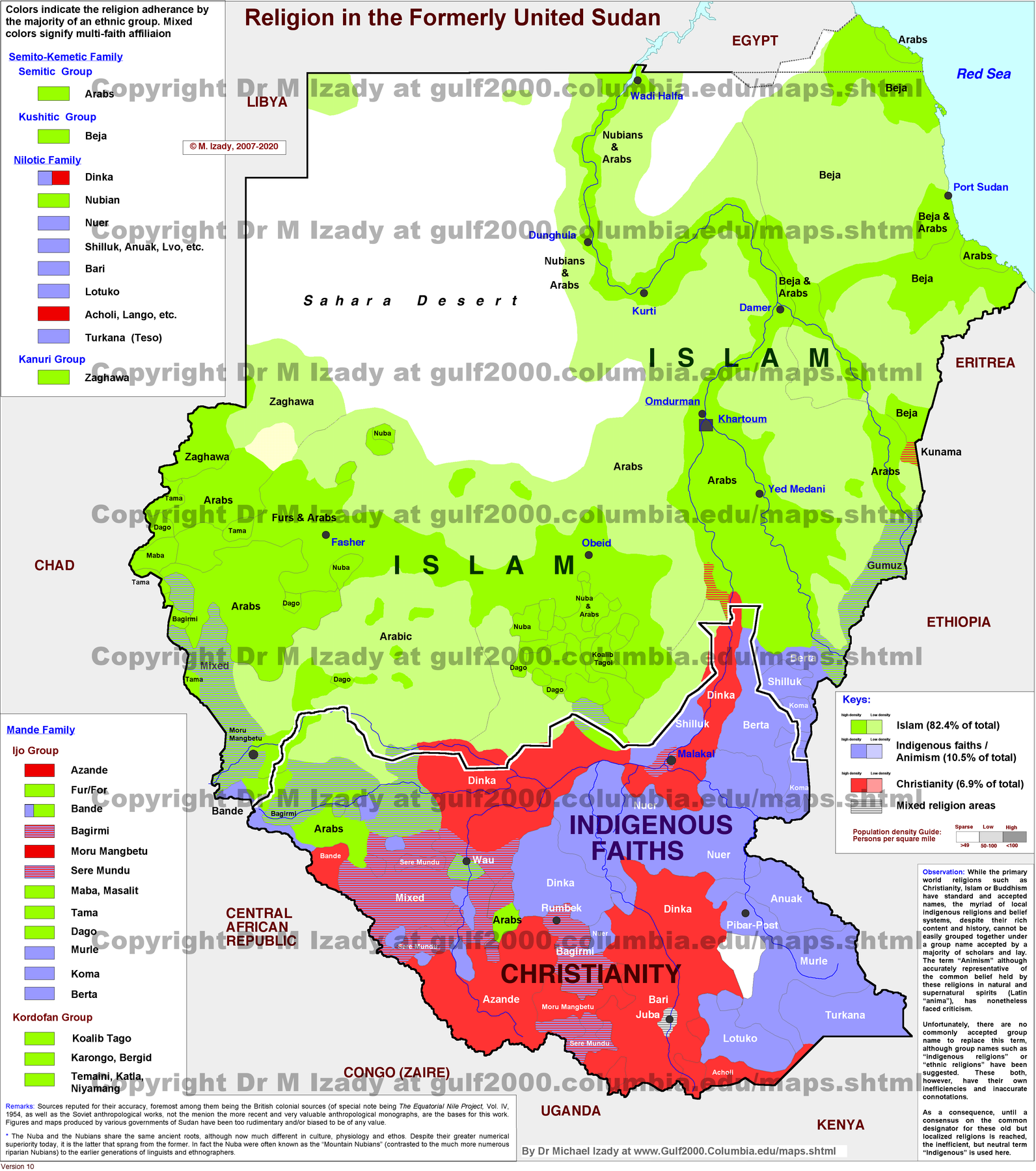
Religious geography for comparison with the account of Islamization and southern resistance. The map is an attributed historical estimate, not a current census.
Map source: Dr. Michael Izady, Gulf/2000, Columbia University. Original map · Collection. Personal reference use; copyright remains with the author.

Ethnic diversity across the old united state
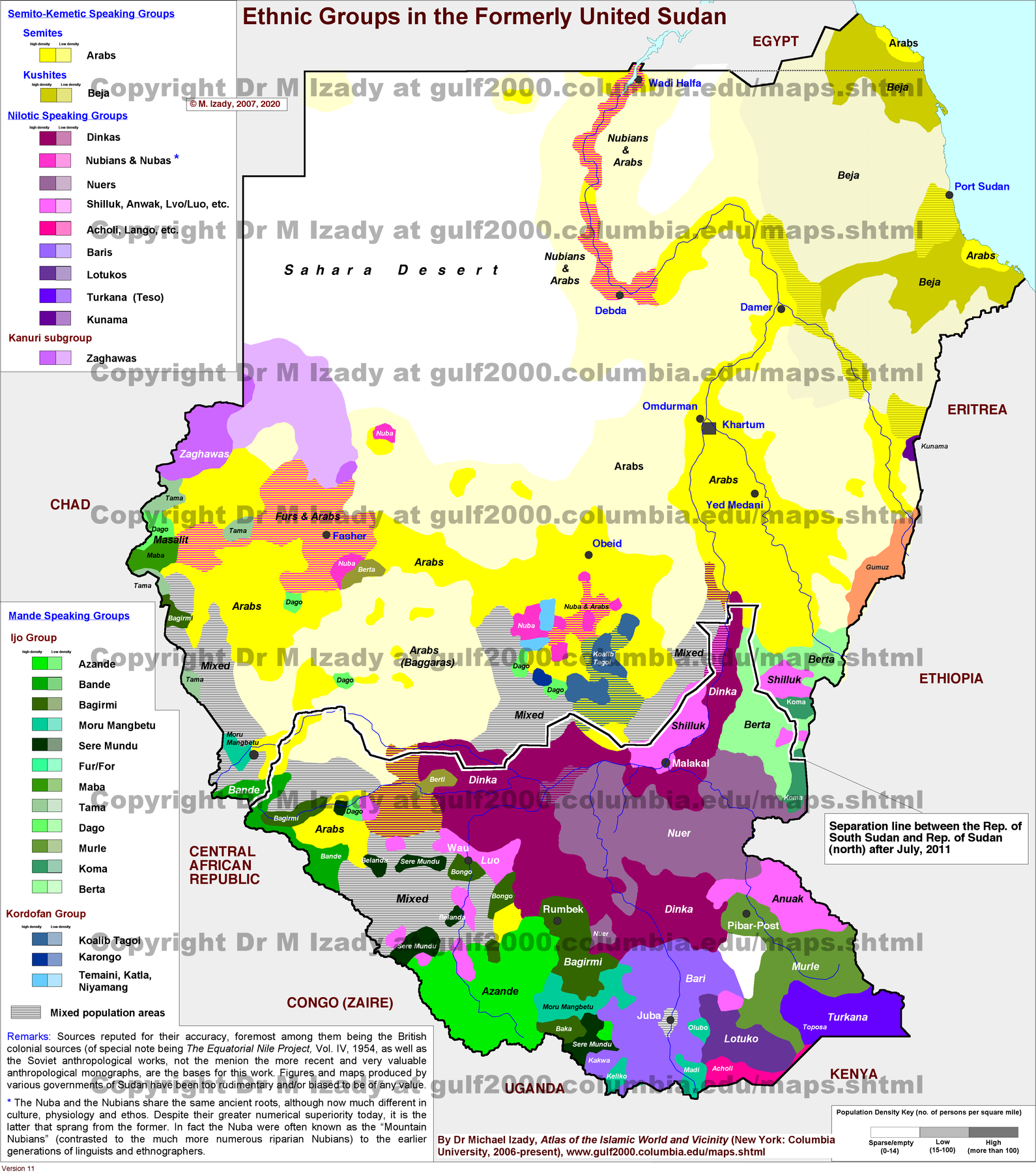
Locate communities within both broad regions. This makes the limits of a simple “Arab north / African south” binary visible.
Map source: Dr. Michael Izady, Gulf/2000, Columbia University. Original map · Collection. Personal reference use; copyright remains with the author.
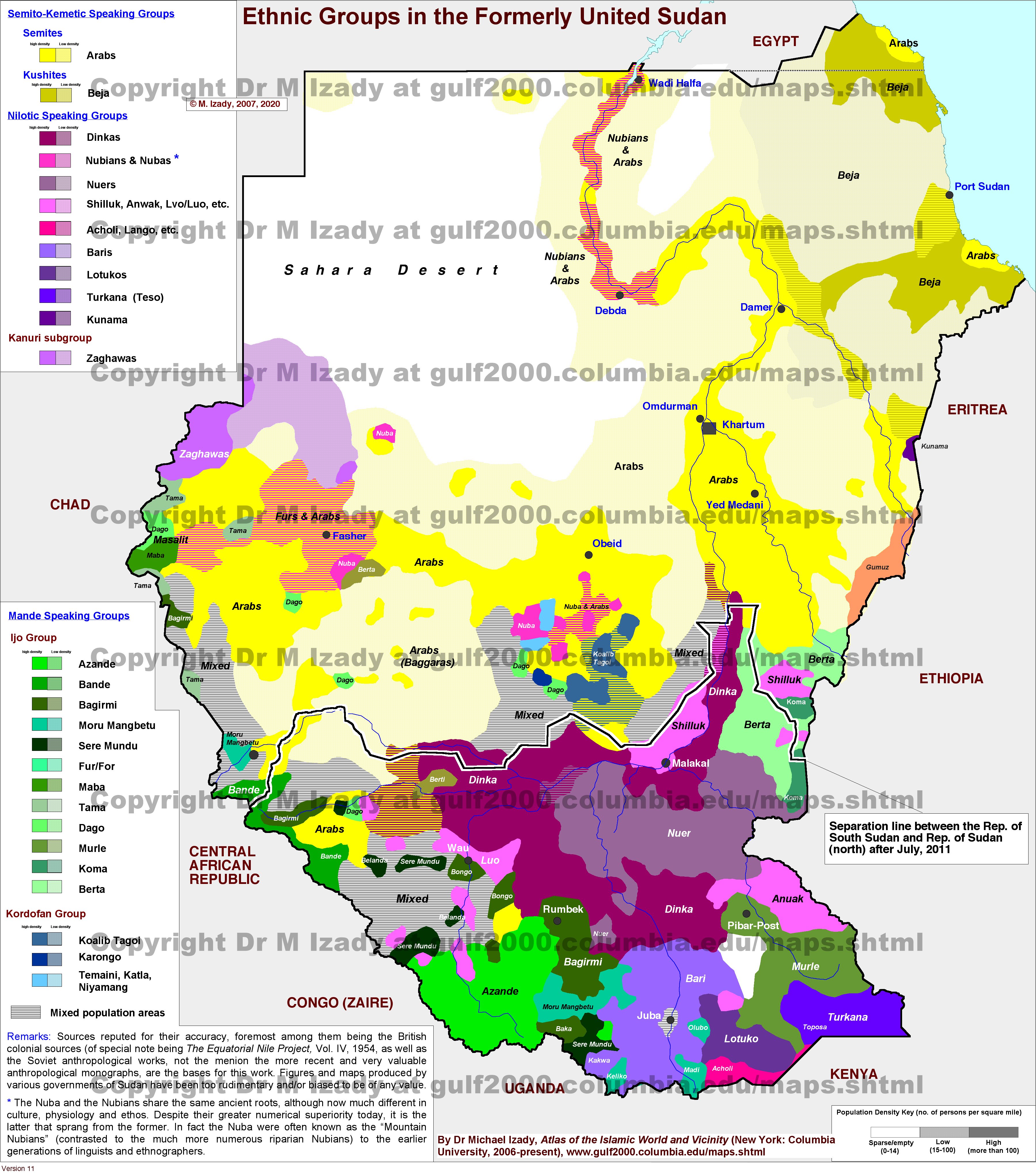
Source and interpretation: Gulf2000 map collection.
Key threads
- The two wars are one conflict with a 10-year pause. The 1972 Addis Ababa Agreement gave the south regional autonomy, its own legislature and executive (the High Executive Council), exemption from Sharia, and a 1:1 north-south troop ratio in the south — but no authority over economic policy, and the troop ratio was never honored. It bought a decade, not a settlement.
- Islamization is the constant. Abboud’s regime stripped the chiefs’ courts (1960), made Arabic mandatory for government services, forced Islamic schooling, and expelled 365 missionaries in 1963–64. Nimeiry, who had no ties to any Islamic school of thought and could therefore sign Addis Ababa, began appeasing the Islamists in 1977 and ended by imposing the September Laws and calling himself Imam of Sudan. Bashir and Turabi took it further still.
- Southern disunity was the government’s best weapon. Anya-Nya, SANU Inside vs. SANU Outside, the SSPG, the Nile Provisional Government, Anya-Nya II, the Nasir split — Khartoum armed the losers of each fight. The Dinka, about a third of the southern population, were feared by every other group, which made Garang’s SPLA look like a “Dinka army” for most of the second war.
- Everyone else’s war was also Sudan’s war. Egypt, Libya, Ethiopia, Uganda, Chad, Israel, the USSR, and the US all fought proxy rounds here. Gaddafi backed coups in Khartoum; Israel armed Joseph Lagu to pin down the Sudanese army; Ethiopia hosted the SPLA and then handed its files to Bashir; Bashir turned Kony’s LRA loose on SPLA supply lines.
- Washington saw the Cold War; its base saw a religious war. The Reagan administration split between anti-communist hawks who read the SPLA as a Soviet-Libyan front and evangelicals who read it as Christians resisting an Islamic dictatorship. That second constituency eventually won out under George W. Bush, who made the peace deal a priority.
- Darfur is a third story that collides with the second. Drought, mechanized farming, Chadian spillover, and Gaddafi’s Arab-supremacist Islamic Legion and Arab Gathering produced the Janjaweed. Darfur’s African Muslims were impeccably Islamist and still never counted as Arab enough for Khartoum. Three revolts (1987, 1995, 2002) — and to secure Bashir’s signature on the 2005 peace deal, the UN and US agreed not to use the word genocide.
B5 notebook pages
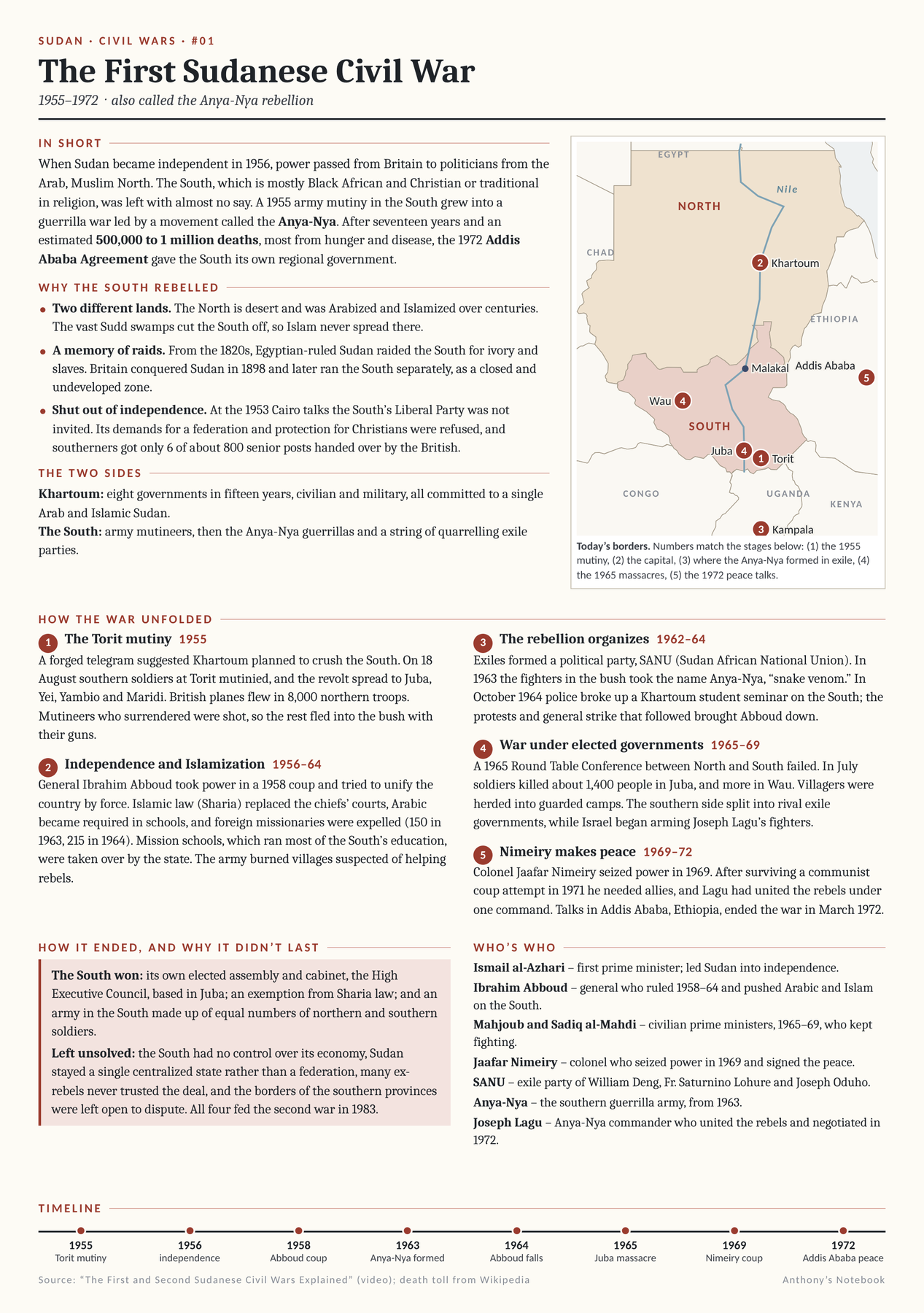
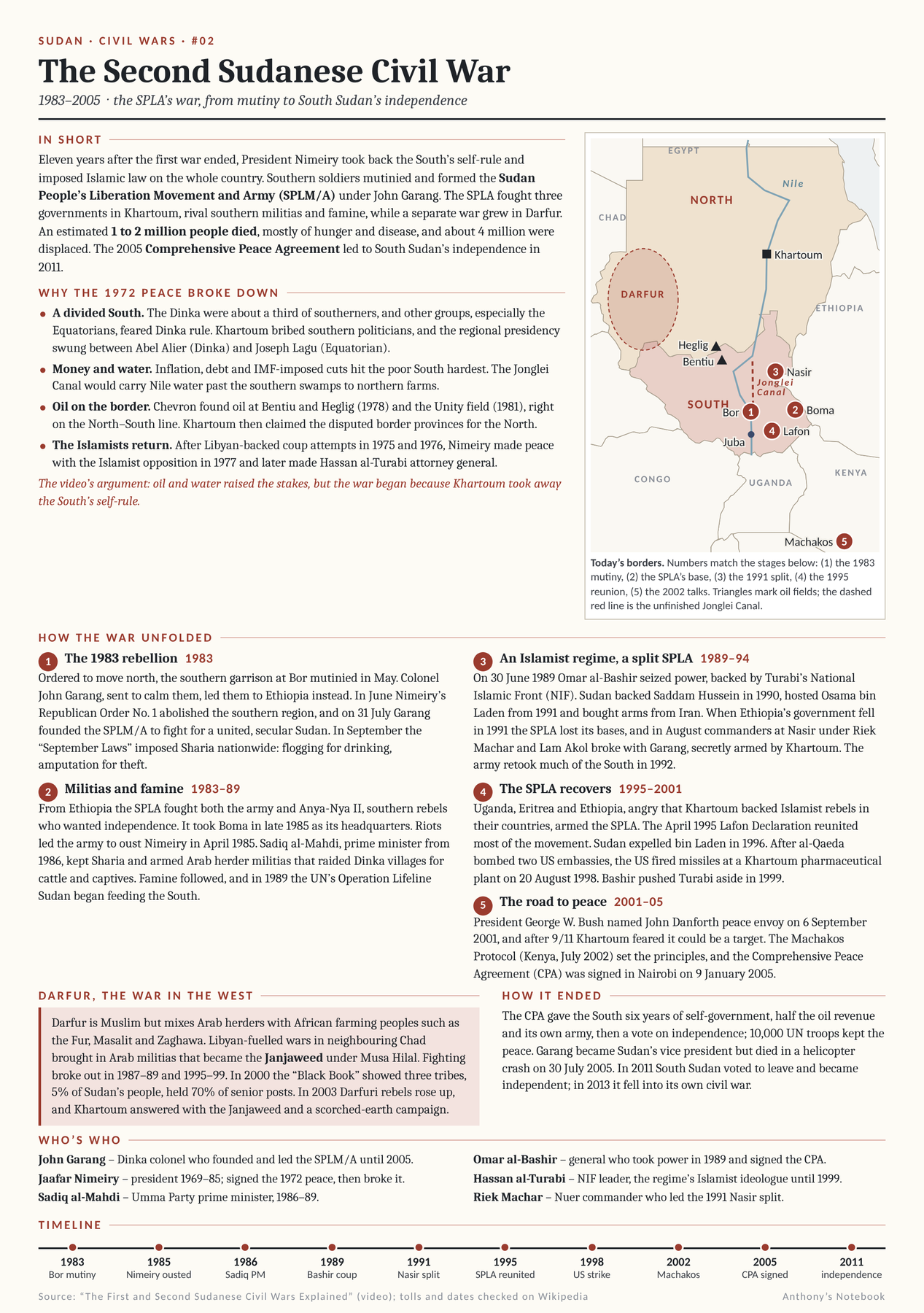
Timeline
Before the wars
- 1820s: Egypt finally penetrates southern Sudan — ivory first, then slave raiding
- 1881–98: Mahdist revolt under Muhammad Ahmad ibn Abdallah against Egyptian and British rule; crushed by the Anglo-Egyptian conquest in 1898
- Early 1900s: Britain reaches the far south, administers it as a separate territory with minimal spending on schools or development
- Early 1930s: militant southern groups pacified; development plans arrive just in time for the Great Depression to kill them
- 1953: Cairo Conference sets the rules for Sudan’s first elections — the south’s Liberal Party is excluded; federalism and Christian safeguards rejected
- 1953: NUP wins parliamentary elections; Ismail al-Azhari becomes PM, then abandons union with Egypt, and Egypt redirects its money to Sudanese rebel groups
First Civil War (1955–1972)
- Aug 1955: forged telegram circulates among southern troops; families of northern officers evacuated from Torit; Lt. Tafeng arrested
- 18 Aug 1955: Equatoria Corps mutinies at Torit rather than deploy to Khartoum; mutinies spread to Juba, Yei, Yambio, Maridi
- Sept–Oct 1955: mutineers who surrender on a promise of fair trial are gunned down; survivors flee to the swamps, Uganda, and the Belgian Congo and begin a guerrilla insurgency. Equatoria Corps liquidated; 1,700 more southerners arrested
- 19 Dec 1955 / 1 Jan 1956: parliament votes for independence; independence granted
- 1956: constitutional committee (3 southerners out of 46) declares Sudan a unitary state, Islam the official religion, Arabic the official language
- 1957: ~10,000 houses burned in the south; Christian mission schools nationalized; Department of Religious Affairs created
- 1958: Umma–PDP coalition under Abdallah Khalil; attempt to make Sudan an Islamic kingdom
- 17 Nov 1958: Khalil hands power to Gen. Ibrahim Abboud; military government
- 1959–60: Operation Nadafa Janub (“cleansing the south”); chiefs’ courts abolished and replaced with the regime’s Sharia; convert-or-lose-your-post ultimatum; Arabic mandated for all government service
- Dec 1960 – 1962: southern politicians flee to Uganda; Sudan Christian Association (1961); SACDNU founded in Leopoldville (Feb 1962), renamed SANU
- Aug 1963: Kampala meeting founds Anya-Nya; first organized attacks in Eastern Equatoria that September
- Jan 1963 / Mar 1964: 150 then 215 foreign missionaries expelled
- 20 Oct 1964: riot police raid a University of Khartoum seminar on “The Problem of the Southern Sudan” → nationwide protests and general strike; Abboud steps down; interim government under Sir al-Khatim al-Khalifa
- Nov 1964 – Jun 1965: SANU fractures — Aggrey Jaden elected president; William Deng returns to Khartoum and forms “SANU Inside”; the March 1965 Round Table Conference collapses on southern disunity
- 1965: Umma–NUP coalition, Mahjoub PM, launches a brutal southern campaign — Juba massacre (8–9 Jul, ~1,400 dead) and the Wau wedding massacre (10 Jul); Southern Front calls it a “Nazi-type extermination policy” and appeals to the UN and OAU
- 1966: Sadiq al-Mahdi becomes PM; “collectivization” concentration camps — ~50,000 relocated by November, cholera rampant
- 1967–70: southern governments rise and fall — SSPG (Aug 1967), Nile Provisional Government (Mar 1969, Gordon Mortat), Taffeng’s breakaway with mercenary Rolf Steiner and a failed coup (Aug 1969); July 1970 Joseph Lagu takes over, unifying the Anya-Nya. Lagu had opened a channel to Israel after the 1967 Six-Day War; Golda Meir supplied him until 1972
- 25 May 1969: Col. Gaafar Nimeiry seizes power in a Free Officers coup
- 19–22 Jul 1971: communist officers under Hashim al-Atta briefly overthrow Nimeiry; Sadat and Gaddafi help reverse it; Atta executed, communists purged, USSR denounced
- 1972: Addis Ababa Agreement ends the war — regional autonomy, own legislature and High Executive Council, exemption from Sharia, 1:1 troop quotas; no authority over economic policy
The interwar decade (1972–1983)
- 1974–: Ethiopia’s Derg takes power; Nimeiry arms Eritrean, Gambella, and Oromo rebels; Ethiopia retaliates by arming Anya-Nya II and the exiled Sadiq al-Mahdi
- 1975–76: back-to-back coup attempts backed by Gaddafi and Ethiopia, with Ansar militias, the NIF, and Darfurian soldiers
- 1976–81: Chevron finds oil and gas — Suakin (1976), Bentiu and Heglig (1978), Unity field (1981) — mostly in provinces whose status was left to referendums that Khartoum never held, then simply claimed
- Late 1970s: debt crisis; IMF and US austerity; budget cuts fall on the south; privatization hands state assets to the Sharia-compliant banks tied to the Umma and DUP
- 1977–: Nimeiry’s appeasement of the Islamists — Sadiq al-Mahdi pardoned, Hassan al-Turabi released and made attorney general to draft a new Sharia code; NIF members placed across government
- 1978–83: Khartoum manipulates southern elections (Abel Alier, Joseph Lagu, Alier again, then Tombura) and pushes the Jonglei Canal — Douglas Johnson’s The Root Causes of Sudan’s Civil Wars (2003) reads it as proof Khartoum wanted the south’s resources with minimum return to the region
Second Civil War (1983–2005)
- Jan–May 1983: Nimeiry orders southern units redeployed north in violation of Addis Ababa; the officers refuse; fighting breaks out; John Garang flees to Ethiopia with ~3,000 troops
- 31 Jul 1983: SPLM/SPLA founded; the Southern Manifesto frames southern grievances as national ones (hence “Sudan,” not “South Sudan,” People’s Liberation Movement)
- 1983: Republican Order No. 1 abolishes the Southern Autonomous Region, splitting it into three; September Laws impose Sharia on the whole country, including the Christian south; Nimeiry proclaims himself Imam of Sudan
- 1984–85: Ethiopia plays the factions against each other; Anya-Nya II attacks SPLA camps; SPLA takes Boma (late 1985) as its in-country HQ
- Apr 1985: economic collapse and riots in Khartoum; the army removes Nimeiry; the interim regime pivots toward Libya and Iran, and Washington cuts ties to the minimum
- Mar 1986: Koka Dam Declaration — all parties but the DUP and NIF agree to a constitutional convention and suspension of religious law
- Apr 1986: first open elections since 1968; DUP wins 100 of 260 seats; Sadiq al-Mahdi becomes PM anyway and refuses to repeal the September Laws
- 1986–89: Sadiq arms the Murahaleen and Arab nomad militias to raid the south — villages burned, thousands enslaved, famine; Dinka families abandon sons who are then taken as slaves or recruited as child soldiers; Operation Lifeline delivers UN food through neighboring countries
- 1987: SPLA counteroffensive pushes the Murahaleen raids into Darfur and the Nuba Mountains; 1989 they are reorganized as the Popular Defense Forces under Omar al-Bashir
- 1988–89: DUP negotiates a second Koka Dam agreement with Garang; Sadiq refuses it
- 30 Jun 1989: as Sadiq is about to fly to Addis Ababa to meet Garang, an NIF-backed coup installs al-Bashir, with Turabi as the regime’s public face
- 1990–92: Sudan backs Saddam’s invasion of Kuwait and loses the Arab world; Iran becomes its main arms supplier; Turabi’s Popular Arab Islamic Congress hosts Hamas, Hezbollah, and al-Qaeda; bin Laden relocates to Sudan
- May 1991: Mengistu falls — the SPLA loses its arms supply and camps, relocates 200,000 people, and the new Ethiopian government hands its files on the SPLA to Bashir
- 28 Aug 1991: the Nasir split — commanders declare independence the goal and try to oust Garang; the coup fails but Khartoum exploits the opening and retakes ground in 1992
- 1994: Bashir turns Joseph Kony’s LRA on SPLA supply routes from Uganda
- 1994–95: IGAD’s Declaration of Principles (self-determination, a secular democratic Sudan); Lafon Declaration (Apr 1995) reunites the Nasir and Torit factions; Ethiopia, Eritrea, and Uganda back the SPLA
- 1995–96: SPLA offensive reverses nearly all of Khartoum’s gains since 1992
- 1996: Sudan tries to expel bin Laden — Saudi Arabia and Jordan refuse him, the Clinton administration declines the offer, and he goes to Afghanistan
- 20 Aug 1998: after the East Africa embassy bombings, US cruise missiles hit the al-Shifa pharmaceutical plant near Khartoum
- 1999: Bashir arrests Turabi, ending their decade-long power struggle
- 2000: the Black Book (Justice and Equality Movement) shows three tribes — 5% of the population — holding 70% of senior government posts; Khartoum’s attempt to buy up copies backfires
- 2001: Bush rescinds the aid ban on northern Sudan (June) and names Jack Danforth envoy (6 Sept); 9/11 changes Bashir’s calculations
- Feb 2002: third Darfur revolt (Fur, Zaghawa, Masalit); Bashir unleashes the Janjaweed; Musa Hilal released Apr 2003; by Oct 2003 the rebels hold most of Darfur
- Jul 2002: Machakos Protocol; Powell offers removal from the state-sponsor-of-terror list
- Jan 2005: Comprehensive Peace Agreement (Naivasha) — a referendum on southern independence, 10,000 UN troops. The video says the UN and US agreed not to call Darfur a genocide to secure Bashir’s cooperation; this is wrong as stated — see The "genocide" wording — what actually happened below
- 2005: John Garang dies in a plane crash, widely suspected of foul play
- 2011: South Sudan votes for independence and becomes the newest UN member state
- 2013: South Sudan falls into its own civil war
The “genocide” wording — what actually happened
The video’s claim doesn’t survive checking
The narrator says that “in order to ensure the cooperation of the Sudanese government, both the UN and the US government had to refrain from referring to the massacres in Darfur as genocide.” Neither half holds up. The US used the word, loudly and first. The UN’s own inquiry refused to use it — and did so on legal grounds, not as a concession to Khartoum. The real story is more damning than the one he tells, and it belongs in a note on how the word gets used.
The US said “genocide” — and then said it changed nothing. On 9 September 2004, four months before the CPA was signed, Secretary of State Colin Powell testified to the Senate Foreign Relations Committee that “genocide has been committed in Darfur and that the Government of Sudan and the jinjaweid bear responsibility — and genocide may still be occurring.” It was the first time a US administration had applied the term to an ongoing conflict. The finding rested on the Atrocities Documentation Team, which interviewed more than 1,100 Darfuri refugees in Chad — an unusually rigorous evidentiary base for a determination of this kind. Bush repeated the charge at the UN General Assembly weeks later.
The catch was the second half of Powell’s testimony. He told the committee the determination carried no new obligation — that nothing in the Genocide Convention required action beyond what the US was already doing, and that Washington’s course in Sudan would not change. Critics read the whole exercise as the word being deployed as a substitute for policy rather than a trigger for it. Powell had, however, invoked Article VIII of the Convention to call on the UN to investigate — which produced the very body that then contradicted him.
The UN’s inquiry concluded it was not genocide. UN Security Council Resolution 1564 (18 September 2004) created the International Commission of Inquiry on Darfur, chaired by the Italian jurist Antonio Cassese. Its report, delivered 25 January 2005 — sixteen days after the CPA — found that the Government of Sudan “has not pursued a policy of genocide,” because the Commission could not establish genocidal intent (dolus specialis) at the level of state policy. Crucially, it did not stop there:
- It found crimes against humanity and war crimes on a large scale, and stated plainly that these “may be no less serious and heinous than genocide.”
- It left open that individual perpetrators, including government officials, might be found by a competent court to have acted with genocidal intent.
- It recommended referral to the International Criminal Court — which the Security Council did in Resolution 1593 (31 March 2005), with the US abstaining rather than vetoing.
And the courts eventually went the other way. The ICC Prosecutor charged Bashir with genocide; Pre-Trial Chamber I declined the genocide counts in the first arrest warrant (4 March 2009, war crimes and crimes against humanity only), the Appeals Chamber ruled in March 2010 that the Chamber had applied too demanding a standard of proof, and on 12 July 2010 a second warrant added three counts of genocide against the Fur, Masalit, and Zaghawa — the first genocide charges in the Court’s history.
What’s actually true in the video’s framing
There is a real and well-documented critique underneath the garbled claim: the Bush administration prioritized the north-south CPA and was slow and soft on Darfur, and its post-9/11 intelligence relationship with Khartoum cut against confrontation. Congressional Research Service reporting notes the administration did not initially treat Darfur as a priority while the Naivasha talks were running. So the charge of subordinating Darfur to the peace deal is defensible. The specific claim that the word was suppressed is not — it was used, and then decoupled from consequences, which is a different failure.
For the full picture see Darfur.
Darfur (parallel track)
- 1970s: drought and mechanized farming displace subsistence farmers and set herders against farmers
- 1980s: Chad’s civil war spills over; Nimeiry arms Chad’s government against Libya, and after 1985 Khartoum flips to Gaddafi’s Arab allies — many of whom end up in the Popular Defense Forces
- Gaddafi’s Islamic Legion and Arab Gathering, aiming to cleanse the Sahel of African farmers and herders, become the Janjaweed under Sheikh Musa Hilal
- 1987: first revolt — Fur form the Federal Army of Darfur (6,000 fighters); Khartoum arms the Janjaweed better; thousands of Fur killed, hundreds of villages burned. The 1989 disarmament agreement is never enforced
- Jan 1992: Daoud Bolad’s SPLA campaign into Darfur fails; he is captured and executed
- 1994: Bashir and Turabi split Darfur into three provinces to weaken the Fur — the same move Nimeiry used on the south in 1983
- 1995: second revolt — the Masalit rise after Arab newcomers are granted the title of emir, on par with their sultan; 1999 balance-of-power agreement
Key figures
| Figure | Role |
|---|---|
| Ismail al-Azhari | NUP leader, first PM; presided over the Torit mutiny and independence |
| Gen. Ibrahim Abboud | 1958 coup; “cleansing the south”; Arabization/Islamization; fell in Oct 1964 |
| Joseph Oduho / Aggrey Jaden / Gordon Mortat | Rotating leaders of the fractious southern exile governments |
| Joseph Lagu | Unified the Anya-Nya (1970), opened the Israeli channel, later an HEC president |
| Gaafar Nimeiry | 1969 coup; signed Addis Ababa (1972); appeased the Islamists from 1977; imposed the September Laws (1983); ousted 1985 |
| Sadiq al-Mahdi | Umma leader, PM twice; armed the Murahaleen; overthrown 1989 |
| Hassan al-Turabi | NIF architect; drafted the Sharia code; hosted al-Qaeda; arrested by Bashir in 1999 |
| Omar al-Bashir | PDF commander → 1989 coup → 30 years in power |
| John Garang | Dinka officer, US-educated; founded the SPLM/A in 1983; died 2005 |
Caveats — check before citing
- The video dates Garang’s death to June 2005; it was 30 July 2005, and it was a helicopter crash. Worth confirming before use.
- Turabi is called both Sadiq al-Mahdi’s brother-in-law and his cousin at different points. Brother-in-law is the usual account.
- One line has “Omar al-Bashir” worried about Soviet influence in the mid-1970s — he wasn’t in power until 1989. Likely a transcript garble.
- The claim that “Namibia began supporting the SPLA” around 1992 looks like a transcription error; treat as unverified.
- The 2005 deal is the Comprehensive Peace Agreement (Naivasha); the video refers to it only descriptively.
- The genocide-wording claim is false as stated — the US declared genocide in Sept 2004 and the UN’s own commission rejected the label on legal grounds. Corrected in full above.
- This is a summary of one YouTube video, not of the underlying sources. The narrator’s own cited source is Douglas Johnson, The Root Causes of Sudan’s Civil Wars (2003) — the thing to read if the thesis is worth testing.