Who are the Phoenicians
Based on the information provided in the search results, here is a summary of who the Phoenicians were:
The Phoenicians were an ancient Semitic-speaking maritime trading culture that originated in the Levant region along the eastern coast of the Mediterranean, primarily in modern-day Lebanon, Syria and northern Israel[3][9][16]. They are widely considered the descendants of the earlier Canaanite inhabitants of the region[9][16].
The Phoenicians were organized into independent city-states, the most notable being Tyre, Sidon, Byblos, Berytus (modern Beirut) and Arwad[3][9][15]. Each city-state was politically independent and ruled by kings or merchant oligarchies, though they shared a common culture and language[9][15][16].
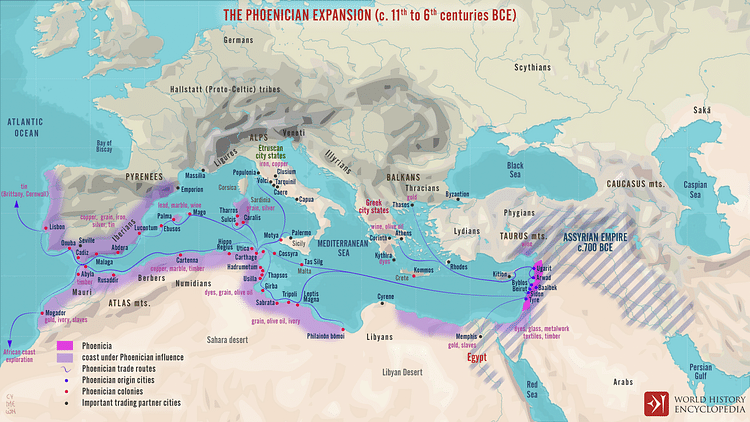
Phoenicia thrived as a maritime trading power from around 1500-332 BC[3][9]. The Phoenicians developed an expansive trade network across the Mediterranean, establishing colonies and outposts as far as the Iberian Peninsula, North Africa, Sicily and Sardinia[1][3][7][9]. Major colonies included Carthage, Cadiz, Utica and Lixis[1][7][14]. Their maritime dominance was enabled by their advanced seafaring and navigation skills[3][9][15].
In addition to facilitating trade between major ancient civilizations like Egypt, Greece and Mesopotamia[3][9], the Phoenicians made important cultural contributions of their own. Most notably, they developed the Phoenician alphabet, the basis for most modern alphabets[3][9][15]. They were also renowned for their skill in shipbuilding, glass-making, textile production and purple dye manufacturing[3][9][16].
The Phoenicians went into decline due to conquest by the Assyrians, Babylonians and Persians between the 9th-6th centuries BC[9][16]. Phoenicia was later conquered by Alexander the Great in 332 BC and eventually incorporated into the Roman Empire[3][9][16]. However, the Phoenician culture and influence persisted, especially through the legacy of the powerful Phoenician colony of Carthage[9].
- Citations:
[1] https://phoenician.org/phoenician_colonies/
[2] https://www.encyclopedia.com/science/encyclopedias-almanacs-transcripts-and-maps/phoenicians-early-lessons-economics
[3] https://www.metmuseum.org/toah/hd/phoe/hd_phoe.htm
[4] https://www.shorthistory.org/ancient-civilizations/mesopotamia/phoenicia/economy-of-phoenicia/
[5] https://phoenician.org/origin_of_phoenicians/
[6] https://www.worldhistory.org/article/881/trade-in-the-phoenician-world/
[7] https://en.wikipedia.org/wiki/History_of_Phoenicia
[8] https://en.wikipedia.org/wiki/List_of_Phoenician_cities
[9] https://en.wikipedia.org/wiki/Phoenicia
[10] https://kinnu.xyz/kinnuverse/history/phoenicians-culture/phoenician-colonies/
[11] https://courses.lumenlearning.com/atd-herkimer-westerncivilization/chapter/the-phoenicians/
[12] https://www.khanacademy.org/humanities/whp-origins/era-3-cities-societies-and-empires-6000-bce-to-700-c-e/32-long-distance-trade-betaa/a/read-phoenicians-masters-of-the-sea-beta
[13] https://smithsonianassociates.org/ticketing/tickets/phoenicians-and-their-colonies
[14] https://phoenicia.org/colonies.html
[15] https://www.worldhistory.org/phoenicia/
[16] https://www.britannica.com/place/Phoenicia
[17] https://phoenicia.org/originphoenicians.html
[18] https://kinnu.xyz/kinnuverse/history/phoenicians-culture/the-phoenician-civilization-an-overview/
[19] https://www.biblicalarchaeology.org/daily/ancient-cultures/ancient-near-eastern-world/who-were-the-phoenicians/
Based on the provided sources, here are some of the key characteristics of Phoenician society:
-
Organized into independent city-states: The Phoenicians were not a single unified kingdom, but rather a collection of independent city-states like Tyre, Sidon, Byblos, and Arwad. Each city-state was politically autonomous, ruled by kings or merchant oligarchies[3][7][11].
-
Maritime trading culture: Phoenician society and economy revolved around maritime trade. They were renowned for their skill in shipbuilding, navigation, and seafaring, establishing trade networks and colonies across the Mediterranean[1][2][7][9][11]. Trade was so central that Phoenician merchants made up the ruling senate[9].
-
Highly stratified society: Phoenician society was stratified, with a clear division between the ruling elite of merchants, landowners, priests and military leaders, and the common people. At the bottom were slaves with no rights[15].
-
Diverse economy: While hugely dependent on maritime commerce, the Phoenicians also had a complex, diversified economy that included agriculture, livestock breeding, fishing, glass-making, woodworking, ivory carving, metalworking, and production of dyes like Tyrian purple[1][4][7][12][17].
-
Cosmopolitan and open to outside influences: Phoenician culture was shaped by its exposure and openness to many different peoples through its far-reaching trade networks. This is reflected in their art, religion, and customs which absorbed Egyptian, Greek, Assyrian and other influences[7][9][13].
-
Advanced artisanal skills: Phoenician artisans were highly skilled in shipbuilding, woodworking, ivory carving, metalworking, glass production, and especially textile dyeing[1][7][19]. Their craftsmanship was coveted across the ancient world.
-
Spread of alphabetic writing: One of the Phoenicians’ most significant cultural contributions was the development and spread of the Phoenician alphabet, which became the basis for the Greek and later Roman alphabets[3][7][12].
So in summary, Phoenician society was characterized by independent city-states unified by a maritime trading culture, a stratified social hierarchy, diverse economy, cosmopolitan outlook, advanced craftsmanship, and important cultural innovations like their alphabet. Their mercantile network was the backbone that held their civilization together.
- Citations:
[1] https://www.encyclopedia.com/science/encyclopedias-almanacs-transcripts-and-maps/phoenicians-early-lessons-economics
[2] https://phoeniciacivillization.weebly.com/accomplishments.html
[3] https://oxfordre.com/classics/display/10.1093/acrefore/9780199381135.001.0001/acrefore-9780199381135-e-8368
[4] https://www.shorthistory.org/ancient-civilizations/mesopotamia/phoenicia/economy-of-phoenicia/
[5] https://www.worldhistory.org/article/881/trade-in-the-phoenician-world/
[6] https://phoenician.org/phoenician_religion/
[7] https://en.wikipedia.org/wiki/Phoenicia
[8] https://www.ancientpages.com/2021/01/04/phoenicians-powerful-traders-and-their-remarkable-seafaring-achievements/
[9] https://www.khanacademy.org/humanities/whp-origins/era-3-cities-societies-and-empires-6000-bce-to-700-c-e/32-long-distance-trade-betaa/a/read-phoenicians-masters-of-the-sea-beta
[10] https://localhistories.org/the-phoenicians/
[11] https://courses.lumenlearning.com/atd-herkimer-westerncivilization/chapter/the-phoenicians/
[12] https://study.com/academy/lesson/the-phoenicians-history-religion-civilization.html
[13] https://www.worldhistory.org/Phoenician_Religion/
[14] https://phoenicia.org/pagan.html
[15] https://kinnu.xyz/kinnuverse/history/phoenicians-culture/the-phoenician-civilization-an-overview/
[16] https://en.wikipedia.org/wiki/Punic_religion
[17] https://phoenicia.org/puniceconomy.html
[18] https://kinnu.xyz/kinnuverse/history/phoenicians-culture/the-phoenician-religious-beliefs/
[19] https://www.metmuseum.org/toah/hd/phoe/hd_phoe.htm
[20] https://www.worldhistory.org/phoenicia/
Based on the provided sources, here is an overview of the Phoenicians colonizing southern Spain, Sardinia, and Sicily from around 1200 BC:
The Phoenicians, skilled seafarers and traders based in city-states like Tyre, Sidon, and Byblos along the coast of modern-day Lebanon, began establishing colonies and trading posts across the Mediterranean starting around 1200 BC[1][10]. Motivated by the search for new markets and valuable raw materials like metals, they expanded westward, founding coastal settlements in Cyprus, North Africa, Sicily, Sardinia, the Balearic Islands, and the Iberian Peninsula (Spain and Portugal)[2][8][9].
In southern Spain, the Phoenicians established the colony of Gadir (modern-day Cádiz) as early as 1110 BC according to ancient sources, although archaeological evidence points to a more likely founding in the 8th century BC[10][11]. They were drawn to the region’s mineral wealth, especially silver, tin, and gold[8]. Other important Phoenician settlements in southern Spain included Malaka (Málaga), Sexi (Almuñécar), and Abdera (Adra)[10].
On the island of Sardinia, the Phoenicians founded colonies like Nora, Sulcis, Tharros, and Caralis (Cagliari) probably in the 9th century BC[2][10]. Sardinia was valued for its rich agricultural land and mineral deposits. Excavated Phoenician tombs there have yielded luxury items like imported Greek pottery and jewelry, attesting to their prosperity[2].
Sicily was another important center of Phoenician colonization, although they later withdrew to the western part of the island in the face of Greek competition[11]. Major Phoenician settlements in Sicily included Motya, Panormus (Palermo), and Solus (Solunto), founded from the 8th century BC[3][11]. The strategic islands of Malta, Gozo, and Pantelleria between Sicily and North Africa also had Phoenician colonies[11].
From these colonies in the central and western Mediterranean, the Phoenicians were able to expand their maritime trading network even further, past the Strait of Gibraltar to the Atlantic coasts of Africa and Europe[4][9]. Their colonial and commercial activity in this period laid the foundations for the later rise of Carthage as the dominant Phoenician power in the western Mediterranean[10][11].
Citations:
[1] https://nuttersworld.com/ancient-trade-routes-mediterranean-sea/ancient-maritime-trade-routes-mediterranean-sea/
[2] https://en.wikipedia.org/wiki/History_of_Sardinia
[3] https://www.boglewood.com/sicily/phoenicians.html
[4] https://www.khanacademy.org/humanities/whp-origins/era-3-cities-societies-and-empires-6000-bce-to-700-c-e/32-long-distance-trade-betaa/a/read-phoenicians-masters-of-the-sea-beta
[5] https://courses.lumenlearning.com/atd-herkimer-westerncivilization/chapter/the-phoenicians/
[6] https://www.britannica.com/place/Spain/Phoenicians
[7] http://www.bestofsicily.com/mag/art150.htm
[8] https://www.metmuseum.org/toah/hd/phoe/hd_phoe.htm
[9] https://en.wikipedia.org/wiki/History_of_Phoenicia
[10] https://www.worldhistory.org/Phoenician_Colonization/
[11] https://smithsonianassociates.org/ticketing/tickets/phoenicians-and-their-colonies
[12] https://en.wikipedia.org/wiki/Phoenicia
[13] https://www.ololeaston.org/?page_id=183
[14] https://scholarsarchive.byu.edu/cgi/viewcontent.cgi?article=2047&context=ccr
[15] https://www.reddit.com/r/MapPorn/comments/102yhue/trade_in_the_ancient_mediterranean_dominated_by/
[16] https://www.tharros.info/text/1104/en
[17] https://www.reddit.com/r/lebanon/comments/zczzf9/phoenician_trade_and_civilization_c_1200_to_332_bc/
Maps