The Flynn effect refers to the substantial and sustained increase in standardized intelligence quotient (IQ) test scores globally throughout the 20th century. The phenomenon was named after James Robert Flynn, a social scientist who extensively documented this upward trend in the 1980s.
Key Details
- Magnitude: Average IQ scores increased by approximately 3 points per decade in many industrialized countries.
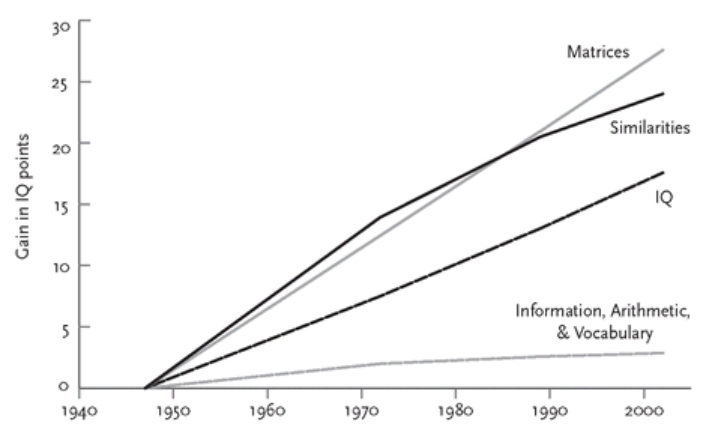
- Nature of Gains: The gains were particularly pronounced in measures of fluid intelligence (abstract reasoning and problem-solving), such as the Raven’s Progressive Matrices test, rather than crystallized intelligence (knowledge from schooling, such as vocabulary or arithmetic). This suggests a change in cognitive style rather than a general increase in “raw” intelligence.
- Implications: The effect highlights that measured intelligence is not a fixed, innate ability but can be significantly influenced by environmental and cultural factors. It has clinical and legal implications, as test norms must be periodically updated to ensure accurate diagnoses of intellectual disabilities or giftedness.
Proposed Causes
Researchers point to various environmental and societal changes as contributing factors to the Flynn effect:
- Improved Nutrition: Better prenatal and early childhood nutrition has led to physical changes (e.g., increased height and skull size) that correlate with cognitive development.
- Increased and Better Education: Longer school attendance, a greater emphasis on problem-solving skills over rote learning, and higher parental educational attainment have all played a role.
- More Complex Environments: Modern society’s increased exposure to complex visual media (television, computers, video games) and technology fosters abstract thinking and symbolic representation skills.
- Smaller Family Sizes: Parents can offer more attention and resources to fewer children, which positively impacts cognitive development.
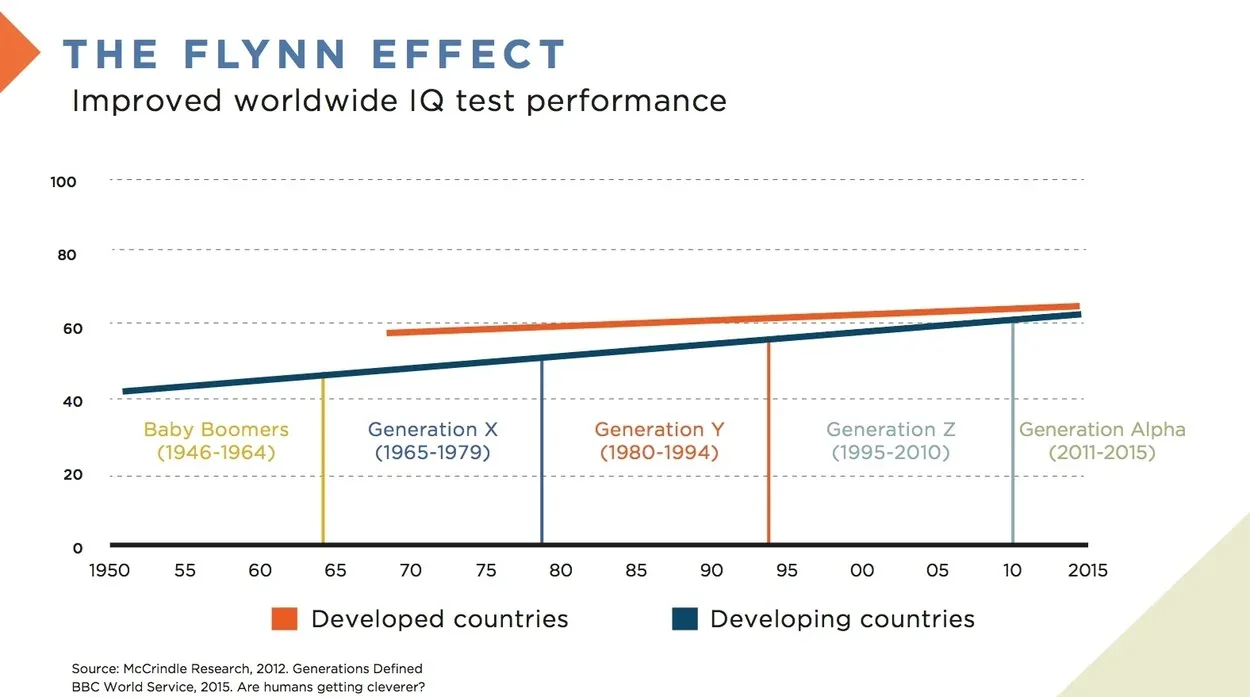
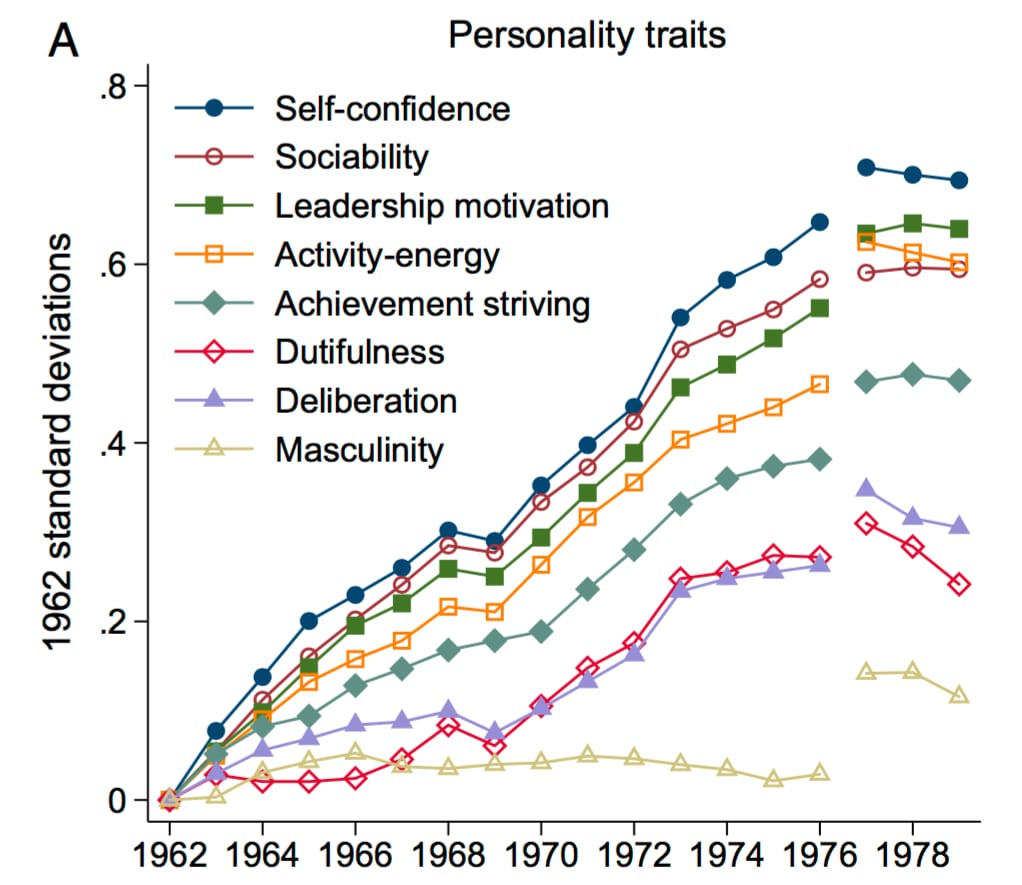
Pinker’s Chapter 9 supplement — what rose in the Flynn effect
Pinker’s 2011 account reports an average twentieth-century increase of roughly three IQ points per decade across the datasets James Flynn assembled, but he rejects the literal conclusion that an ordinary person from 1910 would be globally impaired today. The gains were uneven: matrices and similarities rose far more than vocabulary, arithmetic, information, or raw memory. Pinker therefore interprets the change less as a uniform increase in g than as increased practice in abstract classification, hypothetical reasoning, symbols, percentages, correlations, control groups, and other “scientific spectacles.” He treats the rapid timescale as evidence for environmental change, not genetic evolution.
Figure 9-2 — U.S. gains by subtest, 1947–2002; the divergence among subtests is the point. Pinker then proposes a moral Flynn effect: abstraction may make perspective interchange, proportional punishment, and universal rules easier. That is a historical hypothesis, not proof that IQ produces virtue or that group-score differences have a genetic cause. The figure ends in 2002, the chapter was published in 2011, and later trend estimates are outside this source extraction. Chapter 9 synthesis · Flynn-effect magnitude, PDF pp. 892–894 (file not included in this release) · Figure 9-2, PDF p. 894 (file not included in this release) · Environmental and abstract-reasoning interpretation, PDF pp. 895–900 (file not included in this release)
Race, ancestry, and group-mean inference
For the historical development of these distinctions—and their use in immigration law, sterilization, education, and modern genomics—see Hereditarianism, Eugenics, Race, and IQ in the United States - A Chronological Timeline.
Nathan Cofnas's focused interview synthesis is a useful case study in why four propositions must be separated:
- Cognitive tests measure a real, predictive construct. Scores correlate with education, occupation, health, and other outcomes, but do not measure total human worth or guarantee an individual’s future.
- Individual differences are substantially heritable in many studied populations. Heritability is specific to a population and environment; it is not the percentage of one person’s intelligence “caused by genes.”
- Average test scores can differ among socially classified groups. The size of a gap depends on the sample, cohort, test, age, schooling, language, immigration selection, and category definition.
- The cause of a between-group mean difference is a separate question. Individual-level heritability plus an observed group gap does not calculate how much of that gap is genetic.
Current evidence boundary
Human populations have ancestry-correlated genetic structure, but broad racial labels are fuzzy, admixed, and internally heterogeneous. Current European-derived polygenic scores lose accuracy across ancestries and can be confounded by population structure, indirect parental-genetic effects, and environments. They do not yet provide a validated causal decomposition of broad racial IQ gaps.
The same discipline applies in the opposite direction. Evidence that environments affect IQ does not prove that every group gap is entirely environmental. The appropriate conclusion is calibrated: IQ is neither a meaningless social fiction nor a direct genetic ranking of races; the causal share of broad contemporary group gaps remains unresolved.
Cofnas’s cumulative indirect case
Cofnas accepts that present genomics has not directly decomposed broad racialized IQ gaps. He thinks the combined indirect evidence—adoption studies, regression patterns, cross-national results, intervention fadeout, migration selection, evolutionary considerations, and population structure—nevertheless warrants a hereditarian conclusion. This is a convergent or abductive argument: no one line is supposed to be decisive, but he thinks the bundle fits partial genetic causation better than environment-only accounts.
- Adoption studies: adoptees’ later scores sometimes resemble racialized population averages more than their adoptive-home advantages would predict. This challenges simple shared-home explanations, but pre-adoption experience, placement, attrition, racialized treatment, and small samples prevent a clean genetic estimate.
- Regression patterns: children of unusually high-scoring parents regress toward less extreme averages, sometimes toward different observed group means. That is compatible with differing inherited distributions, but regression also follows from measurement error, selection, imperfect parent–child correlation, assortative mating, and persistent group environments.
- Cross-national results: recurring score differences across countries or migrant settings may strain explanations tied to one local institution. The inference depends on comparable sampling, tests, schooling, language, health, migration selection, and category definitions; a repeated ranking is not itself a causal decomposition.
- Intervention fadeout: the disappearance of some early IQ gains is taken to show that environmental enrichment does not erase underlying differences. Fadeout on one measure does not identify a genetic cause, and some educational exposures or programs produce durable cognitive or life-course effects.
- Migration selection: descendants of positively selected migrants may score closer to a source-population mean than their exceptional parents. Regression after selection is real, but without measured parental genotypes, direct and indirect genetic effects, assortative mating, and comparable environments, this is not an independent estimate of a racial genetic gap.
- Evolutionary considerations: cognitive traits are heritable and polygenic, human populations experienced selection, and different ecologies could in principle produce different trait distributions. This establishes biological plausibility, not the direction or magnitude of a contemporary Black–White or continental gap.
- Population structure: ancestry-correlated genetic structure and allele-frequency differences make population genetic differences possible. Structure is a necessary background condition for a genetic group explanation, not evidence that the relevant cognitive variants differ causally between the groups being compared.
The cumulative case becomes stronger only to the extent that these observations are partly independent, predicted more specifically by hereditarianism than by rival models, and not driven by shared confounders. Several lines reuse the same observed group means or the same regression logic, so simply counting them can double-count evidence. Murray’s older position was the weaker inference that a zero-genetic contribution seemed improbable while the mixture remained unknown; Cofnas argues more strongly that the indirect totality supports a nontrivial and probably majority contribution. See Cofnas's full cumulative-case audit.
Farina, Cofnas, and Charles Murray: where the disagreement lies
| Position | Defensible point | Overreach or limit |
|---|---|---|
| Dave Farina | Race is not a set of discrete biological subspecies, and current evidence does not establish a genetic share of the broad contemporary racialized IQ gap. | He converts failure to establish into conclusive refutation of any ancestry-linked contribution and treats further investigation as unwarranted. |
| Nathan Cofnas | IQ is meaningful but incomplete; individual variation is substantially heritable in many studied populations; ancestry structure exists; a precisely zero group contribution is not logically proved. | He converts possibility, compatibility, and partially dependent indirect evidence into a probable-majority genetic conclusion that current evidence does not quantify. |
| Herrnstein and Murray, 1994 | They treated genes and environment as probable contributors and regarded exact zero as unlikely. | They remained agnostic about the proportions and supplied no genomic causal estimate of the group gap. |
| Charles Murray on human worth | Cognitive usefulness and predictive validity do not rank a person’s fundamental worth; people should not be globally ordered by IQ. | This normative position does not settle Murray’s empirical claims or policy arguments. Cofnas differs by making intelligence one component of worth. |
| Current evidence boundary | Supports meaningful measurement, individual genetic effects, environmental causation, historical malleability, and ancestry structure. | The [[60 Knowledge/60.3 Politics/60.3.12 - Source Audits & Media/Sabine Hossenfelder - More Exposed Than Ever (Racism Edition)#Farina, Cofnas, and Charles Murray: the underlying IQ dispute |
Core formula
Farina turns non-establishment into refutation; Cofnas turns possibility and compatibility into probability and magnitude. Herrnstein and Murray declined to assign a percentage, while contemporary Murray and Cofnas also disagree about whether intelligence contributes to human worth.
The unresolved target is not a timeless property of “races.” Any proposed percentage needs a defined population, period, test, group classification, counterfactual environment, treatment of gene–environment interaction and covariance, and separation of direct genetic effects from stratification and indirect parental effects. Evidence that schooling changes scores does not prove exact zero; evidence that polygenic scores predict individuals does not allocate a between-group mean. See the full source-audited comparison and Murray and Cofnas: different strengths of conclusion.
Policy boundary
Even if future work established some inherited contribution to a group average, it would not determine an individual’s ability, rights, dignity, or appropriate treatment. Group distributions overlap, causal facts do not supply moral premises by themselves, and selection decisions should use relevant individual evidence rather than racial averages.
AI, intelligence measurement, and the genealogy question
The PBS documentary Ghost in the Machine (PBS Documentary) argues that AI inherits eugenic ideas through statistics, intelligence measurement, and classification. Its strongest historical point is the documented fusion of psychometrics, hereditarian ranking, and coercive policy in the early twentieth century. Its broadest claim needs a further step: a shared method or word does not establish that a present AI system retains the same objective or ideology. The source note preserves the documentary transcript and tests that inference against the history of statistics, clinical trials, logistic regression, and the genetic fallacy.