👥 Black Men
⬅️ Hub: Boy Crisis MOC
The double disadvantage: race and gender.
Black Men
Of Boys and Men _ Why the Modern Male Is S - Reeves, Richard copy, p.13 (file not included in this release)
Black men face not only institutional racism but gendered racism, including discrimination in the labor market and criminal justice system.
Of Boys and Men _ Why the Modern Male Is S - Reeves, Richard copy, p.68 (file not included in this release)
How does wearing unnecessary glasses help him sell more cars? “White people especially are just more relaxed around me when I wear them,” he explained. Dwight is six foot five. He is also Black. It turns out that this is a common tactic for defusing white fear of Black masculinity. Dwight is six foot five. He is also Black. It turns out that this is a common tactic for defusing white fear of Black masculinity…Defense attorneys certainly know about it, often asking their Black clients to put on glasses. They call it the “nerd defense.”
Of Boys and Men _ Why the Modern Male Is S - Reeves, Richard copy, p.73 (file not included in this release)
Black men are much less likely than white men to rise up the income ladder, while Black and white women raised by poor parents have similar rates of upward intergenerational mobility. Chetty and his team conclude that the overall Black–white intergenerational mobility gap “is entirely driven by differences in men’s, not women’s, outcomes.”
Of Boys and Men _ Why the Modern Male Is S - Reeves, Richard copy, p.73 (file not included in this release)
Scott Winship, a scholar at the American Enterprise Institute, and I find that marriage rates are a small part of the story.15 The main problem is the low incomes of Black men, especially of those raised in poverty. This means that despite some impressive progress made by Black women, their children are still much more likely to grow up poor, reinforcing intergenerational inequality. Breaking the cycle of poverty for Black Americans will require a transformation in the economic outcomes for Black men.
Of Boys and Men _ Why the Modern Male Is S - Reeves, Richard copy, p.74 (file not included in this release)
Black women are seizing educational opportunities long denied to them, and on some fronts they have overtaken white men. Black girls are more likely than white boys to have graduated from high school; young Black women aged 18 to 24 are more likely than young white men to be enrolled in college; and a higher proportion of Black women aged 25 to 29 hold postgraduate degrees than white men of the same age.19 The gaps here are modest, but they illustrate the important educational gains made by Black women in recent years. The gender gap in education between Black women and Black men is much wider than the one between white women and white men, as figure 4-1 shows. For every Black man getting a college degree, at all levels, there are two Black women.20
Of Boys and Men _ Why the Modern Male Is S - Reeves, Richard copy, p.74 (file not included in this release)
Black men raised in relatively affluent families have lower employment rates than white men raised in poverty.
Raj Chetty and others, “Race and economic Opportunity in the United States: An Intergenerational Perspective,” March 2018, www.equality-ofopportunity.org/assets/documents/race_paper.pdf. “The employment rates of black men with parents at the 75th percentile are comparable to those of white men with parents at the 9th percentile,” p. 22. See especially figure VI F.
Of Boys and Men _ Why the Modern Male Is S - Reeves, Richard copy, p.75 (file not included in this release)
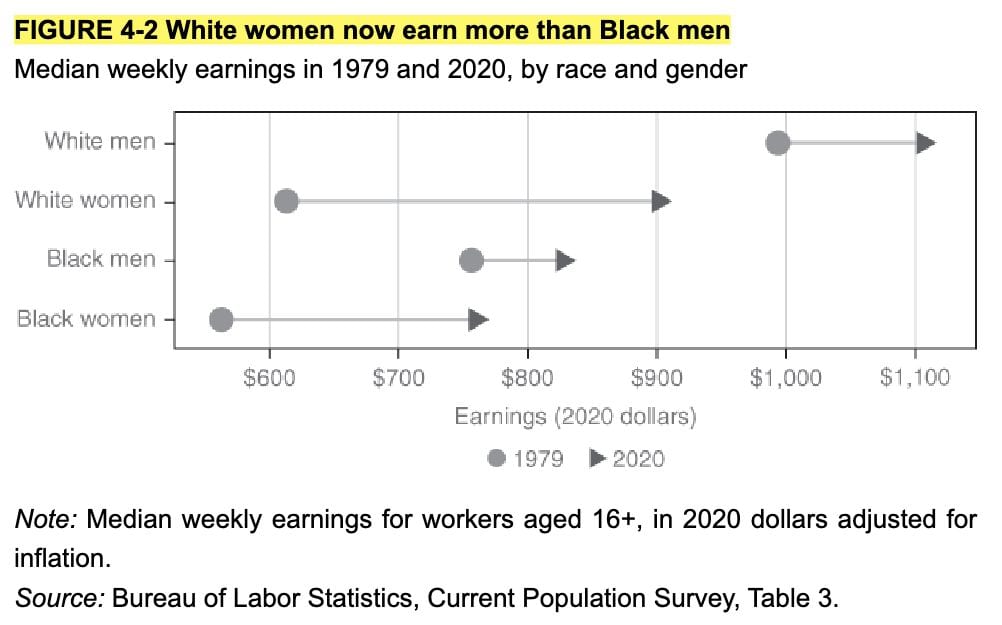
Those Black men who are in work receive some of the lowest wages; the weekly wage of the typical Black male worker in 1979 was $757 (in today’s dollars). Today it is $830. That is a gain of just 10%. Again, it is important to look at race and gender together here. White women have seen the most dramatic economic gains in recent decades, as figure 4-2 shows. In 1979, white and Black women earned the same. Now Black women earn 21% less. White women caught up with Black men by the 1990s and have had faster-rising earnings ever since. Black men now earn 14% less than white women (and 33% less than white men).
Of Boys and Men _ Why the Modern Male Is S - Reeves, Richard copy, p.76 (file not included in this release)
The overall gender pay disparity is closing because the wages of women, especially white women, are rising rapidly. Meanwhile the Black–white pay gap is widening, as Black workers, especially Black men, see painfully slow growth in wages. Given these trends, it should not be a surprise to learn that Black women are more likely than Black men to be the main family breadwinner, again in contrast to every other racial group.
Of Boys and Men _ Why the Modern Male Is S - Reeves, Richard copy, p.77 (file not included in this release)
One in four Black men born since the late 1970s have been in prison by their mid-30s.31 Among those who dropped out of high school, it is seven out of ten. These men hit young adulthood just as the imprisonment boom began in the 1980s and 1990s as part of the bipartisan war on drugs.
Of Boys and Men _ Why the Modern Male Is S - Reeves, Richard copy, p.78 (file not included in this release)
One in three white Americans rank “many or almost all” Black men as “violent,” compared to just one in ten who say the same of white men.32 According to McConnaughy and White, “The gender modifier does unique work in accessing negative notions of black men.
Of Boys and Men _ Why the Modern Male Is S - Reeves, Richard copy, p.78 (file not included in this release)
My colleague Rashawn Ray, a sociologist, shows for example that middle-class Black men are less likely to be physically active in neighborhoods that are mostly white. Why? Because Black men are trying to avoid being seen as a threat.
Of Boys and Men _ Why the Modern Male Is S - Reeves, Richard copy, p.80 (file not included in this release)
study showed that a Black man without a criminal record is less likely to be hired than a similarly qualified white man with a criminal record.
Of Boys and Men _ Why the Modern Male Is S - Reeves, Richard copy, p.80 (file not included in this release)
Before their 14th birthday, one in four Black children see a parent go to jail or prison, usually their father.
Of Boys and Men _ Why the Modern Male Is S - Reeves, Richard copy, p.81 (file not included in this release)
I will note that Black boys seem to benefit even more than others from engaged fatherhood, and that on many measures, Black fathers are more engaged than fathers of other races, especially when they are not married to or living with the mother.
Jo Jones and William D. Mosher, Fathers’ Involvement with Their Children: United States, 2006–2010, National Health Statistics Reports, no. 71 (National Center for 48. 49. 50. 51. 52. 53. 54. 55. 56. 57. 58. 1. 2. 3. Health Statistics, 2013).
Of Boys and Men _ Why the Modern Male Is S - Reeves, Richard copy, p.81 (file not included in this release)
Black mothers are three times as likely as white mothers to be single parents (52% v. 16%), and half as likely to be living with a spouse (41% v. 78%).48 Most births to Black women take place outside marriage (around 70%), compared to about half the births to Hispanic women, and 28% of those to white women.
Of Boys and Men _ Why the Modern Male Is S - Reeves, Richard copy, p.81 (file not included in this release)
Black women in their early 40s are five times as likely as white women of the same age to have never married (34% v. 7%).
Of Boys and Men _ Why the Modern Male Is S - Reeves, Richard copy, p.82 (file not included in this release)
To be marriageable, a man has to be a breadwinner. How outdated and sexist! The trouble is that most people, including most Black people, agree with Wilson. Breadwinning potential is highly prized in a potential mate: 84% of Black Americans say that in order to be a good husband or partner, it is “very important” for a man to be “able to provide for their family financially,” compared to 67% of white respondents.52 But the gap is even wider when it comes to female providers: 52% of Black Americans say it is very important for women to be able to financially support their family, compared to just 27% of white Americans. Given the economic challenges facing Black women and men, this is not surprising. But while Black women are seeing some improvement in their educational and economic positions, and therefore their ability to fill the breadwinning role, Black men are falling way behind.