⬅️ Hub: Psychology Books (MOC) · Parent: 60.21 Psychology

DESCRIPTION
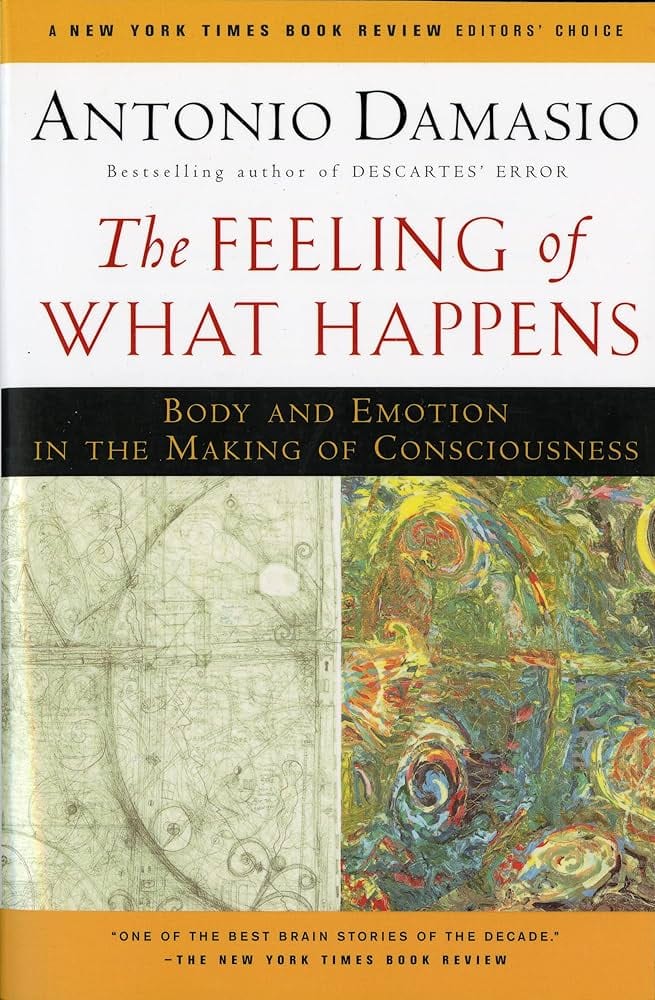
The publication of this book is an event in the making. All over the world scientists, psychologists, and philosophers are waiting to read Antonio Damasio’s new theory of the nature of consciousness and the construction of the self. A renowned and revered scientist and clinician, Damasio has spent decades following amnesiacs down hospital corridors, waiting for comatose patients to awaken, and devising ingenious research using PET scans to piece together the great puzzle of consciousness. In his bestselling Descartes’ Error, Damasio revealed the critical importance of emotion in the making of reason. Building on this foundation, he now shows how consciousness is created. Consciousness is the feeling of what happens-our mind noticing the body’s reaction to the world and responding to that experience. Without our bodies there can be no consciousness, which is at heart a mechanism for survival that engages body, emotion, and mind in the glorious spiral of human life. A hymn to the possibilities of human existence, a magnificent work of ingenious science, a gorgeously written book, The Feeling of What Happens is already being hailed as a classic.
My Summary
Main Ideas, Takeaways & Similarities
Questions
I. What is the problem?
A. How is this problem formulated?
B. Why is this problem important?
C. What is the history of this problem?
D. Which prominent personalities have been interested in this problem?
II. What solutions to the problem are there?
A. What are the conclusions reached?
B. By what argument(s) is the conclusion reached?
C. What facts or assumptions serve as premises?
D. When a prominent personality offers a solution, does he also argue for or against other prominent personalities? Does he raise objections to alternative solutions? Does he consider objections to his own solutions?
III. Evaluation
A. What are the advantages and disadvantages of the alternative formulations to the problem?
B. Has the importance or history of the problem ever been misrepresented?
C. Are the solutions logically related to the premises?
D. Are the facts true? Are the assumptions acceptable? Are the objections answerable?
AI Summary
Highlights
“The Feeling of What Happens: Body and Emotion in the Making of Consciousness” is a book written by Antonio Damasio, published in 1999. The book delves into the relationship between emotions, the body, and consciousness. Here is a comprehensive summary of the book in bullet points:
- Antonio Damasio explores the nature of consciousness and the role of emotions in shaping our conscious experiences.
- He argues that emotions are not separate from reason but are essential components of the human mind and consciousness.
- The book introduces the concept of the “somatic marker hypothesis,” which suggests that emotions play a crucial role in decision-making and guiding our behavior.
- Damasio emphasizes the connection between the body and the mind, asserting that bodily sensations and emotions are integral to our conscious experiences.
- He discusses the brain’s role in generating emotions and highlights the importance of the brainstem and limbic system in processing emotional information.
- The author explores how the brain constructs a mental map of the body, known as the “body image,” which is central to our sense of self and consciousness.
- Damasio presents case studies of patients with brain damage, illustrating how impairments in emotional processing can lead to deficits in decision-making and social behavior.
- The book examines the neural mechanisms behind the experience of pain and pleasure and their influence on consciousness.
- Damasio delves into the concept of “core consciousness,” a basic form of self-awareness that emerges from the brain’s ability to represent the state of the body and its emotional responses.
- He discusses the evolution of consciousness and suggests that consciousness is an adaptive trait that allows organisms to make more effective decisions and respond to environmental challenges.
- The book addresses the relationship between consciousness and memory, highlighting how emotional experiences are stored in memory and influence our future decisions.
- Damasio also explores the impact of culture and language on the development of human consciousness.
- He argues that emotions are essential for moral reasoning and ethical behavior, as they provide the basis for empathy and social cohesion.
- The book concludes by emphasizing the interplay between reason and emotion in human consciousness and the importance of understanding this relationship for our well-being and ethical development.
“The Feeling of What Happens” offers a comprehensive exploration of the role of emotions, the body, and consciousness in human cognition and decision-making. It challenges traditional views of emotions as irrational and highlights their integral role in shaping our thoughts, actions, and sense of self.