⬅️ Hub: Psychology Books (MOC) · Parent: 60.21 Psychology
DESCRIPTION
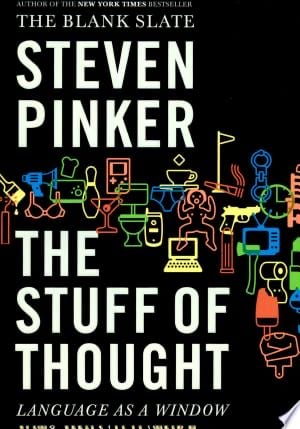
The Pulitzer Prize finalist author of The Blank Slate presents an accessible study of the relationship between language and human nature, explaining how everything from swearing and innuendo to prepositions and baby names reveal facts about key human concepts, emotions, and relationships.
My Summary
Main Ideas, Takeaways & Similarities
Questions
I. What is the problem?
A. How is this problem formulated?
B. Why is this problem important?
C. What is the history of this problem?
D. Which prominent personalities have been interested in this problem?
II. What solutions to the problem are there?
A. What are the conclusions reached?
B. By what argument(s) is the conclusion reached?
C. What facts or assumptions serve as premises?
D. When a prominent personality offers a solution, does he also argue for or against other prominent personalities? Does he raise objections to alternative solutions? Does he consider objections to his own solutions?
III. Evaluation
A. What are the advantages and disadvantages of the alternative formulations to the problem?
B. Has the importance or history of the problem ever been misrepresented?
C. Are the solutions logically related to the premises?
D. Are the facts true? Are the assumptions acceptable? Are the objections answerable?
AI Summary
Highlights
“The Stuff of Thought: Language as a Window into Human Nature” by Steven Pinker is a book that explores the relationship between language and human cognition. It delves into various aspects of language, from grammar and syntax to the meanings of words and expressions, shedding light on how language reflects and influences human thought and behavior. Here is a comprehensive summary in bullet points:
- Title: The Stuff of Thought: Language as a Window into Human Nature
- Author: Steven Pinker
Introduction:
- Highlights the central role of language in human cognition and communication.
- Introduces the idea that language can provide insights into human nature.
Chapter 1: Words and Worlds:
- Discusses the connection between words, concepts, and the external world.
- Explores the concept of “mentalese” and how it relates to language.
Chapter 2: Down the Rabbit Hole:
- Explores the complexity of prepositions and spatial relationships in language.
- Discusses how language reflects our understanding of space and location.
Chapter 3: The Curse of Knowledge:
- Introduces the “curse of knowledge” as a cognitive bias.
- Discusses how it can affect communication and lead to misunderstandings.
Chapter 4: The 7 Words You Can’t Say on Television:
- Explores the evolution and social taboos associated with swear words.
- Discusses the emotional and expressive power of profanity.
Chapter 5: The Stuff of Nonsense:
- Examines the nature of humor and nonsense in language.
- Discusses linguistic puzzles and the cognitive processes involved in humor.
Chapter 6: Tense Relations:
- Explores the complexities of verb tenses in language.
- Discusses how tense can influence our perception of time and events.
Chapter 7: The Ins and Outs of Prepositions:
- Further examines prepositions and their role in language.
- Discusses the variations in prepositions across languages.
Chapter 8: Loose Lips:
- Explores the phenomenon of indirect speech and politeness.
- Discusses how language can convey social norms and hierarchy.
Chapter 9: The Children’s Crusade:
- Discusses language acquisition in children.
- Explores the idea of a “universal grammar” and its role in language learning.
Chapter 10: Us and Them:
- Examines the linguistic markers of group identity and social categorization.
- Discusses the role of language in forming and reinforcing group boundaries.
Chapter 11: Nice Tries:
- Explores the challenges of translation between languages.
- Discusses how languages differ in their expression of concepts.
Chapter 12: A Sense of Style:
- Discusses the role of style and rhetoric in language.
- Explores how language can be used to persuade, manipulate, or entertain.
Chapter 13: Conclusion: Choices, Bets, and Lies:
- Summarizes key insights about language and human nature.
- Highlights the intricate relationship between language and thought.
Legacy:
- “The Stuff of Thought” by Steven Pinker provides a deep exploration of the intricacies of language and its connection to human cognition and behavior.
- The book offers a fascinating journey through various linguistic phenomena, shedding light on how language shapes our understanding of the world and reflects aspects of human nature.
- It serves as a thought-provoking resource for those interested in the intersection of language, psychology, and human communication.