Primary study and figures
Christopher D. Petsko & Nour S. Kteily, “Political (Meta-)Dehumanization in Mental Representations: Divergent Emphases in the Minds of Liberals Versus Conservatives,” Personality and Social Psychology Bulletin 50, no. 12 (2024): 1675–1689. Full article and figure captions (PubMed Central) · DOI · data, materials, and preregistrations. Published online in 2023; journal issue dated 2024. The two images embedded below are the paper’s original Figures 2 and 3, copied from the PubMed Central article for this private vault note.
The short version
In these U.S. samples, both sides produced more dehumanizing representations of their political outgroup than of their ingroup, but in different ways: liberals’ composites of conservatives were rated relatively more savage than immature, while conservatives’ composites of liberals were rated relatively more immature than savage. A second study found that people captured the kind of disparagement they expected from the other side better than its overall amount. These are ratings of experimentally generated face composites—not photographs of real partisans, a population-wide measure of hatred, or evidence that either group is violent.
Pinker’s Chapter 6 supplement — from categorization to killing-by-category
Pinker argues that categorization is ordinarily useful, but can become dangerous through overgeneralization (treating a category average as every member’s essence), moralization (turning a difference into vice), and essentialism (imagining an ineradicable inner nature). Motives that can target individuals—gain, fear, and revenge—can then be redirected at whole populations. Disgust and vermin metaphors make exclusion feel like cleansing, while utopian or exclusionary ideologies can supply a moralized end that licenses extreme means. Leaders and relatively small armed organizations still have to turn those representations into policy and killing.
This is Pinker’s secondary historical synthesis, not a validation of Petsko and Kteily’s reverse-correlation measures and not evidence that dislike, a dehumanizing image, or coexistence between groups automatically causes genocide. It offers a proposed escalation pathway whose links must be tested separately. Chapter 6 synthesis · Attachment (file not included in this release)
What the researchers tested
The paper asks two questions: (1) What kind of dehumanization appears in liberals’ and conservatives’ mental representations of one another? (2) Do they anticipate how the other side represents them? “Dehumanization” here is operationalized with two sets of ratings: savagery (“savage, aggressive”; “lacking morals”; “barbaric, cold-hearted”) and immaturity (“immature, irresponsible”; “irrational, illogical”; “naïve, gullible”). These are the researchers’ constructs, not literal claims that the pictured faces are nonhuman.
The two main reverse-correlation studies enrolled 902 participants in all, with 509 more in two supplementary pilot studies (total N = 1,411). In Study 1, 194 liberal or conservative U.S. adults each made 300 forced choices between noisy versions of the same neutral male face: which looked more like a liberal or a conservative? Choices were averaged into four composite images. A separate group of 192 raters, unaware of how the composites were made, rated them on the two dehumanization dimensions. The analyses controlled for general positive/negative impression of each image (“image valence”). The samples were recruited through CloudResearch, not drawn as a probability sample of all U.S. voters. Method and sample table
Figure 2 — the four mental-representation composites
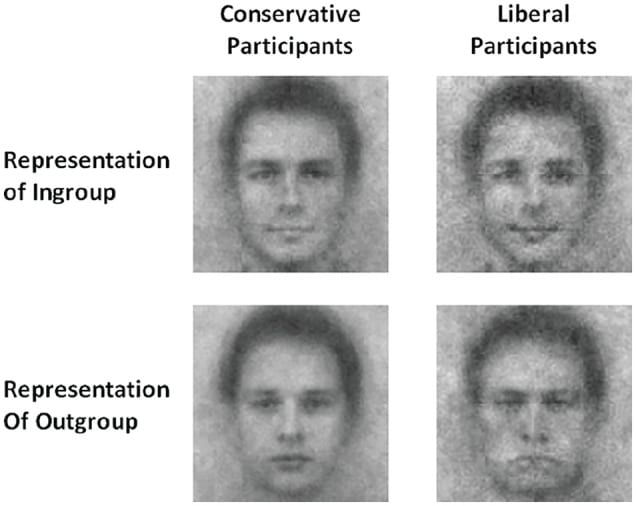
Original Figure 2 (Study 1). Columns identify who generated each composite; top row is that group’s view of its own side, bottom row its view of the other side. Thus the lower-left face is conservatives’ composite of liberals; the lower-right face is liberals’ composite of conservatives. All four began with the same averaged male base image plus random visual noise. They are visual summaries of selections, not typical faces of real liberals or conservatives. Original figure and caption
Figure 3 — how independent raters scored the outgroup faces
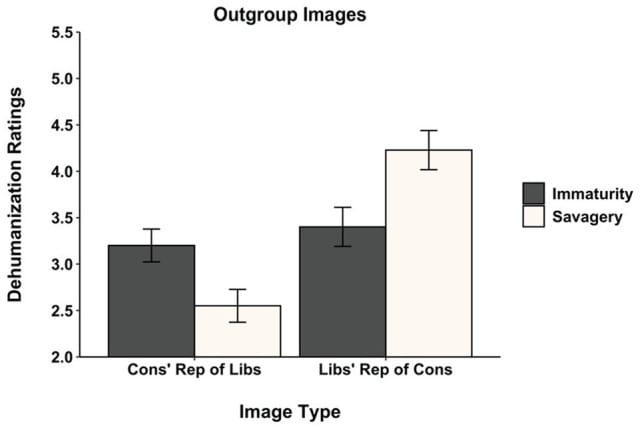
Original Figure 3 (Study 1). Dark bars = immaturity; light bars = savagery. Error bars are 95% confidence intervals; plotted means control for image valence. For conservatives’ representation of liberals (left), immaturity exceeds savagery. For liberals’ representation of conservatives (right), savagery exceeds immaturity. These are 1–7 appearance ratings, not percentages of people who hold a belief. Original figure and caption
The reported within-outgroup contrasts were +0.83 points for savagery minus immaturity in liberals’ representation of conservatives (95% CI [0.63, 1.02], p < .001), and −0.65 points for the same contrast in conservatives’ representation of liberals (95% CI [−0.85, −0.45], p < .001). The interaction between generator ideology and rating dimension was also significant (p < .001). The more useful finding is the different emphasis, not a claim that one political coalition alone dehumanizes. Study 1 results
Study 2 — what each side thinks the other sees
Participants now chose faces while imagining how the outgroup sees their own group (“meta-representations”); independent raters compared those composites with the outgroup representations from Study 1. The main-text phases had 93 image generators and 202 raters; an additional condition is reported in the supplement. On the paper’s combined savagery/immaturity score, conservatives’ anticipated representation of themselves was rated less dehumanized than liberals’ actual representation of conservatives (3.87 vs. 4.14); liberals’ anticipated representation of themselves was rated more dehumanized than conservatives’ actual representation of liberals (3.49 vs. 3.26). Yet each side anticipated the relative dimension correctly: liberals expected to look more immature than savage to conservatives, and conservatives expected to look more savage than immature to liberals. Study 2 results
Do not turn one sample into a timeless partisan ranking
The authors’ supplementary 2017 studies also found the difference in type of outgroup representation, but not the same difference in total level: in 2017, the sides dehumanized each other to similar degrees, and conservatives did not show the same underestimation of total dehumanization. The published analyses differ from the preregistered plan and are explicitly described by the authors as exploratory. The method also uses a White-male base face, may partly elicit cultural stereotypes rather than privately endorsed attitudes, and has not been shown here to predict real-world treatment or violence. Authors’ discussion and limitations
Related but separate: the racial trolley / lifeboat experiments
This is not part of Petsko and Kteily (2024). The Chip Ellsworth III / Tyrone Payton example comes from Eric Luis Uhlmann, David A. Pizarro, David Tannenbaum & Peter H. Ditto, “The Motivated Use of Moral Principles,” Judgment and Decision Making 4, no. 6 (2009): 476–491. Full primary article · . Its question was whether contextual identity cues shift how people endorse consequentialist moral judgments, not whether partisans visually dehumanize one another.
| Experiment | What changed | What was measured | Result |
|---|---|---|---|
| Study 1a, 88 UC Irvine undergraduates | “Chip Ellsworth III” sacrificed to save 100 Harlem Jazz Orchestra members versus “Tyrone Payton” sacrificed to save 100 New York Philharmonic members. Both the victim name and the group saved changed. No race was explicitly stated. | Ratings of whether the depicted sacrifice and a general consequentialist rationale were justified. | Participants lower on the conservatism scale endorsed the Chip version more strongly than the Tyrone version (b = −0.40, p = .002 at 1 SD below the mean); the simple difference for more conservative respondents was not significant (p = .93). Method and results |
| Study 1b, 176 students/community adults | A fatally injured “Chip” or “Tyrone” would be thrown off a sinking lifeboat to save everyone else; the identity of those saved was not specified. | Four 1–7 ratings combined into a consequentialism index. | The same liberal-side pattern appeared (b = −0.19, p = .02 at 1 SD below the mean); the more-conservative simple difference was not significant (p = .54). In a community manipulation check, 79% inferred Chip was White, 64% inferred Tyrone was Black; 92% said changing the victim’s race would not change their response. Study 1b |
| Study 2, sequential presentation | Participants saw both versions rather than one in isolation. | Consistency of ratings across the two cases. | The initial version still affected liberals’ overall stance, but once both cases were visible participants largely applied the same standard to each (r = .98 across judgments). Study 2 |
What the result does—and does not—say
“Liberals were more willing to sacrifice the White man” is shorthand for greater endorsement of a described hypothetical sacrifice when the victim had a stereotypically White name in these samples. No one made a real-life sacrifice or chose to kill someone. In Study 1a, the group being saved changed too, so victim race cannot be isolated there; Study 1b more cleanly varied the victim’s name, but names can also cue class and other stereotypes. “No statistically significant conservative difference” is not proof of perfect impartiality. The 77% vs. 33% and ~51% numbers in the brief lecture-derived note are not reported as outcome percentages in the published paper; do not cite them as this study’s figures without a traceable source. The same Uhlmann et al. paper found a conservative-side asymmetry in a different scenario involving Iraqi versus American civilian casualties, reinforcing the broader motivated-reasoning interpretation. Primary article
How the two studies fit together—and where they do not
Both papers show that political identity can influence social or moral judgment in ways a simple “my side is objective” story misses. But Petsko & Kteily measure visualized outgroup stereotypes, while Uhlmann et al. measure responses to moral dilemmas with identity cues. Neither paper tests whether the face-composite pattern causes the trolley/lifeboat pattern, and neither licenses a blanket statement about what every liberal or conservative thinks. The most defensible comparison is methodological: look for asymmetry, its direction, its context, and whether a counterexample within the same paper changes the partisan story.
More studies on partisan perception and dehumanization
These papers form a research map, not eight replications of Figure 2. The first is the closest methodological predecessor; the others measure trait stereotypes, reactions to labeled photographs, explicit survey judgments, beliefs about what the other party thinks, or responses to corrective information. Compare the question and measure before comparing partisan asymmetries or effect sizes.
Mental representations, traits, and face impressions
-
Petsko, Lei, Kunst, Bruneau & Kteily (2021), “Blatant Dehumanization in the Mind’s Eye.” The closest methodological precursor used two reverse-correlation experiments (image-generating samples of 108 and 336) and seven separate rating studies (2,301 raters). U.S. respondents generated mental representations of “Arabs” and “Americans”, and raters judged the Arab composites more dehumanizing even after accounting for general image negativity. The striking qualification is that this visual pattern appeared among respondents who explicitly rejected dehumanizing Arabs as well as those who explicitly endorsed it. This concerns a different target-group contrast—not whether liberals or conservatives actually look a certain way—and an indirect visual task need not agree with a person’s self-report. Original paper abstract and methods · author-hosted full paper.
-
Crawford, Modri & Motyl (2013), “Bleeding-Heart Liberals and Hard-Hearted Conservatives.” In a trait-attribution task, “human nature” traits were more associated with liberals and “human uniqueness” traits with conservatives. Both sides tended to attach favorable stereotype-consistent traits to their own side and unfavorable ones to the other. This is an earlier account of different contents of partisan dehumanization, but human-nature/human-uniqueness attributions are not the same scales as Petsko & Kteily’s savagery/immaturity ratings. The published pattern is evidence about stereotypes elicited by the task, not a ranking of citizens’ inherent humanity. Primary article.
-
Cassidy, Hughes & Krendl (2022), “Disclosing Political Partisanship Polarizes First Impressions of Faces.” In two experiments using photographs of unfamiliar political candidates, a disclosed party label shifted judgments of likability and competence—even when the label did not match the candidate’s actual party. A second experiment found that the same face was rated more favorably after an in-party label and less favorably after an out-party label by both more-liberal and more-conservative participants. The first experiment’s clear label effect was limited to the more-liberal participants, so its symmetry varies by design. These were mostly college-student samples; threat ratings paralleled the impressions but threat was not manipulated to establish a mechanism. Unlike Petsko & Kteily, the study tests the effect of a label on judgments of real photographs, not the faces people construct in their minds or a direct measure of dehumanization. Full primary article.
How much do the parties dehumanize—and misread—one another?
-
Martherus, Martinez, Piff & Theodoridis (2021), “Party Animals?” Three large, broadly representative online surveys asked about subtle and more direct dehumanizing metaphors for out-partisans. Dehumanization was especially associated with intense negative partisan feelings; in a survey experiment, otherwise identical information about a melee led both Democrats and Republicans to describe out-party participants more dehumanizingly when party labels changed. This supports a bidirectional susceptibility in that scenario, not the claim that every partisan uses such language or that self-reported metaphors and reverse-correlation images are interchangeable. Publisher abstract and design.
-
Moore-Berg, Ankori-Karlinsky, Hameiri & Bruneau (2020), “Exaggerated Meta-Perceptions Predict Intergroup Hostility.” A representative U.S. sample (1,056) and a longitudinal convenience sample (2,707 at its first wave) compared how much Democrats and Republicans reported disliking/dehumanizing the other party with how much each side thought the other side disliked/dehumanized them. Both parties substantially overestimated out-party hostility (the authors describe overestimates of roughly 50–300%, depending on measure and sample). These meta-perceptions were associated with social distance and partisan spite, including over time; observational associations do not by themselves show that the mistaken belief causes those outcomes. The study used a single overall dehumanization rating, so it could not detect the savagery versus immaturity distinction in Petsko & Kteily. Read its two-sided overestimation alongside—but do not collapse it into—Petsko & Kteily’s Study 2 face-composite comparison. Original article · data and materials.
-
van Loon, Goldberg & Srivastava (2024), “Imagined Otherness Fuels Blatant Dehumanization of Outgroups.” In a preregistered correlational study (771) and experiment (398), U.S. partisans who imagined the out-party’s understanding of “America” as farther from most people’s understanding gave higher explicit “Ascent of Man” dehumanization ratings. In the experiment, researchers randomly showed a fabricated visualization suggesting out-partisans’ word associations were very different from, or similar to, those of typical respondents; the greater-difference condition reported somewhat higher outgroup dehumanization (d = 0.22). Participants were debriefed. This experimentally tests the effect of perceived worldview distance in a particular survey setup; it does not establish that actual out-party worldviews are inhuman or that the small rating difference translates into real-world aggression. Full primary article.
Can mistaken beliefs be corrected?
-
Landry, Schooler, Willer & Seli (2023), “Reducing Explicit Blatant Dehumanization by Correcting Exaggerated Meta-Perceptions.” Across three preregistered studies (total N = 4,154), briefly informing partisans that the other side dehumanizes them less than they think lowered the recipients’ own explicit dehumanization ratings; a decrease was still present at approximately one week in the follow-up study. Effects on anti-democratic spite were smaller, and the spite effect did not persist at the follow-up. The authors caution that the comparison was with an empty control, so mentioning dehumanization at all may explain part of the effect; the outcomes were survey reports rather than verified voting or civic behavior. This intervention targets a belief measured more directly than Petsko & Kteily’s visual meta-representations. Full primary article and limitations.
-
Puryear, Kubin, Schein, Bigman, Ekstrom & Gray (2024), “People Believe Political Opponents Accept Blatant Moral Wrongs.” Across eight studies, respondents on both sides exaggerated the number of opponents willing to approve clearly condemned acts such as embezzlement; these inaccurate beliefs tracked dehumanization and reluctance to engage. Experiments found that learning a particular opponent condemned such acts reduced trait dehumanization and improved reported willingness to interact. Crucially, in the group-level test, information about six condemned wrongs reduced the estimated outgroup approval bias, whereas information about one did not; either version reduced a separate group-dehumanization rating. This is a potentially useful correction to assumptions about opponents’ basic morality, not a test of their face composites. Some engagement measures were behavioral, but effects were not uniformly significant across studies and long-term durability remains untested. Full primary article, measures, and Study 8.
Synthesis and evidence boundary
The convergent finding is not “one side is the dehumanizing side.” Depending on whether researchers ask for a face selection, trait, party-labeled first impression, overt metaphor, or estimate of an opponent’s opinion, they observe different kinds and sometimes different directions of bias. Several studies show both parties are vulnerable to negative outgroup judgments and inaccurate meta-beliefs. Brief corrections can change some self-reports under study conditions, but the evidence here does not show that any single intervention durably changes public behavior. Keep the separate Chip/Tyrone dilemma out of this empirical category; it measures a judgment of a hypothetical act.
Sources and routes through the vault
- Petsko & Kteily (2024), full paper and figures · original figure 2 image · original figure 3 image · OSF materials
- Uhlmann et al. (2009), full paper ·
- Related primary research: Petsko et al. (2021), mental representations of Arabs · Crawford et al. (2013), stereotype-consistent human traits · Cassidy et al. (2022), labeled face impressions · Martherus et al. (2021), partisan metaphors.
- Meta-perceptions and corrections: Moore-Berg et al. (2020) · van Loon et al. (2024) · Landry et al. (2023) · Puryear et al. (2024).
- Vault context: short handwritten-note synthesis · long lecture notes · political context · race research hub.

