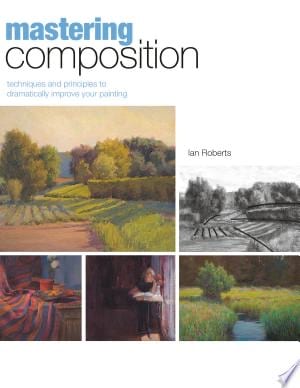
DESCRIPTION
Create Better Compositions by Design The path to better painting begins with Mastering Composition. This effective guide blends clear, visual instruction with 5 step-by-step demonstrations to show you how to plan and paint your best work yet. Composition is the key, and here you’ll learn to design paintings with new skill and confidence. It all begins with the armature or structure of the picture plane. Every great painting has one, and you’ll see through several famous examples exactly how the Old Masters used armatures to create movement, narrative, harmony and fluidity. Based on these examples, you’ll practice what you’ve learned following a series of hands-on demonstrations. Once you understand the basic principles of design, you’ll be amazed at how quickly and effectively your compositions come together. Soon you will be painting more boldly and confidently than ever before with less reworking and overworking. Whether you’re a beginner looking for basic instruction or a more advanced painter troubleshooting a specific problem, the proven methods in this book will work for you. Ideal for all mediums, Mastering Composition gives you the knowledge you need to create powerful paintings out of every subject.
My Summary
Main Ideas, Takeaways & Similarities
Questions
I. What is the problem?
A. How is this problem formulated?
B. Why is this problem important?
C. What is the history of this problem?
D. Which prominent personalities have been interested in this problem?
II. What solutions to the problem are there?
A. What are the conclusions reached?
B. By what argument(s) is the conclusion reached?
C. What facts or assumptions serve as premises?
D. When a prominent personality offers a solution, does he also argue for or against other prominent personalities? Does he raise objections to alternative solutions? Does he consider objections to his own solutions?
III. Evaluation
A. What are the advantages and disadvantages of the alternative formulations to the problem?
B. Has the importance or history of the problem ever been misrepresented?
C. Are the solutions logically related to the premises?
D. Are the facts true? Are the assumptions acceptable? Are the objections answerable?
AI Summary
Highlights
Artists build an armature, based on their picture plane, to “hold” their complex figure compositions within the picture plane.
Using Structure for Placement:
Structure and Fluidity:
Creating Drama:
Eight Common Armatures:
- S
- L
- Diagonal
- Triangle
- Radiating Lines
- Fulcrum
- O
- Portrait
Horizontals and Verticals
When you use horizontals and verticals to create an armature, you can immediately engage the entire picture plane. You start to think in terms of the whole composition.
Add Verticals to Balance the Horizon:
In landscapes, the horizon often becomes a dominant horizontal. You need to look for verticals to balance it.
Create Interest With Simplicity:
Try stripping the composition down to just a couple of contrasts.
The Cruciform
-It immediately engages all sides of the picture plane
Twelve Composition Basics
-
Crop for Drama
-
Look for the Value Masses
-Squint to simplify and see masses.
-If when squinting at a potential composition, you can’t see a few simple value masses, move on to something else.
-
Design Divisions with Rhythm
-
Keep Your Shapes Interesting
-
Avoid Attracting Attention to the Edges of the Picture Plane
-
Create Depth with Overlaps
-
Watch the Corners
-If a line goes out of the picture plane, and invariably the eye will, lower the contrast at the edge to keep the eye coming back
-
Create an Entrance
-
Organize the Masses
-
Orchestrate the Masses for Good Eye Movement with Gradiation
-
Use Straight Lines
-Long, loopy curves of roads, clouds and drapery give objects a detached, floating quality. Most curves are sections of straight lines that change direction.
- Think Foreground, Middle Ground, and Background
Think in Value Masses, Not Subjects
-The value masses carry your painting more than anything else. They are what the viewer will see from across the room.
“What counts is your eye, your sensitivity and the strength of the shapes you make.” -Henri Cartier-Bresson
“Do not be afraid that too much labor over a composition is going to kill the spontaneity.” -John Carlson
Color: Hue, Value & Intensity
Subtle Color Intensity Creates Richness
Video:
“To see is to forget the name of what one sees.”
See abstractly
Gradation is a very important tool to move the eye around
Make simple small sketches of the main value masses of images you like
-Finding what in the work that interests you!
-Finding how the composition works
-3 by 4 inches
-Use the center of the page
-
Spend time looking
-
Squint
-
Use a viewfinder
-
Eliminate & Simplify
-
Do thumbnails (Value masses)
-
Use an armature
-
Think masses
Modulate color masses, picking only three similar colors on color wheel, doesn’t make it too busy