DESCRIPTION
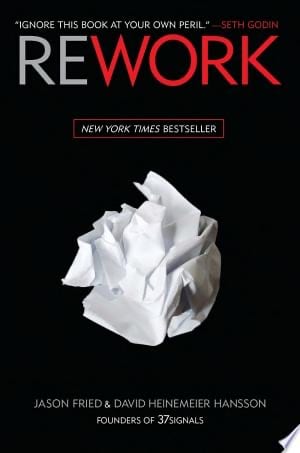
Rework shows you a better, faster, easier way to succeed in business. Most business books give you the same old advice: Write a business plan, study the competition, seek investors, yadda yadda. If you’re looking for a book like that, put this one back on the shelf. Read it and you’ll know why plans are actually harmful, why you don’t need outside investors, and why you’re better off ignoring the competition. The truth is, you need less than you think. You don’t need to be a workaholic. You don’t need to staff up. You don’t need to waste time on paperwork or meetings. You don’t even need an office. Those are all just excuses. What you really need to do is stop talking and start working. This book shows you the way. You’ll learn how to be more productive, how to get exposure without breaking the bank, and tons more counterintuitive ideas that will inspire and provoke you. With its straightforward language and easy-is-better approach, Rework is the perfect playbook for anyone who’s ever dreamed of doing it on their own. Hardcore entrepreneurs, small-business owners, people stuck in day jobs they hate, victims of “downsizing,” and artists who don’t want to starve anymore will all find valuable guidance in these pages.
Highlights
Here is an extensive summary in bullet points of the key ideas from the book Rework, based on the highlights provided:
Key Ideas on Execution
- Make decisions right before doing something, not far in advance. This builds momentum.
- Focus on figuring out the next most important thing to do and execute on that.
- Ideas alone are worthless without execution. What you actually do is what matters.
- Perfect timing is a myth. If you wait for the perfect time, you’ll never act.
- Have strong opinions and stand for something instead of debating everything.
Key Ideas on Productivity
- Constraints and limitations boost creativity. Do more with less.
- Cut out unnecessary details first, add them later if needed. Start simple.
- Constantly look for things to remove and simplify to pare down to the essential.
- Break big problems down into smaller executable pieces to maintain momentum.
- Long projects sap motivation. Launch something small now, while motivated.
Key Ideas on Competition
- Don’t try to copy or catch up to competitors. Redefine the rules instead.
- Pour your unique self into the product instead of just features.
- As you grow bigger, it gets harder to take risks and make changes.
Key Ideas on Marketing
- Marketing is an ongoing sum of everything you do, not just campaigns.
- Success takes time. Measure growth over years, not overnight fame.
- Start building your audience now instead of waiting.
Key Ideas on Inspiration
- When inspired, take action immediately instead of waiting.
- Inspiration creates momentum and motivation to do great work.
Let me know if you need any clarification or have additional questions!
Citations:
[1]
https://ppl-ai-file-upload.s3.amazonaws.com/web/direct-files/7742445/2f823e8e-34ba-49f5-afab-353feee26b2b/paste.txt
Decide what you’re going to do this week, not this year. Figure out the next most important thing and do that. Make decisions right before you do something, not far in advance. (Location 234)
Workaholics aren’t heroes. They don’t save the day, they just use it up. The real hero is already home because she figured out a faster way to get things done. (Location 279)
We all have that one friend who says, “I had the idea for eBay. If only I had acted on it, I’d be a billionaire!” That logic is pathetic and delusional. Having the idea for eBay has nothing to do with actually creating eBay. What you do is what matters, not what you think or say or plan. (Location 341)
Ideas are cheap and plentiful. The original pitch idea is such a small part of a business that it’s almost negligible. The real question is how well you execute. (Location 349)
they protect their ego with the excuse of time. (Location 363)
perfect time never arrives. You’re always too young or old or busy or broke or something else. If you constantly fret about timing things perfectly, they’ll never happen. (Location 365)
Strong opinions aren’t free. You’ll turn some people off. They’ll accuse you of being arrogant and aloof. That’s life. For everyone who loves you, there will be others who hate you. If no one’s upset by what you’re saying, you’re probably not pushing hard enough. (And you’re probably boring, too.) (Location 372)
When you don’t know what you believe, everything becomes an argument. Everything is debatable. But when you stand for something, decisions are obvious. (Location 380)
A business without a path to profit isn’t a business, it’s a hobby (Location 472)
Writers use constraints to force creativity all the time. Shakespeare reveled in the limitations of sonnets (fourteen-line lyric poems in iambic pentameter with a specific rhyme scheme). Haiku and limericks also have strict rules that lead to creative results. Writers like Ernest Hemingway and Raymond Carver found that forcing themselves to use simple, clear language helped them deliver maximum impact. (Location 530)
You’re better off with a kick-ass half than a half-assed whole. (Location 550)
Walt Stanchfield, famed drawing instructor for Walt Disney Studios, used to encourage animators to “forget the detail” at first. The reason: Detail just doesn’t buy you anything in the early stages. (Location 580)
Whenever you can, swap “Let’s think about it” for “Let’s decide on it.” Commit to making decisions. Don’t wait for the perfect solution. Decide and move forward. (Location 588)
You want to get into the rhythm of making choices. When you get in that flow of making decision after decision, you build momentum and boost morale. Decisions are progress. Each one you make is a brick in your foundation. You can’t build on top of “We’ll decide later,” but you can build on top of “ (Location 590)
Long projects zap morale. The longer it takes to develop, the less likely it is to launch. Make the call, make progress, and get something out now—while you’ve got the motivation and momentum to do so. (Location 602)
It’s the stuff you leave out that matters. So constantly look for things to remove, simplify, and streamline. Be a curator. Stick to what’s truly essential. Pare things down until you’re left with only the most important stuff. Then do it again. You can always add stuff back in later if you need to. (Location 609)
Guitar gurus say, “Tone is in your fingers. (Location 652)
People use equipment as a crutch. (Location 661)
Interruption is the enemy of productivity (Location 773)
Momentum fuels motivation. It keeps you going. It drives you. (Location 841)
If you absolutely have to work on long-term projects, try to dedicate one day a week (or every two weeks) to small victories that generate enthusiasm. Small victories let you celebrate and release good news. (Location 850)
Whenever you can, divide problems into smaller and smaller pieces until you’re able to deal with them completely and quickly. Simply rearranging your tasks this way can have an amazing impact on your productivity and motivation. (Location 920)
if you’re a copycat, you can never keep up. You’re always in a passive position. You never lead; you always follow. You give birth to something that’s already behind the times—just a knockoff, an inferior version of the original. That’s no way to live. (Location 961)
Pour yourself into your product and everything around your product too: how you sell it, how you support it, how you explain it, and how you deliver it. Competitors can never copy the you in your product. (Location 982)
If you’re planning to build “the iPod killer” or “the next Pokemon,” you’re already dead. You’re allowing the competition to set the parameters. You’re not going to out-Apple Apple. They’re defining the rules of the game. And you can’t beat someone who’s making the rules. You need to redefine the rules, not just build something slightly better. (Location 1038)
once you do get bigger and more popular, you’re inevitably going to take fewer risks. When you’re a success, the pressure to maintain predictability and consistency builds. You get more conservative. It’s harder to take risks. That’s when things start to fossilize and change becomes difficult. (Location 1146)
Letting people behind the curtain changes your relationship with them. They’ll feel a bond with you and see you as human beings instead of a faceless company. They’ll see the sweat and effort that goes into what you sell. They’ll develop a deeper level of understanding and appreciation for what you do. (Location 1212)
Wabi-sabi values character and uniqueness over a shiny facade. It teaches that cracks and scratches in things should be embraced. It’s also about simplicity. You strip things down and then use what you have. (Location 1222)
Leonard Koren, author of a book on wabi-sabi, gives this advice: Pare down to the essence, but don’t remove the poetry. Keep things clean and unencumbered but don’t sterilize. (Location 1223)
Marketing isn’t just a few individual events. It’s the sum total of everything you do. (Location 1283)
You will not be a big hit right away. You will not get rich quick. You are not so special that everyone else will instantly pay attention. No one cares about you. At least not yet. Get used to it. (Location 1287)
Trade the dream of overnight success for slow, measured growth. It’s hard, but you have to be patient. You have to grind it out. You have to do it for a long time before the right people notice. (Location 1292)
Start building your audience today. Start getting people interested in what you have to say. And then keep at it. In a few years, you too will get to chuckle when people discuss your “overnight” success. (Location 1300)
If you want to do something, you’ve got to do it now. You can’t put it on a shelf and wait two months to get around to it. You can’t just say you’ll do it later. Later, you won’t be pumped up about it anymore. (Location 1701)
Inspiration is a magical thing, a productivity multiplier, a motivator. But it won’t wait for you. Inspiration is a now thing. If it grabs you, grab it right back and put it to work. (Location 1706)