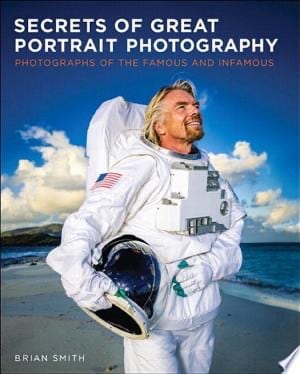
DESCRIPTION
In this sexy, bold book, Pulitzer-Prize winning photographer Brian Smith tells the stories behind the photos and lessons learned in 30 years of photographing celebrities and people from all walks of life. Smith’s long list of famous and infamous subjects includes pro basketball players Dwayne Wade and Shaquille O’Neal; billionaires Bill Gates, Richard Branson, and Donald Trump; tennis stars Serena and Venus Williams; actors Anne Hathaway, Antonio Banderas, Christopher Walken, Taye Diggs, Jane Krakowski, and William H. Macy; and many more. You’ll get the inside scoop on what goes on at a celebrity photo shoot in this gorgeous guide to making professional portraits. Smith has mastered how to make a meaningful portrait on a magazine’s budget and on a celebrity’s schedule, which can sometimes be 15 minutes or less. Smith reveals his tips on connecting with people, finding the perfect location, telling a great story through portraiture, getting the ideal pose, capturing emotion and gestures, arranging unique group shots, and lighting the scene just right. You might not be photographing the rich and famous, but after reading Smith’s tell-all guide, you’ll know how to give everyone who makes their way in front of your camera the star treatment.
My Summary
Main Ideas, Takeaways & Similarities
Questions
I. What is the problem?
A. How is this problem formulated?
B. Why is this problem important?
C. What is the history of this problem?
D. Which prominent personalities have been interested in this problem?
II. What solutions to the problem are there?
A. What are the conclusions reached?
B. By what argument(s) is the conclusion reached?
C. What facts or assumptions serve as premises?
D. When a prominent personality offers a solution, does he also argue for or against other prominent personalities? Does he raise objections to alternative solutions? Does he consider objections to his own solutions?
III. Evaluation
A. What are the advantages and disadvantages of the alternative formulations to the problem?
B. Has the importance or history of the problem ever been misrepresented?
C. Are the solutions logically related to the premises?
D. Are the facts true? Are the assumptions acceptable? Are the objections answerable?
AI Summary
Highlights
To be a good photojournalist, he explained, you have to learn how to get close to people. He told me to put away my telephoto lenses, introduce myself to 50 strangers, and shoot a portrait of each that revealed something about each person’s personality. (Location 233)
the key to getting these gigs is knowing how to connect with all types of personalities—from internationally known economists to multiplatinum rap artists. (Location 284)
If you want to photograph celebrities, start by treating everyone you photograph like a star, whether it’s your mother, the stranger on the street, or the aging barnstormer who puts on a parachute. (Location 294)
Always remember that fame is fleeting, so make sure you spread it around to those who deserve it. Give everyone you shoot the star treatment. (Location 300)
photography can come down to three words: location, location, location. (Location 302)
Place adds yet another storytelling element to a photograph, giving the “who” a sense of “where.” A really great location even explains a bit of the “why.” (Location 302)
Combine the expected with a dash of the unexpected to give your portraits the element of surprise. (Location 344)
Anything can happen in the course of a shoot, and embracing these elements of surprise rather than fighting them can result in some unique portraits. (Location 352)
The key to success as a working commercial photographer is to keep working. And that means keeping your photo editors happy. And the only way to keep photo editors truly happy is to get them the shots they want, even when they want the impossible—especially when they want the impossible. (Location 383)
Sometimes the secret is interpreting what the editors ask for in a nonliteral way. (Location 393)
rarely do you stumble upon the perfect location that doesn’t need at least some prep. (Location 400)
“PHOTOGRAPHY IS ONE PERCENT INSPIRATION AND 99 PERCENT MOVING FURNITURE.” —ARNOLD NEWMAN (Location 410)
Choosing locations for your subjects is a bit of a dating game. You have to make just the right match. (Location 440)
Most magazines are looking for multiple shots for a portrait feature, so I generally try to warm the subject up before we get to the best shot. (Location 456)
“OFTEN, THE VERY FIRST LOCATION THAT CATCHES YOUR EYE IS THE BEST.” (Location 465)
“PUT YOUR SUBJECT ON A PEDESTAL FOR A HEROIC LOOK.” (Location 529)
No matter what you’re shooting, you can be more flexible if you make sure you cover both wide and close-up options. (Location 580)
Prioritize your shots so that if the subject bails early, you at least get your main shot. It never hurts to remind your subjects that a great shoot can even save them time in the long run if other magazines re-license those images rather than assign a new shoot a month later. (Location 622)
The key to making a go of it is retaining ownership of all your images. (Location 625)
“NEVER LEAVE A SHOOT WITHOUT AT LEAST ONE SHOT THAT MAKES YOU PROUD.” (Location 727)
Concentrate on what you want the light to do and how the quality of the light affects the mood of the shot. (Location 1314)
To get a clean outline around a subject shot on white, you’d normally place a couple of black flats on each sides of your subject to create a negative fill that sucks up all the light bouncing around the room. But in this case, I chose to do just the opposite: I let the light from the V-flats spill back onto the subject to soften her outline. (Location 1364)
“RING FLASH CREATES A VERY EVEN LIGHT THAT IS BOTH HARD AND SOFT.” (Location 1398)
Getting the right balance at dusk is relatively simple math—just reduce your variables. If you’re getting f/11 out of your strobes, you need to pick the shutter speed that will give you the right exposure on the background at f/11. But that shutter speed will change quickly as the sky goes dark at dusk. Fortunately, your LCD makes it very easy to see the balance. Just remember to keep the aperture constant and just change the shutter speed. (Location 1471)
When you’re adjusting high-contrast, digital black-and-white images, pay particular attention to what midtone contrast does to your subject’s skin. What looks rugged on an actor might look rough on an actress over 40. You want your subject to bask in the warm glow of the spotlight, not be burned by it. (Location 1695)
Belkin Mini Surge Protector with USB charger: You have surge protection at home, so are you sure you want to plug in your laptop at a Serbian nightclub without one? (Location 1825)
“WORK HARDER THAN THE NEXT GUY.” (Location 2034)
One of the biggest mistakes some photographers make is skimping on production when there’s money in the budget for it. Good hair, makeup, and styling can make all the difference in the world. (Location 2062)
Normally, the photographer owns all rights to the photos from an editorial shoot. The standard practice on a commissioned portrait shoot is that the assigning magazine is granted “first publication rights,” meaning that no one else can publish the shots before they do. Generally, this is followed by a period of exclusivity known as an “embargo,” which is usually between a week (Location 2076)
and three months. Thereafter, the photographer is free to re-license the work to other publications. It’s very important that you never sign away these rights. Most magazines haven’t raised their rates since the Nixon administration, so re-licensing is the only thing that keeps a lot of editorial photographers in business. Plus, who knows, maybe someday someone will ask you to write a book. (Location 2079)