DESCRIPTION
One of the world’s leading creative artists, choreographers, and creator of the smash-hit Broadway show, Movin’ Out, shares her secrets for developing and honing your creative talents—at once prescriptive and inspirational, a book to stand alongside The Artist’s Way and Bird by Bird. All it takes to make creativity a part of your life is the willingness to make it a habit. It is the product of preparation and effort, and is within reach of everyone. Whether you are a painter, musician, businessperson, or simply an individual yearning to put your creativity to use, The Creative Habit provides you with thirty-two practical exercises based on the lessons Twyla Tharp has learned in her remarkable thirty-five-year career. In “Where’s Your Pencil?” Tharp reminds you to observe the world — and get it down on paper. In “Coins and Chaos,” she gives you an easy way to restore order and peace. In “Do a Verb,” she turns your mind and body into coworkers. In “Build a Bridge to the Next Day,” she shows you how to clean the clutter from your mind overnight. Tharp leads you through the painful first steps of scratching for ideas, finding the spine of your work, and getting out of ruts and into productive grooves. The wide-open realm of possibilities can be energizing, and Twyla Tharp explains how to take a deep breath and begin…
My Summary
Main Ideas, Takeaways & Similarities
Questions
I. What is the problem?
A. How is this problem formulated?
B. Why is this problem important?
C. What is the history of this problem?
D. Which prominent personalities have been interested in this problem?
II. What solutions to the problem are there?
A. What are the conclusions reached?
B. By what argument(s) is the conclusion reached?
C. What facts or assumptions serve as premises?
D. When a prominent personality offers a solution, does he also argue for or against other prominent personalities? Does he raise objections to alternative solutions? Does he consider objections to his own solutions?
III. Evaluation
A. What are the advantages and disadvantages of the alternative formulations to the problem?
B. Has the importance or history of the problem ever been misrepresented?
C. Are the solutions logically related to the premises?
D. Are the facts true? Are the assumptions acceptable? Are the objections answerable?
AI Summary
Highlights
Creativity is not just for artists. It’s for businesspeople looking for a new way to close a sale; it’s for engineers trying to solve a problem; it’s for parents who want their children to see the world in more than one way. (Location 97)
I will keep stressing the point about creativity being augmented by routine and habit. Get used to (Location 103)
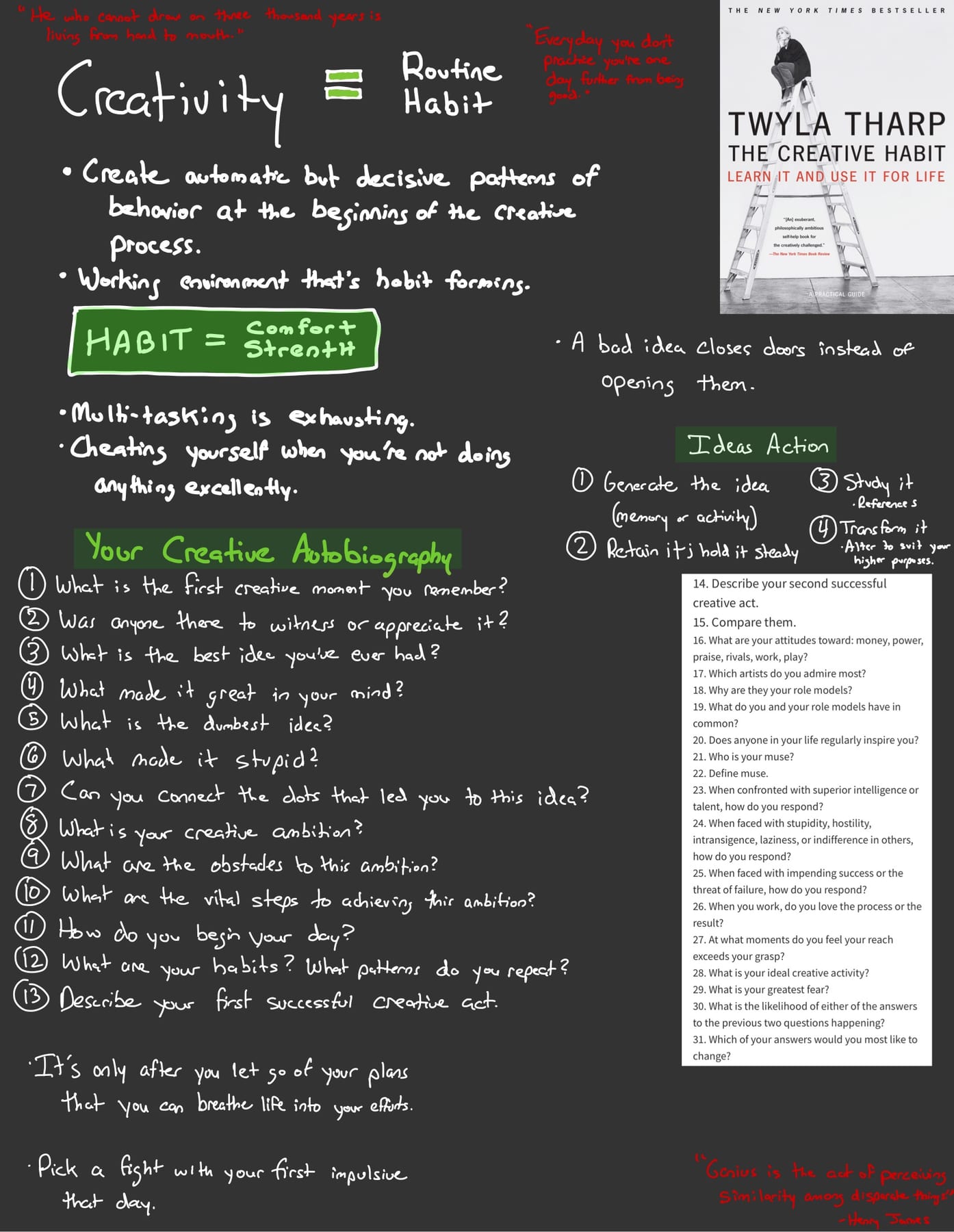
Creativity is a habit, and the best creativity is a result of good work habits. That’s it in a nutshell. (Location 108)
There are no “natural” geniuses. (Location 113)
It’s vital to establish some rituals—automatic but decisive patterns of behavior—at the beginning of the creative process, when you are most at peril of turning back, chickening out, giving up, or going the wrong way. (Location 183)
To get the creative habit, you need a working environment that’s habit-forming. (Location 228)
By making the start of the sequence automatic, they replace doubt and fear with comfort and routine. (Location 236)
The habit, and the faith invested in it, converts it into an act that provides comfort and strength. (Location 324)
The irony of multitasking is that it’s exhausting; when you’re doing two or three things simultaneously, you use more energy than the sum of energy required to do each task independently. You’re also cheating yourself because you’re not doing anything excellently. (Location 346)
T. S. Eliot, you’re “distracted from distractions by distractions.” (Location 348)
Pick your “pencil” and don’t leave home without it. (Location 400)
Solitude is an unavoidable part of creativity. Self-reliance is a happy by-product. (Location 424)
“Every day you don’t practice you’re one day further from being good.” If it’s something you want to do, make the time. (Location 436)
Robert Benchley wrote that there are two kinds of people in the world: those who divide the world into two kinds of people, and those who don’t. (Location 533)
Your Creative Autobiography 1. What is the first creative moment you remember? 2. Was anyone there to witness or appreciate it? 3. What is the best idea you’ve ever had? 4. What made it great in your mind? 5. What is the dumbest idea? 6. What made it stupid? 7. Can you connect the dots that led you to this idea? 8. What is your creative ambition? 9. What are the obstacles to this ambition? 10. What are the vital steps to achieving this ambition? 11. How do you begin your day? 12. What are your habits? What patterns do you repeat? 13. Describe your first successful creative act. 14. Describe your second successful creative act. 15. Compare them. (Location 614)
-
What are your attitudes toward: money, power, praise, rivals, work, play? 17. Which artists do you admire most? 18. Why are they your role models? 19. What do you and your role models have in common? 20. Does anyone in your life regularly inspire you? 21. Who is your muse? 22. Define muse. 23. When confronted with superior intelligence or talent, how do you respond? 24. When faced with stupidity, hostility, intransigence, laziness, or indifference in others, how do you respond? 25. When faced with impending success or the threat of failure, how do you respond? 26. When you work, do you love the process or the result? 27. At what moments do you feel your reach exceeds your grasp? 28. What is your ideal creative activity? 29. What is your greatest fear? 30. What is the likelihood of either of the answers to the previous two questions happening? 31. Which of your answers would you most like to change? 32. What is your idea of mastery? (Location 625)
-
What is your greatest dream? (Location 637)
Venturing out of your comfort zone may be dangerous, yet you do it anyway because our ability to grow is directly proportional to an ability to entertain the uncomfortable. (Location 641)
Traveling the paths of greatness, even in someone else’s footprints, is a vital means to acquiring skill. (Location 915)
A good idea is one that turns you on rather than shuts you off. It keeps generating more ideas and they improve on one another. A bad idea closes doors instead of opening them. It’s confining and restrictive. The line between good and bad ideas is very thin. A bad idea in the hands of the right person can easily be tweaked into a good idea. (Location 1326)
When you’re in scratching mode, the tiniest microcell of an idea will get you going. (Location 1386)
The Harvard psychologist Stephen Kosslyn says that ideas can be acted upon in four ways. First, you must generate the idea, usually from memory or experience or activity. Then you have to retain it—that is, hold it steady in your mind and keep it from disappearing. Then you have to inspect it—study it and make inferences about it. Finally, you have to be able to transform it—alter it in some way to suit your higher purposes. (Location 1419)
Henry James said that genius is the act of perceiving similarity among disparate things. (Location 1458)
Take an author or a subject and start with the most recent text. Then work your way backwards to progressively older texts. If it’s a novelist’s body of work, you’ll learn just as much about the author’s recurring themes, philosophy, and style—but trust me, you’ll see them from an entirely different point of view. (Location 1578)
“He who cannot draw on three thousand years is living from hand to mouth.” (Location 1635)
Avedon doesn’t have a preconceived notion of what he wants the photo to look like, though he does know what feeling it should convey. He plans ahead, but not too far ahead, so he can recognize amazing when he sees it. (Location 1667)
Transforming your ideas rarely goes according to plan. (Location 1676)
it’s only after you let go of your plans that you can breathe life into your efforts. (Location 1679)
The hot stove incident held meaning, said Goodyear, only for the person “whose mind was prepared to draw an inference,” the one who had “applied himself most perseveringly to the subject.” (Location 1706)
When you actually get down to work, pick a fight with your first impulse that day. Do the opposite of what your brain is telling you to do. That quick jolt of defiance might be enough to rewire your circuitry and deliver something new to your doorstep. (Location 1920)
I cannot overstate how much a generous spirit contributes to good luck. (Location 1978)