
DESCRIPTION
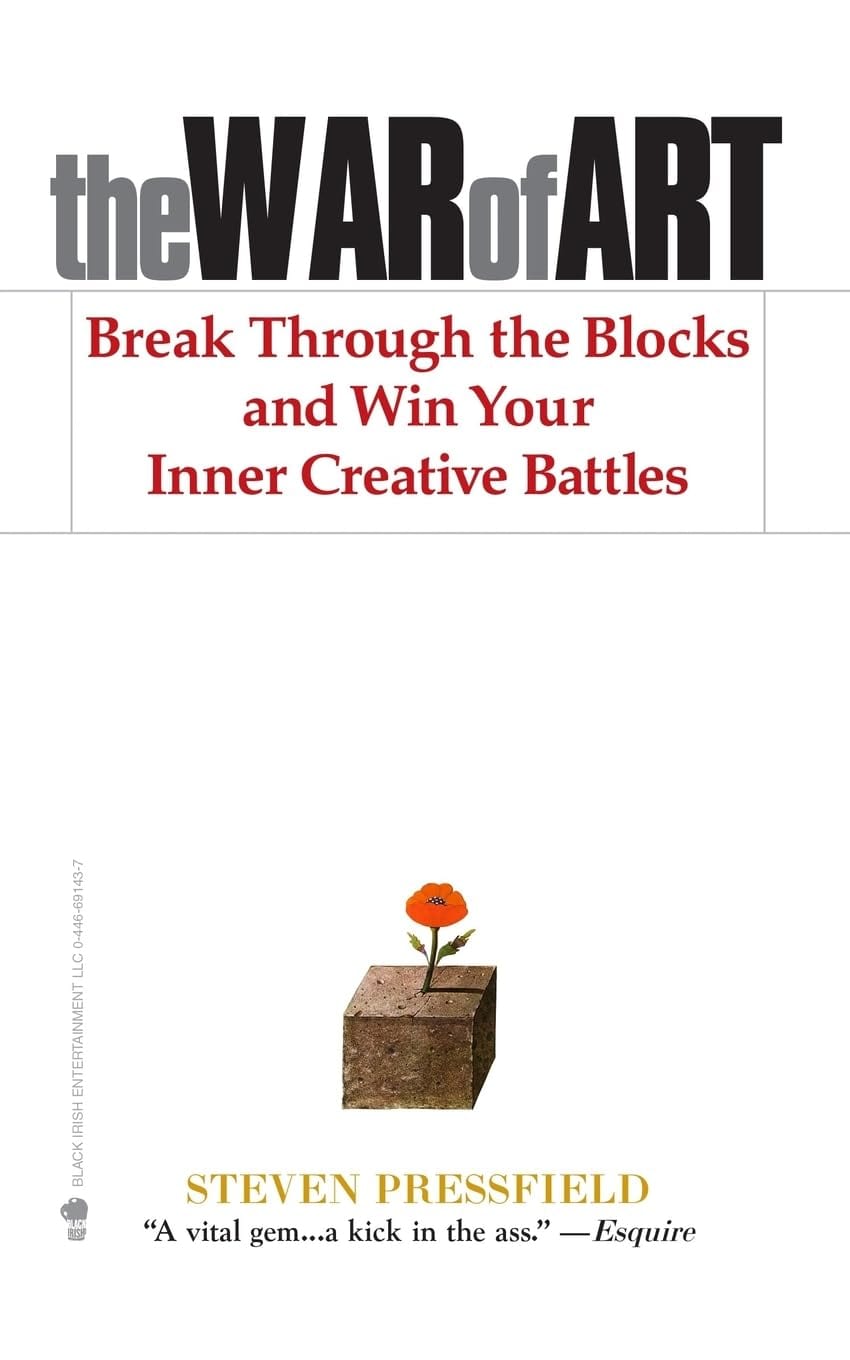
“In this powerful, straight-from-the-hip examination of the internal obstacles to success, bestselling author Steven Pressfield shows readers how to identify, defeat, and unlock the inner barriers to creativity. The War of Art is an inspirational, funny, well-aimed kick in the pants guaranteed to galvanize every would-be artist, visionary, or entrepreneur.” —from back cover.
It’s not the writing part that’s hard. What’s hard is sitting down to write. (Location 83)
Most of us have two lives. The life we live, and the unlived life within us. Between the two stands Resistance. (Location 85)
Every sun casts a shadow, and genius’s shadow is Resistance. (Location 101)
Do we have to stare death in the face to make us stand up and confront Resistance? Does Resistance have to cripple and disfigure our lives before we wake up to its existence? (Location 109)
it was easier for Hitler to start World War II than it was for him to face a blank square of canvas. (Location 121)
In other words, any act that rejects immediate gratification in favor of long-term growth, health, or integrity. Or, expressed another way, any act that derives from our higher nature instead of our lower. Any of these will elicit Resistance. (Location 140)
It’s a repelling force. It’s negative. Its aim is to shove us away, distract us, prevent us from doing our work. (Location 144)
Resistance is protean. It will assume any form, (Location 151)
Resistance is always lying and always full of shit. (Location 154)
Resistance is not out to get you personally. It doesn’t know who you are and doesn’t care. Resistance is a force of nature. It acts objectively. (Location 160)
We can use it as a compass. We can navigate by Resistance, letting it guide us to that calling or action that we must follow before all others. Rule of thumb: The more important a call or action is to our soul’s evolution, the more Resistance we will feel toward pursuing it. (Location 165)
The warrior and the artist live by the same code of necessity, which dictates that the battle must be fought anew every day. (Location 172)
Resistance has no strength of its own. Every ounce of juice it possesses comes from us. We feed it with power by our fear of it. Master that fear and we conquer Resistance. (Location 177)
Resistance obstructs movement only from a lower sphere to a higher. It kicks in when we seek to pursue a calling in the arts, launch an innovative enterprise, or evolve to a higher station morally, ethically, or spiritually. (Location 180)
The danger is greatest when the finish line is in sight. At this point, Resistance knows we’re about to beat it. It hits the panic button. (Location 190)
The awakening artist must be ruthless, not only with herself but with others. Once you make your break, you can’t turn around for your buddy who catches his trouser leg on the barbed wire. The best thing you can do for that friend (and he’d tell you this himself, if he really is your friend) is to get over the wall and keep motating. (Location 203)
The best and only thing that one artist can do for another is to serve as an example and an inspiration. (Location 205)
Never forget: This very moment, we can change our lives. There never was a moment, and never will be, when we are without the power to alter our destiny. This second, we can turn the tables on Resistance. (Location 212)
Sometimes Resistance takes the form of sex, or an obsessive preoccupation with sex. Why sex? Because sex provides immediate and powerful gratification. (Location 216)
Anything that draws attention to ourselves through pain-free or artificial means is a manifestation of Resistance. (Location 227)
The working artist will not tolerate trouble in her life because she knows trouble prevents her from doing her (Location 229)
work. The working artist banishes from her world all sources of trouble. She harnesses the urge for trouble and transforms it in her work. (Location 229)
As Jerry Seinfeld observed of his twenty years of dating: “That’s a lot of acting fascinated.” (Location 252)
Casting yourself as a victim is the antithesis of doing your work. (Location 259)
What makes it tricky is that we live in a consumer culture that’s acutely aware of this unhappiness and has massed all its profit-seeking artillery to exploit it. By selling us a product, a drug, a distraction. (Location 284)
John Lennon once wrote: Well, you think you’re so clever and classless and free But you’re all fucking peasants As far as I can see (Location 285)
no such thing as fundamentalist art. This does not mean that the fundamentalist is not creative. Rather, his creativity is inverted. (Location 315)
The paradox seems to be, as Socrates demonstrated long ago, that the truly free individual is free only to the extent of his own self-mastery. While those who will not govern themselves are condemned to find masters to govern over them. (Location 334)
If you find yourself criticizing other people, you’re probably doing it out of Resistance. When we see others beginning to live their authentic selves, it drives us crazy if we have not lived out our own. (Location 337)
Individuals who are realized in their own lives almost never criticize others. If they speak at all, it is to offer encouragement. Watch yourself. Of all the manifestations of Resistance, most only harm ourselves. Criticism and cruelty harm others as well. (Location 338)
Self-doubt can be an ally. This is because it serves as an indicator of aspiration. It reflects love, love of something we dream of doing, and desire, desire to do it. If you find yourself asking yourself (and your friends), “Am I really a writer? Am I really an artist?” chances are you are. (Location 342)
The counterfeit innovator is wildly self-confident. The real one is scared to death. (Location 344)
Remember our rule of thumb: The more scared we are of a work or calling, the more sure we can be that we have to do it. (Location 347)
So if you’re paralyzed with fear, it’s a good sign. It shows you what you have to do. (Location 356)
The more Resistance you experience, the more important your unmanifested art/project/enterprise is to you — and the more gratification you will feel when you finally do it. (Location 360)
Friends sometimes ask, “Don’t you get lonely sitting by yourself all day?” At first it seemed odd to hear myself answer No. Then I realized that I was not alone; I was in the book; I was with the characters. I was with my Self. (Location 377)
Resistance loves “healing.” Resistance knows that the more psychic energy we expend dredging and re-dredging the tired, boring injustices of our personal lives, the less juice we have to do our work. (Location 409)
Seeking support from friends and family is like having your people gathered around at your deathbed. It’s nice, but when the ship sails, all they can do is stand on the dock waving goodbye. (Location 414)
the more energy we spend stoking up on support from colleagues and loved ones, the weaker we become and the less capable of handling our business. (Location 416)
Rationalization is Resistance’s right-hand man. Its job is to keep us from feeling the shame we would feel if we truly faced what cowards we are for not doing our work. (Location 429)
Resistance is fear. But Resistance is too cunning to show itself naked in this form. Why? Because if Resistance lets us see clearly that our own fear is preventing us from doing our work, we may feel shame at this. And shame may drive us to act in the face of fear. (Location 442)
Tolstoy had thirteen kids and wrote War and Peace. (Location 450)
If Resistance couldn’t be beaten, there would be no Fifth Symphony, no Romeo and Juliet, no Golden Gate Bridge. Defeating Resistance is like giving birth. It seems absolutely impossible until you remember that women have been pulling it off successfully, with support and without, for fifty million years. (Location 453)
It is one thing to study war and another to live the warrior’s life. — Telamon of Arcadia, mercenary of the fifth century B.C. (Location 458)
Aspiring artists defeated by Resistance share one trait. They all think like amateurs. They have not yet turned pro. (Location 460)
the amateur does not love the game enough. If he did, he would not pursue it as a sideline, distinct from his “real” vocation. (Location 469)
The professional loves it so much he dedicates his life to it. He commits full-time. That’s what I mean when I say turning pro. Resistance hates it when we turn pro. (Location 470)
Someone once asked Somerset Maugham if he wrote on a schedule or only when struck by inspiration. “I write only when inspiration strikes,” he replied. “Fortunately it strikes every morning at nine o’clock sharp.” (Location 473)
Principle of Priority, which states (Location 485)
(a) you must know the difference between what is urgent and what is important, and (b) you must do what’s important first. (Location 486)
The artist must be like that Marine. He has to know how to be miserable. He has to love being miserable. He has to take pride in being more miserable than any soldier or swabbie or jet jockey. Because this is war, baby. And war is hell. (Location 509)
1) We show up every day. (Location 515)
2) We show up no matter what. (Location 517)
3) We stay on the job all day. (Location 519)
4) We are committed over the long haul. (Location 521)
5) The stakes for us are high and real. (Location 523)
6) We accept remuneration for our labor. (Location 524)
7) We do not overidentify with our jobs. (Location 526)
8) We master the technique of our jobs. 9) We have a sense of humor about our jobs. 10) We receive praise or blame in the real world. (Location 530)
The professional has learned, however, that too much love can be a bad thing. Too much love can make him choke. The seeming detachment of the professional, the cold-blooded character to his demeanor, is a compensating device to keep him from loving the game so much that he freezes in action. Playing for money, or adopting the attitude of one who plays for money, lowers the fever. (Location 557)
The more you love your art/calling/enterprise, the more important its accomplishment is to the evolution of your soul, the more you will fear it and the more Resistance you will experience facing it. (Location 560)
The professional arms himself with patience, (Location 578)
He knows that any job, whether it’s a novel or a kitchen remodel, takes twice as long as he thinks and costs twice as much. He accepts that. He recognizes it as reality. (Location 579)
The sign of the amateur is overglorification of and preoccupation with the mystery. (Location 594)
The amateur believes he must first overcome his fear; then he can do his work. The professional knows that fear can never be overcome. He knows there is no such thing as a fearless warrior or a dread-free artist. (Location 597)
He knows if he caves in today, no matter how plausible the pretext, he’ll be twice as likely to cave in tomorrow. (Location 604)
The professional respects his craft. He does not consider himself superior to it. He recognizes the contributions of those who have gone before him. He apprentices himself to them. (Location 625)
The pro stands at one remove from her instrument — meaning her person, her body, her voice, her talent; the physical, mental, emotional, and psychological being she uses in her work. She does not identify with this instrument. It is simply what God gave her, what she has to work with. She assesses it coolly, impersonally, objectively. (Location 637)
It uses fear of rejection to paralyze us and prevent us, if not from doing our work, then from exposing it to public evaluation. (Location 647)
The professional cannot take rejection personally because to do so reinforces Resistance. (Location 650)
The Bhagavad-Gita tells us we have a right only to our labor, not to the fruits of our labor. (Location 653)
The professional cannot allow the actions of others to define his reality. (Location 695)
The professional blows critics off. He doesn’t even hear them. (Location 700)
The professional senses who has served his time and who hasn’t. (Location 713)
Making yourself a corporation (or just thinking of yourself in that way) reinforces the idea of professionalism because it separates the artist-doing-the-work from the will-and- consciousness-running-the-show. (Location 721)
If we think of ourselves as a corporation, it gives us a healthy distance on ourselves. We’re less subjective. We don’t take blows as personally. We’re more cold-blooded; (Location 730)
we can price our wares more realistically. (Location 731)
Resistance has no strength of its own; its power derives entirely from our fear of it. A bully will back down before the runtiest twerp who stands his ground. (Location 735)
most important thing about art is to work. Nothing else matters except sitting down every day and trying. (Location 767)
When we sit down each day and do our work, power concentrates around us. The Muse takes note of our dedication. She approves. We have earned favor in her sight. When we sit down and work, we become like a magnetized rod that attracts iron filings. Ideas come. (Location 770)
Here’s Socrates, in Plato’s Phaedrus, on the “noble effect of heaven-sent madness”: The third type of possession and madness is possession by the Muses. When this seizes upon a gentle and virgin soul it rouses it to inspired expression in lyric and other sorts of poetry, and glorifies countless deeds of the (Location 812)
heroes of old for the instruction of posterity. But if a man comes to the door of poetry untouched by the madness of the Muses, believing that technique alone will make him a good poet, he and his sane compositions never reach perfection, but are utterly eclipsed by the performances of the inspired madman. (Location 815)
that the moment one definitely commits oneself, then providence moves too. (Location 880)
Goethe’s couplets: “Whatever you can do, or dream you can, begin it. Boldness has genius, magic, and power in it. Begin it now.” (Location 882)
A hack, he says, is a writer who second-guesses his audience. When the hack sits down to work, he doesn’t ask himself what’s in his own heart. He asks what the market is looking for. (Location 1109)