Handwritten journal — Ways of Seeing
Journal connection: A one-page reading synthesis on how context changes an image’s meaning, oil painting as a language of ownership and status, the gendered gaze, and advertising as manufactured envy.
Source boundary: This is a handwritten reading/reflection page from 2023. Treat its paraphrases and remembered quotations as working notes; verify exact wording and page attribution against Berger before quoting.
PDF++ page: p. 1 (file not included in this release)
Embedded preview:
Pages_from_Journal_2.pdf (file not included in this release)
Open the journal routing table
DESCRIPTION
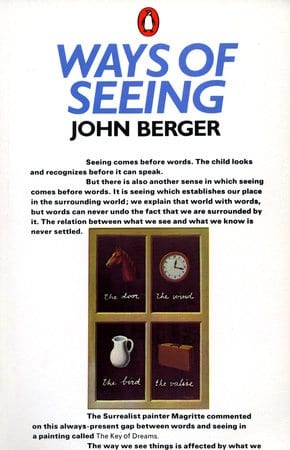
“The relation between what we see and what we know is never settled” — so opens John Berger’s revolutionary million-copy bestseller on how to look at art John Berger’s Ways of Seeing is one of the most stimulating and the most influential books on art in any language. First published in 1972, it was based on the BBC television series about which the Sunday Times critic commented: “This is an eye-opener in more ways than one: by concentrating on how we look at paintings … he will almost certainly change the way you look at pictures.” By now he has.
My Summary
Main Ideas, Takeaways & Similarities
Questions
I. What is the problem?
A. How is this problem formulated?
B. Why is this problem important?
C. What is the history of this problem?
D. Which prominent personalities have been interested in this problem?
II. What solutions to the problem are there?
A. What are the conclusions reached?
B. By what argument(s) is the conclusion reached?
C. What facts or assumptions serve as premises?
D. When a prominent personality offers a solution, does he also argue for or against other prominent personalities? Does he raise objections to alternative solutions? Does he consider objections to his own solutions?
III. Evaluation
A. What are the advantages and disadvantages of the alternative formulations to the problem?
B. Has the importance or history of the problem ever been misrepresented?
C. Are the solutions logically related to the premises?
D. Are the facts true? Are the assumptions acceptable? Are the objections answerable?
AI Summary
Highlights
Meaning if an image is changed according to what one sees immediately before and after.
Men’s presence is dependent upon promise of power which he embodies.
Women’s presence expressed her own attitude to herself, and defines what can and cannot be done to her.
Men act and women appear.
Men look at women. Women watch themselves being looked at.
You are observed with interest but you do not observe with interest — if you do you become less enviable.
It is this which explains the absent, unfocused look of so many glamour images. They look out over the looks of envy which sustain them.
The spectator-buyer is meant to envy herself as she will become if she buys the product. She is meant to imagine herself transformed by the product into an object of envy for others, an envy which will then justify her loving herself. One could put this another way: the publicity image steals her love of herself as she is, and offers it back to her for the price of the product.
Publicity has in fact understood the tradition of the oil painting more thoroughly than most art historians. It has grasped the implications of the relationship between work of art and its spectator-owner and with these it tries to persuade and flatter the spectator-buyer
Glamour is a modern invention.