Zibaldone 2024–2025 journal
Journal connection: A ten-page visual art-history sequence covering periods, artists, and representative works.
Source boundary: These are captured journal materials; the integration does not independently verify every clipped claim, quotation, or figure.
PDF++ pages: p. 321 (file not included in this release) · p. 322 (file not included in this release) · p. 323 (file not included in this release) · p. 324 (file not included in this release) · p. 325 (file not included in this release) · p. 326 (file not included in this release) · p. 327 (file not included in this release) · p. 328 (file not included in this release) · p. 329 (file not included in this release) · p. 330 (file not included in this release)
Embedded preview:
Zibaldone 2024-2025.pdf (file not included in this release)
Open the complete Zibaldone page index
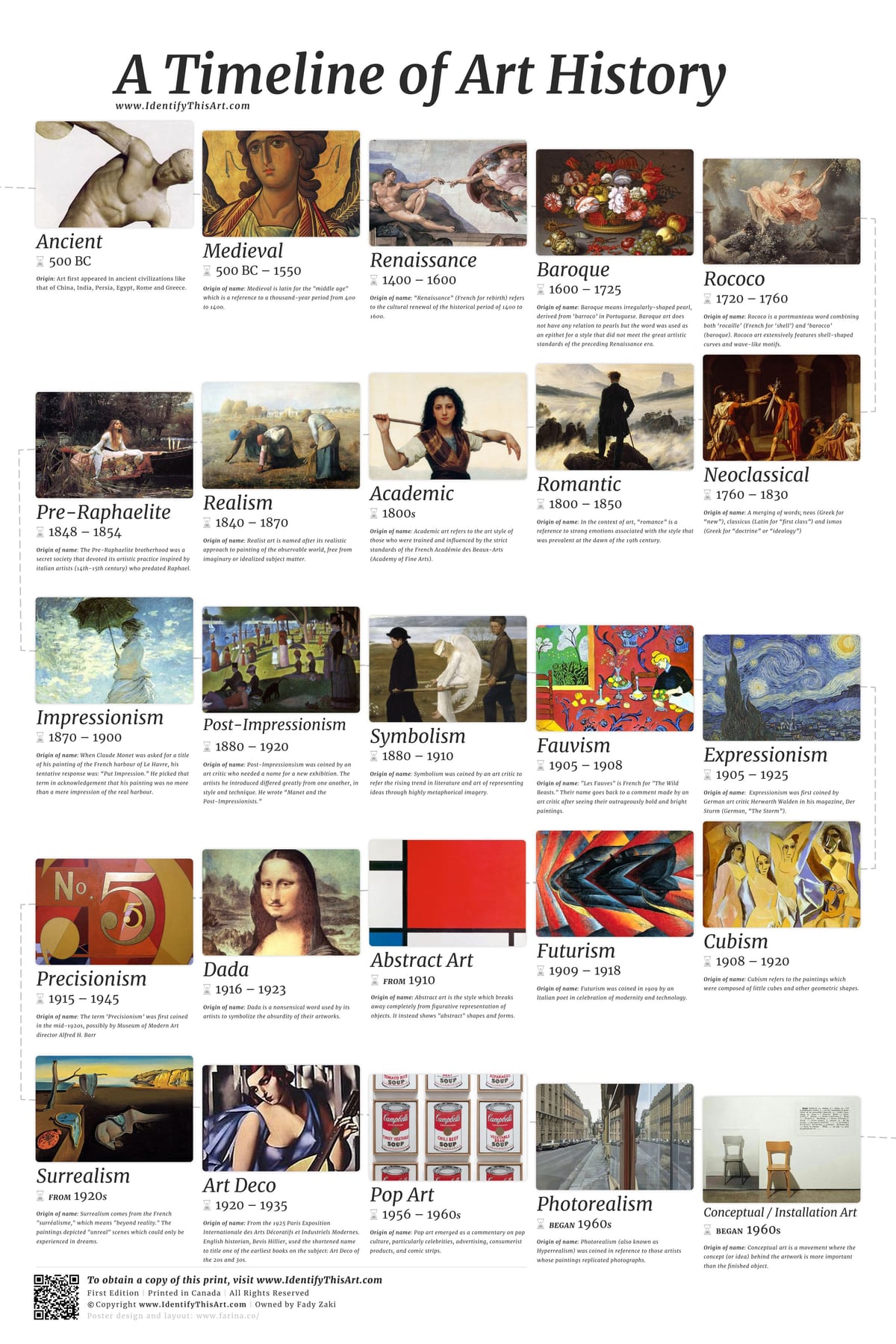
IdentifyThisArt-Timeline-digital2.pdf (file not included in this release)
History_of_art.pdf (file not included in this release)
🏛️ Timeline of Western Art History: Prehistoric Era to 15th Century
🔸 Prehistoric Art (c. 40,000 BCE – 2000 BCE)
🖼️ Characteristics & Innovations:
- Prehistoric art was primarily functional and symbolic, often connected to rituals, hunting, and fertility.
- Art appeared in caves, rock shelters, and later in megalithic sites.
- Techniques included engraving, painting with natural pigments, and carving.
🗿 Notable Works:
Lascaux Cave Paintings (c. 15,000 BCE, France)

👉 Dynamic images of animals like bulls, deer, and horses. Used charcoal and ochre. Believed to have magical or ceremonial significance.
Venus of Willendorf (c. 28,000–25,000 BCE, Austria)

👉 Limestone figurine symbolizing fertility. Stylized and exaggerated features.
🔸 Ancient Near Eastern Art (c. 3500 – 539 BCE)
🖼️ Characteristics & Innovations:
- Developed in Mesopotamia (Sumerians, Akkadians, Assyrians, Babylonians).
- Art was highly symbolic, often combining human and animal forms.
- Focused on kingship, religion, and power; sculpture was a major medium.
🗿 Notable Works:
Standard of Ur (c. 2600 BCE, Sumer)

👉 A wooden box inlaid with lapis lazuli and shell, showing war and peace scenes in registers.
Lamassu (c. 720 BCE, Assyria)

👉 Colossal winged bulls with human heads placed at palace gates to protect and impress.
🔸 Ancient Egyptian Art (c. 3100 – 30 BCE)
🖼️ Characteristics & Innovations:
- Egyptian art emphasized order, eternity, and the afterlife.
- Used hierarchical scale, composite views (frontal torso, profile head), and canon of proportions.
- Art served funerary and religious functions, especially in tombs and temples.
🗿 Notable Works:
Seated Scribe (c. 2500 BCE, Saqqara)

👉 A lifelike statue that breaks from idealized royal portraits. Shows the high status of scribes.
Paintings from the Tomb of Nebamun (c. 1350 BCE)

👉 Vibrant frescoes of leisure scenes, such as hunting birds. Combines naturalism with stylization.
Bust of Nefertiti (c. 1345 BCE, by Thutmose)

👉 An exquisite and idealized portrait of Akhenaten’s queen. Symbol of beauty and elegance.
🔸 Aegean Art (c. 3000 – 1100 BCE)
🖼️ Characteristics & Innovations:
- Includes Cycladic, Minoan, and Mycenaean cultures.
- Known for stylized figures, frescoes, and early architectural sculpture.
🗿 Notable Works:
Cycladic Figurines (c. 2500 BCE)

👉 Abstract marble figures, typically female. Minimalist aesthetic.
Minoan Bull-Leaping Fresco (c. 1450 BCE, Knossos)

👉 Dynamic scene of acrobats vaulting over a bull, symbolizing ritual or sport.
🔸 Classical Greek Art (c. 600 – 323 BCE)
🖼️ Characteristics & Innovations:
- Evolved from Archaic to Classical to Hellenistic styles.
- Pursuit of naturalism, balance, proportion, and ideal beauty.
- Mastered contrapposto, anatomy, and expressive form.
🗿 Notable Works:
Kritios Boy (c. 480 BCE)

👉 First statue to use contrapposto. Marks shift to naturalistic Classical style.
Parthenon Sculptures (c. 447–432 BCE, by Phidias)

👉 Reliefs and pediments from the Parthenon showing gods, heroes, and citizens in harmonious proportion.
🔸 Hellenistic Greek Art (c. 323 – 31 BCE)
🖼️ Characteristics & Innovations:
- More emotional, dramatic, and dynamic than Classical art.
- Explored themes of age, suffering, and movement.
🗿 Notable Works:
Laocoön and His Sons (c. 40–30 BCE)

👉 Violent struggle against sea serpents. Emphasizes agony and muscle tension.
Winged Victory of Samothrace (c. 190 BCE)

👉 Draped goddess landing on a ship’s prow. Celebrates motion and triumph.
🔸 Roman Art (c. 509 BCE – 476 CE)
🖼️ Characteristics & Innovations:
- Practical, political, and commemorative.
- Mastered realism in portraiture, concrete architecture, and large-scale narrative reliefs.
- Art glorified the state, emperor, and ancestors.
🗿 Notable Works:
Augustus of Primaporta (c. 20 BCE)

👉 Idealized portrait of the first emperor in contrapposto, combining realism and divine imagery.
Ara Pacis Augustae (13–9 BCE)

👉 Altar of Peace adorned with processional friezes of imperial family.
Pompeii Wall Paintings (1st century BCE – CE)

👉 Frescoes show architectural illusionism, landscapes, and mythological scenes.
🔸 Early Christian & Late Antique Art (c. 200 – 500 CE)
🖼️ Characteristics & Innovations:
- Emerged in Rome; symbolic art focusing on spiritual themes over realism.
- Used catacombs, mosaics, and manuscripts to convey theology.
- Transition from Roman naturalism to iconographic clarity.
🗿 Notable Works:
Sarcophagus of Junius Bassus (359 CE)

👉 Reliefs showing scenes from the Bible in Classical style – a bridge between pagan and Christian visual language.
Catacomb Frescoes (3rd–4th c. CE)
👉 Early images of Christ as the Good Shepherd. Emphasize symbolic storytelling over physical realism.
Awesome! Let’s dive into the second half of your illustrated timeline of Western art history, covering Byzantine art through the 15th century, including the Proto-Renaissance.
🔹 Byzantine Art (c. 330 – 1453 CE)
🖼️ Characteristics & Innovations:
- Developed in the Eastern Roman Empire (Byzantium, centered in Constantinople).
- Deeply spiritual and symbolic, often emphasizing the divine over the natural.
- Famous for gold-ground mosaics, icon painting, and central-plan church architecture.
- Figures are often frontal, elongated, and heavily stylized, with an emphasis on mystical presence rather than realism.
🗿 Notable Works:
Hagia Sophia Mosaics (Constantinople, 6th–13th c.)

👉 Christ Pantocrator in gold mosaic with Mary and John the Baptist in a Deësis scene. Powerful, serene faces set against ethereal gold backgrounds.
Icon of the Virgin and Child (Vladimir Madonna) (c. 1130)

👉 A tender yet hieratic image of the Virgin. Icons were venerated, not merely viewed.
🔹 Carolingian & Ottonian Art (c. 750 – 1050 CE)
🖼️ Characteristics & Innovations:
- Carolingian art (under Charlemagne) revived Roman artistic ideals with Christian themes: illuminated manuscripts, ivory carvings, and architecture.
- Ottonian art (Holy Roman Empire) continued this with grander scale and imperial themes.
- Return to naturalistic form in manuscript illustration and expressive sculpture.
🗿 Notable Works:
Coronation Gospels (c. 800, Carolingian)

👉 Evangelist portrait of Matthew showing classical calm and drapery.
Gero Crucifix (c. 970, Cologne Cathedral, Ottonian)

👉 Life-size painted wood sculpture showing Christ’s human suffering—an emotional realism uncommon before.
🔹 Romanesque Art (c. 1000 – 1150)
🖼️ Characteristics & Innovations:
- Reflects revival of monumental stone architecture and pilgrimage culture.
- Art is bold, symbolic, and stylized, with heavy outlines and flattened space.
- Stone sculpture reemerges, especially on church portals.
- Architecture features rounded arches, thick walls, barrel vaults.
🗿 Notable Works:
Last Judgment Tympanum, Autun Cathedral (c. 1130, by Gislebertus)

👉 Christ the Judge surrounded by resurrecting souls, angels, and demons. Dramatic, didactic relief carving meant to inspire repentance.
St. Sernin Basilica, Toulouse (c. 1080–1120)
👉 Large Romanesque pilgrimage church with heavy stone piers, barrel vaults, and radiating chapels.
Illuminated Manuscripts – St. Albans Psalter (c. 1120)
👉 Manuscripts with bold linearity, jewel-toned colors, and religious symbolism.
🔹 Gothic Art (c. 1140 – 1400)
🖼️ Characteristics & Innovations:
- Originated in France, spread across Europe.
- Gothic architecture brought the pointed arch, ribbed vault, flying buttress, and soaring height.
- Art is elegant, linear, and increasingly naturalistic.
- Sculpture and stained glass become central to storytelling and spiritual awe.
🗿 Notable Works:
Chartres Cathedral (begun 1194)

👉 Features the famous “Blue Virgin” window and harmonious Gothic facade.
Reims Cathedral Sculptures (c. 1230)
👉 Elongated, graceful figures with “Gothic sway,” more expressive than Romanesque counterparts.
Giotto di Bondone – Arena Chapel Frescoes (c. 1305, Padua)

👉 Giotto bridges Gothic and Renaissance with volume, emotion, and perspective. His Kiss of Judas shows dramatic narrative and human tension.
🔹 International Gothic (c. 1375 – 1425)
🖼️ Characteristics & Innovations:
- A courtly style blending Gothic elegance with increased realism.
- Emphasis on luxurious detail, elongated forms, and rich colors.
- International in reach – seen in France, Burgundy, Italy, and England.
🖼️ Notable Works:
Limbourg Brothers – Très Riches Heures du Duc de Berry (c. 1411–16)

👉 Miniatures combining courtly splendor with real observed landscapes and peasant life.
Simone Martini – “Annunciation” (1333)
👉 Gold ground, elegant drapery, flowing lines. Shows Gothic refinement before Renaissance perspective takes hold.
🔹 Proto-Renaissance (c. 1300 – 1400)
🖼️ Characteristics & Innovations:
- Precedes the Italian Renaissance; mainly centered in Florence and Siena.
- Shows revived interest in naturalism, anatomy, perspective, and classical antiquity.
- Artists like Giotto, Duccio, and Lorenzetti set the stage for the full Renaissance.
🖼️ Notable Works:
Giotto – Lamentation (Arena Chapel) (c. 1305)
👉 Emotionally charged scene of Christ’s followers mourning his death. Figures occupy real space, grounded with mass and weight.
Duccio – Maestà (1308–11, Siena Cathedral)

👉 Combines Byzantine formality with softening realism and spatial awareness.
Ambrogio Lorenzetti – Allegory of Good Government (1338–39, Siena)

👉 Secular fresco showing civic prosperity. Early example of perspective and genre painting.
✅ Summary of Artistic Shifts (Ancient to 15th Century):
| Period | Focus | Innovations |
|---|---|---|
| Prehistoric | Symbolism, ritual | Cave painting, portable sculpture |
| Ancient (Egypt, Greece, Rome) | Order, idealism, narrative | Naturalism, architectural relief, portraiture |
| Early Christian/Byzantine | Spirituality, symbolism | Icon painting, mosaics, basilicas |
| Medieval (Carolingian to Gothic) | Theology, monumentality | Manuscript illumination, stained glass, verticality |
| Proto-Renaissance | Realism, humanism | Spatial depth, emotion, foreshadowing perspective |
Renaissance (1400-1600)
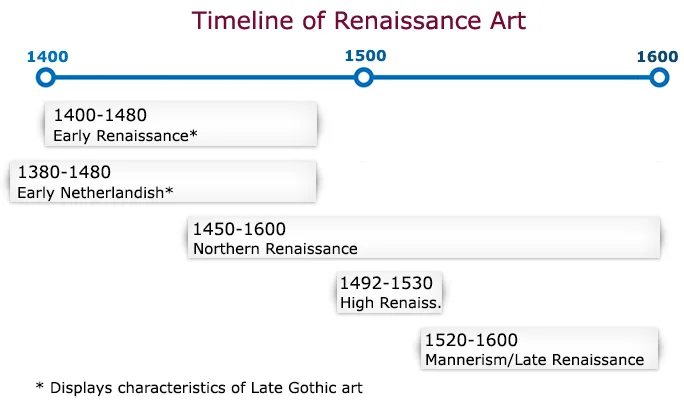
How to identify Renaissance art?
1. 3-D is finally here: Artists used a combination of accurate and believable proportions and spaces to create, for the first time in the history of art, a very realistic, three-dimenstional representation of the world. Gazing at some of their paintings, you’ll feel like you’re part of the scene, or you could just step into it.

San Marco Altarpiece by Fra Angelico
This painting is considered a masterpiece for its three-dimensionality and also for being a great example of tompe l’oeil (explained below, feature #4).
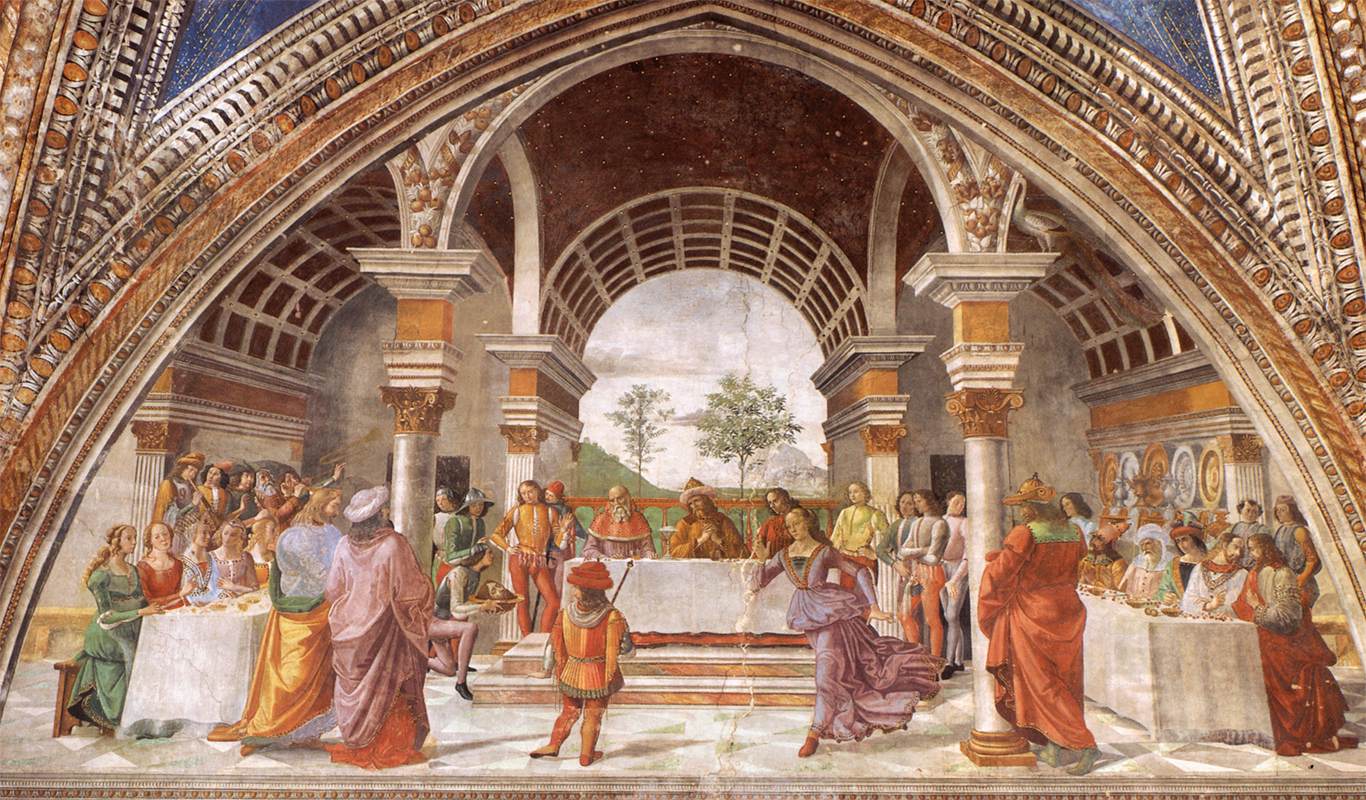
Herod’s Banquet by Domenico Ghirlandaio

Madonna and Child with Saints by Alvise Vivarini

Perspective View with Portico by Canaletto

Saint Luke drawing the Virgin by Rogier van der Weyden

San Zaccaria Altarpiece by Giovanni Bellini

The Alms of St Anthony by Lorenzo Lotto

Mystical Marriage of St Catherine by Paolo Veronese

The Apotheosis of St Roch by Tintoretto
- Look for geometric divisions of floors or ceilings: The geometric pattern in a painting does more than give an illusion of deep space, it’s also the reference point for the artist while composing the painting. Renaissance artists reinvented the way paintings were constructed, by using new techniques, such as linear perspective, which gave a sense of depth. They understood that objects and figures seem smaller as they recede into the space, and that’s how they depicted them on a flat surface.

The Last Supper by Andrea del Castagno
Note the classical pillars (more on this below in feature #12) and the unusual addition of griffin statues (sphinx-like mythological creatures found in ancient Greece and Egypt)

Execution of Savonarola on the Piazza della Signoria by Francesco Rosselli

The Last Supper Leonardo da Vinci

Holy Trinity by Masaccio

The Marriage of the Virgin by Raphael

The School of Athens by Raphael

St Mark Enthroned by Titian
3. Foreshortening is another important technique used by artists. It’s when an object is visually compressed to give the illusion of depth.

The Creation of the Sun and the Moon by Michelangelo

Lamentation of Christ by Andrea Mantegna

The Apotheosis of Venice by Paolo Veronese

The Battle of San Romano by Paolo Uccello
- Some artists went as far as creating optical illusions known as tromp l’oeil (literally, a trick of the eye) where you’ll find them in fake domes, for example.

The Annunciation by Jan van Eyck
As hard as it is to believe, this is a painting, not sculpture.

Camera degli Sposi Ceiling Oculus (circular opening) by Andrea Mantegna

Main hall of Palazzo Lancellotti by Agostino Tassi

Sala delle Prospettive of Villa Farnesina by Baldassare Peruzzi
- The subject matter is mostly religious. If it’s not biblical stories, then it’s hagiographies (i.e. biographies of saints).

The Sermon of St. Stephen at Jerusalem by Carpaccio

The Virgin and Child with St. Anne by Leonardo da Vinci

The Annunciation by Fra Angelico
Note the Annunciation scene is taking place in a Italian-style loggia (explained below, feature #12).

Torture of St John the Evangelist by Filippino Lippi

The crucifixion aka the Calvary by Andrea Mantegna

St. Sebastian by Andrea Mantegna

Expulsion of Adam and Eve from Eden by Masaccio

The Descent from the Cross by Rogier van der Weyden

The Damned Cast into Hell by Luca Signorelli

Salome With Head of John the Baptist by Titian

Contarini Madonna by Giovanni Bellini
- Look for people with symbolic hand gestures, dressed in flowing, swirling robes, all in bright colors, and unprecedented level of detail.

San Giobbe Altarpiece by Giovanni Bellini

The Creation of Adam by Michelangelo

Transfiguration by Raphael

Assumption of the Virgin by Titian

The Sistine Madonna by Raphael
7. Continuous narrative: It’s the illustration of multiple events at different moments from the same story within a single frame.

Resurrection of the Boy by Domenico Ghirlandaio

Stigmata of St. Francis by Domenico Ghirlandaio

Legend of Saint Ursula – Arrival of the English Ambassadors by Vittore Carpaccio

Disputation with Simon Magus and Crucifixion of St Peter by Filippo Lippi

The Tribute Money by Masaccio
- Although most of the creative output was religious, some artists painted pagan works with Graeco-Roman mythological themes.

Danaë by Correggio

Putti Fighting by Guido Reni

Libyan Sibyl by Michelangelo

The Inspiration of the Poet by Nicolas Poussin

The Triumph of Galatea by Raphael

The Feast of the Gods by Giovanni Bellini and Titian

The Birth of Venus by Sandro Botticelli

Primavera by Sandro Botticelli

An Allegory with Venus and Cupid by Agnolo Bronzino
This is a Mannerist masterpeice. Typical features of Mannerism are twisted figures and crowded canvases (more information below, Mannerist features #1 and #3).

Venetia between Justitia and Pax by Paolo Veronese

Wedding Banquet of Cupid and Psyche by Raphael

Wedding Night of Alexander the Great by Il Sodoma

Minerva Sending Away Mars from Peace and Prosperity by Tintoretto

Bacchus and Ariadne by Titian

Venus with a Mirror by Titian

The Rape of Europa by Paolo Veronese

Venus Blindfolding Cupid by Titian

Sacred and Profane Love by Titian
- That era also witnessed the rise of non-religoius individual portraits, of people who were rich and famous. Many of them were donors of chapels and patrons of art.

Bia de’ Medici by Agnolo Bronzino

Portrait of Cosimo I de’ Medici by Agnolo Bronzino

Mona Lisa, aka La Gioconda, by Leonardo da Vinci

Portrait of Innocent X by Diego Velazquez

Portrait of Girolamo Savonarola by Fra Bartolomeo

Portrait of Giovanna Tornabuoni by Domenico Ghirlandaio

Charles VII (1403-1461), King of France by Jean Fouquet
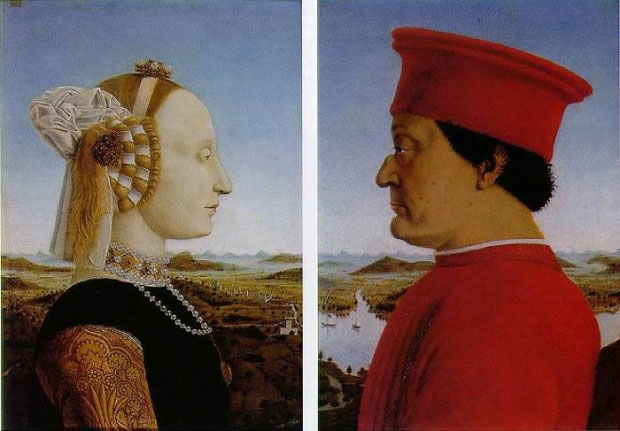
Portraits of the Duke and Duchess of Urbino (Federico da Montefeltro and Battista Sforza) by Piero della Francesca

Portrait of a Man in a Turban by Jan van Eyck

Portrait of Tommaso Inghirami by Raphael

The Woman with a Veil (“La donna velata”) by Raphael

Man with a Glove by Titian

Self-Portrait by Titian
- Although painting on canvases (stretched fabrics on single wooden frames) became prominent during the Renaissance, some artists, especially ones from the early Renaissance, continued to paint on polyptychs as was the custom during the medieval era. Polyptychs were wooden panels with folding wings mainly to serve as altarpieces in churches.

The Garden of Earthly Delights by Hieronymus Bosch

The Hermit Saints by Hieronymus Bosch

St. Peter of Verona Triptych by Fra Angelico

Triptych of St. John the Baptist and St. John the Evangelist by Hans Memling

Portinari Altarpiece by Hugo van der Goes

Ghent Altarpiece by Jan and Hubert van Eyck

Annunciation Triptych (Merode Altarpiece) by Robert Campin
- Paintings in a tondo format (plural is tondi). A tondo is a circular painting, which was an alternative to the rectangular frame.

Madonna of the Magnificat by Sandro Botticelli

Doni Tondo (The Holy Family) by Michelangelo
This tondo is Mannerist style. Typical features of Mannerism here are contorted poses and exaggerated muscles (more information below, Mannerist feature #1 & #2).

Madonna della seggiola (Madonna of the Chair) by Raphael
- Look for paintings that seem like they’re scenes from a bizarre dream or a virtual-reality game where time and place are fluid. Artists fused the contemporary with the biblical and classical. You’ll find figures from events that belong to the first century in biblical villages like Jerusalem, Bethlehem or Nazareth teleported to Tuscan landscapes or inside Flemish houses of the fifteenth century. Other times, the scene’s location is unidentified but surrounded by ancient Roman architecture; columns, niches and round arches. You’ll realize it’s not a biblical locale when you see anachronistic details such as castles on green Tuscan hills or typical Florentine palaces and villas. You’ll easily spot the clean-shaven fashionable Florentines among robed bearded biblical characters, floating angels and popular Franciscan or Dominican monks. Not only would the painter sometimes plant the wealthy art patron who’s paying him into the ancient scene, along with his family, but he, the artist himself, is occasionally there, with a couple friends too.

The Virgin of the Rocks by Leonardo da Vinci
Da Vinci painted a bizarre rocky landscape behind the Virgin, Jesus and John the Baptist. A similar landscape is more likey to be found in Europe than the Near East.

Adoration of the Shepherds by Domenico Ghirlandaio
Ghirlandaio managed to bring together an event from Bethlehem into a setting that blends ancient Rome, Jerusalem and contemporay Italy (Florence), all in one scene. Commissioning a painting was one way for the rich and powerful like the Florentine Sasseti family to show off their wealth. Ghirlandaio’s masterpiece portrays on the far right two of the Sasseti donors as part of the biblical scene. The artist didn’t forget to include himself (the one on the right pointing at himself as if he’s saying “Check this out! I painted this!”) Contemporary Rome and Jerusalem are brought together in the background (left and right, respectively). Also ancient Rome features heavily: There’s a long procession of the magi passing under a Roman triumphal arch with an inscription that says “GN[AEO] POMPEIO MAGNO HIRCANVS PONT[IUS] P[OSUIT]” (The priest Hircanus erected [this arch] in honor of Gnaius Pompey the Great). This is a symbol of the Roman victory over the Hebrews. There’s two Roman pilasters, the one on the left displays the date of the painting on its capital, “MCCCCLXXXV” (1485). The main figures are huddled around an ancient Roman sarcophagus used as the manger. The inscription on it reads “ENSE CADENS SOLYMO POMPEI FVLVI[VS] / AVGVR / NVMEN AIT QVAE ME CONTEG[IT] / VRNA DABIT” (Translation: Falling at Jerusalem by the sword of Pompey, the augur Fulvius says that the urn which contains me shall produce a God.) This is a reference to an ancient prophecy that the messiah, Jesus, is coming. The manger-sarcophagus being used by the child Jesus is a symbol of the triumph of Christianity over the Roman paganism. The symbol-rich masterpiece shows the different reigns of the Hebrews, followed by the Romans and ultimately the Christians.

The Expulsion of Joachim from the Temple by Domenico Ghirlandaio
This is a story from the Christian folklore (not biblical) where two parents Joachim and Anne could not have children for 20 years. The wait was not in vain because they eventually had the ‘Most Honored of Women,’ the Virgin Mary. But during the childless period, being a priest, Joachim walks into the Temple of Jerusalem on a feast day with a lamb for sacrifice. He gets kicked out by the high priest and the reason is his sterility (major stigma at the time). Another lamb is accepted in its place in the background. Ghirlandaio moved the scene from Jerusalem to Florence where the event is now happening in a Renaissance-era loggia, and typical Florentine architecture is seen on the sides. He added two groups of fashionable, clean shaven Florentines. The group on the left includes a proud young man looking at us, Lorenzo Tornabuoni (son of the commissioner) among his friends. On the right, the master painter added himself and some friends. He’s the one whose hand gesture is telling us: That’s my work and I know I’m good!

The Visitation by Domenico Ghirlandaio
This fresco depicts a biblical story of the Virgin Mary visiting the aging Elizabeth, both of whom are having miraculous pregnancies. The former with Jesus and the latter, John the Baptist. The landscape in the distance is not of Judah, the original location. Florence is the setting of the story according to this fresco. On the right side, behind the two maidens following Elizabeth, is a young woman in an elegant Florentine costume. That is Giovanna Tornabuoni (there’s a portrait of her with the same hairdo above, under #9). She was married to the son of Giovanni Tornabuoni, who commissioned Ghirlandaio to paint his chapel in the church of Santa Maria Novella, Florence. In a clever touch, Ghirlandaio put the steeple of that church in the background, on the right. Next to it, between the trees, is the tower of another iconic building: Palazzo Vecchio. Note the young men in contemporary costumes with their backs to us (in the middle), and the two similarly fashionable men walking out of a monumental ancient Roman building on the far right.

Madonna in the Meadow by Raphael
Note the Tuscan landscape in the background of Raphael’s painting of the Virgin, Jesus and John the Baptist. Anachronistically, Jesus takes the cross from John, a sign of acceptance of his future sacrifice.

Cestello Annunciation by Sandro Botticelli

Madonna and Child with Two Angels by Filippo Lippi

Holy Allegory by Giovanni Bellini
A cryptic and bizarre painting: Christian saints, the Virgin Mary enthroned, a baldachin (canopy over a throne) with a scene from the Marsyas myth, two unknown women, a man in a turban, a shepherd, a centaur and four children playing with silver fruits under a tree.

Cutting the Stone by Hieronymus Bosch

Altarpiece: Martyrdom of St. Denis by Henri Bellechose

Netherlandish Proverbs by Pieter Bruegel the Elder

The Stealing of the Dead Body of St. Mark by Tintoretto
Any major city in medieval Europe that sought prestige needed a first-class patron saint. They can’t be achieved without possessing the dead body of a saint or some parts of it (big business back then). In 828, Venetians set their eyes on St. Mark. They traveled to Alexandria, Egypt to steal his relics from a Coptic Church where he had been buried since the year 68. On their ship in the port, they covered the corpse with pork. The smuggling operation was a success because Muslims inspecting the outgoing shipments would not touch the pork. Their heist was annually celebrated from then on. Tintoretto commemorated the event, around 1548, with this haunting, dream-like painting. For a dramatic effect, he made it a windy day with thunderstorm. The sky is red-colored and heavily clouded. There are a few puzzling details here. The setting resembles less Alexandria, and more the Venetian Piazza San Marco. But you wouldn’t expect to see a camel in Venice! There are some semi-transparent or ghostly figures on the left side. The corpse looks like he’s been dead for only hours, not 760 years! But, then again, some might respond that the dead bodies of true saints never decompose. Another question is why the body is not headless (the head had also been stolen earlier and when the Egyptians recovered it, they stored it in a different location). These questions prompted an alternative story: This is the old tale of Egyptian Christians, during a hurricane, stealing the lifeless body of St. Mark from the pagans who intended set it on fire. Tintoretto painted himself behind the camel on the far right. His masterpiece is considered an example of the Mannerist style: Note the lack of balance of the composition (more below, Mannerist feature #3). Also note the presence of a geometrical pattern on the ground – a typical Renaissance feature (mentioned above, feature #2).

The Confirmation of the Franciscan Rule by Domenico Ghirlandaio
Within the Catholic church there’s multiple monastic orders such as Benedectines, Dominicans and Jesuits. Each of these communities focus primarily on one area of faith. For example, preaching and converting others was a priority of the Dominicans, while education was the focus of the Jesuits. The Franciscans, founded by St. Francis of Assisi, was another order, and they took a vow of poverty. The papacy was usually distrustful towards these religious orders since they each had an agenda, and some of them might be reform-minded or heretical. He had to be personally approve them. In this fresco, St. Francis and eleven of his followers are in Rome, in 1209, before the Pope Innocent III who’s reluctantly giving them his approval. The scroll the Pope is handing to St. Francis makes it official. Ghirlandaio transported this important event from the Rome of 12th-century to Florence of the 15th-century. Instead of its original setting of the Lateran Basilica of Rome, you can see Florence in the background with its famous Piazza della Signoria, and its iconic buildings, all of which you can still visit today. The Piazza (Italian for ‘square’) in the fresco’s background shows Palazzo Vecchio (on the left) which is the town hall. It also shows Loggia dei Lanzi (in the middle) which today includes an outdoor gallery of sculpture (a loggia is an arcaded or roofed area attached to a building). Ordinary life goes on behind the scene, there’s even laundry hanging from the first floor from a building on the right. On the far right, there is the short-haired Italian banker who commissioned Ghirlandaio to paint his chapel, Francesco Sassetti. He’s standing next to his son, on the far right. Who would he pick to ask the painter to place next to him (on his right)? The most powerful man in Florence! Most of the art you see on this page owes a debt to the support of that man. He’s Lorenzo the Magnificent, the ruler of Florence during its hey-day. Without the patronage and sponsorship of Lorenzo and his famous Medici family, the Renaissance might not have become what it is today — a turning point, a “rebirth” of Western civilization. Lorenzo’s looks might not have been magnificent (note the large, flat nose) but he seems better looking than Sassetti’s brother-in-law, Antonio di Puccio Pucci, on his right. On the far left, Sassetti’s other sons (Galeazzo, Teodoro and Cosimo) balance the fresco. Walking up the stairs (middle, foreground) is Agnolo Poliziano, a tutor to Lorenzo’s children and a well-known Renaissance scholar and poet. Following the tutor are Lorenzo’s three children: in order from the front, Giuliano di Lorenzo de Medici (grew up to be a duke), Piero the Fatuous (succeeded his father but, as evident from his nickname, his “foolish” strategic mistakes stained his legacy forever) and Giovanni de Medici (a kid with a brighter future who’d grow up to be the first Medici pope, Pope Leo X). Behind the children are two other teachers. Ghirlandaio put into this fresco many figures from the elite of Florence, so much so that he had to overpaint some original figures (note the ghostly-looking monk on the left side).

The Virgin of Chancellor Rolin by Jan Van Eyck
This painting displays multiple characteristic features of Renaissance art, one of which is the geometric pattern on the floor (mentioned above, #2). The 15th-century commissioner Nicolas Rolin, chancellor to Philip the Good, duke of Burgundy is hanging out with sacred figures from another era, the Virgin Mary and infant Jesus under a floating angel. The setting shows anachronistic details that biblical figures would never have seen. For example the setting is a loggia, which is an architecture that originates in medieval and Renaissance Italy before spreading to other parts of Europe. The background shows a contemporary Gothic church (obviously there were no churches during the time of Jesus!). The landscape with its snowy mountains is more likely to be Burgundy, Rolin’s hometown, than Bethlehem or Nazareth.

Brera Madonna by Piero della Francesca

Madonna of the Pesaro Family by Titian

Christ Giving the Keys to St. Peter by Pietro Perugino
How to distinguish the Mannerist (Late Renaissance) among Renaissance artworks?
1. Figura serpentinata (Italian for serpentine figure): Elongated figures in twisted poses and strange body positions

The Holy Trinity by El Greco

The Baptism by El Greco

Madonna with the Long Neck by Parmigianino

The Deposition from the Cross by Pontormo
2. Muscular bodies and lots of flesh: Muscles are exaggerated and shown in a wide range of light and shade.

The Last Judgment by Michelangelo

Martyrdom of St Lawrence by Bronzino

Moses Defending the Daughters of Jethro by Rosso Fiorentino
- Complex and crowded canvases. Sometimes the compositions are asymmetrical where the figures are not concentrated in the centre

Madonna del Rosario by Giorgio Vasari

The Miracle of the Slave by Tintoretto

The Last Supper by Tintoretto

The Feast in the House of Levi by Paolo Veronese
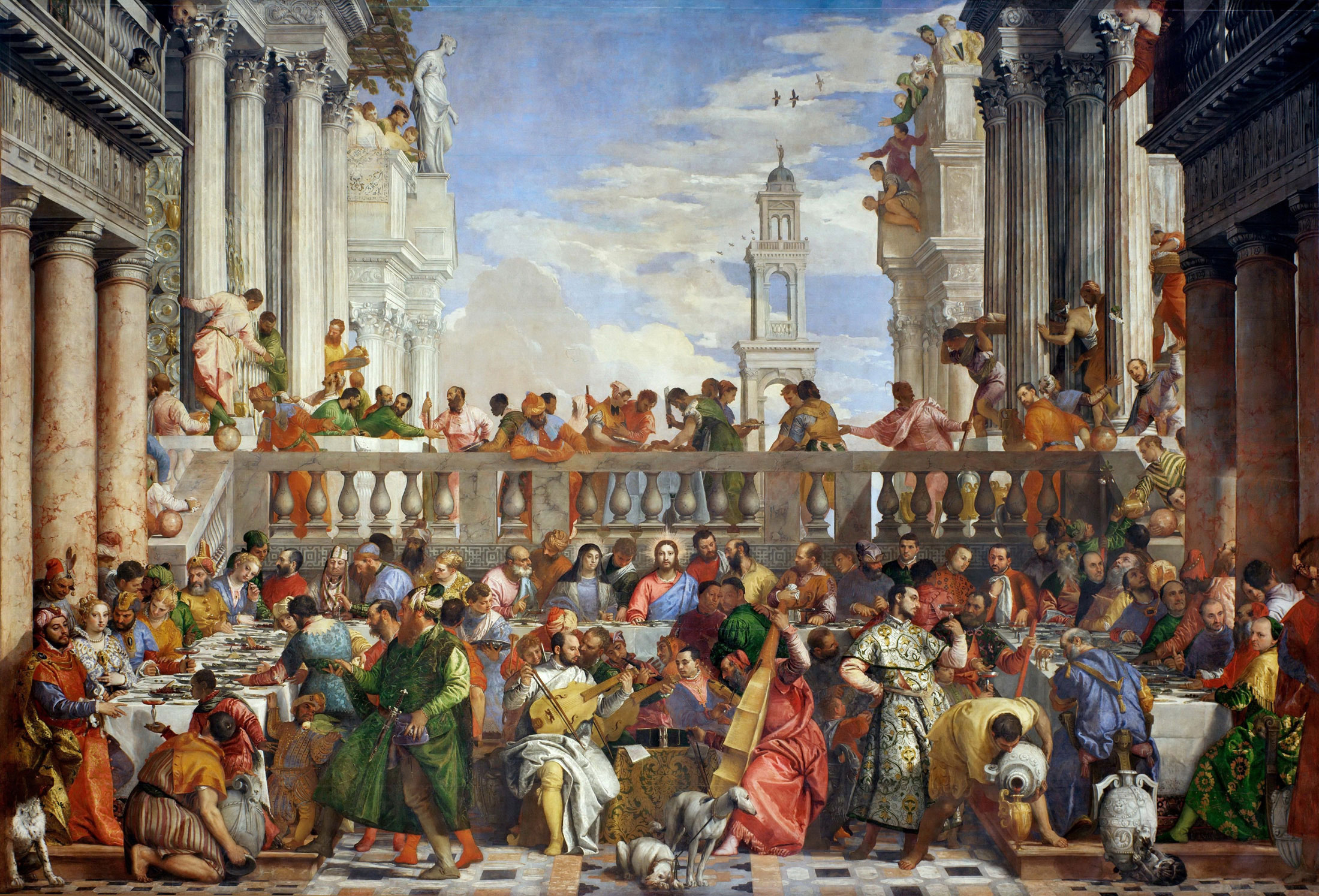
The Wedding at Cana by Paolo Veronese
How Renaissance art got its name? and where?
Some time at the beginning of the 15th century, somewhere in Florence, finally Europa removed her clothes and stepped into a bath for the first time in a thousand years! At least, that’s how one 19th-century historian succinctly put it to describe the European sentiment at that time regarding the Renaissance. In their view it was a transition from the “rat-infested, plague-ridden dark ages” into a period where a fascination with all things Graeco-Roman spread among intellectuals and artists. The Romans had left behind a great legacy well beyond the ruins of public baths, to which the historian was alluding.
The original line by historian Jules Michelet was “a thousand years of history but not a single bath” (mille ans d’histoire mais pas un seul bain). He unfairly derided the Middle Ages (400-1400). Michelet was also the first to coin the word “Renaissance” (French for rebirth) to describe the cultural renewal of the following historical period, from 1400 to 1600.
What gave rise to the Renaissance? Read ten reasons
1. The Black Plague recedes, feudalism crumbles and cities grow
Suddenly you display symptoms of a flu: chills, fever, headache and vomiting. Then you’re dead within hours or, if you’re lucky, within at most seven days. Sometimes you go to bed at night with these symptoms and you never wake up again. That was the Black Death – one of the most devastating plagues in human history. It decimated between one third and one half of the European population in the 1300s. For centuries, Feudalism was the social and economic glue of Western Europe, dividing people into nobility, knighthood, clergy and peasantry, also known as serfs. But the Black Death didn’t discriminate between rich and poor, although the destitute peasants were hardest hit due to the filthy life conditions around them. The high rate of peasant mortality meant an eventual breakdown of the feudal system. Another factor that contributed to that breakdown is the availability of abundant and cheap land vacated by now-dead noblemen. That allowed for unprecedented social mobility because many surviving peasants were the new owners. At the peak of the plague, in countries like Italy, trade had come to a halt to reduce the chances of spreading infection causing an economic crisis and further poverty. But as the Black Death receded a new Europe emerged.
After the plague, trade made a strong comeback; many peasants chose to become traders, moved into the cities rather than go back to work on the farm. Previously, while the Grim Reaper is on the prowl in your neighborhood, you wouldn’t have been in the mood to fantasize about charming Venus! Now life in the city, free from the Plague, allowed people to dedicate time to earthly pleasures and innovations. It’s unlikely that the cultural rebirth would have happened on the sparsely-populated farmland, especially during the dark days of the Plague.
2. Where do you buy culture? Merchants become grand patrons of art
As prosperity spread, a new social class appeared, that is of merchants. The increase in trade meant more assets are exchanging hands in the form of money (capital), instead of land as it always did since the ancient times. These were the foundations of a new economic system: Capitalism. With such economic growth, there was a need for a convenient way to manage money, give loans and finance projects. That’s the moment when banking was born. For multiple generations, a handful of families provided international banking services. A few of these families’ descendants are still active in the financial markets today. Among these families are the Bardi, Peruzzi, Oppenheim, Rothschild and Medici. In Florence and other Italian city-states, competition intensified between them in showing off their wealth and endowing sensually-decorated chapels. For many of them, patronage of the arts was a compensation for their lack of blue blood. Prominent families of merchants, similar to the Church, were motivated by displays of wealth and power but they also were constantly trying to prove that they’re as cultured as the centuries-old nobility of Europe.
Tourists today can visit monuments and chapels in Florence that embody that competition between the wealthy banking families like the Medici, Strozzi, Peruzzi and Albizzi. It was indeed an artistic push into a ‘renaissance’ period that left us with some of the greatest and most creative works of art ever produced.
3. Humanism powers the Renaissance: Looking backwards in order to progress forward
Life in the city brings people physically closer where collective knowledge increases and different ideas and worldviews clash. That’s what happened in Italian cities of the early 15th century. Urbanization combined with an increase in prosperity and international trade routes created a new reality there. In any society, when life conditions drastically change, new concerns, questions and anxieties appear. Consequently, a new vision in dealing with such questions was required. It would be labelled “humanism.”
Renaissance humanism could be defined as the return to Greek and Roman philosophy and texts. That very revival or “rebirth” is what gave us the term Renaissance. Despite the zeal for classical (Greco-Roman) literature lying at the heart of the new intellectual current, it was much more as will be explained below.
Most of us encounter the word Humanities in universities as it’s still used in its original sense. “Studia Humanitatis” is the medieval reference to “human-oriented” studies of classical literature and art as separate from “divinity’ studies, i.e. theology. In the 19th century, as Europeans reflected on the profound evolution of their own civilization four centuries earlier, they coined “humanism,” derived from the original academic term, to refer to the intellectual movement that put human experience in focus.
Fifteenth-century Italians seeking a fresh worldview did not need to look far. They were literally surrounded by the ancient ruins of the great Roman Empire (buildings like the Colosseum, aqueducts, statues and other artifacts). Although many of these buildings had been abused and barely standing, they were still constant reminders of a glorious past. Thus in their quest for answers, they resorted to that ancient wellspring of knowledge: the Greek and Roman writings of intellectuals such as Plato, Socrates and Ovid. It’s not coincidental that ancient Rome and Athens were thriving cities too, not unlike the Italian ones. The humanists started a mission of recovery and rediscovery of classical texts. Thanks to monasteries, the legacy had been preserved for centuries, although the writings were not widely shared, and the understanding was naturally limited to a religious outlook. Up to that moment, Christian Europeans had disdain for their pagan ancestors but they simultaneously harbored deep admiration. Now, that admiration of the classical culture was out in the open. It pervaded art, culture and society and captivated almost everyone among the educated, from popes and priests to merchants. The humanist ideals and the intense study of ancient Greek and Roman art shaped the Renaissance art movement. Intellectual and architectural plundering of classical heritage was replaced with appreciation and respectful scrutiny.
Italian cities were fortunate for their location being close to both the Arabs and Byzantines, both of whom preserved and studied texts of the Antiquity during the Middle Ages while Europe struggled. In fact, the origin of the recent appreciation of Greco-Roman culture was indirectly caused by the downfall of the neighboring Byzantine Empire. The Greek-speaking empire had been doomed for a while and by the time its capital, Constantinople, fell to the Ottoman Turks in 1453 many Greek scholars had fled to Italy. Archives, manuscripts and scrolls were salvaged and brought to the nascent Italian libraries. Among the émigrés was Byzantine philosopher Manuel Chrysoloras (1355 – 1415), one of the pioneers behind introducing Greek literature to Florence. Also the Constantinopolitan Johannes Argyropoulos (1415 – 1487) taught the brothers Pietro and Lorenzo de’ Medici (of Florence’s ruling family) Greek language and philosophy.
Those who belong to the educated elite started to outright reject the centuries-old spiritual outlook as their social and economic conditions continued to improve. No longer they accepted hardship and suffering as paths to grace. No longer they viewed this world with apathy while waiting for the next one. No longer their main source of knowledge was through the Bible, church doctrine and the clergy. And they no longer saw themselves as helpless creatures under relentless control by God. In their eyes, walking away from society and opting for a monastic life should never mark one as a virtuous citizen. Similarly, theology and scriptures were not the only worthy fields of study. Nature, human nature or that of any species merit equal or greater attention. Now life was not just worth living but also deserved every attempt to make it better. The spiritual outlook was replaced with a secular one that put humans in the center, instead of God. Thus, one of the tenets of humanism was secularism.
In medieval times, the feudal system and communal life divided society into rigid groups where individual expression barely had any value. Likewise, the Church’s ascetic doctrine had always equated self-interest with the capital vice of pride. “If anyone wishes to come after Me, he must deny himself” – That was the Biblical teaching. Self-denial and unconditional obedience to Church fathers were always righteous attributes. But with more economic opportunities and wealth, that mindset of the medieval civilization was becoming archaic. Burgeoning private enterprise is by definition individualistic. A newly acquired confidence prompted people to pursue individual achievements and to look for new ways to protect themselves and their own interests (as evidenced by proto-science and proto-medicine). Thus, the concept of Individualism was another important component of humanism.
This is the period that gave us the ‘Renaissance Man’ – an enviable person who’s proficiently experienced in a wide range of fields. Michelangelo was a painter, architect, engineer, poet and above all, as he considered himself, a sculptor. Leonardo da Vinci was a sculptor, painter, caricaturist, inventor, architect, engineer and anatomist. For humanists like da Vinci and Michelangelo and many others, the gates of knowledge had been kicked open and they would’ve found it incomprehensible to be specialized in a single area as we do today. To our defense, these Renaissance polymaths (or “generalists”) didn’t have to reckon with the vast amounts of knowledge that force us to become specialists.
The humanist zeitgeist was manifested in pagan and mythological themes in paintings (e.g. Primavera by Botticelli); in emphasis on the human body and its beauty (An Allegory with Venus and Cupid by Bronzino); in documenting individual achievements of the era’s geniuses (Lives of the Most Excellent Painters, Sculptors, and Architects by Giorgio Vasari); and in even the mere act of signing artworks which the self-negating medieval artists would never have done.
Renaissance artists revealed humanist influence in the realistic depiction of the Holy Family and other biblical figures. Some artists, particularly the Florentines, went as far as dressing the characters in the local fashion of the day. They even placed them among important contemporary citizens including chapel donors and occasionally set the whole scene against their own European landscapes or next to ancient Roman architecture.
Nevertheless, biblical figures at this point are not ordinary bunch of people. You won’t see in Renaissance paintings St. Joseph as a poor laborer with dirty fingernails. That would happen four and half centuries later when we reach the Pre-Raphaelite style which depicted the Holy Family as a working class members in a shabby carpenter’s workshop. Subsequent art movements, including even the Pre-Raphaelite group who were hostile to the Renaissance art as seen from their name, wouldn’t have existed if it weren’t for the Renaissance artistic revolution.
The Renaissance was a crucial moment of human self-consciousness and self-understanding. Western civilization was on the threshold between the Medieval era and the Modern era. The former relied on faith and the supernatural, and the latter was an evolution that was yet to present two centuries later the Enlightenment, reason, the scientific method and individual human rights. It was the cusp of an epoch where innovation and discovery were encouraged (Italians Christopher Columbus and Amerigo Vespucci were about to enter the stage), questioning authority and traditional knowledge were tolerated, challenging established religion was gaining momentum and the seeds were sown for the immense revolt of Protestant Reformation. Humanist values such as secularism and individualism are still cornerstones of Western Civilization.
Note: Don’t confuse Renaissance humanism with today’s secular humanism (simply known as “humanism”). Italian humanists acknowledged the importance of religion and Divine presence although they started to lessen their dominance. French Enlightenment thinkers followed similar trend and marginalized them. Secular humanism of today has become atheistic or agnostic at its core. To borrow a metaphor from sports, in the medieval period God was at the front line of the game, Renaissance humanism and later the Enlightenment put him on the sidelines and today’s secular humanism simply kicked him out of the arena.
4. The Kingdom of Heaven is for the poor: wealthy merchants have to “compensate”
Every Catholic merchant would’ve known that Jesus said that “it is easier for a camel to go through the eye of a needle than for a rich man to enter the kingdom of God.” Based on the traditional interpretation of this verse, poverty was considered a virtue, so much so that thousands of men and women for centuries had been willingly embracing it and living in monasteries all over Europe. The Protestant work ethic would eventually arrive to turn this on its head, where their view was wealth is a sign of grace. (Sociologist Max Weber argued that this was partially responsible for Capitalism to fully develop in future Protestant countries.) For Catholic merchants to deal with that age-old dilemma (still an open question to this day for many Christians) and reconcile their new reality of wealth accumulation with biblical teachings, they chose to spend some of it for “the glory of the Lord”. Besides donations to the poor, they built and decorated dazzling chapels.
5. Thanks Cosimo and Lorenzo: the Medici family bankrolls the Renaissance in Florence
Although many merchant families were patrons of art as explained above, the Florentine Medici family towered above all of them. It’s almost impossible to talk about the genesis of the Renaissance in Italy without including them. Their role was so important that the British historian, Paul Strathern, called them Godfathers of the Renaissance. Their involvement did not just happen during the Renaissance, but, to a great extent, made the Renaissance happen, at least within Florence. Their patronage is the reason why we call Florence the cradle of the Renaissance. They transformed it culturally and artistically. Two Medici family members in particular were very influential: Giovanni de’ Medici and his grandon, Lorenzo the Magnificent.
Originally, they were wool merchants like many other Florentine families – it was one of the largest industries at the time. The first significant character in their story is Giovanni de’ Medici (ca. 1360–1429) who turned a small bank and a modest inheritance into a great financial enterprise. With Cosimo, his son, at the helm of the business, it expanded further to become the largest in Europe. Using his wealth, he rose in political power which prompted a conflict with rival Florentine banking families. The conflict ended with his exile for a year, but he was able to use his financial and political might to return victorious back to Florence in 1434. He was the de facto leader upon his return. His leadership lasted for the following three decades and started a three-century dynasty (1434-1743). The Medici interest, starting with Cosimo, in art patronage and philosophy was more than just propaganda. Indeed, they, like other wealthy patrons, sought prestige and self-glorification, but they proved that they also had a real passion for honing their cultural and artistic sensibilities.
Cosimo hired painters, sculptors and architects, some of whom were well-known masters like Donatello and Fra Angelico. He also financially supported scholars and philosophers, such as the humanist Catholic priest Ficino, who was assigned the job of translating ancient Greek works into Latin. He started an informal group bringing together the greatest Florentine minds for reading and dicussing the works of Plato. It would later be known as the Platonic Academy and lay the basic principles behind humanist philosophy, making the Renaissance much more than just an artistic movement. Humanism spread to other countries and shaped the development of European thought. Cosimo began a Medici tradition where his residence was a place for scholars to congregate. That bears some similarity to the literary role played by Viennese and Parisian cafés at the end of the 19th century, where intellectuals and future revolutionaries met and ideas were debated. Although the difference here is that most of the Renaissance output was in the form of philosphical ideas and art (the visual kind), rather than literature. He encouraged the study of humanism and the return to antiquity to the point of sharing his library of Greek and Latin volumes with scholars to kindle their interest. He himself learnt enough to be able to engage in philosphical debates with them. After his death, Florentines gave Cosimo de’ Medici (1389—1464) a title never given to anyone before or after: Pater Patriae (father of the nation).
Cosimo’s son, Piero, was too ill to leave a significant legacy behind but he continued with the tradition of sponsoring artists. After 5 years in power he was dead. His son Lorenzo (1449—1492), on the other hand, was one of the most important figures of the Renaissance period. During his first few years, he survived an assassination plot at the hands of the Medici arch-rivals, the Pazzi family supported by Pope Sixtus IV. Lorenzo was a true Renaissance man; a politician, a poet and an art patron. He was educated from his youth in classical literature; a privilege his self-taught grandfather never had. To contemporary Florentines he was maestro della bottega (‘boss of the shop’) who also called him il Magnifico (the Magnificent). He assumed the role of the benevolent leader of Florence, and as his grandfather once did, he also sponsored architects and artists like Botticelli, Ghirlandaio and Filippino Lippi. Additionally, he established a school of art for young boys and Michelangelo was among its first students. Perhaps the greatest service il Magnifico gave to the world of art was discovering and sponsoring the talent of the 13-year old Michelangelo. He moved Michelangelo into their palazzo and was one of the family. Lorenzo’s Florence was the cultural capital of Europe. He enlarged the Medici library by adding more manuscripts to it and continued supporting the Platonic Academy. He was another Medici who enjoyed evenings with artists and intellectuals. Who needs television when you have the most brilliant minds of Europe, the likes of Michelangelo and Botticelli and philosophers, Mirandola and Ficino, drinking wine and sharing tales with the Magnificent himself – perhaps even listening to some of his humorous, dirty poetry. The death of Lorenzo marked the end of Florence’s golden age. Rome would take over as the cultural capital of Europe. In retrospect, without the Medici patronage, we may never have heard about artistic geniuses such as Donatello, Michelangelo and Botticelli.
6. Stability within and among Italian city-states though not a Golden Age of Peace
Italy was neither rich nor powerful. It wasn’t even unified. Other powerful nations were France, England or the so-called Holy Roman Empire (centered on modern-day Germany). The Renaissance flowered in Italy, not despite of, but thanks to its fragmented sovereignty. City-states like Milan, Florence and Venice competed in building ever-grander palaces and cathedrals. As more men became artists and architects, more commissions were awarded and experimentation took place on a scale unseen before.
Some traditional sources portray the Renaissance in Italy as an era of harmony, but that would be inaccurate. Italy was spared from foreign invasions, but the city-states, and the Papal States too, often engaged in violent conflicts among themselves. And when city-states were not rising up in arms, it was rival families that plotted against one another. Florence which gained a period of peace under the Medici rule was one well-known example of how a city had divided loyalty between two powerful families, as explained above. Nevertheless, overall Italy enjoyed relative stability while other parts Europe were still battling the plague or mired in war. For example the Hundred Years’ War (1337–1453) kept both England and France locked in a long military conflict – the longest in Europe’s history.
7. Chapel endowments: Can I get my mother to heaven faster if I commission another painting?
Today people in Western Europe often live into their 80s. At the dawn of the Renaissance era, you were lucky to live up to 40 years. And at that you’d be considered ‘aged’. Catholic Christians surrounded with so much death in the Middle Ages had a solution to an old spiritual puzzle. If you’re evil enough, you go to hell and if you’re good enough you go to heaven. But where do you go if you belong, like most people, somewhere in the middle? Their answer was a third hellish place and they called it Purgatory. Their doctrine stated that it was an actual place, where souls would have to stay for a period of time for purification, pain and penitence before they’re released into heaven. If your loved one’s soul is there, could you do anything to alleviate its suffering and expedite its release from Purgatory? Yes, donations to the poor or intercessory prayers and Masses. And, if you’re truly determined and you got deep pockets, you could, besides buying indulgences, directly endow a chapel in their name and furnish it to impress. Such family chapels, though usually small, were springboards for Renaissance creativity. Modern eyes sometimes miss the fact that there’s more to the Renaissance art than aesthetics; it represented a gateway between salvation and eternal suffering. All of this would be rejected by Protestant Reformation in the 16th century.
8. Il Papa is back in town: the advent of great papal commissions in Rome
At the start of the 1300s, a major conflict was brewing between Pope Boniface VIII (reigned 1294–1303) and King Philip IV of France (r. 1285–1314). The conflict was over money (church revenue and taxation) and political power. They were both power-hungry. They competed on whose authority is higher and officially condemned each other. In 1303, the French king sent a bunch of thugs to arrest the 80-year old pope and bring him to France to stand a trial. He was rescued by loyalists from his hometown and brought back to Rome, but died three weeks later. The pope who succeeded him took several steps to bring about peace between the papacy and the French royalty. He was dead within a year. The following one, Clement V, a former bishop of Avignon, planned to bring a final settlement to the conflict. In 1309, he decided to stay temporarily on papal territory at Avignon which was not part of France at the time but close enough to help him deal with the ongoing crisis. Ironically, that evolved into another crisis, an existential one that threatened the the papal institution itself. The ‘temporary’ residence at Avignon became an absence from Rome that lasted for seven decades.
The immutable papal view was that Rome is the home of the papacy but lack of revenues and the presence of hostile city-states stood in the way of their return. Eventually Pope Gregory XI (the seventh and last Avignon pope) returned to Rome in 1377. Pope Urban VI who was elected after him was incompetent and abusive to even his own supporters. A few cardinals within months deposed him and returned to Avignon to elect another pope (an antipope). That started the Great Schism (1378–1417), a three-decade period where Rome and Avignon claimed their own lines of popes. Europe was divided in its allegiance between them. At one point, some cardinals in Pisa stepped up to resolve the problem by electing a third one, turning the crisis into a farce of three men, each claiming to be the one and only true pope! Finally, the Council of Constance, convened in 1414, brought an end to the schism by successfully deposing the claimants of Avignon and Pisa, and the one in Rome abdicated. In 1417, the council elected a new pope, Martin V.
Now that the papacy was permanently based in Rome, it was geographically closer to the future birthplace of the Renaissance. In fact, the successor of Martin V, Eugenius IV (r. 1431–1447) and his court, had a first-hand contact in Florence with the earliest Renaissance artists. One of whom was Fra Angelico (1395-1455) whose work was admired by that pope so much that he was invited to paint two chapels in Rome. The following pontiff, Nicholas V (r. 1447-1455), was the first to be considered a truly Renaissance pope. He inaugurated an era which would transform Rome, restored old buildings and established new ones. His personal library, with volumes of Greek and Roman literature, was the seed of the Vatican Library.
Some might argue whether the Renaissance popes of the following 100 years were spiritual leaders, luxury-loving princes, or perhaps conniving criminals. But there is no argument over how great patrons of art they were. Pius II, a lover of art and literature, chose his papal name after the Latin epithet ‘pius‘ given by the Roman poet Virgil to his hero Aeneas. It’s hard to determine how ‘pious’ and pure he was, but we know that he had the unique distinction of being the only pope who had ever written erotic fiction before he was ordained.
Sixtus IV built the Sistine Chapel, invited scholars into the Vatican Library and sponsored painters and sculptors around Rome. However, he had no shame in practicing nepotism, like many others popes of the time. He made six nephews cardinals. He was also personally involved in a murder conspiracy along with the Pazzi family against the famous Medici family. It resulted in injuring Lorenzo the Magnificent and the killing of his brother Giuliano. He then waged a war against Florence, which was one of his many military adventures. Thanks to his wars and corruption, the papal treasury was emptied and he had to start selling indulgences to the believers – basically tickets to heaven. You could even purchase them on behalf of those who were already dead!
The following pope, Innocent VIII, also lived la dolce vita and had an interest in creating great architectural work. However he’s better known for creating useless religious offices and selling them to whoever pays the most in order to finance his princely lifestyle. Before his ordination, he fathered not one but three illegitimate children.
Another Renaissance pope who was known for his support of art was Alexander VI. He commissioned many artists like Michelangelo, Raphael and Bramante. Alas, many historians consider him to be the most corrupt pope of all time. He started his papacy by committing the offense of simony (a bribery to obtain a church office). In other words, he basically paid to become a pope. His promiscuous lifestyle was not stifled by his ordination, as was the case with other pontiffs. During his papacy, he had multiple mistresses and illegitimate children. He had the nerve to ordain his own son to be a cardinal. Debauchery and nepotism with his leadership rose to new levels. He ran the papacy like a Mafia boss and was behind multiple assassinations and executions, one of which was of the rebellious ‘mad monk’ Savonarola.
Pope Julius II was not much different from his predecessors: He commissioned some of the greatest artists of the period. Among his grand projects was the reconstruction of St. Peter’s Basilica into its current shape. He commissioned Michelangelo to paint the ceiling of the Sistine Chapel. But he hated his predecessor, Alexander VI, to the point that he couldn’t stand being in his notorious residence, the Borgia Apartments (they were sealed off for centuries). Luckily for us and for a young artist named Raphael Sanzio, he moved into a new suite of apartments. He commissioned him to paint frescoes in what’s today known as the Raphael Rooms (Italian, Stanze di Raffaello). The best known of them is the School of Athens. That was among grand works that mark the High Renaissance era. However, he also continued to finance his commissions and construction projects through the sale of indulgences. He too had illegitimate children, three of them, before his election as a pope.
The above-mentioned commissions to Michelangelo and Raphael continued into the papacy of the succeeding pope, Leo X. He was another hedonistic pope with a great passion for art, literature and music. Reconstruction of St. Peter’s Basilica continued and so did its financing scheme through the sale of indulgences. But Leo X expanded the business of selling forgiveness to never-seen-before levels which makes it hardly surprising that an unprecedented backlash was on the horizon.
The sale of indulgences is seen today as one of the most shameful religious abuses in history. It’s a dark irony how millions of gullible and impoverished Catholics indirectly financed the Rome we adore today, including its world-famous St. Peter’s Basilica. That level of corruption paved the way for a monk, named Martin Luther, to begin a ‘protest’ in 1517 that would break up Western Christianity forever. By the time Leo X died in 1521, Europe was about to enter a period of great religious strife. Leo X viewed Martin Luther as an insignificant German monk, not unlike many others that challenged the Church throughout its history (remember, Savonarola was one of them). He also didn’t fully comprehend the urgency of reforms required to put an end to the corruption rife throughout all ecclesiastical ranks.
Overall, the Renaissance papacy was morally low, but artistically high. The motives for their patronage of art were selfish and grandiose. They used sculptors, architects and painters as tools for their extravaganza and power projection. Although that era concluded with the Reformation and the beginning of a violent religious conflict, it also introduced a new Rome rebuilt as the cultural center of the world.
9. Linear perspective unleashes a great wave of creativity
How do you render our three-dimensional world on a flat two-dimensional surface?! From the time they dwelled in caves, humans successfully represented length and width with varying degrees of accuracy, but the third dimension, that is depth, was always the elusive one. While we should refrain from assuming that there was a universal desire to represent three-dimensionality in earlier cultures, that craving was definitely present in the Renaissance one from its conception. They were more inclined towards a realistic style. Unlike their predecessors, they used exactitude to depict religious characters as more human and less heavenly. That did not contradict with Church doctrine. Jesus, after all, in theological terms, had two natures: the human and the divine. Emphasizing the former doesn’t invalidate the latter.
For the first time ever, artists were able to achieve the illusion of depth in paintings through linear perspective. This Florentine discovery was the defining feature of Renaissance art. Linear perspective is a technique that uses mathematical formulas which apply imaginary (or drawn) lines converging in the far distance at a single point — the vanishing point. It tricks our eyes by providing a sense of depth where objects are bigger in the foreground and as they recede in the background, closer to the vanishing point, they appear smaller till they seem to “vanish.” This technique is based on how the human eye perceives a huge castle or a cruise liner on the horizon as smaller than they actually are. The vanishing point is also easy to encounter: find any parallel lines like railroad tracks and they will appear to converge to one point in the distance.
Linear perspective might seem to you like the wheel, toilet paper or condoms — why did they take so long to invent it? The answer is it’s more complicated to construct than it seems. Giotto (1267-1337) was among the first artists in history to dabble in perspectival creations with works like Ognissanti Madonna (1310). It lacks the naturalness and impeccable precision visible in Renaissance paintings but it was still one of the most important artworks in history. Giotto relied on his own intuition since it would be a hundred years before mathematical perspective is developed. In other words, Giotto was a genius Medieval artist who had showed up one century too soon.
Brunelleschi (1377-1446) formalized around 1415 the mathematical system that established the basis for linear perspective. It was the 15th century’s most significant development in art. With mathematical formulas and geometric calculations, each painting was both an artistic and a technical challenge. The first artist to apply that innovative method with accuracy was Masaccio (1401-1428) in his groundbreaking fresco of 1425 titled The Holy Trinity. (His reputation might have matched that of Michelangelo or Da Vinci if he were not to tragically join, or perhaps inaugurate, the infamous “Club 27,” which would later include names like Jimi Hendrix, Kurt Cobain and Amy Winehouse.) It was for more than just showing depth. It was a revolutionary way for Western artists to construct their compositions. The School of Athens (c. 1510) by Raphael represents a prime example of that technique.
10. Fortuna bestows upon Florence an incredible abundance of talent
Historians don’t often talk about fortune but it always lurks in the background beyond all historical analyses and interpretations. There’s a slim chance you would be reading this if it weren’t for astonishing coincidences that took place in the San Francisco Bay Area — rather than anywhere else in the developed world — during the 1970s firing up the PC revolution. Similarly fate and fortune made Florence, out of all Italian cities, the cradle of the Renaissance in the 1400s. Professor Judith Testa explains in her book An Art Lover’s Guide to Florence: It remains amazing that a city of less than a hundred thousand people produced such a disproportionate number of the great sculptors, architects, and painters of the early Renaissance. Indeed, Florence was fortunate.
Why Renaissance artists were rebels?
The Renaissance was a monumental shift that involved many professions. But when you think of the Renaissance, which profession comes to mind first? Your answer is probably the artist. The artists did not only change art radically but they also changed how society viewed them. At the very beginning of the period, socially they were considered craftspeople, “lowly workers” who had to get their hands dirty to earn a living. They were in the same category as stone-smiths, blacksmiths, weavers and tanners. Like any craftspeople, the concepts of their handiwork were not their own, but had to align closely with the requests of their clients. By the end of the Renaissance, painters and sculptors rose up in social ranks and were highly respected in all European elite circles. For example, Pope Urban VIII (r. 1623–1644) was a patron and a close friend of the brilliant sculptor Bernini, who had to occasionally intervene to protect him. (In an infamous incident, Bernini lost his temper when he found out his lover cheated on him with his own brother. As punishment, he sent a servant to shred her face to ribbons with a razor. Thanks to the pope, he got away with only a fine!)
Renaissance artists replaced the flat Gothic art of the Middle Ages with realistic three-dimenstionality. A fresh look at the canvas involved techniques that utilized geometric patterns, accurate proportions, linear perspective, a vanishing point, and foreshortening (compressing an object to give the sense of depth). None of these innovations had been available before.
Birth of Venus by Sandro Botticelli represents two ways Renaissance artists broke from the past. It depicts a mythological theme – anathema to the Middle Ages where only religious icons were venerated. Secular subjects were widely explored in Renaissance art and personal portraits became common among the wealthy. Also, Venus, the pagan goddess, is stark-naked which would have been offensive to medieval eyes unless the icon is showing the horrors of hell or the garden of Eden. Nudity in paintings and sculpture was yet another declaration that the departure from medievalism is irreversible. The male figure was just as glorified as the female one. Michelangelo’s The Creation of Adam is one famous example. Homoerotic undertones of Renaissance male nudity still raises eyebrows of modern museum visitors, stunned by the boldness of artists.
From the 1520, some Renaissance artists took a different path from what had been established as traditional for more than a century. They were the Mannerist artists. They chose to elongate the human figures to the point of absurdity and twist them in strange positions. They also abandoned the simpler order and perfectly symmetrical composition preferred by preceding artists and instead they crowded asymmetrical scenes with entangled human flesh. Although, they altered their artworks in defiance to Renaissance norms, they were still part of the same art movement and supporters of the same ideals. Hence, today we call their style the Late Renaissance.
Timeline of Western Art Movements (16th Century – 2010)
Mannerism (16th Century, c.1520–1590)
Characteristics & Context: Emerging after the High Renaissance, Mannerism was a reaction against the harmonious idealism of masters like Leonardo da Vinci and Raphael. Mannerist art is characterized by artificiality, elongated proportions, and complex, often crowded compositions. Artists took a self-conscious, intellectual approach, prioritizing technical virtuosity and elegance over naturalism. This era saw upheavals (e.g., the sack of Rome in 1527) and new scientific knowledge challenging Humanist ideals, which influenced art to become more emotionally expressive and less centered on man as the measure of all things.
Key Artists: Jacopo da Pontormo and Rosso Fiorentino pioneered early Mannerism in Florence with expressive, sometimes dissonant religious scenes. Parmigianino exemplified mature Mannerism – his Madonna with the Long Neck (c.1534–1540) features a gracefully elongated Virgin Mary and child in an oddly skewed space. Agnolo Bronzino, a pupil of Pontormo, became a leading Florentine Mannerist painter. In sculpture, Benvenuto Cellini’s works showed Mannerism’s elaborate detail.
Innovations: Mannerists introduced the figura serpentinata (“serpentine figure”), twisting the human form into elegant but unnatural poses. They played with scale and perspective – backgrounds might recede unexpectedly or lack logical space. This departure from High Renaissance balance paved the way for more dramatic art styles.
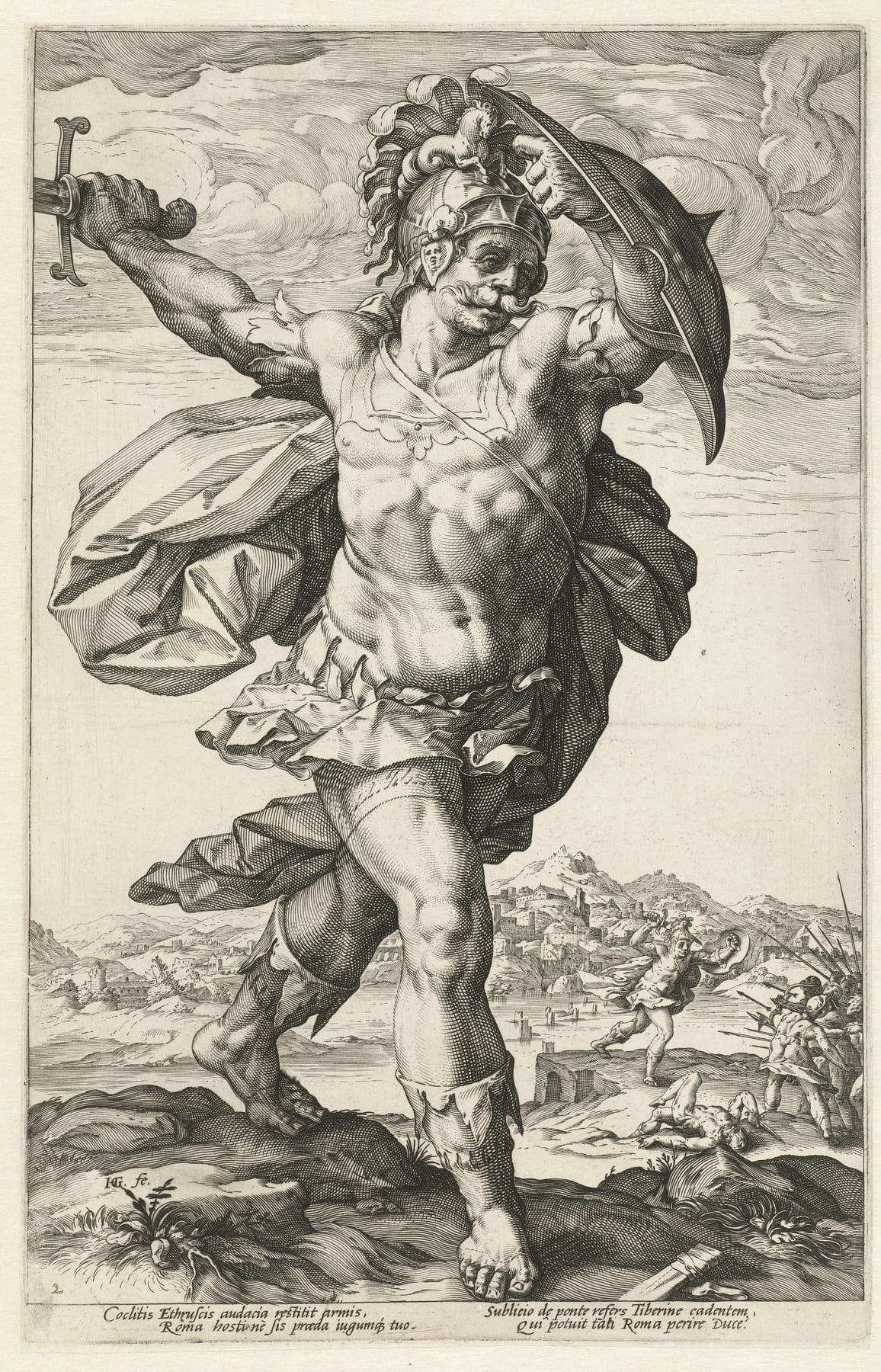
Notable Artworks:
Parmigianino – “Madonna with the Long Neck” (1534–40, Uffizi Gallery). This painting’s exaggerated proportions – Mary’s impossibly long neck and the elongated Christ child – exemplify Mannerist distortion. The crowded cluster of angels on the left versus the empty column on the right creates a strangely unbalanced space, embodying the era’s elegant artificiality.
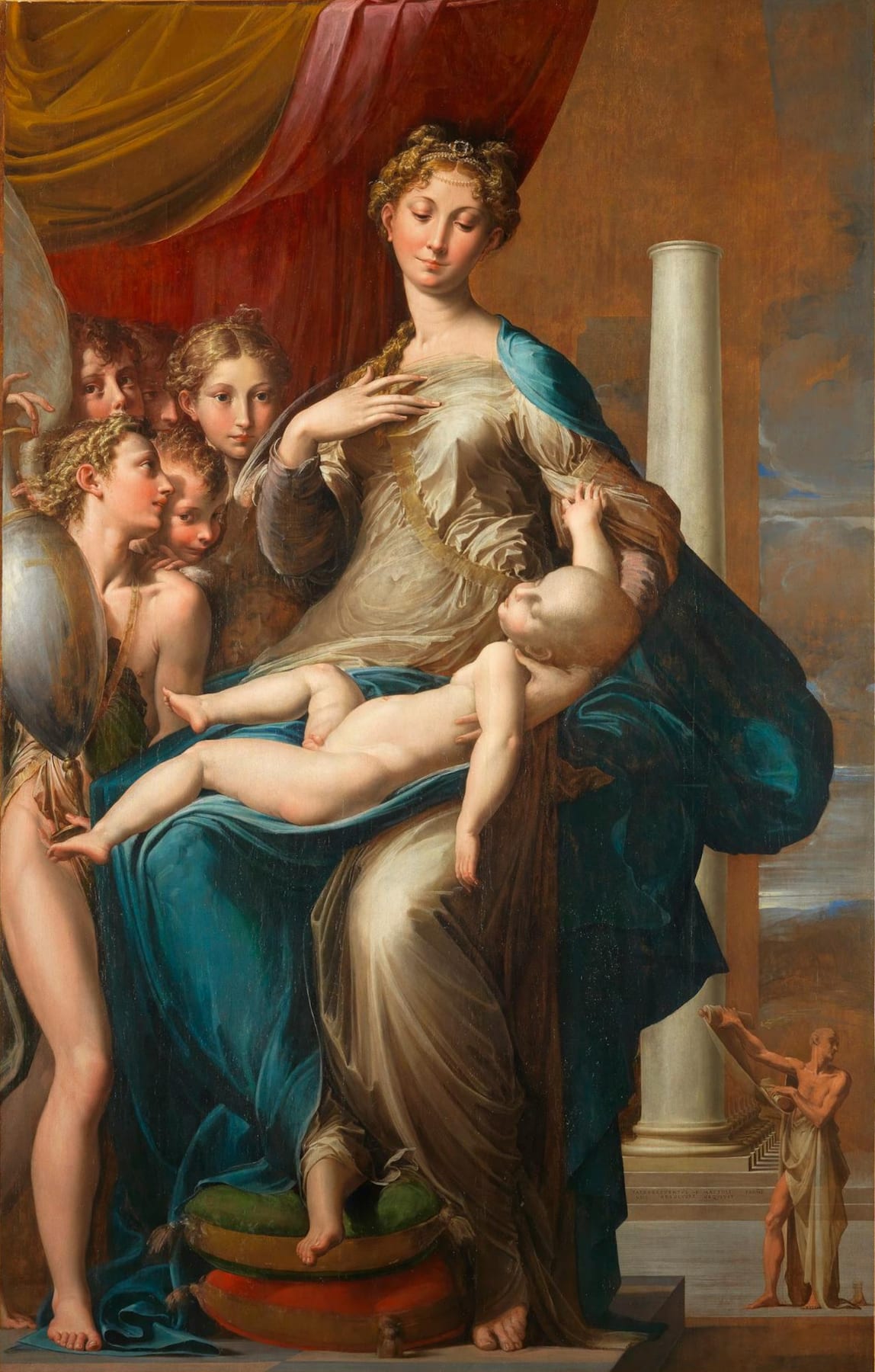
Pontormo – “Deposition from the Cross” (1525–28, Santa Felicita, Florence). Pontormo’s famous altarpiece shows pale, elongated figures in swirling, weightless poses. Lacking a clear sense of ground, the composition appears almost otherworldly, with jarring colors – hallmarks of Mannerism’s emotional drama.
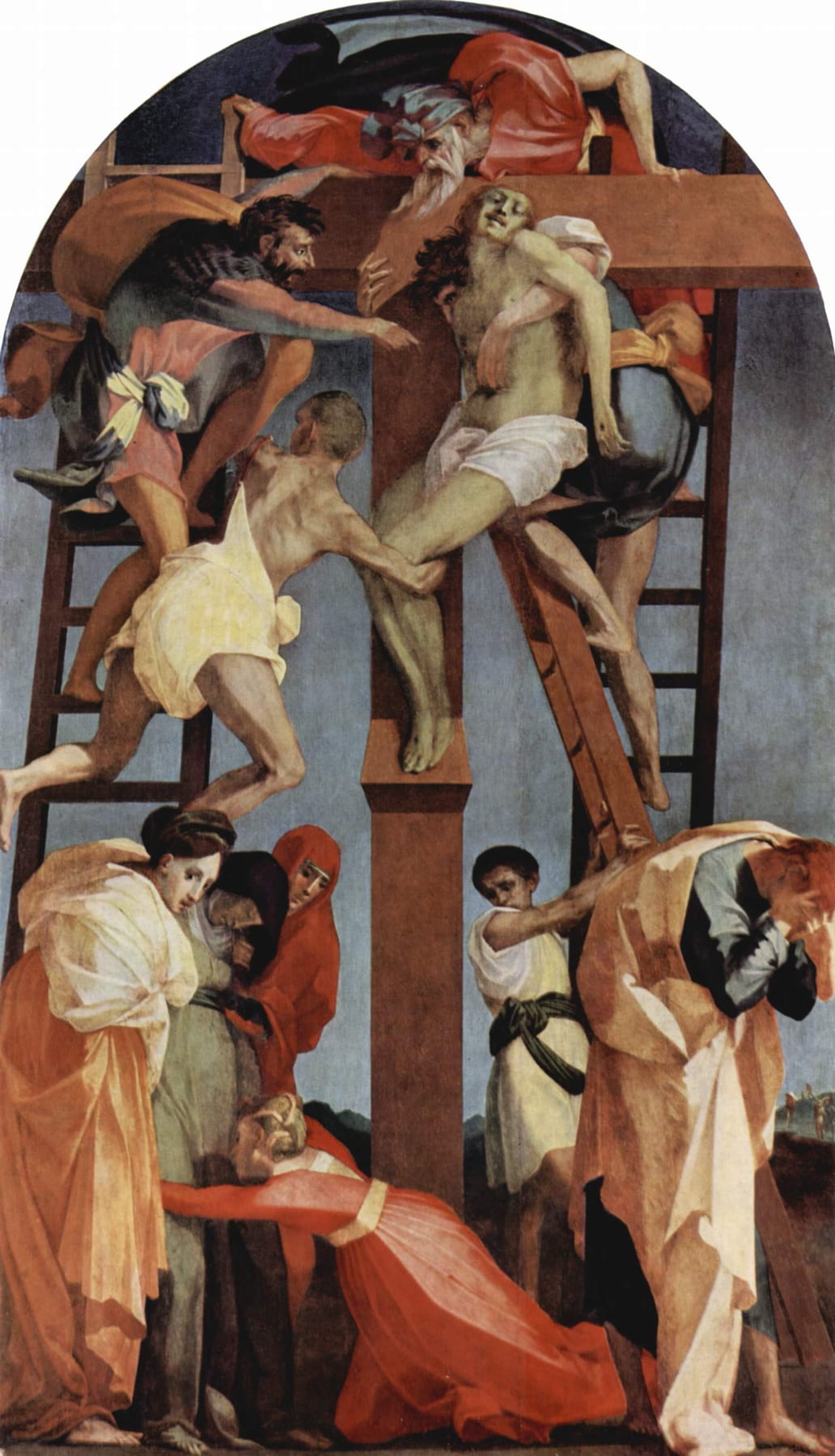
Baroque (17th Century, c.1600–1700)
Characteristics & Context: The Baroque style, spanning roughly 1600–1700, is marked by grandeur, drama, movement, and emotional intensity. Baroque art often sought to evoke emotion and passion, aligning with the Counter-Reformation goal of re-energizing Catholic faith through awe-inspiring images. This period saw absolute monarchies and the Catholic Church as major patrons, using art to display power and inspire devotion. Baroque works are dynamic and theatrical, frequently using strong contrasts of light and shadow (chiaroscuro) to heighten drama.
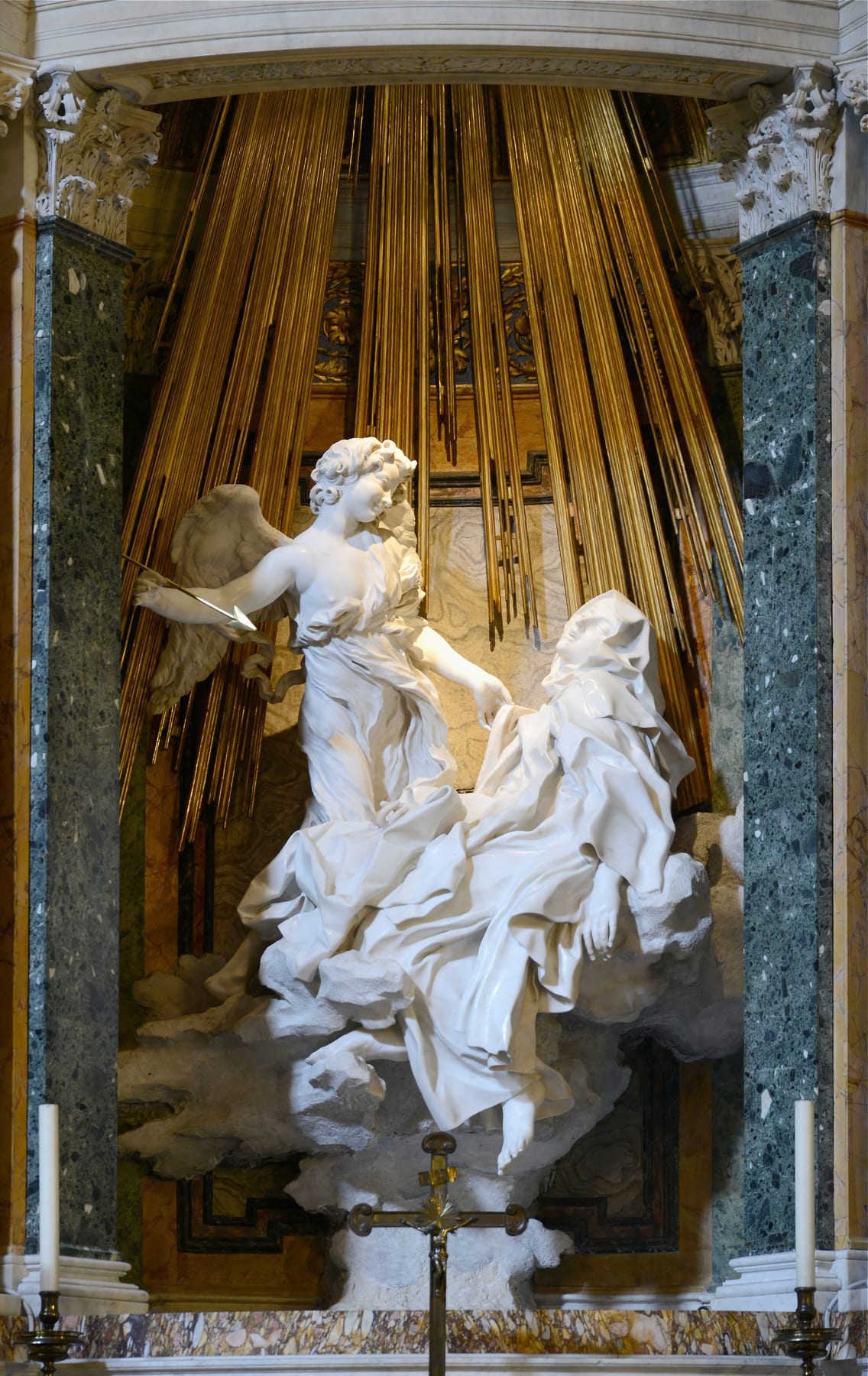
Key Artists: In Italy, Caravaggio pioneered dramatic naturalism with bold chiaroscuro – his Calling of St. Matthew (1599–1600) places biblical figures in everyday settings with a spotlight-like ray of light, a signature device. Gian Lorenzo Bernini, the era’s master sculptor-architect, infused marble with breathtaking movement and emotion – for example, his Ecstasy of Saint Teresa (1647–52) captures a saint’s spiritual rapture with swirling drapery and a golden heavenly glow. Artemisia Gentileschi was a notable female Baroque painter, known for powerful history paintings. Across Europe, Baroque took varied forms: Peter Paul Rubens in Flanders painted vibrant, swirling compositions of fleshy figures; Rembrandt in the Dutch Republic, though more restrained, used light to probe psychological depth; Diego Velázquez in Spain rendered scenes with realism and subtle grandeur (e.g., Las Meninas, 1656). In architecture and decoration, Baroque opulence appeared in the swirling curves and gilt of churches and palaces.
Innovations: Baroque artists advanced tenebrism (extreme chiaroscuro) and dynamic composition – viewers feel part of the action. Ceilings of Baroque churches were painted with illusionistic scenes opening to the heavens. Sculptors like Bernini created multimedia ensembles combining marble, bronze, and stained glass for immersive effect.
Notable Artworks:
Gian Lorenzo Bernini – “Ecstasy of Saint Teresa” (1647–52, marble, Santa Maria della Vittoria, Rome). A pinnacle of Baroque sculpture, it depicts the mystical vision of Saint Teresa of Ávila. Bernini portrays the saint swooning as an angel pierces her heart with a divine arrow; the flowing marble robes and gilded rays of light behind them make the scene theatrically immersive, as if a heavenly stage is set before the viewer.
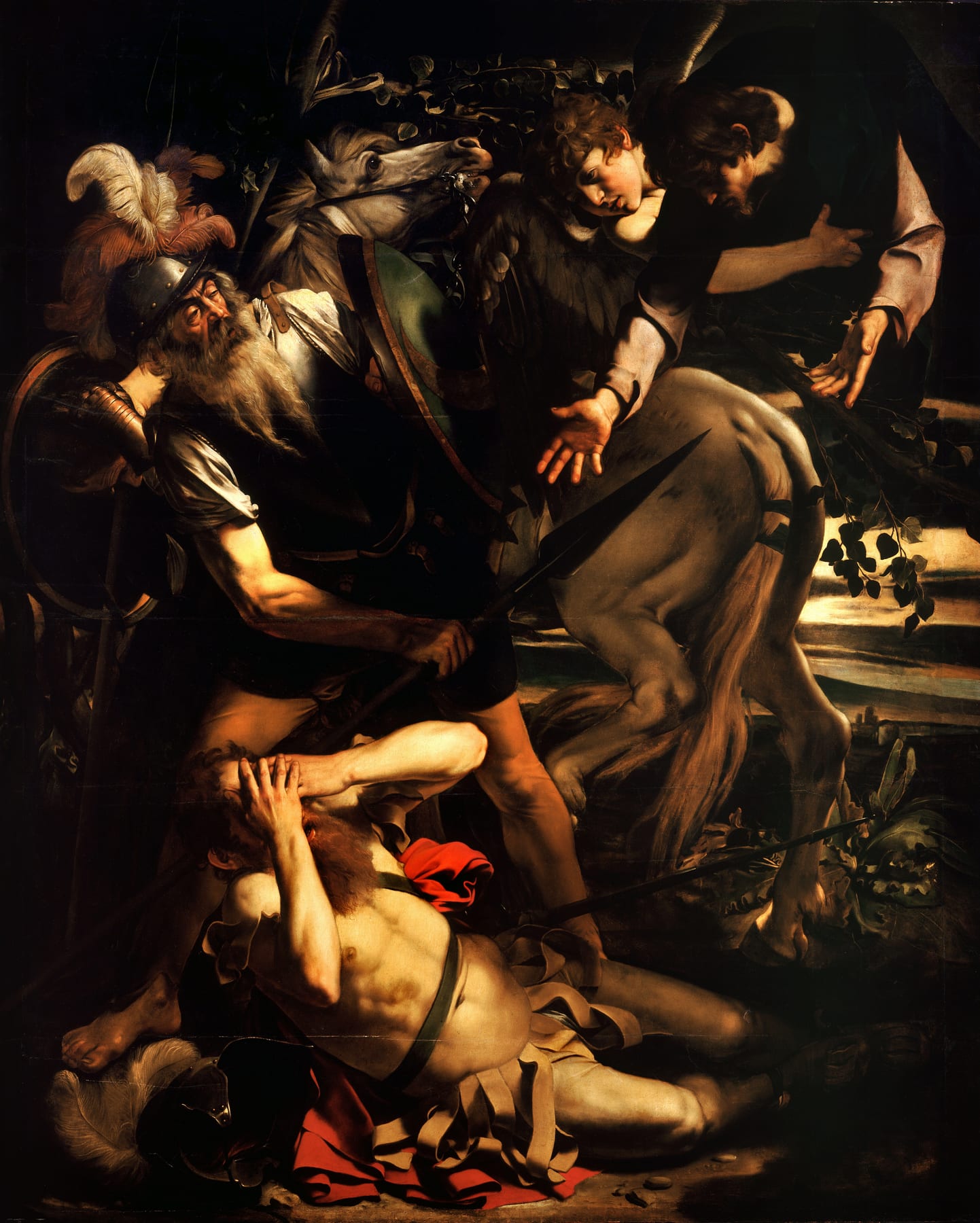
Caravaggio – “The Conversion of St. Paul” (1601, Odescalchi Balbi Collection). In this painting, Caravaggio places a fallen St. Paul on the ground with a horse and groom. A shaft of light and deep shadows dramatize Paul’s moment of divine revelation, exemplifying Caravaggio’s influential naturalism and lighting.
How to identify Baroque art?
- Landscape paintings (e.g. Sunrise in a Wood by Jacob Van Ruisdael)

- General Still Lifes (e.g. Still-Life with Fruits, Shells and Insects by Balthasar van der Ast)

- Still Lifes of fruit bowls (e.g. Still Life by Willem Kalf)

- Theatrical light i.e. the dramatic use of light and shade (chiaroscuro) where the painting appears to have a spotlight/shaft of light highlighting a portion it, e.g. The Nightwatch by Rembrandt

- Paintings show dramatic and emotional moments (e.g. moments of victory or death), e.g. Death of a Virgin by Caravaggio

- Sacred figures and saints in biblical scenes and miracles depicted as ordinary people in every-day activities, e.g. Supper at Emmaeus by Caravaggio

How Baroque art got its name?
Baroque means irregularly-shaped pearl, derived from barocco in Portuguese, first used during the mid-1700s.
Baroque art does not have any relation to pearls but the word was used as an epithet for a style that did not meet the great artistic standards of the preceding Renaissance era. Regardless of its origin, it carried connotations of “bizarre” and “absurd” when used by its critics who dismissed it as a decadent successor to the revered Renaissance movement. Till the end of the 19th century and occasionally in the present time, some people use this word in its original sense as an insult towards anything they find grotesque or abnormal. For example, a blogger in 2011 harshly criticized the movie Black Swan alliteratively as “bleak, baroque and berserk”.
**
What gave rise to Baroque art movement? and where?
**
Superseding Mannerism, Baroque art emerged in Rome, the artistic capital of Europe in the 17th century and spread to other European countries where it merged with local traditions and cultures. Religious paintings continued to predominate but that period also introduced the emergence of non-religious paintings like royal portraits, landscapes, still lifes and paintings depicting private and court life as well as historical events. Royalty and rulers commissioned portraits for displays of grandeur. Non-religious themes became more popular. Seventeenth century’s royalty, aristocrats and other wealthy people were essentially no different from people today, they used the available technology and tools (i.e. paintings and other visual arts) to show off their wealth by hiring artists to paint portraits of them proudly posing and displaying their dress and jewellery. Commissioning an artist to paint an elaborate portrait of yourself in order to hang in your house was a status symbol similar to today’s latest smartphone or cool car.
Next time you see a Baroque-style religious painting, remember that chances are it’s from Catholic Europe (e.g. Italy, France, Spain and Flanders), but if it’s non-religious (e.g. Still Lifes, landscapes and portraits) then it’s likely from Protestant Europe i.e. Holland and England. There are exceptions to this rule because some Dutch artists, such as Rembrandt, chose to paint religious paintings for prospective buyers.
**
Religion (Sacred vs. Secular)**
Baroque art owes its roots to the religious tension that persisted into the 1600s. By then the Catholic Church had lost large parts of Europe where it had ceased to be the Rome-based supreme power, as it was a century earlier. That followed a major revolt by many Christians who “protested” against Catholic traditions and teachings. Later the religious movement was called Protestant Reformation. In Catholic Europe, art’s main purpose was to glorify Catholic beliefs and the Church itself. Hence, in such time of religious conflict, there was no second thought about using art for political purposes, particularly that the Church was the wealthiest and most powerful organization in Europe alongside the European royalty. Catholics alarmed by those attempting to “reform” their centuries-old Church, embarked on a spiritual fight (and at times militant) trying to win back the “lost souls” by any means possible. Dramatic biblical representations in visual ecclesiastical art was one of the easier methods to address and impress the ordinary people as most Europeans were illiterate. The Church was commissioning art with a populist appeal, not for the well-educated elite but for the peasant class. Their artistic “marketing campaign” sought this art style which appeals to people to draw them back to the Church by commissioning artists who portrayed dramatic, vivid scenes of biblical stories, miracles and saints. These commissions initiated the era of Baroque art where it was simply a Catholic Counter-Reformation instrument. That is exactly why it was initially resisted in Protestant countries, but later embraced as a purely secular art, spreading across the rest of Protestant Europe where it became devoid of religious or political messages.
In Catholic churches, since its early history, art served a very high purpose. Iconic images of Christ, or other biblical scenes had always been considered sacred, while in Protestant (Reformed) churches, visual art including paintings, banners, crosses or even occasional sculptures were considered only symbolic or ornamental, and not sacred in themselves. The deeply iconoclastic Protestant Church did not commission art. The lack of approval process administered by bishops, where artists could face the possibility of rejection if their artwork is based on a “false doctrine” left room for artists to break the old rules of visual interpretation
Economy
Capitalism had been gaining ground far earlier than the Baroque era, but it developed very rapidly in Western Europe in the 1600s. In Protestant countries, it was aided by Reformation thought that removed the stigma of usury, therefore interest-based money lending was allowed and wealth was seen favourably as a sign of heavenly blessings. Poverty was not a virtue anymore. Hard work and investing to acquire wealth was encouraged, which led to the rise of a sizable middle class in countries like the Netherlands. Note that despite the secularization of culture today, this belief is still at the heart of Western Capitalism, seen by ardent believers as a long-lasting harmonious relation between the Protestant ethic and the free market, both of which emerged almost at the same time and place in history. Some Protestant leaders like John Calvin opposed and removed icons and other images from inside churches, as they were considered idolatrous. It’s no wonder that the free market replaced the Church as the main patron of art. This is the moment when for the first time in Western art history, art became commercially available for purchase and custom orders were on request to virtually anyone. It was the birth of market-driven art business. Although this art movement originated in Catholic Europe (e.g. Italy, France and Spain), it flourished in Protestant countries like Holland. Replace the Church and monarchy of Catholic Europe with the middle class in Protestant countries, you realize a much larger market for art. Unlike Catholic Italy or France, Holland’s rising art market stimulated Baroque painters, increased competition among them and the production of paintings boomed. Art as a business thrived, fierce competition forced prices down, there was no liking for bare walls, ownership of paintings for home décor turned into a fad, houses of the wealthy had up to 100 and sometimes 200 paintings. Art became so popular that it is said that almost every Dutch house had paintings decorating its walls. Historians call the 17th century in the Netherlands, in particular, the Dutch Golden Age for art, trade and science.
The new class of self-made men (middle class) supplanting the aristocracy and the Church as the chief consumers and commissioners of art, weren’t looking for biblical or mythological themes, they wanted to see themselves. Daily life of the ordinary citizen became the main theme, the fashionable artistic topic. Paintings of domestic life, parents, children, animals, housework would feature in paintings, even the most mundane or the unsightly tasks, like:
Interior with a Mother delousing her Child’s Hair [removing lice], known as ‘A Mother’s Duty’ by Pieter de Hooch who was born in Rotterdam in 1617.
As artists were trying to keep up with the market demand, they would let potential customers walk into their studios to watch them at work and to view their paintings. Artists would sell most of their work but keep some masterpieces in the studio to advertise their skills.
Politics
Feudalism (9th-15th century) is sociopolitical structure where the king divides up his land among the noblemen (also known as landlords, that’s when this term was first used) who recruited knights to protect the land, and the peasants (serfs). The peasants live on and farm the land (known as the fief or feudum in Latin). This social contract was unfair for millions of families who lived their whole lives in servitude while keeping the bare minimum to themselves. The peasants were often treated as slaves who worked for the landlords in return for protection from outsiders. By the mid-1500s or 1600s, feudalism had almost disappeared from Europe and powerful military nation states were rising under absolute monarchies. In the “good” old days of the dark Middle Ages, a king or a queen from a royal family came to the throne because it was considered a birth right. However an absolute monarchist is a ruler who believes and propagates that their absolute power, is more than a birth right, it’s a God-bestowed (“divine”) right, which worked in their favour since criticism could potentially mean an attack religion. In other words if you utter anything but praise regarding the King, God’s appointed authority, you might be committing blasphemy. The rise of the absolute monarchy filled in the gap left behind with the waning influence of the Catholic Church and the declining feudal nobility. Among the absolute monarchies that appeared in Europe during the 1600s: France (Louis XIV) , Spain (Phillip II), Prussia, a former state in Germany (Frederick the Great) and Russia (Peter the Great followed by Catherine the Great). (Side note: have you noticed that many monarchs seem to have the words “the Great” attached to their names?! I wouldn’t mind such as a label in history books, rather than being forever known as the 16th-century Russian “Ivan the Terrible.”) Economically Capitalism replaced Feudalism, and politically absolute monarchies replaced the weakened feudal monarchies. In many European countries like France, Baroque art played a role for emerging monarchies, where it was used by rulers and aristocrats to display their prestige and wealth. While Baroque art was being used as a tool for propaganda by Italy’s Church of Rome, it was also being used, for similarly propagandistic aims by the European rulers. Louis XIV was a poster child for Europe’s absolute monarchy (pun intended, he actually became a king at the age of 5 years old).
Even though art during the reign of Louis XIV was mainly to glorify him and the state of France, he was also a great patron of art who generously endorsed it. Louis XIV became a symbol of the excess of the Baroque era, personifying France in art, as the head of state in absolute power. He was fascinated by his own image, commissioned 300 portraits of himself. While it’s not unusual for a monarch to commission a large number of portraits, requesting your face to be drawn 300 times is a bit narcissistic! When you’re a politician with plenty of free time, a good portion of it can be spent posing for photographss… or paintings. Immortalized by a probable misquote: “l’état, c’est moi,” (meaning “I am the state”), the self-centered Sun King even commissioned ‘war artists’ to follow him to record and paint his military campaigns. In the pre-photography days, that was the only way to graphically record important events. Louis XIV endorsed art in all forms, paintings, sculpture and architecture. Despite his eccentricities, he turned France into one of the major European centres for art and culture, a status that was maintained till the Second World War.
Philosophy and Science
Among the cardinal Protestant ideals was fostering the autonomy of Christian individuals from the authority of the traditional Church, meaning the Church wouldn’t have to be the one and only intermediary between worshippers and salvation. That concept of spiritual independence was reflected in all aspects of life including art. Expanding knowledge and the new currents of individualism, rationalism and Humanism, as well as the Reformation heralded the intellectual Age of Enlightenment starting in the mid-1600s, then spanned the 1700s and beyond. Their creed was René Descartes’ philosophy: “je pense, donc je suis,” (“I think, therefore I am”). For artists that ideology of individualism meant freedom. Artists moved beyond simply religious or political imagery. Till that point in Western history, art served a clear purpose or had to carry a message, whether it was to teach the public morality, raise the worshippers’ spirituality, record important events, glorify rulers, decorate cathedrals or pompously decorate palaces. As art became independent from the Church’s centuries-old command, that opened the gates of creativity for artists. If I were a Baroque artist, I am now free to create artwork devoid of any humans, I can paint a fruit basket, or trees (a landscape), or go back to religious paintings but portray biblical scenes the way I view them, not the way I’m instructed to view them. That unrestrained creativity pioneered a new concept that was known later in the 19th century, in Théophile Gautier’s words as “l’art pour l’art” (art for art’s sake).
Also by the mid-1600s, the majority of scientists in Europe were Copernicans (a reference to the astronomer Nicolaus Copernicus whose shocking yet scientifically-proven theory of 1543 stated that the Earth is not the centre of the universe). Not everyone was ready to give up their geocentric (earth-centered) belief, particularly the clergy. From their viewpoint that meant that humans and their place (planet) in the Universe is not of the utmost significance, a belief held for hundreds of years. Unlike the Catholic Church in its rejection of the recent scientific theory regarding the sun, Protestants slowly started adopting the heliocentric (sun-centered) view of the solar system among other theories of the Scientific Revolution of the 1500s and 1600s. The effect of this electrifying scientific theory on art was another reason artists questioned the importance of humans in their artwork. You could see signs of that in landscapes with no human presence or still lifes with mere representation of simple objects.
Rebels of a new generation
Renaissance art including the Mannerist style that preceded Baroque movement was symmetric and restrained, traditions that were rebelled against by Baroque artists. Some described the Baroque movement as art of the heart, an answer to the Renaissance-era art of the mind. Baroque art was dramatic and emotional, appealed to the public, attempted to get closer to the contemporary viewers, and identified with ordinary people.
Taking a different path, unlike the Mannerist generation, Baroque painters portrayed realistic unidealized life in their paintings, stripped from heavenly imagery or mythology, just common people or even at times no people at all (landscapes and still lifes). A Renaissance or Mannerist painter would certainly find nothing spiritual about a fruit bowl. The stiff, controlled, idealized classical forms of the Renaissance era did not change but human emotions were introduced, and they were intense, in a way unseen before. Emotions and dramatic expressions were visible on the faces of subjects in paintings. Breaking with the past, also was the introduction of a heavy contrast between light and dark. Despite the deviation of the new artists from the older traditions, they still did not smash all conventions. There were boundaries to their art that they would not dare cross. For example, painting nude art in puritanical Spain meant you risk excommunication, fine and exile, enforced by the Spanish Inquisition, and any nude paintings were burnt. Italy was an exception as it had been influenced by pagan classical nude sculptures.
Rococo (18th Century, c.1700–1780)
Characteristics & Context: Rococo art, developing around 1700 in France, was a lighter, more decorative evolution of Baroque. It flourished in the courts of Louis XV and throughout Europe (especially France, Austria, and Germany). Rococo painting and design are characterized by intimacy, playfulness, graceful movement, and ornate detail. Pastel colors, flowing lines, and romantic, often frivolous subjects – aristocrats at play, love affairs, mythological love scenes – typify Rococo’s gentle elegance. This style coincided with a period of courtly decadence and a growing emphasis on personal pleasure and wit in art.
Key Artists: Jean-Antoine Watteau’s “Pilgrimage to Cythera” (1717) introduced the fête galante genre – scenes of aristocrats enjoying leisure in dreamlike outdoor settings. Watteau’s soft colors and delicate figures set the Rococo tone. François Boucher painted playful mythologies with voluptuous nudes (often goddesses or nymphs in lush settings). Jean-Honoré Fragonard epitomized Rococo’s joy and flirtation; his The Swing (1767) famously shows a frothy-dressed maiden on a swing kicking off her shoe, as a hidden suitor peeks up at her – a scene of voyeuristic romance that captures Rococo’s spirit (Baroque art and architecture | Definition, Characteristics, Artists, History, & Facts | Britannica). In sculpture, Étienne-Maurice Falconet and others created elegant small-scale works (Falconet’s “Bather” sculptures, for example) for decorative interiors.
Innovations: Rococo artists excelled at decorative painting – integrating painting, sculpture, and architecture into unified interior designs (e.g., ornate salons with ceiling paintings and gilded stucco). They popularized new genres like fête galante. Rococo’s emphasis on asymmetry and curving forms also influenced furniture and crafts (e.g., Sèvres porcelain).
Notable Artworks:
Watteau – “The Pilgrimage to Cythera” (1717, Louvre, Paris). In this dreamy scene, couples in elegant attire embark to the mythical island of love. The painting’s feathery trees, soft light, and amorous theme inaugurated Rococo’s love of idyllic escapism.
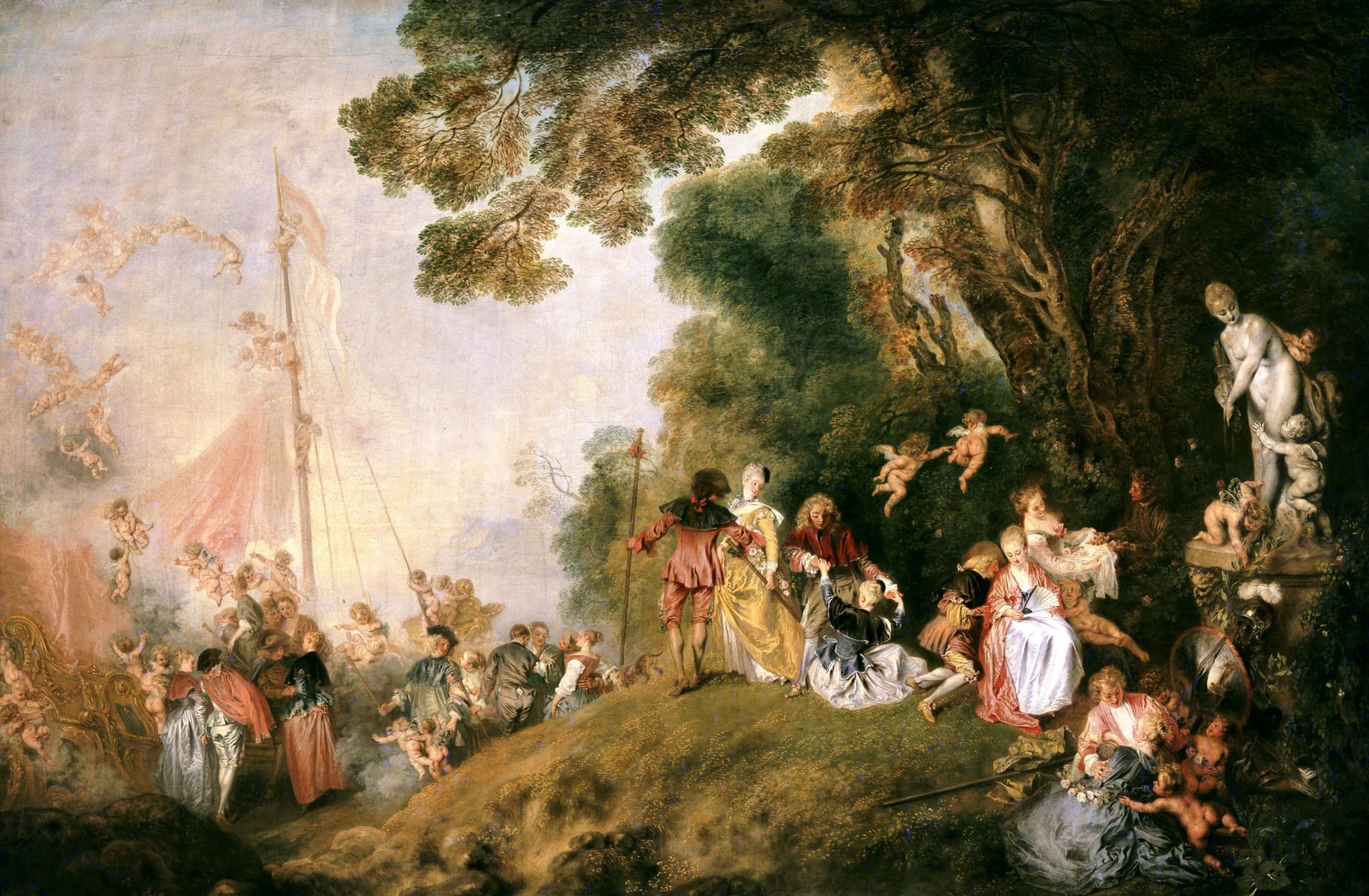
Fragonard – “The Swing” (1767, Wallace Collection, London). Perhaps the most iconic Rococo painting, it portrays a coquettish young lady in mid-swing. Dappled sunlight, pastel pinks and greens, and playful cupids hiding in the foliage create a sense of whimsical delight, celebrating the elegance and amorous intrigue of Rococo society.
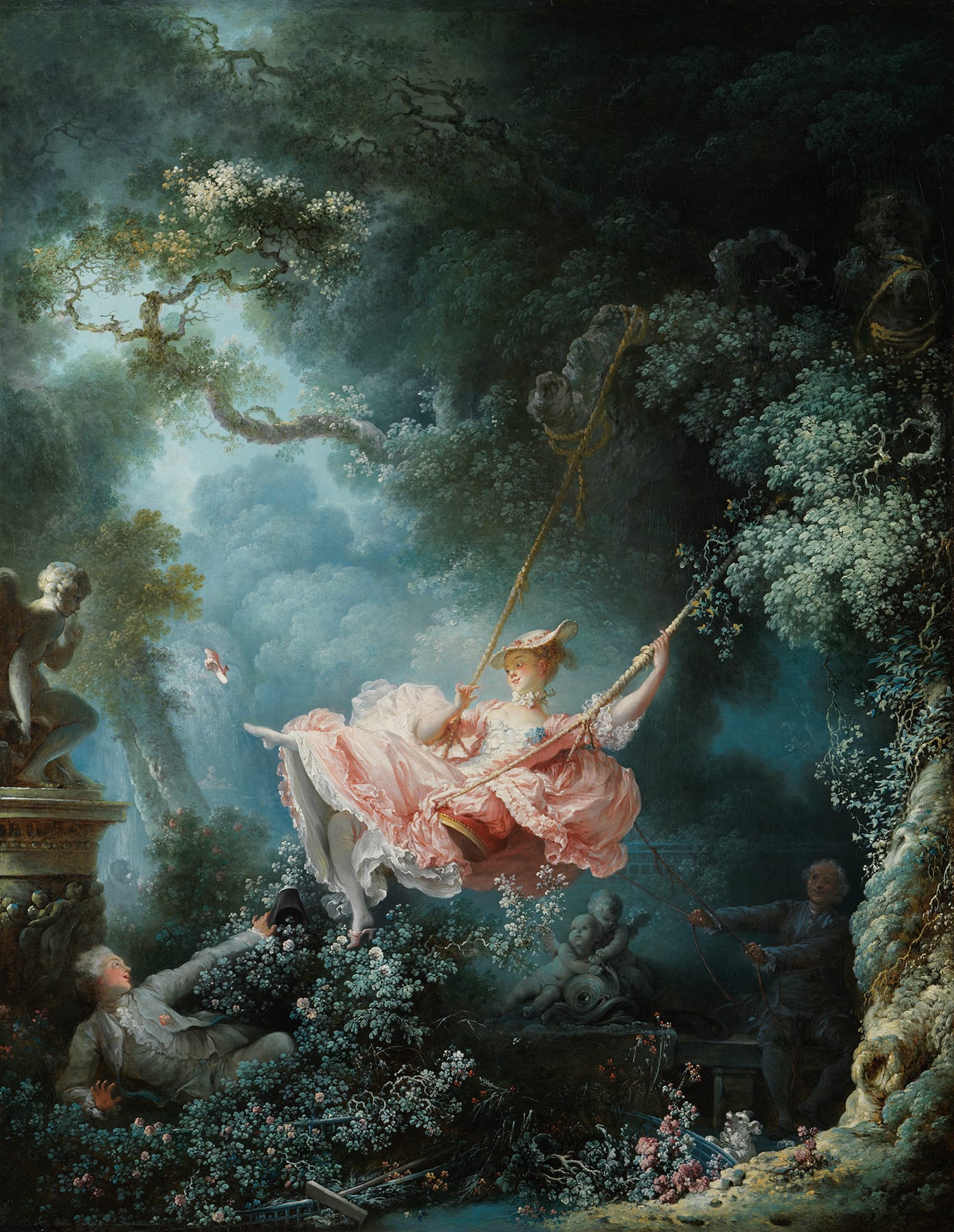
How to identify Rococo art?
- Light-hearted depiction of domestic life in the upper class home (e.g. Le Dejeuner, or The Breakfast, by Francois Boucher)

- Elegantly dressed aristocrats at play, usually in pastoral landscapes (e.g. The Lesson of Love by Jean-Antoine Watteau)

- Look for courting, beauty, romance, fun, playfulness and sexual symbols (e.g. The Stolen Kiss by Jean-Honore Fragonard)

- Mythological themes (e.g. Diana after the Hunt by François Boucher)

- Pastel colours, i.e. soft and light shades, are characteristic of the period (e.g. A Lady in a Garden taking Coffee with some Children by Nicolas Lancret)

6. Look for cherubs hovering around the painting – chubby, nude male babies with wings (e.g. The Toilette of Venus by François Boucher)

How Rococo art got its name?
Rococo is a portmanteau word combining both “rocaille” (French for “shell”) and “barocco”, Italian for Baroque, the art style preceding the Rococo period. Rococo art extensively feature shell-shaped curves and wave-like motifs, particularly in its sumptuous furniture design and interior décor.
What gave rise to Rococo art movement? and where?
The absolute monarch King Louis XIV died in 1715 and although he had been ruling France with unchallenged autocracy, as a micromanaging control freak for several decades, he also left behind his nation as the predominant superpower – an economic and military powerhouse. Louis XIV led his country victoriously through numerous wars and by the end of his reign France had long replaced Spain as the continental power, following Spain’s tragic defeat in the Franko-Spanish war as well as the Thirty Years’ War. Economically thriving, even the French peasant class had more privileges than peasants in other European countries. A case in point: forty percent of the farmland was owned by them.
Being a superpower, culturally France had an international status similar to USA in recent times. French culture had been heavily influencing other countries around the globe. It’s not surprising since Louis XIV turned France into a beacon of art, fashion and culture. French trends and fads were commonly followed around the world. Just like America introduced to the rest of the world Italian pizza, Japanese sushi, Cuban salsa dancing and Chinese kung fu martial art, France, as a cultural superpower, imported little known ideas then exported them to the rest of Europe during the 18th century. For example, they popularized the Panniers, a “side hoops” trend that originally appeared in Spain, which expanded out women’s skirts at the sides but leaving the front and back flat. Similarly, they started the necktie (la cravat) craze, after they saw it adorning the Croatian solider uniform. You might have noticed that the word “cravat” originates from the word Croat (French for Croatian). (350 years later, business men in mid-summer meetings are still choking on their ties, thanks to the French!) Now that you feel amazed and in awe at France’s enviable global position, as you should, it’s time to learn that the next King’s utter fiascoes brought an end to the French political and military domination. As if history is playing a cruel joke on France, after Louis XIV’s seventy-two prosperous years, being the longest reigning monarch of any French or European ruler of all time and one of the greatest French kings, ironically he was directly succeeded by the notorious Louis XV, considered one of the worst French kings ever, who had the second longest reign in French history (that is after the great Louis XIV). Read on to see how Louis XV’s legacy contrasted with his predecessor’s but also gave us the Rococo art.
Politics and Economy
In the early 1700s, New France (Nouvelle-France) was a very large part of French North America. In modern USA, it included French Louisiana, La Louisiane française, which was an extensive colony that included Alabama, Mississippi as well as Louisiana. Also, the French controlled the most developed colony in what later became Canada, making up most of today’s eastern Canada and they aspired to drive the British enemy out, so all of Canada would be French. However Louis XV viewed Canada as an insignificant colony, so the military and financial support he dispatched was always limited, and easily swallowed by a corrupt colonial government. He favoured concentrating his reinforcements on battling the British army in Germany and India. While Louis XV didn’t find Canada important enough, the British were increasing their military might to take over the French territories.
Eventually, France was involved in a brutal war, the Seven Years’ War, that ended in a humiliating defeat and in its aftermath, Louis XV finalized the Treaty of Paris (1763), signing over to other governments almost all French North American territories and in the process, they lost Canada, French Louisiana, and also most of India. The treaty’s cession of Quebec meant permanently losing all of Canada, and other territories around the globe, to the old adversary, Britain. Having lost New France in that 1763 treaty, the French had no territories left in North America except a group of tiny islands (Saint Pierre and Miquelon) off the eastern coast of Canada that they actually still control today. It’s worth noting that ceding French territories to the British cemented Britain’s rise as a great superpower in the following century and similarly other cessions aided the emergence of Prussia (the former kingdom of Germany) as a major power.
Meanwhile, in the separate and secretive Treaty of Fontainebleau (signed in 1762, revealed in 1764), Louis XV ceded Louisiana to Spain. He gave up Louisiana to his cousin, King Charles III of Spain, as a hush-hush “thank you” gift to reduce the pain after the Spanish defeat following their late entry into the Seven Years’ War, in support of France, through which, they lost Florida to Great Britain. Probably, this arrangement wouldn’t have made his predecessor Louis XIV royally joyful, in whose honour Louisiana was named in 1682. In brief, the king’s failed policy in Europe and elsewhere cost France her political clout in international affairs. Besides losing territories like those in Canada and Louisiana, which highlighted his weak diplomacy, also his extravagant spending brought the country near bankruptcy, with huge sums of money spent on unnecessary extravaganza besides war.
On the home front, France had the highest population of any country in Europe, more than 20 million people at the beginning of the 18th century. Population was rapidly increasing every year due to diminishing epidemics and lower than ever mortality rates. The constant growth of French population added pressure on the available food supplies. It was not a Feudalistic society anymore. That was long replaced by Capitalism. However much of the Feudalistic legacy lived on through the social structure of three classes (estates). The First Estate was the Clergy (100,000 people). They represented 0.5% of the French population and owned 10 percent of the land. They paid minimal taxes or no taxes at all. The clergy themselves raised taxes on the land they owned and they led more than comfortable lifestyles, most of whom were originally from noble families (particularly the high clergy like Bishops and those in abbots), which was another distressing fact of life for the common folk. The Second Estate was the aristocracy (400,000 people). They made about 2% of the French population and owned 30 percent of the land. The monarchy always gave the aristocracy special favours and exempted them from taxes. Meanwhile, they could tax peasants in addition to collecting rent from those of them who lived on their farmland. The nobility had exclusive rights to hunting and fishing that others, such as the peasants, were never granted. They had many other special privileges passed down over the centuries that made them very unpopular people in France. The Third Estate was everybody else, i.e. the common folk who were mainly the peasants but also included the labourers, merchants and artisans (manual workers). They are the working class who paid most of the taxes in France. While just under 3% of the French were clergy and nobility, the commoners represented 97% of the population. 90% of whom were peasants who lived at or below subsistence levels, earning only enough to feed their families. Even though they were not serfs as they were in the Feudalist age, and as mentioned above, up to 40% of the land was owned by them, they were still burdened by many types of taxes. In spite of bread being the main staple of the French diet, they couldn’t even own bread ovens which belonged only to members of the noble class. If you don’t belong to the aristocracy or clergy, you lived in very harsh conditions.
Taxes frustratingly kept rising through the mid 1700s, an issue considered among the principal reasons in bringing about the French Revolution. The monarch collected unbearable and oppressive taxes from the common folk while reluctant to tax the noble families. France was sliding into poverty while the monarchy was engaged in extremely excessive spending and the aristocrats were content with the absolutist rule that favoured them. Aristocracy as an elite social class, an exclusive club you had to be born into, was prevalent in most of Europe, but aristocrats of France, in particular, were reputed to be the snobs of the snobs. Their hard daily lives included dancing, hunting, drinking, gambling and a whole lot of gossiping. The king was aware of the crises brewing in his nation and the growing anti-monarchy sentiment and his terrible reputation hastened the decline of the prestige of the monarchy and inflamed the opposition. He earned the reputation of being lazy, indecisive and selfish – a ladies’ man who abandoned himself to pleasure and debauchery. Just like many of today’s politicians who ignore the harsh lives of the working class, unless they rise up and revolt, the king was more interested in his own pleasures than running the affairs of his nation. The apathy of the unpopular King caused a series of political and economic failures, and none of the misfortunes moved him into action as France was losing her global position. A combination of wrong decisions, bad luck, difficult crises and mismanagement ruined his reputation and his legacy forever. His reign is widely considered a failure. The reputation of the French monarchy was beyond repair and that ultimately instigated the anger of the people, who eventually rose up in the French revolution.
The people’s anger was not solely towards the king (the final one, King Louis XVI). The decadent era was also symbolised by another figure: King Louis XVI’s wife Marie Antoinette. It all came to a close when the merciless blade of the guillotine came down in the revolution, ending the lives of many aristocrats, besides King Louis XVI and his wife. Three decades after the Rococo period receded, the French Revolution shook France and shattered its class system. It became the great European revolution of the 18th century that shaped our modern political world. The French Revolution heralded a new era, with no monarchy, no aristocracy, closing the final chapter of the ancient regime (ancien régime) that lasted more than a thousand years. It caused a major cultural shift, not only in visual art but also in fashion and hairstyles. Even shoes changed radically. (A side benefit of the revolution: All traces of French men in wigs and four-inch high-heeled shoes with glittery buckles were gone.)
To understand how things went so wrong before the Revolution, let’s go back to the Rococo era king (Louix XV) and apply the old sexist French wisdom: cherchez la femme (“look for the woman”). Behind this not-exactly-great man, there is a mistress. For hundreds of years, in the European monarchy, being a mistress was a career opportunity; find a wealthy man, an aristocrat, or even better, try to seduce the King himself, that’s if you’re lucky enough to attend events like royal balls. If you so decide on this career, in exchange for keeping the wealthy man sensually satisfied at all times, in an exclusive affair on your part, your living expenses and accommodation will all be provided. If you’re a royal mistress, your accommodation could be a mansion with servants. In the case of Kings, you’ll be competing with other mistresses, but your hard work can lead you to become the official and favourite mistress, “maîtresse en titre.” (Thankfully these jobs have largely vanished because most women today prefer to get educated and earn their own money rather than be domestically kept as mistresses.) The practice of royalty keeping mistresses was an open secret and sometimes the influence of a mistress crossed the boundaries of the bedroom. For any French king, it had been a centuries-old tradition to have a bunch of mistresses and it was one way to show their potency and virility. You prove your manhood by the number of mistresses you kept. But Louis XV did not just keep old traditions, he was a notorious womanizer which was an obsession that occupied most of his time and left him too busy for his political responsibilities. He spent his time between mistresses and courtesans (exclusive upper class prostitutes for the nobility). Historically, Louis XV is not remembered by grand achievements but by the impressive number of mistresses he had, among whom are Madame du Barry and the notorious Madame de Pompadour.
Madame de Pompadour met Louis XV at a masked ball celebrating a wedding in 1745, then she became his latest royal mistress, but after enduring many sleepless nights of arduous work, she was promoted to become his “chief mistress,” earning the official title “maîtresse-en-titre.” Over the years, she turned into more than a mistress, becoming his advisor and confidante, in a role similar to a prime minister without the title. She engaged in a physical relationship with him for 5 years but during those few years, she developed full domination over the king, and although their relationship turned platonic, from 1750 till she died in 1764, they were still very close. Later she would even personally select and provide the young women for his own pleasure. In spite of her non-noble birth, she arrived at the top rank in the palace next to the married King, much to the chagrin of other jealous mistresses. The weak monarch let his mistress take control over him and she subsequently and indirectly reigned over the whole kingdom. His interests were not particularly in politics. He enjoyed hunting, feasting, watching concerts and theatrical performances and attending opulent balls. But above all women were still his utmost passion. The French were in need of a monarch who could be a victorious warmonger but all they got was a chronic whoremonger. He led a profligate, unrestrained life with extravagant spending, while the nation is close to bankruptcy.
Tucked away in a corner of Versailles was a high-class private bordello, called Le Parc aux Cerfs (“stag park” or “deer park”), that was full of young available women just to serve the King’s carnal desires. Their young age meant they are likely inexperienced and therefore disease-free. That harem was always full and the women were procured by his favourite mistress. Morals aside, how despicable is it to use the taxpayers’ money during abysmal economic conditions for maintaining a whole brothel encapsulated in his lavish mansion just for the King’s personal use and enjoyment?! Louis XV continued to have as many crises as sexual partners, and rumours of his lecherous behaviour were spreading. The public was aware that the King had been failing to take his responsibilities seriously and that Madame de Pompadour was taking charge of the government affairs. Her intervention was widely blamed for what resulted in diplomatic disasters and major colonial losses, nevertheless, it is the failed politician, Louis XV himself, who deserves most of the blame.
The empowered mistress took unprecedented authority by meddling into France’s foreign policy. One of the first political failures that resulted from her acting as a behind-the-scenes politician was the ill-fated alliance that led to France’s defeat in the Seven Years’ War (1756-1763). The Seven Year’s War involved many nations, making it one of the largest pre-20th century worldwide wars, considered by many historians, and also by Winston Churchill, as the first world war. Through the territorial gains following that war, Britain became the leading colonial power. From that perspective, it’s not easy to miss the unintentional role a French mistress played in securing Britain’s path towards becoming a superpower.
She became so powerful that she removed from office those who she disliked or those who criticized her actions. She sponsored many Rococo artists and nourished in Louis XV the passion for art. Despite the political disasters and her fatal influence on French diplomacy, she maintained entertainment around the palace with planned events such as royal parties and theatrical plays. She was also well known in the fashionable world of Paris. Her sponsorship of art made Louis XV’s name associated with French art around the world, and France retained her predominance in art and culture. It is remarkable that the self-empowered mistress gained such significant political and cultural influence. Similarly to Louis XIV of the Baroque period who had commissioned many portraits of himself and embraced French art and fashion, she took a similar role and commissioned several portraits by one of her favourite Rococo artists, Francois Boucher. Like a Hollywood actress’ final say over her portrayal on a magazine cover, she had total control of how artists depicted her. Occasionally, the commissioned artist would start anew her portrait if she was not pleased by her half-painted image. She poses in her portraits not as a ferocious femme fatale but as an accomplished woman with great experience and undeniable importance.
Louis XIV’s great legacy is forever associated with French predominance, while Louis XV’s name, for most people, is mainly associated with furniture! The charming Louis XV furniture (aka Rococo furniture) was a style that emerged during his reign producing some of the most sought-after furniture of all time.
The prophetic quote “Après nous, le déluge” – “After us, the deluge [flood]” – was attributed to King Louis XV and sometimes Madame Pompadour. The deluge premonition became true and there was no aversion of the impending political, financial and social collapse. Chaos engulfed the country only 15 years after Louis XV’s death in the French revolution against the monarchy and aristocracy.
Art and Culture
After the death of Louis XIV (1715) and with a new king, Louis XV, there was a new zeitgeist and a fresh taste for art. The French had been setting the trends, and while Baroque art originated in Rome, Rococo art originated in France in the 1720s, then spread across Europe where there was a fascination with French art and culture. The French set the standards for what’s en vogue, in a total monopoly that made France the centre of fashion in the 18th century. But it went out of control in this very fashion-conscious society where they braved discomfort and sometimes pain pursuing absurdly flamboyant fashion. Déjà vu? Yes, because you still see painful fashion every day when you walk the streets of any major city. Consumption of luxury was booming and the nobility sought status symbols in their ludicrous and laughable styles. Despite all the efforts of critics and caricaturists of the Rococo era, ridiculous fashions prevailed. Rococo art had an aristocratic artistic taste, hence it was embraced by citizens of other countries who had been imitating French aristocrats. The growing upper middle-class (the rich of non-noble ancestry known as the bourgeoisie) also started imitating the French aristocracy (noble by birth) in fashion and lifestyle, whose appeal and influence was equivalent to today’s celebrities. Perhaps Rococo paintings were that era’s tabloid photographs meant to leave an impression on the gawkers, so they’d mutter to themselves, “aha, that’s how the rich live!”
People’s relationship with extreme fashion has not changed, but in our modern time-starved society we do not have as much time available, as was the case for French aristocrats in the 1700s. If you are a modern wealthy woman, you can very quickly adorn yourself with high-end branded apparel like Louis Vuitton, Givenchy or Christian Dior; you effortlessly slap on a dress or jeans and slip into casual yet expensive shoes – a little makeup, a few accessories and call it an outfit. Even if today’s women are not comfortable, they can easily pretend to be comfortable in their own styles of choice. Back in the 1700s, fashion was a much more complicated process. French aristocrats did not work, and men and women equally took part in the absurd trends of the day. Fashion was not for everybody, only the wealthy. For those living in opulence and luxury, plenty of time and money could be spent, so they’d stay “à la mode”. Women would happily dedicate many hours every day to their appearance, some went as far as changing their dresses four or five times a day. Dresses were getting ridiculously wide and hairstyles were growing outrageously tall. A typical woman could look up to 3 times larger than a man. Some added to their elaborate hairstyles pearls, feathers and even tiny model ships and some wore horse-hair wigs. In the department of fashion, like everything else, being competitive is only human nature, even if it meant taking on a comical look, that’s why French women’s skirts kept on getting wider. Panniers caused inconvenience for most women in public places, so much so that armless chairs had to be around for those women in giant bell-shaped dresses. Can you imagine a trip to the toilet while trapped in such a massive dress?!
The royal mistress’ patronage of the arts had never been seen before. Her well-known patronage of Rococo art made her synonymous with that art style. Later at the French Revolution, she was seen as a mere icon of Rococo frivolity and a symbol of the degenerate culture, spending money that’s not hers, the taxpayers’ money on her ravenous shopping appetite for clothes, furniture, and art. However, it’s unfair to single out only Madame de Pompadour, since all the privileged elite, those portrayed in Rococo paintings, led lives mainly funded by the backbreaking taxes collected from downtrodden peasants. Such was the ugly reality you never see in the beautiful Rococo paintings – the tragic dark side behind the light-hearted leisurely outings.
The taste of aristocrats dictated the artistic style of Rococo: As life evolved in France, more elegant homes were built. A demand arose to decorate the walls and interiors of spacious mansions and châteaux. Serious Baroque art of days past could not be fit for decorating the intimate and casual homes. House owners competed in decorating their houses, and that included commissioning paintings representing themselves flaunting their wealth, in their garments for example. The market also expanded for paintings featuring pastoral fairylands and courtship scenes.
The pre-revolutionary art of Rococo, with its shallow subject matter, offers a unique glimpse at life during the last several decades of the French upper class. It does not reflect the political and economic reality of the times, but you get to witness when life was grand and time was aplenty. It was an art movement that was not preoccupied with the working class, and you won’t find them represented in the paintings.
Rococo art was far from political, as it never carried any serious message; heck, it doesn’t even have a message. Just like critics of cheesy bubblegum pop music feel nostalgic towards older music, most probably, Rococo art critics reminisced about the good old days of great art, such as the Baroque art of Louis XIV’s era or Renaissance art. Ironically, the frivolity of the Rococo style is symptomatic of the indifference of the royalty and aristocracy who were largely silent as their nation slid downwards. It’s also ironic that while the French political dominance was vanishing before their eyes, their dominance became confined mostly in the sphere of art and culture. Rococo art was never characterized as revolutionary or great. Some of the criticism was aimed at the subject matter and how it disregarded the domestic and international circumstances, be it the fiscal fiascos and the suffering of the peasants, or the overseas political failures. Leading their luxurious lives, they wouldn’t let such issues ruin the general mood! Wrath against the aristocracy boiled under the surface and by the time the party was over (read: the French Revolution), special privileges were withdrawn from all nobility, and equality was preached among all citizens.
There is no question that the Rococo style is a true art movement, nevertheless it’s ostensible that it’s a style created to be mere eye candy, to simply please the spectators. It exemplified the French high society’s taste at the time, summed up in the words of Emilie du Châtelet, 1706-1749, aristocratic French scientist, mathematician and mistress of the famous writer Voltaire: “We must begin by saying to ourselves that we have nothing else to do in the world but seek pleasant sensations and feelings.”
Rococo art had no place for patriotism or piety. No place for morality, saints or heroes. Paintings were neither didactic nor devotional. Instead here is what you’re likely to find in Rococo paintings: outdoor scenes, picnics and pastoral settings, graceful lovers and game-playing, naughty behaviour with a sense of humour, a sensuous mood and veiled eroticism. You’ll find graceful lovers in amorous encounters and provocative poses, but you won’t find much that’s thought-provoking or intellectually stimulating. You won’t find paintings that will challenge you, only those that are meant to delight you – beautiful people surrounded by beautiful scenery. Often described as frivolous because it served no purpose beyond pleasing the eyes and its main raison d’être(“reason for existence”) was only decoration.
However, when you view Rococo paintings and judge the wealthy by their arrogant, lush and indulgent lifestyles in their own age of decadence, be sure to also spot the innocence of happy parents and children and the grace of elegant lovers.
In Rococo art, some culture critics saw very early “disturbing” signs of women’s sexuality spiralling out of control, particularly among some rebellious women in the aristocracy! Bear in mind that women’s slightly erotic portrayal was probably exacerbated by male painters catering to the pleasure of male aristocracy, hence women were depicted as lust objects, tempting sirens and libidinous goddesses.
During an era where France was the epitome of flamboyance, and when everything was elaborate from furniture to hairstyles, those paintings captured the ideal embodiment of the Rococo spirit where the upper classes were preoccupied with their own amusement while the common folk lived in misery and the nation kept on losing territories in places like Europe and North America. The Rococo movement illustrates all of the problems in France as they edged closer towards revolution. That art style never came back to life and the artists who were well-known Rococo painters couldn’t make it in post-Revolutionary France, since Rococo was forever a symbol of decadence. The everlasting distaste for that art style never faded. You can imagine the peasants in the violent riots during the French Revolution ransacking castles and châteaux, destroying everything in their paths including the Rococo furniture and paintings.
Rebels of a new generation
In comparison to the preceding art style, Rococo art reflected lack of depth and its portrayal of an upper class pursuing personal amusement was in itself a reaction against the formality of the Baroque style. While Baroque art was serious, Rococo was playful. Baroque art depicted heroism, martyrs and biblical stories, but Rococo painters showed lovey-dovey themes and aristocracy at play. Larger-than-life religious or political themes were replaced with light-hearted themes revolving around fun, lovers and naughty behaviour. Baroque used dark colours, Rococo used soft and bright colours in a very optimistic “life is beautiful” ambiance. Also, unlike Baroque, Rococo art was not intellectually deep or provocative. Even the size of paintings went through a drastic change, Baroque paintings with propaganda aims (for the Church or the State) had to be large and easily visible from afar, but Rococo paintings were much smaller in order to make them ideal for decoration. Being purely decorative was the reason why Rococo art did not earn much respect from art scholars.
Neither the Church nor governments played any role in the rise of this art movement. It was a sign that French society was less devoted to religion. While some churches were built in and decorated in the Rococo style, generally the religious element was nonexistent in Rococo paintings.
Critics called Rococo art modish, meaning a fad that emerges then disappears. They condemned the art style for being shallow and tasteless. Some critics went as far to label it licentious art and hence the backlash grew against it. With strong criticism from intellectuals like Voltaire, around 1760s, the movement started to decline in France and slowly throughout Europe.
Neoclassicism (Late 18th – Early 19th Century, c.1780–1820)
Characteristics & Context: As the Rococo style waned, Neoclassicism arose in the late 1700s, fueled by the Enlightenment’s rationalism and a renewed interest in classical antiquity (sparked by archaeological discoveries at Pompeii and Herculaneum). Neoclassical art is marked by clarity, order, and a return to classical (Greco-Roman) subject matter and forms. Artists emphasized stern virtues, heroism, and moral narratives, aligning with the revolutionary sentiments in America and France. Visually, Neoclassical paintings feature sharp outlines, balanced compositions, and smooth, sculptural forms set in classical settings (File:David-Oath of the Horatii-1784.jpg - Wikimedia Commons). Sculptors emulated ancient statues, creating idealized figures in white marble.
Key Artists: Jacques-Louis David was the leading Neoclassical painter. His Oath of the Horatii (1784) – showing three brothers swearing to defend Rome, in a composition of stark arches and resolute poses – became an emblem of civic virtue and sacrifice. David’s later works supported the French Revolution and Napoleon (e.g., The Death of Marat, 1793; Napoleon Crossing the Alps, 1801). Antonio Canova, the foremost Neoclassical sculptor, created marble masterpieces like Psyche Revived by Cupid’s Kiss (1787) that combine classical beauty with tenderness. Jean-Auguste-Dominique Ingres, David’s pupil, carried Neoclassicism into the 1800s with precise draftsmanship and cool, linear grace (though his elongated Grande Odalisque, 1814, hints at Romantic exoticism). In architecture, Neoclassicism produced monumental buildings (e.g., the Panthéon in Paris) echoing Greek temples and Roman edifices.
Innovations: Neoclassicism reasserted the importance of line and form over color – drawing from classical sculpture, figures often appear statuesque. This movement also helped establish the modern concept of the “fine arts academy” with strict classical training. It spread widely – seen in American art (e.g., the portraits of John Singleton Copley and history paintings of Benjamin West).
Notable Artworks:
Jacques-Louis David – “Oath of the Horatii” (1784, Louvre). Three Roman brothers salute their father who holds their swords, pledging loyalty to Rome. The painting’s rigid composition, with figures arranged like a classical relief, and its theme of duty over personal emotion reflect Neoclassical ideals of patriotism and stoic virtue.
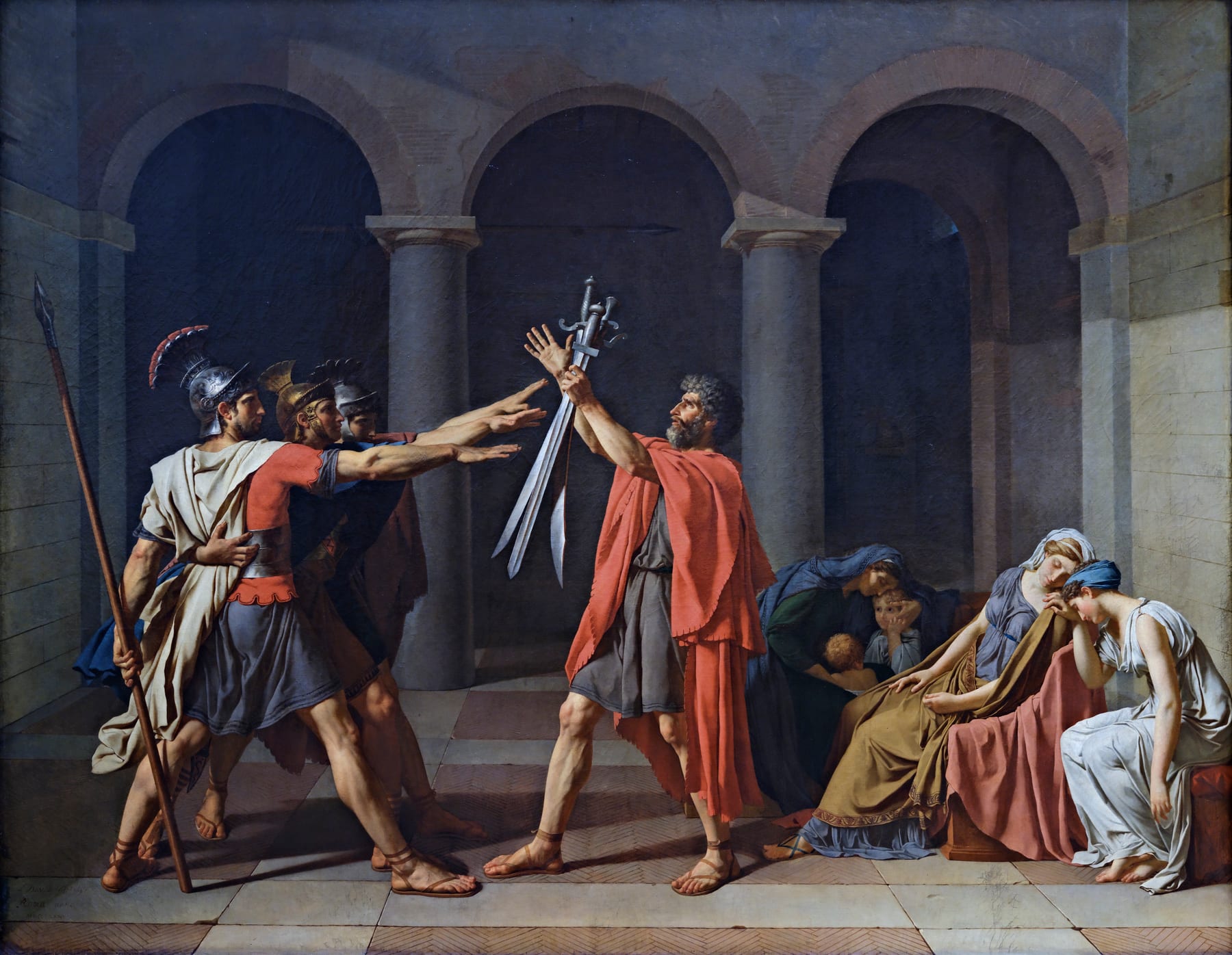
Antonio Canova – “Pauline Bonaparte as Venus Victrix” (1805–08, Borghese Gallery). In this sculpture, Napoleon’s sister is depicted as Venus, reclining semi-nude on a couch. The smooth white marble, calm pose, and idealized beauty exemplify Neoclassical sculpture’s blend of contemporary portraiture with classical form.
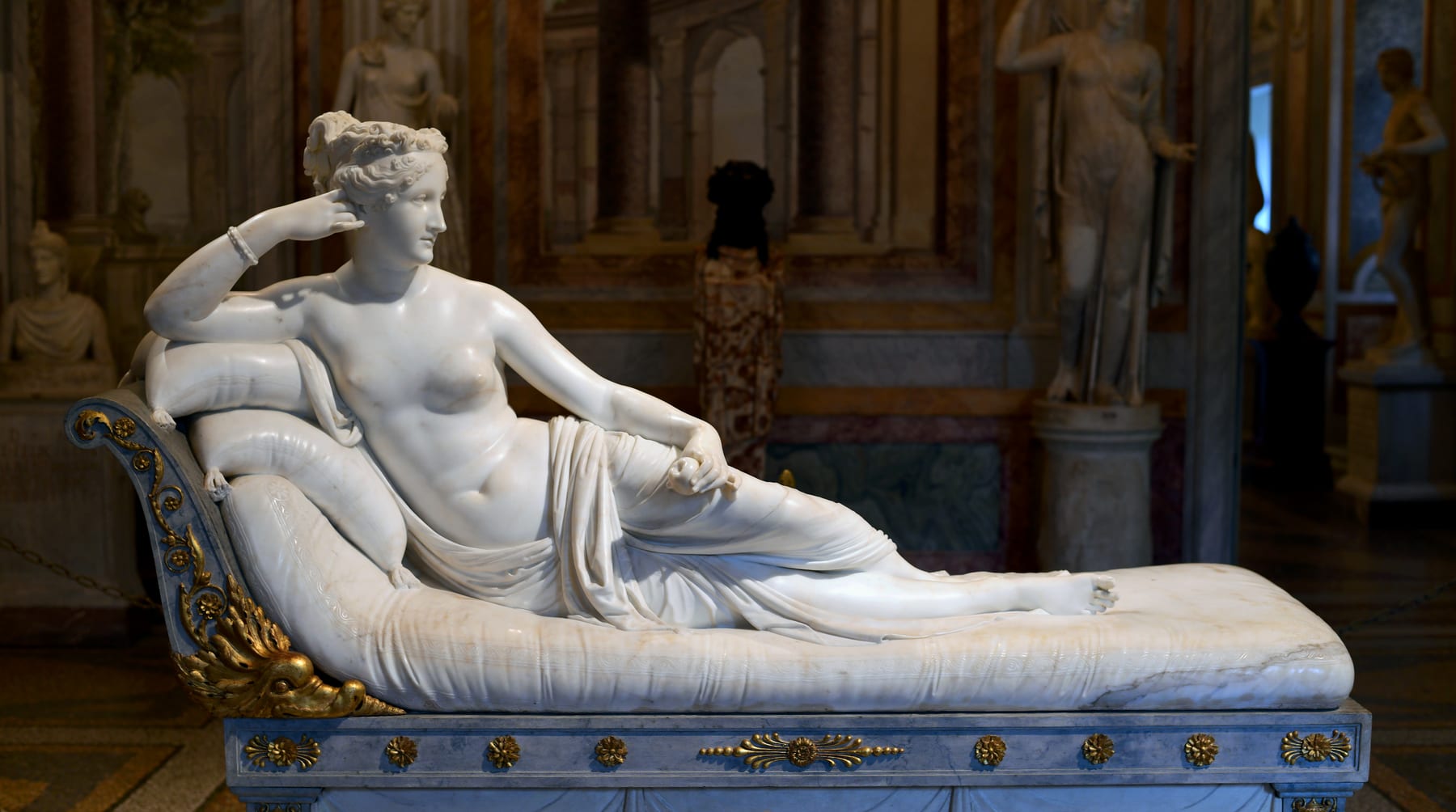
How to identify Neoclassical art?
- Greek or Roman men armoured with swords and spears, e.g. The Oath of Horatii by Jacques-Louis David

- Classical subject matter: People in static calm poses, draped in flowing Greek robes, Roman togas and sandals, e.g. Virgil Reading the Aeneid to Augustus, Octavia, and Livia by Jean-Auguste-Dominique Ingres

- Clear and sharp outlines within a rectilinear composition featuring people looking polished and posing in a statuesque manner, as if they’re marble sculptures e.g. The Death of Socrates by Jacques-Louis David

How Neoclassical art got its name? and where did it originate?
Neoclassicism (meaning New Classicism) was born in the mid-1700s, originally in Rome but its popularity exploded in France, as a generation of French and other European art students finished their training and returned from Rome to their home countries with newly-rediscovered Greco-Roman (Classical) ideals. As a testimony of the significant influence the Greeks and Romans had on Western civilization, interestingly the term itself is a merger of words derived from both ancient languages spoken by them; neos (Greek for “new”), classicus (Latin for “first class”) and ismos (Greek for “doctrine” or “ideology”). Neoclassical art style was widely adopted and popularized by French artists, since France was the centre of culture and art in Europe at that time. The art movement was not limited to painting and sculpture; it was also manifested in literature, architecture and music, embraced by artists all over Europe and America. Born on the eve of the Age of Revolution, it reflected the intellectual, social and political changes of that period. One book (Gardner’s Art through the Ages, 1926) accurately describes it as “the semiofficial voice of the French Revolution.”
What gave rise to Neoclassical art movement?
1. The Age of Enlightenment and the Grand Tour
Ever since the fall of the Roman Empire, thirteen centuries earlier, Europeans had been nostalgically fascinated by the grandeur and glory of ancient Rome. It was always in the intellectual background, hence several classical revivals emerged over the centuries, such as the one that materialized in Italian Renaissance art. However, it was powerfully reignited in the Age of Enlightenment of the 18th century, due to the philosophical return to classical thought, and renewed appreciation of Greek and Roman cultures. Being one of the leading advocates of Neoclassicism, German art historian Johann Joachim Winckelmann summed up the admiration of a new generation of artists behind such resurgence of classical tradition in his book History of Ancient Art (1764). His influential book gave the movement momentum in which he famously proposed that since the ancients had already attained perfection in their art, “the only way for modern artists to achieve greatness was to imitate the Greeks.” [Source: Antoine Watteau: Perspectives on the Artist And the Culture of His Time By Mary D. Sheriff]. In the 1750s, art students in Rome gathered around the historian Winckelmann and his protégé, the painter Anton Raphael Mengs, one of the earliest artists to adopt classical themes in his paintings. By the end of their mid-18th century “pilgrimage” to Rome, a part of what is known as the Grand Tour, expatriate artists had acquired newly-found ideals from the ancient past and a new artistic style.
2. The Ruins of Herculaneum and Pompeii
The revival was also inspired by the excavation of the ruins of Herculaneum and Pompeii. Both were Roman sites, buried under volcanic ash and mud in the eruption of Mount Vesuvius in 79 AD. Such archaeological discoveries were the biggest news of the day. Ancient lost cities, frozen in time, preserved for centuries and about to give an accurate picture of life in antiquity. The excavated artifacts sparked the interest of people and artists in particular. Several books were published about Graeco-Roman art like Antiquities of Athens of 1762 (by English archaeologists James Stuart and Nicholas Revett) and the European fascination with classical antiquity began to be reflected in paintings, fashion, furniture and even tableware and garden design. Architecturally, the Arc de Triomphe of Paris (built between 1806 and 1836) is one of the best known Neoclassical constructions. Also, the American Founding Fathers were in favor of the Neoclassical style. Many government buildings, universities and museums were built to look like Greek temples, for example the White House (built between 1792-1800) and the US Capitol (built between 1793-1829).
3. The Age of Revolution
The advent of revolutionary movements in France and America, based on classical ideals such as the democracy of ancient Athens and Rome, made Neoclassical art even more appealing. Those ideals were a major force behind the American colonies’ Declaration of Independence from the British Empire (1776) and the overthrow of the French monarchy (1789). As they rejected and revolted against the contemporary unjust governments, they found values and inspiration in the Greco-Roman past. Concepts related to the republic and senate, of the ancient ruling system of Rome, provided the revolutionaries with a vision for the emerging American and French republics. The basic reasons behind the French Revolution were poverty and famine, which provoked the rising of the impoverished society that included peasants, laborers and merchants against both the aristocracy and clergy. Frustration with the monarchy and the Church turned violent and hundreds of priests were killed by mobs throughout the revolution, as happened in the September Massacres of Paris in 1792. Eventually, the French government replaced the quasi-state religion of Christianity with anti-clerical Secularism. With religion marginalized, it’s no surprise that they looked towards an alternative source of morals and values from antiquity. That hostility to religion explains why on the path to the revolution, Neoclassical artists portrayed themes of civic duty and allegiance to the state rather than to church (or family). Paintings showed virtues glorified by the Romans and Greeks, like fighting for one’s country, bravery and loyalty. They promoted ideals such as patriotism, courage and sacrifice. The anti-clerical sentiment is evident in the radical approach of depicting civic virtues that were idealized by pagan Romans and Greeks, instead of biblical virtues and Christian saints. It’s not an art style where you’d find a moral message through a painting of a Christian martyr, but rather a dying pagan philosopher (e.g. The Death of Socrates by Jacques-Louis David). Modern-day fallen patriots and revolutionaries were mythologized and portrayed as heroes bravely meeting their demise in scenes that resemble religious martyrdom (e.g. Death of Marat by Jacques-Louis David). One of the best known examples of neoclassical paintings was The Oath of the Horatii painted five years before the outbreak of the revolution. It was painted by French artist Jacques-Louis David whose artwork anticipated the revolution. Three-quarters of the French were illiterate which created an opportunity for art to become a political tool to arouse revolutionary fervor
Rebels of a new generation
Neoclassical painters rebelled against Rococo art because it epitomized what was wrong with a formerly great nation. Rococo art represented the aristocratic extravagances of the pre-revolutionary society under Louis XV. Its shallow subject matter showed flirty women and frolicsome men, cherubs and cupids, mythological scenes, and carefree people with a hedonistic attitude. It was almost sinful and certainly lustful. Neoclassical artists rejected the Rococo superficial beauty and aristocratic frivolity. If Rococo art was aimed at the French aristocracy, then Neoclassical art was aimed at the masses on the verge of revolting against the aristocracy.
If Rococo style represented a decadent culture, then Neoclassical subject matter was art with a moral character. Unlike the Rococo art movement, the purpose of art was no longer decorative but to inspire values while yearning towards the greatness of Greco-Roman cultures. Art had a political role to play. As a sign that flamboyance had given way to solemnity, clarity and order, the serpentine and curvilinear motifs of the Rococo style were replaced by the Neoclassical symmetrical and rectilinear ones.
Romanticism (19th Century, c.1800–1850)
Characteristics & Context: Romanticism developed in the late 18th century and peaked in the early-mid 19th century as a reaction against Neoclassicism’s order and the Enlightenment’s emphasis on reason. Romantic art championed emotion, individualism, and the sublime forces of nature. It often features dramatic scenes, turbulent landscapes, heroic struggles, and exotic or medieval subjects. Romantic artists valued imagination and the sublime – depictions that evoke awe or terror (e.g., shipwrecks, storms, wild nature). This period coincided with political upheavals (French Revolution, etc.), nationalist movements, and a growing fascination with the medieval past and the mysterious.
Key Artists: Eugène Delacroix in France painted energetic, emotion-filled scenes with rich color – Liberty Leading the People (1830) is a famous Romantic image of revolution, with a personified Liberty urging rebels onward amidst the smoke of battle. Théodore Géricault painted the tragic Raft of the Medusa (1819), a stark portrayal of shipwreck survivors that shocked viewers with its realism and pathos. In Spain, Francisco Goya’s works, like The Third of May 1808 (1814), used stark light and anguished faces to condemn war’s brutality. J.M.W. Turner and John Constable in England turned landscapes into emotional dramas – Turner’s swirling, light-suffused canvases (e.g., The Slave Ship, 1840) verge on abstraction, conveying nature’s power and human insignificance. The German painter Caspar David Friedrich created moody, symbolic landscapes (like Wanderer above the Sea of Fog, c.1818) that epitomize Romantic solitude and introspection.
Innovations: Romanticism broadened subject matter to include contemporary events (as emotional narratives), wild natural scenes, and literary themes. Artists often broke academic rules – loose, expressive brushwork and rich, unblended colors appear, especially in Delacroix’s and Turner’s work. There was also a Romantic fascination with the sublime (Edmund Burke’s concept of beauty mingled with terror).
Notable Artworks:
Eugène Delacroix – “Liberty Leading the People” (1830, Louvre). This painting of the July Revolution shows Liberty as a bare-breasted woman holding the tricolor flag, leading a mix of citizens over barricades and bodies. The vigorous brushwork and emotional intensity – with Liberty’s figure illuminated against a smoky background – capture the spirit of revolutionary Romanticism.
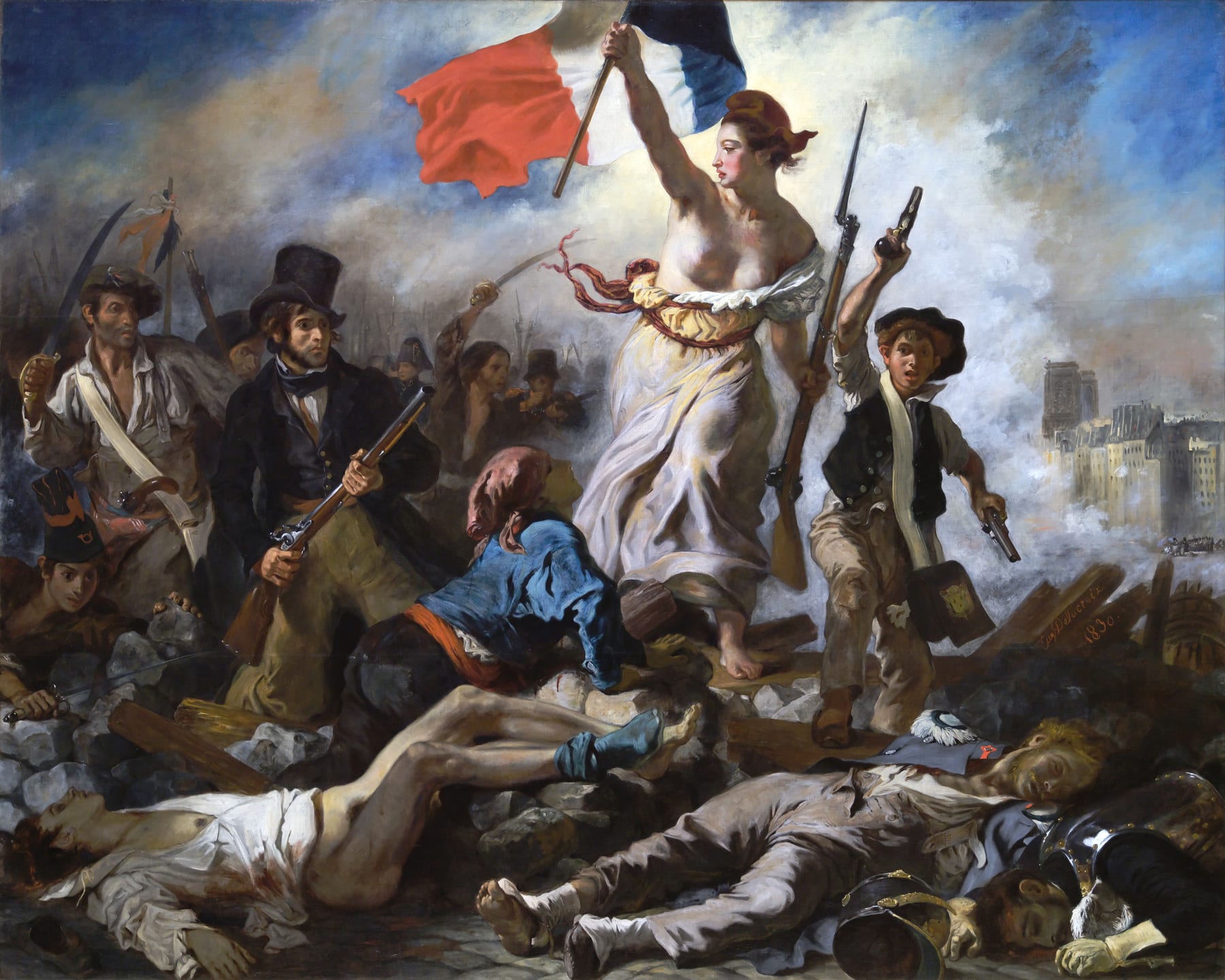
J.M.W. Turner – “The Fighting Téméraire” (1839, National Gallery, London). Turner’s sunset-toned seascape shows an old warship towed by a modern steamboat to be scrapped. The poignant contrast between the glowing sky and the dark steamer reflects on change and mortality, rendered in luminous, hazy brushstrokes that influenced later Impressionists.
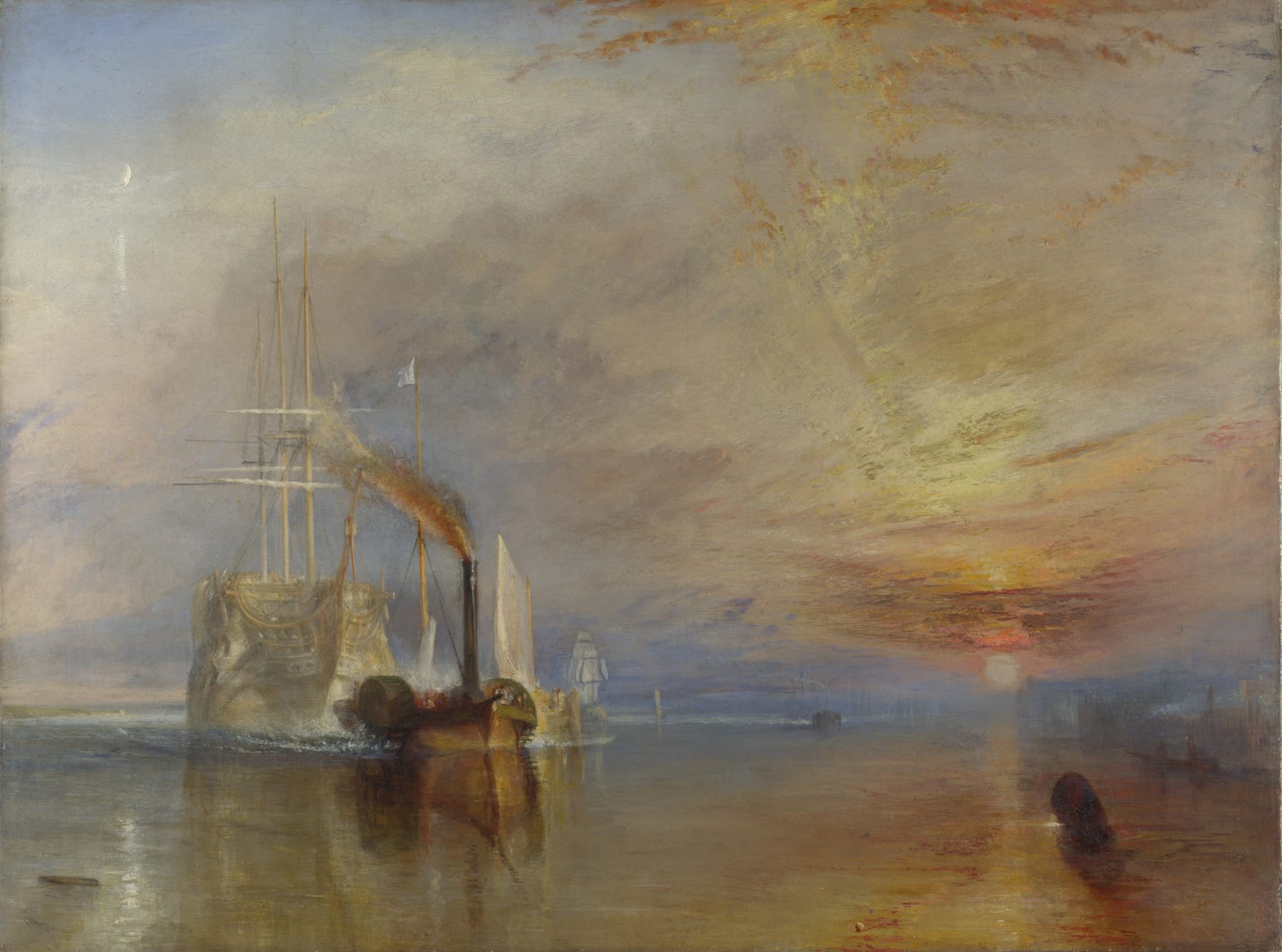
How to identify Romantic art?
- The skies are gloomy or cloudy as a sign of imminent danger and fear of the unknown, e.g. Wanderer above the Sea of Fog by Caspar David Friedrich.

- A focus on nature – mystical landscapes with dark mysterious ambience; dark in both a literal and figurative sense, e.g. Der Heuwagen by John Constable.

- Dramatic scenes of man or nature, occasionally with undertones of nature’s triumph over man, e.g. The Course of Empire Destruction 1836 by Thomas Cole.

- The sky is prominent and overwhelming, often taking over around half of the painting, e.g. Venice Grand Canal by Joseph Mallord William Turner.

- Dramatic scenes (similar to Baroque art but) painted in visible brushstrokes, as typical of the Romantic style, e.g. Liberty Leading the People by Eugène Delacroix.

- Horrific and gothic images, where faces express feelings such as intense pain, anguish, anger or fear, e.g. Saturn Devouring his Son by Francisco de Goya.

How Romantic art got its name?
Whenever you read the words “Romantic art,” don’t think of “love matters,” think “emotional” art. The word “romance” had multiple meanings during its long history, but in the context of art, it’s a reference to strong emotions associated with an art style that was prevalent at the dawn of the 19th century.
Where the Romantic art movement appeared? and what inspired it?
The Romanic movement originated in Germany, then it spread to England, France and the rest of Europe. Across the Atlantic, America had its own version of Romanticism, the Hudson River School, which was the first truly American school of art.
The mid-1600s ushered in the Age of Enlightenment (or “Age of Reason”), which was a period that glorified rational thinking, secularism and scientific progress. The first operational steam engine, built in 1712, could be regarded as the beginning of the Industrial Revolution which later swept the Western hemisphere. Steam engines and cotton mills symbolized that Industrial Revolution. Industrialization transformed economies of Western Europe and North America, driving them from dependence on agriculture to manufacturing. However, at the turn of the 19th century, not everyone believed that science and reason could possibly explain everything. Their reaction against the ongoing industrialization became a comprehensive movement – Romanticism. They looked beyond reason, and sought inspiration in intuition and imagination. Being emotionally engaged was the ultimate aim of their artwork.
Here are two French philosophers who held and defended opposing worldviews that eventually brought the Romantic man up against the Enlightened man: While the Enlightenment philosopher Voltaire (1694 – 1778) preached progress and rationality, his bitter rival Jean-Jacques Rousseau (1712 – 1778), a forerunner of the Romantic movement, advocated a “return to nature.” Going against the tide, Romanticism and its emphasis on the emotional experience fiercely challenged the dominant approach of rational thinking of the preceding 150 years, established by the Enlightenment. Even though religion was treated with little reverence, it was still fascinating to them. No traditional religious art was produced, but biblical stories and religious imagery continued to be sources of inspiration, similar to folk tales. Romanticism wasn’t embraced by only painters, but also poets, composers, novelists and philosophers. The conflict between what was disdained as a dehumanized and mechanical world versus a nostalgic yearning for a simpler life and an appreciation for nature is still alive in our culture today.
Despite the ongoing urbanization, Romantic art depicted villages rather than expanding cities. While large numbers left rural areas and settled in the city, the Romantics longed for life in the country. Rather than machines and factories, they put rural landscapes on display. That signaled a comeback for landscape paintings which were very popular during the Baroque period. However, nature does not only provide a setting for the painting, but also its main subject matter, so much so that people are not present or minuscule in comparison to the setting. It’s not unusual to see only one or two small figures against an overwhelming rural background. Previously, nature was seen as subordinate to humans, a view heavily influenced by a Christian outlook, but that had changed as Europe became more secular during the Age of Enlightenment. It was a time when many felt that, with industrialization and new technologies, they acquired unprecedented power over nature. Romantic paintings served as a reminder that humans were still at the mercy of Mother Nature.
The French poet Charles Baudelaire wrote, “Romanticism is precisely situated neither in choice of subject nor exact truth, but in the way of feeling.” In light of feeling and individual experience, there was no place here for what tradtionally had influenced art; religion, reason, morality and civic virtues. Recurrent themes were human vulnerability and isolation; stunning landscapes and morbid subject matter. Romanticism was directed by the opposite of rationality – passion, intuition and the mysterious. The paintings showed strong emotions through facial expressions like anguish, intense pain, anger or fear.
To borrow a word from contemporary culture, Romantic art was “gothic.” It was dark, macabre and grotesque. Interestingly, it would still be accurate to associate the original meaning of “Gothic,” (that is “medieval”) in describing this art style because the artists revived cultural elements from the Middle Ages such as folklore and fairy tales, and stories of witches and angels. For many generations, since the start of the Enlightenment period, the educated classes looked down on that period and labelled it the “Dark Ages.” They had long admired the grandeur of the Greek and Roman cultures. Nonetheless, the Romantic artists viewed that pre-Renaissance era with admiration: they believed the educated generations that followed couldn’t produce a culture that matches that of the uncultivated, common people of the Middle Ages
Until that moment in the history of Western art, most artwork was created with beauty at its heart. Fine art had been taught as a discipline. Romantic art, on the other hand, was there to fascinate and horrify. Some of the their paintings were the most horrific to be seen in the West at the time, for example Saturn Devours His Children by Francisco de Goya (view here). The artist’s deep troubles and personal struggles came out in his paintings. The stereotype in our popular culture of the artist or intellectual as a self-tortured, lone soul with a nobody-gets-me attitude originated in the Romantic period.
Rebels of a new generation
Romanticism was the anithesis of Neoclassicism. The Enlightenment and its revived ideals from Graeco-Roman cultures gave birth to the Neoclassical art, all of which were rejected by the Romantics. It was a matter of freedom from classical restraints -a matter of trusting the heart, rather than the mind. The Neoclassical style emphasized order and reason, while Romanticism focused on feelings. The stoic, statue-like faces in Neoclassic paintings were incapable of showing feelings that the Romantic artists conveyed in facial expressions in their paintings. You’ll find heroism in Neoclassical paintings, but in the Romantic ones, artists do not attempt to conceal human vulnerability, and proneness to violence or nature’s fury. Classical (Greek and Roman) mythology, the main influence on Neoclassical art, was still featured in Romantic paintings as in “Liberty Leading the People” by Eugène Delacroix (here), nevertheless artists favored local folklore.
A common feature in Romantic art is visible brushstrokes, which would have been unacceptable in the Neoclassical tradition that pursues perfection. Beyond technique, the Romantics also rebelled against the political art of the Neoclassical period with a style that celebrates nature. Themes glorifying virtues like bravery and loyalty were replaced with morbid and mystical themes. Eventually, Romanticism came to an end because it lacked the coherence and wide support of the Enlightenment movement, but it never completely disappeared. In fact, today’s postmodern suspicious view of science and reason has its roots in Romanticism. We attempt to escape our technological world by seeking a refuge in spirituality (traditional or New-Agey), mystical experiences or just nature exploration.
Realism (Mid-19th Century, c.1840–1880)
Characteristics & Context: Realism emerged in France around the 1840s as a reaction against both Romantic drama and Neoclassical idealism. Realist artists aimed to depict everyday life and ordinary people truthfully, without embellishment or idealization (Realism Art Movement – Characteristics - Identify This Art). They often portrayed the working class and rural poor, aligning with the era’s social and political currents (e.g., the 1848 revolutions, rise of socialism). Realism coincided with early photography and scientific positivism – a belief in observable reality. Visually, Realist paintings use earthy tones, solid modeling, and straightforward compositions; subjects might be laborers, peasants, or domestic scenes, presented with dignity and matter-of-factness.
Key Artists: Gustave Courbet led the Realist movement. His monumental The Stone Breakers (1849) showed two laborers breaking rocks – an unapologetic focus on toil, which Courbet called painting “real and existing things.” His A Burial at Ornans (1850) depicted a rural funeral on a grand scale usually reserved for historical or religious scenes, scandalizing critics who saw it as “ugly” reality on display. Jean-François Millet painted peasants with a sense of solemn reverence – The Gleaners (1857) shows women collecting leftover grain after harvest, emphasizing their poverty and perseverance. In the USA, Winslow Homer and Thomas Eakins embraced Realist principles somewhat later, portraying everyday American life (Homer’s Civil War scenes and sailors, Eakins’ surgical theaters and rowers).
Innovations: Realism expanded acceptable subject matter in fine art to include the lower classes and contemporary social issues. This was revolutionary in a Paris art world that favored grand historical themes. Realists also influenced techniques: Courbet’s rough knife-palette application of paint, and Millet’s soft, atmospheric depictions of labor, gave artists new textures and moods to explore. Importantly, the advent of photography (invented 1839) bolstered Realism’s mission to capture life accurately.
Notable Artworks:
Gustave Courbet – “The Stone Breakers” (1849, formerly in Dresden, destroyed). Courbet’s painting showed two workers breaking stones by the roadside, with torn clothing and straining muscles. By portraying back-breaking labor on a large canvas, Courbet claimed such honest work was as deserving of depiction as any mythic scene – a bold Realist statement (Realism Art Movement – Characteristics - Identify This Art).
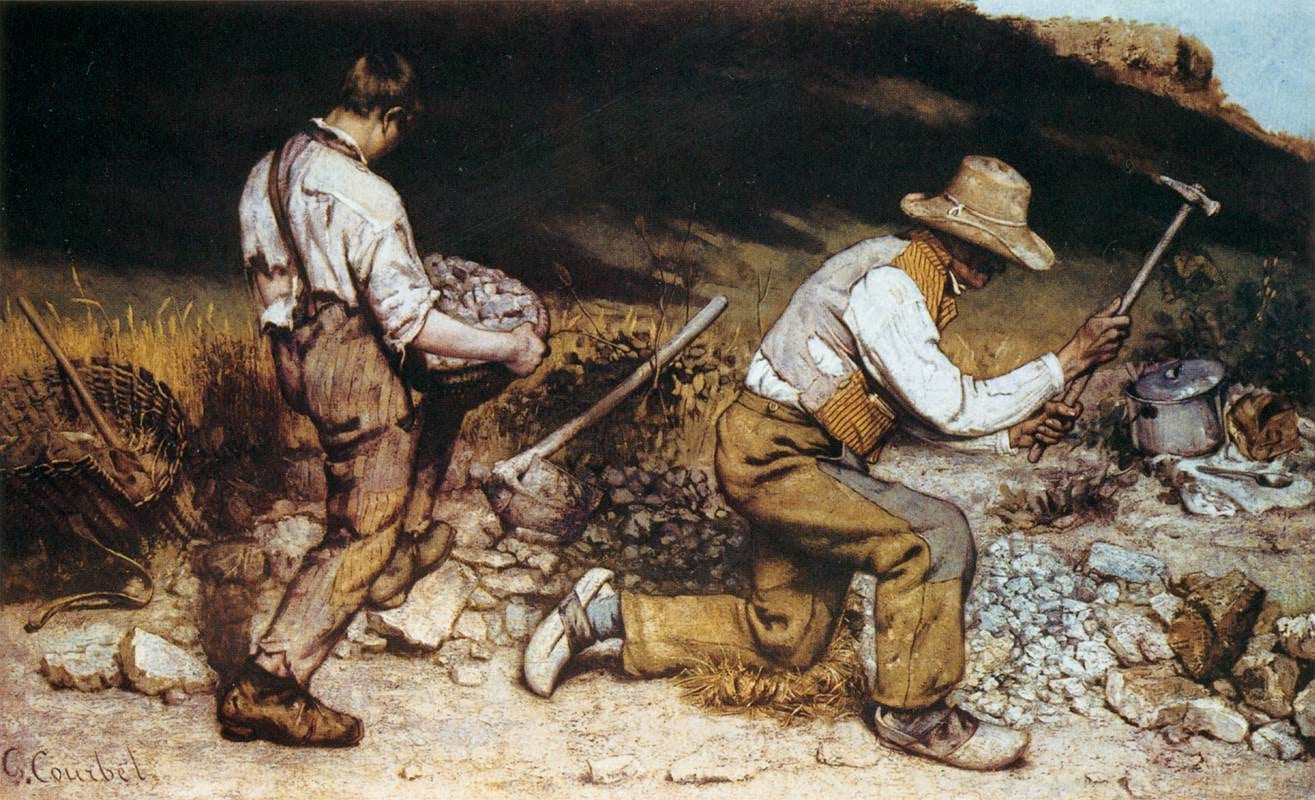
Jean-François Millet – “The Gleaners” (1857, Musée d’Orsay, Paris). Three peasant women bend over to gather stray grains after harvest, their forms monumental against a vast field. Millet’s sympathetic portrayal of peasant labor, with warm light and solid figures, exemplifies Realism’s concern with the rural poor’s dignity and hardship (Realism Art Movement – Characteristics - Identify This Art).
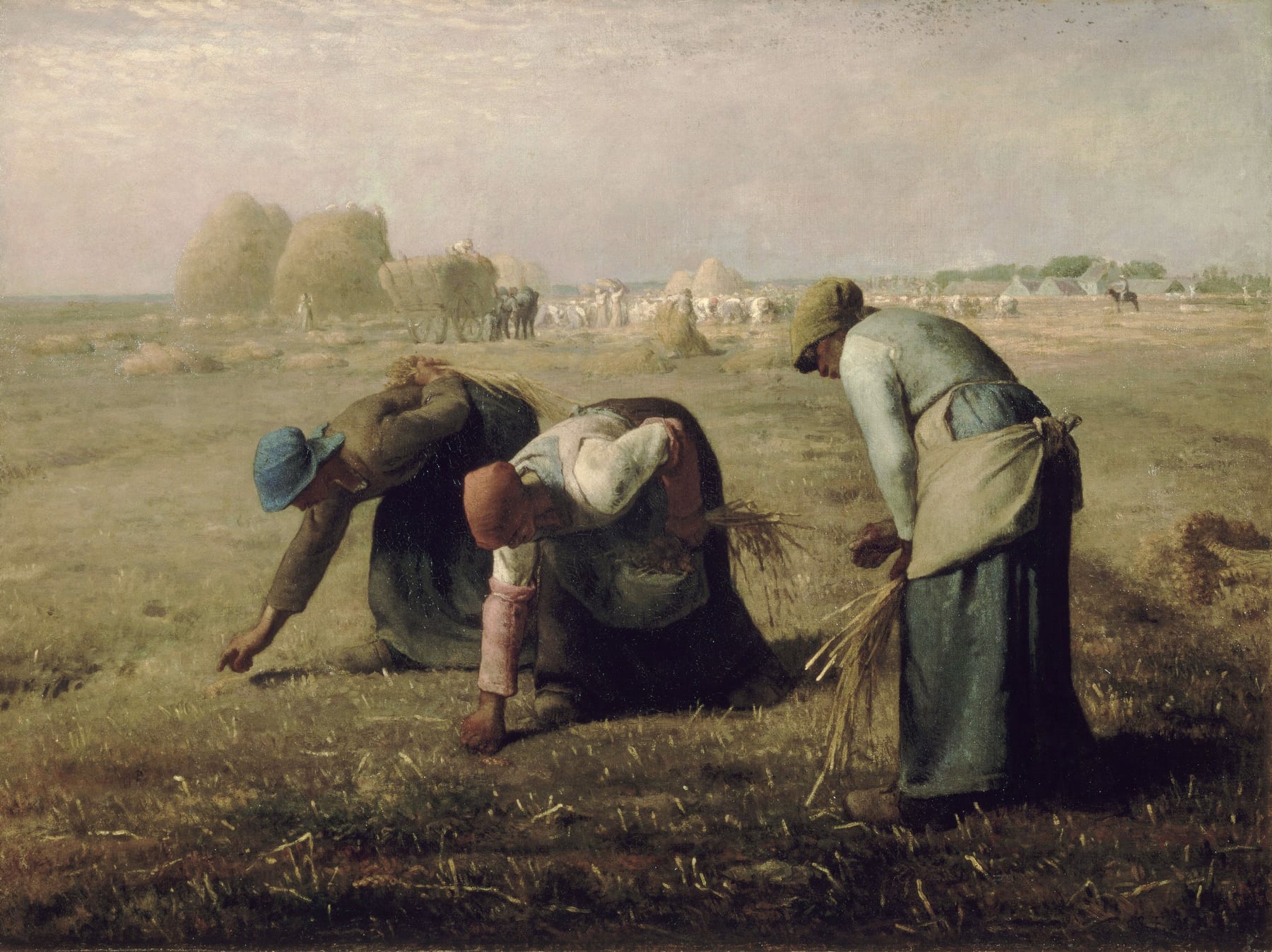
How to identify Realist art?
- Realist paintings depict the harsh, everyday reality of ordinary people from the middle and lower classes of society, for example, The Gleaners by Jean-François Millet.

- Realism is a sympathetic portrayal of poor, urban and rural workers in bent postures, struggling with their hard, manual labor, for example, The Stone Breakers by Gustave Courbet.

- The bleak paintings feature a palette of dark colors to emphasize the plight of workers. The subjects are shown serious-looking and humble – there’s never a cheerful sentiment – for example, Third Class Carriage by Honoré Daumier.

How Realist art got its name?
Realist art is named after its realistic approach to painting of the observable world, free from imaginary or idealized subject matter. You won’t find mystical landscapes, biblical scenes or Greco-Roman mythological themes. To distinguish this art movement from spin-offs and subgenres that emerged later, sometimes it’s referred to as French Realism or 19th-Century Realism.
What gave rise to Realist art? And where?
Politics and Society
The French Republic established in the aftermath of the earth-shattering revolution of 1789 lasted only until Napoleon Bonaparte, in 1804, declared it an empire. But in 1814, he was forced to abdicate and the much-hated dethroned Bourbon monarchy was restored. This time around it was a constitutional monarchy, not an absolutist one. Nevertheless, eventually a Bourbon king was overthrown in 1830 and replaced by King Louis Philippe I of the House of Orleans. In February 1848, a new revolution broke out and ended the monarchical period, forcing King Louis to abdicate, and a French Second Republic was founded. That 1848 Revolution marked the beginning of a wave of revolutions that engulfed Europe. Such revolutions were inspired by political ideologies (e.g. nationalism, socialism and liberalism) and economic crises. In France, the uprising was fuelled by workers’ demands for higher wages and better working conditions, among other reasons such as universal male suffrage (voting rights). The socialist camp (included both Radical Republicans and Socialists) among the revolutionaries championed the proletariat demands. That was not surprising given socialist thought had been increasingly gaining ground in Europe for at least two generations, due to the harsh reality of urban and rural workers. Curiously, in the same year, that is 1848, Karl Marx and Friedrich Engels published The Communist Manifesto – a gospel, to this day, for Socialists and Communists around the world.
The split among French revolutionaries pitted liberal moderate republicans against Radical Republicans and Socialists. While most of the French favored some social reforms, they were rather anti-socialist. The tension turned into an armed, bloody conflict and the socialist uprising was ultimately crushed. Despite their dramatic failure, the concerns for the working class inspired many artists and writers, who sympathized with the left-leaning revolutionaries and some of them were wholeheartedly socialist like Realist art pioneer Gustave Courbet.
Realist artists believed they should tackle social issues of modern life and turn their art into a truthful reflection on the plight of ordinary people. They witnessed the radical changes to modern life during the 1800s as the Industrial Revolution progressed, and found the poor and working classes to be a more worthy subject for artistic depiction. Hence, in Realist paintings, you won’t find anybody having fun, flirting or dressed elegantly – only the mundane, everyday activities of humble, anonymous people at home or at work. Most often the work was a menial labor at a factory or a farm.
Another source of influence was technology. The daguerreotype photographic process, invented in Paris in 1839, signaled the birth of photography, which would have an everlasting influence on the art of painting. Many Realist artists painted directly from photographs.
Realism didn’t have a great effect on architecture and had only a limited presence in sculpture. However, it was significantly present in literature, for example, Victor Hugo’s Les Misérables and Charles Dickens’ Hard Times.
Rebels of a new generation
Realist artists were not interested in the past, or in anything that they didn’t personally experience. That was summed up in a quote by the patriarch of the movement, Gustave Courbet: “I have never seen angels. Show me an angel and I will paint one.” Art that preceded them, in their view, was simply false. Nowhere will you find in Realist art biblical scenes as in Baroque art, mythological themes as in Rococo art, or mythical heroes and historical battles as in Neoclassical art. Unlike the Romantics, who painted mystical nature, the Realists saw only urban wasteland. Their focus was on the lower class and their dire conditions of work. That approach was ground-breaking because even when the poor were previously present in paintings, as in the Academic art style, they were glorified and shown living an idealized life. Devoid of history, literature, religion or mythology, the artist’s focus was on contemporary social issues. The heroic portrayal of the working class was seen as a political agenda and their art style was rightly regarded anti-authoritarian. The Realists were both artists and social activists.
Realism rebelled against the conventional and academic rules of art, which were promoted by the French Académie des Beaux-Arts. In that academy, artists received their artistic training, and later their paintings could be displayed in the Academy’s Salon. But Realism was one of the “radical” art styles which did not conform to the academy’s standards. When Gustave Courbet, had his artwork repeatedly rejected, he had to start his own exhibition, making him “the first artist ever to stage a private exhibition of his own work.”
The emergence of photography brought a decline in landscape paintings. Also portrait paintings and miniatures were replaced with photographs. The three centuries-old custom of sitting for hours in front of an artist, à la Mona Lisa, was no longer required or in demand. The story is familiar to us, new technology brought an end to the careers of many people, however the Realist artists still found in photography an inspiration. Their art was not mimicry of photographs, but an accurate, unadorned report on modern life in the nineteenth-century.
Impressionism (Late 19th Century, c.1860s–1880s)
Characteristics & Context: Impressionism began in France in the 1860s as a radical departure from academic art. The name comes from Claude Monet’s painting Impression, Sunrise (1872), used derisively by a critic to describe the group’s sketch-like, “unfinished” style. Impressionists sought to capture the fleeting effects of light and color, often painting en plein air (outdoors) to observe nature directly. Their works feature visible, broken brushstrokes, bright unmixed colors, and informal compositions that crop the scene like a snapshot. Rather than historical or mythological scenes, Impressionists painted modern life – Parisian boulevards, leisure activities, landscapes – in an immediate, momentary manner.
Key Artists: Claude Monet led the movement; his series on Rouen Cathedral or water lilies show how light and atmosphere can transform a subject. Pierre-Auguste Renoir painted lively scenes of social life (dances, boating parties) with warm, dappled light on figures. Edgar Degas focused on urban subjects like ballet dancers or horse races, often with unusual compositions influenced by photography and Japanese prints (e.g., figures cut off at the frame’s edge). Mary Cassatt, an American in Paris, portrayed tender scenes of mothers and children with Impressionist techniques. Camille Pissarro and Alfred Sisley specialized in landscapes and cityscapes, capturing seasonal light and weather. The movement initially faced rejection (the Salon refused their works, so they held independent exhibitions starting in 1874), but by the 1880s Impressionism gained recognition for its innovation.
Innovations: Impressionists revolutionized color theory in practice – using optical mixing (placing pure colors side by side for the eye to mix at a distance) instead of pre-mixing dull tones. They showed that shadows aren’t merely black or gray but full of reflected hues. Compositionally, they were influenced by the asymmetry and flat color areas of Japanese ukiyo-e prints, which entered Europe in this period. Impressionism also embraced modern life as worthy subject matter, paving the way for artistic focus on the here-and-now.
Notable Artworks:
Claude Monet – “Impression, Sunrise” (1872, Musée Marmottan, Paris). This small harbor scene with loose, hazy brushstrokes and a bold orange sun through morning mist gave Impressionism its name. Monet’s quick strokes suggest rippling water and foggy sky without fine detail, capturing a transient moment of dawn.
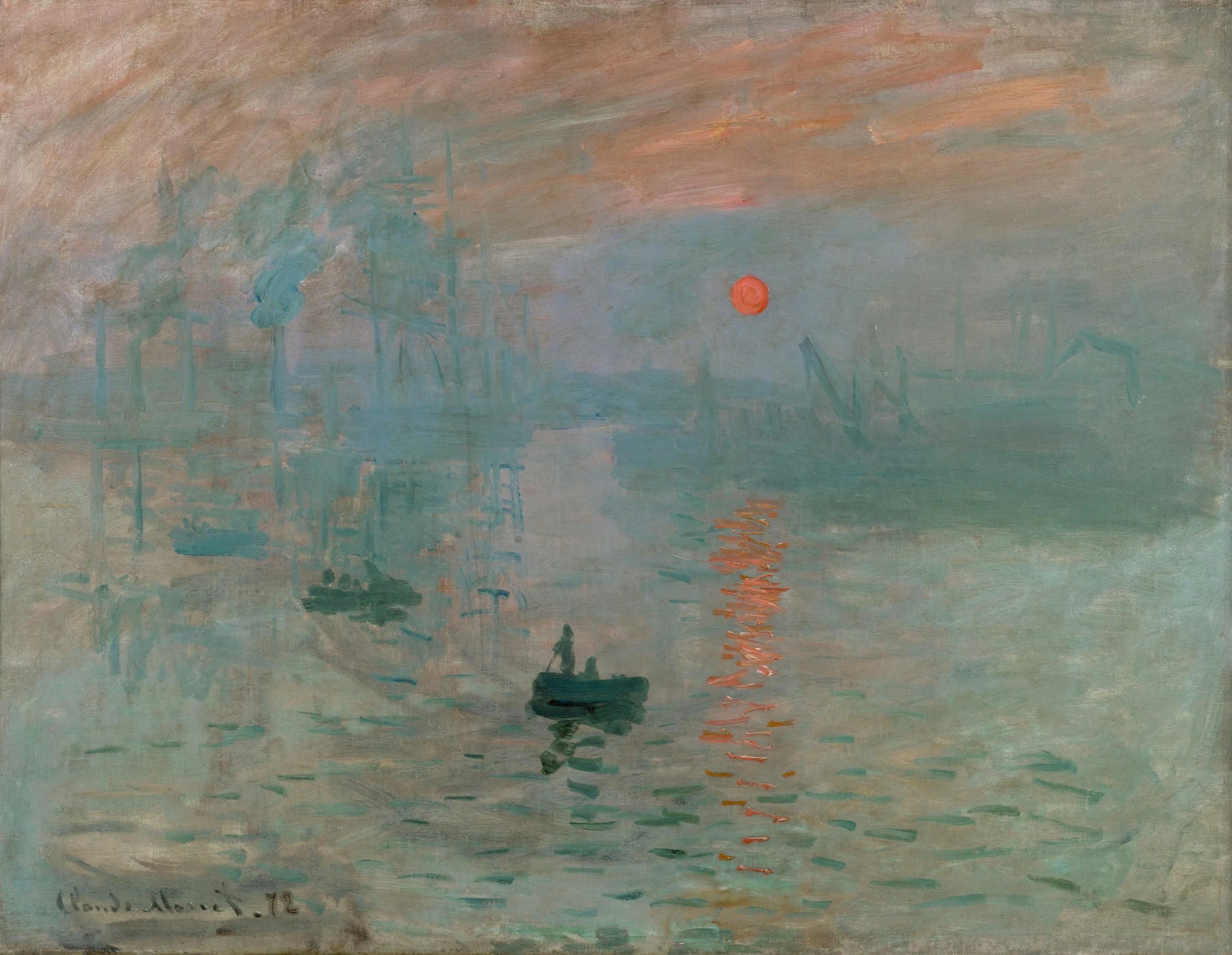
Pierre-Auguste Renoir – “Dance at Le Moulin de la Galette” (1876, Orsay, Paris). A sun-dappled outdoor dance in Montmartre, where city folk gather for leisure. Renoir’s flickering brushwork of blues, pinks, and yellows recreates the effect of late-afternoon sunlight filtering through trees, while the joyful faces and blurrily painted moving figures convey a vivid impression of bourgeois life in motion.
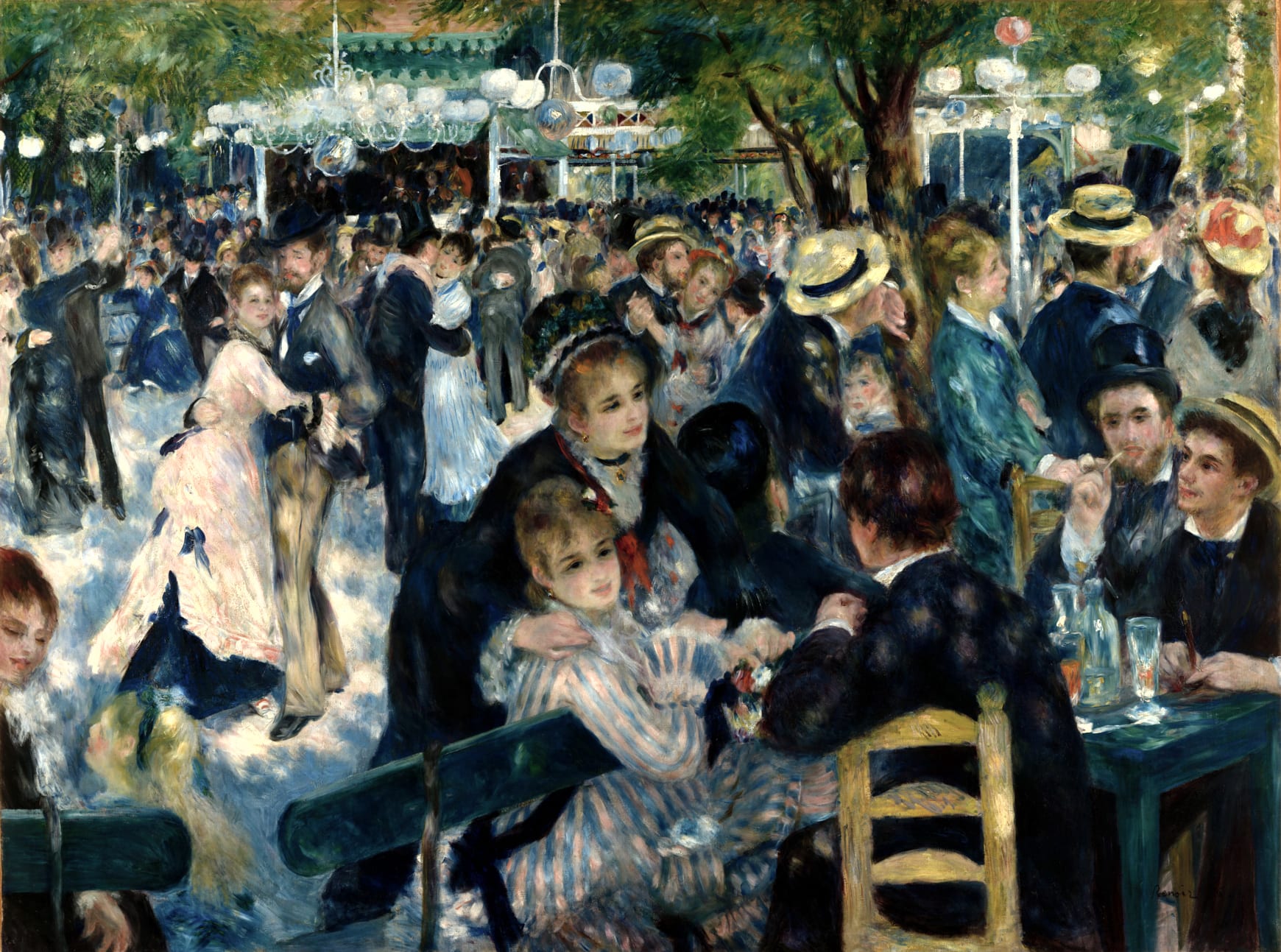
How to identify Impressionist art?
- Look for paintings with thick dabs and blobs of paint; the choppy brushwork will make you wonder if the artist finished the painting in a hurry. Note how everything seems “floaty,” soft and spontaneous.

Woman with a Parasol by Claude Monet
- Get too close to an Impressionist painting, and it will seem like a big, incomprehensible mess, take a few steps back, and your eyes will have to adjust to its blurriness.

The Boulevard Montmartre at Night by Camille Pissarro
- There’s no clear outlines or many details. The very loose brush strokes suggest rather than delineate the subject, blending one color into the next with almost no boundary between them.

The Star – Dancer on the Stage by Edgar Degas
- Artists were fascinated with capturing nature’s fleeting moments, and the interplay between mist, fog, sunlight, clouds and water reflection. These themes, painted in feathery splashes of typically bright colors give the paintings a shimmering effect.

Impression, Sunrise by by Claude Monet
- Most paintings are outdoor scenes that depict rivers, railroads, factories, cityscapes, seascapes and landscapes. You’ll notice there’s a particular emphasis on urbanite social life in activities such as relaxing on the beach or boating.

The Regatta at Sainte-Adresse by Claude Monet
- If the painting is uncharacteristically indoors, it would still portray middle class members — the haves of society, not the have-nots — drinking, dining and dancing. The paintings show them in settings that include bars, cafés, opera houses and ballet classes.

A Bar at the Folies-Bergère by Édouard Manet
How Impressionist art got its name?
The word “impressionism” owes its origin to a title that Monet gave to one of his paintings. It happened in a whimisical decision that took no more than a moment – a perfect naming ceremony for an art style that focuses on capturing fleeting moments. This is how Claude Monet recounted the story: “they asked me for a title” for a painting of the French harbour of Le Havre. His tentative response was: “Put Impression.” He picked that term in acknowledgement that his painting was not more than a mere impression of the real Le Havre. The painting would later acquire the full title Impression, Sunrise (Impression, soleil levant) before it went on display (view painting here). A conservative art critic, Louis Leroy, coined the word “impressionism” as an insult to Monet’s unconventional work in a satiric review. As in contemporary language where “geek” or “gay” are reclaimed by those the words are meant to abuse, Monet and similar artists embraced the label and became “Impressionists.”
What gave rise to Impressionism? And where?
Society
In the mid-nineteenth century, industrialization of Western Europe introduced set working hours. That meant the expanding middle class could start having, as we do today, planned vacations. In France, going to the beach or vacationing in a country house was fashionable for urbanites seeking to escape their filthy cities, crowded factories and workshops. Many of those urbanites were nouveau riche and unaccustomed to the modern lifestyle of steady income and spare time – no wonder some of them are absurdly overdressed for the beach (view painting here), even by the standards of their own time. (Who goes to relax on the beach in a three-piece suit?!) The regular income created a commercial opportunity for artists to document the activities of domestic tourists, interested in paintings as souvenirs. Parisians of that period sought relevant scenes from their own contemporary lives, rather than “high art” with Graeco-Roman or biblical themes destined for museums and art academies.
Thanks to the invention of paint tubes, a revolutionary change had been quietly transforming the painting process since the 1840s: en plein air paining (“in the open air”). No longer artists had to sketch outdoors and finish the paintings in their studios. One of the early adopters of outdoor painting was Eugène Boudin. He was a major influence on young Claude Monet when they met in 1858. Years later, Monet would become the leader and founder of Impressionism. He accompanied Boudin to the seashore where he learnt painting directly from nature. Monet’s experimental style aimed at colorfully recording the light at certain moments. Ultimately, it would be the Impressionists who’d popularize outdoor painting and bring it to a mass audience.
Monet was originally joined by three other artists: Pierre-Auguste Renoir, Alfred Sisley, and Frédéric Bazille. In 1874, Impressionist artists displayed their paintings for the first time in a private exhibition.
Technology
1. Paint tubes: painting goes portable
Pierre-Auguste Renoir once said “without tubes of paint, there would have been no Impressionism.” The new invention provided easy transport and long-term storage of paint. Probably, the last thing your mind could associate with great pre-Impressionist European paintings is, uhm, pig bladders. But that’s what the small pouches were made of to store paint. The industrial revolution didn’t only transform the world around artists, but also the very tools they used. With easily portable paint tubes, the Impressionists were not hindered from experimenting with outdoor painting at different times of the day, and under various light and weather conditions.
You might think the Impressionists found their work easy enough since they no longer needed to worry about the inconvenience of transporting paint in pig bladders or even be confined to their own studios, but that was still far from enough! They created a new painting technique which was incredibly genius (lazy, according to their critics). Instead of “slaving away” at mixing colours on a palette, as artists had always done, they applied the colours directly from the tubes onto the canvas. Let the eye of the observer do all the necessary colour mixing! The art critic, Louis Leroy’s sarcastic response was “what ease of workmanship. Wallpaper in its embryonic state is more finished than that seascape.”
2. Photographs versus paintings
Impressionist art was born at a time when photography, after decades of refining, was becoming increasingly sought after. A deep look into Impressionism will find the spirit of photography within it, and simultaneously a reaction against it. In one of the earliest and best examples of machines replacing humans, artists no longer received commissions for portrait paintings. A camera could produce a more accurate job, albeit in black and white, at a significantly faster speed. That deprived artists from a much needed source of income, which was as old as the Renaissance – Da Vinci himself was a portrait painter. Seeing that photography was also about to step in for recording historic moments and important ceremonies, many declared “painting is dead.” Painters realized their works could not compete with photographs in their documenation of reality. Artists found themselves facing questions such as, why replicate visible reality anymore? could paintings compete with an industrial machine in producing fine details? The answer was obviously negative and that led them into the innovative path of experimenting with light and color. Realistic representational art, which had been dominant in visual Western art, going back to the Greek and Roman eras, seemed to hit a deadend. That led the artist to prefer to dive into one’s own psyche in order to channel a personal perception onto the canvas, producing something that photographs lacked.
Rather than have models pose rigidly for them, Impressionists captured on canvas moments in the lives of ordinary people in a sense of spontaneity that was inspired by photography. The Star – Dancer on Stage (“L’Etoile – La Danseuse sur la Scene“) is painted like a photograph (view painting here).
Rebels of a new generation
“Would someone kindly explain to M. Renoir that a woman’s torso is not a mass of decomposing flesh with green and purplish blotches that indicate a state of complete putrefaction in a corpse…” That was a review by Albert Wolff in Le Figaro on Renoir’s Nude in the Sunlight, 1876 (view below). In another critique of the same Impressionist painting, Louis Enault writes,”[i]t is depressing to look at this large study of a nude woman; her purplish flesh is the color of game that has been hung for too long, and someone really should have made her put on a dress.”

Nude in the Sunlight by Pierre-Auguste Renoir

Nocturne in Black and Gold: The Falling Rocket by James Abbott McNeill Whistler
Impressionist artists turned their backs on the Romantic fixation with emotions. To them, stirring a visual reaction in the eyes of viewers was paramount to stirring their emotions. Also, they shunned clear outlines and forms of Neoclassical paintings. The Impressionist emphasis was on colour, rather than emotions or form. At the time when Impressionism was conceived, artists were expected to conceal their brushwork. Conventionally, paintings – the kind that aspires to belong to high art – tended to look like they were not “painted.” Thick blobs of paint, found in Impressionist works, were considered crude. It was the antithesis of art to leave visible traces of the brushwork on the canvas.
Hostility towards Impressionism culminated in one of the most famous court cases of the 19th century. At the center of the trial was a painting, Nocturne in Black and Gold: The Falling Rocket(1875), by James Abbott McNeill Whistler (view above). The modern motto of “art for art’s sake” was exemplified in Whistler’s painting. His painting did not just foretell of the coming abstraction in art, but also its name “nocturne” (a musical arrangement) was a clear and unprecedented emphasis on the artist’s own experience. On the other side of the court was the leading and respected critic of the Victorian age, John Ruskin, known for his conservative views on art. The libel trial was instigated by Ruskin’s review of Whistler’s painting: “[I] never expected to hear a coxcombask two hundred guineas for flinging a pot of paint in the public’s face.” Ouch! Ruskin would have been outraged if he knew that one day that kind of paintings would be worth well over 100 million dollars.
Whistler won the case, but the court humiliated him by awarding him only one farthing in damages and he was forced to pay for the court fees. The pyrrhic victory brought him financial ruin. The court and the public, from the outset, were not in favor of him or his modern style.
It’s hard to imagine the Impressionist style, admired around the world today, being mocked by critics and the public as ugly and sketchy. The familiarity of the masterpieces makes it even harder for us to comprehend the rationale behind the negative public outcry of its own era.
Impressionist artworks were rejected several times by the Paris Salon of the French Academy –notorious for its conservative taste. Hence, Monet and fellow Impressionists had to show their paintings in independent exhibitions which lasted from 1874 to 1886. Their few exhibitions (only eight of them) were earth-shattering to the world of art. The aftershocks would eventually take the form of other ‘modern’ art movements such as Post-Impressionism, Neo-Impressionism, Fauvism and abstract art.
Post-Impressionism (Late 19th Century, c.1880s–1900)
Characteristics & Context: “Post-Impressionism” is a broad term for the diverse artists who came after Impressionism, roughly 1880s–1890s, who expanded on Impressionist color and light experiments but rejected its lack of structure and emotion. This was not a unified movement but includes painters who developed individual styles. Common threads are a desire to imbue art with deeper symbolism, order, or personal expression. Some Post-Impressionists emphasized geometric forms and structure (leading toward Cubism), while others focused on emotive color and content (leading toward Expressionism and Symbolism).
Key Artists: Vincent van Gogh used bold colors and turbulent brushstrokes to convey his emotional state – in Starry Night (1889), swirling skies and blazing stars transform a quiet night into a cosmic vision. Paul Gauguin sought spiritual depth and exoticism, leaving France for Tahiti; his flat forms and unusual colors in works like Vision After the Sermon (1888) broke from Western naturalism, influencing Symbolism and Primitivism. Paul Cézanne pioneered a new solidity in painting: viewing nature in terms of cylinders, spheres, and cones, he built form with patches of color. Cézanne’s Mont Sainte-Victoire landscapes (1880s–90s) show a drive to simplify nature into underlying geometric structures, paving the way for Cubism. Georges Seurat developed Pointillism (Neo-Impressionism), painting with tiny dots of pure color based on optical science – e.g., A Sunday on La Grande Jatte (1884–86) presents a structured, luminous scene via countless points of paint. Henri de Toulouse-Lautrec captured the nightlife of Paris with sinuous lines and flat areas of color, bridging Post-Impressionism and Art Nouveau graphic design.
Innovations: Post-Impressionists significantly influenced modern art directions. Van Gogh and Gauguin’s expressive use of color inspired the Fauves and Expressionists. Cézanne’s structural approach directly inspired Picasso and Braque in Cubism. Seurat’s pointillism was an early exploration of scientific approaches to color in art. Moreover, Gauguin’s interest in non-European cultures signaled a wider trend of looking beyond Western conventions for inspiration (though often through a colonial lens).
Notable Artworks:
Vincent van Gogh – “The Starry Night” (1889, MoMA, New York). Painted from an asylum in Saint-Rémy, this iconic work shows a village under a night sky alive with swirling clouds, glowing stars, and a bright crescent moon. Van Gogh’s thick impasto and whirling forms create an emotional intensity – the painting is as much about the artist’s inner turmoil and awe of nature as the external scene.
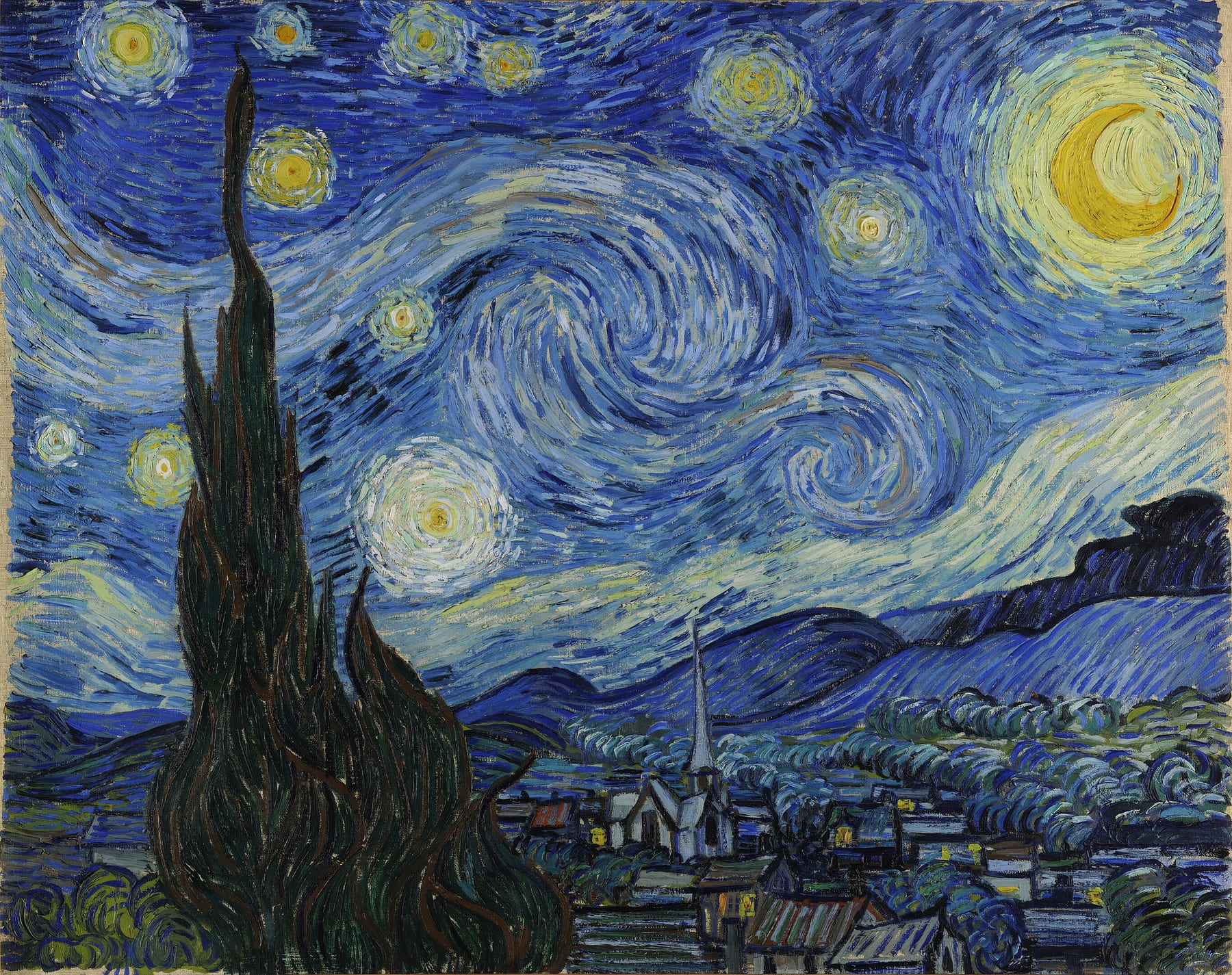
Paul Cézanne – “Mont Sainte-Victoire” (series, e.g., 1887, Courtauld Institute). Cézanne painted this Provençal mountain repeatedly. In one version, broad brushstrokes of blues, greens, and ochres construct the mountain and valley in faceted planes. The composition has a sense of order and permanence, reflecting Cézanne’s aim to “make of Impressionism something solid and durable like the art of museums.” This approach laid groundwork for the abstract analysis of form in 20th-century art.
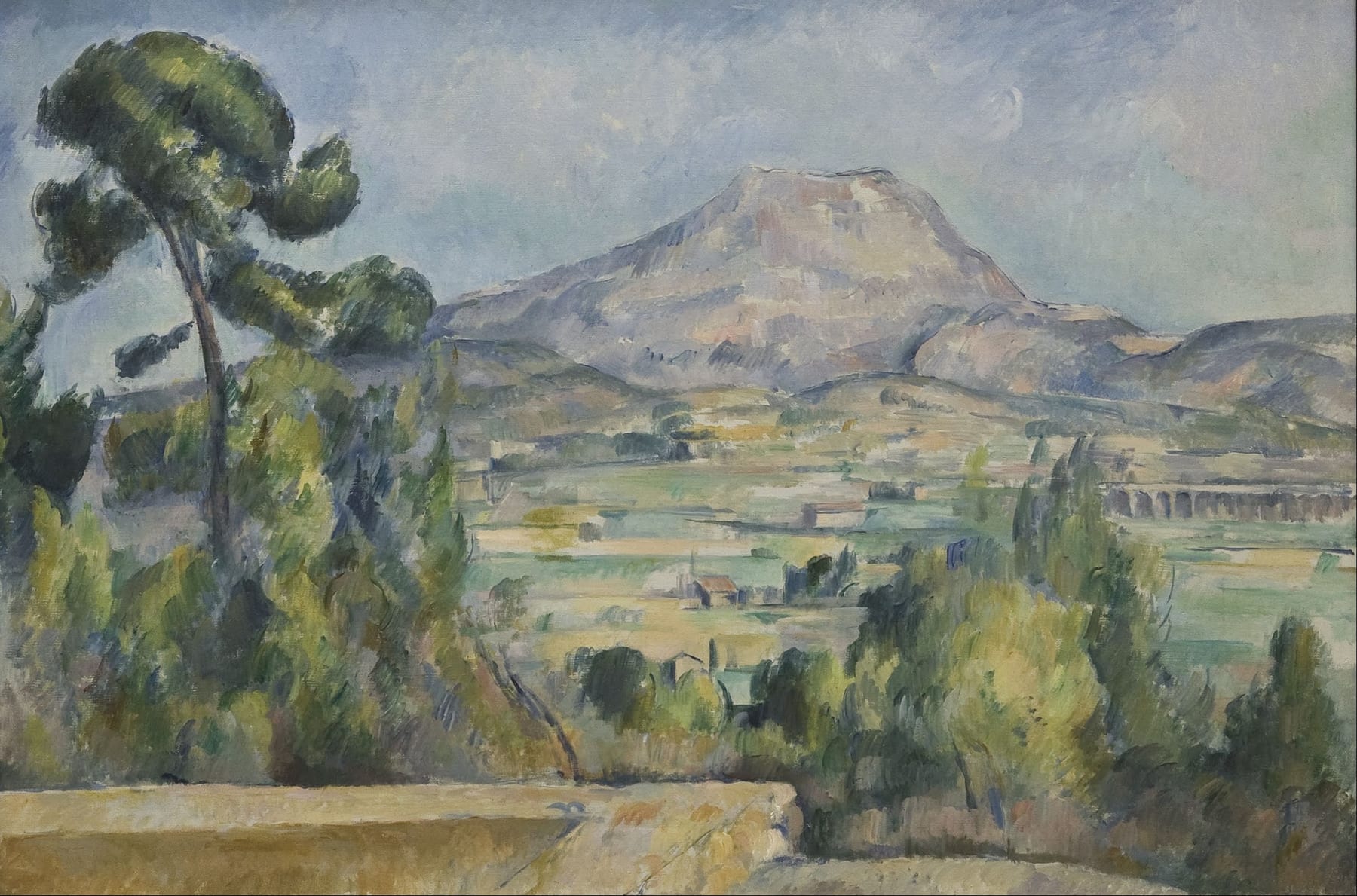
How to identify Post-Impressionist art?
NOTE: Post-Impressionism, unlike other art movements, is not coherent. Artists painted in different styles which makes it tricky to pinpoint common characteristics. However, within Post-Impressionism, there’s one remarkably unique style that you could identify at first sight, which is explained below.
- The main common characteristic among all the various Post-Impressionist styles is heavy outlines. Artists ditched the fuzziness of Impressionist art and brought back strong emphasis on form. The subject matter did not differ from that found in Impressionist paintings. Artists continued to depict the leisurely life of the urbanite middle class. Many of the scenes were outdoors: beaches and landscapes.

La Goulue arriving at the Moulin Rouge by Henri de Toulouse-Lautrec

The bather by Paul Cézanne

Sunflowers by Vincent van Gogh

Te aa no areois (The Seed of the Areoi) by Paul Gauguin
- Look for canvases covered with an incredible number of tiny dots of colour. This is a subcategory of Post-Impressionism called Pointillism, a term used interchangeably with Divisionism, Chromoluminarism and Neo-Impressionism.
 A Sunday Afternoon on the Island of the Grand Jatte by Georges Seurat
 Breakfast by Paul Signac
- Divisionism is sometimes used to refer only to the technique of the small brush strokes distinguishing it from the Pointillist technique of colourful dots.
 The Road Menders by Vincent van Gogh
How Post-Impressionist art got its name?
Post-Impressionism is a lame name (Could you perhaps find a better one?). But before we blame the British art critic and historian, Roger Fry, who coined it in 1910, we have to understand the challenge he faced. He needed a name for his London exhibition through which he was to introduce to the public a new group of very distinct artists (Paul Cezanne, Vincent van Gogh and Paul Gauguin) among original Impressionist artists (e.g. Manet). He settled on “Manet and the Post-Impressionists.” The diversity of their styles and techniques made it hard to give them but a generic term that categorises them as those who arrived after the Impressionist generation.
What gave rise to Post-Impressionism? and where?
Ironically the Impressionist movement that opened the gates to modern art was too limited to a certain group of painters. They were frustrated with its lack of form or clear structure. Most of them were French, like Paul Cézanne, Georges Seurat, Paul Gauguin. Even the notable exception, Vincent van Gogh who was Dutch lived (and died) in France.
Although they shared a dissatisfaction with Impressionism, especially with its formlessness, they never agreed on the way forward. If you compare paintings by Cézanne, Seurat and Van Gogh, you’ll notice that they all look different in style. Their reaction to Impressionism seemed to agree on an immediate return to form that was lost in Impressionism, but little else. Cézanne brought back black outlines, Seurat painted in tiny dots of colour, while Van Gogh’s paintings used thick swabs of paint. As such, Post-Impressionism was never to become a unified movement.
Pointillism
Post-Impressionist painters developed styles that varied not only in technique but also level of difficulty. Pointillism, for example, was extremely laborious, where a painting was composed of a ridiculously large number of dots. A Sunday on La Grande Jatte is made up of millions of perfectly placed dots, taking two years of work by Georges Seurat. The same theories of optics and colour that inspired Impressionist artists before, also played a role in the development of the Pointillist branch of Post-Impressionism. The mosaic-like brush marks rely on colours blending in the eyes of the viewers as long as they’re not too close to the canvas. This technique and its innate understanding of how the human eye operated was much ahead of its time: Your computer screen and its pixels work on the same premise found in Seurat’s paintings composed of millions of dots.
Note that in some contexts, Divisionism refers to the overall style and theory where paintings are composed of either fine dots or swabs of paint (view examples here). In that context Pointillism is just a name for the technique that uses dots.
Rebels of a new generation
Some considered this movement to be somehow a continuation or an extension, or perhaps a final phase to the Impressionist movement (hence the term “Neo-Impressionism” used in some references). After all, some of the key elements were never abandoned such as the portrayal of urban leisure as a subject matter.
However, in truth, the Post-Impressionists differed in many ways from their predecessors and that applies to even the subject matter. Most Impressionist paintings didn’t have room for “important content” with deep meaning while they experimented with colour, light and shadow. The result was blurred form and dematerialization of content. The Post-Impressionist artist rejected these obsessions, placed more emphasis on the subject matter, and embraced clear, defined lines.
Outdoor painting and the necessary tools had been available for several decades. It became popular with Impressionism and introduced unheard of portability to artists who, for generations, long sought after it. Post-Impressionists brought it all back indoors (people are never really satisfied!). Their slow painting method, years-long in the case of Pointillist paintings, could only be done inside a studio. The outcome was that art critics had to change their tune: they derided the blurry Impressionist paintings since they seemed like they were completed in a rush but no such accusation could be hurled at Seurat or Gauguin.
Compare the spontaneous snapshots of Impressionist paintings (a woman on a stroll on a windy day, or a ballerina showing off her moves) to the rigid poses of Post-Impressionism and you’ll find that motion was replaced with stasis. Artists were either no longer interested in spontaneity or their new techniques were just incapable – painted dots are not ideal for showing motion.
The London exhibition mentioned above was not well received. Post-Impressionism with its modern outlook was a shock to the conservative English public who were accustomed to Pre-Raphaelite art, a style which looked backwards to a medieval/Renaissance era that preceded, as the name implies, the Great Raphael. Art critics were just as harsh. In fact, the word “Pointillism” was originally coined by them to ridicule that particular style.
Symbolism & Art Nouveau (Late 19th Century, c.1880–1905)
Characteristics & Context: Symbolism in art (c.1880s–1890s) was a movement reacting against the literal realism of the Industrial Age. Symbolist artists sought to depict dreams, visions, and mystical themes, often with an interest in literature, psychology, and the occult. Their works are characterized by imaginative subjects, rich colors, and often an undertone of melancholy or eroticism. Symbolism overlapped with literature (poets like Baudelaire, Verlaine) and influenced early 20th-century Expressionism and Surrealism.
Meanwhile, Art Nouveau (c.1890–1905) was an international style in art, architecture, and design that emphasized organic, flowing lines and decorative patterns. It often featured floral motifs, whiplash curves, and a synthesis of fine arts and crafts. In painting, Art Nouveau’s influence appeared in the graceful lines and flat, decorative color of artists like Gustav Klimt.
Key Artists (Symbolism): Gustav Klimt of Vienna blended Symbolism and Art Nouveau; his “The Kiss” (1907–08) envelops two lovers in a gilded, decorative field of pattern, merging erotic love with a shimmering, abstract design. Odilon Redon painted fantastical visions and invented creatures, aiming to portray the “visible in the service of the invisible.” Edvard Munch, though often classed as an Expressionist, had Symbolist roots – his The Scream (1893) uses a swirling landscape and a ghostly figure to externalize inner anxiety and despair. Arnold Böcklin’s Isle of the Dead (1883) is a haunting visual poem of a lone boat approaching a mysterious rock island, evoking existential themes. In sculpture, Auguste Rodin’s later works (e.g., The Gates of Hell, 1880–1917) contained Symbolist elements with tormented figures expressing psychological states.
Key Artists (Art Nouveau): Alphonse Mucha in graphic art created elegant posters of women with halos of flowers and sinuous hair, defining Art Nouveau graphics. Henri de Toulouse-Lautrec’s posters of Paris nightlife also used Art Nouveau curves and outlines. In design and architecture, figures like Victor Horta (in Brussels) and Antoni Gaudí (in Barcelona) brought Art Nouveau into three dimensions with flowing ironwork and organic forms.
Innovations: Symbolists treated art as a doorway to the spiritual or dream world, influencing movements like Surrealism. They liberated color and form from describing reality, using them instead to suggest feelings or ideas (e.g., Munch’s blood-red sky in The Scream to signify horror). Art Nouveau broke down the barrier between fine art and design, showing that everyday objects and buildings could be artful. Its emphasis on curvilinear design and unity of the arts foreshadowed later decorative and modernist tendencies.
Notable Artworks:
Edvard Munch – “The Scream” (1893, National Museum, Oslo). A figure on a bridge clutches its face under a blood-orange sky that seems to vibrate with sound. Munch’s undulating lines and surreal colors create a visual embodiment of anxiety and existential dread, making it one of the most famous Symbolist/Proto-Expressionist works.
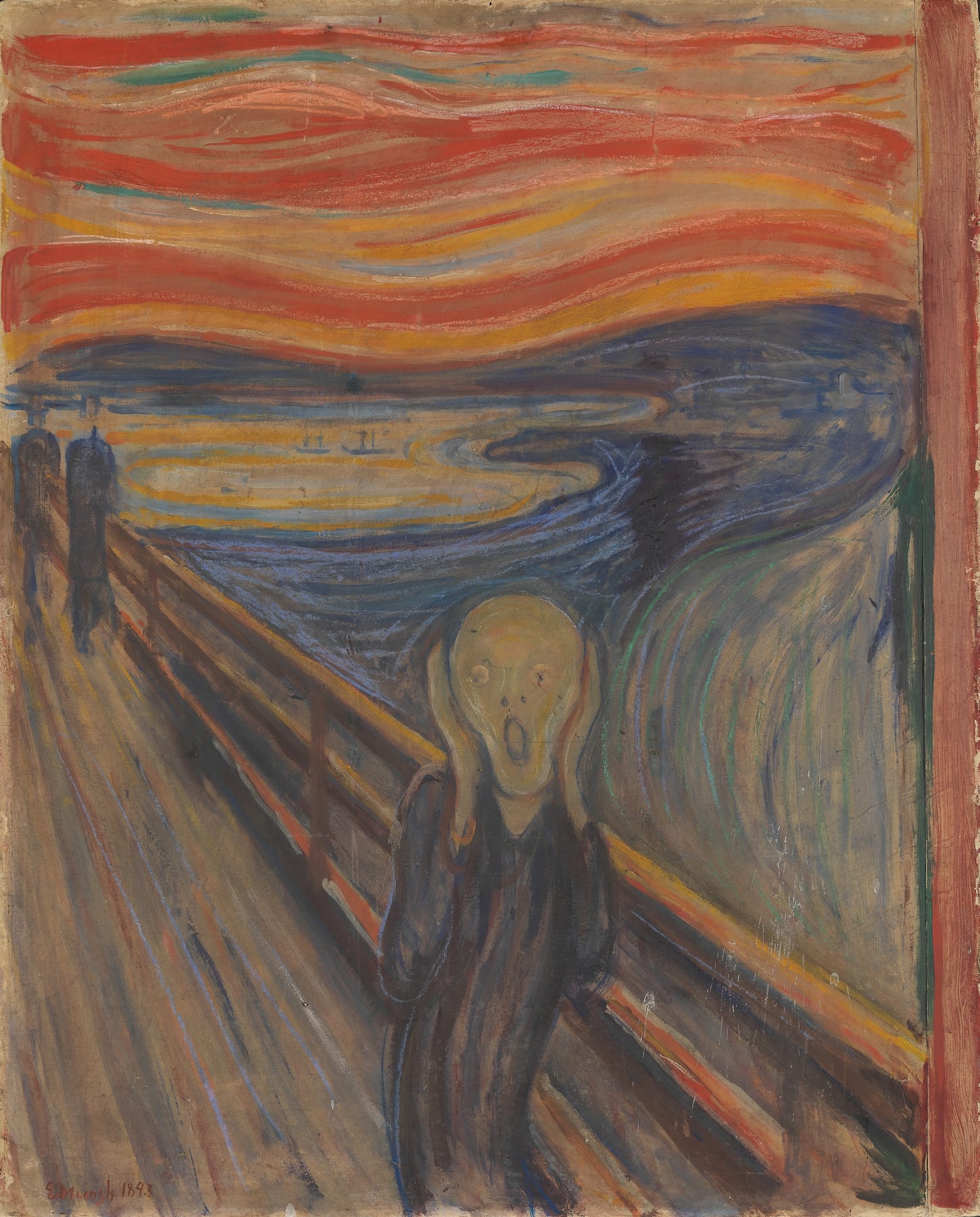
Gustav Klimt – “The Kiss” (1907–08, Belvedere, Vienna). A man and woman, rendered in gold leaf and intricate patterns, embrace on a flowery meadow. Their garments dissolve into decoration – she in colorful floral motifs, he in black-and-gold rectangles – symbolizing unity. With its flat, decorative abstraction and sensual theme, this painting bridges Symbolism’s emotive content and Art Nouveau’s ornamental elegance.
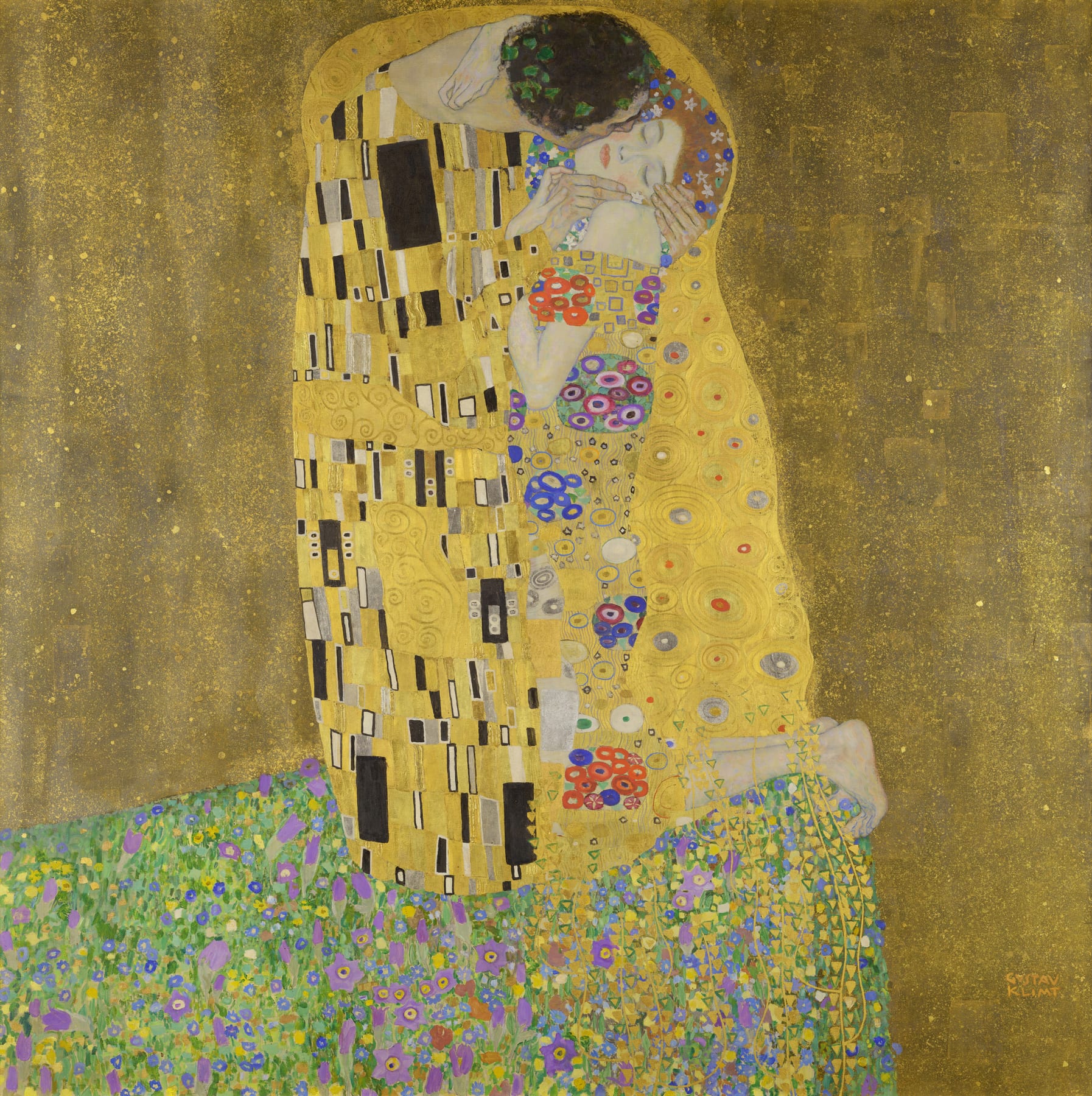
How to identify Symbolist art? (Five Features)
Feature 1:
Symbolist paintings are dim, nightmarish scenes where artistic imagination is overtaken by the morbid and the macabre. The visions are otherworldly and mystical. You’ll find haunting, mysterious figures, evil women, supernatural monsters and demons, and imagery of sex and death. The atmosphere is always unsettling and gloomy.
Symbolism vs. Romanticism: Although both Romantic and Symbolist artists had an interest in mysticism and horrific visions, they differed on multiple points. The Romantics had a fascination with nature and how we’ve become alienated from it. The Symbolists were not interested in that. As for the violent, dream-like scenes of Romantic art, unlike the Symbolist ones, they were moments of action – heavily dramatic. They were also rebellious and often contained a political message. On the other hand, the Symbolist figures are statuesque, eternally suspended in motion against haunting landscapes.

Isle of the Dead by Arnold Böcklin
In this painting an oarsman is slowly rowing towards a small, desolate islet with openings that suggest of sepulchres. On the boat, there’s a draped coffin and a mysterious, statuesque figure shrouded in white. The atmosphere evokes feelings of gloominess and other-worldliness.

The Wounded Angel by Hugo Simberg
This Finnish masterpiece inspired a music video by fellow countrymen and women of heavy metal band Nightwish

The Dream by Pierre Puvis de Chavannes
In this painting, Love, Wealth and Glory appear to a sleeping traveler.

Madam Stuart Merrill – Mysteriosa by Jean Delville
Feature 2:
As the name of the art movement implies, the paintings display objects–symbols–that represent abstract ideas. For example, the terrifying angel in The Death of the Grave Digger (below) symbolizes death. Most of the symbolism referred to death, decadence and debauchery. Extending the symbolism to a whole painting makes it allegorical. The Three Brides below is an example where the three brides represent three states of the soul. The artists used mythological characters and biblical events: dark spirits, angels, gods and goddesses.
Symbolism vs. Surrealism: Despite the common characteristic of placing objects in bizarre juxtapositions in both art styles, there is one main difference: in a Symbolist artwork, everything is meaningful. Also there is always a single, coherent idea that ties up all the strange symbols in one painting. As for Surrealist art, symbols are often irrational and nonsensical. Sometimes they’re used in a playful and humorous way which is foreign to Symbolist art.

The Death of the Grave Digger by Carlos Schwabe
In this painting the black dress and wings of the Angel of Death contrast with the white background of the snow-covered graveyard. She had just caught an old gravedigger by surprise, as evident from his tense hand grasping at his own heart. The green light she holds most likely represents his soul. Surrounding the grave where the old man had been standing and which will be his ultimate resting place, there’s growing grass. It symbolizes the start of a new life while another is ending.

The Three Brides by Jan Toorop
Tell me more about Toorop’s painting.

Pornocrates La dame au cochon – The Lady with the Pig by Félicien Rops
Tell me more about Rops’ painting.

Hesiod and the Muse by Gustave Moreau
Hesiod, a Greek poet, is shown here with a lyre in the presence of the Muse of song and poetry.

I lock my door upon myself by Fernand Khnopff
Note the Pre-Raphaelite influence on this painting: the woman of ideal beauty with long, flowing red hair, her wistful gaze and the title of the painting which is based on a line from a poem.

Jupiter and Semele by Gustave Moreau
Tell me more about Moreau’s painting.

The Dance of Life by Edvard Munch
Tell me more about Munch’s painting.

The Cyclops by Odilon Redon
Note the influence of Impressionism on the color composition of this painting.
Feature 3:
Look for the recurring dark theme of death and mortality (hint: skulls and skeletons)

The Garden of Death by Hugo Simberg
According to to the artist, this is a waiting place before arriving at heaven. The strange flowers are symbols of the souls of the dead. It might have been inspired by the traditional idea of the purgatory. Perhaps the the road at the top of the painting is what leads towards heaven. What’s innovative about this painting is that the skeletons in black robes, who are reminiscent of the frightening Grim Reaper, are depicted as lovable and gentle figures tending to flowers: One is shown with a watering can and the other is holding up to his chest a bunch of flowers. A possible interpretation of this gloomy yet peaceful painting is to tell the viewers that there is no reason to fear death.

Death and Life by Gustav Klimt
In this allegorical painting, Death is personified in the traditional Grim Reaper looking down on Life represented by all ages, incluing a mother, grandmother and a baby. They’re all huddled together making a “monolith of life.” The Grim Reaper is holding a club (not a scythe) eagerly watching like a predator. People seem unaware of his presence, and his closeness. He is wearing a robe covered with crosses to symbolize death. In contrast, the women, on the other side, are sleeping on a flower bed, as a symbol of beauty and youth.

Self-Portrait with Death Playing the Fiddle by Arnold Böcklin
The skeleton in the background playing a violin is a centuries-old symbol of inevitable death.

Death and the Masks by James Ensor
None of the faces in this painting is real: The masks in the painting stand for the decadence and materialism of the bourgeosie while in the middle there’s a skull, representing death, showing a creepy grin, as if bemused by their acting that the party will never come to an end.
Feature 4:
Femme fatale: Look for the theme of sin and sensuality, famously portrayed in the popular motif of the femme fatale (‘dangerous woman’). Traditional social view of women had always influenced art which would often fit them in one of two main archetypes: virgin or whore. The _femme fatale_reappeared in Symbolist art, and it was nothing short of obscene. From the perspective of artists (or many men of that era), women were dangerous and deceptive, sexually deviant and insatiable. They could even turn ruthlessly violent. Artists used that theme as a cautionary tale against submitting to their allure. They didn’t need to make up new subject matter because they were able to reuse familiar scenes from ancient mythology (e.g. Medusa) or the Bible (Eve or Salome).
Symbolism vs. Pre-Raphaelite art: Contrast the ideal, virginal beauty of Pre-Rapaelite womenwith their evil, monstrous counterparts below.

The Sin by Franz Stuck
Note Eve’s gaze towards you and the serpent around her torso which is usually a symbol of her seduction.

Idol of Perversity -L’Idole de la perversité by Jean Delville
Note the snake slithering between her breasts and the supernatural energy radiating from her head.

Eve by Lucien Levy-Dhurmer

The Egg by Alfred Kubin
Don’t miss the open grave next to the skeletal woman with an enormously swollen belly (pregnant?).

The Apparition by Gustave Moreau
Tell me more about Moreau’s painting.

Judith and the Head of Holofernes by Gustav Klimt
Note the severed head (view Feature 5 below).
Feature 5:
A hallucinatory world of creepy, disembodied/severed heads, and hybrid human-animal and human-monster creatures

The Sphinx or The Caresses by Fernand Khnopff

Oedipus and the Sphinx by Gustave Moreau
Tell me more about Moreau’s painting.

Guardian Spirit of the Waters by Odilon Redon

Eye Balloon by Odilon Redon
Note the skull on a saucer being dragged up by the eye balloon.

The Crying Spider by Odilon Redon, a hybrid human-monster

Cactus Man by Odilon Redon, a hybrid human-plant
How Symbolist art got its name?
In 1886, art critic, Jean Moréas, coined the term Symbolism to describe the rising trend in literature and art of representing ideas through highly metaphorical imagery.
What gave rise to Symbolist art? and where?
Symbolism had always been a feature of art in the West, especially since culture became Christianized in the middle of the first millenium. The dove, the lamb, candles, sacred heart and the cross were among many religious symbols found on church walls, ceilings, and later in paintings. During the 17th and 18th centuries, religion receded from the public sphere, pushed aside by Enlightenment ideals, hence religious art and its symbolism lost their appeal. Most art styles that followed were based on reality and mundane activities. Two such “reality-based” art styles in particular would prove highly popular: Realism (1840-1870) and Impressionism (1870-1900). A backlash ensued and earned the name ‘Symbolism.’
In literature, realism and its closely associated ‘naturalism’ were dominant mid-19th-century movements in France and beyond. Writers like Honoré de Balzac, Émile Zola and Gustave Flaubert explored dark, realistic themes that included prostitution, poverty and disease. (Flaubert’s masterpiece Madame Bovary described an adulterous affair making it a scandalous novel for its time. One scene, as an example, shows the cuckold husband who’s a doctor, following a wrong treatment, having to amputate the patient’s gangrenous leg.) Grubby, industrial cities were emerging around Europe and it just made sense for writers and painters to focus on issues of modern society like poverty and alienation.
When the Symbolist counter-movement appeared on the literary scene in the 1880s, they rejected this rational and ‘natural’ approach. Later, a generation of painters joined them. French-speaking, Greek poet Jean Moréas declared the arrival of Symbolism in a manifesto to the widest audience possible in the French national paper, Le Figaro, in 1886.
Although Symbolists were not an organized group, they shared some characteristics, one of which is pessimism – an obvious trait in their paintings. Note their morbid fascination with themes like death and decadence. When you cease to discuss the ‘real problems,’ you’re making an assumption that perhaps there is no point. Instead of depicting the tangible world, their works often showed a fantastical, supernatural world. Their inspiration came from an earlier movement called Romanticism. To them, reality was not to be examined and depicted, it was best avoided. At its core, Symbolism was an escapist art. What else gave them refuge from reality? Heavy consumption of booze and hashish and a few of them became known for destructive relationships. Their affinity for suffering harkens back to the period of the Romantics, who passed on to them – you probably have recognized – the familiar figure of the starving or tortured artist – an idea that has prevailed to this day.
A quick survey of iconic poem titles from that period indicate the new ‘symbolist’ direction: The Flowers of Evil (Les Fleurs du mal) by Charles Baudelaire; The Drunken Boat (Le Bateau Ivre) by Arthur Rimbaud. (Rimbaud himself had an opium and absinthe-loaded lifestyle and a turbulent gay relationship with another French Symbolist poet, Paul Verlaine.) A quote from a letter by Rimbaud written in 1871 reaffirms the above: “A Poet makes himself a visionary through a long, boundless, and systematized disorganization of all the senses. All forms of love, of suffering, of madness.” Indeed, many of the Symbolist visions materializing in painting or writing were induced by drugs through which they sought to unleash their creativity.
More than a few became bohemians or associated with them like Gustav Klimt, Edvard Munch and James Ensor. A bohemian gathering in the 19th century was not unlike a hippie commune in the 1960s. It was made up of those who refused to conform to the social norms. They wore shabby and eccentric clothes, shared drugs and alcohol, had fleeting or ‘unconventional’ relationships, voluntarily chose a life of poverty and some even became nomadic travelers.

Gustav Klimt, gone bohemian
The haunting works of Symbolism reflect the isolation and disillusionment felt by many in Europe during the fin-de-siècle period, that is the last two decades of the 19th century. Like the Romantics, they did not share the prevalent sentiment of confidence in progress and science. What they emphasized in their work is the inner subjectivity of the artist who talks like a prophet in the language of esoteric ideas and dreamlike visions. The artworks betray their dark view that despite all progress of the era, natural forces are still beyond human control: love, lust, fear and death. Such mood of despair and loneliness fueled the drive to create some of the most grotesque art to encounter. Additionally they brought back themes of ancients myths and biblical tales in addition to the graphic representation of their fantasies, nightmares and anxieties. Sadly, one symbol of these anxieties was Woman; the ‘castrating’ sexually insatiable femme fatale whose sole pleasure is sucking life out of her male victims.
Rebels of a new generation
Symbolists did not merely reject an art style, they rejected mainstream society, from its materialism to its “bourgeois morality.” They saw Realism (1830-1870) in art as inferior to subject matter expressing their personal emotions and mystical metaphors. Impressionism (1870 – 1900) was no different. In retrospect, we view it as a first major step in breaking up with realistic art heading towards modern abstraction (non-figurative representation) where we’ll eventually end up with paintings with simple geometric shapes or plain colours. In the eyes of the Symbolists, it was another art style based on the real world. They particularly disdained its “superficial” play with light and colour. They brought back elements from Romanticism, although in a much gloomier style. The Sybmolist prophet who dug into his own psyche for spiritual visions to graphically translate them into symbols and allegories was, you could say, foretelling the world that the Surrealists are coming. They were their precursors.
Rebels of a new generation
Symbolists did not merely reject an art style, they rejected mainstream society, from its materialism to its “bourgeois morality.” They saw Realism (1830-1870) in art as inferior to subject matter expressing their personal emotions and mystical metaphors. Impressionism (1870 – 1900) was no different.
In retrospect, we could view Symbolism as a first major step in breaking up with realistic art heading towards modern abstraction (non-figurative representation) where we’ll eventually end up with paintings with simple geometric shapes or plain colours. In the eyes of the Symbolists, it was another art style based on the real world. They particularly disdained its “superficial” play with light and colour. They brought back elements from Romanticism, although in a much gloomier style. The Sybmolist prophet who dug into his own psyche for spiritual visions to graphically translate them into symbols and allegories was, you could say, foretelling the world that the Surrealists are coming. They were their precursors.
Expressionism (Early 20th Century, c.1905–1920)
Characteristics & Context: Expressionism emerged in the early 1900s, especially in Germany and Austria, as artists sought to represent inner emotions and subjective experience rather than external reality. In an Expressionist work, colors are often intense and non-naturalistic, forms are distorted or jagged, and brushwork is agitated. The goal is to evoke mood or ideas – often angst, despair, or spirituality – rather than to depict the world realistically. This movement was influenced by Van Gogh, Munch, and Symbolism, and was concurrent with the tumult of the early 20th century (pre-World War I tensions, urbanization, and alienation in modern cities).
Key Groups/Artists: German Expressionism had two major groups: Die Brücke (“The Bridge,” founded 1905 in Dresden by Ernst Ludwig Kirchner, Erich Heckel, Karl Schmidt-Rottluff, and others) and Der Blaue Reiter (“The Blue Rider,” founded c.1911 in Munich by Wassily Kandinsky, Franz Marc, and others). Die Brücke artists used harsh colors and angular forms to criticize bourgeois decadence and convey emotional intensity (e.g., Kirchner’s street scenes with garish colors showing the alienation of city life). Der Blaue Reiter artists, including Kandinsky and Marc, leaned towards abstraction and spiritual expression – Kandinsky’s Improvisation 28 (1912) is nearly non-representational, using color and form like music to stir the soul, and Marc painted animals in symbolic colors (blue for spirituality, etc.) aiming to find purity in nature. Egon Schiele in Austria created raw, contorted figure drawings and paintings exploring psychological and sexual tension. Oskar Kokoschka and Emil Nolde are also notable Expressionists.
Innovations: Expressionists helped pioneer abstract art – Kandinsky wrote concerning the spiritual in art and created one of the first entirely abstract paintings around 1913. They also embraced woodcut prints, finding the medium’s bold contrasts apt for raw expression (e.g., Nolde’s and Heckel’s prints). Expressionism wasn’t just painting: in theater, film (the German Expressionist cinema of the 1920s like The Cabinet of Dr. Caligari), and literature, similar traits emerged.
Notable Artworks:
Ernst Ludwig Kirchner – “Street, Berlin” (1913, MoMA). Two fashionably dressed women (perhaps prostitutes) stride toward the viewer on a Berlin street, while indistinct male figures pass by. Kirchner’s jarring pinks, blues, and blacks and his jagged, angular drawing style convey the nervous energy and isolation of modern city life, exemplifying Die Brücke Expressionism.
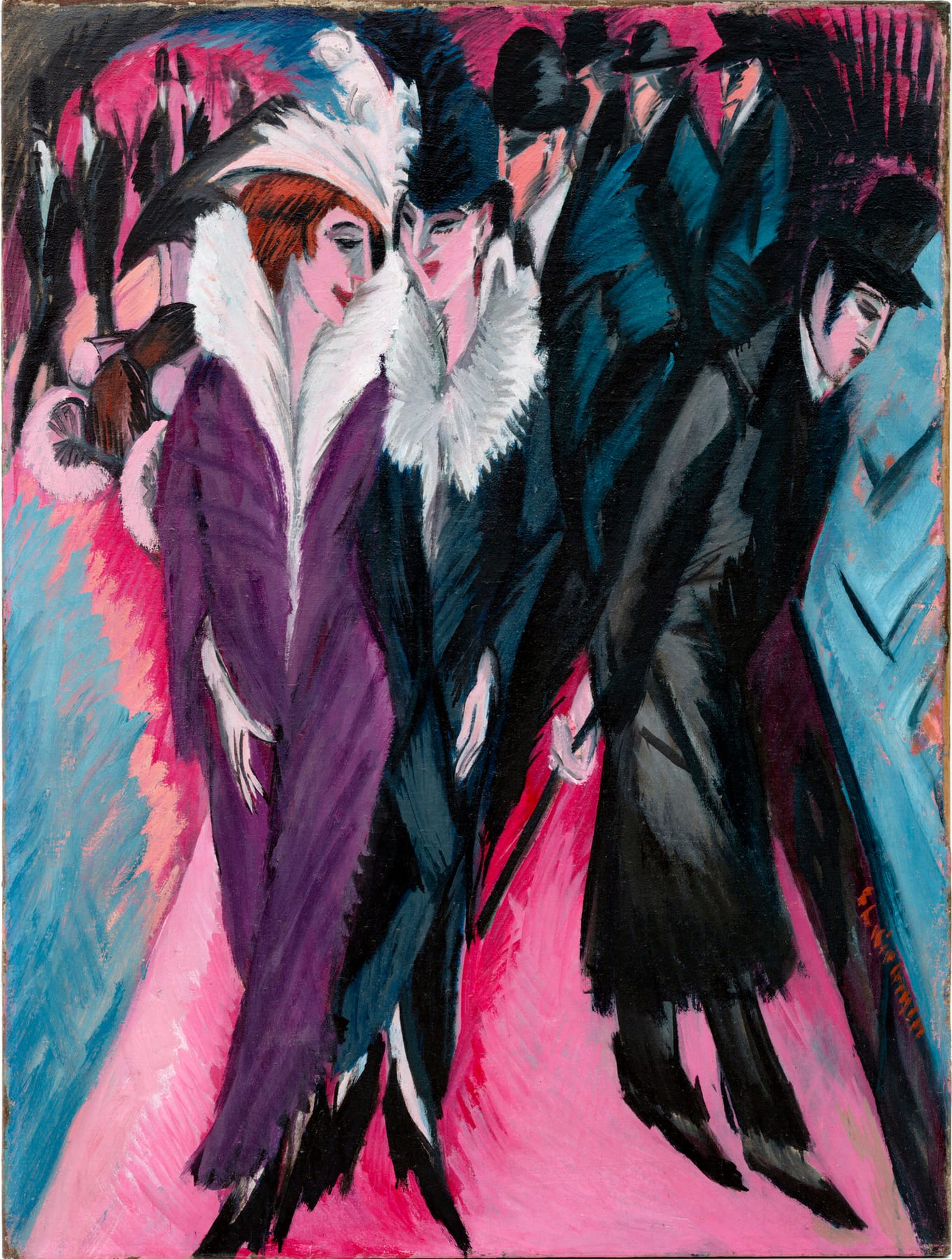
Wassily Kandinsky – “Composition VII” (1913, Tretyakov Gallery). A swirling mass of colors, lines, and semi-recognizable forms (perhaps suggesting a cosmic flood or apocalypse). Kandinsky viewed this large canvas as the culmination of his pre-WWI abstraction efforts. It’s an orchestrated “symphony” of form and color intended to evoke an emotional reaction, reflecting Expressionism’s spiritual abstraction.
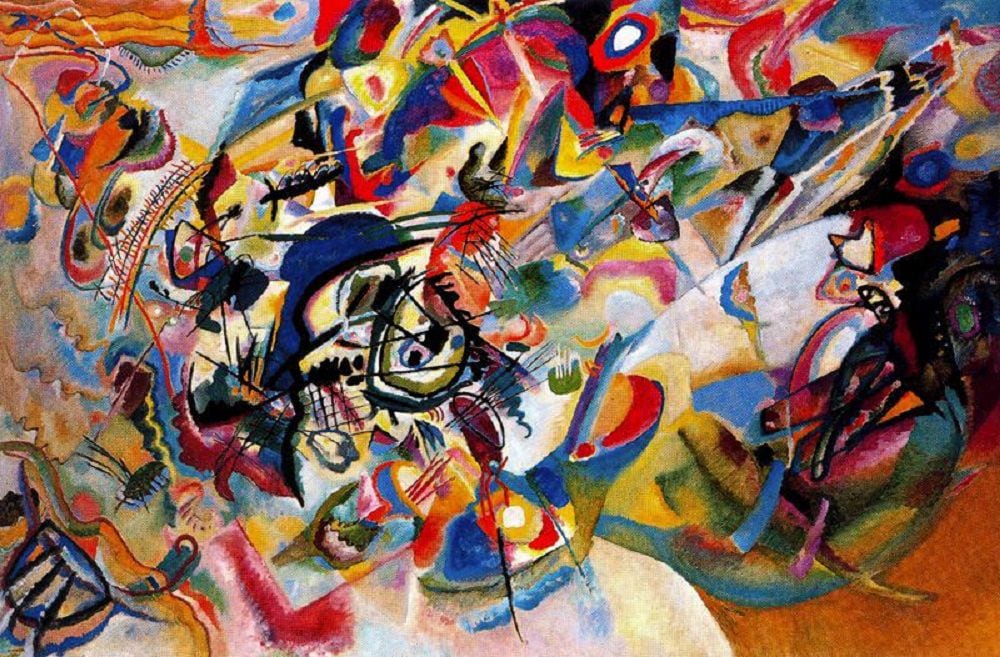
How to identify Expressionist art?
- People, places and objects are distorted or exaggerated. Even nature is sometimes distorted. The scenes show a modern world which is hostile and alienating. The sinister feeling is amplified by aggressive and raw brush strokes.
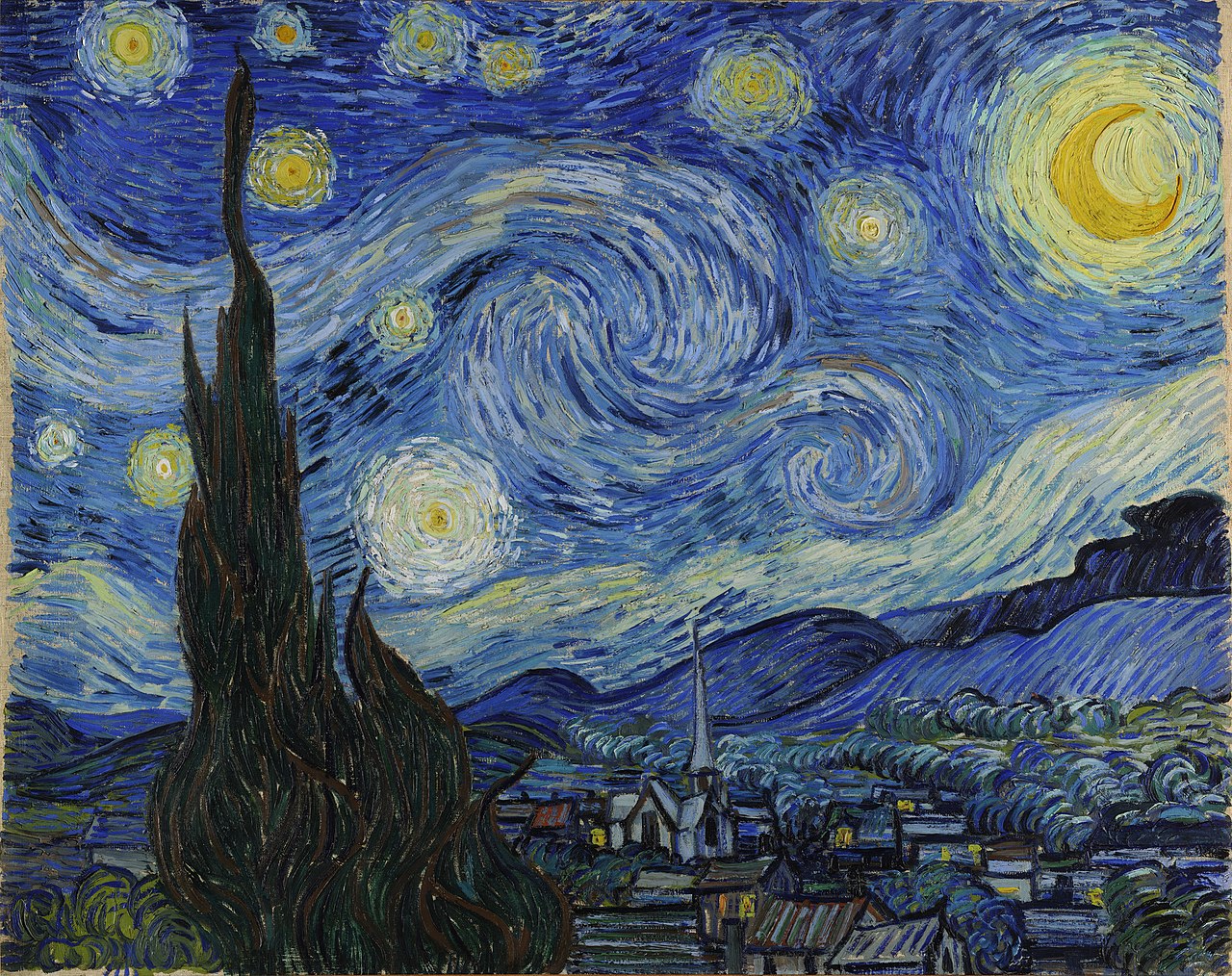
Starry Night by Van Gogh

Street, Dresden by Ernst Ludwig Kirchner

The Night (Die Nacht) by Max Beckmann
- People seem sickly or in emotional pain and anguish. The faces are always gloomy. You never find conventional beauty in Expressionist art!

Puberty by Edvard Munch

Cardplaying War-Cripples by Otto Dix

Self-Portrait (Man Twisting Arm Around Head) by Egon Schiele

Death in the Sickroom by Edvard Munch
- Like Fauvism, colors are unrealistic but Expressionists were not obsessed with red. The unnatural colors are often dark to “express” their feelings about the modern world. Someone once labelled Expressionism as “fauvism with dark glasses.” Edvard Munch’s masterpiece is an example: In his own words he “painted the clouds like real blood.”

The Scream by Edvard Munch

The Tower of Blue Horses by Franz Marc
- Expressionist art is similar to the Symbolist, the scenes are eerie or nightmarish but you can tell them apart: Expressionist perspective, similar to people and objects, is distorted. Also shapes and forms usually lack much detail.

Self-Portrait as a Soldier by Ernst Ludwig Kirchner

The Last Supper by Emil Nolde

Cardinal and Nun by Egon Schiele
How Expressionist art got its name? and where?
The roots of Expressionism were in Germany, hence it’s sometimes referred to as German Expressionism. The label was used first by German art critic Herwarth Walden in his magazine, Der Sturm (German, “The Storm”), which was published between 1910 and 1932.
What gave rise to Expressionism?
Europe was not a happy place for everyone around the end of the 19th century. The social changes due to rapid industrialization resulted in a generation suffering from alienation and anxiety. Artists experimented with ways to express their perception of the world as dark and hostile. It would only get worse for them and that generation would be maimed by a world war (1914 – 1918) which they mainly saw as pointless. That’s the period that the Expressionist art movement spans, from the beginning of the new century till a few years after the war. Artists did not see conventional beauty, hence they never portrayed it. If their artworks seem disturbing, it’s because that’s exactly how they felt: disturbed.
One early group gathered in Dresden, Germany, around the artist Ernst Ludwig Kirchner (1880–1938). They called themselves Die Brücke (The Bridge) viewing their art as a bridge between classic works from the old masters and the art of the future. Expressionism expanded beyond painting, into other forms of art like music and literature. It also emerged in other parts of Europe and inspired giants like Vincent van Gogh, Edvard Munch and James Ensor. Some well-known First World War soldiers, traumatized by their horrific experiences, later became artists. Two famous examples were Otto Dix and Max Beckmann (view their paintings here). Those were artists for whom distorted, disfigured, bodies were not just metaphors on canvases, that was the reality of their “fortunate” fellow soldiers who made it out alive from the war. An iconic example is Cardplaying War-Cripples by Otto Dix here.
Expressionist artists bravely put on display the existential anxiety of their era and the search for meaning in the rubble. They shared with the viewers their struggles with melancholy, isolation and depression. They viewed the modern city as a gloomy and scary place, which was evident in paintings like Street, Dresden by Ernst Ludwig Kirchner or The Scream by Edvard Munch (view paintings here). Franz Marc was an artist who went even further and painted only animals. In his view, flawed humans were not worthy of depiction compared to noble animals such as horses (view The Tower of Blue Horses here).
How do you depict a reality that you find unjust and distorted beyond normal? The artists distorted all on their paintings: figures, faces, perspective, brushwork and color. The Expressionists could convey powerful sentiments by how he handled the paint (thick brush strokes), as an example.
Like other art movements of that era (Fauvism and Impressionism), Expressionism continued to fill in the gaps found in the emerging medium of photography. Photography could not be but an accurate representation of reality. Expressionist art however ventured into the opposite direction by reshaping reality according to how artists perceived it. Unlike photographs, their paintings showed less details, broad shapes and forms and unnatural colors. Photographs were, and still are, deceptive since they do not convey feelings, which the premise of the entire Expressionist movement.
Rebels of a new generation
Expressionist artists found inspiration in the Fauve play with color and the Symbolist dark themes. However, they did not view favorably all their predecessors. In fact, one could view Expressionist art as a response to the popular and mainstream art movement of the previous generation: Impressionism. It’s easy to find harmony, beauty and peace in Impressionist artworks, all of which are absent in Expressionism. For the Impressionist, color was a visual instrument, but for the Fauves and the Expressionists it was an emotional instrument. The Impressionist captures a particular moment in time, but the Expressionist cares to capture only feelings, most of which were intensely negative.
Life was cruel for most of the Expressionist artists and it continued to be so even to their last breaths. Eventually when the Nazis took over Germany, the cradle of Expressionism, they suppressed it as a degenerate art. In 1937, they destroyed hundreds of works by Ernst Ludwig Kirchner, one of the founders of the art movement. The following year, he committed suicide. Van Gogh was known to be mentally unstable and also committed suicide. Edvard Munch, who lived a long, successful life said: “For as long as I can remember, I have suffered from a deep feeling of anxiety.” He endured a nervous breakdown in 1909. Otto Dix was injured several times during his 3-year service during the World War and eventually was discharged. He suffered from nightmares revisiting the carnage he witnessed for the rest of his life. Franz Marc struggled with depression for several years. As his luck would have it, he would be enlisted in the War, and during one of its battles he received an injury to the head killing him instantly at the age of 36 in 1916.
Cubism (Early 20th Century, c.1907–1920)
Characteristics & Context: Developed by Pablo Picasso and Georges Braque in Paris circa 1907–1914, Cubism fundamentally redefined art by fragmenting form and space. Influenced by Cézanne’s geometric simplifications and the abstract qualities of African art (Picasso was inspired by African masks), Cubist artists depicted objects from multiple viewpoints simultaneously, shattering traditional perspective. Early Analytical Cubism (1907–12) features muted colors (brown, gray, ochre) and densely interwoven facets that make figures and still lifes appear nearly abstract (e.g., Picasso’s Girl with a Mandolin, 1910). Later Synthetic Cubism (1912–1914) introduced brighter colors, simpler shapes, and collage elements (pasting newspapers, etc.), emphasizing the reality of the canvas as an object. Cubism’s deconstruction of form paralleled the era’s intellectual upheavals (Einstein’s theory of relativity, questioning of time/space; World War I looming).
Key Artists: Pablo Picasso’s groundbreaking Les Demoiselles d’Avignon (1907) is often seen as a Proto-Cubist work – five nude women with angular bodies and mask-like faces, a shocking break from Western pictorial tradition. Collaborating with Georges Braque, Picasso developed Cubism fully by 1910. Juan Gris and Fernand Léger soon joined; Gris’s Cubism is more flat-planed and colorful, while Léger introduced a machine-like, tubular style (sometimes labeled “Tubism”). In sculpture, Alexander Archipenko and Jacques Lipchitz translated Cubist fragmentation into three dimensions, creating abstracted figures composed of interlocking planes.
Innovations: Cubism introduced collage into fine art (Picasso’s 1912 Still Life with Chair Caning used oilcloth and rope on canvas) and questioned the nature of reality in art – rather than a window on the world, a Cubist painting is an arrangement of forms and signs that remind us of objects. This idea laid groundwork for later abstraction and conceptual art. By presenting multiple perspectives, Cubists tried to show the relativity of perception – an object is not seen from one angle at one moment, but understood by our mind from all sides over time. Cubism also had a huge influence on architecture (leading toward geometric modernist designs) and design (Art Deco’s stylization).
Notable Artworks:
Pablo Picasso – “Les Demoiselles d’Avignon” (1907, MoMA). Five female figures in a brothel are depicted with fractured forms and disjointed bodies; two have African mask-like faces. This painting’s aggressive break from realism – flat splintered planes and the collapse of depth – announced the beginning of Cubism and the end of classical illusionism in art.
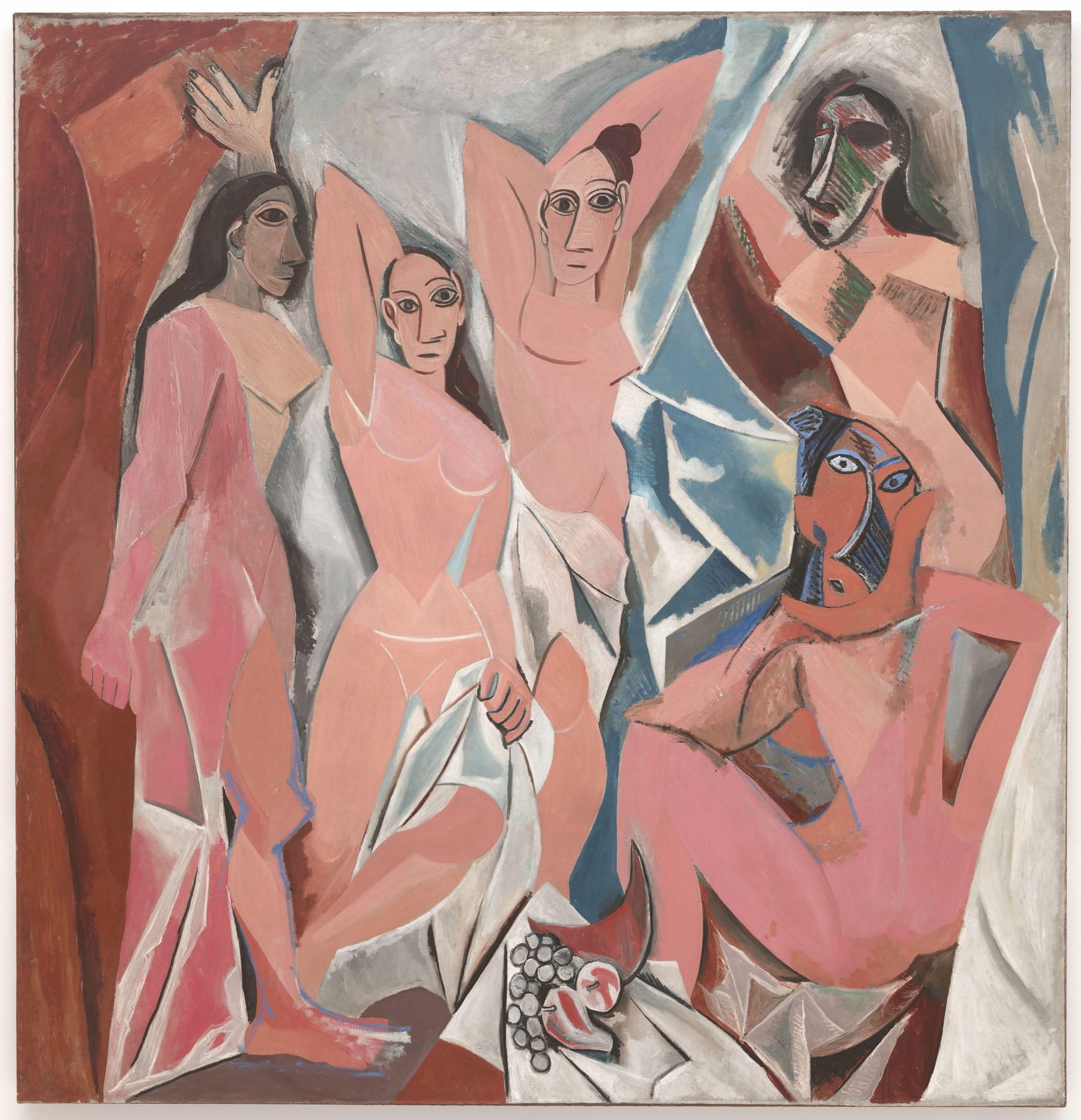
Georges Braque – “The Portuguese” (1911, Kunstmuseum Basel). An Analytic Cubist canvas showing a Portuguese musician. It appears as an intricate grid of brown and gray fragments with only hints of the subject (stenciled letters and a guitar-like oval). Braque’s and Picasso’s analytic works like this nearly dissolve the subject into a dynamic arrangement of transparent planes, capturing a “total” view of objects in space and time.
How to identify Cubist art?
Note: This page lists first features of Analytic Cubism, the first phase of the art movement. Scroll down for features of Synthetic Cubism.
- Paintings are composed of little cubes and other geometric shapes (e.g. squares, triangles and cones). Objects are deconstructed and “analysed” from different angles, and turned into a fragmented composite. That explains why the first of the two phases of Cubism was called Analytic Cubism.

Le Pigeon aux petits pois (Pigeons with peas) by Pablo Picasso

Portrait of Pablo Picasso by Juan Gris

Les Baigneuses (The Bathers) by Albert Gleizes
Behind the female nude bathers, there’s boulders or rock formations along with trees which seems to be intertwined with the foreground. The bottom of the canvas shows reflective blue water. On the horizon (top of the painting) we see a blue sky and factory chimneys of the nearby town releasing smoke. The encroaching of “the industrial” into the natural landscapes was observed by artists of all types around Europe at the time.
- The paintings are flattened (two-dimentional). For example, if you look at the heads and arms of subjects, they are rendered flat. There is little or no sense of depth. No foreshortening or chiaroscuro. (The former is visually compressing an object to give the illusion of depth and the second is contrasting light and shadow, also for depth.)
Girl with a Mandolin by Pablo Picasso
Guernica by Pablo Picasso
Les Demoiselles d’Avignon (The Young Ladies of Avignon) by Pablo Picasso
The painting shows five hideous whores in a brothel. The one in the top right is pulling a curtain to reveal the scene. They’re partially naked. Their bodies are deformed due to Picasso not adhering to a single pictorial view. For example, the eyes of some of the women are looking straight at the viewer but their noses are depicted from the side. This painting is considered one of the earliest Cubist works.
3. Perspective is mobile: several sides of the same subject are shown simultaneously from different angles and sometimes different points of time.
Etude pour Le Goûter by Jean Metzinger
In this painting, we find a seated woman who’s nude, with drapes around her and on her arms, holding a spoon. In front of her is a table with a cup of tea and behind her a commode or table with a vase on top of it. All her body parts are composed of geometric shapes, even her breast which is depicted as a triangle and a sphere. With each of her eyes, she’s simultaneously looking at us and looking sideways. The cup is also shown from the side and from the top.
L’Aubade by Pablo Picasso
- Paintings are fragmented. Its haters once described the Cubist canvas as a field of broken glass. True! When you’re confronted by a Cubist painting, you have to put the pieces together in your mind to understand what it represents. Sometimes the object and background interpenetrate one another. With the same painting displaying different viewpoints, different lighting, and even different times of day, sometimes it’s too complex to understand.

L’Oiseau bleu (The Blue Bird) by Jean Metzinger
Can you spot the following in the above painting: a basilica, a steam ship, a boat, a necklace, a pyramid, a mirror, a fan, a fruit bowl, four different birds, three nude women?
The central figure is holding a blue bird. Another figure, wearing a necklace, is reclining next to a red bird. On the left of the central figure, another one is gazing into a mirror in her left hand, while holding a fan in her right hand The boat is placed on the right side under the steam ship. The Sacré-Cœur Basilica is at the top of the painting.
La noce by Fernand Léger
A wedding procession is theme of this painting. The bride occupies the center. Her white dress takes up all the space to the bottom of the painting. Next to her, dressed in green, is the groom whose hand is on her shoulder to support her. The identity of the man in blue (in the upper half of the painting) is not clear. His hand is above the couple in a way to bless their union. He might be a priest or a parent of the bride or the groom. The artwork is Cubist as it shows mutliple viewpoints of the crowded scene. Note the pipe-shaped bodies parts of the wedding guests on the left of the bride. The painting also foreshadows the Futurist movement by depicting repeated elements to show dynamism and motion of the crowd.

Portrait de Jacques Nayral by Albert Gleizes
Deux Nus (Two Nudes) by Jean Metzinger
- Cubist paintings are often monochromatic. You’ll find only muted colors. Artists would choose one basic color for the entire work, and its variations when needed.

Le guitariste by Pablo Picasso
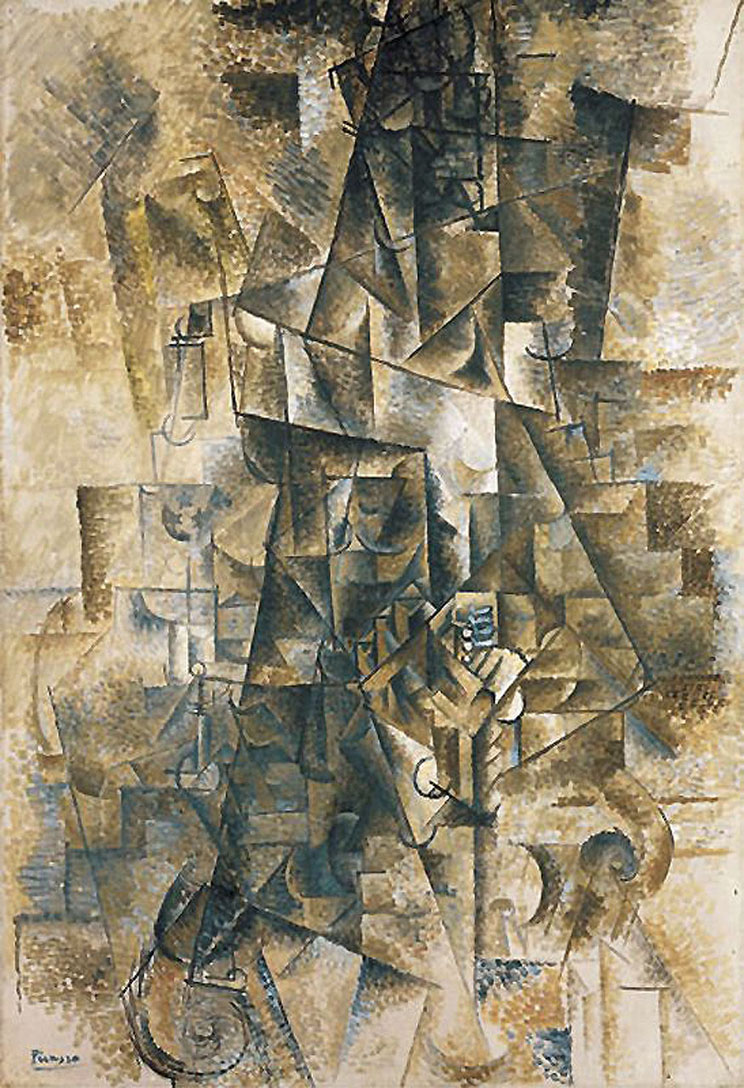
The Accordionist by Pablo Picasso

The Portuguese by Georges Braque
Braque portrayed a Portuguese guitar player he saw in a bar Marseilles. You could see a docking post and a nautical rope in the top right. You also see parts of the musician and his guitar. But because the canvas looks like broken glass, it’s impossible to have complete reading of the painting. And just for fun (and to play with the flattening effect), the artist stenciled letters and numbers. It was hint of what was called later Synthetic Cubism.
How to identify Synthetic Cubism? How it differs from Analytic Cubism?
Synthetic Cubism is was less concerned with representation of the subject, and more with the use of various materials, textures and colors. Analytic Cubism is intellectual while Synthetic Cubism is playful.
Artists of Synthetic Cubism did not create paintings, but built “collages.” Canvases displayed a “synthesis” (combination) of different media beyond paint: newsprint, textual images, cloth, paper and even sand. Also, they expanded their color palette.
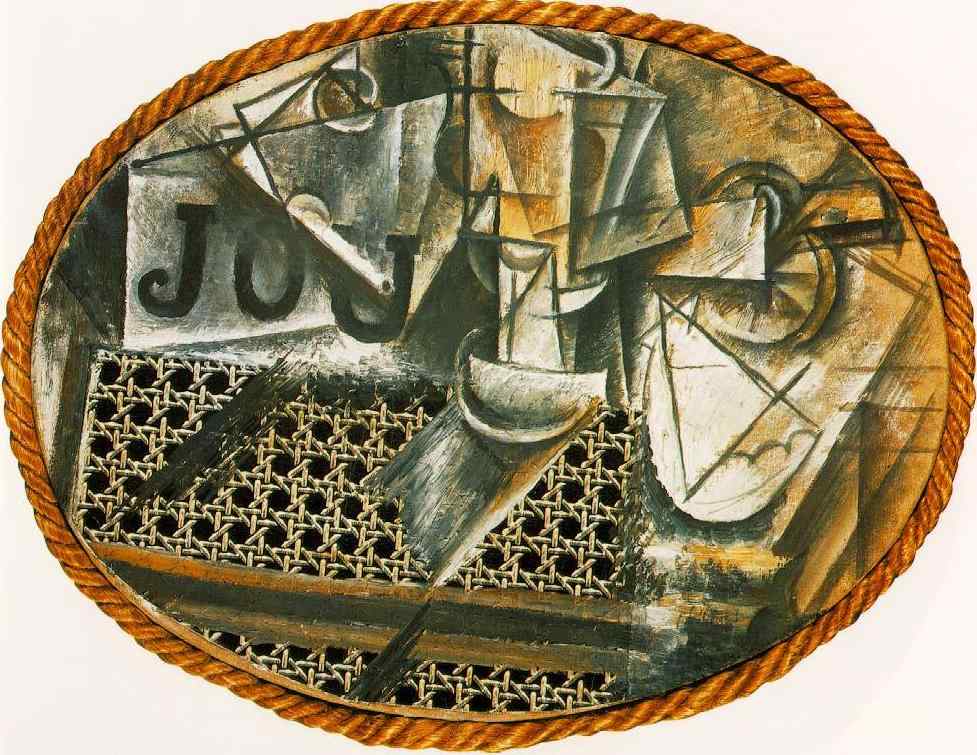
Still Life with Chair Caning by Pablo Picasso
This 1912 work by Picasso is considered the first collage. There’s an oil cloth with an imprint of a cane chair design, popular at the time in cafés which is the setting of this artwork. In a typical Cubist fashion, one sees multiple perspectives of items on top of the table at once. By adding a physical piece to the painting which simulates something else, he’s a play on a multiple levels of reality. The whole work is framed by a rope. Around the top right corner, you’ll see a cut out lemon with a knife handle and blade on top of it. Look lower for a napkin. In the middle, you’ll see a wine glass. On the top left, there’s a journal with the letters JOU on top (standing for “game” in french, or journal). On top of it, there’s a white clay pipe.

Fruit Dish and Glass by Georges Braque
In this 1912 artwork, Braque was the first to use sand which he mixed with gesso, a white paint mixture. Also, here, he was the first to use papier collé (pasted paper), a form of collage, where he added cutouts of faux bois (fake wooden) wallpaper. The viewer could see a fruit bowl, grapes, and pears. With such physical elements and the words BAR and ALE added, he prevents the user from having any spatial perception of the work. It’s impossible to tell apart the background from the foreground.

Bottle, Glass, and Newspaper by Georges Braque
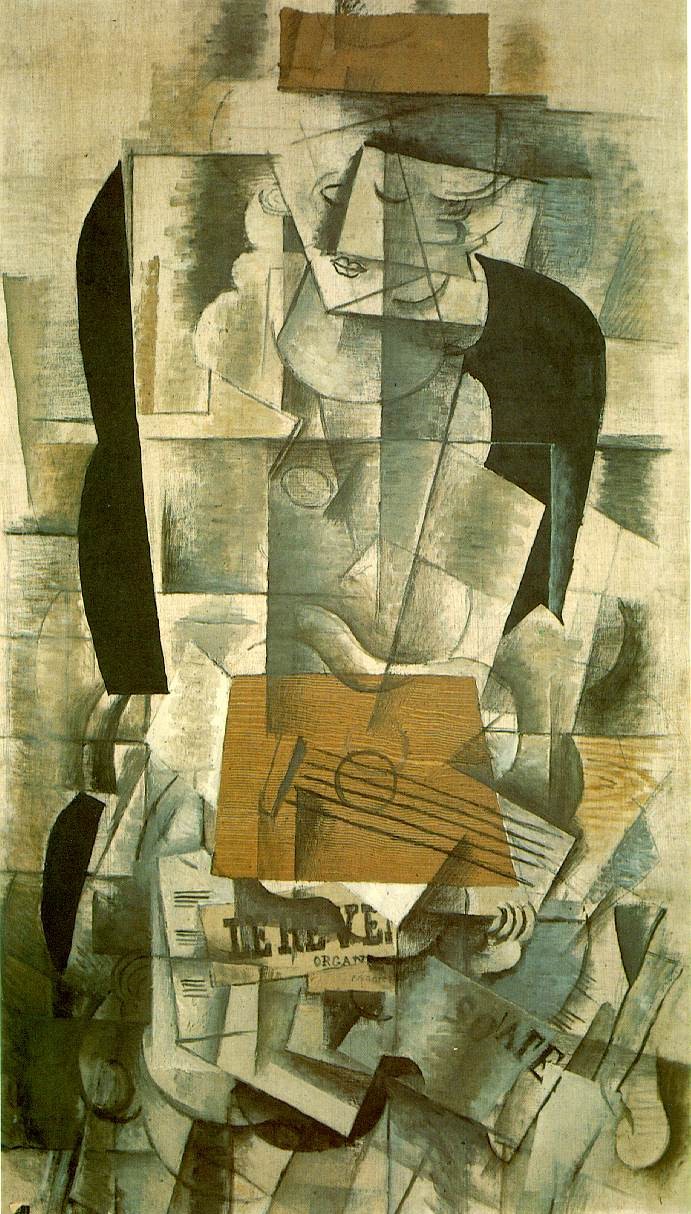
Woman with a Guitar by Georges Braque
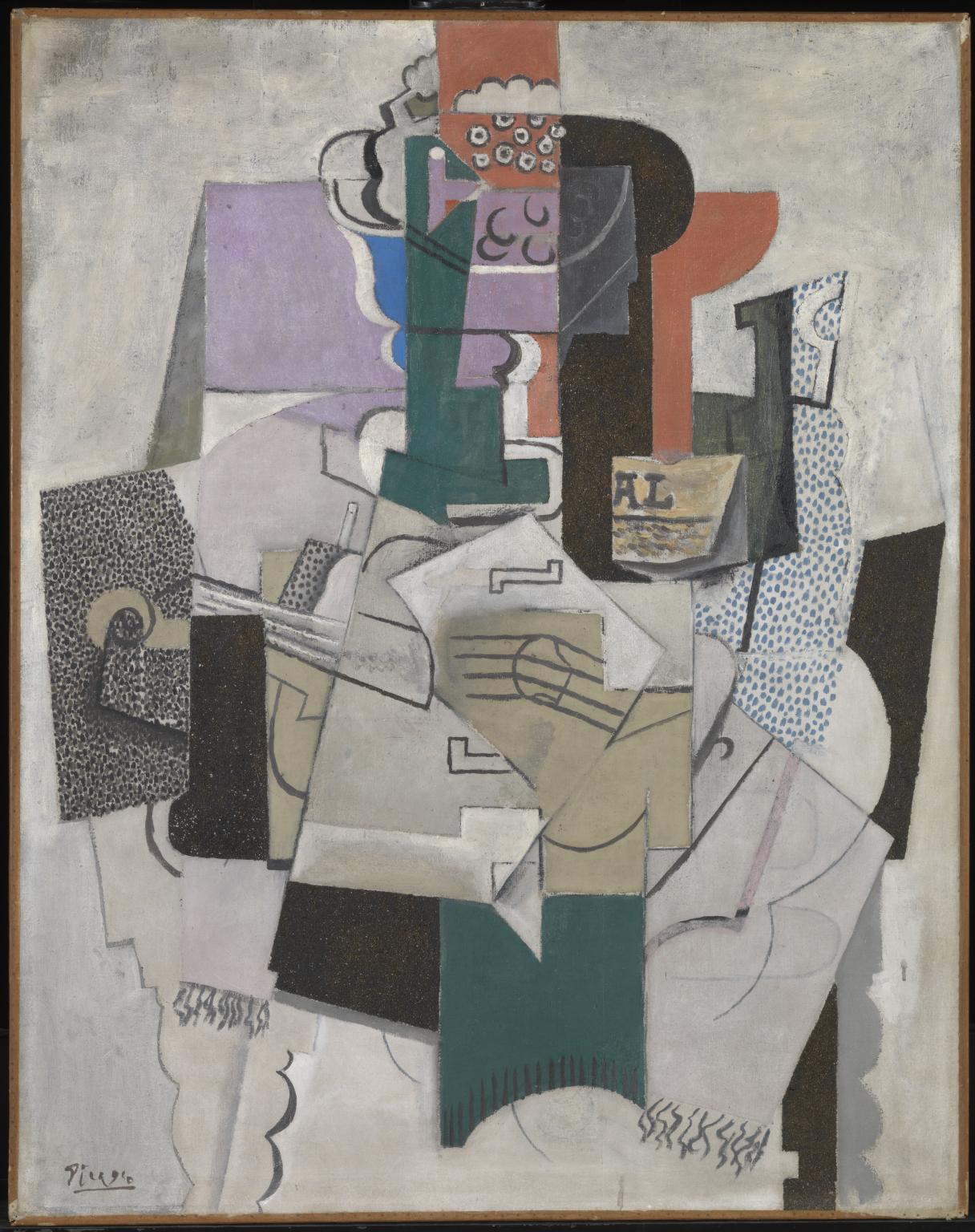
Bowl of Fruit, Violin and Bottle by Pablo Picasso
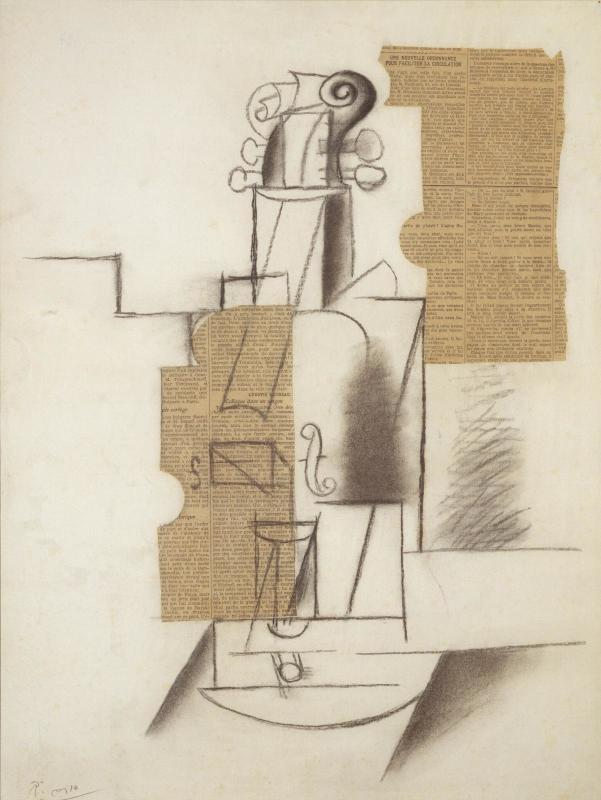
Le Violon by Pablo Picasso
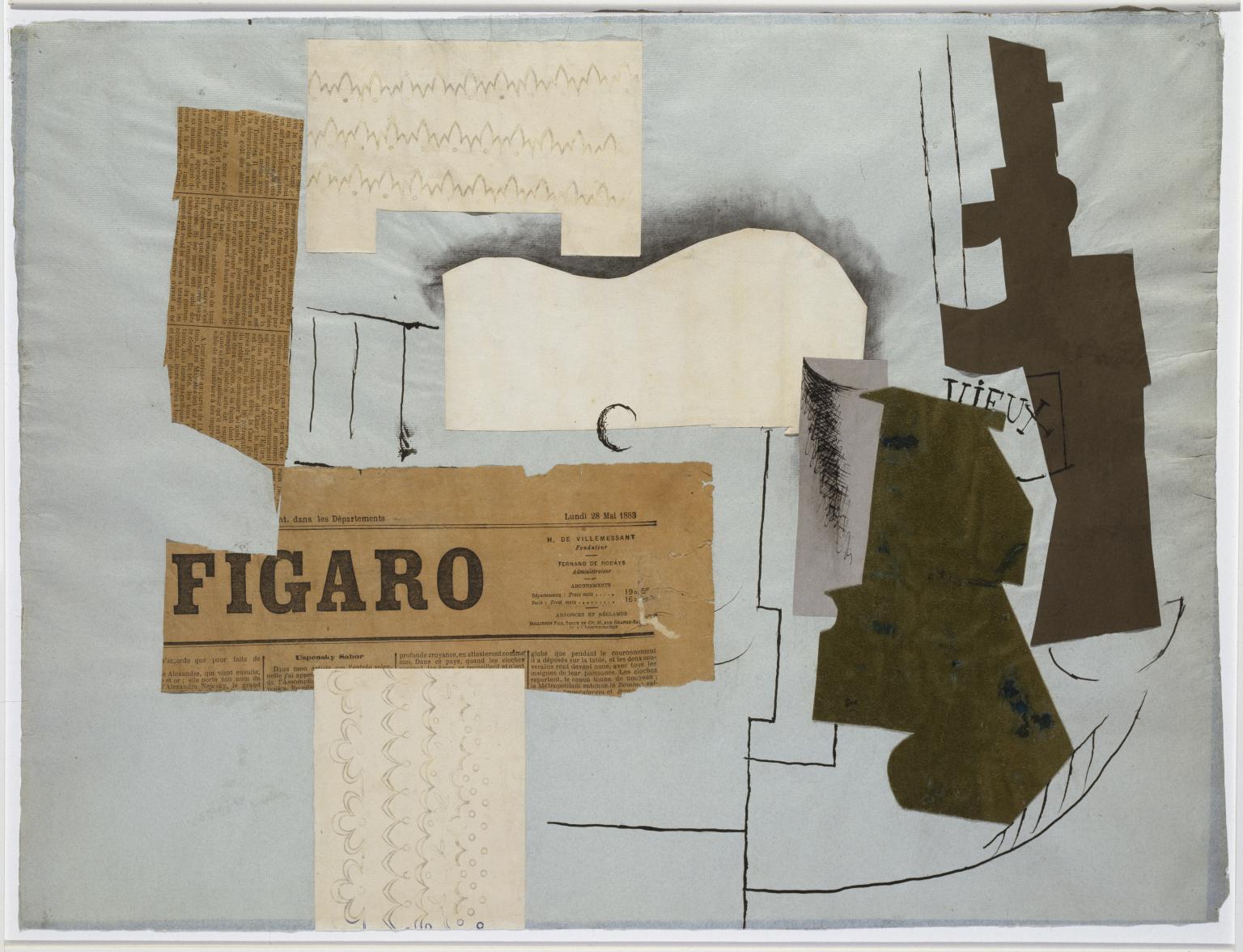
Bottle of Vieux Marc, Glass, Guitar and Newspaper by Pablo Picasso

Fantomas by Juan Gris

Still life with fruit bowl and mandolin by Juan Gris
How Cubist art got its name? and where?
In 1907, Pablo Picasso showed off to Georges Braque what would become known as the first Cubist artwork: Les Demoiselles d’Avignon (Young Ladies of Avignon). Picasso and Braque, who lived in Paris, are the founders of Cubism. A famous French critic, Louis Vauxcelles, in 1908, saw the paintings and rejected the style as “bizarre cubiques,” thus giving it its name. That’s the same guy who also criticized Fauvism and inadvertently gave it its name!
What gave rise to Cubism?
One of the challenging questions to ask about the evolution of art is to wonder why a particular style appeared at a certain point in history. Why Picasso and other Cubist artists went into that direction? Artists by nature attempt to find new ways of viewing art. Perhaps the reason is the generations that preceded them had already covered so much ground: experiments with light (Impressionism), color (Fauvism) and texture (Expressionism). So much had already been done! And certainly artists were not willing to go back to perfectly representational art of the Renaissanceand Baroque eras. So continuing on the route of modern semi-abstraction started by the earliest Impressionists led them to deconstruct compositions. The end result is a painting broken up into cubes, squares, spheres and cones. They eliminated depth and made the image fragments transparent and overlapping. Then they rearranged the bits and pieces to make the paintings intentionally hard to interpret.
The father of Cubism, Picasso, went on to invent a new style by 1912, that is Synthetic Cubism. For the first time, artists used more than paint, they integrated everyday materials into their paintings. Never in the history of art did it evolve so much in such a short period of time!
Rebels of a New Generation
Cubist artists rebelled against the conventional representation of forms by turning them into fractured, geometrical shapes. That was yet another step towards complete abstraction seen in the Abstract styles and Futurism.
They also challenged the very idea of what a painting is. Conventionally, you’d expect only, well, paint! They introduced new materials transforming the traditional 2-dimensional painting into a 3-dimensional collage. That which was revolutionary a hundred years ago is now ironically a standard part of art classes in schools, i.e. creating collages.
Futurism (1910s)
Characteristics & Context: Futurism was an Italian avant-garde movement (launched with poet F.T. Marinetti’s manifesto in 1909) that exalted the modern world, especially machinery, speed, and technology. Futurist artists sought to depict dynamic movement, energy, and the blurring of time – a response to the rapid industrialization and social change in the early 20th century. They often portrayed moving subjects (cars, athletes, city crowds) with techniques like simultaneity and motion blur, using Cubist fragmentation plus a vibrant, aggressive tone. Futurism was intertwined with political fervor (pro-war, anarchic sentiments leading up to WWI).
Key Artists: Umberto Boccioni’s Unique Forms of Continuity in Space (1913) is a bronze sculpture of a striding figure that looks aerodynamic, with forms flowing back like rippling cloth – capturing motion in solid form. His paintings like The City Rises (1910) used swirling, forceful brushstrokes to convey urban construction chaos. Giacomo Balla experimented with depicting motion in sequence (e.g., Dynamism of a Dog on a Leash, 1912, showing a trotting dachshund’s legs multiplied in a blur). Carlo Carrà and Gino Severini painted riotous city scenes and figures in motion, often incorporating pointillist color or collage. Natalia Goncharova and Lyubov Popova in Russia also adopted Futurist elements, though Russian Futurism blended with abstract Rayonism.
Innovations: Futurism’s emphasis on speed and modern technology presaged later art’s fascination with industrial and urban themes. They attempted to depict not just one moment (like a photograph) but the experience of motion across time – a concept also explored in photography by Etienne-Jules Marey and others. Futurists introduced a sense of performance and multidisciplinary art (Marinetti’s “words in freedom” poetry, Futurist theater, fashion, even cuisine!). Their legacy is seen in kinetic art and the general celebration of the machine aesthetic in later 20th-century design.
Notable Artworks:
Umberto Boccioni – “Unique Forms of Continuity in Space” (1913, MoMA cast). This bronze figure appears to stride forward, its body abstracted into sleek, wing-like shapes. Echoing both classical sculpture (an armless, headless torso) and modern aerodynamic form, it symbolizes the Futurist deification of speed and the mechanized human.
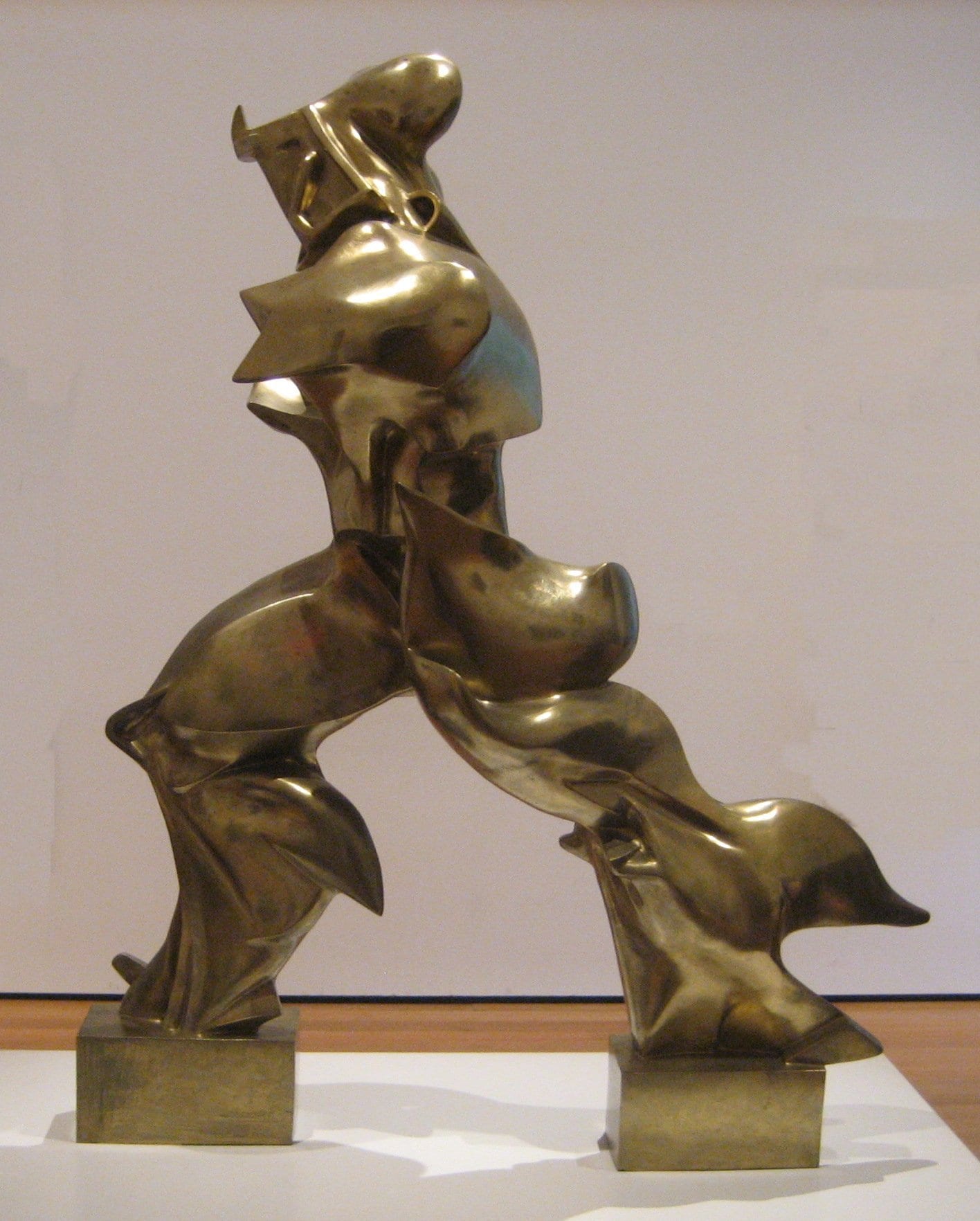
Giacomo Balla – “Abstract Speed + Sound” (1913–14, Guggenheim). In this abstract painting, waves of color and sharp lines suggest noise and velocity – perhaps a car rushing by. Balla used repeating shapes and gradients of color to translate the sensation of sound and movement into visual form, showcasing Futurism’s synesthetic ambitions to paint the energy of modern life.
How to identify Futurist art?
Note: This page lists two phases of Futurism. The first and most important lasted from 1908 to 1918. The second was from 1929 to 1944.
- Objects captured in motion, represented with repeated parallel lines and spirals to convey dynamism. In fact, repetition, blurring and lines of force, which are used to this day as techniques to convey a sense of movement, were conceived by the Futurists. The two paintings below are among the earliest in history to use such force lines to depict energy and motion.
Futurist art alternated between semi-abstract or completely abstract, i.e. some representations are deconstructed into geometric forms, influenced by Cubism, that the viewer could barely comprehend them.

Dynamism of a Car by Luigi Russolo (1913)

Abstract Speed – The Car has Passed by Giacomo Balla (1913)
The artist presents above a sublime fusion of blue sky, green landscape and pink exhaust fumes in an image of a car that had already passed.
- One object in particular was of great fascination for the Futurists, that is a roaring car. They considered it the ultimate symbol of technological progress and modern innovation:

Velocity Of An Automobile by Giacomo Balla (1913)
- Besides speeding cars, look for paintings glorifying steamships, trains, steel towers and urban construction.

Armored Train in Action by Gino Severini (1915)
This is one of the most iconic Futurist paintings. It combines most elements that distinguished the art movement. We could even count them: Glorification of war – check. Celebrating speed and momentum – of course. Celebration of modern technology and industrialization – check. An aerial view – absolutely! Machinery’s dominance over nature – check. In brief, it’s an Italian military train piercing through the countryside. It’s filled with soldiers aiming their rifles in the same direction. Smoke from their guns and the cannon eclipses the green landscape. The soldiers are faceless, as if the artist wants to say these men do not matter as individuals, their military mission is all that matters. The light blue or dark grey is the color of metal, the body of the train (a strong symbol of industrialization). Note the Cubist influence in the use of multiple perspectives simultaneously. Severini created this artwork in 1915 when WWI in Europe was in full swing. Seeing this gorgeous, colorful masterpiece, you could almost forget about the true reality of WWI: the rat-infested trenches and the rotting, abandoned dead soldiers.

States of Mind I: The Farewells by Umberto Boccioni (1911)
In this painting, we could see a train crowded with passengers. The figures are green and are almost fused with the train and its smoke. Everything is in motion, the train, its steam and the passengers. A few items are stationary though like the number of the train station and the oil tower in the background.

The Funeral of the Anarchist Galli by Carlo Carrà (1911)
Angelo Galli is an Italian anarchist who was killed in 1904 by police during a general strike. To prevent the funeral from turning into an anti-government parade, officials refused the entry of mourning anarchists into the cemetery. The mourners resisted, then a violent scuffle erupted between them and the police. The artist wanted to share, what he considered, a heroic moment with his viewers. The scene shows a chaotic and brutal fusion of police mounted on horseback and angry mourners. Both sides are armed, clubs and lances are in their hands. Galli’s anarchist supporters are dressed in their typical black and waving black flags. Light emanates from both the sun and the red coffin in a symbolic gesture. The clashes are so violent that the coffin seems as if it could fall off the shoulders of pallbearers at any moment.
- Look for paintings celebrating industrial landscapes and modernity

Skyscrapers and Tunnel by Fortunato Depero (1930)

The City Rises by Umberto Boccioni (1910)
The artist shows a modern city rising. There’s a major building in construction in the background. In the foreground, we see the workers, some of whom are trying to overpower a horse. The whole scene is in motion. All the painting’s subjects are blurred and fused together to create a sense of dynamism.

Brooklyn Bridge by Joseph Stella (1919)
When the Italian artist Joseph Stella arrived in New York, he was fascinated by the Brooklyn Bridge. Like fellow Futurists, he had an optimistic attitude towards modern life. He used the bridge as an industrial symbol for American progress and technical superiority. The painting is almost spiritual with no humans to find. The entire structure seems fractured and light is emanating from glass-like parts to resemble stained glass of an old cathedral. It’s as if these structures are the new shrines which people should visit and regard with awe.
- Unlike Impressionist artists, the Futurists did not admire natural light. The Futurists sang the praises–literally, as in the founder’s prose–of artificial light. Electrified city lighting, the street lamp, was a new and unmistakable symbol of technological progress.

Street Light by Giacomo Balla (1910)
Aeropittura (Aeropainting): The Second Wave of Futurism
- Before Futurism completely disappeared, it made a comeback that was no longer about automobilism but aeromobilism, i.e. they replaced their fetish of a roaring car with a soaring airplane. That second phase lasted from 1929 to 1944, the year Marinetti, the Futurist ringleader, died. The paintings depict cinematic views of airplanes and aerial combat, both representing a technology that was a great source of national pride in Italy. Note, biplanes feature heavily in aeropittura (aerial painting) as well as the cityscape of Rome. The Futurists, and their fascist allies, yearned for the greatness of ancient Rome while dreaming of a modern, industrialized Italy .

Flying Over the Coliseum in a Spiral by Tato (Guglielmo Sansoni) (1930)
This painting shows a bird’s eye view of a world in motion. The airplane flying over the Coliseum is meant to associate modern Italy with its ancient past. In other paintings, artists went further by playing along with the Fascist government and associating its leadership with the Roman empire. (View below Mussolini the Aviator by Alfredo Gauro Ambrosi).
- Look for paintings of dizzying, nose-dive views of the city. The aviator in these artworks is shown as a great hero.

Before the Parachute Opens by Tullio Crali (1939))
A heroic portrayal of a lone parachute soldier plummeting fast towards to the ground.

Nose Dive on the City by Tullio Crali (1939)

Upside Down Loop (Death Loop) by Tullio Crali (1938)
The painter decided not to depict the pilot in this breath-catching painting. He chose to put you in the pilot’s place during an aerobatic maneuver. What we see is an upside down view of Rome from the cockpit.
- A powerful theme of Aeropittura, and a favorite subject of Futurists towards the end of their art movement, was the portrayal of the Italian Fascist leader, Benito Mussolini, in quasi-religious fashion. They combined his intimidating face with aerial landscapes of Italy to portray him in an eternal and invincible image.

Mussolini the Aviator by Alfredo Gauro Ambrosi (1930)
A propagandistic painting depicting Mussolini’s profile projected on the great city of Rome.

Portrait of Il Duce by Gerardo Dottori (1933)
The portrait of the Fascist leader is rising out of the Italian landscape. Biplanes surround his portrait in a semi-religious symbol of protection and absolute power.
How Futurist art got its name? and where?
Futurism was first conceived as a philosophy then adopted in art. The ideas were laid out by Italian writer and poet, Filippo Tommaso Marinetti, in his “Manifesto of Futurism” in 1909. Because Paris was the wellspring of most artistic movements, he chose the front-page of the French newspaper Le Figaro to publish his manifesto. It was a moment in history, early last century, where there was a dominant sense of optimism towards technology and the future. He wrote that we should embrace a new way of life, endorse modernity in all its forms; speed, violence and machinery. He praised automobiles, trains and planes. When Marinetti wrote his manifesto in 1909, his ideas resonated among young men eager to modernize Italy.
What gave rise to Futurist art?
Italian cities at the late 1800s were just destinations on what was dubbed the Grand Tour, which was a tour and a pilgrimage for the British elite since the end of the 18th century. They went on such tours to learn about Western civilization. A small group of Italian men were waking up to the fact that most Western countries were enjoying the products of industrialization while their budding nation still lives in agrarian poverty. That prompted them to rise up as “Futurists” who rejected the past, archaeology, the Roman empire and their own history. They looked forward to a technologically superior nation who’s never hesitant to wage wars. Although it remained largely an Italian movement, some artists around Europe joined it.
In today’s culture, there exists a dangerous trifecta of youth, violence and technology. That element in our culture could be traced all the way back to this artistic and social movement which began in Italy. Marinetti expressed at the beginning of his founding manifesto his desire to “sing about the love of danger.”
It was an era long before technology was used to kill and maim millions of people, before the nuclear bomb and the industrious, incinerating gas chambers. Today we understand technology could be a double sword, a blessing and a curse. But at the beginning of the 20th century, many believed that technology could only improve life for all humans. Think of trains bringing villages closer. Or the telegraph making communication across continents happen in a few minutes rather than weeks of mail in delivery by horse-drawn carriages. There was a time when electricity was cool! It’s hard to imagine how these young rich men felt while driving cars before there were even speed limits. The Futurists were so excited about technology that one of them, that is Giacomo Balla, among their greatest artists, called his daughters Elica [Propeller] and Luce [Light].
One major source of inspiration for Futurist art was the relatively new medium of photography. Artists had a complicated view of photography. Some saw it as a threat and indeed some genres of art disappeared such as the traditional portrait. However many artists were inspired to emulate it, learn from it and capture in paintings what could never be captured in photographs. For centuries, it was indisputable that a shape should not be repeated or multiplied in a painting. With the advent of photography, and upon studying the works of one scientific photographer, Étienne-Jules Marey, that changed. Marey took photos of animals and humans in motion. It was obvious in chronophotography that motion appears as shape multiplication. That inspired one of the earliest and most important Futurist artworks: Dynamism of a Dog on a Leash by the Italian Giacomo Balla (view below). The influence of photography could also be seen in their so called aerial paintings.

Photograph of a white horse in motion (1886) by Étienne-Jules Marey

Dynamism of a Dog on a Leash (1912) by Giacomo Balla
The art movement disintegrated when its ardent followers finally got what they wished for: War. WWI dispersed them. Umberto Boccioni, one of the best known Futurist artists, died during the war. The cruel irony is that his death was not a heroic one during a battle, but as a result of a fall off a horse while training.
Ultimately the avant-garde movement of Futurism was to be seen, in a smaller scale, in film and music. Ballet Mécanique is considered one of the best examples of experimental cinema that embodied Futurist ideals. One of the best known musical pieces is Pacific 231 by Arthur Honegger. The composer even incorporated sounds of trains.
Rebels of a new generation
A generation before the Futurists, there was a widespread anxiety about the fast-industrializing world of Europe. Close to the end of the 19th century, many young people suffered from an anxiety and disillusionment about life in their cities. That transfigured into morbid art movements like Symbolism and Romanticism. Futurism arrived with a new attitude to modernity. Unlike their predecessors, the Futurists saw the industrial city not as a hostile place. They embraced modernity and admired it. That is the reason you won’t see among the works of Futurists any religious, historical, mythological or romantic paintings. You won’t find nude, especially female, Futurist paintings either, which is not surprising seeing that this artistic movement had a masculine vein running through it. The Symbolists and the Romantics were often targets of Marinetti’s derision in his writings. Also, he publicly condemned the “English art” (the Pre-Raphaelites).
The one art movement that had the greatest influence on Futurism was Cubism. The common elements are obvious in Futurist paintings. However, the Futurists became a separate movement since their main concern, unlike the Cubists, was to show dynamism—objects in motion.
If you have’t seen many mentions of Futurist art in pop culture as is the case with Picasso’s Cubist art or Monet’s Impressionist works, there is a fine explanation. Most art movements start with controversy then eventually become mainstream. However this one in particular never cleared its name. If the artists’ embrace of violence and war was not enough, some of their paintings before the movement disappeared could be considered mere fascist propaganda. It should be noted that not all Futurists were supporters of fascism, or at least officially affiliated with them. Despite their support of fascism and misogyny, the movement’s aesthetics occasionally brings inspiration to designers as in the case of this BMW Z4 Coupe which seems to be moving “even when standing still”!
Dada (1916–1920s)
Characteristics & Context: Dada arose around World War I (circa 1916) as an anti-art movement – a reaction to the horrors of war and a rejection of bourgeois values that Dadaists felt had led to that war. Originating in Zurich at the Cabaret Voltaire, it spread to Berlin, Paris, New York, and beyond. Dada was characterized by absurdity, irreverence, and a disdain for tradition. It wasn’t a style so much as an attitude: Dada artists made work intentionally nonsensical or provocative to shock society and mock artistic pretensions. They embraced chance, collage, found objects (readymades), and performance.
Key Artists: Marcel Duchamp – the most famous Dadaist – created the concept of the readymade by choosing mass-produced objects as art. His Fountain (1917) was a urinal signed “R. Mutt”, turning a plumbing fixture into sculpture and scandalizing the art establishment by asking “What is art?”. Duchamp also painted earlier the Cubist/Futurist-influenced Nude Descending a Staircase, No. 2 (1912). Hannah Höch in Berlin Dada made photomontages – collages from newspapers and magazines – like Cut with the Kitchen Knife (1919), critiquing Weimar society by chaotic juxtaposition of images. Hans/Jean Arp created abstract collages by chance (tearing paper and dropping it to see the random compositions) and whimsical biomorphic sculptures. Francis Picabia and Man Ray explored Dada in Paris and New York with weird mechanical drawings and cameraless photographs (rayographs). Kurt Schwitters in Hanover made Merz assemblages from trash, finding beauty in detritus. Many Dadaists later influenced or joined Surrealism.
Innovations: Dada’s biggest innovation was introducing conceptual art – the idea that the concept or choice of the artist can define an artwork, not just technical skill. This planted seeds for many 20th-century art directions (Conceptual art, performance art, installation). Dada also pioneered photomontage as an art form and embraced randomness and spontaneity in creativity. It broke down barriers between art forms, often mixing poetry, visual art, and theater (as in absurd Dada performances).
Notable Artworks:
Marcel Duchamp – “Fountain” (1917, replica in Tate Modern). A porcelain urinal, turned on its back and signed “R. Mutt 1917”. By presenting this everyday object as art, Duchamp flouted all conventional definitions of art and set the stage for Conceptualism. It remains one of the most influential art objects in history, symbolizing the Dada revolt against tradition.
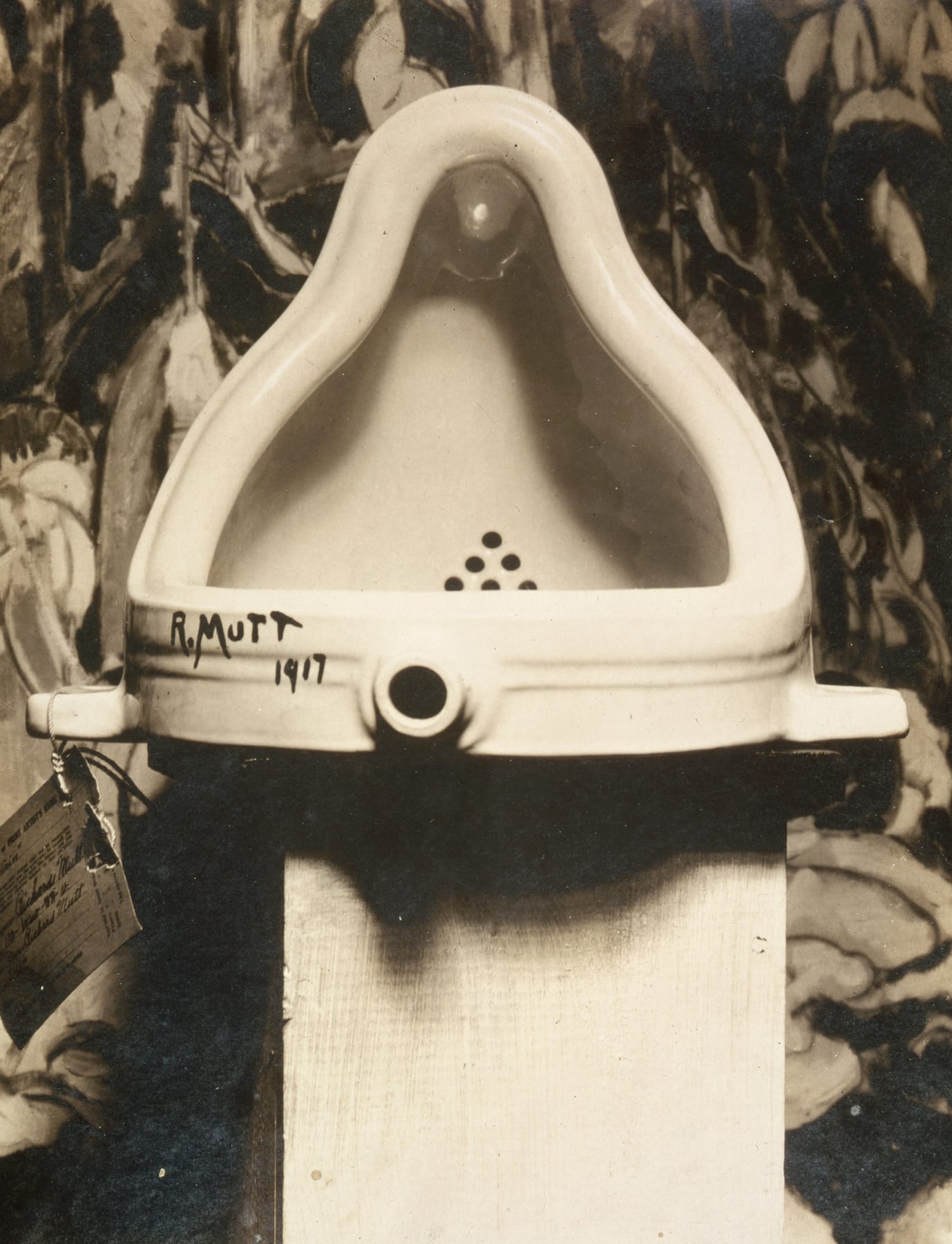
Hannah Höch – “Cut with the Kitchen Knife Dada Through the Last Weimar Beer-Belly Cultural Epoch of Germany” (1919, Neue Nationalgalerie, Berlin). A collaged kaleidoscope of political figures, industrial machines, headlines, and Dada slogans scattered across the paper. Höch’s complex photomontage satirizes the chaotic social milieu of post-WWI Germany and asserts Dada’s feminist and anti-establishment voice (she literally includes a map highlighting countries where women could vote).
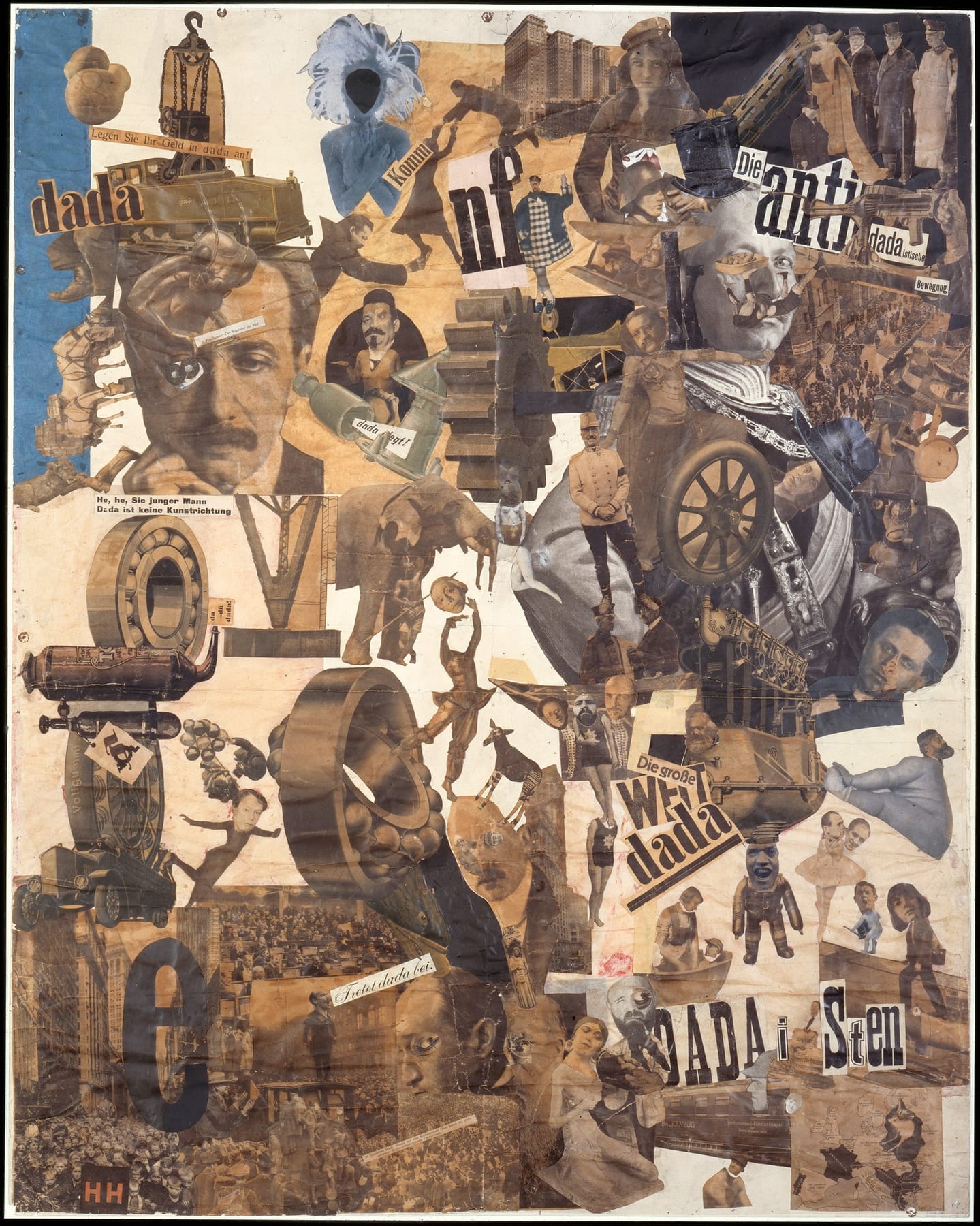
How to identify Dada art?
Every art movement listed on this website is presented with its unique characteristics so if you happen to walk into a museum, you could easily identify to which movement an artwork belongs. In the domain of Dada art, that might not be possible for two reasons. One, well, there is no movement, at least not an official one. Hence there is no common characteristics among the artworks, heck, they don’t even call their productions art! They used everyday objects to make an anti-art statement. Then to make matters more confusing, their approach using mundane objects became an art movement in its own right in the second half of twentieth century called Conceptual Art. However, there are some elements that bring together the work of Dada artists which are distinct from that of Conceptual artists who would emerge decades later.
1. Iconoclastic and playful.
Art had long thrived on rebelliousness, but the Dada artists were not just disrespectful, they physically attacked traditional art and defaced it. Dark and irreverent humor was always a theme in their works.

Marcel Duchamp, La Joconde/ L.H.O.O.Q., 1919
Marcel Duchamp painted a mustache and a goatee on a reproduction post card of Leonardo da Vinci’s Mona Lisa. He wrote at the bottom the letters “L.H.O.O.Q.” which is a pun in French. When pronounced, it sounds like “Elle a chaud au cul,” meaning “she has a hot arse” or “she’s horny.”

Francis Picabia’s Nature Morte: Portrait of Cézanne/Portrait of Renoir/Portrait of Rembrandt (1920)
The French painter nailed a toy monkey to a board and around it he wrote names of three of the greatest artists.
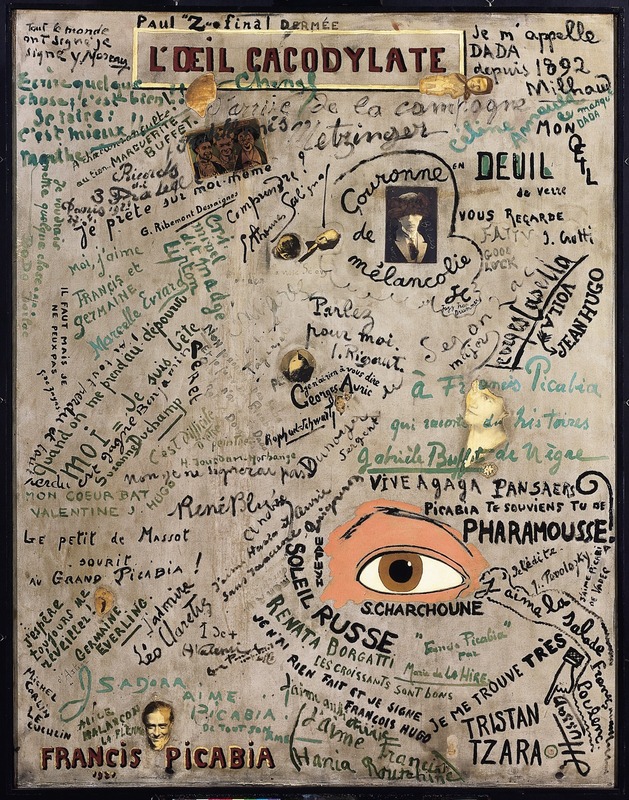
Francis Picabia. L’Œil cacodylate (The Cacodylic Eye). 1921
Legend has it that the artist contributed only his signature and date. He created this while hospitalized for an infection in his eye. He invited all his friends as they visited him to contribute something. It was a radical collaborative work, the earliest of its kind.
2. Illogical and absurd
Dada artists relied on madness and absurdity to shock their audience. You could find that in a blurred photo with creepy double eyes or a laundry iron with spikes! The iron in particular stands for another common theme in their art, that is the use of everyday objects (next characteristic on the list below).

Man Ray, Marquise Casati (1922)

Cadeau, Man Ray, 1921
3. “Readymades”: everyday objects as art
What Dadaists were notorious for was their challenge of the accepted definition of art. They pioneered what became a post-modern feature later in the twentieth-century. Today we call that conceptual or installation art. Theirs was different in the way that they put on display what they considered absurd: a coat rack or a urinal! Then they couldn’t believe it when they were taken seriously. The mass-produced objects, they called “Readymades,” which they would buy from local stores had no aesthetic value, yet when submitted to art exhibits, they were accepted! They philosophized it by declaring, as bizarre as it sounds, that artists no longer need to be the creators of their own art. The most outrageous act in that vein was Marcel Duchamp’s “Fountain.” He bought a porcelain urinal, gave it the humorous title, turned it upside down and signed it “R. Mutt” in reference to the manufacturer and a character in a comic strip. Today we consider it one of the most important works of the last century because it forced us to question our understanding of art. Decades later, Andy Warhol would famously employ similar ordinary objects for art. On another occasion, he mounted a wheel on a kitchen stool and called it “Bicycle Wheel.”

Marcel Duchamp’s Fountain (an upside down urinal), 1917

Marcel Duchamp, Bicycle Wheel, 1951 (the 1913 original was lost)

Hat Rack (1917) by Marcel Duchamp

The Enigma of Isidore Ducasse (1920) by Man Ray
4. Collages and disturbing photomontages
The artistic collage, made up of different materials and fragments of printed text, was a Cubist invention, preceding Dada art by several years, however the Dadaists endorsed it to some extent. The Dada collages you will encounter are not many, and those you find will not be easily distinguishable from the Cubist type. If Cubist artists tried to convince us that a collage of various materials can be refined art, the Dada artists tried to do the opposite, i.e. they were turning that medium into anti-art. They did not even call them collages, that sounded “too artistic.” Instead, they pioneered the now-familiar “photomontages” because it evoked machine production and no personal artistic involvement. (Note: While collages bring together different materials, a photomontage is mainly cut-out photographs.)
Although most of their collages were photomontages, there were a few non-photographic ones like Arp’s iconic work to which he did not give a title. He created the collage by arbitrarily dropping torn rectangular pieces of paper on the canvas, or at least that was his story!

Jean (Hans) Arp. Untitled (Collage with Squares Arranged according to the Law of Chance). 1916–17.

Kurt Schwitters, Merz 19, 1920. Paper collage.
While Cubist collages tried to display harmony and beauty, Data photomontages were brutal and disturbing. The Dada artists emerging from the shadow of the WWI horrors, focused mainly on violent imagery and nonsensical juxtapositions.
Hannah Höch’s work (view below) is an iconic example of a chaotic Dada photomontage. Its ridiculously long title suggests that she sliced with a kitchen knife (a female housework symbol) through the uber-masculine political machine of Germany at the time (note the spinning gears and ball bearings in the composition). The Weimar Republic had just emerged following World War I as the first democratic German government. That would come to an end with the arrival of Hitler in 1933. What did she find inside of the cut out machine? The antiwar radical German Expressionist artist Käthe Kollwitz at the center! Her head is the one being thrown in the air by a body that is dressed in female dancer clothes. It is a moment of female victory. All across the collage, you will see powerful male figures: German politicians (e.g. the overthrown Kaiser Wilhelm II at the upper right), the current president, Friedrich Ebert (upper center), Communist leaders (Karl Marx and Vladimir Lenin at the center right) and the recently-assassinated German Communist leader Karl Liebknecht (lower left). You will also find soldiers and symbols of military and industrial power. The revolutionary element in her collage is emphasized by images of crowds of German demonstrators. At the bottom right, there is a map of Europe highlighting countries that had recently given women the right to vote, juxtaposed with a photograph of the artist’s head. Placing photos of fellow Dada artists next to Marx and Lenin, with cutout words —“Die grosse Welt dada” (the great Dada world) is not arbitrary but a signal that their movement is revolutionary. The overall work is meant to declare that empowered women and Dada art are destabilizing the patriarchal culture. Höch’s ultimate mockery of the masculinity of her era was through sticking heads of military leaders onto the bodies of exotic dancers!

Hannah Hoch – Cut with the Dada Kitchen Knife through the Last Weimar Beer-Belly Cultural Epoch in Germany (1919).
Hausmann composed a photomontage that was a harsh satire on the world of art of his day (view below). The subject of his work is a man with a cartoonishly large head, mouth and eyes. Despite the large eyes and mouth (and oversized pen), he sees and says nothing because they are actually hollowed out, i.e. he is a worthless art critic. He is perfectly coiffed and dressed in a double-breasted suit trying to blend in the upper society. A woman from that society is there to show him what she chooses to. His visiting card declares him to be: President of the Sun, the Moon, and the little Earth, Dadasopher, Dadaraoul, Ringmaster of the Dada Circus. At the back of his neck is a German 50-mark bank note that looks like you could rotate it like a key, as if he is a toy to manipulate with money.

Raoul Hausmann. The Art Critic. 1919-1920.

Raoul Hausmann, A Bourgeois Precision Brain Incites a World Movement, also known as Dada siegt (Dada Triumphs), 1920.
5. The Dada Cyborg: Look for disturbing man-machine fusions
Many years before sci-fi writers started contemplating a future where there might be a human-machine hybrid, Dada artists were among those who gave it thought and represented it in their artworks.

The Spirit of Our Time – Mechanical Head, Raoul Hausmann (1919)
The artist created a wooden dummy head that lacks any unique features or emotions. He attached a ruler, a piece of a typewriter, a small cup, a spectacles case and a watch, as if to say the modern man has become a perfect receptacle of information, without a soul!

A victim of Society (later titled ‘Remember Uncle August, the Unhappy Inventor’) Painting by George Grosz (1919).
The titles gives away the overall meaning of this photomontage. It is a suffering man (perhaps following the horrors of WWI). Is he physically disabled? Is he psychologically disturbed? There is a question mark on his head regarding his future or his fate. His face is disfigured by (or fused with) machine parts. Note that he has a spark plug for a nose. A razor is next to his neck. Perhaps, he’s contemplating suicide!

The Convict: Monteur John Heartfield after Franz Jung’s Attempt to Get Him Up on His Feet, 1920 by George Grosz
The subject who is a friend of the artist is depicted with a machine heart.
How Dada art got its name? and where?
If you dig into the roots of the word Dada, which the artists used to label their own movement, you will not find a definitive answer. You will come across explanations that list connections with the French language, German or Romanian! What matters is the founders, in war-neutral Switzerland, chose a meaningless word—even if it is probably the French word for hobby-horse (rocking horse). They intentionally chose a nonsensical word without an ism to denote that they lost all faith in Western art, culture and ideologies. So what is Dada? When one of the Dada leaders, Tristan Tzara, was faced with that question in 1918, his answer was, “Dada means nothing.”
What gave rise to Dada art?
1. WWI butchery: Dada holds a mirror to a world gone mad
At the start of WWI (1914-1918), a group of draft dodgers made up of artists, poets and intellectuals fled to the largest city of neutral Switzerland, Zürich. They were mostly French and German. In October 1916, as the Battle of Verdun (Feb. – Dec. 1916) was taking away lives at a horrific rate, a few of them gathered to express their frustration at what befell their old continent. Their outrage became a disgust by everything modern and rational. How could the most advanced nations engage in the bloodiest war the world had ever seen? Some of them were anarchists (anti-authority) and others were pacifists (anti-war). Among the biggest names of that group were Hugo Ball (poet) and Marcel Duchamp (artist). Since the French Revolution and the rise of Enlightenment values, Reason had been viewed as a great pillars for all European thought, but if Europe after all descend into mass destruction, then Unreason is the cure. If the civilization, that created the greatest art, tore its apart, then anti-art is the solution. They refused to call their “protest” a movement, and insisted that theirs is not art! Their creations followed no rules, meant to be absurd and shocking. They were fed up with modern life, and found it meaningless, so they decided to create art that is just that, without any meaning.
One of the popular, and probably apocryphal, stories about the origin of the name “Dada” involves two German poets Hugo Ball and Richard Huelsenbeck. They stab a French German dictionary with a knife that lands on the French word Dada that means hobbyhorse. That childish word and that action of random violence fit perfectly the context and content of Dada. Nonsensical violence in their homelands during WWI is the reason such characters congregated as exiles. As for childishness, or rather playfulness, that became a cornerstone for all Dada art. The “Dadaists” broke away from all conventional (read: serious) art.
The birthplace of Dada was a place called Cabaret Voltaire. It was founded by war resisters Hugo Ball (poet), along with like-minded people Tristan Tzara (poet), Richard Huelsenbeck (poet and doctor) and Hans Arp (artist). Another colorful character among the founders was Hugo Ball’s lover who was also a cabaret dancer, poet, prostitute, morphine addict and a thief! But don’t be fooled by the name of the café that refers to the great Enlightenment philosopher, whose name had stood for rationality. Clearly, that was a satire against traditional philosophy. That place became a launching pad of attacks against everything traditional, from politics and morality to music, art and aesthetics.
When Tristan Tzara explained their movement, he said, “Tristan: We had lost confidence in our culture. Everything had to be demolished. We would begin again after the tabula rasa [clean slate]. At the Cabaret Voltaire we began by shocking the bourgeois, demolishing his idea of art, attacking common sense, public opinion, education, institutions, museums, good taste, in short, the whole prevailing order.”
At Cabaret Voltaire, the regulars all banded together to fight accepted bourgeois morality and taste. Their chaotic evenings were full of incomprehensible Dada declarations, boisterous performances, outrageous costumes, noise music, African tribal chants, nonsensical poems, poems made up of words pulled out of hats, or multilingual phrases. One almost wishes to be there for one evening to have the ultimate avant-garde experience! Hans Arp had to following to say about their cabaret: “While the guns rumbled in the distance, we sang, painted, made collages and wrote poems with all our might. We were seeking an art based on fundamentals, to cure the madness of the age, and a new order of things that would restore the balance between heaven and hell.” Finding solace in elements of African culture was to express their despair against the so-called civilized European society. Such evenings would spread to other cafes and clubs, embraced by artists, theatre actors, musicians and writers. Later Dada ideas would also spread to other cities like New York City, Berlin, Cologne and Paris.

Hugo Ball in performance, Zurich, 1916
View an adaptation by the American rock band Talking Heads (1979) of Hugo Ball’s Dada poem “Gadji beri bimba”
In New York, the leading figure of Dada was the French refugee, Marcel Duchamp. Many of his works became iconic, one of which was a urinal, which he submitted to an exhibition in 1917. He introduced into artistic vocabulary the term “Assisted Readymades” referring to arbitrary mass-produced objects.
2. Cynicism towards technology
Not only did Dada artists feel cynical about religion, patriotism, morality and modernity but also technology. The earliest decades of the century was a period where technology was progressing at a dizzying pace: the telephone, the train, the telegraph, the automobile and the camera. The Dadaists were not particularly against technology but they could not how the Machine Age that promised to be utopian be true while wholesale slaughter is happening across Europe, while trenches are filled with mud, blood and human waste.
Despite questioning the benefits of technology, they still endorsed it in their artworks. Using photographs, they introduced a new type of collage: the photomontage. They also used the “mass-produced fruits” of technological progress, the so-called readymade objects and displayed them in a mockery of contemporary culture. With technology, Dada art became a mutlimedia art movement.
3. Anti-art had to happen after decades of Modernist challenges to the meaning of art
Art historians often mark 1870 as the beginning of modern art where realistic visual portrayal of subjects disintegrated on the canvas. The modern era brought about art movements that experimented with light and outlines (Impressionism), color (Fauvism), form (Cubism). New materials were introduced into the traditional canvas by Cubist painters creating collages. Each one of such movement was akin to an attack on the established understanding of the meaning of art. Dada arrived on the scene after half a century of radical experiments in breaking the conventions of art, laid since the onset of the Renaissance during the 1500s. The Dadaists took art one step further fueled by their pessimism and nihilism to defiantly declare their works anti-art! If their predecessors were breaking conventions on the canvas, the Dada artists just ripped the canvas apart. They replaced the canvas with a urinal! They defaced with a mustache and a goatee a reproduction of the iconic Mona Lisa. Dada is a challenge for its audience to define what makes art, how art should be made and what art should be appreciated.
Rebels of a new generation
Anyone studying the history of Western art will notice that almost every art movement springs out from an artistic rebellion against the conventional art of its time. That was the case, for example, with Neoclassical art, Impressionist art or Cubist art. The Dada artists however did not arrive to rebel against conventional art, but art itself! They called on the viewers to cease calling their trash art, theirs was anti-art. A mockery of art! With a grim sense of humor, irrationality and anti-aesthetics, they broke art standards and ridiculed contemporary society. They even refused to call their movement a movement, and it was not one. There were no formal characteristics or a particular philosophy to unite their works. They refused to adopt an “ism” and opted for an absurd, childish name: Dada.
They did not create “pretty pictures” like the Impressionists or the Post-Impressionists. They rejected German Expressionist emphasis on emotions and calm analysis of the modern, hostile society. They also rejected Cubism with its geometric experiments in form or clever collages. Nonetheless they found inspiration in Cubist collages but when they reintroduced them, they were made grotesque, disturbing and nonsensical.
They were inspired by the ongoing abstraction of art and the Futurist obsession with technology. However, they certainly rejected the Italian Futurist celebration of the Machine Age. Dada could be seen as left-wing anarchist, while Futurism is right-wing proto-fascist. Dada owes its genesis to a group of artists who were self-exiles during WWI. Meanwhile, the Futurists were actually celebrating the horrific WWI and the technology that facilitated the wholesale slaughter.
The Dada artists are best known for their rebellion against the centuries-old medium of the canvas. They incorporated any “rubbish” they could find including fabrics, pieces of metal or paper, newspaper clippings and pieces of old machines. Originality in art creation was meaningless to them. There was no one main medium of choice.
One of the great ironies in art history is that Dada works are now displayed in museums, some of which are considered among the most important icons of Western art. Their non-organized movement had a lasting effect on art in the Western world throughout the 20th century, starting with Surrealist art. Even though Dada is not postmodern, Post-modern art and Post-modernism’s roots belong to Dada’s revolutionary ideas which was summed up in one of their many declarations as follows:
Dada knows everything. Dada spits on everything. Dada says nothing. Dada has no fixed idea. Dada does not catch flies. The cabinet has been overthrown. By whom? By Dada. Futurism has died. Of what? Of Dada. Dada runs everything through a new sieve. Dada is bitterness laughing at everything that has been accomplished, sanctioned, forgotten in our language, in our brain, in our habits. Dada says to you: Here is Huamnity and the beautiful absurdities that have made it happy up to its present advanced age.
Surrealism (1920s–1940s)
Characteristics & Context: Surrealism, officially founded in Paris in 1924 by André Breton’s Surrealist Manifesto, aimed to unleash the creative potential of the unconscious mind by tapping into dreams, fantasies, and irrational juxtapositions. Influenced by Freudian psychoanalysis and Dada’s free experimentation, Surrealist art often features dreamlike imagery, bizarre combinations of objects, precise realism used to depict impossible scenes, or abstract automatist expressions. The goal was to transcend reality (sur-real = “above reality”) and reveal deeper truths through the marvelous and uncanny.
Key Artists: Surrealism had two main approaches: biomorphic (abstract) Surrealism and figurative (illusionistic) Surrealism. On the abstract side, Joan Miró and Jean Arp created whimsical organic shapes through automatism (spontaneous drawing). Miró’s Carnival of Harlequin (1924–25) swarms with playful, amoebic forms in a dream scenario. On the figurative side, Salvador Dalí became iconic for his meticulous, hallucinatory scenes – e.g., The Persistence of Memory (1931) with its melting clocks in a desert, symbolizing the fluidity of time in dreams. René Magritte painted witty illusions that challenge perception (a pipe with “Ceci n’est pas une pipe” – The Treachery of Images, 1929 – pointing out it’s only an image). Max Ernst did both – he invented frottage and grattage techniques to generate imagery by chance, and painted eerie scenes like Europe After the Rain (1940). Frida Kahlo, though not formally a Surrealist member, painted deeply personal, dreamlike self-portraits with symbolic imagery, often associated with Surrealism. In sculpture, Meret Oppenheim’s Object (Fur Breakfast) (1936) – a teacup lined with fur – is a famous Surrealist object provoking tactile unease.
Innovations: Surrealists pioneered automatism – techniques to bypass conscious control, such as automatic drawing, exquisite corpse games, or decalcomania (pressing paint between surfaces). They expanded the range of acceptable imagery to include nightmares, sexual fantasies, and the irrational, thus influencing fields beyond art (literature, film – e.g., Buñuel’s Un Chien Andalou). Surrealism’s legacy is vast in modern and contemporary art, informing Abstract Expressionism, Pop iconography, and conceptual strategies.
Notable Artworks:
Salvador Dalí – “The Persistence of Memory” (1931, MoMA). Tiny in size yet immense in fame, this painting shows soft, melting pocket watches draped over a barren landscape with ants crawling on a metal watch and a distorted face in profile. Dalí’s impeccable realism applied to an impossible dream scene epitomizes illusionistic Surrealism – making the unreal seem convincingly tangible and thus unsettling viewers’ sense of reality.
René Magritte – “The Son of Man” (1946, private collection). A man in a bowler hat stands before a wall and sea, but his face is obscured by a hovering green apple. Magritte’s humorous yet thought-provoking image plays with concealment and expectation, a hallmark of his contribution to Surrealism: the idea that what is visible can hide the real truth just behind it, teasing the viewer’s curiosity.
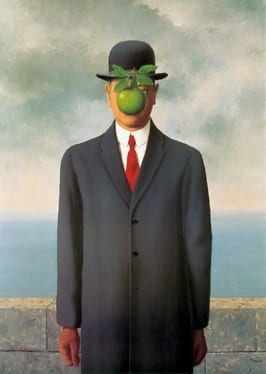
Abstract Expressionism (Mid-20th Century, c.1945–1960)
Characteristics & Context: After World War II, New York City became the new center of avant-garde art, giving rise to Abstract Expressionism (often called the New York School). This was the first major American art movement to gain international influence. Abstract Expressionism is characterized by large-scale, abstract paintings that emphasize the physical act of painting as an essential aspect of the finished work. Artists were influenced by Surrealist automatism and Jungian psychology, treating the canvas as an arena in which to act (in the words of critic Harold Rosenberg). There were varied styles: Action Painting (dynamic, gestural brushstrokes or drips) and Color Field Painting (large areas of color meant to evoke contemplation). The movement reflected the anxious freedom of the postwar era, with existential ideas about individual expression.
Key Artists (Action Painting): Jackson Pollock pioneered drip painting, laying canvases on the floor and energetically dripping, pouring, and splattering paint from all sides. His Autumn Rhythm (Number 30) (1950) is a dense web of black, white, and tan loops – the composition arises from Pollock’s movements and the paint’s behavior, capturing a record of action and improvisation. Willem de Kooning combined aggressive brushwork with reworked figurative elements; his Woman I (1950–52) shows a wild, jaggedly painted female figure emerging from abstract strokes, reflecting both the influence of imagery and the violent energy of painting itself. Franz Kline painted bold black and white “zebra” compositions with sweeping brushstrokes that look spontaneous and monumental.
Key Artists (Color Field): Mark Rothko created luminous rectangular fields of color that seem to glow or float; standing before works like No. 61 (Rust and Blue) (1953), viewers often feel an emotional or spiritual resonance from the expansive, hazy-edged color blocks. Barnett Newman used large fields of a single color interrupted by vertical “zips” (stripes), aiming for a sublime effect (e.g., Vir Heroicus Sublimis, 1950). Clyfford Still painted jagged patches of intense color on vast canvases, and Helen Frankenthaler introduced stain painting by pouring thinned paint onto unprimed canvas (a precursor to the 1960s Color Field painters).
Innovations: Abstract Expressionists shifted focus to the process of art-making. Pollock’s drip technique removed the paintbrush from direct contact with the canvas, expanding definitions of painting. They also elevated scale – huge canvases that envelop the viewer – to create immersive experiences. The emphasis on abstraction and personal expression influenced countless subsequent movements, including lyrical abstraction, minimalism (in reaction to AbEx), and conceptual art (which often defined itself against the subjective excess of AbEx). It also solidified New York’s position in the global art world.
Notable Artworks:
Jackson Pollock – “Autumn Rhythm (Number 30)” (1950, Met Museum). This vast canvas (about 17 feet wide) is filled with an intricate tangle of dripped and flung paint. There is no central focal point – the “all-over” composition envelops the viewer in a rhythmic, almost musical set of loops and splashes. Pollock’s revolutionary technique and scale embodied the freedom and anxiety of the postwar age, making him the poster child of Abstract Expressionism.
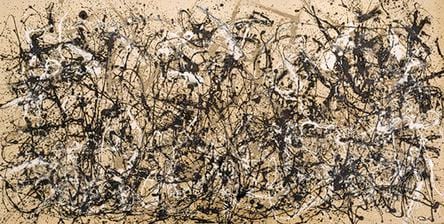
Mark Rothko – “Untitled (Black on Maroon)” (1958, Tate Modern). One of Rothko’s large color field works, it features deep maroon background with rectangular forms of dark plum and black that seem to softly merge at the edges. The painting exudes a contemplative, sombre mood. Rothko intended such works to evoke fundamental human emotions – tragedy, ecstasy, doom – and his floating rectangles of color became iconic for their spiritual depth in abstraction.
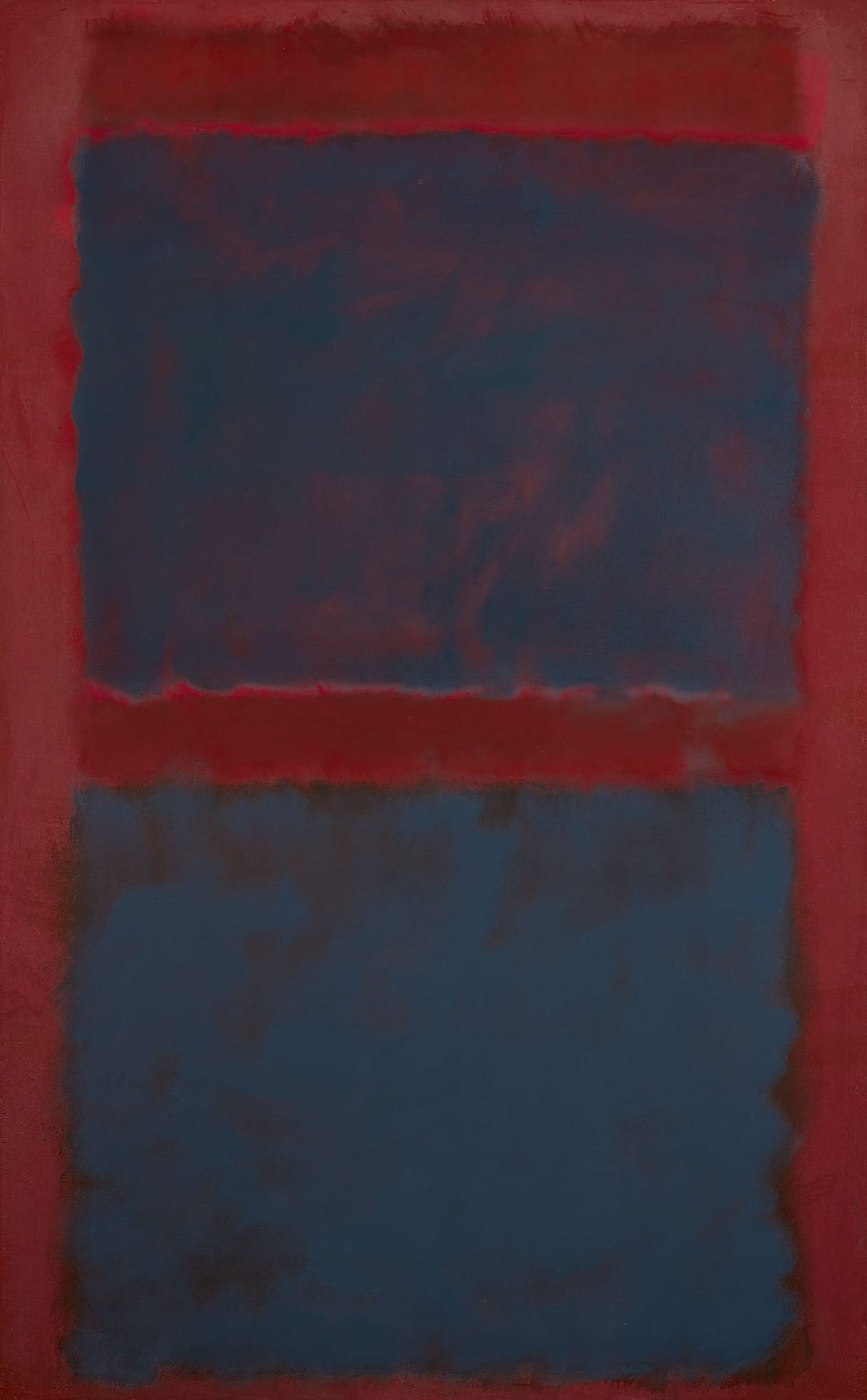
Pop Art (1960s)
Characteristics & Context: By the late 1950s and 1960s, Pop Art in the US and UK turned the focus to popular culture and consumer society. Reacting against Abstract Expressionism’s inward focus, Pop artists celebrated (and slyly critiqued) the imagery of mass media, advertising, comics, and everyday consumer products. Pop Art is characterized by bold, flat colors, hard edges, and often a deadpan, ironic tone. Techniques included mechanical reproduction (silkscreen printing) and use of actual commercial art methods. This movement reflected the booming postwar economy, rise of Hollywood and television, and an interest in breaking down the barrier between “high art” and “low culture.”
Key Artists: Andy Warhol is synonymous with Pop – his silkscreened Campbell’s Soup Cans (1962) and Marilyn Monroe prints (1967) turned consumer goods and celebrity faces into repetitive, icon-like images, commenting on fame and commodification. Roy Lichtenstein elevated the comic strip panel to high art, complete with Ben-Day dots and speech bubbles – e.g., Whaam! (1963), a blown-up comic battle scene, and his many melodramatic romance comic details (Drowning Girl, 1963). Claes Oldenburg sculpted giant soft sculptures of hamburgers, ice cream, or a colossal clothespin, making the mundane monumental. In the UK, Richard Hamilton’s collage Just What Is It That Makes Today’s Homes So Different, So Appealing? (1956) is often cited as the first Pop artwork – filled with cut-out images of appliances, pin-up girls, and comic books in a modern living room, it satirizes consumer abundance. David Hockney, while more figurative, incorporated flat, pop-inspired aesthetics in his California pool scenes of the 1960s. Yayoi Kusama (in NYC then) also touched Pop Art with her polka-dotted installations and happenings.
Innovations: Pop Art erased distinctions between commercial art and fine art. By using silkscreen, Warhol brought mass production into the studio, diminishing the “aura” of the unique art object (a concept later theorized by Walter Benjamin). Pop also introduced a new set of imagery into art galleries – brand logos, comic characters, propaganda – presaging our current world where all images can be art material. It had an irreverent, often humorous approach, opening the door for later postmodern playfulness and appropriation art (e.g., 1980s artists like Jeff Koons directly building on Pop’s legacy).
Notable Artworks:
Andy Warhol – “Marilyn Diptych” (1962, Tate Modern). Fifty images of Marilyn Monroe’s face, silk-screened in a 5x10 grid: the left half brightly colored, the right half in fading black-and-white. Printed from a publicity photo, the repetition mimics mass media’s relentless replication of celebrity images while the gradual fade possibly alludes to Monroe’s tragic death. Warhol’s work challenges us to find meaning in mass-produced imagery – is it celebratory, critical, or merely observing?
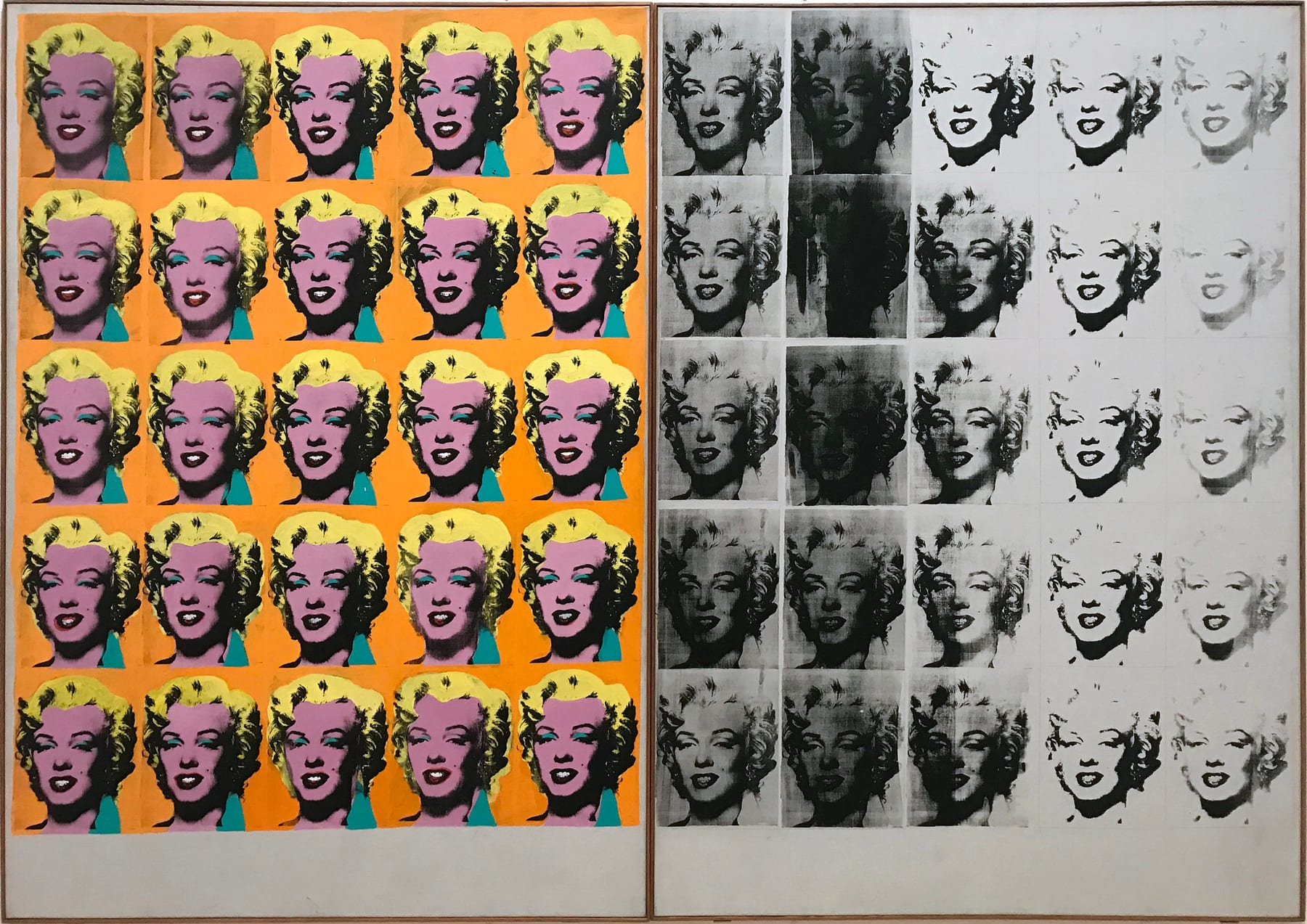
Roy Lichtenstein – “Whaam!” (1963, Tate Modern). A large two-panel painting replicating a fighter jet comic panel: a plane fires a rocket into an enemy plane with a red-and-yellow explosion, accompanied by the onomatopoeic “Whaam!” in bold letters. Lichtenstein painted it by hand but imitated the look of mechanical printing (including dotted shading). It exemplifies Pop’s ironic treatment of war and heroism through the lens of cheap comic graphics, making us both enjoy and question the glamour of pop culture.
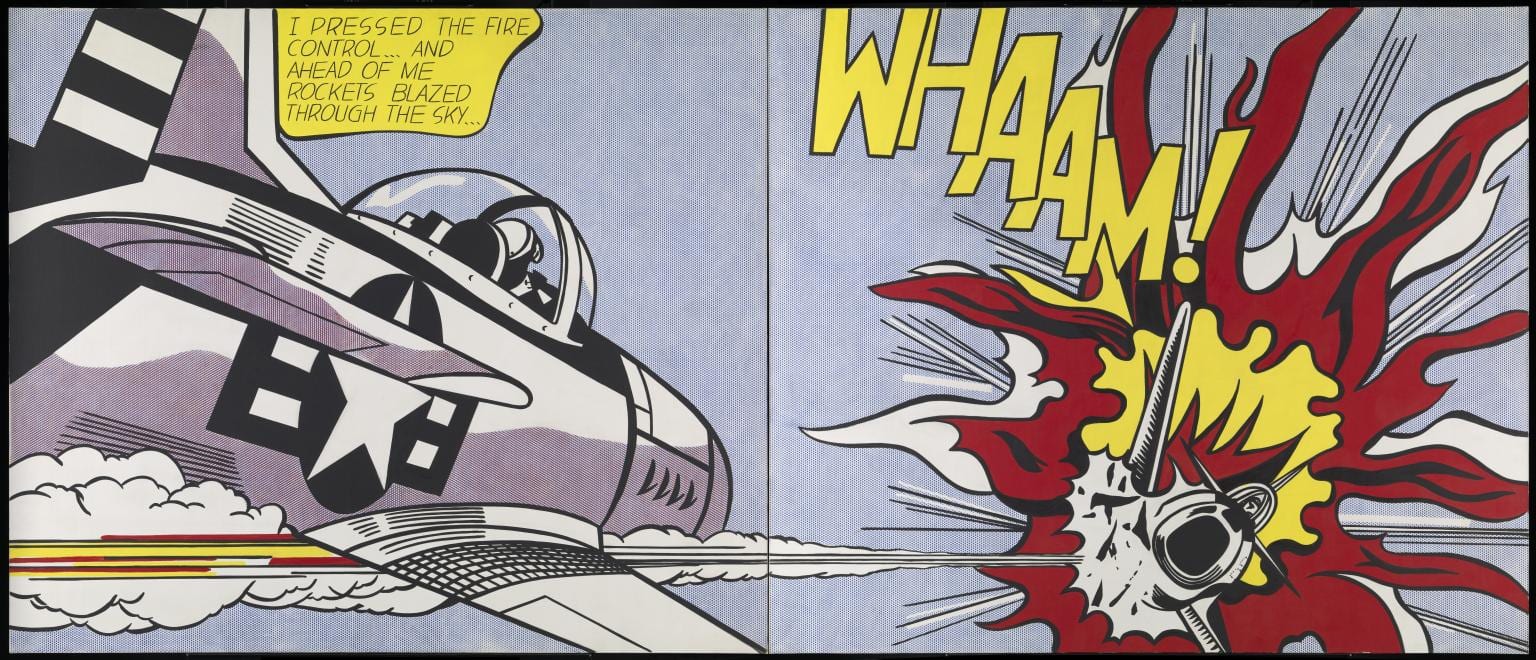
Minimalism (1960s–1970s)
Characteristics & Context: Minimalism emerged in the late 1960s (mostly in the US) as a reaction against the emotional rhetoric of Abstract Expressionism and the figurative pop of Pop Art. Minimalist art is extreme in its simplicity – often made of geometric forms, industrial materials, and a very limited color palette. Painters and sculptors aimed to remove signs of personal expression, creating works that were self-contained objects focused on pure form and materials. Minimalism was linked to a reductive, “less is more” aesthetic also seen in architecture (e.g., Mies van der Rohe) and was contemporary with conceptual art’s rise.
Key Artists: In painting, Frank Stella declared “What you see is what you see” – his early 1960s Black Paintings were just parallel black stripes on raw canvas, and later works used bold, flat color in symmetrical patterns (shaped canvases). Ellsworth Kelly made canvases of single bright colors or simple shapes. In sculpture, Donald Judd crafted precise stacks or boxes (e.g., a series of stainless steel and Plexiglas rectangular units) that he called “specific objects,” emphasizing the objecthood of art. Carl Andre arranged bricks or metal plates in simple grids on the floor (art you could literally walk on). Dan Flavin used commercial fluorescent light tubes to create installations of colored light. Agnes Martin, often associated with Minimalism, painted delicate hand-drawn grids that, while minimalist in form, carried a meditative quality.
Innovations: Minimalists radically eliminated narrative, illusion, and metaphor from art, focusing on pure elements: shape, color, space. They often made use of factory processes or fabrication (Judd, Andre) to remove the artist’s hand. This movement also engaged the gallery space itself – many minimalist sculptures are large-scale or arranged to alter the viewer’s perception of the environment, thus pioneering installation art. Minimalism influenced music (Philip Glass, Steve Reich) and continued to affect design aesthetics.
Notable Artworks:
Donald Judd – “Untitled” (Stack) (1967, MoMA). A vertical stack of identical rectangular units projecting from the wall, made of green lacquered metal and Plexiglas, spaced evenly from floor to ceiling. Judd’s work exemplifies Minimalism’s use of repetition, industrial materials, and clean geometry. It’s abstract yet tangible, asking the viewer to consider how the units relate to the space and to each other rather than representing anything else.
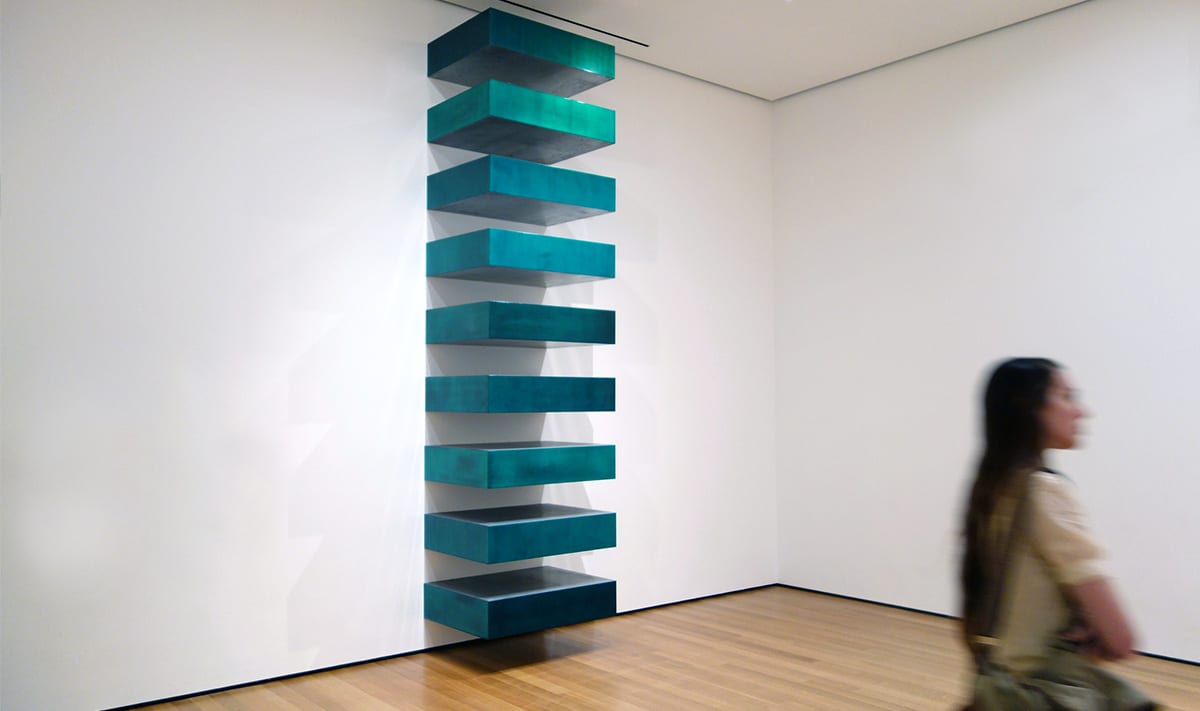
Frank Stella – “Die Fahne Hoch!” (1959, Whitney Museum). One of Stella’s Black Paintings, it consists of black enamel paint in concentric striping that follows the shape of the canvas (which is nearly square with a notch). The title ironically references a Nazi anthem, but the painting itself is non-representational, with precise black bands separated by pinstripes of exposed canvas. It reduces painting to pattern and structure alone, heralding the minimalist motto of self-referentiality: it simply is what it is.

Conceptual Art (Late 1960s–1970s)
Characteristics & Context: Conceptual Art took Minimalism’s intellectual turn even further. By the late 1960s, artists began asserting that the idea or concept behind the work is more important than the physical artwork itself. Conceptual artists might use text, documentation, photographs, or performance to express an idea, sometimes producing no traditional art object at all. This movement questioned the very nature of art, the role of institutions, and the importance of authorship and ownership. Conceptual Art paralleled a tumultuous era (civil rights, Vietnam War protests, 1968 global unrest) and was often aligned with anti-commercial or anti-establishment stances.
Key Artists: Joseph Kosuth’s One and Three Chairs (1965) is a seminal conceptual piece: it consists of a real chair, a full-scale photograph of the chair, and a dictionary definition of “chair.” This trio invites viewers to consider: which is the “real” chair (object, image, or idea)? Sol LeWitt wrote manifestos on Conceptual Art and created wall drawings executed by others following his instructions – the concept (instructions) is primary, the execution secondary. Lawrence Weiner made art from language, presenting phrases on walls (e.g., “A 36” x 36” Removal to the Lathing or Support Wall…,” describing an action rather than showing it). In the UK, Art & Language (a collective) and Victor Burgin explored conceptual practices. On Kawara’s Date Paintings (just the date in white on solid background) and his telegram works (“I AM STILL ALIVE”) examined time and existence as concepts. Marcel Broodthaers created a fictional museum installation to critique art institutions. Performance and body artists like Yoko Ono, Joseph Beuys, and Chris Burden also overlap with Conceptual art, treating actions as art.
Innovations: Conceptual Art expanded the definition of art to include ideas, words, and actions. It de-emphasized aesthetics and craftsmanship in favor of intellectual engagement. Many conceptual works are ephemeral or documented only in books, giving rise to new forms of art presentation (conceptual art exhibits often consist of text panels, diagrams, or photos). This movement also laid groundwork for Institutional Critique (art examining the systems of the art world) and strongly influenced contemporary art by asserting that anything can be art if the artist declares it so and it prompts an idea in the viewer’s mind (an echo of Duchamp’s Dada innovations).
Notable Artworks:
Joseph Kosuth – “One and Three Chairs” (1965). A wooden folding chair sits next to a scale photo of that chair and an enlarged dictionary definition of “chair.” This installation brilliantly encapsulates Conceptual Art’s concerns: the relationship between language, image, and object, and the notion that the concept (here, “chair-ness”) is the true art. The work exists in multiple versions (as the idea can be realized anywhere with a chair, photo, and definition), underlining that the concept is not tied to a singular object.
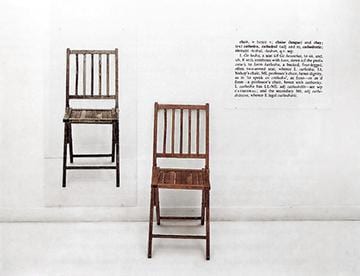
Sol LeWitt – “Wall Drawing #1” (1968). LeWitt’s first wall drawing was a set of instructions: “A wall divided vertically into four equal parts… Within each part, lines in four directions (vertical, horizontal, diagonal left, diagonal right).” When executed, it results in a wall covered in pencil lines in various orientations. The significance is that LeWitt himself might not draw it – anyone can follow the instructions. The art is the idea and plan, and the physical drawing is a manifestation that can be re-created. This was revolutionary in redefining the artist’s role from craftsman to thinker.

Postmodernism & Neo-Expressionism (1970s–1980s)
Characteristics & Context: By the late 20th century, “postmodern” art trends challenged the narratives of progress and singular movements. Postmodern art is characterized by pluralism, irony, appropriation, and a mix of styles. It often revisits earlier art forms in new, self-aware ways and blurs the boundaries between high art and popular culture. Neo-Expressionism arose in the late 1970s and 1980s as a return to expressive, figurative painting, reacting against the austerity of Minimalism and Conceptualism. It coincided with a booming art market in the 1980s. At the same time, other artists explored appropriation (re-using existing images), identity politics, and new media.
Key Artists (Neo-Expressionism): Jean-Michel Basquiat in New York merged street art aesthetics with neo-expressionist painting – his canvases (e.g., Untitled (Skull), 1981) are raw, vibrant, full of cryptic text and imagery dealing with race, mortality, and urban life. Julian Schnabel in the US became known for huge canvases with broken plates or thick paint, with grandiose references to culture and personal mythology. In Germany, Anselm Kiefer created vast, textured paintings (often with straw, ash, lead) grappling with German history and the trauma of WWII (e.g., Margarete, 1981, referencing Holocaust poems). Georg Baselitz painted figures upside-down as a way to stress form and color over content. Francesco Clemente and Sandro Chia in Italy, and David Salle and Eric Fischl in the US, were also associated with this broad return to figurative expression.
Key Artists (Postmodern Appropriation & Identity): Cindy Sherman in the late 1970s/80s took photographs of herself in various costumes (e.g., her Untitled Film Stills) to examine female stereotypes and the constructed nature of identity. Barbara Kruger combined photographs with bold text (“Your gaze hits the side of my face”) to critique consumerism and gender objectification in a striking graphic style. Sherrie Levine re-photographed famous photographs (like Walker Evans’) to question authenticity and authorship. Jeff Koons in the 1980s made shiny steel balloon animals and kitschy sculptures that both celebrate and mock consumer tastes. Nam June Paik and Bill Viola pioneered video art, while Jenny Holzer projected electronic text art. Street art also entered galleries via artists like Basquiat and Keith Haring. This era saw a rise of art addressing race, gender, and sexual identity, such as Faith Ringgold’s story quilts on African American life, Judy Chicago’s The Dinner Party (1979) celebrating women in history, and Mapplethorpe’s frank photographs stirring NEA funding debates.
Innovations: Postmodernism brought appropriation to the forefront – using existing images from art history or media to create new works (a commentary on the saturation of images in the modern world). It embraced pastiche, mixing elements from various styles and eras. Neo-Expressionism’s revisit of painting helped revive the art market for paintings. There was also a greater inclusion of previously marginalized voices and a breakdown of the old canon. In many ways, postmodern art declares “anything goes,” as long as there is a critical or contextual idea behind it.
Notable Artworks:
Jean-Michel Basquiat – “Untitled (Skull)” (1981, Broad Collection). A large canvas with a graffitied, crowned skull figure, rendered in aggressive brush strokes, vibrant patches of color, and scrawled text fragments. Basquiat’s work, drawing on street graffiti and neo-expressionist intensity, exemplifies postmodern pluralism: it mixes anatomy, language, and raw emotion, and confronts issues of identity and mortality with a brash, new voice in fine art.
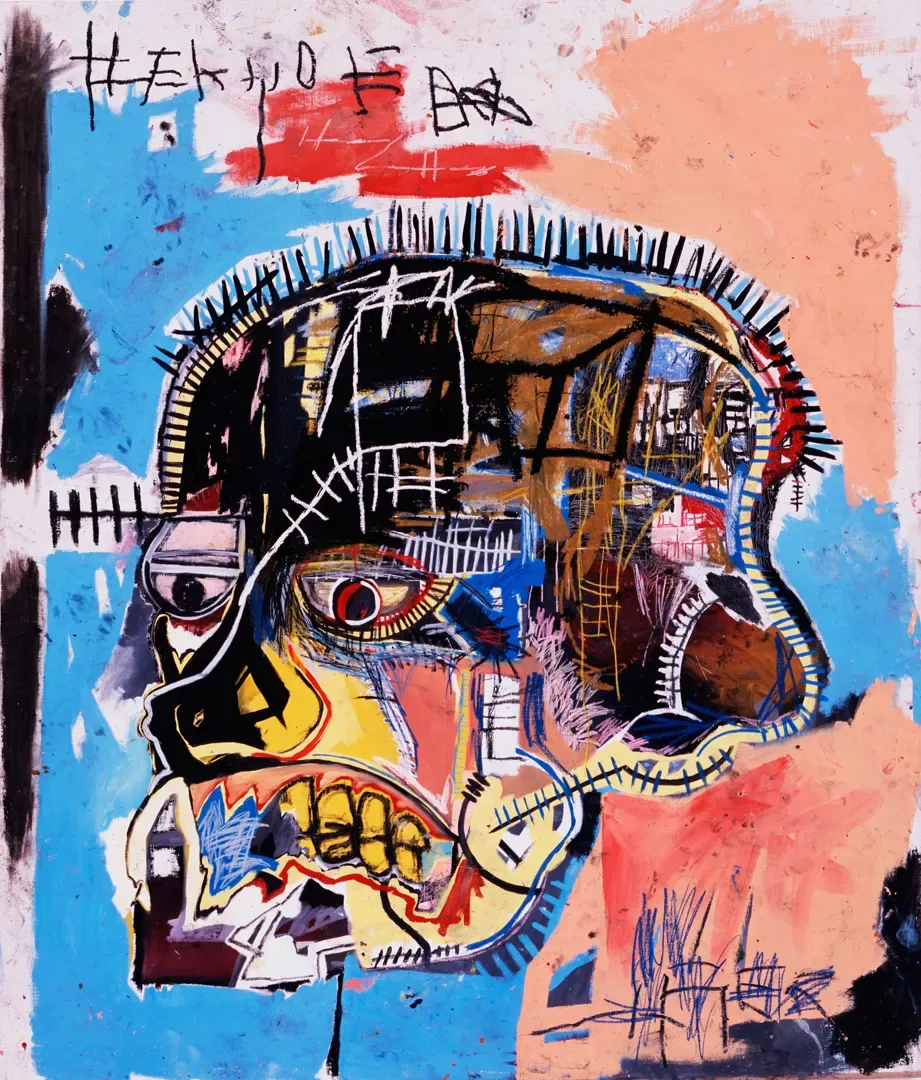
Barbara Kruger – “Untitled (Your body is a battleground)” (1989). A photographic silkscreen of a woman’s face, divided into negative and positive halves, overlaid with the phrase “YOUR BODY IS A BATTLEGROUND” in bold Futura type. Created during the Women’s March on Washington for reproductive rights, this piece uses the visual language of advertising (image + slogan) to deliver a feminist message. Kruger’s work shows postmodern art’s capacity for direct social commentary through the appropriation of mass media techniques, merging graphic design with fine art to challenge viewers’ perceptions.
Contemporary Trends (1990s–2010)
As the timeline approaches 2010, art movements become even more fluid. The late 20th and early 21st centuries saw a continuation and expansion of postmodern eclecticism:
- Installation and Multimedia: Artists like Damien Hirst (with his vitrines of preserved animals, e.g., The Physical Impossibility of Death in the Mind of Someone Living, 1991) and Tracey Emin (her confessional installations like My Bed, 1998) gained fame in the 1990s as part of the Young British Artists (YBAs), blending shock tactics with conceptual art. Installation art and large-scale multimedia works became prominent (e.g., Olafur Eliasson’s The Weather Project, 2003, filling Tate Modern’s Turbine Hall with an artificial sun and mist).

- Globalization and Identity: There was increasing recognition of non-Western artists and themes. Ai Weiwei from China used conceptual and installation modes to critique political systems (dropping Han dynasty urns or covering a museum floor with millions of handmade porcelain sunflower seeds in 2010). Artists like El Anatsui (Ghana) and Yinka Shonibare (UK/Nigeria) used local materials or cultural hybridization in globally acclaimed works (Shonibare’s installations feature Victorian costumes made of African print fabric, commenting on colonialism and identity).
- New Media and Street Art: The 2000s saw the rise of digital art and street art crossovers. Banksy’s stencils (late 1990s–2000s) on city walls brought guerrilla art into public consciousness, laden with political satire. Video and digital installation art grew, with artists like Bill Viola continuing to innovate in video, and net art emerging online.
- Postmodern Painting Evolves: Painting persisted in various new forms – from the ironic figuration of John Currin and Lisa Yuskavage (who mix classical technique with provocative or kitschy subjects) to the vibrant street-influenced works of Kerry James Marshall (addressing African-American history and representation) and Julie Mehretu’s monumental abstract layers reflecting urban maps and global movement.
By 2010, the art world is characterized by diversity rather than dominant “isms.” Major trends include the continuation of Conceptual and Installation art, an embrace of cross-cultural influences, the impact of technology and the internet on art creation and distribution, and an ongoing dialogue between past and present styles (the “postmodern” condition). Art has become increasingly global, with biennials and art fairs showcasing artists from all continents and blending traditions.
Even so, the legacy of the movements from the 16th through 20th centuries underpins this contemporary scene – artists continue to reference, react to, or reinvent ideas from Mannerism to Surrealism and beyond, proving that art history is a dynamic continuum.
Sources: The information and dates in this timeline are drawn from reputable art history sources, including Encyclopædia Britannica, art history texts (TheArtStory.org summaries, museum resources (Realism Art Movement – Characteristics - Identify This Art)), and examples of artworks from museum collections. Each movement’s description is informed by scholarly analysis of its characteristics and key figures. The artworks mentioned are iconic representatives widely cited in art historical discourse. Images are sourced from public domain or freely licensed museum and archive reproductions to illustrate key styles (e.g., Parmigianino’s Madonna with the Long Neck exemplifying Mannerism, and Bernini’s Ecstasy of Saint Teresa exemplifying Baroque drama). This overview provides a structured chronology to understand how Western art evolved through innovation, reaction, and cross-cultural influence over five centuries.