
📓 In your handwritten notebooks
- March 21 – June 9 2026, pp. 200, 210–211 — *A Distant Mirror — Tuchman* → open PDF p217 (file not included in this release)
Index: Personal Journal
DESCRIPTION
A “marvelous history” of medieval Europe, from the bubonic plague and the Papal Schism to the Hundred Years’ War, by the Pulitzer Prize–winning author of The Guns of August Lawrence Wright, author of The End of October, in The Wall Street Journal The fourteenth century reflects two contradictory images: on the one hand, a glittering age of crusades, cathedrals, and chivalry; on the other, a world plunged into chaos and spiritual agony. In this revelatory work, Barbara W. Tuchman examines not only the great rhythms of history but the grain and texture of domestic life: what childhood was like; what marriage meant; how money, taxes, and war dominated the lives of serf, noble, and clergy alike. Granting her subjects their loyalties, treacheries, and guilty passions, Tuchman re-creates the lives of proud cardinals, university scholars, grocers and clerks, saints and mystics, lawyers and mercenaries, and, dominating all, the knight—in all his valor and “furious follies,” a “terrible worm in an iron cocoon.” Praise for A Distant Mirror “Beautifully written, careful and thorough in its scholarship … What Ms. Tuchman does superbly is to tell how it was… . No one has ever done this better.”—The New York Review of Books “A beautiful, extraordinary book … Tuchman at the top of her powers … She has done nothing finer.”—The Wall Street Journal “Wise, witty, and wonderful … a great book, in a great historical tradition.”—Commentary
A Distant Mirror - Barbara W. Tuchman.pdf (file not included in this release)
A Distant Mirror PDF Text
Handwritten journal source
Consolidated source: PDF p. 227 (file not included in this release)
Source boundary: These are handwritten source pages. Use the scan for exact wording; verify quotations and factual claims before reuse.
Embedded preview:
March 21-June 9 2026.pdf (file not included in this release)
Open the journal routing table
Forward
The Period, the Protagonist, the Hazards
Chapter Objective
This opening chapter explains Barbara W. Tuchman’s purpose, method, and historical difficulties in writing A Distant Mirror. Her original question was to understand the social effects of the Black Death of 1348–50, but she concludes that the fourteenth century cannot be reduced to plague alone because it was shaped by overlapping crises: plague, war, taxation, brigandage, bad government, insurrection, and Church schism. The chapter establishes the book’s broader argument: the fourteenth century was a violent, unstable, and contradictory age whose collapse of assumptions offers a “distant mirror” of modern disarray. Tuchman also introduces Enguerrand de Coucy VII as the narrative vehicle through whom she will explore the period.
The Fourteenth Century as a “Bad Time for Humanity”
- Tuchman begins by explaining that the book grew out of her desire to understand the effects of the Black Death, which killed an estimated one third of the population between India and Iceland.
- However, she quickly found that the period’s disorders could not be assigned to one cause.
- The fourteenth century suffered from many simultaneous catastrophes:
- Plague
- War
- Taxes
- Brigandage
- Bad government
- Insurrection
- Schism in the Church
- Tuchman presents the century as a “violent, tormented, bewildered, suffering and disintegrating age,” one in which many contemporaries believed Satan was triumphant.
- She finds the period compelling partly because it offers perspective: modern people living through disorder can recognize that humanity has survived worse crises before.
Historical Parallels and Human Permanence
- Tuchman emphasizes that history does not repeat exactly, but human behavior recurs.
- She cites the comparison made by historian James Westfall Thompson between the aftermath of the Black Death and the aftermath of World War I:
- Economic chaos
- Social unrest
- High prices
- Profiteering
- Depraved morals
- Lack of production
- Religious and social hysteria
- Greed and maladministration
- Tuchman uses Voltaire’s phrase, “History never repeats itself; man always does,” to frame the book’s logic.
- The distance of six hundred years allows permanent features of human conduct to stand out more clearly against the unfamiliar background of medieval life.
- The Middle Ages were different enough from modern life to feel almost foreign, yet familiar human reactions still appear: fear, ambition, greed, moral confusion, endurance, and the search for order.
The Historical Period and Narrative Focus
- Tuchman identifies the core of the book as the fifty years following the Black Death, roughly within a larger historical frame of 1300 to 1450.
- To avoid writing an abstract survey, she chooses to follow the life of one historical figure.
- This method forces her to obey the actual sequence and circumstances of a real medieval life rather than imposing an artificial structure.
- The chosen figure is Enguerrand de Coucy VII, a nobleman of the Second Estate.
- Tuchman rejects several other possible kinds of protagonists:
- Kings and queens, because their lives are too exceptional and overused.
- Commoners, because their lives usually do not provide enough range of documentation.
- Clerics or saints, because they belong to a world she sees as harder to enter.
- Women, because a medieval woman with enough documentation would likely be atypical.
- Coucy is useful because:
- His life spanned 1340 to 1397, matching the period Tuchman wants to examine.
- His mother died in the plague.
- His own death occurred during what Tuchman calls the century’s “culminating fiasco.”
- Through marriage to the eldest daughter of the King of England, he had a double allegiance between France and England during the Hundred Years’ War.
- He appeared in many major public dramas of the period.
- He patronized Jean Froissart, one of the greatest contemporary chroniclers, increasing the available historical record about him.
The Problem of Dates
- Tuchman identifies one major hazard of medieval history as the uncertainty of dates.
- Dates matter because they establish sequence, and sequence is necessary for understanding cause and effect.
- Medieval chronology is difficult because:
- The year was sometimes treated as beginning at Easter, which moved between March 22 and April 22.
- A fixed date of March 25 was often preferred.
- The shift to the modern calendar system was uneven and late.
- English documents often used regnal years, dating events from the king’s accession.
- Some documents used papal years.
- Chroniclers often dated events by the religious calendar, such as “two days before the Nativity of the Virgin” or “the Monday after Epiphany.”
- The result is that medieval people and later historians often disagreed about the exact date of events.
The Problem of Numbers
- Tuchman also stresses the unreliability of medieval numbers.
- Numbers matter because they show the proportion of a population involved in an event.
- Medieval chroniclers frequently exaggerated:
- Army sizes
- Battle casualties
- Plague deaths
- Revolutionary crowds
- Processions
- Any large group en masse
- She argues that chroniclers often used numbers not as data but as a literary device to amaze or horrify readers.
- This exaggeration has caused later historians to misunderstand medieval war by falsely comparing it to modern mass warfare.
- Even modern scholars disagree dramatically. Tuchman notes that estimates of pre-plague France range from 10–11 million to 21 million, a difference large enough to affect interpretations of taxation, agriculture, famine, commerce, and life expectancy.
The Problem of Contradictory Evidence
- Tuchman warns that medieval evidence frequently contradicts itself.
- Mistakes could arise from:
- Oral transmission
- Misread manuscripts
- Variant spellings
- Confused identities
- National differences in naming
- She gives examples:
- Enguerrand was written as Ingelram in England.
- The Comte d’Auxerre appeared under several different English spellings and was confused in French sources with someone else.
- She initially mistook “Canolles” for a variant of one brigand captain before discovering it referred to another.
- Tuchman also notes that historians themselves often give incompatible descriptions:
- Isabeau of Bavaria is described by one historian as a tall blonde and by another as a dark, lively, little woman.
- Sultan Bajazet is described by contemporaries as bold and warlike, but by a modern historian as effeminate and vacillating.
- Her larger point is that the Middle Ages resist simplification. Almost any statement can be met with an opposite statement.
Contradiction as a Feature of Medieval Life
- Tuchman argues that contradiction is not merely a problem of evidence; it is a feature of life itself.
- Medieval society contained many opposing realities at once:
- Starving peasants and prosperous peasants
- Neglected children and loved children
- Knights who spoke of honor and became brigands
- Depopulation and disaster alongside extravagance and splendor
- She insists that no historical age is “tidy” or made of one uniform fabric.
- This is especially true of the Middle Ages, which she calls a “checkered fabric.”
Historians and Their Biases
- Tuchman explains that the Middle Ages look different depending on who is studying them.
- Historical interpretation has changed over time:
- For centuries after the Middle Ages, history was largely written as genealogy of nobility, focused on dynasties and noble families.
- After the French Revolution, interpretation reversed: common people were often treated as heroes, while nobles and kings were presented as villains.
- Nineteenth- and early twentieth-century scholars performed immense work collecting, editing, and publishing sources.
- Modern medievalists, influenced by figures like Marc Bloch, adopted more sociological approaches and paid closer attention to ordinary life.
- Tuchman says her own book is indebted to all these approaches, especially to primary chroniclers.
- She acknowledges that reliance on chroniclers had become unfashionable among medievalists, but she finds them indispensable for recovering the attitudes and narrative texture of the period.
Empty Spaces and Historical Probability
- Sometimes the problem is not contradictory evidence but no evidence at all.
- In such cases, Tuchman says the historian must use likely or natural explanations.
- This is why her book contains words like “probably” and “presumably.”
- These terms may be annoying, but they are necessary when documentation is incomplete.
Negative Overload in Historical Evidence
- Tuchman identifies a deeper problem in recorded history: the survival of negative evidence.
- Historical documents disproportionately preserve:
- Crisis
- Crime
- Calamity
- Lawsuits
- Moral denunciations
- Treaties
- Satire
- Papal Bulls
- The ordinary and normal often go unrecorded.
- She compares this to the modern newspaper: news reports make the world appear more uniformly chaotic than daily life actually is.
- This leads to what she calls Tuchman’s Law: being reported multiplies the apparent extent of a deplorable development by five- to tenfold.
- Her point is that disaster may appear more pervasive in records than it actually was in lived experience.
Difficulty of Entering the Medieval Mind
- Tuchman’s final major hazard is the difficulty of empathy: genuinely entering the mental and emotional world of the Middle Ages.
- The main barrier is medieval Christianity.
- Medieval Christianity was:
- The matrix and law of medieval life
- Omnipresent
- Compulsory
- Focused on the superiority of the spiritual life and afterlife over earthly existence
- Tuchman argues that modern people do not share this worldview in the same way.
- The modern world was created partly by the rupture of this principle and by the rise of belief in:
- The worth of the individual
- Active life in this world
- Human purposes not necessarily centered on God
The Gap Between Christian Ideal and Human Practice
- Tuchman emphasizes that medieval society professed renunciation of worldly life but did not practice it consistently.
- The Church itself often failed to renounce wealth, sensuality, or power.
- The fourteenth century was intensely concerned with:
- Money
- Possessions
- The flesh
- Status
- Material life
- Tuchman argues that economic man and sensual man are not suppressible.
- This creates one of the central tensions of the Middle Ages: the impossible Christian ideal remained authoritative even though ordinary human behavior continually violated it.
- She contrasts her approach with Edward Gibbon, who treated the gap between Christian ideal and human reality with ironic skepticism. Tuchman thinks the ideal must have represented a deep human need, even if it was impossible to live out fully.
Chivalry and the Gap Between Ideal and Reality
- Tuchman identifies a similar contradiction in chivalry, the dominant political ideal of the ruling class.
- Chivalry imagined the warrior class as defenders of order, justice, faith, and the oppressed.
- Its symbolic model was the Round Table, a perfect shape representing order.
- In practice, knights often became:
- Oppressors
- Violent men
- Brigands
- Agents of disorder
- By the fourteenth century, the lawlessness of the warrior class had become a major source of social breakdown.
- Tuchman concludes that when the gap between ideal and reality becomes too wide, the system begins to break down.
- Yet she ends on a more complex note: even destructive and greedy human beings retain a vision of order and continue searching for it.
A Note on Money
- Tuchman provides a practical note about medieval currencies.
- Medieval money derived from the libra, or pound of pure silver, from which 240 silver pennies were struck.
- Later systems developed around:
- Twelve pennies to the shilling or sous
- Twenty shillings or sous to the pound or livre
- Currencies such as the florin, ducat, franc, livre, écu, mark, and English pound were theoretically related to this original standard.
- In practice, their value varied because weight and gold or silver content changed.
- She warns the non-specialist reader not to worry too much about exact equivalence.
- What matters is not the name of the coin but its purchasing power.
- Rather than translating all currencies into one modern equivalent, she uses the currency named in the original document or chronicler and encourages the reader to think of each amount simply as “so many pieces of money.”
References to Sources
- Tuchman explains that sources are found in the bibliography and reference notes at the end of the book.
- Specific references are located by page number and identifying phrase from the text.
- This reinforces her broader method: she is writing a narrative history grounded in documentary evidence, but she also openly acknowledges uncertainty, contradiction, and interpretive limits.
Key Concepts for The Period, the Protagonist, the Hazards
- Distant Mirror: The idea that the fourteenth century reflects aspects of modern disorder. Tuchman does not claim history repeats exactly, but that human behavior under crisis shows recurring patterns.
- Overlapping Crisis Model: Tuchman rejects monocausal explanation. The Black Death mattered enormously, but the century’s disorder also came from war, taxes, brigandage, bad government, insurrection, and Church schism.
- Narrative Through a Life: Tuchman uses Enguerrand de Coucy VII as a historical vehicle. This allows the book to move through real events in sequence rather than becoming an abstract survey.
- Chronological Uncertainty: Medieval dating systems were inconsistent, making sequence and causation difficult to establish with precision.
- Numerical Exaggeration: Medieval chroniclers often used numbers rhetorically rather than statistically, especially when describing armies, deaths, crowds, and disasters.
- Contradictory Evidence: The Middle Ages often present mutually incompatible facts, descriptions, and interpretations. Tuchman treats contradiction as both a documentary problem and a feature of social reality.
- Negative Overload: Historical records overrepresent crisis, conflict, crime, and scandal because these are the kinds of events most likely to be documented.
- Tuchman’s Law: The fact that something is reported can multiply its apparent importance or prevalence. Recorded calamity can make disaster seem more continuous and universal than it was.
- Medieval Christian Worldview: The medieval world was organized around the superiority of spiritual life and the afterlife, a framework modern readers may struggle to inhabit.
- Ideal vs. Practice: Both Christianity and chivalry created exalted ideals that medieval society repeatedly failed to live up to. This gap between vision and behavior is central to Tuchman’s interpretation of the age.
Questions for Reflection for The Period, the Protagonist, the Hazards
- How does Tuchman’s choice to follow Enguerrand de Coucy VII shape the kind of history she can tell?
- Why does Tuchman reject a simple explanation of the fourteenth century centered only on the Black Death?
- How does negative overload affect the way modern readers understand periods of crisis, both medieval and contemporary?
- What does the gap between medieval ideals and medieval behavior reveal about human nature?
- In what ways does the fourteenth century function as a “distant mirror” for modern societies experiencing disorder, uncertainty, or institutional breakdown?
Chapter 1: “I Am the Sire de Coucy”: The Dynasty
Chapter Objective
This chapter introduces the Coucy dynasty as a concentrated example of medieval aristocratic power, violence, status, and social order. Tuchman uses the castle and lineage of Coucy to show how the medieval world was structured around land, fortification, lineage, warfare, Church relations, feudal obligations, and hierarchy. The chapter also prepares the reader for Enguerrand VII, the later protagonist of the book, by explaining the immense historical weight of the family he inherited: a dynasty famous for arrogance, grandeur, brutality, wealth, and political significance. The Coucys become a “distant mirror” of medieval society itself: pagan, barbarian, feudal, Christian, and deeply layered.
The Castle of Coucy as a Monument of Baronial Power
- Tuchman opens with the castle of Coucy, located on a hilltop in Picardy, north of Paris.
- The castle dominated the northern approach to Paris, making it ambiguous whether it served as a guardian of the monarchy or a challenge to royal authority.
- Its most striking feature was the enormous donjon, or central citadel:
- 90 feet in diameter
- 180 feet high
- Capable of housing about a thousand men during a siege
- Described as the largest of its kind in Europe.
- The castle’s physical scale expressed the dynasty’s character:
- Grand
- Excessive
- Dangerous
- Commanding
- The castle was not merely a residence. It was a visible statement of baronial independence and military power.
- The Coucy motto captured this arrogance:
Not king nor prince,
Duke nor count am I;
I am the lord of Coucy.
- Tuchman uses the castle as the chapter’s symbolic entry point: the Coucys were not sovereigns, but they behaved with the confidence of near-sovereign princes.
Coucy and the Gothic Building Age
- The castle was begun in 1223, during the same architectural surge that produced the great Gothic cathedrals of northern France.
- Nearby cathedrals at Laon, Reims, Amiens, and Beauvais were all under construction within fifty miles of Coucy.
- Tuchman contrasts the slow construction of cathedrals, which could take 50 to 150 years, with the astonishing speed of Coucy’s construction.
- Under Enguerrand de Coucy III, the castle, donjon, towers, ramparts, and underground networks were completed in only seven years.
- The castle therefore belongs to the same age of immense architectural ambition as the cathedrals, but it expresses a different ideal:
- Cathedrals embodied faith and divine aspiration.
- Coucy embodied military force and aristocratic command.
The Military Design of Coucy
- Tuchman emphasizes that a medieval castle’s central purpose was defense, not domestic comfort.
- Coucy was designed as a near-perfect military structure:
- Four large corner towers
- Massive ramparts
- A fortified gate
- Moat and portcullis
- Underground passageways
- Secret exits outside the ramparts
- Storerooms, bread ovens, wells, kitchens, fireplaces, and latrines
- The donjon could gather and command a large garrison. Orders could be shouted through the open central shaft, allowing the lord or commander to address hundreds or even over a thousand men.
- From the top of the donjon, an observer could see as far as the forest of Compiègne, about thirty miles away.
- Tuchman presents the castle as an emblem of medieval life:
- It assumes violence.
- It expects attack.
- It reflects a world without reliable central authority.
- The castle replaces the unfortified Roman villa. Where Roman society relied on imperial law and legions, medieval society relied on local fortification.
Castles, Anarchy, and the Birth of the State
- Tuchman uses Coucy to explain the political fragmentation of the Middle Ages.
- After the fall of Rome, secular authority was weak and divided.
- The Church became the only large organizing institution because society could not endure pure anarchy.
- Over time, royal power began to cohere, but it immediately came into conflict with:
- The Church
- The barons
- The growing towns
- The towns, or communes, developed their own order and negotiated charters of liberty from kings, bishops, or nobles.
- Tuchman emphasizes that the state was still in formation:
- Political bonds were not yet primarily citizen to state.
- They were vassal to lord.
- Rule was personal, based on land, homage, and obligation.
- The French king lacked a permanent armed force and had to rely on feudal military service from vassals.
- This made powerful lords like the Coucys politically dangerous.
Picardy and the Strategic Importance of Coucy
- Coucy’s location in Picardy made it one of the “keys of the kingdom.”
- Picardy was strategically important because it connected:
- Northern France
- Flanders
- Normandy
- The Channel
- The Seine basin
- Its rivers, fertile soil, villages, forests, and agricultural wealth made it one of France’s most valuable regions.
- At the beginning of the fourteenth century, Picardy had more than a million people and was unusually populous for medieval France.
- Its towns were among the earliest to win charters as communes.
- Coucy’s power therefore came not only from its castle but from its command over a rich and strategically located region.
The Church Origins of Coucy
- The domain of Coucy originally belonged to the Church, supposedly granted to St. Remi, Bishop of Reims, by Clovis, the first Christian king of the Franks.
- Tuchman uses this origin story to introduce a major medieval contradiction: the Church claimed spiritual authority while being deeply invested in material wealth.
- She compares the gift of Coucy to the traditional story of Constantine’s donation to the Church of Rome.
- The deeper issue is that Christianity’s spiritual mission became compromised by land, lordship, rents, and political power.
- Tuchman identifies this as a central medieval problem:
- The Church reached toward the divine.
- Yet it accumulated worldly possessions.
- This gap between spiritual ideals and material power generated recurring doubt and dissent.
The Early Lords of Coucy
- The early history of Coucy is partly obscure.
- The first primitive castle and chapel were built around 910–20 by Hervé, Archbishop of Reims, as defense against Norsemen.
- Settlers took refuge within the bishop’s walls, creating the upper town of Coucy-le-Château.
- In 975, Archbishop Oderic of Reims ceded the fief to the Comte d’Eudes, the first lord of Coucy.
- Little is known of him, but Tuchman says his descendants displayed extraordinary strength and fury.
- The dynasty’s first major recorded act was religious rather than military:
- Aubry de Coucy founded the Benedictine Abbey of Nogent in 1059.
- This act had two purposes:
- It displayed noble importance.
- It purchased spiritual merit and prayers for salvation.
- The abbey survived the dynasty itself, supported by later Coucy donations.
Enguerrand I and the Scandal of Sybil
- Enguerrand I is presented as a scandalous figure, especially through the hostile testimony of Abbot Guibert.
- He became obsessed with Sybil, the wife of a lord of Lorraine.
- With help from a compliant bishop, Enguerrand divorced his first wife, Adèle de Marie, on charges of adultery.
- He then married Sybil while her husband was away at war and while she was pregnant through another relationship.
- Tuchman uses this scandal to show:
- The entanglement of noble lust, Church compliance, and family violence.
- The instability of aristocratic marriage politics.
- The moral corruption that could exist beneath noble status.
Thomas de Marie and the Violence of Private War
- From this family crisis emerged Thomas de Marie, son of the repudiated Adèle.
- Tuchman describes him as the most savage of the Coucys, quoting Abbot Suger’s description of him as a “raging wolf.”
- Thomas hated his father and became involved in the continuing private war connected to Sybil’s abandoned husband.
- Tuchman explains the character of medieval private war:
- Lords attacked each other by destroying the enemy’s economic base.
- They killed or mutilated peasants.
- They burned crops, barns, vineyards, tools, and property.
- The primary victims were often not rival nobles but the peasantry.
- Abbot Guibert claimed captured men had their eyes put out and their feet cut off.
- Tuchman treats private war as one of Europe’s great curses and suggests that crusades may have partly functioned as an outlet for noble aggression.
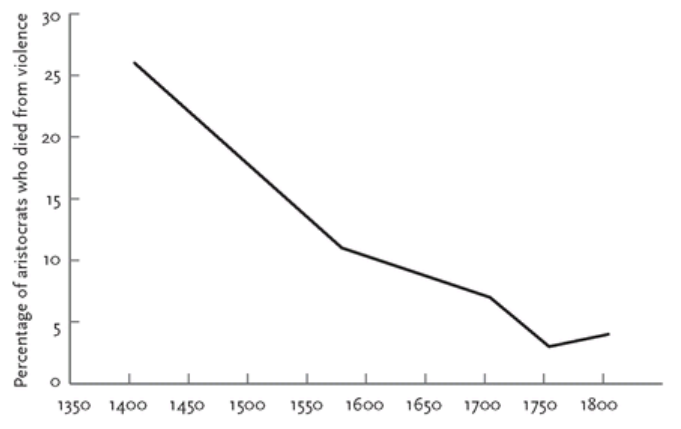
Pinker’s Chapter 3 supplement — private war was an elite social order, not an aberration
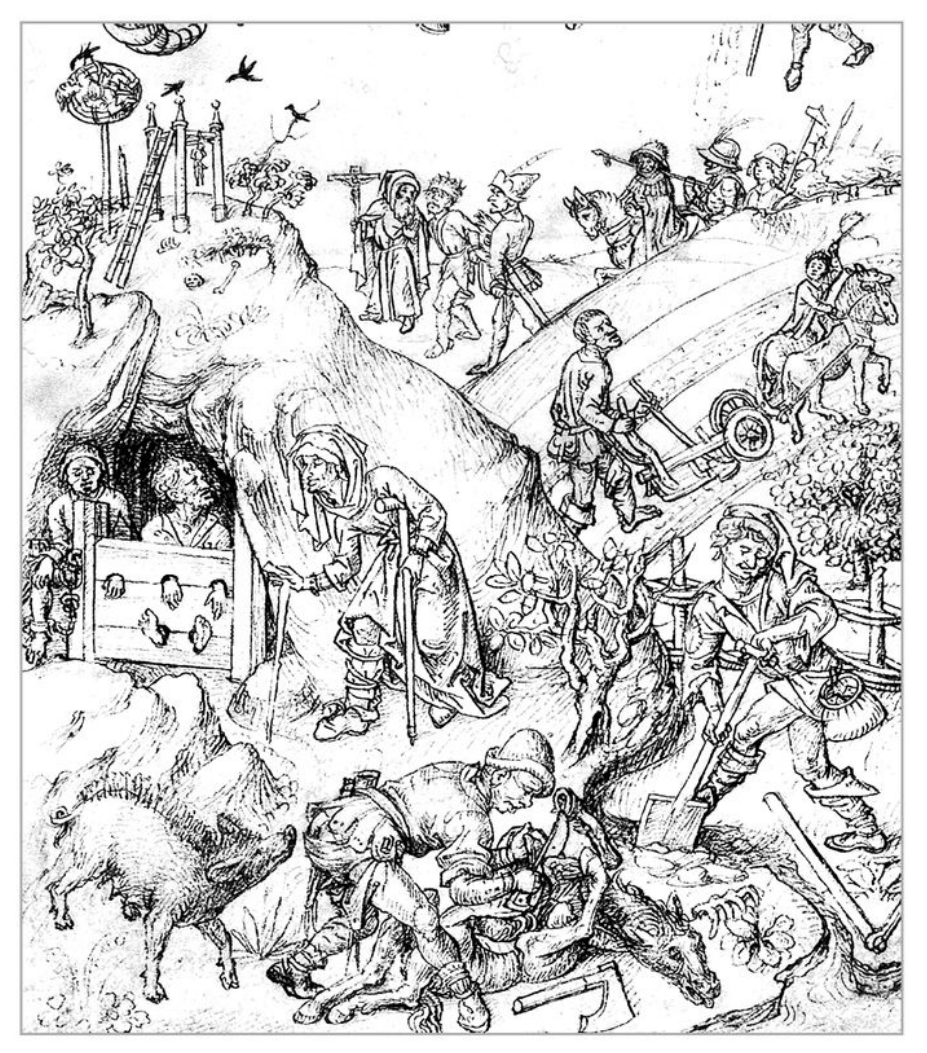
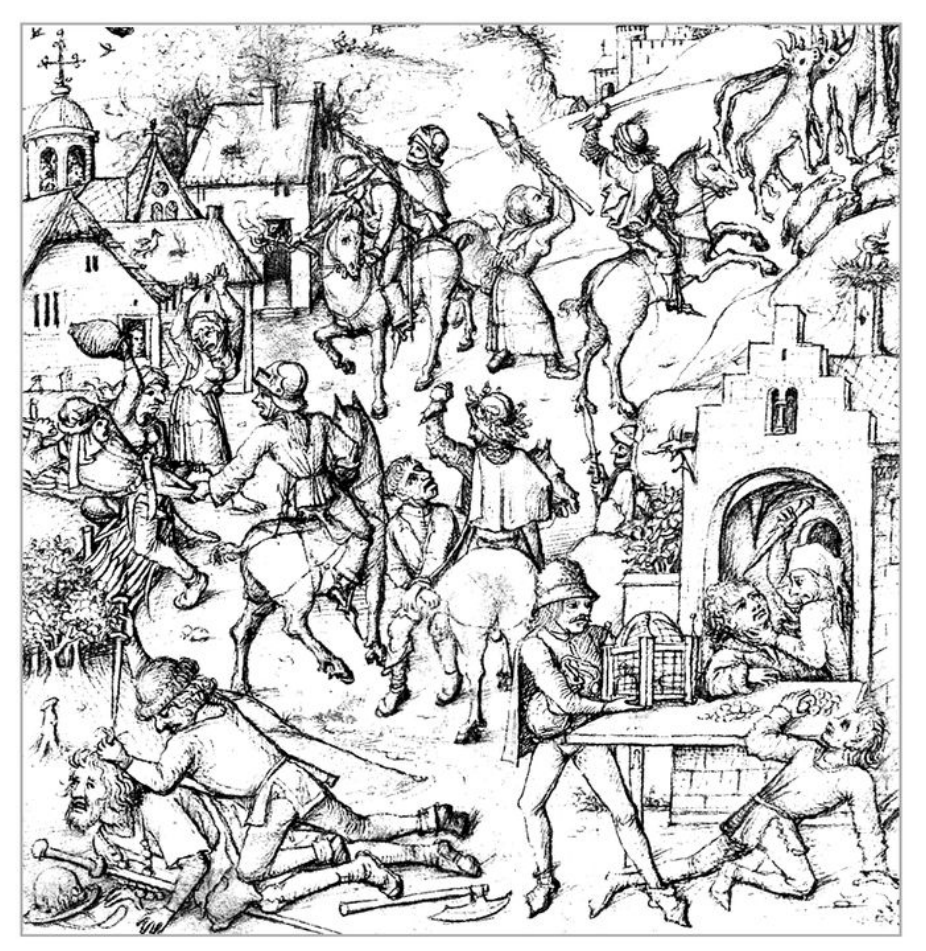
Pinker places Tuchman’s descriptions beside two different kinds of evidence. The Medieval Housebook treats executions, broken bodies, plunder, and mounted attacks on peasants as ordinary parts of the landscape rather than exceptional spectacles. Gregory Clark’s aristocratic genealogies then supply a quantitative check: in Pinker’s plot, about 26% of English male aristocrats died violently in the fourteenth and fifteenth centuries, before the proportion fell to single digits around the turn of the eighteenth century and eventually approached zero.
Figures 3-5 to 3-7 — violence in late-medieval iconography and violent deaths among English male aristocrats, 1330–1829. The illustrations reveal what one elite manuscript could represent as familiar; they are not a census of daily experience. The aristocratic series covers a narrow, unusually documented class and should not be generalized directly to peasants or all of Europe. Together they strengthen Tuchman’s claim that private war and violent status competition were embedded in aristocratic life. Chapter 3 synthesis · The Medieval Housebook and Figure 3-5, PDF pp. 107–108 (file not included in this release) · Mounted plunder and Figure 3-6, PDF pp. 109–110 (file not included in this release) · Elite violence and Figure 3-7, PDF pp. 129–131 (file not included in this release)
The First Crusade and the Coucy Arms
- In 1095, both Enguerrand I and Thomas took the cross for the First Crusade.
- They carried their feud with them to Jerusalem and back.
- Tuchman recounts the legend behind the Coucy coat-of-arms:
- One Coucy, either Enguerrand or Thomas, was surprised by Muslims while out of armor.
- He tore his scarlet cloak trimmed with vair into six pieces.
- These became makeshift banners for recognition.
- He and his companions then defeated the attackers.
- The family arms became six horizontal bands of red and white, described heraldically as “Barry of six, vair and gules.”
- This story links the dynasty’s identity to:
- Crusading violence
- Martial honor
- Family legend
- Heraldic memory
Thomas de Marie’s Career of Brigandage
- Thomas inherited Coucy in 1116.
- He expanded the family domain by adding his mother’s territories of Marie and La Fère.
- His career was marked by violence against:
- The Church
- Towns
- The king
- Peasants
- Tuchman lists accusations against him:
- Seizing convent lands
- Torturing prisoners
- Personally cutting the throats of rebellious bourgeois
- Turning his castles into dens of thieves
- He was excommunicated, symbolically stripped of knighthood, and cursed in every parish in Picardy.
- King Louis VI eventually acted against him and recovered stolen lands and castles.
- Yet Thomas, like many violent nobles, feared damnation in the end.
- He left generous gifts to religious institutions and died in bed in 1130.
- Tuchman’s conclusion is not that Thomas was merely genetically savage, but that his violence flourished because there was no effective institution capable of restraining him.
The High Middle Ages and the Growth of Civilization
- Tuchman then widens the frame from Coucy to Europe’s broader development in the twelfth and thirteenth centuries.
- During this period, political power became more centralized and European civilization surged forward.
- She lists major developments:
- Commerce
- Art
- Technology
- Building
- Universities
- Banking and credit
- Cities
- Exploration
- Mechanical clock
- Compass
- Spinning wheel
- Treadle loom
- Windmills and watermills
- Intellectual and cultural figures of the period included:
- Marco Polo
- Thomas Aquinas
- Giotto
- Roger Bacon
- Dante
- St. Francis
- But Tuchman stresses the contradictions of the age:
- St. Francis represented gentle preaching.
- The Inquisition represented cruelty.
- The Albigensian Crusade brought massacre.
- Cathedrals expressed creativity, technology, and faith.
- The High Middle Ages were therefore not simply an age of progress but an age of simultaneous brilliance and brutality.
Enguerrand II, Raoul I, and the Sale of Liberties
- After Thomas, the Coucys had about sixty years of more respectable lordship under Enguerrand II and Raoul I.
- Both cooperated with the French crown.
- Both responded to crusading calls.
- Both died in the Holy Land.
- Tuchman explains that crusading often impoverished noble families because equipping a knight and his retainers was extremely expensive.
- The financial pressure of crusading helped produce local liberties:
- In 1197, Raoul’s widow sold Coucy-le-Château a charter of liberties as a free commune for 140 livres.
- Tuchman rejects a simplistic view that this was part of a steady march toward liberty.
- Instead, she argues that noble military expenditure unintentionally pushed lords to sell privileges and commute labor obligations into money rents.
- Urban and peasant liberties often arose from aristocratic financial need, not purely from ideological progress.
Enguerrand III “the Great”
- Enguerrand III, called “the Great,” revived the Coucy tradition of excess.
- He ruled from 1191 to 1242.
- He built or reconstructed castles and ramparts on several fiefs, including the great castle at Coucy.
- He also fought in many wars, including:
- The Albigensian Crusade
- A conflict against the diocese of Reims
- He was accused of:
- Pillaging Church lands
- Cutting down trees
- Seizing villages
- Breaking into the cathedral
- Imprisoning the doyen
- Reducing the canons to misery
- Like earlier Coucys, he was excommunicated.
- In his case, the ban was severe because religious services in the diocese were to stop if he appeared.
- The pressure of communal religious deprivation helped bring him to settlement and absolution in 1219.
- Yet his ambition remained unchecked.
Enguerrand III and Royal Defiance
- Enguerrand III’s castle-building was partly driven by his expectation of conflict with the monarchy.
- During the minority of Louis IX, the future St. Louis, Enguerrand led a league of barons against the crown.
- Some sources claimed he aspired to the throne himself.
- His donjon was designed to surpass the royal tower of the Louvre, making it a direct architectural challenge to royal authority.
- His marriages expanded his political power:
- He married into neighboring noble families.
- He married Mahaut de Saxe, connecting him to Henry the Lion, Henry II of England, Eleanor of Aquitaine, Richard the Lionheart, and the Holy Roman Empire.
- His daughter married Alexander II of Scotland.
- Tuchman presents Enguerrand III as the clearest example of the Coucy pattern:
- Military ambition
- Architectural grandeur
- Dynastic calculation
- Near-royal pride
The Construction and Luxury of Coucy
- Tuchman describes the labor and artistry involved in Enguerrand III’s building campaign.
- She estimates the work involved:
- About 800 stonemasons
- Hundreds of carts and animals
- Around 800 craftsmen, including carpenters, roofers, iron workers, lead workers, painters, and wood-carvers.
- The donjon doorway displayed a knight fighting a lion, symbolizing chivalric courage.
- The castle included painted walls, decorative borders, garlands, chimneys, and private chambers.
- Tuchman gives special attention to chimneys:
- They warmed individual rooms.
- They allowed lords and ladies to withdraw from the common hall.
- They increased comfort and refinement.
- But they also widened the social distance between owners and retainers.
- This detail is typical of Tuchman’s method: architecture becomes evidence for social transformation.
Coucy, Amiens, and Sacred Competition
- Tuchman places Coucy’s chapel-building alongside the cathedral-building culture of Picardy.
- In 1206, the citizens of Amiens acquired what was believed to be part of John the Baptist’s head.
- They resolved to build the largest church in France as a shrine for the relic.
- In the same era, Enguerrand III built a magnificent chapel at Coucy, larger than the later Sainte-Chapelle in Paris.
- The chapel’s stained glass was so admired that Jean, Duc de Berry later tried to buy it for 12,000 gold écus.
- This section shows how noble prestige, religious display, and architectural splendor overlapped.
The Power and Rank of the Coucy Domain
- By the thirteenth century, the Coucys held numerous titles and lands.
- Their domain was held directly from the king, and the Sire de Coucy owed homage only to the king personally.
- The lord of Coucy even coined his own money, as did the Bishop of Laon.
- Tuchman uses feudal military obligations to show Coucy’s rank:
- Coucy owed 30 knights.
- The Duke of Anjou owed 34.
- The Duke of Brittany owed 36.
- The Count of Flanders owed 47.
- This placed Coucy just below the great dukes and counts of the realm.
- Coucy was an untitled barony, but its practical power approached that of higher-ranking principalities.
Enguerrand IV and the Advance of Royal Justice
- After Enguerrand III died in 1242, his son Raoul II died on Louis IX’s crusade in Egypt.
- The lordship passed to Enguerrand IV, whom Tuchman compares to a “medieval Caligula.”
- His most important crime occurred when he found three young squires from Laon in his forest with bows and arrows.
- Without trial, he had them hanged.
- This became a major legal test because Louis IX refused to let noble rank shield Enguerrand from justice.
- Enguerrand demanded:
- Judgment by his peers
- Trial by combat
- Louis IX refused, arguing that trial by combat was unjust in cases involving the poor, clergy, or persons deserving pity.
- Enguerrand IV was arrested like an ordinary criminal and imprisoned in the Louvre.
- He was convicted and fined 12,000 livres.
- The money was assigned partly for masses for the souls of the dead men and partly for the defense of the Holy Land.
- Tuchman treats this case as a milestone in social justice and royal authority:
- The king asserted justice over noble privilege.
- Noble violence was no longer automatically immune.
- Legal authority began to supersede feudal prerogative.
The Later Coucys and Dynastic Continuity
- Enguerrand IV eventually regained royal favor by lending Louis IX 15,000 livres to purchase what was believed to be the True Cross.
- He continued his violent career and died in 1311 without heirs.
- The lordship then passed through his sister Alix, married to the Count of Guînes.
- Her second son, Enguerrand V, became lord of Coucy.
- The succession then moved through:
- Guillaume
- Enguerrand VI
- Enguerrand VII, born in 1340 and the central figure of Tuchman’s book.
- Through marriage alliances, the Coucys continued to accumulate:
- Lands
- Revenues
- Political connections
- Heraldic prestige
- They could display as many as twelve coats-of-arms, showing the extent of their noble alliances.
The Household and Magnificence of a Grand Seigneur
- Tuchman describes the Coucys as behaving like sovereign princes.
- Their household was organized similarly to the king’s, with officers such as:
- Constable
- Grand butler
- Master of falconry and the hunt
- Master of stables
- Master of forests and waters
- Stewards of kitchen, bakery, cellar, fruit, lighting, furnishings, and lodgings
- A great lord might also employ:
- Physicians
- Barbers
- Priests
- Painters
- Musicians
- Minstrels
- Secretaries
- Copyists
- An astrologer
- A jester
- A dwarf
- Pages and squires
- Coucy maintained a permanent garrison of about 500, including fifty knights and their attendants.
- Magnificence was politically necessary:
- Feasts
- Tournaments
- Hunts
- Retinues
- Gifts
- Lavish clothing
- Aristocratic generosity was not merely personal virtue. It was a mechanism of loyalty and status.
Nobility, Function, and the Three Estates
- Tuchman explains the medieval theory of social order through the Three Estates:
- Clergy: those who pray
- Nobility: those who fight
- Commoners: those who work
- The noble’s status derived from birth and ancestry, but it had to be confirmed by living nobly, meaning practicing arms.
- The function of the noble was theoretically defensive:
- Protect the other estates
- Maintain justice
- Fight tyranny
- Uphold order
- Tuchman stresses the gap between theory and practice:
- Nobles claimed to protect the people.
- In reality, they often oppressed them.
- The clergy and the Third Estate were also internally divided, despite being treated as unified orders:
- The clergy ranged from wealthy prelates to poor parish priests.
- The Third Estate ranged from wealthy urban magnates to peasants and laborers.
- Nobility defined itself by separating all non-nobles into a supposedly servile category.
Noble Privilege and Taxation
- Nobles claimed exemption from direct taxation because their military service was their contribution to the realm.
- The clergy claimed similar exemption because prayer was their service.
- The theoretical justification was that each estate served the common good in its own way.
- But Tuchman emphasizes that taxation was confused and inconsistent.
- The king was supposed to “live of his own,” but in practice he often needed taxation for defense and government.
- The theological justification for taxation came from the idea that rulers should use common goods for the common good, not personal gain.
- The principles existed, but the actual system was full of exemptions, exceptions, and disputes.
Knighthood, War, and the Horse
- For the noble, the sword was not only a weapon but a symbol of identity.
- The horse elevated the knight physically and socially above other men.
- In most European languages, the word for knight was tied to the horse, as in the French chevalier.
- Tuchman distinguishes between:
- The destrier, the war-horse ridden in battle.
- The palfrey, a quieter horse used for travel.
- Without his mount, the knight was diminished into an ordinary man.
- Battle was glorified as the noble’s highest expression.
- Tuchman quotes the martial enthusiasm of medieval literature and troubadour poetry, especially Bertrand de Born, whose joy in siege, slaughter, and war was so extreme that Dante placed him in Hell.
Feudal Authority and Contract
- Land gave the noble authority over non-nobles in his territory, except clergy and citizens of free towns.
- Great lords had high justice, meaning the power of life and death.
- Lesser knights had low justice, involving lesser punishments such as prison or flogging.
- Tuchman explains that medieval lordship was ideally contractual:
- The vassal owed loyalty and service.
- The lord owed protection, justice, and order.
- Homage sealed the relationship.
- This contract applied upward as well:
- Lesser lords served greater lords.
- Lords served kings.
- Land was the material basis of the entire structure.
- Again, the ideal was reciprocal order, but the reality often fell short.
The Range and Instability of Noble Status
- Not all nobles were powerful like the Coucys.
- French nobility included about 200,000 people in 40,000 to 50,000 families, representing a little over one percent of the population.
- The noble class ranged from:
- Great dukes and counts
- Lords of castles
- Minor knights
- Poor knights with only a house and a few fields
- Some nobles were so poor that they lived barely above peasants.
- Tuchman notes that a noble family could decline over generations if it could no longer sustain the practice of arms.
- She gives examples of families sliding out of noble status because they had to farm, work, or take ordinary occupations.
- At the same time, upwardly mobile peasants, bailiffs, merchants, or officials could acquire wealth, fiefs, military habits, and eventually noble status.
- Nobility was fixed as a social order but fluid in personnel.
Noblesse de la Robe and Anxiety Over Status
- The monarchy increasingly ennobled wealthy outsiders, especially:
- Royal administrators
- Lawyers
- Notaries
- Financial officials
- These became the noblesse de la robe, or nobility of the robe, as opposed to the older military nobility of the sword.
- Old nobles resented them as parvenus.
- As noble status became more penetrable, hereditary nobles became more obsessed with signs of ancestry.
- The coat-of-arms became a near-sacred marker of noble legitimacy.
- Tournaments required heraldic display as proof of noble ancestry.
- Tuchman shows that aristocratic snobbery intensified as social boundaries became less secure.
Sumptuary Laws and the Policing of Identity
- Tuchman then turns to sumptuary laws, which regulated dress and consumption by rank.
- Nobles resented commoners who imitated noble clothing, manners, horses, weapons, and lifestyle.
- Authorities tried to stabilize identity through legal rules on:
- Fabric
- Color
- Fur
- Jewelry
- Number of costumes
- Carriages
- Wedding entertainment
- Meals
- Trousseaus
- Peasants might be restricted to black or brown.
- Bourgeois might be forbidden ermine.
- Prostitutes might be required to wear stripes or inside-out garments.
- The laws reflected a society anxious to preserve visible hierarchy.
- But Tuchman notes that these laws were largely unenforceable.
- People continued to seek adornment and display, just as later societies defied alcohol prohibition.
- The failure of sumptuary laws shows that status performance could not be fully controlled by law.
France at the Opening of the Fourteenth Century
- Tuchman then widens the lens to France’s position around 1300.
- France appeared supreme in:
- Chivalry
- Learning
- Christian devotion
- Courtly culture
- Gothic architecture
- Fashion
- Language
- The French king was known as the Most Christian King.
- The French saw themselves as favored instruments of divine will.
- The canonization of Louis IX in 1297 confirmed France’s sacred prestige.
- French knights were famous throughout Europe.
- The French court was regarded as the center of chivalric manners, festivals, jousts, and noble refinement.
- French was spoken by nobles across England, Flanders, Naples, Sicily, and the remnants of the crusader world.
- It was used in law courts, scholarship, poetry, and aristocratic culture.
- Tuchman emphasizes the international prestige of French civilization before the calamities of the fourteenth century began.
Paris and the University
- Paris was the intellectual capital of Europe.
- The University of Paris was especially famous for theology and philosophy.
- It attracted students from many countries and had more than 500 faculty members at the opening of the fourteenth century.
- Major thinkers connected to Paris included:
- Thomas Aquinas
- Albertus Magnus
- Duns Scotus
- Marsilius of Padua
- William of Ockham
- Paris was called the Athens of Europe.
- The University enjoyed a charter of privileges dating from 1200 and claimed independence from both civil and ecclesiastical control.
- It even considered itself one of the “two lights of the world” alongside the Pope.
- Tuchman uses this to show the intellectual confidence and institutional power of France before its later crises.
The Coucy Inheritance in 1335
- By 1335, the Coucy inheritance was rich, ancient, and symbolically dense.
- Its lands were watered by the Ailette and called the vallée d’or, or golden valley.
- The estate included:
- Timber
- Vineyards
- Grain crops
- Streams full of fish
- The forest of St. Gobain
- Abundant hunting grounds
- Tuchman estimates an annual revenue of 5,000 to 6,000 livres for an estate the size of Coucy.
- Revenue came from:
- Taxes
- Land rents
- Feudal dues
- Bridge tolls
- Fees for using the lord’s mill, wine press, and bread ovens
- This was the material inheritance that would eventually pass to Enguerrand VII.
The Lion Platform and the Layers of Medieval Society
- Tuchman closes with the ritual of homage at the lion platform before Coucy’s castle gate.
- The platform rested on sculpted lions:
- One devouring a child
- One devouring a dog
- One quiescent
- A fourth seated above in majesty
- Three times a year, at Easter, Pentecost, and Christmas, the Abbot of Nogent or his agent came to pay homage for land originally granted to the monks.
- The ritual involved:
- A horse with clipped ears and tail
- A plow-horse harness
- A whip
- A seed bag of wheat
- A basket of 120 rissoles
- A dog with clipped ears and tail
- Circling a stone cross three times
- Kneeling at the lion platform
- Kissing the lion
- Depositing rissoles, loaves, and wine
- The Sire de Coucy accepted the homage and stamped the document with a seal showing a mitered abbot with goat’s feet.
- Tuchman’s final sentence interprets this ritual as the essence of medieval society:
- Pagan
- Barbarian
- Feudal
- Christian
- The ceremony compresses the chapter’s main theme: medieval society was not one thing, but a layered inheritance of ancient, violent, religious, and feudal forms.
Key Concepts for “I Am the Sire de Coucy”: The Dynasty
- Baronial Power: The semi-independent authority of great lords whose castles, lands, courts, troops, and revenues could rival royal power.
- Donjon: The central fortified tower of a castle. At Coucy, the donjon symbolizes aristocratic force, defensive architecture, and defiance of royal authority.
- Feudal Contract: The reciprocal bond between lord and vassal, based on land, homage, service, protection, justice, and military obligation.
- Three Estates: The medieval social theory dividing society into clergy who pray, nobles who fight, and commoners who work.
- High Justice and Low Justice: Levels of judicial authority held by lords. High justice included the power of life and death; low justice involved lesser punishments.
- Private War: Armed conflict between nobles, often conducted by destroying peasants, crops, property, and revenue sources. Tuchman treats it as one of medieval Europe’s central disorders.
- Chivalric Ideal vs. Noble Violence: Nobles claimed to defend justice and protect the weak, but many acted as predators. The Coucys repeatedly embody this gap.
- Church Wealth and Spiritual Compromise: The Church’s possession of lands, lordships, and revenues created tension between its spiritual claims and worldly power.
- Communal Liberties: Charters purchased by towns that granted freedoms and self-governing privileges. Tuchman emphasizes that these often arose from noble financial need rather than abstract democratic progress.
- Noblesse de la Robe: Newly ennobled administrators, lawyers, and officials whose rise challenged the older military nobility.
- Sumptuary Laws: Regulations controlling clothing, luxury, and display by rank. They reveal anxiety over blurred social boundaries.
- Heraldry: Coats-of-arms functioned as visible proof of noble lineage and became more important as noble identity grew less secure.
- Negative Reciprocity of Medieval Hierarchy: The ideal structure promised protection and order, but in practice the same lords who owed protection often exploited or terrorized those below them.
Questions for Reflection for “I Am the Sire de Coucy”: The Dynasty
- How does the physical structure of Coucy castle express the political and social logic of medieval aristocracy?
- Why does Tuchman present the Coucys as both exceptional and representative of the medieval noble class?
- How does the repeated gap between noble ideals and noble behavior help explain the instability of medieval society?
- In what ways did the Church’s wealth strengthen its authority while also undermining its spiritual credibility?
- Why were social symbols like clothing, coats-of-arms, horses, castles, and ceremonies so important in a society organized by rank?
Chapter 2: Born to Woe: The Century**
Chapter Objective
This chapter explains the troubled world into which Enguerrand VII de Coucy was born. Tuchman moves from the Coucy dynasty to the broader fourteenth-century crisis, showing that Europe’s disasters were already underway before the Black Death. The chapter presents the century as “born to woe” because climate deterioration, famine, Church corruption, social unrest, anti-Jewish violence, financial crisis, dynastic instability, and the opening of the Hundred Years’ War all converged before Enguerrand VII’s birth in 1340. The broader purpose is to show that the fourteenth century’s collapse was not caused by one event alone, but by multiple structural pressures that were already weakening medieval society.
Climate Crisis and the Little Ice Age
- Tuchman opens by noting that when the last Coucy was born, France was still supreme, but the century was already marked by trouble.
- A physical chill settled over Europe at the start of the century:
- The Baltic Sea froze in 1303 and again in 1306–07.
- Years of abnormal cold, storms, and heavy rains followed.
- The Caspian Sea rose.
- Modern historians identify this as the beginning of the Little Ice Age, caused by advancing polar and alpine glaciers and lasting until about 1700.
- Medieval people did not understand the climatic cause, but they felt its consequences:
- Shorter growing seasons
- Crop failure
- Declining grain cultivation in northern regions
- Weakening contact with Greenland
- The decline of Norse settlements there
- Tuchman stresses that climate change became disastrous because medieval agriculture was already under pressure.
Population Pressure and Agricultural Limits
- Population growth in the previous century had reached a dangerous balance with available food production.
- Medieval agriculture had limited ability to increase output:
- Productive land had already been cleared.
- Poor soils could not easily be improved.
- Irrigation and fertilizer were inadequate.
- Bulk grain transport was difficult except by water.
- Inland towns depended heavily on local harvests.
- When local crops failed, people had few alternatives.
- This created the conditions for mass hunger.
The Great Famine of 1315–16
- In 1315, constant rain caused crop failures across Europe.
- Tuchman compares the rains to the Biblical flood and describes famine as the “dark horseman of the Apocalypse.”
- The population was already undernourished, making people more vulnerable to disease.
- Reports circulated of extreme desperation:
- People allegedly eating their own children.
- The poor in Poland feeding on bodies taken from the gallows.
- Dysentery spread during the same years.
- Local famines continued intermittently after the great famine.
- The famine shows that the century’s suffering began before the plague and before the major military catastrophes.
Four Ominous Events of the Early Century
- Tuchman identifies four major human-made events in the first twenty years of the century:
- The assault on Pope Boniface VIII by agents of the King of France.
- The removal of the Papacy to Avignon.
- The suppression of the Templars.
- The rising of the Pastoureaux.
- These events reveal the weakening of medieval institutions:
- Papal universal authority was declining.
- The French monarchy was becoming more aggressive.
- Religious orders could be destroyed by royal power.
- Popular unrest could take violent and apocalyptic forms.
Philip IV and the Assault on Boniface VIII
- The conflict between Philip IV of France, called Philip the Fair, and Pope Boniface VIII centered on the question of temporal versus papal authority.
- Philip taxed clerical income without papal consent.
- Boniface responded with the bull Clericos Laicos in 1296, forbidding clergy to pay taxes to secular rulers.
- Boniface then issued Unam Sanctam in 1302, one of the strongest statements of papal supremacy ever made.
- He declared that every human creature must be subject to the Roman pontiff for salvation.
- Philip retaliated by calling for a council to judge the pope on accusations including:
- Heresy
- Blasphemy
- Murder
- Sodomy
- Simony
- Sorcery
- Boniface prepared to excommunicate Philip.
- Philip’s agents struck first.
- On September 7, 1303, they seized the elderly pope at Anagni.
- Boniface was freed after three days, but the shock was fatal; he died within a month.
- Tuchman treats the “Crime of Anagni” as a sign that the medieval dream of a universal Church was fading.
- The important point is not merely that the pope was attacked, but that the attack did not rally Europe to his defense.
The Papacy Moves to Avignon
- The indirect result of Anagni was the relocation of the papacy to Avignon.
- Under French influence, Clement V was elected pope.
- He did not move to Rome, partly from fear of Italian hostility after the French assault on Boniface.
- In 1309, he settled in Avignon, technically outside France but within the French political sphere.
- The move became known as the Babylonian Exile of the papacy.
- Tuchman presents Avignon as a turning point in papal demoralization:
- The papacy lost prestige by leaving Rome.
- It appeared increasingly dependent on France.
- It compensated by becoming more financially centralized and materially magnificent.
Avignon, Simony, and Papal Finance
- Under six successive French popes, Avignon became a wealthy temporal court.
- Tuchman emphasizes the papacy’s obsession with revenue.
- Almost everything in Church administration became monetized:
- Offices
- Appointments
- Dispensations
- Pardons
- Indulgences
- Absolutions
- Legal judgments
- Ecclesiastical nominations
- Simony, the sale of spiritual offices or privileges, became widespread.
- The papacy drew income from:
- Tithes
- Annates
- Papal fiefs
- Peter’s Pence
- Crusade taxes
- Jubilee indulgences
- Bequests and altar offerings
- Benefices became especially lucrative.
- Popes increasingly reserved benefices to their own appointment, weakening local election and encouraging resentment.
- Bishops and abbots often had to pay large fees for office, sometimes up to a full year’s income.
- This system encouraged a chain of corruption throughout the hierarchy.
Abuse of Excommunication and Spiritual Power
- Tuchman argues that spiritual penalties lost moral force when used for financial enforcement.
- Excommunication and anathema, originally severe spiritual weapons against grave sin and heresy, were used to pressure debtors.
- In one case, a bishop was denied Christian burial until his heirs accepted responsibility for his debts.
- Such abuses damaged respect for clerical authority.
- The Church’s spiritual instruments became tools of administration and finance.
Dispensations and Unfit Clergy
- Money could buy exemptions from Church rules.
- Tuchman lists many kinds of dispensations:
- Legitimizing children, often children of priests or prelates.
- Allowing burial in more than one place.
- Permitting nuns to keep servants.
- Allowing marriage within prohibited degrees of kinship.
- Allowing trade with Muslims.
- Permitting possession of stolen goods up to a certain value.
- The most serious dispensations allowed unqualified people to receive Church offices.
- Some appointees were:
- Too young.
- Uneducated.
- Unconsecrated.
- Absentee officeholders.
- Tuchman gives examples:
- A seven-year-old boy appointed to a parish in Bohemia.
- Noble younger sons appointed to archbishoprics at eighteen, twenty, or twenty-two.
- A Bishop of Durham who could not properly read or pronounce Latin.
- The scandal was theological as well as administrative: these clergy were supposed to care for souls and mediate between humanity and God.
The Loss of Religious Meaning Through Money
- Tuchman’s central argument is that when religious practice was translated into money value, its religious meaning weakened.
- Penance, pilgrimage, absolution, and indulgence could all become financial transactions.
- A sinner who should have gone on pilgrimage could instead calculate the cost and purchase an equivalent indulgence.
- This turned spiritual discipline into accounting.
- The problem was not merely corruption but the reduction of salvation practices to commerce.
Papal Luxury at Avignon
- Tuchman contrasts the popes with their apostolic origins.
- Petrarch pointed out that the successors of the poor fishermen of Galilee were now “loaded with gold and clad in purple.”
- John XXII spent heavily on gold cloth, furs, and luxury clothing.
- Benedict XII and Clement VI built the massive papal palace at Avignon.
- The palace included:
- Thick defensive walls
- Chapels
- Banquet halls
- Gardens
- Money chambers
- Papal offices
- A steam room
- Elaborate kitchens and latrines
- Cardinals lived with princely magnificence.
- Clement VI used vast quantities of ermine and decorated his study with secular scenes:
- Hunting
- Falconry
- Orchards
- Gardens
- Fishponds
- Nude bathers
- Tuchman uses these details to show how far the papal court had come from the poverty and simplicity associated with early Christianity.
Avignon as Corruption and Cultural Center
- Petrarch called Avignon the Babylon of the West.
- He attacked its luxury, licentiousness, and corruption.
- Tuchman complicates the picture:
- Avignon was corrupt.
- But it was also a major cultural center.
- It attracted artists, scholars, lawyers, physicians, writers, poets, ambassadors, bankers, merchants, and petitioners.
- The city’s money supported learning and art.
- Tuchman therefore presents Avignon as morally compromised but culturally powerful.
- Everyone criticized Avignon, but everyone also came there.
Kings, Popes, and Mutual Corruption
- Tuchman emphasizes that corruption was not only papal.
- Popes and kings needed each other.
- They negotiated:
- Territories
- Sovereignties
- Alliances
- Loans
- Men-at-arms
- Crusade taxes
- Crusade levies became a convenient way for kings to tax ecclesiastical income.
- This deepened the alliance between religious authority and political finance.
- The clergy also participated in the corruption.
- When prelates dressed luxuriously, lower clergy imitated them.
- Complaints arose that clergy dressed like laymen, wore fashionable clothes, kept jesters, dogs, falcons, and guards, and ignored clerical discipline.
Pardoners and Popular Corruption
- Simony spread downward through the Church hierarchy.
- The common people encountered Church materialism most directly through pardoners.
- Pardoners sold absolution, indulgences, and spiritual benefits.
- They could claim to remit penances, cancel vows, or forgive sins in exchange for money.
- Tuchman uses Chaucer’s Pardoner as the literary embodiment of this fraud:
- Deceptive
- Shameless
- Spiritually empty
- Selling counterfeit salvation
- Priests disliked pardoners because they invaded parish territory and took fees that should have gone to regular clergy.
- Yet the system tolerated them because it profited from them.
Friars, Monks, and the Betrayal of Religious Ideals
- Tuchman turns to friars and monks, whose failures were especially disturbing because their ideals were so high.
- Friars were supposed to imitate St. Francis:
- Poverty
- Barefoot wandering
- Service to the poor
- Rejection of money
- Instead, many religious orders accumulated:
- Lands
- Churches
- Cloisters
- Wealth
- Hierarchy
- Some monks had private funds, servants, rich food, ale allowances, jewelry, and fur-trimmed clothing.
- Friars were often accused of seducing women and selling fake relics.
- Tuchman gives satirical examples:
- Boccaccio’s Friar Cipolla selling one of the Angel Gabriel’s feathers.
- Real friars selling supposed pieces of Moses’ burning bush.
- The people both scorned and feared friars because they might still possess the key to salvation.
The Church as Matrix of Medieval Life
- Tuchman warns that written complaints can exaggerate corruption because scandals survive in records.
- Despite all criticism, the Church was not close to dissolution.
- Christianity remained the matrix of medieval life.
- It governed:
- Birth
- Marriage
- Death
- Sex
- Eating
- Law
- Medicine
- Philosophy
- Scholarship
- Church membership was compulsory.
- There was no meaningful alternative religious system for most people.
- This made the Church’s hold on society very difficult to dislodge.
The Feast of Fools and Religious Burlesque
- Tuchman uses the Feast of Fools to show how medieval religion could be mocked without being destroyed.
- During this Christmas season ritual, lower clergy inverted Church order:
- Elected a mock pope, bishop, or abbot.
- Turned vestments inside out.
- Played dice on the altar.
- Ate sausages during Mass.
- Swung censers made from old shoes.
- Sang obscene songs.
- Parodied sermons and indulgences.
- Led disorderly processions through town.
- The ritual mocked sacred forms, but it also released pressure from within a religious culture that remained authoritative.
- Tuchman interprets it as an eruption of the “natural lout beneath the cassock.”
The Church as Comforter and Protector
- Despite corruption, the Church remained a source of comfort and protection.
- Saints served as personal and communal guardians.
- Different groups had patron saints:
- Archers had St. Sebastian.
- Bakers had St. Honoré.
- Sailors had St. Nicholas.
- Travelers had St. Christopher.
- Charitable brotherhoods had St. Martin.
- Unmarried girls had St. Catherine.
- The Virgin Mary was the supreme figure of mercy.
- She was imagined as compassionate, approachable, and ready to help anyone in distress.
- Tuchman gives miracle stories:
- A child blinded by a thorn is healed when his mother prays to Our Lady.
- A guilty woman condemned to burn is saved when the Virgin stops the fire after the woman prays.
- The point is that the Church did not primarily offer justice; it offered forgiveness.
Salvation, Hell, and the Power of the Church
- The Church gave answers to life’s suffering by teaching that earthly life was a passage toward the eternal home.
- Salvation could only be reached through the established Church and its ordained priests.
- The rule was Extra ecclesiam nulla salus: no salvation outside the Church.
- Hell was imagined vividly and physically:
- Fire
- Serpents
- Demons
- Hanging by tongues
- Monstrous fish
- Frozen or burning torment
- Medieval people believed that most souls would be damned.
- The principle was few saved, many damned.
- Yet the Church offered hope because sin could be repeatedly canceled through penitence and absolution.
- This gave the Church immense psychological power: it controlled access to hope in a world filled with danger.
Beauty, Charity, and Social Care
- The Church gave ordinary lives ceremony, dignity, beauty, and artistic participation.
- Cathedrals and religious art allowed even low-status workers to contribute to a sacred world.
- The Church also sponsored care for the helpless:
- Poor
- Sick
- Orphans
- Cripples
- Lepers
- Blind
- Mentally disabled
- Charity was partly self-interested because almsgiving earned spiritual merit.
- But it was socially effective.
- Nobles gave alms at castle gates.
- Hospitals received donations.
- Merchants allocated money to charity to ease the moral tension of profit-making.
- Guilds contributed “God’s penny” from transactions.
- Parish councils maintained poor tables and alms banks.
- Tuchman notes the tension in Christian charity: people were taught to love the poor, but actual contact with the poor could still repel them.
Rising Anti-Clerical Discontent
- Tuchman argues that the clergy were probably no worse than other men, but their failings mattered more because they claimed higher spiritual status.
- Discontent with the Church was rising.
- Examples include:
- Papal tax collectors being attacked.
- A London mob beheading a bishop in 1326.
- A bishop of Constance being attacked and imprisoned in 1338.
- Within religious life, poverty movements gained force.
- The Fraticelli, or Spiritual Franciscans, insisted that Christ and the Apostles lived without possessions and that true Christianity required absolute poverty.
- This was threatening to the Avignon papacy because it challenged Church wealth at its root.
- The papacy condemned the doctrine as heresy.
- Some Spiritual Franciscans were tried by the Inquisition and burned at Marseille in 1318.
The Christian Ideal of Renunciation
- Tuchman identifies the deeper source of poverty movements: the Christian ideal of renouncing the material world.
- Medieval Christianity taught that:
- Earthly life was inferior to spiritual life.
- The world was corrupt.
- Holiness required victory over the flesh.
- Fasting and celibacy denied worldly pleasure for heavenly reward.
- Money, beauty, gain, ambition, lust, and honor could all become sinful.
- The ideal was ascetic: the denial of sensual man.
- This created constant tension because ordinary people continued to desire money, sex, beauty, honor, and comfort.
- The need for absolution remained permanent because life itself repeatedly involved sin.
Temporal and Intellectual Challenges to Papal Supremacy
- Tuchman next explains that papal supremacy was being challenged politically and intellectually.
- Marsilius of Padua, in Defensor Pacis in 1324, asserted the supremacy of the state over the Church in temporal matters.
- William of Ockham, the English Franciscan, also challenged papal authority.
- Ockham’s nominalism opened the way toward direct knowledge of the physical world and represented a form of intellectual freedom.
- Pope John XXII excommunicated him.
- Ockham responded by accusing John XXII of numerous errors and heresies.
- These conflicts show that the medieval Church was being challenged not only by corruption but by emerging theories of state authority and intellectual independence.
Economic Man and the Christian Moral Code
- Tuchman describes another major contradiction: the growth of capitalism within a religious culture hostile to commerce.
- Christian doctrine treated commerce suspiciously:
- Money was morally dangerous.
- Profit beyond necessity was avarice.
- Interest on loans was usury.
- Buying wholesale and selling retail unchanged at a higher price was condemned.
- The concept of the just price held that goods should be priced according to raw material plus labor, allowing livelihood but not excessive gain.
- Commercial law attempted to prevent unfair advantage by restricting:
- Innovation
- Underselling
- Advertising
- Working late by artificial light
- Extra apprentices
- Use of family labor
- Tuchman argues that this system was the opposite of capitalist enterprise.
- Economic man was as irrepressible as sensual man.
- Therefore, the Christian denial of economic ambition was constantly violated.
Usury and the Rise of Capitalist Practice
- No issue exposed contradiction more sharply than usury.
- Medieval society needed moneylending, but Christian doctrine forbade it.
- In practice, usury often meant charging more interest than was considered decent, but no one could agree on what rate was acceptable.
- Jews were often assigned this “necessary dirty work,” deepening social resentment against them.
- Meanwhile, Christian bankers continued lending and investing at whatever rates the market allowed.
- Merchants routinely violated commercial regulations, paid fines, and continued business.
- Venice and Genoa grew rich through trade with Muslims despite papal prohibitions.
- Tuchman cites the merchant Francisco Datini, whose ledger motto was “In the name of God and of profit.”
- This phrase captures the chapter’s larger tension: medieval people tried to reconcile Christian morality with economic reality.
Class Division and Urban Labor Conflict
- The gap between rich and poor sharpened.
- Owners controlled raw materials and tools, allowing them to reduce wages.
- The poor increasingly saw the rich not as protectors but as exploiters.
- Tuchman cites Philippe de Beaumanoir, who recognized that the poor sometimes resorted to violence because they had no other way to obtain justice.
- Workers formed associations to demand higher wages and punish those who refused to join them.
- Authorities saw this as a threat to public order.
- Tuchman gives special attention to Flanders, where textile production created intense class tensions.
- The textile industry was the “automobile industry of the Middle Ages.”
- Guilds that had once united masters, journeymen, and apprentices became divided between:
- Wealthy entrepreneurs
- Hired workers
- Urban patricians controlled municipal governments and shifted taxes onto the poor.
- Artisans had little political voice.
Brotherhoods and Collective Life
- Despite social tension, medieval life was intensely collective.
- Tuchman stresses that “never was man less alone.”
- People lived in groups:
- Orders
- Guilds
- Brotherhoods
- Villages
- Religious associations
- The confrérie, or brotherhood, supported common people at key life moments.
- Brotherhoods:
- Accompanied members on pilgrimages.
- Marched in funerals.
- Supported widows and children.
- Paid sick benefits.
- Found bodies after accidents.
- Sponsored religious plays.
- Organized processions, music, games, and feasts.
- Supported hospitals, prisoners, the blind, and the poor.
- They also allowed ordinary people to become patrons of art by donating windows, murals, choir stalls, and illuminated books.
- Tuchman presents the confrérie as one of the stabilizing structures of medieval society.
The Pastoureaux Rising
- In 1320, rural misery after the famines erupted in the movement known as the Pastoureaux, named for the shepherds who began it.
- The movement combined:
- Peasant grievance
- Religious prophecy
- Crusading language
- Social resentment
- Apocalyptic expectation
- Peasants had long resisted lordly demands:
- Refusing to plow the lord’s fields.
- Refusing to thresh grain.
- Refusing to grind at the lord’s mill.
- Assaulting bailiffs.
- Rescuing fellow peasants from punishment.
- Moralists warned that nobles were like wolves who devoured the labor of the poor.
- A prophecy circulated that the poor would rise against the powerful, overthrow the Church and a great monarchy, and bring a new unified Christian age.
- Preached by an apostate monk and an unfrocked priest, the movement spread rapidly.
- The Pastoureaux marched south, imagining themselves bound for crusade.
- Along the way they:
- Stormed castles and abbeys.
- Burned town halls and tax records.
- Opened prisons.
- Attacked priests.
- Threatened Church property.
The Pastoureaux and Anti-Jewish Violence
- The Pastoureaux turned violently against Jews in southern France.
- Peasant indebtedness to Jewish lenders had long created resentment.
- Philip the Fair had expelled the Jews in 1306, leading peasants to think their debts were gone.
- His son Louis X allowed Jews to return under terms that gave the crown a share in recovered debts.
- This intensified resentment.
- The Pastoureaux, with help from local populations, massacred Jews from Bordeaux to Albi.
- Royal orders to protect Jews were ineffective.
- Some local authorities joined the attacks.
- Tuchman emphasizes the religious logic behind the violence:
- The Church had taught that Jews were unholy.
- Therefore, killing and looting them could be interpreted as holy work.
- Lepers were also attacked under the accusation that they conspired with Jews to poison wells.
- A royal ordinance in 1321 made persecution of lepers official.
- The Pastoureaux were finally suppressed after Pope John XXII excommunicated them and forbade anyone to supply them.
- Like many poor uprisings in the Middle Ages, the movement ended with corpses hanging from trees.
The State, Taxation, and the Suppression of the Templars
- Tuchman identifies a major structural problem of the century: centralized government was growing faster than its financial mechanisms.
- Taxation was still treated as an emergency measure requiring consent.
- Kings needed money but lacked stable systems to raise it.
- Philip the Fair, having exhausted other sources, turned against the Knights Templar in 1307.
- The Templars were a monastic military order formed during the Crusades to defend the Holy Land.
- Over time, they became rich, autonomous, tax-exempt, and internationally powerful.
- They served as bankers and moneylenders.
- Their wealth and independence made them politically vulnerable.
- Their secretive rituals made them easy to accuse.
Philip IV’s Attack on the Templars
- Philip seized the Temple in Paris and arrested every Templar in France on the same night.
- To justify confiscating their property, he charged them with heresy and related crimes.
- Accusations included:
- Devil worship
- Idol worship
- Denial of Christ
- Spitting and trampling on the cross
- Sodomy
- Intercourse with demons
- Bestiality
- Ritual obscenities
- Tuchman emphasizes that Philip’s campaign gave frightening force to charges of sorcery and black arts.
- These charges later became common weapons against enemies and heretics.
- The pattern helped corrupt French justice and contributed to later witchcraft persecutions.
Torture, Confession, and Medieval Justice
- Philip pressured Pope Clement V to authorize trials.
- Templars were tortured into confession.
- Tuchman explains the logic of medieval justice:
- Courts wanted proof.
- Proof was often confession.
- Confession was routinely obtained through torture.
- Templars were:
- Racked
- Starved
- Hung with weights
- Burned on the feet
- Thumbscrewed
- Deprived of teeth and fingernails
- Broken by repeated interrogation
- Thirty-six died under torture.
- Some committed suicide.
- The Grand Master, Jacques de Molay, and many others confessed under pressure.
- A chronicler admitted that Molay would have confessed to killing God Himself if asked.
- Tuchman uses this to show the brutality and unreliability of confession-based justice.
The End of the Templars and the Curse
- Some Templars later recanted their confessions.
- Sixty-seven were burned as relapsed heretics.
- The Templar order was abolished by the Council of Vienne in 1311–12.
- Its property was officially transferred to the Knights Hospitalers, though Philip clearly benefited.
- In March 1314, Jacques de Molay and his lieutenant were brought before Notre Dame to reaffirm their confessions and receive life imprisonment.
- Instead, they publicly proclaimed their innocence.
- Philip ordered them burned at the stake.
- As Molay died, he called for divine vengeance.
- Later tradition claimed he cursed Philip and Pope Clement to meet him before God within a year.
- Clement died within a month.
- Philip died seven months later at age forty-six.
- Tuchman says the curse legend developed to explain a striking coincidence, but she also notes that what people believe about their own time becomes part of history.
The Capetian Succession Crisis
- After Philip IV’s death, the Capetian dynasty withered.
- His three sons succeeded one another:
- Louis X
- Philip V
- Charles IV
- Each ruled less than six years.
- Each died young.
- None left a male heir.
- Louis X’s daughter Jeanne was passed over.
- Philip V had himself crowned and later obtained approval from an assembly that women could not succeed to the throne of France.
- Tuchman explains that this created the so-called Salic Law, a permanent bar to female succession where none had previously existed in this form.
- This decision would have major consequences for the Hundred Years’ War.
The Valois Succession and Edward III’s Claim
- When Charles IV died in 1328, three claimants emerged:
- Edward III of England, grandson of Philip IV through his mother Isabel.
- Philip of Valois, nephew of Philip IV.
- Philip of Evreux, another nephew.
- Edward’s claim was direct by blood, but it came through a woman and, more importantly, no one in France wanted the English king on the French throne.
- His mother Isabel was also disliked and feared because of her role in English politics and the murder of Edward II.
- Philip of Valois was chosen and became Philip VI, beginning the Valois line.
- Edward initially accepted this by performing homage for the Duchy of Guienne.
- Philip of Evreux was compensated with Navarre and marriage to Jeanne.
- The succession issue remained unresolved beneath the surface and later became a pretext for war.
Philip VI and the Question of Kingship
- Tuchman portrays Philip VI as magnificent but insecure.
- He maintained a great court but had not been raised expecting to be king.
- He was sometimes called le roi trouvé, “the found king,” suggesting unease about his legitimacy.
- His wife, Jeanne de Bourgogne, was powerful, disliked, and influential.
- Philip was devout and deeply interested in the theological issue of the Beatific Vision:
- Whether the blessed see God immediately after death.
- Or whether they must wait until Judgment Day.
- The question mattered because saints could intercede for human beings only if they were already in God’s presence.
- Philip became angry when Pope John XXII expressed doubts on the issue and threatened to treat such a view as heresy.
- A papal commission eventually affirmed that the blessed do see God directly.
- This episode shows how theological doctrine had practical emotional and institutional consequences in medieval life.
France Before the War
- Philip VI’s reign began well.
- France appeared prosperous again after famine and disease.
- Flanders was brought back under French control.
- The crown’s relations with major fiefs were mostly stable.
- The main unresolved problem was Guienne, also called Aquitaine.
- English kings held Guienne as a fief of the French king.
- This created permanent tension:
- England wanted to expand and secure its possession.
- France wanted to absorb it back into royal authority.
The Hapsburg-Coucy Marriage
- As conflict with England intensified, Philip VI arranged a marriage to secure Coucy loyalty.
- In 1338, Enguerrand VI de Coucy married Catherine of Austria.
- Catherine was:
- Daughter of Duke Leopold I of Austria.
- Granddaughter of Amadeus V, Count of Savoy.
- Connected to the Hapsburg and Savoy dynastic networks.
- This marriage tied the Coucys to another major European ruling house.
- It also served Philip VI’s political needs:
- Coucy was strategically important.
- The king wanted its lord firmly aligned against England.
- The marriage terms were significant:
- Catherine’s dowry was 40,000 livres.
- Philip assigned her and her heirs an annuity of 2,000 livres.
- Enguerrand VI received royal gifts and debt relief.
- In return, he promised to lead his vassals in defense of the realm against Edward III.
Marriage as Medieval Diplomacy
- Tuchman uses the Hapsburg-Coucy marriage to explain the broader role of dynastic marriage.
- Marriages were central to medieval international politics.
- They created:
- Alliances
- Territorial claims
- Sovereignty rights
- Diplomatic bonds
- Future conflicts
- Rulers rarely considered:
- The feelings of the marriage partners.
- The interests of the populations affected.
- The Church theoretically required free consent in marriage, but politics often overrode consent.
- The Church also prohibited close-kin marriage, but rulers routinely ignored this when useful.
- The rule against consanguinity was often remembered only when someone wanted to dissolve an inconvenient marriage.
- Tuchman portrays marriage diplomacy as a web that created as many conflicts as alliances.
The Opening of the Hundred Years’ War
- In 1337, Philip VI declared Guienne confiscated.
- Edward III responded by claiming to be the rightful King of France.
- Tuchman says Edward’s claim was not the true reason for war but a justification for settling the longstanding conflict over Guienne.
- Both sides sought allies in the Low Countries and across the Rhine.
- At the start, war did not seem evenly matched:
- France was Europe’s dominant military power.
- France’s population was about 21 million.
- England’s was slightly over 4 million.
- Yet England had two strategic footholds:
- Aquitaine
- Flanders
- Edward’s challenge to “Philip of Valois who calls himself King of France” initiated a conflict neither side understood would last generations.
- Tuchman describes the war as one that would:
- Outlive its founders.
- Resist truces and treaties.
- Spread damage across Europe.
- Become a final torment of the closing Middle Ages.
The Birth of Enguerrand VII
- Enguerrand VI had little time to enjoy his marriage before war called him away in 1339.
- English forces advanced from Flanders.
- A party of 1,500 men-at-arms besieged Oisy, a Coucy castle.
- Coucy’s vassals defended it so fiercely that the English withdrew.
- The English leader was Sir John Chandos, later one of the most important English military figures of the war.
- In revenge, Chandos burned and sacked other towns and castles in the Coucy domain.
- Meanwhile, Enguerrand VI joined Philip VI in the defense of Tournai.
- During this campaign, in 1340, Enguerrand VII, the last Coucy and the central figure of the book, was born.
- His birth thus occurs at the precise moment when France’s supremacy begins to be tested by the long war that will shape his life.
Key Concepts for Born to Woe: The Century
- Little Ice Age: A long period of climatic cooling beginning around the start of the fourteenth century. In Tuchman’s narrative, it shortens growing seasons and helps trigger famine and instability.
- Structural Crisis: Tuchman presents the fourteenth century as a convergence of many pressures rather than a crisis caused by one event. Climate, agriculture, war, finance, religion, class conflict, and dynastic politics all interact.
- Papal Supremacy vs. Temporal Authority: The struggle between the pope’s claim to universal spiritual-political authority and the growing power of kings, especially Philip IV of France.
- Babylonian Exile of the Papacy: The residence of the popes at Avignon rather than Rome. Tuchman treats it as a symbol of papal dependence on France, financial centralization, and spiritual demoralization.
- Simony: The sale of Church offices, appointments, privileges, and spiritual benefits. In this chapter, simony is central to the corruption of Avignon.
- Monetization of Salvation: The transformation of spiritual acts such as penance, indulgence, dispensation, and absolution into financial transactions.
- Ascetic Ideal vs. Human Desire: Medieval Christianity’s demand for renunciation conflicted with ordinary desires for money, sex, beauty, honor, and comfort.
- Just Price: The Christian economic ideal that prices should reflect fair livelihood rather than profit maximization. Tuchman contrasts this with emerging capitalist enterprise.
- Usury: Lending money at interest, condemned by Christian doctrine but necessary to medieval economic life. It reveals the gap between moral teaching and practical necessity.
- Confrérie: A lay brotherhood or association that gave ordinary people social support, religious identity, charity, ritual participation, and communal belonging.
- Pastoureaux: A mass movement of rural and rootless poor in 1320 that combined crusading enthusiasm, social revolt, apocalyptic prophecy, and violent anti-Jewish persecution.
- Confession-Based Justice: A legal system in which confession was treated as proof, making torture central to judicial procedure.
- Salic Law: The principle excluding women from succession to the French throne, formulated after the death of Louis X and later central to the succession conflict behind the Hundred Years’ War.
- Dynastic Diplomacy: The use of marriage to create alliances, claims, and political obligations. Tuchman shows that this system often ignored personal consent and public welfare.
- Hundred Years’ War as Structural Outcome: The war emerges from overlapping causes: Guienne, dynastic claims, royal finance, territorial ambition, and the unresolved relationship between English and French sovereignty.
Questions for Reflection for Born to Woe: The Century
- How does Tuchman show that the fourteenth century’s disasters began before the Black Death?
- Why did the relocation of the papacy to Avignon damage the Church’s spiritual authority?
- What does the conflict between Christian economic teaching and capitalist practice reveal about medieval society?
- How does the Pastoureaux movement combine real social grievance with religious fantasy and scapegoating?
- Why does Enguerrand VII’s birth in 1340 matter symbolically for the structure of Tuchman’s narrative?
Chapter 3: Youth and Chivalry
Chapter Objective
This chapter explains the world of childhood, education, noble formation, and chivalric culture into which Enguerrand VII de Coucy was born. Tuchman uses Enguerrand’s youth as a gateway into medieval assumptions about children, aristocratic training, time, travel, learning, superstition, and the ideals of knighthood. The chapter’s larger argument is that chivalry was both a governing moral ideal and a fantasy, capable of shaping conduct while failing to overcome violence, vanity, lust, greed, and brutality. It shows the gap between medieval ideals and medieval behavior, a major theme of the book.
Medieval Childhood and the Absence of Sentimental Attention
- Tuchman begins by suggesting that although Enguerrand VII was precious as the firstborn heir of a great dynasty, he was probably not treated with the modern tenderness associated with babies.
- She argues that one of the striking differences between medieval and modern society is the relative absence of visible interest in children.
- Children rarely appear with emotional richness in medieval art, literature, or documents.
- Even the Christ child is often shown stiffly, separately, or abstractly rather than with maternal intimacy.
- Tuchman suggests that representations of motherhood were largely absorbed by the figure of the Virgin Mary, leaving ordinary maternal emotion underrepresented.
- In literature, children often appear mainly as victims:
- Drowned
- Smothered
- Abandoned
- Killed because of prophecy, jealousy, or royal fear
- Tuchman does not claim parents never loved children. Instead, she stresses the uneven evidence:
- Some sermons, carvings, and devotional texts show tenderness.
- But these examples are rare enough to make the silence noticeable.
Infant Mortality and Emotional Distance
- Tuchman considers whether high infant mortality helped suppress emotional investment in young children.
- Infant mortality may have been as high as one or two in three.
- Under such conditions, intense attachment to infants may have seemed psychologically dangerous or unrewarding.
- Frequent childbirth may also have reduced the emotional value placed on each individual infant.
- Among noble and wealthy bourgeois families, more children were born and more survived because:
- Women married young.
- Wet-nurses shortened the period of infertility.
- Wealthier families had better resources.
- Tuchman gives examples:
- Guillaume de Coucy raised five sons and five daughters.
- Raoul raised four sons and four daughters.
- Nine of Edward III and Queen Philippa’s twelve children reached maturity.
- She estimates that an average woman of twenty might expect about twelve years of childbearing, with births spaced at roughly thirty-month intervals because of stillbirths, miscarriages, and nursing.
Love, Discipline, and Child-Rearing Advice
- Tuchman avoids a flat generalization and notes that lullabies, cradle-rocking, and love did exist.
- She cites Philip of Novara, who said God gave children qualities that made adults love and care for them.
- But Philip also advocated strictness, claiming that few children die from too much severity, while many are harmed by excessive indulgence.
- Books of advice on child-rearing were rare compared with books on:
- Etiquette
- Household management
- Remedies
- Estate management
- Banquet manners
- Keeping husbands comfortable
- Managing servants
- Few surviving texts advised mothers on breastfeeding, swaddling, bathing, weaning, or infant care.
- Some exceptions existed:
- Bartholomew of England praised breastfeeding for its emotional bond.
- Aldobrandino of Siena advised cleaning, bathing, porridge for weaning, playtime, and gentle schooling.
- Tuchman’s implication is that medieval society had practical knowledge of child care, but did not center childhood as a distinct sentimental stage.
Children as Miniature Adults
- Tuchman suggests that babies and very young children were often left to survive or die with limited recorded concern.
- She speculates that this emotional blankness may have affected medieval character, possibly contributing to a casual attitude toward suffering.
- Yet children did have toys:
- Dolls
- Toy carts
- Wooden knights
- Toy weapons
- Clay animals
- Balls
- Stilts
- Seesaws
- Merry-go-rounds
- Bartholomew of England describes boys in familiar terms:
- Careless
- Playful
- Always hungry
- Quick to laugh and cry
- Resistant to washing
- Quickly dirty again
- If a child survived to about age seven, recognized life began.
- Childhood was already considered nearly over.
- Tuchman notes that medieval behavior often appears childish in its lack of impulse control, perhaps partly because so much of society was young:
- About half the population may have been under twenty-one.
- About one third may have been under fourteen.
Noble Education: Page and Squire
- A noble boy spent his first seven years with women, learning manners and some letters.
- From around age eight to fourteen, he was sent as a page to another lord’s castle.
- This resembled the way lower-class boys were sent out as apprentices or servants.
- Personal service was not seen as degrading for noble youth.
- A page might:
- Serve his lord
- Assist with bathing and dressing
- Wait at table
- Learn courtly behavior
- In return, he received aristocratic training:
- Riding
- Fighting
- Hawking
- Chess and backgammon
- Singing and dancing
- Playing an instrument
- Courtly composition
- Religious instruction
- Rudimentary reading and writing
- At around fourteen or fifteen, the boy became a squire.
- Training then became more military:
- Lance practice
- Swordsmanship
- Heraldry
- Jousting rules
- Care of the lord’s war-horse
- Battlefield service
- Carrying valuables and messages
- Castle administration
- Book learning was secondary, though some nobles studied geometry, law, rhetoric, or Latin.
Education of Noble Girls
- Tuchman notes that noblewomen were often more accomplished in Latin and formal learning than men.
- Girls did not usually leave home at seven like boys, but their education was encouraged by the Church.
- The reason was partly religious:
- They might enter a nunnery.
- They needed to understand the faith.
- Noble girls might learn:
- Reading and writing in French
- Latin
- Music
- Astronomy
- Medicine
- First aid
- This creates an important contrast: noble boys were trained primarily for arms and lordship, while noble girls could receive more sedentary literary and religious education.
The Physical World of Enguerrand’s Youth
- Tuchman then reconstructs the world Enguerrand entered.
- Movement was limited by the speed of man, horse, or ship.
- News traveled by the human voice.
- Light ended for most people at sunset.
- Curfew literally meant “cover fires,” after which work was prohibited because workers could not see properly.
- The rich could extend the day with torches and candles, but ordinary people lived largely by natural light.
- Night was dark and quiet in a way difficult for modern people to imagine.
- Daily life included contrasts:
- Flowers were cherished and used in chaplets, banquets, and processions.
- Monkeys were common pets.
- Beggars were everywhere, many crippled or diseased.
- Women were viewed as snares of the Devil, while the Virgin was adored.
- Doctors were respected.
- Lawyers were hated.
- Leprosy still existed.
- Gunpowder was coming into use but not yet decisive.
- Syphilis, potatoes, tea, coffee, and tobacco were unknown.
- The wealthy drank hot spiced wine; common people drank beer, ale, or cider.
Clothing, Fashion, and Vanity
- Men outside the clergy had abandoned long gowns for divided garments and tights.
- Knights and courtiers wore exaggerated fashions:
- Long pointed shoes called poulaines
- Very short tunics
- Tight clothing
- Chroniclers complained that men’s short tunics exposed body parts that should remain hidden.
- Women used cosmetics, dyed their hair, plucked their hairlines to broaden the forehead, and plucked their eyebrows.
- Such practices were condemned as vanity, but remained part of elite display.
- Tuchman uses fashion as evidence of medieval contradiction:
- Moralists condemned vanity.
- Aristocratic culture valued display.
Fortune, Time, and the Christian Calendar
- Fortune’s Wheel was the dominant image of life’s instability.
- People did not expect steady moral or material progress in this world.
- Improvement of the whole world was expected only through the Second Coming.
- Time was reckoned according to Christian categories:
- Creation
- The birth of Christ
- Papal reigns
- Saints’ days
- Religious feasts
- The year officially began at Easter, but Easter moved, making dating imprecise.
- Hours were named according to prayer:
- Matins
- Lauds
- Prime
- Vespers
- Compline
- Around Enguerrand’s birth, mechanical clocks began appearing in town halls and wealthy homes.
- This brought greater precision and opened possibilities for scientific observation.
Mystery, Superstition, and Early Science
- Medieval people lived close to the inexplicable.
- Natural events were often interpreted supernaturally:
- Marsh gas became fairies or goblins.
- Fireflies were souls of unbaptized infants.
- Lightning, earthquakes, storms, and sudden death could signify divine or demonic action.
- Magic, demons, fairies, ghosts, sorcerers, and planetary influences were part of the mental world.
- Astrology was treated as one of the highest explanatory systems after God.
- Alchemy was popular as an applied science, promising:
- Gold from base metals
- Universal medicine
- Long life
- Yet Tuchman also emphasizes genuine empirical curiosity:
- An Oxford scholar kept a seven-year weather record.
- Humidity was linked to how clearly bells could be heard.
- Depression and anxiety were recognized as illness, though also interpreted as the sin of accidia, or sloth.
- Surveying by triangulation was practiced.
- Eyeglasses extended the scholar’s life of study.
- Paper began to make wider distribution of texts possible.
Energy, Tools, and Production
- Medieval energy depended on:
- Human muscle
- Animal muscle
- Wind power
- Water power
- Mills powered many industries:
- Tanning
- Laundering
- Sawing wood
- Pressing oil
- Casting iron
- Brewing
- Papermaking
- Paint production
- Cloth finishing
- Blast furnaces
- Foundries
- Armor-making
- Mills expanded production so much that timberland was already being deforested to supply fuel for ironworking.
- Other tools also increased productive capacity:
- Lathe
- Brace and bit
- Spinning wheel
- Wheeled plow
- Tuchman’s broader point is that medieval life was not technologically stagnant; it contained significant practical innovation.
Travel and Communication
- Travel was the “mother of tidings.”
- Roads carried:
- Pilgrims
- Peddlers
- Merchants
- Bishops
- Tax collectors
- Royal officials
- Friars
- Pardoners
- Scholars
- Jongleurs
- Preachers
- Couriers
- Nobles, towns, abbeys, courts, banks, and kings employed messengers.
- Travel speeds varied:
- A day on horseback: about 30 to 40 miles
- A messenger on horseback: 40 to 50 miles
- A foot messenger: about half that
- Emergency messenger with horse changes: up to 100 miles
- Packtrains: 15 to 20 miles
- Armies with baggage: sometimes only 8 miles
- France from Flanders to Navarre was about a 20–22 day journey.
- Paris to Naples took about five weeks.
- Canterbury to Rome took about 30 days, depending on the Channel crossing.
- Sea travel was dangerous and unpredictable.
- Larger ships and the stern rudder improved navigation, while the compass allowed greater movement away from coastlines.
- River and canal transport was cheaper than overland transport, though tolls were frequent.
- Despite hardships, people traveled astonishing distances across Europe and beyond.
Roads, Inns, and the Hardships of Travel
- Roads were often dusty, muddy, broken, or impassable to wheeled vehicles in winter.
- Mule trains remained essential.
- Covered wagons existed for ladies and the sick.
- Noble travelers stayed in castles or monasteries.
- Ordinary travelers, including pilgrims, stayed in guest houses outside monastic gates.
- Inns were often crowded, dirty, flea-ridden, and uncomfortable.
- Tuchman cites the poet Eustache Deschamps, who complained about German inns:
- No clean linen
- No food choice
- Only beer to drink
- Fleas, rats, and mice everywhere
- Still, long-distance travel was common enough to connect courts, merchants, pilgrims, and scholars across Europe.
The Mental Furniture of the Noble Class
- Tuchman asks what educated lay nobles like Enguerrand believed and knew.
- Long before Columbus, educated people knew the earth was spherical.
- This knowledge came from astronomical observation and appeared in widely read works such as Gautier de Metz’s Image du Monde.
- Medieval people understood:
- The moon had no light of its own.
- An eclipse involved the moon passing between earth and sun.
- Rain came from moisture drawn up and condensed into clouds.
- The shorter the gap between lightning and thunder, the nearer the storm.
- But distant lands were imagined through fantasy:
- Horned pygmies
- Dog-headed men
- Amazons
- Giant snakes
- Monstrous beasts
- Trees with wool-like leaves
- The Garden of Eden was often imagined as a real earthly place somewhere far east.
- Tuchman shows that medieval knowledge combined observation, inherited learning, biblical geography, classical lore, and fantasy.
The Limits of Knowledge and the Problem of Evil
- Medieval people were surrounded by mysteries:
- What happens to fire when it goes out?
- Why do people have different skin colors?
- What causes madness?
- Where is the soul?
- How does the earth hang in space?
- Because God existed as final explanation, people could accept that causes were hidden.
- Yet one question persisted: Why does God allow evil, illness, and poverty?
- The Augustinian answer was that humanity fell under the Devil’s power through original sin.
- This made the Church and salvation necessary.
- War itself could be traced back to Lucifer’s rebellion against God.
- Tuchman shows how theological explanation structured medieval understanding of suffering.
The Seven Liberal Arts and Noble Education
- Formal education was organized around the seven liberal arts:
- Grammar
- Logic
- Rhetoric
- Arithmetic
- Geometry
- Astronomy
- Music
- Medicine was not one of the liberal arts, but it was linked to music because both concerned harmony.
- History was understood as finite:
- Beginning with Creation
- Ending with the Second Coming and Judgment
- Since humanity’s goal was the next world, collective progress was not central.
- Individual moral improvement was possible, but universal improvement awaited union with God.
Books, Allegory, and Lay Reading
- The average layman learned mostly by ear:
- Sermons
- Mystery plays
- Narrative poems
- Ballads
- Tales
- During Enguerrand’s lifetime, reading among nobles and upper bourgeois increased because manuscripts became more available.
- Lay readers encountered:
- The Bible
- Romances
- Bestiaries
- Satires
- Astronomy
- Geography
- Universal history
- Church history
- Rhetoric
- Law
- Medicine
- Alchemy
- Falconry
- Hunting
- Fighting
- Music
- Allegory was the dominant interpretive habit.
- Biblical events, natural phenomena, and fictional characters were read as signs of moral and theological meaning.
- Tuchman notes that medieval stories were populated by abstract figures such as:
- Greed
- Reason
- Courtesy
- Love
- False-Seeming
- Evil Rumor
Literary Culture
- Noble households loved epics and romances about:
- Brutus
- King Arthur
- Troy
- Alexander
- Julius Caesar
- Charlemagne
- Roland
- Tristan and Iseult
- Coarser comic tales, or fabliaux, were also popular in noble halls and taverns.
- Tuchman uses examples of later fourteenth-century readers:
- The Ménagier of Paris, a wealthy bourgeois who wrote domestic and moral advice for his young wife.
- Geoffroy de La Tour Landry, who wrote cautionary tales for his daughters.
- These readers knew both biblical and classical figures.
- Contemporary writers quickly found audiences:
- Dante’s poetry was sung by workers during his lifetime.
- Florence later funded public lectures on Dante.
- Boccaccio lectured on Dante and copied the Divine Comedy for Petrarch.
- Tuchman uses this to show that medieval intellectual culture was broader and more active than stereotypes suggest.
Enguerrand’s Orphanhood and Minority
- Enguerrand’s childhood was disrupted when his father, Enguerrand VI, was killed in the war against the English around the time of the Battle of Crécy in 1346.
- Because Coucy was a major fief owing military service to the king, control of the barony during Enguerrand’s minority mattered politically.
- The king appointed governors for the barony:
- Jean de Nesles, Sire d’Offémont
- Matthieu de Roye, Sire d’Aunoy, Master of the Crossbowmen of France
- Enguerrand’s uncle, Jean de Coucy, was named his guardian and tutor.
- His mother, Catherine of Austria, acted quickly to protect her son’s inheritance by reaching agreement with Enguerrand VI’s siblings.
- Enguerrand VII was confirmed as successor to the main Coucy domains, including:
- Coucy
- Marie
- La Fère
- Boissy-en-Brie
- Oisy-en-Cambrésis
- Catherine remarried around 1348 or 1349 to Conrad de Magdebourg.
- Within a year, both Catherine and Conrad died in the great plague.
- Enguerrand was left an orphan.
- Tuchman says his childhood is largely blank until he appears in history in 1358, at age eighteen.
Chivalry as Moral System
- Tuchman then turns from Enguerrand’s personal youth to the culture that formed him: chivalry.
- Chivalry was more than manners in war and love.
- It was a moral system governing noble life.
- Tuchman says it was “four parts in five illusion,” but still powerful.
- Chivalry developed during the crusading age as an effort to fuse:
- The religious spirit
- The martial spirit
- The Church needed a way to morally accommodate warriors whose actual conduct was often violent and un-Christian.
- With help from Benedictine thinkers, knighthood was cast as service to:
- Justice
- Right
- Piety
- The Church
- Widows
- Orphans
- The oppressed
- Knighthood was received through a religious ceremony involving:
- Purification
- Confession
- Communion
- Oath-taking
- Sometimes a saint’s relic embedded in the sword hilt
- Ramon Lull could therefore claim that “God and chivalry are in concord.”
A literary stress test for the chivalric ideal
Pinker cites medievalist Richard Kaeuper’s count in the thirteenth-century Lancelot: on average, the romance contains an act of extreme violence every four pages, including mutilations, decapitations, crushing fallen men under horses, abductions, and reports of rape. Even its rule of mercy is narrow: Lancelot ordinarily spares a knight who begs, except when he has sworn to kill him or “cannot avoid it.” Women are “protected” largely within a system in which a victorious knight may claim them as prizes.
This does not establish a medieval crime rate or prove that romance transparently records ordinary conduct. It is evidence about the moral imagination and admired exceptions of an elite warrior culture—the same gap between chivalric ideal and violent practice that Tuchman develops here. Chapter 1, PDF pp. 46–47 (file not included in this release)
Prowess, Honor, Loyalty, Courtesy, and Largesse
- Although chivalry began under religious influence, it developed its own values.
- The central virtue was prowess:
- Courage
- Strength
- Skill in arms
- Other ideals included:
- Honor
- Loyalty
- Courtesy
- Courtly love
- Largesse
- Largesse meant open-handed generosity in gifts and hospitality.
- It was both moral ideal and political tool:
- It attracted knights to a great lord’s banner.
- It displayed aristocratic magnificence.
- It also encouraged extravagance and bankruptcy.
- Tuchman stresses that prowess was not merely rhetoric.
- Fighting in armor required real physical endurance:
- Carrying heavy plate armor
- Riding in battle
- Handling an eighteen-foot lance
- Fighting with sword and axe
- Living in hardship and fear
- She quotes the companion of Don Pero Niño, who describes war as hunger, poor shelter, alarms, sentry duty, confusion, wounds, and constant danger.
Wounds and the Reality Behind Prowess
- Tuchman uses the example of Don Pero Niño to show the physical cost of knightly glory.
- In one combat, Pero Niño was struck by an arrow through the neck area, then later by a crossbow bolt through the nostrils.
- He continued fighting while wounded and dazed.
- His shield was broken, his sword was bloodied and jagged, and his armor was pierced in several places.
- Tuchman’s point is that the chivalric ideal rested on real courage and bodily endurance, not only fantasy.
- Yet this courage existed alongside brutality and moral blindness.
Loyalty and Its Limits
- Loyalty was the fulcrum of chivalry.
- It came from a society where a pledge between lord and vassal was a central form of government.
- A knight who broke his oath could be charged with treason against the order of knighthood.
- But loyalty had narrow limits.
- Treachery could be tolerated if no formal knightly oath had been violated.
- Tuchman gives the example of knights entering a walled town by claiming alliance and then slaughtering defenders; because no oath had been made to the burghers, chivalry was technically not violated.
- This shows how chivalric morality could be selective and class-bound.
Chivalry as a Transnational Noble Order
- Chivalry was imagined as a universal order of Christian knights.
- It crossed political borders and bound noble warriors together as a class.
- Tuchman compares this to the later Marxist idea of workers of the world as a transnational class.
- In theory, all knights were brothers.
- In practice, ethnic and cultural prejudice remained; Froissart excluded Germans and Spaniards as insufficiently cultivated to understand chivalry.
- Knights were expected to risk their lives for their brethren and for noble causes.
- Yet many were likely motivated as much by love of battle as by ideals.
Blind King John of Bohemia
- Tuchman presents Blind King John of Bohemia as an example of pure martial devotion.
- He loved fighting for its own sake.
- Though blind, he fought alongside Philip VI at Crécy.
- He asked his knights to lead him deeper into battle so he could strike with his sword.
- Twelve knights tied their horses’ reins together with his and advanced into the fighting.
- They were all killed.
- His body was later found among his knights, with the horses still tied together.
- The story exemplifies both the grandeur and irrationality of chivalric courage.
Tournaments and Artificial War
- Fighting gave nobles purpose and identity.
- It was their substitute for work.
- When no real war was available, they sought tournaments.
- Tournaments were:
- Exciting
- Expensive
- Dangerous
- Socially prestigious
- Militarily questionable
- Tuchman says tournaments became increasingly harmful to true military function because they absorbed noble energy into formalized combat rather than real tactics and strategy.
- Tournaments began in France as group combat with few rules.
- They later developed into:
- Jousts between individuals
- Melees between groups
- Combat with blunted weapons
- Combat with live weapons
- A tournament could last a week or two and involved:
- Matching combatants
- Jousts
- Melees
- Feasting
- Parties
- Spectators
- Vendors
- Prostitutes
- Pickpockets
- A knight needed costly armor, horses, banners, clothing, squires, and servants.
- A loser might have to pay ransom and surrender horse and armor.
- Gain was officially ignored by chivalry but clearly present.
Condemnation and Attraction of Tournaments
- Popes and kings repeatedly condemned tournaments because they encouraged:
- Violence
- Extravagance
- Vanity
- Waste
- Death
- The Church sometimes treated death in a tournament as a kind of suicide.
- St. Bernard warned that those killed in tournaments would go to Hell.
- St. Louis condemned tournaments.
- Philip the Fair prohibited them during wartime.
- None of these efforts stopped them permanently.
- Tuchman emphasizes their irresistible appeal:
- Brilliant costumes
- Spectators
- Trumpets
- Heralds
- Prancing horses
- Ladies’ scarves
- Crested helmets
- Public display of valor
- The tournament was the noble class celebrating itself.
Courtly Love as Chivalric Fantasy
- Tuchman describes courtly love as the dreamland of chivalry.
- It was love for its own sake:
- Romantic
- Physical
- Illicit
- Usually directed toward another man’s wife
- Courtly love excluded ordinary marriage because noble marriage was primarily dynastic, economic, and political.
- Love was considered irrelevant to marriage and potentially disruptive.
- The contradiction is obvious:
- Courtly love exalted adultery.
- Christianity condemned adultery as sin.
- Secular society treated adultery as dishonor and crime.
- The ideal claimed that love ennobled the knight by making him:
- More courteous
- Better groomed
- More honorable
- More valiant
- More generous
- More refined
- Woman’s status improved somewhat under this ideal, but mainly as the inspirer of male glory.
The Châtelain de Coucy
- Tuchman uses the romance of the Châtelain de Coucy as an example of courtly love literature.
- Written around the time of Enguerrand VII’s birth, it tells of Renault, a châtelain of Coucy, not an actual Seigneur de Coucy.
- In the story:
- Renault falls in love with the Dame de Fayel.
- Her jealous husband maneuvers him into the Third Crusade.
- Renault wins glory but is fatally wounded by a poisoned arrow.
- Before dying, he sends his embalmed heart and a lock of the lady’s hair to her.
- The husband intercepts the box, has the heart cooked, and serves it to his wife.
- Once she learns what she has eaten, she vows never to eat again and dies.
- The husband goes into lifelong pilgrimage to seek pardon.
- Tuchman calls such tales melancholy, amorous, and barbaric.
- They exalt adulterous love as true love, even though real medieval society treated adultery as sin, dishonor, and a possible cause for killing.
Courtly Love and Its Contradictions
- Tuchman argues that courtly love is one of the most tangled contradictions in medieval culture.
- It claims to produce honor but rests on betrayal.
- It claims to ennoble but requires adultery.
- It claims to refine men but often masks appetite and deception.
- Tuchman compares it to usury as another medieval system full of irreconcilable tensions.
- She concludes that courtly love was largely a literary convention and fantasy, closer to a subject for discussion than an ordinary social practice.
The Reality of Male Conduct
- Tuchman contrasts courtly love with the more ordinary behavior described by Geoffroy de La Tour Landry.
- He describes young knights pursuing women opportunistically:
- Swearing false oaths
- Flattering women
- Trying one woman after another
- Seeking sexual conquest rather than loyal devotion
- In one story, three women discover they all have the same lover, Jean le Maingre, who simply says he loved each best while speaking to her.
- La Tour Landry himself appears as more domestic and morally grounded than the courtly ideal:
- He loved his wife.
- He wrote songs and poems for her.
- He did not believe knights truly fought better because of courtly love.
- He thought they fought for their own praise and honor.
- This undercuts the chivalric claim that illicit love was morally elevating.
Edward III and the Countess of Salisbury
- Tuchman ends with a brutal example showing the gulf between courtly love theory and actual conduct.
- Froissart, who revered chivalry, softened the story of Edward III and the Countess of Salisbury.
- In Froissart’s version, Edward is struck by “fine love” and reflects that being more amorous would make him happier, more martial, more generous, and more successful in war.
- Another chronicler, Jean le Bel, gives a darker version:
- Edward sends the Earl of Salisbury away.
- He visits the Countess.
- She rejects him.
- He rapes her violently.
- She is left bleeding and in shock.
- When her husband returns, she tells him.
- The Earl confronts the king and leaves England in dishonor and grief.
- Tuchman uses this episode to show that courtly love did not reliably restrain male violence.
- The fiction of chivalry could shape outward behavior, but it did not transform human nature.
The Final Judgment on Chivalry
- Tuchman closes by comparing chivalry to Christianity:
- Both were ideals.
- Both exceeded human practice.
- Both provided a moral language.
- Both failed to eliminate violence, greed, sensuality, and cruelty.
- Crusaders under St. Louis could be brutal, blasphemous, and debauched.
- Teutonic knights hunted Lithuanian peasants for sport.
- Yet the existence of hypocrisy does not make the ideal meaningless.
- Chivalry was a veneer over violence, but also a real aspiration.
- Like Christianity, it represented a human attempt to reach beyond ordinary brutality, even though the reach exceeded the grasp.
Key Concepts for Youth and Chivalry
- Medieval Childhood: A stage of life less sentimentalized than in the modern world. Children were loved, but the evidence suggests limited cultural attention to childhood as a protected emotional category.
- Miniature Adulthood: The idea that childhood effectively ended around age seven, when children began formal roles as pages, apprentices, servants, or early participants in adult society.
- Page and Squire Training: The aristocratic educational path by which noble boys learned service, manners, riding, combat, hunting, music, and eventually the military functions of knighthood.
- Mental Furniture: The set of assumptions, knowledge, stories, symbols, and beliefs through which medieval nobles understood the world, including Christianity, astrology, allegory, classical lore, romance, and practical science.
- Fortune’s Wheel: The medieval image of worldly instability, showing the rise and fall of human status without expectation of steady earthly progress.
- Allegory: The interpretive habit of seeing people, events, nature, and scripture as signs pointing to moral or theological truths.
- Chivalry: The noble moral system that tried to fuse warfare, Christianity, honor, courtesy, loyalty, courtly love, and social hierarchy into a governing ideal.
- Prowess: The central chivalric virtue of courage, strength, endurance, and skill in arms.
- Largesse: Aristocratic generosity through gifts, hospitality, and expenditure. It displayed nobility and attracted followers, but encouraged extravagance.
- Loyalty: The pledged word at the center of feudal and chivalric order. Tuchman shows that it was powerful but narrow, often protecting knights more than commoners.
- Tournament Culture: Formalized aristocratic combat that served as sport, spectacle, training, status display, and economic gamble, while often distracting from real military effectiveness.
- Courtly Love: A literary and social ideal of ennobling romantic love, usually adulterous and therefore in tension with Christian morality, marriage politics, and social honor.
- Ideal vs. Practice: The chapter’s central interpretive pattern. Chivalry and Christianity both offered high ideals, but medieval people repeatedly failed to live up to them.
Questions for Reflection for Youth and Chivalry
- How does Tuchman’s treatment of childhood complicate modern assumptions about family, affection, and emotional life?
- Why was chivalry necessary as a moral system for a warrior class whose work involved violence?
- In what ways did chivalry genuinely shape noble behavior, and in what ways did it merely disguise brutality?
- How does courtly love reveal the contradictions between aristocratic fantasy, Christian morality, and dynastic marriage?
- Why does Tuchman end by comparing chivalry to Christianity as an ideal that exceeded human practice?
Chapter 4: War
Chapter Objective
This chapter explains how the Hundred Years’ War began to take its destructive shape through the first major English victories: Sluys, Crécy, and the capture of Calais. Tuchman’s purpose is not only to narrate military events, but to show how war exposed the weaknesses of medieval society: obsolete chivalric assumptions, unstable state finance, fragile dynastic alliances, the growing role of common soldiers, and the contradiction between knightly ideals and the profit motive of pillage and ransom. The chapter fits the book’s broader argument by showing that before the Black Death, Europe was already being fractured by war, money, class tension, and institutional inadequacy.
Edward III’s First Campaign and the Battle of Sluys
- Edward III’s first campaign in France ended inconclusively with the truce of 1342.
- Its one strategically important result was the naval battle of Sluys in 1340.
- Sluys was the port of Bruges, located where the Scheldt widened into a major natural harbor.
- The French had assembled around 200 ships, including vessels from Genoa and the Levant, for a projected invasion of England.
- Edward personally commanded the English fleet.
- The English victory destroyed the French fleet and gave England temporary control of the Channel.
- Tuchman emphasizes that sea warfare at this time depended less on naval maneuver than on the strength of soldiers and archers aboard ship.
- Froissart describes sea battle as especially fierce because “on the sea there is no recoiling or fleeing.”
- The victory was enabled by the English use of the longbow, which became the military nemesis of France.
The Longbow as Military Innovation
- The longbow was derived from Welsh practice and developed under Edward I for war against the Scots.
- Its military advantages were enormous:
- Range of up to 300 yards
- Ten to twelve arrows per minute in skilled hands
- Far faster than the crossbow, which fired about two bolts per minute
- Capable of creating a demoralizing “hail” of arrows
- Edward III understood that England needed a tactical advantage to compensate for France’s greater numbers.
- In 1337, he:
- Prohibited most sports except archery.
- Canceled debts of workmen who manufactured yew bows and arrows.
- The longbow represented a shift in warfare because it gave disciplined non-noble soldiers the ability to defeat mounted aristocratic knights.
- This was a direct challenge to chivalric assumptions about who mattered in battle.
Early Gunpowder and Its Limits
- Tuchman notes that gunpowder weapons also appeared at this time, but they were far less important than the longbow.
- Early French cannon, called ribauds or pots de fer, were small iron guns firing bolts.
- The French used one in the raid on Southampton in 1338.
- The English reportedly used small cannon at Crécy and certainly had them at Calais.
- These early guns had little effect:
- They were too small.
- They were difficult to reload.
- They could not yet destroy stone walls.
- The explosive force was hard to control.
- Tuchman’s point is that while gunpowder would eventually transform warfare, in the fourteenth century the truly decisive innovation was still the longbow.
The Causes of the War
- Tuchman asks what Edward III was really fighting for.
- The war’s causes were a mixture of:
- Political ambition
- Economic interest
- Dynastic claim
- Psychological grievance
- The central issue was Guienne/Gascony, the remaining English possession in southwestern France.
- Guienne was part of the old inheritance from Eleanor of Aquitaine, passed to the English crown through Henry II.
- The French king still claimed superior sovereignty over the territory under the principle of superioritas et resortum.
- This allowed inhabitants of Guienne to appeal legal disputes beyond their English lord to the French king.
- To England, this was intolerable because it undermined English authority.
- Guienne was also economically vital:
- It was the greatest wine-exporting region in the world.
- England imported its wine and exported wool and cloth in return.
- Taxes on trade through Bordeaux generated valuable revenue.
- For France, the English foothold inside the kingdom was unacceptable.
- Every French king for two hundred years had tried to recover Aquitaine by war, treaty, or confiscation.
Edward III and the Claim to France
- Edward III was young, energetic, royal in bearing, and deeply suited to the values of his age.
- Tuchman portrays him as:
- Vigorous
- Vain
- Gracious
- Willful
- Fond of pleasure, battle, glory, hunting, tournaments, and display
- His claim to the French throne may not have been entirely sincere, but it was politically useful.
- A claim to France gave Edward the appearance of a just war.
- In the fourteenth century, a just war was almost legally necessary for:
- Raising feudal aids
- Securing political support
- Claiming God’s favor
- Justifying pillage
- The medieval theory of just war required:
- Declaration by legitimate sovereign authority
- A just cause
- Right intention
- Tuchman notes the practical advantage of “just war”: it permitted the right of spoil, because the enemy, being unjust, supposedly had no rightful claim to property.
Allegiance, Vassalage, and French Allies
- Edward’s claim also allowed French vassals to support him without appearing to betray France.
- Allegiance in the fourteenth century was still personal, not national.
- A lord could claim that his homage had been mistakenly given to Philip VI and should instead be transferred to Edward.
- This helped Edward recruit support inside France.
- The support of French allies gave England beachheads and made invasion easier.
- Tuchman stresses that Edward never had to fight his way fully into France; he had internal openings through Normandy, Brittany, Flanders, and later Calais.
Brittany as France’s Scotland
- Brittany became a major theater of war because of a disputed succession to the duchy.
- The contenders were:
- Jean de Montfort, supported by England.
- Jeanne de Penthièvre, whose claim was assumed by her husband Charles de Blois, supported by France.
- Tuchman compares Brittany to Scotland:
- Resistant
- Celtic
- Stony
- Hostile to outside overlordship
- Willing to use foreign allies against a dominant neighbor
- Its coastline gave England access to French territory.
- English garrisons on Breton soil endangered France from the west.
Charles de Blois: Piety and Ferocity
- Charles de Blois is presented as a deeply pious but violently ambitious figure.
- He practiced extreme asceticism:
- Wore filthy clothes crawling with lice.
- Put pebbles in his shoes.
- Slept on straw beside his wife’s bed.
- Wore horsehair beneath his armor.
- Wrapped cords so tightly around himself that they cut into his flesh.
- He confessed every night so he would not sleep in sin.
- He was reputed to treat the poor with justice and kindness.
- Yet his pursuit of the duchy was ruthless:
- He had siege engines throw the heads of thirty captured enemies into Nantes.
- After taking Quimper, his forces massacred around 2,000 civilians.
- Tuchman uses Charles to show a recurring medieval contradiction:
- Extreme religious devotion could coexist with extreme violence.
- Piety did not necessarily restrain political or military cruelty.
The Countess of Montfort
- When Jean de Montfort was captured and sent to Paris, his wife took command of his cause.
- The Countess of Montfort is portrayed as energetic, courageous, and politically capable.
- She:
- Rode from town to town rallying supporters.
- Fortified and provisioned garrisons.
- Presided over councils.
- Conducted diplomacy.
- Paid troops generously.
- Wrote eloquent letters.
- During the siege of Hennebont, she:
- Rode in armor through the streets.
- Exhorted soldiers under arrow fire.
- Ordered women to cut short their skirts and carry stones and boiling pitch to the walls.
- Led a sortie through a secret gate.
- Attacked the enemy camp from the rear.
- Her resistance temporarily saved the Montfort cause.
- Tuchman later notes the tragic end: after years of strain, she went mad and was confined in England for thirty years.
Jeanne de Penthièvre and the Endless Breton War
- After Charles de Blois was captured by the English in 1346, his wife, Jeanne de Penthièvre, continued the struggle for her claim.
- The Breton war became a feud sustained by two determined women as much as by male warriors.
- Charles later gained release for an enormous ransom, but Jeanne refused to let him renounce her claim.
- He resumed the struggle and was eventually killed in battle.
- Charles was later canonized, though the process was nullified for political reasons.
- Tuchman uses this Breton conflict to show how dynastic claims, personal ambition, religious reputation, and foreign alliance could keep war alive long after practical sense might have ended it.
Flanders and the Economic Basis of War
- Flanders was crucial because of trade and geography.
- Its towns were among the richest commercial centers in Europe.
- Italian merchant-bankers established northern headquarters there because of its economic importance.
- Flanders’ wealth came especially from the cloth industry.
- The Flemish cloth industry depended on English wool.
- This tied Flanders economically to England, even though it was politically a fief of France.
- Tuchman summarizes the contradiction:
- The Count of Flanders and Flemish nobility were pro-French.
- Merchants, cloth workers, and towns were economically oriented toward England.
- Flanders was therefore a vulnerable and contested region.
Courtrai and the Omen of Common Infantry
- Tuchman recalls the battle of Courtrai in 1302, where Flemish commoners defeated French knights.
- French chivalry had marched north to crush a revolt of the workers of Bruges.
- The French knights, eager for the glory of victory, ordered their own infantry to fall back.
- Their charge became chaotic.
- Horses stumbled into canals.
- Flemish infantry armed with pikes slaughtered the knights.
- After the battle, 700 golden spurs were stripped from dead knights and hung as trophies in a church.
- Tuchman treats Courtrai as an omen:
- Common infantry could defeat noble cavalry.
- The knightly class ignored the lesson.
- French nobles explained the defeat away as an accident of terrain and circumstance.
Cassel and the Revenge of Chivalry
- Twenty-five years later, at Cassel, French knights avenged Courtrai by slaughtering Flemish workers and peasants.
- This reinforced noble confidence and contempt for common soldiers.
- But Tuchman argues that Courtrai’s lesson remained valid:
- The common soldier armed with pike and motive was becoming militarily important.
- The French chivalric class refused to absorb the implications.
Jacob van Artevelde and Flemish Revolt
- Under pressure from Philip VI to isolate Flanders from England, the Flemish towns revolted.
- The revolt was led by Jacob van Artevelde of Ghent.
- Artevelde was an ambitious bourgeois merchant who wanted political power for the urban commercial class.
- He defeated the Count of Flanders’ forces and forced him to flee to France in 1339.
- Artevelde aligned with Edward III because Flemish industry depended on English wool.
- Edward’s assumption of the title “King of France” helped solve the legal problem of Flemish allegiance.
- Artevelde signed a treaty with Edward in 1340, after Sluys.
- Tuchman shows that Artevelde’s alliance was practical but unstable, rooted in commercial interest more than deep loyalty.
The Fall of Artevelde
- Artevelde’s own ambition eventually destroyed him.
- He used Flemish funds to support Edward’s war.
- Worse, he proposed that Edward’s son, the Prince of Wales, replace the Count of Flanders’ son as heir to Flanders.
- This violated Flemish loyalty to their “natural lord.”
- The Flemish towns refused.
- Artevelde was also suspected of embezzlement.
- In July 1345, an angry crowd in Ghent demanded an accounting.
- Artevelde tried to calm them from his window, promising a full account the next day.
- The crowd shouted for him to come down and stop preaching from above.
- He attempted to escape through the back, but the mob broke in and killed him.
- Tuchman presents his fall as another example of Fortune’s Wheel bringing down a powerful man.
The Flemish Marriage Scheme
- After Artevelde’s death, Flemish representatives hurried to appease Edward.
- They proposed that Edward’s daughter Isabella marry Louis de Male, son of the Count of Flanders.
- This would allow Edward’s line to inherit influence in Flanders without openly disinheriting the rightful lord.
- Edward liked the plan.
- Louis de Male, however, remained loyal to France.
- This marriage scheme later failed in humiliating fashion and indirectly affected Enguerrand de Coucy, because Isabella remained unmarried when she later met him.
Edward’s War Finance and the Collapse of Florentine Banks
- Tuchman then turns to the financial structure of war.
- Edward’s first campaign had been ruinously expensive.
- He financed it through loans from the great Florentine banking houses:
- Bardi
- Peruzzi
- Later affected: Acciaiuioli
- Edward owed enormous sums, secured on expected wool-tax revenue.
- When revenue failed to cover the debt and Edward could not repay, the Italian banks collapsed.
- The Peruzzi failed in 1343.
- The Bardi suspended operations in 1344.
- Their collapse damaged the Florentine economy:
- Capital vanished.
- Stores and workshops closed.
- Wages and purchases stopped.
- Tuchman links this economic disaster to the broader misery of the century:
- Florence and Siena then faced famine in 1347.
- Soon afterward came plague.
- To contemporaries, this sequence looked like divine anger.
War, Money, and the Medieval State
- Tuchman identifies money as the central problem of medieval warfare.
- The old feudal levy, in which vassals served for limited periods, was giving way to paid armies.
- Paid armies were more expensive than traditional feudal service.
- Medieval states wanted war but had not developed stable means to finance it.
- Kings resorted to:
- Loans
- Extraordinary taxation
- Forced subsidies
- Coinage debasement
- Requisitioning
- Pillage
- Tuchman argues that raising money for war caused more damage to fourteenth-century society than the physical destruction of war itself.
- War was made to pay for itself through:
- Booty
- Ransom
- Pillage
- Loot was not incidental; it was structurally necessary because troops were often unpaid or underpaid.
- Knights claimed to fight for glory but practiced war for gain.
- Tuchman connects this to a recurring theme: medieval ideals and medieval practice diverged sharply.
Parliament and the Second English Campaign
- In 1344, Edward asked the English Parliament for support, claiming France had broken the truce.
- Lords and Commons advised him to finish the war either by battle or honorable peace, not by papal letters or requests.
- Parliament voted subsidies.
- In 1345, Parliament authorized Edward to require landowners to serve, provide substitutes, or pay equivalents.
- Military obligations were tied to income:
- £5 income: one archer
- £10 income: one mounted spearman
- £20 income: two mounted spearmen
- Over £25 income: a man-at-arms
- Towns and shires had to raise archers.
- Ships were requisitioned to transport:
- Men
- Horses
- Food
- Millstones
- Bake ovens
- Armorers and forges
- Extra arrows
- The campaign mobilized not only soldiers but the productive and logistical capacities of English society.
Recruitment, Propaganda, and Anti-French Feeling
- Edward filled his ranks with drafted and recruited men.
- Recruitment was encouraged by:
- Promise of loot
- Pardons for outlaws
- Anti-French sentiment after French raids on English coastal towns
- Edward’s claim to be King of France was publicly proclaimed.
- Messages emphasized:
- The justice of his cause
- The wickedness of France
- The threat of French invasion
- Defensive measures were taken along the coast:
- Warning beacons
- Armed men and horses stationed at intervals
- Ships drawn near land
- Stores prepared
- Tuchman notes the economic disruption caused by such mobilization.
Edward’s Landing in Normandy
- In July 1346, Edward sailed for Normandy.
- His force included:
- About 4,000 men-at-arms
- About 10,000 archers
- Irish and Welsh foot soldiers
- His fifteen-year-old son, Edward, Prince of Wales
- He landed on the Cotentin Peninsula, guided by Godefrey d’Harcourt, a banished Norman noble.
- Harcourt promised rich opportunities for loot because Normandy was prosperous and its towns were mostly unwalled.
- Many Norman inhabitants had never experienced war directly.
- They fled, leaving homes and barns full of goods and grain.
- Tuchman emphasizes the contradiction:
- Edward desired “deeds of arms.”
- Yet he welcomed the opportunity to attack a largely undefended region.
The Sack of Normandy
- At Caen, townspeople and knights mounted a defense, but the English prevailed.
- The French Constable, the Comte d’Eu, was captured and sent to England for ransom.
- English forces advanced through Normandy:
- Burning
- Plundering
- Taking prisoners
- Seizing draperies, jewels, plate, livestock, and merchandise
- Tuchman calls this campaign the prototype of what would follow.
- The army “overran, spoiled and robbed without mercy.”
- Soldiers kept loot for themselves rather than accounting to the king.
- The campaign showed the real character of war:
- Not just dynastic claims and chivalric glory.
- But systematic devastation for profit.
Paris Threatened
- As Edward moved along one side of the Seine, Philip followed on the other.
- Edward reached Poissy, only about twenty miles west of Paris.
- While Edward celebrated the Feast of Our Lady in scarlet robes lined with ermine, his army burned villages nearby.
- The flames could be seen from Paris.
- Jean de Venette wrote that citizens of Paris watched in “stupefied amazement.”
- The image captures Tuchman’s point:
- Royal ceremony and religious observance continued amid devastation.
- War turned civilian society into the battlefield’s victim.
Philip VI and the Arrière-Ban
- Philip issued the arrière-ban, the general summons to arms.
- The arrière-ban was based on the idea that all subjects owed their lives to the defense of country and crown.
- It was announced publicly by heralds in markets and village squares.
- Towns and abbeys were also sent letters requesting subsidies or troops.
- Some towns provided foot soldiers.
- Others paid money so the king could hire mercenaries.
- The system was complicated:
- Each levy had to be negotiated separately.
- Rates and obligations varied.
- Duration of service varied.
- Privileges and exemptions caused disputes.
- Tuchman uses this to show the administrative weakness of the medieval state.
Military Pay, Reviews, and Command Problems
- Noble fighters were paid fixed wages:
- Banneret: about 20 sous a day
- Bachelor knight: about 10 sous a day
- Mounted squire: about 6–7 sous a day
- Officials held periodic montres, or reviews, to make sure the king received the soldiers and horses he paid for.
- They checked:
- Whether men were properly ranked.
- Whether horses were sound.
- Whether pay was honestly distributed.
- Medieval armies had weak command structure.
- The permanent military officials were:
- The Constable
- Two Marshals
- Major decisions were often made by councils of leaders rather than by modern centralized command.
Armor, Weapons, and Knightly Combat
- Tuchman describes the knight as “a terrible worm in an iron cocoon.”
- Plate armor supplemented chain mail in the early fourteenth century.
- A knight’s armor included:
- Chest plate
- Hooped skirt
- Arm and leg plates
- Chain mail for joints and neck
- Helmet with visor
- Gauntlets
- Heraldic surcoat
- Weapons included:
- Lance
- Two-handed sword
- Dagger
- Thrusting sword
- Battle-axe
- Mace
- War-horses were also armored.
- If a knight’s horse fell, the knight was vulnerable because armor, weapons, shield, and spurs made it difficult to rise.
- Continental tactics were still centered on the cavalry charge followed by hand-to-hand fighting.
The French Contempt for Archers and Foot Soldiers
- The English had learned in Scotland that trained longbowmen could stop mounted knights by targeting horses.
- The French had seen or should have understood the longbow’s implications, but chivalric assumptions blocked them.
- French nobles believed real combat should be personal and bodily.
- Missile warfare was seen as cowardly because it killed from a distance.
- Archers and infantry were considered inferior and unreliable.
- Tuchman points out the circular problem:
- Foot soldiers were despised because they were ineffective.
- They were ineffective because they were not properly trained.
- The French refusal to integrate common soldiers into tactics became a decisive weakness.
The Battle of Crécy
- The armies met at Crécy in Picardy on August 26, 1346.
- Edward had not planned a major battle.
- He was retreating northwest toward the Channel coast, likely seeking access to Flanders and ships.
- When the French caught up, Edward took a strong defensive position on a hill above Crécy.
- French confidence was high; nobles spoke beforehand about which English opponents they would capture for ransom.
- Philip VI, however, was anxious and uncertain.
- The French army arrived late in the day:
- Tired from marching
- Facing the sun
- Disorganized
- With wet crossbow strings after a storm
- English archers had protected their bowstrings under their helmets.
- Philip considered postponing battle, but his orders were not obeyed.
- French knights surged forward in disorder before the crossbowmen could properly engage.
French Disorder and English Discipline
- Genoese crossbowmen were out of range and struck by English arrows.
- They began falling back.
- French knights, impatient and furious, attacked through their own crossbowmen.
- Either Philip or his brother, the Count d’Alençon, reportedly ordered the knights to slay the “rascals” blocking the way.
- The French launched repeated uphill attacks.
- The English line held.
- English success came from combined arms:
- Longbowmen
- Pikemen
- Welsh knifemen
- Knights fighting on foot
- The Prince of Wales fought at the head of one battle group.
- Edward commanded from a windmill on the hilltop.
- Fighting continued into the night.
- Philip, wounded, was led from the field by the Count of Hainault, who warned him not to lose himself willfully.
- When Philip reached a castle and was asked his identity, he replied: “Open your gate quickly, for this is the fortune of France.”
The Dead at Crécy
- Around 4,000 French and allied soldiers lay dead.
- The fallen included major figures:
- The Count d’Alençon, brother of the king
- Count Louis de Nevers of Flanders
- Counts of St. Pol and Sancerre
- Duke of Lorraine
- King of Majorca
- Blind King John of Bohemia
- Enguerrand de Coucy VI may also have died there, though Tuchman notes uncertainty.
- King John of Bohemia’s crest of three ostrich feathers and motto “Ich dien” were taken by the Prince of Wales and attached to his title thereafter.
- Tuchman stresses that the French were not defeated because they lacked courage.
- They were defeated because English tactics combined noble and non-noble forces effectively, while French chivalry refused to do so.
The Military Meaning of Crécy
- Crécy revealed a structural shift in warfare.
- The English advantage was not superior knightly valor.
- It was the use of excluded classes:
- Welsh knife-men
- Pikemen
- Trained yeomen longbowmen
- The French continued to privilege aristocratic cavalry.
- As long as one side used combined arms while the other clung to chivalric assumptions, war would remain unbalanced.
- Tuchman presents Crécy as an opening of a new era of violence and loss of control, comparable in significance to later catastrophic battles.
After Crécy: No Strategic Pursuit
- Edward did not pursue Philip’s shattered forces.
- Tuchman explains that strategic pursuit of the enemy’s army did not belong to the medieval vocabulary of war.
- The English instead spent the following day:
- Identifying the dead
- Giving honorable burial to nobles
- Calculating ransoms
- Edward then turned north toward Calais rather than pursuing Philip.
- Despite his claim to the French crown, Edward’s immediate priority was a coastal foothold.
The Siege of Calais
- Calais was the port opposite Dover where the Channel was narrowest.
- Edward’s army besieged it for nearly a year.
- Philip assembled a relief force but eventually withdrew without battle because of:
- Lack of money
- Losses after Crécy
- Weakness of available forces
- The citizens of Calais were cut off from food.
- They endured starvation so severe that they reportedly ate:
- Rats
- Mice
- Even excrement
- The city finally surrendered in August 1347.
- Captain Jean de Vienne, wounded and bareheaded, presented the city’s keys.
- Behind him walked the six richest burghers:
- Barefoot
- In shirts
- With halters around their necks
- Their appearance symbolized Edward’s right to hang them.
- Edward wanted to execute them, angered by the long resistance.
- Queen Philippa pleaded for mercy and saved them.
- Tuchman notes that in this scene a French cause was born: the recovery of Calais.
The Cost of Calais
- The long siege exhausted Edward’s resources.
- England had to supply:
- Provisions
- Horses
- Arms
- Reinforcements
- Ships
- Requisitioning grain and cattle caused hardship in England.
- Mobilizing ships disrupted commerce and reduced wool-tax revenue.
- Tuchman estimates that the Crécy-Calais campaign may have involved:
- Around 32,000 combatants
- Plus crews and service troops
- Perhaps 60,000 to 80,000 men in total over the campaign
- Edward could not exploit his victories further.
- The campaign ended in a truce until April 1351.
- Calais became England’s permanent foothold in France, but it did not produce conquest.
Crisis of Confidence in France
- Crécy and Calais damaged confidence in the French monarchy.
- The defeat of French chivalry and the inability of Philip VI to save Calais created resentment.
- Philip had to turn again to extraordinary taxation.
- This worsened tension between the crown and the estates.
- Tuchman notes that from this point began an erosion of belief in the nobles’ performance of their function.
- If nobles existed to defend society, Crécy raised the question: why had they failed?
Taxation, Coinage, and Political Discontent
- Philip VI lacked the ruling instinct of Philip the Fair or St. Louis.
- His councillors were unable to reform military or financial institutions to meet the new dangers.
- The king used unpopular financial measures:
- Sales taxes, called maltôte
- Salt taxes
- Coinage devaluation
- Coinage manipulation disrupted:
- Prices
- Rents
- Debts
- Credit
- The Estates repeatedly complained about fiscal abuses.
- They believed better counsel and honest management would allow the king to “live of his own.”
- In 1347, after Crécy and Calais, a new Estates General met to address defense funding.
- The Estates sharply criticized the king, saying bad counsel had caused defeat and dishonor.
- They still promised subsidies, but only reluctantly and vaguely.
Louis de Male and the Failed English Marriage
- Edward continued trying to secure Flanders through marriage.
- The death of Count Louis de Nevers at Crécy removed one obstacle.
- His son, Louis de Male, was pressured to marry Edward’s daughter Isabella.
- Louis resisted because he had been raised among French nobles and did not want to marry the daughter of the man whose army had killed his father.
- The Flemings imprisoned him courteously until he agreed.
- He pretended to accept the marriage.
- While hawking, he followed his bird at a distance and then galloped across the border into France.
- Philip VI joyfully received him and quickly arranged his marriage to Margaret of Brabant, strengthening French influence.
- The episode humiliated England and left Isabella unmarried.
- Tuchman notes that this indirectly affected Enguerrand VII, because Isabella’s later unmarried status made possible her eventual connection to him.
War Ensured but Delayed
- Tuchman closes by emphasizing the inconclusive nature of the first decade of war.
- England had won:
- A major naval victory at Sluys
- A major battlefield victory at Crécy
- A permanent coastal foothold at Calais
- But England had not conquered France or forced the French crown to terms.
- English blood was excited by:
- Plunder
- Rich ransoms
- Glory
- Public celebration of Crécy
- The French, meanwhile, were fixed on recovering Calais.
- The later poet Eustache Deschamps would express the French position: “No peace until they give back Calais.”
- Crécy and Calais ensured that the war would continue.
- But not immediately, because Europe in 1347 stood on the edge of the Black Death, the greatest catastrophe in recorded history.
Key Concepts for War
- Hundred Years’ War: The long Anglo-French conflict rooted in dynastic claims, English possession of Guienne, trade interests, and the unresolved sovereignty of English-held French lands.
- Guienne/Gascony: The southwestern French territory held by the English crown but still subject to French superior sovereignty, making it a permanent source of conflict.
- Superioritas et resortum: The French king’s superior jurisdiction over Guienne, including the right of appeal by inhabitants against their English overlord.
- Just War: A medieval legal-theological framework requiring sovereign authority, a just cause, and right intention. Tuchman shows how this could also justify pillage and political opportunism.
- Right of Spoil: The idea that in a just war the enemy’s property could be seized because the enemy was unjust. In practice, this normalized pillage.
- Longbow Revolution: The English military innovation that allowed trained common archers to break the power of mounted chivalry.
- Combined Arms: The English tactical integration of longbowmen, pikemen, Welsh knife-men, and dismounted knights. This contrasted with French overreliance on cavalry charges.
- Chivalric Obsolescence: The failure of French knightly culture to adapt to new battlefield realities, especially the importance of trained non-noble infantry.
- Pillage Economy of War: War depended on booty and ransom because medieval states lacked regular financing systems for paid armies.
- Ransom Culture: The capture of noble enemies for profit. Ransom was a major economic incentive behind aristocratic warfare.
- Arrière-Ban: The general summons to arms, calling all capable subjects to defend country and crown.
- Montre: A military review used to verify troops, ranks, horses, and payment obligations.
- Maltôte: A hated sales tax used by the French crown to raise money for war.
- Dynastic Beachhead: Edward’s use of local French allies and disputed successions, especially in Brittany and Flanders, to gain access points into France.
- Fortune’s Wheel: The medieval image of sudden reversal, illustrated in this chapter by the rise and violent fall of Jacob van Artevelde.
Questions for Reflection for War
- How did the longbow challenge the social and military assumptions of chivalry?
- Why does Tuchman argue that money and taxation caused as much or more damage to fourteenth-century society than battle itself?
- How did Edward III’s claim to the French throne function as both legal justification and political strategy?
- Why did Crécy represent more than a French military defeat?
- How did the capture of Calais make future peace harder rather than easier?
Chapter 5: “This Is the End of the World”: The Black Death
Chapter Objective
This chapter explains the arrival, spread, interpretation, and consequences of the Black Death in Europe. Tuchman presents the plague not simply as a medical catastrophe, but as a civilizational shock that exposed the limits of medieval knowledge, weakened confidence in Church authority, intensified social hostility, produced mass persecution of Jews, disrupted labor and landholding, and created a darker psychological climate for the later fourteenth century. The chapter fits the book’s broader argument by showing how the world of Enguerrand de Coucy’s youth was permanently altered by a disaster that seemed to contemporaries like the end of the world.
The Arrival of the Plague in Europe
- In October 1347, two months after the fall of Calais, Genoese ships arrived at Messina in Sicily from Caffa in the Crimea.
- The sailors were dead or dying, showing terrifying symptoms:
- Black swellings in the armpits and groin
- Buboes oozing blood and pus
- Black blotches from internal bleeding
- Severe pain
- Foul-smelling bodily emissions
- Rapid death, often within five days
- A second, more lethal form attacked the lungs:
- Fever
- Spitting blood
- Heavy sweating
- Death within three days or even twenty-four hours
- Tuchman identifies the disease as bubonic plague, appearing in both:
- Bubonic/septicemic form, spread through infected blood and contact
- Pneumonic form, spread through respiratory infection
- The simultaneous presence of both forms explains the plague’s speed and high mortality.
- The horror was intensified because people knew neither prevention nor cure.
Rumor, Fear, and the Spread Across Europe
- Reports of a terrible plague in Asia had reached Europe before the disease itself.
- Rumors claimed it had devastated China, India, Persia, Mesopotamia, Syria, Egypt, and Asia Minor.
- Pope Clement VI calculated reported deaths at over 23 million, though such figures reflected fear more than accurate counting.
- Europeans did not initially panic because they lacked a clear concept of contagion.
- Once infected ships reached Mediterranean ports, the plague moved quickly:
- January 1348: Marseille and Tunis
- March 1348: Avignon
- Spring 1348: Narbonne, Montpellier, Carcassonne, Toulouse
- Summer 1348: Rome, Florence, Bordeaux, Lyon, Paris, Burgundy, Normandy
- Later 1348: England, Switzerland, Hungary
- 1349: Picardy, Flanders, the Low Countries, Scotland, Ireland, Norway
- Later: Sweden, Denmark, Prussia, Iceland, Greenland
- In most places, the plague killed for four to six months and then faded.
- In large cities, it often returned after winter.
Mortality and the Scale of Death
- Tuchman emphasizes that no one knows the true death toll.
- Contemporary accounts relied on awed impressions rather than systematic counts.
- Modern estimates often accept roughly one third of Europe dead, or about 20 million people.
- Mortality varied widely:
- Some places lost one fifth.
- Others lost half, two thirds, or nearly everyone.
- Examples:
- Avignon reportedly lost half its population.
- Paris may have lost around 50,000, roughly half its population.
- Florence lost perhaps three to four fifths.
- Venice lost around two thirds.
- Hamburg and Bremen lost similar proportions.
- The village of Givry in Burgundy recorded 615 deaths in fourteen weeks, compared with about thirty deaths per year previously.
- Enclosed communities were especially vulnerable:
- Some Franciscan convents lost every inmate.
- At Montpellier, only seven of 140 Dominicans survived.
- Petrarch’s brother Gherardo buried thirty-four fellow Carthusians and was left alone with his dog.
Burial, Last Rites, and the Collapse of Normal Death
- The plague overwhelmed burial systems.
- Graveyards filled.
- Bodies were thrown into rivers or mass pits.
- Corpses lay in streets and doorways.
- Dogs sometimes dragged bodies from shallow graves.
- Families often had to dump relatives into pits without ceremony.
- The inability to provide last rites deeply terrified medieval people.
- Many died:
- Without confession
- Without extreme unction
- Without prayers
- Without proper burial
- Some bishops allowed laypeople to confess to each other, even to women if no man was available.
- Pope Clement VI granted remission of sins to plague victims because so many died without priests.
- In Siena, a chronicler wrote that no bells tolled and nobody wept because nearly everyone expected death.
- The phrase “This is the end of the world” captures the psychological condition of the time.
Human Abandonment and Occasional Charity
- Tuchman stresses that the plague was not a disaster that naturally produced solidarity.
- Because people feared contagion, it often destroyed ordinary bonds.
- Reports across Europe described:
- Parents abandoning children
- Children abandoning parents
- Husbands and wives avoiding each other
- Priests refusing to hear confessions
- Notaries refusing to make wills
- Boccaccio described Florence as a city where even fathers and mothers abandoned their children as if they were strangers.
- The papal physician Guy de Chauliac summarized the condition: “Charity was dead.”
- Yet Tuchman balances this with examples of courage:
- The nuns of the Hôtel Dieu in Paris continued tending the sick.
- New nuns replaced those who died.
- Their repeated service became one of the chapter’s rare examples of sustained mercy.
The Plague in Picardy and Coucy
- The plague entered northern France in 1348 and reached Picardy in 1349.
- Normandy was struck first, while Picardy briefly mocked its neighbors for suffering.
- The same pattern appeared in Scotland, where Scots laughed at English suffering until the disease reached them too.
- In Picardy, the plague entered the world of Coucy.
- It killed Catherine of Austria, Enguerrand VII’s mother, and her new husband.
- Enguerrand, about nine years old, survived, though Tuchman does not know whether by chance or because he was living elsewhere.
- This made Enguerrand an orphan and placed him directly within the century’s defining catastrophe.
Social Disorder and Labor Scarcity
- The plague created an immediate shortage of labor.
- In the countryside:
- Peasants died in fields, roads, and houses.
- Wheat went uncut.
- Livestock wandered.
- Fields went uncultivated.
- Spring seed went unsown.
- Dikes crumbled.
- Cleared land began reverting to wilderness.
- Tuchman emphasizes the fear that the future itself had vanished.
- Medieval society lived close to the annual harvest, so labor loss threatened survival.
- In towns, artisans and workers quickly recognized their new leverage.
- Near Amiens, tannery workers bargained for higher wages.
- Textile workers at St. Omer gained three wage increases within a year.
- Guild workers struck for higher pay and shorter hours.
- In a society that assumed social conditions were fixed, wage demands were revolutionary.
The Statute of Laborers and Repression of Wages
- Rulers responded by attempting to freeze wages at pre-plague levels.
- England issued an ordinance in 1349, later reissued in 1351 as the Statute of Laborers.
- It required able-bodied people to work for the same wages as before the plague.
- It punished:
- Refusal to work
- Leaving employment for better pay
- Employers offering higher wages
- Able-bodied begging
- Tuchman explains that this was not merely reactionary nostalgia; it was an attempt to preserve the medieval labor system.
- France’s 1351 statute was more realistic:
- It allowed wages to rise up to one third above previous levels.
- It fixed prices.
- It regulated middlemen’s profits.
- It loosened guild restrictions to increase production.
- Both English and French efforts failed.
- Laws had to be renewed repeatedly with harsher penalties, showing that workers and employers continued violating them.
- The labor crisis accelerated the breakdown of old social bonds.
Goods, Prices, Land, and Rural Change
- The plague disrupted both production and consumption.
- At first, with fewer buyers and goods sitting unsold, some prices fell.
- Survivors sometimes indulged in sudden spending.
- The poor moved into empty houses, slept on beds, and used silver.
- Peasants acquired abandoned tools, animals, mills, wine presses, or forges.
- But as production slowed, goods became scarce and prices rose.
- In France, wheat prices increased sharply by 1350.
- Land use changed:
- Poor soils were abandoned.
- Hill farms were let go.
- Some lands were converted to sheep pasture because sheep required less labor.
- Villages weakened by depopulation could not resist enclosure.
- Property boundaries vanished as land reverted to waste.
- Some landowners declined into poverty or abandoned estates.
- Tuchman connects this directly to later brigandage: impoverished nobles and landowners entered military violence, becoming part of the disorder of the following decades.
Known Victims and the Reach of Death
- The poor died in greater numbers, but the famous and powerful also died.
- Victims included:
- King Alfonso XI of Castile
- Queen Leonora of Aragon
- Bonne de Luxemburg, wife of the French Dauphin
- Queen Jeanne of France
- Jeanne, Queen of Navarre
- Edward III’s daughter Joanna
- Petrarch’s Laura
- Boccaccio’s Fiammetta
- Giovanni Villani, the Florentine historian
- Ambrogio and Pietro Lorenzetti, likely victims
- Andrea Pisano
- Possibly William of Ockham and Richard Rolle
- Doctors and clergy were especially vulnerable because of exposure.
- In Venice, many physicians died.
- At Montpellier, Simon de Covino reported that almost no doctors escaped.
- Guy de Chauliac admitted that he continued visiting patients partly because he feared dishonor if he fled.
- Clerical mortality varied by rank:
- Prelates survived at higher rates.
- Parish priests and lesser clergy died closer to the general population rate.
Ignorance of Cause
- Medieval people did not know that rats and fleas transmitted bubonic plague.
- Fleas are not mentioned in contemporary plague writings.
- Rats appear only incidentally.
- The actual plague bacillus would not be discovered for another five hundred years.
- Tuchman explains the real mechanism:
- The bacillus lived in fleas and rats.
- It spread to humans through flea or rat bites.
- Pneumonic plague also spread through breath.
- But the fourteenth century lacked the conceptual tools for this.
- People observed contact transmission but could not explain it.
- They proposed causes such as:
- Poisoned air
- Earthquakes releasing fumes
- Corrupted water
- Planetary conjunctions
- Miasmas
- Demons
- God’s wrath
Medical Explanation and Astrology
- Doctors remained trapped in the framework of astrology and humoral medicine.
- Guy de Chauliac, though an accomplished surgeon, still practiced according to zodiacal rules.
- In 1348, Philip VI asked the medical faculty of the University of Paris to explain the plague.
- The doctors blamed a triple conjunction of Saturn, Jupiter, and Mars in Aquarius in 1345.
- Their report became the official scholarly explanation.
- It was translated and circulated widely across Europe.
- Tuchman notes one unintended result: the urgency of plague writing stimulated the use of vernacular languages.
Treatment, Prevention, and Quarantine
- Doctors could not cure the disease.
- Their treatments included:
- Bleeding
- Purging
- Enemas
- Lancing buboes
- Cauterizing swellings
- Hot plasters
- Pills of powdered stag’s horn
- Myrrh, saffron, pearls, emeralds, and potable gold
- More sensible advice included:
- Washing hands, mouth, and nostrils with vinegar and rosewater
- Avoiding swamps and bad air
- Mild exercise
- Bland diet
- Avoiding emotional disturbance
- Burning aromatic substances was used to purify air.
- Pope Clement VI survived partly because Guy de Chauliac ordered him to sit between two large fires and remain isolated.
- Tuchman notes that this may have worked unintentionally by repelling fleas and enforcing quarantine.
- Some cities attempted quarantine:
- Pistoia blocked travelers and goods from infected Pisa and Lucca.
- Venice regulated deep burials and organized corpse transport.
- Poland’s border quarantine helped give it relative immunity.
- Milan reportedly walled up infected houses with the sick and dead inside.
- These measures show some practical instinct, even without germ theory.
Sanitation and Urban Breakdown
- Tuchman rejects the idea that medieval society had no sanitation at all.
- Privies, cesspools, drainage pipes, and public latrines existed.
- Castles and wealthy houses often had built-in privies.
- Coucy itself had latrines at each level of its donjon.
- Some abbeys and castles had separate latrine buildings.
- Tuchman even suggests Coucy probably had better sanitation than Versailles.
- But urban sanitation was inadequate and often violated.
- Cesspools leaked into wells.
- Street sewers remained exposed.
- During the plague, street cleaners and carters died.
- Waste accumulated.
- Edward III complained in 1349 that London’s streets were foul with human feces and that the air was poisoned.
The Religious Interpretation: Wrath of God
- For most people, the plague’s true cause was God’s wrath.
- A disaster so sweeping and invisible could only be punishment for sin.
- Pope Clement VI described the pestilence as something with which God afflicted the Christian people.
- Piers Plowman interpreted the plague as punishment for sin.
- Tuchman identifies the sins most present on the century’s conscience:
- Greed
- Usury
- Worldliness
- Adultery
- Blasphemy
- Falsehood
- Luxury
- Irreligion
- Oppression of the poor
- Medieval life produced constant guilt because ordinary acts of commerce, sexuality, and violence repeatedly violated Church teaching.
- The plague tapped this “underground lake of guilt.”
Penitential Processions and Relics
- People tried to appease God through penitential processions.
- Participants walked barefoot in sackcloth, carried candles and relics, wept, prayed, beat themselves, and begged mercy from the Virgin and saints.
- These processions sometimes lasted days and gathered large crowds.
- They unintentionally spread infection.
- Pope Clement VI eventually had to prohibit them.
- At Messina, people begged for the relics of St. Agatha from Catania.
- When Catania refused, the Archbishop dipped the relics in holy water and brought the water to Messina in procession.
- Tuchman also records demonic visions, including a black dog with a sword that supposedly appeared among the people of Messina.
- The plague intensified both official piety and popular supernatural terror.
St. Roch and the Failure of Intercession
- St. Roch became associated with plague healing.
- According to legend, he gave away his wealth, helped the sick, contracted the disease, and was fed by a dog while dying alone in the woods.
- He recovered, was later imprisoned as a suspected spy, and died in jail.
- People believed invoking St. Roch could cure the plague.
- When such prayers failed, the failure strengthened the belief that God intended to punish or end humanity.
- This deepened the sense that ordinary structures of intercession were failing.
Jews as Scapegoats
- Tuchman argues that human hostility became more destructive than divine hostility.
- Jews were accused of poisoning wells in order to destroy Christendom.
- The first attacks began in Narbonne and Carcassonne in 1348.
- Jews were dragged from homes and burned.
- Tuchman explains the social logic of scapegoating:
- People could not strike at God.
- They wanted a human agent to blame.
- Jews were already imagined as hostile outsiders.
- They lived in identifiable quarters.
- Their property could be looted.
- The well-poisoning charge had older precedents, including accusations against lepers and earlier plague rumors.
- The accusation was irrational but culturally ready-made.
Roots of Medieval Anti-Semitism
- Tuchman gives a condensed history of Christian anti-Judaism.
- The early Church defined itself against Judaism and treated Jewish refusal to accept Christ as a theological insult.
- Church councils deprived Jews of civil rights.
- Preachers and theologians helped form the image of Jews as Christ-killers and outcasts.
- During the Crusades, hostility turned into mass violence.
- Crusaders massacred Jewish communities while marching toward the Holy Land.
- Jews were imagined as internal infidels, enemies at home.
- Official Church doctrine sometimes protected limited Jewish rights, but in practice Jews were legally vulnerable.
- They could not reliably bring charges against Christians.
- Their testimony was disadvantaged.
- Their status was close to that of royal serfs.
Jews, Moneylending, and Vulnerability
- Jews maintained a place in Christian society partly because they performed a necessary economic function as moneylenders.
- Christians condemned usury but still needed credit.
- Jews were pushed into moneylending by exclusion from many guilds and occupations.
- Kings used Jews as financial instruments:
- Jews lent at interest.
- The crown took a share.
- Jews absorbed popular hatred.
- Nobles and prelates also used Jewish lending while deflecting resentment onto Jewish agents.
- As larger Christian banking houses grew, Jews became less economically necessary.
- This made them more vulnerable to confiscation, expulsion, and violence.
- Tuchman emphasizes that persecution often involved seizure of Jewish property.
Blood Libel, Badges, and Restrictions
- Jews were accused of ritual murder and host desecration.
- The blood libel claimed Jews killed Christian children and used their blood for sinister purposes.
- Though condemned by some popes and rulers, the idea became deeply rooted in popular imagination.
- Jews faced growing restrictions:
- They could not employ Christian servants.
- They could not intermarry.
- They could not serve as doctors to Christians in some places.
- They could not sell certain goods to Christians.
- They could not hold certain lands.
- They were barred from many crafts and trades.
- Innocent III decreed that Jews wear a distinctive badge, often a yellow circular patch.
- Later, distinctive hats were added.
- These markers intensified social separation and humiliation.
The Pogroms of the Black Death
- In 1348, Pope Clement VI issued a bull forbidding murder, looting, or forced conversion of Jews without trial.
- His order protected Jews in Avignon and the Papal States but was widely ignored elsewhere.
- Formal trials in Savoy used torture to produce confessions of an international Jewish well-poisoning conspiracy.
- These confessions were circulated and triggered further accusations.
- In Basle, several hundred Jews were burned in a specially built wooden structure.
- In Strasbourg, the city council initially resisted persecution but was overthrown by guild pressure.
- In February 1349, before the plague had even reached Strasbourg, about 2,000 Jews were taken to the burial ground and burned, except those who accepted conversion.
- Tuchman stresses that these persecutions were not always spontaneous mob violence; they were sometimes discussed and organized in advance.
The Flagellant Movement
- The flagellants appeared as a mass movement of penitence.
- They believed that by scourging themselves and shedding blood, they could atone for humanity’s sins and persuade God to spare the world.
- Groups of 200 to 300, sometimes more, moved from city to city.
- They stripped to the waist and whipped themselves with leather lashes tipped with iron.
- Their rituals lasted 33½ days, symbolizing Christ’s years on earth.
- Participants obeyed a lay Master and pledged discipline.
- They were forbidden to bathe, shave, change clothes, sleep in beds, or speak with women without permission.
- The movement was anti-clerical because flagellants effectively claimed the role of intercessors between humanity and God.
Flagellants Against Church and Jews
- The flagellants became increasingly hostile to the Church.
- Their Masters claimed authority to:
- Hear confession
- Grant absolution
- Impose penance
- They disrupted services, occupied churches, mocked the Eucharist, and attacked priests who opposed them.
- Tuchman says the movement began as self-punishment but became infected by power hunger.
- The flagellants also inflamed attacks on Jews.
- In towns across Germany and the Low Countries, they led or intensified massacres.
- Examples include:
- Worms, where Jews burned themselves in their houses rather than be killed.
- Frankfurt, where Jews did the same and set part of the city on fire.
- Mainz, where Jews fought back, killed some attackers, and were then overwhelmed; thousands reportedly died.
- Erfurt, where no Jews were reported to have survived.
- By the end of the plague period, few Jews remained in Germany or the Low Countries.
Suppression of the Flagellants
- Eventually Church and state acted against the flagellants.
- The Emperor Charles IV appealed to the pope.
- The University of Paris denied their claim of divine inspiration.
- Pope Clement VI issued a bull in October 1349 calling for their dispersal and arrest.
- Philip VI forbade public flagellation on pain of death.
- Local rulers pursued and executed leaders.
- The movement disappeared almost as suddenly as it had appeared, though some groups lingered until 1357.
- Tuchman presents the flagellants as a symptom of apocalypse mentality: a desperate attempt to force meaning and mercy out of catastrophe.
The Aftermath for Jewish Communities
- Some Jews eventually returned from eastern Europe to former towns.
- But they returned under worse conditions:
- More segregation
- More disabilities
- Greater fear
- Weaker communities
- Towns that had banished Jews sometimes allowed them back because they were economically useful.
- But the image of Jews as malevolent poisoners had hardened.
- Tuchman concludes that the period of medieval Jewish flourishing was over.
- The walls of the ghetto were not yet always physical, but they had risen socially.
Moral Aftermath and the Persistence of the Normal
- Tuchman asks what happened to the human condition after the plague.
- She argues that no immediate radical transformation appeared.
- The “persistence of the normal” was strong.
- Some people interpreted the plague as morally improving society:
- Concubinage declined in some places.
- More people married.
- Gambling and swearing reportedly decreased.
- Dice-makers allegedly turned dice into prayer beads.
- Others thought morals became worse.
- Matteo Villani expected that God’s wrath would make people humble and virtuous, but instead complained that people forgot the past and gave themselves to disorder.
- Marriage rates rose, but often for practical or greedy reasons:
- Orphans with dowries were exploited.
- Siena had to regulate marriage of female orphans.
- Piers Plowman condemned marriages made for goods rather than natural feeling.
- Some observers hoped nature would replace the dead through increased births, twins, and triplets.
- Tuchman treats these claims cautiously, as signs of psychological need as much as demographic fact.
Economic and Social Transformation
- The plague accelerated long-term social change.
- Labor scarcity gave peasants and workers bargaining power.
- Landlords tried to restrain wages and preserve obligations.
- Workers resisted.
- Labor services on land were increasingly commuted into money rents.
- Old ties between lord and peasant weakened.
- Rich and poor became more antagonistic.
- Tuchman sees the plague as deepening class hostility rather than producing reconciliation.
- It did not create a better world.
- That failure produced disillusion.
The Psychological Meaning of the Plague
- Tuchman compares the Black Death’s psychological effect to that of World War I.
- An event of great agony is bearable if people believe it will produce a better world.
- When it does not, disillusion becomes profound.
- The plague produced:
- Apprehension
- Tension
- Gloom
- Pessimism
- Self-doubt
- Self-disgust
- These effects took decades to develop fully.
- They shaped the fifty years of Enguerrand de Coucy’s youth and adulthood.
The Beginning of Modern Doubt
- Tuchman suggests that the plague may have loosened medieval certainty.
- Survivors found themselves neither destroyed nor morally improved.
- If the worst disaster ever known had no clear divine purpose, then the fixed order of the world became questionable.
- People could begin asking whether suffering was really meaningful, whether Church explanations were sufficient, and whether change might be possible.
- Tuchman cautiously argues that this may have been the “unrecognized beginning of modern man.”
Death in Art and Imagination
- The plague brought a new prominence to Death in art.
- In the Camposanto at Pisa, Francesco Traini painted the Triumph of Death around 1350.
- Death appears not as a conventional skeleton, but as a black-cloaked old woman with streaming hair, wild eyes, claws, and a murderous scythe.
- Similar imagery appeared in Florence.
- This was the beginning of a growing late-medieval preoccupation with death.
- Death came to be personified as:
- A skeleton
- A figure with hourglass and scythe
- A reminder that all ranks are equalized
- The moral message was that temporal life is vanity and the afterlife is what matters.
- The plague gave this traditional message new psychological force.
Key Concepts for “This Is the End of the World”: The Black Death
- Black Death: The plague pandemic that struck Europe beginning in 1347, killing roughly one third of the population and transforming social, religious, and psychological life.
- Bubonic Plague: The form marked by buboes, internal bleeding, fever, and rapid death, transmitted through fleas and rats though medieval people did not know this.
- Pneumonic Plague: The lung-based form of plague, spread through respiratory infection and often killing even faster than bubonic plague.
- Great Mortality: The contemporary term for the plague. “Black Death” became common later.
- Apocalyptic Interpretation: The belief that the plague signaled divine judgment, possibly even the end of the world.
- Miasma Theory: The belief that poisoned or corrupted air transmitted disease. This was the main medical framework before germ theory.
- Astrological Medicine: The medical belief that planetary conjunctions and zodiacal influences affected disease and the body.
- Underground Lake of Guilt: Tuchman’s idea that medieval society already carried deep guilt over greed, sex, violence, usury, and irreligion, which the plague activated.
- Penitential Processions: Public acts of collective repentance intended to appease God, but which often spread infection.
- Flagellants: Lay penitents who whipped themselves publicly to atone for human sin. Their movement became anti-clerical, socially disruptive, and linked to anti-Jewish violence.
- Scapegoating: The process by which Jews were blamed for the plague through accusations of well-poisoning, allowing frightened communities to convert suffering into violence against a visible target.
- Well-Poisoning Accusation: The claim that Jews deliberately contaminated wells to destroy Christians; it became the main pretext for plague-era pogroms.
- Pogrom: A violent massacre or persecution of Jews, often with tacit or explicit support from local authorities.
- Statute of Laborers: The English law attempting to freeze wages and force laborers to work at pre-plague rates after labor scarcity increased worker bargaining power.
- Commutation of Labor Services: The replacement of traditional labor obligations with money payments, accelerated by the labor disruptions after the plague.
- Persistence of the Normal: Tuchman’s idea that even after extreme catastrophe, ordinary habits, obligations, and social patterns often resume.
- Triumph of Death: A post-plague artistic theme emphasizing the universality of death and the vanity of worldly rank, wealth, and power.
- Beginning of Modern Doubt: Tuchman’s suggestion that the plague weakened medieval certainty by raising questions about divine order, institutional authority, and the fixed structure of society.
Questions for Reflection for “This Is the End of the World”: The Black Death
- Why did the Black Death produce both religious repentance and social violence?
- How did ignorance of the plague’s biological cause shape medieval explanations of the disaster?
- Why did labor scarcity become one of the plague’s most revolutionary consequences?
- How does Tuchman connect the persecution of Jews to both theological history and social fear?
- In what sense might the Black Death have helped loosen the medieval belief in a fixed, divinely ordered world?
Chapter 6: The Battle of Poitiers
Chapter Objective
This chapter explains how France, barely recovered from the Black Death, moved into a second catastrophic military defeat at Poitiers in 1356. Tuchman presents the battle as more than a military disaster: it exposed the weakness of Jean II’s kingship, the unreliability of the French nobility, the failure of chivalric military assumptions, and the instability of a kingdom divided by aristocratic autonomy, fiscal mistrust, and factional violence. The chapter is also decisive for Enguerrand de Coucy, because Poitiers created the political crisis that would shape his emergence into public life.
France After the Plague
- France emerged from the plague only to face a new disaster: military defeat at the hands of England.
- Tuchman argues that England was the external agent, but the deeper cause lay inside France:
- Powerful semi-independent nobles
- Weak royal authority
- Fiscal disorder
- Local autonomies
- A king with poor judgment
- The chapter begins by introducing Jean II, who succeeded Philip VI in 1350.
- Jean inherited:
- An empty treasury
- Military humiliation after Crécy and Calais
- A kingdom suspicious of royal taxation
- Nobles whose loyalty was fragile
- His reign would intensify these problems rather than solve them.
Jean II as Anti-Prince
- Tuchman calls Jean II almost a model of the Anti-Prince.
- He was:
- Brave in battle
- Personally chivalric
- Impulsive
- Politically inept
- Incapable of foreseeing consequences
- His subjects called him Jean le Bon, or John the Good.
- Tuchman suggests the name may have meant “good fellow,” “prodigal,” or “careless,” rather than politically wise.
- Jean wanted to erase the defeats of his father’s reign by taking the field against England.
- But before he could fight, he needed money and military reform.
The Execution of the Comte d’Eu
- Jean’s first major act as king was disastrous.
- He executed the Comte d’Eu, Constable of France, who had been captured by the English at Caen.
- D’Eu had supposedly regained liberty by promising Edward III the strategic county of Guînes, near Calais.
- Jean had him beheaded without:
- Trial
- Public explanation
- Judgment by peers
- This alienated the nobility, because D’Eu was high-ranking, well-connected, and admired.
- If D’Eu had committed treason, Jean needed to make the case publicly.
- Instead, he acted in secrecy and rage, making himself look arbitrary and dangerous.
Charles d’Espagne and Royal Favoritism
- Jean worsened the crisis by giving the office of Constable to his favorite, Charles d’Espagne.
- Charles d’Espagne was unpopular and widely resented.
- The appointment seemed to confirm suspicions that D’Eu had been killed to make room for the favorite.
- The Constableship was prestigious and profitable because it involved military command and the administration of armed forces.
- Jean’s favoritism deepened noble resentment and made the opening of his reign divisive.
Jean’s Character and Government
- Tuchman links Jean’s flaws partly to the Valois family’s instability and intermarriage.
- Like his father Philip VI, Jean was anxious about the legitimacy of the Valois claim to the throne.
- Like his mother, Jeanne de Bourgogne, he could be cruel and vindictive.
- Jean also had a strong appetite for money and luxury:
- He commissioned translations of the Bible and Livy.
- He collected tapestries.
- He had his court painter decorate even his toilet stools.
- His ministers were widely hated:
- Nobles despised them as men of low birth.
- Bourgeois disliked them for greed and corruption.
- Figures such as Simon de Buci, Robert de Lorris, and Jean Poilevain embodied the venality of Jean’s government.
- Tuchman presents fiscal corruption as a major cause of political disaffection.
The Royal Ordinance of 1351
- Jean did make a serious attempt at military reform.
- The Royal Ordinance of April 1351 tried to address the disorder of French armies.
- Fourteenth-century armies were neither fully feudal nor fully national.
- They were unstable combinations of:
- Feudal vassals
- Paid troops
- Noble retinues
- Local contingents
- The ordinance raised pay rates to match post-plague inflation:
- Banneret: 40 sous per day
- Knight: 20 sous
- Squire: 10 sous
- Valet: 5 sous
- Foot soldier: 3 sous
- More importantly, the ordinance required soldiers to remain under their captains and not withdraw independently.
- This was intended to correct one of the major defects of medieval warfare: the right or habit of nobles and companies to leave at will.
- But the reform failed because the crown lacked reliable revenue to support a more organized military system.
War Finance and Coinage Debasement
- Jean’s government relied heavily on manipulating the currency.
- Coins were recalled, reminted with less precious metal, and reissued at the old face value.
- The difference went to the treasury.
- This hurt ordinary people most because petty coins used in daily life were most affected.
- Nobles, merchants, and bankers could better protect themselves through gold, silver plate, or large coins.
- Currency changes became extreme:
- In 1351, the currency changed eighteen times.
- In the next decade, it changed about seventy times.
- Tuchman uses Abbot Gilles li Muisis’s complaint to show the confusion: money kept rising and falling, and no one knew why.
- Coinage debasement became another source of anger against the monarchy.
The Order of the Star
- Jean’s personal solution to military weakness was chivalric rather than institutional.
- He founded the Order of the Star, modeled on Edward III’s Order of the Garter.
- The purpose was to:
- Restore French prestige
- Bind nobles to the Valois monarchy
- Create a loyal military elite
- Revive the ideals of chivalry
- The Order was open to 500 members, unlike the more exclusive Garter.
- Its members wore elaborate ceremonial clothing and were to gather annually at a banquet.
- Each knight would recount his honorable and shameful deeds of arms.
- The most significant oath required members never to flee more than about 600 yards in battle, but instead to die or be captured.
- Tuchman’s point is that Jean responded to military crisis with a nostalgic chivalric ideal, not with realistic tactical reform.
The Combat of the Thirty
- Tuchman uses the Combat of the Thirty in 1351 to illustrate the knightly ideal of battle.
- It took place during the Breton conflict.
- Robert de Beaumanoir, on the French side, challenged Bramborough, on the Anglo-Breton side.
- The duel expanded into a formal combat of thirty men against thirty.
- The combatants heard Mass, exchanged courtesies, and then fought savagely with swords, axes, daggers, and spears.
- Beaumanoir, wounded and thirsty, was told: “Drink thy blood, Beaumanoir, and thy thirst will pass.”
- The French side won.
- The combat was celebrated in verse, painting, tapestry, and memory.
- Tuchman argues that knights admired it because it matched their nostalgic idea of what battle should be: personal, honorable, limited, and heroic.
- But actual war was increasingly about raids, pillage, taxation, and mass disruption.
The Failure of the Order of the Star
- Jean launched the Order of the Star in 1352 with extravagant ceremony despite depleted finances.
- The opening banquet was so lavish and disorderly that a gold chalice was smashed and rich draperies were stolen.
- While knights celebrated, the English seized the castle of Guînes.
- The Order’s oath not to flee proved disastrous.
- At Mauron in Brittany, French knights surrounded by Anglo-Breton forces refused to retreat because of the oath.
- They fought until almost all were killed or captured.
- This destroyed much of the Order’s strength.
- Tuchman uses the episode to show how chivalric vows could be militarily irrational.
Charles of Navarre
- The chapter then introduces Charles of Navarre, one of the most dangerous figures in fourteenth-century France.
- He was grandson of Louis X and had a stronger Capetian blood connection than Jean II.
- He ruled the small kingdom of Navarre but had his real power base in Normandy, where he held the county of Évreux.
- Tuchman portrays him as:
- Intelligent
- Charming
- Violent
- Ambitious
- Cunning
- Unstable
- Without scruple
- He became known as Charles the Bad.
- His motives are ambiguous:
- He may have wanted the French crown.
- He may have wanted revenge.
- He may simply have liked political disruption.
- His resentment focused on Charles d’Espagne, who had received lands that Navarre considered his.
The Murder of Charles d’Espagne
- Jean tried to placate Charles of Navarre by marrying him to his young daughter Jeanne, but then worsened matters by withholding her dowry.
- Charles responded by having Charles d’Espagne assassinated in 1354.
- His brother Philip of Navarre, with Norman nobles including members of the Harcourt family, broke into the Constable’s room while he slept.
- Charles d’Espagne begged for mercy, offering land, ransom, and exile.
- The assassins killed him with about eighty wounds.
- Charles of Navarre claimed responsibility in a letter to the pope, presenting the murder as righteous retaliation.
- The murder made him a political force because many nobles hated the royal favorite.
Violence as a Feature of the Age
- Tuchman pauses to discuss the broader culture of violence.
- She suggests that strange bursts of violence became more frequent after the Black Death, perhaps because life felt newly insecure.
- She gives examples:
- A violent town-gown riot at Oxford
- Francesco Ordelaffi killing his own son
- The Count of Foix killing his legitimate son
- Violence was not merely personal; it was embedded in society:
- Torture was used by the Church and civil justice.
- Executions, mutilations, floggings, and dismembered bodies were public spectacles.
- Christian art constantly displayed martyrdom, blood, and suffering.
- Popular games involved cruelty to animals.
- Tuchman suggests that medieval people were accustomed to pain and spectacle in ways modern readers find alien.
- This context helps explain the brutality of political and military behavior.
Navarre as Focus of Noble Opposition
- Charles of Navarre became the rallying point for nobles alienated by Jean’s policies.
- Northern nobles resented:
- Royal taxation
- Corrupt ministers
- Military defeats
- Royal reprisals against aristocrats
- Losses in estate income after the plague
- From Normandy, Charles positioned himself as the center of opposition to the Valois crown.
- He offered himself to England as a useful ally.
- He wrote to Edward III that his Norman castles and men could do Jean II irreparable harm.
- Tuchman shows that French weakness was internal as much as external: English success depended partly on French aristocratic fragmentation.
The Failed Peace of 1354
- Pope Innocent VI tried to mediate peace between England and France.
- His urgency came partly from the Turkish seizure of Gallipoli in 1353, which gave the Turks a foothold in Europe.
- The pope wanted Christian rulers united against the infidel.
- Edward III and Jean II entered negotiations, but neither truly wanted a permanent settlement.
- England’s Commons wanted peace because the war’s costs were becoming greater than the gains.
- Jean feared Charles of Navarre’s possible alliance with England.
- Under pressure, Jean pardoned Navarre for the murder of Charles d’Espagne and restored his Norman lands.
- A peace settlement almost occurred, heavily favoring England, but France refused at the last moment.
- The truce was merely extended, while both sides prepared for renewed war.
Edward III’s Public Relations
- Edward denied conspiring with Charles of Navarre, though correspondence showed otherwise.
- He then renewed war propaganda:
- He proclaimed French perfidy.
- He asserted the justice of his cause.
- His letters were read publicly by heralds.
- Sermons spread his grievances.
- Tuchman notes that Edward understood public relations.
- By summer 1355, two English expeditions were ready:
- The Black Prince would sail to Bordeaux.
- The Duke of Lancaster would sail toward Normandy and link with Navarre’s forces.
The Black Prince’s Raid of 1355
- The Black Prince arrived at Bordeaux with:
- About 1,000 men-at-arms
- About 2,000 archers
- Many Welsh foot soldiers
- He was twenty-four, physically strong, hard, proud, and already gaining a reputation as the “Flower of Chivalry.”
- His raid into Armagnac and Languedoc was not aimed at conquest.
- Its aim was:
- Havoc
- Plunder
- Punishment
- Deterrence
- Reduction of French revenue
- Demonstration of English power
- The Prince’s army burned towns, destroyed mills, granaries, barns, vines, fruit trees, bridges, and wine vats.
- They plundered places such as Carcassonne and Narbonne.
- Tuchman emphasizes the contradiction:
- These were knights of the Order of the Garter, supposedly models of magnanimity.
- Yet their work was the destruction of civilians and property.
- Even Froissart, normally admiring of chivalry, called it “an occasion for pity.”
- The raid shows how war habituated armed men to cruelty.
Lancaster’s Campaign and Enguerrand’s First War Experience
- The English expedition to Normandy, led by Henry, Duke of Lancaster, was delayed.
- Lancaster was England’s most distinguished soldier, known as the “Father of Soldiers.”
- Edward III joined him, and they landed at Calais in November 1355.
- Jean issued the arrière-ban, summoning all men between eighteen and sixty.
- The response was slow and uneven.
- Enguerrand de Coucy VII, then fifteen, was present among the barons of Picardy in the battalion of Moreau de Fiennes.
- This was Enguerrand’s first recorded experience of war.
- The campaign was unimpressive:
- The armies circled one another.
- Each king challenged the other to fight.
- Each avoided battle.
- Jean burned or removed local provisions to starve the English.
- This scorched-earth policy hurt French civilians, who experienced their own warriors as ravagers rather than protectors.
- The English withdrew after about ten days.
The Estates of 1355
- Jean needed money to pay his troops and summoned the Estates of Langued’oïl in Paris.
- Because clergy and nobles were largely tax-exempt, the Third Estate bore most of the burden.
- The Estates agreed to finance 30,000 men-at-arms for one year at about five million livres.
- But they imposed a condition:
- The money would not be administered by the king’s treasury.
- It would be controlled by a committee of the Estates.
- This revealed both national loyalty and profound mistrust of Jean’s government.
- The taxes were heavy and regressive:
- 4 percent on rich incomes
- 5 percent on the middle class
- 10 percent on the lowest taxable class
- A revolt of the “little against the great” broke out in Arras, foreshadowing later social unrest.
The Rouen Coup Against Navarre
- Charles of Navarre continued plotting.
- He tried to influence the young Dauphin Charles against his father.
- He also encouraged Norman lords to resist taxation.
- In April 1356, the Dauphin hosted Navarre and Norman nobles at a banquet in Rouen.
- Jean II burst in with armed men and arrested Navarre, calling him a traitor.
- Jean also seized Jean d’Harcourt and others connected to the murder of Charles d’Espagne.
- The Dauphin begged his father not to dishonor him by violating his guests.
- Jean replied that the Dauphin did not know what he knew.
- The next morning, Jean had Harcourt, Colin Doublel, and two other Norman lords executed.
- They were denied confession as traitors, except for Doublel, who had threatened the king directly.
- Their bodies were displayed in chains, and their heads placed on lances.
- Charles of Navarre was imprisoned in Paris.
Consequences of the Rouen Executions
- Jean’s actions again produced the opposite of what he intended.
- He outraged the families and allies of the executed nobles.
- Sympathy grew for Charles of Navarre.
- Popular songs were composed in Navarre’s honor.
- Normandy was reopened to English intervention.
- Godefrey d’Harcourt and Philip of Navarre appealed to Edward III.
- When English forces landed at Cherbourg in July 1356, Norman lords took homage to Edward as King of France.
- Tuchman presents this as a direct result of Jean’s political incompetence.
- His attempt to suppress treason created conditions for deeper treason.
The Black Prince’s 1356 Raid Toward the Loire
- The Black Prince marched north from Bordeaux with about 8,000 men.
- His aim was to:
- Link with Lancaster
- Plunder
- Damage French territory
- Avoid unnecessary pitched battle
- He reached the Loire, but bridges were destroyed.
- Learning that a large French army was approaching, he turned south toward Bordeaux.
- His army was tired and burdened with loot.
- Tuchman stresses that the Prince did not seek battle; he wanted to escape with his gains intact.
The French Army Gathers
- Jean summoned a great mobilization at Chartres.
- The nobility responded because the enemy was now deep inside France.
- Lords came from:
- Auvergne
- Berry
- Burgundy
- Lorraine
- Hainault
- Artois
- Vermandois
- Picardy
- Brittany
- Normandy
- The army included:
- Jean’s four sons
- The new Constable
- Two Marshals
- 26 counts and dukes
- 334 bannerets
- Many lesser lords
- Chroniclers inflated the numbers, but Tuchman estimates about 16,000, roughly twice the Black Prince’s army.
- The army lacked cohesion.
- Each lord arrived with his own retinue, household, baggage, and interests.
- The military reforms of 1351 had produced little practical discipline.
Cardinal Talleyrand’s Mediation
- Pope Innocent VI sent cardinals to try to prevent battle.
- The leading mediator was Cardinal Talleyrand de Périgord.
- He warned the Black Prince that the French intended to intercept him.
- The Prince initially rejected mediation, perhaps hoping to escape.
- The armies moved close together near Poitiers.
- On September 17, a French party under Raoul de Coucy, uncle of Enguerrand VII, attacked an English reconnaissance unit at La Chaboterie.
- Raoul fought bravely but was captured and later ransomed.
- The skirmish helped force the Prince to halt and reassemble his troops.
The Armies Face Each Other Near Poitiers
- On Sunday, September 18, the English saw the French army approaching.
- The Black Prince realized battle was unavoidable and chose defensive terrain:
- A wooded slope
- Vineyards
- Hedges
- Marshy ground
- A narrow road limiting French access
- Jean was confident because of his superior numbers.
- Cardinal Talleyrand persuaded him to delay battle because it was Sunday and the Truce of God should be observed.
- This delay gave the English time to strengthen their position with entrenchments and palisades.
- The Prince offered major concessions:
- Return prisoners without ransom
- Return places taken
- Avoid war for seven years
- Possibly surrender Calais and Guînes, though he likely lacked authority
- Jean demanded the surrender of the Prince and one hundred knights.
- The Prince refused.
- Talleyrand’s mediation failed.
The Tactical Choice Before Battle
- Marshal Clermont advised blockade.
- His plan was simple: surround the English and starve them out.
- This was the most sensible military option.
- Marshal d’Audrehem rejected it as cowardly and pressed for direct attack.
- Chivalric values made blockade seem dishonorable.
- The French chose to attack.
- Because terrain limited cavalry, the main body would fight on foot.
- But the French still assigned 300 elite mounted knights to break through the archers’ line.
- The Constable and both Marshals were placed in this mounted spearhead, an extremely risky decision.
The French Battle Formation
- On September 19, the French formed in three battalions:
- First: nominally commanded by the Dauphin Charles
- Second: commanded by Philippe d’Orléans, the king’s brother
- Third: commanded by King Jean himself
- Jean ordered: “On foot! On foot!”
- Knights dismounted, removed spurs, cut off the long pointed toes of their shoes, and shortened their lances.
- The Oriflamme, the sacred red war banner of France, was given to Geoffrey de Charny, the “perfect knight.”
- Jean addressed the army, invoking the wrongs done by the English and calling for revenge.
- The symbolism was powerful:
- The king
- The sacred banner
- The flower of French chivalry
- A battle framed as national and sacred vengeance
The English Position
- The Black Prince arranged his army with two battalions in front and one behind.
- Archers were placed in saw-tooth formation among the divisions.
- The English advantages were:
- Strong terrain
- Professional preparation
- Better discipline
- Experienced troops
- Coordinated use of archers, foot soldiers, and knights
- Even at the last moment, the Prince tried to move toward the Bordeaux road and avoid battle.
- Seeing the movement of English baggage, Marshal d’Audrehem thought the English were escaping and launched the attack.
- The French entered battle amid quarrels between their commanders.
The Battle of Poitiers
- Audrehem’s mounted squadron attacked from the flank and was crushed by English archers.
- Clermont and the Constable attacked frontally and were also beaten back.
- English archers aimed at the horses’ unarmored rumps.
- Horses panicked, fell, and crushed their own riders.
- Clermont and the Constable were killed.
- Audrehem was captured.
- The Dauphin’s battalion advanced into chaos.
- Many fought hard, but without strong command the battalion began to withdraw.
- The Dauphin’s standard was seized.
- The withdrawal spread disorder to the second battalion under Orléans, which fled without striking a serious blow.
- This failure was decisive.
- Jean then advanced with the third and largest battalion, accompanied by his youngest son Philip.
The Capture of King Jean
- Jean fought bravely and personally.
- The English archers eventually exhausted their arrows, some retrieving them from bodies.
- Sir John Chandos advised the Prince to attack Jean directly because Jean’s sense of honor would prevent him from fleeing.
- The Prince ordered the Captal de Buch to attack the French rear while he attacked frontally.
- Geoffrey de Charny was killed while holding the Oriflamme.
- Jean, bleeding from wounds and fighting with a battle-axe, was surrounded.
- A French exile serving the English, Denis de Morbecque, called on him to surrender.
- Jean handed him his glove and yielded.
- With the king captured, the remaining French forces collapsed.
The Scale and Shame of Defeat
- Poitiers swept away France’s military leadership.
- Captured or killed were:
- The king
- The Constable
- Both Marshals
- The bearer of the Oriflamme
- One fighting archbishop
- 13 counts
- 5 viscounts
- 21 barons and bannerets
- Around 2,000 knights, squires, and men-at-arms
- Many prisoners were released on promise to bring ransom to Bordeaux.
- Several thousand were killed, including perhaps 2,426 nobles.
- Tuchman emphasizes that the shame mattered more than the casualties.
- Chroniclers admitted that some French battalions fled disgracefully.
- The Chronique Normande concluded that the battle’s mortality was not as great as its shame.
Popular Anger Against the Nobility
- The public interpreted Poitiers as betrayal.
- Ordinary people could not understand how the great host of French chivalry had been defeated by “archers and brigands” unless treason had occurred.
- Lords returning to raise ransoms were hated and blamed.
- Some were denied entry to towns or even their own estates.
- In Normandy, peasants attacked the Sire de Ferté-Fresnel, calling him one of the traitors who fled the battle.
- Many nobles struggled to raise ransom payments and had to:
- Sell furnishings
- Free serfs for payment
- Liquidate property
- Tuchman says Poitiers produced a residue of ruined knights.
- More importantly, it damaged belief in the noble estate’s function as protector.
The Meaning of Poitiers
- Tuchman presents Poitiers as a crisis in the ordained structure of medieval society.
- The nobility claimed exemption and privilege because it protected the realm.
- But at Poitiers:
- The nobles failed militarily.
- Some fled.
- The king was captured.
- The country was left leaderless.
- This deepened mistrust between estates.
- It also exposed the practical superiority of English discipline and tactical coherence over French aristocratic fragmentation.
- The battle thus released political and social consequences that would follow in the next chapter.
Key Concepts for The Battle of Poitiers
- Anti-Prince: Tuchman’s implicit model for Jean II: a ruler brave in personal conduct but disastrous in judgment, policy, finance, and political management.
- Seigneurial Autonomy: The semi-independent power of nobles whose private interests weakened the French crown and made coordinated national defense difficult.
- Royal Favoritism: Jean’s reliance on favorites such as Charles d’Espagne, which alienated nobles and increased factional hostility.
- Military Reform Without Fiscal Reform: Jean’s 1351 ordinance tried to create discipline and command, but it failed because the state lacked reliable revenue and administrative capacity.
- Coinage Debasement: The crown’s manipulation of currency to raise money, which damaged trust, purchasing power, and political legitimacy.
- Order of the Star: Jean’s chivalric military order, designed to bind nobles to the monarchy and prevent battlefield flight, but ultimately impractical and destructive.
- Chivalric Nostalgia: The attempt to solve modern military problems through romanticized ideals of knightly honor, personal combat, and refusal to retreat.
- Charles of Navarre: A destabilizing aristocratic rival whose claims, ambitions, and alliances made him a focal point of opposition to the Valois crown.
- Political Violence: The use of assassination, arbitrary execution, torture, mutilation, and public display as common tools of power and justice.
- Chevauchée: A mounted raid intended to devastate enemy territory, destroy revenues, acquire loot, and terrorize populations rather than seize territory directly.
- Arrière-Ban: The general summons to arms, calling subjects to defend the realm, but difficult to translate into disciplined military force.
- Estates as Fiscal Counterpower: The representative estates could grant funds but used taxation to demand oversight and reform, revealing mistrust of the monarchy.
- Oriflamme: The sacred battle banner of France, symbolizing royal and religious legitimacy in war.
- Poitiers as Crisis of Chivalry: The battle demonstrated that courage and noble rank could not compensate for poor command, divided leadership, and tactical rigidity.
- Loss of Confidence in the Noble Estate: After Poitiers, commoners increasingly questioned whether the nobility deserved its privileges if it failed to defend the kingdom.
Questions for Reflection for The Battle of Poitiers
- Why does Tuchman treat Jean II’s personal bravery as politically insufficient?
- How did Jean’s treatment of nobles such as the Comte d’Eu, Charles d’Espagne, and Jean d’Harcourt deepen the kingdom’s instability?
- Why did chivalric values make it difficult for French commanders to choose the most sensible tactic at Poitiers?
- How did Poitiers undermine the social legitimacy of the French nobility?
- In what ways did the battle reveal that France’s real weakness was internal as much as external?
Chapter 7 — Decapitated France: The Bourgeois Rising and the Jacquerie
Chapter Objective
This chapter explains how France’s defeat at Poitiers and the captivity of King Jean II created a political vacuum in which multiple forms of disorder erupted at once: a bourgeois constitutional reform movement in Paris, the spread of military brigandage, and the peasant revolt known as the Jacquerie. Tuchman uses the crisis to show how the 14th century’s institutions—monarchy, nobility, towns, peasantry, clergy, and warfare—were all under stress, but not yet capable of producing stable reform. The chapter fits the broader argument of A Distant Mirror by presenting France as a society whose formal ideals of chivalry, kingship, and Christian order were contradicted by fiscal corruption, social contempt, military failure, and organized violence.
The Political Vacuum After Poitiers
- After the French defeat at Poitiers in 1356, France was effectively “decapitated”:
- The king was a prisoner in English hands.
- The Dauphin Charles was young, politically inexperienced, and physically unimpressive.
- The monarchy’s authority had been weakened by military defeat, fiscal disorder, and distrust of royal officials.
- The Estates General was summoned because the crown needed money for:
- The king’s ransom.
- Defense of the realm.
- Continuation of the war.
- The Third Estate, especially the wealthy bourgeois of Paris, used the crisis to demand political reform before granting funds.
- Tuchman frames this moment as a possible French equivalent of Runnymede:
- Like the English barons at Magna Carta, the French reformers tried to limit arbitrary royal power.
- But unlike the English barons, the French reform coalition was internally divided and socially unstable.
Etienne Marcel and the Bourgeois Reform Movement
- The central figure in the Paris reform movement was Etienne Marcel, the Provost of Merchants, roughly equivalent to mayor of Paris.
- Marcel represented the upper bourgeoisie:
- Wealthy merchants.
- Drapers and financiers.
- Urban office-holders.
- Men who had gained practical influence but not full noble status.
- The reformers demanded:
- Dismissal of corrupt royal councillors.
- Confiscation of their property.
- A new council chosen by the Estates.
- Periodic meetings of the Estates General.
- Control over taxation.
- Reform of royal finance and coinage.
- The release of Charles of Navarre, a dangerous political rival to the Valois monarchy.
- Tuchman makes clear that the reformers were not democratic in the modern sense:
- They wanted constitutional control over monarchy.
- They did not represent the whole common people equally.
- The upper bourgeoisie had little in common with the poor artisans, laborers, and peasants except non-noble status.
Robert le Coq and the Intellectual Strategy of Reform
- Robert le Coq, Bishop of Laon, was the “gray eminence” behind the reform movement.
- He was:
- A cleric of bourgeois origin.
- Skilled in law and rhetoric.
- Ambitious and resentful after failing to obtain the office of Chancellor.
- Allied with Charles of Navarre.
- His role shows how medieval political conflict often combined:
- Legal theory.
- Personal ambition.
- Class resentment.
- Factional maneuvering.
- His inflammatory rhetoric pushed the Estates toward open confrontation with the Dauphin.
The Dauphin’s Resistance
- The Dauphin Charles appeared weak, but Tuchman emphasizes that he had a hidden firmness:
- He lacked military ability.
- He was physically unimpressive.
- But he possessed political patience, intelligence, and survival instinct.
- He initially rejected the Estates’ demands and left Paris.
- His strategy was to resist without openly provoking immediate destruction:
- He temporized.
- He sought provincial support.
- He tried to restore royal legitimacy by appearing as the functioning center of government.
- Tuchman presents him as a ruler whose political instincts were stronger than his outward appearance suggested.
The Grand Ordinance of 1357
- The reformers eventually forced the Dauphin to accept the Grand Ordinance of 1357, which Tuchman describes as the “Magna Carta of the Third Estate.”
- Its major provisions included:
- No taxation without consent of the Estates.
- The Estates General could assemble periodically on its own authority.
- A new council of thirty-six members, drawn from all three estates, would advise the crown.
- Royal financial abuses were to be corrected.
- Coinage could not be altered without approval.
- Royal and princely expenses were to be reduced.
- Officials were to work regularly and be paid properly.
- Local communities were allowed to assemble and defend themselves against violence.
- The ordinance was written in French rather than Latin, symbolizing the emergence of a new political voice.
- But the reform lacked a stable social base:
- Nobles disliked the restrictions.
- The Dauphin resisted.
- King Jean repudiated the ordinance from captivity.
- Parisian radicalism frightened potential allies.
Paris as the Social Stage of Revolt
- Tuchman pauses to describe Paris in detail because the city is not merely the setting but a political actor.
- Paris was:
- Commercially powerful.
- Socially stratified.
- Noisy, crowded, filthy, and energetic.
- Dominated by guilds, trades, markets, churches, the University, and the municipal government.
- The city contained:
- Wealthy merchants and officials.
- Artisans and shopkeepers.
- Laborers, servants, beggars, students, clergy, and nobles.
- Public criers, street vendors, taverns, baths, bookshops, and markets.
- This urban density made political mobilization possible:
- Marcel could call guilds into the streets.
- Work stoppages could pressure the Dauphin.
- Mobs could become instruments of constitutional coercion.
- Tuchman’s larger point is that Paris had enough civic organization to challenge royal power, but not enough political discipline to sustain reform without descending into factional violence.
The Free Companies and the Collapse of Order
- Outside Paris, the countryside was being devastated by the Free Companies:
- Bands of discharged soldiers, mercenaries, adventurers, and ruined nobles.
- Many were English, Welsh, Gascon, German, Breton, or French.
- They survived by plunder after formal campaigns ended.
- Their usual tactics included:
- Seizing castles as bases.
- Ransoming villages.
- Burning poor settlements.
- Robbing monasteries and abbeys.
- Torturing peasants to reveal hidden goods.
- Stealing livestock, tools, carts, food, and valuables.
- Abducting women and servants.
- Tuchman stresses a grim paradox:
- These men were criminals in practice.
- Yet rulers and nobles often employed or rewarded them when useful.
- Examples include:
- Fra Monreale, the mercenary captain in Italy.
- Arnaut de Cervole, the “Archpriest,” who extorted money even from the papacy.
- Sir Robert Knollys, who ravaged France and later retired wealthy and respectable.
- The Free Companies blurred the distinction between knight and brigand.
- This intensified popular hatred of the nobility.
- It also exposed the failure of chivalry as a protective social ideal.
King Jean in Captivity
- King Jean’s captivity in England becomes an indictment of monarchy’s irresponsibility.
- He was treated honorably in London:
- Housed comfortably.
- Allowed courtly pleasures.
- Surrounded by pageantry and noble prisoners.
- Meanwhile, France suffered:
- Brigandage.
- Taxation.
- Political crisis.
- Military vulnerability.
- Social unrest.
- Tuchman emphasizes the grotesque contrast between:
- The king’s courtly expenditures in captivity.
- The suffering of his subjects, who still felt compelled to ransom him.
- The French still desired his return because kingship symbolized order:
- The king was seen as the principle of justice and protection.
- Even a failed king benefited from the mystique of monarchy.
Charles of Navarre and the Radicalization of Paris
- Charles of Navarre entered the crisis as a destabilizing alternative to the Valois monarchy.
- He was useful to Marcel because:
- He could pressure the Dauphin.
- He had a plausible dynastic claim.
- He attracted nobles hostile to the Valois.
- He was eloquent, ambitious, and dangerous.
- His public speeches in Paris stirred popular emotion.
- The Dauphin responded by speaking directly to the people at the Halles, successfully winning sympathy.
- This alarmed Marcel and pushed him toward violence.
The Murder of the Marshals
- Marcel’s decisive mistake was the murder of the Dauphin’s two marshals in February 1358.
- The immediate pretext involved Perrin Marc, a Parisian citizen who had killed the Dauphin’s treasurer and was then forcibly taken from church sanctuary and hanged.
- Marcel assembled thousands of armed artisans and tradesmen wearing the red-and-blue hoods of the popular party.
- His men entered the Dauphin’s chamber and killed:
- Jean de Clermont.
- Jean de Conflans, Sire de Dampierre.
- Marcel then justified the act as being done “by the will of the people.”
- Tuchman’s interpretation:
- The violence was intended to terrify the Dauphin into submission.
- Instead, it hardened his resolve.
- It alienated noble supporters from the reform movement.
- It transformed a constitutional struggle into open class and factional conflict.
The Social World of the Peasantry
- Tuchman then turns to the peasantry in order to explain the conditions behind the Jacquerie.
- The peasant was the laboring foundation of medieval society:
- Producing food.
- Paying rents, fees, taxes, tithes, and dues.
- Supporting clergy, nobles, towns, armies, and monarchy.
- Peasants were not a single uniform class:
- Some were prosperous and owned land, animals, tools, and featherbeds.
- Many survived just above subsistence.
- The poorest lived in misery, with almost no property or security.
- Common burdens included:
- Rent to the lord.
- Labor services.
- Fees for using the lord’s mill, oven, and press.
- Church tithes.
- Taxes.
- Payments for the lord’s ransom, son’s knighting, or daughter’s marriage.
- Judicial fees in the lord’s court.
- Peasants also suffered from social contempt:
- Nobles mocked them as crude, filthy, stupid, deceitful, and dishonorable.
- The term Jacques Bonhomme itself was used derisively.
- Literature often portrayed peasants as subhuman or morally inferior.
- Tuchman’s essential point:
- The Jacquerie did not emerge from a coherent revolutionary program.
- It erupted from accumulated humiliation, exploitation, fear, and hatred.
Causes of the Jacquerie
- The immediate crisis of 1358 combined several pressures:
- Military devastation: Free Companies stole food, animals, tools, and seed grain.
- Noble failure: Knights failed to defend the countryside.
- Continued exactions: Lords still demanded dues and taxes despite failing in their protective role.
- Loss of prestige: Noble defeats at Crécy and Poitiers weakened the aura of chivalric superiority.
- Class hatred: Peasants saw nobles as parasites who consumed resources while failing to protect the realm.
- Political instability: The Dauphin’s efforts to blockade Paris may have triggered further seizures from peasants.
- Tuchman’s formulation is important: the Jacquerie was not a planned social revolution but an explosion of rage.
The Outbreak at St. Leu
- The Jacquerie began on May 28, 1358, near St. Leu.
- Peasants gathered after vespers and blamed the nobles for:
- The kingdom’s misery.
- The capture of the king.
- Oppression of the poor.
- Failure to defend France.
- The initial crowd attacked a nearby manor:
- Killed the knight and his family.
- Burned the property.
- Set off a wider chain reaction.
- The revolt rapidly spread through:
- The Oise valley.
- The Ile de France.
- Picardy.
- Champagne.
- The territories around Coucy, Valois, Laon, Soissons, Senlis, Beauvais, and Amiens.
- Tuchman notes that atrocity stories circulated widely, especially in noble and clerical accounts, but the actual registered killings appear fewer than the literary accounts imply. Destruction and looting were more common than mass murder.
Guillaume Cale and Peasant Organization
- A leader emerged: Guillaume Cale or Karle, a Picard with military experience.
- He attempted to give the revolt structure:
- Formed a council.
- Issued orders with a seal.
- Appointed local captains.
- Organized units.
- Adopted banners with the fleur-de-lys to show loyalty to the king, not to the nobility.
- Cale’s strategy was to ally with towns against nobles.
- Some towns cooperated:
- Beauvais.
- Senlis.
- Other towns dominated by the red-and-blue hood party.
- Other towns resisted:
- Compiègne refused to surrender nobles who had taken refuge there.
- Some urban elites feared the peasants as much as the nobles did.
- This shows the limits of class solidarity:
- Bourgeois radicals could use peasant revolt tactically.
- But property-owning townsmen feared uncontrolled rural violence.
Marcel’s Fatal Alliance with the Jacques
- Marcel tried to use the Jacquerie as a weapon against the Dauphin and royal officials.
- He encouraged attacks on estates belonging to hated royal councillors.
- This was politically disastrous:
- It associated the Paris reform movement with rural violence.
- It frightened the propertied classes.
- It made Marcel appear not as a constitutional reformer but as an accomplice of social chaos.
- The attack on Meaux, where the Dauphin’s family and noblewomen had taken refuge, became the turning point.
The Battle and Massacre at Meaux
- A combined force of Parisian radicals and Jacques approached Meaux on June 9, 1358.
- Inside the fortress were:
- The Dauphin’s wife.
- His sister.
- His infant daughter.
- Hundreds of noblewomen and children.
- A small group of defending knights.
- The town opened its gates, either from fear or sympathy.
- At the critical moment, two southern nobles arrived:
- The Captal de Buch.
- Gaston Phoebus, Count of Foix.
- Their cavalry fought the commoners on a narrow bridge, where peasant numerical superiority was useless.
- The result was slaughter:
- The Jacques and their allies were cut down.
- The town was pillaged and burned.
- The mayor was hanged.
- Citizens were killed, imprisoned, or burned.
- For Tuchman, Meaux shows how quickly noble military superiority could annihilate an undisciplined popular rising once panic passed.
Charles of Navarre and the Defeat of Guillaume Cale
- Guillaume Cale tried to retreat toward Paris, but his men refused.
- He arranged his forces in a more disciplined formation than expected.
- Charles of Navarre chose treachery rather than direct battle:
- He invited Cale to parley.
- Cale came without a guard, apparently assuming that chivalric rules would apply.
- Navarre seized him and placed him in chains.
- Leaderless, the Jacques collapsed.
- Navarre’s forces massacred the peasants.
- Cale was executed after being mockingly crowned “King of the Jacques” with a red-hot iron circlet, according to the account Tuchman reports.
Enguerrand de Coucy and the Repression
- Enguerrand de Coucy, still young, emerged as one of the leaders of the noble repression.
- His lands had been at the center of the revolt.
- Tuchman notes that he helped lead the extermination of the Jacques in his region:
- Peasants were hunted through villages, fields, and woods.
- Many were hanged or slaughtered.
- The repression became indiscriminate.
- By late June 1358, the revolt had been crushed.
- Tuchman’s judgment is bleak:
- The uprising lasted less than a month.
- It achieved nothing.
- It changed nothing.
- It produced only more death.
Marcel’s Death and the Failure of Reform
- After the Jacquerie’s suppression, Marcel’s position collapsed.
- His alliance with Charles of Navarre and his willingness to use popular violence made many Parisians fear he would betray the city.
- At the gates of Paris, Marcel attempted to gain control of the city’s defenses.
- Royalist citizens resisted him.
- He was struck down and killed at the Porte St. Antoine.
- The Dauphin reentered Paris on August 2, 1358.
- He issued pardons but punished close associates of Marcel and Navarre.
- With Marcel dead:
- The reform movement ended.
- The Grand Ordinance was mostly discarded.
- The Estates General lost its chance to establish regular constitutional power.
- The monarchy survived and moved toward the later absolutism of French history.
Key Concepts for Chapter 7 — Decapitated France: The Bourgeois Rising and the Jacquerie
- Decapitated Monarchy
- Tuchman’s image for France after Poitiers, when the king was captured and royal authority was left in the hands of the Dauphin. The state still existed, but its symbolic and practical head was missing.
- Bourgeois Constitutionalism
- The attempt by wealthy urban commoners to impose legal and institutional limits on royal power through the Estates General, councils, tax control, and administrative reform.
- Grand Ordinance of 1357
- The reform program forced on the Dauphin, aiming to restrain taxation, reform administration, regulate coinage, and give the Estates a recurring political role.
- The Third Estate
- The non-noble, non-clerical estate, but internally divided between wealthy bourgeois elites and poorer workers, artisans, and peasants. Tuchman stresses that this estate was not socially unified.
- Free Companies
- Mercenary and brigand bands that operated after campaigns ended, living by plunder and ransom. They symbolize the collapse of disciplined warfare and the erosion of chivalric legitimacy.
- Jacquerie
- The peasant revolt of 1358, named from the contemptuous term Jacques Bonhomme. It was a revolt of rage against noble failure, exploitation, and humiliation rather than a planned revolutionary movement.
- Chivalry versus Social Reality
- The chapter repeatedly contrasts noble ideals of honor, protection, and martial virtue with actual noble behavior: defeat, ransom, brigandage, exploitation, and brutal repression.
- Political Reform Undermined by Violence
- Marcel’s movement begins as a demand for accountable government but collapses when it relies on intimidation, murder, factional opportunism, and alliance with uncontrolled revolt.
- The Mystique of Kingship
- Even when King Jean was incompetent and captive, many French subjects still viewed monarchy as the necessary principle of order. This helped prevent the reform movement from becoming a broader anti-monarchical revolution.
Questions for Reflection for Chapter 7 — Decapitated France: The Bourgeois Rising and the Jacquerie
- Why did the French reform movement fail where the English baronial movement at Runnymede had partially succeeded?
- Was Etienne Marcel primarily a constitutional reformer, a class politician, or a revolutionary opportunist?
- How does Tuchman use the Free Companies to undermine the idealized image of medieval chivalry?
- Why did the peasants of the Jacquerie direct their rage against the nobility rather than against monarchy itself?
- What does the chapter suggest about the relationship between political reform and social violence?
Chapter 8 — Hostage in England
Chapter Objective
This chapter explains the aftermath of France’s defeat at Poitiers by tracing the failed peace negotiations, Edward III’s final major invasion, the Treaty of Brétigny-Calais, and the system of noble hostages sent to England as guarantees for King Jean II’s ransom. Tuchman uses Enguerrand de Coucy’s hostage status to place him inside the Anglo-French aristocratic world, while also showing the deeper contradiction of the age: France was exhausted by war, plague, brigandage, ransom, and territorial dismemberment, yet its rulers continued to operate according to ideals of chivalric honor, dynastic prestige, and crusading fantasy.
The Treaty of London and France’s Refusal
- After Poitiers, peace negotiations in London failed because Edward III demanded enormous concessions from France.
- In 1359, King Jean II agreed to the Treaty of London, effectively trading half his kingdom for his own release.
- The treaty required France to surrender:
- Much of western France from Calais to the Pyrenees.
- A massive ransom of 4 million gold écus.
- Forty royal and noble hostages, including Enguerrand de Coucy.
- The treaty provoked outrage in France.
- The Dauphin and his council refused to accept what King Jean had agreed to in captivity.
- The Estates General rejected the treaty decisively, declaring it intolerable and ordering war against England.
- Tuchman presents this as a moment where the Dauphin showed better political judgment than his father:
- King Jean acted for personal release.
- The Dauphin acted to preserve the kingdom.
Edward III’s Final Great Invasion
- Edward III responded to France’s rejection by preparing a massive invasion.
- His force included:
- Around 11,000–12,000 men.
- More than 3,000 horses, with more to join at Calais.
- Over 1,000 carts.
- Tents, forges, mills, weapons, armor, food, boats, falconers, hounds, and hunting equipment.
- Tuchman emphasizes the extravagance and logistical scale of the campaign:
- Edward intended not merely to raid France but to force final submission.
- He hoped to crown himself King of France at Reims.
- The campaign began badly:
- It started late in the year, ensuring a winter campaign.
- The land had already been devastated by previous warfare and brigandage.
- Foraging was difficult.
- Rain, cold, hunger, and exhaustion slowed the army.
The Dauphin’s Strategy of Avoiding Battle
- The Dauphin adopted a strategy that would eventually save France: avoid pitched battle.
- This strategy emerged from French military disasters:
- Crécy.
- Poitiers.
- The repeated failure of French chivalric offensives.
- Instead of confronting the English in the field, French forces:
- Held fortified towns.
- Emptied the countryside of supplies.
- Denied Edward a decisive battle.
- Forced the English to waste themselves in movement, siege, and hunger.
- Tuchman frames this as a crucial shift:
- Edward wanted glory, battle, and coronation.
- The Dauphin chose necessity over chivalric display.
- The English army reached Reims, but the city refused to open its gates.
- After a forty-day siege, the English had to abandon the effort.
The Winchelsea Raid
- While Edward campaigned in France, the French launched a raid on Winchelsea on the south coast of England.
- The raid’s ultimate goal was to rescue King Jean and avoid paying the ruinous ransom.
- It was boldly conceived but poorly executed.
- The French forces:
- Landed on the wrong coast after receiving false information.
- Captured Winchelsea.
- Fell into pillage, murder, and rape.
- Sacked Rye.
- Withdrew after only forty-eight hours.
- The raid accomplished little militarily.
- Its main effect was psychological:
- It caused panic in England.
- It showed that French forces could bring the same kind of devastation to England that English forces had brought to France.
- It provoked Edward’s anger.
Paris, Chartres, and Black Monday
- Edward next approached Paris, hoping to provoke battle.
- The Dauphin refused to respond, relying on Paris’s improved fortifications.
- English forces burned and killed outside the walls, but the French did not come out.
- Edward then moved toward Chartres.
- On April 13, 1360, a violent hailstorm struck the English army.
- The storm, remembered as Black Monday, caused:
- Deaths among men and horses.
- Destruction of tents.
- Flooding and freezing conditions.
- Severe damage to the army’s morale.
- Tuchman treats Black Monday as both practical and symbolic:
- Practically, it exposed the weakness of Edward’s campaign.
- Symbolically, it appeared to contemporaries as a warning from Heaven.
- The storm confirmed what the campaign had already shown:
- France could not be conquered simply through pillage.
- Major fortified cities could resist.
- Edward could not force decisive battle.
- Medieval armies lacked reliable means to compel total surrender.
The Treaty of Brétigny
- After Black Monday, Edward agreed to renewed peace negotiations.
- The Treaty of Brétigny was signed on May 8, 1360.
- Its major terms included:
- King Jean’s ransom reduced back to 3 million gold écus.
- Edward abandoned some of his most extreme demands.
- England received Guienne, Calais, and other territories free from French homage.
- Edward renounced his claim to the French crown.
- France ceded roughly one-third of the kingdom.
- Tuchman stresses that this was still a catastrophic settlement for France.
- The treaty was later formally ratified as the Treaty of Calais.
- The agreement required hostages from among the greatest nobles of France to guarantee:
- Payment of the ransom.
- Transfer of territories.
- Observance of the peace.
- Enguerrand de Coucy was deliberately selected because of his strategic importance:
- He held a major stronghold in northern France.
- His family lands were significant in the war zone.
- His presence as hostage helped guarantee compliance.
The Hostage System
- The hostages included major figures from the French nobility.
- The most prestigious were the four royal “Lilies”:
- Louis, Duke of Anjou.
- Jean, Duke of Berry.
- The Duke of Orléans.
- Louis II, Duke of Bourbon.
- Other hostages included counts, grands seigneurs, and notable warriors.
- The hostages were not treated like ordinary prisoners:
- They lived at their own expense.
- They moved with relative freedom.
- They participated in banquets, hunting, hawking, dancing, and courtly life.
- Their captivity was governed by aristocratic codes of honor.
- Yet their freedom depended on conditions France struggled to fulfill:
- Ransom payments lagged.
- Territorial transfers met resistance.
- Edward rejected or delayed substitutions.
- Some hostages remained in England for years.
- Tuchman uses the hostage system to show the strange mixture of:
- Courtesy and coercion.
- Chivalric honor and financial extortion.
- Noble privilege and political helplessness.
The Ransom Burden on France
- France made extreme efforts to raise King Jean’s ransom.
- Money came from:
- Town assessments.
- Sales taxes.
- Noble domains.
- The house of Coucy.
- Re-admission of Jews in exchange for payments.
- Dynastic marriage arrangements.
- King Jean even arranged the marriage of his young daughter Isabelle to the Visconti family of Milan in exchange for enormous financial support.
- Tuchman presents this as a humiliation:
- The French crown had to sell dynastic prestige for cash.
- France’s suffering population bore the cost of the king’s ransom.
- The monarchy’s honor was preserved at the expense of the kingdom’s material ruin.
King Jean’s Return to France
- In October 1360, a first ransom payment was delivered at Calais.
- Although it was less than required, Edward accepted it.
- King Jean was released after four years of captivity.
- The French hostages then crossed to England.
- Among them was Enguerrand de Coucy, whose hostage experience would transform his future.
- Tuchman notes that on the same broad historical stage were two major literary witnesses of the age:
- Jean Froissart, who would become the great chronicler of chivalric warfare.
- Geoffrey Chaucer, who had served in the English campaign and was ransomed after being captured near Reims.
Froissart, Chaucer, and the Memory of Chivalry
- Tuchman introduces Froissart and Chaucer to show how the events of the age became literary memory.
- Froissart:
- Celebrated noble deeds, battles, tournaments, and chivalric adventure.
- Preserved the world of knights in brilliant detail.
- Had little sympathy for peasants or lower-class suffering.
- Chaucer:
- Represented a broader range of 14th-century society.
- Captured human types rather than simply noble exploits.
- His image of the young squire fits the kind of courtly ideal Enguerrand may have embodied.
- Tuchman uses Chaucer’s Squire as an indirect portrait of the young noble ideal:
- Handsome.
- Strong.
- Skilled in riding, song, dancing, writing, and jousting.
- Devoted to love and arms.
- Enguerrand de Coucy appears as exactly the kind of young aristocrat who could thrive in this environment:
- Graceful.
- Well-mannered.
- Admired by both French and English.
- Fluent in the shared culture of Anglo-French nobility.
England’s Chivalric World and National Change
- Coucy did not enter a wholly foreign society.
- The French and English aristocracies shared:
- Noble customs.
- Courtly manners.
- Chivalric ideals.
- The French language.
- But Tuchman notes that England was changing:
- French was beginning to decline as the language of the elite.
- English was increasingly used in education and public life.
- England had stronger parliamentary development and national cohesion than France.
- England was at a peak of military pride:
- Victories in France.
- Ransoms of kings.
- Territorial gains.
- Influx of plunder.
- But war also damaged England internally:
- Soldiers returned with habits of violence.
- Some formed robber bands at home.
- The lawlessness practiced in France began to infect English society.
The Second Pestilence
- In 1361, plague returned in what Tuchman calls the Pestis Secunda, or Second Pestilence.
- This outbreak was especially deadly to the young, who lacked immunity from the first plague.
- Its effects included:
- Halted repopulation.
- Renewed fear of recurring catastrophe.
- A deepened sense of decline.
- Intensified apocalyptic expectation.
- The plague struck France, England, Flanders, Picardy, Avignon, and other regions.
- Some hostages died from it.
- Tuchman emphasizes that the second plague was psychologically worse in one respect:
- The first plague was an unimaginable disaster.
- The second proved that disaster could return again and again.
Prophecy, Apocalypse, and Jean de Roquetaillade
- The recurrence of plague and the violence of war produced a climate of apocalyptic fear.
- Tuchman discusses Jean de Roquetaillade, a Franciscan friar imprisoned at Avignon.
- He predicted:
- Tyranny and robbery.
- Revolts of the lowly against the great.
- Sexual violence and widowhood.
- Invasion by Saracens and Tatars.
- Destruction of corrupt clergy.
- Fall of nobles and princes.
- Plague, storms, floods, and mass death.
- The coming of Antichrist.
- Yet his prophecy was not purely despairing:
- Catastrophe would purify the Church.
- A holy pope and king would reform Christendom.
- A universal Christian peace would precede the end.
- Tuchman uses Roquetaillade to show how the disasters of the age were interpreted through a religious-apocalyptic imagination.
France as a “Heap of Ruins”
- When Petrarch visited France in 1361, he described it as devastated.
- His account emphasized:
- Deserted fields.
- Ruined houses.
- Empty countryside.
- Towns surviving behind walls.
- The lingering scars of English warfare.
- Tuchman notes Petrarch’s tendency toward rhetorical exaggeration but still treats his account as revealing.
- France had suffered from:
- War.
- Brigandage.
- Plague.
- Fiscal extraction.
- Depopulation.
- Political instability.
- The Dauphin also suffered personally:
- His two young daughters died.
- He experienced a severe illness, possibly poisoning.
- Charles of Navarre continued plotting against him.
Resistance to Territorial Transfer
- The Treaty of Brétigny assumed that territories could be transferred like dynastic property.
- Tuchman argues that this assumption had become outdated.
- Inhabitants of ceded towns resisted English sovereignty:
- La Rochelle declared it would submit with its lips but never with its heart.
- Cahors lamented that the king had abandoned them like orphans.
- St. Romain de Tarn refused to admit English commissioners.
- The most dramatic example was Enguerrand Ringois of Abbeville:
- He refused to swear allegiance to Edward.
- He was imprisoned in England.
- Given a choice between oath and death, he threw himself from the cliffs of Dover.
- Tuchman’s larger point:
- French national feeling had begun to emerge.
- Rulers had not yet recognized this historical change.
- Provinces were no longer merely transferable feudal possessions.
The Hostages’ Frustration
- Because ransom payments lagged and territorial transfers were resisted, the hostages remained in England longer than expected.
- Some tried to negotiate their own release.
- The royal dukes arranged a private treaty with Edward for freedom, but King Jean interfered over which hostages should be released.
- Coucy remained in England as a result.
- This became decisive for his future:
- He attracted Edward’s attention.
- He also attracted the interest of Edward’s daughter.
- He would eventually become the English king’s son-in-law.
Brignais and the Failure of Royal Recovery
- After returning to France, King Jean failed to restore order.
- His forces suffered another humiliating defeat at Brignais in 1362 against the Tard-Venus, a group of mercenary companies.
- The defeat repeated the pattern of French military failure:
- Noble commanders attacked rashly.
- Mercenaries used terrain and tactics effectively.
- French knights were killed or captured.
- The countryside remained exposed to brigandage.
- The battle showed that even after peace with England, France was still being devoured by the military culture the war had created.
King Jean’s Crusading Fantasy
- Instead of focusing fully on France’s internal ruin, King Jean went to Avignon.
- His purposes included:
- Reviving crusade.
- Possibly drawing the companies out of France.
- Pursuing a marriage alliance with Joanna, Queen of Naples, to bring Provence closer to France.
- Tuchman treats this as another example of Jean’s detachment from political reality.
- Crusading idealism persisted as part of royal and chivalric identity, but the age had changed:
- Holy war had lost much of its earlier force.
- Commerce with Muslims had reduced crusading zeal.
- Plague reduced manpower.
- Paid armies required money.
- European rulers were preoccupied with their own states.
- The crusade was proclaimed but failed to gather serious support.
Jean’s Return to Captivity
- In 1363, King Jean learned that his son, the Duke of Anjou, had broken parole and failed to return to English custody.
- Jean interpreted this as a stain on royal honor.
- Despite advice from his council, prelates, and barons, he decided to return voluntarily to captivity in England.
- He justified his decision by appealing to honor and good faith.
- Tuchman questions this reasoning sharply:
- What did Jean owe to his suffering kingdom?
- What did he owe to those taxed for his ransom?
- What did he owe to the hostages still trapped in England?
- What did he owe to the memory of men like Ringois?
- Her final interpretation is psychological:
- Jean may have known himself unequal to kingship.
- Captivity offered the enforced passivity of prison.
- His return may have been less noble than escapist.
- Jean died in England in April 1364, age forty-five.
- Tuchman closes the chapter with the grim judgment that Jean had found “the permanent passivity of the grave.”
Key Concepts for Chapter 8 — Hostage in England
- Treaty of London
- The rejected 1359 settlement in which King Jean agreed to surrender vast French territories and pay an enormous ransom for his own release.
- Treaty of Brétigny-Calais
- The 1360 peace settlement that reduced Edward’s most extreme demands but still ceded about one-third of France and imposed a massive ransom secured by hostages.
- Hostage Diplomacy
- A system in which noble and urban hostages guaranteed treaty fulfillment, ransom payments, and territorial transfers. Tuchman shows that this was both a political mechanism and a chivalric institution.
- Avoidance of Pitched Battle
- The Dauphin’s defensive strategy of refusing open battle with the English, relying instead on fortified towns, scorched resources, and delay. This marked a major shift away from disastrous chivalric offensives.
- Black Monday
- The violent hailstorm near Chartres in April 1360 that devastated Edward’s army and symbolically confirmed the failure of his campaign.
- Emergent French National Feeling
- The resistance of ceded towns to English rule suggests that inhabitants increasingly saw themselves as French subjects, not merely transferable feudal dependents.
- Chivalric Honor versus Political Responsibility
- King Jean’s return to captivity dramatizes the conflict between personal honor and the practical obligations of kingship.
- Pestis Secunda
- The second major outbreak of plague in 1361, especially destructive to the young and psychologically devastating because it proved that plague would recur.
- Apocalyptic Consciousness
- The disasters of war, plague, brigandage, and social upheaval produced prophetic visions of tribulation, purification, and cosmic renewal.
- Crusading Anachronism
- Jean’s crusading ambitions reveal how older chivalric and religious ideals persisted even when political, military, and economic realities made them increasingly impractical.
Questions for Reflection for Chapter 8 — Hostage in England
- Was King Jean’s voluntary return to captivity an act of honor, irresponsibility, escapism, or some combination of all three?
- How did the Dauphin’s refusal to fight pitched battles represent a break from traditional chivalric warfare?
- What does the resistance of La Rochelle, Cahors, and Ringois of Abbeville suggest about the growth of French national identity?
- How does Tuchman contrast the courtesy of noble hostage life with the violence and misery suffered by ordinary people?
- Why does the chapter treat crusading as both a surviving ideal and an increasingly obsolete political project?
Chapter 9 — Enguerrand and Isabella
Chapter Objective
This chapter explains the marriage between Enguerrand de Coucy and Isabella of England, daughter of King Edward III, while using Isabella’s life to explore the broader position of women, marriage, sexuality, wealth, and aristocratic politics in the fourteenth century. Barbara Tuchman presents the marriage not simply as a personal union, but as an act of dynastic strategy: Edward III hoped to bind a powerful French lord to England through family, title, land, and honor. At the same time, the chapter widens into a social history of medieval women, showing the contradictory world they inhabited: praised in courtly love and Marian devotion, yet subordinated in theology, law, marriage manuals, satire, and daily custom.
Isabella of England: Royal Daughter, Favorite Child, and Extravagant Princess
Main Ideas
- Isabella was Edward III’s favorite daughter, and Tuchman stresses that this favoritism shaped her life.
- She was the second child and eldest daughter of King Edward III and Queen Philippa.
- By 1365, she was thirty-three years old, eight years older than Enguerrand de Coucy.
- She had remained unmarried despite repeated diplomatic marriage attempts.
- Isabella’s childhood reflected the intense ostentation of royal life.
- As an infant, she had a gilded cradle, luxury fabrics, fur-lined garments, and an elaborate household.
- Tuchman uses these details to show that for medieval princes, display was not vanity alone but political duty.
- Royal magnificence communicated rank, power, and legitimacy.
- The royal children lived in a world of elaborate service and ritual.
- Isabella, her brother Edward, and her sister Joanna had their own household.
- Their staff included chaplains, musicians, governors, governesses, cooks, clerks, valets, porters, grooms, and other attendants.
- They were served on silver, slept in silk-upholstered beds, and wore robes trimmed with fur and precious embroidery.
- Tuchman emphasizes the importance of bookkeeping in preserving the material life of the fourteenth century.
- The expenses for clothing, ceremonies, attendants, and household objects survive in detailed account rolls.
- These records allow modern historians to reconstruct the daily world of aristocratic consumption.
Isabella’s Failed Marriage Negotiations
Main Ideas
- Isabella’s marriage was repeatedly used as a tool of royal diplomacy, but every arrangement failed.
- The first proposed match was with Pedro of Castile, later known as Pedro the Cruel.
- This match collapsed.
- Isabella’s sister Joanna was later sent to marry Pedro but died of plague at Bordeaux in 1348.
- Another proposed marriage was with the son of the Duke of Brabant.
- It was delayed by questions of consanguinity.
- Before papal dispensation could settle the matter, Isabella was betrothed elsewhere.
- Isabella was also betrothed to Louis of Flanders, but he famously refused or escaped the match.
- Edward III later attempted to arrange a match with Charles IV of Bohemia, the elected but not yet consecrated Emperor.
- This too failed.
- These failed negotiations show the limits of marriage diplomacy.
- Even royal daughters could not always be smoothly exchanged in dynastic arrangements.
- Marriage required coordination among rulers, families, papal authorities, territorial interests, and the personalities of the individuals involved.
The d’Albret Episode: Isabella’s Retaliation or Refusal
Main Ideas
- In 1351, Edward III arranged Isabella’s marriage to Bérard d’Albret, son of Bernard-Ezi, Sire d’Albret, an important Gascon lord.
- The d’Albrets were not a ruling dynasty, but they were powerful in Gascony.
- Edward wanted to strengthen English influence in Guienne by binding the d’Albret family to his own.
- Edward’s marriage announcement openly stated the political motive.
- He wished to create a closer attachment between the d’Albrets and the English royal house.
- Tuchman notes that this same logic later applied to Coucy.
- Isabella’s dowry and financial settlement were unusually generous.
- Edward settled money and revenues on her.
- He also included a provision that if the marriage failed, the funds would revert to Isabella rather than to the King.
- Tuchman suggests this may have almost invited Isabella to reconsider.
- The wedding preparations were extravagant.
- Ships were seized for her transport.
- Her trousseau included cloth of gold, silk, ermine, embroidered garments, and elaborate gifts.
- Yet at the water’s edge, Isabella changed her mind and returned home.
- Tuchman leaves Isabella’s motive open.
- She may have wanted to jilt someone after having been jilted herself.
- She may have objected to marrying below royal rank.
- She may have remembered her sister Joanna’s death on the earlier voyage to Bordeaux.
- Or the entire affair may have been a way to acquire money, goods, and a wardrobe.
- Bérard d’Albret’s reaction is uncertain.
- One story claims he was so wounded that he became a Franciscan friar.
- Other evidence suggests he later married, received lands from the French king, and adopted heraldic imagery inconsistent with Franciscan poverty.
Isabella’s Wealth, Debt, and Dependence on Edward III
Main Ideas
- Edward III continued to indulge Isabella despite her willfulness.
- He gave her fiefs, manors, castles, priories, wardships, farms, jewelry, and revenues.
- Her spending repeatedly exceeded her income.
- Isabella’s extravagance became habitual.
- She bought luxury items on credit.
- She allowed servants’ wages to fall into arrears.
- She pawned jewelry.
- Edward repeatedly paid her debts.
- Tuchman presents Isabella as someone for whom spending may have been almost neurotic.
- Her expenses were not merely occasional splurges.
- They formed a persistent pattern of dependence, display, and consumption.
- Her financial behavior also reflects aristocratic expectations.
- Noble rank required visible magnificence.
- But Isabella’s spending went beyond duty into personal excess.
Enguerrand de Coucy as Marriage Candidate
Main Ideas
- Tuchman says the moment when Isabella first became interested in Enguerrand is unknown.
- The chronicler Ranulph Higden claimed that Isabella wanted the match “only for love.”
- Tuchman treats this claim cautiously but allows that love may have played some role.
- Edward III had clear political reasons for supporting the marriage.
- Coucy possessed great estates and influence near Picardy and the hinterland of Calais.
- Edward wanted to secure French nobles whose lands mattered strategically.
- If war resumed, Coucy could either be an enemy or a useful ally.
- Edward had already restored Coucy’s English inheritance.
- Coucy had lands in Yorkshire, Lancashire, Westmoreland, and Cumberland through his great-grandmother.
- Restoring these lands helped draw him into English royal favor.
- Coucy’s own feelings are unknown.
- The marriage freed him from hostage status.
- It brought him power, money, and connection to the English royal family.
- Since England and France were then at peace, the match did not immediately create a loyalty crisis.
- Tuchman emphasizes the transnational bond of chivalry.
- Noblemen could fight on opposite sides during war, then resume fellowship when peace returned.
- Aristocratic identity often crossed national boundaries more easily than modern nationalism would suggest.
Isabella and the World of Courtly Sexuality
Main Ideas
- Tuchman uses Isabella’s adulthood to explore the sexual culture of aristocratic courts.
- Isabella had lived independently into her thirties.
- She had spent years in a court where amorous behavior, sexual display, and gossip were normal.
- The example of Joan, the Fair Maid of Kent, illustrates the courtly atmosphere.
- Joan was admired as beautiful and “amorous.”
- Her clothing and conduct reflected the boldness and extravagance of noblewomen at tournaments.
- Tournaments could include women dressed in male attire.
- Some women appeared in short capes, parti-colored tunics, daggers, and fine horses.
- Moralists condemned them as scandalous and wanton.
- Medieval criticism of women often focused on bodily display and adornment.
- Plucking eyebrows and hairlines was condemned with particular intensity.
- Tuchman suggests this may have been seen as immoral because it altered God’s natural design.
Jean de Meung, Satire, and the Medieval Lady
Main Ideas
- Tuchman uses Jean de Meung’s Roman de la Rose to show how medieval satire imagined women.
- Through the character of the Duenna, Jean presents advice to women on beauty, seduction, secrecy, and material gain.
- The advice includes using cosmetics secretly, displaying the body carefully, seeking gifts, avoiding poor lovers, and manipulating multiple suitors.
- Tuchman warns that satire exaggerates, but it exaggerates around a real social core.
- The satire reflects male assumptions about women as mercenary, deceptive, sexually strategic, and vain.
- In Isabella’s case, the connection between femininity and money is especially relevant.
- Isabella’s own household reportedly included artisans constantly serving her luxury needs.
- Goldsmiths, embroiderers, cutlers, and furriers were kept busy supplying her wants.
- Her spending makes her a living example of the aristocratic luxury satirized in literature.
Love Affairs, Chastity Belts, and Literary Women
Main Ideas
- Tuchman discusses the case of Guillaume de Machaut and the young noblewoman traditionally identified as Agnes of Navarre.
- The girl supposedly seduced the elderly poet partly for the renown of having him as a lover.
- She encouraged him to publicize the affair in poems and songs.
- She then mocked him among her young circle.
- This episode illustrates the performative and literary nature of courtly love.
- Love affairs became material for poetry, gossip, reputation, and social play.
- The lover’s suffering could be turned into entertainment.
- Tuchman also discusses the chastity belt.
- It appears often in literary references.
- But she argues that its factual medieval use rests on weak evidence.
- It was probably more a literary conceit than a common object in medieval life.
- Women are difficult to recover historically because most evidence about them was written by men.
- Tuchman names Héloïse and Christine de Pisan as rare female voices.
- The record is therefore distorted: discontent speaks more loudly than ordinary contentment.
Sexual Knowledge and Castle Life
Main Ideas
- Tuchman argues that medieval unmarried girls, noble or otherwise, were unlikely to be ignorant of sex.
- Medieval life lacked modern privacy.
- Castle life, servants, shared spaces, stories, and public rituals exposed people to sexual realities.
- The Chevalier de La Tour Landry claimed to write moral tales for his daughters.
- His stories include lechery, fornication, rape, adultery, and sexual misconduct.
- Tuchman questions whether moral instruction was the true purpose, but notes that this was his stated excuse.
- Castle entertainment mixed noble romance with crude sexual humor.
- The fabliaux were obscene, comic, satirical tales told to aristocratic as well as bourgeois audiences.
- They treated sex not as noble love but as trickery, humiliation, cuckoldry, and bodily comedy.
- Women in fabliaux are usually portrayed negatively.
- They are deceivers, sexually voracious, inconstant, shameless, quarrelsome, or manipulative.
- Tuchman argues that this reflects a broader misogynistic attitude shaped partly by Church teaching.
Church Teaching, Original Sin, and the Problem of Woman
Main Ideas
- The Church often framed woman as spiritually dangerous.
- Woman was the temptress, the distraction, the rival to holiness, and the obstacle to devotion.
- Tuchman cites the misogynistic language of Vincent de Beauvais, who portrayed woman as anxiety, ruin, warfare, and hindrance to devotion.
- Christian theology associated woman with original sin.
- Since Eve’s counsel led Adam to fall, theologians often traced human misery through the female.
- Tuchman argues that equating sex with sin produced one of the deepest and most damaging legacies in human thought.
- The sexual interpretation of original sin was shaped especially by St. Augustine.
- Genesis itself presents the Fall as disobedience and the gaining of knowledge of good and evil.
- Augustine’s influence helped place Christian doctrine in opposition to sexual desire.
- Tuchman emphasizes the contradiction:
- Sexual desire was necessary for reproduction.
- But religious doctrine treated sexual pleasure as morally dangerous.
- This created a permanent tension between nature, marriage, procreation, pleasure, and sin.
Marriage, Sex, and Doctrinal Contradictions
Main Ideas
- Medieval Christianity preferred virginity and celibacy because they allowed undivided love of God.
- Marriage was permitted, but spiritually inferior.
- Sexual intercourse within marriage was legitimate only when ordered toward procreation.
- Pleasure was the problem.
- Augustine accepted that God placed pleasure in sex to motivate reproduction.
- But seeking pleasure for its own sake was treated as sin against nature and therefore against God.
- Tuchman shows how doctrine tied itself in knots.
- If marriage was a sacrament, how could pleasure within marriage be sinful?
- Was sex with a pregnant wife sinful because procreation was no longer the purpose?
- Was marital sex used to avoid adultery one sin committed to avoid another?
- Was childbirth outside marriage less sinful than non-procreative pleasure inside marriage?
- Like usury, sex resisted doctrinal clarity.
- Theologians tried to classify every sexual act by whether it served nature’s ordained end.
- Anything contrary to that end was condemned.
- The category of sodomy was broad.
- It did not mean only homosexuality.
- It included non-procreative acts, “unfit” positions or orifices, masturbation, bestiality, and any spilling of seed outside the accepted purpose.
- Because it was viewed as rebellion against nature, it was treated as the worst sin within lechery.
Marriage and Female Obedience
Main Ideas
- Marriage was one of the central social and literary questions of the Middle Ages.
- Tuchman notes that the Canterbury Tales repeatedly ask who should rule in marriage: husband or wife.
- Conduct manuals stressed female obedience.
- The Ménagier of Paris, writing for his young wife, instructed her to obey her husband’s commands and place his pleasure before her own.
- She should not contradict him, especially in public.
- She could advise him subtly, but never dominate or nag.
- Violent discipline of wives was normalized in moral examples.
- La Tour Landry tells of a husband who struck and kicked his wife after she criticized him publicly.
- The story presents her disfigurement as deserved punishment for her speech.
- Tuchman suggests that the constant insistence on obedience may reveal the opposite reality.
- If manuals repeatedly demand female submission, women may often have resisted, contradicted, argued, or scolded.
- The stereotype of the scolding woman may have reflected the limited forms of resistance available to women.
- Thomas Aquinas codified female subordination intellectually.
- He argued that woman was naturally subject to man because man possessed stronger reason.
- He placed greater value on the father’s role in conception and upbringing.
- Tuchman sharply notes the irony of this judgment coming from “oracular celibacy.”
Patient Griselda and the Ideal of Submission
Main Ideas
- The story of Patient Griselda represents the extreme ideal of female submission.
- Her husband tests her obedience by pretending to have her children killed and repudiating her.
- She endures everything without complaint.
- At the end, the trials are revealed as a test, and she accepts reunion with him.
- The story was retold repeatedly in the fourteenth century.
- Versions appear in Boccaccio, Petrarch, Chaucer, and the Ménagier of Paris.
- Its popularity shows how attractive the fantasy of perfect female obedience was to male authors.
- Even some medieval writers were uncomfortable with the story.
- The Ménagier considered it excessively cruel and unlikely.
- Chaucer, after retelling it, appended advice warning wives not to allow men to abuse them.
- Tuchman uses Griselda to expose the harshness of patriarchal ideals.
- The story is less about love than about domination.
- It dramatizes the demand that a wife surrender judgment, will, and emotional protest.
Married Love, Bourgeois Marriage, and the Dunmow Flitch
Main Ideas
- Married love was still considered desirable, but usually as something achieved after marriage, not before.
- Since marriage was often arranged, affection was expected to develop through conduct.
- The burden of creating marital peace fell largely on the wife.
- She was supposed to win her husband’s love through patience, care, docility, amiability, and attentiveness.
- The Ménagier summarizes the logic: a man is best “bewitched” by giving him what pleases him.
- Tuchman suggests that bourgeois households may have valued marital affection more practically than aristocratic households.
- Bourgeois husbands and wives spent more continuous time together.
- Therefore peaceful companionship mattered for daily life.
- The Dunmow Flitch custom in England rewarded marital harmony.
- A couple who could swear after a year of marriage that they had never quarreled, did not regret the marriage, and would marry again could receive a side of bacon.
- The custom shows both the ideal of marital peace and the comic recognition that it was rare.
The Contradictory Status of Women in Daily Life
Main Ideas
- Tuchman stresses that women’s formal status was inferior, but daily life often required practical competence and authority.
- Women were criticized from all directions.
- They were accused of gossip, vanity, excessive fashion, sentimentality, religious fussiness, and susceptibility to seduction.
- Nuns were mocked as melancholy and irritable.
- Even devotion to the Virgin Mary did not significantly improve the status of ordinary women.
- Women’s mortality patterns reflected childbearing risk.
- Evidence from taxes suggests women died at higher rates than men between ages twenty and forty.
- After forty, the pattern reversed.
- Widows had more freedom than wives.
- Once widowed, women could often choose whether to remarry.
- Peasant women performed economically necessary work.
- They could hold tenancies.
- They rendered services attached to land.
- They earned less than men for the same work, but their labor was essential to household survival.
- Urban women participated in guild and craft life.
- Women dominated or were strongly represented in spinning, ale-making, food trades, and textile work.
- Some crafts excluded women except as wives or daughters of guild members.
- Others allowed women to work more equally.
- Merchant wives often managed complex households and businesses.
- They supervised servants, weaving, brewing, candle-making, marketing, accounts, medicine, surgery, almsgiving, and sometimes separate business as femme sole.
- Some women practiced medicine or taught.
- Jacoba Felicie was prosecuted in Paris in 1322 for practicing medicine without a university license.
- A witness claimed she was wiser in medicine and surgery than the greatest Parisian doctors.
- Novella d’Andrea taught at Bologna and was famous enough that legend said she lectured behind a veil because of her beauty.
Noblewomen as Managers and Defenders
Main Ideas
- Noblewomen often had to manage estates and castles while husbands were absent.
- Fourteenth-century noblemen were frequently away fighting, attending court, or being held for ransom.
- Their wives had to make decisions, manage households, supervise defenses, and sometimes negotiate politically.
- Tuchman gives the example of Marcia Ordelaffi.
- She defended Cesena while her husband held another city against papal forces.
- She refused repeated offers to negotiate despite assaults, mining, and bombardment.
- She had a suspected traitorous councillor arrested and beheaded.
- When surrender became unavoidable, she insisted on negotiating personally and secured safe conduct for herself, her family, servants, dependents, and soldiers.
- This example complicates the ideology of female weakness.
- Official doctrine described women as naturally subordinate.
- Actual circumstances often required women to exercise command, courage, and political intelligence.
- Yet aristocratic women were still vulnerable to male violence.
- Tuchman notes that lords of chivalry, like bourgeois husbands, could beat their wives.
- The Count of Armagnac was accused of breaking his wife’s bones and imprisoning her to extort property.
Christine de Pisan: A Female Voice Against Misogyny
Main Ideas
- Christine de Pisan appears as the chapter’s most important female intellectual figure.
- Born in 1364, she was the daughter of Thomas of Pisano, a physician-astrologer educated at Bologna.
- Her father served King Charles V of France.
- Christine received an unusual education in Latin, philosophy, and science.
- After her husband and father died, Christine became a professional writer.
- She was left with three children and no secure resources.
- Writing became her livelihood through aristocratic patronage.
- Her early poetry expressed widowhood, grief, and emotional concealment.
- Tuchman emphasizes that although the poetic forms were conventional, Christine’s tone was personal.
- Her sorrow helped attract noble patrons.
- Christine wrote across many subjects.
- She produced works on war, mythology, women’s education, and a life of Charles V.
- Her strongest voice appears when writing about women.
- In La Cité des dames, Christine directly confronts misogynistic tradition.
- She asks why men are so united in attributing wickedness to women.
- Female figures such as Justice, Faith, and Charity appear to tell her that misogynistic claims are not truths of faith but errors and self-deceptions.
- They name historical and legendary women who excelled in arts, agriculture, weaving, heroism, religion, and martyrdom.
- Christine’s Epistle to the God of Love attacks Jean de Meung’s misogyny.
- She asks why women, once honored in France, are now insulted by nobles, clergy, and common men.
- Her protest helped provoke a major intellectual controversy over the Roman de la Rose.
- Tuchman presents Christine as an exception to the male-authored record.
- She is not merely an object of commentary.
- She is a woman interpreting the condition of women for herself.
Margery Kempe and Female Mysticism
Main Ideas
- Tuchman links women’s constrained social position to the prominence of women among hysterical or ecstatic mystics.
- Margery Kempe is used as an example of religious emotional excess.
- After visiting Jerusalem, she began uncontrollable weeping over Christ’s suffering.
- Her crying fits continued for years.
- They could be triggered by crucifixes, wounds, children being beaten, or animals being struck.
- Tuchman treats Margery with both irony and sympathy.
- Neighbors found her disruptive.
- Some thought she was possessed, drunk, or simply intolerable.
- Yet her tears expressed an inability to conceal the painfulness of life.
- Margery represents a broader condition.
- In a world where women’s speech, authority, and sexuality were constrained, religious emotion could become one of the few available forms of public expression.
The Marriage of Isabella and Enguerrand
Main Ideas
- Isabella and Enguerrand were married on July 27, 1365, at Windsor Castle.
- The ceremony was magnificent.
- The finest minstrels in England performed.
- Isabella received jewels from her father, mother, and brothers costing over £2,370.
- Isabella’s dowry was immense.
- Her annual pension was set at £4,000.
- Enguerrand received an equally valuable gift: release from hostage status without payment of ransom.
- Soon after, the couple requested permission to return to France.
- Edward III appears to have granted this reluctantly.
- Isabella was already pregnant.
- Edward promised that any children born abroad would still be able to inherit English lands and would be considered fully naturalized.
- Their first daughter, Marie, was born at Coucy in April 1366.
- Isabella soon returned to England with her husband and infant.
- Tuchman finds this hasty return striking, given the difficulty of travel with a newborn.
- Isabella never fully rooted herself at Coucy.
- She repeatedly returned to her father’s court whenever Enguerrand left on expeditions.
- Tuchman suggests she may have been unhappy in France, uncomfortable at Coucy, or unable to live without the indulgent royal environment of her youth.
Edward III’s Strategy: Making Coucy English
Main Ideas
- Edward III moved quickly to bind Enguerrand more closely to England.
- In May 1366, he asked Parliament to approve raising Coucy in English honor.
- Parliament consented.
- Enguerrand was made Earl of Bedford.
- He received a revenue of 300 marks a year.
- In English records he appears as Ingelram, Earl of Bedford.
- Coucy was also inducted into the Order of the Garter.
- This was a major chivalric honor.
- It symbolically integrated him into Edward’s aristocratic and military order.
- These honors served a strategic purpose.
- Coucy was not simply a son-in-law.
- He was a French noble whose loyalty could affect the balance of power in northern France.
- Isabella continued to receive more revenues, but her spending persisted.
- Edward gave her another £200 annually.
- Within months he was again paying her debts for luxury textiles and redeeming pawned jewelry.
The Birth of Philippa and Coucy’s Acquisition of Soissons
Main Ideas
- Isabella and Enguerrand’s second daughter, Philippa, was born in England before Easter 1367.
- She was named after Queen Philippa.
- Her grandparents gave her an elaborate silver service.
- Enguerrand’s fortunes expanded further when he acquired Soissons.
- The county had belonged to Guy de Blois et de Châtillon, another hostage.
- Guy could not pay for his release.
- An arrangement was made with the consent of the French king.
- Guy ceded Soissons to Edward III.
- Edward then granted it to Coucy in place of Isabella’s £4,000 dowry.
- This made Coucy a still more powerful territorial lord.
- His domains of Coucy and Soissons now formed a sizable portion of Picardy.
- A major section of northern France was now in the hands of the English king’s son-in-law.
- Tuchman closes the chapter by stressing the political significance of this outcome.
- Enguerrand became Count of Soissons as well as Earl of Bedford.
- His marriage to Isabella transformed him into a figure with deep ties to both France and England.
Key Concepts for Chapter 9 — Enguerrand and Isabella
- Marriage Diplomacy
- Royal and noble marriages were political instruments used to secure alliances, attach territories, neutralize enemies, and bind powerful families together.
- Ostentation as Political Duty
- Aristocratic magnificence was not merely personal luxury. Clothing, jewels, ceremonies, households, and gifts publicly displayed rank and power.
- Female Subordination
- Medieval theology, law, conduct literature, and satire generally treated women as inferior to men and subject to male authority, especially within marriage.
- Courtly Love vs. Misogyny
- Medieval culture could exalt noblewomen in romance and Marian devotion while simultaneously portraying real women as vain, deceptive, sexually dangerous, and morally inferior.
- Sexual Doctrine
- Christian teaching attempted to separate sex for procreation from sex for pleasure, creating moral contradictions around marriage, desire, sin, and nature.
- Practical Female Agency
- Despite formal subordination, women often exercised real authority as widows, estate managers, craft workers, healers, writers, merchants, and defenders of castles.
- Christine de Pisan’s Feminist Intervention
- Christine’s writings challenged inherited misogynistic traditions and exposed the fact that most claims about women came from male authors.
- Transnational Chivalric Nobility
- Noble identity in the fourteenth century often crossed national boundaries. A French lord like Coucy could be attached to England through marriage, land, titles, and chivalric honor.
- Hostage Politics
- Noble hostages were not merely prisoners. They could become diplomatic assets, marriage partners, and instruments of cross-border political strategy.
- Territorial Consolidation
- Coucy’s acquisition of Soissons shows how marriage and hostage arrangements could shift control of major territories without open battle.
Questions for Reflection for Chapter 9 — Enguerrand and Isabella
- How does Isabella’s life illustrate both the privilege and constraint of royal women in the fourteenth century?
- Why does Tuchman devote so much of this chapter to medieval ideas about women, sexuality, and marriage before returning to Isabella and Coucy’s wedding?
- In what ways did Edward III use marriage, titles, land, and chivalric honors to try to convert Enguerrand de Coucy from a French hostage into an English-aligned noble?
- How does the chapter complicate the simple idea that medieval women were powerless?
- What tension does Tuchman reveal between the medieval ideal of female obedience and the practical need for women to manage households, estates, businesses, and even military defenses?
Chapter 10 — Sons of Iniquity
Chapter Objective
This chapter explains how the Free Companies—mercenary bands left over from the Anglo-French wars—became one of the central destructive forces in fourteenth-century Europe. Tuchman shows that they were not merely stray criminals or temporary disorder, but a symptom of a deeper social and political breakdown: war had become self-perpetuating, rulers used the same violent forces they condemned, and ordinary society was forced to feed, ransom, or endure them. The chapter also introduces Bertrand Du Guesclin as France’s emerging military answer to English power and traces how the companies were redirected into campaigns in Hungary and Spain, where the Hundred Years’ War effectively continued under another name.
The Free Companies as a Way of Life
Main Ideas
- During Coucy’s seven-year absence in England, the Free Companies spread devastation through:
- France
- Savoy
- Lombardy
- Papal territories
- Tuchman stresses that the companies were not an external invasion.
- They had become part of society itself.
- Rulers hired them, negotiated with them, paid them off, and tried to expel them.
- They were both tools of political power and agents of social decay.
- Tuchman compares them to Erysichthon, the mythic figure cursed with an insatiable appetite who finally devoured himself.
- The analogy suggests that the companies consumed the very society that produced and employed them.
- The companies were often more militarily effective than traditional knights.
- They had discipline, organization, and command structures.
- Knights, by contrast, were often driven by personal glory and lacked collective discipline.
- Their violence became self-justifying.
- At first, pillage paid the cost of war.
- Over time, the means became the end: war existed in order to make pillage possible.
- Tuchman’s central judgment is that the fourteenth century increasingly surrendered to the brute triumph of lawlessness.
The Social Composition of the Companies
Main Ideas
- After the Treaty of Brétigny, many fighting men refused to demobilize.
- Even after King Edward ordered them to evacuate fortresses and end operations, many bands continued.
- They regrouped around captains and became part of the host known as the Tard-Venus, or “late-comers.”
- The companies attracted men from every social level.
- The lower ranks came from ruined towns, countryside, broken occupations, and even the Church.
- The leaders often came from the nobility or knightly class.
- Some noblemen joined because violence was profitable.
- Others had been uprooted by the same wars and could no longer live from ruined estates.
- Rather than live without the sword, they became mercenary captains.
- Tuchman emphasizes that lawlessness was contagious when the social contract broke down.
- Once protection, livelihood, and order collapsed, people who might otherwise have lived ordinary lives became predators.
- The companies were called different names in different regions:
- In France: écorcheurs, meaning “skinners”
- In France: routiers, meaning “highwaymen”
- In Italy: condottieri, from the condotta, or contract of mercenary employment
The Companies Become Institutionalized
Main Ideas
- The companies developed a regular economic system.
- They extorted appatis, written agreements by which towns paid tribute to avoid attack.
- These were not random robberies but formalized protection rackets.
- They used ordinary professionals to support their operations.
- Notaries, lawyers, bankers, clerks, blacksmiths, tanners, coopers, butchers, surgeons, priests, tailors, laundresses, prostitutes, and wives all became part of their world.
- They created markets for stolen goods.
- Brokers sold their plunder.
- The companies kept valuable items they wanted, including:
- Arms
- Jewels
- Luxury clothing
- Steel for swords
- Ostrich plumes
- Beaver hats
- The companies became absorbed into the social structure.
- When Arnaut de Cervole, known as the Archpriest, occupied Burgundy, Duke Philip treated him respectfully.
- Philip called him adviser and companion, gave him a castle, and supplied noble hostages as security until he could raise money to pay him off.
- This reinforced popular bitterness against the nobility.
- Lords paid brigands by taxing their own subjects.
- The common people suffered twice: first from the companies, then from the taxes used to make them leave.
Noble Brigands and the Culture of Plunder
Main Ideas
- Tuchman gives examples of noblemen who became more robber than lord.
- Bertucat d’Albret remembered brigandage nostalgically.
- In old age, he looked back fondly on ambushing rich merchants and living from plunder.
- His memory of robbery is almost cheerful, showing how normalized predation had become among some nobles.
- Seguin de Badefol, called the “King of the Companies,” symbolized the mercenary spirit.
- He replaced the hats in his family coat-of-arms with gold coins.
- This heraldic change reduced aristocratic identity to profit.
- Aimerigot Marcel boasted of his loot after decades as a brigand.
- He listed silks, skins, spices, fabrics from Damascus and Alexandria, and provisions supplied by peasants.
- He described his men as living “like kings” while the countryside trembled.
- Tuchman uses these examples to show that the companies were not simply desperate men.
- Many were animated by the attraction of wealth, command, and domination.
- War had become a career and a lifestyle.
Popular Terror and Religious Violation
Main Ideas
- Popular hatred credited the companies with every kind of crime.
- They were accused of violence, sacrilege, cruelty to pregnant women, and violations of religious observance.
- Whether every accusation was true mattered less than the fact that people experienced them as another plague.
- Much of France became their prey.
- They especially targeted wealthy wine-growing regions:
- Burgundy
- Normandy
- Champagne
- Languedoc
- They especially targeted wealthy wine-growing regions:
- Walled towns could sometimes resist.
- But resistance often displaced destruction onto the countryside.
- Peasants, artisans, and clergy became refugees and vagabonds.
- The companies attacked churches.
- They stole books, chalices, crosses, relics, and sacred vessels.
- Churches where blood was spilled became religiously polluted and could not be used for sacraments until formally reconciled.
- The clergy were also compromised.
- Some ruined priests abandoned their benefices and joined the same violent world that had destroyed them.
- Pope Innocent VI lamented that men charged with divine grace were participating in rapine, plunder, and bloodshed.
- Tuchman captures the moral collapse through the saying of an English knight named Talbot:
- “If God Himself were a soldier, He would be a robber.”
- The line expresses a world where soldiering and robbery had become nearly indistinguishable.
Excommunication, Absolution, and the Limits of Church Power
Main Ideas
- One religious fear still mattered to the companies: dying without absolution.
- Even brigands feared dying unshriven.
- Medieval belief held that ghosts might be souls who had returned because they died without absolution.
- Yet the companies treated absolution as another thing to extort.
- When negotiating ransoms or releases, they sometimes forced victims to seek absolution for them.
- They wanted forgiveness without restitution or moral reform.
- The Church tried to stop them through excommunication.
- Pope Urban V issued two bulls in 1364:
- Cogit Nos
- Miserabilis Nonullorum
- These prohibited cooperation with the companies and offered indulgence to those who died fighting them.
- Pope Urban V issued two bulls in 1364:
- The excommunications failed.
- The companies may have been disturbed by the ban, but they were not restrained by it.
- Church sanctions could not overcome the material incentives of plunder and mercenary employment.
Sir John Hawkwood and the Professionalization of Mercenary War
Main Ideas
- Tuchman introduces Sir John Hawkwood as the outstanding professional mercenary among the Tard-Venus.
- Coucy would later meet him in combat.
- Hawkwood’s background explains why many men entered the companies.
- He was the second son of a minor English landowner.
- His elder brother inherited the manor.
- Hawkwood was left landless with a modest portion.
- After serving in the English army in France, he joined the Tard-Venus after Brétigny.
- He was about thirty-five.
- He rose to command the White Company, named for its white flags, tunics, and polished armor.
- Hawkwood became especially important in Italy.
- Italian city-states hired mercenaries as virtual official armies.
- Hawkwood fought for different powers depending on who could pay.
- War was business to Hawkwood.
- He fought for Pisa against Florence and later for Florence.
- He fought for the papacy against the Visconti and later for the Visconti.
- His contracts protected him from fighting against the King of England.
- Tuchman distinguishes Hawkwood from ordinary brigands.
- He was ruthless, but not merely a marauder.
- He acted as a professional contractor of organized violence.
- His reputation endured.
- He became rich in lands, pensions, and fame.
- Florence honored him with Uccello’s equestrian fresco.
- After his death, Richard II requested the return of his body to England.
France’s Problem: No Permanent Army
Main Ideas
- In Italy, mercenary companies were incorporated into the wars of city-states.
- They functioned almost as official armies.
- In France, they remained largely out of control.
- The French monarchy lacked the permanent army needed to suppress them.
- The state did not yet have the administrative and financial capacity to sustain such a force.
- The only practical solution was to pay them to go elsewhere.
- This became the main logic behind attempts to redirect the companies into crusades.
- In 1365, the Pope, Emperor, and King of France tried to send them against the Turks in Hungary.
- The effort was both a military strategy and a social hygiene project.
- The goal was to drain France of its internal predators.
Bertrand Du Guesclin: France’s Rough New Captain
Main Ideas
- Charles V chose Bertrand Du Guesclin to lead the crusading project.
- Tuchman introduces him as a strange and rough military figure.
- He was ugly, dark-skinned, flat-nosed, short, and heavy.
- Cuvelier’s epic presents him as despised in childhood and treated as a fool or clown.
- Du Guesclin came from poor nobility.
- He was not shaped by polished tournament culture.
- He learned war through the brutal guerrilla fighting of Brittany.
- His military methods were unconventional and ruthless.
- He used:
- Ambush
- Disguise
- Spies
- Secret messengers
- Smoke screens
- Bribes
- Torture
- Killing prisoners
- Surprise attacks during religious truces
- He used:
- He was as hard and unscrupulous as the companies themselves.
- Tuchman suggests that France needed someone who could fight disorder with its own methods.
- Du Guesclin became prominent after defending Rennes and capturing a Navarrese fortress in front of the Regent.
- Charles V recognized his usefulness.
- France had lacked an effective commander comparable to the Black Prince or Sir John Chandos.
- Du Guesclin filled that role.
Charles V’s Strategy and the Battles of Cocherel and Auray
Main Ideas
- Charles V’s overriding aim after Brétigny was to prevent the territorial dismemberment of France.
- He did not seek personal battlefield glory.
- He wanted commanders, diplomacy, money, and strategy to reverse English gains.
- In 1364, Du Guesclin led the French in two major battles.
- At Cocherel, he defeated the forces of Charles of Navarre.
- The battle was small in numbers but large in consequence.
- It helped eliminate Navarre’s threat to Paris.
- The Captal de Buch, cousin of Charles of Navarre, was captured.
- Charles V later released him without ransom, hoping to win him over.
- At Auray, Du Guesclin was defeated.
- The battle ended the Breton succession struggle.
- Charles of Blois, the French candidate, was killed.
- Du Guesclin was captured.
- Jean de Montfort, the English-backed candidate, secured Brittany.
- Charles V turned even defeat to advantage.
- He bought off the widow of Charles of Blois with a large pension.
- This ended the running war in Brittany and stopped the drain on French strength.
- Tuchman presents Charles V as a ruler who preferred purchase to battle.
- His method was not chivalric glory, but political calculation.
Astrology, Prophecy, and Political Action
Main Ideas
- Du Guesclin’s rise was associated with astrology and prophecies of Merlin.
- This appealed to Charles V, who was himself interested in astrology.
- Du Guesclin kept an astrologer with him on campaign.
- He was also married to a woman trained in astrology and known for occult powers.
- Charles V’s interest in astrology was more systematic.
- He employed a court astrologer.
- He commissioned translations of astrological works.
- He founded a college of astrology at the University of Paris.
- Tuchman uses Thomas of Pisano as an example of this world.
- Charles summoned him from Bologna in 1365.
- Thomas served as a doctor of astrology.
- He may have harmed Charles medically with mercury-based treatments.
- Thomas also conducted a magical experiment to expel the English.
- He made hollow images of nude men from lead and tin.
- He filled them with earth from France.
- He inscribed them with the names of Edward III and English captains.
- He buried them face down under favorable constellations while reciting spells of expulsion and annihilation.
- Tuchman’s purpose is not merely to mock superstition.
- She shows that political calculation and occult belief coexisted at the highest level of government.
- Charles V could be shrewd, administrative, and superstitious at once.
The Failed Crusade to Hungary
Main Ideas
- The plan to remove the companies through crusade first focused on Hungary.
- The Emperor Charles IV wanted help against the Turks.
- He came to Avignon and offered to underwrite costs.
- The Pope promised French clerical tithes to finance the enterprise.
- The meeting between Emperor and Pope created hope.
- For the first time in living memory, Emperor and Pope appeared publicly at peace.
- This symbolic unity suggested the possibility of coordinated Christian action.
- The mercenaries disliked the idea.
- They asked why they should go so far to make war.
- Even absolution and crusading glory did not attract them as much as nearby plunder.
- Some were persuaded under Arnaut de Cervole, one of their own captains.
- They set out for Lorraine in the Empire.
- The expedition collapsed quickly.
- The population of Alsace resisted them desperately.
- Strasbourg refused to let them cross the bridge over the Rhine.
- The Emperor had to appear with an army to block them.
- Their own reluctance helped turn them back.
- The crusade to Hungary failed within a month.
- A new opportunity soon appeared in Spain.
Spain as the New Cockpit of the Anglo-French War
Main Ideas
- Tuchman argues that the Anglo-French war did not truly end with Brétigny.
- It shifted into Spain.
- The Spanish conflict centered on a struggle for the throne of Castile:
- Pedro the Cruel, King of Castile
- Don Enrique of Trastamare, his illegitimate brother
- The conflict mattered to France and England because Castile affected the balance of power in western Europe.
- Pedro was supported by England.
- Enrique was supported by France.
- A French-aligned Castile would threaten English communication with Aquitaine through Castile’s naval power.
- Pedro had also alienated the French and papacy.
- He allegedly abandoned and murdered his wife, who was sister to the Queen of France.
- He was excommunicated by the Pope for refusing to answer charges of wicked conduct.
- Spain offered an ideal outlet for the companies.
- It could be framed as a crusade against the Moors of Granada.
- It would remove dangerous mercenaries from France.
- It might even kill them abroad.
Du Guesclin at Avignon: Absolution and 200,000 Francs
Main Ideas
- Du Guesclin persuaded twenty-five dangerous company captains to follow him to Spain.
- These included former enemies such as Hugh of Calveley and Eustache d’Aubrecicourt.
- The companies demanded hard cash before crossing the Pyrenees.
- Promises were not enough.
- They marched to Avignon instead of directly to Spain.
- The Pope sent a cardinal to threaten excommunication.
- The companies responded courteously but firmly.
- They wanted two things:
- Absolution for their crimes
- 200,000 francs for the expedition
- Marshal d’Audrehem framed the demand as moral reform.
- He said the companies had committed evil in France for ten years.
- They were now going to fight miscreants in Granada so they would not return to France.
- Therefore, they wanted pardon and money for the journey.
- Du Guesclin made the practical point clear.
- Many of the men cared less for absolution than for money.
- Without payment, they could not be controlled.
- The Pope agreed to absolution if they left.
- The harder problem was the money.
- At first, the Pope tried to raise the money by taxing the bourgeois of Avignon.
- Du Guesclin refused to accept money taken from the common people.
- He demanded that the papal treasury pay instead.
- The taxed money was returned to the people.
- Tuchman presents this scene as morally complex.
- Du Guesclin was brutal and unscrupulous, yet here he defended the commons against clerical avarice.
- The Pope paid from Church funds but recovered the money through a tithe on the French clergy.
The Black Prince in Aquitaine: Image and Reality
Main Ideas
- Tuchman contrasts French image-making around Du Guesclin with English image-making around the Black Prince.
- Chandos Herald celebrated the Black Prince’s rule in Aquitaine as a time of joy, peace, and justice.
- Tuchman says the reality was the opposite.
- His arrogance, extravagance, and taxation alienated his Gascon subjects.
- The Black Prince embodied the chivalric ideal of lavishness.
- He kept open house for hundreds.
- He maintained a huge retinue.
- He held banquets, hunts, and tournaments.
- He insisted on being served only by knights wearing golden spurs.
- His wife, Joan, matched or exceeded Isabella in luxury.
- Her fabrics, furs, jewels, gold, and enamel contributed to the court’s enormous expense.
- Tuchman sharply rejects the heroic portrait.
- Chandos Herald attributed to the Prince liberality, justice, moderation, reason, and restraint.
- Tuchman says he had only liberality and high purpose, not the other virtues.
- The key political problem was taxation.
- The Prince’s courtly magnificence required money.
- His taxes undermined the loyalty he was supposed to build as viceroy of Aquitaine.
The First Spanish Campaign: Enrique’s Victory
Main Ideas
- Du Guesclin’s forces fought effectively in Spain.
- Don Pedro fled.
- Don Enrique was crowned king.
- The companies returned to France sooner than hoped.
- The result did not settle the issue.
- English interests required Pedro’s restoration.
- The possibility of a Franco-Castilian alliance threatened England.
The Black Prince Restores Pedro
Main Ideas
- Don Pedro appealed to the Black Prince for help.
- The Prince accepted, driven by eagerness for war and glory.
- He also had strategic reasons: he wanted to break the Franco-Castilian alliance.
- Pedro promised to repay the entire cost after regaining his throne.
- Advisers warned the Prince not to trust him.
- The Prince ignored the warning.
- In 1367, the Spanish war reopened.
- Du Guesclin and French companies again supported Don Enrique.
- The Black Prince supported Don Pedro.
The Battle of Najera
Main Ideas
- At Najera in April 1367, the English won a major victory.
- The battle became famous in medieval military history.
- The French suffered another defeat that damaged their reputation for military supremacy.
- Du Guesclin advised against pitched battle.
- He and Marshal d’Audrehem urged Don Enrique to avoid direct combat.
- They wanted to cut off supplies and starve the English without fighting.
- This was similar to the advice the French had ignored at Poitiers.
- The advice was not followed.
- Terrain, weather, and Spanish expectations of noble battle made avoidance impractical.
- A king who refused battle might seem dishonorable to his followers.
- The result was catastrophic for Enrique.
- Don Enrique fled.
- Don Pedro was restored.
- Du Guesclin was captured again.
- The Black Prince allowed Du Guesclin to be ransomed.
- At first, he considered holding him.
- Du Guesclin taunted him by implying he kept him out of fear.
- The Prince agreed to ransom him for 100,000 francs.
The Consequences of Najera
Main Ideas
- Najera was a military victory but a political disaster for the Black Prince.
- It marked the peak of his fortune.
- Afterward, his fortunes declined.
- For France, even defeat had advantages.
- Many of the companies were battered in Spain.
- Fewer returned to France.
- Du Guesclin received credit from the common people for helping remove them.
- Other company leaders disappeared.
- Seguin de Badefol was poisoned by Charles of Navarre to avoid payment.
- The Archpriest was assassinated by his own followers.
- The respite was short.
- Don Pedro failed to pay his debts.
- The Black Prince could not pay his troops.
- He quietly encouraged them to return to France and live off the land by force.
- Anglo-Gascon bands moved into Champagne and Picardy.
- They caused renewed damage and distress.
- The cycle of mercenary violence resumed.
Gascon Revolt and the Opening for Charles V
Main Ideas
- The Black Prince’s rule in Aquitaine deteriorated.
- His pride alienated Gascon lords and commoners.
- Tuchman says he valued neither knights, burghers, burghers’ wives, nor common folk.
- The financial crisis after Najera forced him to impose new taxes.
- In 1367–68, he placed annual hearth taxes on the people of Guienne to cover Pedro’s unpaid debts.
- Gascon lords rebelled.
- They reopened negotiations with Charles V.
- They considered returning to French allegiance.
- This gave Charles V both a cause and an instrument for undoing Brétigny.
- The treaty had transferred territories to English control.
- Gascon resentment created a legal and political opening for France to challenge that settlement.
- The chapter ends by showing how mercenary violence, Spanish war, English extravagance, and taxation all converged.
- What looked like English victory at Najera became the beginning of English decline in Aquitaine.
Key Concepts for Chapter 10 — Sons of Iniquity
- Free Companies
- Mercenary bands that survived after formal campaigns ended and lived by pillage, ransom, extortion, and military contracts.
- Tard-Venus
- The “late-comers,” bands of unemployed or semi-employed mercenaries who continued to ravage France after the Treaty of Brétigny.
- Écorcheurs
- Literally “skinners”; a French term for mercenary brigands who stripped regions of wealth and supplies.
- Routiers
- Highwaymen or roaming soldiers who lived by armed robbery and extortion.
- Condottieri
- Mercenary captains in Italy whose service was regulated by contract, or condotta.
- Appatis
- Forced tribute paid by towns to mercenary companies in exchange for protection from attack; essentially a formalized protection racket.
- Mercenary Institutionalization
- The process by which brigand bands became integrated into normal social, political, and economic structures through contracts, brokers, tribute systems, and employment by rulers.
- Absolution Without Repentance
- The companies still feared dying without forgiveness, but they often treated absolution as something to extort rather than as a sign of moral transformation.
- Permanent Army Problem
- France lacked a standing royal army capable of suppressing the companies, revealing the weakness of medieval state capacity.
- War as Business
- Hawkwood represents the transformation of warfare into professional contract service, where loyalty followed payment rather than cause.
- Chivalric Image-Making
- Writers like Cuvelier and Chandos Herald shaped heroic reputations for Du Guesclin and the Black Prince, even when reality contradicted the image.
- Political Use of Crusade
- Crusading language was used not only for religious war but also as a practical strategy to export domestic violence elsewhere.
- Najera as Pyrrhic Victory
- The Black Prince’s victory restored Pedro but created financial and political consequences that weakened English control in Aquitaine.
- Gascon Alienation
- The resentment of Gascon lords and subjects against English taxation and arrogance gave Charles V an opportunity to undermine the Treaty of Brétigny.
Questions for Reflection for Chapter 10 — Sons of Iniquity
- How does Tuchman show that the Free Companies were not an exception to medieval society but a product of its political and military structures?
- Why were rulers willing to employ the same mercenary companies they condemned as criminal and sacrilegious?
- In what ways does Bertrand Du Guesclin represent both a solution to and a continuation of the violence embodied by the companies?
- How did the Spanish conflict allow the Hundred Years’ War to continue indirectly after the Treaty of Brétigny?
- Why did the Black Prince’s victory at Najera ultimately weaken rather than strengthen English power in Aquitaine?
Chapter 11 — The Gilded Shroud
Chapter Objective
This chapter explains the France to which Enguerrand de Coucy returned in 1367: a society recovering unevenly from plague, war, depopulation, mercenary devastation, and fiscal exhaustion, yet still capable of astonishing aristocratic luxury. Tuchman’s central argument is that the late fourteenth-century nobility responded to insecurity and decline with intensified ostentation, pageantry, collecting, feasting, and display. This “gilded shroud” covered the traumas of the Black Death, lost battles, economic strain, and social disorder with a glittering surface of magnificence. The chapter also shows Coucy’s place within this world: a lord managing labor shortages on his own lands, a participant in princely ceremonies, and a figure admired for aristocratic polish and public bearing.
Coucy’s Return to France in 1367
Main Ideas
- Coucy returned to a France deeply damaged by war, plague, taxation, and social breakdown.
- His own domain in Picardy had suffered from several overlapping disasters:
- English military penetration
- The Jacquerie
- Anglo-Navarrese ravaging
- Repeated taxes after French defeats
- Peasant flight into nearby imperial territory, especially Hainault and lands beyond the Meuse
- Tuchman presents Coucy’s next major act as a response to the post-Black Death labor shortage.
- Labor had become scarce.
- Landowners needed peasants to remain on the land.
- Peasants, now more mobile and valuable, had leverage.
- The central local issue was that peasants were leaving servile lands to become free elsewhere.
- A serf who escaped beyond his lord’s jurisdiction and remained there for a year could be regarded as free.
- Coucy’s charter openly acknowledges that peasants left from “hatred of servitude.”
Coucy’s Enfranchisement of the Serfs
Main Ideas
- In August 1368, Coucy issued a charter freeing the serfs, or non-free peasants and villagers, of his domain.
- The charter applied collectively to 22 towns and villages in the barony of Coucy.
- In exchange, the communities owed fixed rents and revenues.
- These payments were granted to Coucy and his successors “in perpetuity.”
- Tuchman emphasizes that the abolition of servitude was not mainly moral.
- Landowners did not abolish serfdom because they suddenly condemned it as unjust.
- They did so because fixed rents were more profitable and practical than trying to hold unwilling serfs.
- The charter identifies two key forms of servile obligation:
- Morte-main
- Formariage
- Coucy’s rationale was economic:
- Servile peasants were fleeing.
- Land was reverting to wasteland.
- Free tenants paying rent would make the land more populous, cultivated, and valuable.
- The payments offered were more profitable than the old servile dues.
- Tuchman stresses the clarity of the charter.
- It provides a concrete picture of medieval tenure.
- It shows the transition from personal dependence to monetary obligation.
- Royal confirmation followed three months later.
- This reinforced the legal validity of the arrangement.
- It also shows that local lordship remained tied to royal authority.
The Economic Consequences of Plague and War
Main Ideas
- Landowners generally suffered economically after the catastrophes of the previous twenty years.
- The plague had destroyed servile labor.
- Dead serfs could not be replaced easily.
- Free men could not simply be forced back into serfdom.
- War damaged the physical infrastructure of estates.
- Mills, granaries, breweries, barns, and other fixed assets had to be rebuilt at the lord’s expense.
- Ransoms and imprisonment placed additional burdens on noble families.
- Many landowners had to pass these costs on to peasants and towns.
- Coucy was unusually fortunate because he had been spared ransom.
- Charles V also sought to win Coucy’s loyalty.
- In June 1368, Charles gave Coucy 1,000 francs to reimburse his hostage expenses and repair war damage to his domain.
- This mirrors Edward III’s earlier efforts to bind Coucy through marriage, land, and honor.
- Tuchman shows Coucy as a valuable political asset.
- Both the English and French crowns had reason to cultivate him.
- His lands and position made him important in the struggle over northern France.
Nobles, Rents, and Urban Luxury
Main Ideas
- The move from servile dependence to rent weakened older personal bonds between lord and dependent.
- Lords increasingly received cash rather than unpaid labor.
- This allowed wealthier nobles more mobility and consumer freedom.
- Great nobles began building urban residences.
- Paris became a center of aristocratic attraction.
- Nobles acquired interests in the city and built hôtels, or great town houses.
- The royal center of attraction was Charles V’s residence at St. Pol.
- It was not a single palace but a collection of houses transformed into a royal complex.
- It had seven gardens, a cherry orchard, galleries, courtyards, topiary, menageries, and aviaries.
- Tuchman introduces an important interpretive point:
- Even in times of devastation, not all places suffer at once.
- While some towns burn, other places contain music, gardens, courtship, labor, feasting, and administrative order.
- Decline is cumulative and often recognized only after time has passed.
Aristocratic Recreation and Courtly Sociability
Main Ideas
- At Coucy’s social level, aristocratic life remained intensely ceremonial and recreational.
- Hunting and hawking were central noble activities.
- A favorite falcon might be carried everywhere, even indoors, to church, court sessions, or meals.
- Banquets could include live birds released from pastries so that hawks could catch them inside the hall.
- Castle life followed a structured rhythm.
- A watchman at the turret blew a horn for approaching strangers.
- He also signaled the hour of rising.
- Matins and mass followed.
- Evening entertainment included minstrels, instruments, singing, conversation, hunting stories, love questions, and verbal games.
- Secular music flourished in the fourteenth century.
- Tuchman notes that as many as 36 instruments had come into use.
- This suggests a cultivated court culture existing alongside political disorder.
- Aristocratic sociability depended on etiquette.
- Life was collective.
- Manners, courtesy, and bodily discipline mattered because privacy was limited.
Aristocratic Amusements and Mechanical Follies
Main Ideas
- Some great lords preserved older forms of magnificence, such as having servants hold torches rather than using wall sconces.
- This was less practical than theatrical.
- It satisfied a sense of grandeur.
- Tuchman gives the example of Count Robert of Artois and the château of Hesdin.
- His mechanical “follies” created elaborate practical jokes:
- Statues squirted water.
- Mechanical devices spoke like parrots.
- Trapdoors dropped visitors onto featherbeds.
- Rooms produced artificial rain, snow, or thunder.
- Hidden conduits soaked ladies from below.
- His mechanical “follies” created elaborate practical jokes:
- These amusements show the strange coexistence of refinement and childish cruelty.
- Noble culture valued artifice, surprise, spectacle, and domination over the visitor’s body.
- The same elite world that sponsored art and ceremony also enjoyed humiliation and theatrical control.
The Swan Festival and Collective Ritual
Main Ideas
- In Picardy, the swan festival offered a broader communal event.
- The festival involved all three estates:
- Clergy
- Nobles
- Bourgeois and commoners
- Participants chased young swans raised in ponds and canals before the birds could fly.
- The chase took place in boats.
- Music and illuminations accompanied it.
- Participants were forbidden to kill what they caught.
- Tuchman uses this festival to show a social world still structured by hierarchy but shared in ritual.
- The estates participated together, but in ranked order.
- Sport, pageantry, music, and communal identity were fused.
Cleanliness, Meals, Clothing, and Fashion
Main Ideas
- Tuchman challenges crude assumptions about medieval dirtiness.
- Hand-washing before and after meals was common.
- Lords and ladies bathed frequently.
- Communal bathing rooms could exist near kitchens for lesser residents.
- Meals followed a different schedule from modern habits.
- Dinner came around 10 A.M.
- Supper came at sundown.
- Breakfast was generally unknown, apart from perhaps bread and wine.
- Clothing was a major arena of display and criticism.
- Sumptuary laws repeatedly tried to suppress extravagant fashion.
- These laws especially targeted pointed shoes, or poulaines.
- Poulaines became symbols of decadence.
- They could be stuffed, curled, chained to the knee, made of velvet, sewn with pearls, or fashioned in different colors for each foot.
- Their impracticality invited ridicule, but nobles remained attached to them.
- Clothing also carried equipment.
- Belts were important because they held:
- Purse
- Keys
- Prayer book
- Rosary
- Reliquary
- Gloves
- Pomander
- Scissors
- Sewing kit
- Belts were important because they held:
- Fur remained a major luxury and practical necessity.
- Tuchman notes the enormous use of squirrel skins in Blanche de Bourbon’s trousseau.
- The scale of consumption illustrates aristocratic luxury and the vast trade networks supporting it.
Religious Possessions and the Mixing of Sacred and Profane
Main Ideas
- Noble religious observance was often mixed with worldliness.
- Some nobles left mass as soon as it ended.
- Others were more devout and carried portable altars while traveling.
- Almsgiving existed, but often amounted to less than spending on clothes or hunting.
- Books of Hours were the fashionable religious possession of the fourteenth-century nobility.
- They were custom-made.
- They included personal prayers, daily devotions, penitential psalms, saints’ lives, and biblical scenes.
- Their margins often contained humorous, grotesque, and profane imagery.
- Tuchman stresses the strange coexistence of sanctity and satire.
- Religious manuscripts could include:
- Devils
- Buffoons
- Fighting rabbits
- Monks with exposed bodies
- Dragons
- Monkeys
- Lustful demons
- Imaginary beasts
- Religious manuscripts could include:
- Religious practice often blended sacred ritual with practical magic.
- The consecrated Eucharistic wafer was believed to possess supernatural powers.
- Tuchman gives examples of people using it to protect cabbage from insects or control bees.
- Ordinary lay understanding of theology was limited.
- Transubstantiation was metaphysically complex.
- Many laypeople understood the Eucharist more through magical power than doctrine.
Religious Observance and Fear at Death
Main Ideas
- Tuchman distinguishes between ordinary religious negligence and fear at the moment of death.
- Many people did not observe communion and confession regularly.
- They were supposed to do so on Sundays and holy days.
- In practice, many observed them only once a year at Easter.
- Religious observance in northern France varied.
- Tuchman gives an estimate:
- About 10 percent were devout observers.
- About 10 percent were negligent.
- The rest moved between regular and irregular observance.
- Tuchman gives an estimate:
- At death, however, people became serious.
- They confessed.
- They made restitutions.
- They endowed prayers for their souls.
- They gave money to shrines, chapels, convents, hermits, and proxy pilgrimages.
- This pattern shows a medieval religious psychology:
- Daily practice could be casual.
- Salvation anxiety became intense near death.
Charles V’s Piety and Daily Rule
Main Ideas
- Tuchman presents Charles V as consciously disciplined and ceremonious.
- According to Christine de Pisan, Charles began each day with prayer.
- He made the sign of the cross upon waking.
- He recited the canonical hours.
- He attended high mass and then low mass.
- His day combined piety, administration, ceremony, family life, study, and counsel.
- He held audiences for rich and poor, widows, ladies, damsels, and others.
- On fixed days, he presided over the Council.
- He received ambassadors, princes, and knights.
- He listened to reports, assigned duties, signed documents, and distributed gifts.
- Charles cultivated majestic regularity.
- He understood kingship as a performance of order.
- His daily routine upheld the dignity of the crown.
- He fasted weekly and read the Bible annually.
- Tuchman portrays him as genuinely pious, but also as a ruler who understood the political function of pious order.
Charles V’s Luxury, Health, and Sense of Urgency
Main Ideas
- Charles was pious and learned, but also possessed the Valois love of acquisition and luxury.
- He reconstructed Vincennes and built or acquired additional residences.
- He employed the famous chef Taillevent.
- His court produced elaborate dishes such as swans and peacocks reconstructed in their feathers with gilded beaks and feet.
- Charles collected precious religious objects and reliquaries.
- These housed supposed relics including:
- A piece of Moses’ rod
- Part of John the Baptist’s head
- The Virgin’s milk
- Christ’s swaddling clothes
- Fragments connected to the crucifixion
- The crown of thorns
- A piece of the True Cross
- These housed supposed relics including:
- At his death, Charles possessed enormous quantities of crowns and chapel furnishings.
- His piety and luxury were not opposites in medieval royal culture.
- Sacred collecting was also prestige collecting.
- Charles’s physical appearance and health are described in detail.
- He was pale, thin, grave, controlled, and secretive.
- He suffered from chronic ailments, including a problem in his arm and an abscess or fistula.
- He lived with a sense of urgency.
- A physician warned that if the abscess stopped draining, Charles would die within fifteen days.
- This condition sharpened his consciousness of mortality and governance.
Charles V’s Library and the Ideal of Knowledge
Main Ideas
- Charles V was deeply interested in knowledge, science, literature, and political instruction.
- He built one of the great libraries of the age in the Louvre.
- The rooms were decorated and protected.
- A silver lamp burned all night so the King could read at any time.
- Charles was concerned not only with knowledge but with the spread of knowledge.
- He commissioned translations into French for public use.
- This helped make learning more accessible beyond Latin-literate clerics.
- He commissioned Nicolas Oresme to explain stable currency in simple language.
- This is part of what earned him the title Charles le Sage, or Charles the Wise.
- It shows his practical, administrative approach to statecraft.
- His library included:
- Livy
- Aristotle
- Augustine’s City of God
- Euclid
- Ovid
- Seneca
- Josephus
- John of Salisbury
- Roman de la Rose
- Sir John Mandeville’s Travels
- Works on crusades
- Astrology and astronomy
- Arthurian romances
- Theology, philosophy, law, grammar, poetry, and satire
- The library eventually became the nucleus of the national library of France.
- Charles defended learning as politically necessary.
- His statement, “As long as knowledge is honored in this country, so long will it prosper,” captures his view that intellectual culture strengthens the realm.
The King’s Brothers: Anjou, Berry, and Burgundy
Main Ideas
- Charles V’s three brothers are presented as acquisitive in different ways.
- Louis d’Anjou
- Desired money and a kingdom.
- Was tall, robust, vain, headstrong, and ambitious.
- Jean de Berry
- Desired art and pleasure.
- Became the supreme collector.
- His patronage helped produce the Très Riches Heures and Belles Heures.
- Philip of Burgundy
- Desired power.
- Was intelligent, proud, and politically ambitious.
- His patronage produced major artistic works, including those associated with Claus Sluter.
- Tuchman presents these princes as culturally magnificent but politically dangerous.
- Each put personal interest above the kingdom.
- Each practiced conspicuous consumption.
- Each used art, luxury, and patronage to magnify prestige.
Lionel of Clarence’s Visit to Paris
Main Ideas
- Coucy participated in two major displays of princely magnificence in 1368–69.
- The first involved Lionel, Duke of Clarence, son of Edward III and brother-in-law of Coucy.
- Lionel traveled through Paris on his way to Milan to marry Violante Visconti.
- He was a widower, father, and English prince.
- Lionel arrived with an immense retinue:
- 457 persons
- 1,280 horses
- Charles V lodged him at the Louvre and honored him lavishly.
- This is striking because England had recently been France’s enemy.
- Aristocratic diplomacy could convert enemies into honored guests when dynastic politics required it.
- Isabella, now Dame de Coucy, and Enguerrand came to Paris to meet Lionel.
- They joined the feasts and honors given by Charles and his brothers.
Amadeus VI of Savoy: The Green Count
Main Ideas
- Another major guest was Amadeus VI of Savoy, known as the Green Count.
- He was Coucy’s cousin and Violante’s uncle.
- His identity was tied to spectacular display.
- At his knighting, he appeared in green plumes, green silk, green horse trappings, and was followed by knights and ladies dressed in green.
- While in Paris, Amadeus indulged in luxury shopping.
- He ordered jeweled necklaces, table knives, boots, shoes, plumes, spurs, and straw hats.
- He gave Charles a jeweled “chapel” of rubies and pearls.
- He rewarded Guillaume de Machaut for presenting him with a romance.
- The Green Count illustrates aristocratic display as personal branding.
- Color, costume, gift-giving, and public extravagance formed a recognizable identity.
The Visconti of Milan: Power, Cruelty, and Splendor
Main Ideas
- Lionel’s marriage to Violante Visconti was the triumph of Galeazzo Visconti.
- Galeazzo had now married his family into both the French and English royal houses.
- This was a major diplomatic achievement for Milan.
- The Visconti were known as the Vipers of Milan, after their family emblem of a serpent swallowing a human figure.
- Tuchman describes the family as a mixture of:
- Effective government
- Savage cruelty
- Artistic patronage
- Avarice
- Sexual excess
- Murder
- Despotism
- Bernabò Visconti, Galeazzo’s brother, is presented as especially brutal.
- He forced a papal legate to eat the bull of excommunication, including cord and lead seals.
- He was accused of burning nuns and roasting a monk alive.
- He was obsessed with hunting dogs and punished negligent keepers with death.
- He fathered many legitimate and illegitimate children.
- He allegedly called himself God on earth, Pope and Emperor in his own domain.
- The Quaresima, a forty-day torture program attributed to the Visconti, symbolizes their reputation for theatrical cruelty.
- Whether fully real or partly meant to terrify, it shows how princely power could advertise itself through fear.
- Galeazzo is portrayed as less melodramatically cruel than Bernabò.
- He ruled from Pavia.
- His castle was praised as one of the finest residences in Europe.
- He was sober in personal habits, devoted to his wife Blanche of Savoy, and afflicted by gout.
Milan as a Center of Wealth and Decadence
Main Ideas
- Milan was the leading inland city of Lombardy and a rival to Venice and Genoa.
- Tuchman describes it as a city of immense infrastructure and specialization:
- Thousands of fountains
- Hundreds of public ovens
- Large hospitals
- Many lawyers
- Copyists
- Monks
- Armorers producing famous Milanese armor
- Like other late medieval cities, Milan was accused of decadence.
- Men were criticized for tight foreign garments, monstrous spurs, and pearl adornment.
- Women were criticized for frizzled hair and revealing gowns.
- Prostitutes were numerous enough that Bernabò reportedly taxed them to support the city walls.
- Milan represents both high civilization and moral anxiety.
- Wealth, craftsmanship, government, luxury, and vice are all intertwined.
The Wedding of Lionel and Violante
Main Ideas
- Lionel arrived in Milan accompanied not only by his own suite but also by 1,500 mercenaries of the White Company.
- This links princely ceremony directly to the mercenary world described in the previous chapter.
- Galeazzo staged a spectacular greeting.
- Eighty ladies wore matching gold-embroidered scarlet gowns with white sleeves and gold belts.
- Sixty mounted knights and squires also dressed uniformly.
- Uniform costume intensified pageantry and visual order.
- Galeazzo paid immense expenses for Lionel and his retinue.
- He covered costs of 10,000 florins a month for five and a half months.
- The dowry itself had taken two years to negotiate.
- The wedding banquet was deliberately overwhelming.
- Its purpose was to display the “largeness” of Galeazzo’s soul and the abundance of his coffers.
- Thirty double courses alternated meat and fish.
- Gifts were distributed after each course according to rank.
- The gifts included:
- Coats of mail
- Plumed helmets
- Horse armor
- Gem-embroidered surcoats
- Greyhounds with velvet collars
- Falcons with silver bells
- Wine bottles
- Purple and golden cloth
- Ermine-trimmed cloaks
- Seventy-six horses
- War-horses named Lion and Abbott
- War-dogs
- Twelve fat oxen
- The food was equally extravagant.
- Meats and fish were gilded.
- Courses paired suckling pigs with crabs, hares with pike, calves with trout, ducks with carp, sturgeon, lamprey, venison, peacocks, fruit, cheese, and more.
- Leftovers alone were said to feed a thousand men.
- Tuchman notes that Petrarch, Froissart, and Chaucer may all have been present.
- The scene becomes a convergence of political power, literary history, artistic display, and dynastic spectacle.
Fortune’s Wheel: The Death of Lionel
Main Ideas
- The magnificence of the Visconti wedding was followed by sudden reversal.
- Four months later, Lionel died in Italy of an undiagnosed fever.
- Poison was suspected, as often happened in such cases.
- Tuchman suggests the cause was more likely illness related to the excesses of the Lombardy summer and the banquet culture surrounding the visit.
- His death destroyed the alliance Galeazzo had purchased at enormous cost.
- The event becomes an example of Fortune’s Wheel: splendid success collapsing into futility.
- Violante’s later life was grim.
- She married the Marquis of Montferrat, described as a half-mad sadist.
- After his violent death, she married one of Bernabò’s sons.
- He too died violently.
- Violante died at thirty-one, three times a widow.
- Tuchman uses this sequence to underscore the instability beneath aristocratic splendor.
- Wealth and ceremony could not protect dynastic plans from death, violence, and chance.
The Burgundy-Flanders Marriage
Main Ideas
- Twelve months after the Visconti wedding, Coucy served as an envoy at another major wedding.
- This marriage had even greater political significance:
- Philip of Burgundy, brother of Charles V
- Marguerite of Flanders, daughter and heir of Louis de Male, Count of Flanders
- Edward III had tried for five years to secure Marguerite for his son Edmund.
- He even offered Calais and 170,000 livres.
- But the couple required a papal dispensation because of consanguinity.
- Charles V used the French papacy to block England.
- Pope Urban V refused the dispensation for Edmund and Marguerite.
- Later, he granted a dispensation for Philip and Marguerite, who were related in the same degree.
- This was a major French diplomatic victory.
- It prevented England from joining itself to Flanders.
- It united Burgundy and Flanders.
- Tuchman notes the long-term irony.
- The union created a powerful Burgundian-Flemish state.
- This state would later contend with France itself and help England during a darker stage of the Hundred Years’ War.
Philip of Burgundy’s Political Ostentation
Main Ideas
- Philip used magnificence as a political tool.
- He sought to impress the Flemish nobles and burghers.
- His goal was to build authority through prestige.
- He sent across Europe for jewels to please Marguerite.
- He bought diamonds, rubies, emeralds, and a pearl necklace from Coucy for 11,000 livres.
- Three enormous coffers of precious objects preceded Philip’s arrival in Ghent.
- Gifts, feasts, processions, tournaments, escorts, and liveries were used to win over the Flemish.
- Philip’s own dress was spectacular.
- He wore hats with ostrich, pheasant, and “bird of India” plumes.
- He used imported gold ribbons and damask.
- His piety was also public and conspicuous.
- He traveled with a reliquary and rosary.
- He attended mass regularly.
- After the marriage, he gave the Virgin’s statue in Tournai Cathedral a robe and mantle of cloth of gold lined with miniver and embroidered with his and his wife’s arms.
- Tuchman presents Philip as a prince for whom display served statecraft.
- Ostentation was not incidental excess.
- It helped produce obedience, admiration, and political legitimacy.
Coucy’s Public Reputation
Main Ideas
- Coucy stood out at the Burgundy-Flanders wedding.
- Froissart specifically praised him.
- He said the “good Sire de Coucy” made the finest appearance at a festivity.
- Coucy knew better than anyone how to conduct himself.
- This is why the King sent him.
- Tuchman uses this comment to build Coucy’s profile.
- He was not merely powerful by birth and lands.
- He possessed the manners, bearing, and social intelligence prized by aristocratic society.
- Coucy appears as a consummate nobleman.
- Diplomatic
- Elegant
- Politically useful
- Visibly impressive
- Skilled in the rituals of high society
The Economics of Luxury After Disaster
Main Ideas
- Tuchman asks how such extravagant spending was possible during a period of devastation.
- The question is not motive but means.
- The motive for princely display is clear: status, awe, legitimacy, and competition.
- The puzzle is where the money came from after plague, depopulation, ruined estates, and war.
- Tuchman offers several explanations:
- Coin did not die from plague.
- Stolen money re-entered circulation.
- With fewer people, the amount of hard cash per survivor may have increased.
- Some pre-plague population may have been surplus, so productive capacity did not fall as sharply as population.
- Goods and services may have become more available in proportion to the surviving rich.
- Luxury therefore intensified rather than vanished.
- The surviving elite may have had greater relative access to goods, labor, and money.
- Conspicuous consumption became even more dramatic.
The Gilded Shroud
Main Ideas
- Tuchman’s title phrase captures the chapter’s central interpretation.
- In the second half of the fourteenth century, princely ostentation went to extremes.
- This was not simply the continuation of old aristocratic display.
- It became more frenzied and excessive.
- The extravagance functioned as a gilded shroud.
- It covered over:
- The Black Death
- Lost battles
- Social disorder
- Economic contraction
- Political instability
- The uncertainty of life
- It covered over:
- The display was a defiant response to misfortune.
- The elite wanted to appear fortunate in an age of advancing disaster.
- Magnificence became a way to deny decline.
- Tuchman frames aristocratic luxury as psychologically defensive.
- The more uncertain life became, the more intensely elites staged wealth, ceremony, and splendor.
Art, Emotion, and the Sense of Affliction
Main Ideas
- The broader emotional climate of the age appeared in art.
- Religious art placed greater emphasis on human drama and suffering.
- The Virgin became more visibly anguished.
- In the Narbonne Altarpiece, she swoons in grief over Christ.
- In another version by the Rohan Master, John the Apostle’s face expresses bewildered human suffering before God.
- Tuchman interprets this as a shift toward emotional intensity.
- Art absorbed and represented the age’s experience of grief, fear, and helplessness.
- The question implied by John’s grief-stricken gaze is: how could God allow this?
- This captures a post-plague religious and emotional crisis.
- Human suffering becomes more central in visual representation.
Literary Pessimism: Boccaccio and Petrarch
Main Ideas
- Tuchman links the darker tone of the age to major literary figures.
- Boccaccio turned from the life-loving humor of the Decameron to the bitter misogyny of Il Corbaccio.
- Woman, once a source of delight in his earlier writing, becomes a greedy and lustful harpy.
- His later theme of the fall of great figures from fortune reflects a more pessimistic outlook.
- Petrarch also sensed decline.
- In a 1366 letter to Boccaccio, he wrote that the earth was perhaps depopulated of true men but densely populated with vice.
- Tuchman treats this pessimism as part of the wider late-fourteenth-century mood.
- The age increasingly saw itself as morally and spiritually corrupted.
- The disasters of plague, war, and social violence deepened older medieval assumptions about human fallenness.
Anti-Christ, Apocalypse, and Medieval Pessimism
Main Ideas
- Pessimism was already a normal tone of the Middle Ages.
- Christianity taught that man was born doomed and in need of salvation.
- In the second half of the fourteenth century, this pessimism intensified.
- Speculation about the coming of Anti-Christ became more common.
- People watched for signs of the “last things.”
- Speculatores, or scouts, were believed to watch for signs of the approaching end.
- The end was feared but also hoped for.
- Anti-Christ would be defeated at Armageddon.
- Christ’s reign and a new age would follow.
- Tuchman closes the chapter by showing the dual emotional logic of apocalyptic thought.
- Catastrophe created dread.
- But apocalypse also promised final justice, purification, and renewal.
Key Concepts for Chapter 11 — The Gilded Shroud
- The Gilded Shroud
- Tuchman’s image for the way aristocratic luxury covered over the trauma of plague, war, defeat, and social decline. The glitter did not eliminate suffering; it concealed and defied it.
- Post-Plague Labor Scarcity
- The demographic collapse caused by the Black Death made labor more valuable and gave peasants more leverage. Coucy’s enfranchisement of serfs reflects this broader transformation.
- Enfranchisement of Serfs
- The legal freeing of non-free peasants in exchange for fixed rents. In Coucy’s case, this was driven by economic necessity rather than humanitarian ideology.
- Morte-main
- A servile condition or obligation connected to inheritance and the lord’s control over a serf’s property at death.
- Formariage
- A servile restriction involving marriage, especially the lord’s control over a serf’s ability to marry outside the lordship.
- Rent-Based Lordship
- The shift from personal servitude and labor obligations toward monetary payments, which weakened older bonds but increased cash revenue and flexibility for nobles.
- Ostentation as Statecraft
- The use of feasts, clothing, jewels, processions, gifts, and ceremony to create political legitimacy, awe, and obedience.
- Conspicuous Consumption
- Public, competitive display of wealth used to assert prestige. In this chapter, it becomes especially extreme because elites sought to appear fortunate amid instability.
- Sacred-Profane Fusion
- The medieval tendency to mix religious devotion with humor, magic, luxury, satire, and worldly interests, seen especially in Books of Hours and Eucharistic folk practices.
- Charles le Sage
- Charles V’s title, “the Wise,” rooted in his learning, library, administrative intelligence, translation projects, and concern for stable currency and public utility.
- Fortune’s Wheel
- The medieval image of sudden reversal from glory to ruin. Lionel’s lavish Milan wedding followed by his sudden death is the chapter’s clearest example.
- Apocalyptic Consciousness
- The intensified belief that disasters might signal the approach of Anti-Christ and the last things, combining dread of catastrophe with hope for final renewal.
Questions for Reflection for Chapter 11 — The Gilded Shroud
- How does Coucy’s enfranchisement of his serfs show the economic consequences of the Black Death more than a moral rejection of servitude?
- Why does Tuchman describe late-fourteenth-century aristocratic luxury as a “gilded shroud” rather than simply as wealth or decadence?
- How does Charles V combine piety, learning, luxury, political calculation, and royal performance in his model of kingship?
- What do the weddings of Lionel and Violante, and Philip and Marguerite, reveal about the political function of pageantry and gift-giving?
- How does the chapter connect external splendor with internal anxiety, especially in art, literature, and apocalyptic expectation?
Chapter 12 — Double Allegiance
Chapter Objective
This chapter explains how Enguerrand de Coucy’s dual position—a French nobleman married into the English royal family and holding lands from both crowns—placed him in an impossible situation as war reopened between France and England in 1369. Tuchman uses Coucy’s predicament to explore the collapse of the Treaty of Brétigny, the renewal of the Hundred Years’ War, the papal wars in Italy, the role of mercenaries, and the strategic recovery of France under Charles V and Bertrand Du Guesclin. The chapter’s larger argument is that France began to recover not through traditional chivalric battle, but through legal maneuvering, attrition, avoidance of decisive combat, diplomacy, naval alliances, and hard-headed statecraft.
Coucy’s Forked Allegiance
Main Ideas
- As France and England moved toward renewed war, Coucy was trapped by double allegiance.
- As a French noble, he owed loyalty to his natural liege lord, Charles V of France.
- As husband of Isabella of England and holder of English lands, he owed obligations to Edward III.
- This created a practical and moral dilemma:
- He could not honorably fight against his father-in-law.
- He could not honorably fight against the King of France.
- Medieval legal theory offered a complicated solution.
- According to Honoré Bonet, a vassal owing service to two lords at war should serve the lord of his first oath personally and send a substitute to the other.
- Tuchman notes that this was ingenious but expensive.
- Coucy’s stakes were high.
- If he fought for France, Edward could confiscate his English estates as Earl of Bedford and perhaps Isabella’s holdings too.
- If he fought for England, he would betray his natural lord and country.
Charles V Reopens the War
Main Ideas
- Charles V carefully prepared the legal case for renewed war.
- The immediate issue was the complaints of the Gascon lords against the Black Prince.
- Charles sought legal opinions from jurists at Bologna, Montpellier, Toulouse, and Orléans.
- Predictably, they gave opinions favorable to the French crown.
- Charles then summoned the Black Prince to Paris to answer the complaints.
- The Prince replied that he would come with helmet on his head and 60,000 men.
- This defiant answer gave Charles grounds to declare him a disloyal vassal.
- Charles declared the Treaty of Brétigny void and proclaimed war in May 1369.
- Tuchman emphasizes that Charles did not rush impulsively into war.
- He draped the action in law.
- He presented the renewed conflict as a defense of sovereignty and feudal order, not simply aggression.
Coucy’s Attempt to Avoid the War
Main Ideas
- Coucy’s first response was to leave France rather than fight on either side.
- He pursued a claimed Hapsburg inheritance through his mother.
- The lands lay across the Jura on the Swiss side of Alsace.
- They were being withheld by his cousins Albert III and Leopold III, Dukes of Austria.
- Coucy signaled this claim heraldically.
- His seal of 1369 quartered his arms with those of Austria.
- Tuchman compares this to Edward III quartering his arms with France to assert his claim to the French crown.
- The seal’s imagery expressed Coucy’s aristocratic pride.
- Unlike the usual noble seal showing a galloping knight, Coucy’s figure stands erect, armed, austere, and immobile.
- This standing posture suggested regency or royal descent.
- It visually echoed the haughtiness of the Coucy motto.
Coucy in Alsace and Prague
Main Ideas
- In September 1369, Coucy entered Alsace with a small force of knights and Picard, Breton, and Norman men-at-arms.
- Isabella returned to England with their daughters around this time.
- Possible reasons included protecting her revenues and being near Queen Philippa, who was dying.
- Queen Philippa’s death also shifted Froissart away from English patronage and toward French patrons, including Coucy.
- Coucy contracted with the Count of Montbéliard for military support against the Hapsburg dukes.
- The price was 21,000 francs.
- He also issued a manifesto to Strasbourg and Colmar, denying hostile intent toward them and explaining his inheritance claim.
- The expedition failed or stalled.
- One possibility is that the Austrian dukes neutralized Montbéliard.
- Another is that Charles V recalled Coucy to serve in the war against England.
- Coucy then disappears from the record for about two years, except for one document from Prague in January 1370.
- Tuchman suggests that he may have gone to Prague to seek the Emperor’s influence over the Hapsburgs.
Coucy in Savoy and Italy
Main Ideas
- By November 1371, Coucy reappeared in Savoy, serving with his cousin Amadeus VI, the Green Count.
- In 1372–73, Coucy and Amadeus fought in Italy for the Pope against the Visconti of Milan.
- This move allowed Coucy to remain militarily active without directly fighting either France or England.
- His Italian service was a way to avoid the impossible demands of his double allegiance.
- It also kept him in the world of aristocratic war and command.
Italy’s Political Chaos
Main Ideas
- Tuchman pauses to explain the condition of Italy.
- Since the fall of Rome, political power had moved away from Italy, leaving a wealthy but fragmented land.
- Italian cities were advanced in commerce, banking, agriculture, crafts, and art.
- But they were politically torn apart by factions and rival claims.
- The old republican city-states increasingly gave way to tyrants and despots:
- Can Grandes
- Malatestas
- Visconti
- Italy was divided by the struggle between:
- Papacy and Empire
- Guelf and Ghibelline
- Republican autonomy and princely rule
- Local faction and foreign mercenary power
- Tuchman notes the paradox:
- Italians talked more than anyone about unity and nationhood.
- Yet Italy had less unity than almost anywhere.
The Map of Italy in 1360
Main Ideas
- The chapter includes a map labeled “Italy in 1360.”
- It shows the geographic fragmentation of the Italian peninsula.
- Major zones include Lombardy, Tuscany, the Papal States, the Kingdom of Naples, Sicily, Sardinia, and the surrounding seas.
- It also marks cities and regions such as Milan, Pavia, Genoa, Florence, Siena, Rome, Naples, Venice, Modena, Mantua, Asti, and Bologna.
- The map visually supports Tuchman’s argument:
- Italy was not a unified political entity.
- It was a crowded field of city-states, lordships, papal lands, maritime republics, and regional powers.
- This fragmentation made Italy especially vulnerable to mercenary warfare and shifting alliances.
Condottieri and Everyday Life in Italy
Main Ideas
- Italy’s political conditions made it fertile ground for foreign condottieri.
- Mercenary captains had no deep loyalty to the cities they served.
- They fought for payment.
- They prolonged wars because war was their livelihood.
- Their interests rarely aligned with the civilians who suffered from their campaigns.
- Ordinary life became insecure:
- Merchants and pilgrims hired armed escorts.
- City gates closed at night.
- Monasteries moved possessions into walled towns for safety.
- Villagers often dared not help travelers attacked by brigands.
- Yet ordinary production continued.
- Venice and Genoa still brought eastern goods into Europe.
- Italian banking and credit still operated.
- Florence’s weavers, Milan’s armorers, Venice’s glassblowers, and Tuscan artisans continued their work.
- Tuchman’s point is that disorder did not stop daily life.
- Violence and commerce coexisted.
- Civilization persisted under conditions of chronic insecurity.
The Papacy’s Italian Problem
Main Ideas
- The central political problem in Italy was the Avignon papacy’s attempt to control the Papal States from outside Italy.
- Tuchman argues that governing central Italy from Avignon was practically impossible.
- It required war, taxation, foreign governors, and coercion.
- These measures increased hostility to the papacy inside Italy.
- The papacy’s attempt to reconquer its lands collided with the expansion of the Visconti.
- The Visconti seized Bologna, a papal fief, in 1350.
- Milan threatened to dominate Italy.
- Bernabò Visconti openly defied papal authority.
- He seized church property.
- He humiliated clergy.
- He forbade subjects to pay tithes or seek papal pardons.
- He ignored summons to Avignon.
- He was excommunicated as a heretic in 1363.
- Pope Urban V preached crusade against Bernabò.
- Tuchman calls this one of the century’s futile gestures.
- Many Italians saw the Avignon papacy as worldly, French-controlled, and illegitimate.
Urban V and the Return to Rome
Main Ideas
- Urban V, born Guillaume de Grimoard, was a genuinely devout Benedictine reformer.
- He tried to improve Church discipline by:
- Reducing multiple benefices
- Raising educational standards for priests
- Acting against usury, simony, and clerical concubinage
- Forbidding pointed shoes in the Curia
- Urban believed the papacy had to return to Rome.
- Devout Christians saw the return as a purification of the Church.
- Politically, the Pope needed to regain control over the Papal States.
- Remaining in Avignon weakened papal prestige, especially in Italy and England.
- The cardinals resisted fiercely.
- They preferred the luxury and security of Avignon.
- Only a few initially accompanied Urban.
- Urban returned to Italy in 1367.
- His first landing at Leghorn was ominous: when he saw Sir John Hawkwood and 1,000 men-at-arms escorting the Doge of Pisa, he trembled and refused to disembark.
- This scene symbolized the danger of returning to a land dominated by armed force.
Rome’s Decay and Urban’s Failure
Main Ideas
- Rome had badly declined during the papacy’s absence.
- The city suffered from:
- Poverty
- Disorder
- Shrinking population
- Ruined monuments
- Churches used as stables
- Rubbish and stagnant pools in the streets
- Rome lacked the cultural vitality of Florence, Venice, Paris, or Bologna.
- It had no major university or flourishing artistic studios comparable to other centers.
- Urban’s return briefly raised hopes.
- The Emperor arrived in Lombardy in 1368 to support him against the Visconti.
- The Byzantine Emperor John V Paleologus came to Rome in 1369 seeking Western aid against the Turks and possible reunion with the Roman Church.
- Both hopes collapsed.
- The anti-Visconti effort did not succeed.
- Reunion with the Eastern Church failed over ritual disagreements.
- Urban returned to Avignon in 1370.
- Brigitta of Sweden predicted his early death for betraying Rome.
- He died two months later, perhaps from despair.
Gregory XI and the Renewed War Against Milan
Main Ideas
- The cardinals elected Pierre Roger de Beaufort, who became Gregory XI.
- They expected him to be manageable.
- He was French, aristocratic, pious, modest, and physically weak.
- But supreme office changed him.
- Like Urban, Gregory felt called to return to Rome.
- He understood that this required securing the Papal States.
- The main obstacle remained the Visconti.
- Gregory inherited a Papal League organized against Milan.
- In 1371, Bernabò seized further papal fiefs.
- This made action unavoidable.
Coucy Crosses the Alps
Main Ideas
- In 1371, Amadeus of Savoy entered Piedmont in a local war against one of his vassals.
- Coucy accompanied him and was appointed Lieutenant-General for Piedmont.
- Coucy crossed the snowbound Alps in the winter of 1371–72 with 100 lances.
- Tuchman emphasizes that medieval travelers crossed alpine passes even in winter, despite dangers that would deter modern travelers.
- The chapter describes alpine travel in detail:
- Savoyard mountaineers served as guides.
- Monks and villagers maintained paths.
- Ropes were strung along ridges.
- Travelers used snow goggles or mask-like hoods.
- Some were pulled on rough sled-like mattresses made of boughs.
- Bodies of travelers who died in storms were cleared away in spring.
- Tuchman uses this to show medieval endurance.
- People were less deterred by physical hazards than later, more comfortable generations.
Amadeus of Savoy and the Campaign in Piedmont
Main Ideas
- Amadeus VI, the Green Count, was a powerful and ambitious ruler of Savoy.
- He controlled the Alpine passes and used this position effectively.
- He despised mercenaries as “scoundrels” and “nobodies,” but still hired them when useful.
- He even bribed mercenaries to betray previous contracts.
- In the Piedmont campaign, Amadeus hired Anachino Baumgarten and his German-Hungarian company.
- The Marquis of Saluzzo, threatened by Savoy, sought help from Bernabò Visconti.
- Coucy then led the Savoyard campaign.
- He “wasted” Saluzzo’s territory.
- He asked Amadeus for more men to strip the country more effectively.
- These tactics were intended to force surrender.
- Tuchman presents Coucy as fully schooled in standard medieval war practice.
- He was honorable in the chivalric sense, but not gentle.
- Devastation of civilian territory was accepted military pressure.
The Papal League Against the Visconti
Main Ideas
- Bernabò’s intervention on behalf of Saluzzo brought Amadeus into the Papal League.
- The Pope named Amadeus Captain-General of league forces in western Lombardy.
- The war was complicated by dense webs of kinship and alliance.
- Amadeus was brother of Blanche, who was married to Galeazzo Visconti.
- Galeazzo and Bernabò were brothers, but not always aligned in interest.
- Italian lords shifted loyalties frequently.
- Tuchman describes the war as a “snake pit of wriggling fragments.”
- Alliances changed constantly.
- Mercenaries changed sides even more easily than princes.
- Personal relations often mattered more than ideological or territorial causes.
Coucy and Hawkwood at Asti
Main Ideas
- At Asti in August 1372, Coucy faced Sir John Hawkwood’s White Company, then serving the Visconti.
- Hawkwood’s men were known for their terrifying discipline and appearance.
- Pages polished their armor until it shone like a mirror.
- In combat, they fought on foot in compact formation.
- Their lances were held low, often by two men.
- They advanced slowly with terrible cries.
- Hawkwood wanted a frontal assault at Asti.
- But Gian Galeazzo Visconti, nominally commanding the siege, was protected by guardians ordered to keep him from being killed or captured.
- These guardians prevented Hawkwood from attacking.
- Hawkwood left the camp in frustration.
- The Savoyards then relieved Asti.
- Bernabò punished Hawkwood by cutting his pay in half.
- Hawkwood deserted to the papal side.
- Baumgarten, meanwhile, deserted from the Savoyards to the Visconti.
- This episode shows the instability of mercenary warfare:
- Pay mattered more than loyalty.
- Strategic opportunities could be lost because of aristocratic caution.
- Command was weakened when military professionals and noble figureheads disagreed.
Coucy Becomes Papal Captain-General
Main Ideas
- Coucy’s role at Asti must have been important, even if not fully chronicled.
- The Pope soon authorized his legate to negotiate directly with Coucy.
- The goal was to give Coucy command of papal troops in Lombardy.
- A payment of 5,893 florins was authorized through a Florentine banker.
- Coucy had to repay 6,000 florins if he failed to fulfill the agreement.
- In December 1372, the Pope formally appointed Coucy Captain-General of the papal company in Lombardy.
- His mission was to join Hawkwood and help complete the envelopment of Milan.
- Amadeus was supposed to advance from the west.
- Hawkwood and Coucy would advance from another direction.
- The goal was to trap the Visconti.
Papal Confusion and Visconti Deception
Main Ideas
- Gregory XI proved indecisive and vulnerable to Visconti manipulation.
- In February 1373, just as Coucy and Hawkwood neared their objective, the Pope instructed Coucy to give the Visconti safe-conduct to appear in Avignon.
- Bernabò had offered negotiations only to gain time.
- The Pope initially believed the offer.
- When he realized he had been deceived, he reversed himself.
- Gregory’s letters to Coucy became contradictory.
- First he praised Coucy’s bravery, forcefulness, and “undivided loyalty.”
- Then he expressed distress that Coucy had entertained peace proposals from enemies of the Church.
- He ordered him not to listen to further negotiations.
- Tuchman uses this episode to show papal weakness.
- The Pope wanted military results but could not manage the war coherently.
- His spiritual authority did not translate into effective command.
The Battle of Montichiari
Main Ideas
- Coucy and Hawkwood reached Montichiari, about forty miles east of Milan.
- Their force was outnumbered.
- Coucy-Hawkwood force:
- 600 lances
- 700 archers
- Some peasant infantry
- Visconti force:
- More than 1,000 lances
- Archers
- Many foot soldiers
- Coucy-Hawkwood force:
- Bernabò had built dikes on the Oglio River to flood the plain and block enemy movement.
- Galeazzo sent Gian Galeazzo with a large force against Coucy and Hawkwood.
- Gian Galeazzo had intelligence from Mantua about the enemy’s strength and route.
- He advanced confidently because of numerical superiority.
- Accounts differ over command.
- One version says Coucy gave command to Hawkwood because Hawkwood knew Italian warfare better.
- Tuchman thinks events suggest Coucy launched the attack himself with the furia francesca, the French fury.
- Coucy’s initial attack was beaten back with heavy losses.
- He might have been overwhelmed if Hawkwood had not come to his aid.
- Froissart says Hawkwood aided him because Coucy had married the daughter of the King of England.
- Coucy and Hawkwood retreated to the hilltop.
- The Visconti mercenaries believed victory was won and began looting.
- Their loss of discipline created an opening.
- Coucy and Hawkwood regrouped and counterattacked.
- Gian Galeazzo was unhorsed and nearly captured or killed.
- Milanese men-at-arms saved him but were overcome.
- The papal force won despite being inferior in numbers.
- The victory brought:
- Visconti banners
- About 200 prisoners
- Thirty high-ranking Lombard nobles suitable for ransom
- The Pope called the victory a miracle.
- News spread quickly to France.
- Coucy gained sudden fame.
- Tuchman says the most important result was what Coucy learned.
- He never again indulged in a reckless attack of the kind French knights loved.
- The battle taught him the value of caution and tactical discipline.
The Failure of the Papal War
Main Ideas
- Montichiari had little strategic effect.
- Coucy and Hawkwood were too depleted to join Amadeus.
- They withdrew to Bologna.
- The Pope was distressed because he had hoped they would complete the envelopment of Milan.
- Hawkwood’s unpaid men became restless.
- Mercenaries would not act without pay.
- They damaged towns belonging to the Papal League itself, including Mantua and Modena.
- The Pope begged Coucy to restrain the “forces of the Church.”
- Tuchman notes the irony:
- The papacy was using brigands to restore papal authority.
- Those same brigands preyed on papal allies.
- Tuchman notes the irony:
- Amadeus eventually broke out and joined Coucy and Hawkwood at Bologna.
- Together they marched west again.
- But the campaign deteriorated.
- At Piacenza in August 1373, the papal forces laid siege, but the effort faded.
- Amadeus fell ill.
- Heavy rains, flooded rivers, Visconti attacks, and lack of enthusiasm broke the offensive.
- Coucy saw little future in the papal war.
- He requested leave to return home, citing long absence from wife, children, estate, and war-torn country.
- Gregory released him in January 1374 with elaborate praise, though payment owed to him remained delayed for years.
Plague, Failed War, and Social Hysteria
Main Ideas
- The Black Death returned in Italy and southern France in 1373–74.
- The plague weakened the papal war effort.
- Amadeus made separate peace with Galeazzo after securing his own interests.
- Galeazzo separated himself from Bernabò.
- Bernabò eventually made favorable peace with the Pope by bribing papal councillors.
- Tuchman concludes that the war accomplished little.
- No participant except the Pope fought for anything fundamental.
- The Pope lacked the means to make his will effective.
- War, Tuchman observes, cannot be sustained successfully without a real cause.
- The renewed plague led to stricter controls.
- Bernabò ordered plague victims removed from Milan and left in the fields.
- Nurses of plague victims were quarantined.
- Priests had to inspect parishioners for symptoms.
- Anyone bringing plague into the city risked death and confiscation.
- Venice denied entry to suspect ships.
- These measures moved in the right direction but could not stop plague because the flea-rat mechanism was unknown.
- The plague killed heavily:
- At Piacenza, half the population died.
- At Pisa, it was said to have killed four-fifths of the children.
- Famous deaths followed:
- Petrarch died in 1374, peacefully with his head and arms resting on books.
- Boccaccio, ill and soured, died the next year.
The Dancing Mania
Main Ideas
- In the Rhineland, a new hysteria appeared: dancing mania.
- Its cause is uncertain.
- It may have come from misery and homelessness after Rhine floods.
- It may have been a spontaneous symptom of a disturbed age.
- Participants believed they were possessed by demons.
- They formed circles in streets and churches.
- They danced for hours with leaps and screams.
- They called on demons by name to stop tormenting them.
- Some claimed visions of Christ, the Virgin, or heaven opening.
- The mania spread to Holland and Flanders.
- Dancers wore garlands.
- They moved in groups like the flagellants.
- Many were poor: peasants, artisans, servants, beggars.
- Women, especially unmarried women, were heavily represented.
- The movement had sexual and anti-clerical elements.
- Sexual revels sometimes followed.
- Hostility to clergy resembled the earlier flagellant movement.
- The pointed shoe became a symbol of Satanic corruption.
- People had heard repeated sermons denouncing this fashion.
- The dancers saw it as evidence of the Devil’s work in society.
- The clergy tried to suppress the craze through exorcisms, processions, and masses.
- The frenzy died within a year but returned periodically over later centuries.
- Gregory XI responded to the broader supernatural atmosphere by expanding inquisitorial authority.
- In 1374, he announced that the Inquisition could intervene in trials for sorcery.
- Sorcery had previously been more of a civil crime, but because it was thought to work through demons, Gregory claimed it for Church jurisdiction.
Coucy Returns to a Recovering France
Main Ideas
- When Coucy returned home, France was gaining the advantage in the war for the first time in thirty years.
- Charles V had a clear war aim:
- Recovery of the territories ceded at Brétigny
- During Coucy’s absence, England had lost most of those territories and three of its greatest soldiers:
- Sir John Chandos
- The Captal de Buch
- The Black Prince
- Tuchman suggests that if Coucy had been free to serve France actively, he might have taken the role that went to Du Guesclin.
- Charles V made a special effort to reattach Coucy.
- Coucy’s title was highly esteemed, “as high as that of King or prince.”
- Charles feasted him and asked about the papal war.
- Coucy returned to his wife after a long absence.
- Froissart assumes their reunion was understandably intense.
- Charles offered Coucy the office of Marshal of France in November 1374.
- Coucy declined because his double allegiance still constrained him.
- Charles nevertheless granted him an annual pension of 6,000 francs.
Coucy’s Neutrality and Honor
Main Ideas
- Coucy’s refusal to fight in the Anglo-French war did not damage his reputation.
- Instead, his neutrality was admired by both sides.
- It was seen as the honorable response to divided allegiance.
- It protected his lands from English attack.
- During Knollys’ raid through Picardy in 1370, Coucy’s land was spared.
- People who identified themselves as belonging to Coucy were not harmed.
- If they were robbed before being identified, they were repaid double.
- A French knight, the Chevalier de Chin, tried to exploit this immunity by carrying a Coucy banner into battle.
- The English were startled but did not believe Coucy had actually sent men against them.
- Their confidence in Coucy’s honor prevented reprisals against his lands.
- This episode shows how powerful reputation could be in chivalric society.
- Coucy’s name itself functioned as protection.
Charles V’s Strategy of Avoiding Battle
Main Ideas
- Charles’s strategy was to avoid major pitched battle.
- Instead, he used:
- Scattered military pressure
- Negotiation with towns and nobles
- Concentration on vulnerable points
- Pressure on Aquitaine
- Attrition
- Recovery of castles and towns piece by piece
- This strategy directly opposed chivalric ideals.
- Chivalry valued decisive combat and honor in battle.
- Charles valued recovery of territory with minimum risk.
- This was one of the reasons France began to recover.
- England had military superiority in pitched battles.
- Charles refused to give England the kind of battle it wanted.
Du Guesclin in Spain and the Death of Pedro
Main Ideas
- To recover Castile as an ally, Charles sent Du Guesclin back to Spain in 1369.
- The conflict between Don Enrique and King Pedro ended in a brutal confrontation near Toledo.
- Froissart gives the more chivalric version:
- The half-brothers fought hand to hand with great axe strokes.
- Pedro was overcome and captured.
- A Spanish chronicle gives a less honorable version:
- Pedro offered Du Guesclin six fiefs and 200,000 gold dobles to help him escape.
- Du Guesclin pretended to accept.
- He led Pedro out secretly and delivered him to Enrique.
- Enrique killed Pedro with a dagger after Pedro tried to attack him.
- The result was strategically crucial for France.
- Enrique’s victory gave France the support of Castilian sea power.
- This renewed English fears of invasion and complicated English communication with Aquitaine.
The Black Prince’s Decline
Main Ideas
- The Black Prince was weakened by disease.
- He suffered from a contagious dysentery that became dropsy.
- His limbs swelled.
- He could barely sit on a horse.
- Eventually he could not mount and was confined to bed.
- The humiliation of illness enraged him.
- For a warrior defined by action, pride, and battle, physical incapacity was devastating.
- His decline coincided with the deterioration of English power in Aquitaine.
- Territories were slipping away.
- French pressure was mounting.
- His command became increasingly ineffective.
The Death of Sir John Chandos
Main Ideas
- In early 1370, Sir John Chandos died in a skirmish at Lussac near Poitiers and Limoges.
- Chandos was one of England’s greatest soldiers.
- He had helped shape victories at Crécy, Poitiers, and Najera.
- He was seneschal of the region.
- During combat at a bridge over the Vienne, he slipped on dew-wet ground.
- For unexplained reasons, his visor was open.
- An enemy sword struck him near his blind eye and entered the brain.
- His men reacted with intense grief.
- They wept, tore their hair, wrung their hands, and called him the “flower of chivalry.”
- Chandos’s death was seen as a severe blow to England.
- Englishmen in Guienne said they had lost everything on that side of the sea.
- Some French knights also lamented his death.
- They believed Chandos might have helped bring peace because he was trusted by the English king.
- Tuchman notes that even knighthood longed for peace.
The Sack of Limoges
Main Ideas
- The Black Prince’s final military act was the brutal reprisal at Limoges.
- Limoges had returned to French allegiance in 1370.
- Its bishop had sworn fealty to the Black Prince but accepted French terms.
- The city raised the fleur-de-lys.
- The Black Prince considered this treason.
- He led a strong force against the city while commanding from a litter because of illness.
- After miners collapsed sections of the wall, English forces entered the city.
- The exits were blocked.
- The inhabitants were massacred regardless of age or sex.
- People begged for mercy before the Prince’s litter.
- Tuchman emphasizes that he was too inflamed with anger to heed them.
- Some high-ranking captives were spared for ransom.
- The bishop escaped to Avignon through a deal with John of Gaunt.
- Tuchman reflects on the moral contradiction of chivalry:
- Knights could weep sincerely for Chandos.
- The same men could slaughter civilians at Limoges.
- Chivalric emotion was intense but selective; it applied mainly to one’s own class.
- The massacre fed long-term hatred of the English.
- Tuchman connects this hatred to the spirit that would later bring Joan of Arc to Orléans.
England’s Negative Strategy and Knollys’ Raid
Main Ideas
- With France now holding the initiative, England shifted to a largely negative strategy.
- Sir Robert Knollys led a savage raid through northern France in 1370.
- Its purpose was to inflict damage, disrupt the French war effort, and draw French forces away from Aquitaine.
- The raid could:
- Burn villages
- Destroy crops
- Rob the countryside
- But it could not:
- Take fortified places
- Force Charles into a decisive battle
- Restore English control
- The lack of ransoms and glory demoralized English knights.
- The threat was serious enough that Charles appointed Du Guesclin as Constable in October 1370.
Du Guesclin as Constable
Main Ideas
- Du Guesclin had been captured multiple times, but Tuchman argues this did not mean he was reckless or inept.
- He was cautious, wily, and practical.
- He believed in wearing down the enemy by deprivation and attrition.
- This made him well suited to Charles’s strategy.
- His first act as Constable was to ally with Olivier de Clisson, another formidable Breton.
- Clisson was called “the Butcher” because of his habit of cutting off arms and legs in battle.
- Together they harassed and pursued Knollys.
- When Knollys’ company split through internal discontent, they defeated it on the lower Loire.
- Du Guesclin then continued recovering ceded territories piece by piece.
- Sometimes he attacked.
- Sometimes he bought off English captains.
- The strategy was gradual but effective.
The Naval Victory at La Rochelle
Main Ideas
- A crucial French advantage came at sea in June 1372.
- A Castilian fleet defeated an English convoy off La Rochelle.
- The English convoy was carrying:
- Men
- Horses
- £20,000 in soldiers’ pay
- The loss of the money was especially damaging.
- It was enough to support thousands of combatants for a year.
- English control in Aquitaine depended on paying troops.
- The Castilian ships were more maneuverable than English merchant vessels.
- They used oars and could maneuver effectively.
- The English ships were square-rigged and could not tack.
- The Castilians rammed English ships, set them on fire with oil and flaming arrows, and attacked from higher ship structures.
- The English were burned, routed, and sunk.
- Strategic consequences:
- England’s communications with Bordeaux were endangered.
- Castilian control of the sea opened the possibility of French raids on England.
- Charles began developing a naval base and shipyards at Rouen.
Edward III’s Failed Expedition
Main Ideas
- Edward III, now aging, tried to intervene personally.
- He assembled a large fleet by “arresting” merchant ships.
- He brought:
- The ailing Black Prince
- John of Gaunt
- A large military force
- The expedition failed because of contrary winds.
- For nine weeks, weather repeatedly turned the fleet back or trapped it in port.
- By the time movement was possible, it was too late in the year.
- The failure was costly:
- Provisions and equipment were wasted.
- Mariners and soldiers had to be paid and maintained.
- Trade was disrupted.
- Shipowners suffered losses.
- Public discontent with the war increased.
- Tuchman reflects on medieval technology:
- The age could build cathedrals, looms, and windmills.
- But it had not developed sailing technology that could reliably overcome contrary winds.
- Therefore, weather shaped war, trade, and history.
The Captal de Buch
Main Ideas
- The failed naval expedition indirectly led to the tragic fate of the Captal de Buch.
- While Edward’s fleet was immobilized, the French recovered La Rochelle and nearby territories.
- The Captal was captured by a Franco-Castilian landing party under Owen of Wales.
- Owen claimed to be the true Prince of Wales and served France.
- Charles V refused to ransom the Captal.
- This violated normal chivalric expectations.
- But Charles prioritized political strategy over knightly custom.
- The Captal had earlier defected from French service back to England.
- Charles did not forgive him.
- He considered him too dangerous to release.
- Charles would free him only if he agreed to “turn French” or swear never again to fight France.
- Coucy later acted as spokesman for knights petitioning Charles to release the Captal.
- Coucy suggested requiring an oath never to fight France again.
- Charles agreed to this condition.
- The Captal refused.
- He would rather die in prison than give up his warrior identity.
- He sank into depression, refused food and drink, fell into coma, and died in prison in 1376.
- Tuchman uses the Captal to show the clash between:
- Chivalric honor
- Political necessity
- Personal loyalty
- The changing logic of state power
John of Gaunt’s Long March
Main Ideas
- England made one last major effort in 1373.
- John of Gaunt, Duke of Lancaster, led an army from Calais toward Aquitaine.
- The march was long and strange.
- Instead of taking the direct route south and confronting Du Guesclin, Lancaster marched behind Paris, through Champagne and Burgundy, across Auvergne, and eventually to Aquitaine.
- The army traveled nearly 1,000 miles over five months.
- The purpose was probably to:
- Spread destruction
- Distract French forces
- Prevent a possible invasion of England
- Seek plunder to compensate for inadequate pay
- The French refused decisive battle.
- Charles forbade it.
- Civilians were encouraged to retreat into fortified towns.
- Lancaster’s army deteriorated.
- Autumn rains and cold set in.
- Provisions dwindled.
- Horses starved and died.
- Knights lost mounts and marched on foot.
- Some discarded rusted armor.
- Some begged for bread on entering Aquitaine.
- By the time the army reached Bordeaux at Christmas:
- Half the men had died.
- Almost all the horses had perished.
- The expedition could hold only the reduced old Aquitaine, not recover lost territories.
The Treaty of Brétigny Nullified
Main Ideas
- By 1374, the Treaty of Brétigny was nullified in fact as well as name.
- England was left with little more than it had held before Crécy, except Calais.
- Tuchman identifies several reasons for English failure:
- England lacked the financial means to maintain a permanent army abroad.
- It could not hold territories whose populations had become hostile.
- It could not force decisive battle against an opponent who refused to fight on English terms.
- Its greatest commanders were dead, captured, incapacitated, or withdrawn.
- Charles V declared willingness to conclude a truce in August 1374.
- The chapter ends by emphasizing the strategic contrast:
- Chivalry prized honor, battle, and glory.
- Charles and Du Guesclin won by recognizing what was possible.
- Their success came from non-chivalric qualities: patience, calculation, attrition, negotiation, and avoidance of unnecessary battle.
- France recovered, but at great cost.
- The country remained ravaged and exhausted.
- Victory did not mean restoration of prosperity.
Key Concepts for Chapter 12 — Double Allegiance
- Double Allegiance
- Coucy’s divided loyalty between France and England. His marriage, landholding, and feudal obligations made ordinary political loyalty impossible once war resumed.
- Feudal Sovereignty
- The legal and political issue behind Charles V’s summons of the Black Prince. Charles framed renewed war as enforcement of lordship over a disloyal vassal.
- Treaty of Brétigny
- The 1360 settlement that transferred large territories to English control. Charles’s strategy aimed to invalidate and reverse it.
- Legalized War
- Charles’s method of preparing war through juristic opinions and formal summons rather than simple aggression. Law became a weapon of statecraft.
- Neutrality as Honor
- Coucy’s refusal to fight either side became a mark of integrity because both parties understood his divided obligations.
- Condottieri
- Mercenary captains in Italy who fought by contract, shifted sides easily, and prolonged war because it served their interests.
- Papal Temporal Power
- The Pope’s attempt to rule the Papal States as a territorial prince, not merely as a spiritual leader. This required armies, taxes, alliances, and war.
- Avignon Papacy
- The period when the papal court resided in Avignon rather than Rome, weakening papal prestige and making the papacy appear dependent on France.
- Return to Rome
- The reform-minded effort by Urban V and Gregory XI to restore the papacy to its traditional seat and regain control over Italy.
- Furia Francesca
- The “French fury,” referring to the aggressive charge associated with French knighthood. Coucy’s attack at Montichiari reflects this impulse, which he later learned to restrain.
- Attritional Strategy
- Charles V and Du Guesclin’s method of avoiding major battle while wearing down the enemy, recovering towns, buying off captains, and exploiting weak points.
- Selective Chivalric Emotion
- The intense grief knights felt for fellow nobles, contrasted with their indifference to civilian suffering, as shown by Chandos’s death and the massacre of Limoges.
- Statecraft over Chivalry
- Charles V’s practical approach prioritized territory, finances, legal claims, and political control over knightly glory.
- Fortune’s Reversal
- The repeated collapse of English advantage after earlier triumphs: Chandos dies, the Black Prince becomes invalided, the Captal is imprisoned, and John of Gaunt’s great march fails.
Questions for Reflection for Chapter 12 — Double Allegiance
- How does Coucy’s double allegiance reveal the limits of medieval feudal loyalty in a world of cross-border marriage, landholding, and dynastic politics?
- Why was Charles V’s strategy of avoiding pitched battle so effective against the English, and why did it contradict chivalric expectations?
- What does the papal war against the Visconti reveal about the difficulty of combining spiritual authority with territorial rule?
- How does Tuchman contrast chivalric emotion with chivalric violence in the deaths of Chandos and the massacre of Limoges?
- Why does Tuchman suggest that France’s recovery came from the non-chivalric qualities of Charles V and Du Guesclin rather than from traditional knightly heroism?
Chapter 13 — Coucy’s War
Chapter Objective
This chapter explains Enguerrand de Coucy’s 1375–1376 campaign against the Hapsburg Dukes of Austria, known as the Gügler War, and shows how a private dynastic claim became entangled with France’s larger military problem: the uncontrollable Free Companies. Tuchman uses the episode to illustrate several broader themes of the book: the instability of fourteenth-century warfare, the destructive dependence on mercenary forces, the declining effectiveness of chivalric armies, and the growing capacity of organized commoners—especially the Swiss—to resist mounted nobles.
Main Ideas
- The failed peace negotiations at Bruges left the war unresolved.
- The English wanted to keep their former possessions in France under English sovereignty.
- Charles V wanted to undo the concessions made at Brétigny, especially the sovereignty of Guienne.
- French lawyers argued that Edward III and the Black Prince had violated the sacred oath of homage, making their position legally rebellious.
- The negotiations failed to produce a treaty, but a one-year truce beginning in June 1375 was arranged.
- The truce created a major internal problem for France: unemployed soldiers.
- Once formal fighting paused, the Free Companies returned to plundering the French population.
- The royal government had already tried to regulate them through an ordinance in 1374:
- authorized companies,
- fixed pay,
- captains appointed by the crown,
- penalties for pillage.
- The policy failed because the Free Companies had become too deeply embedded in the military system.
- Charles V used Coucy’s private claim as a way to remove the brigands from France.
- Coucy had a known grievance against the Hapsburg Dukes of Austria, based on claims connected to his mother’s inheritance.
- Charles’s advisers proposed that Coucy lead the mercenary companies out of France and into Austrian territory.
- The King offered 60,000 livres toward the campaign’s expenses.
- The plan served two purposes:
- it helped Coucy pursue his inheritance claim,
- it removed destructive mercenary bands from France.
- Coucy accepted despite knowing the dangers of commanding mercenaries.
- His experience in Lombardy had already shown him that mercenary forces were unreliable and dangerous.
- He lacked enough personal funds to finance a campaign against the Hapsburgs.
- The King’s offer made the expedition possible, even though it placed Coucy in command of men who were only loosely controllable.
- The army was a mixture of nobles, mercenaries, and adventurers.
- The force included:
- Breton companies linked to Du Guesclin and Clisson,
- Olivier du Guesclin,
- Sylvestre Budes,
- knights from Picardy, Artois, Vermandois, and Hainault,
- the famous adventurer Owen of Wales,
- English knights attracted by Coucy’s connection to Edward III.
- Tuchman stresses the moral contradiction of chivalric “honor”: knights sought glory in noble combat while willingly cooperating with brigands and ravagers.
- The force included:
- Owen of Wales is presented as a representative figure of the restless military world of the fourteenth century.
- He had fought in multiple theaters:
- Poitiers,
- Lombardy,
- Lorraine,
- Spain,
- campaigns with Du Guesclin,
- naval raids in the Channel.
- His contract with Coucy carefully regulated pay, rank, booty, prisoners, and the potential capture of the Duke of Austria.
- This shows how war had become contractual, commercial, and ransom-driven.
- He had fought in multiple theaters:
- The campaign became known as the Gügler War.
- Observers noticed the soldiers’ pointed helmets and hooded cloaks.
- The term Gügler came from the Swiss-German word for cowl or point.
- Many opponents called the whole force Engländer, because the English knights gave the army an English reputation even though it was multinational.
- Before departing, Coucy made religious provisions for his soul.
- He endowed daily perpetual masses at the Abbey of Nogent-sous-Coucy.
- These prayers were to be said for himself, his ancestors, and his successors.
- Tuchman uses this to show the medieval belief in carefully funded spiritual insurance through chantries, masses, and clerical obligations.
- The practice also supported clergy economically, sometimes producing priests whose only function was to perform commemorative prayers.
The Ravaging of Alsace
- The companies entered Alsace before Coucy personally took command.
- They ravaged the region for weeks through October and November.
- Coucy’s delay is treated as one of the unresolved puzzles of the campaign.
- Tuchman considers whether he may have delayed in order to weaken or thin out the companies through winter hardship, but she also notes that he likely intended a real campaign against Leopold.
- Coucy tried to present the expedition as a lawful war rather than mere brigandage.
- He wrote to the Duke of Brabant, imperial Vicar in Alsace, announcing his claim to:
- Brisgau,
- Sundgau,
- Ferrette.
- He also wrote to Strasbourg and Colmar, denying hostile intent toward them and asking for their aid or neutrality.
- The problem was that the companies were already committing atrocities beneath the city walls.
- He wrote to the Duke of Brabant, imperial Vicar in Alsace, announcing his claim to:
- The destruction in Alsace was extreme.
- Forty villages in the Sundgau were robbed and wrecked.
- In Wattwiller, 100 inhabitants were killed.
- Men and women were seized for the brigands’ use.
- The Franciscan monastery of Thann was burned.
- The convent of Schoenensteinbach was so devastated that it was abandoned, and its lands remained uncleared for twenty years.
- Strasbourg paid 3,000 florins to avoid attack.
- Attempts at discipline failed.
- Some captains hanged offenders almost daily.
- But men trained by habit in violence and plunder could not be brought under control by occasional punishment.
- Tuchman’s point is that the Free Companies were not simply disorderly soldiers; they were a structural disease of the war system.
Leopold’s Defensive Strategy
- Leopold of Austria avoided direct battle.
- He lacked sufficient force to confront Coucy’s army directly.
- He withdrew to Breisach across the Rhine.
- He adopted a defensive strategy similar to Charles V’s:
- destroy supplies,
- fortify defensible towns,
- raze or abandon weak positions,
- pull people and goods into walled places.
- This strategy imposed suffering on the population.
- Tuchman emphasizes the human cost of scorched-earth policy.
- For peasants, destroying crops, homes, and supplies meant destroying the product of their labor and the fragile margin of survival.
- Leopold hoped to involve the Swiss.
- He counted on Swiss resistance to stop Coucy’s advance.
- But Swiss attitudes toward the Hapsburgs were divided.
- The Forest Cantons hated Hapsburg rule more than they feared Coucy, and they refused to sacrifice themselves for Leopold.
How later armies solved this?
From the 15th century onward, armies did not fully “solve” this problem in the sense of making defensive avoidance obsolete. The pattern Leopold used against Coucy—avoid pitched battle, deny supplies, fortify strongpoints, pull civilians and goods behind walls—remained one of the basic answers to invasion for centuries.
What changed was that states gradually developed better military institutions, logistics, artillery, taxation, and command systems that made it harder for an invader to live off the land indefinitely or wander freely.
The Basic Problem
A medieval invading army often depended heavily on foraging, pillage, requisition, and local supplies. If the defender refused battle and stripped the countryside, the invader faced a dilemma:
- Stay concentrated and starve.
- Disperse to forage and become vulnerable.
- Besiege towns and lose time.
- Retreat before disease, winter, desertion, or counterattack destroyed the army.
This is why Leopold’s strategy worked: Coucy’s army was dangerous in the open, but it needed food, fodder, shelter, and local cooperation. By denying these, Leopold turned Coucy’s strength into a liability.
From the 15th century on, armies responded in several major ways.
1. Artillery Made Fortified Towns More Vulnerable — But Not Useless
In the late medieval period, castles and walled towns could stop or delay an invading army. A raiding army might ravage the countryside but fail to take the fortified places where people, goods, and political authority had withdrawn.
By the 15th century, gunpowder artillery changed this.
Large cannon could batter down older medieval walls. This meant that simply hiding behind traditional walls became less reliable. Armies could now force defenders to submit by bringing siege artillery.
But this did not end defensive warfare. It produced a new arms race:
- older high stone walls became vulnerable;
- fortifications became lower, thicker, angled, and earth-backed;
- bastioned trace italienne fortresses emerged;
- war became increasingly dominated by sieges.
So the answer to “pull people and goods into walled places” became: yes, but the walls had to evolve.
The 15th–17th centuries became an age of fortress warfare, not an age where open battle suddenly became dominant.
2. Armies Built Supply Systems Instead of Merely Living off the Land
One major solution was the development of more organized logistics.
Instead of relying only on plunder and foraging, early modern states increasingly used:
- magazines;
- supply depots;
- contracted wagons;
- river transport;
- military roads;
- organized requisition systems;
- state taxation to pay troops and suppliers.
This made armies less vulnerable to scorched-earth tactics than a purely foraging army.
But there was a limit. Armies still needed enormous quantities of fodder for horses, food for men, and road access. Pre-railroad armies remained tied to geography. Even in the 17th and 18th centuries, many campaigns were shaped by the question: “Where can the army eat?”
So the defensive strategy did not disappear. It became a contest between:
- the invader’s ability to organize supply,
- and the defender’s ability to deny or interrupt supply.
3. States Became Better at Raising Large Standing Armies
In Coucy’s era, rulers often relied on feudal levies, mercenary companies, noble retinues, and temporary coalitions. This made rapid concentration of force difficult.
From the 15th century onward, stronger states began developing more permanent military structures:
- France developed royal companies and later larger standing forces.
- Burgundy experimented with disciplined ordonnance companies.
- Spain developed professional infantry formations.
- The Ottomans maintained powerful standing military institutions.
- Later, monarchies built permanent armies funded by regular taxation.
This mattered because a defender who previously had to avoid battle might now be able to assemble a field army large enough to challenge the invader.
In other words, one solution was: build a state capable of meeting invasion with organized force rather than improvised resistance.
But this was uneven. Small states, border regions, and fragmented territories still often relied on the older strategy: avoid battle, fortify, delay, and exhaust the enemy.
4. Infantry Firepower Reduced the Dominance of Cavalry Raiding
Coucy’s expedition belonged to a world where armored nobles, mounted men-at-arms, and mobile raiding forces could devastate exposed territory.
From the 15th century onward, infantry became increasingly important:
- Swiss pikemen showed that disciplined infantry could defeat mounted elites.
- English longbowmen had already demonstrated the danger of missile infantry.
- Handgunners and arquebusiers became more common.
- Pike-and-shot formations made infantry armies harder to break.
- Field artillery added another dimension to battlefield firepower.
This made it more dangerous for cavalry-heavy forces to roam freely without infantry and artillery support.
Raiding did not end, but armies became more combined-arms institutions. A force that wanted to conquer territory increasingly needed infantry, engineers, artillery, and supply—not just mounted devastation.
5. War Shifted from Raiding to Controlling Fortresses and Communications
A major early modern solution was strategic rather than purely tactical: control the network of strongpoints.
Instead of asking, “Can I catch the enemy in battle?” commanders increasingly asked:
- Which towns control the river crossings?
- Which fortresses guard the roads?
- Which city anchors the province?
- Which depots support the army?
- Which passes, bridges, and magazines must be held?
This is especially visible in the wars of the 16th and 17th centuries. Armies often moved from siege to siege because taking fortified places controlled territory more reliably than winning a single battle.
This was a partial answer to the Leopold/Coucy problem. If civilians and supplies are withdrawn into fortified towns, then the invader must either:
- bypass them and risk having hostile garrisons in his rear, or
- besiege them and slow down.
Early modern armies chose the second option more often because artillery and engineering gave them a better chance of success.
6. Commanders Used Devastation Too — But More Systematically
Scorched earth did not remain only a defensive tactic. Early modern armies also used devastation offensively.
They burned villages, destroyed crops, seized livestock, and ravaged borderlands to:
- force the enemy to negotiate;
- deny the enemy future supplies;
- punish rebellious territories;
- create buffer zones;
- make enemy occupation impossible.
This became especially brutal during the Thirty Years’ War, where armies, unpaid soldiers, and supply failure devastated large parts of Central Europe.
So one grim “solution” was escalation: both sides used supply denial, requisition, and devastation. The line between strategy and social catastrophe became thin.
7. States Developed Administrative Control Over Civilians and Resources
Leopold’s strategy required moving people and goods into defensible towns. That takes local authority, obedience, and organization.
From the 15th century onward, states gradually improved their ability to mobilize society:
- censuses and tax registers;
- provincial officials;
- military governors;
- grain controls;
- requisition systems;
- fortified frontier zones;
- local militias;
- more centralized command.
This meant defense became less ad hoc. A ruler could order a province to evacuate goods, guard roads, supply garrisons, repair walls, or deny resources to the invader.
The modern state partly emerged from this military problem: war required money, supplies, paperwork, and coercive reach.
8. By the 17th–18th Centuries, the Answer Became “Positional War”
In the age of Louis XIV, warfare was often dominated by fortresses, sieges, magazines, and maneuver.
Armies avoided risky pitched battles unless conditions were favorable. This looked very much like an advanced form of Leopold’s strategy.
A typical campaign might involve:
- securing magazines;
- moving along rivers;
- besieging a fortress;
- covering the siege with a field army;
- avoiding battle unless the enemy exposed himself;
- wintering in quarters.
The goal was often not annihilation but positional advantage.
This was a more institutionalized version of the older medieval defensive logic.
9. Napoleon Temporarily Broke the Pattern Through Speed and Operational Maneuver
The most dramatic change came with the French Revolutionary and Napoleonic armies.
Napoleon solved part of the old problem by using:
- larger citizen armies;
- corps systems;
- rapid marching;
- dispersed movement followed by rapid concentration;
- living off the land in a more organized way;
- decisive battle to destroy enemy armies.
Instead of slowly moving from fortress to fortress, Napoleon often tried to defeat the enemy field army quickly, before the defensive system could fully work.
But even Napoleon did not abolish logistics. His campaigns still depended on food, roads, horses, weather, and local resources. The failure of the 1812 invasion of Russia showed that scorched earth, distance, climate, and supply failure could still destroy even a highly advanced army.
So the old Leopold strategy survived in a larger form: Russia avoided decisive battle at first, traded space for time, burned or denied supplies, and let the invader’s logistics collapse.
10. Railroads and Industrial Logistics Changed the Problem Again
By the mid-19th century, railroads, telegraphs, mass conscription, and industrial production transformed military logistics.
Armies could now:
- mobilize faster;
- supply larger forces;
- move troops by rail;
- coordinate over long distances;
- replace equipment more efficiently.
This made traditional local scorched-earth tactics less decisive in some contexts because armies were less dependent on the immediate countryside.
But it also created new vulnerabilities:
- rail junctions;
- bridges;
- depots;
- telegraph lines;
- ports;
- ammunition factories.
So the logic remained: deny the enemy what he needs. But the target shifted from grain fields and barns to infrastructure.
The Core Answer
Armies “solved” the Leopold/Coucy problem through a combination of:
- Artillery — to reduce fortified towns and castles.
- Better fortifications — to resist artillery and anchor defensive systems.
- Standing armies — to field disciplined forces more reliably.
- Improved logistics — magazines, wagons, contractors, river supply, later railroads.
- Administrative states — taxation, requisition, population control, military bureaucracy.
- Combined arms — infantry, cavalry, artillery, engineers.
- Operational maneuver — especially under Napoleon, to force decisive battle or collapse enemy coordination.
- Infrastructure control — roads, bridges, rivers, railways, depots, and communication lines.
But the deeper point is this:
They never really solved it permanently. They only changed the level at which the same problem operated.
In Coucy’s day, the problem was:
Can my army find food and force the enemy to fight?
In the early modern period, it became:
Can my army take the fortresses, protect its supply lines, and keep its magazines filled?
In the Napoleonic period, it became:
Can my army move fast enough to destroy the enemy before logistics breaks down?
In the industrial age, it became:
Can my army control railways, depots, ports, factories, and communications?
The underlying strategic logic remained constant:
An army that cannot feed itself, move safely, or force a decision will eventually lose, even if it is tactically stronger.
The Swiss Background
- Tuchman places the Gügler War in the larger history of Swiss resistance to the Hapsburgs.
- The legend of William Tell symbolizes defiance against Austrian tyranny.
- Earlier Swiss victories at Morgarten in 1315 and Laupen in 1339 had already shown that infantry and commoners could defeat mounted knights.
- Morgarten demonstrated the military power of chosen terrain.
- Swiss fighters used mountain terrain to trap mounted knights in a narrow defile.
- They attacked from above with boulders and tree trunks, then slaughtered the disordered cavalry.
- The battle showed the vulnerability of cavalry when deprived of the ability to charge.
- Laupen demonstrated that Swiss infantry could also succeed outside mountain ambush conditions.
- The Swiss formed a defensive “hedgehog” phalanx.
- They resisted penetration by mounted nobles and attacked with halberds.
- The result undermined the assumption that armored knights were naturally superior to common foot soldiers.
- The uploaded chapter includes a map titled “The Swiss Campaign 1375–76.”
- The map shows the geography of Coucy’s campaign:
- Strasbourg and Colmar in Alsace,
- the Sundgau and Brisgau regions,
- Basle,
- the Jura Mountains,
- the Aargau,
- Berne, Laupen, Lucerne, Zürich, and Lake Sempach.
- It helps visualize the movement from Alsace across the Jura into the Swiss-Aargau region.
- The map shows the geography of Coucy’s campaign:
Coucy Enters the Aargau
- Coucy arrived around November 11 and entered the campaign directly.
- By then, Alsace had already been stripped of food and forage.
- Froissart gives an account in which the mercenaries mutinied and Coucy fled secretly back to France, but Tuchman says this version is false.
- The actual campaign continued into the Aargau.
- Coucy’s forces crossed the Jura and advanced into the Aargau.
- They moved through Basle, whose bishop allowed them passage.
- They crossed passes at Hauenstein and Blasthal.
- They descended into the valley settlements and seized castles and the bridge at Olten.
- The Aargau collapsed before the invaders.
- Local lords fled to Leopold.
- The Bernese initially advanced, but when they saw nobles abandoning the region, they turned back in disgust.
- Villagers and townspeople fled into walled towns.
- Coucy’s forces became masters of the countryside.
- Leopold continued scorched-earth measures.
- His agents burned fields and harvests and felled trees.
- The local population mocked the Austrians for staying safely across the Rhine while others suffered.
- Coucy failed to capture the fortified towns that mattered most to his inheritance claim.
- His goal depended on controlling pledged cities connected to his mother’s dowry.
- But his forces were scattered, and fortified walls resisted him.
- Even the small town of Büren withstood a siege.
- The Count of Nidau, accused of double-dealing, was killed by an arrow when he exposed himself at a window.
Swiss Counterattacks
- The companies became vulnerable as they spread out to forage.
- Winter cold, lack of food, and the need for plunder forced them to disperse.
- Their crimes also provoked Swiss anger and resistance.
- The first major Swiss success came at Buttisholz.
- Several hundred peasants and townsmen, including young men from Lucerne, attacked a Gügler company.
- They killed hundreds and burned others alive in a church where they had taken refuge.
- A mocking exchange after the battle captures the social meaning of the victory:
- a noble asked whether villeins should wear knightly arms;
- a mountaineer replied that the blood of nobles and horses had been so mixed that no one could tell the difference.
- This moment shows the collapse of symbolic distance between noble and common warrior.
- Berne then entered the struggle with greater force.
- Inspired by the success at Buttisholz, Berne assembled a force under its chief magistrate.
- On Christmas night, they surprised a Breton company at Jens and killed about 300 Güglers.
- The most important clash occurred at Fraubrunnen.
- The Bernese attacked the Abbey of Fraubrunnen, where Owen of Wales was quartered.
- They marched through freezing night conditions, surrounded the abbey before dawn, and set the buildings on fire.
- The battle was fierce, with fighting in the cloisters and buildings.
- Owen escaped, but many of his men were killed.
- The Bernese also suffered serious losses, including their leader Hannes Rieder.
- Fraubrunnen became a symbolic victory.
- Songs, chronicles, monuments, and annual almsgiving commemorated the victory.
- The Bernese “Bear” became the emblem of communal defiance.
- A later stone inscription remembered Coucy as the “English leader” who had attacked foreign fields in an unjust war.
Historical Significance of the Gügler War
- The campaign strengthened Swiss confidence and anti-Hapsburg resistance.
- Tuchman argues that the battles of Buttisholz, Jens, and Fraubrunnen were more important symbolically than numerically.
- They helped re-energize the Swiss struggle against Hapsburg domination.
- They pointed toward the later Battle of Sempach in 1386, where Leopold would be killed and Hapsburg power over the cantons would be severely weakened.
- The campaign confirmed the military capacity of commoners fighting for their own cause.
- Swiss commoners defeated professional soldiers and noble-led mercenaries.
- Tuchman connects this to the broader fourteenth-century pattern in which traditional aristocratic warfare faced serious challenges.
- However, she also qualifies the point: this lesson did not automatically apply everywhere. Other commoner uprisings, such as the Jacquerie, were crushed.
- Coucy’s campaign failed for the same structural reason as many medieval invasions.
- Like Edward III, Lancaster, and other invaders, Coucy relied on living off the land rather than maintaining a proper supply chain.
- Once the countryside was exhausted and scorched, the army could not sustain itself.
- Tuchman describes this as one of the “gloomy repetitions of history”: medieval warfare repeated failed habits because institutional change was slow.
Coucy’s Withdrawal and Settlement
- After Fraubrunnen, Coucy had to retreat.
- He could not force Leopold into battle.
- The country had been stripped of supplies.
- The companies’ morale had fallen after defeats by local populations.
- Hunger, cold, desertion, and abandoned equipment marked the retreat through Alsace.
- The retreat included one more humiliating defeat.
- At Altkirch, citizens believed a strange light in the sky was a sign from the Virgin Mary.
- Encouraged, they attacked a Gügler company and drove it off.
- Tuchman uses the episode to show how religious interpretation shaped morale and military action.
- Coucy obtained a partial settlement.
- On January 13, a treaty was signed at Wattwiller.
- The Dukes of Austria ceded to Coucy the fief of the deceased Count of Nidau, including Büren.
- In return, Coucy renounced his other claims.
- Tuchman notes uncertainty about whether this agreement was extracted by pressure during the retreat or negotiated earlier as the price of Coucy’s departure.
- Either way, he did not return empty-handed.
- The campaign succeeded in one respect: it removed the companies from France for nearly six months.
- This was longer than Du Guesclin’s earlier removal of the companies to Spain.
- But the companies soon returned and resumed pillage.
- Charles V quickly appointed Coucy, Marshal Sancerre, and Olivier de Clisson to suppress some of the same men who had just served under Coucy.
Return to Anglo-French Diplomacy
- The Bruges negotiations resumed but again failed to produce peace.
- The conference involved dukes, cardinals, Du Guesclin, and other major figures.
- It became absorbed in legalities, display, tournaments, feasts, and banquets.
- An epidemic eventually dampened its pleasures.
- Charles V demanded reparations from Edward III, further complicating the dispute.
- The only result was another one-year extension of the truce.
- Coucy became useful again because of his Anglo-French connections.
- Charles V saw him as well suited to negotiate because of his ties to England.
- Coucy’s marriage to Isabella, daughter of Edward III, gave him a unique diplomatic position.
- His French identity, loyalty, and gratitude to Charles pulled him increasingly toward France, but his English lands and wife tied him to England.
Isabella and the English Connection
- Isabella remained strongly attached to England.
- During Coucy’s Austrian campaign, she returned to England as she often did.
- Edward III continued to lavish gifts, grants, and payments on her.
- Tuchman portrays Edward in decline, influenced by his mistress Alice Perrers, who had taken the late Queen’s robes and jewels and appeared publicly as “Lady of the Sun.”
- Isabella benefited from her father’s generosity.
- Edward paid her debts, expenses, and servants’ wages.
- He granted pardons to criminals for whom she interceded.
- He gave her luxurious robes, chapel furnishings, saddles, and gifts for her daughter Philippa.
- Philippa, Coucy and Isabella’s daughter, was already a political figure.
- She had been betrothed at age four to Robert de Vere, Earl of Oxford.
- As a result, she bore the title Countess of Oxford.
- Tuchman uses this to show how aristocratic children were integrated into dynastic politics early in life.
- Coucy faced a looming choice between France and England.
- His friends urged him to become wholly French.
- They argued that he was French by “name, blood, arms and extraction.”
- Coucy was increasingly esteemed by Charles V and grateful for the King’s support.
- He also wanted to avoid being trapped again in awkward neutrality if war resumed.
- Before making a final choice, he sought permission to visit England with Isabella, likely to resolve the fate of his English lands and revenues.
- The chapter ends with Coucy being sent on a covert diplomatic mission.
- The French king and council wanted him to discover what terms might allow peace between England and France.
- Coucy’s prudence, connections, and reputation made him valuable as an intermediary.
- His private war thus leads back into the larger dynastic and diplomatic conflict between France and England.
Key Concepts for Chapter 13 — Coucy’s War
- Free Companies
- Mercenary bands that survived between official campaigns by plundering civilian populations. They were both useful and dangerous to rulers because they supplied military manpower but were nearly impossible to discipline once unemployed.
- Gügler War
- The name given to Coucy’s 1375–1376 campaign into Alsace and the Aargau. The name came from the hooded or pointed headgear worn by the soldiers.
- Scorched-Earth Defense
- A strategy of denying an invading army food, shelter, and supplies by destroying or removing resources. Both Charles V and Leopold used this method. It could defeat invasion but imposed terrible suffering on local civilians.
- Chivalric Honor vs. Military Reality
- Tuchman contrasts the knightly language of honor with the actual conduct of war: plunder, ransom, contracts, civilian devastation, and cooperation with brigands.
- Commoner Military Effectiveness
- The Swiss victories show the growing ability of organized infantry and townspeople to defeat noble cavalry or professional men-at-arms, especially when fighting defensively and for local survival.
- Dynastic Claim as Political Instrument
- Coucy’s inheritance claim against the Hapsburgs was personal, but Charles V turned it into a tool of French policy by using it to export the Free Companies from France.
- Medieval Supply Failure
- Coucy’s campaign demonstrates the repeated weakness of medieval invasion strategy: armies expected to live off the land, but once supplies were exhausted or destroyed, they became unsustainable.
- Ambiguous Feudal Identity
- Coucy’s position between England and France shows the complexity of aristocratic identity in the Hundred Years’ War. Landholding, marriage, birth, allegiance, and political advantage could pull a noble in different directions.
Questions for Reflection for Chapter 13 — Coucy’s War
- How does Coucy’s campaign show the difference between legal justification for war and the actual conduct of war on the ground?
- Why were the Free Companies so difficult for rulers to control, even when kings tried to regulate them through pay, captains, and penalties?
- In what ways did the Swiss victories at Buttisholz, Jens, and Fraubrunnen challenge the assumptions of chivalric warfare?
- Was Coucy’s expedition a failure, a partial success, or both? How should it be judged if its goals included both pursuing inheritance and removing brigands from France?
- How does Coucy’s Anglo-French position reveal the instability of medieval political allegiance during the Hundred Years’ War?
Chapter 14 — England’s Turmoil
Chapter Objective
This chapter explains the political, social, religious, and military crisis in England during 1376–1377, the moment when Coucy returned to England and found the country no longer triumphant but unstable, resentful, and divided. Tuchman uses the chapter to show how England’s failures in the Hundred Years’ War, corruption in royal government, religious unrest, labor conflict, and dynastic uncertainty converged in the Good Parliament, the death of the Black Prince, the decline of Edward III, and Coucy’s eventual decision to renounce England and become fully French. The chapter also shows that the war had morally and institutionally damaged England just as it had damaged France.
Coucy Arrives During England’s Political Crisis
- Coucy arrived in England in April 1376, just as English public anger reached a constitutional turning point.
- The immediate context was the failure of the Bruges peace negotiations.
- England had failed either to win the war or end it honorably.
- The crown needed a new subsidy because the truce with France was nearing expiration.
- This gave Parliament leverage: the Commons could demand reforms before granting money.
- Tuchman frames England’s situation as a parallel to France’s earlier crisis.
- Twenty years earlier, French misgovernment and fiscal strain had helped provoke the Third Estate’s challenge to royal authority.
- Now England faced comparable complaints:
- corrupt royal officials,
- failed war policy,
- military incompetence,
- wasted tax money,
- resentment against royal favorites.
- Coucy and his wife Isabella, Edward III’s daughter, were welcomed at court, but they entered a royal household surrounded by crisis.
- The central political target was John of Gaunt, Duke of Lancaster.
- The Black Prince was dying.
- Edward III was senile and dominated by favorites.
- Lancaster, as the strongest remaining royal figure, became the effective head of government and the focus of public blame.
The Good Parliament and the Commons’ Demands
- The Good Parliament consisted of:
- 74 knights of the shire,
- 60 town burgesses.
- The Commons, with some support from the Lords, demanded redress of 146 grievances before consenting to new taxation.
- Their demands included:
- dismissal of corrupt royal ministers,
- removal of the King’s mistress, Alice Perrers,
- annual Parliaments,
- election rather than appointment of members,
- limits on arbitrary government,
- restraints on abuses by royal officers.
- Two major complaints pointed beyond immediate politics:
- anger against the foreign Church hierarchy, especially papal financial exactions;
- resentment against a laboring class seen as disobedient after the Black Death.
- Tuchman emphasizes that both issues had future consequences:
- anti-clerical and anti-papal resentment would eventually feed the English break with Rome;
- labor conflict would contribute to the Peasants’ Revolt.
England’s Loss of Confidence After the War’s Failures
- Tuchman contrasts the England Coucy once knew after Poitiers with the England of 1376.
- Earlier England had been confident, enriched by ransoms, and proud of conquest.
- By 1376, that confidence had collapsed:
- English holdings in France had shrunk.
- English fleets had been swept from the Channel.
- Scotland remained unsubdued.
- Trade was disrupted.
- War taxes continued.
- Military heroes were dead or dying.
- The symbolic decline of the monarchy is shown through Edward III.
- Once the victor of Crécy, he is now depicted as senile, infatuated, and politically ineffective.
- Queen Philippa had been replaced in influence by Alice Perrers, widely hated and rumored to have gained power through sorcery.
- Tuchman’s broader point is that England’s long war had produced a sense of wasted effort and misrule.
- The country had paid heavily for victories that now seemed to be disappearing.
- The war no longer looked profitable or glorious.
Lawlessness and the Domestic Effects of War
- England had absorbed the lawlessness that war had spread across the continent.
- Returning soldiers brought home habits formed in France:
- pillage,
- robbery,
- intimidation,
- ransom-taking,
- violence against civilians.
- Some soldiers formed armed bands.
- They seized manors and lands.
- They abducted women.
- They beat, maimed, and killed people.
- They intimidated justices so that legal proceedings could not function.
- Royal justice failed to restrain them because the King depended militarily on the same noble class whose retainers caused the disorder.
- Tuchman uses this breakdown of justice to explain the Commons’ anger.
- Public order was collapsing.
- The crown looked unable or unwilling to protect ordinary people.
- Literary evidence reinforces this theme.
- In Piers Plowman, the figure of Peace complains that he cannot obtain justice because powerful wrongdoers maintain armed men.
- The Bishop of Rochester similarly asks why robbery and murder go unpunished in England when other countries hang thieves and murderers.
Labor Conflict After the Black Death
- The Black Death had permanently altered the labor market.
- Because population had fallen, surviving laborers could demand higher wages.
- The ruling class tried to maintain pre-plague social and economic conditions through the Statute of Laborers.
- The statute attempted to hold wages at pre-plague levels.
- It tried to prevent workers from leaving one employer for a better one.
- But these restrictions clashed with economic reality.
- Workers who violated the statute were declared outlaws if they could not be captured.
- This often made them more lawless in practice.
- Some became mobile day laborers, beggars, thieves, or wanderers.
- Tuchman connects this social world to the growing popularity of the Robin Hood legend.
- Robin Hood represented hostility to official authority, especially to figures like the Sheriff of Nottingham.
- Employers complained that laborers left work at will, demanded better food, resisted masters, and formed associations.
- Laborers and artisans began learning collective tactics:
- strikes,
- mutual defense funds,
- organized resistance,
- confederacies against employers and lords.
- Tuchman’s key point is that a generation capable of revolt was forming.
Renewed Plague and Population Decline
- The plague returned in 1374–1375, the same outbreak that had hastened Coucy’s departure from Lombardy.
- Repeated outbreaks deepened:
- population loss,
- economic uncertainty,
- tax decline,
- the century’s general mood of gloom.
- Some villages made no tax returns.
- Tuchman notes that in Norfolk, small abandoned churches still marked the sites of villages deserted in the fourteenth century.
- Yet she qualifies the picture:
- land was not simply left empty everywhere;
- younger sons, poor relations, and landless tenants were often ready to take over available property.
John Wyclif and Religious Unrest
- Religious unrest found its major voice in John Wyclif, an Oxford theologian and preacher.
- Tuchman calls Wyclif, viewed historically, the most significant Englishman of his time.
- The complaints he voiced were not new:
- clerical materialism,
- worldly prelates,
- corrupt priests,
- resentment of papal taxation,
- anger at foreign holders of English benefices.
- What made Wyclif important was that he fused:
- political anti-papalism,
- national resentment,
- spiritual reform,
- criticism of Church wealth.
- Wyclif had served as Master of Balliol and later as a royal chaplain and envoy.
- In 1376, he produced De Civili Dominio — On Civil Authority.
- It argued for the disendowment of Church property.
- It called for excluding clergy from temporal government.
- It claimed that earthly authority belonged to civil rulers, not the Church hierarchy.
- Wyclif’s argument became increasingly radical.
- From attacking corrupt clergy, he moved toward attacking the necessity of the priesthood itself.
- From there, he moved toward denying transubstantiation, because if priests lacked special miraculous power, they could not transform bread and wine into Christ’s body and blood.
- His later implications included rejection of:
- papal necessity,
- excommunication,
- confession,
- pilgrimages,
- relics,
- saints,
- indulgences,
- the treasury of merit.
- His replacement for clerical mediation was the Bible in English.
- Tuchman presents this as one of the most revolutionary acts of religious reform because it bypassed the priesthood and Latin ecclesiastical control.
Anti-Clerical Anger and the Corruption of the Church
- Wyclif’s appeal rested on widespread resentment toward the Church.
- Parliament had long complained that foreign clergy drained income from England.
- Church property was estimated at about one third of the realm’s land.
- Major abuses included:
- forged papal documents,
- papal revenue collection,
- clerical immunity from civil courts,
- unfit priests,
- concubinage,
- simony and fee-taking,
- withholding sacraments for payment.
- Tuchman gives concrete examples:
- priests could purchase licenses to keep concubines;
- the Eucharist might be withheld unless the communicant paid an offering;
- clerics dressed in luxurious clothing and accessories;
- bishops and prelates traveled like lay magnates with large retinues.
- Poets such as Langland and John Gower denounced ecclesiastical corruption.
- Langland complained that charity had disappeared from the Church.
- Gower criticized absentee priests, bribed bishops, and proud cardinals.
Wyclif, John of Gaunt, and the Politics of Disendowment
- Wyclif’s ideas served the interests of John of Gaunt.
- Gaunt wanted access to the wealth of the Church.
- Wyclif supplied a doctrinal argument that nobles could reclaim lands their ancestors had donated to the Church.
- Tuchman explicitly compares Gaunt’s ambition to what Henry VIII would accomplish a century and a half later.
- The anti-clerical turn also had practical political consequences.
- In 1371, the Lords resolved that major offices such as Chancellor and Treasurer should be held by laymen rather than clerics.
- The argument was that laymen could be held answerable in the King’s courts.
- However, replacing clerical officials did not solve England’s military failures in France.
War Costs, Purveyance, and Public Resentment
- English taxpayers resented the enormous cost of war and diplomacy.
- The Bruges negotiations were criticized for lavish spending by Lancaster and his entourage.
- Purveyance became another source of anger.
- This was the King’s right to requisition supplies and transport for royal travel or military provisioning.
- In wartime, it became a form of economic tyranny.
- Purveyors seized men, horses, and even plow animals from agricultural work.
- War profiteering intensified resentment.
- Nobles profited from contracts.
- Royal purveyors profited from requisitions.
- Exchequer clerks profited from payments.
- Coastal towns suffered from billeting troops.
- Trade declined because shipping was disrupted.
- Ransoms no longer enriched England as they had earlier.
- French ransom payments slowed or stopped.
- Charles V even demanded repayment as reparations.
- Tuchman’s conclusion is direct: by this stage England was becoming poorer, not richer, from the war.
The Commons Organize Against Lancaster
- When Parliament met in 1376, the Commons transformed itself from a tax-consenting body into a political force.
- It allied with an anti-Lancaster faction in the Lords.
- A council of twelve lords was formed to cooperate with the Commons:
- four bishops,
- four earls,
- four barons.
- The lay leader was the Earl of March, formerly Coucy’s ward.
- His wife Philippa had a claim in the line of succession after the Black Prince and young Richard.
- This made Lancaster politically suspect, because many believed he had designs on the crown.
- Tuchman qualifies the suspicion against Lancaster.
- His real dynastic ambition was probably the crown of Castile, which he claimed through his wife.
- But his wealth, power, mistress, and control of government made him widely hated.
The Black Prince’s Presence and Public Perception
- The dying Black Prince had himself carried to Westminster during Parliament.
- His purpose was to secure recognition of his son Richard as heir.
- The public interpreted his presence differently.
- Many believed he had come to support the Commons against Lancaster.
- Whether true or not, this perception gave Parliament courage.
- Tuchman emphasizes that political belief can matter as much as political fact.
- The Commons acted with greater confidence because they believed the Prince stood behind them.
The First Parliamentary Impeachment
- The Commons elected Sir Peter de la Mare as Speaker.
- This was the first time the Commons elected a Speaker in this way.
- He was connected to the Earl of March, making him part of the anti-Lancaster alignment.
- The Commons brought charges against:
- Lord Latimer, the Chamberlain;
- Sir Richard Lyons, a wealthy merchant and royal agent;
- Alice Perrers, the King’s mistress.
- Latimer and Lyons were accused of:
- corrupt enrichment,
- fraud,
- cheating the revenue,
- misuse of royal finances.
- Members of the Commons added charges one by one.
- They argued that royal councillors had grown rich while the nation was impoverished.
- They demanded that Parliament examine the public accounts.
- They asked how the King could maintain the war without further burdening the people.
- Lancaster was furious and privately threatened the Commons.
- But he was warned that they had support from the Black Prince and Londoners.
- Sir Peter de la Mare’s key constitutional move came when Latimer asked by what authority he was being accused.
- De la Mare answered that the Commons would maintain their charges as a body.
- Tuchman identifies this as the creation of the constitutional mechanism of impeachment.
- Parliament found the charges proved.
- Latimer, Lyons, and several others were dismissed and punished.
- Alice Perrers was banished from court for interfering with justice.
Reform Petitions and the New Council
- Lancaster temporarily accepted reform because he lacked enough support to resist openly.
- The Commons demanded:
- annual Parliaments,
- elected representatives,
- enforcement of the Statute of Laborers,
- exclusion of papal tax collectors,
- prohibition on exporting money to Rome.
- Notably, the Commons did not petition for peace.
- Tuchman suggests they believed recent failures came from corrupt leadership, not from the war itself.
- A new council was created to contain Lancaster.
- It included William of Wykeham and Simon Sudbury, Archbishop of Canterbury.
- Many members were surprisingly young, reflecting the early age at which aristocrats and clerics exercised power.
The Death of the Black Prince
- Just as Parliament reached its height, the Black Prince entered the final phase of his illness.
- His deathbed scene is presented in elaborate detail:
- doctors and surgeons filled the chamber;
- family members gathered;
- Isabella and Coucy came to weep;
- Edward III came to take leave of his son;
- old comrades and servants were allowed into the room.
- The Prince asked all present to serve his young son Richard loyally.
- His will reflected intense concern for earthly memory:
- disposal of bed furnishings,
- war-horses,
- funeral procession,
- tomb design,
- effigy in full armor.
- Tuchman stresses the tension between Christian humility and aristocratic pride.
- The Prince wanted his effigy to show him armed in the pride of battle, yet with a meek face.
- In death, as in life, he remained both Christian penitent and chivalric warrior.
- He struggled to forgive enemies.
- When the Lollard knight Sir Richard Stury came to make peace, the Prince responded bitterly.
- Only under clerical pressure did he mutter forgiveness.
- The Black Prince died on June 8, 1376, aged 46.
The Black Prince’s Reputation
- Coucy rode in the funeral procession as Earl of Bedford and a member of the royal family.
- The Prince was buried at Canterbury, where his tomb inscription reflected the medieval theme of the transience of worldly power.
- Tuchman asks why he was so admired.
- Knights admired him because he embodied their image of chivalry.
- The English people mourned him because his victories had made them feel great.
- His massacre at Limoges did not disturb his reputation among the chivalric class.
- He died before losing the heroic image.
- His conquests had failed.
- Aquitaine had collapsed.
- His Spanish victory had proved temporary.
- But he still symbolized heroic leadership.
Lancaster Reverses the Good Parliament
- The Prince’s death shifted power toward John of Gaunt.
- Parliament took one precaution before closing:
- young Richard was presented and confirmed as heir apparent.
- The Good Parliament ended on July 10, 1376, after 74 days.
- Its reforms collapsed almost immediately.
- The Commons had no permanent organization.
- Once Parliament dispersed, it ceased to exist as an active body.
- Its reforms had not been enacted as binding statutes.
- Lancaster regained control.
- He neutralized or won over opposition lords.
- He declared the Parliament invalid.
- He restored Latimer and others.
- He dismissed the reform council.
- He imprisoned Sir Peter de la Mare without trial.
- He banished William of Wykeham from court and seized his temporal property.
- He restored Alice Perrers.
- Tuchman’s judgment is that the Lords’ lack of political principle caused the collapse.
- Yet the Good Parliament still mattered.
- It left the constitutional precedent of impeachment.
- It gave the Commons experience in collective political action.
- It demonstrated that the middle class could briefly impose its will.
Coucy Returns to France
- Coucy returned to France in summer or fall 1376.
- Because England was in crisis, he probably did not secure clear peace terms.
- He likely reported that England was divided and vulnerable.
- Froissart says Coucy advised Charles V that England was weakest at home and should be attacked there rather than waited for abroad.
- Edward III also fell seriously ill around this time, though he temporarily recovered.
- Coucy did not yet make an open break with England out of respect for his father-in-law.
- But immediately after returning to France, he accepted a diplomatic mission for Charles V to the Count of Flanders, in French interests against England.
- By this point, Coucy was clearly becoming part of the French royal system.
- He was a member of the Royal Council.
- He received wages and pension payments.
- His daughter Marie, heiress to the Coucy domain, entered the household of Queen Jeanne.
Charles V’s Diplomatic Strategy
- Charles V still wanted to avoid renewed war.
- He sent Coucy to reopen negotiations with England in 1377.
- The talks took place over six months at:
- Boulogne,
- Calais,
- Montreuil.
- Coucy served as the only lay noble among French ministers.
- His chief colleague was Bureau de la Rivière, along with bishops and councillors.
- The English envoys included men Coucy likely knew:
- Sir Guichard d’Angle,
- Sir Richard Stury,
- Lord Thomas Percy,
- the Earl of Salisbury,
- Geoffrey Chaucer.
Geoffrey Chaucer as Diplomat
- Tuchman pauses to describe Chaucer because he appears among the English envoys.
- Chaucer was not yet chiefly known as the great poet of later fame.
- He was a successful civil servant.
- He had recently been appointed Comptroller of the Wool Customs for London.
- His literary importance had already begun.
- In 1369, he wrote The Book of the Duchess in English rather than French.
- This was unusual because courtly love poetry was normally written in French.
- Chaucer had also gone to Italy on diplomatic business and encountered the literary world of Dante and Boccaccio.
- Tuchman notes that poets often served as diplomats because diplomacy required elaborate rhetorical skill.
- Petrarch,
- Boccaccio,
- Deschamps,
- Chaucer
all illustrate the connection between literary skill and diplomatic service.
The Failed Peace Talks of 1377
- The negotiations were complicated and technical.
- Issues included:
- Scotland,
- Castile,
- Calais,
- Aquitaine,
- possible partition,
- possible exchange of fiefs,
- a marriage between Prince Richard and Charles V’s daughter Marie.
- The Pope’s representatives again tried to mediate.
- The French held the stronger position, but the English would not accept a settlement.
- Charles offered terms that left England with possessions in France but denied English sovereignty over any French territory.
- The French insisted on the return of Calais.
- The English refused, because Calais remained their foothold for future campaigns in northern France.
- The final meeting at Montreuil failed.
- The English said they lacked authority to accept final terms.
- No new meeting was scheduled.
- No extension of the truce was agreed.
- The death of Princess Marie removed the proposed marriage option.
Lancaster, Wyclif, and the St. Paul’s Crisis
- During the peace talks, England erupted in another domestic crisis.
- Lancaster had packed a new Parliament, but the bishops moved against Wyclif.
- Archbishop Sudbury and Bishop Courtenay summoned Wyclif to answer for heretical preaching.
- Lancaster came to defend Wyclif at St. Paul’s Cathedral, accompanied by Sir Henry Percy and armed retainers.
- The London crowd already disliked Lancaster and supported Bishop Courtenay.
- The hearing collapsed into confrontation.
- Lancaster demanded a chair for Wyclif.
- Courtenay refused.
- Lancaster threatened the bishop.
- The crowd became threatening.
- Lancaster and Percy withdrew.
- Lancaster succeeded in disrupting the proceedings but worsened his public reputation.
- The crisis spilled into London.
- A mob moved toward Lancaster’s Savoy Palace.
- On the way, they killed a priest who had insulted Peter de la Mare.
- Lancaster and Percy escaped by boat.
- Bishop Courtenay helped calm the mob.
- The aftermath deepened factional divisions:
- London had to apologize formally.
- Peter de la Mare was released.
- clergy regained the offices of Chancellor and Treasurer.
Papal Condemnation of Wyclif
- The Wyclif matter remained unresolved after the St. Paul’s uproar.
- In May 1377, Pope Gregory XI issued five Bulls condemning Wyclif’s errors.
- The Bulls were addressed to:
- the English episcopacy,
- the King,
- the University of Oxford.
- They demanded:
- Wyclif’s arrest,
- suppression of his doctrines,
- removal from office of his supporters.
- This added another source of instability to England.
- The bishops hesitated because:
- Parliament was strongly anti-papal,
- the King was dying,
- the kingdom was waiting for a change of reign.
The Death of Edward III
- Edward III died on June 23, 1377, one day before the truce expired.
- His jubilee year passed almost unnoticed.
- His death attracted little of the heroic attention given to the Black Prince.
- Tuchman presents his death as lonely and degraded.
- Alice Perrers allegedly stripped rings from his fingers before leaving.
- The old victorious king died abandoned by power-seekers.
- A ten-year-old child, Richard II, took the throne.
- Tuchman frames this as the beginning of a long period of division that would damage England for the next century.
Isabella, Coucy, and the Problem of Allegiance
- Isabella de Coucy was in England when her father died.
- She sent urgent messages to Coucy about important matters to be settled.
- Coucy’s problem was not merely emotional or diplomatic.
- He held English lands and revenues.
- He had kinship ties to the Plantagenets.
- He belonged to the Order of the Garter.
- He had sworn fealty and homage.
- Renouncing England meant breaking:
- feudal allegiance,
- family loyalty,
- chivalric fellowship,
- financial interest.
- Tuchman argues that Coucy could no longer remain neutral.
- National feeling had intensified during the war.
- France’s recovery under Charles V had strengthened French identity.
- The sea was increasingly imagined as the natural boundary between England and France.
- A French national consciousness was emerging.
- Writers praised Charles V for recovering French towns.
- Political allegory celebrated the humiliation of England.
- French-English opposition sharpened the sense of belonging to France.
Coucy Renounces England
- On August 26, 1377, Coucy formally renounced all that he held from Richard II in faith and homage.
- In his letter, he acknowledged his bond with Edward III but explained that war had arisen between:
- his natural and sovereign lord — the King of France,
- and Richard II.
- He declared that he was bound to serve his French lord.
- He also resigned his place in the Order of the Garter and asked Richard to appoint someone else in his place.
- Tuchman describes this as the breaking of Coucy’s double allegiance.
- Coucy became, in effect, “a good and true Frenchman.”
- The choice was historically significant because the idea of nationality was becoming stronger, even though the modern word did not yet fully exist in the same sense.
Isabella’s Separation from Coucy
- Coucy’s choice also meant separation from Isabella.
- Tuchman rejects a simple explanation that Coucy had to separate from Isabella to choose France.
- The more likely issue was property.
- If Coucy renounced English allegiance, his English lands would be confiscated.
- Isabella’s temperament and habits suggest she would not accept the loss of English wealth and status.
- Tuchman portrays Isabella as:
- extravagant,
- dependent on England,
- attached to her father’s indulgence,
- insecure in France.
- Isabella remained in England with her younger daughter Philippa.
- Coucy’s English estates were forfeited to the crown but placed in trusteeship for Isabella.
- The arrangement suggests that even her brothers mistrusted her ability to manage property.
- Isabella died in April 1379, aged 47.
- Coucy’s English lands were eventually settled on Philippa.
Renewed French Attacks on England
- When the truce expired, France immediately resumed belligerent action.
- The French, allied with the Spanish fleet, began raids on England’s south coast.
- The English tried to keep Edward III’s death secret by closing exits from the realm, but the French had already begun operations.
- Under Admiral Jean de Vienne, French and Spanish forces landed at Rye on June 29.
- Rye was subjected to:
- burning,
- looting,
- killing of men, women, and children,
- carrying off girls to the ships.
- Tuchman notes that the French violence deliberately imitated English violence previously inflicted on French towns.
- Some French knights wanted to hold Rye as a permanent base, like an English Calais in reverse.
- Admiral Jean de Vienne refused.
- The objective was not occupation.
- The goal was destruction and terror to force England toward peace and prevent reinforcement of Calais.
- French attacks continued against:
- Folkestone,
- Portsmouth,
- Weymouth,
- Plymouth,
- Dartmouth,
- Lewes,
- the Isle of Wight.
- The attacks activated deep English fears rooted in memories of Danish and Norman invasions.
Failure of English Defense and the Road to Revolt
- The weakness of English defense was not due to ignorance of danger.
- These coastal towns had been attacked before.
- Royal decrees had warned of possible French invasion.
- Yet defense measures were inadequate because the kingdom was politically disorganized.
- Nobles often failed to protect exposed towns.
- Sir John Arundel defended Hampton only after citizens paid in good coin to support his lances.
- Walsingham claimed Lancaster refused to defend Pevensey, supposedly saying he was rich enough to rebuild it if the French burned it.
- Tuchman doubts the literal truth of the remark.
- But she says it reflects clerical anger at noble failure to defend the people.
- The chapter ends by linking coastal devastation to future revolt.
- Kent and Sussex, counties exposed to French raids and noble neglect, would later produce the Peasants’ Revolt.
Key Concepts for Chapter 14 — England’s Turmoil
- The Good Parliament
- The Parliament of 1376, famous for challenging royal corruption, demanding reform, electing a Speaker, and initiating the first parliamentary impeachment of royal ministers.
- Impeachment
- A constitutional mechanism created when the Commons asserted the right to bring charges collectively against royal officials. Sir Peter de la Mare’s answer that the Commons would maintain charges “in common” was the crucial precedent.
- Purveyance
- The crown’s right to requisition goods, animals, and labor for royal or military use. In wartime, it became a major grievance because it disrupted agriculture and allowed abuse by royal agents.
- Statute of Laborers
- Post-plague legislation attempting to freeze wages and restrict labor mobility at pre-Black Death levels. It intensified conflict between employers and workers by denying the economic effects of labor scarcity.
- Lollardy
- The English religious dissenting movement associated with Wyclif’s ideas. It criticized Church wealth, priestly corruption, papal authority, and eventually central Catholic doctrines.
- Disendowment
- The proposal to strip the Church of its temporal property. Wyclif supplied a theological argument for what powerful lay nobles like John of Gaunt wanted politically and financially.
- Anti-Clericalism
- Hostility toward clerical wealth, corruption, immunity, and political power. In England, it combined religious reform with national resentment against papal influence.
- Double Allegiance
- Coucy’s divided loyalty between England and France through marriage, landholding, fealty, and kinship. His renunciation of English holdings marks the collapse of this medieval ambiguity under the pressure of national war.
- Emerging National Consciousness
- The growing idea that political loyalty should correspond to country rather than only dynastic marriage, feudal homage, or landholding. Coucy’s choice of France reflects this transition.
- War Blowback
- The way external war damaged domestic society. Soldiers habituated to violence abroad brought brigandage home; taxation, purveyance, and military failure undermined political legitimacy.
Questions for Reflection for Chapter 14 — England’s Turmoil
- How does the Good Parliament show both the growing power and the structural weakness of the Commons in fourteenth-century England?
- Why did the Hundred Years’ War produce domestic lawlessness in England, rather than only military problems abroad?
- In what ways did Wyclif’s religious critique serve both popular spiritual needs and elite political interests?
- Why did Coucy’s renunciation of England mark more than a personal or marital decision?
- How does Tuchman connect the failures of noble protection, coastal devastation, labor unrest, and political resentment to the coming Peasants’ Revolt?..
Chapter 15 — The Emperor in Paris
Chapter Objective
This chapter explains the visit of Holy Roman Emperor Charles IV to Paris in 1377–1378 and uses the episode to display the political theater, royal propaganda, and ideological self-presentation of Charles V’s France at the height of his reign. Tuchman contrasts the splendor of monarchy with the actual weakness of imperial authority, the continuing instability of France, and the growing spiritual disorders of the late fourteenth century: heresy, mysticism, sorcery, demonology, and religious dissatisfaction. The chapter moves from ceremonial magnificence to religious anxiety, showing that beneath the polished surface of Valois kingship lay a society haunted by war, plague, spiritual doubt, and fear of supernatural evil.
The Emperor’s Visit as Valois Spectacle
- The most spectacular event of the decade in France was the visit of Charles IV, Holy Roman Emperor, to Paris in December–January 1377–1378.
- Coucy was again used for his aristocratic prestige and elegance.
- Just as he had served in ceremonial settings before, he was included among the nobles escorting the Emperor.
- His presence added to the image of grace, rank, and splendor that Charles V wanted to project.
- The visit marked the zenith of Charles V’s reign.
- The ceremonies awed the public.
- Their propaganda value probably justified the enormous expense.
- Tuchman presents the event as a carefully staged demonstration of Valois legitimacy and royal dignity.
- Charles V had political and personal reasons for arranging the visit.
- Politically, he wanted to isolate England by strengthening ties with his uncle, the Emperor.
- He also had territorial and dynastic questions to discuss.
- Personally, he valued kinship with the Emperor, even though he knew Charles IV could be calculating and unreliable.
- Charles V also needed ceremonial monarchy because his dynasty still carried insecurity.
- The Valois had been on the throne for three generations, but legitimacy concerns remained.
- Tuchman notes that Charles V was not entirely free from anxiety about his title, partly because of doubts about his own paternity.
- Grand public ritual helped reinforce the dignity and sacred aura of the crown.
The Holy Roman Empire as a Faded Ideal
- Tuchman pauses to explain the gap between the theory and reality of the Holy Roman Empire.
- In theory, the Emperor held temporal authority over Christendom parallel to the Pope’s spiritual authority.
- In reality, imperial power had greatly declined.
- Imperial sovereignty in Italy was mostly symbolic.
- Authority was weakening in Hainault, Holland, and Luxemburg.
- In the east, emerging national entities such as Bohemia, Hungary, and Poland were reducing imperial cohesion.
- The Empire had no real political unity.
- It lacked:
- a capital city,
- common laws,
- common finances,
- common officials,
- durable political cohesion.
- It lacked:
- Its core was a disorderly federation of:
- German principalities,
- duchies,
- free cities,
- leagues,
- margraviates,
- archbishoprics,
- counties,
- overlapping jurisdictions.
- Tuchman calls the Empire “the relic of a dead ideal.”
- This phrase captures the central contradiction: the imperial title remained grand, but the political substance behind it had decayed.
Charles IV as Emperor and Bohemian Ruler
- Charles IV was from the Luxemburg dynasty of Bohemia.
- His ties to France were close.
- He had been raised at the French court from age seven.
- He married a sister of Philip VI.
- His sister Bonne married Jean II of France.
- Tuchman depicts him as physically diminished but intellectually capable.
- He was slightly hunchbacked, sallow, and now elderly.
- In youth he had been handsome, with black hair, beard, and eyes.
- At 61, he was in the final year of his life.
- He was multilingual and intellectually agile.
- He spoke and wrote:
- Czech,
- French,
- Italian,
- German,
- Latin.
- He spoke and wrote:
- Like Charles V, he was cerebral and shrewd.
- Both men were contrasted with their more impulsive and irrational fathers.
- Charles IV was outwardly meek and affable but quick and firm in decision.
- His real political focus was not universal empire but Bohemia.
- He enlarged and enriched Bohemia.
- He earned the title “Father of His Country.”
- Tuchman emphasizes the irony: the Emperor himself represented the nationalist tendencies that were making the old universal empire obsolete.
Coucy’s Campaign in Languedoc
- While preparations for the imperial welcome were underway, Coucy entered the war against England.
- He did not fight in Picardy, his home region, but in Languedoc against the Gascons.
- He served under the Duc d’Anjou, Governor of Languedoc and brother of Charles V.
- Anjou, like John of Gaunt, was a king’s brother driven by ambition for a crown of his own.
- Tuchman flags this as important for Coucy’s future.
- By joining Anjou, Coucy formed a connection that would later draw him into Anjou’s disastrous pursuit of the crown of Naples.
- After two months of siege and skirmish in Gascony, Coucy returned to Paris to serve in the Emperor’s escort.
The Emperor’s Reception at Cambrai and Through Picardy
- The welcoming party met the Emperor at Cambrai on the Hainault border.
- The French escort included:
- Coucy,
- Bureau de la Rivière,
- Jean le Mercier,
- nobles, knights, and squires,
- about 300 resplendent horsemen.
- The Emperor arrived with his eldest son, Wenceslas, King of the Romans.
- He wore a gray furred winter cloak and rode a gray horse.
- The gray horse was protocol.
- A white horse would have suggested imperial entry into an imperial city.
- Since he was entering the territory of the King of France, the distinction mattered.
- At each town, delegations greeted him with gifts of:
- meat,
- fish,
- bread,
- wine,
- hay,
- oats.
- The French carefully managed every ceremonial detail.
- They wanted to honor the Emperor without implying that he had sovereignty over French territory.
- No bells or rituals were permitted that might suggest imperial supremacy.
- The official French chronicle devoted extensive space to the visit.
- Tuchman uses this to show how much significance Charles V attached to protocol, image, and symbolic precedence.
The Emperor at St. Denis
- At the Abbey of St. Denis, the Emperor was received by:
- three archbishops,
- ten bishops,
- the Royal Council.
- Because of gout, he had to be lifted from his litter and carried into the church.
- He prayed at the tomb of St. Louis.
- He then viewed the relics and royal treasures of St. Denis.
- He was especially eager to see the famous treasure.
- He looked at the preserved relics of St. Denis, the jeweled crown of St. Louis, and the royal tombs.
- Tuchman uses this scene to show the fusion of:
- monarchy,
- sanctity,
- dynastic memory,
- national prestige.
- The visit to St. Denis reinforced France’s claim to sacred kingship.
- The Emperor was not merely visiting a church.
- He was being shown the spiritual and historical depth of the French monarchy.
The Imperial Entry into Paris
- The Emperor’s formal entry into Paris had to be adjusted because of his gout.
- Charles V had planned to present him with a black warhorse, but the Emperor had to enter in the Queen’s litter.
- Still, the final meeting with the King had to occur on horseback.
- The Emperor was lifted into the saddle.
- His son Wenceslas rode beside him.
- Paris prepared an enormous public ceremony.
- The Provost’s Guard and 2,000 merchants, magistrates, and citizens waited on horseback.
- They wore coordinated gowns of white and violet.
- Guards controlled the streets so that crowds could see the procession.
- The royal procession included:
- Marshal Sancerre,
- trumpeters,
- the Dukes of Berry, Burgundy, Bourbon, and Bar,
- twelve counts including Coucy as Count of Soissons,
- prelates,
- nobles,
- judges,
- councillors,
- officers of the royal household.
- Each group wore distinct ceremonial colors and fabrics.
- Chamberlains, stewards, armorers, ushers, butlers, chefs, valets, and wine stewards all appeared in coordinated dress.
- The point was visual order: hierarchy made visible through clothing.
- Charles V appeared last.
- Tuchman describes him as scrawny and long-nosed.
- He rode a white palfrey and wore a scarlet fur-lined mantle and an old-fashioned beaked hat.
- The meeting between King and Emperor was carefully staged.
- Both removed their hats.
- Charles V placed himself between the Emperor and Wenceslas.
- The three rode together through Paris to the palace.
Banquets, Gifts, and Private Conferences
- The following days were filled with:
- banquets,
- conferences,
- gift-giving,
- religious services,
- relic-viewing,
- private talks.
- The Sainte Chapelle was richly decorated and lit for the occasion.
- The two rulers held private conversations.
- One lasted three hours without even the Chancellor present.
- Tuchman notes the chronicler’s frustration: “what they said no one knows.”
- Gift exchange displayed royal magnificence.
- Goldsmiths of Paris presented fine works of art.
- Charles V and the Emperor exchanged jeweled goblets, daggers, rubies, diamonds, sapphires, and pearls.
- Charles V believed princely splendor was best expressed through:
- jewels,
- tapestries,
- goldsmith work,
- ceremonial generosity.
The Banquet of January 6
- The banquet of January 6 was staged for about 800 guests.
- The hall was so filled with torchbearers that it appeared as bright as day.
- The original meal was designed with four courses of ten pairs of dishes each, but Charles V reduced it to spare the gout-ridden Emperor from sitting too long.
- Even reduced, the banquet included an extraordinary number of dishes:
- roast capons,
- partridges,
- hare,
- aspics,
- lark pasties,
- marrow rissoles,
- lampreys,
- swan,
- peacock,
- heron,
- venison,
- fish,
- stuffed pigs,
- eels,
- wafers,
- pears,
- comfits,
- spiced wine.
- Service was carefully coordinated.
- Lower tables were served at the same time and with the same dishes as the high tables.
- All tables used gold and silver plate.
- The seating arrangement expressed hierarchy.
- Crowned heads and highest-ranking guests sat under individual canopies of cloth of gold.
- The Emperor, King, and Archbishop of Reims sat at a central marble table.
- Coucy sat with the Duc de Bourbon at the table of the nine-year-old Dauphin.
- His role was to keep the Dauphin company and guard him amid the crowd.
- Marie de Coucy was among the great ladies attending the Queen.
Medieval Stagecraft and the Taking of Jerusalem
- The climax of the banquet was a dramatic spectacle representing the taking of Jerusalem by the First Crusade.
- Tuchman uses this performance to discuss fourteenth-century stagecraft.
- Medieval stagecraft could produce elaborate illusions:
- artificial lakes,
- moving boats,
- lions,
- flowers,
- grapevines,
- disappearing castles,
- artificial storms,
- scented rain,
- sweetmeat hail.
- Drama had developed from liturgical plays at church doors into public theatrical productions staged by guilds and confraternities.
- Medieval drama was religious in subject but secular in manner.
- It was bloody, comic, bawdy, physical, and intensely concrete.
- It presented sacred history in terms of everyday life.
- Tuchman emphasizes the violent realism of medieval theater.
- Torture scenes were staged vividly.
- Martyrdoms used gore and entrails.
- The decapitation of John the Baptist could make audiences scream with excitement.
- Actors playing Christ sometimes remained on the cross for hours.
- The stage reflected medieval society more fully than any other medium.
- It brought together peasants, bourgeois, monks, students, knights, ladies, and local lords.
- It turned theology into spectacle.
Miracles, Violence, and Religious Imagination
- Tuchman discusses the Miracles of Notre Dame, a series of plays that became popular in the second half of the century.
- These plays reflected an anxious society seeking comfort from divine intervention.
- Their typical theme was that no misery, injustice, or sin was beyond the Virgin Mary’s power to remedy.
- The vulnerable central figure was often a wronged woman:
- seduced and abandoned,
- falsely accused,
- endangered in childbirth,
- condemned unjustly.
- One example involves a barren woman whose prayers to the Virgin bring her a son.
- Exhausted after childbirth, she falls asleep while bathing the child.
- The child drowns, and she is condemned as a murderer.
- Through the Virgin’s intervention, the child is restored to life in her arms.
- These plays dramatized:
- guilty passions,
- faithless spouses,
- childbirth,
- adulterous queens,
- frail nuns,
- pregnant abbesses,
- deaths of children,
- grace after punishment.
- Tuchman shows that medieval religious drama mixed consolation with fear.
- The Virgin offered mercy.
- Hell, devils, demons, Antichrist, Judgment, and apocalypse remained constantly present.
The Crusade Spectacle as Propaganda
- The staged siege of Jerusalem was important because it moved beyond biblical or saintly drama into the re-enactment of a historical event.
- The performance was technically impressive:
- a crusader ship moved down the hall as if on water,
- banners flew,
- knights poured out to assault Jerusalem,
- a painted Muslim tower included a muezzin chanting Arabic prayer,
- Saracens in turbans fought with scimitars,
- crusaders fell from siege ladders.
- The goal was not mere entertainment.
- The spectacle was designed to stir enthusiasm for a new crusade.
- Tuchman connects the performance to Philippe de Mézières, the leading crusade propagandist.
- Charles V admired him.
- He had appointed him to the Royal Council and made him tutor of the Dauphin.
- The scene shows how political theater could turn historical memory into ideological mobilization.
The Louvre and Royal Display
- The next day, the Emperor traveled by a specially constructed boat down the river to the Louvre.
- The boat was fitted like a residence, with:
- halls,
- chambers,
- fireplaces,
- chimneys,
- a court bed.
- Charles V showed the Emperor his reconstruction of the Louvre.
- He had transformed the old fortress into a true royal palace.
- Improvements included:
- windows,
- a wide staircase,
- chapels,
- gardens,
- frescoes,
- paneled rooms,
- weapons rooms.
- The weapons room preserved the practical military function of the palace.
- Arrows were fashioned there.
- Women feathered the shafts.
- After dinner, the faculties of the University of Paris were presented to the Emperor.
- The Emperor responded in Latin to the University Chancellor’s formal address.
Charles V Presents His Case Against England
- Charles V’s deepest political purpose came in a formal state assembly.
- The assembly included:
- about fifty members of the imperial party,
- royal dukes,
- prelates,
- peers including Coucy,
- knights,
- members of the Council.
- Charles V wanted to answer English claims and propaganda.
- The chronicler says he was motivated by “the lies the English were spreading in Germany.”
- More fundamentally, Tuchman suggests Charles sought ultimate moral and legal justification.
- Charles V spoke for two hours.
- He traced the quarrel from Eleanor of Aquitaine to the Treaty of Brétigny.
- He explained the legal reasoning by which the treaty had been voided.
- He defended the renewal of war in 1369.
- The Emperor’s response was ceremonially impressive but politically vague.
- He spoke of loyalty, kinship, devotion, and alliance.
- But he offered no concrete military or political commitment.
- Tuchman’s conclusion is that Charles V may have wanted the verbal and symbolic effect more than a binding alliance.
- The visit produced no firm practical result.
- But it enhanced French prestige and reinforced the appearance of imperial sympathy.
The End of the Visit
- Charles V continued to honor the Emperor with gifts and ceremonies.
- The Emperor asked for a Book of Hours.
- When Charles V offered him two, one large and one small, the Emperor kept both.
- The visit included emotional scenes with the Queen and the dowager Duchess of Bourbon, recalling the Emperor’s first wife Beatrice.
- The last day was spent at Beauté-sur-Marne, Charles V’s country manor near Vincennes.
- The estate symbolized cultivated royal pleasure:
- tapestries,
- a Flemish organ,
- turtledoves,
- riverside landscape,
- proximity to forest.
- The Emperor departed by way of Reims.
- Coucy escorted him to the frontier.
- Charles IV died ten months later, in November 1378.
Charles V’s Kingship and the Cult of Monarchy
- The visit enhanced the French crown even though it produced little practical effect.
- Tuchman uses the event to explain Charles V’s conception of monarchy.
- Royal institutions remained fluid.
- Royal powers were undefined.
- The Council’s authority was not fully formulated.
- Government institutions were still changing.
- Yet Charles V had a firm view of kingship.
- Kingship depended on the King’s will.
- The King was not above the law.
- His duty was to maintain the law.
- Tyranny endangered the soul because God denied Paradise to tyrants.
- The theoretical basis of kingship still included consent.
- Jean Gerson would later remind Charles’s successor that kings and princes were originally created by common consent.
- Charles V understood that monarchy depended on public belief.
- The cult of monarchy sustained consent.
- He deliberately nourished that cult through ceremony, order, magnificence, and legal justification.
- He also pioneered a new model of rule.
- Unlike warrior-kings, he showed that kingship could be exercised “from the chamber” rather than through personal battlefield leadership.
France Beneath the Splendor
- Despite the bright display of 1378, France was not secure.
- War had returned to:
- Brittany,
- Normandy.
- Charles of Navarre remained dangerous.
- After twenty years, he was still venomous and again allied with the English.
- Heresy and sorcery were increasing.
- Tuchman treats these not as isolated oddities but as symptoms of needs unmet by the Church.
Religious Dissatisfaction and the Search for Direct Communion
- Tuchman argues that there was never a time when the Church was not resisted somewhere by dissent.
- In the fourteenth century, dissent intensified because the Church appeared spiritually inadequate.
- People needed communion with God more than ever because of:
- plague,
- war,
- social disorder,
- economic suffering,
- apocalyptic anxiety.
- But the institutional Church was preoccupied with:
- war in Lombardy,
- revenues in Avignon,
- benefices,
- worldly power,
- administrative survival.
- The friars had once represented reform from within.
- But they too had succumbed to endowments and institutional corruption.
- As official religion failed to satisfy, seekers turned outside the Church to mystical sects.
The Brethren of the Free Spirit
- The Beghards, or Brethren of the Free Spirit, claimed to be in a state of grace without priests or sacraments.
- They had existed for over a century in:
- Germany,
- the Low Countries,
- northern France.
- Their movement revived in the fourteenth century because of dissatisfaction with Avignon and the mendicant orders.
- Their central belief was that God was within themselves rather than mediated by the Church.
- Because they believed themselves perfected and without sin, they felt free from ordinary moral restraints.
- Tuchman lists the consequences:
- free love,
- adultery,
- group sex accusations,
- nudity to show absence of shame,
- rejection of property restraints,
- taking food or goods without paying,
- even killing those who interfered with them.
- Yet Tuchman carefully explains that the impulse was still religious.
- They sought personal salvation, not social justice.
- Medieval heresy was primarily concerned with God, not man.
- Poverty was understood as spiritually purifying.
- To be without property was to be without sin.
- Renunciation of property threatened the Church because Church wealth depended on defending property as legitimate.
Heresy as Excess of Piety
- Tuchman makes an important distinction: dissent was not necessarily irreligion.
- Many heretics were not denying religion.
- They were seeking a purer Christianity.
- Their dissent became heresy because the Church defined it as such.
- This is why the Free Spirit movement paralleled Wyclif’s threat.
- Wyclif threatened the Church through disendowment.
- The Free Spirits threatened it through mystical rejection of property and priestly mediation.
- The issue was not only doctrine.
- It was institutional authority.
- If people could reach God without the Church, the Church’s social and economic structure was endangered.
Women, Béguines, and Mysticism
- Women were especially prominent among mystical movements.
- Tuchman explains this through women’s frustrations and desire for religious ecstasy.
- The Béguines offered women a semi-religious life outside marriage and formal monasticism.
- They served as:
- communities for unmarried women,
- places for widows,
- retreats from marital coercion,
- lay religious orders dedicated to good works.
- The movement was never fully sanctioned by the Church.
- Béguines read the Bible in French at street meetings.
- This made religious knowledge more direct and less dependent on clerical Latin.
- Women also shaped Free Spirit theology.
- One gospel-like text was associated with Schwester Katrei.
- Another was written by Marguerite Porete, author of The Mirror of Free Souls.
- Porete was excommunicated and burned with her book in 1310.
- Later female leaders included:
- Bloemardine of Brussels,
- Jeanne Dabenton, a French Free Spirit leader burned in 1372.
- Despite repression by the Inquisition, the movement persisted.
Apocalypse and the Turn to Sorcery
- Tuchman describes a growing apocalyptic atmosphere.
- The Duc d’Anjou, in 1376, remarked that epidemics and wars had reduced the population so much that the world might be “brought to nothing.”
- Under repeated calamity, people turned to magic and supernatural explanations.
- The papacy increasingly treated sorcery as heresy.
- Pope John XXII had already equated sorcerers with heretics in the 1320s.
- Sorcery was understood as a pact with Hell.
- Books of magic were to be found and burned.
- By the second half of the century, prosecution of sorcery increased.
- In 1366, the Council of Chartres ordered weekly anathemas against sorcerers in parish churches.
Demonology and the Black Arts
- Tuchman distinguishes demonology from heresy.
- Heresy often represented excessive religious longing for a purer relation to God.
- Demonology represented the opposite: communion with the Devil rather than God.
- Practitioners were imagined as worshiping Lucifer as king of heaven.
- They believed:
- Lucifer and the fallen angels would retake heaven,
- Michael and the good angels would be cast down,
- a pact with the Devil could bring pleasure, sex, wealth, and worldly success.
- The Church saw demonology as dangerous because it offered an alternative supernatural order.
- The problem was distinguishing lawful from unlawful magic.
- Some sorcerers claimed their wax or lead images were made powerful through baptism, exorcism, and mass.
- They claimed to invoke God to compel demons.
- Theologians rejected these claims.
- Even seemingly minor magic was condemned because it bypassed approved channels:
- prayer,
- priests,
- saints,
- Church ritual.
- As anxiety deepened, all magic and witchcraft increasingly came to be interpreted as an implied contract with Satan.
Women and Sorcery
- Tuchman argues that women turned to sorcery for some of the same reasons they turned to mysticism:
- powerlessness,
- frustration,
- desire for intervention,
- emotional and social desperation.
- She gives examples from Paris:
- In 1390, a woman used another woman’s alleged magical power to make a former lover impotent; both were burned.
- In 1391, two more women were condemned for maleficium, or doing evil.
- Confessions in sorcery trials were unreliable.
- They were extracted under torture.
- They reflected the accusations prosecutors wanted to prove.
- Disturbed or fanatical accused persons sometimes claimed the powers attributed to them.
- The imagery of witchcraft developed from both accusers and accused:
- pacts with the Devil,
- demonic sex,
- night flights,
- monstrous black cats,
- goats with flaming eyes,
- black-skinned gigantic demons,
- horns, hoofs, claws, sulfurous smell.
- Tuchman’s key point is that late medieval witchcraft lore was partly manufactured by prosecution itself.
- The combined fantasies of accusers and tortured accused laid the groundwork for the witchcraft persecutions of the next century.
Nicolas Oresme and Rational Skepticism
- Tuchman introduces Nicolas Oresme as the clearest voice of reason in this world of superstition.
- Oresme was:
- a bishop,
- mathematician,
- astronomer,
- translator of Aristotle’s Politics and Ethics,
- adviser to Charles V.
- He rejected astrology and sorcery.
- He began one work by stating that the earth is round like a ball.
- He even proposed a theory of the earth’s rotation.
- Oresme did not deny all supernatural beings.
- He did not rule out demons or angels.
- But he preferred natural and rational explanations whenever possible.
- He explained alleged magic through:
- darkness,
- mirrors,
- drugs,
- gases,
- fumes,
- fasting,
- fear,
- abnormal mental states.
- He suggested that demons and specters might arise from melancholy, meaning disordered mental condition.
- He also criticized the evidentiary basis of sorcery trials.
- Confessions came from torture.
- Many miracles were frauds invented by clergy to increase offerings.
- Tuchman uses Oresme to show the danger of easy generalizations about the Middle Ages.
- Rational skepticism existed alongside superstition.
- Yet even Charles V, who valued Oresme, also employed astrologers and magical practices against the English.
The Rising Fear of Demons and Witches
- Rational critique did not eliminate supernatural fear.
- As the century entered its last quarter, belief in demons and witches became increasingly common.
- The University of Paris later declared that ancient errors and evils were re-emerging to infect society.
- The theologians did not deny the power of black arts.
- Instead, they denied their lawfulness.
- They also rejected skeptics who doubted the existence and activity of demons.
- Tuchman concludes that unorthodoxy made disproportionate noise.
- Heresy and sorcery were significant but not the norm.
- Most religious life remained orthodox.
- The final warning is that the true danger to the Church in 1378 would not come from outside dissent but from within.
- This points forward to the coming crisis of the Church, especially the Great Schism.
Key Concepts for Chapter 15 — The Emperor in Paris
- Ceremonial Monarchy
- The use of public ritual, pageantry, procession, clothing, relics, banquets, and protocol to reinforce royal legitimacy and political consent. Charles V understood that monarchy depended not only on law and force but on public belief in the crown’s dignity.
- Imperial Universalism
- The theory that the Holy Roman Emperor held temporal authority over the Christian world parallel to the Pope’s spiritual authority. Tuchman shows that by the late fourteenth century this idea had become mostly ceremonial rather than politically real.
- The Empire as a “Relic of a Dead Ideal”
- Tuchman’s characterization of the Holy Roman Empire as an institution whose symbolic prestige survived after its practical cohesion had largely disappeared.
- Valois Legitimacy
- Charles V’s concern with strengthening the prestige and lawful dignity of the French crown, especially because the Valois dynasty still carried legitimacy anxieties after the dynastic disputes that helped produce the Hundred Years’ War.
- Rule “From the Chamber”
- Charles V’s model of kingship based on counsel, administration, diplomacy, law, and planning rather than personal battlefield leadership. This contrasted with the traditional warrior-king ideal.
- Political Theater
- The deliberate use of spectacle to communicate power, order, sanctity, and legitimacy. The imperial visit, the banquet, the Jerusalem spectacle, and the Louvre tour all served political purposes.
- Crusade Propaganda
- The use of the staged taking of Jerusalem to revive enthusiasm for crusade. The performance turned historical memory into emotional and ideological mobilization.
- Mystical Dissent
- Religious movements seeking direct communion with God outside the normal channels of Church authority. The Brethren of the Free Spirit and Béguines exemplified the search for spiritual immediacy.
- Heresy as Excess of Piety
- Tuchman’s interpretive point that many medieval heresies were not anti-religious but intensely religious efforts to recover a purer Christianity. They became heretical because they threatened Church doctrine, authority, and property.
- Disendowment and Property Renunciation
- The rejection or stripping of Church property. Wyclif challenged Church property through political theology; the Free Spirits challenged it through mystical poverty and the belief that property itself was a source of sin.
- Demonology
- Belief in an organized supernatural order centered on the Devil and fallen angels. Unlike heresy, which sought God through unauthorized means, demonology imagined communion with evil powers.
- Sorcery as Heresy
- The late medieval tendency to interpret magic as a pact with the Devil and therefore as a form of heresy. This helped turn folk magic and alleged supernatural practices into prosecutable religious crimes.
- Torture-Produced Evidence
- Tuchman’s warning that confessions in sorcery trials often reflected the prosecutors’ assumptions because they were extracted under torture.
- Rational Naturalism
- Represented by Nicolas Oresme’s effort to explain alleged magical phenomena through natural causes, psychology, illusion, and fraud rather than demonic power.
Questions for Reflection for Chapter 15 — The Emperor in Paris
- How does Charles V’s orchestration of the Emperor’s visit show that medieval monarchy depended on spectacle and public belief, not only law or military power?
- Why does Tuchman describe the Holy Roman Empire as a “relic of a dead ideal,” and how does Charles IV himself embody the transition from universal empire to national monarchy?
- What does the staged taking of Jerusalem reveal about the relationship between entertainment, religious imagination, and political propaganda in the fourteenth century?
- In what sense were movements like the Brethren of the Free Spirit and the Béguines symptoms of spiritual need rather than simple rebellion?
- How does Tuchman use Nicolas Oresme to complicate the stereotype of the Middle Ages as uniformly irrational or superstitious?
Chapter 16 — The Papal Schism
Chapter Objective
This chapter explains how the return of the papacy from Avignon to Rome led not to reform and unity, but to the catastrophic Papal Schism of 1378, in which rival popes in Rome and Avignon divided Western Christendom for forty years. Tuchman presents the Schism as one of the great disasters of the fourteenth century, alongside war, plague, and the Free Companies, because it shattered confidence in the Church’s authority, intensified political divisions, multiplied ecclesiastical corruption, and accelerated religious dissent. The chapter also shows how personalities, factionalism, nationalism, financial interests, and failed reform converged to damage the medieval Church from within.
The War for the Papal States
- The chapter begins in Italy, where the war for control of the Papal States resumed in 1375.
- Hatred of the papacy had grown during the Avignon period.
- The papacy was French-dominated.
- Its legates governed Italian cities with arrogance.
- Its mercenary troops were feared and despised.
- Italians increasingly viewed papal officials as foreign occupiers rather than spiritual authorities.
- Tuchman gives a brutal anecdote from Perugia to illustrate this resentment.
- The nephew of the Abbot of Montmayeur, papal legate in Perugia, attempted to rape the wife of a Perugian gentleman.
- The woman tried to escape through a window, fell, and died.
- When outraged citizens demanded justice, the Abbot dismissed them with the remark: “Did you suppose all Frenchmen were eunuchs?”
- The story circulated across Italy and intensified anti-French, anti-papal feeling.
- Florence became the leader of resistance to the papacy.
- Florence feared the creation of a strong papal state on its borders.
- The city also believed the Pope had encouraged John Hawkwood to invade Tuscany when papal pay lapsed.
- Florence had to pay Hawkwood 130,000 florins to buy him off.
- Anti-papal politics in Florence merged with the old Italian conflict between Guelfs and Ghibellines.
- Tuchman describes this feud as inherited, irrational, and destructive.
- Italian cities remained trapped in cycles of factional hatred where parties fought because their fathers had fought.
Florence and the War of the Eight Saints
- The immediate trigger of open conflict was a food crisis in 1374–1375.
- Papal legates embargoed the export of grain from the Papal States to Florence.
- Florence responded by organizing revolt under the slogan Libertas.
- The slogan appeared in gold on a red banner.
- It framed resistance to papal rule as a defense of civic freedom.
- In 1375, Florence formed a league against the papacy.
- The league included:
- Milan,
- Bologna,
- Perugia,
- Pisa,
- Lucca,
- Genoa,
- several territorial powers with ambitions in the Papal States.
- Tuchman uses a chronicler’s description of the time to convey the broader atmosphere:
- quarrels among monks,
- quarrels among kinsmen,
- factional violence in Siena,
- distrust between people and leaders.
- The world is described as a “valley of shadows.”
- The conflict became known in Italian history as the War of the Eight Saints.
- The “Eight Saints” were the Florentine Committee of Eight directing the war.
- The name reflects how popular anti-papal feeling turned civic leaders into quasi-sacred defenders of liberty.
Robert of Geneva and the Massacre of Cesena
- The key papal military figure was Robert of Geneva, the Pope’s Legate in Italy.
- Robert was:
- a cardinal aged 34,
- brother of the Count of Geneva,
- cousin of Charles V,
- related to many sovereign houses of Europe,
- cultivated, eloquent, sophisticated, and politically artful,
- imposing and autocratic.
- He also had the princely lack of inhibition that Tuchman often associates with high aristocratic power.
- To reconquer the Papal States, Robert persuaded Pope Gregory XI to hire the Bretons, among the most feared mercenary companies.
- The Bretons entered Italy in 1376.
- Their swords were blessed and consecrated by the Cardinal Legate.
- They spread terror across Italy but failed to take Bologna, the strategic key to the Papal States.
- Robert’s most infamous act occurred at Cesena.
- The immediate cause was local resistance.
- Breton mercenaries quartered in Cesena seized supplies without paying.
- The citizens rose in arms.
- Robert swore clemency on his cardinal’s hat and persuaded the citizens to lay down their weapons.
- He took fifty hostages, then released them to prove goodwill.
- He then summoned his mercenaries and ordered a general massacre.
- When some hesitated, Robert cried “Sangue et sangue!” — “Blood and more blood!”
- For three days and nights beginning February 3, 1377, the soldiers slaughtered the inhabitants.
- The city gates were closed.
- Squares filled with bodies.
- Hundreds drowned in the moats while trying to escape.
- Women were raped.
- Children were held for ransom.
- Plunder followed killing.
- Art and handicrafts were destroyed.
- Between 2,500 and 5,000 people were killed.
- Robert became known as:
- “Man of Blood,”
- “Butcher of Cesena.”
- Tuchman emphasizes the religious consequence.
- The massacre did not restore Church authority.
- It crushed faith.
- A chronicler of Bologna wrote that people no longer believed in the Pope or cardinals because such acts were enough to destroy belief.
Hawkwood and the Condottieri Model
- John Hawkwood participated in the papal military campaign but soon left papal service.
- Tuchman notes that Hawkwood was said to have saved some women and men at Cesena, but she does not present him as innocent.
- Hawkwood preferred money to killing.
- After Cesena, he left the Pope’s service because papal pay was unreliable.
- He accepted more profitable contracts from Florence and Milan.
- Bernabò Visconti secured Hawkwood’s service by giving him an illegitimate daughter in marriage with a dowry of 10,000 florins.
- Hawkwood became a model for later Italian condottieri.
- He lived in wealth and respect.
- He was elected Captain of Florence.
- He was paid either for service or immunity by many city-states.
- Tuchman’s point is that mercenary violence had become institutionalized.
- Successful predation could become a respectable career.
- Foreign mercenary captains helped inspire the later Italian military entrepreneurs who would dominate warfare in the peninsula.
Florence Excommunicated
- Pope Gregory XI excommunicated Florence.
- Excommunication had political and economic force.
- Non-Florentines were invited to prey on Florentine commerce.
- Florentine caravans could be seized.
- Debts owed to Florentines could go unpaid.
- Clients were released from contracts.
- Florence retaliated by:
- expropriating ecclesiastical property,
- forcing local clergy to keep churches open despite the papal ban.
- By this point, both sides had reasons to seek an end to the conflict.
- Florence’s commerce was being damaged.
- The anti-papal league was difficult to hold together.
- The papacy could not effectively control the Papal States from Avignon.
- Florence was even trying to draw Rome itself into the league.
Catherine of Siena and the Return to Rome
- The pressure for the papacy to return to Rome was intensified by Catherine of Siena.
- Catherine arrived in Avignon in June 1376.
- She urged Gregory XI to return to the Holy See and reform the Church.
- Catherine was already a famous spiritual figure by age 29.
- She was revered for visions, trances, raptures, and her claim to have received the stigmata.
- Florence even sent her as an ambassador to negotiate reconciliation with the Pope.
- Her larger mission was not merely diplomacy.
- She believed she was called to reform and renew the Church.
- Her authority came from the belief that God spoke directly to her.
- Her teachings were preserved in the Dialogues, dictated to her secretary-disciples.
- Tuchman describes Catherine’s extreme asceticism.
- She fasted severely.
- She deprived herself of sleep and comfort.
- She reportedly lived on very little food and forced herself to vomit if made to eat.
- Her ascetic habits began in childhood.
- Catherine’s religious experience was intensely bridal and bodily.
- She dedicated her virginity to Christ.
- She imagined mystical marriage to Jesus.
- She repeatedly read the Song of Songs.
- She described Christ confirming their union with a ring of his flesh.
Catherine’s Mysticism and the Cult of Christ’s Blood
- Catherine’s spirituality centered intensely on the suffering body of Christ.
- Tuchman situates her within a broader mystical culture that focused on:
- Christ’s wounds,
- blood,
- the Passion,
- physical contact with suffering,
- redemptive pain.
- Catherine served the poor, prisoners, and sick.
- During the plague of 1374, she tended victims.
- Several of her siblings and relatives died in the epidemic.
- In one extreme episode, she sucked pus from the cancerous sore of a hospital patient.
- Tuchman connects this to the mystical insistence on direct bodily contact with the wounds of Christ.
- Catherine’s language was saturated with blood.
- She repeatedly spoke of the “blood of the Lamb” and drinking the blood of Christ’s heart.
- Her favorite words were sangue and dolce — blood and sweet.
- Tuchman uses Catherine to show how late medieval piety could be:
- emotionally intense,
- bodily,
- ascetic,
- visionary,
- politically forceful.
Catherine as Public Adviser and Crusade Advocate
- Catherine gained a circle of devoted disciples who called her Mamma.
- From around 1370, she increasingly intervened in public affairs.
- She wrote to:
- rulers,
- prelates,
- town councils,
- military figures,
- individuals in need of correction.
- Her influence came from absolute conviction.
- She believed God’s will and her own will were united.
- Catherine’s two great themes were:
- reform of the Church,
- crusade against the infidel.
- She urged Charles V to support crusade.
- She urged Gregory XI: “Be a man, Father, arise!”
- She also wrote to John Hawkwood, asking him to stop making war on Christians and fight the Turks instead.
- She told him he could become a true knight rather than a soldier of the Devil.
- Tuchman emphasizes the moral paradox:
- Catherine pleaded for peace among Christians.
- Yet she ardently promoted holy war against Muslims.
- This contradiction was characteristic of medieval crusading thought rather than unique to Catherine.
Catherine’s Appeal to Gregory XI
- Catherine disliked the Avignon court.
- She experienced it as sensual and sinful.
- Grand ladies tested her trances by poking, pinching, and even piercing her foot with a needle.
- She addressed Gregory affectionately as “my sweet papa” — dolce babbo mio.
- Her demands to Gregory included:
- appoint worthy priests,
- reform the Church,
- pacify Italy through mercy rather than arms,
- return to Rome with the cross, not with armed force.
- Catherine’s voice expressed:
- popular suffering under mercenary violence,
- longing for reform,
- hatred of ecclesiastical extortion,
- desire for spiritual renewal.
The Church’s Failure of Reform
- Tuchman broadens Catherine’s appeal into a diagnosis of Church corruption.
- Reform, for many people, meant relief from financial exploitation.
- Examples of anti-clerical resentment included:
- papal tax collectors attacked in Germany,
- clergy refusing to pay papal taxes,
- parishes ruined by mercenary violence,
- priests reduced to poverty,
- villages left without sacraments,
- priests taking jobs as taverners or horse-dealers.
- In the upper ranks, prelates were absorbed by:
- property,
- worldly office,
- income,
- political ambition.
- Brigitta of Sweden summarized the corruption by saying that all Ten Commandments had been reduced to one: “Bring hither the money.”
- The Church knew reform was needed.
- It issued orders against clerical luxury, concubinage, and negligence.
- But it was too dependent on its financial system to reform itself at the root.
- Tuchman’s judgment is that the Church was tied to the things of Caesar.
- Real reform would have required destroying vested interests.
- Catherine foresaw division.
- She told Father Raymond that clerics themselves would rise against the Church.
- She predicted that attempts at reform would meet prelatical resistance and divide the Church like a pestilence.
- Catherine herself remained loyal.
- She criticized from within.
- She never became heretical.
- The Church, papacy, priesthood, and Dominican order remained her spiritual home.
Gregory XI Returns to Rome
- Catherine’s appeals helped Gregory XI resist pressure to remain in Avignon.
- Charles V opposed the return.
- He argued that “Rome is wherever the Pope happens to be.”
- He sent the Dukes of Anjou and Burgundy to discourage Gregory.
- The cardinals also resisted.
- They argued that the Pope should stay near France and England while peace negotiations continued.
- Gregory was unmoved.
- He believed only his presence could preserve Rome for the papacy.
- Rome promised submission if he returned.
- Gregory departed Avignon in September 1376 despite storms that damaged his ships.
- His aged father threw himself before him to beg him to stay.
- Gregory stepped over him, quoting the Psalms about trampling the adder and basilisk.
- Tuchman uses this as a stark image of religious duty overriding family.
- Gregory entered Rome in January 1377.
- He died in March 1378, after only fifteen difficult months in Italy.
- Tuchman suggests that Gregory may have deliberately waited to die in Rome so that the next papal election would occur there and keep the papacy where it belonged.
- His intention was worthy, but it precipitated the crisis that would damage the Church beyond repair.
The Election Crisis After Gregory XI
- The Schism was not caused by doctrine.
- It arose from factional politics, fear, national tension, and institutional self-interest.
- Sixteen cardinals were present in Rome for the conclave:
- one Spanish,
- four Italian,
- eleven French divided between hostile Limousin and Gallican factions.
- The French factions did not want one another’s candidate.
- A compromise candidate emerged: Bartolomeo Prignano, Archbishop of Bari and Vice-Chancellor of the Curia.
- Prignano was:
- Neapolitan,
- low-born,
- short, stout, and swarthy,
- hard-working,
- apparently modest,
- experienced in Avignon,
- seen by the cardinals as pliable.
- The cardinals expected him to be governable and willing to return to Avignon.
Roman Pressure and the Election of Urban VI
- The Roman people feared another French pope would return the papacy to Avignon.
- They demanded a Roman or at least an Italian pope.
- Crowds gathered around the Vatican shouting: “Romano lo volemo!” — “We want a Roman!”
- The French cardinals expected danger.
- They moved valuables into the Castel Sant’Angelo.
- Robert of Geneva wore mail.
- Cardinal Pedro de Luna dictated his will.
- Amid mob pressure, the cardinals used a deception.
- They dressed the old Roman Cardinal Tebaldeschi in papal robes to make the crowd think he had been elected.
- The goal was to buy time to escape.
- The hoax was discovered.
- The crowd turned violent.
- Cries of “Death to the cardinals!” followed.
- On April 9, 1378, the cardinals announced Prignano’s election as Urban VI.
- Initially, they treated the election as valid.
- They notified the Avignon cardinals.
- They petitioned Urban for benefices and promotions.
- They did not immediately claim the election had been invalid due to intimidation.
Urban VI’s Reforming Fury
- Urban VI was transformed by papal power.
- He became an aggressive scourge of clerical privilege.
- He attacked cardinals for:
- absenteeism,
- luxury,
- sexual misconduct,
- simony,
- plural benefices,
- pensions and gifts from secular rulers.
- He ordered revenue normally paid to cardinals to be used for restoring churches in Rome.
- Most provocatively, he ordered cardinals to restrict their meals to one course.
- Tuchman emphasizes that Urban’s reform was mixed with personal rage.
- He lacked tact and dignity.
- He shouted insults.
- He called cardinals fools and liars.
- He nearly struck the Cardinal of Limoges.
- Urban also plunged into the politics of Naples.
- He threatened Queen Joanna because Naples owed dues as a papal fief.
- He said the kingdom was badly governed because its ruler was a woman.
- This created a powerful enemy and later gave his opponents a base.
The Cardinals Repudiate Urban
- The cardinals could tolerate insults more easily than attacks on revenue and privilege.
- Urban’s refusal to return to Avignon was the breaking point.
- The cardinals decided to annul the election.
- Their argument was that Urban’s election had occurred under duress from the Roman mob.
- Tuchman’s judgment is balanced:
- the cardinals had genuinely feared for their lives;
- but they had already decided to elect Urban before the mob threat became decisive.
- In July 1378, rumors began circulating that Urban’s election was invalid.
- The cardinals gathered military support through the Duke of Fondi.
- They withdrew to Anagni, guarded by Breton mercenaries under Sylvestre Budes.
- On August 9, 1378, they declared Urban’s election void.
- They also rejected arbitration by an Ecumenical Council, arguing that only a pope could call such a council.
- They denounced Urban as:
- Anti-Christ,
- devil,
- apostate,
- tyrant,
- deceiver,
- elected-by-force.
The Election of Clement VII
- The cardinals likely did not expect a permanent schism.
- They probably thought Urban would resign or be removed by force.
- They first sought support from Charles V of France.
- Charles summoned a council of prelates, lawyers, and theologians on September 11.
- The council advised caution.
- It urged him not to decide too quickly on such a high and dangerous issue.
- Charles ignored this caution.
- Tuchman calls his support for the anti-Urban cardinals the major policy error of his career.
- On September 20, 1378, the cardinals met at Fondi and elected a rival pope.
- Their choice was astonishing: Robert of Geneva, the Butcher of Cesena.
- He took the name Clement VII.
- Tuchman stresses the insanity of the choice.
- If they wanted broad support, especially in Italy, they should have chosen someone acceptable.
- Instead they elected a man feared and hated throughout Italy.
- His election proved the reformers’ accusation that the cardinals were morally and materially corrupt.
Catherine of Siena Condemns the Cardinals
- Catherine of Siena reacted with horror.
- She accused the cardinals of turning from angels into devils.
- For her, the cause was selfishness.
- The cardinals had been supposed to support the Church.
- Instead, they had betrayed it through ambition and self-interest.
- Catherine rejected their argument that Urban’s election had been invalid because of duress.
- She supported Urban and viewed the war against Clement as a holy cause.
- Urban responded by creating an entirely new College of Cardinals.
- He also hired mercenaries under Alberigo da Barbiano.
- Urban’s forces defeated Clement’s forces.
- They recovered the Castel Sant’Angelo.
- They captured Clement’s commanders, including Sylvestre Budes and the Count of Montjoie.
- Clement fled Rome and took refuge with Joanna of Naples.
- Roman hostility forced him to leave Italy.
- In April 1379, Clement returned with his cardinals to Avignon.
The Schism Becomes a Terrible Fact
- With one pope in Rome and one pope in Avignon, the Schism became permanent in practice.
- Tuchman calls it the fourth scourge of the century after:
- war,
- plague,
- the Free Companies.
- Every sovereign power now had to take sides.
- Political alignments shaped religious obedience.
- France recognized Clement VII in November 1378.
- Charles V forbade obedience to Urban within his realm.
- He rejected an Ecumenical Council because it might produce an outcome contrary to French interests.
- England naturally supported Urban because France supported Clement.
- Scotland supported Clement because England supported Urban.
- Flanders remained Urbanist despite being a French fief, largely because the Count of Flanders followed a pro-English policy.
- The new Emperor Wenceslas supported Urban, despite the recent imperial visit to Paris.
- Much of the Empire followed Urban.
- Hungary, Poland, and Scandinavia also supported Urban.
- Charles V had assumed his decision would isolate Urban.
- Instead, Europe divided.
- Castile, Aragon, and Portugal tried neutrality, but political pressure eventually forced them toward Clement.
Public Conscience and Political Obedience
- Tuchman highlights the response of Juan I of Castile.
- Juan resisted immediate support for Clement despite pressure from Charles V.
- He argued that many of his subjects were Urbanist:
- common people,
- nobles,
- clerics,
- learned men.
- He asked what government could triumph over public conscience supported by reason.
- Tuchman uses Juan’s question to show that rulers were beginning to confront the problem of conscience as a political force.
- Charles V, however, demonstrated that rulers could frustrate public conscience through political power.
Urban’s Descent Into Violence
- Urban became increasingly savage and irrational after his repudiation.
- He excommunicated Joanna of Naples for supporting Clement.
- He declared her deposed in favor of Charles of Durazzo.
- This dragged the papacy into Neapolitan dynastic conflict.
- Urban quarreled even with Catherine of Siena.
- Catherine died in 1380 from self-imposed privation, removing one of Urban’s strongest voices of support.
- Urban devoted himself to promoting his worthless nephew Francesco Prignano.
- When Charles of Durazzo refused favors to the nephew, Urban turned against him.
- During a siege, Urban mounted the battlements four times a day to excommunicate the besiegers.
- Urban’s own cardinals became alarmed.
- Some defected to Clement.
- Others planned a regency council to govern in Urban’s name while restraining him.
- Urban discovered the plot.
- He arrested six cardinals.
- They were tortured.
- Urban reportedly walked beneath the windows reciting his breviary while listening to their screams.
- Five were executed.
- The sixth, English Cardinal Adam Easton, survived through Richard II’s intervention.
- Tuchman’s judgment is severe:
- with Urban and Clement both claiming to lead the Church, it seemed as if God had reason to repent of His house on earth.
The Schism’s Damage to the Christian Mind
- The Schism deeply damaged ordinary Christian confidence.
- The practical religious problem was terrifying:
- each pope excommunicated the followers of the other;
- every Christian could be damned by one pope while obeying the other;
- no one could be certain which pope was legitimate.
- Sacramental certainty collapsed.
- A person might be told their priest’s sacraments were invalid because he had been ordained by the wrong pope.
- Baptismal oil might be declared unsanctified because it came from a schismatic bishop.
- In disputed regions, rival bishops might hold competing masses.
- Religious orders split.
- Monasteries and abbeys could be divided under rival priors.
- People even migrated to live under the pope they believed legitimate.
- In Flanders, Urbanists left homes, shops, and trades rather than live under Clementist obedience.
- Although no doctrinal issue caused the Schism, it produced hatred like later religious wars.
- The religious imagination interpreted the crisis apocalyptically.
- Honoré Bonet in France identified Urban with the falling star of Revelation and the Schism with smoke darkening the papacy.
Financial Corruption Intensifies
- The Schism cut papal revenues in half.
- Each papacy needed money to survive.
- Instead of reform, abuses worsened:
- simony increased,
- benefices were sold,
- promotions were sold,
- spiritual dispensations became more expensive,
- chancery taxes increased,
- indulgences became financially important.
- Tuchman explicitly links the sale of indulgences to the later Reformation.
- The Avignon papacy squeezed the French clergy.
- Tax collectors descended on the property of dead bishops and abbots.
- The realm was drained of money.
- Ecclesiastics wandered in misery.
- Papal legates no longer tried to mediate peace between France and England.
- Instead, each papacy openly supported whichever side could help it defeat its rival.
- The Church became an object of satire.
- The Monk of St. Denis compared it to a prostitute pulled between rivals.
Charles V’s Responsibility
- Tuchman places heavy responsibility on Charles V.
- Clement could not have survived without French support.
- Charles supported Clement because he wanted to recover a French-dominated papacy.
- Clement rewarded him with a grant of one-third of the taxes on the French clergy.
- Tuchman argues that Charles’s decision blighted his achievements.
- His failure was the classic ruler’s error:
- he overestimated his capacity to control events.
- Though called “the Wise,” Charles was not immune to political misjudgment.
Anjou’s Ambition and the Kingdom of Adria
- No one was more committed to Clement than Charles V’s brother, the Duc d’Anjou.
- Anjou had his own ambitions.
- When Clement was elected, Anjou celebrated the event publicly in Toulouse.
- Clement needed Anjou’s military support after losing Italy.
- Anjou’s price was a kingdom.
- By a Bull of April 17, 1379, Clement agreed that Anjou would reconquer the Papal States and keep most of them as a new Kingdom of Adria.
- The Kingdom of Adria would include:
- Ferrara,
- Bologna,
- Ravenna,
- Romagna,
- the March of Ancona,
- Spoleto.
- It would be a fief of the Holy See.
- Anjou would pay:
- 40,000 francs annually,
- a white palfrey every three years as a sign of vassalage.
- Tuchman calls Adria a “kingdom in the clouds.”
- It was unrealistic.
- Papal forces had already failed to control the territory.
- There was little reason to believe Anjou could succeed.
- Clement also named Anjou heir to Queen Joanna of Naples.
- This was meant to give Anjou an interest in defending Joanna, Clement’s only Italian base.
- It also contradicted Clement’s own rule that Adria and Naples should not be united under one ruler.
- Tuchman notes that Anjou’s Italian ambitions would soon draw Coucy into Italy.
Rallying France to Clement
- Royal policy alone was not enough to secure French support for Clement.
- In April and May 1379, public assemblies were held in Paris to persuade notables and citizens that Urban’s election was invalid.
- Cardinals testified that Urban had been elected under fear of death.
- Charles V supported their testimony publicly.
- He argued that men of such authority would not damn their souls by lying out of love or hatred.
- A major assembly was held at Vincennes on May 7.
- Attendees included:
- Charles V,
- Anjou,
- Coucy,
- leading nobles,
- ministers,
- prelates,
- theologians.
- Attendees included:
- The assembly voted unanimously for Clement.
- Tuchman notes that many did so with hidden anguish.
- The unanimity was political, not necessarily spiritual.
- A public ceremony followed at Notre Dame.
- Four cardinals, supported by Anjou, proclaimed Clement VII.
- Anyone refusing obedience was declared schismatic.
The University of Paris Resists
- The University of Paris remained uneasy.
- Theologians took the succession of St. Peter seriously.
- Under royal pressure, they formally accepted Clement on May 30.
- Their acceptance was reluctant and not unanimous.
- Two years later, after Charles V’s death, all four faculties passed a resolution calling for a General Council to end the Schism.
- The appeal was presented by Jean Rousse, a master of theology.
- Anjou, then Regent, reacted harshly.
- He had Rousse arrested and imprisoned in the Châtelet.
- He prohibited discussion of a council or papal election.
- This scandal alienated many scholars.
- Some theologians fled to Rome to support Urban.
- Students and faculty from Urbanist countries left Paris for:
- Italy,
- the Empire,
- Oxford.
- Tuchman identifies this moment as the beginning of the decline of the University of Paris as a great cosmopolitan center.
Wyclif and the Protestant Turning Point
- In England, the Schism pushed John Wyclif toward a more radical position.
- At first Wyclif welcomed Urban as a reformer.
- As abuses worsened under both popes, he came to see both as Anti-Christs.
- He interpreted the Schism as the natural result of a corrupted papacy.
- In 1379, Wyclif concluded that the Church could not reform itself.
- Therefore, he argued, the Church must be placed under secular supervision.
- Wyclif now saw the King as God’s Vicar on earth.
- Bishops derived authority from the king.
- The state, as guardian of the Church, could compel reform.
- He moved beyond attacking abuses to attacking ecclesiastical theory itself.
- He was now prepared to sweep away:
- papacy,
- hierarchy,
- religious orders,
- sacerdotal mediation.
- His culminating heresy concerned salvation.
- He transferred salvation from the Church’s agency to the individual.
- Each person was saved or damned by personal merit or guilt.
- Tuchman remarks that, though unperceived at the time, this was the start of the modern world.
The English Bible and Lollard Risk
- Wyclif’s earlier call for disendowment had powerful patrons.
- But once he attacked the sacramental system itself, patrons withdrew.
- They feared heresy and damnation.
- In 1381, a council of Oxford doctors condemned several of his theses:
- eight as unorthodox,
- fourteen as heretical.
- He was prohibited from further lecturing or preaching.
- His voice was silenced, but his work continued through the English Bible.
- Wyclif and his Lollard disciples translated the entire Scripture from Latin into English.
- Tuchman stresses the danger of this labor.
- Opening a direct path to God bypassed the priest.
- Later, mere possession of an English Bible could convict someone of heresy.
- Copying the manuscript Bible by hand required courage and secrecy.
- Wyclif died in 1384.
- His influence continued underground.
- When Jan Hus was burned in 1415, Wyclif’s bones were ordered dug up and burned as well.
- Tuchman ends this section by noting that even weakened by the Schism, the Church still controlled the visible structure of religious life.
- Famous structures crack slowly from within while the façade remains.
The Failure to Heal the Schism
- Once Europe polarized between two papacies, healing became harder each year.
- Thoughtful people recognized the damage.
- The obvious solution was an Ecumenical Council.
- The University of Paris and many individuals supported this route.
- Both popes rejected it because a council threatened papal supremacy.
- The rift lasted forty years.
- A popular saying near the end of the century claimed that no one had entered Paradise since the Schism began.
Key Concepts for Chapter 16 — The Papal Schism
- Papal Schism
- The division of Western Christendom beginning in 1378, when rival popes in Rome and Avignon each claimed legitimate authority. It did not begin over doctrine but over disputed election, factional politics, and institutional self-interest.
- Avignon Papacy
- The period when the papacy resided in Avignon under strong French influence. It generated resentment, especially in Italy, where papal officials were viewed as foreign rulers and exploiters.
- Papal States
- The territorial possessions of the papacy in central Italy. Control over these lands forced the papacy into military politics and dependence on mercenaries.
- War of the Eight Saints
- The conflict between Florence and the papacy beginning in 1375. Florence framed its resistance as a defense of liberty against papal domination.
- Mercenary Ecclesiastical Warfare
- The use of hired military companies by the papacy to enforce temporal rule. Tuchman presents this as a moral contradiction: the spiritual institution of Christendom using consecrated mercenaries to massacre Christian civilians.
- Cesena Massacre
- Robert of Geneva’s slaughter of Cesena in 1377, where thousands were killed after being promised clemency. It became a symbol of papal brutality and loss of moral authority.
- Catherine of Siena
- Mystic, reformer, political adviser, and advocate of both Church reform and crusade. She represents intense late medieval piety operating inside the Church while demanding renewal.
- Mystical Authority
- Authority derived from visions, ecstasy, asceticism, and claims of direct communication with God. Catherine’s influence depended on the belief that she spoke with divine sanction.
- Church Reform
- The demand to correct clerical corruption, financial exploitation, absenteeism, luxury, simony, and failure of pastoral care. Tuchman shows that reform was widely desired but institutionally blocked.
- Urban VI
- The Roman pope elected in 1378. Initially treated as legitimate, he alienated the cardinals through violent temper, attacks on privilege, and refusal to return to Avignon.
- Clement VII
- The Avignon anti-pope elected by the dissident cardinals in 1378. His election as Robert of Geneva, the Butcher of Cesena, demonstrated the moral cynicism and political blindness of the cardinalate.
- Ecumenical Council
- A general council of the Church proposed as the solution to the Schism. Both popes rejected it because it challenged papal supremacy.
- Public Conscience
- The idea, voiced especially by Juan I of Castile, that rulers could not easily compel subjects to obey against reasoned religious conviction. Tuchman uses this to highlight the political force of conscience.
- Sacramental Uncertainty
- The spiritual crisis caused when rival popes, bishops, and priests invalidated each other’s sacraments. Ordinary Christians could no longer be certain whether they were receiving valid grace.
- Financial Corruption of Schism
- Because each papacy had reduced revenue, both increased simony, taxation, sale of benefices, dispensations, and indulgences. The Schism worsened the abuses reformers had already condemned.
- Wyclif’s Protestant Turn
- The Schism pushed Wyclif from anti-clerical reform toward a radical rejection of papal and sacerdotal authority. His transfer of salvation from Church mediation to individual responsibility foreshadowed Protestantism.
- English Bible
- Wyclif’s translation of Scripture into English opened a direct path to God outside priestly control, making vernacular Scripture a revolutionary religious act.
Questions for Reflection for Chapter 16 — The Papal Schism
- Why does Tuchman treat the Papal Schism as one of the great scourges of the fourteenth century, alongside war, plague, and the Free Companies?
- How did the papacy’s reliance on mercenaries, especially in the Massacre of Cesena, undermine its claim to spiritual authority?
- In what ways does Catherine of Siena embody both the strength and the contradiction of late medieval piety?
- Why was Charles V’s support for Clement VII such a damaging political miscalculation, despite his reputation as “the Wise”?
- How did the Schism help push Wyclif from reform criticism into a more radical challenge to the Church’s authority itself?
Chapter 17 — Coucy’s Rise
Chapter Objective
This chapter explains how Enguerrand de Coucy, now fully committed to France after renouncing his English allegiance, rose to the center of royal service during the final years of Charles V’s reign. Tuchman uses Coucy’s increasing importance to show the changing needs of late medieval government: the crown required not merely brave knights but men capable of military command, diplomacy, territorial management, negotiation, and political judgment. The chapter also traces the last major efforts of Charles V to secure France before his death—against Charles of Navarre, Brittany, England, and internal revolt—while showing how taxation, war exhaustion, and aristocratic ambition set the stage for crisis under the boy kings of France and England.
Coucy Becomes the King’s Right Arm
- Now “wholly French”, Coucy became one of Charles V’s most trusted servants.
- Though Charles V was only 41, he sensed that time was running out.
- A sequence of deaths darkened the end of his reign:
- his wife, Jeanne de Bourbon, died of childbed fever in February 1378;
- one of their remaining daughters died three weeks later;
- Pope Gregory XI died soon after, precipitating the Papal Schism;
- the Emperor, Charles V’s uncle, died in November;
- his longtime ally King Enrique of Castile also died.
- Charles wanted to leave his kingdom whole and at peace before his own death.
- He had to close three major “portals of danger”:
- Charles of Navarre’s betrayals;
- the Duke of Brittany’s alliance with England;
- the continuing war with England itself.
- Coucy’s value came from several converging assets:
- his strategic northern territory;
- his military competence;
- his diplomatic skill;
- his dependability;
- his ability to act as both noble commander and political agent.
Charles of Navarre’s Treason
- Coucy’s first major task was to help eliminate Charles of Navarre from Normandy.
- Charles V learned that Navarre had again secretly negotiated with the English to reopen Normandy to them.
- The French King swore to drive Navarre out of every Norman town and castle he held.
- Legal justification was available through Navarre’s two sons.
- Their mother, Charles V’s sister, had died.
- The sons were at the French court.
- Charles V could claim guardianship and take Navarrese fiefs in Normandy in their name.
- Evidence of Navarre’s treason came through Jacques de Rue, Navarre’s chamberlain.
- Under interrogation, De Rue testified that Navarre planned to:
- poison Charles V after Easter through a royal bakery steward;
- exploit the confusion caused by the King’s death;
- seize strongholds along the Seine;
- coordinate with an English landing in Normandy.
- Tuchman emphasizes that this accusation was believable because Navarre had a record of treachery.
The Count of Foix Poisoning Story
- Tuchman gives a lurid story to illustrate Navarre’s character.
- Navarre had earlier tried to destroy his brother-in-law, the Count of Foix.
- The Count of Foix had married Navarre’s sister, Agnes, but she left him after his continued gallantries.
- Their fifteen-year-old son, Gaston, came to ask her to return.
- Navarre gave Gaston a bag of powder and told him it would cause his father to desire reconciliation.
- The powder was discovered and tested on a dog, which died in convulsions.
- The Count of Foix locked up his son, while members of Gaston’s household were examined and executed.
- In despair, Gaston refused to eat.
- The Count rushed to his cell holding a knife he had been using to pare his nails and accidentally cut his son’s throat while seizing him.
- Gaston died the same day.
- Tuchman uses this story to show the sinister political and moral atmosphere surrounding Charles of Navarre.
Public Trial and Justification Against Navarre
- Further evidence came from Pierre du Tertre, another arrested counselor of Navarre.
- Cipher codes were found that corroborated Navarre’s correspondence and treason.
- De Rue and Du Tertre were tried publicly with solemn ceremony.
- Their confessions and evidence were made public to establish a legal record.
- Both men were executed.
- Their headless bodies were hung on the gibbet.
- Their limbs were displayed on the principal gates of Paris.
- The goal was political as much as punitive.
- Charles V needed a public justification for stripping Navarre’s Norman subjects of allegiance to him.
- The trial legitimized the transfer of authority to Navarre’s son under French guardianship.
Coucy and Rivière in the Normandy Campaign
- Charles V assembled an army at Rouen.
- He placed Coucy and Bureau de la Rivière in command under the nominal leadership of the Duke of Burgundy.
- Their instructions were to conquer Navarre’s towns and castles as quickly as possible.
- The strategy combined:
- military intimidation,
- legal argument,
- negotiated surrender,
- selective force.
- Rivière represented the King’s trusted administrative and political advisers.
- He belonged to the group of bourgeois-born councillors derisively called Marmosets by the King’s brothers.
- He was deeply trusted by Charles V and held major responsibility in the future Regency Council.
- Coucy and Rivière took Navarre’s two sons with them.
- Their presence allowed the campaign to be presented as a war on behalf of the rightful heirs.
The Capture of Bayeux
- Bayeux was the first major objective.
- Its location made it strategically important.
- It sat at the base of the Cotentin Peninsula.
- It was near where an English landing might occur.
- Coucy and Rivière approached the city with force and legal argument.
- They showed the young heir of Navarre as the rightful lord.
- They warned the citizens that if the town were taken by storm:
- the inhabitants would be slaughtered;
- the city would be repopulated with new residents.
- The town’s situation revealed a recurring problem of siege warfare:
- citizens often wanted to negotiate to save themselves;
- garrison captains preferred resistance because surrender could dishonor them or expose them to charges of treason.
- At Bayeux, the townspeople overruled the garrison.
- After a three-day truce and written negotiations, Coucy and Rivière entered the city in the name of the King of France.
- They replaced magistrates, installed a garrison, and moved on.
Rapid Conquest of Navarre’s Norman Strongholds
- Coucy and Rivière advanced through Normandy using a mixture of arms and persuasion.
- Towns and castles were taken by:
- threats,
- negotiated terms,
- siege measures,
- mining of walls,
- sharp combat when necessary.
- They often granted favorable terms to speed the campaign.
- Navarre himself was absent.
- He was under attack in the south by the King of Castile.
- Contrary winds prevented most English aid from arriving.
- Cherbourg was an exception.
- English forces occupied it.
- Because it could be supplied by sea, it resisted prolonged French siege.
- Evreux, the heart of Navarre’s Norman possessions, was the hardest fight.
- It had a strong garrison and loyal population.
- Coucy and Rivière encircled it tightly and assaulted it daily.
- Its fall delighted Charles V.
- By the end of 1378, Charles of Navarre had lost almost all his Norman estates.
- His strongholds were razed so enemies of France could not use them again.
- In the south, the Duc d’Anjou took Montpellier, Navarre’s last French possession.
- Tuchman presents this as the final neutralization of Navarre after thirty years of plotting.
Coucy, Clisson, and the Brotherhood of Arms
- Several knights who would later accompany Coucy took part in the Normandy campaign:
- Louis, Duc de Bourbon;
- Jean de Vienne, the new Admiral;
- Olivier de Clisson.
- Clisson brought a Breton company to Coucy’s aid at Evreux.
- Coucy and Clisson formed a formal brotherhood-in-arms.
- Such partnerships involved terms of mutual aid and equal division of profits and ransoms.
- Tuchman presents the relationship as striking because the two men were temperamentally different:
- Coucy was cool-headed and diplomatic;
- Clisson was violent, vengeful, and ferocious.
- Yet they remained in strong harmony.
Olivier de Clisson’s Background
- Clisson came from a turbulent Breton family.
- His father had been executed by Philip VI after being discovered in dealings with Edward III.
- According to tradition, Clisson’s mother carried her husband’s severed head back to Brittany and made her young son swear vengeance against France.
- Olivier grew up at the English court.
- He fought against France at:
- Reims,
- Auray,
- Cocherel,
- Najera.
- He was famous for using a two-handed ax with devastating force.
- He lost an eye in battle.
- Clisson later turned French in 1369.
- His reasons included:
- Charles V restoring his confiscated lands;
- royal gifts and favor;
- his own claim that he could no longer tolerate English arrogance toward the French.
- His brutality is shown in one episode.
- When he learned that the English had killed one of his captured squires, he swore not to give quarter to any Englishman for a year.
- After taking an English stronghold, he had surviving prisoners released one by one and personally beheaded them with an ax.
- Tuchman uses Clisson to show the savagery and personal vengeance embedded in chivalric warfare.
The Murder of Owen of Wales
- Coucy lost another companion from the Swiss campaign: Owen of Wales.
- Owen was besieging Mortagne near the mouth of the Gironde.
- One morning, he sat outside in his shirt and cloak while his Welsh squire, James Lambe, combed his hair.
- Lambe stabbed Owen through the body with a Spanish dagger, killing him instantly.
- The assassin was almost certainly hired by the English.
- Possible motives:
- removing a focus of Welsh anti-English agitation;
- revenge for Owen’s role in capturing the Captal de Buch, who later died in prison.
- Even the English captain inside Mortagne recognized the deed as dishonorable.
- Tuchman uses the episode to mark a new kind of wartime animosity:
- assassination within the brotherhood of knights;
- killing by hired betrayal rather than open combat.
The Brittany Problem
- Midway through the Normandy campaign, Coucy was sent north to strengthen the frontier with Flanders.
- New dangers arose because the Count of Flanders gave asylum to the Duke of Brittany, Jean de Montfort.
- Montfort had repudiated French vassalage and rejoined the English.
- Charles V decided to confiscate Brittany from Montfort on grounds of felony toward his sovereign.
- He hoped to unite Brittany with the French crown through Montfort’s rival, Jeanne de Penthièvre.
- Instead of solving the problem, this decision inflamed Breton resistance.
The Trial and Confiscation of Montfort
- In December 1378, Montfort was tried in absentia before a ceremonial Court of Justice.
- The King sat in “royal majesty.”
- Coucy was among the barons seated with the peers.
- The trial followed elaborate legal form:
- Montfort was summoned aloud three times;
- the royal usher reported that he was absent;
- the Procurator read the indictment;
- Montfort’s crimes and treasons were listed.
- One charge concerned the murder of a priest sent to summon him.
- Montfort had allegedly drowned the messenger with the summons tied around his neck.
- Montfort’s title was declared null.
- Charles V announced the union of Brittany with the French crown.
- The policy backfired.
- Even pro-French Bretons disliked direct annexation.
- Breton independence was too strong to be absorbed easily.
- The “nest of hornets” awakened.
Royal Interest in Coucy’s Barony
- Because Brittany, Flanders, and England threatened the northern frontier, Coucy’s domain became strategically important.
- In February 1379, Charles V sent officials to survey the barony of Coucy.
- In March, the King personally toured:
- Coucy-le-Château,
- other castles,
- towns of the domain.
- Charles was probably ill and watched hunts from a litter.
- The court poet Eustache Deschamps wrote a ballade praising the barony.
- Deschamps celebrated Coucy as:
- a land of delight,
- the heart of France,
- a place of strong fortresses,
- forests, lakes, birds, parks, and the famous donjon.
- Tuchman suggests Charles may have considered purchasing Coucy.
- The crown may have wanted direct control of the greatest northern stronghold.
- But it remains unclear how Coucy could have been compensated or why he would agree.
- Marie, Coucy’s daughter and heiress, was important because Coucy had no son.
- Her marriage would affect the future of the barony.
Marie de Coucy and Dynastic Marriage
- Marie de Coucy was around thirteen and one of three possible brides for the widowed son of the King of Aragon.
- The other candidates were:
- Yolande de Bar;
- Catherine of Geneva, sister of Pope Clement.
- Yolande was chosen.
- Marie later married Henri de Bar, Yolande’s brother.
- This maintained the high status of Coucy’s marital connections.
- Henri was heir to a major duchy on the borders of Lorraine.
- He was also connected to the French royal family.
Coucy’s Order of the Crown
- Around this time, Coucy created his own chivalric order: the Order of the Crown.
- The order reflected the grandeur and self-conscious prestige of the house of Coucy.
- According to Deschamps, the Crown symbolized:
- grandeur,
- power,
- dignity,
- virtue,
- royal conduct.
- The twelve “flowers of authority” were:
- Faith,
- Virtue,
- Moderation,
- Love of God,
- Prudence,
- Truth,
- Honor,
- Strength,
- Mercy,
- Charity,
- Loyalty,
- Largesse.
- Coucy’s seals after 1379 displayed tiny crowns and a standing figure holding a crown upside down.
- The order was unusually inclusive in spirit.
- It admitted ladies, demoiselles, and squires.
- In 1379, Isabella de Coucy died in England.
- Coucy was free to remarry but did not do so for seven years.
English Failure and John Philpot’s Private Naval Action
- England’s new reign brought no improvement in the war.
- English mastery of the Channel had disappeared.
- France benefited from:
- alliance with Castile’s sea power;
- Charles V’s shipbuilding program.
- Lancaster’s expedition near St. Malo failed.
- The French-held town resisted siege.
- Lancaster returned home in failure.
- English commoners began to complain that the nobles accomplished little.
- While Lancaster was stuck in Brittany, French and Scottish pirates harassed English merchant ships.
- When merchants complained, the royal council offered no effective help.
- John Philpot, a wealthy London alderman and future mayor, organized a private naval force.
- He assembled ships, sailors, and men-at-arms at his own expense.
- He captured several pirates and prize ships.
- When summoned before the Council for acting without royal leave, Philpot gave a sharp reply.
- He said he acted because the nobles would not defend the country.
- He claimed he risked his property for the safety and deliverance of the realm.
- Tuchman uses Philpot’s statement to show the growing frustration of the Third Estate with noble incompetence.
Peace Efforts and the Revolt in Flanders
- Both England and France wanted peace, but neither could reach it.
- France had succeeded in Normandy but faced renewed crisis in Brittany.
- The Schism intensified hostility.
- Charles V, aware of declining health, wanted to avoid leaving unresolved wars to his son.
- A renewed parley was arranged in September 1379:
- the English would meet at Calais;
- the French at St. Omer;
- the Archbishop of Rouen would act as intermediary.
- Coucy, Rivière, Mercier, and others served as French plenipotentiaries.
- They also tried to persuade the Count of Flanders to mediate with Brittany.
- Before any settlement could emerge, Flanders erupted in revolt.
The Ghent Revolt
- The revolt began in Ghent, a major cloth city.
- The Count of Flanders levied a tax on the city to pay for a tournament.
- Citizens refused to pay.
- One angry tradesman objected that tax money should not be wasted on:
- princely follies,
- actors,
- buffoons.
- The Count tried to exploit rivalry between cities.
- He promised Bruges a canal to the sea that would benefit Bruges and hurt Ghent.
- When workers began digging the canal to divert the river Lys, Ghent sent its militia to attack.
- The conflict escalated quickly.
- Tuchman places the Ghent revolt in a broader wave of class conflict.
- Similar revolts occurred in:
- Florence,
- Flanders,
- Languedoc,
- Paris,
- England,
- northern France.
- The common trigger was oppressive taxation.
Revolt in Languedoc
- At the same time, revolt erupted in Languedoc.
- The region had suffered under:
- famine,
- oppression,
- war,
- taxes,
- mercenary violence.
- The harsh governor was the Duc d’Anjou.
- Anjou treated Languedoc almost as his own sovereign domain.
- He absorbed revenues without distinguishing:
- personal use,
- defense of Languedoc,
- defense of the kingdom.
- The tax burden increased because plague had reduced the number of taxable hearths.
- Food taxes were added in 1378.
- Tax collectors began house searches, intensifying outrage.
- Protesters gathered before the Virgin’s statue and asked how they could live, feed their children, and pay taxes imposed by the rich for their own comfort.
- In July 1379, revolt intensified after Anjou’s council levied a new tax of twelve francs per hearth without properly convoking the Estates.
- The cry became: “Kill, kill all the rich!”
- The violence targeted:
- royal officials,
- nobles,
- upper bourgeois town councillors,
- anyone associated with taxation and authority.
Suppression of Montpellier
- Revolt spread through towns including:
- Le Puy,
- Nîmes,
- Clermont,
- Montpellier.
- At Montpellier, five of Anjou’s councillors were killed and many others reportedly massacred.
- The insurgents tried to spread general revolt but lacked the stronger industrial organization of the Flemish cities.
- The rising was quickly suppressed.
- Clement VII, dependent on Anjou’s control of Languedoc, sent Cardinal Albano to calm the people and warn of punishment for lèse-majesté.
- Montpellier’s punishment was staged for maximum effect.
- When Anjou returned in January:
- citizens over fourteen processed through the gate;
- officials, clergy, monks, university members, women, children, and citizens with halters around their necks knelt and cried “Mercy!”;
- the city surrendered its keys and the knocker of its great bell.
- Anjou announced an extreme sentence:
- 600 condemned to death;
- one third to be hanged;
- one third beheaded;
- one third burned;
- property confiscated;
- children condemned to perpetual servitude;
- half the property of other citizens confiscated;
- city walls and gates razed;
- the university stripped of rights and archives.
- The sentence was then reduced after public pleading.
- Tuchman explains that the theatrical severity was deliberate.
- Charles V had already intended mercy.
- But royal power needed to demonstrate its ability to punish.
Charles V’s Tax Guilt
- The Languedoc revolt left Charles V with a guilty conscience.
- The revolt revealed the misery caused by royal taxation.
- Charles knew his brother Anjou’s oppression damaged the crown’s reputation.
- He reduced the hearth tax and recalled Anjou from Languedoc.
- Unfortunately, Anjou’s replacement after an interval under Du Guesclin was the Duc de Berry, whose rule proved even more acquisitive.
- Tuchman foreshadows that taxation would weigh heavily on Charles’s deathbed.
Renewed Peace Negotiations at Boulogne
- In April 1379, Coucy and Rivière again pursued peace at Boulogne.
- The French envoys were authorized to offer:
- new territorial concessions;
- sovereignty adjustments;
- a marriage between Richard II and Charles’s baby daughter Catherine;
- the county of Angoulême as Catherine’s dowry.
- The talks failed.
- Tuchman describes peace as a mirage that had mocked its seekers for six years.
- The English came divided:
- partly to see what diplomacy could gain;
- partly to buy time while preparing another assault.
- Montfort’s rebellion in Brittany gave England another opportunity to re-enter France.
- English reluctance to accept peace was intensified by:
- hatred of the French for undoing Brétigny;
- desire to continue fighting;
- expectation of plunder;
- the politics of the Papal Schism.
The English Poll Tax and Arundel’s Disaster
- England needed money for an expedition to Brittany.
- It raised funds through a graduated poll tax.
- The tax was designed to reach clergy and peasants at lower income levels than before.
- It was expected to produce £50,000, but brought in only £20,000.
- The money was invested in a fleet under Sir John Arundel.
- Arundel delayed until winter.
- At Southampton, he behaved brutally.
- His men robbed the countryside.
- They were quartered in a convent.
- They violated nuns and widows.
- Some women were carried onto the ships.
- Sailing in December, Arundel’s convoy was caught in a violent storm.
- He ordered the kidnapped women thrown overboard to lighten the ships.
- After maltreating the crew and striking down the pilot, he was wrecked on the Irish coast.
- Twenty-five ships and almost all aboard were lost.
- Arundel’s body washed ashore three days later.
- The expedition failed before reaching Brittany, wasting the tax money.
English War Aims and the Schism’s Impact
- The Commons increasingly complained that the war no longer served a national interest.
- The government defended the maintenance of overseas footholds such as:
- Calais,
- Cherbourg,
- Brest.
- The Council argued these were necessary “barbicans” guarding England.
- The Commons and coastal towns had reason to doubt this.
- French and Castilian raids continued to reach English shores.
- In 1380, Castilians sailed up the Thames and sacked Gravesend.
- The English war party still wanted to use French footholds as gates into enemy territory.
- The leading war figure was the young Earl of Buckingham, the King’s uncle.
- The Schism frustrated Charles V’s peace strategy.
- Pope Urban discouraged Richard II’s marriage to a French princess.
- Urban encouraged marriage to Anne of Bohemia, sister of Wenceslas.
- This would align England with the Empire in an Urbanist bloc.
- Richard’s advisers rejected the French marriage.
- Two years later Richard married Anne of Bohemia.
- Tuchman’s irony is sharp:
- Charles V’s support for the Schism helped frustrate his own desire for peace.
Brittany Remains Unsettled
- Charles V could not find a solution in Brittany.
- Coucy and others were sent repeatedly to seek a formula for settlement.
- A Breton Assembly of the Three Estates pleaded for pardon for Montfort.
- Charles mistrusted Montfort too much to restore him.
- Montfort refused peace with a sovereign who had confiscated his duchy.
- The conflict created divided loyalties for Du Guesclin.
- He was Breton.
- He was reluctant to fight other Bretons.
- Enemies at court whispered against him.
- Du Guesclin left Brittany to campaign against Free Companies in Auvergne.
- While besieging a castle, he fell ill and died in July 1380.
- He was buried at St. Denis with honors as though he had been the King’s son.
- France was now without a Constable just as a new English expedition approached.
Coucy Refuses the Constableship
- After Du Guesclin’s death, Coucy and Clisson were the leading candidates for Constable of France.
- Coucy was offered the office because of:
- his reputation from Normandy;
- the King’s favor;
- his proven military and diplomatic ability.
- The Constable was the highest and most lucrative lay office in the realm.
- The office included:
- chief military command below the King;
- responsibility for armed forces;
- recruitment and provisioning authority;
- tactical command when the King was absent;
- large profits from salaries, booty, ransoms, and war contracts.
- Coucy refused.
- His stated reason was that Brittany required a Constable known to the Bretons, such as Clisson.
- Tuchman finds this explanation incomplete.
- Coucy’s connection to Montfort through marriage ties might actually have made him better suited for mediation.
- Coucy was not modest or reluctant in other difficult assignments.
- Tuchman suggests political danger as a likely explanation.
- Charles V was near death.
- The Dauphin was a minor.
- The King’s brothers were ambitious, rapacious, and mutually hostile.
- The Constableship might become dangerous under a contested regency.
- Coucy may have judged that he could lose more than he gained.
- Unlike Clisson, he did not need the office for status or power.
Coucy Becomes Captain-General of Picardy
- After refusing the Constableship, Coucy was appointed Captain-General of Picardy.
- He was also given the town, castle, and seigneury of Mortaigne on the northern frontier.
- This ensured that a key outpost between Tournai and Valenciennes was in strong hands.
- Coucy was also named to the Regency Council for the Dauphin.
- The Constableship remained temporarily unfilled because the royal dukes resisted Clisson’s appointment.
Buckingham’s Raid
- On July 19, 1380, the same day Coucy took command of Picardy, the Earl of Buckingham landed at Calais.
- Buckingham’s force numbered about 5,060.
- His goal was to support Montfort in Brittany and recover English positions there.
- The expedition was underfunded.
- The English crown raised money through a tithe on clergy and taxes on wool and hides.
- It pawned the crown jewels for £10,000.
- Soldiers were expected to support themselves through pillage.
- Because English shipping had declined, the force crossed to Calais slowly over two weeks.
- Buckingham repeated Lancaster’s earlier mistake.
- Instead of going directly to Brittany, he marched east through Champagne and Burgundy.
- He sought combat, plunder, and reputation.
- Tuchman asks why the English persisted in this futile pattern.
- Part of the answer lies in Buckingham’s character.
- He was proud, fierce, intolerant, and aggressive.
- He wanted to revive the glory of Edward III and the Black Prince.
- English knights still believed they were living in the age of Poitiers and Najera.
- War served personal motives:
- livelihood,
- fame,
- ransom,
- booty,
- opportunities for deeds of arms.
- National strategy was secondary.
Charles V’s Strategy Against Buckingham
- Charles V ordered French forces to avoid major battle.
- His strategy came from hard experience.
- Poitiers had shaped his view of war.
- He believed battle was too uncertain.
- He preferred containment, attrition, denial of supplies, and disciplined restraint.
- Coucy summoned knights and squires of Artois and Picardy.
- He moved between:
- Hesdin,
- Arras,
- Abbeville,
- St. Quentin,
- Péronne.
- He reviewed troops and deployed forces to defend towns.
- Tuchman notes that Coucy carried out the King’s policy, though as a knight he may have felt the humiliation of restraint.
- French parties shadowed the English and tried to limit foraging.
- Skirmishes occurred, often with mixed or unfavorable results for the French.
- The English burned villages when towns refused supplies.
- At Reims, after being refused, they burned about sixty surrounding villages.
- They also seized sheep and forced the city to deliver bread and wine by threatening fields of ripe grain.
The Fight Near Troyes
- In Burgundy, around 2,000 French knights and squires gathered.
- Leading nobles present included:
- the Duc de Bourbon,
- Coucy,
- the Duc de Bar,
- the Comte d’Eu,
- Admiral Jean de Vienne,
- Philip the Bold, Duke of Burgundy.
- The knights wanted battle.
- Charles V still forbade battle unless the French held decisive superiority.
- Burgundy did not dare disobey the King.
- A fight broke out after an English squire was killed.
- Coucy joined a body of knights in a strenuous combat outside Troyes.
- The result was inconclusive.
- Buckingham moved on.
- The French continued following him and begged the King not to let the English escape.
- Charles answered: “Let them alone; they will destroy themselves.”
Charles V’s Final Illness
- At the Loire, the French had numerical advantage.
- Coucy and others were determined to force battle before the English crossed into Brittany.
- Meanwhile Charles V negotiated with Nantes.
- Nantes was key to Brittany.
- Charles persuaded the city not to admit the English.
- It declared loyalty to France without reference to Montfort.
- In early September, the English crossed the Sarthe.
- At the same time, Charles entered his final illness.
- A long-standing abscess on his arm stopped draining, which doctors and patient accepted as a sign of death.
- Charles moved to Beauté-sur-Marne.
- He summoned his brothers and brother-in-law, except Anjou, whom he hoped to keep away from the royal treasury.
- Anjou came anyway.
Charles V’s Deathbed Anxiety
- Charles suffered physically, but his deeper anguish was spiritual.
- Two issues weighed on his conscience:
- his role in the Papal Schism;
- the legality and burden of his taxation.
- He had stretched temporary tax grants into a decade of continuous taxation.
- He had used taxes to defend the realm and rebuild France, but he had also:
- filled the treasury,
- bought noble allegiance,
- imposed misery on the people.
- Tuchman presents Charles’s reign as a moral paradox.
- He restored France from ruin.
- He canceled most English conquests.
- He uprooted Navarre from Normandy.
- He strengthened French national purpose.
- Yet he may have done so at the cost of the people’s suffering.
- The revolt in Languedoc revealed the human cost of taxation.
- Medieval theology sharpened the issue.
- Illegal taxes could bring divine punishment.
- The complaints of wronged subjects could follow a ruler to judgment.
Charles V’s Last Ordinance
- On his deathbed, Charles first defended his role in the Schism.
- He insisted he had acted according to:
- the testimony of the cardinals;
- the advice of prelates, clerics, and councillors;
- what seemed the safest path.
- He also said he would obey a future General Council if it ruled differently.
- Tuchman describes this as the declaration of a very worried man.
- On taxation, Charles effectively repudiated his own fiscal system.
- He ordered the hearth taxes abolished.
- The hearth tax was the basic property tax on which the financial system rested.
- This act was spiritually understandable but politically destabilizing.
- It pleased the people.
- It deprived his successors of necessary revenue if carried out.
- It created an explosive situation.
- Charles received extreme unction.
- He commended his twelve-year-old son to his brothers.
- His last words urged them to lift the taxes quickly.
- Charles V died on September 16, 1380.
- His final ordinance was proclaimed the next day.
Buckingham’s Failure in Brittany
- In Brittany, Buckingham received an ambiguous welcome.
- Montfort was still double-dealing.
- He negotiated with the French.
- He also swore agreements with Buckingham.
- Breton nobles were reluctant to support an English attack on fellow Bretons.
- Montfort chose reconciliation with France.
- Coucy supported reconciliation with Brittany.
- He was one of the negotiators who concluded a treaty with Montfort in January 1381.
- Buckingham was left stranded.
- Towns and castles closed against him.
- Provisions were withdrawn behind walls.
- His army wandered through winter short of food and shelter.
- Montfort eventually told him to leave.
- Buckingham returned to England in March 1381.
- The expedition accomplished no strategic purpose.
- It produced only:
- some knighthoods,
- ransoms,
- plunder,
- humiliation.
The Chapter’s Closing Judgment
- Both France and England were now ruled by boy kings:
- Charles VI in France;
- Richard II in England.
- Real power fell to ambitious uncles.
- These uncles exercised power without the full responsibility of kingship.
- War temporarily receded, but internal stress intensified.
- Tuchman closes by pointing toward the next major crisis:
- taxation,
- social resentment,
- failed noble leadership,
- regency politics,
- and popular anger were reaching a breaking point.
Key Concepts for Chapter 17 — Coucy’s Rise
- Coucy as Statesman-Knight
- Coucy represents a late medieval noble whose value came not only from prowess in arms but from diplomacy, legal-political judgment, territorial management, and administrative reliability.
- Royal Consolidation
- Charles V’s effort to eliminate internal threats and restore French territorial integrity before his death. The campaigns against Navarre and the attempt to settle Brittany were part of this larger strategy.
- Legalized Conquest
- The use of trials, guardianship claims, public confessions, and formal proceedings to justify military seizure. Charles V did not merely attack Navarre; he created a legal record to legitimize dispossession.
- Negotiated Warfare
- The Normandy campaign shows that medieval conquest was often achieved through a combination of force, threats, legal claims, negotiated surrender, and favorable terms rather than constant storming of cities.
- Brotherhood-in-Arms
- A formal chivalric partnership involving mutual support and sharing of profits and ransoms. Coucy’s relationship with Clisson shows how personal bonds structured military society.
- Order of the Crown
- Coucy’s own chivalric order, built around ideals of authority, virtue, loyalty, largesse, and noble conduct. It reflects both Coucy’s pride and the continuing symbolic importance of chivalric identity.
- Class War and Tax Revolt
- The revolts in Ghent and Languedoc show how taxation, inequality, labor unrest, and elite extravagance produced explosive social conflict after the Black Death.
- Theatrical Punishment
- Anjou’s staged humiliation and sentencing of Montpellier demonstrates how medieval authority used spectacle to reassert power, even when actual punishment was later reduced.
- Fiscal Conscience
- Charles V’s deathbed concern that his taxes may have endangered his soul. Tuchman shows the tension between effective government finance and medieval moral-theological limits on royal exaction.
- Hearth Tax
- The basic property tax on households. Charles V’s abolition of it on his deathbed was spiritually motivated but politically destabilizing because it undermined the fiscal basis of government.
- Avoidance Strategy
- Charles V’s military doctrine of avoiding pitched battle with the English and letting them exhaust themselves. This was based on the lessons of Crécy and Poitiers and contrasted with chivalric eagerness for combat.
- War as Livelihood
- English knights and soldiers continued raiding not only for national strategy but for booty, ransom, reputation, and income. This explains the persistence of destructive campaigns with little strategic coherence.
- Power Without Responsibility
- The final condition of both kingdoms under boy kings and ambitious uncles. Political authority was exercised by men who did not bear the full symbolic and moral burden of kingship.
Questions for Reflection for Chapter 17 — Coucy’s Rise
- How does Coucy’s role in the Normandy campaign show the changing nature of noble service from pure military prowess to military-administrative statesmanship?
- Why did Charles V insist on legal forms, public trials, and dynastic guardianship claims before dispossessing Charles of Navarre?
- What does Coucy’s refusal of the Constableship suggest about the political dangers of high office during a looming regency?
- How do the revolts in Ghent and Languedoc show the connection between taxation, social class, and post-plague instability?
- Was Charles V’s deathbed abolition of the hearth tax an act of justice, spiritual fear, political irresponsibility, or some combination of all three?
Chapter 18 — The Worms of the Earth Against the Lions
Chapter Objective
This chapter explains the great wave of popular and working-class revolt that spread across Europe in the late 1370s and early 1380s, especially in Florence, Ghent, Paris, Rouen, Languedoc, and England. Tuchman’s argument is that the revolts were not random eruptions of disorder but symptoms of a society under extreme pressure from war, plague, taxation, class resentment, weakened authority, and post-plague labor consciousness. The chapter also shows how the ruling class temporarily reasserted control through military victory, repression, executions, fines, and the cancellation of urban liberties. Coucy appears as both soldier and negotiator: he helps mediate Paris’s unrest, joins the royal campaign against Ghent, and participates in the restoration of royal authority after the victory at Roosebeke.
The Growth of Class Consciousness
- The chapter opens with a workingman’s bitter reaction to Charles V’s death, suggesting that ordinary people did not necessarily remember the King as “the Wise,” but as a ruler whose taxes had burdened them.
- Tuchman argues that the late fourteenth century saw a growing rancor of the poor against the rich.
- The underlying causes included:
- concentration of wealth upward;
- growth in the number of the poor;
- urban populations swollen by war, plague, and displacement;
- lowered prospects for journeymen and day laborers;
- exclusion from guild membership;
- low wages and long hours;
- 120 to 150 obligatory religious holidays that reduced earnings;
- the emergence of workers’ associations despite bans on striking or assembling.
- Workers increasingly thought of themselves as “the people.”
- Christ was sometimes represented with tools of artisans and peasants rather than only with instruments of the Passion.
- In Florence, workers called themselves il popolo di Dio — the people of God.
- The slogan “Viva il popolo!” expressed this new self-consciousness.
- Tuchman frames the chapter’s title through Jean de Roquetaillade’s prophecy that the “worms of the earth” would devour the “lions, leopards and wolves.”
- The “worms” are the common people.
- The “lions” and other beasts are the nobles, rulers, and powerful classes.
- The phrase captures elite fear that the lower orders might overturn the social hierarchy.
The Ciompi Revolt in Florence
- Florence, the greatest industrial center of the period, became the natural starting point of working-class revolt.
- The Ciompi were the lowest class of workers, unaffiliated with guilds.
- Their grievances were severe:
- wages below subsistence;
- sixteen- to eighteen-hour workdays;
- fines for waste or damage to materials;
- exclusion from guilds;
- punishments such as flogging, imprisonment, dismissal from employable lists, mutilation, or hanging for agitation.
- In 1378, after violence throughout the city, workers rushed to the Signoria’s palace and demanded:
- access to guilds;
- the right to organize their own unions;
- reform of fines and punishments;
- most significantly, the right to participate in city government.
- The Signoria capitulated because urban mobs created immediate terror in an age before modern crowd-control forces.
- The workers created a government based on labor representation in the guilds.
- The experiment lasted only 41 days.
- Internal stress weakened it.
- The magnates counterattacked.
- By 1382, the major guilds had restored control.
- Tuchman notes the long-term significance:
- fear of another proletarian revolt weakened republican confidence;
- this contributed to the later rise of the Medici as a dominant ruling family.
Ghent and the Flemish Revolt
- The revolt in Ghent had greater endurance than the Ciompi revolt.
- Tuchman clarifies that Ghent’s struggle was not simple class war.
- It was a defense of town autonomy against the Count of Flanders.
- It also involved rivalry between towns, trades, religious factions, and levels within trades.
- The weavers of Ghent were not purely egalitarian.
- They oppressed the lower-status fullers with the same hostility they directed toward the Count.
- The Flemish revolt began when the Count of Flanders imposed a tax on Ghent to pay for a tournament.
- A tradesman denounced the idea that tax money should support princely amusements, actors, and buffoons.
- The Count tried to use the rivalry between Ghent and Bruges.
- He promised Bruges a canal to the sea that would damage Ghent’s commercial position.
- When digging began, Ghent’s militia attacked.
- The revolt expanded from that point into a broader civil conflict.
France After Charles V: Tax Anger and Weak Regency
- In France, Charles V’s deathbed promise to abolish taxes created intense expectation.
- Anger over taxation was sharpened by the recent English raid under Buckingham.
- People saw taxes levied to defend the kingdom, yet English forces had ravaged the countryside.
- Tuchman notes that Charles V’s defensive spending had actually strengthened towns and castles, but this did not reduce the burden on the poor or the resentment of towns.
- Resistance appeared in Picardy.
- Laon refused to open its gates to Coucy as Captain-General of Picardy.
- Laon also refused to send him thirty archers.
- St. Quentin and Compiègne saw riots against tax offices and tax collectors.
- The French government was weakened by a scramble for power around the young Charles VI.
- The King’s uncles pursued their own interests:
- Anjou wanted money for his Italian ambitions;
- Burgundy focused on Flanders;
- Berry was driven by acquisition and collecting;
- Bourbon, the maternal uncle, was more restrained but less influential because he was not of the royal blood.
- The uncles had little common concern for the integrity of the realm.
- Their shared goal was to push aside Charles V’s old ministers.
- They even divided the late King’s magnificent library among themselves.
Charles VI’s Coronation and the Failure of Pageantry
- Charles VI was crowned at age twelve.
- Tuchman presents him as handsome and fond of chivalric display but shallow in character.
- The coronation itself revealed the disorder of the new regime.
- Anjou and Burgundy physically struggled for the seat of honor beside the King.
- Burgundy won by rank as premier peer of France, but Anjou tried to seize the seat anyway.
- Burgundy shoved him out and took it.
- The sacred ceremony of monarchy was thus marred by aristocratic rivalry.
- Coucy, Clisson, and Admiral de Vienne served the King’s dishes from horseback at the coronation banquet, displaying the ritual grandeur of chivalry.
- The royal entry into Paris included three days of festivities and artificial fountains running with milk, wine, and water.
- The pageantry failed to calm the population.
- When an Estates General was summoned to find a replacement for the abolished hearth tax, public anxiety rose immediately.
The First Paris Tax Explosion
- Parisian artisans held street discussions, secret meetings, and assemblies against new taxation.
- The Chancellor, Miles de Dormans, announced that the King needed aids from the people.
- A crowd of commoners rushed upon a merchants’ meeting.
- A cobbler gave a fiery speech denouncing:
- the greed of seigneurs;
- noble luxury;
- new taxes;
- the contempt of the rich for the poor;
- the cowardice of merchants who would not resist.
- The crowd forced the Provost of Merchants to carry demands to Anjou and the Chancellor.
- The people swore they would pay no more taxes and would rather die than endure such dishonor.
- Anjou promised tax abolition in soothing language.
- Tuchman notes that revolutionary ideas were in the air:
- some believed government would be better directed by the people than by their natural lords;
- even if chroniclers exaggerated this, elite fear of such ideas was real.
The Pogrom Against the Jews
- When the government confirmed tax abolition, popular anger did not disappear.
- The crowd turned against the Jews, the group upon whom the poor could safely vent aggression.
- Some nobles may have encouraged the assault to erase debts.
- The mob:
- broke into Jewish homes;
- looted goods and documents;
- seized valuables;
- threw Jews into the river;
- kidnapped children for forced baptism.
- Many Jews fled to the Châtelet.
- Ten bodies, including a rabbi’s, were recovered.
- The pogrom spread to Chartres, Senlis, and other cities.
- Tuchman treats the violence as a symptom of disturbed society:
- popular rage displaced onto a vulnerable minority;
- anti-Jewish violence became a recurring outlet for social crisis;
- persecution continued until the crown’s expulsion of the Jews in 1394.
- Hugues Aubriot, Provost of Paris, tried to restore stolen goods and return baptized Jewish children.
- This later became one of the charges used against him.
Fiscal Panic and the Search for Money
- On November 16, the government formally abolished taxes, tithes, gabelles, aids, and subsidies imposed since Philip VI.
- Tuchman calls this a kind of fiscal suicide.
- It reflected panic rather than real policy.
- The state still needed money to function.
- The government appealed to provincial Estates for voluntary aids.
- Resistance spread:
- Normandy cried “Nothing! Nothing!” when a grant was proposed;
- Rouen and Amiens opposed payment;
- Sens saw a bourgeois orator denounce the tax.
- Many believed the King already had enough treasure and that any new money would be wasted by nobles.
- Summoning the Estates unintentionally spread discussion and sharpened resistance.
- The Third Estate itself was divided:
- petty bourgeois wanted power from merchant oligarchies;
- guild masters feared labor agitation but also used it;
- unskilled workers and displaced peasants supplied the most explosive force.
Collapse of Charles V’s Ministerial System
- The uncles dismantled the administrative structure of Charles V’s reign.
- Bureau de la Rivière was accused of treason but saved when Clisson issued a challenge that no one dared accept.
- Rivière left office out of fear.
- Other old ministers, including d’Orgement and Mercier, were pushed out.
- Cardinal Jean de La Grange fled to Avignon after learning that the young King wanted revenge on him.
- The removal of experienced royal servants weakened the state at a moment of social crisis.
The Fall of Hugues Aubriot
- Hugues Aubriot, Provost of Paris, was a controversial but capable official.
- He had gained favor by:
- building the first sewers;
- repairing walls and bridges;
- supporting urban infrastructure.
- He had made enemies among:
- the clergy, whom he insulted;
- the University, whose privileges he challenged;
- scholars and clerics whom he arrested.
- At Charles V’s funeral, Aubriot clashed with the University over precedence in the procession.
- His intervention on behalf of the Jews gave the University and clergy a weapon against him.
- He was charged with:
- heresy;
- sodomy;
- false Christianity;
- profaning baptism by returning Jewish children;
- contempt for the Eucharist;
- failure to take communion;
- sexual crimes;
- sorcery.
- He was convicted but spared death through Burgundy’s influence.
- He was forced to publicly beg absolution before Notre Dame and condemned to perpetual imprisonment on bread and water.
- His removal weakened Parisian government and made the city more vulnerable to revolt.
Coucy’s Position Under the Uncles
- Coucy survived the factional instability better than Charles V’s old ministers.
- He remained on the Royal Council and maintained good relations with the Dukes.
- Anjou confirmed him in lifetime possession of Mortaigne.
- Tuchman emphasizes Coucy’s political skill:
- he had a personal power of attraction;
- he avoided making enemies;
- he could work with whoever held power;
- his Anglo-French marriage and career may have trained him in political tact.
- Coucy continued to serve in several roles:
- negotiator of peace with Brittany;
- ambassador to the English at Montreuil;
- defender of the frontier;
- paymaster of spies for information on Calais, Guînes, and other English fortresses;
- adviser to Anjou on Italian projects.
Anjou’s Need for Money
- Anjou’s dream of a kingdom in Italy required large sums.
- He allegedly seized treasure stored by Charles V at Melun for the young King’s use.
- Whether or not the story is fully reliable, Anjou continued pressing for taxes and aids.
- He won some grants but met broad resistance.
- His pursuit of money becomes one of the immediate causes of the next wave of revolt.
The English Peasants’ Revolt
- While France smoldered, England erupted in the Peasants’ Revolt of 1381.
- The immediate cause was the third poll tax in four years.
- The tax applied to everyone over fifteen and was intended to finance Lancaster’s ambitions in Spain.
- The first collection produced less than expected, partly because tax commissioners could be bribed.
- A second round of collection provoked rebellion.
- Villages in Essex refused payment.
- The revolt spread into Kent.
- Peasants and veterans from the French wars armed themselves with:
- rusty swords;
- scythes;
- axes;
- old longbows.
- They stormed a castle holding a runaway villein.
- They elected Wat Tyler as commander.
- They seized Canterbury and forced its mayor to swear fealty to “King Richard and the Commons.”
- They freed John Ball, the radical priest and ideologue of the movement.
Villeinage, John Ball, and the Idea of Freedom
- Tuchman argues that the poll tax ignited the revolt, but the deeper grievance was villeinage.
- Villeins lacked legal and political rights:
- they could not plead in court against their lords;
- no one represented them in Parliament;
- they were bound by servile duties;
- they could not change the rules except by force.
- Unlike the Jacquerie, which Tuchman presents as a violent explosion without a coherent program, the English Peasants’ Revolt expressed a developing idea of freedom.
- The rebels wanted:
- abolition of villeinage;
- commutation of servile labor into rent;
- repeal of labor restrictions imposed after the Black Death;
- relief from forest and game laws.
- John Ball preached radical equality:
- all descended from Adam and Eve;
- there should be neither vassals nor lords;
- all things should be held in common.
- Tuchman links this atmosphere to Wyclif’s spirit, not necessarily as direct causation, but as part of a broader weakening of automatic obedience to authority.
- The last thirty years had produced:
- mistrust of government;
- contempt for venal officials;
- resentment against warriors;
- anger at the Church;
- belief that authority could be challenged.
The March on London
- The rebels marched toward London from Kent and Essex.
- They opened prisons, burned manorial records, and destroyed legal documents.
- They especially hated lawyers because law was the instrument of villeinage.
- They killed officials, including Sir John Cavendish, Chief Justice of England.
- The government was nearly helpless:
- Lancaster was away on the Scottish border;
- Buckingham was in Wales;
- Edmund of Cambridge’s forces were leaving for Spain;
- the crown had only 500 or 600 men-at-arms near the King;
- Londoners were unreliable, with many sympathetic to the rebels.
- About 20,000 peasants camped outside London.
- They demanded negotiation with Richard II.
- They wanted the heads of:
- Archbishop Sudbury, the Chancellor;
- Sir Robert Hailes, the Treasurer;
- John of Gaunt, the symbol of misgovernment and failed war.
Richard II and the Rebels
- Richard II, only fourteen, rode out to meet the rebels.
- The rebels demanded:
- abolition of the poll tax;
- abolition of servile status;
- commutation at four pence an acre;
- free use of forests;
- abolition of game laws;
- royal charters guaranteeing these reforms.
- The government conceded everything to get them to disperse.
- Meanwhile, Wat Tyler’s group entered London.
- They seized the Tower and murdered:
- Archbishop Sudbury;
- Sir Robert Hailes.
- They destroyed John of Gaunt’s palace, the Savoy.
- Tyler ordered it destroyed rather than looted.
- Tapestries were ripped.
- Jewels were smashed.
- Gunpowder was thrown into the flames.
- The Temple, symbolic center of the law, was also destroyed.
- Foreigners, magnates, officials, and hated “traitors” were hunted down and killed.
- Richard’s sacred royal image still held power.
- Dressed in royal splendor, he granted charters to many rebels.
- Many groups departed believing the King was their protector.
Wat Tyler’s Death and the Collapse of the Revolt
- Wat Tyler suspected the charters were hollow and knew he was unlikely to be pardoned.
- He returned to Smithfield with more radical demands:
- abolition of all rank inequality;
- all men equal below the King;
- disendowment of the Church;
- division of Church estates among the commons;
- abolition of most bishops and the hierarchy.
- Accounts of the next scene vary, but Tyler apparently quarreled with a royal squire and drew a dagger.
- William Walworth, Mayor of London, struck Tyler down.
- Richard II then rode alone toward the rebels and declared:
- “I am your captain. I am your King.”
- While he parleyed, Sir Robert Knollys brought armed force around the camp.
- Leaderless and surrounded, the rebels collapsed.
- Wat Tyler’s head was displayed on a lance.
- John Ball and other leaders were hanged.
- The revolt was suppressed within a month.
- Tuchman says it was defeated more by fraud than force.
- Pardons were revoked.
- Charters were canceled by Parliament as issued under duress.
- Richard told Essex petitioners: “Villeins ye are, and villeins ye shall remain.”
Consequences of the English Revolt
- Tuchman notes the irony that economic forces were already weakening villeinage.
- Even though the revolt failed, commutation continued, and the unfree peasant gradually disappeared.
- The immediate result, however, was conservative reaction:
- the ruling class became complacent;
- Richard II developed absolutist instincts;
- the military saw no need for reform;
- the Church hardened against religious reform;
- Lollardy was pushed underground because elites associated it with leveling doctrines.
- Many contemporaries interpreted the revolt not politically but providentially.
- Like plague, earthquake, or invasion, revolt was seen as a sign of God’s wrath.
- This religious interpretation prevented some observers from treating revolt as evidence of social injustice.
War, Taxes, and the Poor
- Tuchman asks whether the English revolt affected revolutionary sentiment abroad but concludes that war and taxes supplied enough fuel on their own.
- War did create economic activity for some:
- armorers,
- carters,
- grain dealers,
- bakers,
- horse-breeders,
- soldiers,
- army servants.
- But contemporaries mostly noticed war’s unequal burden.
- Villani’s principle summarizes the grievance:
- war should not be paid for by the poor, but by those who held power.
- Anjou ignored this principle.
The French Tax Revolts of 1382
- In 1382, Anjou’s renewed search for money provoked another wave of French revolt.
- His claim to Naples had become urgent after Queen Joanna was overthrown.
- Against Coucy’s advice, Anjou was determined to lead an army to Italy.
- He secured consent for a new sales tax on:
- wine,
- salt,
- other merchandise.
- Because of fear of popular reaction:
- the edict was issued secretly;
- bidding for tax-collection offices was held behind closed doors;
- the court remained outside Paris at Vincennes.
- News of the tax spread through tradesmen and travelers.
- Riots broke out in:
- Laon,
- Amiens,
- Reims,
- Orléans,
- Rouen,
- Paris.
- People locked out tax collectors, seized arms, rang the tocsin, and destroyed tax offices.
- Elites feared that the revolt had been inspired by England and Ghent, but Tuchman says concerted action was less a fact than a fear.
The Harelle of Rouen
- In Rouen, the new wine tax hurt important vintners.
- These wealthier interests encouraged popular resistance without openly exposing themselves.
- They distributed free wine and stirred artisans and cloth workers against the tax.
- Two hundred intoxicated drapers rushed to the city hall and rang the tocsin.
- This became the Harelle.
- Rioters attacked:
- houses of the rich;
- priests;
- pawnbrokers;
- Jews;
- former mayors;
- royal officials;
- tax collectors.
- The chief of the drapers’ guild, Jean le Gras, was forced into leadership and paraded on a throne.
- The rioters attacked the Abbey of St. Ouen.
- The abbey was hated for landholding and privileges.
- Rent registers and charters were burned.
- The Abbot was forced to sign remissions of dues.
- Tuchman notes that the legal form of these documents reveals the participation of upper bourgeois elements behind the working-class violence.
- The town asked the King’s pardon and promised a fixed sum in aids.
- The settlement only temporarily contained the conflict.
The Maillotins of Paris
- Paris rose almost simultaneously.
- A herald publicly announced the new tax in the marketplace and fled.
- The next morning, a tax collector demanded payment from a woman selling watercress at Les Halles.
- The market people killed him.
- Paris exploded.
- Crowds called people to arm “for the liberty of the country.”
- The insurgents broke into the Hôtel de Ville and seized about 3,000 long-handled lead mallets stored for defense against the English.
- These weapons gave the rebels their name: Maillotins.
- The Maillotins:
- hunted tax collectors;
- seized notaries and jurists;
- dragged tax officials from sanctuary;
- burned records;
- looted the Jewish quarter;
- killed roughly thirty people on the first day, about half of them Jews.
- The upper bourgeois tried to contain and use the revolt.
- They mobilized their own militia.
- They resisted both the lower-class rebels and direct royal intervention.
- Eventually, the Maillotins obeyed them enough to become a political tool.
Coucy’s Mediation With Paris
- Because the Paris revolt followed Rouen so closely, the court feared a general conspiracy.
- Coucy was sent with Burgundy and the Chancellor to negotiate at the Porte St. Antoine.
- Coucy was chosen because he was known for tact and persuasiveness.
- Jean de Marès acted as mediator for the city.
- Paris demanded:
- abolition of all levies since the coronation;
- amnesty for riot acts;
- release of four bourgeois arrested for opposing Anjou’s tax.
- The royal negotiators released the four prisoners as a gesture of appeasement.
- The gesture backfired.
- The mob stormed the Châtelet and other prisons.
- Prisoners were released.
- Trial records were burned.
- Hugues Aubriot was freed and asked to lead the revolt.
- Like other revolts, the insurgents wanted someone from the governing class to give them direction.
- Aubriot refused and escaped during the night.
Royal Duplicity and Repression
- The bourgeois pressed for settlement because they feared lower-class violence would damage men of property.
- The crown agreed to concessions but worded the royal letters ambiguously.
- The bourgeois noticed that the seal was not the proper green wax on silk that would make the remission perpetual.
- The court then hardened its position.
- Armed force gathered at Vincennes.
- Paris was forced to surrender forty alleged fomenters.
- Fourteen were publicly executed.
- Others, according to the Monk of St. Denis, were secretly drowned.
- The King returned to Rouen on March 29 to impose delayed punishment.
- Burgundy forced the citizens into a posture of submission:
- they were told to cry for mercy with a rope around the neck;
- the image signified that the King could hang or spare them.
- Rouen’s punishments included:
- executions;
- removal of the tocsin bell;
- removal of street chains;
- fines;
- revocation of the city charter;
- transfer of administration from guilds to a royal bailiff.
- Tuchman’s key point is that suppression of revolt allowed the crown not only to raise money but to extend royal power by canceling urban liberties.
The Tuchins and Rural-Urban Disorder
- Disorder continued in southern France.
- Dispossessed peasants and vagabond poor formed bands known as the Tuchins.
- They were called:
- désespérés — the hopeless;
- crève-de-faim — the starving.
- The name may derive from:
- tuechien — “kill-dog,” implying people so poor they ate dogs;
- or touche, meaning the brush or maquis where fugitives hid.
- Tuchins organized guerrilla war against established society.
- They:
- preyed on clergy;
- ambushed travelers;
- held lords for ransom;
- attacked those without callused hands.
- Tuchman compares their development to the Mafia:
- they began in misery as predators on the rich;
- once organized, they could be hired by rich men for local feuds and brigandage.
- Their violence deepened upper-class fear of social subversion.
Ghent as the Focus of Elite Fear
- By 1382, the ruling class saw Ghent as the center of revolutionary danger.
- The dangers were multiple:
- lower-class revolt against upper-class rule;
- possible English alliance with Philip van Artevelde;
- Flanders’s Urbanist allegiance in the Papal Schism;
- Burgundy’s dynastic interest in recovering his Flemish inheritance.
- France prepared a major campaign into Flanders.
- Coucy was among the first designated for the army.
- His retinue included knights, squires, archers, and his cousin Raoul, Bastard of Coucy.
- The army assembled slowly over six months and finally marched in November despite winter conditions.
- The French force probably numbered around 12,000, though chroniclers gave inflated figures.
- Charles VI, now fourteen, rode with the army, accompanied by the royal uncles and leading French nobles.
- The Oriflamme was carried for the first time since Poitiers to present the campaign as a kind of holy war.
- This was ideologically awkward because the enemy was Urbanist, but so was Louis of Flanders, the French ally.
The Crossing of the Lys and Capture of Comines
- The French reached the river Lys at Comines and found:
- the bridge destroyed;
- boats removed;
- Flemish defenders waiting on the opposite bank under Peter van den Bossche.
- Coucy had advised crossing farther east at Tournai, where supplies from Hainault would be easier.
- Clisson insisted on the direct route and later admitted Coucy had been right.
- French knights discovered three sunken boats and secretly ferried men across.
- Around 400 knights and squires crossed while the main army distracted the Flemings with crossbows and small cannon.
- Clisson panicked at seeing the “flower” of the army isolated across the river.
- The French remained in armor overnight in cold rain.
- At daybreak, the French advanced.
- Their long spears outranged the Flemish weapons.
- Van den Bossche was wounded.
- The repaired bridge allowed Clisson’s main force to cross.
- Comines fell.
- The French pursued and killed Flemings in streets, fields, mills, monasteries, and neighboring towns.
- Plunder followed immediately.
Surrenders in Flanders
- After Comines, several towns began to surrender.
- The upper bourgeois of Ypres overthrew Artevelde’s governors and offered submission.
- Ypres paid 40,000 francs.
- Malines, Cassel, Dunkirk, and nine other towns followed, paying another 60,000 francs.
- Surrender terms were supposed to protect towns from pillage, but the Breton troops could not be restrained.
- They sold loot cheaply to nearby towns, caring only for silver and gold.
- Tuchman’s comment that business followed war “like a jackal” captures the opportunism surrounding military destruction.
Philip van Artevelde Prepares for Battle
- In Ghent, Philip van Artevelde summoned every man capable of bearing arms.
- He promised that Flanders would defeat the French King and win independent sovereignty.
- His envoys had sought English aid, but no English army arrived.
- Winter might have been Artevelde’s best ally.
- If he had stayed defensive, hunger and weather might have defeated the French.
- He instead marched out, probably because:
- he feared Bruges would turn against him;
- he overestimated his strength after the earlier victory over the Count;
- he miscalculated the French threat.
- His army was probably under 20,000, though chroniclers reported 40,000 or 50,000.
- The Flemings carried banners of towns and trades and marched south.
Roosebeke
- The battle took place near Roosebeke on November 29, 1382.
- The French army took position near Roosebeke, close to Passchendaele.
- The night before battle, an extraordinary proposal was made:
- Clisson would temporarily resign as Constable;
- Coucy would replace him for the day;
- Clisson would guard the King.
- Clisson protested, fearing he would be seen as a coward.
- The proposal was withdrawn.
- Tuchman interprets the episode as evidence of elite anxiety.
- The battle was not merely knights fighting knights.
- The French nobility feared that defeat would encourage commoners everywhere and threaten the entire noble order.
- Artevelde initially favored defense from the hill.
- His men, confident from previous victory, insisted on attack.
- Artevelde ordered:
- no quarter;
- no prisoners except the King;
- compact formation with arms intertwined;
- crossbow and bombard fire followed by a dense advance.
- The battle began in thick mist.
- The French advanced silently on foot.
- The Flemings descended like a moving forest, fired crossbows and bombards, and charged with iron-pointed staves.
- The French center gave way under the charge.
- The Bourbon-Coucy wing was blocked, but Coucy proposed shifting as a wing of the King’s battalion and taking the hill.
- Bourbon accepted.
- Coucy and Bourbon attacked from behind with lances, axes, and swords.
- The French center recovered, and both wings closed in.
- The Flemings were compressed so tightly that inner ranks could not move, breathe, or raise weapons.
- French soldiers killed without mercy.
- Artevelde was trampled to death by his own men.
- His banner-bearer, Big Margot, was also killed.
- Bourbon and Coucy pursued fugitives and routed a final group of Flemings in a wood.
- The battle ended in about two hours.
- Flemish dead were left unburied, and the field stank for days.
After Roosebeke
- The French victory was treated as a vindication of noble authority.
- The body of Philip van Artevelde was found and presented to Charles VI.
- Artevelde’s corpse was hanged after death as a rebel.
- Courtrai was punished.
- It had been a symbolic place because the Flemings had defeated the French there in 1302.
- The French burned the town and took back the spurs captured in the earlier battle.
- The victory restored noble confidence and frightened rebellious towns.
- The English broke off negotiations after hearing of the Flemish defeat.
- They were not displeased because a Flemish victory might have encouraged renewed revolt in England.
- Ghent refused to submit to the Count of Flanders.
- It would submit only directly to the King of France.
- The Count and Burgundy rejected that arrangement.
- Winter prevented a siege.
- The French had restored authority in most of Flanders, though they failed to convert it from Urbanist to Clementist obedience.
- They then turned their attention back to Paris.
Paris Subdued
- In January 1383, the royal army halted outside Paris and demanded submission.
- Armed companies surrounded the city.
- Parisians marched out with crossbows, shields, and mallets to show their strength near Montmartre.
- The crown sent the Constable and Coucy to assess them.
- The Parisians claimed they wanted the young King to see their strength.
- They were ordered to return and lay down their arms.
- Their morale had been broken by Roosebeke, and they obeyed.
- The royal army entered Paris in the guise of war, wearing armor.
- Coucy and Marshal Sancerre were ordered to open the city by:
- removing gates from their hinges;
- removing street chains.
- The gates were thrown into the streets so the King could ride over them, symbolically trampling the pride of the city.
- Heralds promised no sack or harm.
- The bourgeois appeared in festival dress and knelt for pardon.
- The King, his nobles, and Coucy rode through the stripped gates, flanked by armed men.
Repression of Paris
- Royal troops occupied bridges and squares.
- Citizens were ordered to surrender all arms to the Louvre, from where they were removed to Vincennes.
- Arrests began immediately.
- The crown focused especially on bourgeois notables, whom it recognized as the real political opponents.
- Among those arrested were:
- Jean de Marès;
- Nicolas de Flament.
- Executions began quickly.
- More than 100 people were executed in Paris, not counting those killed in other towns.
- The sales tax that had caused the revolt was reimposed.
- The crown revoked the privileges and franchises of Paris.
- Major consequences included:
- suppression of the Provost of Merchants;
- suppression of municipal magistracies;
- royal takeover of their jurisdictions;
- trades placed under royal supervisors;
- abolition of the city’s police squads;
- royal control of defense;
- prohibition of confrérie meetings and public assemblies except church attendance;
- death penalty and confiscation for illicit meetings.
- Tuchman emphasizes the structural result:
- urban self-government, won over centuries, was drained away into royal centralization.
The Execution of Jean de Marès
- Jean de Marès had tried for more than a year to moderate Parisian anger and mediate between city and crown.
- The Dukes nevertheless pursued him.
- Informers accused him of advising rebels to arm.
- He was convicted and condemned to death.
- Stripped of gown and hood, he was carried in a cart to execution at Les Halles.
- He denied guilt and refused to ask the King for mercy.
- He said he would ask mercy from God alone.
- The people wept but dared not intervene.
- Tuchman uses his death to show how repression targeted mediators and bourgeois leadership, not only violent rioters.
Final Ritual of Submission
- On March 1, the anniversary of the Maillotins’ revolt, the crown staged a mass assembly in the courtyard of the Marble Table.
- One person from every house in Paris had to attend bareheaded.
- Charles VI sat with his uncles and Council.
- Chancellor d’Orgement read a harsh accusation against the people of Paris.
- When he declared “It is not finished!”, the crowd wailed in fear.
- The women of imprisoned men begged for mercy.
- The royal uncles and the King’s brother performed a ritual plea for civil rather than criminal punishment.
- The King granted a general pardon, but fines remained.
- Many citizens were fined so heavily that they were ruined.
- Similar punitive measures were imposed at Amiens, Laon, Beauvais, Orléans, and other towns.
- Paris alone paid 400,000 francs, with comparable sums from the provinces.
- Much of the money enriched the uncles, paid royal officials, and reimbursed nobles for the Flanders campaign.
- Coucy received 13,200 francs and a pledge of part of the aids levied on his domain for fortifying his towns and castles.
Coucy’s Reputation After Repression
- Despite his role in removing Paris’s gates, Coucy retained a favorable image among Parisians.
- A saying circulated that Coucy had warned the King not to destroy his own country.
- He allegedly told the King that if he destroyed France, he would be reduced to using a workman’s spade.
- The saying endured because it captured the popular hope that at least one noble understood the danger of ruling by devastation.
The Lions Regain Authority
- The authority of the nobles and crown was restored.
- Paris did not regain a Provost of Merchants for thirty years.
- Rouen never recovered the liberties it had enjoyed before the Harelle.
- Tuchman explains why insurgency failed:
- it had no prepared political role;
- its ranks were divided;
- the poor supplied force but were often used by the merchant class;
- towns were divided against one another;
- rebels lacked permanent organization.
- The monarchy gained where the towns lost.
- By financially incorporating the nobility, the crown made nobles partners in royal power.
- The lower class was now seen as more dangerous.
- Deschamps expressed sympathy for the poor, calling grain and corn the blood and bones of the poor folk who had plowed the land.
- Yet the wave of revolt produced little immediate improvement for workers.
- Tuchman closes with historical perspective:
- inertia weighed more heavily than change;
- four hundred years would pass before the descendants of the Maillotins seized the Bastille.
Key Concepts for Chapter 18 — The Worms of the Earth Against the Lions
- Class Consciousness
- The growing awareness among workers, artisans, and peasants that they formed a distinct social body called “the people.” This consciousness was sharpened by poverty, exclusion from guilds, taxation, and religious ideas of equality.
- The Worms Against the Lions
- Tuchman’s central image for lower-class revolt against the ruling classes. The “worms” are the common people; the “lions, leopards and wolves” are nobles, rulers, and wealthy oppressors.
- Ciompi Revolt
- The 1378 Florentine workers’ revolt by lower-class textile workers and artisans seeking guild access, labor rights, and political participation. It briefly created a labor-based government before being reversed.
- Town Autonomy
- The rights and liberties by which medieval towns governed themselves through charters, magistrates, guild structures, and local institutions. The failure of revolt allowed monarchies to cancel or absorb many of these liberties.
- Fiscal Revolt
- Revolt driven by opposition to taxation, especially when taxes were viewed as financing noble extravagance, failed wars, or private ambitions rather than public defense.
- Maillotins
- Parisian insurgents of 1382 named after the lead mallets they seized from the Hôtel de Ville. Their revolt combined anti-tax anger, lower-class violence, bourgeois manipulation, and urban resistance to royal fiscal power.
- Harelle
- The 1382 revolt in Rouen against royal taxation, especially the wine tax. It involved cloth workers, artisans, bourgeois manipulation, attacks on rich households and ecclesiastical property, and ended in royal repression.
- Tuchins
- Bands of dispossessed peasants and starving poor in southern France who waged guerrilla-style violence against clergy, travelers, lords, and crown officers. They show how misery could become organized outlawry.
- Peasants’ Revolt of 1381
- The English rural uprising triggered by the poll tax but rooted in villeinage, lack of legal rights, labor restrictions, and a developing ideology of freedom and equality.
- Villeinage
- Hereditary servile status binding peasants to lords through labor duties and legal dependence. The English revolt targeted villeinage as the core institutional form of rural oppression.
- John Ball’s Equality Doctrine
- The radical preaching that all people descended from Adam and Eve and therefore should not be divided into hereditary lords and servants. Tuchman treats this as a sign that social hierarchy was becoming morally contestable.
- Royal Fraud
- The tactic by which rulers promised concessions under pressure, then revoked charters and pardons once force was available. Richard II’s suppression of the Peasants’ Revolt and the French crown’s dealings with Paris both show this pattern.
- Roosebeke
- The 1382 battle in which the French nobility defeated Philip van Artevelde and the Flemish rebels. It restored ruling-class confidence and allowed the French crown to suppress Paris and other rebellious towns.
- Centralization Through Repression
- The process by which the crown used revolt as an opportunity to revoke municipal liberties, impose taxes, appoint royal officials, control urban defense, and reduce autonomous town government.
- Bourgeois Ambivalence
- The middle-class pattern of using lower-class agitation to pressure the crown while fearing that the same popular force might turn against property and order.
- War’s Unequal Burden
- The recurring grievance that war was paid for by the poor while its decisions and benefits belonged to rulers and nobles.
Questions for Reflection for Chapter 18 — The Worms of the Earth Against the Lions
- How does Tuchman distinguish between tax revolt, class war, and town autonomy in the different uprisings of Florence, Ghent, Paris, Rouen, and England?
- Why did the lower classes become more politically aggressive after the Black Death, even though many revolts ultimately failed?
- How did rulers use promises, pardons, and charters tactically during revolt, and what does this reveal about medieval political trust?
- Why was Roosebeke more than a military victory for the French nobility?
- In what ways did the suppression of revolt strengthen monarchy while weakening urban liberties?
Chapter 19 — The Lure of Italy
Chapter Objective
This chapter explains how the Angevin claim to Naples drew France into Italian politics and created a pattern of French intervention in Italy that would continue for centuries. Tuchman uses the failed expedition of the Duc d’Anjou and the later intervention of Enguerrand de Coucy to contrast two types of aristocratic action: Anjou’s grandiose, ceremonial, self-defeating pursuit of kingship versus Coucy’s practical, flexible, reality-based command. The chapter also deepens one of the book’s central arguments: the fourteenth century’s wars were not merely political contests among princes; they were catastrophes financed by the laboring population, carried out by predatory soldiers, and justified by dynastic claims that offered no benefit to ordinary people.
The French Lure of Naples
- Tuchman opens by comparing French ambitions in Italy to English ambitions in France.
- Just as a foothold in France pulled the English into repeated campaigns, a foothold in Italy pulled the French southward.
- From Anjou’s crossing of the Alps in 1382, the Angevin claim to Naples created a French habit of Italian intervention that would last intermittently for 500 years.
- The immediate context was the disputed succession to the Kingdom of Naples.
- The Angevins had ruled Naples and Sicily since Charles of Anjou, brother of St. Louis, was placed on the throne by papal influence in 1266.
- Sicily later passed to Aragon, but the mainland kingdom of Naples remained the largest political domain in Italy south of Rome.
- Naples had once flourished under King Robert, known as the “new Solomon.”
- His reign was remembered as civilized, cultured, commercial, and orderly.
- Naples attracted figures such as Petrarch and Boccaccio.
- Castel Nuovo, trade with Genoa, Spain, and Provence, noble palaces, Tuscan artists, stable law, and secure roads made his reign seem almost paradisiacal.
- After Robert’s death in 1343, the kingdom declined under his granddaughter Queen Joanna.
- Her efforts to secure the female succession through marriage brought repeated turmoil.
- The Papal Schism turned Naples into a battlefield.
Joanna, Clement, Urban, and Charles of Durazzo
- Queen Joanna sided with Pope Clement VII, the Avignon pope.
- At Clement’s urging, Joanna named Louis, Duc d’Anjou, as her heir.
- Pope Urban VI, the Roman pope, retaliated by declaring Joanna deposed as a heretic and schismatic.
- Urban crowned another Angevin descendant, Charles of Durazzo, as the rightful King of Naples.
- Charles of Durazzo became Charles III of Naples.
- He was described as small, fair-haired, courageous, genial, and learned.
- Yet he was ruthless when his claim required it.
- Charles defeated Joanna’s forces within two months.
- He established himself in Castel Nuovo.
- He imprisoned Joanna, hoping to force her to name him heir and thereby legitimize his conquest.
- Tuchman’s sharp political observation: “To put on the garment of legitimacy is the first aim of every coup.”
- Charles did not merely want power.
- He wanted Joanna’s formal acknowledgment to make his seizure appear lawful.
- When Joanna refused and Anjou entered Italy to aid her, Charles had Joanna strangled in prison.
- Her corpse was displayed in the cathedral for six days so that no one could doubt her death.
Anjou’s Coronation and Preparation
- Anjou traveled by way of Avignon, where Pope Clement crowned him King of:
- Naples,
- Sicily,
- Jerusalem,
- Provence.
- Clement simultaneously excommunicated Charles of Durazzo.
- Anjou lacked enough money for the expedition.
- He tried unsuccessfully to persuade the French Royal Council to finance his Italian venture as a national war.
- As sovereign of Provence, he minted large quantities of coin.
- He allowed his troops to loot his new subjects under the pretext of punishing their recent rebellion.
- Anjou also received money and forces from Pope Clement.
- He was joined by Amadeo, the Green Count of Savoy, who contributed 1,100 lances at a cost of 20,000 ducats a month.
- The Green Count is presented as a figure of chivalric splendor.
- His equipment included a huge green pavilion, green horse gear, green clothing for pages, and embroidered heraldic display.
- His barons objected to the campaign, but he declared he would fulfill his promise even if it meant death.
- Anjou eventually crossed into Lombardy with an army of about 15,000, followed by pack mules and baggage wagons.
Visconti Money and French Display
- In Milan, Anjou received major financial support from the Visconti.
- The political exchange was dynastic.
- Anjou’s young son, Louis, was betrothed to Lucia, daughter of Bernabò Visconti.
- Bernabò paid 50,000 florins for the prospect of his daughter becoming Queen of Naples.
- Gian Galeazzo Visconti contributed additional money.
- Anjou’s expedition became a display of royal magnificence.
- Tuchman describes helmets, pomp, gifts, honors, wagons, and songs celebrating French valor.
- The army’s style looked grand, but the display consumed resources before the objective was achieved.
- The army avoided Tuscany because Florence opposed both Anjou and Durazzo and did not want either passage or pillage.
- Therefore Anjou took the difficult Adriatic route.
Anjou’s Strategic Failure
- Anjou proclaimed that his mission was to promote the cause of the Church by force of chivalry.
- Yet he failed to attack Urban VI in Rome when opportunity existed.
- Hawkwood’s White Company, expected to defend Urban, had been held back by Florence.
- Amadeo of Savoy advised a bolder route.
- Anjou instead bypassed Rome and moved toward Naples.
- The army suffered in the mountains.
- Highland brigands, apparently manipulated by Naples, attacked the baggage train and treasure.
- Anjou arrived near Naples much poorer than when he began.
- Tuchman gives one of the chapter’s clearest criticisms of medieval warfare:
- reconnaissance was not part of the chivalric military imagination because it was not part of tournaments.
- “The clash was everything.”
- Anjou then delayed further at Aquila, accepting ceremonies from supporters.
- These delays allowed Hawkwood to join Charles of Durazzo.
- Anjou challenged Charles to formal battle, but Charles refused to be trapped.
- He stayed fortified in Castel Nuovo.
- He counted on exhausting Anjou’s money and resources.
- He kept Anjou marching toward battles that never happened.
Disease, Poverty, and the Collapse of Anjou’s Army
- By Christmas, Anjou’s anxiety deepened.
- He made a will.
- Amadeo of Savoy proposed a negotiated settlement.
- The proposed settlement would have allowed:
- Anjou to relinquish Naples;
- Charles of Durazzo to relinquish Provence;
- Anjou to return safely to France.
- Charles rejected the terms.
- A proposed combat of ten champions from each side was arranged but, as usual when major stakes were involved, did not occur.
- In February 1383, an epidemic struck Anjou’s army in the mountains above Naples.
- Amadeo of Savoy died on March 1, 1383, at age 49.
- Anjou wept at his deathbed.
- The Green Count’s magnificent chivalric career ended in a miserable campaign far from Savoy.
- Anjou’s forces retreated toward the heel of Italy.
- The army’s poverty became humiliating:
- Anjou sold his gold and silver plate;
- he sold his nuptial crown;
- he replaced his gold-embroidered hauberk with simple cloth painted with fleurs-de-lys;
- he ate rabbit stew and barley bread;
- starving war-horses drooped like ordinary beasts.
- Tuchman’s point is not only that Anjou failed, but that chivalric magnificence collapsed into material degradation when unsupported by strategy and finance.
Appeals for Coucy’s Reinforcement
- From the start, Anjou repeatedly asked the French Council to send reinforcements under Enguerrand de Coucy.
- His agent, Pierre Gérard, was instructed to secure Coucy’s written commitment before paying money, but also to deal with him graciously.
- Pope Clement supported Anjou’s requests.
- He claimed the enterprise was vital to the health of the Church.
- He expressed frustration that the French Council would not help.
- The Council delayed through the year of Roosebeke.
- Only after Paris was suppressed and the Treasury replenished by fines did the crown agree to support Anjou.
- By then:
- Amadeo was dead;
- Anjou’s army was weakened;
- the expedition had already lost its momentum.
The Bishop of Norwich’s Crusade
- Just as the Council agreed to fund Anjou, England launched another invasion.
- The English raid was led by Henry Despenser, Bishop of Norwich.
- This was presented as a crusade against schismatic France in support of Pope Urban.
- Tuchman presents the campaign as morally damaging before it even began.
- Papal agents sold indulgences to fund the crusade.
- Some parishioners were denied absolution or even the sacrament unless they contributed.
- Women’s savings, jewels, and hidden treasures were extracted for the cause.
- Wyclif responded with one of his final tracts, Against Clerical Wars.
- Lollard preachers denounced worldly prelates as captains of Satan’s battles.
- The Bishop of Norwich was young, martial, and reckless.
- Walsingham described him as unbridled, insolent, and lacking discretion.
- Norwich landed at Calais with about 5,000 men.
- He quickly took:
- Gravelines,
- Dunkirk,
- Bourbourg.
- He failed at Ypres and turned toward Picardy, defended by Coucy as Captain-General.
- Norwich withdrew without fighting when part of his force under Sir Hugh Calveley refused to follow him farther.
- A superior French army took the field.
- Norwich shut himself in Bourbourg while Calveley moved toward Calais.
- Calveley judged the expedition shameful and blamed the bishop for trying to fly before he had wings.
The Siege of Bourbourg
- A large French army besieged Bourbourg in August 1383.
- The siege became less an urgent military action than a scene of aristocratic display.
- Nobles entertained one another with:
- jousts,
- visits,
- festivities,
- displays of splendor,
- exploits meant to enhance noble reputation.
- Coucy made a strong impression.
- He rode gracefully on a fine horse.
- He led other horses adorned with the heraldic arms of his house.
- Observers admired his elegance and presence.
- The French showed little eagerness for assault.
- As winter approached, the Duke of Brittany mediated.
- Norwich was bought off and returned to England in disgrace.
- Tuchman notes that this was effectively the last English invasion of the century, though not the end of the war.
- A nine-month truce followed in January 1384.
Delay and the Theft by Pierre de Craon
- Anjou’s wife and chancellor continued begging the French Council to deliver the promised aid.
- Anjou’s situation worsened because one of his nobles, Pierre de Craon, stole or squandered a huge sum intended for him.
- Craon had been sent to fetch between 80,000 and 100,000 francs.
- In Venice, he dissipated most of the money through:
- parties,
- gambling,
- debauchery,
- attempts to display himself grandly as Anjou’s representative.
- Tuchman suspects that such bold betrayal may have had protection from someone powerful.
- The likely protector was the Duke of Burgundy, to whose wife Craon was related.
- Craon escaped punishment for years, though he was eventually ordered to repay 100,000 francs.
Coucy’s Expedition Is Finally Launched
- In spring 1384, after the truce with England and Burgundy’s inheritance of Flanders, Coucy’s rescue expedition was finally launched.
- Tuchman says it was already late to save Anjou, but Coucy did not move prematurely or incompetently.
- Before leaving, Coucy founded a perpetual daily mass for himself and his successors at St. Médard near Soissons.
- This echoed the spiritual provisions he had made before the Swiss campaign.
- It shows the same mixture of aristocratic piety, fear, and prudential preparation.
- The crown gave Coucy 78,000 francs.
- 8,000 were to be repaid by Pope Clement.
- Another 4,000 compensated Coucy for unpaid aids promised earlier.
- Coucy assembled an army of about 1,500 lances, or roughly 9,000 men including foot soldiers and archers.
- His force included mercenaries, some recruited at Avignon.
- He first went to Avignon for consultation with Clement.
- In July 1384, he crossed the Alps by Mont Cenis.
Coucy in Milan
- Coucy carried authority to conclude by proxy the marriage between Anjou’s son and Bernabò Visconti’s daughter.
- Bernabò Visconti invited Coucy to enter Milan with 200 high-ranking companions.
- Coucy arrived with 600, whether from caution or magnificence.
- Bernabò welcomed him outside the gates.
- The entry was so large that the bridge broke under the crowd.
- The visit lasted two weeks and included ceremonies and gifts.
- Coucy used the time to navigate the rivalries of northern Italy.
The Italian Political Labyrinth
- Tuchman describes Italian politics as a constantly shifting network of rivalries.
- Major actors included:
- Venice,
- Genoa,
- Milan,
- Florence,
- Piedmont,
- Siena,
- Pisa,
- Lucca,
- papal factions,
- various despots and communes.
- Alliances changed rapidly, like partners in a dance.
- Coucy also had to navigate the rivalry between:
- Bernabò Visconti in Milan,
- Gian Galeazzo Visconti in Pavia.
- Gian Galeazzo was subtle, secretive, calculating, and morally indifferent.
- He feared Bernabò’s strengthening alliance with France.
- Tuchman notes that from this period the idea of removing Bernabò began to take shape in Gian Galeazzo’s mind.
Florence and Coluccio Salutati
- Florence became Coucy’s main diplomatic opponent.
- The Florentine chancellor Coluccio Salutati directed the republic’s diplomacy.
- Salutati was:
- a humanist scholar,
- elegant Latin stylist,
- long-serving chancellor,
- politically capable and steady.
- Gian Galeazzo reportedly said that one of Salutati’s state papers weighed as much as a thousand horsemen.
- Florence sent envoys to Coucy to divert him from Tuscany.
- Coucy responded with exaggerated graciousness.
- He called the Florentines not merely friends and brothers but fathers and masters.
- He promised not only to avoid hostility but to support them with his army.
- Tuchman notes that Coucy had learned the Italian diplomatic manner.
- Florence did not fully trust him but lacked the armed power to block him.
Coucy’s Passage Through Tuscany
- Coucy promised to limit his route through Tuscan territory.
- In practice, his army’s passage became destructive.
- Coucy exacted tribute from towns, looted villages, and seized castles.
- Florence complained that he had acted peacefully in appearance but not in heart.
- The Florentines accused his men of:
- stealing animals,
- robbing dovecotes,
- taking sheep and cattle,
- storming undefended homes,
- capturing and torturing people for ransom,
- killing men and women,
- burning houses.
- Tuchman does not absolve Coucy.
- He used pillage partly to intimidate Florence into neutrality.
- He also needed to feed and pay mercenaries.
- Once force was unleashed, rapine became hard to restrain.
Arezzo as Coucy’s Objective
- Coucy’s key target became Arezzo.
- Florence had long wanted Arezzo and was preparing to acquire it.
- Arezzo was ancient and important:
- Etruscan in origin,
- Roman in its pottery tradition,
- visually associated with towers, art, and the legend of St. Francis exorcising demons.
- The ruling Tarlati, lords of Pietramala, had been overthrown in 1380.
- The city had then called in the help of Charles of Durazzo.
- Durazzo’s agents treated Arezzo like a conquered city.
- Florence was negotiating to buy the city from Durazzo when Coucy intervened.
- The exiled lords of Pietramala offered to help Coucy take Arezzo.
- Coucy’s objectives were practical:
- gain a foothold for the Angevin cause;
- pressure Florence for supplies;
- possibly draw Hawkwood north from Naples, thereby weakening forces opposing Anjou.
Coucy’s Duel With Florence
- Coucy began making heavier demands.
- He demanded:
- 25,000 florins from Florence;
- 20,000 florins from Siena.
- Siena paid 7,000 florins.
- Florence delayed and paid nothing.
- Coucy appeared to resume his march south toward Cortona, but this was a ruse.
- On the night of September 28–29, he turned back toward Arezzo.
- He divided his forces:
- one group assaulted the walls loudly to distract defenders;
- Coucy led the stronger group silently to the San Clemente gate.
- The French broke through the gate and entered the city shouting for King Louis and Coucy.
- Fighting filled the streets.
- The defenders retreated to the citadel.
- The lords of Pietramala returned in triumph.
- Arezzo suffered rape and pillage.
- Coucy claimed the city in the name of King Louis of Naples, Sicily, and Jerusalem.
Anjou’s Death
- Unknown to Coucy, Louis of Anjou had already died nine days earlier.
- Anjou had spent about a year and a half immobilized in southern Italy.
- He may not have been as destitute as hostile chroniclers claimed because he held Bari and other Adriatic coast towns, but he lacked funds and momentum.
- His army dwindled and achieved little beyond skirmishes.
- In September 1384, Anjou caught a severe chill after overexerting himself against looters in his army.
- Fever followed.
- Recognizing death, he completed his will.
- His will showed that his ambition remained intact.
- He urged Clement to ensure his son Louis II inherited Naples.
- He urged Charles VI to avenge Queen Joanna.
- He appointed Coucy as his viceroy to continue the campaign.
- Anjou died on September 20, 1384, in the castle of Bari.
- Charles of Durazzo held funeral services appropriate to Anjou’s rank and dressed his court in mourning.
Florence Responds to Coucy’s Capture of Arezzo
- Florence was shocked by Coucy’s capture of Arezzo.
- The Balia, or Council of Ten, assembled immediately.
- Florence sent letters and ambassadors to:
- Genoa,
- Bologna,
- Padua,
- Perugia,
- Verona,
- Naples,
- Milan.
- The goal was to form a league against Coucy as an invader.
- Hawkwood was summoned from Naples.
- Pope Urban was asked to levy a tithe to drive out the “schismatics.”
- Then news arrived that Anjou was dead.
- Florence rejoiced and intensified efforts to surround Coucy in Arezzo.
- Coucy initially did not believe the news.
- He suspected a Florentine trick meant to demoralize him.
Coucy’s Reality-Based Exit Strategy
- Coucy established himself in Arezzo magnificently to impress the population.
- He held open table and rewarded anyone declaring for the Angevin cause.
- He continued besieging the citadel.
- Soon he realized that he was being encircled:
- Florence pressed from the north;
- Hawkwood threatened from the south.
- Once Anjou’s death was confirmed, the purpose of the campaign collapsed.
- Coucy now faced the central problem: how to get out without humiliation.
- Tuchman explicitly contrasts Coucy with a foolishly heroic knight.
- He was not the type to keep marching into disaster out of blind valor.
- He recognized reality and adjusted.
- His solution was to use Arezzo as bargaining leverage.
- He offered to sell Arezzo to Siena for 20,000 florins.
- This forced Florence, Siena’s rival, to offer a better price and safe passage.
- Florence also feared French reprisals if it attacked Coucy directly.
- Bernabò Visconti advised Florence to buy Arezzo rather than fight for it.
The Sale of Arezzo
- Florence prepared a formal record accusing Coucy of wrongdoing.
- The Signoria wrote to Charles VI describing:
- pillage,
- demands for tribute,
- dealings with rebels,
- deceitful promises,
- hostile action despite friendship.
- The Signoria wrote to Charles VI describing:
- This letter protected Florence’s legal and diplomatic position.
- Despite the hostile record, Florence reached a practical settlement with Coucy.
- Two treaties were signed on November 5.
- In the first treaty:
- Coucy ceded Arezzo to Florence in perpetuity;
- no money was mentioned;
- the agreement appeared to be a political act in the Angevin interest rather than a sale.
- Coucy’s conditions included:
- restoration of the Pietramala to their properties;
- Florentine neutrality regarding Naples;
- safe passage and provisioning rights for French envoys and troops.
- In the second treaty:
- Florence agreed to pay Coucy 40,000 gold florins;
- three fourths were paid before cession;
- the remaining 10,000 were to be paid after evacuation.
- The French were allowed to take whatever they could carry on the day of departure.
- Tuchman calls the settlement a diplomatic masterpiece.
- Florence gained Arezzo.
- Coucy recovered the campaign’s cost and withdrew with prestige.
- The Angevin cause did not appear openly defeated.
- The actual losers were Durazzo, the Pietramala, and the people of Arezzo.
Coucy’s Withdrawal
- The Pietramala retaliated by ambushing French foragers and killing soldiers lured into their homes.
- Coucy demanded punishment by Florence.
- Florence replied with elaborate regrets and a rhetorical denunciation of the Pietramala, but little practical action.
- Florence paid 30,000 florins on November 15 and 17.
- Carraciolo surrendered the citadel on November 18.
- Coucy evacuated Arezzo on November 20.
- He avoided returning through hostile territory.
- He crossed the mountains and returned along the eastern slope toward Bologna.
- He posted rear-guard units to create the appearance of a victor’s return.
- On Christmas Day at Bologna, Coucy received the final payment.
- He returned to Avignon in January 1385 after crossing the Alps in midwinter.
- Tuchman emphasizes that he emerged almost untouched from a situation that could easily have become a disaster.
Coucy Versus Anjou
- Tuchman’s central comparison is between Coucy’s realism and Anjou’s failed grandeur.
- Coucy’s great gift was recognition of realities.
- Anjou’s quest was not doomed from the start.
- He had a plausible claim.
- He had as good a chance as Durazzo.
- The failure came from late start, poor generalship, delays, and wasteful ceremony.
- Anjou spent too much effort acting like a king before securing the kingdom.
- Tuchman writes that a faster, leaner, more practical expedition might have succeeded.
- But such an approach would have required a more modern strategic attitude than the medieval aristocratic culture encouraged.
The Social Cost of the Italian Venture
- The deepest damage was not simply military failure but social cost.
- The funds used for Anjou’s expedition were squeezed from the people of France.
- The cause offered no benefit to them.
- Tuchman calls the cost of war the poison running through the fourteenth century.
- She gives a rare working-class voice through Guillaume le Jupponnier, a tailor of Orléans.
- Drunk and angry, he denounced Anjou:
- for going to Italy;
- for robbing France to conquer another land;
- for extracting the earnings of ordinary workers;
- for the injustice of kings taxing what people earned by their labor.
- His most striking complaint is personal and concrete:
- Why should rulers take what he earned with his needle?
- He would rather all kings be dead than that his son be harmed.
- The court record says his words expressed “what others dared not say.”
- He was arrested but later pardoned.
The Angevin Claim Continues
- Anjou’s widow, Marie of Brittany, continued the struggle for her son Louis II.
- She inherited the stubborn political will of her parents, Charles of Blois and his wife.
- Louis II never succeeded in securing Naples.
- Naples eventually passed to Aragon and later to the Spanish Bourbons.
- The Angevins continued pressing their claim for two centuries.
- Tuchman uses this to show dynastic persistence divorced from practical benefit or social cost.
Urban VI and the Continuing Papal Crisis
- The French goal of imposing Clement by force was not abandoned, even though Anjou had never seriously attempted it.
- Meanwhile, Urban VI descended deeper into violence and instability.
- He quarreled with Charles of Durazzo and was driven from Naples.
- He moved through Italy with mercenaries.
- He dragged captive cardinals behind him.
- When one cardinal’s horse went lame, Urban had him killed and left unburied by the roadside.
- He later executed four more cardinals.
- Tuchman’s judgment is clear: Urban did not dignify the Roman Church.
Pierre de Craon Returns
- Pierre de Craon returned to France after Anjou’s death with obvious wealth.
- Many of Anjou’s other soldiers returned begging on foot, making Craon’s wealth especially scandalous.
- The Duc de Berry accused him of causing Anjou’s death and demanded his arrest.
- No one acted because Craon was protected by his connection to Burgundy.
- Craon continued at court and avoided punishment for a long time.
- Eventually he was ordered to repay 100,000 francs.
- Tuchman foreshadows that Craon would later commit another historically consequential crime.
Coucy Injured in Avignon
- After escaping disaster in Italy, Coucy suffered a serious fall from his horse in Avignon.
- His leg injury may have been a compound fracture.
- He was confined to bed for nearly four months.
- As Anjou’s viceroy, he continued handling responsibilities:
- distributing funds to returning veterans;
- mediating disputes;
- advising Anjou’s widow;
- helping her regarding Pierre de Craon;
- comforting her as best he could.
Honoré Bonet and The Tree of Battles
- During this period Coucy may have encountered Honoré Bonet, Benedictine Prior of Salon in Provence.
- Bonet was attached to the Anjou household and lived in Avignon between 1382 and 1386.
- He wrote The Tree of Battles, one of the great commentaries on war in the fourteenth century.
- Bonet’s purpose was to answer the “great commotions and very fierce misdeeds” of his time.
- His central question was whether the world could naturally exist without conflict and in peace.
- His answer was no.
- Bonet opened with a Tree of Mourning, showing:
- the tribulation of the Schism;
- dissension among Christian princes;
- discord among communities.
- He examined practical and ethical questions of war:
- safe-conducts;
- ransom obligations;
- whether death is preferable to flight;
- wages and sick pay;
- rights to spoil.
- His governing principle was that war should not harm those who do not make war.
- He especially defended:
- merchants,
- tillers of the soil,
- shepherds,
- plowmen,
- oxen and animals harnessed to the plow.
- Bonet argued that laborers and their beasts should be immune because they work for everyone.
- Tuchman uses Bonet to articulate the moral truth that the practice of war continually violated.
Bonet’s Critique of Chivalry
- Bonet had no illusions about chivalry.
- He understood that knights fought for mixed motives:
- glory,
- fear,
- greed,
- desire for riches.
- He was one of several articulate witnesses, along with poets like Deschamps, who openly deplored the social damage of war.
- Tuchman notes that Bonet was honored rather than punished.
- He dedicated The Tree of Battles to Charles VI.
- He was invited to court and received pensions and positions.
- But he was ignored in practice.
- The chapter ends on this irony:
- moral criticism of war could be admired;
- it did not necessarily change policy.
Key Concepts for Chapter 19 — The Lure of Italy
- The Lure of Italy
- The recurring attraction of Italian territory, claims, wealth, and prestige for French dynastic ambition. Anjou’s expedition begins a long pattern of French intervention in Italy.
- Angevin Claim
- The French dynastic claim to the Kingdom of Naples through the Angevin line. It became a pretext for French military intervention and a burden on France’s finances and people.
- Legitimacy After a Coup
- Tuchman’s observation that every seizure of power seeks legal or symbolic legitimacy. Charles of Durazzo’s imprisonment of Joanna was meant to force her formal recognition of him as heir.
- Chivalric Magnificence Versus Strategic Reality
- Anjou’s expedition shows how aristocratic display, ceremony, and honor could undermine practical military success. He behaved like a king before securing a kingdom.
- Coucy’s Realism
- Coucy’s distinctive strength is his ability to recognize realities and adapt. When Anjou died and the Italian campaign lost purpose, Coucy converted a trapped military position into a profitable diplomatic exit.
- Mercenary Logistics
- The practical problem of feeding, paying, and controlling hired soldiers. Coucy’s destructive passage through Tuscany reflects the difficulty of moving armed mercenaries without pillage.
- Arezzo Settlement
- Coucy’s sale of Arezzo to Florence after capturing it. It was a diplomatic solution that preserved appearances, recovered costs, and avoided military disaster.
- Diplomatic Face-Saving
- The technique of structuring agreements so all parties can claim honor or legality. Florence obtained Arezzo; Coucy appeared to act for Angevin policy rather than for money.
- War as Social Poison
- Tuchman’s recurring theme that the cost of war poisoned fourteenth-century society by transferring wealth from common laborers to dynastic and military projects that did not benefit them.
- Working-Class Political Speech
- Guillaume le Jupponnier’s outburst represents the rarely preserved voice of ordinary people against taxation, dynastic war, and royal exploitation.
- Clerical War
- The use of crusade language and papal indulgences to finance war between Christians. The Bishop of Norwich’s campaign illustrates how the Schism corrupted religious authority.
- The Tree of Battles
- Honoré Bonet’s treatise on the law and morality of war. It asks how war should be governed and insists that noncombatants, especially laborers and plow animals, should be protected.
- Noncombatant Immunity
- Bonet’s principle that those who do not make war should not suffer war’s violence. His concern for plowmen, merchants, shepherds, and working animals anticipates later laws of war.
- Chivalry Critiqued From Within
- Bonet’s criticism shows that medieval observers were not blind to chivalry’s corruption. They saw that knights often fought for greed, spoil, and reputation rather than justice.
Questions for Reflection for Chapter 19 — The Lure of Italy
- How does Anjou’s expedition show the danger of confusing dynastic legitimacy with actual political and military capability?
- Why does Tuchman treat Coucy’s handling of Arezzo as evidence of his practical intelligence rather than merely as opportunism?
- What does Guillaume le Jupponnier’s outburst reveal about how ordinary people understood the connection between taxation, war, and royal ambition?
- How does the Bishop of Norwich’s “crusade” show the moral damage caused by the Papal Schism?
- In what ways does Honoré Bonet’s Tree of Battles challenge the ideals and practices of chivalric warfare?
Chapter 20 — A Second Norman Conquest
Chapter Objective
This chapter explains how the French crown, under Charles VI and his uncles, moved from Charles V’s cautious defensive strategy toward grandiose schemes of offensive war, especially a planned invasion of England that Tuchman frames as a fantasy of a “Second Norman Conquest.” The chapter contrasts the old discipline of Charles V with the reckless ambition, chivalric display, factional politics, and strategic incoherence of the new regime. It also shows Coucy at the height of his diplomatic usefulness: he mediates between pope and crown, remains central to invasion planning, and eventually resolves the dangerous Brittany crisis caused by the Duke of Brittany’s seizure of the Constable, Olivier de Clisson.
The Bavarian Marriage and the Schism
- While Coucy was still in Avignon, he was given a delicate diplomatic task:
- to inform Pope Clement VII of the proposed marriage between Charles VI of France and Elizabeth of Bavaria, known in France as Isabeau.
- The marriage was politically sensitive because Bavaria remained obedient to Pope Urban VI, while France supported Clement VII.
- Despite this religious-political problem, the alliance was attractive.
- Bavaria was one of the strongest German states.
- The Wittelsbachs were among the great dynastic families of the Empire.
- A Bavarian marriage would strengthen France against England, especially since Richard II of England was negotiating to marry Anne of Bohemia.
- Isabeau was also tied to Italy through her mother’s family.
- She was a granddaughter of Bernabò Visconti of Milan.
- Her background linked France, Bavaria, and the Visconti world of northern Italian politics.
- The proposed marriage initially encountered resistance.
- Duke Stephen of Bavaria was offended by the French requirement that a prospective queen be examined nude by court ladies to determine her suitability for childbearing.
- He feared the humiliation of Isabeau being sent back.
- The matter was handled diplomatically by other relatives, who arranged for Isabeau to be sent to France under the pretext of pilgrimage.
Gian Galeazzo’s Coup Against Bernabò Visconti
- News of Isabeau’s likely marriage to Charles VI helped provoke one of the great coups of the age: Gian Galeazzo Visconti’s overthrow of Bernabò.
- Bernabò’s marriage policy had threatened Gian Galeazzo’s position.
- Bernabò had married several children into the Wittelsbach dynasty.
- He had granted Visconti territories and revenues as dowries without properly consulting Gian Galeazzo.
- If Bernabò’s granddaughter became Queen of France, Bernabò’s influence with the French crown would grow dangerously.
- A second issue intensified the danger.
- Bernabò’s daughter Lucia was again being considered for marriage to Louis II of Anjou, which could revive Bernabò’s connection to the Angevin claim to Naples.
- Gian Galeazzo used religious pretext and calculated deception.
- He told Bernabò he was going on pilgrimage to the Madonna del Monte and suggested a meeting outside Milan.
- Bernabò dismissed warnings of a plot because he despised Gian Galeazzo as timid and overly cautious.
- At the meeting, Gian Galeazzo embraced Bernabò while his men seized him.
- One cut Bernabò’s sword belt.
- Another took his baton of office.
- Gian Galeazzo’s forces immediately occupied Milan’s strong points.
- Gian Galeazzo then secured legitimacy.
- He allowed the people to sack Bernabò’s palace and burn tax registers.
- He reduced taxes.
- He summoned a Grand Council to formalize his rule.
- He circulated a legal transcript of Bernabò’s crimes.
- Bernabò was imprisoned in the fortress of Trezzo and died later that year, supposedly poisoned.
- Tuchman presents Gian Galeazzo as a cold, calculating ruler whose character anticipates Machiavelli’s Prince:
- pious in appearance,
- secretive in method,
- rational in self-interest,
- morally indifferent when power was at stake.
Isabeau and Charles VI
- Isabeau’s arrival in France occurred in July 1385.
- Before reaching the French court, she was trained in:
- French dress,
- etiquette,
- courtly manners,
- flirtation.
- Charles VI was seventeen, physically attractive, ardent, and unstable.
- He loved tournaments, arms, and chivalric display.
- He was generous to excess.
- He lacked seriousness and steadiness.
- Tuchman notes ominous signs of inherited instability, including his mother’s earlier mental illness and the mortality of his siblings.
- The meeting took place at Amiens.
- Charles was impatient and excited, repeatedly asking when he would see Isabeau.
- When he saw her, he became instantly enamored.
- Asked whether she would become Queen of France, he answered: “By my faith, yes!”
- Isabeau knew little French and spoke with a thick German accent, but her appearance and manner captivated the King.
- The wedding took place quickly on July 17, 1385.
- Tuchman foreshadows the grim future:
- a marriage that began in intense attraction would later sink into madness, debauchery, and hatred.
The Scottish Expedition
- After the marriage came renewed war planning.
- Scotland asked France for military support against England.
- France welcomed the chance to shift from defense to offense.
- The aim was to teach England that it could be attacked in its own land.
- This followed the earlier strategic suggestion associated with Coucy: attack England at home rather than always fight on French soil.
- Admiral Jean de Vienne was sent to Scotland with:
- eighty knights,
- about 1,500 men,
- six months’ pay,
- 50,000 gold francs for the King of Scotland,
- fifty suits of armor for Scottish nobles.
- The French found Scotland miserable compared with their own aristocratic standards.
- Castles were bare and gloomy.
- Clan dwellings were smoky and primitive.
- Weather was harsh.
- The Scots lacked the equipment and material culture French knights expected.
- The Scots were equally unimpressed by the French.
- They resented the luxury-loving knights.
- They refused to march into pitched battle when a large English army approached.
- The planned French reinforcements did not arrive because renewed conflict in Flanders diverted attention.
- Vienne’s frustrated campaign deteriorated.
- He became involved in a scandalous affair with a cousin of the Scottish King.
- The Scots insisted the French pay the costs of their stay.
- Vienne left Scotland in haste.
- Tuchman uses the episode to show the recurring problem of allied warfare:
- shared enemies did not guarantee shared military culture, strategy, or trust.
Damme and the End of the Flemish Revolt
- While the French were distracted, the Ghent party under Francis Ackerman seized Damme, the port of Bruges.
- The seizure was encouraged by the English, who feared French invasion.
- A French army marched north, with Charles VI newly married and present in person.
- The army besieged Damme for six weeks.
- Conditions were difficult:
- heat,
- English archers,
- plague.
- Damme was eventually recaptured.
- Punishment was harsh.
- Burgundian forces burned and destroyed territory up to the gates of Ghent.
- Many prisoners, initially taken for ransom, were executed as examples.
- One prisoner warned that even if the King killed strong-hearted Flemings, their bones would rise again to fight him.
- Burgundy realized that permanent alienation of his own future subjects was not in his interest.
- A peace was concluded at Tournai in December 1385.
- It imposed no further penalties or fines.
- Efforts were made to restore damaged Flemish commerce.
- Tuchman concludes that the great age of Flemish prosperity had passed.
- Decades of conflict had done lasting damage.
Coucy’s Second Marriage and Castle Renovation
- In February 1386, Coucy remarried at age forty-six.
- His bride was Isabelle of Lorraine, daughter of the Duc de Lorraine.
- She was about sixteen to eighteen and had even been considered briefly as a bride for Charles VI.
- Soon after the marriage, Coucy undertook major renovations at Coucy-le-Château.
- A new northwest wing was added, almost as grand in scale as the famous donjon.
- The major addition was the Salle des Preux, or Hall of the Nine Worthies.
- The Nine Worthies represented medieval models of heroic greatness:
- Hector of Troy,
- Alexander the Great,
- Julius Caesar,
- Joshua,
- King David,
- Judas Maccabeus,
- King Arthur,
- Charlemagne,
- Godfrey of Bouillon.
- A neighboring hall honored female legendary worthies, such as:
- Hippolyta,
- Semiramis,
- Penthesilea.
- The renovations also included:
- fireplaces,
- a lady’s boudoir,
- an indoor tennis court,
- new stables,
- terraces,
- kitchens and waterworks,
- kennels,
- restored roofs,
- repaired windows,
- carved ceilings,
- locks, hinges, plumbing, painting, and decorative work.
- The surviving domestic accounts reveal the scale of noble household management.
- Coucy maintained vineyards, livestock, fish, chapels, bailiffs, tax collectors, craftsmen, mounted retainers, and even an astronomer.
- The second marriage produced only one daughter, Isabelle.
- Coucy later fathered an illegitimate son, Perceval, known as the Bastard of Coucy, whom he acknowledged and endowed.
The French Turn Toward Invasion
- The failure in Scotland did not discourage French offensive ambition.
- Instead, the plan grew into a full-scale invasion of England — a possible Second Norman Conquest.
- Many French leaders believed only a direct military victory could:
- end the war,
- humble England,
- secure French supremacy,
- strengthen the French-backed Pope Clement.
- England appeared vulnerable.
- It was internally divided.
- The nobility was disaffected.
- John of Gaunt had left England with a large force to pursue his claim to Castile.
- The Duke of Burgundy was initially the chief sponsor of the invasion plan.
- In April 1386, the Royal Council approved it unanimously.
- Tuchman contrasts this with the reign of Charles V.
- Charles V had learned restraint after Poitiers.
- Under Charles VI, the regime began unlearning that discipline.
- The new policy reflected folie de grandeur — fantasies of omnipotence.
Planning the Armada
- The French invasion fleet was intended to be the greatest since creation.
- Chroniclers gave exaggerated figures:
- 40,000 knights and squires,
- 50,000 horses,
- 60,000 foot soldiers.
- The numbers were meant to convey enormity more than precision.
- Funding came through renewed sales taxes and beverage taxes.
- Ships were hired or bought from across Europe:
- Prussia,
- Castile,
- France,
- Holland,
- Zeeland,
- Germany,
- Spain.
- The gathering place was the mouth of the Scheldt, near Sluys and Bruges.
- The fleet may have numbered around 1,200 ships, with hundreds fitted for combat.
- Nobles competed in magnificence.
- Ships had gilded prows, silvered masts, silk and cloth-of-gold sails, heraldic decoration, and elaborate banners.
- Burgundy’s ship bore the motto “Il me tarde” — roughly, “I don’t wait.”
- Coucy had his own richly decorated ship, but it was seized in the Seine during a Portuguese raid allied with Lancaster.
- Coucy’s seal from the invasion preparations bore his arms combined with the royal leopard of England.
- Tuchman suggests this may reflect some lingering or asserted claim connected to his daughter Philippa, who was cousin to the King of England.
The Logistics of Invasion
- Tuchman gives extensive detail on the logistics to show the scale of the undertaking.
- Supplies included:
- barrels for biscuit,
- timber for carts,
- portable handmills,
- cannonballs,
- ropes,
- candles,
- lanterns,
- mattresses,
- straw pallets,
- laundry tubs,
- shaving basins,
- gangplanks for horses,
- shovels,
- pickaxes,
- hammers.
- Food supplies included:
- wheat for biscuit,
- salt pork,
- bacon,
- smoked fish,
- dried peas and beans,
- onions,
- French wine,
- imported wines,
- cattle,
- sheep,
- poultry,
- spices,
- almonds,
- sugar,
- rice,
- barley,
- oil,
- cheeses.
- Military supplies included:
- swords,
- lances,
- halberds,
- armor,
- helmets,
- shields,
- banners,
- 200,000 arrows,
- gunpowder,
- stone cannonballs,
- ramming prows,
- catapults,
- flame-throwers.
- The logistics were sophisticated, but Tuchman’s judgment is critical:
- fourteenth-century technology could serve war impressively;
- the mental and moral capacity guiding that technology was inadequate.
The Portable Wooden Town
- The most extraordinary preparation was a prefabricated wooden town.
- It was meant to protect and house the invaders after landing in England.
- It was essentially an artificial Calais to be transported across the Channel.
- Its planned scale was enormous:
- nine-mile circumference,
- 1,000 acres,
- wooden wall twenty feet high,
- towers every twelve to twenty-two yards,
- houses, barracks, stables, markets, streets, and squares.
- It was prefabricated in Normandy by about 5,000 woodcutters and carpenters under architects.
- The sections were numbered so they could supposedly be assembled at the beachhead in three hours.
- Tuchman treats this as the physical embodiment of French megalomania:
- technically imaginative,
- logistically impressive,
- strategically overconfident.
Waiting at the Scheldt
- The invasion force gathered, but departure was repeatedly delayed.
- Nobles stayed comfortably in Bruges and rode to Sluys to ask when they would depart.
- The answer was always postponed:
- tomorrow,
- next week,
- when the fog lifted,
- when the Duc de Berry arrived.
- Conditions worsened.
- Men crowded the area.
- Pay was delayed.
- Local prices rose.
- Poorer knights and squires complained.
- Flemings resented the French presence and the memory of Roosebeke.
- The major excuse became the delayed arrival of the Duc de Berry.
The Duc de Berry and the Peace Party
- Berry’s absence suggested that the invasion was not universally supported.
- He represented, or at least enabled, a peace-oriented faction.
- Berry was not interested in war in the same way as Burgundy.
- He cared more about possessions, art, luxury, relics, animals, books, and collecting.
- Tuchman devotes significant attention to Berry’s acquisitive personality.
- His collections included:
- castles,
- clocks,
- coins,
- enamels,
- tapestries,
- Books of Hours,
- musical instruments,
- relics,
- curiosities,
- animals,
- rare trees,
- jewels,
- pigments,
- illuminated manuscripts.
- His artistic patronage produced masterpieces, including the Grandes Heures and Très Riches Heures.
- But his refinement was financed by harsh taxation.
- As governor of Auvergne and Languedoc, he imposed burdensome exactions.
- His punishment of the Tuchin rising included massive fines.
- He ruined his lands to fund his tastes and died insolvent.
- Tuchman’s portrait is double-edged:
- Berry fostered beauty;
- he also exploited the people mercilessly.
The Collapse of the 1386 Invasion Plan
- Berry finally arrived on October 14, too late in the season.
- Before his arrival, disaster struck the portable town.
- Seventy-two ships carrying it from Rouen to the Scheldt were attacked by an English squadron from Calais.
- Three ships were captured, along with the master carpenter.
- Sections of the wooden town were taken to England and displayed in London.
- Bad weather followed.
- Storms damaged ships.
- Rain ruined supplies.
- The Channel became increasingly dangerous.
- In November, captains of 150 ships submitted reasons why departure was impossible:
- the sea was dangerous,
- nights were too long,
- weather too cold and rainy,
- ships too old or small,
- ports too perilous,
- wind and moon conditions unfavorable.
- The invasion was called off for the winter.
- The massive army disintegrated.
- Perishable supplies were sold below cost.
- The remaining wooden town was given to Burgundy and used for construction in his own lands.
- England celebrated.
Why the Invasion Failed
- Tuchman identifies multiple causes behind the failure:
- lack of unanimity among French leaders;
- Berry’s reluctance;
- Burgundy’s fear of leaving Flanders behind him;
- growing sentiment for peace;
- doubts in the Royal Council;
- fear of crossing the Channel;
- late-season weather;
- lack of a friendly beachhead in England.
- The deepest reason may have been reluctance at the water’s edge.
- Tuchman places the failed invasion in a longer historical pattern.
- Since 1066, no successful invasion of a hostile English beachhead occurred until 1944.
- Napoleon and Hitler would later prepare similarly grand invasions and fail to cross.
- This comparison reinforces the chapter’s central theme:
- invasion planning can become magnificent fantasy when not disciplined by operational reality.
The 1387 Renewed Invasion Plan
- The invasion was considered postponed, not abandoned.
- In March 1387, Charles VI visited Coucy-le-Château, partly to discuss renewed plans.
- A document refers to provisions for the army Coucy would take “for going to England.”
- During the visit, a small theft by a poor man named Baudet Lefèvre produced a royal pardon letter.
- Baudet stole serving platters from the castle during the King’s stay.
- The pardon emphasized:
- his poverty,
- his many children,
- his previous good life,
- the King’s mercy.
- Tuchman uses this document to show how royal pardon functioned as an image of kingship:
- the King appeared as protector of the poor;
- even petty cases were framed through royal grace.
- In May 1387, the Royal Council met again to plan a smaller English expedition.
- The plan had shifted from conquest to a major raid.
- The force would be split:
- one expedition under Clisson from Brittany;
- another under Admiral de Vienne, Coucy, and Waleran de St. Pol from Harfleur.
- Their objective was Dover.
- Preparations were genuine.
- Supplies and equipment were loaded.
- Wages were paid.
- The departure seemed nearly certain.
Montfort and the Brittany Interruption
- England found a way to disrupt the invasion through Jean de Montfort, Duke of Brittany.
- Montfort’s politics were unstable and double-dealing.
- He balanced between England and France.
- He made and broke agreements repeatedly.
- He was emotionally volatile and reputed to be easily moved to tears.
- His hatred of Olivier de Clisson, Constable of France, was constant.
- Clisson had deepened the hostility by marrying his daughter to Jean de Penthièvre, heir of the rival Blois-Penthièvre line.
- England encouraged Montfort to act against the French invasion.
- Burgundy and Berry also had reasons to dislike Clisson.
- Clisson’s power as Constable threatened the royal uncles.
- His wealth, loans, fiefs, and influence made him dangerous.
The Seizure of Clisson
- In June 1387, Montfort staged a coup against Clisson.
- He summoned a Breton Parliament at Vannes, which all Breton nobles were expected to attend.
- He treated Clisson warmly during the proceedings.
- After dinner, he invited Clisson and others to inspect his new castle of Hermine.
- At the entrance to the donjon, Montfort asked Clisson to inspect the tower because he supposedly valued his expertise in fortification.
- Clisson, relying on the security of guest-right, went up alone.
- Armed men seized him and loaded him with chains.
- Other members of Clisson’s party were also imprisoned or threatened.
- Montfort’s rage nearly led him to order Clisson’s death.
- Three times he ordered him beheaded or drowned.
- Each time Clisson’s brother-in-law, Laval, pleaded successfully to stop him.
- Laval persuaded Montfort that ransom would profit him more than murder.
- Montfort demanded:
- 100,000 francs,
- two towns,
- three castles,
- including Josselin, Clisson’s home.
- Clisson had to sign.
- Froissart’s comment captures the historical gravity:
- to tell such things without the whole matter would be chronicle, not history.
The Collapse of the 1387 Invasion
- News of Clisson’s disappearance caused immediate alarm.
- Many believed he had been killed.
- The expedition against England was instantly considered broken.
- Even after Clisson was known to be alive, Coucy, Vienne, and St. Pol would not proceed without him.
- The insult to the King’s authority through the seizure of his Constable took precedence over the invasion.
- The expedition was abandoned again.
- Tuchman notes that it collapsed so easily that one wonders whether the interruption was welcomed.
- Montfort’s action was destructive of basic feudal assumptions.
- A lord had seized a guest by treachery.
- Knights asked how anyone could trust a prince after such an act.
- If a poor knight had done the same, he would have been dishonored forever.
The Political Crisis After Clisson’s Release
- Clisson, released after agreeing to Montfort’s terms, rode furiously to Paris seeking justice.
- Charles VI wanted revenge because his own honor was tied to his Constable’s.
- The King’s uncles were far less eager.
- They told Clisson he should have known better than to accept Montfort’s invitation.
- They resisted any major action that would enhance Clisson’s prestige.
- The government split into factions.
- On one side:
- Clisson,
- Coucy,
- Admiral de Vienne,
- Bureau de la Rivière,
- Jean le Mercier,
- the King’s younger brother Louis.
- On the other:
- the royal uncles,
- especially those jealous of Clisson’s influence.
- Coucy insisted that the King must require Montfort to make restitution.
The Duke of Guelders’ Challenge
- A second crisis erupted when the Duke of Guelders sent an insolent challenge to Charles VI.
- The Duke declared himself an ally of Richard II and addressed Charles merely as Charles de Valois, denying his royal title.
- The challenge was likely encouraged by England.
- Charles VI loved the chivalric provocation.
- He wanted personal war.
- He wanted to see new lands.
- He wanted to spread his name’s glory.
- The Council debated whether to respond.
- Some argued that Guelders’ challenge was empty boasting.
- Coucy argued strongly that the insult had to be answered.
- If France ignored it, foreign countries would despise the nobles of France.
- The nobles were sworn to uphold the King’s honor.
- Coucy may also have felt that France needed to act after twice abandoning the invasion of England.
- Coucy’s authority was strengthened because he was believed to understand German affairs from his dispute with the Austrian dukes.
- Burgundy supported war against Guelders because it served his interests near Brabant.
- The Council nevertheless insisted that the Brittany issue must be settled first, because Montfort might open the door to England if left unresolved.
The Death of Charles of Navarre
- As the year ended, another long-term troublemaker disappeared: Charles of Navarre.
- Navarre had allegedly attempted one last poisoning, this time of Burgundy and Berry.
- His death was grotesque and symbolically fitting.
- Suffering chills, he was wrapped at night in brandy-soaked cloths sewn around his body to make him sweat.
- A valet’s candle accidentally ignited the wrappings.
- Navarre burned horribly and lived two weeks in agony before dying.
- Tuchman presents his death as the end of one of the century’s most persistent sources of intrigue.
Coucy Mediates With Montfort
- In 1388, the Council chose Coucy to negotiate with Montfort.
- Coucy was selected because:
- he was Montfort’s former brother-in-law;
- he had weight and reputation;
- he was considered agreeable to the Duke;
- he had a known gift for persuasion.
- Coucy traveled with Bureau de la Rivière and Admiral de Vienne, a mission described as three very intelligent lords.
- Montfort received Coucy warmly.
- They talked, hunted, and exchanged courtesies.
- But on the core issue, Montfort at first refused.
- Montfort asked: “How may any love be nourished when there is nothing but hate?”
- Coucy required two visits and used:
- tact,
- eloquence,
- reason,
- hints about Montfort’s weak political position,
- pressure from Burgundy.
- He persuaded Montfort to:
- return Clisson’s castles;
- make restitution;
- submit to judgment in Paris.
- Montfort tried to avoid Clisson and invented excuses, but Coucy gradually forced the issue.
- With a royal safe-conduct and his own escort, Montfort traveled up the Loire and eventually reached Paris.
Reconciliation of Montfort and Clisson
- In June 1388, Montfort arrived at the Louvre.
- A formal settlement was made:
- Clisson’s property was restored;
- the King issued formal pardon;
- Montfort and Clisson swore to be good and loyal sovereign and vassal.
- The reconciliation was sealed by the symbolic ritual of drinking from the same cup.
- Tuchman notes the hypocrisy and tension:
- Montfort and Clisson glared at each other while performing the gesture of “love and peace.”
- Coucy received a French Bible from the King as a mark of royal gratitude.
- Froissart’s tribute closes the chapter.
- Coucy is described as one of the best entertainers and most gracious lords in Christendom.
- He was praised as persuasive, well-versed in customs, widely traveled, and naturally polite.
- Tuchman’s closing judgment:
- with these talents, Coucy had brought to heel the most troublesome vassal since Charles of Navarre.
Key Concepts for Chapter 20 — A Second Norman Conquest
- Second Norman Conquest
- The French fantasy of invading England on a scale that would reverse the old Norman conquest of 1066. Tuchman uses the phrase to expose the gap between grandiose ambition and practical reality.
- Folie de grandeur
- A fantasy of greatness or omnipotence that overtook the French government after Charles V. The invasion project shows ambition expanding beyond discipline, strategy, and feasibility.
- Chivalric Militarism
- The aristocratic desire for glory, display, personal combat, and memorable deeds. Charles VI’s reign encouraged this impulse, unlike Charles V’s more restrained and strategic approach.
- Operational Reality
- The practical constraints of war: weather, shipping, beachheads, supplies, timing, command unity, political will, and logistics. The failed invasion shows that immense preparation does not equal strategic viability.
- Portable Wooden Town
- The prefabricated invasion camp planned for the English beachhead. It symbolizes both the technical sophistication and strategic fantasy of the French invasion scheme.
- Beachhead Problem
- The difficulty of landing on a hostile shore without a friendly port or allied foothold. Tuchman places the French failure in a long pattern of failed cross-Channel invasions.
- Dynastic Marriage as Strategy
- Marriages such as Charles VI and Isabeau’s were instruments of alliance-building, international balance, and factional maneuvering across the Schism.
- Visconti Coup Politics
- Gian Galeazzo’s overthrow of Bernabò shows the calculated seizure of power through deception, legal justification, tax relief, and control of public legitimacy.
- Guest-Right and Feudal Trust
- Montfort’s seizure of Clisson violated the basic expectation that a guest under a lord’s hospitality was protected. This breach disturbed the knightly world because it undermined trust among nobles.
- Constableship as Political Threat
- The office of Constable made Clisson militarily and politically powerful, provoking jealousy from the royal uncles and other princes.
- Factional Government
- Charles VI’s government was divided among royal uncles, ministers, military commanders, and regional interests. This fragmentation repeatedly frustrated coherent policy.
- Coucy as Diplomatic Noble
- Coucy’s value lay in combining aristocratic prestige with tact, experience, persuasion, and international knowledge. He succeeded where force alone might have deepened crisis.
- Ceremonial Reconciliation
- The formal drinking from the same cup by Montfort and Clisson illustrates medieval political theater: symbolic harmony could be publicly enacted even when private hatred remained.
Questions for Reflection for Chapter 20 — A Second Norman Conquest
- How does the failed French invasion of England reveal the difference between logistical preparation and true strategic feasibility?
- Why does Tuchman contrast Charles V’s political discipline with the folie de grandeur of Charles VI’s government?
- How did dynastic marriage politics connect France, Bavaria, Milan, England, and the Papal Schism?
- Why was Montfort’s seizure of Clisson more than a personal feud between Breton nobles?
- What qualities made Coucy effective as a mediator in situations where royal force or legal authority alone might not have worked?
Chapter 21 — The Fiction Cracks
Chapter Objective
This chapter explains how the late-fourteenth-century fiction of chivalric competence, honor, and noble military superiority began to crack under the pressure of repeated failures. Tuchman argues that the warrior class still clung to the outward forms of chivalry—splendor, tournaments, costume, ritual, and grandiose invasion schemes—but its practical and moral authority was visibly deteriorating. The chapter links this crisis of chivalry to several larger failures: the aborted French invasions of England, English military fiascos, the defeat of Austrian knights by Swiss commoners at Sempach, the factional instability of France and England, the corruption of government, the social devastation caused by war and plague, and the growing criticism of nobles by poets, moralists, and political observers. Coucy remains a central figure because he still embodies the older ideal at its most capable: prudent, diplomatic, elegant, widely respected, and militarily experienced, but living in a world where the chivalric order itself is losing credibility.
Chivalry’s Military Fiction Begins to Fail
- Tuchman opens with a series of humiliations that exposed the weakness of noble military pretensions:
- the double collapse of the French invasion of England;
- the failure of the English Buckingham raid;
- the fiasco of the Norwich crusade;
- the defeat of Austrian knights by Swiss commoners at Sempach.
- The battle of Sempach reversed the meaning of Roosebeke.
- At Roosebeke, French knights had defeated Flemish urban commoners.
- At Sempach, Austrian knights expected to repeat that pattern against the Swiss.
- Instead, the Swiss defeated them decisively.
- The Austrians tried to imitate the French at Roosebeke by dismounting and fighting on foot.
- The Swiss, however, were not like the compressed Flemish mass at Roosebeke.
- They were trained in mobility, flexibility, and rapid movement.
- The Austrian reserves fled without engaging.
- Duke Leopold was killed.
- Out of 900 men in the Austrian vanguard, nearly 700 died.
- Tuchman’s central military judgment is that late medieval knights lacked innovation.
- They remained attached to inherited forms.
- They did not treat tactics as a professional discipline.
- Because every nobleman was expected to be a fighter, military professionalism was paradoxically weaker rather than stronger.
- Chivalry was not fully conscious of its own decay.
- Or, if it sensed decay, it clung more intensely to external signs:
- brilliant clothes,
- ceremonial forms,
- tournaments,
- heraldry,
- noble rhetoric,
- antique models of glory.
- Or, if it sensed decay, it clung more intensely to external signs:
Moral Criticism of the Warrior Class
- Outside observers increasingly criticized knights because the gap between chivalric fiction and social reality had become too wide.
- After fifty years of war with England, the warrior class had failed in its basic claims:
- it could not win decisively;
- it could not secure peace;
- it could not protect the people;
- it inflicted further taxes, raids, destruction, and misery.
- Eustache Deschamps mocked the French knights’ Scottish expedition.
- His refrain, “You are not now on the Grand Pont in Paris,” attacked knights who dressed and boasted magnificently in France but performed poorly on campaign.
- He urged them to show courage rather than fancy clothes.
- Philippe de Mézières was even more severe in Songe du Vieil Pélérin.
- He argued that French knights became vain after Roosebeke because they had defeated fullers and weavers.
- They imagined themselves equal to Arthur, Charlemagne, and Godfrey of Bouillon.
- Yet, according to Mézières, they did not observe even a fraction of the rules of war known to ancient and Christian peoples.
- Critics attacked both the softness and moral failure of nobles.
- They slept late in private rooms.
- They used soft beds, perfumes, baths, rich clothing, and comforts on campaign.
- They dragged baggage, robes, jewels, carpets, boots, tents, and cooking equipment behind them.
- They looked more like luxury consumers than hardened warriors.
- The deeper problem was not comfort alone but the collapse of the knight’s moral role.
- The knight was supposed to be a defender of justice.
- In practice, he often became a predator, aggressor, extortionist, and profiteer.
Knighthood Detached From Nobility in Italy
- In Italy, criticism of knighthood had a different focus.
- Franco Sacchetti complained that knighthood had become socially degraded.
- Bakers, wool-carders, money-changers, usurers, and low-status men could become knights.
- Public officials acquired knighthood without embodying knightly duties.
- Sacchetti concluded that “knighthood is dead.”
- Tuchman uses this Italian complaint to show that chivalry was decaying in more than one direction:
- in France, nobles retained chivalric form but failed morally and militarily;
- in Italy, the title itself had become detached from hereditary nobility and chivalric function.
- The larger European context reinforced the sense of decline:
- France and England were ruled by young kings manipulated by factions;
- Emperor Wenceslas proved drunken and brutal;
- the Church was split between two corrupt popes;
- the ruling class could no longer cover its tarnish with brilliance.
The Guelders Campaign
- The Guelders campaign of 1388 showed the disordered military condition of the French government.
- The campaign was out of proportion to its cause.
- Guelders was a petty issue.
- Yet France mobilized a large expedition because royal honor had been insulted.
- Coucy was assigned to help plan the campaign.
- His relationships in Bar and Lorraine mattered because those lands lay along the route.
- His knowledge of the area made him useful.
- He was designated to recruit local lords and organize the passage.
- The preferred route was through Brabant.
- Brabant refused passage.
- Its towns and nobles warned that a French army would damage their lands more than an enemy would.
- The army therefore had to march through the Ardennes.
- This required a massive engineering effort:
- surveyors were sent ahead;
- 2,500 men were assigned to cut a road through the forest;
- the expense was paid by a triple tax on salt and sales.
- Tuchman notes the political awkwardness of the campaign.
- It was hard to present the expedition as defense of the realm.
- Coucy may therefore have been required to recruit in his own name, as if for another private expedition against the Hapsburgs.
- Coucy led the vanguard with 1,000 lances.
- During the march, he was detached to Avignon on an obscure mission, probably related to French plans to conquer Rome for Pope Clement.
- He returned within about a month, traveling nearly 1,000 miles round trip, which Tuchman treats as evidence of his energy.
Failure and Misery at Guelders
- The campaign produced little combat and no glory.
- It bogged down in negotiations.
- Conditions were miserable:
- tents were soaked;
- provisions rotted;
- humidity ruined supplies;
- food was scarce;
- roads became mud;
- rivers flooded;
- men drowned;
- horses stumbled;
- wagons and booty floated away.
- The Duke of Guelders eventually offered a negotiated apology.
- Honor was technically satisfied, but the army returned exhausted and resentful.
- Many knights blamed the Duke of Burgundy, correctly seeing that his ambitions in Brabant helped drive the campaign.
- Coucy escaped blame, as he had after the Paris revolt.
- Tuchman’s larger judgment:
- since Charles VI’s accession, the uncles had dragged France into costly, grandiose, futile enterprises;
- after Guelders, their political credit ran out.
Warnings Against Bad Government
- Tuchman uses prophetic and moral episodes to show awareness of bad government.
- While the army assembled for Guelders, a hermit reportedly traveled from Provence to warn the King and his uncles.
- The hermit claimed an angel had instructed him to tell them:
- treat subjects more gently;
- reduce taxes and subsidies.
- The nobles mocked the hermit’s poverty and ignored his counsel.
- Charles VI was kind and inclined to listen, but his uncles dismissed the warning and levied the triple tax anyway.
- The episode functions as moral commentary:
- rulers were repeatedly warned about the burdens they imposed;
- the warnings were heard but not acted upon.
Deschamps’ Critique of Modern Knights
- After Guelders, Deschamps became even more caustic.
- He had personally participated in the campaign and fallen sick with intestinal illness.
- He compared modern knights unfavorably with older knights.
- Earlier knights gained hardiness through:
- long apprenticeship;
- riding long journeys;
- wrestling;
- throwing stones;
- scaling forts;
- practicing shield and sword.
- Modern young nobles, by contrast:
- despised training;
- called instructors cowards;
- ate and drank excessively;
- borrowed and spent irresponsibly;
- polished themselves like ivory;
- slept late in clean beds;
- drank wine on waking;
- ate rich food;
- cared only for appearance and money.
- Deschamps also criticized their military incompetence:
- no order;
- no night watch;
- no scouts;
- no advance guard;
- no protection for foragers;
- failure to guard carts and provisions;
- panic when bread was short;
- readiness to turn back when supplies spoiled;
- reckless attacks at the wrong time and season.
- His judgment: armies governed by such mad recklessness deserved contempt.
- Yet Deschamps was not a revolutionary.
- He sympathized with peasants and condemned injustice.
- But he rejected social mobility by peasants trying to become squires.
- He wanted the classes to perform their proper roles, not the social order overturned.
Mézières and the Dream of Reform
- Philippe de Mézières presented a broader moral indictment in The Dream of the Old Pilgrim.
- Like Langland’s Piers Plowman, it used allegory to diagnose the age.
- Mézières called for:
- reform of the whole world;
- reform of Christendom;
- reform especially of France.
- The allegory featured:
- the pilgrim Ardent Desire;
- his sister Good Hope;
- the absent Queen of Truth;
- her companions Peace, Mercy, and Justice.
- The message was urgent and pessimistic:
- society was morally disordered;
- rulers and knights had failed;
- reform was necessary but uncertain.
Charles VI Assumes Personal Rule
- After returning from Guelders in 1388, Charles VI, now twenty, dismissed his uncles and assumed direct rule.
- The motion was proposed by the Cardinal of Laon.
- The Cardinal soon died, and many suspected he was poisoned by the uncles.
- Clisson later boasted that he had made Charles VI “king and lord of his realm” by removing the government from the uncles.
- Tuchman suggests broader motives behind the change:
- Coucy and others wanted to lift the crown and Council from the uncles’ unpopularity;
- Clisson had personal hostility toward them;
- reform-minded ministers wanted to restore the administrative system of Charles V.
- The King’s younger brother, Louis, Duc de Touraine, soon known as Duc d’Orléans, became increasingly important.
Louis d’Orléans
- Louis d’Orléans replaced Burgundy in the Royal Council beginning in 1389.
- He would play a major role in French politics and develop a special connection to Coucy.
- Tuchman portrays Louis as contradictory:
- handsome,
- pleasure-loving,
- sexually indulgent,
- religiously devout,
- intellectually sharper than Charles VI,
- ambitious and rapacious,
- melancholy beneath his pleasures.
- He often retreated to the Celestine monastery, influenced by Mézières and its penitential spirituality.
- He was one of the few royal family members able to understand diplomatic Latin.
- He gambled heavily at chess, tennis, dice, and cards.
- Louis’s ambition would later create a devastating feud with Burgundy.
- His murder by Jean, son of Philip the Bold, would split France and reopen the way to English intervention.
- Tuchman thus uses Louis’s rise to foreshadow the later Armagnac-Burgundian conflict.
Coucy’s Political Position After the Fall of the Uncles
- Coucy was associated with the ousting of the royal uncles, yet he remained diplomatically useful to them.
- Soon after the change, he entertained Philip the Bold and Philip’s son, the Count of Nevers, at Coucy-le-Château.
- Burgundy gave gifts to Coucy’s wife and daughter.
- Tuchman’s point is that Coucy remained worth cultivating even by those whose power had been diminished.
- He continued to occupy a rare position:
- trusted by reformers;
- respected by military nobles;
- useful to factions without becoming a factional casualty.
The Reform Government of the Marmosets
- The reorganized Council tried to reverse the damage done by the uncles.
- The Marmosets—Charles V’s former administrative servants such as Rivière and Mercier—returned to influence.
- The reform government sought to:
- end the uncles’ personal autocracy;
- restore Charles V’s administrative system;
- purge bureaucracy of the uncles’ men;
- appoint commissioners of reform;
- remove corrupt officials;
- replace them with “good men.”
- The government also attempted reconciliation with Paris:
- the office of Provost of Paris was restored;
- some municipal offices and privileges returned;
- urban reforms were proposed.
- Practical reforms addressed:
- sewage collection;
- professional beggary;
- fraudulent displays of disability in the Cour des Miracles.
- Financial reform remained the central problem.
- The government tried to cancel the University’s tax exemption.
- This failed politically because it made the University an enemy of Rivière and Mercier.
England’s Parallel Crisis: Richard II and Robert de Vere
- At the same time, England experienced its own conflict between king, favorites, and magnates.
- The central figure was Robert de Vere, ninth Earl of Oxford, husband of Philippa de Coucy.
- Oxford became Richard II’s closest friend and adviser.
- He gained enormous influence over the King.
- Chroniclers claimed Richard would not contradict him even if he said black was white.
- Richard II was young, arrogant, capricious, luxurious, and inclined toward arbitrary power.
- He showered Oxford with:
- lands,
- castles,
- wardships,
- lordships,
- revenues,
- titles,
- political power.
- Richard made Oxford:
- Knight of the Garter,
- member of the Privy Council,
- Marquis of Dublin,
- Duke of Ireland.
- Oxford’s elevation angered the English nobles, especially Thomas of Woodstock, Duke of Gloucester.
Oxford’s Divorce From Philippa de Coucy
- Oxford worsened his position by falling in love with a Bohemian lady-in-waiting of Queen Anne.
- He sought to divorce Philippa de Coucy in order to marry the Bohemian woman.
- This insulted Philippa’s royal uncles:
- Lancaster,
- Gloucester,
- York.
- Richard II supported Oxford’s divorce despite Philippa being his cousin.
- Pope Urban was willing to support the divorce partly because Philippa came from a Clementist lineage.
- Froissart said Oxford’s treatment of Philippa was the principal thing that destroyed his honor.
- Tuchman uses the divorce episode to expose another medieval contradiction:
- marriage was theoretically a sacrament;
- divorce was theoretically impossible;
- in practice, marriage litigation and divorce were common when influence and money were available.
- Philippa’s mother-in-law condemned Oxford’s conduct and took Philippa into her household.
The Lords Appellant and the Merciless Parliament
- In November 1387, a group of nobles known as the Lords Appellant appealed against Oxford and other royal councillors.
- Richard and Oxford tried to defend royal sovereignty by force.
- The conflict ended at the Battle of Radcot Bridge.
- Oxford faced superior forces.
- He escaped by leaping into the river on horseback, discarding armor, and fleeing into the dusk.
- He went to Flanders, where he had already deposited money.
- In February 1388, the Merciless Parliament charged Oxford and others with treason.
- They were accused of:
- conspiring to control the King;
- excluding proper councillors;
- planning to murder Gloucester;
- impoverishing the crown;
- overriding Parliament;
- offering Calais to France in return for aid.
- Oxford and Michael de la Pole were sentenced to be hanged in absentia.
- Others were executed.
- Richard was humiliated but left on the throne.
- Tuchman warns that humiliating a king while leaving him in power is dangerous.
- Richard would later seek revenge.
Coucy and Oxford
- Against Coucy’s fierce opposition, Oxford was invited to France in 1388.
- The stated reason was that Oxford might provide useful information about English political divisions.
- Coucy hated Oxford for dishonoring Philippa.
- He was forced to acquiesce temporarily.
- Oxford was received at court and entertained.
- Coucy then worked with Clisson, Rivière, and Mercier to have him expelled.
- Oxford was sent to Brabant.
- In 1392, Oxford died in a boar hunt at age thirty.
- Richard II had his body brought back to England and mourned over the embalmed face, placing a ring on his dead finger.
- Philippa remained legally Countess of Oxford after the divorce was annulled.
Coucy as Grand Bouteiller and Lay President
- In November 1388, Coucy was appointed Grand Bouteiller of France.
- The office was equivalent to chief seneschal or domestic steward to the crown.
- He was also associated with the Chambre des Comptes, serving as first Lay President.
- At the same time, he received the privilege of holding two annual fairs in Coucy, with merchandise exempt from taxes.
- The grant reveals the damage to Coucy’s domain:
- laborers had died in the great mortality;
- war had impoverished the town;
- houses, rents, revenues, and population had declined;
- fields and vineyards risked going to waste.
- The crown had a strategic interest in restoring Coucy.
- The barony was called the “key and frontier” of the kingdom.
- It bordered Flanders and the Empire.
- The castle was one of the most notable in France.
- If Coucy declined, the realm itself would face danger.
- Coucy’s enlarged domain contained about 150 towns and villages.
France’s Physical and Social Decay
- Tuchman broadens the picture from Coucy’s domain to France as a whole.
- The scars of plague, war, taxation, and depopulation were everywhere:
- Picardy was beaten and impoverished;
- peasants fled from devastated regions;
- laborers could not be found to cultivate land;
- communes in Normandy shrank to a few hearths;
- abandoned towns and parishes appeared in Bayeux and Brittany;
- cloth production at Châlons collapsed from 30,000 pieces a year to 800;
- roads, bridges, lanes, and highways decayed near Paris;
- abbeys were burned, robbed, depopulated, or financially crippled.
- The Schism added material damage.
- Church revenues were disrupted across lines of obedience.
- Abbeys spent money on legal disputes.
- Papal taxes had to be reduced in some cases because institutions could no longer pay.
- Landowners responded to falling revenue by imposing new fees and exactions on peasants.
- These measures intensified peasant hostility and flight.
- Tuchman cautions against making the picture too uniform.
- Every age contains both light and dark.
- Even amid decay, elite life could still appear beautiful, cultivated, and pleasurable.
Noble Life at Serifontaine
- To balance the evidence of decay, Tuchman describes noble life at Serifontaine, based on the later account of the Spanish knight Don Pero Niño.
- The castle belonged to Reynaud de Trie, Admiral of France after Vienne.
- It was rich, comfortable, and idyllic:
- river setting,
- orchards,
- gardens,
- fishponds,
- hounds,
- horses,
- forests,
- falcons,
- beautiful wife,
- separate residence for the lady.
- The lady’s daily life involved:
- prayer with her damsels;
- mass;
- roasted larks and chicken;
- riding in the countryside;
- songs;
- flower garlands;
- meals with knights and ladies;
- dancing;
- falconry;
- evening games and torchlit entertainment.
- Tuchman’s point is not that decay was unreal, but that late medieval life was a checkerboard of light and dark.
- Misery and beauty coexisted.
- Aristocratic pleasure could flourish in pockets even while surrounding society decayed.
Deschamps’ Social Vision
- Tuchman turns again to Eustache Deschamps, whose poetry gives a sharp picture of late medieval society.
- Deschamps recorded scenes of courtly dissipation:
- dinners,
- dice games,
- taverns,
- drinking,
- gambling,
- noble excess.
- He also wrote a comic lament about baldness, naming Coucy among the bald noblemen of the court.
- His poetry is populated by:
- pimps,
- sorcerers,
- monks,
- lawyers,
- tax collectors,
- prostitutes,
- prelates,
- scolds,
- female procurers,
- rascals.
- Deschamps condemned:
- impiety,
- pride,
- sodomy,
- sorcery,
- love of money,
- court hypocrisy,
- flattery,
- lying,
- betrayal,
- calumny,
- cupidity.
- Although he condemned social injustice, his criticism remained moral and satirical rather than revolutionary.
The War Loses Its Meaning
- After fifty years, the original purpose of the war had faded.
- Men could barely remember what had caused it.
- Anti-war sentiment increased in both kingdoms.
- England still had a war party led by Gloucester and other bellicose nobles, but they could not raise funds for another expedition.
- France’s failed invasion drained enthusiasm for aggression.
- Mézières argued that Christian blood had been shed for fifty years over a little ground.
- His solution, however, was not pacifism in the modern sense.
- He wanted Christian peace so that Europe could unite in crusade against Muslims.
- War against fellow Christians was condemned; holy war remained legitimate in his view.
The Truce of 1389
- After six months of negotiation, a three-year truce was signed in June 1389.
- It did not produce a definitive settlement.
- It included complex provisions for handling territorial and sovereignty disputes.
- With communication restored, Coucy could send a messenger to his daughter Philippa in England because he desired to know of her welfare.
- Coucy was appointed Captain of Guienne.
- His task was to supervise the truce in the south.
- He was responsible for guarding territory from the Dordogne to the sea, including Auvergne and Limousin.
- Ordinary people received the news of peace skeptically.
- In Bois-Gribaut, villagers discussed the truce and doubted it would last.
- A poor shepherd, Marcial le Vérit, repeated the popular saying that Coucy had warned the King he would need a spade if he destroyed his country.
- The saying had become a symbolic expression of popular distrust toward royal devastation.
Coucy as Chivalric Symbol
- Around this time, Thomas Mowbray, Earl of Nottingham and future Duke of Norfolk, challenged Coucy to a formal joust.
- Nottingham described Coucy as a man of:
- approved honor,
- valor,
- chivalry,
- great renown.
- The proposed combat included:
- three points of the lance,
- three of the sword,
- three of the dagger,
- three blows of the axe on foot.
- Coucy apparently did not accept or the joust never occurred.
- Tuchman uses the challenge to show Coucy’s symbolic status.
- Even as chivalry’s fiction cracked, Coucy still represented its highest reputation.
- Young knights sought combat with him to gain honor.
Boucicaut and the Challenge of St. Ingelbert
- After Coucy did not participate, Nottingham took part in the famous Challenge of St. Ingelbert.
- Boucicaut and two companions held the lists against all comers for thirty days.
- Boucicaut embodied the energetic, aggressive young chivalric ideal.
- Tuchman recalls his first battle at Roosebeke, when as a youth he killed a huge Fleming who mocked him.
- Boucicaut would later become Marshal of France and join Coucy’s final adventure.
- Nottingham’s craving for combat later led to darker consequences:
- his duel with Bolingbroke;
- exile;
- death abroad;
- the crisis that helped bring down Richard II.
Froissart and Coucy
- In June 1389, Jean Froissart came to Paris and visited Coucy.
- Froissart called Coucy one of his lords and patrons.
- Coucy had supported him financially and had proposed him for a canonry at Lille.
- Froissart’s praise of Coucy is significant because it creates a rounded portrait.
- Coucy is described as:
- gentil — nobly born and well-considered;
- subtle — shrewd;
- prudent — careful and judicious;
- fort-imaginatif — thoughtful, far-seeing, intellectually active;
- sage — wise, steady, rational, discreet;
- cointe — elegant, gracious, courteous, valiant.
- Tuchman treats this vocabulary as evidence of Coucy’s distinctive reputation.
- Coucy also owned, or at least was associated with, Froissart’s Chronicles.
- The oldest surviving manuscript of Book One bears the Coucy coat of arms.
Books and the Reading Public
- Tuchman uses Froissart’s manuscripts to discuss the growth of book culture.
- Manuscript copying had become a professional craft, not merely monastic labor.
- Professional scribes worked under university licensing in Paris.
- Authors complained about copyists’ delays, ignorance, laziness, arrogance, and textual errors.
- The fourteenth century saw the rise of a broader bourgeois reading public.
- Factors included:
- increased paper production;
- merchant literacy;
- desire for histories, romances, travel writing, bawdy tales, allegories, religious works, and poetry;
- the association of book ownership with cultivated status.
- Since wealthy bourgeois imitated noble manners and ideals, chronicles of chivalry became popular.
- Coucy received several books from the King:
- a French Bible from Genesis to Psalms;
- the romance of King Peppin and Bertha Bigfoot;
- a rhymed Gestes de Charlemagne.
Froissart, Coucy, and the View of the Age
- Coucy invited Froissart to accompany him on a journey to Mortagne.
- They exchanged news.
- Coucy discussed the truce negotiations.
- Froissart told stories from his travels, including his visit to the Count of Foix.
- Froissart had drawn from Gaston Phoebus, Count of Foix, a revealing view of the century.
- Gaston believed the history of his lifetime would be especially sought after because it contained more feats of arms and marvels than the previous 300 years.
- Tuchman comments that, from a position of privilege, the turmoil of the age could seem exciting rather than horrifying.
- Her interpretive point:
- people living inside an age lack perspective;
- the same events that crushed the poor could appear marvelous to the elite.
The Knighting of Louis II of Anjou
- Chivalric nostalgia reached a feverish pitch in the knighting of Louis II of Anjou and his younger brother.
- The ceremony took place at the royal Abbey of St. Denis.
- The purpose was political:
- to promote enthusiasm for the Angevin recovery of Naples.
- The event turned the sacred space of the abbey into a festival of secular chivalry.
- Religious services were displaced by:
- carpenters,
- tournament preparations,
- dances,
- banquets,
- laborers and materials.
- Charles VI revived ancient rituals that had fallen into disuse.
- Spectators found the rites strange and asked what they meant.
- The little princes were dressed in elaborate red silk and furred mantles.
- Squires carried naked swords with golden spurs hanging from them.
- The next day, tournaments continued the theme.
- Ladies led knights to the lists.
- Each lady drew a silk ribbon from her bosom and gave it to her knight.
- The rituals imitated antique gallantry.
- The celebrations included:
- jousts,
- tourneys,
- dances,
- masquerades,
- feasting,
- drunkenness,
- adultery.
- Tuchman’s judgment is sharply ironic:
- knighthood was not enhanced by turning little boys into chivalric symbols amid decadent festivities.
Isabeau’s Coronation Entry Into Paris
- The chapter closes with the spectacular ceremonial entry of Isabeau of Bavaria into Paris for her coronation as Queen.
- The event was designed to outdo all previous ceremonies.
- It was also a form of government.
- Tuchman explains that government depends on the many accepting the authority of the few.
- Circuses and ceremonies help create that acceptance.
- But if they cost too much, they can produce the opposite effect.
- The procession moved along the Rue St. Denis.
- The event centered on the great ladies of the realm.
- Coucy escorted:
- his daughter Marie,
- her mother-in-law, the Duchess of Bar.
- His wife rode in another litter.
- Paris was transformed into theatrical space:
- houses were hung with silks and tapestries;
- streets were covered with fine fabrics;
- bourgeois lined the avenue in coordinated gowns;
- children dressed as angels sang;
- fountains ran with red and white wine;
- staged dramas appeared along the route;
- a “gate of Paradise” lowered a crown onto the Queen;
- organ music played;
- allegorical dramas celebrated royal justice.
- At Notre Dame, an acrobat walked a tightrope from the cathedral tower to a house on the Pont St. Michel while holding lighted candles.
- The coronation and banquets were lavish:
- cloth of gold,
- ermine,
- velvet,
- silk,
- crowns,
- jewels,
- torches,
- pageantry.
- Isabeau was seven months pregnant and nearly fainted from heat and crowding.
- The Dame de Coucy fainted.
- The King wore heavy scarlet and ermine in August, unintentionally confirming Deschamps’ advice about dressing lightly in summer.
Pageantry and Taxation
- The Paris bourgeois presented gifts of jewels and gold to the King and Queen, hoping for tax remission.
- Their gifts did not achieve the desired result.
- Two months later, taxes were raised in Paris to pay for:
- the Queen’s entry;
- the King’s new royal tour of the south.
- Currency manipulation worsened the burden.
- Small silver coins commonly used by the poor were temporarily forbidden in Paris.
- For two weeks, many poor people lacked the coin needed to buy food.
- Tuchman ends with a sharp question:
- which weighed more heavily—the miraculous vision of the acrobat and fountains of wine, or two weeks of hunger and anger?
- This closing image returns to the chapter’s central issue:
- chivalric and royal spectacle could still dazzle;
- but beneath the spectacle, the social and moral fiction was cracking.
Key Concepts for Chapter 21 — The Fiction Cracks
- The Fiction of Chivalry
- The belief that the knightly class embodied superior courage, competence, justice, and social leadership. Tuchman argues that this fiction was increasingly exposed by military failure, moral corruption, tactical stagnation, and social criticism.
- Chivalric Decadence
- The gap between outward knightly splendor and inward decline. Nobles preserved ceremonies, costumes, tournaments, and rhetoric while failing in discipline, strategy, protection of the people, and moral responsibility.
- Military Non-Innovation
- The failure of the noble warrior class to study tactics professionally or adapt to new forms of infantry warfare. Sempach, like earlier Swiss victories, showed the vulnerability of aristocratic armies to disciplined commoner forces.
- Moral Authority
- The legitimacy that ruling classes require beyond force. Tuchman shows that the warrior class was losing moral authority because it could neither win the war nor protect society from the war’s costs.
- Folie de grandeur
- Grandiose political and military ambition detached from realistic means. The aborted invasion of England and the Guelders campaign both show French policy after Charles V expanding beyond practical judgment.
- The Marmosets
- Charles V’s administrative servants, restored to power after the dismissal of the royal uncles. They represented a return to bureaucratic government, reform, and fiscal order, though their reforms created new enemies.
- Factional Kingship
- Rule by a young king surrounded by favorites, uncles, ministers, and rival magnates. Both Charles VI and Richard II show how royal youth and unstable counsel could destabilize government.
- Government by Favorite
- Richard II’s dependence on Robert de Vere shows the political danger of a royal favorite whose influence provokes aristocratic opposition and charges of arbitrary rule.
- Merciless Parliament
- The English parliamentary crisis of 1388 in which the Lords Appellant condemned Richard II’s favorites. It humiliated the King while leaving him in power, setting the stage for future revenge.
- The Social Scars of Plague and War
- Depopulation, labor shortage, ruined roads, abandoned villages, diminished trade, impoverished abbeys, and peasant flight. These material effects show the real cost beneath aristocratic ceremony.
- Checkerboard of Light and Dark
- Tuchman’s corrective against one-sided historical judgment. The age contained misery and decay, but also beauty, pleasure, refinement, patronage, and cultivated noble life.
- Royal Ceremony as Government
- Pageantry, coronations, entries, and public spectacles encouraged public acceptance of authority. But when spectacle was financed by oppressive taxation, it could deepen resentment instead of loyalty.
- Bourgeois Reading Public
- The rise of literate lay readers beyond the nobility, aided by paper and professional scribes. This helped spread chronicles, romances, histories, religious works, and chivalric ideals.
- Chivalric Nostalgia
- The revival of old knightly rituals at St. Denis and in tournaments. Such ceremonies showed not confidence but anxiety: an attempt to preserve an ideal whose practical reality was fading.
Questions for Reflection for Chapter 21 — The Fiction Cracks
- How does Tuchman use Sempach, the failed invasion of England, and the Guelders campaign to show that the military authority of chivalry was weakening?
- Why did critics like Deschamps, Mézières, and Bonet condemn knights even while society continued to honor chivalric display?
- In what ways do France under Charles VI and England under Richard II show parallel crises of young kingship, faction, and unreliable counsel?
- How does Coucy remain an example of the best chivalric qualities even as the broader chivalric system loses credibility?
- What is Tuchman suggesting by ending the chapter with Isabeau’s dazzling coronation spectacle followed by hunger caused by taxation and currency manipulation?
Chapter 22 — The Siege of Barbary
Chapter Objective
This chapter explains the 1390 French-Genoese expedition against Mahdia in North Africa, presented as a crusade against the “Barbary” pirates but shaped by the same flaws that had marked late-fourteenth-century chivalric warfare: imperfect intelligence, weak strategic purpose, poor command discipline, contempt for the enemy, logistical strain, and the pursuit of honor over political results. Tuchman places the campaign within the broader pattern of the age: after the truce with England, French nobles still needed a theater for martial glory, while the crown, the papacy, Genoa, and the chivalric class each tried to turn crusading energy to their own advantage. Coucy appears at his mature peak: politically trusted, militarily prudent, personally gracious, and more disciplined than many of his peers, yet still caught inside a chivalric system whose enterprises repeatedly ended in frustration.
Coucy at Fifty
- In 1390, Coucy reached the age of fifty.
- He had become one of the leading nobles in the French royal circle, below only the King’s brother and maternal uncle in importance.
- He was relied upon for both:
- political missions;
- military command.
- His offices included:
- Captain-General of Auvergne and Guienne;
- member of the Royal Council.
- Tuchman presents Coucy as a rare noble who combined aristocratic prestige with administrative usefulness.
Charles VI’s Journey to Avignon and Languedoc
- In September 1389, Charles VI traveled south with:
- his brother Louis d’Orléans;
- his uncle Bourbon;
- Coucy commanding the royal escort.
- The journey had two main purposes:
- to confer with Pope Clement VII at Avignon about restoring unity to the papacy;
- to repair the crown’s relationship with Languedoc, which had been alienated by the oppressions of the Duc de Berry.
- Delegates from Languedoc had pleaded with the King against Berry’s officers.
- They described “crushing tyranny” and “intolerable exactions.”
- They warned that tens of thousands had already fled to Aragon and that more would follow unless royal policy changed.
- The King’s ministers Bureau de la Rivière and Jean le Mercier advised the journey.
- They wanted Charles to see how his subjects were governed.
- They also wanted him to make himself more loved, partly because the crown needed money.
- Tuchman contrasts Charles VI with his father.
- At twenty-two, Charles VI was still shallow and extravagant.
- Charles V at the same age had already become a serious ruler.
- Burgundy and Berry were ordered not to accompany the King.
- They recognized that Rivière and Mercier were behind the exclusion.
- They resolved to hide their resentment for the moment but to punish the advisers later.
The Papal Problem at Avignon
- Charles VI entered Avignon in ceremonial magnificence.
- He presented Clement with a richly embroidered blue velvet cope.
- Despite the crown’s financial strain, Charles wanted his magnificence to be known even outside France.
- Tuchman argues that the French had an opportunity to end the Schism by withdrawing support from Clement.
- Without French support, Clement’s papacy would likely have collapsed.
- But states rarely admit error or cut losses.
- The French continued supporting Clement because of power, prestige, and political self-interest.
- The French plan remained unrealistic.
- They wanted to open Clement’s path to Rome.
- They proposed strengthening French power in Italy through:
- Louis d’Orléans in a revived Kingdom of Adria;
- Louis II of Anjou in the Kingdom of Naples and Sicily.
- Louis II of Anjou was ceremonially crowned King of Naples, Sicily, and Jerusalem at Avignon.
- Coucy served in the ceremony on horseback, alongside the Count of Geneva, Clement’s brother.
- News then arrived that Urban VI had died and had been replaced by Boniface IX.
- Rome, like Avignon, refused to abandon its claim.
- Charles VI promised that, after returning to France, he would devote himself to restoring Church unity.
Courtly Diversions at Avignon
- While political plans were being made, the young King and his companions spent nights in music, dancing, and entertainment.
- The most memorable entertainment was a literary debate on courtly love.
- The poems were collected in the Cent Ballades.
- The question debated was whether fidelity or inconstancy gave greater satisfaction.
- The debate had begun among four young knights, including Boucicaut and the Comte d’Eu, while they were temporarily imprisoned in Damascus.
- Various nobles contributed poems, including:
- Louis d’Orléans;
- Guy de Tremolile;
- Jean de Bucy, a follower of Coucy;
- Aubert, a Bastard of Coucy.
- Coucy himself did not contribute, which Tuchman treats as a small possible clue to his personality.
- The debate contrasted:
- Hutin de Vermeilles, representing loyal love;
- La Guignarde, representing promiscuity and the pleasures of inconstancy.
- Tuchman notes that courtly love had become more of a game than a deeply animating ideal.
- Men still risked their lives for knighthood and honor.
- They did not treat courtly love with the same existential seriousness.
Royal Reform in Languedoc
- Charles VI continued through Languedoc, visiting:
- Nîmes;
- Montpellier;
- Narbonne;
- Toulouse.
- The towns staged lavish welcomes with processions, decorated streets, public meals, gifts, and ceremonial honor.
- Ministers investigated local grievances and lifted the heaviest taxes.
- The most dramatic act of royal intervention was the punishment of Bétizac, Berry’s hated chief officer.
- Investigations revealed that Bétizac had committed severe extortions and atrocities.
- Bétizac defended himself by saying all the money had been properly paid to the Duc de Berry.
- His papers appeared to support him.
- The legal problem was delicate:
- Bétizac had acted under Berry’s authority;
- Berry had been appointed by the crown;
- executing Bétizac for obeying his superior was not straightforward.
- The Council solved the problem by a legal trick.
- Bétizac was privately told that his only chance to avoid death was to confess heresy.
- He was told the Church would then take jurisdiction and likely protect him.
- He confessed errors of faith.
- The Bishop of Béziers handed him back to the civil arm as a confessed heretic.
- Bétizac was burned publicly.
- The people rejoiced.
- Berry was removed from the lieutenancy of Languedoc and replaced by royal reformers.
- The province, grateful for royal justice, voted the King an aid of 300,000 francs.
- Tuchman’s point is double:
- royal justice could restore loyalty;
- but the justice was itself politically theatrical and legally manipulated.
Genoa Proposes a Crusade Against Barbary
- At Toulouse, Genoese ambassadors proposed a campaign against the Berber Kingdom of Tunis.
- Their target was Mahdia, the chief base of the Barbary pirates.
- The pirates harassed Genoese commerce, raided Mediterranean islands, and sold captured Christians in slave markets.
- Genoa offered:
- fleet;
- provisions;
- archers;
- foot soldiers.
- France was asked to supply:
- knights;
- squires;
- a royal prince as leader.
- The ambassadors framed the proposal as a crusade.
- They flattered France as the greatest Christian kingdom.
- They claimed the French name was feared as far as India.
- They presented the campaign as a short war with long glory.
- Tuchman identifies the political motive behind the proposal.
- The Doge of Genoa, Antoniotto Adorno, wanted to suppress piracy but also strengthen his own political position.
- He faced opposition at home and wanted both commercial success and a powerful French alliance.
- French knights were excited by the idea.
- Ministers were more cautious.
- England was only under truce, not permanent peace.
- Sending French strength abroad was risky.
- Leadership of the expedition could provoke jealousies.
The Lost Portrait of Coucy
- While at Toulouse, Coucy joined the royal hunt that almost produced the only known contemporary image of him.
- The hunters became lost in a forest at night.
- Charles VI vowed that if he escaped, he would donate the price of his horse to the chapel of Notre Dame de Bonne Espérance.
- A light then appeared, revealing a path.
- The King fulfilled his vow.
- A fresco later commemorated the episode.
- The fresco included Coucy among seven nobles in the King’s train, identifiable by his coat of arms.
- Unfortunately, in surviving copies, Coucy is the only one whose face is turned away.
- Tuchman uses the incident almost ironically: even when history nearly preserves his likeness, he escapes visual capture.
Possible Mission to Aragon
- Tuchman then considers whether Coucy went to Spain to negotiate the marriage of Yolande of Aragon to Louis II of Anjou.
- Froissart’s account is chronologically confused and unreliable.
- Yet Coucy would have been a natural choice:
- the Duchesse d’Anjou valued his influence;
- he had earlier acted as proxy in Louis’s previous marriage;
- he was connected by marriage to the Queen of Aragon, Yolande de Bar.
- If he went, Coucy would have seen Spain on the edge of major disorder.
- Spain had been damaged by the civil wars between Pedro the Cruel and Enrique.
- Social anger increasingly turned against the Jews.
- Anti-Jewish agitation in Spain was inflamed by:
- fear of Jewish influence;
- resentment over debts;
- religious hatred;
- preaching by the fanatic Archdeacon Ferran Martínez.
- In 1391, violence erupted:
- murder;
- seizure of property;
- forced conversions;
- wider insurrection against clergy and the propertied class.
- Tuchman connects this to a recurring historical pattern:
- Jews become a “microcosm” onto which societies project broader fears and resentments.
The Canonization Hearings of Pierre de Luxemburg
- Coucy appeared in Avignon in January 1390 to testify in hearings for the canonization of Pierre de Luxemburg.
- Pierre was a young noble churchman connected to powerful families.
- His canonization would enhance the prestige of Clement’s papacy.
- If a saint emerged from Clement’s sphere, it would strengthen the French pope’s legitimacy.
- Pierre was portrayed as extraordinarily pious from childhood.
- He renounced the flesh at age six.
- He practiced fasting and self-flagellation.
- He wanted to enter the austere Célestin Order.
- He slept on the bare ground in his clothes to be ready for midnight prayers.
- His high birth and piety brought rapid ecclesiastical advancement:
- canon at nine;
- archdeacon later;
- Bishop of Metz at fifteen;
- Cardinal at sixteen.
- He was credited with miraculous cures.
- He died in 1387 of consumption and self-imposed austerities.
- His grave at Avignon became an object of pilgrimage.
- Coucy testified as Witness Eight.
- He described how Pierre had refused to bind Church lands to reimburse his brother’s men-at-arms.
- Coucy had personally taken custody of Church property until a settlement could be reached.
- He praised Pierre’s piety from childhood.
- The canonization failed.
- Clement let the process lapse.
- Pierre was eventually beatified, not canonized, in 1527.
Burgundy’s Festivities at Dijon
- Returning north, the King and court stopped at Dijon, where Burgundy staged elaborate festivities to recover favor.
- The visit involved:
- tournaments;
- banquets;
- liveries;
- gifts;
- decorated streets;
- massive fabric orders;
- craftsmen, tailors, embroiderers, armorers, carpenters, entertainers, and animal trainers.
- Tuchman notes that such extravagance also had an economic function.
- It created work for trades and crafts.
- It stimulated urban spending.
- Dijon’s streets had to be cleaned and decorated.
- Tuchman gives a vivid picture of urban filth:
- animals wandering the streets;
- pigs contributing to smells and danger;
- complaints of pigs biting or even eating children;
- one guilty pig executed by hanging.
- A huge tent was built to accommodate the festivities.
- Coucy, even at fifty, won distinction in the tournament.
- He received a pearl-and-sapphire clasp from the Duchess of Burgundy.
- The festivities ended with singing and dancing in honor of the King, Louis d’Orléans, Bourbon, and Coucy.
The Barbary Crusade Approved
- Soon after returning to Paris, Charles VI set aside his promise to focus on Church unity.
- The proposed crusade against Barbary became more attractive because it was simpler than resolving the Schism.
- Crusade brought prestige and spiritual privileges.
- Participants gained the privilegium crucis, including moratorium on debts and immunity from lawsuits.
- The Royal Council imposed limits:
- only 1,500 knights could leave France;
- no one could go without royal permission;
- participants had to equip themselves at their own expense;
- they could recruit followers only from their own domains.
- Louis d’Orléans wanted command, hoping to strengthen his political position.
- Burgundy prevented Louis from obtaining it, citing youth and inexperience.
- The command went to Louis de Bourbon, who wanted crusading glory in the footsteps of St. Louis.
- Coucy was named second in command.
Coucy’s Célestin Foundation
- Before departing, Coucy founded a church and monastery.
- He chose the Célestin Order, known for extreme austerity.
- The Célestins were favored by nobles precisely because their renunciation seemed to offer strong spiritual merit.
- Tuchman reflects on the paradox:
- worldly nobles supported severely ascetic monks;
- this may reflect spiritual unease in a life distant from Christian ideals.
- Coucy’s charter founded a monastery for twelve Célestin monks at Villeneuve, near Soissons.
- Its purpose was perpetual prayer for:
- Coucy;
- his present wife;
- his ancestors and successors;
- the knights and ladies of his Order of the Crown.
- He endowed the monastery with 400 livres of annual income and legal safeguards.
- The charter took unusual care to protect the monks’ revenue against future disputes.
- Coucy later remained attentive to the foundation:
- he added money when buildings were unfinished;
- he gave the monks a mansion in Soissons for shelter during war;
- he arranged for them to acquire a vineyard when they lacked sufficient wine.
The Crusading Force Assembles
- The nobility of France assembled for the expedition.
- The party included:
- Bourbon;
- Coucy;
- Admiral de Vienne;
- Comte d’Eu;
- Jean d’Harcourt VII;
- Philippe de Bar;
- Geoffrey Boucicaut;
- Yvain, bastard son of the Count of Foix;
- the Soudic de la Trau;
- knights from Hainault and Flanders;
- an English party from Calais under John Beaufort, Earl of Somerset.
- Clisson stayed behind to guard France and prevent Burgundy from gaining too much freedom of action.
- Financial support came from:
- the King;
- Louis d’Orléans;
- the participants’ own resources.
- Coucy was well supported.
- He had recently received 6,000 francs from the crown for expenses in Avignon and Languedoc.
- He borrowed 10,000 francs more from Louis d’Orléans.
- Pope Clement granted a plenary indulgence, though the theological justification was questionable.
- Honoré Bonet argued that war against unbelievers was legitimate only for recovery of Jerusalem.
- Bonet held that unbelievers should not be forced to baptism or faith.
Departure From Marseille and Genoa
- The French met Genoese transports at Marseille.
- They sailed to Genoa to take on:
- provisions;
- archers;
- foot soldiers;
- foreign knights.
- The expedition numbered about:
- 1,400–1,500 knights and squires;
- perhaps 5,000 total fighting men;
- around 1,000 sailors;
- forty galleys;
- twenty cargo ships.
- Bourbon, Coucy, the Comte d’Eu, and the Soudic went ashore in Genoa and were entertained by the Doge.
- Practical problems emerged immediately:
- insufficient provisions;
- lack of space;
- many horses had to be sold cheaply because they could not be carried.
- The Schism created ceremonial awkwardness.
- Genoa and France obeyed different popes.
- Two priests blessed the fleet, one for each obedience.
- The fleet sailed on July 1, 1390.
- The armada made a brilliant spectacle, with banners, music, trumpets, and visual splendor.
Arrival at Mahdia
- A storm near Elba scattered the fleet.
- The ships regrouped at Malta after a nine-day delay.
- In late July, they reached Mahdia, on the Tunisian coast.
- Mahdia was strongly defended:
- walled town;
- narrow peninsula;
- fortified harbor;
- chains and towers;
- stone-hurling machines;
- access to underground water;
- stored provisions;
- garrison of about 6,000.
- The Christians sent an advance landing force under Coucy.
- Coucy, with the young Comte d’Eu, led 600–800 men-at-arms supported by Genoese archers.
- Coucy was the first ashore.
- The Berber Sultan Abou-’l-Abbas deliberately allowed the landing.
- His strategy was to avoid general battle and let the invaders exhaust themselves:
- against walls;
- under the August sun;
- with failing supplies;
- under constant harassment.
- Tuchman notes that this resembled Charles V’s defensive strategy against the English.
The Christian Siege Camp
- The crusaders established a camp of bright-colored tents.
- Bourbon’s pavilion with the fleur-de-lys stood at the center.
- Genoese crossbowmen held the wings.
- The Christians could blockade Mahdia by land and sea, but the city’s water and supplies made it difficult to starve quickly.
- The Sultan gathered aid from neighboring rulers.
- On the third evening, Berber forces attacked suddenly from the fortress.
- The Christians repelled them, reportedly killing 300.
- The crusaders then built a defensive barrier around the camp:
- stakes;
- ropes;
- crossed oars and lances;
- archers posted at intervals.
Heat, Skirmishing, and Attrition
- A large Berber relief army arrived behind the city.
- The Berbers avoided decisive battle.
- They used repeated light attacks:
- fast horses;
- sudden raids;
- harassment in the hottest hours;
- quick dispersal when pursued.
- The European knights suffered badly in heavy armor.
- They were almost burned inside their steel.
- The Berbers’ lighter quilted or leather armor suited the climate.
- Skirmishes continued almost daily, sometimes at night, for six to seven weeks.
- Genoese ships supplied the camp from Sicily and Calabria, but irregularly.
- The Christians suffered from:
- heat;
- thirst;
- wounds;
- fevers;
- bad water;
- insects;
- lack of morale;
- frustration at the city’s strength.
- Tuchman compares their suffering to that of St. Louis’s crusade.
- Froissart praises Coucy for caring for poorer knights and squires.
- Bourbon remained ceremonially aloof.
- Coucy behaved graciously and put lesser men at ease.
The Parley With the Berbers
- The Christians lacked battering rams, so they began building a large assault tower.
- The defenders, also suffering from the blockade, sent envoys to negotiate.
- The Berber envoys asked why French and English knights had come to fight people who had not harmed them.
- They argued that their conflict was with Genoa, and that mutual raiding between neighbors was customary.
- Bourbon and Coucy consulted with twelve leading lords before answering.
- Their reply was religious and historically confused:
- they said the Saracens were enemies because they were unbelievers;
- they also claimed to avenge Christ’s crucifixion.
- The Berbers laughed and replied that it was the Jews, not they, who had crucified Jesus.
- The exchange exposes both the crusaders’ ideological simplifications and their ignorance of the enemy.
Coucy Opposes the Challenge of Champions
- A later religious dispute between a Berber and a Christian produced a challenge:
- ten champions from each side would fight to test the truth of their religions.
- Ten crusaders immediately volunteered, including:
- Guy de Tremolile;
- Guillaume de Tremolile;
- Geoffrey Boucicaut;
- two English knights.
- The Christian camp grew excited.
- Coucy alone disapproved.
- His objections were practical and disciplinary:
- there was no advantage in the combat;
- if the Berbers sent low-status fighters, victory would bring no honor;
- the challenge might be a trap to capture Christian knights;
- such a fight could not take Mahdia;
- challenges should not be accepted without deliberation, identification of opponents, and authorization by high command.
- Coucy rebuked the champions for indiscipline.
- Tuchman explicitly states that, in this view of command structure and subordination, Coucy was ahead of his countrymen.
The Pointless Battle
- Despite Coucy’s warning, the champions rode out.
- They were joined by more and more comrades until most of the able-bodied army had gathered.
- The camp was left guarded mostly by the sick under Coucy.
- Seeing the large Christian crowd, the Berber champions did not appear.
- Bourbon arrived hoping to prevent disorder but feared he would not be obeyed if he ordered retreat.
- Battle broke out against the enemy camp.
- The Christians inflicted damage but could not destroy the much larger Berber army.
- The heat and armor exhausted them.
- Men died of wounds, thirst, and fatigue.
- By twilight, even the aggressive Comte d’Eu advised retreat, noting that the camp was vulnerable.
- Casualty reports vary, but Tuchman’s point is clear:
- losses were suffered in a battle that gained nothing.
Final Assault on Mahdia
- Frustration increased after two months of siege.
- The crusaders doubted the town could be taken by skirmishing.
- They also feared winter, supply failure, and possible Genoese abandonment.
- A War Council decided on one final major assault.
- The attack was fierce.
- The Berber field army resisted strongly.
- Mahdia’s defenders fought with confidence in heavenly reward.
- They poured from the walls:
- arrows;
- stones;
- burning oil.
- The Christian assault tower was destroyed.
- Men climbed ladders to the walls but were thrown back.
- One gate was almost taken, but the city held.
- The Berber field army was repelled, yet Mahdia remained unconquered.
- The walled city had defeated the besiegers, just as walled towns so often resisted armies in France.
Withdrawal and Treaty
- After the failed assault, both sides were ready to end the campaign.
- The Berbers wanted the invaders gone.
- The Genoese wanted to resume trade and end the costly interruption.
- The invaders packed their camp after nine weeks ashore.
- Bourbon, noting Coucy had been first to land, declared that he himself wished to be last to embark.
- The Genoese negotiated terms that allowed the French to depart without dishonor.
- The final War Council accepted the terms.
- The crusaders persuaded themselves they had performed honorably.
- The Soudic de la Trau argued that maintaining a siege for two months against three Saracen kings and a strong city was as honorable as three battles.
- The others, including Coucy, accepted this interpretation.
Why the Expedition Failed
- Tuchman’s judgment is that the expedition failed not from lack of courage but from impracticality.
- The campaign repeated familiar errors:
- inadequate intelligence;
- underestimation of fortified cities;
- difficulty of overseas supply;
- climate and disease;
- contempt for the enemy;
- weak command structure;
- desire for deeds over strategic ends.
- Knights should have known the difficulties of siege warfare and North African crusade from the experience of St. Louis, but historical memory did not restrain them.
- Ignorance of the enemy was partly a condition of poor communication.
- Contempt for the enemy was a condition of the mentality of the age.
- Froissart claimed knights later said that if Coucy had commanded, the result would have been different.
- Tuchman doubts this.
- Coucy may have improved discipline and judgment.
- But the deeper problem was lack of vital interest.
- The campaign was not a necessary war of survival or recovery.
- It was chivalric adventure with a religious overlay.
- The knights cared mainly about:
- deeds of valor;
- zeal for the faith;
- personal honor;
- not the achievement of a concrete political objective.
Reception Back in France
- While the expedition was absent, France had little news.
- Public processions and prayers were held for the crusaders.
- Charles VI visited Coucy-le-Château in September.
- He may have gone to comfort the young Dame de Coucy.
- He may also have inspected again a strategic domain coveted by the crown.
- News of the crusaders’ return to Genoa in October brought rejoicing.
- Many sick men died or recovered slowly in Genoa.
- Bourbon, Coucy, and others crossed the Alps in winter and reached Paris about six weeks later.
- The truth of the campaign was softened by distance and delay.
- Although the expedition returned without:
- booty;
- ransoms;
- prisoners;
- conquest,
- Casualties of nearly 20 percent among knights and squires left no major negative impression because such losses were considered customary.
- Genoa admired the undertaking because the presence of French arms had alarmed the Berbers and reduced piracy for the time being.
- Charles VI was not discouraged.
- After hearing the accounts, he declared he would gladly go with a royal army to exalt the Christian faith and confound the infidels once peace with England and Church unity were secured.
- Tuchman closes by noting that memories of suffering faded quickly.
- The crusaders’ attitude toward the enemy remained unchanged.
- Their enthusiasm for future crusade survived the failure of Barbary.
Key Concepts for Chapter 22 — The Siege of Barbary
- Chivalric Crusade
- A military expedition framed as holy war but driven heavily by aristocratic desire for honor, adventure, prestige, and martial display. The Barbary expedition had religious language but weak strategic necessity.
- Barbary Expedition
- The 1390 French-Genoese campaign against Mahdia, intended to suppress piracy and strike at Muslim North Africa. It ended without conquest but was remembered favorably because it preserved the appearance of honor.
- Mahdia
- A fortified coastal stronghold in Tunisia and pirate base. Its strong walls, harbor defenses, stored supplies, and water access made it far harder to capture than the crusaders expected.
- Genoese Commercial War
- Genoa’s motive was primarily commercial and political: suppress piracy, protect trade, and strengthen the Doge’s position at home. Crusading rhetoric helped recruit French military force for Genoese interests.
- Crusading Prestige
- Participation in a crusade gave spiritual and social benefits: honor, indulgence, debt relief, immunity from lawsuits, and association with Christian militancy.
- Privilegium Crucis
- The legal and spiritual privileges granted to crusaders, including debt moratorium and protection from lawsuits. These incentives made crusade attractive beyond religious devotion alone.
- Command Discipline
- Coucy’s criticism of the champion challenge shows his unusually modern sense that armies require hierarchy, deliberation, and authorization rather than impulsive honor-seeking by individual knights.
- Vital Interest
- Tuchman’s explanation for the expedition’s failure: because the campaign was not tied to a necessary national or strategic objective, it lacked the disciplined purpose that Charles V had imposed in wars of French recovery.
- Contempt for the Enemy
- The crusaders underestimated the Berbers as “infidels,” misunderstood their religion and motives, and failed to respect their defensive strategy, local advantages, and tactical adaptability.
- Attritional Defense
- The Berber strategy of avoiding pitched battle, allowing the enemy to land, and wearing them down by climate, supply difficulty, harassment, and fortified resistance.
- Religious Misrecognition
- The crusaders’ claim to avenge Christ’s crucifixion on Muslims shows how crusading ideology could collapse distinct peoples and histories into a generalized enemy category.
- Austerity as Spiritual Insurance
- Coucy’s support of the Célestin Order reflects a broader noble pattern: worldly aristocrats sought the prayers of ascetic monks to secure spiritual merit and salvation.
- Courtly Love as Game
- The Cent Ballades episode shows that courtly love remained a literary and social amusement, but lacked the deeper motivational force that chivalric honor still held for knights.
- Royal Justice as Political Theater
- Bétizac’s execution demonstrates how royal reform could restore public confidence, but also how justice could be staged and legally manipulated for political effect.
Questions for Reflection for Chapter 22 — The Siege of Barbary
- How does the Barbary expedition show the difference between religious justification and actual political or commercial motive?
- Why does Tuchman doubt that Coucy’s command alone could have changed the outcome at Mahdia?
- What does Coucy’s opposition to the champion challenge reveal about his understanding of warfare compared with other nobles?
- How does the punishment of Bétizac illustrate both the power and the ambiguity of royal justice?
- Why were the crusaders able to remember the campaign as honorable despite returning without conquest, booty, prisoners, or strategic victory?
Chapter 23 — In a Dark Wood
Chapter Objective
This chapter explains how, after the inconclusive Barbary expedition, the French crown shifted immediately toward an even more ambitious and unrealistic project: ending the Papal Schism by military force through the Voie de Fait, or “Way of the Deed.” Tuchman uses this projected march on Rome to show the recurring pattern of late-fourteenth-century policy: vast plans, religious rhetoric, inadequate means, factional interests, and little attention to the real burdens placed on society. The chapter also broadens into a portrait of spiritual and political disorder across Europe—France, the Empire, Bohemia, Spain, England, and the Church—showing a civilization searching for direction “in a dark wood.” Coucy remains central as a trusted negotiator and political noble, active in diplomacy with England, Brittany, and the French court, but the chapter’s deeper focus is the growing inability of rulers, popes, and princes to solve the crises they themselves perpetuate.
The Voie de Fait
- After Coucy and Bourbon returned from Tunisia, the French King and Council quickly turned to a new project: ending the Papal Schism by force.
- The proposed policy was called the Voie de Fait, meaning the Way of the Deed or Way of Force.
- It opposed the Voie de Cession, the Way of Cession, supported by the University of Paris.
- The Way of Cession meant both rival popes would voluntarily abdicate so a new, uncontested pope could be elected.
- The French plan was to march into Italy, remove Pope Boniface IX from Rome, and install Pope Clement VII.
- Tuchman emphasizes the scale of the fantasy.
- A march on Rome was no less difficult than the recently failed invasion of England.
- Yet the French Council showed little hesitation.
- The plan was sold to Charles VI as a precondition for crusade.
- Advisers argued that he could not properly take the cross against the Turks while Christendom remained divided.
- Once Rome was conquered and Clement installed, the King could continue toward Jerusalem.
- Charles VI was immediately excited by the idea.
- He had been raised under the influence of Philippe de Mézières, whose crusading propaganda taught that France had a providential mission to save Christendom.
The Scale and Impracticality of the Roman Plan
- The proposed expedition was enormous.
- The army was to include 12,000 lances:
- Charles VI and his brother would lead 4,000;
- Burgundy, Berry, and the Constable would each lead 2,000;
- Bourbon and Coucy would each lead 1,000.
- The force was to depart from Lyon in March 1391.
- Everyone was to receive three months’ pay in advance.
- Tuchman stresses the financial unreality of the proposal.
- Raising and maintaining such a force would require heavy taxation.
- The people were already overburdened.
- When the Council met to authorize new rates, a violent storm made them hesitate, as if nature itself were warning against further burdens.
- The plan shows one of Tuchman’s recurring themes:
- rulers repeatedly imagined grand enterprises before confronting the fiscal, logistical, and human realities that made them dangerous.
Jean Gerson Opposes the Way of Force
- The most articulate opposition came from the University of Paris.
- On January 6, 1391, Jean Gerson preached a twelve-hour sermon before the King and court against the Voie de Fait.
- Gerson was only twenty-seven, already famous as a preacher, and soon to become Chancellor of the University of Paris.
- He would become one of the leading advocates of the superiority of a General Church Council over the pope.
- Tuchman presents Gerson as difficult to classify:
- mystical in faith;
- rational in practical judgment;
- conformist and nonconformist at the same time;
- humane in some ideas but harsh in others;
- suspicious of visionary excess yet later willing to defend Joan of Arc’s voices.
- Gerson urged the crown to reject armed intervention.
- He condemned the plan’s “doubtful battle and spilling of blood.”
- He recommended prayer, penitential processions, and serious consultation rather than war.
- He also rebuked the silencing of the University.
- The University had been prevented from openly discussing a Church Council.
- Gerson argued that the King would have benefited from hearing it.
- His key principle was that the welfare of the Christian community mattered more than the institutional pride of the papacy.
- He argued that the Holy See existed for the Church’s good; if it became the source of grave damage, its authority had to be judged in relation to the larger Christian body.
Gerson’s Intellectual Position
- Tuchman pauses to describe Gerson because he embodies the intellectual and spiritual tensions of the age.
- He entered the University of Paris at fourteen.
- He found late scholastic philosophy dry and barren.
- Scholasticism had once tried to reconcile faith and reason in the age of Aquinas.
- By Gerson’s time, it had hardened into formal syllogistic argument.
- Like many people in the late fourteenth century, Gerson wanted a more meaningful spiritual path.
- He emphasized mystical faith and direct inward devotion.
- He believed knowledge of God was better reached through penitential feeling than intellectual investigation.
- Yet he was not irrational.
- He rejected magic and astrology.
- He recommended careful examination of visions before accepting them.
- He affirmed demons and supernatural realities, but he wanted discernment rather than credulity.
- Gerson wrote many sermons and treatises in French, even though he opposed vernacular Scripture.
- His aim was to reach simple people and children.
- He paid unusual attention to the religious formation of children.
- He believed Church reform had to begin with education.
- He wanted schools and colleges reformed from the bottom up.
Gerson, Sexual Morality, and the Roman de la Rose
- Gerson’s religious concerns included a strict view of sexuality.
- He urged confessors to awaken guilt in children over sexual habits.
- He saw masturbation and sexual familiarity as grave moral dangers.
- His strictness shaped his rejection of Jean de Meung’s Roman de la Rose.
- He hated the poem because it:
- celebrated carnal love;
- satirized chastity;
- enthroned Reason;
- displayed skepticism;
- attacked clerical formulas;
- degraded women in his view.
- Christine de Pisan attacked the poem in 1399, and Gerson strongly supported her.
- Gerson said that if he possessed the only copy of the Roman de la Rose, even if it were worth 1,000 livres, he would burn it.
- Defenders of the poem, including Jean de Montreuil, Gontier Col, and Pierre Col, represented another intellectual path.
- They admired Jean de Meung’s free-ranging thought.
- They valued reason, natural instinct, and satire of conventional ideas.
- Tuchman treats them as a kind of early humanist tendency, though not identical with Italian Renaissance humanism.
- The debate shows a larger division in late medieval thought:
- mystical reform and moral discipline on one side;
- lay reason, literary freedom, and naturalism on the other.
The Dark Wood of Religious Confusion
- Tuchman uses the phrase “dark wood” to describe the age’s sense of spiritual disorientation.
- The Schism had deepened religious confusion.
- Both popes were absorbed in prestige, money, and display.
- Boniface IX in Rome sold benefices, took profits from usury, and sometimes resold offices to higher bidders.
- Clement VII in Avignon demanded loans, subsidies, and ecclesiastical taxes until even his own bishops protested.
- Clement also handed over tithes from the French clergy to the French crown, aligning himself with royal power against the clergy.
- By his death, Clement was so financially strained that the papal tiara itself was reportedly pawned.
- The Schism had turned the papacy into a fiscal and political machine fighting for survival.
The Empire and Wenceslas
- Tuchman shifts to the Holy Roman Empire to show that the Schism operated in a world already full of disorder.
- The Empire was politically fragmented:
- rival dynasties;
- competing principalities;
- insubordinate towns;
- leagues against nobles;
- conflicts between Germans and Czechs;
- weak imperial revenue;
- superficial imperial authority.
- Wenceslas IV, son of Charles IV, had been crowned King of Bohemia and nominated emperor before his father’s death.
- He was well educated and trained in government, but lacked the character to master his circumstances.
- Chroniclers portrayed him as:
- violent;
- drunken;
- capricious;
- bestial;
- negligent in government;
- dependent on hunting and bad companions.
- Tuchman notes that some accounts were shaped by enemies, especially clerical and German chroniclers.
- Still, the stories likely reflect a real collapse of royal discipline.
- Wenceslas became increasingly alcoholic and incapable of consistent policy.
- His reign included the Prague pogrom of 1389.
- After an incident during an Easter procession, townspeople slaughtered thousands of Jews.
- Wenceslas punished the surviving Jews rather than the attackers.
- His conflict with the Church culminated in the murder of John of Pomuk.
- John was tortured after resisting royal interference in ecclesiastical authority.
- Wenceslas had him thrown into the Moldau River.
- He was later canonized as a martyr and patron saint of bridges.
- Wenceslas was eventually deposed as emperor in 1400, though he remained King of Bohemia.
- Tuchman treats him as another figure lost in the dark wood:
- not merely a personal failure;
- but a ruler overwhelmed by the excessive burdens of a disordered age.
Bohemia and the Hussite Prelude
- The Church in Bohemia was also failing.
- The resulting reform movement became the strongest in Europe.
- Its doctrine drew from Wyclif.
- Its later leader, Jan Hus, would be burned as a heretic in 1415.
- The Hussite movement opened the way toward the Reformation a century later.
- It also intensified the crisis of Wenceslas’s reign and contributed to his final collapse.
The Immaculate Conception Controversy
- In France, religious conflict also appeared in the 1389 controversy over the Immaculate Conception.
- A Dominican, Jean de Montson, argued that the Virgin Mary was conceived in original sin.
- The University of Paris condemned him and supported the opposing Franciscan view that Mary was immaculately conceived.
- The controversy became so heated that Dominicans were accused, like Jews during the plague, of poisoning rivers or wells.
- Clement VII faced a difficult choice:
- if he condemned Montson, he would oppose an older theological position supported by Thomas Aquinas;
- if he supported Montson, he would provoke the University and popular anger in France.
- Montson eventually fled to Rome.
- Clement then declared for the Immaculate Conception.
- Tuchman uses the episode to show how intense devotional feeling, institutional rivalry, and popular hysteria could merge.
Irreverence and Declining Observance
- Alongside intense devotion, evidence of unbelief and irreverence increased.
- Clerics complained that many people no longer believed in anything higher than their rooftops.
- Some English barons were said to deny:
- God;
- the Eucharist;
- resurrection after death;
- any spiritual distinction between human death and animal death.
- Yet Tuchman qualifies this evidence.
- Many who spoke irreverently still made pious bequests near death.
- Few people were willing to risk damnation at the end.
- Reformers complained of lax religious observance:
- churches were empty;
- mass was poorly attended;
- people attended feast days for spectacle rather than worship;
- vigils became occasions for dancing and songs;
- priests played dice;
- people left church for drinks and returned only at consecration;
- obscene images were sold in churches;
- pilgrimages became occasions for debauchery.
- The issue was not simple unbelief.
- Religion was so woven into daily life that sacred things could be treated with overfamiliarity.
- Still, the rising volume of clerical complaint indicated disgust and spiritual weariness.
The Brethren of the Common Life
- A new devotional movement emerged in northern Holland: the Brethren of the Common Life.
- They lived in small trading towns near the mouth of the Rhine.
- They called themselves “the devout.”
- Their goal was direct union with God through:
- preaching;
- good works;
- communal lay life;
- practical piety.
- They were not extremists like the Brethren of the Free Spirit.
- They saw themselves as religious people living in the world rather than leaving it for the cloister.
Gerard Groote and the Devotia Moderna
- The movement was founded by Gerard Groote.
- Groote was born in Deventer, the son of a prosperous cloth merchant.
- He studied at the University of Paris and lived a worldly youth.
- After a period as a secular cleric, he experienced conversion.
- He gave away his property and began preaching a gospel of inward devotion.
- His message emphasized:
- love of God;
- love of neighbor;
- moral reform;
- obedience to Christ;
- inward devotion rather than reliance on sacraments alone.
- Groote preached:
- in Latin to clergy;
- in the vernacular to laity.
- His followers formed communities of men and women living separately.
- Membership was voluntary and did not require formal vows.
- They lived in poverty and chastity but did not beg.
- Instead, they supported themselves by teaching, copying manuscripts, and cooking.
- Groote valued work as morally purifying.
- His principle was that labor is holy, but business is dangerous.
- The movement was criticized by Church authorities because voluntary lay religion seemed threatening.
- Groote was prohibited from preaching before his death in 1384.
- The movement survived because it had public sympathy and some clerical defenders.
- Gerson later defended the Brethren from charges of heresy at the Council of Constance, even though he disliked some of their doctrines.
Thomas à Kempis and The Imitation of Christ
- The Brethren’s most famous spiritual fruit was The Imitation of Christ by Thomas à Kempis.
- Thomas was born in 1380 in Kempen.
- At twelve he entered a school of the Common Life at Deventer.
- He later joined an Augustinian monastery associated with the movement.
- He spent most of his long life in quiet religious study and writing.
- The Imitation of Christ taught:
- the world is delusion;
- the Kingdom of God is within;
- the life of the senses has little value;
- worldly wealth, pleasure, and power obstruct salvation;
- salvation requires humility, inner discipline, and the conquest of sin;
- peace belongs to the humble, not the powerful;
- man is a pilgrim in exile, whose true home is with God.
- Tuchman emphasizes that the message was not new.
- Its power came from its timing and clarity.
- It offered consolation to ordinary people in a disturbed age.
- It became the most widely read Catholic devotional book after the Bible.
The Voie de Fait Blocked
- Gerson’s sermon helped oppose the Way of Force, but more practical politics also blocked it.
- France could not march into Italy without help or neutrality from Florence and Milan.
- Florence and Milan were at war with one another.
- Rival French factions supported different Italian alignments.
- Valentina Visconti, wife of Louis d’Orléans, represented Milanese interests at the French court.
- Louis d’Orléans dreamed of the Kingdom of Adria, which depended on:
- Milanese wealth;
- Gian Galeazzo’s cooperation;
- French military action in Italy.
- Gian Galeazzo Visconti wanted French support against Florence but did not want France too powerful in Italy.
- He also avoided openly committing himself to Clement or the Voie de Fait.
- Meanwhile Pope Boniface, alarmed by reports of a French march on Rome, asked the English to distract France.
English Peace Overtures Delay the Roman Plan
- England responded not by threatening war but by offering peace negotiations.
- English ambassadors arrived in France in February 1391.
- Coucy and Rivière were assigned to dine with them and keep them company.
- The ambassadors said that Lancaster and Gloucester would represent England at a serious parley.
- France could not refuse such an opportunity, even though England’s purpose was partly to delay the Roman expedition.
- The parley was scheduled for June.
- The march on Rome was suspended.
- When June came, the English requested a nine-month postponement.
- England was internally divided:
- Richard II, Lancaster, and York favored peace;
- Gloucester strongly opposed peace.
Gloucester and the English War Party
- Thomas of Gloucester embodied the English war party.
- He believed the French had cheated England out of the gains confirmed by the Treaty of Brétigny.
- He demanded restoration of:
- cities;
- lands;
- lordships;
- the unpaid portion of King Jean’s ransom.
- But Tuchman argues the deeper reason was social and professional:
- Gloucester and his followers opposed peace because war was their occupation.
- Behind him stood poorer knights, squires, and archers whose livelihood depended on fighting.
- Their interest in war had little to do with justice or right.
- War had become an economic habit.
Brittany Reopens Its Quarrel
- At the same time, the Duke of Brittany, Jean de Montfort, reopened his quarrel with France.
- He increasingly acted like an independent sovereign:
- minting money in his own image;
- asserting rights of independent rule;
- resisting vassal obligations.
- France wanted to settle Brittany before negotiating with England.
- Otherwise, England might exploit Brittany as an exposed flank.
- Coucy, one of the few figures acceptable to Montfort, arranged a meeting with the King and Council at Tours.
- Montfort arrived with a large armed suite:
- 1,500 knights and squires;
- five ships armed with cannon.
- Negotiations lasted three months, from October to December 1391.
- Montfort remained slippery and intransigent.
- As a last resort, France offered the King’s infant daughter Jeanne in marriage to Montfort’s son.
- This dynastic solution was meant to attach Brittany to France.
- Tuchman notes that the same strategy had failed with Charles of Navarre.
- Montfort accepted with little grace and returned home still full of hatred.
Coucy and the Blois-Orléans Transaction
- While at Tours, Coucy became involved in a transaction with long-term irony.
- The only son of Count Guy de Blois died, leaving a great estate without direct dynastic heirs.
- Louis d’Orléans immediately sought to acquire the property.
- Guy de Blois was old, fat, sick, bankrupt, and surrounded by quarreling would-be heirs.
- Coucy had influence with him.
- They had once been fellow hostages in England.
- Coucy also held a lien on his property from the Soissons transaction.
- Coucy was chosen to evaluate the estate and arrange its sale to Louis d’Orléans.
- Sale of dynastic land for cash was considered somewhat dishonorable.
- Coucy reduced Guy’s asking price for the Hainault lands from 200,000 to 150,000 francs.
- Louis compensated Coucy handsomely:
- he paid him the 50,000-franc difference;
- he canceled Coucy’s 10,000-florin debt from the Tunisian campaign.
- Froissart judged Coucy harshly for this role, saying that Coucy was greatly to blame.
- Tuchman suggests Froissart may have considered it improper for Coucy to profit from the sale of dynastic property.
- The irony is that Coucy’s own domain would later pass into the hands of Orléans after his death.
The 1392 Amiens Peace Parley
- In January 1392, Coucy resumed duties as Lieutenant-General in Auvergne and Guienne.
- In March, he traveled north to join Charles VI at the peace parley with England at Amiens.
- Just before the parley, a son was born to Charles VI and Isabeau.
- Paris celebrated joyfully:
- bells rang;
- bonfires burned;
- churches filled;
- people sang and danced;
- food and wine were set out in the streets.
- Tuchman foreshadows the fragility of dynastic hope.
- This Dauphin would die at age nine.
- Four more sons would die before the eventual Charles VII survived.
- The French took extraordinary precautions to prevent quarrels during the parley.
- Subjects were forbidden on pain of death to insult or challenge the English.
- No one was to go out at night without a torch.
- Pages and servants who started tavern quarrels could face death.
- Thousands of guards were posted day and night.
- English visitors were to be honored and entertained at royal expense.
- These precautions show how easily chivalric honor culture could wreck diplomacy.
Philippa de Coucy at Amiens
- The English dukes brought Philippa de Coucy with them.
- They likely hoped that her presence would influence Coucy in favor of English terms.
- Philippa herself wanted to see the father she barely knew.
- Coucy was joyful at the meeting.
- Tuchman describes Philippa as traveling in good state but like a widow who had found little happiness in marriage.
- Her presence gives the parley a personal dimension:
- Coucy remained emotionally connected to England through his daughter;
- yet politically he served France.
The Failure of the Amiens Parley
- The parley opened ceremonially before Charles VI seated on his throne.
- Lancaster approached the King with the ritual of homage.
- Burgundy, Berry, and the great lords exchanged formal courtesies with the English.
- Banquets were held by French lords, including Coucy, for the English guests.
- Despite all the ceremony, the negotiations failed.
- Major obstacles remained unchanged:
- English demands for more than a million francs in unpaid ransom for King Jean;
- French demands for three million francs in war damages;
- the status of Calais;
- the sovereignty of Aquitaine.
- The French eventually offered:
- payment of the ransom arrears;
- peaceful possession, though not full sovereignty, of Aquitaine;
- in exchange for razing Calais.
- The English refused.
- They considered Calais the “key to France.”
- When Charles urged peace for the sake of crusade, the English claimed they lacked authority to conclude final terms.
- Once again, a peace parley produced only another extension of the truce for one year.
- Tuchman’s closing judgment is blunt: “How hard it was to end a war.”
Charles VI’s Strange Illness
- During the parley, Charles VI fell suddenly ill.
- He suffered:
- high fever;
- delirium;
- transports of mental disturbance.
- He was moved from Amiens to the quieter episcopal palace at Beauvais.
- He recovered by June and resumed hunting and pleasure.
- Tuchman notes ominously that no ill omens were attached to this strange illness, though they might well have been.
- The illness foreshadows the mental collapse that would later dominate Charles VI’s reign.
- The chapter’s title, “In a Dark Wood,” therefore applies not only to Christendom and the Church, but to the French monarchy itself as it moves unknowingly toward crisis.
Image Note
- The chapter’s final page includes an image labeled “Papal palace at Avignon as it would have appeared in the 14th century.”
- It is an engraving by Israel Sylvestre, circa 1650.
- Its placement reinforces the chapter’s central institutional setting: Avignon as the seat of Clement’s papacy and the French-backed half of the Schism.
Key Concepts for Chapter 23 — In a Dark Wood
- Voie de Fait
- The “Way of the Deed,” or use of armed force to end the Papal Schism by removing the Roman pope and installing the Avignon pope. Tuchman presents it as another grandiose French plan detached from practical means.
- Voie de Cession
- The “Way of Cession,” supported by the University of Paris, in which both rival popes would abdicate voluntarily so a new pope could be elected. It represented a more institutional and less violent solution.
- Conciliarism
- The theory that a general council of the Church could possess authority superior to the pope in an emergency. Gerson would become one of its leading advocates as the Schism deepened.
- Jean Gerson
- Theologian, preacher, mystic, reformer, and future Chancellor of the University of Paris. He embodies the age’s attempt to combine inward faith, moral reform, and institutional correction.
- Mystical Faith Against Scholasticism
- The movement away from dry scholastic reasoning toward inward devotion and direct experience of God. Gerson represents this turn while still retaining practical rationality.
- The Dark Wood
- Tuchman’s metaphor for spiritual, political, and moral confusion: a world of rival popes, weak rulers, religious anxiety, social violence, and no clear path to reform.
- Papal Fiscal Corruption
- The sale of benefices, forced loans, ecclesiastical taxes, and financial manipulation by both papacies. The Schism increased corruption by forcing each pope to fund a rival court.
- Devotia Moderna
- The “Modern Devotion” founded by Gerard Groote, emphasizing inward piety, disciplined lay community, work, education, and direct devotion without leaving the world entirely.
- Brethren of the Common Life
- Lay religious communities inspired by Groote. They lived communally without formal vows, supported themselves through teaching and manuscript copying, and sought practical holiness in daily life.
- The Imitation of Christ
- Thomas à Kempis’s devotional work arising from the world of the Brethren. It taught humility, inward spirituality, contempt for worldly ambition, and preparation for eternal life.
- War as Livelihood
- The condition in which knights, squires, and archers depended economically and socially on continued warfare. Gloucester’s opposition to peace reflects this structural interest in war.
- Dynastic Settlement
- The use of marriage to solve political conflict, such as offering Charles VI’s infant daughter Jeanne to Montfort’s son. Tuchman treats this as a familiar but unreliable instrument of medieval policy.
- Chivalric Diplomacy
- The use of ceremony, banquets, ritual homage, controlled hospitality, and personal ties in negotiation. Amiens shows the elaborate politeness that surrounded negotiations even when substantive peace remained impossible.
- Failure to End War
- The repeated inability of France and England to turn truces into peace. Territorial claims, ransom arrears, Calais, Aquitaine, war damages, and aristocratic interests kept the war alive.
Questions for Reflection for Chapter 23 — In a Dark Wood
- Why does Tuchman treat the Voie de Fait as another example of French grandiosity after the failed invasion of England and the Barbary expedition?
- How does Jean Gerson’s opposition to the Way of Force reveal the growing importance of the University of Paris in Church politics?
- In what ways does the Devotia Moderna answer spiritual needs that the institutional Church failed to satisfy?
- Why was peace between France and England so difficult even when both sides repeatedly entered negotiations?
- How does Charles VI’s strange illness at the end of the chapter foreshadow the political disasters that will follow?
Chapter 24 — Danse Macabre
Chapter Objective
This chapter explains how the madness of King Charles VI exposed the fatal weakness of late medieval France: the kingdom’s stability depended too heavily on the person of the king. Once Charles became intermittently insane, factional rivalries between the royal uncles, the King’s brother Louis d’Orléans, the Marmosets, Clisson, Burgundy, Brittany, and later Queen Isabeau tore the state apart. Tuchman connects this political breakdown to a broader fourteenth-century atmosphere of death, pessimism, moral decay, plague, sorcery, and social exhaustion. The chapter’s title, “Danse Macabre,” works both literally and symbolically: France is drawn into a dance of political violence, madness, burning bodies, plague, and national disintegration.
The Attack on Clisson
- The chapter begins with the crisis surrounding Olivier de Clisson, the Constable of France.
- Clisson was hated by two major political forces:
- The King’s uncles, especially Burgundy and Berry, because Clisson supported the ministerial party known as the Marmosets and helped keep the uncles away from power.
- The Duke of Brittany, who saw Clisson as a rival in Breton affairs and hated him personally.
- Their shared hatred created an alliance of convenience between Brittany and the royal uncles.
- The connecting figure was Pierre de Craon, a morally corrupt Burgundian protégé with links to both Burgundy and Brittany.
- He had previously embezzled funds during the Naples campaign.
- He had avoided punishment for crimes through influence.
- He had fallen out with Louis d’Orléans after betraying one of Louis’s romantic secrets.
- After being banished from court, he took refuge with the Duke of Brittany.
- Craon was persuaded that Clisson had helped cause his banishment.
- On June 13, 1392, Craon ambushed Clisson in Paris with forty armed men.
- Clisson was returning from a royal party, lightly accompanied and unarmed for serious combat.
- Craon’s men attacked in the dark, shouting for death.
- Clisson defended himself with only a dagger and was badly wounded.
- He survived only because he fell into the doorway of a baker’s shop and was dragged inside.
- The attempted assassination reveals one of Tuchman’s broader themes:
- Chivalric codes had decayed.
- Nobles who supposedly lived by honor were now willing to use ambush, treachery, and murder.
- The social shocks of plague, brigandage, schism, and war had corroded traditional restraints.
Charles VI’s Rage and the March Against Brittany
- King Charles VI interpreted the attack on Clisson as an attack on the crown itself.
- He swore that no crime would be more severely punished.
- Craon escaped to Brittany because the gates of Paris could not be closed properly after previous urban unrest.
- Charles responded with extreme fury:
- Craon’s servants were executed.
- His properties were confiscated.
- His residences and castles were ordered destroyed.
- Those who sheltered him were punished.
- Tuchman stresses that the King’s rage became contagious.
- Officials acted with excessive brutality.
- Admiral de Vienne reportedly abused Craon’s family and seized property.
- The attempted murder seemed to release a wider “contagion of evil.”
- The crisis escalated because the Duke of Brittany refused to surrender Craon.
- Charles insisted on war against Brittany despite poor health.
- His physicians warned against a campaign, but he ignored them.
- The royal uncles tried to prevent the campaign because Brittany was their political ally.
- Their delay only worsened Charles’s agitation.
The King’s First Attack of Madness
- In mid-August 1392, Charles marched toward Brittany from Le Mans.
- The physical conditions were oppressive:
- blazing heat,
- sandy roads,
- fatigue,
- tension among the nobles,
- Charles already feverish and mentally unstable.
- As the King rode through the forest of Mans, a ragged barefoot man seized his bridle and cried:
“Ride no further, noble King! Turn back! You are betrayed!”
- The man was treated as a madman and not arrested.
- Later, when a page accidentally dropped the King’s lance against a helmet, the metallic clang triggered Charles’s breakdown.
- Charles drew his sword and charged at his own men, crying that traitors were trying to deliver him to the enemy.
- He killed or wounded several knights before being restrained.
- He then fell into a coma-like state and was carried back to Le Mans in an oxcart.
- Tuchman presents the event as politically catastrophic:
- The march against Brittany ended immediately.
- The King’s body and mind became the weak point of the kingdom.
- France’s political system had no stable mechanism for ruling when the king was incapacitated.
Public Reaction: Sorcery, Divine Anger, and National Fear
- The news of the King’s madness caused widespread panic.
- People believed the health of France was tied to the health of its king.
- The public response mixed grief, religion, superstition, and political suspicion:
- Clergy led processions.
- Wax figures of the King were carried to churches.
- People prayed before relics for his recovery.
- Rumors of poison and sorcery spread.
- Few believed the illness had natural causes.
- Explanations included:
- Divine punishment for heavy taxes.
- Divine punishment for failing to end the papal schism.
- Divine warning against trying to end the schism.
- Sorcery by political enemies.
- Conspiracy by Brittany or the royal uncles.
- Tuchman uses this reaction to show the medieval tendency to interpret political and medical crises through religious and supernatural frameworks, especially in times of fear.
Guillaume de Harsigny and the King’s Partial Recovery
- Coucy summoned his personal physician, Guillaume de Harsigny, one of the most respected doctors in France.
- Harsigny was ninety-two years old and famous for his learning and wide medical experience.
- Under his care, Charles recovered enough to recognize what had happened.
- Within a month, he was taken to the castle of Creil for fresh air and rest.
- Harsigny advised that Charles should not be burdened with government:
- His mind was still fragile.
- Pleasure, rest, and forgetfulness were better than political work.
- This advice suited the royal uncles because it allowed them to rule while Charles remained sovereign only in name.
The Fall of the Marmosets
- Charles’s incapacity created an opening for the royal uncles.
- Berry and Burgundy acted quickly.
- They dismissed the King’s Council, disbanded the army, and seized control of government.
- The Marmosets, who had governed under Charles’s personal rule, were removed.
- Rivière and Mercier were arrested, imprisoned, and stripped of property.
- Jean de Montagu escaped in time to Avignon.
- Tuchman emphasizes how easily the government was overturned:
- The King was incapacitated.
- Clisson was wounded and politically isolated.
- Louis d’Orléans was too young and indecisive.
- The nobles lacked unity.
- No regent had been named for the infant Dauphin.
- Burgundy acted cautiously.
- Rivière and Mercier expected torture and execution.
- But Burgundy avoided killing them because Charles might recover.
- After eighteen months, they were released and banished from court.
Clisson’s Dismissal and Coucy’s Position
- Burgundy’s greatest prize was the removal of Clisson.
- Clisson confronted Burgundy about the government of the realm.
- Burgundy insulted him, focusing especially on Clisson’s enormous fortune.
- Clisson fled Paris by night to defend himself.
- Burgundy sent forces after him, including Coucy and Guy de Tremoille.
- Clisson escaped to his fortress at Josselin in Brittany.
- He was tried in absentia, declared a traitor, removed as Constable, banished, and fined.
- The office of Constable was again offered to Enguerrand de Coucy.
- Coucy refused it decisively.
- His refusal matters because:
- He would not profit from the fall of his brother-in-arms.
- He avoided becoming too openly the creature of Burgundy.
- Yet he remained politically useful enough to survive within the new regime.
Court Frivolity After the King’s Recovery
- After Charles seemed restored, he returned to court.
- Harsigny’s advice helped justify a court culture of diversion, pleasure, and avoidance of serious government.
- The uncles allowed this because a distracted King, Queen, and Duke of Orléans were politically harmless.
- Court life became extravagant and frivolous:
- constant entertainments,
- magicians,
- mystery plays,
- sorcerers,
- extreme fashion,
- elaborate hairstyles,
- jeweled clothing,
- theatrical displays.
- Tuchman contrasts the King’s personal popularity with public unease:
- Charles was loved as Charles le Bien-aimé, “the Well-beloved.”
- But people criticized the extravagance of Queen Isabeau, Valentina, and the royal court.
- The people blamed the uncles for permitting such behavior.
The Bal des Ardents
- The court’s frivolity culminated in disaster on January 28, 1393.
- Queen Isabeau held a masquerade for the remarriage of a lady-in-waiting.
- Such remarriages were sometimes mocked through a charivari, a noisy and disorderly celebration.
- King Charles and five other young men disguised themselves as “wood savages.”
- Their costumes were made of linen soaked in resin, wax, or pitch, then covered with hemp to appear hairy.
- Because the costumes were highly flammable, torches were forbidden during the dance.
- The event was devised by Huguet de Guisay, whom Tuchman depicts as cruel, sadistic, and corrupt.
- He abused servants.
- He hated commoners.
- He forced people to imitate dogs while he beat them.
- During the dance, Louis d’Orléans entered with torches despite the ban.
- A spark ignited one costume, then another.
- The Queen fainted because she knew the King was among the dancers.
- The young Duchesse de Berry saved Charles by covering him with her skirt.
- Several dancers burned to death or died after days of agony.
- Huguet de Guisay died cursing others; the common people mocked his coffin with cries of “Bark, dog!”
- The event became known as the Bal des Ardents, or “Dance of the Burning Ones.”
- Tuchman treats it as a symbol of the court’s decadence:
- childish amusement,
- disregard for danger,
- cruelty,
- frivolity,
- and the near destruction of the King’s life.
Public Anger After the Bal des Ardents
- The people of Paris were outraged.
- The King’s life had been risked for a reckless amusement.
- Rumors spread that if Charles had died, the people would have massacred the royal uncles and court nobles.
- The uncles responded by staging a public act of penance.
- Charles rode solemnly to Notre Dame.
- His brother and uncles followed barefoot as penitents.
- Louis d’Orléans, blamed for the disaster, built a chapel in expiation.
- Tuchman subtly notes the irony:
- Louis paid for the chapel using revenues from Craon’s confiscated property.
- The moral economy of repentance was itself tied to political plunder.
The Danse Macabre and the Cult of Death
- Tuchman then expands the meaning of the chapter title.
- The Danse Macabre was a late medieval artistic and theatrical theme showing all ranks of society being led by death.
- It emphasized that death levels everyone:
- pope,
- emperor,
- knight,
- monk,
- peasant,
- child.
- The message was moral and religious:
- worldly power, honor, and wealth mean nothing at death;
- good works and salvation matter;
- everyone should contemplate death daily.
- Tuchman distinguishes the figure leading the dance:
- It is not exactly Death as an external character.
- It is the Dead One, a representation of oneself after death.
- The message is: this is what you will become.
- The chapter connects this death culture to the aftermath of plague.
- The fourteenth century became fascinated with the physical corruption of the body:
- worms,
- rotting flesh,
- naked corpses,
- realistic tomb effigies,
- skeletal imagery.
- Harsigny’s tomb is important because it showed him not idealized in youthful resurrection but as an aged corpse.
- This marked a shift from serene medieval tomb imagery toward grim physical realism.
Plague, Population Collapse, and Cultural Contradiction
- The Black Death returned again in 1388–1390.
- Earlier recurrences had affected many children, but this wave struck a new adult generation.
- Europe’s population had fallen to roughly 40–50 percent of its level at the start of the century.
- Tuchman notes that contemporaries rarely directly discussed the scale of this population loss, even though its effects were visible:
- reduced trade,
- abandoned cultivation,
- weakened churches and abbeys,
- unrepaired urban districts,
- social contraction.
- Yet Tuchman avoids a simple story of decline.
- The period was also culturally productive:
- merchants accumulated wealth;
- tapestry workshops flourished;
- maps improved;
- book production expanded;
- bourgeois readers supported literature;
- architecture became flamboyant and technically exuberant.
- This creates one of the chapter’s central tensions:
- The age was psychologically morbid and politically unstable.
- But it was not culturally barren.
- Creativity, commerce, luxury, and technical progress continued alongside pessimism and collapse.
Moral Pessimism and the Sense of Decline
- Tuchman argues that the psychological effects of the age were clearer than the physical ones.
- Writers increasingly emphasized the miseria of human life.
- Many believed the world was old, corrupt, and nearing the end.
- Thinkers such as Gerson, Deschamps, Christine de Pisan, Gower, and others described society as morally decayed.
- Common complaints included:
- corruption in the Church,
- betrayal of chivalry,
- sale of academic degrees,
- fraud by merchants,
- bribery in law,
- violence by nobles,
- ignorance among the common people,
- general loss of truth and fidelity.
- Tuchman notes that complaints about decline were not new.
- Earlier centuries had also produced apocalyptic and pessimistic rhetoric.
- But in the fourteenth century these complaints became more pervasive and more convincing because lived conditions seemed to confirm them.
- The central moral conclusion:
- Late medieval man had lost confidence in his ability to build a good society.
The Cry for Peace
- Amid war, schism, plague, and moral exhaustion, many called for peace.
- The desire for peace was tied to several goals:
- reforming society,
- ending the papal schism,
- defending Christendom against the Turks,
- ending the misery of ordinary people.
- Philippe de Mézières personified devotion as an old woman now called Despair.
- Gerson’s later cry, “Veniat Pax!” — “Let peace come!” — was already present in public feeling.
- Some questioned what the war with England was even for.
- But peace remained blocked by the issue of Calais.
- France wanted it back.
- England refused to give it up.
- For France, permanent peace without Calais was unacceptable.
The Peace Conference at Leulinghen
- In May 1393, negotiations resumed at Leulinghen near Abbeville.
- The major participants included:
- Burgundy and Berry for France,
- Lancaster, Gloucester, and the Archbishop of York for England.
- King Charles was theoretically present but not deeply active.
- The peace negotiations were framed by broader Christian concerns, especially the Turkish threat.
- The setting was symbolically awkward:
- Meetings were held in a chapel decorated with tapestries of ancient battles.
- Lancaster objected that scenes of war were inappropriate for peace talks.
- The tapestries were replaced with scenes from the Passion of Christ.
- The schism also intruded.
- Cardinal Pedro de Luna came from the Avignon papacy to press its legitimacy.
- Lancaster blamed the Avignon cardinals for creating and sustaining the schism.
- Burgundy preferred to bracket the issue and focus on peace.
Why Peace Failed to Become Permanent
- The negotiations stalled over the two major demands:
- France wanted Calais razed or returned.
- England wanted the Treaty of Brétigny fulfilled.
- Neither side could accept the other’s demand.
- The English, especially Gloucester, deeply mistrusted French wording.
- He accused the French of using ambiguous language with “double understanding.”
- This reflected both:
- national stereotypes of crafty Frenchmen and plain-speaking Englishmen;
- a real diplomatic problem, since French was not the native language of many English lords.
- The English feared being deceived, especially after Charles V had previously exploited treaty clauses.
- Still, negotiations produced limited progress.
- The truce was extended for four years.
- Some disputed territories were to revert to one side or the other.
- But permanent peace remained impossible because Calais remained unresolved.
The King’s Second Attack and the Long Disaster
- In June 1393, while the peace negotiations were still unfolding, Charles suffered another major attack of madness.
- This second episode lasted eight months and was more serious than the first.
- From this point until his death in 1422, Charles was intermittently insane.
- His symptoms included:
- forgetting he was king,
- forgetting his name,
- forgetting he had a wife and children,
- hating the fleur-de-lys and his own royal insignia,
- fearing Queen Isabeau,
- failing to recognize his children,
- finding comfort only in Valentina, wife of Louis d’Orléans.
- This preference for Valentina generated rumors that she had bewitched him.
- The rumors were politically useful to the Burgundian faction and fed by anti-Italian suspicion because Valentina was a Visconti.
- Tuchman’s political conclusion is severe:
- Charles’s intermittent madness made stable government impossible.
- His occasional recoveries prevented a clean transfer of power.
- The half-empty throne intensified factional struggle.
- The rivalry between Orléans and Burgundy would eventually invite English intervention and shatter France.
Madness, Medicine, and Sorcery
- Tuchman explains that medieval society had multiple explanations for madness.
- It could be seen as:
- a natural disorder caused by stress,
- a curable illness,
- a divine affliction,
- demonic possession,
- sorcery.
- Treatments included:
- rest,
- sleep,
- bleeding,
- baths,
- ointments,
- potions,
- exorcism,
- religious rituals.
- Charles became vulnerable to quacks, mystics, and occult healers.
- One pseudo-mystic, Arnaut Guilhem, claimed to possess a divinely given book from Adam that could overcome afflictions caused by original sin.
- Other treatments also failed.
- Two Augustinian friars accused court figures of sorcery and were eventually tortured, forced to confess, and executed.
- The obsession with sorcery reflected a broader rise in belief in the occult.
- By the 1390s, witchcraft had been officially recognized by the Inquisition as equivalent to heresy.
- Tuchman links this to institutional anxiety:
- The Church was weakened by schism.
- Reform movements challenged its authority.
- A frightened society increasingly imagined hidden agents of evil.
Queen Isabeau and the Political Vacuum
- Queen Isabeau emerges in the chapter as frivolous, sensual, politically opportunistic, and greedy.
- Charles’s mad aversion to her humiliated her.
- She effectively abandoned him to servants and to Odette de Champdivers, a horse-dealer’s daughter who became Charles’s companion and was called “the little Queen.”
- Isabeau pursued:
- pleasure,
- adultery,
- political intrigue,
- personal wealth,
- enrichment of her Bavarian relatives.
- She extracted land, revenues, residences, jewels, and household accounts from Charles.
- Court life became more scandalous and extravagant.
- Tuchman presents Isabeau’s private conduct as part of the larger breakdown of royal dignity and political responsibility.
- Politically, Isabeau attached herself wherever power lay:
- first to Louis d’Orléans,
- then, after his assassination, to Burgundy’s faction.
- Eventually, isolated and pressured, she agreed to the treaty that named the King of England heir to the French throne instead of her own son.
- Tuchman presents this as one of the ultimate consequences of Charles VI’s incapacity: a queen without political capacity became the tool of stronger forces.
Final Judgment on the Reign of Charles VI
- The chapter closes by quoting the later judgment of the Duc de Sully, who called Charles VI’s reign:
- “pregnant with sinister events,”
- “the grave of good laws and good morals in France.”
- This final judgment summarizes Tuchman’s argument:
- The King’s madness did not merely afflict one man.
- It destabilized the whole political order.
- The monarchy became a shell around which factions fought.
- Court frivolity, noble greed, public fear, sorcery, plague, and war combined into a national catastrophe.
Key Concepts for Danse Macabre
- Personal Monarchy
- A political system in which the stability of the state depends heavily on the person, health, judgment, and authority of the monarch.
- Charles VI’s madness exposed how fragile France was when the king could no longer rule.
- Factional Government
- Rule dominated by competing noble factions rather than coherent royal authority.
- In this chapter, Burgundy, Berry, Orléans, Brittany, Clisson, the Marmosets, and Isabeau all struggle for power around an incapacitated king.
- The Marmosets
- The ministerial reforming party that had governed under Charles VI’s personal rule.
- Their fall after Charles’s first attack of madness shows how dependent they were on royal favor.
- Danse Macabre
- A late medieval death motif showing all ranks of society led in procession by the dead.
- It expresses the idea that death levels pope, king, knight, monk, peasant, and child alike.
- Tuchman uses it as the symbolic key to the chapter’s atmosphere of mortality, decay, and political horror.
- Cult of Death
- The fourteenth-century fascination with corpses, decay, worms, tomb effigies, and the physical destruction of the body.
- It grew out of the repeated experience of plague, war, and social insecurity.
- Bal des Ardents
- The “Dance of the Burning Ones,” the disastrous 1393 masquerade in which several nobles burned to death and Charles VI barely survived.
- It symbolizes the reckless frivolity of the French court under conditions of national crisis.
- Sorcery and Political Explanation
- In this chapter, madness and disaster are repeatedly explained through poison, magic, witchcraft, or demonic conspiracy.
- Tuchman presents this as a symptom of an anxious society unable to accept natural causes for catastrophic events.
- Miseria
- The late medieval literary and religious emphasis on the misery of human life.
- Tuchman connects this to plague, war, schism, moral pessimism, and the loss of confidence in human society.
- Calais Question
- The unresolved issue blocking permanent peace between France and England.
- France could not accept peace while Calais remained an English foothold; England refused to surrender it.
- Political Vacuum
- The condition created by a living king who could not govern but whose survival prevented a clean transfer of authority.
- This vacuum allowed Burgundy, Orléans, Isabeau, and eventually England to exploit France’s weakness.
Questions for Reflection for Danse Macabre
- How does Charles VI’s madness reveal the structural weakness of a monarchy dependent on the personal authority of the king?
- Why does Tuchman place the Bal des Ardents beside the Danse Macabre? What does the burning masquerade reveal about the court and the century?
- In what ways did fear of sorcery and conspiracy function as a political tool in late medieval France?
- How does Tuchman balance the fourteenth century’s cultural creativity with its pessimism, plague, violence, and social decay?
- Why was the issue of Calais powerful enough to prevent a permanent peace even when both France and England had strong reasons to end the war?
Chapter 25 — Lost Opportunity
Chapter Objective
This chapter explains how France repeatedly came close to resolving two enormous late-fourteenth-century problems—the Great Schism and the Hundred Years’ War—but failed to convert opportunity into lasting settlement. Tuchman’s main argument is that political self-interest, factional rivalry, institutional inertia, mistrust, and personal ambition repeatedly defeated the apparent logic of peace and church unity. The chapter follows three overlapping “lost opportunities”: the failed French plan to use force in Italy to install the Avignon pope in Rome, the missed chance to end the Schism after Clement VII’s death, and the fragile Anglo-French peace arranged through Richard II’s marriage to Isabelle of France.
Coucy, Avignon, and the Kingdom of Adria
- While peace negotiations with England were taking place at Leulinghen in 1393, Enguerrand de Coucy was sent to Avignon to negotiate with Pope Clement VII.
- His mission was part of a larger French plan to:
- install Clement in Rome,
- expand French power in Italy,
- transform the Papal States into a new Kingdom of Adria,
- give that kingdom to Louis d’Orléans, the King’s brother.
- The plan depended heavily on Gian Galeazzo Visconti, lord of Milan.
- Visconti was not primarily concerned with healing the Church.
- His real aim was the expansion of Milanese power:
- weaken Florence,
- weaken Bologna,
- draw France into Italy,
- use the Schism for Milanese advantage.
- Tuchman presents Visconti as a master of realpolitik:
- intelligent,
- rich,
- melancholy,
- religious personally but politically opportunistic,
- willing to shift between papal factions if it served Milan.
- The ideological argument for the Kingdom of Adria came from Niccolo Spinelli, Visconti’s elderly ambassador.
- Spinelli argued that the Papal States had caused endless wars and hatred for the papacy.
- His claim was that the clergy should renounce temporal lordship because they could neither govern the Papal States peacefully nor benefit Christendom by holding them.
- The French liked the argument because it gave religious justification to political expansion.
- But Clement hesitated.
- He did not want to be remembered as the pope who liquidated the papal patrimony.
- He wanted the Papal States conquered first before officially granting them away.
- The French wanted the grant first before undertaking conquest.
- Coucy and the Bishop of Noyon tried to persuade Clement that only France could end the Schism by force.
- The cardinals demanded practical guarantees:
- money,
- troops,
- captains,
- length of military commitment.
- The French envoys had no concrete military commitments in their instructions.
- After six weeks, Coucy obtained only Clement’s promise to send envoys to Paris for further discussion.
France’s Weakening Commitment to the Way of Force
- The French plan to resolve the Schism by military intervention was called the Voie de Fait, or Way of Force.
- Its momentum weakened because of several pressures:
- the failure to conclude permanent peace with England,
- Charles VI’s renewed madness,
- the growing rivalry between Burgundy and Orléans,
- English warnings that they might break the truce if France attacked the Roman pope.
- France also worried about military readiness.
- The government ordered defenses strengthened and walls repaired.
- It also tried again to improve French archery by banning popular games such as:
- tennis,
- soules,
- dice,
- cards.
- The purpose was to encourage practice with the bow and crossbow.
- Tuchman uses this to expose a deeper French military problem:
- France knew its archery was weak.
- But French tactics still did not integrate archers effectively with knights.
- Nobles feared giving commoners too much military importance.
- They also feared armed commoners after repeated social unrest.
- The nobles eventually forced the ordinance to be revoked.
- Tuchman calls this an example of self-interest defeating self-interest:
- nobles wanted better military defense,
- but they feared empowering commoners more.
Florence, Burgundy, Isabeau, and Opposition to the Italian Plan
- Opposition to the Way of Force grew.
- The Florentines sent a large diplomatic mission to Paris to warn against alliance with Gian Galeazzo.
- They found support from Philip of Burgundy.
- Burgundy opposed the plan because:
- he was not deeply committed to Clement;
- his Flemish interests made him cautious;
- he did not want Louis d’Orléans strengthened as King of Adria.
- Queen Isabeau also opposed the plan because she hated Gian Galeazzo.
- Tuchman notes that Isabeau would have allied even with the Devil if it helped harm him.
- The strongest public opposition came from the University of Paris.
- The University represented the intellectual clerical establishment.
- It had become increasingly hostile to Avignon and to the corruption produced by the Schism.
- It wanted the Church reunited not by force but by resignation of both popes.
Gerson and the Way of Cession
- The University advanced the Voie de Cession, or Way of Cession.
- This meant that both rival popes should abdicate so that a single pope could be chosen.
- Jean Gerson supplied the theological basis for this position.
- In his thesis on Spiritual Jurisdiction, he argued:
- authority must be relinquished if retaining it harms the common good;
- a pope who clings to power against the common good commits mortal sin;
- anyone who fails to help end the Schism shares moral responsibility for prolonging it.
- This was a direct attack on clerics who benefited from having two papacies because the division created more offices, benefices, and opportunities for advancement.
- Gerson’s boldness also indicates Burgundy’s protection.
- Without political cover, such a statement would have been dangerous.
Genoa and Louis d’Orléans
- The Italian project suddenly gained new life when Genoa offered sovereignty to Louis d’Orléans.
- Genoa was torn by chronic internal conflict among noble families and bourgeois factions.
- The invitation of a foreign ruler came from domestic exhaustion and factional disorder.
- For Louis, Genoa was a major opportunity:
- a foothold in Italy,
- a path toward Adria,
- a more achievable project than the Angevin claim to Naples.
- Louis sent Coucy again to Avignon to request enfeoffment of Adria.
- This time the French proposed delaying the conquest for three or four years while Louis secured Genoa.
- After long bargaining, Clement finally granted a conditional document of enfeoffment.
- But the effort collapsed almost immediately.
- Two weeks after the envoys left Avignon in September 1394, Clement died.
Clement VII’s Death and the Missed Chance to End the Schism
- Clement’s death created what seemed like the perfect chance to end the Great Schism.
- If the Avignon cardinals could be prevented from electing a successor, the Roman line might remain the only papal line.
- The University of Paris understood the opportunity immediately.
- It warned that such a chance might never come again.
- The French Royal Council sent messengers to Avignon asking the cardinals to delay the conclave.
- Marshal Boucicaut and the royal messengers rode 400 miles in four days.
- They arrived too late.
- The conclave had already begun.
- The cardinals wanted Church unity but not at the cost of their own institutional power.
- Cardinal Pedro de Luna persuaded them that their right to elect a pope must not be interrupted.
- They decided not to open the King’s letter until after the election.
- To protect themselves from accusation, they signed an oath:
- the elected pope would work for union,
- would examine all possible solutions,
- and would abdicate if necessary.
- De Luna claimed he would abdicate as easily as removing his hat.
- He was elected pope and took the name Benedict XIII.
- Tuchman marks this as the central “lost opportunity” of the chapter:
- the Schism could have been ended painlessly,
- but institutional self-preservation blocked the opening.
Benedict XIII and the Trap of Office
- Benedict XIII initially promised to work for union.
- He repeated that he would abdicate if necessary.
- He claimed he accepted the papacy only to end the “damnable schism.”
- But once he occupied the papal throne, the obligation to resign was overtaken by the conviction that his office was legitimate.
- Tuchman’s judgment is subtle:
- Benedict may have been sincere at first.
- But supreme office creates its own sense of right.
- The Schism, like the war, became a trap easier to enter than to escape.
Coucy’s Campaign for Genoa
- While the crisis over Benedict unfolded, Coucy was in northern Italy acting for Louis d’Orléans.
- His base was Asti, which belonged to Louis through Valentina Visconti’s dowry.
- He commanded:
- French lances,
- archers,
- Gascon mercenaries,
- Italian mercenary companies.
- Coucy’s method was not simple military conquest.
- He used negotiation backed by force:
- securing castles,
- buying allegiance,
- arranging passage,
- paying mercenaries,
- negotiating with local lords,
- coordinating with Gian Galeazzo.
- Tuchman uses surviving paperwork to show the financial machinery behind medieval warfare.
- The campaign required constant payments:
- monthly subsidies to noble families,
- wages to soldiers,
- payments to notaries,
- fees to envoys,
- loans from bankers,
- purchase of military equipment,
- reimbursement for local allies.
- Tuchman’s sharp observation is that “when knighthood was in flower, one of its primary interests was money.”
- The chivalric world appears not as pure romance but as a system of contracts, credit, negotiation, and cash.
Gian Galeazzo, Milan, and Political Ambiguity
- Coucy met with Gian Galeazzo at Pavia.
- Tuchman pauses to describe Visconti’s cultural world:
- his library,
- Petrarch’s influence,
- illuminated manuscripts,
- the Visconti Hours,
- the rising Milan Cathedral.
- The Milan Cathedral becomes an example of late medieval energy and civic participation.
- All classes contributed:
- guilds,
- officials,
- nobles,
- prostitutes,
- wealthy patrons,
- ordinary districts of the city.
- Coucy and Visconti concluded two treaties:
- one for taking Genoa,
- one for the Way of Force.
- But Visconti was already preparing alternatives.
- He negotiated with Emperor Wenceslas and later bought the title of hereditary Duke of Milan in 1395.
- Tuchman presents this as a major transition:
- from the age of city-states,
- toward the age of territorial despots.
France Takes Genoa from Orléans
- While Coucy worked for Louis d’Orléans, another deal was made behind his back.
- Florence, Burgundy, and Queen Isabeau encouraged Doge Adorno to offer Genoa not to Louis but to Charles VI.
- Because Charles was unstable, he could be manipulated.
- In 1395, Coucy learned that the King had bought out Louis’s interests in Genoa for 300,000 francs.
- Coucy suddenly found himself serving a different principal.
- He negotiated a truce with Doge Adorno, but Adorno broke it by attacking Savona.
- Coucy defended Savona, though he was briefly immobilized by a leg wound.
- By August, the siege was lifted and French sovereignty over Genoa was confirmed.
- The result:
- Coucy had helped gain an Italian foothold for France;
- but not for Louis d’Orléans;
- and not in a way that resolved the Schism.
- French control of Genoa lasted until a popular uprising in 1409.
- The claim would later draw French kings into Italy in the sixteenth century.
The University and the Campaign Against Benedict XIII
- With Clement dead and Benedict refusing to resign, the University and court increasingly united against the new pope.
- The French were also displeased that Benedict was a Spaniard rather than “one of us,” as Clement had been.
- The urgency of Church unity increased because crusade pressure was rising against the Turks.
- The University sent Benedict a powerful plea urging immediate abdication.
- The argument was moral and psychological:
- if Benedict was ready to resign today, he should not wait;
- delay would weaken his will;
- flatterers and office-seekers would corrupt him;
- power would become sweet;
- tomorrow he would be less ready than today.
- Benedict was unmoved.
- His earlier promise gave way to inflexibility.
- Tuchman describes this stubbornness as bred “in the country of good mules.”
The 1395 Conference and Rejection of the Way of Force
- In February 1395, a major conference of prelates and theologians met in the King’s name.
- It voted overwhelmingly for the Way of Cession and against the Way of Force.
- The vote was not purely theological.
- It reflected Burgundy’s political ascendancy.
- Churchmen dependent on noble patronage shifted positions depending on which faction was dominant.
- The conference judged the Way of Force too dangerous.
- It could involve France in war against all supporters of the Roman pope.
- Even if Rome were defeated, England, Germany, Italy, and Hungary might still refuse to accept Benedict.
- The Schism might become even stronger.
- This decision effectively killed the Adria project.
- Without a French pope to benefit, France lost interest in military intervention.
The Embassy to Benedict XIII
- France sent a major embassy to Avignon made up of:
- Burgundy,
- Berry,
- Orléans,
- University delegates.
- The embassy represented royal pressure on the papacy.
- But Benedict proved extremely skilled at evasion.
- He repeatedly professed commitment to unity while avoiding direct abdication.
- He argued that unilateral resignation made no sense without a guarantee that the Roman pope would also resign.
- Benedict’s objection had real force.
- If he resigned alone, the Roman pope might simply win.
- Tuchman says Benedict cannot bear all the blame because the French solution had obvious weaknesses.
- Still, Benedict used every delaying tactic:
- refusing to hand over the conclave oath,
- offering secret summaries,
- claiming privilege,
- asking for written proposals,
- requesting time to reflect,
- excluding University delegates,
- offering the Papal States as a bargaining chip.
- After three months, the French left defeated.
- The Schism remained unresolved.
Radicalization of the University
- The University was furious.
- It proposed stronger measures:
- withhold French ecclesiastical revenues from Benedict;
- consider deposition by a General Council.
- The crown was not yet ready to break obedience to Avignon.
- The University continued campaigning:
- sending letters to rulers and universities,
- preaching in towns,
- denouncing Church corruption,
- spreading demands for reform.
- Tuchman notes that this anti-schism agitation unintentionally advanced broader reform movements.
- Benedict would resist all pressure for nearly thirty years.
- He remained defiant even after:
- French withdrawal of obedience,
- siege of Avignon,
- desertion by cardinals,
- deposition by councils,
- rival popes.
- He died in 1422 still maintaining his papal claim.
Richard II’s Marriage Proposal
- If the Schism did not end, the war with England seemed to offer a possible breakthrough.
- In March 1395, Richard II of England proposed marriage to Isabelle, daughter of Charles VI.
- Richard was twenty-nine.
- Isabelle was six.
- The marriage was politically bold.
- Richard wanted peace with France because:
- he disliked the war,
- he admired France,
- he wanted to strengthen himself against domestic enemies,
- he hoped for French support if English nobles rebelled.
- Tuchman presents Richard as emotionally unstable and increasingly authoritarian:
- moody,
- profligate,
- despotic,
- impulsive,
- resentful after humiliation by the Lords Appellant.
- The marriage was less about producing an heir than securing peace and political backing.
- Richard’s envoys even asked France to support him against his own subjects if necessary.
England’s Domestic Tensions and Lollardy
- Richard’s England was unstable.
- Problems included:
- lingering tensions after the Peasants’ Revolt,
- marauding knights and archers,
- heavy taxation,
- Lollard religious dissent.
- The Twelve Conclusions of the Lollards appeared publicly in 1394–95.
- They attacked:
- Church wealth,
- transubstantiation,
- clerical celibacy,
- exorcism of objects,
- pilgrimages,
- killing in war or legal execution.
- The bishops were alarmed enough to summon Richard back from Ireland.
- Richard threatened severe punishment for Lollard supporters.
- Tuchman links Lollardy to wider reform currents that would later connect Wyclif to Jan Hus through Queen Anne’s Bohemian retinue.
French Debate Over the Marriage
- The French Council was divided over Richard’s proposal.
- Philippe de Mézières supported it because he wanted Christian peace for crusade.
- Burgundy supported it because peace benefited Flemish commerce.
- Berry and Orléans opposed it.
- Some councillors argued that marriage without permanent peace was unnatural.
- The Chancellor, Arnaud de Corbie, argued that the marriage would strengthen Richard against the English war party.
- The peace party prevailed.
- In July 1395, a formal English embassy came to Paris.
- Agreement was reached on:
- Isabelle’s dowry of 800,000 francs,
- no territorial dowry,
- a truce of twenty-eight years.
- This was a major diplomatic achievement.
- For the first time, the truce was long enough to suggest genuine abandonment of war.
Gloucester and English Opposition to Peace
- The chief obstacle in England was the Duke of Gloucester.
- Gloucester represented the English war party.
- Many Englishmen believed France had cheated England out of the gains promised by the Treaty of Brétigny.
- They feared the marriage would permanently delay satisfaction.
- Soldiers and adventurers still wanted the profits of war.
- The commons may have disliked taxes and disruption but still distrusted the French marriage.
- Richard needed Gloucester’s reluctant acceptance.
- French envoys sent Robert the Hermit to argue that peace was commanded by Heaven and necessary because of the Turkish threat.
- Gloucester was unmoved.
- He distrusted French diplomacy and mocked Robert’s claims of divine inspiration.
- Richard worried Gloucester might raise the people against him.
- Count Waleran de St. Pol advised Richard to buy Gloucester’s cooperation with gifts and promises.
- Richard promised Gloucester a large sum and advancement for his son.
- Through bribery, persuasion, and pressure from Lancaster, Gloucester gave sullen acquiescence.
The Marriage, the Truce, and the Last Illusion of Peace
- A proxy marriage and ratification of the truce took place in Paris in March 1396.
- Richard later met with Burgundy at Calais and showed himself strongly inclined toward France.
- He agreed to:
- support the Way of Cession,
- persuade the Roman pope to resign,
- yield English footholds in Brittany.
- In October 1396, Richard and Charles VI met near Calais.
- The ceremony was magnificent:
- 400 French knights and 400 English knights stood with swords in hand;
- the two kings embraced;
- the knights knelt, many weeping;
- banquets and festivities followed.
- Isabelle, only seven, was formally married to Richard at Calais.
- Coucy was not present.
- He had already left with the chief nobles of France on what Tuchman calls the last crusade of real consequence in the Middle Ages.
Why the Peace Failed
- Despite ceremony and emotion, the core issues remained unresolved:
- Calais,
- Guienne,
- disputed frontiers,
- homage,
- reparations,
- old territorial claims.
- Gloucester remained hostile.
- Burgundy recognized that Gloucester would always find new ways to renew hatred between England and France.
- Yet Tuchman notes that Gloucester alone was not responsible.
- Burgundy’s own factional struggle with Orléans would also help destroy peace.
- The deeper problem was that the war had created too wide a gulf between the kingdoms.
- Richard and Lancaster were almost alone in genuinely supporting a pro-French policy.
- Both were dead within three years.
- Less than twenty years later, Henry V would renew the war.
Key Concepts for Lost Opportunity
- Lost Opportunity
- The chapter’s central idea: moments when peace or unity became possible but failed because institutions and rulers could not overcome self-interest, mistrust, and faction.
- Voie de Fait / Way of Force
- The proposed French military solution to the Great Schism.
- It aimed to install the Avignon pope in Rome by force and reshape the Papal States into the Kingdom of Adria.
- Voie de Cession / Way of Cession
- The University of Paris’s preferred solution to the Schism.
- Both popes would abdicate, allowing the Church to reunite under a new pope.
- Conciliarism
- The theory that ultimate authority in the Church could reside in a General Council rather than solely in the pope.
- Tuchman presents it as a growing but still controversial solution to the Schism.
- Realpolitik
- Politics based on power, interest, and strategic advantage rather than religious principle or moral consistency.
- Gian Galeazzo Visconti embodies this approach by using the Schism and French ambitions to expand Milan.
- The Kingdom of Adria
- A proposed French-controlled kingdom carved from the Papal States and granted to Louis d’Orléans as a papal fief.
- It represented the fusion of religious justification and dynastic expansion.
- Institutional Self-Preservation
- The tendency of institutions to preserve their own authority even when doing so prolongs crisis.
- The Avignon cardinals’ decision to elect Benedict XIII rather than delay the conclave is the clearest example.
- Papal Inertia
- The tendency of papal claimants to speak of unity while refusing practical resignation.
- Benedict XIII’s transformation from professed reformer to immovable claimant illustrates this.
- Diplomatic Truce Without Settlement
- The Anglo-French truce and royal marriage created the appearance of peace without resolving the causes of war.
- The unresolved issues of Calais, Guienne, homage, and territorial claims made renewed conflict likely.
- Factional Monarchy
- A monarchy weakened by internal rivalries among royal relatives and noble factions.
- In both France and England, faction prevented coherent policy and made peace fragile.
Questions for Reflection for Lost Opportunity
- Why does Tuchman treat Clement VII’s death as the greatest missed chance to end the Great Schism?
- Was Benedict XIII mainly a hypocrite, or does Tuchman suggest that the structure of papal office itself made resignation psychologically and institutionally difficult?
- How does Coucy’s Genoese campaign reveal the financial and contractual realities beneath the ideals of chivalric warfare?
- Why did the Anglo-French marriage settlement create the appearance of peace without solving the causes of the Hundred Years’ War?
- How do Burgundy, Orléans, Visconti, the University of Paris, and Richard II each pursue “peace” or “unity” for reasons that are partly self-interested?
Chapter 26 — Nicopolis
Chapter Objective
This chapter explains how the last major medieval crusading effort, the Crusade of Nicopolis in 1396, ended in catastrophic defeat because Western chivalry mistook courage, display, and personal glory for military competence. Tuchman frames Nicopolis as the culmination of several failures already traced in the book: aristocratic vanity, contempt for non-Western enemies, lack of unified command, indiscipline, strategic ignorance, and the inability of medieval Christendom to act coherently against a serious external threat. The chapter also marks the effective end of Enguerrand de Coucy’s career and life, placing him at the center of the final collision between pragmatic warfare and the destructive mystique of chivalric honor.
The Ottoman Advance into Europe
- Tuchman opens by placing the crusade in the larger context of the Ottoman expansion.
- For decades, Europeans had heard reports of Turkish advances in the East but had responded only intermittently.
- The Ottomans began as frontier warriors under the Seljuks in Anatolia.
- After the Seljuk collapse under Mongol pressure, Osman’s followers established their own power around 1300.
- Within a generation, they conquered major parts of Anatolia and reached the straits separating Asia from Europe.
- The weakened Byzantine Empire stood across the straits.
- Once the eastern continuation of the Roman Empire, Byzantium had become a reduced and unstable remnant:
- its naval and commercial dominance had passed to Genoa and Venice;
- its military depended on mercenaries;
- its politics were torn by dynastic feuds;
- its provinces were disorganized;
- it suffered from the same pressures affecting the West: plague, economic disruption, religious dissent, labor unrest, and war.
- The Ottoman entry into Europe came through Byzantine civil war.
- John Cantacuzene, regent for John V Paleologus, declared himself rival emperor and hired Ottoman troops to support his claim.
- In 1345, Sultan Orchan crossed the Hellespont at Cantacuzene’s invitation.
- Tuchman treats this as one of the decisive acts of historical blindness: Cantacuzene gained temporary advantage but opened Europe to Ottoman conquest.
Gallipoli, the Balkans, and Turkish Expansion
- The Ottomans secured their European foothold with the capture of Gallipoli in 1353.
- Under Murad I, they expanded across Byzantine and Balkan lands.
- In 1365, Murad moved his capital to Adrianople, deep inside Europe.
- In 1371, he defeated a Serbian-Bulgarian league at the Maritza River.
- In 1389, he defeated a coalition of Serbs, Rumanians, Moldavians, and others at Kossovo, destroying Serbian independence.
- Tuchman identifies division among Christian powers as the major factor enabling Turkish success.
- The Balkans were divided by:
- political rivalries,
- local dynastic conflicts,
- hostility between Latin Catholic and Greek Orthodox Christians,
- Hungarian attempts to dominate neighboring peoples,
- resentment among Serbs, Bulgarians, Wallachians, and others.
- Murad’s policy was strategically effective:
- leave local rulers in place,
- make them vassals,
- require homage and military support,
- avoid provoking unified resistance.
- Bajazet I, Murad’s successor, intensified Ottoman expansion.
- He strangled his brother after becoming Sultan, following Turkish dynastic custom.
- He besieged Constantinople, expanded in Bulgaria, invaded Macedonia and Attica, and ravaged Bosnia and Croatia.
- His speed and force earned him the name Ilderim, or Thunderbolt.
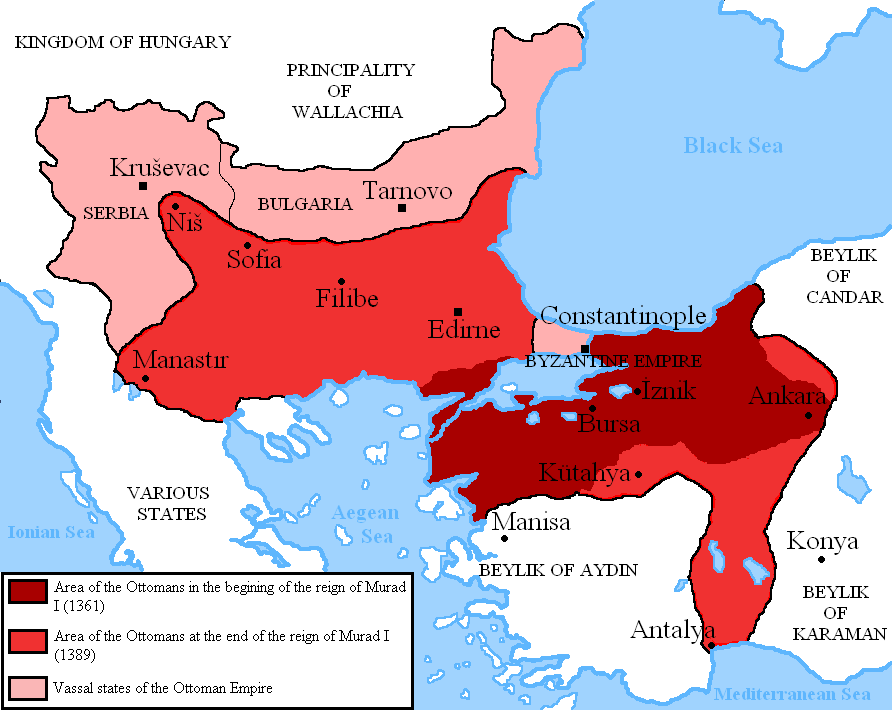
Nicopolis and the Crisis for Hungary
- In 1393, Bajazet captured Nicopolis, the strongest Bulgarian fortress on the Danube.
- Its location made it strategically important:
- it controlled a Danube crossing;
- it guarded communications through the interior;
- it was linked to tributary rivers and river traffic;
- it stood at a frontier point between Ottoman and Christian power.
- Bajazet later strangled the Bulgarian Czar Ivan Shishman and reduced his kingdom to a Turkish province.
- This alarmed Sigismund, King of Hungary.
- Hungary was now the last organized Christian state in Eastern Europe resisting Ottoman advance.
- Yet Hungary itself was internally fragile:
- Sigismund was a foreign ruler;
- the nobility was divided;
- peasants and townsmen were socially distinct;
- German merchant communities remained culturally separate;
- Hungary faced quarrels with Poland, Lithuania, Wallachia, and other neighbors.
- Sigismund had courage and intelligence but lacked secure authority.
- Tuchman portrays him as attractive, educated, multilingual, and politically capable, but also pleasure-loving, tactless, hot-tempered, and not strong enough to impose strategy on the crusading army.
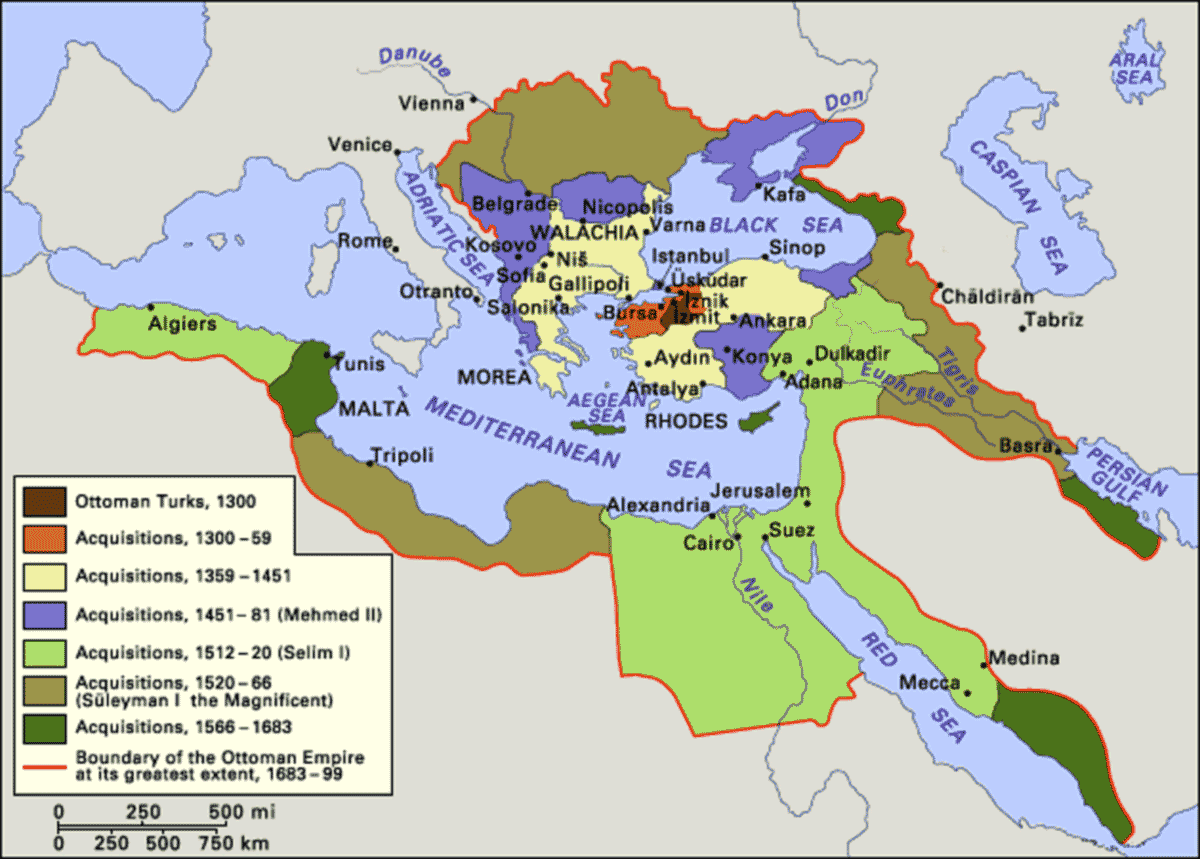
The West’s Earlier Failure to Respond
- Western Europe had not ignored the Turks entirely, but its responses had been fragmented and self-interested.
- Popes had repeatedly called for crusade, but these calls often served religious prestige more than practical defense.
- Venice and Genoa cared mainly about trade routes and commercial colonies.
- Cyprus cared about its own survival.
- The papacy cared about drawing the Greek Church back into Roman obedience.
- Earlier efforts failed:
- The Latin League captured Smyrna but could not sustain an effective land campaign.
- Pierre de Lusignan captured Alexandria in 1365, but his followers preferred to secure booty rather than hold the city.
- Amadeus of Savoy retook Gallipoli temporarily, but lacked the force to exploit the victory.
- Emperor John V tried to reunite with Rome to gain Western aid, but his own people rejected the move, and the West was preoccupied.
- Tuchman’s point is that the Ottoman threat was real, but Christendom responded with partial, temporary, and self-interested efforts rather than coordinated strategy.
Philippe de Mézières and the Ideal Crusade
- Philippe de Mézières was the most persistent advocate of crusade.
- For him, crusade was not merely military policy but a moral remedy.
- He believed a properly organized crusade would:
- restore Christian unity,
- end internal wars,
- reform tyrants,
- revive true knighthood,
- convert or defeat the enemies of Christendom,
- heal society’s moral disorder.
- Unlike many romantic crusaders, Mézières understood the Turks from firsthand experience.
- He knew they were disciplined, organized, and dangerous.
- He envisioned a serious military order, the Order of the Passion of Jesus Christ, combining knights, bourgeois, and commoners under discipline and religious purpose.
- Tuchman contrasts Mézières’ disciplined vision with the actual crusade that followed.
- His ideal was organized moral warfare.
- The real crusade became an aristocratic expedition of display, luxury, and vainglory.
Burgundy Takes Up the Crusade
- The Duke of Burgundy became the principal organizer.
- His motives were mixed:
- defense of Christendom,
- enhancement of his dynasty,
- prestige for his son,
- political self-magnification.
- Burgundy originally considered leading the crusade himself, along with Louis d’Orléans and the Duke of Lancaster.
- In the end, none of them went.
- Instead, Burgundy placed his son, Jean de Nevers, in nominal command.
- Nevers was twenty-four, not yet knighted, and inexperienced.
- Burgundy knew Nevers needed stronger guidance.
- He therefore asked Coucy to accompany him as chief counselor.
- Coucy was the most experienced French noble available:
- veteran of multiple campaigns;
- diplomat in France, England, Italy, and the papacy;
- former son-in-law of Edward III;
- royal councillor;
- former candidate for Constable;
- experienced in both chivalric and practical warfare.
- Coucy accepted, though reluctantly.
- He asked for the assistance of Guy and Guillaume de Tremoille and Admiral de Vienne.
- Tuchman stresses that the problem of command would become crucial.
The Absence of Unified Command
- Although Burgundy apparently wanted Coucy to guide Nevers, the formal command structure was confused.
- Nevers had one group of official counselors from Burgundy’s court.
- Coucy, D’Eu, Boucicaut, De la Marche, and Henri de Bar formed another consultative group whom Nevers could consult “when it seemed good to him.”
- This arrangement was militarily defective.
- It reflected a larger medieval problem: no coherent concept of unity of command.
- The expedition attracted knights eager for action after peace with England.
- Tuchman says many took the cross to escape idleness and employ themselves in chivalry.
- The army included roughly:
- 2,000 knights and squires,
- 6,000 archers and foot soldiers,
- allied contingents from Germany, Hungary, Venice, Rhodes, and elsewhere.
- The supposed English contingent was likely imaginary.
- Tuchman argues there is no evidence of official English financing or permission for such a force.
- The absence of the English may reflect both domestic English tensions and the lingering bitterness of the Anglo-French war.
Luxury, Display, and Preparation
- Burgundy prepared the crusade as a magnificent dynastic spectacle.
- Nevers’ company was outfitted in green livery.
- The expedition carried:
- satin tents,
- jeweled banners,
- embroidered pennons,
- velvet saddle blankets,
- heraldic trumpet covers,
- elaborate kitchen equipment,
- large quantities of wine and provisions.
- The costs were enormous.
- Burgundy taxed his territories heavily and borrowed from bankers, municipalities, and tax farmers.
- Even noncombatants paid in lieu of participation.
- Tuchman’s criticism is direct:
- display mattered more than practical military equipment;
- the crusaders spent on silk, velvet, gold, and feasting;
- they failed to prepare adequately for siege warfare.
- Mézières saw the problem immediately.
- He lamented that the crusaders did not go in the humility of pilgrims but like kings, preceded by minstrels and heralds.
- For him, the crusade was already corrupted by Vainglory.
The Crusaders’ Grandiose Aims
- The route led from Dijon through Germany and Austria to Buda, then down the Danube.
- The plan was ambitious:
- expel the Turks from the Balkans,
- relieve Constantinople,
- cross the Hellespont,
- march through Turkey and Syria,
- liberate Palestine and the Holy Sepulcher,
- return by sea.
- The plan assumed that Christian valor would overwhelm the Turks.
- It underestimated Ottoman discipline, mobility, and tactical sophistication.
- It also ignored recent lessons from failed expeditions such as Mahdia.
- A war council issued rules of discipline:
- nobles causing disorder could lose horse and harness;
- servants drawing knives could lose a hand;
- robbers could lose an ear.
- But the most important issue—obedience to command—was not solved.
- The French also claimed the avant-garde, the front line of battle.
- Tuchman notes that chivalry required glory in the front rank, but victory required something else.
Coucy’s Mission to Milan and the Valentina Affair
- Coucy did not travel with the main body at first.
- He was sent to Milan to warn Gian Galeazzo Visconti not to interfere with French control of Genoa.
- Behind this was the deteriorating relationship between France and Milan.
- Gian Galeazzo’s daughter Valentina, wife of Louis d’Orléans, had been accused of bewitching or poisoning Charles VI.
- These rumors were encouraged by Queen Isabeau and spread among the Paris public.
- Louis failed to defend Valentina and instead removed her from Paris.
- Gian Galeazzo was enraged by the humiliation of his daughter.
- Some later accused Gian Galeazzo of informing Bajazet of the crusaders’ plans in revenge.
- Tuchman does not assert this as fact, but says it was possible.
- Coucy may even have revealed details inadvertently during his Milanese mission.
Arrival in Hungary and Strategic Disagreement
- Nevers delayed with receptions, festivities, and borrowing money while the vanguard had already moved ahead.
- He reached Buda in July.
- Sigismund welcomed the crusaders with both joy and anxiety.
- He feared the problems of combining armies with different languages, customs, strategies, and command traditions.
- At the war council in Buda, Sigismund advised a defensive strategy:
- wait for Bajazet to come north;
- fight near Hungary where Sigismund had local control;
- avoid a long march through uncertain territory;
- let the Turks exhaust themselves.
- The French rejected this strategy.
- They believed Bajazet had failed to appear because he was afraid.
- They insisted on seeking out the enemy.
- Coucy, chosen as spokesman for the allies, rejected the defensive plan and said they had come to pursue the Turks.
- Tuchman presents this as a decisive error.
- Sigismund’s advice was strategically sound, but he lacked the authority and prestige to impose it.
- The French confused offensive movement with courage and prudence with cowardice.
The March Down the Danube
- The allied army marched down the Danube.
- The campaign quickly exposed indiscipline:
- pillage,
- sexual misconduct,
- mistreatment of local populations,
- friction with Hungarian and Balkan allies,
- feasting and luxury on campaign.
- The French alienated the local people whose information and support they needed.
- Clerics warned them that their behavior would invite divine punishment.
- The warnings had little effect.
- Tuchman cautions that chroniclers may have exaggerated the immorality because they wrote after the disaster and sought moral explanations.
- Still, the evidence points to serious disorder and contempt for local allies.
Vidin and Rachowa
- The crusaders first took Vidin, whose Bulgarian ruler surrendered rather than fight for the Turks.
- The French were deprived of the combat they desired, but used the occasion to knight Nevers and hundreds of companions.
- The next target was Rachowa.
- The French hurried ahead by night to reach it before their allies.
- They fought hard for the bridge but could not take the town alone.
- Sigismund sent reinforcements.
- The Bulgarian inhabitants arranged to surrender to Sigismund on condition that their lives and goods be spared.
- The French violated the surrender.
- They pillaged and massacred the town, claiming it had been taken by assault.
- A thousand Turkish and Bulgarian prisoners were taken for ransom.
- Rachowa was left in flames.
- This deepened the split between the French and Hungarians:
- the Hungarians saw the act as an insult to Sigismund;
- the French accused the Hungarians of trying to steal their glory;
- Sigismund’s fears about allied indiscipline were confirmed.
The Siege of Nicopolis
- The crusaders reached Nicopolis on September 12.
- The fortress was extremely strong:
- built on a limestone height,
- protected by cliffs and ravines,
- composed of upper and lower fortified towns,
- well supplied,
- commanded by the resolute Turkish governor Dogan Bey.
- The crusaders had brought no proper siege engines.
- Tuchman makes this a central symbol of the campaign’s failure.
- They had invested in luxury rather than tools of victory:
- silks,
- velvet,
- wine,
- gold embroidery,
- festive provisions.
- Boucicaut dismissed the lack of siege equipment, claiming ladders used by brave men were better than catapults.
- This reveals the chivalric mentality:
- courage was treated as a substitute for logistics;
- personal valor was treated as a substitute for technology;
- contempt for the enemy replaced planning.
- Since assault failed, the crusaders settled into blockade.
- Discipline deteriorated further:
- feasting,
- games,
- drunkenness,
- luxurious dress,
- mockery of allies,
- lack of sentinels.
- Local inhabitants, alienated by the crusaders’ misconduct, brought little information.
- Rumors of Bajazet’s approach were dismissed by the French as cowardly alarmism.
Coucy’s Reconnaissance Victory
- Coucy, unlike many others, wanted real intelligence about the enemy.
- He valued the knowledge of Wallachian allies who understood Turkish tactics.
- He led a reconnaissance force of 500 lances and 500 mounted archers.
- Learning that a Turkish force was approaching through a pass, he used a tactical ambush:
- a small party feigned retreat;
- the Turks pursued;
- Coucy’s hidden force attacked from behind;
- the vanguard turned back and attacked from the front.
- The ambush succeeded completely.
- The Turkish force was slaughtered.
- The victory had two negative consequences:
- it increased French overconfidence;
- it intensified the jealousy of the Constable, Comte d’Eu.
- D’Eu accused Coucy of risking the army and stealing glory from Nevers.
- This personal jealousy became a strategic problem.
The Battle Plan Dispute
- Sigismund proposed a rational battle plan.
- He wanted Wallachian infantry to engage the Turkish vanguard first.
- The Turkish front line was often composed of irregular or expendable troops meant to absorb the first shock.
- After the enemy’s first line was spent, the French knights could strike fresh and decisive blows.
- Hungarian and allied forces would support them and prevent Turkish cavalry from enveloping them.
- D’Eu rejected this plan furiously.
- He argued that French knights had not come so far to be preceded by peasant infantry.
- He treated the issue as one of honor rather than tactics.
- As Constable, he claimed the right to lead the first charge.
- Boucicaut supported him.
- Nevers and the younger knights were easily persuaded.
- Coucy and Admiral de Vienne advised obeying Sigismund.
- They saw the wisdom of waiting and fighting in coordination with the whole army.
- D’Eu refused.
- Tuchman’s point is that presumption defeated prudence.
- The older and wiser commanders could not overcome the younger men’s honor culture.
- In a society governed by the mystique of valor, caution could be treated as cowardice.
The Massacre of the Prisoners
- Before the battle, the French killed the prisoners taken at Rachowa.
- The stated reason was that they lacked guards.
- Tuchman treats this as a barbaric act and one of the moral low points of the campaign.
- It later intensified Bajazet’s rage and contributed to his execution of Christian prisoners after the battle.
The Battle of Nicopolis
- On September 25, 1396, the French advanced against the Turks.
- The Hospitalers, Germans, Hungarians, and other allies remained with Sigismund.
- The French assault initially succeeded.
- They smashed the untrained Turkish front line.
- They then pushed into trained infantry and came under arrow volleys.
- They encountered rows of sharpened stakes set at horse-belly height.
- The French broke through, but at great cost.
- Many horses were impaled or lost.
- Knights dismounted and fought with swords and axes.
- After routing the Turkish infantry, Coucy and Vienne urged a pause:
- rest the men,
- restore order,
- wait for the Hungarians,
- avoid advancing blindly.
- The younger knights refused.
- Believing victory was near, they pursued uphill.
- They did not know the Sultan had held a fresh corps of cavalry in reserve.
- Meanwhile, the broader allied army collapsed under Turkish pressure.
- The Wallachians and Transylvanians deserted after seeing riderless horses and assuming defeat.
- Sigismund and the Grand Master of Rhodes fought hard but were overwhelmed.
- A decisive Serbian cavalry intervention under Stephen Lazarevich, Bajazet’s vassal, tipped the balance.
- Sigismund escaped by boat to the allied fleet.
- The French reached the plateau expecting victory.
- Instead, they faced fresh Turkish cavalry.
- Surrounded and exhausted, they fought desperately.
- Admiral de Vienne died holding the banner of Notre Dame.
- Coucy fought with great physical strength and remained unshaken under blows.
- D’Eu and Boucicaut fought bravely, but bravery could not repair the tactical disaster.
- Nevers was surrounded and surrendered.
- The remaining French surrendered after him.
- The battle was completely lost.
T==he Consequences of Defeat==
- Tuchman emphasizes the historical seriousness of the defeat.
- If the crusaders had fought in unity with their allies, the outcome might have been different.
- Instead:
- the Western challenge was turned back;
- the Turks held Nicopolis;
- Ottoman power remained firmly lodged in Europe;
- Constantinople’s eventual fall became more likely;
- Bulgaria remained under Turkish domination for centuries.
- Sigismund’s judgment is blunt:
- the day was lost by French pride and vanity.
- Tuchman agrees, but she adds that Turkish discipline, tactics, and training were also superior.
Bajazet’s Revenge
- After the battle, Bajazet inspected the field.
- He was enraged by the scale of Turkish losses and by the discovery that the crusaders had massacred the prisoners from Rachowa.
- He ordered the Christian prisoners brought before him.
- A French knight, Jacques de Helly, who had served with Murad, was asked to identify high-ranking nobles worth ransom.
- Nevers, Coucy, D’Eu, Guy de Tremoille, Jacques de la Marche, Boucicaut, and others were spared.
- Younger prisoners were also spared for service.
- The rest were executed.
- They were marched naked before the Sultan, bound in groups.
- Executioners decapitated, cut throats, or dismembered them.
- The high-ranking prisoners were forced to watch.
- Nevers saved Boucicaut by signaling that he was like a brother and worth ransom.
- The executions lasted from morning to late afternoon before Bajazet stopped them.
- Estimates range widely, but Tuchman gives the more plausible range as several hundred to several thousand.
Flight, Captivity, and Ruin
- Many fugitives died after the battle.
- Some drowned in the Danube while trying to escape.
- Some were pushed away from overloaded boats.
- Others wandered through stripped lands, starving and ragged.
- Count Rupert of Bavaria reached home in beggar’s clothes and died soon after.
- Sigismund avoided Wallachian treachery by sailing to the Black Sea and Constantinople before returning home by sea.
- The surviving nobles faced captivity and ransom.
- The crusade’s glory had ended in humiliation, execution, and ruin.
Tuchman’s Judgment on Why Nicopolis Failed
- Tuchman lists several contributing causes:
- luxury,
- immorality,
- pride,
- dissension,
- lack of discipline,
- lack of siege engines,
- poor intelligence,
- superior Turkish tactics,
- superior Turkish training.
- But she identifies the deeper cause as the chivalric insistence on personal prowess.
- The French did not fight primarily for a strategic goal.
- They fought to vindicate their own image of themselves as warriors.
- Their culture valued:
- being first in battle,
- visible courage,
- personal glory,
- honor before prudence,
- display before logistics.
- Tuchman contrasts this with Charles V and Coucy’s more pragmatic style of war.
- Charles V had cared less about glory than about getting the English out of France.
- Coucy often used money, diplomacy, negotiation, and political bargains before resorting to arms.
- At Nicopolis, this practical tradition was overwhelmed by the renewed chivalric fantasy represented by D’Eu, Boucicaut, and the younger knights.
- The chapter’s final analytical point is that dominant ideas change slowly.
- Even after Crécy, Poitiers, and Mahdia, the French still believed themselves supreme in war.
- They could not adapt to enemies who fought by different rules.
- The crusaders began with a strategic purpose but were mentally captured by honor and glory.
Key Concepts for Nicopolis
- Chivalric Prowess
- The aristocratic ideal that a knight proves his worth through visible courage, front-line combat, and personal glory.
- Tuchman treats this as the central cause of the disaster because it displaced strategy, discipline, and unity of command.
- Unity of Command
- The principle that an army requires clear, recognized authority in order to act coherently.
- The crusade lacked this: Nevers was nominal commander, Coucy was an informal counselor, D’Eu claimed precedence as Constable, and Sigismund’s strategic advice was ignored.
- Vainglory
- The pursuit of glory for its own sake.
- Mézières saw vainglory in the crusaders’ luxury, display, and aristocratic self-dramatization.
- Pragmatic Warfare
- War fought for concrete objectives using diplomacy, money, negotiation, intelligence, and force as needed.
- Tuchman associates this with Charles V and often with Coucy.
- Chivalric Warfare
- War imagined as a theater for honor, courage, and noble distinction.
- At Nicopolis, this meant claiming the vanguard, rejecting peasant infantry, despising defensive strategy, and pursuing prematurely.
- Ottoman Ghazi Ethos
- The Turkish holy-war identity in which warriors saw themselves as instruments of Allah against Christian “polytheism.”
- Tuchman uses this to show that the Turks had their own religious-military ideology, not merely brute force.
- Balkan Fragmentation
- The political and religious division among Byzantines, Serbs, Bulgarians, Wallachians, Hungarians, Latins, and Orthodox Christians.
- This fragmentation made unified resistance to Ottoman expansion extremely difficult.
- Strategic Contempt
- The habit of underestimating an enemy because he is culturally or religiously despised.
- The French contempt for “infidels” led them to neglect siege engines, intelligence, and tactical caution.
- Moralized Defeat
- The tendency of chroniclers to explain disaster as punishment for sin.
- Tuchman uses the Monk of St. Denis carefully, noting that his vivid denunciations may have been shaped by hindsight.
- Nicopolis as Turning Point
- The battle confirmed Ottoman power in Europe and ended the last major medieval crusade of real consequence.
- It also exposed the exhaustion and inadequacy of late medieval chivalric culture.
Questions for Reflection for Nicopolis
- Why does Tuchman see personal prowess rather than simple military incompetence as the deepest cause of the defeat at Nicopolis?
- How does Coucy’s practical military judgment differ from the chivalric mentality of D’Eu, Boucicaut, and the younger French knights?
- Why was Sigismund’s defensive strategy more rational, and why were the French unable to accept it?
- How did religious division among Christians help the Ottoman advance into Europe?
- What does the contrast between luxury preparation and lack of siege equipment reveal about late medieval aristocratic culture?
Chapter 27 — Hung Be the Heavens with Black
Chapter Objective
This chapter closes Tuchman’s account of Enguerrand de Coucy and uses his death after the disaster at Nicopolis as a symbolic ending for the fourteenth century itself. The chapter explains the aftermath of the failed crusade: the captivity and ransom of the French nobles, Coucy’s death in Ottoman hands, the financial and dynastic consequences of the defeat, and the final collapse of the old ideals of chivalry, monarchy, and Church unity. Tuchman’s broader argument is that the century ended in a condition of institutional default: knighthood failed to protect, the Church failed to guide, monarchy failed to stabilize, and society longed for order while stumbling toward the transformations of the modern age.
The Christian Army Destroyed
- After Nicopolis, the great Christian crusading army was effectively gone:
- many were dead,
- many had fled,
- many were captives of the Turks.
- Although the road to Hungary lay open, Bajazet did not press forward.
- Tuchman rejects the idea that gout alone stopped him.
- The more important reason was that the Turks had also suffered heavy losses and had reached the limits of immediate military capacity.
- Bajazet returned to Asia but first sent Jacques de Helly to France:
- to announce the Turkish victory,
- to inform the French court who had survived,
- to demand ransom for the captives.
The Prisoners’ March to Gallipoli
- The French prisoners endured a brutal 350-mile march to Gallipoli.
- They were:
- stripped nearly naked,
- often barefoot,
- tied by the hands,
- beaten by their guards,
- underfed,
- exposed to heat by day and cold by night.
- For nobles who had lived almost entirely on horseback, the forced barefoot march was both physically painful and socially humiliating.
- Tuchman stresses the psychological shock:
- these men had expected glory,
- instead they suffered degradation,
- they were now dependent on an enemy outside the codes of Christian chivalry.
Coucy’s Miracle on the Road
- Coucy, the eldest of the major captives, nearly collapsed from cold and exhaustion.
- He had never before been a prisoner or a defeated man, making his suffering especially stark.
- Believing he was near death, he prayed to Notre Dame of Chartres.
- Suddenly, a Bulgarian appeared with a gown, hat, and heavy cloak.
- The stranger gave these to Coucy, restoring his strength and spirits.
- Coucy interpreted the event as a miracle.
- In gratitude, he later left 600 gold florins to Chartres Cathedral in his will.
- His physician and executor, Geoffrey Maupoivre, witnessed the event and recorded it for the cathedral.
- Tuchman uses this episode to show the medieval fusion of:
- physical survival,
- religious interpretation,
- personal devotion,
- and final preparation for death.
Captivity at Gallipoli and Brusa
- At Gallipoli, noble captives were held in the upper rooms of a tower.
- Common prisoners were held below.
- The captives could see the shores of Troy across the straits.
- Tuchman turns this into a meditation on war:
- Troy was the archetypal tale of human bellicosity,
- full of heroism, folly, rage, deceit, sacrifice, and destruction.
- The comparison suggests that the Crusade of Nicopolis was another tragic repetition of the ancient pattern: noble violence wrapped in ideals but ending in ruin.
- After two months, the captives were moved to Brusa, the Ottoman capital in Asia.
- Brusa was inland, surrounded by mountains, and much farther from any hope of rescue.
- The captives feared Bajazet might kill them at any moment.
- Everything now depended on ransom.
News Reaches France
- Rumors of the defeat reached Paris in early December.
- At first, the disaster seemed unbelievable.
- Those spreading rumors were imprisoned in the Châtelet and threatened with drowning if found guilty of lying.
- The French court sent envoys in multiple directions to discover the truth.
- On Christmas Day, Jacques de Helly entered the palace of St. Pol and confirmed the defeat before the King and court.
- He reported:
- the campaign,
- the battle,
- the deaths,
- the massacre of prisoners,
- the surviving nobles held for ransom.
- The court was overwhelmed.
- Families crowded around Helly to learn who was alive, dead, or missing.
- Once the truth was established, the imprisoned rumor-mongers were released.
Mourning in France and Burgundy
- The defeat produced widespread mourning:
- black garments appeared everywhere,
- churches filled with prayers,
- bells tolled throughout Paris,
- solemn services were held for the dead.
- The grief was intensified because:
- many bodies had not received Christian burial,
- the fate of the prisoners remained uncertain,
- many noble families in Burgundy had lost sons, husbands, or relatives.
- Tuchman presents the timing as bitterly ironic:
- France had just celebrated peace with England through Richard II’s marriage to Isabelle,
- but joy was immediately smothered by news of Nicopolis.
Efforts to Ransom the Captives
- The Dame de Coucy wrote to the Doge of Venice seeking help in ransoming her husband.
- Louis d’Orléans sent envoys to recover Coucy and Henri de Bar.
- Burgundy prepared a major diplomatic mission to the Sultan.
- The ransom effort required gifts selected to appeal to Bajazet:
- white gerfalcons,
- jeweled falconers’ gloves,
- horses,
- hounds,
- ornate saddles,
- scarlet cloth,
- tapestries depicting Alexander the Great.
- The gifts reflected the belief that Bajazet could be reached through aristocratic tastes: hunting, splendor, prestige, and claims of heroic descent.
- Venice became the central logistical hub:
- for news,
- travel,
- credit,
- banking,
- communication with the Ottoman world.
- Gian Galeazzo Visconti suddenly became important again because he was believed to have influence at the Ottoman court.
- The French court tried to reconcile with him by granting him the right to add the fleur-de-lys to the Visconti arms.
The Financial Burden of Ransom
- Burgundy’s subjects, already taxed to finance the crusade, were taxed again to ransom its survivors.
- The traditional aid for a lord’s ransom was demanded from towns, counties, and clergy.
- Resistance and bargaining followed because the burden was heavy.
- Tuchman uses Deschamps’ complaint of “Money! Money!” to show the chronic fiscal pressure of the age.
- Taxes, documents, lawyers, nobles, and collectors bore down on commoners.
- Sometimes commoners killed tax collectors, but these revolts did not produce lasting relief.
- The cost of aristocratic glory was paid by the lower orders.
- Tuchman’s implication is severe:
- nobles pursued chivalric display,
- lost catastrophically,
- and then charged society for their rescue.
Coucy’s Decline in Captivity
- In Brusa, Coucy became gravely ill.
- Some accounts describe him as sunk in melancholy.
- Tuchman suggests that physical illness, wounds, exhaustion, and harsh captivity were likely more important than abstract despair.
- Coucy was fifty-six, not extremely old by medieval standards.
- Tuchman pauses to correct the assumption that old age came universally early in the Middle Ages:
- many people died young,
- but those who reached their fifties or sixties were not necessarily seen as decrepit.
- Coucy had lived an exceptionally active life:
- war,
- diplomacy,
- administration,
- marriage politics,
- campaigns in Italy, France, Flanders, Tunisia, Genoa, and Hungary.
- The catastrophe at Nicopolis may have broken him because it represented more than personal defeat.
- It may have revealed to him a deeper failure of knighthood itself:
- the battle was fought against his advice,
- his comrades were slaughtered before him,
- the enterprise he was meant to guide ended in humiliation,
- and he was now captive in a world beyond the rules he knew.
Coucy’s Last Will
- On February 16, 1397, Coucy drew up a long codicil to his will.
- He described himself as sound of mind but infirm of body.
- The will reveals what mattered to a late medieval noble facing death.
- His first concern was burial in France:
- his body at Nogent,
- his heart at Ste. Trinité in Soissons.
- He later added instructions to ensure that, if necessary, at least his bones and heart would be returned.
- Tuchman notes the contradiction:
- official Christian teaching treated the body as carrion and the soul as what mattered,
- yet medieval nobles cared intensely about the physical handling, division, burial, and commemoration of their remains.
- Coucy’s second major concern was Ste. Trinité, his monastic foundation.
- He ordered valuable liturgical gifts:
- a large silver cross,
- a silver censer,
- cruets,
- a silver ewer,
- a silver-gilt chalice,
- priestly ornaments.
- He also left bequests to numerous churches and chapels, including:
- Notre Dame de Chartres,
- Notre Dame de Liesse,
- Pierre de Luxemburg’s chapel at Avignon,
- chantries in Soissons,
- the poor of Paris,
- the poor of his domain,
- the Hôtel Dieu in Paris.
- Unlike some nobles, Coucy does not appear to have been preoccupied with deathbed restitution for wrongs committed.
- His concerns were:
- religious salvation,
- proper burial,
- fulfillment of debts,
- payment of servants,
- care of institutions tied to his memory.
The Death of Enguerrand de Coucy
- Coucy died in Brusa on February 18, 1397.
- Tuchman presents him as one of the least morally compromised nobles of his class.
- He was not free from the assumptions of his age, but he was steadier, more competent, and less reckless than most.
- She describes him as:
- sagacious,
- cool in judgment,
- capable in action,
- trusted by others,
- largely immune to the “furious follies” of his class.
- Tuchman compares him in some qualities to George Washington:
- steadiness,
- competence,
- public trust,
- disciplined judgment.
- But she adds that Coucy lacked the historical conditions that might have called forth national leadership.
- His age did not provide him with a coherent national cause or political structure in which such leadership could fully emerge.
- Coucy served his time well but did not transcend it.
- He “went with it, served it better than most, and died of its values.”
Funeral, Memory, and Deschamps’ Lament
- Coucy’s death was not known in Paris for two months.
- His remains, or at least his embalmed heart and body or bones, were returned to France.
- His widow was devastated.
- A grand funeral was conducted by the Bishops of Noyon and Laon.
- His body or remains were buried at Nogent.
- His heart was buried at Ste. Trinité.
- Eustache Deschamps wrote a dirge treating Coucy’s death almost as a national event.
- The poem praised him as:
- a great baron,
- a true knight,
- a servant of his sovereign,
- brave in many lands,
- generous,
- tireless,
- a defender of the faith.
- Tuchman includes the lament but comments that much fourteenth-century French poetry has limited charm in translation because of its rigid rhyme and erratic meter.
The Ransom Completed
- Ransom negotiations were finally completed in June 1397.
- The sum was fixed at 200,000 ducats or gold florins.
- Burgundy’s magnificent gifts may have backfired by convincing Bajazet that the Burgundians could pay even more.
- Financing the ransom required an international credit network.
- The central figure was Dino Rapondi, Burgundy’s banker and purveyor.
- Funds came from:
- Burgundy,
- the Knights of Rhodes,
- the King of Cyprus,
- merchants of the Archipelago,
- Venice,
- Sigismund’s assigned revenues,
- Gattilusio of Mitylene.
- The surviving prisoners were released on June 24, 1397, after a down payment.
- They had to remain in Venice until the full ransom was paid.
- Comte d’Eu, whose pride had helped cause the disaster, died nine days before release.
- Tuchman calls this “cruel justice.”
Bajazet’s Farewell and the Return Home
- Bajazet dismissed the prisoners with a challenge.
- He told Nevers that he did not require an oath never to fight him again.
- Instead, he invited him to raise another army and return, boasting that he would always be ready to conquer deeper into Christendom.
- Bajazet then displayed his own splendor through a massive hunt:
- thousands of falconers,
- thousands of huntsmen,
- hounds,
- leopards,
- satin blankets,
- diamond collars.
- The released crusaders did not return home quickly.
- They stopped at Mitylene, Rhodes, Venice, and elsewhere.
- They needed clothing, rest, credit, and funds to travel in a manner suitable to their rank.
- The costs after release nearly equaled the ransom itself.
- Burgundy refused to let his son return looking poor or defeated.
- More money was raised to fund Nevers’ dignified return.
- Plague in Venice forced the crusaders to move to Treviso.
- Henri de Bar, Coucy’s son-in-law, died there.
- This left Marie de Bar, Coucy’s daughter and principal heir, both fatherless and widowed.
Nevers’ Triumphal Return
- The surviving crusaders re-entered France in February 1398.
- Nevers was received with ceremonies, gifts, music, and public celebration.
- At Dijon, he liberated prisoners from the city jail in memory of his own captivity.
- Burgundy ordered his son to make a triumphal progress through towns whose taxes had paid for his return.
- Tuchman is skeptical of the celebrations.
- They likely represented organized dynastic joy more than spontaneous popular enthusiasm.
- Many Burgundian families had lost sons who did not return.
- Yet public ceremony was necessary for the prestige of Burgundy and his heir.
- The result was grotesque:
- a catastrophic defeat was covered with pomp,
- the “culminating fiasco of knighthood” was buried under minstrelsy and display.
Moral Interpretations of Nicopolis
- The defeat reinforced late medieval pessimism.
- Writers and moralists responded quickly:
- Mézières wrote the Epistre Lamentable et Consolatoire.
- Deschamps wrote a ballade for the French fallen.
- Bonet wrote an allegorical satire.
- Deschamps blamed Nicopolis on pride and folly.
- Mézières blamed the absence of four military virtues:
- order,
- discipline,
- obedience,
- justice.
- For Mézières, God abandons an army that lacks these virtues.
- He saw Nicopolis as one in a long sequence of defeats from Crécy and Poitiers onward.
- Bonet went deeper by questioning the aristocratic assumption that only mounted knights had military value.
- He argued that peasants and common soldiers could endure hardship and fight effectively if armed.
- Other writers made similar observations.
- Tuchman presents this as an emerging critique of chivalric warfare:
- the common soldier had become militarily significant,
- but knights resisted sharing glory with commoners.
The Ottoman Victory and Tamerlane
- Bajazet’s victory did not immediately lead to further Ottoman conquest in Europe because he soon faced a greater enemy in the East: Tamerlane.
- Tamerlane overran Anatolia with extreme brutality.
- In 1402, he defeated Bajazet at Angora and captured him alive.
- Bajazet died in captivity, a symmetrical reversal of his own treatment of defeated enemies.
- Europe failed to exploit this opportunity.
- It was too absorbed in:
- internal factions,
- dynastic struggles,
- the Schism,
- French and English domestic conflict.
- Constantinople received little meaningful help.
- Ottoman power recovered.
- In 1453, Bajazet’s great-grandson Mohammed II conquered Constantinople.
The Fate of the Coucy Domain
- After Coucy’s death, his enormous barony became the object of rivalry.
- The domain included:
- castles,
- forests,
- around 150 towns and villages,
- valuable revenues,
- strategic position in northern France.
- A dispute broke out between:
- Marie de Bar, Coucy’s eldest daughter and heir,
- the Dame de Coucy, his widow.
- Queen Isabeau tried to arrange a marriage between her father, Stephen of Bavaria, and the Dame de Coucy.
- This raised fear that the strategic domain might pass into foreign Bavarian hands.
- To prevent this, Louis d’Orléans pressured Marie into selling the barony to him.
- The deed justified the sale as serving the good of the Kingdom of France.
- Tuchman leaves open whether Louis acted mainly for France or for personal power against Burgundy.
- The sale price was 400,000 livres, but Louis paid only part of it.
- Lawsuits followed for years.
- Eventually, the Coucy barony passed to the French crown when Louis’ descendant became Louis XII.
- Symbolically, Coucy’s house disappeared into royal power.
- The great independent barony that had stood for feudal grandeur was absorbed into the monarchy.
The Schism and the Failed Meeting at Reims
- In 1398, Charles VI and Emperor Wenceslas met at Reims to address the Schism.
- The meeting represented another attempt to secure mutual abdication of the rival popes.
- It failed almost absurdly because of the personal incapacity of the two rulers:
- Charles was sliding back into madness,
- Wenceslas was drunk.
- France later withdrew obedience from Benedict XIII and even besieged him in the papal palace.
- These measures failed to end the Schism.
- Richard II supported French efforts to pressure the Roman pope, but this further angered his English subjects.
The Fall of Richard II
- Richard II’s pro-French policy intensified hostility in England.
- Londoners mocked him as Richard of Bordeaux, implying that his heart was French.
- Then came the “great and horrible” events in England:
- Richard had Gloucester removed to Calais and murdered,
- Arundel was executed,
- Warwick and the Percys were banished,
- fear and hatred spread among the English nobility.
- In 1399, Henry Bolingbroke returned and deposed Richard without serious resistance.
- Richard was forced to resign the crown and later died in prison, likely by deliberate neglect or worse.
- With Richard gone, the strongest prop of Anglo-French peace disappeared.
- Henry IV talked of breaking the truce but was too occupied with maintaining his usurped throne to resume major war immediately.
Froissart’s Disillusionment
- The fall of Richard II deeply shocked Froissart.
- His world depended on the ideals of monarchy, nobility, ceremony, and chivalric order.
- A king’s deposition undermined the assumptions that sustained his imagination.
- Froissart’s chronicle breaks off as the century ends.
- Tuchman presents this as symbolically appropriate.
- The age that Froissart had celebrated as a pageant of noble adventure closed in shadow.
- The glittering surface of chivalry had been exposed as hollow.
The Fourteenth Century as a Time of Default
- Tuchman closes with a broad assessment of the century.
- For a few at the top, it had seemed brilliant and adventurous.
- For most people, it was a succession of disasters:
- pillage,
- plague,
- taxes,
- war,
- brigandage,
- famine,
- insurrection,
- sorcery,
- murder,
- madness,
- social disorder,
- deserted fields,
- declining population.
- She describes the age as a time of default:
- Knighthood failed to protect.
- The Church failed to guide souls.
- Towns failed to sustain the common good.
- Monarchy failed to ensure order.
- Chivalry failed morally and militarily.
- The Schism shook the central institution of Christian life.
- People felt swept by events beyond their control.
- They longed for remedy, revival, stability, and order, but none came.
Change Beneath Collapse
- Despite the bleakness, Tuchman insists the times were not static.
- Failure itself created pressure for change.
- Several transformations were underway:
- Wyclif and reform movements arose from the Church’s failures.
- Monarchy and centralized states grew stronger.
- Seaborne enterprise expanded through navigational tools like the compass.
- Literature in national languages developed from Dante to Chaucer.
- Printing was on the horizon: Gutenberg was born in the year Coucy died.
- Tuchman does not claim that these changes immediately redeemed the age.
- Conditions would grow worse for another fifty years.
- Yet eventually, through “mysterious chemistry,” new energies and ideas broke through the mold of the Middle Ages.
- The chapter ends by suggesting that the fourteenth century’s suffering was not meaningless, but its consequences were indirect and delayed.
- The age did not solve its own problems.
- It transmitted them forward until new forms of thought, power, and society emerged.
Key Concepts for Hung Be the Heavens with Black
- Institutional Default
- Tuchman’s broad diagnosis of the late fourteenth century.
- Major institutions continued to exist but failed in their essential functions: knights did not protect, the Church did not guide, towns did not preserve the commonweal, and monarchy did not provide stable order.
- The Failure of Chivalry
- Nicopolis revealed that chivalry’s ideals of valor, honor, and noble combat could not substitute for discipline, logistics, intelligence, and unified command.
- The postwar celebration of Nevers showed chivalry’s capacity to cover failure with ceremony.
- Ransom Economy
- The financial system by which captured nobles were redeemed through vast payments raised by taxation, credit, gifts, and international banking.
- It shows the material underside of aristocratic warfare.
- Deathbed Piety
- Coucy’s will reflects the late medieval concern with burial, prayers, religious foundations, relic-like bodily remains, and gifts to churches and the poor.
- Salvation was pursued through institutional memory and liturgical obligation.
- Noble Memory
- Coucy’s funeral, tomb, heart burial, and poetic lament turned his death into a public aristocratic event.
- His memory was preserved through ritual, poetry, architecture, and institutional bequests.
- Absorption of Feudal Power
- The sale and eventual transfer of the Coucy domain to the French crown represents the long-term weakening of independent feudal lordships and the growth of centralized monarchy.
- Moralized Defeat
- Writers interpreted Nicopolis not merely as a tactical failure but as punishment for pride, disorder, and sin.
- Mézières especially saw defeat as the result of missing moral virtues: order, discipline, obedience, and justice.
- Common Soldier Critique
- Bonet and others began challenging the assumption that only mounted knights mattered militarily.
- This anticipates the larger decline of aristocratic cavalry supremacy.
- Historical Transition
- The chapter frames the end of the fourteenth century as both collapse and preparation.
- The old medieval order was failing, while reform movements, centralized states, vernacular literature, maritime expansion, and printing pointed toward a different future.
- Coucy as the Last Whole Man
- Tuchman presents Coucy as unusually steady, competent, and honorable within a fractured age.
- He did not transcend his time, but he served it better than most and died from its values.
Questions for Reflection for Hung Be the Heavens with Black
- Why does Tuchman treat Coucy’s death as more than the death of one nobleman? What does he symbolize about the fourteenth century?
- How does the ransom process reveal the financial burden that aristocratic warfare placed on ordinary society?
- In what ways did the celebration of Nevers’ return disguise the real meaning of Nicopolis?
- Why does Tuchman describe the late fourteenth century as a time of default, and which institutions failed most seriously?
- How does the chapter balance decline with transition? What signs of future renewal does Tuchman identify amid collapse?
Epilogue — A Distant Mirror
Chapter Objective
The epilogue explains how the forces unleashed during the fourteenth century continued into the fifteenth: civil war in France, renewed English invasion, the collapse of chivalric military prestige, the long struggle to end the papal schism, the rise of conciliar reform, the growth of centralized monarchy, and the first signs of the modern world. Tuchman uses the aftermath of Coucy’s death to show that the fourteenth century did not end cleanly; its disorders deepened before they began to generate transformation. The epilogue closes the book by tracing both decline and transition: the medieval order failed, but from that failure emerged stronger states, new military forms, vernacular literature, print, oceanic expansion, and the early movements that would lead toward Reformation and modernity.
The Fourteenth Century’s Forces Continue
- Tuchman begins by arguing that the next fifty years after Coucy’s death saw the forces of the fourteenth century play themselves out in exaggerated form.
- The Black Death receded after a heavy recurrence at the end of the century, but other disorders continued:
- war,
- brigandage,
- depopulation,
- moral exhaustion,
- the cult of death,
- the struggle to end the papal schism,
- the demand for Church reform.
- Society reached a low point both physically and morally.
- The epilogue is not merely an afterword; it is Tuchman’s explanation of how the fourteenth century’s failures carried forward into the fifteenth.
John the Fearless and the Murder of Louis d’Orléans
- In France, Jean de Nevers, who became Duke of Burgundy in 1404, turned political rivalry into open murder.
- In 1407, he arranged the assassination of Louis d’Orléans in the streets of Paris.
- Louis was attacked after dark by hired killers:
- his left hand was cut off,
- he was dragged from his mule,
- he was hacked to death with swords, axes, and clubs,
- his body was left in the gutter.
- John the Fearless avoided punishment because of his ducal power.
- He publicly justified the murder as tyrannicide, accusing Louis of corruption, vice, sorcery, and public villainy.
- Because Louis was associated with court extravagance and heavy taxation, John could present himself as a defender of the people.
- Tuchman uses this episode to show the political vacuum caused by Charles VI’s madness.
- With the King helpless, powerful nobles could claim to defend the common good while pursuing private vengeance and factional power.
Burgundians, Orléanists, and Civil War in France
- The murder of Louis d’Orléans created a long civil conflict between Burgundians and Orléanists.
- France was consumed for decades by:
- factional hatred,
- brigandage,
- rival armies,
- pillage,
- massacre,
- abuse of finance and justice,
- sale of offices,
- corruption in Parlement,
- multiplication of taxes.
- Both factions raised the Oriflamme against each other, turning the royal symbol of sacred war inward against fellow Frenchmen.
- The realm descended into administrative and moral disorder.
- Tuchman presents this as the continuation of earlier patterns:
- Charles of Navarre’s treachery,
- the Maillotins’ revolt,
- aristocratic faction,
- urban violence,
- inability to convert reform demands into stable government.
The Cabochien Revolt
- The middle class again tried to reform corrupt government, much like Etienne Marcel had done decades earlier.
- In Paris, the movement became entangled with the violent revolt of the Cabochiens, named after their leader Caboche.
- The Cabochiens included butchers, skinners, and tanners.
- Their revolt reproduced the violence of the Maillotins but with even greater brutality.
- The bourgeoisie eventually recoiled from the violence.
- They opened the gates to the Orléanist party, which:
- suppressed the revolt,
- restored corrupt officials,
- canceled reforms,
- persecuted reformers.
- John of Burgundy withdrew during the violence and was later declared a rebel.
- He then allied with the English, repeating the pattern of French nobles using foreign enemies in domestic struggles.
Henry V and the Renewal of the Hundred Years’ War
- Henry IV died in 1413 after years of domestic struggle.
- He was succeeded by Henry V, who brought energy, discipline, and ambition to the English crown.
- Henry V revived the old claim to the French throne.
- His motives included:
- exploiting French civil war,
- using alliance with Burgundy,
- uniting England behind the Lancastrian dynasty,
- pursuing conquest under the language of rightful inheritance.
- In 1415, Henry invaded France.
- He captured Harfleur and then marched toward Calais.
- Near the field of Crécy, he met the French army at Agincourt.
Agincourt and the Confirmation of Chivalric Failure
- Tuchman argues that Agincourt was not decisive in the same way as Crécy or Poitiers.
- Crécy led to Calais and transformed the war.
- Poitiers destroyed confidence in the noble knight.
- Agincourt confirmed both results.
- The French army outnumbered the English by three or four to one.
- Yet French command and tactics had barely improved:
- crossbowmen from Paris were rejected;
- archers were placed uselessly behind the nobles;
- the battlefield was poorly chosen;
- no commander-in-chief imposed a tactical plan;
- nobles crowded the front line seeking glory.
- Heavy plate armor, intended to protect knights from arrows, reduced mobility and stamina.
- Rain turned the field into mud.
- French knights, packed together, stumbled and suffocated in their own formation.
- English archers, lightly equipped and mobile, first shot into the French and then attacked with axes, hatchets, hammers, and swords.
- The result was slaughter.
- French losses included:
- three dukes,
- five counts,
- ninety barons,
- many knights,
- Coucy’s grandson Robert de Bar,
- Coucy’s son-in-law Philip Count of Nevers.
- Charles d’Orléans, now lord of Coucy, was captured and remained in England for twenty-five years.
- Boucicaut was also captured; Agincourt was his final combat.
- Tuchman’s main point:
- valor was not competence.
- French chivalry still prized glory over tactical adaptation.
- English success depended heavily on common soldiers and archers.
Artillery, Normandy, and the Treaty of Troyes
- Henry V returned after a pause and pursued systematic conquest.
- Improved artillery and gunpowder technology now changed siege warfare.
- Walled cities were no longer as secure as they had been.
- From 1417 to 1419, Henry conquered Normandy while France remained consumed by internal conflict.
- The siege of Rouen showed the brutality of war:
- defenders expelled 12,000 civilians to save food;
- the English refused to let them pass;
- civilians starved and froze between the lines.
- French factions tried to reconcile when Paris itself was threatened.
- In 1419, a meeting between the Dauphin and John the Fearless was arranged at Montereau.
- The meeting ended in murder:
- suspicion and harsh words escalated,
- the Dauphin withdrew,
- his followers killed John the Fearless.
- This avenged Louis d’Orléans but destroyed any possibility of reconciliation.
- John’s son, Philip of Burgundy, allied fully with Henry V.
- The result was the Treaty of Troyes in 1420.
- Charles VI and Queen Isabeau disowned the Dauphin and recognized Henry V as heir to the French throne.
- Henry married Catherine of France.
- France was reduced to an Anglo-Burgundian political arrangement.
- Tuchman frames Troyes as worse than Poitiers:
- at Poitiers, a king was captured;
- at Troyes, kingship itself was surrendered.
Occupied France and the Survival of the Dauphin
- Despite the Treaty of Troyes, France was not fully conquered.
- A divided country remained:
- occupied France under English and Burgundian control;
- free France below the Loire under the Dauphin.
- The Dauphin, later Charles VII, retreated to Bourges and maintained a weak but surviving royal claim.
- Henry V and Charles VI died within a month of each other in 1422.
- Henry died first, so he never wore the French crown.
- The English claim passed to his infant son, Henry VI.
- Tuchman notes the irony that Henry VI inherited the Valois curse of madness through Catherine of France.
- Charles VII, whom Isabeau had called illegitimate, escaped that inheritance.
War, Famine, and the Return of the Forests
- The renewed war devastated northern France.
- Once again, people said, “The forests came back with the English.”
- In Picardy and other regions:
- villages were burned,
- fields went uncultivated,
- roads disappeared under weeds,
- abandoned lands became silent,
- famine and social breakdown spread.
- Tuchman gives a grim example from Abbeville: a starving peasant woman was found who had salted the bodies of two children she had killed.
- Peasants fled to towns for safety but found overcrowding, unemployment, disease, and hostility.
- Some returned to abandoned lands or lived by trapping and fishing in the woods.
The Fifteenth-Century Cult of Death
- The cult of death intensified in the fifteenth century.
- Churches multiplied statues of plague saints such as St. Roch.
- Skeletal tomb effigies became more common.
- Artists depicted bodily decay in gruesome detail:
- worms in corpses,
- toads on dead eyes,
- naked skeletal bodies,
- the Danse Macabre led by a mocking Death.
- Popular religious literature focused on the Ars Moriendi, or Art of Dying.
- Deathbed scenes included:
- doctors,
- notaries,
- family members,
- shrouds,
- coffins,
- grave-diggers,
- angels and demons contending for the soul.
- Drama and mystery plays became more grotesque.
- Tuchman presents this not simply as artistic taste but as a psychological response to plague, war, uncertainty, and the expectation of apocalypse.
Joan of Arc and the Fusion of Faith and Patriotism
- With the English in Paris and the Dauphin weak, French resistance lacked coordination and leadership.
- Tuchman identifies the unexpected source of courage as Jeanne d’Arc, a common village girl.
- She belongs, Tuchman says, to no ordinary category.
- Joan claimed that voices from God commanded her to:
- expel the English,
- have the Dauphin crowned King.
- Her importance lies in the fusion of two forces:
- old religious faith,
- new patriotism.
- Unlike older saints whose divine commands concerned chastity, humility, or spiritual life, Joan’s divine mission demanded political action to rescue France from foreign rule.
- Her active career lasted only three years:
- she appeared in 1428;
- helped inspire the attack at Orléans;
- helped raise the siege in May 1429;
- led Charles to coronation at Reims in July 1429;
- was captured by Burgundians in 1430;
- was sold to the English;
- was tried as a heretic and burned at Rouen in 1431.
- The English needed her condemned as a heretic because if her voices were accepted as divine, then God appeared to oppose English rule in France.
- Charles VII and the French made no serious effort to save her.
- Tuchman suggests this may have reflected noble embarrassment at being led to victory by a village girl.
The French Recovery
- Joan’s death did not instantly create national resistance.
- But after her intervention, the English were fighting a losing cause.
- Charles VII’s coronation changed the political situation.
- The Duke of Burgundy recognized the shift.
- In 1435, Burgundy reconciled with Charles VII through the Peace of Arras.
- Soon after, Paris was regained for the French crown.
- Tuchman is cautious:
- Joan’s historical significance is clearer to later generations than it was to contemporaries.
- Yet renewed energy and hope entered French affairs after her appearance.
Councils, Reform, and the End of the Schism
- The dominant intellectual effort of Europe remained the attempt to end the papal schism and reform the Church.
- Both required the idea of conciliar supremacy: that a General Council could possess authority over the pope.
- The Councils of Pisa, Constance, and Basle attempted to resolve these issues.
- At Pisa in 1409:
- both rival popes were deposed;
- a new pope was elected;
- but the old popes refused to resign;
- the Schism became triple.
- At Constance, summoned under Emperor Sigismund, the Council addressed:
- Church unity,
- reform,
- heresy.
- The Council condemned Jan Hus, successor to Wyclif’s reform ideas, and burned him in 1415.
- It also deposed John XXIII after charges including piracy, murder, rape, sodomy, and incest.
- It elected Martin V, and the Schism was formally declared closed.
- Yet reform was not achieved.
- At Basle, the struggle between pope and council continued for eighteen years.
- Eventually the papacy regained practical primacy.
- Tuchman argues, however, that the papacy never fully recovered its old prestige.
- Conciliarism, Gallican liberties, and reform movements pointed toward the later Protestant break.
Hussites and Military Change
- The death of Jan Hus helped ignite the Hussite wars.
- The Hussite movement combined:
- Czech nationalism,
- religious reform,
- resentment of ecclesiastical authority,
- military innovation.
- Unlike the aristocratic cavalry tradition, the Hussites developed new tactics:
- wagon forts,
- chained defensive formations,
- pikes,
- flails,
- hand-held guns,
- cannon fired from within wagon squares.
- In 1420, they defeated forces led by Sigismund.
- They later raided into Hungary, Bavaria, and Prussia.
- Tuchman emphasizes that, like the Swiss, they fought effectively because they were not bound to knightly glory or the horse.
- This marks another sign of the decline of the old chivalric military order.
Henry the Navigator and the Turn Toward the Atlantic
- While Europe struggled with war and reform, Henry the Navigator of Portugal launched Atlantic voyages.
- Portuguese expeditions explored and claimed:
- the Azores,
- Madeira,
- the Canaries,
- the West African coast.
- By 1433, explorers had rounded the great western bulge of Africa.
- New trade in gold and ivory opened.
- Even if Henry’s motives were still religious and crusading, his work was modern in effect.
- Tuchman places him on the bridge between medieval and modern worlds.
Continued Misery and Slow Recovery
- Change was uneven.
- Europe’s population reached its lowest point around 1440.
- Cities and institutions remained depleted:
- Rouen’s population had fallen dramatically;
- cathedral revenues were much reduced;
- elementary schools disappeared in many places;
- Paris had grass growing in the streets;
- wolves attacked people in half-empty suburbs.
- War, taxation, brigandage, and depopulation persisted.
- Yet the repeated summoning of Estates and parliaments for taxation may have strengthened representative institutions even while burdening society.
Charles VII and the Standing Army
- Over time, the tasks of kingship made Charles VII into a more effective ruler.
- Better servants entered his government.
- Jacques Coeur supplied money and credit.
- Skilled gunners and artillery experts helped break English control of fortified towns.
- The most important reform was Charles VII’s establishment of a standing army in 1444–45.
- The new army consisted of compagnies d’ordonnance:
- organized royal companies,
- paid by the crown,
- provisioned through regular taxation,
- quartered strategically across France,
- partly designed to absorb and eliminate the lawless mercenary companies.
- Tuchman treats this as one of the most important signs of change.
- It represented a new principle of order after a century dominated by disorder:
- plague,
- war,
- schism,
- brigandage,
- private violence.
The End of the Hundred Years’ War
- England’s will to conquer weakened under Henry VI.
- He wanted peace and lacked strong leadership.
- The Duke of Bedford was dead.
- English politics became increasingly factional.
- By 1450, France had recovered Normandy.
- English Aquitaine shrank to the area around Bordeaux.
- In 1453, the last major battle was fought at Castillon.
- At Castillon, the old roles reversed:
- the English showed foolhardy mounted valor;
- the French showed technical and bourgeois competence.
- Jean Bureau, a Parisian artillery expert, defended the French camp with:
- ditches,
- earthworks,
- tree trunks,
- artillery,
- projectile weapons.
- Lord Talbot led a frontal cavalry attack and was killed.
- Bordeaux fell soon afterward.
- England’s continental empire was reduced to Calais and an empty claim to the French crown.
- The war ended without dramatic ceremony:
- no grand treaty,
- no clear cease-fire,
- no single moment of closure.
- After five generations, the conflict simply faded away.
National Identity and the End of Medieval Unity
- Tuchman argues that the Hundred Years’ War helped form national identities.
- It broke apart older medieval forms of unity:
- the brotherhood of chivalry,
- international university culture,
- cross-border noble identity,
- universal Christendom.
- England and France emerged with a lasting mutual antagonism.
- Their rivalry would last until necessity forced alliance in 1914.
1453 and the End of an Age
- The year 1453 becomes symbolic.
- In that year:
- Castillon ended the Hundred Years’ War,
- Henry VI’s madness began,
- England moved toward the Wars of the Roses,
- Constantinople fell to the Ottoman Turks,
- Gutenberg produced the first document from movable type around 1453–54.
- Constantinople’s fall has often been treated as a conventional end of the Middle Ages.
- But Tuchman gives even greater significance to printing.
- Gutenberg’s press transformed the spread of knowledge and ideas with unprecedented speed.
- Printing spread rapidly through European cities:
- Rome,
- Milan,
- Florence,
- Naples,
- Paris,
- Lyon,
- Bruges,
- Valencia,
- Westminster.
- William Caxton printed Malory’s Morte d’Arthur in 1484, preserving the chivalric imagination even as the world that produced it had passed.
The New World and the Redirection of European Energies
- By the late fifteenth century, Europe’s energies shifted outward.
- The Treaty of Etaples in 1492 formally settled Anglo-French tensions.
- The same year was more significant for the opening of the New World.
- Energies once spent on crusade now turned toward:
- voyages,
- discoveries,
- settlements,
- overseas expansion.
- Tuchman implies that the crusading impulse did not disappear; it changed direction.
The Coucy Lineage
- After Enguerrand VII’s death, the Coucy lineage survived only faintly.
- His legitimate line passed through Marie’s son, Robert de Bar.
- Through later marriages, Coucy blood entered the Bourbon line.
- Eventually, this line led to Henri IV of France.
- Tuchman describes Henri IV as:
- courageous,
- quick-witted,
- amorous,
- reasonable,
- popular,
- rational.
- She lightly suggests that some of his rationality may have owed something to genes from Enguerrand VII.
The Fate of the Castle of Coucy
- The barony of Coucy eventually became part of the royal domain under Louis XII.
- The castle later became involved in the Fronde, when nobles opposed Cardinal Mazarin.
- In 1652, Mazarin destroyed parts of the castle to prevent it from serving as a rebel stronghold.
- The great donjon survived.
- An earthquake in 1692 damaged it further.
- During the French Revolution, the property passed to the state.
- In the nineteenth century, restoration was considered but rejected because Coucy was too expensive compared with Pierrefonds.
- Viollet-le-Duc admired Coucy as a giant of medieval military architecture but could only stabilize it.
- The castle stood as a ruin, inhabited by owls, visited by tourists, artists, and archaeologists.
- It seemed impervious to time and decay—until the twentieth century.
Coucy Destroyed in World War I
- In 1917, during the German occupation of Picardy, Prince Rupprecht of Bavaria urged that the castle be spared because it had no military value and was a unique architectural treasure.
- General Ludendorff ignored this appeal.
- Coucy was packed with 28 tons of explosives and dynamited.
- The donjon built by Enguerrand III was destroyed.
- Tuchman ends with the ruins:
- outer walls,
- foundations,
- underground chambers,
- tunnels,
- fragments of inner walls and doorways,
- the carved knight still fighting a lion above a cracked lintel.
- The castle had witnessed seven centuries of ambition, order, disorder, greatness, decline, and violence.
- Its ruins remain as silent witnesses to history’s recurring cycles.
Key Concepts for Epilogue
- Historical Continuity
- Tuchman shows that the fourteenth century’s disorders did not stop at the century’s end. Civil war, plague mentality, Church crisis, war, and social breakdown continued into the fifteenth century.
- Factional Collapse
- France’s monarchy was undermined by internal rivalries between Burgundians and Orléanists. The King’s madness created a vacuum in which private vengeance became national catastrophe.
- Failure of Chivalry
- Agincourt and Castillon confirm the military bankruptcy of aristocratic cavalry culture. Mounted valor could not compete with archers, artillery, disciplined infantry, and tactical planning.
- Tyrannicide as Political Justification
- John the Fearless justified Louis d’Orléans’ murder as the killing of a tyrant. Tuchman uses this to show how political violence could be moralized and made publicly defensible.
- Conciliarism
- The theory that a Church council could hold authority over the pope. It emerged as the main institutional answer to the papal schism and Church corruption.
- Gallican Liberties
- The French assertion of national ecclesiastical autonomy against papal taxation and control. This reflected the weakening of universal papal authority and the rise of national churches.
- Standing Army
- Charles VII’s compagnies d’ordonnance marked a decisive step toward centralized state power and public military order. This was a major break from feudal levies and lawless mercenary companies.
- Military Modernization
- The growing use of artillery, firearms, wagon forts, and professional organization signaled the end of the knight’s dominance in war.
- National Consciousness
- The Hundred Years’ War helped form English and French identities by breaking older feudal, chivalric, and ecclesiastical internationalism.
- Transition to Modernity
- Printing, oceanic voyages, centralized monarchy, vernacular literature, and national churches all emerged from the wreckage of medieval institutions.
- The Castle as Historical Witness
- Coucy’s castle functions as a physical symbol of medieval ambition, feudal power, historical memory, and ultimate destruction. Its ruin in World War I links medieval violence to modern violence.
Questions for Reflection for Epilogue
- How does Tuchman use the murder of Louis d’Orléans to show the long-term political consequences of Charles VI’s madness?
- Why does Agincourt confirm, rather than newly reveal, the failure of French chivalry?
- How did the Hundred Years’ War help create national identity while destroying older forms of medieval unity?
- Why does Tuchman treat the standing army of Charles VII as such an important sign of recovery and modernization?
- What does the final destruction of the castle of Coucy in 1917 add to the book’s larger argument about history, violence, and human recurrence?