DESCRIPTION
In this gripping sequel to his bestselling 1177 B.C., Eric Cline tells the story of what happened after the Bronze Age collapsed—why some civilizations endured, why some gave way to new ones, and why some disappeared forever “A landmark book: lucid, deep, and insightful… . You cannot understand human civilization and self-organization without studying what happened on, before, and after 1177 B.C.”—Nassim Nicholas Taleb, bestselling author of The Black Swan At the end of the acclaimed history 1177 B.C., many of the Late Bronze Age civilizations of the Aegean and Eastern Mediterranean lay in ruins, undone by invasion, revolt, natural disasters, famine, and the demise of international trade. An interconnected world that had boasted major empires and societies, relative peace, robust commerce, and monumental architecture was lost and the so-called First Dark Age had begun. Now, in After 1177 B.C., Eric Cline tells the compelling story of what happened next, over four centuries, across the Aegean and Eastern Mediterranean world. It is a story of resilience, transformation, and success, as well as failures, in an age of chaos and reconfiguration. After 1177 B.C. tells how the collapse of powerful Late Bronze Age civilizations created new circumstances to which people and societies had to adapt. Those that failed to adjust disappeared from the world stage, while others transformed themselves, resulting in a new world order that included Phoenicians, Philistines, Israelites, Neo-Hittites, Neo-Assyrians, and Neo-Babylonians. Taking the story up to the resurgence of Greece marked by the first Olympic Games in 776 B.C., the book also describes how world-changing innovations such as the use of iron and the alphabet emerged amid the chaos. Filled with lessons for today’s world about why some societies survive massive shocks while others do not, After 1177 B.C. reveals why this period, far from being the First Dark Age, was a new age with new inventions and new opportunities.
After 1177 BC- The Survival of Civilizations — Eric H_ Cline;.pdf (file not included in this release)
Preface — Why look at “after collapse”?
Cline sets up the core aim: instead of re-telling the Late Bronze Age Collapse itself (the subject of his earlier work), this book asks what happened to real communities and political systems in the centuries afterward—who survived, who adapted, who transformed, and who disappeared. He frames “collapse” as something that often means political fragmentation and reorganization rather than total “end of a people,” and he treats the post-1177 world as a long, uneven transition into the Iron Age.
He also signals the method: a regional, case-study approach (Egypt/southern Levant; Mesopotamia; Phoenicia/Cyprus; Syro-Anatolia; the Aegean), followed by a synthetic chapter that introduces resilience language to compare outcomes across regions.
Prologue — “Welcome to the Iron Age”
1) Questioning the “Dark Age” story
Cline opens by challenging a classic explanatory myth: the “Dorian invasion” as the simple cause of Mycenaean collapse and Greece’s “first dark age.” He emphasizes that this invasion narrative has long been doubted and may be an “invasion without invaders,” a scholarly mirage used to tidy up messy evidence.
2) What do we even mean by “dark age”?
He reviews “dark age” and “collapse” as analytical labels, noting that scholars often operationalize them by symptoms: collapse of central administration/economy, elite disappearance, settlement shift, population decline—plus “dark-age” markers like loss of writing and a halt to monumental architecture.
3) The book’s guiding question: “dark for whom?”
Cline’s pivot is moral and social as much as political: even if a palace system collapses, what does that mean for ordinary survival? He foregrounds James C. Scott’s challenge (“dark for whom?”) and positions the chapters as case studies in lived consequences and recovery pathways from the twelfth through eighth centuries BC.
Chapter 1 — The Year of the Hyenas, When Men Starved (Egypt, Israel, and the Southern Levant)
1) Egypt’s “survival,” beginning with a political shock
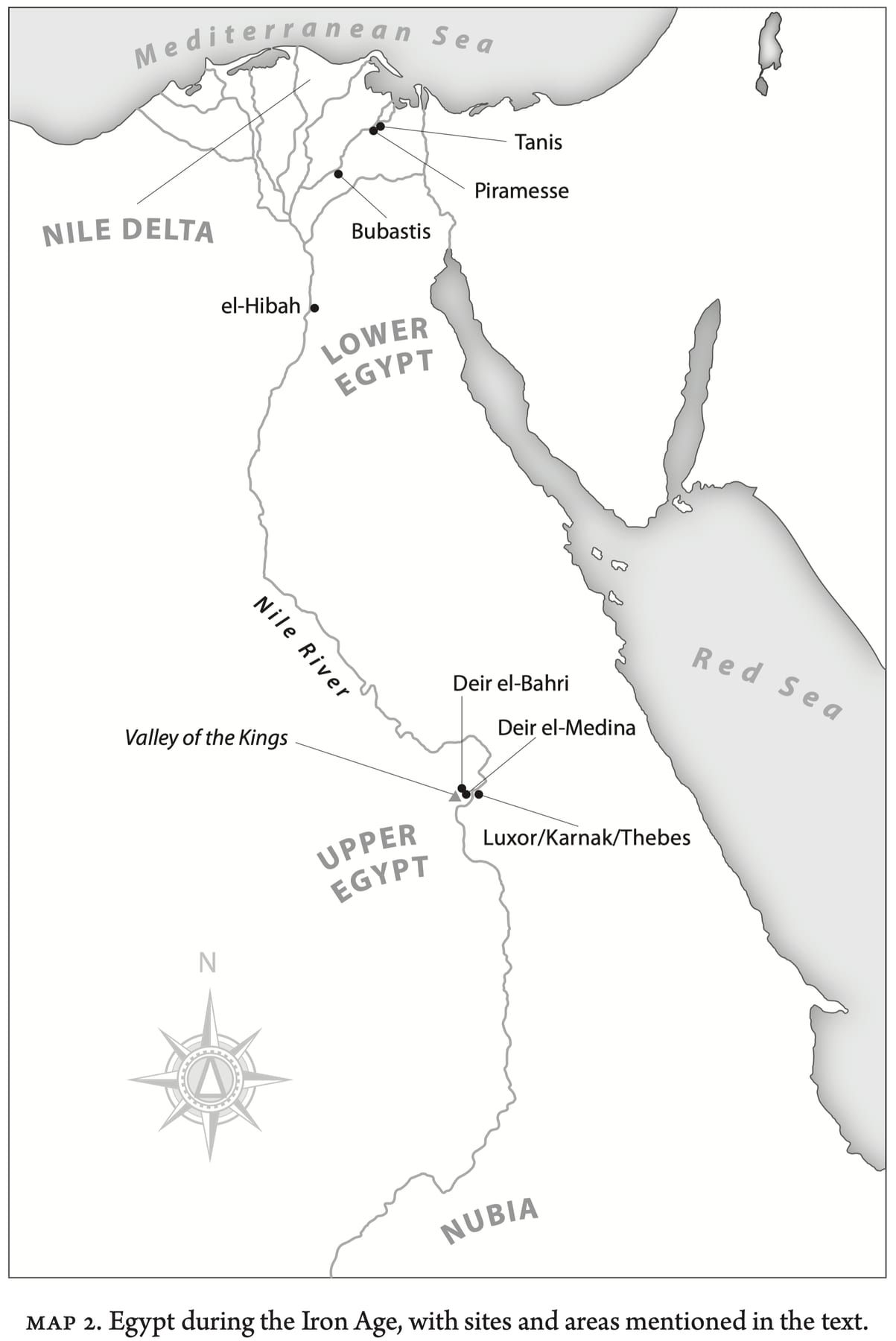
The chapter opens with a vivid marker of instability: Ramses III is assassinated (1155 BC) in a palace/harem conspiracy linked to Queen Tiye and Prince Pentawere, known from a dossier of papyri including the Turin Judicial Papyrus.
Cline uses this as an entry point into Egypt’s long, uneven decline after its last great Late Bronze Age assertions of power.
2) Symptoms of strain: famine, insecurity, corruption, and tomb robbery
Cline highlights how Egyptian records show food problems and social disorder. One of his recurring motifs is that “survival” can coexist with deep dysfunction: shortages, reduced labor, foreigners in the Theban region, and the destabilizing cycle of tomb robbery and punitive enforcement. He uses vivid episodes (including the mutilation and re-wrapping of royal remains) to show how far institutional authority had degraded compared with earlier New Kingdom stability.
3) A partial regrouping: the long road toward a new equilibrium
Egypt does not vanish, but it no longer plays its former international role. Cline traces the transition through later Ramesside rule into the Third Intermediate Period and then to a partial restoration of unity under Sheshonq I (mid-10th century), a Libyan-origin ruler who tries to tighten control (notably by managing Thebes via priestly appointments).
4) Egypt and the southern Levant re-entwine: Sheshonq/Shishak
Cline uses Sheshonq’s Levantine campaign to show Egypt’s limited rebound and to connect Egyptian, biblical, and archaeological evidence. He notes the common scholarly identification of biblical “Shishak” with Sheshonq I, and ties the episode to an inscriptional record (Karnak’s Bubastite Portal) and a discovered fragment bearing Sheshonq’s cartouche at Megiddo, which is presented as a striking (if debated) point of contact between text traditions and material remains.
5) The southern Levant’s transformation: from Canaanite city-states to new polities
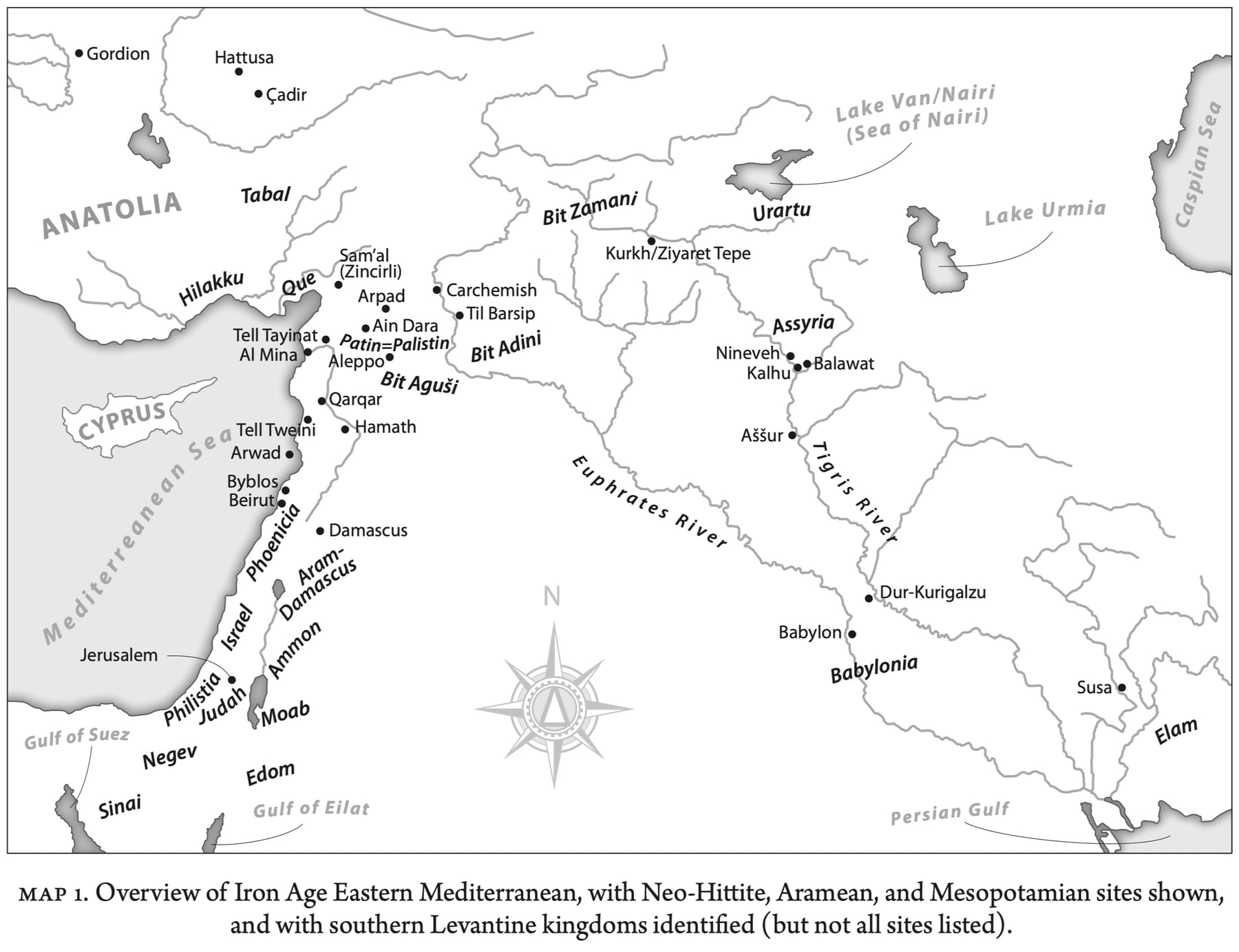
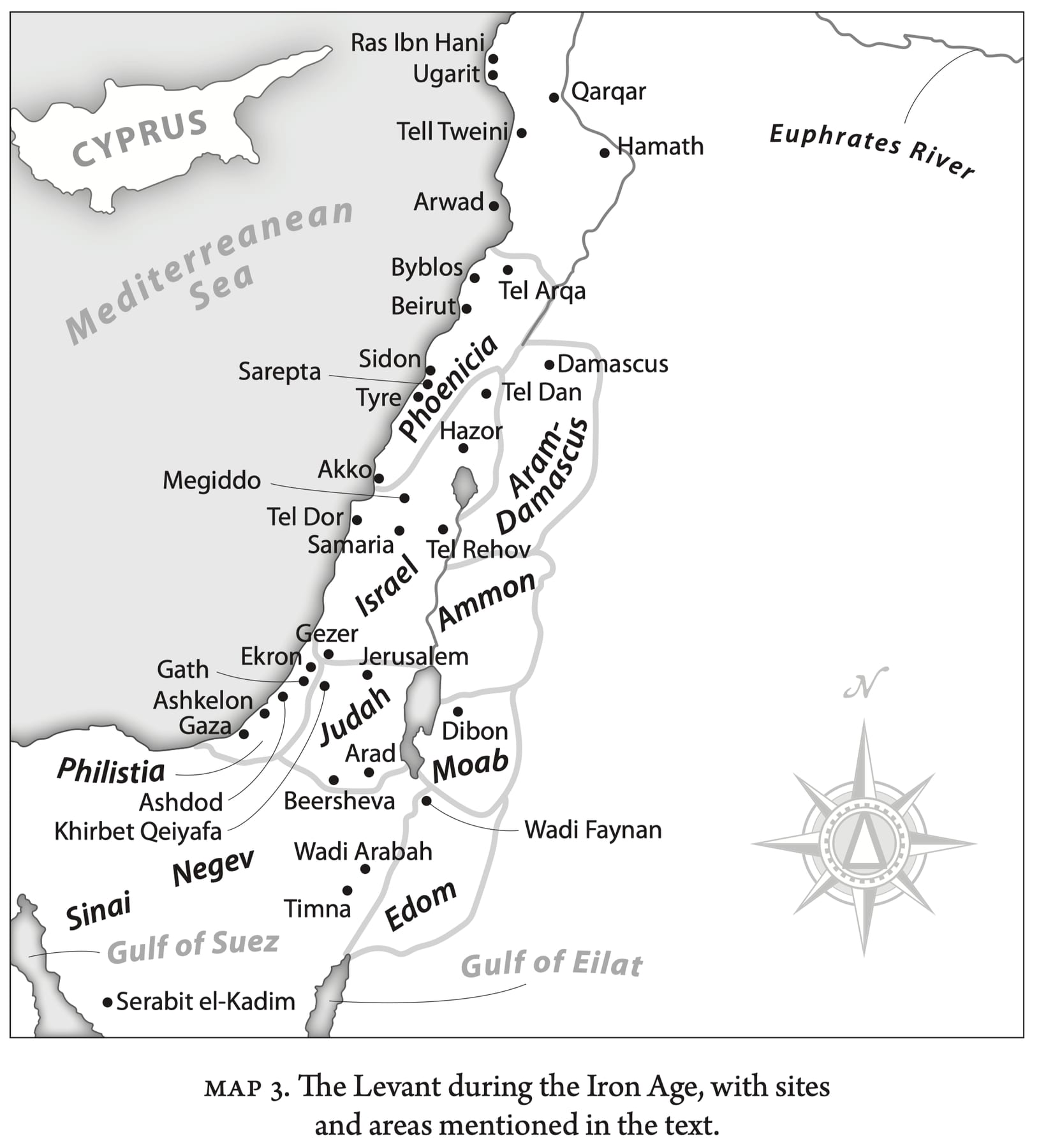
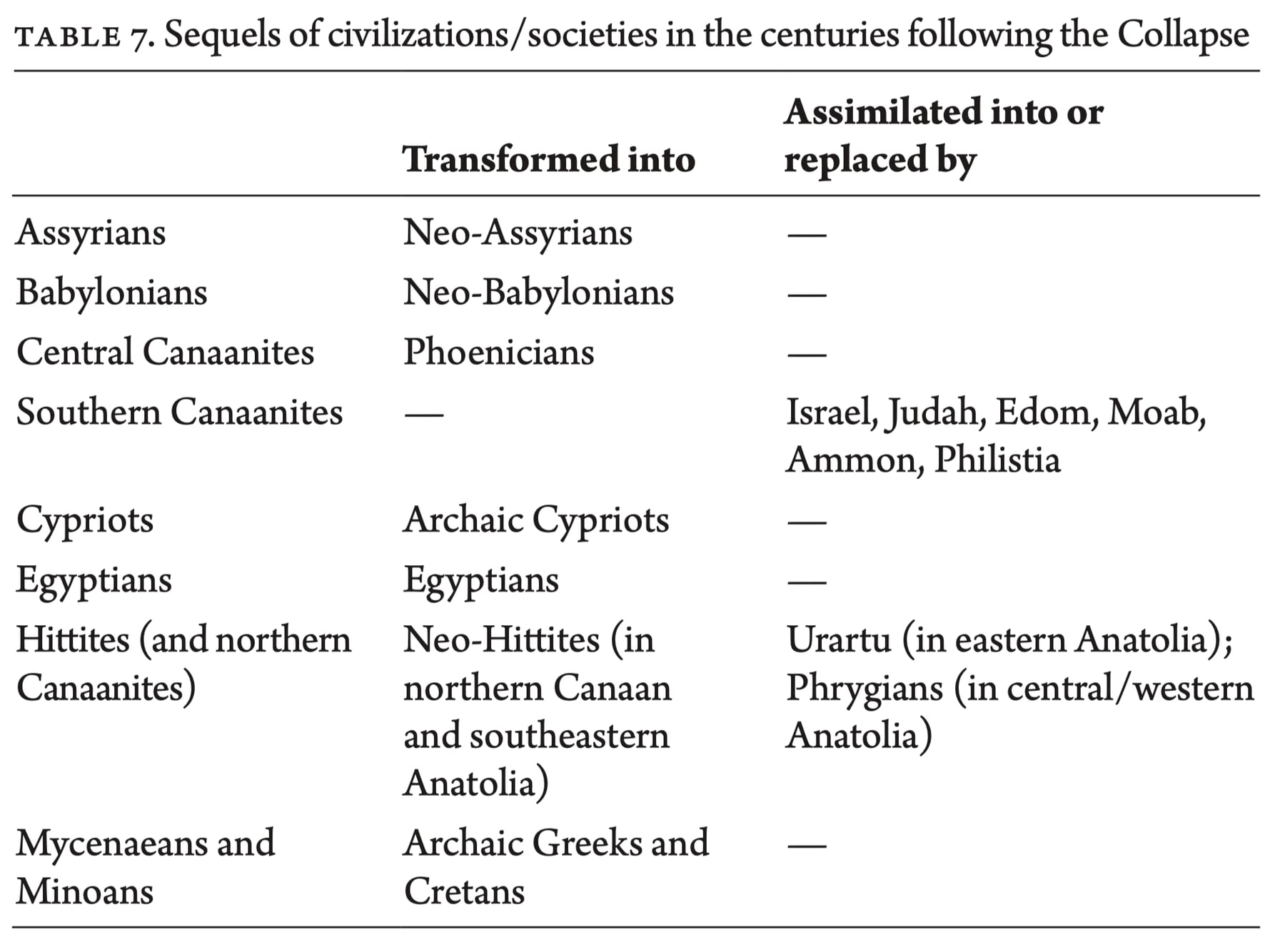
In parallel, Cline treats the southern Levant as a zone where new identities and kingdoms crystallize over time. His broad conclusion (revisited explicitly in Chapter 6) is that while many individuals and communities persisted, the recognizable system of Canaanite city-states largely ceased as distinct entities, with the region reorganizing into new kingdoms (Israel, Judah, Philistia, Edom, Ammon, Moab).
Bottom line for Chapter 1: Egypt “makes it through,” but mainly by coping; it declines as a great power rather than successfully adapting into a new stable form. The southern Levant is less a story of “return” than of replacement and recomposition of political forms and identities.
Chapter 2 — Conqueror of All Lands, Avenger of Assyria (Mesopotamia)
1) Early Iron Age Assyria: continuity plus a documentary gap
Cline stresses that Assyria and Babylonia initially weather the Bronze-to-Iron transition better than many coastal palace societies: they retain writing and bureaucracy—yet they are still affected (including in population and record-keeping). He discusses the striking gap in surviving Assyrian royal inscriptions for parts of the 12th century and what that might imply about stress and disruption.
2) Tiglath-Pileser I as emblem of Assyrian recovery-through-violence
A centerpiece is Tiglath-Pileser I (r. 1115–1076 BC), whose inscriptions present relentless campaigning—especially against Aramaean groups—plus a grim repertoire of exemplary brutality. Cline uses these texts both as evidence and as a caution (royal hyperbole), while still treating them as crucial windows into how Assyrian kings performed legitimacy amid insecurity.
3) Aramaeans, mobility, and the limits of “victory”
The Aramaeans appear not merely as enemies but as a structural force: decentralized, mobile populations that are hard to “solve” by conquest alone. Cline emphasizes that even Assyria’s military prowess did not immunize it from longer-term shocks and regional instability.
4) The long arc: from strained survival to later imperial expansion
Cline’s narration then telescopes forward: Assyria’s later Neo-Assyrian expansion is acknowledged (with examples of western reach and references to Levantine polities), but he keeps the spotlight on the centuries immediately following collapse and the pattern of recovery, relapse, then resurgence.
5) Brief summation: both survive, but on different clocks
Cline’s explicit takeaway is comparative: both Assyrians and Babylonians “weathered” the transition at first, but both were later hit by drought/famine/plague; Assyria re-emerges sooner (late 10th/early 9th century), while Babylonia’s full return to dominant power arrives far later (end of the 7th).
Bottom line for Chapter 2: Mesopotamian systems show high continuity (writing, administration) relative to many Late Bronze Age palace cultures, but “survival” still includes delayed crises and uneven recovery rhythms.
Chapter 3 — The Mediterranean Became a Phoenician Lake (Phoenicia and Cyprus)
1) Opportunity after collapse: trade niches open
Cline frames Phoenicia as a classic case of a society that not only survives but capitalizes on the vacuum created by the destruction of major Late Bronze Age hubs. He notes how, after events like the sack of Ugarit and broader disruption, Phoenician cities (e.g., Tyre and others) are positioned to expand maritime trade.
2) Networks, goods, and skills: why the Phoenicians win the era
The Phoenicians’ advantage is presented as a mix of seafaring capacity, commercial flexibility, and a willingness to operate in newly fragmented political conditions. Cline highlights the spread of Phoenician influence and exchange circuits across the Mediterranean.
3) The alphabet and cultural transmission as “resilience tools”
Cline treats Phoenician cultural outputs as historically decisive: especially their role in diffusing an alphabetic writing system (and associated administrative/communication advantages) across regions.
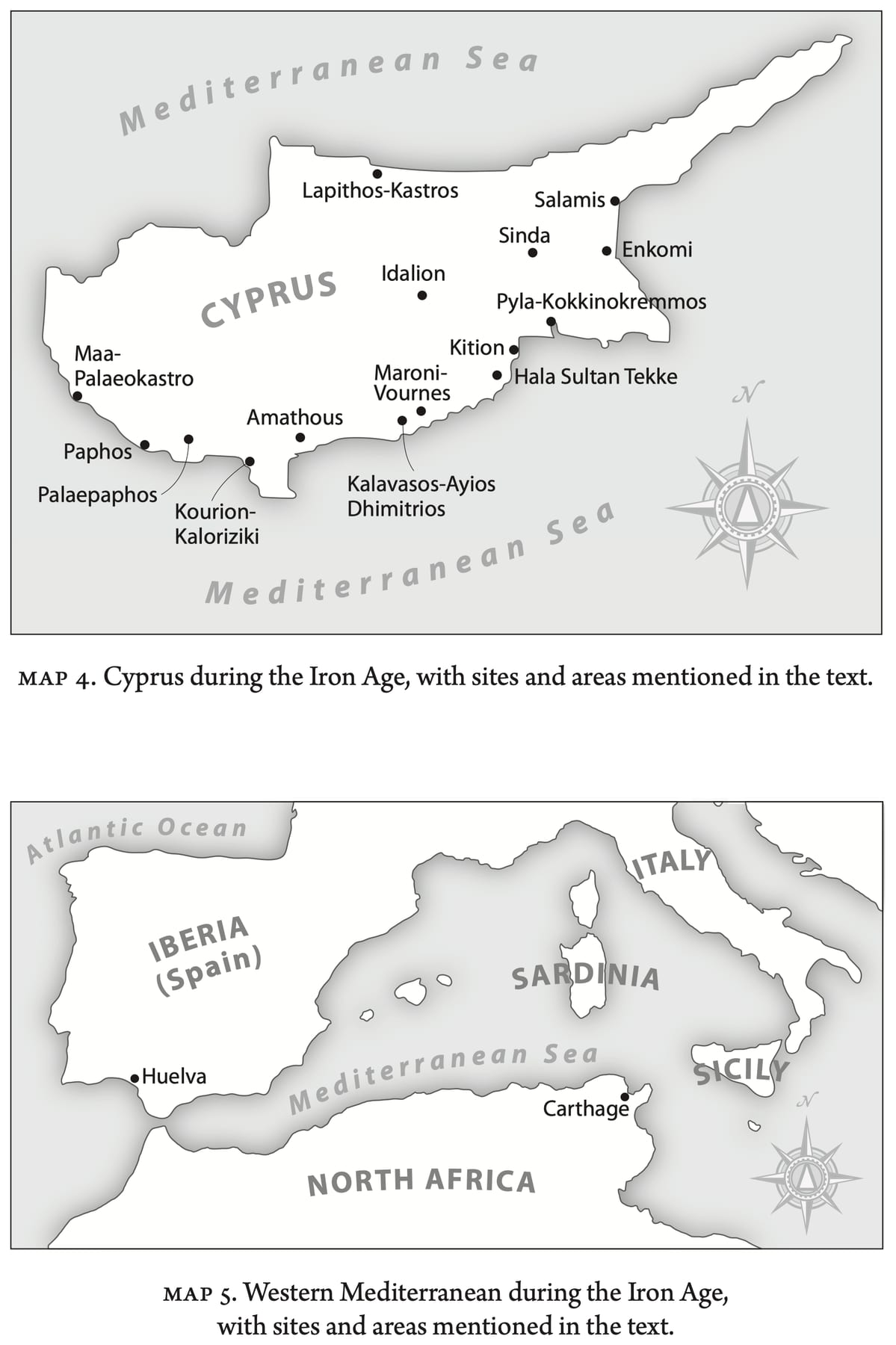
4) Cyprus: metallurgy, position, and “iron age” mechanics
Cyprus is paired with Phoenicia because it remains a major player in metals and exchange. Cline emphasizes Cypriot participation in the evolving metal economy and highlights the diffusion of iron technology as a key Iron Age driver—one reason the period is named for the metal and not merely labeled “dark.”
5) Explicit takeaway: resilience that becomes “anti-fragility”
Cline’s language becomes most evaluative here: he describes both Phoenicians and Cypriots as not only resilient but “innovative,” even “anti-fragile,” because the new world order offered them room to expand.
Bottom line for Chapter 3: This is the book’s clearest “winners of collapse” chapter: societies that thrive precisely because the old international system breaks, allowing new networked strategies to dominate.
Chapter 4 — King of the Land of Carchemish (Syro-Anatolia / Neo-Hittite successor states)
1) The Hittite imperial failure—and the survival of fragments
Cline distinguishes between the collapse of the Hittite Empire as a macro-structure and the persistence of Neo-Hittiteor Syro-Anatolian successor polities that carry forward elements of Hittite tradition (writing, art, administration) in smaller forms. In his synthetic assessment, he classifies the Hittites as a case that largely “failed to navigate” the transition—while adding an “asterisk” for the successor states that do persist.
2) Carchemish as a case of “complexity regained”
Carchemish functions as Cline’s anchor example of a society that, despite living in the shadow of imperial collapse, returns to visible complexity: monumental sculpture and architecture, inscriptions, hierarchical rule, specialized roles (priests), and organized production—i.e., a recognizable complex society in miniature.
3) Living under the Neo-Assyrian horizon
Cline integrates the later Assyrian problem: Carchemish and peers survive, but increasingly within a world shaped by Neo-Assyrian expansion, tribute demands, and eventual conquest. The chapter uses tribute lists and Assyrian inscriptions to show that Carchemish was not a “backwater,” and that its wealth and organization made it legible to imperial extraction.
4) Long continuity, eventual end
Cline emphasizes the remarkable duration of these post-collapse polities: Carchemish maintains governance and cultural production for centuries after 1200, until it is finally absorbed/destroyed by Assyria (717 BC).
Bottom line for Chapter 4: Empire collapses, but “civilization” doesn’t simply switch off; it can persist as smaller, durable nodes—until later empires re-consolidate the region.
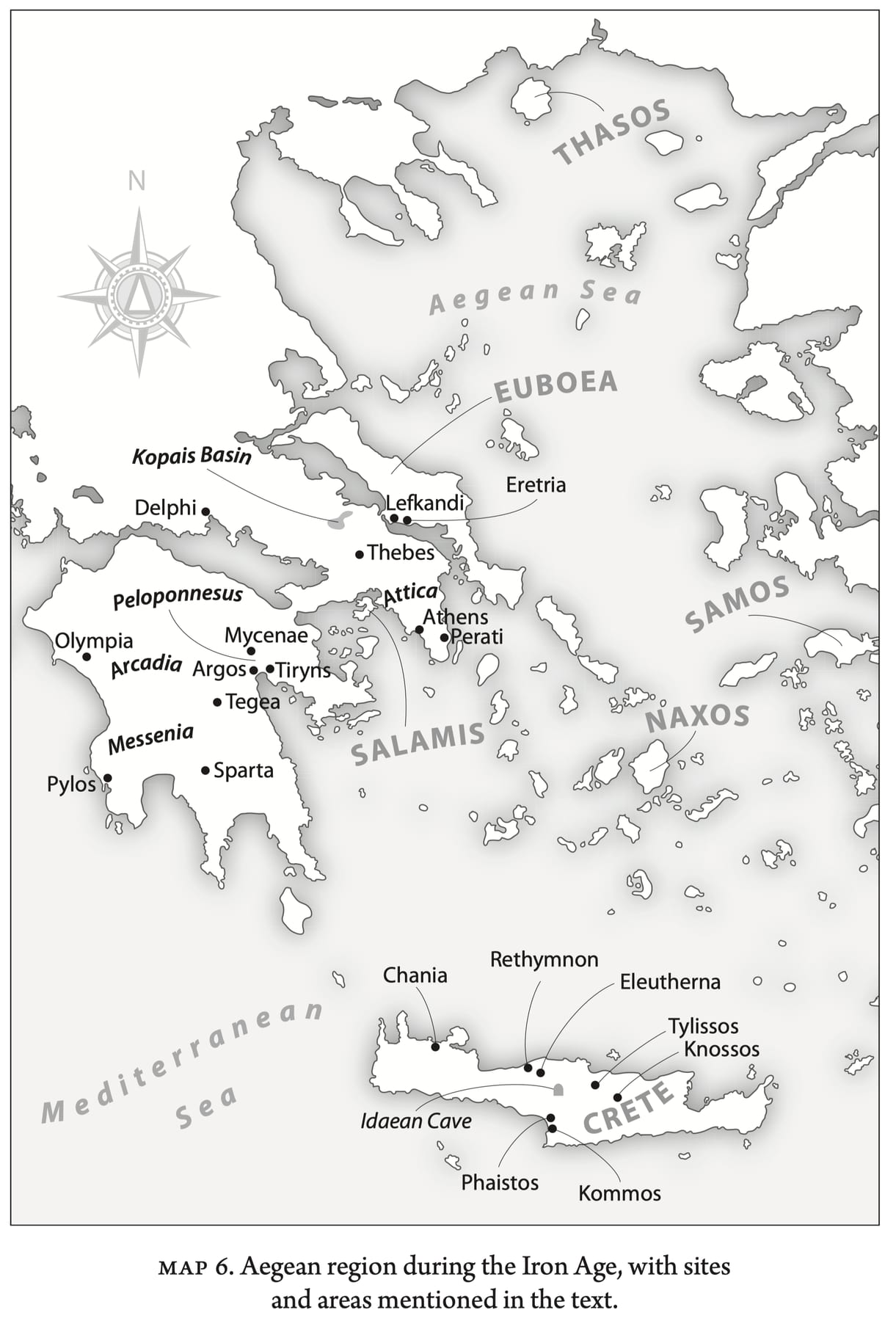
Chapter 5 — In the Shadow of the Ruined Palaces (Aegean region)
1) Starting in rubble: the Mycenaean palace world is gone
Cline anchors the Aegean story in material remains that “remember” the collapse: warrior/ship imagery on post-destruction pottery, abandonment patterns, and the haunting reality that some survivors squat among ruins for a time before even those remnants fade.
2) A long rebuild rather than a quick restoration
The chapter emphasizes that the Greek mainland doesn’t “bounce back” to palace complexity quickly. Instead, it undergoes a prolonged, locally varied reorganization that eventually supports the rise of city-states. Cline treats the period as one of partial continuity plus major institutional reinvention, not a simple void.
3) The “Dark Age” label: partly true, but incomplete
Cline acknowledges what makes the term tempting (loss of writing; fewer monumental works), but insists that the label hides ongoing cultural work and gradual recovery.
4) Brief summation: rebuilding toward the 8th-century takeoff
His own wrap-up is blunt: Mycenaeans (and Minoan-era structures) don’t truly return to earlier heights; Greek recovery to “higher levels of complex society” comes only by the 8th century BC, when growth and stabilization are evident.
Bottom line for Chapter 5: Greece is a case of slow resilience—collapse, decentralization, cultural persistence, then eventual re-complexification on a new basis (the polis world).
Chapter 6 — From Collapse to Resilience (Comparative framework + lessons)
This is the book’s analytic engine room: Cline steps back and offers tools to compare the previous case studies.
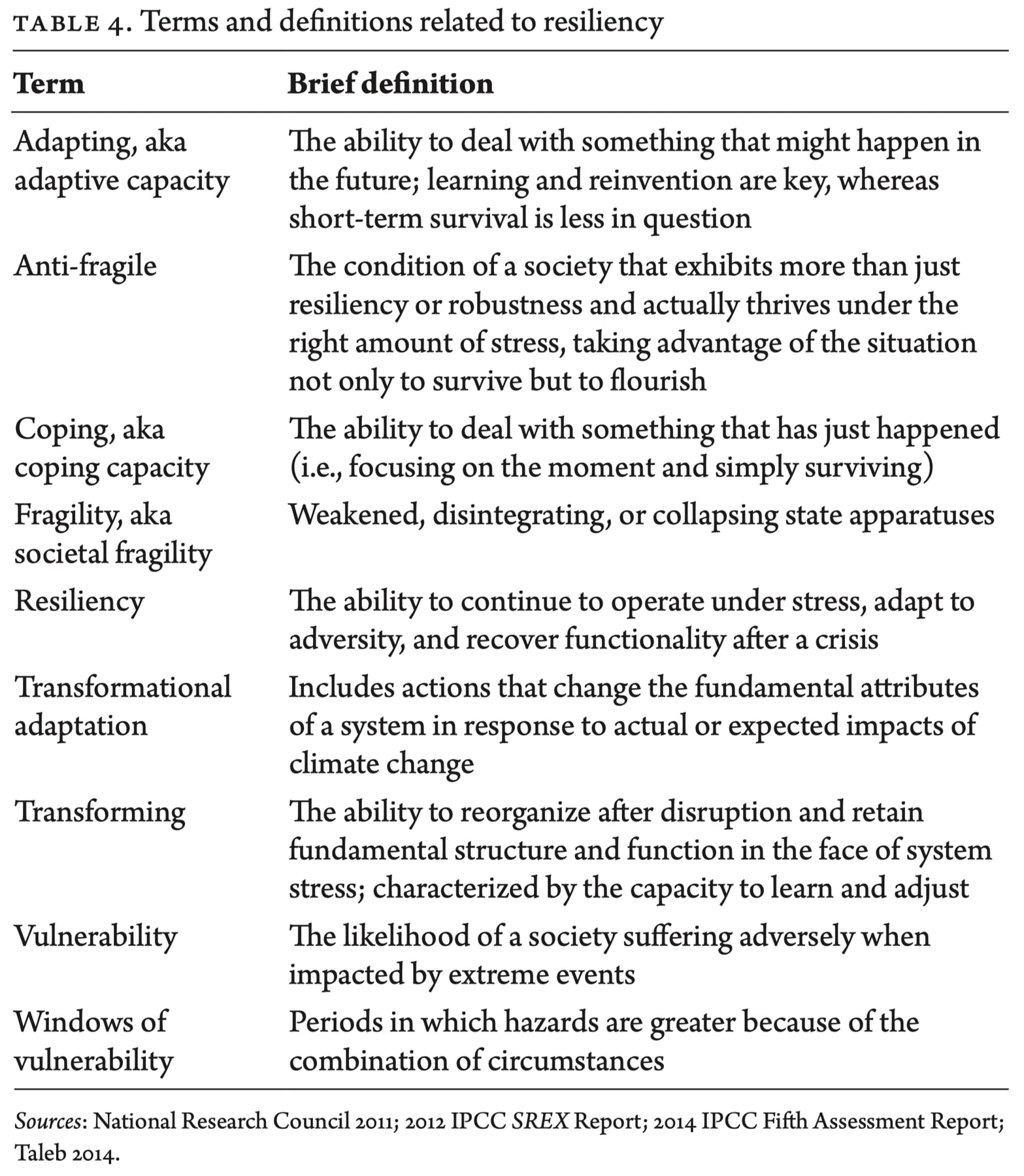
1) Definitions: coping, adaptation, transformation, resilience
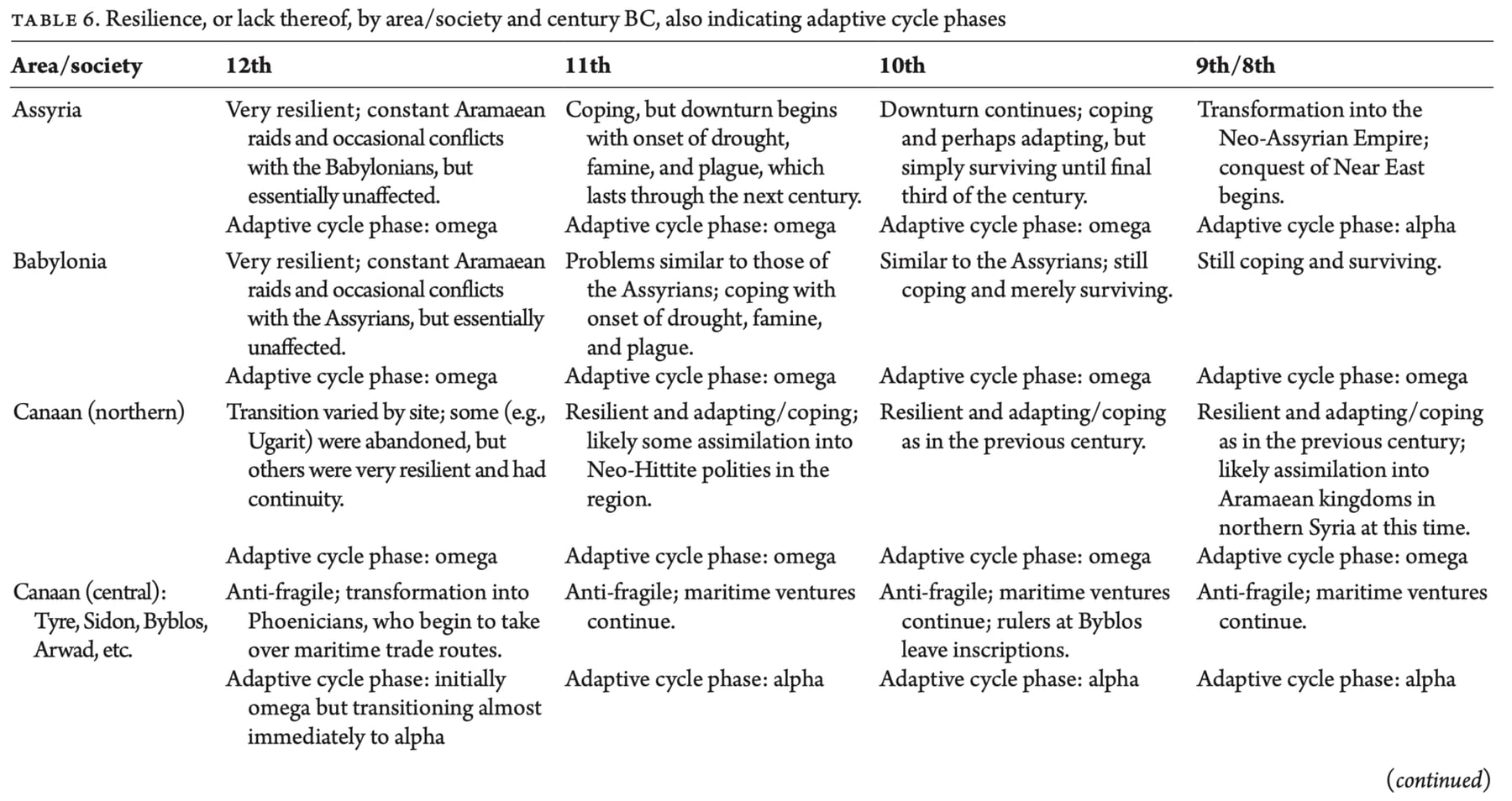
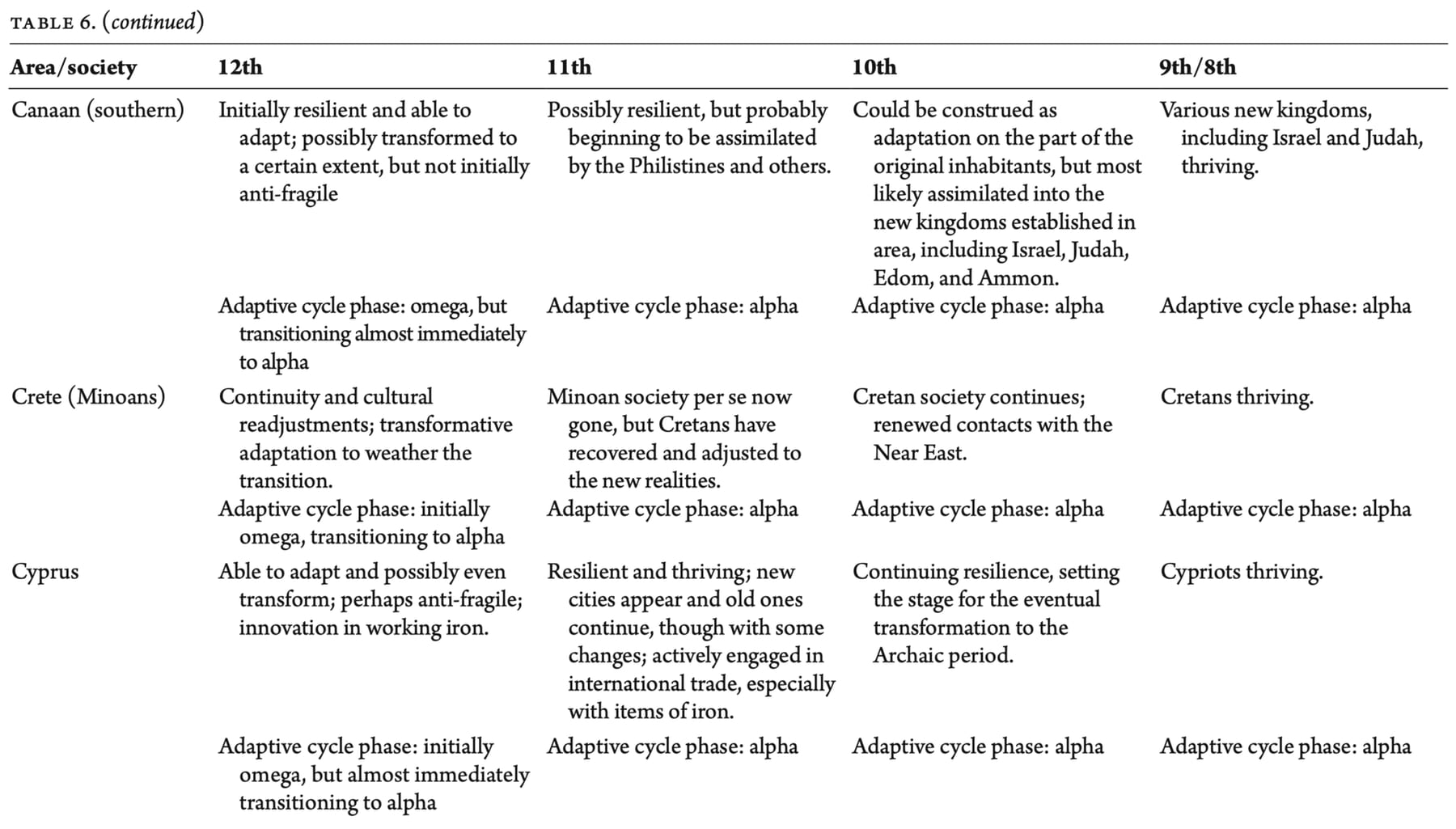
Cline clarifies terms (in the language of resilience studies): coping as short-term endurance, adaptation as adjusting within a system, transformation as shifting to a new system state—then uses these to interpret “survival” in more than one way.
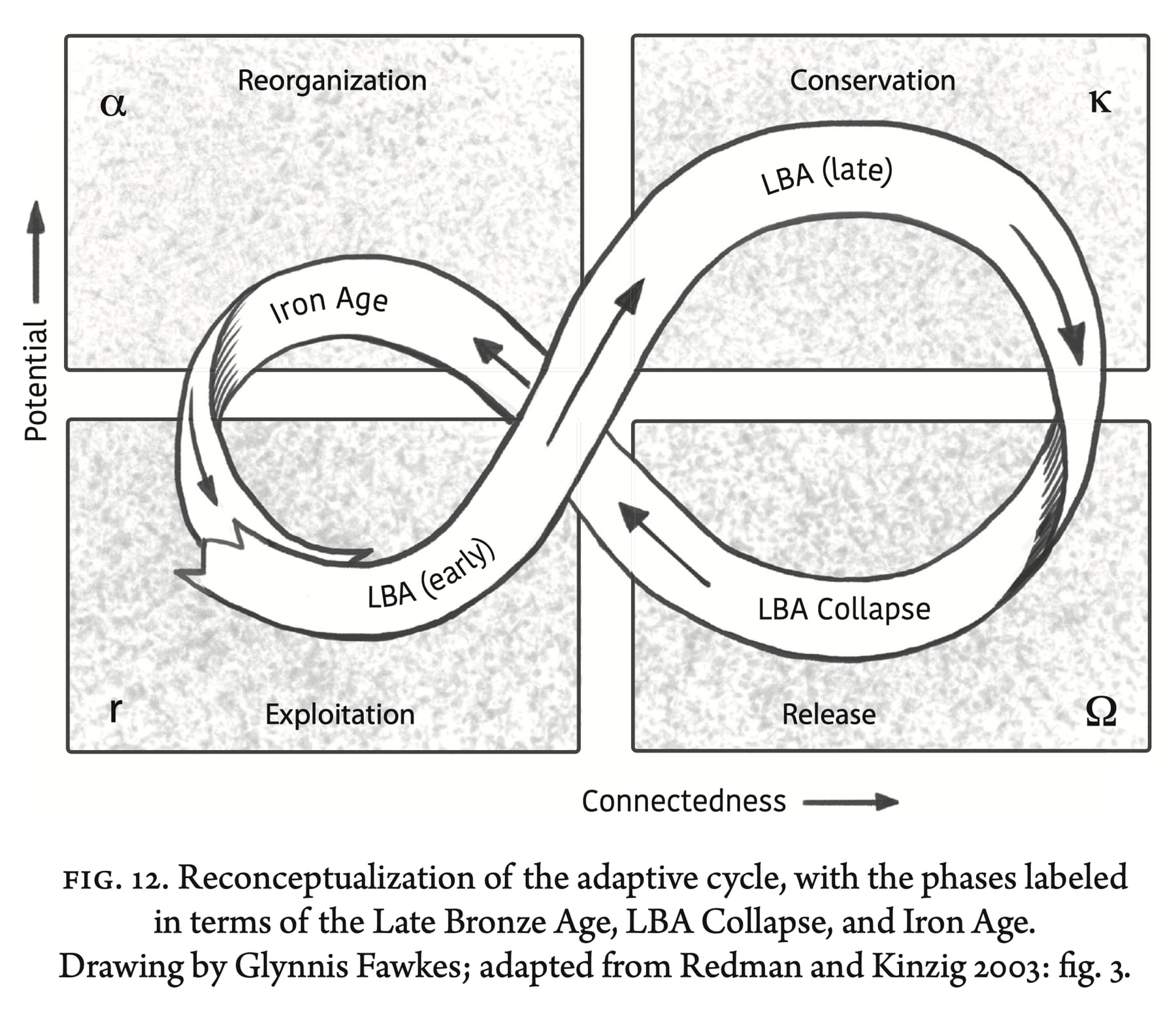
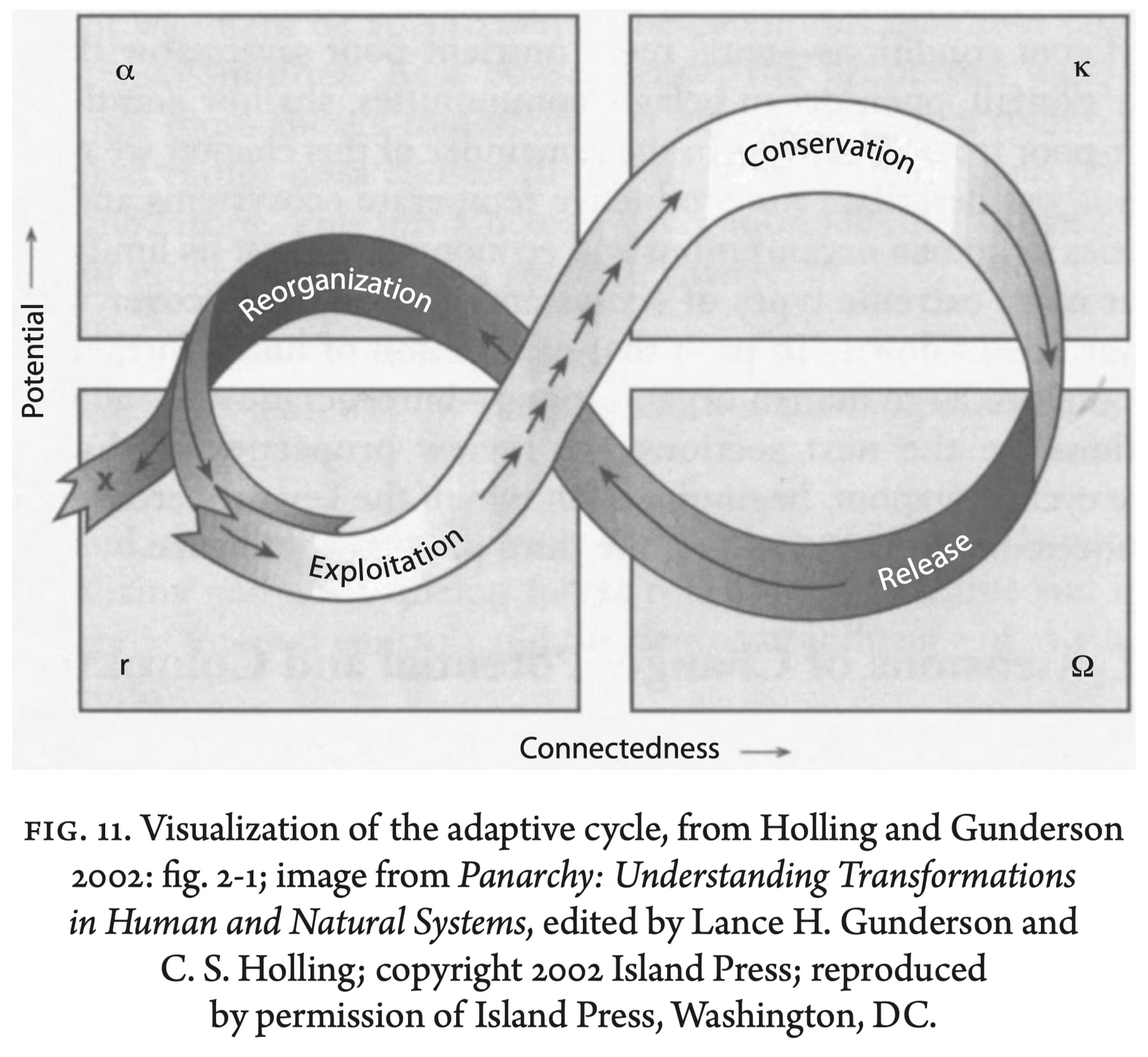
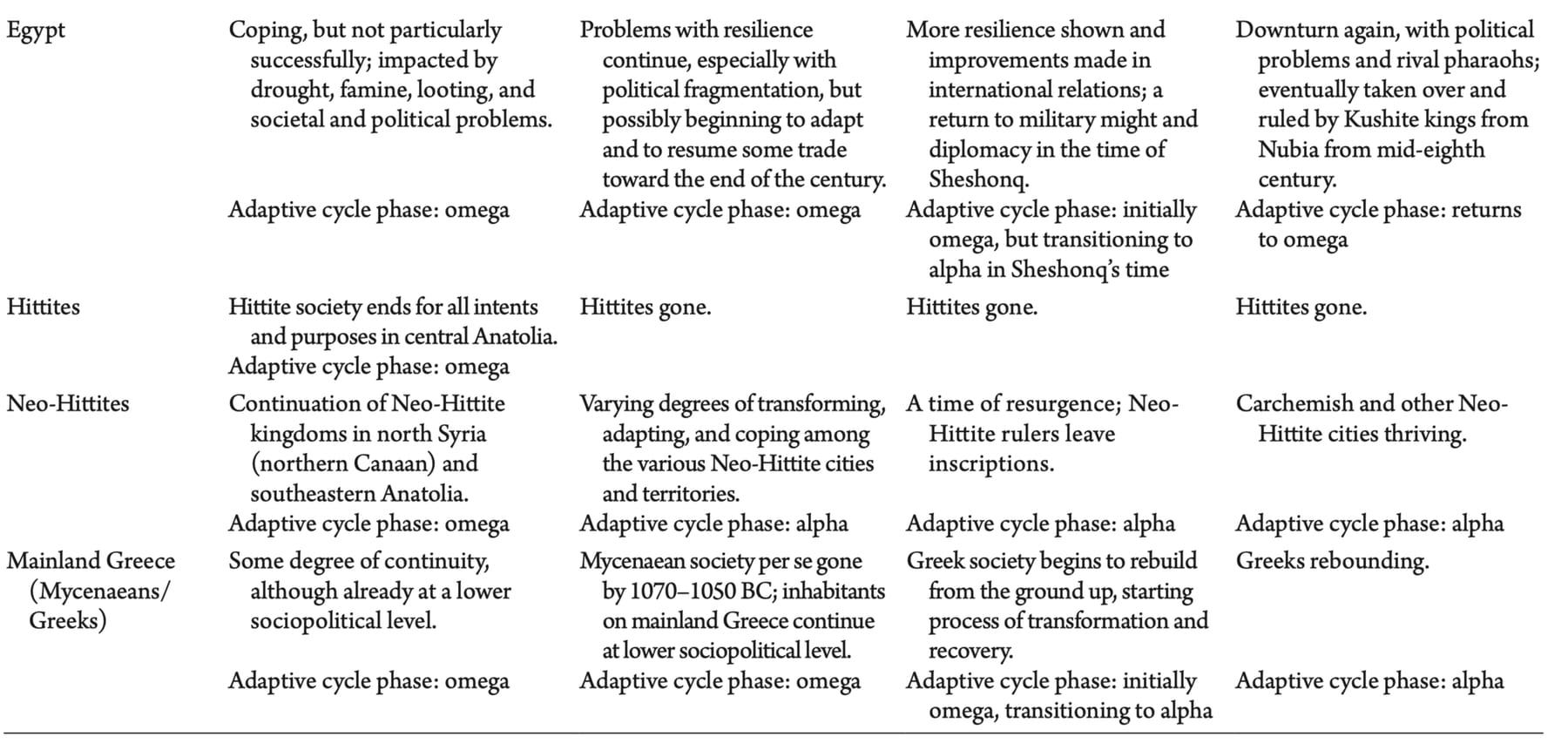
2) The adaptive cycle and “panarchy”
He introduces the adaptive cycle (growth → conservation → release → reorganization) and emphasizes that collapses can be seen as transitions within wider system dynamics rather than purely terminal events.
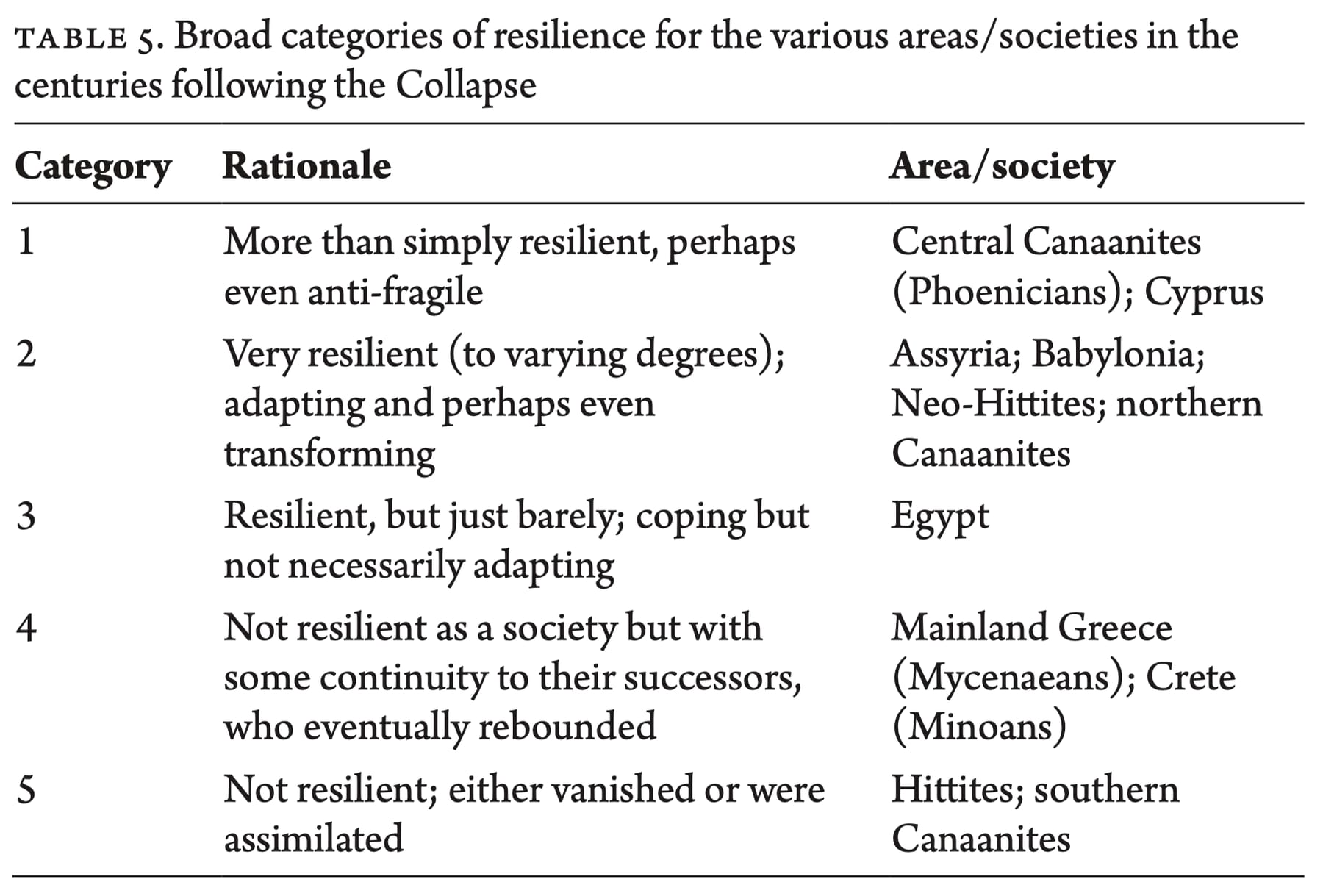
3) A five-tier classification of post-1177 outcomes
Cline proposes categories ranging from highly resilient societies to those that essentially vanish. He places examples into tiers with explicit nuance:
- Some remain resilient “despite” turbulence.
- Others “cope” but fail to transform.
- Some transform into new polities.
- Some show only limited rebound.
- Some vanish as identifiable systems (with caveats about individuals/small communities persisting).
4) A key example of nuance: “vanished” doesn’t mean “everyone died”
His discussion of “not resilient—essentially vanished” is careful: he classifies the Hittite imperial system here, but explicitly notes successor pockets; similarly, he argues Canaanite city-state society ceases as uniquely identifiable even if many people persist and influence successor kingdoms.
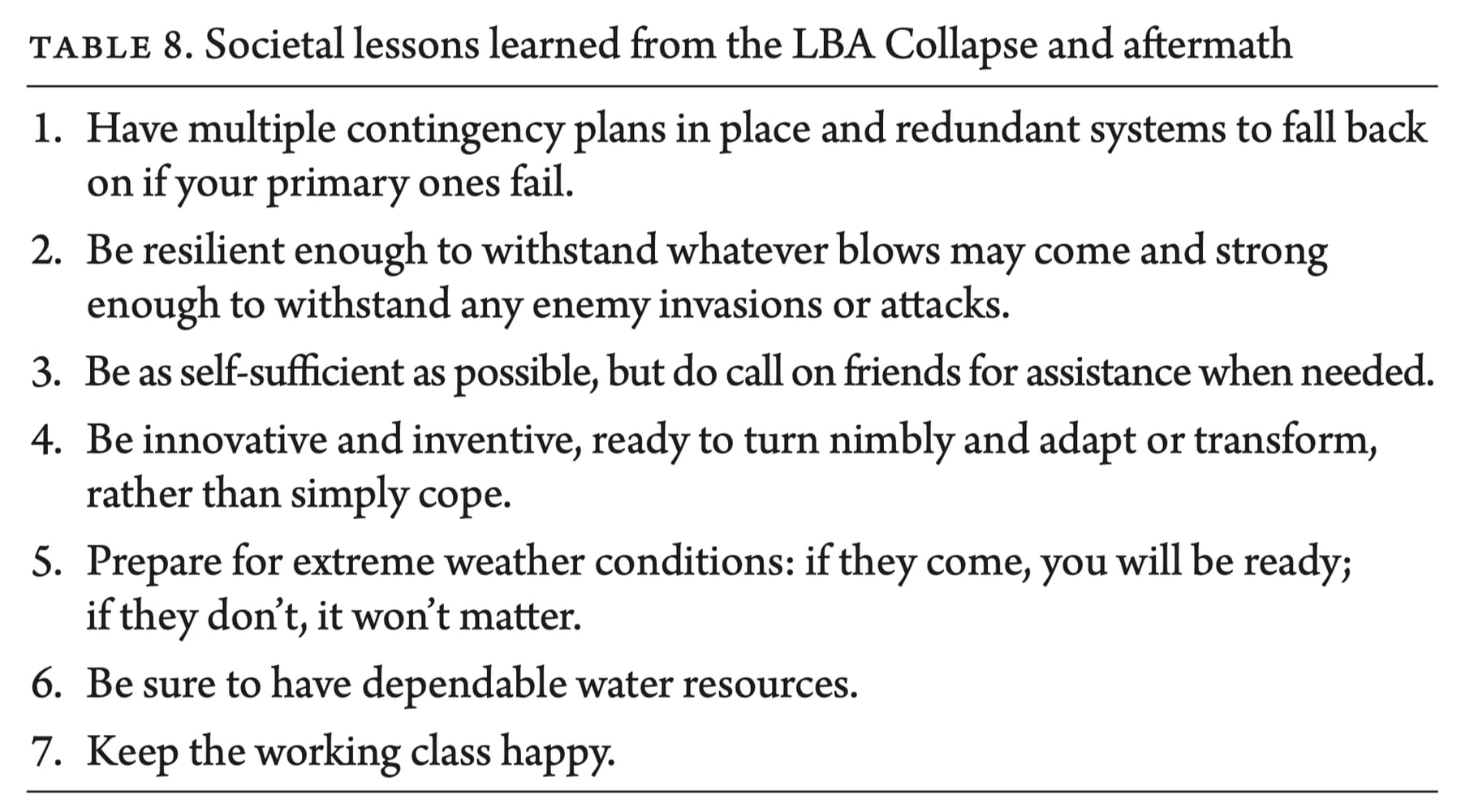
Bottom line for Chapter 6: Cline’s synthesis is that the post-1177 centuries are best read as divergent pathways through a shared shock—with resilience shaped by geography, networks, political flexibility, and the ability to reorganize into smaller, viable units.
Epilogue — End of a Dark Age
1) Returning to the opening question
Cline closes by “coming full circle”: was the period truly a dark age? He argues the answer depends on scale and viewpoint; there are undeniable losses, but also recoveries and innovations that the label can obscure.
2) The deeper claim: the “dark age” produces the Iron Age world
He points out that by the 8th century, many regions show renewed complexity; the post-collapse centuries become the incubator for the later first-millennium empires and the Greek world that re-enters written history in new forms.
3) What the book wants you to remember
The epilogue reinforces the book’s main moral: “collapse” is often reconfiguration, and the most important historical question may be less “why did it fall?” than “how did people live through it, and what new worlds did they build afterward?”