DESCRIPTION
A riveting, comprehensive history of the Arab peoples and tribes that explores the role of language as a cultural touchstone This kaleidoscopic book covers almost 3,000 years of Arab history and shines a light on the footloose Arab peoples and tribes who conquered lands and disseminated their language and culture over vast distances. Tracing this process to the origins of the Arabic language, rather than the advent of Islam, Tim Mackintosh-Smith begins his narrative more than a thousand years before Muhammad and focuses on how Arabic, both spoken and written, has functioned as a vital source of shared cultural identity over the millennia. Mackintosh-Smith reveals how linguistic developments—from pre-Islamic poetry to the growth of script, Muhammad’s use of writing, and the later problems of printing Arabic—have helped and hindered the progress of Arab history, and investigates how, even in today’s politically fractured post–Arab Spring environment, Arabic itself is still a source of unity and disunity.
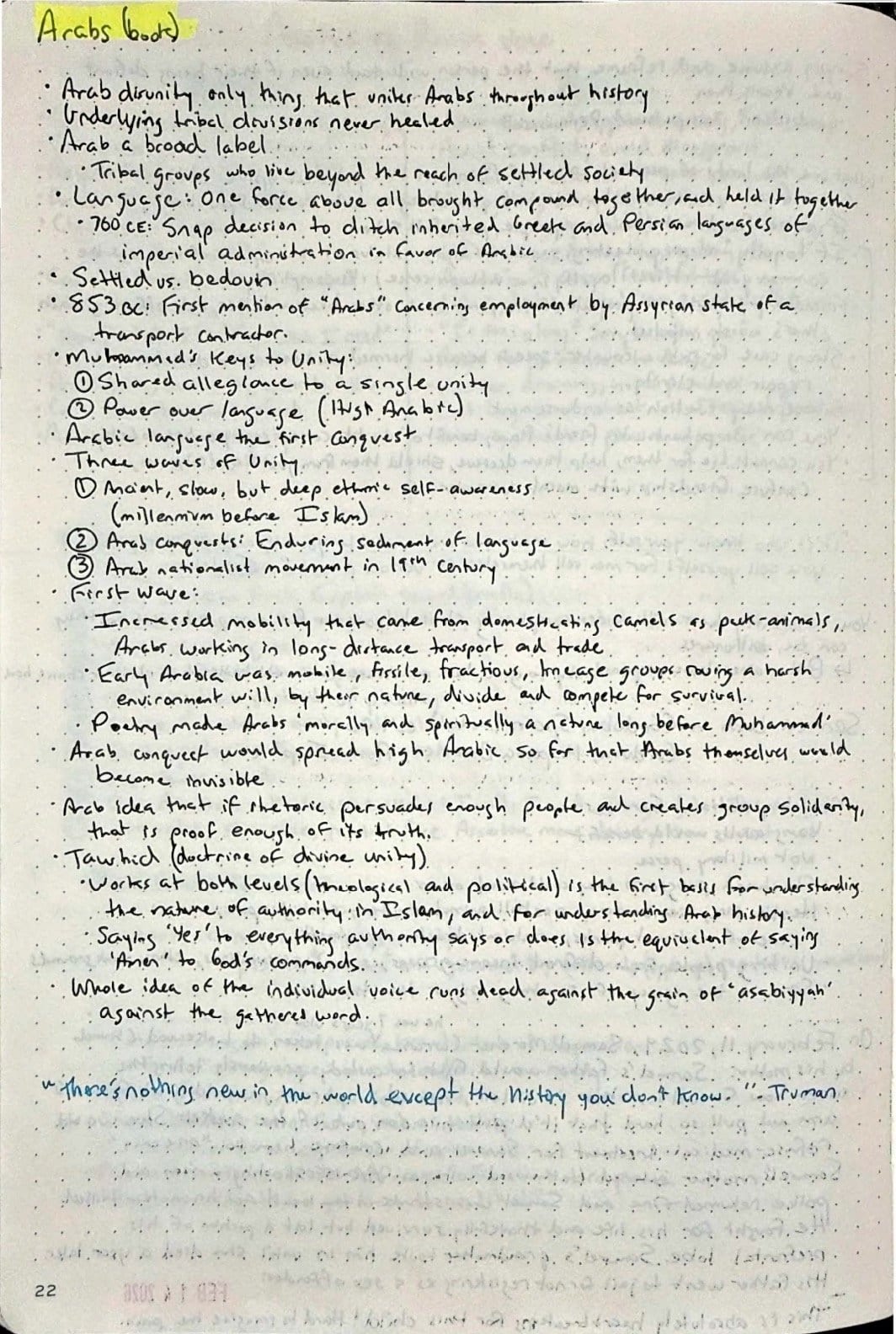
Executive Summary
Tim Mackintosh-Smith tells Arab history as a recurring cycle of gathering and splintering: bursts of unity that look momentarily total, followed by fracture that can be just as structural and self-destructive. The key term sha‘b captures the paradox—“a people” is both a collection and a separation—and the book insists that “Arab” is not a fixed essence but a shifting label that has repeatedly changed meaning over three millennia. Early on, ‘arab often means a mode of life on the edge of settled society: mobile, tribal, raid-capable, shaped by an ecology of water-scarcity and the constant tension between hadar (settled civilization) and badw (beyond the polity, where the raid is an institution). That tension produces both strength and chronic instability, and it persists in modern forms even as camel-nomadism fades.
The deepest binding thread across the whole story is the word. Pre-Islamic Arabia develops a pan-regional “high” Arabic through mobility, trade, fairs, and above all poetry and inspired speech: the sha‘ir and the orator are political forces whose words can mobilize followers and ignite conflicts. This word-centered culture creates a kind of cultural nation before there is political unity. Islam then arrives as a revolutionary amplification of this linguistic infrastructure. Muhammad’s achievement in Medina is portrayed as the archetype of “gathering the word”: welding heterogeneous people into disciplined unity by a new, totalizing authority. The Qur’an is central not only as doctrine but as medium—revelation as recited sound that quickly becomes book, turning Arabic into a sacred and increasingly administrative technology of cohesion. Yet the book immediately punctures any myth of lasting unanimity: struggles over succession, wealth, and rule return almost at once, showing that unity built on power and distribution remains fragile.
As the early empire expands, the book stresses that conquest often runs ahead of conversion and depends on pragmatic governance—taxation, treaties, administration—while the same expansion exports internal fractures into new garrison cities and politics. The Umayyad and early Abbasid periods mark a decisive pivot: Arabic becomes the language of state and prestige, enabling a vast “Arabosphere” in which many “Arabs” are better understood as arabophones. Baghdad’s cosmopolitan brilliance—translation, measurement, paper, bureaucracy—creates a world center of knowledge and text, but it also accelerates the political eclipse of old tribal Arab primacy as court networks, administrators, and imported military power dominate. Fragmentation follows: strongmen rule while caliphs become symbols; counter-caliphs appear; institutions like the madrasa preserve learned unity amid political splintering. External shocks—Crusades, Mongols, plague, Timur—compress the Arabic-speaking heartlands politically, but Arabic and inherited memory persist as a cultural empire long after the temporal empire fades.
The later book reframes “Arab power” through networks rather than territory, especially in the Indian Ocean world where monsoon trade, pilgrimage, diaspora prestige, and Arabic script circulate a portable civilizational package. Modernity then arrives as a new “word regime”: translation, schools, and presses refit Arabic for public life, while diglossia and censorship keep unity partly performative—real in speeches and formal writing, fractured in daily dialect life. Mid-20th-century pan-Arabism becomes a mass-public phenomenon amplified by broadcast, but defeat (especially 1967) exposes the costs of slogan-politics and repression. Oil briefly supplies leverage and wealth, while labor migration reconnects Arabs socially even as it deepens inequality and hardens regimes. The “Age of Disappointment” follows: autocrats, insurgent political Islam, and militia/patronage politics produce cycles of repression, revolt, and collapse, culminating in 2011—an uprising driven by dignity and connectivity but often met by counter-revolution, civil war, and refugee exodus.
The afterword returns to the book’s moral core: contemporary Arab societies can feel trapped in an “ever-present past,” waiting in a “station of history,” while rulers “gather the word” by enforcing unanimity and punishing speech. The Arab past, the author argues, is itself “under occupation”—often by homegrown powers that weaponize heritage. A freer future requires reclaiming a fuller, plural history (including internal wars and failures, not only triumphs), so identity can stop being built mainly through myth and antagonism—and the cycle of unity-through-rhetoric followed by fracture-through-power can finally be interrupted.
Table
Arabs - Tim Mackintosh-Smith - Chronology (book scan).pdf (file not included in this release)
| Time (approx.) | Major event / development | Importance in the book’s argument |
|---|---|---|
| 1st millennium BC | South Arabian civilization (e.g., Saba/Marib Dam enlargement) | Reminds you Arabia had major settled states; “Arab history” isn’t only desert nomads. |
| 853 BC | Gindibu “the Arab” in Assyrian record | “Arab” appears first as an external label tied to camels and war on imperial margins. |
| 730s BC | Assyrians defeat Shamsi (“queen of the Arabs”) and seize camels | Control of camels = control of mobility; empires try to pin down desert power. |
| 5th–3rd c. BC | Arabs as border forces; trade networks expand | “Arabness” forms through role: caravan/military specialists in bigger imperial systems. |
| 3rd c. BC onward | Nabataeans (Petra) and caravan commerce | Caravan cities as hadar/badw contact zones that spread arabization. |
| 26 BC | Roman expedition toward Marib (Aelius Gallus) | Outsider fantasies about “Arabia” collide with logistical realities of terrain/distance. |
| 0 AD onward | Safaitic/North Arabian graffiti proliferate | Writing becomes an early archive of identity: names/lineages/tribal belonging. |
| 106 AD | Rome annexes Nabataea | Imperial absorption redirects rather than ends arabization and caravan dynamics. |
| 244 AD | Philip “the Arab” becomes Roman emperor | Periphery can reach the imperial center; “Arab” not confined to deserts. |
| 267 AD | Early fully Arabic inscription (Mada’in Salih) | Arabic becomes more visible as a written medium with wider prestige potential. |
| 328 AD | al-Namarah inscription (“king of all the Arabs”) | Milestone: explicit “Arab” political prestige and sovereignty claims. |
| 6th–early 7th c. | Byzantine–Sasanian rivalry + Arabian religious ferment | Late antique conditions converge for Islam’s rapid expansion. |
| 622 | Hijra to Medina | Religion becomes statecraft; a durable base for unity and expansion. |
| 632 | Muhammad dies; succession crisis | The book’s recurring theme: unity is powerful but immediately contested. |
| 630s | Ridda wars | Coercive consolidation of Arabia; sets “expand or collapse” logic. |
| 636 | Yarmuk (Byzantines) | Opens Syria; showcases mobility advantage and shifting frontier loyalties. |
| 636–638 | Qadisiyyah (Sasanians) | Pivotal defeat of Persia; expansion becomes imperial-scale. |
| 642 | Nihawand | Consolidates conquest eastward into the Iranian world. |
| Mid-7th–8th c. | Garrison towns; thin Arab manpower | Explains later assimilation mechanisms and early factional politics. |
| 661 | “Year of Unity” (Umayyad restoration logic) | Aristocratic/dynastic politics return under Islamic legitimacy. |
| 691 | Dome of the Rock | Monumental legitimacy amid civil fracture; politics reshapes sacred geography. |
| c. 700 | Abd al-Malik’s arabicization (administration/coinage) | Key pivot: Arabic becomes state language and status ladder—long-run cultural unity. |
| 750s–800s | Baghdad rises; translation/knowledge culture | Abbasid cosmopolitanism and paper-driven textual growth fuel bureaucracy and learning. |
| 809–813 | Abbasid civil war (al-Amin vs al-Ma’mun) | “No kinship in kingship” accelerates reliance on paid/foreign armed power. |
| 922 | Execution of al-Hallaj | Symbol of tightening doctrinal boundaries and state policing of religious speech. |
| 929 | Cordoba caliphate declared | “Counter-caliphs” make fragmentation explicit at the highest symbolic level. |
| 945 | Buyids take Baghdad | Caliph becomes a figurehead; real sovereignty shifts to military dynasts. |
| 1055 | Seljuqs in Baghdad; madrasa expansion | Institutions preserve learned unity while political unity fractures. |
| 1090s–1200s | Crusades | External pressure exploits internal disunity; contact zone without full cultural absorption. |
| 1258 | Mongol sack of Baghdad | Civilizational rupture; accelerates shifts away from Arab political centrality. |
| 1340s–1350s | Black Death | “Connectivity” becomes lethal; demographic collapse deepens institutional fragility. |
| 1400s | Timur’s devastations (e.g., Damascus) | Aftershock that dramatizes survival via accommodation and the precarity of cities. |
| 1492 | Fall of Granada | Symbolic end of a western Arabic political refuge; cultural brilliance vs political loss. |
| Long medieval–early modern | Indian Ocean monsoon networks; Hadrami diasporas | “Empire without maps”: ports, pilgrimage, script prestige, and mobile elites spread Islam/Arabic. |
| 1485 (and later reaffirmed) | Ottoman restrictions on Arabic printing | Arabic-script worlds are late to print; affects modern knowledge and mass public sphere formation. |
| 1798 | Napoleon in Egypt | Shock of modern power fused with measurement/paperwork; catalyzes “awakening” institutions. |
| 1822 | State press under Muhammad Ali (Cairo) | Printing and translation infrastructure expands modern Arabic’s public role. |
| Late 1800s–early 1900s | Nahda language work + censorship + Ottoman/Turkish pressures | “Identity rediscovered” through Arabic modernization, constrained by managed speech. |
| 1900–1908 | Hijaz Railway | Modern infrastructure + centralization; emblem of late imperial control and modernization. |
| 1916 | Arab Revolt; Sharif Husayn “King of the Arabs” claim | Old titles revived in new geopolitics; unity slogans meet great-power realities. |
| 1950s–1960s | Nasserism and pan-Arab mass politics | Transnational “Arab public” becomes emotionally real via broadcast and charisma. |
| 1967 | Defeat (“catastrophe”) | Crisis of truth/accountability; repression and performance politics corrode competence. |
| 1973–1980s | Oil shock + labor migration (“pilgrimage of oil”) | Oil becomes leverage; migration reconnects Arabs while deepening inequality and resentment. |
| 1982 | Hamah destruction (Syria) | Emblem of authoritarian “order” through terror and silence—storing future ruin. |
| 1990 | Yemen unification → re-tribalization | Case study: patronage/arms outcompete institutions; unity without state capacity collapses. |
| 2011 | Uprisings; “the people want the fall of the regime” | Dignity + connectivity; semantic war over “order” vs “regime” becomes central. |
| 2010s | Counter-revolution, civil wars, refugee hijrah | The “disappointment” hardens into fragmentation and mass displacement. |
| Afterword (2010s frame) | “Station of history”; speech control; past “under occupation” | Closing moral: regimes/ideologues weaponize history and language; liberation requires reclaiming plural past—including internal wars. |
If you want one more layer of structure, I can add a second table that maps each chapter (1–15 + Afterword) to: time span covered, core claim, and the “identity mechanism” it emphasizes (tribe, empire, language, religion, institutions, nationalism, oil, coercion, media).
Foreword — The Wheel and the Hourglass (pp. xii–xxvi)
- The problem the book opens with: unity vs. disunity. The author frames Arab history through the recurring pattern of political coming-together followed by splintering, using Yemen’s modern trajectory (1990 unification optimism → later fracture and war) as a lived example of how quickly “unity” can unravel.
- Why the disunity is so destructive right now. He points to the scale of violence and displacement in the contemporary Arabic-speaking world and asks why intra-Arab conflict seems so intense and self-harming.
- “Sha’b” as the book’s conceptual lens: union and separation are built in. He uses Lane’s definition of sha’b(a “people” that is both “collection/union” and “separation/disunion”) and even the anatomical metaphor of skull sutures (sha’b) and bones (qabilahs = “tribes”) to suggest that cohesion and fracture are structurally intertwined.
- “Arab” as a slippery label, not a stable essence. The author argues it’s misleading to speak of “the Arabs” as a single fixed entity because the meaning of Arab has repeatedly changed across 3,000 years; often it referred to mobile tribal groups beyond settled society, better treated as ’arab (a common noun) rather than a capitalized “people.”
- Arabs as an “ethnic compound” with a built-in tension. He describes a long-formed mixture of (1) nomadic/semi-nomadic ’arab tribes and (2) settled South Arabian peoples, whose interaction produced strengths and chronic instability—especially the tension between the settled and the raiding, peripheral elements.
- Ibn Khaldun’s framework: settled society vs. raiding society. He adopts Ibn Khaldun’s dual model—hadari(settled “civilization”) vs. badawi (beyond the polity, where the key institution is the ghazw/raid)—and argues the “raid logic” persists in modern forms even if camel-nomadism is fading.
- “Real time” history from Yemen. The author writes as someone living inside ongoing conflict (mortars, slogans, martyrs), even giving a darkly comic detail of using borrowed AK-47s as improvised jump-leads—an emblem of how violence saturates everyday life.
- Time isn’t just a line: the wheel needs an hourglass. He argues Arab history is shaped by an “ever-present past” that can root societies but also confine their futures; he invokes Eliot’s “time past / time future” and then turns to Nizar Qabbani’s image of the past as an hourglass that swallows you, where the “grains” are human lives and deaths.
Introduction — Gathering the Word (pp. 1–15)
- A scene of sudden unity: Abu Sufyan watches Muhammad’s community. The introduction begins with the Meccan clan chief Abu Sufyan witnessing a disciplined, synchronized act of worship by Muhammad’s followers in Yathrib/Medina—people of mixed origins (including South Arabian roots and some Jewish Arabians) moving “as one body.”
- “Gathering the word” as the recurring political ambition. The author frames Muhammad’s achievement as the archetype of what “would-be Arab leaders had always tried to do”: enforce unanimity, silence dissent, and weld diversity into a single collective will.
- But unity is fragile: conflict over authority returns fast. The narrative immediately undercuts any myth of lasting unanimity: within decades, leadership struggles erupt (later glossed as Sunni–Shi‘a) but fundamentally rooted in earthly power—wealth, rule, and control.
- Core thesis stated early: Arabs as “orators” and “predators.” Drawing on Qur’anic language distinctions, the author argues Arab history is propelled by a volatile blend of rhetoric and raiding, producing repeated cycles of unification and fragmentation; lasting unity would require true equality, but that ideal rarely holds in practice.
In the Beginning Was the Poet (within the Introduction)
- Language as the hidden “string” of Arab identity. The author calls Arabic the deepest strand of “being Arab,” the thread on which unity has repeatedly been “gathered.”
- Three “waves” of unity driven by the gathered word. He links group solidarity (’asabiyyah) to high Arabic (’arabiyyah) and outlines three major historical waves:
- slow pre-Islamic ethnic self-awareness
- the 7th–8th century conquests (brief surge, long linguistic sediment)
- modern nationalist rediscovery (still “breaking” now)
- How the book will be structured. He previews the book’s three-part arc by time span: Emergence/Revolution(900 BC–AD 630), Dominance/Decline (630–1350), Eclipse/Re-emergence (1350–now).
- The sha’ir as seer/poet and political force. He sketches the formation of a unified North Arabian language (helped by camel-enabled mobility and trade) and the later emergence of a “high,” quasi-mystical register (’arabiyyah) used for oracle speech and poetry—mastered by the sha’ir (seer/shaman → poet), whose words could mobilize followers and intensify conflict.
The Word Spreads (within the Introduction)
- Correcting the “Islam-starts-everything” distortion. The author insists we need a “stereoscopic” historical view: Islam’s “flash” can blind us to what came before and over-illuminate what came after, so Arab history must be read across the full 3,000-year frame.
- “Arabic information technology” as a driver of identity and power. He argues Islam inaugurates new ways to use and control language—moving from mostly oral culture to written systems that reshape identity and empire. He gives a quick timeline:
- Qur’an as the first Arabic “book,” making language/people newly legible
- ~700 administrative switch to Arabic
- paper-making and the explosion of written culture
- printing challenges with cursive script; later Nahdah press revival
- radio, then word-processing/satellite TV, then social media and its capture by reactionary actors
Language, “the Arabosphere,” and why unity is mostly rhetorical
- Language as the ethnic “genius” of Arabs. He describes high Arabic as an extraordinary cultural force (an old adage: wisdom descends on Greek brains, Chinese hands, and Arab tongues) and claims Arab history is at least as much shaped by “men (and some women) of words” as by men of action.
- Most “Arabs” are really arabophones. He argues the better frame is the Arabic world / Arabosphere, defined by language more than a single ethnicity; calling everyone from Gibraltar to Hormuz “the Arabs” is like calling all English speakers “the English”—or even “the Angles.”
- High Arabic unifies in theory, but fractures in practice. He calls high Arabic an “imagined bond” that also becomes a “bind” because nobody speaks it as a native mother tongue; dialects dominate everyday life, so unity exists “only in speeches” and on paper. He illustrates with dialect variation in Tunisia and a sharper split in Bahrain between a “settled” dialect (ruled Shi‘i majority) and a “bedouin” dialect (ruling Sunni “Arabs” who took power in a raid).
The Book of the Stick (within the Introduction)
- Al-Jahiz and the politics of oratory. The author introduces the 9th-century writer al-Jahiz, who treats language as the chief national characteristic and writes The Book of the Stick as a rebuttal to critics (especially among Persian-origin Muslims) accusing Arab supremacists of betraying Muhammad’s egalitarian message.
- The stick as symbol of political rhetoric and coercion. Al-Jahiz reframes the stick as a tool of power across history—wand, sceptre, orator’s prop, baton to “conduct” the masses, firestick of revolution, and cudgel of repression—capturing how persuasion and force continually intertwine.
Chapter 1 — Voices from the Wilderness: Earliest Arabs
What this chapter is trying to do
Mackintosh-Smith opens by arguing that you can’t understand “the Arabs” as a timeless ethnic block. You have to start with (1) what Arabia is physically like, (2) what outsiders meant when they first wrote about “Arabs,” and (3) what the earliest self-authored evidence (inscriptions) shows about life on the ground.
Main ideas and supporting points
- Arabia as an “island” created by ecology (not water). The peninsula isn’t bounded by seas in the way Britain is, but the author treats it as an “island” because of its extreme scarcity of fresh water, with “Arabia” effectively defined by where rainfall fails. The environment pushes people toward mobility, opportunistic survival strategies, and strong local identities.
- Early “Arab” is often a category, not a “nation.” The chapter stresses that in ancient usage “ʿarab” functions like a common noun: it points to a mode of life—a stripped-down, mobile, tribal existence outside settled oversight—more than a clearly bounded “people” in the modern sense.
- The first “Arabs” we can see clearly are seen through imperial eyes. One of the earliest datable mentions comes from Assyrian royal inscriptions: Shalmaneser III describes a battle in which “Gindibu the Arab” supplies camels (notably a thousand of them), which tells you both how “Arabs” were noticed (as desert auxiliaries) and what they were associated with materially (camels, mobility, steppe/desert warfare).
- From outsiders’ labels to insiders’ voices: inscriptions as “wilderness archives.” The chapter’s signature move is to shift from elite imperial texts to the massive spread of desert graffiti (Safaitic/related corpora): ordinary people scratching short messages, names, prayers, boasts, and raid-notes into stone. These are treated as the earliest widespread “authentic voices” of people living the nomadic life.
- Contact and permeability. Even these “wilderness” texts can carry the fingerprints of empire and long-distance movement—names, titles, and references that imply the desert was not sealed off from the Roman-Persian world, but threaded into it.
Concrete examples the chapter leans on
- Assyrian inscription detail (Gindibu + camels) as an early anchor point for “Arab” as a recognized desert force.
- Graffiti as a social record—not “literature,” but a huge cumulative trace of how nomads named themselves, moved, feared, worshipped, and fought.
Chapter 2 — Peoples and Tribes: Sabaeans, Nabataeans and Nomads
What this chapter is trying to do
The author maps a pre-Islamic Arabian world that is already complex: settled kingdoms, caravan cities, and mobile tribes form an interdependent system. “Arab” identity emerges inside that system, not outside it.
Main ideas and supporting points
- Southern Arabia as a “high” civilization of water management and cult. The Sabaeans (and successors) are presented through their engineering and their sacral centers. The Marib dam—massive in scale, with long walls and canal systems—anchors the picture of an irrigation-based polity and a pilgrimage economy.
- Pilgrimage and power: a pre-Islamic pattern that will matter later. At Marib’s Awam temple complex, the chapter emphasizes rules and rituals around pilgrimage (including restrictions on weapons and violence during the sacred period), pushing the reader to notice institutional continuities in how sanctuaries can order trade, truce, and status.
- The “incense road” world: Arabia plugged into global demand. Sabaeans are framed as a “nation far off” even in biblical imagery, and their wealth is tied to aromatics and long-distance exchange—an early reminder that “Arabia” was not a backwater but part of broader Afro-Eurasian circuits.
- Northern caravan polities and the problem of who counts as “Arab.” The Nabataeans and Palmyrenes are treated as Arabic-speaking (or closely related) populations whose settled, cosmopolitan life made them not“ʿarab” in the older lifestyle sense. Their political arc—Nabataea annexed by Rome, Palmyra’s later destruction—illustrates how caravan cities sit at the mercy of imperial cycles.
- “Nabat” as the antonym of “ʿarab.” The chapter explains how, in later Arabic usage, nabat becomes a label for settled folk in contrast to desert nomads, plausibly linked to the Nabataeans themselves—an example of how a once-specific people-name can become a social category.
- Nomads as economic actors, not just raiders. The nomadic world is shown as organized and rule-governed. Raiding is depicted as a hard institution with understood shares and expectations—an economy of risk, redistribution, and honor as much as violence.
- Empires “touch” Arabia directly, not abstractly. A vivid example is Rome’s failed southern expedition under Aelius Gallus (26 BC), where even basic logistics—like water sources—become decisive, underlining how the peninsula’s ecology shapes imperial outcomes.
Concrete examples the chapter leans on
- Marib dam scale and function to make “Sabaean civilization” tangible.
- Awam temple pilgrimage rules to show how sanctuaries discipline violence and organize seasonal movement.
- Nabataea/Palmyra under Rome to show caravan states’ vulnerability to imperial restructuring.
- Raiding shares as evidence that “nomad violence” had structure and norms.
Chapter Three — Scattered Far and Wide: The Changing Grammar of History
Chapter aim and throughline
Mackintosh-Smith explains how late pre-Islamic Arabia becomes a zone of churn: nomads and semi-nomads push into older settled systems (especially in the South), populations migrate and remix, and—crucially—language, poetry, and eventually script become the unifying “infrastructure” that politics cannot yet supply.
1) Pressure from empires, and the southward drift of tribes
- Arabia sits between rival “lions” (Rome and Persia) while also facing the southern Himyari state; imperial pressure and proxy politics help set tribes in motion.
- A key movement: under pressure (likely connected to Persian campaigns), big tribal groupings like Madhhij and their overlords Kindah relocate south in large numbers—nomadic logic favors “striking camp” over holding ground.
- The influx of tens of thousands of nomads/semi-nomads into fertile, irrigated South Arabian regions accelerates the weakening of settled systems and speeds the linguistic Arabization already underway.
2) “The Rat with Iron Teeth”: Marib Dam as parable of civilizational breakdown
- The chapter frames South Arabia’s decline as later memory compresses it into a single emblem: the fall of the Marib Dam, with folk portents (the seeress’s visions) and the famous “rat” undermining the structure.
- The Qur’anic version turns the dam into a moral-political warning: blessings are withdrawn after ingratitude, ending with the line, “We scattered them far and wide,” i.e., tearing a society apart.
- Historically, the author emphasizes long-term institutional erosion: cycles of neglect and emergency repairs over centuries signal weakening central authority; later occupations worsen things, but the deeper driver is growing tribal/mercenary power that “gnaws” at civic foundations.
- The dam story “works at different levels” (folk warning, prophetic moral lesson, and social-history model): it becomes a parable for the increasing permeability of the nomad–sedentary boundary and the “human floods” that follow.
3) “The Active Voice of History”: myth, rhetoric, and identity-making
- Tarifah, the kahinah (seeress), becomes the narrative engine: she foresees collapse, chooses the migration route, and uses saj’ (rhymed, rhythmic prose) and bayan (“unveiling of meaning”) whose authority rests on form and reception as much as on “facts.”
- Mackintosh-Smith treats this not as disposable fantasy but as meaningful “parahistory”: myth helps compound a new collective identity, and later historians grasped how the “new” religion emerged from older Arabian rhetorical and cultural soil.
- The Marib diaspora story is presented as a prototype (“maquette”) for later Islamic-era dispersion and conquest: migration and mixing are portrayed as the precondition for “Arabdom” becoming a broader identity.
4) Mobility as a core “grammar” of Arab history
- The chapter generalizes from these migration tales to a wider historical rhythm: Arabs are imagined as powerful in motion and diminished when settled—captured in the metaphor of the passive voice (majhul, “unknown”).
- Mobility is traced as a continuous motif from early records through Muhammad’s hijrah and onward into modern migrations and refugee flows—“the road is life.”
5) “No Fixed Abode”: buffer-kingdoms between nomad and empire
- The Ghassanids (Byzantine clients) and Lakhmids (Sasanian clients) embody mixed identities: semi-mobile courts, partial settlement, and cultural bilingualism—living with “a foot in camp and a foot in court.”
- They are frontier hybrids: titles, religion, and scripts flow across borders; their very capitals are “encampments” turned semi-urban centers (e.g., al-Hirah’s Syriac-rooted name).
- Superpower rivalry is “devolved” into proxy violence: imperial clashes are frequently fought through Arab client-kings, producing brutal cycles of raid, sacrifice, revenge, taxation attempts, and hostage-taking.
6) “LK NW VWLZ”: Arabic script—glory, difficulty, and consequences
- The chapter gives a brisk origin story: Arabic letter-forms grow out of Nabataean script, plausibly linked to al-Hirah/al-Anbar; early spread is limited (few writers in Mecca at first), then becomes explosive with Qur’an/empire/culture.
- A vivid anecdote (Caliph Hisham and the milestone) illustrates how readers “construct” meaning: early Arabic’s missing short vowels makes context essential—often you “need to know what it is saying in order to read it.”
- Early script was even harder before dotting distinguished consonants; undotted and unvowelled, a tiny cluster could be read in hundreds of ways.
- The author calls script both a cultural emblem and a potential historical “tragic flaw”: cursive beauty complicates typography and mass literacy, hinting at long-run developmental tradeoffs.
7) “The King’s Buried Poems” and “The Identity Within”: poetry as unifier, language as boundary
- Because material culture in much of pre-Islamic ‘arab Arabia had to be portable and memorable, poetry (and seers’ saj’) becomes the dominant cultural artform; court patronage helps standardize high Arabic across regions.
- The Lakhmids and Ghassanids “collect” poets in a rivalry likened to Renaissance dynasties; praise-poetry’s power is rooted in sound and performance as much as propositional content.
- A story about al-Nu’man III burying written volumes of Arab poetry in his palace (and their later “discovery”) dramatizes how later Arabs imagined poetry as their greatest pre-Islamic treasure—“gold in the spoil-heap of language.”
- Language consolidates ethnic solidarity: ‘arabiyyah (Arabic) reinforces ‘asabiyyah (group feeling), and identity sharpens via the boundary pair ‘arab/‘ajam (Arabs vs non-Arabs / the “ineloquent”).
- The chapter closes this arc by showing how linguistic ideology becomes a theory of thought itself—“syntax is the logic of the Arabs”—and how contact with “foreigners” intensifies self-definition through language.
Chapter Four — On the Edge of Greatness: The Days of the Arabs (pp. 88–111)
The chapter’s core claim: a sixth-century turning point
Mackintosh-Smith argues that the long sixth century is the hinge between “ancient” South Arabian civilization and the recognizably Arab cultural world that follows. The old South Arabian order collapses under internal weakness and repeated foreign interventions, while power shifts toward mobile tribal groups and, above all, toward the arts of speech—poetry, oratory, preaching—which become the most potent “infrastructure” of identity and authority.
1) A southern curtain-fall: collapse, invasion, and the end of an era
The chapter opens with the unraveling of the Himyari/Sabaean world. A proximate trigger is the Himyari ruler Yusuf As’ar’s adoption of Judaism and persecution of Christians (notably at Najran), which gives Christian Ethiopia (Axum) a pretext for major intervention. But Mackintosh-Smith stresses deeper structural decay: increased raiding by ’arab tribes, rising reliance on tribal mercenaries, and worsening disunity that makes coordinated resistance impossible.
Ethiopian rule is followed by further instability: Abrahah becomes the dominant figure and launches northern expeditions. The “Day of the Elephant” tradition is discussed as part of this Ethiopian moment, with the author emphasizing how hard precise chronology becomes in later retellings—and how legendary overlays shape what later ages think they know.
2) Foreign pressure and widening fault lines: Ethiopia, Persia, and “Arabness”
After the Ethiopian phase, Persian intervention in the south deepens the sense that Arabia is increasingly enmeshed in imperial rivalries (and exposed to them). The author treats this not only as a political story but as an identity accelerator: a growing consciousness of Arabs versus non-Arabs (especially Arabs versus Persians) develops in frontier zones and in the rhetoric that later ages inherit.
At the same time, the chapter insists on a crucial sociological shift: repeated interventions and weakening institutions empower “badw/’arab” elements. With formal structures fraying, legitimacy increasingly belongs to leaders who can command allegiance through speech—who can “gather the word” and generate solidarity.
3) Words as fortifications and weapons: the politics of rhetoric
Mackintosh-Smith presents rhetoric as the decisive technology of this world. In a turbulent century, words function as defensive walls (preserving honor, deterring rivals) and offensive weapons (provoking, mobilizing, humiliating). Tribal leadership is tied to eloquence as much as lineage; clashes are preceded and recorded by poetic combat; and the “aristocracy of rhetoric” includes chiefs, public speakers, poets, and seers.
The author underlines the continuity from this pre-Islamic rhetorical ecosystem into the early Islamic period: poetic “shafts” are treated as genuinely lethal; curse-poetry retains a quasi-magical force; and the difference between seer-speech and prophetic speech becomes a major later doctrinal boundary—though persuasion still depends, in practice, on mastery of language.
4) The “Days of the Arabs”: chivalric violence, vendetta logic, and the War of al-Basus
The “Days of the Arabs” are presented as a signature feature of the era: recurring battle-days sparked by grazing disputes, insults, raids gone too far—often bounded by customs of reparation (including enormous blood-money payments).
The centerpiece is the War of al-Basus: two “brother” tribes (Taghlib and Bakr) fight for decades after an apparently trivial chain of provocations involving restricted grazing, a camel, and escalating honor claims—until a killing triggers all-out war. Mackintosh-Smith uses it to show (a) how fragile social order is, (b) how rhetoric lights the fuse (“The Instigators”), and (c) how poetry and public speech are not ornament but causal forces in conflict.
He also notes skeptical modern scholarship (e.g., Taha Husayn) that treats portions of the narrative as later projection, but the chapter’s point remains: whether the details are embellished or not, the story distills a real pattern of chronic disunity and vendetta dynamics that prefigure later fractures.
5) Imru’ al-Qays: the tragic “Wandering King” and failed unity projects
Against this background of splintering, the chapter turns to Kindah’s attempt to impose unity over fissile tribes, and to the figure who becomes the era’s first fully “rounded” tragic hero: the poet-prince Imru’ al-Qays. He is portrayed as both literary innovator and political failure—an exile shaped by family collapse and factional war, trying (unsuccessfully) to avenge and to restore authority, courting Byzantine support, and dying short of his aim.
The author uses him as a symbol of the century’s restlessness: movement across geography, women, alliances, and ambitions; a life “in search of the unattainable” that mirrors a society unable to stabilize itself into lasting political unity.
6) The su’luks: outlaw poets and an extreme individualism before Islam
Imru’ al-Qays’s early association with su’luks (outcasts/brigands) opens a broader portrait of social outsiders who reject tribal solidarity and its honor code. Many are poets; their lives dramatize an “atomistic” age and a sharp kind of individuality. The author notes how modern admirers romanticize them, but also stresses their real social function: some form alternative bands and, in certain cases, articulate ideals of redistribution or mutual support—an “alternative society” that can look, in fragments, like a precursor to later non-tribal community forms.
At the same time, he argues that the kind of radical individual selfhood they embody will be sharply constrained by the coming religious-political order’s drive toward a single normative model and communal discipline.
7) What pre-Islamic poetry reveals: ethics without eschatology, memory as “afterlife”
Mackintosh-Smith treats pre-Islamic poetry as the closest thing to an archaeological record for much of Arabia’s interior: “structures” built of words that preserve lived detail and moral assumptions. He emphasizes a worldview in which time ends in nothingness (not an eternal afterlife), yet behavior still matters intensely because reputation and remembrance function as reward/punishment.
Within that framework, he highlights:
- A binding ethical code (generosity, bravery, hospitality, loyalty) that is social rather than doctrinal.
- Din and sunnah in older senses as obligations to ancestral ways—conduct and duty more than theology—helping explain why later Islamic devotion to prophetic precedent resonates with deeper inherited patterns.
8) Poetry, preaching, and the “Kulturnation”: a cultural unity without political unity
A central conclusion of the chapter is that Arabs become unified poetically before they are unified politically: a shared high language and shared response to rhetorical excellence creates an Arabia-wide ethno-cultural identity (“Arab” as cultural-linguistic belonging, not simply nomadism).
This culminates in inter-tribal fairs like Ukaz, where poetic competition functions as both cultural center and peace-space—temporary unity in a chronically divided land.
The chapter also foregrounds Quss ibn Sa’idah, a famed “freelance” preacher/orator who speaks on mortality and morality in rhymed prose, invokes Allah, and is later remembered (in Islamic tradition) as a kind of herald figure whose style resembles early Qur’anic rhetoric. This preaching-and-poetry complex “founds a collective memory” and makes the later emergence of the Qur’an (viewed historically) and a pan-Arab identity far more intelligible.
But Mackintosh-Smith adds a darker corollary: because identity is so word-centered, control of rhetoric becomes a route to control of people—making propaganda and mobilization dangerously effective.
9) Visions of unity that keep collapsing—and the threshold of “Advent”
Near the end, the author returns to unity as mirage: experiments in supra-tribal order repeatedly fail because they depend on external power or lack durable internal collective will.
He closes the “Days” with examples of internecine destruction and human cost (including a poignant lament for a raided-and-enslaved child), underscoring how raiding culture shreds social fabric even as it generates heroic verse.
Finally, in “Advent,” he marks a geopolitical shift with major implications: Byzantines and Persians drop their Arab buffer kingdoms; the Persian shah kills the Lakhmid king al-Nu’man III (602); and Arab tribes defeat Persians at Dhu Qar (604). The author reads this as a notable moment of tribal coordination—yet still fragile—and as part of the destabilized frontier world on the eve of Muhammad’s entrance onto the stage.
Chapter 5 — Revelation, Revolution: Muhammad and the Qur’an (pp. 115–146 excerpt only)
What this chapter is doing
Mackintosh-Smith explains how a particular place (Mecca), a particular medium (high Arabic speech), and a particular event (Muhammad’s revelations) combine into a civilizational hinge: the Qur’an becomes both religious scripture and the founding instrument of “Arabdom,” reshaping politics, language, identity, and history.
The Black Stone
- The Black Stone functions as a sacred focal object whose significance is inseparable from the Ka‘bah and the pilgrimage complex, and the author uses it to show how symbolic objects can “store” and amplify collective meaning across time.
- A key formative episode is the dispute among Qurayshi clans during rebuilding: the crisis is defused by having the stone placed on a cloak and lifted together, with Muhammad (already trusted) guiding the compromise—an early illustration of status, arbitration, and sanctity braided together in Meccan life.
The Mother of Emporia
- Mecca is framed as a sanctuary-market hybrid: pilgrimage routes are “ready-made highways” for trade; sacred times create enforced truces; fairs and seasonal gatherings turn spiritual traffic into commercial traffic.
- The chapter emphasizes that Mecca’s “economy” is not just goods but also speech: the annual convergence of tribes works like a cultural “selection mechanism” for language—variants compete, reputations are made, and “high” Arabic is refined and circulated through performance and memory.
The Navel of the Earth
- Mecca is presented as a “world-center” in the imagination: a place that claims cosmic centrality (not merely geographic centrality), with the Ka‘bah and its rites acting as a kind of axis for orientation, meaning, and belonging.
- This symbolic geography matters because it makes the later revelations feel like they arrive at the “navel” of a system already built to broadcast: pilgrimage, shared ritual time, and shared speech create an infrastructure for rapid cultural spread.
Muhammad
- The author underscores how thin the early biographical record is, then foregrounds what can be plausibly said about Muhammad’s embeddedness in Meccan religious life before the revelations (including at least one recorded pagan sacrifice).
- He situates Muhammad’s emergence inside a wider “divine environmental shift”: monotheism is already spreading around the Mediterranean and into Arabia; Mecca remains diverse, but older cults are becoming vulnerable.
- A crucial bridge from “merchant in Mecca” to “prophet” is retreat: Muhammad joins a local pattern of contemplative withdrawal (notably at Jabal Hira’), and the revelations begin in that setting.
Recite!
- The first revealed imperative—iqra’ (“Recite”)—is treated as a thesis statement about Islam’s medium: the primacy of voiced language, heard and remembered, not merely written text.
- The chapter stresses how the experience initially resembled (to outsiders and even to Muhammad) older Arabian modes of inspired utterance associated with kahins (soothsayers) and their daemonic “inspirers”; Muhammad fears becoming a seer, while critics interpret the phenomenon as a “shaytan” at work—until Muhammad comes to distinguish angelic mediation from daemonic inspiration.
- The author draws a sharp analogy: in Christianity the Word is made flesh; here, with Muhammad, the Word is “made sound”—a revolution in how revelation is delivered and how it exerts force.
The Word Made Book
- The Qur’an is presented as Muhammad’s central miracle and as the rhetorical engine powering later unity, expansion, and recurring fragmentation in Arab history.
- The chapter explains the “oral-first” nature of the Qur’an while insisting that writing is not a later, separate stage but intertwined from the beginning (the first revelation itself continues with teaching “by the pen”).
- Early materiality: revelations are written on whatever is available; written “leaves” circulate; in Medina, dictation and systematic recording develop, including “scribes of the revelation,” and the text itself reflects a shift in vocabulary from qur’an (recitation) toward kitab (book).
- Polemical edge: producing “a Book” is part of the argument against Meccan paganism—Muhammad defeats rivals not only by speaking sacred language but by producing sacred scripture.
- Ummi as “gentile” rather than simply “illiterate”: the “miracle” is framed as a prophet arising from a community without prior scripture (unlike Jews and Christians).
- Consequence claim: the Qur’an becomes a founding constitutional-style text for Arab identity and historical consciousness, not only a religious document.
- The chapter also clarifies that “Islam” as a system (capital-I, with the political community it organizes) is associated with the later Medinan turn; earlier, Muhammad and like-minded predecessors are grouped as hanifs—a broader monotheist orientation before the full political crystallization.
Rhyme Is Reason
- Compilation and form: during Muhammad’s life “scripture” is loose-leaf; later editors must splice without cutting, yielding repetition, echoes, and a structure best grasped as themes-and-variations rather than linear narrative.
- The Qur’an’s “excess” of meaning is a feature: built-in ambiguities generate vast exegesis, and the text itself distinguishes clearer verses from those whose “hidden meanings” are known fully only to God.
- The author’s culminating emphasis is aesthetic-rhetorical: what matters most is not just what the Qur’an says but how it says it—its “magic” in the sense of oral tradition and spellbinding sonic force; the “ideas” are secondary to the words because the words are treated as divine speech.
- He offers an analogy for modern readers: like certain inimitable visual art that conveys a “deeper truth” beyond photographic realism, the Qur’an’s perceived inimitability and inspiration are experienced through form, sound, and linguistic power.
Chapter 6 — God and Caesar: The State of Medina (pp. 147–173)
Severance: the Hijrah as political rupture, not just relocation
The chapter frames Muhammad’s move from Mecca to Yathrib (later Medina) as a “severance” that breaks the normal gravitational pull of tribal life and redirects loyalty toward a new, totalizing community. The migration becomes the hinge where religious commitment starts behaving like state formation: discipline, hierarchy, and obedience replace the older tribal balance of autonomy and negotiated authority. Contemporary observers (in later tradition) are depicted as struck by the followers’ cohesion and willingness to yield status and property to the new cause—signs that a new kind of collective identity is taking root.
Yathrib becomes Medina: a literate “garden city” ready for a new center
Mackintosh-Smith emphasizes how different Yathrib was from Mecca. Instead of a compact pilgrimage-trading town hemmed by hills, Yathrib is described as a loose “garden city” of hamlets among fields and date groves, punctuated by small defensive towers. Its population is mixed: the two major tribes (Aws and Khazraj) are themselves migrants from South Arabia, and there are also Jewish communities of varied (and partly legendary) origins.
Muhammad’s arrival in September 622 is treated as epochal and unusually datable in his life. Pious tradition portrays a celebratory welcome (“The full moon has risen over us!”), but the author also suggests practical reasons the town might elevate him so quickly. He cites Muhammad’s own explanation—“Medina was conquered by the Qur’an”—and ties it to Yathrib’s comparative literacy and to the circulation of Qur’anic messages not only orally but in written Arabic form. He also notes the plausibility of economic incentives: one of Muhammad’s first acts is said to make the market tax-free, and Friday becomes both market-day and the day designated for congregational prayer—binding commerce, calendar, and worship into one civic rhythm.
The “super-society”: an Arabian alliance-model, intensified into a new polity
The Medina state is presented as both revolutionary and recognizably Arabian. Politically it resembles earlier tribal alliances: a coalition structure that grants a paramount figure authority to adjudicate disputes and make decisions. But it is “superlative”—an intensified version of older patterns—because the source of unity is no longer a shared ancestor (real or imagined) but a single super-deity, Allah, and a prophet who speaks with divine warrant.
This is where writing becomes a political technology. The alliance between Yathrib’s groups and the Meccan incomers is formalized in documents known as the Constitution of Medina. The act of writing down a social compact both echoes precedent (the author notes earlier traditions of written alliances) and marks a shift from oral oath-bonds to documentary governance.
Ummah as “super-tribe”: Abrahamic fathering, prophetic centrality, pragmatic inclusiveness
The new ummah is described as a “super-tribe”: its unity is owed to Allah, not lineage; its symbolic father is Abraham; Muhammad’s wives are cast as “mothers” of the community; and the prophet’s person displaces ordinary individual autonomy (“closer to the believers than their own selves”).
Early on, the community is also portrayed as more inclusive than later stereotypes suggest. The Constitution is said to have embraced not only Medina’s Jews but even its polytheists. The author underlines that, at “Year Zero,” this can look like a clean break—but against the “longue durée,” Medina also “emerges” from Arabian background structures, only heightened into a new scale of solidarity and ambition (“super-’asabiyyah,” “super-raids”).
South Arabian underlayers and the “de-judaization” of Islam’s Arabian setting
A distinctive thread here is the South Arabian dimension of Medina’s population (Aws/Khazraj) and what that might imply. The chapter raises the possibility that southern practices helped shape emerging Islamic custom—ritual ablutions are one example—and links this to broader “political theology” themes: covenant-binding, unification, and sacred authority.
Relatedly, the author critiques a common “Orientalist” framing: instead of an “arabianization” of Islam in response to Jewish rejection, he argues what happens is better described as “de-judaization.” Islam is already anchored in an Arabian environment; what evolves is boundary-making and differentiation as power consolidates.
Hyper-authority and the narrowing of pluralism
A key departure from earlier Arabian politics is the scale and absoluteness of authority. In many tribal settings, chiefs rule by consent and consultation; autocratic behavior risks backlash and “nemesis.” Muhammad, by contrast, can wield “hyper-authority” because his decisions are framed as Allah’s will—so “there could be no opposition” in principle.
The chapter illustrates this with control of resources: traditional grazing grounds are declared to belong to “Allah and His prophet,” effectively for the whole community—described in modern terms as “nationalized.” As this totality of control expands, the early pluralism “withers,” and opposition becomes a structuring force. Even the earliest prayer-direction (toward Jerusalem) is presented as part of the period when Islam’s boundaries were still being worked out.
Bedouin energy vs settled stability: the problem of belonging and believing
A sustained tension in the Medina project is the bedouin (a‘rāb) relationship to the ummah. Bedouin life is described as fundamentally autonomy-loving—almost the premise of the nomadic ethos—yet the new polity demands total obedience to Allah as expressed through Muhammad. The ummah needs bedouin raiding capacity to expand, but also fears its volatility. The chapter captures this push-pull with a later attribution to Umar: bedouins are “the origin of the Arabs and the material of Islam,” but the material is “raw and very volatile.”
This tension is then conceptualized as a split between islam (submission) and iman (belief). The Qur’anic rebuke—bedouins saying “We are believers,” corrected to “We have submitted… belief has not yet entered your hearts”—becomes emblematic of a recurring theme in later Arab-Islamic history: outward affiliation without inward conviction, and the political consequences of that gap. The author adds a vivid (and comic) example of bedouin verse-prayer for rain that simultaneously reveals theological bluntness and social distance from urban piety.
Religion as civic infrastructure: a social contract with dues, and media of cohesion
The chapter treats the Medina order as a kind of total social contract: the community’s cohesion rests on a sacred-secular bargain in which the “wages” of membership include not only ritual actions (prayers, pilgrimages) but also financial obligations—“payment of dues.”
It also highlights communication and symbolism as tools of state-making. Muhammad is repeatedly characterized as understanding “the power of writing,” using documents and messages as instruments of alliance and authority.
Alongside that documentary power, the chapter notes the role of distinctive formulas and slogans in forging group identity (“brand recognition”)—a way of turning belief into a publicly legible marker of belonging.
Arabness and Islam: intertwined expansion beyond the old tribal map
The author is explicit that the Medina state is an “Islamic state,” but also suggests that Islam and Arab identity become interlocked in practice (“Siamese twins” in effect): Arabic revelation, Arabian setting, and the mobilization of Arabian social energies shape what Islam becomes as a historical force.
At the same time, Muhammad’s immediate political horizon is portrayed as primarily Arabian rather than a fully formed imperial project—yet the “super-’asabiyyah” he forges will soon be capable of taking on empires.
Zero hour: Farewell Pilgrimage, death, and the succession problem
Near the end, the chapter turns to culmination and rupture. At the Farewell Pilgrimage, Muhammad is depicted as speaking in universalizing moral terms (including an insistence that superiority is a matter of piety rather than ethnicity).
Two months after returning to Medina, he falls ill with fever and dies. The narrative stresses the immediate historical consequence: an intensely formative period ends with a question that will shape everything after—who succeeds him, and on what principle? The chapter leaves that as the hanging problem at the transition from prophetic community to post-prophetic rule.
Out of the ruins: material traces of the Medina order
Finally, the chapter gestures toward early, concrete remains that symbolize the new order’s permanence—such as early mosques and the reuse/overwriting of older sacred landscapes—suggesting how quickly a revolutionary community begins to inscribe itself into architecture and place.
Chapter 7 — “Crescaders” (pp. 177–222): What this chapter is doing
Mackintosh-Smith explains how a small, recently unified Arab society turned the post-Muhammad shock (rebellions, faction, opportunism) into a machine of conquest and revenue—“openings-up” (futūḥāt) that spread fast through raids, taxes, and new frontier cities, while mass conversion lagged and “Arabness” itself began to change (through clientage, intermarriage, and cultural borrowing).
OPENINGS-UP: conquest as “openings,” not just occupation
- The chapter frames the futūḥāt as “openings” in multiple senses: taking territory, opening routes/markets, and eventually opening Arab minds to the older civilizations they overran.
- Early expansion is presented as both astonishingly rapid and structurally thin—small Arab forces spread across huge spaces, forced to improvise durable control later.
DOMINANCE: why momentum mattered
- Mackintosh-Smith emphasizes a basic dynamic: raid and trade can follow quickly, but faith/conversion trails—the early empire’s engine runs on manpower, spoils, and administration more than spiritual transformation.
- This also explains why the conquerors become intensely interested in enforceable rules (especially taxes) and scalable systems, not just heroic battles.
“THE HARLOTS OF HADRAMAWT”: the Ridda and recycling rebels into empire
- The chapter opens with a concrete case: al-Ashʿath ibn Qays of Kinda—a prominent Arab who turns against Medina after Muhammad’s death, is defeated and then later “reabsorbed” into the new order, becoming part of the outward push. It’s a worked example of how “apostasy” often overlapped with tribal sovereignty, bargaining, and survival, and how the early state co-opted talent once subdued.
- The section also uses the story’s cultural texture (songs, status, scandal, honor politics) to show how near the new Islamic polity still was to older Arabian patterns—even as it was building something bigger.
“OVERWHELMED WITH VULTURES”: the brutality and ambiguity of consolidation
- The “wars of apostasy” are portrayed as violent cleanup after Muhammad’s death: breakaway regions, rival prophets, and fragile allegiance—where the new leadership treats unity as existential.
- A vivid poetic fragment from Bahrain (Bahrayn) captures the wreckage and bitterness (“vultures…dogs…”)—a reminder that the “unification” story looks different from the losing side.
“PRUNING THE UNCIRCUMCISED”: war with Byzantium (and what it meant)
- In the Byzantine front, the chapter shows how conquest is narrated through martial celebration and symbolic language (the “uncircumcised” as religious-civilizational other).
- It also flags an important complication: Arabs are not just the attackers; Arab Christian clients and frontier groups already existed inside the imperial borderlands—so “Arab vs. Byzantine” is messier than a simple ethnic binary.
“THE WEST OF THE EAST”: Persia as the great prize (and great “Other”)
- The Persian conquest is presented as both staggering and culturally fateful: major set-piece defeats (e.g., Nihawand, “Victory of Victories”) and the collapse of the Sasanian order become the hinge that swings Arabs into imperial status.
- Mackintosh-Smith uses Lévi-Strauss’s formulation (“the East of the West / the West of the East”) to stress that “East/West” are relational categories—and Arabs are moving into a space that will reshape them in return.
“READING AL-BALADHURI”: conquest as treaties, taxes, and “protection”
- A central claim is that early conquest narratives (especially in al-Balādhurī) are remarkably light on moral/spiritual motives and heavy on concrete arrangements: who pays what, what property is protected, and what happens when payment/resistance breaks the deal.
- Example: al-Balādhurī’s detail that the poll-tax could be four gold dinars per adult male (with the author noting the chilling modern echo of a 2014 re-imposition by ISIS in the same region).
- The chapter makes a sharp point about priorities: in early accounts, kafara often clusters around withholding tax—suggesting the conquerors’ interests are as fiscal as religious.
- The system’s pragmatism shows up in selective exemptions (e.g., groups excused poll-tax for military usefulness) and in the relative rarity of indiscriminate violence—though the text includes grim exceptions like Istakhr, where a revolt after surrender is said to have led to mass slaughter.
- The chapter explicitly likens this logic to a scaled-up “protection” arrangement: non-Muslims are ahl al-dhimmah (“protected people”), and even din (“religion”) is linked etymologically to dayn (“debt”)—religion and rule as systems of dues/obligation.
- Beyond poll-tax, the empire learns to harvest steadier wealth through kharāj (land/agricultural tax).
Conversion lag: “raid first, faith later”
- Mackintosh-Smith underlines that conversion is not the immediate driver; it’s often in tension with revenue. He notes “extremes” (e.g., the pious Umayyad caliph ʿUmar ibn ʿAbd al-ʿAzīz, who inspires conversions in Sind and among North African Berbers) but treats them as exceptions.
- He cites a (conjectural) estimate that by 750 CE only ~10% of people in the conquered lands had embraced Islam—while insisting the larger point (slow Islamization) is secure even if the number is debated.
“THE BRIDES OF MEDINA”: reverse conquest, cultural borrowing, and anxiety
- The “openings-up” flow back into Arabia: Medina is “invaded” by Persian brides, including (in the narrative) daughters of the last Sasanian ruler married into the first generation of Muslim elite families. The chapter uses this to show how quickly elite lineages and cultural tastes become mixed.
- Consequences described include:
- genealogical reach (e.g., the Husayni line traced through a Persian mother),
- the normalization of children from captive Persian women (a rapid shift in status norms),
- and linguistic/cultural seepage—Medina’s Arabic “invaded” by Persianisms and elite “Persian” manners/luxury, provoking ʿUmar’s call to remain “rough” Maʿadd Arabs.
- Alongside women, converted men also begin to “infiltrate” tribes—setting up the next major social mechanism: clientage.
“Mawlas”: manufacturing more Arabs, and Arabness in flux
- Because conquering Arabs are a minority amid huge subject populations, mawla relationships (clientage) explode: mawlas come to outnumber “original” Arabs; elites parade with large mawla followings in places like al-Kufah.
- Formally, mawlas are assimilated into tribal solidarity, but the chapter stresses how fiercely “blood” distinctions persist—until, inevitably, they blur over time.
- Mackintosh-Smith’s punchline is historical: within a couple centuries, Arab identity (language + scripture + mission) is “in flux once more,” increasingly like a civic status (“cives romanus”) as new non-Arab military elites later dominate the empire.
- He illustrates the social performance involved through satire—e.g., jokes about “Arabs manufactured in the marketplace” who can “play bedouin” convincingly.
“SKY OF DATES, EARTH OF GOLD” and the imperial toolbox: migration, cities, records
- The chapter links the Islamic “hijrah” vocabulary to the new imperial practice of moving people into strategically placed new towns (amsār), while also comparing Islamic expansion (carefully qualified) to later empires that redirect revolutionary energy into state/market power.
- Frontier/garrison cities (amsār) are founded where they can control routes and resources: al-Basrah, al-Kufah, and in Egypt the fall of Babylon (Old Cairo) and founding of al-Fusṭāṭ; expansion presses west toward North Africa, with al-Qayrawān founded later as a major frontier base.
- These cities quickly become hemiglobal market hubs (Basrah’s teak/ivory/brocade/land-tax wealth), but the design carries a fatal flaw: tribal segmentation and shallow urbanization.
“HOUSES DIVIDED”: tribalism rebuilt inside the new cities
- The amsār are physically organized by tribal blocks: in al-Kufah, “southerners” (Yemenis) in the east, “northerners” (Nizaris) in the west, then further subdivided—with a mosque per tribe, so disunity persists even at congregational prayer.
- Military organization mirrors this: armies march under tribal banners—Islamic unity as an ideal that never fully replaces tribal solidarity.
- The chapter underscores how quickly this splintering becomes political destiny, listing cascading factional splits (Adnanis/Yemenis; Mudar/Rabiʿah; then sub-splits within each).
“MANY BOOKS INTO ONE” and “CRACKING UP”: unity attempts, wealth shocks, civil fracture
- The chapter ties the empire’s explosive wealth to internal strain: conquest pours resources into elite hands and intensifies conflict over authority, legitimacy, and distribution.
- A key stabilizing move is textual: under ʿUthmān, the Qurʾān is standardized (“many books into one”), with rival copies destroyed—an attempt at doctrinal and linguistic unity amid growing political fracture.
- But “cracking up” accelerates as nepotism/corruption accusations and tribal-factional pressures converge, producing civil war dynamics that the chapter treats as foundational to later divisions.
The chapter’s bottom line
“Crescaders” argues that early Islamic expansion is best understood as a hybrid of tribal momentum, imperial pragmatism, and gradually universalizing religion: the state grows by regulating dues, founding strategic cities, and absorbing outsiders (mawlas and “brides”)—but it exports tribal fault lines into the very structures meant to unify it, so political and social fracture arrives quickly after the first wave of victories.
Chapter 8 — The Kingdom of Damascus (Umayyad Rule)
The chapter’s through-line
Chapter 8 argues that the Umayyads’ Damascus-based “kingdom” was built on a paradox: it publicly celebrated Islam and used Islamic legitimacy, yet it also revived older (pre-Islamic) patterns of Meccan aristocratic power, imperial court culture, and hard coercion. Its most durable achievement wasn’t simply military expansion—it was making Arabic the administrative and cultural medium of empire, turning a sacred language into an everyday imperial one.
1) A political world defined by faction, revenge, and severed heads
The chapter opens with a grim tableau in al-Kufah: Caliph Abd al-Malik is shown the severed head of Musʿab ibn al-Zubayr, and a witness recalls that the same hall has repeatedly hosted the heads of successive enemies and would-be rulers—al-Husayn, Ibn Ziyad, al-Mukhtar, and now Musʿab. The caliph’s reaction (ordering the hall’s vault destroyed) underlines how power in Iraq—and in the wider early Islamic polity—has become a revolving door of violent turnover.
The anecdote compresses a chain of upheavals: al-Husayn’s death (680) becomes foundational martyrdom for the Shiʿah; revenge politics fuels counter-killings; the rival Meccan anti-caliphate of ʿAbd Allah ibn al-Zubayr briefly dominates large areas; and Abd al-Malik’s victory over Musʿab in 691 highlights how far the polity has moved from the earlier, idealized “Year of Unity” (661).
2) “The Year of Unity” as restoration: Muʿawiyah and the return of aristocratic politics
Mackintosh-Smith frames Muʿawiyah as a restoration figure: the Meccan establishment reasserts itself, relocated to Damascus, and the revolution’s social leveling often “turns” back toward older hierarchies—“a full 360 degrees.”
A key sign is dynastic succession: Muʿawiyah designates his son as heir, clashing with earlier precedent. Yet the dispute is narrated less as an argument over refined Islamic constitutional theory than as a familiar contest of _lineage_and prestige—an intra-Qurashi aristocratic quarrel in Islamic dress.
3) Damascus: from desert hardness to courtly urban culture, and a monumental Islamic aesthetic
The chapter portrays Umayyad rule as a cultural transition: poetry flourishes, but the sensibility shifts from the harsh badiyah toward an urban softness (the example of Jamil embodies this movement).
This new courtly order absorbs and repurposes older imperial traditions, culminating in the Umayyad Mosque of Damascus—a site layered with prior sacred meanings (temple/church), shared for decades by Christians and Muslims, then rebuilt under al-Walid with vast Byzantine craft labor and shimmering mosaics of landscapes and vegetation.
A later story—Umar ibn Abd al-Aziz considering stripping the gold for charity, then changing his mind after Byzantine envoys are visibly shaken by the mosque’s grandeur—turns architecture into geopolitical messaging: the visitors conclude the Arabs will endure.
Mackintosh-Smith then sharpens the interpretation: the Umayyad state can look like an “Islamic layer” over a “pre-Islamic essence,” with a Byzantine imperial gloss—Islam is essential for legitimacy and display, but not always for inner political character.
4) Sacred politics: Jerusalem, Mecca, and the Dome of the Rock
Disunity produces monuments. Abd al-Malik reportedly redirects pilgrimage away from Mecca (because the anti-caliph is forcing pledges) and elevates Jerusalem—building the Dome of the Rock (completed 691). But once Mecca is retaken and the anti-caliph destroyed, the pilgrimage recenters, and the peninsula becomes politically sidelined for centuries.
5) Making “Arabs” by story: genealogies and a shared past
The chapter emphasizes that Umayyad-era unity is not only coercive or administrative; it is also mythic and genealogical. Lineages are elaborated that link Adnan (ancestor figure for northern tribes) to Ismaʿil, and the “Ismaʿil legend” is presented as powerful precisely because it: connects Muhammad to a monotheistic family tree, reconciles northern and southern Arabia within one narrative, and “Arabizes” a wider sacred past.
Parallel inventions reinforce the same project: the southerners are given Yaʿrub (“He-Speaks-Arabic”), made to serve as an origin-point that magically resolves the awkward fact of non-Arabic South Arabian languages; both descent lines are traced back to Shem.
The chapter treats this as “inspired autobiography” rather than strict history—but insists it becomes real in its consequences, helping forge a unifying ethnic narrative that overlays older, looser meanings of “Arab.”
6) “Dashing Pens”: Abd al-Malik’s arabicization as a turning point
One of the chapter’s central claims is that Abd al-Malik’s reforms around 700 are decisive: the Umayyads stop merely inheriting Byzantine/Persian administrative machinery and make Arabic the language of bureaucracy, while issuing Arabic-inscribed coinage. If you want to advance, you now have to learn Arabic across an enormous imperial space.
The book includes a colorful anecdote—a Byzantine scribe allegedly urinates in an inkwell, prompting the shift—but the point is serious: small contingencies can trigger enormous systemic change, and the decree’s repercussions are not in doubt.
The reforms also create winners and losers. Some Byzantine scribes are displaced and must find new livelihoods; others adapt within a multilingual environment already present in the Fertile Crescent.
Materially, the explosion of writing pushes Arabic scripts toward faster cursive forms and wider use of diacritics; intellectually, it helps kick-start formal analysis of Arabic—grammar, syntax, philology—as early “Arab sciences,” shaping how complex systems are approached through textual/rhetorical authority.
7) “Lingua sacra, lingua franca”: why Arabic persists as a civilizational glue
The chapter argues that arabicization is the “second chapter” of a written revolution (after the Qur’an): it prevents high Arabic from drifting into priestly isolation (a Latin/Sanskrit-like fate) by making it the practical vehicle of power and paperwork.
It then makes a broader sociolinguistic claim: the Arabic world’s longevity is extraordinary; “ink is thicker than blood,” and linguistic links can outlast genetic ones—helped by Islam’s single sacred language and by new garrison towns as linguistic “hotspots.”
But durability has a price: conquered peoples learn the conquerors’ language, enter their systems, and can eventually overwhelm them from within. The chapter illustrates this through figures like Hammad al-Rawiyah, a non-Arab “human search-engine” of ancient Arabic poetry who paradoxically strengthens the idea of Arabs as a cultural whole by preserving all tribes’ poetic memory together.
8) Iraq as the crucible: unity as fantasy, coercion as practice (al-Hajjaj)
After Mecca is reconquered, unity is again proclaimed—but the chapter stresses how factionalism persists, sharpening the “North–South” split and keeping Iraq unstable.
To impose control, Abd al-Malik unleashes al-Hajjaj ibn Yusuf as viceroy of Iraq—an administrator depicted as both rhetorician and terror.
Al-Hajjaj’s sermons are described as staged intimidation: he appears veiled in a red turban, builds fear through imagery of “ripe” heads, and pairs persuasion with armed men at the exits. The chapter’s point isn’t only that he is brutal, but that he can make listeners feel brutality is justified—a portrait of rhetoric manufacturing “truth” against observable reality.
The text also gives scale-claims of repression (mass killings and prison deaths) while noting the possibility of exaggeration—yet emphasizing that even reduced totals remain horrifying.
A darkly comic counter-scene shows the limits of his dominance: al-Walid’s wife humiliates him with a blistering lecture (“If Allah had not made you…”), and al-Hajjaj flees, shaken—one of the few moments where the chapter lets someone puncture his aura.
9) The periphery pushes back: Khurasan as revolt incubator, and the Abbasid shadow
The chapter then widens to the eastern provinces, showing how Damascus depends on—and fears—its frontier military machines. It describes hard-edged team-building rhetoric for troops drawn from harsh regions, followed by campaigns like Qutaybah’s push into Transoxania—and how successful commanders can threaten the center, sometimes dying when their men refuse to follow them into rebellion.
Khurasan becomes a repeating pattern: ambitious governors such as Yazid ibn al-Muhallab expand the realm, are accused of hoarding booty, escape imprisonment, and revolt—foreshadowing a future uprising that will actually succeed.
Finally, Mackintosh-Smith ties the story back to the chapter’s opening “heads” motif: the memory of al-Mukhtar’sproto-Shiʿi revolt feeds into eastern revolutionary movements (the Hashimiyyah) and into Abbasid legitimacy narratives (the claimed “bequest” of authority to the Abbasid branch). The chapter frames this as another case where a “fig-leaf” of legitimacy can mask a raw bid for power—setting up the Umayyads’ eventual fall.
Chapter 9 — The Empire of Baghdad: Abbasid Sovereignty (Tim Mackintosh-Smith)
What this chapter is doing
Chapter 9 explains why Baghdad under the Abbasids becomes the symbolic “midpoint” of the Old World and the engine-room of a new, urban, bureaucratic, and intellectually expansive civilization—while also showing how that very success eclipses older Arab political supremacy and tribal logic, replacing it with a more cosmopolitan (and increasingly non-Arab) imperial order, plus a growing tendency to freeze authority into texts, rules, and orthodox boundaries.
1) Baghdad as “the middle” of a connected world
The chapter opens by portraying Baghdad not just as a capital, but as a claim about world-order: it sits where routes and horizons meet—linking river traffic, land roads, and long-distance exchange, so the empire’s imagination expands east as well as west.
To make that “world-center” idea concrete, the author uses striking examples of Abbasid reach. One is the famous Mercian gold coin of Offa (8th century) that imitates an Abbasid dinar—Arabic profession of faith and all—suggesting how far Abbasid monetary prestige and trade radiated, even to places barely “on the map” of Baghdad’s elites.
2) A purpose-built imperial capital: the Round City and the new orientation of power
Baghdad is presented as an imperial design project—cosmopolitan and globally oriented, centered on the Round Citywith the caliphal palace at the center, and gates aligned to the empire’s quarters. Merchants are deliberately pulled in to build a commercial suburb (Karkh), turning the city quickly into a hub of Silk-and-Spice routes.
Just as important is what Baghdad signals: a psychological and political reorientation toward the east. The author captures this with al-Mansur’s line about the Tigris and China, using the river as a metaphor for unblocked connectivity and future-facing empire.
But the chapter stresses that this imperial vision rests on hard power and ruthless consolidation. Before the city is founded, al-Mansur clears the board—neutralizing rivals within the ruling family and then turning on the revolutionary powerhouse Abu Muslim once he’s no longer convenient.
3) Measuring, mapping, and administering: “statecraft” as knowledge
The Abbasid order is shown building legitimacy through administration + knowledge. A key emblem is the effort to measure the world: the Banu Musa are associated with projects to determine the size of the earth, using field measurement of a degree along the meridian on the Sinjar plain—science as an extension of imperial confidence and capability.
4) Translation, synthesis, and a new intellectual empire (al-Ma’mun as symbol)
The chapter ties Baghdad’s “golden” reputation to a cultural program: translation and assimilation. Baghdad becomes a place where Greek thought is rendered into Arabic and folded into an Islamic imperial milieu, with the Bayt al-Hikmah (House of Wisdom) functioning as a potent symbol of this ambition.
The author uses the famous anecdote of al-Ma’mun’s dream of Aristotle to dramatize this: Aristotle becomes a kind of authoritative voice endorsing reasoned virtue, and the caliph becomes the patron who imagines himself adjudicating between revelation, philosophy, and imperial governance.
This intellectual cosmopolitanism is also portrayed as intensely multilingual and cross-cultural: learning moves across Greek, Syriac, Persian, Indian sources, and the Arabic synthesis begins to generate new conceptual tools (the chapter flags, for example, the significance of “nothing/zero” entering the learned world).
5) “A revolution on paper”: why writing explodes
A central causal claim is that Baghdad’s florescence is not just “genius” or patronage; it’s also infrastructure. The spread of paper (associated with knowledge transfer from China and early production centers like Samarkand before Baghdad becomes a major beneficiary) makes writing cheaper and more abundant—fueling bureaucracy, scholarship, copying, book markets, and the sheer mass of textual production.
The chapter treats this as a civilizational pivot: paper helps create the conditions for archiving, systematizing, and standardizing—not only administration, but also memory, language, and religion.
6) The “long eclipse”: the Abbasids are Arab rulers, but the system stops being “Arab”
One of the chapter’s major paradoxes is explicit: the Abbasids are portrayed as “the greatest” Arab dynasty in scope and cultural impact, yet also “the least Arab,” precisely because their imperial model depends on absorbing non-Arabs and building a court/bureaucracy that is not tribally Arab at its core.
This shift becomes visible even in the intimate mechanics of dynasty. The chapter underlines that caliphs are overwhelmingly born to concubines from outside Arab lineages, with only a tiny number of mothers being freeborn Arab women—so the old idea of Arab aristocratic reproduction is, in practice, replaced.
The political result is a slow-motion replacement of Arab tribal primacy with purchased loyalty, bureaucratic expertise, court factions, and imported power networks.
7) Court power and its dangers: the Barmakids as the lesson
To show how a cosmopolitan empire actually runs, the chapter highlights the rise of powerful non-Arab administrators—above all the Barmakids—whose competence and influence become so large that later memory turns them into near-mythic figures (and whose fall becomes a warning about overmighty servants).
The Barmakid episode functions as a moral-political parable: the caliph needs such people to govern a vast, complex empire, yet their very indispensability threatens the monopoly of sacred kingship.
8) “No kinship in kingship”: civil war and the severing of old bonds
A climactic political turning point is the succession disaster after Harun al-Rashid. The chapter depicts his “King Lear” solution—dividing roles among sons and formalizing it with high symbolism (a proclamation hung in the Ka’bah, ominously said to fall as it’s raised).
The result is a brutal war: al-Ma’mun’s forces march from Khurasan on Baghdad; the city is consumed by an extended urban conflict that poets frame as social unmaking—“birth-bonds” severed, beauty turned to ruin.
The chapter crystallizes the new logic of rule in al-Amin’s reported line near the end: “There is no kinship in kingship.” The author then draws out the meaning: once this line is crossed, rulers increasingly rely on paid loyalty and non-Arab military followings, accelerating the slide of real power away from Arab hands and making “political unity” a pretense.
9) “Settling down, setting down”: once the nomad fades, Arabs start archiving themselves
As the imperial world becomes decisively urban and administrative, the chapter argues that Arabs respond by turning their past into a curated textual inheritance. The author frames this as an “Age of Setting Down” (tadwīn): histories, genealogies, poetry corpora, and linguistic authorities are compiled—often by scholars who seek out Bedouin speech as a kind of purity-source, even as real Bedouin political centrality dwindles.
This is both preservation and invention: once a way of life is no longer dominant, it can become an idealized standard—something later generations treat as essence, authenticity, or moral baseline.
10) Guardians of the lexicon: building “correct Arabic” as cultural power
A major part of that setting-down project is linguistic: grammarians and lexicographers (the chapter spotlights figures like al-Khalil and Sibawayh) transform Arabic into a system—rules, categories, and a mapped vocabulary—so that “the language” becomes something that can be guarded and policed.
This matters politically and culturally because Arabic is no longer just a spoken medium of tribes; it becomes an imperial, scholarly, and religious instrument—so controlling “proper Arabic” becomes a way to control legitimacy and belonging.
11) “A God made of letters”: tightening orthodoxy and narrowing interpretive freedom
The chapter then tracks a shift from earlier intellectual openness toward a more guarded doctrinal posture. It notes a turn away from free-ranging reasoning toward stricter adherence, associated with the end of the Mu‘tazilite ascendancy and a broader move toward taqlīd (deference/“following”) over expansive interpretive independence.
The underlying theme is that as the empire becomes more diverse and politically fragile, certainty gets sought in fixed texts and enforceable boundaries—a religion of the Book becoming, in a deeper sense, a religion of the letter.
12) The death of al-Hallaj: the state draws the line against radical interior truth
The chapter closes its arc with the case of al-Hallaj (executed 922), whose mystical language (“I am …”) and public charisma become intolerable to authorities. His death functions here as a symbol: a world that once celebrated expansive synthesis now increasingly punishes forms of spiritual speech that threaten public order or doctrinal control.
The chapter’s bottom line
Baghdad’s Abbasid empire is presented as the moment Arabs become fully enmeshed in (and help drive) an Afro-Eurasian civilization: a planned imperial capital, global trade horizons, scientific ambition, translation, paper, and mass textual culture.
But the chapter insists on the cost and irony: the Abbasids’ very success produces a “reverse conquest” in which Arab tribal supremacy dissolves; kinship politics collapses into civil war; loyalty is bought; and cultural authority migrates into texts, language-guardianship, and orthodoxy, culminating in episodes like al-Hallaj’s execution.
Chapter 10 (pp. 305–347) — Counter-Cultures, Counter-Caliphs: The empire breaks up
The chapter’s through-line
Mackintosh-Smith is tracking how Abbasid “Arab empire” sovereignty collapses into symbolism while real power migrates to outsiders (first Turkish military strongmen, then Iranian and Turkic dynasts), even as Arabic language and high culture keep absorbing those outsiders. The political result is fragmentation; the social result is revolt; the ideological result is rival claims to “true” Islam and even rival caliphates.
1) The caliph becomes a prop: Turkish strongmen and the amir al-umara
The chapter opens with a vivid emblem of the new order: Bajkam, a Turkish military boss, styles himself amir al-umara (“commander of commanders”) and issues medallions that effectively broadcast his supremacy, reducing the Abbasid caliph to a dependent figurehead.
This isn’t presented as an aberration but as the maturation of a system that had been hollowing the caliphate from within: rule is increasingly conducted by armed “praetorians,” while the caliph’s formal authority remains useful as a stamp of legitimacy.
Why the Turks dominate: the text ties it back to the slave-soldier pipeline: al-Mu‘tasim imports thousands of Turks, then builds Samarra to house them—creating a militarized force that will soon make and break caliphs.
2) “Counter-cultures”: the argument over Arabness, language, and status
Political decline coincides with cultural anxiety: Arabic high culture is increasingly produced by people who are not “genetically” Arab, and anti-Arab polemic rises. The chapter uses al-Jahiz as a key witness: he treats Arabic as the decisive marker of Arab identity (“whoever speaks Arabic is an Arab”), while also revealing the tension around the mawali (clients/affiliates)—a term that can mean both subordinate and patron, reflecting the empire’s blurred hierarchies.
The implication is double-edged: Arabic can “Arabize” newcomers culturally, but that very success fuels resentment, rivalry, and a sense that the political project no longer belongs to Arabs alone.
3) “Slaves and peasants”: the Zanj revolt as an empire-from-below crisis
Mackintosh-Smith then drops from court politics to labor and land: the Zanj revolt is framed as a brutal response to a plantation-like economy around Basra’s marshes/salt works, where imported enslaved laborers faced lethal conditions. The revolt becomes a prolonged regional trauma and a sign that imperial extraction can ignite mass violence, not just elite coups.
4) “The Levellers”: Qarmatian radicalism and the shock to sacred order
Next comes the Qarmatians, presented as a leveling movement that weaponizes sectarian networks and social grievance into an alternative order—so radical it culminates in a stunning assault on the symbolic center of Islam (including the seizure of the Black Stone in the famous episode). The chapter treats this as both religious revolt and social revolution: a challenge to hierarchy itself, not merely a dynastic bid.
5) A different kind of counter-culture: the Brethren of Purity
Alongside violent revolt, the chapter highlights intellectual counter-culture: the Ikhwan al-Safa (Brethren of Purity) in Basra, associated with wide-ranging “treatises” meant to reconcile knowledge, faith, and society amid fragmentation. Their presence in the narrative signals that “break-up” isn’t only political—it produces encyclopedic attempts to rebuild coherence at the level of ideas.
6) The “Iranian intermezzo”: Buyids take Baghdad and tame the caliph
The Buyids (Buwayhids)—Daylamite/Iranian mountain upstarts—seize Baghdad (945) and formalize what the Turkish amirs had pioneered: the caliph becomes explicitly “tame,” titles flow from him, but power does not. The text stresses that sectarian labels are often just instruments masking raw appetite for rule; the caliph’s authority is now “purely theoretical.”
Yet the cultural story continues: even these interlopers can be “conquered” by Arabic—one Buyid ruler is portrayed as fluent enough to compose Arabic verse—showing language as the empire’s long afterlife.
7) Seljuqs and the Sunni “toolkit”: conquest plus institutions (the madrasa)
A new Turkic wave follows: the Seljuqs, arriving as Sunni-labeled conquerors, eventually reach Baghdad (1055), justifying takeover as a defense of orthodoxy against heterodoxy.
Here the chapter pivots to institution-building as political technology. The Iranian vizier Nizam al-Mulk is credited with systematizing the madrasa—a funded curriculum-and-building model that trains Arabic/Islamic scholarship, preserving a cultural unity even as the old empire fractures.
Mackintosh-Smith frames this as paradoxical: an Iranian, bankrolled by Turks, helps stabilize the “Arabic-Islamic” learned world and its linguistic foundations.
8) “Counter-caliphs”: Fatimids in Cairo and Umayyads in Cordoba
Political fragmentation becomes doctrinally explicit with rival caliphates.
- Fatimids: the chapter presents them as a formidable rival project—an Isma‘ili-Shi‘i caliphate that can compete with Baghdad not only militarily but ideologically, and whose legitimacy claims provoke fierce dispute.
- Cordoba: in response to Fatimid pressure and outrage over the title “caliph,” ‘Abd al-Rahman III declares a Umayyad caliphate in 929, producing the chapter’s striking image of three concurrent caliphates (Baghdad, Cairo/Tunis-to-Cairo, and Cordoba).
Mackintosh-Smith uses a sharp anecdote to express the rivalry’s tone: the Cordoban caliph replies to a hostile Fatimid letter with an aristocratic dismissal—essentially, “we can’t insult you properly because we don’t know who you are.”
9) An “Arab Indian summer” in al-Andalus
The chapter closes by complicating any simple “decline” story: while Baghdad’s caliphate becomes a shell, al-Andalusintensifies Arab cultural self-confidence. Baghdad may mock the far west as the “tail” of the world-bird, but the retort is that it’s a peacock, and the tail is its finest part—an image for Cordoba’s pride in Arabic culture.
The claim is not mere vanity: the chapter argues Spain becomes, in some respects, “more Arab than Arabia,” with real Arab settlement and a concentrated cultivation of Arabic identity at the empire’s edge.
Chapter 11 — The Genius in the Bottle: The Hordes Close In (Summary)
The chapter’s core throughline
Mackintosh-Smith frames the later medieval period as a long compression of “Arabdom” from imperial engine into something closer to a cultural-civilizational force: Arabic remains the sacred language of Islam and a prestige medium, but political agency shifts to non-Arab powers, and Arab centers are battered by successive waves of military and demographic shock. He captures the period’s mood through the image of an Abbasid caliph turned into a literal political “shadow,” and by the end, he pivots toward a different kind of mobility—trade and missionary movement—that will keep the “Kulturnation” alive even as old heartlands reel.
1) “Shadow-fantasy”: the caliphate after Baghdad, and Cairo as foster-parent
- After the Abbasids are reduced to figureheads, the chapter opens with an almost theatrical image: Abbasid caliphs as “shadow-puppets” manipulated by yet another Turkish military regime (the Mamluks). The caliph Sulayman (al-Mustakfi) bitterly jokes that the “travesty” of his office is sustained by empty ceremonial blessings while real power and money sit elsewhere.
- This becomes the setup for a bigger claim: Islam has become a world faith that has “cut the umbilical cord” tying it to its Arab origins, even though Arabic remains Qur’anic and Mecca remains the ritual center. Cairo—fertile, hybrid, and politically central—emerges as a new “Mother of the World” for Arabic civilization.
- He explicitly frames the period as one of accumulating pressures from multiple fronts—Latin Christendom in both west and east, plus pressures from other Muslim peoples—asking how a 600-year dynasty descended from the Prophet’s clan could become so politically irrelevant.
2) “Frankish foes and friends”: Crusades as both clash and contact zone
- The Crusades are presented partly as a “reaction” movement to the earlier Arab expansion: not equal in scale, but comparable as an ideology-enabled mobilization that channels internal violence outward and dresses ambition in sanctified language.
- He emphasizes how brutal the Crusader conquest narratives could be (including frank admissions by European chroniclers), and how Muslim disunity repeatedly makes resistance harder—Damascus appealing to Baghdad while rulers are preoccupied elsewhere, and the caliph being sympathetic but powerless.
- At the same time, the Levant becomes a place where limited cultural exchange happens: a few Franks learn Arabic or become locally absorbed, and some family names preserve traces of that long encounter. Yet the larger point is that Latin Christendom proves unusually resistant to Arabic cultural absorption—“its own like pole”—leaving behind a relationship marked as much by spurned intimacy as by remembered enmity.
3) “Multiplicity of threats” expands westward: al-Andalus under the squeeze
- While the Crusades pressure the eastern Mediterranean, the Reconquista steadily intensifies in Iberia. Muslim Spain fragments after the Umayyad caliphal collapse into the “Party Kings” (taifas), a mix of lineages and military-client regimes; predictable rivalry and infighting leaves them vulnerable.
- The chapter highlights a repeating structural weakness across regions: Muslim rulers absorbed in fighting one another while external enemies consolidate, producing near-identical laments in Spain and the Levant.
4) The Mongol catastrophe and what it does to the Arabic-speaking heartlands
- The Mongol advance is narrated as an apocalyptic rupture—an event experienced not just as a change of dynasty but as civilizational destruction, striking cities, scholarship, and the settled infrastructures that supported high urban culture.
- In the author’s framing, the shock is twofold:
- Political: the old caliphal order is effectively ended as a lived political reality (even if its symbols linger elsewhere).
- Cultural-linguistic: the Mongol successor world (especially in the western khanates) trends Islamic over time, but adopts Persian as a primary cultural language, hardening the boundary between Arabic and Persian spheres and diminishing Arabic’s “paramount” status across Islamdom.
5) “Mongols and microbes”: the paradox of renewed connectivity
- Mackintosh-Smith stresses a paradox: Mongol rule helps reopen trans-hemispheric trade and travel (“Pax Mongolica”), creating a renewed Eurasian circulation not seen since the Abbasid height—then that very mobility helps microbes travel too.
- The Black Death is framed as another “horde from the East,” and he uses Ibn al-Wardi’s grimly playful verse to show how contemporaries tried to narrate catastrophe, even as authors themselves died mid-work.
- Ibn Khaldun’s image of plague “rolling up Earth’s carpet” is used to underline how final—and caliph-like in its irrevocability—the disaster felt.
6) Timur as aftershock, and Ibn Khaldun’s “too-close” vantage point
- The later fourteenth-century invasions of Timur (Tamerlane) arrive as a delayed aftershock to the Mongol century, with special brutality in the Levantine urban world (Aleppo, then Damascus).
- Ibn Khaldun appears not as detached theorist but as a scholar caught in the gears: spared because Timur values scholars, yet compelled into service (writing a guide to North Africa), trying afterward to warn rulers. Mackintosh-Smith treats this as a revealing moment about scholarship under conquest—survival purchased at moral and political cost.
7) The “bottled” genius: cultural afterlife, surfaces, and the west’s last light
- In the chapter’s later movement (especially as it looks toward the far west), the author’s tone shifts toward cultural diagnosis: Arabic civilization continues producing beauty, but increasingly as an art of refinement under constraint—more defensive, more archival, more “kept” than expansive.
- This culminates in the story of Granada as the last great Andalusi refuge and symbol—an endpoint for centuries of contraction. The Alhambra becomes emblematic: an architecture saturated in inscription and aesthetic surface, a high art that can flourish even while political ground collapses.
- The fall of Granada in 1492 is presented not just as a regime change but as a civilizational closing of a western “island” of Arabic culture—an end-point scene that echoes the chapter’s central metaphor of the genius contained and sealed.
8) Where the chapter leaves you: the next kind of movement
By the end, Mackintosh-Smith is already pointing beyond the land empires and siege cycles: the great era of mass tribal migrations wanes, and a different mobility—merchants and missionaries, sea-lanes and port-cities—will become crucial to how Arabic/Islamic culture persists and expands in surprising directions.
Chapter 12 — Masters of the Monsoon: Arabs around the Indian Ocean
What this chapter is doing
Mackintosh-Smith shifts the “center” of Arab history out onto the Indian Ocean, arguing that even as Arabs lost political primacy in many heartlands, Arabic (as scripture, script, and prestige language) and Islam (as a portable civilizational package) traveled powerfully along monsoon routes—creating a kind of networked, oceanic “empire” that isn’t drawn on maps.
Main ideas (in the chapter’s flow)
1) The Indian Ocean “arc” as a niche radiating light
The chapter opens with a concrete trace of Arab-Islamic presence on India’s west coast: Muslim tombstones in Cambay/Khambhat, carved with the Qur’an’s “Light Verse” imagery (“the lamp in the niche”). Mackintosh-Smith turns this into a guiding metaphor: an “oceanic arc” around the Indian Ocean that functions like a niche, “radiating the light of Islam.”
The key move is conceptual: instead of empire-as-territory, he invites you to see empire-as-circulation (ports, graves, contracts, pilgrims, texts).
2) Idols, elephants, and Arabic: travel as constant contact
Using Ibn Battutah, he emphasizes how normal cross-cultural proximity was in the monsoon world. Battutah arrives in Gujarat and immediately notes Hindu religious architecture and idols—evidence that Muslim traders/scholars weren’t operating in isolated enclaves but within thick religious pluralism.
He also recounts the story of “Urduja,” a warrior princess whose very name survives in an Indo-Muslim linguistic legacy—an example of how Arabic travel writing records (and mythologizes) far-flung contact zones.
3) The monsoon as a historical engine
The monsoon turns the ocean into a predictable, seasonal machine for movement: merchants can plan, communities can recur, routes can become institutions. The chapter frames this as more than economics—desire for wealth and desire for learning travel together. He cites the saying attributed to Muhammad that humans have “two hungers,” one for wealth and one for knowledge.
That pairing helps explain why trade routes become routes of literacy, religious study, and legal-cultural transfer.
4) A “phantom empire” held together by script, ritual, and habit
A central thesis here is that Arabic-world cohesion often persists best when it’s least “audible”: not necessarily in sovereignty, but in shared textuality and the infrastructure of literacy.
Across the Indian Ocean, Arabic shows up as:
- Qur’anic language (sacred authority)
- gravestones and inscriptions (diaspora memory)
- administrative/religious usage beyond ethnicity (Arabic script used for non-Arab languages, and Arabic terms embedded in local vocabularies)
5) Mecca as a distant center
Even when communities are thousands of miles away, Mecca works as an integrating force: pilgrimage rhythms, shared devotional reference points, and the cultural prestige of proximity (real or claimed) to the sacred center. In the chapter’s logic, Hajj/pilgrimage is part of what makes the oceanic network feel like a single world rather than scattered settlements.
6) “Translating” Islam in coastal societies
He treats Islam’s spread less as simple conversion-by-contact and more as translation: Islam is adopted into local languages and social structures, producing hybrid forms. The result is a recurring paradox: Islam expands dramatically, while “Arabness” often becomes more symbolic—carried by script, titles, genealogies, and ritual ties rather than Arab political rule.
7) Europeans arrive as print and maritime empire accelerate together
He explicitly synchronizes the surge of European oceanic power with Europe’s print revolution: Gutenberg (1455), the Ottoman capture of Constantinople (1453), and Portuguese rounding of the Cape (1488), followed by other watershed events—suggesting a new era where sea-power becomes more militarized and territorial.
This reframes the Indian Ocean from an older commercial ecumene into a theater where forts, monopolies, and mapped sovereignty matter more.
8) The ironies of diaspora authority: Hadramis abroad
One of the chapter’s most vivid case studies is Hadrami migration (from southern Arabia) into Southeast Asia. Hadramis—especially sayyid lineages claiming descent from the Prophet—become brokers of religious legitimacy, founders of communities, and sometimes political actors.
He highlights the al-Jufri story as emblematic: a Hadrami founder becomes a kind of saintly figure for an Arab quarter (“Kampong Arab”), and later generations become both revered and contested; Conrad even turns this social world into fiction.
And he underlines that “Arab” mobility isn’t only devotional: Hadrami tribal warriors also appear as mercenaries (e.g., Hyderabad), showing how diaspora Arabness can function as labor, force, and status in other people’s empires.
The chapter’s closing argument: the “silent empire” of print (and Arabic’s delay)
9) “Print-unfriendly”: why Arabic largely misses early print
He closes by pivoting to another empire—print—arguing that users of Arabic script were effectively “silenced” in the new world of the printed word for centuries.
Reasons include:
- Political-religious resistance: the Ottomans ban printing in Arabic early (1485) and reaffirm it.
- Technical/aesthetic friction: cursive Arabic and movable type clash; vowels/ligatures explode the character count (hundreds upon hundreds).
10) What the delay may have cost—and the late catch-up
He notes that Arabic moveable type takes centuries to gain a foothold in Arabic lands; Napoleon’s 1798 Cairo posters and Muhammad Ali’s 1822 state press are key turning points.
He argues the lag likely slowed scientific/technological progress and may have meant missing a European shift toward “fact as proof” (as opposed to proof by rhetoric/authority) associated with print culture.
11) Final twist: leapfrogging into the internet age
The chapter ends with an irony: word-processing finally makes Arabic script fully viable in modern printing again, but the larger shift is digital—many Arabs become intensive internet users, potentially “vault[ing] over print” into a world of simultaneous “truths,” where rhetoric and authority can reassert themselves (“pre-truth” to “post-truth” without the intervening stage).
Key concepts
- Monsoon ecumene: seasonal winds as the structural engine of recurring mobility and durable coastal networks.
- Phantom empire: cohesion through ports, pilgrimage, texts, and script rather than mapped territory.
- Diaspora authority (Hadrami sayyids): lineage + mobility + scholarship as a way to build prestige and power abroad.
- Print as a “silent empire”: a communications revolution that reshapes knowledge—and from which Arabic script is structurally/politically delayed.
Key terms
- Hadrami / Hadramawt: people/region of southern Arabia central to Indian Ocean diasporas.
- Sayyid: claimant of descent from the Prophet’s family; major prestige category in many Muslim societies.
- Movable type / letterpress / lithography: print technologies contrasted for how well they handle cursive scripts.
Chapter 13 — Identity Rediscovered: Awakenings (Summary)
What the chapter is doing
Mackintosh-Smith traces how “Arab identity” gets consciously reassembled in the modern period: first as a cultural project centered on Arabic language (a Kulturnation), then as a political aspiration (a nation on maps)—and why both tracks keep producing unity-talk alongside persistent fragmentation.
Re-emergence: shock, comparison, and the sense of falling behind
- The chapter opens with the chronicler al-Jabarti portraying an “Age of Oblivion” and a society that, in his view, had largely stopped producing serious history or intellectual movement—setting up the contrast with the modern “awakening.”
- Napoleon’s invasion of Egypt is framed less as a simple conquest than as a brutal demonstration of a new kind of power—military force fused with paperwork, measurement, and administrative systems—forcing Arabic-speaking elites to confront modernity’s speed and scale.
The House of Tongues: the state builds modern Arabic (translation, schooling, print)
- A major engine of awakening is institutional: translation schools and state-sponsored language work produce new registers of Arabic suited to bureaucracy, science, and modern public life.
- This is not just “literary revival”; it’s language being refitted for governance and mass communication—an Arabic capable of carrying new concepts and new kinds of authority.
The Forked Tongue: diglossia as a political and cultural constraint
- The chapter stresses the structural split between “high” written Arabic and spoken dialects (diglossia): Arabic is the badge of unity, but daily speech pulls people into local worlds.
- That split matters because modern politics requires mass address—speeches, newspapers, slogans—and the language question becomes a question of who can be reached, and how.
The Lagging Lexicon: modern concepts and the race to name them
- A recurring problem is vocabulary: new technologies, institutions, and social categories arrive faster than a shared modern Arabic lexicon can stabilize, creating disputes over borrowing, coining, and standardization.
- The result is a language revival that is real but uneven—capable of high cultural pride while still struggling with the practical demands of modernity.
The Other Great Game: empires, infrastructure, and managed speech
- Modern Arab “awakening” unfolds inside imperial competition: Egypt’s financial subordination and British occupation, strategic chokepoints (like the Suez route), and great-power rivalry shape what can be built and what can be said.
- Language is not merely revived; it is also policed: the chapter describes censorship around nationalist vocabulary (even the words for “revolution,” “freedom,” and “Arab awakening”).
- Ottoman centralization and later Young Turk policies sharpen the break: Arabic is pushed out of schooling and official life in favor of Turkish, catalyzing Arabist resentment and organization.
Language and Land: from cultural unity to territorial politics
- As the century turns, identity begins shifting from “we share a language” to “we should share a state,” but the chapter emphasizes how difficult that transition is in a region of layered loyalties, old splits, and externally imposed administrative boundaries.
Hijrahs of Steam: migration as a modernizing force
- Steam-era mobility creates huge Arab diasporas (especially in the Americas). The chapter treats these movements as modern “hijrahs”: they change demography, widen horizons, and—crucially—reshape literature.
- Writers like Jubran (Kahlil Gibran) are used as examples of how leaving home can loosen the grip of inherited forms and enable a new, more experimental Arabic modernism—modernity entering not only through imitation, but through social dislocation and creative freedom.
Rulers with rulers: borders, straight lines, and the convenience of “manageable” states
- The chapter highlights the late, sometimes casual, often arbitrary production of borders—commissions, rulers-on-maps, straight lines across sparsely populated deserts—contrasting older movement with the coming era of documents and restrictions.
- It argues that lines on maps matter, but don’t fully explain disunity: internal divisions long predate modern borders, and later rulers often find it easier to govern inside inherited boundaries than to risk a larger unity.
After World War I: unity as promise, unity as mirage
- The postwar settlement accelerates fragmentation: rival monarchies and mandates, Palestine’s collision course, and competing nationalisms make “Arab unity” feel increasingly remote; the chapter uses Sa’d Zaghlul’s “zeros” remark to capture the cynicism that unity-slogans can produce.
- By the interwar decades the political landscape is portrayed as almost kaleidoscopic—foreign-backed regimes, colonial interventions of different kinds, and intra-Arab rivalries (notably around Hashemite ambitions and Saudi-Hashemite conflict).
The Thief of Fire: a cultural awakening that still fractures
- Even where cultural unity seems stronger (writers and poets giving identity “life and cohesion”), the chapter insists that splits reappear—especially in Egypt, where debates about the foundations of Arabic heritage become existential for nationalism.
- Taha Husayn becomes the emblem: Western-trained, arguing Egypt should be open to multiple civilizations, yet also deeply attentive to Arabic’s formative role—while insisting on critical scrutiny of the heritage canon.
- His On Pre-Islamic Poetry (1926) is presented as a near-sacrilege not against the Qur’an but against the deeper cultural “gold standard” of the language: he argues that much “pre-Islamic poetry” is later fabrication, and that modern scholarship requires a disciplined detachment.
- The case is dismissed, but the book is effectively punished through bowdlerization—showing how cultural modernity advances while remaining politically and socially constrained.
Ending argument: unity/particularity as the permanent tension
- The chapter closes by widening the lens: it’s not only imperialism that blocks unity. External powers exploit divisions, but the fissures are older and internal too; later post-imperial rulers often preserve the inherited partitions because they are governable.
- Mackintosh-Smith then leans into “dualism” as a recurring pattern—high/low Arabic, tribe/people, Mecca/migration—arguing that the unity ideal functions like both magnet and centrifuge: it attracts, but also repels.
Chapter 14 — The Age of Hope: Nasserism, Ba’thism, Liberation, Oil, Re-emergence
This chapter follows a mid–late 20th-century arc in which Arab unity and modernizing “hope” surges through mass politics (especially Nasserism), hardens into rival authoritarian “unity” projects (Ba’thism), and then gets reshaped by two forces that both unify and deform: the unresolved Israel–Palestine struggle and the massive economic/social upheavals of oil wealth and labor migration. The result is an Arab world that becomes more interconnected than it has been in centuries—yet also more unequal, more internally brittle, and more easily ruled by regimes that weaponize both external enemies and internal divisions.
1) Nasserism: mass politics, mass media, and the new “Arab public”
A central idea is that mid-century pan-Arabism isn’t just an ideology; it is also a media phenomenon. The chapter emphasizes how broadcast technology makes a transnational Arab “crowd” feel newly real—people in different countries listening at once, absorbing a shared political language, and experiencing unity as emotion, performance, and expectation. This “Arab public” can be electrified by a single charismatic voice, and just as quickly whiplashed by events that expose the gap between rhetoric and power.
2) “Unity” as dream, spectacle, and structural problem
The chapter treats pan-Arab unity as an enduring aspiration that repeatedly collides with facts on the ground: state interests, military realities, and rival elites. Even where the symbolism of unity is staged—palaces, delegations, official language—poets and events keep revealing fragmentation and feud beneath the surface.
A key thread here is how “successor” figures try to inherit the Nasserist mantle—most notably Qadhdhafi, who casts himself as the movement’s trustee and a new “Knight of Dreams,” a self-myth that later curdles into nightmare.
3) Ba’thism: unity-talk that produces rival police states
Ba’thism appears as another “one great Arab nation” project—attempting to institutionalize unity through party ideology and state power. But the chapter emphasizes how the Ba’th’s promise of unity becomes, in practice, a machinery for control inside particular states (notably Syria and Iraq), and how competing regimes end up embodying the opposite of their slogans: faction, fear, and rivalry.
4) Liberation: anti-colonial struggle, then the Palestinian “core” of solidarity
The chapter treats liberation in two intertwined senses:
- Anti-colonial liberation, with vivid attention to how icons are created (and how imagery and poetry turn resistance into shared myth). One example is Algeria’s celebrated young resistance figure, whose suffering becomes a transnational secular martyr story—and whose post-independence life adds an ironic human twist to the epic narrative.
- The Palestine question, which the chapter frames as the most powerful potential nucleus for Arab solidarity—and also the most enduring source of distortion and exploitation by Arab regimes and external powers.
5) War, defeat, and the crisis of speech: 1967 as “Catastrophe”
The 1967 war is presented not only as a military loss but as a civilizational humiliation that forces a reckoning: if the public sphere is dominated by performance, censorship, and myth, societies lose twice—once on the battlefield and again in the inability to speak truthfully about why they lost. The chapter uses poetry (especially Nizar Qabbani) to dramatize that argument: repression and the policing of speech corrode competence, accountability, and resilience.
The chapter also stresses that “Arab versus Israel” does not prevent Arab-versus-Arab violence—highlighting Jordan’s 1970 civil conflict with its Palestinian guest-population (Black September) as a brutal reminder that unity talk can mask internal wars.
6) Oil as a new weapon and a new hierarchy: 1973 and the petrodollar turn
After the failure of words and armies to deliver “liberation,” the chapter argues that Arabs briefly discover a weapon more powerful than rhetoric: oil. In 1973, the military assault is paired with production cuts and embargo tactics, and the economic shock reshapes global politics and the Arab world’s internal balance of power.
The chapter tracks the rapid price escalation and what it means symbolically and materially: Gulf oil states—previously dismissed as backwaters—suddenly become globally visible, cash-rich, and influential, with all the caricatures and cultural encounters that follow (from London street scenes to TV-famous ministers and the international spectacle of “petrocrats”).
7) The “pilgrimage of oil”: labor migration, dependence, and disillusion
One of the chapter’s most important arguments is that oil wealth doesn’t just create rich states; it creates movement—a vast circulation of Arab labor into the Gulf that functions like a secular hajj, with Dhahran replacing Zamzam as the site where “treasure” is sought.
Key effects:
- Scale and social cost: huge numbers of men leave for years, producing fatherless households and long-distance family life, while remittances reshape village economies.
- Greater linkage, sharper awareness of difference: by the late 1970s the Arab world becomes unusually interconnected socioeconomically—yet increased contact also highlights diversity and resentment rather than effortless “cousinly love.”
- A new client system: migrants often live under sponsorship arrangements (the kafil system), with fewer independent rights—an experience that stings particularly for people who regard themselves as coming from “more civilized societies.”
The chapter leans on bitter satire and poetry to show how oil can feel less like national uplift than humiliation, inequality, and moral corrosion.
8) The “dark pearl”: Israel–Palestine, dictatorship, and a grim symbiosis
In the chapter’s closing synthesis, Israel is described as an internal “dagger” that shapes Arab identity from within the region rather than from outside—yet the author’s sharper point is the political symbiosis: Israeli aggression and occupation help Arab tyrannies justify their own injustice, while Arab dictators use perpetual confrontation to delegitimize internal reform (even branding uprisings as foreign/Zionist plots).
Oil, too, is folded into this closing diagnosis: the same 1973 revenue leap that rebalanced “Desert” and “Fertile” Arabias also fuels new forms of absolutism—tribal rulers becoming monarchs “as absolute as any” in history.
By the early 1980s, the chapter suggests, dictatorships and monarchies largely have the region tied up in a tense “cat’s cradle” of conflicts—an arrangement that prevents genuine unity and keeps powerholders secure. And then, ominously, “unity” returns to the agenda again—poised to divide even more.
Chapter 15 — The Age of Disappointment (Autocrats, Islamocrats, Anarcharchs)
What the chapter is doing
Mackintosh-Smith frames the late–20th and early–21st century as an “Age of Disappointment”: after pan-Arab hopes fade, the region is squeezed between hardened authoritarian states, insurgent forms of political Islam, and the centrifugal pull of faction, patronage, and militia power—producing cycles of repression, revolt, and collapse that culminate in the uprisings of 2011 and their violent aftermath.
1) Repression as the baseline (Hamah as emblem)
He opens with a personal visit to Hamah and the uncanny “restored” feel of its Great Mosque—then reveals why: the city’s center had been obliterated in February 1982 by state violence in response to an Islamist uprising, with mass civilian death and a cultivated national silence in its wake. The episode becomes a template for the era: rulers can impose short-term “order” through terror, but the long-term result is deeper ruin—underscored by the later Syrian war under Hafiz al-Asad’s son.
2) A region of grinding, mutually reinforcing conflicts
The “disappointment” isn’t only internal dictatorship; it’s also a landscape of long-running confrontations that keep states brittle and publics radicalized:
- In North Africa, the Morocco–Algeria rivalry over Western Sahara festers, while Algeria’s aborted elections help trigger a catastrophic civil war.
- Libya under Qadhdhafi becomes a theatrical one-man summary of the era—cycling through ideological costumes while sustaining autocracy and regional disruption.
- Israel/Palestine remains a central destabilizer: the intifadas enter global vocabulary, violence escalates, and the author stresses the lopsided human toll and the hardening structures of control in the West Bank.
He also uses the 2003 Iraq invasion to puncture any easy moral story that “rhetorical truth” is an Arab specialty: great-power narratives can be just as distortive and consequential.
3) Forms of rule: patronage webs, “demonarchies,” and the missing citizen
A core diagnosis is institutional weakness: the older tension between hadar (settled/urban) and badw (tribal/nomadic) doesn’t disappear; it reappears as states that never consolidate impersonal rule. What grows instead are networks of loyalty and corruption—“webs” of wala’ that make the ruler less a civic official than the apex of a client system.
He sketches hybrid regimes that blend republican language with monarchical succession—“jumlakiyyahs” or “demonarchies”—where presidents prepare sons as heirs and elections become ritual rather than accountability.
This ties into a deeper civic deficit: even where the vocabulary of “citizens” exists, the political reality is often closer to subjects than rights-bearing members of a reciprocal state.
4) Yemen as a case study in “tribes triumphant”
Yemen becomes the chapter’s microscope for how modern state-building fails when older solidarities and armed patronage outcompete institutions. Unification in 1990 looks like a hopeful rupture—two “Yemens” becoming one, and even a symbolic narrowing of pan-Arab rhetoric (the new state drops “Arab” from its name).
But the country “re-tribalizes”: the ruler cultivates a dynastic succession, styles himself as a super-tribesman, and politics turns into a contest between “peoples” and “tribes,” between “agriculture” and “armiculture”—with arms gaining the upper hand.
5) “Re-emergence”: why 2011 happens, and why words matter
The uprisings don’t begin as ideology-first revolutions. They begin with humiliation and livelihood—Bouazizi’s self-immolation and the insistence on dignity and bread—and then spread through a shared, fast-moving language of protest.
Mackintosh-Smith emphasizes two linked motors:
- Connectivity: a “meeting of minds” accelerated by digital communication (and the new voice it gives to people otherwise managed by censorship and fear).
- Semantic struggle: slogans like al-sha‘b yurīd isqāṭ al-niẓām (“the people want the fall of the regime”) weaponize older Arabic political vocabulary—sha‘b (people) and niẓām (order/system)—and force everyone to fight over what “order” really means.
A key point is that rulers exploit this ambiguity: “order” is made to mean the regime, so opposition becomes “chaos.”
6) Counter-revolution and the slide from disappointment to despair
The chapter refuses a romantic ending. The “tyrannosaurs” fight back, and (in different ways) many uprisings are crushed, hijacked, or converted into civil wars. A poet’s bleak line—“a regime founded on repression cannot be overthrown without violence”—becomes a grim thesis for what follows.
The result is a new, mass “hijrah” (exodus): refugees reshape neighboring countries and, by knock-on political effects, Europe too. And the author’s bottom line is harsh: pervasive insecurity doesn’t “teach” citizenship; it produces fragmentation and predation.
He closes by returning to Syria—Aleppo’s mosque, once a living bridge across centuries, is ruined; even its celebrated pulpit disappears into the fog of war and looting. Yet he leaves a thin strand of hope: perhaps survivors will return and reassemble their city after the war-makers pass into history.
Afterword (“In the Station of History”) — Summary
The afterword argues that the book’s long story of Arab peoples ends in a present that feels trapped: the “Age of Disappointment” is experienced as a kind of stalled time, in which politics, identity, and even “history” itself keep looping back into older patterns.
Time that won’t move: waiting in the “station of history”
Mackintosh-Smith frames the contemporary moment with Nizar Qabbani’s image of time: the past is “calibrated” by battles and heroic victories, while the present is a broken clock where “time does not pass.” In the poem’s metaphor, people wait for a rescuing figure (“Ghudu,” an Arabic “Godot”) to arrive and save them from tyrants—yet they remain “imprisoned… in the station of history.” The author links this to a suffocating authority of tradition (“the eternal yesterday”) and notes the telling ambiguity that hadith can mean both “tradition” and “modern.”
Words, coercion, and the politics of “gathering the word”
A major theme is how language is treated as power. The author describes Gulf politics as a struggle over enforced unanimity: regimes “gather the word” by silencing opposition, while punishing Qatar for “splitting the stick” (diverging from the expected line). He highlights Al Jazeera’s role as an independent media voice (investigative journalism, not court-style praise), and points to threats and laws aimed at shutting down speech—including Egypt’s Sisi saying he would “cut the tongue” of Al Jazeera.
He then uses Jamal Khashoggi’s murder to illustrate how literal the metaphors of “tongues” and “sticks” can become: speech is dangerous, sovereignty is invoked to deflect accountability, and tightly bound “sticks” become symbols of authority and execution—evoking fascistic imagery (“fasces”).
Language as identity—and as a target
Language, he argues, is not just communication but community and continuity. He gives the example of Israel demoting Arabic from official-language status in 2018, framing it as a form of mass “tongue-cutting” that affects citizens who “live in a language as well as a land,” and warning that deeper forms of linguistic exclusion are imaginable.
Revolutions that curdle: the Arab Spring’s aftermath and civil war
The “clock” of the region seems not merely broken but reversed. Even Tunisia—often treated as the Arab Spring’s standout case—appears to be faltering amid economic strain and the persistence of authoritarian and extremist pressures. Syria is portrayed as a catastrophe in which Assad endures with Russian and Iranian backing, while cultural monuments (like Aleppo’s mosque/pulpit) become casualties and mysteries.
Most personally, the author turns to Yemen: a country he loves, sliding into civil war. He recounts Ali Abdullah Saleh’s arc as a tragic “hero-anti-hero”: dethroned, then returning through an alliance with the Houthis, and finally dying when the alliance collapses into violent rupture. The “dancing on the heads of snakes” line becomes a moral fable: “the snake always gets the charmer,” and Saleh ends like a Laocoön figure trapped in coils of his own making—his corpse “history unburied; the past on ice.”
Unity as mirage, unity as rhetoric
The afterword stresses how elusive political unity remains—often a mirage briefly grasped. Yet he notes exceptions in rhetorical form: the UAE is presented as still able to perform unity through poetic political language (an ode celebrating the 1971 federation and enduring “bloodlines”), showing how leaders keep “spinning out” the old “word-magic” even amid modern skylines.
A self-check on “Western” judgment: colonial habits vs. liberal standards
Mackintosh-Smith pauses to interrogate his own vantage point (as someone shaped by Britain). He quotes Doreen Ingrams on a classic colonial assumption: that “natives” must prefer the colonizer’s “order and justice” to their own “disorder and injustice.” He then asks whether applying liberal-democratic standards to Arab societies is itself a kind of intellectual colonialism—and notes how dictators, Islamists, and armed movements weaponize a “clash of civilizations” story to hold power.
Taha Husayn, ethos, and the fear of “the global blur”
He invokes Taha Husayn to argue that independence is not the ultimate goal but a means to higher ends (order and justice). Yet he calls Husayn an “ambiguous” figure for modern Arab memory: cosmopolitan, “married” to Europe, seeking “clinches, not clashes.” The author suggests that the hoped-for “acceleration” toward change through Western contact has reversed in recent decades, driven by fear of homogenization—the “global blur”—and the loss of ethos(character, genius, daemon, fate).
This fear helps explain temporal dislocation: people “want to resemble their fathers” more than their times, clinging to an ever-present past instead of fixing the broken clock. He poses a stark identity question: if Arabs fully entered the current global hadarah of democratic civil society (rule of law, speech/religion liberty, working constitutions), would they become merely “West Asians” and “North Africans,” left only with language, history, and culture—would that be enough? He also insists that no civilization lasts forever, and tyrannies are not destiny.
The past under occupation: reclaiming history for a better future
One of the afterword’s central claims is that the Arab past is “under occupation”—not primarily by Europeans, but by internal forces that police memory and weaponize heritage. He echoes Orwell’s maxim about controlling past/present/future to describe how regimes (and movements) manipulate history to dominate politics and identity.
Against this, he offers a program of recovery:
- draw on pluralistic and open currents in Arab-Islamic history (inclusive Qur’anic passages, Medina’s constitution, Abbasid openness under al-Ma’mun, Cordoba’s cultured caliphate, Sufi “liberating” theologies, the nineteenth-century Awakening’s interfaith intellectuals, modern poets seeking truth, and today’s seekers of dignity and bread)
- “reconsider the past” honestly, including its buried and dangerous truths, letting it have an “intifadah” (a shaking-off of dust)
- teach not only triumphs like al-Yarmuk and Hittin but also shameful internal wars—Arab-on-Arab slaughter such as the Day of the Camel and Siffin—so the past stops being a theme-park used by the present and becomes ground for a better future
He argues that selfhood is too often defined by opposition (especially anti-Western slogans), and that truthfully reclaiming history could allow a more self-possessed identity—true to itself without needing antagonism as its organizing principle.
Closing note: internal “imperialism” and the task ahead
The afterword ends by rejecting any justification for external imperialism while stressing a different kind of domination: internal “homegrown” rulers and ideologues can become occupiers of a people’s past. A free future requires liberating history itself—so new generations can recover what was buried, confront what was mythologized, and stop being “imprisoned… in the station of history.”