DESCRIPTION
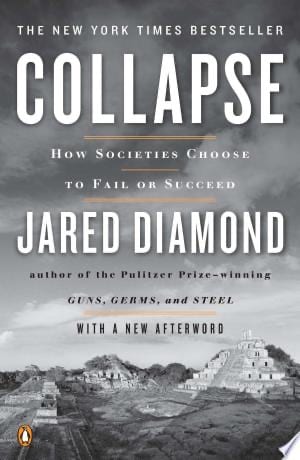
In Jared Diamond’s follow-up to the Pulitzer-Prize winning Guns, Germs and Steel, the author explores how climate change, the population explosion and political discord create the conditions for the collapse of civilization. Diamond is also the author of Upheaval: Turning Points for Nations in Crisis Environmental damage, climate change, globalization, rapid population growth, and unwise political choices were all factors in the demise of societies around the world, but some found solutions and persisted. As in Guns, Germs, and Steel, Diamond traces the fundamental pattern of catastrophe, and weaves an all-encompassing global thesis through a series of fascinating historical-cultural narratives. Collapse moves from the Polynesian cultures on Easter Island to the flourishing American civilizations of the Anasazi and the Maya and finally to the doomed Viking colony on Greenland. Similar problems face us today and have already brought disaster to Rwanda and Haiti, even as China and Australia are trying to cope in innovative ways. Despite our own society’s apparently inexhaustible wealth and unrivaled political power, ominous warning signs have begun to emerge even in ecologically robust areas like Montana. Brilliant, illuminating, and immensely absorbing, Collapse is destined to take its place as one of the essential books of our time, raising the urgent question: How can our world best avoid committing ecological suicide?
My Summary
Main Ideas, Takeaways & Similarities
Questions
I. What is the problem?
A. How is this problem formulated?
B. Why is this problem important?
C. What is the history of this problem?
D. Which prominent personalities have been interested in this problem?
II. What solutions to the problem are there?
A. What are the conclusions reached?
B. By what argument(s) is the conclusion reached?
C. What facts or assumptions serve as premises?
D. When a prominent personality offers a solution, does he also argue for or against other prominent personalities? Does he raise objections to alternative solutions? Does he consider objections to his own solutions?
III. Evaluation
A. What are the advantages and disadvantages of the alternative formulations to the problem?
B. Has the importance or history of the problem ever been misrepresented?
C. Are the solutions logically related to the premises?
D. Are the facts true? Are the assumptions acceptable? Are the objections answerable?
AI Summary
“Collapse: How Societies Choose to Fail or Succeed” by Jared Diamond is a book that explores the collapse of past societies and examines the factors that contribute to their decline or resilience. Here is a comprehensive summary in bullet points:
- Title: Collapse: How Societies Choose to Fail or Succeed
- Author: Jared Diamond
Introduction:
- Introduces the central question of the book: Why do some societies collapse while others survive and thrive?
- Discusses the relevance of this question in the context of the modern world.
Part I: Modern Montana:
- Describes the landscape and history of Montana, which serves as a case study for understanding environmental challenges and responses.
Part II: A Dozen Reasons Why Societies Collapse:
- Identifies and discusses a series of factors that can contribute to the collapse of societies, including environmental damage, climate change, hostile neighbors, and more.
- Emphasizes that multiple factors often interact to lead to collapse.
- *Part III: Past Societies:
- Examines several historical case studies of societies that collapsed, including the Anasazi, the Maya, and the Norse Greenlanders.
- Analyzes the specific factors and decisions that led to their downfall.
- *Part IV: Modem Societies:
- Discusses the challenges facing modern societies and the potential for collapse.
- Explores contemporary examples, such as Rwanda and Haiti, to illustrate the complex interplay of factors.
- *Part V: Understanding Success:
- Shifts the focus to societies that have successfully navigated environmental challenges and achieved long-term sustainability.
- Examines examples like Japan and New Guinea Highlands to draw lessons for resilience.
Part VI: The World as a Polder:
- Discusses the concept of “polders” as societies that have successfully managed their resources and environments.
- Emphasizes the importance of adaptive strategies, cooperation, and making conscious choices.
Conclusion:
- Summarizes the main lessons from the book.
- Stresses the importance of recognizing environmental limits, valuing natural resources, and making informed decisions to avoid collapse.
Legacy:
- “Collapse” by Jared Diamond has been influential in raising awareness about the environmental challenges facing humanity.
- It has prompted discussions about sustainable resource management and the potential consequences of neglecting environmental issues.
- The book serves as a cautionary tale and a call to action for societies to make informed choices that promote resilience and long-term survival.