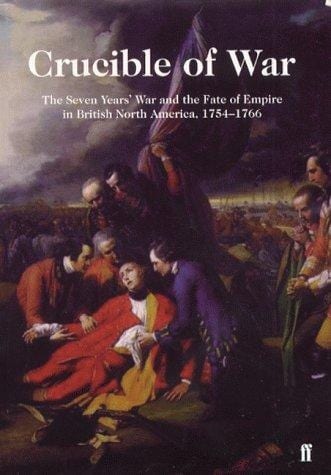
DESCRIPTION
Fred Anderson reconstructs the Seven Years’ War as the decisive crisis of the eighteenth-century British Empire rather than a hazy prelude to the American Revolution. Beginning with Indigenous diplomacy in the Ohio Country and ending with the postwar crises of imperial control, he shows how a contingent frontier conflict became a world war, how British victory depended on naval power, colonial mobilization, and negotiated alliances, and how the resulting empire proved harder to govern than to conquer. This note follows the complete Vintage edition chapter by chapter and preserves Anderson’s central distinction between an empire sustained by consent and negotiation and one that tried to substitute command, coercion, and fiscal control.
Vault PDF
Attachment (file not included in this release)
Refresher and writing practice
for closed-book questions, verified PDF reading routes, an optional essay brief, and space for answers and feedback. Command: “Give me a refresher on Crucible of War.”
Notebook page (B5)
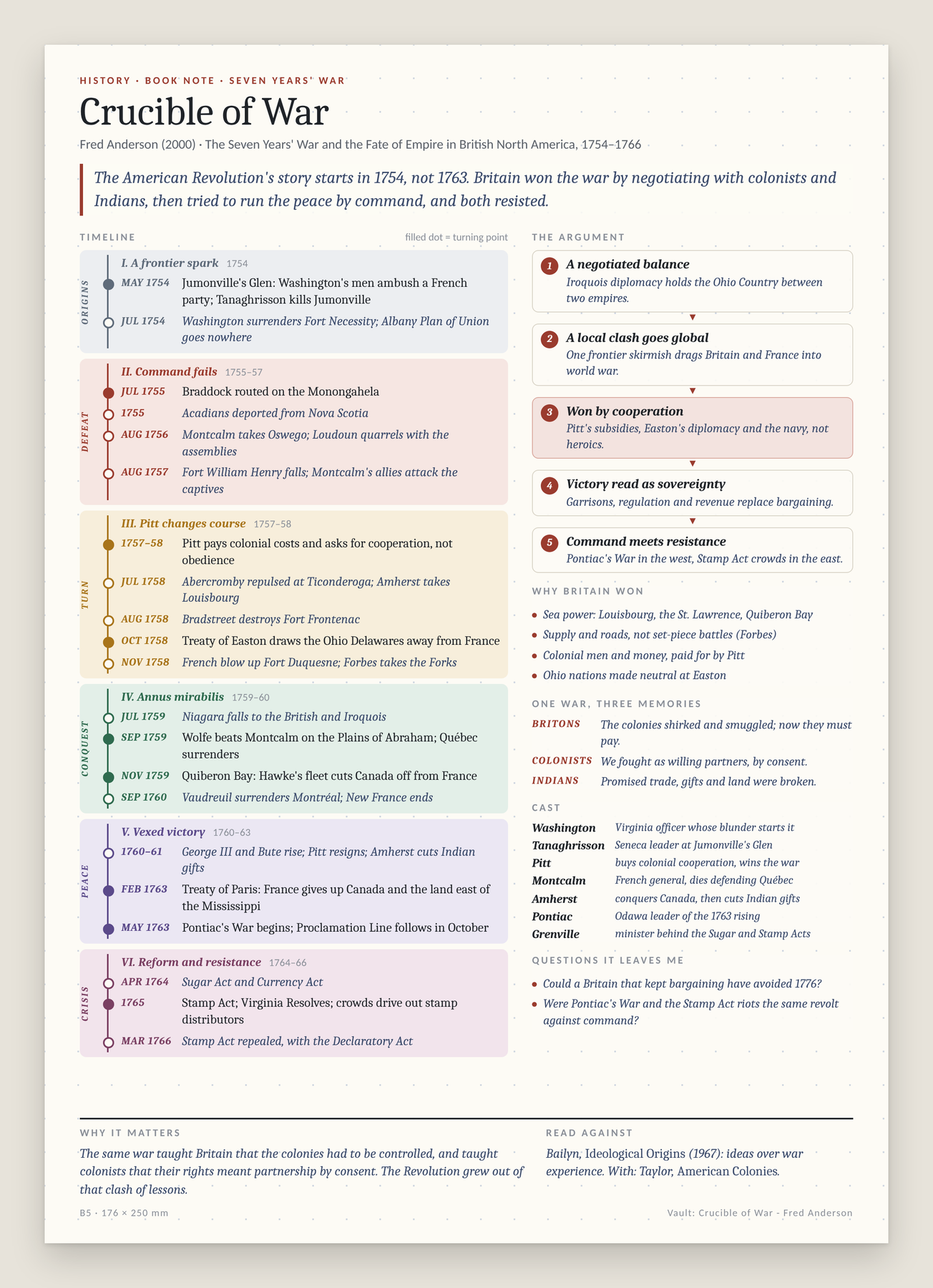
One-page book note: thesis, a phased timeline of the main events from 1754 to 1766, the argument as a five-step chain, why Britain won, the three memories of the war, the cast, and why it matters. Source: Attachment (file not included in this release).
Chapter Summaries
Linked overview
Each entry jumps to a full argument summary, analytical narrative stages, key concepts, indispensable evidence, significance, and three reflection questions. Page links use the PDF viewer’s page count, not the book’s printed pagination.
- Introduction: Anderson relocates the origins of the American Revolution from 1763 to the imperial and intercultural crisis beginning in 1754, restoring contingency and making the Seven Years’ War the book’s causal center. Attachment (file not included in this release)
- Prologue — Jumonville's Glen: A confused frontier skirmish and Tanaghrisson’s killing of Jumonville reveal that imperial war began through local motives, misinterpretation, and Indigenous agency rather than a deliberate European decision. Attachment (file not included in this release)
Part I — The Origins of the Seven Years’ War
- 1. Iroquoia and Empire: Iroquois “aggressive neutrality” maintained a three-sided balance among the Confederacy, France, and Britain; its strength depended on diplomacy, gifts, and the appearance of authority over the Ohio Country. Attachment (file not included in this release)
- 2. The Erosion of Iroquois Influence: Land frauds, settler expansion, autonomous Ohio peoples, and French fort building hollowed out Iroquois claims, making the strategic balance increasingly unstable. Attachment (file not included in this release)
- 3. London Moves to Counter a Threat: British ministers interpreted French moves through a global balance-of-power lens, but divided authority, Virginia politics, and land speculation translated imperial anxiety into improvised frontier action. Attachment (file not included in this release)
- 4. Washington Steps onto the Stage . . .: Ambitious and inexperienced, Washington carried Dinwiddie’s warning to the French, publicized the threat, and returned to find that the French had seized the Forks and built Fort Duquesne. Attachment (file not included in this release)
- 5. . . . And Stumbles: Washington’s ill-supplied expedition, the killing of Jumonville, and defeat at Fort Necessity converted a local contest into an international provocation while exposing British ignorance of Indigenous politics and wilderness logistics. Attachment (file not included in this release)
- 6. Escalation: Colonial paralysis and metropolitan alarm brought Braddock’s army to America just as European alliances destabilized, making a larger war increasingly unavoidable. Attachment (file not included in this release)
Part II — Defeat
- 7. The Albany Congress and Colonial Disunion: The Congress exposed competing land and provincial interests; Franklin’s union plan failed, encouraging London to impose military coordination from above. Attachment (file not included in this release)
- 8. General Braddock Takes Command: Braddock brought administrative energy but mistook formal authority for practical power; Franklin’s successful wagon diplomacy showed that persuasion worked where command did not. Attachment (file not included in this release)
- 9. Disaster on the Monongahela: Braddock’s defeat arose from failed alliance management and tactical surprise, demonstrating that European professionalism could not substitute for Indigenous cooperation and adaptation to American war. Attachment (file not included in this release)
- 10. After Braddock: Frontier collapse, Acadian deportation, Lake George, and competing northern campaigns produced partial successes but no strategic recovery, leaving fortified deadlock and political recrimination. Attachment (file not included in this release)
- 11. British Politics and Diplomatic Revolution: Defeat in America intersected with ministerial rivalry and the reversal of Europe’s alliance system, destroying Shirley’s career and widening the colonial war into a continental crisis. Attachment (file not included in this release)
Part III — Nadir
- 12. Lord Loudoun Takes Command: Loudoun tried to rationalize the war through direct command, but his contempt for provincial institutions transformed logistical and constitutional disputes into an imperial legitimacy problem. Attachment (file not included in this release)
- 13. Oswego: Montcalm captured Oswego by combining siegecraft with Canadian and Indigenous methods, while British panic and institutional friction destroyed the Mohawk frontier’s offensive capacity. Attachment (file not included in this release)
- 14. The State of the Central Colonies: Thin fort chains and divided assemblies failed to protect the middle frontier, but Teedyuscung and Quaker intermediaries opened a diplomatic route toward peace. Attachment (file not included in this release)
- 15. The Strains of Empire: Quartering, inadequate finance, coercion, and local control made Loudoun himself a cause of military weakness and taught colonists to separate their liberties from imperial command. Attachment (file not included in this release)
- 16. Britain Drifts into a European War: Minorca, Byng, Frederick’s invasion of Saxony, and cabinet collapse pulled Britain into a general war while exposing the fragility of metropolitan leadership. Attachment (file not included in this release)
- 17. The Fortunes of War in Europe: Prussian defeat at Kolín, Cumberland’s predicament in Hanover, and uncertainty from India to America made 1757 Britain’s bleakest strategic moment. Attachment (file not included in this release)
- 18. Loudoun’s Offensive: Loudoun built an efficient supply system and planned carefully, yet his embargo, quartering threats, and preference for redcoat control intensified colonial alienation before the Louisbourg expedition even sailed. Attachment (file not included in this release)
- 19. Fort William Henry: Montcalm’s victory ended in an Indigenous attack on surrendered troops, revealing the limits of French command over allies; New England’s emergency mobilization simultaneously disclosed immense unused colonial capacity. Attachment (file not included in this release)
- 20. Other Disasters and a Ray of Hope: Frontier war and colonial dysfunction continued, but the Easton negotiations aligned enough competing interests to begin separating the Delawares from France. Attachment (file not included in this release)
- 21. Pitt Changes Course: Loudoun’s aborted campaign and Britain’s wider defeats opened the way for the Pitt-Newcastle ministry, whose strategy joined continental subsidies to an imperial offensive and new terms of colonial cooperation. Attachment (file not included in this release)
Part IV — Turning Point
- 22. Deadlock and a New Beginning: Pitt broke the Anglo-American deadlock by reimbursing colonial expenses, respecting provincial rank and enlistment practices, and asking for cooperation rather than submission. Attachment (file not included in this release)
- 23. Old Strategies, New Men, and a Shift in the Balance: Familiar strategic objectives became viable under new commanders, British naval pressure, French scarcity, and an irreparable Vaudreuil-Montcalm conflict. Attachment (file not included in this release)
- 24. Montcalm Raises a Cross: Abercromby’s needless frontal assault gave France a spectacular tactical victory, but Britain retained overwhelming resources while time and shortage worked against Canada. Attachment (file not included in this release)
- 25. Amherst at Louisbourg: Effective naval-army cooperation, siege discipline, and French isolation captured Louisbourg, opening the St. Lawrence while demonstrating the operational system Pitt hoped to reproduce. Attachment (file not included in this release)
- 26. Supply Holds the Key: Forbes made logistics rather than battle the basis of his advance on Fort Duquesne; secure roads, depots, and methodical movement converted endurance into strategy. Attachment (file not included in this release)
- 27. Bradstreet at Fort Frontenac: Bradstreet’s improvised raid destroyed France’s Lake Ontario supply hub and fleet, proving that strategic insight and provincial mobility could achieve disproportionate effects. Attachment (file not included in this release)
- 28. Indian Diplomacy and the Fall of Fort Duquesne: Direct negotiation at Easton neutralized the Ohio peoples just as Frontenac’s fall severed French supply, allowing Forbes to take the Forks without a climactic battle. Attachment (file not included in this release)
- 29. Educations in Arms: Provincial service sharpened distrust of regular discipline while teaching Washington that logistics, restraint, and strategic persistence mattered more than battlefield glory. Attachment (file not included in this release)
Part V — Annus Mirabilis
- 30. The Ascent of William Pitt: Victory consolidated Pitt’s authority and encouraged an even larger 1759 offensive, but financial, political, and command uncertainties remained beneath the celebration. Attachment (file not included in this release)
- 31. Ministerial Uncertainties: Fiscal strain and invasion fears shadowed British confidence; Guadeloupe’s unexpectedly profitable capitulation suggested that liberal commercial terms could secure conquest more effectively than coercion. Attachment (file not included in this release)
- 32. Surfeit of Enthusiasm, Shortage of Resources: The colonies answered Pitt enthusiastically despite debt and manpower exhaustion, revealing both real imperial patriotism and the limits imposed by local rivalry and subsidy dependence. Attachment (file not included in this release)
- 33. Emblem of Empire: Fort Pitt embodied British permanence to settlers but betrayal to Ohio peoples, as trade disorder, garrison growth, and looming settlement contradicted promises made at Easton. Attachment (file not included in this release)
- 34. The Six Nations Join the Fight: Iroquois leaders allied with Britain to regain western influence; Niagara’s fall destroyed the French communications system but made Iroquois dependence on British power irreversible. Attachment (file not included in this release)
- 35. General Amherst Hesitates: Amherst gained the Champlain forts cheaply but refused to outrun naval cover and secure supply, choosing consolidation over a risky drive on Montréal. Attachment (file not included in this release)
- 36. Dubious Battle: Wolfe’s destructive, nearly failed campaign ended in an improvised landing and battlefield victory; Québec fell, but contingency, civilian devastation, and the coming winter qualified the heroic legend. Attachment (file not included in this release)
- 37. Fall’s Frustrations: News of Québec arrived too late to redeem Amherst’s campaign or provincial service; mutiny and resentment deepened the cultural divide between regulars and Americans. Attachment (file not included in this release)
- 38. Celebrations of Empire: Anglo-American civilians interpreted Québec as proof of providential favor and imagined a Protestant imperial future, intensifying emotional investment in Britain. Attachment (file not included in this release)
- 39. Day of Decision: Hawke’s victory at Quiberon Bay ended the invasion threat and cut Canada off from relief, making naval supremacy—not Québec alone—the decisive fact of 1759. Attachment (file not included in this release)
Part VI — Conquest Completed
- 40. War in Full Career: Amherst prepared a three-pronged conquest of Canada while subsidies, employment, and wartime demand fused colonial prosperity with imperial cooperation. Attachment (file not included in this release)
- 41. The Insufficiency of Valor: Lévis won at Sainte-Foy but could not retake Québec because naval control determined which empire received relief; courage could not overcome maritime isolation. Attachment (file not included in this release)
- 42. Murray Ascends the St. Lawrence: Naval mobility let Murray bypass resistance, accept local submissions, and turn an invasion into an orderly progress toward Montréal. Attachment (file not included in this release)
- 43. Conquest Completed: Amherst, Haviland, and Murray converged with remarkable precision; Vaudreuil chose civilian survival over Lévis’s demand for military honor and ended French dominion in Canada. Attachment (file not included in this release)
- 44. Causes of Victory and Experience of Empire: British victory required adaptation, provincial labor, Indigenous alliance, naval logistics, and massive finance, while common soldiers emerged with memories sharply different from commanders’ triumphal accounts. Attachment (file not included in this release)
- 45. Pitt Confronts an Unexpected Challenge: At the height of victory, George II’s death transferred power to George III and Bute, making Pitt’s dominance suddenly vulnerable to court politics. Attachment (file not included in this release)
- Victory Recollected — Scenographia Americana: A postwar print series converted contingent, multicultural conquest into a serene visual narrative of British arms, commerce, settlement, and providential dominion. Attachment (file not included in this release)
Part VII — Vexed Victory
- 46. Fruits of Victory and Seeds of Disintegration: The negotiated practices that enabled victory were reversed after conquest, and Amherst’s rationalizing reforms made coercion the foundation of a dangerously unstable imperial order. Attachment (file not included in this release)
- 47. Cherokee War and Amherst’s Reforms: Violence on the southern frontier showed how alliance could collapse under settler aggression; Amherst then generalized policies that misunderstood gifts, trade, and ammunition as indulgences rather than foundations of diplomacy. Attachment (file not included in this release)
- 48. Amherst’s Dilemma: Troop reductions, military rule, western garrisons, and settler growth made the new empire costly and brittle; to Indigenous observers, occupation looked like colonization after conquest. Attachment (file not included in this release)
- 49. Pitt’s Problems: George III and Bute exploited strategic disagreement over Spain to isolate Pitt, whose resignation ended the political coalition that had organized Britain’s victories. Attachment (file not included in this release)
- 50. The End of an Alliance: Pitt’s system outlived him long enough to widen the war against Spain, but Bute displaced Newcastle and terminated the Prussian alliance as Europe reached exhaustion. Attachment (file not included in this release)
- 51. Havana: Britain defeated Bourbon strategy from Portugal to Cuba; Havana demonstrated global logistical reach and the intimate connection between naval power, commercial wealth, disease, and imperial bargaining. Attachment (file not included in this release)
- 52. Peace: The Treaty of Paris exchanged spectacular conquests for a defensible empire, but competing valuations of Canada, sugar islands, fisheries, and allies made victory politically divisive. Attachment (file not included in this release)
- 53. Wilkes, Bute, and Manila: Domestic opposition toppled Bute while Manila demonstrated that force without local allegiance or commerce could not create real dominion—a lesson British leaders failed to apply elsewhere. Attachment (file not included in this release)
- 54. Anglo-America at War’s End: Continued colonial service coexisted with metropolitan stereotypes, smuggling disputes, land hunger, and uncontrolled settlement, revealing that apparent imperial unity rested on fragile accommodations. Attachment (file not included in this release)
- 55. Yankees Invade Wyoming: Connecticut settlers, competing land claims, Teedyuscung’s death, and Delaware retaliation made the Wyoming Valley a concentrated example of postwar conquest without legitimate authority. Attachment (file not included in this release)
- 56. Amherst’s Reforms and Pontiac’s War: A pan-Indigenous religious revival and local grievances turned coordinated attacks into a continental uprising against conquest, settlement, and the destruction of diplomatic reciprocity. Attachment (file not included in this release)
- 57. Amherst’s Recall: Besieged forts, failed relief, colonial reluctance, and Amherst’s political isolation forced his replacement by Gage, leaving the architect of postwar reform blamed for a rebellion he never understood. Attachment (file not included in this release)
Part VIII — Crisis and Reform
- 58. Death Reshuffles a Ministry: Egremont’s death stabilized Grenville and Halifax in office long enough to pursue an energetic but poorly integrated reform program derived from metropolitan memories of the war. Attachment (file not included in this release)
- 59. An Urgent Search for Order: A peacetime army, western boundary, Indian administration, and new revenue system formed a connected attempt to secure empire while reducing dependence on colonial assemblies. Attachment (file not included in this release)
- 60. The American Duties Act: Grenville designed the Sugar Act to raise revenue, regularize trade, weaken French islands, and habituate colonists to parliamentary sovereignty; control mattered as much as income. Attachment (file not included in this release)
- 61. The Currency Act: A merchant-driven response to Virginia paper money became an empire-wide restriction, showing how Parliament imposed metropolitan creditor interests without understanding colonial fiscal conditions. Attachment (file not included in this release)
- 62. Postwar Conditions: Depression, debt retirement, reduced money supply, and vanishing wartime patronage weakened governors and amplified local faction just as imperial reform demanded compliance. Attachment (file not included in this release)
- 63. An Ambiguous Response: Merchants and assemblies protested selectively and locally; constitutional unease spread, but fragmented politics and continuing frontier war prevented coordinated resistance. Attachment (file not included in this release)
- 64. Pontiac’s Progress: British insistence on punishment prolonged war until Bradstreet, Bouquet, and especially Croghan used negotiation, coercion, and opportunism to restore a precarious peace. Attachment (file not included in this release)
- 65. Lessons of Pontiac’s War: Indians, officials, and settlers drew incompatible lessons: Indigenous leaders thought resistance had restored reciprocity, Britain lacked enforcement capacity, and frontier settlers embraced exterminatory security. Attachment (file not included in this release)
Part IX — Crisis Compounded
- 66. Stamp Act and Quartering Act: Measures Grenville considered moderate converted money and provisioning into constitutional questions because Parliament imposed burdens formerly granted by colonial consent. Attachment (file not included in this release)
- 67. Grenville’s End: Court politics, royal illness, and the regency dispute removed Grenville before colonial resistance erupted, leaving his integrationist imperial program to uncertain successors. Attachment (file not included in this release)
- 68. The Assemblies Vacillate: Assemblies initially hesitated, but Patrick Henry reframed taxation as a stark contest between liberty and slavery, creating language ordinary colonists could readily mobilize. Attachment (file not included in this release)
- 69. Mobs Respond: Misreported Virginia Resolves and organized crowd action transformed an elite constitutional protest into a popular campaign that forced stamp distributors from office. Attachment (file not included in this release)
- 70. Nullification by Violence: Colonial crowds made enforcement impossible; merchants and political leaders then shifted toward nonimportation and intercolonial coordination to discipline popular power without surrendering resistance. Attachment (file not included in this release)
Part X — Empire Preserved?
- 71. Repeal of the Stamp Act: Rockingham, merchants, Pitt, and Franklin constructed a retreat that repealed the tax while preserving parliamentary sovereignty through the Declaratory Act. Attachment (file not included in this release)
- 72. The Hollowness of Empire: Repeal restored celebration, not agreement: British confidence in unity, sovereignty, and military supremacy concealed an empire sustained mainly by allegiance and acquiescence. Attachment (file not included in this release)
- 73. Acrimonious Postlude: Depression and local political conflicts reemerged in Massachusetts, New York, and Virginia, revealing divisions the Stamp Act had intensified but not created. Attachment (file not included in this release)
- 74. The Future of Empire: British troops occupied a vast map they could not govern; unresolved settlement, violence, finance, and constitutional tensions showed that imperial survival depended on limits Britain repeatedly exceeded. Attachment (file not included in this release)
Notes
Book Argument and Reading Map
Anderson’s governing claim is that the Seven Years’ War should be treated as the event that transformed British North America and made the later imperial rupture possible, not as background scenery to a Revolution whose origins begin automatically in 1763. Starting in 1754 restores contingency. Nobody at Jumonville’s Glen sought an independent American republic; colonists identified intensely with Britain, Indigenous peoples pursued their own diplomacy, and ministers acted within a European balance-of-power system. The war altered all of those contexts. It eliminated France as a continental counterweight, expanded Britain’s territorial obligations, normalized large-scale military administration, deepened debt, fostered colonial expectations of partnership, and unleashed migration into lands Indigenous nations still possessed.
The narrative develops through five connected problems:
- Balance: Iroquois diplomacy and autonomous Ohio peoples kept imperial claims from becoming territorial command.
- Mobilization: Britain’s first attempts to impose cooperation failed; Pitt succeeded by subsidizing and accommodating provincial political culture.
- Conquest: Naval supremacy, logistics, colonial manpower, and Indigenous realignment—not battlefield heroism alone—destroyed New France.
- Postwar control: Amherst and later ministers mistook victory for sovereignty and tried to replace negotiated relations with regulation, garrisons, and coercion.
- Divergent lessons: Britons remembered colonial obstruction and the costs of war; colonists remembered voluntary sacrifice and glorious partnership; Indigenous peoples remembered promises, reciprocity, and autonomy. Reform therefore activated incompatible political memories.
Anderson’s central causal sequence
A negotiated balance collapses → a local frontier war becomes global → Britain wins by mobilizing relationships and resources → victory removes counterweights and creates new obligations → officials pursue control and revenue → Indigenous rebellion and colonial resistance expose the limits of coercive empire.
Introduction: The Seven Years’ War and the Disruption of the Old British Empire
Attachment (file not included in this release)
Chapter Objective and Through Line
Anderson begins by challenging the retrospective habit of treating the colonial past as a prelude to the United States. Histories that start the Revolution in 1763 already know where the story ends; they therefore convert the Sugar and Stamp Act controversies into signs of an approaching independence that contemporaries neither expected nor desired. Anderson proposes a different vantage point. Beginning in 1754 places colonists inside a British imperial world they regarded as protective, Protestant, free, and indispensable. It also restores France, Native nations, European diplomacy, and the continental interior to the story. From Montréal, Havana, Berlin, or the Ohio Country, the Seven Years’ War appears more consequential than the American Revolution because it decisively rearranged power across Europe, the Atlantic, India, and North America.
The book will treat empire as a negotiated process, not a metropolitan structure simply imposed on passive peripheries. Indigenous peoples, colonial assemblies, merchants, soldiers, governors, and ministers could all shape, obstruct, or redirect it. The war began when the diplomatic balance in the Ohio Country broke down; British victory then enlarged the empire beyond the capacity of ordinary administrative routines. Efforts to make the conquest governable—through armies, boundaries, trade regulation, and taxation—strained Indigenous relations and Anglo-American allegiance. Anderson’s aim is not to make the Revolution inevitable by moving its starting date backward. It is to explain how a war no one intended to produce independence transformed the conditions within which later choices became possible.
Chapter Structure at a Glance
- Identify the Revolution-centered chronology as a source of hindsight bias.
- Recast the Seven Years’ War as a global and continental turning point.
- Replace an exclusively Anglo-American cast with imperial and Indigenous actors.
- Define empire as a negotiated system of intercultural relations.
- Trace victory into territorial expansion, fiscal pressure, and weakened allegiance.
- Preserve contingency by ending in 1766–1767, before independence became a political objective.
Section-by-Section Argument
Analytical division: The distortion created by starting in 1763
The familiar chronology turns postwar controversies into a straight road to revolution. Anderson argues that this quietly assumes what needs explaining: how colonists who celebrated British victory came to fear imperial power.
- Neo-Progressive and Neo-Whig interpretations disagree over material interests and political ideas but often share the same retrospective starting point.
- Moving the vantage point to 1754 makes war, empire, and Indian diplomacy causal variables rather than backdrop.
Analytical division: A global war with continental origins
The Seven Years’ War differed from earlier dynastic conflicts because it ended in decisive territorial redistribution. Its North American origins and global spread connected the Ohio Valley to Europe, the Caribbean, West Africa, India, and the Philippines.
- France lost Canada, acquired a motive for revenge, and later intervened against Britain.
- Britain gained territories whose scale produced new problems of defense, finance, and political control.
- Removing French power changed the strategic conditions for Indigenous autonomy and settler expansion.
Analytical division: Negotiated empire and the book’s causal design
Following the idea that empires are processes and sites of intercultural relations, Anderson foregrounds actors who could not command one another but nevertheless depended on one another. The narrative will show how metropolitan attempts to replace bargaining with control repeatedly failed.
- Iroquois diplomacy and the choices of Ohio peoples are indispensable to both the outbreak and course of the war.
- Colonial participation depended on political terms that officials could either respect or violate.
- Conquest generated a contradiction: Britain possessed more territory but depended on forms of allegiance it could not compel.
Key Concepts and Distinctions
- Retrospective inevitability: Reading 1763–1776 as if independence were already latent in every dispute. Significance: Anderson’s chronology is designed to recover choices, uncertainty, and paths not taken.
- Negotiated empire: Imperial power created through reciprocal, unequal, and revisable bargains. Significance: It explains why formal sovereignty so often exceeded actual control.
- Imperial history versus national origins: A continental and global account asks different questions from a genealogy of the United States. Significance: It restores Indigenous and non-British actors to causal centrality.
- Disruption: Victory did not perfect the old empire; it destroyed the accommodations that had made that empire workable. Significance: This is the bridge from war to postwar crisis.
Essential Evidence and Examples
- The war’s outcome helped shape French revenge policy, the later French intervention in America, and the sequence that led toward the French Revolution.
- The conflict rearranged control from Canada and the Caribbean to India, demonstrating why a thirteen-colonies perspective is too narrow.
- The Ohio Country matters because it linked Indigenous diplomacy, land speculation, continental communication, and metropolitan fears in one unstable region.
Chapter Conclusion and Significance
The introduction supplies the interpretive rules for the whole book. Anderson will not search the 1750s for embryonic revolutionaries. He will follow the war’s contingent expansion, the relationships that made victory possible, and the policies by which victors misunderstood what they had won. The crucial unresolved tension is that Britain needed stronger coordination after 1763 while effective empire still depended on local consent and intercultural accommodation.
Questions for Reflection
- How does beginning in 1754 alter the relative importance of constitutional ideology, material interest, and imperial experience in explaining the Revolution?
- What evidence would distinguish a genuinely negotiated empire from a coercive empire that merely makes tactical concessions?
- Does a global frame reduce the distinctiveness of the American Revolution, or explain more convincingly why it occurred when it did?
Prologue: Jumonville’s Glen
Attachment (file not included in this release)
Chapter Objective and Through Line
The prologue reconstructs the wet, confused encounter of May 28, 1754, to strip away the clean origins later assigned to the war. George Washington’s small, exhausted force joined Tanaghrisson and a handful of Mingo warriors in surprising a French party led by Joseph Coulon de Villiers de Jumonville. The brief exchange of fire left Jumonville wounded and several Frenchmen dead. What transformed a skirmish into a diplomatic catastrophe was Tanaghrisson’s deliberate killing of Jumonville, whose skull he split after addressing him as “father.” Washington neither ordered nor understood the act, and the surviving accounts do not permit absolute certainty about every motion or word.
Anderson treats the killing as intelligible within Indigenous diplomacy. Tanaghrisson’s authority in the Ohio Country was collapsing under French occupation and the independence of local Delawares, Shawnees, and Mingos. By killing a French emissary before British witnesses, he tried to make reconciliation impossible and bind the Virginians to an anti-French war that might restore his position. Washington understood the encounter through European categories of combat and honor; the French described Jumonville as an envoy murdered while delivering a summons. The event therefore became dangerous not simply because blood was shed, but because people acting within different political cultures assigned incompatible meanings to it. A local chief’s desperate strategy, a provincial officer’s ambition, and imperial claims no one could enforce combined to light a global fuse.
Chapter Structure at a Glance
- Place Washington’s column in physical disorientation and tactical uncertainty.
- Bring Tanaghrisson’s intelligence and alliance into the operation.
- Describe the short, confused engagement with Jumonville’s party.
- Isolate Tanaghrisson’s killing as a purposeful diplomatic act.
- Contrast British, French, and Indigenous interpretations of the encounter.
- Show how ambiguity itself enabled escalation.
Section-by-Section Argument
Analytical division: A battle without clear categories
Washington approached the French with little experience, poor information, and troops barely capable of moving through the forest. Whether Jumonville was scouting, warning, or preparing an ambush mattered enormously under European law but was impossible to establish in the moment.
- Weather, darkness, and divided forces undercut the later image of a planned military engagement.
- Tanaghrisson supplied the local knowledge that made contact possible, demonstrating Washington’s dependence on an ally he did not control.
Analytical division: Tanaghrisson’s intervention
The half-king had more at stake than Washington. French forts and diplomacy were erasing his claim to speak for the Ohio peoples. His ritualized assault on Jumonville repudiated French paternal authority and attempted to force an Anglo-French rupture.
- Addressing Jumonville as “father” before killing him inverted the French diplomatic relationship.
- The act served Tanaghrisson’s political survival even though it did not express a general Iroquois or Ohio consensus.
Analytical division: From contested episode to casus belli
Washington reported victory; France reported assassination. The incompatible accounts traveled into imperial systems already disposed to fear one another. Neither Washington nor Tanaghrisson could determine what those systems would do with the episode.
- Diplomatic status, not casualty scale, made the event explosive.
- The prologue foreshadows the book’s larger pattern: local actions acquire consequences through distant institutions and misunderstood cultural codes.
Key Concepts and Distinctions
- Skirmish versus assassination: Competing legal and political descriptions of the same encounter. Significance: The label determined responsibility and justified retaliation.
- Half-king: An Iroquois-authorized spokesman whose practical authority depended on local followers. Significance: Tanaghrisson acted from institutional weakness, not sovereign command.
- Intercultural misinterpretation: Different actors read the same gesture through incompatible assumptions. Significance: Misunderstanding was causal, not incidental.
- Local agency and global consequence: Peripheral actors could trigger processes larger powers did not plan. Significance: This is Anderson’s antidote to a purely metropolitan explanation of war.
Essential Evidence and Examples
- Washington’s force numbered only about forty men after a miserable night march, underscoring the disproportion between the engagement’s scale and consequences.
- Jumonville’s death followed rather than simply occurred within the exchange of fire, supporting Anderson’s focus on Tanaghrisson’s purpose.
- French claims that Jumonville carried a summons converted the event into an alleged violation of diplomatic immunity.
Chapter Conclusion and Significance
Jumonville’s Glen introduces a war born from layered weakness: weak intelligence, weak colonial command, weak Indigenous authority, and weak imperial control over frontier agents. Its significance lies less in who fired first than in who could define the meaning afterward. The episode establishes that contingency in Anderson’s narrative does not mean randomness; it means that consequences emerged from the interaction of rational but incompatible aims.
Questions for Reflection
- How much explanatory weight should Tanaghrisson’s individual strategy bear relative to the structural Anglo-French rivalry already present?
- What would count as sufficient evidence for deciding whether Jumonville was acting primarily as envoy or combatant?
- How does the prologue complicate heroic accounts of Washington’s early military career without reducing him to incompetence?
Part I — The Origins of the Seven Years’ War
Part through line
The first six chapters trace the collapse of a three-sided diplomatic balance. European rivalry supplied the danger, but land claims, Indigenous political change, speculative ambition, and improvised decisions in the Ohio Country supplied the mechanism of war.
Part I timeline — From diplomatic balance to imperial war (1660s–January 1755)
Source status: This chronology follows Anderson’s Part I narrative and causal emphasis; it is not an independent fact-check. Date ranges mark extended processes rather than single decisions. Each entry links to the relevant chapter synthesis and the book’s discussion.
- 1660s–1701 — Iroquois crisis produces a balancing strategy: Exhausting wars, epidemic losses, adoption, and the end of Dutch arms supplies weaken the Five Nations. Separate peace with New France in 1665–67 and the 1677 Covenant Chain with New York create the two diplomatic relationships later joined in the Grand Settlement. Ch. 1 · Attachment (file not included in this release)
- 1701 — The Grand Settlement establishes “aggressive neutrality”: The Five Nations make peace with New France at Montréal while renewing the Covenant Chain at Albany. By maneuvering between the French and English systems, the Confederacy preserves autonomy and makes European rivalry a source of leverage. Ch. 1 · Attachment (file not included in this release)
- 1709–1711 — The Confederacy quietly frustrates British invasions of Canada: Minimal cooperation, delay, and covert warning to the French show that neutrality is an active strategy, not passivity or indecision. Ch. 1 · Attachment (file not included in this release)
- 1713–1744 — Iroquois influence reaches its apparent height: During the imperial peace, the Tuscaroras join the League and the Six Nations enlarge their claims over the Ohio Country and “dependent” peoples. Their authority increasingly rests on diplomatic recognition and outsiders’ belief, however, rather than firm control over Delawares, Shawnees, Mingos, and western nations. Ch. 1 · Attachment (file not included in this release)
- 1737 and 1742 — The Walking Purchase turns diplomatic authority into dispossession: Pennsylvania’s fraudulent 1737 purchase strips Delawares of eastern lands; Six Nations representatives confirm it at Easton in 1742. The deal brings gifts and recognition but pushes displaced communities west and corrodes the legitimacy of Iroquois claims to speak for them. Ch. 2 · Attachment (file not included in this release)
- 1744 — The Treaty of Lancaster opens the Ohio to expansive colonial readings: Iroquois diplomats make a sweeping cession that Virginians interpret as covering the Ohio Country. A transaction meant to display Six Nations authority becomes a legal foundation for land speculation and settlement beyond their effective control. Ch. 2 · Attachment (file not included in this release)
- 1745–1748 — King George’s War fractures the old balance: Mohawk participation in raids on Canada strains Confederacy solidarity, while New England’s capture of Louisbourg disrupts French trade. The 1748 Treaty of Aix-la-Chapelle restores conquests but does not restore the Iroquois position or the previous commercial balance in the interior. Ch. 2 · Attachment (file not included in this release)
- 1747–1749 — British trade and Virginia speculation converge on the Ohio: George Croghan’s traders offer western peoples cheaper and more plentiful goods, culminating in the Pickawillany post, while the Ohio Company begins turning paper claims into storehouses, surveys, and plans for settlement. France increasingly sees commerce and colonization as one strategic threat. Ch. 2 · Attachment (file not included in this release)
- June–November 1749 — Céloron’s expedition renews France’s claim but exposes its weakness: Céloron buries lead plates and warns British traders away during a three-thousand-mile circuit of the Ohio watershed. He returns convinced that speeches and symbols cannot compete with British prices and established trade relationships. Ch. 2 · Attachment (file not included in this release)
- Spring–June 1752 — Logstown concessions and the destruction of Pickawillany narrow the middle ground: Tanaghrisson recognizes Virginia’s proposed post at the Forks, hoping to preserve local autonomy, but on June 21 a French-allied force attacks Pickawillany and kills the Miami leader Memeskia. Trade rivalry is becoming militarized. Ch. 2 · Attachment (file not included in this release) · Attachment (file not included in this release)
- Spring–autumn 1753 — France converts its claim into an occupation: Duquesne’s forces build forts at Presque Isle and LeBoeuf and establish Fort Machault at Venango, with a final post planned for the Forks. The chain secures the route toward the Ohio and makes physical control—not treaty language—the decisive issue. Ch. 2 · Attachment (file not included in this release)
- August 21, 1753 — London authorizes colonial resistance by force: Already alarmed by French expansion, the British cabinet instructs colonial governors to prevent further encroachments and the Board of Trade calls a general Indigenous conference at Albany. Central direction grows, but implementation still depends on divided provincial governments. Ch. 3 · Attachment (file not included in this release)
- November 30, 1753–January 1754 — Washington’s warning mission confirms French resolve: Only Tanaghrisson and three Mingos accompany Washington to Fort LeBoeuf, undermining British claims of broad Indigenous support. Saint-Pierre receives him courteously, refuses Dinwiddie’s demand to withdraw, and reveals preparations for a spring descent; Washington returns to Williamsburg with the refusal and a publishable warning. Ch. 4 · Attachment (file not included in this release)
- February 17–April 17, 1754 — The contest for the Forks becomes an armed occupation: Virginia’s small construction party begins a fort with Tanaghrisson’s ceremonial support, but shortages and weak local backing leave it exposed. On April 17, Contrecoeur arrives with at least five hundred troops and eighteen cannon; Ensign Ward surrenders, and the French build Fort Duquesne. Ch. 4 · Attachment (file not included in this release)
- May 28, 1754 — Jumonville’s Glen turns confrontation into bloodshed: Washington and Tanaghrisson attack Jumonville’s detachment; Tanaghrisson kills the wounded French commander. The ambiguous encounter can be narrated as battle, assassination, or diplomatic murder, but in every version it destroys the remaining room for easy de-escalation. Ch. 5 · Attachment (file not included in this release)
- June 2–July 4, 1754 — Fort Necessity exposes Virginia’s military and diplomatic weakness: Washington completes the fort, advances despite failing supply and shrinking Indigenous support, then retreats before Coulon de Villiers. After the July 3 battle he signs surrender terms and withdraws on July 4; Shawnee, Delaware, and Mingo participation with the French shows that Britain has lost the alliance its strategy assumed. Ch. 5 · Attachment (file not included in this release)
- September–November 1754 — Colonial failure shifts initiative to London: Dinwiddie’s appeals and the colonial response produce little, but news of defeat convinces Newcastle and Cumberland to send Edward Braddock with regular troops. A proposed limited recovery of the Ohio expands into simultaneous operations on four fronts, while Braddock receives powers designed to override colonial disunion. Ch. 6 · Attachment (file not included in this release)
- Late 1754–January 16, 1755 — American escalation meets European realignment: France prepares major reinforcements for Canada while Austria’s still-secret approach to France weakens Britain’s old alliance system. On January 16 two understrength Irish regiments sail for Virginia; the “limited” Ohio intervention now carries the risk of a general war. Ch. 6 · Attachment (file not included in this release)
Causal arc: Iroquois leverage weakens → land cessions and trade pull settlers and speculators west → France answers with forts → Britain answers through improvised provincial action → bloodshed and defeat invite metropolitan troops → a frontier contest becomes entangled with Europe’s collapsing alliance system.
Chapter 1: Iroquoia and Empire
Attachment (file not included in this release)
Chapter Objective and Through Line
Anderson begins the war’s origins with the Haudenosaunee, or Six Nations, because Anglo-French rivalry did not by itself determine control of the interior. After catastrophic seventeenth-century warfare, the Iroquois Confederacy secured its independence through the Grand Settlement of 1701: peace with New France alongside renewal of the Covenant Chain with the English. This posture became aggressive neutrality. Onondaga’s diplomats maintained relations with both empires, magnified Iroquois claims over dependent peoples and territory, and extracted gifts, trade, and recognition from rivals that each feared would otherwise gain the advantage.
The strategy rested on a productive gap between appearance and effective control. The Confederacy claimed conquest rights over the Ohio Country and authority to speak for Delawares, Shawnees, Mingos, and even distant “Far Indians,” although the consent behind those claims was often fragile. France needed the Ohio route between Canada and the Illinois Country; Britain wanted to prevent encirclement and preserve the region for trade and future settlement. Because both powers believed Iroquois alignment could decide the contest, diplomatic gifts and wampum sustained a balance that compensated for the Confederacy’s demographic limits. The apparent zenith of Iroquois influence after 1713 therefore contained the seeds of decline: expanding claims, growing dependence on European recognition, and the increasing autonomy of peoples supposedly represented from Onondaga.
Chapter Structure at a Glance
- Contrast earlier dynastic wars with the territorially decisive Seven Years’ War.
- Reconstruct the Iroquois League, mourning war, and seventeenth-century crisis.
- Explain the Grand Settlement and neutrality after 1701.
- Show how French paternal diplomacy and the British Covenant Chain created rival systems.
- Establish the Ohio Country’s strategic place between Canada, Louisiana, and British colonies.
- Reveal the difference between Iroquois claims and actual command over western peoples.
Section-by-Section Argument
Analytical division: From internal peace to imperial diplomacy
The League of Peace redirected violence outward and developed institutions capable of managing relations among the Five Nations. War, epidemic, adoption, missions, and factionalism later threatened cohesion, but the 1701 settlement offered a durable strategy of dual engagement.
- Adoption replenished population while also making Iroquois society politically complex.
- Catholic mission settlements created Francophile, Anglophile, and neutral factions within the nations.
- Peace with France and alliance with New York allowed Onondaga to avoid exclusive dependence.
Analytical division: The diplomatic economy of balance
Neutrality was active leverage. Wampum, speeches, and material gifts did not merely decorate negotiations; they ratified relationships and supplied goods essential to life and trade.
- British and French officials “brightened” their respective chains with cloth, arms, tools, ammunition, and liquor.
- Iroquois intermediaries used European fear to obtain far more influence than their roughly 1,100 warriors alone could command.
- Claims to represent thousands of Far Indian warriors magnified bargaining power.
Analytical division: The Ohio Country as strategic fulcrum
The Ohio watershed joined French Canada to the Illinois and Mississippi while offering British colonies their most plausible western avenue. Iroquois claims made Onondaga seem the necessary broker, but resident peoples retained practical autonomy.
- Mingos, Shawnees, and Delawares moved into the region under pressures originating farther east.
- Half-kings such as Tanaghrisson could negotiate and receive gifts but depended on local followers and could not bind the region unilaterally.
- The Confederacy’s strongest diplomatic claim therefore exceeded its territorial capacity.
Key Concepts and Distinctions
- Aggressive neutrality: Deliberate maneuvering between rival empires while avoiding exclusive alignment. Significance: It was the foundation of Iroquois power before 1754.
- Covenant Chain: The alliance relationship linking the Iroquois and English colonies, especially New York. Significance: It was a diplomatic relationship requiring renewal, not a fixed submission.
- Onontio/fatherhood: The French governor-general’s role as a generous mediator among allied peoples. Significance: Authority depended on persuasion and gifts rather than direct command.
- Claimed suzerainty versus effective control: The Confederacy could sell or speak for lands and peoples it did not govern in a European sense. Significance: The gap made diplomacy lucrative but unstable.
Essential Evidence and Examples
- The Confederacy covertly frustrated British invasions of Canada in 1709 and 1711, showing neutrality as purposeful strategy.
- Admission of the Tuscaroras and western settlement by client peoples expanded the League’s claimed reach after 1713.
- British intelligence credited the Iroquois with influence over 9,300 Far Indian warriors despite their much smaller actual population, demonstrating the power of diplomatic perception.
Chapter Conclusion and Significance
The prewar balance was not peace guaranteed by European deterrence. It was a diplomatic construction whose indispensable pivot was an Indigenous confederacy seeking autonomy. Anderson thereby makes the erosion of Iroquois leverage, rather than a timeless British-French rivalry, the immediate structural origin of war. The chapter also introduces a recurring warning: imperial maps and formal claims become dangerous when officials mistake them for social control.
Questions for Reflection
- Was aggressive neutrality sustainable, or did it inevitably invite the expansive claims that later undermined it?
- How should historians describe Iroquois authority over the Ohio Country without either accepting European legal fictions or denying real diplomatic influence?
- What does the material role of gifts reveal about the boundary between diplomacy, trade, and dependency?
Chapter 2: The Erosion of Iroquois Influence
Attachment (file not included in this release)
Chapter Objective and Through Line
The chapter explains how Iroquois leverage eroded between the Walking Purchase and the French occupation of the Ohio Valley. At the 1742 Treaty of Easton, Six Nations representatives confirmed Pennsylvania’s fraudulent acquisition of Delaware land; at Lancaster in 1744, they made sweeping cessions that Virginians read as including the Ohio Country. These bargains brought gifts and recognition, but they alienated displaced Delawares and Shawnees, encouraged westward migration beyond Onondaga’s reach, and converted the Confederacy’s fictive claims into instruments of settler expansion. The very transactions that displayed Iroquois diplomatic authority weakened its social foundations.
At the same time, imperial commerce and security began to converge on the Ohio. Pennsylvania traders offered cheaper, more abundant goods than the French, drawing western peoples toward British exchange. Virginia land speculators formed the Ohio Company and sought a fortified post at the Forks. French officials interpreted traders, surveys, and proposed settlements as a mortal threat to communication between Canada and Louisiana. Their response under Governor-General Duquesne was not commercial accommodation but rapid militarization: a chain of forts from Lake Erie toward the Forks. Hundreds died and millions of livres were spent, but the posts visibly announced permanent occupation. Tanaghrisson and other local leaders, fearful of French control yet unwilling to become British subjects, now had fewer options. By 1753, the diplomatic space on which neutrality depended was closing.
Chapter Structure at a Glance
- Show how the Walking Purchase dispossessed Delawares with Iroquois complicity.
- Explain the Lancaster Treaty’s divergent understandings of territorial cession.
- Trace Delaware and Shawnee migration into the Ohio Country and growing independence.
- Describe Pennsylvania traders’ commercial challenge to French networks.
- Connect Virginia speculation and the Ohio Company to imperial security.
- Explain Duquesne’s fort-building campaign as a coercive answer to a diplomatic problem.
Section-by-Section Argument
Analytical division: Land transactions consume diplomatic capital
Iroquois diplomats used dependent peoples’ land to cement ties with colonial governments. Short-term material gain and recognition came at the cost of resentment and dispersal.
- The Walking Purchase transferred roughly two-thirds of a million acres through fraud.
- Lancaster’s wording allowed Virginia to treat a limited cession as a sweeping western title.
- Migrants beyond the Susquehanna could invoke Iroquois ties when useful while resisting direction from Onondaga.
Analytical division: Trade reorganizes the west
Pennsylvania traders penetrated the Ohio Country because their manufactures were cheaper and more plentiful than French goods. Commercial allegiance did not automatically imply political submission, but French officials read it as strategic defection.
- George Croghan became a crucial British intermediary through credit, trade, and personal relationships.
- French-allied groups used violence against British traders, but coercion could not erase price and supply advantages.
- Local peoples sought alternatives between the two empires rather than simple incorporation into either.
Analytical division: Militarization closes the middle ground
The Ohio Company joined private speculation to Virginia’s territorial claims. Duquesne’s orders to expel English traders and build Presque Isle, LeBoeuf, Machault, and finally a fort at the Forks transformed influence into occupation.
- The French might have preserved access through cheaper trade and reassurance; Anderson stresses this missed alternative.
- Fort construction killed more than four hundred men and cost at least four million livres, evidence of perceived stakes.
- The final fort site directly collided with the Ohio Company’s proposed post, forcing the colonial governments to respond.
Key Concepts and Distinctions
- Diplomatic capital: Authority accumulated through recognized mediation and consent. Significance: Land sales spent this resource faster than gifts could replenish it.
- Commercial influence versus sovereignty: Peoples could prefer British goods without accepting British rule. Significance: French policy dangerously collapsed the distinction.
- Speculative empire: Private land companies translated expansive charters into pressure for state protection. Significance: The Ohio Company made personal profit and imperial rivalry mutually reinforcing.
- Militarized communication corridor: France understood the Ohio as the link between Canada and Illinois. Significance: Forts aimed to preserve a continental system, not merely a local tract.
Essential Evidence and Examples
- The Walking Purchase and its Iroquois confirmation drove Delawares toward Wyoming and the Ohio while preserving a grievance that would outlast the war.
- The Ohio Company’s proposed 200,000-acre grant and fortified trading post fused settlement with strategic policy.
- The French chain of four posts turned an ambiguous borderland into an apparent binary choice between empires.
Chapter Conclusion and Significance
The chapter converts “erosion” into a causal process: claims outran authority, land bargains alienated clients, trade shifted loyalties, and France used forts to solve a problem of consent. By the time the rival empires confronted one another at the Forks, the Iroquois no longer possessed enough accepted authority to restore balance. Yet no empire had enough power to replace that balance peacefully.
Questions for Reflection
- Which did more to weaken Iroquois influence: settler land hunger, French militarization, or the Confederacy’s own treatment of dependent peoples?
- Could French commercial concessions realistically have prevented war once Virginia speculators sought settlement?
- How does the Ohio Company’s role complicate any simple division between private interest and public strategy?
Chapter 3: London Moves to Counter a Threat
Attachment (file not included in this release)
Chapter Objective and Through Line
Anderson shifts from the Ohio Country to Whitehall to show how local developments entered British decision making. Newcastle, Bedford, and Halifax differed personally and institutionally, but all interpreted France as Britain’s permanent rival. The Treaty of Aix-la-Chapelle had returned Louisbourg, left Austria embittered over Silesia, and exposed both the North American and European balances as fragile. Halifax especially wanted a more uniform and energetic colonial administration. Reports of French “encroachments” therefore appeared not as an isolated frontier quarrel but as one element of a coordinated French drive for advantage.
Yet British government could issue instructions more readily than it could produce coherent action. Ministers authorized colonial governors to resist and called for a general Indian conference at Albany, but provincial interests filtered every directive. Virginia’s Lieutenant Governor Robert Dinwiddie declined intercolonial coordination because he believed royal support allowed him to act independently and because western land claims divided his own assembly. His bitter pistole-fee dispute with the Burgesses made asking them for money politically perilous. Unable to send an army, he chose a warning mission and selected the ambitious, connected, and physically capable twenty-one-year-old George Washington. Metropolitan alarm thus reached the frontier through a governor constrained by local constitutional conflict and personally entangled in the Ohio Company.
Chapter Structure at a Glance
- Establish Newcastle, Bedford, and Halifax’s shared fear of France.
- Link North American developments to the post-1748 European balance.
- Show Halifax using colonial administration and an Albany congress to seek uniformity.
- Explain why Virginia refused the cooperative route.
- Connect Dinwiddie’s Ohio policy to land interests and the pistole-fee controversy.
- Present Washington’s mission as an improvised substitute for power.
Section-by-Section Argument
Analytical division: French power through a metropolitan lens
British ministers perceived the Ohio forts within a larger strategic system. Their fear was rational, but the breadth of the frame encouraged them to infer coordination where local circumstances mattered greatly.
- France appeared strengthened by the last war while Britain’s Austrian alliance weakened.
- Halifax accumulated frontier complaints and treated administrative diversity as a security defect.
- Nova Scotia’s Acadian population and the return of Louisbourg added to the sense of encirclement.
Analytical division: The attempt to coordinate the colonies
The Board of Trade called an Albany meeting to repair Iroquois relations and replace separate provincial treaties with one made in the king’s name. The instruction assumed uniform imperial interest where provinces saw competing land and constitutional interests.
- Earlier congresses had repeatedly failed to overcome provincial priorities.
- Virginia’s absence weakened any claim that Albany represented the whole British mainland.
Analytical division: Dinwiddie’s constrained initiative
Dinwiddie interpreted ambiguous orders as authorization to defend the Ohio Company position, but conflict with the Burgesses left him without funds. Washington’s journey was therefore both imperial diplomacy and a locally improvised political maneuver.
- The pistole fee became a constitutional dispute over taxation without consent.
- Washington’s Fairfax and Ohio Company connections made him useful despite his inexperience.
- Sending a letter postponed military confrontation while gathering intelligence and publicizing Virginia’s claim.
Key Concepts and Distinctions
- Metropolitan threat perception: The interpretation of scattered colonial reports through global rivalry. Significance: It magnified the stakes of frontier events.
- Administrative uniformity: Halifax’s preference for policy made in the king’s name rather than by separate colonies. Significance: It foreshadows later reform efforts.
- Prerogative versus consent: The pistole dispute asked whether executive authority could impose a fee without legislative approval. Significance: Wartime action was already entangled with constitutional expectations.
- Instruction versus capacity: London could authorize resistance without supplying the local money or consensus to carry it out. Significance: The gap encouraged improvisation.
Essential Evidence and Examples
- Aix-la-Chapelle returned Louisbourg and compelled Austria to accept Prussian Silesia, weakening Britain’s diplomatic “System.”
- Halifax ordered a general Indian treaty, demonstrating that centralization preceded the later postwar acts.
- Dinwiddie’s inability to approach the Burgesses during the pistole crisis explains why diplomacy preceded force.
Chapter Conclusion and Significance
London did not sleepwalk blindly into the Ohio crisis; ministers recognized a threat and tried to respond. What they lacked was a reliable mechanism for converting imperial priorities into colonial action. Washington entered history at precisely that junction, as a substitute for an integrated state. The resulting mission would reveal both the extent of French commitment and the weakness of British coordination.
Questions for Reflection
- Were British fears of coordinated French expansion strategically accurate, or did they overread local fort building?
- How did constitutional conflict inside Virginia alter the trajectory of international diplomacy?
- What does Washington’s selection reveal about how patronage and private interest supplied capacity in a weak imperial administration?
Chapter 4: Washington Steps onto the Stage …
Attachment (file not included in this release)
Chapter Objective and Through Line
The chapter introduces Washington not as the composed national founder of later memory but as an ambitious, self-educated provincial gentleman seeking reputation. Family deaths and Fairfax patronage had given him land, surveying experience, and modest offices, but not the social ease or military judgment he desired. Dinwiddie’s mission offered a path to public distinction and an opportunity to inspect country in which he held a speculative interest. Accompanied by Christopher Gist and a small party, Washington traveled through the Ohio Country, judged the Forks ideal for a fort, and learned that Indigenous leaders were less united behind Britain than colonial claims implied.
At Fort LeBoeuf, Captain Legardeur de Saint-Pierre received Washington courteously but rejected Dinwiddie’s demand. The French regarded the Ohio as their territory and intended to complete their posts. Washington returned through extraordinary winter hazards and published a journal that made him briefly famous while convincing officials that France meant to stay. Dinwiddie then ordered construction of a British post at the Forks, but inadequate manpower and supply left Ensign Edward Ward with a token stockade. In April 1754, Contrecoeur arrived with hundreds of troops and cannon; Ward sensibly surrendered. The French replaced the little enclosure with Fort Duquesne, a visible and formidable statement that diplomacy had failed and control of the strategic junction had changed hands.
Chapter Structure at a Glance
- Establish Washington’s social position, self-fashioning, and desire for reputation.
- Follow the mission through the backcountry and the weak response of Ohio leaders.
- Present the polite but unequivocal French refusal at Fort LeBoeuf.
- Turn Washington’s hazardous return and published journal into political evidence.
- Show Virginia attempting to occupy the Forks without adequate capacity.
- End with Contrecoeur’s seizure and the construction of Fort Duquesne.
Section-by-Section Argument
Analytical division: The making of a provincial gentleman
Washington’s traits—physical endurance, reserve, ambition, surveying skill, and sensitivity to honor—made him willing to accept a mission beyond his experience. Anderson uses biography to explain decision, not to foreshadow greatness.
- Fairfax patronage opened western surveying and militia offices.
- Self-improvement compensated for limited formal education and lingering social insecurity.
- Speculative interest aligned public duty with private opportunity.
Analytical division: Intelligence, diplomacy, and misread authority
Washington confirmed the Forks’ strategic value but could secure only Tanaghrisson and three Mingos as escorts. The small party revealed that the British could not plausibly claim unified Indigenous support.
- French officers used hospitality to gather intelligence from Washington while calmly rejecting Dinwiddie’s claim.
- Tanaghrisson tried unsuccessfully to delay the French withdrawal, exposing his diminished leverage.
- Washington’s journal made the threat legible to audiences far from the frontier.
Analytical division: Occupation decides what correspondence cannot
Virginia moved to build before it had secured men, food, or intercolonial support. Contrecoeur’s overwhelming force offered honorable surrender, then constructed a fort designed to resist siege.
- Captain Trent’s absence and Lieutenant Fraser’s refusal to assume command dramatized institutional weakness.
- Fort Duquesne’s artillery, earth-and-log walls, moat, and river position converted a disputed claim into durable presence.
- Tanaghrisson’s protest that he had laid the first log carried no practical weight.
Key Concepts and Distinctions
- Reputation: Public honor as a motive for service among provincial gentlemen. Significance: It helps explain Washington’s willingness to accept risks beyond his preparation.
- Cartographic judgment: Surveying and geographic appraisal as instruments of empire. Significance: Washington assessed the Forks simultaneously as terrain, trade route, and property.
- Diplomatic courtesy versus concession: Saint-Pierre’s hospitality did not imply uncertainty. Significance: Politeness briefly masked an irreconcilable territorial conflict.
- Occupation: The physical ability to fortify and supply a place. Significance: It mattered more than expansive charter claims.
Essential Evidence and Examples
- Only four Mingos accompanied Washington from Logstown, contradicting claims of broad Anglo-Indigenous solidarity.
- Washington’s published journal turned a failed warning into political capital and public alarm.
- Forty British workers faced at least five hundred French troops and eighteen cannon at the Forks, making the surrender a rational response rather than cowardice.
Chapter Conclusion and Significance
Washington’s mission clarified the issue without resolving it. His report mobilized concern, but the British still lacked a coordinated apparatus capable of occupying the disputed ground. France’s seizure of the Forks created the material fact around which the next campaign would revolve. It also placed Tanaghrisson in a desperate position: neither European power recognized the kind of autonomous Ohio order he sought to preserve.
Questions for Reflection
- How does Anderson balance Washington’s genuine capabilities against the ambition and inexperience that made him dangerous?
- Why did publication of the journal matter if the mission failed to alter French policy?
- At what point did the conflict cease to be negotiable: Saint-Pierre’s refusal, Fort Duquesne’s construction, or later bloodshed?
Chapter 5: … And Stumbles
Attachment (file not included in this release)
Chapter Objective and Through Line
Washington’s 1754 campaign exposes the consequences of launching a military operation without money, transport, intelligence, or a stable alliance. His Virginia Regiment was understrength, badly clothed, and attracted largely by promised western land. Dinwiddie and the Burgesses treated logistics as an afterthought while arguing over cost and constitutional control. Ordered to act defensively but authorized to kill those obstructing Virginia’s works, Washington entered terrain in which the French already possessed superior numbers and the support—or at least acquiescence—of most Ohio peoples.
The encounter at Jumonville’s Glen gave Washington a fleeting sense of success but destroyed the remaining possibility of de-escalation. Tanaghrisson’s subsequent failure to rally local nations and Washington’s slow road building left the Virginians exposed. At Great Meadows, Washington constructed Fort Necessity in a poor position and accepted reinforcements whose divided command did not solve his weaknesses. Coulon de Villiers, Jumonville’s brother, surrounded the position in rain, inflicted heavy casualties, and offered surrender terms. A mistranslation led Washington to sign an admission that Jumonville had been “assassinated.” More important than the documentary humiliation was the political fact revealed during withdrawal: Shawnees, Delawares, and Mingos had fought with the French. Britain had not merely lost a battle; it had lost the Ohio alliance that its strategy presumed.
Chapter Structure at a Glance
- Assemble an underpaid and understrength Virginia force.
- Show logistics and road building consuming the expedition’s energy.
- Connect Jumonville’s death to Tanaghrisson’s failed attempt to force alliance.
- Trace Indigenous withdrawal and French concentration.
- Explain Fort Necessity’s tactical and command failures.
- Read surrender and Indigenous participation as strategic defeat.
Section-by-Section Argument
Analytical division: An army created on the cheap
The campaign began with a mismatch between expansive aims and meager means. Low pay, scarce clothing, poor supply, and amateur administration undermined the force before it encountered an enemy.
- Fewer than 160 men were present when news of the Forks’ fall arrived.
- Dinwiddie’s legalistic response to officers’ pay complaints ignored the relationship between compensation, honor, and retention.
- Road construction through the mountains slowed movement while exhausting men and food.
Analytical division: Tactical success, diplomatic failure
The Jumonville encounter appeared to vindicate Washington, but Tanaghrisson’s act made compromise harder while failing to create the broad anti-French alignment he needed.
- Local leaders did not interpret the killing as a binding decision for war.
- Tanaghrisson soon abandoned Washington, judging the Virginians incapable of resisting.
- French retaliation acquired both military purpose and a language of vengeance.
Analytical division: Fort Necessity and the collapse of the expedition
Washington chose a wet, exposed meadow, built inadequate defenses, and divided authority with Captain James Mackay’s independent South Carolina company. Rain ruined powder and morale; the French could fire from cover.
- The British lost about thirty killed and seventy wounded among roughly three hundred combatants.
- French losses were only a few dead and mostly minor wounds.
- The revelation that “our own Indians” had joined the attack made the strategic meaning unmistakable.
Key Concepts and Distinctions
- Operational logistics: The movement and maintenance that make combat possible. Significance: Its absence, not lack of courage, doomed the expedition.
- Defensive wording, offensive latitude: Dinwiddie’s orders authorized force while formally calling the mission defensive. Significance: Ambiguity allowed escalation without clear accountability.
- Alliance as continuing consent: Indigenous cooperation had to be sustained through credible behavior. Significance: It could not be assumed from prior councils or Iroquois claims.
- Tactical event versus strategic result: Jumonville’s defeat benefited France strategically; Fort Necessity confirmed the reversal. Significance: Battlefield labels can obscure political consequences.
Essential Evidence and Examples
- Washington’s troops lacked basic shoes, stockings, hats, blankets, and reliable food even after retreat.
- The surrender document’s disputed “assassination” wording shows how translation could produce lasting diplomatic evidence.
- Desertions began immediately after Fort Necessity and continued in large groups, leaving the force incapable of renewed action.
Chapter Conclusion and Significance
The campaign failed because Virginia tried to project sovereignty without the material and diplomatic means to sustain it. Washington learned painful lessons, but the immediate consequence was French supremacy in the Ohio Country and a powerful justification for metropolitan intervention. The chapter also refuses a simple “European versus Indian warfare” lesson: the deepest failure was political—the inability to understand or retain allies whose interests diverged from colonial settlement.
Questions for Reflection
- Which failure at Fort Necessity was most decisive: site selection, divided command, supply, or loss of Indigenous support?
- How should responsibility be divided among Washington, Dinwiddie, the Burgesses, and Tanaghrisson?
- Why did the surrender’s language matter to imperial escalation even though battlefield conditions already compelled withdrawal?
Chapter 6: Escalation
Attachment (file not included in this release)
Chapter Objective and Through Line
The final chapter of Part I explains how Washington’s defeat activated metropolitan forces that colonial appeals had not. Dinwiddie could not extract adequate money from the Burgesses, obtain substantial intercolonial help, or restore the Virginia Regiment. In London, however, Newcastle read the loss as evidence that tolerating France would sacrifice North America. He still hoped a swift, limited operation could restore the Ohio balance without a formal European war, but the policy chosen—sending Major General Edward Braddock with two regular regiments—raised the scale and stakes of confrontation.
Escalation in America intersected with the “Diplomatic Revolution” in Europe. British strategy had long depended on Austria and a web of subsidies to contain France and protect Hanover. Maria Theresa’s determination to regain Silesia led Kaunitz to seek an accommodation with France, while British leaders increasingly looked to Prussia. Court politics strengthened the aggressive duke of Cumberland and weakened Newcastle’s ability to control policy. By early 1755, troops were crossing the Atlantic while the European alliance system was coming apart. Anderson’s conclusion is deliberately multicausal: Iroquois decline, Ohio autonomy, trade and settlement, French fears for continental communication, British fears of encirclement, and the personalities of decision makers combined. No single actor designed a world war, but the available exits were closing.
Chapter Structure at a Glance
- Show Dinwiddie’s frantic but ineffective response to Fort Necessity.
- Contrast colonial inertia with Newcastle’s metropolitan alarm.
- Explain the plan for a limited, secret British counterstroke.
- Introduce Braddock and the decision to send regular forces.
- Trace Austria’s movement toward France and Britain’s diplomatic anxiety.
- Synthesize local, imperial, and personal causes into near-inevitable escalation.
Section-by-Section Argument
Analytical division: Colonial failure raises the level of decision
Virginia’s institutions could not rapidly mobilize resources. Appeals to neighboring governors produced little, and the Burgesses tied supply to their dispute with Dinwiddie.
- North Carolina’s aid was restricted for use inside its own province.
- Washington’s shattered regiment could do little beyond defend Wills Creek.
- Dinwiddie’s reports nevertheless supplied London with an urgent narrative of French aggression.
Analytical division: A limited intervention with unlimited risk
Newcastle hoped Braddock could eject the French before they reinforced, forcing negotiation without general war. The plan assumed Britain could separate American violence from European diplomacy.
- Two understrength Irish regiments sailed in January 1755.
- Braddock received powers intended to overcome colonial disunity.
- Success at the Forks became the hinge on which Newcastle’s peaceful strategy depended.
Analytical division: European realignment removes the safety net
Austria no longer trusted Britain after the loss of Silesia, and Kaunitz pursued a French alliance. Newcastle sensed his “System” dissolving but lacked clear information or control.
- British reliance on Hanover made continental security inseparable from colonial war.
- Cumberland’s influence favored military solutions.
- Once both alliance systems and Ohio diplomacy destabilized, a small frontier clash could propagate across theaters.
Key Concepts and Distinctions
- Limited war strategy: A decisive local blow intended to restore negotiation without general conflict. Significance: Braddock’s mission was conceived as containment but made escalation more likely.
- Diplomatic Revolution: The reversal that brought Austria toward France and Britain toward Prussia. Significance: It transformed the strategic meaning of American hostilities.
- Multicausal escalation: War arose from interacting systems rather than one master plan. Significance: It preserves responsibility without inventing conspiracy.
- Path dependence: Earlier decisions narrowed later choices. Significance: Forts, bloodshed, and deployments made retreat politically costlier at each stage.
Essential Evidence and Examples
- Newcastle declared that no war could be worse than allowing French claims to stand, revealing the perceived existential stakes.
- Austria’s dissatisfaction over Silesia weakened the alliance on which Britain’s European strategy rested.
- Braddock sailed before any actor knew how the local campaign, colonial institutions, and European realignment would interact.
Chapter Conclusion and Significance
By the opening of 1755, war was not predetermined in a metaphysical sense, but it had become the probable product of several rational strategies colliding. Braddock’s expedition embodied the contradiction: Britain sent centralized military power to solve a problem created partly by weak, negotiated authority, yet success still depended on the colonial and Indigenous relationships that command could not replace.
Questions for Reflection
- At what point, if any, did escalation become practically irreversible?
- Did Newcastle underestimate the likelihood that a “limited” American operation would interact with European alliance changes?
- How does a multicausal explanation avoid dissolving individual responsibility for war?
Part II — Defeat
Part through line
Britain’s first centralized solution to colonial disunion intensified the very frictions it was supposed to overcome. Braddock, Shirley, and metropolitan ministers possessed more formal power than their predecessors but repeatedly mistook provincial and Indigenous cooperation for resources that could simply be ordered into existence.
Chapter 7: The Albany Congress and Colonial Disunion
Attachment (file not included in this release)
Chapter Objective and Through Line
Anderson revisits the Albany Congress to challenge its retrospective reputation as an early step toward American union. Delegates met while news of Jumonville’s Glen and Fort Necessity arrived, yet much of their energy went into provincial advantage, land speculation, and control of Indigenous diplomacy. Connecticut promoters used John Henry Lydius and Timothy Woodbridge to obtain a vast Wyoming Valley claim; Pennsylvania’s agents sought competing cessions; New York factions maneuvered around the Indian trade and the influence of William Johnson. The conference’s proceedings therefore illustrated why a common external danger did not automatically produce a common political interest.
Franklin’s Plan of Union proposed a Crown-appointed president general and an elected grand council empowered to tax, raise troops, regulate Indian relations, and manage western settlement. It answered real problems of coordination, but each assembly found some provision more threatening than the French: charter colonies feared prerogative, proprietaries feared rival jurisdiction, land speculators feared bounded claims, and Quakers resisted militarization. Even Massachusetts rejected a weakened version. Whitehall would not have accepted a body with such independent taxing capacity either. The result was not a frustrated nation waiting to be born, but proof to ministers that voluntary union was impossible. London consequently created Crown Indian superintendencies and relied on a commander in chief to impose military coherence from above.
Chapter Structure at a Glance
- Contrast the military emergency with delegates’ local priorities.
- Expose the speculative contest over the Wyoming Valley.
- Show Iroquois anger at land fraud and British diplomatic disorder.
- Present Franklin’s union as an institutional answer to coordination failure.
- Trace the plan’s rejection across distinct colonial interests.
- Explain why failure strengthened metropolitan centralization.
Section-by-Section Argument
Analytical division: Congress as a marketplace of interests
The formal agenda—repairing relations with the Six Nations and organizing defense—coexisted with private bargaining over land and patronage. The conflict between proclaimed union and actual competition is Anderson’s main interpretive point.
- Lydius used liquor and private negotiation to obtain signatures for the Susquehannah Company.
- Pennsylvania’s proprietary interest sought a cession that could defeat Connecticut’s claim.
- Chief Hendrick condemned British neglect and disunity, while his own influence was entangled with Johnson’s position.
Analytical division: Franklin’s institutional solution
The plan acknowledged that defense, diplomacy, and western settlement crossed provincial borders. Its mixed constitution tried to balance Crown authority with colonial representation.
- A president general would execute policy; a grand council would represent legislatures.
- Independent revenue power was essential to effectiveness but fatal to acceptance.
- Management of western lands threatened colonies with sea-to-sea charter claims.
Analytical division: Rejection and imperial consequence
Assemblies rejected the plan for different reasons, demonstrating not generalized apathy but rational defense of local institutions and interests. The aggregate result was paralysis.
- Virginia never considered the plan because Dinwiddie protected its western claim.
- Pennsylvania’s Quaker-dominated assembly avoided a military union.
- Massachusetts, the colony most experienced with French war, still feared loss of autonomy.
- Franklin concluded that only Parliament could impose union.
Key Concepts and Distinctions
- Intercolonial coordination problem: Benefits of defense were shared while taxes and authority were local. Significance: Every province had incentives to shift burdens elsewhere.
- Union versus nationhood: Administrative cooperation did not imply a common American identity. Significance: It prevents reading 1754 through 1776.
- Crown superintendency: Direct royal control over northern and southern Indian affairs. Significance: It was centralization born from colonial failure.
- Land as diplomacy: Cessions shaped alliances, offices, and jurisdiction as much as property. Significance: Speculation undermined the conference’s stated purpose.
Essential Evidence and Examples
- The Susquehannah Company sought roughly five million acres while delegates ostensibly repaired trust with the Iroquois.
- Most assemblies rejected or ignored the Plan of Union; none ratified it.
- The lasting administrative result was the appointment of William Johnson as northern superintendent, not a representative federation.
Chapter Conclusion and Significance
Albany did not fail because colonists lacked foresight in some abstract sense. It failed because a workable union required powers that threatened entrenched jurisdictions and interests. This failure gave imperial officials evidence for a recurring but hazardous conclusion: if the colonies would not cooperate voluntarily, the Crown must direct them. Braddock’s arrival would test whether command could accomplish what negotiation had not.
Questions for Reflection
- Was Franklin’s plan politically unrealistic, or did its rejection reveal the depth of the problem it correctly diagnosed?
- How did private land schemes undermine the legitimacy of British diplomacy with the Six Nations?
- Why did the failure of voluntary union strengthen rather than discredit metropolitan centralization?
Chapter 8: General Braddock Takes Command
Attachment (file not included in this release)
Chapter Objective and Through Line
Braddock arrived with the administrative discipline, royal commission, and regular troops that London believed colonial war required. He immediately ordered governors to supply money, quarters, transport, and men; condemned Pennsylvania’s Quaker assembly; and sought to end trade with the French. At Alexandria he treated governors as subordinate officers, announced multiple campaigns, and assumed that formal authority would translate into resources. Anderson does not portray him as a caricatured fool. Braddock was energetic and capable within a professional military system. His error was political: he failed to see that colonial governors could not simply command assemblies and that cooperation required persuasion, bargaining, and sensitivity to local law.
The chapter juxtaposes Braddock’s command style with the methods of William Johnson and Benjamin Franklin. Johnson secured limited Iroquois participation by addressing land grievances and working through relationships, although his promises could not produce the mass alliance Braddock expected. Franklin solved the expedition’s transport crisis by offering attractive terms to Pennsylvania farmers and supplementing inducement with a carefully staged threat. Washington, meanwhile, joined as a volunteer hoping to obtain royal recognition. These encounters reveal the social infrastructure beneath military operations: armies moved only when local brokers translated imperial needs into forms colonists and Indigenous leaders could accept.
Chapter Structure at a Glance
- Establish Braddock’s mandate and rapid administrative activity.
- Show his assumption that governors and assemblies could be commanded.
- Lay out a multi-pronged campaign against French positions.
- Contrast Braddock’s diplomacy with Johnson’s negotiated approach.
- Introduce Washington’s search for patronage and professional status.
- Use Franklin’s wagon procurement to demonstrate effective brokerage.
Section-by-Section Argument
Analytical division: Viceroyal authority meets colonial politics
Braddock interpreted resistance as disobedience rather than as a structural feature of governments in which assemblies controlled money. His threats obtained some short-term compliance but obscured the need for durable coalition.
- Governors could promise little without legislative grants.
- Pennsylvania’s refusal reflected Quaker principle, proprietary conflict, and control of taxation—not simple cowardice.
- A common fund remained impossible because no representative institution could authorize it.
Analytical division: Four campaigns, one fragile coalition
Braddock envisioned attacks on Fort Duquesne, Niagara, Crown Point, and Acadian positions. The plan projected coherence, but each column relied on different provincial governments, contractors, and alliances.
- Boscawen’s fleet was to block French reinforcement.
- Johnson’s northern army required Mohawk and provincial cooperation.
- The plan’s apparent unity masked decentralized execution.
Analytical division: Brokers make command effective
Johnson, Washington, and Franklin represented different ways local knowledge entered the imperial war. Franklin’s success most clearly demonstrated that mutually legible incentives outperformed orders.
- Johnson obtained about two hundred Mohawk warriors for his own campaign but none for Braddock in time.
- Washington accepted subordinate volunteer status to enter Braddock’s patronage network.
- Franklin produced 150 wagons and hundreds of packhorses within weeks by guaranteeing pay and compensation.
Key Concepts and Distinctions
- Formal authority versus practical influence: Legal power does not itself create compliance. Significance: Braddock possessed one and lacked the other.
- Brokerage: Translation between imperial demands and local incentives. Significance: Johnson and Franklin supplied capacity the command hierarchy could not.
- Campaign system: Multiple operations linked strategically but sustained by separate political economies. Significance: Failure in coordination could unravel the whole design.
- Patronage: Advancement through a powerful commander’s favor. Significance: It drew Washington into the regular army’s culture and expectations.
Essential Evidence and Examples
- Braddock threatened to quarter troops in Pennsylvania before learning how its government worked.
- Johnson traded concessions over disputed lands for limited Iroquois cooperation.
- Franklin’s wagons arrived only after he combined generous contracts, personal reputation, and a partly fictitious warning of military seizure.
Chapter Conclusion and Significance
Braddock’s preparations looked like the solution to colonial disunion, but the expedition already depended on relationships outside his chain of command. Anderson’s comparison is not simply between arrogance and tact. It shows that empire operated through intermediaries whose influence arose from trust, credit, kinship, and local legitimacy. Braddock would enter the Ohio Country with a well-organized column but without understanding the political ecology that made movement and intelligence possible.
Questions for Reflection
- Could Braddock have exercised his commission effectively without threatening provincial institutions at all?
- What distinguishes Franklin’s threat of seizure from Braddock’s coercive style?
- How did patronage both develop Washington’s career and encourage his Anglophile assumptions?
Chapter 9: Disaster on the Monongahela
Attachment (file not included in this release)
Chapter Objective and Through Line
Anderson reconstructs Braddock’s defeat as more than a clash between rigid European formations and flexible woodland tactics. Before the battle, Braddock alienated potential Ohio allies by expelling accompanying women, dismissing Indigenous military value, and refusing to assure leaders such as Shingas that British victory would not lead to colonial settlement. Most warriors left. The army then advanced slowly along a road it had to build and consumed its transport capacity. Braddock eventually created a faster flying column, but by the time it approached Fort Duquesne he had little intelligence and almost no Indigenous screen.
The French position was itself precarious. Captain Beaujeu led a mixed force of French, Canadians, and Indigenous allies out to meet the British, and the two columns collided unexpectedly near the Monongahela. After Beaujeu fell, allied warriors used ravines, trees, and enveloping fire while the crowded British formation dissolved. Officers suffered catastrophic casualties; Braddock was mortally wounded; Dunbar destroyed stores and retreated. Anderson’s decisive lesson is political and strategic. Braddock’s force was not defeated because regular discipline was useless, but because its commander had discarded the alliance and intelligence practices needed to employ it. Scarouady, Washington, and Braddock drew different lessons, revealing incompatible visions of the Ohio’s future.
Chapter Structure at a Glance
- Show Braddock driving away or offending prospective Indigenous allies.
- Trace the road, supply, and intelligence problems of the march.
- Present Fort Duquesne’s vulnerability and the defenders’ improvised sortie.
- Explain the encounter battle and collapse of British command.
- Follow Dunbar’s retreat and destruction of the expedition’s recovery capacity.
- Compare British, colonial, and Indigenous interpretations of defeat.
Section-by-Section Argument
Analytical division: The alliance failure before the battlefield
Ohio chiefs were willing to help expel France only if Britain respected their autonomy. Braddock treated them as auxiliaries and future obstacles rather than political partners.
- Shingas delivered Stobo’s plan of Fort Duquesne as a costly gesture of goodwill.
- Braddock reportedly answered questions about western land with an assertion of British possession.
- Fewer than a dozen Indigenous scouts remained with the march.
Analytical division: Collision and command breakdown
The armies did not execute fully prepared plans; they met unexpectedly. British units crowded one another, fired without clear targets, and resisted efforts to disperse, while the French-allied warriors found cover and threatened the flanks.
- Beaujeu’s death did not end the attack because alliance warfare was not dependent on a single command hierarchy.
- British officers exposed themselves while trying to restore order and were shot in disproportionate numbers.
- Regular courage persisted, but discipline could not correct the absence of situational awareness.
Analytical division: The meanings of defeat
Washington blamed panic and thought better training in adapted tactics could preserve professionalism. Scarouady blamed Braddock’s contempt and saw the defeat as the collapse of a possible Anglo-Indigenous alliance. Dunbar’s retreat made the loss strategic by destroying supplies and abandoning the frontier.
- Washington remained committed to removing both French and Indigenous barriers to settlement.
- Scarouady sought restoration of Indigenous autonomy rather than British territorial sovereignty.
- France gained prestige and access to allies far beyond the immediate battle.
Key Concepts and Distinctions
- Encounter battle: An engagement produced by unexpected contact rather than a fully chosen field. Significance: It undermines myths of a deliberately staged ambush.
- Alliance warfare: Combat capacity distributed among partners with autonomous motives. Significance: French success depended on persuasion and participation, not simple command.
- Operational versus strategic defeat: Casualties alone did not decide the campaign; Dunbar’s destruction of stores ended its recovery. Significance: Retreat converted disaster into abandonment.
- Competing futures of the Ohio: British settlement, French-linked trade, and Indigenous autonomy. Significance: Allies could agree on an enemy without agreeing on victory.
Essential Evidence and Examples
- The British force suffered roughly nine hundred casualties from about fourteen hundred engaged, including a devastating share of its officers.
- Shingas’s smuggled fort plan demonstrates that the Ohio peoples’ alignment was still genuinely open before Braddock alienated them.
- Scarouady’s judgment that Braddock treated Indigenous allies “as dogs” identifies failed respect as a strategic variable.
Chapter Conclusion and Significance
The Monongahela was a lesson in the limits of professional power detached from local relationships. The French did not win because “savages” naturally mastered forests; they won because an intercultural coalition could exploit British blindness. The defeat secured French prestige for three years and taught Washington a partial lesson in adaptation, but it also widened the gap between colonial settlement aims and Indigenous autonomy.
Questions for Reflection
- How much of the defeat can be attributed to Braddock personally rather than to the military culture he represented?
- Would a substantial Indigenous scouting force have prevented the battle, changed its tactics, or merely altered its timing?
- Why did Washington learn a military lesson more readily than Scarouady’s political lesson?
Chapter 10: After Braddock — William Shirley and the Northern Campaigns
Attachment (file not included in this release)
Chapter Objective and Through Line
Braddock’s death left William Shirley as commander in chief and exposed the middle-colony frontier to devastating raids. Virginia raised a regiment under Washington, but Maryland retreated behind a narrower defensive line and Pennsylvania’s Quaker assembly struggled to act. Delawares, Shawnees, and Mingos who had hesitated before the Monongahela now saw France as the stronger partner; attacks emptied settlements and transformed a military loss into a social catastrophe. Shirley’s attempt to recover the initiative therefore unfolded amid simultaneous crises in the Chesapeake, Acadia, Lake Ontario, and the Lake George corridor.
The chapter follows three northern outcomes. British authorities deported the Acadians after concluding that neutrality could no longer be trusted, an act that secured Nova Scotia through mass dispossession. Shirley’s own advance toward Niagara stalled at Oswego amid supply problems and disease. William Johnson’s army defeated Dieskau at Lake George, but Chief Hendrick died, Mohawk participation dissolved after the battle, and Johnson declined to advance on Crown Point. Fort William Henry and Fort Carillon hardened the corridor into a fortified stalemate. These results mixed victory, ethnic removal, and strategic failure, allowing political enemies to portray Shirley as corrupt and incompetent even as the war’s institutional problems exceeded any one commander.
Chapter Structure at a Glance
- Describe frontier collapse after Dunbar’s retreat.
- Trace provincial defense and the widening French-Indigenous alliance.
- Explain the decision to deport the Acadians.
- Follow Shirley’s stalled Oswego–Niagara campaign.
- Reconstruct Johnson’s Battle of Lake George and Hendrick’s death.
- End with parallel fortification and a northern deadlock.
Section-by-Section Argument
Analytical division: Defeat spreads beyond the battlefield
The absence of a mobile British army made scattered farms indefensible. Colonial governments responded unevenly, and bounties, forts, and militia patrols could not restore confidence.
- Refugees crowded Winchester and eastern settlements.
- Washington’s regiment defended a long line but lacked the strength for offensive action.
- Indigenous alignment shifted toward the power capable of protecting trade and territory.
Analytical division: Acadia secured by deportation
British officials saw Acadian neutrality, French fortification, and Catholic kinship as intolerable during war. Removal solved a strategic problem by destroying a society.
- The decision treated refusal of an unconditional oath as evidence of disloyalty.
- Families were dispersed across British colonies and property confiscated.
- The episode reveals the coercive underside of imperial consolidation.
Analytical division: Partial northern success becomes stalemate
Shirley’s Lake Ontario army reached Oswego but could not sustain an advance. Johnson stopped Dieskau near Lake George and won recognition, yet casualties, supply shortages, and the departure of Mohawk allies ended the Crown Point expedition.
- Hendrick’s death weakened the already narrow Anglo-Iroquois military alignment.
- Fort William Henry protected the head of Lake George; Carillon blocked its northern end.
- Fortification preserved positions but postponed strategic decision.
Key Concepts and Distinctions
- Frontier collapse: Withdrawal of settlers when mobile defense and confidence disappear. Significance: It converts a military reverse into demographic and political pressure.
- Neutrality under suspicion: Acadians understood neutrality as survival; officials viewed it as latent treason. Significance: War narrowed tolerance for ambiguous allegiance.
- Fortified stalemate: Strongpoints secure routes without achieving conquest. Significance: It consumed resources and made later campaigns predictable.
- Command succession: Shirley inherited authority without the legitimacy or resources Braddock possessed. Significance: Political vulnerability shaped operational judgment.
Essential Evidence and Examples
- Virginia lost more than a hundred settlers killed or captured in the immediate frontier crisis.
- Acadian deportation subordinated property and community to strategic security.
- Johnson’s army held the field at Lake George but did not proceed against Crown Point, showing the difference between victory and strategic exploitation.
Chapter Conclusion and Significance
The year 1755 did not end with a simple balance sheet of British losses and gains. It produced a defensive frontier, an uprooted Acadian population, and a northern corridor locked behind opposing forts. Shirley’s campaigns revealed that British numerical and economic superiority remained unusable without integrated logistics and political legitimacy. The ambiguity of these outcomes also made him an easy target in the metropolitan struggle over blame.
Questions for Reflection
- How should strategic necessity be weighed against the collective punishment inherent in Acadian deportation?
- Why did the Lake George victory fail to reverse the strategic effects of the Monongahela defeat?
- Was fortified stalemate a rational interim achievement or evidence of failed command?
Chapter 11: British Politics, and a Revolution in European Diplomacy
Attachment (file not included in this release)
Chapter Objective and Through Line
The chapter connects military frustration to two political revolutions: the remaking of Europe’s alliance system and the collapse of William Shirley’s authority. In Britain, Newcastle needed a leader in the Commons but distrusted both Henry Fox and William Pitt. At the same time, Austria’s Kaunitz pursued an alliance with France to recover Silesia, while Britain moved closer to Frederick of Prussia to protect Hanover. The Westminster Convention and Franco-Austrian rapprochement inverted old alignments. American hostilities could no longer be contained within the Atlantic because the diplomatic structure that had localized earlier conflicts was dissolving.
Shirley became a casualty of metropolitan faction. Thomas Pownall, William Johnson, and New York rivals supplied accusations about corrupt contracting, strategic incompetence, and favoritism. Some reflected real disorders, but the campaign against Shirley also illustrates how information from the periphery traveled through patronage networks and became ammunition at the center. London decided to replace him with Lord Loudoun months before the change took effect, leaving a commander already politically dead to organize the 1756 campaign. France moved more quickly, sending Montcalm and reinforcements. Thus Britain’s divided ministry, slow administration, and politics of blame created a dangerous interval in which its adversary acted with greater unity.
Chapter Structure at a Glance
- Show Newcastle’s dependence on an unstable Commons majority.
- Contrast Fox’s management with Pitt’s public and oratorical power.
- Explain the Austro-French and Anglo-Prussian realignment.
- Connect diplomatic revolution to the widening colonial war.
- Trace Pownall’s and Johnson’s campaign against Shirley.
- End with delayed British succession and rapid French reinforcement.
Section-by-Section Argument
Analytical division: A government unable to choose its war leader
Newcastle required parliamentary management and public inspiration but found those capacities divided between men he mistrusted. The instability at the center slowed decisions and made responsibility diffuse.
- Fox could organize votes but lacked broad credibility.
- Pitt could animate public opinion but threatened both Newcastle and George II.
- Cumberland’s military influence complicated every appointment.
Analytical division: The Diplomatic Revolution
Austria’s desire to recover Silesia outweighed its old partnership with Britain. Britain, needing protection for Hanover, sought Prussian alignment. France and Austria moved from hereditary rivalry toward cooperation.
- European commitments altered what resources France and Britain could send overseas.
- American war became one theater in a struggle encompassing Germany and the seas.
- The new alignments increased the penalty for delay.
Analytical division: Shirley’s political destruction
Pownall turned genuine administrative irregularities into a coherent indictment and promoted Johnson as a self-sacrificing alternative. Patronage, personal ambition, and operational criticism became inseparable.
- Treasury audits targeted Shirley’s supply associates.
- Johnson received a baronetcy, money, and secure Indian authority.
- Pownall eventually gained the Massachusetts governorship he had helped vacate.
Key Concepts and Distinctions
- Diplomatic Revolution: The reversal of traditional European alliances in 1756. Significance: It converted colonial fighting into part of a general war system.
- Politics of blame: Assigning military failure to individuals through selective evidence and patronage. Significance: It weakened continuity of command.
- Information network: Letters and reports linking colonial actors to metropolitan patrons. Significance: Periphery could shape policy, but through interested filters.
- Political death before administrative removal: Shirley continued planning after London had decided to replace him. Significance: Imperial lag created strategic incoherence.
Essential Evidence and Examples
- Austria’s move toward France and Britain’s convention with Prussia overturned the alliance assumptions on which Newcastle’s policy rested.
- Pownall’s accusations linked contractors, New York factions, and Shirley’s command into a persuasive narrative of abuse.
- Loudoun’s appointment and Montcalm’s arrival occurred on different administrative clocks, giving France an operational advantage.
Chapter Conclusion and Significance
Defeat in America cannot be separated from instability in London and diplomatic revolution in Europe. Shirley’s fall illustrates that empires do not process battlefield information neutrally; careers, factions, and patronage determine which explanation becomes policy. Britain entered 1756 with a new commander still in transit, an old commander stripped of confidence, and a European system sliding toward general war.
Questions for Reflection
- How much of Shirley’s fall reflected genuine incompetence, and how much reflected the need for a politically useful scapegoat?
- Why did the Diplomatic Revolution make the American theater more rather than less important?
- What safeguards, if any, could have prevented interested colonial reports from distorting metropolitan decisions?
Part III — Nadir
Anderson’s “nadir” is institutional as much as military. Between 1756 and 1757, British leaders repeatedly possessed more population, credit, and naval potential than France yet failed to convert those resources into effective power. Loudoun’s effort to impose order intensified constitutional friction; meanwhile, Montcalm exploited British fragmentation even while his own alliance system remained culturally divided and materially fragile.
Chapter 12: Lord Loudoun Takes Command
Attachment (file not included in this release)
Chapter Objective and Through Line
The chapter explains why Lord Loudoun’s appointment, intended to cure fragmented command, instead exposed the political limits of metropolitan authority in America. Loudoun arrived with broad military powers and a rational program: unify strategy, standardize supply, clarify rank, and subordinate provincial forces to the king’s officers. From London, these measures answered the failures of 1755. In the colonies, however, they collided with governments accustomed to controlling taxation, appointments, quarters, and the terms on which their inhabitants served. The same acts could therefore look like administrative necessity to Loudoun and unconstitutional innovation to assemblies and towns.
Anderson does not reduce the conflict to an inevitable clash between liberty and tyranny. Loudoun inherited real disorder, dishonest contracting, inconsistent enlistments, and provincial rivalries. Yet his impatience and contempt for colonial institutions made cooperation harder. His quarrels over rank alienated experienced provincial officers; his insistence on quarters provoked New York and other communities; his relations with Indian superintendent William Johnson revealed competing jurisdictions inside imperial government itself. The larger point is that British North America could not be commanded like a unitary state. Authority worked when negotiated through provincial political cultures. Loudoun’s failure to recognize that fact turned logistics into constitutional controversy and weakened the military capacity he meant to strengthen.
Chapter Structure at a Glance
- Introduce Loudoun’s mandate to centralize military authority.
- Contrast regular hierarchy with provincial control over officers and enlistment.
- Trace disputes over rank, quarters, finance, and supply.
- Show how overlapping authority complicated Indian diplomacy.
- Explain colonial cooperation as conditional rather than automatic.
- Establish coercive coordination as a source of imperial weakness.
Section-by-Section Argument
Analytical division: Rationalization meets a negotiated empire
Loudoun treated the colonies as components of one military machine. Assemblies regarded themselves as political communities whose money and manpower required consent.
- Uniformity promised efficiency but threatened local patronage and constitutional practice.
- Provincial commissions carried social authority at home even when regular officers dismissed them.
- Every supply demand passed through institutions Loudoun could pressure but not replace.
Analytical division: Rank and quartering become constitutional questions
What looked like technical administration quickly acquired symbolic weight. Colonists read forced quarters and degraded provincial rank as signs that service to the Crown diminished rather than confirmed their rights.
- New York’s resistance showed that even strategically exposed colonies defended assembly control.
- Loudoun’s threats could win immediate compliance while reducing future willingness.
- Friction among officers spread into newspapers, legislatures, and local memory.
Analytical division: Command without legitimacy
Loudoun possessed formal supremacy but lacked the information and trust needed to use it. Johnson’s Indian department, provincial governors, assemblies, contractors, and regular officers answered to partially different chains of authority.
- Central direction could not erase institutional pluralism.
- Coercion concealed rather than resolved coordination problems.
- Military reform therefore generated the political resistance that made reform less effective.
Key Concepts and Distinctions
- Formal authority: Legal power granted by metropolitan commission. Significance: Loudoun had much of it but still could not compel durable cooperation.
- Negotiated empire: Rule through bargains with assemblies, local elites, and allied peoples. Significance: It describes how imperial capacity actually operated.
- Rank dispute: Conflict over precedence between regular and provincial officers. Significance: It joined military hierarchy to colonial honor and political status.
- Quartering: Provision of lodging and support for troops. Significance: A logistical necessity became a test of who could impose obligations.
- Jurisdictional pluralism: Overlapping military, civil, provincial, and diplomatic authorities. Significance: Centralization could not simply abolish it.
Essential Evidence and Examples
- Loudoun’s commission gave him unprecedented control over troops while leaving assemblies in control of most colonial revenue.
- New York’s quartering resistance forced threats and bargaining rather than simple obedience.
- Conflicts over provincial commissions showed that social and political legitimacy could not be inferred from the regular army’s hierarchy.
Chapter Conclusion and Significance
Loudoun’s arrival marks an early experiment in the kind of imperial integration Britain would attempt after 1763. Its failure was not proof that colonists rejected the empire; most still wanted victory and protection. It showed instead that metropolitan power became usable only when translated through local consent. By confusing legal supremacy with governing capacity, Loudoun aggravated the fragmentation he had been sent to end.
Questions for Reflection
- Which of Loudoun’s reforms were genuinely necessary, and which became counterproductive because of how he imposed them?
- Why did disputes over rank and quarters carry meaning far beyond military administration?
- Could a negotiated command structure have preserved strategic unity without sacrificing assembly control?
Chapter 13: Oswego
Attachment (file not included in this release)
Chapter Objective and Through Line
The fall of Oswego demonstrates how France could turn an apparently weaker position into operational superiority by combining European siegecraft with Canadian mobility and Indigenous alliance. The British posts on Lake Ontario projected an offensive ambition but depended on long, vulnerable supply lines and uncertain support from the Six Nations. Montcalm and Governor General Vaudreuil disagreed about command and methods, yet they shared the immediate objective of eliminating a British base that threatened French communications between Canada and the interior. Their forces surrounded the forts, brought artillery to bear, and compelled surrender before British relief could arrive.
For Anderson, the result mattered beyond the loss of men and matériel. Oswego’s collapse damaged British prestige among the Haudenosaunee, revealed the emptiness of Shirley’s strategic preparations, and triggered panic down the Mohawk corridor. The destruction of nearby posts surrendered much of the initiative in the interior. At the same time, the victory displayed tensions inside New France: Montcalm valued disciplined European operations, Vaudreuil emphasized Canadian and Indigenous methods, and allied warriors expected captives and plunder as part of war. French success therefore rested on a coalition no commander fully controlled. Oswego was a model of effective hybrid warfare, but it also foreshadowed the alliance-management crisis at Fort William Henry.
Chapter Structure at a Glance
- Locate Oswego in the French and British communication systems.
- Describe the post’s weak defenses and exposed supply line.
- Explain Montcalm’s concentration of regular, Canadian, and Indigenous forces.
- Reconstruct the siege and British capitulation.
- Trace the collapse of neighboring British positions.
- Assess effects on Indigenous diplomacy and French command tensions.
Section-by-Section Argument
Analytical division: An offensive position without a sustainable system
Oswego threatened French Lake Ontario communications, but its garrison depended on a chain of rivers, portages, contractors, and political cooperation that Britain had not secured.
- Fortifications could not compensate for inadequate intelligence and reinforcement.
- Disease, poor supply, and divided command weakened the garrison before combat.
- British presence appeared less credible to Indigenous observers as support failed.
Analytical division: Coalition warfare produces a decisive siege
Montcalm’s professional siege methods worked because Canadians and Indigenous allies isolated the position and magnified French numbers and mobility.
- Artillery rendered the exposed British works untenable.
- Vaudreuil’s mobilization network supplied the manpower Montcalm needed.
- Allied participation gave the victory diplomatic as well as tactical meaning.
Analytical division: Defeat propagates through perception
After Oswego surrendered, Webb ordered western Mohawk posts destroyed rather than risk their capture. A local loss thus became strategic withdrawal through fear.
- British abandonment reduced confidence among the Six Nations.
- Captured stores strengthened France’s interior position.
- Panic accomplished what further French operations might not have achieved.
Key Concepts and Distinctions
- Hybrid warfare: Combination of regular siegecraft, colonial mobility, and Indigenous alliance. Significance: French strength came from integration, not one supposedly superior style.
- Prestige: Perceived ability to protect allies and punish enemies. Significance: It was a strategic resource in Indigenous diplomacy.
- Communication corridor: Linked waterways, posts, and portages sustaining distant armies. Significance: Forts mattered chiefly as nodes in systems.
- Operational panic: Withdrawal produced by anticipated defeat rather than direct compulsion. Significance: Webb expanded the consequences of Oswego.
Essential Evidence and Examples
- Montcalm’s guns quickly made the British works indefensible and forced capitulation.
- The victors captured substantial supplies and eliminated Britain’s Lake Ontario fleet and base.
- Webb’s destruction of posts down the Mohawk converted one surrender into a broad contraction of British power.
Chapter Conclusion and Significance
Oswego was France’s clearest early demonstration that coordination could offset demographic inferiority. Yet the victory depended on a coalition whose members understood war differently. Britain learned the negative lesson that unsupported forts were liabilities; France learned the more flattering but dangerous lesson that its alliance system could sustain repeated conquest. Both conclusions would shape Fort William Henry and the campaigns that followed.
Questions for Reflection
- Was Oswego lost primarily through tactical weakness, logistical failure, or diplomatic isolation?
- How did perceptions of strength among the Six Nations amplify the material consequences of defeat?
- What did French coalition warfare achieve that neither European nor Indigenous methods could have achieved alone?
Chapter 14: The State of the Central Colonies
Attachment (file not included in this release)
Chapter Objective and Through Line
This chapter shifts from major expeditions to the lived strategic crisis in Pennsylvania, Maryland, and Virginia. Their governments erected forts and raised troops, but thin defensive chains could not prevent small war parties from killing captives, emptying settlements, and imposing a frontier of fear. The problem was not simply insufficient courage or spending. Each colony pursued its own boundary and patronage interests; militias were designed for local defense; regular troops were scarce; and mobile raiders could choose where to strike. Settlers demanded protection while assemblies disputed who should pay, command, and benefit.
The “ray of hope” lay in diplomacy. Teedyuscung, a Delaware spokesman whose authority was real but contested, sought recognition, land redress, and a route out of a war that served neither his people nor frontier settlers. Philadelphia Quakers, estranged from the province’s militarization and the Penn proprietors’ land policies, became intermediaries. Their involvement did not represent disinterested pacifism alone: it joined religious conscience, factional politics, and a serious understanding that forts could not end a conflict rooted in dispossession and diplomatic humiliation. Anderson uses the central colonies to show that defense required political negotiation with Indigenous peoples, not merely a thicker line of garrisons.
Chapter Structure at a Glance
- Survey frontier depopulation after Braddock and Oswego.
- Assess the defensive fort systems of Pennsylvania, Maryland, and Virginia.
- Explain why raids defeated static security.
- Introduce Teedyuscung’s position and objectives.
- Trace Quaker entry into provincial diplomacy.
- Show how peace negotiations challenged proprietary and Iroquois claims.
Section-by-Section Argument
Analytical division: Forts promise more protection than they deliver
Colonial governments used forts as visible answers to public fear. Yet scattered garrisons protected their own walls more reliably than farms and roads.
- Raiders moved around fixed positions and struck undefended households.
- Provincial boundaries disrupted pursuit and supply.
- Demands for local garrisons dispersed forces further.
Analytical division: Frontier defense is a political economy
Military choices distributed contracts, taxes, land protection, and command. They therefore intensified factional conflict rather than suspending it.
- Proprietary interests and assembly majorities disputed finance.
- Officers’ social connections shaped appointments and supply.
- Settlers judged government by immediate safety, not strategic explanations.
Analytical division: Teedyuscung reframes the war
Teedyuscung argued that violence followed fraudulent land dealings and Indigenous subordination, not merely French manipulation. Quaker participation gave that claim an audience in provincial politics.
- Peace required recognition of Delaware agency.
- Negotiation threatened both proprietary land claims and Iroquois assertions of sovereignty.
- Diplomacy offered a way to separate Indigenous grievances from the French alliance.
Key Concepts and Distinctions
- Static defense: Security based on fixed posts. Significance: It could hold corridors but rarely stop dispersed raids.
- Frontier depopulation: Civilian flight from exposed settlements. Significance: It turned limited raids into territorial and fiscal loss.
- Mediation: Political work by actors trusted imperfectly by opposing sides. Significance: Quakers created channels official authorities lacked.
- Contested representation: A leader speaks for a people without uncontested centralized authority. Significance: Teedyuscung’s importance did not make him a sovereign in the European sense.
Essential Evidence and Examples
- Fort chains consumed men and money while raiders continued to bypass them.
- Teedyuscung linked peace to land grievances and political recognition rather than simple military submission.
- Quaker intermediaries turned a frontier-security question into an argument over the Penn family’s land regime.
Chapter Conclusion and Significance
The central-colony crisis revealed the limits of treating Indigenous war as a policing problem. Government could neither fortify every farm nor coerce every nation. Teedyuscung and the Quakers began building the diplomatic coalition that would later make Easton possible. Their work matters because it offered an alternative imperial technology: redress, recognition, and negotiated neutrality instead of ever-expanding garrisons.
Questions for Reflection
- Why did additional forts fail to produce proportional increases in frontier security?
- In what ways did Quaker diplomacy combine moral principle with provincial factional interest?
- What did Teedyuscung gain—and risk—by presenting himself as a principal negotiator?
Chapter 15: The Strains of Empire — Causes of Anglo-American Friction
Attachment (file not included in this release)
Chapter Objective and Through Line
Anderson gathers the disputes of Loudoun’s first year into an explanation of why wartime integration produced political alienation. Britain needed quarters, transport, supplies, recruits, and a stable chain of command. Colonists generally accepted the war’s objectives, but they expected these resources to be granted through their assemblies and administered according to local law. Loudoun treated delay and bargaining as obstruction. His solution—threats, unilateral requisition, and regular-army precedence—converted practical disputes into tests of constitutional standing.
The friction was reciprocal. Assemblies protected patronage and sometimes used liberty language to conceal parochial interests; merchants evaded regulations; contractors profited; provinces shifted burdens onto neighbors. Nevertheless, Loudoun’s style made the empire less governable. Quartering became especially explosive because it entered homes, towns, and budgets; rank disputes humiliated colonial officers who had mobilized local communities; embargoes and impressment transferred military costs to civilians without their consent. The chapter’s deeper argument is that imperial capacity depended on political trust. Loudoun sought efficiency by bypassing negotiation, but every coercive success taught Americans to see the army and ministry as interests separate from their own.
Chapter Structure at a Glance
- Identify the logistical demands of a continental war.
- Contrast parliamentary-military assumptions with assembly practice.
- Analyze quartering and requisition conflicts.
- Examine provincial rank and recruitment.
- Weigh colonial self-interest against Loudoun’s coercion.
- Connect wartime disputes to a new Anglo-American political distance.
Section-by-Section Argument
Analytical division: The fiscal-military state reaches America
Britain’s war machine relied on taxation, public credit, regulation, and disciplined hierarchy. Those instruments did not transfer smoothly to colonies with separate treasuries and representative assemblies.
- Loudoun needed predictable resources; assemblies offered conditional grants.
- Central accounting treated local discretion as waste.
- Colonists treated discretion as the substance of self-government.
Analytical division: Coercion changes the meaning of burdens
Troop quarters, transport seizures, and embargoes imposed real costs. Their political effect depended less on absolute weight than on who authorized them.
- A burden voted locally could signify loyal contribution.
- The same burden ordered by a commander could signify subordination.
- Loudoun’s threats made technical disputes constitutional precedents.
Analytical division: War creates divergent imperial identities
Regular officers increasingly described colonists as selfish and undisciplined; Americans described regulars as arrogant and arbitrary. Each side assembled confirming examples.
- Misconduct existed on both sides but was generalized asymmetrically.
- Shared enemies did not guarantee shared political identity.
- The conflict left memories later activated by postwar reforms.
Key Concepts and Distinctions
- Fiscal-military state: A government able to tax, borrow, provision, and command large forces. Significance: Britain’s strength in Europe became a source of friction in plural colonial governments.
- Consent versus amount: Difference between how a burden is authorized and how heavy it is. Significance: Constitutional conflict cannot be reduced to tax rates.
- Impressment: Compulsory seizure of labor, vehicles, or supplies. Significance: It externalized military costs onto civilians.
- Imperial identity divergence: Formation of opposed British and provincial stereotypes during common service. Significance: War weakened the emotional assumptions of partnership.
Essential Evidence and Examples
- Quartering disputes forced towns and assemblies to decide whether military necessity could override local law.
- Regular precedence demoted provincial officers regardless of local standing or experience.
- Loudoun’s coercive methods often secured immediate compliance while making later recruitment and supply politically harder.
Chapter Conclusion and Significance
The strains of 1756–1757 did not yet amount to separatism. They did create a durable distinction between loyalty to the king and submission to metropolitan administrators. Anderson thereby makes Loudoun’s command a rehearsal for the post-1763 crisis: Britain interpreted standardization as rational government, while colonists interpreted unconsented impositions as evidence that imperial reform could endanger their status.
Questions for Reflection
- Why is the source of authorization as important as the material size of a wartime burden?
- How should responsibility for Anglo-American friction be divided between provincial self-interest and Loudoun’s methods?
- Which wartime disputes most clearly anticipated the constitutional arguments of the 1760s?
Chapter 16: Britain Drifts into a European War
Attachment (file not included in this release)
Chapter Objective and Through Line
This chapter explains how Britain’s undeclared American conflict became inseparable from a general European war. The loss of Minorca to France humiliated the ministry, endangered Mediterranean power, and made Admiral John Byng the symbol of national failure. Meanwhile, Frederick II of Prussia invaded Saxony, transforming diplomatic realignment into continental war. Britain’s alliance with Prussia exposed Hanover; the Franco-Austrian alliance threatened to overwhelm Frederick; and George II’s dynastic concern for his German electorate complicated every strategic choice. The government could no longer choose between an American war and a European one because each theater constrained the resources and political meaning of the others.
Anderson emphasizes drift rather than design. Newcastle tried to preserve power through bargains, Fox and Pitt maneuvered for office, and the king defended Hanover. Public rage demanded decisive leadership and punishment. Byng’s court-martial and execution made an officer bear the weight of systemic failure, while Newcastle’s ministry collapsed under pressures no faction could master alone. Pitt briefly entered office with public authority but lacked royal confidence and a stable parliamentary base. The political crisis shows that the celebrated strategy later associated with Pitt emerged only after improvisation, defeat, and ministerial breakdown—not from a settled national plan.
Chapter Structure at a Glance
- Show why Minorca mattered strategically and symbolically.
- Trace public outrage and Byng’s conversion into a scapegoat.
- Explain Frederick’s invasion of Saxony and the opening of continental war.
- Connect Hanoverian defense to Britain’s global commitments.
- Follow the collapse of Newcastle’s ministry.
- Present Pitt’s unstable first accession to office.
Section-by-Section Argument
Analytical division: Minorca turns failure into a political crisis
Minorca’s loss endangered British naval credibility and offered the public a clear object for anger. Structural problems of strategy and readiness were concentrated in Byng’s conduct.
- Naval power carried expectations of national invulnerability.
- A court-martial simplified responsibility after complex failure.
- Punishment reassured opinion without repairing the governing system.
Analytical division: Europe closes around the Atlantic war
Frederick’s preventive invasion and the new alliance blocs made neutrality impossible. Britain needed Prussia to defend Germany yet had to protect its maritime and colonial theaters.
- Hanover linked dynastic security to continental policy.
- Subsidies and armies in Europe competed with overseas expeditions.
- French pressure on Britain could operate in many theaters at once.
Analytical division: Ministerial drift precedes strategic coherence
Newcastle lost authority; Fox lacked legitimacy; Pitt lacked court support. No single leader could yet unite Parliament, the king, and public opinion.
- Personnel changes substituted for settled priorities.
- Political rivalry slowed strategic learning.
- The eventual Pitt-Newcastle partnership became possible only after each alternative failed.
Key Concepts and Distinctions
- General war: Conflict linking European, maritime, colonial, and commercial theaters. Significance: It made local outcomes dependent on global allocation.
- Dynastic interest: George II’s concern for Hanover as a hereditary possession. Significance: It complicated any purely “British” national strategy.
- Scapegoating: Concentrating systemic responsibility on an individual. Significance: Byng’s punishment satisfied anger while obscuring institutional causes.
- Strategic drift: Expansion of commitments without an integrated plan. Significance: Britain entered the war through cumulative reactions.
Essential Evidence and Examples
- The French capture of Minorca contradicted Britain’s self-image as the superior naval power.
- Frederick’s occupation of Saxony activated the new European alliance system.
- Newcastle’s fall and Pitt’s insecure tenure showed that public acclaim alone could not govern without court and parliamentary support.
Chapter Conclusion and Significance
Britain entered the Seven Years’ War politically divided and strategically overextended. The ministry had neither accepted the costs of a continental commitment nor devised a way to connect that commitment to imperial war. Defeat and drift created the conditions for Pitt’s later synthesis, but Anderson preserves the contingency: nothing in 1756 guaranteed that Britain would find coherent leadership before its enemies exploited the crisis.
Questions for Reflection
- Was Byng’s execution primarily a disciplinary measure, political theater, or an evasion of institutional responsibility?
- Why could Britain not isolate its American objectives from the security of Hanover and Prussia?
- At what point does reactive escalation become a strategy, if ever?
Chapter 17: The Fortunes of War in Europe
Attachment (file not included in this release)
Chapter Objective and Through Line
The chapter widens the lens to show why 1757 looked like the possible destruction of Britain’s alliance system. Frederick won at Prague but then lost at Kolín, ending his offensive momentum and exposing Prussia to converging enemies. The duke of Cumberland, commanding the army meant to protect Hanover, retreated before the French and accepted the Convention of Klosterzeven. In London, these reversals deepened the crisis of leadership. The king wanted Hanover saved, Parliament wanted effective war, and no ministry could reconcile military commitments with political legitimacy.
Yet the global picture was not uniformly disastrous. In India, Robert Clive recaptured Calcutta, took Chandernagore, and won at Plassey, initiating a transformation of the East India Company’s power. Anderson juxtaposes theaters to prevent a teleological account centered on later victory. Information traveled slowly, successes and defeats overlapped, and contemporaries could not know which theater would prove decisive. Britain’s future advantage lay in the ability to finance coalitions and exploit maritime-commercial networks, but in mid-1757 those capacities had not yet cohered into confidence. The chapter’s function is to establish the depth of the nadir from which subsequent success must be explained.
Chapter Structure at a Glance
- Reconstruct Frederick’s victory at Prague and defeat at Kolín.
- Show how multiple enemies threatened Prussian survival.
- Follow Cumberland’s retreat and the Hanover convention.
- Trace the effects on British court and cabinet politics.
- Contrast European danger with Company victories in India.
- Emphasize uncertainty in a genuinely global conflict.
Section-by-Section Argument
Analytical division: Prussia approaches strategic encirclement
Frederick’s operational brilliance could not erase the arithmetic of coalition war. Kolín forced retreat and encouraged Austria, Russia, France, and Sweden.
- Tactical victories had value only if they prevented concentration by enemies.
- Prussia’s survival mattered because it absorbed armies that might otherwise threaten Britain.
- British subsidy policy depended on confidence that Frederick could remain in the field.
Analytical division: Hanover turns alliance into humiliation
Cumberland’s agreement appeared to remove Hanover’s army from war and abandon Prussia. It reflected military weakness but carried political costs far beyond the battlefield.
- George II’s dynastic priority looked incompatible with national honor.
- The convention exposed the fragility of coalition promises.
- British leaders faced a choice between accepting humiliation and renewing continental risk.
Analytical division: India complicates the narrative of disaster
Clive’s victories showed that commercial organizations and naval reach could create imperial power even as formal armies struggled in Europe and America.
- Plassey depended on political intrigue and local alliance as much as battle.
- Company power blurred public and private empire.
- Global war redistributed wealth and authority in unforeseen directions.
Key Concepts and Distinctions
- Coalition arithmetic: The cumulative pressure of several adversaries against one ally. Significance: It limited what battlefield genius could accomplish.
- Convention of Klosterzeven: Agreement neutralizing Cumberland’s army. Significance: It threatened both Hanover and the Anglo-Prussian partnership.
- Company empire: Territorial and political power exercised by a chartered corporation. Significance: It expanded Britain through forms unlike Crown conquest.
- Contemporaneous uncertainty: Historical actors lack knowledge of later outcomes. Significance: Anderson uses it to resist inevitable-victory narratives.
Essential Evidence and Examples
- Frederick’s defeat at Kolín reversed the apparent promise of Prague.
- Cumberland’s convention seemed to leave Prussia exposed and Britain dishonored.
- Plassey opened access to Bengal’s revenues while much of Britain’s formal war effort appeared near collapse.
Chapter Conclusion and Significance
The fortunes of 1757 reveal a world war in which no single front supplied the whole meaning. Britain’s system could fail in America and Germany while expanding in India. This unevenness would become a source of strength once leaders connected credit, fleets, subsidies, and opportunistic conquest. At the nadir, however, it looked like incoherence rather than latent superiority.
Questions for Reflection
- How did Prussia’s survival affect Britain’s capacity to fight outside Europe?
- Why should Plassey be understood as part of the same war as Oswego and Kolín?
- How does attention to contemporaneous uncertainty change judgments about strategic decisions in 1757?
Chapter 18: Loudoun’s Offensive
Attachment (file not included in this release)
Chapter Objective and Through Line
Loudoun’s 1757 campaign was not careless. He concentrated troops, improved supply and transport, gathered intelligence, and planned an amphibious attack on Louisbourg that might open the St. Lawrence. These efforts show the administrative competence often obscured by his reputation. But the means he used to create order—an embargo, compulsory quarters, secrecy, and preference for regular over provincial forces—transferred costs to colonial merchants and communities while excluding Americans from meaningful participation. Operational preparation and political alienation advanced together.
The expedition failed when intelligence revealed a stronger French fleet and garrison than expected. Avoiding battle was militarily defensible; sailing home after months of preparation was politically devastating. Loudoun had drawn forces away from the northern frontier, restricted commerce, and demanded sacrifice without producing a victory. Anderson’s point is not that the general should have attacked at any price. It is that a strategy can be tactically prudent and imperially ruinous when it ignores the political relationships that make mobilization possible. Loudoun created a more efficient army at the cost of a less cooperative empire.
Chapter Structure at a Glance
- Describe Loudoun’s logistical and intelligence reforms.
- Explain the selection of Louisbourg as the main objective.
- Trace concentration at Halifax and reliance on secrecy.
- Assess the colonial embargo, quartering, and economic burden.
- Reconstruct the decision to abort the attack.
- Measure military prudence against political consequences.
Section-by-Section Argument
Analytical division: Administration as real achievement
Loudoun reduced contracting disorder and assembled a force capable of operating at distance. His preparation deserves distinction from the failed outcome.
- Supply coordination improved over earlier campaigns.
- Intelligence and naval cooperation became central to planning.
- Concentration reduced the autonomy of scattered provincial commands.
Analytical division: The colonies pay for secrecy and control
To prevent information and supplies reaching France, Loudoun restricted shipping and commerce. He also pressed communities for quarters and transport.
- Merchants bore losses without representation in command decisions.
- Provincial troops guarded frontiers while regulars received prestige and priority.
- Secrecy prevented colonial leaders from understanding or defending the strategy.
Analytical division: A rational cancellation becomes political defeat
French strength made assault dangerous. Yet cancellation left no visible return for months of sacrifice and exposed the frontier to Montcalm.
- Military risk assessment favored withdrawal.
- Imperial legitimacy required an explanation and shared accounting of costs.
- The episode reinforced stereotypes of regular arrogance and colonial unreliability.
Key Concepts and Distinctions
- Operational competence: Ability to organize a campaign’s forces and supplies. Significance: It can coexist with strategic and political failure.
- Embargo: Restriction of colonial shipping for military security. Significance: It imposed dispersed economic costs for uncertain benefit.
- Opportunity cost: What is sacrificed by concentrating resources elsewhere. Significance: Louisbourg preparation weakened the Champlain frontier.
- Prudent failure: A defensible decision that nonetheless damages wider objectives. Significance: Aborting the assault saved troops but squandered trust.
Essential Evidence and Examples
- Loudoun assembled the expedition at Halifax with a level of logistical order absent in 1755.
- Intelligence of French naval superiority persuaded commanders not to assault Louisbourg.
- The embargo and troop concentration damaged colonial interests while Fort William Henry remained exposed.
Chapter Conclusion and Significance
Loudoun’s offensive clarifies why administrative efficiency cannot be the sole measure of imperial strategy. His army became more coherent as the political partnership supporting it deteriorated. The cancelled expedition denied him the victory that might have justified his methods. It also left the northern frontier vulnerable at precisely the moment Montcalm was ready to strike.
Questions for Reflection
- Was Loudoun right to cancel the Louisbourg expedition once French strength became clear?
- How should commanders account for civilian and political opportunity costs when judging military risk?
- Why did improved logistics fail to improve Britain’s overall strategic position in 1757?
Chapter 19: Fort William Henry
Attachment (file not included in this release)
Chapter Objective and Through Line
The siege and surrender of Fort William Henry expose both the power and the limits of New France’s coalition warfare. Montcalm assembled regulars, Canadians, militia, and thousands of Indigenous allies, isolated the fort, and used formal siege operations to compel Lieutenant Colonel George Monro’s surrender. General Daniel Webb, holding Fort Edward, declined to attempt relief. Within European convention, the capitulation allowed the garrison to march away on parole. But many Indigenous warriors understood victory through captives, plunder, and reciprocal obligations that the capitulation denied them. French officers could promise terms they lacked the power to enforce.
The attack on the departing column became one of the war’s most remembered atrocities, later magnified in British accounts and literary memory. Anderson reconstructs it without minimizing violence or accepting the myth of an uncontrolled massacre on the scale propaganda alleged. The episode emerged from incompatible practices of war and from Montcalm’s decision to promise more than his alliance could deliver. Its strategic sequel was equally important: New England mobilized thousands of militia in alarm, revealing a reserve of manpower that Loudoun’s coercive policies had failed to tap. The same crisis that discredited French command over allies demonstrated the latent strength of voluntary colonial mobilization.
Chapter Structure at a Glance
- Explain Montcalm’s coalition and approach to Lake George.
- Reconstruct the siege and Webb’s refusal to relieve the fort.
- Analyze the surrender terms within European military convention.
- Explain Indigenous expectations of captives and plunder.
- Reassess the attack on the surrendered column and its memory.
- Trace New England’s emergency mobilization and its implications.
Section-by-Section Argument
Analytical division: Montcalm’s coalition reaches maximum power
French logistics and Indigenous numbers permitted a siege Britain could not contest locally. The alliance’s diversity multiplied capability but also expectations.
- Canadian and Indigenous forces controlled movement around the lake.
- European artillery and trenches reduced the fort methodically.
- Webb’s caution deprived Monro of a plausible relief force.
Analytical division: One capitulation, incompatible meanings
Montcalm treated the garrison as a European army entitled to negotiated honors. Allied warriors expected the material and human rewards that justified their participation.
- Surrender terms redistributed benefits without full allied consent.
- French officers had influence, not absolute command, over their partners.
- Violence followed from both individual action and structural mismanagement.
Analytical division: Memory enlarges atrocity; crisis releases manpower
British retelling made Fort William Henry a symbol of French perfidy and “savage” violence. Meanwhile, fear produced rapid provincial mobilization on a scale regular commanders had doubted possible.
- Propaganda erased French attempts to intervene and exaggerated casualties.
- The event hardened racialized interpretations of frontier war.
- Militia response suggested cooperation could produce forces coercion could not.
Key Concepts and Distinctions
- Capitulation convention: European rules governing surrender, parole, and honors. Significance: They were not universally authoritative within coalition war.
- Alliance autonomy: Allies pursue related but distinct purposes. Significance: Montcalm could not simply order Indigenous warriors as soldiers.
- Atrocity memory: Political and cultural reconstruction of violence after the event. Significance: Memory shaped imperial identity beyond the casualty count.
- Latent capacity: Resources available under legitimate mobilization but absent from formal command. Significance: New England’s response challenged regular stereotypes.
Essential Evidence and Examples
- Montcalm secured surrender through siege rather than a costly assault.
- The post-capitulation attack arose partly because warriors were denied expected captives and plunder.
- New England’s sudden militia turnout contrasted sharply with the limited forces Loudoun obtained through pressure.
Chapter Conclusion and Significance
Fort William Henry was a French tactical triumph that exposed a fundamental weakness in French alliance management. It was also a British disaster that revealed colonial capacity. Anderson therefore refuses the simple atrocity story: the decisive lesson lies in incompatible systems of war, the limits of command, and the political conditions under which ordinary colonists chose to mobilize.
Questions for Reflection
- What responsibility did Montcalm bear for terms he could not guarantee to all members of his coalition?
- How does Anderson’s reconstruction differ from later cultural memories of the “massacre”?
- Why did emergency fear mobilize New England more effectively than Loudoun’s centralized methods?
Chapter 20: Other Disasters, and a Ray of Hope
Attachment (file not included in this release)
Chapter Objective and Through Line
Anderson surveys the continuing failures of 1757 while identifying diplomacy in Pennsylvania as the first credible route out of the central-colony war. British posts, southern alliances, and frontier settlements remained vulnerable. The Cherokee relationship frayed as warriors encountered broken promises, inadequate supplies, and settler contempt. Provincial governments still struggled to coordinate defense. These difficulties show that Fort William Henry was not an isolated setback but part of a system unable to align regular, provincial, and Indigenous participants.
The hopeful development was the negotiation involving Teedyuscung, Pennsylvania officials, Quakers, George Croghan, and the Iroquois. Each participant entered with different aims: Teedyuscung sought recognition and redress; Quakers wanted peace and political leverage against the proprietors; officials needed frontier security; the Six Nations tried to preserve claims of overlordship. No meeting instantly resolved those contradictions. Yet the talks established that western and Delaware peoples might be detached from France if Britain addressed land grievances and restored diplomatic reciprocity. This shift would become indispensable to the fall of Fort Duquesne. Anderson thus treats peace-making as strategy, not as a humanitarian supplement to “real” military action.
Chapter Structure at a Glance
- Survey continuing British weakness after Fort William Henry.
- Trace deterioration in the Cherokee alliance.
- Revisit central-colony frontier insecurity.
- Introduce the competing parties in Pennsylvania diplomacy.
- Explain Teedyuscung’s claims and Iroquois resistance.
- Establish negotiation as the basis for strategic separation from France.
Section-by-Section Argument
Analytical division: Disaster persists through alliance neglect
British officials wanted Indigenous manpower but often failed to provide gifts, trade, respect, or protection. The Cherokee alliance exposed this instrumental view.
- Warriors expected reciprocity, not auxiliary status.
- Settler violence and official delay consumed goodwill.
- Military plans treated alliance maintenance as incidental expenditure.
Analytical division: Pennsylvania’s war has political causes
Frontier violence grew from land transactions and status injuries as well as French influence. Teedyuscung insisted that peace acknowledge those causes.
- Proprietary power made land redress politically explosive.
- Iroquois claims complicated Delaware representation.
- Quaker participation connected diplomacy to provincial faction.
Analytical division: Negotiation changes the strategic map
Talks did not make Indigenous peoples British subjects. They created options: neutrality, renewed trade, and withdrawal from French operations.
- Neutrality could isolate Fort Duquesne more effectively than assault.
- Recognition gave Indigenous leaders reason to test peace.
- Croghan’s trading and diplomatic networks supplied practical channels.
Key Concepts and Distinctions
- Reciprocal alliance: Relationship maintained by gifts, trade, respect, and mutual obligation. Significance: It cannot be reduced to military recruitment.
- Strategic neutrality: Withdrawal from one belligerent without subordination to the other. Significance: It could alter campaign outcomes decisively.
- Land grievance: Political injury rooted in dispossession or disputed purchase. Significance: Military pressure alone could not remove it.
- Diplomacy as strategy: Negotiation that changes enemy access, intelligence, or manpower. Significance: It belongs inside, not outside, military explanation.
Essential Evidence and Examples
- Cherokee complaints showed that Britain endangered alliances through everyday conduct as much as through formal policy.
- Teedyuscung’s demands made land and recognition central to peace.
- Quaker and official intermediaries began constructing the relationships later consolidated at Easton.
Chapter Conclusion and Significance
The “ray of hope” was not a battlefield victory but a change in the terms of frontier politics. Britain could reduce French power by treating Indigenous peoples as negotiating actors with grievances of their own. The insight remained incomplete and fragile, but it offered a model of effective imperial action precisely opposite to Loudoun’s presumption that order flowed from command.
Questions for Reflection
- Why did British officials repeatedly undervalue the maintenance costs of Indigenous alliances?
- How did provincial factionalism both obstruct and enable Pennsylvania diplomacy?
- In what sense can negotiated neutrality be more strategically important than a battlefield victory?
Chapter 21: Pitt Changes Course
Attachment (file not included in this release)
Chapter Objective and Through Line
The chapter closes the nadir by explaining the political and strategic synthesis associated with William Pitt. Loudoun’s Louisbourg expedition had produced no result; British forces suffered in Europe; and the ministry lacked authority. Yet Frederick’s victories at Rossbach and Leuthen restored Prussian credibility, while the political necessity of combining Newcastle’s parliamentary management with Pitt’s public authority became undeniable. The resulting ministry joined two men who distrusted one another but possessed complementary strengths.
Pitt changed course less by inventing new objectives than by reorganizing priorities and political relationships. Britain would use naval and financial strength to attack the French empire while subsidizing Prussia to hold France and Austria in Europe. In America, the Crown would request large provincial forces, reimburse much of their expense, and recognize local forms of enlistment and rank rather than treating assemblies as obstacles to be coerced. This was an imperial bargain: colonists remained politically autonomous enough to mobilize enthusiastically, while Britain supplied money, regulars, naval power, and strategic direction. Anderson stresses that success followed accommodation, not the permanent centralization Loudoun had attempted.
Chapter Structure at a Glance
- Conclude Loudoun’s failed strategic cycle.
- Trace Britain’s European reverses and Frederick’s recovery.
- Explain the necessity of the Pitt-Newcastle coalition.
- Define Pitt’s global strategy of fleet, finance, and Prussian subsidy.
- Describe the new terms offered to colonial governments.
- Establish political cooperation as the basis of the 1758 turn.
Section-by-Section Argument
Analytical division: Crisis forces a coalition at home
Neither Newcastle nor Pitt could govern effectively alone. Their partnership connected court, Commons, patronage, and public opinion.
- Newcastle supplied organization and parliamentary management.
- Pitt supplied strategic direction and popular legitimacy.
- The coalition stabilized decision-making without ending faction.
Analytical division: Britain leverages comparative advantages
Pitt did not try to make Britain the dominant land power in Germany. Subsidies helped Frederick occupy continental enemies while fleets and expeditions attacked imperial margins.
- Public credit translated wealth into sustained war.
- Naval mobility permitted concentration against distant objectives.
- Prussia’s survival prevented France from focusing wholly overseas.
Analytical division: The colonial bargain reverses Loudoun
Pitt asked assemblies for more troops while relaxing the practices that had made cooperation humiliating.
- Parliamentary reimbursement lowered fiscal barriers.
- Provincial officers received more usable status.
- Local governments retained ownership of mobilization and could present service as voluntary loyalty.
Key Concepts and Distinctions
- Pitt-Newcastle coalition: Partnership of strategic-popular leadership and parliamentary administration. Significance: It supplied stable political machinery for global war.
- Peripheral strategy: Attacking colonies, coasts, commerce, and naval bases while allies contain enemies in Europe. Significance: It matched British strengths.
- Subsidy warfare: Financing an ally’s army rather than replacing it with British forces. Significance: Credit became a strategic weapon.
- Colonial bargain: Reimbursement and respect for local institutions in exchange for extraordinary manpower. Significance: Accommodation unlocked capacity.
Essential Evidence and Examples
- Rossbach and Leuthen preserved Frederick as a viable ally at Britain’s moment of crisis.
- Pitt and Newcastle accepted a partnership because each lacked what the other controlled.
- Requests for provincial troops were accompanied by reimbursement and altered rank arrangements, producing a much larger response.
Chapter Conclusion and Significance
Pitt’s change of course reveals the political foundation of British military recovery. Britain did not become stronger because Americans suddenly grew more loyal or because regular officers became infallible. It aligned money, naval reach, allied armies, and colonial consent. The arrangement was powerful precisely because it postponed the question of whether Parliament could command the colonies directly—a question victory would soon revive.
Questions for Reflection
- How much of Pitt’s strategy was innovation, and how much was improved execution of existing ideas?
- Why did reimbursement and respect for provincial forms produce more troops than Loudoun’s coercion?
- Did the colonial bargain solve imperial weakness or merely defer a constitutional conflict?
Part IV — Turning Point
The campaigns of 1758 mark a genuine reversal, but Anderson resists attributing it to one heroic minister or commander. Britain’s improved position resulted from coalition politics, naval pressure, colonial mobilization, French shortage, Indigenous diplomacy, and patient logistics. Tactical disaster at Ticonderoga coexisted with strategic gains at Louisbourg, Frontenac, and Fort Duquesne.
Chapter 22: Deadlock, and a New Beginning
Attachment (file not included in this release)
Chapter Objective and Through Line
This chapter shows the old command system breaking down and a new cooperative one taking shape. Loudoun’s final conflict with Massachusetts—detaining provincial soldiers whose terms had expired—perfectly expressed his belief that military necessity overrode local understandings. The resulting outrage confirmed that his authority had become an obstacle. London recalled him and sent new requests under Pitt’s policy. Instead of threatening assemblies, the ministry promised parliamentary reimbursement and accommodated provincial military practices.
The response was extraordinary. Colonies burdened by debt and exhausted by repeated failure raised forces on a scale previously thought impossible. Anderson is careful not to romanticize the mobilization: bounties rose, poorer men carried disproportionate burdens, desertion continued, and assemblies expected British money. But the contrast with Loudoun is unmistakable. Political legitimacy enlarged military capacity. The new beginning lay not in abolishing colonial particularism but in making it useful to imperial objectives. This arrangement also reinforced colonial confidence that their rights and institutions were compatible with British greatness—an expectation postwar policy would violate.
Chapter Structure at a Glance
- Reconstruct Loudoun’s detention of Massachusetts troops.
- Explain why the dispute destroyed remaining confidence in his command.
- Trace his recall and transfer of authority.
- Define Pitt’s reimbursement and rank concessions.
- Measure the colonies’ unprecedented recruiting response.
- Identify the social costs and long-term political expectations of mobilization.
Section-by-Section Argument
Analytical division: Deadlock reaches its clearest form
Massachusetts soldiers believed their enlistments had ended; Loudoun believed strategic need entitled him to retain them. The dispute condensed the larger conflict over consent.
- Written terms and local expectations collided with commander discretion.
- Detention made service appear involuntary after the fact.
- Provincial leaders could no longer defend Loudoun as merely demanding.
Analytical division: Pitt changes incentives and meaning
Reimbursement did more than supply money. It let assemblies claim agency and present levies as locally authorized contributions to a common cause.
- Parliament absorbed part of the fiscal burden.
- Provincial rank became less humiliating.
- Requests preserved bargaining where commands had provoked resistance.
Analytical division: Voluntary mobilization has limits
The surge depended on bounties, coercive local recruitment practices, and hopes of reimbursement. “Voluntary” described constitutional authorization more than each soldier’s experience.
- Labor shortages and family needs raised the cost of enlistment.
- Tax and debt burdens remained unequal.
- Political cooperation nevertheless released more manpower than direct command.
Key Concepts and Distinctions
- Constitutional voluntarism: Mobilization authorized through representative institutions. Significance: It differs from wholly voluntary individual enlistment.
- Reimbursement: Parliamentary repayment of provincial war expenses. Significance: It redistributed cost and rewarded cooperation.
- Provincial military form: Local terms of enlistment, officers, and organization. Significance: Respecting form preserved political ownership.
- Capacity through legitimacy: Expansion of usable resources when commands are accepted as rightful. Significance: It is a central causal claim of the book.
Essential Evidence and Examples
- Loudoun’s detention of Massachusetts men turned a manpower problem into a public breach of trust.
- His recall removed the personal embodiment of coercive centralization.
- Colonies raised unprecedented numbers under Pitt’s reimbursement policy despite years of debt and disappointment.
Chapter Conclusion and Significance
The deadlock ended when Britain treated colonial governments as partners rather than subordinate administrative units. That choice did not settle sovereignty; it made settlement temporarily unnecessary. The success of 1758 would later deepen colonial shock when ministries abandoned the cooperative bargain and demanded routine revenue and obedience.
Questions for Reflection
- In what sense was the 1758 mobilization voluntary, and in what sense was it not?
- Why did changing the political form of recruitment alter its military result so dramatically?
- Did Pitt strengthen the empire by respecting colonial autonomy or make later centralization harder?
Chapter 23: Old Strategies, New Men, and a Shift in the Balance
Attachment (file not included in this release)
Chapter Objective and Through Line
Anderson emphasizes continuity in objectives and change in the conditions of execution. British plans again targeted Louisbourg, the Champlain corridor, Fort Duquesne, and French communications. What changed were commanders, resources, naval pressure, and the political atmosphere. Amherst, Wolfe, Forbes, Boscawen, and others brought different temperaments, but none operated alone. Pitt’s subsidies and colonial bargain produced forces; the navy constrained French reinforcement; better supply organization made simultaneous campaigns plausible.
New France, meanwhile, suffered scarcity, corruption, and divided leadership. Vaudreuil and Montcalm disagreed over strategy, the value of Canadian methods, relations with Indigenous allies, and responsibility for shortages. Versailles increasingly treated Canada as secondary to the European war and could not match British shipping. The balance shifted before the decisive battles because one coalition acquired food, credit, men, and maritime movement while the other lost them. Anderson thereby turns away from explanations based solely on national character or generalship. “New men” mattered because institutions and resources finally allowed their choices to accumulate into strategic pressure.
Chapter Structure at a Glance
- Compare the 1758 objectives with earlier British plans.
- Introduce the new command group and division of theaters.
- Show how provincial mobilization and naval power enabled simultaneity.
- Analyze French supply scarcity and corruption.
- Trace the Vaudreuil-Montcalm conflict.
- Establish the structural shift preceding battlefield outcomes.
Section-by-Section Argument
Analytical division: Familiar plans become executable
The British had long understood which French nodes mattered. Earlier failures resulted from insufficient coordination and support more than ignorance of geography.
- Louisbourg controlled access to the St. Lawrence.
- Champlain forts guarded the inland route to Canada.
- Duquesne and Frontenac sustained French influence in the Ohio and Great Lakes.
Analytical division: Personnel matters inside systems
Amherst’s caution, Wolfe’s aggressiveness, Forbes’s logistics, and Boscawen’s naval professionalism affected outcomes, but all relied on larger enabling structures.
- Commanders received more resources and clearer objectives than predecessors.
- Simultaneous pressure prevented France from concentrating.
- Naval support connected metropolitan production to distant battlefields.
Analytical division: New France’s coalition erodes
Food shortage, corrupt contracting, and personal conflict reduced French flexibility. Indigenous allies also assessed the declining material rewards of alignment.
- Vaudreuil defended colonial experience; Montcalm disparaged it.
- Scarcity intensified blame and weakened gift diplomacy.
- France prioritized the European struggle and left Canada strategically isolated.
Key Concepts and Distinctions
- Strategic continuity: Persistence of objectives across changes in leadership. Significance: It prevents crediting victory to inspiration alone.
- Simultaneous pressure: Multiple offensives that deny an enemy freedom to shift resources. Significance: British scale finally became operational.
- Maritime constraint: Naval control limiting reinforcement and supply. Significance: It altered the balance before direct conquest.
- Command-system interaction: Effects of individual judgment depend on institutions and resources. Significance: Great-man explanations are insufficient.
Essential Evidence and Examples
- The 1758 plan revisited objectives attempted or discussed in earlier years.
- Britain could support several large expeditions while France struggled to provision Canada.
- The Vaudreuil-Montcalm feud made real scarcity harder to manage and assign responsibility for.
Chapter Conclusion and Significance
The turning point began before Ticonderoga, Louisbourg, or Duquesne fell. It lay in the widening asymmetry between a British coalition learning to mobilize its plurality and a French coalition losing the resources needed to sustain its own. The campaigns that followed would still depend on contingency, but the cost of every French setback had become harder to repair.
Questions for Reflection
- Why were strategies that failed in 1755–1757 viable in 1758?
- How should historians balance commander agency against structural advantages?
- Which French weakness—scarcity, naval isolation, or divided leadership—most altered the strategic balance?
Chapter 24: Montcalm Raises a Cross — The Battle of Ticonderoga
Attachment (file not included in this release)
Chapter Objective and Through Line
The Battle of Ticonderoga demonstrates that Britain’s improving strategic position did not prevent catastrophic tactical error. Abercromby advanced with an enormous army toward Fort Carillon. The death of Lord Howe—an officer admired for adapting regulars to American campaigning—removed the expedition’s most energetic organizer and psychological center. Hasty reconnaissance then persuaded Abercromby that Montcalm’s fieldworks could be rushed before reinforcement. Instead of waiting for artillery, he sent troops repeatedly against abatis and entrenched defenders.
Montcalm’s smaller force held and celebrated beneath a raised cross, turning survival into a powerful French victory narrative. British and provincial casualties were appalling. Yet Anderson places the battle inside the wider war: Abercromby retained a large army, France could not replace losses or relieve supply scarcity, and other British campaigns continued. Ticonderoga was therefore both a genuine disaster and a misleading emblem. It magnified Montcalm’s reputation while concealing Canada’s narrowing options. The episode also reveals how command culture, personal loss, and inadequate intelligence can waste structural superiority in a single afternoon.
Chapter Structure at a Glance
- Describe the British concentration and intended advance.
- Establish Lord Howe’s adaptive leadership and sudden death.
- Reconstruct faulty reconnaissance of the French position.
- Analyze Abercromby’s decision to attack without artillery.
- Trace repeated assaults and severe casualties.
- Contrast French celebration with the wider strategic balance.
Section-by-Section Argument
Analytical division: Howe embodies adaptation—and leaves a vacuum
Howe simplified equipment, shared hardship, and encouraged tactics suited to forests. His death damaged both planning and morale.
- Personal leadership linked regular discipline with practical innovation.
- The command system depended too heavily on one officer’s initiative.
- Abercromby became more cautious in judgment yet rash in execution.
Analytical division: Superiority is thrown against prepared ground
French fieldworks and abatis multiplied defensive strength. British assaults converted numerical advantage into congestion and exposure.
- Reconnaissance underestimated the completed defenses.
- Artillery that could reduce obstacles remained unused.
- Repetition replaced reassessment as casualties mounted.
Analytical division: Tactical meaning diverges from strategic meaning
Montcalm preserved the Champlain barrier and created a heroic symbol. But the victory did not repair naval isolation, food shortage, or pressure elsewhere.
- France gained time and morale.
- Britain retained the resources to resume offensive war.
- Celebration encouraged observers to mistake one battlefield for the balance of the conflict.
Key Concepts and Distinctions
- Abatis: Felled trees arranged as a defensive obstacle. Significance: It made frontal advance slow and exposed.
- Tactical victory: Success in a particular battle. Significance: It need not reverse strategic decline.
- Adaptive leadership: Modification of doctrine to local conditions. Significance: Howe’s example rebuts a simple regular-versus-frontier dichotomy.
- Command vacuum: Loss of a figure who informally integrates an organization. Significance: Howe’s death had effects beyond formal succession.
Essential Evidence and Examples
- The British army vastly outnumbered Montcalm’s defenders yet attacked the strongest point without artillery preparation.
- Repeated assaults produced casualties disproportionate to any plausible gain.
- Montcalm’s cross and public thanksgiving converted the defense into a providential French memory.
Chapter Conclusion and Significance
Ticonderoga warns against reading resources directly into outcomes. Institutions and commanders must still use advantages intelligently. At the same time, Anderson resists letting dramatic bloodshed define the whole campaign year. The battle saved Carillon temporarily; it did not restore France’s deteriorating imperial system.
Questions for Reflection
- How much of the defeat should be attributed to Howe’s death rather than Abercromby’s decisions?
- Why do spectacular tactical victories so easily obscure strategic weakness?
- What institutional practices might have forced reassessment before repeated frontal attacks?
Chapter 25: Amherst at Louisbourg
Attachment (file not included in this release)
Chapter Objective and Through Line
Louisbourg provides the counterexample to Ticonderoga: a complex joint operation in which naval power, disciplined landing, siegecraft, and command coordination steadily reduced a formidable position. Admiral Edward Boscawen contained the harbor and protected the crossing; Jeffery Amherst directed the siege; James Wolfe forced a landing under fire and pressed aggressive operations. Weather and surf nearly defeated the landing, showing contingency even within a well-supported campaign. Once ashore, British troops tightened batteries while the navy trapped and destroyed French ships.
The fall of Louisbourg removed the principal maritime shield of the St. Lawrence and prevented France from using the fortress as a naval base. Its effect was strategic because Britain could exploit the victory through sea control; an isolated capture would have meant less. Anderson also introduces the contrasting reputations and temperaments of Amherst and Wolfe. Wolfe’s energy attracted notice, while Amherst’s methodical control made success sustainable. Their later differences should not obscure how complementary caution and aggression operated here within a functioning joint system.
Chapter Structure at a Glance
- Explain Louisbourg’s place in Canada’s maritime defense.
- Describe Boscawen’s blockade and the hazardous landing.
- Show Wolfe establishing the beachhead.
- Trace Amherst’s siege lines and artillery advance.
- Follow the destruction and capture of French ships.
- Assess capitulation and the opening of the St. Lawrence.
Section-by-Section Argument
Analytical division: Sea power creates the field of operations
The navy moved, protected, and supplied the army while denying those functions to France.
- Boscawen’s blockade isolated the garrison.
- Boats and sailors made the landing possible.
- French ships became trapped assets rather than relief forces.
Analytical division: Aggression works inside method
Wolfe’s initiative at the landing mattered because Amherst and the fleet had assembled overwhelming support. Bold action and systematic siegecraft were complements.
- A weakly defended cove became the entry point.
- Batteries advanced under cover rather than through massed frontal assault.
- Coordination converted local success into irreversible pressure.
Analytical division: Conquest changes strategic access
Louisbourg’s capitulation opened the Gulf and weakened confidence across New France. It did not by itself conquer Canada, but it removed a barrier whose replacement France could not supply.
- Naval control magnified the fortress’s loss.
- Captured or destroyed ships could not be readily replaced.
- The victory supplied experienced commanders and a template for later expeditions.
Key Concepts and Distinctions
- Joint operation: Coordinated army and naval action. Significance: Louisbourg’s success depended on capabilities neither service possessed alone.
- Beachhead: Secure initial position after an amphibious landing. Significance: Wolfe’s action made systematic siege possible.
- Maritime isolation: Denial of reinforcement, resupply, and escape by sea. Significance: It turned attrition against the defender.
- Methodical aggression: Bold local action embedded in logistical and artillery preparation. Significance: It differs from Abercromby’s unsupported assault.
Essential Evidence and Examples
- Surf and French fire made the landing uncertain despite British superiority.
- British batteries and naval attacks progressively eliminated French ships and defenses.
- The capitulation gave Britain control of the principal gateway needed for a future Quebec expedition.
Chapter Conclusion and Significance
Louisbourg illustrates British comparative advantage at its most coherent: credit supplied forces, the navy controlled access, and commanders coordinated specialized tasks. Success was neither effortless nor inevitable, but setbacks could be absorbed within a robust system. The campaign made the conquest of Canada imaginable in operational rather than merely rhetorical terms.
Questions for Reflection
- Why did boldness succeed at Louisbourg but fail at Ticonderoga?
- Was Amherst’s caution a limitation, or the condition that made Wolfe’s aggression useful?
- How did naval control convert a fortress’s fall into a strategic turning point?
Chapter 26: Supply Holds the Key
Attachment (file not included in this release)
Chapter Objective and Through Line
Brigadier General John Forbes’s march on Fort Duquesne turns logistics into the central act of campaigning. Forbes rejected the idea that speed and one decisive clash would solve the western war. He assembled magazines, built a new road across Pennsylvania, placed fortified depots at intervals, and advanced only as support permitted. The method frustrated officers who wanted action, especially George Washington, whose Virginia interests favored Braddock’s old road. But Forbes understood that a force arriving exhausted and hungry at the Forks would merely reproduce Braddock’s vulnerability.
Supply was political as well as material. Pennsylvania and Virginia disputed route, contracts, territorial influence, and credit for the campaign. Provincial troops, wagoners, road builders, merchants, and Indigenous intermediaries made the advance possible. Forbes’s failing health sharpened rather than weakened his reliance on organization and delegated command. Anderson presents the campaign as an education in strategic patience: roads and depots transformed geography, protected retreat, and made French uncertainty cumulative. The army’s strength lay not in marching fastest but in ensuring that every forward step could be sustained.
Chapter Structure at a Glance
- Introduce Forbes’s objective and severe physical illness.
- Compare the Pennsylvania route with Braddock’s Virginia road.
- Explain magazines, road building, and fortified stages.
- Trace provincial rivalry and Washington’s objections.
- Show how logistical depth reduced operational risk.
- Connect the advance to diplomatic and French supply developments.
Section-by-Section Argument
Analytical division: Roads are strategy
The choice of route shaped supply, political influence, future settlement, and the army’s ability to survive interruption.
- A Pennsylvania road shortened access to productive districts.
- Fortified depots protected accumulated stores.
- Construction created a durable corridor beyond the campaign.
Analytical division: Provincial interests enter operational planning
Virginia wanted its existing road and claims favored; Pennsylvania wanted the campaign to secure its own frontier and commerce.
- Washington’s military argument overlapped with Virginia land interest.
- Contracts and roads distributed long-term economic advantages.
- Forbes had to arbitrate within an army whose components did not share one political geography.
Analytical division: Patience compounds pressure
Forbes refused to let urgency make the army fragile. Each secure stage lengthened the French defensive problem while preserving British choices.
- Supply reduced dependence on a rapid decisive battle.
- Defensive posts prevented one reverse from destroying the expedition.
- Time increasingly favored Britain as French and Indigenous support weakened.
Key Concepts and Distinctions
- Logistical depth: Layered routes, depots, and protected stores supporting an advance. Significance: It makes an army resilient to delay and loss.
- Infrastructure strategy: Use of roads and forts to alter future operational and settlement possibilities. Significance: Campaign construction outlasted the campaign.
- Provincial geography: Different colonies imagine routes and objectives through their own interests. Significance: A “British” strategy contained rival territorial projects.
- Strategic patience: Deliberate refusal to trade sustainability for speed. Significance: Forbes reversed Braddock’s model.
Essential Evidence and Examples
- Forbes chose a new road despite Virginia pressure to use Braddock’s route.
- Magazines and fortified posts permitted steady resupply and a secure line of retreat.
- Washington’s disagreement became part of his education in the primacy of logistics over honor and haste.
Chapter Conclusion and Significance
Forbes’s campaign makes Anderson’s material explanation concrete: armies move on political cooperation, transport, stored food, and constructed roads. His slow advance was not timidity but a way to transform British scale into durable power. It also prepared the ground for diplomacy and raids elsewhere to make Fort Duquesne untenable without a grand battle.
Questions for Reflection
- When does strategic patience become excessive caution, and why did Forbes remain on the right side of that line?
- How did the road dispute combine legitimate military judgment with provincial self-interest?
- In what ways did campaign infrastructure prefigure later settlement and conflict?
Chapter 27: Bradstreet at Fort Frontenac
Attachment (file not included in this release)
Chapter Objective and Through Line
Lieutenant Colonel John Bradstreet’s attack on Fort Frontenac shows how a relatively small operation could have continental effects when directed against the right node. After Ticonderoga, Abercromby still had abundant troops but little confidence. Bradstreet pressed for permission to strike across Lake Ontario at the French depot and naval base supplying western posts. The plan relied heavily on provincial soldiers, bateaux, mobility, and surprise rather than a conventional march against the main French army.
Frontenac fell quickly. Bradstreet captured or destroyed vessels, stores, trade goods, and artillery that France could not readily replace. The blow disrupted supply to Fort Duquesne and western allies, magnifying the pressure created by Forbes’s advance and Easton diplomacy. Anderson also notes the limits of exploitation: Abercromby did not turn the raid into a broader offensive, and Bradstreet destroyed rather than permanently occupied the post. Even so, the episode demonstrates operational insight. Strategic effect depends less on the size of a battle than on whether an action attacks the systems that allow an enemy to remain in the field.
Chapter Structure at a Glance
- Place Bradstreet’s proposal after the Ticonderoga defeat.
- Explain Frontenac’s role in French western communications.
- Trace the provincial, waterborne expedition.
- Reconstruct the fort’s rapid capture.
- Inventory the destruction of ships and supplies.
- Assess strategic consequences and missed exploitation.
Section-by-Section Argument
Analytical division: Initiative survives institutional defeat
Abercromby’s army had failed, but Bradstreet recognized that unused capacity remained. He redirected part of it toward a vulnerable logistical center.
- Provincial watercraft skills suited the objective.
- Surprise compensated for limited numbers.
- Permission from a shaken commander was itself a political achievement.
Analytical division: A node matters more than a line
Frontenac connected Canada with Lake Ontario, western forts, trade goods, and food. Its loss propagated through the network.
- Ships were difficult to replace under British naval pressure.
- Stored goods sustained both garrisons and diplomacy.
- Duquesne’s isolation increased without direct battle there.
Analytical division: Destruction yields effect but not control
Bradstreet could demolish the base but not hold it permanently. The raid gained strategic leverage without establishing continuous occupation.
- Limited objectives kept the expedition feasible.
- Nonoccupation allowed some French recovery.
- Abercromby’s failure to follow up narrowed the victory’s maximum value.
Key Concepts and Distinctions
- Strategic node: A point whose loss disrupts multiple routes or functions. Significance: Frontenac’s value exceeded its garrison size.
- Raid versus occupation: Temporary destruction compared with permanent control. Significance: Each offers different costs and effects.
- Provincial mobility: Waterborne and frontier skills outside regular siege doctrine. Significance: Colonial forces could be strategically innovative.
- Network effect: Consequences spreading through connected posts and alliances. Significance: Logistical damage reshaped distant campaigns.
Essential Evidence and Examples
- Bradstreet’s force crossed Lake Ontario and surprised a weakly defended but heavily stocked base.
- The capture eliminated vessels and large quantities of western supplies.
- Duquesne’s defenders and French-allied peoples felt the loss despite being far from Frontenac.
Chapter Conclusion and Significance
Frontenac made Ticonderoga’s disaster less determinative. It showed that a losing army could still generate strategic success through initiative and correct target selection. More broadly, it confirms Anderson’s systems view of war: destroying communications and alliance goods could accomplish more than winning a celebrated set-piece battle.
Questions for Reflection
- Why did Frontenac’s small garrison conceal the post’s large strategic value?
- Should Bradstreet have attempted occupation, or was destruction the more rational objective?
- What does the episode reveal about the underused capabilities of provincial forces?
Chapter 28: Indian Diplomacy and the Fall of Fort Duquesne
Attachment (file not included in this release)
Chapter Objective and Through Line
The fall of Fort Duquesne resulted from converging logistical and diplomatic isolation, not a climactic British assault. Forbes advanced methodically while Christian Frederick Post, George Croghan, Quaker mediators, Pennsylvania officials, and Indigenous leaders opened direct communication with the Ohio peoples. At the Easton conference, Britain and Pennsylvania promised limits on western settlement and redress of land grievances. These assurances were neither complete nor permanently honored, but they offered Indigenous communities an alternative to a French alliance increasingly unable to provide goods or protection.
Frontenac’s destruction magnified the diplomatic shift by cutting French supplies. As Ohio warriors withdrew or declared neutrality, Duquesne’s garrison lost the coalition that had destroyed Braddock. A premature British reconnaissance under Major James Grant suffered a sharp defeat, proving the fort remained dangerous; nevertheless, it could not withstand Forbes’s approaching army in isolation. The French burned and abandoned it. Anderson’s causal point is exact: Britain took the Forks because logistics and negotiation changed the defenders’ choices. Military force mattered as credible pressure, but diplomacy determined whether it would meet an allied army or an evacuated post.
Chapter Structure at a Glance
- Connect Forbes’s advance to diplomatic initiatives.
- Trace Post’s dangerous mission to Ohio communities.
- Explain the interests assembled at the Easton conference.
- Analyze promises concerning land, trade, and recognition.
- Reconstruct Grant’s defeat and its limited strategic effect.
- Show why the French abandoned and burned Duquesne.
Section-by-Section Argument
Analytical division: Direct diplomacy bypasses inherited claims
British negotiators addressed Ohio peoples rather than relying entirely on Iroquois assertions of authority. This recognized political realities that earlier policy had obscured.
- Post carried assurances into communities Britain could not command.
- Teedyuscung and Quaker pressure kept land grievances visible.
- Indigenous leaders evaluated neutrality as an autonomous strategy.
Analytical division: Easton exchanges promises for disengagement
The conference did not create British sovereignty. It created a conditional bargain in which reduced settlement pressure and restored trade made withdrawal from France plausible.
- Boundary promises answered fear of colonial expansion.
- Gift and trade relationships reopened channels of reciprocity.
- The bargain’s later breach would make victory unstable.
Analytical division: Isolation defeats the fort before the army arrives
Grant’s reverse showed that tactical danger persisted. But the French could no longer replace supplies or summon enough allies to survive Forbes’s full approach.
- Frontenac’s loss reduced matériel.
- Indigenous neutrality reduced manpower and intelligence.
- French evacuation converted a potential siege into an occupation.
Key Concepts and Distinctions
- Conditional neutrality: Indigenous withdrawal based on specific assurances, not allegiance to Britain. Significance: Misreading it as submission invited later conflict.
- Easton bargain: Land and diplomatic promises exchanged for peace and disengagement from France. Significance: It was a decisive part of the campaign.
- Credible pressure: Military capability that changes choices without necessarily fighting. Significance: Forbes’s army gave diplomacy weight.
- Coalition isolation: Loss of the allies, supplies, and intelligence sustaining a position. Significance: Duquesne became indefensible before siege.
Essential Evidence and Examples
- Post’s missions established communication with peoples earlier treated through Iroquois intermediaries.
- Easton addressed western settlement and land fraud sufficiently to facilitate neutrality.
- The French destroyed Fort Duquesne and withdrew before Forbes’s main army arrived.
Chapter Conclusion and Significance
Duquesne fell through an unusually effective alignment of force, logistics, and negotiation. The victory vindicated neither conquest alone nor benevolent diplomacy alone. It depended on both—and on promises that British settlers and officials would soon violate. The campaign therefore contains the seed of postwar instability within the method of victory itself.
Questions for Reflection
- Would Easton have succeeded without Forbes’s advancing army and Frontenac’s destruction?
- Why is Indigenous neutrality different from British victory or allegiance?
- How did the promises that enabled the fall of Duquesne constrain Britain after conquest?
Chapter 29: Educations in Arms
Attachment (file not included in this release)
Chapter Objective and Through Line
Anderson pauses at the turning point to examine what military service taught British and provincial participants. Regular officers often interpreted provincial short enlistments, bargaining, desertion, and resistance to discipline as moral defects. Provincials interpreted regular punishments, class hierarchy, and disdain as evidence that the army threatened the status of free men. Shared campaigns therefore did not produce a single British identity. They generated rival bodies of experience and memory.
George Washington’s education is the chapter’s most important individual case. He entered the war seeking honor, a royal commission, and decisive action. Braddock’s defeat, frontier command, conflict over rank, Forbes’s logistical method, and Grant’s rash reverse taught him the value of supply, patience, intelligence, and civilian support. They also confirmed the ceiling imposed on colonial officers within the imperial hierarchy. For ordinary soldiers, service widened horizons but often intensified attachment to local rights. Anderson’s point is not that the war made revolution inevitable. It supplied habits, resentments, organizational experience, and contrasting interpretations of empire that later crises could mobilize.
Chapter Structure at a Glance
- Compare regular and provincial military cultures.
- Examine discipline, enlistment, desertion, and rank.
- Recover ordinary soldiers’ experiences of service.
- Trace Washington’s ambitions and disappointments.
- Identify his operational lessons under Forbes.
- Connect wartime education to later political memory without claiming inevitability.
Section-by-Section Argument
Analytical division: Service creates contact without convergence
Regulars and provincials worked together but judged one another through different assumptions about authority and citizenship.
- Regular discipline presumed hierarchy and long service.
- Provincial service remained bounded by contract and local political culture.
- Each group treated the other’s adaptive behavior as vice.
Analytical division: Ordinary soldiers learn the empire bodily
Campaigns meant disease, hunger, punishment, labor, distance, and encounters with unfamiliar people. These experiences rarely resembled metropolitan victory rhetoric.
- Road and fort construction occupied more time than battle.
- Unequal discipline made social rank visible.
- Veterans carried practical knowledge and grievance home.
Analytical division: Washington’s strategic education
Washington gradually exchanged the ideal of sudden martial glory for a systems understanding of war.
- Braddock taught the cost of alliance and reconnaissance failure.
- Frontier command taught civil-military dependence.
- Forbes taught supply, fortification, patience, and the danger of premature battle.
Key Concepts and Distinctions
- Military culture: Shared assumptions about discipline, honor, hierarchy, and service. Significance: Coalition friction was cultural as well as administrative.
- Contractual service: Enlistment understood as a bounded agreement. Significance: Detention beyond terms appeared as a violation of freedom.
- Experiential memory: Political meaning derived from lived service rather than official narrative. Significance: Veterans retained a different empire from celebrants.
- Strategic education: Accumulated learning from failure, command, and logistics. Significance: Washington’s later competence had deep wartime roots.
Essential Evidence and Examples
- Provincial officers repeatedly confronted inferior rank despite local responsibility and experience.
- Soldiers spent campaigns building roads, hauling supplies, and enduring disease, not merely fighting.
- Washington’s disputes with Forbes and the outcome at Duquesne shifted his understanding from speed and honor toward sustainment and coalition management.
Chapter Conclusion and Significance
The war’s educational effects were politically ambiguous. Service could deepen attachment to Britain’s power while teaching Americans that metropolitan officers did not regard them as equals. It could celebrate shared victory while preserving memories of arbitrary discipline. Anderson thereby locates later revolutionary capacity in experience without treating that experience as a predetermined march to independence.
Questions for Reflection
- Why did prolonged cooperation fail to erase stereotypes between regulars and provincials?
- Which lesson of the war most transformed Washington’s conception of command?
- How can military service strengthen imperial attachment and political alienation at the same time?
Part V — Annus Mirabilis
The celebrated victories of 1759 were real, but Anderson disaggregates them. Pitt’s political ascent, colonial exhaustion, Indigenous diplomacy, naval blockade, siegecraft, and battlefield contingency combined unevenly. Quebec became the central legend; Quiberon Bay supplied the decisive strategic condition.
Chapter 30: Success, Anxiety, and Power — The Ascent of William Pitt
Attachment (file not included in this release)
Chapter Objective and Through Line
The successes of 1758 transformed Pitt from a precarious minister into the public director of national victory. Louisbourg, Frontenac, and Duquesne validated the coalition’s strategy, strengthened parliamentary support, and allowed Pitt to plan even larger operations for 1759. Yet Anderson pairs success with anxiety. Britain faced immense expenditures, an ongoing invasion threat, uncertain allies, and campaigns whose coordination depended on fragile personalities and weather. Political power did not eliminate strategic risk; it made Pitt responsible for it.
Pitt’s ascendancy rested on narrative as well as results. He presented disparate victories as proof that energetic leadership had awakened national resources after years of incompetence. Newcastle’s indispensable financial and parliamentary work receded from popular view. The ministry now planned Quebec, Niagara, the Champlain route, West Indian expeditions, naval blockade, and support for Prussia. Such ambition exploited British advantages but risked dispersion. The chapter therefore treats 1759 not as the inevitable culmination of a master plan but as a wager made possible by political confidence and expanding credit.
Chapter Structure at a Glance
- Recount the political impact of the 1758 victories.
- Explain how Pitt converted outcomes into public authority.
- Preserve Newcastle’s less visible administrative role.
- Survey the enlarged 1759 global program.
- Identify financial, naval, and command anxieties.
- Frame the coming year as high-capacity risk rather than inevitability.
Section-by-Section Argument
Analytical division: Victory creates ministerial authority
Results silenced critics and made Pitt appear to embody national revival. Political credit accumulated around a recognizable leader.
- Success retroactively legitimated the strategic bargain.
- Public celebration simplified coalition government into Pitt’s personal achievement.
- Authority enabled further mobilization and borrowing.
Analytical division: Hidden machinery sustains visible leadership
Newcastle managed patronage, Parliament, and finance while Pitt articulated objectives. The partnership remained unequal in fame but complementary in function.
- Public credit required legislative confidence.
- Appointments and supplies required administrative follow-through.
- Strategic speech could not replace institutional management.
Analytical division: Expansion multiplies exposure
The 1759 plan applied pressure across the globe. It could overwhelm France—or exceed Britain’s coordination capacity.
- Fleets faced invasion defense and overseas transport simultaneously.
- Prussian survival remained uncertain.
- Each expedition depended on weather, disease, and commanders far from London.
Key Concepts and Distinctions
- Victory narrative: Political story linking dispersed outcomes to leadership. Significance: It creates authority but obscures collective causes.
- Public credit: State borrowing sustained by confidence in revenue and government. Significance: It let Britain spend ahead of immediate taxation.
- Strategic dispersion: Allocation across many theaters. Significance: Global reach could become overextension.
- Coalition leadership: Division of political labor among ministers and allies. Significance: Pitt’s power rested on work he did not perform alone.
Essential Evidence and Examples
- The victories of 1758 reversed the public meaning of the war and strengthened the ministry.
- Plans for 1759 combined North American, West Indian, naval, and European commitments.
- Newcastle’s management remained essential even as Pitt monopolized popular credit.
Chapter Conclusion and Significance
Pitt’s ascent reveals how military results, political storytelling, and financial confidence reinforce one another. The same mechanism can also encourage overreach. Britain entered 1759 with unprecedented power, but its many offensives were contingent wagers. Calling the year miraculous after the fact should not erase the anxiety with which ministers launched it.
Questions for Reflection
- How much of Pitt’s authority came from strategy, and how much from his ability to narrate success?
- Why was Newcastle indispensable despite receiving less public credit?
- Did Britain’s global program exploit comparative advantage or risk strategic overextension?
Chapter 31: Ministerial Uncertainties
Attachment (file not included in this release)
Chapter Objective and Through Line
This chapter complicates the image of effortless momentum by tracing the fiscal and political uncertainties beneath the 1759 campaign. Britain’s expenditures climbed, invasion remained possible, and the ministry had to sustain Parliament, public credit, Prussia, fleets, and distant expeditions simultaneously. Pitt’s confidence could not abolish scarcity. Newcastle worried about finance and patronage; commanders disputed priorities; delayed information made adjustment slow. The state’s strength lay in managing uncertainty, not escaping it.
The conquest of Guadeloupe provides the chapter’s most instructive case. A sickly British expedition struggled, shifted tactics, and eventually compelled the prosperous sugar island to capitulate. Liberal terms protected property and commercial life, allowing conquerors to benefit from production rather than destroying it. The island’s wealth—and the labor of its overwhelmingly enslaved population—made conquest financially and diplomatically valuable. Guadeloupe taught ministers that commerce could turn military possession into bargaining power. It also exposed the moral foundation of that value: imperial calculations treated enslaved people and plantation output as assets. Anderson’s account joins fiscal innovation, flexible capitulation, and coerced labor within the same war system.
Chapter Structure at a Glance
- Inventory Britain’s financial and strategic commitments.
- Show tensions within the Pitt-Newcastle ministry.
- Trace the troubled Guadeloupe expedition.
- Explain adaptation from failed assault to economic pressure.
- Analyze liberal surrender terms and continued production.
- Connect plantation wealth to imperial bargaining and slavery.
Section-by-Section Argument
Analytical division: Confidence rests on credit
Britain could fight globally because lenders expected Parliament to service debt. Political instability or visible failure could raise the cost of every campaign.
- Newcastle’s fiscal caution was strategic rather than merely timid.
- Subsidies and fleets required continuous borrowing.
- Invasion fear forced resources to remain near home.
Analytical division: Guadeloupe rewards adaptation
Disease and resistance frustrated initial operations. British commanders shifted toward occupying productive districts and applying pressure to planters.
- Tropical disease was as consequential as combat.
- Local economic interests created leverage over defenders.
- Flexible operations salvaged a campaign that looked near failure.
Analytical division: Liberal conquest preserves extractable wealth
Capitulation protected property, law, and production sufficiently to make the island useful. Coercion was selectively limited to secure commerce.
- Planters could accept British rule without social revolution.
- Sugar revenue increased the value of peace negotiations.
- Enslaved labor remained the unacknowledged basis of prosperity.
Key Concepts and Distinctions
- Fiscal capacity: Ability to borrow and tax for sustained war. Significance: It underwrote operations far beyond annual revenue.
- Liberal capitulation: Surrender terms preserving local property and commerce. Significance: Restraint could produce more value than punitive occupation.
- Bargaining conquest: Territory captured partly for exchange at peace. Significance: Military value and diplomatic value can differ.
- Plantation war economy: Imperial wealth grounded in enslaved labor and export staples. Significance: It places slavery inside, not outside, grand strategy.
Essential Evidence and Examples
- The ministry’s global commitments depended on continued lender and parliamentary confidence.
- Guadeloupe’s expedition overcame disease and initial failure by pressuring productive districts.
- Capitulation preserved a sugar economy in which most inhabitants were enslaved, making the island an exceptionally valuable bargaining asset.
Chapter Conclusion and Significance
Ministerial uncertainty was the price of operating a global fiscal-military system. Guadeloupe showed the system’s adaptability and its moral economy: conquest could be moderated for property holders while preserving enslavement. The victory strengthened Britain’s hand, but it also made clear that “national” success rested on colonial labor regimes and financial confidence far removed from heroic battle.
Questions for Reflection
- Why was Newcastle’s fiscal anxiety a necessary counterweight to Pitt’s strategic ambition?
- What did Guadeloupe teach Britain about the political economy of conquest?
- How should the centrality of enslaved labor change an assessment of the campaign’s success?
Chapter 32: Surfeit of Enthusiasm, Shortage of Resources
Attachment (file not included in this release)
Chapter Objective and Through Line
The colonies entered 1759 with genuine enthusiasm and severe exhaustion. Pitt requested another extraordinary levy after years of enlistment, taxation, debt, casualties, and labor shortage. Assemblies still responded because reimbursement made service politically defensible, victory seemed possible, and Protestant-imperial sentiment had strengthened. But numbers on paper concealed rising bounties, substitute hiring, unequal burdens, desertion, and competition for men. Mobilization approached the social and fiscal limits of provincial governments.
Anderson uses Pennsylvania and Virginia to show that common purpose did not erase rivalry. Routes, frontier priorities, officer commissions, and land interests continued to shape contributions. Colonies expected Parliament to honor reimbursement and guarded their treasuries accordingly. This was not hypocrisy: the bargain worked because it aligned local interest with imperial ambition. The chapter’s title captures the distinction between political willingness and material capacity. Americans could be loyal, excited, and still unable to supply unlimited men. Britain’s success required subsidizing that constraint rather than moralizing it as disloyalty.
Chapter Structure at a Glance
- Present Pitt’s renewed manpower requests.
- Measure previous provincial service, debt, and casualties.
- Explain why assemblies still voted large levies.
- Trace bounties, substitutes, desertion, and labor scarcity.
- Compare Pennsylvania and Virginia interests.
- Define reimbursement as the hinge between enthusiasm and capacity.
Section-by-Section Argument
Analytical division: Victory expands willingness
The successes of 1758 gave sacrifice a plausible payoff. Assemblies could describe new levies as contributions to an empire that now listened and won.
- Reimbursement reduced the political cost of taxation.
- Protestant and British identification reinforced support.
- Expected conquest created momentum absent under Loudoun.
Analytical division: Social limits appear beneath headline numbers
Recruiting drew increasingly on money and compulsion. Provincial totals did not measure equal commitment or equal hardship.
- High bounties shifted costs to taxpayers and future budgets.
- Substitution let wealthier men avoid service.
- Labor scarcity endangered farms and household economies.
Analytical division: Cooperation remains provincial
Pennsylvania and Virginia supported war through distinct institutions and territorial goals. Coordination did not create a unified American state.
- Each assembly protected its fiscal autonomy.
- Local frontier interests shaped deployment.
- Dependence on parliamentary repayment preserved the negotiated character of mobilization.
Key Concepts and Distinctions
- Political willingness: Readiness to authorize action. Significance: It does not equal unlimited material capacity.
- Manpower exhaustion: Rising difficulty of recruiting after repeated service. Significance: It appears through cost and inequality before absolute failure.
- Bounty system: Cash incentives for enlistment. Significance: It monetized service and redistributed burdens.
- Subsidized cooperation: Local mobilization supported by central repayment. Significance: It joined autonomy to imperial scale.
Essential Evidence and Examples
- Colonies again promised large forces even after years of war debt.
- Bounties and substitutions became increasingly important to meeting quotas.
- Pennsylvania-Virginia rivalry persisted inside a broadly successful imperial campaign.
Chapter Conclusion and Significance
The colonies’ response disproves the claim that Americans would never sacrifice for imperial purposes. It also disproves the belief that enthusiasm could override demography and political economy. Pitt’s genius was to recognize constraints and purchase cooperation. The postwar ministries would remember the expense but forget the legitimacy that made the expense productive.
Questions for Reflection
- What is lost when troop totals are treated as a simple measure of popular enthusiasm?
- How did reimbursement preserve rather than eliminate provincial autonomy?
- At what point do bounties and substitution undermine the claim that mobilization is voluntary?
Chapter 33: Emblem of Empire — Fort Pitt and the Indians
Attachment (file not included in this release)
Chapter Objective and Through Line
The British transformation of ruined Fort Duquesne into Fort Pitt made victory visible and immediately destabilized the diplomacy that had produced it. Forbes and the Easton negotiators had encouraged Ohio peoples to expect restrained settlement, regulated trade, and a limited military presence. Instead, officers planned a massive permanent fort, merchants crowded the Forks, and settlers interpreted conquest as an invitation west. To British eyes the fort represented security, commerce, and lawful sovereignty; to Indigenous observers it looked like the infrastructure of dispossession.
Supply disorder intensified the contradiction. A large garrison required food, transport, and trade goods across the new road. Independent traders sold alcohol, competed unpredictably, and evaded regulation. Officers alternated between dependence on Indigenous neighbors and assertions of superiority. Anderson labels Fort Pitt an “emblem” because it condensed the postwar imperial problem before the war had even ended: the structures that protected colonists simultaneously threatened allied peoples, and policymakers mistook neutralization of France for Indigenous acceptance of British dominion.
Chapter Structure at a Glance
- Contrast Easton’s assurances with plans at the Forks.
- Describe construction of the permanent fort.
- Trace settlement and commercial movement along Forbes’s road.
- Analyze garrison supply and disorderly trade.
- Reconstruct Indigenous interpretations of British permanence.
- Present Fort Pitt as a forecast of postwar rebellion.
Section-by-Section Argument
Analytical division: A military structure carries political meaning
British officers viewed a strong fort as prudent defense. Indigenous communities read its scale and permanence as evidence of intended occupation.
- Architecture communicated intentions beyond official words.
- A garrison made settler protection and expansion more plausible.
- Permanent construction contradicted the spirit of wartime promises.
Analytical division: Roads turn logistics into colonization
Forbes’s road sustained the army but also lowered the cost of migration and commerce.
- Infrastructure served soldiers, traders, and settlers sequentially.
- Military success changed land markets.
- Ohio peoples experienced strategic access as demographic threat.
Analytical division: Trade without diplomacy destabilizes peace
Merchants treated exchange as private commerce, while Indigenous nations understood trade as part of alliance and reciprocity.
- Alcohol and price disputes damaged relationships.
- Officers lacked the capacity to regulate all traders.
- Goods became less reliable just as British demands increased.
Key Concepts and Distinctions
- Emblem of empire: A place embodying a larger political contradiction. Significance: Fort Pitt made conquest, commerce, and settlement inseparable.
- Infrastructure dual use: Military roads and forts facilitating civilian expansion. Significance: Defensive projects transformed territorial relations.
- Neutrality versus submission: Withdrawal from French alliance compared with acceptance of British sovereignty. Significance: Britain confused the two.
- Diplomatic trade: Exchange embedded in political relationship. Significance: Unregulated commerce could not substitute for alliance maintenance.
Essential Evidence and Examples
- The new fort was far more permanent and imposing than a temporary wartime post.
- Forbes’s road drew traders and settlers toward the Ohio Country.
- Trade disputes and supply difficulties appeared even while British leaders celebrated the recovery of the Forks.
Chapter Conclusion and Significance
Fort Pitt reveals how victory altered the meaning of every British action. What had been a supply road became a settlement route; what had been a coalition base became a symbol of unilateral sovereignty. The postwar crisis did not arise because Indigenous peoples misunderstood British benevolence. It arose because they read the material consequences of British power accurately.
Questions for Reflection
- Why did Fort Pitt communicate more credibly than diplomatic assurances?
- Could Britain have secured the Forks without accelerating settler expansion?
- What does the distinction between commercial exchange and diplomatic trade explain about later conflict?
Chapter 34: The Six Nations Join the Fight — The Siege of Niagara
Attachment (file not included in this release)
Chapter Objective and Through Line
The siege of Niagara marks the most substantial Haudenosaunee military alignment with Britain and the destruction of France’s main western connection. The Six Nations did not join because they had become British subjects. Leaders sought to restore influence over western peoples, prevent marginalization, and align with the power now most likely to win. Prideaux’s expedition combined regulars, provincials, artillery, naval transport, and a large Indigenous contingent under William Johnson. When Prideaux died accidentally during the siege, Johnson assumed command.
French relief forces gathered from western posts but were defeated at La Belle Famille, where Indigenous diplomacy and battlefield alignment deprived them of crucial support. Captain Pouchot then surrendered Niagara. The victory severed communications between Canada and the interior and accelerated the abandonment of other posts. Yet it also changed the Six Nations’ bargaining position. By helping eliminate France, they removed the counterweight that had sustained aggressive neutrality. Their immediate attempt to recover influence thus increased long-term dependence on British power.
Chapter Structure at a Glance
- Explain Niagara’s role in the French interior system.
- Identify Six Nations motives for joining Britain.
- Trace Prideaux’s march and siege preparations.
- Reconstruct his death and Johnson’s succession.
- Analyze the battle of La Belle Famille.
- Assess surrender and the paradoxical effects on Iroquois autonomy.
Section-by-Section Argument
Analytical division: Alignment is strategic, not submissive
Haudenosaunee leaders chose participation to reshape their relations with western nations and the empires.
- French decline made neutrality less profitable.
- British alliance offered immediate leverage.
- Leaders expected continued recognition of their intermediary role.
Analytical division: A coalition survives sudden command loss
Prideaux’s accidental death could have paralyzed the expedition. Johnson’s diplomatic standing and familiarity with the allied force allowed continuity.
- Formal rank mattered less than coalition legitimacy at the crisis.
- Siege operations continued while relief approached.
- Indigenous participation affected intelligence and enemy morale.
Analytical division: Victory destroys the old balance
La Belle Famille and Niagara’s capitulation broke France’s western supply network. The Six Nations gained prestige but lost the imperial competition on which their leverage depended.
- Western French posts became isolated.
- Indigenous communities reassessed alliances rapidly.
- Britain emerged as a potential monopolist of trade and force.
Key Concepts and Distinctions
- Strategic alignment: Temporary cooperation based on autonomous interest. Significance: It should not be mistaken for loyalty or subordination.
- Intermediary power: Influence derived from mediating among peoples and empires. Significance: The Six Nations sought to restore it through war.
- Coalition succession: Transfer of command requiring political as well as military acceptance. Significance: Johnson’s legitimacy preserved the expedition.
- Victory paradox: Success removes the balance that made an ally influential. Significance: France’s defeat weakened long-term Haudenosaunee leverage.
Essential Evidence and Examples
- A major Six Nations contingent accompanied an expedition only after the strategic balance had shifted.
- Johnson took command after Prideaux’s accidental death and continued the siege.
- The relief force’s defeat at La Belle Famille left Pouchot without hope and severed France’s western communications.
Chapter Conclusion and Significance
Niagara shows Indigenous agency operating at the center of imperial conquest. The Six Nations helped determine the outcome for reasons of their own. Their success also demonstrates the tragedy of coalition strategy: an ally can win its immediate objective while helping create a postwar order more dangerous to its autonomy than the old rivalry had been.
Questions for Reflection
- Why did the Six Nations choose active alignment in 1759 after years of guarded neutrality?
- What made Johnson a viable successor to Prideaux in a multinational force?
- Did Niagara strengthen or weaken Haudenosaunee power when measured over the longer term?
Chapter 35: General Amherst Hesitates — Ticonderoga and Crown Point
Attachment (file not included in this release)
Chapter Objective and Through Line
Amherst’s 1759 advance up the Champlain corridor recovered Ticonderoga and Crown Point with little fighting, yet stopped short of the intended convergence on Canada. The French, unable to defend both positions strongly, withdrew and destroyed works. Amherst occupied the ground, repaired forts, built vessels, and insisted on secure communications before moving farther north. To critics, especially Wolfe, this looked like paralyzing caution. To Amherst, advancing without naval control of the lake and reliable supply risked losing the army for the sake of a timetable.
Anderson treats the hesitation seriously rather than resolving it through outcome bias. Amherst’s caution ensured permanent gains and prevented a Ticonderoga-style disaster, but it also left Wolfe isolated at Quebec and permitted French forces to concentrate. Weather and construction delays eventually made further advance impractical. The chapter draws a distinction between conquest of positions and exploitation toward strategic decision. Amherst achieved the first; whether he should have risked more for the second remains the dilemma.
Chapter Structure at a Glance
- Outline Amherst’s mission along Lake Champlain.
- Trace French withdrawals from Ticonderoga and Crown Point.
- Explain Amherst’s fortification and naval construction.
- Assess supply, intelligence, and seasonal constraints.
- Contrast his caution with Wolfe’s expectations.
- Judge consolidation against the unrealized convergence.
Section-by-Section Argument
Analytical division: The French trade ground for time
Withdrawal preserved troops while forcing Amherst to occupy and rebuild each position.
- Destroyed works slowed British use.
- Lake control remained uncertain.
- The retreat protected the approaches to Montreal without risking a decisive defeat.
Analytical division: Amherst secures what he gains
The general refused to move beyond his communications. Shipbuilding and fortification turned abandoned posts into reliable British bases.
- Supply continuity reduced vulnerability.
- Naval capability was necessary for movement on the lake.
- Consolidation made French recovery unlikely.
Analytical division: Prudence carries an opportunity cost
Every day spent securing the corridor reduced the chance of aiding Wolfe in 1759.
- French troops could remain concentrated elsewhere.
- Seasonal weather imposed a hard deadline.
- A low-risk campaign produced limited strategic coordination.
Key Concepts and Distinctions
- Consolidation: Making territorial gains defensible and supplied. Significance: It converts occupation into durable control.
- Exploitation: Rapidly extending success to a larger objective. Significance: Delay can surrender the initiative.
- Operational risk: Danger to a force created by movement beyond support. Significance: Amherst prioritized force preservation.
- Outcome bias: Judging a decision only by later results. Significance: Wolfe’s victory does not settle whether Amherst’s caution was sound.
Essential Evidence and Examples
- French forces abandoned and damaged both major forts rather than fight.
- Amherst devoted substantial time to rebuilding and constructing a lake fleet.
- He failed to approach Montreal in time to coordinate with Wolfe’s Quebec operation.
Chapter Conclusion and Significance
Amherst’s campaign was neither failure nor decisive victory. It secured the Champlain corridor while declining the risks needed for immediate convergence. Anderson uses it to preserve strategic ambiguity: methodical command can be exactly right for long war and still miss a fleeting opportunity within one campaign season.
Questions for Reflection
- How should a commander balance force preservation against the opportunity to support another army?
- Did the French withdrawal validate Amherst’s caution or invite faster exploitation?
- What information would be necessary to judge his decision without relying on hindsight?
Chapter 36: Dubious Battle — Wolfe Meets Montcalm at Québec
Attachment (file not included in this release)
Chapter Objective and Through Line
Anderson reconstructs the Quebec campaign as a near-failure later compressed into heroic legend. Wolfe commanded a powerful expedition supported by Saunders’s fleet, but Quebec’s terrain and Montcalm’s defensive concentration frustrated direct attack. An assault at Montmorency ended bloodily. As illness, weather, and the approaching season narrowed options, Wolfe authorized destruction of farms and settlements along the St. Lawrence, using civilian devastation to pressure a government that would not abandon its position. The campaign’s moral and strategic darkness belongs inside the victory narrative.
The decisive move upriver and landing at Anse au Foulon succeeded through naval deception, French lapses, and extraordinary contingency. Montcalm chose to attack on the Plains of Abraham before Bougainville or other reinforcements could arrive. British volleys broke the French line; both Wolfe and Montcalm received mortal wounds. Yet battlefield victory did not automatically deliver Canada. Ramezay surrendered Quebec after judging the city unsustainable, while Vaudreuil and Lévis preserved the army. The “dubious” battle was tactically decisive for the city, strategically important, and still insufficient without naval supply and the following year’s campaign.
Chapter Structure at a Glance
- Establish Quebec’s geography and French defensive strategy.
- Trace Wolfe’s failed approaches and Montmorency assault.
- Examine rural devastation and the campaign’s ethical costs.
- Reconstruct the upriver movement and Anse au Foulon landing.
- Analyze Montcalm’s decision and the Plains of Abraham.
- Separate battlefield victory, Quebec’s surrender, and Canada’s conquest.
Section-by-Section Argument
Analytical division: Superior force meets resistant geography
British naval power delivered and sustained the army but could not by itself make the cliffs and fortified approaches disappear.
- Montcalm avoided being drawn into disadvantageous battle.
- Montmorency exposed Wolfe’s impatience and cost lives.
- Disease and season increased pressure for a risky solution.
Analytical division: Devastation substitutes for decision
British forces burned settlements and destroyed crops when they could not defeat the army. The policy punished civilians and weakened the colony’s subsistence.
- Destruction aimed to provoke battle and deter militia service.
- It revealed coercion beneath the later romance of conquest.
- The damage burdened Canada even after the campaign.
Analytical division: Contingency opens the Plains
The landing depended on darkness, currents, deception, dispersed French defenses, and local command errors. Montcalm then chose immediate battle.
- British discipline in volley fire was decisive once lines formed.
- Bougainville’s absence gave Wolfe a temporary local advantage.
- Both commanders’ deaths simplified later memory into personal sacrifice.
Analytical division: A city falls, not an empire
Ramezay’s capitulation secured Quebec before winter, but the French field army survived and returned in spring.
- British occupation depended on naval relief.
- Quebec’s damaged stores and works made winter precarious.
- Conquest remained reversible until 1760.
Key Concepts and Distinctions
- Operational contingency: Dependence of a plan on uncertain timing and enemy error. Significance: The landing cannot be reduced to genius.
- Civilian devastation: Destruction used to coerce an enemy polity. Significance: It qualifies heroic accounts of the campaign.
- Battlefield decision: Immediate defeat of an opposing force. Significance: It differs from durable strategic conquest.
- Heroic compression: Memory reducing collective, contingent action to iconic commanders. Significance: Wolfe and Montcalm came to stand for a much larger system.
Essential Evidence and Examples
- The failed Montmorency assault demonstrated that Wolfe’s first methods had not solved Quebec’s defenses.
- British forces systematically burned rural settlements along the St. Lawrence.
- The night landing and Montcalm’s rapid attack created the brief conditions for British victory; Quebec surrendered while the French army remained intact.
Chapter Conclusion and Significance
Quebec mattered enormously, but not in the simple form later memory assigned it. Naval power made the campaign possible; devastation marked its frustration; chance opened the landing; tactical discipline won the field; Ramezay’s judgment secured the city; and winter left the result uncertain. Anderson restores a chain of contingent decisions where legend supplies one sublime moment.
Questions for Reflection
- Was Wolfe’s destruction of civilian settlements strategically defensible, and what moral limits should apply?
- Which mattered more on the Plains of Abraham: British discipline, Montcalm’s haste, or the contingency of the landing?
- Why is the capture of Quebec analytically distinct from the conquest of Canada?
Chapter 37: Fall’s Frustrations
Attachment (file not included in this release)
Chapter Objective and Through Line
The autumn of 1759 looked different from the later annus mirabilis. Amherst’s army remained south of Canada, and provincial soldiers expected release when their terms expired. Officers tried to retain or redirect them, provoking mutiny and disorder that revived every dispute over contractual service. Amherst regarded provincials as unreliable precisely when their labor had made the campaign possible. They regarded him as willing to violate bargains once their usefulness had been exhausted.
News of Quebec traveled slowly and could not retroactively coordinate the stalled campaign. The gap between operational frustration and metropolitan celebration is Anderson’s subject. In camps, men experienced rain, illness, delayed pay, expiring terms, and uncertain purpose; in sermons and newspapers, victory became providential national triumph. The chapter makes memory socially situated. Commanders, soldiers, colonists, and distant readers inhabited different versions of the same season, and those versions would inform later ideas about what the empire owed its members.
Chapter Structure at a Glance
- Review Amherst’s stalled northern position.
- Explain expiring provincial enlistments.
- Reconstruct disputes, refusals, and mutinous behavior.
- Analyze Amherst’s interpretation of provincial service.
- Contrast camp experience with delayed news of Quebec.
- Show how frustration and celebration produced divergent memory.
Section-by-Section Argument
Analytical division: Contractual time defeats command time
Amherst planned according to strategic need; provincials counted the dates they had agreed to serve.
- Seasonal enlistment reflected household and agricultural obligations.
- Extension without renewed consent resembled coercion.
- Commanders saw departure as indiscipline rather than contract enforcement.
Analytical division: Stereotypes become self-reinforcing
Regular officers treated resistance as proof of colonial inferiority. Provincials treated threats and contempt as proof that regular command was arbitrary.
- Each side ignored the other’s institutional logic.
- Anger erased recognition of earlier cooperation.
- Successful service yielded resentment rather than equality.
Analytical division: Victory is produced after the event
Quebec’s news eventually reframed a season of uncertainty as national triumph. Public narrative selected the outcome and discarded the waiting.
- Communication delay separated battlefield from reception.
- Ordinary hardship disappeared from ceremonial memory.
- The empire’s emotional unity was strongest at the point of greatest experiential divergence.
Key Concepts and Distinctions
- Command time: Duration defined by operational need. Significance: It clashed with legally and socially bounded enlistment.
- Contractual time: Duration defined by the soldier’s agreed term. Significance: Provincials linked it to free status.
- Situated memory: Recollection shaped by one’s position and experience. Significance: “The victory” meant different things to camp and metropolis.
- Recognition deficit: Failure to credit a partner’s contribution or standing. Significance: It converted shared success into grievance.
Essential Evidence and Examples
- Provincial terms expired before Amherst had achieved his larger objective.
- Attempts to retain troops generated resistance that officers labeled mutiny.
- Celebration of Quebec arrived after participants had already formed memories of frustration and coercion.
Chapter Conclusion and Significance
Fall’s frustrations show how victory could strengthen the empire symbolically while weakening mutual trust among those who made it possible. The later patriotic story was not false, but incomplete. It omitted the contractual conflict that taught provincial veterans to distinguish their contribution to Britain from obedience to British officers.
Questions for Reflection
- Were provincials who refused service beyond their terms insubordinate soldiers or defenders of a contract?
- Why did shared victory fail to produce equal recognition within the army?
- How does communication delay alter the creation of national memory?
Chapter 38: Celebrations of Empire, Expectations of the Millennium
Attachment (file not included in this release)
Chapter Objective and Through Line
The capture of Quebec released a flood of celebration in Britain and the colonies. Sermons, newspapers, illuminations, and public rituals interpreted victory as evidence of divine favor toward a Protestant British empire. Jonathan Mayhew and other ministers placed the event inside providential history: Catholic French power had been broken, liberty and true religion would advance, and North America might enter an era of peace and improvement. Such language was not ornamental. It gave ordinary people a framework connecting taxes, service, mourning, and distant battles to a sacred collective purpose.
Anderson emphasizes the height of Anglo-American attachment in order to make later rupture historically intelligible. Colonists did not celebrate as reluctant outsiders. They claimed full membership in a victorious British people and expected that status to bring security, prosperity, and recognition. Millennial expectation magnified disappointment when postwar policy instead produced garrisons, restrictions, taxes, and western conflict. The chapter therefore treats enthusiasm as a causal force. The more expansive the imagined fruits of victory, the more jarring an imperial settlement that looked like mistrust and subordination.
Chapter Structure at a Glance
- Trace the arrival and circulation of Quebec news.
- Describe civic celebrations and print culture.
- Analyze Protestant providential interpretations.
- Examine Mayhew’s millennial expectations.
- Establish colonists’ emotional identification with Britain.
- Connect exalted expectations to later postwar disillusionment.
Section-by-Section Argument
Analytical division: Public ritual makes empire present
Distant conquest entered local life through bells, bonfires, sermons, and print. Celebration transformed information into belonging.
- Repetition standardized the meaning of victory.
- Mourning for Wolfe personalized an enormous coalition effort.
- Provincial communities claimed the triumph as partly their own.
Analytical division: Protestant providence supplies a historical script
French defeat appeared as the defeat of Catholic despotism and the expansion of liberty.
- Religious categories fused with geopolitical rivalry.
- Success confirmed beliefs already embedded in colonial culture.
- Providence made victory a mandate for future improvement.
Analytical division: Expectation creates vulnerability
Colonists imagined peace, open opportunity, and honored partnership. Those expectations formed the standard against which postwar measures would be judged.
- Victory raised rather than lowered claims to British rights.
- Wartime sacrifice seemed to earn political recognition.
- Disappointment would feel like betrayal, not ordinary policy disagreement.
Key Concepts and Distinctions
- Providential interpretation: Reading events as evidence of divine purpose. Significance: It linked war to religion and political identity.
- Millennial expectation: Hope that victory inaugurated a transformed era. Significance: It expanded the imagined consequences of conquest.
- Participatory Britishness: Colonial claim to membership through service and celebration. Significance: Later resistance grew partly from asserted inclusion.
- Expectation gap: Distance between anticipated and experienced postwar order. Significance: It intensified political grievance.
Essential Evidence and Examples
- Public commemorations spread across British America after Quebec’s fall.
- Ministers such as Mayhew framed the conquest as Protestant and providential deliverance.
- Colonial rhetoric claimed victory as shared achievement rather than a gift from metropolitan forces alone.
Chapter Conclusion and Significance
The celebrations of 1759 were a high point of imperial unity, not a superficial pause before inevitable revolution. They created positive expectations about British liberty and colonial status. Anderson’s irony is that sincere attachment helped produce later resistance: Americans opposed postwar reform partly because they believed victory had confirmed, rather than reduced, their standing within the empire.
Questions for Reflection
- How did religious interpretation change the political meaning of Quebec’s fall?
- Why can heightened loyalty make later disillusionment more intense rather than less?
- What parts of the victory disappeared when Wolfe became its principal public symbol?
Chapter 39: Day of Decision — Quiberon Bay
Attachment (file not included in this release)
Chapter Objective and Through Line
Anderson identifies Admiral Edward Hawke’s victory at Quiberon Bay as the true strategic decision of 1759. France planned invasion as the most direct way to relieve pressure on its empire and break Britain’s will. British blockades sought to keep French fleets divided and prevent their concentration. In dangerous weather near a hostile coast, Hawke pursued Conflans into Quiberon Bay rather than allow the French to escape. The resulting battle wrecked or trapped much of the fleet and ended the practical invasion threat.
Quiberon Bay mattered because naval supremacy connected every other British advantage. It protected credit and domestic confidence, freed ships for blockade and transport, isolated Canada, and allowed overseas conquests to accumulate. Quebec’s battlefield drama supplied the hero; Quiberon supplied the strategic condition that prevented France from reversing the result. Anderson’s hierarchy of causation is therefore deliberately revisionist: maritime control, not one general’s death, made the annus mirabilis decisive.
Chapter Structure at a Glance
- Explain France’s invasion plan and fleet concentration problem.
- Describe Britain’s blockade system.
- Trace Hawke’s pursuit in severe conditions.
- Reconstruct the battle and French losses.
- Show how the result ended the invasion threat.
- Connect naval command to Canada, credit, and global war.
Section-by-Section Argument
Analytical division: Invasion is France’s strategic shortcut
An army landed in Britain might force withdrawal from overseas theaters and shatter the ministry. The challenge was assembling and protecting transports and fleets.
- British blockade kept French squadrons separated.
- Weather created openings for both escape and pursuit.
- Domestic defense remained connected to imperial offense.
Analytical division: Hawke accepts navigational risk for strategic decision
Pursuit into Quiberon Bay risked shoals, darkness, and storm. Allowing Conflans to survive carried an even greater strategic cost.
- Aggression was informed by the objective, not merely temperament.
- French ships lost freedom to maneuver.
- The environment destroyed or disabled vessels alongside British fire.
Analytical division: Sea control integrates the global system
After Quiberon, France could not credibly invade Britain or resupply Canada at scale. Britain could borrow, ship troops, and exploit colonial victories with reduced risk.
- Naval supremacy protected the political center.
- Blockade turned French scarcity into isolation.
- Overseas campaigns became mutually reinforcing rather than competing exposures.
Key Concepts and Distinctions
- Sea control: Practical ability to use maritime routes while denying them to an enemy. Significance: It was the connective tissue of British global strategy.
- Strategic decision: Event that fundamentally narrows an enemy’s viable options. Significance: Quiberon had effects beyond its casualties.
- Blockade system: Persistent containment of enemy fleets. Significance: It produced cumulative pressure before battle.
- Calculated navigational risk: Accepting environmental danger to secure a larger objective. Significance: Hawke’s aggression differed from reckless frontal assault.
Essential Evidence and Examples
- France’s invasion preparations tied its naval survival to the possibility of changing the whole war.
- Hawke pursued into hazardous coastal waters and shattered the concentrated fleet.
- Canada remained effectively cut off, while Britain’s home security and credit position improved.
Chapter Conclusion and Significance
Quiberon Bay makes the year’s victories cohere. Britain could lose battles and still draw on a protected fiscal-maritime system; France could win locally but could not replenish its empire. By ranking the naval battle above the Plains of Abraham in strategic importance, Anderson replaces heroic memory with a causal account of global power.
Questions for Reflection
- Why was Quiberon Bay more strategically decisive than the better-remembered battle at Quebec?
- What made Hawke’s hazardous pursuit calculated rather than merely reckless?
- How did naval victory reinforce public credit and campaigns on land?
Part VI — Conquest Completed
Canada’s fall in 1760 confirms that naval and logistical systems, not the death of two commanders, decided the imperial contest. French valor produced a final battlefield victory, but Britain’s three converging armies and control of the St. Lawrence made recovery impossible. Anderson then asks who actually produced victory and whose experience public commemoration excluded.
Chapter 40: War in Full Career
Attachment (file not included in this release)
Chapter Objective and Through Line
The 1760 plan aimed to end French power in Canada through three converging columns: Murray would ascend from Quebec, Haviland would move from the Champlain corridor, and Amherst would advance by the St. Lawrence and Lake Ontario route. This design required more than battlefield superiority. Fleets, bateaux, engineers, roads, magazines, Indigenous diplomacy, and provincial troops had to operate across immense distances. The same empire that had failed to coordinate in 1755 now attempted synchronized continental movement.
Mobilization also stimulated colonial economies. British spending, shipping, contracts, wages, and parliamentary reimbursements circulated money after earlier scarcity. Wartime prosperity strengthened cooperation and made the empire feel materially beneficial, even as taxes and debt accumulated. Anderson connects the economic and military systems: the colonies furnished men and goods because metropolitan finance made doing so possible; Britain could project power because colonial production and labor translated credit into supplies. “War in full career” describes both maximum operational momentum and the peak of an expensive partnership that peace would abruptly dismantle.
Chapter Structure at a Glance
- Explain the need to finish conquest after the precarious Quebec winter.
- Outline Amherst’s three-column plan.
- Trace preparations in transport, supply, and engineering.
- Measure provincial and Indigenous participation.
- Analyze wartime spending and colonial prosperity.
- Present military momentum and political economy as one system.
Section-by-Section Argument
Analytical division: Convergence converts scale into decision
Three routes forced French leaders to divide attention and denied a single defensive line.
- Murray threatened from below Montreal.
- Haviland approached through Lake Champlain.
- Amherst brought the largest force down the upper St. Lawrence.
Analytical division: Coordination rests on material preparation
Maps showing arrows conceal the boats, food, labor, and repair needed to move each column.
- Seasonal water levels and rapids shaped timing.
- Provincial troops supplied manpower beyond regular establishments.
- Naval movement shortened distances that land transport made prohibitive.
Analytical division: War spending underwrites attachment
The imperial partnership carried immediate economic benefits. Contracts and wages connected distant victory to household income and merchant activity.
- Parliamentary money eased provincial fiscal limits.
- Military demand stimulated production and transport.
- Prosperity made cooperation rational as well as patriotic.
Key Concepts and Distinctions
- Converging campaign: Separate forces approaching one objective along multiple axes. Significance: It reduces an enemy’s ability to concentrate.
- Mobilization economy: Production and exchange organized around war demand. Significance: Military capacity and prosperity reinforced each other temporarily.
- Translation of credit: Conversion of borrowed money into men, food, vessels, and movement. Significance: Finance became physical power through colonial labor.
- Peak partnership: Moment of maximum mutual military and economic benefit. Significance: Its abrupt postwar end would be destabilizing.
Essential Evidence and Examples
- Amherst coordinated three large forces from geographically distinct bases.
- Provincial personnel and transport remained essential to regular operations.
- British expenditure and reimbursement sustained wartime demand across the colonies.
Chapter Conclusion and Significance
The conquest plan reveals the maturation of Britain’s coalition system. Central direction succeeded because it rested on local contributions and abundant finance, not because diversity had disappeared. This was imperial power at its most effective—and therefore a misleading guide for peacetime officials who would remember command while forgetting subsidy and consent.
Questions for Reflection
- What made the 1760 convergence feasible when earlier multi-pronged plans had failed?
- How did wartime prosperity affect colonial perceptions of the empire?
- Why might officials misremember a subsidized partnership as proof of centralized command?
Chapter 41: The Insufficiency of Valor — Lévis and Vauquelin at Québec
Attachment (file not included in this release)
Chapter Objective and Through Line
The spring of 1760 nearly reversed the most famous victory of 1759. Lévis returned toward Quebec with the surviving French army, while James Murray led his weakened garrison out to meet him at Sainte-Foy. The British lost the battle and retreated behind Quebec’s damaged defenses. Lévis opened a siege and waited for ships, because whichever empire first received naval reinforcement would probably hold the city. French courage and tactical success had recreated opportunity, but they could not control the Atlantic.
British vessels arrived first. Captain Vauquelin fought with conspicuous bravery as French naval resistance collapsed, but heroism could not overcome the strategic asymmetry produced at Quiberon Bay. Lévis lifted the siege. Anderson’s title makes the causal claim explicit: valor matters inside systems of supply and command, but cannot substitute for them. Sainte-Foy also punctures the legend that the Plains of Abraham settled the conquest. Quebec survived because a global navy arrived, not because the previous year’s battlefield victory had made the result irreversible.
Chapter Structure at a Glance
- Describe the British garrison’s weakened winter condition.
- Trace Lévis’s return and Murray’s advance.
- Reconstruct the French victory at Sainte-Foy.
- Explain the siege and dependence on naval relief.
- Contrast British arrival with Vauquelin’s resistance.
- Connect local valor to the global maritime balance.
Section-by-Section Argument
Analytical division: Quebec remains strategically reversible
Disease, shortage, and damaged works left Murray vulnerable. Lévis preserved enough organized force to exploit spring conditions.
- The British occupation had not destroyed French military capacity.
- Murray’s decision to fight outside the walls risked the garrison.
- French victory restored siege conditions but not supply.
Analytical division: The Atlantic decides the siege
Both sides looked downriver because ships would bring food, guns, and control of movement.
- A British sail meant reinforcement and French isolation.
- A French fleet might have forced Quebec’s surrender.
- The result reflected battles fought far beyond Canada.
Analytical division: Heroism cannot reverse structure
Vauquelin’s resistance acquired legendary quality precisely because it was futile against superior maritime power.
- Personal courage shaped memory more than outcome.
- French naval weakness made continued siege impossible.
- Lévis withdrew rationally despite battlefield success.
Key Concepts and Distinctions
- Reversible conquest: Occupation not yet secured against counterattack. Significance: Quebec remained contested through spring 1760.
- Naval relief race: Competition over which side can first resupply a besieged position. Significance: It transferred decision from battlefield to sea lane.
- Valor-structure distinction: Courage affects action but cannot erase material asymmetry. Significance: It is the chapter’s interpretive core.
- Sainte-Foy: French battlefield victory outside Quebec. Significance: It exposes the incompleteness of the 1759 legend.
Essential Evidence and Examples
- Murray’s weakened force lost at Sainte-Foy and withdrew into Quebec.
- Lévis could besiege but not reduce the city before naval reinforcement arrived.
- British ships entered first, defeated French naval resistance, and forced the French army to retreat.
Chapter Conclusion and Significance
The insufficiency of valor is not a dismissal of individual courage. It is an explanation of why courage produced different results inside unequal systems. Sainte-Foy vindicated French tactical capacity; the relief of Quebec demonstrated British maritime supremacy. Together they show why Canada’s fate was decided globally even when fought locally.
Questions for Reflection
- Did Murray make a defensible decision in offering battle at Sainte-Foy?
- How does the 1760 siege change the meaning assigned to Wolfe’s 1759 victory?
- Why is Vauquelin’s heroism memorable even though it was strategically ineffective?
Chapter 42: Murray Ascends the St. Lawrence
Attachment (file not included in this release)
Chapter Objective and Through Line
Once Quebec was secure, Murray used naval mobility to advance toward Montreal. Rather than fight for every riverside settlement, he moved past potential resistance, accepted submissions, traded for supplies, and made British power appear orderly and inevitable. Canadians faced a practical choice: continue militia service for a regime unable to protect them or secure property and family under temporary British terms. Murray’s progress weakened French mobilization without requiring widespread destruction.
The campaign demonstrates a more economical form of conquest than Wolfe’s devastation. Ships bypassed roads and fortified points; proclamations and negotiated submissions converted military superiority into compliance; disciplined restraint reduced incentives for guerrilla resistance. Anderson does not portray the process as consensual in a free sense—an army and fleet supplied the coercive backdrop. But the contrast matters. Dominion became usable when force offered predictable protection and tolerable terms, a lesson British leaders would repeatedly fail to generalize in other parts of the empire.
Chapter Structure at a Glance
- Secure Quebec after British naval relief.
- Prepare Murray’s column and river transport.
- Describe movement upriver past potential defenses.
- Analyze proclamations, trade, and local submissions.
- Explain the decline of Canadian militia participation.
- Connect restraint to the isolation of Montreal.
Section-by-Section Argument
Analytical division: Naval mobility bypasses local obstacles
Control of the river allowed Murray to choose where to land and when to move.
- Defenders could not guard every settlement.
- Ships carried supply with the army.
- Movement communicated French inability to protect the corridor.
Analytical division: Submission becomes a household calculation
Canadians evaluated risk through crops, property, family, and the prospect of retaliation.
- British promises of protection made compliance less costly.
- Trade and payment reduced the need for plunder.
- Each submission weakened French claims to continued militia service.
Analytical division: Restraint produces governing capacity
Murray’s column used credible force without making devastation its normal method.
- Discipline reduced irregular resistance.
- Predictable terms turned military passage into provisional rule.
- Compliance further lowered the force required for the next community.
Key Concepts and Distinctions
- Naval mobility: Ability to move forces and supplies along controlled water. Significance: It bypassed fixed defense and poor roads.
- Conditional submission: Acceptance of temporary authority in exchange for protection. Significance: It is not the same as ideological allegiance.
- Economy of force: Achieving political effect without fighting everywhere. Significance: Negotiation conserved troops and time.
- Compliance cascade: One community’s submission changes the calculations of others. Significance: Governing capacity can compound.
Essential Evidence and Examples
- Murray’s fleet moved upriver while French leaders could not contest the route effectively.
- Local inhabitants provided supplies and accepted protections rather than sustaining militia resistance.
- The advance reduced Montreal’s manpower and legitimacy before the three British columns arrived.
Chapter Conclusion and Significance
Murray’s ascent shows conquest becoming administration. The key was not benevolence detached from power, but disciplined power offering predictable terms. British success depended on allowing civilians a survivable path into compliance. Manila and the American frontier would later show what happened when this lesson was ignored.
Questions for Reflection
- Why did conditional submission spread more effectively than punitive devastation?
- How did naval mobility alter both military and political calculations along the river?
- Does compliance under credible force count as legitimate authority, and by what standard?
Chapter 43: Conquest Completed — Vaudreuil Surrenders at Montréal
Attachment (file not included in this release)
Chapter Objective and Through Line
The three British columns finally converged on Montreal. Haviland moved north from the Champlain corridor, reducing French posts; Murray came upriver from Quebec; Amherst led the largest force through the upper St. Lawrence, surviving dangerous rapids and losses along the way. The coordination displayed an imperial capacity unimaginable in 1755. By the time the armies arrived, Vaudreuil lacked food, reinforcements, Indigenous support, and a viable escape. Military resistance promised destruction without strategic benefit.
Vaudreuil therefore negotiated capitulation for Canada, prioritizing inhabitants and civil protections. Lévis protested Amherst’s refusal to grant the honors of war and ordered regimental colors destroyed rather than surrendered. The conflict between governor and general expressed two definitions of duty: preservation of colony and civilians versus defense of military honor. Amherst’s harsh terms displayed both the confidence of overwhelming power and his contempt for the defeated enemy. Canada’s conquest ended French sovereignty but preserved people, property, religion, and institutions sufficiently to make occupation possible.
Chapter Structure at a Glance
- Follow Haviland’s advance through the Champlain route.
- Trace Amherst’s hazardous descent of the St. Lawrence.
- Bring Murray’s force into the convergence.
- Assess Montreal’s material and diplomatic isolation.
- Reconstruct Vaudreuil’s negotiations and Lévis’s protest.
- Explain capitulation as both military ending and governmental transition.
Section-by-Section Argument
Analytical division: Convergence becomes physical reality
Separate columns overcame different terrain and opposition, arriving close enough in time to eliminate French alternatives.
- Haviland removed remaining southern barriers.
- Amherst accepted casualties in the rapids to preserve momentum.
- Murray’s prior submissions weakened the countryside around Montreal.
Analytical division: Vaudreuil chooses preservation over honor
With no relief possible, continued resistance would expose civilians to assault and destruction.
- Capitulation sought protections for inhabitants and institutions.
- Lévis viewed unconditional military surrender as dishonor.
- The disagreement reflected civil and professional obligations rather than courage versus cowardice.
Analytical division: Amherst dictates the end
Amherst denied conventional honors and imposed terms from overwhelming superiority, yet he needed an orderly transfer.
- Lévis destroyed colors to prevent symbolic submission.
- Protections facilitated occupation of a large population.
- Force won the bargaining position; administration required restraint within it.
Key Concepts and Distinctions
- Operational convergence: Timed arrival of independent armies at one objective. Significance: It made defense and escape impossible.
- Military honor: Corporate code governing surrender and reputation. Significance: Lévis valued it even after strategic defeat.
- Civil responsibility: Duty to protect inhabitants and social order. Significance: Vaudreuil placed it above a final battle.
- Capitulation regime: Terms transferring authority while regulating property, religion, and conduct. Significance: It bridged conquest and government.
Essential Evidence and Examples
- Amherst’s force suffered losses navigating the St. Lawrence rapids but reached Montreal.
- Three British armies arrived while French supply and allied support had collapsed.
- Lévis burned colors after Amherst denied honors, while Vaudreuil completed surrender to protect Canada’s population.
Chapter Conclusion and Significance
Canada fell because a global system produced local encirclement. The surrender also reminds readers that ending war is a political act. Vaudreuil and Lévis disagreed about what remained worth saving; Amherst had to turn military supremacy into an occupation that could function. Conquest was complete, but the problem of governing conquered and allied peoples had only expanded.
Questions for Reflection
- Was Vaudreuil right to prioritize civilian preservation over Lévis’s conception of military honor?
- What does the three-column convergence reveal about Britain’s institutional learning since 1755?
- Why did Amherst combine humiliating military terms with protections needed for civil administration?
Chapter 44: The Causes of Victory and the Experience of Empire
Attachment (file not included in this release)
Chapter Objective and Through Line
Anderson pauses after conquest to separate causal explanation from celebratory myth. Britain did not win because its regular army was inherently superior or because one minister willed victory. It learned to combine naval command, public credit, Prussian diversion, provincial manpower, Indigenous alliance, logistical depth, and commanders capable of adaptation. France’s smaller population and economy mattered, but only once British institutions converted potential into sustained simultaneous pressure. The decisive contrast was between coalitions: Britain eventually managed plurality more effectively while New France’s supply and alliances eroded.
The experience of victory was equally plural. Generals remembered campaigns and honors; ministers remembered expenditure and strategy; provincials remembered labor, disease, rank humiliation, and the power of their assemblies; Indigenous allies remembered bargains and expected reciprocity; civilians remembered providential deliverance. These memories were not merely subjective aftereffects. They created incompatible expectations for the postwar empire. London concluded that central direction had won; colonists concluded that voluntary mobilization had proved their value; Indigenous peoples expected wartime commitments to remain binding. Victory unified the map while multiplying political misunderstanding.
Chapter Structure at a Glance
- Reject monocausal explanations centered on generals or national character.
- Identify naval, fiscal, continental, colonial, and Indigenous contributions.
- Explain Britain’s learning and French isolation.
- Recover ordinary provincial soldiers’ experience.
- Contrast metropolitan, colonial, and Indigenous memories.
- Show how divergent lessons destabilized the postwar settlement.
Section-by-Section Argument
Analytical division: Potential becomes power through coordination
Britain always possessed greater demographic and commercial resources, but early failures showed that abundance was not self-executing.
- Credit financed sustained global operations.
- Naval command moved British resources and blocked French replacement.
- Prussia absorbed continental pressure.
Analytical division: Negotiated contributions produce conquest
Provincial and Indigenous participation was elicited through terms, payments, recognition, and diplomacy.
- Pitt’s bargain released colonial manpower.
- Easton helped isolate Duquesne.
- Six Nations participation contributed to Niagara.
Analytical division: Participants remember different empires
Official history privileged command; lived experience emphasized obligations and inequities.
- Veterans knew regular dependence on provincial labor.
- Indigenous allies knew victory had rested on conditional alignment.
- Ministers focused on debt and administrative disorder.
Key Concepts and Distinctions
- Multicausal victory: Outcome produced by interacting systems rather than one decisive cause. Significance: It is Anderson’s corrective to heroic history.
- Converted capacity: Resources made usable through institutions and legitimacy. Significance: Mere population or wealth cannot explain outcomes.
- Coalition management: Maintenance of actors with distinct interests. Significance: It was the core practical skill of imperial war.
- Divergent lesson: Different inference drawn from the same result. Significance: Postwar policy conflict began in how victory was remembered.
Essential Evidence and Examples
- British victories accelerated only after reimbursement, improved logistics, naval pressure, and allied cooperation aligned.
- French Canada could not replace ships, supplies, or diplomatic goods once blockaded.
- Provincial and Indigenous participants expected political recognition that triumphal metropolitan accounts minimized.
Chapter Conclusion and Significance
Victory resulted from an empire operating as a negotiated coalition. Its leaders then risked mistaking the outcome for proof that hierarchy and command had prevailed. That false lesson is the pivot from conquest to disintegration. The empire won by accommodating difference and would endanger itself by trying to abolish it.
Questions for Reflection
- Which cause of British victory was necessary but not sufficient on its own?
- How did the lived experience of a provincial soldier challenge the ministry’s interpretation of success?
- Why are divergent memories of victory politically consequential rather than merely cultural?
Chapter 45: Pitt Confronts an Unexpected Challenge
Attachment (file not included in this release)
Chapter Objective and Through Line
At the peak of Pitt’s prestige, George II died and the young George III ascended the throne. The succession changed the ministry’s political environment more abruptly than any battlefield result. George III wanted to rule through men he trusted and looked to the earl of Bute, his former tutor and confidant. Pitt’s authority rested on public reputation and parliamentary coalition, not personal influence over the new king. Newcastle’s patronage machinery also became vulnerable to a court determined to free itself from the old system.
The chapter reminds readers that wartime strategy remained dependent on domestic constitutional politics. Victory did not stabilize personnel or settle the war’s duration. The new king and Bute favored peace, distrusted Pitt’s dominance, and interpreted national interest differently. Pitt, convinced that Bourbon coordination threatened Britain, pressed toward confrontation with Spain. The issue would fracture the leadership that had produced victory. Anderson places dynastic contingency at the center: had George II lived, ministerial alignments and timing might have differed substantially.
Chapter Structure at a Glance
- Present Pitt’s authority after Canada’s conquest.
- Recount George II’s death and George III’s accession.
- Explain Bute’s personal and political position.
- Contrast court confidence with parliamentary-popular authority.
- Introduce the dispute over Spain and continuing war.
- Establish succession as a new source of ministerial instability.
Section-by-Section Argument
Analytical division: Victory does not insulate ministers from succession
Pitt’s public power could not guarantee trust from a new monarch.
- Royal appointment remained central to office.
- Bute supplied access Pitt could not command.
- Newcastle’s network looked to George III like an inherited constraint.
Analytical division: The meaning of patriotism divides
Pitt understood vigorous prosecution and preemption as national defense. Bute and the king increasingly associated peace with independent royal government.
- Both positions claimed to escape faction.
- Strategic disagreement merged with personal and constitutional rivalry.
- Spanish intentions became a test of political control.
Analytical division: Contingency reopens the settlement
The death of one sovereign altered policy before military circumstances changed.
- Court relationships affected the war’s scale and duration.
- The coalition’s internal bargains became less stable.
- Triumph created no automatic consensus about what to do with victory.
Key Concepts and Distinctions
- Royal confidence: Monarch’s willingness to entrust office and policy to a minister. Significance: It remained distinct from parliamentary or public support.
- Court politics: Influence operating through personal access and household relationship. Significance: Bute’s rise could bypass Pitt’s popular authority.
- Preemptive strategy: Acting against a likely enemy before formal attack. Significance: Spain divided ministers over risk and evidence.
- Dynastic contingency: Policy change generated by succession. Significance: It interrupts narratives of linear strategic development.
Essential Evidence and Examples
- George III’s accession immediately elevated Bute’s political role.
- Pitt’s fame did not translate into secure personal influence with the king.
- Disagreement over Spain became the wedge that would split the victorious ministry.
Chapter Conclusion and Significance
The unexpected challenge was political control of victory. Britain had conquered Canada, but the men who organized conquest did not own its consequences. The succession placed peace, patronage, and royal authority back in dispute, preparing the transition from Pitt’s global war to Bute’s postwar settlement.
Questions for Reflection
- Why could public popularity not substitute for royal confidence in eighteenth-century government?
- Was Pitt’s posture toward Spain prudent preemption or an extension of wartime ambition?
- How does George II’s death complicate structural explanations of Britain’s policy shift?
Victory Recollected: Scenographia Americana
Attachment (file not included in this release)
Chapter Objective and Through Line
Anderson analyzes Scenographia Americana, a portfolio of twenty-eight engravings published after the war, as a visual theory of empire. Views of cities, harbors, waterfalls, forts, and conquered places arranged North America into a legible British landscape. Orderly perspective, commercial shipping, cultivated settlement, and monumental nature suggested that victory had fulfilled an existing civilizational logic. The images made an immense and contested continent appear possessed, surveyed, and available to improvement.
What the series omitted is as important as what it displayed. Indigenous nations, provincial political bargaining, enslaved labor, disease, logistical dependence, and the contingency of battle largely vanished. Ruined French strongholds became scenic trophies; British commerce connected the spaces into a coherent whole. Visual recollection thus replaced a negotiated, multinational war with a serene narrative of metropolitan dominion. The portfolio anticipates the policy error Anderson traces in the rest of the book: if conquest looked complete and orderly, ministers could believe that administration required only rational lines, garrisons, and regulations.
Chapter Structure at a Glance
- Introduce the portfolio and its postwar audience.
- Analyze perspective, landscape, commerce, and urban order.
- Show how conquered places become British possessions in print.
- Identify absent Indigenous, colonial, enslaved, and military labor.
- Contrast visual coherence with wartime contingency.
- Connect the aesthetic of possession to postwar governing assumptions.
Section-by-Section Argument
Analytical division: Perspective converts space into possession
Elevated and ordered views make territory appear knowable and governable.
- Harbors connect settlement to imperial commerce.
- Forts become landmarks rather than fragile alliance nodes.
- Nature appears destined for British improvement.
Analytical division: Absence edits causation
The people whose diplomacy, work, and suffering made conquest possible are largely outside the frame.
- Indigenous sovereignty disappears with Indigenous presence.
- Provincial bargaining disappears behind imperial order.
- Enslaved and ordinary labor disappear behind prosperity.
Analytical division: Recollection becomes a policy premise
Images did not dictate legislation, but they shared an assumption with postwar reform: the empire was a finished possession rather than a field of relationships.
- Visual unity suggested administrative unity.
- Conquest appeared permanent and uncontested.
- The need for accommodation became hard to see.
Key Concepts and Distinctions
- Visual imperialism: Representation that makes contested territory appear naturally possessed. Significance: Images can perform political argument without explicit text.
- Aesthetic order: Composition suggesting coherence, hierarchy, and control. Significance: It suppresses the disorder of conquest.
- Causal omission: Exclusion of agents necessary to the actual outcome. Significance: Memory reallocates credit and obligation.
- Possession versus relationship: Territory imagined as owned rather than governed through continuing bargains. Significance: This distinction structures the postwar crisis.
Essential Evidence and Examples
- The portfolio’s twenty-eight views linked forts, cities, landscapes, and trade into one British visual field.
- Indigenous peoples and the social systems sustaining conquest were largely absent.
- Recently contested sites appeared stable enough to contemplate as imperial scenery.
Chapter Conclusion and Significance
Scenographia Americana is Anderson’s bridge from military victory to imperial overconfidence. Its beauty depends on removing the relationships and violence that made the landscape governable. The postwar state would attempt a similar simplification in policy, with far more destabilizing consequences.
Questions for Reflection
- How can landscape art make a political claim without depicting government directly?
- Which omitted actors most radically change the meaning of the portfolio when restored?
- In what ways did visual mastery encourage the illusion that conquest had solved governance?
Part VII — Vexed Victory
Britain’s enlarged empire generated costs and obligations its leaders had not fully anticipated. Amherst and the ministry sought economy, order, and military control; Indigenous nations, colonists, and conquered populations interpreted the same measures through promises made during war. The transition from alliance to presumed sovereignty produced the Cherokee and Pontiac conflicts even as global fighting continued against Spain.
Chapter 46: The Fruits of Victory and the Seeds of Disintegration
Attachment (file not included in this release)
Chapter Objective and Through Line
Anderson opens the postconquest narrative with a paradox: the practices that enabled victory were judged too expensive or disorderly to continue. Wartime Britain had paid for provincial troops, distributed gifts, courted Indigenous allies, tolerated overlapping authority, and adapted policy through negotiation. Victory appeared to remove the competitors that made accommodation necessary. Amherst and metropolitan officials therefore expected obedience at lower cost. They reduced expenditures, regularized trade, limited ammunition and gifts, held strategic forts, and treated resistance as ingratitude or criminality.
These reforms had a rational administrative logic. The national debt was enormous, garrisons had to be maintained, corruption and private trade were real, and officials feared renewed French influence. But rationality inside the metropolitan budget produced danger within diplomatic systems. Gifts were not charity; they affirmed relationship. Ammunition was not merely contraband; it sustained hunting and household life. Forts were not neutral security installations; after French withdrawal they signaled monopoly and settlement. The seeds of disintegration lay in confusing the absence of an imperial rival with the presence of consent.
Chapter Structure at a Glance
- Inventory the territorial and financial fruits of victory.
- Explain why officials expected postwar economy and uniformity.
- Contrast wartime accommodation with postwar reform.
- Analyze gifts, trade, ammunition, and garrisons as diplomatic institutions.
- Reconstruct Indigenous interpretations of unilateral change.
- Establish victory itself as the condition of imperial overconfidence.
Section-by-Section Argument
Analytical division: Conquest enlarges the management problem
Britain gained Canada and western posts, but every acquisition required troops, supply, diplomacy, and civil arrangements.
- More territory did not automatically yield more revenue.
- French removal shifted Indigenous expectations toward the remaining empire.
- Garrisons extended lines Britain had to finance permanently.
Analytical division: Economy dismantles reciprocity
Amherst viewed gifts and subsidized trade as wasteful inducements. Indigenous leaders understood them as material recognition of alliance.
- Reductions communicated a change from partner to subject.
- Ammunition restrictions injured subsistence as well as warfare.
- Trade centralization reduced local flexibility and trust.
Analytical division: Monopoly encourages command thinking
Without France, British officials believed Indigenous peoples lacked alternatives and must accept new terms.
- Bargaining appeared unnecessary when balance disappeared.
- Fort occupation seemed proof of sovereignty.
- Settlement pressure made abstract claims materially threatening.
Key Concepts and Distinctions
- Vexed victory: Success that creates harder political problems than the war resolved. Significance: It names the postwar imperial condition.
- Administrative rationality: Policy coherent within bureaucratic goals such as economy and uniformity. Significance: It can be politically irrational in another system.
- Diplomatic gift: Material exchange affirming relationship and status. Significance: Cutting gifts changed political meaning, not just spending.
- Monopoly power illusion: Belief that removal of a rival eliminates the need for consent. Significance: It underlay Amherst’s reforms.
Essential Evidence and Examples
- Wartime alliances had depended on sustained gifts, trade, and negotiated obligations.
- Amherst reduced these practices after conquest in the name of economy and discipline.
- Permanent garrisons and settler movement led Indigenous communities to interpret victory as an existential transformation.
Chapter Conclusion and Significance
The seeds of disintegration were not hidden defects suddenly revealed by peace. They were new incentives created by victory. Britain mistook bargaining under competition for temporary weakness and tried to govern without it. Anderson’s central irony is now explicit: the empire abandoned the relational practices that had made it victorious precisely because victory seemed to prove those practices obsolete.
Questions for Reflection
- Which postwar economies were fiscally reasonable but diplomatically disastrous?
- Why did the disappearance of France increase rather than reduce Britain’s governing burden?
- How can a state distinguish corruption from the legitimate material costs of alliance?
Chapter 47: The Cherokee War and Amherst’s Reforms in Indian Policy
Attachment (file not included in this release)
Chapter Objective and Through Line
The Cherokee War demonstrates how an alliance can collapse through accumulated local violence, unmet expectations, and incompatible ideas of justice. Cherokee warriors had aided British campaigns, traveled long distances, and expected supplies, gifts, and respect. Settlers treated them with suspicion, cheated them, and killed returning warriors. Colonial authorities failed to punish perpetrators in ways Cherokees recognized as reciprocal justice. Retaliation produced further frontier killings, hostage taking, and a cycle officials interpreted as unprovoked rebellion.
British expeditions under Montgomery and later James Grant attacked towns and destroyed crops. The campaigns imposed immense suffering and compelled peace but did not vindicate Amherst’s understanding of Indigenous politics. He responded by tightening a general policy that reduced gifts, restricted ammunition, limited trade, and demanded dependence. The Cherokee case should instead have taught that alliance obligations and settler conduct required sustained regulation. Anderson shows how punishment could force a settlement while generating a misleading lesson: officials concluded that severity restored authority when their own failures had helped create the war.
Chapter Structure at a Glance
- Review Cherokee service and wartime expectations.
- Trace settler violence and failures of redress.
- Explain reciprocal retaliation and hostage crises.
- Reconstruct Montgomery’s and Grant’s campaigns.
- Assess town and crop destruction as coercion.
- Connect the peace to Amherst’s wider reform program.
Section-by-Section Argument
Analytical division: Alliance frays through everyday encounters
Grand councils could not compensate for murders, fraud, shortages, and insults along travel routes.
- Cherokee service generated expectations of reciprocal protection.
- Settler killers often escaped equivalent punishment.
- Different justice systems converted grievance into collective retaliation.
Analytical division: Destruction compels without reconciling
British columns burned towns and food stores to make continued resistance unsustainable.
- Operational success depended on scorched subsistence.
- Civilian hardship became the mechanism of peace.
- Submission did not establish shared interpretation of the war.
Analytical division: Amherst generalizes the wrong lesson
Amherst saw Indigenous dependence and severity as the route to order. The conflict more plausibly showed the need to control settlers and maintain reciprocity.
- Gifts were recoded as bribes rather than obligations.
- Ammunition was used as leverage without regard to hunting needs.
- Policy punished broad categories for failures rooted in particular relations.
Key Concepts and Distinctions
- Reciprocal justice: Expectation that injuries receive equivalent redress. Significance: Divergent legal systems made nonpunishment appear as approval.
- Alliance maintenance: Continuous work needed after an alliance is formed. Significance: Wartime service did not preserve itself.
- Subsistence warfare: Destruction of towns and crops to compel peace. Significance: It transfers coercion to noncombatants.
- False lesson of coercion: Inference that capitulation proves punitive policy was originally correct. Significance: It ignores how policy caused the conflict.
Essential Evidence and Examples
- Cherokee warriors returning from British service were attacked by settlers, and redress failed.
- British expeditions devastated Cherokee towns and food supplies to force negotiation.
- Amherst incorporated severity, gift reduction, and ammunition control into a broader postwar approach.
Chapter Conclusion and Significance
The Cherokee War was neither spontaneous treachery nor a simple anticolonial master plan. It grew from an alliance Britain wanted to use without paying its diplomatic and legal costs. Military devastation ended open resistance, but the policy lesson officials extracted prepared a much larger uprising in the Great Lakes and Ohio Country.
Questions for Reflection
- How did failures of individual criminal justice become a war between peoples?
- Can a peace compelled by subsistence destruction create durable authority?
- What alternative lesson should Amherst have drawn from the Cherokee conflict?
Chapter 48: Amherst’s Dilemma
Attachment (file not included in this release)
Chapter Objective and Through Line
Amherst faced a genuine structural dilemma. The empire required garrisons across Canada, the Great Lakes, and the Ohio Country, but London expected troop reductions and economy. Military government had to protect conquered Canadians, secure routes, regulate trade, and restrain settlers with fewer resources. Amherst responded by concentrating authority, reducing diplomatic expenditures, and treating forts as instruments of control. Each measure reduced an immediate administrative problem while increasing distrust among the peoples whose cooperation made distant posts viable.
The dilemma was sharpened by settlement. Fort Pitt grew into a commercial and demographic magnet. Traders and squatters moved beyond lines officials could police; land speculators treated victory as title; Indigenous peoples saw occupation spreading into colonization. Amherst could not both economize and enforce restraint, nor could he satisfy colonists’ land expectations while honoring wartime assurances. Anderson’s analysis is sympathetic to the difficulty without excusing the response. The general’s governing assumptions—dependency, hierarchy, and punishment—made a hard problem more combustible.
Chapter Structure at a Glance
- Define the postconquest military geography.
- Explain demands for troop and expenditure reduction.
- Trace military government in Canada and the interior.
- Analyze fort supply and trade regulation.
- Show settlement outrunning imperial control.
- Frame Amherst’s choices as a dilemma worsened by command ideology.
Section-by-Section Argument
Analytical division: A vast garrison system meets fiscal contraction
Posts needed men and goods, yet peace appeared to justify demobilization.
- Distance made every soldier expensive.
- Garrisons relied on nearby Indigenous trade and goodwill.
- Reduced numbers encouraged officials to substitute threats for presence.
Analytical division: Military government can preserve order but not legitimacy alone
In Canada, officers often governed pragmatically; in the west, forts asserted authority over peoples who had never surrendered.
- Conquered French inhabitants occupied a different legal position from Indigenous allies.
- One command structure obscured those distinctions.
- Administrative convenience encouraged claims broader than actual consent.
Analytical division: Settlement makes promises unenforceable
Roads and forts invited colonists whom imperial officials lacked capacity or desire to restrain.
- Speculation converted victory into private expectation.
- Squatters created facts before policy caught up.
- Indigenous distrust was rational even when London issued nominal limits.
Key Concepts and Distinctions
- Garrison empire: Territorial system maintained through dispersed military posts. Significance: Its cost grows with distance and political hostility.
- Military government: Temporary administration by officers after conquest. Significance: It can secure order without resolving sovereignty.
- Settler overrun: Private migration exceeding official policy and enforcement. Significance: It makes diplomatic promises incredible.
- Structural dilemma: Conflict among objectives that cannot all be achieved simultaneously. Significance: Economy, expansion, restraint, and security pulled apart.
Essential Evidence and Examples
- London expected Amherst to reduce a force stationed across an enlarged continent.
- Fort Pitt’s growth and western trade signaled permanent British presence.
- Officials could proclaim restraint but lacked power to stop squatters and speculators consistently.
Chapter Conclusion and Significance
Amherst’s dilemma was real, but his premises narrowed possible solutions. He treated Indigenous consent as unnecessary, settler expansion as manageable, and diplomatic expenditure as waste. The resulting system saved money on relationships while increasing the probability of a war far more costly than the gifts and regulation it replaced.
Questions for Reflection
- Which of Amherst’s postwar objectives were mutually incompatible?
- Why did military government function differently in conquered Canada and the unconquered Indigenous west?
- Could London credibly restrain settlement without challenging powerful colonial interests?
Chapter 49: Pitt’s Problems
Attachment (file not included in this release)
Chapter Objective and Through Line
Pitt’s political position deteriorated under George III and Bute as the prospect of war with Spain divided the cabinet. The Bourbon Family Compact and Spanish preparations convinced Pitt that delay would sacrifice Britain’s initiative. He advocated an early strike; opponents saw an attempt to prolong his personal system of war and power. The new king wanted peace and ministers more dependent on royal confidence. Strategic argument therefore became inseparable from a struggle over who would govern.
Unable to carry the cabinet, Pitt resigned in October 1761. His departure did not immediately end the military system he had created, nor did it mean his analysis of Spain was wholly wrong—war soon followed. But it ended the political coalition’s center of gravity. Anderson treats the episode as another warning against identifying national strategy with one man. Pitt’s achievements were institutional and collaborative; his inability to dominate a changed court showed the limits of popular prestige. Victory had made him powerful, not constitutionally sovereign.
Chapter Structure at a Glance
- Introduce the Family Compact and Spanish risk.
- Explain Pitt’s proposal for preemptive war.
- Trace opposition from Bute, the king, and cabinet colleagues.
- Show strategic disagreement merging with court politics.
- Reconstruct Pitt’s resignation.
- Assess continuity of policy and limits of personal power.
Section-by-Section Argument
Analytical division: Spain becomes a test of strategic timing
Pitt believed Bourbon coordination made conflict inevitable and that Britain should strike before Spain was ready.
- Intelligence supported concern but not certainty about timing.
- Preemption promised advantage and risked appearing aggressive.
- Cabinet members weighed exhaustion and peace differently.
Analytical division: George III seeks freedom from the wartime coalition
The king and Bute associated Pitt’s dominance with an inherited ministerial order they wanted to replace.
- Royal confidence shifted appointments and debate.
- Peace became a program of domestic political change.
- Opposition to Pitt combined principle, personality, and power.
Analytical division: Resignation exposes the limits of charisma
Pitt could appeal to public opinion but could not command cabinet unanimity or remain without royal support.
- His departure preserved personal consistency.
- The war machine continued through established commitments.
- Later Spanish entry partly vindicated his warning without proving every proposed action wise.
Key Concepts and Distinctions
- Family Compact: Bourbon agreement linking French and Spanish interests. Significance: It altered British expectations about Spain’s neutrality.
- Preemption: Attack to prevent a probable future threat. Significance: Its justification depends on uncertain evidence and timing.
- Royal-ministerial conflict: Disagreement over policy and control between monarch and leading minister. Significance: It shaped grand strategy.
- Personal versus institutional power: Popular authority compared with control of offices and procedures. Significance: Pitt possessed the first more securely than the second.
Essential Evidence and Examples
- Pitt interpreted Spanish preparations as grounds for immediate action.
- George III and Bute opposed allowing him to dictate policy through the cabinet.
- Pitt resigned before Spain entered the war, leaving successors to prosecute the conflict he predicted.
Chapter Conclusion and Significance
Pitt’s fall separated the victorious strategy from its most celebrated author. Britain would continue to win, but under leaders who wanted peace and a different domestic settlement. The transition matters because the empire’s postwar design would be fashioned by men less committed to the negotiated wartime bargains Pitt had used.
Questions for Reflection
- What evidence would have been sufficient to justify Pitt’s proposed preemptive attack on Spain?
- Was George III’s resistance a legitimate assertion of monarchical government or a destabilizing court intervention?
- Which parts of Pitt’s system were institutional enough to survive his resignation?
Chapter 50: The End of an Alliance
Attachment (file not included in this release)
Chapter Objective and Through Line
After Pitt’s resignation, Britain entered war with Spain while dismantling the political and diplomatic arrangements that had sustained the conflict against France. The ministry retained fleets, plans, and commanders long enough to attack Spanish possessions. At the same time, Bute displaced Newcastle and ended the Prussian subsidy. George III and Bute regarded the continental alliance as expensive dependence; Frederick regarded the termination as betrayal. Exhaustion and political change loosened a partnership that had kept French armies absorbed in Europe.
The alliance ended without producing immediate British disaster because the war’s balance had already shifted and Prussia gained unexpected relief when Russia changed rulers and policy. That contingency should not obscure the risk Britain accepted. Anderson uses the episode to show how states remember alliance asymmetrically. British leaders saw money spent; Frederick saw reciprocal strategic service. The postwar empire would display the same pattern in America: London would treat past subsidies and gifts as exceptional costs, while partners treated them as the substance of relationship.
Chapter Structure at a Glance
- Trace policy continuity after Pitt’s resignation.
- Explain formal war with Spain.
- Follow Bute’s displacement of Newcastle.
- Analyze termination of Prussian subsidies.
- Reconstruct Frederick’s sense of betrayal.
- Show how Russian political change helped Prussia survive.
Section-by-Section Argument
Analytical division: A war system outlives its architect briefly
Plans, fleets, and commitments already in motion could not be reversed instantly.
- Spanish entry activated preparations Pitt had urged.
- Institutional momentum preserved offensive capacity.
- Political ownership of success shifted to new ministers.
Analytical division: Britain revalues the continental alliance
Bute saw subsidies as a burden no longer justified by British interest. Prussia saw them as payment within a common struggle.
- Each side counted contribution differently.
- Termination reduced Britain’s obligations but damaged credibility.
- Peace aims displaced coalition maintenance.
Analytical division: Contingency rescues Prussia
The death of the Russian empress and reversal by her successor removed a major threat to Frederick.
- British policy alone did not determine Prussian survival.
- Later victory could make a dangerous abandonment look prudent.
- Alliance outcomes depended on dynastic events beyond either partner’s control.
Key Concepts and Distinctions
- Alliance accounting: Competing measures of each partner’s contribution and debt. Significance: Disagreement can persist even after common success.
- Policy momentum: Continuation of operations because institutions and resources are already committed. Significance: Strategy does not change instantly with ministers.
- Subsidy termination: Withdrawal of financial support from Prussia. Significance: It symbolized Bute’s break with Pitt-Newcastle policy.
- Contingent rescue: Survival produced by an external political event. Significance: It complicates claims that abandonment was strategically safe.
Essential Evidence and Examples
- Britain continued major operations against Spain using the machinery of Pitt’s war.
- Bute removed Newcastle and ended the Prussian subsidy.
- Russia’s policy reversal, rather than renewed British support, relieved Frederick at a critical moment.
Chapter Conclusion and Significance
The alliance’s end previews Britain’s postwar relational error. Officials equated reduction of expenditure with restoration of freedom, while partners experienced it as repudiation. Immediate success concealed the reputational cost. In both Europe and America, Britain would discover that relationships cannot be switched off as readily as appropriations.
Questions for Reflection
- Was ending the Prussian subsidy a rational adjustment or a breach of alliance?
- How did institutional momentum allow Bute to benefit from a strategy he opposed?
- Why do allies so often keep incompatible accounts of reciprocal contribution?
Chapter 51: The Intersections of Empire, Trade, and War — Havana
Attachment (file not included in this release)
Chapter Objective and Through Line
The Havana expedition displayed the extraordinary global reach of British naval and fiscal power. After helping defend Portugal and regaining Newfoundland, Britain targeted Spain’s principal Caribbean port and naval base. The expedition transported a large force across the Atlantic, forced a landing, besieged the Morro fortress, and ultimately captured the city, fleet, treasure, and stores. It was among the richest conquests of the war.
Success came at a terrible human cost. Disease killed far more soldiers and sailors than combat, and tropical climate threatened the expedition’s capacity at every stage. The victory also depended on colonial troops, maritime labor, intelligence, and the plantation-commercial networks surrounding the Caribbean. Prize money made conquest personally lucrative for senior officers while ordinary participants bore mortality unevenly. Havana’s value at peace lay in its connection of empire, trade, and war: it could be exchanged for territorial concessions, and its loss exposed Spain’s commercial system to British naval penetration.
Chapter Structure at a Glance
- Place Havana within Britain’s war against Spain.
- Explain the port’s naval and commercial value.
- Reconstruct the landing and siege of the Morro.
- Trace disease and manpower attrition.
- Inventory the captured fleet, treasure, and trade leverage.
- Connect conquest to peace bargaining and unequal rewards.
Section-by-Section Argument
Analytical division: Global projection targets a system hub
Havana protected Spanish shipping, fleet assets, and routes connecting American wealth to Europe.
- Its harbor concentrated naval and commercial value.
- British sea lift made a distant siege possible.
- Capture threatened Spain beyond the city itself.
Analytical division: Disease governs the timetable
Commanders had to reduce defenses before sickness dissolved their force.
- Heat and infection killed regardless of tactical success.
- Reinforcement and supply could not fully offset attrition.
- The victory’s human cost disappeared behind inventories of booty.
Analytical division: Conquest becomes commercial leverage
Captured ships, treasure, and territory created bargaining power, but benefits were distributed unequally.
- Senior commanders gained immense prize shares.
- Britain could exchange Havana for durable territorial settlement.
- War opened markets by force while presenting itself as commercial freedom.
Key Concepts and Distinctions
- System hub: Place connecting military, financial, and commercial networks. Significance: Havana’s value exceeded its land area.
- Disease attrition: Loss of force through environment and infection. Significance: It constrained strategy more than battle casualties.
- Prize economy: Distribution of captured value among military participants. Significance: It shaped incentives and inequality.
- Commercial warfare: Use of force to redirect trade and bargaining advantage. Significance: Empire and market expansion were intertwined.
Essential Evidence and Examples
- Britain transported and sustained a major siege across the Atlantic.
- Disease devastated the expedition even as the Morro and city fell.
- The captured Spanish fleet and treasure made Havana a premier diplomatic bargaining chip.
Chapter Conclusion and Significance
Havana represented British power at global scale: fleets moved armies, siegecraft took a hub, and conquest yielded commercial leverage. It also exposed the bodily and moral underside of that system—disease, coerced colonial labor, and unequal prize distribution. The victory’s spectacular value made peace possible on favorable terms while encouraging confidence that force could reliably reorder trade.
Questions for Reflection
- Why was Havana strategically more valuable than a simple territorial conquest?
- How should disease losses affect judgments about command success?
- In what sense did prize money privatize portions of imperial victory?
Chapter 52: Peace
Attachment (file not included in this release)
Chapter Objective and Through Line
The Treaty of Paris transformed wartime possession into a new imperial map. Britain retained Canada and territory east of the Mississippi, acquired Florida from Spain, and secured important commercial and fishing rights. It returned Havana and Manila, and restored valuable French sugar islands such as Guadeloupe. France ceded Louisiana to Spain in a separate arrangement and preserved a limited North Atlantic fishery. The settlement looks overwhelmingly British in territorial terms, yet contemporaries disagreed about what victory should purchase.
Pitt and critics argued that returning profitable conquests squandered leverage; Bute defended a peace that removed France from continental North America and produced a more governable strategic frontier. The disagreement turned on valuation. Sugar islands generated immediate revenue; Canada reduced a military threat but brought expense and opened western questions. Fisheries trained sailors and sustained communities; boundaries on maps implied obligations to peoples not represented at Paris. Anderson emphasizes that no treaty could settle Indigenous sovereignty or colonial land hunger. Peace redistributed claims among European states while leaving the most volatile relationships unresolved.
Chapter Structure at a Glance
- Explain war weariness and Bute’s desire for settlement.
- Inventory the principal territorial exchanges.
- Compare Canada with Caribbean sugar islands.
- Analyze fisheries, Florida, Louisiana, and Spanish interests.
- Trace domestic criticism of the terms.
- Identify peoples and problems excluded from European diplomacy.
Section-by-Section Argument
Analytical division: Peace requires choosing among unlike assets
Territories had military, fiscal, commercial, and demographic values that could not be reduced to one scale.
- Canada removed France from the northern frontier.
- Sugar islands generated concentrated export wealth.
- Fisheries mattered economically and as a nursery for seamen.
Analytical division: The treaty is politically contested victory
Bute claimed strategic sufficiency; Pitt demanded fuller exploitation of conquest.
- Returned possessions became symbols of missed opportunity.
- Supporters emphasized the costs of continued war.
- The debate served domestic struggles over legitimacy as well as imperial arithmetic.
Analytical division: European signatures do not create local consent
France could transfer claims but not Indigenous sovereignty or settlers’ obedience.
- Western nations had not surrendered their lands.
- Spanish and French subjects faced new rulers.
- Boundaries imposed new garrison and diplomatic obligations on Britain.
Key Concepts and Distinctions
- Territorial valuation: Comparison of lands by revenue, security, commerce, and governing cost. Significance: Different metrics produced different judgments of peace.
- Strategic removal: Elimination of a rival’s military presence. Significance: Canada’s value was partly negative and preventative.
- Paper sovereignty: Claim recognized among states but not necessarily by inhabitants. Significance: Treaty lines exceeded actual governing power.
- Peace dividend illusion: Expectation that victory immediately reduces cost. Significance: New possessions required expensive defense and administration.
Essential Evidence and Examples
- Britain kept Canada while returning Guadeloupe and other conquests.
- Spain traded Florida after recovering Havana; France transferred Louisiana to Spain.
- Indigenous nations whose lands appeared inside British boundaries had no representation in the settlement.
Chapter Conclusion and Significance
The Treaty of Paris ended European hostilities but did not create a settled empire. Britain gained a vast strategic victory and inherited an equally vast coordination problem. The peace debate already contained the postwar crisis: ministers wanted revenue and order from possessions whose inhabitants and neighbors understood their obligations differently.
Questions for Reflection
- Was Canada more valuable to Britain than the restored sugar islands, and by which metric?
- What forms of sovereignty could the Treaty of Paris actually transfer?
- Why did a peace intended to lower costs create new fiscal and military burdens?
Chapter 53: The Rise of Wilkes, the Fall of Bute, and the Unheeded Lesson of Manila
Attachment (file not included in this release)
Chapter Objective and Through Line
Bute’s peace did not secure political stability. John Wilkes used The North Briton to portray the minister as a corrupt favorite and the treaty as national betrayal. Popular hostility, the cider tax, parliamentary conflict, and Bute’s weak political base forced his resignation. The domestic aftermath shows that winning and ending a war could both destabilize government when public expectations had been raised by triumph.
Manila supplied a distant lesson Britain did not absorb. British forces captured the city, but Spanish official Simón de Anda organized resistance from the countryside. Without cooperation from inhabitants, dependable commerce, or control beyond the walls, the occupiers possessed a fortress more than a colony. Military capture did not generate functioning dominion. Anderson pairs Manila with Wilkes because both exposed the limits of formal authority: Bute held office without broad legitimacy; Britain held Manila without allegiance. In each case, control on paper proved hollow.
Chapter Structure at a Glance
- Trace Wilkes’s attack on Bute and the peace.
- Explain the political effects of the cider tax and favoritism charge.
- Follow Bute’s resignation.
- Reconstruct the capture of Manila.
- Analyze Anda’s resistance and British limits beyond the city.
- Extract the unheeded lesson about force and allegiance.
Section-by-Section Argument
Analytical division: Peace becomes a domestic liability
Bute lacked the parliamentary network and public standing needed to own controversial terms.
- Wilkes personalized structural opposition.
- Tax policy made distant finance locally visible.
- Court favor appeared to replace accountable political management.
Analytical division: Manila separates capture from dominion
British troops controlled the capital while Anda claimed authority and sustained resistance elsewhere.
- City occupation did not ensure rural compliance.
- Commerce could not flourish amid political uncertainty.
- Military numbers were inadequate for comprehensive control.
Analytical division: Legitimacy is the missing resource
Both Bute and the Manila occupiers possessed formal titles without relationships capable of sustaining them.
- Coercion could punish but not cheaply govern.
- Allegiance depended on predictable interest and accepted authority.
- British policymakers failed to generalize this insight to North America.
Key Concepts and Distinctions
- Favorite: Minister believed to derive power from personal royal access. Significance: The label weakened Bute’s public legitimacy.
- Formal control: Legal or military possession of office or place. Significance: It can exist without effective governing capacity.
- Allegiance: Accepted obligation to a governing authority. Significance: It cannot be manufactured by capture alone.
- Unheeded lesson: Evidence available to policymakers but not integrated into policy. Significance: Manila previewed the hollowness of wider empire.
Essential Evidence and Examples
- Wilkes’s attacks and popular agitation turned Bute’s peace into a symbol of corruption.
- The cider tax widened opposition by connecting fiscal policy to households and producers.
- Anda maintained Spanish resistance outside occupied Manila, limiting British rule to what force could directly reach.
Chapter Conclusion and Significance
Bute’s fall and Manila’s resistance share a political truth: possession is not legitimacy. Britain had acquired unmatched coercive reach but repeatedly misread formal supremacy as durable authority. The lesson was visible at the edge of empire and in London itself, yet postwar reform proceeded as if clearer commands could close the gap.
Questions for Reflection
- Why was Bute unable to convert peace into political credit?
- What would Britain have needed to turn Manila’s capture into effective rule?
- How does the concept of allegiance connect domestic ministerial politics to overseas empire?
Chapter 54: Anglo-America at War’s End — The Fragility of Empire
Attachment (file not included in this release)
Chapter Objective and Through Line
At war’s end Anglo-America looked loyal and powerful. Provincial governments had raised tens of thousands of soldiers over successive years, merchants had supplied global campaigns, and colonists celebrated the empire’s victories. Yet the structure beneath that attachment was fragile. Regular officers and metropolitan commentators increasingly remembered Americans as evasive, self-interested, and dependent despite the record of mobilization. Colonial leaders remembered unrecognized sacrifices and defended commercial practices Britain labeled smuggling. Shared victory did not create a shared account of contribution.
Economic and territorial pressures widened the gap. Writs of assistance and customs enforcement alarmed merchants; James Otis attacked arbitrary search; land companies and settlers rushed toward the west; imperial authorities faced the impossible task of honoring Indigenous promises while satisfying colonial expectations. Americans wanted the fruits of conquest—security, trade, and land—without permanent military and fiscal subordination. Britain wanted the colonies to help pay for the order that made those fruits possible. Anderson identifies fragility not as weak loyalty but as strong attachment built on incompatible assumptions.
Chapter Structure at a Glance
- Review the scale and duration of provincial service.
- Contrast metropolitan stereotypes with colonial self-understanding.
- Analyze customs enforcement and writs of assistance.
- Trace western land hunger and speculation.
- Define competing expectations about defense and cost.
- Show why sincere loyalty could rest on unstable premises.
Section-by-Section Argument
Analytical division: Contribution is remembered asymmetrically
Provincials saw repeated levies and taxes; regulars saw bargaining, desertion, and reimbursement.
- Each record was real but selective.
- Metropolitan accounts minimized the legitimacy of local constraint.
- Colonial accounts minimized dependence on British finance and navy.
Analytical division: Enforcement changes the meaning of commerce
Trade practices long tolerated as part of wartime and colonial life became objects of stricter regulation.
- Writs of assistance authorized broad searches.
- Otis linked commercial enforcement to constitutional security.
- Merchants treated customary evasion as distinct from criminal disloyalty.
Analytical division: Victory opens land faster than policy can govern it
Speculators and settlers expected French removal to release western territory.
- Military roads facilitated migration.
- Indigenous promises restricted the same spaces.
- Imperial authority could not satisfy both sets of expectations.
Key Concepts and Distinctions
- Asymmetric memory: Each party recalls its own costs and the other’s failures. Significance: It erodes reciprocity after cooperation.
- Customary evasion: Illegal trade normalized through long practice and lax enforcement. Significance: Reform made old behavior newly political.
- Writ of assistance: Broad customs search authority. Significance: It joined trade regulation to rights against arbitrary power.
- Fragile attachment: Loyalty dependent on unstated, incompatible assumptions. Significance: Strength of feeling can coexist with structural instability.
Essential Evidence and Examples
- Provincial governments continued raising large forces through the final years of war.
- Otis’s challenge to writs of assistance articulated a constitutional objection before the Stamp Act.
- Land companies and migrants moved toward territories that wartime diplomacy had promised to restrain.
Chapter Conclusion and Significance
Anglo-America’s fragility came from success. Colonists believed service had confirmed their equal British status; officials believed subsidies had exposed dependence and the need for reform. Both expected peace to validate their interpretation. The coming crisis would make those tacit premises explicit.
Questions for Reflection
- Which side’s account of colonial wartime contribution was more incomplete, and why?
- Why did stricter enforcement of existing trade law feel like a constitutional innovation?
- Could the empire meet colonial land expectations without violating Indigenous agreements?
Chapter 55: Yankees Invade Wyoming—and Pay the Price
Attachment (file not included in this release)
Chapter Objective and Through Line
The Wyoming Valley became a concentrated test of overlapping sovereignty. Connecticut’s Susquehannah Company claimed land under an old charter that overlapped Pennsylvania’s grant and territory occupied by Indigenous communities. Company settlers moved in despite warnings, treating paper title and wartime victory as sufficient authority. Teedyuscung had established a community in the region and tried to defend Delaware interests through the diplomatic world that produced Easton.
His death in a suspicious fire—amid Seneca hostility and colonial intrigue—removed a principal mediator. Settlers continued occupation; Captain Bull and Delaware warriors attacked and expelled them. Anderson avoids turning the incident into a simple morality tale of savage retaliation. It resulted from corporate speculation, intercolonial jurisdiction, Haudenosaunee-Delaware tension, and the collapse of credible restraint. The Yankees “paid the price” because they entered a field of claims with no authority capable of settling them peacefully.
Chapter Structure at a Glance
- Explain Connecticut and Pennsylvania charter overlap.
- Introduce the Susquehannah Company’s speculative project.
- Locate Teedyuscung and Delaware interests in Wyoming.
- Analyze Seneca opposition and Teedyuscung’s death.
- Trace settler occupation and Captain Bull’s attack.
- Present Wyoming as a microcosm of postwar sovereignty failure.
Section-by-Section Argument
Analytical division: Charters create incompatible paper sovereignties
Connecticut and Pennsylvania each derived claims from imperial grants made without Indigenous consent or precise geography.
- Speculators converted ambiguity into opportunity.
- Colonial governments lacked a mutually accepted adjudicator.
- Settlers treated occupancy as a strategy for winning title.
Analytical division: Indigenous politics is internally contested
Teedyuscung’s Delaware leadership threatened Seneca and broader Six Nations claims of authority.
- Colonial actors could exploit intra-Indigenous rivalry.
- His death weakened a diplomatic bridge.
- No single “Indian interest” governed the valley.
Analytical division: Direct action replaces failed adjudication
When official warnings and diplomacy failed, settlers and warriors used occupation and expulsion to create facts.
- Settlers believed imperial victory protected expansion.
- Delaware attackers defended territory through force.
- Each act made future compromise harder.
Key Concepts and Distinctions
- Overlapping charter claim: Competing colonial titles to the same territory. Significance: Imperial paperwork generated conflict rather than settling it.
- Settler fait accompli: Occupation intended to force legal recognition. Significance: Private action could drive imperial crisis.
- Intra-Indigenous rivalry: Competition among nations and leaders over authority and land. Significance: It complicates binary settler-Indigenous narratives.
- Failed adjudication: Absence of a legitimate forum capable of binding all claimants. Significance: Violence became a substitute for judgment.
Essential Evidence and Examples
- The Susquehannah Company acted on a Connecticut grant overlapping Pennsylvania and Indigenous claims.
- Teedyuscung’s community and contested authority made Wyoming central to Delaware-Seneca politics.
- Captain Bull’s party expelled settlers when warnings and negotiations failed.
Chapter Conclusion and Significance
Wyoming reveals the empire’s inability to govern expansion it had encouraged emotionally and materially. Crown victory did not determine which colony owned the valley, whether a company could settle it, or whose Indigenous title counted. In that vacuum, every party used presence and violence to strengthen a claim.
Questions for Reflection
- Which authority, if any, could have legitimately adjudicated all claims to Wyoming?
- How did inter-Indigenous politics shape the conflict independently of colonial expansion?
- Why did settlers interpret military victory as authorization for private occupation?
Chapter 56: Amherst’s Reforms and Pontiac’s War
Attachment (file not included in this release)
Chapter Objective and Through Line
Pontiac’s War arose from a broad convergence of grievances, spiritual renewal, and local planning rather than from one mastermind or residual French direction. Neolin’s teachings called Indigenous peoples to reject European dependency and restore moral order. Amherst’s restrictions on gifts, ammunition, and trade gave that message immediate material force. Forts occupied by the British signaled permanent rule; settler movement threatened land; officers rejected the reciprocity that had framed earlier alliances. Communities around the Great Lakes and Ohio Country reached similar conclusions through connected but locally organized action.
Pontiac’s attempt on Detroit became the uprising’s most famous episode, but attacks spread against numerous posts and routes. Surprise succeeded because British commanders believed conquest had produced submission. Smaller forts fell, garrisons and settlers were killed or captured, and communications collapsed. Anderson restores Indigenous strategic rationality without pretending perfect unity. The war was coordinated enough to be continental and decentralized enough to pursue different local goals. Its common target was not “civilization” in the abstract but a postwar British regime that had made dependence, occupation, and dispossession more visible.
Chapter Structure at a Glance
- Explain Amherst’s postwar restrictions and fort system.
- Introduce Neolin’s religious and moral program.
- Trace Pontiac’s organizing around Detroit.
- Reconstruct near-simultaneous attacks on western posts.
- Distinguish shared grievance from centralized command.
- Interpret the uprising as a response to conquest rather than French manipulation.
Section-by-Section Argument
Analytical division: Reform creates a common grievance
Policies felt locally shared a recognizable pattern: fewer gifts, scarce ammunition, restricted trade, and commanding officers.
- Subsistence and diplomacy were disrupted together.
- Fort occupation looked permanent after France withdrew.
- Settler advance made delay dangerous.
Analytical division: Religious renewal organizes interpretation
Neolin translated material dependency into moral and spiritual crisis.
- European goods became signs of compromised autonomy.
- Purification offered a program of collective action.
- Spiritual language connected communities beyond one immediate dispute.
Analytical division: Decentralized coordination exploits overconfidence
British posts were dispersed and lightly held because officials underestimated opposition.
- Local groups chose targets and timing.
- Surprise overcame formal military superiority.
- Detroit’s resistance did not prevent other posts from falling.
Key Concepts and Distinctions
- Nativist revitalization: Religious-political movement seeking renewal through rejection of foreign dependency. Significance: Neolin supplied a language larger than particular grievances.
- Decentralized coordination: Related action without one controlling headquarters. Significance: It explains both breadth and variation.
- Conquest regime: Forts and policies premised on defeated subjects rather than allied nations. Significance: It was the uprising’s common object.
- Strategic surprise: Success produced by enemy assumptions as much as secrecy. Significance: British belief in submission left posts vulnerable.
Essential Evidence and Examples
- Amherst’s restrictions directly affected gifts, ammunition, and local trade.
- Neolin’s message linked autonomy to rejection of European practices.
- Coordinated attacks overwhelmed many posts even though Detroit itself did not fall.
Chapter Conclusion and Significance
Pontiac’s War was the political answer to Britain’s false postwar premise. Indigenous nations had helped determine the imperial contest but had not surrendered sovereignty. When Britain acted as if they had, common grievance made widespread resistance possible. The uprising exposed the limits of garrison empire more dramatically than any administrative report could.
Questions for Reflection
- How did Neolin’s teachings transform material grievances into a wider political movement?
- Why is decentralized coordination a better description than either conspiracy or spontaneous riot?
- Which British assumption most directly enabled the uprising’s early success?
Chapter 57: Amherst’s Recall
Attachment (file not included in this release)
Chapter Objective and Through Line
The British response to the uprising revealed the weakness of the postwar system. Detroit and Fort Pitt endured siege; relief forces struggled; a detachment suffered at Bloody Run; and frontier communication became dangerous. Colonel Henry Bouquet eventually fought through at Bushy Run and relieved Fort Pitt, but localized military success did not restore political order. Colonial assemblies, believing the interior army served imperial rather than provincial purposes, resisted supplying men and money at the scale Amherst demanded.
Amherst responded with anger and proposals for extreme measures, including discussion of using smallpox to reduce hostile populations. His inability to understand the war as a diplomatic and political crisis left punishment as his principal vocabulary. London recalled him and appointed Thomas Gage. The change removed the general most associated with postwar reform but did not solve the fiscal or sovereignty problem. Anderson’s judgment is structural as well as personal: Amherst intensified the crisis through contempt and misrecognition, yet the government that replaced him still wanted cheap security, western control, and colonial support on terms no participant fully accepted.
Chapter Structure at a Glance
- Survey sieges, lost posts, and disrupted communications.
- Trace British relief failures and Bloody Run.
- Reconstruct Bouquet’s victory at Bushy Run.
- Analyze colonial reluctance to mobilize.
- Examine Amherst’s punitive and genocidal thinking.
- Explain his recall and Gage’s unresolved inheritance.
Section-by-Section Argument
Analytical division: Tactical relief cannot restore the network alone
Bouquet’s success reopened Fort Pitt, but forts remained expensive islands amid hostile territory.
- Convoys required protection.
- Detroit’s resistance did not establish wider control.
- Lost confidence affected traders, settlers, and allied communities.
Analytical division: Provincial interests diverge from imperial security
Assemblies no longer received wartime reimbursements or saw a French invasion threatening their cores.
- They resisted open-ended western expense.
- Amherst interpreted bargaining as disloyalty.
- The army’s dependence on colonial consent reappeared after officials had declared it obsolete.
Analytical division: Extermination enters command discourse
Amherst’s correspondence entertained deliberate infection and other measures aimed at destroying Indigenous resistance.
- The discussion reflected racialized dehumanization.
- It also exposed frustration with conventional military limits.
- Recall ended his command but not the attitudes enabling such proposals.
Key Concepts and Distinctions
- Relief versus pacification: Reaching a besieged fort compared with restoring a political order. Significance: Bushy Run accomplished the first, not the second.
- Provincial-imperial divergence: Different assessments of who benefits from western defense. Significance: It limited colonial support.
- Extermination logic: Treatment of a people rather than armed opponents as the target. Significance: Amherst’s smallpox discussion crossed from punishment toward genocidal intent.
- Personal recall versus policy change: Removal of a commander without resolution of governing aims. Significance: Gage inherited the same contradictions.
Essential Evidence and Examples
- Bouquet’s force survived Bushy Run and relieved Fort Pitt after other British reverses.
- Assemblies resisted Amherst’s demands for renewed mobilization.
- Amherst and subordinates discussed spreading smallpox among Indigenous opponents, revealing the extremity of his response.
Chapter Conclusion and Significance
Amherst’s recall closed the career of the commander who most clearly equated conquest with authority. His policies helped create the uprising, and his response exposed the violence required to sustain rule without consent. Yet replacing him could not by itself repair the empire. Britain still had to choose between renewed diplomacy, expensive coercion, and restraint of settlement.
Questions for Reflection
- Why did Bouquet’s tactical success fail to resolve the wider conflict?
- How did the end of the French threat change colonial willingness to support western operations?
- What does Amherst’s smallpox discussion reveal about the moral logic of conquest under frustration?
Part VIII — Crisis and Reform
Grenville and Halifax tried to solve the war’s fiscal and administrative legacy as one connected problem: retain troops, order western expansion, regulate Indigenous relations, enforce trade, and obtain colonial revenue. Their program was not a plot to provoke revolution; it was an energetic, internally coherent reform assembled from metropolitan lessons. Its weakness was inadequate knowledge of colonial economies, political expectations, and the postwar depression.
Chapter 58: Death Reshuffles a Ministry
Attachment (file not included in this release)
Chapter Objective and Through Line
The death of the earl of Egremont altered a government already weakened by Bute’s resignation and George III’s search for dependable ministers. George Grenville emerged with greater control, and Lord Halifax gained influence over colonial policy. Personal vacancies mattered because the British constitution distributed initiative through offices, patronage, and royal confidence rather than a modern unified executive. Ministerial reshuffling created a rare period in which men committed to order and fiscal reform could act consistently.
Grenville and Halifax inherited debt, western rebellion, military expense, customs weakness, and a vast new territory. They did not see separate crises. They saw symptoms of insufficient imperial integration. The colonies had prospered under wartime protection, traded around regulations, relied on British troops, and controlled their own revenue. Reformers concluded that Parliament must clarify authority and make administration pay for itself. Anderson’s emphasis on death and reshuffling preserves contingency: the program of 1763–1765 depended on a specific alignment of offices, not an inevitable imperial plan conceived at victory.
Chapter Structure at a Glance
- Review the instability after Bute’s fall.
- Explain Egremont’s death and redistribution of office.
- Establish Grenville’s fiscal and administrative priorities.
- Identify Halifax’s role in colonial reform.
- Inventory debt, garrisons, customs, and western crisis.
- Frame reform as contingent coordination around an integrationist diagnosis.
Section-by-Section Argument
Analytical division: Personnel creates policy opportunity
The removal of one minister changed access to the king and the balance among factions.
- Offices carried jurisdiction and information.
- Grenville gained room to coordinate finance and empire.
- Halifax supplied experience and a reforming disposition toward colonies.
Analytical division: Separate problems become one diagnosis
Debt, smuggling, frontier war, and assembly independence appeared to share a cause: weak central control.
- Reform promised both revenue and security.
- Administrative regularity looked morally preferable to bargaining.
- Wartime precedents were abstracted from the subsidies that had made them acceptable.
Analytical division: Coherence can magnify error
A coordinated program could impose mutually reinforcing measures, but wrong assumptions would also reinforce one another.
- Customs enforcement affected merchants during depression.
- Western restriction affected land expectations.
- Army funding affected constitutional consent.
Key Concepts and Distinctions
- Ministerial reshuffle: Redistribution of offices and influence after a vacancy. Significance: It can redirect policy without electoral change.
- Integrationist diagnosis: Belief that diverse imperial problems arise from insufficient central authority. Significance: It organized Grenville’s program.
- Policy coherence: Measures designed as parts of one system. Significance: Coherence does not guarantee correct premises.
- Contingent reform window: Temporary alignment allowing action. Significance: The program was historically specific, not inevitable.
Essential Evidence and Examples
- Egremont’s death changed who controlled colonial and foreign policy.
- Grenville and Halifax treated revenue, defense, and western order as interdependent.
- The new ministry had enough stability to move from discussion to legislation.
Chapter Conclusion and Significance
Death reshuffled a ministry and gave imperial reform an institutional home. The resulting program made sense within a metropolitan account of the war: Britain had paid, protected, and commanded; the colonies should now contribute and conform. The crisis came because Americans and Indigenous nations remembered a different war and inhabited different economic conditions.
Questions for Reflection
- How does ministerial contingency qualify explanations based on long-term imperial structure?
- Why did debt, western violence, and customs enforcement appear to reformers as one problem?
- When does policy coherence become a liability rather than a virtue?
Chapter 59: An Urgent Search for Order — Grenville and Halifax Confront Revenue and Control
Attachment (file not included in this release)
Chapter Objective and Through Line
Grenville and Halifax designed an interlocking postwar settlement. A permanent army would defend the colonies and interior; the Proclamation of 1763 would pause settlement beyond a boundary; superintendents and regulated trade would stabilize Indigenous relations; stronger customs enforcement would redirect commerce; and colonial revenue would offset military expense. Each element answered a real problem revealed by the war. Together they attempted to reduce dependence on assemblies and replace improvisation with uniform administration.
The plan’s contradictions were equally real. An army meant to secure colonists also enforced a boundary many colonists opposed. The boundary promised restraint to Indigenous nations but was drawn and altered without enough consultation or enforcement. Trade regulation required officers and funds that economy discouraged. Revenue measures designed to make the system self-supporting implied that Parliament could tax colonies unilaterally. Anderson’s formulation—an urgent search for order—captures both seriousness and haste. Ministers built a logical architecture on the assumption that political consent would follow from evident administrative necessity.
Chapter Structure at a Glance
- Define the postwar army and its intended functions.
- Explain the western boundary and Proclamation of 1763.
- Describe Indian superintendence and trade reform.
- Connect customs enforcement to revenue.
- Show the plan’s aim of reducing assembly leverage.
- Identify contradictions among security, economy, settlement, and consent.
Section-by-Section Argument
Analytical division: The army becomes a peacetime institution
Officials argued that garrisons deterred foreign return, managed the west, and protected colonies.
- The force preserved expensive wartime infrastructure.
- Colonists questioned why victory required permanent troops.
- Funding raised the question of who authorized imperial burdens.
Analytical division: A boundary promises order without enforcement
The Proclamation Line sought to halt immediate settlement and separate jurisdictions.
- It acknowledged that expansion could cause war.
- Land interests expected revision and exceptions.
- Indigenous nations had not collectively ceded authority to a royal line.
Analytical division: Revenue and control form one program
Customs and taxes were not merely bookkeeping. They aimed to make officials less dependent on assembly appropriations.
- Financial autonomy would increase executive capacity.
- Parliamentary taxation asserted sovereign reach.
- Administrative regularity threatened the bargaining structure of colonial government.
Key Concepts and Distinctions
- Peacetime establishment: Permanent army maintained after active war. Significance: It made defense a recurring fiscal-constitutional issue.
- Proclamation Line: Royal boundary limiting western settlement. Significance: It was a holding measure mistaken by different parties for promise or obstacle.
- Executive independence: Ability of officials to operate without assembly funding. Significance: Revenue reform changed the colonial balance of power.
- Order-consent gap: Difference between administrative usefulness and political authorization. Significance: Reformers assumed the first could substitute for the second.
Essential Evidence and Examples
- The ministry retained a large North American military establishment after peace.
- The Proclamation of 1763 tried to restrain settlement while frontier war was still active.
- Revenue and customs plans aimed partly to free imperial administration from provincial legislative bargaining.
Chapter Conclusion and Significance
Grenville and Halifax confronted genuine disorder with a program whose parts fit together on paper. Its very integration made it threatening: army, boundary, trade, and taxes all shifted power away from negotiated local consent. The search for order therefore created a new constitutional crisis before it had solved the western one.
Questions for Reflection
- Which part of the reform program addressed the clearest postwar necessity?
- Could the Proclamation Line have worked without stronger control over settlers and land speculators?
- Why did executive financial independence threaten colonial assemblies even if taxes were modest?
Chapter 60: The American Duties Act — The Sugar Act
Attachment (file not included in this release)
Chapter Objective and Through Line
The Sugar Act of 1764 revised rather than simply invented imperial trade taxation. The earlier Molasses Act imposed a high duty that was widely evaded; Grenville lowered the rate, strengthened enforcement, expanded enumerated goods, and expected actual revenue. The measure sought several goals simultaneously: fund the American army, channel trade toward British islands, weaken French Caribbean commerce, and habituate colonists to Parliament’s fiscal authority. Revenue mattered, but so did control.
Colonial merchants judged the act within a depressed postwar economy and an Atlantic trade system dependent on flexible exchange with foreign islands. A lower duty rigorously collected could be more burdensome than a higher one routinely avoided. Vice-admiralty procedures and customs powers also changed the risk of enforcement. Anderson distinguishes the constitutional crisis still forming from later retrospective clarity. Opposition was initially uneven, commercial, and local. Yet the act established the premise that Parliament could raise American revenue without assembly consent, making a technical reform a precedent for sovereignty.
Chapter Structure at a Glance
- Review the Molasses Act and customary evasion.
- Explain Grenville’s lower but collectible duty.
- Identify revenue, trade, geopolitical, and disciplinary aims.
- Analyze enforcement and vice-admiralty procedure.
- Place merchant response in postwar depression.
- Connect commercial protest to the emerging sovereignty question.
Section-by-Section Argument
Analytical division: A lower rate can impose a higher burden
Nominal law and effective law differed. Merchants had priced trade around bribery, smuggling, and lax enforcement.
- Collection transformed the economic incidence.
- Legal foreign-island trade routes became less viable.
- Reform disrupted established credit and exchange networks.
Analytical division: The act has four purposes, not one
Grenville wanted money, mercantilist redirection, strategic pressure on French islands, and obedience.
- Revenue estimates justified administration.
- Trade rules favored British planters.
- Enforcement demonstrated that parliamentary statutes were real.
Analytical division: Procedure becomes constitutional substance
Vice-admiralty courts and customs searches appeared to deny protections merchants associated with British law.
- Enforcement occurred without local juries.
- Officials gained incentives and discretion.
- Objections to means broadened objections to Parliament’s purpose.
Key Concepts and Distinctions
- Nominal versus effective duty: Statutory rate compared with amount actually collected. Significance: It explains why a “reduction” increased burden.
- Incidence: Who ultimately bears a tax or regulation’s cost. Significance: Merchants, consumers, and trading partners were affected differently.
- Revenue taxation: Duty designed to produce general governmental income. Significance: Colonists distinguished it from trade regulation, however imperfectly.
- Habituation: Use of a modest measure to normalize a governing principle. Significance: Control was part of Grenville’s design.
Essential Evidence and Examples
- Grenville cut the molasses duty while making collection much more credible.
- The act combined customs enforcement with a plan to support the North American establishment.
- Merchant objections focused first on trade survival and legal procedure before becoming a unified constitutional doctrine.
Chapter Conclusion and Significance
The Sugar Act mattered less for the revenue it produced than for the relation it proposed. Parliament would determine colonial contribution, and imperial courts would enforce it. In a prosperous moment the change might still have met resistance; amid depression and credit contraction, it seemed both constitutionally dangerous and economically destructive.
Questions for Reflection
- Why was a lower duty more objectionable once it became collectible?
- Which purpose of the Sugar Act best explains Grenville’s persistence despite modest expected revenue?
- When does enforcement procedure become part of the constitutional substance of a law?
Chapter 61: The Currency Act
Attachment (file not included in this release)
Chapter Objective and Through Line
The Currency Act arose from metropolitan creditor complaints, especially about Virginia’s paper money, but imposed a broad restriction on colonial legal tender. Colonies had used paper currency to manage chronic specie shortage, public expenditure, and wartime debt. Merchants and creditors feared depreciation and repayment in money worth less than contracted. Both concerns were real. The policy failure lay in generalizing from interested testimony and treating diverse monetary systems as one abuse.
Grenville’s government prohibited new legal-tender issues without providing an alternative medium adequate to colonial conditions. In a contracting economy, the measure threatened debtors, trade, and provincial fiscal flexibility. Richard Bland and other colonial critics argued that Parliament had privileged British creditors while ignoring local necessity. Anderson uses the act to show how information traveled through empire: well-connected merchants presented one side as technical expertise, officials converted it into uniform law, and affected colonists encountered that law as partisan intervention.
Chapter Structure at a Glance
- Explain colonial specie scarcity and paper-money practice.
- Present Virginia’s issues and creditor complaints.
- Trace merchant testimony into metropolitan policy.
- Describe the act’s prohibition on legal tender.
- Analyze effects during postwar contraction.
- Connect monetary regulation to representation and knowledge failure.
Section-by-Section Argument
Analytical division: Money solves one problem by creating another
Paper currency allowed exchange and public finance but could depreciate and alter repayment value.
- Debtors and creditors experienced the same issue differently.
- Colonial legislatures varied in discipline and redemption design.
- No single judgment fits every issue.
Analytical division: Interested information becomes imperial fact
British merchants had access to Parliament and framed depreciation as breach of contract.
- Their evidence was relevant but selective.
- Colonial borrowers lacked equivalent presence.
- Uniform law converted a distributive conflict into neutral-sounding regulation.
Analytical division: Restriction intensifies contraction
Limiting legal tender reduced provincial options just as wartime spending and credit receded.
- Scarce money increased debt pressure.
- Assemblies lost a tool of fiscal management.
- Economic injury reinforced claims of political exclusion.
Key Concepts and Distinctions
- Legal tender: Money creditors must accept in discharge of debt. Significance: Its status affects bargaining power and repayment.
- Specie scarcity: Shortage of gold and silver coin. Significance: It made paper currency functionally important.
- Creditor bias: Policy privileging repayment value over liquidity and debtor conditions. Significance: It reflected unequal access to policymakers.
- Information asymmetry: Officials hear some interests more clearly than others. Significance: Technical legislation can embody political partiality.
Essential Evidence and Examples
- Virginia’s wartime paper issues generated complaints from British merchants and creditors.
- Parliament extended a broad restriction beyond the specific abuses alleged.
- Colonies entered economic contraction without the same freedom to issue legal-tender currency.
Chapter Conclusion and Significance
The Currency Act was not simply foolish or predatory; it protected legitimate creditor interests through an overbroad remedy. Its imperial significance lay in who defined the problem and who bore the adjustment. The act taught colonists that Parliament could restructure local economies on the basis of testimony they had little power to contest.
Questions for Reflection
- How should a government balance stable repayment against the need for liquidity?
- Why did a dispute centered on Virginia produce an empire-wide rule?
- What institutions might have reduced the information asymmetry behind the act?
Chapter 62: Postwar Conditions and the Context of Colonial Response
Attachment (file not included in this release)
Chapter Objective and Through Line
Anderson reconstructs the economic and political environment in which colonists encountered reform. War had injected British money through wages, contracts, shipping, provisioning, and reimbursements. Peace removed much of that demand abruptly while leaving public and private debts. Merchants called in credit, specie flowed outward, land and commodity markets weakened, and the Currency Act limited monetary response. What looked from London like recovery after expensive victory felt in many colonies like deflationary contraction.
Political structures also changed. Governors and officials had used wartime patronage, contracts, and money to build influence; peace reduced those resources. Assemblies and local factions turned inward as common danger receded. The result was not automatic unity against Britain but sharper conflict within colonies and greater sensitivity to any external burden. Anderson’s contextual method matters: the Sugar and Currency Acts cannot be judged only by their statutory language. Timing altered their incidence and symbolic meaning. A modest revenue demand imposed during contraction and political fragmentation could mobilize fears that a prosperous colony might absorb.
Chapter Structure at a Glance
- Identify sources of wartime money and demand.
- Trace demobilization and the end of reimbursements.
- Explain credit contraction, specie drain, and debt pressure.
- Connect monetary limits to deflationary conditions.
- Analyze the collapse of wartime executive patronage.
- Establish context as a multiplier of imperial controversy.
Section-by-Section Argument
Analytical division: Demobilization is an economic shock
The end of military purchasing removed an external customer before households and governments had reduced commitments.
- Soldiers lost wages and merchants lost contracts.
- Provincial debt remained after subsidy flows slowed.
- Wartime expansion made peacetime adjustment sharper.
Analytical division: Credit and currency transmit contraction
British merchants sought repayment while colonial money supplies tightened.
- Specie moved toward metropolitan creditors.
- Debtors faced falling prices and fixed obligations.
- Limits on paper money narrowed adjustment mechanisms.
Analytical division: Political power loses its wartime glue
Governors could no longer distribute the same jobs and contracts or invoke the same emergency.
- Assembly factions reasserted local conflicts.
- Patronage networks weakened.
- Imperial requests arrived when executive persuasion was less effective.
Key Concepts and Distinctions
- Demobilization shock: Rapid loss of military demand and income after war. Significance: Peace can produce recession rather than immediate prosperity.
- Debt deflation: Rising real burden of debt as money and prices contract. Significance: It intensifies conflict between creditors and debtors.
- Specie drain: Outflow of coin to pay external balances. Significance: It restricts local exchange and public finance.
- Context multiplier: Conditions that amplify the effect of a policy beyond its nominal size. Significance: Timing made reform more explosive.
Essential Evidence and Examples
- Wartime British expenditure had sustained colonial employment, shipping, and public finance.
- Peace reduced those flows while debts and import obligations persisted.
- Governors lost wartime sources of patronage just as Parliament demanded new compliance.
Chapter Conclusion and Significance
Colonial response cannot be explained by timeless hostility to taxation or abstract ideology alone. Depression, debt, scarce money, and weakened political mediation made imperial measures both materially painful and symbolically ominous. Anderson does not reduce constitutional argument to economics; he shows why economic context determined when and how that argument gained force.
Questions for Reflection
- Which channel transmitted demobilization most strongly into colonial distress?
- How can economic context intensify a constitutional objection without invalidating it?
- Why did the end of wartime patronage weaken governors’ ability to manage reform?
Chapter 63: An Ambiguous Response to Imperial Initiatives
Attachment (file not included in this release)
Chapter Objective and Through Line
Initial colonial reaction to the Sugar and Currency Acts was real but fragmented. Merchants petitioned, assemblies objected, pamphleteers questioned revenue and enforcement, and committees exchanged information. Yet no continental movement emerged. Different colonies experienced trade, debt, paper money, and frontier war differently; local factions filtered each response; many leaders still expected ordinary lobbying to secure revision. Pontiac’s War also reminded colonists that British troops and authority remained useful.
The ambiguity is analytically important because later revolutionary narratives often project the unity of 1765 backward. In 1764 colonists had not agreed on a doctrine, organization, or remedy. Objections could affirm parliamentary regulation while denying revenue, defend local currency without challenging sovereignty, or criticize administration while professing loyalty. Anderson’s account preserves a moment when accommodation remained plausible. The ministry, however, read incomplete protest as manageable assent and moved toward the Stamp Act, while colonists underestimated the integrationist logic connecting one measure to the next.
Chapter Structure at a Glance
- Survey merchant and assembly objections.
- Distinguish commercial, monetary, and constitutional complaints.
- Trace early intercolonial correspondence.
- Explain the force of local faction and regional difference.
- Show how western war moderated resistance.
- Analyze mutual misreading by ministry and colonies.
Section-by-Section Argument
Analytical division: Protest lacks a common object
The acts affected colonies unevenly, so opposition did not begin from one shared interest.
- New England merchants emphasized molasses and trade.
- Southern debtors and assemblies worried about currency and credit.
- Frontier colonies still sought military protection.
Analytical division: Constitutional language remains unsettled
Colonists experimented with distinctions between regulation and taxation, external and internal measures, and representation.
- No formula commanded universal agreement.
- Petitions assumed imperial institutions could correct themselves.
- Loyalty and objection coexisted without perceived contradiction.
Analytical division: Ambiguity invites escalation
Officials saw no unified resistance and concluded firmer measures were feasible. Colonists treated the acts as grievances that might be adjusted rather than a fixed program.
- Weak coordination concealed the depth of unease.
- Ministry confidence grew from the absence of crisis.
- Both sides failed to anticipate the symbolic power of stamped paper.
Key Concepts and Distinctions
- Fragmented protest: Opposition divided by interest, region, and remedy. Significance: It differs from absence of opposition.
- Doctrinal fluidity: Constitutional categories not yet stabilized. Significance: Later slogans should not be read backward as settled beliefs.
- Petitionary loyalty: Objection expressed through appeals within the imperial system. Significance: Colonists still expected reform, not rupture.
- Mutual misreading: Each side infers reassurance from the other’s ambiguity. Significance: It encouraged escalation.
Essential Evidence and Examples
- Merchants and assemblies criticized different portions of the reform program for different reasons.
- Committees and correspondence began to connect colonies but did not yet generate unified action.
- Continuing frontier danger complicated any demand to remove British military power altogether.
Chapter Conclusion and Significance
The response of 1764 was ambiguous because the empire itself still offered many possible futures. Resistance had not yet fused economic pain, constitutional principle, and popular mobilization. The Stamp Act would supply a common object and a visible mechanism touching legal and commercial life across colonies.
Questions for Reflection
- Why did the Sugar and Currency Acts fail to create the unity later produced by the Stamp Act?
- What constitutional distinctions were colonists still trying to formulate in 1764?
- How did Pontiac’s War simultaneously support and undermine imperial reform?
Chapter 64: Pontiac’s Progress
Attachment (file not included in this release)
Chapter Objective and Through Line
Under Gage, Britain struggled to end a war that had already disproved Amherst’s conquest model. Colonel Bradstreet negotiated unauthorized and overgenerous agreements during his expedition, claimed submissions that did not match political reality, and weakened coordination with Bouquet. Bouquet then advanced into the Ohio Country and secured the return of captives at the Muskingum, using credible force and negotiation together. Neither operation created final western order.
George Croghan’s journey supplied the most important diplomatic progress. Captured and then incorporated into negotiations, he traveled among Wabash and Illinois peoples, heard grievances, exchanged gifts, and worked toward accommodation with Pontiac and other leaders. The British finally occupied Fort de Chartres, but the flag followed diplomacy as much as conquest. Anderson contrasts paper treaties and genuine relationship-building. Peace emerged not from one punitive campaign but from local bargains, restored exchange, exhaustion, and Indigenous recalculation.
Chapter Structure at a Glance
- Explain Gage’s inherited strategic problem.
- Reconstruct Bradstreet’s expedition and unreliable treaties.
- Trace Bouquet’s Ohio advance and captive negotiations.
- Follow Croghan’s capture and diplomatic journey.
- Analyze Pontiac’s changing position and western accommodation.
- Connect Fort de Chartres to negotiated access rather than simple occupation.
Section-by-Section Argument
Analytical division: A treaty can exist only on paper
Bradstreet treated signatures and declarations as proof of submission without ensuring authority, implementation, or coordination.
- Local leaders could not bind every community.
- Promises conflicted with Gage’s and Bouquet’s plans.
- The appearance of peace obscured unresolved grievances.
Analytical division: Bouquet combines pressure with a limited objective
His disciplined force established credibility, while negotiations focused on return of captives rather than universal sovereignty.
- Military readiness shaped bargaining.
- Captive restoration addressed a concrete colonial demand.
- The settlement left broader land and trade questions open.
Analytical division: Croghan rebuilds relational diplomacy
Croghan listened, gave gifts, and moved through Indigenous political networks. His vulnerability made command impossible and negotiation unavoidable.
- Capture became access to councils.
- Wabash and Illinois peoples pursued their own calculations.
- Pontiac’s accommodation reflected changed options, not defeat in one battle.
Key Concepts and Distinctions
- Paper treaty: Agreement lacking representative authority or implementation. Significance: Formal text can exaggerate control.
- Credible negotiation: Bargaining backed by capacity but limited to achievable aims. Significance: Bouquet obtained concrete results.
- Relational diplomacy: Peace built through repeated councils, gifts, and personal networks. Significance: Croghan restored practices Amherst had cut.
- Progress without settlement: Reduction of violence without resolution of sovereignty and land. Significance: Peace remained provisional.
Essential Evidence and Examples
- Bradstreet announced agreements that exceeded his authority and did not bind all participants.
- Bouquet’s Muskingum negotiations recovered captives after a methodical advance.
- Croghan’s councils and movement west helped open the route to Fort de Chartres and accommodation with Pontiac.
Chapter Conclusion and Significance
Pontiac’s progress toward peace came when Britain returned, unevenly, to negotiation. Force mattered as leverage, but claims of unilateral submission repeatedly failed. The resulting peace was practical rather than final: violence declined because actors found temporary terms, not because Britain had solved the political future of the interior.
Questions for Reflection
- What distinguishes a valid treaty from Bradstreet’s nominal submissions?
- Why did Croghan’s vulnerability make him a more effective diplomat?
- Did Bouquet’s captive settlement advance peace or narrow it to colonial priorities?
Chapter 65: The Lessons of Pontiac’s War
Attachment (file not included in this release)
Chapter Objective and Through Line
Pontiac’s War ended without a single peace or shared interpretation. Indigenous nations could reasonably conclude that resistance had forced Britain to restore gifts, trade, councils, and a measure of respect. British officials concluded that better administration and selective force had pacified the west. Frontier settlers often concluded that Indigenous presence itself made security impossible. Pontiac’s personal influence declined; he was later killed, but the movement’s political lesson outlived him.
Britain had also learned that it could not cheaply enforce the Proclamation Line, regulate all traders, prevent settlement, and garrison the interior. The Paxton Boys’ murder of peaceful Conestoga people showed how settler fear and racial hatred could attack Indigenous communities under government protection. Colonial crowds could frustrate officials from below just as western resistance did. The war therefore produced incompatible lessons. Indigenous peoples expected renewed reciprocity, administrators sought improved control, and settlers demanded removal. These expectations ensured that peace contained the outline of another war.
Chapter Structure at a Glance
- Assess the military and diplomatic end of the uprising.
- Trace the restoration of gifts and trade practices.
- Explain Pontiac’s declining position and later death.
- Analyze Britain’s enforcement limits.
- Reconstruct the Paxton violence and settler ideology.
- Compare the incompatible lessons drawn by all parties.
Section-by-Section Argument
Analytical division: Resistance appears to restore reciprocity
British policy after the uprising partially reversed Amherst’s economy.
- Councils and gifts returned because forts alone were insufficient.
- Indigenous leaders could see this as vindication of force.
- No clear settlement defined future land relations.
Analytical division: The state cannot control its own settlers
The Proclamation Line existed on paper while migration, speculation, and racial violence continued.
- Enforcement capacity was small.
- Colonial governments were divided or complicit.
- Paxton attacks demonstrated that even protected communities were vulnerable.
Analytical division: Peace institutionalizes incompatible expectations
Each side believed the conflict had confirmed a different political order.
- Indigenous nations expected alliance practices.
- Officials expected eventual administrative compliance.
- Settlers expected expansion and harsher security.
Key Concepts and Distinctions
- Incompatible lesson: Inference from an outcome that conflicts with another party’s inference. Significance: It makes renewed conflict likely even after peace.
- State-capacity limit: Gap between policy announcement and enforcement. Significance: Britain could neither restrain settlers nor rule the interior cheaply.
- Settler security ideology: Belief that safety requires Indigenous removal rather than regulated coexistence. Significance: It drove violence beyond official policy.
- Restored reciprocity: Return to gifts and councils after coercive reform. Significance: It showed that Amherst’s model had failed.
Essential Evidence and Examples
- British authorities resumed diplomatic expenditures curtailed before the war.
- Pontiac did not emerge as sovereign leader of a unified Indigenous polity and later lost standing.
- The Paxton Boys murdered protected Conestoga people, and officials struggled to punish or restrain the movement.
Chapter Conclusion and Significance
Pontiac’s War taught Britain that empire without accommodation was unaffordable, but it did not produce a stable alternative. The Crown lacked capacity to police expansion; colonists rejected many restraints; Indigenous nations had demonstrated power but secured no durable boundary. Reform in the east would now proceed while the west remained unresolved.
Questions for Reflection
- Which side had the strongest evidence for its interpretation of the war’s outcome?
- Why did Britain’s inability to restrain settlers undermine every diplomatic promise?
- How did the Paxton violence expose a conflict between colonial society and imperial governance?
Part IX — Crisis Compounded
Grenville’s next measures converted diffuse unease into continental resistance. The Stamp Act touched legal, commercial, and print transactions across colonies; the Quartering Act revived wartime conflicts over military support. Assemblies hesitated, popular organizers acted, and crowd coercion made enforcement impossible before elite leaders could agree on a common constitutional doctrine.
Chapter 66: Stamp Act and Quartering Act
Attachment (file not included in this release)
Chapter Objective and Through Line
Grenville considered the Stamp Act a moderate, administratively efficient way to obtain colonial revenue. Stamped paper would tax court documents, newspapers, licenses, contracts, and other transactions; much of the money would support the American military establishment. Colonial agents had warning and opportunities to suggest alternatives, but they could not authorize a continental tax and failed to produce a plan Grenville considered adequate. The resulting act was “internal” not simply because of where the duty fell, but because it entered the everyday machinery of law and public communication.
The Quartering Act addressed another wartime legacy by requiring colonies to provide specified support for troops. Its provisions were less sweeping than later memory sometimes implied, but it standardized obligations previously negotiated under emergency conditions. Together, the acts asserted that Parliament could determine both money and provisioning without the originating consent of colonial assemblies. Grenville saw equal contribution and sovereign order; colonists increasingly saw a precedent that made their representative institutions optional. Modest rates could therefore carry radical constitutional meaning.
Chapter Structure at a Glance
- Explain Grenville’s revenue requirement and choice of stamped paper.
- Assess consultation with colonial agents and its limits.
- Describe the range of taxed transactions.
- Distinguish administrative burden from constitutional precedent.
- Explain the Quartering Act’s wartime antecedents.
- Connect both measures to assembly control over money and military support.
Section-by-Section Argument
Analytical division: Consultation is not representation
Grenville heard agents and invited alternatives, but agents lacked a common mandate and Parliament retained decision.
- Notice did not supply consent.
- Colonies could not coordinate a substitute tax quickly.
- Failure to propose an alternative was treated as acceptance of Parliament’s method.
Analytical division: Stamped paper reaches institutional life
The tax attached to documents required for courts, commerce, education, and news.
- Lawyers and printers became immediate stakeholders.
- Enforcement required visible distributors in each colony.
- Refusal could halt legal and business processes.
Analytical division: Quartering regularizes an exceptional burden
Support once bargained during war became a standing statutory duty.
- The issue was less billeting in private homes than legislative control over provisioning.
- Permanent troops made the obligation indefinite.
- Colonial assemblies saw their appropriations power narrowed.
Key Concepts and Distinctions
- Consultation versus consent: Opportunity to advise compared with authority to approve. Significance: Grenville conflated notice with legitimate participation.
- Internal tax: Revenue measure embedded in transactions within colonial society. Significance: Its visibility and reach aided mobilization.
- Stamp distributor: Local official responsible for selling stamped paper. Significance: A vulnerable human link made the act easy to nullify.
- Regularized obligation: Emergency practice converted into permanent rule. Significance: Quartering changed the constitutional meaning of support.
Essential Evidence and Examples
- Colonial agents could not collectively authorize a revenue alternative despite Grenville’s invitation.
- Stamps were required for an unusually broad range of legal and commercial documents.
- The Quartering Act drew on wartime practice but removed some control from local bargaining.
Chapter Conclusion and Significance
Grenville designed measures that were fiscally limited and constitutionally expansive. Because the Stamp Act depended on local officials and ordinary documents, it created both a broad opposition coalition and obvious points of obstruction. The Quartering Act tied the revenue dispute back to the wartime struggle over who commanded colonial resources.
Questions for Reflection
- Why did prior consultation fail to legitimize the Stamp Act?
- What made stamped paper especially capable of uniting diverse colonial interests?
- How did the Quartering Act change the meaning of practices already used during the war?
Chapter 67: Grenville’s End
Attachment (file not included in this release)
Chapter Objective and Through Line
Grenville fell before the Stamp Act crisis fully unfolded. George III’s illness and the proposed regency raised fears over succession and control, while disputes within the royal family and ministry deepened. Spitalfields unrest and other domestic pressures added instability. The king grew determined to escape Grenville’s lecturing manner and political constraints, eventually turning to the marquess of Rockingham and a Whig connection that lacked firm royal enthusiasm.
The timing created a profound mismatch. The minister who designed imperial integration left office; successors inherited statutes, administrative preparations, and a coming colonial storm without sharing one settled interpretation of them. Grenville’s end therefore did not end his program. It deprived the program of its strongest owner just when resistance required flexible response. Anderson again emphasizes domestic contingency: colonial policy did not move through a single calculating “Britain,” but through ministries formed and dissolved for reasons often remote from America.
Chapter Structure at a Glance
- Explain the royal illness and regency controversy.
- Trace conflict between George III and Grenville.
- Place domestic unrest around the ministry.
- Reconstruct the search for an alternative government.
- Introduce the Rockingham ministry’s weak position.
- Show how imperial policy outlived its political author.
Section-by-Section Argument
Analytical division: Regency turns policy into court survival
Questions about who would govern during royal incapacity activated family conflict and faction.
- The king’s health made ministerial arrangements urgent.
- Grenville’s handling damaged personal trust.
- Colonial statutes continued amid metropolitan preoccupation.
Analytical division: The king rejects constraint, not necessarily the program
George III wanted ministers he could tolerate and influence. Removing Grenville did not amount to repudiating parliamentary supremacy.
- Personality and constitutional preference merged.
- The king’s alternatives had limited parliamentary cohesion.
- Rockingham inherited policy without a clear mandate to reverse it.
Analytical division: Administrative continuity meets political discontinuity
Stamps, commissions, and instructions moved forward even as leadership changed.
- Colonial officials prepared for implementation.
- Resistance addressed an act whose sponsor no longer governed.
- Successors had to choose between repeal and inherited authority.
Key Concepts and Distinctions
- Regency crisis: Dispute over governance during possible royal incapacity. Significance: It destabilized the ministry independently of America.
- Policy inheritance: Measures received by successors who did not design them. Significance: It complicates responsibility and reversal.
- Administrative continuity: Implementation continuing through ministerial change. Significance: Empire moved on slower institutional clocks.
- Plural metropolitan politics: Competing courts, ministers, Parliament, and public rather than one British will. Significance: Colonial causation must include domestic faction.
Essential Evidence and Examples
- George III’s health and regency arrangements intensified conflict with Grenville.
- The king dismissed Grenville before the stamps were due to take effect.
- Rockingham assumed office with fragile support and a fully enacted imperial measure approaching implementation.
Chapter Conclusion and Significance
Grenville’s fall detached the Stamp Act from the minister who best understood its place in a larger program. That did not make repeal automatic; it made response uncertain. Colonial mobilization would now shape metropolitan politics because the new government needed a way to retreat without denying Parliament’s sovereignty.
Questions for Reflection
- How did issues unrelated to America determine the political fate of colonial reform?
- Why can replacing a minister fail to change the policy associated with him?
- Did the weakness of the Rockingham ministry make repeal more or less likely?
Chapter 68: The Assemblies Vacillate
Attachment (file not included in this release)
Chapter Objective and Through Line
Colonial assemblies did not immediately lead a unified resistance. Many members feared the Stamp Act but also feared challenging Parliament, losing patronage, or encouraging popular disorder. Petitions and carefully worded resolutions reflected uncertainty about constitutional doctrine and practical remedy. James Otis and other leaders wrestled with how to affirm British connection while denying revenue authority. Vacillation was not cowardice alone; it reflected the absence of an established continental institution or a consensus on sovereignty.
Patrick Henry altered the emotional and rhetorical field in Virginia. His resolves cast taxation without representation as a contest between liberty and slavery and invoked the danger of tyranny in memorable language. The House adopted some propositions and rejected or moderated others, but printers circulated expanded versions as if all had passed. The misreport mattered more than the precise legislative record. A radical text attributed to Virginia’s prestigious assembly offered colonists elsewhere a script for resistance. Print converted an ambiguous debate into a clear precedent.
Chapter Structure at a Glance
- Survey early assembly caution and petition strategies.
- Explain unresolved constitutional categories.
- Introduce Henry and the Virginia debate.
- Distinguish adopted resolves from rejected or disputed language.
- Trace publication of more radical versions.
- Show how rhetorical clarity outran institutional action.
Section-by-Section Argument
Analytical division: Assemblies defend authority cautiously
Legislators wanted to preserve taxation power without denying the wider empire.
- Petitions assumed Parliament might correct itself.
- Elite leaders feared accusations of sedition.
- Local factions shaped how far each house would go.
Analytical division: Henry creates a moral binary
Liberty-versus-slavery language transformed technical revenue disputes into a test of civic status.
- Emotional clarity made the argument portable.
- The rhetoric drew on classical and British constitutional traditions.
- It risked collapsing compromise into betrayal.
Analytical division: Print manufactures a stronger precedent
Newspapers circulated versions more radical than the final House record.
- Readers elsewhere could not verify procedural nuance.
- Attribution to Virginia gave authority to contested wording.
- The printed resolves mobilized people beyond the assembly’s intention.
Key Concepts and Distinctions
- Assembly vacillation: Movement between protest and caution under uncertainty. Significance: It reflects institutional risk, not absence of principle.
- Liberty-slavery rhetoric: Binary language equating unconsented taxation with political enslavement. Significance: It widened popular comprehension and intensity.
- Printed precedent: Text treated as an authoritative legislative example through circulation. Significance: Its political effect can exceed factual accuracy.
- Procedural versus public act: What a legislature formally adopts compared with what audiences believe it adopted. Significance: Communication reshaped constitutional reality.
Essential Evidence and Examples
- Most assemblies initially relied on petitions and guarded formulations.
- Virginia adopted only part of the set associated with Henry.
- Newspapers circulated additional, more radical resolves and inspired action across colonies.
Chapter Conclusion and Significance
Assemblies opened the constitutional argument but did not control its meaning. Henry and the print network converted caution into a revolutionary-sounding precedent. Once liberty and slavery framed the dispute, ordinary people could treat enforcement as a moral emergency rather than await legislative petition.
Questions for Reflection
- Why were colonial assemblies institutionally inclined toward caution?
- What did liberty-versus-slavery rhetoric clarify, and what did it obscure?
- Should the political significance of the Virginia Resolves be measured by the official record or by the text people read?
Chapter 69: Mobs Respond
Attachment (file not included in this release)
Chapter Objective and Through Line
Popular action made the Stamp Act crisis irreversible. In Boston, the Loyal Nine and a wider network directed crowds first against stamp distributor Andrew Oliver and then, less controllably, against officials and property associated with imperial authority. Effigies, demolition, threats, and ritual forced distributors to resign. The destruction of Thomas Hutchinson’s house crossed a line many elite opponents condemned, yet it also demonstrated that ordinary participants could redefine the movement’s targets and methods.
Similar pressure spread through the colonies. Jared Ingersoll in Connecticut, Isaac Sears and New York organizers, and John Hughes in Pennsylvania confronted crowds, intimidation, and the collapse of protection. Men who accepted commissions found careers and safety endangered before the act took effect. Anderson neither romanticizes “the people” nor dismisses them as irrational mobs. Crowd action had organization, symbols, and political aims, but violence could exceed elite scripts. Its decisive achievement was administrative: by removing distributors, it dismantled the local personnel on whom Parliament depended.
Chapter Structure at a Glance
- Introduce the Loyal Nine and Boston’s organizing networks.
- Trace the attack on Oliver and his resignation.
- Reconstruct violence against Hutchinson’s property.
- Compare elite direction with crowd autonomy.
- Follow intimidation of distributors across colonies.
- Explain personnel collapse as practical nullification.
Section-by-Section Argument
Analytical division: Ritualized coercion targets an office
Effigies, processions, and demolition warned Oliver that accepting the commission would isolate him socially and physically.
- The crowd attacked the office through the person.
- Public resignation converted threat into visible victory.
- Symbols communicated across literacy and class boundaries.
Analytical division: Popular action exceeds elite control
The assault on Hutchinson’s home attacked a figure not simply reducible to stamp distribution and destroyed private papers and property.
- Elite organizers could mobilize anger without fully directing it.
- Class resentment and faction entered imperial protest.
- Condemnation did not erase the crowd’s political effect.
Analytical division: Administration fails through local defection
The empire could legislate in London but required colonists to distribute stamps, judge cases, and maintain order.
- Threats made officeholding personally costly.
- Governors lacked reliable force to protect distributors everywhere.
- Resignations prevented implementation before formal legal challenge succeeded.
Key Concepts and Distinctions
- Crowd politics: Collective public action using ritual, numbers, and coercion. Significance: It was organized yet not wholly controlled by elites.
- Personalized enforcement: Dependence of law on identifiable local officeholders. Significance: It created vulnerable points of resistance.
- Nullification by resignation: Disabling a law by forcing implementers from office. Significance: It bypassed constitutional adjudication.
- Movement spillover: Action extending beyond initiators’ targets or limits. Significance: It gave resistance power and danger.
Essential Evidence and Examples
- Oliver’s effigy and property were attacked until he publicly resigned.
- Hutchinson’s house was destroyed in violence that leading opponents disavowed.
- Distributors across colonies faced intimidation severe enough to empty the administrative apparatus.
Chapter Conclusion and Significance
The mobs made the act unenforceable before November 1. Their power derived from the empire’s local dependence, not from defeating British troops. They also forced colonial elites to confront a dilemma that would recur: popular coercion could defend constitutional claims while threatening property, hierarchy, and the leaders who hoped to speak for resistance.
Questions for Reflection
- What distinguishes organized crowd politics from indiscriminate riot in this crisis?
- Were elite condemnations of the Hutchinson attack consistent with their earlier mobilization tactics?
- Why was forcing distributors to resign more effective than petitions alone?
Chapter 70: Nullification by Violence, and an Elite Effort to Reassert Control
Attachment (file not included in this release)
Chapter Objective and Through Line
By the Stamp Act’s effective date, violence and intimidation had removed most distributors and made routine compliance impossible. In New York, the presence of troops and Fort George created the danger of direct confrontation. General Gage and Governor Colden possessed force but understood that firing on crowds could trigger a wider war they lacked resources to suppress. Their restraint revealed the practical limit of imperial coercion: soldiers could hold a fort, not compel thousands of daily transactions across a continent.
Merchants and political leaders then tried to channel popular power through nonimportation, committees, and the Stamp Act Congress. Intercolonial delegates articulated shared rights and petitioned within the empire. Boycott shifted leverage toward British merchants and gave elites a more controllable instrument than demolition. Yet Sons of Liberty organizations remained necessary to enforce compliance. John Adams and other observers recognized the ambiguity: liberty had been defended through methods capable of intimidating dissent. Anderson presents this not as hypocrisy easily resolved but as the central political problem of revolutionary mobilization.
Chapter Structure at a Glance
- Describe administrative collapse by November 1765.
- Reconstruct the New York confrontation and military restraint.
- Explain why direct coercion could not implement the act.
- Trace the Stamp Act Congress and rights declarations.
- Analyze nonimportation as elite economic leverage.
- Examine the unresolved relation between popular and elite power.
Section-by-Section Argument
Analytical division: Violence achieves practical nullification
Courts, ports, and printers faced a law whose required materials and officers were absent.
- Officials improvised unstamped business or suspended functions.
- Enforcement would require coercion at innumerable points.
- Parliament’s legal supremacy lacked administrative reach.
Analytical division: Military restraint acknowledges political reality
Gage could defend concentrated positions but not govern commerce by bayonet.
- Firing on crowds risked martyrs and escalation.
- Troops depended on colonial provisions and information.
- Restraint was strategic, not simple sympathy.
Analytical division: Elites institutionalize resistance
The Congress and nonimportation translated disorder into petitions and market pressure.
- Intercolonial deliberation supplied common language.
- Boycott enlisted merchants while targeting British interests.
- Popular enforcement remained indispensable and potentially coercive.
Key Concepts and Distinctions
- Practical nullification: Law remains valid formally but cannot operate. Significance: It exposes the difference between sovereignty and capacity.
- Coercive restraint: Decision not to use available force because consequences exceed benefits. Significance: Gage recognized limits Amherst ignored.
- Nonimportation: Collective refusal to purchase British goods. Significance: It exported colonial pressure into metropolitan commerce.
- Elite capture of mobilization: Attempt to channel popular action into controlled institutions. Significance: It could organize resistance but never fully own it.
Essential Evidence and Examples
- Most stamp distributors resigned before the act’s effective date.
- New York troops did not impose compliance despite direct challenges to Colden and Fort George.
- The Stamp Act Congress and merchant agreements created intercolonial structures more durable than isolated riots.
Chapter Conclusion and Significance
The Stamp Act was defeated in America before Parliament repealed it. Violence produced the initial administrative fact; elite coordination gave that fact constitutional and economic form. The episode demonstrated that Britain could not rule without colonial cooperation and that colonial leaders could not mobilize resistance without releasing popular power they feared.
Questions for Reflection
- Why was Gage’s restraint an acknowledgment of weak governing capacity rather than military weakness alone?
- Did nonimportation democratize resistance or restore elite control over it?
- Can political violence be judged separately from the constitutional end it helped achieve?
Part X — Empire Preserved?
Repeal avoided immediate rupture but did not reconcile sovereignty with consent. Britain preserved Parliament’s claim through the Declaratory Act; Americans celebrated the success of resistance and the restoration of an older constitutional relationship. Economic depression and local faction quickly returned, while the west, Canada, Florida, and the army exposed how little effective authority the empire possessed beneath its maps.
Chapter 71: The Repeal of the Stamp Act
Attachment (file not included in this release)
Chapter Objective and Through Line
The Rockingham ministry had to reconcile colonial noncompliance, British merchant pressure, parliamentary dignity, and royal uncertainty. Cumberland initially favored firmness but died, weakening the ministry’s political protection. Petitions from merchants documented the costs of nonimportation and the paralysis of Atlantic trade. Repeal became economically attractive, but many members feared that yielding would confess Parliament lacked sovereignty.
Pitt offered a way through the dilemma. He condemned the act as unconstitutional taxation while affirming broad parliamentary authority over imperial matters. Benjamin Franklin’s examination before the Commons supplied detailed evidence that the tax could not be enforced and that colonists distinguished external regulation from internal taxation. Parliament repealed the Stamp Act and simultaneously passed the Declaratory Act, asserting power to legislate for the colonies “in all cases whatsoever.” Each side could celebrate: Americans had defeated the tax; Parliament had preserved its claim. Anderson shows that the compromise postponed rather than solved the contradiction.
Chapter Structure at a Glance
- Explain Rockingham’s weak parliamentary and court position.
- Trace Cumberland’s death and changing political protection.
- Present merchant petitions and nonimportation pressure.
- Analyze Pitt’s distinction between taxation and wider authority.
- Reconstruct Franklin’s examination and practical evidence.
- Pair repeal with the Declaratory Act’s sovereignty claim.
Section-by-Section Argument
Analytical division: Economic pressure makes retreat rational
Nonimportation translated colonial resistance into metropolitan losses.
- Merchants became advocates for repeal without adopting colonial doctrine.
- Trade disruption gave Rockingham practical justification.
- The ministry could frame repeal as commercial prudence rather than surrender.
Analytical division: Pitt separates taxation from sovereignty
Pitt denied Parliament’s right to tax unrepresented colonists but retained extensive legislative authority.
- The distinction defended colonial consent without embracing independence.
- Its theoretical boundary remained difficult to police.
- Pitt’s stature made repeal compatible with patriotic rhetoric.
Analytical division: Repeal and declaration encode opposite meanings
The paired acts allowed political retreat and legal assertion at once.
- Americans focused on the concrete tax removed.
- Parliament focused on the abstract power preserved.
- Celebration concealed incompatible constitutional settlements.
Key Concepts and Distinctions
- Merchant pressure: Lobbying generated by trade losses from colonial resistance. Significance: It connected American action to parliamentary incentives.
- Taxation-legislation distinction: Claim that Parliament may regulate but not tax unrepresented colonies. Significance: It enabled repeal but remained unstable.
- Declaratory Act: Assertion of parliamentary authority in all cases. Significance: It preserved the sovereignty premise behind the crisis.
- Face-saving compromise: Arrangement allowing opponents to claim success through different meanings. Significance: It can defer rather than resolve conflict.
Essential Evidence and Examples
- British merchants petitioned as colonial nonimportation damaged commerce.
- Franklin explained practical noncompliance and colonial distinctions in parliamentary testimony.
- Repeal passed together with an unqualified declaration of parliamentary authority.
Chapter Conclusion and Significance
Repeal restored trade and celebration because both sides read it selectively. The empire was preserved in practice while its constitutional foundation became more contradictory. Britain believed it had chosen not to exercise a power it unquestionably possessed; Americans believed resistance had confirmed a power Parliament never possessed.
Questions for Reflection
- Did merchant lobbying vindicate constitutional resistance or merely commercial self-interest?
- Could Pitt’s taxation-legislation distinction have sustained a durable empire?
- Why was the Declaratory Act politically useful in 1766 but dangerous over the long term?
Chapter 72: The Hollowness of Empire
Attachment (file not included in this release)
Chapter Objective and Through Line
Repeal celebrations created the appearance of restored unity. Pitt and many British leaders imagined Americans as one grateful people whose affection could be secured once an ill-designed tax disappeared. They also assumed Parliament’s sovereignty remained intact and that, if necessary, the army could compel obedience. Anderson calls the empire hollow because those beliefs exceeded actual knowledge and capacity. America was not politically unitary, allegiance was conditional, and troops could punish concentrations but not administer everyday life without cooperation.
The empire’s strength remained relational. Merchants, assemblies, officials, settlers, Indigenous nations, conquered Canadians, and soldiers complied for different reasons. No central apparatus penetrated all those communities. Repeal worked because it reduced the occasion for resistance, not because it clarified authority. Britain’s unmatched map, navy, and public credit concealed weak local enforcement and incomplete legitimacy. The hollowness was therefore not absence of power; it was the gap between spectacular coercive reach and the mundane consent required to govern.
Chapter Structure at a Glance
- Describe imperial celebrations of repeal.
- Identify Pitt’s assumptions about American unity and loyalty.
- Examine Parliament’s preserved sovereignty claim.
- Assess military enforcement capacity.
- Contrast map-level possession with local governance.
- Define allegiance and cooperation as the empire’s hidden supports.
Section-by-Section Argument
Analytical division: Celebration masks incompatible settlements
Public rejoicing reduced immediate tension while allowing each side to retain its interpretation.
- Americans celebrated successful resistance.
- Britons celebrated wise parliamentary correction.
- No institution adjudicated the underlying contradiction.
Analytical division: Coercive reach is not administrative depth
Britain could capture cities and dispatch regiments but could not staff every court, port, road, and transaction.
- Local officeholders remained indispensable.
- Troops required quarters, information, and supply from colonies.
- Force risked creating the opposition it was meant to suppress.
Analytical division: Allegiance is conditional political capital
Most colonists remained attached to Britain, but attachment rested on rights, interest, habit, and identity.
- Allegiance could be strong without being unconditional.
- Repeal restored confidence because it appeared to honor established terms.
- Future assertions could spend that capital rapidly.
Key Concepts and Distinctions
- Hollow empire: Vast formal sovereignty with limited local administrative penetration. Significance: It captures Britain’s postwar paradox.
- Coercive reach: Ability to project force over distance. Significance: It differs from continuous governing capacity.
- Administrative depth: Routine presence of accepted institutions and agents. Significance: Britain depended on colonial intermediaries for it.
- Conditional allegiance: Loyalty sustained by perceived rights and reciprocal benefit. Significance: It is real but withdrawable.
Essential Evidence and Examples
- Repeal produced widespread celebration without agreement on Parliament’s authority.
- Stamp enforcement had collapsed because local personnel withdrew despite British military presence.
- The empire relied on assemblies and communities for revenue, provisioning, justice, and information.
Chapter Conclusion and Significance
Britain’s empire was most powerful where cooperation made power inexpensive and most fragile where leaders mistook legal supremacy for effective command. Repeal preserved the empire by ceasing an unenforceable policy. Calling that result restored sovereignty obscured the lesson the Stamp Act had demonstrated: government rested on sufferance as much as statute.
Questions for Reflection
- What is the difference between an empire being weak and being hollow?
- Why did the army’s ability to win battles fail to guarantee civil enforcement?
- Under what conditions can conditional allegiance be more durable than coerced obedience?
Chapter 73: Acrimonious Postlude — The Colonies after Repeal
Attachment (file not included in this release)
Chapter Objective and Through Line
With the common Stamp Act threat removed, colonial politics did not settle into harmony. Depression, debt, and local faction reemerged. In Massachusetts, the country party and urban opponents attacked Hutchinson and sought to purge perceived supporters of imperial policy. In New York, the assembly’s confrontation over quartering showed that the unresolved military-support issue could still provoke institutional resistance. In Virginia, the Robinson scandal exposed planter debt, patronage, and paper-credit practices that split the elite and elevated figures such as Richard Henry Lee and Patrick Henry.
Anderson’s point is twofold. First, the imperial crisis interacted with conflicts already present inside colonies; it did not create a unified American interest from nothing. Second, the techniques and language of 1765 altered those conflicts. Committees, crowd pressure, liberty rhetoric, and suspicion of officeholders became available for local use. The colonies after repeal were therefore more politically mobilized but also more divided. A later imperial crisis could reconnect them, while in the meantime acrimony weakened the old elites and habits that had mediated authority.
Chapter Structure at a Glance
- Reestablish depression and local faction after repeal.
- Trace Massachusetts’s country-party offensive.
- Analyze New York’s Quartering Act conflict.
- Reconstruct Virginia’s Robinson scandal.
- Show the rise of Lee, Henry, and insurgent elite politics.
- Explain how imperial mobilization reshaped internal colonial contests.
Section-by-Section Argument
Analytical division: Massachusetts turns resistance inward
Opponents associated Hutchinson and officeholding networks with a dangerous imperial interest.
- Purges blurred accountability and factional revenge.
- Country-city conflict survived common protest.
- Loyalty became a tool in local political classification.
Analytical division: New York tests quartering after repeal
The assembly resisted provisioning demands even though the Stamp Act had vanished.
- Military support remained a question of legislative control.
- British suspension threats revived sovereignty issues.
- A “settled” empire immediately generated another enforcement standoff.
Analytical division: Virginia’s credit system fractures its elite
Speaker John Robinson’s use of retired paper money to aid indebted planters exposed patronage and fiscal concealment.
- Debt was both private burden and political relationship.
- Reformers attacked an entrenched leadership network.
- Henry’s anti-establishment position gained a durable local base.
Key Concepts and Distinctions
- Post-crisis reversion: Return of local issues after a common external threat recedes. Significance: Unity was episodic, not permanent.
- Imperial interest: Suspicion that local officeholders serve metropolitan power over constituents. Significance: It recast faction as constitutional danger.
- Elite fracture: Breakdown of a governing class into competing networks. Significance: It widened space for mobilization.
- Repertoire of resistance: Reusable language, organizations, and tactics learned in one crisis. Significance: 1765 changed later local politics.
Essential Evidence and Examples
- Massachusetts politics targeted Hutchinson and associated officeholders after repeal.
- New York continued to resist statutory quartering requirements.
- The Robinson scandal joined planter debt, public currency, and patronage in a major Virginia realignment.
Chapter Conclusion and Significance
The acrimonious postlude shows that “America” remained a collection of contentious societies. That diversity did not negate resistance; it supplied the interests and leaders through which later resistance would operate. Repeal ended one policy but left colonies economically strained, institutionally suspicious, and newly practiced in coordinated opposition.
Questions for Reflection
- How did the Stamp Act crisis reshape conflicts that were fundamentally local?
- Why did quartering remain explosive after the revenue measure was repealed?
- Did elite fracture make colonial politics more representative or simply more unstable?
Chapter 74: The Future of Empire
Attachment (file not included in this release)
Chapter Objective and Through Line
Anderson closes in 1766 by surveying an empire whose future remained open. In West Florida, Governor George Johnstone’s quarrels and administrative chaos showed how a nominally British province could evade coherent rule. In Canada, James Murray balanced conquered inhabitants against British merchants and faced criticism from those who wanted immediate Anglicization and commercial privilege. In the west, squatters, trader violence, rum, land companies, and murders repeatedly threatened the diplomacy Croghan and others tried to rebuild. The army occupied strategic points but could not create civil society or consent by itself.
These cases return to the book’s central distinction between possession and governance. Britain’s leaders could preserve empire if they respected plural institutions, restrained expansion, and accepted negotiation as normal rather than temporary. Yet debt, sovereignty doctrine, settler pressure, and the memory of victory pushed toward more command. Revolution was not inevitable in 1766; many actors still desired British connection. But the empire’s survival depended on recognizing its limits, while its political culture celebrated limitlessness. The future would turn on whether allegiance could be cultivated faster than authority was asserted.
Chapter Structure at a Glance
- Examine Johnstone’s troubled rule in West Florida.
- Analyze Murray’s balancing act in Canada.
- Trace western settlement, trade, and violence.
- Assess Croghan’s diplomacy and its vulnerabilities.
- Define the army’s limits as a governing instrument.
- End with contingent alternatives for preserving or losing empire.
Section-by-Section Argument
Analytical division: New provinces expose administrative improvisation
West Florida and Canada required different law, settlement, religion, and economic arrangements.
- Johnstone’s personality aggravated weak institutions.
- Murray protected Canadian continuity against impatient British merchants.
- Uniform Britishness could not be imposed without resistance and disorder.
Analytical division: The western interior resists paper order
Proclamation boundaries and trade rules collided with settlers, speculators, alcohol, and revenge killing.
- Private actors repeatedly generated diplomatic crises.
- Croghan could repair relationships but not control migration.
- Garrisons punished incidents after they occurred more easily than preventing them.
Analytical division: The army is a blunt political instrument
Soldiers could hold forts, escort officials, and deter concentrated opposition. They could not generate legitimacy across dispersed communities.
- Coercion was expensive and information-poor.
- Quartering and supply depended on local institutions.
- Every punitive action risked broadening resistance.
Analytical division: The imperial future remains contingent
Accommodation had worked during the war and remained possible. Sovereignty claims and expansion made it less politically attractive.
- Repeal demonstrated capacity for retreat.
- The Declaratory Act preserved a path back to conflict.
- No single event yet required independence.
Key Concepts and Distinctions
- Possession versus governance: Territorial claim compared with effective, legitimate rule. Significance: It is the book’s final imperial distinction.
- Plural administration: Different arrangements suited to different peoples and provinces. Significance: Uniformity could destabilize conquered societies.
- Blunt instrument: Tool effective at force but poor at subtle political work. Significance: The army could not substitute for civil legitimacy.
- Contingent future: Outcome not yet fixed by prior events. Significance: Anderson ends before inevitability replaces choice.
Essential Evidence and Examples
- West Florida’s administration remained disorderly despite formal British sovereignty.
- Murray’s accommodation of French Canadian institutions provoked British merchant opposition but preserved order.
- Western diplomacy remained vulnerable to squatters, traders, alcohol, and isolated killings beyond official control.
Chapter Conclusion and Significance
The Seven Years’ War created a British empire larger than any institution available to govern it. Its future depended less on drawing firmer lines than on maintaining allegiance across difference. Anderson’s final answer is conditional: empire could be preserved through negotiation, restraint, and political humility, but victory had taught too many leaders to equate command with power. The crucible forged both unprecedented capacity and the misconceptions that would help destroy the old empire.
Questions for Reflection
- Which postwar region most clearly demonstrated the difference between possession and governance?
- What would a genuinely plural and negotiated imperial constitution have required Britain to surrender?
- Does Anderson’s contingent ending make the Revolution appear less likely, or simply more dependent on later choices?
Whole-Book Synthesis
Anderson’s Core Argument
The Seven Years’ War did not merely remove France and leave a tax dispute behind. It transformed the relationships that constituted the old British Empire. Britain won when it coordinated public credit, naval power, Prussian resistance, provincial mobilization, Indigenous diplomacy, and adaptive command. Those achievements depended on subsidy, bargaining, and reciprocal expectation. After conquest, ministers and commanders treated the resulting map as proof that negotiation could be replaced with economy, hierarchy, and law. The Cherokee and Pontiac wars revealed the error in the west; the Sugar, Currency, Stamp, and Quartering Acts revealed it in the colonies.
The causal sequence is therefore:
- Competitive empire made Indigenous diplomacy powerful.
- Local action in the Ohio Country triggered an expanding imperial war.
- Early British command failed because authority outran legitimacy and logistics.
- Pitt’s negotiated bargain converted British wealth and colonial capacity into victory.
- Naval supremacy isolated New France and made conquest durable.
- Victory removed the rival that had forced Britain to bargain.
- Postwar economy and reform recoded partners as subjects.
- Resistance exposed the empire’s dependence on allegiance and local cooperation.
- Repeal preserved the connection while leaving sovereignty unresolved.
Recurring Analytical Distinctions
| Distinction | Why it matters |
|---|---|
| Formal sovereignty / effective authority | Treaties, statutes, and commissions did not implement themselves. |
| Coercive reach / administrative depth | Britain could send fleets and armies farther than it could govern daily life. |
| Tactical result / strategic effect | Ticonderoga was a French triumph; Quiberon Bay decided the wider balance. |
| Alliance / submission | Indigenous participation pursued autonomous goals and never implied surrender. |
| Consultation / consent | Colonial agents could advise Grenville without authorizing parliamentary taxation. |
| Amount / authorization | Modest burdens could be constitutionally explosive when imposed without local grant. |
| Possession / governance | Capturing forts and provinces did not create allegiance. |
| Victory memory / lived experience | Celebratory empire erased the negotiations and labor on which success depended. |
Causal Ledger: What Changed, and What Did Not
- Changed: France ceased to be a territorial counterweight in mainland North America.
- Did not change: Indigenous nations retained political agency, land claims, and military capacity.
- Changed: Britain acquired extraordinary confidence in fleets, credit, and armies.
- Did not change: Provincial assemblies controlled the local institutions needed for taxation and enforcement.
- Changed: Wartime spending and reimbursement made mass colonial mobilization possible.
- Did not change: Colonies remained distinct polities with rival interests and bounded service traditions.
- Changed: Imperial debt and garrison commitments made reform urgent in London.
- Did not change: Americans expected burdens to originate in representative consent.
- Changed: Repeal ended immediate confrontation.
- Did not change: Parliament and the colonies retained incompatible accounts of sovereignty.
Historiographical Contribution
Anderson’s most important intervention is chronological and causal. By beginning the revolutionary era in 1754 rather than 1763 or 1765, he shows that constitutional conflict emerged from wartime institutions and memories. He restores Indigenous nations as makers of strategy, not background allies; treats logistics and finance as causes rather than scenery; embeds North America in a world war; and explains revolution through contingent mislearning rather than an automatic colonial quest for independence.
His narrative also invites productive criticism. The imperial frame can still make Indigenous politics appear chiefly when they affect European outcomes. The emphasis on contingency may underweight longer-term settler colonial pressure and ideological development. The density of elite military and ministerial narrative can obscure women, enslaved people, and household economies even when their labor underlies the campaigns. These limits do not negate the argument; they identify where complementary scholarship should extend it.
Research Paths
- Compare the chronology with Alan Taylor’s imperial-wars synthesis.
- Compare Anderson’s negotiated-empire model with work on settler colonialism and Indigenous sovereignty.
- Trace the wartime origins of quartering, customs enforcement, and provincial military culture into the Revolution.
- Study the economic transition from wartime stimulus to postwar contraction colony by colony.
- Reconstruct Pontiac’s War from Indigenous-centered scholarship to test how far Anderson’s narrative remains empire-centered.
- Compare Scenographia Americana with maps, sermons, veterans’ accounts, and Indigenous oral traditions as competing media of victory memory.
Final Assessment
Crucible of War succeeds because it makes the famous endpoint—the Revolution—less inevitable and the Seven Years’ War more consequential. Its central lesson is neither that Britain was foolish nor that colonists were naturally rebellious. It is that power assembled through cooperation can be destroyed when leaders mistake the result for proof that cooperation was unnecessary. Britain conquered an empire by negotiating across difference and endangered it by trying to govern as though difference had disappeared.
Revisit Log
- 2026-11-06 · Revisited · Confirmed by Anthony; no recall rating supplied. · Next return: 2026-12-06.