Attachment (file not included in this release)
DESCRIPTION
An award-winning Oxford history professor “makes a forceful argument and tells a story with great verve” (The Wall Street Journal)—that the West is, and always has been, truly global. “Those archaic ‘Western Civ’ classes so many of us took in college should be updated, argues Quinn, [who] invites us to … revel in a richer, more polyglot inheritance.”—The Boston Globe AN ECONOMIST BEST BOOK OF THE YEAR In How the World Made the West, Josephine Quinn poses perhaps the most significant challenge ever to the “civilizational thinking” regarding the origins of Western culture—that is, the idea that civilizations arose separately and distinctly from one another. Rather, she locates the roots of the modern West in everything from the law codes of Babylon, Assyrian irrigation, and the Phoenician art of sail to Indian literature, Arabic scholarship, and the metalworking riders of the Steppe, to name just a few examples. According to Quinn, reducing the backstory of the modern West to a narrative that focuses on Greece and Rome impoverishes our view of the past. This understanding of history would have made no sense to the ancient Greeks and Romans themselves, who understood and discussed their own connections to and borrowings from others. They consistently presented their own culture as the result of contact and exchange. Quinn builds on the writings they left behind with rich analyses of other ancient literary sources like the epic of Gilgamesh, holy texts, and newly discovered records revealing details of everyday life. A work of breathtaking scholarship, How the World Made the West also draws on the material culture of the times in art and artifacts as well as findings from the latest scientific advances in carbon dating and human genetics to thoroughly debunk the myth of the modern West as a self-made miracle. In lively prose and with bracing clarity, as well as through vivid maps and color illustrations, How the World Made the West challenges the stories the West continues to tell about itself. It redefines our understanding of the Western self and civilization in the cosmopolitan world of today.
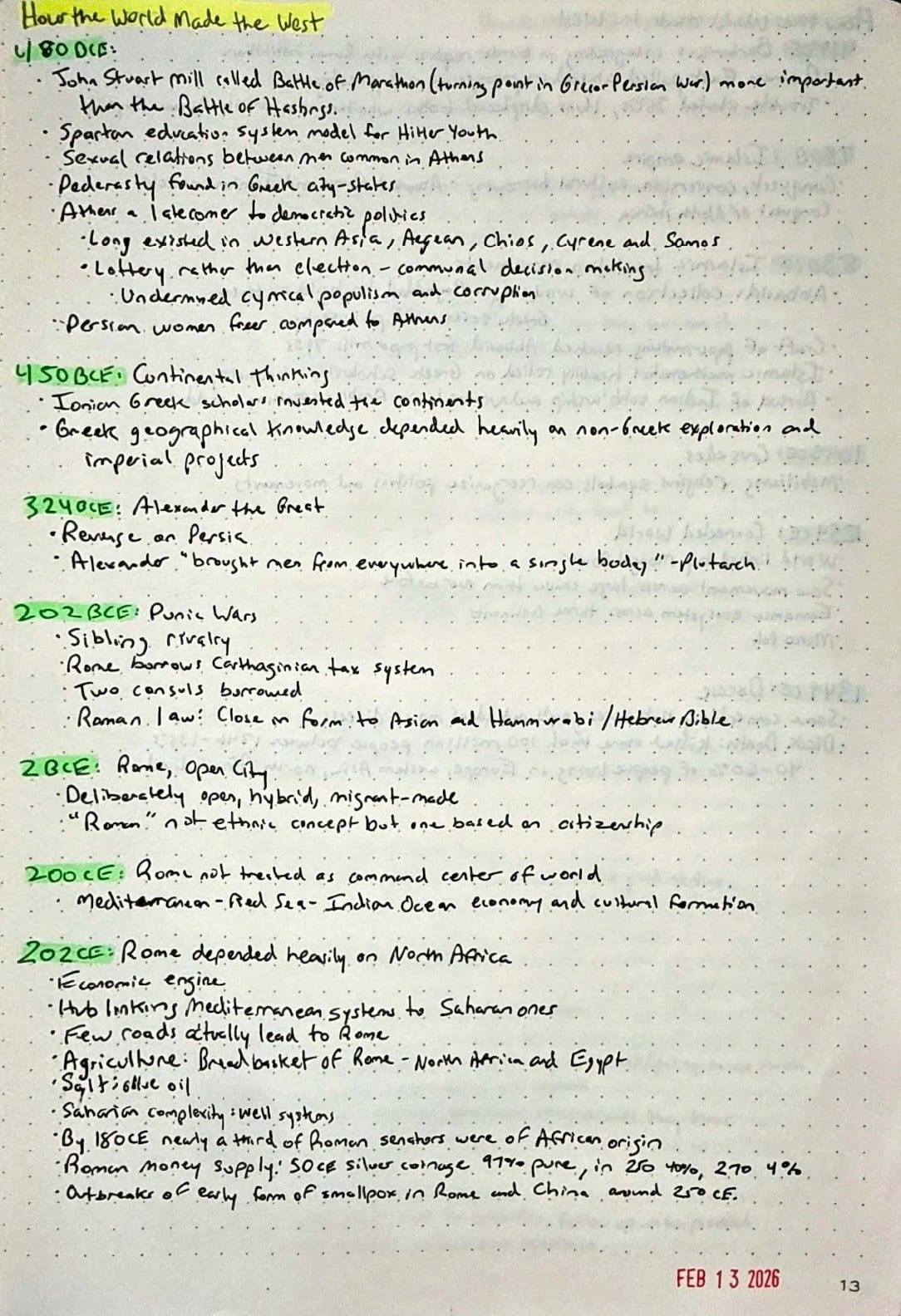
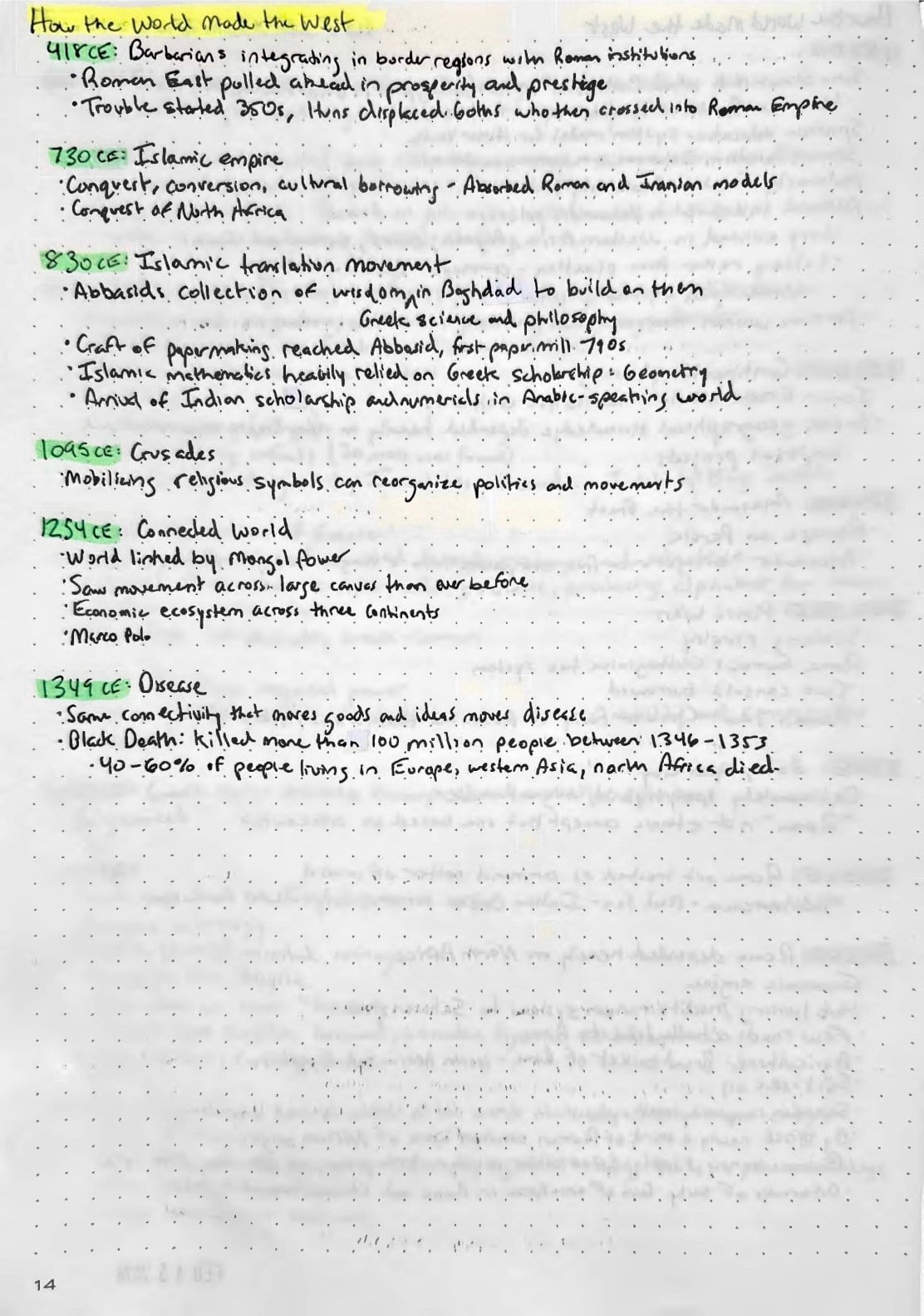
Introduction
Chapter Objective
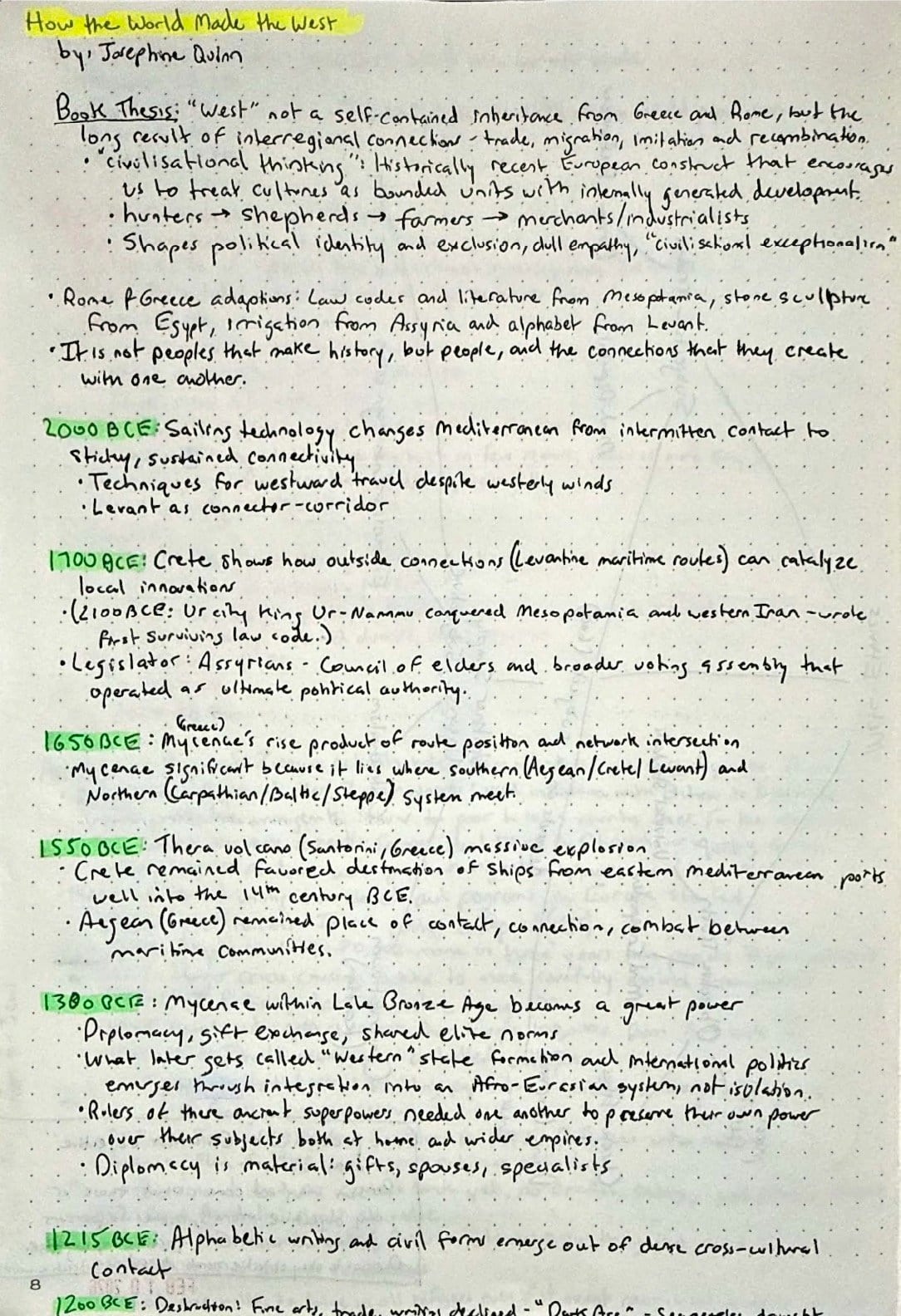
Quinn sets up the book’s core thesis: the story of “the West” is not a self-contained inheritance from Greece and Rome, but the long result of interregional connections—trade, migration, imitation, rivalry, and recombination—stretching from the Bronze Age to the Age of Exploration. She argues that modern habits of seeing history through bounded “civilisations” distort how change actually happens.
Main Ideas
-
The target: “civilisational thinking.” Quinn argues that “civilisations” feel like natural categories today, but they’re historically recent European constructs that encourage us to treat cultures as bounded units with internally generated development.
-
Stage 1 — “civilisation” as a single ladder of progress. In 18th-century and Scottish Enlightenment-style models, societies move through set stages (hunters → shepherds → farmers → merchants/industrialists). Mill is presented as a key voice: “civilization” is measured by settled life, towns, agriculture, trade, and manufactures—implicitly with modern Western Europe as the benchmark.
Connections, not civilisations
“More broadly, I want to make the case that it is connections, not civilisations, that drive historical change.” — p. 3
-
Civilisation language as an alibi for empire. Quinn uses Mill (an East India Company figure) to show how the “progress ladder” model could justify coercive rule:
“Despotism” as tutelage
“Despotism is a legitimate mode of government in dealing with barbarians, provided the end be their improvement.” — p. 4
-
Stage 2 — “civilisations” as plural, bounded cultural organisms. Quinn traces a shift toward thinking in multiple civilisations with distinct “characters” and internal logics (she uses Guizot as a key marker), encouraging origin-myths and ancestor-hunting (Romans, Greeks, Germans, Christianity), and later harsher, open-ended imperial hierarchies.
-
Why it matters now (not just academically). Quinn argues civilisational categories still shape political identity and exclusion (“West vs East”), can be mobilized by extremists, and can dull empathy by framing suffering through “civilisational exceptionalism.”
-
Analogy from genetics → culture. Just as “race as permanent biological type” has been undermined by genetics, Quinn argues that culture too should be seen as historically mobile and mixed—better like a trellis than a tree.
Key Concepts
- Civilisational thinking: The habit of treating human societies as bounded, enduring cultural units that develop mainly from internal causes, often rankable and morally/politically loaded.
- Connectivity as driver of change: Quinn’s master-explanatory lens—encounters and networks (commercial, political, cultural) as the main motors of transformation.
- Ancestor-hunting: A modern impulse to claim “true” cultural forebears (e.g., Greeks as the West’s “real” ancestors) to authorize present identity and hierarchy.
Key Terms
- “Civilisation” (singular): An abstract stage of “advanced society,” often defined via urbanism, commerce, agriculture, industry.
- “Civilisations” (plural): Distinct cultural entities with persistent characters and separate histories.
- West / East (as categories): Flexible modern binaries used to map politics, race, and religion as much as geography.
Critical Analysis
- Strength: Quinn’s framing is powerful because it attacks a common historical shortcut at the level of method: instead of debating which “civilisation” deserves credit, she challenges the category itself and proposes a more testable causal focus (routes, exchange, intermediaries, adoption).
- Potential weakness / risk: “Connections” can become a catch-all explanation unless carefully specified (who connects, by what mechanisms, with what constraints). Quinn signals this problem by emphasizing networks and recombination, but the approach still requires disciplined, case-by-case causal proof across the book.
- Bias check: The Introduction is explicitly corrective and polemical against a long European intellectual tradition; that clarity is a virtue, but it can also lead readers to feel that “civilisation talk” is treated primarily as a moral/political problem rather than sometimes a rough descriptive convenience. (Quinn’s later chapters need to carry the empirical weight.)
Questions for Reflection
- If “civilisations” are recent interpretive inventions, what specific evidence would show that “connections” (not internal development) drove a given historical change?
- How can you describe patterned cultural differences without reifying them into bounded “civilisations”?
- When do “ancestor stories” become politically dangerous, and when might they be harmless identity myths?
- What would a textbook look like if written around routes, hubs, intermediaries, and transfers rather than cultures and states?
Connections
- Thinkers: John Stuart Mill; François Guizot; David Reich (genetics analogy).
- Themes that preview later chapters: trade networks, migration/mobility, and the critique of “Greek/Roman roots” narratives.
Chapter 1 — “A Single Sail” (Byblos, c. 2000 BCE)
Chapter Objective
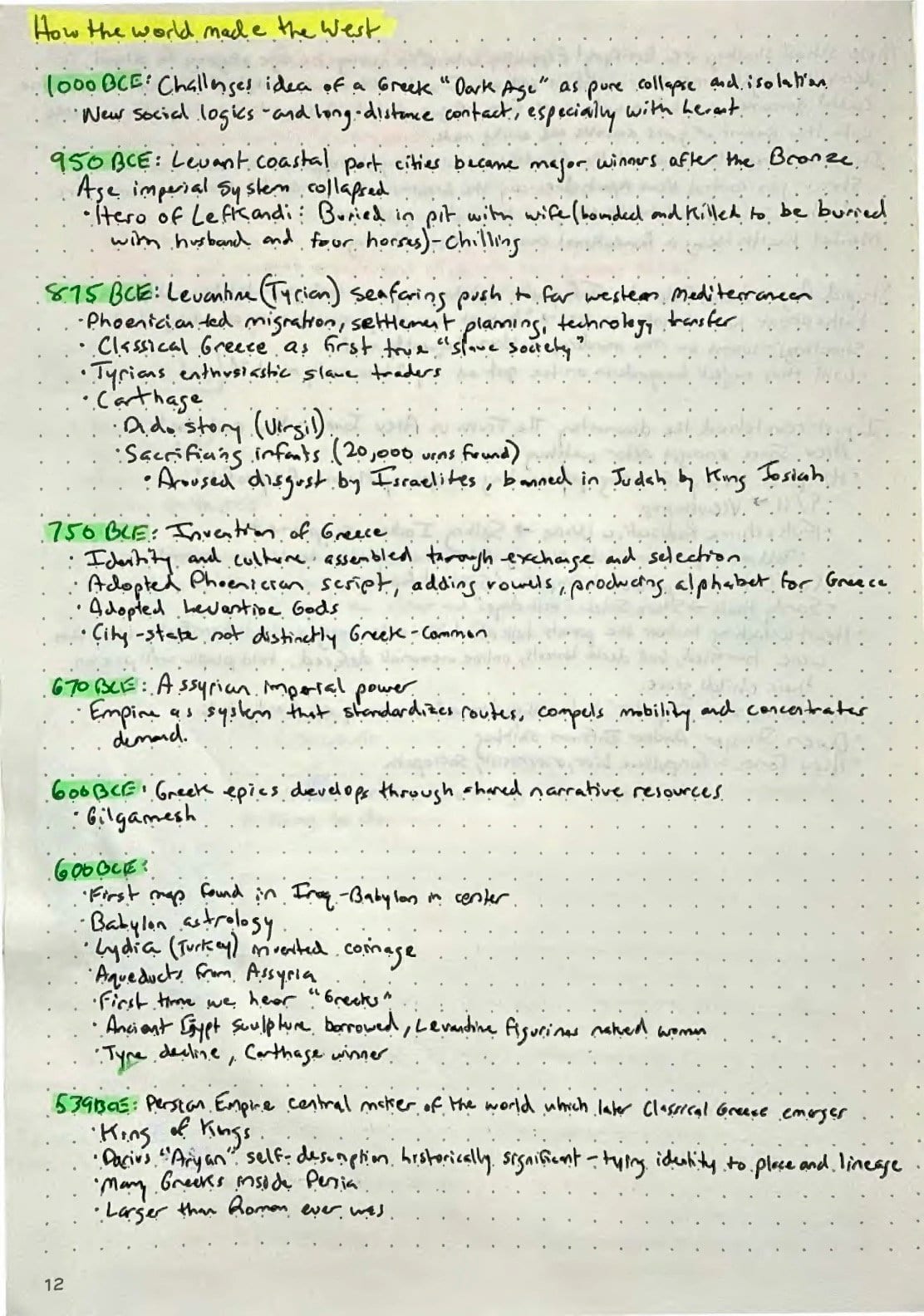
Quinn explains how the spread of sailing technology (not just trade desire) changes the Mediterranean from intermittent contact to sticky, sustained connectivity, setting up the book’s recurring claim: technological and logistical shifts in movement can reorganize entire cultural worlds.
Main Ideas
- The Levant as connector-corridor. Geography (mountains/desert) made Egypt–Mesopotamia direct contact difficult; the western Levant becomes the long, indirect hinge linking regions.
- Acceleration via sea travel. Egyptian maritime development and regular sea trade with Levantine ports appear by the mid–third millennium BCE, intensifying exchange.
- Byblos as an Egyptian-facing hub. Egyptian records label seagoing vessels “Byblos ships,” highlighting Byblos’ role as a principal port; cedar from Lebanon becomes a defining export, used in Egyptian religious and funerary building—including Khufu’s funerary boat.
- The key break: learning to sail west. Quinn stresses the technical constraints of early sailing (no keel stability; square sail requiring favorable winds) and the significance of Levantine sailors developing techniques for westward travel despite westerly winds.
Why sail changes everything
“Contacts across the Mediterranean had come and gone for millennia, but now with sail they stuck.” — p. 21
- Europe before the “West” story. The westward sailors encounter societies without states/cities/temples/written literature; Quinn resists calling them “primitive” and frames them as living outside the main exchange corridors—until sail changes that.
Key Concepts
- Mobility threshold: A change in transport capacity (speed, cargo volume, effort) that alters what kinds of relationships are feasible and sustainable (canoe/rowing vs sail).
- Connectivity “stickiness”: Not just contact, but repeated, reliable interaction that allows cumulative transfer and transformation.
Key Terms
- Byblos: Levantine port that becomes a major maritime interface with Egypt; “Byblos ships” as an Egyptian label for seagoing craft.
- Square sail / keel (absence): Early sailing constraints shaping routes and feasibility.
- Cedarwood (Lebanon): Strategic export powering Egyptian construction and funerary practices.
Critical Analysis
- Strength: Quinn convincingly makes technology and seamanship (not “civilisational spirit”) the pivot: the causal mechanism is concrete—distance/day, cargo capacity, wind constraints—so the narrative can be checked against maritime realities.
- Possible weakness: The chapter’s big claim (“now with sail they stuck”) is persuasive, but it risks underplaying cases where overland networks could also produce sustained connectivity; the broader book will need to keep balancing sea vs land systems rather than letting “maritime = destiny” dominate.
Questions for Reflection
- What makes a connection “stick” historically—frequency, volume, reliability, institutionalization, or something else?
- How do geographic constraints create “connector regions” like the Levant?
- What modern narratives about “Europe before civilisation” does Quinn implicitly challenge here?
- If early sailing required favorable winds, what kinds of political or economic structures would best exploit (or control) wind-dependent routes?
Connections
- Regions: Egypt; western Levant; Mesopotamia; early “Europa” (as later conceptual space).
- Theme linkage: The chapter operationalizes the Introduction’s thesis by showing how connections form and persist through logistics and technology.
Chapter 2 — “The Palace of Minos” (Knossos, c. 1700 BCE)
Chapter Objective
Quinn uses Crete to show how outside connections (especially Levantine maritime routes) can catalyze local innovation rather than “civilisational diffusion” or simple imitation—and how modern archaeology itself has been shaped by civilisational and racial ideologies (especially via Arthur Evans).
Main Ideas
- Knossos as lived experience + infrastructure. The palace is presented not just as spectacle but as an organized complex with public display, private rooms, workshops, storage magazines, and archives of clay tablets—a bureaucratic and economic engine.
- Myth as a memory of connection (Europa). Quinn retells the Europa story (Tyre → Crete), reading it as a cultural memory that acknowledges crossings and entanglement rather than isolated development.
- Byblos ships as catalysts. The earliest west-of-Levant sailing image appears on Crete around 2000 BCE, coinciding with new metals, technologies, and luxury goods arriving from western Asia and northeast Africa.
- Crete’s earlier position: Cycladic-centered networks. Before direct sailing links, the Cyclades function as an Aegean contact zone, trading metals and linking to Troy/Anatolia routes; Cretan needs (lack of local metals) pull it into wider exchange.
- Expansion of material and cultural imports. Quinn details how heavier and larger imports imply the arrival of sailing ships, not just hand-to-hand canoe exchange; and she explains environmental constraints (currents, prevailing winds) that structure routes.
- Writing emerges amid connectivity. Roughly 2,000 documents in undeciphered scripts survive; Cretan Hieroglyphic and Linear A are described as syllabic systems not resembling Mesopotamian cuneiform or Egyptian hieroglyphs—suggesting local development under the stimulus of being plugged into literate worlds.
- Archaeology and ideology: Evans as case study. Quinn shows how Evans’ civilisational commitments shaped “Minoan” interpretations, including a “European vs oriental” framing echoed by his student Childe.
- Anti-diffusion argument: choice under exchange. Quinn rejects both “isolationist civilisations” and simplistic “diffusion/influence,” arguing that overseas exchange expands the menu of cultural options and local actors select among them.
Exchange expands choice
“Overseas exchange meant that Cretans could now pick and choose from different cultural options, and they did.” — p. 34
- Where “Western” features appear first (and not in Crete). Quinn points to early evidence of law, literature, entrepreneurship, and popular government in places like imperial Ur and Assyrian merchant colonies—undercutting the “Aegean first” story Evans wanted.
Key Concepts
- Anti-diffusion model (“influence gets action backward”): Rather than a one-way export of traits from a “core civilisation,” Quinn emphasizes interactive selection by connected societies.
- Connectivity without mimicry: Exchange enables borrowing, hybridization, and innovation without collapsing cultures into clones.
Key Terms
- Arthur Evans: Archaeologist whose interpretations were shaped by civilisational/racial thinking; key for the modern “Minoan” framing.
- Cretan Hieroglyphic: Early Cretan syllabic script (undeciphered), used on seals/objects.
- Linear A: Later Cretan syllabic script (undeciphered), replacing Cretan Hieroglyphic by ~1650 BCE.
- “Minoan”: A modern label freighted with assumptions about bounded civilisation and “European spirit.”
Critical Analysis
- Strength: Quinn’s method is strong here: she triangulates myth, material constraints (winds/currents), and administrative evidence (writing archives) to show how connectivity changes social complexity rather than merely asserting it.
- Strength: The Evans section usefully demonstrates how modern scholarship can inherit ideological frames—important meta-history for readers.
Evans’ racial worldview
“I believe in the existence of inferior races … and would like to see them exterminated.” — p. 27
- Potential weakness: The argument that writing experiments are “unlikely to be coincidence” alongside new sailing connections is plausible, but readers may want more direct causal evidence (who learned what from whom, and through which intermediaries). Quinn flags the correlation clearly; the burden is on later chapters (or wider literature) to strengthen the mechanism.
Questions for Reflection
- What does it mean to say “influence gets the action backward”? Can you apply that to a modern example of cultural exchange?
- How do winds, currents, and ship design shape what counts as a “reachable world”?
- How should we treat myth as historical evidence—memory, metaphor, propaganda, or something else?
- What safeguards can historians use to avoid importing ideological frames (like Evans’ “European spirit”) into interpretation?
Connections
- Mythic/ancient authors: Greek Europa myth; Minos/Knossos tradition.
- Archaeology/intellectual history: Evans; Vere Gordon Childe.
- Earlier/larger networks: Byblos ships; Egypt; Mesopotamia; Assyrian merchant systems (Kanesh).
Chapter 3 — “The Amber Routes” (Mycenae, c. 1650 BCE)
Chapter Objective
Quinn reframes Mycenae’s rise as the product of route position and network intersection, not isolated “Greek genius” or an inevitable East–West clash. The “West” begins to form where multiple systems of exchange cross and recombine.
Main Ideas
- Schliemann as narrative foil. Quinn recounts Schliemann’s attempt to prove the Trojan War’s historicity and his discovery of unrobbed shaft graves at Mycenae—rich in gold and prestige goods—raising the question: how does a minor settlement become a treasure house?
- Location > local resources. Mycenae lacks mines but sits by a defensible hill near a main land route connecting gulfs and seas; the track becomes a trade route that can be exploited/controlled, pulling wealth “from all points of the compass.”
- The mixed cargo of connectivity. Grave goods include Cretan-derived luxuries and technologies (pottery forms, weapons, arts), but also northern items: bridle gear and especially Baltic amber, plus abundant gold uncommon in the Aegean—evidence of a second axis of connection.
Not East–West conflict, but a new link
“What he had found was not the remains of a great conflict between … East and West but evidence for a new connection …” — p. 42
- Mechanisms of new-route formation. Quinn suggests new partnerships often begin at the edges of established powers (people with less to lose and more to gain), then crystallize into sustained exchange.
- Prestige and imitation-with-innovation. Northern sword development shows a key Quinn theme: imports carry prestige, which can reshape local experimentation (including “fake rivets” imitating older Aegean forms even when local designs improve). Connectedness itself becomes a status good.
- Cultural exchange without flattening. Dress styles, chariot imagery, and competitive display spread, but local burial practice remains distinctive (group burials vs individualized leader tombs), underscoring that exchange doesn’t erase difference.
Key Concepts
- Network intersection (“routes crossing”): Mycenae becomes significant because it lies where a southern (Aegean/Crete/Levant) and northern (Carpathian/Baltic/Steppe) system meet.
- Prestige transmission: Imported forms can remain more prestigious than superior local redesigns, shaping what spreads and why.
Key Terms
- Shaft graves: Stone-lined trench graves enabling multiple burials; the Mycenae shaft graves contain elite bodies and lavish metal goods.
- Baltic amber (Greek elektron): Resin valued for sensory and “alive” qualities; its presence signals long-distance northern links.
- Carpathian Basin: Key northern corridor supplying gold/silver and shaping the “amber route” network into Greece.
Critical Analysis
- Strength: The chapter is methodologically persuasive because it uses object-provenance logic (what kinds of goods appear, and what that implies about routes and partners) rather than civilisational labels.
- Potential weakness: Some reconstructions (“textiles perhaps, or even slaves”) remain speculative because the asymmetry of archaeological survival makes exports harder to see than imports. Quinn flags the uncertainty, but the causal story necessarily remains partly inferential.
Questions for Reflection
- What kinds of evidence most reliably distinguish “trade,” “gift exchange,” and “loot” in archaeology?
- Why might imported prestige goods remain more valued than locally improved versions?
- How does a settlement’s control of a chokepoint differ from a state’s control of territory?
- If Mycenae’s rise is about intersections, what modern “intersections” (ports, cables, corridors) play similar roles?
Connections
- Archaeology/history of scholarship: Schliemann; Pausanias as a source for locating heroic graves.
- Networks: Crete/Aegean trade; Carpathian/Balkan river routes; Baltic amber flow.
Chapter 4 — “The Erupting Sea” (Akrotiri, c. 1550 BCE)
Chapter Objective
Quinn uses Thera/Akrotiri to argue that the Aegean in this era is best understood as a connected maritime field, not separate “Minoan vs Mycenaean civilisations.” She introduces the analytical tool of the “sailing day” to explain how geography and travel-time structure economic and cultural relationships—and how disruption (volcanic eruption) reorganizes networks.
Main Ideas
- Akrotiri’s art shows a blended world. Frescoes combine Cretan architectural motifs and dress with hints of mainland arms (boars’-tusk helmets) and imagery resembling Mycenae items—suggesting intense cross-Aegean interpenetration.
- “Civilisations” misdescribe what’s happening. Quinn explicitly rejects the idea that Akrotiri’s people saw themselves as members of discrete civilisations; she argues the civilisational lens cuts people off from the very interactions defining the region.
Against the civilisation lens
“The notion of a civilisation cuts people off from those around them …” — p. 57
- The “sailing day” as network geometry. Within a day’s sail, direct relationships are easier; beyond it, they become more complex and costly. Quinn gives concrete distances (e.g., Akrotiri to Knossos’ port roughly aligns with Byblos ship averages), using travel-time as causal explanation for hubs and corridors.
- Thera as hub; eruption as re-wiring event. Crete’s options are constrained by distance; Thera serves as a crucial northern stepping-stone into island chains toward resources (like silver mines). The eruption doesn’t simply “end Minoans, elevate Mycenaeans,” but changes the pattern of relationships and opportunities.
Key Concepts
- Sailing-day analysis: Modeling connectivity by travel-time thresholds rather than by political/cultural borders.
- Disruption reshapes networks: Catastrophe changes relative centrality, routes, and bargaining power, opening space for new actors.
Key Terms
- Akrotiri: Theran settlement whose material culture and art reveal dense Aegean connectivity.
- Boars’-tusk helmets: Marker associated with mainland martial culture appearing in Akrotiri imagery.
- Nilotic landscape motif: A shared eastern Mediterranean artistic theme (papyrus/palms, exotic animals), signaling widespread symbolic exchange.
Critical Analysis
- Strength: The “sailing day” is a strong explanatory device because it operationalizes the otherwise vague claim that “connections matter”: it predicts hubs, stepping-stones, and the consequences of removing one.
- Potential weakness: Artistic motifs can demonstrate contact, but they do not always specify the direction, frequency, or social depth of interaction. Quinn uses them alongside logistics, which helps; still, some readers may want more economic data (cargo patterns, distributions) than art can supply on its own.
Questions for Reflection
- How does a time-threshold model (“sailing day”) change what you notice compared to a culture-border model (“civilisations”)?
- What kinds of disruptions today function like the eruption—closing hubs, re-routing flows, redistributing opportunity?
- When does shared iconography imply deep integration vs shallow fashion?
- What would “civilisation collapse” narratives miss if the real unit is a network?
Connections
- Places already linked: Byblos, Knossos, Mycenae, wider eastern Mediterranean motif-sharing.
- Analytical continuity: Extends Chapter 1’s travel-capacity logic into a more formal network model.
Chapter 5 — “Band of Brothers” (Mycenae, c. 1300 BCE)
Chapter Objective
Quinn situates Mycenae within the Late Bronze Age “club” of great powers—bound by diplomacy, gift exchange, and shared elite norms—showing that what later gets called “Western” state formation and international politics emerges through integration into an Afro-Eurasian system, not isolation.
Main Ideas
- Mycenae becomes a “big man” center. By 1300 BCE Mycenae is fortified with Cyclopean walls and monumental gates; Quinn frames leadership through the Mesopotamian term lugal.gal (“Great Big Man”), emphasizing how power scales up within networked competition.
- Great kings as an exclusive peer group. Late Bronze Age powers (Egypt, Mycenae, Babylon, Assyria) treat one another as peers—calling each other “brother”—and maintain ties through standardized diplomatic exchanges.
The “brotherhood” of great kings
“Great kings … called each other ‘brother’ and regarded themselves as an exclusive club.” — p. 67
- Diplomacy is material: gifts, spouses, specialists. Relationships are maintained by sending not just luxury goods but also high-value people (princesses, craftspeople, diplomats, messengers). Quinn emphasizes how mobility of expertise is part of the system.
- Akkadian as the international language. Elites communicate in Akkadian across borders; the system depends on scribal training and administrative infrastructure.
- Uluburun shipwreck as snapshot of the world system. The cargo evidences intense interregional trade: raw materials (e.g., terebinth resin), metals, finished luxuries, and prestige items—showing how states and elite markets are supplied by complex, far-flung procurement.
- Mycenae’s internal reorganization reflects status in the system. Quinn notes, for example, the reconfiguration of the grave circle as a “historical monument,” suggesting elite identity construction and memory-politics inside the fortified citadel—an inward-facing complement to outward diplomacy.
Key Concepts
- Club diplomacy: Great-power stability maintained by ritualized equality, reciprocity, and prestige competition among rulers.
- World-system supply chains (Bronze Age version): Long-distance acquisition of metals, resins, luxury materials, and specialist labor that sustains elite politics.
- Memory-politics: Reworking older burial spaces into monuments to legitimize present power and identity.
Key Terms
- lugal.gal (“Great Big Man”): Mesopotamian title evoked to frame Mycenaean kingship as scaled-up “big man” authority.
- Akkadian: International diplomatic language of Late Bronze Age elites.
- Uluburun shipwreck: Archaeological find revealing the composition and reach of elite trade networks.
- Terebinth resin: Example of bulk trade good in elite exchange systems.
Critical Analysis
- Strength: Quinn’s use of the Uluburun shipwreck is especially strong because it anchors “connectivity” in an unusually concrete assemblage—turning an abstract thesis into an inventory of actual interdependence.
- Strength: The “brotherhood” framing clarifies that international politics is not a modern invention; the mechanisms (peer recognition, gift obligations, lingua franca, mobility of specialists) are legible and specific.
- Potential weakness: Calling Mycenaean kingship “Great Big Man” usefully de-mystifies authority, but it can compress important differences between palace bureaucracies and earlier, more personalistic “big man” systems. The concept is illuminating as analogy, but it needs careful handling to avoid flattening institutional complexity.
Questions for Reflection
- What makes “peer” status real in international politics—military parity, mutual recognition, economic dependence, or shared norms?
- How does a lingua franca (Akkadian) reshape what kinds of political relationships are possible?
- What does a shipwreck reveal that texts and monuments hide?
- Why would elites convert a grave circle into a “historical monument”? What political work does that do?
Connections
- Earlier chapters: Mycenae’s earlier rise via route intersection (Chapter 3) becomes, here, formal inclusion in a diplomatic world system; Aegean connectivity logic continues (Chapter 4).
- Wider world: Egypt, Babylon, Assyria; international scribal culture; maritime trade arteries.
Chapter 6 — Alphabet City (Ugarit, 1215 BCE)
Chapter objective
This chapter uses Late Bronze Age Ugarit as a case study to argue that what later looks like “Greek” or “Western” distinctiveness (especially alphabetic writing and civic forms) emerged out of dense cross-cultural contact—not isolation. Ugarit is presented as a deliberately engineered cosmopolitan port polity where multilingual administration, inclusive civic ritual, and a locally standardized alphabet developed inside an international world.
Main ideas
Ugarit as a “world city” built on connection
- Ugarit’s power came from being an international hinge: it sat at a maritime/overland crossroads tying together Egypt, Anatolia/Hatti, Cyprus (Alashiya), and inland Syria/Mesopotamia. It prospered by hosting traders, diplomats, and specialists moving through those circuits rather than by projecting territorial power.
- The chapter emphasizes that Ugarit’s elite and economy were structurally dependent on external networks(shipping, markets, alliances), making “local development” inseparable from “international system.”
Civic community as an administrative and ritual achievement
- Quinn highlights how Ugaritian identity is framed less as ethnicity and more as membership (“sons of Ugarit”), a political belonging reinforced by civic religious practice that included broad participation.
- City ritual is presented as a tool for cohesion in a diverse port: festivals, temples, and shared offerings help bind a population that includes locals, migrants, and merchants with wide horizons.
Multilingual bureaucracy and the problem of “who owns” writing
- Ugarit’s palace archive shows administration conducted across multiple languages and scripts, undermining the idea that writing systems belong to single “civilisations.” The city’s literate culture is a practical response to living inside an international order.
The Ugaritic alphabet as local standardization inside a shared world
- The chapter’s centerpiece is the Ugaritic alphabet (a cuneiform-shaped but alphabetic system). Quinn treats it as a local administrative innovation: simplifying writing while staying compatible with scribal tools and habits shaped by Mesopotamian cuneiform practice.
- She stresses that alphabetic writing is not “Greek in origin,” but part of a wider eastern Mediterranean experiment in making writing more efficient and portable, later taken up and modified elsewhere.
Ugarit as a connected city
“Ugarit was a city of strangers.” — p. 86
Key concepts
- Connectivity as causation: Ugarit’s institutions (identity, administration, writing) are explained as outcomes of being embedded in a high-contact world.
- Civic identity over ethnic identity: belonging defined by the city (“sons of…”) rather than a pan-people label.
- Alphabet as adaptation: alphabetic writing emerges as a pragmatic refinement within an older scribal ecology, not a sudden civilisational leap.
Key terms
- Ugarit: Late Bronze Age Levantine port city; a multilingual administrative and commercial hub.
- Alashiya: name used for Cyprus in Late Bronze Age diplomacy/trade.
- “Sons of X” civic formula: self-description in inscriptions that marks belonging to a city-community.
- Ugaritic alphabet: alphabetic system written with cuneiform-style wedges; used for local language and administration.
Critical analysis
- Strengths
- The chapter is strong in showing mechanisms: why a port city would value portable writing, flexible identity, and civic cohesion—tying institutional forms to material and geopolitical conditions.
- It effectively destabilizes “civilisation blocks” by foregrounding multilingual archives and mixed practices as normal rather than exceptional.
- Potential weaknesses / tensions
- Because Ugarit is unusually well documented (archives), it may function as a “best case” for connectivity; less-visible sites could make the pattern harder to prove with equal confidence.
- The argument leans interpretive when moving from administrative evidence to broad claims about civic belonging; the linkage is plausible, but the text inevitably extrapolates from elite/archival material to the whole population.
Questions for reflection
- If “alphabet” is an adaptation inside an older scribal world, what does that imply about how we should narrate “innovation” in history?
- How do civic identities (“sons of Ugarit”) compare to later ethnic identities—what changes make ethnicity more salient?
- What features of port cities (then and now) tend to generate institutional experiments?
- What kinds of evidence would you need to test whether non-elite residents shared the civic identity implied by official texts?
Connections
- Amarna-style international order / Great Kings diplomacy (background system Ugarit operates within).
- Earlier chapters’ theme: contact produces institutions rather than merely transmitting “goods.”
Chapter 7 — Regime Change (Lefkandi, 1000 BCE)
Chapter objective
This chapter uses Lefkandi (Euboea) to challenge the idea of a Greek “Dark Age” as pure collapse and isolation. Quinn argues that after the Bronze Age political order broke, Greek communities reorganized around new social logics—and that long-distance contact, especially with the Levant, returned earlier and more substantively than older narratives allowed. Lefkandi becomes a key example of how post-collapse societies can be restructured, not simply diminished.
Main ideas
Lefkandi as an early “reconnector”
- Lefkandi shows unusually early signs of renewed external links (prestige goods and practices) relative to many Aegean sites, suggesting that some nodes re-entered wider circuits quickly.
- A striking burial (early ninth century) includes weapons, Levantine balance weights, and an antique Syrian cylinder seal, pointing to participation in a Levantine-influenced trade world and to the social prestige of that participation.
Social transformation: from palatial order to competitive elites
- Quinn frames the post-palace era as one where rules and status are renegotiated: prestige is built through visible displays (burial, feasting, imported goods) rather than through palace bureaucracy.
- The material record (e.g., elite burials and trade equipment) suggests the rise of figures who are simultaneously armed and commercially embedded—a blend that doesn’t map neatly onto older “warrior vs trader” stereotypes.
Contact changes local trajectories (not just “adds luxury”)
- The chapter treats renewed contact as structural, not decorative: tools like balance weights imply standardized exchange practices and integration into external systems of value and measurement.
Lefkandi and the Levantine trade world
“He is working in a Levantine world of trade, with people who hadn’t had much of a Dark Age at all.” — p. 106
Key concepts
- Post-collapse reordering (“regime change”): collapse creates openings for new social contracts and elite strategies, rather than only decline.
- Trade as social power: commercial tools and foreign objects function as status technology, signaling access to wider systems.
Key terms
- Lefkandi: major Early Iron Age site on Euboea used to rethink the “Dark Age” narrative.
- Cylinder seal: carved seal (often Mesopotamian/Syrian) used to mark documents/containers; here an “antique” object repurposed as prestige or proof of connection.
- Balance weights: standardized stones used to measure value in trade; their Levantine style implies participation in Levantine exchange conventions.
Critical analysis
- Strengths
- Uses concrete, interpretable artifacts (weights, seal) to argue for early reconnection—evidence that is harder to dismiss as mere “influence.”
- Reframes “Dark Age” as uneven: some places lag, some re-link, producing a more realistic historical texture.
- Potential weaknesses / tensions
- The interpretive leap from one elite burial assemblage to broad claims about community structure is always a risk; elite deposits can overrepresent exceptional individuals.
- “External contact” can be demonstrated, but its depth (occasional vs systematic) is harder to measure—weights suggest system, but the scale remains debatable.
Questions for reflection
- What is the minimum evidence needed to claim “integration” into a trade system rather than sporadic exchange?
- How does the meaning of “wealth” change when palatial redistribution disappears?
- Why might armed capacity and commercial capacity converge in the same individuals after collapse?
- If some regions “didn’t have much of a Dark Age,” how should that alter the standard Greek periodization?
Connections
- The Uluburun/Amarna world as a contrast: earlier high-level connectivity vs post-collapse patchy reconnection.
- Later chapters’ theme: eastern Mediterranean nodes (Levant) act as continuity carriers that shape Aegean redevelopment.
Chapter 8 — I Am Not Your Servant (Tyre, 950 BCE)
Chapter objective
This chapter explains how the Levant—especially the coastal port cities (Tyre, Sidon, Byblos, Dor)—became the major winners after the Bronze Age imperial system collapsed. Using the Egyptian literary text Tale of Wenamun, Quinn argues that the end of empire produced a vacuum filled by new political experiments and by commercially powerful city-states whose influence would “jump-start” wider Mediterranean transformations.
Main ideas
Wenamun as a lens on a new balance of power
- The Tale of Wenamun is presented as Egyptian literature (likely fiction), but one whose setting would have felt real: Egypt weakened and divided, Levantine cities prosperous and assertive.
- Wenamun’s humiliations dramatize a diplomatic reversal: Byblos’ king Zakerbaal insists Egypt no longer dictates terms and demands proper payment and credentials.
Power shift in the Levant
“I am not your servant!” — p. 108
Collapse as opportunity: experiments in political forms
- Quinn argues that after the “Brother Kings” world ended, former clients became independent, and new polities emerged (Neo-Hittite kingdoms in the north; new tribal states inland; industrial/urban growth in the south). Crucially, coastal ports survived and then dominated because imperial oversight vanished while trade remained.
- The disappearance of Ugarit reoriented trade toward the surviving ports, accelerating their rise as eastern Mediterranean commercial leaders.
“Phoenicians” as an outsider label (and why that matters)
- The term Phoenician is shown as Greek naming: likely tied to purple/crimson dye (murex). It is analytically useful but historically misleading if treated as an internal ethnic unity.
- Quinn stresses that inscriptions (over 10,000) never show these people calling themselves “Phoenician”; instead they identify as “sons of” individual cities—Tyre, Sidon, etc.—implying small-scale civic identities rather than a shared ethnicity.
No one called themselves “Phoenician”
“No one ever calls themself a Phoenician in their own language.” — p. 110
Geography, autonomy, and the sea-facing city-state
- The ports were geographically segmented—mountains to the east, rivers north/south, narrow farmland—encouraging small autonomous communities oriented toward maritime livelihoods.
- Example of Dor: evidence of continued prosperity (purple-dye industry, courtyard houses) and long-distance trade (exports across the east Mediterranean; imports including cinnamon from India), illustrating that Levantine connectivity never fully collapsed the way many Aegean networks did.
Temple-first wealth and civic benefit
- Quinn contrasts Late Bronze Age palace-centered wealth with an Iron Age shift toward temples as civic centers where wealth can be distributed more broadly. She notes the absence (in sources) of prominent palaces at tenth-century Tyre and similar cities, suggesting a change in what “power” looked like.
Israel, Tyre, and what biblical narrative reveals (even when unreliable)
- Quinn uses the Hebrew Bible cautiously: historically uneven, but valuable for positioning Tyre as a recognized regional power. In the biblical account, Hirom (Hiram) supplies cedar, craftsmen, and maritime expertise to David/Solomon in exchange for agricultural products, and participates in international voyaging.
- She emphasizes that this tells us more about how Tyre is imagined/remembered as a hub of trade, technology, and diplomacy than it proves the biblical scale of Solomon’s kingdom.
Key concepts
- End of empire → new models: interstate collapse creates competitive space for smaller polities to innovate politically and commercially.
- Ethnicity as historically contingent: fixed ethnic identity is not treated as a timeless human default; small-scale civic identities dominate where literacy/mass communication are limited.
- Maritime city-state ecology: geography + trade routes foster autonomous port polities with outsized influence.
Key terms
- Tale of Wenamun: Egyptian narrative about a mission to acquire cedar; used here as a cultural snapshot of shifting power relations.
- Murex: sea snail used to produce purple dye; likely source of Greek “Phoenician” label.
- “House of X” (Bit + name): Aramean-style tribal states conceptualized as descent communities (“House of…”).
- Ezion-Geber / Ophir / Punt: biblical geography used to frame maritime ambitions; treated critically.
Critical analysis
- Strengths
- Excellent methodological honesty: Wenamun is flagged as literature/likely fiction, yet still used responsibly as evidence of what an audience could find plausible.
- Strong conceptual payoff: dismantles ethnic essentialism by pointing to inscriptional self-identification patterns and to the external origin of “Phoenician.”
- Potential weaknesses / tensions
- The critique of ethnic identity leans programmatic; while well-argued, it risks reading modern debates back into ancient evidence (even if the evidence does support the claim about self-labeling).
- Using biblical narrative “for Tyre rather than Jerusalem” is persuasive, but the boundary between literary memory and historical reconstruction remains necessarily blurred.
Questions for reflection
- How can a text be “fiction” and still be evidence for historical realities (social expectations, plausibility structures)?
- What changes (literacy, administration, mobility) make broad ethnic identity more likely to form?
- Why might temple-centered wealth be politically stabilizing in post-imperial city-states?
- In what ways do outsider labels (“Phoenician”) distort historical understanding—and when are they still useful?
Connections
- Ugarit as predecessor for “sons of the city” identity language.
- Amarna / Great Kings system as the fallen order whose vacuum enables these ports to rise.
- Later: Levantine expansion westward (Gadir/Carthage) builds directly on this port-city power base.
Chapter 9 — Through the Pillars (Gadir/Cádiz; Carthage)
Chapter objective
This chapter shows Levantine (Tyrian) seafaring pushing to the far western Mediterranean and beyond, arguing that the “making of the West” includes Phoenician-led migration, settlement planning, and technology transfer—often earlier than comparable Greek colonial movement. The chapter uses Gadir (Cádiz) and Carthage to illustrate how overseas foundations combine myth, archaeology, and ongoing economic strategy.
Main ideas
Routes, stopovers, and a westward “network of networks”
- Quinn reconstructs increasingly complex journeys: by the late ninth century, pottery distributions indicate multi-stop circuits linking Cyprus, Sardinia, central Italy, Crete, Iberia, and North Africa—suggesting a structured “Route of the Islands” with regional sub-networks.
- The Utica well (2012 excavations) with mixed-origin pottery and animal bones is interpreted as feast debris—evidence for multicultural stopovers and social practices that sustain long-distance travel (resupply, rest, repair, alliance).
Founding Gadir: mythic story, archaeological correction
- Literary foundation stories (Velleius Paterculus; Strabo) emphasize Tyrian initiative and divine/oracular guidance (“by the Pillars of Herakles”), with repeated failed attempts marked by unfavorable sacrifices before the “successful” settlement.
- Quinn highlights the tendency of Greco-Roman authors to date deep antiquity by reference to the Trojan War, producing implausibly early foundation dates (e.g., 1104 BCE for Gadir).
- Archaeology under the Teatro Cómico revised the timeline: an ordered settlement dated by Tyrian pottery to the late ninth century BCE, earlier than previously known remains.
Oracle and the Pillars
“Strabo’s story begins when the Tyrians receive an oracle telling them to found a settlement ‘by the Pillars of Herakles’.” — p. 123
Life and infrastructure at Gadir: urban planning, administration, and even cats
- The settlement required terracing and retaining walls; it had paved streets, standardized house plans, and Levantine building techniques (Egyptian royal cubit, mudbrick walls, flat roofs, courtyards, ovens).
- Administrative presence appears via writing (scratched sherds) and clay sealings for papyrus documents—evidence that migrants brought bureaucratic tools, not just trade goods.
- The chapter uses the excavated house cat as a vivid marker of biological/technological transfer along trade routes (a ship’s mouser moving west of Crete).
- Economically, Gadir anchors access to Atlantic resources and protects routes, offering workshops for pottery and purple dye and processing raw metals.
Carthage: refugee foundation myth and political self-image
- The Carthaginian origin story (Elissa/Dido fleeing Tyre) foregrounds displacement, gendered leadership, and eventual tragic suicide; Quinn notes that later Roman authors fused this with Trojan-Rome legends (Aeneas) only much later.
- A Tyrian king list records (in retrospect) that in 824 BCE Elissa fled and founded Carthage, but Quinn treats this cautiously (unknown compilation date; could reflect later legend).
- Key interpretive point: compared to Gadir’s story (Tyre’s gods/government), Carthage’s emphasizes independence—a memory politics of autonomy.
Carthage in archaeology: city planning, production, and contested ritual
- Carbon-dated animal bones suggest late ninth-century activity; earliest houses found so far date to ~750 BCE on Byrsa Hill, laid out on a grid (with precedents on Bronze Age Cyprus, challenging later Greek “inventor” credit narratives).
- Carthage mirrors Gadir in Tyrian pottery presence and raw-material processing (metal and ivory working). Notably, it developed a method of converting iron to stronger steel using calcium from murex shells, framed as a challenge to simplistic progress narratives (a “Bessemer-like” process long before modern Britain).
- The chapter treats the Tophet-like sanctuary to Baal Haamon and alleged infant sacrifice as a contested issue: ancient hostile authors report child sacrifice; some modern scholars argue for enemy-propaganda and reinterpret the site as a cemetery for stillborn/sick infants dedicated to gods.
Carthage and independence
“While the foundation story of Gadir foregrounds the gods and government of Tyre, this one emphasises the new city’s independence.” — p. 127
Key concepts
- Planned migration earlier than Greek colonization: archaeological evidence positions Levantine foundations as earlier by generations in the far west.
- Myth + material correction: foundation legends preserve identity claims but require archaeological anchoring to avoid chronographic distortions.
- Settlement as infrastructure transfer: migrants bring measurement systems, building templates, administration, and domesticated animals—an exported package of practices.
Key terms
- Pillars of Herakles: the straits region around Gibraltar in Greek geographic imagination; a boundary marker in colonization stories.
- Gadir (Cádiz): Tyrian-founded Atlantic-facing settlement; name glossed as “fence/enclosure.”
- Melqart: Tyrian god associated with voyages and protection; shrine/temple central to Gadir’s foundation narrative.
- Qart-Hadasht (Carthage): “New City” in Phoenician/Punic; major western power.
- Baal Haamon / Kronos (Greek identification): deity associated with Carthaginian sanctuary; child-sacrifice claims debated.
Critical analysis
- Strengths
- The chapter is methodologically rich: it triangulates Greco-Roman texts, local self-image, and archaeology, showing how each can mislead alone and clarify together.
- It powerfully expands “West-making” beyond Greeks by detailing concrete transfers (grid planning, sealings, cats, industrial processes).
- Potential weaknesses / tensions
- Some reconstructions (feast interpretation at Utica; motives behind foundation legends) are plausible but inferential; the chapter generally signals inference, but readers should track where interpretation exceeds direct proof.
- The Carthaginian child sacrifice debate is necessarily unresolved here; Quinn presents competing interpretations, but the evidentiary and ethical stakes can pull readers toward premature certainty.
Questions for reflection
- What does it mean for a society’s “origin story” to emphasize dependence (Tyre’s gods/government) vs independence (Carthage)?
- How should historians weigh hostile external testimony (Greek/Roman claims) against archaeological ambiguity in morally charged practices?
- Why do grids keep getting attributed to later “inventors” when earlier precedents exist?
- What kinds of “invisible trade” (linen, rope, fish, etc.) might we be systematically missing when we rely on archaeology? (Connect back to Wenamun’s goods lists.)
Connections
- Chapter 8’s Levantine port dominance as precondition for westward settlement.
- Later classical receptions: Virgil’s Aeneid layering Roman myth onto Dido/Carthage traditions.
- Broader theme: “West” as an outcome of Mediterranean entanglement, not a lineage confined to one people or peninsula.
Chapter 10 — The Invention of Greece (Eretria, 750 BCE)
Chapter Objective
- Quinn’s aim here is to undermine the idea that “Greece” (as a distinct, self-generated civilisational origin) simply appears out of an isolated Aegean genius. Instead, she shows how what later becomes “Greek” identity and culture is assembled through exchange—especially through Levantine (Phoenician) movement, tools, stories, and styles—and then retrospectively narrated as native, pure, and exceptional.
Main Ideas (following the chapter’s natural argument breaks; the chapter has no internal subheadings)
- “Greekness” is invented by selection + boundary-making, not discovered as an ancient essence
- Quinn frames “Greece” as a later category built from choices about what to adopt, what to reject, and how to narrate origins—and notes how modern racial/ethnic fantasies (e.g., “purity”) distort that story.
- The alphabet is the decisive “import” that Greeks re-engineer
- The key claim is not merely “Phoenicians influenced Greeks,” but that Greeks adopted and modified a Phoenician consonantal script into something new by adding symbols for vowels, producing an alphabet fit for Greek speech and (crucially) Greek poetic forms.
- Quinn stresses the cultural self-awareness of borrowing: Greeks themselves recognized the Levantine origin of the letters.
Greeks name the alphabet’s origin
“The Greeks themselves called their letters phoinikeia grammata.” — p. 136
- Writing appears first as a social technology (status, memory, play, performance), not a bureaucratic state tool
- The earliest Greek writing is tied to named individuals, public display, and competitive self-fashioning(e.g., calling out ownership, authorship, prestige).
- Quinn uses the famous cup-inscription tradition (and other early inscriptions) to show writing as part of elite sociability and poetic performance rather than administration.
- “Orientalising” is not decorative copying; it is a deep cultural remix
- As connections intensify, Greek artisans and patrons draw on eastern Mediterranean and Near Eastern motifs (e.g., griffins, sphinxes) and imported media (e.g., scarabs, ivory), but the important point is that Greeks refit these elements to local needs and meanings.
- Quinn’s emphasis is methodological: talk of one-way “influence” is too passive; what matters is appropriation-by-choice.
Not “influence,” but agency
“What matters as ever is not ‘influence’ but choice.” — p. 142
- Political community is also “constructed”: the polis is an ideology as much as a place
- Quinn highlights how Greeks articulate the polis as a community of people (and norms) rather than merely walls or territory—an argument about what holds a city together.
Polis as people
“Men, not walls, make a town.” — p. 141
- Quinn highlights how Greeks articulate the polis as a community of people (and norms) rather than merely walls or territory—an argument about what holds a city together.
Key Concepts
- Invented tradition (applied to “Greece”)
- “Greece” emerges as a retrospective synthesis: later Greeks (and later Europeans) narrate a coherent origin-story out of heterogeneous, networked developments.
- Adoption + adaptation
- Cultural borrowing is presented as active engineering (especially the alphabet): taking a tool from elsewhere and reshaping it for new linguistic/cultural functions.
- Orientalising as Mediterranean-style formation
- “Orientalising” is treated as evidence of dense connectivity—a style-world produced by contact, not a simple story of Greek dependence or Greek purity.
Key Terms
- phoinikeia grammata — “Phoenician letters”; Greeks’ own label marking Levantine origins of the script.
- poinikastas — a term used for a scribe in a Greek inscription, tying writing practice to Phoenician associations.
- alphabet — a script system with vowel signs; contrasted with Phoenician consonant-focused writing.
- Orientalising — eighth–seventh century BCE Aegean/Italian uptake and refashioning of eastern motifs and luxury forms.
- polis — a political community conceived as people and shared order, not just fortifications.
Critical Analysis
- Strengths
- The chapter’s strongest move is its shift from “Greek exceptionalism” to network explanation: it treats writing, style, and politics as outcomes of contact plus local choice, rather than miracles.
- Quinn is careful to avoid the opposite trap (reducing Greece to a mere copy of “the East”): she repeatedly frames borrowing as selective transformation.
- Potential weaknesses / pressure points
- Because early evidence is fragmentary, the argument sometimes relies on plausibility + pattern (what writing “must have been for,” how adoption “likely” worked) rather than fully demonstrable causation in every case.
- Her critique of “purity” narratives is persuasive, but it can invite a methodological question: how to measure “choice” versus structural constraint (trade access, elite competition, scarcity of materials) in cultural adoption.
Questions for Reflection
- If Greeks explicitly called the letters “Phoenician,” why do later origin-stories erase that acknowledgment?
- What changes when you treat “the alphabet” as a designed solution (adding vowels) rather than a borrowed artifact?
- In what ways can “Orientalising” be read as creative agency rather than dependency—and where might that interpretation break down?
- How does defining the polis as people (not walls) change what counts as political legitimacy or belonging?
Connections
- Phoenicia / the Levant as carrier of scripts, goods, and practices into the Aegean.
- Links forward to Assyrian imperial conditions and Mediterranean circulation (picked up explicitly in Chapter 11).
Chapter 11 — The Assyrian Mediterranean in the Seventh Century BCE (Tarshish, 670 BCE)
Chapter Objective
- Quinn’s goal is to show that the “Mediterranean world” of the seventh century BCE is not driven only by Greek pioneers or Phoenician entrepreneurs in isolation, but also by Assyrian imperial power—which reshapes Levantine cities, forces new patterns of movement, and indirectly helps generate western Mediterranean connectivity (including “orientalising” flows).
Main Ideas (following the chapter’s natural argument breaks; no internal subheadings)
- Assyria makes the Levant “imperial,” and the Mediterranean becomes part of that system
- Quinn begins with the scale and self-representation of Assyrian kings reaching the sea, marking the Mediterranean as a stage for imperial ideology and logistics.
Assyria reaches the Mediterranean
“I … cleansed my weapons in the Great Sea.” — p. 146
- Quinn begins with the scale and self-representation of Assyrian kings reaching the sea, marking the Mediterranean as a stage for imperial ideology and logistics.
- The text connects maritime contact to a broader imperial economy: tribute relationships, prestige goods, and the language of domination.
- Coercion and relocation are not side notes; they are mechanisms of connectivity
- Quinn emphasizes forced resettlement (moving populations across the empire) as a recurring strategy. This creates mixed communities, skill transfer, and new commercial/social ties that shape the wider region.
- Tarshish and “ships of Tarshish”: the far west is legible within an eastern Mediterranean information world
- The vignette’s point is that Tarshish is not an isolated “edge,” but a named node in stories and trade imaginaries; it exists within a shared Mediterranean frame of reference.
- Material evidence: long-range trade and luxury circulation
- Quinn uses concrete evidence (e.g., shipping finds) to argue that Levantine trade carried not only bulk commodities but also luxury items and crafted goods, linking western consumers to eastern production and tastes.
- The “orientalising” boom has a political-economic timetable
- A key historical claim is that the availability of “oriental” goods in the west expands under these imperial-era conditions and then contracts as Assyrian control and Levantine fortunes shift.
Key Concepts
- Empire as an infrastructure of exchange
- The chapter frames empire not only as violence but as a system that standardizes routes, compels mobility, concentrates demand, and therefore reorganizes who meets whom and what moves where.
- Peripheral visibility
- Places like Tarshish become “thinkable” and nameable within eastern records and narratives—evidence of a shared mental map that reaches beyond the Aegean.
- Stylistic economies
- “Orientalising” is treated as a market + status phenomenon: consumers want goods (and imitations) associated with prestige circuits tied to eastern Mediterranean production and imperial-era availability.
Key Terms
- Assyria / Assyrian Empire — the imperial power whose conquest, tribute, and resettlement policies reshape Levantine Mediterranean connectivity.
- Tarshish — a western node (associated with far-distance trade) used here to show how the “far west” sits inside Mediterranean networks and stories.
- “oriental” goods — luxury items/styles associated with the eastern Mediterranean and western Asia whose circulation helps produce “orientalising” fashions in the west.
- forced resettlement / deportation — an imperial technique that generates demographic mixing and new ties across regions.
Critical Analysis
- Strengths
- The chapter’s biggest strength is explanatory power: it makes the western Mediterranean’s seventh-century “easternness” intelligible through imperial political economy, not vague diffusion.
- Quinn’s method pairs imperial texts/self-representation with trade/logistics evidence, strengthening the case that this is not merely ideological boasting.
- Potential weaknesses / pressure points
- The causal chain can be hard to prove at a micro-level: even if Assyria restructures the Levant, how directly that translates into specific western consumption trends may depend on intermediary actors and local choices (Phoenicians, local elites, Italian markets).
- There’s an interpretive risk of making empire the master variable; some connectivity might have persisted (or arisen) even without Assyrian dominance, though Quinn’s point is that the shape and intensity of the networks change under empire.
Questions for Reflection
- What changes in Mediterranean history when you treat empire (Assyria) as a generator of trade conditions rather than only a land-based military power?
- How does forced resettlement function as a “connectivity technology”—and what are its human costs that the network story can accidentally smooth over?
- If “orientalising” depends on supply conditions, what does that imply about the relationship between aesthetics and geopolitics?
- Why do later “Greek origins” stories tend to foreground Greek agency while backgrounding imperial frameworks that made certain contacts possible?
Connections
- Links back to Chapter 10’s emphasis on eastern Mediterranean inputs (alphabet, motifs), but now framed through imperial restructuring of the Levant.
- Sets up Chapter 12’s argument about story transmission across the same connected space.
Chapter 12 — He Who Saw the Deep (c. 600 BCE)
Chapter Objective
- Quinn aims to show that the Homeric epics—central to later “Greek culture”—sit inside a wider eastern Mediterranean myth-and-literature environment. The chapter argues that Greek epic develops through shared narrative resources (themes, scenes, images, divine behaviors) that circulated through contact, rather than emerging from an insulated Greek genius.
Main Ideas (following the chapter’s natural argument breaks; no internal subheadings)
- Introducing Gilgamesh as a Mediterranean-relevant classic
- Quinn summarizes the Epic of Gilgamesh and emphasizes its ancient prestige and long transmission history, treating it as a near-eastern “classic” comparable in status (within its world) to Homer later in Greece.
- She foregrounds the epic’s original opening words as its authentic title, and uses that to pivot into the epic’s content and themes.
The epic’s original name
“He who saw the deep (Sha naqba imuru).” — p. 163
- Parallels with the Iliad: heroic friendship, grief, mortality
- Quinn argues that while plots differ, the emotional and thematic architecture overlaps: a pair of heroic companions, the death of the companion, and the survivor’s confrontation with death and limits.
- She highlights striking micro-parallels in mourning imagery and the refusal to release the body—details less likely to be coincidence.
The corpse detail
“I did not surrender his body … until a maggot dropped from his nostril.” — p. 163
- Parallels with the Odyssey: the long journey, monsters, counsel, return
- Quinn draws a second comparison track: both Gilgamesh and Odysseus fight monstrous beings and travel through strange zones, receiving directions from figures at the margins, and eventually return to rule.
- Beyond Mesopotamia: the wider eastern Mediterranean literary field
- The chapter extends the “shared mythscape” beyond Gilgamesh to Egyptian, Levantine, and Ugaritic materials, arguing for an eastern Mediterranean environment where big narrative ideas (gods, craft, monsters, underworld knowledge) circulate in forms that Homer can echo without anyone needing to label it “borrowing.”
- Crucial limiting claim: parallels matter, but Homer is still distinct
- Quinn explicitly warns against exaggeration: these borrowings are a fraction of Homeric meaning; the epics remain dramatically different from Near Eastern and Egyptian literature even while participating in shared resources.
- Homer as a unifier: building a Greek language and an open community
- The epics help consolidate a mutually comprehensible “Greek” language and shared past—but Quinn insists this is not yet a closed “civilisation”; Homer’s world is culturally permeable (shared gods, bilingualism, bonds across battle lines).
Key Concepts
- Mediterranean mythscape
- A shared imaginative field in which stories, motifs, and divine-human frameworks circulate and are locally reworked—often without any concern for tracing “origins.”
- Selective borrowing (with strong constraints)
- Quinn’s model: cross-cultural echoes are real and meaningful, but they do not erase distinctiveness; transmission produces hybrids, not clones.
- Epic as identity-making
- Homeric epic is presented as one of the tools that produces a shared Greek past and language rather than simply reflecting an already-unified Greece.
Key Terms
- Sha naqba imuru — Akkadian opening words (“He who saw the deep”), treated as the epic’s original title.
- Gilgamesh / Enkidu — the heroic pair whose friendship, loss, and aftermath anchor the epic’s emotional structure.
- Standard Babylonian version — the compiled “classic” form of the story (the stabilized literary object that later readers knew).
- mythscape — Quinn’s way of capturing a shared world of stories and ideas spanning societies around the eastern Mediterranean.
Critical Analysis
- Strengths
- Quinn is persuasive because she combines (1) broad transmission history (Gilgamesh as a long-lived classic) with (2) tight, memorable parallels that feel harder to dismiss as generic heroism—especially the mourning/body detail.
- She explicitly builds guardrails against overclaiming, which strengthens credibility: the argument is connectivity-with-limits, not “Homer copied the East.”
- Potential weaknesses / pressure points
- Demonstrating routes of transmission is harder than demonstrating similarities. Quinn partly brackets the mechanics (who carried what, in which language, through which institutions) and focuses on outcomes—reasonable for synthesis, but still a vulnerable spot for specialists who want a more granular chain of custody.
- Some parallels may still be contested as “motif-level” commonplaces; Quinn’s best defense is her combination of multiple parallels plus her insistence on partiality (borrowing as a fraction).
Questions for Reflection
- If Homer never acknowledges eastern parallels, what does that suggest about how ancient audiences conceptualized cultural exchange (or didn’t)?
- Which kind of evidence is more persuasive to you: transmission history (Gilgamesh as a classic) or specific shared images (the corpse/maggot detail)—and why?
- How can a tradition be “shared” without dissolving distinctiveness? What’s the conceptual difference between shared heritage and exclusive civilisation?
- If epics create a people by creating a shared past, what does that imply about modern national origin stories?
Connections
- Chapter 11: the same imperial-connected Mediterranean that moves goods also moves stories and motifs.
- Ugaritic tradition (Baal Cycle; craft-god parallels) as part of the Levantine literary background for Homeric tone and divine behavior.
- Thucydides on the absence of early “common action in Hellas,” used to frame Homeric epic as a unifying narrative technology.
Chapter 13 — The Bitter River (Miletos, c. 600 BCE)
Chapter objective
Quinn uses Miletos to show how “Greek” intellectual and political developments in the Archaic period were shaped by a wider eastern Mediterranean world—especially Babylonia and Egypt—through trade, migration, and cultural borrowing. The chapter argues that what later reads as uniquely Greek (maps, “science,” new political forms, monetized exchange) emerged inside a web of connections that Greeks both depended on and tried to narrate as their own.
Main ideas
Miletos as a contact-zone city
- Miletos sits at the mouth of the winding Maiandros/Meander (“the bitter river”), and Quinn treats its geography as symbolic: it is a place where land, river, and sea traffic converge, producing constant movement of people and goods.
- Milesians are portrayed as deeply entangled with non-Greek powers and markets; the city’s prosperity depends on its position within a wider commercial system rather than “Greek” self-sufficiency.
Anaximander and the “Greek” map that wasn’t purely Greek
- Quinn anchors the chapter in Anaximander’s world map (c. 600 BCE), presented as a major milestone in “Greek” rational description of the world, but one built from older eastern practices.
- The map’s circular, sea-encircled structure echoes a Babylonian worldview: a disk of land surrounded by ocean, with Babylon at the center—suggesting that even Greek spatial imagination was shaped by eastern models and data flows.
- Quinn links the rise of mapmaking and “logoi” (accounts) to seafaring and trade: those who travel need portable models of space, routes, and peoples.
The sea as a generator of knowledge
“Those who live on the sea … become inquirers into … Egyptian and Libyan customs.” — p. 155
Lydian power, coinage, and the politics of money
- Quinn emphasizes that Greek cities in western Anatolia operated in the shadow of Lydia. This matters because “Greek” economic change (especially coinage) is tied to Lydian innovation and regional power dynamics, not a self-contained Greek story.
- Coinage is framed as a political-economic technology: Lydia’s kings use it to pay troops, manage markets, and project authority; Greek adoption occurs within these structures.
Coinage and Lydian context
“Coins were invented around 630 BCE in Lydia.” — p. 166
Tyrants, trade, and “Greek” political experimentation
- Quinn presents Archaic Greek “tyranny” as a form of regime emerging in commercialized, competitive city environments—often tied to war finance and external alliances. Miletos is a key example of a city where power contests are inseparable from regional geopolitics.
- The chapter implicitly sets up a later contrast: Greeks will narrate themselves as inventors of political freedom, but many political forms (including strongman rule and civic institutions) evolve under pressures created by imperial neighbors and trade networks.
Egypt, Naukratis, and how Greek presence abroad gets normalized
- The chapter shifts south to Egypt, highlighting Naukratis as a semi-formal Greek trading settlement that shows Greeks operating inside a non-Greek state system rather than simply “colonizing” on their own terms.
- Quinn uses Naukratis to show that Greek mobility often depended on permission, regulation, and patronagefrom powerful states (Egyptian kings, local officials), and that Greek sanctuary-building abroad could function as both religious and commercial infrastructure.
Rhodopis and the social underside of Mediterranean connectivity
- The story of Rhodopis (a Greek woman in Egypt whose wealth and fame travel widely) becomes a way to show that networks are not just about elites and state policy: they also circulate labor, coercion, sex, reputation, and stories across borders.
- Quinn treats such narratives as evidence of how Greeks processed their dependence on foreign worlds—sometimes admiringly, sometimes defensively—by translating real entanglement into moralized tales.
Key concepts
- Connectivity produces “Greek” knowledge: mapping, inquiry, and description grow from trade-driven exposure to foreign lands and information channels.
- Borrowed infrastructures: coinage, measurement, and commercial institutions are shown as emerging in regional systems where Lydia/Egypt matter as much as any Greek polis.
- Narrative ownership: later “Greek achievement” stories tend to flatten these dependencies, masking how much was learned, adapted, or enabled by non-Greek power.
Key terms
- Miletos: Ionian city in western Anatolia; major Archaic hub for trade and intellectual production.
- Maiandros/Meander: the river whose winding course becomes a geographic and metaphorical marker of the region.
- Anaximander: Milesian associated with early cartography/cosmology; his map is used to probe the eastern inputs into “Greek” science.
- Lydia: Anatolian kingdom; central to early coinage and to the political constraints on Ionian cities.
- Naukratis: Greek trading settlement in Egypt, illustrating state-regulated Greek mobility.
Critical analysis
- Strengths
- Quinn is especially strong at turning “Greek firsts” into historical problems: the map and coinage become occasions to trace older eastern models and the material reasons Greeks would adopt them.
- The chapter gives a convincing causal logic: mobility → exposure → information → abstraction (maps, inquiry), rather than treating ideas as free-floating genius.
- Weaknesses / risks
- Some reconstructions depend on comparative plausibility more than direct proof (e.g., how exactly Babylonian mapping concepts reach Milesian circles). The direction of influence is persuasive, but the chain of transmission can’t always be fully documented.
- By design, the chapter pushes against traditional Greek exceptionalism; readers should watch for where corrective emphasis might underplay genuinely local innovations (even when those innovations are adaptations).
Questions for reflection
- If the map’s structure echoes Babylonian models, what does “Greek originality” mean here—new data, new use, new audience, or new claims of ownership?
- How does coinage change political power when it becomes easier to pay soldiers, collect revenue, and standardize exchange?
- In what ways do stories like Rhodopis function as cultural coping mechanisms for dependence on foreign wealth and institutions?
- What kinds of “Greek presence abroad” look less like colonization and more like licensed participation in someone else’s state order?
Connections
- Babylonian world-maps and Mesopotamian cartographic imagination (earlier eastern models).
- Lydian kingship and early monetized state power.
- Egyptian state patronage enabling Naukratis as a controlled gateway for Greek trade.
- Foreshadows the later chapters’ theme: Greeks will narrate themselves as inventors of “the West,” but their tools were often learned in contact zones.
Chapter 14 — The King of Kings (Babylon, 539 BCE)
Chapter objective
Quinn reframes the Persian Empire as a central maker of the world in which later “Classical Greece” emerges. The chapter argues that Persia’s power was not just military; it was ideological and administrative—creating categories (subjects, tribute, ethnonyms, “King of Kings”) and imperial spaces (Persepolis) that shaped later Greek self-definition and later “West vs East” storytelling.
Main ideas
Cyrus takes Babylon and invents a usable imperial story
- Cyrus’ seizure of Babylon (539 BCE) is presented as a turning point: Persia becomes the new superpower and must justify rule over older, prestigious civilizations. Quinn highlights the Persian use of Mesopotamian royal language to legitimize conquest.
- The Cyrus Cylinder functions as imperial propaganda: Babylonian gods (especially Marduk) “choose” Cyrus; Cyrus restores order, returns displaced gods/peoples, and positions himself as rightful ruler rather than outsider conqueror.
Cyrus’ legitimacy via Marduk
“Marduk … called Cyrus … by name.” — p. 186
Expansion after Cyrus: an empire that absorbs the Mediterranean
- Quinn sketches how Persian expansion rapidly incorporates key regions (including Greek-speaking coastal Anatolia) and builds the conditions for later Greek-Persian confrontation—while also normalizing Greeks as one group among many inside an imperial system.
Darius’ coup, Behistun, and the manufacturing of legitimacy
- The Behistun inscription is treated as both a breakthrough historical source and a carefully constructed story. Darius narrates a crisis (a “false Bardiya” usurper) and his heroic restoration of order, but Quinn argues the account collapses under scrutiny and likely masks a more ordinary seizure of power.
- The chapter emphasizes that revolts across the empire suggest contested legitimacy: Darius boasts of suppressing multiple rebellions, implying that many subjects did not accept his version of events.
“King of Kings” and the invention of politically useful identity
- Quinn highlights Darius’ shift from older Mesopotamian titulature toward “King of Kings”—a title that asserts hierarchical sovereignty over many subordinate rulers and peoples.
- She also treats Darius’ “Aryan” self-description as historically significant: an early explicit claim tying identity to place and lineage, later disastrously repurposed in modern racial mythmaking.
Darius’ self-identification
“an Aryan of Aryan stock” — p. 192
Persepolis and the Apadana: empire made visible
- Persepolis is presented as a built argument: monumental architecture stages imperial order. The Apadana/Audience Hall and its reliefs show a procession of distinct subject groups bringing tribute—difference managed inside a single hierarchy.
- Quinn draws a pointed connection between this imperial visual grammar and later Greek monumental programs (especially how “tribute processions” become a political aesthetic).
Greeks inside Persia: the “East” already contains the “Greek”
- Quinn stresses that Persia did not treat Greeks as a single existential enemy: many Greek-speakers were Persian subjects or allies, and Greeks appear in Persian labor records, inscriptions, and court stories (stonemasons, scribes, physicians, artists).
- This undermines later civilizational binaries: “Greek vs Persian” becomes a selective narrative, not a complete description of how people actually moved and worked across borders.
Key concepts
- Imperial legitimacy as narrative engineering: cylinders, inscriptions, and genealogies are tools to make rule appear lawful and continuous.
- Empire as an organizer of difference: subject peoples are catalogued and displayed (dress, gifts, tribute) as stable “cultures” within hierarchy.
- Identity as power: ethnonyms and bloodline claims (“Aryan”) can be deployed to strengthen sovereignty—and later weaponized in new contexts.
Key terms
- Cyrus Cylinder: Babylonian-language foundation text presenting Cyrus as chosen by Marduk and restorer of order.
- Behistun inscription: trilingual monument narrating Darius’ rise; crucial for decipherment and for studying propaganda and rebellion.
- Apadana: Persepolis Audience Hall; reliefs show subject delegations bearing tribute.
- Satrap: Persian provincial governor (appears in the run-up to the Ionian Revolt and Greek campaigns).
- “Yauna”: Persian umbrella label for Greeks/Ionians, illustrating how Greeks were categorized within Persian systems.
Critical analysis
- Strengths
- Quinn’s strongest move is methodological: she treats Persian texts as strategic self-presentations, not transparent history, while still extracting what they reveal about imperial ideology and control.
- The chapter punctures simplistic “East vs West” frames by documenting Greeks embedded in Persian infrastructure (labor, expertise, literacy).
- Weaknesses / risks
- Because the chapter foregrounds ideology, a reader could miss some of the day-to-day mechanics (taxation, roads, administration) unless they track the implicit argument: that spectacle and narrative are themselves part of governance.
- The “Aryan” discussion is analytically important, but it also risks dragging modern categories into the reading experience; Quinn’s point is precisely to prevent that anachronism.
Questions for reflection
- How does an empire use continuity (local gods, old titles, “restoration”) to make conquest feel legitimate?
- What kinds of evidence let us distinguish “history” from “official story” in texts like Behistun?
- Why might cataloguing subject peoples (dress, gifts) be politically useful to an empire?
- If Greeks are present throughout Persian systems, what exactly is being claimed when later Greeks narrate Persia as the civilizational Other?
Connections
- Earlier chapters on eastern Mediterranean connectivity: Persia inherits and amplifies a world already organized by long-distance exchange.
- The coming Persian Wars narrative in Chapter 15: Persian campaigns arise from imperial norms and retaliation logic, not from a civilizational desire to “destroy Greece.”
Chapter 15 — The Persian Version (Mount Aigaleos, 480 BCE)
Chapter objective
Quinn retells the Persian Wars from the perspective of Persian imperial logic and Greek participation patterns. Her core claim is that the wars were not a single “Greece vs Persia” showdown for freedom; they grew from specific diplomatic offenses and rebellion dynamics, involved many Greek collaborators, and ended as a qualified Persian success—a fact later Greek storytelling obscured.
Main ideas
Reframing the “freedom war”: most Greeks were not fighting Persia
- Quinn states plainly that the Great Kings did not aim to conquer “Greece” as a whole and did not target Greeks collectively; many Greek-speakers were Persian subjects or allies, and the conflict’s drivers were narrower than later myth suggests.
The Ionian Revolt as the real ignition point
- The chain begins with Aristagoras of Miletos (a Persian client) whose failed campaign pushes him into rebellion for self-preservation; Athens and Eretria provide limited help, which Persian power then punishes.
- Persians reconquer Ionia, destroy the sanctuary at Didyma, and deport many Milesians—an imperial response to rebellion framed as restoring order and deterring future defiance.
“Earth and water” and the escalation of interstate norms
- Darius’ demand for earth and water is presented as a standard submission protocol; most comply, while Athens and Sparta kill the messengers—an act Quinn highlights as a serious breach of diplomatic norms, comparable to temple-burning at Sardis.
Marathon as symbolic Greek gain, limited Persian loss
- The Persian expedition punishes Eretria and lands at Marathon; the Persians lose the battle and withdraw, but Quinn stresses Marathon is a relatively minor blow to Persian imperial standing, not a decisive civilizational turning point.
Xerxes’ campaign and Salamis: why it mattered, and what it didn’t settle
- Xerxes resumes the mission; Greek memory centers on heroic defense (Thermopylae/Salamis), but Quinn’s framing emphasizes Persian objectives, logistics, and the fact that “Greek unity” is partial and contingent.
- She anchors the chapter scene at Mount Aigaleos, where Xerxes watches Salamis—then pivots to how Greeks later used the wars to build identity claims.
Coinage, propaganda, and the “Athenian” story of the war
- Quinn uses a coin comparison to show how narratives are minted into everyday objects: an Athenian “owl” coin versus a Persian archer coin, inviting a simplistic Athens/freedom vs Persia/despotism reading that the chapter challenges.
The story embedded in money
“At first glance this coin seems Athenian … It is not.” — p. 199
Democracy as war-product (and not purely “Greek essence”)
- Quinn links Athens’ political transformation to war mobilization and imperial revenue. Democracy becomes a way to manage manpower, legitimacy, and participation—but also a framework Athens later uses to claim moral superiority.
- She emphasizes that democracy’s celebrated features (assembly power, lot selection, ostracism) develop alongside coercive imperial practices—complicating the clean “freedom” narrative.
The Delian League becomes an Athenian empire
- After the wars, Athens forms the Delian League as an anti-Persian alliance, but Quinn shows how it becomes an extractive system: treasury moved to Athens; allies swear obedience to Athens; tribute finances monumental building, including the Parthenon functioning partly as a secure depot.
- She draws a provocative visual-political parallel: the Parthenon’s tribute imagery echoes Darius’ Apadana procession—suggesting Athens adopts imperial aesthetics even while defining itself against empire.
Persian “success,” delayed but real: Greek rivalry returns Persia to the center
- Quinn’s payoff claim: the wars were, in the end, a qualified Persian success—not immediately total, but later confirmed as Greek rivalry drives Greek states to court Persian power.
- During the Peloponnesian War era, Persia alternates support; Sparta’s victory is built on Persian cash, and the King’s Peace (387 BCE) confirms Persian authority over Ionia and guarantees terms from Susa.
Persia’s later confirmation of victory
“Sparta’s eventual victory … was built on Persian cash.” — p. 208
Key concepts
- Event causation vs civilizational myth: rebellions, sacrilege, and diplomatic violations drive escalation more than abstract East/West destiny.
- Narrative capture: Athens transforms military episodes into moral capital, embedding a selective story in monuments and money.
- Imperial mimicry: Athens condemns empire while reproducing imperial extraction and iconography through the Delian League.
Key terms
- Aristagoras: Milesian tyrant and Persian client whose failed venture triggers the Ionian Revolt.
- Earth and water: ritualized tokens of submission demanded by Persia.
- Didyma: Milesian sanctuary destroyed after the revolt; symbol of imperial punishment and deterrence.
- Delian League: postwar alliance that becomes Athenian empire through tribute and centralized control.
- King’s Peace (387 BCE): treaty negotiated at Susa, guaranteed by Artaxerxes II, restoring Persian authority over Ionia.
Critical analysis
- Strengths
- Quinn’s most powerful contribution is the scale shift: she restores Persia as the dominant frame and shows Greek “unity” as partial, often opportunistic, and frequently compatible with Persian rule.
- The Delian League discussion is a sharp internal critique: it forces the reader to reconcile democracy’s prestige with Athens’ coercive extraction and imperial aesthetics.
- Weaknesses / risks
- The corrective swing can feel deflationary toward classic Greek narratives; the argument is strong, but readers attached to Herodotean heroism may see the chapter as underweighting Greek experiential meaning even while it explains mythmaking.
- Some “Persian success” framing depends on later outcomes (King’s Peace) rather than the immediate war years; Quinn is explicit about the time lag, but the interpretive emphasis is still a choice.
Questions for reflection
- If most Greek-speakers were not “anti-Persian,” what does that imply about how “Greek identity” is constructed after the fact?
- Which matters more in long-term history: a battlefield outcome (Salamis) or the later diplomatic settlement (King’s Peace)?
- How do democracies justify coercion when they control allies—what rhetorical tools replace overt claims of kingship?
- What is the relationship between monuments (Parthenon) and political obedience—are they religious, civic, financial, or all three?
Connections
- Chapter 14’s imperial ideology and spectacle (Apadana) as a template Athens ironically echoes.
- Chapter 13’s Miletos: the revolt starts in the same Ionian world where trade and tyranny already blur “Greek” autonomy.
- The longer arc: “West vs East” becomes a story Greeks tell after the fact, even as Persian power remains decisive in Greek interstate politics.
Chapter 16 — Continental Thinking (Athens, c. 450 BCE)
Chapter objective (how it fits the book):
- Quinn uses the invention of the continents to show that even something as “basic” as how “the world” is divided into Europe / Asia / (Africa) was built out of cross-regional contact, imperial logistics, and borrowed information—not out of an isolated “European” self-discovery.
Main ideas (argument + logic + evidence): - “Europe” and “Asia” are intellectual technologies, not timeless facts.
- Quinn opens with the claim that Ionian Greek scholars “invented the continents”—meaning they constructed a new conceptual grid for organizing the known world.
- Early “world” writing (e.g., Hekataios’ Journey Around the World) was literally organized into two parts: one on Europe, one on Asia—a sign that the categories were already doing explanatory work (structuring knowledge) rather than merely labeling regions.
- Those continental labels were repurposed from older, narrower regional terms.
- Quinn notes older usages (e.g., Aswiai/Assuwa for parts of western Anatolia; “Europe” used more locally near the Hellespont), then emphasizes that Milesian geographers expanded these labels to “fill the whole world known to them.”
- Greek geographical knowledge depended heavily on non-Greek exploration and imperial projects.
- Egyptian and Persian rulers had concrete strategic reasons to sponsor exploration; Greek authors then absorbed the resulting information into their “continental” frameworks.
- Example: Necho II’s Phoenician sailors allegedly circumnavigate Africa, establishing that it is bounded by sea.
- Example: Darius sends Scylax down the Indus; the report becomes actionable intelligence—opening routes, enabling conquest and maritime connections.
- Even with these borrowed inputs, the “known world” remained full of gaps and contested claims.
- Quinn underlines that Herodotus still identifies major gaps in geographical knowledge—reminding you that “continental thinking” was partly an aspirational map of order over a messy evidence base.
Key concepts (frameworks unique to this chapter):
- Quinn underlines that Herodotus still identifies major gaps in geographical knowledge—reminding you that “continental thinking” was partly an aspirational map of order over a messy evidence base.
- Continents as cognitive infrastructure
- The continents function as a schema that lets authors sort peoples, places, and histories into large bins—making later stories about “East vs West” easier to tell, even if the bins were historically contingent.
- Knowledge as a byproduct of empire and trade
- Exploration is framed as serving conquest, logistics, and commerce; “scholarship” is downstream of state power and merchant movement.
Inventing continents
“Ionian Greek scholars invented the continents.” — p. 210
Key terms (as used here):
- Exploration is framed as serving conquest, logistics, and commerce; “scholarship” is downstream of state power and merchant movement.
- Continents — conceptual divisions of the world (not simply geographic “facts”), used to organize knowledge and identity.
- Europe / Asia — repurposed, expanded labels that came to cover the known world.
- Hekataios — Milesian author whose “world journey” is structured by Europe/Asia.
- Necho II / Darius / Scylax — non-Greek rulers/agents whose exploration supplied key geographical inputs.
- Herodotus — highlights the persistence of uncertainty and gaps.
Critical analysis (strengths / weaknesses): - Strengths
- Strong demystification: Quinn makes “continents” feel like a historically situated invention rather than a neutral backdrop, which supports the book’s larger anti-isolationist thesis.
- Effective use of ruler-sponsored exploration to show how “knowledge” rides on power and trade.
- Weaknesses / risks
- The opening claim (“invented the continents”) is rhetorically powerful, but it can blur the difference between naming/organizing and discovering physical geography; the chapter depends on the reader tracking that distinction carefully.
- The argument leans on reported exploration traditions (e.g., circumnavigation stories) where evidentiary certainty may vary; Quinn’s point still stands even if details are debated, but the persuasive force partly relies on those narratives.
Questions for reflection (3–5):
- If “continents” are an invented framework, what later political or moral stories become easier to tell once that framework exists?
- How does it change your understanding of “Greek achievement” if the informational inputs are often Egyptian/Phoenician/Persian?
- What kinds of knowledge tend to be produced by states for strategic reasons today—and how does that shape what scholars later treat as “objective”?
- Where does Herodotus’ admitted uncertainty matter most: coastlines, interiors, peoples, distances—and why?
Connections (people/events/chapters referenced or implied): - Anaximander, Hekataios, Herodotus; Egyptian and Persian imperial projects; Phoenician seafaring; the book’s recurring theme that “Western” categories are assembled from wider-world inputs.
Chapter 17 — Of Elephants and Kings (Susa, 324 BCE)
Chapter objective (how it fits the book):
- Quinn presents Alexander’s conquests as a turning point in large-scale Afro–Eurasian integration, emphasizing that “Greek” and “European” history is being made through intense contact with (and dependence on) Asian and African worlds.
Main ideas (argument + logic + evidence): - Alexander’s campaign is staged as “Greek revenge,” but becomes something bigger.
- The Troy episode is framed as symbolic branding: Alexander reenacts a mythic-hero script and positions himself in a long arc of conflict with Persia.
- After Issus, Darius offers terms; Alexander refuses, and the preserved “letter” to Darius articulates revenge while sliding toward imperial supremacy.
- The conquest links three continents in practice, not just in theory.
- Quinn explicitly frames Alexander’s ambitions as “transcontinental,” producing “unprecedented contact” among European, Asian and African peoples, cultures, and ideas.
- He founds Alexandria in Egypt and then decisively defeats Darius at Gaugamela, after which troops proclaim him “king of Asia”—an identity claim that matters politically and culturally.
- “Elephants and kings” signals a shift in what power looks like, and who defines it.
- Quinn uses the shock of new military/political forms (like the elephant spectacle at Gaugamela) to underscore that “Greek” horizons are being expanded by direct encounter with imperial Asia.
From revenge to kingship
“I have invaded Asia to take revenge on Persians for aggressions you began” — p. 221
Key concepts (frameworks unique to this chapter):
- Quinn uses the shock of new military/political forms (like the elephant spectacle at Gaugamela) to underscore that “Greek” horizons are being expanded by direct encounter with imperial Asia.
- Imperial rebranding
- “Revenge for Persia” works as a legitimating story, but it becomes a platform for a broader claim to rule—“King of Asia” as a new political identity.
- Connectivity through conquest
- Contact is not depicted as gentle diffusion; it is produced by armies, administrative replacement (satraps), and new urban foundations (Alexandria).
Key terms (as used here):
- Contact is not depicted as gentle diffusion; it is produced by armies, administrative replacement (satraps), and new urban foundations (Alexandria).
- Susa — Achaemenid administrative center; sets the stage for late-conquest integration politics.
- Satraps — provincial governors; Alexander replaces Persian officials with his own.
- Issus (333 BCE) — major victory over Darius; triggers the peace offer and rhetorical escalation.
- Gaugamela (331 BCE) — decisive defeat of Darius; “king of Asia” moment and horizon expansion.
- Alexandria — new Mediterranean city in Egypt; emblem of new entanglements.
Critical analysis (strengths / weaknesses): - Strengths
- The chapter cleanly dismantles “Europe acts, Asia receives” narratives by framing Alexander as a vector of multi-directional contact and transformation.
- Strong rhetorical evidence: the “letter” illustrates how legitimation stories evolve mid-conquest.
- Weaknesses / risks
- Reliance on a preserved “letter” that is “certainly intended for consumption” raises genre questions (propaganda vs reportage). Quinn flags this, but the persuasive punch still depends on reading it as revealing ambition.
- The “unprecedented contact” framing is powerful but can underplay continuities of earlier long-distance contact; the novelty may be scale/intensity rather than absolute firstness.
Questions for reflection (3–5):
- When does Alexander stop being “leader of Greeks” and become something else—and what evidence best marks that shift?
- How do founding cities (like Alexandria) function as tools of cultural integration and control?
- What do “exotic” military technologies (elephants) do psychologically in conquest narratives?
- How should historians treat sources that are explicitly “for consumption on his own side”?
Connections: - Persian Empire (Darius, satraps); earlier “continental thinking” (Europe/Asia as categories now made real by conquest); later Roman imperial appropriation themes (Rome learning from rivals).
Chapter 18 — Clouds in the West (Zama, 202 BCE)
Chapter objective (how it fits the book):
- Quinn reframes the Punic Wars to show Rome’s rise as a process of learning, mirroring, and appropriatingfrom a long-connected Mediterranean world—especially from Carthage—rather than a purely “Roman” or “Western” flowering.
Main ideas (argument + logic + evidence): - Rome vs Carthage is not “civilization vs other”; it’s sibling rivalry inside a shared Mediterranean system.
- Quinn stresses how later national myths (Rome-as-West, Carthage-as-East; or Dutch/English “new Carthage”) distort what contemporaries saw.
- Polybius—writing for Greeks stunned by Roman ascent—repeatedly draws parallels between the two cities, treating them as structurally comparable powers.
- Carthage remains a teacher even in defeat.
- After Carthage’s destruction, Rome borrows the Carthaginian tax system in Africa, redistributes territory and even preserves (and translates) Carthaginian expertise like Mago’s agricultural work—evidence that Roman dominance is built through selective absorption of rival capacities.
- Imperial appropriation is a repeatable strategy (Persia → Hellenistic kingdoms → Rome).
- Quinn situates Rome’s later empire-building as taking already-seen imperial strategies “to new heights,” building power by adopting the ideas and institutions of conquered subjects and defeated rivals.
The gathering clouds
“If you allow the clouds now gathering in the west to burst on Greece, I fear that the storm which follows will be too big for your armies to handle.” — p. 235
Key concepts (frameworks unique to this chapter):
- Quinn situates Rome’s later empire-building as taking already-seen imperial strategies “to new heights,” building power by adopting the ideas and institutions of conquered subjects and defeated rivals.
- Sibling-rival model of imperial development
- Rome’s growth is explained through close comparison with Carthage: similar mixed imperial-commercial profiles, but with Rome ultimately scaling and weaponizing what it learns.
- Appropriation as an engine of empire
- The chapter treats “borrowing” not as cultural trivia but as a systematic imperial technique (tax systems, texts, administrative habits).
Key terms (as used here):
- The chapter treats “borrowing” not as cultural trivia but as a systematic imperial technique (tax systems, texts, administrative habits).
- Zama (202 BCE) — symbolic pivot point; Hannibal vs Scipio and the remaking of Mediterranean power (chapter frame).
- Polybius — Greek observer explaining Rome to Greeks; key comparative lens on Rome/Carthage.
- Imperial appropriation — conquering by absorbing institutions/ideas of others; Rome intensifies the pattern.
- Mago — Carthaginian agricultural writer; Rome translates his work, signaling continued learning from Carthage.
Critical analysis (strengths / weaknesses): - Strengths
- Excellent revision of the “clash of civilizations” frame: Quinn makes a plausible case that similarity and rivalry, not otherness, explain the dynamics.
- Concrete institutional evidence (tax system borrowing; translation project) strengthens the “Rome learned from Carthage” thesis.
- Weaknesses / risks
- The sibling analogy is illuminating but can compress real differences (political culture, social structures, internal dynamics) into an instructive narrative; it’s persuasive as a corrective, but may not capture the full complexity of divergence.
- The polemical closing (“copied Carthage to death”) is memorable, but it’s an interpretive flourish that needs the earlier evidence to keep it from feeling over-total.
Questions for reflection (3–5):
- What does Rome gain by copying Carthage, and what does it lose (if anything) in identity or legitimacy?
- How does Polybius’ position (Greek writing in/near Rome) shape what he sees as “similarity”?
- Which is more decisive for empire: military victory, or administrative borrowing afterward?
- Where do modern national myths still smuggle “Carthage vs Rome” symbolism into politics?
Connections: - Polybius, Punic Wars, Roman provincial administration; broader book theme of borrowed institutions and connected Mediterranean systems.
Chapter 19 — Fighting for Freedom (Crimea, 67 BCE)
Chapter objective (how it fits the book):
- Quinn uses Mithridates and the eastern Mediterranean/Black Sea world to expose how modern “Classics” can narrow our field of vision, and to show Rome operating inside a wider, highly connected arena where resistance to conquest intensifies—especially among those with less power.
Main ideas (argument + logic + evidence): - Mithridates becomes a cultural symbol of anti-Roman freedom—then and later.
- Quinn begins with Mozart’s Mitridate, re di Ponto (1770) and the climactic communal vow “to fight Rome for freedom,” noting also Racine’s play performed for Louis XIV—evidence of Mithridates’ long afterlife in European imagination.
- Why we “don’t know” these kings now is partly a curricular artifact.
- Quinn argues their marginality is not just distance in time but the product of a “canonical Classical” curriculum built around certain authors and “good” Greek/Latin prose—pushing messier later histories/biographies to the edges.
- Pontus looks remote until you see its networks.
- The kingdom is mountainous but resource-rich (mines, pasture, coastal Greek trading posts) and embedded in a deep-contact Black Sea zone—a “whirlpool of contacts.”
- Mithridates’ strategy is hybridity and legend-making in a contested imperial zone.
- Quinn emphasizes that Mithridates embraces complexity: reputedly speaking twenty-two languages, claiming descent from Achaemenids and Alexander, mixing Persian royal styling with Alexander imagery and alternative eras—politics as symbolic synthesis.
- The costs of connectivity show up in violence, credit shocks, and escalating resistance.
- The chapter highlights the scale of anti-Roman violence (reports of ~80,000 deaths) and even a Roman “credit crunch” from sudden repayment cutoffs—economic entanglement making political violence reverberate back to the capital.
- Rome’s response mixes brutality and pragmatism: Sulla’s siege of Athens and later “generous” peace terms (driven by Roman civil war pressures) illustrate that imperial policy is shaped by internal Roman politics as much as by foreign realities.
- Final defeat comes through elite Roman militarism and administrative restructuring.
- Pompey pushes Mithridates into Crimea (67 BCE) and later reorganizes the region into provinces/client arrangements, bringing Rome into new frontier contact (including first face-to-face proximity with Parthia).
Fight Rome for freedom
“The survivors join in song to declare their determination to fight Rome for freedom.” — p. 250
Key concepts (frameworks unique to this chapter):
- Pompey pushes Mithridates into Crimea (67 BCE) and later reorganizes the region into provinces/client arrangements, bringing Rome into new frontier contact (including first face-to-face proximity with Parthia).
- Classical canon as historical filter
- “What counts” as ancient history is shaped by educational choices; that selection process can erase entire theaters (Pontus/Black Sea/Parthia-facing worlds) from standard narratives.
- Connected-world disadvantages
- Connectivity increases vulnerability: financial shocks, political radicalization, and imperial reach all intensify for the less powerful as networks tighten.
Key terms (as used here):
- Connectivity increases vulnerability: financial shocks, political radicalization, and imperial reach all intensify for the less powerful as networks tighten.
- Mithridates VI (Pontus) — long-reigning king framed as Rome’s major enemy after Carthage; symbol of resistance.
- Pontus — Black Sea kingdom, resource-rich and networked despite apparent remoteness.
- Sulla — Roman commander whose campaign illustrates empire shaped by civil conflict pressures.
- Pompey — defeats Mithridates and restructures eastern territories into provinces/clients.
- Parthia / Arsacids — rising rival power as Rome moves east; new frontier of world-division.
Critical analysis (strengths / weaknesses): - Strengths
- The “opera opening” is a smart historiographical hook: it shows how later Europe remembered an eastern king while modern curricula forget him—supporting Quinn’s meta-argument about constructed “West” narratives.
- Strong linkage between political violence and economic interconnectedness (credit crunch), which concretizes “connectivity” beyond slogans.
- Weaknesses / risks
- Quinn’s critique of “classics” as a discipline is persuasive, but it can flatten variation within classical scholarship (not all classics is canon-narrow in practice). The point works best as a critique of popular/educational inheritance rather than all research fields.
- The chapter moves quickly across complex wars and regions; readers may need external scaffolding (maps/timelines) to keep causality clear.
Questions for reflection (3–5):
- How does your picture of “Rome” change when the eastern frontier (Pontus/Armenia/Parthia) becomes central rather than peripheral?
- What does “freedom” mean in the Mithridates story: autonomy of cities, kingship, anti-taxation revolt, anti-occupation identity?
- Why does curricular canon formation matter for modern political myths about “the West”?
- What modern parallels exist where economic interdependence makes political violence “boomerang” back into the core?
Connections: - Mozart, Racine, Louis XIV (reception history); Sulla, Pompey (late Republic power); Parthia/Arsacids (world rival); book’s recurring theme: the “West” is produced through wider-world entanglement and through what later institutions choose to remember.
Chapter 20 — Rome, Open City
Chapter objective
Quinn’s aim in this chapter is to unsettle the “Rome as the origin-point of the West” story by showing Rome as a deliberately open, hybrid, migrant-made city whose power and self-image depended on absorbing people, gods, goods, and ideas from across the Mediterranean and beyond. The “Roman” identity that later gets treated as a civilizational starting block is presented instead as a product of connectivity—and of political storytelling about that connectivity.
Quinn’s subsections (the chapter is narrative rather than explicitly subdivided; these are the book’s thematic moves)
1) A city that advertises its foreignness
- Quinn starts from the premise that Rome’s “openness” is not incidental but structural—built into the city’s origin stories and the political uses of those stories.
- Rome’s foundation legends normalize incorporation:
- The asylum tradition attributed to Romulus frames Rome as a refuge for outsiders (and therefore as a city constituted by arrivals rather than by bloodline continuity).
- The Sabine women episode is treated not just as mythic violence but as an origin-story for intermarriage and incorporation as statecraft.
2) Augustus stages “the world in Rome”
- Quinn uses the late Augustan city (especially around 2 BCE) as an example of how Rome monumentalized its claim to global centrality:
- The Porticus Vipsania (Agrippa’s world map) is presented as a visual technology for turning the empire into an object that can be surveyed “at Rome.”
- The Campus Martius becomes a curated landscape where conquered cultures (and Egypt in particular) are displayed, repurposed, and made to signal Rome’s reach.
3) Egypt inside Rome
- Quinn emphasizes that Rome’s relationship to Egypt is not just military conquest but cultural appropriation and religious traffic:
- Egyptian sacred architecture and symbols are re-sited in Rome (an Egyptian-style chapel linked to Dendera is one example), and an obelisk is made part of the city’s monumental grammar.
- Rome’s elite spectacles also fold Egypt into entertainment—Quinn highlights staged exoticism as part of how “the world” is rendered consumable in the capital.
4) Spectacle as an imperial language
- The chapter treats public shows as more than leisure: they are a medium for teaching empire to a mass audience.
- Quinn points to the sheer scale and costliness of animal spectacles (lions, elephants, etc.) as a way the city experiences the empire materially—through bodies transported, displayed, and killed.
5) “Roman” peoplehood as movement, slavery, and mixing
- Quinn argues that Rome’s population is best understood through migration and enslavement, not through descent from a bounded “Italian” stock.
- She cites genetic evidence that many buried in imperial Rome had ancestry from outside Italy, consistent with the city as a demographic magnet for the wider empire.
- Key implication: Rome’s later cultural self-presentation (as a civilizational template) sits on top of a lived reality of plural origins and constant inflow.
Key concepts
- Open-city political identity: Rome’s identity is fashioned as inclusive-by-design, where incorporation of outsiders is narrativized as destiny rather than contingency.
- Imperial display: monuments, maps, and spectacles act as technologies of world-ordering, translating far-flung spaces into Roman legibility.
- Cultural capture: conquest brings not only loot but symbols and sacred forms (e.g., Egyptian material culture) that get repurposed inside Rome to signify global authority.
- Demographic empire: empire is present in the capital through the movement of people—free and unfree—making “Rome” a composite rather than a lineage.
Key terms
- Porticus Vipsania: a monumental display space associated with Agrippa’s world map, used to visualize Rome’s grasp of the world.
- Campus Martius: a major monumental zone where Augustan-era building projects stage Rome’s imperial identity (including imported/appropriated forms).
- Asylum (Romulus): the foundation tradition that frames Rome as a city built by newcomers.
- aDNA (ancient DNA): genetic evidence used to test assumptions about mobility and ancestry in ancient populations; Quinn uses it to underscore Rome’s mixed origins.
Critical analysis
- Strengths:
- Quinn’s method is persuasive because she triangulates myth + monument + demography: origin stories (asylum/Sabines), Augustan staging (maps/monuments), and population evidence (aDNA) reinforce the same thesis from different angles.
- Potential weaknesses / points to watch:
- There is an interpretive risk in moving from “Rome contains many imported forms/people” to “therefore Roman identity is primarily derivative”: a reader could argue Rome’s political institutions still matter in distinctive ways, even if their inputs are global.
- Genetic and archaeological evidence can illuminate movement, but it may not by itself settle questions about identity (how people understood themselves), which remain partly inferential.
Questions for reflection
- If Rome’s foundation myths celebrate incorporation, what does that imply about how “belonging” was politically constructed in Rome (versus inherited)?
- How does a world map displayed in the capital change the psychology of empire—for elites and non-elites?
- What is gained (and lost) analytically by treating spectacle as a form of political education?
- How should we weigh demographic mixing (migration/enslavement) against institutional continuity when deciding what “Rome” is?
Connections
- Augustus and Augustan ideology (monuments and curated memory).
- Egypt as a key case of religious/material entanglement with Rome.
- The book’s broader argument about “the West” as an outcome of connectivity, not isolated genius.
Chapter 21 — Trade Winds
Chapter objective
Quinn’s goal here is to show that the “Classical” Mediterranean economy and cultural formation were deeply shaped by Indian Ocean and Red Sea systems—routes organized around seasonal monsoon winds and multilingual port networks. Rome is not treated as the command center of this world: in some key sources, Rome is barely present, and shipping is described as “Hellenic,” not “Roman.”
Quinn’s subsections (the chapter is narrative; these are the main thematic sections)
1) The Indian Ocean system as infrastructure of connection
- Quinn emphasizes that long-distance trade across the Red Sea and Indian Ocean was not a fringe add-on but a structured system with:
- predictable wind cycles (monsoon regime),
- port cities acting as translation nodes,
- and commercial routines robust enough to make “global” circulation ordinary.
2) A multipolar maritime world (not “Rome’s sea lanes”)
- The chapter pushes against the assumption that Roman political dominance automatically equals commercial centrality:
- In one striking example, Quinn notes how the Periplus—a key guide to Red Sea/Indian Ocean trade—has almost no mention of Rome, and calls the ships on these routes “Hellenic.”
- This reframes “the classical world” as Mediterranean–Red Sea–Indian Ocean entanglement, where Greek language/culture often functions as the operational medium even under Roman rule.
3) Ports, polities, and cosmopolitan literacy
- Quinn highlights that Red Sea/Indian Ocean trade depends on actors who can navigate multi-lingual environments and cross-cultural contracting.
- One emblem is the description of the ruler Zoskales (linked to the region of Axum), presented as literate and culturally versatile:
Zoskales and cosmopolitan competence
”…Zoskales is a fine person, but somewhat miserly, and always striving for more, but otherwise upright, and well versed in reading and writing Greek.” — Page 290
4) Palmyra as a desert hinge between worlds
- Quinn uses Palmyra to show how inland caravan cities can be as globally connected as seaports—participating in Mediterranean imperial structures while operating within longer-range Asian trade logics.
- Pliny’s amazement at Palmyra frames it as a place that slips ordinary geographic categories:
Palmyra as an “in-between” city
“…a city removed from the earth…” — Page 289
5) Demand, luxury, and moral anxiety in Roman/imperial discourse
- Quinn notes how elite moral/political rhetoric reacts to long-distance luxury trade—especially around silk and status consumption.
- A pointed example is the Roman anxiety about silk garments and gendered luxury:
Silk as moral threat
“Men were banned from wearing silk garments, because they were seen as ‘defiling themselves in women’s clothing’.” — Page 271
Key concepts
- Monsoon commerce: predictable wind patterns make very long sea-routes economically viable and socially routinized.
- Hellenic operating language: Greek as a practical lingua franca of trade and navigation, even under Roman imperial umbrellas.
- Hinge cities: places like Palmyra function as connectors between ecological zones (desert/sea) and political worlds (imperial/provincial).
- Luxury backlash: consumption becomes a site where empire, gender norms, and moral regulation collide.
Key terms
- Periplus (of the Red Sea / Erythraean Sea): a practical guide to routes, ports, and trade along Red Sea–Indian Ocean networks; notable here for its minimal attention to Rome.
- Palmyra: caravan city on the edge of Roman power, central to desert commerce and interregional exchange.
- Monsoon winds: seasonal winds enabling predictable sailing windows across the Indian Ocean.
Critical analysis
- Strengths:
- Quinn’s strongest move is to use the Periplus to decenter Rome empirically: it’s hard to maintain a Rome-centered mental map when a core commercial text barely mentions Rome and calls ships “Hellenic.”
- The chapter’s case studies (Zoskales; Palmyra) effectively demonstrate how connectivity required skills and institutions (literacy, contracts, brokerage), not just “goods flowing.”
- Potential weaknesses / points to watch:
- A skeptical reader might argue that “Rome is absent from the text” doesn’t necessarily mean Rome is absent from the system—political security, coinage, or taxation could still matter indirectly. Quinn’s framing is persuasive, but it invites a careful distinction between political sovereignty and commercial centrality.
Questions for reflection
- What does it mean for “classical” trade routes to be described as “Hellenic” rather than “Roman”? What is being measured—language, culture, legal status, or economic practice?
- How do hinge cities (Palmyra) complicate a simple land/sea divide in ancient globalization?
- Why do luxury goods (like silk) provoke moral regulation, and what does that reveal about elite anxiety in imperial societies?
- Which is more decisive for long-distance integration: political empire or ecological technology (winds, ships, oases)?
Connections
- Rome’s imperial ideology (from Chapter 20) contrasted with the relative invisibility of Rome in some commercial texts.
- Axum / Red Sea / Indian Ocean networks (non-Mediterranean inputs to “classical” history).
- Palmyra as a recurring example of multi-world participation.
Chapter 22 — Salt Roads
Chapter objective
Quinn argues that Roman “world-making” depended heavily on north Africa—not merely as a conquered periphery, but as an economic engine and a hub linking Mediterranean systems to Saharan ones. She also aims to dismantle the assumption that trans-Saharan trade is “medieval”: in her telling, a complex, staged system—driven especially by saltand enslaved labor—was already operating in antiquity.
1) Reframing “all roads lead to Rome”
- Quinn begins by noting the proverb’s later (medieval) moral/intellectual uses, then flips it historically: in antiquity, few roads actually led to Rome, and the capital could be distant from the day-to-day hubs of its empire.
- She illustrates this with the Periplus again: Rome is scarcely present, and ships are “Hellenic,” underscoring the mismatch between imperial center and commercial reality.
2) Africa as the imperial economic core
- Quinn stresses that by the imperial period, Rome’s economy relies heavily on African:
- agriculture,
- manufacturing (e.g., African Red Slip ceramics),
- and trade, much of it controlled by Africans.
- Political consequence: African elites gain power in Rome itself (a major share of senators being of African origin by the late second century CE).
3) Lepcis and Septimius Severus (202 CE): empire from the provinces
- Quinn uses the emperor Septimius Severus—born at Lepcis—to highlight a reversal of perspective: “Rome ruled Africa,” but an African could rule Rome.
- Lepcis is portrayed as a port city participating in “more than one world,” balancing Roman provincial incorporation with older Phoenician identities (e.g., claims to Tyrian origins; Phoenician language persistence).
4) The Sahara as a “sea”: movement, oases, and invisibility
- Quinn reframes the Sahara not as emptiness but as a traversable medium—more like a sea with:
- oasis “islands,”
- fewer obstructions than some terrains,
- and high strategic value for groups skilled in its logistics.
5) The Garamantes: state formation, technology transfer, and desert urbanism
- Quinn uses the Garamantes as the centerpiece for Saharan complexity:
- Their prosperity depended on importing ideas and technologies along trade routes.
- Key technologies:
- early well systems (e.g., shaduf-type raising systems) enabling agriculture in arid conditions.
- foggaras (shaft-and-gallery tunnels) adapted from older West Asian technologies to move underground water long distances.
- These systems support settlement growth, with Garama as a long-lived capital and a crossroads with routes in multiple directions.
6) Salt as driver; slavery as the plausible “return cargo”
- Quinn insists we should abandon the idea that trans-Saharan trade was “normally” a straight Mediterranean-to-sub-Saharan exchange; instead, it is staged and triangulated, with significant intra-desert exchange as well.
- Salt is central:
- archaeologically visible through salt pans and the infrastructure to extract and process it (including dissolving deposits and re-evaporating brine).
- functionally essential (dietary necessity; preservation), making it a reliable basis for demand.
- Quinn argues that what comes back north is harder to see materially; she reviews alternatives (stones, gold, animals) and concludes that human labor (enslavement) is the most plausible major driver:
- evidence is limited and late in explicit textual form, but the broader representational record across the Mediterranean plus the economic logic makes labor the “only plausible solution.”
7) Roman frontier management and African production systems
- Quinn notes the relatively light Roman military footprint in Africa and emphasizes frontier work: managing crossings, taxing movement, and channeling resources.
- She links frontier zones to the supply of animals and materials for Mediterranean markets and arenas.
- She explains how the imperial system scaled African production:
- the annona as a state distribution agency for grain to army and Rome, paired with incentives that encourage private investment in cash crops.
- infrastructural support (roads/bridges) aids extraction and movement of goods.
- a material signature of this system appears in Rome as Monte Testaccio, the amphora “mountain” tied to oil imports.
Key concepts
- Peripheral centrality: Africa as a “periphery” politically, but a core economically and demographically (elites, senators, emperors).
- Desert as connective medium: Sahara as a structured space of mobility, not void.
- Technology transfer and state capacity: Garamantian power built through imported irrigation and agricultural technologies that enable urbanism.
- Salt–slavery logic: essential commodity flows south; coerced labor plausibly flows north in a staged system.
- Extraction institutions: the annona and infrastructure translate regional productivity into imperial stability.
Key terms
- Garamantes: Saharan kingdom centered in the Fazzan; technologically enabled oasis agriculture and long-distance commerce.
- Foggaras: underground water-channel systems (shaft-and-gallery tunnels) enabling desert agriculture and settlement.
- Annona: Roman state agency managing grain distribution to army and Rome; a key lever for African agricultural expansion.
- Monte Testaccio: amphora-fragment mound in Rome associated with massive oil imports (especially from Africa).
- African Red Slip: mass-produced African ceramics that spread widely, indicating industrial and trade capacity.
Critical analysis
- Strengths:
- Quinn’s most powerful contribution here is methodological: she combines textual tradition (Herodotus), archaeology (pottery distributions; irrigation traces), and economic inference (what could plausibly sustain a route) to build a coherent model of Saharan connectivity.
- The Severus/Lepcis frame effectively makes the political point: the “center” is not ethnically or culturally fixed.
- Potential weaknesses / points to watch:
- The slavery conclusion is presented as the “only plausible solution,” but the direct ancient evidence is acknowledged as limited and late; readers should note where Quinn moves from material constraints to probabilistic inference.
Questions for reflection
- What kinds of evidence (pottery, infrastructure, texts) are strongest for reconstructing trade where perishable goods and people leave fewer traces?
- How does reimagining the Sahara as a “sea” change how we think about ancient state power and border control?
- If Africa is economically central to Rome, what does that do to “Rome-centric” explanations of imperial stability?
- How should historians handle arguments that are explicitly inferential (like the slavery conclusion) when direct evidence is sparse?
Connections
- Periplus (again) as an index of where commercial attention actually lies.
- Palmyra as a parallel “edge-of-empire” hub participating in multiple worlds (linked explicitly when Severus visits Lepcis “like Palmyra”).
- The book’s larger theme: “the West” emerges from entangled networks—Mediterranean, Saharan, and Indian Ocean—not from a single civilizational core.
Chapter 23 — The Rise of the Barbarians (Ravenna, 476 CE)
Chapter objective: This chapter challenges a simple “fall of Rome” story by showing how so-called barbarians were entangled with Roman institutions—often as migrants, soldiers, clients, and rulers inside Roman frameworks—so “collapse” becomes a transformation produced by long-standing cross-border interactions.
Main ideas
- Barbarians as participants in Rome: The category “barbarian” obscures complex integration: military recruitment, settlement bargains, and elite negotiation inside imperial politics.
- Ravenna 476 as symbol, not clean break: The chapter uses the iconic endpoint (476) to argue that Roman authority had already shifted into hybrid arrangements, and that “Rome” persisted in law, identity, and administrative habits beyond the supposed fall.
Key concepts
- Identity as political labeling: “Barbarian” works as a rhetorical tool—who gets categorized, when, and for what ends.
- Continuity through institutions: Even when regimes change, administrative routines can preserve “Roman-ness.”
Key terms
- Barbarian: In Roman usage, a flexible outsider label (often culturally and politically motivated).
- Hybrid polities: Mixed regimes combining Roman administrative inheritance with non-Roman leadership networks.
Critical analysis
- Strength: The chapter’s framing is powerful: it converts “decline” into a story about integration pressures and institutional reconfiguration.
- Potential weakness: The corrective can swing too far if a reader expects sustained attention to genuine discontinuities (security, taxation capacity, urban contraction).
Questions for reflection
- When does “integration” become “takeover,” and who gets to define the difference?
- What would “Rome” mean if you define it by institutions instead of emperors?
Connections
- Links forward to debates about “Europe” as a later constructed identity (Chapter 25).
Chapter 24 — Kings of the World (Walid II’s castle, 724 CE)
Chapter objective: This chapter situates the early Islamic empire as a new “center of the world,” emphasizing how conquest, conversion, and cultural borrowing produced a regime that absorbed Roman and Iranian models while restructuring Afro-Eurasian geopolitics.
Main ideas
- Islamic expansion as opportunistic and entangled: The conquest of North Africa is presented as contingent and locally enabled (e.g., leveraging Roman unpopularity and Berber resistance), not a single planned steamroll.
- From Carthage to Tunis, Morocco, Iberia: The chapter highlights how conquest remade the map—new cities, razed ports, new provincial centers, and the leap across Gibraltar under Tariq ibn Ziyad.
- Borrowing as statecraft: Umayyad rulers adopt and adapt Sasanian court traditions and earlier architectural/artisan worlds, illustrating Quinn’s recurring claim: “new societies” are always “entangled” with what surrounds them.
Key concepts
- Imperial translation of prestige: New powers claim legitimacy by appropriating old imperial forms (court ritual, architecture, bureaucratic narratives).
- Center-shifting: “World center” is not Europe by default; it can relocate (here, to the Caliphate).
Key terms
- Ifriqiya: Islamic provincial region in North Africa centered on Kairouan.
- Sasanian: Late antique Iranian imperial tradition influencing Umayyad court culture.
Critical analysis
- Strength: Strong causal chain: local politics + imperial opportunism + cultural inheritance explains rapid consolidation plausibly.
- Potential weakness: The panoramic sweep can compress internal diversity (regional variation in governance, tax systems, local religious dynamics).
Questions for reflection
- What does it mean for a civilization to “inherit” imperial forms from defeated powers?
- How does “center-shifting” change a Eurocentric timeline?
Connections
- Sets up Chapter 25’s emergence of “Europe” as a late and contested category.
Chapter 25 — The Father of Europe (Between Poitiers and Tours, 732 CE)
Chapter objective: This chapter argues that “Europe” becomes meaningful not as a geographic fact but as a contested identity label, emerging unevenly amid Islamic expansion, Frankish consolidation, and the political usefulness of religious boundary-making.
Main ideas
- Poitiers/Tours as political hinge, not civilizational wall: Charles Martel’s victory matters for Frankish elite politics (title, legitimacy), while Muslim forces and Christian alliances continue to complicate a neat “Europe vs Islam” story.
- The oddity of “Europeenses”: An Iberian Christian chronicler (754) describes Martel’s forces as Europeenses—rare language for the era, since “Europe” was usually a geographers’ term, not an ideological banner.
- Religious boundary work (“Saracens”): The same chronicler contrasts “Europeans” with “Saracens”—a label that shifts from ethnic/geographic meanings to a broad term for Muslims, helping make “Europe” feel like a religious-political camp.
“Europeans” as an ideological invention-in-progress
“A report … in 754 describes Charles Martel’s forces in Latin as Europeenses.” — p. 336
Key concepts
- Category-making under pressure: “Europe” becomes useful when elites need a larger collective identity than “Franks” or “Gaul.”
- Religious geopolitics: Labels (“Saracen,” “Christian”) help reorganize conflict into blocs even when lived reality is mixed.
Key terms
- Europeenses: Rare medieval Latin usage of “Europeans.”
- Saracens: Greco-Latin term that evolves into a general label for Muslims.
Critical analysis
- Strength: Excellent demonstration of how a single word can signal a shift in worldview—identity labels as historical evidence.
- Potential weakness: Language evidence is powerful but thin; readers may want corroboration across more texts beyond the chronicler’s phrasing.
Questions for reflection
- What kinds of crises make people reach for bigger collective identities (“Europe,” “Christendom”)?
- How do labels become “real” politically even when social life is mixed?
Connections
- Isidore of Seville and eastern-first sacred geography; later chapters on convivencia and crusading tensions.
Chapter 26 — The Translation Movement (Baghdad, 900 CE)
Chapter objective: This chapter shows how “Western” intellectual development drew heavily on Arabic translation, synthesis, and scientific practice, centered in Abbasid Baghdad—where texts and methods traveled across languages, religions, and regions.
Main ideas
- Translation as innovation engine: The “movement” is not passive copying; it reorganizes knowledge—classifying, correcting, extending Greek and other traditions into new scientific and philosophical toolkits.
- Cross-cultural scholarly infrastructure: Baghdad’s status is framed as a product of empire, patronage, and cosmopolitan scholarly labor that makes new kinds of work possible.
Key concepts
- Knowledge circulation: Ideas move through translation chains; “origin” is less important than transmission + transformation.
- Scholarly ecosystems: Patronage, institutions, and networks matter as much as “great thinkers.”
Key terms
- Translation movement: Large-scale, often state- and elite-supported translation and commentary activity (especially into Arabic).
- Abbasids: Dynasty based in Baghdad that becomes a major sponsor of scholarship.
Critical analysis
- Strength: Persuasive structural argument: knowledge advances when systems sustain multilingual labor and preserve texts.
- Potential weakness: The chapter’s big picture can underplay conflict (theological resistance, political instability) that also shaped what got translated and valued.
Questions for reflection
- What gets lost when “the West” is credited with discoveries whose methods and texts arrived via Arabic synthesis?
- How do translation networks compare to trade networks in earlier chapters?
Connections
- Leads into crusader-era cultural mixing (Chapter 27) and later Mongol-era connectivity (Chapter 28).
Chapter 27 — The Sign of the Cross (Clermont, 1095 CE)
Chapter objective: This chapter reframes the Crusades as part of a wider connected world where identities harden in rhetoric, yet everyday life in frontier societies produces hybridity, exchange, and “becoming-other.”
Main ideas
- Clermont as launch point: The chapter anchors on 1095 to show how mobilizing religious symbols (“the cross”) can reorganize politics and movement across regions.
- Crusader societies become mixed: Quinn stresses how settlers and elites in the Levant adapt—language, marriage, dress, local alliances—undercutting a pure civilizational clash story.
Fulcher on crusader transformation
“We who were Occidentals have become Orientals.” — p. 376
Key concepts
- Rhetorical polarization vs social entanglement: A society can preach separation while practicing mixture.
- Frontier acculturation: Sustained contact produces adaptation even when ideology resists it.
Key terms
- Crusade: Armed pilgrimage framed as religious duty and identity project.
- Levant: Eastern Mediterranean zone where Latin Christian states formed.
Critical analysis
- Strength: The Fulcher passage is strong evidence for lived hybridity; it’s hard to dismiss as modern projection.
- Potential weakness: The chapter risks smoothing over violence and coercion by emphasizing cultural blending; both are true, but the balance matters.
Questions for reflection
- Why do boundary-making projects often produce the very hybridity they claim to oppose?
- Which matters more historically: elite rhetoric or daily social practice?
Connections
- Transition from Abbasid intellectual networks (Chapter 26) to Mongol-era “connected world” dynamics (Chapter 28).
Chapter 28 — Kalila wa-Dimna (Karakoram, 1254 CE)
Chapter objective: This chapter uses the travel and transmission of Kalila wa-Dimna (a story collection moving across languages and empires) to illustrate a thirteenth-century world linked by Mongol power, translation chains, and portable literature—connections that shape what later becomes “Western” culture.
Main ideas
- Mongol-era connectivity: Karakoram symbolizes a political order spanning enormous distances, enabling unusual cross-cultural encounters and movement.
- Stories as infrastructure: The chapter treats narrative texts as vehicles of moral and political ideas that travel like commodities—copied, translated, refit for new audiences.
Key concepts
- Translation chains (multi-hop): A work’s influence grows through repeated re-encoding rather than “original purity.”
- Cultural portability: Fables and wisdom literature cross boundaries more easily than doctrine.
Key terms
- Kalila wa-Dimna: A widely traveling fable tradition associated with courtly moral instruction.
- Karakoram: Mongol imperial center, standing for the scale of thirteenth-century interconnection.
Critical analysis
- Strength: Clever evidentiary choice: a text’s transmission history is a concrete trace of connectivity.
- Potential weakness: Cultural transmission can be hard to tie to specific social effects; the chapter depends on the reader accepting “influence” as meaningful even when indirect.
Questions for reflection
- What kinds of ideas travel best across empires—technical knowledge, religion, stories, or law?
- How do empires unintentionally spread culture even when motivated by power?
Connections
- Mongol networks as a bridge to later plague-era and Atlantic-era transformations (Chapters 29–30).
Chapter 29 — The Land of Darkness (Aleppo, 1349 CE)
Chapter objective: This chapter links mid-fourteenth-century catastrophe (especially plague) and Afro-Eurasian interdependence: the same connectivity that moves goods and ideas also moves disease, destabilizing regimes and accelerating new patterns of travel, trade, and imagination (including “dark” unknown zones on the map).
Main ideas
- Plague as system shock: The chapter treats the Black Death as a connectivity event—routes become channels for collapse as well as prosperity.
- Crisis consciousness: Contemporary writing registers a sense of civilizational turning point—dynasties, cities, and moral orders feel unstable.
Ibn al-Wardi on dynastic decline in a plague world
“The signs are that the Moroccan dynasty has entered into such a period.” — p. 407
Key concepts
- Negative connectivity: Networks amplify harm (pandemics, raids, cascading shortages) as well as benefit.
- Cartographic imagination: “Unknown” regions become newly meaningful as Europeans and others re-map possibilities after crisis.
Key terms
- Black Death: Pandemic shock reshaping demography, labor, and state capacity.
- Dynastic instability: Regime fragility heightened by demographic and fiscal collapse.
Critical analysis
- Strength: Strong causal plausibility: demographic shock → fiscal/political stress → altered incentives for exploration and restructuring.
- Potential weakness: The chapter must compress regional variation—plague impacts differ dramatically across places and institutions.
Questions for reflection
- How does “negative connectivity” alter the moral evaluation of globalization-like processes?
- If plague is an effect of connection, why do societies double down on connection afterward?
Connections
- Prepares the turn to Atlantic exploration and conquest (Chapter 30).
Chapter 30 — A New World (Hispaniola, 1493 CE)
Chapter objective: This chapter argues that the so-called “Age of Discovery” is best understood as an intensification and redirection of older global connections—now across the Atlantic—producing catastrophic asymmetries (disease, conquest, extraction) and remaking what later gets labeled “the West.”
Main ideas
- 1493 Hispaniola as transformation site: The chapter anchors early colonial realities—encounter, coercion, rapid ecological and demographic consequences—rather than treating “discovery” as a heroic European achievement.
- New routes, old logic: Exploration follows familiar drivers (profit, rivalry, legitimacy narratives), but the Atlantic scale magnifies outcomes.
Key concepts
- Asymmetric exchange: Flows are not equal—military technology, pathogens, and extraction regimes create one-sided “integration.”
- World-making through violence: “The West” is not merely ideas; it is built through institutions of control and appropriation.
Key terms
- Hispaniola: Early colonial hub where conquest dynamics become clear.
- Colonial extraction: Wealth transfer structured through forced labor and monopolized trade.
Critical analysis
- Strength: The chapter’s anchoring in a concrete site/year prevents romanticization; it emphasizes mechanisms (settlement, coercion, logistics).
- Potential weakness: A single focal site can flatten the diversity of early Atlantic encounters (Portuguese vs Spanish patterns; island vs mainland dynamics).
Questions for reflection
- If “discovery” is a story we tell, what changes when we retell it from Hispaniola outward?
- Which older Afro-Eurasian systems does the Atlantic world replicate—and which does it break?
Connections
- Echoes Chapter 21’s trade-driven power and Chapter 29’s system shocks—now shifted into an Atlantic register.
Distilled Knowledge
Source contribution
Quinn supplies the cluster’s strongest challenge to bounded civilizational genealogy: the societies later called Western were produced through contact, migration, borrowing, trade, translation, rivalry, conquest, and recombination rather than the unfolding of a self-contained Greek, Roman, or Christian essence.
Reusable routes
- Moral Genealogy Is Not Moral Ownership — connectivity blocks exclusive civilizational ownership while leaving room for distinctive transformations inside particular traditions.
- — provides the “no bounded West” counter-position.
- The Silk Roads — parallel re-centering of exchange networks and Eurasian corridors.
Claims to carry forward
- “Civilizations” are analytical constructions whose boundaries can conceal the mechanisms that actually produce change.
- Greek and Roman cultures described and practiced borrowing; purity is a later retrospective story.
- Connections do not make every region identical. Imported forms are selected, translated, and transformed through local institutions.
- A global genealogy does not show that Christianity, Greece, Rome, or Europe made no distinctive contribution; it changes claims of autonomous creation into claims about recombination.
Evidence boundary
Connectivity can become as totalizing as civilizational essence if every outcome is attributed to exchange. The analysis must still explain why particular societies adopted, rejected, or transformed circulating resources differently. Distinguish the origin of components, the site of recombination, the institutions of transmission, and the later political use of “the West.”