⬅️ Hub: History
DESCRIPTION
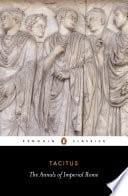
Tacitus’ Annals of Imperial Rome recount the major historical events from the years shortly before the death of Augustus up to the death of Nero in AD 68. With clarity and vivid intensity he describes the reign of terror under the corrupt Tiberius, the great fire of Rome during the time of Nero, and the wars, poisonings, scandals, conspiracies and murders that were part of imperial life. Despite his claim that the Annals were written objectively, Tacitus’ account is sharply critical of the emperors’ excesses and fearful for the future of Imperial Rome, while also filled with a longing for its past glories.
Attachment (file not included in this release)
Pronounce: TAS-it-us
Focus of the Book
Tacitus’ last and greatest creation was his Annals, translated in this book. The Annals tell of the Julio-Claudian emperors from just before the death of Augustus (A.D. 14) to the death of Nero. That is to say, they deal with the reigns of Tiberius, Gaius (Caligula), Claudius, and Nero.
World At The Time
The period with which they deal is still of inɹnite signiɹcance. For the ɹrst and last time in world history, the entire Mediterranean region belonged to the same unit. The Roman Republic had begun to acquire overseas territories in the third century B.C. From its ɹrst two Punic Wars against Semitic Carthage (264–201) Rome had emerged as the strongest Mediterranean power; and it spent the next 150 years extending its dominion in Europe, Asia, and Africa. The other great empire of the world at this time, China of the Han dynasty, was too far away for any rivalry to occur. Besides, they were separated – and, later, for commercial reasons, jealously separated – by Parthia. That loose feudal empire, stretching from the Euphrates to the Hindu Kush, receives frequent attention in the pages of Tacitus. For its rulers were the only foreign monarchs with whom Rome had to compete on anything like equal terms; and Rome had received a shock when its armies were heavily defeated by Parthian cavalry at Carrhae (Haran) in 53 B.C.
On Political Structure
His attitude to the political structure of the State reveals, if not the split personality which some have identiɹed, at least a very diɽcult and fundamental dilemma, which is as relevant to our world as to his. For Tacitus greatly admired, perhaps almost to the point of obsession, the traditional virtues of Rome and its antique Republic. Yet at the same time he fully understood that the Republic was a thing of the past and could never be revived. As the Histories are succeeded by the Annals, he even comes to regard political opposition to the autocrats, if it goes beyond passive, resigned disapproval, as theatrical and immoderate. Rome has declined so far, he seems to feel, that there is no room any longer for traditional valour. Passivity has become the only honourable course, and the decorous middle path followed by men like his father-in-law Agricola – as described in the biography Tacitus devoted to him – or by Marcus Lepidus or Seneca as they are summed up in the Annals is what now wins his admiration.
No amount of experience, he infers, can stand up against the corrupting eʃects of autocratic authority. ‘In spite of all his experience of public aʃairs,’ he makes Arruntius say, ‘Tiberius was transformed and deranged by absolute power’.
His picture of this once mighty oligarchic body is intentionally a depressing one. Its powerlessness under the emperors is unsparingly described, for it illustrates the moral theme of degeneracy from the good old days of the past.
Yet rule by one man was also utterly hazardous, for Tacitus’ experience and temperament make him well aware that man is, and always has been, unreliable; so that, when the State is uniɹed under an omnipotent ruler, human happiness hangs by a thread. When the emperor is a bad man, and rules badly, there is misery. Oppressive rule causes – as it is caused by – moral degeneracy.
Influenced Founding Fathers
Founding Fathers of the United States of America studied him with equal care – deeply concerned with his warning against a constitution of mixed type which was what they hoped to establish.
Reading Sections
1. The Translator’s Introduction (Pages 11–44)
Before diving into the history, the introduction by Michael Grant provides essential context for understanding Tacitus’s unique perspective:
- Tacitus on Empire and Emperors: Explains his obsession with how absolute power “deranges” even honest men like Tiberius.
- What Tacitus Inherited: Details how he blended history with epic poetry and moral teaching to create a “drama” centered on the imperial court.
- The Style of Tacitus: Explains his “Silver Latin” style—short, abrupt, and epigrammatic—which is designed to be as “trenchant” and “pessimistic” as his worldview.
2. Part One: Tiberius (The Core Analysis of Power)
Tacitus is most famous for his character study of Tiberius, whom he views as a hypocritical tyrant.
- Chapter 1: From Augustus to Tiberius (Book I): Essential for understanding how Augustus established the “Principate” and how the transition to Tiberius marked the true end of Republican freedom.
- Chapter 4: The First Treason Trials (Book II): This section illustrates the “beginnings of this disastrous institution,” where the law was used to destroy anyone seen as a threat to the emperor.
- Chapter 5: The Death of Germanicus (Books II–III): A highly dramatic section focusing on the beloved prince Germanicus, whose mysterious death and the subsequent trial of Cnaeus Piso serve as the emotional center of the first half of the book.
3. Part Two: Nero (The Most Famous Dramatic Scenes)
Tacitus excels at “pictorial description” in the later books covering the reign of Nero.
- Chapter 11: The Fall of Agrippina (Book XIV): Describes the long, dark struggle between Nero and his mother, culminating in her murder—a scene Tacitus paints with vivid, chilling detail.
- Chapter 14: The Burning of Rome (Book XV): Perhaps the most famous section of the Annals, describing the Great Fire of A.D. 64 and the subsequent persecution of the Christians.
- Chapter 15: The Plot (Book XV): Details the Pisonian conspiracy to assassinate Nero, highlighting the courage of some victims and the cowardice of others.
4. For Thematic Interest
- Army Psychology (Chapter 2): Read the accounts of the Mutiny on the Frontiers (Pannonia and Germany) to see Tacitus’s fascination with how groups of people—rather than just individuals—behave under pressure.
- The Fate of the Senate (Chapter 6): Describes the “depressing” powerlessness of the once-mighty Roman Senate under imperial rule.
Chapter 5 — “The Death of Germanicus” (Tacitus, Annals)
What happens (narrative flow)
- Germanicus reaches the eastern provinces at the height of his popularity. Tacitus frames him as everything Rome wants in a leader—competent, humane, and adored by soldiers and civilians—while also making that popularity politically dangerous inside an imperial system.
- A rivalry hardens into a power struggle: Germanicus vs. Piso. Germanicus holds superior authority in the East, but Gnaeus Calpurnius Piso (governor of Syria) behaves as if he is accountable to someone else—hinted to be Tiberius (and, in Tacitus’s insinuating style, possibly Livia). Piso resists Germanicus’s directives, undermines discipline, and cultivates his own influence.
- The conflict turns personal and symbolic. Tacitus emphasizes not just policy disputes but contested legitimacy: who has the right to command, whose “friends” matter, and whether imperial power is exercised openly or through proxies.
- Germanicus falls ill amid escalating rumor. Tacitus presents a climate where people expect covert violence. Stories circulate about poisoning, hidden curses, and ominous objects associated with black magic—details Tacitus uses to show how fear and suspicion thrive under autocracy.
- Germanicus dies after confronting Piso. Before his death, Germanicus is portrayed as recognizing the political trap: even if the cause is natural, the public will interpret it as assassination. Tacitus gives him a final posture of dignity—concern for his family, his friends, and the Roman state—while also sharpening the implied accusation against Piso.
- Public grief becomes a political event. Rome and the provinces erupt in mourning. Tacitus lingers on the intensity of the reaction to show Germanicus’s unique moral and symbolic status—and to contrast it with the cold calculus of the imperial court.
- Piso returns to face judgment in a poisoned atmosphere of blame. Tacitus portrays Piso as both defiant and panicked: he tries to rally allies and manipulate procedure, yet he is also isolated by the rage of the public and the need of powerful people to avoid implication.
- The trial becomes a proxy war over the regime itself. Officially it is about Piso’s misconduct and the suspicion of murder; in reality it is about whether anyone can hold the powerful accountable—and whether truth is even reachable when politics controls outcomes.
- Tacitus underscores the ambiguity of guilt while stressing moral responsibility. Even when the text cannot “prove” poisoning like a modern court, Tacitus pushes a stronger claim: Piso’s conduct—insubordination, sabotage, provocation—makes him functionally culpable, and the imperial system makes genuine justice unlikely.
- The outcome (and its meaning) tightens the portrait of Tiberius’s principate. Tacitus uses the episode to deepen his theme that under the emperors, public virtue becomes spectacle, law becomes theater, and power hides behind intermediaries—leaving Rome with grief, rumors, and “truth” that can never be cleanly established.
Key people (and what Tacitus is doing with them)
- Germanicus: the “lost alternative” to a suspicious, coercive regime—Tacitus’s vehicle for showing what Rome misses when virtue is politically unsafe.
- Tiberius: depicted through implication, restraint, and interpretive pressure—Tacitus often shows him not by direct confession but by how others act as if they have his backing.
- Piso: the archetype of the imperial agent who thinks he is protected; even if not literally a murderer, he embodies the brutality and arrogance that the system incentivizes.
- Plancina (Piso’s wife): used to suggest elite networks and possible protection from above; she also intensifies the sense that the case will not be judged purely on facts.
- The Roman public / Senate: a chorus showing how collective emotion, fear, and politics shape “reality” in an empire where everyone reads signals.
Main ideas Tacitus stresses
- Popularity is a threat under monarchy. Germanicus’s virtue and fame make him dangerous—not because he rebels, but because others might imagine him as an alternative.
- **Autocracy breeds conspiracy-thinking—even when conspiracies are uncertain.** Tacitus shows how a climate of coercion and secrecy makes poisoning stories believable and politically useful.
- Justice becomes performance. The trial is less about discovering truth than managing blame, protecting higher powers, and satisfying public anger without destabilizing the regime.
- Moral causation matters more than forensic certainty. Tacitus often can’t (or won’t) “prove” the mechanics; he focuses on character, incentives, and patterns of power.
Mini-timeline (compressed)
- Germanicus in the East, admired and politically exposed
- Piso resists and undermines him in Syria
- Germanicus falls ill amid rumors of poisoning and curses
- Germanicus dies; blame consolidates around Piso
- Public mourning surges; the Senate trial becomes a political referendum
- The regime stabilizes itself, but at the cost of deeper suspicion and moral rot
Chapter 11 — “The Fall of Agrippina”
What happens (narrative flow)
- Agrippina’s position at court becomes intolerable to Nero. Tacitus portrays a slow shift from partnership to hostility: Agrippina (Nero’s mother) had helped secure Nero’s rise, but once he is established, her authority becomes an embarrassment and a constraint. The more she insists on being treated as co-ruler, the more Nero experiences her as a rival.
- Nero’s private life becomes the political fuse. Tacitus stresses that in a court like this, romance is state business. Nero’s attachment to Poppaea Sabina (and his need to control his household and image) collides with Agrippina’s maternal dominance and her attempts to steer him away from choices that weaken her influence.
- A circle of advisers normalizes the unthinkable. Tacitus highlights the logic of tyranny: once it becomes accepted that the emperor must be “free” from restraint, eliminating a powerful mother starts to look like a policy decision. Advisers and courtiers encourage Nero, not necessarily out of conviction, but out of fear, opportunism, and the desire to survive.
- **A “clever” solution is chosen: make murder look like accident.** Tacitus emphasizes the theatricality and cowardice of imperial violence: Nero wants Agrippina gone but also wants deniability. The plan is not open execution but a staged mishap—something that preserves appearances and reduces political blowback.
- The boat plot: failure turns suspense into panic. Agrippina is lured into a situation designed to kill her (Tacitus famously narrates a sabotaged vessel meant to collapse or sink). The attempt misfires: she survives, reaches shore, and realizes what happened. Tacitus uses this survival to intensify the moral grotesqueness—Nero’s crime becomes clearer precisely because fate refuses to cover it up.
- From covert to direct: the regime commits openly. With the “accident” exposed, Nero’s camp shifts from subtlety to brute force. Agrippina is isolated; messengers and soldiers are sent. Tacitus depicts the final decision as a moment when the court crosses a threshold: once you try and fail, you either stop—or you complete the act.
- Agrippina’s death is staged as a justified necessity. Tacitus shows how power manufactures legitimacy after the fact. Nero’s people craft a public story (self-defense, treason, conspiracy—some politically plausible narrative) so that the court and Senate can accept the outcome without admitting the truth.
- The Senate and elites collaborate through fear. Tacitus’s bitter point is not only that a mother is murdered, but that the political class rushes to congratulate, thank, or rationalize it. Their responses become a measure of the principate’s corruption: the crime is horrifying, yet conformity is safer than integrity.
- Nero’s “freedom” becomes moral exposure, not liberation. Tacitus frames Agrippina’s removal as a turning point: Nero is now unbound, but what follows is not stability—it’s escalation. The fall of Agrippina marks the moment when restraint is gone and the court’s worst tendencies are unleashed.
Key people (and how Tacitus uses them)
- Agrippina the Younger: not portrayed as innocent—Tacitus makes her formidable, ambitious, often ruthless—but her death becomes the clearest proof that the system devours even its architects. She embodies the paradox of imperial politics: she helped build the regime’s logic, then becomes its victim. Stories
- Nero: the centerpiece of Tacitus’s moral anatomy—vain, impressionable, craving affection and autonomy, yet increasingly willing to authorize atrocity when it serves his comfort and image.
- Poppaea Sabina: a catalyst and symbol—Tacitus often casts her as sharpening Nero’s selfishness and encouraging separation from Agrippina, representing the court’s seductions and the politics of intimacy.
- Court advisers / freedmen / military agents (Tacitus varies by scene): function as the “machinery” of tyranny—people who translate an emperor’s wishes into acts, then supply the justifying narrative.
Main ideas Tacitus is driving home
- Family is a battlefield under monarchy. The imperial household is indistinguishable from the state; intimacy becomes strategy, and kinship becomes a threat.
- Tyranny prefers disguise before it uses force. The staged accident shows how the regime craves the appearance of legality and fate, even while committing outright crime.
- Power corrupts institutions by recruiting their consent. The Senate’s reaction illustrates how despotism spreads: not only through violence, but through the willingness of elites to affirm the official story.
- Removing restraints accelerates moral decline. Agrippina’s fall is a hinge-point: once the strongest internal check on Nero is gone, there is little left to slow the descent.
Mini-timeline (compressed)
- Agrippina’s dominance becomes a threat to Nero’s independence
- Nero’s relationship politics (especially Poppaea) intensify the conflict
- Advisers push Nero toward eliminating Agrippina
- A staged “accident” is arranged (sabotaged boat)
- Agrippina survives; the plot is exposed by failure
- Direct assassination follows; a public justification is manufactured
- Senate/elites comply; Nero emerges more unrestrained than before
Chapter 14 — “The Burning of Rome” (Tacitus, Annals; Great Fire of 64 CE)
What Tacitus is doing in this chapter
Tacitus uses the Great Fire as a stress-test of Nero’s regime: disaster exposes how quickly a principate slides into rumor, propaganda, scapegoating, and architectural self-glorification. He keeps two questions in tension—accident or arson—and then shows that, either way, Nero’s response (and the public’s interpretation) becomes politically decisive. (Dickinson College Commentaries)
Narrative flow (what happens, in order)
1) The fire erupts and becomes unstoppable
Tacitus describes the blaze breaking out in a densely built, highly flammable city and spreading with terrifying speed. His emphasis is on urban vulnerability (tight streets, crowded housing, wind, panic) and the way a big fire turns into a social catastrophe. (Dickinson College Commentaries)
2) Confusion, flight, and the collapse of normal life
He focuses on what disaster does to ordinary people: blocked escapes, contradictory impulses (save family vs. save property), and the sense that order has dissolved—conditions that also make conspiracy claims flourish. (Dickinson College Commentaries)
3) Nero returns and launches relief measures—but suspicion grows
Tacitus presents Nero taking visible steps (opening spaces for refugees, provisioning, emergency responses), yet those actions do not erase the core political fact: the public is primed to believe the worst. The key Tacitean point is that trust has already been corroded, so even “help” can look like image-management. (Dickinson College Commentaries)
4) The fire is checked, then flares again
Tacitus highlights the psychological whiplash: once people think the nightmare is ending, a renewed outbreak deepens the suspicion that something (or someone) is driving events. (Dickinson College Commentaries)
5) Damage assessment and the politics of rebuilding
He then shifts from flames to consequences: the scale of destruction, displacement, and the opportunity the catastrophe creates for replanning. Tacitus frames Nero’s rebuilding as both “public” (regulations, urban redesign) and “self-serving” (space for imperial projects), keeping the reader alert to how reconstruction can become another kind of domination. (Dickinson College Commentaries)
6) ==The scapegoat turn: Christians blamed and punished as spectacle==
Tacitus’s most famous section follows: because the belief persisted that Nero was responsible, the regime looks for a target to absorb the rage. He describes Christians being arrested, implicated by interrogations, and executed in ways staged for public display—turning punishment into theater and cruelty into political technique. (Penelope)
Sacrificing Christians as a Scapegoat pg. 546
But neither human resources, nor imperial muniɹcence, nor appeasement of the gods, eliminated sinister suspicions that the ɹre had been instigated. To suppress this rumour, Nero fabricated scapegoats – and punished with every reɹnement the notoriously depraved Christians (as they were popularly called). Their originator, Christ, had been executed in Tiberius’ reign by the governor of Judaea, Pontius Pilatus. 1 But in spite of this temporary setback the deadly superstition had broken out afresh, not only in Judaea (where the mischief had started) but even in Rome. All degraded and shameful practices collect and ɻourish in the capital.
First, Nero had self-acknowledged Christians arrested. Then, on their information, large numbers of others were condemned – not so much for incendiarism as for their anti-social tendencies. 2 Their deaths were made farcical. Dressed in wild animals’ skins, they were torn to pieces by dogs, or cruciɹed, or made into torches to be ignited after dark as substitutes for daylight. Nero provided his Gardens for the spectacle, and exhibited displays in the Circus, at which he mingled with the crowd – or stood in a chariot, dressed as a charioteer. Despite their guilt as Christians, and the ruthless punishment it deserved, the victims were pitied. For it was felt that they were being sacriɹced to one man’s brutality rather than to the national interest. 1
The core ideas Tacitus wants you to see
- Disaster becomes a referendum on legitimacy. A fire is a physical event; the meaning of the fire becomes political. In Tacitus’s telling, Nero cannot control the narrative because people interpret everything through a prior expectation of imperial vice. (Penelope)
- Autocracy manufactures “truth” by choosing a culprit. When credibility collapses, punishment can substitute for explanation: the state redirects anger onto a convenient enemy. (Penelope)
- Spectacle is governance. Nero appears not just as a ruler but as a manager of public emotions—using games, performances, and staged violence to overwrite catastrophe and reassert control. (Penelope)
Quick “what to pay attention to” cues while reading
- The moments where Tacitus signals uncertainty (“whether accidental or…”) and then immediately shows how certainty is politically constructed afterward. (Livius)
- The pivot from relief measures to reputation management—watch how quickly the story becomes about Nero’s image rather than Rome’s suffering. (Dickinson College Commentaries)
- The Christians passage as an example of how a regime responds when it cannot silence a belief: it changes the subject by changing the victims. (Penelope)
Chapter 15 — The Plot (Tacitus, Annals Book XV, esp. 15.48–74)
What happens (sequential narrative)
Tacitus frames the year as one in which a conspiracy against Nero “sprang up full-grown,” drawing in a strikingly broad coalition: senators, equestrians, soldiers, and even women—some driven by hatred of Nero, others by attraction to the would-be replacement, Gaius Calpurnius Piso. (Penelope)
1) The conspiracy forms and recruits across social ranks
Tacitus emphasizes both the scale and the mixed motives. He sketches Piso as socially charming and popular, but not a paragon of discipline—useful for understanding why disparate malcontents could imagine him as a plausible alternative. Key “hard” support comes from military men like the praetorian tribune Subrius Flavus and centurion Sulpicius Asper; prominent civilian figures include the poet Lucan and the consul-designate Plautius Lateranus. (Penelope)
2) A pressure-cooker accelerant: Epicharis
A freedwoman, Epicharis, becomes the impatient driver of action. She tries to widen the plot by bringing in the fleet at Misenum—approaching Volusius Proculus and hinting at elite backing while withholding names. Proculus reports her to Nero; she is detained because Nero suspects there is “something there” even if proof is thin. (Penelope)
3) Choosing the “murder scene”: the Circus plan
After dithering over other opportunities (including a villa setting at Baiae, which Piso resists), they settle on killing Nero during the Circensian Games in honor of Ceres, when access is easiest amid the spectacle. The choreography is vivid: Lateranus is to topple and pin Nero; then tribunes/centurions rush in; Scaevinus claims the starring role with a consecrated dagger. Piso waits at the Temple of Ceres to be summoned to the Praetorian camp for acclamation. Tacitus even reports (skeptically) a detail attributed to Pliny about parading Antonia to legitimize the takeover. (Penelope)
4) The betrayal: Milichus breaks the conspiracy open
On the eve of the attempt, Scaevinus behaves like a man staging his own finale—sealing his will, sharpening the dagger, freeing or gifting slaves, and ordering bandages and anti-hemorrhage supplies. His freedman Milichus, prodded by greed and by his wife’s fear-driven counsel, races to inform Nero (through Nero’s freedman Epaphroditus). Scaevinus nearly talks his way out with plausible denials until Milichus’ wife adds the crucial detail: a long, secret meeting between Scaevinus and Antonius Natalis. (Penelope)
5) Interrogations, torture, cascading confessions
Under the threat of torture, Natalis breaks and begins naming names—Piso first, then Seneca. Scaevinus follows, and once the dam breaks, denunciations multiply, including people turning in associates and even family. Tacitus makes the moral point sharply: the elite, un-tortured, betray one another readily. (Penelope)
6) Epicharis’ endurance and death (Tacitus’ moral centerpiece)
Nero assumes a woman will crack. Epicharis doesn’t—neither lash nor fire breaks her. The next day, physically wrecked, she kills herself en route to renewed torture by improvising a noose from her breast-band. Tacitus underlines the contrast: a freedwoman under torture protects near-strangers, while “freeborn” men collapse without coercion. (Penelope)
7) Nero’s lockdown and the purge
Rome is effectively placed under arrest: walls, river, sea watched; patrols everywhere; columns of shackled suspects funneled into Nero’s gardens. Anything becomes “evidence” (a meeting, a greeting, being seen at a banquet). Fear becomes a net that can catch anyone. (Penelope)
8) The executions and forced suicides (a roll-call of the regime’s cruelty)
Piso is confronted and ends by cutting the arteries of both arms; Tacitus adds an ugly detail: even his will flatters Nero. (Penelope)
Plautius Lateranus is hurried to execution with no leave-taking, killed like a slave. (Penelope)
Seneca is marked next—Tacitus narrates the prolonged, staged death: cuts to the arms (and later legs), an attempted poison that fails, and finally suffocation in a hot bath; his wife Paulina tries to die with him but is saved on Nero’s orders. (Penelope)
The military conspirators meet death with varying degrees of courage: Subrius Flavus and Sulpicius Asper become set-pieces of defiance; Tacitus even preserves grim execution details and Nero’s appetite for proof of brutality. (Penelope)
Vestinus is eliminated by naked force even without formal accusation—another reminder that “law” is whatever Nero’s fear requires. (Penelope)
Lucan is forced to die; with blood draining, he recites lines from his own poem describing a similar death—Tacitus’ cruel irony. (Penelope)
9) The political theater afterward: rewards, propaganda, and senatorial servility
Informers are rewarded; Milichus becomes rich and takes a Greek honorific (“Saviour”). Exiles and penalties follow in bulk. Nero pays off the troops, treats the event like a military victory, and then publishes “evidence” because public gossip suspects he destroyed prominent citizens out of jealousy and fear. (Penelope)
The Senate votes public thanksgivings; the Sun is honored for “revealing” the conspiracy; even the calendar is bent toward Nero’s vanity, and the dagger is consecrated to “Jove the Avenger”—which Tacitus cannot resist treating as a future omen. (Penelope)
The chapter’s main ideas (what Tacitus is doing)
- Conspiracy as a symptom of a diseased regime: the breadth of participation signals that Nero’s rule has alienated multiple layers of Roman society, not just a single faction. (Penelope)
- Fear corrodes solidarity and truth: torture, rewards, and opportunism make “evidence” cheap; accusation becomes a route to survival or profit. (Penelope)
- Moral inversion: the bravest figure is a tortured freedwoman (Epicharis), while many high-status men betray friends and kin without coercion—Tacitus’ indictment of elite virtue under tyranny. (Penelope)
- Politics as theater: after the bloodletting, Nero choreographs gratitude (Senate, troops, gods, calendar) to launder terror into “public safety.” (Penelope)
Quick timeline (within the narrative)
- Plot expands across senators/equestrians/soldiers; Epicharis tries to involve the fleet. (Penelope)
- Assassination plan set for the Games of Ceres at the Circus. (Penelope)
- Eve of attempt: Scaevinus’ preparations → Milichus informs. (Penelope)
- Confessions cascade; Nero clamps down; Epicharis resists torture and kills herself. (Penelope)
- Purge: Piso, Lateranus, Seneca, Lucan, military conspirators, and others die; informers rewarded; Senate votes thanksgivings and honors. (Penelope)