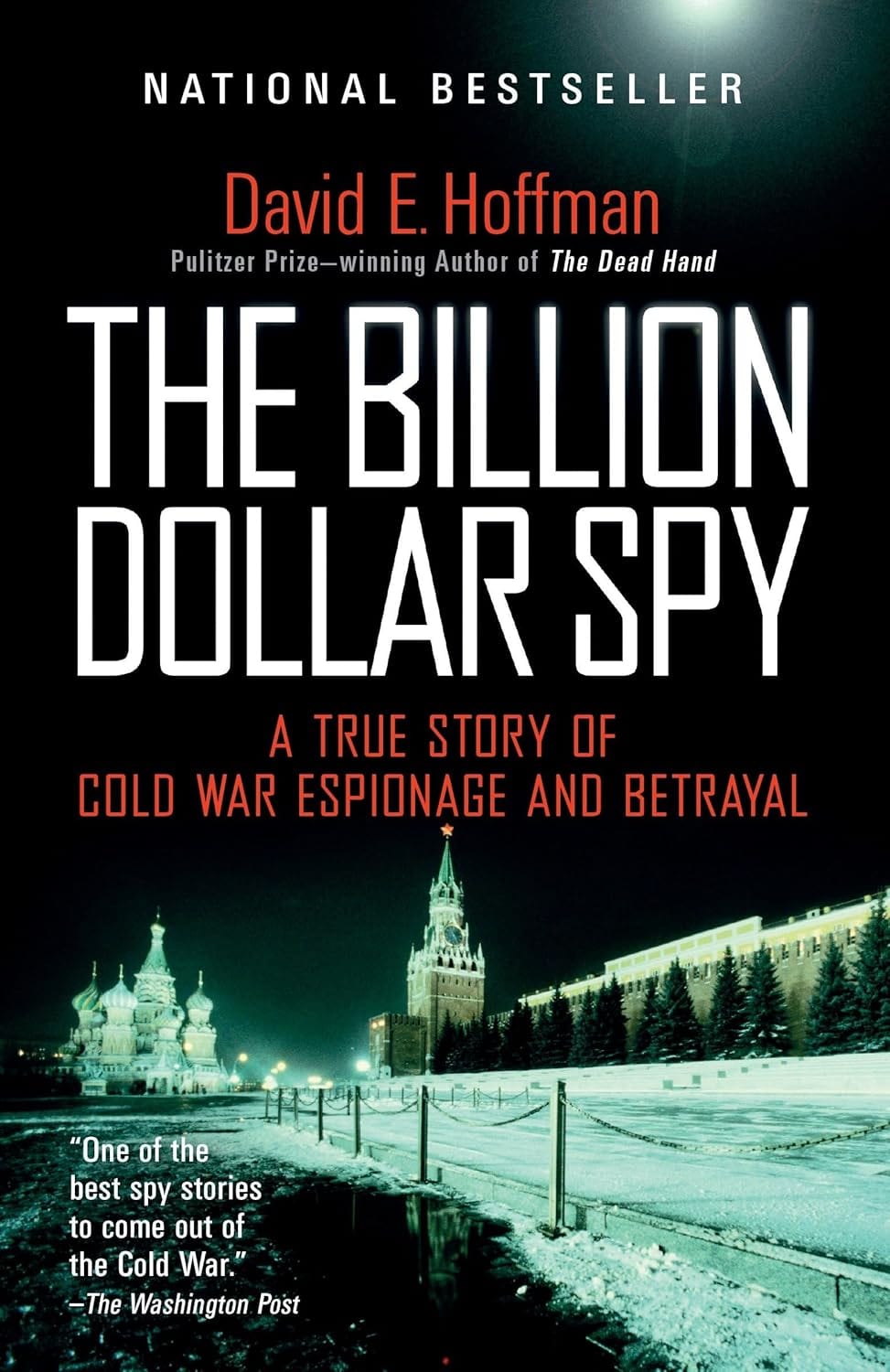
The Billion Dollar Spy — David E. Hoffman
Source: attached PDF, The Billion Dollar Spy: A True Story of Cold War Espionage and Betrayal by David E. Hoffman.
Executive Summary
David E. Hoffman’s central argument is that Adolf Tolkachev, a Soviet radar engineer inside a top-secret military research institute, became one of the CIA’s most valuable Cold War agents because he provided intelligence that directly shaped American understanding of Soviet aviation, radar, missile, and air-defense capabilities. His work helped the United States gain a decisive advantage in aerial combat and weapons design.
The book is also an institutional history of the CIA’s Moscow station. Hoffman shows how the CIA moved from early failure, fear, and paralysis in Moscow into a more sophisticated age of street tradecraft, disguises, dead drops, spy cameras, clandestine signals, and high-risk face-to-face meetings under KGB surveillance. The tragedy is that the operation was not finally defeated by superior Soviet counterintelligence alone, but by betrayal from inside the American intelligence system, especially through Edward Lee Howard and later Aldrich Ames.
Hoffman’s significance lies in showing espionage as a human system: not just secrets, technology, and statecraft, but fear, vengeance, ego, bureaucracy, family vulnerability, operational improvisation, and moral ambiguity.
Prologue
Main Ideas
The prologue opens in late 1982, when the CIA has lost contact with its most valuable Soviet agent. The agent’s intelligence had already revealed critical Soviet radar and aviation secrets and had helped expose vulnerabilities in Soviet air defenses.
The central dramatic scene is Bill Plunkert’s attempt to shake KGB surveillance using the CIA’s Jack-in-the-Box device, a pop-up dummy hidden inside a fake birthday cake. The scene establishes several themes:
- Espionage as illusion: the CIA succeeds not by brute force, but by misdirection.
- Moscow as hostile terrain: every street, car, building, and phone line is assumed compromised.
- The agent’s vulnerability: one operational failure could lead to arrest, interrogation, and execution.
- The personal burden on handlers: Plunkert has never met the agent but understands that his own performance may determine whether the spy lives or dies.
Espionage as Illusion
“Espionage is the art of illusion.” — Page 12
The prologue functions as a flash-forward. It begins near the height of the operation, when Tolkachev’s value is already clear but his safety is uncertain. Hoffman uses this suspense to frame the rest of the book as both a historical reconstruction and a procedural account of clandestine work.
1. Out of the Wilderness
Main Ideas
This chapter explains why Tolkachev’s later success was so extraordinary. In the early Cold War, the CIA had almost no ability to recruit and run agents inside Moscow. The Soviet Union was a closed police state, and contact with foreigners could be fatal.
Hoffman traces the CIA’s origin after Pearl Harbor, when U.S. leaders wanted a centralized intelligence service to prevent strategic surprise. But the CIA quickly moved beyond analysis into covert action and espionage as the Cold War intensified.
Key points:
- The CIA’s early Soviet intelligence was weak.
- Stalin’s closed society made human intelligence extraordinarily difficult.
- The KGB inherited decades of ruthless internal policing.
- Early CIA covert actions into Eastern Europe largely failed.
- The CIA depended on defectors, émigrés, refugees, and agents handled outside the USSR.
Hoffman then introduces early breakthroughs: Pyotr Popov and Oleg Penkovsky. Both demonstrated the immense value of Soviet military insiders, but both also showed the dangers of handling agents connected to Moscow.
Penkovsky’s intelligence was especially important during the Cuban Missile Crisis, where his information helped Kennedy assess Soviet missile capabilities. Yet his capture reinforced the sense that Moscow was almost impossible terrain for CIA operations.
The chapter’s title refers partly to James Angleton’s “wilderness of mirrors,” the atmosphere of counterintelligence suspicion that paralyzed the CIA’s Soviet operations.
Key Takeaway
The CIA’s later handling of Tolkachev represents a major institutional breakthrough: the agency learned to conduct direct, repeated meetings with a Soviet source in Moscow, the KGB’s own backyard.
2. Moscow Station
Main Ideas
This chapter describes the CIA’s attempt to rebuild its Moscow capability after years of caution and failure. Hoffman presents Moscow station as a small, embattled outpost operating inside an adversary’s capital, under constant KGB observation.
The chapter centers on:
- The development of surveillance detection runs.
- The need for deep-cover officers.
- The distinction between diplomatic cover and clandestine work.
- The KGB’s massive surveillance advantage in Moscow.
- The CIA’s gradual willingness to take operational risks.
Hoffman also recounts the Ogorodnik case. Aleksandr Ogorodnik, a Soviet Foreign Ministry officer recruited abroad, became one of the CIA’s first major post-Angleton Soviet sources. His work showed that the CIA could handle agents connected to Moscow, but his eventual compromise and suicide underscored the lethal stakes.
Moscow station emerges as a learning organization: improvisational, nervous, resourceful, and conscious that every mistake might cost a source’s life.
Key Takeaway
Before Tolkachev, the CIA had to overcome not only the KGB but also its own fear, bureaucracy, and counterintelligence trauma.
3. A Man Called Sphere
Main Ideas
This chapter introduces the first signs of Tolkachev. After the Ogorodnik disaster, the CIA is still recovering when an unknown Soviet man repeatedly tries to contact American officials.
Tolkachev’s first approaches are cautious, awkward, and ambiguous. The CIA initially fears a KGB provocation. This suspicion is rational: the KGB had long used false volunteers to trap or expose Western intelligence officers.
Tolkachev receives the CIA cryptonym CKSPHERE, shortened to Sphere. The name reflects how the CIA converts a living human being into a compartmented operational identity. He is both Adolf Tolkachev, a husband and father, and “Sphere,” an intelligence asset.
The chapter also highlights the CIA’s institutional hesitation. The agency wants the secrets but fears a trap. Tolkachev, meanwhile, is frustrated by the Americans’ caution. This mismatch becomes a recurring pattern: the agent is often more aggressive than the service handling him.
Key Takeaway
The beginning of the Tolkachev operation was not clean or confident. It began with uncertainty, mistrust, and repeated failed contact attempts.
4. “Finally I Have Reached You”
Main Ideas
Tolkachev finally succeeds in making contact on February 16, 1978, when he passes an envelope to CIA Moscow station chief Gardner Hathaway outside the U.S. embassy.
His letter reveals both his seriousness and his impatience. He insists that he has valuable access to Soviet military technology and that he has been trying to reach the Americans for a long time.
This chapter establishes the operational dilemma:
- Tolkachev appears genuine.
- His access could be extraordinary.
- But the CIA cannot assume he is safe.
- Contacting him too quickly could expose both sides.
- Ignoring him could waste a historic intelligence opportunity.
Hoffman shows the CIA moving from suspicion toward cautious engagement. The agency begins to assess Tolkachev’s information and realizes that his material may be of immense value.
The Volunteer’s Frustration
“Finally I have reached you.” — Page 64
Key Takeaway
Tolkachev’s persistence forces the CIA to confront a rare opportunity: a Soviet insider with direct access to secrets the United States badly needed.
5. “A Dissident at Heart”
Main Ideas
This chapter develops Tolkachev’s motives. He was not primarily a mercenary. He was driven by hatred of the Soviet system, personal grievance, and a desire for revenge.
Hoffman portrays him as a dissident at heart, though not a public dissident like Sakharov or Solzhenitsyn. Tolkachev did not protest openly. Instead, he weaponized his access to damage the regime from inside.
Major motive strands:
- Hatred of Soviet ideological hypocrisy.
- Anger over repression.
- Personal memory of Stalinist terror.
- Desire to help the United States technologically defeat the Soviet military.
- Psychological need to act rather than merely resent.
The chapter also shows the first serious CIA meetings with Tolkachev. John Guilsher becomes central as a handler. Trust is slowly built through clandestine meetings, letters, operational notes, and careful negotiation.
Key Takeaway
Tolkachev’s espionage was political and personal. He was not simply selling secrets; he saw himself as striking back against a system that had destroyed lives.
6. Six Figures
Main Ideas
This chapter examines money, compensation, and the peculiar economics of espionage.
Tolkachev demands a large sum: six figures. The request unsettles the CIA. Was he greedy? Was money his real motive? Or was the money symbolic proof that the CIA valued his risk?
Hoffman shows that Tolkachev’s relationship to money was complex:
- He wanted money for his family, especially his son.
- He wanted Western goods unavailable in the Soviet Union.
- He also wanted recognition.
- He measured the CIA’s seriousness partly through compensation.
- He understood that he was risking execution.
The CIA debates how much to pay him and how to provide rubles safely. Large sums of Soviet currency create practical problems: storage, concealment, and suspicion. Tolkachev’s payment demands also force the CIA to think of him not only as a heroic dissident but as a difficult, proud, demanding human source.
Key Takeaway
Money in the Tolkachev case is not reducible to greed. It becomes a language of risk, respect, leverage, and future security.
7. Spy Camera
Main Ideas
This chapter focuses on the technical problem at the heart of the operation: Tolkachev needs to copy huge quantities of classified material without detection.
At first, he relies on memory and handwritten notes, but this is inadequate. The CIA provides miniature cameras, but early results are poor. Documents are blurred, unreadable, or badly exposed.
The chapter shows espionage as a technical craft:
- Cameras must be small enough to hide.
- Film must capture fine technical details.
- The agent must be trained without normal training conditions.
- Documents must be photographed quickly.
- Mistakes can waste irreplaceable access.
- Equipment failure can increase operational risk.
The CIA’s Office of Technical Service becomes crucial. The operation depends not only on brave case officers but also on engineers, disguise experts, camera designers, concealment specialists, and logistics personnel.
Key Takeaway
Tolkachev’s value depended on the union of human access and technical collection. Courage alone was insufficient; espionage required tools that could reliably convert access into intelligence.
8. Windfalls and Hazards
Main Ideas
Tolkachev begins producing intelligence of extraordinary value. He provides details about Soviet radar systems, electronic components, and aviation technologies that U.S. analysts had not previously understood.
The “windfalls” are clear:
- The CIA receives direct insight into Soviet airborne radar.
- U.S. military planners learn about Soviet weaknesses and development timelines.
- American engineers can design countermeasures.
- Tolkachev’s intelligence helps clarify future Soviet weapons programs.
The hazards are equally serious:
- The more Tolkachev produces, the more risks he takes.
- His workplace security remains unpredictable.
- Handling bulky materials and equipment increases exposure.
- The CIA must balance intelligence appetite against agent safety.
This chapter also situates Tolkachev’s intelligence in the broader U.S.-Soviet military competition. The secrets are not abstract; they matter for aircraft survivability, missile guidance, air defense penetration, and future combat.
Key Takeaway
The Tolkachev operation becomes a classic intelligence tradeoff: the more productive the agent, the greater the temptation to push him into danger.
9. The Billion Dollar Spy
Main Ideas
This chapter explains why Tolkachev earned the book’s title. His intelligence is assessed as being worth billions of dollars to the United States because it helped avoid unnecessary research, redirected weapons development, and allowed U.S. systems to be designed against actual Soviet capabilities.
Tolkachev provides information on:
- Soviet fighter radars.
- Air defense systems.
- Look-down/shoot-down capabilities.
- Avionics.
- Research programs projected years into the future.
- Weaknesses in Soviet technical development.
The U.S. defense establishment values his reporting because it allows American planners to move beyond speculation. Instead of guessing what Soviet systems could do, they can design against known parameters.
This chapter also deepens the tension between Tolkachev’s production and the CIA’s ability to protect him. His growing value makes the operation indispensable, but also psychologically harder to stop.
Key Takeaway
Tolkachev’s intelligence mattered because it affected procurement, weapons design, pilot training, and strategic confidence. He was not merely a source of secrets; he altered the military balance.
10. Flight of Utopia
Main Ideas
This chapter shifts attention to CIA case officer David Rolph and the inner workings of Moscow station.
The title suggests both aspiration and illusion. The CIA’s Moscow operation is built on a kind of professional utopianism: the belief that technique, discipline, and courage can overcome a total surveillance state. Yet the work is fragile and often improvised.
Hoffman describes the physical and bureaucratic environment of the station:
- Secure rooms.
- Cipher locks.
- Compartmented files.
- Technical officers.
- Surveillance planning.
- Operational rehearsals.
- Constant awareness of KGB penetration.
The chapter also broadens the cast of CIA personnel. The operation is collective, not just a relationship between Tolkachev and one handler. It depends on station chiefs, spouses, technicians, headquarters officers, analysts, and logistical support.
Key Takeaway
The Tolkachev operation was an institutional achievement. It required a small clandestine ecosystem built inside a hostile capital.
11. Going Black
Main Ideas
“Going black” refers to operating free of surveillance, or at least believing one has escaped it. This chapter explores the most dangerous phase of Moscow tradecraft: leaving official cover and moving invisibly through the city.
The CIA uses disguises, route changes, surveillance detection runs, public transportation, and deception devices. Officers rehearse movements and rely on split-second timing.
Key themes:
- The city itself becomes an operational battlefield.
- The CIA must deceive not only watchers but patterns of expectation.
- Disguises are psychological as well as physical tools.
- Tradecraft depends on discipline, memory, and nerve.
- The KGB’s surveillance advantage is large but not perfect.
The chapter reinforces Hoffman’s procedural strength. He makes clear that clandestine work is not glamorous improvisation but methodical choreography under pressure.
Key Takeaway
The CIA’s ability to meet Tolkachev depended on its capacity to create temporary invisibility inside one of the most heavily surveilled cities in the world.
12. Devices and Desires
Main Ideas
This chapter focuses on the material culture of espionage: suicide pills, cameras, concealments, signals, packages, and Western goods requested by Tolkachev.
Tolkachev finally receives the L-pill, a suicide capsule hidden in a fountain pen. The request is morally disturbing but operationally understandable. He fears being captured alive and tortured or forced to betray others.
[!quote] Operational Fatalism
“Everything we do is dangerous.” — Page 8
The chapter also develops Tolkachev’s personal desires. He asks for money, music, medicine, art supplies, Western pens, materials for his son, and other goods. These requests reveal the deprivation and absurdity of late Soviet life, where ordinary Western consumer items carry enormous symbolic weight.
The CIA must decide which requests to fulfill and which are too risky. Every object has a dual nature: it may reward the agent, but it may also incriminate him.
Key Takeaway
Espionage objects are never merely objects. A pen can be a suicide device; a camera can be a strategic weapon; a consumer good can be evidence of treason.
13. Tormented by the Past
Main Ideas
This chapter gives the deepest explanation of Tolkachev’s motives by turning to his family history.
Tolkachev was haunted by Stalinist repression. His wife Natasha’s mother had been executed, and her father had been sent to labor camps. These family traumas shaped Tolkachev’s hatred of the Soviet system.
Hoffman emphasizes that Tolkachev’s espionage cannot be understood apart from the Soviet state’s violence against its own citizens. His treason was, in his mind, retribution.
Major themes:
- The long memory of the Great Terror.
- Family trauma as political motivation.
- The private afterlife of state violence.
- The difference between public conformity and private hatred.
- Revenge as a motive for ideological betrayal.
Tolkachev was not an abstract liberal democrat. He was a wounded Soviet citizen whose rage had hardened into clandestine action.
Key Takeaway
The Soviet system created some of its own enemies. Tolkachev’s betrayal was rooted in the regime’s earlier betrayal of his family and society.
14. “Everything Is Dangerous”
Main Ideas
This chapter marks a more anxious phase in the operation. Tolkachev has become increasingly aware of the danger. He worries about surveillance, workplace security, family exposure, and the CIA’s demands.
The title captures the operation’s condition: there is no safe move, only relative risk.
The CIA must manage:
- Missed signals.
- Irregular contact.
- Changes in Tolkachev’s behavior.
- Possible workplace scrutiny.
- His desire for more equipment and autonomy.
- His fear of capture.
Tolkachev continues to produce valuable intelligence, but the psychological cost is rising. The operation begins to show strain.
Key Takeaway
The longer an espionage operation continues, the more risk accumulates. Even successful tradecraft cannot erase the basic vulnerability of a human source.
15. Not Caught Alive
Main Ideas
This chapter centers on Tolkachev’s fear of arrest and his determination not to be taken alive. A security inquiry at his institute alarms him. Even routine bureaucratic scrutiny becomes terrifying because he knows what discovery would mean.
Tolkachev destroys materials, burns money, and takes defensive measures. He becomes more cautious but not inactive. His survival instincts conflict with his drive to continue damaging the Soviet system.
The CIA faces a difficult problem: should it suspend the operation to protect him, or continue collecting because his intelligence remains uniquely valuable?
The chapter also shows the limits of CIA control. Tolkachev is not a subordinate. He makes his own decisions, takes his own risks, and sometimes exceeds what the CIA considers prudent.
Key Takeaway
Tolkachev’s agency is central. He is handled by the CIA, but he is not controlled by it.
16. Seeds of Betrayal
Main Ideas
The focus shifts to Edward Lee Howard, a CIA trainee selected for Moscow duty. Howard’s personal instability, failed polygraph, dismissal, resentment, and later contact with the Soviets become the seeds of the operation’s destruction.
Hoffman’s account of Howard is important because it shows betrayal developing not from ideology but from grievance, ego, and perceived humiliation.
Key points:
- Howard was trained in sensitive Moscow operations.
- He learned details about CIA methods and assets.
- He failed a polygraph and was removed from the Moscow assignment.
- He became angry and unstable.
- He eventually approached Soviet representatives.
This chapter is structurally important because it moves the book from operational triumph to impending catastrophe. The reader understands that Tolkachev’s greatest danger may not be the KGB watching Moscow streets, but a disgruntled American insider.
Key Takeaway
Counterintelligence failure can be internal and psychological. Howard’s betrayal grew from poor judgment, inadequate personnel control, and resentment.
17. Vanquish
Main Ideas
Tolkachev receives the cryptonym CKVANQUISH, reflecting a new phase in the operation. The name is grimly ironic: he wants to vanquish the Soviet system, but the operation itself is approaching collapse.
After the security scare at his institute, Tolkachev gradually resumes work. He continues to provide material and presses for better photographic equipment. The CIA remains cautious, especially about giving him larger cameras that could be more incriminating.
The chapter shows a tension between Tolkachev’s hunger for production and headquarters’ concern about operational security. He wants tools that will let him copy more documents. The CIA fears that better tools may increase the chance of discovery.
Key Takeaway
Tolkachev’s determination becomes both heroic and dangerous. His desire to inflict maximum damage on the Soviet system pushes him toward risks that even the CIA hesitates to endorse.
18. Selling Out
Main Ideas
This chapter follows Edward Lee Howard’s betrayal more directly. In January 1985, Howard travels to Vienna and meets Soviet contacts. He begins selling what he knows.
Howard’s betrayal is especially damaging because he had been trained for Moscow and knew CIA operational methods. Even if he did not know every detail of Tolkachev’s production, he could compromise enough to alert the KGB to CIA practices and possibly to specific sources.
The chapter emphasizes the asymmetry of betrayal:
- Years of careful tradecraft can be undone by one insider.
- A source’s life can depend on people he has never met.
- Operational compartmentation reduces risk but cannot eliminate it.
- The KGB needs only enough information to begin narrowing possibilities.
Howard is not portrayed as a mastermind. He is petty, resentful, and self-justifying. That makes the betrayal more disturbing: enormous damage can come from smallness of character.
Key Takeaway
The most lethal breach in an intelligence operation may come from an unimpressive person with access, resentment, and enough knowledge to sell.
19. Without Warning
Main Ideas
This chapter returns to Tolkachev in 1985, during the beginning of the Gorbachev era. Tolkachev notices political and cultural changes, though he remains skeptical that the Soviet system will truly reform.
Then the operation breaks. Tolkachev is arrested without warning.
The title captures the suddenness of counterintelligence catastrophe. For years, the CIA and Tolkachev managed risk through signals, meetings, surveillance detection, and concealment. But when compromise comes, it comes abruptly.
Key themes:
- The fragility of clandestine continuity.
- The limits of external monitoring.
- The impossibility of fully knowing whether an agent is safe.
- The psychological shock of losing contact.
- The dawning realization that betrayal may have occurred.
Key Takeaway
Espionage operations can appear stable until the moment they are already lost.
20. On the Run
Main Ideas
The chapter broadens from Tolkachev to the cascading crisis caused by Soviet defectors and American traitors. Vitaly Yurchenko, a KGB officer, defects to the United States and reveals that Edward Lee Howard has betrayed CIA secrets. Later, Yurchenko redefects to the Soviet Union, creating further confusion and embarrassment.
The CIA and FBI then pursue Howard. Howard flees the United States and ultimately escapes to the Soviet Union.
The chapter highlights several institutional failures:
- Howard had been inadequately controlled after dismissal.
- The CIA underestimated the danger he posed.
- The FBI’s surveillance of him failed.
- Interagency coordination was imperfect.
- The damage assessment was uncertain.
Howard’s escape compounds the disaster. Not only has Tolkachev been lost, but the man believed to have helped compromise him avoids justice.
Key Takeaway
The Tolkachev case becomes part of a broader counterintelligence crisis in the 1980s, exposing weaknesses in how the United States handled insiders who knew sensitive operations.
21. “For Freedom”
Main Ideas
This chapter recounts Tolkachev’s imprisonment, interrogation, trial, and execution.
Tolkachev confesses to espionage but tries to protect his family, insisting they did not know. The KGB finds incriminating evidence: money, spy cameras, operational materials, maps, forged documents, and the L-pill.
At trial, Tolkachev frames his actions in political terms. He presents himself as someone who acted against the Soviet system, not merely for money.
[!quote] Tolkachev’s Justification
“For freedom.” — Page 274
The chapter also follows the aftermath for Natasha and Oleg, Tolkachev’s wife and son. They suffer the consequences of his espionage despite his efforts to shield them.
Hoffman treats Tolkachev neither as a simple martyr nor as a simple traitor. He was a man who knowingly committed treason against his state because he believed that state was illegitimate and criminal.
Key Takeaway
Tolkachev’s death completes the book’s tragic arc: an individual’s revenge against a totalitarian system succeeds strategically but destroys him personally.
Epilogue
Main Ideas
The epilogue explains Tolkachev’s long-term significance. His intelligence continued to influence U.S. military understanding into the 1990s. Hoffman argues that human intelligence remains indispensable because technical systems cannot always reveal an adversary’s intentions, internal debates, design weaknesses, and future plans.
Tolkachev’s information affected U.S. air combat preparation, weapons design, and confidence against Soviet systems. Hoffman connects his intelligence to later American performance, including the Gulf War, where U.S. aircraft and tactics benefited from deep knowledge of Soviet-designed systems.
The epilogue also restores Tolkachev’s individuality. He was not simply a cryptonym, a “source,” or a producer of documents. He was an engineer, husband, father, and politically motivated actor who accepted fatal risk.
Key Takeaway
Tolkachev’s espionage outlived him. His work helped shape the technological and tactical balance at the end of the Cold War and beyond.
A Note on the Intelligence
Main Ideas
Hoffman explains how Tolkachev’s material entered the U.S. intelligence system. His reporting fed into finished intelligence, National Intelligence Estimates, military assessments, and technical analysis.
Important points:
- Tolkachev’s name did not appear in high-level intelligence products.
- His material was blended with satellite imagery, signals intelligence, and other sources.
- His reporting helped revise U.S. judgments about Soviet air defense capabilities.
- The intelligence community continued using his material long after his death.
This section is methodologically important because Hoffman distinguishes between the agent’s raw material and the finished intelligence products that shaped policy and military planning.
Key Takeaway
Tolkachev’s intelligence mattered not only because he stole documents, but because those documents were translated into usable strategic and technical judgments.
Key Concepts
Human Intelligence
Human intelligence, or HUMINT, is intelligence gathered from human sources rather than satellites, intercepted communications, or open sources. Hoffman argues that HUMINT is uniquely valuable because it can reveal internal intentions, bureaucratic processes, technical weaknesses, and future plans.
Tolkachev’s case is a model of high-value HUMINT: he had access, motivation, technical competence, and repeated contact with handlers.
Tradecraft
Tradecraft refers to the methods used in espionage: disguises, dead drops, signals, surveillance detection, secure communication, concealments, and clandestine meetings.
In Hoffman’s account, tradecraft is not cinematic decoration. It is the practical system that keeps an agent alive.
The Moscow Rules
Although not always formalized as a list in the book, the operation reflects the logic of the Moscow Rules: assume surveillance, vary patterns, trust nothing, avoid predictability, and never take unnecessary risks.
Moscow is treated as the most dangerous operating environment because the KGB controls the terrain.
Surveillance Detection Run
A surveillance detection run is a carefully planned route used by a case officer to determine whether he or she is being followed. These runs involve changes of transportation, walking routes, delays, turns, and observation points.
Their purpose is to create enough confidence to meet an agent without leading surveillance to him.
Dead Drop
A dead drop is a concealed location where an agent and handler can exchange material without meeting face-to-face. Dead drops reduce direct contact but require precise timing, location discipline, and signal systems.
Brush Pass
A brush pass is a quick physical exchange between two people in public, often designed to look accidental or ordinary.
L-Pill
The L-pill is a lethal suicide capsule. Tolkachev requested one because he feared interrogation and wanted control over his fate if captured.
Cryptonym
A cryptonym is a code name assigned to an agent or operation. Tolkachev is first known as CKSPHERE and later CKVANQUISH.
Technical Intelligence
Technical intelligence concerns weapons systems, electronics, radar, avionics, guidance systems, and engineering data. Tolkachev’s value came from his position inside Soviet military research and development.
Counterintelligence
Counterintelligence is the effort to detect, prevent, or exploit enemy espionage. Hoffman presents counterintelligence as both necessary and potentially paralyzing. James Angleton’s paranoia damaged CIA Soviet operations, while later failures to control Howard and Ames proved catastrophic.
Key Terms
- CIA: Central Intelligence Agency; the U.S. civilian intelligence service responsible for foreign intelligence and covert operations.
- KGB: Soviet Committee for State Security; the USSR’s main security and intelligence agency.
- GRU: Soviet military intelligence agency.
- Moscow Station: CIA operational unit inside the U.S. embassy in Moscow.
- Case Officer: CIA officer responsible for handling agents.
- Agent: A recruited or volunteer source who provides intelligence to a foreign service.
- Asset: Intelligence source or operational resource.
- Handler: Officer who manages an agent.
- Rezidentura: Soviet intelligence station abroad.
- First Department: Soviet institutional security office responsible for classified materials.
- Regime Office: Security apparatus within a Soviet institute, connected to KGB oversight.
- Minox: Small commercial camera used in espionage.
- Tropel Camera: Specialized CIA miniature camera system.
- Jack-in-the-Box / JIB: CIA deception device that simulated a person in a car seat.
- Deep Cover: Operating identity designed to avoid normal detection by hostile surveillance.
- SVET Signal: A light signal system used to indicate readiness for contact.
- Fortochka: Small hinged window or vent used in signal arrangements.
- Polygraph: Lie-detector test; central to Howard’s failed CIA career.
- Defector: Person who abandons one country or service and cooperates with an adversary.
- Finished Intelligence: Analyzed intelligence product prepared for policymakers or military users.
- National Intelligence Estimate: High-level U.S. intelligence assessment integrating multiple sources.
Critical Analysis
Methodology
Hoffman’s method combines declassified CIA documents, interviews, memoirs, operational records, and intelligence history. His reconstruction is strongest when he explains the mechanics of espionage: meetings, signals, cameras, routes, concealments, payment, and internal CIA debate.
The book’s procedural detail is one of its major strengths. Hoffman does not reduce espionage to glamour. He shows it as:
- Bureaucratic.
- Technical.
- Repetitive.
- Psychologically exhausting.
- Morally ambiguous.
- Dependent on fragile human judgment.
Strength of Conclusions
Hoffman’s conclusion that Tolkachev was one of the CIA’s most valuable Cold War agents is well supported by the scale and utility of the intelligence described. The “billion dollar” claim is plausible because Tolkachev’s reporting affected expensive defense programs, aircraft survivability, and American understanding of Soviet capabilities.
The book also persuasively argues that the CIA’s success in Moscow required institutional maturation. The agency moved from early failure and Angleton-era suspicion into more sophisticated human operations.
Biases and Limitations
Hoffman writes largely from the American intelligence perspective. This gives the book depth on CIA operations but creates some limits:
- The KGB perspective is less fully developed.
- Soviet institutional archives are not equally available.
- Tolkachev’s inner life must be reconstructed from letters, operational notes, and retrospective accounts.
- The moral question of treason is framed sympathetically because Tolkachev opposed a repressive system.
- The book gives less sustained attention to how Soviet citizens outside the dissident or intelligence world might have interpreted his actions.
The book is strongest as a history of espionage operations and weaker as a broad social history of late Soviet life. Still, Hoffman uses Tolkachev’s family history effectively to connect individual espionage to Stalinist repression and Soviet stagnation.
Overall Evaluation
The Billion Dollar Spy succeeds because it works on three levels at once:
- Operational history: how the CIA ran a source in Moscow.
- Strategic history: why Tolkachev’s intelligence mattered to the Cold War balance.
- Human tragedy: how personal grievance, courage, ambition, fear, and betrayal shaped the life and death of one agent.
Its central achievement is showing that Cold War intelligence was not an abstract game between agencies. It was a series of human decisions made under conditions where a single mistake could mean execution.
Questions for Reflection
- Was Adolf Tolkachev best understood as a traitor, dissident, avenger, political actor, or intelligence professional?
- How does Hoffman’s account change the usual view of Cold War competition as primarily nuclear, ideological, or diplomatic?
- Did the CIA act responsibly in continuing to use Tolkachev after his risks became increasingly severe?
- What does the Tolkachev case suggest about the limits of technical intelligence compared with human intelligence?
- How did Stalinist repression continue to shape Soviet politics decades after the Great Terror?
- Was Edward Lee Howard’s betrayal mainly a personnel failure, a counterintelligence failure, or an unavoidable risk of secret institutions?
- What similarities exist between Cold War espionage and modern cyber, surveillance, or insider-threat conflicts?
Connections
Influential Works and Authors Mentioned or Relevant
- David E. Hoffman, The Dead Hand — Hoffman’s earlier Pulitzer-winning history of the Cold War arms race.
- George Kennan, “Long Telegram” — foundational document of containment strategy.
- James Angleton — CIA counterintelligence chief associated with the “wilderness of mirrors.”
- T. S. Eliot, “Gerontion” — source of the “wilderness of mirrors” phrase.
- Richard Helms — CIA leader whose recollections frame early Soviet intelligence failures.
- Allen Dulles — CIA director during key Cold War intelligence struggles.
- Oleg Penkovsky — GRU colonel whose intelligence helped the West during the Cuban Missile Crisis.
- Pyotr Popov — early CIA Soviet military source.
- Dmitri Polyakov / TOPHAT — Soviet military intelligence officer who spied for the United States.
- Alexei Kulak / FEDORA — KGB scientific and technical officer who volunteered to the FBI.
- Edward Lee Howard — CIA officer turned Soviet source; central betrayal figure.
- Aldrich Ames — later CIA mole whose betrayal compounded the destruction of U.S. Soviet assets.
- Vitaly Yurchenko — KGB defector/redefector whose information implicated Howard.
- John le Carré — not the book’s source base, but relevant for comparison on betrayal, ambiguity, and the moral psychology of espionage.
- Christopher Andrew, The Sword and the Shield — useful comparative work on KGB history.
- Benjamin B. Fischer and CIA historical studies — relevant for Angleton, counterintelligence, and Cold War intelligence history.
Historical Movements and Contexts
- Cold War containment
- Soviet stagnation under Brezhnev
- Stalinist terror and its aftermath
- U.S.-Soviet arms competition
- Cuban Missile Crisis
- Late Cold War intelligence competition
- Gorbachev-era reform
- Human intelligence versus technical intelligence
- Counterintelligence crisis of the 1980s
- U.S. air superiority and post-Vietnam military reform