Executive Summary
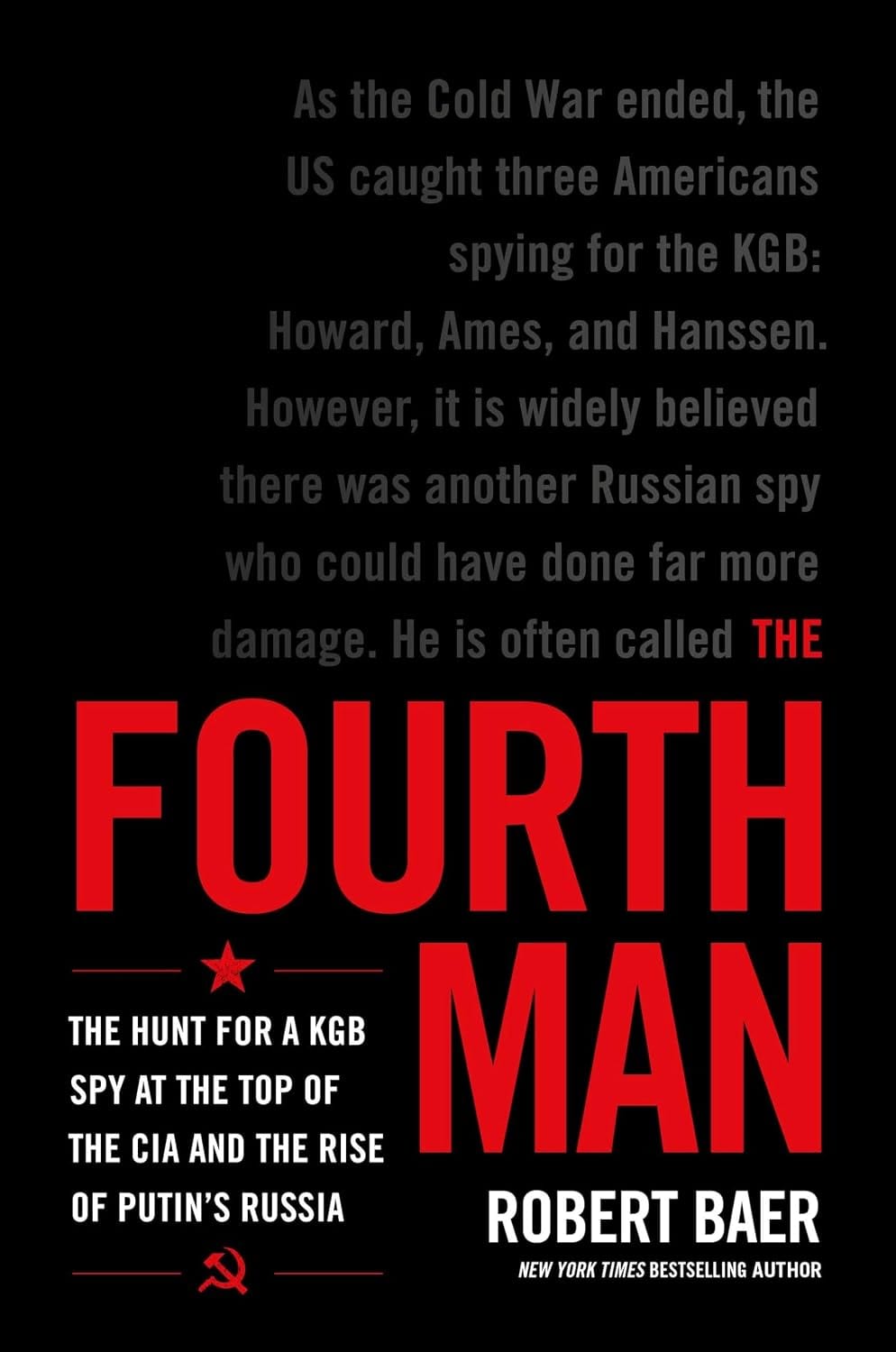
Robert Baer’s central argument is that the CIA’s catastrophic losses in Soviet/Russian operations during the late Cold War cannot be fully explained by the known traitors Edward Lee Howard, Aldrich Ames, and Robert Hanssen. Baer reconstructs the CIA’s internal hunt for a possible additional high-level KGB penetration—“the Fourth Man”—and argues that, whether the Fourth Man was a real mole, a Russian deception operation, or a tragically unresolved counterintelligence mirage, the hunt exposes a deeper institutional failure: the CIA misunderstood both the resilience of the KGB and the emerging power structure that eventually produced Vladimir Putin’s Russia.
The book is not a courtroom case. Baer does not claim to prove the Fourth Man’s identity. His conclusion is narrower but still significant: enough credible insiders believed there was another penetration that the theory cannot be dismissed as fantasy. The Fourth Man investigation becomes a lens for understanding bureaucratic denial, counterintelligence uncertainty, Russian strategic deception, and the post–Cold War American failure to recognize that the KGB had not died with the Soviet Union.
[!quote] Baer’s Framing
“The KGB is a way of thinking.” — Page 10
Author’s Note
Main Ideas
Baer explains the methodological problem at the center of the book. After 1991, the KGB was formally broken into successor agencies, especially the SVR for foreign intelligence and the FSB for internal security/counterintelligence. But Baer deliberately continues to use “KGB” as a shorthand because he sees continuity in personnel, institutional culture, worldview, and operational habits.
He also clarifies the book’s evidentiary limits:
- Many sources remain anonymous because the Fourth Man investigation was still active.
- Baer tried to corroborate nonpublic information with at least two sources.
- The book focuses primarily on the CIA’s hunt, not the FBI’s full investigation.
- The CIA requested limited redactions, which Baer says did not alter his conclusions.
Key Concepts / Terms
- KGB as institutional culture: Baer treats the KGB not merely as an agency but as a governing mentality that survived the USSR.
- Active investigation: The unresolved legal and intelligence status of the Fourth Man restricts what can be publicly confirmed.
- Corroborated oral history: Baer’s method depends heavily on retired intelligence officers, memory, and cross-checking, not declassified archives alone.
Chapter One
Main Ideas
Chapter One introduces Alexander Ivanovich Zaporozhsky, known to the CIA as Max, the KGB/SVR officer whose information helped trigger the Fourth Man hunt. In Moscow in 1992, the CIA wants to reconnect with Max but faces the severe constraints of operating under Russian surveillance.
Baer traces Max’s first contact with the CIA in East Africa in 1988, where he had attempted to recruit an American official. CIA officer Mark Sparkman interrupts the operation and develops a relationship with Max. Max begins dropping hints that the KGB had double agents inside American intelligence: one in the CIA and one in the FBI.
Initially, CIA officers distrust Max, suspecting he may be a dangle—a Russian-controlled provocation designed to make the CIA chase ghosts. But Max later provides a crucial lead: a Russian officer, Yuri Karetkin, had traveled to Caracas to meet a CIA double agent. That information helps investigators connect the dots to Aldrich Ames, who is arrested in 1994.
Max’s credibility then rises dramatically. The chapter ends with his more explosive claim: there was another, more senior CIA mole beyond Ames. This figure becomes the “Fourth Man.”
Key Concepts / Terms
- Counterintelligence: The practice of detecting hostile penetrations within one’s own intelligence system.
- Dangle: A supposed volunteer agent secretly controlled by the adversary.
- Moscow Rules: Tradecraft for operating under intense hostile surveillance.
- Agent vs. case officer: In CIA language, the agent is the recruited source; the case officer is the CIA handler.
- The Fourth Man: A suspected high-ranking CIA penetration beyond Howard, Ames, and Hanssen.
Chapter Two
Main Ideas
Chapter Two shifts to Baer’s personal entry into the mystery. In 1996, Baer’s boss Bill Lofgren tells him that the KGB has “another one” inside CIA headquarters, allegedly on the seventh floor, where senior CIA management works.
[!quote] Lofgren’s Warning
“We’ve got another one.” — Page 19
Years later, in 2019, Lofgren names the person he suspects. Baer is initially skeptical because the claim seems extraordinary, but Lofgren had been a serious counterintelligence player in the Ames case, not a conspiracy theorist.
Baer then describes his reporting process. Many former CIA officials refuse to speak or claim ignorance. Some deny the Fourth Man’s existence; others say the mole was real and possibly more damaging than Ames. Baer repeatedly emphasizes the tension between suspicion and evidence.
The chapter establishes one of the book’s major methodological themes: the Fourth Man story is not simply hidden because of classification. It is hidden because of shame, institutional self-protection, fear of reputational collapse, and the inherent ambiguity of counterintelligence.
Key Concepts / Terms
- Need-to-know: Restricting knowledge to the smallest possible number of people.
- Seventh floor: The CIA leadership level; symbolically, the possibility that the mole was not merely operational but managerial.
- Omertà: Baer uses this mafia-like concept to describe the silence of former officials.
- Suspicion vs. evidence: The core epistemological problem of the entire book.
Chapter Three
Main Ideas
Chapter Three argues that the CIA effectively stopped serious KGB mole-hunting just when it should have intensified it. After the fall of the Soviet Union, many CIA leaders believed Russia was defeated and no longer an existential intelligence threat. Milt Bearden, head of the CIA’s Central Eurasia Division, embodies this shift. He believed the Cold War was over and that the CIA should stop treating the KGB as the primary enemy.
Baer presents this as a catastrophic misreading. The KGB was formally broken apart, but its power, networks, methods, and worldview survived. The Second Chief Directorate, the KGB’s counterintelligence branch, remained especially opaque. Baer argues that the CIA had never truly penetrated or understood it.
The chapter links the Fourth Man story to the rise of Putin. If the CIA misunderstood the survival of the KGB, it also failed to understand the forces that would later return Russia to security-service rule.
Key Concepts / Terms
- Mole / penetration: A hostile agent inside an intelligence service.
- First Chief Directorate: KGB foreign intelligence; later SVR.
- Second Chief Directorate: KGB counterintelligence; a central adversary in Baer’s narrative.
- FSB / SVR: Post-Soviet successor services.
- Kompromat: Compromising material used for leverage.
- Active measures: Political warfare, sabotage, influence operations, and disinformation.
Chapter Four
Main Ideas
Chapter Four examines the aftermath of Ames’s arrest in February 1994. Ames’s betrayal was devastating, but Baer argues that the CIA’s relief at catching him risked becoming a false closure. The institution wanted Ames to explain everything.
Baer emphasizes the culture of denial that allowed Ames to operate for years. Ames was careless, financially reckless, and visibly compromised, yet the CIA failed to catch him quickly. If such an obvious traitor could survive inside the system, a more disciplined mole could be far harder to find.
The chapter also compares the CIA’s shock to Britain’s experience with the Cambridge Spy Ring, especially Kim Philby. The CIA had long assumed it was immune from the British disease of elite betrayal. Ames shattered that confidence, and the possibility of the Fourth Man threatened to destroy what remained of it.
Key Concepts / Terms
- Treachery: Betrayal of an institution’s deepest trust.
- Damage assessment: The post-arrest accounting of what a spy compromised.
- Institutional denial: The tendency of bureaucracies to prefer a manageable explanation over a destabilizing one.
- Cambridge Spy Ring: British precedent for elite Soviet penetration.
Chapter Five
Main Ideas
Chapter Five revisits the earlier compromises that haunted CIA counterintelligence, especially the losses around 1985. Baer focuses on Aldrich Ames, Edward Lee Howard, Vasily Yurchenko, and Adolf Tolkachev.
The official tendency was to attribute unexplained Soviet losses to Howard or Ames. Baer argues that several anomalies did not fit neatly:
- Some agents appeared compromised before Ames’s known betrayal.
- Certain documents seemed outside Howard’s access.
- Yurchenko’s defection and redefection created enduring uncertainty.
- Tolkachev’s compromise may not be fully explained by known traitors.
This chapter builds the circumstantial foundation for the Fourth Man theory. Baer does not claim these anomalies prove another mole, but he argues they created a pattern serious counterintelligence officers could not ignore.
Key Concepts / Terms
- Paranoia: In counterintelligence, the danger of seeing patterns everywhere—but also the danger of ignoring real patterns.
- Occam’s razor problem: CIA leadership preferred simpler explanations, even when the evidence remained messy.
- Yurchenko case: A defection/redefection episode that complicated the mole-hunting picture.
- Tolkachev: A major Soviet source whose compromise raised questions beyond Howard and Ames.
Chapter Six
Main Ideas
Chapter Six returns to Max after Ames’s arrest. In South America in 1994, Max provides new information that points toward a still-unidentified, senior CIA mole. His claim is more specific than before: the suspected mole allegedly had access to sensitive CIA materials and may have served in the USSR Branch.
Max’s information sharpens the profile. The Fourth Man was not imagined as a random case officer but as someone with senior access, operational knowledge, and proximity to the CIA’s most sensitive Soviet counterintelligence files.
Baer also shows why Max remained problematic. He had previously said there were two double agents in American intelligence, then insisted he had always meant three. His reliability was therefore both indispensable and contested.
Key Concepts / Terms
- Prodigal son: Max’s return to relevance after earlier doubts.
- USSR Branch: A key organizational locus for access to Soviet operations.
- Source credibility: The problem of using a flawed but potentially vital source.
- Profile narrowing: The process of moving from vague suspicion to a limited suspect pool.
Chapter Seven
Main Ideas
Chapter Seven describes the formal beginning of the Fourth Man investigation in May 1994. CIA operations chief Ted Price tasks Paul Redmond with a post-Ames cleanup investigation. Redmond had deep Soviet counterintelligence experience and had helped pursue Ames.
Baer argues that Price and Redmond made a courageous institutional choice. They could have closed the book by blaming Howard and Ames, but the unresolved anomalies made that irresponsible. FBI figures involved in the Ames case also believed there may have been another Russian penetration.
The chapter emphasizes how politically explosive the investigation was. A new mole at the top of the CIA could have brought congressional fury, press attacks, and calls to dismantle or radically restructure the agency.
Key Concepts / Terms
- Circumstantial evidence: The kind of partial, pattern-based evidence that drives mole hunts.
- Post-Ames cleanup investigation: The official frame for what became the Fourth Man hunt.
- Evidentiary bar: The gap between intelligence suspicion and prosecutable proof.
- Bureaucratic survival: The institutional incentive to avoid truths that threaten the agency itself.
Chapter Eight
Main Ideas
Chapter Eight introduces Laine Bannerman, the counterintelligence officer chosen to run the Special Investigations Unit investigation. Bannerman asks for Diana Worthen and Maryann Hough, whom she considers elite spy catchers.
The chapter builds Bannerman as a disciplined investigator rather than a paranoid theorist. She understands that personal dislike, intuition, and bureaucratic rumor cannot make a case. The team must construct a rigorous evidentiary profile from access, chronology, documents, agent losses, and operational anomalies.
Baer also introduces tensions around Redmond’s control of information. Some operations and sources were stovepiped through him, creating mistrust. Baer is careful: this does not prove wrongdoing, but it complicates the investigation because the person supervising the hunt also controls key pieces of the story.
Key Concepts / Terms
- Calling: Bannerman’s professional vocation as a counterintelligence analyst.
- SIU: Special Investigations Unit, the CIA unit central to the Fourth Man hunt.
- Stovepiping: Controlling information outside normal channels.
- Bias control: The team’s effort to distinguish evidence from personality-based suspicion.
Chapter Nine
Main Ideas
Chapter Nine centers on the matrix, the investigative framework SIU uses to organize the Fourth Man evidence. Bannerman, Worthen, and Hough collect unexplained compromises, agent losses, document leaks, technical operation failures, and source reports. They compare each anomaly against known access patterns.
The matrix is the book’s most important analytic device. It allows the investigators to ask: who had access to the compromised information, at the right time, and in the right organizational position?
Several known explanations—Howard, Ames, and later Hanssen—fail to account for everything. The Fourth Man hypothesis becomes stronger not because of one decisive fact but because of cumulative fit.
Key Concepts / Terms
- Matrix: A structured pattern of facts used to identify access and opportunity.
- Access analysis: Determining who could have known or stolen specific secrets.
- Chronology analysis: Matching compromise dates against known spy activity.
- Pattern evidence: Evidence whose force comes from accumulation rather than a single smoking gun.
Chapter Ten
Main Ideas
Chapter Ten deepens the “wilderness of mirrors” problem. SIU must consider whether Max is truthful, mistaken, exaggerating, or manipulated by Russian intelligence. The chapter explores the possibility that the Fourth Man hunt itself may be shaped by KGB deception.
Baer stresses that counterintelligence cases are uniquely unstable. A real lead may be wrapped in falsehood; a false lead may contain truth; a hostile service may frame an innocent officer; an innocent-looking officer may be a mole.
The chapter also explores Redmond’s back-channel handling of sources and the resulting mistrust. Again, Baer avoids making accusation equal proof. The issue is structural: if information is controlled by one powerful officer, investigators cannot fully test competing explanations.
Key Concepts / Terms
- Wilderness of mirrors: A counterintelligence environment where truth, deception, and self-deception blur.
- Disinformation: Deliberate falsehood inserted into an adversary’s analytic system.
- Frame-up hypothesis: The possibility that the KGB manufactured signs pointing toward an innocent CIA officer.
- Controlled ambiguity: The adversary’s ability to keep investigators uncertain.
Chapter Eleven
Main Ideas
Chapter Eleven examines the “inner sanctum” of Soviet/Russian counterintelligence and the difficulty of understanding how the KGB handled its most sensitive penetrations. SIU must ask whether the Fourth Man was run by the First Chief Directorate, the Second Chief Directorate, or another compartmented channel.
The chapter emphasizes that Western intelligence knew far less about KGB internal counterintelligence than about ordinary foreign intelligence operations. If the Fourth Man was run by a deeply compartmented KGB channel, the CIA’s usual analytic assumptions may have been inadequate.
Baer uses this to widen the book’s argument: the CIA was not only hunting a possible mole; it was confronting its own ignorance of the adversary’s deepest structures.
Key Concepts / Terms
- Inner sanctum: The closed, protected world of KGB counterintelligence.
- Compartmentation: Restricting knowledge even within an intelligence service.
- Directorate K / Line KR: KGB counterintelligence elements involved in operations against hostile services.
- Adversary opacity: The intelligence problem of not knowing how the enemy actually organizes its secrets.
Chapter Twelve
Main Ideas
Chapter Twelve focuses on the role of intuition in counterintelligence. SIU cannot ignore gut judgments, but it also cannot rely on them. Bannerman and her team weigh contradictory possibilities: Max may be a dangle; the Fourth Man may be real; the suspect may be framed; the evidence may be incomplete.
The chapter develops one of Baer’s central tensions: counterintelligence requires suspicion, but suspicion can corrupt analysis. The SIU team’s discipline lies in their attempt to keep the matrix evidence-driven rather than personality-driven.
The investigation increasingly points toward a profile: someone with long-term access to Soviet/Russian operations, seniority, knowledge of sensitive files, and the ability to explain multiple otherwise unresolved compromises.
Key Concepts / Terms
- Intuition: A gut judgment that can guide inquiry but cannot substitute for evidence.
- Analytic discipline: The effort to test hypotheses against structured data.
- False positives: Innocent people who appear suspicious because of coincidental access or behavior.
- Hypothesis competition: Weighing mole, dangle, frame-up, and bureaucratic-error explanations.
Chapter Thirteen
Main Ideas
Chapter Thirteen is the dramatic center of the book. Bannerman sees the matrix and profile converge. The anomalies include Max’s information, unexplained document compromises, compromised agents such as Gordievsky, Bokhan, and Poleshchuk, and technical losses that cannot easily be assigned to Howard, Ames, or Hanssen.
SIU briefs the findings. Redmond objects to several leads, arguing that Max and other sources are unreliable or that known traitors explain the losses. Bannerman pushes back on chronology and access. When she reaches the claim that the Fourth Man was a senior Directorate of Operations officer, Redmond reacts angrily and leaves the room.
Baer presents this as a moment that deeply affected the SIU team. To Bannerman, Worthen, and Hough, Redmond’s reaction seemed revealing. But Baer also notes that Redmond later said he did not recall the episode. The chapter shows the gap between an investigator’s conviction and legally actionable proof.
Key Concepts / Terms
- Fact: Something treated as self-evident, though in counterintelligence facts often remain contested.
- Profile convergence: When multiple lines of evidence point toward one candidate.
- Access-plus-timing: The key analytic test: who had the information before the compromise?
- Non-prosecutable suspicion: A belief that may be analytically strong but legally insufficient.
Chapter Fourteen
Main Ideas
Chapter Fourteen covers the institutional aftermath of the SIU briefing. Baer recounts his own 1995 experience with Lofgren and the internal awareness that something serious was unresolved.
Bannerman later briefs Ted Price alone. Price listens carefully and understands that SIU’s work is rigorous rather than conspiratorial. He also understands that the profile points in a highly sensitive direction, though Redmond’s name is not explicitly central in that briefing.
The chapter’s key point is that the investigation reaches senior levels but does not produce decisive action. The institution sees the danger but remains constrained by evidence, politics, and the fear of detonating another CIA scandal.
Key Concepts / Terms
- Blind: Acting without full visibility into the threat.
- Senior-level awareness: The investigation is no longer merely an analyst-level suspicion.
- Rigorous but inconclusive: SIU’s work is serious enough to matter but not enough to convict.
- Institutional paralysis: The state of knowing enough to worry but not enough to act decisively.
Chapter Fifteen
Main Ideas
Chapter Fifteen examines the collapse of SIU’s position after Price leaves. Bannerman, Worthen, and Hough lose their patron and become vulnerable inside the bureaucracy. The chapter frames their situation as one of professional powerlessness: they possess a disturbing analytic conclusion but lack the institutional authority to force action.
The team considers moving into Lofgren’s Central Eurasia Division, partly because Lofgren witnessed Redmond’s reaction and may understand the stakes. Their attempt reflects the broader struggle over who controls the Fourth Man narrative.
The theme is not only espionage but organizational politics. In Baer’s telling, bureaucratic survival mechanisms begin to smother the investigation.
Key Concepts / Terms
- Revenge: The possibility that institutional actors retaliate against those who raise dangerous questions.
- Patronage: The need for senior protection in sensitive investigations.
- SIU in exile: The effective marginalization of the original investigative team.
- Narrative control: The bureaucratic battle over what the Fourth Man case means.
Chapter Sixteen
Main Ideas
Chapter Sixteen describes a counterattack against SIU’s version of the case. The investigation is redirected, and Redmond remains central. Baer discusses Redmond’s handling of sources such as Budanov and Sergei, off-the-books relationships that SIU believes distorted the investigation.
Baer remains cautious: these irregularities do not prove espionage. But they do show that Redmond operated with unusual autonomy, limiting accountability. For Bannerman, the issue is that Redmond’s private channels and control over evidence made it impossible to fully test the Fourth Man hypothesis.
The chapter ends with an unresolved but damaging implication: Russian intelligence appears to have had a high-level penetration, but the mechanism and identity remain unproven.
Key Concepts / Terms
- Counterattack: A response by institutional power against a threatening investigation.
- Back-pocket agents: Informal or off-the-books sources controlled outside normal systems.
- Accountability gap: When intelligence reporting is not documented, encrypted, or entered into official records.
- Conjecture vs. proof: Baer repeatedly distinguishes suspicious behavior from treason.
Chapter Seventeen
Main Ideas
Chapter Seventeen describes the effective checkmate of the original SIU effort. After meetings involving Max and further inquiries, the investigation is increasingly shaped away from SIU’s matrix-driven approach.
Bannerman and others come to believe that Redmond controlled what evidence could be used, which suspects would be emphasized, and which leads would be marginalized. Baer notes that the suspects Redmond advanced were not implausible; they had relevant access. But they did not fully fit the SIU profile or explain the total pattern.
Lofgren considers escalating the issue to CIA Director John Deutch, but ultimately retires. The original investigative momentum dissipates.
Key Concepts / Terms
- Checkmate: The investigators are boxed in, unable to move the case forward.
- Suspect substitution: Redirecting attention toward plausible but less comprehensive candidates.
- Matrix suppression: The loss of the structured evidentiary framework SIU had built.
- Unresolved access problem: No alternative suspect fully explains the pattern.
Chapter Eighteen
Main Ideas
Chapter Eighteen moves into the late 1990s and early 2000s. The CIA continues to struggle in Moscow. British intelligence warns that all four remaining CIA Russian agents may be compromised. The chapter underscores the continuing blindness of U.S. intelligence inside Russia.
Baer also follows later developments involving Max. Against CIA advice, Max returns to Russia in 2001 and is arrested by Aleksandr Zhomov, a former KGB/FSB figure. In 2003, Max is convicted of spying for the CIA and sentenced to eighteen years. In 2010, he is exchanged in a spy swap after the FBI arrests Russian illegals in the United States.
The chapter links the Fourth Man mystery to the reassertion of Russian security-service power under Putin.
Key Concepts / Terms
- Flying blind: Operating without reliable sources or insight.
- Illegals: Deep-cover Russian intelligence officers living under assumed identities.
- Spy swap: Exchange of captured intelligence assets between states.
- Putin-era continuity: The persistence of KGB habits under the new Russian state.
Chapter Nineteen
Main Ideas
Chapter Nineteen returns to the FBI’s later interest in Redmond. In 2006, retired CIA employees connected to the Fourth Man hunt are contacted and asked whether Redmond had any reason to travel to Moscow in the mid-1980s without authorization.
Bannerman interprets the question as significant: the FBI would not lightly pursue such a line against a former senior CIA counterintelligence official. Others are asked similar questions. Baer cannot confirm what triggered the FBI’s renewed interest, but he suspects another source or defector may have provided information.
Redmond denies wrongdoing and suggests the FBI distrusted him, perhaps because of historic CIA-FBI rivalry or because Russian sources may have falsely implicated him.
The chapter ends without closure. It shows that, years after SIU’s work, the Fourth Man question remained alive.
Key Concepts / Terms
- Glimmer: A partial flash of possible closure.
- FBI-CIA rivalry: Institutional distrust shaping espionage investigations.
- Unauthorized Moscow travel: A potentially serious counterintelligence concern.
- No closure: The defining condition of the case.
Epilogue
Main Ideas
Baer’s epilogue is deliberately cautious. He does not claim to know who the Fourth Man was. Redmond’s suspicious associations, anger toward SIU, and possible links to Russian figures are not proof of espionage. The KGB may have framed him. Max and Adolf may have exaggerated, misunderstood, or been used as vehicles for disinformation.
Baer also asks a hard question: if the Fourth Man was so highly placed, why are there not more unmistakable compromises? Ames and Howard left visible trails of destruction. The Fourth Man’s damage is more inferential.
But Baer refuses to dismiss the case. Too many experienced insiders believed there was another mole. More importantly, the Fourth Man hunt reveals how little the CIA understood the KGB’s post-Soviet survival. The book’s final significance lies in the connection between mole-hunting failure and strategic blindness toward Putin’s Russia.
[!quote] Baer’s Caution
“I don’t know who the Fourth Man was.” — Page 181
Key Concepts / Terms
- Strategic blindness: Failure to understand the adversary’s political and institutional continuity.
- KGB continuity thesis: The idea that the Soviet security apparatus survived under new names.
- Counterintelligence uncertainty: Some cases never produce final proof.
- Russia as unresolved target: The CIA’s lack of agents and understanding left it unable to read Putin’s rise.
Who’s Who: Cryptonyms, Aliases, and Other Spy Arcana
Main Ideas
The “Who’s Who” section functions as a reference guide to the book’s dense cast of intelligence officers, sources, cryptonyms, and agencies. It helps readers track the overlapping CIA, FBI, KGB, SVR, FSB, and MI6 figures involved in the Fourth Man story.
Important entries include:
- Max / Alexander Zaporozhsky: KGB/SVR officer whose leads helped expose Ames and later suggested another CIA mole.
- Laine Bannerman: Chief of SIU during the Fourth Man investigation.
- Paul Redmond: Senior CIA counterintelligence official central to the investigation and later suspicion.
- Aldrich Ames: CIA officer who spied for the KGB.
- Edward Lee Howard: CIA officer who defected to Moscow.
- Robert Hanssen: FBI agent who spied for Soviet/Russian intelligence.
- Milt Bearden: CIA Central Eurasia Division chief who believed the Cold War intelligence posture needed to change.
- Ted Price: Senior CIA operations official who authorized the Fourth Man investigation.
- Viktor Cherkashin: KGB officer involved with Ames.
- Gordievsky, Bokhan, Poleshchuk, Tolkachev: Key compromised Soviet/Russian sources whose losses shape the evidentiary matrix.
Key Concepts Across the Book
Counterintelligence as Pattern Recognition
Baer presents counterintelligence as a discipline that rarely gets perfect evidence. It depends on access, timing, anomaly detection, source evaluation, and adversary modeling. The Fourth Man case is built less on a smoking gun than on a pattern of unresolved compromises.
The KGB Continuity Thesis
One of the book’s broadest arguments is that the KGB did not meaningfully disappear in 1991. Its structures changed, but its worldview, methods, personnel networks, and political ambitions survived. Putin’s rise becomes, in Baer’s interpretation, the political culmination of that continuity.
Bureaucratic Self-Protection
The CIA’s handling of Ames and the Fourth Man hunt illustrates how institutions resist evidence that threatens their legitimacy. Baer portrays the CIA as torn between truth-seeking and self-preservation.
The Wilderness of Mirrors
The Fourth Man case is full of possible deception: Max may be truthful, mistaken, or manipulated; Redmond may be innocent, guilty, or framed; the KGB may have run a mole, staged a deception, or both. The book’s strength is that it refuses to collapse this ambiguity too quickly.
Access, Timing, and Motive
The SIU matrix depends on three questions:
- Who had access to the compromised information?
- When was the information compromised?
- Who had the opportunity and possible motive to pass it?
Baer shows that access and timing often matter more than psychological speculation.
Key Terms
- Agent: A recruited source who secretly provides intelligence.
- Case officer: CIA officer who recruits and handles agents.
- Mole / penetration: A hostile agent inside an intelligence service.
- Dangle: A controlled provocation offered by an adversary service.
- Need-to-know: Compartmentation principle limiting access to secrets.
- Moscow Rules: Tradecraft for operating under Soviet/Russian surveillance.
- Matrix: SIU’s structured chart of compromises, access, and suspects.
- Damage assessment: Evaluation of what a known spy compromised.
- Kompromat: Compromising information used for coercion.
- Active measures: Russian/Soviet political warfare, disinformation, sabotage, and influence operations.
- First Chief Directorate: KGB foreign intelligence branch.
- Second Chief Directorate: KGB counterintelligence branch.
- SVR: Russian foreign intelligence successor to the First Chief Directorate.
- FSB: Russian internal security/counterintelligence successor to major KGB functions.
- Illegals: Deep-cover intelligence officers operating under nonofficial identities.
- Wilderness of mirrors: A spy case so layered with deception that truth becomes difficult to distinguish from manipulation.
Critical Analysis
Methodology
Baer’s method is investigative and oral-historical rather than archival or prosecutorial. He relies on interviews with retired intelligence officers, prior accounts of the Ames case, insider recollections, and reconstructed chronology. This approach is appropriate for a still-sensitive counterintelligence subject, but it creates limitations:
- Memory is inconsistent after decades.
- Many sources are anonymous.
- Some important officials refused to speak.
- The CIA and FBI did not provide full institutional records.
- The most important evidence may remain classified or unavailable.
Baer is strongest when he distinguishes between evidence, inference, and suspicion. He repeatedly states that suspicious conduct does not equal proof of treason. This restraint makes the book more credible than a simple accusation narrative.
Strength of Conclusions
Baer’s strongest conclusion is not that a specific named person was the Fourth Man. His strongest conclusion is that the unresolved compromises were serious enough that experienced CIA and FBI counterintelligence officers believed another mole likely existed.
That conclusion is persuasive because it rests on:
- Max’s proven value in the Ames case.
- Chronological anomalies not fully explained by Ames or Howard.
- The SIU matrix’s access-based method.
- Continued FBI interest years later.
- The institutional fear surrounding the case.
His weaker claim is the implied suspicion around Redmond. Baer presents reasons investigators found him suspicious, but he does not produce definitive evidence. The book’s own epilogue admits that Redmond may have been framed or misunderstood.
Biases and Omissions
Baer’s perspective is shaped by his CIA background and his sympathy for field officers and counterintelligence professionals who believed the institution failed them. This gives the book insider texture but may also intensify its suspicion of CIA leadership and bureaucratic actors.
Possible omissions or limitations:
- The FBI side of the investigation remains underdeveloped.
- Russian archival evidence is absent.
- The Fourth Man’s actual damage remains less concrete than Ames’s or Hanssen’s.
- The book sometimes moves from counterintelligence mystery to geopolitical diagnosis quickly, especially in connecting the Fourth Man to Putin’s rise.
- Baer’s distrust of post-Soviet optimism is compelling, but the argument would be stronger with more external evidence about policy-level Russia analysis outside CIA operations.
Overall Evaluation
The book is best read as a serious counterintelligence reconstruction, not a final verdict. Its value lies in showing how intelligence institutions deal with uncertainty, shame, and unresolved betrayal. Baer’s broader thesis—that America failed to understand the survival of KGB power after 1991—is the book’s most historically significant contribution.
Questions for Reflection
- How should intelligence agencies act when evidence strongly suggests a mole but falls short of legal proof?
- Did the CIA’s desire to believe the Cold War was over make it strategically blind to the survival of KGB power?
- Is Baer’s Fourth Man theory stronger as a counterintelligence case or as an explanation for America’s misunderstanding of Putin’s Russia?
- How can analysts distinguish between real patterns and paranoia in a “wilderness of mirrors”?
- What institutional incentives make bureaucracies resist evidence of internal betrayal?
- If Max was both unreliable and indispensable, how should his information have been weighed?
- Does the absence of visible damage from the Fourth Man weaken the case, or could it indicate a more careful and valuable penetration?
Connections
Influential Works Mentioned or Implied
- Milt Bearden and James Risen, The Main Enemy
Used by Baer as an important reference point for CIA-KGB conflict and the Ames era. - Sandy Grimes and Jeanne Vertefeuille, Circle of Treason
A major account of the Ames investigation and CIA mole-hunting. - T. S. Eliot, “Gerontion”
Source of the phrase “wilderness of mirrors,” later adopted in counterintelligence discourse.
Thinkers / Intelligence Figures
- James Jesus Angleton: Former CIA counterintelligence chief; symbol of both necessary suspicion and destructive paranoia.
- Kim Philby: Cambridge Spy Ring member; precedent for elite betrayal inside Western intelligence.
- Aldrich Ames: Known CIA traitor whose betrayal frames the Fourth Man question.
- Robert Hanssen: FBI mole whose existence confirmed Max’s broader claim of Russian penetration of American intelligence.
- Edward Lee Howard: CIA officer who defected to Moscow and became an official explanation for some compromises.
- Vladimir Putin: Former KGB officer whose rise represents, for Baer, the post-Soviet survival of the security state.
- Boris Yeltsin: Post-Soviet Russian leader whose attempt to weaken the KGB failed.
- Milt Bearden: CIA officer associated with the post–Cold War decision to reduce emphasis on KGB operations.
- Paul Redmond: CIA counterintelligence official central to the book’s unresolved suspicions.
- Laine Bannerman: SIU chief and one of the book’s main investigators.
Historical Movements / Contexts
- Cold War espionage
- Post-Soviet Russian state formation
- KGB-to-FSB/SVR institutional continuity
- CIA post–Cold War identity crisis
- Ames damage assessment and CIA reform debates
- Putin’s security-state restoration
- Russian active measures and political warfare
- U.S. intelligence failure regarding Russia in the 1990s