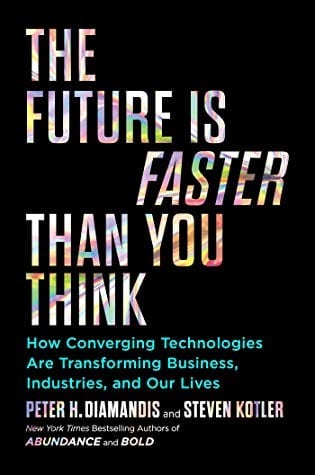

Full title: The Future Is Faster Than You Think: How Converging Technologies Are Transforming Business, Industries, and Our Lives. Edition: supplied ebook, copyright 2020; first hardcover edition identified as January 2020. All book citations below use PDF viewer pages, not the printed pagination reproduced in the index.
Read in two passes: the whole-book review takes approximately 6–10 minutes; the chapter summaries support slower study and closed-book retrieval. Forecasts describe the authors’ outlook when writing in 2019–2020. Later verification and practical applications are labeled separately.
Companions: Attachment (file not included in this release) · Attachment (file not included in this release) · Attachment (file not included in this release)
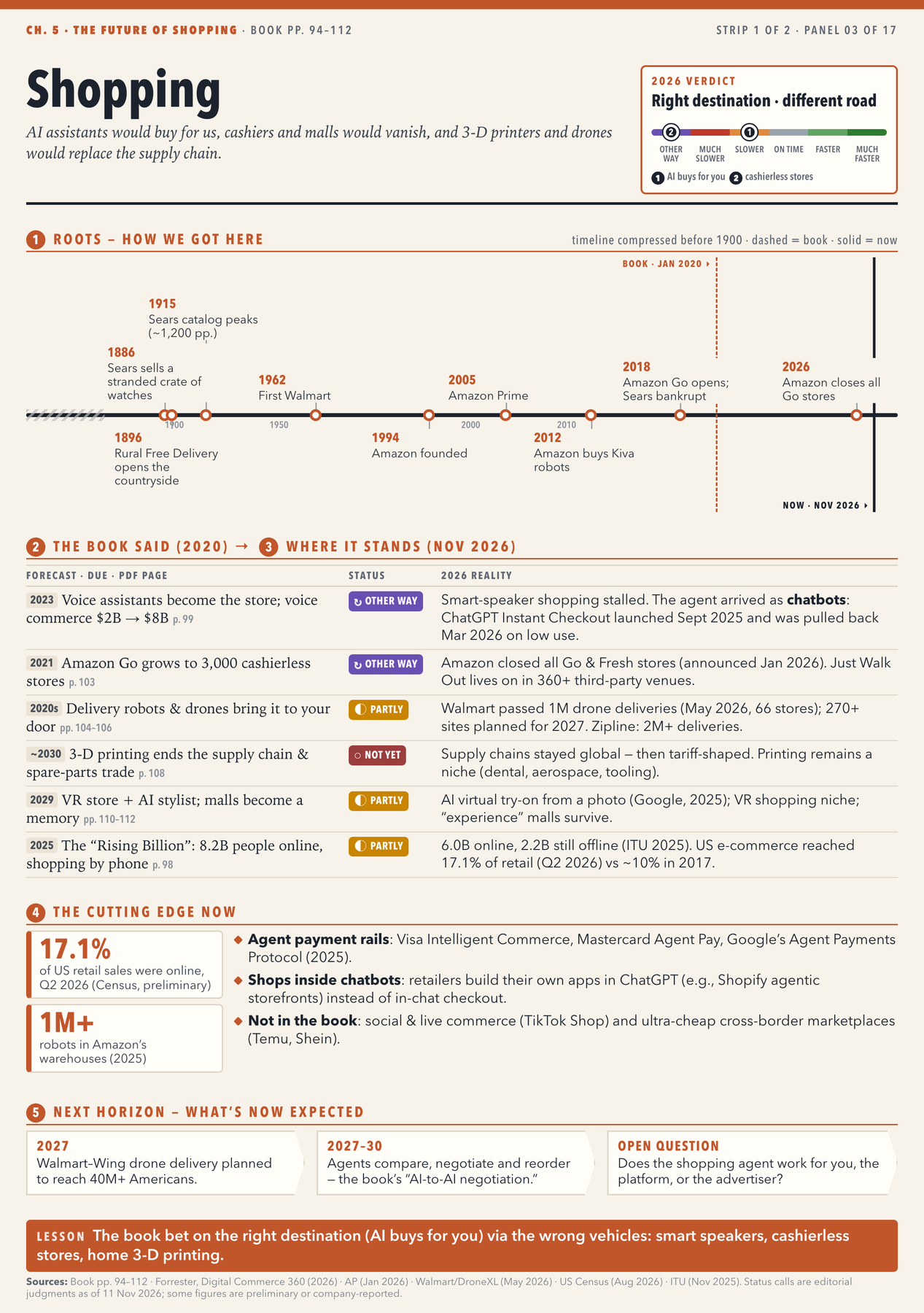
Forecast check (Nov 2026): Attachment (file not included in this release) · Fold-out strip 1 · Fold-out strip 2 · Slip chart · Tech radar. Each sector panel compares the 2020 forecasts with the 2026 reality; status calls are editorial judgments. Embedded below in Forecast Check (Nov 2026) - B5 Fold-out.
Whole-Book Review
What I Should Retain
Three central arguments
- Convergence changes what becomes possible. An improvement in AI can combine with cheaper sensors, better materials, faster networks, and robotics to unlock a service that none could supply independently. Study the combination and its bottlenecks, as well as each component’s trajectory.
- Progress feeds back into the ability to make progress. Saved time, more available capital, cheaper tools, wider participation, denser communication, new business models, and longer healthy lives can increase the number and speed of experiments. These are the book’s seven second-order accelerators.
- The consequences extend beyond products. When coordination, discovery, production, and delivery change together, the boundaries of industries and institutions change. A retailer can become a technology platform; a vehicle can become a service; an education system can distribute individualized instruction. Whether these possibilities improve lives depends on implementation, access, and cooperation.
Three evidence anchors
- Sears → Walmart → Amazon: successive combinations of communication and logistics changed who could reach customers efficiently. An incumbent’s successful platform can become the infrastructure inherited by its successor. Attachment (file not included in this release)
- The Global Learning XPRIZE: tablet software tested with children in remote Tanzanian villages illustrates how software, inexpensive devices, power, and distribution can jointly address access. Its demonstrated scope concerns foundational learning, not every responsibility of a school. Attachment (file not included in this release)
- M-Pesa: a mobile-money pilot gained traction through remittances, using local agents and existing phones. The useful combination included human infrastructure and an urgent customer job. Attachment (file not included in this release)
Essential factual anchors
- Published in 2020, with examples and interviews chiefly from the preceding years. The main horizon is the following decade; Chapter 14 deliberately extends toward the century ahead.
- Six Ds: Digitalization → Deception → Disruption → Demonetization → Dematerialization → Democratization. These are the authors’ developmental heuristic; they are not a measured law guaranteeing every technology’s success.
- Convergence describes interacting capabilities; demonetization describes falling costs; dematerialization describes functions moving out of dedicated objects; democratization describes wider access. These processes can overlap without being identical.
- Smartness economy: apply increasingly accessible intelligence to a familiar tool or service. Chapter 4 explicitly attributes this formulation to Kevin Kelly’s The Inevitable.
One connection worth testing: your notebook principle, “boring industry + new capability,” closely matches the smartness economy. Test whether the new capability removes a recurring, expensive bottleneck for a specific buyer. See Business Application - Existing Products Plus New Capabilities.
One implication worth reconsidering: an impressive feature may create less value than changing how customers obtain the underlying result. Ask both “How can this tool improve?” and “Could the job disappear, move elsewhere, or become a service?” This is an implication to examine, not a recorded change in your beliefs.
The Book’s Argument in One Connected Account
Diamandis and Kotler begin with transportation because it makes their central mechanism tangible. Electric aircraft require more than an electric motor: batteries, lightweight structures, control software, manufacturing, infrastructure, and a viable operating model must come together. Several different transport systems might develop at once, while avatars could reduce the need to transport a person at all. This combination makes a familiar single-industry forecast inadequate.
The authors then unpack the technologies behind that example. Computing, AI, networks, sensors, and robots provide ways to model, perceive, communicate, and act. VR and AR change how experiences are delivered. Additive manufacturing changes fabrication; distributed ledgers change some forms of coordination and record keeping; materials science and biotechnology change what can be made. Their central claim concerns these technologies’ interactions. An advance in one area can lower a constraint in another, producing a capability that seemed premature when viewed in isolation.
Chapter 4 adds a feedback loop. Cheaper and more usable tools expand participation. Digital networks connect participants to ideas, funding, collaborators, and customers. Saved time and shorter experimental cycles make more attempts possible. New business models convert capabilities into services, and, in the authors’ longer-range account, improved healthspan could preserve expertise for longer. Innovation begins to improve its own conditions of production.
Part Two follows this mechanism through everyday industries. Shopping and advertising change when AI mediates discovery and purchase. Entertainment changes who creates, what participation means, and where an experience occurs. Education can distribute foundational instruction and adapt its pace. Healthcare can combine continuous sensing with more individualized interventions. Finance, insurance, and property services can reduce information and transaction costs. Food production can target waste and resource intensity at several points in the chain. The shared pattern is the reorganization of the complete service, extending beyond a better gadget.
Part Three tests this optimism against water scarcity, climate change, biodiversity loss, disrupted employment, and existential risks. The authors argue that increasingly powerful tools also enlarge our capacity to respond. Crucially, they acknowledge that tools require coordinated deployment. Their account of employment relies on substitution, new demand, augmentation, and retraining, rather than a denial that particular jobs can vanish.
The final chapter broadens “migration” from people moving between regions and cities to time spent in virtual worlds, settlement beyond Earth, and speculative forms of connected intelligence. These developments would rearrange where people work, meet, learn, and create. Migration itself then becomes another source of recombination and acceleration. The afterword returns to abundance: greater access to useful capabilities can improve lives even while wealth remains unevenly distributed. Its conclusion is an invitation to participate in building that outcome, conditional on cooperation and effective distribution. Attachment (file not included in this release) · Attachment (file not included in this release)
Argument Sequence and Forecast Horizons
This is a technology forecast and business book; an exhaustive historical timeline would misrepresent its organizing logic.
| Stage | Question | Where to review |
|---|---|---|
| Components converge | Which improvements jointly remove an old constraint? | Chapters 1–3 |
| Innovation feeds back | What makes experimentation cheaper, faster, and more widely available? | Chapter 4 |
| Industries reorganize | Who controls the customer relationship, production, and delivery? | Chapters 5–12 |
| Consequences require coordination | Can environmental, employment, and safety problems be addressed at scale? | Chapter 13 |
| People and activity relocate | How might place, presence, and collective intelligence change? | Chapter 14 |
Dated anchors: the 2004 DARPA autonomous-vehicle competition; 2007 streaming at Netflix and M-Pesa’s Kenyan launch; the 2011 Materials Genome Initiative; the 2018 Duplex demonstration; and the May 2019 Global Learning XPRIZE awards connect the argument to developments discussed in the book. 2023–2030 aircraft, transport, retail, education, and medical scenarios are forecasts or ambitions. The 2050 and later migration and settlement passages have a different horizon and evidential status. The notes retain these distinctions rather than presenting the scenarios as present-day facts.
Principal People and Institutions
| Person or institution | Role in the book | Relationship to remember |
|---|---|---|
| Peter H. Diamandis / Steven Kotler | Entrepreneur and technology advocate / writer and flow researcher | Authors with organizational and commercial interests in several examples; see Source and Coverage |
| Ray Kurzweil | Advocate of accelerating returns and future human enhancement | Influential source for timing extrapolations; a forecast is distinct from demonstrated capability |
| Kevin Kelly | Author of The Inevitable | The book credits him for applying AI to existing tools; this is a reported intellectual connection |
| XPRIZE / Kitkit School / onebillion | Incentive competition and two Global Learning winners | Prize-based experimentation, foundational learning, and open-source distribution |
| Martine Rothblatt / United Therapeutics | Entrepreneur responding to her daughter’s illness | Links drug development, organ preservation, organ manufacture, and delivery bottlenecks |
| Jeremy Bailenson / Philip Rosedale | VR researcher / virtual-world entrepreneur | Presence and behavior change / shared virtual environments |
| Nick Hughes / M-Pesa | Mobile-money initiator / service launched in Kenya in 2007 | Remittances and local cash agents turned a technical possibility into a useful service |
| Ramez Naam | Energy commentator interviewed by the authors | Renewable generation, storage, and grid coordination form a system |
| Nick Bostrom / Stewart Brand | Existential-risk philosopher / advocate of long time horizons | Risk identification and institutional foresight qualify the acceleration narrative |
| Jeff Bezos / Elon Musk | Competing commercial-space advocates | Orbital habitats and lunar resources / Mars settlement; ambitions exceed demonstrated settlement capabilities |
Navigation
- Part One — The Power of Convergence: 1 · 2 · 3 · 4
- Part Two — The Rebirth of Everything: 5 · 6 · 7 · 8 · 9 · 10 · 11 · 12
- Part Three — The Faster Future: 13 · 14
- Afterword: Abundance Revisited · Business Application - Existing Products Plus New Capabilities · Supplementary Verification - Selected Corrections · Forecast Check (Nov 2026) - B5 Fold-out · Source and Coverage · Vault Connections
Chapter 1: Convergence
What I Should Retain
- Three takeaways: breakthrough services can depend on several maturing technologies; industries face overlapping replacements; a substitute for the customer’s activity can disrupt even the best improved product.
- Evidence anchors: Uber Elevate’s electric-aircraft plans combine propulsion, batteries, sensing, materials, and manufacturing; the Model T depended on an industrial system; ANA’s Avatar XPRIZE investigates presence without bodily travel.
- Factual anchors: the Model T arrived in 1908; DARPA held its first autonomous-vehicle Grand Challenge in 2004; the book opens at Uber’s 2018 Elevate conference. Its imagined 2028 journey is a scenario.
- Connection to test: identify one service you buy and list the separate constraints that must change before it could become much cheaper or more convenient. Then ask whether an alternative could remove your need for the service entirely.
Chapter Objective and Through Line
The opening chapter explains why the authors expect the future to arrive through interacting advances that are difficult to anticipate from a single trend. Flying cars supply the entry point. They have appeared in speculative visions for decades, so another announcement would establish little. The relevant question is why a workable service might emerge at a particular moment. The answer, in the authors’ account, is that supporting technologies have improved together sufficiently to remove several constraints at once.
The chapter then moves from engineering feasibility to business and social consequences. Autonomous vehicles, high-speed transport, tunnels, and rockets could alter ownership, commuting, land use, and delivery. Yet the sequence contains a further challenge: remote presence could substitute for travel itself. The reader is therefore asked to look beyond a product’s immediate competitor and examine the underlying job being done. This prepares the rest of the book’s method: identify capabilities, follow their convergence across industry boundaries, and trace consequences through a wider system. The timelines attached to particular projects remain the authors’ and interviewees’ forecasts.
Chapter Structure at a Glance
- Use electric aerial ridesharing to explain the timing question.
- Identify the engineering and operating complements it requires.
- Show how several transport modes could reorganize adjacent industries.
- Explain why familiar intuitions struggle with compound change.
- Introduce avatars as substitutes for physical travel.
Section-by-Section Argument
Flying cars and their enabling system — analytical opening division
At the 2018 Uber Elevate conference in Los Angeles, Jeff Holden presents aerial ridesharing as a service with concrete requirements, rather than merely a futuristic vehicle. Electric distributed propulsion could reduce mechanical complexity and noise. Improved materials and design tools could support lighter aircraft; manufacturing advances could make repeated production more economical. Sensors and control systems contribute to safe operation, while batteries constrain useful flight. Smartphone and electric-car supply chains help create components that aviation can reuse.
This is a complementarity argument: success requires the parts to work together. A plausible aircraft still needs charging, landing facilities, certification, throughput, and a cost structure customers will accept. Uber’s dates and per-mile targets illustrate the proposed business case; they do not demonstrate that the system has already reached it. The chapter’s strongest explanatory point survives uncertainty about those dates: an old idea can become newly feasible when several external inputs improve. Attachment (file not included in this release)
More Transportation Options
The 1908 Model T introduces an earlier convergence: internal combustion, the moving assembly line, and petroleum infrastructure. The car subsequently changed roads, suburbs, parking, and commerce. This establishes the move from an invention to a social system.
The authors apply the same reasoning to autonomous cars. The 2004 DARPA Grand Challenge helps catalyze development; firms such as Waymo subsequently combine sensors, machine learning, road data, and fleet operation. Usage generates information that can improve the system, making accumulated data commercially valuable. A shift from owning a seldom-used car to purchasing rides could change fleet demand, brand importance, parking requirements, and municipal revenue. These consequences depend on costs, service quality, and actual adoption.
Hyperloop, tunneling, and passenger rockets broaden the picture. The authors describe computational modeling, power electronics, manufacturing, materials, and entrepreneurial coordination as contributors to previously difficult transport proposals. Their examples include the 2013 Hyperloop concept and Musk’s 2017 proposal for rapid terrestrial rocket trips. These are different projects with different infrastructure and safety requirements; grouping them as convergence examples does not establish equal readiness. The implied network would coordinate modes around passengers’ destinations. Attachment (file not included in this release)
Seeing into the Future
Amazon supplies an accessible business analogy: applying the internet to mail-order shopping transformed a familiar activity. The authors suggest that interacting changes across transport could have wider consequences than such a single combination. They connect forecasting difficulties to habits formed in relatively local environments and to research on the psychological distance between present and future selves.
The practical inference is to make consequences explicit instead of assuming that future life is the present with a better device attached. Work location, available time, employment, and institutions become part of the inquiry. The authors acknowledge retraining needs and the vulnerability of established organizations, although their sweeping claims about how quickly institutions will fail exceed what individual examples establish. Attachment (file not included in this release)
Avatars
The imagined 2028 journey links autonomous cars, rapid ground transport, and aerial services. Avatars then challenge the premise of that journey. A digital avatar can support activity in a simulated environment; a remotely operated robot can support action elsewhere in the physical world. VR, haptics, communications, and robotics combine to transmit forms of presence.
ANA’s funding of the 2018 Avatar XPRIZE matters because an airline is exploring a technology that might reduce some demand for flights. The deeper business lesson concerns the result customers seek: access to people or places can sometimes be supplied without carrying a body there. A company can anticipate a threat by experimenting with that substitution itself. Attachment (file not included in this release)
Key Concepts and Distinctions
- Convergence: different capabilities combine to enable a result. Its role is to explain “why now?” for an old ambition.
- Product versus service: customers can buy access to transport rather than own the equipment. This changes utilization and where revenue accumulates.
- Complementary infrastructure: charging, landing, manufacturing, and operating systems allow an invention to function at scale.
- Substitution of the activity: avatars can replace some reasons for travel, extending disruption beyond competing vehicles.
Essential Evidence and Examples
- Uber Elevate, 2018: a proposed aircraft service exposes multiple simultaneous constraints; supporting case, not proof of delivery. Attachment (file not included in this release)
- Model T, 1908: vehicle, production system, and fuel infrastructure support the historical systems analogy. Attachment (file not included in this release)
- Autonomous fleets: repeated operation generates data with potential learning and service advantages. Attachment (file not included in this release)
- ANA Avatar XPRIZE, 2018: an incumbent funds experimentation with a possible substitute for its core service. Attachment (file not included in this release)
Chapter Conclusion and Significance
The chapter establishes a way to analyze technological change: follow the interacting inputs, the service built from them, and the adjacent activities affected. Its transport forecasts create an arresting illustration, while its more durable contribution is the shift in unit of analysis from isolated invention to connected system.
The unresolved issue is timing. Several components can improve while certification, infrastructure, manufacturing, or demand remains limiting. Keep that gap visible when applying the chapter to a business decision. The rest of Part One supplies a vocabulary for examining the components and feedback loops in greater detail.
Questions for Reflection
- What did the 2004 DARPA Grand Challenge aim to accelerate?
- Name three complementary capabilities needed for electric aerial ridesharing.
- What distinguishes a digital avatar from a robotic avatar?
- How could a shift from car ownership to rides purchased as a service affect another industry?
- Why is ANA’s avatar investment a useful example of thinking beyond direct competitors?
Answers and Feedback
- Autonomous road vehicles. A prize challenge helped organize and stimulate development. Attachment (file not included in this release)
- For example: batteries, lightweight materials, sensing/control, charging, and suitable manufacturing. A strong answer explains why each is a constraint on the service. Attachment (file not included in this release)
- A digital representation acts in a virtual setting; a robot acts in a physical setting. Both can support remote presence. Attachment (file not included in this release)
- Examples include reduced parking demand, changed vehicle purchasing, or different insurance liability. Explain the causal link through utilization and ownership; the precise outcome is conditional. Attachment (file not included in this release)
- It investigates replacing the need to fly. The competitive question concerns the customer’s purpose, extending beyond which airline carries them. Attachment (file not included in this release)
Cautions and Limits
The chapter’s commercial rollout dates, cost targets, and imagined trips are forecasts. Several engineering quantities and historical simplifications in the source should not be reused as technical specifications. Component progress and a successful demonstration remain different from a dependable, affordable, permitted service.
2026 Forecast Check
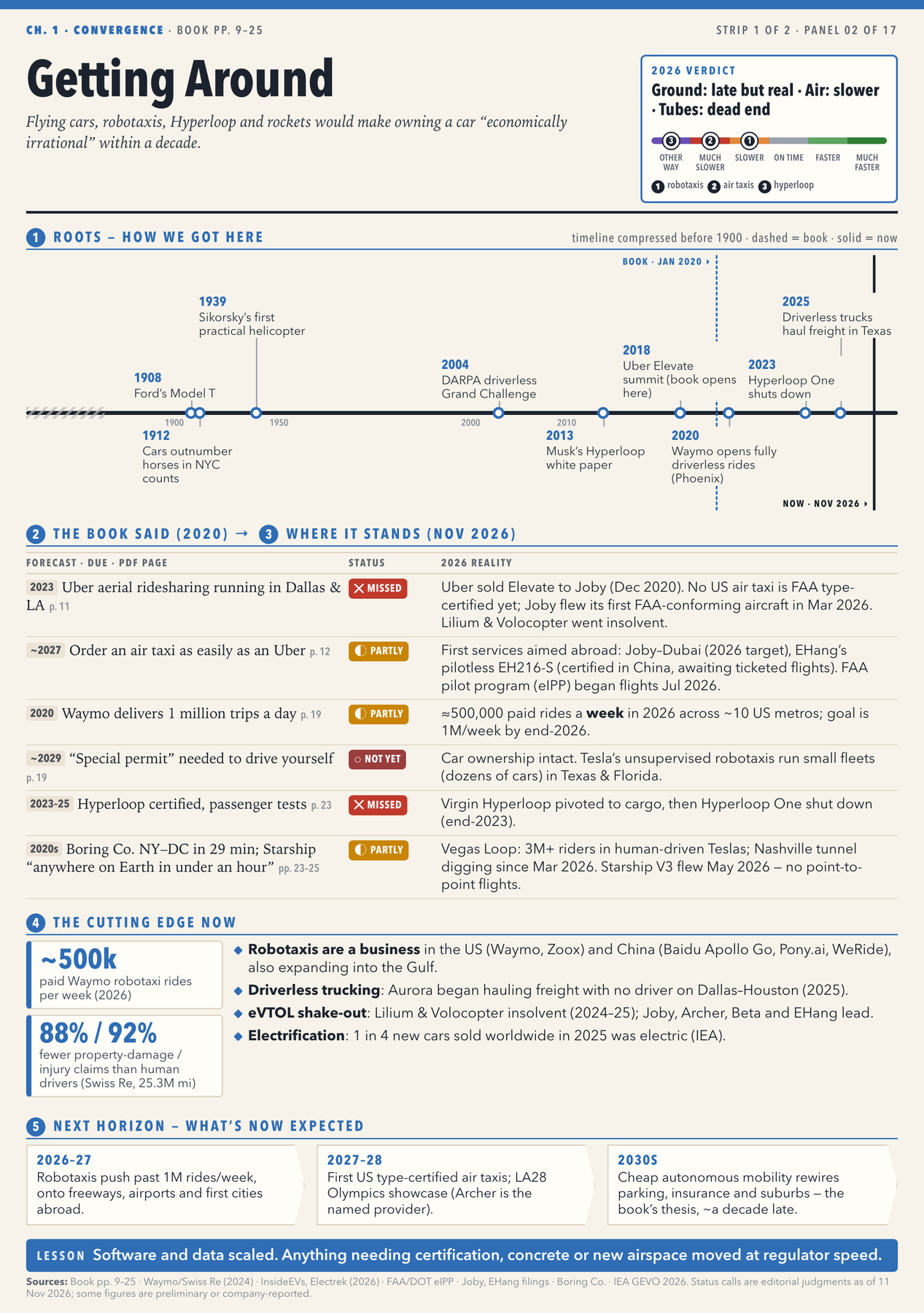
How this chapter’s forecasts compare with November 2026. Status tags are editorial judgments; see the full fold-out for the scorecard and method.
Panel 02 · Getting Around
Chapter 2: The Jump to Lightspeed: Exponential Technologies Part I
What I Should Retain
- Three takeaways: computation supports many other advances; networks and sensors expand the available information; AI and robotics can turn that information into decisions and action.
- Evidence anchors: Rigetti’s cloud tools illustrate access to specialized computing; cheap GPUs and large datasets help explain AI’s resurgence; Fukushima’s robot failures expose the difference between controlled demonstrations and demanding field conditions.
- Factual anchors: Xiaoice was introduced in 2014; the book discusses Google Duplex’s 2018 demonstration; the 2011 Fukushima disaster preceded the 2015 DARPA Robotics Challenge. The Six Ds organize the authors’ account of technological development.
- Connection to test: separate sensing, interpretation, action, and feedback in an existing workflow. Which step has become cheaper, and which step still limits a usable result?
Chapter Objective and Through Line
This chapter introduces the first set of technologies underlying the opening transportation example. Quantum computing represents the search for new computational capabilities as conventional chip scaling becomes harder. AI transforms data into useful classifications, predictions, and decisions. Networks connect people and machines; sensors translate physical conditions into data; robots perform actions in the world. Together these technologies form a potential cycle of observation, interpretation, action, and improvement.
The authors also introduce their Six Ds framework to explain why an early technology can look disappointing before it becomes commercially disruptive. Falling costs and simpler interfaces matter because they enlarge the population able to experiment. A powerful machine accessible only to specialists has a different social effect from a capability available through a familiar interface or cloud service. The chapter’s role is therefore both technical and economic: it names components, but also explains mechanisms of access and diffusion. Some popular descriptions of quantum power and AI generality are too expansive; the useful argument concerns specific capabilities and combinations, with those limitations retained.
Chapter Structure at a Glance
- Ask how computing might advance beyond familiar scaling limits.
- Introduce the Six Ds and the importance of usable interfaces.
- Explain AI’s growth through data, hardware, and methods.
- Connect people and machines through expanding networks.
- Make the physical world measurable through cheaper sensors.
- Combine perception and intelligence with robotic action.
Section-by-Section Argument
Quantum Computing
Rigetti Computing, founded in 2013, illustrates efforts to make quantum processors accessible through the cloud. The authors connect this work to a broader proposition: computation can advance through changing architectures and materials even when one scaling path becomes difficult. Quantum simulation could be useful for problems involving molecules and materials, creating downstream possibilities in drug discovery and design.
The source’s comparisons between qubits, ordinary memory, and universally rapid problem solving overstate what follows from superposition. Quantum advantage depends on the problem, algorithm, and physical implementation; it is not a general replacement for classical computing. See the independently checked explanation in Supplementary Verification - Selected Corrections.
The Six Ds shift attention from hardware to diffusion. Digitalization makes a process amenable to computation. In the deceptive phase, early doublings may have little practical effect despite publicity. Disruption begins when a capability changes established practices. Demonetization lowers costs; dematerialization moves functions into other devices or software; democratization spreads access. Digital photography illustrates the disappearance of film and developing costs, while smartphones illustrate the absorption of functions once performed by separate objects. Interfaces can connect expert capability to ordinary users, expanding experimentation. These categories are a heuristic, not a guarantee that every emerging technology will complete the sequence. Attachment (file not included in this release)
Artificial Intelligence
Microsoft’s 2014 Xiaoice emphasizes sustained social interaction rather than rapid task completion. Other examples involve recognizing images, processing speech and text, generating prose, and selecting actions. The authors group service work into looking, listening, reading, writing, and integrating knowledge to show how many occupations contain tasks exposed to AI capabilities.
The explanatory convergence is large datasets with increasingly capable and affordable GPUs, alongside improved learning methods. Game-playing examples illustrate that systems can learn effective strategies, including through self-play. AlphaGo’s Lee Sedol match occurred in March 2016; AlphaGo Zero was reported in 2017, a correction to the source’s conflated chronology. These achievements concern constrained tasks; the authors’ JARVIS assistant is an extrapolation toward integrating capabilities across a much broader context. Cloud services and available software make experimentation more accessible, a separate claim from achieving general intelligence. Attachment (file not included in this release)
Networks
The telegraph and telephone provide historical comparisons for improvements in speed, information capacity, and usability. The authors then discuss mobile networks, balloons, and satellite constellations as different approaches to connecting underserved populations. Their projected result is a much larger pool of participants, customers, and collaborators.
This matters to convergence because ideas and services can move through the same infrastructure. More connectivity can enlarge markets and allow cloud-based tools to reach users without requiring each to own expensive computing equipment. The plans for Loon, OneWeb, Kuiper, and SpaceX are evidence of efforts and investment at the time of writing, not proof that every person obtained affordable broadband on the proposed schedule. Attachment (file not included in this release)
Sensors
The Oura ring combines smaller sensors, batteries, and computing to monitor physiological signals in a wearable form. The source reports high agreement for particular heart-rate measures; that should not be converted into an equivalent claim about diagnosing sleep disorders or accurately classifying every sleep stage.
The wider argument concerns falling size and price, illustrated by cameras, positioning devices, and motion sensors. Once measurement becomes inexpensive, farms, factories, vehicles, and bodies can be monitored more continuously. The Internet of Things links these measurements to other systems. Data can improve decisions, but its usefulness depends on what is measured, the quality of inference, and who can access it. The authors recognize the associated privacy concern. Attachment (file not included in this release)
Robotics
The 2011 Fukushima disaster exposes robots’ limitations in environments involving difficult terrain and damaged infrastructure. The 2015 DARPA challenge shows similarly awkward performances, followed by improved demonstrations from firms such as Boston Dynamics and Honda. The sequence illustrates both progress and the importance of operational conditions.
Collaborative robots lower some programming and deployment barriers; targeted delivery systems such as Zipline address useful logistics jobs before a universally capable humanoid exists. The authors’ concluding point is about combining sensing, networks, AI, and machines. A robot’s purchase price alone does not measure the installed cost, reliability, integration effort, or value of that complete operating system. Attachment (file not included in this release)
Key Concepts and Distinctions
- Six Ds: a vocabulary for development, disruption, cost reduction, absorption of functions, and wider access.
- User-friendly interface: a means for additional people to use a capability; it can change the scale of adoption.
- AI task capability versus general intelligence: success in a defined task supports a narrower conclusion than autonomous competence across life.
- Internet of Things: connected physical measurements and devices; the bridge between digital analysis and material conditions.
- Collaborative robotics: machines integrated with human work, expanding the relevant alternative beyond total worker replacement.
Essential Evidence and Examples
- Rigetti’s cloud access: illustrates diffusion of specialized tools through interfaces. Attachment (file not included in this release)
- Data + GPUs: the authors’ explanation for AI’s movement into commercially useful tasks. Attachment (file not included in this release)
- Oura: measurement becomes wearable through component convergence; accuracy is measure-specific. Attachment (file not included in this release)
- Fukushima → robotics challenges: demanding environments reveal capability gaps that stage demonstrations can conceal. Attachment (file not included in this release)
Chapter Conclusion and Significance
The technologies become more consequential when linked into a system: sensors supply observations, networks transport them, AI interprets them, and robots act. Increasing access to computational tools can also improve the development of every component. This gives the book a mechanism for acceleration beyond simply asserting that devices will improve.
The central practical limit is integration. Accessible components do not automatically produce reliable operation, valid inference, or a viable service. The next chapter adds technologies for experience, fabrication, records, materials, and biology to this expanding set of possible combinations.
Questions for Reflection
- List the Six Ds in order.
- What two inputs help explain the AI resurgence described here?
- What did Fukushima reveal about robots in 2011?
- Why can a simpler interface change an emerging technology’s economic importance?
- Explain a complete sensor-to-action chain without assuming that more data guarantees a good decision.
Answers and Feedback
- Digitalization, Deception, Disruption, Demonetization, Dematerialization, Democratization. Remember the distinction between lower costs, fewer dedicated objects, and wider access. Attachment (file not included in this release)
- Large datasets and affordable, powerful GPUs, combined with improved learning methods. Attachment (file not included in this release)
- Robots useful in demonstrations could fail in damaged, hazardous environments. Terrain, reliability, and exposure mattered. Attachment (file not included in this release)
- It enlarges the pool of users and experimenters. Adoption can depend on usability as well as raw capability. Attachment (file not included in this release)
- A strong answer identifies measurement, transmission, interpretation, action, and feedback, then names a possible measurement or inference failure. A monitored farm or delivery system is suitable. Attachment (file not included in this release)
Cautions and Limits
The source frequently moves from task demonstrations to broad social forecasts. Keep those steps separate. Its quantum-computing analogies and several dates need correction; use the supplementary verification section when retaining technical or chronological facts.
2026 Forecast Check
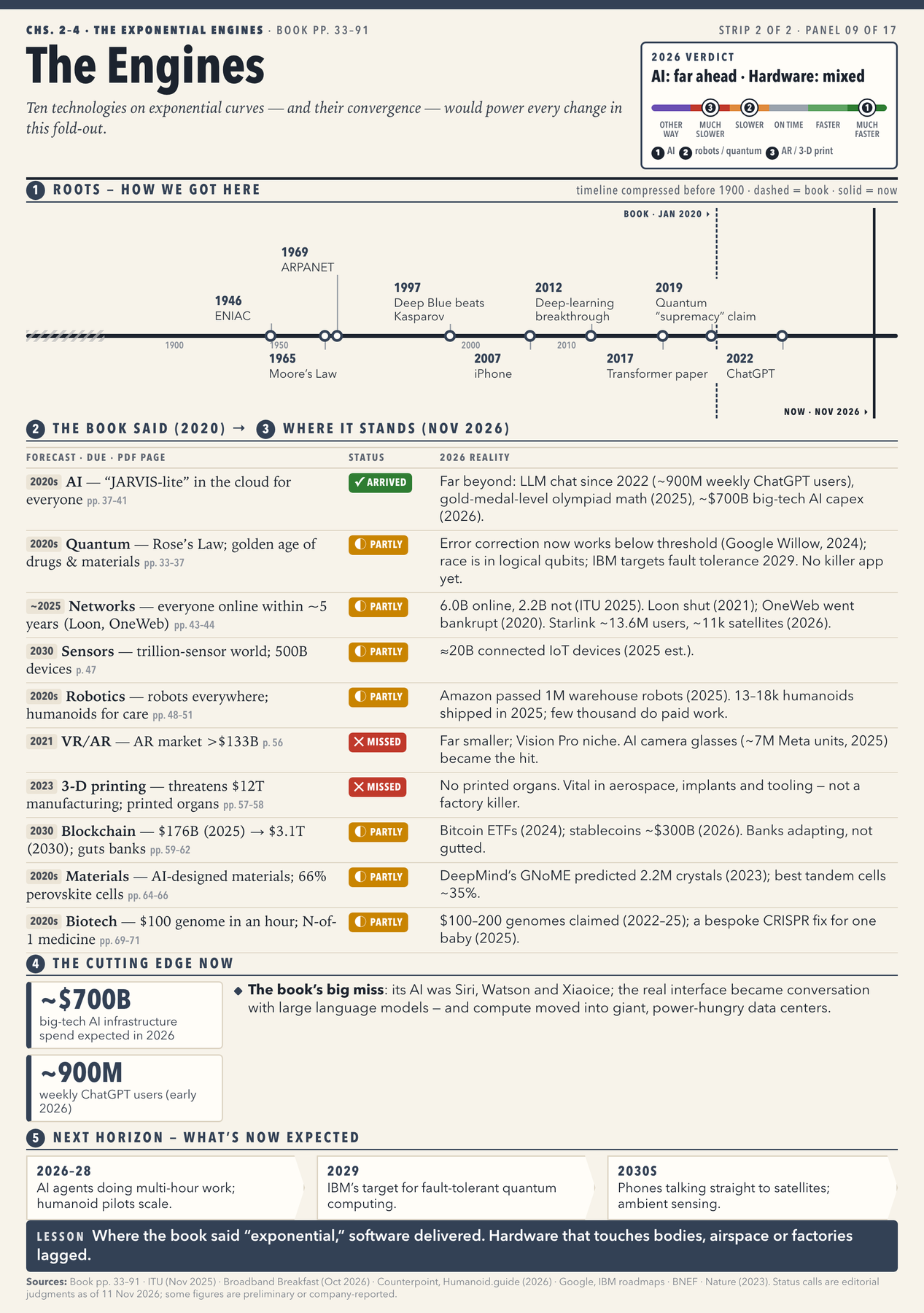
How this chapter’s forecasts compare with November 2026. Status tags are editorial judgments; see the full fold-out for the scorecard and method.
Panel 09 · The Engines
Chapter 3: The Turbo-Boost: Exponential Technologies Part II
What I Should Retain
- Three takeaways: experience, fabrication, coordination, and biology can all become more programmable; one technology’s progress can supply another’s missing input; computational models accelerate exploration while physical and clinical validation remain essential.
- Evidence anchors: Bailenson’s virtual plank illustrates presence; additive manufacturing changes the relation between design and inventory; gene therapy’s setbacks and renewed progress show that a promising mechanism can face long safety and delivery barriers.
- Factual anchors: the Materials Genome Initiative began in 2011; Jesse Gelsinger died in a gene-therapy trial in 1999; the source discusses renewed SCID treatment success in 2019. VR replaces the experienced setting; AR overlays information on a physical setting.
- Connection to test: does your idea require a new material or biological breakthrough, or could it use an already available capability to change a customer’s workflow?
Chapter Objective and Through Line
Chapter 3 completes the book’s initial inventory of enabling technologies by expanding from information and machines to experiences, objects, transactions, materials, and living systems. VR and AR can change how a person encounters information. Additive manufacturing can turn digital designs into physical objects. Blockchain can support particular ways of coordinating records and transfers. Computational materials research changes how candidate substances are explored. Biotechnology develops ways to read and modify biological systems.
The through line is that increasingly accessible tools can make previously difficult forms of manipulation more practical. Once design, simulation, data, and fabrication interact, progress can cross disciplinary boundaries. The authors use this interaction to explain why opportunities may appear outside the sector in which the original advance occurred. Their narrative also contains important evidence of friction: early VR was expensive and unsatisfactory; batteries took decades to develop; gene therapy encountered lethal setbacks. These examples should remain part of the account. They show that a digitally assisted process can still depend on demanding physical experiments, safety constraints, and workable delivery.
Chapter Structure at a Glance
- Turn simulated information into an embodied experience.
- Connect digital designs to physical production.
- Reorganize selected records, transfers, and agreements.
- Use models and databases to narrow materials searches.
- Apply reading, editing, and replacement techniques to biology.
Section-by-Section Argument
Virtual and Augmented Reality
In 2001, Jeremy Bailenson’s virtual-plank demonstration prompted a judge to react physically to a simulated drop. The point is presence: sufficiently persuasive sensory information can produce a response beyond simply recognizing a picture. The authors connect later improvements to computing, game engines, displays, tracking, and additional senses such as touch.
VR can therefore offer experiences that would be costly, dangerous, or impossible to arrange physically. AR supplies a different relationship: information appears alongside the real environment, supporting navigation, training, shopping, or explanation. The authors treat cheaper components and development tools as mechanisms that could spread both. Their evidence supports particular perceptual and behavioral possibilities; it does not establish that every VR experience produces lasting learning or that all users prefer immersion. Attachment (file not included in this release)
3-D Printing
Additive manufacturing changes the path from a design to an object. Printing an appropriate part near the point of use can reduce some inventory and transport requirements. The space-station discussion makes these costs visible because resupply is unusually difficult. Circuit prototypes, specialized components, prosthetics, and construction illustrate different combinations of digital design, materials, and fabrication.
The GE turboprop example emphasizes consolidation of components, while New Story’s 2019 Mexico housing project illustrates a proposed social use of lower-cost construction. These cases support examining which production steps change; they do not justify treating every quoted shell or printing cost as the final cost of a ready-to-occupy home. Likewise, printing tissue or a scaffold is a different achievement from providing a safe, functioning transplant organ. The authors’ near-term organ-market dates are predictions. Feedstock, post-processing, quality control, and fit-for-purpose performance remain part of production even when an inventory step shrinks. Attachment (file not included in this release)
Blockchain
Digital money creates a coordination problem: copying information is easy, while spending the same unit twice must be prevented. Bitcoin’s 2008 proposal and subsequent software illustrate a distributed approach to maintaining an agreed transaction history. The authors extend the reasoning to remittances, identity, ownership records, and agreements executed through software.
A useful distinction is between recording a claim and establishing its truth. A ledger can help track an accepted title or transfer; it cannot by itself settle every dispute about who originally owned land or whether an external event occurred. Smart contracts similarly rely on rules and, where needed, reliable information from outside the ledger.
The chapter’s Vatom examples combine digital ownership, AR, AI, and physical redemption. A digital drink redeemable at a bar or a game-like recruitment object is a scenario showing how technologies might combine, rather than evidence that the whole imagined system was operating. The business question is which coordination cost changes and why a distributed ledger is needed for that particular job. Attachment (file not included in this release)
Material Science and Nanotechnology
The authors contrast laborious materials searches with simulation and databases that help researchers select promising candidates. The June 2011 Materials Genome Initiative provides an institutional example: shared information, computation, and experimentation can shorten discovery cycles. Better materials can then support improvements in energy storage, vehicles, implants, and electronics, feeding other technologies’ development.
Nanotechnology extends manipulation to very small scales. The source combines existing applications—such as coatings and engineered materials—with much more speculative molecular manufacturing. These have different evidential status. A working nanoscale material does not establish a general-purpose, self-replicating assembler. The chapter’s sounder mechanism is that better search and fabrication tools enlarge the set of candidates researchers can explore; selecting a candidate still requires testing its performance in the intended environment. Attachment (file not included in this release)
Biotechnology
Gene therapy’s history prevents a smooth success narrative. Jesse Gelsinger’s death in 1999 and cancer in early SCID trials exposed serious risks. The authors contrast those setbacks with renewed treatment success reported in 2019, arguing that continuing research can improve a field even while public expectations collapse.
They then distinguish reading a genome, adding functional genetic material, editing a sequence, and replacing or repairing cells. Falling sequencing costs can support all of these approaches by improving information. Their projected endpoint is highly individualized medicine assembled from genetic and other biological data.
These mechanisms should be retained without the source’s implication that complex disease becomes a simple debugging exercise. A genetic association, a precisely targeted edit, and a safe treatment in a human are separate achievements. The same applies to the broad promise of stem cells: capabilities differ by cell type, intervention, and disease. Attachment (file not included in this release)
Key Concepts and Distinctions
- Presence: the felt reality of a simulated situation; explains why VR can influence responses.
- VR versus AR: a simulated setting versus information overlaid on a physical setting; different routes to experience and assistance.
- Additive manufacturing: building from a digital design by adding material; changes some production and inventory decisions.
- Smart contract: programmed execution of agreed rules; depends on appropriate rules and trusted external inputs where relevant.
- Biological reading, editing, and replacement: different intervention types; the distinction prevents conflating information with treatment.
Essential Evidence and Examples
- Bailenson’s 2001 demonstration: supports the presence mechanism. Attachment (file not included in this release)
- GE and New Story: illustrate different design and fabrication advantages, with different cost boundaries. Attachment (file not included in this release)
- Materials Genome Initiative, 2011: shared models and data assist discovery across sectors. Attachment (file not included in this release)
- Gene therapy, 1999–2019: progress can coexist with long safety and implementation delays. Attachment (file not included in this release)
Chapter Conclusion and Significance
The chapter enlarges the set of capabilities available for recombination. A product opportunity can involve changes to the experience, how it is fabricated, how ownership is coordinated, what it is made from, or how a biological process is influenced. This supplies a much richer search space than “a faster computer” alone.
Its examples also reveal why technical possibility must be separated from practical maturity. Physical behavior, biological response, and institutions impose constraints that an elegant digital model cannot simply erase. Chapter 4 then asks how improved capabilities can change the process of innovation itself.
Questions for Reflection
- What does “presence” mean in the VR discussion?
- What institutional initiative began in 2011 to accelerate materials development?
- Distinguish gene addition, gene editing, and cell replacement.
- Why can local 3-D printing reduce inventory without eliminating every supply-chain cost?
- What extra problem remains when a blockchain records ownership of a physical asset?
Answers and Feedback
- A simulated situation produces a felt, embodied response. Bailenson’s plank is the example. Attachment (file not included in this release)
- The Materials Genome Initiative. It connects data, computation, and materials experimentation. Attachment (file not included in this release)
- Supply functional genetic material; alter a targeted sequence; supply cells that perform or repair functions. These are distinct intervention routes, with separate validation needs. Attachment (file not included in this release)
- The design can replace storage of some finished parts, but materials, equipment, validation, and finishing still have to be supplied. Explain the changed step and the remaining inputs. Attachment (file not included in this release)
- Connecting the record to a valid real-world claim. The ledger preserves accepted information; disputes, physical provenance, or external events can still need institutions and verification. Attachment (file not included in this release)
Cautions and Limits
The source compresses difficult engineering and clinical questions into optimistic examples. Treat nanomachines, near-term printed organs, and universal personalized prevention as projections with different maturity from functioning materials or specific demonstrated treatments. The Human Genome Project chronology is corrected in the supplementary section.
2026 Forecast Check
This chapter’s technologies (VR/AR, 3-D printing, blockchain, materials, biotech) are scored on Panel 09 · The Engines under Chapter 2; see also the full fold-out.
Chapter 4: The Acceleration of Acceleration
What I Should Retain
- Three takeaways: technological gains can improve the conditions for further innovation; participation and recombination matter alongside computing power; a new business model can unlock value from an existing capability.
- The seven forces: saved time, availability of capital, demonetization, more genius, communications abundance, new business models, and longer lives.
- Evidence anchors: faster information search reduces a research task’s time; crowdfunding broadens routes to financing; the smartness economy applies accessible intelligence to existing tools and services.
- Essential distinction: a feedback mechanism is a causal possibility, not proof that every cycle produces useful progress. Funding can support failed ventures, and cheaper tools can produce low-value output.
- Connection to test: your “boring industry + new capability” lens becomes stronger when paired with a specific customer, recurring pain, delivery method, and measurable result. The direct source passage is on PDF p. 87.
Chapter Objective and Through Line
Chapter 4 answers a deeper question than which technologies are improving: why might the rate of innovation itself increase? The authors propose three layers. Individual technologies become more capable; those capabilities converge; and the resulting changes improve the resources available for another round of innovation. They identify seven forces operating at this third layer.
The argument concerns a productive system. Innovators require time, tools, funding, knowledge, collaborators, and ways to bring a result to market. An improvement in one input can enlarge what the others accomplish. Cheaper tools make funding go further; networks make talent and customers easier to find; faster experimentation frees time for another attempt. Longer healthy lives could preserve accumulated expertise. The chapter is therefore the book’s main explanation of acceleration as a feedback process. It also supplies its most direct entrepreneurial framework: a familiar activity can become a new business when a capability or commercial arrangement changes. The crucial qualification is that these enabling conditions expand opportunities; they do not establish customer demand or the quality of any particular venture.
Chapter Structure at a Glance
- Distinguish component progress, convergence, and feedback effects.
- Increase the time and financial resources available for experiments.
- Lower the cost of tools and broaden participation.
- Connect people and ideas at larger scale.
- Convert capabilities into new ways of delivering and capturing value.
- Extend the productive use of accumulated expertise.
Section-by-Section Argument
Force #1: Saved Time
The Steve Jobs boot-time anecdote shows why a small saving multiplied across users can matter. The authors then use research comparing online and library searches: answers took an average of approximately 7 versus 22 minutes per inquiry in the described experiment. The meaningful result is a task-specific saving; extrapolating it to every search would require assumptions about what people otherwise would have done.
Saved time can support innovation in two ways. It releases time previously consumed by routine activity, and it shortens the experimental process itself. A simulation or faster prototype can allow additional attempts within a fixed period. The argument depends on how people use the released time; it is a potential resource, not automatically more useful work. Attachment (file not included in this release)
Force #2: Availability of Capital
Funding supports people, equipment, experiments, and persistence through failure. The authors move from government-supported aerospace to crowdfunding, venture capital, token offerings, sovereign funds, and SoftBank’s Vision Fund. Digital distribution can let a project reach funders far beyond its immediate location.
The categories differ. A reward or advance purchase is not the same arrangement as a loan or equity investment. Filecoin’s 2017 fundraising before a completed product illustrates how rapidly capital could be assembled in a particular market climate; it does not show that the resulting proposition was already viable. The causal claim is that more routes to funding can increase the number of experiments. The allocation and eventual productivity of that funding remain separate questions. Attachment (file not included in this release)
Force #3: Demonetization
Lower prices allow a given budget to purchase more capability. The authors emphasize computing, sensing, genomic sequencing, and bundled smartphone functions. This can change who can enter a field and how many alternatives a team can test.
The word “demonetization” sometimes makes the process sound like the disappearance of all costs. The practical mechanism is often narrower: a formerly expensive function becomes cheap at the margin or is bundled into another product. Customers still need equipment, access, expertise, and an operating arrangement. Likewise, a low generation cost does not make delivered, dependable electricity free. Retain the declining-input-cost mechanism without assuming the entire service has reached zero price. Attachment (file not included in this release)
Force #4: More Genius
Ramanujan’s 1913 correspondence with G. H. Hardy illustrates the contingency of talent being discovered and supported. The authors argue that wider connectivity and access can reduce the amount of ability lost to geography, class, or exclusion. This is a participation argument, distinct from the claim that a tool increases any individual’s ability.
They also discuss experiments in flow, stimulation, memory, and brain interfaces as possible forms of augmentation. Improvements in a specified task or patient group do not establish a general increase in intelligence. The chapter’s near-term institutional implication is more secure: removing barriers can enlarge the pool of contributors without waiting for speculative neural enhancement. Attachment (file not included in this release)
Force #5: Communications Abundance
Coffeehouses and cities provide analogies for idea exchange. Networks can bring previously separated knowledge into contact, while useful combinations arise from that exchange. Global connectivity potentially extends this process across more people and disciplines.
The authors invoke research on cities and innovation to support the value of connection. A statistical relationship involving city size should not be treated as a universal formula for every network or as proof that larger is always better. The business implication is to look for missing connections between people who possess complementary knowledge, needs, or assets. Attachment (file not included in this release)
Force #6: New Business Models
A business model specifies how value is created, delivered, and captured. The authors identify seven emerging forms:
| Model | Mechanism to remember |
|---|---|
| Crowd economy | Coordinate external talent, funding, or underused assets |
| Free/data economy | Offer access while generating revenue through data or associated activity |
| Smartness economy | Add intelligence to a familiar tool or service |
| Closed-loop economies | Turn an output or waste stream into a useful input |
| Decentralized autonomous organizations | Execute some organizational rules and transactions through software |
| Multiple world models | Build goods and services for physical and virtual identities or settings |
| Transformation economy | Charge for a meaningful change in the customer, extending beyond an experience |
The smartness economy is the passage most directly connected to your request. The authors compare adding electricity to existing tools with adding AI to them, explicitly crediting Kevin Kelly’s The Inevitable. The useful pattern is a familiar purpose supplied through a newly accessible capability. The value comes from a better result and a workable commercial model, not from the label “smart.” These business models can overlap; an intelligent service might also use underused assets and sell a transformation. Attachment (file not included in this release)
Force #7: Longer Lives
Accumulated expertise, relationships, and judgment take time to develop. Extending healthy function could let people use them longer, adding another input to innovation. The authors describe Calico, senolytics, blood factors, stem-cell approaches, and longevity escape velocity as routes being explored.
This is the most speculative of the seven forces as a near-term general accelerator. Animal results, experimental treatments, and company valuations do not establish large extensions of healthy human lifespan. Chapter 10 examines these research approaches more closely. The conceptual point is to distinguish additional healthy working capacity from simply adding years of illness or dependency. Attachment (file not included in this release)
Key Concepts and Distinctions
- Second-order effect: an outcome of innovation that influences later innovation; central to the feedback argument.
- Demonetization: declining cost of a capability; differs from eliminating all delivery costs.
- Business model: the arrangement that creates, delivers, and captures value; an invention alone does not specify it.
- Smartness economy: intelligence added to an established activity; your strongest direct bridge to opportunity discovery.
- Healthspan: years of useful, healthy function; the relevant input to the longer-lives mechanism.
Essential Evidence and Examples
- Search experiment: roughly 7 versus 22 minutes per answer in the reported comparison; illustrates task-time savings. Attachment (file not included in this release)
- Crowdfunding and Filecoin, 2017: illustrate new funding routes and speed, with distinct obligations and viability questions. Attachment (file not included in this release)
- Ramanujan–Hardy correspondence, 1913: memorable anchor for previously excluded talent becoming connected. Attachment (file not included in this release)
- Seven business models: an explicit set of mechanisms for converting capabilities into value. Attachment (file not included in this release)
Chapter Conclusion and Significance
The chapter turns the opening technology inventory into a theory about innovation’s productive inputs. The effects reinforce one another: more accessible tools and connections can make a budget and an hour more productive, while new commercial arrangements can bring experiments to users. This is the bridge from Part One’s components to Part Two’s industries.
For application, distinguish an enabling force from proof of opportunity. An entrepreneur still needs a valuable customer result, a distribution path, and economics that work. The seven forces suggest where to search and what may have changed; they do not eliminate the need to test.
Questions for Reflection
- Name the seven forces of acceleration.
- Which business model most directly matches “old tool + AI,” and whom do the authors credit?
- Distinguish the experience economy from the transformation economy.
- How can saved time and lower tool costs reinforce one another?
- Why does rapid fundraising establish less than a viable business?
Answers and Feedback
- Time, capital, demonetization, genius, communications, business models, longer lives. Expand each shorthand into its effect on innovation. Attachment (file not included in this release)
- The smartness economy; Kevin Kelly. The endnote identifies The Inevitable (2016), p. 33; Kelly has not been independently summarized here. Attachment (file not included in this release) · Attachment (file not included in this release)
- An experience is the encounter; transformation is the resulting change in the person. The customer is paying for a different level of outcome. Attachment (file not included in this release)
- Shorter tasks allow more experiments, while cheaper tools reduce each attempt’s resource requirement. Explain the feedback without assuming every attempt succeeds. Attachment (file not included in this release) · Attachment (file not included in this release)
- It establishes access to capital, not profitable demand, reliable delivery, or sustainable value capture. The distinction follows from the chapter’s separate capital and business-model mechanisms. Attachment (file not included in this release)
Cautions and Limits
The seven forces differ in maturity and evidential support. Some source statistics confuse different cost or output measures. Treat the framework as a set of mechanisms to investigate, with direct measurement of your own task or venture taking precedence over dramatic aggregate extrapolations.
2026 Forecast Check
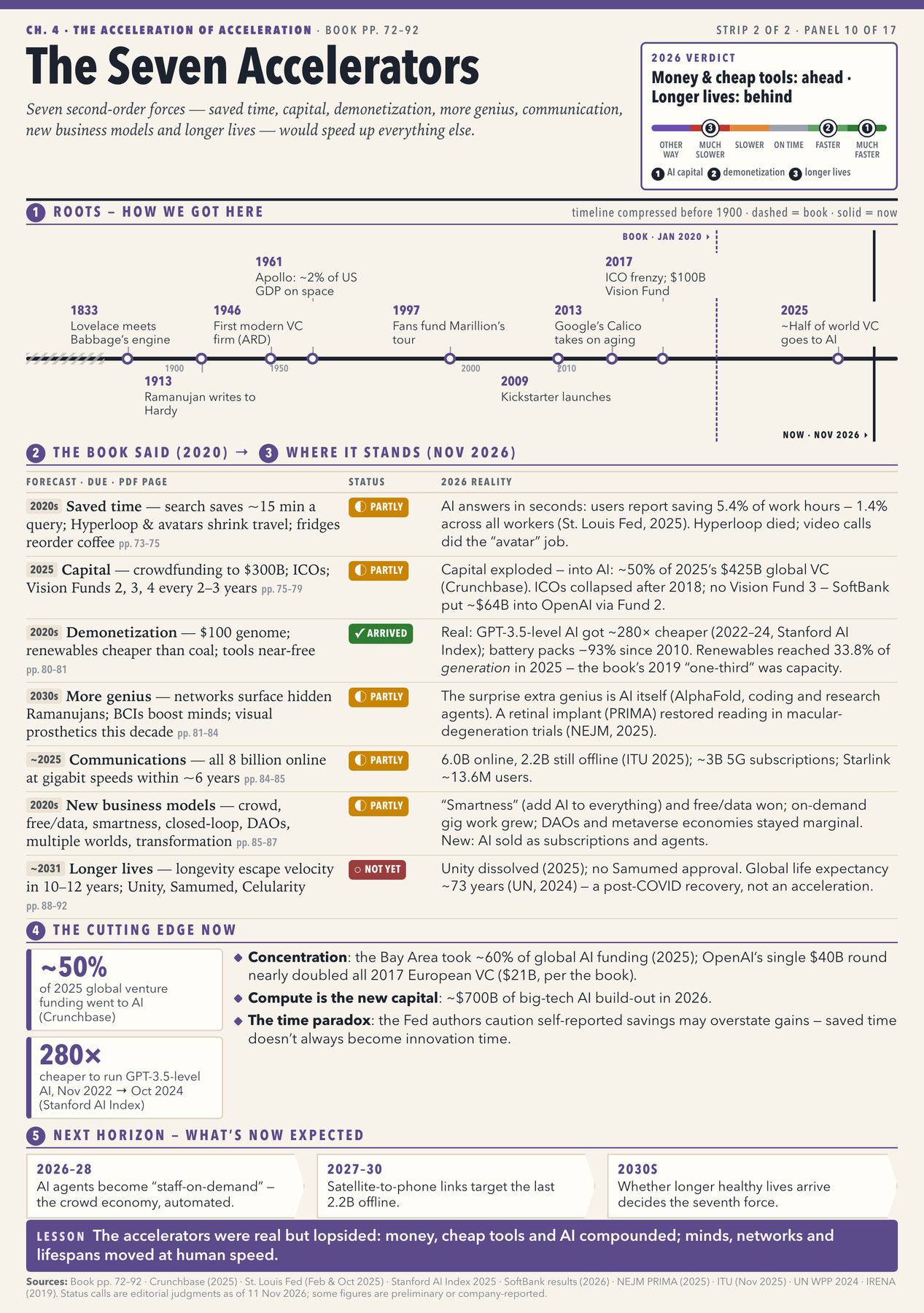
How this chapter’s forecasts compare with November 2026. Status tags are editorial judgments; see the full fold-out for the scorecard and method.
Panel 10 · The Seven Accelerators
Chapter 5: The Future of Shopping
What I Should Retain
- Three takeaways: retail platforms grow from communication and logistics systems; AI can change the interface through which purchasing decisions are made; physical stores need a reason for customers to visit when routine transactions become easier elsewhere.
- Evidence anchors: Sears used catalogs and delivery; Walmart used inventory information; Amazon combined digital ordering with fulfillment. Amazon Go illustrates sensor-supported checkout. Experience-oriented retail offers a different reason to visit.
- Factual anchors: Sears’s watch-resale opportunity came in 1886; rural free delivery expanded in 1896; Sears filed for bankruptcy in 2018. Amazon Go’s Seattle store opened in January 2018.
- Connection to test: in your business, does value come from the object sold, expert selection, convenient fulfillment, the relationship, or the experience? Which part could become commoditized, and which could become more valuable?
Timeline
1886: Sears resells watches → a price and distribution opportunity becomes a business.
1896: Rural free delivery expands access → catalogs can reach more underserved customers.
1920s: Sears expands city stores → a platform adapts to urbanization.
1980s–1990s: Walmart’s information and logistics advantage grows → inventory coordination strengthens discount retail.
January 2018: Amazon Go opens in Seattle → sensing, identification, and payment change checkout.
Autumn 2018: Sears files for bankruptcy → past platform success provides no permanent protection.
Chapter Objective and Through Line
Shopping is the first extended industry case because it connects consumer behavior to information, physical goods, logistics, and commercial organization. The authors begin historically to show that a platform combines infrastructure with an effective way to serve customers. Sears’s catalog reduced the limitations of local selection and pricing; later competitors reorganized those same functions around better information and delivery systems.
The chapter then follows AI through the customer journey and operating process: discovering an item, selecting it, receiving help, paying, replenishing stock, making the product, and delivering it. This makes the claim broader than “online sales will increase.” Control may move toward the assistant that understands the buyer, while production and fulfillment become more responsive. Physical retail faces two potential futures: an increasingly specialized experience worth visiting, or displacement of routine shopping into virtual and automated channels. The chapter presents both, making the strategic question which customer purpose a store serves and what its complete operating system makes possible.
Chapter Structure at a Glance
- Explain platform succession through retail history.
- Move the purchasing interface toward AI assistance.
- Connect checkout and inventory through sensing.
- Reorganize fulfillment and some production.
- Compare physical experiences with personalized virtual shopping.
Section-by-Section Argument
The First Platform Play
In 1886, Richard Sears recognizes a watch-resale opportunity at the railroad station where he works. Catalogs, expanding delivery, and transport let the company reach customers poorly served by local merchants. The authors emphasize transparent, consistent prices and access to a much wider selection. Rural free delivery in 1896 expands that system’s reach; urban growth later supports stores.
Walmart’s advantage develops through cheaper operations and better information about sales and inventory. Amazon then combines internet ordering with physical fulfillment. The authors use Jeremy Rifkin’s framework—communication, energy, and mobility—to explain the infrastructure behind commercial shifts. Sears’s 2018 bankruptcy anchors the warning: inventing a powerful platform does not ensure that its organization will adapt to later infrastructure and competitive changes. The explanation is useful without assuming technology was the sole cause of any company’s decline. Attachment (file not included in this release)
AI and the Retail Experience
Digital assistants can change the route from wanting something to obtaining it. The firm controlling this interface gains knowledge about preferences and may influence which suppliers are considered. Google Duplex’s 2018 phone demonstration shows AI performing a bounded coordination task; the subsequent need to disclose its automated identity also shows a social constraint on apparently seamless interaction.
Customer service provides two distinct applications. Software can assist an employee with information or suggestions, or it can handle selected interactions directly. The authors’ company examples concern particular implementations and reported results. The wider inference is that selection and service could become cheaper and more continuously available. Whether the buyer receives neutral advice depends on the assistant’s incentives and available information. Attachment (file not included in this release)
Go, Go, Gone Are Cashiers
An imagined April 2026 jacket purchase combines a body profile, preference data, transport, automated payment, and replenishment. The chapter then grounds individual components in examples available when written. Amazon Go’s January 2018 Seattle opening illustrates identifying customers and removed products through a combination of software and sensors.
The significance reaches beyond avoiding a checkout line. Information about removal and purchase can update inventory and influence restocking and forecasts. The proposed service improves when the customer-facing step and internal operations share useful information. The fictional scenario should remain separate from demonstrated pieces of it; a successful checkout mechanism does not establish every assumption about perfect sizing or seamless delivery. Attachment (file not included in this release)
The Robots Are Coming, The Robots Are Coming
Delivery bots, drones, store assistants, and warehouse robots operate at different points in the chain. The 2012 Amazon acquisition of Kiva illustrates the importance of back-end organization; a customer need not see a robot for robotics to affect service speed and cost.
The authors emphasize labor savings and continuous operation. A practical comparison also needs supervision, maintenance, exceptions, facility design, and utilization. The promising opportunity may be a narrowly defined task with predictable conditions, rather than a humanoid replacing every store function. Attachment (file not included in this release)
3-D Printing and Retail
Ministry of Supply illustrates new materials and on-demand garment production, while other examples concern customized goods and replacement parts. The proposed shift is from forecasting and storing many finished variants toward producing some items after the customer’s requirement is known.
The authors’ four expected effects concern supply chains, waste, spare parts, and user-designed products. These headings are sweeping; the mechanism is more specific. Design files and local fabrication can substitute for selected inventory and transport steps when materials, production methods, and validation fit the product. Inputs and quality requirements remain. Attachment (file not included in this release)
Retail’s Last Hope
Joseph Pine’s birthday-cake progression moves from ingredients to packaged goods, services, and an organized experience. The authors apply it to stores: convenience elsewhere can increase the importance of what customers experience by visiting. Westfield’s Destination 2028 is presented as a proposal combining shopping, wellness, entertainment, and learning.
This is an affirmative business possibility: the destination offers a worthwhile use of time. It is different from assuming that customers will continue visiting solely to obtain a commodity they can order more easily at home. Attachment (file not included in this release)
No More Shopping Malls
The imagined 2029 fashion purchase combines a body scan, virtual store, AI advice, custom production, and delivery. Existing examples support parts of this architecture. Its final form remains a scenario, and the authors themselves leave room for a compelling physical destination to survive.
The strategic conclusion concerns a redesigned journey and control of the interface. Some retail can disappear from dedicated places while other retail becomes a richer experience. The two possibilities can coexist because they serve different customer purposes. Attachment (file not included in this release)
Key Concepts and Distinctions
- Retail platform: an arrangement connecting selection, transactions, and fulfillment; its advantage depends on infrastructure and coordination.
- Friction: time, effort, uncertainty, or delay in obtaining a result; several technologies can remove different sources.
- Customer interface: the point through which preferences and purchase decisions pass; strategically valuable when an assistant mediates buying.
- On-demand production: making after a requirement is known; can reduce selected inventory and mismatch costs.
- Experience economy: a reason to pay for an encounter or visit, extending value beyond the goods exchanged.
Essential Evidence and Examples
- Sears/Walmart/Amazon: recurring platform replacement through information and fulfillment advantages. Attachment (file not included in this release)
- Duplex, 2018: bounded automated coordination plus a need for disclosure. Attachment (file not included in this release)
- Amazon Go, 2018: sensor-assisted checkout tied to product tracking. Attachment (file not included in this release)
- Destination 2028: proposed experience-oriented response to routine-shopping displacement. Attachment (file not included in this release)
Chapter Conclusion and Significance
Retail change is a connected process involving the buyer’s interface, the operating system behind it, and the reason for visiting a place. The chapter explains why a good product or a store network may lose value when another organization coordinates the full journey more effectively.
Its open question is which mixtures of human expertise, automation, physical presence, and personalization customers actually value. The paired physical and virtual scenarios are best used to test that question. Chapter 6 follows the consequence for advertising when selection increasingly happens through software.
Questions for Reflection
- What did rural free delivery add to Sears’s business system in 1896?
- Which Seattle store opening illustrates sensor-supported checkout in 2018?
- What distinguishes an experience-oriented store from a routine fulfillment point?
- Why does control of a purchasing assistant matter to retailers?
- Explain how virtual shopping and successful physical destinations could coexist.
Answers and Feedback
- Greater reach into rural communities. It expanded the distribution system supporting catalog sales. Attachment (file not included in this release)
- Amazon Go. Identification, product sensing, and payment are linked. Attachment (file not included in this release)
- The visit itself supplies value. Learning, entertainment, wellness, or social experience can justify the trip. Attachment (file not included in this release)
- It can control access to the buyer and the information used to select suppliers. Explain why this could shift bargaining power and customer knowledge. Attachment (file not included in this release)
- They can serve different purposes. Routine purchases may favor convenience, while a distinctive visit may be worth the time; neither scenario alone decides the whole market. Attachment (file not included in this release)
Cautions and Limits
The source’s projected store counts, automation savings, and 2026/2029 scenes are not verified outcomes. Its company-valuation table is unnecessary to the central argument and contains comparison problems; no investment conclusion is drawn from it here.
2026 Forecast Check
How this chapter’s forecasts compare with November 2026. Status tags are editorial judgments; see the full fold-out for the scorecard and method.
Panel 03 · Shopping
Chapter 6: The Future of Advertising
What I Should Retain
- Three takeaways: advertising follows the interface where consumers direct attention; spatial computing could make physical surroundings commercially searchable; an assistant making purchases could change the target of persuasion.
- Evidence anchors: visual search connects an observed object to information or a product; voice cloning and deepfakes separate realistic appearance from genuine endorsement; the imagined JARVIS buyer selects toothpaste from evidence and preferences.
- Factual anchors: Google Lens was released in 2017; Jordan Peele’s Obama deepfake appeared in 2018. The claim that conventional advertising could disappear within 10–12 years is a forecast from the book’s publication period.
- Connection to test: if software helps your customer choose, what verifiable information would it need to judge your offering? Also ask who pays for the assistant and controls its rankings.
Chapter Objective and Through Line
This shorter chapter follows the consequences of AI-assisted shopping for advertising. Traditional advertising seeks to influence a person’s attention, beliefs, and desires. Digital platforms make this influence more targeted by collecting information about users. The authors expect another transition as AR connects commercial information to the physical world, while synthetic voices and images make personalization unusually persuasive.
They then propose a reversal: the same intelligent assistance that creates more intrusive advertising could make much of it unnecessary. An assistant choosing products according to formulation, evidence, price, and the user’s circumstances would be less susceptible to an emotionally attractive commercial. The reasoning depends on a crucial premise—that the assistant reliably serves the customer’s interests and can evaluate relevant information. The chapter establishes a change in the possible decision interface, but it does not establish that commercial influence disappears. Advertising could instead move toward the platforms, data, and recommendations through which the assistant operates. That remains an analytical question raised by the forecast.
Chapter Structure at a Glance
- Follow advertising from mass media to data-rich platforms.
- Overlay commercial information on the physical environment.
- Combine personal data with convincing synthetic people and voices.
- Ask whether delegated buying changes the value of persuasion.
Section-by-Section Argument
Madder Men
The authors describe digital platforms as a redistribution of advertising power. Information about searches, preferences, and social activity allows targeting beyond a general broadcast audience. Their historical revenue examples establish the scale of Google and Facebook in the late 2010s, while their projected disappearance of social-media advertising is a further prediction, not a finding contained in those figures. Attachment (file not included in this release)
The Spatial Web
AR, sensors, connectivity, and AI could attach personalized information to objects and places. Visual search is the practical bridge: point a camera at something and receive relevant information or purchase options. Google Lens in 2017, Pinterest tools, and IKEA’s placement applications illustrate different pieces. The imagined store avatar or cabinet advertisement is an extension of these capabilities. A physical environment becomes an interface; the user’s attention supplies context for a commercial suggestion. Attachment (file not included in this release)
The Eerie Power of Hyper-Personalization
The chapter imagines advertising that draws on identity, gaze, preferences, and familiar relationships. The causal mechanism is unusually precise targeting combined with an emotionally effective presentation. This could offer useful recommendations, but the same information could support manipulation. The customer’s control over preferences and interruptions becomes part of the service’s value. Attachment (file not included in this release)
Sure That Sounds Like Mom, But Can You Prove It?
Voice-cloning examples from Lyrebird and Baidu show how a recording could be made to sound familiar. The authors also identify beneficial applications, including replacement voices and personalized narration. The important distinction is between synthesis and authorization: a convincing voice does not establish who spoke or endorsed the message. Attachment (file not included in this release)
Deeper Fakes
Jordan Peele’s 2018 Obama video deliberately demonstrates synthetic speech and imagery. More persuasive fabrication creates two problems: viewers may believe false material, and genuine material may become easier to dismiss. The chapter therefore contains a trust problem within its personalization story. Realism and truth are different properties. Attachment (file not included in this release)
Goodbye Advertising, Hello JARVIS
The hypothetical buyer compares toothpaste’s ingredients, evidence, cost, and fit with the user. It can also replenish routine products automatically. If this works, some consumer-directed emotional persuasion loses its role. The conclusion remains conditional on the assistant’s competence and incentives; an assistant’s operator could still sell placement or shape which evidence it sees. This is the unresolved commercial premise to retain when evaluating the book’s end-of-advertising prediction. Attachment (file not included in this release)
Key Concepts and Distinctions
- Spatial web: information connected to physical objects and places; changes where discovery occurs.
- Hyper-personalization: messages shaped by extensive individual data; can improve relevance or increase manipulation.
- Deepfake: synthetic or altered representation of a person; visual plausibility does not establish authenticity.
- Delegated purchasing: software evaluates and selects for a user; shifts the commercial decision interface.
Essential Evidence and Examples
- Visual-search tools: connect observation to discovery and purchasing. Attachment (file not included in this release)
- Voice cloning: supports the possibility of synthetic familiar speakers, with useful and deceptive applications. Attachment (file not included in this release)
- Peele’s 2018 video: illustrates the authenticity problem directly. Attachment (file not included in this release)
- JARVIS toothpaste scenario: a thought experiment about changed selection criteria. Attachment (file not included in this release)
Chapter Conclusion and Significance
The chapter explains why advertising’s future depends on who or what makes purchasing decisions. Its most useful prediction concerns movement of the interface, from a human viewing a commercial toward software mediating the purchase. The disappearance of advertising is a stronger claim with an unresolved business-model premise.
The next chapter extends synthetic content, personalization, and sensory interfaces into entertainment, where the same capabilities can change the experience itself.
Questions for Reflection
- What does the spatial web add to a physical environment?
- Which 2018 video illustrates the deepfake problem?
- What purchasing task does JARVIS perform in the concluding example?
- Why can deepfakes undermine trust even in genuine footage?
- What assumption must hold for delegated purchasing to weaken consumer-directed advertising?
Answers and Feedback
- Contextual digital information and interactions, potentially personalized to the observer. Attachment (file not included in this release)
- Jordan Peele’s synthetic Obama video. It demonstrates words being made to appear to come from someone else. Attachment (file not included in this release)
- Selecting and replenishing toothpaste using relevant product information and preferences. Attachment (file not included in this release)
- Plausible fabrication makes denial easier. Someone can argue that authentic evidence was also manufactured. Attachment (file not included in this release)
- The assistant must competently prioritize the buyer’s interests. A strong answer considers paid placement, information access, and platform incentives as possible complications to the scenario. Attachment (file not included in this release)
2026 Forecast Check
How this chapter’s forecasts compare with November 2026. Status tags are editorial judgments; see the full fold-out for the scorecard and method.
Panel 04 · Advertising
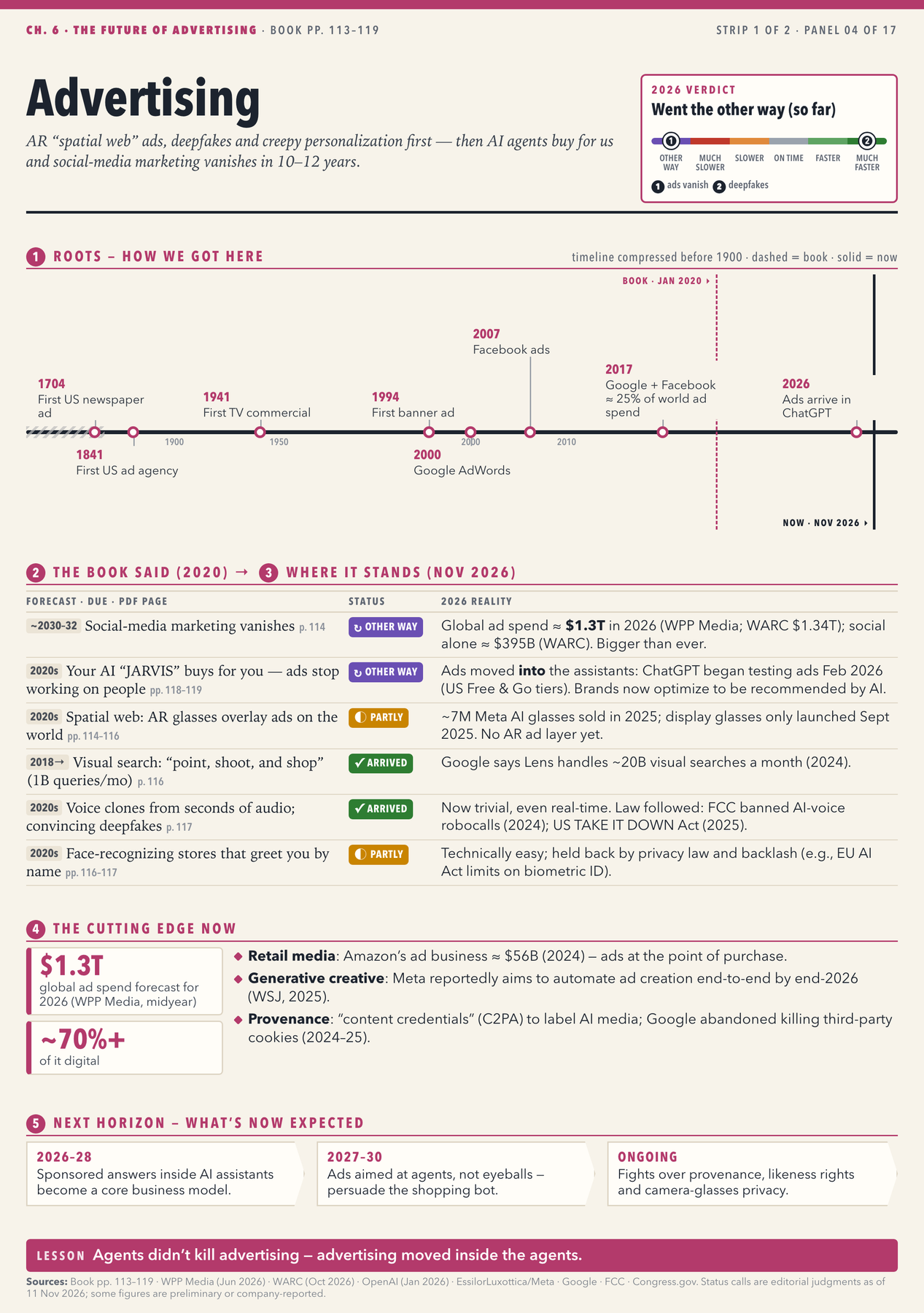
Chapter 7: The Future of Entertainment
What I Should Retain
- Three takeaways: cheaper creation and distribution can weaken studio control; content can become participatory, immersive, and adaptive; changing the delivery interface can change both the product and the industry supplying it.
- Evidence anchors: Netflix’s shift to streaming in 2007; smartphone creators using YouTube; AI assistance on the 2016 Morgan trailer; prototypes combining rendering, capture, displays, and haptics.
- Factual anchors: the chapter’s organizing questions are who creates, what is created, and where it is experienced. Affective computing infers or responds to signals associated with emotion. Brain-computer interfaces are discussed as a farther horizon.
- Connection to test: in photography or other creative work, distinguish a tool that saves production time from a service that changes what the client can experience. Neither automatically solves discovery, rights, or willingness to pay.
Chapter Objective and Through Line
Entertainment illustrates converging technologies reshaping both production and consumption. Historically, a small number of studios and networks controlled scarce combinations of equipment, talent, financing, and distribution. The authors argue that accessible capture tools, digital networks, and new platforms weaken those barriers. AI adds production assistance, while interactive software allows the audience to participate in the result.
The chapter then follows a second transition, from distributing familiar content cheaply to changing the form of the experience. Immersion engages additional senses; affective computing could adapt a scene to a user’s responses; AR and brain interfaces could move entertainment beyond a fixed screen. These are related but distinct changes. A streaming service, an interactive story, and a proposed holodeck differ in technological maturity and customer purpose. The chapter’s contribution is to connect them through the questions of who, what, and where. Its strongest cases demonstrate changes in particular production or delivery steps; its most ambitious scenarios require extensive integration and assumptions about human preference.
Chapter Structure at a Glance
- Use Netflix to show distribution becoming a platform.
- Broaden access to creation and audience reach.
- Make content participatory through software and AI collaboration.
- Combine sensory technologies into more immersive experiences.
- Use feedback to personalize content.
- Explore interfaces beyond the conventional screen.
Section-by-Section Argument
Going Digital
Netflix’s DVD model combined convenient ordering, a queue, and subscription terms. Its 2007 move into streaming replaced physical delivery with broadband. Later content investment illustrates a platform extending from distribution into production. The authors use this sequence to show how control of the route to an audience can change the industry’s power structure.
The relevant mechanism is broader than copying films onto the internet. A new distribution arrangement can accumulate customers, information, and revenue that support other activities. Historical content and subscriber figures in the book belong to their stated period; they are not a present-day market comparison. Attachment (file not included in this release)
The Rise of the Uber-Creator
Smartphones reduce the equipment needed to record and edit; YouTube supplies distribution and ways to monetize attention. Their combination expands who can attempt content creation. The chapter’s high-earning examples show what was possible for a few successful creators, not an expected income for entrants.
AI can also contribute to production. Sunspring in 2016 illustrates machine-generated scripting. For the 2016 Morgan trailer, the described system identified moments while a human arranged them into a coherent edit. The reported reduction from roughly ten days to one concerns that workflow, preserving the human contribution. This is a concrete example of changing the division of labor rather than inferring that a complete creative profession has been automated. Attachment (file not included in this release)
From Passive to Active
Passive media sends information primarily in one direction. Active media lets users alter or contribute to what happens. The authors discuss game modifications, interactive narrative, and AI systems that help organize user contributions. A feedback loop can develop: people create with software, while the software learns patterns that help future creation.
Motion transfer and synthetic personas extend this participation into representations of people. A Tony Robbins persona illustrates the ambition of combining an archive with an interactive interface. The distinction between a convincing performance and a person’s understanding, identity, or professional competence matters. The book reports promoters’ claims; resemblance and a large library alone do not establish equivalence to the person. Attachment (file not included in this release)
The Holodeck Is Here
The title names an ambition assembled from several components: Otoy’s rendering, LightStage’s capture, Light Field Lab’s displays, and methods of supplying tactile feedback. Each solves a different part of creating an apparently shared physical environment. Related examples add sound, body-worn haptics, and location-based group experiences.
This is a particularly clear convergence case. Better visual generation alone does not supply touch, shared tracking, or a usable room. The authors argue that engaging more senses can change the intensity of attention and participation. Working components and prototypes support a direction of development; they do not establish a complete consumer holodeck with the properties of the fictional device. Attachment (file not included in this release)
This Time It’s Personal
The imagined 2028 entertainment system tracks a person’s day and selects content to influence mood. Affective-computing examples such as Affectiva and the game Nevermind ground a narrower mechanism: signals associated with emotion can inform how a system responds. Crowd measurements can similarly influence an event or test a piece of content.
Adaptive generation would go further than recommending an existing film. It could alter what is produced as responses arrive. This raises a different design question from maximizing engagement: whose purpose does adaptation serve? A signal such as heart rate or facial movement is also context-dependent; it does not supply transparent access to a person’s inner state. The narrative’s apparently precise psychological knowledge remains an extrapolation. Attachment (file not included in this release)
Here, There, and Everywhere
The authors move through flexible screens, AR displays, contact-lens proposals, immersive rooms, and brain-computer interfaces. Each alters where a user encounters content and what equipment mediates it. The Moment, released in 2018, uses EEG input to vary a film, illustrating a limited adaptive interface.
BrainNet’s game-related communication is another narrow proof of concept. Signals used to make choices in a constrained task should not be equated with transmitting a whole experience or merging minds. The authors acknowledge that direct brain-linked entertainment can exceed the book’s usual decade horizon. The long-range claim is that neuroscience, interfaces, and media production could become more closely connected industries. Attachment (file not included in this release)
Key Concepts and Distinctions
- Who / what / where: the chapter’s map of change in creators, content forms, and delivery settings.
- Passive versus active media: receiving a fixed presentation versus contributing or changing its course.
- Immersion: coordinated sensory engagement; distinct from merely watching a higher-resolution image.
- Affective computing: systems interpreting or responding to emotion-related signals; inference is different from direct knowledge.
- Human–AI collaboration: a changed allocation of creative tasks, as illustrated by the trailer workflow.
Essential Evidence and Examples
- Netflix streaming, 2007: distribution changes the basis of competition and supports expansion into content. Attachment (file not included in this release)
- Phone + YouTube: creation tools become more valuable when distribution and payment are available. Attachment (file not included in this release)
- Morgan trailer, 2016: AI selection plus human editing illustrates workflow augmentation; the quoted time saving is case-specific. Attachment (file not included in this release)
- Nevermind / The Moment: feedback can alter experiences through specific measured inputs. Attachment (file not included in this release) · Attachment (file not included in this release)
Chapter Conclusion and Significance
Entertainment’s transformation joins lower entry barriers with changes in the experience being sold. The customer can become a participant, the tool can become a collaborator, and the location can become part of the interface. This helps explain the authors’ recurring claim that converging technologies lead to converging markets.
The same developments create unresolved problems of authenticity, ownership, emotional influence, and platform dependence. Broad access to production does not ensure broad income or user control. Chapter 8 applies related tools to a different outcome: learning rather than entertainment.
Questions for Reflection
- What are the chapter’s three organizing questions?
- What changed in Netflix’s delivery model in 2007?
- What role did a human retain in the Morgan trailer example?
- How does adaptive generation differ from recommending an existing movie?
- Why do working display and haptic components fall short of proving a complete holodeck?
Answers and Feedback
- Who creates, what is created, and where it is experienced. These separate production access from content and interface changes. Attachment (file not included in this release)
- Broadband streaming replaced the need to mail a DVD for that offering. This changed delivery economics and access. Attachment (file not included in this release)
- Arranging selected moments into a coherent edit. The example supports collaboration within a task. Attachment (file not included in this release)
- Generation can change the content itself in response to feedback. Recommendation selects among existing items; either can be personalized. Attachment (file not included in this release)
- Integration, coverage, tracking, reliability, and usable interaction still matter. Explain which sensory or operating requirement remains unresolved; plausible answers can choose different bottlenecks. Attachment (file not included in this release)
Cautions and Limits
The source’s strongest earning examples are selected successes. Its claims that blockchain prevents piracy and that emotion-related signals reveal exact inner states go beyond the mechanisms demonstrated. Proposed holodecks, contact lenses, and comprehensive brain-linked media should retain their experimental or speculative status.
2026 Forecast Check
How this chapter’s forecasts compare with November 2026. Status tags are editorial judgments; see the full fold-out for the scorecard and method.
Panel 05 · Entertainment
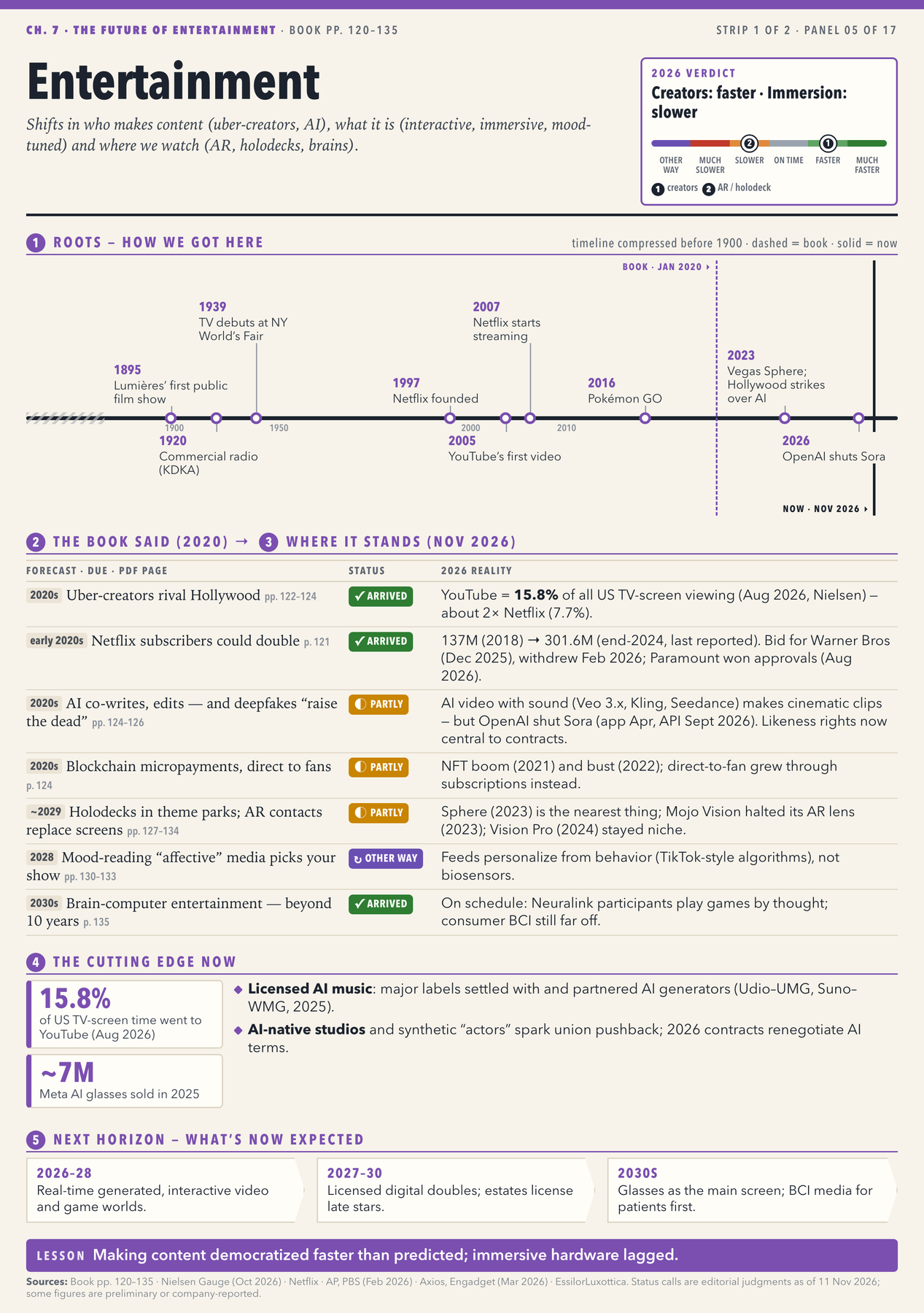
Chapter 8: The Future of Education
What I Should Retain
- Three takeaways: education faces access and quality problems; software can distribute selected learning functions at low additional cost; personalization and immersion are valuable only insofar as they improve learning and development.
- Evidence anchors: Negroponte’s 2012 Ethiopian tablet experiment; the Global Learning XPRIZE’s 2019 awards after field testing in Tanzania; High Fidelity’s shared 2018 Nefertari-tomb experience.
- Factual anchors: Kitkit School and onebillion shared the final Global Learning prize. The foundational tasks were Swahili literacy and numeracy, not the full work of a teacher. Devices, charging, usable software, and distribution were complementary inputs.
- Connection to test: for your own study, choose the skill to improve—recall, explanation, reasoning, or application—before choosing an attractive interface. Measure what you can do with the tool closed.
Chapter Objective and Through Line
This shorter chapter asks whether the technologies discussed in entertainment could address two educational problems: reaching people without adequate instruction and improving the fit between instruction and individual learners. The authors criticize standardized pacing that leaves some pupils lost and others bored, then explore software that allows learners to work through material more independently.
The argument develops from access to experience and personalization. Tablet projects show that children can explore and learn through accessible software. Shared VR can provide access to a place that would be impractical to visit. AI could adapt instruction, while AR could connect explanations to the environment around a learner. The final model is the individually responsive learning companion imagined in Neal Stephenson’s The Diamond Age. Its role is an organizing aspiration, not evidence that such a complete educational system already exists. The central question remains which learning outcomes a particular system improves, for whom, and with what human and physical support.
Chapter Structure at a Glance
- Separate educational access from instructional quality.
- Test self-directed foundational learning through tablets.
- Use shared immersion to expand accessible experiences.
- Combine adaptation and contextual information into a learning companion.
Section-by-Section Argument
The Quest for Quantity and Quality
The authors frame quantity as insufficient access to teachers and schools, and quality as a mismatch between uniform instruction and individual needs. Their criticism of an inherited industrial model is a broad interpretation; it should not substitute for a detailed history of schooling. The practical claim is that distributing the same pace and presentation to everyone can produce disengagement or confusion. Technology becomes useful if it changes that constraint while preserving meaningful educational goals. Attachment (file not included in this release)
One Billion Android Teachers Per Year
In 2012, Negroponte’s Ethiopian project supplies tablets with learning material and charging equipment. Children’s rapid exploration and customization challenge assumptions about the amount of instruction needed to begin using the devices. Those observations support curiosity and self-directed use; they do not alone establish mastery of a complete curriculum.
The Global Learning XPRIZE offers a more focused field test. The book describes approximately 2,400 children in 167 Tanzanian villages, with software addressing reading, writing, and mathematics over an 18-month period. In May 2019, Kitkit School and onebillion share the final award. Open-sourcing the finalists’ software supports distribution beyond the competition. Calling a donated device a “teacher” is an analogy for selected instructional functions; social development, supervision, curriculum, and assessment remain wider responsibilities. Attachment (file not included in this release)
The Ultimate Field Trip
High Fidelity’s 2018 Nefertari-tomb project combines scanning, imagery, headsets, and a shared virtual environment. It demonstrates access to a spatial experience without the class traveling to Egypt. The authors extend the argument to empathy and emotional learning through perspective-taking and therapeutic research.
The proposed benefit is a particular kind of encounter or practice that conventional presentation may not provide. More sensory input should not automatically be equated with better retention or transfer. An informative simulation also needs trustworthy reconstruction and effective teaching around it; an avatar of a historical thinker remains an interpretation. Attachment (file not included in this release)
School 2030
Stephenson’s 1995 fictional Primer models a companion that responds to the learner and aims at autonomy, creativity, and empathy. AI supplies adaptation; AR connects instruction to the surrounding world; sensors might help a system respond to engagement or difficulty.
The authors’ desired shift is from standardized delivery to individually responsive learning. The unresolved step is showing that adaptation achieves the intended educational outcomes. A captivating interface and a capable learner are different results; the latter requires assessment beyond time spent interacting. Attachment (file not included in this release)
Key Concepts and Distinctions
- Quantity versus quality: reaching learners versus improving what they learn and how; separate problems can need different interventions.
- Self-directed learning: learners explore and progress using available resources; the extent of mastery still requires evidence.
- Personalization: adjusting instruction to an individual; useful when it improves a specified outcome.
- Immersive learning: encountering or practicing through simulated space and action; distinct from proving durable understanding.
Essential Evidence and Examples
- Ethiopia, 2012: children explore tablets with little initial direction. Attachment (file not included in this release)
- Tanzania / XPRIZE, 2019: a scoped foundational-learning test with devices, power, software, and deployment. Attachment (file not included in this release)
- Nefertari, 2018: scanning and social VR enable a shared remote encounter. Attachment (file not included in this release)
- The Diamond Age, 1995: a fictional model organizes the forecast, rather than supplying empirical evidence. Attachment (file not included in this release)
Chapter Conclusion and Significance
The chapter identifies ways to distribute instruction and experiences more widely while adjusting to individual learners. Its strongest examples involve defined educational tasks. The much broader replacement of an entire educational institution remains a proposal with additional social, developmental, and assessment requirements.
For the book’s argument, education also supplies a feedback mechanism: improved learning could expand participation and help workers adapt to changing tasks. That contribution depends on demonstrated learning, not simply access to a device.
Questions for Reflection
- What two educational problems organize the chapter?
- Which teams shared the final Global Learning XPRIZE award in 2019?
- What three practical inputs accompanied the learning software in the field projects?
- Why does tablet exploration establish less than a complete educational result?
- What would distinguish a successful personalized study tool from an engaging one?
Answers and Feedback
- Quantity/access and quality/fit of instruction. Attachment (file not included in this release)
- Kitkit School and onebillion. The tested scope centered on foundational learning. Attachment (file not included in this release)
- Devices, charging/power, and distribution or implementation support. Equivalent descriptions of these complements are valid. Attachment (file not included in this release)
- Use and curiosity do not measure all curriculum outcomes or developmental functions. Explain what learning still needs to be assessed. Attachment (file not included in this release)
- Improved recall, explanation, transfer, or skill demonstrated independently. A strong answer specifies an outcome and a test suited to it; the chapter’s field tests illustrate the need for defined tasks. Attachment (file not included in this release)
2026 Forecast Check
How this chapter’s forecasts compare with November 2026. Status tags are editorial judgments; see the full fold-out for the scorecard and method.
Panel 06 · Education
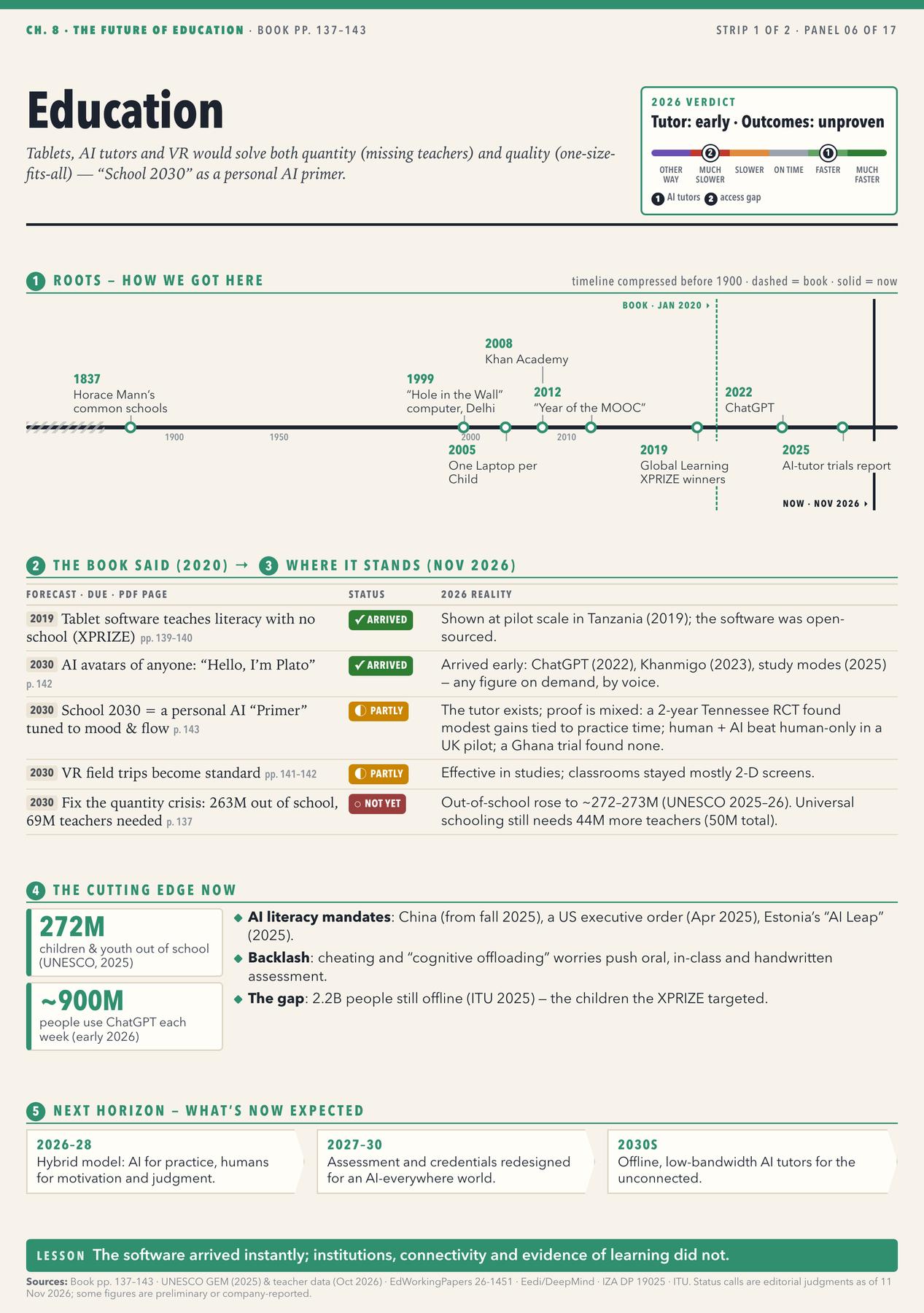
Chapter 9: The Future of Healthcare
What I Should Retain
- Three takeaways: healthcare can be redesigned across detection, intervention, and discovery; better information can support more individualized care; shortening an early research step is different from demonstrating a safe and effective treatment.
- Evidence anchors: Rothblatt attacks several organ-supply bottlenecks; connected sensors could support earlier detection; AI-generated molecular candidates illustrate a changed discovery workflow.
- Factual anchors: Jenesis Rothblatt’s diagnosis in 1992 motivates the opening story; the chapter discusses 2017 CAR-T treatments and 2018 AlphaFold work. STAR’s soft-tissue task differs from generally autonomous surgery. “Reading,” “writing,” and “editing” a genome name different capabilities.
- Connection to test: the business lesson is to identify the limiting step in the complete pathway. A faster discovery, diagnosis, or delivery process creates value only if it improves a consequential outcome downstream.
Chapter Objective and Through Line
Healthcare gives the authors a complex system in which many technologies can act on different stages. They begin with Martine Rothblatt’s response to her daughter’s illness, then widen from a single determined entrepreneur to changes in diagnostics, genomics, surgery, cellular therapies, and drug discovery. The central ambition is a move from reactive and generic treatment toward proactive, personalized care.
The argument also concerns institutional entry. Large technology companies possess data capabilities, consumer interfaces, and a place in daily life that may matter for continuous monitoring. Yet access to information and a sophisticated interface are different from clinical benefit. Throughout the chapter, retain the distinctions between identifying a risk, diagnosing a disease, selecting an intervention, demonstrating benefit, and delivering care affordably. These stages explain both the promise and the remaining work. The chapter’s business value lies in its view of the complete treatment pathway; its strongest medical conclusions require evidence beyond a prototype, a selected patient story, or a company founder’s description.
Chapter Structure at a Glance
- Show one entrepreneur addressing linked medical bottlenecks.
- Reframe care around earlier detection and individualized intervention.
- Bring sensing and diagnostic support closer to daily life.
- Develop biological information into possible treatments.
- Change procedures and therapeutic manufacturing.
- Accelerate candidate discovery while retaining clinical validation.
Section-by-Section Argument
Martine and the Moonshots
After her daughter’s 1992 pulmonary-hypertension diagnosis, Rothblatt investigates the disease and develops a business around a previously shelved compound. The resulting treatment manages the condition; the chapter distinguishes this from a cure. Her next projects address organ failure through several routes: preserving more donated lungs using ex vivo perfusion, investigating animal-to-human transplants, developing artificial scaffolds with living cells, and improving organ transport.
The sequence matters because scarcity has several causes. Making an organ is one problem; preserving and delivering an available one are others. The authors use Rothblatt’s work to illustrate a goal assembled from distinct technological and organizational solutions. Her forecast about managing organ failure by approximately 2028 is an ambition reported in the book, not a demonstrated general outcome. Attachment (file not included in this release)
Turning Sick Care into Healthcare
The authors criticize a system that often intervenes after disease appears and supplies broadly standardized treatment. Their proposed alternative is prospective, proactive, and personalized. Sensors and AI could affect detection; robotics and printing could affect procedures; genomic information and computational research could affect therapies.
They also identify a change in who enters the industry. Consumer technology companies have interfaces, analytical capabilities, and access to daily activity. Those advantages can make monitoring feasible, while also creating questions about consent, data control, and how findings connect to competent care. The commercial system and the clinical pathway have to work together. Attachment (file not included in this release)
DIY Diagnostics
An imagined January 2026 morning connects wearables, home devices, an assistant, and diagnosis. It is a future scene, including its assumed vaccine and sensor capabilities. Actual examples discussed when the book was written concern particular measurements or devices, not every function of the fictional home.
Human Longevity’s Health Nucleus supplies a selected screening example: the book reports significant findings in 14.4% of its first 1,190 clients, with additional clients assigned monitoring. This is a finding rate in a screened group, not a measured reduction in deaths or a demonstration that broad screening benefits everyone. Diamandis is a cofounder of the company. The distinction matters to the chapter’s inference: detecting additional abnormalities can lead to useful treatment, unnecessary investigation, or both, depending on the condition and evidence. Attachment (file not included in this release)
Reading, Writing, and Editing the Code of Life
Genome sequencing can identify variants and contribute to larger datasets that help interpret risk. The 2018 All of Us project is an institutional example of collecting information across participants. Genome writing and editing propose interventions beyond observing a sequence. The authors’ animal examples and early therapeutic work demonstrate different points along that pathway.
The book overstates what its cited 2017 MedSeq trial established. Genetic risk findings were not equivalent to proving that one-fifth of participants had immediately life-threatening illnesses or that screening saved their lives. The primary study’s more limited result is recorded in Supplementary Verification - Selected Corrections. A genetic variant, a disease process, and a successful intervention are distinct links in the reasoning. The projected removal of thousands of diseases is therefore a long-range promise, not the outcome of the cited study. Attachment (file not included in this release)
The Future of Surgery
STAR illustrates automating a defined soft-tissue suturing task. The authors contrast a robot’s potential consistency with variation in human practice, then discuss surgical assistance, targeted microdevices, and patient-specific printed objects. These developments change different aspects of a procedure: dexterity, navigation, delivery, fit, or planning.
A robot assisting a surgeon is a different arrangement from a system taking independent responsibility for a complete operation. Performance on one task supports a scoped claim. Wider autonomy requires handling complications, diverse patients, and decisions beyond the practiced action. Likewise, a printed scaffold, prosthetic, or experimental light-sensitive structure is a specific achievement, not evidence that every replacement organ is clinically available. Attachment (file not included in this release)
Cellular Medicine
Cells can be used as therapeutic agents. The chapter explains CAR-T as collecting and engineering a patient’s immune cells to target a cancer. Its 2017 examples illustrate both therapeutic potential and demanding individualized manufacturing.
Placental-cell approaches, including Celularity’s work, are introduced as a possible way to improve supply and manufacturing scale. Diamandis is also associated with Celularity. A scalable cell source would address one bottleneck, but the safety and effectiveness of a particular cell product still require their own evidence. Availability of raw biological material and an affordable, validated treatment are separate achievements. Attachment (file not included in this release)
The Future of Drugs
Insilico Medicine uses AI methods to search for targets and generate candidate molecules with desired properties. The reported 46-day example concerns a research and early-validation process, not completion of human trials and regulatory review. The important mechanism is narrowing or improving the search space and accelerating some experiments.
The chapter pairs this with AlphaFold’s 2018 protein-structure work. Understanding structure can help research, while a candidate still has to interact usefully with a real biological system and avoid unacceptable effects. Quantum computing is introduced as an additional possible tool. The authors infer a future of more individualized medicines from these complementary developments. The evidence supports changes in research capabilities; it does not collapse discovery, clinical efficacy, approval, manufacturing, and routine access into one step. Attachment (file not included in this release)
Key Concepts and Distinctions
- Reactive versus proactive care: treating recognized illness versus identifying and addressing risks earlier; benefit must be established for the intervention.
- Personalized medicine: using individual biological and clinical information to guide care; a goal with varying maturity across applications.
- Assistance versus autonomy: a machine supports a professional or assumes a defined task; neither implies general independent clinical competence.
- Candidate versus treatment: an interesting molecule or cell product still needs safety, effectiveness, and practical delivery evidence.
- Manufacturing bottleneck: producing a therapy consistently and at useful scale; a separate challenge from demonstrating its mechanism.
Essential Evidence and Examples
- Rothblatt’s organ pathway: preservation, supply, and delivery are separate constraints. Attachment (file not included in this release)
- Health Nucleus: findings in a selected screening cohort; relevant author affiliation and outcome limitations must travel with the example. Attachment (file not included in this release)
- STAR: automated performance on a defined surgical task, distinct from an independent general surgeon. Attachment (file not included in this release)
- CAR-T: individualized manufacturing creates a scale problem alongside therapeutic promise. Attachment (file not included in this release)
- Insilico / AlphaFold: complementary discovery tools; research-stage gains precede clinical outcomes. Attachment (file not included in this release)
Chapter Conclusion and Significance
The chapter’s central contribution is a map of interventions along the healthcare pathway. A technology can improve information, procedures, biological targeting, manufacturing, or access. Combining improvements across these steps could change the service, while progress at one step can remain blocked by another.
Its strongest optimistic claims depend on converting additional information and experimental capability into better patient outcomes. Retaining that causal chain makes the chapter useful without treating founder enthusiasm or early findings as equivalent to clinical proof. Chapter 10 extends the inquiry from particular diseases to the processes associated with aging.
Questions for Reflection
- Which illness in Rothblatt’s family motivates the opening story?
- Distinguish a surgical cobot from the autonomous task represented by STAR.
- What do “reading,” “writing,” and “editing” a genome refer to?
- Why does a higher screening finding rate fail, by itself, to establish a health benefit?
- What major steps remain between an AI-generated molecule and routine clinical care?
Answers and Feedback
- Her daughter Jenesis’s pulmonary hypertension, diagnosed in 1992. Attachment (file not included in this release)
- A cobot assists a clinician; STAR illustrates automation of a defined suturing task. Neither alone establishes general surgical autonomy. Attachment (file not included in this release)
- Determining a sequence, constructing genetic material, and altering targeted sequences. Connect these to information versus intervention. Attachment (file not included in this release)
- Findings can include uncertain or nonbeneficial discoveries. A strong answer asks whether follow-up improves outcomes relative to harms and an appropriate comparison. Attachment (file not included in this release) · primary-study correction
- Relevant experimental validation, human safety and efficacy, regulatory review, manufacturing, and delivery. The exact sequence depends on the product; explain why an early discovery metric is narrower. Attachment (file not included in this release)
Cautions and Limits
This is a reconstruction of a 2020 forecast, not a treatment guide. The chapter mixes approved interventions, experimental devices, animal studies, selected screening findings, and commercial claims. Diamandis’s connections to several featured companies matter when judging independence. Specific corrections below should accompany reuse of the affected claims.
2026 Forecast Check
How this chapter’s forecasts compare with November 2026. Status tags are editorial judgments; see the full fold-out for the scorecard and method.
Panel 07 · Healthcare
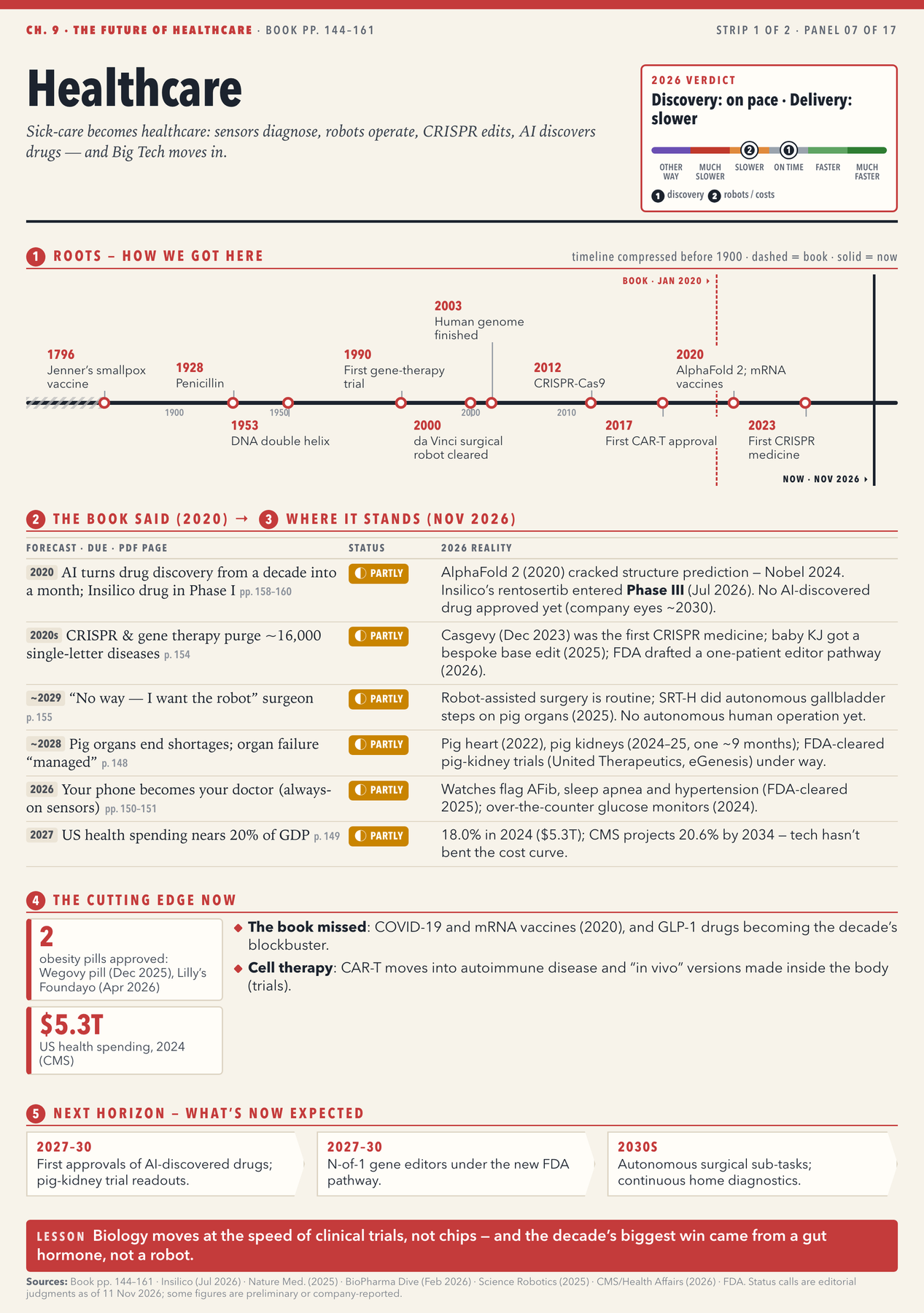
Chapter 10: The Future of Longevity
What I Should Retain
- Three takeaways: aging can be investigated as interacting biological processes; interventions on several processes might reinforce one another; findings in worms, mice, or biomarkers do not establish additional healthy years in humans.
- Evidence anchors: combined gene changes extend C. elegans lifespan more than the researchers expected; rapamycin connects drug repurposing to animal longevity studies; mouse parabiosis motivates research on circulating factors.
- Factual anchors: the chapter uses the nine-hallmark framework associated with 2013 aging research. It reports different escape-velocity forecasts from Kurzweil and Aubrey de Grey, rather than a common agreed timetable.
- Essential distinction: lifespan is duration; healthspan concerns healthy function. The latter connects the chapter to the book’s claim that longer productive lives could accelerate innovation.
- Connection to test: identify what outcome a longevity claim actually measures before asking how impressive it sounds.
Chapter Objective and Through Line
This chapter examines the biological mechanisms behind Chapter 4’s proposed longer-lives accelerator. The authors reframe aging as a collection of processes open to investigation, then describe genetic, pharmaceutical, regenerative, and blood-factor approaches. The argument is strongest when it shows how understanding a mechanism creates a testable intervention. It becomes more speculative when it moves from particular experimental results to confident predictions about large extensions of human life.
The through line is convergence: genomic information, computation, drug discovery, cells, and organ replacement might jointly influence several sources of decline. Longevity escape velocity expresses the ambition that successive improvements could arrive faster than a person exhausts their remaining life. This is a forecast about an entire continuing research and delivery system. It cannot be established by a single encouraging result. The chapter contributes a map of research directions and an explanation of why healthspan matters, while leaving the magnitude, timing, and distribution of human benefit unresolved.
Chapter Structure at a Glance
- Divide aging into interacting biological mechanisms.
- Show that combined interventions can have unexpected effects in a model organism.
- Define the ambition of longevity escape velocity.
- Examine repurposed drugs, senolytics, and regenerative approaches.
- Investigate circulating factors through animal experiments.
Section-by-Section Argument
The Nine Horsemen of Our Apocalypse
The source presents nine mechanisms as an organizing framework. Its language of aging as “planned obsolescence” is the authors’ framing, not a settled explanation of evolution. Retain the mechanisms without turning that metaphor into a universal biological law.
| Hallmark in the book | Meaning to retain |
|---|---|
| Genomic instability | Accumulating damage or instability in genetic information |
| Telomere attrition | Shortening of protective chromosome ends and associated cellular limits |
| Epigenetic alterations | Changes in regulation of gene expression |
| Loss of proteostasis | Impaired maintenance and disposal of proteins |
| Deregulated nutrient sensing | Disruption in pathways responding to nutrients and energy availability |
| Mitochondrial dysfunction | Impaired cellular energy-related function |
| Cellular senescence | Persisting cells with altered behavior, including inflammatory effects |
| Stem-cell exhaustion | Reduced capacity for tissue maintenance and repair |
| Altered intercellular communication | Disrupted signaling between cells and systems |
This list helps explain why one intervention may leave other constraints untouched. The processes interact, so combinations could matter; interaction also makes prediction difficult. The table records the framework used in the book, not a claim that it is the final contemporary classification. Attachment (file not included in this release)
Longevity Escape Velocity
The C. elegans example concerns combined changes involving daf-2 and rsks-1. The authors describe worms living far longer than a simple addition of earlier effects suggested, using research reported around 2013–2014. Its conceptual value is interaction: effects can depend on the combination.
A multiple of worm lifespan is not an estimate of the same multiple in humans. Different organisms, mechanisms, trade-offs, and conditions intervene. The authors nevertheless use the example to introduce a broader possibility: continuing advances could extend remaining life by at least one year for each year lived. They report roughly 12-year and 30-year escape-velocity forecasts from Kurzweil and de Grey respectively. This is a disagreement in projected timing reported by the authors, with neither timetable established by the animal evidence. Attachment (file not included in this release)
The Anti-Aging Pharmacy
Rapamycin’s story moves from a compound found in 1960s Rapa Nui samples through established medical uses to experiments on aging. The chapter describes a 2009 mouse lifespan result and later human research addressing more limited outcomes. Its significance is drug repurposing: a known pathway or compound can suggest a different question for investigation.
Metformin offers another example, with the source itself leaving the human longevity question open. Senolytics target particular senescent cells and their effects. The reported mouse benefits are encouraging for that research program, but their percentages apply to the described animal experiments.
Samumed’s Wnt-pathway work introduces signaling and regeneration. Small trials, safety work, and individual patient stories have different evidential weight from a replicated demonstration of broad disease reversal. The book’s large valuation references measure investor expectations, not clinical success. The unresolved question is whether a specific intervention yields an acceptable balance of benefits and harms in a defined human population. Attachment (file not included in this release)
The Bloody Fountain of Youth
Mouse parabiosis links circulatory systems of young and old animals. Changes in the older animals motivate efforts to identify helpful or harmful blood components, including GDF11-related work, and companies such as Elevian and Alkahest investigate particular approaches.
This is a route from an experimental observation to possible mechanisms. It does not establish that a commercial young-plasma infusion reverses human aging. The FDA’s separately sourced position on that distinction appears below. The chapter’s final certainty that major human life extension is a matter of timing is the authors’ extrapolation; the described experiments establish a research direction, not that conclusion’s inevitability. Attachment (file not included in this release)
Key Concepts and Distinctions
- Healthspan versus lifespan: functional, healthy years versus total duration; different outcomes can move differently.
- Hallmarks of aging: interacting processes used to organize research targets; explanatory framework, not a single cause.
- Senolytics: interventions directed at particular senescent cells; mechanistic promise requires outcome evidence.
- Longevity escape velocity: improvements extend remaining life as fast as time passes; a system-level future hypothesis.
- Translation: moving from a model organism or early result to demonstrated human benefit.
Essential Evidence and Examples
- Double-mutant worms: combination effects can be larger than an additive expectation; no direct human-year conversion follows. Attachment (file not included in this release)
- Rapamycin: an existing compound generates a new aging research question; the cited lifespan result is in mice. Attachment (file not included in this release)
- Senolytic experiments: effects concern specified animals, treatments, and measured outcomes. Attachment (file not included in this release)
- Mouse parabiosis: motivates investigation of circulating factors, not a proven human rejuvenation service. Attachment (file not included in this release)
Chapter Conclusion and Significance
The chapter makes aging more analytically tractable by separating interacting mechanisms and associating them with research approaches. That supports the possibility of targeted experiments and combinations. The book then makes a much stronger extrapolation toward substantial, widely available human life extension.
Keep the transition visible. Scientific interest, early evidence, commercial investment, human efficacy, and widespread access are separate stages. The chapter explains why the authors regard longevity as consequential to innovation, while providing less certainty about when that consequence will be realized.
Questions for Reflection
- Distinguish healthspan from lifespan.
- Name three hallmarks of aging used in this chapter.
- What is longevity escape velocity?
- What does the combined worm-gene experiment show, and what human conclusion does it leave open?
- How would you distinguish a promising longevity mechanism from a proven human intervention?
Answers and Feedback
- Healthy function versus total years lived. The book’s innovation argument depends particularly on the first. Attachment (file not included in this release)
- Any three accurate entries from the table, with their meanings: for example telomere attrition, loss of proteostasis, and cellular senescence. Attachment (file not included in this release)
- Continuing advances add at least a year of remaining life per year lived. It is a future hypothesis, not a demonstrated population outcome here. Attachment (file not included in this release)
- Interacting changes can yield unexpected longevity effects in worms. The size and safety of analogous effects in humans remain unestablished by that experiment. Attachment (file not included in this release)
- Specify the population, intervention, comparison, clinical outcome, duration, and harms. A mechanistic change or animal survival result answers a narrower question than additional healthy human years. Attachment (file not included in this release)
Cautions and Limits
Animal life extension, early-phase research, and company valuations do not demonstrate human longevity escape velocity. The source’s aging and evolutionary metaphors are stronger than its evidence requires. Keep the separate FDA check attached to discussion of commercially offered young-plasma treatments.
2026 Forecast Check
How this chapter’s forecasts compare with November 2026. Status tags are editorial judgments; see the full fold-out for the scorecard and method.
Panel 08 · Longevity
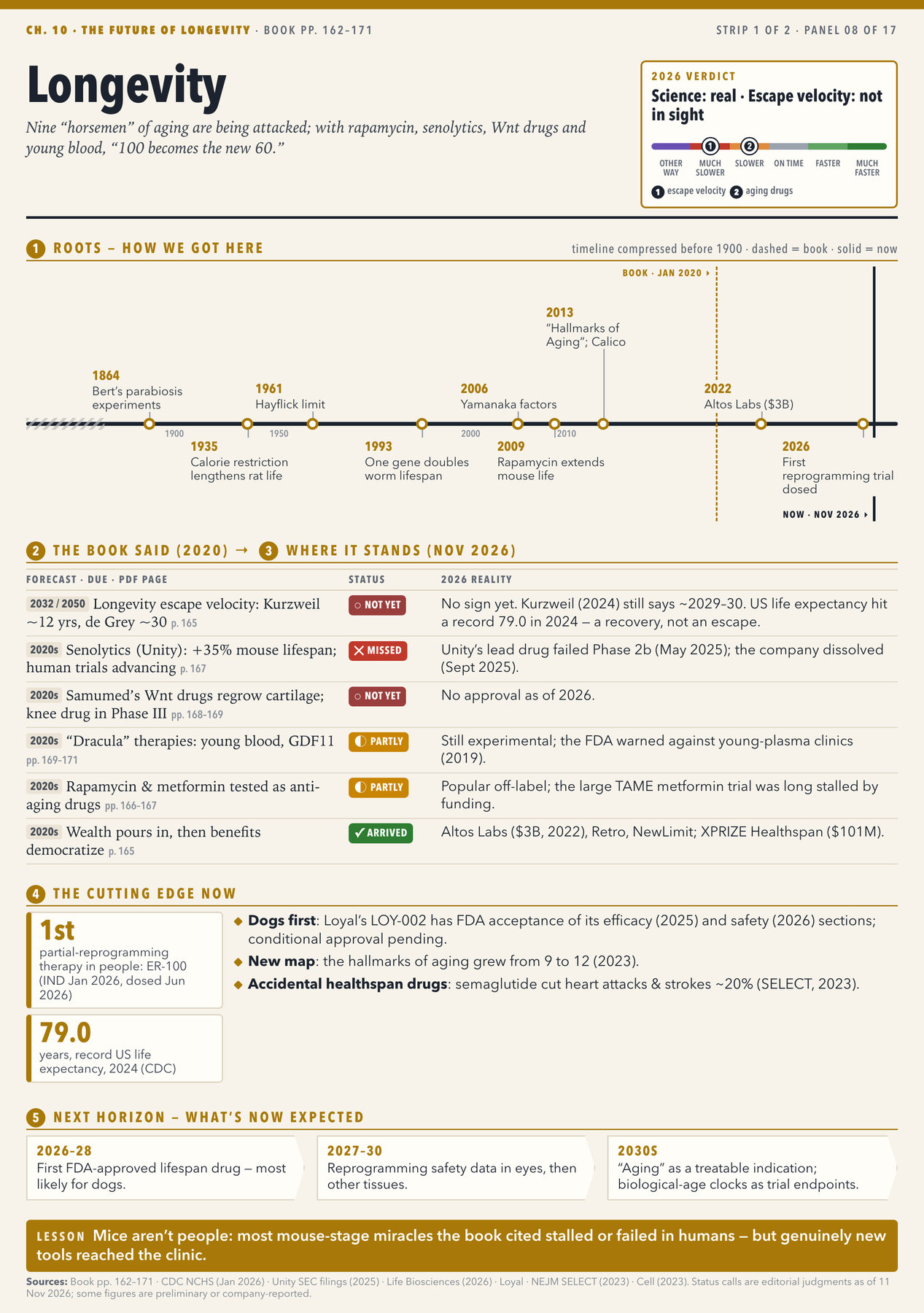
Chapter 11: The Future of Insurance, Finance, and Real Estate
What I Should Retain
- Three takeaways: information and coordination costs shape all three industries; continuous data can change risk assessment and service delivery; removing an intermediary’s visible task does not eliminate every obligation it fulfilled.
- Evidence anchors: Lloyd’s shipping information supports underwriting; Progressive’s driving sensors connect premiums to behavior; M-Pesa solves transfers with phones and local agents; eXp replaces an office with virtual coordination.
- Factual anchors: the source dates Lloyd’s coffeehouse to 1686, TripSense to 2004, Snapshot to 2008, and M-Pesa’s Kenyan launch to 2007. The three sectors involve different legal and physical constraints.
- Connection to test: describe the costly task, the trust required, and the remaining liability before calling a new platform “disintermediation.” A cheaper interface can change the business without making the complete service automatic.
Chapter Objective and Through Line
This chapter extends the convergence argument into three large systems for assessing risk, moving resources, and arranging ownership or use of property. They share substantial information-processing and coordination tasks, making them plausible targets for networks, sensors, AI, and software-mediated transactions. The authors use this common structure to explain why firms outside established institutions could enter their markets.
The progression begins with insurance’s dependence on information, moves through the basic jobs performed with money, and ends with property search and the importance of location. Technology can alter the cost of assessing a customer, executing a transaction, maintaining an organization, or reaching a place. Some proposed changes transfer a task or risk to a different actor; others might reduce the amount of it. Keeping that distinction visible prevents the chapter’s rhetoric of eliminating middlemen from obscuring necessary functions. Its contribution is a set of business mechanisms to investigate, while its projections about vanished industries depend on adoption, incentives, reliable operation, and institutional arrangements beyond the interface.
Chapter Structure at a Glance
- Establish information and risk pooling as insurance foundations.
- Change who bears risk and how it is measured.
- Digitize the jobs of storing, transferring, investing, and spending money.
- Use customer behavior to discover the strongest application.
- Reduce property-service coordination and search costs.
- Ask whether new transport changes the value of proximity.
Section-by-Section Argument
The Full Future
Insurance, finance, and real estate extend the industry survey beyond the earlier consumer-facing examples. The unifying proposition is that cheaper information and coordination could change how people obtain familiar services. The sectors overlap economically, while the work being performed should still be separated. Attachment (file not included in this release)
Coffee, Risk, and the Origins of Insurance
Edward Lloyd’s 1686 London coffeehouse becomes a source of shipping intelligence and a meeting place for people willing to assume maritime risk. Its later move to Lombard Street expands the setting for news and transactions. The book uses this history to show that insurance’s foundations include reliable information, participant coordination, and risk assessment. Contemporary sensors and networks can alter these same functions, even though the underlying need to bear uncertain losses persists. Attachment (file not included in this release)
The Car That Doesn’t Crash
Autonomous transport could alter both accident patterns and the identity of the insured party. A passenger purchasing a ride has a different relationship to the vehicle from its owner or operator. Responsibility could involve the fleet, manufacturer, software, sensor suppliers, and other actors.
The source treats removal of human driving errors as a major reduction in danger, but the proportion of crashes involving human error is not a measured proportion eliminated by automation. New failure modes and liability questions remain. The stronger inference is a change in risk and its allocation, not the disappearance of all motor-related insurance. Attachment (file not included in this release)
Crowdsurance
Digital coordination can make it easier to assemble pools, process information, and automate selected claims. The authors also describe healthier customers leaving a broad pool, which could raise costs for those remaining. This is a tension between individual selection and collective risk sharing.
Lemonade illustrates a simplified digital interface; Etherisc illustrates payments tied to a defined event such as a flight delay. The latter still requires an agreed information source and funded obligations. The examples support redesigning administration and selected products, without proving that legal insurance responsibilities, adequate capital, or external verification vanish. Attachment (file not included in this release)
Dynamic Risk
Progressive’s 2004 TripSense experiment and 2008 Snapshot offering connect prices to observed driving behavior. The authors extend this mechanism to building sensors and possible health monitoring. Information could support prevention as well as payment after damage: a detected water problem can prompt action before a major loss.
More granular data also changes who benefits. Individualized prices can reward some behaviors while making coverage more expensive or intrusive for others. A lower administrative cost and a socially desirable distribution of risk are different results. Attachment (file not included in this release)
Finance
The authors divide money’s uses into storing, moving, investing, and spending. This helps avoid treating “banking” as one indivisible activity. Different technologies can alter different jobs, and a nonbank can supply a useful interface while relying on other institutions for parts of the service. Attachment (file not included in this release)
Good Money
Gunnar Lovelace’s proposed mobile service combines convenience, customer participation, and values-oriented deployment of profits. The example illustrates a commercial proposition for people dissatisfied with existing banking arrangements. Its descriptions of fees, ownership, and benefits belong to the offering reported at the time; they are not current product terms or a recommendation. The relevant question is which customer dissatisfaction a different arrangement addresses. Attachment (file not included in this release)
An Unusual Proposition
M-Pesa begins as a mobile-finance experiment and launches in Kenya in 2007. The powerful use case becomes remittances: workers can transfer money without relying on an envelope carried by someone else. Local agents support cash-in and cash-out. The human distribution network is part of the innovation, not a detail that technology eliminates.
This is a strong business-discovery example because observed use changes the emphasis from the designers’ original microfinance purpose. The service fits existing phones and an urgent recurring task. Its development also challenges the assumption that useful innovations always originate in rich-country technology centers. The separately checked poverty study below uses households, correcting the book’s imprecise denominator. Attachment (file not included in this release)
The AI Invasion
TransferWise, peer-to-peer lending, alternative credit assessment, and automated portfolio services illustrate different ways to reduce matching, evaluation, or administrative costs. A cheaper transaction or an accessible account is a concrete service change. It is different from proving superior investment returns or eliminating default risk.
The same data that extends access can generate opaque or intrusive decisions. The source’s rhetoric about replacing trust with data should be read as a change in the basis of trust: users still depend on records, models, operators, and institutions. Automated trading, portfolio allocation, and financial advice also perform different jobs and should not be collapsed into one statistic. Attachment (file not included in this release)
Real Estate
Glenn Sanford responds to the 2008 recession-era environment by creating a brokerage coordinated through a virtual campus. eXp’s example concerns organizational overhead and communication. Agents can work together without the same physical office arrangement; this does not by itself remove the service they provide to customers. Attachment (file not included in this release)
Say Goodbye to Your Broker
AI can help search, value, compare, and manage property. VR can make remote tours and hypothetical renovations more accessible. The authors imagine a personal assistant learning from reactions to improve recommendations, potentially reducing the need for some brokerage tasks.
The title’s stronger replacement claim remains conditional. A compelling tour does not establish a building’s condition, a valid title, suitable financing, or the quality of a negotiation. Separate search and visualization from the other obligations within a property transaction. Attachment (file not included in this release)
Reinventing the City
Proximity has value because people need access to work, relationships, services, and amenities. Faster or more usable travel could change this relationship. Remote presence could alter some needs more directly. The conclusion depends on the actual time, cost, reliability, and desirability of access; physical geography alone is not the full measure.
The authors also discuss floating-city proposals, including 2019 interest in Oceanix. These are attempts to create usable places under different environmental constraints, not completed proof of universal resilience or cheap coastal housing. Location’s value may change while physical infrastructure, maintenance, and governance remain essential. Attachment (file not included in this release)
Key Concepts and Distinctions
- Underwriting: assessing and accepting risk for a premium; data changes its inputs without erasing losses.
- Dynamic risk: assessment informed by changing observations, potentially supporting prevention.
- Adverse selection: lower-risk participants leaving can alter the cost of a remaining pool.
- Disintermediation: some tasks move away from an established intermediary; needed functions can persist elsewhere.
- Proximity: practical access to valued activities; transport and remote presence can change its cost.
Essential Evidence and Examples
- Lloyd’s coffeehouse: information and coordination support risk markets. Attachment (file not included in this release)
- TripSense/Snapshot, 2004/2008: observed behavior informs pricing. Attachment (file not included in this release)
- M-Pesa, 2007: urgent remittances plus phones and local agents create a useful complete service. Attachment (file not included in this release)
- eXp: virtual coordination reduces some physical overhead while brokerage continues. Attachment (file not included in this release)
Chapter Conclusion and Significance
The chapter shows that information-rich industries can be decomposed into specific tasks, risks, and coordination problems. This opens space for new entrants with lower costs or a better customer interface. M-Pesa especially demonstrates how an accessible capability becomes valuable through real demand and an appropriate delivery network.
The limit is functional completeness. Trust, liability, capital, physical verification, and institutional legitimacy do not disappear because software handles an interaction. The business opportunity may consist in combining those continuing functions more effectively. Chapter 12 applies a similar system-wide analysis to food’s physical resource chain.
Questions for Reflection
- What connected Lloyd’s coffeehouse to the development of insurance?
- What are the four uses of money identified by the authors?
- When and where did M-Pesa launch, and what use became especially important?
- How can continuous measurement both reduce losses and create a social trade-off in insurance?
- Why does a virtual property tour replace less than the complete brokerage function?
Answers and Feedback
- Shipping information and a place to coordinate risk-taking. Those functions supported underwriting. Attachment (file not included in this release)
- Store, move, invest, spend. Distinct tasks can be redesigned separately. Attachment (file not included in this release)
- Kenya, 2007; remittances. Local cash agents helped connect phones to ordinary financial life. Attachment (file not included in this release)
- Earlier warnings can prevent damage, while granular pricing or surveillance changes access and privacy. Explain both the operating gain and who could bear additional costs. Attachment (file not included in this release)
- Search and visualization leave other transaction requirements. Condition, title, negotiation, financing, and local knowledge are possible examples; identify their separate role. Attachment (file not included in this release)
Cautions and Limits
Product terms, financial forecasts, liability rules, and projected housing outcomes in this chapter belong to the book’s period. No current financial recommendation follows from them. Several described systems automate only selected tasks; retain the distinction between lower administrative cost and disappearance of the underlying risk or obligation.
2026 Forecast Check
How this chapter’s forecasts compare with November 2026. Status tags are editorial judgments; see the full fold-out for the scorecard and method.
Panel 11 · Insurance
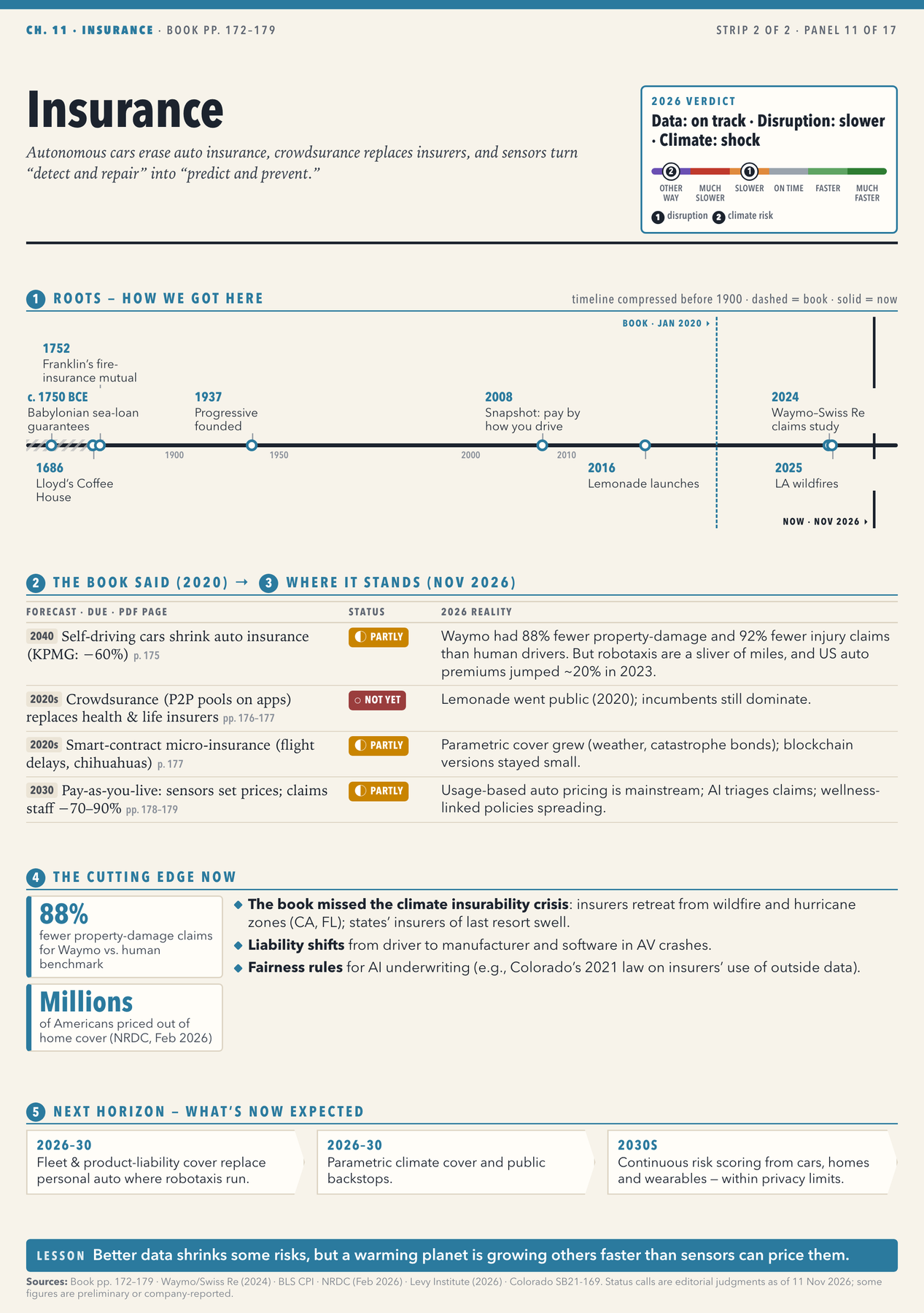
Panel 12 · Money & Finance
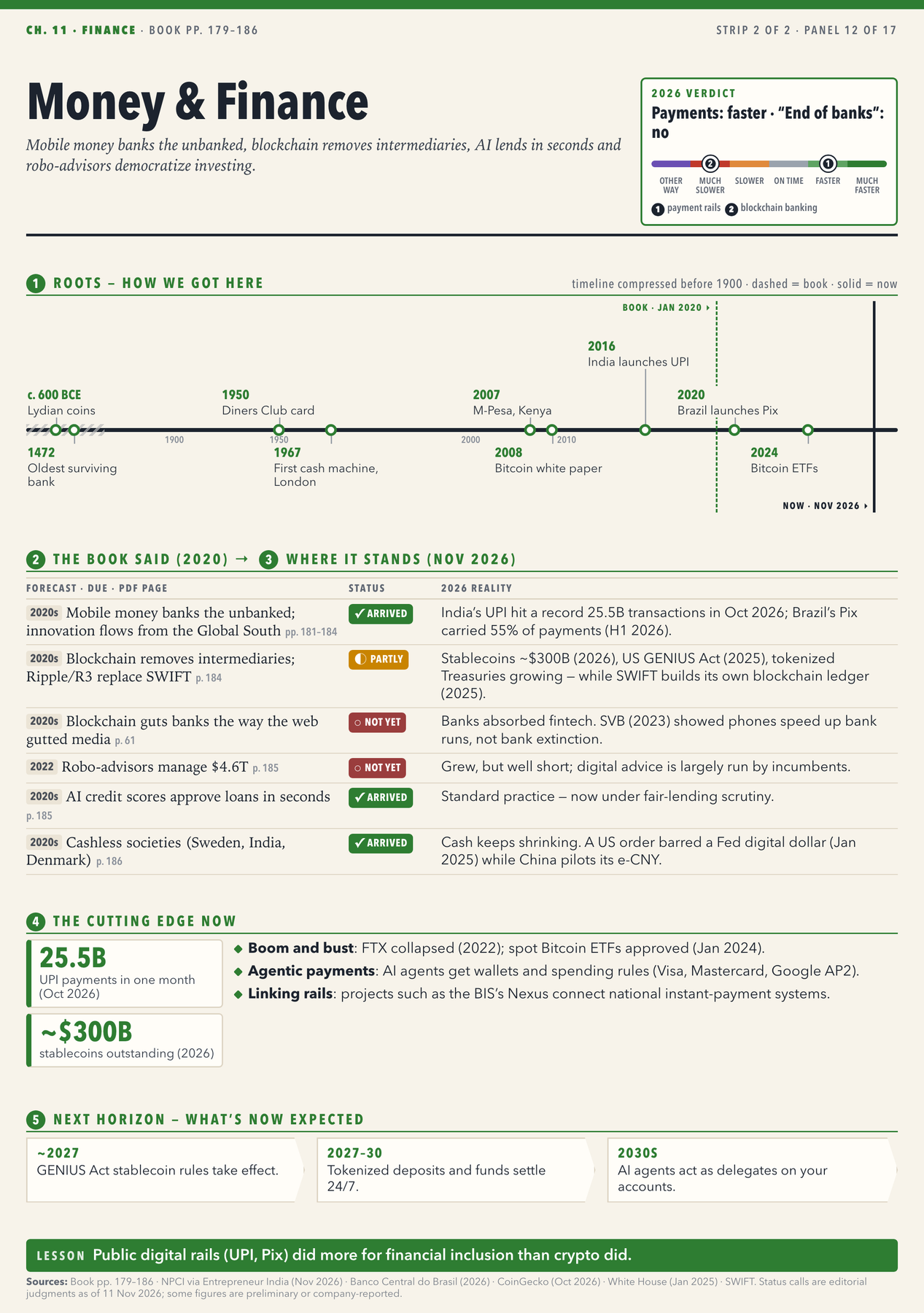
Panel 13 · Real Estate & Cities
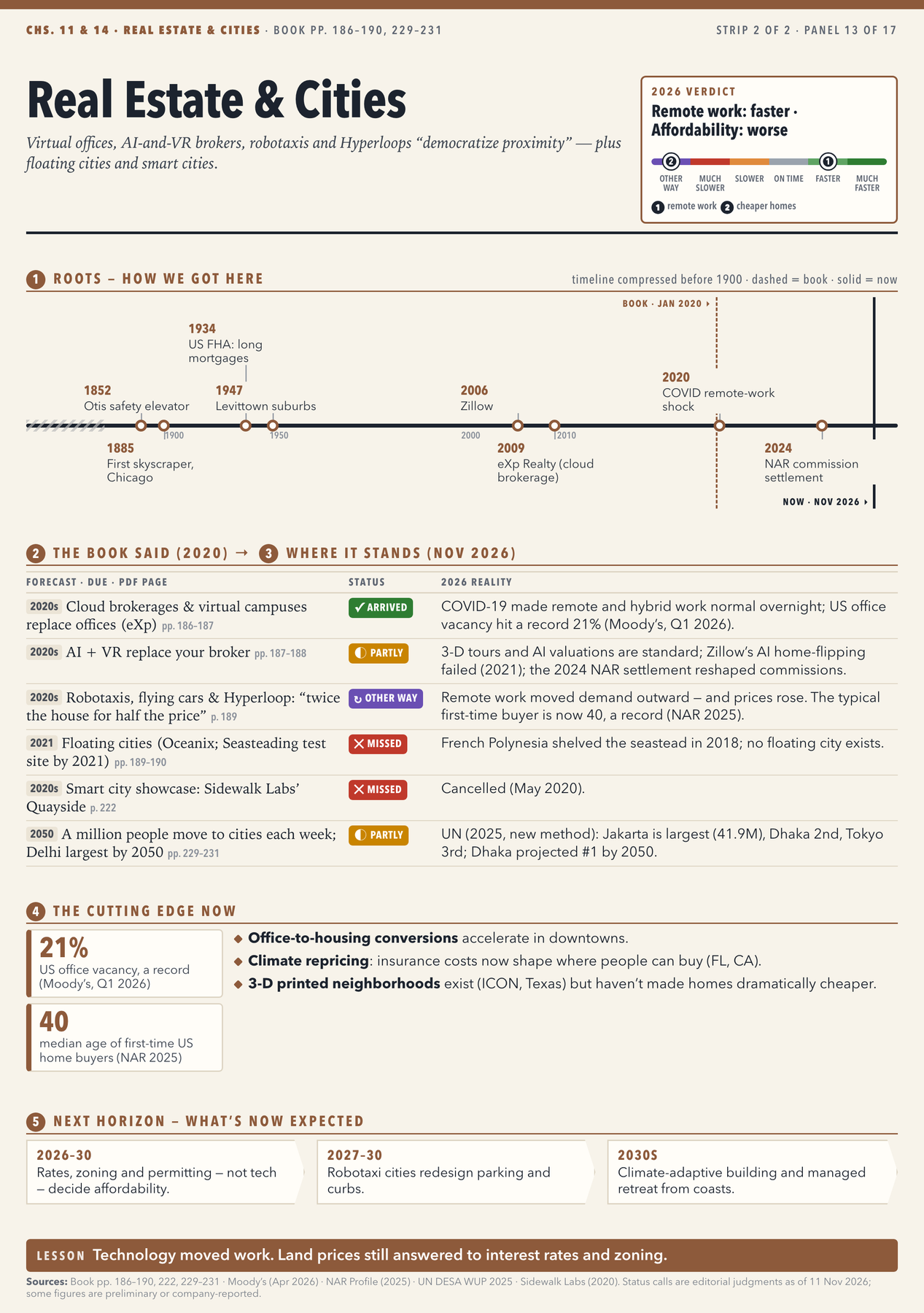
Chapter 12: The Future of Food
What I Should Retain
- Three takeaways: food has several different resource and waste bottlenecks; improved crops, preservation, controlled environments, and alternative production address different links; environmental benefit and commercial viability depend on the complete process.
- Evidence anchors: photosynthesis research targets yield; Apeel targets spoilage; vertical farms target control and proximity; cultured meat targets producing desired tissue without raising an entire animal.
- Factual anchors: the first cultured burger’s 2013 prototype cost and later prices in the chapter describe different products and units. The 2030 robo-kitchen is an opening scenario, not an established household system.
- Connection to test: look for an expensive loss between production and use. Preserving or coordinating an existing output can be a different opportunity from inventing a new way to produce it.
Chapter Objective and Through Line
Food brings convergence into a material system with biological growth, energy use, transportation, perishability, preparation, and consumption. The authors open with a speculative automated dinner, then work backward to the sources of inefficiency. Their argument is that improvements can target several links simultaneously, changing both the amount of food available and the resources required to supply it.
The chapter moves from plants to preservation and controlled environments, then to the particular costs of producing animal products. Cultured meat is presented as a way to obtain selected tissue without raising a whole animal, while fermentation supplies an adjacent route to dairy proteins. The authors expect these changes to improve access, reduce ecological pressure, and spare animals. Their own discussion identifies important barriers in growth media, texture, energy, and scale. These conditions are essential to the reasoning: a technically successful sample becomes a system-level solution only when production, delivery, price, and customer acceptance also work.
Chapter Structure at a Glance
- Imagine an integrated automated meal.
- Identify losses across the existing food chain.
- Improve plant production and preserve output longer.
- Move selected crops into controlled environments.
- Explore alternatives to raising whole animals for selected products.
Section-by-Section Argument
The opening meal — analytical division
The imagined 2030 dinner combines preference-aware AI, delivery, traceability, printing, robotic preparation, and cultured ingredients. It functions as a convergence exercise. Some components existed separately when the book was written; that is different from an affordable and dependable kitchen offering the entire experience. The subsequent argument asks which production and delivery constraints those components might change. Attachment (file not included in this release)
The Inefficiency of Food
The authors follow energy through photosynthesis, growing, transport, spoilage, and discarded food. Their strongest conceptual point is that waste has several locations. A higher farm yield, a longer shelf life, and a shorter supply chain improve different quantities.
Research associated with RIPE and other plant laboratories illustrates efforts to improve photosynthetic performance. Reported gains concern particular plants and experiments; applying them to global food production requires further work. Apeel supplies a contrasting route: a plant-derived protective coating slows moisture loss and spoilage. Keeping more of an existing harvest usable can matter without increasing the harvest.
Vertical farms combine controlled light, water and nutrient delivery, sensors, and software. Plenty and AeroFarms illustrate the approach; robotics could change handling costs. Location and control can reduce selected resource or transport requirements, while electricity, equipment, crop choice, and labor still affect the complete economics. A high yield per unit of floor area does not alone establish a cheaper or environmentally superior food system. Attachment (file not included in this release)
The Inefficiency of Growing a Cow
The authors argue that raising a whole animal uses resources beyond those needed to produce the desired edible tissue. Cultured meat attempts to change this pathway: obtain cells, supply a growth medium, and develop tissue in a controlled process. The chapter explicitly identifies difficult growth media, structured meat, and energy requirements.
The 2013 cultured burger is a prototype cost anchor. Later quoted figures involve different meats and units, so they should not be plotted as one like-for-like price series. Future low-price targets remain targets. Environmental percentages in the chapter also depend on production and energy assumptions; they are not measured guarantees for every future factory.
Perfect Day’s dairy-protein work illustrates an adjacent route through fermentation. The point is the function and composition supplied to customers, not that all alternatives use the same method. The authors end with a strong forecast of reducing animal slaughter and ecological pressure. That conclusion depends on viable scale, access, substitution, and acceptable products; technical possibility alone establishes less. Attachment (file not included in this release)
Key Concepts and Distinctions
- System efficiency: usable food relative to all required inputs and losses; different improvements need comparable boundaries.
- Vertical farming: controlled-environment cultivation arranged to use space intensively; crop and energy requirements matter.
- Cultured meat: growing animal cells or tissue through a controlled process; different from growing the whole animal.
- Preservation versus production: retaining usable output versus creating additional output; separate sources of value.
Essential Evidence and Examples
- Photosynthesis experiments: scoped improvements in plant production, with further translation required. Attachment (file not included in this release)
- Apeel: a preservation intervention at a different link in the chain. Attachment (file not included in this release)
- Plenty / AeroFarms: integration of controlled environments, sensing, and software. Attachment (file not included in this release)
- Cultured meat: the source identifies media, tissue structure, energy, and scale as unfinished steps. Attachment (file not included in this release)
Chapter Conclusion and Significance
Food exemplifies the book’s case for interacting solutions: less spoilage, better yields, different locations, and alternative biological production could reduce several pressures together. The useful analytical move is to locate the specific loss and ask which capability changes it.
The chapter does not establish that every alternative has favorable complete economics or that greater technical supply automatically resolves hunger. Access and distribution remain necessary. Chapter 13 widens these dependencies into environmental and societal risks.
Questions for Reflection
- What food-chain problem does Apeel target?
- Name three inputs controlled in a vertical farm.
- What are the basic steps in the cultured-meat process described here?
- Why is greater yield per floor area insufficient to prove lower total cost?
- How could preventing spoilage create value without changing farm output?
Answers and Feedback
- Spoilage and moisture loss. The intervention preserves more existing food. Attachment (file not included in this release)
- Light, water, nutrients, temperature, or related environmental variables. Select three and explain their roles. Attachment (file not included in this release)
- Obtain cells, supply growth conditions and nutrients, and grow tissue in a controlled system. Structured products and economical scale add challenges. Attachment (file not included in this release)
- Other inputs can be costly. Electricity, equipment, labor, crop cycle, losses, and delivery must enter the comparison. Attachment (file not included in this release)
- More of the same harvest reaches use or sale. A strong answer follows the effect on losses, availability, and the buyer’s costs. Attachment (file not included in this release)
2026 Forecast Check
How this chapter’s forecasts compare with November 2026. Status tags are editorial judgments; see the full fold-out for the scorecard and method.
Panel 14 · Food
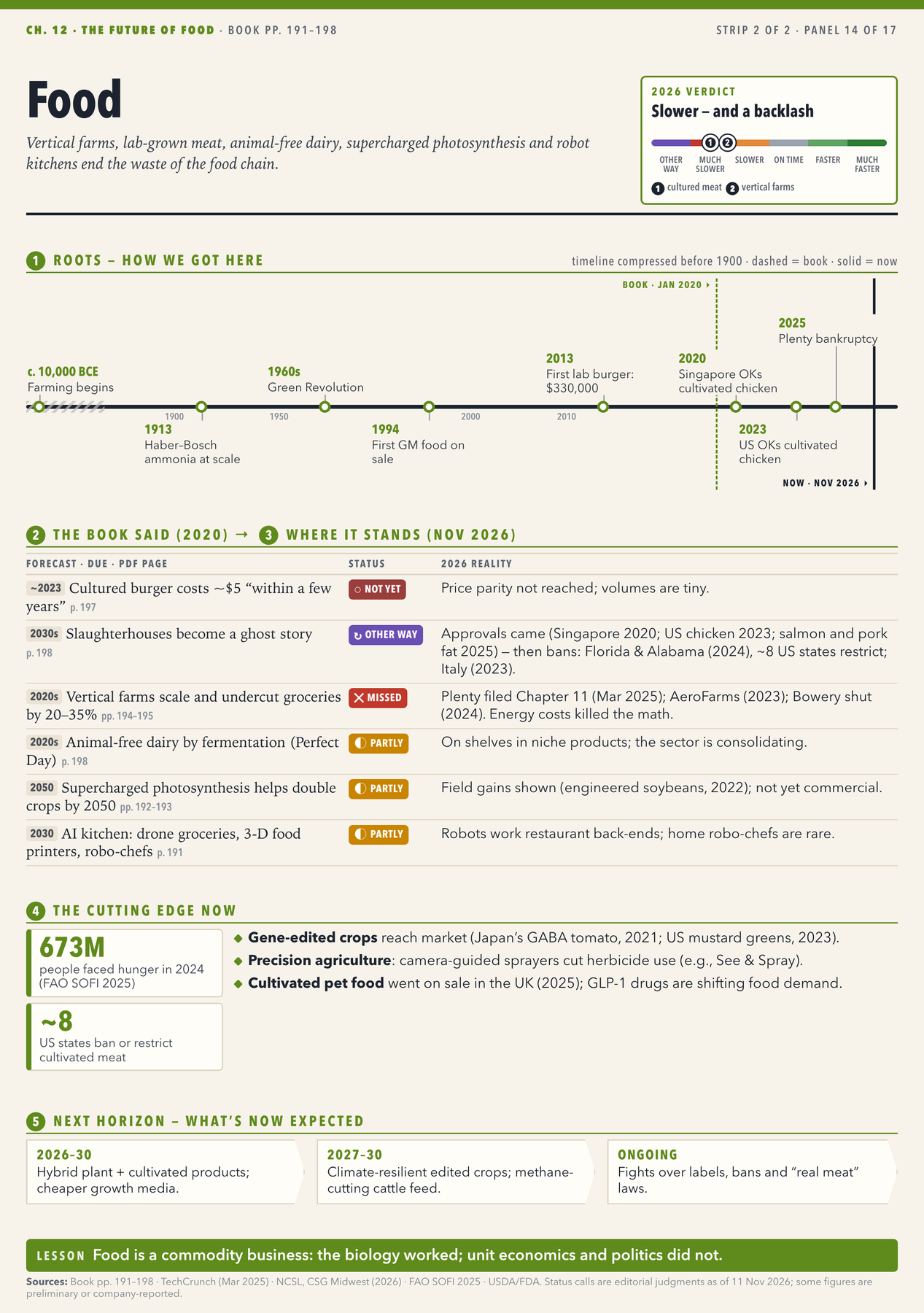
Chapter 13: Threats and Solutions
What I Should Retain
- Three takeaways: acceleration produces risks alongside opportunities; connected problems can benefit from connected solutions; deployment and cooperation remain essential even when useful technology exists.
- Evidence anchors: Kamen’s purifier needs distribution partners; renewable generation needs storage and grids; restoring mangroves can support habitat, carbon storage, and flood protection; historical automation sometimes changes tasks and demand rather than simply eliminating work.
- Factual anchors: the chapter responds to environmental warnings from 2018; it discusses the 2008 Myanmar cyclone and historical labor-market examples. The existential-risk response is organized into vision, prevention, and governance.
- Connection to test: when a new capability produces a benefit, trace who bears the transition cost and what institution must make adoption work. An opportunity may lie in that difficult implementation rather than in the most visible invention.
Chapter Objective and Through Line
Chapter 13 asks whether the changes celebrated earlier could be overtaken by environmental destruction, economic disruption, or technologies used destructively. The authors explicitly reject an automatic path from invention to a good outcome. Their response is that converging tools can expand the capacity to address problems, while cooperation determines whether that capacity is deployed at sufficient scale.
The progression starts with water, moves through energy and ecosystems, then examines employment and existential danger. In each case the authors identify a problem, a set of possible responses, and a coordination requirement. Their optimism rests on growing capability, wider participation, and the entrepreneurial significance of large unmet needs. This chapter is therefore a necessary qualification to the industry forecasts: progress involves infrastructure, institutions, and collective choices as well as prototypes. Its proposed responses remain unevenly evidenced, and historical examples cannot settle all future risks. The useful contribution is the explicit move from what might be possible to what a society must organize to make it beneficial.
Chapter Structure at a Glance
- Identify risks capable of interrupting the acceleration story.
- Combine supply and demand interventions for water.
- Treat clean energy as generation, storage, transport, and coordination.
- Connect restoration to multiple ecosystem services.
- Distinguish automated tasks from net employment outcomes.
- Organize existential-risk responses around foresight and institutions.
Section-by-Section Argument
Water Woes
The authors frame the 2018 climate and global-risk reports as warnings that ecological problems require rapid action. They then return to Dean Kamen’s Slingshot purifier. Its significance depends on more than making dirty water clean: manufacturing, power, maintenance, distribution, and a functioning local service must connect the invention to people.
Kamen’s 2012 Coca-Cola partnership and subsequent Ekocenter distribution illustrate this implementation layer. Atmospheric extraction and other purification approaches add options, while farm sensing and water management address demand. A machine meeting prize conditions in a particular setting does not establish cheap water production under every climate or operating condition. The chapter’s strongest general point is to connect technical capacity with a complete delivery system. Attachment (file not included in this release)
Climate Change for Optimists
The authors emphasize falling renewable-generation costs and the potential complementarity of wind and solar. Better materials, monitoring, installation, and maintenance could improve the economics further. Ramez Naam supplies much of the interpretation through interviews.
Several quantities must remain separate: panel cost per watt, generation cost per kilowatt-hour, contracted prices in favorable locations, and the cost of supplying dependable electricity. They answer different questions. A lower generation price can support adoption without demonstrating that all grid, storage, and delivery requirements have become inexpensive. The authors’ accessibility argument is that abundant incoming energy is useful only when converted into a service people can obtain. Attachment (file not included in this release)
The Story of Storage
Storage addresses the mismatch between when renewable electricity is produced and when it is required. Lithium-ion batteries, flow systems, compressed air, thermal methods, and pumped hydro are presented as a portfolio serving different needs. A portable application values different characteristics from a stationary, long-duration one.
The necessary convergence includes generation, storage, grids, and management. Improving a battery chemistry is only one part of deploying a reliable system. The source sometimes mixes power and energy units; the notes retain the functional distinction rather than reproducing those quantities. Power describes a rate, while stored energy describes an amount that can support a rate over time. Attachment (file not included in this release)
Electric Cars Are Gaining Speed
Electric transport connects energy technology to consumer requirements. Batteries, range, charging time, charging locations, and vehicle design all influence whether the service meets a user’s needs. The chapter describes automaker investment and announced policy targets from the late 2010s; targets and announcements should not be converted into completed transitions or current law.
Vehicles might also contribute to backup power or wider grid management, but battery capacity by itself does not supply the necessary electrical equipment and operating arrangements. This reinforces the chapter’s recurring point: multiple useful pieces must form a functioning system. Attachment (file not included in this release)
Biodiversity and Ecosystem Services
Ecosystem services are functions such as pollination, flood protection, and climate regulation that human life and production depend upon. The authors organize responses into drone reforestation, reef restoration, alternative seafood production, agricultural reinvention, and closed-loop manufacturing.
Their mangrove example is particularly useful. The 2008 Myanmar cyclone illustrates the devastating vulnerability of a damaged coastal environment. Restoration could support habitat, carbon storage, and flood protection together. It is therefore possible for one intervention to address several connected problems. The inference should remain proportional: neither the cyclone’s full toll nor a restoration project’s success can be reduced to one variable.
Likewise, planting seeds is a step toward a forest, not a measured surviving forest. New food production can free land only if other economic and institutional choices allow it to return to habitat. The chapter’s cooperation requirement belongs inside these causal chains. Attachment (file not included in this release)
Economic Risks: The Threat of Technological Unemployment
The authors contrast predictions of occupational exposure with late-2010s labor-market conditions and historical adaptation. Their ATM example argues that lower branch-operating costs allowed more branches and changed teller work, rather than producing the simple disappearance initially feared. Human–machine collaboration is a second mechanism: automation can alter tasks and expand output.
The important distinction is among task automation, gross job displacement, new demand, and net employment. A historical finding that the internet created more jobs than it removed is evidence about a particular period and set of economies, not a law for every future technology. Nor does a positive aggregate outcome ensure an easy transition for a particular worker or region.
The authors acknowledge threatened occupations and rely on retraining, easier interfaces, and time for adaptation. The unresolved issue is whether new opportunities arrive in places and forms displaced workers can access. Their optimism is conditional on that adjustment being organized successfully. Attachment (file not included in this release)
Existential Risks: Vision, Prevention, and Governance
The chapter introduces Nick Bostrom’s 2002 work and concerns about destructive uses or failures involving AI, biotechnology, nanotechnology, and infrastructure. Its response comprises three categories:
- Vision: extend time horizons, illustrated by Stewart Brand and the Long Now approach.
- Prevention: anticipate and reduce danger, using examples such as Dutch adaptation to water, NASA’s asteroid monitoring, and the planned DART mission.
- Governance: build institutions capable of responding to change, with Estonia’s digital public services as an example of administrative redesign.
These are response categories, not a demonstrated solution to every catastrophic risk. Faster administration is also different from removing deliberation or accountability. The authors’ Toronto Quayside example is a proposal at the time of writing; proposed smart-city software is not evidence that the complete social arrangement worked.
Their final reasons for optimism are that small teams can wield stronger tools, large problems create opportunities, and future capabilities can improve responses as well as threats. The chapter leaves collective action as the decisive unresolved link. Attachment (file not included in this release)
Key Concepts and Distinctions
- Ecosystem services: natural functions supporting life and economic activity; damage can create costs beyond the visible resource lost.
- System deployment: connecting components, maintenance, distribution, and institutions into an operating service.
- Task automation versus net employment: changing work content differs from the final balance of jobs and accessible opportunities.
- Existential risk: a threat with consequences for humanity’s survival or long-term potential; uncertainty does not supply a precise probability.
- Vision / prevention / governance: complementary ways to anticipate danger, reduce it, and organize a response.
Essential Evidence and Examples
- Slingshot and distribution: a purifier needs a route to sustained use. Attachment (file not included in this release)
- Renewable-system components: generation, storage, and coordination solve different constraints. Attachment (file not included in this release)
- Mangroves and the 2008 cyclone: environmental functions interact; restoration can supply several benefits. Attachment (file not included in this release)
- ATMs and collaboration: examples of changing costs, demand, and tasks, rather than a universal unemployment prediction. Attachment (file not included in this release)
- Estonia and Dutch adaptation: administrative design and long-horizon planning are part of the response, alongside hardware. Attachment (file not included in this release)
Chapter Conclusion and Significance
The chapter supplies the condition that keeps the book’s optimism from being purely automatic: capability must become coordinated action. Its most useful examples connect a technical result to distribution, institutions, or changed incentives. They also show why the same intervention can have consequences across several systems.
The unresolved balance is between the speed of improving tools and the speed of worsening risks or failed adjustment. A list of possible responses does not establish that they will scale in time. Chapter 14 widens this uncertainty into a century-long inquiry about where people and activity may relocate.
Questions for Reflection
- What are ecosystem services? Give two examples.
- Which partnership helped address the distribution problem for Kamen’s purifier?
- Name the three categories of response to existential risks.
- How could an ATM reduce one task while supporting more employment in a related activity?
- Why is “the technology exists” an incomplete answer to a global resource problem?
Answers and Feedback
- Useful functions supplied by ecosystems, such as pollination, flood protection, or climate regulation. Attachment (file not included in this release)
- Coca-Cola’s partnership with Kamen/DEKA, followed by the Ekocenter effort. Distribution and local operation complement purification. Attachment (file not included in this release)
- Vision, prevention, governance. Explain the distinct job of each. Attachment (file not included in this release)
- Lower operating costs can expand demand or the number of service locations, changing employee tasks. This is the source’s historical mechanism, not a guarantee for every automation. Attachment (file not included in this release)
- Scale, maintenance, financing, access, incentives, and cooperation remain. A strong answer follows one concrete component through sustained deployment. Attachment (file not included in this release) · Attachment (file not included in this release)
Cautions and Limits
Risk exposure is different from a dated prediction of losses. Climate thresholds, power/energy measures, and generation/retail costs must retain their definitions. Historical labor adaptation does not establish that every worker benefits from a later transition. The risk-response framework remains a proposal whose adequacy requires further evidence.
2026 Forecast Check
How this chapter’s forecasts compare with November 2026. Status tags are editorial judgments; see the full fold-out for the scorecard and method.
Panel 15 · Energy, Climate & Water
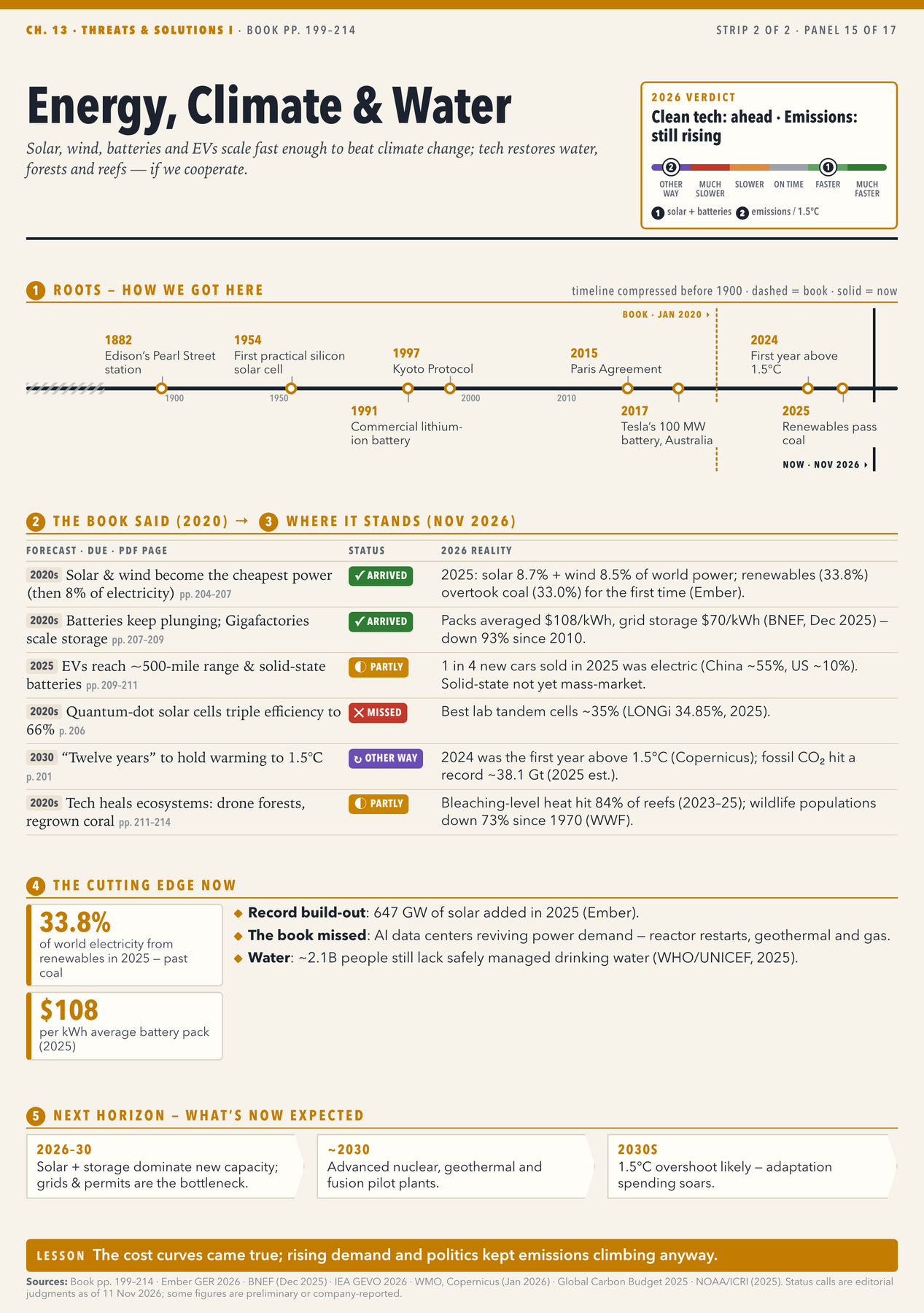
Panel 16 · Work, Risk & Government
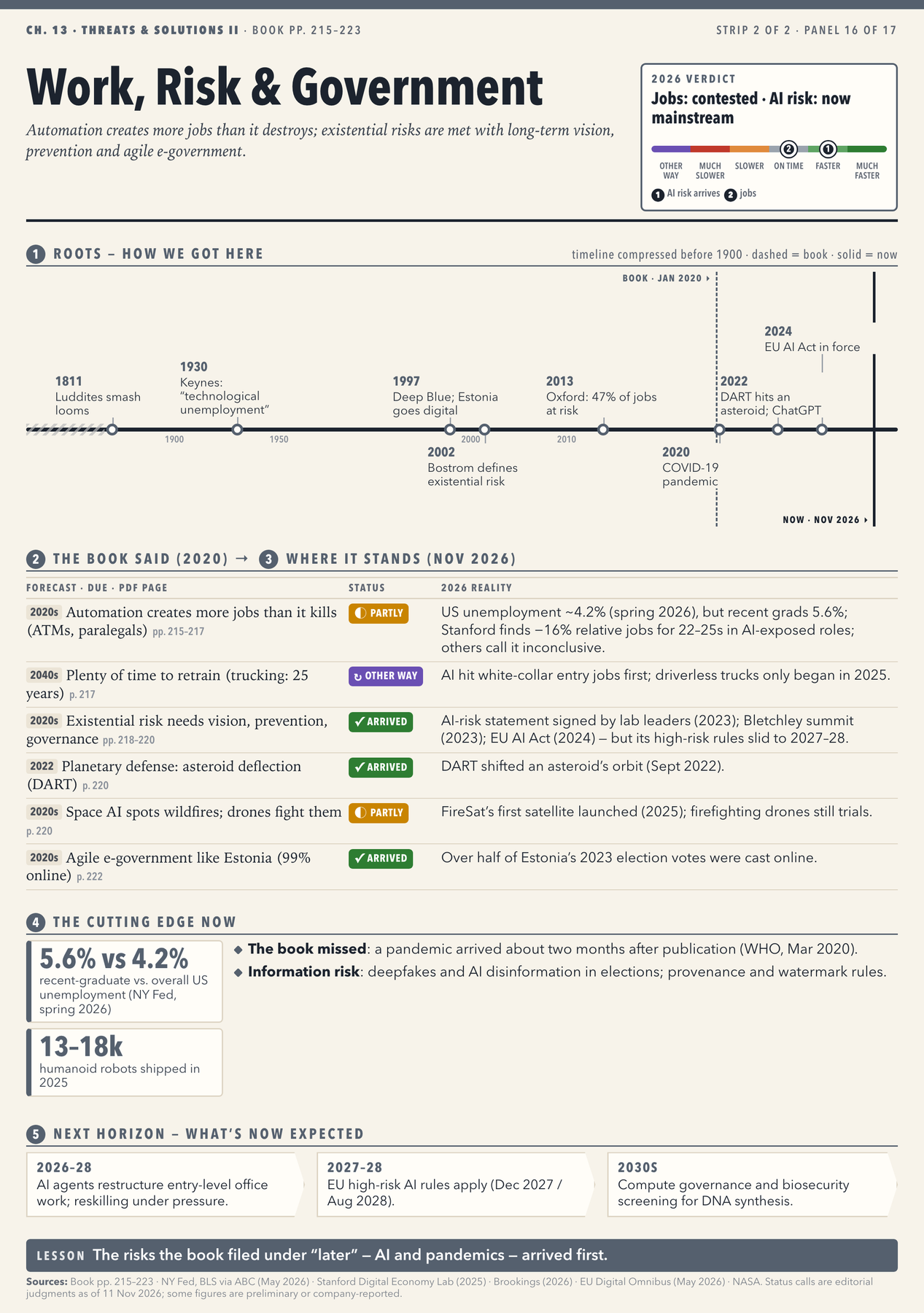
Chapter 14: The Five Great Migrations
What I Should Retain
- Three takeaways: movement can recombine people and ideas; future relocation includes both physical movement and shifts in where attention and activity occur; the five migrations have very different evidence, mechanisms, and time horizons.
- The five: climate migration, urban relocation, virtual worlds, space migration, and meta-intelligence.
- Evidence anchors: research on émigré scientists motivates the recombination argument; cities concentrate interaction; virtual economies show that some work and exchange can occur online; limited brain-interface experiments precede any speculation about collective consciousness.
- Factual anchors: Nazi persecution following the 1933 civil-service law provides the historical opening; 2007 marks the book’s half-urban global milestone; 2050 and beyond projections extend the earlier decade horizon.
- Connection to test: distinguish where people live from where they work, meet, learn, and direct attention. A business may serve one of these relocations without moving a customer’s body.
Chapter Objective and Through Line
The final chapter expands the book’s horizon from the following decade to much of the century. Migration becomes a way to connect technological change with the redistribution of people, economic activity, and experience. The authors begin from a historical proposition: movement brings knowledge into new environments and creates opportunities for recombination. They then apply this idea to environmental displacement, city growth, virtual life, settlement beyond Earth, and technologically connected minds.
These are not five instances of the same phenomenon. Climate displacement involves coercive danger; urban relocation includes economic attraction; virtual migration changes time and participation; space settlement requires a difficult physical infrastructure; meta-intelligence speculates about interfaces and consciousness. Their evidential status differs accordingly. The chapter’s role is to show how changes in place and presence could themselves feed back into innovation. Retain its broad question about the geography and organization of activity while resisting the implication that all five developments are inevitable or equally near. The available evidence supports some present mechanisms, some conditional forecasts, and some philosophical extrapolations.
Chapter Structure at a Glance
- Connect historical migration to recombination and innovation.
- Examine climate-related pressures to leave places.
- Contrast those pressures with the attraction of cities.
- Relocate selected activities into virtual environments.
- Consider the requirements and motives of space settlement.
- Separate limited neural communication from speculative collective intelligence.
Section-by-Section Argument
Migration as an innovation accelerant — analytical opening division
The authors draw on Goldin and Cameron’s account of migration, then use research associated with Petra Moser on scientists leaving Nazi Germany. The 1933 Law for the Restoration of the Professional Civil Service helps establish the coercive context. New expertise contributes to work in receiving institutions, supporting a mechanism of knowledge transfer and recombination.
Later examples concern skilled migration, product reallocation, and immigrant entrepreneurship. The populations and measures matter: findings about selected scientists, highly skilled employees, or venture-backed firms should not become a single estimate for all migrants and every outcome. The conceptual distinction is between invention counts and market changes. Patents record one kind of activity; product reallocation tracks new goods displacing older ones. The authors use both to support their larger claim that movement can change what gets made. Attachment (file not included in this release)
Climate Migrations
The authors acknowledge that mitigation described in Chapter 13 is far from fully implemented. Sea-level rise, heat, drought, and extreme weather can make existing places more difficult to inhabit. They compare forecasts from the 1990s with a 2015 Climate Central assessment and use the 1947 partition of India and Pakistan to make the possible scale emotionally concrete.
Important distinctions constrain these comparisons. Population living on land exposed under a warming scenario is not a direct count of people who will migrate by a specific year. Long-run sea-level commitment, actual timing, adaptation, and migration decisions are different variables. The source sometimes slides between them. Its strongest conclusion is that unaddressed environmental damage could impose severe human and economic costs, making prevention and adaptation consequential.
The possibility that migration eventually stimulates innovation does not compensate for or erase forced displacement’s suffering. The chapter’s normative argument favors avoiding preventable loss of homes and communities. Attachment (file not included in this release)
Urban Relocations
The chapter describes a long movement toward cities, reaching a global threshold around 2007, when approximately half the population was urban. Its 2050 projections anticipate much larger urban populations. Those totals include population growth and changes in classification as well as people migrating; they should not all be described as individuals leaving the countryside.
The authors emphasize agglomeration: proximity can improve matching, exchange, specialization, and shared infrastructure. Geoffrey West’s scaling work and productivity comparisons support examining these relationships. Urban concentration can also create congestion, unaffordable housing, unsafe conditions, and unequal access. The chapter therefore makes governance part of the mechanism. A large population alone does not produce an effective city; planning, institutions, services, and cooperation determine what concentration makes possible. Attachment (file not included in this release)
Virtual Worlds
Here migration means a movement of time, attention, relationships, learning, and work into digital environments. The Second Life example demonstrates that some virtual activity can have real economic value. The authors propose a combination of psychological attraction and practical opportunity: compelling experiences, learning, employment, and social or sexual interaction could draw people toward immersive worlds.
The chapter’s neurochemical explanation is much more sweeping than the examples establish. Reward, flow, engagement, and compulsive use should not be treated as interchangeable, and the prediction that immersion overrides everyone’s agency is not warranted by those anecdotes. The useful business mechanism is narrower: if people spend meaningful time in an environment, demand can arise for goods and services suited to that environment.
The analogy with forced historical population movements also has limits. Online participation does not itself mean abandoning a physical home, and different activities can coexist across physical and virtual settings. Attachment (file not included in this release)
Space Migration
The authors contrast two commercial-space ambitions. Bezos’s Blue Origin, founded in 2000, connects lunar resources with the orbital-habitat ideas of Gerard O’Neill. Musk’s SpaceX, founded in 2002, pursues Mars settlement and a multiplanetary future. Competition and reusable launch systems are presented as mechanisms reducing barriers and increasing investment.
Lower launch costs are relevant, but a settlement needs far more: sustained life support, protection, supplies, maintenance, institutions, and an economic purpose. The chapter reports plans for humans on Mars before 2030, a city by 2050, and possible ticket prices. These are ambitions from the writing period, not demonstrated services or reliable schedules.
The authors’ larger rationale is redundancy for civilization and access to resources beyond Earth. Bezos and Musk differ about the preferred location and development path, while sharing the broad goal. This is a comparison of strategies reported in the book, not an independent judgment that either strategy solves the remaining settlement problems. Attachment (file not included in this release)
Meta-Intelligence: Into the Borg
Brain-computer interfaces offer the chapter’s final convergence: materials and biology affect the interface, sensing produces signals, computing helps interpret them, and networks could transmit information. Charles Lieber’s flexible-mesh experiments in mice illustrate an attempt to reduce mismatch between electronics and living tissue. Medical interfaces and constrained communication experiments establish particular forms of sensing, control, or signaling.
The 2014 brain-to-brain example uses encoded signals and perceived flashes of light. This is different from transmitting an unrestricted thought or merging consciousness. Similarly, noninvasive recording, an implanted device, and a proposed neural interface involve different capabilities and risks. The authors move from these experiments to a much more speculative cloud-connected collective intelligence.
They suggest motives including connection, group flow, augmentation, and competition with AI. Those motives can explain interest without establishing technical feasibility, widespread preference, or continuity of personal agency. The claim that evolution naturally points toward a unified collective is a philosophical extrapolation, not a biological conclusion proved by the cited engineering.
The final feedback loop returns to the opening thesis: if minds could collaborate in radically different ways, the process of innovation might itself change again. The question is productive as a scenario; the book supplies no demonstration of the proposed collective consciousness. Attachment (file not included in this release)
Key Concepts and Distinctions
- Migration and recombination: movement can connect knowledge and people to new settings; benefits depend on context and institutions.
- Agglomeration: advantages from concentration and interaction; distinct from population size alone.
- Virtual migration: relocation of activity and attention; a metaphor with different implications from physical displacement.
- Brain-computer interface: a channel for particular measurements, control, or communication; not automatically shared consciousness.
- Meta-intelligence: the authors’ speculative form of extensively connected intelligence; separate from ordinary collaboration and limited neural signaling.
Essential Evidence and Examples
- Émigré scientists following Nazi persecution: supports a mechanism of transferred expertise in a specific historical setting. Attachment (file not included in this release)
- Urbanization and density: illustrate interaction and shared infrastructure, with governance as a condition. Attachment (file not included in this release)
- Second Life: an example of real exchange within virtual activity; not proof that most people will abandon physical life. Attachment (file not included in this release)
- Blue Origin / SpaceX: competing ambitions and technical efforts; settlement dates remain forecasts. Attachment (file not included in this release)
- Mesh interfaces and encoded brain communication: narrow experimental steps precede the chapter’s much broader consciousness scenario. Attachment (file not included in this release)
Chapter Conclusion and Significance
The final chapter changes the scale of the argument. Technology can alter where economic activity and experience occur, while movement itself creates new combinations of knowledge and demand. It thereby closes the feedback loop between innovation and the social arrangements that make further innovation possible.
Its five migrations should remain a graduated set of questions. Climate and urban changes have demographic evidence; virtual participation already has concrete examples; large-scale space settlement and merged intelligence require much more extrapolation. Keeping those differences visible preserves the chapter’s imagination without turning a scenario into a schedule.
Questions for Reflection
- Name the five migrations.
- What historical persecution frames the opening research example?
- Distinguish Bezos’s and Musk’s settlement strategies as reported here.
- Why does population exposed to future sea-level rise differ from a dated migration forecast?
- What is the gap between encoded brain-to-brain communication and collective consciousness?
Answers and Feedback
- Climate, urban, virtual, space, and meta-intelligence. Explain which involve physical movement and which extend the term metaphorically. Attachment (file not included in this release)
- Nazi exclusion and persecution, including the 1933 civil-service law. The study concerns the subsequent movement and work of scientists. Attachment (file not included in this release)
- Lunar resources and orbital habitats / Mars settlement. These are reported ambitions with substantial remaining requirements. Attachment (file not included in this release)
- Exposure omits timing, adaptation, and decisions about moving. A strong answer separates warming scenario, sea-level response, affected residents, and actual displacement. Attachment (file not included in this release)
- A limited signaling task does not show unrestricted thought transfer or a merged subject of experience. The latter adds technical and philosophical assumptions beyond the experiment. Attachment (file not included in this release)
Cautions and Limits
The chapter mixes demographic projections, selected historical studies, business ambitions, neuroscience, and speculative philosophy. Preserve each denominator and time horizon when reusing numbers. Its claims about unavoidable virtual addiction and a directional evolutionary destiny go beyond the evidence needed for the more modest recombination argument.
2026 Forecast Check
How this chapter’s forecasts compare with November 2026. Status tags are editorial judgments; see the full fold-out for the scorecard and method.
Urbanization is also covered in Panel 13 · Real Estate & Cities under Chapter 11.
Panel 17 · Five Great Migrations
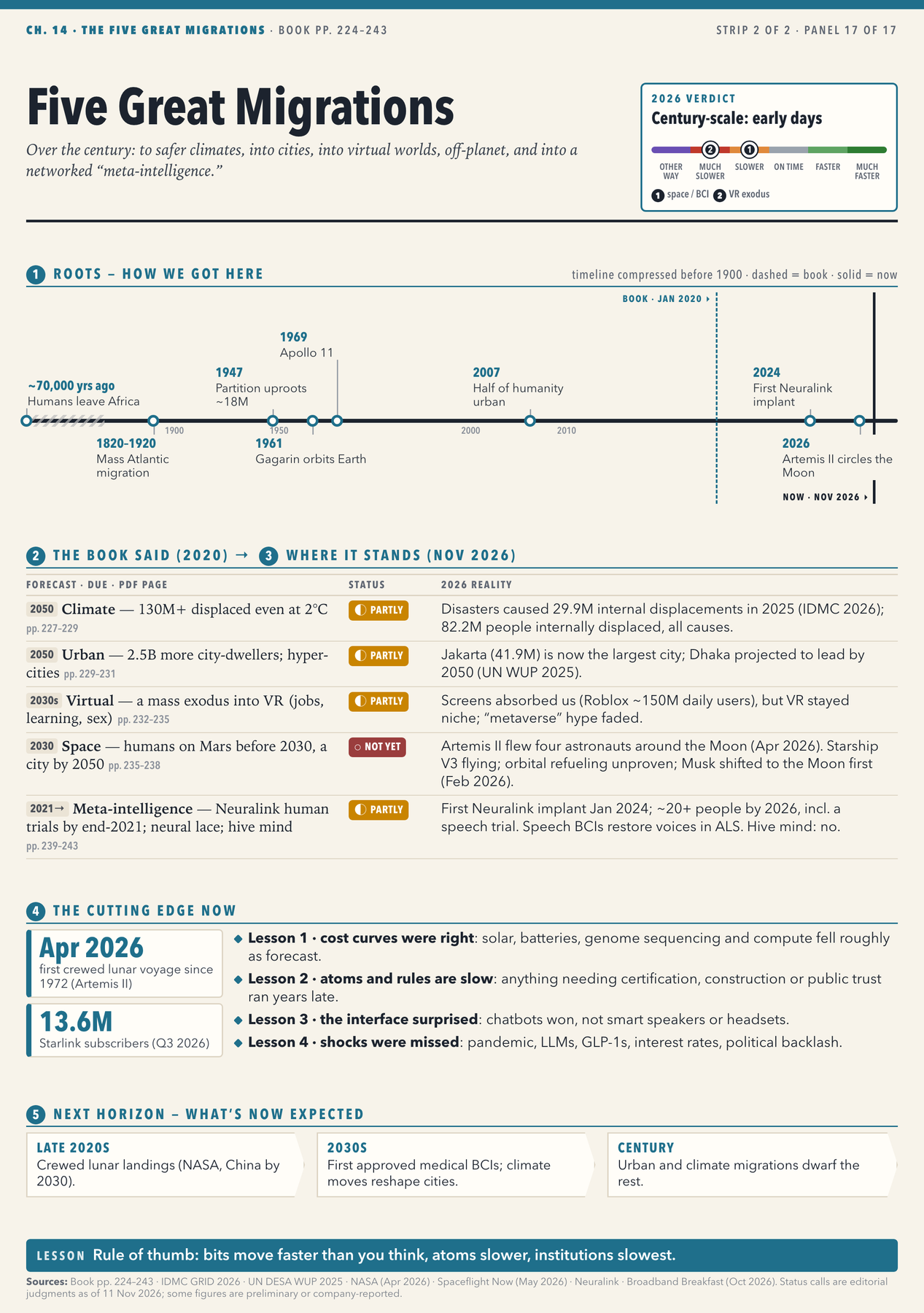
Afterword: Abundance Revisited
The afterword returns to the authors’ earlier Abundance thesis: technological progress can widen access to useful capabilities even when money and wealth remain unevenly distributed. A smartphone bundles functions that once required separate expensive equipment. The authors extend this pattern to energy, water, learning, healthcare, food, and entertainment.
This is a claim about capability and access, which differs from saying that inequality has disappeared or that all indicators improve. The source explicitly acknowledges worsening environmental and resource problems, incomplete distribution, and continuing violence and disease. Its optimistic interpretation is that lower costs and wider participation can expand the range of lives people are able to lead.
The final condition is cooperation. Inventions and promising prices do not distribute themselves, and the book ends by inviting readers to participate in that work. The accompanying “Which Way Next?” material recommends continuous learning about technology and flow. Those pages also promote programs and organizations associated with the authors; they should be read as such, rather than as an independently selected course list. Attachment (file not included in this release)
Business Application - Existing Products Plus New Capabilities
This section develops an application from the book. The examples and tests below are analytical hypotheses, not the authors’ evidence of current market gaps.
The Specific Passage Behind Your Idea
In Chapter 4’s smartness economy, the authors write:
“take any existing tool, and add a layer of smartness.”
They compare adding electricity to existing tools with adding AI and credit Kevin Kelly’s The Inevitable. A productive business search starts with an established human purpose, then asks what a newly accessible capability makes possible. Attachment (file not included in this release) · Attachment (file not included in this release)
Your motor analogy fits this pattern. More precisely, a motor can turn a hand-powered drilling mechanism into a powered drill, or a manual screwdriver into a powered screwdriver. The important continuity is the customer’s job. BLACK+DECKER’s history identifies a 1917 portable electric-drill design with a pistol grip and trigger, illustrating how control and usability accompany the motor. Manufacturer’s historical timeline.
The smartphone example illustrates convergence particularly well. Apple’s January 9, 2007 announcement combined a phone, music player, and internet device with a new interface. It was a combination of computing, communications, software, sensors, and design. Adding present-day AI is another possible capability layer; AI alone does not explain the original smartphone transition. Apple’s original announcement.
Search for a Better Result
Use this working formula: existing customer job + newly affordable capability + necessary complements + a result someone will pay for.
| Starting activity | Capability to investigate | Valuable result to test |
|---|---|---|
| Manual tool use | Motor plus suitable control and power | Less effort or time with reliable performance |
| Finding a particular delivered photograph | Search over an authorized image archive and its metadata | Faster retrieval for a client’s recurring request |
| Turning a client brief into production preparation | Structured extraction and drafting with human review | Fewer missed requirements and less preparation time |
| Reviewing property documents | Extraction, cross-referencing, and source-linked questions | Faster triage with fewer overlooked discrepancies |
| Maintaining a building or device | Sensing, alerts, and an operating response | Earlier useful intervention and less avoidable downtime |
For intelligence-enabled products, specify the changed action: find, classify, predict, recommend, draft, coordinate, or control. Each requires different inputs and reliability. A recommendation becomes valuable only when someone can act on it; a physical action may require an actuator, permissions, and dependable exception handling.
Apply Your Existing Opportunity Lenses
Your Opportunity-Seeking Mindset already supplies seven lenses: pain, friction, existing spending, change, neglect, underused assets, and unequal access. Use them to select the job before designing the feature. The book’s convergence framework explains what may have changed; your lenses explain where to look for a buyer affected by that change.
For your photography work, a reasonable first hypothesis is client preparation or archive retrieval, because you can observe the workflow directly. This is a testing advantage, not evidence that a new market exists. Existing client behavior, current alternatives, and actual demand still need checking.
Turn One Observation into a Small Test
- Describe the present job. Choose one recurring task and record who performs it, how often, the recent workaround, elapsed time, error costs, and who controls a budget.
- Name what changed. Identify an available capability and the exact constraint it removes. Separate a working input from something dependent on a future research breakthrough.
- Map the complete delivery. Include data access, human review, integration, exceptions, and distribution. The book’s Slingshot and M-Pesa cases show why this layer matters.
- Run a manual or assisted pilot. For an archive-retrieval hypothesis, use a small authorized image set and real representative requests. Compare time, acceptable-result rate, corrections, and support effort with the existing process.
- Test payment and repeat use. A paid pilot, repeat request, or changed purchasing behavior is stronger evidence than enthusiasm. Estimate contribution per job after software, review, rework, and support time.
- Set the stop condition first. For example, stop if the pilot produces too few acceptable results, saves too little time, or requires more review than the buyer values. Choose the threshold from the actual workflow rather than inventing an attractive percentage.
The next idea may involve a better device, a managed service, improved coordination, or removal of the original activity. Move a candidate to the once its causal thesis, economics, timing, test, and rejection condition are concrete.
Next learning step
Exercise: Map one familiar customer job from pain to paid result, leaving a space for every missing complement.
Why it helps: It tests whether you understand convergence as a complete service and exposes the gap between a clever feature and a business.
First attempt: Spend 5–10 minutes on one photography task. Write the present workaround, newly available capability, required inputs, buyer, measurable result, and one reason the idea could fail. Then compare the map with the B5 overview and Attachment (file not included in this release).
Review cue: after a few days, try Chapter 4’s questions and explain one complete convergence example without the notes. Return to the difficult questions approximately a week later if useful; these are starting intervals, not scheduled reminders. A later Goodnotes worksheet could leave the causal links and test criteria blank, with a separate answer guide; the existing B5 sheet provides the compact overview now.
Supplementary Verification - Selected Corrections
These checks are outside the book summary. They address consequential factual or interpretive problems encountered while reading, rather than scoring every forecast against 2026 outcomes. Links lead to primary sources; the source book’s PDF pages identify the claims being qualified.
| Claim or issue in the book | Verified distinction | Primary source |
|---|---|---|
| AlphaGo chronology, PDF p. 40 | The Lee Sedol match was in March 2016; AlphaGo Zero was announced in October 2017. | DeepMind: AlphaGo · AlphaGo Zero |
| Quantum computers as generally overwhelming classical computers or ordinary memory, PDF pp. 33–35 | Advantages depend on particular algorithms and tasks. Measurement cannot simply retrieve every possible answer represented in superposition. | NIST explanation · IBM fundamentals |
| Human Genome Project chronology and project cost, PDF p. 69 | The public project ran 1990–2003; NHGRI reports $2.7 billion in FY1991 dollars. A first project’s total budget differs from the later cost of sequencing one genome. | NHGRI fact sheet · 2003 completion announcement |
| MedSeq screening interpreted as immediate life-threatening diagnoses and lives saved, PDF pp. 152–153 | In the 2017 pilot trial, 11 of 50 sequenced participants (22%) received new monogenic disease-risk findings; 2 of 50 (4%) showed the predicted phenotype. Clinical utility remained uncertain. These results do not establish the book’s stronger life-saving claim. | Vassy et al., full primary study |
| M-Pesa poverty impact, PDF p. 182 | Suri and Jack’s 2016 study estimates 194,000 households, about 2% of Kenyan households, lifted out of poverty. The denominator is households, not individual people. | Science study abstract |
| Young-blood research versus a marketed anti-aging treatment, PDF pp. 169–171 | The FDA’s December 6, 2024 notice states that young-donor plasma is not approved for aging or memory-loss claims and that demonstrated clinical benefit for those uses is lacking. Animal research does not establish those human uses. | FDA notice |
General rule for reusing the book’s figures: retain the period, population, outcome, units, and comparison. A forecast, company interview, modeling result, small trial, and demonstrated deployed service provide different kinds of support. Where a number was unnecessary or had a questionable denominator, the chapter reconstruction preserves the mechanism instead of amplifying it.
Forecast Check (Nov 2026) - B5 Fold-out
A two-strip B5 accordion fold-out compares the book’s 2020 forecasts with the state of each sector in November 2026. Each sector panel has five bands: roots (a history timeline), the book said (forecast, due date, PDF page), status (one tag per claim), cutting edge (2026 frontier and key figures), and next horizon (what is now expected). Status tags are editorial judgments as of 11 November 2026, and a few late-2026 figures are preliminary or company-reported. This is a sector-level check, not a claim-by-claim audit of the whole book.
Print version: Attachment (file not included in this release). Print at B5 (176 × 250 mm), tape the pages edge to edge in order, and zig-zag fold.
At a Glance — Forecast Slip Chart
Twenty-three dated forecasts, each plotted from the year the book promised to the year it arrived, the year it is now roughly expected, or the point where it was abandoned. Where the book gave no year, its ten-year horizon (2030) is used. The “not yet” arrowheads are rough editorial estimates, not official forecasts.
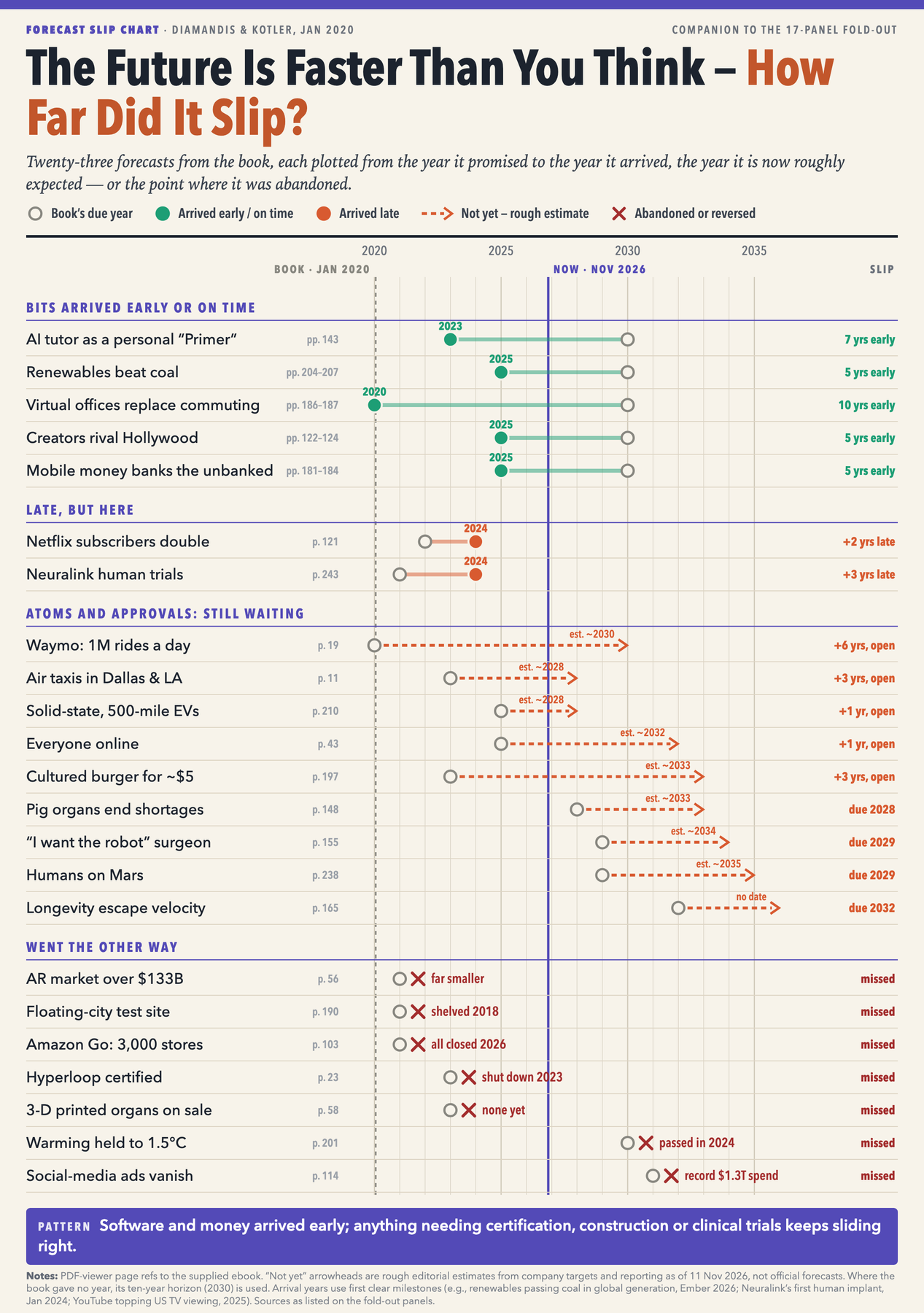
What’s New Now and Next — Tech Radar
The newest technologies and inventions found while checking the forecasts, in eight domains. Each lists four working technologies in 2026, tagged in use, scaling, trials/pilots or lab/prototype, and three next milestones. “Next” dates are company targets, regulator timelines or editorial estimates, not guarantees.
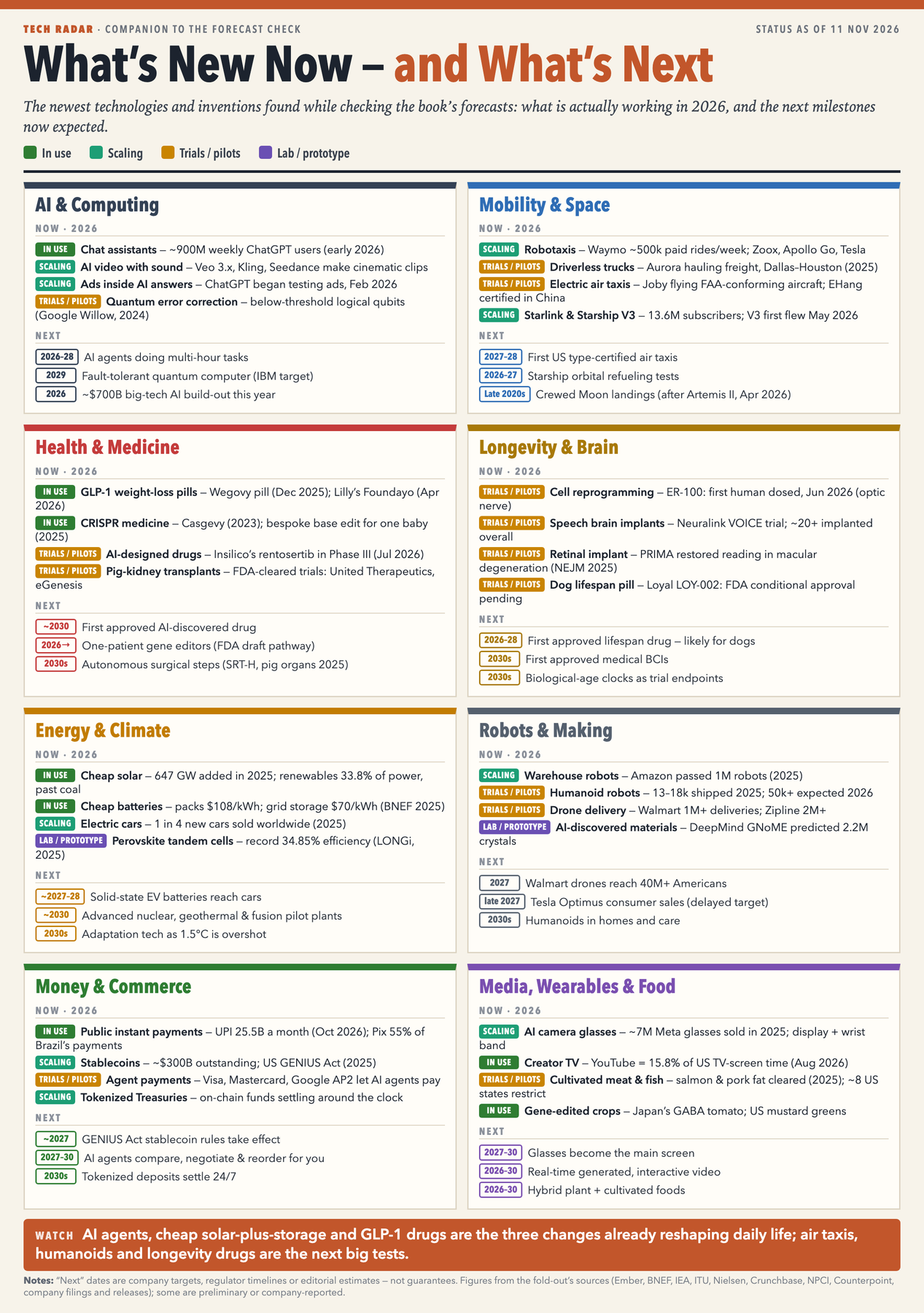
Strip 1 — Everyday Life (Panels 01–08)

Strip 2 — Money, Matter, Planet (Panels 09–17)

Individual panels (B5, readable size)
Panel 01 · Cover & Scorecard — overview of all sectors
Panel 02 · Getting Around — Chapter 1
Panel 03 · Shopping — Chapter 5
Panel 04 · Advertising — Chapter 6
Panel 05 · Entertainment — Chapter 7
Panel 06 · Education — Chapter 8
Panel 07 · Healthcare — Chapter 9
Panel 08 · Longevity — Chapter 10
Panel 09 · The Engines — Chapter 2 (also Chapter 3)
Panel 10 · The Seven Accelerators — Chapter 4
Panel 11 · Insurance — Chapter 11
Panel 12 · Money & Finance — Chapter 11
Panel 13 · Real Estate & Cities — Chapter 11 and Chapter 14
Panel 14 · Food — Chapter 12
Panel 15 · Energy, Climate & Water — Chapter 13
Panel 16 · Work, Risk & Government — Chapter 13
Panel 17 · Five Great Migrations — Chapter 14
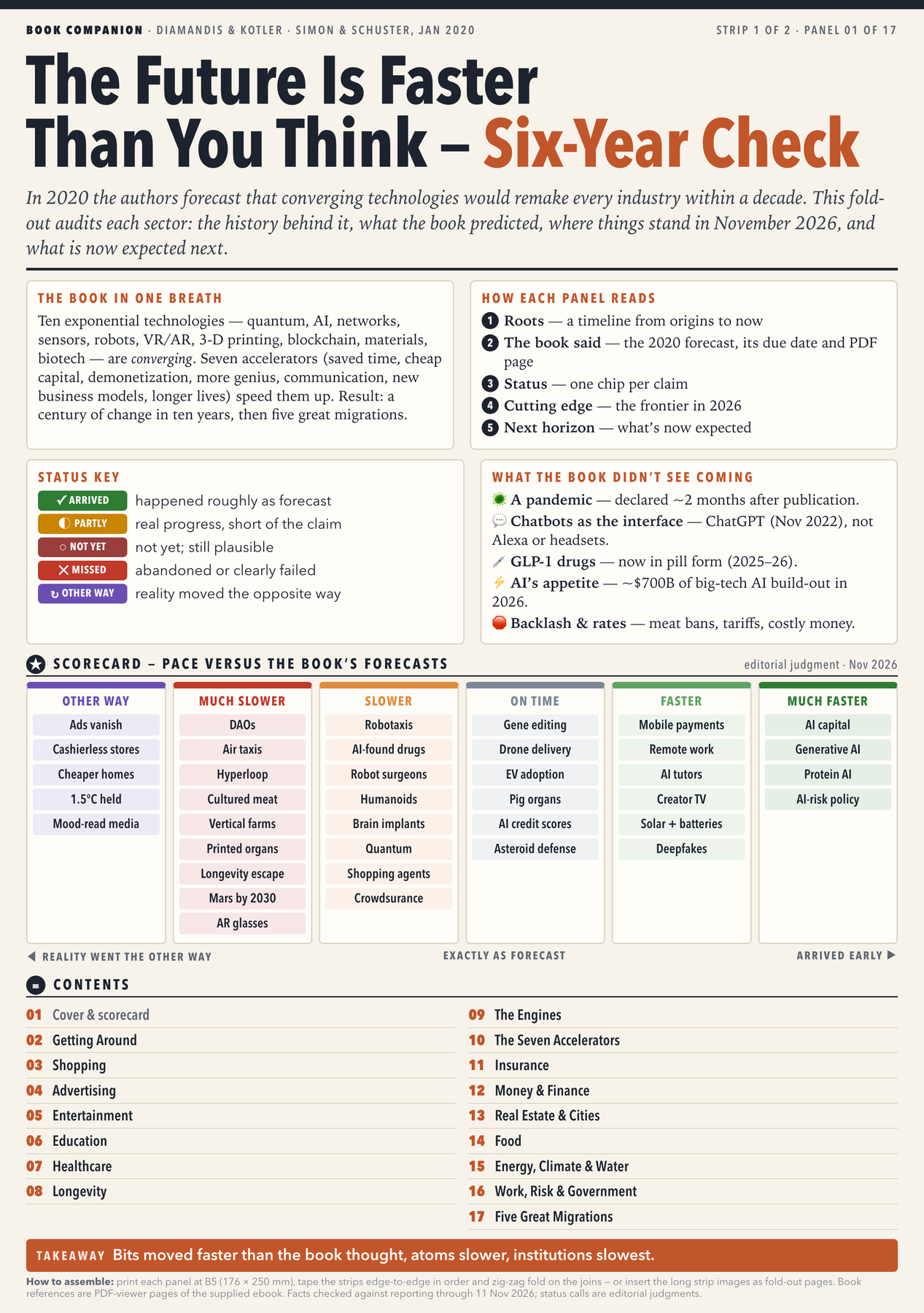
Source and Coverage
- Primary source: the supplied complete 351-page PDF, now saved as Attachment (file not included in this release). The copyright page identifies the ebook ISBN as 9781982109684. No printed-edition page count is inferred from the PDF’s length.
- Coverage: Foreword, all 14 chapters, Afterword, “Which Way Next?” resources, acknowledgments, author material, endnotes, index, and copyright were read. Detailed reconstruction covers every numbered chapter; the Foreword’s purpose is incorporated into the whole-book account, and the Afterword has its own section. No missing or unreadable narrative section was identified in the text extraction.
- Page convention: PDF viewer pages throughout. Foreword 5–7; Chapters 1–14 begin at 9, 32, 53, 72, 94, 113, 120, 137, 145, 162, 172, 191, 200, and 224. Chapter 14 ends at 244; Afterword begins at 245; resources extend through 250; endnotes occupy 258–319. The index’s printed-page numbers are not substituted for viewer pages.
- Source character: the authors combine interviews, company examples, research papers, journalism, consultancy estimates, and forecasts. Diamandis’s affiliations include XPRIZE, investment activity, Human Longevity, and Celularity; Kotler’s include the Flow Research Collective. The source and its endnotes disclose several investments in featured firms. Access can enrich the reporting while limiting its independence.
- Summary boundary: dates and claims remain in their 2019–2020 context unless explicitly corrected in the supplementary section. Explanatory qualifications distinguish demonstrations, mechanisms, forecasts, and inference. No claim is made that the entire forecast has been audited against current outcomes.
- Reading state: creating this source synthesis does not mark the book finished. The current record retains Reading; the future catalog retains its separate prior-reading evidence.
Vault Connections
- AI — convergence joins capabilities to deployment, infrastructure, and institutions.
- Business — the smartness economy and new business models connect technical change to customer value.
- Opportunity-Seeking Mindset — supplies the existing seven lenses and observation-to-test practice used in the application section.
- — evaluates a candidate through thesis, economics, timing, test, and rejection criteria.
- Nexus — comparison question: when do more powerful information networks improve understanding, and what institutions affect the result? This is a question for cross-book study, not an asserted agreement or disagreement.
- · — both link to this canonical note while keeping their existing status evidence.