Zibaldone 2024–2025 journal
Journal connection: The journal’s visual case for and against American isolationism.
Source boundary: These are captured journal materials; the integration does not independently verify every clipped claim, quotation, or figure.
PDF++ pages: p. 7 (file not included in this release) · p. 8 (file not included in this release)
Embedded previews:
Zibaldone 2024-2025.pdf (file not included in this release)
Zibaldone 2024-2025.pdf (file not included in this release)
Open the complete Zibaldone page index
Related arguments
Elective War in Democracies explains a political constraint on sustained intervention, while Ronald Reagan on Appeasement gives the opposing warning about restraint. Isolationism - Charles Kupchan is a book-length companion. Distinguish isolationism, non-interventionism, and selective engagement before comparing them.
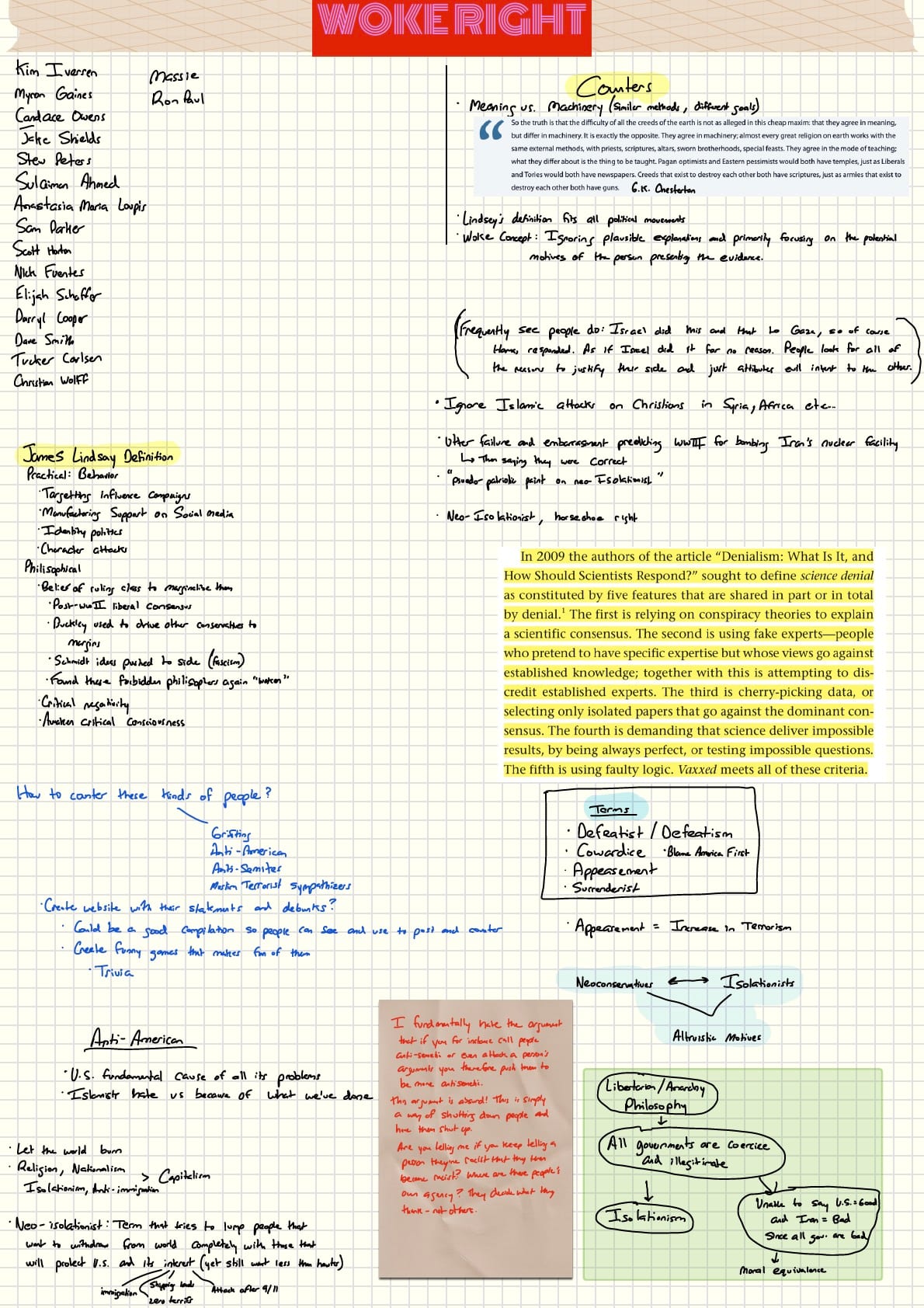
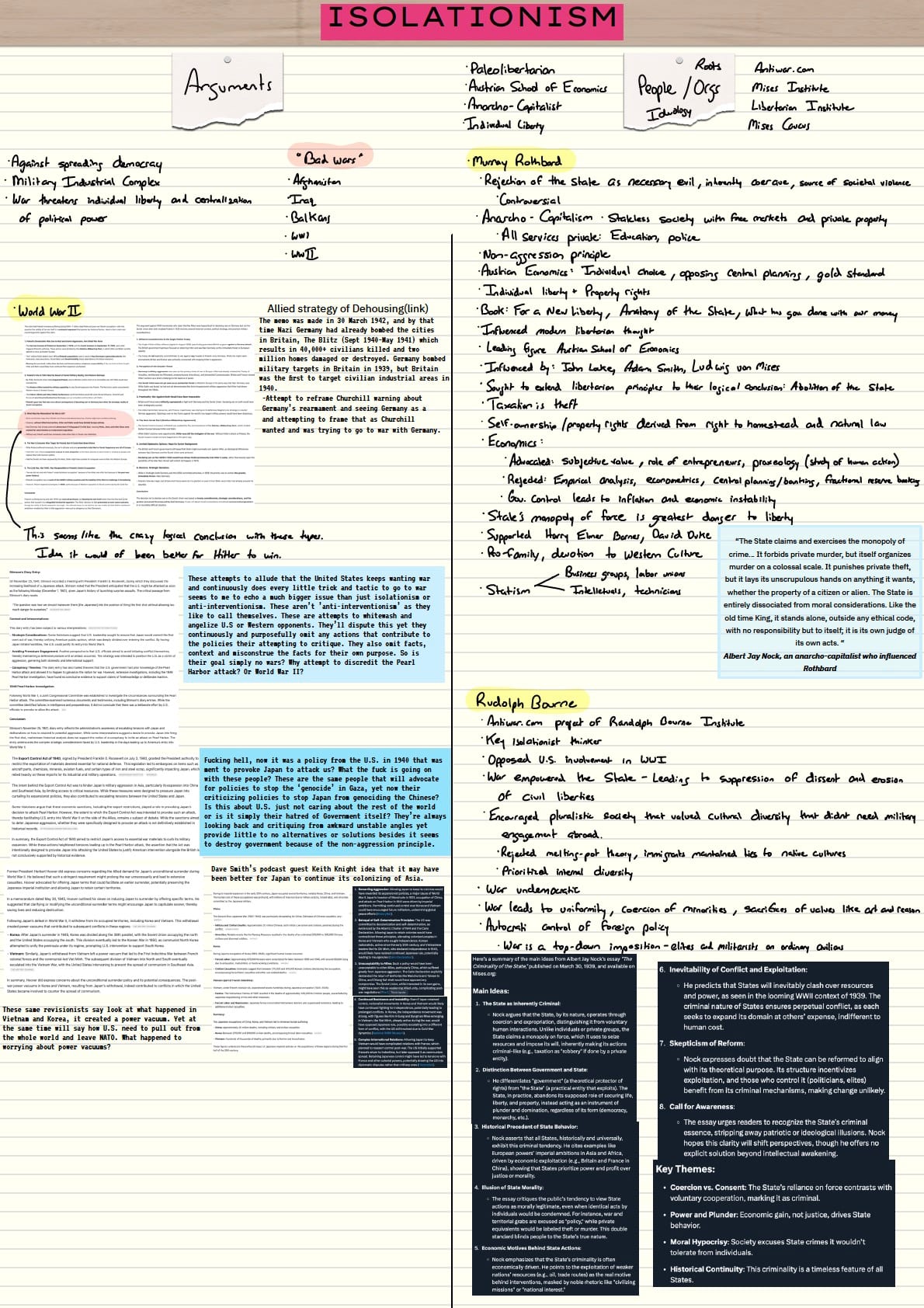
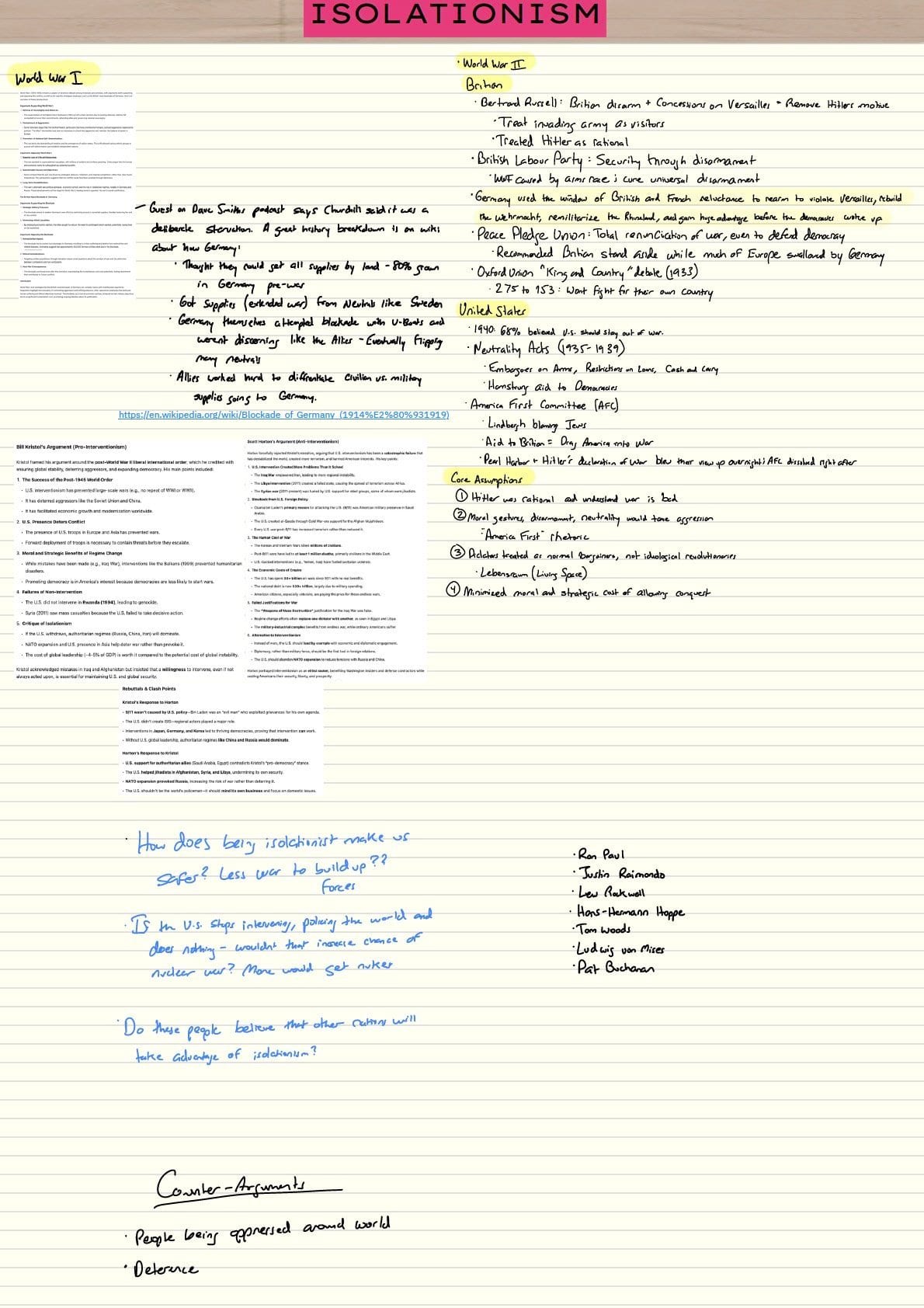
Handwritten journal source
Consolidated source: PDF pp. 164–165 (file not included in this release)
Source boundary: These are handwritten source pages. Use the scan for exact wording; verify quotations and factual claims before reuse.
Embedded preview:
March 21-June 9 2026.pdf (file not included in this release)
Open the journal routing table
Summary
🧠 Main Ideas of Isolationism
Isolationism is a foreign policy stance advocating that a country minimize its involvement in international political and military affairs, especially entangling alliances or foreign wars. It prioritizes domestic stability, national sovereignty, and non-intervention over global engagement.
⚠️ Note: Isolationism is often contrasted with non-interventionism, which allows for trade and diplomacy but avoids military entanglements. True isolationism is more extreme and rare, but the term is often used imprecisely.
1. Avoidance of Foreign Entanglements
- Belief that alliances and interventions abroad drag a nation into unnecessary conflicts.
- Inspired by Washington’s Farewell Address: “avoid entangling alliances.”
2. National Sovereignty and Self-Sufficiency
- Nations should focus on their own problems and avoid becoming dependent on global institutions or trade networks.
3. Peace Through Detachment
- Wars are often viewed as avoidable if nations mind their own affairs.
- Military adventurism is seen as wasteful, imperialistic, or morally dubious.
4. Economic Protectionism (Sometimes)
- Some isolationists support tariffs and reduced international trade to protect domestic industry.
- Others are more aligned with non-intervention but favor open trade (this varies).
5. Anti-Imperialism
- Skeptical of empire-building, foreign aid, or regime change.
- Opposed to globalism, sometimes linked with America First sentiment.
🧑🏫 Philosophical and Historical Roots
| Thinker / Source | Contribution |
|---|---|
| George Washington | Warned against permanent alliances in his Farewell Address (1796). |
| Thomas Jefferson | Advocated for “peace, commerce, and honest friendship with all nations, entangling alliances with none.” |
| John Quincy Adams | Argued America “goes not abroad in search of monsters to destroy.” |
| Charles Lindbergh | Voice of the America First Committee; opposed WWII involvement. |
| Robert Taft | Post-WWII senator; resisted NATO and Cold War expansionism. |
| Ron Paul (modern non-interventionist) | Advocates withdrawal from military commitments abroad. |
| Patrick Buchanan | Paleoconservative critic of globalism and foreign wars. |
📅 Timeline of Isolationism
Founding Era
- U.S. leaders like Washington, Jefferson, and Adams express caution about foreign alliances.
- The young republic avoids European conflicts (e.g., Napoleonic Wars).
19th Century
- Monroe Doctrine (1823) asserts U.S. dominance in the Western Hemisphere but warns European powers to stay out.
- U.S. remains militarily isolated while expanding westward.
Pre-WWI
- U.S. avoids European military entanglements.
- Focus on continental expansion and trade.
Interwar Period (1919–1941)
- Peak isolationist sentiment:
- U.S. rejects League of Nations.
- Neutrality Acts passed to prevent entry into future wars.
- America First Committee becomes prominent.
- World War I seen as a costly mistake by many.
Post-WWII Decline
- Cold War and Pearl Harbor shift the U.S. to global engagement.
- Isolationism marginalized in favor of containment and internationalism.
Modern Echoes (2000s–Present)
- Rise of non-interventionism in reaction to Iraq, Afghanistan.
- Political figures like Donald Trump, Tulsi Gabbard, Ron Paul, and Josh Hawley express “America First” themes.
- Some opposition to NATO, UN, and foreign aid resurfaces.
👤 Key Figures Associated with Isolationism
| Name | Contribution |
|---|---|
| George Washington | First major proponent of “no permanent alliances.” |
| Charles Lindbergh | America First spokesman, WWII era. |
| Sen. Robert Taft | Critic of NATO and Cold War entanglements. |
| Ron Paul | Libertarian non-interventionist; critical of foreign wars. |
| Pat Buchanan | Paleocon; strong “Fortress America” stance. |
| Donald Trump (partial) | Advocated withdrawal from global conflicts; “America First” rhetoric. |
| Rand Paul | Advocates restraint in foreign policy and defense spending. |
❗ Main Critiques of Isolationism
1. Global Power Vacuum
- Critics argue isolationism allows hostile powers to dominate (e.g., Hitler in the 1930s, Soviet Union post-WWII).
- Risk of threats growing unchecked without American deterrence.
2. Moral Abdication
- Avoiding genocide or human rights crises may be seen as morally negligent.
- Critics argue isolationism fosters apathy toward global suffering.
3. Economic Risks
- Trade restrictions or detachment from global systems can hurt domestic economies.
- Critics claim protectionism harms competitiveness and raises consumer prices.
4. Strategic Blindness
- Some argue that global engagement prevents greater conflicts and secures alliances.
- Isolation can cause a nation to be reactive rather than proactive.
5. Confusion with Non-Interventionism
- The term “isolationist” is often misused to describe moderate restraint, muddying debate.
🔀 Variants and Related Movements
| Movement | Relation |
|---|---|
| Non-Interventionism | Allows diplomacy/trade but rejects war; often confused with isolationism. |
| America First | Populist slogan emphasizing national interest over globalism; can lean isolationist. |
| Libertarian Foreign Policy | Strongly anti-war and anti-interventionist; overlaps heavily. |
| Paleoconservatism | Shares skepticism of foreign entanglements and global institutions. |
| Anti-Imperialism | Left-wing or right-wing resistance to military and economic dominance abroad. |
What Both Sides STILL Don’t Get About Iran (Experts Explain) – Yaron Brook and Elan Journo - YouTube
Watch @yaronbrook go scorched earth on libertarian isolationists - Full Ep out now. 1.mp4 (file not included in this release)
WWII Isolationism
1. What Sowell actually says about Russell and disarmament
In the interview, Sowell makes this claim:
“Between the two World Wars it was the leading intellectuals of the western world who talked the biggest nonsense… it was Bertrand Russell who said that Britain should disarm while Hitler was building up this military machine across the Channel… and Russell was by no means the only one in England.”
He’s using Russell as an example of the unconstrained vision applied to war: intellectuals believing that good intentions, rational argument, and unilateral moral gestures could overcome very dark political realities.
To see what that actually looked like, we have to reconstruct Russell’s interwar pacifism and the wider British and American isolationist mood.
2. Bertrand Russell’s interwar pacifism and disarmament advice
2.1 Russell’s position in the 1930s
- Russell had been a pacifist in WWI, went to prison for anti-war activism, and carried that anti-militarist stance into the 1920s–30s.(Wikipedia)
- In the 1930s he became a prominent public intellectual for secular pacifism, associated with movements like the Peace Pledge Union (PPU), which asked people to pledge that “war is a crime against humanity” and to renounce support for any war.(Wikipedia)
His core assumptions: - Modern industrial war would be so destructive that even a bad peace was better than a just war.
- If Britain disarmed and behaved benignly, this example—plus concessions on Versailles—would supposedly take away the motives for German aggression.
In his 1936 book Which Way to Peace?, he argued that a new European war would likely kill between 50–90% of the population, and so “modern war is practically certain to have worse consequences than even the most unjust peace.”(OpenEdition Journals)
From this he inferred that: - Britain should not rearm in response to Hitler’s buildup.
- Britain should pursue disarmament, negotiations, and concessions as the only rational course.
That’s the kind of thing Sowell is summarizing as “Britain should disarm while Hitler was building up his military machine.”
2.2 The infamous 1937 “treat them as visitors” letter
Russell’s most notorious statement is from a 1937 private letter to the critic Godfrey Carter. In it he wrote that if Nazi Germany invaded Britain:
“If the Germans succeed in sending an invading army to England we should do best to treat them as visitors, give them quarters and invite them…” (The Forward)
He goes on (in the part I’m not quoting verbatim) to say the commander-in-chief should be invited to dine with the Prime Minister, and that such behaviour would “baffle” the Germans.
What he meant:
- Pure non-resistance: he’s seriously suggesting that Britain not fight even in the face of invasion.
- He imagines this would morally disarm the Nazis, or at least blunt the brutal consequences of war.
In hindsight, this looks disastrously naive: - Nazi rule in occupied Europe (Poland, Czechoslovakia, France, the Low Countries, the USSR) showed that “treat them as visitors” would not have prevented terror, plunder, mass murder, and dictatorship.
- It assumed Hitler and his regime could be shamed or puzzled into moderation instead of recognizing they were ideologically committed to domination and racial hierarchy.
2.3 Russell changes his mind once the danger is undeniable
Russell did eventually reverse course:
- He opposed rearmament in the 1930s and supported appeasement.(Wikipedia)
- By 1940, after war had actually broken out and Hitler had overrun much of Europe, Russell concluded that a Nazi victory would be a permanent threat to democracy and that war, though evil, might be the “lesser of two evils.”(Wikipedia)
- In 1943 he articulated a position he called “relative political pacifism”: war is always a great evil, but there are some extreme circumstances where fighting is necessary to prevent a greater catastrophe.(Wikipedia)
So Sowell is fair in saying Russell urged disarmament while Hitler was rearming; he’s not saying Russell stayed that way forever. Russell’s “correction” came only after the danger was unmistakable.
What Russell was recommending (and why it was wrong in hindsight) - Unilateral British disarmament or deep cuts in armaments to “set an example” and reassure Germany.
- Non-resistance even in the case of invasion.
- Accommodation: revising the Versailles settlement and making concessions in the hope that Hitler’s demands would be limited and negotiable.
The error, in retrospect, is that this treated Hitler as a basically rational, status-quo actor who could be placated by goodwill and “just” boundaries, rather than as a revolutionary dictator with explicit expansionist, racist, and exterminationist aims.
3. Other British disarmament / “isolationist” currents Sowell is gesturing at
Russell wasn’t alone. A whole peace/disarmament culture grew up in interwar Britain, especially among intellectuals and the left.
3.1 Labour Party and “security through disarmament”
- The 1931 Labour manifesto insisted that “without this policy of disarmament there cannot be either peace or security.”(Labour Party)
- A 1937 article by Labour MP R. Page Arnot summarized the line this way: “the safety of this country and the peace of the world cannot be secured by reliance on armaments, but only by the resolute pursuit of a policy of disarmament.”(Marxists Archive)
The logic: - Arms races caused WWI; therefore the cure is universal disarmament.
- Britain should lead by example, cutting its own forces and pushing at Geneva for multilateral reductions.
In hindsight: - Germany used the window of British and French reluctance to rearm to violate Versailles, rebuild the Wehrmacht, remilitarize the Rhineland, and gain huge advantages before the democracies woke up.
- Disarmament as policy made sense only if all major powers respected treaties; the Nazi regime clearly didn’t.
3.2 Pacifism and the Peace Pledge Union (PPU)
The Peace Pledge Union (founded 1934) attracted many intellectuals and public figures, including Russell. Its members pledged:
“War is a crime against humanity. I renounce war, and am therefore determined not to support any kind of war.”(Wikipedia)
Key points:
- The PPU promoted total renunciation of war—even “wars to defend democracy.”
- Some sponsors backed Neville Chamberlain’s appeasement and argued that if the territorial injustices of Versailles were corrected, Germany’s aggression would cease.(Wikipedia)
- In one controversial pamphlet, Clive Bell suggested Germany might be allowed to “absorb” France, Poland, the Low Countries, and the Balkans.(Wikipedia)
Again, the flawed advice in hindsight: - This amounted to recommending Britain stand aside while much of Europe was swallowed by a totalitarian regime.
- It underestimated the ideological nature of Nazism: not just about borders, but about racial hierarchy, dictatorship, and suppression of dissent.
3.3 Oxford Union “King and Country” debate (1933)
A famous student symbol of this mood:
- On 9 February 1933, the Oxford Union debated the motion:
“This House will in no circumstances fight for its King and Country.” - The motion passed, 275 to 153, causing a national storm.(The Oxford Union Library and Archives)
While it was a student debate, it captured a broader sentiment: - Many young educated Britons saw WWI as meaningless slaughter.
- They were prepared to say publicly that no cause would justify fighting again, even for national survival.
In retrospect, that attitude—if it had translated into actual government policy—would have meant no resistance to Hitler at all.
3.4 Norman Angell and “The Great Illusion”
Another influential intellectual background figure: Norman Angell, whose book The Great Illusion (1909) became a huge best-seller.
- He argued that modern economic interdependence made war economically irrational; conquest didn’t pay, because ruined economies were no use to conquerors.(Wikipedia)
- The “illusion” was the belief that nations gain from war; he thought this illusion, once dispelled, would make great-power war unlikely.
Angell himself didn’t say war was impossible, but his ideas fed into a general confidence in peace through trade and mutual interest.(World Peace Foundation)
In hindsight: - WWI and then Hitler’s rearmament showed that ideological and nationalist passions can override economic rationality.
- Interdependence did not stop war; instead, it meant that when war came it was even more destructive.
4. American isolationism and “stay out of Europe’s war”
On the American side, Sowell’s point about the unconstrained vision applies to those who believed that good intentions, oceans, and neutrality laws could keep the U.S. safe while dictators reshaped the world.
4.1 Public mood: “We learned our lesson in the last war”
- After WWI, many Americans concluded that entry into the war had been a mistake; by 1941, about four in ten still thought intervention in WWI had been wrong.(Gallup.com)
- In early 1940, Gallup found 68% of Americans believed the U.S. would stay out of the European war; the most common reason: “the people are overwhelmingly against war and would not stand for American participation.”(Teaching American History)
The idea: - If the U.S. refused to get involved, stayed neutral, and avoided “entanglements,” it could avoid another catastrophe like WWI.
In hindsight: - Isolation did not stop the Axis from conquering most of Europe and much of Asia; it only meant the U.S. entered the war later, after the strategic situation had greatly worsened (France fallen, Britain battered, Soviet Union invaded, Japan on the rampage).
4.2 The Neutrality Acts
Between 1935 and 1939 Congress passed a series of Neutrality Acts:
- Embargoes on arms sales to belligerents.
- Restrictions on loans.
- “Cash and carry” rules to avoid entanglements and attacks on U.S. ships.(Holocaust Encyclopedia)
These were meant to keep America out of war, but: - In practice they hamstrung aid to democracies like Spain’s Republican government and, later, made it harder to assist Britain and France against Hitler, at least until modified.
4.3 The America First Committee and Charles Lindbergh
The most visible organized isolationist force was the America First Committee (AFC):
- Founded September 1940, grew to 800,000+ members in 450 chapters.(Wikipedia)
- Its purpose was to prevent U.S. entry into WWII; it opposed Lend-Lease and deeper involvement.
Its most famous spokesman, aviator Charles Lindbergh, argued in his Des Moines speech (Sept 11, 1941) that:“The three most important groups who have been pressing this country toward war are the British, the Jewish and the Roosevelt administration.”(charleslindbergh.com)
Key elements of the American isolationist line: - The U.S. should stay out of Europe’s quarrels; focus on defending the Western Hemisphere.
- The Atlantic and Pacific oceans and American air/sea power would keep the U.S. safe.
- Aid to Britain was portrayed by hardliners as a plot by foreign and domestic “war agitators” to drag America into another pointless slaughter.(Wikipedia)
In retrospect, the errors are clear: - They assumed Hitler’s ambitions were limited to Europe and that a Nazi-dominated continent wouldn’t threaten U.S. security or values.
- They underestimated the danger of allowing a hostile, totalitarian bloc to control the resources, industry, and strategic positions of Eurasia.
- They saw U.S. power as a kind of fortress that could remain untouched, ignoring that Japan and Germany were already on collision courses with American interests (Pacific bases, shipping, etc.).
Pearl Harbor and Hitler’s declaration of war on the U.S. in December 1941 blew up this worldview almost overnight; the AFC dissolved right after the U.S. entered the war.(Wikipedia)
5. Putting it together: what Russell and other isolationists were “wrong” about
Across Britain and the U.S., the “Russell-type” advice before WWII shared a few core assumptions:
- War is so irrational and destructive that no rational state will choose it
- Russell and Angell leaned heavily on economic and humanitarian arguments: modern war would devastate all sides, so no one could “gain” from it.(OpenEdition Journals)
- Isolationists assumed that leaders would ultimately be constrained by these realities.
- Moral gestures, disarmament, and neutrality would tame aggression
- Russell urged disarmament and even non-resistance, believing it would morally and psychologically “baffle” Hitler.(The Forward)
- British Labour and peace groups claimed security depended “not on armaments, but on disarmament”and example-setting.(Marxists Archive)
- American neutrality laws and “America First” rhetoric assumed that staying aloof would keep the U.S. safe.
- Dictators were treated as normal bargainers, not ideological revolutionaries
- Many assumed Hitler mainly wanted revision of Versailles and limited territorial adjustments. Giving him those, they thought, would satisfy him.(Wikipedia)
- They did not fully grasp—or refused to accept—the stated program of Lebensraum, racial hierarchy, and permanent dictatorship.
- They minimized the moral and strategic cost of allowing conquest
- Proposals to let Germany “absorb” large parts of Europe, or to treat invaders as guests, effectively wrote off the rights and lives of millions under occupation.(Wikipedia)
- American isolationists implicitly accepted that Europe could fall under totalitarian rule as long as the U.S. mainland stayed untouched.
From the vantage point of history:
- These policies would likely have produced a world in which Nazi Germany and Imperial Japan dominated Eurasia, with catastrophic consequences for Jews, Slavs, dissenters, and eventually Western democracies themselves.
- It took the opposite policies—rearmament, alliances, and ultimately war—to stop that outcome.
That’s the “complete picture” behind Sowell’s passing remark: Russell’s advice to disarm and even not resist, Labour and peace-movement slogans of security through disarmament, student declarations never to fight, and America First’s push to keep the U.S. out at all costs. All of them, in different ways, tried to solve a radical totalitarian threat with moral posture and restraint alone—underestimating how far some regimes were willing to go, and how little they cared about the economic or humanitarian “irrationality” of war.