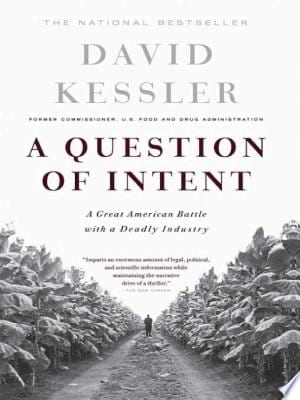
DESCRIPTION
Tobacco companies had been protecting their turf for decades. They had congressmen in their pocket. They had corrupt scientists who made excuses about nicotine, cancer and addiction. They had hordes of lawyers to threaten anyone — inside the industry or out — who posed a problem. They had a whole lot of money to spend. And they were good at getting people to do what they wanted them to do. After all, they had already convinced millions of Americans to take up an addictive, unhealthy, and potentially deadly habit. David Kessler didn’t care about all that. In this book he tells for the first time the thrilling detective story of how the underdog FDA — while safeguarding the nation’s food, drugs, and blood supply — finally decided to take on one of the world’s most powerful opponents, and how it won. Like A Civil Action or And the Band Played On, A Question of Intent weaves together science, law, and fascinating characters to tell an important and often unexpectedly moving story. We follow Kessler’s team of investigators as they race to find the clues that will allow the FDA to assert jurisdiction over cigarettes, while the tobacco companies and their lawyers fight back — hard. Full of insider information and drama, told with wit, and animated by its author’s moral passion, A Question of Intent reads like a Grisham thriller, with one exception — everything in it is true.
My Summary
Main Ideas, Takeaways & Similarities
Questions
I. What is the problem?
A. How is this problem formulated?
B. Why is this problem important?
C. What is the history of this problem?
D. Which prominent personalities have been interested in this problem?
II. What solutions to the problem are there?
A. What are the conclusions reached?
B. By what argument(s) is the conclusion reached?
C. What facts or assumptions serve as premises?
D. When a prominent personality offers a solution, does he also argue for or against other prominent personalities? Does he raise objections to alternative solutions? Does he consider objections to his own solutions?
III. Evaluation
A. What are the advantages and disadvantages of the alternative formulations to the problem?
B. Has the importance or history of the problem ever been misrepresented?
C. Are the solutions logically related to the premises?
D. Are the facts true? Are the assumptions acceptable? Are the objections answerable?
AI Summary
Highlights
Here is a thorough summary of the book “A Question of Intent: A Great American Battle with a Deadly Industry” in bullet points:
- Title: A Question of Intent: A Great American Battle with a Deadly Industry
- Author: David Kessler
Introduction:
- The book chronicles the battle between the U.S. Food and Drug Administration (FDA) and the tobacco industry over the health risks of smoking.
Chapter 1: The Arrival of David Kessler
- Introduction to David Kessler as the new FDA commissioner.
- Early actions to investigate the tobacco industry’s practices.
Chapter 2: The Power of Nicotine
- Examination of nicotine addiction and the tobacco industry’s manipulation of nicotine levels.
- The addictive nature of cigarettes and its impact on public health.
Chapter 3: The Surgeon General’s Report
- The significance of the 1964 Surgeon General’s report on smoking and health.
- The role of scientific evidence in understanding the risks of smoking.
Chapter 4: Manipulating Nicotine Levels
- Industry efforts to engineer cigarettes for maximum addictiveness.
- The role of additives and design changes in enhancing nicotine delivery.
Chapter 5: Advertising and Targeting Youth
- Tobacco industry marketing strategies aimed at young people.
- The Joe Camel campaign and its controversy.
- The impact of advertising on smoking initiation.
Chapter 6: Fighting for Regulation
- Kessler’s push for stronger tobacco regulation.
- The battle between the FDA and the tobacco lobby.
- Congressional hearings and political maneuvering.
Chapter 7: The Role of Whistleblowers
- Whistleblowers within the tobacco industry who exposed insider knowledge.
- Revelations about industry practices and deception.
- The importance of insider accounts in the regulatory battle.
Chapter 8: The Tobacco Industry’s Legal Strategy
- The industry’s efforts to undermine FDA regulations through litigation.
- Legal battles, court decisions, and appeals.
- The complexity of regulating a powerful industry.
Chapter 9: The Master Settlement Agreement
- The landmark Master Settlement Agreement (MSA) of 1998.
- Implications of the MSA on the tobacco industry’s practices and marketing.
- Financial consequences for the industry.
Chapter 10: Lessons Learned
- Reflections on the tobacco industry’s deception and the battle for public health.
- The importance of regulation and scientific evidence.
- The ongoing challenges of tobacco control and addiction.
Chapter 11: Tobacco Control Today
- Contemporary tobacco control efforts and their impact.
- Ongoing public health campaigns and initiatives.
- The role of education, policy, and public awareness.
Conclusion:
- Summarizes the key themes and lessons from the regulatory battle.
- The ongoing importance of vigilance in public health and tobacco control.
- The broader implications for regulating powerful industries.
“A Question of Intent: A Great American Battle with a Deadly Industry” by David Kessler provides an in-depth look at the decades-long struggle between the FDA and the tobacco industry over smoking-related health risks and the marketing practices that contributed to addiction and illness. It explores the regulatory challenges and the quest for public health and accountability.