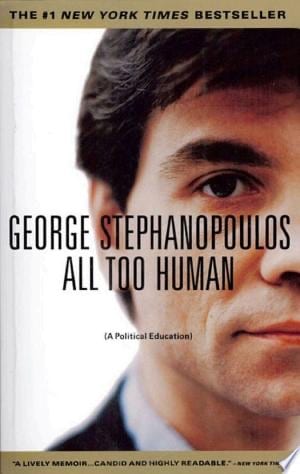
DESCRIPTION
All Too Human is a new-generation political memoir, written from the refreshing perspective of one who got his hands on the levers of awesome power at an early age. At thirty, the author was at Bill Clinton’s side during the presidential campaign of 1992, & for the next five years he was rarely more than a step away from the president & his other advisers at every important moment of the first term. What Liar’s Poker did to Wall Street, this book will do to politics. It is an irreverent & intimate portrait of how the nation’s weighty business is conducted by people whose egos & idiosyncrasies are no sturdier than anyone else’s. Including sharp portraits of the Clintons, Al Gore, Dick Morris, Colin Powell, & scores of others, as well as candid & revelatory accounts of the famous debacles & triumphs of an administration that constantly went over the top, All Too Human is, like its author, a brilliant combination of pragmatic insight & idealism. It is destined to be the most important & enduring book to come out of the Clinton administration.
My Summary
Main Ideas, Takeaways & Similarities
Questions
I. What is the problem?
A. How is this problem formulated?
B. Why is this problem important?
C. What is the history of this problem?
D. Which prominent personalities have been interested in this problem?
II. What solutions to the problem are there?
A. What are the conclusions reached?
B. By what argument(s) is the conclusion reached?
C. What facts or assumptions serve as premises?
D. When a prominent personality offers a solution, does he also argue for or against other prominent personalities? Does he raise objections to alternative solutions? Does he consider objections to his own solutions?
III. Evaluation
A. What are the advantages and disadvantages of the alternative formulations to the problem?
B. Has the importance or history of the problem ever been misrepresented?
C. Are the solutions logically related to the premises?
D. Are the facts true? Are the assumptions acceptable? Are the objections answerable?
AI Summary
Highlights
Here is a thorough summary of the book “All Too Human” by George Stephanopoulos in bullet points:
- Title: All Too Human: A Political Education
- Author: George Stephanopoulos
Introduction:
- Autobiographical account of George Stephanopoulos, a key figure in Bill Clinton’s presidential campaign and administration.
- Provides insights into the inner workings of American politics during the 1990s.
Chapter 1: The Education of a Greek Orthodox Altar Boy
- Early life and upbringing of George Stephanopoulos.
- Introduction to his Greek heritage and religious background.
- Initial interest in politics and journalism.
Chapter 2: Learning Politics in the Divided States
- Stephanopoulos’s college years at Columbia University.
- Political awakening during the turbulent 1970s.
- Role models and influences in his early political career.
Chapter 3: The Road to Little Rock
- Joining the 1992 Clinton presidential campaign.
- Experiences on the campaign trail and behind the scenes.
- Formation of key relationships with Bill Clinton and other campaign staff.
Chapter 4: Taking Charge
- Transitioning to the White House with President-elect Bill Clinton.
- Challenges and responsibilities as Deputy Director of Communications.
- Early successes and setbacks in the Clinton administration.
Chapter 5: The War Room
- Inside look at the Clinton campaign’s “War Room.”
- Strategies and tactics employed during the 1992 campaign.
- Clinton’s election victory and the excitement of the inauguration.
Chapter 6: Balancing Act
- Juggling professional and personal life in the White House.
- Relationships with fellow staff members and the media.
- Managing crises and controversies during the first term.
Chapter 7: Monica
- The Monica Lewinsky scandal and its impact on the Clinton presidency.
- Stephanopoulos’s role in crisis management and public relations.
- Personal and ethical dilemmas faced during this period.
Chapter 8: The Second Term
- President Clinton’s re-election and the challenges of a second term.
- Stephanopoulos’s evolving role and responsibilities.
- Policy issues, international events, and political maneuvering.
Chapter 9: Out of the White House
- Departure from the Clinton administration in 1996.
- Transition to a career in journalism as a political commentator.
- Reflections on the Clinton presidency and its legacy.
Chapter 10: Epilogue
- Stephanopoulos’s continued involvement in politics and media.
- Insights into the changing landscape of American politics.
- Personal reflections on his journey from the White House to journalism.
“All Too Human: A Political Education” by George Stephanopoulos offers an intimate and candid account of his political career and experiences within the Clinton administration. It provides readers with a behind-the-scenes look at the inner workings of American politics and the challenges and complexities of life in the public eye.