
DESCRIPTION
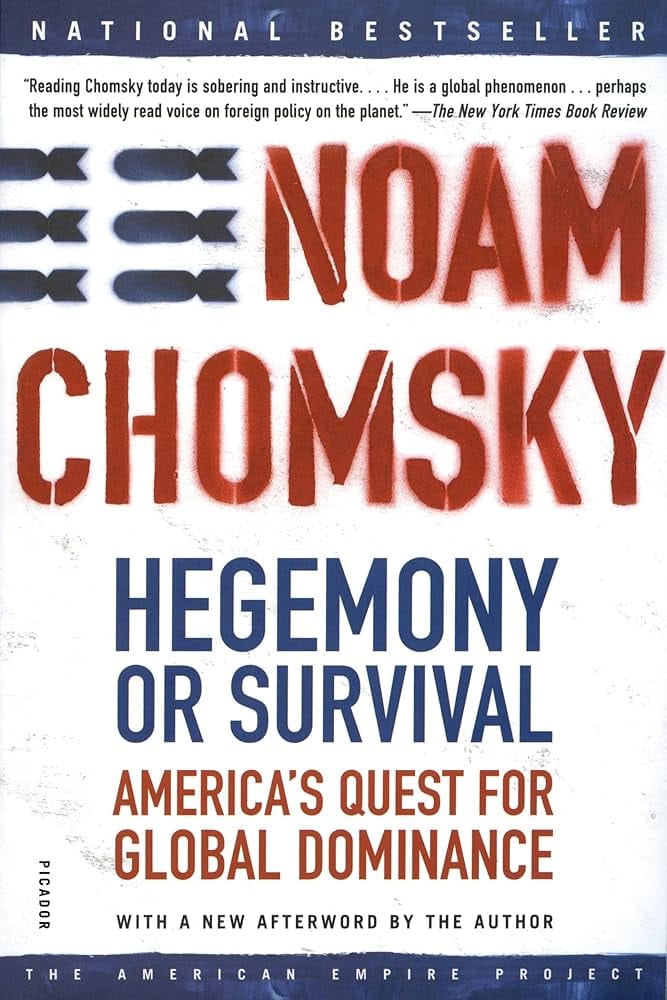
From the world’s foremost intellectual activist, an irrefutable analysis of America’s pursuit of total domination and its expected consequences. “Intellectual activist Chomsky takes aim at the Bush administration’s policy of preemptive force against terrorism and sees it as part of a US bent toward hegemony… Chomsky offers a cautionary look at where we may be headed as a nation and the growing threats to world peace and personal freedom.” — Booklist An immediate national bestseller, Hegemony or Survival demonstrates how, for more than a half a century, the United States has been pursuing a grand imperial strategy with the aim of staking out the globe. Our leaders have shown themselves willing—as in the Cuban missile crisis—to follow the dream of dominance no matter how high the risks. World-renowned intellectual Noam Chomsky here investigates how we came to this perilous moment and why our rules are willing to jeopardize the future of our species. With the striking logic that is his trademark, Chomsky tracks the U.S. government’s aggressive pursuit of “full spectrum dominance” and vividly lays out how the most recent manifestations of the politics of global control—from unilateralism to the dismantling of international agreements to state terrorism—cohere in a drive for hegemony that ultimately threatens our existence. Lucidly written, thoroughly documented, and featuring a new afterword about the war in Iraq, Hegemony or Survival is a definitive statement from one of today’s most influential thinkers. “If … you have to pick just one book on the subject of the American Empire, pick this one. It’s the Full Monty. It’s Chomsky at his best. Hegemony or Survival is necessary reading.” —Arundhati Roy “[A] highly readable, heavily footnoted critique of American foreign policy from the late 1950s to the present… . Cogent and provocative … an important addition to an ongoing public discussion about US policy.” — Publishers Weekly
My Summary
Main Ideas, Takeaways & Similarities
Questions
I. What is the problem?
A. How is this problem formulated?
B. Why is this problem important?
C. What is the history of this problem?
D. Which prominent personalities have been interested in this problem?
II. What solutions to the problem are there?
A. What are the conclusions reached?
B. By what argument(s) is the conclusion reached?
C. What facts or assumptions serve as premises?
D. When a prominent personality offers a solution, does he also argue for or against other prominent personalities? Does he raise objections to alternative solutions? Does he consider objections to his own solutions?
III. Evaluation
A. What are the advantages and disadvantages of the alternative formulations to the problem?
B. Has the importance or history of the problem ever been misrepresented?
C. Are the solutions logically related to the premises?
D. Are the facts true? Are the assumptions acceptable? Are the objections answerable?
AI Summary
Highlights
“Hegemony or Survival: America’s Quest for Global Dominance” is a book written by Noam Chomsky, published in 2003. In this book, Chomsky critiques American foreign policy and its impact on global politics. Here is a comprehensive summary of the book in bullet points:
- The book argues that American foreign policy is driven by a quest for global dominance, which is pursued through various means, including military interventions, economic coercion, and political influence.
- Chomsky contends that American foreign policy is primarily shaped by the interests of corporate elites and the military-industrial complex rather than the well-being of the American people or the global community.
- He examines the historical context of U.S. foreign policy, discussing America’s role in toppling democratically elected governments, supporting dictators, and engaging in covert operations to protect its economic and geopolitical interests.
- Chomsky criticizes the U.S. government’s pursuit of military interventions in countries like Vietnam, Iraq, and Afghanistan, arguing that these actions often lead to human suffering, instability, and anti-American sentiment.
- The book questions the legitimacy of U.S. interventions in the name of spreading democracy and protecting human rights, suggesting that these justifications are often used selectively to advance American interests.
- Chomsky also discusses the impact of American economic policies, including trade agreements and structural adjustment programs, on developing nations, often exacerbating poverty and inequality.
- He explores the role of corporate media in shaping public perception and promoting government narratives that support the pursuit of global dominance.
- The book examines the consequences of American unilateralism and disregard for international institutions and agreements, such as the United Nations and international treaties.
- Chomsky criticizes the expansion of American military bases around the world and the development of a global military presence, arguing that it fosters insecurity and hostility.
- He discusses the concept of “preventive war” and the Bush administration’s justification for the invasion of Iraq, which he views as a dangerous departure from international norms.
- Chomsky also examines the potential consequences of nuclear weapons proliferation and the need for disarmament to prevent catastrophic conflicts.
- The book concludes by advocating for a shift in American foreign policy towards diplomacy, cooperation, and the pursuit of genuine security and well-being for all nations.
“Hegemony or Survival” is a critical analysis of American foreign policy and its pursuit of global dominance. Chomsky challenges the justifications and consequences of U.S. actions on the world stage, advocating for a more ethical and cooperative approach to international relations.