Attachment (file not included in this release)
Executive Summary
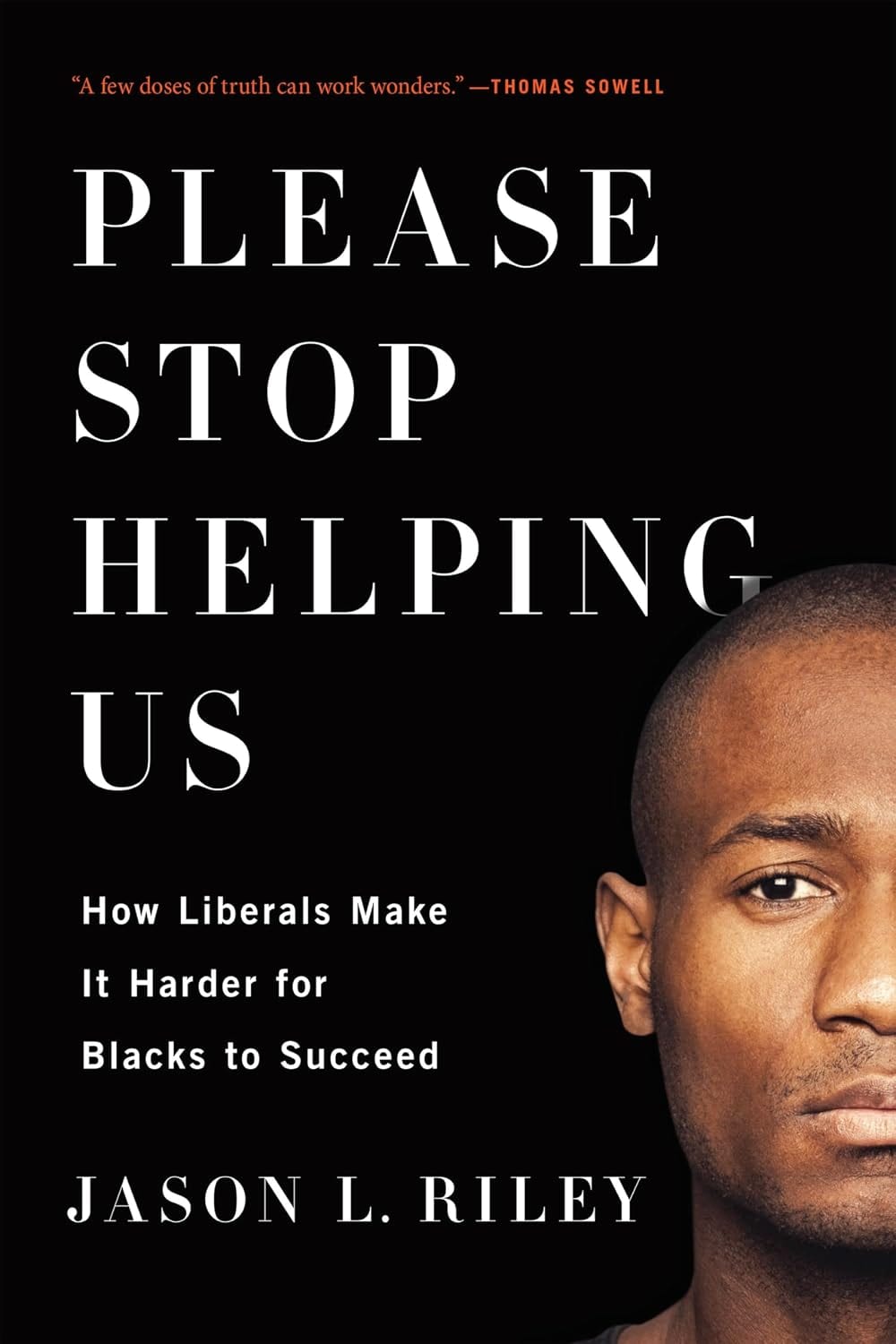
Jason L. Riley’s Please Stop Helping Us: How Liberals Make It Harder for Blacks to Succeed argues that post-1960s liberal policy has often harmed black Americans by substituting government-managed racial outcomes for equal opportunity, self-development, work, family stability, public safety, school choice, and merit-based advancement. Riley does not reject the civil-rights achievements of the mid-twentieth century; he explicitly treats the Civil Rights Act and Voting Rights Act as liberalism “at its best.” His critique is aimed at what he sees as the next phase: welfare-state expansion, racial preferences, union-backed labor regulation, soft-on-crime policies, and education policies that protect institutions rather than students.
The book’s central claim is that black political advancement has not reliably translated into black socioeconomic advancement. Riley contends that black progress depends less on symbolic representation or race-conscious government intervention and more on cultural norms, family structure, employment, educational freedom, public order, and academic fit. The significance of the book is that it offers a black conservative/libertarian critique of the modern civil-rights establishment, drawing heavily on Thomas Sowell, Shelby Steele, Booker T. Washington, Frederick Douglass, and empirical policy arguments against liberal orthodoxy.
Key Concepts
Equal Opportunity vs. Equality of Result
Riley frames the book around Lyndon Johnson’s Howard University argument that civil rights required not merely formal freedom but “equality as a fact and equality as a result.” Riley challenges this premise. He argues that government can remove legal barriers, but attempts to engineer equal outcomes often create perverse incentives and institutional distortions.
[!quote] Lyndon Johnson’s Civil-Rights Premise
“Freedom is not enough.” — PDF p. 7
Riley’s counterargument is that once legal equality is secured, policy should protect opportunity rather than guarantee proportional racial outcomes.
Group Self-Development
Riley repeatedly contrasts the modern liberal civil-rights model with Frederick Douglass and Booker T. Washington. For Riley, self-development means the internal cultivation of habits, norms, skills, discipline, education, family responsibility, and economic independence.
[!quote] Frederick Douglass on Self-Development
“Do nothing with us! Your doing with us has already played the mischief with us.” — PDF p. 9
Culture Matters
The book’s organizing sociological premise is that culture is not incidental. Riley argues that norms around family formation, work, school behavior, crime, religion, respectability, and attitudes toward achievement shape outcomes more powerfully than many liberals admit.
Perverse Incentives
A recurring framework is that well-intended policies can generate incentives that undermine their goals. Examples include:
- Welfare programs that reduce the economic necessity of marriage or work.
- Minimum-wage laws that price low-skilled workers out of entry-level jobs.
- Affirmative action that mismatches students with schools where they are less likely to succeed.
- Criminal-justice leniency that leaves poor black neighborhoods less safe.
- Opposition to school choice that traps children in failing public schools.
Political Representation vs. Socioeconomic Progress
Riley argues that black politics has often overvalued symbolic representation and undervalued concrete outcomes. Obama’s election is his central example: a major symbolic political achievement that, in Riley’s account, did not reverse black unemployment, income decline, family breakdown, poor schooling, or crime.
Mismatch Theory
In the affirmative-action chapter, Riley relies on the argument that racial preferences can place students into academic environments where their entering credentials are far below the institutional median. This, he argues, can reduce graduation rates, particularly in demanding fields such as science, technology, engineering, and mathematics.
Institutional Capture by Liberal Interest Groups
Riley argues that teachers’ unions, civil-rights organizations, Democratic politicians, and black liberal intellectuals often benefit from the status quo even when black communities do not. The book repeatedly claims that liberal institutions preserve political influence by keeping race central to public debate.
Key Terms
- Great Society — Lyndon Johnson’s domestic-policy program aimed at reducing poverty and racial inequality through federal spending, welfare programs, and redistributive policy.
- Equality of Result — The political goal of producing proportional or equal outcomes across racial groups, not merely equal legal rights.
- Identity Politics — Political organization based on racial, ethnic, or group identity; Riley treats it as a mechanism that encourages racial solidarity over policy accountability.
- Race Card — Riley’s term for using racial accusation or racial symbolism to deflect criticism, mobilize black voters, or delegitimize opponents.
- Black Liberalism — In Riley’s usage, the modern civil-rights establishment’s emphasis on racism, government intervention, racial preferences, and political mobilization.
- Self-Development — The internal development of habits, discipline, skills, family stability, and economic independence.
- Acting White — A cultural accusation that academic achievement, standard English, or middle-class behavioral norms are betrayals of black authenticity.
- Soft-on-Crime Policies — Criminal-justice reforms or policing restrictions that Riley argues reduce public safety in high-crime black neighborhoods.
- Minimum Wage — A legal wage floor Riley argues disproportionately harms low-skilled black workers by reducing entry-level employment.
- Davis-Bacon Act — Federal law requiring prevailing wages on public works projects; Riley treats it as historically tied to union protectionism and racial exclusion.
- School Choice — Policies such as charter schools and vouchers that allow families to leave assigned public schools.
- Affirmative Action — Race-conscious admissions or hiring preferences designed to increase minority representation.
- Mismatch — The claim that racial preferences can place students in academic environments where they are less likely to graduate or persist in rigorous fields.
- Historically Black Colleges and Universities — Institutions originally created to educate black students; Riley argues they remain important because they often provide better academic fit than elite institutions using heavy racial preferences.
Introduction
Main Ideas
Riley begins with Lyndon Johnson’s 1965 Howard University speech, where Johnson argued that formal legal freedom was insufficient after centuries of oppression. Johnson’s claim was that civil rights had entered a deeper phase: not merely equality before the law, but opportunity and equal results.
Riley treats this as the decisive ideological turn. He argues that the Civil Rights Act and Voting Rights Act removed core legal barriers, but the Great Society then moved into a more ambitious and dangerous project: trying to engineer racial equality through redistribution and group-based remedies.
[!quote] Johnson’s Race Analogy
“You do not take a person who, for years, has been hobbled by chains and liberate him, bring him up to the starting line of a race and then say, ‘you are free to compete with all the others.’” — PDF p. 7
Riley’s central question is whether government help after the civil-rights victories actually helped black Americans. His answer is largely no. He argues that welfare programs, minimum wages, affirmative action, weak policing, and opposition to school choice often produced the opposite of their stated purpose.
He contrasts Johnson’s vision with Frederick Douglass and Booker T. Washington. Douglass wanted the state to secure equal rights and then stop interfering. Washington emphasized preparation, discipline, property, industry, education, and character. Riley argues that modern liberalism ignored this older black tradition.
[!quote] Booker T. Washington’s Warning
“It is important and right that all privileges of the law be ours, but it is vastly more important that we be prepared for the exercise of these privileges.” — PDF p. 10
Argument Structure
- The civil-rights movement achieved legal equality.
- The Great Society shifted the goal from legal equality to managed outcomes.
- This created policies that weakened work, family, schooling, safety, and self-development.
- Black elites and Democratic politicians benefited politically from these policies.
- Poor black communities often bore the costs.
Key Concepts in the Introduction
- Serial altruism — Riley’s description of repeated liberal interventions that claim benevolent motives but produce harmful results.
- Limits of government benevolence — The claim that law can remove barriers but cannot substitute for culture, discipline, family, and skills.
- Self-development tradition — The Douglass-Washington view that black advancement requires internal preparation, not permanent political guardianship.
01. Black Man in the White House
Main Ideas
This chapter uses Barack Obama’s presidency as a test case for Riley’s argument that black political success is not the same as black social or economic success.
Riley notes that black Americans remained highly supportive of Obama even during a period when black unemployment, black household income, and black homeownership worsened. He argues that racial solidarity and Democratic loyalty shielded Obama from the kind of accountability black voters might have applied to a white president.
The chapter does not present Obama primarily as the cause of black socioeconomic decline. Instead, Riley treats Obama as evidence against the claim that black political representation is the central precondition for black progress.
[!quote] The Symbolism Problem
“One lesson of the Obama presidency—maybe the most important one for blacks—is that having a black man in the Oval Office is less important than having one in the home.” — PDF p. 32
Black Voters and Democratic Loyalty
Riley argues that black voters have become a captured constituency. Since black voters overwhelmingly support Democrats, Republicans have little electoral incentive to compete for them, while Democrats have little incentive to deliver concrete policy results.
He presents this as a political trap:
- Republicans often ignore black voters because they do not need them to win.
- Democrats can take black voters for granted because black voters rarely defect.
- Civil-rights leaders reinforce the arrangement by treating Democratic loyalty as racial loyalty.
Identity Politics and Racial Solidarity
Riley argues that modern liberalism encourages black voters to see politics racially rather than empirically. He criticizes multiculturalism, hate-crime laws, affirmative-action quotas, racially gerrymandered districts, and voter-ID controversies as mechanisms that keep racial consciousness politically useful.
The chapter argues that the Obama administration and its allies used race-based rhetoric to maintain support among black voters, especially through arguments about voter-ID laws, drug sentencing, criminal-background checks, and housing integration.
Booker T. Washington vs. Protest Politics
The chapter pivots into a historical contrast between Booker T. Washington and the protest-politics tradition associated with W. E. B. Du Bois, the NAACP, Malcolm X, Martin Luther King Jr., Jesse Jackson, and Al Sharpton.
Riley does not deny the importance of protest against legal segregation. His criticism is that after legal barriers fell, the protest model remained dominant and crowded out Washington’s emphasis on economic independence, education, property, discipline, and character.
Supporting Evidence
Riley uses:
- Obama-era unemployment and income figures.
- Black voting patterns from 1980–2012.
- Polling showing high black approval for Obama.
- Census data on black voter turnout.
- Historical comparison of Washington, Douglass, Du Bois, Bayard Rustin, Martin Luther King Jr., and James Farmer.
- Contemporary disputes over voter ID, charter schools, and civil-rights rhetoric.
Key Concepts
- Political romanticism — The belief that symbolic racial representation will produce material racial progress.
- Captured constituency — A voting bloc with few realistic alternatives, reducing accountability.
- Protest-politics legacy — The extension of civil-rights protest tactics into an era where Riley believes economic and cultural development should be primary.
02. Culture Matters
Main Ideas
This is the book’s most explicitly sociological chapter. Riley argues that black outcomes cannot be understood without discussing culture, especially family structure, attitudes toward education, neighborhood norms, religion, and behavioral expectations.
He begins personally, describing his own father’s presence after divorce. The point is not autobiography for its own sake; Riley uses his father to highlight the importance of black fatherhood.
[!quote] Margaret Mead on Fatherhood
“Every known human society rests firmly on the learned nurturing behavior of men.” — PDF p. 34
Riley argues that family breakdown is central to black disadvantage. He rejects the claim that slavery or Jim Crow straightforwardly explains modern black family instability, arguing that black marriage rates were historically stronger during periods of greater racism than in the late twentieth and early twenty-first centuries.
Culture and Social Mobility
Riley’s argument is that cultures transmit habits. Some habits promote mobility; others impede it. He emphasizes:
- Stable two-parent families.
- Fathers as disciplinarians, role models, and protectors.
- Religious participation.
- Educational seriousness.
- Respect for lawful authority.
- Middle-class behavioral norms.
- Work ethic and delayed gratification.
He criticizes liberal reluctance to judge destructive behavior. In his view, refusing to distinguish between functional and dysfunctional norms makes reform impossible.
“Acting White”
The chapter discusses the charge that academic achievement is “acting white.” Riley treats this as one of the clearest examples of self-defeating cultural norms. He argues that black students in some environments face peer penalties for academic seriousness, standard English, or middle-class behavior.
He uses Shaker Heights and other examples to argue that racial gaps persist even where schools are integrated and well-funded, suggesting that school resources alone cannot explain educational disparities.
Bill Cosby and the Respectability Debate
Riley discusses Bill Cosby’s controversial criticism of poor black behavior. He argues that Cosby’s critics—such as Michael Eric Dyson, August Wilson, Theodore Shaw, and Ta-Nehisi Coates—too quickly shifted blame back to slavery, Jim Crow, and systemic racism.
Riley’s position is that historical racism matters, but cannot explain why some indicators of family stability were stronger in earlier, more racist periods.
[!quote] Riley’s Cultural Thesis
“Liberals want to blame the ‘legacy’ of slavery and racism for the breakdown of the black family and subsequent social pathologies. But the empirical data support Bill Cosby.” — PDF p. 54
Welfare and Family Breakdown
Riley argues that welfare policy weakened incentives for marriage and work. He does not claim that welfare alone caused black family breakdown, but he treats it as a major accelerant because it made single parenthood more economically viable and reduced the necessity of male provision.
Supporting Evidence
Riley draws on:
- Census and family-structure data.
- Historical marriage comparisons.
- Moynihan-style arguments about family breakdown.
- Studies of peer pressure and “acting white.”
- Shaker Heights educational disparities.
- Bill Cosby’s 2004 NAACP speech and reactions to it.
- Thomas Sowell and Shelby Steele’s arguments about culture.
Key Concepts
- Culture of dependency — The idea that welfare and excuse-making can produce learned dependence.
- Acting white — A stigma against achievement or middle-class behavior.
- Father absence — A central causal factor in Riley’s explanation of crime, education failure, and poverty.
- Respectability politics — Though Riley does not use the term as a pejorative, his argument overlaps with the claim that behavior, discipline, family, and presentation matter.
03. The Enemy Within
Main Ideas
This chapter argues that crime is one of the most serious obstacles to black advancement and that liberal explanations often misidentify the cause. Riley rejects the view that black incarceration rates are mainly the result of racist policing, racist sentencing, or racist drug laws. He argues instead that black incarceration rates largely reflect black crime rates.
His central claim is that law-abiding black residents are the primary victims of under-policing and leniency. He argues that black communities need more public order, not less.
Crime as a Barrier to Mobility
Riley frames crime as an internal enemy because it damages the very institutions and behaviors required for progress:
- It drives businesses out of neighborhoods.
- It weakens schools.
- It traps families in unsafe areas.
- It normalizes antisocial behavior.
- It discourages investment.
- It makes ordinary community life unstable.
Critique of “Racist Criminal Justice System” Explanations
Riley challenges claims that the justice system is the main driver of black incarceration. He argues that:
- Violent crime is concentrated disproportionately among black offenders.
- Victim reports often match arrest patterns.
- Drug laws do not explain most black incarceration.
- Crack sentencing disparities were initially supported by many black lawmakers because crack was devastating black neighborhoods.
- Criminal-background checks may help black job applicants because they reduce employers’ reliance on racial profiling.
Stop-and-Frisk and Policing
Riley defends aggressive policing strategies such as New York’s stop-and-frisk in high-crime areas. His argument is utilitarian: if crime is racially concentrated in particular neighborhoods, policing will also be concentrated there. For Riley, racial disparities in police contact do not automatically prove racial bias.
Trayvon Martin and Symbolic Politics
Riley criticizes the racial mobilization around high-profile cases of white-on-black or nonblack-on-black violence. His objection is not that individual injustices cannot occur, but that the civil-rights establishment focuses on rare interracial cases while ignoring far more common black-on-black violence.
Supporting Evidence
Riley uses:
- Crime and arrest statistics.
- Heather Mac Donald’s policing arguments.
- Randall Kennedy on crack sentencing.
- Studies on criminal-background checks.
- Comparisons between black victimization and black incarceration.
- Discussion of stand-your-ground laws and high-profile racialized crime narratives.
Key Concepts
- Black-on-black crime — Riley’s central public-safety concern; he argues it receives insufficient attention from civil-rights leaders.
- Under-policing — The idea that fear of racial accusation leads to reduced policing in communities that need protection.
- Symbolic victim politics — The political elevation of racially resonant cases over statistically more common harms.
- Racial-disparity fallacy — Riley’s implied critique of assuming that unequal racial outcomes necessarily prove racial discrimination.
04. Mandating Unemployment
Main Ideas
This chapter argues that minimum-wage laws and related labor regulations harm black workers by reducing entry-level employment. Riley’s central economic claim is that low-skilled workers need access to first jobs more than they need a legally mandated wage above their productivity level.
[!quote] Riley on Anti-Poverty Policy
“The best antipoverty program is not the minimum wage. Rather, it’s a job, even if it’s an entry-level one.” — PDF p. 91
Minimum Wage and Black Youth Unemployment
Riley argues that black teenagers and low-skilled black workers are especially vulnerable to minimum-wage hikes because employers respond to higher labor costs by hiring fewer inexperienced workers, automating, reducing hours, or demanding higher productivity.
He emphasizes that the first job is not only about immediate income; it is about acquiring soft skills:
- Showing up on time.
- Taking supervision.
- Developing references.
- Learning workplace discipline.
- Building a résumé.
- Moving up to better-paying work.
Labor Unions and Racial Exclusion
Riley links minimum-wage laws to union interests. He argues that unions support wage floors partly because wage mandates reduce competition from lower-skilled nonunion labor. He also discusses the racial history of labor exclusion, including Frederick Douglass’s criticism of unions and the Davis-Bacon Act.
Davis-Bacon Act
Riley treats the Davis-Bacon Act as an example of labor regulation that protected white union workers from competition by black workers. His argument is that “prevailing wage” requirements made it harder for black laborers to compete by offering lower-cost labor.
Critique of Liberal Intentions
Riley does not deny that minimum-wage advocates often intend to help the poor. His claim is that intention does not determine effect. If a wage mandate prices out the least skilled, it injures the very people it claims to help.
Supporting Evidence
Riley uses:
- Historical material on unions and racial exclusion.
- Economic studies on minimum wages by David Neumark, William Wascher, Richard Burkhauser, and Joseph Sabia.
- Critiques of David Card and Alan Krueger.
- Black teen unemployment statistics.
- Discussion of Ted Kennedy, Robert Reich, and liberal minimum-wage advocacy.
- Davis-Bacon historical analysis.
Key Concepts
- Price floor — A mandated wage above the market-clearing wage.
- Disemployment effect — The reduction in employment caused by raising the price of labor.
- Entry-level work — Low-wage work that provides experience and a path into the labor market.
- Union protectionism — The use of labor regulation to protect incumbent workers from lower-cost competitors.
- Prevailing wage — Government-mandated wage levels for public works projects.
05. Educational Freedom
Main Ideas
This chapter argues that black educational failure is not mainly caused by insufficient spending or racial bias in testing. Riley argues that poor black children are trapped in failing public schools because liberal politicians and teachers’ unions oppose school choice.
His central claim is that black families need educational freedom more than they need loyalty to traditional public-school systems.
Public-School Failure
Riley argues that education spending has increased substantially without eliminating racial achievement gaps. He claims that the problem is not simply money, but institutional monopoly, weak accountability, union rules, and the absence of parental choice.
Historical Black Commitment to Education
Riley notes that blacks historically placed high value on education, including during Reconstruction and through institutions like Dunbar High School. He uses this history to challenge the idea that black students fail because education is culturally alien to black life. His concern is instead with contemporary institutions and peer norms.
Charter Schools
Riley strongly supports charter schools, especially successful networks serving poor black and Hispanic students. He argues that charters can outperform traditional public schools because they often have:
- Longer school days.
- Strong disciplinary norms.
- High expectations.
- Teacher accountability.
- Parental buy-in.
- Institutional flexibility.
Teachers’ Unions
Riley treats teachers’ unions as major obstacles to reform. He argues that unions protect adult employment interests over student outcomes, oppose school choice, resist accountability, and use political donations to preserve their power.
Vouchers and School Choice
The chapter defends vouchers and other choice mechanisms as ways for poor families to access better schools. Riley argues that wealthier families already exercise school choice by moving to better districts or paying private tuition; poor families need policy mechanisms to obtain similar options.
Critique of Liberal Opposition
Riley argues that liberal politicians often claim to defend poor children while blocking the very reforms those families want. In his view, opposition to charters and vouchers shows that the left prioritizes public-school systems and unions over black students.
Supporting Evidence
Riley uses:
- Achievement-gap data.
- Education spending data.
- Charter-school studies and examples.
- Dunbar High School as a historical model.
- Teachers’ union political spending.
- Examples from Washington, D.C., Georgia, and other jurisdictions.
- Discussion of successful charter networks such as Democracy Prep.
Key Concepts
- School choice — Allowing parents to choose alternatives to assigned public schools.
- Charter school — Publicly funded but independently managed school with more flexibility than traditional public schools.
- Voucher — Public funding that follows the student to a private or alternative school.
- Education monopoly — Riley’s critique of traditional public-school assignment systems.
- Union capture — The claim that teachers’ unions dominate education policy at the expense of students.
06. Affirmative Discrimination
Main Ideas
This chapter argues that affirmative action often harms black students and workers by lowering standards, stigmatizing beneficiaries, and producing academic mismatch. Riley’s critique is not only constitutional or moral; it is empirical. He argues that racial preferences can reduce black graduation, especially in demanding fields.
Civil Rights Act and Racial Preferences
Riley begins by returning to the Civil Rights Act of 1964. He notes that defenders of the law insisted it would not require quotas or racial balancing. Riley argues that courts, agencies, and institutions later transformed anti-discrimination law into race-conscious preference regimes.
From Equal Treatment to Racial Balancing
The chapter argues that affirmative action shifted civil-rights enforcement from banning intentional discrimination to producing racially representative outcomes. Riley sees this as a betrayal of the original colorblind promise of civil rights law.
Academic Mismatch
Riley relies on mismatch theory to argue that black students admitted with large preference gaps may struggle at elite institutions where their classmates are more academically prepared. He argues that many of these students would have been more successful at less selective schools where they were better matched.
[!quote] Mismatch Argument
“It is not lack of talent or innate ability that drives these students to drop out of school, flee rigorous courses, or abandon aspirations to be scientists or scholars; it is, rather, an unintended side effect of large racial preferences.” — PDF p. 136
University of California After Proposition 209
Riley highlights California’s ban on racial preferences as evidence that ending affirmative action did not destroy black educational progress. He argues that after preferences were banned, black and Hispanic students were more likely to graduate and persist in rigorous fields because they attended schools better matched to their preparation.
Stigma and Clarence Thomas
Riley discusses Clarence Thomas’s view that affirmative action stigmatizes black achievement. Even when black students or professionals are fully qualified, racial preferences can cause others to assume they were admitted or hired because of race rather than merit.
[!quote] Clarence Thomas on Stigma
“Now I knew what a law degree from Yale was worth when it bore the taint of racial preference.” — PDF p. 138
Asian Americans and the Cost of Preferences
Riley argues that affirmative action does not merely help one group; it imposes costs on others. He emphasizes Asian American applicants, who often face higher effective academic standards because universities seek racial balance.
Supporting Evidence
Riley uses:
- Civil Rights Act legislative language.
- Hubert Humphrey’s assurances against quotas.
- SAT and admissions data.
- University of California outcomes after Proposition 209.
- Richard Sander and Stuart Taylor’s mismatch research.
- Clarence Thomas and Stephen Carter on stigma.
- Asian American admissions controversies.
Key Concepts
- Affirmative discrimination — Riley’s term for race-conscious preference systems that discriminate in the name of remedy.
- Racial balancing — Seeking racial proportionality in institutions.
- Mismatch — Placing students in academic environments where they are less likely to succeed.
- Stigma effect — The suspicion that minority achievement is due to preference rather than merit.
- Colorblind law — The principle that government should not classify or distribute benefits by race.
Conclusion
Main Ideas
Riley closes by distinguishing between the civil-rights movement’s legitimate achievements and the liberal policy regime that followed. He praises the mid-century fight against legal discrimination but argues that liberalism became counterproductive once it moved from equal rights to social engineering.
[!quote] Civil Rights at Its Best
“The civil rights struggles of the mid-twentieth century were liberalism at its best.” — PDF p. 140
The conclusion argues that fifty years after the War on Poverty, the record is disappointing. Riley points to persistent or worsening gaps in poverty, unemployment, incarceration, education, and family structure. His interpretation is that these failures are not accidental; they reflect the defects of a policy model that downplays behavior and culture while exaggerating the power of government intervention.
Riley’s Final Diagnosis
Riley argues that the modern liberal civil-rights establishment has become too invested in racial grievance. Its incentives are political and institutional:
- Civil-rights organizations need racism to remain central.
- Democratic politicians benefit from black dependency and loyalty.
- Teachers’ unions benefit from blocking school choice.
- Universities benefit from racial-preference systems that signal virtue.
- Liberal intellectuals benefit from systemic explanations that excuse destructive behavior.
The conclusion’s final emphasis is that black advancement requires a recovery of older ideas: self-help, responsibility, educational seriousness, work, family, and lawfulness.
Key Concepts
- Post-civil-rights liberalism — Riley’s target: the policy regime after formal legal equality.
- Racial grievance industry — The claim that civil-rights institutions preserve power by maintaining racial crisis narratives.
- Self-inflicted wounds — Riley’s term-like idea that some black disadvantages are now internally reproduced rather than externally imposed.
- Color consciousness — Riley argues that America has become more obsessed with racial identity even after legal segregation ended.
Critical Analysis
Strengths
Riley’s book is strongest as a counter-narrative to mainstream liberal explanations of black disadvantage. Its most effective sections are those that force a distinction between intentions and outcomes. He repeatedly asks a valid policy question: even if a program is morally well-intended, does it actually improve the lives of the people it claims to help?
The book is also effective in recovering an older black intellectual tradition often neglected in contemporary debates: Frederick Douglass, Booker T. Washington, Thomas Sowell, Shelby Steele, Clarence Thomas, and parts of the black self-help tradition. Riley’s critique is not simply “white conservative backlash”; it is situated within a recognizable black conservative lineage.
His strongest empirical arguments concern:
- The difference between political representation and material progress.
- The importance of family structure.
- The damage caused by school monopolies in poor communities.
- The possibility that racial preferences can produce academic mismatch.
- The risk that minimum-wage laws reduce employment opportunities for the least skilled.
Weaknesses
The book’s main weakness is that it sometimes treats “liberalism” as too unified and too causally powerful. The left contains competing views on welfare, policing, school reform, charter schools, labor markets, and affirmative action. Riley often writes as if liberalism has one coherent institutional agenda, when in reality there are internal conflicts among progressives, civil-rights lawyers, labor unions, education reformers, social democrats, black church leaders, and urban politicians.
A second weakness is that Riley can move too quickly from racial disparity does not prove discrimination to behavior is the main cause. The first claim is analytically sound; the second requires more careful causal demonstration than the book always provides. Structural explanations can be overstated, but they cannot simply be dismissed because cultural explanations also matter.
A third limitation is that Riley’s cultural analysis sometimes under-specifies feedback loops. Family breakdown, crime, poor schooling, welfare dependency, labor-market exclusion, and neighborhood disorder may reinforce one another. The book tends to privilege culture as an explanatory variable without always showing how culture itself is shaped by economic shocks, housing policy, deindustrialization, incarceration, or local institutional failure.
Methodology
Riley’s method is polemical, empirical, and synthetic. He draws from:
- Census data.
- Labor economics.
- Crime statistics.
- Education research.
- Legal history.
- Public-policy studies.
- Political commentary.
- Black intellectual history.
The book is not a neutral academic monograph. It is an argumentative policy essay. Its evidence is often relevant and forceful, but it is selected to support a defined thesis. It should be read alongside serious liberal, progressive, and centrist accounts of race, poverty, crime, education, and labor markets.
Biases and Omissions
The most notable bias is ideological: Riley is explicitly skeptical of government intervention, racial preferences, union power, welfare programs, and civil-rights organizations. He is sympathetic to market mechanisms, school choice, colorblind law, policing, and behavioral explanations.
Major omissions or underdeveloped areas include:
- The effects of deindustrialization on black male employment.
- The long-term effects of housing segregation and redlining.
- The role of local tax bases in school quality.
- The empirical case for some forms of anti-poverty policy, including the Earned Income Tax Credit.
- More nuanced treatment of police misconduct and over-enforcement.
- The possibility that some black cultural pathologies are downstream of concentrated disadvantage rather than independent causes.
- Liberal reformers who support school choice, welfare reform, or policing reform without fitting Riley’s caricature.
Overall Evaluation
The book is valuable because it attacks weak assumptions in liberal race policy: that good intentions equal good results, that racial disparities automatically prove discrimination, that political representation equals progress, and that government programs can substitute for family, work, education, and public order.
Its limitation is that it sometimes overcorrects. Riley’s critique is strongest when framed as: liberal policy often ignores culture and incentives. It is weaker when it implies that culture and behavior can be analyzed apart from history, institutions, and economic structure.
Questions for Reflection
- Where should the line be drawn between removing barriers to opportunity and trying to engineer equality of outcomes?
- Does Riley successfully prove that liberal policies caused black socioeconomic problems, or does he mainly show that those policies failed to solve them?
- How should policymakers weigh cultural explanations against structural explanations when addressing poverty, crime, and educational failure?
- Was Booker T. Washington’s self-help tradition unfairly marginalized after the civil-rights movement, or was protest politics necessary because self-help alone could not defeat institutional racism?
- Can affirmative action be redesigned to avoid mismatch and stigma, or are those problems inherent in racial preference systems?
- If school choice benefits poor black students, why do many civil-rights organizations and Democratic politicians oppose vouchers or charter expansion?
- What would a serious black advancement agenda look like if it prioritized family stability, school quality, public safety, employment, and colorblind law over racial representation?
Connections
Thinkers Mentioned or Central to the Argument
- Frederick Douglass — Used as a model of black self-development and limited government assistance.
- Booker T. Washington — Central figure for Riley’s emphasis on education, industry, property, character, and economic independence.
- W. E. B. Du Bois — Represents the alternative emphasis on political rights, institutional integration, and elite advancement.
- Martin Luther King Jr. — Treated as part of the protest-politics tradition, though Riley respects the civil-rights achievements associated with King.
- Bayard Rustin — Important for the shift from protest to political power.
- Thomas Sowell — Major intellectual influence on Riley’s arguments about race, economics, culture, minimum wages, and affirmative action.
- Shelby Steele — Important influence on Riley’s critique of white guilt, black victimhood, and liberal racial politics.
- Clarence Thomas — Used as a critic of affirmative action and racial preference stigma.
- Randall Kennedy — Used in the discussion of crack sentencing and criminal justice.
- Heather Mac Donald — Important source for Riley’s policing and crime arguments.
- Richard Sander and Stuart Taylor — Central to the mismatch critique of affirmative action.
- Daniel Patrick Moynihan — Implied influence on family-structure arguments.
Influential Works Mentioned or Relevant
- Frederick Douglass, speeches and autobiographical writings
- Booker T. Washington, Up from Slavery
- W. E. B. Du Bois, The Souls of Black Folk
- Martin Luther King Jr., Where Do We Go from Here: Chaos or Community?
- Bayard Rustin, “From Protest to Politics”
- Thomas Sowell, The Economics and Politics of Race
- Thomas Sowell, Affirmative Action Around the World
- Shelby Steele, The Content of Our Character
- Stephen Carter, Reflections of an Affirmative Action Baby
- Richard Sander and Stuart Taylor, Mismatch
- Daniel Patrick Moynihan, The Negro Family: The Case for National Action
- Charles Murray, Losing Ground
- James Q. Wilson, writings on crime and social order
- Heather Mac Donald, writings on policing and crime
Historical Movements and Policy Contexts
- Abolitionism
- Reconstruction
- Tuskegee self-help tradition
- Progressive-era labor regulation
- New Deal labor policy
- Civil-rights movement
- Great Society
- War on Poverty
- Black Power
- Affirmative action
- School-choice movement
- Charter-school reform
- Tough-on-crime and broken-windows policing
- Post-racial politics debate after Obama’s election
- Colorblind constitutionalism vs. race-conscious policy