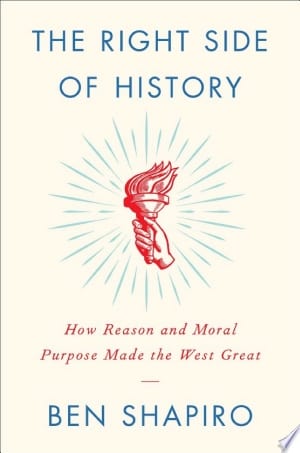
DESCRIPTION
A #1 NEW YORK TIMES BESTSELLER! Human beings have never had it better than we have it now in the West. So why are we on the verge of throwing it all away? In 2016, New York Times bestselling author Ben Shapiro spoke at the University of California–Berkeley. Hundreds of police officers were required to protect his speech. What was so frightening about Shapiro? He came to argue that Western civilization is in the midst of a crisis of purpose and ideas; that we have let grievances replace our sense of community and political expediency limit our individual rights; that we are teaching our kids that their emotions matter more than rational debate; and that the only meaning in life is arbitrary and subjective. As a society, we are forgetting that almost everything great that has ever happened in history happened because of people who believed in both Judeo-Christian values and in the Greek-born power of reason. In The Right Side of History, Shapiro sprints through more than 3,500 years, dozens of philosophers, and the thicket of modern politics to show how our freedoms are built upon the twin notions that every human being is made in God’s image and that human beings were created with reason capable of exploring God’s world. We can thank these values for the birth of science, the dream of progress, human rights, prosperity, peace, and artistic beauty. Jerusalem and Athens built America, ended slavery, defeated the Nazis and the Communists, lifted billions from poverty, and gave billions more spiritual purpose. Yet we are in the process of abandoning Judeo-Christian values and Greek natural law, watching our civilization collapse into age-old tribalism, individualistic hedonism, and moral subjectivism. We believe we can satisfy ourselves with intersectionality, scientific materialism, progressive politics, authoritarian governance, or nationalistic solidarity. We can’t. The West is special, and in The Right Side of History, Ben Shapiro bravely explains how we have lost sight of the moral purpose that drives each of us to be better, the sacred duty to work together for the greater good,.
Attachment (file not included in this release)
Timeline of Key Individuals in The Right Side of History
Ancient World
- Moses (c. 1400–1200 BCE)
• Influence: Central figure in Judaism, brought the Ten Commandments, establishing moral and legal codes based on divine authority. His influence on the development of monotheism and moral law is central to the book’s argument that Judeo-Christian values underpin Western ethics. - Plato (c. 428–348 BCE)
• Influence: Greek philosopher, student of Socrates, and teacher of Aristotle. His works, especially The Republic, are foundational in the development of Western political thought, emphasizing justice, order, and the role of reason in governance. - Aristotle (384–322 BCE)
• Influence: Plato’s student and tutor to Alexander the Great, Aristotle’s works on logic, ethics, and politics significantly influenced Western philosophy. His ideas of reason, virtue, and the “Golden Mean” are integral to Shapiro’s argument about the role of reason in Western civilization.
Classical Roman and Early Christian Period - Jesus of Nazareth (c. 4 BCE – 30/33 CE)
• Influence: Founder of Christianity, whose teachings about love, humility, and redemption deeply impacted Western moral and ethical thinking. Shapiro points to Jesus’ teachings as a crucial aspect of Western civilization’s emphasis on individual dignity and human value. - Saint Paul (c. 5–64 CE)
• Influence: Early Christian missionary and writer of much of the New Testament. Paul’s writings helped spread Christianity across the Roman Empire, blending Greco-Roman ideas with Judeo-Christian ethics, forming a bedrock for Western moral philosophy.
Medieval Era - Saint Augustine (354–430 CE)
• Influence: Christian philosopher and theologian whose works, especially City of God and Confessions, merged Christian theology with Greco-Roman philosophy. Augustine’s thoughts on sin, redemption, and human nature shaped medieval Christian thinking and the concept of individual conscience. - Thomas Aquinas (1225–1274 CE)
• Influence: Christian theologian and philosopher who integrated Aristotelian philosophy with Christian doctrine in his seminal work, Summa Theologica. Aquinas is instrumental in Shapiro’s narrative as someone who harmonized faith and reason, which influenced Western ideas on law, ethics, and governance.
Renaissance and Enlightenment - Niccolò Machiavelli (1469–1527 CE)
• Influence: Italian political philosopher best known for The Prince. Though his work is often considered cynical, Shapiro views Machiavelli as an important figure in the transition from medieval to modern political thought, where power dynamics became a central concern. - John Locke (1632–1704 CE)
• Influence: English philosopher whose ideas on natural rights, government by consent, and individual liberty heavily influenced the American and French Revolutions. Locke’s Two Treatises of Government and theories of “life, liberty, and property” are crucial to Shapiro’s argument about the role of Enlightenment thinking in Western political development. - Baruch Spinoza (1632–1677 CE)
• Influence: Dutch philosopher who challenged traditional religious views and argued for a rationalist, pantheistic understanding of the universe. Spinoza’s blending of reason and ethics is a reflection of the shift toward Enlightenment thinking.
Modern Era - Immanuel Kant (1724–1804 CE)
• Influence: German philosopher whose work in ethics, particularly Critique of Pure Reason and Groundwork of the Metaphysics of Morals, had a profound impact on modern moral and political thought. Kant’s emphasis on human autonomy, morality, and duty is significant in Western moral philosophy, especially in discussions about rights and justice. - George Washington (1732–1799 CE)
• Influence: First President of the United States and key figure in the American Revolution. Washington is central to Shapiro’s discussion of the American founding as the embodiment of Enlightenment principles applied in practice, especially concerning liberty and governance. - Thomas Jefferson (1743–1826 CE)
• Influence: Principal author of the Declaration of Independence, Jefferson represents the culmination of Enlightenment ideas about natural rights and government, blending Greco-Roman reason and Judeo-Christian ethics in the foundation of the United States. - James Madison (1751–1836 CE)
• Influence: “Father of the Constitution” and co-author of The Federalist Papers. Madison’s work on the U.S. Constitution reflects the practical application of the philosophical heritage that Shapiro emphasizes throughout the book.
19th & 20th Centuries - Friedrich Nietzsche (1844–1900 CE)
• Influence: German philosopher who critiqued traditional morality and religion, declaring “God is dead.” Shapiro presents Nietzsche as a pivotal figure in the decline of Judeo-Christian values in Western society, marking a shift towards moral relativism and nihilism. - Karl Marx (1818–1883 CE)
• Influence: Philosopher and economist, co-author of The Communist Manifesto. Marx’s critique of capitalism and call for revolution fundamentally challenged the ideas of individual liberty and private property, which are central to the Western tradition that Shapiro defends. - Adolf Hitler (1889–1945 CE)
• Influence: Dictator of Nazi Germany whose genocidal policies led to World War II and the Holocaust. Shapiro uses Hitler as an example of the dangers of abandoning the moral framework of Judeo-Christian values in favor of totalitarianism and nihilism.
Contemporary Figures - Martin Luther King Jr. (1929–1968 CE)
• Influence: Civil rights leader who advocated for racial equality through nonviolent resistance. King is highlighted for his reliance on Judeo-Christian principles of justice and equality, drawing heavily from the moral philosophies that shaped Western civilization.
Conclusion
In The Right Side of History, Ben Shapiro argues that Western civilization was built on the foundation of Judeo-Christian values and Greco-Roman reason. The key individuals mentioned in this timeline were instrumental in shaping both the intellectual and moral foundations of the West, and their influence continues to be felt in modern Western society. The decline of these foundational ideas, according to Shapiro, is leading to a cultural and moral crisis in contemporary times.
For & Against People
Here’s the breakdown with the addition of Nietzsche and Hobbes:
Ancient World
• For:
• Moses: Central to establishing monotheistic, moral law through the Ten Commandments, reflecting the foundation of Western ethics based on divine authority and order.
• Plato & Aristotle: Both Greek philosophers emphasized reason, virtue, and justice, laying the groundwork for political thought that valued reason. Aristotle’s emphasis on the “Golden Mean” and natural law is a key aspect Shapiro endorses.
• Against:
• Polytheism and the ancient Greek gods: Shapiro views polytheistic belief systems as chaotic and arbitrary, in contrast to the moral and ordered universe proposed by Judeo-Christian monotheism.
Classical Roman and Early Christian Period
• For:
• Jesus of Nazareth: His teachings about love, humility, and redemption shaped Western moral thought, emphasizing individual dignity and moral responsibility, which are core to Shapiro’s argument.
• Saint Paul: Expanded Christianity across the Roman Empire, merging Judeo-Christian values with Greek reason.
• Augustine of Hippo: Merged Christian theology with Greco-Roman philosophy, reinforcing the idea of moral law and individual responsibility.
Medieval Era
• For:
• Thomas Aquinas: Integrated Aristotelian philosophy with Christian theology, emphasizing the compatibility of faith and reason, which Shapiro advocates as the foundation for Western civilization’s success.
• Saint Augustine: Contributed to the development of Christian thought that emphasized divine purpose and human morality, a key element in Shapiro’s moral framework.
• Against
• Certain radical religious movements**: While supportive of Christianity, Shapiro is critical of movements that restrict the use of reason or elevate faith to the exclusion of reason, which may occur in some medieval religious contexts.
Renaissance and Enlightenment
• For:
• John Locke: Advocated for natural rights and the use of reason, particularly in government. Locke’s ideas of liberty and the sovereignty of the individual are central to Shapiro’s arguments.
• George Washington, Thomas Jefferson, and James Madison: Founders of the United States who applied Enlightenment ideas in a context that respected Judeo-Christian moral principles.
• Against:
• Niccolò Machiavelli: Although seen as important in political thought, Shapiro views Machiavelli’s pragmatic, often amoral approach as a challenge to virtue and traditional moral order.
• Jean-Jacques Rousseau: Rousseau’s elevation of the “general will” and advocacy for social revolution is seen as a precursor to the excesses of modern collectivist ideologies, which Shapiro critiques.
• Thomas Hobbes: Hobbes’ materialist and mechanistic view of human beings as self-interested and in constant conflict undermines the classical and Judeo-Christian belief in natural law, morality, and human virtue. Hobbes advocated for a strong central authority (Leviathan) to control human impulses, which Shapiro sees as rejecting the balance between individual liberty and moral responsibility.
Modern Era
• For:
• Immanuel Kant: Though challenging certain aspects of religious belief, Kant’s emphasis on moral law, autonomy, and duty aligns with the rational pursuit of morality that Shapiro supports.
• Against:
• Friedrich Nietzsche: Nietzsche’s declaration that “God is dead” and his promotion of moral relativism, the will to power, and nihilism is seen by Shapiro as pivotal in the decline of Judeo-Christian values. Nietzsche’s rejection of objective morality and his idea of the Übermensch as a creator of new values deeply contrasts with Shapiro’s advocacy for a moral framework rooted in religious tradition and reason.
• Karl Marx: Marx’s rejection of individual liberty and promotion of class struggle undermined the Judeo-Christian and Greco-Roman philosophical foundations of the West.
• Adolf Hitler: Hitler represents the extreme consequences of abandoning moral frameworks based on Judeo-Christian ethics, leading to totalitarianism and nihilism, according to Shapiro.
Contemporary Period
• For:
• Martin Luther King Jr.: Advocated for civil rights using principles grounded in Judeo-Christian values and natural law, emphasizing justice, equality, and human dignity.
• Against:
• Postmodernism and identity politics: Shapiro is critical of modern movements that he perceives as rejecting reason and moral responsibility in favor of subjective identity and division.
This timeline now includes both Nietzsche and Hobbes as significant figures whose ideas diverged from the moral and rational foundations that Shapiro argues are essential to Western civilization’s success. Nietzsche’s philosophy of individual will and moral relativism, and Hobbes’ materialism and advocacy for absolute authority, represent challenges to the Judeo-Christian and Greco-Roman ideals of morality, virtue, and liberty.
MAIN IDEAS, TAKEAWAYS & SIMILARITIES
- Strong moral purpose = happiness
- Four Elements of Moral Purpose (Happiness)
- Individual moral purpose
- Innate individual value
- Duties gives us purpose
- Individual capacity to pursue that purpose
- Virtuous action
- Belief in capacity to cultivate and utilize a skill set
- Capacity to better ourselves
- Meaning individuals; not a cluster of cells
- Power and ability to reason
- Believe we are pursuing true goals—not merely effective ones
- Communal moral purpose
- Strong social community
- Strong social relationships
- Civil vitality
- Communal capacity to pursue that purpose
- Churches
- Social Clubs
- Charity organizations
- And for Government to protect them; delicate balance
- what does positive communal capacity look like? It looks like a governmental system capable of mobilizing to stop external threats, but unable to threaten individual liberties; it looks like a social fabric powerful enough to support community members, confident enough to avoid the tools of governmental compulsion. Few governments in human history have met that standard.
- active social communities promoting virtue, and a state nonrestrictive enough to provide a forum for our free choice.
- Individual moral purpose
- There can be no individual or communal moral purpose without a foundation of Divine meaning; there can be no individual capacity or communal capacity without a constant, abiding belief in the nature of our reason.
- The economy is good, people are better now than they have ever been. Why the depression and mental illness?
- The upper middle class in the United States grew from 12 percent of Americans in 1979 to 30 percent as of 2014. Income mobility hasn’t changed significantly in the United States since the 1970s.
- The age of scientific progress didn’t begin with the Enlightenment. It began in the monasteries of Europe.
- Islamic civilization did thrive on the Arabian Peninsula particularly—when Islamic civilization came up against Western civilization at the Battle of Tours, Islamic forces were soundly defeated.
- In the Athenian framework, it’s nearly impossible to disassociate individual purpose from communal purpose. Plato, Aristotle, and the Stoics would have all rejected such a division as counterproductive and fruitless: individual purpose lay in acting virtuously—fulfilling our telos by pursuing right reason in accordance with nature. Virtue, in turn, could only be defined with reference to the community. The individual, in this view, tends to disappear into the community.
- Greeks gave us the roots of democracy. Based on the notion of virtue—use of reason to act in accordance with nature—Plato, Aristotle, and the Stoics developed ethical systems.
- The secularist myth holds that religion held back science for millennia. The reverse is true. Without Judeo-Christian foundations, science simply would not exist as it does in the West.
Summary (AI)
- Overview
“The Right Side of History: How Reason and Moral Purpose Made the West Great” by Ben Shapiro explores the philosophical, moral, and religious foundations that have shaped Western civilization. Below is a summary of the book’s main points in bullet form:
- Importance of Judeo-Christian Values: Shapiro argues that Judeo-Christian values are fundamental to the development of Western civilization, providing a moral framework that underpins the concepts of individual worth and moral responsibility.
- Role of Greek Reason: Alongside Judeo-Christian values, Shapiro credits ancient Greek philosophy, particularly the emphasis on reason and inquiry, as a pillar of Western thought, crucial for the development of science, political theory, and human rights.
- Enlightenment and Rational Thought: The book highlights the Enlightenment as a pivotal era that advanced the use of reason, leading to significant progress in science, governance, and human rights, building upon the intellectual heritage of Judeo-Christian values and Greek philosophy.
- Critique of Modernity: Shapiro is critical of modern movements that reject these foundations, including postmodernism, secularism, and identity politics, arguing they lead to division, nihilism, and a loss of meaning.
- Importance of Liberty and Individualism: Shapiro emphasizes the importance of liberty, individualism, and free speech as products of the West’s unique philosophical heritage, arguing that these principles are under threat in the contemporary political climate.
- Call for Return to Principles: The book makes a call to return to the fundamental principles of Judeo-Christian values and rational thought, suggesting that the West’s greatness can be preserved and extended through a recommitment to these ideals.
- Analysis of Current Social and Political Divisions: Shapiro examines the current social and political divisions in the United States and the Western world, attributing them to a departure from the foundational principles that made the West great.
- Personal Responsibility and Moral Purpose: The book underscores the importance of personal responsibility and the pursuit of moral purpose grounded in Judeo-Christian ethics and rational inquiry, as essential for individual fulfillment and societal well-being.
- Introduction to “The Right Side of History” by Ben Shapiro:
- The book addresses two main mysteries: why the current state of human civilization is so prosperous and why society seems to be squandering its achievements.
- Shapiro reflects on the historical hardships of humanity, contrasting them with the modern comforts and freedoms enjoyed in the United States today[1].
- Human Progress and Current Comforts:
- Shapiro notes the significant advancements in human well-being, including drastic reductions in infant and maternal mortality rates, and the widespread availability of amenities like climate-controlled spaces, food, cars, and technology[1].
- He highlights the freedoms enjoyed in the U.S., such as the absence of slavery, torture, and unjust imprisonment, as well as the lack of restrictions based on race or gender[1].
- Concerns About Modern Society:
- Despite these advancements, Shapiro observes increasing rates of depression, drug overdoses, declining marriage and childbearing rates, and a general sense of dissatisfaction despite material wealth[1].
- He points out the divisiveness in American politics, citing the unfavorability of the 2016 presidential candidates and the stress and frustration of political discourse[1].
- Distrust in Institutions and Each Other:
- Trust in key institutions and in fellow citizens has eroded, with low percentages of Americans expressing trust in banks, newspapers, organized religion, the federal government, and Congress[1].
- Shapiro also notes the decline in trust among neighbors and the decrease in social interactions[1].
- Economic, Racial, and Technological Explanations:
- Shapiro critiques the arguments that economic divides, racial tensions, and technology are the primary causes of societal disintegration, suggesting that these factors alone cannot explain the current crisis[1].
- Human Nature and the Enlightenment:
- The book explores the idea that human nature has reverted to tribalism and possessiveness, countering the Enlightenment’s emphasis on rationality and progress[1].
- Shapiro questions why modernity and Enlightenment ideals emerged in the first place if they are contrary to human nature[1].
- Foundations of Western Civilization:
- Shapiro argues that Western civilization is built on the foundations of Judeo-Christian values and Greek natural law reasoning, which have led to scientific, human rights, and artistic achievements[1].
- He warns that abandoning these values leads to the collapse of civilizations, as seen in historical examples like the USSR, Nazi Germany, and Venezuela[1].
- Personal Experience and the Importance of Speech:
- Shapiro shares his personal experience of needing security at speaking events on college campuses, illustrating the hostility towards free speech and rational debate[1].
- The Role of Judeo-Christian Values and Greek Natural Law:
- The book emphasizes the importance of these values in creating a society with purpose, freedom, and moral duty, and suggests that the decline of these values is causing societal decay[1].
- Call to Action:
- Shapiro calls for a reexamination of the foundational ideas that built Western civilization and urges a return to these principles to prevent further decline[1].
[1] https://ppl-ai-file-upload.s3.amazonaws.com/web/direct-files/7742445/1309fd57-bc70-4228-beba-4baae92965ca/Ben Shapiro - The Right Side of History (2019, HarperCollins Publishers) - libgen.li pages 4 - 15.pdf
[2] https://www.blinkist.com/en/books/the-right-side-of-history-en
[3] https://en.wikipedia.org/wiki/The_Right_Side_of_History
[4] https://www.amazon.com/Right-Side-History-Reason-Purpose/dp/0062857908
[5] https://blog.12min.com/the-right-side-of-history-pdf-summary/
[6] https://instaread.co/insights/history-political-social-science-sociology/the-right-side-of-history-book/kcrppljncf
[7] https://www.bookey.app/book/the-right-side-of-history - Introduction
The introduction to Ben Shapiro’s “The Right Side of History” explores two central mysteries: why, despite historical progress, is society seemingly regressing in certain aspects? Shapiro delves into the remarkable advancements humanity has achieved over centuries, contrasting these with the current state of societal discontent and division. Here’s a summary of the key points:
- Historical Progress: Shapiro outlines the vast improvements in human living conditions over time, including significant reductions in infant and maternal mortality rates, increased life expectancy, and advancements in technology and freedoms. He highlights the unprecedented level of comfort and liberty enjoyed by the majority of the American population today.
- Current Societal Issues: Despite these advancements, Shapiro points to increasing rates of depression, drug overdoses, declining marriage and childbearing rates, and a general sense of dissatisfaction and division within society. He notes the extreme polarization observed during the 2016 U.S. presidential election as a symptom of deeper issues.
- Loss of Trust: Shapiro discusses the dramatic decline in trust towards key institutions and each other, citing statistics that reveal low levels of confidence in banks, newspapers, organized religion, and the federal government among Americans.
- Economic, Racial, and Technological Theories: Shapiro critiques various explanations for the current societal divide, including economic inequality, racial tensions, and the impact of technology and social media. He argues that these factors alone cannot fully explain the depth of the divide.
- Human Nature and Enlightenment: Shapiro suggests that a reversion to tribal, possessive, and angry instincts, which were temporarily suppressed during the Enlightenment, might be contributing to the current societal issues. He emphasizes the importance of the Enlightenment in fostering science, humanism, reason, and progress.
- Foundations of Western Civilization: Shapiro argues that the achievements of Western civilization are built on the foundations of Judeo-Christian values and Greek natural law reasoning. He warns that abandoning these values risks the collapse of civilization into tribalism, hedonism, and moral subjectivism.
- Personal Experience: Shapiro shares his personal experiences of hostility and violence while speaking at college campuses, illustrating the extent of societal polarization and the rejection of free speech.
- Call to Action: Shapiro concludes by calling for a reexamination and reinforcement of the foundational values of Western civilization to prevent further societal decay and division.
[1] https://ppl-ai-file-upload.s3.amazonaws.com/web/direct-files/7742445/f64a9797-10d1-4809-979f-5c6730dbbc7d/Ben Shapiro - The Right Side of History (2019, HarperCollins Publishers) - libgen.li pages 4 - 15.pdf - Chapter 1: The Pursuit of Happiness
- Ben Shapiro reflects on happiness during a stressful period in his life, finding solace in the Sabbath as an Orthodox Jew, where he disconnects from work and technology to spend time with family and community.
- He distinguishes between the pursuit of happiness and the achievement of happiness, noting that politics can only establish the conditions for happiness, not provide it directly.
- Shapiro criticizes the increasing tendency of Americans to seek happiness through politics and external forces, rather than looking inward and improving their own lives.
- He argues that the pursuit of physical pleasure, emotional catharsis, and monetary stability are often mistaken for happiness, but they do not provide lasting fulfillment.
- Shapiro emphasizes that true happiness comes from living with moral purpose, as understood since the dawn of Western civilization, with references to both Judeo-Christian and Greek traditions.
- He cites the Bible and Aristotle, who both associate happiness with living according to moral purpose and virtue, rather than temporary pleasures.
- Shapiro discusses the necessity of individual moral purpose, rooted in the belief that all humans are made in God’s image and have inherent value and duties.
- He stresses the importance of individual capacity for happiness, which includes the belief in one’s ability to pursue happiness, the power of reason, and the pursuit of true goals.
- Shapiro highlights the need for communal moral purpose, where social connections and a shared vision of the community’s moral purpose bind people together.
- He outlines the necessity for communal capacity, which involves strong social institutions and a government that is protective yet limited, to allow for the pursuit of individual and communal virtuous goals.
- Shapiro concludes that happiness comprises four elements: individual moral purpose, individual capacity, collective moral purpose, and collective capacity, and that society crumbles without these.
- He asserts that the West is losing its civilization due to generations undermining the sources of happiness: Divine meaning and reason, and calls for a return to these roots[1].
- Chapter 2: From the Mountaintop
The chapter from Ben Shapiro’s “The Right Side of History” titled “From the Mountaintop” discusses the transformative impact of Judeo-Christian values on civilization, particularly focusing on the shift from a polytheistic worldview to a monotheistic one. Here’s a summary of the key points:
- The Shift from Polytheism to Monotheism: The chapter begins by contrasting the ancient polytheistic belief systems, where humans were at the mercy of capricious gods and had little control over their fate, with the revolutionary monotheistic beliefs of Judaism (and later Christianity). This shift introduced the concept of a single, unified God who cares about individuals and their actions.
- Judeo-Christian Contributions to Civilization: Shapiro argues that the Judeo-Christian tradition laid the foundation for Western civilization’s advancements in freedom and material prosperity. He emphasizes four key innovations of Judaism: the unity of God, moral standards for human behavior, the concept of historical progress, and the importance of individual choice.
- Critique of Modern Western Attitudes: Shapiro critiques contemporary Western leaders for undermining Judeo-Christian values, which he sees as the bedrock of Western civilization. He argues that dismissing these religious beliefs in favor of materialism and relativism threatens the very fabric of Western society.
- The Nature of Polytheism: The chapter provides an overview of polytheistic beliefs, highlighting their complexity and natural appeal. It discusses how polytheism accommodated a chaotic universe and multiple gods, contrasting this with the monotheistic view of a logical, ordered universe governed by a single deity.
- Judaism’s Revolutionary Ideas: Shapiro outlines how Judaism introduced the concept of a moral universe governed by a single, just God. This was a departure from the arbitrary and capricious gods of polytheism. Judaism also emphasized the importance of moral behavior and individual responsibility.
- The Role of Christianity: Christianity is credited with spreading the fundamental principles of Judaism to a broader audience, emphasizing grace and redemption.
- The Importance of Individual and Communal Purpose: The chapter discusses how Judaism and Christianity provided individuals and communities with a sense of purpose and direction, rooted in the belief in a caring and purposeful God.
- The Expectation of Progress and Redemption: Unlike the cyclical or static views of history common in other ancient cultures, Judaism introduced the idea of historical progress towards redemption, a concept later embraced by Christianity.
- The Significance of Free Will: Shapiro highlights the revolutionary idea, introduced by Judaism, that all humans are created in the image of God and endowed with free will, marking a departure from the notion that divine qualities were reserved for rulers or demigods.
- The Limited Role of Government: The chapter touches on the Bible’s ambivalence towards centralized power and its preference for a society structured around family, community, and a limited government role.
[1] https://ppl-ai-file-upload.s3.amazonaws.com/web/direct-files/7742445/dbb60049-b2cf-4159-b16b-3124af0e609e/Ben Shapiro - The Right Side of History (2019, HarperCollins Publishers) - libgen.li pages 28 - 40.pdf - Chapter 3: From the Dust
Summary of Chapter 3: From the Dust
Chapter 3 of Ben Shapiro’s “The Right Side of History” discusses the role of universities and the value of studying the classics in the context of Western civilization. Shapiro argues that historically, universities were places where students were steeped in the classics, learning from the literature of ancient Greece and Rome, which the Founding Fathers of the United States were well versed in. However, in modern times, the classics are often viewed as outdated and irrelevant, leading to a decline in their study. Shapiro criticizes this trend, suggesting that it stems from a generalized scorn for Western civilization, which is seen by many on the radical left as a bastion of imperialism and racism. He references Edward Said’s “Orientalism” to illustrate the critique of Western study of non-Western cultures. Shapiro argues that ignoring the legacy of the Greco-Roman philosophical tradition undermines the true contributions of Western civilization, which he claims include freedom, reduced poverty, and the rise of human rights and democracy. He emphasizes the importance of learning from Athens, which teaches human capacity and the use of reason, and he discusses the Greek contributions to natural law, science, and democracy. Shapiro concludes that while Athens’s contributions are necessary, they are not sufficient to explain the greatness of the West, and that the West also required Jerusalem, representing religious faith[1].Timeline of People Discussed in Chapter 3
- Plato (428-348 BCE): A philosopher from ancient Athens who contributed to the foundation of Western civilization with his allegory of the cave and the idea that people can use reason to discover the nature of the world and construct the best collective systems for cultivating reason[1].
- Aristotle (384-322 BCE): A Greek philosopher who, along with Plato, rejected the atomic theory of Democritus and believed in the existence of natural laws that could be discovered through the use of reason. He posited that everything has a purpose (telos) and that human virtue lies in fulfilling that purpose[1].
- Democritus (460-370 BCE): An ancient Greek philosopher who believed that all of human life could be reduced to atoms and that ethics were secondary to nature. His views were opposed by Plato and Aristotle, who believed in natural law and purpose[1].
- Edward Said: An intellectual who critiqued the study of ancient philosophy and civilization in his work “Orientalism,” suggesting that the legacy of Greece and Rome was one of “othering” the East and that Westerners should not write about “Orientalist” cultures[1].
- Jesse Jackson: A political figure who, in the 1980s, led a march at Stanford University chanting against Western civilization, reflecting the broader movement against the study of the classics on college campuses[1].
- Chapter 4: Coming Together
- Nature of God Conflict:
- Moses vs. Aristotle: Judaism’s active God vs. Greek’s Unmoved Mover.
- Rabbi Jonathan Sacks: Highlighted the fundamental difference between the God of history (Abraham) and the changeless God of Greek philosophy (Plato and Aristotle).
- Judaism vs. Greek Thought: Judaism saw God’s presence in human events, while Greek thought emphasized fate and a divine presence without moral sense.
- Universality Conflict:
- Greek Reason vs. Jewish Revelation: Greek thought sought universal truths through contemplation, while Judaism believed in specific divine communication and the necessity of revelation for moral guidance.
- Torah’s Perspective: Encouraged using reason to find general truths but emphasized the unique role of the Jewish people in spreading universal truths through divine commandments.
- Polis vs. Divine Commitment Conflict:
- Greek Citizenship vs. Jewish Divine Law: The Greek focus on the polis and cultivating virtues for citizenship clashed with Judaism’s commitment to divine law.
- Maccabean Revolt (167 BCE): Resulted from Antiochus IV’s attempts to impose Greek religion and ban Jewish practices, leading to the reestablishment of the Hasmonean dynasty and the celebration of Hanukkah.
- Birth of Christianity:
- Merging Jewish and Greek Thought: Christianity attempted to combine Jewish thought with Greek universality, making the message of Judaism universal.
- Jesus’s Role: Transitioned from a Jewish figure to a universal savior, leading to the abandonment of Jewish law in favor of universal salvation through faith.
- Tertullian and Saint Augustine: Emphasized faith over Greek reason, with Augustine arguing that investigating the universe was less important than accepting revelation.
- Victory of Christianity:
- Rapid Spread: From about 1,000 followers in 40 CE to six million by 300 CE.
- Factors Contributing to Spread: System of care for the poor, active seeking of converts, and legal recognition within the Roman Empire.
- Constantine and Theodosius: Played significant roles in Christianity’s rise to the official state religion of the Roman Empire.
- Christianity’s Influence on Western Civilization:
- Monastic System: Centralized learning and preserved manuscripts, contributing to the survival of liberal arts education.
- Scholasticism: Encouraged a blend of faith and reason, leading to the establishment of universities and the promotion of scientific inquiry.
- Aquinas’s Thomism: Merged Aristotelianism with Christianity, advocating for the use of reason to understand God’s creation and reinforcing the compatibility of faith and reason.
- Flaws in Consonance and Rise of the Enlightenment:
- Limitations of Augustine and Aquinas’s Legacy: While providing a framework for individual and communal purpose, their views did not fully account for the physical world’s betterment or the dangers of communal power, setting the stage for the Enlightenment’s challenges to religious dominance.
- Moses (Date not specified, traditionally around 1300 BCE) - Represents Judaic view of an active God.
- Plato (428/427 or 424/423 – 348/347 BCE) - Mentioned in context with Aristotle, contributing to Greek philosophical thought.
- Aristotle (384–322 BCE) - Introduced the concept of the Unmoved Mover, contrasting with Judaic views.
- Antiochus IV (215–164 BCE) - Greek king whose actions led to the Maccabean Revolt.
- Jesus (c. 4 BCE – c. AD 30/33) - Central figure in Christianity, redefined from a Jewish figure to a universal savior.
- Tertullian (c. 155 – c. 240 AD) - Early Christian thinker who emphasized faith over Greek reason.
- Saint Augustine (354–430) - Argued for the primacy of revelation over investigation of the universe.
- Boethius (477–524) - Philosopher who categorized the liberal arts into the quadrivium and trivium.
- Saint Benedict (c. 480–547) - Established the Benedictine monastic order.
- Hugh of Saint-Victor (1096–1141) - Scholastic philosopher encouraging the study of all areas of knowledge.
- Maimonides (1135–1204) - Jewish philosopher who sought to reconcile Aristotelianism with Judaism.
- Thomas Aquinas (1225–1274) - Developed Thomism, merging Aristotelianism with Christianity.
- Roger Bacon (1219/1220–1292) - Early proponent of the scientific method.
- Nature of God Conflict:
- Chapter 5: Endowed by Their Creators
Main Ideas of Chapter 5
Chapter 5 of “The Right Side of History” by Ben Shapiro, titled “Endowed by Their Creators,” delves into the philosophical and historical underpinnings that have shaped modern Western civilization. Shapiro argues that the fusion of Judeo-Christian values with Greek philosophy, particularly the emphasis on individual freedom and natural rights, has been crucial in developing the moral and intellectual framework of the West. He discusses the evolution of these ideas through historical figures and movements, highlighting the importance of skepticism towards centralized power and optimism in scientific progress. Shapiro also examines the role of key individuals who contributed to the scientific and political revolutions that defined the Western world, emphasizing the interplay between faith and reason in their work.Timeline and Summary of Key Figures
- Thomas Aquinas (1225-1274): A medieval philosopher and theologian who integrated Aristotelian philosophy with Christian theology, emphasizing that reason and faith are complementary. Aquinas is in the book for his role in laying the groundwork for the Western tradition of rational inquiry and natural law[1].
- William of Ockham (1287-1347): An English Franciscan friar and scholastic philosopher known for Ockham’s Razor, advocating for simplicity in philosophical and theological explanations. His skepticism of the Church’s authority contributed to the development of scientific inquiry[1].
- Nicole Oresme (c. 1320-1382): A pre-Renaissance French bishop and scholar who discovered the Earth’s rotation. His work exemplifies the Church’s support for scientific investigation during the Middle Ages[1].
- Nicholas of Cusa (1401-1464): A cardinal who theorized about the Earth’s movement through space, challenging the static Earth model. His contributions reflect the period’s growing acceptance of scientific ideas[1].
- Nicolaus Copernicus (1473-1543): A Renaissance mathematician and astronomer who proposed the heliocentric model of the universe, challenging the geocentric view. His work, though initially controversial, was a pivotal moment in the Scientific Revolution[1].
- Martin Luther (1483-1546) and John Calvin (1509-1564): Leaders of the Protestant Reformation who challenged the Catholic Church’s authority, leading to religious fragmentation and the promotion of individual interpretation of the Bible. Their actions had profound political and social implications, contributing to the rise of individual rights[1].
- Galileo Galilei (1564-1642): An Italian astronomer whose support for the Copernican system led to conflict with the Catholic Church. Galileo’s insistence on observational evidence as the basis of scientific theory is a cornerstone of the scientific method[1].
- Francis Bacon (1561-1626): An English philosopher and statesman who advocated for the empirical method, emphasizing observation and experimentation over Aristotelian abstract reasoning. His work laid the foundations for the modern scientific method[1].
- René Descartes (1596-1650): A French philosopher who emphasized the use of reason to develop the natural sciences. Known for “Cogito, ergo sum” (I think, therefore I am), Descartes’ method of doubt and emphasis on individual reason were influential in the Enlightenment[1].
- Johannes Kepler (1571-1630) and Isaac Newton (1642-1727): Kepler discovered the laws of planetary motion, and Newton formulated the laws of motion and universal gravitation. Both integrated their scientific discoveries with their religious beliefs, seeing the universe’s order as evidence of divine design[1].
[1] https://ppl-ai-file-upload.s3.amazonaws.com/web/direct-files/7742445/b6efcedc-4185-4c17-8e5e-30cf60e315ff/The Right Side of History — Ben Shapiro — 2019 — HarperCollins Publishers — 9780062857903 — 881fd785d7cabbf3e1b2ec811b5a3b05 — Anna’s Archive pages 64 - 78.pdf
[2] https://blog.12min.com/the-right-side-of-history-pdf-summary/
[3] https://quizlet.com/53026129/us-history-chapter-5-main-topics-flash-cards/
[4] https://elevatesociety.com/the-right-side-of-history-summary-review/
[5] https://www.blinkist.com/en/books/the-right-side-of-history-en
[6] https://instaread.co/insights/history-political-social-science-sociology/the-right-side-of-history-book/kcrppljncf
[7] https://quizlet.com/8068855/us-history-chapter-5-terms-1-10-and-main-ideas-flash-cards/
[8] https://en.wikipedia.org/wiki/The_Right_Side_of_History
[9] https://openstax.org/books/us-history/pages/5-summary
[10] https://www.litcharts.com/lit/a-people-s-history-of-the-united-states/chapter-5-a-kind-of-revolution
[11] https://www.bookey.app/book/the-right-side-of-history
[12] https://www.booksataglance.com/book-summaries/the-right-side-of-history-how-reason-and-moral-purpose-made-the-west-great-by-ben-shapiro/ - Chapter 6: Killing Purpose, Killing Capacity
Summary of Chapter 6: Killing Purpose, Killing Capacity
Chapter 6 of “The Right Side of History” by Ben Shapiro, titled “Killing Purpose, Killing Capacity,” discusses the debate surrounding the separation of church and state in the United States. Shapiro argues that America’s founding philosophy was based on both secular reason and religious morality, which were cultivated through religious warfare and secular argument. He posits that modernity was built on these twin pillars, creating a civilization that was practical, purposeful, religious, rational, virtuous, and ambitious. Shapiro criticizes the proponents of the Enlightenment who suggest that the philosophy of individual rights sprang from the rejection of religion and embrace of reason. He contends that the Enlightenment’s progress was rooted in Judeo-Christian values and the Greek search for knowledge and purpose. Shapiro also explores the historical forces that drove Western thought away from Judeo-Christian morality and Aristotelian virtue, starting with Machiavelli and continuing through thinkers like Hobbes, Spinoza, and Hume. These philosophers questioned religious revelation, discarded the notion of final causes, and promoted moral . Shapiro warns that the Enlightenment’s rejection of Judeo-Christian values and Greek teleology led to an existential crisis of meaning and a decline in the West’s moral and rational foundations.Timeline of Philosophers and Thinkers
- Niccolò Machiavelli (1469-1527): Challenged traditional virtue, advocating for virtù, a pragmatic blend of good and evil to achieve ends[1].
- Thomas Hobbes (1588-1679): Applied rigorous logic to religious revelation, finding it wanting, and dismissed Aristotelian telos in favor of material interests[1].
- Baruch Spinoza (1632-1677): A lapsed Jew who criticized religious authorities and the Bible, promoting rational egotism and minimal state intervention[1].
- David Hume (1711-1776): Discounted miracles and classical proofs of God’s existence, rejecting discoverable purpose and introducing the “is-ought” problem[1].
- Voltaire (1694-1778): A deist who sought morality in reason and promoted a hedonistic, materialist morality while recognizing the need for virtue in society[1].
- Jean-Jacques Rousseau (1712-1778): Advocated for the “general will” and transformative leadership, elevating passions and the idea of human perfectibility[1].
- Immanuel Kant (1724-1804): Focused on moral instinct and a priori knowledge to derive universal morality through categorical imperatives[1].
- Jeremy Bentham (1748-1832): Constructed a utilitarian moral system based on the promotion of happiness and rejection of natural rights[1].
- Chapter 7: The Remaking of the World
Main Ideas of Chapter 7
Chapter 7 of “The Right Side of History” by Ben Shapiro, titled “The Remaking of the World,” discusses the Enlightenment’s impact on Western civilization and the contrasting outcomes of its different strains. Shapiro argues that the Enlightenment had two distinct paths: the American Enlightenment, which was rooted in Judeo-Christian values and the philosophical heritage of Athens and Jerusalem, and the European Enlightenment, which rejected these foundations in favor of reason without boundaries. He contrasts the American Revolution, which emphasized individual rights and social virtue, with the French Revolution, which pursued a utopian vision of human perfectibility without traditional virtue. Shapiro critiques the French Revolution’s rejection of Judeo-Christian values and ancient virtue, leading to a society where collective will and radical subjectivism replaced individual rights. He also discusses figures like Edmund Burke, who critiqued the French Revolution for ignoring human nature and morality. The chapter explores how nationalism and collectivism, unmoored from transcendent values, led to destructive outcomes in history[1].Timeline of People Discussed
- John Locke (1632-1704): English philosopher whose ideas on God-given rights of individuals influenced the American Enlightenment[1].
- Voltaire (1694-1778): French writer and philosopher known for his criticism of traditional virtue and influence on the French Revolution[1].
- Jean-Jacques Rousseau (1712-1778): Philosopher whose concept of the “general will” was central to the French Revolution’s ideology[1].
- Denis Diderot (1713-1784): French philosopher and Encyclopédie editor who wished to eliminate the influence of religion and monarchy[1].
- Nicolas de Condorcet (1743-1794): French philosopher who believed in the perfectibility of mankind through science[1].
- Maximilien Robespierre (1758-1794): French revolutionary leader who established the Cult of the Supreme Being and was executed during the Reign of Terror[1].
- Edmund Burke (1729-1797): British statesman and philosopher who criticized the French Revolution for its disregard for tradition and morality[1].
- Johann Fichte (1762-1814): German philosopher who promoted the idea of German superiority and nationalism[1].
- Georg Hegel (1770-1831): Philosopher who saw the state as the embodiment of rationality and history as a process of thesis, antithesis, and synthesis[1].
- Karl Marx (1818-1883): Philosopher and economist whose ideas on communism and class struggle influenced the 19th and 20th centuries[1].
[1] https://ppl-ai-file-upload.s3.amazonaws.com/web/direct-files/7742445/ec7305fc-9b82-4206-b7e3-1aceb7a23b72/The Right Side of History — Ben Shapiro — 2019 — HarperCollins Publishers — 9780062857903 — 881fd785d7cabbf3e1b2ec811b5a3b05 — Anna’s Archive pages 94 - 118.pdf
[2] https://blog.12min.com/the-right-side-of-history-pdf-summary/
[3] https://www.litcharts.com/lit/a-people-s-history-of-the-united-states/chapter-7-as-long-as-grass-grows-or-water-runs
[4] https://quizlet.com/225850663/apush-chapter-7-key-concepts-and-eventskey-people-flash-cards/
[5] https://elevatesociety.com/the-right-side-of-history-summary-review/
[6] https://quizlet.com/63428576/us-history-chapter-78-review-flash-cards/
[7] https://openstax.org/books/us-history/pages/chapter-7
[8] https://instaread.co/insights/history-political-social-science-sociology/the-right-side-of-history-book/kcrppljncf
[9] https://quizlet.com/166426421/us-history-chapter-7-key-terms-definitions-and-people-to-know-flash-cards/
[10] https://en.wikipedia.org/wiki/The_Right_Side_of_History
[11] https://www.coursehero.com/lit/A-Peoples-History-of-the-United-States/chapter-7-summary/
[12] https://www.blinkist.com/en/books/the-right-side-of-history-en
[13] https://openstax.org/books/us-history/pages/7-summary
[14] https://www.booksataglance.com/book-summaries/the-right-side-of-history-how-reason-and-moral-purpose-made-the-west-great-by-ben-shapiro/ - Chapter 8: After the Fire
Summary of Chapter 8 of “The Right Side of History”
Chapter 8 of “The Right Side of History” by Ben Shapiro, titled “After the Fire,” delves into the aftermath of World War II and the existential crisis that ensued in Western civilization. Shapiro argues that despite the West becoming freer, richer, and more prosperous than ever before, a “meaning-shaped hole” persisted at the center of Western civilization. This void, according to Shapiro, has expanded over the decades, leading to attempts to fill it with action, science, and political activism, none of which provided the sought-after meaning. The chapter critiques the Enlightenment project and its aftermath, highlighting how the philosophies of key figures like Kant, Hegel, Nietzsche, Marx, Darwin, and Comte contributed to a crisis of meaning following the horrors of World War II and the Holocaust. Shapiro discusses the rise of existentialism, with a focus on thinkers like Søren Kierkegaard, Friedrich Nietzsche, Karl Jaspers, Martin Heidegger, and Jean-Paul Sartre, and how their ideas shifted the quest for meaning to individual subjectivity, further complicating the search for universal truths. The chapter also touches on the impact of scientific advancements and the challenges posed by figures like Sigmund Freud and Alfred Kinsey to traditional moral frameworks. Shapiro concludes by questioning the sustainability of the Neo-Enlightenment’s reliance on science and reason alone to provide moral guidance and purpose[1].Timeline and Summary of Key Figures
- Søren Kierkegaard (1813-1855): A Danish philosopher who critiqued Enlightenment reason and emphasized individual subjectivity and the leap of faith as the means to find meaning. Kierkegaard is considered the father of existentialism, advocating for a personal search for truth and a passionate commitment to faith[1].
- Friedrich Nietzsche (1844-1900): German philosopher who declared “God is dead” and emphasized the will to power and the creation of one’s own values. Nietzsche’s philosophy challenged traditional moralities and promoted the idea of the Übermensch (Superman) as the creator of new values[1].
- Karl Jaspers (1883-1969): A German psychiatrist and philosopher who introduced the concept of the “philosophical faith” and emphasized the importance of personal truth and existential communication. Jaspers believed that all knowledge is interpretation, highlighting the subjective nature of understanding[1].
- Martin Heidegger (1889-1976): A German philosopher known for his existential and phenomenological explorations of the “being.” Heidegger argued that the essence of being human is existence itself, challenging the primacy of reason and advocating for authenticity[1].
- Jean-Paul Sartre (1905-1980): A French existentialist philosopher who argued that existence precedes essence, meaning that individuals first exist and then define their essence through actions. Sartre emphasized freedom, choice, and the responsibility that comes with being free[1].
- Sigmund Freud (1856-1939): An Austrian neurologist and the founder of psychoanalysis. Freud introduced theories about the unconscious mind, the significance of dreams, and the complexity of human sexuality. He viewed religion as a form of collective neurosis[1].
- Alfred Kinsey (1894-1956): An American biologist and sexologist who conducted groundbreaking research on human sexual behavior. Kinsey’s reports challenged conventional beliefs about sexuality and suggested a more diverse range of sexual behaviors among the American population[1].
[1] https://ppl-ai-file-upload.s3.amazonaws.com/web/direct-files/7742445/3181f31d-0c2f-4caf-a20b-c6c6c5ae5666/The Right Side of History — Ben Shapiro — 2019 — HarperCollins Publishers — 9780062857903 — 881fd785d7cabbf3e1b2ec811b5a3b05 — Anna’s Archive pages 119 - 134.pdf
[2] https://blog.12min.com/the-right-side-of-history-pdf-summary/
[3] https://quizlet.com/760990509/american-history-chapter-8-main-ideas-flash-cards/
[4] https://instaread.co/insights/history-political-social-science-sociology/the-right-side-of-history-book/kcrppljncf
[5] https://quizlet.com/8461908/chapter-8-nine-main-ideas-us-history-flash-cards/
[6] https://en.wikipedia.org/wiki/The_Right_Side_of_History
[7] https://openstax.org/books/us-history/pages/chapter-8
[8] https://www.booksataglance.com/book-summaries/the-right-side-of-history-how-reason-and-moral-purpose-made-the-west-great-by-ben-shapiro/
[9] https://openstax.org/books/us-history/pages/8-summary
[10] https://www.blinkist.com/en/books/the-right-side-of-history-en
[11] https://www.coursehero.com/lit/A-Peoples-History-of-the-United-States/chapter-8-summary/
[12] https://www.amazon.com/Right-Side-History-Reason-Purpose/dp/1982649232 - Chapter 9: The Return of Paganism
Summary of Chapter 9: The Return to Paganism
In Chapter 9 of “The Right Side of History” by Ben Shapiro, titled “The Return to Paganism,” Shapiro discusses the contemporary societal shift away from reason and towards subjectivity and tribalism. He recounts a personal experience on CNN HLN’s Dr. Drew Show, where he was criticized and physically threatened for questioning the mass acceptance of transgender identity as disconnected from biological reality. Shapiro uses this incident to illustrate a broader societal trend where reason and factual discussion are often overshadowed by emotional reactions and identity politics. He argues that this shift represents a return to a pre-Enlightenment, pagan way of thinking, where subjective feelings and tribal affiliations take precedence over objective truth and individual reasoning. Shapiro critiques this movement as a rejection of the Judeo-Christian and Enlightenment values that have historically underpinned Western civilization, suggesting that it leads to societal chaos and undermines progress made through rational discourse and scientific inquiry[1].Timeline and Summary of Key Figures
- Caitlyn Jenner (1949-Present): Former Olympic athlete who publicly came out as a transgender woman in 2015. Jenner’s transition and the subsequent media coverage sparked widespread discussions about transgender identity and rights. Shapiro discusses Jenner in the context of societal acceptance of transgender identities and the broader implications for the distinction between biological sex and gender identity. Jenner’s inclusion in the book serves as a starting point for Shapiro’s critique of contemporary society’s move towards subjectivity and away from biological and objective reasoning[1].
- Zoey Tur (1960-Present): A transgender female journalist and helicopter pilot who had a confrontational exchange with Shapiro on the Dr. Drew Show. Tur’s reaction to Shapiro’s comments on transgenderism exemplifies the tension between free speech and the enforcement of certain societal norms regarding gender identity. Tur’s inclusion highlights the conflict between traditional views on gender and the emerging norms that prioritize subjective identity over biological facts[1].
- Ben Shapiro (1984-Present): Author of “The Right Side of History” and conservative political commentator. Shapiro uses his experiences and observations to critique what he sees as a decline in societal adherence to reason and objective truth. He argues that the abandonment of Judeo-Christian and Enlightenment values in favor of subjective feelings and identity politics represents a regression to a more primitive, pagan state of societal organization[1].
Conclusion
Chapter 9 of “The Right Side of History” by Ben Shapiro presents a critique of modern society’s shift away from objective reasoning towards subjectivity and identity politics, which he equates with a return to pagan values. Through personal anecdotes and broader societal observations, Shapiro argues that this trend undermines the foundations of Western civilization built on Judeo-Christian values and Enlightenment rationalism. The chapter serves as a call to recognize and address the implications of abandoning reason and objective truth in favor of subjective identity and tribal affiliations[1]. - Conclusion: How to Build
Main Ideas of the Chapter
The conclusion of “The Right Side of History” by Ben Shapiro discusses the current struggles of America, particularly the struggle for the nation’s soul. The chapter suggests that the anger and division within the country stem from the destruction of a common vision that was once supported by Judeo-Christian morality and the Founding vision. Shapiro argues that the community, once united by shared values, has become fragmented into opposing groups. He emphasizes the need to regain the lost values of individual and communal happiness through boldness and sacrifice, drawing parallels with the biblical story of Abraham’s binding of Isaac. Shapiro contends that just as Abraham was willing to sacrifice for a higher purpose, society must be willing to teach and potentially put their children in danger for the sake of defending valuable truths. He stresses the importance of passing on the tradition of liberty and the values that underpin Western civilization to future generations[1].Timeline of People Discussed
- Abraham (birth and death dates not provided in the text)
- Summary: Abraham is a central figure in the biblical story of the binding of Isaac, which Shapiro uses to illustrate the concept of sacrifice for a higher purpose. He is presented as an example of someone willing to commit his children to his ideals, paralleling the idea that society must teach its children to defend important truths[1].
- Richard Dawkins (born March 26, 1941)
- Summary: Dawkins is mentioned as a critic of the story of Abraham and Isaac, viewing it as barbaric and morally reprehensible. He challenges the moral lessons that can be derived from the story, which Shapiro uses to discuss the complexities of moral teachings from religious texts[1].
- Søren Kierkegaard (born May 5, 1813 – died November 11, 1855)
- Summary: Kierkegaard’s interpretation of Abraham’s story is referenced, suggesting that it represents the height of religious faith over the ethical. His philosophical perspective contributes to the discussion of how religious narratives can be understood in the context of personal faith and morality[1].
- Thomas Aquinas (born 1225 – died March 7, 1274)
- Summary: Aquinas saw Isaac as a proto-Jesus figure, contributing to the theological debate on the meaning of the biblical story of Abraham and Isaac. His views are used to explore different religious interpretations of sacrifice and divine commandments[1].
- Ronald Reagan (born February 6, 1911 – died June 5, 2004)
- Summary: Reagan is quoted to emphasize the fragility of freedom and the responsibility to fight for and pass it on to future generations. His words underscore the theme of preserving and defending the values of Western civilization[1].
[1] https://ppl-ai-file-upload.s3.amazonaws.com/web/direct-files/7742445/d3f26845-a02f-4745-9682-bb32bd1e8ed0/The Right Side of History — Ben Shapiro — 2019 — HarperCollins Publishers — 9780062857903 — 881fd785d7cabbf3e1b2ec811b5a3b05 — Anna’s Archive pages 153 - 158.pdf
[2] https://blog.12min.com/the-right-side-of-history-pdf-summary/
[3] https://www.amazon.com/Right-Side-History-Reason-Purpose/dp/0062857908
[4] https://lawliberty.org/getting-right-side-history-shapiro/
[5] https://www.barnesandnoble.com/w/the-right-side-of-history-ben-shapiro/1129417179
[6] https://history.sdsu.edu/_resources/docs/revwriting_guide.pdf
[7] https://www.blinkist.com/en/books/the-right-side-of-history-en
[8] https://studycrumb.com/dissertation-conclusion
[9] https://www.historyskills.com/assessment/conclusions/
[10] https://theimaginativeconservative.org/2018/06/whos-right-side-history-joseph-pearce.html
[11] https://en.wikipedia.org/wiki/The_Right_Side_of_History
[12] https://www.expertresearch-dataanalysishelp.com/conclusion-2635.html
[13] https://www.cambridge.org/core/journals/think/article/making-sense-of-the-right-side-of-history/62F4E905043ACA359E3F015CCAE46FF2
[14] https://paperpile.com/g/thesis-conclusion/
[15] https://www.booksataglance.com/book-summaries/the-right-side-of-history-how-reason-and-moral-purpose-made-the-west-great-by-ben-shapiro/
[16] https://www.sjsu.edu/writingcenter/docs/handouts/Conclusion Section for Research Papers.pdf
[17] https://plos.org/resource/how-to-write-conclusions/
[18] https://history.rutgers.edu/academics/undergraduate/writing-historical-essays
[19] https://instaread.co/insights/history-political-social-science-sociology/the-right-side-of-history-book/kcrppljncf
[20] https://books.openedition.org/uop/1913?lang=en
[21] https://www.richardblackaby.com/book-review-the-right-side-of-history/
[22] https://history.ucla.edu/introductions-conclusions/
[23] https://www.coursehero.com/lit/A-Peoples-History-of-the-United-States/chapter-9-summary/ - Abraham (birth and death dates not provided in the text)
The book “The Right Side of History” by Ben Shapiro provides a comprehensive timeline of key philosophers, political thinkers, and movements that have shaped Western civilization’s quest for meaning and its foundational values. Here is a condensed timeline highlighting the philosophers mentioned in the book:
- Hugo Grotius (1583–1645): Introduced concepts that bridged natural law and human rights, emphasizing reason and the social nature of humanity.
- Thomas Hobbes (1583–1679): Known as the first rationalist political philosopher, he focused on human behavior and motivations, emphasizing self-preservation and the need for a strong state to prevent chaos.
- John Locke (1632–1704): A proponent of natural law and rights inherent in human existence, he believed in reason, sovereignty, and equality rooted in both ancient philosophy and religious tradition.
- Montesquieu (1689–1755): Expanded on the balance of powers within government, influencing the American Constitution’s separation of powers.
- Adam Smith (1723–1790): His vision of natural liberty and limited government roles significantly influenced free market enterprise.
- Voltaire, Rousseau, and other Enlightenment thinkers: They sought to redefine morality and human purpose through reason, moving away from traditional Judeo-Christian and Aristotelian principles.
- Charles Darwin: Introduced evolutionary biology, challenging the special creation of man and suggesting natural selection as the driver of species development.
- Fyodor Dostoyevsky and Friedrich Nietzsche: Warned of the consequences of abandoning Judeo-Christian morality and the search for meaning beyond materialism and the will to power.
- Karl Marx: Advocated for a collectivist redistributionism, viewing human history as a class struggle toward a communist society.
- Georg Hegel: His philosophy of history as a dialectical process influenced nationalist and collectivist ideologies.
- Max Weber: Praised the rise of bureaucracy as a means to rationalize and organize society for efficiency and governance.
- John Dewey: Emphasized the role of education and scientific method in shaping society and individuals for progress.
These thinkers and their philosophies represent a broad spectrum of ideas that have contributed to the development of Western thought, from individualism and natural rights to collectivism and the role of the state. Each has played a part in the ongoing debate about the best path forward for society, balancing the pursuit of individual freedoms with the collective good.
Modern Era Philosophers
The Modern Era in philosophy, spanning from the late 19th century to the present, has been marked by diverse movements and schools of thought, addressing issues ranging from the nature of reality and knowledge to ethics, politics, and the human condition. This period saw the rise of both continuation and radical departure from Enlightenment ideas, with philosophers exploring new methods of inquiry and subjects, including the structure of language, the unconscious mind, and the critique of modernity itself. Below is a table summarizing some key philosophers of the Modern Era and their views:
| Philosopher | Nationality | Key Ideas | Contributions |
|---|---|---|---|
| Friedrich Nietzsche | German | Will to power, eternal recurrence, death of God | Critiqued traditional moral values and religion, emphasizing the importance of individual will and power over conventional morality. Introduced the concept of “Übermensch” as an ideal for humanity. |
| Sigmund Freud | Austrian | Psychoanalysis, id, ego, and superego, unconscious mind | Founded psychoanalysis, exploring the influence of the unconscious mind on behavior. Proposed that human behavior is significantly influenced by unconscious drives and desires. |
| Karl Marx | German | Materialist conception of history, class struggle, communism | Critiqued the capitalist system, arguing that it leads to class conflicts which would eventually lead to the creation of a classless society. His ideas laid the foundation for Marxism and influenced political movements worldwide. |
| John Dewey | American | Pragmatism, education reform, instrumentalism | Advocated for a pragmatic approach to philosophy and education, emphasizing learning through doing and the importance of democratic principles in education. |
| Ludwig Wittgenstein | Austrian-British | Picture theory of language, language games, limits of language | His early work proposed that the meaning of language is in its public use, not in reference to private mental states. Later, he argued that philosophical problems arise from misunderstandings of the logic of language. |
| Martin Heidegger | German | Being and time, Dasein, question of Being | Explored the nature of being and the human condition, introducing the concept of Dasein to describe the experience of being thrown into the world. Critiqued the forgetfulness of being in modern philosophy. |
| Simone de Beauvoir | French | Existentialism, feminism, ethics of ambiguity | Explored the existentialist foundation of ethics and feminism, arguing that one is not born but becomes a woman, highlighting the societal construction of gender roles. |
| Michel Foucault | French | Power/knowledge, discourse analysis, biopolitics | Examined how power relations affect knowledge production and social institutions. His work on discourse, sexuality, and the relationship between power and knowledge has been influential across the humanities and social sciences. |
This table represents just a fraction of the rich and varied landscape of Modern Era philosophy, which includes many other influential figures and movements such as existentialism, structuralism, post-structuralism, and analytic philosophy. These philosophers have profoundly influenced not only academic philosophy but also literature, art, politics, and social theory, contributing to the ongoing dialogue on what it means to be human in the modern world.
“The Right Side of History: How Reason and Moral Purpose Made the West Great” by Ben Shapiro delves into the philosophical, religious, and historical roots of Western civilization, asserting how these foundations have led to the development of principles like freedom, science, and human rights. Shapiro examines the split among philosophers, tracing it back through history. The table below outlines the argument presented by Shapiro regarding how the split between philosophers happened:
| Era | Philosophers | Key Ideas | Split |
|---|---|---|---|
| Ancient Greece | Plato vs. Aristotle | Plato emphasized the world of forms and ideals beyond physical reality. Aristotle focused on empirical observation and the material world. | The split began with differing views on the nature of reality and knowledge. |
| Medieval Period | Religious vs. Secular Thinkers | The tension between religious authority and secular, rational thought. | The split deepened over the source of moral and ethical truths, with some arguing for divine revelation and others for human reason. |
| Enlightenment | Rationalists vs. Empiricists | Rationalists believed in innate ideas and reasoning; empiricists emphasized sensory experience and evidence. | The philosophical divide grew over how humans understand the world and gain knowledge. |
| Modern Era | Classical Liberals vs. Progressives | Classical liberals advocated for individual freedom and limited government; Progressives pushed for social reform and expanded government roles. | The split evolved into political and social ideologies, focusing on the role of government and individual rights. |
This table simplifies the complex arguments and nuances Shapiro presents, highlighting the major philosophical splits and their evolution over time. Shapiro argues that the divergences among these philosophical schools of thought have significantly shaped Western civilization’s development, impacting societal values, governance, and individual rights.
Enlightenment Era
During the Enlightenment era, a period characterized by an emphasis on reason, science, and individual rights, philosophers engaged in vigorous debates over the nature of knowledge, governance, and human nature. This period saw a divergence in philosophical thought, particularly between rationalists and empiricists, but also included debates on political philosophy and ethics. The table below expands on the Enlightenment era, outlining key philosophers and their views:
| Philosopher | Nationality | Key Ideas | Contributions |
|---|---|---|---|
| René Descartes | French | Rationalism, methodic doubt, “I think, therefore I am” | Advocated for the use of reason as the primary source of knowledge, emphasizing the importance of doubt and questioning as a means to achieve certainty. |
| John Locke | English | Tabula rasa, natural rights, government by consent | Proposed that the mind is a blank slate at birth, with knowledge derived from experience. Advocated for the rights to life, liberty, and property, and the idea that governments must be established with the consent of the governed. |
| Immanuel Kant | German | Categorical imperative, critique of pure reason | Argued that reason is the source of morality, and introduced the categorical imperative as a way of evaluating motivations for action. Sought to bridge the gap between rationalism and empiricism by arguing that while knowledge starts with the senses, reason is what ultimately structures it. |
| Voltaire | French | Critique of the Church, advocacy for freedom of speech and religion | A fierce critic of the Catholic Church and advocate for civil liberties, including freedom of speech and religion. Promoted the importance of enlightened absolutism and was a prolific writer, influencing the spread of Enlightenment ideas. |
| Jean-Jacques Rousseau | Swiss-French | Social contract, general will, critique of civilization | Proposed that humans are naturally good but become corrupted by society. Introduced the concept of the social contract as an agreement among free individuals to create a society and government. Argued that legitimate political authority rests on the general will of the governed. |
| David Hume | Scottish | Empiricism, skepticism, naturalism | Emphasized the role of experience and observation in the formation of ideas, and was skeptical of the existence of innate ideas. Argued that human understanding is limited to what can be perceived through the senses. |
| Baruch Spinoza | Dutch | Pantheism, ethics, rational understanding of God | Advocated for the idea that God and Nature are one and the same. Argued for the importance of understanding through reason and that true happiness comes from an understanding of God or nature. |
This table highlights the diversity of thought during the Enlightenment, showcasing the foundational ideas that contributed to modern philosophy, science, and political theory. These philosophers’ debates over knowledge, ethics, governance, and human nature played a crucial role in shaping the intellectual landscape of the West, influencing subsequent generations of thinkers and the development of modern democratic societies.
Here’s a table summarizing the key philosophers mentioned in “The Right Side of History” by Ben Shapiro, categorized by their philosophical stance regarding the role of God, tradition, reason, and morality.
| Philosopher | Era | Stance | Side |
|---|---|---|---|
| Socrates | Ancient Greece | Saw rational order, hinted at higher good | God and Tradition of Athens |
| Plato | Ancient Greece | Believed in a higher form of good, foundational for morality | God and Tradition of Athens |
| Aristotle | Ancient Greece | Argued for a natural order, emphasizing purpose and virtue | God and Tradition of Athens |
| Judeo-Christian Tradition | Ancient to Medieval | Emphasizes a transcendent God as the source of moral law | God and Tradition of Athens |
| Immanuel Kant | Enlightenment | Believed reason could identify moral laws, independent of divine revelation | Enlightenment Reasoning |
| John Locke | Enlightenment | Advocated natural rights given by Creator, but focused on reason | Enlightenment Reasoning |
| Jean-Jacques Rousseau | Enlightenment | Argued for society based on rational principles | Enlightenment Reasoning |
| Voltaire | Enlightenment | Critiqued religious tradition, advocated for reason | Enlightenment Reasoning |
| David Hume | Enlightenment | Skepticism towards religion, emphasized empirical reason | Enlightenment Reasoning |
| Friedrich Nietzsche | 19th Century | Declared “God is dead,” rejecting traditional moral sources | Enlightenment Reasoning |
| Existentialists | 19th-20th Century | Questioned traditional morals, focused on individual choice | Enlightenment Reasoning |
This table reflects the division between those who integrated a divine or transcendent dimension into their understanding of morality and those who sought to base morality solely on human reason, as outlined by Shapiro. The “God and Tradition of Athens” side aligns with philosophers who saw morality as intrinsically linked to some form of higher power or order, whereas the “Enlightenment Reasoning” side includes those who believed in the sufficiency of human reason to establish moral and ethical frameworks independent of divine authority.
-Questions for AI to make a table
-Row for belief or no belief in God
- People Talked About
- List JERUSULUM Plato Aristotle Tertullian Saint Benedict Hugh of Saint-Victor Maimonides Thomas Aquinas Nicolaus Copernicus Hugo Grotius Fyodor Dostoyevsky Edmund Burke ATHENS Voltaire Pythagoras Seneca Cicero Boethius Francis Bacon Rene Descartes Machiavelli Thomas Hobbes Montesquieu Adam Smith Spinoza Jean-Jacques Rousseau Immanuel Kant Charles Darwin Friedrich Nietzsche Karl Marx Georg Hegel Yoram Hazony Thomas Paine Auguste Comte Max Weber John Dewey EXISTENTIALISM Soren Kierkegaard Karl Jaspers Jean-Paul Sartre Sigmund Freud Alfred Kinsey E. O. Wilson
- AI Table
Name Years Category of Philosophy Summary of Ideas Plato 428/427 or 424/423 BC–348 BC Ancient Developed the theory of forms, founded the Academy, contributed to epistemology, metaphysics, and political philosophy. Aristotle 384–322 BC Ancient Founded the Lyceum, contributed to logic, metaphysics, ethics, politics, and natural sciences. Emphasized empirical observation and categorization. Tertullian c. 155/160–after 220 AD Patristic Early Christian theologian who developed the vocabulary of Western Christianity and was a precursor to Latin Christian theology. Saint Benedict c. 480–547 AD Medieval Established the Benedictine Rule, emphasizing moderation, community life, and prayer. Hugh of Saint-Victor 1096–1141 Medieval Integrated philosophy and theology, emphasizing the didactic purpose of all knowledge and the importance of mystical contemplation. Name Years Category of Philosophy Summary of Ideas Maimonides 1138–1204 Medieval Integrated Aristotelian philosophy with Jewish theology, emphasizing reason and ethical living. Known for his 13 principles of faith and the Mishneh Torah. Thomas Aquinas 1225–1274 Medieval Synthesized Aristotelian philosophy with Christian theology, emphasizing natural law and the existence of God through five ways. Nicolaus Copernicus 1473–1543 Renaissance Proposed the heliocentric model of the universe, challenging the geocentric model and contributing to the Scientific Revolution. Hugo Grotius 1583–1645 Early Modern Father of international law, advocated for natural law and the freedom of the seas. Fyodor Dostoyevsky 1821–1881 Modern Explored themes of free will, morality, and human suffering, emphasizing the psychological depth of his characters and the moral struggles they faced. Edmund Burke 1729–1797 Modern Critic of the French Revolution, founder of modern conservatism, emphasizing the complexity of society and the importance of tradition and order. Name Years Category of Philosophy Summary of Ideas Pythagoras c. 570–c. 495 BC Pre-Socratic Introduced the idea that mathematics is the foundation of all reality, believed in metempsychosis (transmigration of souls), and contributed to the development of music theory and mathematics[2][7][11][15][19][21][23]. Cicero 106–43 BC Hellenistic Advocated for the Republic and laws, emphasized the importance of moral integrity and was a key figure in the development of Roman oratory and Latin literature[4]. Seneca c. 4 BC–AD 65 Stoicism Focused on ethics, the role of fortune in human affairs, and the importance of stoic calm in facing life’s hardships. Advocated for rationality and self-control[3][8][12][16][24]. Boethius c. 477–524 AD Medieval His work “The Consolation of Philosophy” addressed the nature of happiness and fortune, blending Christian and ancient philosophy[No direct source, inferred from historical context]. Francis Bacon 1561–1626 Renaissance/Early Modern Developed the scientific method, emphasizing empirical evidence and inductive reasoning. Advocated for the advancement of scientific knowledge[No direct source, inferred from historical context]. René Descartes 1596–1650 Early Modern Introduced the method of doubt, famous for “Cogito, ergo sum” (I think, therefore I am), and contributed to the development of modern philosophy and analytical geometry[No direct source, inferred from historical context]. Voltaire 1694–1778 Enlightenment Criticized organized religion and advocated for freedom of speech, separation of church and state, and civil liberties. His work spanned philosophy, history, and literature[1][6][10][14][22][25]. Name Years Category of Philosophy Summary of Ideas Machiavelli 1469–1527 Renaissance Political realism, the ends justify the means, better to be feared than loved. Thomas Hobbes 1588–1679 Early Modern Social contract theory, political absolutism, materialism. Montesquieu 1689–1755 Enlightenment Separation of powers, classification of governments, spirit of laws. Adam Smith 1723–1790 Enlightenment Classical economics, division of labor, free market, invisible hand. Spinoza 1632–1677 Early Modern Pantheism, monism, ethics, rationalism, determinism. Jean-Jacques Rousseau 1712–1778 Enlightenment Social contract, general will, education, critique of society and civilization. Immanuel Kant 1724–1804 Enlightenment Critiques of pure reason, practical reason, judgment, categorical imperative. Name Years Category of Philosophy Summary of Ideas Georg Hegel 1770–1831 Modern Developed the dialectical method, absolute idealism, emphasizing the development of the spirit through history. Thomas Paine 1737–1809 Enlightenment Advocated for American independence, rights of man, and secularism in governance. Auguste Comte 1798–1857 Modern Founded positivism, advocating for the scientific method in social sciences. Charles Darwin 1809–1882 Modern Proposed the theory of evolution by natural selection. Karl Marx 1818–1883 Modern Developed Marxism, focusing on class struggle and social change through revolutionary means. Friedrich Nietzsche 1844–1900 Modern Introduced concepts of the Übermensch, the will to power, and the death of God. Yoram Hazony 1964–present Contemporary Advocates for national conservatism and critiques liberal internationalism. Name Years Category of Philosophy Summary of Ideas Thomas Paine 1737–1809 Enlightenment Advocated for American independence, rights of man, and secularism in governance. Auguste Comte 1798–1857 Modern Founded sociology and positivism, advocating for the scientific method in social sciences. Max Weber 1864–1920 Modern Developed theories on the sociology of religion, bureaucracy, and the spirit of capitalism. John Dewey 1859–1952 Modern Promoted pragmatism, educational reform, and democracy. Name Years Category of Philosophy Summary of Ideas Soren Kierkegaard 1813–1855 Existentialism Explored individual existence, subjectivity, and the importance of personal choice and commitment. Known as the father of existentialism. Karl Jaspers 1883–1969 Existentialism Developed the concept of Existenzphilosophie, focused on individual freedom, existence, and the experience of limit situations. Jean-Paul Sartre 1905–1980 Existentialism Advocated for existentialism and phenomenology, emphasizing freedom, responsibility, and the absurdity of existence. Known for the concept that “existence precedes essence.” Sigmund Freud 1856–1939 Psychoanalysis Developed the theory of psychoanalysis, exploring the unconscious, sexuality, and the structure of the psyche. Alfred Kinsey 1894–1956 Sexology Pioneered research into human sexuality, challenging conventional norms about sexual behavior. E. O. Wilson 1929–present Sociobiology Coined the term sociobiology, studying the biological basis of social behavior. Advocated for biodiversity and conservation.
- Linage
- Hugo Grotius (combined notion of a right to act with the idea that sovereigns were subject to the dictates of natural law) → Thomas Hobbes → John Locke (Sovereignty resided in the individual, natural law discoverable by reason and Hobbesian natural right inherent in human existence) → Montesquieu (balances of powers, legislative, executive, and judicial)
My Notes
- What is my moral purpose?
- Strong purpose in life = 15% live longer study
- Better health
- Increase empathy and altruism
- We tend toward tribalism and group loyalty; we cease worrying about how we can improve ourselves, and we begin reshaping and remolding the society around us, using the power of the collective to crush individuals.
Highlights
Introduction
In 1900, some 10 percent of all infants died before reaching their first birthday in the United States; in other countries, the number was far higher. Approximately one in every one hundred mothers could expect to die in childbirth. (Location 34)
We don’t live in a perfect world, but we do live in the best world that has ever existed. (Location 46)
Why are we throwing it away? We are killing ourselves at the highest rates in decades. Rates of depression have skyrocketed. Drug overdoses are now responsible for more deaths than car crashes. Marriage rates have declined, as have childbearing rates. We’re spending more money on luxuries, and enjoying everything less. Conspiracies have replaced reason and subjective perceptions have replaced objective observation. Facts have been buried to make way for feelings; a society of essential oils and self-esteem has replaced a society of logic. (Location 48)
68 percent of Democrats said it was “stressful and frustrating” to talk to political opponents; 52 percent of Republicans agreed. (Location 62)
Virtually all of our trust in key institutions has vanished. (Location 63)
Gallup polls show that our average trust in fourteen key institutions is just 32 percent. Just 27 percent of Americans trust banks; just 20 percent of Americans trust newspapers; just 41 percent of Americans say they trust organized religion; that number is 19 percent for the federal government overall, and 39 percent for the health care system.4 Only 30 percent of Americans trust the public schools, 18 percent trust big business, and 9 percent trust Congress.5 We still trust our police, but those numbers have dropped over the past decade, particularly among Democrats.6 The only thing we still seem to trust is the military—which makes sense, since it provides for our common defense. (Location 64)
Just 46 percent of Americans say they spend an evening with neighbors even once per month, compared to 61 percent of Americans who did in 1974.8 Another 2016 survey showed that just 31 percent of Americans thought “most people can be trusted.” (Location 72)
What in the world happened? (Location 83)
economic reductionism seems misplaced. The upper middle class in the United States grew from 12 percent of Americans in 1979 to 30 percent as of 2014.10 Income mobility hasn’t changed significantly in the United States since the 1970s. (Location 87)
we’re more racially equal than ever before in our history—more equal than any other society in human history. In 1958, just 4 percent of Americans approved of black-white intermarriage; as of 2013, that statistic was 87 percent.16 In that year, 72 percent of white Americans thought race relations were good, and so did 66 percent of black Americans; that statistic had remained relatively stable from 2001 through 2013. And yet our racial battles are now bloody and brutal, with renewed tribalism raging on all sides; by July 2016, just 53 percent of Americans said race relations were good, while 46 percent said they were bad.17 Something is indeed falling apart, but it’s hard to attribute that collapse to a resurgence of racist sentiment. (Location 110)
most basic argument of all: for whatever reason, human nature has kicked back in. We’re naturally tribal, naturally possessive, naturally angry. For a while, we suppressed those instincts; we called that the “Enlightenment.” Jonah Goldberg, in his masterful Suicide of the West, calls that overthrow of human instinct “The Miracle.”21 Steven Pinker, author of Enlightenment Now, makes a similar case: he says that the Enlightenment changed everything—that it brought about science and humanism, reason and progress. Enlightenment thinking substituted rationality for irrationality, and the effect was the creation of the modern world.22 Goldberg, arguing that Enlightenment ideals are unnatural, says that our current dissolution looks like a reversion to our tribal, reactionary nature. Pinker agrees. (Location 126)
This book argues that Western civilization, including our modern notions of values and reason and science, was built on deep foundations. And this book argues that we’re tossing away what’s best about our civilization because we’ve forgotten that those foundations even exist. (Location 136)
order to fix ourselves, then, we must reexamine what we believe. We believe freedom is built upon the twin notions that God created every human in His image, and that human beings are capable of investigating and exploring God’s world. Those notions were born in Jerusalem and Athens, respectively. (Location 204)
you believe that life is more than materialistic pleasures and pain avoidance, you are a product of Jerusalem and Athens. If you believe that the government has no right to intrude upon the exercise of your individual will, and that you are bound by moral duty to pursue virtue, you are a product of Jerusalem and Athens. If you believe that human beings are capable of bettering our world through use of our reason, and are bound by higher purpose to do so, you are a product of Jerusalem and Athens. (Location 208)
twin ideals of Judeo-Christian values and Greek natural law reasoning built human rights. They built prosperity, peace, and artistic beauty. Jerusalem and Athens built America, ended slavery, defeated the Nazis and the Communists, lifted billions from poverty, and gave billions spiritual purpose. Jerusalem and Athens were the foundations of the Magna Carta and the Treaty of Westphalia; they were the foundations of the Declaration of Independence, Abraham Lincoln’s Emancipation Proclamation, and Martin Luther King Jr.’s Letter from Birmingham Jail. (Location 212)
The fight against entropy is never over. Our way of life is never more than one generation away from the precipice. We have already begun to see a huge number of our citizens lose faith in free speech, in democracy, in economic freedom, in the idea of a shared morality or cause. That turn away from our values began when we lost faith in the path that brought us here in the first place. (Location 222)
We are in the process of abandoning Judeo-Christian values and Greek natural law, favoring moral subjectivism and the rule of passion. (Location 225)
Chapter 1 The Pursuit of Happiness (Location 251)
Sabbath is the high point of many Jews’ weeks. There’s an old saying in the Jewish community: the Jews didn’t keep the Sabbath, the Sabbath kept the Jews. It certainly kept us sane. (Location 266)
Politics is about working to build the framework for the pursuit of happiness, not the achievement of it; politics helps us establish the preconditions necessary for happiness, but can’t provide happiness in and of itself. (Location 269)
HAPPINESS IS MORAL PURPOSE (Location 304)
Lasting happiness can only be achieved through cultivation of soul and mind. And cultivating our souls and minds requires us to live with moral purpose. (Location 307)
The Hebrew Bible calls happiness simcha; Aristotle called happiness eudaimonia. (Location 309)
Aristotelian eudaimonia similarly relies on living in accordance with moral purpose. Like the Bible, Aristotle didn’t define happiness as temporary joy. He saw happiness in a life well-lived. How could we live a good life? First, by determining what “good” means; second, by pursuing it. To Aristotle, “good” wasn’t a subjective term, something for each of us to define for ourselves; “good” was a statement of objective fact. Something was “good” if it fulfilled its purpose. A good watch tells time; a good dog defends its master. What does a good human being do? Acts in accordance with right reason. What makes human beings unique, says Aristotle, is our capacity to reason, and to use that reason to investigate the nature of the world and our purpose in it: What, then, prevents one from calling happy someone who is active in accord with complete virtue and who is adequately equipped with external goods, not for any chance time but in a complete life?10 (Location 324)
Act well, and in accordance with your value as a rational being, and you will be happy. We find moral purpose in cultivating our reason, and using that reason to act virtuously; pursuing moral purpose makes us “great-souled.” (Location 333)
So, in the end, the Bible and the Philosopher come to the same conclusion from opposite directions: the Bible commands us to serve God with happiness and identifies that moral purpose with happiness; Aristotle suggests that it is impossible to achieve happiness without virtue, which means acting in accordance with a moral purpose that rational human beings can discern from the nature of the universe—a universe Aristotle traced back to an Unmoved Mover. (Location 334)
George Washington puts the synthesis well in his letter to the Protestant Episcopal Church on August 19, 1789: “the consideration that human happiness and moral duty are inseparably connected, will always continue to prompt me to promote the progress of the former, by inculcating the practice of the latter.” (Location 337)
Happiness is the pursuit of purpose in our lives. If we have lived with moral purpose, even death becomes less painful. (Location 342)
Viktor Frankl wrote in his stirring memoir about surviving the Holocaust, Man’s Search for Meaning, “Woe to him who saw no more sense in his life, no aim, no purpose, and therefore no point in carrying on. He was soon lost… . We had to learn ourselves and, furthermore, we had to teach the despairing men, that it did not really matter what we expected from life, but rather what life expected from us.” (Location 346)
A study of 951 patients with dementia found that those who said they felt a sense of purpose were 2.4 times less likely to develop Alzheimer’s than others. Cancer patients given “meaning-centered” therapy rather than “support-focused” therapy were more motivated to keep living—and even felt better than their colleagues. A study of teenagers found that those who increased their empathy and altruism most also saw the greatest drop in cardiovascular risk. As Dr. Dhruv Khullar, researcher at the Weill Cornell Department of Healthcare Policy and Research writes in the New York Times, “Only about a quarter of Americans strongly endorse having a clear sense of purpose and of what makes their lives meaningful, while nearly 40 percent either feel neutral or say they don’t. This is both a social and public health problem.” (Location 356)
We need, in my estimate, four elements: individual moral purpose, individual capacity to pursue that purpose, communal moral purpose, and communal capacity to pursue that purpose. These four elements are crucial; the only foundation for a successful civilization lies in a careful balance of these four elements. (Location 363)
THE NECESSITY FOR INDIVIDUAL MORAL PURPOSE (Location 365)
The key phrase—the beginning of Western civilization—lies in Genesis 1:26: we are all made in God’s image. (Location 368)
That means we all have inherent value, and that our mission in life is to draw close to something beyond ourselves. (Location 369)
We are endowed not merely with rights, but with duties. Those duties give us purpose. And those duties devolve on us as individuals, regardless of social circumstance, thanks to our innate value as creatures made just “a little lower than the angels and crowned … with glory and honor.” (Location 372)
Voltaire famously stated, “I want my lawyer, my tailor, my servants, even my wife to believe in God, because it means that I shall be cheated and robbed and cuckolded less often… . If God did not exist, it would be necessary to invent him.” (Location 379)
Without belief in our innate individual value, we collapse into animals incapable of seeking moral purpose, even though we feel the need for it beating in our chests. (Location 381)
THE NECESSITY FOR INDIVIDUAL CAPACITY (Location 385)
It’s not enough to know our individual moral purpose, to know that we must seek happiness through virtuous action. In order for us to be happy, we must believe that we can pursue that happiness with some degree of success. We must believe that we have the capacity to cultivate and utilize a skill set—that we’re free, active agents in our own lives. (Location 386)
We must believe that even in the direst circumstances, we have the capacity to better ourselves. As Frankl wrote about living through the Holocaust, “Every day, every hour, offered the opportunity to make a decision, a decision which determined whether you would or would not submit to those powers which threatened to rob you of your very self, your inner freedom; which determined whether or not you would become the plaything of circumstance, renouncing freedom and dignity to become molded into the form of the typical inmate.” (Location 393)
We must also assume that we exist as meaningful individuals, not mere clusters of cells. (Location 397)
We are individuals with identities and responsibilities. (Location 399)
We must believe, too, in the power of our reason—our rational capacity. We’re not just instincts and firing neurons. We have the ability to think things through (Location 400)
we must believe that we are pursuing true goals—not merely effective ones. (Location 407)
that we can discover the moral and the true. (Location 411)
THE NECESSITY FOR COMMUNAL MORAL PURPOSE (Location 412)
Seneca stated, “No one can live happily who has regard to himself alone and transforms everything into a question of his own utility.”20 Solomon wrote in Ecclesiastes, “Two are better than one, because they have a good reward for their labor, for if they fall, the one will lift up his fellow, but woe to him that is alone when he falls, for he has no one to help him up.” (Location 414)
Jonathan Haidt writes, “If you want to predict how happy someone is, or how long she will live (and if you are not allowed to ask about her genes or personality), you should find out about her social relationships. Having strong social relationships strengthens the immune system, extends life (more than does quitting smoking), speeds recovery from surgery, and reduces the risks of depression and anxiety disorders.” (Location 418)
massive longitudinal Harvard study found that the single best predictor of lifelong happiness was the presence of close relationships: satisfaction with relationships at age fifty was actually more predictive of long-term health than cholesterol level. (Location 422)
We need communities. We need civic vitality, engagement in that community. We need nets to fall back on, friends to rely upon, fellow citizens to defend. (Location 426)
John Adams stated in a letter to the Massachusetts militia, “We have no Government armed with Power capable of contending with human Passions unbridled by … morality and Religion. Avarice, Ambition, Revenge or Gallantry, would break the strongest Cords of our Constitution as a Whale goes through a Net. Our Constitution was made only for a moral and religious People. It is wholly inadequate to the government of any other.”25 (Location 431)
The best countries—and the best societies—are those where citizens are virtuous enough to sacrifice for the common good but unwilling to be forced to sacrifice for the “greater” good. (Location 436)
THE NECESSITY FOR COMMUNAL CAPACITY (Location 438)
social institutions thrive—institutions like churches and synagogues and social clubs and charity organizations—and (Location 440)
government is both strong enough to protect against anarchy and limited enough to check its tendency toward tyranny. This is a delicate balance. We need social institutions to provide us the safety to take risks, institutions that help pick us up when we fall; we also need governmental structures that leave us free to take those risks. We need social organizations promoting civic virtue in order to instill individual virtue; we need government to protect individuals’ free right to choose. Society is not the government; government is not society. (Location 440)
We tend toward tribalism and group loyalty; we cease worrying about how we can improve ourselves, and we begin reshaping and remolding the society around us, using the power of the collective to crush individuals. (Location 445)
In 2012, the Democratic National Convention featured a video with the slogan, “Government’s the only thing we all belong to.” That belief has been the defining feature of tyrannies the world over: the utopian notion that if we all pull our oars in the same direction, at the behest of a centralized government, we’ll be able to accomplish more together. (Location 448)
what does positive communal capacity look like? It looks like a governmental system capable of mobilizing to stop external threats, but unable to threaten individual liberties; it looks like a social fabric powerful enough to support community members, confident enough to avoid the tools of governmental compulsion. Few governments in human history have met that standard. (Location 457)
active social communities promoting virtue, and a state nonrestrictive enough to provide a forum for our free choice. (Location 462)
THE INGREDIENTS FOR HAPPINESS (Location 463)
There can be no individual or communal moral purpose without a foundation of Divine meaning; there can be no individual capacity or communal capacity without a constant, abiding belief in the nature of our reason. (Location 471)
Chapter 2 From the Mountaintop (Location 479)
GOD’S ORDERED UNIVERSE (Location 512)
Bible lays forth, for the first time, an argument for the internal logic of the universe. (Location 541)
The notion of a moral universe is a Judaic creation. It’s woven into the name of Israel itself: Yisrael, in Hebrew, means “struggle with God.” And God wants human beings to struggle with Him—so much so that He will refuse to intervene to correct human beings even if they are wrong. (Location 554)
GOD’S EXPECTATIONS FOR MAN (Location 572)
The Talmud openly acknowledges that we could use reason to learn certain character traits;12 Judaism suggests that we can in fact determine certain moral injunctions—even ignoramuses, Judaism believes, can determine that there is a God and that murder is wrong, for example. (Location 587)
revelation teaches how to be good: it teaches us which values we ought to hold dear, which characteristics we ought to cultivate. Revelation is necessary to raise us beyond the realm of the mediocre. (Location 594)
GOD: THE FORCE BEHIND PROGRESS (Location 596)
THE MOST IMPORTANT VERSE IN HUMAN HISTORY (Location 636)
Polytheism left little room for the individual to make his way in the world. (Location 637)
Epic heroes of the ancient myths are identified with the gods; commoners never even appear in these narratives. (Location 646)
Judaism fought the notion of human inequality before God tooth and nail. We are all created equal in our endowment with a certain level of free will. Perhaps the most important sentence ever penned was this, from Genesis 1:27: “God created man in His image, in the image of God He created him; male and female He created them.” (Location 647)
No longer was divine choice restricted to great leaders: in fact, God mocks such pretensions in Genesis 6:2, when He decides to flood the earth after the “sons of the gods”—the rulers—begin running roughshod over the rights of commoners, prompting God to scoff at the arrogant humans who “are mortal.”23 (Location 649)
Freely willed action preceded justification. (Location 666)
WHAT JERUSALEM TELLS US … AND WHAT IT DOESN’T (Location 666)
The Bible does not, however, set out the notion that our own search for universal truths will bring us closer to happiness. God is, in the Jewish view, the only universal truth. Jews seek out God and hold Him to His word, not ours—His standards of truth matter, not our own.29 The notion of a search for truth outside of God is foreign to Biblical thought. (Location 685)
To seek a higher moral purpose, human beings would have to cultivate their reason. For that, they turned to Athens. (Location 723)
Chapter 3 From the Dust (Location 726)
1900, half of all American public high school students were obligated to take Latin classes.1 But many current scholars and students find the classics trite and boring, old and hackneyed—ethnocentric and culturally stagnating. (Location 732)
As of 2010, not a single top university required students to take a course in Western civilization; only sixteen even offered such a course. (Location 735)
Edward Said made this case most explicitly in Orientalism, in which he suggested that the legacy of Greece and Rome was one of “othering” the East—and that classicists were most concerned with the denigration of non-Western traditions. Furthermore, Westerners were forbidden from writing about “Orientalist” cultures—as outsiders, they were destined to pervert the teachings of these cultures. (Location 740)
to ignore the legacy of the Greco-Roman philosophical tradition is to perpetuate the lie that Western civilization brought us more exploitation than liberty. (Location 747)
Western civilization has freed more people than any other, by a long shot; it has reduced poverty, conquered disease, and minimized war. Western civilization is responsible for the economic betterment of the global population, and for the rise in human rights and democracy. (Location 754)
Religious faith is empowering because it tells human beings that they are loved, and that they have the capacity to choose between good and evil. But religious faith also requires us to acknowledge the inherent limits on human capacity—it requires us to say that there are things we will never understand, that we are earthly creatures bounded by dust. (Location 760)
project of Athens was about elevating man using man’s own faculties. Religion doesn’t discount the capacity of mankind, of course, but that capacity is always secondary to God’s will; Athens elevates man’s capacity and makes it primary. (Location 763)
This tragic quest for knowledge is endemic to Greek thought. It is a tragedy shot through with hope. Plato’s allegory of the cave is the most famous example of striving to reach the light. In that allegory, Plato paints a picture of men chained to a wall in a cave, prevented from seeing the source of light outside the cave; their ignorance restricts them to the belief that “the truth is nothing other than the shadows of artificial things.” But a few noble people can be released from those bonds, acclimated to truth, and brought out into the light; those happy few can then return to the cave and help build a truer society for their fellows—but they will risk the wrath of their fellow prisoners, and may pay the ultimate price for having debunked popular notions of truth. (Location 769)
Utilizing human reason to escape the cave, and bringing knowledge of the light, that was the task of ancient Athens—a task uniting Plato (428–348 BCE) and Aristotle (384–322 BCE). The ancient Greeks gave us three foundational principles: first, that we could discover our purpose in life from looking at the nature of the world; second, that in order to learn about the nature of the world, we had to study the world around us by utilizing our reason; and finally, that reason could help us construct the best collective systems for cultivating that reason. In short, the Greeks gave us natural law, science, the basis of secularly constructed government. Jerusalem brought the heavens down to earth; Athens’s elevation of reason would launch mankind toward the stars. (Location 775)
FINDING PURPOSE IN NATURE (Location 781)
first contribution of the ancient Greeks was the philosophy of natural law. (Location 782)
Plato and Aristotle rejected Democritus’s atomic theory. In their view, the human mind was freely capable of deciphering nature’s rules—and they believed that those rules did, in fact, exist. We could determine rules and values from nature itself. Nature had a purpose—or the God behind it did. (Location 790)
Their reasoning was simple and profound. They posited that virtually every object in creation is directed toward an end—a telos, in Greek. The value of an object lies in its capacity to achieve the purpose for which it was designed. Facts and values aren’t separate things—values are embedded within facts. For example, a watch is virtuous if it tells time properly; a horse is virtuous if it properly pulls a cart. (Location 792)
Our end, according to both Plato and Aristotle, is to reason, judge, and deliberate. (Location 797)
according to both Plato and Aristotle, what makes us “virtuous” is doing our job: look at the world with our reason, discerning the final causes (Location 806)
Ancient systems of thought carried one significant difference from modern thought with regard to virtue: they focused on virtue in terms of character development. As Jonathan Haidt writes, “Where the ancients saw virtue and character at work in everything a person does, our modern conception confines morality to a set of situations that arise for each person only a few times in any given week: trade-offs between self-interest and the interests of others.” (Location 812)
THE BIRTH OF SCIENCE (Location 832)
Pythagoras (570–495 BCE) led this quest—he believed that human beings could achieve consonance with the universe by seeking to understand that universe. Pythagoras’s philosophy led him to mathematics, an attempt to uncover the supposedly perfect harmony of the cosmos. And that led him to the Pythagorean theorem, among other discoveries. (Location 839)
Plato and Aristotle both believed in the notion of objective truth as well. But Plato and Aristotle disagreed with regard to what constituted objective truth: the Forms, or knowledge of the physical world. In the end, this disagreement would wind up creating the basis for the scientific method: (Location 843)
Aristotle’s establishment of logical rigor with regard to empirical observation would provide the basis for all further scientific thought. (Location 846)
THE CREATION OF REASON-BASED GOVERNMENT (Location 848)
Greeks gave us the roots of democracy. (Location 848)
Based on the notion of virtue—use of reason to act in accordance with nature—Plato, Aristotle, and the Stoics developed ethical systems. (Location 849)
Some of their ideas regarding government were good; others were bad. But they began the process of applying reason to governmental structures—a process that has continued down to our day. (Location 851)
good citizenship was a prerequisite to being a good man. (Location 854)
truly virtuous man will be happy. (Location 855)
WHAT ATHENS TELLS US … AND WHAT IT DOESN’T (Location 888)
In the Athenian framework, it’s nearly impossible to disassociate individual purpose from communal purpose. Plato, Aristotle, and the Stoics would have all rejected such a division as counterproductive and fruitless: individual purpose lay in acting virtuously—fulfilling our telos by pursuing right reason in accordance with nature. Virtue, in turn, could only be defined with reference to the community. The individual, in this view, tends to disappear into the community. (Location 897)
Athens rejected the concept of individual freedom beyond the freedom to pursue the virtuous in pursuit of telos; freedom merely meant self-control, the very opposite of what we often mean by freedom today. Freedom in the modern notion is explicitly rejected by Plato, who felt it would lead to anarchy; according to Aristotle, freedom only exists in the individual context when you are involved in philosophical pursuits. (Location 908)
The community was tasked with two separate functions: instilling virtue in the citizenry, and protecting the citizens from the violation of natural law. Plato thought that fulfillment of the first function could prevent the necessity for the second: if the government could train perfect philosopher-kings to govern, there would be no need to worry about violations of natural law. (Location 912)
how does philosophy translate over into action? Where the law of Moses is written in stone, the natural law often seems vague or even illusory. How can the world of thought be united with the world of practice? Could the thundering voice of God, demanding action from the mountaintop, somehow be linked with the quiet, questioning voice of the philosophers, demanding reason from nature? (Location 921)
Chapter 4 Coming Together (Location 925)
There were three serious conflicts between Jewish thought and Greek thought. The first conflict surrounded the nature of God: the God of Moses and the God of Aristotle were not identical. Where Judaism posited an active God in the universe, Greek thought posited an Unmoved Mover largely unconcerned with human affairs. “The changeless, Unmoved Mover was the God of Plato and Aristotle,” Rabbi Jonathan Sacks says. “The God of history was the God of Abraham. They simply did not belong together.” Judaism believed, as Greek thought did, in a God who stood behind creation; but unlike Greek reason, Judaism also saw God’s presence in human events, not merely nature. God was intimately involved, in this view, with man’s action. The Greeks believed far more in fate than in a divine presence with a moral sense. (Location 931)
Second, Greek reason sought universality in all things; revelation found universality through the specific communication between God and man at Sinai. Greek natural law thinking centered on the notion that human beings could, through pure contemplation of the world around them, arrive at certain universal truths. Those universals were true for everyone, and represented the ultimate level of knowledge. (Location 938)
THE BIRTH OF CHRISTIANITY
Christianity’s focus on grace rather than works makes it a far more accessible religion than Judaism in a practical sense. The commandments of Judaism are intricate and difficult. Christianity dispensed with the need for them. Faith is paramount. (Location 971)
Christianity conflated that Logos with the person of Jesus. The great early Christian thinker Tertullian (155–240) summed up the idea well: “What has Jerusalem to do with Athens, the Church with the Academy, the Christian with the heretic? … After Jesus we have no need of speculation, after the Gospel no need of research.” (Location 975)
THE VICTORY OF CHRISTIANITY (Location 1007)
Christianity’s spread? There have been several theories, aside from the obvious spiritual ones. First, concurrent historians suggested that Christianity’s rise had been driven by admiration for its system of care for the poor: the emperor Julian, a committed opponent of the Church, spoke of pagan shortcomings when compared with the “moral character, even if pretended,” of the Christians, including their “benevolence toward strangers and care of the graves of the dead.” Julian saw Christians’ attention to the impoverished as a chief outreach method. (Location 1010)
Then there was the fact that Christianity was the only religion actively seeking converts: after the destruction of the Jewish Temple in 70 CE, Judaism had stopped religious outreach (there is controversy as to whether Judaism sought religious conversion even before that event). Because Christianity proposed both universal salvation and exclusive salvation, furthermore, it drew adherents from Roman society—it’s easier to evangelize those of foreign religion if they are barred from eternity by failure to join. (Location 1015)
From the fall of Rome through the twelfth century, Christianity would spread from its base in the Italian peninsula to the British Isles, France, Germany, and eventually the Nordic countries as well. (Location 1031)
That process began with the reintroduction of Greek reason to the West in the eleventh century. Christianity, comfortable now in its dominance, could afford more exploratory thinking when it came to secular learning. This bred a new movement, called scholasticism—and that movement encouraged Christians to extend the provenance of God’s dominance over all of the areas of human knowledge. Scholasticism would open the door for a renewed investigation into the unity between God and His created universe, and between faith and reason. Leading scholastic Hugh of Saint-Victor (1096–1141) famously stated, “Learn everything, later you will see that nothing is superfluous”; he followed through on his own injunction by attempting to write a book that covered the gamut of human knowledge, known as a summa. (Location 1063)
Aquinas sought to use reason to bolster faith. He offered several proofs of God’s existence, the most convincing of which was a form of the cosmological argument promoted by Aristotle. Essentially, Aquinas argued that all things in life are a combination of actual and potential—that a candle, for example, is a candle right now, and has the potential to become a pool of wax when operated on by fire. The reason the candle is currently in its state is because of something acting upon it. That something, in turn, is dependent on something else. But, Aquinas argues, that chain cannot continue forever; in the end, there must be a final cause, an Unmoved Mover standing behind things as they are. That Unmoved Mover will not be a combination of actual and potential at all—it will be pure actuality, since if it had potential, that potential could only be actualized by another force, which would continue the regress. This final Unmoved Mover, says Aquinas, is what we call God. And that Unmoved Mover must exist immaterially, exist outside of time and space, and be perfect—otherwise, the Unmoved Mover would not be pure actuality. (Location 1088)
In Aquinas’s thought, Jerusalem and Athens are reunified. God orders us to use our reason, and reason impels us to discover the natural law—laws designed by God. (Location 1102)
Aquinas is completely comfortable with the notion of scientific discovery and progress; he openly states that if the astronomers of his day were proved to be wrong, that would not refute any of his metaphysics, since “perhaps the phenomena of the stars are explicable on some other plan not yet discovered by man.” (Location 1103)
Aquinas’s faith in human reason—and his faith that human reason would not be able to tear down the revelation of God—led to a consonance that would blossom into the scientific revolution. The development of Western science was rooted in the notion that man’s task was to celebrate God through knowledge of His creation. Contrary to the propaganda of a postmodern atheist movement, nearly every great scientist up until the age of Darwinism was religious. The Scholastic movement produced the earliest roots of the scientific method, all the way up through the discovery by Nicolaus Copernicus (1473–1543) of a heliocentric solar system. (Location 1110)
The age of scientific progress didn’t begin with the Enlightenment. It began in the monasteries of Europe. (Location 1119)
FLAWS IN THE CONSONANCE (Location 1120)
Aquinas also provided a strong belief in human capacity. Both Augustine and Aquinas believed in free will, but Aquinas’s faith in reason stretched beyond Augustine’s. That faith in reason would allow Aquinas to make room for exploration of the material world, without fear that such exploration would detract from the religious mission to know God. Aristotelian focus on the immanent replaced Platonic speculation about the transcendent. (Location 1129)
What of communal purpose? Christianity provided a sense of communal purpose in fighting for the good. But Christianity, like all religions, focuses on the spiritual to the exclusion of the physical. And that failure to take into account the drive for betterment in the physical world would be used as a club wielded against Christianity itself before long. When it comes to communal capacity, however, the dominance of the Catholic Church provided a stumbling block. Neither Augustine nor Aquinas would have contemplated a separation between church and state in any real sense. Augustine sought to defend religion against the predations of a secular state but would have preferred a Christian monarch to a secular one; Aquinas, like Aristotle, believed that the promotion of the common good through the state was worthwhile, even if he demoted that promotion to secondary status behind the promotion of spiritual salvation. (Location 1133)
Chapter 5 Endowed by Their Creators (Location 1143)
By the end of the thirteenth century, Western civilization was completely dominated by Catholicism. That dominion stretched across Europe, giving new freedom to thinkers like Aquinas—but it also masked serious religious tensions among various orders, as well as even deeper tensions with secular rulers who felt threatened by the arrogation of power to the Church. (Location 1153)
From this era of challenges, two strong new ideas emerged: first, human beings are capable of exploring the world and bettering their material condition in it; second, each human being is free and endowed with natural rights. Skepticism of centralized political power grew from centuries of political and religious conflict; optimism in the power of science grew from new discoveries made in light of the liberated individual mind. The Renaissance and the Enlightenment completed the foundations of the West that built our world. (Location 1158)
THE POWER OF SCIENCE (Location 1162)
The secularist myth holds that religion held back science for millennia. The reverse is true. Without Judeo-Christian foundations, science simply would not exist as it does in the West. (Location 1166)
in the Christian worldview—a backlash led by thinkers like Martin Luther (1483–1546) and John Calvin (1509–1564)—led to the Church’s famous persecution of Galileo. Galileo Galilei (1564–1642) famously posited that the Earth moves around the sun, and was forced to recant by the Church for his failure to state that his theory was not fact. Copernicus had been treated with decency by the Church of (Location 1174)
Kepler’s philosophy was also that of Isaac Newton (1642–1726): “Opposite to [God] is Atheism in profession & Idolatry in practice. Atheism is so senseless & odious to mankind that it never had many professors.”7 (Location 1192)
SCIENTIFIC PROGRESS, CONTINUED (Location 1194)
Bacon’s confidence in man’s mind to better the world—in accordance, of course, with “right reason and true religion”—saw further development from René Descartes (1596–1650), who also discarded “speculations” on behalf of “useful knowledge.” He saw meaning not in theology, but in science—full knowledge of which would surely carry mankind forward toward “the perfect moral science.” (Location 1214)
Both Bacon and Descartes, while discarding the teleology of the ancients, maintained faith in the Bible and in God. But they also laid the groundwork for the rise of Deism—and in time, for the fall of religion itself. By cutting final causes from science, by separating God from the natural world, the modern scientific project would eventually remove religion and purpose from the domain of reason—a project that both Bacon and Descartes would have abhorred. (Location 1224)
THE RISE OF CLASSICAL LIBERALISM (Location 1227)
The rise of science was coincident with the simultaneous rise of human freedom. The dominance of the Catholic Church over the course of the Middle Ages and Renaissance led some to rebel against the notion of centralized authority altogether. (Location 1228)
Catholic Church’s woes were just beginning. The rise of Lutheranism challenged both the spiritual and temporal power of the Church. Luther, in his ardent attempt to reclaim the Bible from what he deemed the thoroughgoing corruption of the papacy, worked to decimate the hierarchy of believers, leaving merely individuals before God, capable of comprehending God’s direct word: (Location 1248)
it would be Luther and Calvin’s religious fragmentation and their devolution of authority down to the individual that would lead to a true transnational movement away from authoritarian government. The horrors of religious conflict from the mid-sixteenth century culminated in the Thirty Years’ War (1618–1648)—a war that resulted in some eight million deaths—and forced the choice of religious toleration or mass carnage. It was in making this choice that the notion of human rights was born. (Location 1262)
The earliest author of that concept was Hugo Grotius (1583–1645). Grotius, unlike Machiavelli, Luther, and Calvin, saw human reason as paramount and society as a way for man to develop his capacity in concert with others; his thought reflects far more the thought of the ancients. Grotius, like Plato and Aristotle, saw natural right as an extension of natural law: you had a right to do that which was in accordance with your telos. (Location 1266)
Grotius extended the concept of human rights further than that: he stated that human beings also had rights to do things—the right to act in pursuit of justice by capturing criminals, for example. Once Grotius combined the notion of a right to act with the idea that sovereigns were subject to the dictates of natural law, it was a relatively short step to Thomas Hobbes (1588–1679). (Location 1273)
THE RISE OF THE INDIVIDUAL (Location 1276)
Hobbes is often considered the first rationalist political philosopher. He attempted to map out human behavior with the regularity of mathematics. In doing so, he rejected the philosophy of Aristotle as insufficiently realistic, and, following Machiavelli, suggested instead that human passions were the chief motivator for human conduct. And the chief passion, Hobbes believed, was the passion for saving your own skin. Forget the polis; forget the community. No longer was the goal of human life to fulfill the ends of reason—it was to prevent your own death, as shown by the so-called state of nature, in which men harmed one another so far as their self-interest dictated they should do so. “I put for a general inclination of all mankind, a perpetual and restless desire of power after power, that ceaseth only in death,” Hobbes stated. (Location 1277)
And that sovereign ought to be seen as representing the collective will of the people. His power is absolute and unchallengeable, granted by social contract from individuals in the state of nature. (Location 1287)
Hobbes, however, had opened a door that he could not close again: If human beings had individual rights, did those rights end merely with survival? Or, in a state of nature, did human beings enjoy inalienable rights beyond merely breathing and eating and not being murdered? (Location 1289)
The philosopher who asked that question was John Locke (1632–1704). Following in Hobbes’s footsteps, Locke believed that sovereignty resided in the individual. Locke—a deeply religious Christian—believed in both natural law discoverable by reason and Hobbesian natural right inherent in human existence. (Location 1291)
Natural rights, according to Locke, were those rights that sprang from exercise of natural law: a right to property, since we had a corresponding duty not to steal; a right to life, since we had a duty not to kill; a right to liberty, since we had a duty not to oppress. Those rights carried with them duties, as well: the right to property carried with it the duty to cultivate that property, for example, since God had granted the earth to all people in common, but that our self-ownership to the exclusion of others allowed us to mix our labor with the land, thereby transforming it. (Location 1296)
Locke radically disagreed with Hobbes about the state of nature. For Hobbes, the state of nature made life nasty, brutish, and short; for Locke, the state of nature was a place of “men living according to reason, without a common superior on earth, to judge between them.” Notice that Locke, a believer in individual natural rights, did not discount community as Hobbes did. The state of nature was not supposed to describe a sort of Eden-on-earth, but man’s status in a pre-political society—in a family or a community of voluntary association. Over time, such communities would grow, and sovereignty would have to be surrendered to a broader government to guarantee the exercise of fundamental rights. (Location 1300)
government’s willingness to protect natural rights. The goal of law is to preserve freedom, not to trade freedom away for security as Hobbes would have suggested: “the end of law is not to abolish or restrain, but to preserve and enlarge freedom: for in all the states of created beings capable of laws, where there is no law, there is no freedom.” (Location 1307)
Locke suggested a republic of checks and balances as the key to creating such a government. Government, he stated, required two separate powers: the legislative and the executive. Montesquieu (1689–1755) would later set down the more well-known balance of powers enshrined in the American Constitution: legislative, executive, and judicial. (Location 1310)
Locke’s philosophy would not merely influence the Founding Fathers of the United States, as we will see—it would shape the foundations of free market enterprise. The vision of Adam Smith (1723–1790) of natural liberty almost precisely mirrors Locke’s vision of natural right: (Location 1318)
Smith posited that the government had but three fundamental duties: preservation of life; preservation of liberty through administration of justice; and funding for public goods. His viewpoint would be deeply influential in the formation of the greatest economy in the history of mankind. (Location 1323)
THE AMERICAN TRIUMPH (Location 1326)
first country in history to be crafted based on philosophy: the United States of America. The Founding Fathers were devotees of Cicero and Locke, of the Bible and Aristotle. They’d done their reading. And they based their new national philosophy on the lessons garnered from that reading: natural law, rooted in reason and enshrined by religion; individual natural rights, balanced by corresponding duties; a limited government of checks and balances designed to protect those rights in accordance with natural law; and inculcation of virtue, to be pursued by individuals and communities, again in accordance with the dictates of natural law. (Location 1327)
The founders weren’t heedless narcissists, unconcerned with the dangers of radical individualism—they feared a society of religion-less individuals. Nor were they tyrannical collectivists—they feared mob rule and the heavy hand of government cramming subjective definitions of “virtue” down the throats of individuals. (Location 1332)
John Adams, the chief congressional sponsor of the Declaration, mirrored Jefferson’s language exactly: “the principles of Aristotle and Plato, of Livy and Cicero, and Sidney, Harrington, and Locke; the principles of nature and eternal reason; the principles on which the whole government over us now stands.”29 (Location 1338)
Jefferson originally worked from a draft of George Mason’s Virginia Declaration of Rights, which was far more specific: “all men are born equally free and independent.”30 Jefferson merely compressed these ideas into the pithier “all men are created equal.” (Location 1349)
THE CULMINATION (Location 1375)
The founding ideology was the basis for the greatest experiment in human progress and liberty ever devised by the mind of man. But then again, it was an idea developed through Judeo-Christian principles and Greek rationality, molded and shaped over time by circumstance, purified in the flame of conflict. It was the best that men have done, and the best that men will do in setting a philosophic framework for human happiness. (Location 1376)
That virtue took the form of temperance—no better founding document has ever been penned than the Constitution of the United States, the product of compromise. That virtue took the form of prudence—the practical wisdom of The Federalist Papers has not yet been surpassed in political thought. And that virtue took the form of justice—the rule of law, not of men, and the creation of a system where each receives his due. (Location 1384)
Chapter 6 Killing Purpose, Killing Capacity (Location 1433)
advocates for the so-called Enlightenment offer a different theory. They suggest that the philosophy of the modern West—the philosophy of individual rights, particularly—sprang from rejection of religion and embrace of reason. The proponents of the self-proclaimed age of reason flatter themselves that we live today in accordance with the thought of great Enlightenment thinkers, bold new minds who sprang forth from the ground, wholly formed, ready to do battle with, and triumph over, the ancients. In fact, the very term Enlightenment suggests a pre-Enlightenment era in which religion inhibited human development rather than fostering it—and by extension, suggests that belief in Judeo-Christian values and God Himself was at best an obstruction to modern Western civilization. Furthermore, the most ardent believers in the Enlightenment deride the Greek search for telos as misguided, resting as it does on the assumption of a reality lying behind material reality; they believe that Enlightenment thought could only progress by jettisoning teleology itself, and substituting materialism. They argue that the Enlightenment only became the Enlightenment by killing God and discarding the idea of an objectively discoverable purpose. The Enlightenment, they say, shed the vestigial organs of religion and Greek teleology, and took civilization to new, uncharted heights. Unfortunately, these claims are manifestly false. (Location 1444)
Enlightenment could have sprung up anywhere, at any time; perhaps it should have arisen earlier in societies without the barriers of Greek telos and Judeo-Christian religion. It didn’t. It didn’t, because the philosophy of individual rights, springing from the Biblical beliefs that individual human beings are created in God’s image and that individual virtue matters, were key to the Enlightenment. So was the search for knowledge—a search rooted in the belief that God had a master plan for the universe, that human beings were blessed with the free will and the reason to investigate that plan, and that we had a moral duty to seek God and to better our own stations materially and spiritually through that search. A devotion to progress in history began with Judeo-Christian religion as well. Most important, Judeo-Christian thought and Greek thought both held in common the belief in purpose. (Location 1455)
FROM VIRTUE TO MORAL RELATIVISM (Location 1473)
The original drive to discard God in Western thought grew from three intertwined forces. First, the drive against religion sprang from the dissolution of Catholic dominance; that dissolution created religious schisms and vacuums that all too often invited brutal violence. Critics of Judeo-Christian faith saw in the internecine religious warfare proof that religious fundamentalism inhibited human freedom rather than deepening it. Second, atheism and agnosticism saw a dramatic upswing among intellectuals thanks to the rise in religious fundamentalism: both Lutheranism and Calvinism were, at least in part, responses to the perceived secularization of the Catholic Church. And the Catholic Church moved to mitigate such religious insurgencies by cracking down on its own tendencies toward secular learning. Religion did become more of an obstacle to secular learning as Catholic homogeneity receded. Finally, the fragmentation of control by the Catholic Church led to more room to breathe for dissenters. The Peace of Westphalia was explicitly designed to promote more religious freedom for minority religions—and that also allowed new, agnostic philosophies to flourish. (Location 1474)
The earliest signs of a philosophical movement breaking with Judeo-Christian morality and Aristotelian virtue came from Machiavelli. (Location 1482)
Hobbes doesn’t merely dismiss the Judeo-Christian moral system as divine. He also discards the Aristotelian telos: (Location 1498)
morality must be boiled down to mere competition of interests, and the desire of human beings to avoid suffering and untimely death. In a state of nature, “nothing can be Unjust. The notions of Right and Wrong, Justice and Injustice have there no place. Where there is no common Power, there is no Law; where no Law, no Injustice.”5 If moral relativism began anywhere, it began in Hobbes. (Location 1502)
Where Hobbes was playfully vague as to his views of the Bible, Spinoza took no prisoners: (Location 1510)
Humans, Spinoza argued, designed a God who had made the universe especially for mankind, and reasoned in circular fashion that God had crafted a human purpose. Like Hobbes, this leads Spinoza to disparage the very notion of “good” or “bad.”9 And like Hobbes, this led Spinoza to a sort of rational egotism as the nature of man: human beings want to avoid pain and seek pleasure. The best way to do this, according to Spinoza, is through a Stoic passivity—seeking knowledge of the universe and acknowledging that we are not at the center of it. (Location 1520)
While Hobbes’s new morality led him to the foot of an all-encompassing state, Spinoza recommended the opposite: a minimal state designed merely to prevent insurrection from those whose rights are violated. Freedom of religion and speech, in this view, aren’t rights so much as spheres of privacy the state ought to avoid if it knows what’s good for it. This is a libertarianism based on practicality, not on principle per se: we don’t know what is right or good or virtuous, and therefore the decent man will not foist his opinion on others. But in order for that sort of freedom to prevail, the state must agree not to become the tool of the powerful to quash disagreement. (Location 1525)
The final step away from Judeo-Christian ethical monotheism and Greek teleology and toward outright atheism came courtesy of the jolly British empiricist David Hume (1711–1776). (Location 1530)
Hume discounted the possibility of miracles—he said that the laws of nature speak to us more frequently than any human testimony, and therefore the evidence for miracles was annihilated. (Location 1531)
Like Hobbes and Spinoza, Hume totally dismissed the notion that human beings could discern purpose or virtue from the bare facts of the material world. Hume famously summed up this problem in his “is-ought” distinction: just because the natural world is a certain way doesn’t mean we ought to do a certain thing. Discoverable purpose disappeared in Hume’s philosophy. (Location 1537)
BUILDING ON REASON ALONE (Location 1540)
Most philosophers were also unwilling to concede to Hobbesian positivism—the idea that good and bad are human constructions dependent on power relationships. (Location 1542)
fascinating and complex attempts at creating a God-free objective morality. (Location 1550)
Leading the way was Voltaire (1694–1778). Voltaire was a deist—he famously stated, “It is perfectly evident to my mind that there exists a necessary, eternal, supreme and intelligent being. This is no matter of faith, but of reason.” (Location 1551)
Voltaire famously scoffed at the idea of a discoverable telos in nature, (Location 1559)
So where did Voltaire find purpose and morality? Like Francis Bacon, one of his intellectual heroes, he found it in the betterment of the human condition materially. And this led him toward a hedonistic, materialist morality as well. For those capable of exercising reason properly, the maximization of pleasure and minimization of pain were the paramount goals of life. His poetry is filled with unambiguous condemnation of religious prudery, and embrace of the pleasures of the world: “Enjoying pleasure in each state and hour, / Mortals acknowledge God’s eternal power … The modern Stoic would each wish control, / And of its very essence rob my soul.” (Location 1570)
When Voltaire’s version of freedom was mixed with the passion of Jean-Jacques Rousseau (1712–1778), the result was the guillotine. (Location 1579)
Juxtaposed to the vainglorious, acidic Voltaire, Immanuel Kant (1724–1804) appears a secular saint. (Location 1581)
like Voltaire and Locke, Kant was a devotee of reason above all, even if he explored its limits to the utmost. In his essay, “What Is Enlightenment?,” Kant spelled out the central philosophy of the era: “Dare to know! (Sapere aude.) ‘Have the courage to use your own understanding,’ is therefore the motto of the Enlightenment.”16 (Location 1582)
Kant remained skeptical of the human capacity to know the world. By looking at our moral instinct, Kant believed we could derive a universal morality: (Location 1587)
The human heart, he said, had embedded within it a moral logic. And that moral logic relied on categorical imperatives: absolute truths. Those categorical imperatives included injunctions never to use other human beings as means, but rather to treat them as ends. Actions are good in and of themselves, not because they have good effects. And acting in pursuit of the good makes us free. The measure of religion itself is its adherence to this moral law of the heart.18 In short, “Act only according to that maxim whereby you can at the same time will that it should become a universal law.”19 (Location 1594)
To our secular minds, this is beautiful stuff—and the closest thing philosophy has ever crafted to a serious sense of meaning and purpose. (Location 1599)
But Kant’s categorical imperative does not answer more complex moral calculations. Is it really correct that we do a wrong whenever we lie, even to hide a Jew when the Nazi is at the door, for example, as Kant seems to suggest? (Location 1602)
Kant’s categorical imperative isn’t objectively mandatory. Why not simply assume that everyone else should abide by Kant’s rule, and break all the rules yourself? And even if you don’t wish your own self-serving priorities to rule, there are other moralities just as logical as Kant’s. Indeed, Kant’s categorical imperative was but one system for organizing human morality along the lines of a priori reason. (Location 1604)
Voltaire, Kant, Bentham—all assumed that reason could construct morality from scratch. But their moralities did not coincide. Practically speaking, their morality lifted elements, even if unconsciously, from the Judeo-Christian tradition and Greek telos they suggested they had exploded. (Location 1610)
THE DEATH OF CAPACITY (Location 1615)
Enlightenment did not merely involve utilizing reason to question Judeo-Christian values and telos. It involved turning reason in on itself, examining the human mind. It meant obliterating mankind as the jewel of the cosmos, bringing him low, returning him to the animals rather than allowing him to aspire to join the divine. By throwing God out of the kingdom of man, the Enlightenment also reduced man to a creature of flesh and blood, with no transcendent reason to guide the way. (Location 1617)
Hobbes, who was deeply devoted to tearing down Greek teleology, attacked not only the idea that the universe had discoverable purpose, but that human beings were capable of exercising reason more broadly. “The Passions of men,” Hobbes writes, “are commonly more potent than their Reason.” Reason cannot bring happiness, nor can it be used as the goal of a philosophical life. There is no happiness. There is only striving and security and passion. Reason cannot save us from the war of all against all; only the Leviathan, the power of the state, can. (Location 1627)
Hobbes’s skepticism of reason was mirrored by Descartes, who suggested that human beings were driven by passion rather than reason.22 But Spinoza made the most radical break with the past when he discarded the notion of free will altogether. He likened human beings to stones cast through space, but believing that they move themselves: (Location 1631)
It was left to Hume, once again, to completely circumscribe reason. “Reason is, and ought only to be, the slave of the passions,” Hume famously wrote, taking to its logical extreme the thought of his predecessors. “[Reason] cannot be the source of moral good or evil, which are found to have that influence.”24 (Location 1639)
Hume’s contemporary and friend Jean-Jacques Rousseau accepted Hume’s essential argument about human nature—but then elevated the passions in a way Hume never did. No, said Rousseau, passions were good. Man was perfectible. And morality was based on empathy. In the beginning, Rousseau argued, man lived in harmony with nature, comfortable and “indolent,” until he formed societal bonds. Those societal bonds were formed in an attempt to perfect human nature—to develop human nature itself. Human beings gathered together and lived as communities in “the happiest and most stable of epochs” before greed came to the fore, pushing men to create surplus rather than surviving at subsistence levels. Property was the death of the natural man. “The first man who, having enclosed a piece of ground, bethought himself of saying This is mine, and found people simple enough to believe him, was the real founder of civil society,” Rousseau wrote. But now that society had been created, human beings could only find happiness through an administration of the “general will”—as Mary Ann Glendon writes, “an agreement by which everyone would give himself and all his goods to the community, forming a state whose legislation would be produced by the will of each person thinking in terms of all.” And that state would be led by a transformative leader dedicated to “changing human nature.”25 (Location 1642)
This move away from reason and toward passion—the rejection of Judeo-Christian values and Greek teleology—may have been popular among philosophers, but it remained a rather fringy perspective. (Location 1652)
Charles Darwin’s On the Origin of Species (1859) provided the first scientific grounding to the notion of a world without God, and a world beyond the mind of man. (Location 1654)
THE WARNING (Location 1669)
Fyodor Dostoyevsky (1821–1881) worried deeply about mankind unbound from moral obligation. He saw in the rise of an atheistic world the face of the Marquis de Sade (1740–1814), the famed French sadist, rapist, and pedophile who embraced passion, discounted human responsibility, and saw in his own pleasure the highest good. (Location 1670)
He foresaw that materialist man was far more of a threat than religious man—that human beings who think themselves mere agglomerations of matter, without the responsibility of choice, will throw decency aside. He saw that man would find in his search for purpose something far darker than the Judeo-Christian tradition and Greek teleology that built the modern world. (Location 1675)
THE TRIUMPH OF THE WILL (Location 1698)
The death of God, Friedrich Nietzsche (1844–1900) saw, left no room for purpose through reason. Like Hume, Nietzsche believed that morality through reason alone was a lie, a cover for instinct wearing the costume of reason: “Your decision, ‘this is right,’ has a previous history in your impulses, your likes and dislikes.”30 Nietzsche, in other words, had consolidated the lessons of the eighteenth and nineteenth centuries, and ripped the mask of nicety from the face of the Enlightenment. (Location 1699)
Reason and passion are both aspects of something deeper, something primordial, Nietzsche stated: the will to power. Nietzsche suggested that we stop brooding over the “moral worth of our actions.” Instead, he said, let us “seek to become what we are,—the new, the unique, the incomparable, making laws for ourselves and creating ourselves!”31 Nietzsche knew that the only answer to scientific materialism was radical subjectivity, and with it would come the death of morals. He celebrated that fact, and reveled in the power of the will. (Location 1703)
Nietzsche advocated the destruction of Judeo-Christian values. He properly understood that all other systems of morality, from utilitarianism to Kantian categorical imperatives, are based at root on the moral discoveries of the Judeo-Christian tradition—and he said that man can only be freed by destroying that moral vestigial structure. That structure, he believed, had held man back; it was “slave-morality,” which sacrificed strength for weakness, which celebrated poverty and powerlessness. (Location 1713)
Philosophy spent two centuries killing Judeo-Christian values and Greek teleology—or at least discarding them in favor of brave new utopias filled with perfectible human beings, or crystal palaces ruled by men of reason, or worlds of determinism filled with avoidance of pain and maximization of pleasure. (Location 1721)
Chapter 7 The Remaking of the World (Location 1726)
The Enlightenment straddled two sides of a thin line. On the one side was the American Enlightenment, based on the consummation of a long history of thought stretching back to Athens and Jerusalem, down through Great Britain and the Glorious Revolution, and to the New World; on the other was the European Enlightenment, which rejected Athens and Jerusalem in order to build new worlds beyond discoverable purpose and divine revelation. (Location 1733)
juxtaposition between the American Revolution and the French Revolution demonstrates the contrast between the strains of Enlightenment thinking. (Location 1737)
French Revolution, based on Rousseau’s “general will,” Voltaire’s generalized scorn for traditional virtue, and an optimistic sense of the perfectibility of mankind through the application of virtue-free reason. (Location 1739)
Where, exactly, did the French Revolution—born with dreams of liberty, equality, and fraternity—go so wrong? It went wrong because the Enlightenment of the French Revolution rejected the lessons of the past; it saw in the history of the West mere repression and brutality, and longed for a tomorrow full of visions and dreams based on vague notions of human goodness. (Location 1802)
The man who best critiqued the French Revolution lived just across the English Channel. His name was Edmund Burke (1729–1797), and he was a member of Parliament sympathetic to the American colonists but utterly opposed to the French Revolution. Burke argued that the French Revolution had failed because it had ignored the lessons of human nature, the morality of Christianity, and the traditions of the past. (Location 1805)
THE UTOPIA OF NATIONALISM (Location 1827)
As Professor William Rogers Brubaker of Harvard University writes, “The Revolution, in short, invented not only the nation-state but the modern institution and ideology of national citizenship.” Karl Marx (1818–1883) suggested, “The gigantic broom of the French Revolution … swept away all these relics … thus clearly simultaneously the social soil of its last hindrances to the superstructure of the modern state edifice.” By centralizing power, the Revolution discarded all boundaries between man and the state, and made individuals feel part of a greater whole. (Location 1832)
Philosopher Yoram Hazony defends nation-states built on two principles: first, what he terms the “moral minimum required for legitimate government,” which would include “minimum requirements for a life of personal freedom and dignity for all”; second, the “right of national self-determination,” rights accruing to nations “cohesive and strong enough to secure their political independence.” (Location 1859)
Perhaps the key philosopher espousing the power of nationalism in history—and one of the most influential philosophers of the century overall—was Georg Hegel (1770–1831). According to Hegel, individuals were defined by “the life of the state”; the state may be created by individuals, but eventually it supersedes them. The state shapes men and civilizations, and those who impose its will are the civil servants, guided by reason—the class of men both made by the state and who work for it. And states, as the embodiment of the rational state of a nation, settle matters between themselves through conflict. (Location 1872)
It’s an obvious truism that nations find collective identity in language and culture. But the question is whether that culture forwards fundamental God-given rights, or whether that culture becomes an excuse to take away rights in the name of collective self-preservation. Romantic nationalism is not patriotism. But the appeal of romantic imperialistic nationalism has never died. And that fiery appeal, unmoored from any transcendent values, has burned millions in its heat. (Location 1886)
THE UTOPIA OF LEVELING (Location 1890)
Thomas Paine, author of the most important political pamphlet in modern history, Common Sense, saw the French Revolution as a powerful, necessary move in favor of social leveling. An ardent atheist, Paine rejected the value of Judeo-Christian morality, and instead promoted redistributionist materialism. (Location 1893)
The French Revolution didn’t end in a communist utopia. But according to Karl Marx, it was the first step in the gradual evolution of markets toward communism. (Location 1906)
Marx wrote that the French Revolution had set for itself “the task of unchaining and setting up modern bourgeois society,” (Location 1908)
This system, Marx believed, demeaned human beings. Human beings are built to produce “in accordance with the law of beauty,” not merely for survival; labor makes men free, Marx stated. (Location 1920)
Eventually, human nature would be restored by the collapse of capitalism—and this collapse would, in turn, drive the creation of a new man, a better human being. Marx’s promise was a transcendental promise, not merely a material one. Like Rousseau, Marx believed in the power of the collective. (Location 1927)
THE UTOPIA OF BUREAUCRACY (Location 1958)
rubes. Whereas democrats like Alexis de Tocqueville considered the bureaucracy a new form of oppressive oligarchy, Hegel called bureaucrats the “universal class,” since their goal was to fulfill the general will. Bureaucrats were to be trained in ethics and organization. And if properly governed, people would naturally resonate to patriotism: “the consciousness that my interest, both substantive and particular, is contained and preserved in another’s (i.e., in the state’s) interest and end.”32 Hegel’s reverence for bureaucracy would later be deepened and broadened by German sociologist Max Weber (1864–1920), who declared that merit-based bureaucracy could bring about a better world, predicating “the exercise of control on the basis of knowledge.” (Location 1968)
Auguste Comte (1798–1857). Comte is often disparaged today based on his belief in pseudoscientific silliness like phrenology—the study of the shapes of skulls to determine differences among human beings. But we are still living in Comte’s framework. (Location 1976)
Comte provided a philosophical basis for bureaucratic oligarchy: atheistic science. Widely considered the father of sociology, Comte believed that human development had begun with religious pseudo-authority—human beings paying attention to obscure moral codes they believed had come from God, thanks to their own superstition. (Location 1978)
Continental progressivism—the philosophy of Hegel and Comte, among others—made its way across the Atlantic Ocean in the form of John Dewey (1859–1952), a man that Professor Robert Horwitz described as “the foremost American philosopher of democracy of the twentieth century.” Dewey believed that social science could be used to engineer a new world and a new humanity. Dewey thought that the great ill plaguing the United States was its materialism—like Marx, Dewey said that production and consumption had locked human beings into a vicious cycle of meaninglessness. But there was good news: that cycle could be broken, and without Marx’s brutal class warfare. Instead, all that was needed was “intelligence.” If we were simply smart enough, we could solve all of our problems. As Dewey wrote, “the most direct and effective way out of these evils is steady and systematic effort to develop that effective intelligence named scientific method in the case of human transactions.” (Location 1991)
philosophy of scientifically based expertise proposed by Hegel and Comte and espoused by Dewey came to fruition in the administration of Woodrow Wilson. Woodrow Wilson studied Hegel; he was a devotee of Herbert Spencer, himself a fan of Comte and the philosopher who actually coined the term survival of the fittest.38 And he thought that the American Founding Fathers had been wrong—that the social contract theory and inalienable rights of John Locke and Thomas Jefferson were a load of bunk. Liberty was malleable, changeable, just as Dewey said: “No doubt we are meant to have liberty; but each generation must form its own conception of what liberty is.” (Location 2017)
From now on, American government would no longer base itself on the Declaration of Independence and the Constitution of the United States. It would base itself on the pragmatic progressivism of Dewey and Wilson—an ever-growing bureaucracy, self-assured and confident in its own scientific expertise, and aware of its own authority to help shape the formation of the American people from the top down. (Location 2028)
The Nazi regime promulgated the most extreme romantic nationalism in world history—hundreds (Location 2072)
Meanwhile, concurrent with the rise of romantic nationalism in Germany, the ideals of collectivist redistributionism took precedence in the East. The end of World War I marked the final breath of the tsarist regime in Russia—and with it, the rise of Marxism. (Location 2093)
Vladimir Lenin (1870–1924) (Location 2095)
John Dewey found the USSR wondrous, as did most of the top officials in the American labor movement. W. E. B. Du Bois gushed, “I may be partially deceived and half-informed. But if what I have seen with my eyes and heard with my ears in Russia is Bolshevism, I am a Bolshevik.”55 Until the USSR’s fall, many on the mainstream Left believed it to represent a viable ideology. (Location 2133)
The enthusiasm for central planning led to particularly dark results in the areas of race and sex. Many of the most prominent proponents of the social science movement were devotees of so-called race science, the pseudoscience that suggested that all disparities were due to inborn traits—and that the future of a society lay in its willingness to find a “solution” to the problem of “undesirable” populations. This pseudoscience led many of those same “humanistic” thought leaders to propose eugenics as a solution to societal ills. As historian Thomas Leonard writes, “The roster of progressives who advocated exclusion of hereditary inferiors reads like a Who’s Who of American economic reform… . They were joined by the founders of American sociology.”63 Among these figures were Teddy Roosevelt, Woodrow Wilson, and Oliver Wendell Holmes. (Location 2169)
A WORLD IN ASH (Location 2202)
Chapter 8 After the Fire (Location 2215)
Hitler claimed ideological forebears in Kant, Hegel, and Nietzsche;1 Stalin took his cues from Marx; the eugenicists took their ideas from Darwin and Comte. The post-Locke Enlightenment project had been a Tower of Babel, with the common goal of supplanting reason for religion rather than seeking the congruence of the two. As the tower began to challenge God, its builders went to war with one another, speaking languages all their own. (Location 2223)
Existentialism truly began in the nineteenth century with Søren Kierkegaard (1813–1855), a Danish philosopher bothered by the problem of Enlightenment reason, which he saw as arrogant—the notion that a universal ethical system could be discerned by human beings was a fool’s errand, the idea that history was an unerring unfolding of Hegelian dialectics far too simplistic. The universe was cold and chaotic—man’s search for meaning could not begin with an attempt to look outward for that meaning. Kantian universalism was too hopeful, Comtian scientism far too self-assured. (Location 2236)
Instead, Kierkegaard posited that human beings had to find meaning by looking within. (Location 2241)
Truth can be found in ourselves.3 To Kierkegaard, this meant making the leap of faith to believe in a God beyond man-made ethics—his famous “… (Location 2244)
his belief system would lead not to God, in the end, but to… (Location 2248)
If truth lay in the self, then all moral truth automatically became a matter of subjective interpretation. This was the view of Nietzsche, who stated that the greatest man would be he “who can be the most solitary, the most concealed, the most divergent, the man beyond good and evil, the master of his virtues, and of superabundance of will; precisely this shall be called greatness; as diversified as can be entire, as ample as can be full.”5 But all truth was subjective, according to the existentialists, not merely moral truth. This was the view of Karl Jaspers (1883–1969), a German philosopher who wrote, “All knowledge is interpretation.”6 It was also the view of Martin Heidegger (1889–1976), who suggested that the essence of being human was being—not reason or passion, but existence. While Descartes had suggested that proof and meaning in human existence could be predicated on thinking—“I think, therefore I am”—Heidegger contended that our identity was wrapped up purely in existence itself. What did this mean practically? It meant mostly deconstructing ancient notions of eternal truths and human reason going all the way back to Plato and Aristotle. What would fill the gap? Authenticity—the true self,… (Location 2249)
original association with the Nazis.9 The truest expositor of existentialism, however, was Jean-Paul Sartre (1905–1980). Politically, Sartre was a committed Marxist; he spent his life bouncing between support for Soviet communism and Maoism. But his philosophical contributions lay more precisely in the realm of the individual. According to Sartre, unlike both the ancients and the Enlightenment philosophers, existence precedes essence: in other words, we are born, and then constantly remake ourselves in the face of the world, rather than being subject to the dictates of human nature.… (Location 2263)
Sartre writes: Nowhere is it written that the Good exists, that we must be honest, that we must not lie; because the fact is we are on a plane where there are only men… . If existence really does precede essence, there is no explaining things away by reference to a fixed and given human nature. In other words, there is no determinism, man is free, man is freedom. On the other hand, if God does not exist, we find no values or commands to turn to which legitimize our conduct. So, in the bright realm of values, we have no excuse behind us, nor justification before us. We are alone, with no excuses. That is the idea I shall try to convey when I say that man is… (Location 2269)
This is a beautifully expressed idea—an idea replete with the tragedy of existence, but hopeful about man’s possibility of reaching within himself for something higher. But it also leaves human beings without a guidepost. It promises no communal purpose or communal capacity; it focuses almost entirely on the individual, but leaves individuals without any guide other than the guide within. (Location 2277)
THE NEW “NATURAL LAW” (Location 2281)
The focus on science had radically shifted. Science had begun, in the Francis Bacon philosophy, as an aid toward the betterment of man’s material conditions; it had morphed over time into an aid toward the betterment of man’s moral condition, though not the source of morality itself. But now, with God out of the picture and the collective implicated in the worst crimes in human history, science was handed the task of creating a new morality, a new law. The existentialists had reduced human purpose to creation of subjective truth; science provided the last remnant of objective truth in Western thought. (Location 2290)
Nature, then, was the answer; investigation of nature became the purpose. (Location 2295)
Now, however, a new form of natural law came to fruition: the belief that whatever occurred in nature was “natural,” and therefore true. This was a far cry from the original “natural law”; it said that human beings were animals, and that their purpose was to act according to their instincts, not their reason. (Location 2300)
science now undermined reason and will. (Location 2305)
The first serious advocate of the position that human beings were no longer rational, free actors came from Sigmund Freud (1856–1939). (Location 2305)
where Plato suggested that man should work to ally spirit with reason to overcome appetite, Freud suggested that working to uncover unconscious forces shaping our id would be the best possible solution. (Location 2316)
was only a short step to rejecting that sublimation in favor of freeing us from neurosis through sexual profligacy. Thus Alfred Kinsey (1894–1956) (Location 2320)
And the basis for that argument would only grow stronger in the scientific community. Scientists would soon argue that the capacity for free choice itself was no longer present—that we were automatons, slaves to our biology, robots deceived by the sophisticated outgrowth of our own neurocircuitry. (Location 2341)
Harvard professor E. O. Wilson was perhaps the greatest advocate of this position: he posited that human beings had inescapable programming that made us behave in certain ways in response to our environment. (Location 2344)
So man’s capacity disappeared. Man’s purpose seemed to disappear as well. If human beings could change nothing, being non-free actors, and if David Hume’s distinction between what is and what ought to be remained valid—if you couldn’t learn what was moral from nature itself—then human beings were left with nothing but hedonism. They were creatures of pleasures and pain, animals rooted in biology, responding to stimuli. (Location 2349)
THE NEO-ENLIGHTENMENT (Location 2352)
many of the same scientists who promoted the mechanistic, materialist vision of human beings and the universe were unwilling—thankfully—to leave human beings utterly adrift. Instead, many of them clawed their way back to the roots of the Enlightenment. Just as Enlightenment thinkers had relied on the power of reason, they relied on the power of science. Supposedly, (Location 2353)
Human beings were not fashioned to find meaning in being. (Location 2392)
neo-Enlightenment thinkers returned to the premises of the Enlightenment in the name of science: the same Enlightenment that had brought about scientific progress, they argued, had ushered in an age of universal morality as well. (Location 2412)
Where Wilson discards Kant as antiscientific, Pinker embraces Kant’s call to “understand.” He also endorses in glowing terms the power of reason: “The Enlightenment principle that we can apply reason and sympathy to enhance human flourishing may seem obvious, trite, old-fashioned… . I have come to realize that it is not.”20 And Pinker is obviously correct in celebrating in voluminous fashion the outgrowth of human reason—the material gains that are its products. (Location 2414)
He simultaneously embraces Enlightenment ideas that have Judeo-Christian roots, and chops off those roots. Pinker treats the Enlightenment as a significant break from the thought that preceded it. That’s not true, as we’ve seen. (Location 2420)
a four-hundred-page book about the Enlightenment, he never mentions the French Revolution—which, as we have seen, worshipped the Cult of Reason. Pinker wants to pluck the fruit of the Enlightenment without stepping in the manure. But the manure was heavily linked to precisely the worship of God-free reason that Pinker embraces. As Yoram Hazony observes, “In short, the principle advances that today’s Enlightenment enthusiasts want to claim were ‘set in motion’ much earlier. And it isn’t at all clear how helpful the Enlightenment was once it arrived.” (Location 2424)
He writes that human progress “requires only the convictions that life is better than death, health is better than sickness, abundance is better than want, freedom is better than coercion, happiness is better than suffering, and knowledge is better than superstition and ignorance.” This is circular reasoning: if you assume that Pinker is right, it turns out that Pinker is right. But he isn’t right, at least not for most human beings. It all depends on the meaning of happiness, which Pinker contrasts with suffering—as though all happiness can be got from a 98.6 degree temperature, a hearty meal, and a steady supply of sex. But that’s not what happiness actually constitutes. Human beings keep showing that they need something more—man cannot live by quality of life indicators alone. Material human progress in the absence of spiritual fulfillment isn’t enough. People need meaning. (Location 2429)
statement that reason tells you all other human beings are human, and therefore you have a responsibility to treat them as you would treat yourself is effectively a religious appeal, not a reasoned argument. Why not simply take what you want? Why not declare your tribe or class superior? Why not reason that your genetic offspring can only survive if you gain an advantage over others, in accordance with the survival of the fittest? (Location 2449)
Michael Shermer, a historian of science and editor of Skeptic magazine, argues that there are real moral values “out there to be discovered … in human social nature.” He considers himself a moral realist. How can we find those values? Shermer says they are inherent in the exercise of reason. (Location 2455)
Sam Harris, too, takes this view—he says that the primary value that makes life worth living and gives us meaning is “the well-being of conscious creatures.” (Location 2459)
Like Hobbes, who saw the key to human systems in our desire to seek pleasure and avoid pain, moral systems can be built on the basis of a utilitarian calculation about human survival and flourishing. (Location 2461)
Here is the truth: most of what constitutes human well-being at any moment will escape narrow Darwinian calculus, because most human beings are not driven simply by the dictates of procreation and survival and pain avoidance. (Location 2467)
nation. That nation is more technologically advanced and more intellectually and culturally adaptive than its neighbors. Your nation is relatively small, and there are populations that live in your nation that consume disproportionate resources and refuse to integrate into your superior culture. You are surrounded by more populous and more barbarous nations. Thus, you have two options. First, you can wait for the inevitable demographic swamping of your nation—which, in the long run, will result in the collapse of humanity’s survival, since your neighbors are less adaptable. Second, you can attack your neighbors, and take whatever measures are necessary in order to assure the long-term survival of your nation. That was Hitler’s case for the Holocaust, after all. When the highest moral cause is material success, it looks a lot like having no morals at all. (Location 2470)
IS THE NEO-ENLIGHTENMENT SUSTAINABLE? (Location 2477)
Neo-Enlightenment philosophers like to connect religion with slavery, overlooking that the abolitionist movement in the West was almost entirely led by religious Christians—and ignoring that the global movement against slavery was led by the West (slavery was only legally abolished in China in 1909, and slavery was only legally ended in Saudi Arabia in 1962). (Location 2486)
How about universal suffrage? Again, it wasn’t science that supported that notion—it was a belief in the individual, born of the Judeo-Christian tradition and Greek reason. Yes, Elizabeth Cady Stanton wrote The Woman’s Bible to challenge precisely the sexism she saw in the Bible—but in doing so, she cut herself off from influence with the suffrage movement, which reached success by leaving her behind and appealing to the better angels of the Christian nature (Frances Willard’s Woman’s Christian Temperance Union was far more instrumental in achieving the women’s vote than Stanton). And naturally, even Stanton was groomed in a Christian society and inculcated Christian values. (Location 2493)
same holds true of the movement against Jim Crow. Martin Luther King Jr. quoted the Bible far more than he quoted David Hume—and with good reason. It was the prophet Isaiah’s dream that animated King’s: “I have a dream that one day every valley shall be exalted, and every hill and mountain shall be made low, the rough places will be made plain, and the crooked places will be made straight; ‘and the glory of the Lord shall be revealed and all flesh shall see it together.’” (Location 2498)
Don’t get me wrong—I think what Harris and Pinker and Shermer are doing in reviving Enlightenment ideals is spectacular. I agree with a lot of Enlightenment ideals, particularly regarding individual liberty and natural rights, as we’ve discussed. But the new scientific Athenians will have to make common cause with the devotees of Jerusalem, rather than making war on them. The same holds true in reverse. For, as it turns out, there are larger philosophical threats to Western civilization that require our attention. (Location 2517)
Chapter 9 The Return to Paganism (Location 2522)
BAITING THE BABBITTS (Location 2567)
Horkheimer and other members of the Frankfurt School were forced to leave Germany with the rise of the Nazis, but they made their way to the United States with the help of Edward R. Murrow, among others. Leading lights like Theodor Adorno (1903–1969) posited that American culture was replete with antirevolutionary materialism; Erich Fromm (1900–1980) suggested that the roots of totalitarianism could be found in the materialism he saw in the United States. Fromm stated that fascism would rise in the United States thanks to its devotion to capitalism. Individuals had been alienated from society by its consumerism, made into widgets. (Location 2609)
Nazism didn’t arise from consumerism. It arose from communal purpose overriding individual purpose, and individual capacity abandoned in favor of worship of the communal capacity of the state. Nazism, in other words, lay a lot closer to Marxism than capitalism did. (Location 2622)
leading advocate of that rebellion was Herbert Marcuse (1898–1979). Marcuse, one of the progenitors of the so-called New Left, preached that the prevailing order had to be torn out root and branch. In 1955, coincident with the rise of Kinsey’s thought, Marcuse penned Eros and Civilization, in which he argued that repressive sexuality had damaged mankind, and that only freeing man of his Victorian mentality regarding sex could build a better world. (Location 2627)
The Left properly pointed out the widespread problems of racism and sexism in American society in the 1950s—and their diagnosis was to destroy the system utterly. That diagnosis was self-serving—since Marx, the Left had seen Western civilization as the problem, a hierarchy of property-owners seeking to suppress their supposed inferiors. Now, the Left claimed that all the ills of society could be laid at the feet of the system they so despised. And young Americans, living through the turbulent social change of the 1960s, resonated to that message. In the 1960s and 1970s, the counterculture, which saw America as a place replete with evil and suffering, became the dominant culture in academia and the media. (Location 2652)
“I’M ON THE RIGHT TRACK, BABY” (Location 2657)
The psychological theory of Abraham Maslow (1908–1970) was hijacked to support this new journey within. Maslow said that human beings sought self-realization—not the pursuit of virtue through acting in accordance with an objective telos, but realization of what you truly want. Repression prevents us from realizing what we want and need—and such repression begins in childhood, “mostly as a response to parental and cultural disapprovals.” We should seek our inner nature, which is “definitely not ‘evil,’ but is either what we adults in our culture call ‘good,’ or else it is neutral.” By removing repression, we can unlock our own good. (Location 2661)
Nathaniel Branden (1930–2014), famously Ayn Rand’s paramour and an early objectivist, penned the bestselling The Psychology of Self-Esteem, in which he stated that the central human search was for self-esteem—and that self-esteem could be achieved only through rational appraisal. He attacked the doctrine of Original Sin, and argued that the will to understand could grant purpose.18 Later, Branden would write that there was not a “single psychological problem—from anxiety and depression, to fear of intimacy or of success, to spouse battery or child molestation—that is not traceable to the problem of poor self-esteem.”19 (Location 2677)
The true effect wasn’t to create generations of more fulfilled human beings, though—it was to create generations of more self-obsessed human beings. But society was quick to embrace the self-esteem movement, the notion that everyone’s feelings were to be honored in order to prevent crucial loss of self-esteem. (Location 2691)
THE RISE OF INTERSECTIONALITY (Location 2699)
For the advocates of the Frankfurt School, the point of focusing on self-esteem was obvious: if they focused instead on the spread of material prosperity, they’d have to give up Marxism in favor of Judeo-Christian-values-supported capitalism. By focusing on self-esteem, however, the New Left could kill three birds with one stone: they could overturn reliance on Judeo-Christian religion, Greek teleology, and capitalism. Religion, Greek teleology, and capitalism all have something in common: none of them cares particularly much about “your bliss.” Religion suggests that your self-realization lies in consonance with God, and that any attempt to placate your ego through pursuit of personally defined happiness is bound to fail. Religion suggests that “your bliss” does not exist: only God’s bliss does. Greek teleology is utterly unconcerned with your personal definition of self-realization; the only thing that counts is whether you are acting virtuously in accordance with right reason. And capitalism cares far less about how you’re feeling than about your ability to create products and services someone else wants. (Location 2700)
Second-wave feminists like Betty Friedan (1921–2006) characterized the role of American women as “the comfortable concentration camp.” (Location 2714)
Feminist author Simone de Beauvoir, author of The Second Sex and existentialist partner of Sartre, went so far as to say that society should bar women from becoming mothers: (Location 2719)
Professor Kimberlé Crenshaw of Columbia University came up with a term to describe this coalition of victims: intersectionality. (Location 2739)
VICTIMHOOD TRIUMPHANT (Location 2756)
In January 2018, Steven Pinker discussed the problem of political radicalization, and particularly the newfound attraction by some college students to the alt-right. He stated that one of the reason for the alt-right’s sudden upsurge had come as a result of attempts to silence discussion about science. He mentioned that if rational people cited basic facts—facts like “different ethnic groups commit violent crimes at different rates” or “men and women are not identical in their life priorities, in their sexuality, in their tastes and interests”—they were immediately called racist and sexist. Because the Left saw such facts as inherently debasing of self-esteem, they sought to quash discussion of those facts—with the result that people who wanted to talk about those facts were more likely to draw foolish inferences from them. As Pinker explained, “If you’ve never heard these facts before and you stumble across them or someone mentions them, it is possible to come to some extreme conclusions … you’re never exposed to the ways of putting these facts into context so that they don’t lead to racism and sexism.” Pinker added, “If they were exposed, then the rationale for putting them into proper political and moral context could also be articulated, and I don’t think you would have quite the extreme backlash.” (Location 2778)
American Astronomical Society has now asked PhD programs to stop using the Graduate Record Exam (GRE) in physics for applicants, since too few women were doing well. (Location 2807)
schools have been encouraged to stop using the Medical College Admission Test (MCAT) for ethnic minorities. The impact: “From 2013 to 2016, medical schools nationally admitted 57 percent of black applicants with a low MCAT of 24 to 26, but only 8 percent of whites and 6 percent of Asians with those same low scores, according to Claremont McKenna professor Frederick Lynch.” How it helps patients to have less qualified but more ethnically diverse heart surgeons remains unexplained. (Location 2809)
Better false statistics and bad social science than to violate someone’s sense of self-esteem. (Location 2829)
Even worse, people who perceive themselves as victims are also more likely to become aggressors; as social psychologist Roy Baumeister explains, “Many violent people believe that their actions were justified by the offensive acts of the person who became their victim.”42 Which is precisely what we’ve seen from campus rioters and social media malcontents and the movement to use government force to shut down particular types of disapproved speech. (Location 2844)
THE END OF PROGRESS (Location 2853)
Perhaps we can only be truly happy by discarding truth and reality. “Do we really want to live in a world in which billions of people are immersed in fantasies, pursuing make-believe goals and obeying imaginary laws? Well, like it or not, that’s the world we have been living in for thousands of years already,” Harari argues.45 Perhaps humanity will change itself beyond recognition through technology, and save itself from the rut. Perhaps not. (Location 2871)
Harari is right about one thing: capitalism, it turns out, cannot fulfill the human longing for meaning, even if it betters our material condition. And so the fantasy of a new humanity promulgated by the Left continues to romance us. We cycle between attempting to fulfill that dream, suffering for that attempt, abandoning that attempt, and taking up the dream again. Our only alternative would be to return to the Judeo-Christian values and Greek reason that undergirded America’s founding. It’s not enough to make the case for the utility of the Enlightenment; the Enlightenment was the ground floor of the building, resting on certain foundational ideas and basic premises. We must shore up those ideas and premises if we hope to keep building skyward rather than adding weight to an already shaky superstructure. (Location 2875)
Conclusion: How to Build (Location 2883)
The easiest way to evade responsibility is to avoid teaching our children our values. If we merely let them choose their value system for themselves, we reason, then we put them in no danger; if we act as neutral arbiters, bubbling them off from the possibility of harm through vague shibboleths about tolerance (though we’re never quite specific about just what we’re willing to tolerate). We can leave our chosenness behind. In Fiddler on the Roof, Tevye complains, “I know, I know, we are Your chosen people. But once in a while, can’t You choose someone else?” (Location 2917)
The only way to protect their children is to make warriors of our own children. (Location 2923)
must be fought for, protected, and handed on for them to do the same, or one day we will spend our sunset years telling our children and our children’s children what it was once like in the United States where men were free.” (Location 2925)
My wife and I will start by teaching our children four simple lessons. (Location 2932)
1. Your Life Has Purpose. (Location 2933)
Life is not a bewildering, chaotic mess. It’s a struggle, but it’s a struggle guided by a higher meaning. You were designed to use your reason and your natural gifts—and to cultivate those assets toward fulfillment of a higher end. That end can be discovered by investigating the nature of the world, and by exploring the history of our civilization. That end includes defending the rights of the individual and the preciousness of individual lives; it includes acting with virtues including justice and mercy. It means restoring the foundations of your civilization, and building new and more beautiful structures atop those foundations. We care what you do; your long-dead ancestors care what you do; your children will care what you do; your God cares what you do. (Location 2933)
2. You Can Do… (Location 2939)
Forge forth and conquer. Build. Cultivate. You were given the ability to choose your path in life—and you were born into the freest civilization in the history of mankind. Make the most of it. You are not a victim. In a free society, you are responsible for your actions. Your successes are your accomplishments, but they are also the legacy of those who came before you and those who stand with you; your failures are purely your own. Look to your own house before blaming the society that bore you. And if society is acting to violate individual rights, it is your job to work to change it. You are a human being, made… (Location 2939)
3. Your Civilization Is… (Location 2945)
Recognize that what you have been given is unique in human history. Most human beings throughout time have lived in poverty and squalor, at serious risk of disease and death; most human beings throughout time have experienced more pure pain in their first few years than you will likely experience throughout your life. Most human beings have lived under the control of others, suffered tyranny and oppression. You have not. The freedom you enjoy, and morals in which you believe, are products of a unique civilization—the civilization of Dante and Shakespeare, the civilization of Bach and Beethoven, the civilization of the Bible and Aristotle. You did not create your freedoms or your definition of virtue, nor did they arise in a… (Location 2945)
4. We Are All Brothers and… (Location 2952)
We are not enemies if we share a common cause. And our common cause is a civilization replete with purpose, both communal and individual, a civilization that celebrates both individual and communal capacity. If we fight alongside one another rather than against one another, we are stronger. But we can only be stronger when we pull in the same direction, and when we share the same vision. We must share the same definition of liberty when it comes to politics, and, broadly speaking, the same definition of virtue when it comes to creating and maintaining social capital. As Abraham Lincoln said in his First Inaugural Address, “We are not enemies, but friends. We must not be enemies. Though passion may have strained it must not break our bonds of affection. The mystic chords of memory, stretching from every… (Location 2952)
As my daughter and son grow older, their questions will become harder. Good. That’s what reason is designed to do: to question. And it will be our job to try to find answers for them, and to assure them that though we may not have all the answers, with effort, they can find answers that uphold the traditions of our history while exploring new horizons. We will teach our children that they stand on powerful, vital foundations built by hands not their own, and that they are protected by walls they, too, must defend. We will teach them that they must learn why the walls exist before tearing them down. We will say to them, as G. K. Chesterton did, “If you don’t see the use of [that wall], I certainly won’t let you clear it away. Go away and think. Then, when you can come back and tell me that you do see the use of it, I may allow you to destroy it.”4 We will do our best to teach them what made our… (Location 2960)
Islamic civilization did thrive on the Arabian Peninsula particularly—when Islamic civilization came up against Western civilization at the Battle of Tours, Islamic forces were soundly defeated. (Location 1053)
Faith provided individual moral purpose; faith provided collective moral purpose. (Location 1058)
Truth can be found in ourselves.3 To Kierkegaard, this meant making the leap of faith to believe in a God beyond man-made ethics—his famous “teleological suspension of the ethical.” (Location 2244)
his belief system would lead not to God, in the end, but to worship of subjectivity. (Location 2248)
If truth lay in the self, then all moral truth automatically became a matter of subjective interpretation. This was the view of Nietzsche, who stated that the greatest man would be he “who can be the most solitary, the most concealed, the most divergent, the man beyond good and evil, the master of his virtues, and of superabundance of will; precisely this shall be called greatness; as diversified as can be entire, as ample as can be full.”5 But all truth was subjective, according to the existentialists, not merely moral truth. This was the view of Karl Jaspers (1883–1969), a German philosopher who wrote, “All knowledge is interpretation.”6 It was also the view of Martin Heidegger (1889–1976), who suggested that the essence of being human was being—not reason or passion, but existence. While Descartes had suggested that proof and meaning in human existence could be predicated on thinking—“I think, therefore I am”—Heidegger contended that our identity was wrapped up purely in existence itself. What did this mean practically? It meant mostly deconstructing ancient notions of eternal truths and human reason going all the way back to Plato and Aristotle. What would fill the gap? Authenticity—the true self, contemplating its own death and the meaninglessness of the universe, “taking hold of itself.”7 Heidegger prophesied a time “when the spiritual strength of the West fails and its joints crack, when this moribund semblance of a culture caves in and drags all forces into confusion and lets them suffocate in madness.” (Location 2249)
original association with the Nazis.9 The truest expositor of existentialism, however, was Jean-Paul Sartre (1905–1980). Politically, Sartre was a committed Marxist; he spent his life bouncing between support for Soviet communism and Maoism. But his philosophical contributions lay more precisely in the realm of the individual. According to Sartre, unlike both the ancients and the Enlightenment philosophers, existence precedes essence: in other words, we are born, and then constantly remake ourselves in the face of the world, rather than being subject to the dictates of human nature. There is no sure good or evil; there is merely the world we are granted, and it is our job to make and remake ourselves, utilizing our freedom to do so. (Location 2263)
Sartre writes: Nowhere is it written that the Good exists, that we must be honest, that we must not lie; because the fact is we are on a plane where there are only men… . If existence really does precede essence, there is no explaining things away by reference to a fixed and given human nature. In other words, there is no determinism, man is free, man is freedom. On the other hand, if God does not exist, we find no values or commands to turn to which legitimize our conduct. So, in the bright realm of values, we have no excuse behind us, nor justification before us. We are alone, with no excuses. That is the idea I shall try to convey when I say that man is condemned to be free. Condemned, because he did not create himself, yet, in other respects is free; because, once thrown into the world, he is responsible for everything he does. (Location 2269)