Attachment (file not included in this release)
DESCRIPTION
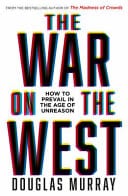
The brilliant and provocative new book from one of the world’s foremost political writers ‘The anti-Western revisionists have been out in recent years. It is high time that we revise them in turn…’ In The War on the West, international bestselling author Douglas Murray asks: if the history of humankind is a history of slavery, conquest, prejudice, genocide and exploitation, why are only Western nations taking the blame for it? It’s become, he explains, perfectly acceptable to celebrate the contributions of non-Western cultures, but discussing their flaws and crimes is called hate speech. What’s more it has become acceptable to discuss the flaws and crimes of Western culture, but celebrating their contributions is also called hate speech. Some of this is a much-needed reckoning; however, some of it is part of a larger international attack on reason, democracy, science, progress, and the citizens of the West by dishonest scholars, hatemongers, hostile nations and human rights abusers hoping to distract from their ongoing villainy. In The War on the West, Douglas Murray shows how many well-meaning people have been lured into protests and polarisation by such lies and hypocrisy. A blistering and important polemic, Murray’s latest book carefully and methodically shows how far political discourse has strayed in Europe and America from its stated goals: justice and equality. Propelled by an incisive deconstruction of inconsistent arguments and activism, towards a clarion call for the defence of enlightenment values, The War on the West is one of the most important books for a generation, cementing Murray as one of the world’s foremost political writers.
My Summary
Main Ideas, Takeaways & Similarities
Questions
I. What is the problem?
A. How is this problem formulated?
B. Why is this problem important?
C. What is the history of this problem?
D. Which prominent personalities have been interested in this problem?
II. What solutions to the problem are there?
A. What are the conclusions reached?
B. By what argument(s) is the conclusion reached?
C. What facts or assumptions serve as premises?
D. When a prominent personality offers a solution, does he also argue for or against other prominent personalities? Does he raise objections to alternative solutions? Does he consider objections to his own solutions?
III. Evaluation
A. What are the advantages and disadvantages of the alternative formulations to the problem?
B. Has the importance or history of the problem ever been misrepresented?
C. Are the solutions logically related to the premises?
D. Are the facts true? Are the assumptions acceptable? Are the objections answerable?
AI Summary
Highlights
Introduction
- ChatGPT Summary:
- Cultural war against the Western tradition and its positive contributions.
- Criticisms of terms like “equality,” “anti-racism,” and “justice” that appear hypocritical.
- Pressure on Western countries to quickly change demographics, driven by disdain rather than affection for these nations.
- Limited criticism of China despite severe abuses, in contrast to constant criticism of the West.
- Heightened racial awareness in Western countries, replacing color blindness.
- It is a cultural war, and it is being waged remorselessly against all the roots of the Western tradition and against everything good that the Western tradition has produced. (Location 23)
- People began to talk of “equality,” but they did not seem to care about equal rights. They talked of “anti-racism,” but they sounded deeply racist. They spoke of “justice,” but they seemed to mean “revenge.” (Location 27)
- Only the Western countries, spread across three continents, were told constantly that in order to have any legitimacy at all—to be even considered decent—they should swiftly and fundamentally alter their demographic makeup. (Location 49)
- The arguments were being made not out of love for the countries in question but out of a barely disguised loathing for them. (Location 55)
- In spite of all the unimaginable abuses perpetrated in our own time by the Communist Party of China, almost nobody speaks of China with an iota of the rage and disgust poured out daily against the West from inside the West. (Location 70)
- Race is now an issue in all Western countries in a way it has not been for decades. In the place of color blindness, we have been pushed into racial ultra-awareness. A deeply warped picture has now been painted. (Location 87)
- Terrible racism exists at present across Africa, expressed by black Africans against other black Africans. The Middle East and the Indian subcontinent are rife with racism. Travel anywhere in the Middle East—even to the “progressive” Gulf States—and you will see a modern caste system at work. (Location 92)
- Yet we hear very little about this. Instead, the world gets only a daily report on how the countries in the world that by any measure have the least racism, and where racism is most abhorred, are the homes of racism. This warped claim even has a final extension, which is that if other countries do have any racism, it must be because the West exported the vice to them. As though the non-Western world is always made up of Edenic innocents. (Location 99)
- The War on the West is a book about what happens when one side in a cold war—the side of democracy, reason, rights, and universal principles—prematurely surrenders. (Location 111)
- Just a couple of decades ago, a course in the history of Western civilization was commonplace. Today it is so disreputable that you can’t pay universities to do it. (Location 128)
- In a few short decades, the Western tradition has moved from being celebrated to being embarrassing and anachronistic and, finally, to being something shameful. It turned from a story meant to inspire people and nurture them in their lives into a story meant to shame people. (Location 134)
- the hunt for visible, tangible problems shouldn’t become a hunt for invisible, intangible problems. Especially not if they are carried out by dishonest people with the most extreme answers. If we allow malicious critics to misrepresent and hijack our past, then the future they plan off the back of this will not be harmonious. It will be hell. (Location 140)
- exploring two key ideas. The first is that critics of Western civilization do provide alternatives. (Location 143)
- They venerate every culture so long as it is not Western. (Location 144)
- Two major problems come from celebrating all non-Western cultures. The first is that non-Western countries are able to get away with contemporary crimes as monstrous as anything that has happened in the Western past. (Location 146)
- new generation has imbibed the idea that aspects of the Western tradition (such as “human rights”) are a historical and global norm that have been rolled out everywhere. In time, it has come to seem that the Western tradition that evolved these norms has uniquely failed to live up to them and that non-Western “Indigenous” cultures are (among much else) purer and more enlightened than Western culture can ever be. (Location 151)
- Not the least of them is that while the West is assaulted for everything it has done wrong, it now gets no credit for having got anything right. In fact, these things—including the development of individual rights, religious liberty, and pluralism—are held against it. (Location 163)
- This leads us to a second, deeper puzzle. Why open everything in the West to assault? (Location 166)
- The culture that gave the world lifesaving advances in science, medicine, and a free market that has raised billions of people around the world out of poverty and offered the greatest flowering of thought anywhere in the world is interrogated through a lens of the deepest hostility and simplicity. (Location 166)
- Every schoolchild now knows about slavery. How many can describe without irony, cringing, or caveat the great gifts that the Western tradition has given to the world? (Location 171)
- The Judeo-Christian tradition that formed a cornerstone of the Western tradition finds itself under particular assault and denigration. (Location 172)
- A new generation does not appear to understand even the most basic principles of free thought and free expression. (Location 174)
- We appear to be in the process of killing the goose that has laid some very golden eggs. (Location 188)
Chapter 1: Race
- ChatGPT Summary
- Delegitimizing the West involves the demonization of the racial majority in Western countries, specifically white people.
- A lesson emphasized is treating individuals as unique rather than reducing them to their racial group.
- The introduction of Critical Race Theory (CRT) in academia aimed to interpret the world through a racial lens.
- CRT challenges the idea of progress in American race relations, relying on interpretations and attitudes over empirical evidence.
- The concept of “lived experience” takes precedence over traditional evidence in CRT.
- CRT proponents claim that all forms of oppression intersect and must be addressed simultaneously.
- According to CRT, white people are considered inherently guilty of racism from birth.
- Eduardo Bonilla-Silva’s work contributed to the notion that aspiring to be “color-blind” is itself a form of racism.
- CRT scholars became preoccupied with the concept of power, attributing it based on skin color.
- CRT asserts that only white people possess the power to be racist, as they are considered to have societal influence.
- Thomas Sowell observed that racism is perpetuated by politicians, race hustlers, and those who denounce others as “racists.”
- The introduction of authors like Robin DiAngelo and her book “White Fragility” played a significant role in promoting CRT.
- DiAngelo’s argument implies that both denying being racist and admitting to it are seen as confirming racism.
- CRT divides society into two groups: racists and antiracists, leaving no room for neutrality.
- CRT’s influence extended to popular entertainment, education, employment, and healthcare sectors.
- The text highlights the impact of CRT on education, where it promotes a racialized view of society.
- CRT’s emphasis on systemic racism and white privilege has led to significant changes in curriculum and teaching methods.
- Employment sectors, including government agencies like the FBI and Department of Homeland Security, have implemented CRT-based training.
- Employees are subjected to “Confronting Racism” courses, which encourage them to be “less white” and acknowledge their privilege.
- CRT has also infiltrated the healthcare sector, with some practitioners attributing racial health disparities solely to whiteness and systemic racism.
- To delegitimize the West, it appears to be necessary first to demonize the people who still make up the racial majority in the West. It is necessary to demonize white people. (Location 199)
- The lesson had seemed clear: treat people as individuals, and reject those who would try to reduce them to membership of a group they belonged to solely by accident of birth. (Location 230)
Critical Race Theory
- create a movement of activists within academia who would interpret almost everything in the world through the lens of race. (Location 247)
- CRT saw nearly all progress in American race relations as an illusion. (Location 255)
- one of the distinguishing marks of CRT was that its assertions were based not on evidence, as it might previously have been understood, but essentially on interpretations and attitudes. (Location 262)
- If a person’s “lived experience” could be attested to, then the question of “evidence” or “data” had to find a place further back in the queue, if at all. (Location 264)
- These people, who built a theory from the assertion that all oppressions “intersect” and must be simultaneously “solved,” made this leap possible. (Location 266)
- Because one of the distinguishing marks of CRT was that its assertions were based not on evidence, as it might previously have been understood, but essentially on interpretations and attitudes. (Location 262)
- At its best, the shift from evidence to “me” allowed a stalemate: You have your views and reality. I have mine. At its worst, it left any exchange of ideas vulnerable to being taken over by bad-faith actors who simply insisted that things are as they say they are. And that is precisely what happened. (Location 274)
- interest, and even feelings and the unconscious. Unlike traditional civil rights, which embraces incrementalism and step-by-step progress, critical race theory questions the very foundations of the liberal order, including equality theory, legal reasoning, Enlightenment rationalism, and neutral principles of constitutional law.” (Location 282)
- academics “with an activist dimension.” (Location 294)
- understand society but to “transform it”? (Location 294)
- This is the language of revolutionary politics, not a language traditionally used in academia. (Location 295)
- The claim is that white people are in their totality guilty of prejudice, specifically racism, from birth. (Location 297)
- That racism is interwoven so deeply into white-majority societies that the white people in those societies do not even realize that they live in racist societies. Asking for proof was proof of racism. (Location 298)
- The work of Eduardo Bonilla-Silva and others insisted that even the concept of aspiring to be “color-blind” when it comes to issues of race is itself deeply racist.4 (Location 301)
- thanks to the influence of Michel Foucault, these academics had become obsessed with the issue of power.5 (Location 303)
- Attributing power, or taking power, on the basis of skin color was enormously advantageous to these academics, even if their thinking on the matter remained wildly confused. (Location 306)
- someone could not be guilty of racism if they had no power—even if they were prejudiced. (Location 307)
- axiomatic that only white people had power. Therefore, only white people could be racist. (Location 308)
- Black people either could not be racist or, if they were racist, were racist only because they had “internalized whiteness.” (Location 309)
- Sowell’s follow-on observation that racism was now being kept alive “by politicians, race hustlers, and people who get a sense of superiority by denouncing others as ‘racists.’”7 (Location 325)
- Robin DiAngelo, (Location 330)
- White Fragility. (Location 332)
- white people who disliked being told that they were racist, or objected to being called racist, were simply providing further evidence of their racism. (Location 332)
- In DiAngelo’s logic, the person who denies that they are racist is racist, and so is the person who says they are racist. Meaning that the best thing to do in any given situation is for a person to save time and confess to being a racist. (Location 334)
- “One of them is to try to develop a positive white identity … However, a positive white identity is an impossible goal. White identity is inherently racist; (Location 360)
- They should “strive to be ‘less white’” is her answer, adding for the sake of clarity that “to be less white is to be less racially oppressive.”14 (Location 363)
- CRT had been persuaded that race relations in their country were wildly worse than they were. People in the American academy had invented and popularized a whole set of concepts and terms to help this along. Just as their colleagues in the intersectional arena insisted on the idea that everyone lived in a “cis-heteronormative patriarchy,” so the professors of CRT introduced a set of racialized terms into the academic language and from there into the nation’s language. They argued, for instance, that America was not merely a white-dominated society, or that America had a white-majority population, but a “white-supremacist” society. They claimed that all white people benefited from allowing white-supremacist rule. They claimed that when confronted by their racism, white people deliberately changed the subject or made themselves into the victims. They claimed that there was a specific phenomenon known as “white tears” (and a subcategory within that, “white women’s tears”). They also claimed that (Location 387)
- Advocates of this theory claimed that race was not just one lens through which to view society. They insisted that it was the most important, in fact, the only, lens through which to view society. (Location 401)
- the storm that blew CRT and its theories across the whole Western world: the murder of George Floyd in Minneapolis in May 2020. (Location 404)
- Twenty-two percent of people who identified as “very liberal” said they thought the police shot at least ten thousand unarmed black men in a year. Among self-identified liberals, fully 40 percent thought the figure was between one thousand and ten thousand. The actual figure was somewhere around ten. (Location 416)
- in the years before the death of George Floyd, more police officers were killed by black Americans than unarmed black Americans were killed by the police. (Location 420)
- It was a moment when silence in the face of “racism” was deemed to be violence. A moment when actual violence was excused as a form of legitimate political speech. (Location 433)
- Tony Timpa death compared to George Floyd — he was white (Location 461)
- Today there is a widespread belief that if you pull back the mask of the American state, you have a state that is not just racist but white supremacist and that its agents and representatives, as well as the citizenry as a whole, are dedicated to the casual murder of black people. (Location 469)
- American students had been primed for a white-supremacist, racist interpretation of their own society to grip them. How do we know? Because for a decade or more, they had been seeing ghouls and monsters that were not there. (Location 479)
Moral Panics
How did this Happen?
- The details are fought over because America is the world’s most powerful nation, the world’s most influential nation, and the nation whose sins and errors are likely to be exported just as much as are its virtues and attainments. (Location 569)
Racist Babies
- A is for Activist (2012) (Location 581)
- Adam Rutherford (author of How to Argue with a Racist) (Location 589)
- Ibram X. Kendi would produce a book called Antiracist Baby, (Location 595)
- Arizona Department of Education recently declared, babies are able to become racist by the age of three months old. And, according to the “equity toolkit” published by the department, which made this claim, it is white babies that are the problem. The toolkit claims that “expressions of racial prejudice often peak at ages 4 and 5” but that while “Black and Latinx children” at the age of five show “no preference towards their own groups,” “white children at this age remain strongly biased in favor of whiteness.”36 A reminder that from even before the moment they are able to speak or walk, it is white children who are the problem. And white children who must be worked on to achieve the change that everybody seems to have agreed is needed. (Location 605)
Antiracism
- Defining or rather redefining terms and words has become a career specialty for Kendi. (Location 628)
- Kendi’s definition of a racist is someone who engages in racist actions—a definition that is at best circular, for it uses the thing being defined to define the thing. It also leaves unaddressed the question of what a racist action is and who designates it as such. Though a suspicion lingers. Meantime, Kendi’s definition of an antiracist is somewhat simpler. It is, essentially, the invitation to be like Kendi. (Location 636)
- “Racism is a marriage of racist policies and racist ideas that produces and normalizes racial inequities” is one of his standard answers. (Location 640)
- Which is that Kendi is not opposed to racism. He is opposed to certain forms of racism: specifically white on black racism. Other racisms can be, in his own definitions, a positive force. For instance, in his writing on discrimination and inequity, he cannot avoid one particular conclusion beckoning to him: “The only remedy to racist discrimination is antiracist discrimination. The only remedy to past discrimination is present discrimination. The only remedy to present discrimination is future discrimination.”39 (Location 643)
- There are no areas of neutral in Kendi’s color chart. There are only white supremacists and white nationalists and then white people who agree with him. (Location 649)
- Similarly, there are black people who agree with Kendi and black people who do not. Those black people who do not go along with everything proposed by him are also racists. For instance, Kendi does not like the conservative Supreme Court justice Clarence Thomas, condemning him with typical understatement for “the most egregious Black on Black racist crime in recent American history.” (Location 650)
- Likewise, he does not like the black former Ohio secretary of state Ken Blackwell, who worked for George W. Bush. Kendi has no truck with such people. “Remember, we are all either racists or antiracists,” he says, before saying that “criminals like Blackwell get away with their racism. Black people call them Uncle Toms, sellouts, Oreos, puppets—everything but the right thing: racist. Black people need to do more than revoke their ‘Black card,’ as we call it. We need to paste the racist card to their foreheads for all the world to see.” (Location 652)
- he makes it clear that it is racist to oppose reparations for slavery. It is also racist not to have any opinion on the matter. So you must either share Kendi’s specific view on the matter or you are—guess what?—a racist. (Location 659)
- “post-racial society” is also racist. Either you must accept Kendi’s definition of the society you live in or you are a racist. (Location 661)
- he divides the world clearly and firmly between just these two camps of people. (Location 664)
- If one portion of your society is racist and another portion antiracist, then normal political settlement becomes impossible. Some people will go along with a policy or position they know to be incorrect simply in order not to be sullied by the label “racist.” (Location 672)
- How to Be an Antiracist Family, (Location 677)
- black people are the oppressed and able to say anything, however insulting, so long as it is said about white people. (Location 679)
- Ijeoma Oluo’s work Mediocre: The Dangerous Legacy of White Male America (2020). And the London-born author Otegha Uwagba’s work titled Whites: On Race and Other Falsehoods. (Location 680)
Take it to the Streets
- It seemed that Portland had become the epicenter of a confusion that has afflicted activists in Britain and other Western countries as well. That was the taught perception that they live in a patriarchal, unequal, cis-heteronormative, irredeemably racist society. (Location 735)
- a tour of the sights in Portland consisted of a wide variety of empty plinths. (Location 745)
- Only now, when the resulting vision can be seen blown up in large, projected onto the wall of the world, can the full consequences of the work that has been put in be perceived. Minute claims of “systemic racism,” “institutional whiteness,” and much more were ignored. But blown up on the projector system of American culture, they now show a picture that is monstrous. Which is why a middle-class adolescent from one of the luckiest generations in human history, living in one of the freest societies in human history, can be found outside a police facility at night, in a pink jumpsuit, screaming obscenities at any representative of the state. (Location 764)
Popular Entertainment
Practical Consequences
- Education
- “life and death matters, about people’s flesh and blood and bone.” He was also told that he had created “dissonance for vulnerable and unformed thinkers” and caused “neurological disturbance in students’ (Location 844)
- Employment
- FBI has been holding “intersectionality workshops” for its employees.60 The Department of Homeland Security has been using training documents that tell white employees that they have been “socialized into oppressor roles,” (Location 883)
- The mandatory “Confronting Racism” course for employees included a slide instructing employees to be “less white, less arrogant, less certain, less defensive, less ignorant and more humble.” (Location 903)
- When people wonder why most go along with the whole agenda, it is because it is so often made clear that whether you’re a math teacher or a partner in a vast multinational firm, the cost of raising your head above the parapet can lead to your whole career crashing down around you. And it can happen from asking the simplest of questions, asserting a provable truth, or simply acknowledging a belief that everybody held until the day before yesterday. (Location 913)
- Disney told its employees that they should reject “equality” and focus instead on “equity.” According to the “What can I do about racism?” program to which Disney employees were subjected, they must focus on “systemic racism,” “white privilege,” “white fragility,” and more. Their training also included segments on “implicit bias,” “microaggressions,” and, of course, “becoming an antiracist.” In the training module “Allyship for Race Consciousness,” employees were told that they should “take ownership” for educating themselves “about structural anti-Black racism.” They were told that the USA has a “long history of systemic racism and transphobia” and that white employees at Disney must “work through feelings of guilt, shame, and defensiveness,” atone by challenging “colorblind ideologies and rhetoric,” and never “question or debate Black colleagues’ lived experience.” Among the suggestions for white Disney employees was that they work on their racist babies (racist from “3 months old” again) and “donate to anti–white supremacy work such as your local Black Lives Matter Chapter.”67 (Location 918)
- Health Care
- Kendi, Afua Hirsch, and others had taken to the pages of The Guardian and The Atlantic and the airwaves. There they managed to suggest that America, Britain, and other Western countries were so racist that they couldn’t even import a virus from China without giving it their own special racial spin and using the opportunity to kill as many black people as possible.69 (Location 939)
- “equitable medicine” (Location 961)
- American Medical Association (AMA) has released an eighty-six-page “equity plan” (Location 973)
- Many doctors, including many black doctors, recognize how dangerous this is, and a number took to the pages of the New England Journal of Medicine to try to halt it. After several paragraphs of necessary disclaimers, they stressed their point, which was “that genetic differences exist between people belonging to different socially constructed racial categories. We embrace this diversity and acknowledge its clinically meaningful implications.”78 But it is not at all clear that these careful practitioners will be victorious in their attempt to weave around the dogmas of the era. What they are arguing requires an understanding of something other than CRT. It requires a knowledge of certain genealogical and medical facts. But for the time being, an insistence on racism and antiracism as the sole means of looking at any and every problem remains much greater, clearer, and all-encompassing. (Location 985)
- That is why, for instance, other medical practitioners from Harvard on down can blame all racial health disparities on whiteness (“anti-racist epidemiology”),79 claim that systemic racism is to blame for the deaths of pregnant black women,80 and assert that when white Americans volunteer their DNA for scientific experiments, these white Americans are subtly doing so in order to victimize nonwhite groups. (Location 992)
- As one New York Times contributing editor recently put it, whiteness is “a virus that, like other viruses, will not die until there are no bodies left for it to infect.” (Location 996)
Conclusions
- UCLA law professor and leading critical race theorist Cheryl Harris is one of numerous leading critical race theorists who have argued that the right to private property should be suspended, with land and money seized and then redistributed along racial lines. (Location 1007)
- Aruna Khilanani (Location 1016)
- She said that it was “the cost of your own life, as they suck you dry. There are no good apples out there.” She described white people as “a demented, violent predator,” with “holes in their brain” and said that all white people are “out of their minds, and they have been for a long time.” And she declared that talking to white people about race is “useless.”86 (Location 1025)
Interlude: China
- ChatGPT Summary
- Cultural figures like Albarn tend to blame the West for global issues, using it as a convenient scapegoat (Location 1047).
- Raising awareness about China’s present-day involvement in the opioid crisis in the United States could potentially save lives (Location 1060).
- The text highlights the tendency to focus on past wrongs and harshly judge them, rather than taking practical steps to address current global problems (Location 1063).
- China stands out among major powers for continuing to pursue communism while liberalizing its financial system, becoming the world’s second-largest economy (Location 1068).
- China practices tightly controlled economic liberalism (Location 1072).
- More than a million Uighur Muslims and others have been forced into internment camps in Xinjiang, facing allegations of systematic rape, torture, forced sterilization, and forced organ harvesting (Locations 1075, 1077).
- China’s “family planning by violence” involves coercive measures such as forced abortions for mothers expecting a second child (Location 1088, 1096).
- China’s entry into international organizations was expected to promote democratic norms, but it has instead influenced these organizations in the opposite direction (Location 1101).
- China’s rapid economic growth has shifted global trade dynamics, with many regions doing more business with China than the United States (Location 1103).
- China’s strategy includes buying key infrastructure in Western countries, influencing political elites, and expanding its global influence (Locations 1109, 1116, 1128).
- The truth is that unless he could blame the West, Albarn (like so many other cultural and other figures in the West) was stumped to find any explanation for malfeasance in the world. So long as there was a story of Western wrongdoing, that story could suffice to be the founding problem of the country in question. (Location 1047)
- If more people knew about China’s present-day opioid war on America, then perhaps lives could be saved. (Location 1060)
- raking over the past, and judging it as harshly as possible, seems to be so much easier than doing anything practical about problems that face us all today. (Location 1063)
- Unlike all the other major powers that tried communism, China is still pursuing a version of that ideology. Unlike them, it has found a way to liberalize its financial system to such an extent that in recent decades it has become the world’s second most important economy. (Location 1068)
- tightly state-controlled economic liberalism. (Location 1072)
- To date, more than a million men, women, and children of the Uighur Muslim minority, among others, have been forced into the sprawling network of internment camps—often referred to as “concentration camps”—across the Xinjiang region. (Location 1075)
- These camps include systematic rape and torture of detainees, as well as forced sterilization of Uighur women. There are also accusations of the forced harvesting of the internal organs of detainees in these and other camps in the Chinese system. (Location 1077)
- When the authorities found out that a woman was going to give birth to a second child, there were a number of things they could do. If the mother tried to go into hiding, then the authorities would capture all her family members and imprison them for weeks or months until this forced the mother out of hiding. Then the returning pregnant mother could be forced to have an abortion. (Location 1088)
- A system of “family planning by violence.” (Location 1096)
- The elites of America and Europe thought that bringing China into international organizations would push democratic norms into the country. Instead, China has pushed democratic norms out of international organizations. It has used the period since its 2001 entry into the World Trade Organization to especially great effect. (Location 1101)
- In the year 2000, most countries in South America, Africa, the Far East and Australasia, and Europe did more trade with America than they did with China. By 2020, that situation was inverted. In just twenty years, all these parts of the globe were doing more business with China than they were with America. During that period, America had fallen from more than 75 percent of total global trade to just over 25 percent.4 And eating up all that difference was China, which went rocketing up in exactly the opposite direction. (Location 1103)
- buy up key infrastructure across the West. Sometimes it is a key port, such as that of Haifa in Israel or that of Piraeus in Greece. In 2019, Italy signed a deal with China to become the first G7 country to be a part of the Belt and Road Initiative. (Location 1109)
- Huawei (Location 1115)
- The CCP’s ability to buy up influence among the elites in each of the countries the party is hoping to enter is unparalleled in its scope and munificence. Across the countries of the West, all who have been in need of some postretirement financing, from former prime ministers on down, have found comfortable sinecures thanks to Chinese firms. Even among the relatively lower ranks of political figures in the West, the CCP and its fronts have been busy buying people up. (Location 1116)
- Deutsche Bank used bribes and other corrupt practices to gain entry to the Chinese market. (Location 1128)
- Ancient universities including Britain’s Cambridge University have welcomed Chinese investment and allowed Chinese authorities the right to decide what should and should not be studied or said in the institutions, and to suppress criticism of the munificent regime that is paying the checks. (Location 1134)
- The British prime minister was understandably spooked and soon afterward announced that he planned never to meet the Dalai Lama again. The British government then issued a formal apology to the Chinese authorities for the offense caused. (Location 1142)
- If the American-led world order is so terrible, what might a CCP-led world order look like? If the United States and other Western countries are so dreadful, then would the only likely alternative system be any better? (Location 1156)
- Asia is filled with labels like this, where people are summed up along ethnic lines in ways that are rarely flattering. The terms that are reserved for foreigners, and white people in particular, are especially ugly. They include “farang in Thailand, gaijin in Japan, mat salleh in Malaysia, gweilo in Hong Kong.” This last one is particularly interesting. Gwei means “ghost,” and it is meant literally—a white person is not fully human. “Indeed, in many Chinese dialects, the idiomatic term for any foreigner, be they Indian or Ivorian or Irish, contains the ghostly ‘gwei’; only ethnic Chinese are constantly referred to as ‘ren’, which means ‘person’. In other words, only the Chinese really exist as full-blooded people.” (Location 1166)
- Racism against black people remains ingrained and commonplace. (Location 1173)
- So long as the West is into the masochism business, it will always find a very willing sadist in Beijing. On the national and international stage, China is willing to hit the West—and America in particular—in what it regards as its weak spot. And one of those weak spots is racism. (Location 1180)
- “In an exceptional case,” Ambassador Bing said, his American counterpart had actually “admitted to her country’s ignoble human rights record.” And so, he said, “that does not give her country the license to get on a high horse and tell other countries what to do.” (Location 1206)
- Blinken, briefly expressed to his Chinese counterparts his “deep concerns” over actions by China in Xinjiang, Hong Kong, Taiwan, cyber-attacks on the United States, and the country’s economic coercion of allies. (Location 1210)
- Chinese counterpart, Yang Jiechi, was visibly furious. The United States had no right to lecture China, he explained in an eighteen-minute harangue. “I think that we thought too well of the United States,” Jiechi said. “The US does not have the qualification to say that it wants to speak to China from a position of strength.” Waving his hand angrily/dismissively at his counterpart, he continued, “There are many problems within the United States regarding human rights.” And these are “admitted by the US itself as well.” While China was making progress on human rights, he said, the United States was not. “We hope the United States will do better on human rights.” But, echoing the claims of the US’s own ambassadors, Jiechi said that “the challenges facing the United States in human rights are deep-seated. They did not just emerge over the past four years, such as Black Lives Matter. It did not come up only recently.” (Location 1211)
- The CCP’s spokespeople now find this an enormously useful line of attack. In the summer of 2021, the UN Human Rights Council held a session in which developing countries denounced systemic racism and racial discrimination. The UN high commissioner for human rights, Michelle Bachelet, said that denial of historical responsibility by countries that had benefited from the transatlantic slave trade and colonialism was an important cause of ongoing racism and racial violence. The CCP’s foreign ministry spokesperson, Zhao Lijian, told the international press that the developed world had to do more to tackle violence against people of African and Asian descent. And Zhao Lijian called on Western countries to address this problem, saying: “We urge relevant Western countries to earnestly respond to the concerns of the international community, deeply reflect on themselves and take concrete measures to address the issue of systemic racism and racial discrimination, so as not only to promote and protect human rights at home, but also to contribute to the healthy development of the international human rights cause.”11 (Location 1220)
- Chinese counterpart, Yang Jiechi, was visibly furious. The United States had no right to lecture China, he explained in an eighteen-minute harangue. “I think that we thought too well of the United States,” Jiechi said. “The US does not have the qualification to say that it wants to speak to China from a position of strength.” Waving his hand angrily/dismissively at his counterpart, he continued, “There are many problems within the United States regarding human rights.” And these are “admitted by the US itself as well.” While China was making progress on human rights, he said, the United States was not. “We hope the United States will do better on human rights.” But, echoing the claims of the US’s own ambassadors, Jiechi said that “… (Location 1211)
- The CCP’s spokespeople now find this an enormously useful line of attack. In the summer of 2021, the UN Human Rights Council held a session in which developing countries denounced systemic racism and racial discrimination. The UN high commissioner for human rights, Michelle Bachelet, said that denial of historical responsibility by countries that had benefited from the transatlantic slave trade and colonialism was an important cause of ongoing racism and racial violence. The CCP’s foreign ministry spokesperson, Zhao Lijian, told the international press that the developed world had to do more to tackle violence against people of African and Asian descent. And Zhao Lijian called on Western countries to address this problem, saying: “We urge relevant Western countries to earnestly respond to the concerns of the international community, deeply reflect on themselves and take concrete… (Location 1220)
- while the CCP urges this introspection on the West, it engages in no… (Location 1229)
- In the very same month that it made this demand of the West, the CCP was commemorating its one hundredth anniversary. At a highly staged ceremony in Tiananmen Square before a crowd of tens of thousands of people, Xi Jinping declared that China’s rise would prove to be a “historical inevitability.” He warned that the country would no longer be “bullied, oppressed or subjugated” by foreign powers, and the language he used was characteristically martial. He declared that “anyone who dares to try, will find their heads bashed bloody against a great wall of steel forged by over 1.4… (Location 1231)
- CCP… (Location 1237)
- The CCP is only weaponizing Western weaknesses in the way that totalitarian regimes and competitors to… (Location 1240)
- There was nothing any noticeably less racist about Russia in the 1930s than there was in America. Just as there is nothing less racist about China in the 2020s than there is in America. Very much the opposite. And yet it is enormously helpful to China today, as it was to the Soviets in the past, to encourage the perception of America as uniquely racist and China as uniquely virtuous. (Location 1248)
- And it runs off the claim that the West has not merely done things that every other civilization in history has done, but rather has always been worse than any other civilization, meaning that the West is uniquely unqualified to pass moral judgment today. This in itself relies on two fundamental presumptions, which both turn out to be true. First, it runs on the presumption that knowledge of Western history inside the West is uniquely lacking: Westerners have become increasingly unaware of what is true and what is not about their own past. Second, it runs on the presumption—again also true—that almost nobody in the West has any knowledge of what countries such as China have done throughout history or are doing today. (Location 1252)
- gigantic moral presumption. That presumption is the idea that nobody in the world can do anything wrong unless the West has made them do it. (Location 1262)
- When Robert Mugabe came to power in Zimbabwe (formerly Rhodesia) in 1980, the average life expectancy in the country was just under sixty. After his rule, or rather mismanagement, of the country for a little over a quarter of a century, the average life expectancy in Zimbabwe had almost halved. (Location 1263)
- People who believe that the history of the world is a history of Western malfeasance and non-Western innocence. (Location 1279)
- The only thing modern Western populations are more ignorant about than their own history is the history of other peoples outside the West. (Location 1281)
- history of the West has been entirely rewritten. And rewritten in order to tell the people of the West that their history is not especially glorious but instead a source of unimaginable shame. The anti-Western revisionists have been out in force in recent years. It is high time that we revise them in turn. (Location 1303)
Chapter 2: History
- ChatGPT Summary:
- Despite the prevailing narrative that emphasizes the sins of the Western world’s history, an alternative perspective has emerged.
- “The 1619 Project,” launched by a renowned newspaper, aimed to reframe and rewrite America’s founding story, portraying it as rooted in oppression rather than heroism.
- This project sought to shift the founding date of the USA to highlight slavery’s role in the country’s development.
- Some critics argued that this project represented a displacement of historical understanding by ideology.
- Ideas from academia and the media can quickly influence public sentiment and even lead to changes in society.
- In 2020, a survey revealed that many liberals wished to rewrite the US Constitution to better reflect diversity.
- The history of humanity has often involved the displacement and conquering of one group by another, making accusations of stolen land complex.
- The anti-Western sentiment seen today has been brewing since the postcolonial era, with Western powers retreating and America grappling with its superpower status.
- Intellectuals played a role in fueling anti-Western sentiment during this period, advocating for significant change.
- Figures like Jean-Paul Sartre and Frantz Fanon championed revolutionary socialism and criticized Western culture’s influence on colonized populations.
- Edward Said’s work, “Orientalism,” had a profound impact on Western self-perception, offering a singularly anti-Western perspective.
- Said argued that Westerners viewed other societies through their own cultural lens, perpetuating stereotypes and biases.
- The treatment of scholars like Nigel Biggar and Christopher Gilley highlighted the shift in academia’s stance on empire from one of nuanced examination to outright condemnation.
- Some argue that the British Empire, while not without its flaws, also had positive aspects, such as infrastructure and scholarship.
- The moral complexities of empire are often overshadowed by specific atrocities, like the Amritsar massacre, leading to one-sided discussions.
- Slavery, often depicted as a one-way exchange, also had aspects of Africans selling their fellow Africans into slavery.
- The Arab-run slave trade saw millions of Africans traded east, with castration being a common practice.
- There is ongoing debate over whether the Arab slave trade constitutes genocide.
- The current focus on historical slavery and privilege overshadows the fact that white Europeans of the time did not necessarily live in privilege.
- The West Africa Squadron’s efforts between 1808 and 1860 resulted in the capture of 1,600 slave ships and the liberation of 150,000 African slaves.
- Claims against Winston Churchill, though disproven by historical records, persist due to repeated assertions.
- Churchill’s heroic story serves as an example of human greatness and heroism, making him a target for criticism.
- Attacking Churchill’s reputation undermines Western heroes and demoralizes the West.
- Statues have become a focal point of controversy, with some calling for their removal due to historical connections to slavery and colonialism.
- The great divestment movement aims to redirect funds away from institutions and organizations associated with colonial history and practices.
- In spite of the fact that schoolchildren in the West are brought up on a diet of the sins of their forefathers, another narrative has got out there. (Location 1338)
“Reframing” Our History
- “The 1619 Project” (Location 1345)
- launched by a newspaper—and one which is still sometimes referred to as a paper of record—is highly unusual. For the project was not a piece of reportage. It was an attempt to reframe, and rewrite, the founding story of America. That wasn’t what critics said about it. It is what the project’s founders said about their own project. (Location 1346)
- The project was a deliberate transposing of American history into a minor key. (Location 1384)
- The move of the founding date was not just about proving that everything that made America exceptional, including its economic power, its industrial power, and its system of democracy, had come out of slavery. It was intended to formalize the idea that the USA was founded on an original sin. It sought to turn a tale of heroism and glory into one of oppression and shame. (Location 1384)
- Desmond had the wind in his sails. His anticapitalist critique continued: “When a midlevel manager spends an afternoon filling in rows and columns on an Excel spreadsheet they are repeating business procedures whose roots twist back to slave-labor camps.” (Location 1416)
- The historians said that the 1619 Project reflected “a displacement of historical understanding by ideology.” (Location 1436)
The 1619 Riots
- Just as it is striking how swiftly obscure ideas can spill out from academia, so it is striking how swiftly ideas pumped out in the media can make their way onto the streets. (Location 1460)
- In 2020, a survey showed that by that year 70 percent of self-identified “liberals” wanted to rewrite the US Constitution into one “that better reflects our diversity as a people.” (Location 1462)
- Before the modern era, the whole history of our species was one of occupation and conquering. One group of original peoples were replaced by another group of other peoples. And someone outside the American continent was always going to “discover” America. (Location 1517)
- At this stage, they are also completely self-destructive. For if the land you are on is simply stolen, the Founding Fathers were simply “slave owners,” the Constitution needs to be rewritten, and no figure in your history deserves any respect, then what exactly holds this grand quarter-millennial-long project like America together? (Location 1523)
None of this is New
- In a period of such rich iconoclasm, it is easy to think that the present anti-Western moment came from nowhere. In fact, it has been bubbling up for decades. Specifically, since the postcolonial period, when the European powers were in retreat and America was struggling with the problem of how to be a superpower without acquiring an empire. (Location 1527)
- as the West retreated, anti-Westernism advanced. (Location 1531)
- Where once many people had thought that the West could do nothing wrong, the West entered an era where it became dangerous to concede that the West had ever done anything right. (Location 1533)
- To the surprise of no one, this was whipped along and otherwise encouraged by intellectuals. Specifically, by those who, though unwilling to lose a drop of blood themselves, seemed keen on considerable bloodletting among other people. (Location 1535)
- Jean-Paul Sartre, (Location 1536)
- Frantz Fanon. (Location 1537)
- Sartre mocked the Western powers for their efforts to create a native elite in the countries they had once ruled. Sartre claimed that the West had imbued these people with “the principles of Western culture,” including “grand glutinous words that stuck to the teeth” leading natives to be “sent home, whitewashed.” Such people had become “walking lies,” wrote Sartre. (Location 1537)
- For Sartre, Fanon by contrast offered another way—“Revolutionary socialism all together everywhere.” And so Sartre correctly stated that Fanon puts his readers “on guard” against “Western culture.” And all this was admirable in Sartre’s eyes. For Sartre was a man who claimed to believe that “the only true culture is that of the revolution.”20 (Location 1541)
- Sartre talks about people “who are rather too Westernized” and absorbed the “witchery” of Western culture.21 And he seems almost panting at the prospect of conflict to come. “In the past we made history,” he writes, “and now it is being made of us. The ratio of forces has been inverted; decolonization has begun; all that our hired soldiers can do is to delay its completion.” (Location 1544)
- Fanon, like many other postcolonial writers who became famous in the West, is not really interested in restoring the cultures of the non-Western countries he claims to care about. He is not interested in returning African nations to an era of tribal customs or any other precolonial Indigenous tradition. What he is interested in is analyzing these cultures through a Marxist lens and then “saving” them by applying a Marxist ideology to them. (Location 1565)
- Intent in shrugging off the legacy of Western colonialism, they find an answer for every non-Western society in Western Marxism. (Location 1570)
- Edward Said had an unprecedented impact on the way in which significant portions of the West thought about themselves. (Location 1582)
- Said’s central claim is singularly anti-Western. (Location 1583)
- Orientalism, published in 1978—has (Location 1585)
- Said’s central critique is an attempt to prove that when Westerners encountered other societies, they did so through the lens of the societies they came from. (Location 1586)
Empire
- The treatment of Biggar, like the treatment of Gilley, suggested something more than normal academic disagreement. The backlash suggested that these scholars had crossed over some unspoken threshold. And, of course, they had. Just as in the early twentieth century the default consensus at a university such as Oxford would have been that the empire was a force for good, so by the early twenty-first century it had become the default position at such places that the empire was solely a force for bad. The dogma had simply shifted. So now it was not even possible to try to weigh up the moral complexities of empire without being accused of being an apologist for, or supporter of, colonialism. Inadvertently, these critics showed the fragility of their arguments. (Location 1745)
- For instance, the Nigerian novelist and hero of anticolonialism Chinua Achebe said in 2012, “The legacy of colonialism is not a simple one but one of great complexity, with contradictions—good things as well as bad.” And in his final book, There Was a Country (2012), Achebe wrote, “Here is a piece of heresy. The British governed their colony of Nigeria with considerable care. There was a very highly competent cadre of government officials imbued with a high level of knowledge of how to run a country … British colonies were, more or less, expertly run… . One was not consumed by fear of abduction or armed robbery. One had a great deal of confidence and faith in British institutions. Now all that is changed.”45 Achebe is not alone in his assessment. Scholars and writers such as Nirad C. Chaudhuri and Dr. Zareer Masani have argued eloquently in the case of India that what the empire left behind was not just the railroads and the Indian civil service but the scholarship of men such as Sir William Jones and James Prinsep, who unlocked the classical language of India and handed that civilization back to itself. (Location 1751)
- The oddity of those who argue against weighing up the various merits and demerits of empire is twofold. First, they say that it cannot be done: there is no way to form the moral calculus necessary to work such things out. Then, they insist that in any case because of a specific terrible thing that happened, any positives must be discounted. In the case of the academics at Oxford who objected to the study of empire, the whole idea of weighing up the merits of empire was obscene because of the Amritsar massacre of 1919. (Location 1766)
- The brutal shooting at a crowd that led to the deaths of 379 people would not have been remembered if it had been carried out in the twentieth century by Japanese or Chinese troops. It would not have been remembered if it had been carried out by Russian troops, and it would hardly have registered if it had been carried out in the twentieth century by German troops. It is remembered because the massacre was carried out by British troops. It was not just an exception but one which caused deep anger and shame in Britain even as it happened. (Location 1771)
- if the sins of the West are ineradicable, then are the sins of all other peoples ineradicable too? Or is it only Western crimes that are judged in such a light? Nobody appears to know the answer to these questions. More sinister is the fact that nobody is even meant to ask them. (Location 1783)
Slavery
- The slaves that were brought out of Africa not only suffered the indignity of being ripped away from their homeland and taken abroad without their permission. They suffered the additional indignity of having been sold by their neighbors and families. (Location 1808)
- For while historical attention is now almost exclusively interested in one direction of slavery, throughout the last millennium (as throughout history) the horror went in every direction. And while huge attention has been paid in recent years to the trade in slaves that went west, very little has been expended on the trade that went east. (Location 1813)
- somewhere between eleven and seventeen million Africans were traded east in the Arab-run slave trade. One reason why the numbers are so difficult to discern is that unlike the transatlantic trade, the slaves the Arabs traded were systematically castrated after being brought from Africa. (Location 1818)
- Tidiane N’Diaye is one of those who has questioned this, in Le Genocide Voilé (The veiled genocide) (2008). (Location 1821)
- Even here, for Kendi, the question of diversity is of foremost importance. A form of slavery that involves the enslaving of one racial group is the worst of slavery’s forms. While a form of slavery that has diversity at its heart is somehow better slavery. (Location 1842)
- genocide of the local Indigenous populations. Most of the time, this includes reference to the Indigenous populations having been wiped out or significantly diminished by the deliberate spreading of disease. (Location 1855)
- Independent Brazil continued to encourage the slave trade right up to the 1880s. The Ottoman Empire continued it even longer. Still today in Saudi Arabia and across the Middle East, black people are referred to as Abid’ (plural Abeed’), which literally means “slave.” Being “black” and being a slave still means the same thing to millions of people in the region. (Location 1874)
- Slavery persists today, in countries including Mauritania, Ghana, and South Sudan. (Location 1879)
- There are estimated to be over forty million people living in slavery around the world today. In real terms, this means that there are more slaves in the world today than there were in the nineteenth century. (Location 1884)
- It raises the question of what might practically change for people today if we spent even a portion of the time that we focus on past slavery focused, instead, on present-day slavery. And what we might be able to do about this modern horror. (Location 1886)
- The current interest in slavery alongside the obsession with “privilege” (especially “white privilege”) elides the fact that white Europeans during this time were not living in some type of privileged paradise. For (Location 1891)
- Voltaire (Location 1903)
- [They reproach our trade: a nation that traffics its children is even more to be condemned than the buyer]). (Location 1906)
- Between 1808 and 1860, the West Africa Squadron captured 1,600 slave ships and freed 150,000 African slaves. (Location 1916)
Churchill
- Such claims are wholly disproved by the historical record but have gained some currency thanks to the ferocity of their repetition. (Location 2014)
- If Churchill’s good points cannot outweigh any bad points, then no one can ever do enough good in their lives. (Location 2036)
- The attacks on Churchill make all human endeavor seem futile, because if even defeating the greatest evil in history will count as nothing, and you will not be lauded for it in your own country even half a century after your death, then what good deed could ever count for anything? (Location 2039)
- Because his story is a heroic story, demonstrating the greatness that mankind can aspire to and the heroism that men can achieve. This, then, is the reason why Churchill must be particularly assaulted. Because as long as his reputation stands, the West still has a hero. As long as his reputation remains intact, we still have figures to emulate. But if Churchill can be made to fall? Why then one of the great gods, perhaps the greatest of the West, falls. And then? Well, anything might be forced upon a people so subjected and demoralized. (Location 2047)
Statues
The Great Divestment
Interlude: Reparation
- ChatGPT Summary:
- This passage highlights the manipulation of animosity by portraying certain groups as unfairly benefiting at the expense of others, a tactic seen throughout history. It mentions the controversial “World Conference against Racism, Racial Discrimination, Xenophobia and Related Intolerance” that occurred in 2001 under the UN’s auspices. During this conference, various outrages took place, including the introduction of Fidel Castro as the leader of “the most democratic country in the world.” The conference participants seemed primarily focused on attacking Western democracies, blaming them for global issues, and praising those opposed to the West. Additionally, international bodies like the UN Human Rights Council sometimes serve as platforms for oppressive states to divert attention from their present actions by highlighting the historical wrongs of the West, such as Britain’s suppression of the Atlantic slave trade, which has been praised as a significant example of international moral action in modern history. Notably, there appears to be a double standard in how racial slurs and laws are treated, particularly when they target white women.
- It is not difficult to whip up animosity against a particular group by portraying them as having unfairly benefited to the detriment of others. History is chock-full of versions of how this plays out. (Location 2147)
- “World Conference against Racism, Racial Discrimination, Xenophobia and Related Intolerance” took place between August 31 and September 8, 2001. (Location 2157)
- The outrages of this conference—which took place under the auspices of the UN—were (Location 2161)
- Fidel Castro, who was introduced to the conference as the leader of “the most democratic country in the world.” (Location 2186)
- nothing mattered to them, other than attacking the Western democracies, blaming them for all the world’s ills, and lauding anyone seen as an enemy or antagonist of the West. (Location 2188)
- UN Human Rights Council (Location 2195)
- in 2020, when North Korea called the United States a “human rights wasteland” and a country of “extreme racists,” citing the BLM protests and the death of George Floyd as justification.3 (Location 2197)
- International bodies such as the Human Rights Council are perfect places for oppressive states to deflect attention from their ongoing crimes and focus instead on the historic sins of the West. (Location 2203)
- Britain’s suppression of the Atlantic slave trade, it has been claimed, constituted “the most expensive example” of international moral action “recorded in modern history.” (Location 2315)
- Modern Turkey is not expected to pay money for the activities of the Ottoman Empire. An empire that, incidentally, ran on for twice as long as the empires of Europe did. (Location 2343)
- racial slurs are actually cool and can be written into law so long as the people they demean are white women. (Location 2387)
Chapter 3: Religion
- ChatGPT Summary:
- In 2010, General David Petraeus intervened when a Florida pastor threatened to burn a Quran, highlighting the sensitivity to religious issues.
- In August 2020, Bibles were burned on camera in Portland, Oregon, suggesting a contrasting response to the desecration of holy texts.
- The West appears more willing to protect and respect other religions’ holy places than its own.
- The religion of antiracism has become a dominant narrative, providing people with purpose, meaning, and a sense of direction.
- Antiracism gives individuals confidence, divides society into saints and sinners, and allows them to confront their own origins.
- It also provides an opportunity to appear virtuous by attacking Western traditions and values.
- Westerners tend to idealize unspoiled societies and use them to criticize their own societies.
- Historically, thinkers like Michel de Montaigne and Jean-Jacques Rousseau have promoted the idea of non-Western societies as superior.
- The trend to idealize non-Western cultures persisted into the 20th century.
- Naomi Klein’s book “No Is Not Enough” reflects this trend.
- Kant, a renowned philosopher, is criticized for his alleged racist views, leading to the dismissal of his work without thorough examination.
- Scholars suggest teaching Kant’s racism as an example of succumbing to racism.
- The critique extends to other pillars of Western philosophy, including Aristotle.
- The Enlightenment, which contributed to significant progress in human history, is now viewed as a conspiracy to support Western imperialism.
- Eric Hobsbawm, a Marxist historian, recognized the importance of preserving Enlightenment values.
- The Enlightenment provided the foundation for building inclusive societies worldwide.
- Some historical figures, such as Karl Marx and Michel Foucault, are exempt from the scrutiny applied to others with connections to racism or imperialism.
- Karl Marx’s derogatory comments about Jews are overlooked, despite their alignment with racist views.
- Michel Foucault’s work, which often critiques Western institutions, remains widely accepted.
- The current cultural moment seems to impose a political vision on the West rather than a moral one.
- The selective criticism suggests an effort to undermine traditional Western thought.
- In 2020, the Archbishop of Canterbury, Justin Welby, apologized for the “institutional racism” of the Church of England.
- Despite previous apologies, by 2021, the Church of England faced accusations of being “institutionally racist” itself.
- Many churches criticized their congregations for being too white supremacist while keeping their doors shut during the COVID-19 pandemic.
- STEM subjects are considered immune to the influence of “Theory” and radical ideologies.
- The concept of “equitable maths” suggests that math itself is inherently racist and privileged.
- Certain educators argue that there are multiple ways to develop solutions in math, criticizing the idea of a single correct method.
- Standardized testing in schools is deemed racist and a tool to degrade Black minds.
- Critics, like Ibram X. Kendi, claim standardized tests exclude and harm minority students.
- There is a drive to lower or eliminate standards in math and other subjects in the name of equity and antiracism.
- In 2010, when a whack-job Florida pastor threatened to burn a Quran, there was an intervention from General David Petraeus himself. In other words, there was nothing overblown about General Allen’s fears.1 By contrast, in August 2020, at least one Bible—possibly more—was burned on camera in Portland, Oregon. (Location 2420)
- It serves as a reminder that the West is now willing to protect and revere almost any holy places, so long as they are not its own. (Location 2436)
- With any and all other grand narratives collapsed, the religion of antiracism fills people with purpose and a sense of meaning. It gives them drive and allows them to see where they are going. It allows them to imagine a perfectible upland toward which they and everyone else on earth might strive. It imbues them with confidence, and consolation, dividing the society they are in between saints and sinners in a way that gives them the illusion of great perception. Perhaps most crucially, it also allows them to war on what were their own origins. The appeal of this conflict should not be underestimated. It is a very deep-seated instinct, the instinct to destroy, to burn, and to spit on everything that has produced you. And, of course, there is one final appeal. The opportunity to treat other people badly beneath the guise of doing good. (Location 2452)
- That is a willingness to celebrate and sanctify anything so long as it is not part of the Western tradition, and to venerate anything else in the world, so long as it is not part of your own heritage. (Location 2466)
- It is the trend that leads young Americans and Europeans to travel the world to find the temples of the Far East, while failing to spend any time in the cathedrals on their own doorsteps. (Location 2468)
- All this played into what is clearly a deep-seated need in human beings: to think of a place that is unspoiled. To believe that a place exists where all is peace and where the woes and struggles of civilization can be escaped. But the Western mind did not just idealize such societies. It consistently used them in order to lambaste Western societies for their failures. (Location 2482)
- famous essay “On the Cannibals” (ca.1580), Michel de Montaigne, (Location 2492)
- Jean-Jacques Rousseau, (Location 2507)
- “Discourse on Inequality” (1755). (Location 2511)
- Yet the tendency to extol all non-Westerners survived Rousseau and Marion du Fresne. In the twentieth century, the vogue for using non-Western natives as a means to criticize the West has continued. (Location 2526)
- Naomi Klein in her 2017 book, No Is Not Enough: Defeating the New Shock Politics. (Location 2560)
All Philosophers are Racist
- If Kant used the N-word, then you don’t have to read him. Gone are the necessity of weeks spent plowing your way through the Critique of Pure Reason or the Metaphysics of Morals. Instead, you can skip all that, label Kant a racist, and move swiftly on. You have to work to know Kant, but you could know he was a racist for free. (Location 2595)
- after advice from “an equality working group,” that Kant’s racist views should be taught to students “as an example of how people can succumb to racism.”14 This was not an original critique. In fact, it was the same claim that has been made in recent years against almost every one of the pillars of the Western philosophical tradition, going right back to the ancient Greeks. (Location 2601)
- Aristotle had laid the groundwork for “race science.” (Location 2609)
- As a result, Aristotle was linked with “the alt-right” and its “chilling” embrace of “Western civilization.” (Location 2611)
- Consider the assault in recent years on the tradition of the Enlightenment. This was the movement, or set of movements, that occurred across Europe around the eighteenth century and saw some of the greatest leaps forward in human history, providing, among other things, the philosophical bases for the principles of toleration, the utility of reason, and the separation of church and state. (Location 2616)
- Writing in the New Left Review in 1994, the late Eric Hobsbawm was already warning of an interpretation of the Enlightenment as “a conspiracy of dead white men in periwigs to provide the intellectual foundation for Western imperialism.” Hobsbawm—who was a lifelong apologist for the crimes of communism—understood the importance of protecting the Enlightenment. (Location 2620)
- in spite of its downsides, the Enlightenment provides “the only foundation for all the aspirations to build societies fit for all human beings to live in anywhere on this earth.” (Location 2622)
- John Locke owned stock in companies that were connected with the slave trade. And so, A Letter Concerning Toleration (1689) has been transformed from one of the great advances of humanist thought into a guilty man’s meaningless hypocrisy. (Location 2636)
- Race and Racism in Modern Philosophy.18 (Location 2645)
- Furthermore, as the scholar Jane O’Grady has persuasively argued, thinkers such as Hume and Kant set the foundations in their work for the arguments that would make racism untenable. They helped to expose its fundamental flaws. For instance, Hume argued “that morality is based on humans’ natural attunement to one another’s feelings and a discomfort at sensing others’ discomfort that can be elevated into more impartial justice.”19 Until very recently, Hume was revered—most commonly in the country of his birth—for his radical empiricism, skepticism, and application of reason in works such as An Enquiry Concerning Human Understanding (1758). (Location 2653)
- Such critics fail to take into account Mill’s career-long efforts to discredit the racial theories of his day or his belief that education would alter all those things that were claimed to be inherited characteristics.22 (Location 2676)
- “War, in a good cause, is not the greatest evil which a nation can suffer. War is an ugly thing, but not the ugliest of things: the decayed and degraded state of moral and patriotic feeling which thinks nothing worth a war, is worse.”25 (Location 2689)
- Perhaps the thinkers of the Enlightenment should have preoccupied themselves exclusively with the issues that preoccupy us today. But they were busy with other things. Much of Voltaire’s energies were expended against the clergy of his day. Much of Hume’s energy was spent (like other thinkers of the era) devising ways for society to emerge from a period of superstition and corruption. Kant’s energies were spent attempting to divine and delineate a universal ethic. Might they have spent more time applying themselves to what was happening on continents they never visited? Perhaps. Might they have applied themselves to questions of rights among peoples they had never met? Quite possibly. But it is a high demand to make, and a presumptuous one. (Location 2736)
- It does not mean that we have the right to condemn him, teach students only about his errors, or fool ourselves—for the sake of ease—into thinking that we have nothing to learn from him. (Location 2746)
- The European Enlightenments were the greatest leap forward for the concept of objective truth. (Location 2749)
Why do their Gods not Fall?
- Yet there are many oddities in all of this. Kant, Hume, Jefferson, Mill, Voltaire, and everyone else connected to racism, empire, or slavery must fall. And yet a strange selection of historical figures does not. And in this fact, we get to the roots of something that is happening in the anti-Western moment. (Location 2759)
- There is no special effort to eradicate, problematize, decolonize, or otherwise act in an “antiracist” manner against the legacy of Karl Marx and his circle. And this is strange because as anybody who has read the work of Marx will know—especially anyone who has read his letters with Engels—Marx’s reputation by the lights of our own age ought to be toast by now. (Location 2781)
- Marx tells his audience that “the loan-mongering Jews of Europe do only on a larger and more obnoxious scale what many others do on one smaller and less significant. But it is only because the Jews are so strong that it is timely and expedient to expose and stigmatize their organization.” (Location 2813)
- Michel Foucault (1926–84). He remains the world’s most cited scholar, across an array of disciplines. His work on sexuality, and especially on the nature of power, has endeared him to generations of students. (Location 2864)
- taken in its totality, his work is one of the most sustained attempts to undermine the system of institutions that had made up part of the Western system of order. (Location 2867)
- Foucault’s obsessive analysis of everything through a quasi-Marxist lens of power relations diminished almost everything in society into a transactional, punitive, and meaningless dystopia. (Location 2868)
- One of the many oddities of these revelations is that, to date, they seem to have done nothing to dent Foucault’s reputation. Nor has the fact that along with other French intellectuals, he once signed a letter recommending the age of consent in his country be lowered to twelve. His work continues to be cited. His books continue to be published, and there is no significant campaign to have them pulled. (Location 2881)
- The political Left would likely be unwilling to let the issue slide by completely. Nor would they be willing to pass up the opportunity to extrapolate some extra lessons. They might say that this habit was revealing of a wider conservative mindset. That it revealed the pedophilic, rapist, racist tendencies at the heart of traditional Western thought. They might even try to point out that a whole cultural movement or societal tendency was tarred by association with this nocturnal and noxious habit. But with Foucault, no such thing has happened. He remains on his throne. (Location 2889)
- Which is that what is happening in the current cultural moment is not simply an assertion of a new moral vision but the attempted imposition of a political vision on the West. (Location 2896)
- As though in the hope that when everyone else is brought low, the only figures who will still remain on their pedestals (both real and metaphorical) are those figures who were most critical of the West. Meaning that the only people left to guide us would be the people who will guide us in the worst possible directions. (Location 2898)
Woke Churches
- In February 2020, the archbishop of Canterbury, Justin Welby, gave a speech to the General Synod of the Church of England. In it he apologized for the “institutional racism” of the Church of England. The archbishop said, “I am sorry and ashamed. I’m ashamed of our history and I’m ashamed of our failure. There is no doubt when we look at our own Church that we are still deeply institutionally racist.” (Location 2912)
- But by 2021, the church’s own self-estimation seemed to be that it was the KKK at prayer. (Location 2922)
- Like the church across the Atlantic, it spent much of 2020–21 with its doors literally shut to its remaining flock. And like the Church of England, it chose this precise moment to berate its remaining congregation for being too white supremacist, claim that they were members of a communion which was “institutionally racist,” and suggest that the answer to all of the church’s considerable range of problems lay in lecturing its remaining congregations about racism. (Location 3018)
Consequences
Rationalism
- People were welcome to get themselves into debt studying for useless humanities degrees that educated them in nondisciplines. Because all the time, reality and the facts would continue to assert themselves in STEM subjects. These people asserted that while Theory, with a capital T, might work in lesbian dance theory classes, it would halt at the borders of the hard sciences and mathematics. It would stop at the doors of engineering, because at some point the bridges had to stay up. (Location 3097)
- That is precisely what has been done in recent years with the development of “equitable maths.” This is the idea that math itself is problematic. The argument goes that math is elitist, privileged, and of course inherently racist. (Location 3105)
- Kenneth Jones and Tema Okun’s Dismantling Racism: A Workbook for Social Change Groups has been used by a lot of people in the field of education since its first publication in 2001. That work identified a number of “norms and standards” that it claimed were “damaging” because “they promote white supremacy thinking.” The authors claimed that these norms were damaging both to people of color and to white people. The characteristics selected as being especially damaging included “perfectionism,” “worship of the written word,” “sense of urgency,” “individualism,” and “objectivity.” According to Jones and Okun, the idea that there is only one right way to do something in education is white supremacist. Instead, they recommend that “when working with communities from a different culture,” educators should be clear that “you have some learning to do about the community’s ways of doing” things. They also criticize white people for “valuing ‘logic’ over emotion.” (Location 3109)
- Again and again, it seeks to do so by advocating that teachers presume that black, Latinx, and multilingual students already have some special knowledge of math that is hard or impossible for white people to appreciate or access. Worse, it presumes that nonwhite students find normal math hard or impossible to appreciate or access. (Location 3125)
- removing the credit we give to a Greek mathematician by replacing the “Pythagorean Theorem” with the term “side-length relationship for right triangles.” (Location 3130)
- For instance, it insists that contrary to the Eurocentric approach, “In an anti-racist and anti-discriminatory environment, teachers know that there is more than one way to develop a solution, and students are exposed to multiple ways of knowing and encouraged to explore multiple ways of finding answers.” (Location 3132)
- One example of what “antiracist” math might look like emerged, like so much else, in the summer of 2020. (Location 3137)
- claims that 2+2=4 is part of a “hegemonic narrative,” that the people who make such narratives should not get to decide what is true, that 2+2 should equal whatever people want it to equal, and that making such a definitive statement excludes other ways of knowing. (Location 3142)
- The drive to make math when done correctly into a symbol of white supremacy means that standards in the subject, as in any and all other subjects, will be lowered or expunged altogether. (Location 3161)
- Ibram X. Kendi is also against standardized testing in schools. People may be unsurprised to learn what accusation Kendi levels against standardized testing. In 2019, he said, “I’ll say it again and again: Standardized tests have become the most effective racist weapon ever devised to objectively degrade Black minds and legally exclude their bodies.”62 This is not a fringe idea. Randi Weingarten, the president of the American Federation of Teachers, has said, “Standardized testing doesn’t help kids learn, and it doesn’t help teachers teach. We need to measure what matters.”63 And what exactly is it that matters? We are never told. (Location 3171)
Interlude: Gratitude
- ChatGPT Summary:
- The passage explores the concept of ressentiment, emphasizing its destructive nature and its role in driving individuals to seek revenge or blame others for their misfortunes. It touches on Nietzsche’s perspective, which suggests that ressentiment is driven by a desire to anesthetize pain through emotion and ultimately leads to self-blame. The text highlights how this sentiment has been harnessed in recent decades in the West, driving a project of deconstruction and destruction fueled by resentment and revenge. It also underscores the importance of gratitude in human life, as it allows individuals to appreciate what they have inherited and recognize the value of their societal and cultural foundations.
- And that just as the line between civilization and barbarism is paper-thin, so it is a miracle that anything at all survives, given the fragility of all things plus the evil and carelessness of which men are capable. (Location 3219)
- That sentiment is one of the greatest drivers for people who want to destroy: blaming someone else for having something you believe you deserved more. (Location 3222)
- For Nietzsche, one of the dangers of the men of ressentiment is that they will achieve their ultimate form of revenge, which is to turn happy people into unhappy people like themselves—to shove their misery into the faces of the happy so that in due course the happy “start to be ashamed of their happiness and perhaps say to one another: ‘It’s a disgrace to be happy! There is too much misery!’” This is something that must be averted, for the sick, says Nietzsche, must not make the healthy sick too, or make the healthy “confuse themselves with the sick.”5 He returns to the subject again and again, as though circling to get exactly to the root of the thing he is attempting to diagnose. Eventually he makes the central insight, which is that ressentiment is at its heart a yearning for revenge motivated by a desire to “anaesthetize pain through emotion” (italics Nietzsche’s own). One needs “the wildest possible emotion,” he says, in order to arouse oneself to the crucial claim of the resentful person: “Someone or other must be to blame that I feel ill.”6 (Location 3230)
- The men of ressentiment rip at wounds that have closed and open scars “and make themselves bleed to death from scars long-since healed.” (Location 3238)
- Nietzsche’s telling) and say the most difficult thing. Which is that they are quite right. It is true. “Somebody must be to blame: but you yourself are this somebody, you yourself alone are to blame for it, you yourself alone are to blame for yourself.” (Location 3241)
- “For it is a law according to which people can only be equal in respect of those characteristics having the least value. ‘Equality’ as a purely rational idea can never stimulate desire, will or emotion. But resentment, in whose eyes the higher values never find favor, conceals its nature in the demand for ‘equality.’ In reality it wants nothing less than the destruction of all those who embody those higher values which arouse its anger.”9 (Location 3251)
- have seen in recent decades in the West has been a grand project of deconstruction and destruction fueled by resentment and revenge. (Location 3287)
- These people take an interest in other societies solely in order to play them off against the West. They are interested in native tribes solely in order to try to demonstrate how bankrupt the West is. And they are interested in every other civilization in no serious sense. They do not learn the languages of other civilizations or study their cultures in any depth—certainly to nothing like the extent that the much-derided “Orientalists” and others from the Western past did. But they praise any culture so long as it is not Western solely and simply in order to denigrate and devalue the West. (Location 3302)
- Without an ability to feel gratitude, all of human life and human experience is a marketplace of blame, where people tear up the landscape of the past and present hoping to find other people to blame and upon whom they can transfer their frustrations. Without gratitude, the prevailing attitudes of life are blame and resentment. Because if you do not feel any gratitude for anything that has been passed on to you, then all you can feel is bitterness over what you have not got. Bitterness that everything did not turn out better or more exactly to your liking—whatever that “liking” might be. Without some sense of gratitude, it is impossible to get anything into any proper order. (Location 3319)
- The more important task of life is to recognize what you do not have while being grateful for what you do. (Location 3326)
- People who have the good fortune to live in the West are not just the inheritors of comparatively good economic fortune. They have inherited a form of government, justice, and law for which they ought to feel profound gratitude. (Location 3338)
- “Coming close to death you begin to know what life means, and what it means is gratitude.”11 (Location 3351)
Chapter 4: Culture
- ChatGPT Summary:
Art and Depiction of Evil:
- The chapter discusses how a work of art depicting something evil does not mean that the artist is advocating for it.
- Rex Whistler is mentioned in this context.
- The chapter highlights that many aspects of literary history have undergone “decolonization” and “diversification” in universities.
- It mentions a debate in the School Library Journal about whether Shakespeare’s works should still be taught due to their perceived problematic content.
- The chapter also mentions criticism of Homer and other classical literature.
- The British Library is working on creating a blacklist of authors with connections to the slave trade or colonialism, including names like Oscar Wilde, Lord Byron, and George Orwell.
- Kew released a gardening podcast called “Dirt on Our Hands,” exploring the inequality and racism in the world of plants.
- There’s a growing trend of politicizing gardening.
- John Douglas argued for the decolonization of Canada’s lawns, claiming that a backyard with a big lawn is like a classroom for colonialism.
- The chapter discusses the history of gathering knowledge in the West and how music has been politicized.
- It mentions the idea that music should be about politics and criticism of music education.
- The chapter addresses the controversy around dropping musical notation in universities.
- The Royal Academy of Music plans to view its collection through a “decolonization lens.”
- The book explores various definitions of cultural appropriation.
- Critics argue that cultural appropriation is wrong because it hurts people who belong to the appropriated culture and allows others to profit unfairly.
- The chapter questions whether it’s acceptable for someone with a partial connection to a culture to engage with it.
- The concept of cultural appropriation is seen as part of a society that prefers culture cloaked in whiteness.
- The chapter argues that Western culture is not characterized by cultural appropriation but cultural admiration.
- It expresses sadness and shame in an era that seems reluctant to admire, appreciate, or understand earlier cultures.
- The chapter criticizes the view that Western art is a history of illegitimate acquisition and theft.
- It emphasizes that Western art has often expressed a spirit of tribute and admiration when encountering non-Western traditions.
- Western culture has historically sought to learn from other cultures and open itself to the world.
- The history of Western culture is characterized as a history of sharing, borrowing, imitating, and admiring other cultures.
- The chapter highlights that culture should not be limited by borders, and sharing and admiration have been fundamental to cultural development.
- That just as a novel that mentions slavery does not mean that the novelist is celebrating slavery, so a work of art depicting something evil does not mean that the artist is somehow urging for it to happen. (Location 3467)
- Rex Whistler (Location 3473)
Racist Literature
- Nearly everything in literary history has now been subjected to the same, dulling, remorseless, Kendi-ish maltreatment. Universities that have announced that their curriculums are going to be “decolonized” or “diversified” always fall into the same remorseless groove. (Location 3480)
- Only months earlier, the School Library Journal had run a debate on whether Shakespeare’s works should still be taught in American classrooms. According to one expert, Shakespeare’s works are “full of problematic, outdated ideas, with plenty of misogyny, racism, homophobia, classism, anti-Semitism and misogynoir.” She concluded that educators in America are “coming to the conclusion that it’s time for Shakespeare to be set aside and deemphasized to make room for modern, diverse and inclusive voices.” (Location 3515)
- Homer, deeming The Odyssey as just one part of a canon of texts by dead white men that were problematic. (Location 3527)
- Shakespeare (Location 3531)
- British Library announced that it “had made a commitment to its staff and its users that it will become an actively anti-racist organization, and will take all the necessary steps required to make this promise a reality.” As one part of this great commitment, the Library announced that it was working to create a list of authors who were found to have any connection to the slave trade or colonialism. As it was forming this blacklist of authors, news of some of the names that had been put on it were published online by the Library. The initial list contained the names of three hundred guilty parties, including Oscar Wilde, Lord Byron, and George Orwell. (Location 3533)
RACIST GARDENING (Location 3574)
- Kew had recently released a gardening podcast called “Dirt on Our Hands: Overcoming Botany’s Hidden Legacy of Inequality.” In it, the BBC broadcaster James Wong had set out to explore the inequality and racism that lie behind “the seemingly democratic and wholesome world of plants.” (Location 3603)
- Since everything should be politicized, why should gardening not be? (Location 3619)
- Wong reacted to a professor of cities and landscape who asserted that “gardens are denied their political agency because they too often reveal uncomfortable politics.” (Location 3621)
- John Douglas (a history professor at Thompson Rivers University in Kamloops) gained national attention when he argued the urgent case for decolonizing Canada’s lawns. (Location 3634)
- “A backyard with a big lawn is like a classroom for colonialism,” he explained. (Location 3638)
RACIST MUSIC (Location 3643)
- history of the West is a history of gathering knowledge wherever it could be found. A history of collecting plants, ideas, languages, and styles. Not in order to subjugate or steal them but to learn from them. (Location 3645)
- drawing attention to economic inequality, that music ought to be about politics, that music education in North America is a “part of an obvious agenda of cultural Whiteness and that the posture that performers adopt on stage is racist.” (Location 3651)
- What happened to the goal of such a center simply being to perform the best work possible? After all, there is nothing wrong with white people being in an audience, any more than there is anything wrong with white people being in a congregation. If there are not enough black people in a particular gathering, it doesn’t make the gathering wrong. It may just not appeal to everyone, and it should be possible to make some peace with that, or affect it, without insisting that the cause must be “racism.” (Location 3698)
- Perhaps it is inevitable in a world in which everything else is racist that even the fundamentals of music would be branded in the same light. (Location 3716)
- increasing drive at the top universities in the Western world to drop the very idea of musical notation because of its allegedly elitist, white, and Western connotations. (Location 3717)
- musical notation itself as a “colonialist representational system.” (Location 3752)
- Royal Academy of Music to announce what it was planning to do in reaction to the death of George Floyd. According to the academy, it was now necessary to look at everything in a new light, including its world-renowned collection of twenty-two thousand rare instruments. (Location 3764)
- “to view the collection, which has been built up over two centuries, through a decolonization lens.” (Location 3767)
- Nobody knows what was going through the mind of George Floyd during the last terrible minutes of his life. But it might have surprised him to learn that his death could lead to a purge of historic harpsichords at one of London’s premier music conservatories. (Location 3771)
- Eventually everything becomes viewed through the same negative, hostile light, even in the arts, where works created in a spirit of generosity, sincerity, and tribute are now labeled as works of “appropriation” or “colonialism.” (Location 3775)
CULTURAL APPROPRIATION (Location 3777)
- So You Want to Talk about Race, Ijeoma Oluo tried to define what cultural appropriation actually is. She takes several runs at it.
- “At its core, cultural appropriation is about ownership of one’s culture, and since culture is defined both collectively and individually, the definition and sentiment about cultural appropriation changes with one’s identification and sentiment about aspects of their culture.” (Location 3778)
- Yet again she tries to simplify it, and in yet another run—printed in bold this time—she informs us that: “We can broadly define the concept of cultural appropriation as the adoption or exploitation of another culture by a more dominant culture.”33 (Location 3784)
- According to critics such as Oluo, white people’s “taking” culture that is not theirs is wrong for two main reasons. The first is that they cannot know or share the roots of the culture that they are appropriating and that it hurts people who have been born into that culture to see others attempt to absorb it without feeling their pain. The second is that white people who appropriate other cultures apparently go on to make money from their appropriations, often unfairly. So when a white rapper makes money from a record deal, for instance, they are earning money that has effectively been stolen from a nonwhite person who could have done the same task at least as well, if not better. (Location 3790)
- number of problems arise from such assertions. Not the least of them is that such assertions presume that cultural pain is constant, unending, and unshareable. (Location 3795)
- permissible to engage in the culture of another group so long as you do not excel at it? If you are bad at engaging in that culture, then how bad does it have to be before it is insulting? (Location 3797)
- If only one of their parents, or one of their grandparents, happens to be of the tradition that they would like to engage with? (Location 3799)
- Oluo claims that cultural appropriation is “the product of a society that prefers its culture cloaked in whiteness” and a society that “only respects culture cloaked in whiteness.” (Location 3801)
- By focusing on costumes or hair braids, the opponents of cultural appropriation make the job too easy for themselves. And they ignore—whether through malice or ignorance—the much bigger questions that loom up behind. (Location 3811)
CULTURAL ADMIRATION (Location 3813)
- For the history of Western culture is not a story of cultural appropriation. It is far more accurate to describe it as a story of cultural admiration. (Location 3813)
- There is something not just sad but shameful about an era trying so hard not to admire, appreciate, or even just understand the hopes and dreams of earlier days. As though everybody who dreamed or created before the present must be found to have slipped up somewhere and then be cast aside for good. (Location 3864)
CULTURAL APPROBATION (Location 3867)
- It looks to Western art and attempts to see it as a history of illegitimate acquisition and theft. What it resolutely fails to do is to recognize the spirit not just of generosity but of deep tribute that the history of Western art has always expressed when it met non-Western traditions. (Location 3870)
- It is exceptionally easy to claim that Western artists—like Western explorers, soldiers, and botanists—merely saw the world outside of Europe as a place to artistically rape and pillage. What it refuses to recognize is that almost none of the work now interpreted in this light was created with such a mean or meaningless intent. (Location 3872)
- Many cultures around the world have tried to protect and cordon off what they have, believing outside influence to be a negative thing. Yet Western art has constantly sought to go in another direction, opening itself up to the world and seeking to learn from it. (Location 3889)
- For the history of Western art and Western culture cannot be best understood by interpreting it as some act of grand theft. Much more accurate is to understand the history of Western culture—especially as the centuries have progressed—as being a history of admiration, interest in, and praise for other cultures. (Location 3986)
- no reason why culture should be regarded as having borders that cannot be traversed. (Location 4002)
- On the contrary, the whole history of culture is one of sharing, borrowing, imitating, and admiring. Who would have it any other way? Only, it seems, a movement almost entirely centered in the West itself that believes—or claims to believe—that the West alone should not be admired and must not be allowed to admire in turn. This belief is not just factually wrong. It is morally wrong: an error that not only would rob the West of its own culture but would rob the rest of the world of sharing in it. (Location 4003)
Conclusion
- ChatGPT Summary:
Interview with Rufo:
- In an interview with Christopher Rufo, Marc Lamont Hill asked him a potentially career-ending question: “What do you like about being white?”
2. One way to answer the question is to avoid seeing color and emphasize that skin color is unimportant.
==- Another approach is to assert that “white culture” is part of a universal culture open to all, while some other cultures may be exclusive.
4. The text highlights that Western culture has made significant contributions to the world, including medical and scientific advancements.
==- It points out that most major breakthroughs in medicine and science did not originate in Africa or Native American tribes.
6. Western cultures have founded many of the world’s oldest educational institutions and promoted the written word.
==- The Western world has shown a curiosity in other cultures and revived some of them.
- Western civilization has developed free market capitalism, lifting billions out of extreme poverty.
9. Western culture developed the principles of representative government, political liberty, freedom of thought, speech, and expression.
==- Civil rights and freedoms, as understood in the Western world, are unique and often absent in other cultures.
- Lamont Hill is no fool, and when he interviewed Rufo, he had a devastating question up his sleeve. The question was this: If I were to say to you now, Christopher, “What do you like about being white?” what would you say? Rufo is also no fool, and he knew that he had just been led onto an unbelievably dangerous, potentially career-ending, land mine. (Location 4059)
- The first way to answer it is to try to take the path that Rufo tried to take. That is to say—basically, I do not want to see color. I do not want to see people primarily through the prism of their skin pigmentation. I think that skin color is essentially uninteresting and unimportant, and we should leave it at that. This is a perfectly respectable answer to give, and it is about the only answer that is survivable if asked such a question in any public forum today. (Location 4078)
- The second way to answer it would be to step a little further along the same road as that: which is to say that effectively what is described as “white culture” is in fact no more than a part of a universal culture. And that whereas some black people and people of other races might decide to cut themselves off from allowing other people to join their party, white people should take a different route. That what is called “whiteness” is something that can be open to all people. And that whereas the traditions and cultural norms of black Americans may try to be kept back solely for the enjoyment of other black people, white culture should not be identified in such a way and should almost be a synonym for something that is open to all. So in an era that wishes to identify people along tribal lines, “whiteness” becomes a convening body for people of any background or skin color who wish to engage themselves in an ongoing tradition known in shorthand as the Western tradition. (Location 4082)
- “The good things about being white include being born into a tradition that has given the world a disproportionate number, if not most, of the things that the world currently benefits from. The list of things that white people have done may include many bad things, as with all peoples. But the good things are not small in number. They include almost every medical advancement that the world now enjoys. They include almost every scientific advancement that the world now benefits from. No meaningful breakthrough in either of these areas (Location 4094)
- has come for many centuries from anywhere in Africa or from any Native American tribe. No First Nation wisdom ever delivered a vaccine or a cure for cancer. (Location 4097)
- “White people founded most of the world’s oldest and longest-established educational institutions. They led the world in the invention and promotion of the written word. Almost alone among any peoples it was white people who—for good and for ill—took an interest in other cultures beyond their own, and not only learned from these cultures but revived some of them. Indeed, they have taken such an interest in other peoples that they have searched for lost and dead civilizations as well as living ones to understand what these lost peoples did, in an attempt to learn what they knew. This is not the case with most other peoples. No Aboriginal tribe helped make any advance in understanding the lost languages of the Indian subcontinent, Babylon, or ancient Egypt. The curiosity appears to… (Location 4099)
- “White Western peoples happen to have also developed all the world’s most successful means of commerce, including the free flow of capital. This system of free market capitalism has lifted more than one billion people out of extreme poverty just in the twenty-first century thus far. It did not originate in Africa or China, although people in those places benefited from it. It originated in the… (Location 4106)
- “It is Western people who developed the principle of representative government, of the people, by the people, for the people. It is the Western world that developed the principles and practice of political liberty, of freedom of thought and conscience, of freedom of speech and expression. It evolved the principles of what we now call ‘civil rights,’ rights that do not exist in much of the world, whether their peoples yearn for them or not. They were… (Location 4110)
- The Mathura sculptures excavated at Jamalpur Tila are works of exceptional refinement, but no sculptor ever surpassed Bernini or Michelangelo. Baghdad in the eighth century produced scholars of note,… (Location 4114)
- there have been great music and culture produced from many civilizations, but it is the music of the West as well as its philosophy, art, literature, poetry, and drama that have reached such… (Location 4118)
- Outside China, Chinese culture is a matter for scholars and aficionados of Chinese culture. Whereas the culture created by white people in the West belongs to the world, and a… (Location 4119)
- Bach’s Mass in B… (Location 4124)
- “Of course, you may dispute some of these details, or you may dispute whole swathes of it, think its tone is wrong, does not show enough humility or self-deprecation. You may even say that this understated homily sounds ‘triumphalist’ or otherwise in bad taste. But what cannot be disputed is the most devastating proof of all, which is the simple matter of footfall: a footfall that is entirely one-directional. For there is, even today, no serious movement of peoples in the world struggling to get into modern China. For all its financial prowess, the world does not wish to move to that country. It does want to move to America and will go to extraordinary lengths—even the risk of life—to reach that goal. Similarly, there is no serious… (Location 4126)
- “The migrant ships across the Mediterranean go only in one direction—north. The people-smuggling gangs’ boats do not—halfway across the Mediterranean—meet white Europeans heading south, desperate to escape France, Spain, or Italy in order to enjoy the freedoms and opportunities of Africa. No significant number of people wishes to participate in life among the tribes of Africa or the Middle East. There is no mass movement of people wishing to live with the social norms of the Aboriginals or assimilate into the lifestyle of the Inuit, whether those groups would allow them in or not. Despite everything that is said against it, America is still the world’s number one destination for migrants worldwide. And the next… (Location 4133)
- “So if you ask me what is good about being white, what white people have brought to the world, or what white people might be proud of, this might constitute the mere beginnings of a list of accomplishments from which to start. And while we are at it, one final thing. This culture that it is now so fashionable to deprecate, and which people across the West have been encouraged and incentivized to deprecate, remains the only culture in the world that not only tolerates but encourages such a dialogue against itself. It is the only culture that actually rewards its critics. And there is one final oddity here worth noting. For the countries… (Location 4140)
- “It is not possible today for a non-Indian to rise to the top of Indian politics. If a white person moved to Bangladesh, they would not be able to become a cabinet minister. If a white Westerner moved to China, neither they nor the next generation of their family nor the one after that would be able to break through the layers of government and become supreme leader in due course. It is America that has twice elected a black president—the son of a father from Kenya. It is America whose current vice president is the daughter of immigrants from India and Jamaica. It is the cabinet of the United Kingdom that includes the children of immigrants from Kenya, Tanzania, Pakistan, Uganda, and Ghana and an immigrant who was born in India… (Location 4146)
- After the central religious and cultural stories of the West were taken out of the culture, and people were encouraged to turn on their own past, the culture became entirely hollowed out. (Location 4160)
- In the place of a history or tradition, we got instead the talk of “values” only, as though those values came from nowhere or could be invented afresh. In the name of great openness, we became close-minded, and in the name of progress, we absorbed ideas that turned out to be highly regressive. (Location 4162)
- only public ethic in the West that people are encouraged to unite around is opposition toward itself. (Location 4180)
- “I ask that Smith College stop reducing my personhood to a racial category. Stop telling me what I must think and feel about myself. Stop presuming to know who I am or what my culture is based upon my skin color. Stop asking me to project stereotypes and assumptions onto others based on their skin color.” The (Location 4202)
- no evidence that a society thrives by developing the racial and cultural obsessions that the West has now developed. (Location 4237)
- Thomas Chatterton Williams. In his recent memoir, Self-Portrait in Black and White, Williams writes: “One way or another, we are going to have to figure out how to make our multi-ethnic realities work, and one of the great intellectual projects facing us—in America and abroad—will be to develop a vision of ourselves strong and supple enough both to acknowledge the lingering importance of inherited group identities while also attenuating, rather than reinforcing, the extent to which such identities are able to define us.”16 (Location 4265)
- the most shocking aspect of today’s mainstream antiracist discourse is the extent to which it mirrors ideas of race—specifically the specialness of whiteness—that white supremacist thinkers cherish. “Woke” antiracism proceeds from the premise that race is real—if not biological, then socially constructed and therefore equally if not more significant still—putting it in sync with toxic presumptions of white supremacism that would also like to insist on the fundamentality of racial difference. Working toward opposing conclusions, racists and many antiracists alike eagerly reduce people to abstract color categories, all the while feeding off of and legitimizing each other, while any of us searching for gray areas and common ground get devoured twice.18 (Location 4272)
- But as Henry Louis Gates Jr. said, the only way to transcend the divisions is to forge “a civic culture that respects both differences and commonalities.” And the only way this can be done “is through education that seeks to comprehend the diversity of human culture.” And to recognize that “any human being sufficiently curious and motivated can fully possess another culture, no matter how ‘alien’ it may appear to be.”19 (Location 4288)