DESCRIPTION
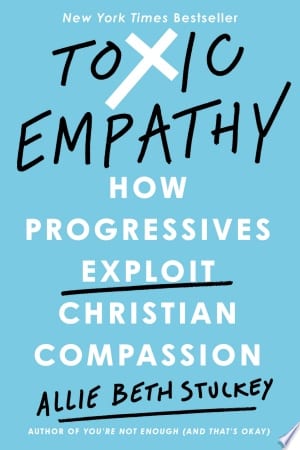
A sharp Christian voice makes a bold argument: when politics are driven by empathy rather than truth, innocent people pay the price. We are told that empathy is the highest virtue—the key to being a good person. Is that true? Or has “empathy,” like so many other words of our day—“tolerance,” “justice,” “acceptance”—been hijacked by bad actors who exploit compassion for their own political ends? In Toxic Empathy, Allie Beth Stuckey argues that empathy has become a tool of manipulation by left-wing activists who bully people into believing that they must adopt progressive positions to be loving. She explores the five most heated issues through which toxic empathy is deployed: abortion, gender, sexuality, immigration, and social justice. Progressives use catchy mantras to present their perspective as empathetic, like “abortion is healthcare,” “love is love,” or “no human being is illegal,” but in each case, they ignore the other side of the moral equation. For example, abortion is presented as compassionate for the woman, but what about the human life the procedure kills? This book isn’t about killing empathy; it’s about submitting our empathy to God’s definitions of love, goodness, and justice. Stuckey exposes the logical pitfalls and moral consequences of toxic empathy, equipping Christians with research-backed, Biblical truths to dismantle the progressive lies that have permeated our culture—and our church.
Attachment (file not included in this release)
AI Summary
Transgender Chapter
Main Ideas (Overview)
- The chapter argues that rapid growth in youth medical transition is driven less by solid science and more by “toxic empathy,” social contagion, institutional incentives, and a fragile evidence base—especially around the “affirm or suicide” claim.
- It contends that the historic intellectual roots of gender medicine (Ellis → Kinsey → Money) were ethically compromised and empirically weak, culminating in the Reimer case—misrepresented as a success but ending tragically—used to popularize the sex/gender split.
- Medically, the chapter catalogs significant risks and irreversibilities from puberty blockers, cross-sex hormones, and surgeries, arguing that these costs are minimized in public messaging.
Historical Background (Ellis → Kinsey → Money)
- Havelock Ellis (late 19th–early 20th c.): Presented “sexual inversion” (believing one is the opposite sex), embraced eugenics, and advanced controversial views about children’s sexuality. The chapter positions Ellis as a starting point for later developments in gender theory.
- Alfred Kinsey (mid-20th c.): Popularized a sexual continuum, challenged taboos, and (per the chapter) included disturbing research methods involving children; he helped normalize sweeping rethinks of sex, paving the way to “changing sex itself.”
- John Money (mid-20th c.): Codified “gender” distinct from biological sex and promoted early sex-reassignment at Johns Hopkins. The Reimer twins case—touted as a success—later unraveled (coerced “rehearsal” behaviors reported; ultimate suicide), which the chapter treats as emblematic of foundational error.
What’s Happening Now (Scale & Trajectory)
- Use of blockers and youth hormones rose sharply from 2017 to 2021; the chapter expects today’s numbers to be even higher and lists notable U.S. clinic whistleblower stories and adverse outcomes (e.g., osteoporosis after blockers).
Core Claims About Evidence & Studies
- “Affirm or suicide”: The chapter calls the strongest versions of this claim “moral blackmail,” arguing many studies cited are methodologically weak (small samples, funding conflicts) and notes analyses finding higheryouth suicide rates in places with easier access to blockers/hormones after controls (Heritage analysis).
- ROGD / Social contagion: The chapter leans on Lisa Littman’s work to argue that today’s surge—especially among adolescent girls—reflects rapid-onset gender dysphoria, clustering in friend groups with heavy online influence and status rewards.
- Comorbidity & vulnerability: Many adolescents presenting with trans identification have existing mental-health issues (e.g., autism, anxiety/depression) or recent stress/trauma; these vulnerabilities, the chapter claims, are being channeled into transition pathways rather than addressed at their root.
Medical Risks & Irreversibility (Selected Highlights from the Chapter)
- Female→Male testosterone: Potential for permanent infertility; mood/anxiety changes; increased risks tracked in the chapter include severe acne, hair loss, hypertension, dyslipidemia, type-2 diabetes, liver dysfunction, and elevated breast/uterine cancers; reported >4× heart-attack risk vs. women not on testosterone.
- Male→Female hormones: Lower muscle mass, erectile dysfunction, infertility; heightened risks of stroke and blood clots.
- Surgeries:
- Vaginoplasty: Long recoveries, required dilation, risk of infection/incontinence, sexual dysfunction, and need for revisions.
- Phalloplasty: High rates of urethral stricture, recurrent UTIs, catheter reliance, multiple revisions; some require lifelong perineal urethrostomy.
Mechanisms of Spread & Cultural Drivers (per the chapter)
- Online ecosystems & status incentives: Pro-transition content and influencers saturate feeds; trans identity is framed as celebrated/victimized status compared to “oppressor” labels for normie identities—especially affecting teens susceptible to peer signals.
- Pornography: Chapter links escalating porn use to increasingly extreme categories, noting rapid growth of trans-related content consumption.
Institutionalization & Policy Pressures (chapter’s depiction)
- The chapter’s broader narrative (in the surrounding pages) describes supportive stances by professional bodies and school policies (e.g., gender curricula, confidentiality from parents), presenting these as normalizing early transition. (Context drawn from the same chapter set.)
Author’s Bottom Line (as presented)
- The chapter urges skepticism toward “settled science” claims, emphasizes the gravity and irreversibility of medical interventions for minors, and recommends a therapy-first approach that addresses comorbidities and social drivers rather than defaulting to medicalization.
Gay Marriage Fact-check
Question:
Is it true that “two out of five studies in the analysis found children with gay parents suffer more emotional problems than kids with traditional parents,” that “one study showed children with lesbian parents had worse physical health,” and that “in four of the six studies analyzed, children in gay households had lower graduation rates and worse educational attainment than kids in traditional households and were more likely to repeat grades,” as claimed with reference to studies such as Regnerus (2012), Potter (2012), Sirota (2009), Rosenfeld (2010), Sarantakos (1996), Allen (2013), and the BMJ Global Health (2023) review?
Answer:
No, that summary is not accurate. It overgeneralizes, mixes incomparable studies, and misrepresents the overall state of research. Here’s what the cited evidence actually shows:
- Regnerus 2012 (NFSS; U.S.) – Reported poorer outcomes for young adults whose parent ever had a same-sex relationship, but the sample mostly included children from broken or unstable families, not those raised continuously by same-sex couples. The study’s design makes it impossible to attribute differences specifically to same-sex parenting.
PubMed - Potter 2012 (U.S.) – Found small raw academic differences that disappeared after adjusting for family instability and socioeconomic background, concluding there is no independent disadvantage associated with same-sex parents.
Wiley Online Library - Sirota 2009 (U.S.) – Studied a very small sample of adult daughters of gay or bisexual fathers and found higher attachment anxiety, but this is not a representative child-outcome study.
PubMed - Rosenfeld 2010 (U.S. Census) – Found no significant differences in school progress or grade repetition between children of same-sex and heterosexual parents once socioeconomic factors were controlled.
PubMed - Sarantakos 1996 (Australia) – Reported lower scholastic and social outcomes for children in same-sex households, but used a small, non-random sample from the mid-1990s and is not representative.
Cambridge University Press - Allen 2013 (Canada) – Found children of same-sex parents were less likely to graduate high school, but the study relied on limited census data that did not track family stability or time lived with parents, and its interpretation remains controversial.
Springer - BMJ Global Health 2023 (umbrella review) – Synthesized over 300 studies and concluded there are no significant overall differences in psychological adjustment, educational performance, or health outcomes between children of same-sex and different-sex parents. It notes that one earlier U.S. study (Regnerus 2012) reported worse self-rated physical health, but stresses that its design limits causal inference.
BMJ Global Health
In summary:
Among the studies cited, only a few—particularly Regnerus (2012), Sarantakos (1996), and Allen (2013)—report disadvantages, and each has major methodological limitations. The strongest, most recent evidence (BMJ Global Health 2023) finds no consistent disadvantage for children raised by same-sex parents once family stability and socioeconomic context are accounted for. Therefore, the quoted claim that “two out of five” or “four of six” studies show poorer outcomes is misleading and unsupported by the total body of evidence.
Immigration Fact-Check
Claim:
“America not only accepts more legal immigrants than every other country each year, we also have the largest foreignborn population of any nation. … The United States is home to more immigrants than live in the next four top countries combined. … America only has 5 percent of the world’s population, but we are home to 20 percent of the world’s immigrants.”
(Sources given: Elliott Davis Jr. via U.S. News & World Report; Jeanen Batalova via Migration Policy Institute)
What the best available data show / partial truths and exaggerations
- The U.S. has among the largest foreign-born populations (in absolute numbers).
- According to Migration Policy Institute (2025), the U.S. foreign-born population reached 47.8 million in 2023. (migrationpolicy.org)
- It is widely reported that the U.S. is the country with the largest number of immigrants (or foreign-born) in absolute terms. (migrationpolicy.org)
- Wikipedia’s “List of sovereign states by immigrant population” also lists the U.S. among the top nations by count. (Wikipedia)
- Proportion of world’s immigrants / share claims are likely overstated.
- The claim that the U.S. “has 5% of world population, but is home to 20% of world’s immigrants” is not clearly supported by standard global migration statistics.
- The United Nations’ “International Migrant Stock” data (for example) often indicate that while the U.S. is a top destination, many other countries host large immigrant populations, and proportions vary by definition (long-term vs. short-term migrants, refugees, etc.).
- I did not find a reliable global statistic confirming that the U.S. alone holds 20% of all immigrants worldwide in the most recent data.
- “Accepts more legal immigrants than every other country each year” — ambiguous and contestable.
- “Legal immigrants accepted per year” depends on visa regimes, quotas, and definitions (permanent legal admissions, refugee resettlement, etc.).
- Some years, the U.S. indeed grants among the highest numbers of legal permanent resident statuses globally, but this is context-dependent and not always the top in every year.
- The U.S. News & World Report slide show (Elliott Davis Jr.) may have been citing data on countries with large immigrant inflows, but it should be taken as illustrative rather than definitive.
- “More immigrants than the next four top countries combined” — likely false in most recent comparisons.
- While the U.S. has one of the largest immigrant populations, whether it exceeds the sum of the next four countries depends on which countries, how immigrants are counted, and what year.
- The data I found do not unequivocally support that specific extreme claim (U.S. > sum of next four) for recent years.
Verdict & more reliable framing
- Mostly true: The U.S. is among the nations with the largest number of immigrants (foreign-born) in absolute terms.
- Overstated / inaccurate parts: The bold “20% of world’s immigrants” and “U.S. > next 4 combined” claims are not reliably supported by current global migration statistics.
- Better phrasing:
“The United States is home to one of the largest foreign-born populations in the world. In 2023, about 47.8 million U.S. residents were foreign-born. While the U.S. is a major global destination, claims such as holding 20% of the world’s immigrants or accepting more legal immigrants every year than any other country require careful qualification and depend heavily on definitions, years, and comparative data sets.”
Question:
“America not only accepts more legal immigrants than every other country each year, we also have the largest foreign-born population of any nation. In fact, the United States is home to more immigrants than live in the next four top countries combined. To put it another way, America only has 5 percent of the world’s population, but we are home to 20 percent of the world’s immigrants.”
Answer (fact check):
- Largest foreign-born population (absolute numbers): True. The United States hosted about 52.4 millioninternational migrants in 2024, the most of any country.
Source: United Nations DESA, International Migrant Stock 2024 – Key facts and figures (advance release): https://www.un.org/development/desa/pd/content/international-migrant-stock - “More immigrants than the next four countries combined”: False. UN 2024 estimates list the next top destinations roughly as Germany (~16.8M), Saudi Arabia (~13.7M), the Russian Federation (~12M), and the United Kingdom (~10–11M). Those four together total ~53–54 million, which is greater than the U.S. total (~52.4M).
Sources: UN DESA, International Migrant Stock 2024 – Key facts and figures (country breakdown cited in release); see also IOM, World Migration Report 2024 data snapshots for the same ordering: https://worldmigrationreport.iom.int/what-we-do/world-migration-report-2024-chapter-2/international-migrants-numbers-and-trends and PDF snapshot: https://worldmigrationreport.iom.int/sites/g/files/tmzbdl1691/files/documents/WMR-Data-Snapshot-Top-Origin-and-Destination-Countries.pdf - “U.S. has 5% of world population but 20% of the world’s immigrants”: Overstated. UN-linked compilations put total international migrants at ~304 million in 2024. With ~52.4M in the U.S., that is ~17% of the world’s migrants, not 20%. (The U.S. share of world population is ~4–4.3%.)
Sources: IOM/Migration Data Portal (UN DESA–based), “International migrant stocks overview” (304M in 2024): https://www.migrationdataportal.org/themes/international-migrant-stocks-overview ; UN DESA totals/dataset entry page: https://www.un.org/development/desa/pd/content/international-migrant-stock - “Accepts more legal immigrants than every other country each year”: Needs qualification. By lawful permanent residence (green cards), the U.S. typically is at or near the top: ~1.17 million people became LPRs in FY2023. But comparisons depend on definitions (permanent vs. temporary admissions, humanitarian entrants, intra-EU free movement, etc.), and in some categories or specific years other countries lead.
Sources: U.S. DHS, Yearbook of Immigration Statistics 2023: https://ohss.dhs.gov/topics/immigration/yearbook-immigration-statistics/yearbook-2023 ; USAFacts summary of FY2023 LPR flow: https://usafacts.org/answers/how-many-immigrants-get-green-cards-every-year/country/united-states/ ; OECD, International Migration Outlook 2024 (permanent-type migration to OECD countries reached 6.5 million in 2023): https://www.oecd.org/content/dam/oecd/en/publications/reports/2024/11/international-migration-outlook-2024_c6f3e803/50b0353e-en.pdf
Bottom line (corrected wording you can paste):
The United States does host the largest number of international migrants in the world (about 52.4 million in 2024). However, the U.S. does not host “more than the next four countries combined,” and the U.S. share of global migrants is ~17%, not 20%. The U.S. usually admits around a million+ new lawful permanent residents per year, which often places it at or near the top globally—though exact rankings vary with what counts as “accepted” and which migration categories are compared.
Sources: UN DESA International Migrant Stock 2024: https://www.un.org/development/desa/pd/content/international-migrant-stock ; Migration Data Portal (304M global migrants in 2024): https://www.migrationdataportal.org/themes/international-migrant-stocks-overview ; IOM/WMR 2024: https://worldmigrationreport.iom.int/what-we-do/world-migration-report-2024-chapter-2/international-migrants-numbers-and-trends ; DHS Yearbook 2023: https://ohss.dhs.gov/topics/immigration/yearbook-immigration-statistics/yearbook-2023 ; USAFacts (LPR flow 2023): https://usafacts.org/answers/how-many-immigrants-get-green-cards-every-year/country/united-states/ ; OECD International Migration Outlook 2024: https://www.oecd.org/content/dam/oecd/en/publications/reports/2024/11/international-migration-outlook-2024_c6f3e803/50b0353e-en.pdf
Highlights
Before I had kids, I’m embarrassed to say that when I heard babies screaming on planes or running around chaotically in airports I thought, “Why do parents travel with little kids?” Or “Just give them some Benadryl!” I laugh at myself now, realizing how little I understood then. I had no idea at the time that those parents feel a great deal more stress and frustration than I did at their child’s behavior. I didn’t consider that the child may be tired, scared, overwhelmed, or stressed herself. I had no concept of these things, because I hadn’t been there. (Page 8)
empathy alone is a terrible guide. It may be part of what inspires us to do good, but it’s just an emotion and, like all emotions, is highly susceptible to manipulation. That’s exactly what’s happening today. Empathy has been hijacked for the purpose of conforming well-intentioned people to particular political agendas. Specifically, it’s been co-opted by the progressive wing of American society to convince people that the progressive position is exclusively the one of kindness and morality (Page 9)
If you really care about women, you’ll support their right to choose. If you really respect people, you’ll use preferred pronouns. If you’re really a kind person, you’ll celebrate all love. If you’re really compassionate, you’ll welcome the immigrant. If you’re really a Christian, you’ll fight for social justice. (Page 10)
No one wants to be seen as unempathetic, because a person who completely lacks empathy may be a narcissist. They’re unable to see anyone else’s point of view and refuse to bear their suffering. They’re selfish and coldhearted. They ignore the struggling mom lugging her bags and her toddler down the crowded jet bridge. (Page 10)
That’s why toxic empathy is so persuasive. It extorts a real and good desire that most people have, which is to be, and to be perceived as, kind. (Page 10)
But empathy literally means to be in the feelings of another person. Empathy by itself is neither loving nor kind; it’s just an emotion. Love, on the other hand, is a conscious choice to seek good for another person. (Page 10)
The erroneous conflation of love and empathy has convinced the masses that to be loving, we must feel the same way they do. Toxic empathy says we must not only share their feelings, but affirm their feelings and choices as valid, justified, and good. This confusion has not only made us a morally (Page 10)
Toxic empathy says we must not only share their feelings, but affirm their feelings and choices as valid, justified, and good. (Page 10)
lost people but it’s also harmed the very people empathy-mongers claim they’re trying to help: the truly marginalized and vulnerable. (Page 11)
Empathy can help us see their perspective and foster compassion, but that’s all it can do. It can’t guide us into making the right decisions or donning the wise, moral, or biblical position. Toxic empathy bullies us into believing that the unwise, immoral, and unbiblical position is actually the righteous one. (Page 11)
That’s why empathy is different from love and why it also must be submissive to love. Putting yourself in someone’s shoes may help you feel their pain, but their pain isn’t determinative of what’s true or false, right or wrong. A person for whom you feel empathy may, in their pain, believe or demand things that are untrue, unhelpful, and even harmful. We can empathize with the pain of withdrawal for a drug addict, for example, but it would be cruel to give them the heroin they crave. (Page 15)
Putting yourself in someone’s shoes may help you feel their pain, but their pain isn’t determinative of what’s true or false, right or wrong. (Page 15)
A few days later, I shared a video of an older woman, who was black, expressing through sobs her experience of watching her community devastated by rioters. The point of my post was to ask: Why not both? Why can’t we be upset by the footage of George Floyd and condemn the riots? If the goal is justice, the protection of life, shouldn’t we care about both? While many agreed, I was also met with an onslaught of angry comments arguing to compare destruction of property to the killing of a human being. Buildings have insurance, they said, but Floyd’s life can’t be rebuilt. “Have some empathy,” they chided, over and over again. it’s disrespectful and—yes—racist (Page 20)
Then and now, in the world of social media activism, outrage is considered the measure of virtue, but only outrage going in the “right” direction. We must show empathy, but only the “right” kind of empathy. The overwhelmingly loud voices online, joined by most of the mainstream media, Silicon Valley, academia, our public education system, our federal bureaucracy, and Hollywood, have decided that the outrage and empathy must align with progressive causes. Thus, in the summer of 2020, the only acceptable approach was to claim that systemic racism, alive and well in America since 1619, murdered George Floyd. I’d expressed the wrong kind of outrage. (Page 21)
In the months that followed the black square craze, I pored over studies and books on race, history, justice, and economics by conservative authors like Thomas Sowell and Walter Williams, as well as books on critical race theory written by its most prominent proponents. I listened to the perspectives of Christians and non-Christians across the political spectrum. I talked to dozens of people on all sides of the issue. And everything I learned increased my confidence that too many Christians had been erroneously manipulated by toxic empathy when it came to so-called racial and social justice. They weren’t willing to hear competing data or arguments to their narrative, because to do so would seem unempathetic. (Page 21)
Here are a few red flags that we’ll see repeatedly in these pages: (Page 22)
- THE USE OF EUPHEMISMS: Euphemisms obscure the truth to make a position seem more palatable. Think “reproductive rights” for killing an unborn child, or “gender-affirming care” In every conversation, for bodily mutilation. advertisement, article, or podcast, you must carefully look out for the use of euphemisms. Ask yourself, “What does she mean by that?” and try to identify the reality her language choice is hiding. (Page 22)
- CONTRADICTIONS TO GOD’S WORD: Sometimes these contradictions are obvious (e.g., “Jesus isn’t the only way to heaven”), but most of the time, they’re not. Just like the Devil tricking Eve or tempting Jesus, unbiblical statements are often paired with something true. Think “Christians are called to love the foreigner” to justify chaotic border laws, or “The early church shared everything they had” to justify socialism. Just because something sounds good doesn’t mean it is. It’s crucial we know our Bible and train ourselves to think critically about the things we read and hear—especially when they’re viral or catchy. (Page 22)
- EXCLUSIVELY POLITICAL ENDS: When calling for empathy, inclusivity, and love, are they talking about how we treat these people as individuals, or are they actually speaking of achieving certain political ends? For example, “love is love” isn’t really a call for us to love gay people by recognizing their innate worth as human beings and treat them with kindness; it’s a call to legally redefine marriage and family. “Black lives matter” isn’t just a true statement about the value of black people; it’s a call to political change, which typically includes removing funding from police forces and redistributing wealth to black Americans. These are examples of the exploitation of empathy to achieve political power, not peace. (Page 23)
- CHRISTIAN-SOUNDING WORDS WITH UNCHRISTIAN MEANINGS: The concepts of equality, equity, liberation, oppression, inclusion, and social justice can all be, in some way, found in the Bible, but the Bible defines them differently than progressive activists do. Biblical equity, for example, means fair, impartial judgment (Ps. 99:4). Progressive equity means equal outcomes. As Vice President Kamala Harris explained, “Equitable treatment means we all end up in the same place.”[4] As we will discuss in the social justice chapter, equal outcomes are impossible outside of extreme, oppressive government intervention, and nowhere does the Bible indicate that justice means everyone having equal resources. (Page 23)
- EMOTIONAL LANGUAGE: Manipulative rhetoric lacks substantive, logical arguments and replaces them with demands that you feel a certain way. If you’re really loving, caring, understanding, empathetic, etc., you will buy into a particular position. Often, your rational points will be rebuffed with accusations of callousness instead of thoughtful responses. When they call you hateful, bigoted, racist, or any other epithet, it usually means they don’t know why they believe what they believe, so their insecurity manifests itself in anger. This kind of bullying is frustrating, but you have the power to let it roll off your shoulders. I’ve learned from experience that it’s best never to lose your cool and never to give an ounce of legitimacy to their insults. If they raise a fair point, say so, but don’t waste your time defending yourself against their accusations. No need to say something like, “I’m not a bigot, but…” This shows you’ve at least registered their name-calling. You know such an allegation is ridiculous, and you don’t need to dignify it with a response. Simply continue to kindly, humbly, but confidently stand your ground. It may be that this conversation planted a seed in them that won’t blossom until much later on. (Page 23)
LIE #1 “Abortion Is Health Care” (Page 25)
While abortions at or after twenty-one weeks gestation are rarer than abortions earlier in the second trimester and in the third trimester, they still happen. The CDC puts the number at about ten thousand per year.[8] However, the number is likely far higher, as only a handful of states are required to report their numbers on late-term abortions. (Page 32)
As a reminder, a baby’s heart starts beating at about six weeks gestation. That’s only two weeks after a missed period. Despite desperate attempts by the media to belittle these heartbeats as “pulses,” doctors have long acknowledged this cardiac activity is, indeed, a heartbeat, even if the heart is still developing. (Page 32)
Princeton philosopher Peter Singer, for example, infamously supports the idea that babies, while scientifically human, are not human persons. His reasoning goes like this: 1. We must treat all persons according to moral guidelines. 2. Persons are self-aware. 3. Infants are not self-aware and thus are not persons. We do not need to treat them according to moral guidelines. Logically, then, that means that babies under a year and a half don’t have rights, including the right to life. Thus, if parents decide they want to kill their baby, according to Singer’s logic, they can. (Page 34)
A good rule of thumb is this: if you’re on the right side of an issue, you don’t have to lie to convince people to join you. (Page 36)
The truth is, every person who considers themselves “pro-choice,” no matter what they say they believe, has accepted Peter Singer’s reasoning that human value and rights start sometime after birth. The core of this logic is that personhood is granted to others by those who have the power to do so. This is the truth masked by fake, empathy-based narratives about abortion. (Page 36)
In many ways, Thomas Malthus—the namesake of the Malthusian League—was Sanger’s intellectual predecessor. Malthus warned that overpopulation would lead to the dwindling of resources, which would lead to a deadly decline in living standards. The proposed solution to his Malthusian catastrophe was to limit the growth of the population as much as possible. Malthus’s theory, however, was wrong. While the world population has increased by seven billion people since 1800,[11] extreme poverty has decreased from 84 percent to 24 percent.[12] As it turns out, human beings add to and benefit our environments more than we subtract and detract from them. (Page 37)
This gave rise to advocacy for eugenics. English naturalist Sir Francis Galton, the half-cousin of Charles Darwin, birthed the field of eugenics in 1883, which he defined as “the science which deals with all influences that improve the inborn qualities of a race.”[13] A common idea among supporters of eugenics was that certain ethnicities were innately inferior, both intellectually and morally. (Page 37)
This is the philosophical legacy of Planned Parenthood and Margaret Sanger, who forged a plot in the United States to minimize—if not eradicate —the existence of people she considered undesirable. Her plans quickly bore fruit. (Page 38)
In 1927, the Supreme Court ruling in Buck v. Bell effectively agreed, ruling mass sterilization was constitutional. Justice Oliver Wendell Holmes Jr. declared: “Three generations of imbeciles are enough.” (Page 38)
Sanger was especially concerned about limiting black births, writing to the heir of the Procter & Gamble fortune that “the most successful educational approach to the Negro is through a religious appeal. We don’t want the word to get out that we want to exterminate the Negro population, and the minister is the man who can straighten out that idea if it ever occurs to any of their more rebellious members.” (Page 38)
But the horrors of the Holocaust and the worldwide sympathy it evoked eventually forced Sanger and her eugenicist contemporaries to update their message. In 1942, the American Birth Control League dropped “birth control” from their messaging and used the term “planned parenthood” instead.[17] The new organization, Planned Parenthood, would shift its focus from breeding a pure racial stock to encouraging the use of contraception, offering abortions, and providing infertility treatments (Page 38)
Yet the eugenicist legacy persisted. Planned Parenthood’s president in 1973—when Roe v. Wade was decided by the U.S. Supreme Court—was Dr. Alan F. Guttmacher, former vice president of the American Eugenics Society. Today his name adorns the Guttmacher Institute, the premier research organization of the abortion industry. (Page 38)
Despite dropping “population control” and “eugenics” from its public list of goals, Planned Parenthood has followed the eugenics program to its inevitable conclusion. Of the hundreds of thousands of abortions performed (Page 38)
each year in the United States, 39.2 percent are undergone by black women, despite this demographic making up only about 12.4 percent of the U.S. population as of 2020.[18] In 2013, more black babies in New York City were aborted than born.[19] These statistics alone satisfy Sanger’s founding vision for her movement. (Page 39)
The partnership between eugenics, depopulation, and abortion is still prominent. Microsoft cofounder and activist Bill Gates is a major investor in providing worldwide access to birth control for the purpose of curbing population growth. In a 2010 TED Talk, he warned: “The world today has 6.8 billion people. That’s headed up to about 9 billion…. Now, if we do a really great job on new vaccines, health care, reproductive health services, we could lower that by, perhaps, ten or fifteen percent.” (Page 39)
Billionaire Warren Buffett, the sixth richest man on earth, has given more than $1 billion in grants to pro-abortion organizations like Planned Parenthood, the Guttmacher Institute, and the National Abortion Federation, driven by what biographer Roger Lowenstein called “a Malthusian dread” of overpopulation. Buffett is also one of the original investors in RU-486 (a U.S. abortion pill) manufacturer Danco Laboratories. (Page 39)
Charlie Munger, who was the vice chairman of Buffett’s investing firm, Berkshire Hathaway, until his death in 2023, worked with Buffett to found a “church” in the 1960s that wasn’t really a religious entity but rather existed to aid women in obtaining abortions outside the United States. (Page 39)
The Rockefellers, another billionaire family, have supported abortion efforts for decades. According to the Rockefeller Brothers Fund, John D. Rockefeller Jr. had a focus on “special projects in African-American communities.” (Page 39)
The movement that labels itself pro-choice actually only pushes one outcome: abortion. In fact, it actively suppresses alternatives to abortion, shielding mothers from the realities of the procedure. Anyone who seeks an abortion at Planned Parenthood will be lied to about fetal development and will likely be prevented from seeing her ultrasound image. (Page 46)
Truth in Love > Empathy (Page 54)
LIE #2 “Trans Women Are Women” (Page 55)
Even if all is covered by lies, even if all is under their rule, let us resist in the smallest way: Let their rule hold not through me![1] —ALEKSANDR SOLZHENITSYN (Page 55)
But ultimately, such empathy-driven affirmation is not just shortsighted, but unloving. The implications of transgenderism go far beyond any one testimony of hurt and healing and into a tangled, dark, and deadly web of ideology, politics, bunk science, bad medicine, and corrupt powers that exploit the pain and confusion of people like Laura, resulting in destruction both for those caught in it as well as the rest of us. (Page 58)
The American Academy of Pediatrics (AAP) supports the assertion that children’s gender can differ from their sex. In 2018, the AAP published a policy statement that supported the “transition” of minors that includes both the prescription of “puberty blockers,” which inhibit the natural process of puberty in the preteen years and can cause sterility,[3] and cross-sex hormones for teens (Page 60)
According to journalist Christopher Rufo, over four thousand schools in the United States host gender and sexuality clubs. The stated mission of the national GSA organization is to abolish the American judicial system, as well as “cisgender heterosexual patriarchy.”[8] School and public libraries across the country offer books related to gender transition to children, including sexually explicit works like Lawn Boy and Gender Queer. (Page 61)
In many ways, that history started in the late nineteenth and early twentieth centuries with a man named Havelock Ellis—a close friend of birth control advocate Margaret Sanger. Like Sanger, Havelock was an early supporter of the eugenics movement and believed that sexual freedom coupled with birth control could solve modern ills. To explain how this new world would work, he studied human sexuality, including among children. (Page 66)
His theory was that children, and even little babies, had sexual interests, and that people could sometimes have what he called “sexual inversion,” or the benign belief that they were the opposite sex. Both these ideas were highly controversial at the time, and they led to strange conclusions. For example, because Havelock thought children were sexualized, he defended pedophilia and was weirdly interested in childhood masturbation. Ellis’s “research” was taken up by a biologist named Alfred Kinsey in the early twentieth century. Kinsey’s goal was to overturn society’s sexual mores, and he believed just about every person was secretly deeply sexually perverted. Kinsey popularized the idea that sexuality wasn’t black or white but existed on a sliding scale. Where Ellis believed that people could believe they were the opposite sex, Kinsey posited that one’s sexual attraction fluctuated and could change. To both, old notions about sex and sexuality were being challenged. Also like Ellis, Kinsey believed that even the youngest kids were sexual beings, and as such, Kinsey worked with pedophiles to study orgasms among young boys, writing about how younger children often sobbed and cried during the experience. (Page 66)
John Money, (Page 67)
When John Money was doing sex-change experiments on children in the 1960s and ’70s, few people even knew what transgenderism was. As late as 2005, there were only three gender clinics for children in the entire world. The only clinic in the western hemisphere had a scant eighty patients.[31] Of that tiny number of kids, the vast majority were found to grow out of their gender confusion as they hit puberty and adulthood. (Page 68)
Today, the number of gender-confused youth is exploding. There is no central source for data on transgenderism in America, but the numbers we do see are astounding. In a survey of 137 college students in 2021, nearly 4 percent of undergraduates said they did not fit into a traditional male or female framework,[33] somewhere between 2 percent[34] to nearly 10 percent[35] of high school students said in 2018 that they were genderdiverse, and 42,000 young people were diagnosed with gender dysphoria, nearly twice as many as had that identity two years before. (Page 69)
One big reason adults go along with the madness is moral blackmail. When their child comes out as trans, they’re immediately asked: “Would you rather have a living son or a dead daughter?” This is one of the main empathy-driven pressure tactics the transgender movement uses. It’s based upon studies purportedly showing that kids who don’t medically transition are significantly more likely to commit suicide. If you don’t accept the transition, you’re complicit in your own child’s death, the argument goes. (Page 69)
The Heritage Foundation published a study overturning the idea that cross-sex medical intervention lowers the risk of suicide. To take just one data point, when controlling for other factors, starting in 2010 suicide rates actually rose in states where puberty blockers and cross-sex hormones became easily accessible for minors (Page 70)
This significant increase in gender confusion is in large part the result of something researchers call “rapid-onset gender dysphoria,” or ROGD. This was a term coined by Dr. Lisa Littman when she noticed something very strange. In the past, gender dysphoria appeared in an extremely small number of mostly boys at a very young age. Now, large numbers of much older adolescents, especially girls, were coming out as transgender despite having no history of gender confusion.[ (Page 70)
The vast majority of those studied by Dr. Littman have a mental health condition, like autism, or have suffered trauma of some sort in their lives, like a bad breakup or their parents’ divorce. (Page 70)
Perhaps most frightening, transgender identity appears to be spread through heavy internet use. (Page 71)
This is the predictable result of transgenderism. If we accept that people can change genders—or even if we don’t but agree to be “polite” and call a man “she”—then why shouldn’t “she” be allowed to play women’s sports or bathe naked in an all-women’s space? Why shouldn’t “she” be allowed to enter women’s abuse houses or be transferred to a women’s prison? Why accept one lie and not the whole thing? These stories aren’t rare. Websites like Reduxx.info post near daily on various ways gender-confused men violate women’s spaces. (Page 74)
For that matter, how can we stop “her” from getting puberty blockers, receiving cross-sex hormones, or removing “her” penis? False empathy affirms feelings, and this is what people feel, after all. Ultimately, there is only one reasonable place to draw the line, and that’s at the truth. (Page 74)
LIE #3 “Love Is Love” (Page 81)
Keyes clarified a point many people ignore: Because the state has an interest in protecting its continued existence and future citizens, it has an interest in protecting marriage. Marriage serves as a bedrock for functioning societies. Upending marriage leads to chaos. (Page 86)
The Centre for Social Justice in the United Kingdom issued a report in 2019 finding that the rise of divorce and single-parent households has led to the destabilization of children’s lives. The breakdown of the family nearly doubles a child’s chances of failing at school, doubles a child’s chances of becoming a criminal, more than doubles a child’s chances of becoming homeless, and increases the risk of mental health problems and drug addictions. (Page 87)
Harvard University sociologist Robert Sampson describes the family structure as “one of the strongest, if not the strongest” predictors of violence in the urban United States.[6] This is acutely demonstrated among black Americans, whose communities face a disproportionate amount of violence. [7] In 2018, seventy percent of black babies in the United States were born to unmarried women, far more than any other race in the United States. (Page 87)
Meanwhile, children in a stable, married household have better economic mobility, financial stability, educational achievement, and physical, social, and emotional health. (Page 87)
Suffice to say, two out of five studies in the analysis found children with gay parents suffer more emotional problems than kids with traditional parents. One study showed children with lesbian parents had worse physical health. Likewise, in four of the six studies analyzed, children in gay households had lower graduation rates and worse educational attainment than kids in traditional households and were more likely to repeat grades.[11] But we don’t need studies to tell us what we already intuitively know: The same people needed to make a baby are needed to raise her. Only men can be dads, and only women can be moms. Each has their own irreplaceable role to play. (Page 88)
We may be in the minority, but no poll can ever change what the truth about marriage or the effect redefining it has on children, the most vulnerable and voiceless members of society. Marriage between a man and woman is a child-producing and child-protecting institution. “Love is love” may sound like a no-lose slogan in support of “gay marriage,” but it undermines and collapses the purpose of the marriage union. When this union is deprioritized or redefined based on the desires or political agendas of adults, children suffer, not just during their upbringing but from their conception. (Page 89)
LIE #4 “No Human Is Illegal” (Page 110)
Love for one’s country means chiefly love for people who have a good deal in common with oneself.[1] —C. S. LEWIS (Page 110)
That’s why empathy, even in its best form, isn’t a sufficient determinant of right and wrong, nor is it an adequate driver of policy. There will always be hurt people on all sides of any issue. Stories like Maribel’s and Kate’s matter, but they alone can’t give us a full picture of immigration in the United States, and therefore they’re not sufficient in helping us think through this issue and its related policies. We have to determine what is actually true. (Page 116)
But we don’t have to have all the answers for other nations to care about our own borders. We don’t have to fix the rest of the world before we secure our own country. We can have compassion for the plight of immigrants without advocating for liberal border policy that endangers our own citizens and incentivizes trafficking. (Page 125)
Nations need strong borders to keep their citizens safe. “Strong borders” means a border that’s nonporous: one that’s guarded by impenetrable structures and armed guards who are authorized to protect their nation against smugglers, drug lords, and traffickers. Strict immigration policy that enforces laws against both illegal entry and illegal presence disincentivizes bad actors from exploiting the border and infiltrating the United States. (Page 125)
There’s no such thing as a perfect policy. Every lawmaking decision has pros and cons, risks and benefits. Where there is strict immigration law, there will be heartrending stories like Maribel’s. Where there is loose immigration law, there will be tragic stories like Kate’s. (Page 125)
It’s unpopular to say, and empathy mongers may refuse to face it, but borders exist for our good. They are crucial in protecting a country’s citizens and retaining national sovereignty. And with or without these proven risks of illegal immigration, every country has the right to enforce immigration law, deport noncitizens, and strongly secure its borders. (Page 125)
There’s no question that legal immigration allows people into our country who offer incredible contributions to our culture, economy, and overall health as a nation. America not only accepts more legal immigrants than every other country each year,[57] we also have the largest foreignborn population of any nation. In fact, the United States is home to more (Page 126)
immigrants than live in the next four top countries combined. To put it another way, America only has 5 percent of the world’s population, but we are home to 20 percent of the world’s immigrants. (Page 127)
Every nation has this right to sovereignty. Sovereignty is legitimacy. A nation’s legitimacy is necessary to enact and enforce laws, which represent the rights of a country’s citizenry. (Page 128)
If a country has no borders, it has no sovereignty. If it has no sovereignty, it has no legitimacy. If a country has no legitimacy, it has no authority to create laws. If it has no laws, chaos ensues, rights are lost, and citizenship means nothing. A country without any meaningful citizenship isn’t a country at all. (Page 128)
G. K. Chesterton: “A man’s reasons for not wanting his country to be ruled by foreigners are very like his reasons for not wanting his house to be burned down; because he could not even begin to enumerate all the things he would miss.” (Page 130)
LIE #5 “Social Justice Is Justice” (Page 139)
It’s true that black people are disproportionately represented in the justice system. Though they comprise about 14.4 percent of the general population, they made up nearly 40 percent of the prison population[16] and about 26 percent of all arrests in 2019.[17] They are more likely than any other ethnicity to be involved in traffic stops and to be accused of reckless driving. They are also said to be more likely to be killed by the police than their white counterparts.[18] But it’s important to note that densely populated black communities are typically high in crime, and black men, while making up only 5 to 6 percent of the population, account for 40 percent of police officer killings.[19] No one is arguing that this justifies tragedies like Elijah’s. The point is that the more crime there is in a community, the more police interactions there are, and the greater the chances there are of a fatal interaction with the police. (Page 148)
Thomas Sowell, a black man who was born in the segregated South, has spent decades refuting this argument by pointing out that many gaps between white and black Americans grew exponentially after 1965, which marked the inception of Lyndon B. Johnson’s welfare state. If slavery and Jim Crow were really the cause of today’s outcomes for black America, these gaps would have been much wider sixty years ago than they are today, and yet they’re wider today than they’ve ever been.[ (Page 151)
It’s certainly not hard to imagine that the well-documented historic prejudice toward black people in America could have a negative impact on them today, but this causal relationship must be proven rather than assumed. In Discrimination and Disparities, Sowell demonstrates that it is inaccurate and dangerous to “automatically and incessantly attribute statistical differences in outcomes to malevolent actions.” The social justice–powered assumption that all disparities between white and black people are due to injustice leads to deleterious policies, like reducing a community’s police force or doling out different sentences based on race. (Page 151)
In The Quest for Cosmic Justice, Sowell argues that the attempt to force society to reach an unreachable, cosmic goal of complete equality of outcome is better named “cosmic” justice than social justice, since politicians and activists attempt to put themselves in the place of gods by rearranging society to achieve their vision of “equity.” Sowell argues, “Envy was once considered to be one of the seven deadly sins before it became one of the most admired virtues under its new name, ‘social justice.’ ” (Page 151)
Never before in history, he points out, has equality of outcome been achieved outside of the brute force of tyranny (think: communism). Differing outcomes among individuals and groups are expected, and while some disparities may be due to unjust discrimination, many are not. Choices, strengths and weaknesses, cultural differences, and many other factors can all play a part in a person’s or community’s outcomes. After all, if two siblings from the same family, who received the same upbringing, the same amount of parental support, and the same number of resources, can end up with vastly different outcomes, why would we expect people who come from varying backgrounds to all reach the same place? (Page 152)
Sowell explains, “The crucial question is not whether evils exist but whether the evils of the past or present are automatically the cause of major economic, educational and other social disparities today. The bedrock assumption underlying many political or ideological crusades is that socioeconomic disparities are automatically somebody’s fault, so that our choices are either to blame society or to ‘blame the victim.’ ” To social justice ideologues, there is no middle ground. (Page 153)
Dr. Voddie Baucham, a pastor, missionary, and dean of the School of Divinity at African Christian University in Zambia, described the problem with this reasoning as the “fallacy of the excluded middle.” By attributing every disparate statistic to discrimination, social justice warriors are ignoring all the other factors that could come into play. These arguments lead to the justification of policies that purport to eliminate disparities in an effort to fight injustice. (Page 153)