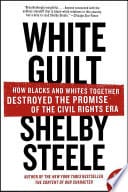
DESCRIPTION
A look at the state of black and white race relations in twenty-first-century America, from the New York Times– bestselling author of The Content of Our Character . “Not unlike some of Ralph Ellison’s or Richard Wright’s best work. White Guilt , a serious meditation on vital issues, deserves a wide readership.” — Cleveland Plain Dealer In 1955 the killers of Emmett Till, a black Mississippi youth, were acquitted because they were white. Forty years later, despite the strong DNA evidence against him, accused murderer O. J. Simpson went free after his attorney portrayed him as a victim of racism. The age of white supremacy has given way to an age of white guilt—and neither has been good for African Americans. Through articulate analysis and engrossing recollections, acclaimed race relations scholar Shelby Steele sounds a powerful call for a new culture of personal responsibility. “Breathtakingly insightful… . Anyone concerned with the endless standoff that is black-white relations in this country has a duty to read Shelby Steele.” — Chicago Sun-Times “Brilliant… . An autobiographical meditation on why a significant portion of the black population hasn’t been able to take advantage of freedoms that belatedly came to it.” — New York Sun “Stunning… . A clarifying lens through which to view the lonely struggle of clear-sighted black intellectuals to rescue black from a degrading temptation.” — Newsweek “No writer deserves black America’s allegiance more.” —John McWhorter, National Review
Highlights
- PART ONE THE STORY OF WHITE GUILT (Location 101)
- 1 A DILEMMA (Location 104)
- Today in America there is no moral relativism around racism, no sophisticated public sentiment that recasts racism as a mere quirk of character. Today America is puritanical rather than relativistic around racism, and if Clinton had been caught in this way, it is very likely that nothing would have saved him. (Location 138)
- The very legitimacy of the American democracy in this post–civil rights era now requires a rigid, if not repressive, morality of racial equality. A contribution of the civil rights movement was to establish the point that a multiracial society cannot be truly democratic unless social equality itself becomes a matter of personal morality. So a president’s “immorality” in this area would pretty much cancel his legitimacy as a democratic leader. (Location 140)
- Race simply replaced sex as the primary focus of America’s moral seriousness. (Location 149)
- there has been much moral decline in America since the sixties, but it is also true that I drove into San Luis Obispo on that winter morning knowing that I could sleep or eat anywhere my wallet would take me. I had no need to search out a local black person or to find the black part of town. So, in the same decades of America’s “moral decline” there had obviously also been a great moral advance. A great evil had been stilled, pushed back, repressed. In downtown San Luis Obispo I searched only for a restaurant that suited me, not one that would have me. And after parking my car, I walked through a world cleansed by a very hard-earned moral advance and held in this new benign state by an unforgiving social puritanism. So it was hard for me, having walked down streets where one’s color was a bar to everything, to believe fully in declinism. No doubt the divorce rate in this town is twice what it was when I was unwelcome here. But it is also true that in other ways people here are better than they once were. (Location 178)
- 2 FIDELITY (Location 191)
- fidelity to a discipline of democratic principles. (Location 194)
- Freedom, then, is not a state-imposed vision of the social good (say, a classless society); rather, it is the absence of any imposed vision that would infringe on the rights and freedom of individuals. In a true democracy freedom is a higher priority than the social good. (Location 196)
- fidelity to a discipline of principles—rather than to notions of the social or public “good”—is the unending struggle of democracies. And the legitimacy of democratic governments and institutions depends on the quality of this struggle. (Location 201)
- totalitarian or feudal societies legitimacy and moral authority are, a priori, coming from God (the divine right of kings) or from ideological “truth.” (Location 203)
- Free societies become more like these unfree societies when they decide that some social good is so important that it justifies suspending freedom’s discipline of principles. (Location 205)
- 3 INFIDELITY (Location 213)
- Segregation was, of course, an institutionalized infidelity to democratic principles. (Location 251)
- The fact is that we live different lives than our parents, no matter how much we love them and they us. We have a separate experience to contend with. (Location 275)
- Their rejection of violence, even as a weapon against racial oppression, gave them the extraordinary power of moral witness—the great power of the early civil rights movement. (Location 279)
- But what do all the postures of Gandhian passive resistance look like when the enemy has been persuaded? Suddenly the nonviolence that looked courageous in the face of the mob looks a little obeisant and supplicating when the mob disappears, when the government itself passes laws ending the segregated way of life the mob stood for. My parents believed with all their hearts in the moral power of turning the other cheek, but by 1968 this strategy was passé and Dr. King himself was a bit of an anachronism. (Location 283)
- Note: PASSIVITY TURNS INTO MILITANCY ONCE YOU’RE THE MAJORITY OR AT LEAST YOU DON’T HAVE ANY RESISTANCE
NEVER THOUGHT ABOUT THE CIVIL RIGHTS MOVEMENT IN THESE TERMS OR MACRO PERSPECTIVES
- Note: PASSIVITY TURNS INTO MILITANCY ONCE YOU’RE THE MAJORITY OR AT LEAST YOU DON’T HAVE ANY RESISTANCE
- Our point was that black power would no longer come from being better than whites; it would come from not being better. (Location 300)
- Oppression, in itself, pushes people neither to anger nor to revolution. If it did, black slaves would have been so relentlessly rebellious that slavery would have been unsustainable as an institution. It is wishful thinking in those who rightly abhor oppression to see it as a kind of dialectic that leads automatically to the rages that eventually topple it. Slavery might never have ended had not larger America—at the price of a civil war—decided to end it. The slave’s rage meant nothing and brought only the lash. (Location 319)
- Anger is acted out by the oppressed only when real weakness is perceived in the oppressor. So anger is never automatic or even inevitable for the oppressed; it is chosen when weakness in the oppressor means it will be effective in winning freedom or justice or spoils of some kind. Anger in the oppressed is a response to perceived opportunity, not to injustice. And expressions of anger escalate not with more injustice but with less injustice. Wounds and injustices create only the potential for anger, but weakness in the oppressor calls out anger even when there is no wound or injustice. In both the best and the worst sense of the word, black rage is always a kind of opportunism. (Location 323)
- America had moved out of its long age of white racism and into a new age of white guilt. A moral ambivalence and guilt around race had opened in white America that could be worked on by black anger. By 1968 black anger and militancy had replaced the passivism of the King era as the best means to opportunity and power for blacks. (Location 336)
- 4 A CERTAIN KNOWLEDGE (Location 339)
- the vacuum of moral authority that comes from simply knowing that one’s race is associated with racism. Whites (and American institutions) must acknowledge historical racism to show themselves redeemed of it, but once they acknowledge it, they lose moral authority over everything having to do with race, equality, social justice, poverty, and so on. They step into a void of vulnerability. The authority they lose transfers to the “victims” of historical racism and becomes their great power in society. This is why white guilt is quite literally the same thing as black power. (Location 370)
- 5 WHITE GUILT (Location 376)
- Maybe the self-segregation of blacks on college campuses and in some workplaces at least partly involves a longing for that old racial bond—the chance to concretely help and be helped by each other. But bonds that came automatically under oppression now require a self-consciously politicized racial identity that insists on a bond when there is no concrete need for one. (Location 382)
- Today you can witness blacks everywhere enforcing on themselves the very separatism and community that segregation so recently imposed—black churches, civil rights confabs that are far more social than political, “state of black America” gatherings as if we still share a singular destiny, black professional associations by the hundreds, black student associations of every variety, even a congressional black caucus, not to mention black caucuses in many state legislatures. (Location 391)
- racial unity is politically self-defeating in freedom, since it leaves the nicely unified race to be taken for granted by power. Freedom can be seized only by individuals. And the fact is that we blacks are free. (Location 395)
- Because white guilt is a vacuum of moral authority, it makes the moral authority of whites and the legitimacy of American institutions contingent on proving a negative: that they are not racist. The great power of white guilt comes from the fact that it functions by stigma, like racism itself. Whites and American institutions are stigmatized as racist until they prove otherwise. (Location 401)
- larger reality is that white guilt leaves no room for moral choice; it does not depend on the goodwill or the genuine decency of people. It depends on their fear of stigmatization, their fear of being called a racist. Thus, white guilt is nothing less than a social imperative that all whites, from far-left socialists to Republican presidents, are accountable to. (Location 408)
- this social morality—born of white guilt—became the establishment morality because it answered the problem of white guilt. It brought moral authority and legitimacy to a society that had acknowledged its history of racism. (Location 414)
- one has to be grateful to white guilt for bringing about possibly the greatest social transformation in American history. (Location 424)
- 6 THE NEW CONSCIOUSNESS (Location 426)
- hipness. This attitude comes out of the experience of oppression in which survival requires one to have a separate knowledge from that of the oppressor. The world lies constantly to those it oppresses, and to survive oppression one must not only be “hip” to those lies but also nurture a deeper awareness of the world as it really is. This more existential and subversive awareness of the “real” world is hipness. And the hipster is a kind of existential hero who preserves his humanity (amidst his oppression) by seeing through to the irony and absurdity of his situation. The true hipster is never surprised—is therefore “cool”—because he already knows. (Location 457)
- Marxist vision of American racism that would frame the racial debate for the next three decades. It was a precursor to the now common argument that racism is “systemic,” “structural,” and “institutional.” Of course, this was not formal Marxism (Gregory never used the word); rather, it was a loose conceptual borrowing from Marxism. The point was that ugly human prejudices like racism did not just remain isolated in the hearts of racists. These dark passions worked by an “invisible hand” to generate societal structures that impersonally oppressed. As people simply conformed to mundane standards of social decency, they executed bigotry and shaped society around it without necessarily feeling animus toward minorities. (Location 470)
- only in the mid-sixties, after the strongest antidiscrimination laws in history had been passed, did a new generation of black leaders begin to argue that racism was a determinism as well as a barrier—and thus a far greater enemy of black freedom than had previously been imagined. Logic would have argued the other way, that the new civil rights legislation meant that blacks were facing a far less deterministic racism. And surely black leaders would have agreed with this logic if they were responding to actual racial oppression. But they weren’t. They were responding to white guilt. (Location 485)
- For King’s generation of leaders racism was a barrier in the path to black freedom, and the goal was to remove it. But for this new generation of black leaders, racism existed within a context of white guilt, within a society that suffered a vacuum of moral authority precisely because of its indulgence in racism. Thus, America and all its institutions suddenly needed something from blacks—a people who in the past had been needed for little more than manual labor. By the mid-sixties white guilt was eliciting an entirely new kind of black leadership, not selfless men like King who appealed to the nation’s moral character but smaller men, bargainers, bluffers, and haranguers—not moralists but specialists in moral indignation—who could set up a trade with white guilt. (Location 491)
- The most striking irony of the age of white guilt is that racism suddenly became valuable to the people who had suffered it. (Location 496)
- But in the age of white guilt, racism was also evidence of white wrongdoing and, therefore, evidence of white obligation to blacks. King had argued that whites were obligated to morality and democratic principles. But white guilt meant they were obligated to black people because they needed the moral authority only black people could bestow. (Location 498)
- Note: GHANDIAN PASSIVITY -> MILITANCY -> MORAL AUTHORITY WIELDING THE SWORD OF WHITE GUILT
- White guilt had inadvertently opened up racism as the single greatest opportunity available to blacks from the mid-sixties on—this for a people with no other ready source of capital with which to launch itself into greater freedom. (Location 509)
- For black leaders in the age of white guilt the problem was how to seize all they could get from white guilt without having to show actual events of racism. Global racism was the answer. With it, the smallest racial incident proved the “global truth” of systemic racism. (Location 524)
- People said these rioters were crazy because they burned up their own neighborhoods and killed far more of their own people than the police ever did. But, in fact, they were working a rather sophisticated adaptation to white guilt. Ingeniously, they globalized what was very likely a necessary police beating into an agonized national debate on the state of black America—a debate that invariably expands both white obligation and black entitlement. Certainly they did great injury to their community, but, by their lights, they also reinforced black leverage against white guilt. (Location 534)
- It was social determinism that made global racism possible. Determinism was the idea that moved racism from the level of discriminatory events to the level of “impersonal” and “structural” forces that worked by “invisible hand” to stifle black aspiration even when real racists were nowhere to be seen. When racism is defined as a determinism, then whites and American institutions are part of a cultural pattern (“white privilege”) that automatically oppresses blacks; and blacks are automatically victims of this same pattern. As the Los Angeles rioters instinctively knew, global racism enables blacks to frame racism to the scale of white guilt rather than to the scale of white racism—too weak these days to count for much. (Location 539)
- The disproportion between an isolated racist incident and days of chaotic violence that took lives and destroyed vast stretches of property was meant to suggest the disproportion between mere racist events and the much broader structural determinism that kept blacks down. (Location 550)
- The damage was always to fellow blacks and within black neighborhoods. No doubt individual rioters felt rageful, but the targets of their rage belie their true goal: to persuade rather than hurt their oppressor, to turn white paternalism from hostility to generosity, and to establish a global racism that would bring global redress. (Location 556)
- Note: THE IDEA THAT WHITE WERE “RARELY” THE VICTIM OF THESE RACE RIOTS IS DISINGENUOUS. THIS IS A WHITEWASHING OF WHAT WENT ON. I DO REMEMBER THE WHITE TRUCK DRIVER DURING THE RODNEY KING RIOTS PULLED OUT OF HIS TRUCK AND BEATEN FOR NO REASON EXCEPT HE WAS AT THE WRONG PLACE AT THE WRONG TIME. AS FAR AS THE BLM RIOTS RECENTLY, A TON OF PEOPLE WERE HURT AND MANY KILLED AS WELL. I DON’T THINK PASSES THE TRUTHFULNESS TEST.
- When I visit university campuses today, black students often tell me that racism is everywhere around them, that the university is a racist institution. When I ask for specific examples of racist events or acts of discrimination, I invariably get nothing at all or references to some small slight that requires the most labored interpretation to be seen as racist. Global racism allows these students to feel aggrieved by racism even as they live on campuses notorious for almost totalitarian regimes of political correctness—and to feel more aggrieved than black students did forty years ago, before the civil rights victories. This is because their feeling of racial aggrievement is calibrated to the degree of white guilt on university campuses and not to actual racism. When I ask if they feel racially aggrieved away from campus at their summer jobs, they often look surprised, as if the question is not relevant. But then most say they don’t see as much racism at their summer jobs. Global racism prevails precisely where whites and institutions most aggressively search for moral authority around race. Even announcements of a new commitment to “diversity” within an institution will very likely increase feelings of racial aggrievement in minorities. We blacks always experience white guilt as an incentive, almost a command, to somehow exhibit racial woundedness and animus. (Location 558)
- Note: THIS IS A VERY INTERESTING OBSERVATION. THE MORE WHITE PEOPLE TRY TO BE POLITICAL CORRECT AND EMPHASIZE, BLACK PEOPLE WILL FEEL THERE IS MORE RACISM. IS THIS BECAUSE THESE LIBERALS MOST LIKELY ARE VIEWING THE WORLD THROUGH RACE SO THEREFORE THEY ARE TREATING BLACKS AS AN OTHER AND NOT AS EQUALS. LOOK AT THEM LIKE THEIR WOUNDED ANIMALS TO TAKE CARE OF WITH THER SUPERIORITY.
- Texaco paid $750 million to the corrupt diversity industry even though the “racist” executive was found to have only repeated a nonracist term (Location 573)
- Texaco, Coca-Cola, and Toyota are only a few of the corporations that have paid hundreds of millions of dollars to avoid “global” stigmatization as racist. (Location 574)
- The race card works by the mechanism of global racism: even a hint of racism proves the rule of systemic racism. So these corporations never pay to the measure of any actual racism; they pay to the measure of racism’s hyped-up and bloated reputation in the age of white guilt. (Location 575)
- O. J. Simpson murder trial, (Location 578)
- So powerful was global racism in the case that even the possibility that this implausible caricature might be true was given more weight than solid DNA evidence linking Simpson to the murders. (Location 582)
- he gambled it on the court’s being obsessed with showing its utter freedom from racial bias, its determination to let even a hint of racism disqualify sound evidence. Johnnie Cochran instinctively understood that the court—an American institution in the age of white guilt—was infinitely more concerned with its own moral authority and legitimacy than with the truth. (Location 591)
- 1955 the conviction of the white murderers of Emmet Till (the black teenager famously murdered for looking at a white woman in Mississippi) would have fractured the social order of the segregated South, so the facts in the case meant nothing and the murderers walked. White supremacy had to be served, just as white guilt was served in the Simpson case. Both Till’s killers and Simpson enjoyed a “race card.” Both invoked their race to gain immunity from the law. (Location 600)
- 7 RACE AS DESTINY (Location 608)
- I was learning from people like Gregory wanted me to voluntarily, even proudly, do the same thing that racism had done: make my race more important than my individuality. Unwittingly, this new consciousness came into perfect agreement with the first precept of white racism. This meant that Dick Gregory and George Wallace (“segregation forever”) were saying the same thing: that race was destiny—the same axiomatic American truth that the civil rights movement had just won a great victory against. So now, as I was coming into greater individual freedom than I had ever known, the new militant black consciousness wanted me to embrace again my race as my destiny. In the age of racism I had wanted freedom as an individual; in the age of white guilt I was learning to want power as a black. (Location 633)
- To up the ante on white guilt this new black consciousness led blacks into a great mistake: to talk ourselves out of the individual freedom we had just won for no purpose whatsoever except to trigger white obligation. (Location 639)
- 8 RESPONSIBILITY IN THE AGE OF RACISM (Location 642)
- can one take agency over it. And agency—the sovereignty and will that we have over our individual lives—is what makes us fully human. To its credit, segregation gave us agency over our lives by allowing us to be fully responsible for ourselves. But it also cruelly denied us the freedom to use our agency for much more than subsistence. So segregation was yet another dose of the absurd: you can have responsibility but not much possibility; you can have sovereignty over your life but not enough freedom for it to matter much. (Location 663)
- 9 RESPONSIBILITY AS A TOOL OF OPPRESSION (Location 682)
- President Johnson had launched the Great Society in his famous Howard University speech by saying: “You do not take a person who, for years, has been hobbled by chains and liberate him, bring him up to the starting line in a race and then say ‘You are free to compete with all the others.’” Here the president of United States had virtually described the crucible blacks had endured, saying for all the world that blacks had been “hobbled” by that old oppressive formula—full responsibility with little freedom—so they had never been allowed to become competitive. Johnson clearly realized that full responsibility had been an unfair and oppressive burden on blacks. His Great Society was, among other things, a redistribution plan for responsibility by which he asked white America to assume considerable responsibility for black advancement. Thus, by implication, the president of the United States had agreed with the new militants that it was morally wrong—given what blacks had been through—to ask them to be fully responsible for pulling themselves up. (Location 717)
- Standing there in that church I realized that no one—least of all the government—had the moral authority to tell me to be responsible for much of anything. (Location 732)
- moral authority that America suddenly lacked passed into me as pure moral power. Suddenly I could use America’s fully acknowledged history of racism just as whites had always used their race—as a racial authority and privilege that excused me from certain responsibilities, moral constraints, and even the law. (Location 735)
- Not only was this totalitarian power broken, but now I was the one—as a victim—who possessed an almost reckless moral authority. Now I could shame and silence whites at will. With this moral authority there was the power to better defend myself against racism, but there was also a new, abusive power very similar to the abusive power that had been wielded against me—a power of racial privilege deriving solely from the color of my skin. This power to shame, silence, and muscle concessions from the larger society on the basis of past victimization became the new “black power.” (Location 741)
- this great infusion of moral authority gave blacks the power to imprint the national consciousness with a profound new edict, an unwritten law more enforceable than many actual laws: that no black problem—whether high crime rates, poor academic performance, or high illegitimacy rates—could be defined as largely a black responsibility, because it was an injustice to make victims responsible for their own problems. (Location 749)
- It is nothing less than stunning that in the four decades of racial reform since the sixties, and amid constant racial debate, there has not been a single articulation by an American president of how blacks might so much as even share responsibility for their own advancement. (Location 764)
- 10 THE REDISTRIBUTION OF RESPONSIBILITY (Location 767)
- goal of the civil rights movement had escalated from a simple demand for equal rights to a demand for the redistribution of responsibility for black advancement from black to white America, from the “victims” to the “guilty.” This marked a profound—and I believe tragic—turning point in the long struggle of black Americans for a better life. (Location 777)
- So black militancy, for all its bluster of black pride and its rhetoric of self-determination, is a mask worn always and only for the benefit of whites. (Location 794)
- Black leader after black leader argued that we could not pick ourselves up by our own bootstraps, because we “don’t have any bootstraps.” But this humiliating plea for white intervention only projected whites as powerful and blacks as helpless. So, finally, we embraced a black militancy that argued nothing more strongly than our own perpetual weakness—or, put another way, our inferiority. (Location 808)
- Preferential affirmative action, the classic “results”-oriented racial reform, tells minorities quite explicitly that they will not have to compete on the same standards as whites precisely so they can be included in American institutions without in fact achieving the same level of excellence as whites. (Location 821)
- So whites and American institutions live by a simple formula: lessening responsibility for minorities equals moral authority; increasing it equals racism. This is the formula that locks many whites into publicly supporting affirmative action even as they privately dislike it. (Location 829)
- The reason for this illusion is that white guilt wants no obligation to minority development. It needs only the display of social justice to win moral authority. It gets no credit when blacks independently develop themselves. (Location 848)
- This is why white guilt generates only “results,” affirmative action–style reform—reform that brings moral authority to whites without the bother and expense of minority development. And to achieve this corruption white guilt commits another one: it constantly portrays problems of minority underdevelopment as problems of injustice. (Location 854)
- If a young black boy cannot dribble well when he comes out to play basketball, no one will cast his problem as an injustice. No one will worry about his single-parent home, the legacy of slavery that still touches his life, or the inherent racial bias in a game invented by a white man. His deficiency will be allowed to be what it is—poor dribbling. (Location 881)
- No group that has been oppressed to the point of inferiority is going to face the realities of new freedom without flinching. Almost always, oppressed groups enter freedom by denying that they are in fact free, this as a way of avoiding the daunting level of responsibility that freedom imposes. (Location 905)
- Whites needed responsibility for our problems in order to gain their own moral authority and legitimacy. So they set about—once again—to exploit us, to encourage and even nurture our illusions, to steal responsibility from us, to take advantage of our backwardness just as slave traders had once done on the west coast of Africa. Suddenly, in the age of white guilt, we were gold again. (Location 919)
- 11 QUITTING (Location 928)
- Unfortunately, all this gave blacks a political identity with no real purpose beyond the manipulation of white guilt. (Location 966)
- PART TWO AN EXPANDING GUILT (Location 1010)
- 12 WHITE REBELS (Location 1013)
- It was Vietnam that pushed the youth consciousness of the sixties far across the continuum of disaffection into possibly the worst case of generational alienation in American history—bad enough to spawn an essentially anti-American counterculture with greater moral authority than traditional America. (Location 1041)
- The ideas and ideologies that shaped this consciousness no doubt came from many sources—Marx, Freud, Martin Luther King, Herbert Marcuse, R. D. Laing, Chairman Mao, Lao-tzu, to name only a few. But it was white guilt—this enormous vacuum of moral authority—that called out the counterculture and the black militancy that I encountered in the sixties. (Location 1066)
- Usually adolescent rebels are quickly humbled because they overestimate their own truth and underestimate the truth of their elders. As Mark Twain famously put it, “When I was a boy of fourteen, my father was so ignorant I could hardly stand to have the old man around. But when I got to be twenty-one, I was astonished at how much he had learned in seven years.” (Location 1106)
- But after racial resistance was finally breached, America forever lost a certain innocence. The country had become rather familiar with this new phenomenon of acknowledging a moral wrong. So there was certainly support for the war and even some resistance to full equality for women, but the moral landscape had already begun to change. People who took these positions were increasingly stigmatized as Neanderthals who wanted women in the kitchen, blacks in their place, and a military that opened the world for American economic exploitation. They were more and more marginalized as living incarnations of the American soullessness and greed, all that decent Americans now wanted to move beyond. (Location 1135)
- And it was, in fact, white guilt rather than American guilt, not only because the great loss of moral authority began in white racism, but also because whites were the nonoppressed Americans, the only race/clan for which all the precepts of the American democracy fully applied, and the group that conducted the nation’s affairs entirely in its own self-interest. Whites had kept blacks down, taken the country to war when it suited them, resisted pleas for equality from their own women, ruined the environment out of greed, practiced a capitalism that exploited the resources of poor countries around the world, and so on. It doesn’t matter that all of this is not precisely true, or that there is another and more positive side to at least some of it, or that America—for all its transgressions—is also indisputably great. (Location 1146)
- 13 ADOLESCENTS ALL (Location 1167)
- 14 STUMBLING INTO POWER (Location 1207)
- Like racism, white guilt not only generates new social customs, redefines the way institutions function, gives us new law, and reorients our national politics; it also, in a sense, makes a new world by forever altering our idea of virtue. It says that white supremacy is not a moral truth that decency requires us to observe, but rather an evil that decency requires us to condemn. This new virtue demands that whites condemn the idea of their own racial superiority. So white guilt means that white skin now subtracts moral authority from rather than adds it to people and, thus, imposes humility where it once granted superiority. (Location 1237)
- 15 THE END OF WHITE SUPREMACY (Location 1244)
- White supremacy—commonly accepted as a moral truth about the world, as a fact of nature reflecting God’s intended hierarchy of races—gave whites the moral authority to exclude other races from the American democracy as inferiors. This was also the authority that justified European colonialism as a “white man’s burden.” Though this specious claim of innate superiority is a human impulse present in all races, it has been a special problem in the Western world because it is supported by a very visible and real superiority of wealth and power. The dangerous logic is very simple: if whites have more power than others, they must also have an innate superiority over others—the former proving the latter. (Location 1262)
- But how did the delegitimizing of white supremacy expand white guilt? The answer begins in what replaced white supremacy: the view that white Western supremacy came not from an innate racial superiority but from an innate capacity for evil, that the wealth and power of whites did not prove God’s favoritism for them but rather proved their special talent for dehumanizing others on a grand scale—their will to go forth and dominate others; to steal resources; to enslave, to conquer, to convert, to exploit, to exclude, and even to annihilate others. So white supremacy was replaced, in its same proportion, by the idea of white evil. And this was a profound change for America and the West because white supremacy had been a great source of authority, and thus a license and a power to act without serious regard for nonwhites. (Location 1276)
- Today Mrs. Burgess would be seen as an enforcer of racial hierarchy because she was essentially an accommodationist: someone who showed kindness to blacks by helping them accommodate to white supremacy. And shouldn’t her kindness have gone into combating white supremacy? Maybe so, but this is a little like glibly passing judgment on someone who learns to survive under a totalitarian regime. White supremacy was the authority we were both accountable to, and though today Mrs. Burgess could easily be judged an accommodationist, back then I thought of her only as a kind of friend. (Location 1326)
- 16 A COHERENCE GONE OUT OF THE WORLD (Location 1349)
- America admitted to what was worst about itself, there was not enough authority left to support what was best. (Location 1390)
- PART THREE THE WAYS OF BLINDNESS (Location 1392)
- 17 A CONTINGENT POWER (Location 1395)
- So America’s great acknowledgment did not cause power to change hands directly from one race to another, but it did make the power that whites wield in society a contingent power—a power that must satisfy certain social or moral contingencies before it can be considered legitimate. After the mid-sixties, power exercised by whites, in the public and private sectors, had to dissociate from the sins that had caused whites to lose moral authority in the first place—racism and racial discrimination but also imperialism, ecological indifference, sexism, and so on. (Location 1418)
- President Johnson’s Great Society, for example, was created—above all else—to meet this new contingency of dissociating American power from the nation’s racist past. (Location 1422)
- The Great Society was essentially an apology for the racism that had made the American democracy illegitimate. And its true purpose was not to “end poverty in our time,” but to restore legitimacy to the American democracy. (Location 1425)
- 18 BLAMELESS POVERTY (Location 1442)
- 19 WHITE BLINDNESS (Location 1513)
- For one thing, they were victims of what historians call “presentism”—having their past innovations constantly judged in the light of present-day standards and with all the smugness of hindsight. Policies that had once seemed destined to deliver America from centuries of racial shame were now seen through the prism of decades of failure and cultural divisiveness. (Location 1540)
- And yet these men were also victims of another, far more common human problem: they did not entirely know themselves (like most of us), which often left them blind to their actual motivations. Most any time race is given importance, positively or negatively, people are hiding from their true motivations. In the age of racism, whites said blacks were inferior so as not to see their own desire to exploit them, their true motivation. In the age of white guilt, whites support all manner of silly racial policies without seeing that their true motivation is simply to show themselves innocent of racism. (Location 1550)
- But, of course, these institutions are not interested in the reasons for minority noncompetitiveness; they are interested only in the fact that this persistent weakness means they must use preferences to rope in enough minorities. And what is enough minorities? Enough is just enough to clearly dissociate the institution from America’s old racist patterns. Without preferences it would be utterly impossible to admit enough minorities for a convincing dissociation. Dissociation requires evidence of a proactive effort, a self-conscious and highly visible display of minority recruitment that shows the institution to be actively at war with its racist past. Thus, to conspicuously dissociate, it should be clear that preferences were used. (Location 1597)
- 20 WHITE BLINDNESS AND SAMBO (Location 1611)
- Bledsoe—like such contemporary black leaders as Jesse Jackson, Al Sharpton, Julian Bond, and the entire civil rights establishment—essentially sells a “Sambo” image of his own people, an image of black weakness and inferiority offered in trade to blind whites looking to buy an easy moral authority. (Location 1646)
- This points to a sad irony at the core of black-white relations in America. The price blacks pay for the mere illusion of recompense for past injustice always requires them—literally as well as metaphorically—to be “Sambo-ized,” to be merchandised to whites as inferiors and victims. The Sambo doll, as an image of grotesque black inferiority sold to whites in homage to their superiority, is an ominous and recurring image in Invisible Man, a novel set in the era of segregation. Yet, even today, when people argue for diversity and, thus, for racial preferences, black students are effectively Sambo-ized. They are assigned an inferiority so intractable that nothing overcomes it, not even good schools and high family incomes. (Location 1648)
- 21 THE RAGE OF INVISIBILITY (Location 1661)
- They will know that they are surviving against far greater odds than others, and despite the obvious unfairness of this, they will compose a brotherhood of the strong and assign themselves a broader and deeper humanity than others. Paradoxically, oppression always conveys a sense of superiority along with its abuses. This is why it is so profoundly mistaken to assume that racism and oppression automatically cause low self-esteem in blacks. The opposite is more likely the case. (Location 1725)
- 22 ELITISM AS VIRTUE (Location 1754)
- So Thomas’s dissent effectively annihilates Maureen Dowd’s conception of herself as a moral and socially responsible person. And this invisibility is simply too much to bear. Suddenly she is in a rage. In her column devoted to excoriating Thomas, she blurts out a word that chills the souls of all blacks. She says that instead of complaining, Clarence Thomas should show “gratitude” for affirmative action. Here, of course, she is trying to “annihilate” him, to put him in his place as an inferior who can advance only through the largesse of superiors like herself. Maureen Dowd, thinking herself quite incapable of racism, effectively calls Justice Thomas a nigger who—given his fundamental inferiority—should show “gratitude” to his white betters. In her rage, this ever so hip baby-boomer liberal invokes white supremacy itself to annihilate Thomas—in reaction to her sense of being annihilated by him. So mired in white blindness, so lost in the liberal orthodoxy that counts mere dissociation from racism as virtue, and so addicted to the easy moral esteem that comes to her from dissociation, Dowd plays the oldest race cards of all—I’m white and you’re black, so shut up and be grateful for my magnanimity. It is as though in fighting for her human visibility she is really fighting for her superiority—a superiority that Thomas annihilated and that she now wants back. (Location 1804)
- 23 “THE NEW MAN” (Location 1823)
- Suddenly there was a need for a “new man,” or more accurately a “dissociated man,” someone so conspicuously cleansed of racism, sexism, and militarism that he would be a carrier of moral authority and legitimacy. (Location 1840)
- You could already see this liberal “new man” on campuses in the late sixties among both faculty and students. And even then you could sense that he had fallen into a kind of trap. Dissociation is inherently elitist. Automatically, it creates a new kind of American, one who is better than most Americans because he has conspicuously dissociated from the litany of American sins. Thus, elitism, in itself, became a form of dissociation, a way to become a “new man,” to show oneself better than most Americans and, thus, worthy of moral authority. And, of course, one wanted to be better than most Americans had been in racial matters. One wanted a moral elitism in relation to the nation’s bigotries and bigots. But over time, as elitism became more entrenched as dissociation, a new American archetype emerged: the unreconstructed white American, the white who has failed to dissociate from the country’s racist past. Such whites may or may not actually be racist, but their failure to dissociate in this age of white guilt means they carry no moral authority, and add nothing to the legitimacy of the institutions they are a part of. (Location 1842)
- Blue states are more dissociational and elitist; red states tend to prefer a liberalism of principle more than dissociation. But it was white guilt, this yawning vacuum of authority, that set the forces in play that would leave us divided. (Location 1852)
- Because dissociation is a claim of superiority, it generates a kind of collective narcissism—an irrational yet utterly certain belief in the moral superiority of postsixties, dissociational liberalism. In this liberalism one does not argue by logic or principle; ones argues by dissociation. Only in dissociation are authority, legitimacy, and power available. This grounding in dissociation, with its assertion of moral superiority, is what gives today’s liberalism its narcissistic quality. (Location 1854)
- 24 SELF-DESTRUCTION (Location 1889)
- But what were the forces that created this archetype? Certainly there had always been black Republicans, and many of the values that we refer to today as conservative were quite prominent in the black community I grew up in. On social issues blacks tend to poll more conservatively than whites. One poll even had 88 percent of blacks opposing racial preferences. So why this new prejudice that when “black conservative” is not an oxymoron it is a novelty? (Location 1896)
- PART FOUR DISSOCIATION AND CULTURE (Location 2007)
- 25 THE COUNTERCULTURE ESTABLISHMENT (Location 2010)
- Multiracial societies, where prejudice has been allowed to create deep inequalities over time, require moral balancing. They cannot recover their authority and legitimacy without a self-conscious and explicit social morality. (Location 2026)
- 26 A CULTURE WAR (Location 2055)
- At the heart of this culture war there remains a terrible contradiction: the new “progressiveness” that America achieved around race after the sixties was accompanied by considerable cultural decline. The problem is that the dissociational left destroys the principles that would realize its goals, and the right lacks the moral authority to enforce those selfsame principles. The result is a kind of impotence. Whether the problem is school reform or minority poverty, there has been no way to bring demanding principles to bear. So, as Americans have made great moral progress where the nation’s old sins are concerned, they have also stood by helplessly as the nation’s public schools have declined right before their eyes, and as inner-city poverty has become more intractable and isolating than ever. (Inner-city black English diverges more from standard English today than it did in the fifties.) The nation’s moral development has correlated to a deepening powerlessness in the face of its social problems—this the legacy of a white guilt–inspired culture war that allows social problems to be addressed only by dissociation. (Location 2116)
- The right today enjoys a new political and cultural ascendancy for two reasons. First, the left has effectively ceded its old territory—compassionate Jeffersonian liberalism—to the right, thereby ceding to it precisely the democratic principles and values of individual freedom and responsibility that have made America a great nation despite its many betrayals of these principles. The second reason is that today’s right has been chastened and now understands that racism, sexism, and reckless militarism are morally wrong. (Location 2134)
- the special character of contemporary conservatism comes from the fact that it is a reaction to the cultural decline caused by the culture of dissociation. This conservatism tends to think of itself as a historical corrective. (Location 2146)