Zibaldone 2024–2025 journal
Journal connection: Journal excerpts and visual notes tied to Whiteshift.
Source boundary: These are captured journal materials; the integration does not independently verify every clipped claim, quotation, or figure.
PDF++ pages: p. 188 (file not included in this release)
Embedded preview:
Zibaldone 2024-2025.pdf (file not included in this release)
Open the complete Zibaldone page index
Whiteshift - Eric Kaufmann.pdf (file not included in this release)
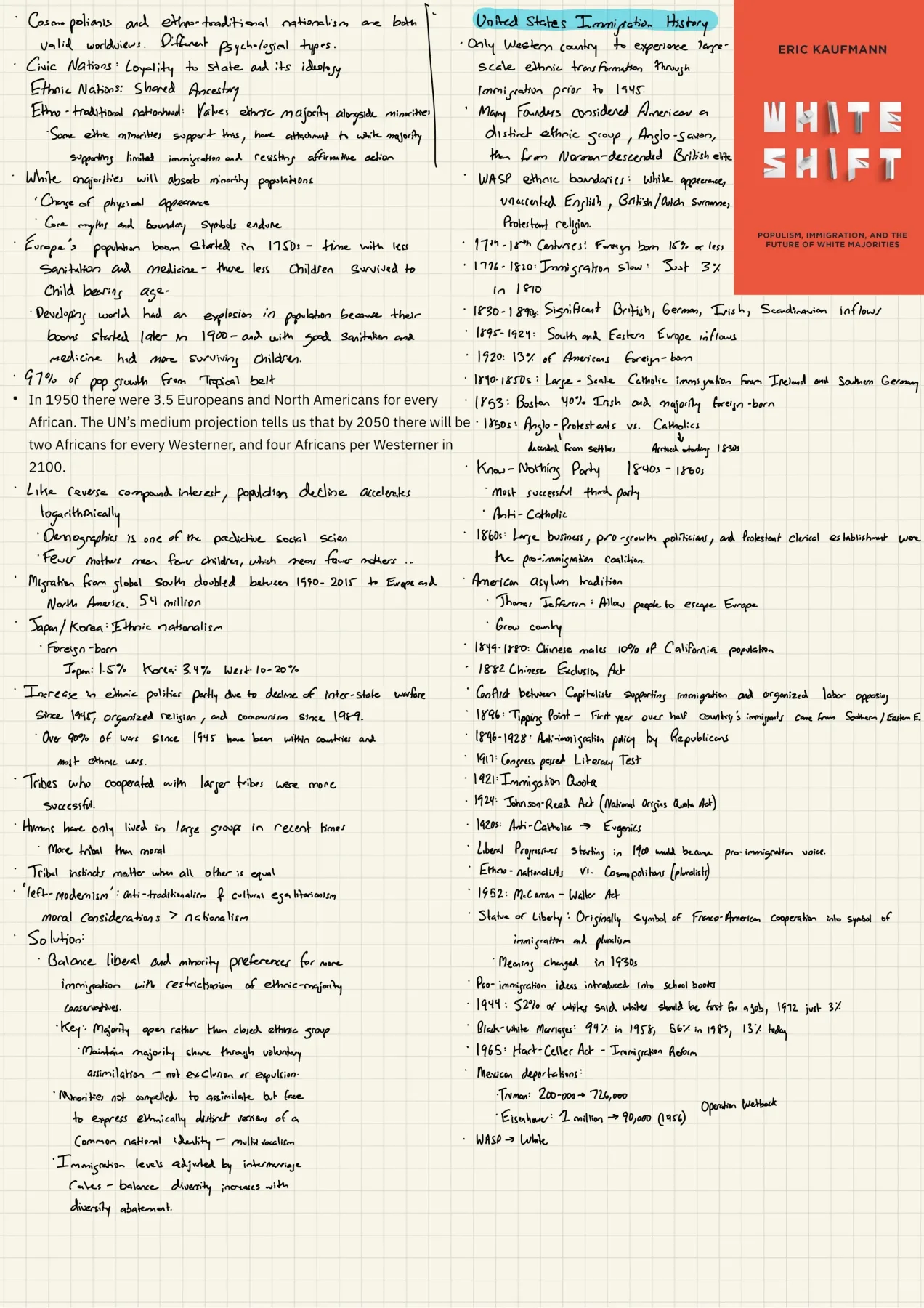
Summary
Here is a thorough summary of the main ideas from Whiteshift: Populism, Immigration, and the Future of White by Eric Kaufmann:
I. Core Concept: Whiteshift
-
Definition: “Whiteshift” has two meanings:
- The demographic decline of white populations in Western countries due to low birth rates and mass immigration.
- The ethnic transformation of whites through intermarriage with minorities, leading to a mixed but culturally white identity over time.
-
This is not racial extinction but a reconstitution of whiteness, similar to how Irish and Italians were once outside the WASP category but later absorbed into it.
II. Populism and Ethnic Anxiety
-
Ethnic change, not economic discontent, is the key driver of modern right-wing populism.
-
Populism reflects cultural insecurity and a desire for national continuity among white majorities.
-
Political correctness and identity politics have suppressed legitimate discussions of white identity, fostering resentment and backlash.
-
Examples: Brexit, Trump’s election, the rise of Le Pen, Hofer, and the Sweden Democrats.
III. Four White Responses to Ethnic Change
- Fight – Support populist or nationalist politics.
- Repress – Internalize left-modernist views and suppress white identity concerns.
- Flee – Move to homogeneous communities (geographical retreat).
- Join – Intermarry and assimilate into a hybrid identity.
IV. Left-Modernism and Cultural Supremacy
-
Left-modernism dominates elite institutions—academia, media, corporations—promoting anti-traditionalism and diversity as an end in itself.
-
This ideology stigmatizes white identity while celebrating minority group identities, leading to asymmetrical multiculturalism.
-
Daniel Bell’s “Cultural Contradictions of Capitalism” and other thinkers are referenced to explain how capitalist structures paradoxically sustain anti-traditionalist cultural norms.
V. Historical Precedent: Past Assimilations
-
The assimilation of Irish, Italians, and Jews into mainstream whiteness offers a model for future intergroup mixing.
-
Cultural markers, such as language, religion, and shared myths, are more durable than race.
-
Future white identity may be more about culture than biology, with mixed-race individuals identifying as white in cultural terms.
VI. Projected Demographic Changes
-
By 2050, white populations will become minorities in countries like the U.S., Canada, and New Zealand.
-
Europe will follow more slowly, with some countries projected to be 30–40% white by 2100.
-
Despite “white decline,” intermarriage will lead to a new majority—a blend of white and non-white ancestry, culturally tethered to European heritage.
VII. Cultural Conflict and the Rise of Populism
-
Populist backlash is intensified by suppression of white identity and political elites’ refusal to acknowledge the cultural dimension of immigration concerns.
-
“Somewheres vs. Anywheres”: A cultural divide between traditionalists attached to place and cosmopolitan globalists.
-
Kaufmann warns against stigmatizing white majorities for wanting cultural continuity.
VIII. Three Futures for White Identity
- Ethnic Unmixing – Expulsion or voluntary repatriation of minorities (highly unlikely and morally implausible).
- Salad Bowl – Persistent multiculturalism with whites as one group among many.
- Melting Pot – Intermixing leads to a new, blended majority with a core of whiteness.
- Kaufmann views the melting pot as the most likely and desirable outcome.
IX. Ethnic Mixing, Intermarriage, and Assimilation
-
Intermarriage rates are rising across the West.
- In the U.S., 14% of infants were mixed-race in 2015.
- Mexican Americans, Afro-Caribbeans, and Asians show signs of long-term assimilation.
-
Mixed people may identify as white, expanding the boundaries of whiteness in future generations.
X. Cultural Protection and Policy Recommendations
-
Kaufmann proposes a “cultural points” immigration system, selecting migrants likely to integrate based on secularism, intermarriage potential, etc.
-
He argues for moderate identity politics that allows white majorities to express cultural preferences without being labeled racist.
-
Opposes both radical exclusion and radical multiculturalism, instead advocating inclusive nationalism.
XI. The Role of Religion and Fertility
- Groups like the Amish, Mormons, and ultra-Orthodox Jews may help preserve “white” cultural traits due to high fertility and cultural insulation.
XII. Technology, Virtual Identity, and the Future
-
Kaufmann speculates on how genetic engineering, skin-lightening, and virtual reality might shape future perceptions of race and identity.
-
Despite racial blending, whiteness as a cultural identity may persist or be symbolically retained by future hybrid populations.
Would you like this broken down into flashcards or turned into a blog-style summary next?
Chapter 1: The Century of Whiteshift
Summary of Whiteshift: Populism, Immigration, and the Future of White by Eric Kaufmann (Pages 6-30)
Main Themes and Ideas
-
White Identity in an Age of Change
- Kaufmann argues that white identity is not merely a social construct to maintain power but a legitimate ethnic identity with deep historical roots.
- The book seeks to address the anxiety among white majorities in Western nations as they experience demographic shifts.
-
Whiteshift: A Two-Part Concept
- The first meaning of Whiteshift refers to the demographic blending of white majorities through intermarriage, leading to a mixed but culturally European-descended population.
- The second meaning pertains to the declining share of white populations in Western countries due to immigration and low birth rates.
-
Populism as a Reaction to Ethnic Change
- Right-wing populism is rising in the West due to anxieties over ethnic identity rather than economic concerns.
- Immigration, rather than class struggles, is the key driver of this political shift.
-
Polarization and the Culture Wars
- As white identity becomes more salient due to demographic changes, a conflict emerges between conservative whites who seek continuity and left-modernists who push for multiculturalism.
- The anti-white ideology of some elements of the cultural left exacerbates this polarization.
-
Historical Precedents of Ethnic Assimilation
- White majorities in the West are undergoing a process similar to past assimilations (e.g., Anglo-Protestants incorporating Catholic and Jewish immigrants in the U.S.).
- Despite demographic shifts, core cultural myths and symbols tend to persist.
-
Future Outlook: A Mixed White Majority
- Over the next century, intermarriage will create a new, mixed-race majority that still identifies with white European heritage.
- This transition period will be marked by cultural instability and tensions before stabilizing into a new ethnic equilibrium.
-
Responses to Ethnic Change: Fight, Repress, Flee, or Join
- Fight: Support for right-wing populism or more extreme resistance.
- Repress: Adopting politically correct anti-racism to suppress ethnic concerns.
- Flee: Moving to homogeneous areas or avoiding diverse settings.
- Join: Intermarriage and assimilation, leading to a new mixed identity.
-
The Role of Left-Modernism
- Left-modernism, which combines anti-traditionalism with cultural egalitarianism, dominates elite discourse and suppresses open discussion on white identity.
- This has created a political vacuum that populist movements have exploited.
-
Demographic Transition as the Root Cause
- The West’s declining birth rates and rapid population growth in the Global South fuel immigration trends.
- These demographic shifts are largely inevitable and will shape the future racial composition of Western nations.
Historical Facts Provided
- Demographic Shifts in the West: White majorities in North America and New Zealand are projected to become “majority-minority” by 2050, with Western Europe and Australia following later.
- Historical Examples of Ethnic Forgetting: In Turkey, Byzantine Christian ancestry has largely been forgotten, just as many other groups airbrush their complex origins over time.
- Rise of Right-Wing Populism:
- In Austria, Jörg Haider’s Freedom Party (FPÖ) won 27% in the 1990s; by 2016, Norbert Hofer won 49.7%.
- Jean-Marie Le Pen of France’s Front National (FN) reached 18% in 2002, and his daughter Marine Le Pen secured 34% in 2017.
- Ethnic Transition in the U.S.: Protestant Anglo-Americans once saw Irish Catholics as a threat; today, Irish Americans are considered fully assimilated.
- Population Growth Trends:
- In 1950, there were 3.5 Europeans/North Americans for every African; by 2050, the ratio will be reversed.
- Guatemala’s population explosion in the 20th century was five times that of Denmark due to different demographic transition rates.
- Declining White Birth Rates: European fertility rates have been below replacement since the 1950s, leading to a long-term population decline.
Key People Mentioned and Their Context
- Jörg Haider: Austrian right-wing populist, leader of FPÖ, who gained political success by opposing immigration.
- Jean-Marie Le Pen: Founder of France’s Front National, an early example of successful European right-wing populism.
- Marine Le Pen: Successor to Jean-Marie Le Pen, took the FN to greater electoral success.
- Donald Trump: Cited as a key figure in right-wing populism, elected due to concerns over immigration and national identity.
- Michael Lind: Coined the term “beige ethnicity” to describe the future racial blending in the West.
- George Orwell: Quoted for his observation that by 1930, English intellectuals largely viewed their own nation with disdain.
- Daniel Bell: Introduced the concept of the “adversary culture” that criticizes its own society.
- Karen Stenner: Social psychologist who argues that diversity triggers conservatism and authoritarianism.
- Ralph Waldo Emerson & Israel Zangwill: Early theorists of the U.S. as a melting pot, cited in discussing the long-term effects of intermarriage.
- John McWhorter: Critic of left-modernism, describes anti-racism as a “new religion.”
This summary captures the main arguments and historical context presented in Whiteshift (pages 6-30). Let me know if you need further elaboration on any section!
Part I: Fight
Chapter 2: Prequel to Whiteshift: From WASP to White in American History
Summary of Whiteshift: Populism, Immigration, and the Future of White by Eric Kaufmann (Pages 33-62)
Main Themes and Ideas
-
Ethnic Change as the Core Issue in Populism
- Kaufmann argues that immigration-driven ethnic change is the primary driver of right-wing populism, not economic concerns.
- Mainstream politicians fail to acknowledge this and instead focus on economic explanations.
-
Demographic Shifts and Their Political Impact
- The growing visibility of ethnic minorities in Western countries has heightened the salience of white identity.
- White-majority populations feel culturally insecure as their numerical dominance declines.
-
The Role of Left-Modernism in Suppressing Debate
- Left-modernism, an ideology emphasizing diversity and multiculturalism, has stigmatized discussions about white identity and demographic concerns.
- The suppression of such discussions has fueled populist backlash.
-
The Four Responses to Ethnic Change: Fight, Repress, Flee, or Join
- Fight: Supporting right-wing populism or resisting multicultural policies.
- Repress: Internalizing left-modernist norms and suppressing white identity concerns.
- Flee: Moving away from ethnically diverse areas to maintain cultural homogeneity.
- Join: Embracing intermarriage and assimilation, leading to a new mixed identity.
-
Historical Patterns of Ethnic Assimilation
- White ethnic groups in the U.S. (Irish, Italians, Jews) were once seen as outsiders but later assimilated into the dominant white identity.
- Kaufmann predicts a similar trajectory for today’s non-European minorities.
-
Polarization Between Cosmopolitans and Ethno-Traditionalists
- Societies are dividing between those who embrace multiculturalism and those who seek to preserve traditional ethnic majorities.
- This division is deepening political and cultural conflicts in Western democracies.
-
The Need for a New Narrative
- Kaufmann argues for a vision of Whiteshift where assimilation and intermarriage create a future white-majority population that is racially mixed but culturally European.
- This could bridge the nationalist-globalist divide and reduce populist tensions.
Historical Facts Provided
-
Right-wing populism’s rise:
- The Austrian Freedom Party (FPÖ) and France’s National Front (FN) have significantly increased their vote share in recent decades.
- The Brexit vote and Donald Trump’s election were driven by concerns over immigration rather than economic issues.
-
Demographic transitions:
- The U.S. transitioned from an Anglo-Protestant majority to a more inclusive white identity, incorporating Irish, Italian, and Jewish immigrants.
- Intermarriage in the U.S. has steadily increased, leading to more mixed-race identities.
-
Historical ethnic resistance:
- In 19th-century America, Protestant majorities opposed Catholic immigration, leading to the rise of the Know-Nothing Party.
- Similar resistance patterns can be seen in modern concerns over Muslim immigration in Europe.
-
Effects of suppression:
- In the Soviet Union and Communist China, suppressing ethnic identity led to underground nationalist movements.
- Kaufmann warns that suppressing white identity today may produce similar unintended consequences.
People Mentioned and Their Context
- Donald Trump: A key example of right-wing populism rising in response to ethnic anxieties in the U.S.
- Marine Le Pen: Leader of France’s National Front, who has capitalized on concerns over immigration and national identity.
- Jörg Haider: Austrian right-wing populist who gained political success by opposing immigration and multiculturalism.
- George Orwell: Quoted for his observations on the English left’s historical self-criticism and disdain for national identity.
- Daniel Bell: Introduced the concept of the “adversary culture,” which critiques dominant cultural norms.
- Karen Stenner: Psychologist who argues that diversity increases authoritarian tendencies among conservatives.
- John McWhorter: Critic of left-modernism, describes anti-racism as a “new religion.”
This summary encapsulates the main arguments, historical insights, and key figures discussed in Whiteshift (pages 33-62). Let me know if you need further elaboration!
Chapter 3: The Rise of Trump: Ethno-Traditional Nationalism in an Age of Immigration
Summary of Key Ideas from Whiteshift: Populism, Immigration, and the Future of White by Eric Kaufmann (Pages 63-126)
Main Themes and Ideas:
- The Rise of Ethno-Traditional Nationalism in the U.S.
• The post-1965 Hart-Celler Immigration Act marked a demographic shift in the U.S.
• The white share of the U.S. population declined from 85% in 1960 to 63% in 2010 due to increased immigration, especially from Latin America and Asia.
• Political shifts and cultural anxieties around these changes fueled populist movements, including Trump’s rise.
- Demographic and Political Shifts
• California was the first major U.S. state to undergo a “third demographic transition” from a white-majority to a minority-majority state.
• The U.S. Census Bureau revised its estimates on when the country would become majority-minority, now predicting 2055 instead of 2042.
• Immigration policy debates focused more on undocumented immigration rather than legal immigration, despite major demographic changes.
- Psychological and Political Responses to Immigration
• Opposition to immigration is often value-driven rather than economic, shaped by personal experiences and psychological tendencies.
• Pat Dade’s Cultural Dynamics model categorizes people into Settlers, Prospectors, and Pioneers:
• Settlers (security-focused, stability-oriented) tend to oppose immigration.
• Prospectors (status-seekers) are generally indifferent.
• Pioneers (exploratory and liberal) tend to be pro-immigration.
• Ethnic change fuels nostalgia and concern among conservatives who benchmark society against their childhood norms.
- Ethno-Nationalist Intellectuals and Thought Leaders
• Some elites advocate for the preservation of national or ethnic traditions.
• Historical movements like the Gaelic Revival in Ireland and Welsh language preservation efforts are cited as examples.
• In the U.S., figures like Stephen Miller and Henry Cabot Lodge have represented nationalist sentiments at different times.
- Immigration Attitudes Post-1965
• American views on immigration have fluctuated, peaking in restrictionist sentiment in the 1990s before shifting towards a more liberal stance.
• Increasing education levels and generational change contributed to the shift in opinion.
• The 1994 California Proposition 187, which sought to deny public services to undocumented immigrants, marked an early political mobilization of anti-immigration sentiments.
- The Role of the Republican Party and the Religious Right
• The Republican Party historically opposed Official English legislation due to fears of alienating Hispanic voters.
• Figures like Karl Rove promoted pro-Hispanic strategies to align Republican values with religious and family-oriented Hispanic voters.
• The Religious Right played a significant role in shaping conservative politics, particularly on abortion, same-sex marriage, and education.
• However, secularization and shifting attitudes in younger generations have reduced the religious right’s influence.
- Cultural Fragmentation and the Decline of Ethno-Traditional Americanism
• The breakdown of white ethnic neighborhoods and countercultural movements (hippies, yuppies, techies) weakened white identity politics.
• This led to a shift in focus from economic issues to identity politics in the 21st century.
• Political correctness and multiculturalism reshaped the Democratic Party and made it increasingly pro-immigration.
List of Historical Facts Mentioned:
• 1965 Hart-Celler Immigration Act: Removed national-origin quotas, leading to an immigration boom from Latin America and Asia.
• Non-Hispanic White Share Decline: From 85% in 1960 to 63% in 2010.
• Hispanic Population Growth: From 3% in 1960 to 16.3% in 2010.
• California’s Demographic Shift: Became a minority-majority state by the late 1990s.
• 1986 Immigration Reform and Control Act (IRCA): Granted amnesty to 1.8 million undocumented immigrants.
• Proposition 187 (1994, California): Attempted to restrict public services to undocumented immigrants.
• Rise of Official English Movement (1980s-1990s): Virginia was the first state to pass an Official English law in 1981.
• George W. Bush’s 2000 Presidential Campaign: Won 35% of Latino votes (rose to 40% in 2004).
• 2007-08 Financial Crisis: Led to economic discontent and weakened faith in free-market conservatism.
• Rise of Secularization: The proportion of Americans with no religious affiliation grew from 15% in 1995 to 23% by 2014.
• Same-Sex Marriage Approval: Grew from 27% in 1996 to 64% in 2017.
• Neoconservatism and the Iraq War (2003-2011): Affected Republican foreign policy strategies and national identity narratives.
List of People Mentioned and Their Context:
• Pat Dade: Market researcher behind the Settlers/Prospectors/Pioneers framework for analyzing voter psychology.
• Henry Cabot Lodge (1920s): Example of early U.S. ethno-nationalist thought leader who opposed immigration.
• Stephen Miller (Trump Administration): White House policy adviser known for restrictionist immigration policies.
• David Coleman: Coined the term “third demographic transition” describing the shift to a minority-majority population.
• Karl Rove: Republican strategist who pushed for Hispanic voter outreach.
• John Tanton: Founder of FAIR (Federation for American Immigration Reform), which advocated for reduced immigration.
• Éamon de Valera: Irish leader who sought to revive the Gaelic language and culture.
• Jerry Falwell: Evangelical preacher and founder of the Moral Majority, which mobilized the Religious Right in the 1980s.
• Paul Weyrich and Richard Viguerie: Key figures in the rise of the Christian Right as a political force.
• George W. Bush & Jeb Bush: Republican leaders who emphasized pro-Hispanic policies.
• Newt Gingrich: Supported Puerto Rican statehood but opposed Official English.
• Francis Fukuyama: Political scientist who wrote The End of History, emphasizing Western democratic dominance.
• Barack Obama: First African-American U.S. president, won the youth vote with a growing secular base.
• Donald Trump: Tapped into ethno-traditional nationalist sentiment to win the presidency in 2016.
This summary provides a structured breakdown of the main themes, historical facts, and key figures from the document. Let me know if you need any further refinements!
Chapter 4: Britain: The Erosion of English Reserve
Summary of Key Ideas from Whiteshift: Populism, Immigration, and the Future of White by Eric Kaufmann (Pages 127-191)
Main Themes and Ideas:
- Brexit and the Rise of Cultural Nationalism
• The Brexit referendum on June 23, 2016, resulted in a 52% vote to leave the European Union (EU).
• British voters were motivated by concerns about immigration and national identity rather than purely economic factors.
• The result was unexpected, as elites assumed economic consequences would deter voters from choosing Brexit.
• Cities, university towns, and Scotland voted to remain, while most of England and Wales voted to leave.
- Economic vs. Cultural Drivers of Populism
• London’s financial and political elite underestimated the power of cultural nationalism in shaping political decisions.
• Economic factors, such as trade with the EU, were secondary to concerns over immigration and sovereignty.
• Brexit highlighted how issues of identity could override economic self-interest among voters.
- History of Immigration in Britain
• Immigration was minimal in Britain before the late 20th century.
• The largest early migration was of Irish Catholics to Scotland, causing social tensions.
• Post-World War II immigration from the Caribbean, South Asia, and Africa gradually reshaped British demographics.
• The Commonwealth Immigrants Act (1962) was the first significant restriction on non-white migration.
- The Influence of Enoch Powell and Ethnic Nationalism
• Enoch Powell’s infamous “Rivers of Blood” speech (1968) expressed fears of demographic transformation.
• Powell’s argument was that mass immigration would create parallel societies and endanger British identity.
• His speech sparked a populist response, with significant public support despite condemnation from elites.
• Powellism remains a forerunner of modern right-wing populism in Britain.
- Thatcher’s Immigration Rhetoric and Policy
• Margaret Thatcher (Prime Minister 1979-1990) warned of Britain being “swamped” by immigration.
• Her government took a tougher stance on limiting migration while distancing itself from Powell’s racial rhetoric.
• The Monday Club, a right-wing faction within the Conservative Party, pushed for stricter immigration controls and even repatriation incentives.
- Tony Blair’s Liberalization of Immigration
• Tony Blair’s government (1997-2007) shifted towards a more open immigration policy.
• Labour figures such as Robin Cook emphasized Britain’s multicultural identity.
• Policy changes led to a dramatic increase in immigration, from about 55,000 per year in the 1980s to 156,000 in 2004.
• Blair’s advisers saw immigration as a way to modernize Britain and weaken right-wing nationalism.
- The Decline of Multiculturalism and Shift to Integrationism
• Early 2000s saw the decline of state-endorsed multiculturalism as concerns over segregation and radicalization grew.
• The 2001 race riots in northern England and the 7/7 London bombings (2005) intensified public debates on integration.
• The Cantle Report (2001) introduced the term “parallel lives”, warning that multicultural policies had led to social fragmentation.
• By the late 2000s, Labour figures like Trevor Phillips openly criticized multiculturalism, advocating for greater integration.
- The Role of the Tabloid Media and Populist Narratives
• British tabloids, such as The Sun and Daily Mail, played a significant role in fueling immigration skepticism.
• Unlike in some European countries, British politicians never fully suppressed public debates on immigration.
• Populist parties such as UKIP (United Kingdom Independence Party) gained traction by openly opposing immigration and the EU.
- Growing Ethnic Mixing and the Future of Britain’s Demographics
• Despite rising anti-immigration sentiment, Britain also saw increasing inter-ethnic relationships.
• One in eight households in England and Wales had more than one ethnic group by the 2010s.
• Intermarriage was particularly high among mixed-race Britons, suggesting a gradual blending of identities.
List of Historical Facts Mentioned:
• June 23, 2016 – Brexit referendum results in a 52%-48% vote to leave the EU.
• 1975 Referendum – Britain voted to remain in the European Economic Community (EEC).
• 1905 Aliens Act – Britain’s first immigration control law, aimed at limiting Jewish immigration.
• Commonwealth Immigrants Act (1962) – Restricted free movement from British colonies.
• Enoch Powell’s “Rivers of Blood” Speech (1968) – A key moment in British anti-immigration politics.
• 1978 Margaret Thatcher “Swamped” Interview – Used restrictive immigration rhetoric.
• 1997 Tony Blair’s Election – Marked a shift to liberal immigration policies.
• 2001 Mill Town Riots – White and South Asian Muslim youths clashed in northern cities.
• 2005 London Bombings (7/7) – Islamist terrorist attack by British-born radicals.
• 2001 Cantle Report – Argued Britain was developing segregated communities.
List of People Mentioned and Their Context:
• David Cameron – British Prime Minister (2010-2016), campaigned for Remain in the Brexit referendum.
• Mark Carney – Governor of the Bank of England, warned of Brexit’s economic risks.
• Enoch Powell – Conservative MP who became famous for his anti-immigration “Rivers of Blood” speech.
• Margaret Thatcher – Conservative Prime Minister (1979-1990), known for restricting immigration while avoiding overt Powellism.
• Robin Cook – Labour politician who promoted Britain’s multicultural identity.
• Trevor Phillips – Former head of the Commission for Racial Equality, later became a critic of multiculturalism.
• Ted Cantle – Author of the 2001 Cantle Report, which highlighted social segregation.
• Tony Blair – Labour Prime Minister (1997-2007), significantly increased immigration and promoted multiculturalism.
• William Hague – Conservative leader (1997-2001), criticized asylum seekers and called for tighter immigration laws.
• Barbara Roche – Blair-era policy adviser who promoted mass immigration.
• Nigel Farage – Leader of UKIP, played a key role in Brexit by campaigning against immigration and the EU.
• Jean-Marie Le Pen – French National Front leader, influenced European populist movements.
• Jörg Haider – Austrian far-right politician, pushed anti-immigration policies in the 1990s.
This summary provides a structured breakdown of the key themes, historical facts, and figures from the document. Let me know if you need further refinements!
Chapter 5: The Rise and Rise of the Populist Right in Europe
Summary of Key Ideas from Whiteshift: Populism, Immigration, and the Future of White by Eric Kaufmann (Pages 192-243)
Main Themes and Ideas:
- The Rise of Populist Right in Europe
• The increasing influence of right-wing populist parties across Europe in the 21st century.
• The Austrian presidential election in 2016 saw Norbert Hofer of the far-right FPÖ nearly win (49.7%).
• The 1999 Austrian elections previously caused international outrage when Jörg Haider’s FPÖ entered government, leading to EU sanctions.
• In France, Jean-Marie Le Pen’s 2002 presidential run shocked many, but by the 2010s, far-right gains no longer generated the same level of outrage.
- Populist Right’s Influence on Policy and Governance
• Many European populist-right parties gained traction due to their opposition to immigration and multiculturalism.
• Even where populists didn’t govern, they pressured mainstream parties to adopt stricter immigration policies.
• The idea that proportional representation (PR) electoral systems made right-wing populists viable was challenged—UKIP in Britain and Trump in the U.S. showed that majoritarian systems could also facilitate populism.
- Populism in Western vs. Eastern Europe
• Populist movements in Western Europe focus more on immigration-driven ethnic change.
• In contrast, Eastern European populism is rooted in nationalism and historical traumas, such as Hungary’s loss of territory after WWI.
• Ethnic nationalism plays a larger role in Eastern Europe, often with authoritarian tendencies.
- The Role of Immigration in Populist Movements
• Immigration-led ethnic change is the primary driver of the populist right in Western Europe.
• Comparison to the Know-Nothing Party in 1850s America, which opposed Catholic immigrants.
• Some European nations historically resisted internal migration (e.g., German Protestants opposing Catholic workers moving north).
• The growing presence of minorities, especially Muslims, increased populist-right support in many European countries.
- Normalization of the Far Right
• In the early 2000s, mainstream parties kept populist-right groups isolated via a “cordon sanitaire.”
• Over time, this strategy failed, and right-wing parties entered coalition governments (e.g., Austria, Denmark, Netherlands, Norway, and Italy).
• As right-wing populist support grew, anti-immigration views became more socially acceptable.
- Cultural vs. Economic Factors in Anti-Immigration Sentiment
• Surveys show that opposition to immigration is driven more by cultural identity concerns than economic anxieties.
• White conservatives often justify immigration skepticism using economic arguments, but underlying motivations are psychological and identity-based.
• Polls showed that people rated issues like “pressure on housing” or “urban sprawl” much higher when framed as caused by immigration.
- Changing Political Dynamics in Europe
• Western European politics has shifted from a left-right economic divide to an open-closed cultural divide.
• The emergence of parties focused on immigration and national identity, rather than economic policy.
• Traditional parties (e.g., socialists and conservatives) lost ground, while populist right and Green parties gained traction.
- The Link Between Social Liberalism and Immigration Attitudes
• Countries that are socially liberal (e.g., Sweden, Netherlands) tend to be more pro-immigration.
• Surveys suggest that attitudes toward homosexuality strongly correlate with openness to immigration.
• However, unlike attitudes on LGBTQ+ rights, immigration skepticism has not necessarily declined over time.
- The 2015-16 Refugee Crisis and Political Consequences
• The Syrian civil war and Middle Eastern conflicts led to an influx of asylum seekers into Europe.
• The German government’s welcoming stance, led by Angela Merkel, encouraged further migration.
• This mass migration wave triggered a backlash and significantly boosted right-wing populist parties.
• Anti-immigration sentiment surged across Europe, with many countries adopting stricter border controls.
- Islam as a Political Issue in Europe
• Before the 1990s, Islam was not a major political issue in Europe.
• The 9/11 attacks and subsequent terrorist incidents in Europe (Madrid 2004, London 2005) changed the discourse.
• High-profile cases, such as the 2004 murder of Theo van Gogh and the Danish cartoon controversy (2005), intensified anti-Islamic rhetoric.
• Populist-right parties used Islam as a rallying point, combining anti-immigration sentiment with concerns about religious conservatism.
List of Historical Facts Mentioned:
• May 17, 2016 – Austrian presidential election: Norbert Hofer (FPÖ) loses narrowly to Alexander Van der Bellen.
• 1999 Austrian Elections – FPÖ under Jörg Haider enters government, triggering EU sanctions.
• April 21, 2002 – Jean-Marie Le Pen advances to the second round of the French presidential elections.
• 7/7 London Bombings (2005) – Islamist terrorists attack London’s transport system.
• Danish Cartoons Controversy (2005-06) – Sparks protests and debates about free speech and religious sensitivity.
• 2014 European Elections – Right-wing populist parties make significant gains.
• 2015 Refugee Crisis – Europe sees a massive influx of refugees from the Middle East and Africa.
• August 2015 – Merkel signals that Germany will accept Syrian refugees, increasing migration flows.
• September 2015 – Over 200,000 refugees arrive in Europe in a single month.
• 2016 U.S. Presidential Election – Trump wins on a populist platform, influencing European populism.
List of People Mentioned and Their Context:
• Norbert Hofer – Austrian Freedom Party (FPÖ) leader, nearly won the 2016 Austrian presidential election.
• Jörg Haider – Leader of FPÖ in Austria (1990s-2000s), pioneered modern European right-wing populism.
• Jean-Marie Le Pen – Leader of France’s Front National (FN), anti-immigration hardliner.
• Marine Le Pen – Successor to Jean-Marie Le Pen, focused on making FN more electable.
• Angela Merkel – German Chancellor, implemented an open-door policy during the refugee crisis.
• Nigel Farage – Leader of UKIP, instrumental in Brexit campaign.
• Geert Wilders – Dutch far-right politician, known for anti-Islam rhetoric.
• Frits Bolkestein – Early critic of Dutch multiculturalism, influenced right-wing movements.
• Pim Fortuyn – Dutch politician, assassinated in 2002, mixed liberalism with anti-Islam rhetoric.
• Theo van Gogh – Dutch filmmaker, murdered by an Islamist extremist in 2004.
• Ayaan Hirsi Ali – Somali-born critic of Islam, targeted after Van Gogh’s murder.
• Sarah Maple – British artist threatened for her Islamic-themed artwork.
• Heinz-Christian Strache – FPÖ leader, pushed anti-Muslim stance in Austria.
• Florian Philippot – Marine Le Pen’s strategist, sought to rebrand FN as more mainstream.
• Paul Collier – Economist, warned about migration self-fulfilling dynamics.
This summary provides an overview of the key themes, historical facts, and figures from the document. Let me know if you need further refinements!
Chapter 6: Canadian Exceptionalism: Right-Wing Populism in the Anglosphere
Summary of Key Ideas from Whiteshift: Populism, Immigration, and the Future of White by Eric Kaufmann (Pages 244-269)
Main Themes and Ideas:
- Canadian Exceptionalism in Right-Wing Populism
• Unlike many Western nations, Canada has not developed a strong right-wing populist movement.
• Countries like Australia and New Zealand, which have similar immigration patterns, have seen the rise of anti-immigration parties, but Canada remains largely unaffected.
• The chapter explores why this might be the case, particularly focusing on English Canada compared to Quebec.
- Immigration Patterns in Anglo Settler Societies
• Australia, New Zealand, and Canada all have high foreign-born populations.
• In Australia, 26% of the population is foreign-born, with immigration increasingly coming from Asia rather than the UK.
• Similar shifts have occurred in New Zealand and Canada, leading to rapid ethnic changes.
• Despite similar demographics, Canada has lacked a strong anti-immigration political movement.
- Differences in National Identity
• Canada and the U.S. are both projected to become majority-minority nations by 2050.
• Cities like Toronto and Vancouver have already crossed this threshold.
• The U.S. has seen ethnic change primarily through Hispanic population growth, while Canada’s diversity is shaped by immigration from Asia.
• Anglo settler societies like Canada, Australia, and New Zealand have historically viewed their nations as ever-evolving, which may explain their more open stance on immigration.
- Why Canada Lacks a Populist Right-Wing Movement
• Political Institutions: Canada’s electoral system discourages third-party movements, unlike proportional representation systems in Europe.
• Media Landscape: Unlike the U.S. and Australia, Canada lacks a strong right-wing media ecosystem, such as Fox News or Murdoch-owned newspapers.
• Multiculturalism Policy: Canada has officially embraced multiculturalism since the 1970s, making opposition to it more socially taboo.
• Linguistic Divide: French-Canadian nationalism in Quebec has absorbed some of the energy that might otherwise go to right-wing populism.
- Quebec as an Exception in Canada
• Quebec, unlike English Canada, has a stronger tradition of ethno-nationalism.
• The province has historically sought to maintain its French identity, including its own immigration selection policies favoring French-speaking immigrants.
• The rise of parties like the Coalition Avenir Québec (CAQ) reflects growing skepticism of immigration in Quebec.
• In contrast to Canada’s overall approach, Quebec has passed laws restricting religious symbols, such as the burqa ban (Bill C-62).
- Comparison to Other Settler Societies
• Canada, Australia, and New Zealand all have high immigration rates, but Canada’s policies have been more openly pro-immigration.
• New Zealand’s populist party, New Zealand First, has campaigned on reducing immigration.
• Australia has had right-wing parties like One Nation, which have influenced mainstream politics.
• Despite these trends, Canada remains an outlier in avoiding a major populist backlash.
- Role of Political Correctness and Media Norms
• In Canada, anti-immigration rhetoric is more stigmatized than in other Anglo countries.
• The lack of a strong conservative tabloid media has contributed to this, unlike in the UK or Australia.
• Right-wing figures like Kellie Leitch, who proposed screening immigrants for “Canadian values,” were widely criticized.
• Critics argue that political correctness in Canada has suppressed open debate on immigration.
- Minority Voices Critiquing Multiculturalism
• Interestingly, some of the most vocal critics of Canadian multiculturalism have been from minority backgrounds.
• Neil Bissoondath (Trinidadian-Indian origin) criticized multiculturalism as reinforcing ethnic divisions.
• Salim Mansur warned that multiculturalism could enable Islamic fundamentalism.
• David Suzuki, a Japanese-Canadian environmentalist, called Canada’s immigration policy “criminal” for contributing to overpopulation and brain drain.
• Ujjal Dosanjh, a Sikh-Canadian former premier of British Columbia, argued that political correctness silences legitimate concerns.
- Housing Crisis and the Immigration Debate
• The real estate market in cities like Vancouver has been heavily influenced by foreign buyers, particularly from China.
• Andy Yan, a Chinese-Canadian urban planner, revealed that most luxury home buyers had Chinese surnames, triggering accusations of racism.
• In response, British Columbia introduced a 15% foreign buyer tax in 2016, which was widely popular among residents.
- The Future of Canadian Populism
• While Canada has avoided a Trump-style populist movement, the factors that fuel such movements—immigration, housing affordability, and political correctness—still exist.
• The key question is whether the Canadian political and media landscape will continue to suppress right-wing populism or if a future politician will successfully challenge these norms.
List of Historical Facts Mentioned:
• 2016 Census – Found that 26% of Australia’s population was foreign-born, with growing Asian immigration.
• 2017 New Zealand Immigration Policy Shift – Jacinda Ardern’s Labour Party promised to reduce immigration, aligning with New Zealand First.
• Quebec’s Language Laws (1977-present) – Laws mandating French-language education and restricting English signage.
• Burqa Ban (Bill C-62, 2017) – Quebec passed legislation banning face coverings while receiving public services.
• 2017 British Columbia 15% Foreign Buyer Tax – Aimed at controlling Vancouver’s overheated housing market.
• 1993 Canadian Reform Party Breakthrough – A populist, economically conservative movement that later merged with the Conservative Party.
• 2018 Ontario Election – Doug Ford, brother of controversial mayor Rob Ford, won the premiership on a populist platform.
• 2017 Conservative Leadership Race – Kellie Leitch’s campaign proposed screening immigrants for “Canadian values.”
List of People Mentioned and Their Context:
• Winston Peters – Leader of New Zealand First, an anti-immigration populist party.
• Pauline Hanson – Leader of One Nation in Australia, known for her anti-immigration rhetoric.
• Jacinda Ardern – New Zealand’s Labour Party leader, reduced immigration to gain New Zealand First’s support.
• Kellie Leitch – Canadian Conservative politician who campaigned on screening immigrants for “Canadian values.”
• Ezra Levant – Founder of Rebel Media, Canada’s leading right-wing online platform.
• Neil Bissoondath – Author of Selling Illusions, a critique of Canadian multiculturalism.
• Salim Mansur – Political scientist warning about the risks of multiculturalism.
• David Suzuki – Environmentalist who criticized Canada’s immigration policy for harming the environment.
• Andy Yan – Urban planner who highlighted the impact of foreign real estate investors in Vancouver.
• Ujjal Dosanjh – Former British Columbia premier, criticized political correctness for stifling debate.
• François Legault – Leader of Coalition Avenir Québec, advocating for reduced immigration.
• Rob Ford – Former Toronto mayor, known for his populist style, but avoided immigration issues.
• Doug Ford – Premier of Ontario, brother of Rob Ford, won on a populist conservative platform.
• Preston Manning – Founder of Canada’s Reform Party, focused on economic conservatism.
This summary captures the key ideas, historical facts, and individuals discussed in this section of Whiteshift. Let me know if you need more details or any refinements!
Part II: Repress
Chapter 7: Left-Modernism: From Nineteenth-Century Bohemia to the Campus Wars
Summary of Key Ideas from Whiteshift: Populism, Immigration, and the Future of White by Eric Kaufmann (Pages 272-314)
Main Themes and Ideas:
- The Evolution of Left-Modernism and Cultural Norms
• Societies enforce norms based on moral and emotional responses rather than rational deliberation.
• Over time, liberal societies have replaced traditional taboos with new moral standards, particularly in areas related to race and gender.
• The cultural shift from conservative taboos (e.g., patriotism) to progressive taboos (e.g., anti-racism) marks the dominance of left-modernism in Western institutions.
- Political Correctness and Its Impact on Free Speech
• Modern leftist movements enforce ideological boundaries similar to past religious or political inquisitions.
• Academic institutions and media outlets increasingly marginalize those who challenge dominant liberal norms.
• The case of Bret Weinstein, who was forced to resign from Evergreen State College after questioning a racial segregation event, illustrates this shift.
- The Role of Universities in Shaping Cultural Hegemony
• Universities have become central hubs for left-modernist thought, enforcing political correctness through faculty and administrative policies.
• Activism on campuses has led to movements like “no-platforming” and “safe spaces,” restricting speech that challenges progressive norms.
• The increasing intolerance of dissenting voices reflects a shift towards moralistic rather than rational discourse.
- Moralistic Politics and the Use of Social Pressure
• Social movements use tactics like public shaming and virtue signaling to enforce ideological conformity.
• Similar to historical purges (e.g., the Inquisition, McCarthyism), progressive movements silence dissent through accusations of racism or sexism.
• Online and media discourse play a significant role in reinforcing these moral standards.
- Identity Politics and the Transformation of the Left
• The shift from economic-based socialism to identity politics has redefined leftist movements.
• Left-modernism prioritizes race, gender, and sexuality over traditional class struggles.
• This focus on identity has led to ideological conflicts within progressive circles (e.g., trans rights vs. feminism, cultural appropriation debates).
- The Expansion of Hate Speech Definitions
• Hate speech laws and social pressure have broadened the definition of racism and sexism.
• Figures like Germaine Greer and Ben Shapiro have faced de-platforming for expressing views perceived as violating progressive dogma.
• The rise of online outrage culture has intensified calls for censorship of speech that contradicts dominant left-modernist narratives.
- The Rise of Cultural Appropriation as a Political Issue
• The discourse around cultural appropriation has become a central tenet of progressive ideology.
• Figures like David Johnston (former Governor-General of Canada) and Hal Niedzviecki (Canadian journalist) faced backlash for remarks perceived as undermining Indigenous identity.
• The case of Justin Trudeau being criticized for wearing Indian attire during a state visit illustrates the tensions between cosmopolitanism and progressive identity politics.
- The Historical Context of Left-Modernism
• Left-modernism emerged in the early 20th century, gaining dominance in the 1960s.
• Figures like Herbert Marcuse promoted the idea of “repressive tolerance,” arguing that speech from the right should be restricted while the left should be protected.
• The rise of media and academia as ideological gatekeepers allowed left-modernism to replace older conservative norms.
A Detailed History of Left-Modernism
Left-modernism is a fusion of cultural modernism and egalitarian leftism that has shaped Western high culture since the early 20th century. It evolved through several stages, from the modernist movements of the 19th and early 20th centuries to the identity politics and cultural radicalism of the 1960s and beyond.
Origins and Early Development (19th Century - 1945)
- Romantic Expressive Individualism: The roots of left-modernism trace back to expressive individualism in the 19th century, which encouraged people to channel their inner nature unconstrained by tradition or reason.
- Modernism’s Antinomian Rejection: Daniel Bell and Anthony Giddens described modernism as an antinomian movement rejecting all cultural authority, favoring novelty and transgression over tradition.
- Early Leftist Influence: Left-modernism originally had a nationalistic thrust—in the French Revolution, attacks on traditional values created space for French nationalism.
- Fusion with Socialism: Before WWI, many European socialists endorsed colonialism, viewing non-Europeans as too underdeveloped for socialist revolution. This changed after the Russian Revolution (1917) when the international socialist movement adopted an anti-nationalist and anti-colonial stance.
Post-War Left-Modernism (1945-1960s)
-
The Defeat of Fascism and the Rise of Cultural Radicalism
- The defeat of Nazism and fascism discredited ethno-nationalism, allowing left-modernist cosmopolitanism to emerge victorious.
- Anti-communist resistance movements and the New York Intellectuals (many of whom were Jewish ex-leftists) championed cultural modernism and social democracy.
- The CIA funded modernist art movements (such as Abstract Expressionism) to counteract Soviet propaganda.
-
The Holocaust’s Role in Anti-Racist Narratives
- The Holocaust became central to Western moral discourse only in the 1960s, helping solidify left-modernist anti-racism norms.
- By the 1960s, left-modernism gained dominance in academia and media, spreading through television and university expansion.
The Cultural Turn of the 1960s
-
Shift from Class to Identity Politics
- The 1960s “cultural turn” marked the transformation of left-modernism into a new egalitarian movement that prioritized cultural minorities over the traditional working class.
- The New Left focused on issues of race, gender, and sexuality, moving away from class-based economic struggle.
- Herbert Marcuse and other Frankfurt School thinkers promoted “repressive tolerance”, arguing that free speech should be restricted to curb reactionary ideas.
-
Politicization of Universities and Cultural Institutions
- Left-modernism swept through academia, with humanities and social sciences embracing identity-based politics.
- The 1960s also saw the rise of political correctness, enforcing new taboos on race and gender discussions.
Expansion in the 1980s-1990s: The Age of Political Correctness
-
Institutionalization of Left-Modernism
- By the late 1980s and 1990s, race, gender, and sexuality became sacred values, leading to widespread speech regulations on campuses.
- The rise of political correctness involved expanding definitions of racism and sexism, increasing the power of left-modernist norms.
- Figures like Randolph Bourne and John Dewey laid the intellectual groundwork for multiculturalism, arguing that national traditions should give way to cosmopolitan diversity.
-
The Decline of Class-Based Socialism and the Left’s Cultural Shift
- With the fall of the Soviet Union (1991), economic socialism declined, but left-modernism continued its cultural ascent.
- Left-liberal academics increasingly focused on race, gender, and identity rather than economic class.
The 2010s: A New Wave of Left-Modernism
-
The Evergreen State Controversy and Leftist Radicalization
- Events like the 2017 Evergreen State College protests marked the escalation of left-modernist activism, with demands for racial and gender-based restrictions on speech and curriculum.
- Social media and progressive online media amplified left-modernist views, leading to heightened polarization between left and right.
-
The Influence of Social Media and Cancel Culture
- The rise of social media allowed left-modernist movements to spread rapidly, enforcing new norms through online activism.
- The alt-right emerged in response, branding left-modernism as a new form of puritanical oppression.
Key Figures in Left-Modernism
- Herbert Marcuse – Frankfurt School thinker who argued that free speech should be limited to suppress reactionary views.
- John Stuart Mill – Advocated for positive liberalism, believing that more advanced cultures should guide less advanced ones.
- Daniel Bell – Critic of modernism, argued that bohemian culture fused with capitalism, shaping left-modernist values.
- Anthony Giddens – Sociologist who described de-traditionalization, the process of modernism breaking down historical traditions.
- Randolph Bourne – Early advocate of multiculturalism, rejecting the idea of a unified national culture.
- John Dewey – Progressive educator who influenced cosmopolitanism and modernist identity politics.
- David Goodhart – Theorized the “Somewheres vs. Anywheres” divide, explaining left-modernism’s disconnect from traditional communities.
- Angela Nagle – Argued that left-modernist extremism provoked the alt-right’s growth.
Conclusion
Left-modernism originated as a fusion of cultural modernism and egalitarianism, expanding from early 20th-century socialism into identity-based politics. It gained institutional dominance in the 1960s, reshaped academia and media in the 1980s, and continues to evolve in response to populist backlash and digital activism.
Would you like a deeper dive into any particular period or figure?
- The Impact of the Civil Rights Movement on Western Politics
• The Civil Rights Movement led to a rapid shift in racial attitudes in the U.S. and other Western nations.
• The movement’s success encouraged a broader focus on identity politics beyond racial equality.
• Over time, this led to the sacralization of marginalized identities, making them central to left-wing politics.
- How Modernism and Anti-Nationalism Became Intertwined
• Early nationalism and modernism were initially aligned, but post-WWI liberalism became anti-nationalist.
• The association of nationalism with fascism and racism caused a rejection of national identity among Western elites.
• The Holocaust played a key role in solidifying the moral opposition to nationalism in liberal societies.
List of Historical Facts Mentioned:
• Evergreen State College Protests (2017) – Professor Bret Weinstein faced backlash for opposing a racial segregation policy.
• French Revolution (1789-1799) – The rejection of traditional values created space for nationalist sentiment.
• McCarthyism (1950s) – Political purges in the U.S. targeted communists, similar to modern progressive witch hunts.
• The Cultural Revolution in China (1966-1976) – Example of moralistic politics leading to purges and ideological policing.
• The 1960s Student Protests – Marked the rise of identity-based activism over economic-based socialism.
• The Civil Rights Movement (1950s-60s) – Led to rapid changes in racial attitudes and policies in the U.S.
• Quebec’s Bill C-62 (2017) – A law banning face coverings, reflecting Quebec’s unique nationalism.
• Rise of Campus Safe Spaces (2015-Present) – A shift in student activism towards restricting speech deemed offensive.
• Justin Trudeau’s India Visit (2018) – Criticized for cultural appropriation when wearing traditional Indian clothing.
List of People Mentioned and Their Context:
• Bret Weinstein – A biology professor forced to resign after opposing a racial segregation event at Evergreen State College.
• Herbert Marcuse – A key intellectual of the New Left, promoted “repressive tolerance” to justify silencing right-wing views.
• Germaine Greer – A feminist scholar criticized and de-platformed for her views on transgender identity.
• Ben Shapiro – A conservative speaker who faced de-platforming and protests at various universities.
• David Johnston – Former Governor-General of Canada who was criticized for comments about Indigenous people.
• Hal Niedzviecki – Canadian journalist who was forced to resign after defending cultural appropriation in literature.
• Justin Trudeau – Prime Minister of Canada, criticized for wearing traditional Indian attire during a state visit.
• Isaiah Berlin – Philosopher who distinguished between negative and positive liberalism, a key concept in the book.
• John Stuart Mill – A classical liberal thinker who promoted individualism but also supported empire and cultural assimilation.
• Friedrich Meinecke – A German historian who blended nationalism with cosmopolitanism in the early 20th century.
• Aristide Briand – French politician who promoted European federalism between WWI and WWII.
• Count Coudenhove-Kalergi – Founder of the Pan-European Union, an early proponent of European integration.
• Chelsea Manning – A whistleblower whose invitation to speak at Harvard was revoked due to political pressure.
• Rachel Dolezal – A white woman who falsely claimed to be black, sparking debates on transracialism.
• Caitlyn Jenner – Formerly Bruce Jenner, became a key figure in the transgender rights movement.
• Douglas Carswell – UKIP politician who was de-platformed at British universities.
This summary captures the main themes, historical facts, and key figures discussed in this section of Whiteshift. Let me know if you need further details or refinements!
Eric Kaufmann discusses Daniel Bell in the context of modernism, individualism, and the contradictions of capitalism. Here’s what the book says about him:
- Modernism and the Rejection of Tradition
• Bell argues that modernism replaced contemplation of external reality and tradition with sensation and immediacy.
• The desire to seek new and different experiences led to the elevation of novelty and diversity as virtues in the new liberal order.
• To favor tradition over the new, or homogeneity over diversity, was increasingly seen as reactionary.
- The Cultural Contradictions of Capitalism
• Kaufmann references Bell’s influential book The Cultural Contradictions of Capitalism, which describes how bourgeois puritanism at work is mixed with bohemian consumerism at play.
• Bell’s bohemian-bourgeois synthesis is seen as the foundation of modern capitalism, where self-expression and cultural radicalism coexist with economic efficiency.
• This contradiction allows left-modernist values (e.g., diversity, identity politics) to thrive within capitalist structures.
- The Rise of the Adversary Culture
• Bell viewed modernism as antinomian, meaning it rejects all traditional cultural authority.
• He identified bohemian intellectuals as key figures in shaping left-modernism, dating back to the 19th century.
• Kaufmann suggests that Bell’s work explains why left-modernism became dominant in Western cultural institutions, especially in academia and media.
- Modernism as a Self-Critical Ideology
• Kaufmann highlights Bell’s view that Western modernism fosters self-critique, which has been both a strength (leading to intellectual and cultural innovation) and a weakness (making Western societies hesitant to defend traditional values).
• Left-modernism’s dominance has grown because there are no checks and balances to limit its influence over high culture.
Overall, Kaufmann uses Bell’s ideas to support his broader argument that modern capitalism and cultural liberalism have become intertwined, leading to the dominance of left-modernist norms in elite institutions.
Chapter 8: Left-Modernism versus the Populist Right
Summary of Key Ideas from Whiteshift: Populism, Immigration, and the Future of White by Eric Kaufmann (Pages 315-356)
Main Themes and Ideas:
- Charlottesville and the Clash Between Left-Modernism and Ethno-Traditional Nationalism
• The August 11-12, 2017, Charlottesville rally was a major flashpoint between white nationalist groups and left-wing counter-protesters.
• Protesters rallied against the removal of a Robert E. Lee statue in Emancipation Park.
• Slogans such as “You will not replace us” reflected concerns about demographic changes and “white genocide” conspiracy theories.
• Clashes led to multiple injuries, and counter-protester Heather Heyer was killed when a far-right supporter drove into a crowd.
• President Trump’s response, which included comments about “very fine people on both sides”, sparked intense controversy.
- The Role of Left-Modernist Activism in Fueling Right-Wing Backlash
• Kaufmann argues that aggressive left-modernist cultural activism, such as calls for statue removals and speech restrictions, contributes to growing conservative grievances.
• The expansion of anti-racism norms into areas like historical monuments and literature creates a backlash among traditionalists.
• Examples include attempts to remove or deface Christopher Columbus statues, which Trump condemned, highlighting the broader cultural divide.
- Political Correctness and Its Role in Polarization
• Political correctness (PC) norms, initially confined to universities, have now expanded into corporate, media, and political spheres.
• Surveys show that while most Americans reject overt racism, they also increasingly oppose what they see as excessive PC culture.
• The rise of social media activism has amplified left-modernist narratives, making them more visible and polarizing.
- Radicalization of Both Left and Right through Social Media
• The internet has fueled a feedback loop of radicalization, where leftist identity politics provokes a reactionary response from the far right.
• Figures like Milo Yiannopoulos, Ben Shapiro, and Anne Coulter gained prominence by confronting campus activism.
• The alt-right movement embraces internet trolling culture, using humor and provocation to challenge progressive norms.
- White Grievance Politics and Trump’s Appeal
• Trump capitalized on white conservative grievances, particularly regarding immigration and political correctness.
• Studies showed that white Americans who felt discriminated against were more likely to support Trump.
• The Overton Window (acceptable public discourse) has shifted, making anti-immigration views more mainstream.
- Erosion of Anti-Racism Taboos in the West
• Kaufmann argues that previously dominant anti-racism norms have weakened over time.
• In Europe, the 2015 migration crisis forced leaders like Merkel to adopt stricter immigration policies, reversing earlier liberal stances.
• Anti-Muslim rhetoric and policies (e.g., burqa bans in France, Belgium, and Switzerland) became politically acceptable.
- Shift in Immigration and Multiculturalism Policies
• Politicians once avoided questioning multiculturalism but are now openly discussing its downsides and integration challenges.
• The success of populist-right movements across Europe has pressured mainstream parties to take tougher stances on immigration.
- The Rise of Right-Wing Nationalism in Eastern Europe
• In countries like Hungary, Poland, and Slovakia, leaders have promoted ethnic nationalism rather than multiculturalism.
• Leaders like Viktor Orbán explicitly reject mass immigration and champion Christian European identity.
• Unlike in Western Europe, anti-immigration sentiment in Eastern Europe is socially acceptable and state-endorsed.
- Multiculturalism as a National Identity in Canada and Australia
• Canada and Australia continue to embrace multiculturalism, but debates over immigration are emerging.
• Justin Trudeau’s pro-multicultural stance has faced pushback, but Canada’s immigration policies remain largely uncontested compared to Europe.
• In Australia, Pauline Hanson’s One Nation party has tried to challenge multiculturalism, but the broader political landscape remains stable.
- Political Correctness and the Future of Cultural Conflict
• The next phase of the culture wars will focus on whether PC norms continue to expand or if the right-wing backlash forces a retreat.
• Kaufmann suggests that excessive left-modernist control over institutions may provoke further populist movements.
List of Historical Facts Mentioned:
• August 11-12, 2017 – Charlottesville “Unite the Right” rally, protesting the removal of a Robert E. Lee statue.
• Heather Heyer’s Death (2017) – Killed when a far-right extremist drove into a crowd of counter-protesters.
• Trump’s Response to Charlottesville – Controversial remarks about “very fine people on both sides” sparked national outrage.
• Christopher Columbus Statue Vandalism (2017) – Activists in Baltimore damaged a 200-year-old monument.
• 2015 European Migrant Crisis – Over 1 million migrants entered Europe, triggering political turmoil.
• Burqa Bans in Europe (2011-2017) – France, Belgium, Switzerland, and Quebec enacted restrictions on Islamic dress.
• Viktor Orbán’s 2017 Speech – Called migration a “poison” and advocated for ethnic homogeneity in Hungary.
• Justin Trudeau’s Immigration Policies (2017) – Increased Canada’s immigration target from 260,000 to 340,000 per year.
• Sweden Democrats’ Rise (2014-2018) – The anti-immigration party grew from 13% to 20-25% in national polls.
• Pew Survey (2017) – Showed a dramatic increase in Republican distrust of universities.
List of People Mentioned and Their Context:
• Donald Trump – U.S. President (2017-2021), used anti-immigration rhetoric and opposed PC culture.
• Steve Bannon – Trump’s former strategist, accused of equating far-right and leftist protesters in Charlottesville.
• Heather Heyer – Counter-protester killed at the Charlottesville rally.
• Milo Yiannopoulos – Right-wing provocateur who gained notoriety challenging campus leftism.
• Ben Shapiro – Conservative commentator often targeted by campus protests.
• Anne Coulter – Controversial author and speaker critical of immigration and PC culture.
• Viktor Orbán – Hungarian Prime Minister, staunch advocate of ethno-nationalism and Christian Europe.
• Angela Merkel – German Chancellor, initially pro-immigration but later restricted migrant intake.
• Pauline Hanson – Leader of Australia’s One Nation party, known for anti-multiculturalism stance.
• Justin Trudeau – Canadian Prime Minister, known for pro-multicultural and high-immigration policies.
• Bill de Blasio – New York City mayor, ordered a review of historical statues for potential removal.
• Zach Goldberg – Researcher who studied the impact of social media on white liberal attitudes.
• Pat Buchanan – Right-wing commentator, praised Trump’s defense of American heritage.
• Jacinda Ardern – New Zealand Prime Minister, cut immigration levels despite progressive credentials.
• Geert Wilders – Dutch politician, known for anti-Islam policies.
• Marine Le Pen – Leader of France’s National Rally, prominent critic of immigration.
• Pim Fortuyn – Dutch politician, one of the first to openly campaign on anti-Islam platforms.
• Timur Kuran – Economist, coined the term preference falsification, explaining why people hide their real opinions on race and immigration.
This section of Whiteshift explores the cultural and political battles between left-modernists and the populist right, focusing on Charlottesville, Trump, PC culture, and the global rise of nationalism. Let me know if you need further refinements!
Part III: Flee
Chapter 9: Hunkering Down: The Geographic and Social Retreat of White Majorities
Summary of Mentions of Daniel Bell in Whiteshift by Eric Kaufmann
Main Points & Ideas on Bell
-
Shift to Neoconservatism – Daniel Bell, originally a democratic socialist and part of the “New York Intellectuals,” moved toward neoconservatism due to disillusionment with the anti-intellectualism of student revolts in the 1960s .
-
Critique of Radical Egalitarianism – Bell observed what he called a shift toward “radical egalitarianism” in academia and culture, where demands for equal representation in the canon displaced earlier merit-based conceptions .
-
Opposition to Student Radicalism – Bell opposed students’ efforts to dictate university curricula, arguing that they lacked the knowledge necessary to determine what should be studied .
-
Modernism and Left-Modernism – Bell critiqued modernism for rejecting tradition in favor of novelty and sensation, arguing that it led to a breakdown in high cultural standards . He identified a tension in left-modernism between expressive individualism and egalitarianism.
-
Cultural Contradictions of Capitalism – Bell’s idea that modern capitalism combines a puritan work ethic with bohemian consumerism influenced later thinkers like David Brooks .
-
Art and De-traditionalization – Bell argued that modernist art movements, such as Surrealism and Abstract Expressionism, reflected a rejection of past traditions, aligning with Anthony Giddens’ theory of de-traditionalization .
-
Influence on Contemporary Intellectual Thought – Bell’s critiques of cultural leftism influenced debates on left-modernism and the evolution of progressive academia .
Historical Facts Related to Bell
• Bell was part of the “New York Intellectuals,” a group of mainly Jewish democratic socialists who moved toward neoconservatism.
• He met Eric Kaufmann in 2009, two years before his death.
• He opposed the radical student movements of the 1960s and was critical of their approach to education and knowledge.
• His theory of the Cultural Contradictions of Capitalism explained how capitalism blends strict work ethics with liberal consumption habits.
• He analyzed the shift in art from traditional forms to modernist and abstract movements.
People Mentioned in Context with Bell
• Nathan Glazer – Another New York Intellectual, who also moved toward a conservative stance due to student unrest in the 1960s .
• Paul Gauguin – Used as an example of modernism’s cultural appropriation debates, illustrating the conflict Bell identified within left-modernism .
• Anthony Giddens – His ideas on de-traditionalization were compared to Bell’s views on modernism .
• David Brooks – His book Bobos in Paradise expanded on Bell’s theory of the Cultural Contradictions of Capitalism .
Would you like a more detailed analysis of any specific aspect of Bell’s mentions?
Part IV: Join
Chapter 10: Mixing or Moulding? Interracial Marriage in the West
Summary of Key Ideas from Whiteshift: Populism, Immigration, and the Future of White by Eric Kaufmann (Pages 399-416)
Main Themes and Ideas:
- Interracial Marriage and Ethnic Mixing in the West
• White majorities in Western countries are adapting to demographic change through social and residential mixing, intermarriage, and acceptance of minorities.
• Rather than creating a new homogeneous mixed-race identity, interracial unions tend to accrete around existing white ethnic cores, expanding the definition of whiteness.
- Ethnic Change and Its Impact on Populism
• Areas experiencing rapid demographic shifts often show an initial increase in anti-immigration sentiment and populist-right support.
• Over time, however, white resistance to immigration declines as minority populations stabilize and become an established presence.
• Studies in Britain show that places with large and stable minority populations have weaker support for the populist right compared to areas experiencing recent ethnic change.
- The ‘Halo Effect’ in White Attitudes Toward Immigration
• White populations living near but not inside diverse areas tend to exhibit stronger anti-immigration attitudes.
• This phenomenon, known as the halo effect, explains how rural and exurban whites, who feel their communities are next in line for demographic transformation, tend to support populist politics (e.g., Trump’s gains in 2016 rural U.S. counties).
- Cohort Effects and Generational Turnover
• Younger generations grow up with a different baseline of national identity, making them more comfortable with multicultural societies.
• However, studies suggest that people become more conservative with age, which limits the potential for generational liberalization.
• In Britain, surveys show that older generations have shifted toward anti-immigration views over time, erasing decades of previous liberalization.
- Historical Shifts in Attitudes Toward Immigration
• Immigration sentiment fluctuates based on the rate of demographic change:
• Britain (1970-1990): Anti-immigration sentiment declined as immigration slowed.
• U.S. (1924-1965): The restrictionist period saw reduced hostility toward existing minorities.
• Post-2015 Europe: Anti-immigration sentiment surged after the refugee crisis but has started cooling as migration levels decline.
- Interracial Marriage Trends and Demographic Assimilation
• As minority populations grow, the probability of intermarriage increases, leading to greater social integration.
• Black–white intermarriage rates in the U.S. increased from 5% (1980) to 18% (2015), signaling changing social attitudes.
• Hispanic and Asian intermarriage rates remain high, but as their populations grow, in-group marriage also increases.
- Variation in Intermarriage by Ethnic and Religious Group
• Some groups, such as South Asians and Muslims in Europe, have lower intermarriage rates due to religious and cultural norms.
• Studies show that Franco-Algerians and Franco-Moroccans intermarry at much higher rates than Turkish or Pakistani immigrants.
• In Denmark, the Netherlands, and Germany, policies restricting spousal migration have reduced arranged marriages with foreign-born partners.
- The Role of Secularization in Assimilation
• Religious loss accelerates intermarriage: Secularized individuals from minority backgrounds are more likely to marry outside their ethnic group.
• In Britain, Afro-Caribbean Christians assimilate at a higher rate than South Asian Muslims, largely due to differences in religious identity persistence.
- Expansion of Whiteness and Majority Identity Shifts
• Over time, ethnic boundaries shift, absorbing groups previously considered non-white.
• Latinos in the U.S. may follow a trajectory similar to Italians and Irish, who were once seen as non-white but later fully assimilated into whiteness.
• Studies show that third-generation Mexican Americans are increasingly identifying as white, reducing the perceived decline of the white population.
- Cultural and Political Effects of Ethnic Mixing
• The left has promoted the idea of a “new multiracial future”, exemplified by magazine covers depicting mixed-race Americans.
• However, rather than leading to a radical transformation of identity, ethnic mixing tends to strengthen pre-existing racial categories with blurred boundaries.
• Some right-wing intellectuals argue that cultural memory and nostalgia for a whiter past could sustain anti-immigration sentiment even in a multiracial society.
List of Historical Facts Mentioned:
• Loving v. Virginia (1967) – U.S. Supreme Court decision that struck down interracial marriage bans.
• Black–white intermarriage approval rates – Disapproval was 94% in 1958, fell to 63% in 1990, and dropped to 15% by 2015.
• U.S. Census changes (2013) – Half of newborns classified as “non-white,” but 60% had at least one white parent.
• Grand Island, Nebraska Immigration Conflict (2008) – Latino workers protested against Somali immigrants receiving religious accommodations.
• Denmark’s Marriage Migration Laws (2002-2005) – Reduced non-European spousal immigration by 25%.
• Quebec Secularism Laws (2019) – Banned religious symbols in public-sector jobs, affecting Muslim women disproportionately.
• Hispanic Political Shifts – Higher-income Hispanics are more likely to vote Republican.
• Meghan Markle’s Marriage to Prince Harry (2018) – Seen as a milestone in elite racial integration in Britain.
List of People Mentioned and Their Context:
• Ron Inglehart & Pippa Norris – Theorists of generational liberalization; argue that younger cohorts will gradually reduce opposition to immigration.
• James Dennison – Researcher who found that anti-immigration sentiment in Europe declined after the 2015 crisis.
• Richard Alba – Sociologist who argues that Hispanic and mixed-race Americans are increasingly assimilating into whiteness.
• Jamelle Bouie – Liberal journalist who suggests that America’s future will be a white majority with Spanish surnames.
• John Judis – Political analyst who revised his earlier belief that demographic change alone would create permanent Democratic majorities.
• Reihan Salam – Political writer who warns that lower-status Latinos may not assimilate as quickly as earlier European immigrants.
• Craig Cobb – White nationalist who discovered through DNA testing that he was 14% black.
• Hector St. John de Crèvecoeur – 18th-century writer who envisioned a “new American man” blending different European nationalities.
• Ted Cruz – U.S. Senator of Cuban descent, cited as an example of how Latinos may be absorbed into whiteness.
• Steven Woolfe – Former UKIP politician with African ancestry, used as an example of right-wing populists incorporating minority figures.
This section of Whiteshift explores interracial marriage, demographic assimilation, and shifting ethnic boundaries in Western societies. Let me know if you’d like any refinements or further analysis!
Chapter 11: The Future of White Majorities
Summary of Key Ideas from Whiteshift: Populism, Immigration, and the Future of White by Eric Kaufmann (Pages 417-441)
Main Themes and Ideas:
- Three Possible Futures for White Majorities
Kaufmann outlines three major scenarios for the future of white majorities in Western nations:
• Ethnic Unmixing: Minorities leave or are forced to leave, returning society to 1950s-style homogeneity (highly unlikely).
• Melting Pot: Whites mix with minorities, expanding whiteness or creating a new hybrid majority.
• Salad Bowl: Whites remain a distinct but shrinking group within a multicultural society.
Kaufmann argues that option 1 (ethnic unmixing) is improbable and that Western societies will likely move toward option 3 (salad bowl) in the near term but ultimately evolve toward a melting pot.
- Historical Examples of Ethnic Unmixing
• Ethnic unmixing mostly occurs through war, conquest, or diplomatic arrangements, such as:
• Italian expulsion from Motovun, Croatia post-WWII.
• Ethnic Germans expelled from Eastern Europe after WWII.
• Greek-Turkish population exchange (1923) where 1.5 million people were relocated.
• Partition of India (1947) leading to forced migrations of Hindus and Muslims.
• Civil wars and genocides (e.g., Bosnia, Rwanda, Syria) have resulted in partial unmixing, but complete removals of ethnic minorities are rare in modern times.
- Why White Ethno-States Are Unlikely
• The far right advocates for voluntary repatriation of minorities, but this idea is unpopular.
• Polls show most white voters prefer slowing ethnic change rather than forcing removals.
• Mixed-race populations are growing, making racial purification logistically and morally unfeasible.
• Ethnic partitioning (e.g., Northern Ireland, Israel-Palestine) is a theoretical alternative but unlikely in North America or Western Europe.
- The Dynamics of the Melting Pot
• Intermarriage rates are increasing, leading to a long-term shift toward mixed-race populations.
• Projections for the U.S. and Canada show that:
• 14% of American infants were mixed-race in 2015, up from 5% in 1980.
• Canada’s white population could fall below 20% by 2106 due to immigration and intermarriage.
• Mixed-race people will gradually blend into whiteness, similar to how Irish and Italians were absorbed into the American mainstream.
- Projections for European Demographics
• By 2061, foreign-born populations in Europe could range from 22% (France) to 75% (Luxembourg).
• By 2050, Muslims could make up between 10-21% of Western European nations, peaking at 31% in Sweden.
• Intermarriage trends will determine whether these groups assimilate or remain distinct.
- Long-Term Trends Toward a Mixed Majority
• By 2100, Britain could be 40% white, 30% non-white, and 30% mixed-race.
• Mixed people are likely to assimilate into whiteness, blurring traditional racial boundaries.
• The rate of immigration affects the speed of change but not the final outcome—eventually, mixed-race populations will become the norm.
- Race and Cultural Identity in a Mixed Future
• Mixed populations may identify as white if whiteness becomes more inclusive.
• Identity markers like naming, religion, and lifestyle may replace race as primary ethnic distinctions.
• Historical parallels:
• Mexican mestizo identity emerged from Spanish and Indigenous mixing.
• Hawaiians and Native Americans have seen identity revivals based on mixed ancestry.
• Whites may retain cultural dominance through assimilation rather than racial purity.
- Melting Pot vs. Salad Bowl: Public Opinion
• A 2016 U.S. survey found that 63% of Americans prefer a melting pot (whiteness expands to include mixed people) over a multicultural society where whites remain a small but distinct group.
• Canadian responses were even more in favor of a melting pot (~85%).
• Even many non-whites support assimilation into a broader hybrid identity rather than strict multiculturalism.
- The Risk of Color Stratification
• Future white identifiers may have more Caucasian features, leading to potential color-based hierarchies.
• Lighter-skinned individuals tend to have higher social status in Latin America, the Caribbean, and South Asia—this pattern could emerge in the West.
• However, liberal values and wealth distribution may prevent extreme stratification.
- White Identity in a Mixed World
• Future white majorities may include individuals with partial non-European ancestry.
• Cultural markers like language, naming, and traditions may define whiteness more than physical appearance.
• A new hybrid identity (Creole nationalism) could emerge, similar to Métis in Canada or mestizos in Latin America.
List of Historical Facts Mentioned:
• Greek-Turkish Population Exchange (1923) – Forced relocation of over 1.5 million people.
• Partition of India (1947) – Led to mass migrations of Hindus and Muslims.
• Post-WWII Expulsions – Ethnic Germans forced out of Eastern Europe.
• Hawaii’s Native Population Growth – Native Hawaiian population rebounded from 50,000 in 1900 to 300,000 today, projected to reach 700,000 by 2060.
• Muslim Population Growth in Europe (2050) – Expected to be 10-31% in major Western European nations.
• Interracial Marriage Trends in the U.S. – Mixed-race births increased from 5% (1980) to 14% (2015).
• Canada’s 2106 Projection – White population could fall below 20% due to intermarriage and immigration.
• 2016 U.S. Survey – 63% preferred a melting pot over a multicultural salad bowl.
List of People Mentioned and Their Context:
• Samuel Huntington – Discussed American identity in Who Are We? (2004), raising concerns about white-majority decline.
• Mario Andretti – Italian-American F1 driver whose family was expelled from Motovun, Croatia post-WWII.
• Steven Pinker – Argues in The Better Angels of Our Nature that war and violence are declining globally.
• Andreas Wimmer – Studies ethnic conflicts and argues that civil wars declined after 1991 as empires collapsed.
• Paul Morland – Coined the term “soft demographic engineering”, referring to partitioning states by ethnicity.
• Anthony Smith – Describes how territories become symbolic ethnic homelands, making artificial ethno-states unlikely.
• Giampaolo Lanzieri – Conducted demographic projections for Eurostat on Europe’s foreign-born populations.
• David Coleman (Oxford University) – Predicts that Europe’s white populations will decline to 15-35% by 2050.
• Elizabeth Warren – Noted as an example of selective ethnic identity claims (Native American ancestry).
• Coco Chanel – Credited with making tanned skin fashionable, reversing earlier beauty standards favoring paleness.
This section of Whiteshift examines demographic shifts, interracial mixing, and the evolution of white identity in Western societies. Let me know if you need refinements or a deeper analysis!
Chapter 12: Will ‘Unmixed’ Whites Go Extinct?
Summary of Key Ideas from Whiteshift: Populism, Immigration, and the Future of White by Eric Kaufmann (Pages 442-472)
Main Themes and Ideas:
- Will ‘Unmixed’ Whites Go Extinct?
• The idea of racial identity is not fixed but influenced by cultural and historical perceptions.
• Kaufmann disputes the critical race theory argument that Irish and Italians were not originally considered white; he asserts they were always seen as white outsiders rather than non-white.
• Race is socially constructed but based on biological archetypes, making it difficult to eliminate entirely.
• Ethnic identity is more flexible than race, meaning people could identify as white even without fully European ancestry in the future.
- White Genocide Theory and its Growth on the Far Right
• The “white genocide” theory claims that a combination of low white birth rates, immigration, and race-mixing will cause white populations to disappear.
• Far-right groups, such as those involved in Charlottesville (2017), use slogans like “You will not replace us” to express their fears.
• The theory blames liberal policies, Jewish influence, and post-Holocaust white guilt for encouraging mass immigration into Western nations.
• Kaufmann critiques the theory but acknowledges that anti-white rhetoric on the left fuels its appeal.
- White Nationalist Terrorism and Radicalization
• Anders Breivik’s 2011 Norway attacks and the 2016 murder of British MP Jo Cox are examples of white nationalist terrorism inspired by replacement theories.
• While far-right terror incidents are relatively low in number, they are increasing and often politically motivated.
• Germany saw a quadrupling of attacks on refugee shelters (2015) due to anti-immigrant sentiment.
- Demographic and Cultural Shifts in the West
• White populations are declining in urban areas, leading to anxieties about demographic change.
• However, whites remain a majority in rural and suburban areas, where change is slower.
• Future ethnic boundaries will blur, but cultural whiteness may persist through heritage, language, and traditions.
- The Future of the White Identity and Integration
• Some mixed-race individuals may identify as white, similar to how Hispanics in the U.S. increasingly identify as white.
• Future “beige majorities” may still uphold white cultural traditions, even as their racial composition changes.
• Kaufmann explores Michael Lind’s theory that future mixed-race majorities will have to choose whether to deny, ignore, or celebrate white heritage.
- Immigration and the Role of Liberalism in Demographic Change
• Some critics argue that only white-majority nations allow mass immigration, making whites uniquely vulnerable to demographic shifts.
• Kaufmann counters that many non-Western nations, such as Turkey and Kenya, have also absorbed large-scale immigration.
• He suggests that Western liberalism and humanitarianism, rather than deliberate anti-white policies, drive immigration trends.
- Religious and Ethnic Fundamentalism as a Path to White Persistence
• Kaufmann explores whether religious groups with high birth rates could preserve white identity over time.
• Groups such as the Amish, Hutterites, ultra-Orthodox Jews, and Mormons are growing rapidly due to their high fertility rates and cultural insularity.
• He argues that these groups could play a larger role in future Western demographics, maintaining pockets of unmixed white populations.
- The Role of Technology in Shaping Ethnic Identity
• Kaufmann speculates on futuristic scenarios where virtual reality and genetic engineering could allow people to “whiten” themselves.
• Some societies already use skin-lightening techniques and racial selection in marriage, raising the possibility that genetic modification could play a role in future whiteness.
• He questions whether future mixed-race societies might still retain a white cultural identity through historical memory and genetic preference.
- White Identity in a Post-White Majority World
• While demographic change is inevitable, Kaufmann suggests that whiteness will not disappear but evolve.
• Future societies might resemble Latin America, where mixed-race populations exist but still maintain hierarchical racial distinctions.
• Political implications:
• The far right may continue to resist demographic shifts, fueling ongoing cultural conflicts.
• The left’s suppression of white identity could push more people toward nationalist movements.
List of Historical Facts Mentioned:
• Charlottesville Rally (2017) – White nationalists protested the removal of Confederate statues, chanting “You will not replace us”.
• Anders Breivik’s Terror Attack (2011) – Killed 77 people in Norway, citing white genocide theory.
• Jo Cox’s Assassination (2016) – British MP murdered by a white nationalist.
• German Refugee Shelter Attacks (2015) – More than 1,000 attacks recorded, quadrupling from 2014.
• Costa Rica’s Nicaraguan Immigration Surge (1984-2012) – Nicaraguans grew from 45,000 to 287,000, forming 6% of the population.
• Antigua’s Hispanic Migration (1981-Present) – Dominican immigrants increased from near zero to 10% of the population.
• South African Xenophobic Violence (2008) – 60 immigrants killed in pogroms.
• Côte d’Ivoire Civil War (2002-2011) – Triggered by ethnic tensions between Muslims and Christians over immigration.
• Mormon Growth in Utah – Mormons remain 61% of Utah’s population, diverging from national demographic trends.
• Ultra-Orthodox Jewish Growth in Israel – Haredi Jews form 33% of Israeli Jewish first-graders, shifting future demographics.
• Amish Population Explosion – Grew from 5,000 (1900) to 250,000 (2013), doubling every 25 years.
List of People Mentioned and Their Context:
• Nick Griffin – Former leader of the British National Party, accused the UK government of “bloodless genocide” against whites.
• Michael Lind – Coined the term “beige majority”, referring to a future mixed-race population that still retains white cultural identity.
• Richard Dawkins – Compared racial categories to color perception, arguing they are social constructs with biological underpinnings.
• Shlomo Sand – Israeli historian who rejects Jewish ethnicity in The Invention of the Jewish People.
• Jordan Peterson – Debated Michael Eric Dyson, where Dyson called Peterson a “mean, mad white man” in a racialized insult.
• Rihanna – Cited for removing a Hispanic musician from her backup band in favor of an all-black lineup.
• Anders Breivik – Norwegian terrorist who cited white genocide theory in his manifesto.
• Thomas Mair – Killed MP Jo Cox while shouting “This is for Britain”, linking his attack to nationalist ideology.
• Stanley Fischer – Former governor of the Bank of Israel, warned that ultra-Orthodox economic inactivity could destabilize Israel.
• Éric Zemmour – French intellectual who opposes immigration and criticizes multiculturalism.
• Randolph Bourne – Early multiculturalist thinker, credited with influencing asymmetrical multiculturalism in the U.S.
• Francis Fukuyama – Wrote Our Posthuman Future, exploring the ethics of genetic engineering.
• Elon Musk – Advocated for virtual reality as an escape, raising the question of whether white identity could persist in digital worlds.
This section of Whiteshift examines white identity, demographic fears, and the future of race in the West, touching on radicalization, religious birth rates, and futuristic scenarios. Let me know if you need more details or analysis!
Chapter 13: Navigating Whiteshift: Inclusive Majorities in Inclusive Nations
Summary of Key Ideas from Whiteshift: Populism, Immigration, and the Future of White by Eric Kaufmann (Pages 473-496)
Main Themes and Ideas:
- Navigating Whiteshift: Inclusive Majorities in Inclusive Nations
• Kaufmann argues that left-modernism has played a significant role in shaping globalizing free-market liberalism, giving it moral legitimacy.
• Large-scale migration is driven by economic and demographic factors, but the political reaction to it depends on how immigration is framed in public discourse.
• The expansion and retreat of anti-racism norms since the 1960s are key to understanding why anti-immigration populism has surged in recent years.
• The revolt of elites against national populism has left many white voters feeling politically homeless, paving the way for populist figures like Pat Buchanan in the 1990s and Donald Trump in 2016.
- Breaking the Anti-Racism Taboo and the Rise of Populism
• Kaufmann explains that once mainstream parties begin discussing immigration openly, they create a self-reinforcing feedback loop, where conservative voters feel more comfortable expressing their concerns.
• He argues that progressive efforts to shut down anti-immigration discourse can actually backfire, increasing populist support.
• Sweden serves as an example where the failure to acknowledge immigration concerns led to the rise of the Sweden Democrats, forcing mainstream parties to adjust their stance.
- The Need for a Cultural Message to Appease the “Somewheres”
• Kaufmann references David Goodhart’s concept of “Somewheres” (traditionalists attached to place) vs. Anywheres (global elites).
• He argues that half of ethnic-majority voters prioritize continuity and security over change, meaning they need reassurances about assimilation rather than rhetoric about demographic inevitability.
• He critiques cosmopolitan elites who promote diversity as an end goal, calling it “cosmopolitan imperialism.”
- Multiracial Assimilation and the Challenge of Race and Religion
• Historically, Catholics and Jews integrated into the Protestant West, but the process was easier than current white/non-white mixing.
• Kaufmann points out that intermarriage rates among East Asians, Afro-Caribbeans, and Franco-Algerians match past Catholic-Protestant integration rates, signaling a pathway to assimilation.
• However, race and religion could prove more resistant to full assimilation compared to past ethnic differences.
- Local vs. National Responses to Immigration
• People often live in socially segregated bubbles, even in diverse countries like Canada and Sweden.
• The paradox of liberal cosmopolitanism is that elites promote diversity but often live in disproportionately white areas.
• Michael Walzer’s theory suggests that if national borders are open, people will recreate micro-level ethnic segregation in their daily lives.
- The Rise of Ethno-Traditional Nationalism in the Absence of Ideological Conflict
• With the decline of Cold War ideological battles, political divisions have shifted toward culture wars and identity politics.
• Right-wing populism thrives because immigration fundamentally alters societies, unlike past issues like secularization.
• Ethnic anxiety among conservatives is unlikely to dissipate unless migration levels significantly decline.
- Symmetrical Identity Politics: Allowing Whites to Express Group Interests
• Kaufmann argues that ethnic-majority groups should be allowed to express their identity without being labeled racist, as long as they don’t promote exclusion.
• He criticizes left-modernist identity politics, which promotes minority grievances but stigmatizes white identity concerns.
• He suggests that moderate identity politics for all groups could reduce polarization.
- Cultural Protection and the Debate Over Immigration Controls
• Some conservatives argue that cultural protection laws, like those allowing Native American reservations to control membership, could apply to preserving white-majority communities.
• Kaufmann points out that in American Samoa and other U.S. Pacific territories, immigration laws are stricter to preserve indigenous majorities.
• He argues that similar ethnic protections could be legitimately applied at the national level.
- Two Models of Immigration Policy
• Kaufmann contrasts two approaches:
• Liberal Model: Open immigration but aggressive enforcement of integration policies (e.g., France banning the burqa).
• Cultural Points System: Select immigrants based on how likely they are to integrate, prioritizing those with higher intermarriage rates and secular values.
• He proposes a middle ground, where immigrants are selected for compatibility with existing national cultures while avoiding explicit racial preferences.
- The Tragedy of Sublimation: How Suppressing White Identity Fuels Populism
• Kaufmann warns that left-modernist suppression of white identity concerns pushes conservatives to express their anxieties in coded ways (e.g., emphasizing crime, terrorism, or economic concerns instead of race).
• This undermines open debate and fuels resentment, which in turn strengthens populist backlash.
• He suggests that acknowledging white group interests without stigma could help stabilize Western democracies.
List of Historical Facts Mentioned:
• Christopher Lasch’s Revolt of the Elites (1995) – Analyzed how global elites abandoned working-class nationalists.
• Rise of Sweden Democrats (2010-2020) – Gained popularity after mainstream parties ignored immigration concerns.
• David Goodhart’s The Road to Somewhere (2017) – Defined “Somewheres” vs. “Anywheres” in political identity.
• Canada’s Ethnic Segregation Paradox – While Canada promotes multiculturalism, social networks remain highly segregated.
• U.S. Pacific Islands’ Immigration Restrictions (1990s) – Granted five territories control over immigration to preserve indigenous majorities.
• France’s Burqa Ban (2011) – Example of state-led enforcement of secular values instead of cultural assimilation policies.
• 2015 European Migrant Crisis – Increased anti-immigration sentiment, leading to a rise in right-wing populist parties across Europe.
• Brexit Referendum (2016) – Partly driven by ethnic and cultural anxieties over immigration.
List of People Mentioned and Their Context:
• Pat Buchanan – Early U.S. populist, opposed multiculturalism and predicted white-majority decline.
• Donald Trump – Used anti-immigration and nationalist rhetoric to win the 2016 election.
• John Judis & Michael Lind – Argued in the 1990s that elites rejected nationalism while voters embraced it.
• David Goodhart – Defined “Somewheres” vs. “Anywheres”, explaining cultural divide over immigration.
• Michael Walzer – Theorized that local ethnic segregation emerges naturally when national borders are open.
• Tino Sanandaji – Swedish-Kurdish economist, described Sweden’s paradox: pro-diversity policies but private segregation.
• Ron Inglehart – Studied generational shifts in liberalism, showing how older conservatives maintain influence.
• Mark Lilla – Criticized leftist identity politics, arguing that Hillary Clinton ignored white voters in 2016.
• Paul Collier – Proposed a cultural points-based immigration system, prioritizing assimilation.
• Yael Tamir – Warned that liberals support nationalism for minorities but deny it to whites.
• Victor Turner – Coined “multivocalism”, the idea that symbols can have multiple meanings.
Conclusion:
This section of Whiteshift explores the challenges of immigration, identity politics, and the future of white-majority nations, advocating for a balanced approach that acknowledges ethnic-majority concerns without fueling radical nationalism. Let me know if you need more analysis!
Highlights
1 The Century of Whiteshift
Highlight(yellow) - Page 1 · Location 245
Projections reveal that faster immigration may slow the process by bringing in racially unmixed individuals, but in a century those of mixed-race will be the largest group in countries like Britain and America. In two centuries, few people living in urban areas of the West will have an unmixed racial background.
Highlight(yellow) - Page 1 · Location 251
This means we’re more likely to experience what I term Whiteshift, a process by which white majorities absorb an admixture of different peoples through intermarriage, but remain oriented around existing myths of descent, symbols and traditions. Naturally there will be contestation, with cosmopolitans lauding exotic origins; but most people will probably airbrush their polyglot lineage out of the story to focus on their European provenance. This is rooted in Gestalt psychology, in which the brain simplifies sense-perceptions into a unified whole, screening out a great deal of information. We see this process of selective forgetting and remembering time and time again among ethnic groups in history. In Turkey, for example, many groups in the ethnic majority’s DNA have been forgotten. Most Turks trace their origins to Central Asia, neglecting their Byzantine Christian ancestors and the large number of immigrants who arrived from far-flung parts of the Ottoman Empire.
Highlight(yellow) - Page 3 · Location 272
The Western tradition of opposing one’s own culture begins with the so-called ‘lyrical left’ in the late nineteenth century, which lampooned bourgeois values. After the First World War, the cultural left turned against the nation, to the point that by 1930, according to the liberal George Orwell, essentially all English intellectuals were on the left and ‘in left-wing circles it is always felt that there is something slightly disgraceful in being an Englishman’. 2 In the more diverse United States, the lyrical left’s critique took the form of an attack on their own ethnic group, the Anglo-Protestant majority, whom they saw as oppressing European immigrants and enforcing puritanical laws like the prohibition on selling alcohol. In the 1960s, this countercultural movement, which I term left-modernism, developed a theory of white ethno-racial oppression. Its outlook superseded the logical, empirically grounded, left-liberal Civil Rights Movement after 1965 to become a millenarian project sustained by the image of a retrograde white ‘other’. Today, left-modernism’s most zealous exponents are those seeking to consecrate the university campus as a sacred space devoted to the mission of replacing ‘whiteness’ with diversity.
Highlight(yellow) - Page 4 · Location 293
Cosmopolitanism and what I term ethno-traditional nationalism are both valid worldviews, but each suits a different psychological type. Imposing either on the entire population is a recipe for discontent because value orientations stem from heredity and early life experiences. Attempts to re-educate conservative and order-seeking people into cosmopolitanism will, as the psychologist Karen Stenner notes, only generate resistance. 3 Differences need to be respected. Whiteshift is not just a prediction of how white identity will adapt to demographic change, but a positive vision which can draw the sting of right-wing populism and begin to bridge the ‘nationalist–globalist’ divide that is upending Western politics.
Highlight(yellow) - Page 4 · Location 300
writer Michael Lind calls ‘beige’ ethnicity, i.e. a racially mixed majority group.
Highlight(yellow) - Page 4 · Location 302
We in the West are becoming less like homogeneous Iceland and more like homogeneous mixed-race Turkmenistan. But to get there we’ll be passing through a phase where we’ll move closer to multicultural Guyana or Mauritius.
Highlight(yellow) - Page 7 · Location 352
Anyone who wants to explain what’s happening in the West needs to answer two simple questions. First, why are right-wing populists doing better than left-wing ones? Second, why did the migration crisis boost populist-right numbers sharply while the economic crisis had no overall effect? If we stick to data, the answer is crystal clear. Demography and culture, not economic and political developments, hold the key to understanding the populist moment. Immigration is central. Ethnic change–the size and nature of the immigrant inflow and its capacity to challenge ethnic boundaries–is the story.
Highlight(yellow) - Page 10 · Location 413
Is a common national ‘we’ not the solution to all this? I’m afraid not. Political scientists often differentiate ‘civic nations’, defined by loyalty to the state and its ideology, from ‘ethnic nations’, united by shared ancestry. 16 All Western countries have been trying to promote civic conceptions of nationhood to include immigrants, but the populist right shows that limiting nationhood to ‘British values’, the American Creed or the French Republican tradition doesn’t address the anxieties of conservative voters. These universalist, creedal conceptions of nationhood are necessary for unity, but cannot provide deep identity in everyday life.
Highlight(yellow) - Page 10 · Location 418
Ethnic nationhood, which restricts citizenship to members of the majority, is clearly a non-starter. But things aren’t so black and white. There is a third possibility, ethno-traditional nationhood, which values the ethnic majority as an important component of the nation alongside other groups. Ethno-traditional nationalists favour slower immigration in order to permit enough immigrants to voluntarily assimilate into the ethnic majority, maintaining the white ethno-tradition. The point is not to assimilate all diversity, but to strike a balance between vibrant minorities and an enduring white-Christian tradition. This is the view of many conservative white voters, though there is an important tranche of exclusionists on the far right who dream of repatriating minorities.
Highlight(yellow) - Page 11 · Location 426
One often sees this among, say, outsiders who have moved to ethnically distinctive regions like Cajun country or Cornwall and oppose rapid erosion of the Cajun/ Cornish share of the local population. At the national level, this means some ethnic minorities–especially Hispanics and Asians in America–have a vicarious attachment to the white majority and support majority ethnic aims like reducing immigration or resisting affirmative action.
Highlight(yellow) - Page 11 · Location 435
By the end of our century, half the world’s 7,000 languages–most of which define a tribal or ethnic group–will join them. 17 Excluding small island states, 80 per cent of the world’s 156 major countries have an ethnic majority and half contain a majority of at least 70 per cent.
Highlight(yellow) - Page 12 · Location 447
I contend that today’s white majorities are likely to successfully absorb minority populations while their core myths and boundary symbols endure. This will involve a change in the physical appearance of the median Westerner, hence Whiteshift, though linguistic and religious markers are less likely to be affected. Getting from where we are now, where most Westerners share the racial and religious features of their ethnic archetype, to the situation in a century or two, when most will be what we now term ‘mixed-race’, is vital to understanding our present condition.
Highlight(yellow) - Page 13 · Location 458
Europe’s transition began around 1750 and lasted until about 1950. It took a long time, but in 1750, 1850 or 1900 sanitation and medicine were not what they are today. The demographer Vegard Skirbekk shows that many of those who were part of Europe’s population explosion died before reaching childbearing age, which is not true in the developing world. This means the European boom had a smaller impact on global population. Take one of Skirbekk’s comparisons, Denmark and Guatemala. In 1775, prior to the onset of its transition, Denmark had a population of 1 million and a population density of about twenty people per square kilometre. In Guatemala in 1900, these numbers were about the same. Because Denmark’s population boomed earlier, just two to three children per woman survived to adulthood during its transition. By the time Denmark’s total fertility rate fell below 2.1 in the 1950s, its population had expanded to 5 million. By contrast, Guatemala’s transition only began in 1900. By the 1990s, the average Guatemalan woman was giving birth to five children who survived to childbearing age. Today there are 15.5 million Guatemalans. When Guatemala’s transition is complete, it is projected to have a population of about 24 million. Its transition will have produced a population expansion five times that of Denmark. Multiplied across many countries, this explains why the West’s share of world population dropped so rapidly after 1950.20
Highlight(yellow) - Page 14 · Location 477
Ninety-seven per cent of global population growth takes place in a tropical belt from Central America through Africa and into West Asia, where TFR is well above the 2.1 level needed to replace the population. Some sixty-five countries are still early in their demographic transition with the average woman expected to bear between 3.5 and 7 children over her lifetime. The developed world–the West plus East Asia–has total fertility rates well below replacement. The population is ageing, producing societies such as Spain, in which over 40 per cent of the population will be over sixty in 2050.
Highlight(yellow) - Page 14 · Location 481
In 1950 there were 3.5 Europeans and North Americans for every African. The UN’s medium projection tells us that by 2050 there will be two Africans for every Westerner, and four Africans per Westerner in 2100.
Highlight(yellow) - Page 14 · Location 487
Western Europe’s fertility rate dropped below replacement almost fifty years ago. Demographic momentum takes about forty years, so Europe’s ethnic majority population has been declining in absolute terms only since the 2000s. Fewer mothers mean fewer kids, which in turn means fewer mothers, and so on. Like reverse compound interest, population decline accelerates logarithmically. If Italy’s fertility rates continue at their present level for a century, its population will be only a third its present size. This is not speculation: demography is the most predictive of the social sciences because the fifty-somethings of fifty years from now have already been born. European fertility rates have risen slightly, but the continent’s TFR is still only 1.5, enough to reproduce just three quarters of each generation of mothers. Demand for labour to staff hospitals and manual jobs and pay the taxes needed to meet growing pension bills will exert a powerful migratory pull. In the global South, a continuing population boom combined with low wages is generating a corresponding migratory push. While fertility is dropping quickly across most of the developing world, the population growth gradient between the global North and South will remain steep into the 2050s. In the decades to come, as young populations grow, we should expect significant migration pressure. The 2015 migration crisis showed the tragic lengths to which some in the developing world were prepared to go to reach Europe.
Highlight(yellow) - Page 16 · Location 499
International migration has a long history: the share of the world’s people living in a different country from the one they were born in has risen only modestly since 1960. But there has been a big rise in the number of people moving from the global South to Europe and North America. This figure more than doubled between 1990 and 2015 as 54 million people immigrated to Western countries. While nearly 40 per cent of those moving to European countries came from within Europe, 60 per cent arrived from beyond it. 23 Moreover, the vast majority of immigrants to North America came from Latin America, Asia, Africa and the Middle East–a big change from the period before 1980.
Highlight(yellow) - Page 17 · Location 512
The demographic revolution isn’t the sole reason we’re seeing conflict over immigration. The political winds are also favourable. The decline of inter-state warfare since 1945, of organized religion since the 1960s and of communism since 1989 is opening more space for ethnic politics to emerge. This is evident in the pattern of war. Over 90 per cent of wars since 1945 have taken place within rather than between countries. Of these, most have been ethnic wars.
Highlight(yellow) - Page 18 · Location 528
The focus throughout is on Whiteshift, the turbulent journey from a world of racially homogeneous white majorities to one of racially hybrid majorities.
Highlight(yellow) - Page 18 · Location 535
According to Karen Stenner, a social psychologist, rising diversity triggers two responses: conservatism and authoritarianism.
Highlight(yellow) - Page 18 · Location 538
Ethnic change is the irritant, not levels of diversity, which is why a meta-analysis of the academic literature I helped conduct shows ethnic change nearly always predicts increased anti-immigration sentiment and populist-right voting.
Highlight(yellow) - Page 20 · Location 566
We are, as Jonathan Haidt remarks, part bee, hardwired to be tribal.
Highlight(yellow) - Page 20 · Location 567
Tribes who trade do better than those too xenophobic to do so. So when it comes to social evolution, societies whose norms allowed them to transcend narrow tribalism may have aided individual survival. Evolution could also have selected for individuals who when conquered made the best of a bad situation and accepted amalgamation. Those who repressed their tribalism to adapt to these larger units may have been able to pass their genes on more effectively.
Highlight(yellow) - Page 20 · Location 579
The fact our tribal makeup can be tricked to apply to sports teams or empires shows that evolution exerts only a distant force on behaviour. We favour genetic relatives, but this primordial tribalism is a weak tie-breaker that comes into play only when everything else is equal. A white American in a foreign airport usually feels closer to a black American than to a white Frenchman. Tribal instincts matter within social groups: a parent may favour a biological child over an adopted one if both are precisely the same in other respects, but the parent won’t prefer her brother’s child to her adopted one; the Arab Islamic fundamentalist will feel closer to an Arab fundamentalist than to a Pakistani fundamentalist but will feel a stronger bond to a Pakistani fundamentalist than to an Arab Christian. As long as political conflicts are centred on ideology or states, primordial tribalism remains latent.
Highlight(yellow) - Page 21 · Location 585
What matters most is economic and institutional heft, with nepotistic instincts deciding things only at the margin.
Highlight(yellow) - Page 21 · Location 589
Much of this book is concerned with the clash between a rising white tribalism and an ideology I term ‘left-modernism’. A sociologist member of the ‘New York Intellectuals’ group of writers and literary critics, Daniel Bell, used the term modernism to describe the spirit of anti-traditionalism which emerged in Western high culture between 1880 and 1930. With the murderous excesses of communism and fascism, many Western intellectuals embraced a fusion of modernist anti-traditionalism and cultural egalitarianism, distinguishing the new ideology from both socialism and traditional liberalism.
Highlight(yellow) - Page 22 · Location 601
More importantly, left-modernism laid the basis for a new moral order–a redefinition of sacred and deviant–which pushed immigration restriction beyond the pale, keeping it off the political agenda. This permitted business and humanitarian considerations to override cultural concerns, facilitating the immigration-led ethnic changes which have powered right-wing populism.
Highlight(yellow) - Page 23 · Location 623
Among white liberals, moral considerations override nationalism so completely that the changing ethnic composition of Western cities and countries barely registers.
Highlight(yellow) - Page 27 · Location 700
Having surveyed the dynamics of Whiteshift, I set out a vision for a new centre, which entails accepting the legitimate cultural interests of reconstructed, open ethnic majorities. This can pave the way towards a more relaxed, rational political conversation. The West cannot simultaneously accept large inflows and maintain culturally neutral immigration policies. Yet I am not arguing that it should adopt the exclusive East Asian model. A better solution is to balance liberal and minority preferences for more immigration with the restrictionism of ethnic-majority conservatives. The key is that the majority be an open rather
Highlight(yellow) - Page 27 · Location 704
than closed ethnic group. An open majority group’s conservative members will want slower immigration to help it maintain its share through voluntary assimilation–not exclusion and expulsion. Minorities should not be compelled to assimilate to a state-defined national identity, but, like white majorities, should be free to express their ethnically distinct versions of the common national identity–an arrangement I term multivocalism.
Highlight(yellow) - Page 28 · Location 712
As my research shows, presenting evidence of intermarriage and assimilation to conservative audiences makes a significant difference in reducing support for right-wing populism.
PART I Fight
Highlight(yellow) - Page 29 · Location 727
Part I FIGHT
Highlight(yellow) - 2 Prequel to Whiteshift: From WASP to White in American History > Page 31 · Location 729
2 Prequel to Whiteshift: From WASP to White in American History
Highlight(yellow) - 2 Prequel to Whiteshift: From WASP to White in American History > Page 31 · Location 734
In America, half of babies are Latino, Asian or black and the nation as a whole is slated to become ‘majority minority’ in the 2040s.
Highlight(yellow) - 2 Prequel to Whiteshift: From WASP to White in American History > Page 31 · Location 737
This puts America half a century ahead of Western Europe on the racial transformation curve. This has spread well beyond gateway cities: twenty-two of the top 100 metropolitan areas are currently ‘majority minority’,
Highlight(yellow) - 2 Prequel to Whiteshift: From WASP to White in American History > Page 33 · Location 763
Thomas Jefferson, a Founding Father who served as third president, wrote to John Adams after drafting the constitution that the Americans were ‘the children of Israel in the wilderness, led by a cloud by day and a pillar of fire by night; and on the other side, Hengist and Horsa, the Saxon chiefs from whom we claim the honour of being descended, and whose political principles and form of government we have assumed’. 2 Notice the separate nod to Anglo-Saxon genealogical and ideological inheritances. In this sense, many Founders considered Americans a distinct ethnic group, especially as compared to the Norman-descended British elite.
Highlight(yellow) - 2 Prequel to Whiteshift: From WASP to White in American History > Page 33 · Location 777
In short, American political nationhood, as in much of Western Europe, was constructed around what the sociologist of nationalism Anthony Smith terms an ‘ethnic core’. 5 We can think of two aspects to ethnic groups: a time dimension connecting them to ancestors, and a spatial dimension distinguishing them from neighbouring groups in the present.
Highlight(yellow) - 2 Prequel to Whiteshift: From WASP to White in American History > Page 34 · Location 780
The spatial aspect is referred to in the literature as an ethnic boundary and its symbols typically include one or more of language, religion and physical appearance. At different times, and in different places, certain markers become more important.
Highlight(yellow) - 2 Prequel to Whiteshift: From WASP to White in American History > Page 35 · Location 802
The share of foreign-born in the United States has fluctuated, but, apart from the earliest years of British and Scotch–Irish colonization in the seventeenth and early eighteenth centuries, never exceeded 15 per cent of the total. Immigration slowed during the early years of the American republic between 1776 and 1820, contributing just 3 per cent of population growth in 1810. However, as figure 2.1 shows, this changed from the 1830s. In addition to significant British immigration, German, Irish and Scandinavian inflows increased from the 1830s through the 1890s, with Southern and Eastern European immigration peaking between 1895 and 1924. Today, 13.1 per cent of Americans are foreign-born, a figure not seen since the 1920s, when anti-immigration sentiment was at its zenith. Inflows were actually somewhat higher in the nineteenth century than today, but the high native birth rate back then meant immigrants had less of a demographic impact than they do today.
Highlight(yellow) - 2 Prequel to Whiteshift: From WASP to White in American History > Page 36 · Location 821
Anglo-Protestants saw themselves as the indigenous, ‘native’ population, descended from settlers who, as Day’s character announced to Neeson’s Irishmen, had won the Revolutionary War and built the country. This was distinct from Catholic immigrants who had arrived after the 1830s. As with perceptions of Islam in the West today, Catholicism was viewed as an alien faith with no place in American civilization.
Highlight(yellow) - 2 Prequel to Whiteshift: From WASP to White in American History > Page 41 · Location 901
1882 Chinese Exclusion Act.
Highlight(yellow) - 2 Prequel to Whiteshift: From WASP to White in American History > Page 41 · Location 903
between capital and labour was growing, with captains of industry squaring off against rising national unions such as the Knights of Labor and American Federation of Labor (AFL). For most of American history, notes Brian Gratton, capitalists were the main advocates of immigration while organized labour consistently opposed it.
Highlight(yellow) - 2 Prequel to Whiteshift: From WASP to White in American History > Page 42 · Location 920
By the 1880s, a rising share of the inflow stemmed from more culturally distant Italy, Russia and Poland. In Gratton’s estimation, restriction in America is a function of both raw numbers and the distance of immigrants from the Anglo-Protestant cultural core.
Highlight(yellow) - 2 Prequel to Whiteshift: From WASP to White in American History > Page 42 · Location 923
Yet 1896 was the first year in which over half the country’s immigrants came from Southern and Eastern Europe. This was a contributing factor in tipping the balance away from one of confidence in the majority group’s capacity to assimilate to concern over immigration.
Highlight(yellow) - 2 Prequel to Whiteshift: From WASP to White in American History > Page 42 · Location 928
Even so, the shift in source countries cannot explain the explosive growth of anti-Catholic popular movements in the 1890s. The American Protective Association (APA) and second Ku Klux Klan–most of whose members were northerners who cared little about African-American questions–enrolled millions, united in their desire to reduce immigration, affirm their Anglo-Protestant identity and defend America’s Protestant character. At the elite level, ever more Protestant clergy grew sceptical of the pro-immigration theology of divine providence. As the country grew into an urban nation, the Social Gospel movement arose, uniting a concern for the working class and the ills of the industrial city with the belief that government should control immigration and enact social reform. Social Gospel cleric Josiah Strong’s Our Country (1885) called for an end to unrestricted immigration and greater attention to workers’ concerns. It proved a bestseller that defined the new era.
Highlight(yellow) - 2 Prequel to Whiteshift: From WASP to White in American History > Page 43 · Location 944
Immigration restriction became a plank of the Progressive movement which advocated improved working conditions, women’s suffrage and social reform. This combination of left-wing economics and ethno-nationalism confounds modern notions of left and right but Progressive vs. free market liberal was how the world was divided in the late nineteenth century.
Highlight(yellow) - 2 Prequel to Whiteshift: From WASP to White in American History > Page 44 · Location 964
The parties were complex, with cross-cutting issue positions, but from 1896 anti-immigration sentiment was channelled primarily through the Republicans. Between 1896 and 1928, the Republicans won seven of nine presidential contests. Immigration restriction was an important part of their platform.
Highlight(yellow) - 2 Prequel to Whiteshift: From WASP to White in American History > Page 44 · Location 969
Republican victories paved the way for increasingly restrictive immigration laws. In 1917, Congress enacted its first major anti-immigration measure, the Literacy Test. In 1921 the Republican president, Taft, passed the first restrictionist bill which created immigration quotas for European source countries based on the 1910 immigrant population. Since the 1910 immigrant population was much less Anglo-Protestant than the country, the basis for the quotas was progressively adjusted to match the composition of the American population. The much more encompassing Johnson–Reed Act of 1924 changed the quotas for source countries from the 1910 immigrant population to the more North-Western European 1890 immigrant population. The Act passed overwhelmingly, 323 to 71 in the House and 62 to 6 in the Senate. Johnson–Reed, popularly known as the National Origins Quota Act, represented a coalition between Anglo-Protestant and Old Immigrant voters. The framers of the original law proposed the 1890 immigrant population as the basis for quotas in order to win over German-, Irish-and Scandinavian-origin voters.
Highlight(yellow) - 2 Prequel to Whiteshift: From WASP to White in American History > Page 47 · Location 1014
The foregoing doesn’t mean the elite were unified around restriction. Indeed, the first glimmers of today’s left-liberal, open-borders, anti-racism orientation were emerging and would gain power in progressive circles in the decades to come. Neither anti-racism nor religious toleration were important arguments for supporters of immigration until the twentieth century. Pro-immigration’s intellectual foundations were classical liberalism, the American tradition of asylum and the theology of divine providence. Its handmaidens were growth-oriented politicians and commercial interests. Pro-immigration liberals like Emerson embodied the same unquestioned racist assumptions as immigration opponents. In the twentieth century, this changed, producing habits of mind and political constellations that remain influential to this day.
Highlight(yellow) - 2 Prequel to Whiteshift: From WASP to White in American History > Page 49 · Location 1055
Where the Progressives saw the immigrant-dominated cities as open sores in need of social reform and assimilation, the Liberal Progressives viewed American diversity as an embryo of international cooperation and world peace. Instead of evangelizing and Americanizing, they called for the humane assimilation of immigrants into a universal civilization.
Highlight(yellow) - 2 Prequel to Whiteshift: From WASP to White in American History > Page 50 · Location 1071
The ideas of the Liberal Progressives influenced theologians within the mainline Protestant denominations. The Boston Watchman, which, as we saw, had turned against Chinese immigration by 1891, suddenly shifted its position back towards liberal immigration in 1905. Drawing on Addams’s and Dewey’s ideas, the paper urged that American children be taught foreign cultures in order to produce a ‘cosmopolitan outlook’ in which no ethnic group dominated America. Other denominations followed suit: Presbyterian spokesmen pivoted from anti-immigration to pro-immigration positions between 1904 and 1913, and now called for universal brotherhood. In 1908, Congregationalists first lauded the positive qualities of the new immigrants and, in the same year, a Methodist writer repudiated his previous position in favour of immigration restriction. 38 Notice how the rationale for clerical pro-immigration views changed from ‘God’s Will’ prior to 1890 to secular cosmopolitanism and pacifism after 1910. In between, many had endorsed restriction because they believed this helped workers and would ameliorate the social problems of the cities.
Highlight(yellow) - 2 Prequel to Whiteshift: From WASP to White in American History > Page 52 · Location 1109
The Liberal Progressives are the progenitors of today’s pro-immigration left, but they were not true multiculturalists.
Highlight(yellow) - 2 Prequel to Whiteshift: From WASP to White in American History > Page 54 · Location 1136
Cosmopolitanism must manage the contradiction between its ethos of transcending ethnicity and its need for cultural diversity, which requires ethnic attachment.
Highlight(yellow) - 2 Prequel to Whiteshift: From WASP to White in American History > Page 54 · Location 1145
The multiculturalism of the 1960s fused the Liberal Progressive pluralist movement with the anti-white ethos of the Beat counterculture.
Highlight(yellow) - 2 Prequel to Whiteshift: From WASP to White in American History > Page 58 · Location 1214
During the 1950s, the McCarran–Walter Act reaffirmed the country’s Anglo-Protestant ethnic tradition. However, liberal elements in both the Republican and Democratic parties were pressing for change. In the Republican Party, representatives of the East-Coast commercial wing such as Wendell Willkie, a lawyer and corporate executive, urged openness. Among Democrats, the liberal northern branch of the party was beginning to gain the upper hand over its powerful southern segregationist contingent. The Democrats’ largely unbroken hold on power between 1932 and 1968 allowed it to shape the country’s institutions in a progressive direction. In the early 1960s, for instance, the Democrats’ more liberal Supreme Court ordered a reapportionment of seats in Congress where prior Courts had held this to be a state responsibility outside federal jurisdiction. This gave more power to the diverse cities because the state legislatures which are responsible for districting were dominated by rural interests. For example, one urban New York congressional district had a population of 800,000 while a rural one in the same state contained just 91,000 souls.
Highlight(yellow) - 2 Prequel to Whiteshift: From WASP to White in American History > Page 58 · Location 1222
Furthermore, social attitudes were beginning to shift. The average length of time in full-time education increased from under nine years to over twelve between 1940 and 1970; more importantly, the share of Americans attending college grew from 15 per cent in 1950 to a third in 1970. The country also came to be knitted together by a national electronic media centred in liberal Los Angeles and New York. Both helped spread progressive ideas which produced cultural value changes. In 1944, for example, 52 per cent of whites endorsed the idea that ‘white people should have the first chance at any kind of job’; by 1972, just 3 per cent did. 52 The number of white Americans opposed to black–white intermarriage fell more slowly and steadily, from 94 per cent in 1958 to 56 per cent in 1983 to 13 per cent today. Similar liberalizing value shifts occurred in Europe after the 1960s, which Ronald Inglehart ascribes to rising material prosperity and security. 53 As attitudes change, they alter people’s perceptions of what others think, leading to tipping points. Paul Krugman recalls that one summer, around 1965, large homes on Long Island suddenly repainted their little statues of coachmen from black to white in order not to typecast African-Americans in subservient roles.
Highlight(yellow) - 2 Prequel to Whiteshift: From WASP to White in American History > Page 60 · Location 1245
Hart–Celler introduced a global immigration regime while the 1924 Act focused exclusively on Europe, with tiny quotas later added for Asia. Latin America, however, remained outside the quotas until the 1952 McCarran–Walter Act. This meant a steady stream of Mexican labour entered the country during the National Origins period, many under the Bracero temporary worker programme initiated during the war. However, as the number of Mexicans entering the country illegally began to rise, successive administrations began a heavy-handed programme of deportation, culminating in the mass eviction action known as Operation Wetback. During the Truman administration, the numbers of Mexicans deported each year rose from 200,000 to 726,000, peaking with Operation Wetback under Eisenhower in 1954 at over 1 million before dropping back to just 90,000 in 1956.
Highlight(yellow) - 2 Prequel to Whiteshift: From WASP to White in American History > Page 60 · Location 1252
Attitudes to marriage between Protestants, Catholics and Jews changed markedly from the 1960s. In the early part of that decade, three quarters of Protestants opposed marriage between Protestants and Catholics. By the early 1980s, over three quarters of Americans approved of both Protestant–Catholic and Jewish–Christian marriages. 56 Inter-ethnic marriage was increasingly common in mid-twentieth-century America but 90 per cent were intra-religious prior to 1970. After 1970, religious barriers fell to the point that half of Jews married outside their faith. Catholic and Jewish incomes also rose to WASP levels and they increasingly left ethnic enclaves for growing mixed-ethnicity white suburbs.
Highlight(yellow) - 2 Prequel to Whiteshift: From WASP to White in American History > Page 61 · Location 1265
‘For twenty years, the de-WASPing of the ruling elite in America has proceeded at a breathtaking pace,’ observed Robert Christopher in 1989.58
Highlight(yellow) - 2 Prequel to Whiteshift: From WASP to White in American History > Page 65 · Location 1334
This chapter underscores several aspects of American ethnic history that are relevant today. First, that the US, like most European nations, has had an ethnic majority since Independence. Second, that the Anglo-Protestant majority underwent a Whiteshift in the mid-twentieth century which permitted it to absorb Catholics and Jews, members of groups once viewed as outsiders. Finally, certain ethnic groups–notably Anglo-Protestants and African-Americans–have become symbolically intertwined with American nationhood. Two thirds of Americans are not members of these groups, yet many recognize them as ethno-traditional: part of what makes the nation distinct. On the right, an ethno-traditional nationalism focused on protecting the white Anglo heritage is emerging as an important force in American politics.