DESCRIPTION
AN INSTANT NEW YORK TIMES, USA TODAY, AND AMAZON BESTSELLER America’s most effective conservative intellectual proves once and for all that Marxist radicals have taken over our nation’s institutions. In the 1960s, Mao launched China’s Cultural Revolution. Cities grew overcrowded. Technocrats demanded progress from above. Anyone opposed was sent to be “re-educated.” China’s revolution was bloody, fast, and a failure, but what if America started a revolution at the same time, based on the same bad ideas, and it’s just been slower, calmer, and more effective? In his powerful new book, Christopher F. Rufo uncovers the hidden history of left-wing intellectuals and activists who systematically took control of America’s institutions to undermine them from within. America’s Cultural Revolution finally answers so many of the questions normal Americans have, such as: • Why is nearly every major corporation bending the knee to a far-left agenda? • How did DEI suddenly become the department no institution can continue without? • Why is race the main thing America’s rich, white elite wants to talk about? • When did the left adopt all this doublespeak, saying progress is a lack of progress, equality is not equality, speech is violence, and violence is speech? • Has the goal of the left, for a century, actually been the destruction of every Western institution? Readers may not know the names of Herbert Marcuse, Angela Davis, Paulo Freire, and Derrick Bell, but they will recognize the ideas they spread. How their radical, destructive ideology slowly worked its way from prisons to academia to classrooms to your human resources department will come as a shock. Failing to act soon, Rufo warns, could allow the radical left to achieve their ultimate objective: replacing constitutional equality with a race-based redistribution system overseen by bureaucratic ‘diversity and inclusion’ officials. Most Americans don’t want this, but most Americans are no longer in control of our institutions. If the mainstream media’s depiction of a failing dystopia in need of a fresh start never sounded right to you, this expose and call to arms is the book you’ve been looking for.
Attachment (file not included in this release)
Pinker’s Chapter 3 comparison — a contested “decivilizing” account of the 1960s
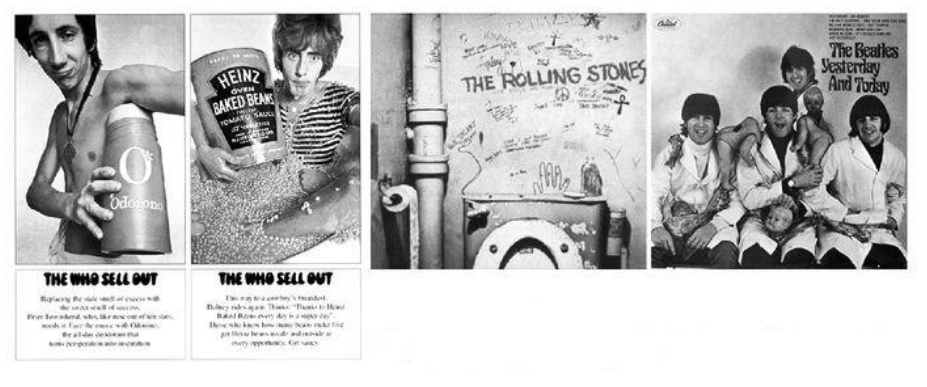
Pinker begins with an outcome that needs explanation: U.S. homicide rose from 4.0 per 100,000 in 1957 to 10.2 in 1980, while other major crimes also rose. The baby-boom increase in the crime-prone population would have predicted only about a 13% increase from 1960 to 1970, he says, versus the observed 135%, so cohort size alone was insufficient. He then proposes a cultural mechanism: generational solidarity, declining trust in institutions, informalization, celebration of spontaneity, weakened self-restraint, and radical rationalizations of some violence interacted with retreating law enforcement and illicit drug markets.
Figure 3-17 — album-cover examples of flouted cleanliness and propriety conventions. Pinker explicitly warns that correlation is not causation, that throwing away a wristwatch or mocking manners is far removed from assault, and that the overwhelming majority of baby boomers were nonviolent. The figure measures cultural style, not crime or ideology. His argument also includes policing, family formation, alcohol and drugs, illegal markets, and institutional legitimacy, and it was published in 2011. It can serve as a competing hypothesis beside Rufo’s genealogy, not as independent proof that one intellectual movement caused a national crime wave or today’s institutions. Chapter 3 synthesis · Attachment (file not included in this release) · Attachment (file not included in this release) · Attachment (file not included in this release) · Attachment (file not included in this release)
My Summary
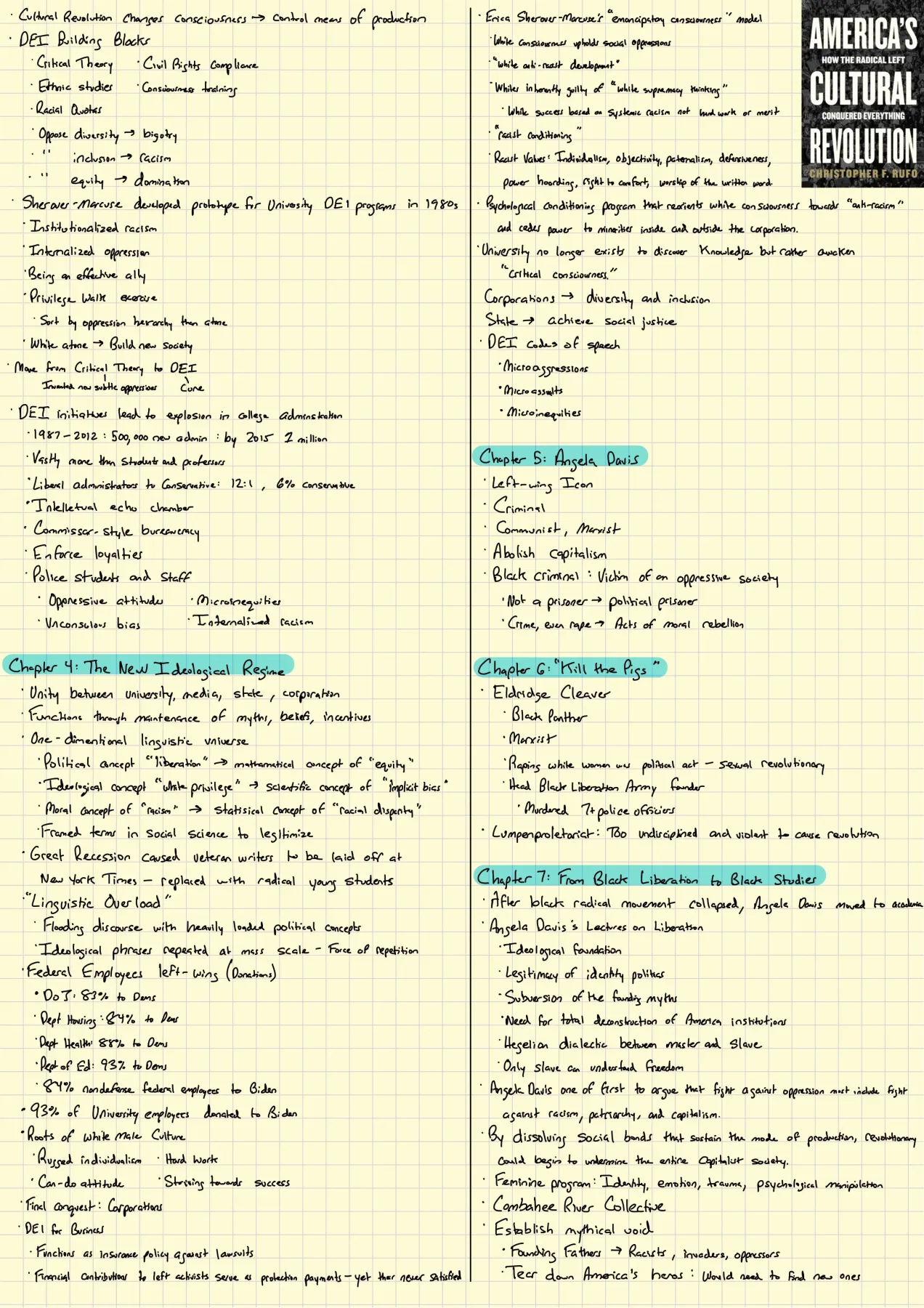
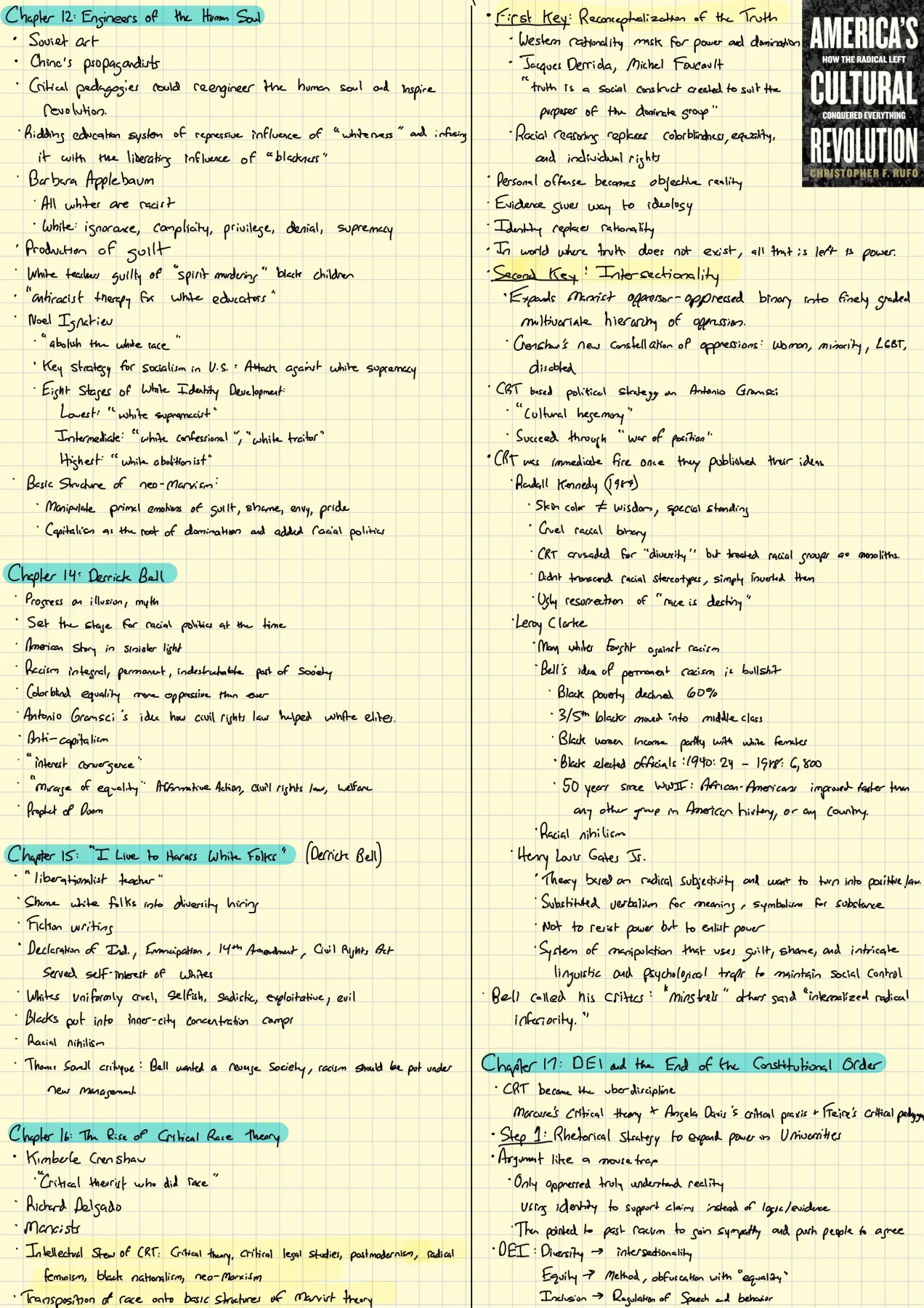
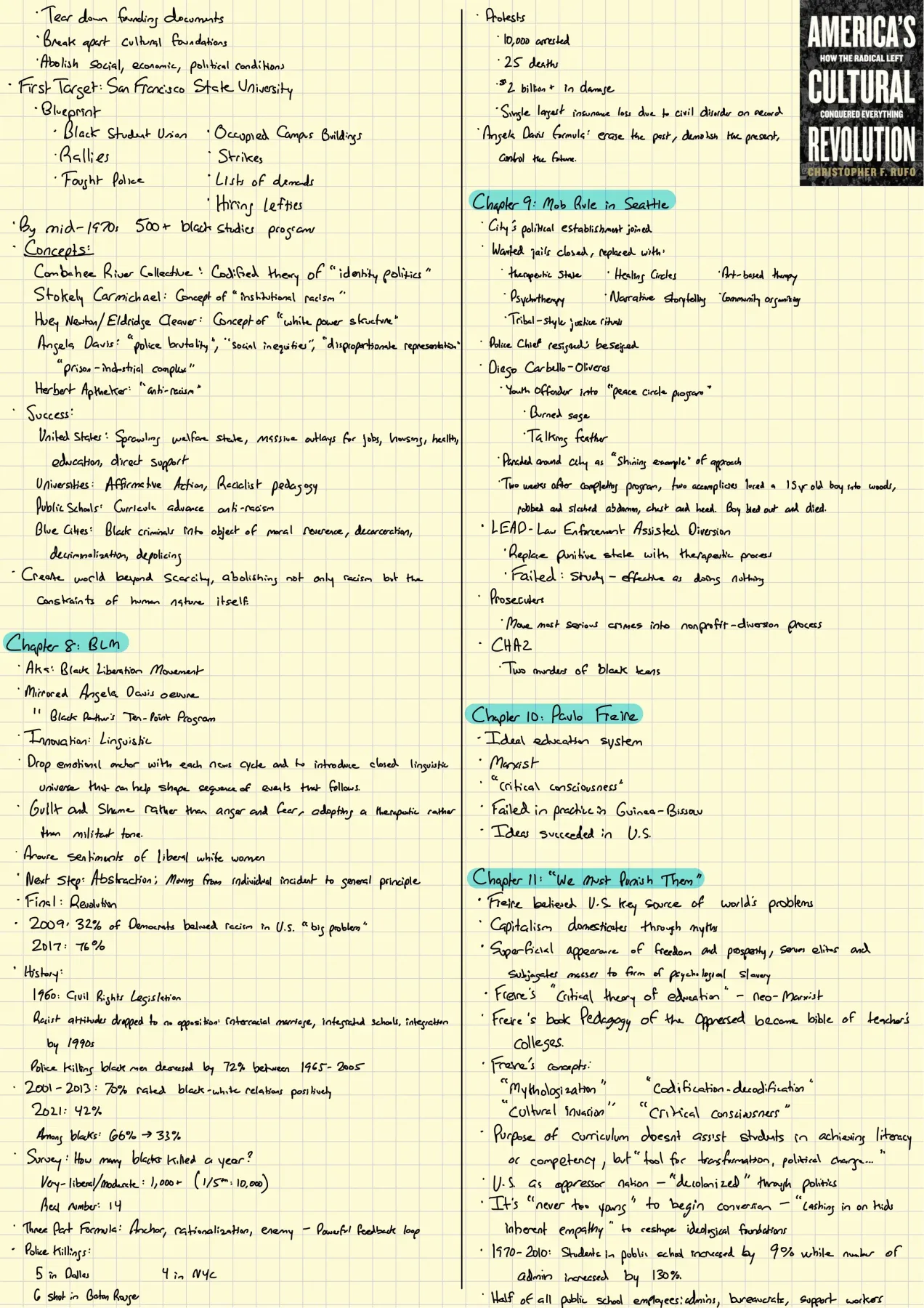
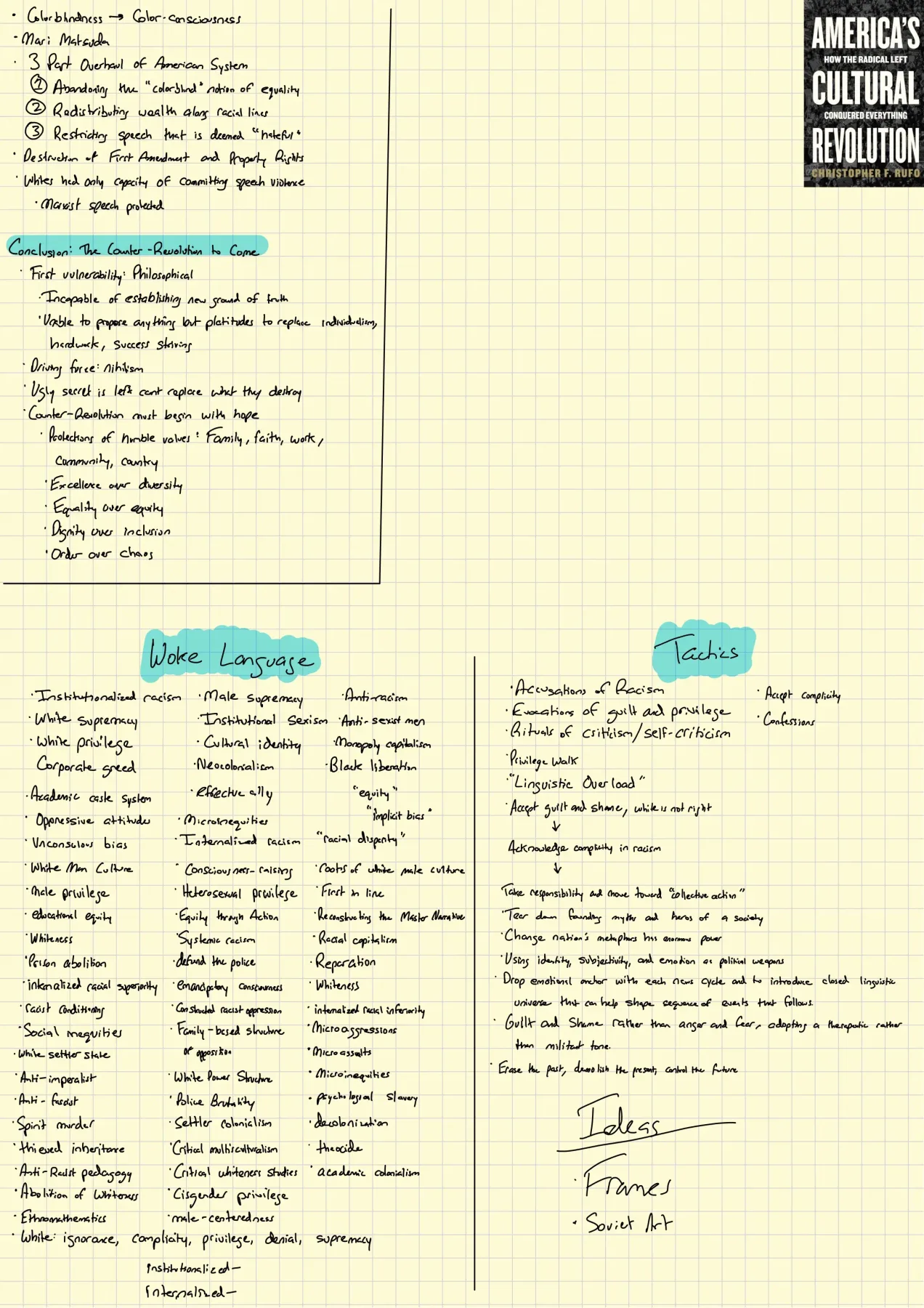
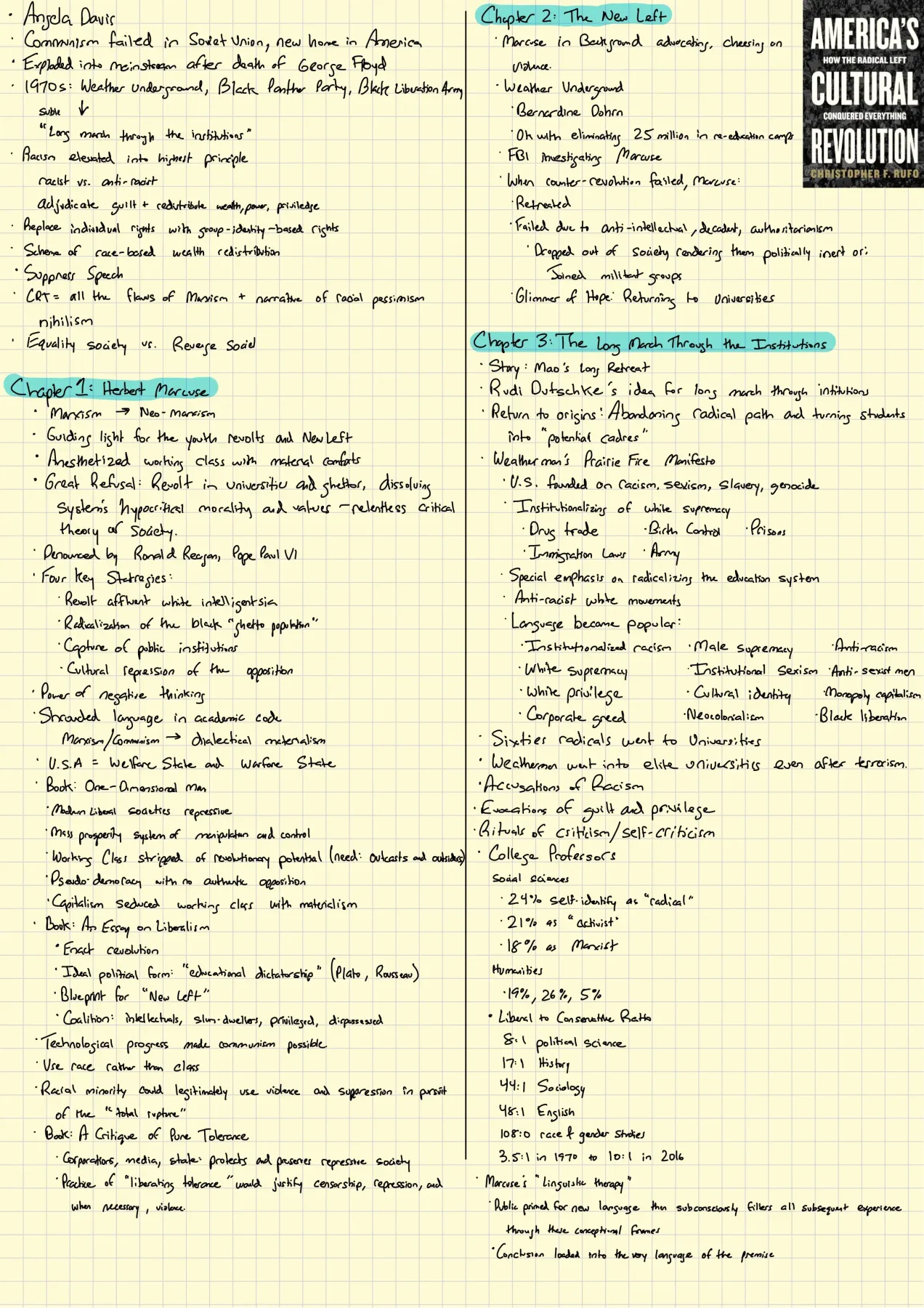
Timeline of Ideas, Actors, and Events (as presented by Rufo)
| Year/Period | Person / Text / Event | What it contributes (Rufo’s framing) | Evidence in book |
|---|---|---|---|
| Late 1960s | Herbert Marcuse’s program (student revolt; “repressive tolerance”; “long march through the institutions”) | Lays out the strategy: intellectual, cultural, sexual, and student revolt; replaces classical tolerance with “liberating tolerance” for the Left and “intolerance” for the Right; advances the “long march” of institutional capture. | ; ; |
| 1969 (Dec)–1970 | Weather Underground, Flint “War Council” and going underground | Tactical turn from campus agitation to clandestine violence; seeds later fusion of radical politics with education. | |
| 1970 (Eng. trans.); 1962–64 roots | Paulo Freire, Pedagogy of the Oppressed | Recasts education as revolutionary praxis; elevates the “teacher-student contradiction,” the teacher as political actor, and “conscientization” as a path to social change; becomes a template for U.S. school activism. | ; |
| Early–mid 1970s | Erica Sherover-Marcuse, “unlearning racism” trainings | Prototype for later DEI methods: guilt, confession, “self-criticism,” and racial essentialism in facilitated trainings. | |
| 1974 | Prairie Fire (Weather Underground manifesto) | Shifts from pure insurrection to a mass strategy centered on “radicalizing education” and building an “anti-racist white movement,” anticipating identity-based mobilization. | ; |
| 1977 | Combahee River Collective, Statement | Coins and operationalizes “identity politics”; centers personal identity and trauma as political authority and mobilization method. | ; |
| Late 1970s | Eldridge Cleaver, revisionist history line | Model of delegitimizing U.S. founding myths to clear space for revolutionary re-narration. | ; |
| 1980 | Derrick Bell’s “interest convergence” (within CRT prehistory) | Supplies a core CRT claim: racial progress occurs only when it converges with white elites’ interests; undercuts liberal universalism. | |
| 1989 | Naming of “critical race theory” (workshop; Crenshaw/colleagues) | Consolidates a movement identity and agenda for law and policy under the CRT banner. | |
| 1992 | Derrick Bell, Faces at the Bottom of the Well (incl. “The Space Traders”) | Popularizes CRT’s dark parables about race, power, and law; expands CRT from the academy into public debate. | |
| 1990s | Noel Ignatiev / Race Traitor (“abolish the white race”) | Radicalizes “whiteness studies”: calls for renunciation of “white” identity; links anti-whiteness to socialist strategy; ideas migrate into K-12 culture. | ; |
| 1990–1991 onward | Kimberlé Crenshaw, “Intersectionality” essays | Systematizes identity politics into a general theory that elevates positional identity as political authority and program; emphasizes praxis/change. | ; |
| 2017 | Oregon statewide “ethnic studies” mandate | Codifies critical-theory–inflected standards (power, identity, anti-capitalism/anti-oppression frames) into K-12 curricula. | ; ; |
| 2020 (spring–summer) | George Floyd period; BLM street dominance; CHAZ/CHOP (Seattle) | Demonstrates the street-level application of the ideology—autonomous zones, policing abolition rhetoric, widespread unrest; becomes a catalyst for institutional alignment. | ; |
| 2020 | Corporate / public-sector DEI (Sandia National Labs; Walmart/REI training) | Shows institutionalization of earlier training logics (guilt/“white men’s caucus,” privilege confessions) at scale inside elite orgs. | ; |
| 2020 | K–12 “equity” build-out (Tigard-Tualatin, Portland area) explicitly citing Freire | Makes Freirean praxis explicit in U.S. districts (equity departments, affinity groups, Freire-based curricular blueprints); links classroom to street. | ; |
| 2021 (Jan) | Post-Trump continuation (Portland inauguration-day riots) | Signals that the movement persists beyond partisan cycles; the school-to-street pipeline is intact. | |
| 2020–2021 | BLM synthesis of prior traditions (Davis, Combahee, Panthers) | Rufo argues BLM fuses racialist dialectic, identity-first politics, and Marxist-Leninist aims into a contemporary package adopted by prestige institutions. | ; |
Notes and connective threads (author’s through-line)
- From theory to praxis: Marcuse → student/identity revolt → Freire/critical pedagogy → CRT/intersectionality → DEI/curriculum → street actions. ; ; ;
- Identity as authority: Combahee and Crenshaw convert personal identity/trauma into political standing and a program for institutional change. ;
- Institutional capture: Early workshop methods (Sherover-Marcuse) mature into DEI bureaucracies and state standards. ; ;
- Street validation: 2020 unrest is treated as both culmination and accelerant of the agenda articulated since the late 1960s. ;
Summary
Introduction
Brief overview of the main idea and themes
Christopher F. Rufo frames the book as a history and diagnosis of a “cultural revolution” that he argues began with the New Left in 1968 and, over decades, migrated from street radicalism into America’s institutions. He contends that the ideas associated with critical theory (and its derivatives in race and education) have become a substitute morality, embedded through bureaucratic capture—especially “diversity, equity, and inclusion” (DEI) regimes—culminating in a visible eruption after George Floyd’s death in 2020. The book presents itself as a “work of counter-revolution” that aims to expose this ideology, trace its origins, and mobilize a return to earlier American values.
Key arguments, facts, and narrative—
in order of appearance
- Solzhenitsyn–Angela Davis anecdote as parable of ideology over people.
Rufo opens with Aleksandr Solzhenitsyn’s 1975 speech condemning Angela Davis, recounting a story in which Czech dissidents sought Davis’s help for political prisoners and she allegedly refused, revealing (for Solzhenitsyn) a communist willingness to sacrifice individuals to ideology. This episode establishes Rufo’s theme: revolutionary rhetoric about “liberation” can mask dehumanizing dogma. - Claim: the radical project did not die with the Soviet collapse.
Although left-wing revolutions failed globally, Rufo argues their cultural counterpart found a new home in the United States. The 2020 protests and institutional responses—framed by terms such as “systemic racism,” “white privilege,” and “DEI”—revived the old revolutionary narrative (e.g., America as irredeemably racist, whites as oppressor class). - Origin story: 1968 and the New Left’s theoretical turn.
The “story” begins amid late-1960s uprisings. Left-wing intellectuals developed a new theory of Western revolution while militants printed pamphlets and planted bombs. Rufo’s thesis: these theories seeded a long institutional strategy rather than an immediate overthrow. - Four “prophets” and four domains.
The book is organized into four parts—revolution, race, education, power—each built around a figure Rufo sees as foundational:- Herbert Marcuse: philosopher of the New Left and its bid to combine white intelligentsia with the “black ghetto” as a new proletariat.
- Angela Davis: Marcuse student who pledged violent revolution and became a symbol of racial revolt.
- Paulo Freire: Brazilian Marxist whose pedagogy seeks to make schools instruments of revolution.
- Derrick Bell: Harvard law professor who laid critical race theory’s foundations and helped spread it through elite institutions.
- From street violence to “long march through the institutions.”
After the 1970s collapse of violent groups (Weather Underground, Black Panther Party, Black Liberation Army), Rufo claims New Left activists pivoted to a gradual, bureaucratic strategy—embedding race- and identity-focused theories in universities, schools, newsrooms, and public agencies. - Structural revolution and “relentless negation.”
Over decades, these ideas allegedly transformed from academic theories into political weapons aimed at acquiring power. Rufo describes a process of negation—dismantling prior values—so incremental that the public scarcely noticed until 2020. - Endgame: a new ideological regime via DEI.
Rufo asserts the march is largely complete: the 1968 “critical theories” now inform curricula, media, policy, and corporate HR. He cites elite adoption (e.g., Ivy League institutions and companies such as Walmart, Disney, Verizon, American Express, Bank of America) and argues the ideology reduces society to a binary (“racist” vs. “anti-racist”), elevates racism as a guiding principle, and installs DEI bureaucracies to reward allies and punish dissenters. Political forms remain intact, he says, but the intellectual substructure has shifted—“a revolution from above.” - Stated aims of the radical project.
Rufo characterizes the Left’s ultimate goals as replacing individual rights with group-based rights, instituting race-based redistribution, and restricting speech according to a racial-political calculus—a “total rupture” with the existing order. - Limits and contradictions.
Despite institutional gains, Rufo argues the movement cannot construct a positive value system. He highlights:- The New Left’s earlier “class suicide” and “white-skin privilege” rhetoric breeding narcissism and guilt.
- Terror campaigns alienating the public, prompting radicals to reappear as academics and bureaucrats.
- Contemporary consequences: universities losing their telos, Black Lives Matter–era unrest harming cities, schools adopting revolutionary principles while failing at basics, and CRT inheriting Marxism’s flaws plus “racial pessimism.”
- Diagnosis: from anxiety to nihilism.
Rufo claims the public senses a hostile new order imposed through DEI and identifies the revolution’s “hideous face” as nihilism—producing exhaustion and despair rather than progress. - Purpose and questions of the book; call for a counter-revolution.
The book aims to reveal the nature of the critical theories, document the regime’s workings, and prepare resistance. Rufo poses guiding questions (equality vs. revenge society; transcend vs. entrench racialism; tolerating destruction in the name of progress) and asserts the system “does not work.” He calls for resurrecting pre-existing American values, symbols, and principles to reconnect past, present, and future. The chapter closes with the coming contest between competing visions of America.
Notable quotes (illustrative and thematic)
- Solzhenitsyn’s verdict on Davis—“That is the face of Communism… the heart of Communism for you”—as the moral frame for the chapter’s opening.
- The movement’s institutional strategy: the “long march through the institutions.”
- On the new orthodoxy: critical theories have become a “substitute morality,” dividing society into a crude binary and elevating racism as a guiding principle.
- On legitimacy: “Nobody voted for this change; it simply materialized from within.”
- On efficacy: “The revolution is not a path to liberation; it is an iron cage.”
- On the book’s stance: “This is, in short, a work of counter-revolution.”
How this chapter connects to (and structures) the overall book
- Thesis statement: Establishes the core claim that a New Left–inspired cultural project captured American institutions and now governs via bureaucratic mechanisms and moral inversion.
- Roadmap: Introduces the four-part structure (revolution, race, education, power) and the four principal figures (Marcuse, Davis, Freire, Bell) whose ideas and networks anchor later chapters.
- stakes & questions: Sets the normative conflict the book will pursue (whether America chooses equality vs. revenge, transcends vs. entrenches racialism) and frames Rufo’s project as a comprehensive rebuttal and plan for reversal.
Bottom line
The Introduction argues that today’s DEI-driven institutional order descends from 1968’s critical theories and New Left activism, matured through a slow, bureaucratic “long march.” The chapter defines the book’s mission: to document this genealogy, argue that the resulting regime is corrosive and ineffective, and rally a counter-movement to restore an older American moral and institutional framework.
Part I: Revolution
Chapter 1 — Herbert Marcuse
Herbert Marcuse: Father of the Revolution
Brief overview of the main idea and themes
The chapter presents Herbert Marcuse as the intellectual architect of the New Left’s “cultural revolution.” Rufo traces how Marcuse’s critique of liberal democracy and consumer society—especially in One-Dimensional Man and “Repressive Tolerance”—reframed Western democracies as “pseudo-democracies” that mask domination. Marcuse’s solution shifts from proletarian revolution to a coalition of students, racial militants, and intellectuals, justified by “liberating tolerance,” which includes censoring “Right” opposition and, in certain conditions, endorsing extralegal resistance.
Key arguments, facts, and developments (in order)
- From critique to “democratic unfreedom.” One-Dimensional Man argues modern liberal societies pervert technological rationality; prosperity produces manipulation rather than liberation—“a comfortable, smooth, reasonable, democratic unfreedom.” Marcuse contends domination integrates opposition, hollowing politics into symbols without power. The working class loses revolutionary role; democracy becomes “pseudo-democracy.”
- Reorienting revolution. Because the classical proletariat is neutralized, Marcuse looks to new revolutionary subjects (students/intelligentsia; racial revolutionaries) and to extra-parliamentary struggle, concluding that “the fight for democracy thus tends to assume anti-democratic forms.”
- “Repressive” vs. “liberating” tolerance. In “Repressive Tolerance,” Marcuse defines “liberating tolerance” as “intolerance against movements from the Right” and toleration of the Left, extending “to the stage of actions” and justifying censorship and, when necessary, violence to reopen blocked pathways for a “subversive majority.”
- Justifying extralegal resistance. He articulates a “natural right” for “oppressed and overpowered minorities to use extralegal means” if legal channels are inadequate—arguing such resistance breaks an already existing chain of violence.
- Toward an “educational dictatorship.” Drawing on Plato/Rousseau, Marcuse sketches an interim order led by elites capable of distinguishing “false” from “true” consciousness—“[they] must be ‘forced to be free’”—a “dictatorship of the intellectuals” to transition from slavery to freedom.
- The “Great Refusal.” In the face of one-dimensional society, he places hope in “the substratum of the outcasts and outsiders,” honoring their negativity as a final, if uncertain, revolutionary reserve—the “Great Refusal.”
Notable quotes
- “A comfortable, smooth, reasonable, democratic unfreedom prevails.”
- “Tolerance… would mean intolerance against movements from the Right.”
- “I believe that there is a ‘natural right’ of resistance… to use extralegal means.”
- People may need to be “forced to be free.”
- The “Great Refusal” remains, honoring “those who… give their life” without hope.
Connection to the overall book
Rufo frames Marcuse as the source code for later radical praxis: redefining liberal institutions as repressive; recoding tolerance as censorship of the Right; and legitimizing extra-legal resistance. This intellectual frame, he argues, becomes the template for the New Left’s street militancy and its later “long march” into institutions discussed in Chapters 2–3.
Chapter 2 — The New Left
The New Left: “We Will Burn and Loot and Destroy”
Brief overview of the main idea and themes
The chapter narrates the New Left’s escalation from protest to militancy, focusing on the Weather Underground. Rufo links their program and rhetoric to Marcuse’s arguments, documenting the shift from public demonstrations to underground bombings and revolutionary communiqués, followed by a strategic pivot after repression—and the seeds of later institutional strategies.
Key events, claims, and evidence (in order)
- From protests to “Days of Rage.” Modeling themselves on Che, Mao, and the Red Guards, the Weathermen orchestrate occupations, vandalism, and sabotage culminating in Chicago’s “Days of Rage,” which police violently suppress.
- Flint “war council” (Dec. 1969–Jan. 1970). In a drug-fueled conclave, leaders revel in revolutionary violence (“we will burn and loot and destroy”), celebrate Manson, and debate whether killing “newborn white babies” could be revolutionary duty. Internal rhetoric centers on terror and assassination as permissible means.
- Declaration of war and going underground (Jan. 1970). The Weathermen announce “Armed struggle starts when someone starts it.” Within months, a tape of Communiqué #1 pledges attacks within fourteen days; “Revolutionary violence is the only way.”
- Bombing campaign. Two weeks after Communiqué #1, a bomb hits NYPD headquarters; a letter declares “The pigs in this country are our enemies… Political power grows out of a gun…” Over five years, the group claims responsibility for symbolic bombings at major government and financial targets.
- Scale of violence (1969–1970). In just fifteen months, law enforcement records 4,330 bombings and 43 deaths, as militants hope focused action will spark nationwide revolt.
- Marcuse’s ties and official concern. The FBI elevates Marcuse to “Security Matter –C,” tracking his connections to radical leaders and organizations during the turn to violence.
Notable quotes
- “We will burn and loot and destroy.”
- “Armed struggle… starts when someone starts it.”
- “Revolutionary violence is the only way.”
- “The pigs in this country are our enemies… Political power grows out of a gun…”
Connection to the overall book
This chapter supplies the movement-level sequel to Marcuse’s theory: militant cadres enact the logic of “counter-violence,” then confront state crackdown and public backlash. That failure sets the stage for the strategic shift—away from bombings toward capturing institutions—which Chapter 3 details.
Chapter 3 — The Long March Through the Institutions
Brief overview of the main idea and themes
Following the collapse of street militancy, Marcuse and allies embrace Rudi Dutschke’s strategy: infiltrate and transform institutions from within. Rufo argues this “long march” preserves revolutionary ends by substituting a war of values and ideas for immediate insurrection—creating counter-institutions, seizing “chains of information,” and spreading a new sensibility by “contagion.”
Key arguments and developments (in order)
- From Mao’s “Long March” to Dutschke’s metaphor. Rufo opens with Mao’s historic retreat and recovery as a template. Marcuse sees the New Left similarly besieged and endorses Dutschke’s “long march through the established institutions” as “the only effective way” forward.
- Counterrevolution and Revolt—program. Marcuse urges radicals to “burrow” into universities, schools, media, and social services, “working against the established institutions while working in them,” to control the “great chains of information and indoctrination.”
- Build counter-institutions. He calls for radical caucuses, counter-meetings, and alternative media—“radio, television, press, workshops”—to break the establishment’s information monopoly and launch a “cultural revolution,” i.e., a “transformation of values.”
- Method: patience and education. Change should diffuse by “contagion,” through a long process of education, cultivating “potential cadres” and sustaining a revolution in values possibly over generations.
- Weathermen’s pivot—Prairie Fire (1974). The surviving Weather Underground reemerges with a manifesto that swaps crude terror talk for an intellectual frame: indicting U.S. “capitalism, racism, sexism, imperialism, [and] colonialism,” advocating a new “weapon of theory,” and reconnecting inside-the-institution work with outside pressure. Education becomes a priority lever.
Notable quotes
- Dutschke’s line endorsed by Marcuse: the long march is “the only effective way.”
- “Working against the established institutions while working in them.”
- Gain control of the “great chains of information and indoctrination.”
- Spread change by “contagion” through a “long process of education.”
- Use the “weapon of theory” to build revolutionary consciousness.
Connection to the overall book
Chapter 3 explains the operational bridge between 1960s militancy and the later capture of institutions that the book claims matured into today’s bureaucratic and cultural regime. The long march reframes the revolution as a slow, strategic campaign in schools, media, and public agencies—foreshadowing later sections on education and administrative power.
Through-line across Chapters 1–3
- Theory → Militancy → Institutional Strategy. Marcuse’s critique (Ch. 1) informs the New Left’s violent turn and subsequent failure (Ch. 2), which yields the long-term strategy of institutional capture (Ch. 3). Collectively, these chapters supply the book’s origin story for how ideas of 1968 traveled from campus and street into the “means of knowledge production” and, ultimately, into the bureaucratic mainstream the book critiques in later parts.
Selected short quotations (grouped for quick reference)
- “Democratic unfreedom” (Marcuse on advanced industrial society).
- “Intolerance against movements from the Right.”
- “Natural right” to “extralegal” resistance.
- “Armed struggle… starts when someone starts it.”
- “Revolutionary violence is the only way.”
- Long march as “the only effective way.”
- “Weapon of theory.”
Chapter 4 — The New Ideological Regime
Brief overview of the main idea and themes
Rufo argues that the New Left’s “long march through the institutions” has culminated in a revolution from above: a decentralized ideological regime uniting university, media, state, and corporation. This regime, he says, translates radical concepts into managerial, social-science language (e.g., “liberation” → “equity,” “white privilege” → “implicit bias,” “racism” → “racial disparity”) and governs through bureaucracies, incentives, and vocabulary control rather than overt central command. The chapter traces this progression sector by sector—media capture (with the New York Times as emblem), state bureaucracy and DEI patronage, and corporate adoption (including training programs and post-2020 pledges)—and concludes that Marcuse’s vision has diffused into elite culture and practice.
Key arguments, facts, and developments (in order)
- From invisible “long march” to finished regime.
The revolutionary shift was gradual and bureaucratic, largely unnoticed as it migrated from campus theory into societal power centers. Now consolidated, it functions as a revolution of information rather than production, with ideas embedded as operational norms. - Marcuse’s “third way” and the new elite.
Marcuse, skeptical of both capitalism and Stalinism, urged followers to master large enterprises and install critical theories as governing ideology—replacing a proletarian base with an elite managerial class suited to an abstract, knowledge-based economy. - A decentralized ideological regime.
Universities incubated the ideas; media, state, and corporations translated and professionalized them as social science and DEI, forming a diffused unity maintained by myths, beliefs, and incentive systems rather than centralized command. - Language shift: from liberation to equity (the “one-dimensional linguistic universe”).
Once ascendant, ideologues reframed moral claims as technical ones—“equity,” “implicit bias,” “racial disparity”—to legitimize elite managerial control and sideline “antirevolutionary” working classes. This creates a protected vocabulary that places authority beyond normal political dispute. - Media: the “conquest” of the New York Times as case study.
After a generational turnover post-Great Recession, younger staff steeped in critical theory shifted the Times’ internal culture and output, with steep rises in usage of terms like “racism,” “white privilege,” and “systemic racism.” This “long march through the media” turned fringe ideas into a new consensus and influenced other outlets (Post, NPR, MSNBC, wire services). Tactically, activists deploy “linguistic overload”—repetition of charged phrases to pre-shape public conclusions. - State: bureaucracy as the “highest prize.”
Building on New Deal/Great Society expansion, activists targeted administrative agencies where policy is made with limited democratic oversight. Federal employees’ donations skew heavily Democratic; the Biden administration mandated DEI across departments; and agencies run standing DEI programs enforcing speech/behavior norms. Example: Sandia National Laboratories required a “White Men’s Caucus” training centered on confessional antiracism exercises and dismantling “white male culture.” - Patronage networks in federal grantmaking.
The Department of Education, NEA, NEH, and NSF are portrayed as permanent benefactors of DEI/critical-theory projects across administrations, funneling hundreds of millions of dollars into aligned programs (e.g., “equity-driven” initiatives, “DEI systemic change,” “creating faculty change agents”). Rufo casts this as a one-party selection process run by career bureaucrats. - Corporations: from contradiction to co-optation.
Despite critical theory’s anti-capitalist roots, Fortune 100 firms adopted DEI infrastructure (training on “whiteness,” “racial capitalism,” “prison abolition”), rationalized as reputational insurance and legal risk management. Post-George Floyd, CEOs pledged around $50B to “racial equity,” aligning public messaging with street movements while pursuing standard lobbying for economic interests—an inside-outside game. - Walmart example: corporate DEI as “farce” with effects.
Walmart pledged $100M to its Center for Racial Equity and implemented mandatory training (via Racial Equity Institute) characterizing the U.S. as a “white supremacy system,” diagnosing “white supremacy thinking” (e.g., “individualism,” “objectivity,” “power hoarding”), and prescribing “white anti-racist development” (accept guilt/shame, move to “collective action”). Rufo argues that even if motives are cynical, repetition imprints ideology on corporate culture. - Synthesis and denouement.
Marcuse was dismissed late in life as a “paper revolutionary,” but his framework ultimately embedded across institutions. The formerly distinct vocabularies of academia, media, government, and business have blurred; intellectuals now supply the language of managers and officials, erasing old demarcations.
Notable quotes (short, illustrative)
- “It is revolution from above… revolution in the abstract… a revolution of information.”
- “The political concept of ‘liberation’ becomes ‘equity’… ‘white privilege’ becomes ‘implicit bias’… ‘racism’ becomes ‘racial disparity’.”
- Marcuse on strategy: learn to use mass media, build “counterinstitutions” and master the “great chains of information and indoctrination.”
- On media tactics: “The sociological and political vocabulary must be… ‘moralized’ in terms of the Refusal.”
- On the state: “It is a revolt of the state against the people.”
- Marcuse (1968): if the choice is forced, “I would prefer the dictatorship of the intellectuals.”
How this chapter connects to the overall book
- From origins to operating system: Earlier chapters traced theory (Marcuse), militancy (Weathermen), and the pivot to institutions. Chapter 4 shows the operational regime that, according to Rufo, now governs—how theory became practice across media, state, and business.
- Mechanisms of power: It details the vocabulary engineering, bureaucratic DEI structures, and patronage networks Rufo sees as the practical levers of contemporary cultural power, setting up later parts on race, education, and administrative power.
Bottom line
Chapter 4 contends that the “long march” has consolidated an elite, managerial regime that normalizes critical-theory concepts via language control, bureaucracy, and incentives across media, state, and corporate spheres. What began as campus theory now operates, Rufo argues, as a diffuse but coherent orthodoxy shaping public and private life.
Part II: Race
Chapter 5 — Angela Davis
The Spirit of Racial Revolt
Overview (main idea & themes)
Rufo profiles Angela Davis as the movement’s exemplar of “racial revolt,” shaped by Herbert Marcuse’s revolutionary theory and the Black Power aesthetic. He argues Davis fused Marxist philosophy with black nationalism, embraced violence as instrumentally necessary, and became a powerful icon through courtroom theater and media. The chapter culminates in the 1970 Marin County courthouse attack linked to Davis, her flight, and arrest.
Key arguments / events in order
- Marcuse’s encouragement and Davis’s apprenticeship to him; Davis absorbs German critical theory while admiring the Black Panthers’ militancy.
- Davis articulates a vision of total social transformation and accepts violence as historically part of revolution.
- Intensifying radicalization: intimate letters to George Jackson mix devotion with calls for bloodshed and “annihilation of the monster.”
- Preparations for action: Davis and Jonathan Jackson purchase firearms and ammunition.
- Marin County courthouse assault (Aug. 7, 1970): hostage-taking, attempted escape, and shootout leave four dead, including Judge Harold Haley; evidence ties weapons and materials to Davis.
- Aftermath: Davis flees, is placed on FBI’s Most Wanted list, and is arrested in New York two months later; the White House publicly hails the capture.
Notable quotes (short, representative)
- Marcuse to Davis: “Your cause is our cause.”
- Davis (on revolution): “You have to completely revolutionize the entire fabric of society.”
- Davis (on violence): “In the history of revolutions… you have had the occurrence of violence.”
- Davis to George Jackson: “We have to learn to rejoice when pigs’ blood is spilled.”
Connection to the overall book
Rufo presents Davis as Marcuse’s most visible disciple and a hinge from theory to action in the “race” part of the revolution, setting up later chapters on institutionalization and revival.
Chapter 6 — “Kill the Pigs”
The Black Revolution Explodes
Overview
This chapter traces the post-1970 escalation from courtroom violence to urban insurgency, focusing on the Black Panther Party’s fragmentation and the rise of the Black Liberation Army (BLA). Rufo argues Davis rationalized a “violent stage,” while clandestine cells embraced assassination, robbery, and terror before collapsing under internal dysfunction and federal pressure.
Key arguments / events in order
- Davis conducts a triumphalist tour, linking 1960s revolts to a coming “violent stage,” and defends prison militants as political.
- Panthers fracture; militants pivot to underground war. Don Cox’s manuals outline a strategy later adopted by the BLA.
- BLA self-definition and praxis: Shakur frames the BLA as a people’s resistance; cells prioritize “physical operations,” including assassinations.
- 1971–72 campaign: execution of NYPD officers Rocco Laurie and Gregory Foster; other killings and robberies; escalating street war.
- FBI counterinsurgency exploits internal fissures; by 1974 leadership is dead, imprisoned, or in exile; BLA disintegrates.
- Rufo’s conclusion: the BLA blended revolutionary rhetoric with criminal subculture—a “lumpen” turn that undermined the cause.
Notable quotes
- Davis: the struggle had entered “a violent stage.”
- Assata Shakur: the BLA “is not an organisation: it goes beyond that… a people’s movement.”
Connection to the overall book
This chapter shows the culmination of street-level militancy that, after burning out, pushes activists toward a “long march” through institutions—bridging to Chapter 7.
Chapter 7 — From Black Liberation to Black Studies
Overview
Rufo argues the movement’s center of gravity shifted from guerrilla action to academia. Following her acquittal, Davis moves into the university world; Black Studies becomes the institutional container for revolutionary ideas, normalizing radical frameworks across the humanities and social sciences.
Key arguments / events in order
- Davis’s academic pivot (San Francisco State, Mills, UC Santa Cruz, Vassar, UCSB) positions her to shape curriculum.
- Her prison-abolition feminism and intersectional politics enter syllabi and, Rufo claims, become “standard products” in departments.
- Black Studies’ disciplinary identity coalesces around anti-racism, intersectionality, decolonization; influence spreads into Women’s and Ethnic Studies.
- Institutional dynamics: early activists argue for erasing the “white gaze” and building a separate epistemic space; demands harden into durable programs.
- Critical appraisals: Shelby Steele warns of a politicized campus culture of grievance; Fabio Rojas describes how activism, administration, and funding entrenched the field.
Notable quotes
- Steele: campus “politicization… breeds… easily offended self-righteousness.”
Connection to the overall book
Chapter 7 operationalizes the book’s thesis that the revolution turned structural via institutions—universities first, then other “knowledge-making” bureaucracies.
Chapter 8 — BLM
The Revolution Reborn
Overview
Rufo depicts Black Lives Matter as the modern revival of 1960s–70s black liberation, with Angela Davis as an ideological throughline. He focuses on organizers such as Melina Abdullah and Alicia Garza, framing BLM as explicitly abolitionist (police/prisons) and openly revolutionary in rhetoric and objectives.
Key arguments / events in order
- BLM leadership and allied academics cast the moment as a revolution, calling for immediate social transformation.
- Abdullah’s platform: “rid of ‘whiteness’ that has defined this country” and embrace black rage as a form of love fueling change.
- Abolitionist throughline: police and prison abolition presented as the precondition for justice; demands escalate from reform to replacement.
- Cultural capture claim: Rufo argues the “morality play” and institutional amplification convert revolutionary slogans into mainstream orthodoxies.
Notable quotes
- Abdullah: “Everybody needs to decide which side you’re on—justice or tyranny—we need to get us on that road now.”
- “Black rage is black love.”
Connection to the overall book
BLM is presented as the realization of ideas seeded by Davis and earlier militants, now channeled through contemporary movements and institutions.
Chapter 9 — Mob Rule in Seattle
Overview
Using Seattle’s 2020 unrest as a case study, Rufo argues that abolitionist politics produced a real-world experiment—CHAZ/CHOP—demonstrating how “police-free” zones breed intimidation, vigilantism, and lethal violence. He claims political actors enabled a power vacuum that mobs filled.
Key arguments / events in order
- Political pressure & intimidation: activists target officials’ homes; a councilmember promises a 50% police budget cut under duress.
- Policy shifts: council moves to restrict crowd-control tools; the police chief warns officers cannot safely intercede—signaling breakdown of order.
- Strategy, per Rufo’s sources: reduce police power to achieve “mob rule,” then demand defunding; polls show majority support for defunding.
- East Precinct abandoned; activists declare the Capitol Hill Autonomous Zone (CHAZ), intending to model a new order beyond police, prisons, and courts.
- Identity-based governance: elevation of BIPOC and trans women; segregationist spaces; public “reparations” rituals.
- Security vacuum: armed factions become de facto police; journalists and dissenters assaulted.
- Violence & collapse: multiple shootings, two homicides (both Black victims); city retakes area July 1; Rufo underscores the irony of the precinct’s pro-community origins.
Notable quotes
- Slogans left at officials’ homes: “Guillotine Jenny.”
- Officer’s assessment: activists sought “mob rule” by stripping police of authority and tools.
Connection to the overall book
Seattle’s CHAZ/CHOP is presented as a practical test of abolitionist theory, tying the book’s historical arc—from Davis-era militancy to BLM—into a contemporary experiment with governance and order.
Through-line of Part II
Across Chapters 5–9, Rufo’s thesis is that Davis connects revolutionary theory, militant action, institutional capture (Black Studies), and the modern BLM movement, culminating in 2020’s “abolitionist” politics and their practical effects. The part moves from person (Davis) to organizations (BPP, BLA) to institutions (universities) to a nationwide movement (BLM) and a city-level case study (Seattle).
Part III: Education
Chapter 10 — Paulo Freire: Master of Subversion
Overview
Rufo introduces Paulo Freire as the intellectual architect of “critical pedagogy,” arguing that Freire reconceived schooling as a revolutionary project aimed at raising students’ “critical consciousness” and mobilizing them against the existing social order.
Key arguments and sequence
- Freire’s gospel and appeal. Pedagogy of the Oppressed soared globally; after English publication in 1970 it became foundational in North American education circles.
- Core theory: “critical pedagogy” reframes classrooms as sites of political formation; teachers are to develop students into activists through “revolutionary praxis.”
- Language and method: Freire’s slogans—“reading the world,” “dialogue,” “praxis”—mask a militant project; the aim is to produce “comrades” rather than citizens.
Notable quotes
- “The teacher is no longer the ‘one-who-teaches.’”
- Teaching should not close on the future “as if it were perfect, coherent, and final.”
Connection to the book
This chapter establishes the education pillar of Rufo’s thesis: after Marcuse (Part I) and Davis (Part II), Freire supplies the school-based playbook that later American actors adapt and institutionalize in Chapters 11–13.
Chapter 11 — “We Must Punish Them”: Marxism Conquers the American Classroom
Overview
Rufo traces how Freire’s ideas moved from the “Third World” into American schools and teacher training, emphasizing that advocates positioned teachers as political operatives—“co-conspirators”—inside the system.
Key arguments and sequence
- Transnational spread. After 1970, Freirean workshops and networks proliferated across North America, embedding his lexicon and tactics in K–12 and higher-ed pedagogy.
- Teacher’s role redefined. The classroom leader becomes a “co-conspirator,” “inter-generational freedom-fighter,” and “militant political activist,” collapsing instruction into agitation.
- Strategy of capture. Activists infiltrate “la base” of the education system—gaining footholds, then advancing policy and curriculum by stealth until power consolidates.
Notable quotes
- Teachers as “co-conspirators” and “militant political activist[s].”
Connection to the book
Chapter 11 shows the “long march” through American schools: the tactical move from street agitation (Part II) to institutional capture via pedagogy, setting up concrete case studies in Chapters 12–13.
Chapter 12 — Engineers of the Human Soul
Overview
Rufo argues that second-generation critical pedagogues extend Freire by centering race and identity—promoting “abolitionist,” “decolonizing,” or “liberatory” approaches that target “whiteness,” “colorblindness,” “individualism,” and “meritocracy” as systems to be dismantled. He juxtaposes theory with district-level programs in Buffalo and Philadelphia, then assesses results.
Key arguments and sequence
- From Freire to identity revolution. New theorists keep his revolutionary structure but “burrow into identity,” leveraging emotions like guilt and shame to guide activism.
- Abolitionist framing. The project aims to “abolish” institutions—prisons, schools, even constitutional norms—in pursuit of racial justice; nothing “can be left standing.”
- “Pedagogy of Whiteness.” Scholars prescribe replacing “white talk” with racial “counterstories” and normalizing “decolonizing pressure.”
- “Pedagogy of Blackness.” Major districts adopt curricula urging “unapologetically Black” schools, traditional African justice models, and radical historical texts; activism is promoted as “anti-racism.”
- Outcomes and critique. Despite very high per-pupil spending, proficiency rates in Buffalo and Philadelphia remain low—evidence, Rufo argues, of a rhetoric-reality gap.
Notable quotes
- “White folx cannot lose their Whiteness… [Being] well and White is rejecting Whiteness for the good of humanity.”
- “We need to tear [it] down.” (on remaking society).
Connection to the book
This chapter argues the school system has become a prime vehicle for the broader cultural revolution, translating critical theory into administrative mandates and classroom practice.
Chapter 13 — The Child Soldiers of Portland
Overview
Rufo presents Portland as a case where Freirean pedagogy, local equity bureaucracies, and street radicalism intersect. He profiles youth-driven protest (including the Youth Liberation Front) and describes how area districts institutionalized “critical pedagogy,” culminating, he argues, in radicalization that spilled into riots and teacher arrests.
Key arguments and sequence
- Setting and escalation. Portland—“the ‘whitest city in America’”—nevertheless becomes a hub of “race radicalism”; 2020 protests include explicit anti-American chants and involvement of minors.
- Institutionalization. City and schools embed equity plans and political education; three districts (Tigard-Tualatin, Beaverton, Portland Public Schools) adopt Freirean frames.
- Curricular throughline. Materials and trainings push “abolitionist/decolonizing” pedagogy and anti-whiteness identity work, linking classroom discourse with activist praxis.
- Street-level results. Rufo details Antifa/BLM tactics, “network-enabled mobs,” and sustained unrest; some Portland teachers are arrested on riot-related charges.
- Conclusion. He argues Portland’s institutions cultivate a worldview that risks “mob rule,” with schools “agitating for [the state’s] own destruction.”
Notable quotes
- Protest chant recorded in 2020: “Death to America.”
- On policy horizon: “Nothing can be left standing. The endpoint of abolition is… the abolition of America itself.”
Connection to the book
Portland functions as Rufo’s capstone case study for the Education section: the pipeline from theory (Freire) → pedagogy/administration → youth activism mirrors the book’s thesis about a “long march” converting institutions into engines of cultural revolution.
Brief Part III through-line
Across Chapters 10–13, Rufo’s argument is that Freire’s revolutionary pedagogy migrated into American education, where second-generation theorists racialized it and school systems operationalized it through “equity” bureaucracies and curriculum—culminating, in this section, with on-the-ground case studies (Buffalo/Philadelphia; Portland) that, he contends, show political mobilization without academic gains.
Part IV: Power
Chapter 14 — Derrick Bell
Prophet of Racial Pessimism
Brief overview
Rufo presents Derrick Bell, Harvard Law’s first Black professor and a seminal influence on critical race theory (CRT), as the architect of a sweeping “racial pessimism.” Despite professional success and national recognition, Bell publicly reaffirmed—late in life—that American racism was permanent and that visible milestones (including Barack Obama’s election) were not signs of progress but reconfigurations of the same racial order.
Key arguments and developments (in order)
- Profile and positioning. Bell combined a conventional academic persona with deep ties to radical milieus (e.g., legal support for Angela Davis; engagement with Paulo Freire; contacts with Black Panthers). His strategic shift was to take radical ideas from the street into elite institutions, cultivating protégés who would formalize CRT.
- Core thesis of “permanent racism.” Bell’s writings argued that legal equality was a “myth” masking a durable racial hierarchy; his public comments in 2010 reiterated that the United States remained fundamentally racist.
- Catastrophic frame and popularization. Through allegorical “Chronicles” (leading to And We Are Not Saved and Faces at the Bottom of the Well), Bell advanced a narrative in which white society would sacrifice Black interests—even to fantastical extremes. This pessimism became both an intellectual brand and a cultural commodity.
- “Space Traders” and genocide anxiety. Bell asserted in interviews that, if offered, Americans would vote to expel Black citizens; he even speculated about the possibility of “racial genocide,” aligning with contemporaries who warned Blacks had become “economically superfluous.”
- Endpoint logic. Bell’s late-life storytelling dramatized a vision of cyclical defeat and looming catastrophe as the logical endpoint of his racial realism.
Notable quotes
- “We are now not in the post-racism era… we are still in a racist society.”
- “Racism is an integral, permanent, and indestructible component of this society.”
Connection to the overall book
Bell functions as the keystone linking 1968-era radicalism to a durable institutional program. Rufo frames Bell’s pessimism—and his mentorship of CRT founders—as the intellectual bridge by which the New Left’s ideas moved from revolutionary agitation into policy, law, and administration.
Chapter 15 — “I Live to Harass White Folks”
The Politics of Eternal Resentment
Brief overview
This chapter charts the immediate intellectual contest around Bell’s program. Rufo highlights early, internal critiques (notably by Randall Kennedy and Leroy Clark) that argued CRT’s “racial reasoning” essentialized identity and misread American racial history, while also showing Bell’s combative responses.
Key arguments and developments (in order)
- From Chronicle to platform. Bell’s pessimistic narratives, first circulated in elite law reviews, gained mass-market traction and media attention; pessimism, Rufo argues, became a prestige engine.
- Kennedy’s critique of “standing” and group essentialism. Harvard’s Randall Kennedy argued CRT conflated the Black professor and the “uneducated captive of the ghetto,” treating race as epistemic authority and substituting status for argument—harmful to scholarship and minorities alike.
- Intra-faculty conflict. Bell pressed Kennedy not to publish; Kennedy did, prompting Bell to denounce him publicly as serving white audiences—an episode Rufo uses to illustrate the costs of dissent.
- Clark’s historical rebuttal. Civil-rights attorney and law professor Leroy Clark challenged Bell’s historical pessimism with evidence of long-run Black advancement, arguing that problems in poor Black communities mirrored issues also present among poor whites and could not be reduced to race alone.
- Moral and strategic criticism. Clark lamented Bell’s turn to what he deemed “racial nihilism,” accusing him of substituting accusation for analysis and undermining multiracial coalition-building.
Notable quotes
- Kennedy: Status-based criteria for intellectual standing are “anti-intellectual in that they subordinate ideas and craft to racial status.”
- Clark: Bell’s message “propagates a damaging and dampening message… which must be confronted and rejected.”
Connection to the overall book
The chapter situates CRT’s rise amid contestation within liberal institutions. For Rufo’s thesis, the critiques by Kennedy and Clark show that the “long march” did not go uncontested, even as the pessimistic frame continued to gain institutional purchase.
Chapter 16 — The Rise of Critical Race Theory
Brief overview
Rufo narrates CRT’s formation as an organized intellectual movement. In 1989, a cohort of law scholars gathered in Wisconsin; Kimberlé Crenshaw supplied the name “critical race theory,” and the group consciously defined itself against traditional academic standards, emphasizing politics, narrative, and activism.
Key arguments and developments (in order)
- Founding moment (St. Benedict Center, 1989). A “loose network” of Bell’s students and allies convened; they rejected prevailing legal liberalism and, under Crenshaw’s label, signaled a new, insurgent identity.
- Self-conception and method. CRT’s architects sought to “match the weapons of the aggressor,” uplifting minority writers and channels while construing “white racism” as the object of attack—privileging movement-building over “traditional notions of academic rigor.”
- Programmatic turn. According to Rufo, the nascent movement explicitly aimed to replace neutral scholarship with politically committed work—an orientation that would shape subsequent CRT literature and pedagogy.
Notable quotes
- Crenshaw’s naming captured a “spirit of rebelliousness” and declared intent to “match the weapons of the aggressor,” while uplifting minority voices and attacking “white racism.”
Connection to the overall book
This chapter marks the pivot from Bell’s theoretical pessimism to a branded, mobilizable framework (CRT) that could be exported through elite institutions—advancing the book’s thesis about ideas moving from radical circles into the commanding heights of culture and administration.
Chapter 17 — The Long March Through the Institutions
Brief overview
Rufo contends that, by the early 1990s and beyond, CRT and adjacent racial ideologies spread beyond law into a sprawling regime of academic departments, school districts, nonprofits, media, HR bureaucracies, and professional associations—transforming institutional language and practice around race.
Key arguments and developments (in order)
- From discipline to networked regime. What began as a law-school movement grew into an “ethic and sensibility” across universities, K–12 systems, and civic and corporate bodies, turning “white fragility,” “equity,” and similar terms into everyday administrative vernacular.
- Mechanisms of diffusion. Rufo describes how activists and academics coordinated to normalize race-forward policy and training, with the aim of retooling institutions around CRT-derived concepts.
- Resulting order. The chapter asserts that these efforts installed a “new racialist mythology” and a bureaucratic apparatus to enforce it—completing the institutional phase of the “long march.”
Notable quotes
- CRT’s disciples “set out to transform the institutional language of race relations—‘white fragility,’ ‘equity,’ and ‘white supremacy.’ They had created a new racialist mythology and intended to bring it to life through practical action.”
Connection to the overall book
Chapter 17 closes the arc begun in the Introduction and earlier parts: the “long march” from radical theory to institutional power. Rufo’s broader claim—of a structural revolution that embedded critical theories into mainstream bureaucracies and norms—is restated here in concrete, institutional terms.
Part IV throughline
Across these chapters, Rufo presents a progression: Bell’s pessimism (Ch. 14) → internal critiques and sharpening conflict (Ch. 15) → formalization of a self-consciously political scholarly movement (CRT, Ch. 16) → diffusion into a cross-sector institutional order (Ch. 17). This sequence undergirds the book’s central thesis that ideas from the New Left were rationalized and embedded across America’s institutions.
Notes on quotations
Quotations above are taken directly from the provided chapter text where indicated by citations. Each quote is included because it encapsulates a chapter’s thesis or crystallizes an authorial claim central to the chapter’s message.
Conclusion
The Counter-Revolution to Come
Brief overview of the main idea and themes
Rufo argues that the “cultural revolution” achieved institutional dominance—academia, bureaucracy, media, and corporate management now speak in its idiom—but that beneath this apparent triumph lies a moral and practical void. He contends the project’s core weaknesses (philosophical incoherence, racial-revolutionary nihilism, and bureaucratic dependency) make it reversible through democratic action. The conclusion lays out a counter-revolutionary program to sever ideology from administration, restore republican self-government, and re-anchor institutions in enduring American principles.
Key arguments, facts, and moves — in order
- Triumph masking a void.
Critical theories became the academy’s dominant frame; the “long march” captured public and private bureaucracies; left-wing racialist language became elite lingua franca—yet the movement shows “a darkness—a moral void” that threatens to turn victory into a monster. - Historical failures and unrepentant champions.
New Left icons praised communist cultural revolutions (Lenin, Mao, Che, Castro, Cabral) that devolved into tyranny or stagnation; Marcuse, Freire, and Davis never disavowed them. Rufo argues the Third-World revolutions failed, but their justifying theories “succeeded in the First World,” dissolving America’s unifying narrative and recoding its heroes as villains. - Rise of a “universal class” and the reality check.
A self-styled elite of intellectuals, experts, and administrators claims an omniscient vantage and seeks “total administration,” but the result, Rufo says, is a suffocating orthodoxy unable to manage complex society. Apparent hegemony hides dependence on state subsidy (public financing, loans, civil-rights regulatory apparatus)—a vulnerability subject to democratic reversal: “What the public giveth, the public can taketh away.” - Mission for the opposition.
Expose the ideology and its institutional operation; identify and exploit vulnerabilities; show that critical theory collapses in practice, racial revolution devolves into nihilism, and DEI bureaucracy fails “the common citizen.” The strategic aim: lay siege to institutions, sever ideology from administration, and protect the public from values imposed from above. “The task is, in short, counter-revolution.” - Philosophical vulnerability.
Even left philosophers raised alarms. MacIntyre denounced a “dictatorship of the intellectuals” (“One cannot liberate people from above…”); Adorno recoiled—“I could not have guessed that people would try to realize it with Molotov cocktails.” Rufo’s claim: the dialectic excels at disintegration but cannot found new truth; Marcuse’s “Great Refusal” yielded emptiness, producing a “one-dimensional society in reverse” of guilt-ridden functionaries. Dutschke foresaw radicals becoming “parasites of the system.” - Empirical test: outcomes for ordinary people.
Rufo proposes a simple audit—Are cities safer? Are students learning to read? He asserts the working class is increasingly anti-revolutionary after witnessing policy effects: family destabilization, dependency, and cycles of addiction, violence, incarceration. - Racial-revolution critique.
The romance of “cleansing” violence, he argues, delivered despair and a “death wish.” Rufo presents examples (Cleaver, Davis, BLM unrest) to claim the movement rationalized destruction and then converted it into corporate and nonprofit patronage; leaders reaped cultural and financial rewards while communities suffered. - CRT critique and the elite-bureaucratic turn.
Derrick Bell’s pessimism becomes, in Rufo’s reading, nihilism; his disciples reduce inequality to racism, propose “anti-racism” that would deepen division, and function as a protected bureaucratic class—“pseudo-radical,” parasitic on institutional subsidies rather than genuinely revolutionary. - Strategic opening for reversal.
The regime’s grip on the superstructure is weaker than it appears. A counter-mobilization of “physical classes” (property, family, faith, democratic representation) can break it by meeting revolution with equal or greater force, institution against institution. - Program of counter-revolution.
- Moral groundwork: Reanimate “eternal principles” (Declaration, Constitution); revive shared myth and memory; restore a healthy historical sense.
- Vocabulary reset: “Excellence over diversity, equality over equity, dignity over inclusion, order over chaos.”
- Political restoration: Re-center legislative/executive/judicial rule over managerial governance; dismantle DEI and captured bureaucracies; decentralize toward “small, textured, differentiated communities.”
- End-state: A “patchwork republic” where local autonomy operates within constitutional bounds and citizens pass on their virtues free from top-down ideological imposition.
Notable quotes (brief, illustrative)
- “What the public giveth, the public can taketh away.”
- “The task is, in short, counter-revolution.”
- MacIntyre: “One cannot liberate people from above; one cannot re-educate them at this fundamental level.”
- Adorno: “I could not have guessed that people would try to realize it with Molotov cocktails.”
- “Excellence over diversity, equality over equity, dignity over inclusion, order over chaos.”
How the conclusion connects to the overall book
The conclusion synthesizes the book’s through-line: theory (Marcuse) → militancy and race revolt (Davis, BPP/BLA) → institutionalization (Freire, Black Studies) → bureaucratic consolidation (CRT/DEI). It reframes that genealogy as both a diagnosis of present power and a playbook for reversal—calling for a democratic, decentralizing counter-revolution that restores American constitutionalism and civic virtues.
Bottom line
Rufo closes by claiming the cultural revolution is powerful but brittle—philosophically thin, outcome-poor, and state-dependent. He urges an organized counter-revolution that replaces negation with a positive moral-political project rooted in the principles of 1776, aiming to re-empower citizens and re-align institutions with durable goods: family, faith, work, community, and country.
Highlights
Introduction America’s Cultural Revolution (Page 11)
For Solzhenitsyn, this moment revealed everything. Davis embodied the spirit of left-wing revolution: sacrificing the human being in service of ideology. Her commitment to the great abstractions—liberation, freedom, humanity—was a ruse. “That is the face of Communism,” he said. “That is the heart of Communism for you.” (Page 12)
This new revolution patiently built itself in the shadows and then, after the death of George Floyd in the spring of 2020, exploded onto the American scene. All of a sudden, the old Angela Davis narrative appeared everywhere: America was an irredeemably racist nation; whites constituted a permanent oppressor class; the country could be saved only through the performance of elaborate guilt rituals and the wholesale overturning of its founding principles. All of the formative institutions—universities, schools, corporations, government agencies—repeated the revolution’s vocabulary like a mantra: “systemic racism,” “white privilege,” “diversity, equity, and inclusion.” Meanwhile, in the streets, mobs of left-wing rioters expressed the ideology in physical form, toppling statues of Washington, Jefferson, and Lincoln and burning entire city blocks to the ground. (Page 12)
The ambition of this book is to reveal the inner history of America’s cultural revolution, tracing the arc of its development from its origin point to the present day. The book is divided into four parts: revolution, race, education, and power. Each part begins with a biographical portrait of the four prophets of the revolution: Herbert Marcuse, Angela Davis, Paulo Freire, and Derrick Bell. These figures established the disciplines of critical theory, critical praxis, critical pedagogy, and critical race theory, which, in the subsequent half century, multiplied into a hundred subdisciplines and devoured the university, the street, the school, and the bureaucracy. Together they represent the intellectual genesis of the revolution. Their ideas, concepts, language, and tactics shaped and now suffuse the politics of the present. (Page 13)
During the 1970s, the most violent elements of the New Left coalition —the Weather Underground, the Black Panther Party, and Black Liberation Army—fell apart, but the spirit of their revolution carried on in a subtler but equally dangerous form. As Solzhenitsyn revealed the bankruptcy of the communist movements in the West, the most sophisticated activists and intellectuals of the New Left initiated a new strategy, the “long march through the institutions,” which brought their movement out of the streets and into the universities, schools, newsrooms, and bureaucracies. They developed intricate theories along the lines of culture, race, and identity, and silently rooted them into the entire range of America’s knowledge-making institutions. (Page 13)
And their strategy was ingenious: the capture of America’s institutions was so gradual and bureaucratic, it largely escaped the notice of the American public, until it burst into consciousness following the death of George Floyd. (Page 14)
The critical theories of 1968 have turned into a substitute morality: racism is elevated into the highest principle; society is divided into a crude moral binary of “racist” and “anti-racist”; and a new bureaucratic logic is required to adjudicate guilt and redistribute wealth, power, and privilege. (Page 14)
The ultimate goal is still revolutionary: the activists of the radical Left want to replace individual rights with group-identity-based rights, enact a scheme of race-based wealth redistribution, and suppress speech, based on a new racial and political calculus. They want a “total rupture” with the existing order. (Page 15)
Critical race theory bears all the flaws of traditional Marxism, then amplifies them with a narrative of racial pessimism that crushes the very possibility of progress. (Page 15)
Over the span of fifty years, the cultural revolution has slowly lowered its mask and revealed its hideous face—nihilism. (Page 15)
Does the public want an equality society or a revenge society? Will it work to transcend racialism or to entrench it? Must it tolerate destruction in the name of progress? (Page 16)
Part I Revolution (Page 17)
Chapter 1 Herbert Marcuse Father of the Revolution (Page 18)
Marcuse’s lecture, titled “Liberation from the Affluent Society,” praised the hippies and the counterculture for initiating a “sexual, moral and political rebellion”4 and argued that the Marxist revolution must begin with a “new sensibility” and “the emergence of a new type of man, with a vital, biological drive for liberation, and with a consciousness capable of breaking through the material as well as ideological veil of the affluent society.” (Page 18)
“the abolition of labor,” “the (Page 18)
termination of the struggle for existence,” “the total reconstruction of our cities,” “the elimination [of] ugliness,” “the transition from capitalism to socialism.”7 (Page 19)
chided—his ideas became the guiding light for the youth revolts and the so-called New Left. (Page 19)
He argued that modern capitalist society had created the perfect means of repression, anesthetizing the working class with material comforts, manufactured desires, and welfare programs, which stabilized the system and allowed for the creation of external scapegoats. (Page 19)
The only solution, he believed, was the Great Refusal: the complete disintegration of the existing society, beginning with a revolt in the universities and the ghettos, then dissolving “the system’s hypocritical morality and ‘values’” through the relentless application of his “critical theory of society,”10 a philosophy described by Marcuse scholar Douglas Kellner as “Western Marxism,” “neo-Marxism,” or “critical Marxism.” (Page 19)
Ronald Reagan (Page 19)
Pope Paul VI (Page 20)
During the fever pitch of the late 1960s, Marcuse posited four key strategies for the radical Left: the revolt of the affluent white intelligentsia, the radicalization of the black “ghetto population,” the capture of public institutions, and the cultural repression of the opposition.18 (Page 20)
Marcuse’s “critical theory,” which he wryly called “the power of negative thinking,” (Page 20)
Marcuse’s prophecy that, once society had been liberated from capitalist repression, their “rebellion would then [take] root in the very nature, the ‘biology’ of the individual” and unleash a pure freedom beyond necessity, exploitation, and violence. (Page 20)
The subsequent decades of Marcuse’s life followed the same pattern of revolution and disenchantment. (Page 22)
study under the philosopher Martin Heidegger (Page 23)
But as Adolf Hitler rose to power in 1932, Marcuse fled Germany alongside other Jewish academics and joined the Institute for Social Research, an association of prominent Marxist theoreticians who had escaped the Nazis, first to Switzerland, then to France, then to the United States.33 (Page 23)
The group, led by scholars Max Horkheimer, Theodor Adorno, Leo Löwenthal, and Friedrich Pollock, would pioneer the “critical theory of society,” which synthesized a vast range of concepts from philosophy, psychoanalysis, and political theory in an attempt to explain the failure of traditional Marxism and to create a new, more sophisticated dialectic that could finally inspire the “radical act” of transforming the world. Their theory would contain three essential parts: radical criticism of the existing society, a method for the “alteration of society as a whole,” and a “utopian spirit” that could guide humanity beyond necessity. (Page 23)
The institute’s scholars were careful to shroud their language in academic code—self-consciously replacing words such as “Marxism” and “communism” with “dialectical materialism” and “the materialist theory of society”35—but the implications were clear: the true object of the new Marxism was not the pursuit of truth, but the pursuit of revolution. (Page 23)
The United States, Marcuse concluded, was little more than a “Welfare State and Warfare State”: a twin engine of repression, no longer capable of realizing any higher principle. (Page 24)
technological Marcuse elaborated on this theme in a probing and pessimistic 1964 book, One-Dimensional Man. His main line of argument was that modern liberal societies had transcended their original purpose, perverted the repressive. “A methods of comfortable, smooth, reasonable, democratic unfreedom prevails in advanced industrial civilization,” he wrote.38 The capitalist economies had created mass prosperity, but rather than liberate man, they had created a new structure of manipulation and control. Rationality had devolved into irrationality. Freedom had turned into slavery. Progress had produced barbarism. rationality, and become (Page 24)
In the new flattened society, he wrote, “domination—in the guise of affluence and liberty—extends to all spheres of private and public existence, integrates all authentic opposition, absorbs all alternatives. Technological rationality reveals its political character as it becomes the great vehicle of better domination, creating a truly totalitarian universe in which society and nature, mind and body are kept in a state of permanent mobilization for the defense of this universe.”39 (Page 24)
First, the working class had been stripped of its revolutionary potential. Second, the political system had become a “pseudo-democracy” with no authentic opposition.40 For Marcuse, this was cause to despair. The theory of classical Marxism had been predicated on the revolutionary conflict between the proletariat and the bourgeoisie. But after the rise of the one-dimensional society, these conditions had been subsumed: capitalism had seduced the working class with its “supreme promise” of “an ever-more-comfortable life for an ever (Page 24)
growing number of people.” The outcome was a new form of alienation. The proletarians had been reduced to “preconditioned receptacles” for production, advertisement, and domination.41 They had become “sublimated slaves,” unable to comprehend their own wishes and desires. (Page 25)
Modern man was condemned to “the hell of the Affluent Society” through a soft, diffused totalitarianism.44 He was deprived of his own imagination and found his “soul in [his] automobile, hi-fi set, split-level home, kitchen equipment.” (Page 25)
He painted Western society as a series of inversions: democracy was “pseudodemocracy”; liberty was “repressive tolerance”; freedom was “sublimated slavery.” (Page 25)
Marcuse wrote in An Essay on Liberation.46 The only solution, therefore, was to break through the illusion and enact a revolution against the system as a whole. “If democracy means self-government of free people, with justice for all, then the realization of democracy would presuppose abolition of the existing pseudo-democracy,” (Page 25)
appealing to Plato and Rousseau, Marcuse gently introduced his ideal political form: the “educational dictatorship”—or rule by elites who can distinguish false from true consciousness and freedom from slavery. (Page 25)
breaking from his predecessors, Marcuse offered an ironic twist: instead of the “dictatorship of the proletariat,” which represented the will of the working class, Marcuse proposed a “dictatorship of the intellectuals”—which, presumably, represented the will of men like him (Page 26)
In the final passage of One-Dimensional Man, he appealed to “the substratum of the outcasts and outsiders,” which, he believed, could constitute the physical, if not intellectual, forces of last-ditch resistance. (Page 26)
seminal book An Essay on Liberation (Page 27)
This body of work would soon become the blueprint for the “New Left,” a loose coalition of student protestors, race activists, radical feminists, and counterculture figures in the United States and Europe. Marcuse, then turning seventy, would become their father, their guru, their guide. As the New Left rose to prominence, Marcuse abandoned his earlier pessimism and laid out an ambitious intellectual program for the new radicals. In a speech at the Free University of Berlin in 1967, Marcuse outlined the basic philosophical orientation of the movement: “The New Left is, with some exceptions, neo-Marxist rather than Marxist in the orthodox sense; it is strongly influenced by what is called Maoism, and by the revolutionary movements in the Third World.” (Page 27)
The new movement was not the “‘classical’ revolutionary force” of the proletariat. It was, instead, the coalition of opposites that Marcuse had imagined in One-Dimensional Man: the intellectuals and the slum-dwellers, the privileged and the dispossessed. (Page 27)
Technological progress, he argued, had finally made communism possible. The new proletariat could use race, rather than class, to prepare the grounds for revolution. The radical minority could legitimately use violence and suppression in pursuit of the “total rupture.” (Page 28)
The white radicals and black militants, he believed, for disintegration” that might spur a crisis and, subsequently, develop into a real revolutionary class. represented a “powerful force (Page 31)
Building on the argument of One-Dimensional Man, Marcuse argued that the liberal-democratic notion of tolerance was an illusion. The “society of total administration” promoted the appearance of freedom and the simulation of dissent, but in practice it repressed and absorbed any real opposition into the system.75 Thus, the major power centers—corporations, media, the state—had created a “perverted” form of tolerance that served “the protection and preservation of a repressive society.” (Page 31)
As Marcuse put it: “Liberating (Page 31)
tolerance, then, would mean intolerance against movements from the Right, and toleration of movements from the Left. As to the scope of this tolerance and intolerance: … it would extend to the stage of actions as well as of discussion and propaganda, of deed as well as of word.” (Page 32)
For Marcuse, the practice of “liberating tolerance” would justify censorship, repression, and, when necessary, violence. (Page 32)
Those means would include the censorship of ideas, the suppression of the political opposition, and the “suspension of the right of free speech and free assembly” for the enemies of the revolution, who constituted, in Marcuse’s words, a “clear and present danger.” The new regime would apply strict censorship to all universities, corporations, media outlets, educational institutions, political parties, and the state itself. The radicals would enforce a policy of “intolerance even toward thought, opinion, and word” in order to inoculate the public against reactionary politics at the deepest substratum of consciousness. (Page 32)
Marcuse makes this explicit. “I believe that there is a ‘natural right’ of resistance for oppressed and overpowered minorities to use extralegal means if the legal ones have proved to be inadequate,” he says. “If they use violence, they do not start a new chain of violence but try to break an established one. Since they will be punished, they know the risk, and when they are willing to take it, no third person … has the right to preach them abstention.” (Page 33)
Chapter 2 The New Left “We Will Burn and Loot and Destroy” (Page 34)
As one San Diego resident told reporters, every time political violence erupted, “Marcuse, somewhere, is in the background.” (Page 34)
His cohost was Bernardine Dohrn, who praised Marcuse as “the ideological leader of the New Left” and would later establish the Weather Underground terrorist organization (Page 34)
However, despite Marcuse’s insistence that the young people in the audience represented a betrayal of his ideas, they also represented the natural consequence of his philosophy. They embodied the Great Refusal, the liberation of aesthetic form, the unleashing of the instincts. They followed Marcuse’s call to participate in “the refusal to grow up, to mature, to perform efficiently and ‘normally’ in and for a society which compels the vast majority of the population to ‘earn’ their living in stupid, inhuman, and unnecessary jobs.”16 They were the “counter-culture,” the inevitable carriers of the negative dialectic. (Page 36)
The FBI was so concerned by these connections that Director J. Edgar Hoover personally elevated Marcuse to “Security Matter –C” status, classifying the professor as a “revolutionary,” “anarchist,” “grandfather of the New Left,” and “threat to national security.”26 Agents recruited informants and monitored Marcuse closely, detailing his financial support for the Black Panther Party, meetings with Communist Party officials, and (Page 37)
connections with the Marxist intellectual Angela Davis, black revolutionary H. Rap Brown, and German student leader Rudi Dutschke. (Page 38)
bacchanalia (Page 39)
menagerie (Page 39)
According to an FBI informant who infiltrated the group, the Weather Bureau leadership was already making plans for what they would do after violently overthrowing and seizing control of the state. They would establish reeducation centers in the Southwest to rehabilitate the capitalists and guard against the counter-revolution. “Well, what is going to happen to those people that we can’t re-educate, that are die-hard capitalists?” the informant asked. “And the reply was that they would have to be eliminated. And when I pursued this further, they estimated that they would have to eliminate 25 million people in these re-education centers. And when I say ‘eliminate,’ I mean ‘kill’ 25 million people.”40 The young radicals were utterly disillusioned with Western society and ready to enact Marcuse’s dictum that “counter-violence” was necessary in “the struggle for changes beyond the system.” (Page 40)
Like his young disciples in the Weathermen, he praised Fidel Castro and Che Guevara as the living embodiment of “‘freedom,’ ‘socialism,’ and ‘liberation’” (Page 42)
intellectual lip masturbation (Page 43)
The student radicals of 1968, in other words, had taken one of two roads: they had either dropped out of society, rendering them politically inert, or joined the militant groups, rendering them vulnerable to infiltration, disruption, and despair. (Page 44)
The revolution, he told his young followers, would not be achieved through LSD or guerrilla warfare. They had failed at the ballot box and failed in the streets, but there was still one thin glimmer of hope: returning to the origins of the critical theories—the universities—and rebuilding the revolution from the ground up. (Page 44)
Chapter 3 The Long March Through the Institutions (Page 45)
uring the chaos of the Chinese Civil War, the communist revolutionary Mao Zedong found himself besieged. The Nationalists had routed and encircled his army. His men were panicked, bloodied, and undersupplied. In October 1934, after deliberations, the Communists, who then chose Mao as their leader, initiated one of the most desperate and audacious maneuvers in military history: a five-thousand-mile strategic retreat that would become known as the “Long March of the Red Army.” Over the course of the yearlong retreat, Mao’s ranks were devastated. His men died of starvation, cold, disease, and violence, and defeat seemed imminent. But after securing his defenses in the mountain stronghold of Yan’an and patiently rebuilding his forces, Mao launched a counterattack against the Nationalists, chased his enemies into the sea, and declared the Communist Party the sole and legitimate ruler of the People’s Republic of China—a stunning reversal of fortune. (Page 45)
During the early 1970s, as the radical movement was disintegrating, Marcuse turned to the young activists in his political orbit, especially the German student leader Rudi Dutschke, who had helped spread the campus (Page 45)
revolts across Europe and, after the failure of the terror campaigns, had proposed a new strategy of the “long march through the established institutions”—a direct allusion to Mao’s military campaign. (Page 46)
They believed that the New Left needed to return to its origins: abandoning the radical path and, instead, rebuilding its power in the universities and turning the students into “potential cadres” who, over time, could move their “revolution in values” from university to society—and, for the time being, spread their influence outside the confines of electoral politics.2 (Page 46)
theory in his Marcuse outlined his final political book, Counterrevolution and Revolt (Page 46)
He encouraged the student radicals to put down their arms and burrow themselves in the universities, schools, media, and social services, capturing the means of knowledge production in order to subvert them—or, in Marcuse’s words, “working against the established institutions while working in them.” (Page 46)
The general line of Prairie Fire, which was radical at the time, now reads as something quite familiar: the United States was founded on racism, sexism, slavery, and genocide; the ruling class then set about with “the institutionalizing of white supremacy,”12 which was “maintained and perpetuated over the generations by the schools, the unemployment cycle, the drug trade, immigration laws, birth control, the army, the prisons”;13 and, as a result, the current system was full of rot, enriching the elites while oppressing racial minorities and appeasing poor whites with “white-skin privilege.”14 (Page 48)
Dohrn, Ayers, and Jones put special emphasis on radicalizing the education system. They understood that public schools, which facilitated the transmission of values, could be co-opted by white, college-educated activists. They called on “radical teachers” to form an “anti-racist white movement”15 and enter working-class and minority schools in order to “radicalize other teachers, organize the parents, teach and encourage [the] students.” (Page 48)
The language of Prairie Fire was not enough to revive the New Left, but over time it would become the entire vocabulary of American intellectual life: “institutionalized racism,” “white supremacy,” “white privilege,” “male supremacy,” “institutional sexism,” “cultural identity,” “anti-racism,” “anti-sexist men,” “monopoly capitalism,” “corporate greed,” “neocolonialism,” “Black liberation.” (Page 49)
As the student radical turned Brown University professor Paul Buhle explained in his book Marxism in the United States: “To the question: ‘Where did all the sixties radicals go?,’ the most accurate answer would be: neither to religious cults nor yuppiedom, but to the classroom.”23 (Page 50)
The Weathermen, in spite of their participation in political terror campaigns, found a welcome home in the academy, too. Dohrn, who had promised to “lead white kids into armed revolution,”26 became a professor at Northwestern. Ayers, who had laid bombs at the Pentagon and the US Capitol, became a professor at the University of Illinois. Even Kathy Boudin, who served a long prison sentence for her involvement in an armored car robbery that left one Brinks guard and two police officers dead, became a professor at Columbia. In total, approximately half of the most active Weathermen managed to secure positions in the education field, from prestigious appointments at Duke, Fordham, and Columbia to more modest (Page 50)
sinecures in the public school systems of Chicago, New York, and San Francisco, where the old revolutionary cells had been most prominent. (Page 51)
They were able to use their old tactics of manipulation—accusations of racism, evocations of guilt and privilege, rituals of criticism/self-criticism—to push out more conservative scholars and delegitimize traditional conceptions of knowledge. (Page 51)
According to survey data, 24 percent of college professors in the social sciences self-identify as “radical,” 21 percent as “activist,” and 18 percent as “Marxist”; in the humanities, the numbers are 19 percent, 26 percent, and 5 percent, respectively.29 In another study of faculty partisan affiliation at forty leading universities, one researcher found even greater dominance, with the ratio of liberal to conservative faculty reaching 8:1 in political science, 17:1 in history, 44:1 in sociology, 48:1 in English, and 108:0 in race and gender studies. (Page 52)
The consequence, scholars argue, is an “academic caste system”: the departments at the most prestigious universities administer hiring, funding, and placement of new professors on a majoritarian and consensus basis, which serves to further concentrate and reinforce ideological power. “Once the apex of the disciplinary pyramid becomes predominately left-leaning, it will sweep left-leaners into positions throughout the pyramid,” they write. As a result, the ratio between liberals and conservatives in the social sciences and humanities increased from 3.5:1 in 1970 to 10:1 in 2016—and promises to become even more concentrated in the future as the “one-party” system replaces older professors with younger ideological allies.3 (Page 52)
The old radicalism has shed the need for its prefixes—“countersociology” has become sociology; “counter-psychology” has become psychology; “counter-education” has become education—and the new (Page 52)
disciplines have cannibalized every traditional field in the humanities and social sciences. (Page 53)
The language, too, has been devoured by the critical ideologies. The vocabulary of subversion in Prairie Fire, dismissed at the time as fringe and marginal, has become the lingua franca of academia. A search of the scholarly journals yields 105,000 results for “white supremacy,” 61,000 for “white privilege,” 52,000 for “neocolonialism,” 35,000 for “monopoly capitalism,” 34,000 for “male privilege,” 29,000 for “male supremacy,” and 28,000 for “institutionalized racism.”39 There are now thousands of academics producing derivative scholarship that establishes dominance not through quality, but through volume. They promote their ideas in a circular fashion, agreeing with and promoting one another while insulating themselves from the very possibility of criticism. (Page 53)
The purpose of flooding the discourse with these concepts is not merely to shape public consciousness, but to precondition the population for leftwing political conclusions. Marcuse called this process “linguistic therapy,” which he described as “the effort to free words (and thereby concepts) from the all but total distortion of their meanings by the Establishment” and to initiate “the transfer of moral standards (and of their validation) from the Establishment to the revolt against it.” (Page 53)
The process works like this: The public consciousness is primed with new language—for example, “male supremacy” or “institutionalized (Page 53)
racism”—and then subconsciously filters all subsequent experience through these conceptual frames, whether or not they correspond with reality. The conclusion is loaded into the very language of the premise. Once the web is spun, it catches everything. (Page 54)
The cultural revolution would begin with a change in consciousness but must end with control over the means of production (Page 55)
They took the basic building blocks of their academic program—a composite of critical theory, ethnic studies, racial quotas, civil rights compliance, and consciousness training—and formalized them in the bureaucracy. Over time, this regime of “liberating tolerance” came to be known as “diversity, equity, and inclusion,” or DEI. (Page 55)
Even the choice of language was brilliant. From the beginning, it had the attributes of a moral bulldozer: to oppose “diversity” was bigotry; to oppose “inclusion” was racism; to oppose “equity” was domination. (Page 55)
on led workshops “institutionalized Sherover-Marcuse designed a series of training programs that became the prototype for university DEI programs nationwide. In the 1980s, Sherover-Marcuse racism,” “internalized oppression,” and “being an effective ally,” and invented the now-famous “privilege walk” exercise, in which participants sort themselves into an oppression hierarchy, then atone for their racial, sexual, and economic privilege.50 The basic premise of Sherover-Marcuse’s program was that racism is ubiquitous in every aspect of society and, consequently, that whites must eliminate the racist ideologies that have shaped their lives in order to prepare themselves for building the new society. (Page 56)
This move from critical theory to “diversity, equity, and inclusion” was a stroke of genius. With one hand, the critical theorists invented subtle new oppressions; with the other, they administered the cure. (Page 56)
These newly created DEI initiatives have led to an explosion in college administration. Between 1987 and 2012, colleges and universities added more than 500,000 administrators56 and, by 2015, the total number of administrators was rapidly approaching 1 million57—vastly outstripping the growth of both students and professors. The driving force behind the recent hiring binge, according to the Economist, is “diversity,” with colleges boosting spending to “promote the hiring of ethnic minorities and women, launch campaigns to promote dialogue, and write strategic plans on increasing equity and inclusion on campus.” (Page 57)
According to a recent survey, liberal administrators outnumber conservative administrators by a 12:1 ratio, with 71 percent of administrators identifying as “liberal” or “very liberal,” compared to 6 percent who identify as “conservative” or “very conservative.” (Page 57)
agitprop (Page 59)
The intention, Perry says, is to create an “intellectual echo chamber” that institutionalizes a “Marxist political ideology” through a pretextual focus on “race,” “equity,” and “diversity.” The outcome is a commissarstyle bureaucracy. Diversity officers monitor academic departments, diversity statements enforce loyalties, and, in Perry’s words, the resultant “culture of fear” prevents most faculty from expressing opposition. (Page 59)
The DEI departments, using the techniques of Erica Sherover-Marcuse, probe, test, and police students and staff for “oppressive attitudes” and the subliminal crimes and bias,” “microinequities.”83 “unconscious “internalized racism,” of (Page 60)
Chapter 4 The New Ideological Regime (Page 62)
The result of this process is the creation of a new ideological regime— composed of a unity between the university, the media, the state, the corporation—that has coalesced around the critical theories, transmitted them through the public bureaucracy, and enforced the new orthodoxy through the top-down management of private life. This regime is decentralized and diffused. It functions through the maintenance of myths, beliefs, and incentives, rather than central leadership or direction. (Page 63)
When the New Left was in the minority, Marcuse preached “extraparliamentary” political mobilization and criticized the Establishment for using manipulative language. Today the roles are reversed. After the leftwing ideologues began to dominate the institutions and consolidate power in the bureaucracy, they created their own one-dimensional linguistic universe, seeking to put their authority beyond political opposition. Thus the political concept of “liberation” becomes the mathematical concept of “equity.” The ideological concept of “white privilege” becomes the scientific concept of “implicit bias.” The moral concept of “racism” becomes the statistical concept of “racial disparity.” They framed their revolution in terms of the social sciences because, they believed, it would legitimize the “antirevolutionary” working classes, which had, since Marcuse’s time, opposed their rule. elite management of society—and freeze out (Page 63)
The solution, then, was to extend the “long march through the institutions” to the media and to build a counter-narrative apparatus with the power to subvert the Establishment narrative and replace it with the narrative of the critical theories. He implored the students to learn “how to use the mass media, how to organize production,” as part of a “concerted effort to build up counterinstitutions” and develop mastery over “the great chains of information and indoctrination.” (Page 64)
This conquest came late but progressed quickly. According to a veteran New York Times reporter, who requested anonymity out of fear of reprisals, the paper’s ideological shift began in the aftermath of the Great Recession, as executives laid off many veteran writers and began hiring hundreds of younger reporters who had been steeped in the critical theories at elite universities. These new employees waged a “generational battle” against existing leadership at the paper and the writers’ union, eschewing traditional labor concerns in favor of agitating for the implementation of diversity programs and left-wing ideological priorities. “I think what’s happening in the larger body of the Times very much mirrors what was happening in the union,” said the reporter, “and now we’re deeply immersed in DEI battles and battles over race [and] gender.” (Page 65)
Between 2011 and 2019, the frequency of the word “racist(s)” and “racism” increased by 700 percent and 1,000 percent; between 2013 and 2019 the frequency of the phrase “white privilege” increased 1,200 percent and the frequency of the phrase “systemic racism” increased by 1,000 percent. (Page 65)
After securing power, the activists in the new “counter-media” deployed the model of political change that had been developed in the universities: flooding the discourse with heavily loaded political concepts in order to shape the popular consciousness and precondition the public for left-wing political conclusions. This process could be called “linguistic overload,” in which a key set of ideological phrases is repeated at mass scale and embedded into the public mind through the force of repetition. (Page 66)
The state, it turned out, was an easy capture. The revolutionaries were able to easily translate the strategies, tactics, and policies of the universities to the state bureaucracy. (Page 67)
Using political donations as a proxy for political culture, the federal departments are overwhelmingly left-wing. In the 2020 presidential election cycle, employees at the Department of Justice sent 83 percent of all contributions to Democrats. At the Department of Housing and Urban Development, the number was 84 percent. At the Department of Health and Human Services, 88 percent; and at the Department of Education, a full 93 percent.21 Overall, according to analysis by Bloomberg, nondefense federal employees sent 84 percent of all presidential donations to Democratic nominee Joseph Biden—within striking distance of the rate in universities, 93 percent. (Page 68)
To begin the sessions, the trainers explained that their intention was to expose the “roots of white male culture,” which consists of “rugged individualism,” “a can-do attitude,” “hard work,” and “striving towards success”—which might be superficially appealing but are, in fact, rooted in “racism, sexism, and homophobia” and “devastating” to women and minorities. (Page 68)
The final conquest in the long march through the institutions is the extension of the critical theories into America’s largest corporations. (Page 71)
Meanwhile, for executives, adopting the principles of the critical theories, watered down as “diversity, equity, and inclusion,” functions as an insurance policy against left-wing activism campaigns and costly, often frivolous discrimination lawsuits under Title VII of the Civil Rights Act. By circulating materials and requiring training programs on “racial equity” and “systemic racism,” corporations can signal their liberal bona fides and create a preemptive defense for any “hostile work environment” or “race and gender discrimination” claims. (Page 72)
to In addition, under the aegis of “diversity and inclusion” initiatives, executives can direct left-wing activist financial contributions organizations, which serve as protection payments against protests, boycotts, and public relations campaigns. The major corporations have made a simple calculation: they have achieved all of their desires from the political right on economics—tax cuts, free trade, deregulation—and so they are looking to appease their potential enemies from the political left on culture. It is a classic inside-outside game (Page 72)
These businesses understand there is always a tax: in the past, they might have paid the mob or the union to achieve peace; today they pay the equity consulting firm and the racial activist organization. (Page 73)
to activists become The problem, however, is that the critical theories can never be satisfied. Petty corruption eventually congeals into bureaucracy: one-time cash payments long-term contracts with diversity consultants; the discovery of subliminal bias in the workplace leads to an endless inquisition; temporary initiatives harden into full-time departments. Once corporate managers have accepted the premise of the critical theories, they can never rid themselves of the consequences. (Page 73)
Following Erica Sherover-Marcuse’s “emancipatory consciousness” model, the program maintains that limitations in white consciousness uphold social oppressions. Therefore, according to Walmart, the objective is to create a psychological diagnosis of “whiteness,” which can then be treated through “white anti-racist development.” Whites, the manual explains, are inherently guilty of “white supremacy thinking,” which is based on the belief that “one’s comfort, wealth, privilege and success has been earned by merits and hard work,” rather than through the benefits of systemic racism. As a result, white Americans have been subjected to “racist conditioning” that indoctrinates them into “white supremacy,” which includes the racist values of “individualism,” “objectivity,” “paternalism,” “defensiveness,” “power hoarding,” “right to comfort,” and “worship of the written word.” (Page 74)
psychological conditioning program that reorients white consciousness toward “anti-racism” and cedes power to minorities inside and outside the corporation. (Page 75)
white employees must accept their “guilt and shame” and the idea that “white is not right,” acknowledge their complicity in racism, and, finally, begin taking responsibility and moving toward “collective action,” whereby “white can do right.” (Page 75)
such condemn Companies “objectivity,” as Walmart might “individualism,” and “power hoarding” as “white supremacy culture” while ruthlessly operating on those principles in the global market. (Page 75)
The lines between academia, media, government, and business are no longer reliable lines of demarcation. The intellectuals have captured the tongues of the politicians, managers, and generals; the vocabulary of the university is now indistinguishable from the vocabulary of the state. (Page 76)
Marcuse’s “dictatorship of the intellectuals” and “dictatorship of politicians, managers, and generals” have now converged. His critical theory has become the normative ideology of the universities and his “counter-institutions” have become, at least as a matter of public affirmation, the dominant institutions across every domain. (Page 77)
The university no longer exists to discover knowledge, but rather to awaken “critical consciousness.” The corporation no longer exists to maximize profit, but to manage “diversity and inclusion.” The state no longer exists to secure natural rights, but to achieve “social justice.” (Page 77)
After the capture of the institutions, however, this method went through an inversion. The descendants of the New Left could use their position in the great bureaucracies to shift the culture from the top down and to exert authority over the “antirevolutionary” masses. They began to wield their own tools of repression. The intellectuals build political narratives at industrial scale. The DEI departments create new codes of speech and behavior. The bureaucrats invent and then punish dissenters for crimes of pure subjectivity, such as “microaggressions,” “microassaults,” and “microinequities.”4 (Page 77)
Marcuse turned out to be a prophet. In the final months of his life, a young disciple asked him if “his life’s project had been to prepare the theory for future revolutionary movements.” Marcuse responded with pleasure: “Yes, you could say that.” (Page 78)
Part II Race (Page 79)
Chapter 5 Angela Davis The Spirit of Racial Revolt (Page 80)
had become a left-wing icon. She had been arrested on charges of kidnapping, murder, and interstate flight in relation to a botched prison break in San Rafael, California (Page 80)
The international Left also rose to her defense. The Soviet Union’s political commissars, seeing the persecution of a black female communist as a propaganda opportunity, instructed schoolchildren throughout the empire to flood the United States with letters of support. (Page 83)
Since childhood, Angela had told her family that she wanted to become a pediatrician, but as she grew older, she began to feel doubt toward what she later condemned as the “Booker T. Washington syndrome”—the “prevailing myth” that the path to black progress was through individual initiative, rather than changing society as a whole (Page 85)
She was intoxicated by visions of “how capitalism could be abolished” and make way for “a new society, without exploiters and exploited, a society without classes, a society where no one would be permitted to own so much that he could use his possessions to exploit other human beings.” (Page 86)
Davis saw a new consciousness bubbling up in the ghettos and in the prisons. Through a network of street gangs and Black Power organizations, which had recently captured headlines for violent eruptions from the Watts section of Los Angeles to Newark, New Jersey, the black underclass was beginning to organize and develop an ideology of self-empowerment. The black criminal, who had previously been taught that he was the victimizer of the innocent, was learning that he was, in fact, the victim of an oppressive society. He was not a “prisoner,” but a “political prisoner.” His crimes—theft, robbery, violence, even rape—were not transgressions, but acts of moral rebellion. (Page 93)
Davis and her attorneys had beguiled the all-white jury, persuading them that the Marin courthouse revolt was a “slave insurrection” and that Angela was a “symbol of resistance.”56 They turned the tables, identifying the state as the victimizer and Davis as the victim. During thirteen hours of jury deliberation, the facts of the case seemed to melt away and the political narrative took hold. (Page 95)
Chapter 6 “Kill the Pigs” The Black Revolution Explodes (Page 96)
The person who most embodied the life and spirit of the black Marxist revolution was a man named Eldridge Cleaver. (Page 98)
Cleaver’s personal biography contains the entire arc of the revolution: he was radicalized in the California prisons, served as the Black Panther Party’s minister of information, and led the movement down its final, apocalyptic path. He was the masculine, hot-blooded complement to Angela Davis’s feminine, cold-blooded intellectualism. (Page 98)
“I became a rapist,” he wrote. “To refine my technique and modus operandi, I started out by practicing on black girls in the ghetto—in the black ghetto where dark and vicious deeds appear not as aberrations or deviations from the norm, but as part of the sufficiency of the Evil of the day—and when I considered myself smooth enough, I crossed the tracks and sought out white prey.” (Page 98)
But the rape of white women, he insisted, was not personal, but political. Through the act of physical domination, the black man could transform himself from the low-status “supermasculine menial” into a highstatus sexual revolutionary. (Page 98)
“Rape was an insurrectionary act,” Cleaver wrote. “It delighted me that I was defying and trampling upon the white man’s law, upon his system of (Page 98)
values, and that I was defiling his women—and this point, I believe, was the most satisfying to me because I was very resentful over the historical fact of how the white man has used the black woman. I felt I was getting revenge. From the site of the act of rape, consternation spreads outwardly in concentric circles. I wanted to send waves of consternation throughout the white race.” (Page 99)
Cleaver’s theory represented a departure from orthodox Marxism, which dismissed the lumpenproletariat—the criminal, the vagrant, the drifter, the unemployed—as utterly incapable of revolution. As Marx and Engels described it in The Communist Manifesto, the lumpenproletariat was “the ‘dangerous class,’ the social scum, that passively rotting mass thrown (Page 99)
off by the lowest layers of old society” that “may be swept into the movement by a proletarian revolution” but, ultimately, could not achieve the necessary consciousness or sustained action required for overthrowing the ruling class.18 (Page 100)
By 1970, the Black Panther Party’s inflammatory rhetoric and lowgrade guerrilla war had inspired violence across the country. Police departments in New York, New Jersey, Los Angeles, and Detroit reported (Page 101)
massive increases in assaults against officers, which, in the words of one official, were largely driven by the Panthers’ “rhetoric of violence” and the “widespread availability” of their newspaper, which “constantly pressed” the incitement to wield “the gun” and “Kill the Pigs.” The chief of police in Los Angeles warned that America was facing “a revolution on the installment plan” that threatened to destabilize national government.32 The Panthers, meanwhile, expanded their operations and bragged publicly that they had assembled an armory with pistols, rifles, explosives, machine guns, and grenade launchers. (Page 102)
The FBI, too, played a role, intentionally sowing distrust between the two leaders, who, in 1971, ended their relationship with a vicious public feud, accusing each another of treason and splitting the Black Panther Party in two—the West Coast Panthers remained loyal to Newton, while a smaller (Page 102)
contingent of East Coast Panthers pledged allegiance to Cleaver and his vision for total war.39 With this, the Black Liberation Army was born. Cleaver gave directions to this new faction and edited its official newspaper from exile. His fifty or sixty followers in New York went underground and began plotting how to secure funds, recruit members, plan operations, and turn the rhetoric about “killing the pigs” into reality. (Page 103)
In the spring of 1971, the BLA launched its first offensive, strafing two New York City policemen with a machine gun, leaving them in critical condition.43 Later that night, the group sent a communiqué to the New York Times and a Harlem radio station claiming credit for the attack and warning “the fascist state pig police” that “the domestic armed forces of racism and oppression will be confronted with the guns of the Black Liberation Army.”44 Two nights later, BLA gunmen ambushed two patrolmen, instantly killing the first, a black man, with a shot to the back of the head, and slowly killing the second, a white man, who was hit with thirteen shots to the body and bled out as a radio car rushed him to the hospital (Page 103)
Over the next two years, the BLA would unleash a reign of terror: the militants assassinated five more police officers,46 robbed a series of banks,47 kidnapped and ransomed a bar owner,48 orchestrated multiple prison escapes,49 hijacked commercial airplanes,50 and ran a series of criminal enterprises, ranging from drug-running to street robbery. (Page 104)
Their grisliest crime, however, was the murder of two NYPD officers— Rocco Laurie, a white man, and Gregory Foster, a black man—in the East Village neighborhood of Manhattan. On January 27, 1972, as part of their second “spring offensive,” members of the BLA’s so-called George Jackson Squad gunned down the two men at point-blank range, then shot Laurie in the groin and Foster in the eyes, splattering their genitalia, cranial bones, and brain tissue across the pavement.51 After mutilating the bodies, one of the BLA gunmen performed a Yoruban-style war dance over the corpses. (Page 104)
Despite all of Eldridge Cleaver’s ideological posturing, Marx might have been right after all. The lumpenproletariat—the “thieves and criminals of all kinds living on the crumbs of society”—might have been too undisciplined, violent, hedonistic, and easily manipulated, and, thus, incapable of becoming the true subject of the revolution.64 As the BLA soldier Sundiata Acoli lamented, the media was able to highlight the movement’s “lumpen tendencies,” including “lack of discipline, liberal use of alcohol, marijuana, curse words, loose sexual morals, a criminal mentality, and rash actions,” in order to discredit the group from the outset. In the words of another soldier, the origins of the BLA were always more criminal than revolutionary. “We went deep off into the ghetto” to find recruits, he said. “Them niggas had been shooting their pistols Friday and Saturday night anyway … so we’d get them and politicize them.” (Page 105)
Chapter 7 From Black Liberation to Black Studies (Page 107)
After the collapse of the black radical movement, Angela Davis retreated to the permanent refuge of the failed revolutionary: academia. (Page 107)
The influence of Davis’s long march through academia is profound. When Davis broke down the door of the UCSD registrar’s office as a graduate student, she demanded racial quotas, critical theory, Marxist ideology, and “white studies” to unmask the oppressive nature of European culture, and a general critique of “capitalism in the Western world, including the crucial roles played by colonialism, imperialism, slavery, and genocide.” She wanted a reading list of Karl Marx, Vladimir Lenin, Malcolm X, Frantz Fanon, and Che Guevara, and a curriculum designed to “reject the entire oppressive structure of America.” (Page 107)
The course, which was later published as a pamphlet called Lectures on Liberation, established the ideological formula that served as the foundation of her work for the following fifty years: the legitimacy of identity politics, the subversion of the founding myths, and the need for the total deconstruction of American institutions. (Page 108)
Davis presented the world as a Hegelian dialectic between master and slave. She wove together the great themes of consciousness, identity, power, and action, and advanced the argument that only the slave could understand freedom. (Page 108)
The first objective of Davis’s new theory of revolution was to establish racial and sexual identity as the basis for political action. Beginning with her prison writings, Davis presented herself and, by extension, the black woman, as the neo-slave, the maroon, the fugitive wading through the swamps—and, by virtue of her identity, the human embodiment of the quest for freedom. (Page 109)
Davis was one of the first to argue that the fight against oppression must include the fight against racism, patriarchy, and capitalism. “The socialist movement must never forget that while the economic struggle is indispensable, it is by no means the sole terrain of significant anti-capitalist activity,” she wrote during her incarceration. The movement must obliterate the entire superstructure that holds the system in place, particularly the architecture of racism and the “family-based structure of oppression.” For Davis, just as minorities must be liberated from racial domination, women must be liberated from the “drudgery of full-time child rearing,” their “containment within the family,” and the “male supremacist structures of the larger society.” By dissolving the social bonds that sustain the mode of production, she believed, the revolutionary could begin to undermine the entire capitalist society (Page 109)
The activists eschewed the masculine inclinations toward violence, system-building, physical power, and the seizure of the means of production, and created a uniquely feminine program that marshalled identity, emotion, trauma, and psychological manipulation in service of their political objectives. (Page 111)
Despite its shortcomings,8 the Combahee Statement is a triumphant document: a declaration of independence from “white male rule,” using a that would become vocabulary and a method of argumentation commonplace in every corner of American society (Page 111)
The next objective in Davis’s project of rationalization was to demolish the founding myths of the United States, which, she believed, would create a predicate for subverting the institutions that maintained the system of racial domination. (Page 111)
Cleaver understood the power of establishing a mythical void. He declared that the great figures of American life—the Founding Fathers who had established the Republic in the name of life, liberty, and the pursuit of happiness—had “acquired new names” and been reduced to a sequence of “slave-catchers, slaveowners, murderers, butchers, invaders, oppressors.”11 Suddenly, Americans who sang the national anthem or stood for the pledge of allegiance began to experience a stirring of doubt. “The racist conscience of America”12 was beginning to break through the protective layers of denial and hypocrisy. (Page 112)
Cleaver had realized that every society has a pantheon of heroes and, if the radicals could tear it down, the pain would become unbearable and men would rush to find new heroes to replace them. (Page 112)
Moreover, Davis claimed, the regime that Lincoln established through the Emancipation Proclamation and the Thirteenth Amendment, which formally abolished slavery, was not an attempt to fulfill the promise of the Declaration of Independence, but a duplicitous scheme to perpetuate the slave system through other means, most notably the prison system. America moved from the “prison of slavery to the slavery of prison,” which was designed to control blacks through the demonstration that “incarceration and penal servitude were their possible fate.” (Page 113)
As with Cleaver, Davis’s gambit was to strike at the origins of the nation’s historical memory, to expose its deepest principles as a pack of lies, and to break apart the cultural foundations that ensure its continuity. She understood that to change a nation’s metaphors is to have enormous power over its future. After establishing the premise of American evil, she hoped, the public would be ready to enact its conclusion. (Page 113)
This is the endpoint of Angela Davis’s ideological formula: “abolition.” If one accepts that the United States is rooted in slavery and oppression, and that modern-day black Americans play the role of “neo-slaves,” the only just and reasonable solution is to abolish the social, economic, and political conditions that brought it into being. (Page 113)
If anything, the shift from concrete to abstract made the abolitionist program even more ambitious. Davis and her comrades began to call not for the release of individual criminals, but for the abolition of the entire system. (Page 114)
first target was San Francisco State University. (Page 116)
The campaign was remarkably successful. Within a few years, the coalition opened a student-led Experimental College and, through an agreement with the administration following the strike, secured automatic admission for nonwhite students and established the nation’s first ethnic studies and black studies programs, with courses such as “History of the Third World,” “Black Nationalism.” “Sociology of Black Oppression,” and (Page 116)
By the mid-1970s, there were upwards of five hundred black studies programs in universities across the country. Activists had established the technique and replicated it everywhere. (Page 117)
Today, the discipline of black studies has been universalized: 91 percent of public universities have black studies programs and 42 percent have solidified them into full-time academic departments.39 The black liberation movement may have disintegrated, but over time its ideology has been softened, adapted, and absorbed into the academic bureaucracy. (Page 118)
The concepts for these departments were ready-made. The Combahee River Collective had codified the theory of “identity politics.”40 Black Panther leader Stokely Carmichael had created the concept of “institutional racism.”41 Huey Newton and Eldridge Cleaver had popularized the concept of the “white power structure.”42 Angela Davis popularized the phrases “police brutality,” “social inequities,” “disproportionate representation,” and “prison-industrial complex.”43 Her mentor Herbert Aptheker coined the term “anti-racism.”44 Over the decades, this language escaped from the pages of the Black Panther newsletter and the BLA communiqué and legitimized itself through the organs of prestige knowledge-formation. (Page 118)
In one sense, the movement has achieved its goals. The United States has created a sprawling welfare state, with massive outlays for jobs, housing, health, education, and direct support. The universities have installed affirmative action and racialist pedagogy as key pillars of their administrative programs. The largest public school districts have created policies and curricula to advance “anti-racism.”49 Blue cities have turned the black criminal into an object of moral reverence and begun the process of “decarceration, decriminalization, and depolicing. (Page 119)
The demands had never changed. The radicals wanted to realize Marcuse’s utopia. They wanted to create a world beyond scarcity, abolishing not only racism but the constraints of human nature itself. (Page 120)
Chapter 8 BLM The Revolution Reborn (Page 121)
he black liberation movement, which had been left for dead in the Nixon era, was reborn in the new millennium with the founding of Black Lives Matter. (Page 121)
As Black Lives Matter cofounder Alicia Garza summarized it: “BLM, BLM”1—in other words, the black liberation movement and Black Lives Matter are one and the same. (Page 121)
lodestar (Page 121)
oeuvre (Page 121)
sweeping historical claims from “the transatlantic slave trade through the prison industrial complex” and calls to “destabilize, (Page 121)
deconstruct, and demolish oppressive systems,” including prisons, policing, borders, and immigration enforcement. (Page 122)
BLM’s policy agenda is a simple reprise of the Black Panther land Party’s Ten-Point Program, demanding “financial redistribution, political self-determination, culturally relevant education programs, language recuperation, and the right to return.” restitution, (Page 122)
The new movement has also absorbed the lessons of the Combahee River Collective Statement and Angela Davis’s Women, Race & Class, using identity, subjectivity, and emotion as political weapons. (Page 122)
BLM can be best understood as a synthesis of the major lines of the black liberation movement—the racialist dialectic of Angela Davis, the identity-first orientation of the Combahee River Collective, the Marxist-Leninist vision of the Black Panther Party—resurrected for the digital age. (Page 123)
Black Liberation Army summarized their ideology in a simple formula: “We are anti-capitalist, anti-imperialist, anti-racist, and anti-sexist”; “we must of necessity strive for the abolishment of these systems”; “in order to abolish our system of oppression we must utilize the science of class struggle.”9 The same logic underpins the philosophy of Black Lives Matter. “It’s not possible for a world to emerge where black lives matter if it’s under capitalism,” said Garza, “and it’s not possible to abolish capitalism without a struggle against national oppression and gender oppression.” (Page 123)
The great innovation of Black Lives Matter was not political, but linguistic. They did not change the content—anti-racism, anti-capitalism, antipatriarchy, anti-imperialism—they changed the presentation. (Page 124)
passed through a filter of marketing language that makes it palatable to American elites (Page 124)
Marcuse and the critical theorists traded the word “revolution” for the more benign “liberation,” (Page 124)
wrapped black liberation ideology in the vocabulary of euphemism and social science (Page 124)
They condemn abstractions such as “systemic racism” and commit to “racial justice.” (Page 124)
The underlying technique is to drop an emotional anchor with each news cycle and to introduce a closed linguistic universe that can help shape the sequence of events that follows (Page 125)
guilt and shame rather than anger and fear, adopting a therapeutic rather than militant tone. (Page 125)
arouse the sentiments of the professional class, including the stratum of liberal white women who now command powerful administrative positions in corporations, philanthropies, universities, and schools, and often mimic the rituals first created by activists (Page 125)
The next step in the process is abstraction, moving from individual incident to general principle. This is the work of theory. (Page 125)
The final point in the process is the movement’s eternal destination: revolution. (Page 126)
According to the Pew Research Center, that narrative has been cemented into the Democratic mind. In 2009, only 32 percent of Democrats believed that racism in the United States was a “big problem”; by 2017, that number had more than doubled to 76 percent. (Page 127)
This dramatic change in public perception seems self-contradictory. Racism, by almost any measure, has declined in the United States from the days of the Black Panther Party. The laws have guaranteed equal treatment since the passage of the civil rights legislation of the mid-1960s. Racist attitudes among whites dropped precipitously following that time period, with virtually no opposition to interracial marriage, integrated schools, and integrated neighborhoods by the mid-1990s.28 Police killings of black men decreased by 72 percent between 1965 and 200529—and the absolute numbers obscure the fact that the vast majority of these incidents are in response to deadly threats and, therefore, justifiable.30 Finally, in 2008, the (Page 127)
United States elected its first black president, Barack Obama, which, at the time, was heralded as a racial watershed. (Page 128)
According to Gallup, from 2001 to 2013, approximately 70 percent of adults rated black-white relations positively.31 Then, as the Black Lives Matter narrative began building influence in response to a series of high-profile police shootings, it suddenly collapsed. By 2021, the number of Americans with a positive assessment of race relations plummeted to 42 percent. Among African-Americans, the number fell from 66 percent to 33 percent—the lowest share on record. (Page 128)
In 2021, the Skeptic Research Center conducted a survey asking Americans how many unarmed black men they believed were killed by police in 2019. The majority of self-described “very liberal” respondents estimated that the number was at least 1,000, with one-fifth of those respondents estimating that the number was at least 10,000. Even among self-described “moderate” voters, more than one-quarter believed that the police had killed at least 1,000 unarmed black men over the course of the year.32 The real number, according to the Washington Post database of fatal police shootings, was 14—one-tenth of 1 percent of the highest estimates from the “very liberal” respondents. (Page 128)
three-part formula—anchor, rationalization, enemy —proved to be a powerful feedback loop. (Page 128)
They had not targeted law enforcement officers for decades, but following the death of Michael Brown in 2014, they initiated a three-year violence spree. One extremist ambushed and killed five police officers in Dallas. Another ambushed and shot six cops in Baton Rouge. A third attacked four officers in New York City with a hatchet, promising “mass revolt” against “the oppressors.” (Page 130)
The George Floyd protests were the most widespread since the height of the New Left in 1968. There were more than ten thousand demonstrations nationwide, with protestors engaging in violence, looting, arson, and vandalism in all fifty states.49 Police arrested more than ten thousand protestors and recorded twenty-five deaths connected with the unrest.50 Rioters inflicted more than $2 billion in property damage—the single largest insurance loss due to civil disorder on record. (Page 131)
The rioters were unconsciously following the formula Angela Davis had once suggested to students in her first lectures at UCLA: erase the past, demolish the present, control the future. (Page 131)
Chapter 9 Mob Rule in Seattle (Page 136)
During the George Floyd protests, rather than resist, the city’s political establishment joined the activist campaign to dismantle the justice system. Following the activist line, elected officials in Seattle and King County (Page 136)
announced their intentions to simultaneously defund the Seattle Police Department, permanently close the county’s largest jail, and gut the municipal court system. They made the case that traditional law enforcement should be replaced by what could be described as a “shadow justice system” of ideologically aligned nonprofit programs. They believed they could replace the carceral state with a new therapeutic state, under the assumption that, when the oppression of the justice system is lifted, the new society could be guided through psychotherapy, criminal diversion, and tribal-style justice rituals. (Page 137)
in According to sources the police department, officers found themselves in a state of “disbelief.” They were besieged on two fronts—in the streets and in the corridors of City Hall. The black-clad mobs smashed the windows of banks and storefronts with impunity, the city council voted for an initial set of budget cuts that set the stage for “abolition,” and the activists successfully waged a campaign of legislative humiliation and political intimidation against Police Chief Best, who eventually resigned. (Page 140)
According to a trove of leaked documents from the King County Executive’s Office, during the season of George Floyd, policymakers were busy laying out the rationale for permanently closing the region’s largest jail and ending all youth incarceration—including for minors charged with serious crimes such as rape and murder. (Page 140)
The leading coalition of the progressive reform movement in the region, Budget for Justice, had an answer: the government should “transfer resources from formal justice systems to community-based care” programs that are “rooted in restorative justice practices that are trauma-informed, human rights–, and equity-based.” The activists highlighted three nonprofit programs as models for the new justice system —Community Passageways, Creative Justice, and Community Justice Project—that offer programs such as “healing circles,” “narrative storytelling,” art-based therapy, and community organizing. (Page 141)
In one high-profile case, prosecutors diverted a youth offender named Diego Carballo-Oliveros into a “peace circle” program, in which nonprofit leaders burned sage, passed around a talking feather, and led Carballothrough “months of self-reflection.”17 According to one Oliveros corrections official with knowledge of the case, prosecutors and activists paraded Carballo-Oliveros around the city as the “shining example” of their approach.18 However, two weeks after completing the peace circle program, Carballo-Oliveros and two accomplices lured a fifteen-year-old boy into the woods, robbed him, and then slashed open his abdomen, chest, and head with a retractable knife. The boy placed a desperate phone call to his sister and a passerby called an ambulance, but the boy bled out and later died at the hospital.19 (Page 142)
In the years leading up to 2020, Seattle became a haven for tent encampments, public drug use, and street disorder, and boasted one of the highest property crime rates in the nation. The LEAD program, which received millions in annual city funding, had repeatedly failed to produce results. In its original “scientific study,” when controlling for old warrants, LEAD had no statistical effect on new arrests—in other words, participation in LEAD was as effective as doing nothing.23 (Page 143)
However, despite these ethical concerns, the campaign to replace justice with activism continued apace. After the George Floyd riots, dozens of King County prosecutors, organized as the “Equity & Justice Workgroup,” issued a letter encouraging their office to stop filing charges for assault, theft, drug dealing, burglary, escape, fare evasion, and auto theft—in effect, moving all but the most serious crimes into the nonprofit-diversion process.27 (Page 144)
In the autonomous zone’s brief history of independence, there were two murders, four additional shootings, and an overall homicide rate that turned out to be nearly fifty times greater than the city of Chicago’s.40 In a cruel irony, all of the identified victims were black men—precisely the demographic for whom Black Lives Matter and the leaders of the CHAZ had claimed to offer protection. (Page 147)
As the national media conducted its final autopsy of the CHAZ, there was one tragic detail that escaped notice. The Seattle Police Department East Precinct building, which radicals believed to be a symbol of “white supremacy,” was originally constructed under the leadership of Seattle’s first African-American city councilman, Sam Smith, who wanted to provide faster response times to the city’s Central District, where black residents had demanded greater police protection.42 The irony is cutting: Smith, who grew up in the Deep South during Jim Crow, saw policing as a public service; sixty years later, college-educated radicals saw it as a force for evil that must be abolished. (Page 148)
Part III Education (Page 150)
Chapter 10 Paulo Freire Master of Subversion (Page 151)
its oppressors, and Freire stands ready to offer the solution. Through his work, he reveals a vision of an ideal education system that deconstructs society’s myths, unmasks to “revolutionary consciousness.”4 Freire’s language—liberation, revolution, struggle—is not merely symbolic. The most-cited political figures in the Pedagogy are Lenin, Mao, Guevara, and Castro, all of whom mobilized violence to advance their political cause. inspires students (Page 152)
How should one interpret this new pedagogical approach? First, it must be recognized that, throughout his life, Freire played a double game: he used abstractions such as “liberation” that could be interpreted through the lens of humanism or radicalism. “Liberation” meant a personal process of attaining conscientização, or “critical consciousness,” that frees the pupil from illiteracy, helplessness, and ignorance. But “liberation” also meant a revolutionary struggle to overthrow a given political regime and install Marxism-Leninism as the new state ideology. (Page 155)
In retrospect, Freire had made a tragic mistake. He had identified a constellation of monsters—colonialism, capitalism, ignorance, oppression —but put too much faith in the revolution. In Guinea-Bissau, Freire and Cabral had followed their theory to its limits, expelling the colonial power, dismantling the market economy, and establishing the one-party state that would, through conscientização alone, “transform reality.”68 But after they vanquished the old constellation of monsters, they unleashed another one: violence, barbarism, precarity, and disillusionment. (Page 164)
Yet, despite this string of failures, Freire’s image as the wise, peripatetic guru persevered. His practical work might have been a supreme disappointment—he enabled tyranny more than he taught literacy—but his theoretical project would soon be resurrected in an unlikely place: the United States of America. (Page 164)
Chapter 11 “We Must Punish Them” Marxism Conquers the American Classroom (Page 165)
Freire believed that the United States was a key source of the world’s problems, projecting war, racism, imperialism, domination, and oppression across the globe. He also believed that the country projected these forces within. (Page 166)
Freire’s basic theory of oppression in the First World was that capitalism “uproots” the poor and working classes, then “domesticates” them through a series of “myths” that seek to legitimize and manufacture support for the system of private property, individual rights, and human (Page 166)
initiative. (Page 167)
This liberal-democratic order creates the superficial appearance of freedom and prosperity, but upon deeper analysis serves the interests of economic elites and subjugates the masses to a form of psychological slavery. “Perhaps the greatest tragedy of modern man is his domination by the force of these myths,” Freire explained in his book Education for Critical Consciousness. “Gradually, without even realizing the loss, he relinquishes his capacity for choice; he is expelled from the orbit of decisions… . And when men try to save themselves by following the prescriptions [of the elites], they drown in leveling anonymity, without hope and without faith, domesticated and adjusted.” (Page 167)
The first step, a book series in direct collaboration with Freire, would lay out their “critical theory of education” and establish a base of support in academia. This effort was explicitly neoMarxist. As Giroux explained: “The neo-Marxist position, it seems to us, provides the most insightful and comprehensive model for a more progressive approach for understanding the nature of schooling and developing an emancipatory program for social education.” Giroux believed that public schools served as “agents of ideological control” on behalf of the oppressor class—which, he hoped, the circle of intellectuals around Paulo Freire could demystify and subvert from within.20 The next step, according to Giroux, was to launch a “political intervention” within the university and work to secure tenure for one hundred radical intellectuals. He believed that, if they could reshape the concepts in academia, they would eventually trickle down to the classroom.21 Thus, with Freire as the guru and Giroux as the tactician, the project was born: the critical theorists of education began methodically deconstructing the existing curricula, pedagogies, and practices, and replacing them, brick by brick, with the ideology of revolution. (Page 168)
Pedagogy of the Oppressed became the bible of teachers colleges throughout the United States22 and created a cottage industry in academic publishing.23 (Page 169)
“cultural invasion,” In total, Freire’s oeuvre has generated nearly 500,000 academic citations and his disciple, Henry Giroux, has generated another 125,000.24 Freire’s concepts—“Mythologization,” “codificationdecodification,” “critical consciousness”—have reshaped the language of pedagogical theory and dominated the discourse in the academic journals. Over time, these ideas have become part of the official architecture of higher education: UCLA sponsors an official Paulo Freire Institute; Chapman University hosts an annual Paulo Freire Democratic Project Awards; McGill University runs a Paulo and Nita Freire Project for Critical Pedagogy; and similar initiatives have been established in Spain, Portugal, Ireland, Germany, Finland, Austria, England, and Brazil. (Page 169)
R. Tolteka Cuauhtin, the original cochair of the Ethnic Studies Model Curriculum, developed much of the material regarding early American history. In his book Rethinking Ethnic Studies, cited in the state’s official reference guide, Cuauhtin argues that the United States was founded on a “Eurocentric, white supremacist (racist, anti-Black, anti-Indigenous), capitalist (classist), patriarchal (sexist and misogynistic), heteropatriarchal (homophobic), and anthropocentric paradigm brought from Europe.” Cuauhtin claims that whites began “grabbing the land,” “hatching hierarchies,” and “developing for Europe/whiteness,” which created “excess wealth” that “became the basis for the capitalist economy.” The result was a system of white “hegemony” that continues to the present day, in which and are minorities ‘zombification.’” domestication, “socialization, subjected to (Page 170)
This is pure Paulo Freire. According to the “vision statement” prepared by the Board of Education, the purpose of the curriculum is not to assist students in achieving literacy or competency, but to provide a “tool for transformation, social, economic, and political change, and liberation.”31 The curriculum writers have deliberately recast the United States as an oppressor nation that must be “decolonized” through politics. They unabashedly elevate the Aztecs—who brutally sacrificed thousands of innocent men, women, and children—into religious symbols of California’s state-approved ideology. (Page 171)
white Christians committed “theocide” against indigenous spirituality. (Page 171)
What is the solution? Pacheco told the teachers they must “awaken [students] to the oppression” and lead them to “decodify” and eventually “destroy” the dominant political regime. The first step in this process is to help students “get into the mind of a white man” such as Christopher Columbus and analyze “what ideology led these white male settlers to be power and land hungry and justify stealing indigenous land through genocide.” Pacheco described this process as transforming students as (Page 171)
young as six years old into “activist intellectuals” who “decodify systems of oppression” into their component parts, including “white supremacy, patriarchy, classism, genocide, private property, and God.” (Page 172)
It’s “never too young” to begin the process of conversion, Pacheco said, telling educators they should be “cashing in on kids’ inherent empathy” in order to reshape their ideological foundations. (Page 172)
The statistics reveal the extent of this shift in power. Between 1970 and 2010, the number of students in American public schools increased by 9 (Page 172)
percent, while the number of administrators increased by 130 percent. In total, half of all public school employees are now nonteaching administrators, bureaucrats, and support workers.36 According to the US Department of Labor, there are now hundreds of thousands of public school managers making an average wage of $100,000 per year, which is significantly more than classroom teachers and the median American household. (Page 173)
For the men and women of the Third World, where poverty, hunger, disease, and corruption reigned, Freire’s abstractions offered little sustenance; his call for “committing suicide as a class” was madness.58 But in the First World, insulated from the concrete miseries of the postcolonial societies, Freire’s abstract appeals to liberation, revolution, and socialism have found a receptive audience. American intellectuals took Freire’s concepts as a metaphor, believing that the slums of the “Third World in the First World” provided a justification for, at minimum, a cultural revolution. (Page 177)
Chapter 12 Engineers of the Human Soul (Page 178)
This concept—the ruthless application of politics to the most intimate recesses of the human spirit—would drive the communist regimes for the middle part of the twentieth century. The Soviets had their artists. The Chinese had their propagandists.2 The Third World armies had their pedagogists. All were committed to the creation of the New Man. (Page 178)
The Marxists in the West, such as Paulo Freire, held the same philosophy. Freire and his disciples believed that the critical pedagogies could reengineer the human soul and inspire a revolution from the bottom up. (Page 178)
redefinition of Echoing Marcuse’s the proletariat—the white intellectuals united with the black underclass—Freire’s American disciples developed an elaborate framework for categorization and subversion of the ruling order. Their primary pedagogical strategy was to pathologize white identity, which was deemed inherently oppressive, and radicalize black identity, which was deemed inherently oppressed. In the academic literature, this technique is sometimes referred to as “revolutionary pedagogy,” “critical multiculturalism,” or “decolonization,” which entails ridding the education system of the repressive influence of “whiteness” and infusing it with the liberating influence of “blackness.” (Page 179)
The “pedagogy of liberation” is, in practice, composed of two parallel pedagogies: one for the oppressor, another for the oppressed. (Page 181)
Applebaum argues that all white people are “infected” by a cluster of ignorance,” “white complicity,” “white psychological evils: “white privilege,” “white denial,” and “white supremacy.”13 Individual whites might insist on their own moral goodness, but, in truth, “all whites, by virtue of systemic white privilege that is inseparable from white ways of being, are implicated in the production and reproduction of systemic racial injustice”—in other words, as Applebaum summarizes, “‘all whites are racist,’” or, at minimum, complicit, no matter their individual behavior, character, or beliefs.14 Racism is baked into the very ontology of whiteness. It is a collective psychological condition that emanates through and upholds the oppressive structures of society. (Page 181)
For Applebaum and the critical pedagogists, it begins with confession. (Page 181)
The running theme of this pedagogy is the production of guilt. In another training, a consultant for San Diego Unified explained that white teachers were guilty of “spirit murdering” black children and that their “whiteness reproduces poverty, failing schools, high unemployment, school closings, and trauma for people of color.” The cure, according to the district, is racial renunciation and “antiracist therapy for White educators,” who must “acknowledge,” “confront,” and “use” their whiteness for the cause of “antiracism”17 and, in the words of one school official, “racial healing.”18 Such is the tenor of the critical pedagogy in practice: whiteness is seen as a malevolent, invisible force that shapes the material world and manifests as a sickness within an entire race. (Page 182)
Noel Ignatiev (Page 182)
For Ignatiev, whites must shed this “white-skin privilege” in order to create cross-racial solidarity and then subvert the system of capitalism. (Page 183)
Decades later, after earning his PhD from Harvard and becoming a whiteness studies professor, Ignatiev founded the magazine Race Traitor and intensified his rhetoric: “abolish the white race”; “treason to whiteness is loyalty to humanity”; “we intend to keep bashing the dead white males, and the live ones, and the females too, until the social construct known as ‘the white race’ is destroyed—not ‘deconstructed’ but destroyed.”22 As one of Ignatiev’s collaborators put it, the new radicals must see “the attack against white supremacy as the key to strategy in the struggle for socialism in the United States.” (Page 183)
The letter included a graphic outlining eight stages of white identity development—from the lowest form, “white supremacist,” to the intermediate forms of “white confessional” and “white form, “white abolitionist.”24 the highest traitor,” to (Page 184)
For Hesse, the Western concepts of “‘rationality,’ ‘liberalism,’ ‘capitalism,’ ‘secularism,’ [and] ‘rule of law’” are “white mythologies” that are used to justify, extend, and perpetuate white domination. (Page 184)
But underneath the rhetoric, the critical pedagogists are playing a serious game. They want to dismantle the pillars of Western society— rationalism, individualism, capitalism, natural rights, the rule of law—and usher in a post-liberal, or post-whiteness, political order. This process begins with the engineering of the human soul: the educator can reshape the psychology of the child, then lead him down the path of political activism. (Page 184)
This interpretation can be either literal or figurative. In Freire’s time, the decolonizers fought physical wars to banish whites from Africa, Asia, and Latin America. In the current day, the decolonizers fight symbolic wars to banish “whiteness” from American institutions, beginning in the classroom and ending, they hope, with the institutions of culture, economy, and law. The enemy is dispersed through the superstructure—and “blackness” is seen as the antidote to “whiteness.” (Page 186)
The curriculum constantly reprises these themes. In kindergarten, teachers ask students to compare their skin color with an arrangement of crayons, which establishes their position in the racial hierarchy, and then play a video that dramatizes dead black children speaking to them from beyond the grave, warning black students they could be killed by “racist police and state-sanctioned violence” at any moment. By fifth grade, students are taught that America has created a “school-to-grave pipeline” for black children and that, as adults, “one million Black people are locked in cages.” In middle and high school, students learn the theory of “systemic racism,” which teaches that America was designed for the “impoverishment of people of color and enrichment of white people.” Students are told that “all white people play a part in perpetuating systemic racism” and that white elites, in particular, “work to perpetuate racism through politics, law, education, and the media.” By the end of high school, the predicate is firmly established: the regime of whiteness, from epistemology to economics to criminal justice, is the omnipresent force that has reduced minorities to a life of misery, failure, and oppression. (Page 187)
They are condemned: not by “Western nuclear family dynamics” and “heteronormative thinking,” but by the heartbreaking pathologies in their communities and the immense failures of the institutions that are supposed to serve them. The gap between rhetoric and reality is almost beyond comprehension. The ten- and eleven-year-olds at William D. Kelley march for the utopia of “black communism,” but they are unable to read and write. School officials promise to transform society, but they can barely teach rudimentary skills. (Page 190)
Sadly, administrators have chosen to double down. As Freire said of his efforts in Guinea-Bissau, they believe that “their methodological errors have ideological roots,”54 and, consequently, they focus even more on political activism. They conduct lengthier self-criticisms, seek greater ideological purity, and blame any failures on a lack of commitment. (Page 190)
In Buffalo, according to a veteran teacher, the district’s “pedagogy of liberation” has, in practice, become a series of “scoldings, guilt-trips, and demands to demean oneself simply to make another feel ‘empowered.’” (Page 190)
What do the critical pedagogists want? There are many names for their desires—decolonization, liberation, equity, anti-racism—but the most revealing is “abolition.” The phrase has a double meaning. On the surface, it appeals to the cachet of the anti-slavery movement. Beneath this linguistic shell, however, it is pure critical theory, operating on a ruthless dialectic of negation. (Page 191)
As Bettina Love, the most prominent advocate of abolitionist education, explains in her book We Want to Do More Than Survive, the program of abolition is a totalizing one. America, she says, is a “superpredator” that systematically “spirit-murders” minority children and “has a long history of passing laws that protect Whites when they kill, torture, and displace dark people.”57 In order for the oppressed to emerge from these eternal cruelties, Love argues, activists must abolish the entire range of American institutions, down to the foundations. The demolition list includes tangible institutions such as traditional schools, prisons, immigration enforcement, gun ownership, drug laws, cash bail, and standardized testing, as well as deep abstractions such as rationality, whiteness, and capitalism, which perpetuate “dark suffering” and ensure that “the rich get richer and the poor get disposed of.” (Page 191)
Love would destroy all of these. She believes that rationality should be suspended in favor of imagination, whiteness should be eradicated in favor of blackness, and capitalism should be destroyed in favor of collectivism. (Page 192)
work of abolition begins with the elimination of white pathologies such as “White privilege,” “White fragility,” “White emotionality,” “White violence,” and “White rage.”61 (Page 192)
Instead, it is manifest in the struggles of (Page 192)
the dispossessed to overturn the Eurocentric, elitist, patriarchal, and dehumanizing liberal racial underpinnings.” capitalism structures and its of (Page 193)
Whatever one calls it—“Abolitionist,” “decolonizing,” “liberatory”— the new pedagogy marks a significant advancement from Freire’s original pedagogy of the oppressed. The second generation of theorists has retained the basic structure of his revolutionary neo-Marxism, then burrowed into the soft ground of identity and learned how to manipulate the primal emotions of guilt, shame, envy, and pride. They have taken Freire’s analysis of “capitalism as the root of domination”65 and added a racial politics that can guide students into identity-driven activism (Page 193)
Chapter 13 The Child Soldiers of Portland (Page 194)
Part IV Power (Page 209)
Chapter 14 Derrick Bell Prophet of Racial Pessimism (Page 210)
Derrick Bell remained a pessimist until the bitter end. He had risen from humble origins to become the first black professor at Harvard Law School. He had published bestselling books and won the praise of the national media. And he had been a mentor to a promising young student named Barack Obama, who would later win the presidency. (Page 210)
progress was an illusion, a myth, a false hope. “Barack is a brilliant politician, a very smart man, had a great campaign,” he said. But the reason that whites had cast their vote for him was not to heal the wounds of racism but to secure their own interests through a cynical political calculus. Bell did not see the election of America’s first black president as a transcendent moment, but as another pathway for the eternal recursion of American racism. “We are now not in the post-racism era, but rather in an era in which racism has been resurrected,” he said. “The truth is that we are still in a racist society.” (Page 210)
Bell had provided legal support to Angela Davis at her murder trial, studied the critical pedagogy of Paulo Freire, and maintained a close (Page 210)
relationship with Black Panther Party members such as Kathleen Cleaver, the wife of Eldridge Cleaver. (Page 211)
He had a brilliant strategic vision and a surprising personal magnetism. During his long career at Harvard, Bell cultivated a cadre of young intellectuals beneath him—law students who would go on to establish the discipline of critical race theory—and encouraged them to challenge the institutions from within. In his own activism, he deftly manipulated the logic of affirmative action and the emotion of white guilt in order to achieve his political objectives within the academy. And, most importantly, he laid out a grand theory of racial pessimism that became the dominant tone for left-wing racialist ideology, moving it from the rhetoric of Marxist-Leninist revolution to the rhetoric of elite grievance. (Page 211)
It is not an overstatement to say that Derrick Bell set the stage for the racial politics of our time. Through a combination of legal and creative writing, Bell recast the American story in a sinister light. He argued that Washington, Jefferson, and Lincoln were the cynical authors of a “slave history of the Constitution,”3 that “racism is an integral, permanent, and indestructible component of this society,”4 and that the contemporary regime of colorblind equality was, in fact, an insidious new form of racism that was “more oppressive than ever.” (Page 211)
Bell believed that progress was an illusion, telling his readers matter-of-factly that “black people will never gain full equality in this country.” (Page 212)
Bell was not a Huey Newton–style revolutionary, but something much more dangerous: an institutional player who understood how to use the politics of race to manipulate the bureaucracy. His most enduring accomplishments were grounded in his writings but became real through his disciples, who cobbled together his racial predicates with a substantive demand to deconstruct the constitutional order. These students, calling themselves “critical race theorists,” would throw acid on the founding principles of the country, making the argument for dismantling colorblind equality, curtailing freedom of speech, supplanting individual rights with group-identity-based entitlements, and suspending private property rights in favor of racial redistribution. (Page 212)
They did not want to assemble bombs and set them off in the US Capitol or assassinate police officers. They wanted to create a theoretical basis for undermining the American regime as a whole by attaching their ideas to real administrative power in government, education, and law. (Page 212)
Bell, perhaps a bit dour by nature, began to see the entire enterprise as a bitter disappointment. In his memoirs, he recalls one moment in a courtroom in the Deep South, watching a judge treat Bell’s black clients with contempt and then, in the next breath, cheerily administer the oath of citizenship to a group of European immigrants. This was, in his own words, a “courthouse epiphany” that slashed down his faith in the movement. (Page 216)
At Harvard, Bell worked to transform his disillusionment with the civil rights movement into a cohesive theory of race and power. (Page 217)
Bell argued that race is “an indeterminate social construct that is continually reinvented and manipulated to maintain domination and enhance white privilege.” His goal was to examine “the law’s role in concretizing racial (Page 217)
differences, maintaining racial inequality, and reifying the status quo”—and then to change it through the application of political power. (Page 218)
Gramsci provided him with a theoretical framework for explaining how civil rights law, while appearing to help minorities, actually served the interests of white elites. Freire provided Bell with a theoretical justification for infusing his teaching with political activism. (Page 218)
Gramsci and Freire both validated Bell’s reflexive anticapitalism. (Page 218)
This simplistic formulation would remain Bell’s basic political ideology for the rest of his life. “We live in this capitalist society,” he reiterated decades later, “that, by definition, means that some people are going to make a whole lot of money, gain a whole lot of power, by the exploitation of a whole lot of other people.”33 (Page 218)
He called this phenomenon “interest convergence”: whites heralded advancements for blacks but, beneath their superficial appeals to freedom and equality, always secured their own material desires first. The superficial elements had changed over time, but the power structure remained the same. (Page 219)
Whites could offload their guilt by pointing to civil rights legislation and de jure legal equality without having to sacrifice any of their economic or political privileges. As he later wrote, white elites had “rewir[ed] the rhetoric of equality”38 in order to preserve the substance of white supremacy. (Page 219)
Bell went so far as to argue that American democracy itself was predicated on maintaining capitalist domination through racial control. (Page 219)
Bell portrays whites as ruthless exploiters who take pleasure in the permanent subordination of black America. After the fall of slavery and segregation, Bell contends, whites have cynically used civil rights laws, welfare policies, affirmative action, and colorblindness to create a “mirage” of equality, while secretly doing “all in their power to ensure their dominion and maintain their control.” (Page 220)
Bell’s relentless pessimism was turned into a brand—and he chased it for the rest of his life. He had become the great misanthropist, the great prophet of doom, and, completing the reversal from his younger life, abandoned all hope in “the nation’s long-held myth of equality.”46 Thus the pattern was set: the gloomier his work, the greater his influence; the more apocalyptic his conclusions, the greater his prestige. (Page 221)
Chapter 15 “I Live to Harass White Folks” The Politics of Eternal Resentment (Page 223)
Next he taught for a year at Stanford Law School, where students complained that his courses were steeped in ideology rather than constitutional theory, (Page 223)
Over the years, Bell had fashioned himself into a Paulo Freire–style “liberationist teacher”2 who recruited students into campus politics. (Page 223)
Bell and his students demanded that the university hire visiting professor Regina Austin, a critical race theorist who was known for writing inflammatory polemics, denouncing the “white man’s racist, sexist comic imagination,” celebrating the stereotype of the “Black Bitch,” and telling her black female colleagues that “the time has come for us to get truly hysterical.” (Page 225)
The lesson of the story, according to Bell, was that the university was a racist institution that had formalized a “black tokenism policy” that amounted to: “Hire one if you must, but only one.”16 The purpose of his writing, he suggested, was to “shame those high-level white folks”17 into expanding diversity hiring—which, in the fictional narrative, they did. (Page 226)
Bell made his case, but administrators were unmoved. They attended the meeting, processed the paperwork, and fired him. (Page 227)
The only consolation, Bell later wrote, was that he had caused distress for his white colleagues. “I was disappointed, but also amused—as blacks are from time to time—when we recognize how easy it is to frighten whites, notwithstanding the fact that they hold all the power.” (Page 227)
He wrote fictional stories attacking Thomas Jefferson and George Washington as racist hypocrites.25 He made the case that the Constitution was not a “hallowed document,”26 but a self-serving compact that protected the interests of whites who controlled massive “investments in land, slaves, manufacturing, and shipping.” (Page 228)
Bell believed that the entire arc of America’s racial history—from the Declaration to the Emancipation to the Fourteenth Amendment to the Civil Rights Act—appeared to be in the service of freedom for blacks but, in actuality, served the self-interest of elite whites. The Founders signed the Declaration of Independence not to establish the grounds of universal freedom, Bell argued, but to use the profits of slavery to enrich themselves at the direct and conscious expense of blacks.30 Lincoln issued the Emancipation Proclamation not to free the slaves, but “to win the war and preserve the Union.”31 Legislators enacted the Fourteenth Amendment not to extended citizenship and equal protection under the law, but as a (Page 228)
mechanism to secretly protect the fortunes of the great robber barons of the railroads, utilities, banks, and vested interests.32 Even the Civil Rights Act, in Bell’s revisionist history, provided only a fig leaf of colorblind equality while, in truth, entrenching and legitimizing existing racial inequalities. (Page 229)
In Bell’s imagination, whites are uniformly cruel, selfish, sadistic, exploitative, and evil. (Page 229)
In Bell’s story, the racial politics of American society had grown dire. Laissez-faire economics, welfare dependency, AIDS, and rampant crime had devastated the black community. The white power structure had put blacks in inner-city concentration camps, with high walls and armed guards controlling the entrances and exits. “Young blacks escaped from time to time to terrorize whites. Long dead was the dream that this black underclass would ever ‘overcome,’” Bell wrote.39 The American public was split into two camps. White conservatives warmed to the deal because it would cut government costs. The business lobby opposed it, as “most business leaders understood that blacks were crucial in stabilizing the economy with its everincreasing disparity between the incomes of rich and poor.” (Page 230)
polemical (Page 231)
This contradiction led to a bipolar reaction. Bell retreated into racial pessimism at the same time that he lashed out in symbolic rage. He sought validation from the same institutions that he despised. He fantasized about the murder of his colleagues and was outraged that they rejected him. “Being black in America means we are ever the outsiders,” he wrote. “As such, we are expendable and must live always at risk of some ultimate betrayal by those who will treat such treachery as a right.” (Page 232)
The conservative black economist Thomas Sowell, whom Bell had attacked as a race traitor,48 offered an explanation of Bell’s predicament. “Derrick Bell was for years a civil-rights lawyer, but not an academic legal scholar of the sort who gets appointed as a full professor at one of the leading law schools. Yet he became a visiting professor at Stanford Law School and was a full professor at Harvard Law School. It was transparently obvious in both cases that his appointment was because he was black, not because he had the qualifications that got other people appointed to these faculties,” Sowell said. “Derrick Bell’s options were to be a nobody, living in the shadow of more accomplished legal scholars—or to go off on some wild tangent of his own, and appeal to a radical racial constituency on campus and beyond. His writings showed clearly that the latter was the path he chose.” (Page 232)
Seen through this lens, Bell’s bluster was a cover for his self-doubt. His assault on colorblindness, meritocracy, and tenure was a justification for his own position. His hatred for his colleagues was a preemption against personal rejection. The problems of Derrick Bell were not the problems of the black ghetto—they were the problems of the affirmative action hire in the elite institution. (Page 232)
He hated them as much as he needed them. He sought rejection as much as he sought approval. (Page 233)
Bell’s worldview had grown darker and darker as the years passed. His characterizations descended into caricature. His insights turned into clichés. (Page 233)
Bell recalled. “‘Derrick,’ she said slowly, seriously, ‘I am an old woman. I lives to harass white folks.’”58 This simple phrase became Bell’s personal motto. (Page 234)
Bell had made a fetish out of white evil and black despair. He turned his provocative theory of racial pessimism into a bottomless pit of racial nihilism. The young lawyer, fighting against Jim Crow in a pressed suit, had succumbed to his own cynicism and paranoia. He could not prove that racism was eternal or that black genocide was imminent, but his fears provided enough justification to believe it. (Page 235)
The economist Thomas Sowell described Bell’s philosophical descent in blunt terms. “He’s turned his back on the ideal of a colorblind society and (Page 235)
he’s really for a getting-even society, a revenge society,” Sowell said. “It’s particularly ironic in the case of Bell because, at one point in his career, he fought against racism. And now he seems to have metamorphosed into someone who thinks that racism should not be eliminated, but simply put under new management.” (Page 236)
Chapter 16 The Rise of Critical Race Theory (Page 237)
Crenshaw summarized later, in a nod to Marcuse: “We discovered ourselves to be critical theorists who did race, and we were racial justice advocates who did critical theory.”3 (Page 237)
And thus the new discipline of “critical race theory” was born (Page 238)
“I was a member of the founding conference,” recalled Richard Delgado, who would become the key chronicler of the movement. “We gathered at that convent for two and a half days, around a table in an austere room with stained glass windows and crucifixes here and there—an odd place for a bunch of Marxists—and worked out a set of principles.”5 (Page 238)
They saw the new discipline as a way to revitalize the study of law and infuse it with a pastiche of critical theory, racialist ideology, and Marxist politics. They hoped to transform the American constitution to achieve, if not justice, then retribution. (Page 238)
The self-described “misfits”8 and “outsiders”9 had put together an intellectual stew, combining elements of critical theory, critical legal studies, postmodernism, radical feminism, black nationalism, and neo-Marxism.10 They mixed-and-matched the most acidic parts of modern thought, beginning from the assertion that “objective truth, like merit, does not exist,”11 continuing to the Derrick Bell–style posture of “deep dissatisfaction with traditional civil rights (Page 238)
discourse,”12 and ending with a call for a “war of position”13 against whiteness, colorblindness, private property, and traditional constitutional theory. (Page 239)
The elements of critical race theory are, in fact, a near-perfect transposition of race onto the basic structures of Marxist theory. “White supremacy” replaces “capitalism” as the totalizing system. “White and black” replaces “bourgeoisie and proletariat” as the “oppressor and oppressed.” “Abolition” the method of “liberation.” replaces “revolution” as (Page 239)
This is not a mere metaphor or post hoc comparison. The critical race theorists appeal directly to Marxist theoreticians and the Marxist-Leninist figures of the black liberation movement. Although in subsequent years they sought to downplay or deny their Marxist lineage—Crenshaw famously refused to answer whether critical race theory was “Marxism” on national television16—one can uncover the entire intellectual genealogy in the paragraphs and footnotes of the discipline’s original texts, which appeal to Marx, Davis, Freire, and the Marxist-Leninist revolutionary movements. (Page 239)
waging a self-conscious intellectual war against “the very foundations of the liberal order, including equality theory, legal reasoning, Enlightenment rationalism, and neutral principles of constitutional law.”17 (Page 240)
The first key element of critical race theory is the discipline’s reconceptualization of the truth. (Page 240)
arguing that Western rationality was a mask for power and domination. (Page 240)
followed the fashionable line of French post-structuralist philosophers Jacques Derrida and Michel Foucault, arguing that “truth is a social construct created to suit the purposes of the dominant group” (Page 240)
They wanted to replace the old system of colorblindness, equality, and individual rights with a new system one might call a theory of “racial reasoning.” (Page 240)
Charles Lawrence III took the logic of racial reasoning to its conclusion by offering a racialist alternative to the “the colonizer’s canon.”23 He called this system “the Word,” drawing on the tradition of African mystical healing and Paulo Freire’s “pedagogy of the oppressed.”24 Lawrence’s epistemology prioritizes racial subjectivity, narrative, emotion, and revisionism, uniting Marxian theory and praxis toward the goal of “liberation.”25 He embraced a “positioned perspective” and told his colleagues they must “learn to privilege their own perspectives and those of other outsiders,” self-consciously elevating the “victim perspective” over the “perpetrator perspective.”26 This functioned as a reversal: knowledge is reduced to power, and provides the critical race theorists with a new basis for overturning the existing hierarchy. In practice, the victim becomes the new source of authority—and his subjective feelings must be validated. (Page 241)
This is the nebulous epistemological foundation of critical race theory: personal offense becomes objective reality; evidence gives way to ideology; identity replaces rationality as the basis of intellectual authority. (Page 242)
in a world where truth does not exist, all that is left is power—and the critical race theorists intended to take it. (Page 242)
The second key element of critical race theory, which builds on the foundation of racial reasoning, is the concept of “intersectionality.” The simplest way to explain intersectionality is that it expands the Marxist oppressor-oppressed binary into a finely graded, multivariate hierarchy of oppression (Page 242)
innovation was theory of intersectionality provided the basis for a new revolutionary Subject, far Politically, Crenshaw’s that her (Page 243)
beyond Marx’s white male proletariat and Marcuse’s white-students-andblack-ghetto coalition. In Crenshaw’s vision, the new constellation of oppressions—the woman, the minority, the homosexual, the disabled— could be aggregated into a political majority, which, despite superficial differences, represented the crush of flesh at the bottom of the basement, teeming with grievances and ready to revolt. (Page 244)
praxis (Page 244)
The critical race theorists based their political strategy on the work of Antonio Gramsci, the Italian communist who pioneered the concept of “cultural hegemony” and argued that modern left-wing revolutions could succeed through a “war of position” against the establishment. “Critical scholars derive their vision of legal ideology in part from the work of Antonio Gramsci,” wrote Crenshaw in The Key Writings That Formed the Movement. “In examining domination as a combination of physical coercion and ideological control, Gramsci articulated the concept of hegemony, the means by which a system of attitudes and beliefs, permeating both popular consciousness and the ideology of elites, reinforces existing social arrangements and convinces the dominated classes that the existing order is inevitable.” (Page 244)
The struggle of blacks, like that of all subordinated groups, is a struggle … to manipulate elements of the dominant ideology in order to transform the experience of domination,” Crenshaw explained. “Gramsci called this struggle a ‘war of position’ and he regarded it as the most appropriate strategy for change in Western societies.”37 This strategy, for Crenshaw, provided the most powerful method for seeding critical race theory into the American regime and creating a “counterhegemony” within the American power structure. And the critical race theorists, who by the mid-1990s had secured professorships at prestigious law schools around the country, were in the perfect position to execute it. (Page 245)
The critical race theorists had set their initial plans in private, but as soon as they began publishing, their movement came under immediate fire from prominent scholars. Critics on the Right and the Left attacked the critical race theorists’ victim epistemology, unwarranted pessimism, and partisan political strategy. (Page 246)
Kennedy argued that skin color alone was not an automatic indicator of wisdom or an entitlement to special standing. The critical race theorists had attempted to reduce the world into a crude racial binary, which collapsed meaningful distinctions between individuals who might share the same racial ancestry. As Kennedy pointed out, their analysis “wraps in one garment of racial victimization the black law professor [and] the black, unemployed, uneducated captive of the ghetto” and, even worse, assumes that all members of a racial category must hold the same opinion. (Page 247)
Kennedy had laid bare an embarrassing truth: the critical race theorists crusaded for “diversity” but treated racial groups as monoliths. The discipline did not transcend racial stereotypes, it simply inverted them: minorities were assumed to be wise, disadvantaged, and deserving; whites were assumed to be sterile, imperial, and oppressive. Race became a proxy for worth and group identity became the new criterion of moral and intellectual evaluation. (Page 247)
He viewed the reduction of individuals to racial categories as an ugly resurrection of the notion that “race is destiny.”50 And he considered the concepts of “whiteness” and (Page 247)
“blackness” as hopelessly vague, ill-motivated, and hostile to the individual and to universal values. (Page 248)
After graciously setting the stage, Clark went after Bell’s relentlessly negative perception of American history and his argument that racism is permanent, indestructible, and all-powerful in society. The truth, Clark pointed out, was that, throughout American history, many whites fought selflessly for racial equality. In the antebellum period, white abolitionists fought to prohibit slavery out of moral and religious conviction. During the civil rights movement, white activists worked hand in hand with black activists to end the practice of segregation and state-sanctioned racism. (Page 249)
He pointed to a range of historical evidence that contradicted Bell’s theory of permanent racism and, instead, made the case for continued progress. In their lifetime, Clark wrote, black poverty had declined by 60 percent, three-fifths of blacks had moved into the middle class, black women had arrived at income parity with white women, and the number of black elected officials had grown from a few dozen in 1940 to 6,800 in 1988. Quoting the economist Peter Drucker, Clark summarized the case for racial optimism: “In the fifty years since the Second World War the economic position of AfricanAmericans in America has improved faster than that of any other group in American social history—or in the social history of any country.” (Page 249)
Clark saw something deeper: Bell’s “racial realism” was, in truth, a form of racial nihilism. His protests were not a demonstration of moral heroism, but a form of narcissism and moral grandstanding. (Page 250)
The critical race theorists had based their theory of knowledge on the shaky ground of radical subjectivity, which elevated their perspective as the only valid point of judgment and then demanded that it be turned into positive law. (Page 251)
The critical race theorists had substituted verbalism for meaning, and symbolism for substance. If they were to attain power, Gates warned, they would sacrifice liberty for a phantom notion of equality, which, in the end, might end up destroying both. Contrary to the activists of the civil rights movement, the aim of the critical race theorists was “not to resist power, but to enlist power.”68 The result would be a system of manipulation that uses guilt, shame, and intricate linguistic and psychological traps to maintain social control. (Page 252)
Bell and his disciples dispatched their black critics through smears and character assassination. Bell called his black opponents (Page 252)
“minstrels” and accused them of participating in “the slave masters’ practice of elevating to overseer and other positions of quasi-power those slaves willing to mimic the masters’ views.” (Page 253)
reproduced this strategy in subtler therapeutic language, diagnosing black critics as suffering from the disease of “internalized racial inferiority.” (Page 253)
The critical race theorists had built their philosophy on the unstable foundation of postmodernism, designated themselves the avatars of the oppressed, and created a manipulative political praxis in search of a nebulous and always-failing utopia. (Page 253)
Chapter 17 DEI and the End of the Constitutional Order (Page 254)
In a way, critical race theory has become the überdiscipline of the critical theories. It has harnessed the essential frame of Marcuse’s critical theory, absorbed the strategy of Angela Davis’s critical praxis, merged with the application of Paulo Freire’s critical pedagogy, and combined them all into a formidable, if largely invisible, political movement, which has moved from the margins to the center of American power. Their theory—that the Constitution upholds the regime of white supremacy and must be superseded by a regime of “racial equity”—has become dominant across the entire range of elite institutions. (Page 255)
The first step for the critical race theorists was to devise a rhetorical strategy for expanding their power within the universities. (Page 255)
From the beginning, the critical race theorists constructed their argument like a mousetrap. They used their epistemology of the oppressed to justify their claims on the grounds of identity, rather than reason, evidence, and rationality, which they dismissed as the logic of the oppressor. From there they were able to use the premise of historical racism to raise sympathies, then pressure the listener into affirming their conclusions, whether or not they were logically or historically justified. By using this technique, the critical race theorists could reinterpret even the highest points in American history, such as the signing of the Emancipation Proclamation or the passage of the Fourteenth Amendment, as a racial conspiracy to subordinate blacks. If anyone disagreed, the critical race theorists had a battery of explanations: the black critic was suffering from “internalized racial oppression”; the white critic was suffering from “white fragility,” “unconscious bias,” and “internalized white supremacy.” They used the emotions of guilt and shame to bludgeon their enemies into accepting their conclusions. (Page 255)
The process began with simplification: the academics provided the concepts; the professionals translated them into bureaucratic language. The symmetry between the two expressions—in other words, between theory and praxis—is revealed through a careful reading of the basic terms that compose the acronym of DEI. First, “diversity.” The term appeals to the verbal connotation of demographic representation. But at a deeper level, the euphemism of “diversity” is built on the intellectual foundations of intersectionality, which argues that the individual represents not only a demographic reality, but a political imperative—that person must check the boxes of identity and also advance the “victim perspective” as an ideology. As Derrick Bell once explained: “The goals of diversity will not be served by persons who look black and think white.”13 The practical outcome of this policy is the deliberate inversion of the hierarchy of oppression: the “victim perspective” is raised above the “perpetrator perspective” within the institution, and the supposedly “marginalized” individual who represents the favored ideology moves to the center. (Page 258)
The critical race theorists explicitly rejected the American standard of colorblind equality, arguing that equal treatment under the law represents “mere nondiscrimination” and serves as a mask for white supremacy and (Page 258)
capitalist oppression. Equity is the other side of the coin. It would replace the regime of individual rights with a regime of group entitlement, calling for “equalizing treatment by redistributing power and resources in order to rectify inequities and to achieve real equality.” (Page 259)
Finally, “inclusion.” Again, the signifier and the signified are in opposition. The word “inclusion” has the surface meaning of tolerance for a wide range of people and opinions. But, following the epistemology of the oppressed, the true meaning of “inclusion” is the regulation of speech and behavior to protect the subjective well-being of the intersectional coalition. Anything that is deemed “exclusive,” or representing the interests of the oppressor, is excluded; anything that is deemed “inclusive,” or representing the interests of the oppressed, is included. (Page 259)
The blitz was made even easier by the federal government’s existing civil rights apparatus—the various offices of equal opportunity, minority programs, and legal compliance—which was easily captured and converted from the ideology of colorblindness to the ideology of color-consciousness. (Page 260)
The Constitution is merely a piece of paper in the face of the monopoly on violence and capital possessed by those who intend to keep things just the way they are,” said Mari Matsuda.33 Tearing it down was not a transgression; it was a moral obligation. When necessary, Matsuda argued, the critical race theorists could appeal to the Bill of Rights and the Constitution to advance their interests, but ultimately, they believed, “rights are whatever people in power say they are.”34 The point was not to uphold the principles of the Constitution, but to wield them as a weapon for securing authority. (Page 264)
In place of the existing interpretation, the critical race theorists proposed a three-part overhaul of the American system of governance: abandoning the “colorblind” notion of equality, redistributing wealth along racial lines, and restricting speech that is deemed “hateful.” (Page 264)
As Bell explained, the remedy for the limitations of the Fourteenth Amendment, which had failed to achieve substantive racial equality, was to “broaden the Constitution’s protections to include economic rights” and an “entitlement to basic needs—jobs, housing, food, health care, education and security—as essential property rights of all individuals.”38 In practice, the implementation of this view would require a system of affirmative action, racial quotas, reparations, and group-based rights. The Constitution would thus become “color-conscious” and the state would treat individuals differently according to race, deliberately reducing privileges for whites and securing privileges for minorities. “The only substantive meaning of the equal protection clause,” explained Mari Matsuda, “mandates the disestablishment of the ideology of racism.” (Page 265)
At the abstract level, this would mean foreclosing the promise of the Declaration, the Emancipation, and the Fourteenth Amendment. At the practical level, it would mean permanently categorizing, ranking, sorting, rewarding, and punishing individuals on the basis of identity, rather than character, merit, or individual accomplishment. For the critical race theorists, the question was how, not if, racism has occurred, and any alternate explanations for disparities, such as family, culture, and behavior, were dismissed as rationalizations for white supremacy. (Page 265)
The solution for Harris was to replace the system of property rights and equal protection, which she described as “mere nondiscrimination,” with a system of positive discrimination tasked with “redistributing power and resources in order to rectify inequities and to achieve real equality.”44 To achieve this goal, she advocated large-scale land and wealth redistribution, inspired in part by the African decolonial model. Harris envisioned a (Page 266)
temporary suspension of existing property rights, followed by a governmental campaign to “address directly the distribution of property and power” through property confiscation and race-based reapportionment. “Property rights will then be respected,” Harris noted, “but they will not be absolute and will be considered against a societal requirement of affirmative action.”45 (Page 267)
The next question facing the critical race theorists was more practical: How would this proposed system of group-based rights and racialist redistribution be enforced? The answer was clear: through the regulation of “harmful” speech.49 (Page 267)
In a book titled Words That Wound, Mari Matsuda, Charles Lawrence III, Richard Delgado, and Kimberlé Crenshaw laid out the case for dramatically restricting the First Amendment in order to suppress individuals and institutions that represent the forces that would “advance the structure and ideology of white supremacy.” (Page 267)
This is a book about assaultive speech, about words that are used as weapons to ambush, terrorize, wound, humiliate, and degrade,” they write in the book’s opening paragraph.51 As with private property and colorblind equality, the critical race theorists proposed that the First Amendment was not designed to protect individual speech, but to cynically enable “racist hate speech” and protect the system of white supremacy. (Page 267)
In order to adjudicate guilt, the critical race theorists argued that the concept of “harmful speech” must be interpreted through the lens of intersectionality, with the victim-perpetrator distinction offering a rubric for culpability. The writers of Words That Wound were explicit in their argument that whites, and whites only, had the capability of committing speech violence. (Page 268)
Under their ideal regime, Marxist speech would be protected by the First Amendment; “racist,” “fascist,” and “harmful” speech would not. (Page 268)
This simple binary described in Words That Wound was a basic reformulation of Marcuse’s “liberating tolerance,” using the black-white and left-right distinctions as crude sorting mechanisms. (Page 268)
Taken together, the three pillars of the critical race theorists’ ideal system of governance—the replacement of individual rights with group rights, the race-based redistribution of wealth, the suppression of speech based on a racial and political calculus—constitute a change in political regime. (Page 269)
Under the ideology of the critical race theory, the meaning of the First Amendment, the Fourteenth Amendment, and the protections of private property would be demolished. The result would be a form of tyranny: the state would not only control the distribution of material resources, as in a collectivist economic regime, but would also extend its domain over individual psychology, speech, expression, and behavior. These twin goals —material and nonmaterial reapportionment—would be achieved through the heavy hand of the state, which would be granted unprecedented intrusion into public and private life. (Page 269)
race (Page 269)
conscious formula for distributing vaccinations (Page 270)
income transfer programs exclusively for racial and sexual minorities (Page 270)
separate employee training programs for “whites” and “people of color” (Page 270)
segregating students by race for field trips and extracurricular activities, (Page 270)
theory of “intersectionality” to direct resources to favored racial-political factions (Page 270)
The strategy is not to amend the Constitution through the democratic process— which, the critical race theorists concede, would be an impossibility—but to subvert it through a thousand administrative cuts. (Page 270)
Their gambit is to normalize the regime of group-based rights, active discrimination, speech suppression, and racialist redistribution of resources through small administrative decisions, which can, over time, legitimize broader policies. (Page 270)
Conclusion The Counter-Revolution to Come (Page 273)
The warning signs were there from the beginning. As a historical matter, the cultural revolution has been a failure everywhere it has been tried. During the rise of the New Left, Marcuse, Davis, and Freire all expressed unalloyed support for the communist revolutionary movements, which were putting their theories into practice. They heaped praise on Lenin, Mao, Che, Castro, and Cabral. But this dream quickly changed into a nightmare. Within a few years of the emergence of the New Left, the cultural revolutions from Beijing to Havana to Bissau devoured themselves. Mao’s government annihilated millions of its own citizens in pursuit of cultural revolution. Castro’s regime degenerated into state tyranny. Cabral’s state fell into a decades-long pit of stagnation, failure, and dependency. (Page 273)
The cultural revolution’s first vulnerability is philosophical. (Page 275)
the dialectic had a tremendous power of disintegration, but it was incapable of establishing a new ground of truth and, consequently, building a real-world alternative to the liberal society. (Page 276)
The members of this new elite might lambaste individualism, hard work, silent strength, and striving toward success as features of “white supremacy,” but they are unable to propose anything but platitudes in their place. Privately, they know there is no practicable way to make ancient West African spirituality or lost Aztec rituals the basis for governing a modern university or school system, but publicly they continue producing in opposition while abdicating any boilerplate, pretending responsibility over the institutions they now control. to be (Page 276)
In the 1950s, Marcuse had warned about the “centralized bureaucratic communist” (Page 276)
The working class is more antirevolutionary today than at any time during the upheaval. The common citizens have seen the consequences of elite ideology as public policy. Their family structures have been destabilized. Their culture of self-reliance has been usurped by state dependence. Their quality of life has plummeted into incarceration.15 a revolving nightmare of addiction, violence, and Marcuse’s vision of liberated eroticism and the infinite malleability of human nature resulted not in utopia, but in catastrophe for those with the least capacity to resist it. (Page 277)
The true heart of the quest for liberation—the driving force behind its theory and praxis—is nihilism. Cleaver believed that raping white women was “freedom.” Angela Davis believed that taping a shotgun to the neck of a county judge was “justice.” Black Lives Matter activists believed that looting and burning down shopping malls was “reparations.” But all of these are, in truth, pure resentment. The black liberation movement rationalized violence, first dressing it up in Kant and Hegel, and then, in the contemporary period, using it as a method for extorting corporate and public support. But this method of liberation is ultimately a dialectic of destruction. (Page 278)
The ugly secret is that the radical Left cannot replace what it destroys. The peace circle and the synthetic tribal ritual are no substitute for the existing architecture of social institutions. When the left-wing activists control the moment of decision, it becomes clear that they do not have an agenda to transform their sweeping visions into a stable reality. Instead, chaos becomes the highest value. They believe they are succeeding because there is a frenzy of activity. Destruction begins to provide a sense of meaning in and of itself. (Page 279)
This is where the critical race theorists reach the final impasse. Their program has become a form of empty professional-class aestheticism, designed for manipulating social status within elite institutions, not for alleviating real miseries or governing a nation. (Page 281)
If the endpoint of the critical theories is nihilism, the counter-revolution must begin with hope. The principles of the society under counterrevolution are not oriented toward sweeping reversals and absolutes, but toward the protection of the humble values and institutions of the common man: family, faith, work, community, country. The intellectuals and activists of the counter-revolution must arm the population with a competing set of values, spoken in language that exposes and surpasses the euphemisms of the left-wing ideological regime: excellence over diversity, equality over equity, dignity over inclusion, order over chaos. (Page 285)