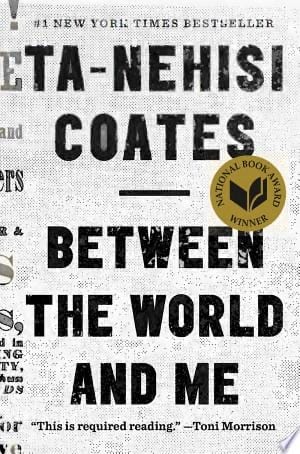
DESCRIPTION
#1 NEW YORK TIMES BESTSELLER • NATIONAL BOOK AWARD WINNER • NAMED ONE OF TIME’S TEN BEST NONFICTION BOOKS OF THE DECADE • PULITZER PRIZE FINALIST • NATIONAL BOOK CRITICS CIRCLE AWARD FINALIST • ONE OF OPRAH’S “BOOKS THAT HELP ME THROUGH” • NOW AN HBO ORIGINAL SPECIAL EVENT Hailed by Toni Morrison as “required reading,” a bold and personal literary exploration of America’s racial history by “the most important essayist in a generation and a writer who changed the national political conversation about race” (Rolling Stone) NAMED ONE OF THE NEW YORK TIMES’S 100 BEST BOOKS OF THE 21ST CENTURY • NAMED ONE OF THE MOST INFLUENTIAL BOOKS OF THE DECADE BY CNN • NAMED ONE OF PASTE’S BEST MEMOIRS OF THE DECADE • A KIRKUS REVIEWS BEST NONFICTION BOOK OF THE CENTURY ONE OF THE TEN BEST BOOKS OF THE YEAR: The New York Times Book Review, O: The Oprah Magazine, The Washington Post, People, Entertainment Weekly, Vogue, Los Angeles Times, San Francisco Chronicle, Chicago Tribune, New York, Newsday, Library Journal, Publishers Weekly In a profound work that pivots from the biggest questions about American history and ideals to the most intimate concerns of a father for his son, Ta-Nehisi Coates offers a powerful new framework for understanding our nation’s history and current crisis. Americans have built an empire on the idea of “race,” a falsehood that damages us all but falls most heavily on the bodies of black women and men—bodies exploited through slavery and segregation, and, today, threatened, locked up, and murdered out of all proportion. What is it like to inhabit a black body and find a way to live within it? And how can we all honestly reckon with this fraught history and free ourselves from its burden? Between the World and Me is Ta-Nehisi Coates’s attempt to answer these questions in a letter to his adolescent son. Coates shares with his son—and readers—the story of his awakening to the truth about his place in the world through a series of revelatory experiences, from Howard University to Civil War battlefields, from the South Side of Chicago to Paris, from his childhood home to the living rooms of mothers whose children’s lives were taken as American plunder. Beautifully woven from personal narrative, reimagined history, and fresh, emotionally charged reportage, Between the World and Me clearly illuminates the past, bracingly confronts our present, and offers a transcendent vision for a way forward.
My Summary
Attachment (file not included in this release)
Here is a summary of the key points from the PDF file “Between the World and Me” by Ta-Nehisi Coates:
Main Ideas
- Coates writes this book as a letter to his teenage son, sharing his experiences and perspectives as a Black man in America.
- He conveys the constant fear and reality of racial violence that Black Americans face, showing how racism and White supremacy are deeply embedded in America’s history, economy, and institutions.
- Coates recounts many examples of police brutality and discrimination against Black people, from personal experiences to high-profile cases like Prince Jones, Trayvon Martin, and Michael Brown.
- He criticizes the American Dream as being founded on the oppression of Black bodies through slavery, segregation, mass incarceration and economic exploitation.
- Coates argues that Black communities live in a different reality from White Americans, facing systematic threats to their safety and humanity.
- He wants his son to grow in consciousness of these racial injustices, see the full spectrum of Black life and culture, and continue the struggle through questioning and open eyes.
- The book title “Between the World and Me” refers to the gulf between the worlds of Black and White America. Coates aims to give his son resources to survive in America.
So in summary, it is a powerful personal narrative about the Black experience, unflinchingly facing racial injustice while affirming Black dignity and the richness of African-American communities.
Based on the passages, when Coates refers to “Dreamers” he is talking about white Americans who believe in and benefit from a national mythology of the United States as a just, noble, and innocent country.
Some key points about his view of Dreamers:
- They subscribe to the “Dream” of America as a meritocracy where hard work leads to success, while denying the oppression and exploitation that enabled and undergirds that dream.
- They think of themselves as heroic figures from adventure stories and popular culture, not as oppressors benefiting from injustice.
- They erase and forget the horrors of slavery, segregation, discrimination and their ongoing legacies that granted them power and privilege.
- They see themselves as noble, moral and “white” rather than fallible humans participating in a system of racial injustice.
- They justify police brutality and the destruction of black bodies to protect their sense of innocence and virtue.
So in essence, “Dreamers” refers to white Americans who deny the racist foundations of American society that granted them dominance, in order to preserve a myth of themselves as good and righteous people. It connects to ignoring racial injustice to protect a false innocence.
Based on the passages, the key resources Coates aims to give his son through this letter include:
- Knowledge and awareness of America’s history of racial injustice, violence against Black bodies, and the structures that enable this injustice to persist. He conveys his own experiences and perspectives to share the reality of what it means to live as a Black person in America.
- An understanding of the need to grow in consciousness, keep one’s eyes open, and continue questioning and struggling against racial injustice. He wants his son to see the full spectrum of Black life and culture.
- Lessons and wisdom from his own life and journey - his personal stories, his process of questioning, his experiences at Howard University. He shares these so his son can learn from them.
- The power of community, culture and people - emphasizing the richness of the Black community as a resource his son can draw strength from. “I had people - I always had people.”
- Literature, art and culture that enlighten the Black experience in America, from writers like James Baldwin to films like “12 Years a Slave.” He sees these as offering insight and tools for survival.
In summary, Coates aims to equip his teenage son with greater awareness, community ties, and a spirit of questioning and struggle against injustice to help him navigate life as a young Black man in America. The letter itself serves as a profound personal resource his son can return to.
Based on the search results, here are some of the main criticisms and arguments against Ta-Nehisi Coates’s book Between the World and Me:
- The book is not accessible or clear enough for a wide audience. Some find Coates’s writing style dense, forced, overwrought, anecdotal, and circular. It requires too much effort for the reader to follow his arguments ([2], [4]).
- The book expresses a bleak, pessimistic view of race relations without providing a constructive path forward. Some readers felt drained and defeated after reading it, rather than inspired or hopeful ([5]).
- The book fails to recognize the progress made against racism or individual success stories. Some argue Coates focuses too narrowly on oppression without acknowledging improvements in society or personal agency ([4]).
- The book attributes problems solely to racism while ignoring other factors. Some argue issues like poverty have complex causes, yet Coates reduces them to just race and white supremacy ([4]).
- The book stereotypes white people and makes sweeping generalizations. Some readers argue Coates unfairly profiles all white people as complicit in racism ([4]).
- The book indulges in racial essentialism. Some argue that defining people solely by race perpetuates the problem, rather than emphasizing our shared common humanity ([2]).
In summary, while some praise Between the World and Me as a powerful personal perspective, others critique it as an overwrought polemic that lacks solutions and makes questionable generalizations about race. Reasonable people can disagree on the book’s merits.
Citations:
[1]
https://observer.com/2015/07/why-ta-nehisi-coatess-between-the-world-and-me-is-not-the-masterpiece-we-hoped-for/
[2]
https://www.theatlantic.com/national/archive/2015/07/readers-critical-between-world-me-ta-nehisi-coates/399641/
[3]
https://www.salon.com/2021/09/27/ta-nehisi-coates-on-banning-books-thats-no-longer-education-thats-indoctrination/
[4]
https://www.theatlantic.com/national/archive/2015/08/between-the-world-and-me-book-club-your-final-critical-thoughts-ta-nehisi-coates/400421/
[5]
https://www.reddit.com/r/books/comments/47h7co/i_just_finished_tanehisi_coates_between_the_world/?rdt=63827
Highlights
There is nothing uniquely evil in these destroyers or even in this moment. The destroyers are merely men enforcing the whims of our country, correctly interpreting its heritage and legacy. It is hard to face this. But all our phrasing—race relations, racial chasm, racial justice, racial profiling, white privilege, even white supremacy— serves to obscure that racism is a visceral experience, that it dislodges brains, blocks airways, rips muscle, extracts organs, cracks bones, breaks teeth. You must never look away from this. You must always remember that the sociology, the history, the economics, the graphs, the charts, the regressions all land, with great violence, upon the body. (Page 11)
Tags: blue
Families, believing themselves white, were out on the streets. Infants, raised to be white, were bundled in strollers. (Page 11)
Tags: blue
She also taught me to write, by which I mean not simply organizing a set of sentences into a series of paragraphs, but organizing them as a means of investigation. When I was in trouble at school (which was quite often) she would make me write about it. The writing had to answer a series of questions: Why did I feel the need to talk at the same time as my teacher? Why did I not believe that my teacher was entitled to respect? How would I want someone to behave while I was talking? What would I do the next time I felt the urge to talk to my friends during a lesson? I have given you these same assignments. I gave them to you not because I thought they would curb your behavior— they certainly did not curb mine—but because these were the earliest acts of interrogation, of drawing myself into consciousness. (Page 24)
Tags: blue
Your grandmother was not teaching me how to behave in class. She was teaching me how to ruthlessly interrogate the subject that elicited the most sympathy and rationalizing—myself. (Page 24)
Tags: blue
few Americans will directly proclaim that they are in favor of black people being left to the streets. But a very large number of Americans will do all they can to preserve the Dream. No one directly proclaimed that schools were designed to sanctify failure and destruction. But a great number of educators spoke of “personal responsibility” in a country authored and sustained by a criminal irresponsibility. The point of this language of “intention” and “personal responsibility” is broad exoneration. Mistakes were made. Bodies were broken. People were enslaved. We meant well. We tried our best. “Good intention” is a hall pass through history, a sleeping pill that ensures the Dream. (Page 27)
Tags: blue
When I came to Howard, Chancellor Williams’s Destruction of Black Civilization was my Bible. (Page 35)
Tags: blue
Larry Neal, Eric Williams, George Padmore, Sonia Sanchez, Stanley Crouch, Harold Cruse, Manning (Page 35)
Tags: blue
Marable, Addison Gayle, Carolyn Rodgers, Etheridge Knight, Sterling Brown (Page 36)
Tags: blue
The older poets introduced me to artists who pulled their energy from the void—Bubber Miley, Otis Redding, Sam and Dave, C. K. Williams, Carolyn Forché. The older poets were Ethelbert Miller, Kenneth Carroll, Brian Gilmore. (Page 38)
Tags: blue
They had seen so many Malcolmites before and were ready. Their method was rough and direct. Did black skin really convey nobility? Always? Yes. What about the blacks who’d practiced slavery for millennia and sold slaves across the Sahara and then (Page 40)
across the sea? Victims of a trick. Would those be the same black kings who birthed all of civilization? Were they then both deposed masters of the galaxy and gullible puppets all at once? And what did I mean by “black”? You know, black. Did I think this a timeless category stretching into the deep past? Yes? Could it be supposed that simply because color was important to me, it had always been so? (Page 41)
Queen Nzinga (Page 41)
Tags: blue
discovered an essay by Ralph Wiley in which he responded to Bellow’s quip. “Tolstoy is the Tolstoy of the Zulus,” wrote Wiley. “Unless you find a profit in fencing off universal properties of mankind into exclusive tribal ownership.” And there it was. I had accepted Bellow’s premise. In fact, Bellow was no closer to Tolstoy than I was to Nzinga. And if I were closer it would be because I chose to be, not because of destiny written in DNA. My great error was not that I had accepted someone else’s dream but that I had accepted the fact of dreams, the need for escape, and the invention of racecraft. (Page 42)
Tags: blue
She had never known her father, which put her in the company of the greater number of everyone I’d known. I felt then that these men —these “fathers”—were the greatest of cowards. But I also felt that the galaxy was playing with loaded dice, which ensured an excess of cowards in our ranks. (Page 48)
Tags: blue
But your mother and I knew too many people who’d married and abandoned each other for less. The truth of us was always that you were our ring. We’d summoned you out of ourselves, and you were not given a vote. If only for that reason, you deserved all the protection we could muster. Everything else was subordinate to this fact. If that sounds like a weight, it shouldn’t. The truth is that I owe you everything I have. Before you, I had my questions but nothing beyond my own skin in the game, and that was really nothing at all because I was a young man, and not yet clear of my own human vulnerabilities. But I was grounded and domesticated by the plain fact that should I now go down, I would not go down alone. (Page 49)
Tags: blue
That wisdom is not unique to our people, but I think it has special meaning to those of us born out of mass rape, whose ancestors were carried off and divided up into policies and stocks. I have raised you to respect every human being as singular, and you must extend that same respect into the past. Slavery is not an indefinable mass of flesh. It is a particular, specific enslaved woman, whose mind is active as your own, whose range of feeling is as vast as your own; who prefers the way the light falls in one particular spot in the woods, who enjoys fishing where the water eddies in a nearby stream, who loves her mother in her own complicated way, thinks her sister talks too loud, has a favorite cousin, a favorite season, who excels at dressmaking and knows, inside herself, that she is as intelligent and capable as anyone. “Slavery” is this same woman born in a world that loudly proclaims its love of freedom and inscribes this (Page 51)
love in its essential texts, a world in which these same professors hold this woman a slave, hold her mother a slave, her father a slave, her daughter a slave, and when this woman peers back into the generations all she sees is the enslaved. She can hope for more. She can imagine some future for her grandchildren. But when she dies, the world—which is really the only world she can ever know—ends. For this woman, enslavement is not a parable. It is damnation. It is the never-ending night. And the length of that night is most of our history. Never forget that we were enslaved in this country longer than we have been free. Never forget that for 250 years black people were born into chains—whole generations followed by more generations who knew nothing but chains. (Page 52)
The birth of a better world is not ultimately up to you, though I know, each day, there are grown men and women who tell you otherwise. The world needs saving precisely because of the actions of these same men and women. I am not a cynic. I love you, and I love the world, and I love it more with every new inch I discover. But you are a black boy, and you must be responsible for your body in a way (Page 52)
that other boys cannot know. Indeed, you must be responsible for the worst actions of other black bodies, which, somehow, will always be assigned to you. And you must be responsible for the bodies of the powerful—the policeman who cracks you with a nightstick will quickly find his excuse in your furtive movements. And this is not reducible to just you—the women around you must be responsible for their bodies in a way that you never will know. You have to make your peace with the chaos, but you cannot lie. You cannot forget how much they took from us and how they transfigured our very bodies into sugar, tobacco, cotton, and gold. (Page 53)
And I knew that they’d shot Gary Hopkins and said he’d gone for an officer’s gun. (Page 55)
The problem with the police is not that they are fascist pigs but that our country is ruled by majoritarian pigs. (Page 57)
The officer who killed Prince Jones was black. The politicians who empowered this officer to kill were black. Many of the black politicians, many of them twice as good, seemed unconcerned. (Page 60)
I could see no difference between the officer who killed Prince Jones and the police who died, or the firefighters who died. They were not human to me. Black, white, or whatever, they were the menaces of nature; they were the fire, the comet, the storm, which could—with no justification—shatter my body. (Page 63)
Some days I would take the train into Manhattan. There was so much money everywhere, money flowing out of bistros and cafés, money pushing the people, at incredible speeds, up the wide avenues, money drawing intergalactic traffic through Times Square, money in the limestones and brownstones, money out on West Broadway where white people spilled out of wine bars with sloshing glasses and without police. I would see these people at the club, drunken, laughing, challenging breakdancers to battles. They would be destroyed and humiliated in these battles. But afterward they would give dap, laugh, order more beers. They were utterly fearless. I did not understand it until I looked out on the street. That was where I saw white parents pushing double-wide strollers down gentrifying Harlem boulevards in T-shirts and jogging shorts. Or I saw them lost in conversation with each other, mother and father, while their sons commanded entire sidewalks with their tricycles. The galaxy belonged to them, and as terror was communicated to our children, I saw mastery communicated to theirs. (Page 64)
All my life I’d heard people tell their black boys and black girls to “be twice as good,” which is to say “accept half as much.” (Page 65)
“I could have you arrested,” he said. Which is to say, “One of your son’s earliest memories will be watching the men who sodomized Abner Louima and choked Anthony Baez cuff, club, tase, and break you.” I had forgotten the rules, an error as dangerous on the Upper West Side of Manhattan as on the Westside of Baltimore. One must be without error out here. Walk in single file. Work quietly. Pack an extra number 2 pencil. Make no mistakes. (Page 69)
The fact of history is that black people have not—probably no people have ever—liberated themselves strictly through their own efforts. In every great change in the lives of African Americans we see the hand of events that were beyond our individual control, events that were not unalloyed goods. You cannot disconnect our emancipation in the Northern colonies from the blood spilled in the Revolutionary War, any more than you can disconnect our emancipation from slavery in the South from the charnel houses of the Civil War, any more than you can disconnect our emancipation from Jim Crow from the genocides of the Second World War. (Page 69)
But my experience in this world has been that the people who believe themselves to be white are obsessed with the politics of personal exoneration. And the word racist, to them, conjures, if not a tobacco-spitting oaf, then something just as fantastic—an orc, troll, or gorgon. (Page 70)
At the onset of the Civil War, our stolen bodies were worth four billion dollars, more than all of American industry, all of American railroads, workshops, and factories combined, and the prime product rendered by our stolen bodies—cotton—was America’s primary export. The richest men in America lived in the Mississippi River Valley, and they made their riches off our stolen bodies. Our bodies were held in bondage by the early presidents. Our bodies were traded from the White House by James K. Polk. Our bodies built the Capitol and the National Mall. The first shot of the Civil War was fired in South Carolina, where our bodies constituted the majority of human bodies in the state. (Page 72)
Here is what I would like for you to know: In America, it is traditional to destroy the black body—it is heritage. Enslavement was not merely the antiseptic borrowing of labor—it is not so easy to get a human being to commit their body against its own elemental interest. And so enslavement must be casual wrath and random manglings, the gashing of heads and brains blown out over the river as the body seeks to escape. It must be rape so regular as to be industrial. There is no uplifting way to say this. I have no praise anthems, nor old Negro spirituals. The spirit and soul are the body and brain, which are destructible—that is precisely why they are so precious. And the soul did not escape. The spirit did not steal away on gospel wings. The soul was the body that fed the tobacco, and the spirit was the blood that watered the cotton, and these created the first fruits of the American garden. And the fruits were secured through the bashing of children with stovewood, through hot iron peeling skin away like husk from corn. (Page 74)
You and I, my son, are that “below.” That was true in 1776. It is true today. There is no them without you, and without the right to break you they must necessarily fall from the mountain, lose their divinity, and tumble out of the Dream. And then they would have to determine how to build their suburbs on something other than human bones, how to angle their jails toward something other than a human stockyard, how to erect a democracy independent of cannibalism. But because they believe themselves to be white, they would rather countenance a man choked to death on film under their laws. (Page 75)
But part of what I know is that there is the burden of living among Dreamers, and there is the extra burden of your country telling you the Dream is just, noble, and real, and you are crazy for seeing the corruption and smelling the sulfur. For their innocence, they nullify your anger, your fear, until you are coming and going, and you find yourself inveighing against yourself—“Black people are the only people who…”—really inveighing against your own humanity and raging against the crime in your ghetto, because you are powerless before the great crime of history that brought the ghettos to be. (Page 76)
I am speaking to you as I always have—as the sober and serious man I have always wanted you to be, who does not apologize for his human feelings, who does not make excuses for his height, his long arms, his beautiful smile. You are growing into consciousness, and my wish for you is that you feel no need to constrict yourself to make other people comfortable. None of that can change the math anyway. I never wanted you to be twice as good as them, so much as I have always wanted you to attack every day of your brief bright life in struggle. The people who must believe they are white can never be your measuring stick. I would not have you descend into your own dream. I would have you be a conscious citizen of this terrible and beautiful world. (Page 77)
His manner was like all the powerless black people I’d ever known, exaggerating their bodies to conceal a fundamental plunder that they could not prevent. (Page 78)
The killing fields of Chicago, of Baltimore, of Detroit, were created by the policy of Dreamers, but their weight, their shame, rests solely upon those who are dying in them. There is a great deception in this. To yell “black-on-black crime” is to shoot a man and then shame him for bleeding. And the premise that allows for these killing fields—the reduction of the black body—is no different than the premise that allowed for the murder of Prince Jones. The Dream of acting white, of talking white, of being white, murdered Prince Jones as sure as it murders black people in Chicago with frightening regularity. Do not accept the lie. Do not drink from poison. The same hands that drew red lines around the life of Prince Jones drew red lines around the ghetto. (Page 79)
“You exist. You matter. You have value. You have every right to wear your hoodie, to play your music as loud as you want. You have every right to be you. And no one should deter you from being you. You have to be you. And you can never be afraid to be you.” (Page 81)
I confess that is because I am afraid. And I have no God to hold me up. And I believe that when they shatter the body they shatter everything, and I knew that all of us—Christians, Muslims, atheists—lived in this fear of this truth. (Page 81)
I wanted you to have your own life, apart from fear—even apart from me. I am wounded. I am marked by old codes, which shielded me in one world and then chained me in the next. (Page 88)
And I am now ashamed of the thought, ashamed of my fear, of the generational chains I tried to clasp onto your wrists. We are entering our last years together, and I wish I had been softer with you. Your mother had to teach me how to love you— how to kiss you and tell you I love you every night. Even now it does not feel a wholly natural act so much as it feels like ritual. And that is because I am wounded. That is because I am tied to old ways, which I learned in a hard house. It was a loving house even as it was besieged by its country, but it was hard. (Page 89)
Your route will be different. It must be. You knew things at eleven that I did not know when I was twenty-five. When I was eleven my highest priority was the simple security of my body. My life was the immediate negotiation of violence—within my house and without. But already you have expectations, I see that in you. Survival and safety are not enough. Your hopes—your dreams, if you will—leave me with an array of warring emotions. I am so very proud of you— your openness, your ambition, your aggression, your intelligence. My job, in the little time we have left together, is to match that intelligence with wisdom. Part of that wisdom is understanding what you were given—a city where gay bars are unremarkable, a soccer team on which half the players speak some other language. What I am saying is that it does not all belong to you, that the beauty in you is not strictly yours and is largely the result of enjoying an abnormal amount of security in your black body. (Page 92)
Our current politics tell you that should you fall victim to such an assault and lose your body, it somehow must be your fault. Trayvon Martin’s hoodie got him killed. Jordan Davis’s loud music did the same. John Crawford should never have touched the rifle on display. Kajieme Powell should have known not to be crazy. And all of them should have had fathers—even the ones who had fathers, even you. Without its own justifications, the Dream would collapse upon itself. You first learned this from Michael Brown. I first learned it from Prince Jones. (Page 92)
And they are torturing Muslims, and their drones are bombing wedding parties (by accident!), and the Dreamers are quoting Martin Luther King and exulting nonviolence for the weak and the biggest guns for the strong. Each time a police officer engages us, death, injury, maiming is possible. It is not enough to say that this is true of anyone or more true of criminals. The moment the officers began their pursuit of Prince Jones, his life was in danger. The Dreamers accept this as the cost of doing business, accept our bodies as currency, because it is their tradition. As slaves we were this country’s first windfall, the down payment on its freedom. After the ruin and liberation of the Civil War came Redemption for the unrepentant South and Reunion, and our bodies became this country’s second mortgage. In the New Deal we were their guestroom, their finished basement. And today, with a sprawling prison system, which has turned the warehousing of black bodies into a jobs program for Dreamers and a lucrative investment for Dreamers; today, when 8 percent of the world’s prisoners are black men, our bodies have refinanced the Dream of being white. Black life is cheap, but in America black bodies are a natural resource of incomparable value. (Page 93)
because the fact is that I had not known Prince all that well. He was among the people I would be happy to see at a party, whom I would describe to a friend as “a good brother,” though I could not really account for his comings and goings. (Page 98)
Once, the Dream’s parameters were caged by technology and by the limits of horsepower and wind. But the Dreamers have improved themselves, and the damming of seas for voltage, the extraction of coal, the transmuting of oil into food, have enabled an expansion in plunder with no known precedent. And this revolution has freed the Dreamers to plunder not just the bodies of humans but the body of the Earth itself. The Earth is not our creation. It has no respect for us. It has no use for us. And its vengeance is not the fire in the cities but the fire in the sky. Something more fierce than Marcus Garvey is riding on the whirlwind. Something more awful than all our African ancestors is rising with the seas. The two phenomena are known to each other. It was the cotton that passed through our chained hands that inaugurated this age. It is the flight from us that sent them sprawling into the subdivided woods. And the methods of transport through these new subdivisions, across the sprawl, is the automobile, the noose around the neck of the earth, and ultimately, the Dreamers themselves. (Page 105)
I drove away from the house of Mable Jones thinking of all of this. I drove away, as always, thinking of you. I do not believe that we can stop them, Samori, because they must ultimately stop themselves. And still I urge you to struggle. Struggle for the memory of your ancestors. Struggle for wisdom. Struggle for the warmth of The Mecca. Struggle for your grandmother and grandfather, for your name. But do not struggle for the Dreamers. Hope for them. Pray for them, if you are so moved. But do not pin your struggle on their conversion. The Dreamers will have to learn to struggle themselves, to understand that the field for their Dream, the stage where they have painted themselves white, is the deathbed of us all. The Dream is the same habit that endangers the planet, the same habit that sees our bodies stowed away in prisons and ghettos. I saw these ghettos driving back from Dr. Jones’s home. They were the same ghettos I had seen in Chicago all those years ago, the same ghettos where my mother was raised, where my father was raised. Through the windshield I saw the mark of these ghettos—the abundance of beauty shops, churches, liquor stores, and crumbling housing—and I felt the old fear. Through the windshield I saw the rain coming down in sheets. (Page 106)