Systematic study pathway
supplies an ordered checklist of books, selected chapters, primary articles, videos and comparison exercises. records the Goodreads and Libib matches.
Critical Theory
Definition
- Critical Theory: All systems of power are to help the upper class
- Critical Race Theory: All systems of power were created to help specific races.
- Critical race theorists reject the philosophy of “colorblindness.” They acknowledge the stark racial disparities that have persistedin the United States despite decades of civil rights reforms, and they raise structural questions about how racist hierarchies are enforced, even among people with good intentions. Proponents tend to understand race as a creation of society, not a biological reality. And many say it is important to elevate the voices and stories of people who experience racism. NYTimes
- considers racism to be systemic in various laws and rules, and not based only on individuals’ prejudices.
- The word critical in the name is an academic reference to critical theory rather than criticizing or blaming individuals.
- CRT is also used in sociology to explain social, political, and legal structures and power distribution as through a “lens” focusing on the concept of race, and experiences of racism. Wikipedia
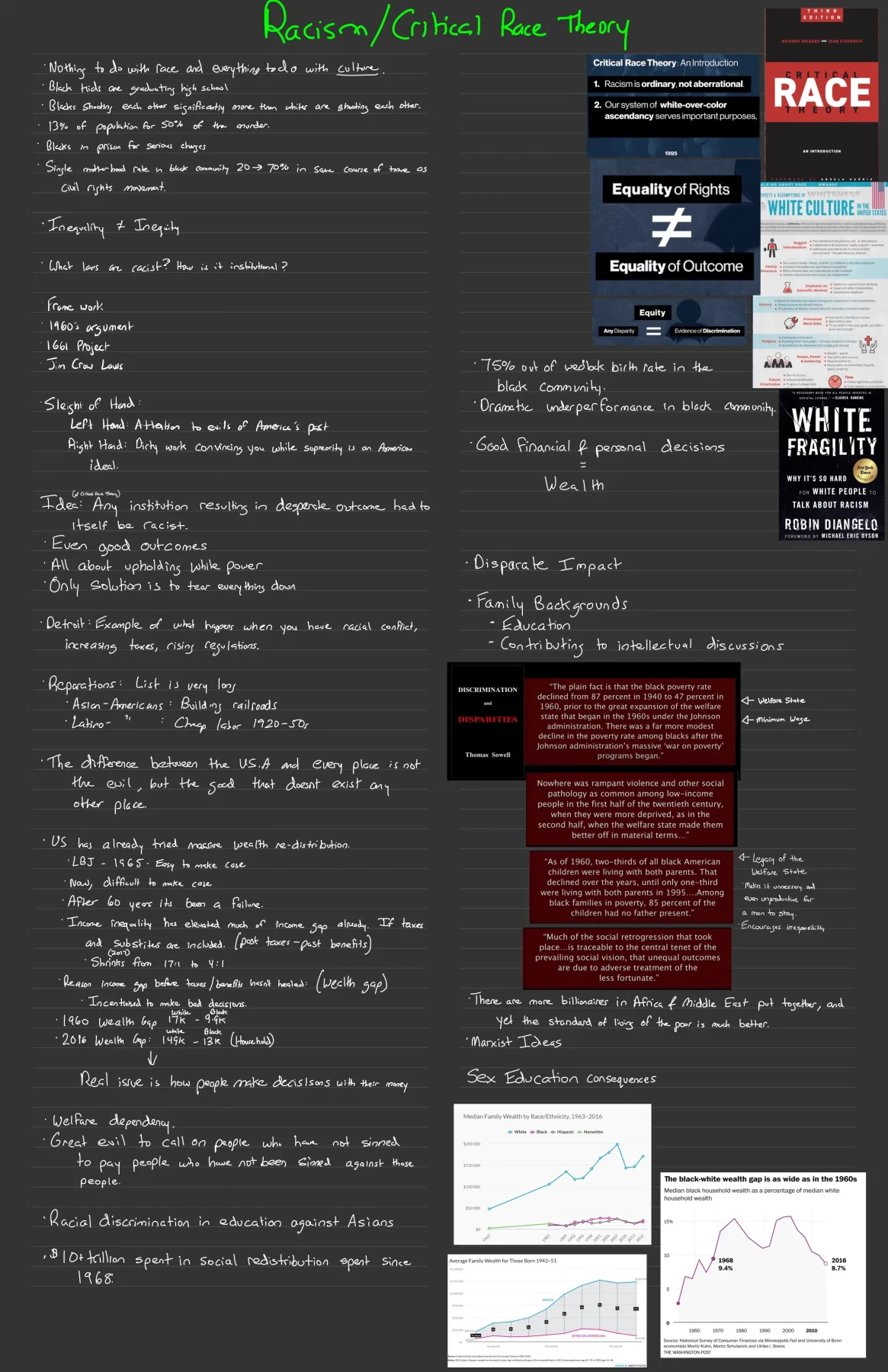
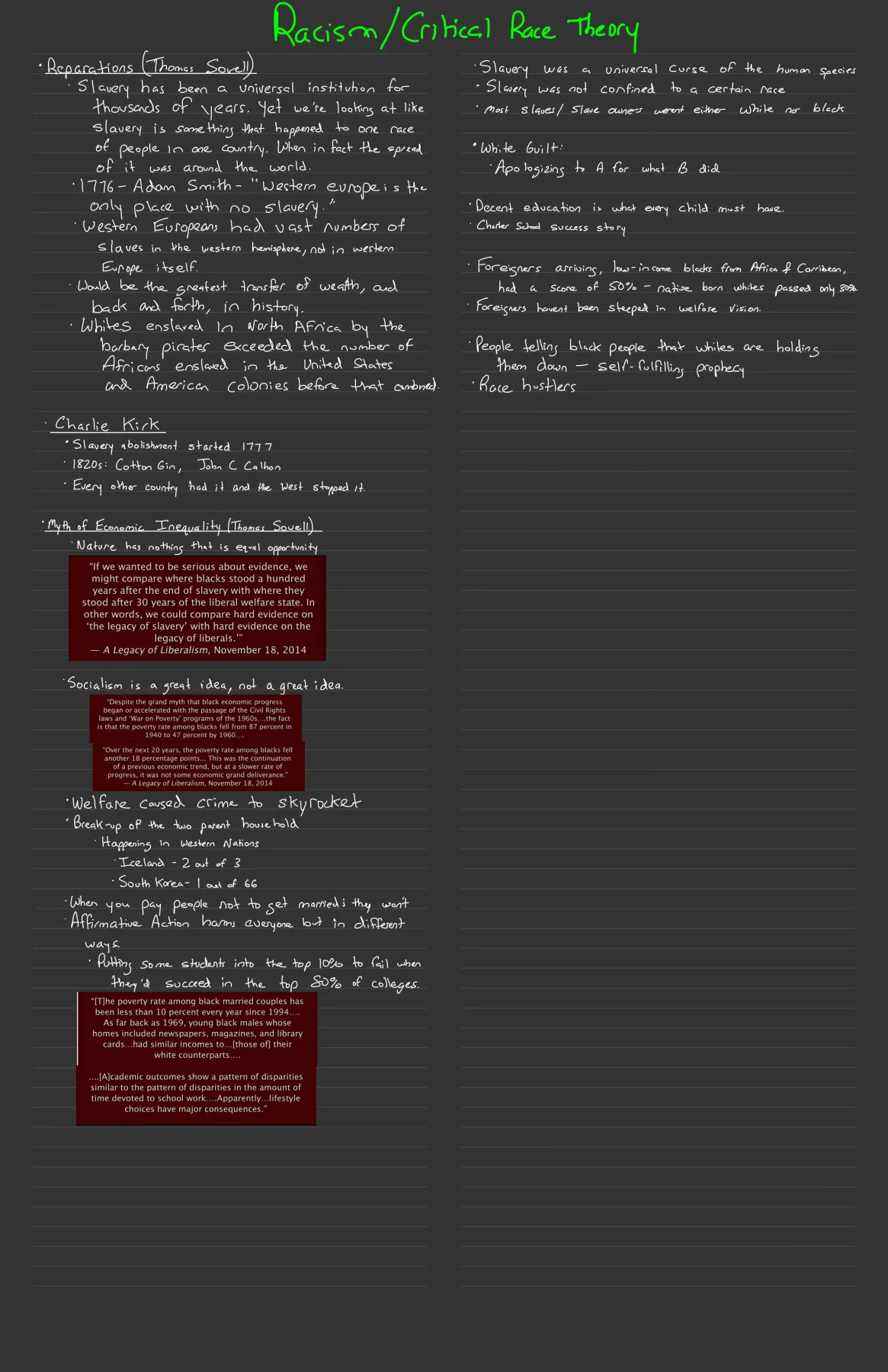
- Charlie Kirk has a definition of CRT I personally prefer, “Call everything racist until you control it.” Murray talks about how CRT is not based on evidence or data, but a person’s “lived experience.” It essentially based on interpretations and attitudes. One’s own perception became sufficient as evidence. Murray write, “At its best, the shift from evidence to “me” allowed a stalemate: You have your views and reality. I have mine. At its worst, it left any exchange of ideas vulnerable to being taken over by bad-faith actors who simply insisted that things are as they say they are. And that is precisely what happened.”
- In their 2001 work Critical Race Theory: An Introduction, author Richard Delgado and Jean Stefancic admiringly described CRT as a “movement” consisting of “a collection of activists and scholars interested in studying and transforming the relationship among race, racism and power. The movement considers many of the same issues that conventional civil rights and ethnic studies discourses take up, but places them in a broader perspective that includes economics, history, context, group and self-interest, and even feelings and the unconscious. Unlike traditional civil rights, which embraces incrementalism and step-by-step progress, critical race theory questions the very foundations of the liberal order, including equality theory, legal reasoning, Enlightenment rationalism, and neutral principles of constitutional law.”
Timeline
Here is a comprehensive timeline of the development of Critical Race Theory (CRT), including its origins, key figures, and subsequent contributions:
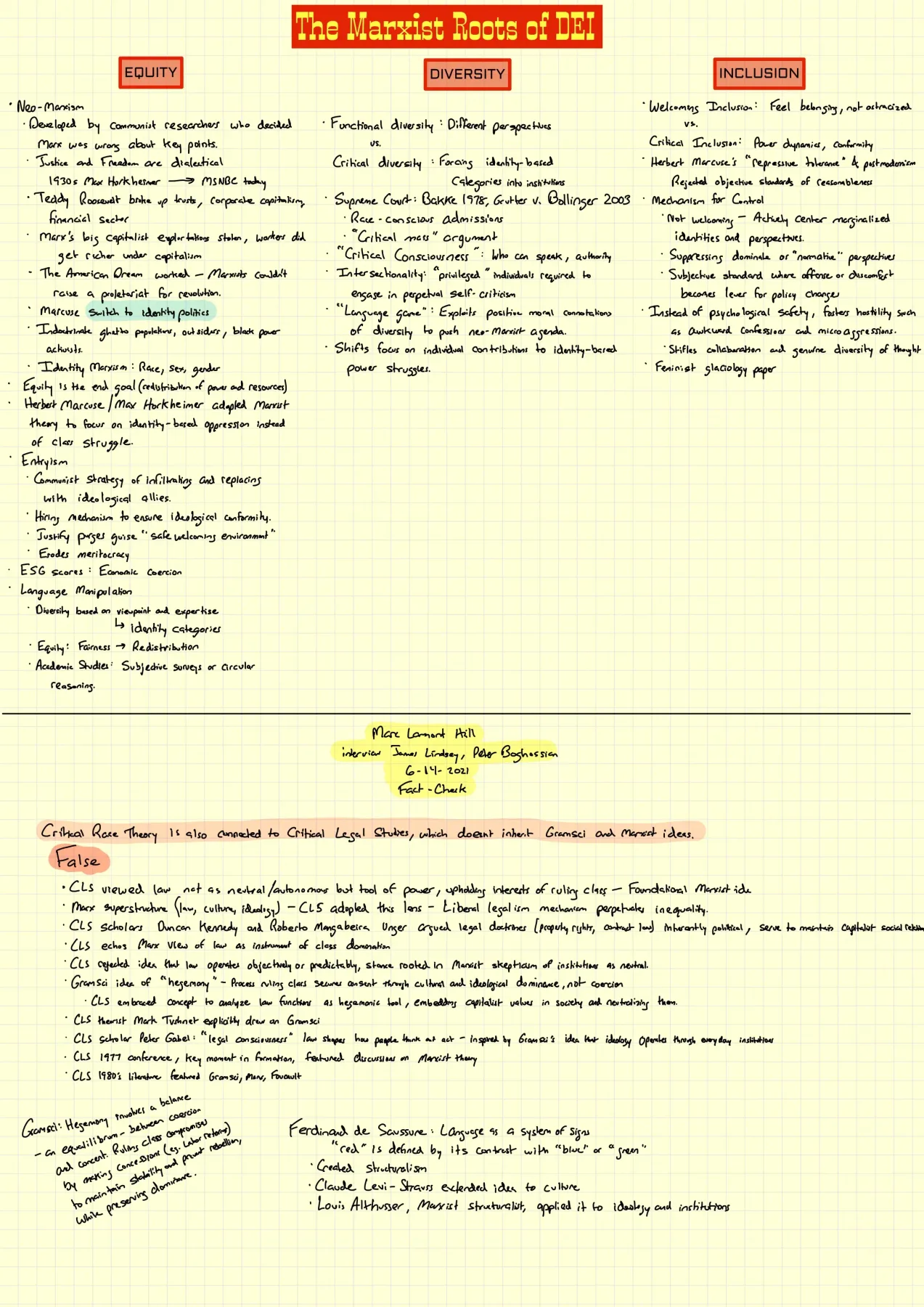
Herbert Marcuse, a German-American philosopher associated with the Frankfurt School, is often linked to the development of critical race theory (CRT) through his contributions to critical theory. Marcuse’s work primarily focused on critiquing capitalism, modern technology, and cultural institutions, and he was a prominent figure in the New Left movement during the 1960s and 1970s[1].
Critical race theory emerged as an offshoot of critical theory, which was developed by the Frankfurt School. Critical theory sought to critique and change society by challenging the status quo and addressing issues of power and oppression. Marcuse played a role in transforming critical theory into a framework that could address racial issues by identifying racial minorities as a new “worker” class for revolutionary change. He suggested that these groups could be re-educated to challenge societal norms and institutions that perpetuate oppression[3].
While Marcuse did not directly create CRT, his ideas influenced its development by providing a theoretical foundation that emphasized the critique of societal structures and the role of marginalized groups in revolutionary change. His work highlighted the potential for racial minorities to be agents of change within the broader context of social and political transformation[2][3].
Citations:
[1] https://en.wikipedia.org/wiki/Herbert_Marcuse
[2] https://blog.pmpress.org/2022/01/23/behind-recent-attacks-on-herbert-marcuse/
[3] https://www.newsweek.com/critical-race-theory-repackaged-marxism-opinion-1599557
[4] https://www.bu.edu/wcp/Papers/Educ/EducReit.htm
Herbert Marcuse’s concept of “repressive tolerance” is articulated in his 1965 essay of the same name. In this work, Marcuse critiques the conventional understanding of tolerance in liberal societies, arguing that it can serve as a tool for repression rather than liberation. He contends that the prevailing form of tolerance in capitalist democracies often supports the status quo and suppresses genuine dissent, thereby maintaining existing power structures[1][3][6].
Marcuse’s central thesis is that true tolerance should not be indiscriminate. Instead, he proposes “liberating tolerance,” which involves being intolerant of right-wing and repressive movements while being tolerant of left-wing and progressive movements. He argues that this selective tolerance is necessary to foster social progress and challenge the dominant, oppressive ideologies that benefit from the guise of “pure” tolerance[3][7].
Marcuse’s argument is rooted in the idea that the liberal notion of tolerance has become a means of maintaining control within a “totally administered society.” He suggests that genuine tolerance should aim to advance democratic conditions and support dissent against repressive forces. This perspective has been both praised and criticized, with some viewing it as a justification for censorship and others seeing it as a necessary critique of how tolerance is practiced in society[1][2][6].
Citations:
[1] https://ecommons.luc.edu/philosophy_facpubs/71/
[2] https://www.reddit.com/r/CriticalTheory/comments/p19o3l/repressive_tolerance_by_herbert_marcuse_a_call/
[3] https://outsidertheory.com/right-marcuseanism/
[4] https://www.reddit.com/r/CriticalTheory/comments/12offj5/are_there_any_commentaries_on_marcuses_repressive/
[5] https://www.marcuse.org/herbert/publications/1960s/1965-repressive-tolerance-1969.pdf
[6] https://blogs.bu.edu/guidedhistory/law-and-religion/ameen-k/
[7] https://en.wikipedia.org/wiki/Herbert_Marcuse
| Year | Event/Development | Influences/Key Figures | Contributors/Developments |
|---|---|---|---|
| 1960s-1970s | Intellectual roots in Critical Legal Studies (CLS) and legal realism | Oliver Wendell Holmes, Karl Llewellyn, Benjamin N. Cardozo | CLS scholars challenged the impartiality of the law and its role in perpetuating social inequalities[3][6] |
| 1970s | Emergence of CRT concepts | Derrick Bell, Alan Freeman | Bell’s work on racial realism and interest convergence laid foundational ideas for CRT[4][8] |
| 1980 | Publication of “Brown v. Board of Education and the Interest-Convergence Dilemma” | Derrick Bell | Introduced the concept of interest convergence, arguing that civil rights advances occur when they align with white interests[8] |
| 1987 | Publication of “And We Are Not Saved: The Elusive Quest for Racial Justice” | Derrick Bell | Explored the permanence of racism in American society[3] |
| 1989 | First Workshop on Critical Race Theory at University of Wisconsin-Madison | Kimberlé Crenshaw, Neil Gotanda, Stephanie Phillips | The term “Critical Race Theory” was coined, marking the official organization of CRT[4][6] |
| 1990 | Increased publication of CRT works | Richard Delgado, Patricia Williams, Mari Matsuda, Alan Freeman | Legal scholars began publishing extensively on CRT, furthering its discourse[4][8] |
| 1991 | Publication of “The Alchemy of Race and Rights” | Patricia Williams | Critiqued the intersection of race, law, and civil rights[3][4] |
| 1992 | Publication of “Faces at the Bottom of the Well” | Derrick Bell | Developed the concept of racial realism, arguing that racism is a permanent fixture in American society[4][8] |
| 1993 | Publication of “Whiteness as Property” | Cheryl I. Harris | Examined the legal construction of whiteness as a form of property[4] |
| 1995 | Application of CRT in education | Gloria Ladson-Billings, William F. Tate | Applied CRT framework to analyze inequities in education[4] |
| 2000s | Emergence of related CRT scholarship | Various scholars | Development of LatCrit, AsianCrit, and TribalCrit, focusing on specific racial and ethnic experiences[4] |
| 2020 | Presidential Session on “Intersectionality and Critical Race Theory” | Kimberlé Crenshaw, others | Brought together various strains of CRT, emphasizing intersectionality[3] |
This table highlights the critical milestones and key figures in the development of Critical Race Theory, tracing its intellectual roots, foundational contributions, and subsequent expansions into various domains.
Citations:
[1] https://digitalcommons.law.buffalo.edu/journal_articles/433/
[2] https://experts.syr.edu/en/publications/critical-race-theory-its-origins-history-and-importance-to-the-di
[3] https://www.blackpast.org/african-american-history/critical-race-theory-a-brief-history/
[4] https://en.wikipedia.org/wiki/Critical_race_theory
[5] https://thenewpress.com/books/critical-race-theory
[6] https://www.britannica.com/topic/critical-race-theory
[7] https://news.temple.edu/news/2021-08-05/untangling-controversy-around-critical-race-theory
[8] https://www.newyorker.com/magazine/2021/09/20/the-man-behind-critical-race-theory
[9] https://www.americanbar.org/groups/crsj/publications/human_rights_magazine_home/civil-rights-reimagining-policing/a-lesson-on-critical-race-theory/
Origins
- Founders
- Richard Delgado
- Jean Stefancic
- Derrick Bell
- Alan Freeman
- Started as an law theory
- CRT began in the United States in the post–civil rights era, as 1960s landmark civil rights laws were being eroded and schools were being re-segregated. With racial inequalities persisting even after civil rights legislation and color-blind laws were enacted, CRT scholars in the 1970s and 1980s began reworking and expanding critical legal studies(CLS) theories on class, economic structure, and the law to examine the role of US law in perpetuating racism. CRT, a framework of analysis grounded in critical theory, originated in the mid-1970s in the writings of several American legal scholars, including Derrick Bell, Alan Freeman, Kimberlé Crenshaw, Richard Delgado, Cheryl Harris, Charles R. Lawrence III, Mari Matsuda, and Patricia J. Williams. CRT draws from the work of thinkers such as Antonio Gramsci, Sojourner Truth, Frederick Douglass, and W. E. B. Du Bois, as well as the Black Power, Chicano, and radical feminist movements from the 1960s and 1970s.
- Jean-Paul Sartre, who’s a ridiculous communist French philosopher who has been taken seriously by liberals for half a century, wrote the exact same thing in his introduction to a book called “The Wretched of the Earth” by Frantz Fanon. In it, he suggests that the West should essentially accept violence upon itself from Third World peoples in order to expiate its own sins of colonialism. This Worldview Is Totally Evil. And It’s Now Mainstream
Principles of CRT
- Activist ideology movement to tear away at the systems of the United States
- “Racism is ordinary and not aberrational. Usual way society does business.”
- You are racist even if you don’t know your racist
- Racism is ordinary
- “Most would agree that our system of white over color ascendancy serves important purposes both psychic and material. The first feature ordinariness means that racism is difficult to cure or address. Color blind or formal conceptions of equality expressed in rules that insist only treatment that is the same across the board can thus remedy only the most blatant forms of discrimination such as mortgage redlining or refusal to hire black PhD rather than a white high school drop out that do stand out and attract our attention.”
- Key tenets
- Racism is very difficult to cure
- You cannot fight racism at an individual level
- Everything must be leveled. torn out by the roots
- If no equal outcome = Inequity
- The more vague the supposed racism the better to fight
- Ghost hunting
- Cultish
- Deeply tied into policy
- Material determinism
- Neo-Marxist
- Your whiteness makes you enjoy the racism of the system
- “The social construction thesis holds that race and racism are products of social thought and relations not objective inherent or fixed. They correspond to no biological or genetic reality rather races are categories that society invents, manipulates or retires when convenient.”
- Systems of power are racists and made up race to damn other people
- You get beyond by embracing race.
- Unique voice of color. Minority status presumed competence to communicate their circumstance to whites.
- More important than the 3rd thesis
- Minority status if people more of a right to talk than the majority.
People
- Kimberly Crenshaw
- Derrick Bell
- End goal to explode the system
Reading List
Critical Theory Booklist with Summaries
Kant, Idealism, and Nietzsche
- Kant - Critique of Pure Reason: Kant explores the nature of human knowledge and argues that our understanding of the empirical world is shaped by the way our mind processes experiences, introducing his famous distinction between phenomena and noumena.
- Kant - Groundwork of the Metaphysics of Morals: This work lays out Kant’s ethical philosophy, proposing that moral action is guided by categorical imperatives—universal principles derived from reason.
- Fichte - An Attempt at a Critique of All Revelation: Fichte discusses the concept of divine revelation, blending his ideas with Kant’s philosophy to argue that faith and reason are not opposed.
- Hegel - The Phenomenology of Spirit: Hegel presents a complex analysis of the development of consciousness, spirit, and self-awareness, through a dialectical process.
- Hegel - Philosophy of History: This book outlines Hegel’s view of history as a rational process, where freedom is realized through the unfolding of the world spirit.
- Schopenhauer - The World as Will and Representation: Schopenhauer argues that the world is driven by a non-rational will, offering a pessimistic view of nature and human desire.
- Nietzsche - Beyond Good and Evil: Nietzsche critiques traditional morality, emphasizing the importance of individualism and questioning the dichotomy of good versus evil.
- Nietzsche - On the Genealogy of Morals: This work is a historical analysis of moral concepts, where Nietzsche argues that morality is a product of societal power dynamics.
- Nietzsche - Twilight of the Idols: In this book, Nietzsche delivers a scathing critique of conventional philosophical beliefs and societal norms.
Marxism
- Marx - Economic and Philosophical Manuscripts of 1844: Marx discusses his theory of human nature and the alienating effects of capitalism on workers and their labor.
- Marx - Theses on Feuerbach: This short text criticizes the materialist philosophy of Feuerbach, leading to Marx’s development of historical materialism.
- Marx - The German Ideology: Marx and Engels outline their theory of history, emphasizing the importance of economic factors in shaping social structures.
- Marx - Capital: A foundational text for Marxist economics, analyzing the capitalist system, its dynamics, and the laws of capitalist development.
- Lukacs - History and Class Consciousness: Lukács introduces the concept of reification and discusses the consciousness of the proletariat within capitalist societies.
- Gramsci - The Prison Notebooks: Gramsci’s writings from prison cover a range of topics, including cultural hegemony and the role of intellectuals in society.
Phenomenology
- Husserl - The Crisis of the European Sciences: Husserl addresses the crisis in science and rationality in Europe, proposing phenomenology as a solution.
- Heidegger - Being and Time: Heidegger explores the nature of being, human existence, and time, challenging traditional metaphysical concepts.
- Merleau-Ponty - Phenomenology of Perception: This book challenges traditional ideas about perception and argues that our body plays a central role in experience and understanding.
Structuralism
- Saussure - Course on General Linguistics: Saussure lays the foundation for structural linguistics, discussing the relationship between speech, writing, and meaning.
- Levi-Strauss - Tristes Tropiques: Lévi-Strauss combines travelogue and anthropological study, offering insights into various cultures and the practice of anthropology.
- Barthes - Mythologies: Barthes analyzes modern cultural phenomena, showing how they can be understood as systems of signs, creating cultural myths.
Psychoanalysis
- Freud - The Interpretation of Dreams: Freud introduces his theory of the unconscious and the interpretation of dreams as a window into the unconscious mind.
- Freud - Totem and Taboo: This work explores the origins of religion and moral systems, drawing parallels between the psychological development of children and primitive societies.
- Freud - Beyond the Pleasure Principle: Freud discusses the concept of the death drive, expanding his theory of human psychology.
- Freud - Civilization and its Discontents: Freud examines the conflict between individual’s instinctual drives and the demands of civilization.
- Jung - Man and His Symbols: Jung explores the significance of symbols in human life, particularly in dreams, and introduces key concepts of analytical psychology.
- Lacan - Ecrits: A collection of Lacan’s writings, it introduces his reinterpretation of Freudian psychoanalysis, focusing on language and the symbolic order.
- Lacan - Seminars XI: The Four Fundamental Concepts of Psychoanalysis: Lacan discusses the essential concepts of his psychoanalytic theory, including the unconscious, repetition, and the drive.
Frankfurt School
- Benjamin - “The Work of Art in the Age of Mechanical Reproduction”: Benjamin examines the impact of mass production on art, culture, and politics.
- Fromm - The Fear of Freedom: Fromm analyzes the psychological consequences of political and economic freedom, focusing on the rise of totalitarianism.
- Horkheimer - “Traditional and Critical Theory”: Horkheimer outlines the principles of critical theory, differentiating it from traditional theory.
- Horkheimer and Adorno - The Dialectic of Enlightenment: This book critiques the Enlightenment and modernity, arguing that rationality can lead to domination and totalitarianism.
- Adorno - Minima Moralia: Adorno presents reflections on everyday life in capitalist society, exploring the intersection of personal and political.
- Marcuse - Eros and Civilization: Marcuse combines Marx and Freud, arguing for the potential of non-repressive societies.
- Marcuse - The One-Dimensional Man: This work critiques advanced industrial societies, arguing they suppress critical thought and promote a conformist culture.
- Adorno - Negative Dialectics: Adorno proposes a method of dialectical thinking that seeks to challenge totalizing systems of thought.
- Habermas - The Structural Transformation of the Public Sphere: Habermas explores the development of public spaces and their role in democratic discourse.
- Habermas - The Theory of Communicative Action: This book introduces Habermas’s theory of communicative rationality and its implications for social theory and democracy.
Other
- Bataille - The Accursed Share: Bataille discusses the concept of excess energy in economies and its role in social and cultural activities.
- Bataille - Visions of Excess: A collection of essays, Bataille explores themes of eroticism, mysticism, and the philosophy of excess.
- Debord - The Society of the Spectacle: Debord critiques contemporary consumer culture and the commodification of social life.
- Vaneigem - The Revolution of Everyday Life: Vaneigem examines everyday life under capitalism and advocates for its transformation through revolutionary means.
Poststructuralism/postmodernism
- Barthes - Image/Music/Text: Barthes analyzes the role of images, music, and texts in constructing
meanings in society.
- Foucault - The History of Madness: Foucault traces the history of Western attitudes towards madness, challenging traditional notions of mental illness.
- Foucault - The Birth of the Clinic: This work examines the emergence of modern medical institutions and practices, and their impact on knowledge about the human body.
- Foucault - Discipline & Punish: Foucault explores the history of the modern penal system and its role in shaping power relations in society.
- Foucault - The History of Sexuality: Foucault analyzes the role of sexuality in Western societies, challenging the repressive hypothesis.
- Derrida - Of Grammatology: Derrida deconstructs the idea of fixed meaning in texts, introducing the concept of ‘différance’.
- Derrida - Writing and Difference: A collection of essays where Derrida explores the relationship between writing, language, and philosophy.
- Derrida - Speech and Phenomena: Derrida discusses the relationship between speech, writing, and the phenomenology of Husserl.
- Deleuze and Guattari - Anti-Oedipus: This book critiques psychoanalytic theories of the unconscious and proposes a radical political and social theory.
- Deleuze and Guattari - A Thousand Plateaus: An exploration of ‘rhizomatic’ structures in various fields, challenging traditional hierarchical models.
- Lyotard - The Postmodern Condition: Lyotard analyzes the nature of knowledge in postmodern societies, introducing the concept of the ‘metanarrative’.
- Baudrillard - Simulacra and Simulation: Baudrillard examines the relationships between reality, symbols, and society, arguing that in the contemporary world, simulations replace the real.
- Agamben - Homo Sacer: Sovereign Power and Bare Life: Agamben explores the concept of ‘bare life’ and its implications for politics and sovereignty.
Feminism
- de Beauvoir - The Second Sex: De Beauvoir’s seminal work on feminism, examining the treatment and perception of women throughout history.
- Kristeva - The Kristeva Reader: A collection of essays by Kristeva, exploring topics such as language, psychoanalysis, and feminism.
- Cixous - The Laugh of the Medusa: Cixous advocates for a distinctive women’s writing, challenging traditional patriarchal structures of literature.
- Irigaray - Speculum of the Other Woman: Irigaray critiques male-dominated discourse in psychoanalysis and philosophy, arguing for a feminine language.
- Irigaray - This Sex Which Is Not One: This book continues Irigaray’s exploration of feminine language and sexuality, challenging conventional notions of gender.
- Mulvey - “Visual Pleasure and Narrative Cinema”: Mulvey’s influential essay on the male gaze in cinema and its implications for feminist theory.
Post-Marxism
- Althusser - Reading Capital: Althusser offers a structuralist reinterpretation of Marx’s Capital, emphasizing the scientific aspects of Marxist theory.
- Althusser - Lenin and Philosophy and Other Essays: A collection of essays, including Althusser’s influential ideas on ideology and ideological state apparatuses.
- Baudrillard - For a Critique of the Political Economy of the Sign: Baudrillard explores the significance of signs and symbols in consumer society.
- Baudrillard - The Mirror of Production: This work critiques traditional Marxist theories of production and proposes a radical rethinking of the economic system.
- Jameson - Postmodernism, or, the Cultural Logic of Late Capitalism: Jameson examines the cultural forms and expressions associated with the stage of capitalism he calls ‘late capitalism’.
- Badiou - Theory of the Subject: Badiou discusses the relationship between the individual (subject) and structures of truth and event.
- Laclau and Mouffe - Hegemony and Socialist Strategy: They propose a radical democratic approach to politics, reinterpreting the concept of hegemony.
- Zizek - The Sublime Object of Ideology: Žižek combines Lacanian psychoanalysis with Marxist theory to explore the functioning of ideology.
- Derrida - Spectres of Marx: Derrida engages with Marx’s works, offering a critique and a rethinking of Marxism in the contemporary world.
- Hardt and Negri - Empire: They propose a new framework for understanding global power dynamics, focusing on the concept of ‘Empire’.
- Hardt and Negri - Multitude: War and Democracy in the Age of Empire: This book extends the discussion in ‘Empire’, focusing on the role of the ‘multitude’ in global politics.
- Hardt and Negri - Commonwealth: The final part of the trilogy, discussing the possibility of a new, more equitable and democratic society.
Postcolonial Theory
- Fanon - The Wretched of the Earth: Fanon’s analysis of the psychological and cultural impacts of colonialism, advocating for anti-colonial struggle.
- Said - Orientalism: Said critiques Western perceptions of Eastern cultures, introducing the concept of ‘Orientalism’.
- Spivak - “Can the Subaltern Speak?”: Spivak discusses the ability of marginalized groups to speak and be heard within existing power structures.
- Bhabha - The Location of Culture: Bhabha explores the concept of cultural hybridity and the intersection of culture, postcolonialism, and globalization.
- Mignolo - The Darker Side of the Renaissance: Mignolo examines the impact of colonialism on the Renaissance, focusing on the disruption of the classical tradition.
Queer Theory
- Butler - Gender Trouble: Butler challenges conventional notions of gender, introducing the concept of gender performativity.
- Sedgwick - Epistemology of the Closet: Sedgwick explores the ways in which sexual orientation has been constructed and represented in Western culture.
- Halberstam - Female Masculinity: Halberstam examines the phenomenon of female masculinity and its implications for gender and sexuality.
- Halperin - Saint Foucault: A tribute to Foucault’s influence on queer theory, examining his contributions and legacy.
- Edelman - No Future: Edelman critiques the centrality of ‘reproductive futurism’ in political and social discourse, arguing for a queer negation of this ideology.
Secondary Texts:
These texts offer interpretations, critiques, and extensions of the primary theories.
This summary only scratches the surface of the rich and complex ideas presented in these works. The conflicts mentioned represent broader themes of disagreement or differing perspectives within each field.
- AI Essay on the topic
Certainly! Given the expansive scope of the texts you’ve provided, I’ll craft an essay focusing on several key themes from these works, including the nature of human consciousness, the role of power and economics in society, and the impact of language and culture on human experience. The essay will also touch upon the conflicts and divergences within these theories.
Critical Theory: A Synthesis of Philosophical Perspectives
Critical theory, as a discipline, spans an immensely broad range of topics, from the nature of human consciousness and morality to the intricate structures of power and economy in society. This essay seeks to synthesize key insights from a selection of foundational texts in critical theory, covering philosophical ideals, Marxism, phenomenology, structuralism, psychoanalysis, and postmodernism, among others.
Kantian Ideals and the Foundations of Morality
The journey begins with Immanuel Kant, whose works like “Critique of Pure Reason” and “Groundwork of the Metaphysics of Morals” lay the groundwork for modern philosophy. Kant’s rigorous analysis of human reason and his assertion that knowledge is rooted in our experiences set a precedent for understanding reality. He argued for a moral law grounded in reason, proposing that ethical actions are those performed out of duty and not from emotional inclinations.
Hegelian Dialectics and Marxist Thought
Hegel’s dialectical method, particularly in “The Phenomenology of Spirit,” introduces a dynamic process where each concept (thesis) inevitably generates its opposite (antithesis), leading to a resolution (synthesis). This method influenced Karl Marx, who applied it to his materialist conception of history. Marx’s works, including “Capital” and “The German Ideology,” revolutionize our understanding of class struggle and the impacts of capitalism on human relations and society. Marx’s theory lays the foundation for later Marxist theorists like Lukacs and Gramsci, who expand on the ideas of class consciousness and cultural hegemony, respectively.
Phenomenology and the Subjective Experience
Moving into the 20th century, phenomenology, led by thinkers like Husserl and Heidegger, focuses on the structures of experience and consciousness. Husserl’s “The Crisis of the European Sciences” delves into how subjective experiences shape our understanding of the world, while Heidegger in “Being and Time” explores the nature of being (Dasein) and its relation to time.
Structuralism and the Power of Language
Structuralism, as seen in Saussure’s “Course on General Linguistics” and Levi-Strauss’s “Tristes Tropiques,” emphasizes the role of underlying structures in language and culture. This perspective views language as a system of signs, where meaning is defined relationally within the system. Barthes’ “Mythologies” further demonstrates how cultural phenomena can be interpreted through this lens.
Psychoanalysis and the Unconscious Mind
Freud’s pioneering psychoanalytic theories, including concepts presented in “The Interpretation of Dreams” and “Civilization and its Discontents,” explore the influence of the unconscious mind on behavior. Jung’s ideas about the collective unconscious and archetypes, alongside Lacan’s emphasis on language in psychoanalysis, offer additional layers to our understanding of the human psyche.
The Frankfurt School and Critical Theory
The Frankfurt School, including thinkers like Horkheimer, Adorno, and Marcuse, brings a critical perspective to mass culture and rationality. Their works, such as “Dialectic of Enlightenment” and “One-Dimensional Man,” critique the ways in which modern capitalist societies produce cultural products that serve to reinforce the status quo, thereby limiting critical thinking and true freedom.
Poststructuralism and the Deconstruction of Metanarratives
Poststructuralism, exemplified by Foucault and Derrida, challenges the rigid structures posited by structuralism. Foucault’s analysis of power/knowledge relations in books like “Discipline & Punish” and “The History of Sexuality” reveals how societal institutions exert control. Derrida’s concept of deconstruction, presented in works like “Of Grammatology,” dismantles the idea of fixed meanings in texts, highlighting the fluid and ambiguous nature of language.
Feminism and Gender Studies
Feminist theorists like de Beauvoir, Irigaray, and Butler challenge traditional notions of gender and sexuality. De Beauvoir’s “The Second Sex” argues that gender is a social construct, a revolutionary idea that laid the groundwork for later feminist theories. Butler’s concept of gender performativity in “Gender Trouble” further disrupts the notion of inherent gender identities.
Post-Marxism and Contemporary Critiques
Post-Marxist thought, represented by thinkers like Althusser, Jameson, and Laclau and Mouffe, revisits and reinterprets Marxist theory in the context of contemporary society. This includes exploring the ideological state apparatuses and the cultural logic of late capitalism.
Postcolonialism and Queer Theory
Postcolonial theory and queer theory, seen in the works of Fanon, Said, Spivak, Butler, and Sedgwick, challenge the Eurocentric and heteronormative assumptions in previous theories. These disciplines explore the complexities of identity, power, and representation in the context of colonial history and gender/sexuality dynamics.
Conclusion: A Tapestry of Critical Thought
The synthesis of these diverse theories presents a rich tapestry of critical thought, illustrating the complexity of human experience and society. From Kant’s exploration of human reason to the postmodern critiques of Foucault and Derrida, critical theory offers a multifaceted lens through which to view the world. While there are conflicts and divergences in these theories—such as Nietzsche’s challenge to Kantian idealism, or the tension between structuralist determinism and poststructuralist fluidity—they collectively contribute to a deeper understanding of the human condition in its many facets.
This essay is a mere glimpse into the extensive and nuanced world of critical theory, intended to provide an overview of its key themes and conflicts. The depth and breadth of each theory warrant individual exploration to fully appreciate their contributions to our understanding of society and ourselves.
Additional
Recommended Reading List - Parents Defending Education
Empower - Parents Defending Education
References
Charlie Takes Arrogant College Student to School on Critical Race Theory - YouTube
Derrick Bell - Wikipedia