Instructing-Animosity_11.13.24.pdf
Program-level source audit
Specific DEI Programs Criticized as Problematic examines eight concrete programs using official policies, court records, conservative criticism, and documented corrections. It separates authenticated program features from disputed legal, causal, and mandatory-participation claims.
Admissions, hardship, and predictive validity
The Murray–Sailer exchange analysis preserves the four-post exchange and full analysis of whether hardship changes the interpretation of academic credentials. It separates prediction of college performance from normative reasons for considering circumstances, then examines the broader social-science argument and additional policy cases.
Harvard’s “DEI pledge”: the fact-checked version
Bottom line
There was no single Harvard-wide DEI oath that every student, professor, or employee had to sign. The phrase “Harvard’s DEI pledge” usually collapses two different things: an optional guide for Harvard units to publish organizational DEI commitments, and a required Diversity, Inclusion, and Belonging (DIB) statement for applicants to faculty positions in Harvard’s Faculty of Arts and Sciences (FAS). The second policy created a genuine academic-freedom and ideological-screening controversy; calling it a university-wide signed pledge overstates the evidence.
1. The organizational commitment-statement guide was not mandatory
Harvard’s diversity office published a DEI Commitment Statement Guide for Harvard organizations and units. It described a commitment statement as a public declaration that:
- expresses an organization’s commitment to a diverse and inclusive community;
- identifies its DEI values and goals;
- sets DEI-related expectations for members; and
- may help build trust, increase belonging, and recruit a more diverse applicant pool.
Crucially, the guide itself distinguished this kind of statement from legally required equal-opportunity and accommodation notices. It stated that a diversity statement was “not required by law or university policy” and instead signaled an organizational commitment beyond legal mandates. The guide therefore encouraged Harvard units to formulate public DEI commitments, but it is not evidence that every person affiliated with Harvard had to swear, sign, or personally affirm one.
That does not make the guide politically neutral. Telling an organization to set DEI expectations and use the statement in recruitment can shape institutional culture and create pressure to align with contested concepts. But the strongest accurate criticism is about institutional signaling and expectation-setting, not a universal compulsory oath.
2. FAS did require a DIB statement in faculty hiring
The more serious “pledge” controversy concerned Harvard’s Faculty of Arts and Sciences, the University’s largest faculty. Beginning with the 2019–2020 academic year, FAS faculty searches required candidates to submit a separate statement describing their efforts to encourage diversity, inclusion, and belonging, including past, current, and expected future contributions. The requirement was therefore real and consequential: an applicant had to address DIB as part of the hiring dossier.
The scope still matters. This evidence establishes an FAS hiring requirement, not a rule imposed on every Harvard student, employee, or academic unit. Kennedy cited at least one Graduate School of Education advertisement that asked a candidate’s teaching philosophy to describe an “orientation toward diversity, equity, and inclusion practices.” That school-specific example broadens the controversy beyond FAS, but it still does not establish one uniform Harvard-wide policy.
Why critics called it a “pledge of allegiance”
Harvard Law professor Randall Kennedy, writing from the political left, argued that mandatory statements pressured candidates to profess support for an institutionally favored and politically contested framework. His strongest objections were structural:
- The statement was attached to access to employment. Even without a literal loyalty oath, applicants had an incentive to say what they believed evaluators wanted to hear.
- The expected vocabulary was not ideologically empty. Harvard’s Bok Center suggested that applicants discuss concepts such as privilege, colonialism, systemic racism, positionality, and power in the classroom. A dissenter could reasonably fear that criticizing those concepts would hurt rather than help an application.
- The requirement encouraged ritualized answers. Applicants could hire consultants or reproduce approved language, rewarding fluency in DEI rhetoric rather than candor, scholarship, or demonstrated fairness toward students.
- The test was asymmetric. Harvard would not ordinarily require candidates to explain their orientation toward capitalism, patriotism, conservatism, or another disputed political outlook. Making DEI a distinct credential risked treating one cluster of political-moral commitments as a condition of academic citizenship.
This criticism has real force even without proof that a committee demanded a particular slogan. A mandatory statement can chill disagreement through predictable career incentives: when the evaluator controls a scarce job, ambiguity about the “right” answer itself creates pressure to conform.
Strongest accurate polemical formulation
Harvard did not merely ask whether candidates could teach students fairly. FAS made contribution to a disputed institutional program a required employment credential. That invited applicants to display ideological alignment in order to be considered for a faculty job—the practical function of a soft loyalty test, even if it was not a signed oath and even if individual committees sometimes used it responsibly.
The strongest defense
Harvard philosophy professor Edward Hall, in a paired response to Kennedy, defended the legitimate question underneath the policy. A university hires teachers for a diverse student body; it may therefore reasonably ask how a candidate will create a classroom in which students with different backgrounds and viewpoints can participate on equal terms. On this account, evidence of inclusive teaching, mentoring, and service is job-relevant rather than ideological.
Hall nevertheless separated that legitimate inquiry from what he called a distorted expectation that candidates endorse “equity-based teaching.” His position was not that every DEI rubric is harmless, but that Harvard should improve the question rather than abandon evaluation of teaching across difference. This is the best defense because it focuses on observable professional competence—fair treatment, effective teaching, and productive disagreement—rather than personal assent to DEI theory.
What changed, and why
On June 3, 2024, FAS ended the DIB-statement requirement. Harvard reported that faculty feedback regarded the statements as too narrow and dependent on terminology that was difficult to interpret, especially for international candidates. FAS replaced the requirement with broader materials:
- a service statement about efforts to strengthen academic communities; and
- a teaching and advising statement addressing how the candidate creates a learning environment in which students are encouraged to ask questions and share ideas.
The replacement preserved the job-related core of the defense—teaching and serving a pluralistic academic community—while removing the demand that every candidate frame the answer through DIB terminology. The current FAS appointment handbook continues to request teaching/advising/mentoring and service/citizenship materials rather than a separate DIB statement. In a May 12, 2025 letter, Harvard president Alan Garber stated more broadly that Harvard did not use DEI statements in hiring decisions.
Evidence assessment
| Claim | Assessment | Evidence strength |
|---|---|---|
| Harvard published a guide encouraging organizational DEI commitment statements. | Verified. | A — Harvard guide. |
| Every Harvard member had to sign a DEI pledge. | False or at least unsupported. The guide expressly said such statements were not required by law or university policy. | A against the claim. |
| FAS required faculty candidates to submit a DIB statement. | Verified, from 2019–2020 until June 2024. | A — contemporary reporting plus FAS policy change. |
| The requirement could pressure candidates to perform ideological agreement. | Strong institutional-mechanism inference. A mandatory, high-stakes statement and ideologically specific guidance create a predictable conformity incentive. | B — mechanism documented; individual effects not measured. |
| Harvard systematically rejected dissenters under a centralized ideological scoring rubric. | Not established by the sources reviewed. No Harvard-wide equivalent of the documented Berkeley scoring rubric was located, and no causal hiring-outcome study was found. | C — allegation remains unproven. |
| Harvard abandoned the policy because a court ruled it illegal. | False. The located record describes an internal FAS policy change after faculty consultation, not a court judgment. | A against the claim. |
Do not import the Berkeley evidence into the Harvard case
The University of California system provides stronger documentary evidence about scoring rubrics and screening effects. That material is analyzed in the UC diversity-statements case. It may illustrate the general risk, but it does not prove that Harvard used the same rubric or produced the same outcomes.
Debate-ready conclusion
The defensible conclusion is narrower—and stronger—than the viral version. Harvard did not impose a universal DEI oath. It did, however, require applicants to its largest faculty to document their past and future contributions to diversity, inclusion, and belonging. Because the requirement made a contested institutional vocabulary part of a high-stakes hiring dossier, critics were justified in warning that it could operate as a soft ideological loyalty test. Harvard’s later replacement of it with broader, non-DEI-specific questions about teaching and academic service shows that the legitimate professional goals could be assessed without demanding a separate DEI statement. What remains unproven is the maximal claim that Harvard used a centralized rubric to purge dissenters or that the policy measurably changed the ideology of the faculty.
Sources
- Debate source and wider audit: Crowder–Kennedy Harvard debate audit — situates Kennedy’s criticism of mandatory statements within the broader dispute over faculty ideology, academic freedom, federal funding, and Harvard governance.
- Primary, organizational guide: Harvard, “DEI Commitment Statement Guide”.
- Current primary policy: FAS Appointment and Promotion Handbook, AY 2025–2026.
- Primary statement of current university position: Alan Garber to Secretary Linda McMahon, May 12, 2025, reproduced as Exhibit 3.
- Timeline and policy change: Harvard Magazine, “Faculty Service Statements” and The Harvard Crimson, “Harvard Faculty of Arts and Sciences Will No Longer Require Diversity Statements”.
- Criticism: Randall L. Kennedy, “Mandatory DEI Statements Are Ideological Pledges of Allegiance. Time to Abandon Them”.
- Defense and reform case: Edward J. Hall, “Don’t Eliminate. Improve.”.
Nathan Cofnas: DEI as disparity correction after the “equality thesis”
Cofnas's focused transcript synthesis supplies a model of DEI that differs from the neo-Marxist genealogy developed below. He argues that DEI can arise without conspiracy, entryism, or conscious hostility to merit:
- elites believe racial and sex groups have the same innate distributions of socially important traits;
- they observe persistent group disparities;
- morally serious actors infer that the environment contains remediable injustice;
- institutions adopt demographic preferences, disparate-impact monitoring, speech controls, and other equalizing measures.
Useful insight, incomplete causal history
This model explains why unexplained disparity is sometimes treated as presumptive evidence of discrimination and why debates about the causes of group differences become moral emergencies. It does not by itself establish that DEI is caused primarily by belief in equal innate potential. Civil-rights law, litigation risk, professional incentives, organizational imitation, demographic politics, social media, and genuine discrimination can operate independently or reinforce the belief mechanism. Compare The Origins of Woke - Richard Hanania, which gives legal and bureaucratic incentives greater causal priority.
Do not collapse unlike programs
“DEI” can mean nondiscrimination compliance, outreach, accessibility, demographic targets, race-conscious preferences, training, or an administrative office. Cofnas uses the term narrowly for unequal standards and outcome balancing justified by past or present injustice. Any evaluation should identify the actual mechanism rather than infer it from the label.
Cofnas’s proposed alternative is also more qualified than “pure meritocracy.” He says individual merit should be the lodestar, but recognizes representation as an independent value and allows that limited quotas might sometimes balance the two. His practical disagreement with DEI is therefore partly about magnitude, justification, and limits, not the absolute absence of identity-conscious selection.
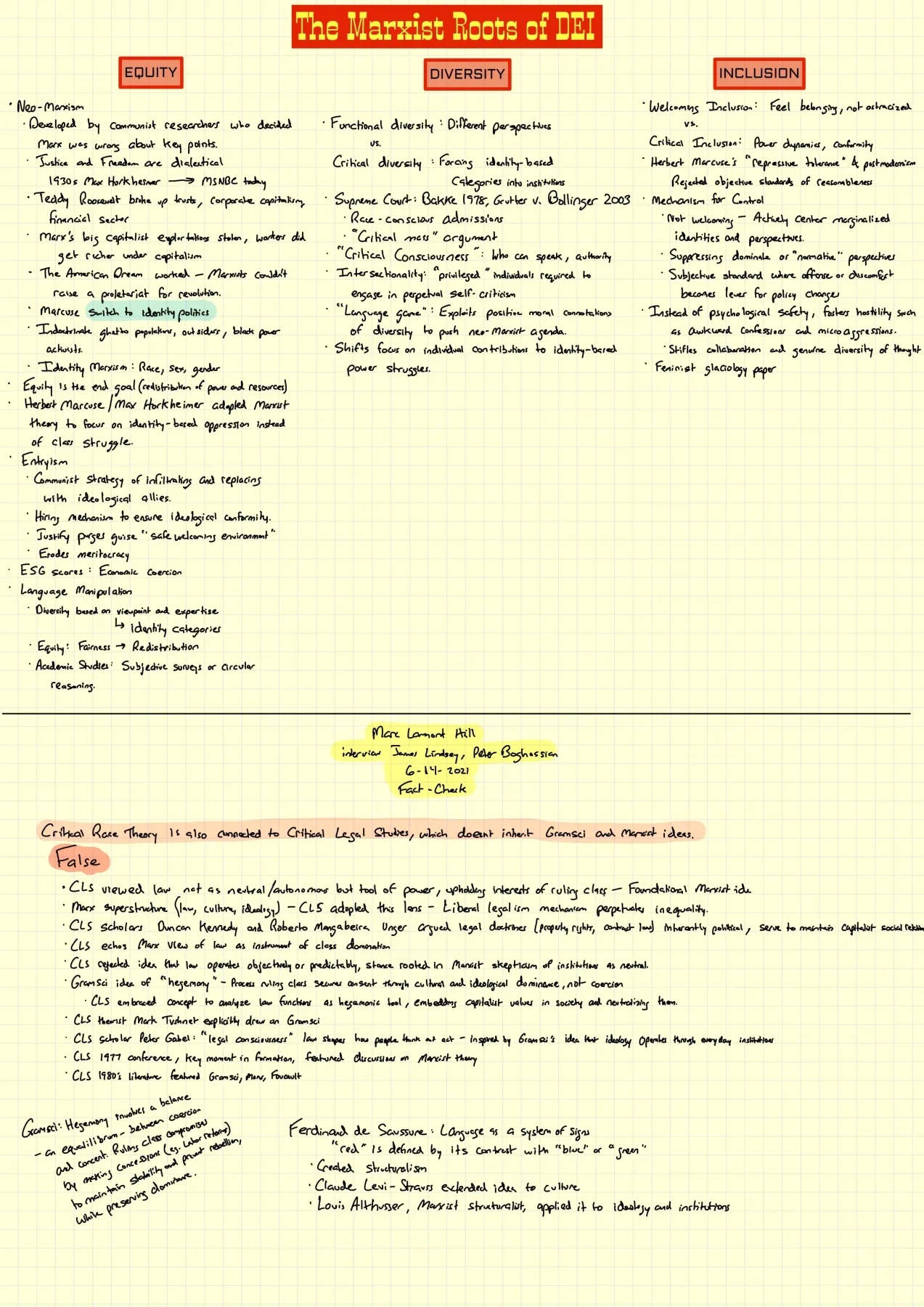
# The Marxist Roots of DEI - Session 1: Equity | James Lindsay
The Marxist Roots of DEI - Session 1: Equity | James Lindsay - YouTube
Summary of the Lecture: The Marxist Roots of DEI
Quote
neo-marxism which developed primarily from the 1930s through the early 1970s and neo-marxism developed and I don’t want to get too deep into the history of neo-marcissism but it developed as a reply to the fact that these these these researchers these these communist researchers decided that Marx was wrong about some key points one of them as a matter of fact is that Justice and freedom are what they call dialectical Concepts so they exist in contradiction so if you have more Justice you have less freedom and more freedom you have less justice so you see the attacks on freedom in the name of Justice today that’s a neo-marxist ideology that has come straight down the track from 1930s Max horkheimer to whoever you listen to on MSNBC this morning straight line they also became in the 1960s very aware that corporate capitalism had solved many of the problems of exploitation mostly by breaking up trusts which is a huge problem again now in New sectors financial sector there’s a big problem Tech sector there’s a big problem you have certain industries where there’s you know a very strong concentration of a lot of the of resources in a very small number of hands well they busted up the trust problem I guess Teddy Roosevelt mostly busted up the trust problem in the early 20th century and then the Neo Marxist said wow the big exploitations of capitalism been stolen away from us by these you know changes to the corporate structure and now there’s no the working class in Mark Herbert Marcus’s World words specifically were has been stabilized and Max horkheimer I just named his words he said well Mark said that the the the capitalism would immiserate the workers but it doesn’t it gives them the opportunity to build a better life it turns out horkheimer was like Yeah The American Dream is real and that’s a problem because we can’t possibly raise a proletariat who’s going to bring us to a revolution if we don’t have a working class that’s going to be easily agitated into becoming leftists and Marxist activists they’ve been stabilized they’ve been made conservative we have to look somewhere else and Marcus said where is that energy well it’s in in his words the ghetto populations it’s also in the radical feminists it’s in all these kind of identity politics sectors the sexual minorities the the racial minorities and the the radical feminists and he said well that’s where the energy is that’s where he called him the vital need for Liberation that’s where that is where do you find the know-how well that’s where you find it in the elite college students and if you can just indoctrinate the elite college students then go Minister critical theory to people like black power activists then we can build as he called it a new working class out of this kind of ragtag of identity politics and so my argument that I’ve made and I think it’s original to me is that out of neo-marxism coming out of the 60s and going into the early 70s we have the birth of a new phenomenon in Marxism that I call not cultural Marxism but identity Marxism where the Marxism is now going to be done across lines of stratification in identity factors like race sex sexuality gender fat status disability status and that as Judith Butler had it that exasperated Etc of more identity categories that you have to list every time in all their papers and so we’re in something very different now and neo-marxisms Vary as many communist ideologies are very mono maniacal as one thought one thought over and over and over again
1. Purpose of the Lecture
- The speaker aims to provide conceptual clarity on DEI by breaking down its components and exposing the linguistic manipulations that drive it.
- He argues that DEI is not merely a corporate or educational initiative, but a vehicle for implementing a new form of communism through institutional control.
- The importance of discernment is emphasized—understanding when language is being used to manipulate rather than inform.
2. DEI as a Package Deal
- Diversity, Equity, and Inclusion are not separate concepts but a unified ideological framework.
- Equity is the end goal (redistribution of power and resources).
- Diversity and Inclusion are the means to achieve Equity by changing the composition of institutions and embedding ideological loyalty.
- Without equity, the purpose of diversity and inclusion collapses.
3. DEI’s Marxist Origins
- DEI has its intellectual roots in neo-Marxism, particularly in Critical Theory and Critical Race Theory (CRT).
- Neo-Marxists in the mid-20th century (e.g., Herbert Marcuse and Max Horkheimer) adapted Marxist theory to focus on identity-based oppression instead of class struggle.
- Marcuse advocated using racial minorities, feminists, and sexual minorities as the new “proletariat” to bring about revolutionary change.
- The modern DEI movement is an extension of this “Identity Marxism,” shifting the focus from economic class to race, gender, and identity categories.
4. DEI as Institutional Capture
- DEI functions as entryism, a classic communist strategy of infiltrating institutions and replacing personnel with ideological allies.
- Diversity initiatives serve as a hiring mechanism to ensure ideological conformity.
- Inclusion policies are used to justify purges of non-conforming individuals under the guise of “creating a safe and welcoming environment.”
- This process erodes meritocracy and ensures that institutions become ideological enforcement mechanisms.
5. DEI, ESG, and Corporate Power
- DEI is deeply connected to Environmental, Social, and Governance (ESG) scores.
- Corporations must comply with DEI mandates to receive financial backing from major investment firms like BlackRock and Vanguard.
- ESG creates a form of economic coercion, ensuring that only compliant businesses receive funding and investments.
- This corporate-government fusion mirrors Chinese-style communism, where private companies exist but operate at the pleasure of the ruling ideology.
6. The Role of Language Manipulation
- The meanings of words like “equity” and “diversity” have been intentionally shifted to facilitate ideological control.
- Older definitions of diversity (based on viewpoint and expertise) have been replaced with diversity based solely on identity categories.
- Equity no longer means fairness but enforced redistribution.
- The intellectual dishonesty in academic studies supporting DEI is pointed out, as many rely on subjective surveys or circular reasoning.
7. The Push for Systemic Change
- The state of Washington’s Office of Equity explicitly stated that their goal is to dismantle existing systems and replace them with new ones based on DEI ideology.
- This confirms that DEI is not about improving workplaces or schools, but about remaking society through institutional revolution.
- The language of “dismantling” and “rebuilding” is taken directly from Marxist and neo-Marxist texts.
8. The Corporate Takeover & Sustainable Development Goals (SDGs)
- Sustainability and DEI are linked under globalist economic initiatives.
- ESG and DEI are designed to enforce compliance through economic pressure, creating a corporatist system that blends elements of communism and fascism.
- Companies must adopt DEI policies or face financial exclusion.
- This represents a shift from shareholder capitalism to stakeholder capitalism, where companies serve political and ideological goals rather than market demand.
Conclusion: DEI as a Neo-Marxist Power Tool
- DEI is not about fairness, equality, or genuine inclusivity; it is a mechanism for ideological control.
- It seeks to reshape institutions through forced demographic and ideological shifts.
- The ultimate goal is equity, meaning redistribution and centralized control.
- DEI operates through corporate and governmental coercion, particularly via ESG scoring and economic pressure.
- Fighting DEI requires discernment, institutional pushback, and rejection of ideological coercion in workplaces, schools, and governance.
Final Thought
The speaker argues that DEI is not just a bad policy—it is a revolutionary movement disguised as corporate and educational reform. Understanding its linguistic manipulations, historical origins, and institutional mechanisms is essential for pushing back effectively.
Grok Summary
- Purpose and Approach: Conceptual Clarity and Discernment
- Objective: The speaker seeks to provide “conceptual clarity” by decoding the jargon and “wokish language” of DEI, focusing on Equity in this session. He aims to expose linguistic manipulations that obscure its true intent.
- Pseudo-Reality: DEI operates in a “clown world”—a distorted, theoretical reality with its own internal logic that collapses when tested against actual reality. This pseudo-reality relies on “theoretical lenses” that filter data to fit ideological narratives.
- Discernment: The key skill to counter DEI is discernment—distinguishing between genuine good-faith efforts and dangerous ideologies cloaked in appealing language. This is vital across all sectors (corporate, education, public life).
- Equity as Neosocialism
- Definition: Equity, shorthand for “social equity,” is redefined as “critical social equity”—a neo-Marxist scheme to redistribute resources (power, privilege, wealth) across identity-based “axes of oppression” (e.g., race, gender).
- Socialism Connection: The speaker asserts Equity is socialism rebranded, aiming for equal outcomes (not access) through administered redistribution. It’s the precursor to a neo-communist “critical social justice” utopia, enforced by authoritarian measures (e.g., a “dictatorship of the anti-racists”).
- Communist Spontaneity Thesis: Equity’s proponents believe that forcing redistribution long enough will make equality spontaneous, mirroring Marxist progression from socialism to communism—a belief the speaker mocks as unworkable “cotton candy” logic.
- Historical and Theoretical Roots
- H. George Frederickson (1968): Equity originated with Frederickson’s “social equity theory,” proposed as a third pillar of public administration (alongside efficiency and economy). He asked “who benefits?”—assuming unequal outcomes signal systemic bias, a neo-Marxist inflection.
- Neo-Marxism: Emerging in the 1930s–70s (e.g., Max Horkheimer, Herbert Marcuse), neo-Marxism shifted Marxist class struggle to identity politics (“identity Marxism”), fueling DEI’s focus on systemic power dynamics over merit.
- Legal Precedents: Supreme Court rulings like Griggs v. Duke Power (1971) allowed disparate impact as proof of discrimination, and United Steelworkers v. Weber (1979) permitted race-conscious hiring—legal loopholes exploited by Equity’s neo-Marxist expansion.
- DEI as a Neo-Communist Framework
- New Communism: DEI is a modern communism blending communist ends (redistribution) with fascist means (corporate enforcement), akin to China’s Deng Xiaoping model of controlled markets under CCP rule.
- Corporate Enforcement: Equity drives the “S” (social) in Environmental, Social, and Governance (ESG) scores, enforced by financial giants like BlackRock. Companies must comply to access capital, making DEI a trillion-dollar lever.
- Entryism: Diversity and Inclusion (D&I) are tactics to install ideological “commissars” (e.g., diversity officers), purging dissenters and aligning institutions with Equity’s goals.
- Implementation and Practical Effects
- Outcomes Over Access: Equity conflates access with outcomes, measuring the former by the latter (e.g., Ibram X. Kendi’s “racial inequity is evidence of racist policy”). This justifies dismantling merit systems (e.g., banning SATs).
- Washington State Case: The state’s Equity Task Force (legislated 2020) aims to “disrupt and dismantle” systems for 50+ years, redistributing resources to “historically marginalized groups”—a neo-Marxist overhaul.
- Downward Equalization: Equity “equalizes downward,” reducing excellence to mediocrity (e.g., imposter syndrome in diversity hires, demotivated talent), echoing Vonnegut’s Harrison Bergeron.
- Critique of DEI’s Foundations
- Corrupted Scholarship: DEI’s academic literature is “wholly corrupted”—relying on subjective surveys (e.g., Ivy League polls), opinion pieces, and auto-ethnographies rather than rigorous evidence.
- Moral Exploitation: Equity offers corporations moral cover for unethical acts (e.g., Disney’s ESG score offsets filming near concentration camps) and extorts compliance post-moral panics (e.g., George Floyd).
- Division: Equity trainings (e.g., “hot seats”) create polarization, not unity, identifying dissenters for removal and fostering fanatics—aligning with neo-Marxist conflict theory.
- Societal Risks
- Technocracy: Equity ties to ESG and Sustainable Development Goals (SDGs), enabling a “public-private partnership” (fascism) where technocratic “stakeholders” reorder society.
- Medicine and Climate: Equity in medicine risks “medical Lysenkoism” (e.g., racially preferenced care), while climate equity could spark geopolitical conflict by punishing rich nations.
- Legal Vulnerability: Bad jurisprudence sustains Equity’s legality, necessitating challenges to narrow disparate impact and “historically marginalized” categories.
- Call to Resistance
- Discernment as Weapon: The speaker urges audiences to decode Equity’s linguistic lies and push back intelligently across sectors.
- Meritocracy: Defending objective standards (e.g., military affirmative action’s success) counters Equity’s excesses without sacrificing competence.
- Actionable Thinking: While strong on analysis, the speaker relies on the audience—leaders in various fields—to devise practical solutions.
Core Takeaway on Equity
- Equity = Socialism: It’s a neo-Marxist redistribution scheme aiming for neo-communism, enforced via D&I and ESG, undermining merit and equalizing downward.
The lecture positions Equity as a deceptive, dangerous ideology driving DEI’s broader agenda, setting the stage for subsequent talks on Diversity and Inclusion as its enforcement mechanisms. Let me know if you’d like further elaboration!
# The Marxist Roots of DEI - Session 2: Diversity | James Lindsay
The Marxist Roots of DEI - Session 2: Diversity | James Lindsay - YouTube
ChatGPT Summary
Summary of the Lecture: The Marxist Origins of DEI and Diversity Industry
The lecture provides a historical, ideological, and legal analysis of Diversity, Equity, and Inclusion (DEI), arguing that it is a neo-Marxist tool designed to infiltrate institutions and transform society. Below are the main points:
1. DEI as an Institutional Mechanism for Equity
- Diversity and Inclusion serve as tools to implement Equity, which is the true goal of the movement.
- The lecture suggests that DEI is not about fairness or inclusivity but about restructuring institutions to enforce Marxist power dynamics.
2. The Two Meanings of Diversity
- The speaker differentiates between functional diversity (bringing different perspectives together for practical benefits) and critical diversity (forcing identity-based categories into institutions).
- Critical diversity prioritizes identity politics over individual merit and is linked to Critical Theory.
3. The Role of Language Manipulation
- The redefinition of words (e.g., equity, diversity) allows ideological activists to push radical policies under seemingly benign terms.
- Diversity has been repurposed to focus solely on race, gender, and identity categories rather than perspectives or skills.
4. DEI’s Marxist Foundations
- DEI stems from Marxist critical theory, particularly Identity Marxism, which replaces economic class struggle with racial and gender-based struggles.
- Key figures like Herbert Marcuse and Critical Race Theorists (e.g., Robin DiAngelo) argue that social identity should determine access to power and privilege.
5. The Entryism Strategy: Capturing Institutions
- DEI functions as an ideological filter: hiring and promotion are based on adherence to the ideology, rather than merit.
- Institutions are infiltrated through DEI policies, ensuring ideological conformity and suppressing dissent.
- This process leads to “woke commissars” controlling organizations.
6. The Legal Backing of the Diversity Industry
- Supreme Court rulings (Bakke 1978, Grutter v. Bollinger 2003) allowed for race-conscious admissions and institutionalized the DEI industry.
- These cases introduced the “critical mass” argument, which effectively allowed quotas without calling them quotas.
- The diversity industry emerged, profiting from DEI training, policies, and consulting.
7. DEI’s Connection to ESG and Corporate Control
- DEI is deeply linked to ESG (Environmental, Social, Governance) frameworks, ensuring that corporations comply or risk financial penalties.
- This creates economic coercion, forcing businesses, schools, and governments into compliance with DEI ideology.
8. The Role of Critical Consciousness and Positionality
- DEI enforces “Critical Consciousness”, a neo-Marxist perspective on social identity that determines who can speak, who has authority, and who must defer.
- Intersectionality is used to maintain these ideological hierarchies, with “privileged” individuals required to engage in perpetual self-criticism.
9. The Master-Slave Dialectic & Power Structures
- The framework sees all human relations in terms of oppressor vs. oppressed, much like classic Marxism.
- Individuals must engage in “positionality” thinking, where their race, gender, and identity dictate their level of oppression or privilege.
10. The Future: How DEI is Expanding
- DEI is embedding itself deeper into laws, institutions, and corporate policies, making dissent risky and punishable.
- The movement is self-reinforcing: once institutions adopt DEI, it becomes nearly impossible to remove due to legal protections and financial incentives.
Conclusion: DEI as a Revolutionary Tool
- The lecture argues that DEI is not about improving workplaces or universities but about implementing Marxist ideology.
- The goal is to dismantle existing systems and replace them with a permanent structure of ideological control.
- The only way to resist is to recognize the language games, reject the ideological framing, and push back at the institutional level.
This lecture presents DEI as a neo-Marxist strategy for social engineering, with economic, legal, and ideological mechanisms ensuring institutional capture and cultural transformation.
Grok Summary
Below are the main ideas extracted from the provided lecture transcript, which appears to be a critical analysis of diversity, equity, and inclusion (DEI) initiatives, particularly through the lens of “critical diversity” as influenced by critical theory and neo-Marxism. The speaker critiques the ideological underpinnings and practical implications of modern diversity programs, contrasting them with traditional or functional approaches to diversity.
Main Ideas:
-
Distinction Between Functional and Critical Diversity:
- Functional Diversity: The traditional view of diversity involves bringing people with different perspectives together for a practical, productive purpose (e.g., enhancing creativity or problem-solving). It’s seen as valuable when purposeful and tied to specific goals, such as overcoming bigotry or improving outcomes in fields like travel through cultural sensitivity.
- Critical Diversity: Rooted in critical theory, this redefines diversity as a tool to address power dynamics and identity politics. It focuses on social group memberships (race, gender, etc.) rather than individual merits or skills, aiming to dismantle perceived systemic oppression rather than foster unity or productivity.
-
Critique of Critical Diversity as Ideological Manipulation:
- The speaker argues that critical diversity, as promoted by figures like Robin DiAngelo, is a “language game” that exploits the positive moral connotations of diversity to push a neo-Marxist agenda. It shifts the focus from individual contributions to identity-based power struggles, magnifying differences to serve ideological ends.
- Terms like “minoritized” (vs. “minority”) and “critical social justice” are used to frame societal structures as inherently oppressive, requiring constant intervention by trained “experts” (e.g., diversity trainers).
-
Power Dynamics as a Central Framework:
- Critical diversity views all differences through the lens of power dynamics, portraying them as systemic forces (akin to “pagan gods”) that privilege some groups while oppressing others. This perspective rejects individualism and colorblindness as tools of oppression, insisting that only a “critical consciousness” can reveal true diversity.
- The speaker highlights how this leads to concepts like “positionality” and “intersectionality,” where one’s identity determines their authenticity and authority in discussions, sidelining merit or shared goals.
-
Historical Context and the Diversity Industry:
- The modern diversity industry emerged from Supreme Court decisions like Regents of the University of California v. Bakke (1978), which allowed race-conscious admissions for educational benefits. This opened the door to a profitable field of diversity consultants, who shifted the focus from practical diversity to identity politics.
- The speaker traces this to a broader shift from American pluralism (“e pluribus unum” – from many, one) to multiculturalism (celebrating separate identity-based cultures), which critical theorists exploit to foster division.
-
Practical Consequences of Critical Diversity Programs:
- Psychological Abuse and Division: Diversity training based on critical theory (e.g., DiAngelo’s work) is described as emotionally manipulative, using tactics like accusing defensiveness as proof of privilege, creating a “Kafka trap” where disagreement reinforces guilt.
- Organizational Dysfunction: Implementing critical diversity leads to hiring based on identity rather than competence, undermining trust, motivation, and efficiency. It also installs “commissars” (diversity officers) to enforce ideological compliance, misallocating resources and fracturing organizations internally.
- Two Rulebooks: The speaker notes a deliberate strategy of applying different rules to “privileged” vs. “minoritized” groups, justified as “leveling the playing field,” which demoralizes and polarizes workplaces.
-
Proposed Solutions and Alternatives:
- Reject Critical Diversity: The speaker advises avoiding DEI programs entirely due to their captured ideological nature, suggesting businesses focus on merit, responsibility, and accountability instead. Using “diversity” risks legitimizing authoritarianism unless redefined strictly as functional diversity with clear goals.
- E Pluribus Unum: The ultimate antidote is a return to individualism and a unifying identity (e.g., shared organizational mission or American identity), rejecting power-dynamic frameworks in favor of treating people as unique individuals rather than avatars of social groups.
-
Broader Societal Implications:
- The push for critical diversity is linked to larger agendas like ESG (Environmental, Social, Governance) metrics and the concept of “global citizenship,” which the speaker sees as a precursor to global governance, undermining national sovereignty and individual rights.
- Multiculturalism and critical diversity are critiqued as divisive, contrasting with the unifying success of American pluralism, which allows cultural retention within a shared identity.
Summary:
The lecture posits that while diversity can be beneficial when functional and goal-oriented, its “critical” form—infused with neo-Marxist identity politics—serves as a tool for division, control, and ideological conformity rather than unity or progress. The speaker urges discernment, rejection of manipulative language, and a focus on individualism and shared purpose to counter this trend, warning of its corrosive effects on organizations and society at large.
# The Marxist Roots of DEI - Session 3: Inclusion | James Lindsay
The Marxist Roots of DEI - Session 3: Inclusion | James Lindsay - YouTube
ChatGPT Summary
Main Ideas from the Lecture on Inclusion
-
Inclusion as a DEI Lever
- Inclusion is the third component of the Diversity, Equity, and Inclusion (DEI) framework.
- It functions as a lever that makes diversity proactive rather than passive.
- Inclusion ensures that diversity is not just representation but also engagement.
-
The Moral and Political Uses of Inclusion
- Inclusion is framed as a moral necessity but is also used to justify censorship and purges.
- It aligns with Herbert Marcuse’s Repressive Tolerance, a 1960s neo-Marxist concept advocating tolerance for leftist movements while repressing right-leaning views.
-
Psychological Safety vs. Manipulation
- Inclusion is often justified on the grounds of creating “psychological safety” in workplaces and education.
- Psychological safety, initially a productive concept, has been manipulated to control discourse and behavior.
- Examples include requiring employees to “bring their whole self to work,” which can justify political activism at work.
-
The Social Model of Disability and its Expansion
- The social model of disability shifted the responsibility of accessibility from individuals to society.
- This principle was later broadened beyond disability to apply to all perceived marginalizations.
- It led to the argument that societal structures, rather than individual circumstances, are the source of exclusion.
-
The Shift from Welcoming Inclusion to Critical Inclusion
- Traditional inclusion aimed at making spaces welcoming and respectful.
- Critical inclusion focuses on power dynamics and dismantling perceived systemic barriers.
- It leads to policies that favor historically marginalized groups while suppressing dissent.
-
Power Dynamics and Control Through Inclusion
- The modern inclusion framework is used to control workplace policies, language, and behavior.
- Concepts like “microaggressions” and “inclusion guidelines” create an environment where people fear speaking freely.
- It leads to self-censorship and the weaponization of offense.
-
Epistemic Injustice and Inclusion in Academia
- Inclusion is used to introduce subjective and ideological perspectives into scientific and academic fields.
- Examples include feminist glaciology, which argued that indigenous and feminist perspectives on glaciers should be treated as equal to scientific models.
- This is part of broader movements like “research justice” and “citational justice,” which prioritize identity-based representation over objectivity.
-
Repressive Tolerance and Selective Censorship
- Inclusion serves as a mechanism for selectively allowing some views while suppressing others.
- The repressive tolerance concept justifies tolerating leftist activism while treating opposing views as threats.
- This dynamic leads to censorship, purges, and a climate of fear in organizations and academia.
-
The Dangers of an Inclusion-Driven Culture
- Overemphasis on inclusion leads to dysfunctional workplaces and institutions.
- People are discouraged from mentoring or engaging honestly due to fear of accusations.
- Activists and highly sensitive individuals gain disproportionate power over group dynamics.
-
Strategic Resistance to Coercive Inclusion
- Organizations and individuals should be aware of how inclusion policies are weaponized.
- The best response is not appeasement but standing firm against manipulative tactics.
- Inclusion should be balanced with professionalism and institutional integrity.
The lecture critiques the way inclusion has evolved from a well-intentioned principle to a tool for ideological enforcement and social engineering. It argues that the modern inclusion movement, particularly in its “critical inclusion” form, undermines genuine diversity, stifles free expression, and creates hostile work environments under the guise of safety and equity.
Grok Summary
Below are the main ideas from the provided lecture transcript on the topic of “inclusion” within the Diversity, Equity, and Inclusion (DEI) framework, as presented by the speaker. The lecture critiques the evolution and implementation of inclusion, contrasting its common-sense understanding with what the speaker terms “critical inclusion,” rooted in neo-Marxist and identity-based ideologies.
Main Ideas:
-
Distinction Between Welcoming Inclusion and Critical Inclusion:
- Welcoming Inclusion: The speaker describes this as the intuitive, traditional understanding of inclusion—creating a psychologically safe environment where people feel they belong, can contribute, and are not ostracized for being themselves. It’s tied to fostering creativity and collaboration (e.g., John Cleese’s talk on creativity and psychological safety).
- Critical Inclusion: This is framed as a perversion of the above, driven by power dynamics and identity Marxism. It shifts inclusion from a practical, positive goal to a tool for enforcing ideological conformity, censoring dissent, and purging non-compliant individuals or ideas.
-
Origins and Evolution of Inclusion:
- Inclusion emerged in contexts like special education (e.g., Michael Oliver’s social model of disability in the 1980s), initially aiming to integrate marginalized groups by adapting societal structures. Over time, this morphed into a broader, more ideological framework.
- The speaker argues that this shift was co-opted by neo-Marxist ideas (e.g., Herbert Marcuse’s “repressive tolerance”) and postmodernism, which reject objective standards of reasonableness and emphasize systemic power dynamics as the root of exclusion.
-
Critical Inclusion as a Mechanism for Control:
- Under critical inclusion, the goal isn’t just to welcome people but to actively center marginalized identities and perspectives (e.g., “decolonizing the curriculum” or feminist glaciology). This often involves suppressing dominant or “normative” perspectives.
- It creates a subjective standard where offense or discomfort becomes a lever for policy changes, censorship, or purges, empowering the perpetually aggrieved and enabling bad actors (e.g., grifters or psychopaths).
-
Psychological Safety vs. Psychological Hostility:
- While inclusion should promote psychological safety (a workplace where people can take risks and be creative), critical inclusion paradoxically fosters hostility. Examples include DEI trainings that force awkward confessions (e.g., outing personal biases) or microaggression policies that make people afraid to speak.
- This stifles mentorship, collaboration, and genuine diversity of thought, polarizing workplaces and reducing effectiveness.
-
Inclusion as an Entryism Tool:
- The speaker ties inclusion to “entryism”—a strategy to infiltrate and transform organizations into ideologically compliant entities. Diversity brings in the “comrades,” inclusion purges dissenters, and equity enforces a neo-communist outcome.
- This is linked to broader frameworks like ESG (Environmental, Social, Governance), which incentivizes such policies for corporate scores, despite their dysfunctionality.
-
Examples of Absurdity and Overreach:
- The lecture cites examples like the feminist glaciology paper, which demands inclusion of non-scientific perspectives (e.g., indigenous beliefs about glacier movement) in academic fields, illustrating how critical inclusion distorts reason and merit.
- Other instances include workplace trainings that escalate minor slights into HR issues or policies that prioritize subjective feelings over objective standards (e.g., Washington State Equity Task Force’s focus on “healing-centered approaches”).
-
Critique of Subjectivity and Power Dynamics:
- Critical inclusion defines inclusion negatively (lack of exclusion) rather than positively, making it ripe for manipulation. What counts as “exclusion” is determined by subjective power analyses, often ignoring intent and prioritizing feelings.
- This empowers those who claim perpetual victimhood, undermining professionalism and meritocracy (e.g., viewing punctuality or objectivity as “white supremacy”).
-
Practical Consequences:
- In practice, critical inclusion leads to dysfunctional workplaces, schools, and societies. It squanders resources, creates double standards, and incentivizes grievance (e.g., microaggression trainings teach people to take offense).
- It risks totalitarian outcomes, where dissent is silenced under the guise of protecting inclusion, as seen in historical parallels like Soviet purges.
-
Solutions and Resistance:
- Disambiguation: Differentiate between beneficial DEI (functional diversity, reasonable equity, psychological safety) and its critical, ideological counterpart. Reclaim the “motte” (common-sense meaning) and reject the “bailey” (radical ideology).
- Action: Individuals should get informed, organize, and resist—whether through whistleblowing, legal challenges (e.g., suing DEI consultants), or pushing alternative values. Red states could outlaw such ideologies outright.
- Cultural Pushback: Emphasize meritocracy, individualism, and common humanity (e.g., “e pluribus unum”) as superior alternatives to critical DEI’s divisiveness.
-
Optimism Amid Critique:
- Despite the dire framing, the speaker expresses hope: resistance is growing, the ideology is unpopular when exposed, and the internet’s marketplace of ideas threatens the elite’s control. Courageous pushback can dismantle it, as “courage begets courage.”
Summary:
The lecture argues that inclusion, originally a noble concept tied to psychological safety and access, has been hijacked by critical theory into a tool for ideological control, censorship, and organizational dysfunction. It contrasts this with a merit-based, individualistic approach, urging discernment and active resistance to reclaim workplaces and society from what the speaker sees as a neo-communist agenda. The tone is both analytical and rallying, blending critique with a call to action.