⬅️ Parent: Democratic Socialists of America (DSA) · Related: DSA Policies Platform · Darializa Avila Chevalier - Policy Positions
Summary
DSA is a large, internally plural socialist membership organization, not merely a Nordic-style welfare-state advocacy group and not accurately described, on the current constitutional evidence, as a single Leninist democratic-centralist party. Its official 2026 program is substantially more transformative than social democracy: it calls for public ownership of the largest corporations and essential industries, abolition of the police and prison system, abolition of ICE, an end to overseas bases and sanctions, and major constitutional restructuring. Analysis should distinguish official policy, binding rules, caucus positions, individual members, endorsed candidates, sympathetic media figures, and critics’ predictions.
Handwritten Notebook Pages
Sources
- Open notebook p. 44 — electoral tactics and Bolshevik analogy (file not included in this release)
- Open notebook p. 89 — democratic socialism, communism, and social democracy (file not included in this release)
- Open notebook p. 99 — democratic centralism, entryism, polling, and censure (file not included in this release)
- Open notebook p. 208 — OSA and platform claims (file not included in this release)
Analytical Units
Claims about “the DSA” can refer to different things:
| Unit | What counts as evidence |
|---|---|
| National organization | Constitution, bylaws, convention resolutions, national program, and official statements. |
| National Political Committee | Recorded votes, minutes, directives, budgets, and official communications. |
| Local chapter | That chapter’s bylaws, endorsements, votes, and public actions. |
| Caucus or working group | Its own platform and conduct; do not automatically attribute it to every member. |
| Endorsed candidate or elected official | Endorsement terms, candidate platform, votes, and any documented discipline. |
| Individual member | The individual’s statements and conduct only. |
| Sympathetic commentator | Evidence of an allied media ecosystem, not proof of organizational policy. |
| Critic | A hypothesis or interpretation to be tested against primary documents. |
This prevents the ecological fallacy: a communist caucus member does not make every DSA member a communist, while a moderate candidate does not erase an explicit radical national program.
What DSA Officially Says It Is
The constitution, amended by the 2025 convention, says DSA rejects an economy based on private profit and supports popular control of resources and production, economic planning, equitable distribution, feminism, and racial equality. The organization describes itself as a “big tent,” but that tent sits within an explicitly socialist purpose.
The 2026 national political program calls for:
- universal health care with no individual cost;
- public education from pre-K through college and cancellation of student debt;
- universal rent control and publicly owned social housing;
- public ownership of the largest corporations and essential industries;
- a federal jobs guarantee, a 32-hour work week without reduced pay, and a living minimum wage;
- steps toward fully abolishing the police and prison system;
- reproductive and gender-transition access;
- abolition of ICE, amnesty, and an end to visa caps and quotas;
- ending U.S. military and economic aid to Israel;
- ending overseas military bases, blockades, embargoes, and sanctions;
- replacing the presidency and Supreme Court with institutions subordinate to Congress;
- abolishing the Electoral College and Senate; and
- proportional representation and a multiparty system.
These are official programmatic facts. Whether they are desirable, constitutional, internally coherent, electorally feasible, or likely to produce their stated results are separate questions.
Democratic Socialism, Social Democracy, and Communism
| Tradition | Typical ownership goal | Political route | Useful distinction here |
|---|---|---|---|
| Social democracy | Predominantly private ownership with regulation, unions, taxes, and a large welfare state. | Competitive liberal democracy. | The Nordic analogy fits this better than it fits DSA’s current national program. |
| Democratic socialism | Social or public control over major productive assets, pursued with democratic institutions. | Elections plus labor and social movements. | DSA’s constitutional self-description and national program fit here. |
| Leninist communism | Party-led revolutionary transition, historically associated with democratic centralism and suppression of rival power centers after seizure of state power. | Revolutionary party and state transformation. | Some DSA members or caucuses may identify with communist traditions, but that does not by itself make the whole organization Leninist. |
“Socialist” therefore should not be euphemized into “ordinary regulated capitalism,” but “socialist” also does not settle every question about method, pluralism, or civil liberty.
Is DSA Democratic Centralist?
What democratic centralism means
In its classical Leninist form, members may debate before a decision, but afterward the organization expects unified public action and restricts organized dissent or factional disobedience. Historically, the centralist component often overwhelmed the democratic component.
What the current DSA constitution shows
- The national convention is the highest decision-making body.
- Delegates are apportioned by dues-paying membership and elected; the National Political Committee includes 25 convention-elected members plus two youth representatives.
- Chapter agreements and duly adopted chapter decisions can be binding.
- At the same time, chapter rules must allow members and factions to organize, seek changes, and openly criticize DSA policies while accepting majority decisions as legitimate.
- The bylaws say a youth-section charter may be revoked if a majority is under the discipline of a self-defined democratic-centralist organization. That wording treats external democratic-centralist control as a danger; it is not DSA declaring itself democratic centralist.
Conclusion
The current evidence supports majoritarian internal governance with some binding organizational decisions, not the flat claim that national DSA formally practices Leninist democratic centralism. A stronger claim would require rules imposing a public party line, systematic punishment of dissent as factionalism, or equivalent documented practice.
Electoral Strategy: Ballot Line, Entryism, and “Dirty Break”
DSA is not itself a major ballot-qualified national party. Members and endorsees often contest Democratic primaries, which creates three possible interpretations:
- Coalition strategy: use the Democratic ballot line to win reforms and influence a broad party coalition.
- Party-surrogate strategy: build a disciplined socialist organization whose elected officials use the Democratic line because U.S. election law disadvantages third parties.
- Dirty-break strategy: use the available ballot line while building independent working-class organization, with a later rupture if capacity permits.
The journal’s “skin suit” wording treats the third interpretation as secret communist deception. That is rhetoric, not a demonstrated fact about all members. Some socialist writers openly advocate a dirty break; openness about the strategy weakens the claim that its mere existence proves concealment. The important empirical questions are whether candidates disclose their commitments, who controls endorsements, what discipline is imposed after election, and whether loyalty runs to voters, the Democratic caucus, a DSA body, or an external faction.
Related source retained from the earlier note: The Ballot and the Break.
Liberal–Socialist Coalition Wedge — Journal Thought Experiment
Notebook p. 89 asks whether making the conflict between mainstream liberals and organized socialists more salient would divide Democratic voters, and whether “inflaming” that conflict could help conservatives. It also asks the most important strategic question: could the tactic be counterproductive?
There is an ethical and analytical line between clarifying a real disagreement and manufacturing hostility:
- legitimate contrast uses primary documents, quotes in context, symmetrical standards, and accurate descriptions of consequences;
- manipulative incitement relies on false attribution, selective editing, identity panic, dehumanization, or encouraging citizens to disengage rather than judge policies;
- short-run coalition damage can strengthen the most radical faction, make moderates rally defensively, or normalize tactics later used against constitutional conservatives;
- a message that exaggerates DSA into a monolith would conflict with the fallibilist and evidence-first commitments in Personal Political Positions.
The strongest principled approach is to make the substantive choice visible: ask liberal candidates which official DSA commitments they reject, ask DSA candidates which they accept, compare records with answers, and let voters decide. The goal should be informed coalition sorting, not engineered confusion or voter suppression.
Organizing and Media
The journal correctly identifies door-knocking as a major organizing tactic. Intensive canvassing can matter because it creates repeated personal contact, collects voter data, recruits volunteers, and makes a motivated minority electorally consequential in low-turnout primaries.
The notebook lists Majority Report, Kyle Kulinski, Krystal Ball, Hasan Piker, and Emma Vigeland as media promoters. Their coverage may amplify candidates or ideas, but none should be treated as an official DSA spokesperson without an organizational role or authorization. A commentator calling himself communist can reveal part of the wider coalition; it does not by itself establish DSA’s formal identity.
Claim Ledger
| Journal or retained-note claim | Status | Required next evidence |
|---|---|---|
| “DSA people” will use Democrats as a disguise and reveal communism after gaining power. | Generalized prediction; not established. | Candidate-by-candidate disclosure, internal strategy documents, endorsement contracts, governing behavior, and evidence of concealed commitments. |
| DSA national leadership is 51.9% communist, based on an internal poll. | Unverified number. | Original poll, date, exact question, respondent population, response rate, caucus coding method, and whether “leadership” means NPC, delegates, staff, or another group. |
| DSA sends “letters of censure” to Democrats who depart from policy. | Plausible in specific cases but too broad as written. | The letter, issuing body, rule invoked, recipient, conduct, sanction, appeal, and frequency across endorsees. |
| DSA is democratic centralist. | Not supported as a formal national self-description by the current constitution. | Evidence of mandatory public unity and suppression of organized dissent, not merely binding votes. |
| DSA is only Nordic social democracy. | Contradicted by the 2026 national program. | The official program explicitly seeks public ownership of the largest firms and extensive political restructuring. |
| DSA supports police and prison abolition. | Verified national program. | The 2026 program says current measures are steps toward full abolition. Implementation details remain underspecified. |
| DSA supports open borders. | Needs precise wording. | The 2026 program calls to abolish ICE, grant amnesty, legalize migration, and end visa caps and quotas. “Open borders” is an interpretation unless the organization uses the exact term in the governing document. |
| DSA seeks to eliminate private property. | Overbroad. | The program targets large corporations, essential industries, landlords, and commodified housing; it does not establish abolition of all personal property. |
| DSA ignores authoritarian abuses by Russia, Iran, Venezuela, or China. | Comparative omission claim; requires a defined corpus and period. | Systematic comparison of official statements, votes, campaigns, and salience—not selected silence alone. |
| DSA has a paramilitary wing called Red Rabbits. | Unsupported in the notebook. | Organizational charter, command relationship, funding, membership rule, or credible investigation linking the group institutionally to DSA. |
The 2025 Convention and the Harrington Boundary
The retained Atlantic note reports that the 2025 convention removed older language used to exclude members working with communist organizations and elevated Palestinian “right to resistance” language. The current constitution is indeed amended through 2025 and no longer contains a general anti-communist-cell exclusion; it does, however, retain the youth-section rule against majority control by a self-defined democratic-centralist organization. The 2026 program expressly recognizes a Palestinian right to resist military occupation.
Evidence boundary
The constitutional text verifies the present rules. The Atlantic article supplies an interpretation of what changed and why. To establish the exact amendment history, compare the pre-2025 text, convention amendment language, vote totals, and final adopted text.
Retained reading:
- The DSA Is a Parasite — The Atlantic
- There’s Nothing Democratic About These Socialists — The Atlantic
Bolshevik Historical Analogy
The notebook sketches a real sequence: the Russian Social Democratic Labour Party split; the Bolsheviks remained a minority for important periods; they gained majorities in the Petrograd and Moscow soviets in 1917; seized power in the October Revolution; lost the Constituent Assembly election; dissolved the Assembly; and consolidated one-party rule.
The analogy offers a legitimate warning mechanism: a disciplined minority can exploit institutional breakdown, temporary alliances, and opponents who underestimate it. It is not, by itself, evidence that DSA has the capacity, intent, organization, armed power, or crisis conditions of the Bolsheviks. A valid comparison must map each mechanism rather than substitute historical resemblance for proof.
Mechanism test
| Bolshevik condition | U.S./DSA question |
|---|---|
| State collapse and dual power | Is there remotely comparable institutional breakdown? |
| Armed and disciplined revolutionary organization | What present organization, command, or coercive capacity is documented? |
| Suppression of rival parties and press | What actual rule or act—not future fear—shows this intention or capacity? |
| Electoral minority followed by dissolution of the assembly | Does an actor reject adverse election outcomes in practice? |
| Temporary alliance with moderates | Is cooperation ordinary coalition politics, openly declared independent organizing, or deceptive capture? |
Strongest Critiques of DSA
- Its official economic program may understate knowledge, incentive, investment, and state-capacity problems created by large-scale public ownership and price controls.
- Police and prison abolition carries a high burden to specify how serious violence, repeat offending, incapacitation, due process, and victim protection would work.
- Abolishing or subordinating major constitutional institutions could concentrate power even when framed as democratization.
- Foreign-policy anti-imperialism can become selective if U.S. power receives much more scrutiny than coercion by rival states or allied movements.
- Electoral discipline can conflict with plural representation when an endorsed official owes voters independent judgment.
- A coalition broad enough to include social democrats, democratic socialists, Marxists, and communists can obscure which endpoint a particular campaign is asking voters to authorize.
Strongest Replies from DSA
- Existing corporate ownership also concentrates unaccountable power and shapes politics, work, housing, and health care.
- Elections every few years do not exhaust democracy; workplace and economic institutions can also be democratized.
- Universal programs can reduce domination, insecurity, and arbitrary dependence on employers or landlords.
- Police, prisons, immigration enforcement, and foreign policy deserve scrutiny for coercion and unequal treatment rather than a presumption of legitimacy.
- U.S. election structure makes use of a major-party ballot line a rational tactic, not proof of conspiracy.
- Internal factions, proportional voting, open meetings, appeal rights, and explicit protections for criticism are evidence against treating DSA as organizationally monolithic.
Questions for DSA Members or Candidates
- Which parts of the 2026 national program do you personally endorse, reject, or regard as aspirational?
- What forms of private ownership would remain under “economic democracy”?
- What institution would respond to murder, organized violence, and repeat predation after police and prison abolition?
- May an endorsed official publicly dissent from DSA and vote against a resolution? What sanction follows?
- Do liberal parties retain the right to organize and win office after socialist reforms?
- What independent judiciary protects speech, property, religious liberty, and political opposition?
- How do you judge Russian aggression against Ukraine, Chinese coercion of Taiwan, Iranian repression, and abuses by governments opposed to the United States?
- What does the Palestinian “right to resist” exclude—especially attacks on civilians?
- What empirical result would make you revise rent control, public ownership, or abolitionist policy?
Primary Sources
- DSA Constitution and Bylaws, amended by the 2025 National Convention
- DSA Leadership and Structure
- DSA 2026 Political Program
- DSA Policies Platform
Retained Evidence Archive
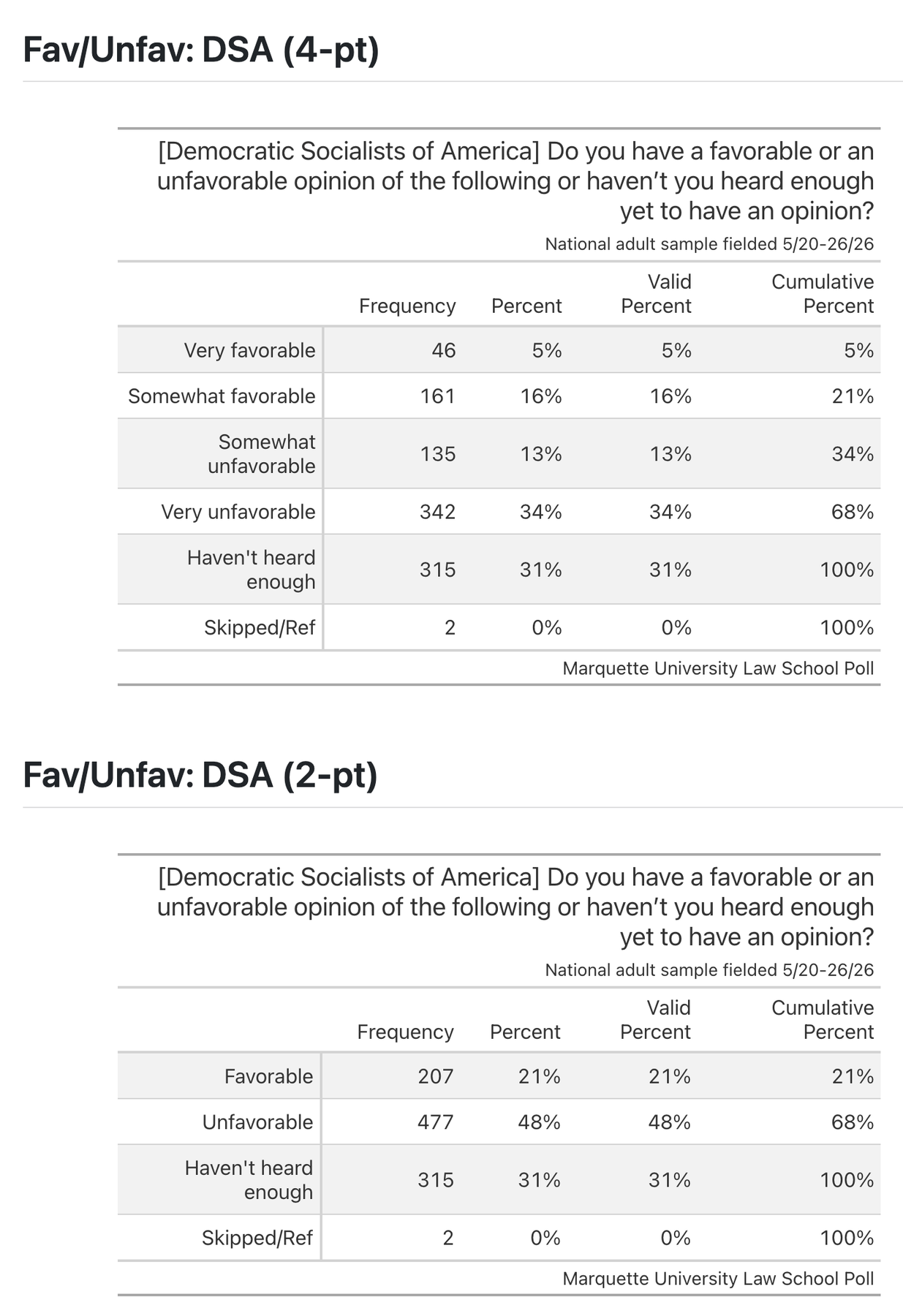
Marquette Law School Poll — national issues toplines
Retrieval Cues
- Which official positions make DSA more radical than Nordic social democracy?
- Why does the current constitution not establish that DSA as a whole is democratic centralist?
- What evidence would distinguish ordinary coalition politics, entryism, and a dirty-break strategy?
- Why must candidate, caucus, commentator, and national-organization claims remain separate?