Attachment (file not included in this release)
Culture (America Bad)
- Secularism
- War on Christmas
- Metaphysical -> Physical
- Soul
- Religious Values
- Ta-Nehsis Coates
- “Black bodies”
- Culture dominates society
- Antonio Gramsci
- Prison Notebook
- “Socialism is precisely the religion that must overwhelm Christianity”
- Christian Nationalism reactionary trap
- Transform into “false version”
- Socialist goals
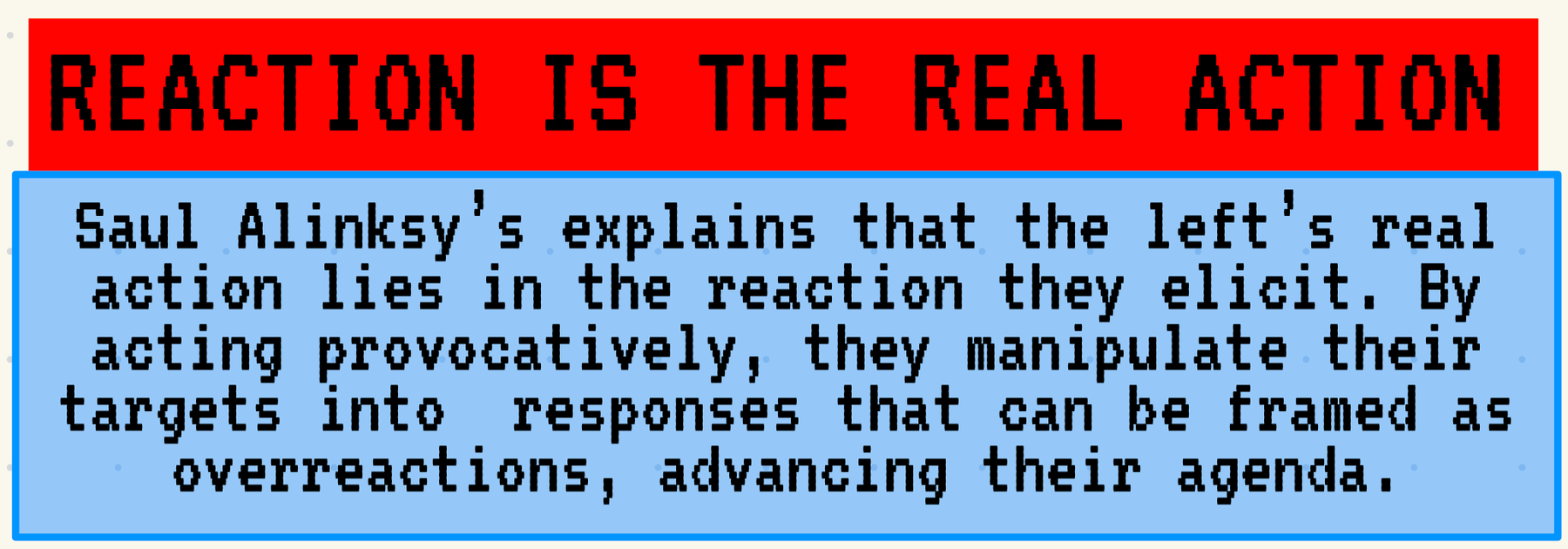
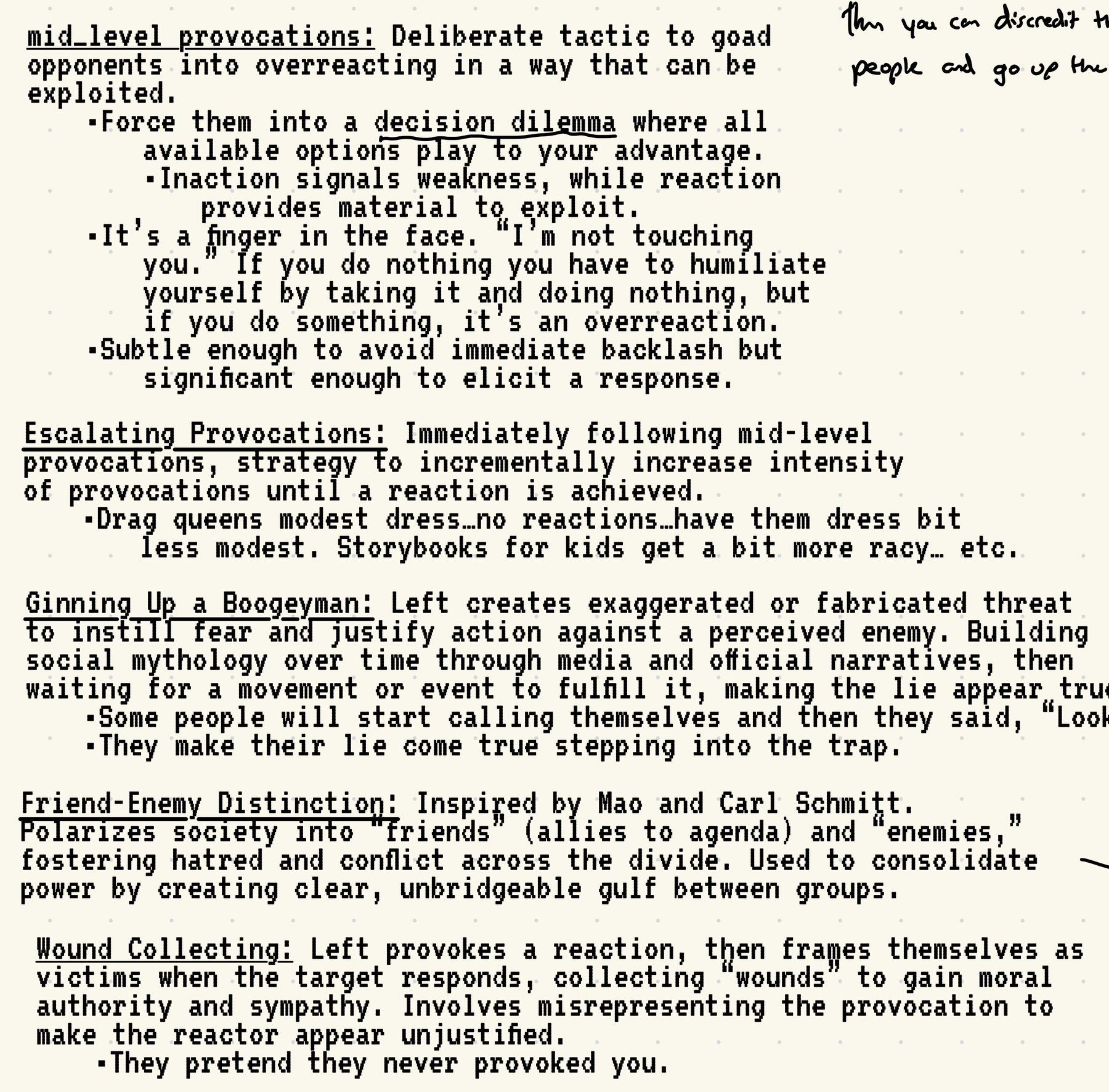
- They want their opponent to react in predictable and useful ways.
- Christian Nationalism reactionary trap
- Antonio Gramsci
Philosophy
-
Liberal Humanitarianism
-
Postcolonialism
-
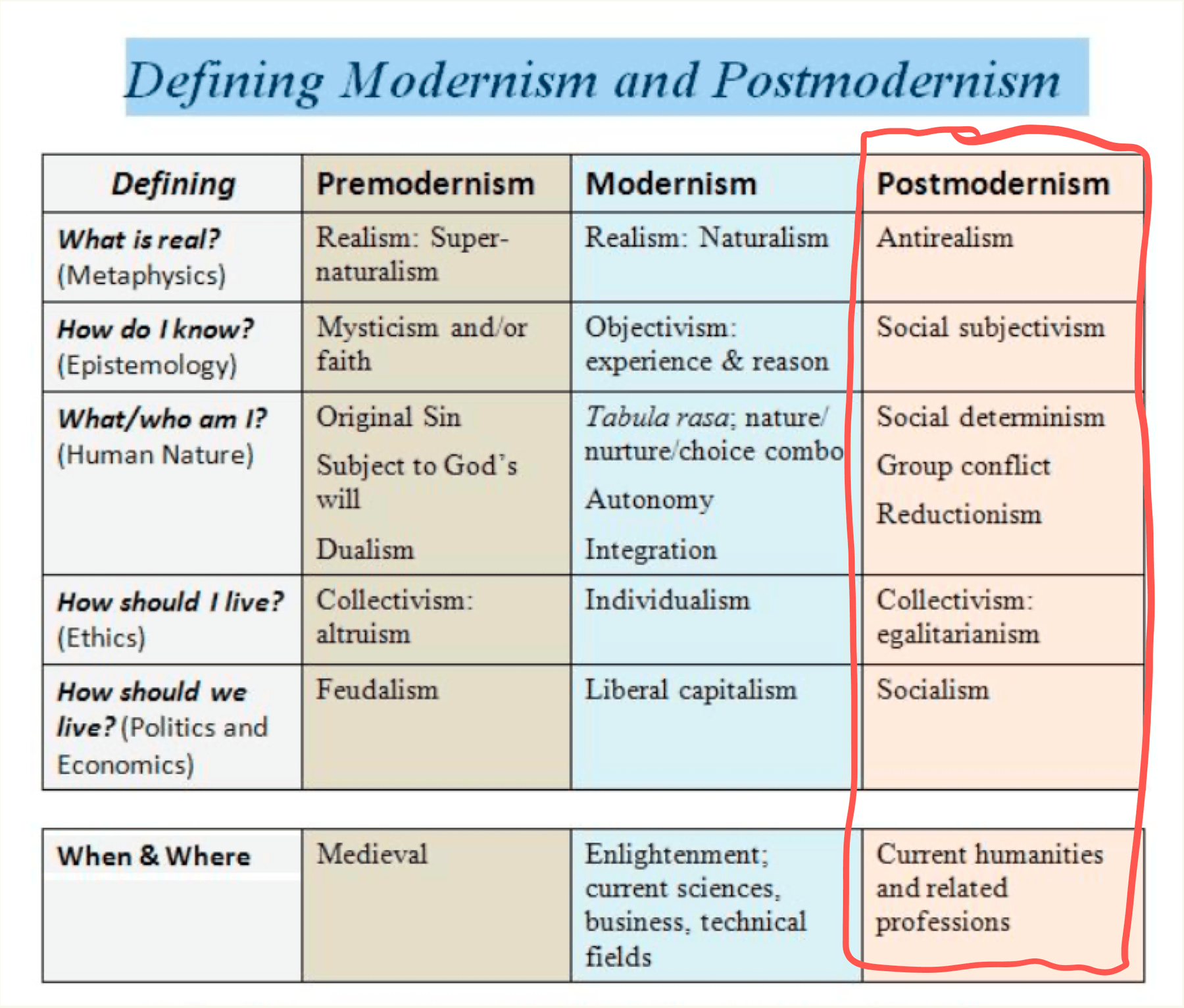
Subjectivism
- Knowledge
- Morality
- Relative
-
Power
-
Hierarchy
- Gender
- Race
- Sex
-
Identity Politics
- Anti-Racism
- Safe Spaces
- Race
- Leonard Jeffries
- Hoaxes
-
Sex
- Gender Theory
- Judith Butler
- Gender Performativity
- John Money
- Separates the body from identity
- Judith Butler
- Transgender
- Gender affirming care
- Queer Theory
- Fludity
- Biology
- Examples
- New English Journal of Medicine sex designations on birth certificates harmful to transgenders
- Examples
- Dismantle Family
- “the personal is political”
- Simone de Beauvoir
- Marxist
- Gender Theory
-
Feminism
- 2nd Wave
- Marxism
- Gender roles shifting
- Feminity not biology
- 3rd Wave
- Fluidity
- Gender performative
- 2nd Wave
-
Science
- Examples
- BLM: ok to protect
- WHO: Herd Immunity
- Examples
Critical Theory
- Examples
- Walt Whitman: Racist
- Shakespeare
- Colonialism
- Slavery
- Racism
- Deconstruction
- Jacques Derrida
- Literary Criticism
- Race/Gender Focus
- Literary Criticism
- Jacques Derrida
- Marxist
- Critical Legal Studies
- Oliver Wendall Holmes
- Karl Llevelty
- Benjamin N. Codoco
- Social Inequalities
- Challenged impartiality
- 1st: 1960-1990s
- Frankfurt School
- People
- Herbert Marcuse
- Censorship
- “Repressive tolerance”
- True Tolerance is repression of conservatives
- “Liberating Tolerance”
- True Tolerance is repression of conservatives
- Erich Fromm
- Max Hurtheimer
- Herbert Marcuse
- People
- Dismantle societal structures
- Western culture relentless criticism
- Critical Race Theory
- Activism
- Racism = Power + Prejudice
- Everything is Race
- Power
- People
- bell hooks
- Richard Delgado
- Alan Freeman
- Kimberle Crenshaw
- Patricia Williams
- Derrick Bell
- interest convergence
- ‘race realism’
- Racism permanent
- Black never equality in U.S.
- Moral relative
- Brown vs. Board of Education (interest convergence)
- White interests
- 1989
- Tools
- Language
- Media
- Intersectionality
- Illusions that obscure power imbalances
- Individualism
- Progress
- Reason
- Illusions that obscure power imbalances
- Postmodernism
- Questioning metanarratives
- Michel Focault
- Jacques Derrida
- Dismantling texts
- Biases
- Contradictions
- Privilege certain perspectives
- Dismantling texts
- Knowledge / Truth
- Not objective
- Subjective
- Shaped by power dynamics
- Socially constructed
- Serve interests of power group
- Power
- Institutions
- Worms
- Language
- Liberal ideals critique
Tactics
-
Political Correctness
-
Traditional Vices = Virtues
- Pride
- Sloth
- Rebellion
- Gluttony
- Fat acceptance
- Envy
-
Redefining Reality
- Lisa Feldman Barrett
- Words cause harm to brain
- Redefine moral standards
- Examples
- bum -> homeless -> unhoused
- shifting responsibility to victimhood
- criminal -> justice -> involved person
- Rainbow flag > U.S. Flag
- Examples
- Lisa Feldman Barrett
-
Control
- Power
-
Tech
- De-platforming
-
Speech codes
-
Free speech not an absolute value
- Stanley Fish
-
Tool
- Irony
-
Applied Selectively
- Pride Parades
- Slut Walks
- Clarence Thomas hearing
-
“Correct lineism” from communism
-
Section Wave Feminism
- Kathie Sarachild
- “consciousness raising”
- Carol Hanisch
- The Personal is Political
- Kathie Sarachild
-
Dialectical Political Warfare
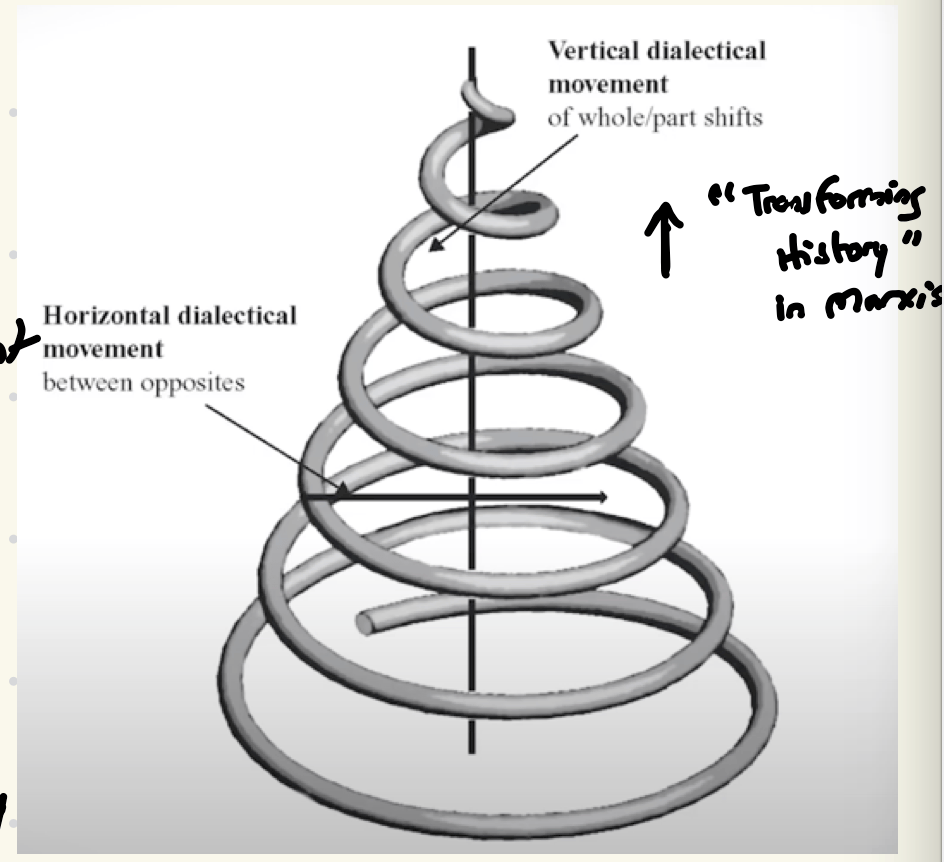
- Provokes conflict to create apparent opposites that create the energy for political warfare action
- To generate movement up you get a back and forth argument going
- Christian Nationalists < (fight) > Woke
- Creates false dichotomy
- Your either: Christian Nationalist or Pro transition of children
- Creates false dichotomy
- Gulf of opposites creates energy; then you can discredit those people and go up the spiral
-
-
Coexistence With Leftism Is No Longer Possible
1. Framing of the “Left”
- Definition: The speakers distinguish between ordinary Democrats or liberals (e.g., Bill Maher) and “leftists,” who are described as holding a corrosive, dangerous ideology.
- Mission: They declare a goal of defeating leftist ideology—not individuals—by making it as socially unacceptable as Nazism.
- Interpretation: Leftism is treated not merely as policy preferences (healthcare, taxes) but as a worldview and quasi-religion.
2. Leftism as a Secular Religion
- James Lindsay’s Argument: Woke ideology is portrayed as a secular religion with dogmas, rituals, festivals, and priestly classes.
- Religious Structure:
- Dogmas: equity, liberation, progress.
- Rituals: DEI statements, land acknowledgments, pride parades.
- Liturgical calendar: Pride Month, LGBTQ holidays.
- Priestly castes: academics, HR professionals, activists.
- Replacement of Christianity:
- They argue leftism borrows Christian metaphysics (universalism, dignity) while removing Christ and redemption.
- Without redemption, leftism creates a system where individuals must perpetually confess sins (whiteness, masculinity) without forgiveness.
- It becomes a “suicidally empathetic” system—self-destructive empathy without limits.
3. Core Philosophical and Theological Claims
- Oppressor vs. Oppressed: Leftism is framed through critical theory—society is structured by hierarchies of domination.
- Self-Actualization: The end goal is “endless liberation”—freedom from all unchosen obligations (family, nation, tradition).
- Theological Parallels:
- Compared to Satan’s temptation in Eden (“You will be like God”).
- Saul Alinsky’s dedication of Rules for Radicals to Lucifer is highlighted as emblematic.
- Marxism and woke ideology are cast as attempts to replace God with the self as god.
- Result: The utopia sought is described as a false “heaven on earth” via Marx’s dictatorship of the proletariat.
4. Philosophers and Thinkers Referenced
- Karl Marx:
- Attacked the family as a tool of oppression.
- Advocated collectivized child-rearing and education.
- Influenced feminism, sexual liberation, and later critical theory.
- Antonio Gramsci:
- Developed the concept of cultural hegemony—the ruling class preserves power by controlling cultural institutions.
- Inspired the “long march through the institutions” (term coined later by Rudi Dutschke).
- Herbert Marcuse:
- Frankfurt School thinker; influential on the New Left.
- Advocated using culture and education to undermine capitalism.
- Paulo Freire:
- Pedagogy of the Oppressed framed education as liberation through critical consciousness.
- Education is never neutral—it either integrates students into the system or transforms them to overthrow it.
- bell hooks:
- Argued that classrooms should dismantle patriarchy, capitalism, and white supremacy.
- Saul Alinsky:
- Strategist of radical organizing; influence traced through Hillary Clinton and Barack Obama.
- Yuri Bezmenov:
- Soviet defector; warned of “active measures” to infiltrate and demoralize Western cultural institutions.
5. Key Themes in the Critique of Leftist Philosophy
- Attack on the Family: Marx’s call for abolishing the bourgeois family is tied to modern feminism, BLM, and educational progressivism.
- Education as Indoctrination: Schools are portrayed as the primary battleground for capturing the next generation.
- Liberation Ideology: Leftist philosophy seeks to dissolve tradition, religion, nationhood, and even biology (sex, gender).
- Totalizing Vision: Leftism is framed as not content with pluralism—it seeks to dominate all cultural terrain.
- Asymmetry with Conservatism: Capitalist societies allow socialist communes; socialist states suppress religious or capitalist alternatives.
6. Military/Strategic Framing
- METT Framework (Mission, Enemy, Terrain, Troops, Time):
- Mission: Destroy leftist ideology.
- Enemy: Leftist thought and its adherents.
- Terrain: Culturally shaping institutions (family, education, media, arts, politics, church).
- Troops: Assets (people, movements, media) mobilized to reclaim cultural ground.
- Time: Both immediate and long-term objectives in cultural conflict.
7. Overarching Conclusion
The transcript portrays leftism as:
- A secular replacement religion rooted in Marxism, critical theory, and postmodernism.
- A philosophy that seeks absolute liberation—freedom from all inherited obligations, traditions, and objective truths.
- A predatory ideology that undermines the family, captures education, and dissolves cultural foundations.
- A diametrically opposed worldview to Christianity, capitalism, and conservatism—one that must be “defeated” through cultural counterinsurgency rather than mere electoral politics.
Timeline of Leftist Thinkers and Ideas
Karl Marx (1818–1883)
- Core ideas:
- Family is a tool of oppression; should be abolished as tied to bourgeois property.
- Education must be collectivized to liberate children from parental influence.
- Promoted the idea of history as class struggle leading to the dictatorship of the proletariat.
- Legacy:
- Provided the foundation for later critiques of family, religion, and private property.
- Seen as the root of modern feminism, sexual liberation, and collectivist politics.
Antonio Gramsci (1891–1937)
- Key work: Prison Notebooks.
- Core ideas:
- Introduced the concept of cultural hegemony — ruling classes maintain power through cultural institutions (church, schools, media).
- Revolution in the West requires not violent uprising but subversion of culture.
- Legacy:
- Inspired the “long march through the institutions.”
- Reframed Marxism for Western societies by focusing on culture, not just economics.
Frankfurt School (1920s–1970s)
- Figures: Herbert Marcuse, Max Horkheimer, Theodor Adorno.
- Core ideas:
- Developed critical theory — society is structured by oppressive hierarchies beyond just class (race, sex, culture).
- Marcuse especially influenced the 1960s New Left with his critique of capitalism and advocacy for cultural revolution.
- Legacy:
- Linked Marxism to cultural and psychological critiques.
- Popularized the idea that liberation means dismantling traditional values and institutions.
Rudi Dutschke (1940–1979)
- Contribution: Coined the phrase “long march through the institutions” (1960s).
- Core idea: Instead of violent revolution, infiltrate universities, media, and political structures to reshape culture from within.
- Legacy: Gave a strategy that activists and academics in the West adopted widely.
Saul Alinsky (1909–1972)
- Key work: Rules for Radicals (1971).
- Notable detail: First edition dedicated to Lucifer as “the first radical.”
- Core ideas:
- Pragmatic, conflict-driven community organizing.
- Power is seized through agitation, disruption, and manipulation of institutions.
- Legacy:
- Strong influence on U.S. activists, including Hillary Clinton (thesis) and Barack Obama (community organizing).
Yuri Bezmenov (1939–1993)
- Background: Soviet KGB defector.
- Core idea: Warned of active measures — Soviet strategies to infiltrate Western media, education, and cultural institutions to demoralize and subvert society.
- Legacy: Seen by conservatives as evidence that Gramsci-style tactics were deliberately deployed against the U.S.
Paulo Freire (1921–1997)
- Key work: Pedagogy of the Oppressed (1970).
- Core ideas:
- Education is never neutral — it either integrates students into the system or transforms them to overthrow it.
- Promoted “critical pedagogy,” teaching students to question capitalism, patriarchy, and oppression.
- Legacy:
- Hugely influential in teacher training programs and progressive education.
- Helped embed Marxist concepts in schooling.
bell hooks (1952–2021)
- Key work: Teaching to Transgress (1994).
- Core ideas:
- Classrooms are sites of political struggle.
- Education should dismantle capitalism, patriarchy, and white supremacy.
- Legacy:
- Brought critical pedagogy and intersectionality into mainstream academia.
- Reinforced the activist role of educators.
Modern “Woke” Ideology (21st Century)
- Core features (as described in the transcript):
- Secular religion: Dogmas (equity, liberation), rituals (DEI statements, pride parades), liturgical calendar (Pride Month).
- Oppressor vs. Oppressed: Rooted in critical theory.
- Endless liberation: Freedom from all unchosen obligations (family, nation, tradition).
- Priestly class: Academics, HR managers, activists enforcing orthodoxy.
- Legacy: Seen by critics as the culmination of Marx → Gramsci → Frankfurt → Freire → modern progressivism.
Genealogical Flow
Marx → rejection of family, religion, property →
Gramsci → cultural hegemony, institutions as battlefield →
Frankfurt School (Marcuse) → critical theory, culture over economics →
Dutschke → long march through institutions →
Alinsky → radical organizing strategies →
Freire → critical pedagogy, education as revolution →
bell hooks → classrooms as sites to dismantle capitalism/patriarchy →
Modern Wokeism → secular religion of equity, liberation, identity politics.