⬅️ Hub: Fascism · Related: Robert Paxton - Anatomy of Fascism · Far Right & Woke Right (MOC) · Source map: Fascism - Vault-Wide Mention Index
Definition
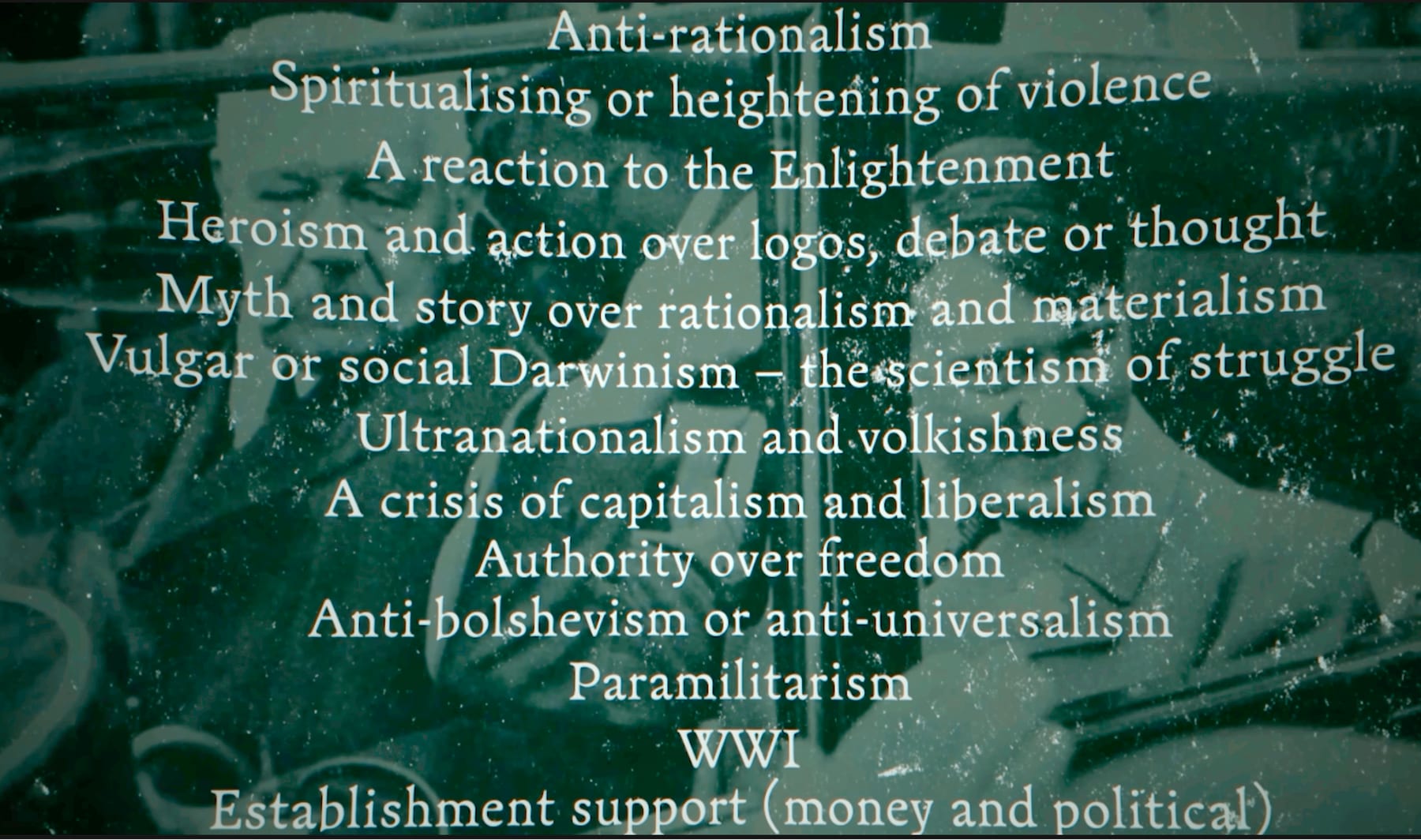
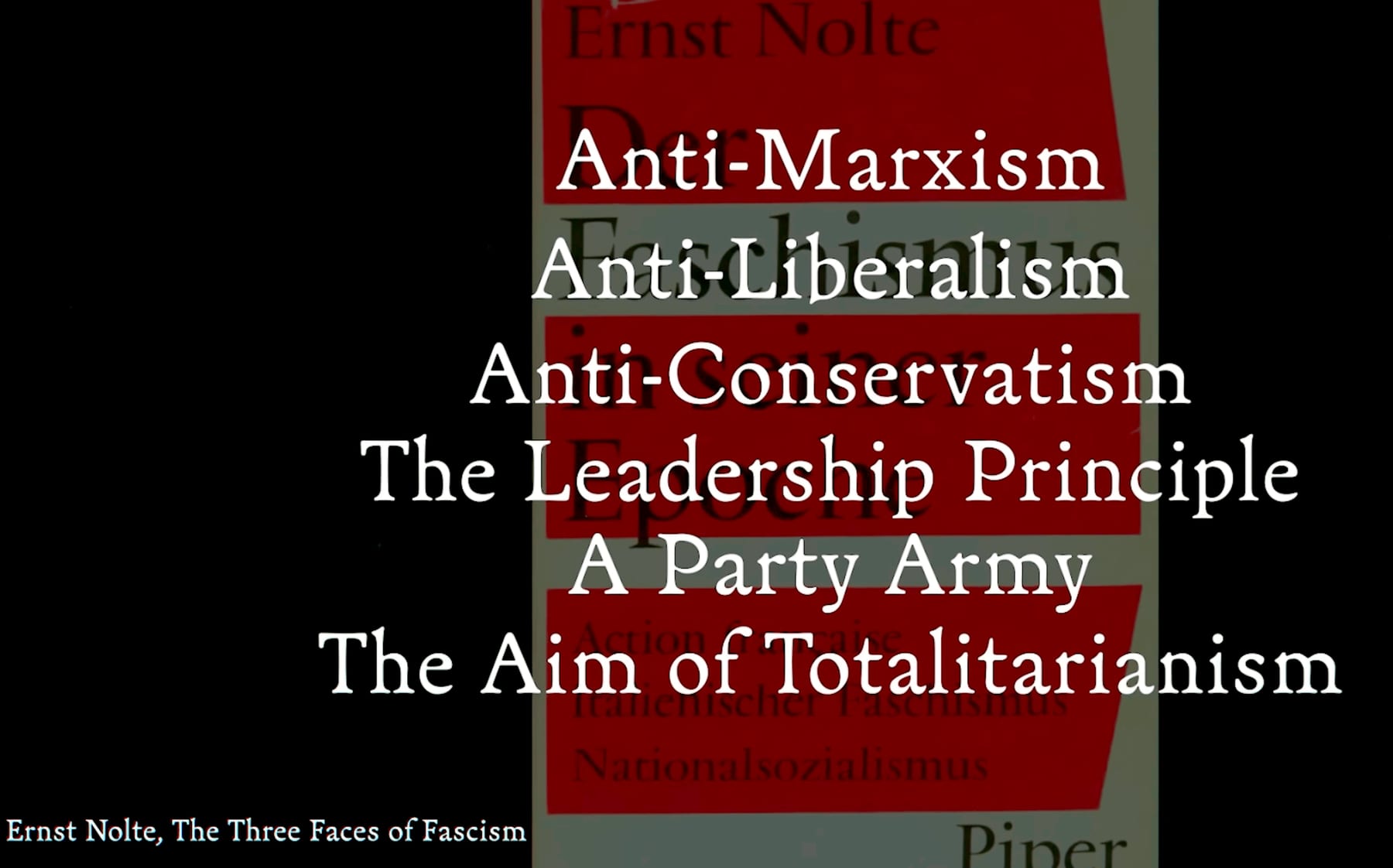

Research companion
Robert Paxton - Anatomy of Fascism adds the institutional process to this note’s cultural history: movement formation, conservative alliances, accession to power, exercise of power, and radicalization or entropy.
Introduction
Abstract
The introduction frames fascism less as a spell cast by propaganda and more as a mindset that grows out of a culture that can idealize violence. Using Ernst Jünger and his WWI memoir Storm of Steel, it argues that modern people underestimate how easily extreme hardship, camaraderie, and war can be experienced not only as horror but as transcendence—pride, meaning, “ecstasy,” and spiritual elevation through danger. The narrator’s core move is to force a “mental reversal”: to take seriously that violence was often seen as purposeful, even morally energizing, rather than simply criminal or pathological.
It also sets up the project’s method: you can’t understand fascism through a simple good/evil movie script. Many influential figures were ambiguous—capable of genuine artistry, sincerity, and intellectual depth while also being anti-democratic, nationalist, or complicit in prejudice. The introduction positions fascism as something ordinary people could drift into, especially those shaped by the brutalizing expectations of war and “men of action” myths. The promise is a layered “onion” approach—psychological, cultural, and historical—showing how a worldview forms in which order is sacred, struggle is progressive, and the “villains” can be sincerely experienced as heroic.
The trench experience as a “crucible,” and Ernst Jünger as the archetype
- 00:00:00 The speaker opens with World War I trench warfare as something historically new:
- “Dark and dirty, disease ridden and deathly trenches”
- A crucible (definition: an intense, severe test that forms/forges people) producing:
- Camaraderie under terrible odds
- Awe-inspiring machinery and terrifying weaponry
- A “brotherhood molded by extreme violence”
- 00:00:16 Introduces Ernst Jünger (German soldier; name appears as “Ernst Younger” in transcript):
- 00:00:25 At 19, he sustained “over 14 wounds” in the war.
- 00:00:31–00:00:45 After the war, he could “only make sense of it” by raising it into meaning; died in 1998 at 102; became a respected author and “voice of that lost generation.”
- 00:00:50 His 1920 memoir Storm of Steel is distinct because it heightens war rather than only mourning the fallen.
- 00:01:01–00:01:09 The key motif introduced: idealizing / glorifying / romanticizing / spiritualizing violence(the speaker treats these as a continuum).
Jünger’s language: spiritualized violence and “intoxication”
- 00:01:16 Quote (as given): “in these men there lived an element that underscored the savagery of war, while also spiritualize izing it… the matter of fact, joy and danger… The chivalrous urge to fight.”
- Violence is framed as:
- A spiritual experience
- A purifying forge (“the fire forged… purer… bolder warriorhood”)
- Violence is framed as:
- 00:01:37–00:02:08 The speaker builds an analogy:
- You can understand a small version of this feeling via pride after something painful (a wound/accident/challenge).
- Then scale it: “times a thousand… times a million” in service of something “great” and “transcendent.”
- 00:02:14–00:02:47 A second long quote (verbatim as provided) describing ecstatic combat:
- “the ecstasy… of the holy man… prophets… love… granted to those of great courage”
- “blood boils… intoxication beyond all intoxication”
- Individual becomes “a raging storm… tossing sea… roaring thunder… melted into everything.”
The uncomfortable claim: humans are fascinated by violence
- 00:02:54–00:03:12 The speaker says we dislike admitting this:
- We’re “culturally hooked” on war games/podcasts/movies/documentaries, sometimes gratuitously.
- This fascination is described as universal in human history.
- 00:03:12–00:03:39 Jünger celebrated war’s declaration like many contemporaries:
- Bored with bourgeois routine
- Suspicious of materialism/decadence in Europe/America
- Desirous of heroism and meaning
- The speaker challenges the viewer: “Does that sound familiar… might be you too.”
“If the war is meaningless, give it meaning”
- 00:03:45–00:04:09
- Jünger: if war was meaningless, it becomes necessary to give it meaning.
- Quote: “The blood of the Great War cannot have flowed for nothing.”
- The speaker adds a cultural mechanism: meaning accrues through art, literature, poetry, film, and history “over time.”
- 00:04:17–00:04:31
- Jünger’s implied philosophical test: if slaughter is meaningless, the philosophy must be “barren, nihilistic… in which no God is present.”
- Introduces a theme: many figures in the story will believe violence has meaning because it moves history.
“Men of action” vs. philosophers and bureaucrats
- 00:04:38–00:04:57
- Violence is framed as the driver of Rome, the British Empire, the American Revolution, etc.
- The speaker contrasts “men of action” with “philosophers or pencil pushing bureaucrats.”
- Rhetorical prod: “Aren’t we all just a little bit too comfy?”
Jünger’s politics: conservative radicals and soldierly nationalism
- 00:05:05–00:05:28
- Jünger advocated overthrowing a “lying, divided parliamentary talking shop” and the “decadent and lazy” Weimar Republic.
- He joined writers called conservative radicals (definition: German interwar intellectual circle combining nationalist, anti-liberal ideas with revolutionary energy).
- He opposed democracy; endorsed “soldierly nationalism.”
- The “soldierly” part is flagged as crucial for fascism.
- 00:05:28–00:05:47
- He “flirted” with Nazism; was “mildly anti-Semitic” (speaker notes “many people at the time were”).
- He called early Nazis “revolutionary fire”; Goebbels admired him.
- But he ultimately stopped short of supporting Nazis.
Why start with Jünger: ambiguity + violence as a mental reversal
- 00:05:47–00:06:24
- Purpose: disrupt “simple good guys / simple bad guys.”
- Jünger is:
- A nationalist who hated democracy
- Yet produced “great… earnest art”
- Not fully fascist
- 00:06:24–00:06:56
- Main reason: to foreground cultural heightening of violence.
- The viewer must “recalibrate”:
- Violence was more present in life
- Often accepted
- Sometimes considered good and purposefully pursued
- This is the “first mental reversal” needed to understand fascists from “comfortable screens today.”
- 00:06:56–00:07:25
- The speaker attacks a common view: “You think it’s all about being captured by Hitler’s spell… Mussolini’s propaganda… you wouldn’t be tricked.”
- Claim: that interpretation is “wrong.”
- You’re more likely to be someone already tough, expecting war, experienced war, or closely connected to veterans.
The “cauldron” of violence and the ingredients beyond leaders
- 00:07:25–00:08:06
- Mentions emergent groups from WWI:
- Shock troops
- Veterans
- “squad, Risi” / “D.T.” (unclear transcription; later the talk uses Italian squadristi/Arditi)
- People skilled in daggers, grenades, hand-to-hand combat; who welcomed close gritty combat
- Adds long-run intellectual ingredients:
- Ideas of the Volk
- Socialists, anarchists
- Darwin, race struggle, etc.
- Mentions emergent groups from WWI:
- 00:08:06–00:08:42 The speaker frames the story as a reversal of post-WWII moral intuitions:
- Enlightenment philosophers are “evil”
- Order is sacred
- Violent struggles are inevitable and progressive
- Fascist villains are heroes (in their own self-understanding)
- Europe “corrupted” by parliaments and lazy intellectuals
- Promise: deep psychological/historical “onion” to understand authoritarian mindset.
Chapter One: Fertile Soil
Abstract
This chapter argues that fascism grows in “fertile soil” created by 19th-century modernity: rapid industrial change, migration, porous empires and mixed ethnic landscapes, and the sense that old certainties (religion, hierarchy, local community) are dissolving. It uses Bismarck as a symbol of the strong, competent authoritarian leader—yet stresses that even this symbol is partly mythologized. The larger point is not “start with Bismarck,” but to notice what people feared: chaos overrunning order, and the craving for a stabilizing force that feels both traditional and effective.
The chapter emphasizes a paradox that becomes crucial later: “revolutionary conservatism”—wanting to preserve older hierarchies while harnessing modern dynamism (industry, speed, national mobilization) to restore greatness. Germany and Italy are presented as latecomers with inferiority complexes relative to Britain and France: proud histories, limited empires, and an anxious desire to “catch up.” Out of this mix—nostalgia, acceleration, social dislocation, and mistrust of parliamentary “talking shops”—a longing emerges for a politics that feels rooted, unified, and forceful.
Where to begin: Berlin, but then the countryside
- 00:08:55–00:09:22
- 1914 Germany described as most powerful state culturally (and implied materially).
- Middle class expects “more progress… prosperity.”
- The speaker “welcomes” us to Berlin or any big capital, but says it may not be the best starting point.
- 00:09:31–00:09:43 Asks: if fascism has a “soul” or inner core, where is it?
- Announces movement toward the countryside and Italian squads roaming it for action.
Richard Evans and the “Bismarck question”
- 00:09:58–00:10:25
- Mentions historian Richard Evans (Third Reich trilogy).
- Evans’s opening line: “Is it wrong to begin with Bismarck?”
- Otto von Bismarck ruled the Second Reich (1871–1890).
- Embodies “strong, competent, authoritative… world shaping but conservative” leadership.
- 00:10:25–00:10:51
- The speaker uses Bismarck to discuss charisma and “strongman” appeal.
- Frames such leaders as simultaneously old/conservative and new/radical:
- Not royal/hereditary
- A “reaction” to Enlightenment progressivism/scientism and revolutionary change
Bismarck as “revolutionary conservative” and the anti-parliament impulse
- 00:11:06–00:11:25
- United Germany “hated parliaments and division.”
- Bismarck: smart, calculating; negotiated with liberals; “revolutionary conservative.”
- Phrase: “using the past to strongarm the future.”
- 00:11:25–00:12:14
- In the 1920s many Germans still remembered living under Bismarck.
- Bismarck resembles authoritarian elements of fascism, but key difference: elitism and fear of the masses.
- Hitler/Mussolini’s innovation:
- Not merely ruling the masses
- But inviting them in, shaping them into a movement, and using them.
- This “brought alive” militaristic traditions (Bismarck, Frederick the Great).
- Mentions Kaiser’s world conquest dreams seeming near.
Distorted memory: Bismarck as “jackbooted” vs diplomat of moderation
- 00:12:27–00:13:10
- Germans remembered Bismarck as “Iron Chancellor,” but memory distorted.
- Reality: negotiated liberal concessions:
- Fair trials
- Equality before the law
- Bourgeois capitalism
- Rollback of most censorship
- Some parliamentary power
- Bismarck described as pragmatist.
- 00:12:51–00:13:10 1944 diplomat quote: picture of Bismarck as “politician of violence” is false; his gift was diplomacy/moderation; winning trust.
The problem of causal overreach and the “too many causes” issue
- 00:13:18–00:13:37
- The speaker says we must go deeper and also remember it’s not only Germany.
- Notes complexity: “causes like dominoes… but you can go back too far.”
- Mentions 2000 review counting 37,000 texts on Nazis (before other fascisms).
- 00:13:37–00:14:13
- Alternative starting points:
- Napoleon as “first modern dictator”
- Anti-Semitism as long historical thread
- Emphasizes differences:
- Italy vs Germany different
- France more anti-Semitic than Germany (speaker’s claim)
- Italian fascism emerges from split within Italian socialists
- Hitler hated Marxists as much as Jews
- Other proto-fascist movements:
- Russia’s Black Hundreds (paramilitary ultranationalist anti-Semitic group; mass mobilization)
- France’s “action France” (likely Action Française; nationalist, anti-Semitic, populist movement)
- Alternative starting points:
The 19th century: modernity as chaos and dislocation
- 00:14:45–00:15:40
- 19th century described as “new, scary, fast moving… God is dead world.”
- Europe’s national/imperial map different:
- Nation-states not the norm
- Ethnicities scattered under empires
- Borders porous/gradients rather than hard lines
- Examples:
- Germany included Poles, Slavs, Danes, French speakers
- Austro-Hungarian Empire: dozens of ethnicities
- Border towns: mixed populations
- Modernity speeds migration and cross-border movement.
Technology, capitalism, atomization, decadence, and fear of the mob
- 00:15:47–00:16:27
- Bismarck symbolizes fear of chaos overrunning order.
- Industrial revolution + capitalism + second industrial revolution tech list:
- Electricity, engines, telegraph, telephone, cars, planes, cinemas, radio
- Fascism “builds on all of this.”
- 00:16:04–00:16:33
- Atomization (definition: individuals becoming socially detached from traditional communities):
- Uprooted from family/church/village norms
- Fears:
- Decadence and greed
- Cities “dining on fat portions of exotic foods”
- Forgetting “real work” and “real fighting”
- Materialism over godliness
- Mob over hierarchy
- Atomization (definition: individuals becoming socially detached from traditional communities):
Traditional conservatism vs “revolutionary conservatives”
- 00:16:33–00:17:00
- Bismarck = Realpolitik (definition: pragmatic politics focused on power and practical results over ideology), gradual change.
- Traditional respect for:
- Prussian monarchy
- Landed estates/aristocracy
- Religion
- God-ordained order
- 00:17:13–00:17:39 Introduces “revolutionary conservatives”:
- Combine old order with dynamism/speed/inventions of the future.
- Memorable metaphors:
- “Bismarck on steroids”
- “Napoleon in a tank”
- “Genghis Khan on the radio”
Inferiority complexes and nostalgia + chaos
- 00:17:44–00:18:21
- Nations doing well: Britain, France, America; Germany catching up.
- Germany and Italy: “inferiority complex”
- Germany proved military might (Franco-Prussian War) but lacked colonies.
- Italy had Rome’s glorious past but felt decline.
- “Chaos and nostalgia together” as a dangerous mix.
- Turn of the century: “unrooted” West.
Chapter Two: The Pure of the Earth
Abstract
Chapter two focuses on the emotional appeal of “rootedness” as modern life becomes abstract and destabilizing. It contrasts local, tangible life (craft, village networks, familiar tools) with the alienating world of factories, national markets, bureaucracy, statistics, and expert knowledge. German Romanticism is presented as a deep cultural reaction: suspicion of Enlightenment abstraction and a preference for embodied community, tradition, emotion, landscape, myth, and “wholeness.”
From this, the chapter traces the rise of völkisch thought: the idea that a people (Volk) has an organic, quasi-spiritual bond with its soil, language, and inherited culture. Thinkers like Friedrich Ratzel connect this to “Lebensraum,” treating peoples like organisms that require territory. The chapter shows how popular literature and myth-making (Grimm, medieval epics, Nordic revivalism) normalizes ideals of purity, moral authenticity, and rural virtue—creating a powerful cultural template where the “true people” are the heartland producers, threatened by cities, modernity, and mixing.
A parable of the village craftsman vs industrial modernity
- 00:18:50–00:19:42 The speaker asks the viewer to imagine:
- You’re a woodworker in a village: stable tools/knowledge passed through generations.
- Suddenly factories mass-produce furniture; shipped by trains across continents.
- Advertised via national color catalogs managed from distant cities.
- Cars + obsolescence fears: livelihood threatened.
- “Heartland producers” (farmer/builder/grocer) vs alien metropolitan life.
Enlightenment abstraction vs rooted experience
- 00:20:02–00:21:12
- “Science/technology/mathematics/enlightenment formal thinking” described as antithesis of rooted life.
- Depicts “specialist, abstract, esoteric” knowledge by technocrats/intellectuals in “ivory towers.”
- List of modern abstractions:
- Measuring/categorizing/statistics/data
- Instruments (beakers, microscopes)
- Supply chains, borrowing, interest rates, loans
- Emotional effect on ordinary people: abstract, far away, discomforting/terrifying.
Romanticism as reaction: Wordsworth example
- 00:21:27–00:22:22
- Romanticism (definition: cultural movement emphasizing emotion, nature, tradition, the sublime; often critical of rationalism/industrial modernity)
- Claims Romanticism was Europe-wide but deeper/longer in Germany.
- Romantic suspicion of Enlightenment jargon.
- Contrasts “rooted, real” (bodies, emotion, community, tradition) vs abstract.
- Quote from William Wordsworth:
- Science seeks truth as “remote and unknown benefactor… solitude”
- Poet shares truth as “visible friend and hourly companion”
- The point: science/tech can feel exotic/remote vs village life.
“Rooted measurement” vs national abstraction
- 00:22:45–00:23:39
- The speaker clarifies: craftsmen do measure and calculate, but it’s tangible and local.
- Rooted economy:
- Local demand, trees, materials
- Relationships, word-of-mouth, contracts with local shops
- Suggests small business still relies on “romantic rootedness” against theory.
The Völkisch movement and the sacredness of land/soil
- 00:23:47–00:24:08
- Völkisch (definition: German ethnic-nationalist cultural ideology stressing a people’s organic unity, heritage, and connection to land)
- Idea: a people with special characteristics connected spiritually/religiously to land/soil, each other, language—unique and immovable.
- 00:24:08–00:24:47 Introduces Friedrich Ratzel (geographer/ethnographer):
- 1896 quote: cannot divorce the being of nature from a Volk (definition: “people” conceived as an organic ethnic/cultural unit) rooted on the same soil for centuries.
- Coins Lebensraum (“living space”): a people needs space to thrive.
- Bases on animal migration/territory protection/expansion.
Spirit made concrete: landscape as fate
- 00:24:57–00:25:12
- Ratzel: a people inscribes spirit/fate into landscape, towns, houses.
- “Spirit becomes concrete”; transcendental becomes real.
- 00:25:19–00:25:35 Cultural references:
- Painting: “wanderer over the [fog]” (likely Wanderer above the Sea of Fog): lone figure facing vast landscape (visual shorthand for Romantic sublime/individual facing nature).
- Brothers Grimm fairy tales: local oral storytelling valued like rational science.
Life as a jigsaw: the “wholeness” claim
- 00:25:41–00:25:53
- Science/math are “one small narrow part”; life requires community/poetry/religion/culture.
- 00:26:00–00:26:25
- German writer quote (name unclear in transcript) on landscape:
- Countryside becomes “landscape” when experienced by the human soul.
- If soul recognizes countryside rhythm as its own, rootedness = stable predictable structure across elements.
- German writer quote (name unclear in transcript) on landscape:
Myths as meta-narratives and models (Jordan Peterson reference)
- 00:26:41–00:27:59
- Mentions German fascination with:
- Edda (collection of Norse myth; speaker calls it “German texts”)
- Nibelungenlied (epic medieval German tale of heroism written ~1200)
- Definition of myth:
- Not “untrue” by definition
- Organizes meta-narratives; provides lessons
- “Jordan Peterson sense”: myths as psychologically guiding stories
- Truth-status not always central; myths can be:
- True, fictional, ambiguous
- Medieval knights with Jesus, Norse gods, Marvel superheroes
- Or attached to real figures (Mandela, MLK)
- Function: glue, entice, guide, teach.
- Mentions German fascination with:
Near-Romantic flourishing and “vocation novels”
- 00:28:21–00:28:50
- End of century: flourishing of near-romantic poets/writers/playwrights.
- Vocation novels (definition as used here: popular novels idealizing rooted “calling,” agrarian purity, ethnic virtue).
- Example: Helmut Heeringa (1910; as transcribed) widely read.
- Hero traits: blond hair, moral purity
- “Aryan face” so honest a judge would “know” he didn’t commit a crime (example used to show pseudoscientific racial essentialism).
- Protagonist rejects:
- Industrialization/cities/smog/technology/alcohol
- “Racial mixing”
- Chooses “pure völkisch life.”
Sacred geography and occult revival themes
- 00:29:15–00:29:56
- Teutoburg Forest: symbolically special; ancient Germanic victory over Romans.
- Novel Osney (as transcribed): Nordic renaissance; secret group resurrecting cult; leader in cave in Teutoburg; old Nordic gods; later staged by Nazis.
- Theme: stories “touch something deep” in psyche/history.
“Totality” and spiritual completeness; Geist and philosophical lineage
- 00:30:05–00:31:13
- Romantic writers: spiritual completeness = totality of experience (emotion/story/community/landscape), not only reason/science/business.
- Speaker relates personally (influence by Romantics; mentions:
- Videos on Romantics
- “romantic pilgrimages” to Rousseau’s “high school” (unclear), Lake District).
- Philosophical lineage:
- Geist (Hegel; definition: spirit/mind shaping history/culture)
- Spinoza: humans part of universe with a total purpose
- Hegel: striving/dynamism/reaching
- Idea: an “insatiable” drive for wholeness (not necessarily material greed, but experiential/spiritual/cultural).
The “deed” over “thinking”: Die Tat and actionism
- 00:31:48–00:32:26
- Mentions a writer (name unclear; “Take Uganda’s drinks” in transcript) who coined term “near Romantic” and published magazine Die Tat (“The Act/The Deed”) in Vienna.
- Central distinction:
- Deed/doing over thinking
- Bring abstract Enlightenment ideas down into concrete action.
- Says this distinction will be important later.
Dietrich, pantheism, corporatism, and swastika-as-sun symbolism
- 00:32:26–00:33:58
- “Diuretics” in transcript (likely Eugen Diederichs): made völkisch ideas respectable; popular writer; model of wholeness.
- Eccentric details (kept because the speaker uses them as illustrative color):
- Zebra-skin trousers, turban
- Hosted ancient Greek wine-themed feasts
- Cites historian George Mosse, The Crisis of German Ideology:
- Industrial materialism opposed by “new spiritual vitality.”
- Germany should renounce liberalism; organize on corporatist lines (definition: society organized by functional groups/professions with integrated roles and representation).
- Quote attributed to Dietrich/Diederichs:
- God = sun as source of life
- Sun rays as “material infused with Geist” transmitting invisible heat
- Pantheistic (definition: God present in everything; divinity identical with nature).
- Visual-symbol claim:
- Swastika meant as representation of the turning sun releasing energy.
Expanding “German-ness” and the tension between rootedness and exotic reach
- 00:33:58–00:35:18
- Speaker describes a “German hero” archetype striving for experiences:
- Reaching for German things and “something more” that expands “Germanness.”
- Notes a tension:
- Völkisch grounded in rural/agrarian “green”
- Yet also drawn to:
- “Iranism,” India
- Nazi obsessions with the Holy Grail
- Purpose: to magnify and “feed” German identity by claiming wider ancient connections.
- Speaker describes a “German hero” archetype striving for experiences:
Guido von List: occult nationalism and “reading the landscape with our souls”
- 00:35:18–00:36:46
- Introduces Guido von List (occultist playwright/novelist):
- Obsessed with hidden meanings under symbols/places
- “Mysterious powers,” special sites releasing Germanic spirit
- Believed greatness buried by Christianity/Judaism; wanted recovery.
- Quote: “we must read with our souls the landscape that archeology conquers with the spade… fly into the loneliness of nature.”
- Believed in a lost Germanic culture that once ruled Europe.
- Vision of a future German strongman restoring all-inclusive united greatness.
- Introduces Guido von List (occultist playwright/novelist):
“Aryan” as linguistic discovery → racial mythology
- 00:36:55–00:37:29
- Aryan race idea traced to 18th-century discovery of Indo-European language roots.
- Mentions Rigveda referencing a noble people called “aria/Aryans.”
- Von List and others transform this into claim of a noble Aryan race originating in Germany, spreading to India.
- Parallels with Italian fascism’s nostalgia for Rome.
Munich Cosmic Circle and purity-through-anti-mixing logic
- 00:38:01–00:39:15
- Von List’s ideas adopted by Alfred Schuler (occultist), associated with Munich Cosmic Circle; 1922 talks Hitler “may have been present at.”
- Swastika popularized as symbol of ancient pure Aryan race.
- Purity narrative: race once pure, lost potency through “mixing of blood.”
- Analogy:
- Border language mixing (French/German)
- Mixing many paints → brown (used to make the “pure origin” intuition feel plausible).
Perennialism, Blavatsky, and “pure equals strength”
- 00:39:23–00:40:29
- Christianity sits poorly with social Darwinism/militarism (foreshadowing).
- As Christianity declines, people search for alternatives → rise of occult/pagan/perennial theories.
- Perennialism (definition: belief that universal truths recur across religions/cultures; here used to find clues legitimizing a “universal mission.”)
- “Pure = strength = best = Aryan,” bolstered by symbols found widely (Scotland caves; India).
- Mentions Madame Helena Blavatsky:
- Claims secret Tibetan texts pointing to Aryan Eurasian domination; Aryans as “root race.”
- Logic: the more you can connect to a glorious past, the more you legitimize claims to a great future.
Purity implies impurity: anti-Semitism enters as the antithesis
- 00:40:46–00:41:29
- If an ideal pure model exists, logic produces an opposite: the impure.
- Anti-Semitism described as Europe-wide; “worst in France” per speaker.
- Jewish emancipation laws gradually abolished discriminatory taxes/rights restrictions across 19th century.
- “Jewish question” widely discussed by intellectuals.
- Historical constraints on professions/guilds → overrepresentation as financiers/middlemen/merchants → scapegoating during crashes.
- “Wandering enemy within” framed as uniquely dangerous; opposite of rooted vocation.
Paul de Lagarde and Moritz von Egidy: internal debate within völkisch currents
- 00:42:27–00:42:57 Paul de Lagarde:
- Anti-Slavic and anti-Semitic.
- Disliked Christianity due to “Jewish influences.”
- Wanted a German Christian doctrine; organized Volk into medieval estates.
- Jews framed as stateless, wandering, not fitting stable harmonious German soul.
- 00:43:13–00:43:45 Moritz von Egidy (as transcribed):
- Völkisch youth education, but skeptical of Jewish corruption narrative.
- Asks: how could ~500,000 Jews corrupt 50 million Germans?
- Concludes: if so, that implies weakness in Germans, not Jewish power.
Back-to-the-land movements and Lebensraum as protection-and-expansion paradox
- 00:43:51–00:44:54
- Rootedness becomes key metaphor against Enlightenment/materialism destabilization.
- Back-to-land groups:
- Thinker Willibald Henschel
- “Ottomanen” / “Artamanen” (transcript unclear; context: youth agrarian commune movement)
- Began as “MIT society” (unclear) in 1906; advocated leaving cities for rural communes.
- Described as “basically hippies,” but became nationalist via opposition to Polish farm laborers in the East.
- Many saw themselves as “third way” between communism and capitalism; adopted Lebensraum.
- Himmler is said to have been a member; later incorporated into Nazi Party.
- 00:44:54–00:46:20
- Novel The Peasant from Buttner (1895; author “Vilhelm von plantes” as transcribed) said to influence Hitler:
- Peasant borrows money from a Jew → can’t repay → foreclosure → Jew sells to industrialist → factory built.
- Ends with peasant staring at soil; quote: “The soil to which he had dedicated his life… sold his body and his soul.”
- Germany saturated by this literature.
- Goebbels cited as having PhD in romantic literature.
- Rootedness becomes struggle to preserve/recapture greatness; can become engine of expansion (Lebensraum).
- Novel The Peasant from Buttner (1895; author “Vilhelm von plantes” as transcribed) said to influence Hitler:
Hitler’s “secret book” quote: history as struggle for existence
- 00:46:31–00:47:03
- Quote from Hitler’s later “secret book / Zvi Booker / Zweites Buch” (second book):
- “history itself is the presentation of the course of a people’s struggle for existence… eternal struggle… life… against death.”
- Quote from Hitler’s later “secret book / Zvi Booker / Zweites Buch” (second book):
Chapter Three: The Science of Struggle
Abstract
This chapter explains how late-19th-century scientific discoveries and evolutionary language reshaped social and political imagination. The discovery of germs and the rise of hygiene culture make “invisible threats” feel omnipresent; Darwin and popularized “survival of the fittest” thinking encourage a worldview where struggle is natural, permanent, and morally instructive. Even if Darwin himself allowed room for altruism, the broader culture increasingly treats competition and elimination of weakness as common sense.
The chapter shows how biological and medical metaphors get applied to society: parties have “antibodies,” nations must purge “bacilli,” and racial struggle becomes framed as objective science. This helps fuse völkisch rootedness, social Darwinism, and colonial logic into a politics where territory is everything and war appears inevitable and progressive. The result is a chilling “normalization” of ideas about purity, hygiene, classification, and the necessity of harsh action—presented not as hatred but as nature’s law.
Struggle as organizing concept; leadership-by-selection logic inside Nazism
- 00:47:10–00:48:27
- Struggle framed as relatable, still-existing concept.
- Quotes Nazi Max Amann on Hitler’s leadership method:
- Party shouldn’t appoint leaders; the best fighter pushes through by achievements.
- Hitler “sits back,” watches internal competition; those who rise do so through struggle.
- Historians therefore call him a “weak dictator” (definition: leader who rules via competing subordinates rather than direct micromanagement), intervening mainly when required.
Discovery of bacteria and hygiene obsession; racialized cleanliness imagery
- 00:48:42–00:49:34
- Discovery of bacteria described as hard to overestimate psychologically.
- Mentions Robert Koch (1876).
- Effect: changed medicine + psychology; obsessive hygiene drive.
- Example: Jim Crow America adverts depicting whites as clean and African-Americans as dirty/diseased (speaker’s illustrative claim).
- Ties timing to Darwin’s publication.
Darwin/Spencer: survival of the fittest becomes quasi-religion
- 00:50:06–00:50:49
- 1859: Darwin publishes On the Origin of Species (context).
- Herbert Spencer coins “survival of the fittest.”
- Struggle for survival across:
- Other humans
- Other species
- Environment
- Invisible organisms “under/in our skin”
- Scholars say this becomes a Europe-wide “religion,” pervading disciplines.
- 00:50:49–00:51:07
- Darwin quote (as given): “one general law… multiply… let the strongest live and the weakest die.”
Misreadings and moral implications: poor perish; altruism debate
- 00:51:07–00:51:35
- “Most obvious expression”: poor/needy destined to perish; strong thrive.
- Speaker notes Darwin didn’t fully accept this; he argued altruism can fit natural selection via reciprocity.
- But “it didn’t really matter what Darwin thought” because people drew the harsh conclusion anyway.
Pervasiveness example: War of the Worlds and fear of extermination
- 00:51:46–00:52:39
- Analogy: school race—if built from “worst team members” vs elite selection (used to make selection logic intuitive).
- Example from War of the Worlds (1898):
- Humans wiped out; cities fall; giant cemetery; “massacre of humanity.”
- Point: zeitgeist shifts from stable order to struggle as essence of change.
From Aristotle/God-order to Newtonian movement and struggle everywhere
- 00:52:45–00:53:19
- Contrasts:
- Aristotle: everything has its place (stone falls to ground; natural order).
- Religion: God-ordained order.
- Enlightenment/Newtonian view: everything moves; struggle/dynamism everywhere.
- Names spanning domains: Hegel, Marx, Dostoyevsky, Freud, Darwin.
- Contrasts:
Medical metaphors in politics: Mussolini and Hitler
- 00:53:35–00:54:10
- Mussolini quote (while still Socialist) comparing party expulsions to immune system:
- Party is organism; has “socialist antibodies”
- Must defend against “impure elements” like germs in blood.
- Mussolini quote (while still Socialist) comparing party expulsions to immune system:
- 00:54:29–00:54:57
- Some call Nazism “applied biology” and discuss “medicalization” of society (definition: explaining social/political problems through disease/health metaphors).
- Hitler 1920 speech quote:
- Can’t fight disease without killing bacillus; calls Jews “racial tuberculosis” cause; must remove cause.
Racial hygiene, colonialism, and the strategic logic of territory
- 00:55:19–00:55:41
- “Venn diagram” between:
- Völkisch thought (Lebensraum, national character)
- Social Darwinism
- Colonialism
- Struggle → inevitable war to protect/expand Volk; territory as zero-sum.
- “Venn diagram” between:
- 00:55:50–00:56:15
- Hitler’s conquest logic summarized (transcript is garbled here):
- “Conquer Eastern Europe… dominate the heartland… dominate the world… [unclear repetition about ‘Island’].”
- Core idea: territory/heartland logic of world power.
- Hitler’s conquest logic summarized (transcript is garbled here):
Borders as historically fluid; imperial expansion as normal
- 00:56:37–00:57:42
- Claims we live in unusually static-border period (with exceptions).
- Examples of fluidity:
- Genghis Khan, British/Roman empires expanding/shrinking
- Porous ethnic borders
- Pilgrims in America; westward movement
- Farmers/states/corporations buying land and growing
- “Thinking in this way was… normal, commonsensical.”
- Moral corollary: you shouldn’t rebel against what’s “natural.”
Italy and Germany’s “place in the sun” and colonial envy
- 00:57:48–00:58:55
- “Of course” logic (speaker mimics mindset):
- Peoples need space/materials/land to keep up with Britain/France.
- Italy humiliated by defeat to Ethiopia in 1896; inheritors of Rome.
- Germany as European center of learning/science/philosophy; nostalgia for Reich glories.
- Lists German colonies (as transcribed): Tanganyika, Namibia, Togo, Cameroon, New Guinea.
- German naval build-up; North Sea battle seen as inevitable.
- Rearmament described as illegal under “Masai treaty” (likely Versailles; transcript error).
- “Of course” logic (speaker mimics mindset):
Race as “electric charge”: Henschel novel Varuna and normalization of racism
- 00:59:18–01:00:44
- Quote via Mosse about Henschel’s 1907 Varuna:
- History powered by stored energy from “racial dynamism.”
- Primeval race as “electric charge” needing preservation via purity.
- Speaker’s interpretive point:
- Racism didn’t have today’s negative connotations; “race and racism… seen… as positive force.”
- Terms like nationalism, race, struggle, purity were mundane/expected pre-20th-century atrocities.
- Claims fusion of racialist + völkisch + social Darwinism → “scientific racism” late 19th century.
- Transcript becomes briefly unintelligible 01:01:02–01:01:20 (several garbled lines).
- Quote via Mosse about Henschel’s 1907 Varuna:
Chamberlain, Gobineau, phrenology: measuring “essence”
- 01:01:20–01:02:33
- Houston Stewart Chamberlain:
- English racialist thinker who moved to Germany; popular; loved by Kaiser.
- Struggle for supremacy between German and Jewish races.
- Germans as special tribe avoiding racial mixing; Greeks/Jesus/artists framed as Aryan due to Indo-European root.
- Quote: Jew’s “existence is sin… crime against holy laws of life.”
- Hitler visited him as he was dying; kissed his hand; Chamberlain died 1927.
- Houston Stewart Chamberlain:
- 01:02:33–01:03:09
- Arthur de Gobineau:
- Three races (white/yellow/black) ranked; purity diluted by mixing.
- Pessimistic: mixing too far; must preserve remaining purity for survival.
- Uses entropy-like analogy: can’t go backwards.
- Arthur de Gobineau:
- 01:03:09–01:03:38
- A chain of mixing analogies (why speaker uses them: to show how “purity → order” feels intuitive):
- Mix all food together
- Scrub paints together
- Smash every piano note at once
- Let garden grow wild with weeds
- Too many voices at once
- Outcome: discordance/disorder from purity to impurity
- A chain of mixing analogies (why speaker uses them: to show how “purity → order” feels intuitive):
- 01:03:38–01:05:18
- Mentions “Franz Josef Gao” (likely Franz Joseph Gall, founder associated with phrenology; transcript variant).
- Phrenology (definition: pseudoscience claiming skull shape reveals mental traits/character).
- Claim: inner essence measurable via outer appearance; scientific classification puts everyone “in its place.”
- Mentions a “plaster meter” device to measure facial geography and infer everything about a person.
- Broader logic:
- If empiricism can classify plants/animals, why not humans?
- Then you could assign people to roles:
- manual vs intellectual work
- leaders vs followers
- Result: “perfectly… ordered utopia.”
Chapter Four: Enemies of the Volk
Abstract
Chapter four develops the logic of “othering” within this rootedness framework: the city becomes a symbol of anonymity and disorder; merchants and mobile workers become suspicious as uprooted; and Jews become the archetypal “enemy within”—both present in cultural imagination yet often absent from everyday rural life, making them easy scapegoats. The chapter stresses what it sees as “new” anti-Semitism: less purely religious and more sociological/pseudoscientific—about belonging, fitting into an imagined organic national order, and being cast as inherently rootless.
It traces how legal restrictions and exclusion from guilds pushed many Jews into roles (finance, middlemen, city trades) that then fed stereotypes, especially during economic crises. A chain is outlined: modernization and crashes produce anxiety; scapegoating finds a target that seems abstract and powerful; and popular culture reinforces the narrative. Anti-Semitism rises and falls with conditions, but the “mold” gets set in classrooms, literature, and political fashion—making it available later as a ready-made explanation for chaos, humiliation, and decline.
City, merchant, proletariat, Jew: archetypes of rootlessness
- 01:05:35–01:06:13
- City: imported everything, no farmland, anonymity → “a mess.”
- Merchant: traveling, bringing “alien goods,” uprooted.
- Proletariat: moving job to job, “disinherited from the land.”
- Jew: “homeless… rooted [rootless]… not even European… not embedded” (transcript has glitches).
- The speaker models the rhetoric: “not a matter of good or bad… a matter of belonging.”
- 01:06:46–01:07:22
- Mentions René Girard on scapegoating (resource reference).
- Key distinction: new anti-Semitism differs from old by its völkisch/sociological + pseudoscientific component:
- Less about religion alone
- More about “fitting in” to a social order
Forest vs desert: environmental metaphors of identity
- 01:07:28–01:08:05
- Quote from Nazi-period writer:
- While Semites searched for Promised Land and Romulus/Remus fought, “our fatherland already possessed a settled peasant culture.”
- Völkisch trope:
- Germans = forest, deep, mysterious
- Jews = desert, rootless, wandering, shallow, dry
- Quote from “Moses Calvary” (unclear): dreams ripen under pine trees, not palms.
- Quote from Nazi-period writer:
Capitalist crises + displacement + mass media = scapegoating conditions
- 01:08:14–01:09:09
- Late 19th-century depressions/crashes/recessions across the West.
- Rapid change + displacement + migration for work.
- New globalized mass media: you can see and dream about far-away events; strikes and revolution threats visible internationally.
- Reminder: majority still lived rural/agricultural lives.
Invisibility and blame: the “John doesn’t show up” analogy
- 01:09:09–01:10:20
- Psychological point: we fear unseen threats; misjudge risks (fear air travel more than crossing road).
- Scapegoating targets least visible / least able to respond.
- Work meeting analogy:
- Crisis + absent person (“John doesn’t show up”) → easiest to blame him.
- Jew framed as both “there and not there”:
- Visible in literature/politics/argument
- Not physically visible in countryside
- The “other” becomes blank canvas for fears.
“Dire rationalism”: how stereotypes become self-reinforcing
- 01:10:25–01:11:18
- Speaker warns against seeing xenophobia as purely irrational.
- Mechanism:
- Legal/social restrictions push Jews toward middleman roles (merchants/bankers/city life).
- Then society blames them for being “wanderers” and “department store owners” etc.
- Stereotype becomes “evidence.”
Credit crises and the stock market as symbol of alien capitalism
- 01:11:25–01:12:18
- Depression years listed (as transcribed): 1873, “84,” “1993” (likely transcription error).
- Woodworker/farmer needs credit; banker may be a Jew.
- Credit extended/denied/called in.
- Bank crashes.
- Question posed: who is to blame?
- Stock market symbolizes strange incomprehensible capitalism, supposedly dominated by wandering Jews.
Anti-Semitism becomes fashionable and institutional
- 01:12:18–01:13:06
- 1880 national petition to remove Jews from government positions.
- Jews expelled from societies and student bodies.
- 1899 schoolboy quote: Jew sitting with Gentile “excites notoriety.”
- Ritual murder accusations mainstream; 12 trials in Austrian Empire alone.
- France: Dreyfus Affair (Jewish officer wrongly accused of spying).
- German politicians win on anti-Semitic platforms.
- When economy improves, wave dies down—but “mold” set, especially via classrooms.
Hitler’s synthesis in Mein Kampf: vocation + struggle + medical metaphor
- 01:13:06–01:13:58
- Notes influence circle: Dietrich Eckart and others (artists/poets/playwrights) blaming Jewish control of arts.
- Hitler in Mein Kampf merges:
- Vocation/rootedness themes
- Darwinist struggle
- Medical metaphors
- Anti-Semitism
- Quote: Jews as “pestilence worse than the Black Death… a maggot in the decomposing body of Germany.”
Chapter Five: Syndicalism, Socialists, and their Discontents
Abstract
This chapter argues that fascism’s origins aren’t purely “right-wing reaction”; they also draw from fractures within revolutionary politics on the left—especially syndicalism. In Italy and across Europe, capitalism, parliamentary reforms, and the proliferation of ideologies produce a crisis of direction: reform seems too slow, the state seems corrupt and ineffectual, and elites and radicals alike sneer at “talking shop” democracy. The chapter contrasts Germany’s powerful socialist movement with Italy’s weakness and humiliation, showing how both contexts generate a hunger for national renewal and moral seriousness.
Georges Sorel becomes the key figure: disillusioned with reformism and skeptical of parliamentary democracy, he argues that myths—especially the myth of the general strike—mobilize people more powerfully than rational argument. Violence, in this view, can be “ethical” and regenerative, restoring vitality to societies “deadened” by comfort and humanism. The chapter highlights the crucial crossover: nationalism becomes the carrier of myth and mass mobilization, and a new kind of elite emerges—an action-oriented vanguard that seeks to replace liberal order with a heroic, disciplined, anti-Enlightenment ethos.
Italy’s imperial humiliation and national insecurity
- 01:14:13–01:15:12
- Italy wanted an empire; occupied parts of what is now Eritrea.
- 1887 Dogali (“De Ghali” in transcript): 500 Italians ambushed by 10,000 Ethiopians; slaughtered.
- Described as national humiliation; riots in Italy.
- Mentions “orientalist painting” depiction (visual reference: exoticized portrayal of Ethiopian warriors/scene).
- 01:15:12–01:16:00
- Italy vs Germany contrasted:
- Italy weakest great power; agricultural; divided; low national consciousness; low literacy.
- Germany among top industrial/scientific nations; high literacy.
- Both unified around similar time: Germany 1871; Italy 1860s.
- Both nostalgic for great past; mix of greatness + insecurity.
- Italy vs Germany contrasted:
Capitalism destabilization + Enlightenment pluralism
- 01:16:08–01:16:43
- Capitalism: promise (tech, machines, weapons) and destabilizing force.
- Seen as “running away from the Volk / stable / rooted.”
- Enlightenment unleashed competing ideologies:
- Liberal, socialist, anarchist, variants
Socialist strength and the fear it produced
- 01:16:43–01:17:22
- German Socialist Party largest in world; Marxist but reformist.
- Rejected cooperation with bourgeois parties.
- Evans quote: social democracy terrified respectable middle/upper classes.
- Liberals gain: parliamentary rights, free speech, broader franchise, reforms.
- Many socialists moved toward reform; reform seen as working to some extent.
Revolutionary syndicalism: producers vs the state
- 01:17:33–01:18:25
- French radicals reject reform; some hate state/parliaments as “idle chatter.”
- Overlap and disagreement among anarchists/socialists subgroups.
- Syndicalists (definition: revolutionary labor movement aiming to place economic power in workers’ unions; often anti-parliamentary and skeptical of the state) argue:
- State is the problem
- Power should belong to producers/doers.
- Called “unorthodox Marxists.”
Key origin claim: fascism’s nucleus from revolutionary left (Italy)
- 01:18:25–01:18:47
- Historian Stanley Payne quote:
- Nucleus of Italian fascism came not from cultural elite or right nationalists, but from transformation of revolutionary left—especially revolutionary syndicalists.
- Historian Stanley Payne quote:
- 01:18:53–01:19:22
- Big recurring questions:
- Jewish question, socialist question, capitalist question
- spiritual/cultural question, scientific question
- “What is the right/good/moral thing to do?” (speaker stresses moral framing often forgotten)
- Big recurring questions:
Georges Sorel: anti-intellectualism, myth, and the general strike
- 01:19:49–01:20:43
- Introduces “George Cicero” (clearly Georges Sorel, French syndicalist; transcript error).
- Sorel hated:
- Intellectuals and parliaments
- Liberals
- Even intellectual history (Socrates “yapping… dialectically” about good life and who should rule)
- Preferred:
- Heroes, villains, action, bravery
- “Nietzsche” flavor (speaker notes)
- Quote: “there will be no longer any soldiers or sailors, but… skeptical and witty shopkeepers.”
- 01:20:43–01:21:17
- Sorel on myths in civilization:
- Homer’s Odyssey/Iliad; gods (Zeus/Brahma/Thor); knights/chivalry
- Myth purpose: not truth/falsity but models for emulation and moral guidance leading to real action.
- Myths can be about past heroes or future expectations.
- Sorel on myths in civilization:
- 01:21:58–01:22:11
- Quote: myths incite action—when we act we create an “artificial world… formed out of movements that depend on us.”
- 01:22:18–01:23:16
- Sorel’s problem: why no revolution despite working-class movements?
- Marx predicted capitalism collapse; instead socialists become reformists.
- Marx: workers have no country; international proletarian solidarity.
- Sorel: national solidarity proved stronger.
- Marx didn’t foresee liberals/bourgeoisie could “buy off” workers with reforms.
- Sorel’s problem: why no revolution despite working-class movements?
- 01:23:23–01:24:14
- Solution: a “great motivating myth” to break the “slightly improved chains.”
- Marx underappreciated ideas/symbols/psychology/words.
- Mythic event: the general strike:
- A heroic total shutdown
- Prepares ground for revolution
- Requires myth-makers/leaders/vanguard elite.
- 01:24:29–01:25:02
- Sorel differs from Marx:
- Rejects proletarian dictatorship
- Rejects central state role
- Envisions producer-run society through autonomous unions/syndicates in a market economy, led by efficient producer elites.
- Sorel differs from Marx:
- 01:25:02–01:25:14
- Book: Reflections on Violence (1908), popular among French radicals; spreads to Italy.
- 01:25:14–01:25:57
- Sorel embraces struggle as engine of progress:
- Class struggle as “alpha and omega”
- Competition among syndicates as creativity and change driver.
- Sorel embraces struggle as engine of progress:
Strike as electrifying collective psychology; “ethical violence”
- 01:26:44–01:27:14
- Speaker mentions claim (uncertain): 1906 had “half a million strikes” (he flags implausibility).
- Describes hardship of unrest:
- Shared saved food; foraging; soldiers shooting strikers.
- References Russia “Bloody Sunday” (transcript says 1985; likely 1905; but keep as given): hundreds killed.
- 01:27:32–01:28:23
- Edouard Berth (syndicalist; student of Sorel; follower of Henri Bergson):
- Strike as contagious collective phenomenon:
- Egoism disappears; “electrified mass”; “collective personality”
- Quote about unity surging to “highest peaks of heroism… sublime”
- Strike as contagious collective phenomenon:
- Sorel on violence as regenerative:
- “proletarian violence” ensures revolution
- also restores energy to nations “deadened by humanism”
- Edouard Berth (syndicalist; student of Sorel; follower of Henri Bergson):
Anti-democratic turn toward nationalism and national syndicalism
- 01:28:52–01:29:44
- Sorel moves away from orthodox Marxism; hates democracy (specifically parliamentary democracy).
- Speaker notes “democracy” is nebulous (bourgeois liberal vs socialist vs communist interpretations).
- Sorel also dislikes mob-rule; moves toward nationalism as carrier of myths and organizer of people.
- Claim: national identity remains most enduring ideology.
Cercle Proudhon, Sternhell’s “turning point,” and the new elite
- 01:30:12–01:31:18
- Berth + Georges Valois form Cercle Proudhon (Circle Pre-dawn in transcript).
- Move syndicalism into nationalist direction.
- Valois quote:
- Nationalism carries forces for social transformations.
- National values replacing socialist values.
- Circle’s declaration:
- Democracy is “greatest terror of the past century”
- Must “destroy all democratic institutions” to preserve civilization’s moral/intellectual/material capital.
- 01:31:18–01:32:05
- Historian Zeev Sternhell, The Birth of Fascist Ideology:
- This is the key turning point:
- New elite emerges aiming to mobilize masses via myths
- Anti-Enlightenment, anti-rational, revolutionary, pro-action/violence
- Contains ingredients for fascism (even if later distorted/mixed)
- This is the key turning point:
- Caveats:
- Not all syndicalists fascistic
- Not all fascists started syndicalist
- Some remained anti-state and focused on union control of industry.
- Historian Zeev Sternhell, The Birth of Fascist Ideology:
The “warriors and monks” moral world and left anti-democracy
- 01:32:27–01:33:44
- Sternhell quote summary:
- Replacement of liberal order
- New world: virile, heroic, pessimistic, puritanical
- Duty and sacrifice
- “morality of warriors and monks”
- Powerful avant-garde; aristocracy of producers allied against decadent bourgeoisie
- Speaker emphasizes what feels alien today:
- You can be left and anti-democratic
- Unions can be revolutionary yet hierarchical/elitist
- Nationalists and leftists could overlap
- Nationalism then had different connotations (often liberation from empires)
- Sternhell quote summary:
Convergence of themes across countries; violence as counter-Enlightenment
- 01:34:04–01:34:49
- Sorel influenced Italy, not Germany; völkisch influenced Germany, not Italy.
- But broadened themes converge:
- Nation/Volk must come first
- Struggle is key; enemies inevitable
- Myth/symbol/culture central
- Describes “counter spirit of the age” against Enlightenment rationalist/materialist liberal models.
- Rhetorical closer: what’s more counter to Enlightenment than violence?
Sponsor interruption (kept because it appears in transcript)
- 01:35:06–01:36:42
- Speaker explains no sponsorship; wants community-supported channel.
- Notes long production: reading books/articles for about a year.
- Praises editors “Louise and Paul.”
- Critiques platform incentives: ad revenue, competition, shorts, “AI slop.”
- Asks support (as little as a dollar), offers ad-free/early/patron exclusives.
Chapter Six: The Cult of the Violent
Abstract
Chapter six reframes Mussolini as an intellectual and a product of the era’s violent assumptions rather than a simplistic clown figure. The point is that early-20th-century politics across the spectrum—including socialism—was often steeped in toughness, struggle, and the belief that progress comes through conflict. Italian and German unification are invoked as recent proof that “blood and iron” makes history, making it easier for radicals to see violence as not only inevitable but honorable and purposive.
The chapter then connects avant-garde modernism (Futurism) to this glorification: speed, technology, war as “hygiene,” and an ecstatic worship of action. It shows how WWI transforms this cultural posture into lived experience—creating “violent generations” and tight-knit warrior brotherhoods that return home resentful, radicalized, and trained for domestic conflict. In both Italy and Germany, defeated veterans confront chaos, humiliation, and political street war; paramilitary groups mushroom; and the habits of total war (hierarchy, propaganda, organization) flow into civilian life—making fascism a continuation of wartime structures by other means.
Mussolini: not a clown, but an intellectual-violent paradox
- 01:36:47–01:37:32
- The speaker says history often treats Mussolini as clown; “mistake.”
- Mussolini:
- Read philosophy widely
- Spoke four languages
- Left 44 volumes of writings
- Loved poetry/music/Russian literature
- Was a teacher
- Also ruthless/violent: stabbed classmate at 10; expelled for being uncontrollable
- Embodied earlier themes:
- Committed socialist
- Knew Darwin and Sorel
- Believed in Italian nationhood and greatness
Fascism emerges in a world where hardness/violence was normal
- 01:37:40–01:38:54
- Italy oppressed by Austrians in north; context for nationalist resentment.
- Foreign admiration for Mussolini:
- British aristocrats
- American public opinion
- Roosevelt calls him admirable
- Gandhi initially admires him
- Period remembered as tough/violent:
- Even socialism then = struggle, tough workers/industrialists, war/authority/repression
- Claim: war and progress were seen as linked; progress requires hard violent struggle.
Unification as precedent: “blood and iron”
- 01:39:03–01:39:35
- Italian unification (transcript says 1961; likely 1861): achieved through war expelling Austria.
- German unification similarly via Prussian domination.
- Bismarck phrase: issues settled through “blood and iron.”
- Violence becomes framed as inevitable and therefore “embraced.”
Violence justified as tool: surgeon vs assassin analogy
- 01:39:52–01:40:10
- Syndicalist Arturo Labriola quote:
- Knife heals in surgeon’s hand; kills in assassin’s.
- Used to argue violence can be good if purposefully directed.
- Syndicalist Arturo Labriola quote:
Futurism: modernity, speed, war as “hygiene”
- 01:40:10–01:41:10
- Futurists led by Tommaso Marinetti:
- Emphasized modernity, technology, speed, violence, action
- Speaker recommends reading 1909 Futurist Manifesto
- Extracted keywords:
- love of danger, energy, fearlessness, courage
- aggressive action, “strides and leaps”
- speed; “explosive,” “breath roaring”
- “primordial elements”
- “Number nine” quote: “We will glorify war, the world’s only hygiene… militarism, patriotism… beautiful ideas worth dying for.”
- Futurists led by Tommaso Marinetti:
- 01:41:10–01:41:46
- Futurists as fierce northern Italian industrialist-aligned youth:
- Italy framed as split: agricultural south vs industrial technical poet youth in north.
- 1913 Marinetti quote (verbatim):
- “The future needs blood… human victims… butchery… revolution and conquest… Blood is the wine of strong peoples… oil for the wheels…”
- Futurists as fierce northern Italian industrialist-aligned youth:
Empire envy and Nietzsche as cultural atmosphere (not the man, but the “idea”)
- 01:41:46–01:42:22
- British Empire as model:
- Tech ships/artillery + “Lebensraum beyond meager size”
- Canada/Australia/India/Africa; obtained through industry and force
- Generates jealousy among nationalists
- British Empire as model:
- 01:42:10–01:43:17
- Nietzsche “idea” (speaker explicitly says: not the man himself):
- Compatible with struggle/Darwinism
- Critic of Enlightenment pen-pushers and Socrates
- New values/new men via will to power
- Works complex; twisted by others (including his sister)
- Speaker notes Nietzsche opposed anti-Semitism and “naive vulgar German nationalism”
- Still, his concepts get simplistically adopted (herd morality; Übermensch forging moral path).
- Nietzsche “idea” (speaker explicitly says: not the man himself):
World War I as detonator; porous borders make struggle concrete
- 01:43:25–01:44:06
- Italy’s war aims: Austrian-controlled “unredeemed lands” (irredentism).
- Borders in Europe were materially mixed and porous:
- Villages half Italian/half Slavic; some French/Germanic
- Not just abstract map lines; real communities.
- 01:44:15–01:45:32
- Italy: limited enthusiasm; peasants didn’t grasp national identity.
- Desertion executions; mutinies common; “no national unity.”
- “Around a million military trials.”
- Example of brutal general:
- 19 men shot for assorted offenses
- Alessandro Ruffini shot for saluting with pipe in mouth
- Alpine “white war”:
- More died from cold than bullets
- One 25-mile advance cost 200,000 Italian lives
Radicalization spiral: antiwar socialists → pro-war violence advocates double down
- 01:45:32–01:46:30
- Socialists as internationalists opposed war (“Proletarians of the world unite”).
- Pro-war advocates become more extreme; argue peasantry must be radicalized into national war meaning.
- John Foot phrase: war created “violent generation,” “sacrificial generation” (echoing Jünger’s spiritualizing frame).
- War gets more technologically horrifying:
- poison gas, aerial bombing, submarine warfare, flamethrowers, amputations
Arditi and the carryover from trench brotherhood to domestic squads
- 01:47:19–01:48:38
- Mentions elite Italian shock troops: Arditi (“the daring ones”).
- Trained in hand-to-hand combat, daggers, explosives
- “Ultimate men of violence”
- They return with trench camaraderie; resent shirkers/deserters/socialists/pacifists; mutual hatred grows.
- Ferruccio (surname unclear) quote:
- “We would like to thank the Army and apologize… we did not all die. This was our hope and our duty.”
- These veterans form early squadristi / squadrismo (definition: fascist squad movement in Italy; paramilitary violence) bands to fight socialists in countryside.
- Speaker emphasizes transition:
- “Band of Brothers” in war → bands of brothers at home
- Names repeated: “squad, Risi” (garbled), “DT” (garbled), but meaning is veteran paramilitary squads.
- Mentions elite Italian shock troops: Arditi (“the daring ones”).
Germany’s postwar shock: defeat without invasion; “stab in the back”
- 01:48:49–01:50:15
- German soldiers told they lost; felt they were winning.
- No invasion; forced to give up fleet/submarines/tanks/guns.
- Territory shrank by 13% + 10% population due to border changes.
- Allies took ships/trains/100,000 coaches/coal; reparations; accept “war guilt.”
- Speaker: terms harsh; many see as major later cause.
- Adds nuance: German planned terms if victorious would be harsher.
- Evans quote: reparations not beyond resources and not unreasonable given German destruction in Belgium/France.
Domestic chaos: veterans vs revolutionaries; paramilitary explosion
- 01:50:15–01:52:20
- Veterans believe betrayal by “weak internal traitors” (parliamentarians; sometimes Jews/communists).
- Germany descends into mutinies, revolutions, street battles—nearly civil war.
- Allied occupation of Rhineland through 1920s.
- Veterans return to find liberal/socialist revolutionaries attacking them; fights escalate.
- Veterans organize into nationalist hierarchical units; adopt anti-Semitic/völkisch/anti-rational ideas.
- Diary vignette:
- At Potsdam station, men with red armbands demand surrender of insignia; he resists with cane; humiliated; hatred for “November criminals.”
- Another memory: “red rabble” who never heard bullets tore medals; veterans rage about sacrifices “for this kind of Germany.”
Mass organizations: Steel Helmets, Fatherland Party, Bund youth, teachers
- 01:52:26–01:54:59
- Inflation hits Italy/Germany; veteran support groups form.
- Steel Helmets (Der Stahlhelm; definition: German nationalist veterans’ organization):
- 300,000 → 1,000,000 members
- Marches/demonstrations; Berlin march with 132,000 in uniform
- They fight for German Volk and “renewal of Germanic race,” eliminating foreign racial influences.
- Fatherland Party: pan-German group; over a million members.
- Conservative parties realize masses can be mobilized; some use anti-Semitism to win votes.
- “Neville Kuntz / Kuntz with a stick” (unclear) mentioned as anti-Jewish agitator.
- Coalition forms around veterans + völkisch groups + some conservative politicians.
- Youth movements and schools:
- “Bund” places teaching rooted German character, plus eros (male bonding/love) within tight male groups.
- “Two Bund” (1918) formed to fight supposed secret Jewish plots.
- Claim: Nazi-era textbooks show völkisch principles strong among middle-class teachers shaping next generation.
- Moral education framing:
- Modernity condemned; Teutonic forest forebears as heroic models.
Boarding schools and “education spells empire” lineage
- 01:55:26–01:56:54
- Boarding schools inspired by English system:
- German educator Hermann Lietz taught near speaker; admired English model.
- Motto taken home: “education spells empire.”
- Successor Alfred became National Socialist; praised Hitler’s schools as culmination of Lietz’s work.
- Speaker finds lineage interesting: British Empire → English private boarding education → German educators → Hitler.
- English model emphasized:
- Anglicanism (speaker calls it “a kind of völkisch Christianity” as a heuristic)
- English history/greatness
- Physical prowess
- Lietz founded first German version in 1898; boarding schools seen as ideal to mold nationalist hierarchy-minded youth.
- Boarding schools inspired by English system:
Street war: Freikorps, repression, and the atmosphere that births Nazism
- 01:57:12–02:00:52
- Mosse quote summary: returning soldiers’ martial-heroic feeling; youth movement infused with renewed national consciousness.
- Paramilitaries become so powerful that parties court them; “meeting in the middle.”
- Some offshoots practice revenge killings against communists; sometimes ostracized, ignored, or strategically used.
- Class alignment and fear:
- Working class poorer → more communist/socialist support
- Middle/upper fear Russia-style revolution; Germany near becoming Soviet
- 1919 Berlin uprising crushed; communist leaders Karl Liebknecht and Rosa Luxemburg murdered.
- Regional civil war: at least a thousand killed.
- 1923 Hamburg uprising violently repressed.
- Freikorps (Free Corps; definition: German paramilitary units of ex-soldiers) grow:
- Over half a million members
- Assassinations, street fighting, uniform marches
- “Militarization of war returned to domestic streets.”
- Many groups for traumatized/bored veterans:
- “Association Against the Arrogance of the Jews” (as named)
- Communist Red Front Fighters League
- Freikorps, Steel Helmets, others fighting over neighborhoods (“quasi guerrilla warfare”)
- A young Nazi calls communists “Red murder mob” with hate-filled faces “worthy of study by a criminologist.”
- Evans quote: Nazism born in atmosphere of trauma, extremism, violent conflict, upheaval.
- Speaker underscores: war is decisive—Evans: without the war, Nazism wouldn’t become serious political force.
- Notes “total war” for first time:
- Society geared toward war aims: authority, hierarchy, propaganda, industry, home life
- Stories of brutal violence, destruction, human awfulness
- “fragile middle held” for the moment
Chapter Seven: When Things Fall Apart
Abstract
This chapter depicts the postwar collapse as the accelerant: revolutions, mutinies, coups, street battles, hyperinflation, unemployment, and the sense that liberal parliamentary systems are new, abnormal, and failing. In Germany, the Weimar Republic is attacked from both left and right and blamed for defeat; in Italy, “Red Years” of strikes, factory occupations, and near-civil-war conditions terrify property owners and conservatives. The chapter emphasizes the lived reality: ordinary, often rural people see crime, disorder, and economic impossibility while politics looks like endless argument without results.
Out of this, it introduces corporatism as a “third way” fantasy: reorganizing society into fixed, hierarchically ordered interest groups meant to replace individualism and chaos with stability and coordination. The chapter presents corporatism as a convergence point for different anti-liberal currents (völkisch third-way thinking, syndicalist producer ideals, certain strands of nationalist “socialism”). In an atmosphere where communism seems terrifying and liberalism impotent, the desire for order, discipline, and effective action becomes psychologically irresistible—and the search for a “man of action” intensifies.
Modernity as the enemy: feminism, abstract art, Bolshevism, parliaments
- 02:00:59–02:02:12
- “What does it mean to be modern?”
- Anti-Enlightenment rejection of abstract rights and university intellectuals.
- Modernity bucket includes:
- feminism, abstract art, communism
- parliaments + rights to speak/associate/print
- materialism, factories, consumerism
- radio, jazz clubs, city dancing
- homelessness, “rudeness,” “the Jewish” (as scapegoat cluster)
- Bolsheviks as universalists; “Red terror” imagery
- Europe broadly scared and disoriented.
Revolutions and counter-terrors across Europe
- 02:02:12–02:03:09
- Russian Revolution: White terror → Red terror; “hundreds of thousands died.”
- Béla Kun: Hungarian Soviet Republic (1919); Red terror then White terror after overthrow.
- Bavarian Soviet Republic (1918–1919-ish): suggests Germany could “turn red entirely.”
- Kaiser flees; SPD proclaims Weimar Republic: constitutional liberal republic with powerful president.
- Weimar despised from start by communists (left) and monarchists/nationalists (right).
- Weimar blamed for losing war.
War damage: broken families, injured veterans, debt
- 02:03:09–02:03:33
- Millions of children without fathers; broken homes.
- Many veterans unable to work due to injuries (missing limbs).
- Pensions/welfare to almost a million veterans.
- Germany borrowed heavily during war with no guaranteed repayment means.
Munich as extremist playground; repression and “shot while trying to escape”
- 02:03:33–02:04:33
- Bavaria: communists under playwright Ernst Toller and Lenin ally Eugen Leviné train 20,000 to defend Bavarian Soviet.
- Counter-revolutionary Freikorps: 35,000 in armored train to Munich; crush communists in bloodbath.
- Communists beaten/tortured/executed.
- Phrase: “shot while trying to escape” used often in early fascist violence.
- 500–1000 killed (Evans).
- Evans: Munich becomes playground for extremist sects; resentment/fear/revenge; public order vanishes.
Kapp Putsch and youth activism
- 02:04:33–02:05:14
- 1920 Kapp Putsch (definition: failed right-wing coup attempt against Weimar).
- Mosse quote: postwar fascist movement built on youth and activism; “youthful energy.”
- Kapp Putsch supported by 50,000 students/youth group members.
- They hated Weimar and postwar treaty; coup fails but reveals Weimar weakness; shows constant chaos.
Italy’s “Two Red Years,” strikes, factory seizures, proto-civil war
- 02:05:14–02:07:56
- Bolsheviks call for international general strike (1918).
- Italy: liberals blamed for poor war gains; war seen awful/pointless; debt/inflation.
- Socialists winning elections; unions control large parts; communist maximalists urge Bolshevik-style revolution.
- “Red Week” 1914: rebellion nearly revolution.
- Biennio Rosso (“Two Red Years”) 1919–1920:
- thousands of strikes, street battles, unionization
- workers seize factories; socialist flags; revolution seems near.
- John Foot (Blood and Power) on Red Week:
- churches burned; stations invaded; barricades; “freedom trees” with flags/slogans (French Revolution tradition)
- proto civil war; government loses control in parts of Romagna and Ancona
- journalist quote: “population is gripped by panic… barricaded themselves in their homes.”
- Marco Severino on Red Week:
- central Italy paralyzed/isolated; sense of utopia and fear
- role of agitators exaggerated
- trail of bloodshed previewing later destruction.
German hyperinflation and social collapse
- 02:07:56–02:10:14
- Reparations default → French occupy Ruhr (1923); humiliating.
- Hyperinflation: money loses meaning; wages in baskets/wheelbarrows.
- Daily Mail example (as quoted):
- gramophone 5 million marks at 10am; 12 million at 3pm
- newspaper cost changes 35,000 → 60,000
- Welfare payments add pressure; business resents paying welfare (new historically).
- Bankruptcies → consolidation; cartels form as big firms swallow small.
- Rural gangs steal crops; food riots; convictions skyrocket; prisons overflow.
- Prison anecdote: many without shoes/shirts.
- Country “collapsing.”
Cultural obsession with crime/debauchery; Weimar seen as illegitimate and weak
- 02:10:00–02:12:06
- Germany obsessed with crime stories, debauchery, cheating, “greedy Jew” stereotype.
- Center Party fights pornography/contraception; moral panic: nation going to hell.
- Artist George Grosz (speaker says “George Gross”): Dada-style depictions of chaos, criminality, sex, deviancy—visual capture of “unrooted modernity.”
- Speaker repeatedly instructs viewer to imagine being average rural, religious, traditional, völkisch:
- Not in jazz clubs
- Not thinking about philosophy of reason
- But experiencing violence/criminality and economic ruin.
- Weimar blamed as “effete talking shop” unable to act.
- Evans quote: Weimar weak legitimacy from start.
- Weimar: 20+ governments between 1919–1933; unstable coalitions.
- Many ordinary people either conservative or communist; hate Weimar.
- State institutions prosecute left harder; blind eye to right:
- army, police, judiciary, courts, judges
- civil service actively thwarts parliament.
Great Depression overlay and corporatism as “third way”
- 02:13:48–02:15:49
- Speaker “fast forwards” conceptually: Great Depression hits with hyperinflation memory.
- Unemployment, homelessness; Evans:
- youth hiking clubs → “wild cliques” gangs in disused buildings
- scavenge/steal/fight/clash with police
- 1932: 1 in 3 Germans unemployed (~13 million incl dependents).
- Welfare-state irony: economy fails → more need → less tax revenue.
- Communists gain members but lack resources; can’t pay rent for clubs.
- Question: if you fear liberal capitalism and also fear communism/Russia, what alternative?
- Corporatism introduced as one answer:
- Important clarification: not “corporatism” in modern slang sense.
- Definition (via Philippe Schmitter quote): interest representation via limited compulsory noncompetitive hierarchical functional categories licensed by state; monopoly representation in exchange for controls.
- Concrete examples:
- steel corporation, timber, trade union, utilities, roads, etc.
- Purpose: stability as response to chaos; mixed management (private entrepreneurs + politicians/public interest).
- Calls it utopian and backward-looking; palingenetic (definition: rebirth-oriented; returning to a mythic golden age) via romanticized medieval stability.
Variants: Sorel, völkisch “third way,” and German socialist synthesis
- 02:17:45–02:19:56
- Sorel: abolish the state; replace with union-run corporations.
- Völkisch groups: third way between socialism/capitalism; each rooted group has place in German order.
- Mentions Müller (van den Bruck) (as transcribed “Muller Vandenberg”):
- Advocates German socialism synthesizing medieval corporatism + völkisch thought.
- Rejects Marxism: “every people has its own socialism.”
- Example community: colony Eden founded 1893 on corporatist völkisch principles.
- German economics unique:
- Anti–laissez-faire
- Adolph Wagner advocates Volkswirtschaft (“people’s economy”): rationalize industry with state intervention to prevent chaos.
- States nationalize trains/utilities/mining in some areas.
- Tension:
- Rationally ordering corporations/nation is Enlightenment-esque
- Yet pursued for anti-Enlightenment ends (order, rootedness).
- Contrasts with Sorel’s preference for struggle/competition among syndicates.
“Sea of chaos” and need for hero
- 02:19:56–02:20:12
- Ideologies floating together:
- socialism, völkisch, syndicalism, anarchism, nationalism, authoritarianism, monarchism, imperialism, democracy, liberalism
- plus debt, crime, street violence, paramilitaries
- Conclusion: need some kind of hero.
- Ideologies floating together:
Chapter Eight: Heroes and Villains; Villains and Heroes
Abstract
Chapter eight explains fascism as a synthesis that turns earlier ingredients into a coherent moral drama: purity, rootedness, struggle, legitimized violence, paramilitary belonging, anti-parliamentarism, nostalgia, myth, and symbol. It frames a historiographical debate—movements from below vs. leaders from above—then argues for a hybrid: social conditions provide the “Lego blocks,” but charismatic figures assemble them into a compelling narrative that recruits ordinary people. The key mechanism is mythic storytelling that reorganizes perception: redefining who counts as hero and villain under conditions of humiliation and chaos.
The chapter highlights how charisma, aesthetics, and ritual operate at both national and local levels (minor leaders matter too). Examples like D’Annunzio show proto-fascist performance politics: uniforms, salutes, slogans, ceremonies, theatrical occupation, and poetic nationalism. The argument is that fascism excels at sensory saturation and emotional mobilization—funerals, martyrs, rallies, symbols, modern amplification—while elevating action over deliberation. In this inverted moral world, democracy looks like mediocrity and betrayal; national struggle looks like meaning; and the heroic leader becomes the embodiment of destiny.
The ingredient list so far; “soup” vs “great men” debate
- 02:20:24–02:21:34
- Recap ingredients:
- purity/rootedness/us
- affirmation of struggle; legitimization of violence
- paramilitarization of society
- crisis/decadence to be fought
- reform failures and parliamentary squabbling
- nostalgia for glory days
- myth and symbol
- Historical debate:
- Fascism from below (streets) vs above (great men).
- Speaker’s view:
- Historical forces are “Lego blocks,” but leader/charisma assembles them into coherent movement.
- Recap ingredients:
Wagner, myths, and mimesis: stories as social glue
- 02:22:16–02:23:42
- Hitler obsessed with Wagner operas; Germanic heroic myth-making.
- Wagner’s Ring Cycle merges Germanic and Norse mythology into epic.
- Claim: Germany had strong attachment to medieval mythical heroes.
- Speaker argues we’re not “past” myth:
- Modern myths: Lord of the Rings, Harry Potter, Star Wars, Marvel
- They shape our thinking subtly (virtue, values, expressions, charisma).
- Mimesis (definition: imitation; humans absorb behaviors/values by copying models).
The hardest reversal: fascist “heroes” as we see “villains”
- 02:23:42–02:24:29
- To understand fascism, reverse heroes and villains.
- If people are destitute amid chaos and paramilitary violence, leaders can appear as heroes.
- Post-WWII moral comfort makes this hard.
Charisma everywhere: local leaders and exemplar figures
- 02:24:29–02:25:12
- Hero ingredient: charisma; compelling protagonist.
- Charisma not only Hitler/Mussolini; many minor figures have hundreds/thousands of followers and drive local movements.
- Two examples introduced:
- Gabriele D’Annunzio (Italy)
- Karl Lueger (Vienna; Germany/Austria context)
D’Annunzio at Fiume: proto-fascist symbolism and spectacle
- 02:25:12–02:26:22
- Some historians see D’Annunzio as first fascist.
- Post-WWI he leads 200 soldiers into Fiume (now Rijeka, Croatia):
- City east of Italy, large Italian population, formerly under Austrian Empire.
- Motivated by ultra-nationalism and irredentism (definition: reclaiming “unredeemed” ethnically-related territories).
- Occupies city; declares an Italian state.
- Why “father of fascism” (speaker’s list):
- ultra-nationalism
- Greater Italy project
- poet skilled in symbols/slogans/ceremonies
- black shirts
- idealized violence
- used Roman salute before Mussolini
Eckart, Chamberlain, and the German Workers’ Party as conduit
- 02:26:22–02:26:51
- Hitler inspired by Karl Lueger (anti-Semitic populist mayor of Vienna).
- Also by Dietrich Eckart:
- Founding member of German Workers’ Party (DAP) founded 1919.
- Völkisch poet/playwright; saw German culture as moving force.
- Anti-Semite; introduced Hitler to authors like Chamberlain.
- Point: charismatic figures absorb historical forces and pass them on; sometimes innovation + timing produce “world-historical figures” (Hegel term).
The “poetic” leader: gesture, voice, eyes, and mythic self-fashioning
- 02:27:36–02:30:37
- People commented on:
- Hitler’s eyes/rhetoric
- Mussolini’s masculinity/gesture/voice
- Quote via Mussolini biographer Richard Bosworth:
- Mussolini’s command of gesture; variety of timbres/tones from intimate to powerful; “plurality… of his soul.”
- Speaker’s point: charisma resists Enlightenment quantification; it’s not a taxonomy entry.
- Mentions philosopher Levinas and “magic behind the eyes” (as framed by speaker).
- Leaders styled as mythic figures:
- Mussolini compared to Napoleon
- Hitler portrayed as knight in shining armor on horseback
- Pilots as modern knights; celebrity cults:
- Red Baron shot down 80 planes; “aces of aces.”
- People commented on:
Mussolini as synthesis: Marx + Darwin + futurist tech-love; flying as visceral fascism
- 02:30:04–02:31:16
- Mussolini understood intellectual heritage; inspired by Marx.
- Combined heritage with futurism/technology:
- engines, cars, planes, metal
- learned to fly; survived crash
- Bosworth line: flying as “viscerally fascist,” man challenges gods.
- Mussolini’s history theory:
- struggle as engine of change (Marx/Darwin)
- plus elitism/willpower/leadership/charisma layered onto it.
Mythmaking in fascist movements: martyrs, funerals, salute, rallies
- 02:31:50–02:32:40
- Arthur Bonus (as transcribed) + Berth: Nietzsche as self-fashioning knight; myth/legend/symbol spurs action.
- Berth quote:
- “revival of heroic values” among younger bourgeoisie
- bellicose + religious spirit triumphs over pacifistic/humanitarian
- wants to destroy “power of the average” (democratic bourgeois liberal mediocrity)
- Fascist mythmaking tactics:
- Martyr myths (killed in street fights often vs communists)
- Grand funerals: columns of fascists singing with insignia/symbols/uniforms
- Fascism as ultimate myth-spectacle machine:
- Roman salute
- myth of “November criminals” (stab-in-the-back)
- Nuremberg rallies
- uniforms
- modern transport, planes, “place and posters and…” (transcript ends mid-list)
Chapter 9 — An Idea of Fascism: Bundles and Sticks
Mussolini’s “pivot” and why it matters
- Speaker flags a “crucial moment”: how Benito Mussolini turned from socialist to fascist.
- Framed as especially perplexing “for anyone on the left.”
- Key to understanding the move (speaker’s claim): national identity.
- Context: 1912, two years before WWI
- Mussolini becomes editor of the socialist journal Avanti!
- Described as the foremost socialist in Italy; committed revolutionary, Marxist.
“Myth, story, action” as mobilizing force
- Speaker recalls earlier emphasis (attributed to “Sorel” in the transcript) that myth/story/action mobilize people more than abstract theory.
- Definition: here, “myth” doesn’t mean “falsehood,” but a motivating narrative that spurs collective action.
- A figure associated with this moves toward nationalist syndicalism (described as between Marx, anarchism, and nationalist ideas).
- Syndicalism (definition): a labor-centered revolutionary approach where unions (syndicates) are the main vehicle for political/economic power, often skeptical of parliamentary politics.
Nationalism as a “progressive” cause (in this period)
- Speaker’s frame: many nations were “under the yoke of empires.”
- Example: Italians living under Austro-Hungarian rule in the north of what is now Italy.
- Nationalism here is presented as “liberation/self-determination”: uniting Italians into one free people.
- National identity in Italy described as weak after unification (1860)
- Speaker claim: only about 2.5% spoke Italian then.
- Peasantry and large parts of the country had little sense of “Italian” national identity.
- Therefore, many (except the internationalist left) thought “fostering/incubating” national culture was key to greatness.
Empire / “seat at the imperial table”
- “National empire question”: Britain/France carve up Africa; Italy gets “crumbs.”
- Belgium has the Congo; “what did Italy have?”
- Italy described as seen by some as “least of the great powers,” even “sick man of Europe.”
- This feeds nationalist resentment and expansionist temptation (Mediterranean basin, colonies, “unredeemed lands”).
Pareto, elites, and skepticism about proletarian revolution
- 1904: Mussolini attends lectures of Vilfredo Pareto.
- Pareto’s key idea (as presented): “creative elites” shape the world via will, dynamism, intellectual creativity.
- Pareto principle (definition): “80/20 rule” — roughly 20% (elites) produce 80% of results.
- Conclusion drawn: elites inevitably rule.
- Speaker ties this to disappointment with socialism’s trajectory
- Many think proletariat is failing its revolutionary mission.
- Socialists are “seduced” by liberals/parliament: small reforms, piecemeal changes.
- Mussolini as a “maximalist”: revolution over reform, but increasingly skeptical of working-class agency.
Mussolini quote on “primordial methods”
- Mussolini (quoted):
- “We only hope that the party returns to its primordial methods of struggle, and that it directs an implacable fighting spirit against the constituted order… without dirtying its hands with political or financial deals.”
- Speaker notes: many radicals agreed.
Syndicalism drifts from class determinism to elite leadership + symbols
- Speaker paraphrases a shift described by scholars:
- Class struggle centrality replaced by elitist conceptions.
- “Vulgar determinism” replaced by belief in elite leadership using symbols and ideas.
- Emphasis on charisma + choice (human will) rather than inevitability.
- Example: Union Syndicalist Italiana (USI)
- Major force; ~100,000 members by end of 1912.
- Wins parliamentary seats; becomes more nationalistic over time.
Mussolini shifts: Marxist materialism → ideas, will, culture
- Mussolini moves away from Marxist materialism/determinism.
- Emphasizes ideas, intellectualism, will.
- Sees need to cultivate a symbolic Italian identity.
- He encourages reading Nietzsche in Avanti!
- Nietzsche invoked as fuel for will/heroism/anti-bourgeois norms (as implied by context).
- Mussolini quote on faith/illusion:
- “It is faith which moves mountains because it gives the illusion that the mountains move. Illusion is perhaps the only reality in life…”
Anti-parliament / action-first ethos
- Mussolini hates “parliaments” as a “talking shop.”
- Action is framed as key to change.
- Scholar summary (Stonehouse/Stenhouse as cited in transcript) of the nationalism + revolutionary syndicalism synthesis:
- Rejection of democracy, Marxism, liberalism, “bourgeois values,” 18th-century heritage, internationalism, pacifism.
- Embrace of heroism, vitalism, violence.
- Vitalism (definition): belief that life-force/energy/instinct is central; often anti-rational, pro-action.
Parallel: Germany’s National Socialism as a similar “append nationalism” move
- Anton Drexler (German Workers’ Party founder, 1919) described as socialist but “national socialist.”
- Speaker’s mechanism:
- Once you add nationalism to socialism, you invite in particularist cultural elements:
- symbols, myths, poems, music, flags, language.
- Nations treated not merely as “ideas,” but transcendent/mystical/spiritual.
- Once you add nationalism to socialism, you invite in particularist cultural elements:
- Result: reversal of Marxist materialism
- “Put the idea of the nation first.”
- Quote from a nationalist:
- “The nation is above classes…”
Summer 1914: split on war and Mussolini’s break
- Italy’s socialist party (PSI) is internationalist/universalist:
- “The working man has no country.”
- Official position: neutrality.
- Mussolini initially supports “absolute neutrality”
- Quote: proletariat must not spill “a single drop of blood” for a cause not its own.
- Then he begins allowing pro-war voices to publish in Avanti! and shifts toward intervention.
- Motivations (as presented):
- He’s a fighter.
- He sees proletariat failing to take power.
- Revolution requires action and violence.
- War could radicalize masses and build up Italy.
- Motivations (as presented):
Pro-war arguments: expansion, resources, “unredeemed lands”
- Most Italians and most socialists favored neutrality.
- Pro-war pressure (center-right expansionists):
- Italy needs industrial raw materials.
- War as opportunity to regain “unredeemed lands” (irredentist claim).
- Possible Mediterranean expansion and colonies.
- Mussolini quote reframing war as participation in world-historical drama:
- “We have the privilege of living at the most tragic hour in world history… Do we want to be inert spectators… or protagonists?”
Example counter-stance from a socialist
- A socialist disagrees with Mussolini:
- “Let the government blow up the ship. The explosion will sweep them away… Long live the revolution!”
“Wonderfully mustached” figure: Alceste De Ambris
- Introduced to illustrate left/right ambiguity in this era.
- Trajectory:
- Socialism → syndicalism; state seen as waste of time.
- Proletariat should win through unions and take over corporate syndicates.
- Yet: interventionist (pro-war), nationalist-left.
- Supports D’Annunzio at Fiume; helps write constitution with free press, freethought, equality, free schools (as described).
- Forms a short-lived splinter group supporting war:
- Name given as “Fascio Rivoluzionario…” (speaker notes he may be butchering it).
- Speaker flags the key word for fascism: fascio.
- Fascio (definition): “bundle” (connected to “bundle of sticks”); politically, a binding-together force/unit.
“Producer class” and anti-Bolshevism
- Key distinction speaker draws:
- Syndicalists envision fusing bourgeoisie + proletariat into a “producer class.”
- They prefer sharing a wealthier society with bourgeoisie to inheriting a poorer one.
- Bolshevism described as:
- collapsing bourgeois regime,
- disintegrating productive organism,
- producing disorder/poverty,
- “most anti-socialist and most anti-proletarian phenomenon” (as quoted in transcript).
Mussolini tries to synthesize nationalism + socialism
- Mussolini writes about creating an “Italian soul.”
- Quote:
- “In loving their own nationality, it is not mandatory for them to hate the others… harmonic development and the brotherhood of all nations. This is the socialist ideal.”
- Speaker interprets: he wants to “have his cake and eat it too.”
Rapid rupture: resignation, expulsion, new paper
- October: steps down from Avanti!
- November: expelled from socialist party.
- December speech:
- “The nation has not disappeared… the nation is a history of sentiments, traditions, language, culture and race.”
- “Class can become an integral part of the nation… class struggle is a vain formula…”
- Claim: unresolved national/linguistic/racial boundaries impair class movement.
- Immediately starts Il Popolo d’Italia
- Initially still addresses socialists:
- “Whatever happens, you won’t lose me… Socialism is in my very blood.”
- Initially still addresses socialists:
- Over time:
- becomes anti-Bolshevik, maybe anti-Marxist.
- 1918: paper drops “socialist” label, replaces it with “producers.”
- Convergence claim (Sternhell cited in transcript):
- Revolutionary syndicalism reaches “point of no return” around war.
- War accelerates the socialist-nationalist synthesis.
War as crucible + “symbolic generation”
- Mussolini accepts draft in 1915; serves two years; wounded by shrapnel.
- Parallel: Hitler temporarily blinded by mustard gas.
- Both become part of “symbolic generation” of sacrifice/heroism.
- Speaker’s capstone: you don’t get fascism “in the same way” without WWI.
Chapter 10 — Fascism Developed
Why fascism’s development is “not straightforward”
- Speaker contrasts with movements that have:
- coherent doctrine (e.g., Marxism, civil rights),
- clear leader (Lenin, MLK),
- followers.
- Fascism described instead as a “dance” between:
- violent material groups on the ground (veterans; squads; street violence)
- leadership that is strong-minded/idealistic/personality-driven
- but without a single coherent doctrine
- drawing from many floating ideas
Postwar paralysis and “too many groups”
- Italy and Germany described as unable to govern:
- many parties, bickering, stalemate
- countries seem torn apart
- In the vacuum:
- various groups become power sources and “band closer together.”
National particularism vs universalism as enemy framing
- Nationalism seen as “marinating” through 19th century, then “purified” in WWI.
- Obvious enemy: internationalism/universalism/Bolshevism.
- Violence of nationalist groups directs raw energy against these.
“New aristocracy” myth of the front
- Bosworth quote (as used by speaker) about D’Annunzio-type front experience:
- men fuse thought/beauty/action → “new aristocracy”
- enemies of “traitors everywhere”
Po Valley: localized, messy class war → squads
- Key moment: countryside around Po Valley (north Italy)
- Socialists “de facto” control in many areas.
- Bloody localized class warfare: landowners vs workers + politicians; strikes/protests/violence.
- Veterans return disillusioned/radicalized; led by former officers.
- Join roaming groups: squadristi / squadrismo (terms appear in transcript as “squad resté / verismo”)
- Definition (practical): fascist paramilitary squads operating locally, using organized violence.
- Join roaming groups: squadristi / squadrismo (terms appear in transcript as “squad resté / verismo”)
Squad violence: tactics, style, organization
- Typical squad size: 30–50 men
- Better trained at violence than socialists; military experience
- Known tactics:
- pour castor oil on enemies (humiliation/terror tactic)
- open-bed army trucks
- military weapons
- Style markers:
- cudgels/truncheons; sometimes guns
- clean-shaven; wore black
- leaders called ras (regional bosses)
- Speaker’s interpretation:
- war mirrored domestically; paramilitary reenactment of wartime experience.
“Fascism = bundle of sticks” at this stage
- Speaker stresses: early on, not a formed ideology.
- “Bundle”: roaming fighting groups with loose outline:
- nationalist, anti-Bolshevik, militarist
- sometimes syndicalist sympathies
- Multiple splits; confusing landscape → increases demand for “order.”
- Order itself can become the ideology.
- “Bundle”: roaming fighting groups with loose outline:
Mussolini’s magnetism + bidirectional pull
- “Fascio” used historically in Italy since 1870s as general term adopted by groups.
- After war it becomes tied to these squads.
- As Mussolini moves toward squads (ideas/leadership), squads move toward him (legitimacy/coordination).
“Subsidies” and the revolution question
- Tanenbaum quote (as presented):
- Even when squad leaders accept subsidies from landowners/business, they still aim at “making their own revolution.”
- Revolutionary syndicalists help organize counter-unions of agricultural workers.
- By end of 1920: Mussolini takes cues from squadristi.
March 1919: Fasci di combattimento (programmatic mix)
- Group forms officially in Milan under Mussolini.
- Mussolini’s stated positions include:
- rejection of political parties
- call for national revolution
- universal suffrage
- abolition of Senate
- eight-hour day
- worker participation in industrial management
- pensions
- “partial expropriation of all wealth”
- Speaker’s emphasis:
- sounds economically/socially left, but “syndicalist left”
- uncertainty: when (if) Mussolini abandons Marxism entirely
Syndicalist corporate blueprint (Ansaldo-like program as cited)
- A syndicalist theorist (named Sergio… in transcript) writes a program with articles:
- Article 5: population divided into “organic classes”
- Article 6: classes organized into “corporations”
- Article 7: administration of social matters transferred to corporations
- Corporatism (definition): organizing society/economy into officially recognized groups (corporations) representing sectors/classes, intended to coordinate interests and reduce conflict/individualism.
Anti-individualism and “creative violence”
- Stonehill quote (as used):
- nation made up of syndicates rather than individuals concerned with personal profit.
- Augusto Lanza (syndicalist then fascist) quote:
- reconstitute proletariat via “spiritual liberty”
- animate with “breath of creative violence”
- true revolution molding “Italy of tomorrow”
The “problem”: left credibility vs elite funding + personal lifestyle shift
- Many leftists are still socialists; squads funded by large landowners (kept secret).
- Speaker highlights ambiguity:
- Did Mussolini change yet?
- Did he know where he was going?
- Commentators notice tastes for expensive hobbies by 1914:
- horses, fast cars, nice food
- Bosworth portrayed as unsure: tainting/corruption? maybe not; others might argue yes.
- Speaker suggests another reading:
- Mussolini synthesizes with powerful people + emerging social force
Mussolini turns “liberal” on economics; anti-state
- Mussolini quote:
- “Every state-owned concern is an economic disaster.”
- Quote:
- “As far as economics is concerned, we [are] liberals… national economy cannot be usefully entrusted to collective or governmental… organizations.”
- Long anti-state quote listing what state becomes when it tries to do everything:
- banker, lender, gambling housekeeper, seaman, bandit, insurer, postman, railway worker, impresario, industrialist, teacher, tobacco shop owner, judge, gambler, tax man.
“Third way” pragmatism + totalitarian risk
- Bosworth summary (as presented):
- land acquired by those who work it
- social equality only slowly, with national agreement, without damaging economy
- Mussolini declares “hour of syndicalism”:
- “third way” between capitalism and communism
- pragmatism of producers/hard workers loyal to Italy
- against class division/universalism/Bolshevism
- Speaker’s label: Mussolini as “pragmatist mongrel”
- selects from ideas depending on moment/audience
- can promise anything in service of nebulous “Italy”
- This flexibility + violence is flagged as a possible beginning of totalitarianism:
- leader’s will becomes ultimate principle
- personality embodied as pragmatism
- justified by “Italy,” enforced by paramilitary violence
Escalation into terror and democratic breakdown
- Country descends toward civil war/revolution:
- extremes fight in streets; center can’t act
- Mussolini endorses violence (1920 quote):
- “The Socialist Party is a Russian army encamped in Italy… Fascists have launched a guerrilla war…”
- Example raid:
- futurist Marinetti and fascist leader Cesare De Vecchi march to Avanti! HQ and ransack it.
- Electoral dominance vs street dominance contradiction
- socialists win elections, but fascists disrupt voting via beatings/shootings/intimidation
- bully officials out; scare candidates/voters
- police ignore or side with fascists
- kidnappings/torture/killing of prominent socialists
- humiliation ritual: placard “You must serve the Fatherland, and I am a deserter.”
- Phrase (historian):
- “terrorist dictatorship emerging from the streets”
- Onlooker:
- “It appears the war has taught people to kill.”
Violence reaches Parliament (John Foot anecdote)
- Deputy Misiano confronted by fascist deputy.
- “Are you Misiano?” → “Then get out.”
- Claim: voters elected him “to kick Misiano out.”
- Armed fascists surround/push him out.
- Speaker reflects on “grotesque” democratic logic:
- force backed by masses treated as “will of the people” rivaling ballot box.
Matteotti’s warning and later murder
- Socialist leader Giacomo Matteotti describes night raids:
- homes surrounded by 20–100 armed men
- threats to burn house
- abduction, torture, mock execution, sometimes release, sometimes killing
- Note: in 1924 Matteotti abducted, beaten, body dumped outside Rome (as stated).
Institutionalization: NFP and mass membership
- By 1921: fascists control streets in much of north Italy.
- November: paramilitary transformed into Partito Nazionale Fascista (PNF).
- ~250,000 members (as stated).
- Socialist membership declines; socialist describes town invaded by hooligans:
- daytime beatings, ransacking, furniture smashed, theft
- nighttime masked groups with muskets; random shooting; bombs; home invasions
- extortion; forced declarations; fear of women/children; flight to countryside
- Closing line: “Fascism had arrived.”
Chapter 11 — German Copycats
Weimar hatred and postwar grievances
- Majority of Germans despise Weimar (speaker claim), including Hitler.
- Grievances named:
- interwar settlement, army restrictions
- hyperinflation, chaos
- fear/threat of socialism/Bolshevism “in the East”
- Volk philosophy, corporatism, authoritarian order
- Specific irritation for Hitler:
- military negotiating with Soviet-style councils after war.
Hitler’s early pathway: army indoctrination → party infiltration
- After war + gas attack hospitalization; rejection of modern multicultural Vienna.
- Attends army lectures:
- anti-socialist
- pan-Germanic
- völkisch
- Völkisch (definition): ethnonationalist “people/folk” ideology linking nation to ethnic essence, culture, often racial hierarchy.
- Superiors impressed; make him an instructor.
- He lectures soldiers on anti-communism and pan-nationalism.
- Talent for speaking discovered.
- Army asks Hitler to join DAP/DRP (German Workers’ Party) to infiltrate, gather info, build connections.
- Party described as: pan-German, antisemitic, populist, völkisch, and early anti-capitalist.
Early Nazi-style program: social-welfare language
- 1920 program includes:
- pensions
- nationalizing trusts
- profit-sharing in key industries
- land reform
- Hitler becomes star; party grows from ~50 members; he leaves army; rises quickly.
Key pattern: paramilitarization + street politics
- Like Italy, Germany sees interwar paramilitarization:
- Steel Helmets, Freikorps, Red Front Fighters League (named as earlier).
- “quasi guerrilla warfare.”
- DAP → NSDAP builds SA (Sturmabteilung):
- SA / Brownshirts (definition): Nazi paramilitary street-fighting organization used to intimidate opponents and project force.
- SA mass appeal:
- gives young men belonging/order
- reaches “4 million” members (as stated), larger than army
- Ernst Röhm builds SA as a “people’s army.”
- ties to Freikorps
- Hitler quote:
- “politics back then was made on the street”
- searched for “men of brutality”
- “We must be strong not only in words, but in deeds…”
Röhm as archetype of bottom-up violent power
- Röhm characterized:
- autobiography begins: “I am a soldier.”
- loves fighting/brawling/drinking; misogyny; contempt for civilians.
- Key point:
- Röhm’s power comes from below (SA), making him unusually independent from Hitler.
- Parallel:
- Mussolini rides wave of squads; dependent on regional ras.
- Slogan:
- “We’ll beat our way to the top.”
Street violence vignettes (witness quotes)
- 400 brownshirts disrupt a rival meeting:
- furious howling/catcalls, then chair-and-brawl chaos
- hall demolished in two minutes
- seven heavily injured comrades; rocks thrown outside even with police protection
- Communist storming of Nazi meeting:
- weapons: blackjacks, brass knuckles, clubs, heavy belt buckles, glasses, bottles
- chair legs used as bludgeons; women faint; bleeding faces; clothes torn
- band plays martial tune
- Hermann Göring stands calmly on stage, fists on hips
- Speaker interpretation:
- Hitler rides a wave he can’t fully steer.
Internal Nazi tensions: left-wing vs elitist wings; Night of the Long Knives
- SA/Röhm wing wants:
- replace the army
- nationalize industries
- continue “people’s revolution”
- Gregor Strasser faction:
- more left-wing / populist variant (still völkisch)
- Later: radicals expelled or murdered in Night of the Long Knives (speaker uses it to show consolidation).
Pragmatist leaders: limited economic revolution, maximal cultural revolution
- Speaker claims:
- Hitler/Mussolini don’t aim to radically change economic base (beyond minor reforms).
- Radical change becomes:
- cultural
- institutional
- national-spiritual
- enforced by authoritarian violence.
- Antisemitism as unifying glue
- “transcends insoluble nationalism vs socialism problem”
- provides ideology that animates base
- Jew framed as both greedy capitalist and Bolshevik internationalist (dual enemy archetype).
Support base shift + “palingenetic” definition
- Evans claim (as quoted):
- Nazi support among small/middling landowners skyrockets
- farmers’ sons provide manpower for stormtroopers fighting communists in cities
- Speaker’s definitional line:
- “Fascism is ultranationalist populism.”
- Roger Griffin definition:
- fascism as “palingenetic” populist ultranationalism
- Palingenesis (definition): “rebirth” — idea of national regeneration after decay/defeat.
- fascism as “palingenetic” populist ultranationalism
Propaganda aesthetics and mass mobilization vs conservative elitism
- Mussolini (journalism background) + Hitler (artist) understand propaganda.
- Influences cited:
- Wagner (music)
- D’Annunzio (poetry/spectacle)
- Tools of mobilization:
- symbols, emotions, slogans, uniforms, rallies, songs, radio
- goal: create “mood” and “mobilizing passions”
- Distinction:
- conservatives = elitists, distrust masses
- fascists = invite masses in; make them part of something bigger
Reichstag dysfunction → presidential decrees → Hitler appointment
- 1920s: Nazi Party becomes largest; center collapses; no stable majority.
- Reichstag dysfunction:
- uproar; sessions fail
- 1931: Reichstag can’t sit for six months
- Power shifts to President Hindenburg via emergency decrees.
- Claim: Weimar doomed from start because left and right both want to overthrow it; even Hindenburg hates democracy and wants Second Reich.
Constitutional mechanics: Article 48 and Article 25
- Article 48 (definition): emergency power allowing president to rule by decree and suspend rights during “emergency.”
- Speaker stresses danger: ambiguity of “emergency.”
- Used frequently before Nazis near power:
- Friedrich Ebert uses it 136 times (as stated).
- Evans quote (as used):
- few safeguards; president could threaten dissolution.
- Article 25 (definition in this context): president’s power to dissolve the Reichstag.
- Key institutional vulnerability (speaker’s point):
- combination of Art. 48 + Art. 25 centralizes power in executive.
- two-thirds amendment mechanism can rewrite constitution.
January 1933: conservatives “co-opt” Hitler; the torchlit mass
- Hindenburg appoints Hitler Chancellor to co-opt movement
- gives cabinet seats to Hindenburg allies like von Papen
- von Papen phrase: make Hitler “squeak”
- Torch march after appointment:
- 18,000 brownshirts + 40,000 ordinary Germans
- “waves in the sea,” torches, enthusiasm
- chants: “Heil Hitler”; sometimes “Death to the Jews”
- song imagery: blood of Jews “squirt from their knives” (as quoted)
- Psychological hook: violence + belonging
- observer describes horror mixed with “intoxicating joy”
- “burning desire to belong… attach myself to something great and fundamental.”
Crackdown and terror; democracy undone “from within”
- Communists counter-march; violence escalates; murders/torture.
- Coalition cracks down on speech/press:
- bans social democratic newspapers
- bans communist meetings/press
- Courts dominated by old-regime loyalists side with fascists.
- Communist Party claims: 130,000 arrested; 2,500 murdered (as stated).
- Speaker’s conclusion:
- mass movement + paramilitary force + institutional capture leaves only step: destroy democracy from within.
Chapter 12 — Conservatives, Crisis, and Power
Visual/diagram reference: Italian Parliament blocs
- Speaker describes a diagram/slide of Parliament just before Mussolini takes power:
- two big blocs at extremes
- socialists as biggest party on one side
- conservatives/nationalists including fascists smaller on right
- “center” is biggest bloc but split among many parties → ineffectual
- two big blocs at extremes
Puzzle: fascists had few seats yet dominate
- Previous election: fascists win only two seats.
- Explanations offered:
- this is year before March on Rome; membership skyrockets to rival socialists
- socialists hesitate (Italy “not developed enough” for revolution)
- squadristi use violence to intimidate and control local elections/affairs
Example: Cremona and the “41st councillor”
- 40 councillors elected in Cremona; fascists ignore democratic procedure.
- Local fascist leader insists he speaks as “41st councillor,” claiming he “elected himself.”
- Claudio Treves quote to parliament:
- “The state has abandoned all its power to the Avengers… A state has formed within the state… A private army has formed alongside the national army.”
March on Rome: conservative choke point
- October 1922: Mussolini speech in Naples
- “We want to become the state.”
- either government given or taken by descending on Rome.
- Fascists seize police station and post office in Cremona (example of force).
- King’s choice: deploy army or accept fascist rule.
- Marshal quote:
- “Your Majesty, the army will do its duty. However, it would be well not to put it to the test.”
- Marshal quote:
- Speaker’s claim: army could easily have stopped march if king/politicians had will.
- Commentator: 48 hours or less to round up fascists with martial law and regular forces.
- King Victor Emmanuel III stands down; reasons debated:
- weakness? fear of civil war?
- or ideological agreement with fascists?
Conservative establishment support as necessary condition
- Speaker’s generalization:
- in both Italy and Germany, fascists can’t win power without conservative establishment support.
“March” as travel + compromise takeover
- Mussolini takes night train to Rome.
- “March” is in reality travel by walking, driving, trains.
- Many wear war uniforms and medals; king agrees → fascists take power.
- Hybrid compromise:
- king remains
- parliament remains (initially)
- institutions remain “overnight”
- Mussolini pressures center to support him; takes full powers slowly.
- Violence continues “with impunity” as squads become the state.
Hybrid state and shadow institutions
- John Foot quote (as used):
- “militia party” hybrid with preceding liberal institutions
- not full revolution, requires institutional cooperation
- New/extra-legal structures:
- Fascist Grand Council (outside old system)
- power of squads and ras as regional faction leaders
- De Grand quote:
- old structures/mentality survive; fascists become part of existing system.
Acerbo Law (called “survey law” in transcript)
- Law gives two-thirds of seats to party with 25% vote
- enables parliamentary control without majority.
- Elections continue but become farce:
- intimidation/violence blocks opposition candidacies.
- Mussolini “castrates” parliament, replaces with Fascist Grand Council (over years).
- Italy described as mongrel state: liberalism + constitutional monarchy + fascism
- but “in practice” Mussolini is supreme leader.
Germany: crisis as pretext — Reichstag fire → rights suspended
- Reichstag fire (Feb 1933):
- “young vagabond… anarchist” burns Reichstag (speaker’s description).
- Hitler reaction quote:
- “This is the beginning of the Communist uprising… strike, there is not a minute to waste.”
- Hindenburg signs decree limiting constitutional rights:
- restrictions on personal liberty
- free expression, press
- assembly/association
- privacy of communications
- warrants for searches/confiscations
- property restrictions permissible beyond legal limits
- Speaker: “in a pen stroke,” democracy begins to be dismantled.
Street force meets state power: coordinated terror
- Nazis + police use lists to arrest/beat/torture communists and trade unionists; smash offices; seize valuables.
- “10,000 arrested” (as stated); party banned.
- Stormtrooper quote:
- prepared, formed mobile squad; waited nights
- “beacon in Berlin… signs of fire… relief of the order… Go to it!”
- justifies violence as protecting Germany from Bolsheviks.
- First head of Gestapo (quote as used):
- SA “cleaned up” districts; knew where enemies lived and met.
- danger extends beyond communists to anyone who spoke against Hitler.
Final institutional step: Enabling Act
- March election:
- Nazis gain votes but not majority.
- With communists banned/intimidated/arrested, and with bribery/threats/negotiations with center, Nazis secure two-thirds needed to change constitution.
- March 1933: Enabling Act
- allows Hitler to rule by decree; effectively abolishes parliament.
- Goebbels diary (as quoted):
- “the road to the total state… revolution has an uncanny dynamism.”
- “Democracy was dead.”
Chapter 13 — The Soul of Fascism
Money and the “big capital” interpretation
- Speaker introduces “money” as often-forgotten factor.
- Marxist/communist trope:
- fascism = “open terrorist dictatorship of the most reactionary… elements of finance capital” (attributed here to György Dimitrov).
- Common three-part argument (as summarized by speaker):
- anti-Bolshevism is driving force
- fascists talk corporatist/syndicalist economy but largely leave capitalism intact
- big business supports both regimes
Problems with a purely economic reduction
- Speaker critiques reductionism while affirming major influence of capital:
- big business preferred traditional conservatives until later
- early Nazi funding mostly small donations/dues
- some industrialists nervous about “socialist” elements
- Speaker’s own position:
- economics is central but not the only factor
- fascism also driven by:
- racism/antisemitism (pre-dates capitalism)
- anti-rationalism, völkisch thought, Darwinism, colonialism
- desire for order
- psychological/social/cultural/intellectual forces
Fritz Stern’s “teachers” line (culture as power)
- Stern quote (as used):
- “a thousand teachers” who worshiped certain nationalist thinkers were as important as “millions of marks” from tycoons.
- Yet: Hitler does collect millions.
- Examples of industrialist attitudes:
- Alfred Hugenberg (media magnate): hates Marxism, not antisemitic (as stated), thinks Hitler too fanatical/possibly socialist.
- Fritz Thyssen supports Hitler early.
- Examples of industrialist attitudes:
- 1933 funding drive:
- IG Farben, Deutsche Bank, mining association, others
- organized by industrialist Gustav Krupp (named as leader of major weapons manufacturer).
- Speaker’s inference:
- hard not to see a variation on “imperialism as highest stage of capitalism,” but still not the whole story.
Lipset: “extremism of the center”
- Speaker cites Seymour Martin Lipset:
- fascism as “extremism of the center”
- revolt of bourgeois shopkeepers/artisans/middle classes against:
- big capital (or image of “financial Jew”)
- proletariat/Bolshevik threat
- “Core of the Venn diagram” as early support base.
The final ingredient: violence + fear + propaganda + conformity — but not “brainwashing only”
- Evans quote (as used):
- terror is comprehensive; Nazis call it “coordination” in civil service.
- Coordination (definition here): forced alignment of institutions with regime (often called Gleichschaltung).
- Quote:
- “swastika badges… sprouting… like mushrooms”
- Speaker pushes back on a simplistic “brainwashed masses” story:
- insists it was a bottom-up, self-justifying movement with convincing roots.
- goal: understand the core/heart/spirit “soul” of fascism.
“Cooking channel” model: fascism as ingredients
- Speaker metaphor:
- like a cooking channel: show ingredients; viewer decides weighting/what’s missing.
- “ingredients” = factors/conditions/drivers/forces/causes.
“Fascist minimum” lists: ingredients and definitions
- Speaker’s ingredient list (in order given):
- spiritualization/heightening of violence
- anti-rationalism (reaction to Enlightenment)
- heroism/action over debate/thought
- myth/story over rationalism/materialism
- vulgar/social Darwinism (“scientism of struggle”)
- ultranationalism
- crisis of capitalism and liberalism
- authority and order over freedom and chaos
- anti-Bolshevism / anti-universalism
- paramilitarism
- reality/shock of WWI
- establishment support (big money, big politicians)
- Speaker warns list-risk: fascism becomes “can’t define it, but know it when you see it.”
Nolte, Eco, Griffin: competing definitions
- Ernst Nolte six-point “fascist minimum” (as given):
- anti-Marxism
- anti-liberalism
- anti-conservatism
- leadership principle
- party-army
- aim of totalitarianism
- Umberto Eco: 14 features (speaker calls it a short read; says he’ll link below).
- Roger Griffin: “palingenetic” populist ultranationalism (rebirth nationalism).
- Fuller definition, sub-myths, and neo-fascist trends → Griffin book note
Speaker’s emphasis: what sets fascism apart = energized expansion via violence
- Speaker says these definitions miss the key differentiator from “milder authoritarianism”:
- drive/energy for outer+inner expansion
- rooted in spiritualization of violence
- Violence described as central theme; without it, fascism lacks “dynamic, explosive, conservative radicalism.”
Fascism as ordering ideology: utopian promise + enemy clarity
- Speaker’s claim:
- fascism is largely fear of chaos → ultimate ordering ideology
- utopian promise: glory, belonging, leader, good struggle, clear enemy
- but requires active participation: heroic violence to secure ordered utopia
Eternal threat vs historical anomaly (closing question)
- Speaker weighs two frames:
- fascism as timeless/eternal struggle (freedom vs power; tyrant vs subject)
- versus fascism as historically specific, anomalous, containable
- Raises stakes:
- if it’s eternal, risk of recurrence or worse
- democracy is historically rarer than tyranny; empires more common than republics.
What comes next (content roadmap; not historical analysis)
- Next videos promised:
- “ghosts of fascism” (why it remains in consciousness)
- what fascists did in power; effectiveness question
- philosophy of fascism in texts
- counterfactual: what Nazis would have done if they’d won
- authoritarianism today; neo-authoritarianism
- Mentions upcoming philosophy-focused video with names:
- Giovanni Gentile, Carl Schmitt, Julius Evola (as stated).
Summary (1 paragraph)
Across Chapters 9–13, the speaker traces fascism’s emergence as a messy convergence of prewar ideological shifts and postwar street power: Mussolini’s move from socialist internationalism toward nationalist syndicalism is explained through the mobilizing pull of national identity, myth, and action; WWI accelerates a drift from Marxist determinism to elite leadership, symbols, and violence, while veterans’ squads in Italy (and later the SA in Germany) supply organized paramilitary force that outpaces parliamentary institutions. Fascism develops as a hybrid of bottom-up violent groups and top-down charismatic leadership without a fixed doctrine, grows by exploiting polarization and fear of Bolshevism, and reaches state power only when conservative establishments compromise in moments of crisis (March on Rome; Reichstag fire). In the final chapter, the speaker argues money and elite support matter deeply but do not fully explain fascism’s “soul,” which he locates in ultranationalist rebirth politics energized by the spiritualization of violence, anti-rationalism, and a promise of total order against chaos.
Key takeaways (top 15)
- The speaker’s key to Mussolini’s socialist-to-fascist shift is nationalism as a mobilizing identity that can override class politics.
- Revolutionary syndicalism is presented as a bridge: moving from Marxist determinism toward elite leadership, symbols, will, and action.
- Early Italian nationalism is framed as “progressive” liberation for co-nationals under empire, even as Italian national identity is described as historically thin.
- Pareto’s elite theory is used to explain disillusionment with proletarian revolutionary agency and attraction to leadership/charisma.
- WWI functions as the crucible that legitimizes violence, creates a “symbolic generation,” and accelerates ideological convergence.
- Fascism is described as developing through a “dance” between violent street groups and personality-driven leaders rather than coherent doctrine.
- Squadristi violence (castor oil, trucks, raids, intimidation) is portrayed as the practical engine that breaks democratic life even before formal power.
- Fascism’s early programmatic language can sound economically left (worker participation, expropriation), yet the movement’s alliances and trajectory shift.
- Mussolini’s “third way” rhetoric is framed as pragmatic synthesis: producers, corporations, loyalty to nation over class.
- Democratic institutions can be hollowed out when force substitutes for legitimacy (violence entering parliament; intimidation of elections).
- In Germany, paramilitarization and street politics mirror Italy; SA becomes a mass belonging-machine for dislocated young men.
- Antisemitism is presented as the unifying ideological “glue” that resolves tensions between nationalism and socialism within the movement.
- Weimar’s constitutional vulnerabilities (Articles 48 and 25) enable executive takeover mechanisms that can be exploited under “emergency” framing.
- Conservative establishment support is depicted as a necessary enabling condition for fascists to take power (Italy’s king; Germany’s conservative cabinet strategy).
- The speaker’s defining “soul” claim: fascism is not just ultranationalist rebirth but rebirth energized by spiritualized violence and fear-of-chaos ordering utopia.
Glossary (all technical terms and jargon from these chapters)
- Avanti!: Italian socialist newspaper/journal; Mussolini edited it before breaking with the Socialist Party.
- Bolshevism: revolutionary communism associated with the Russian Bolsheviks; used here as the chief enemy-image of fascists (internationalist, disruptive, anti-national).
- Brownshirts (SA): Nazi paramilitary organization; street-fighting force used for intimidation and mass mobilization.
- Castor oil tactic: fascist humiliation/terror practice described in Italy (forced ingestion/used on enemies).
- Class struggle: Marxist idea that history/politics are driven by conflict between economic classes (e.g., bourgeoisie vs proletariat).
- Constitutional monarchy: system with a king and constitutional limits; Italy is described as blending this with fascist structures for a time.
- Coordination (Gleichschaltung): Nazi term for bringing institutions and society into enforced alignment with the regime.
- Corporatism / corporations (in fascist/syndicalist sense): organizing society into officially structured economic/social groups (corporations) that manage sectors and “social matters,” prioritizing collective order over individual autonomy.
- Creative elites (Pareto): ruling minority whose will/creativity/dynamism shapes society; used here to support elitist leadership theories.
- Enabling Act (1933): law allowing Hitler to rule by decree; effectively ends parliamentary democracy.
- Fascio / Fascism (bundle of sticks): “fascio” means a bundle; “fascism” described here as initially a loose bundle of militant groups before crystallizing into a regime.
- Fascist Grand Council: institutional body outside old liberal system in Italy; part of the hybrid structure through which fascist power consolidates.
- Freikorps: German paramilitary groups in the post-WWI period; part of broader interwar paramilitarization.
- Internationalism / Universalism: political outlook that prioritizes cross-national solidarity and universal principles over national particularism; presented as fascism’s ideological enemy.
- Irredentism (“unredeemed lands”): nationalist claim to “recover” territories inhabited by co-nationals under foreign rule.
- Leadership principle: idea that authority flows from a supreme leader whose will is decisive; listed as a component of “fascist minimum.”
- Marxism: socialist theory centered on material conditions, class conflict, and revolutionary transformation; depicted as something Mussolini increasingly revises/rejects.
- Myth (political): motivating narrative that mobilizes action and sacrifice; contrasted with rational debate/materialism.
- Night of the Long Knives: purge in which Hitler eliminates internal rivals (including radical SA elements) to consolidate control (as referenced).
- Palingenesis / Palingenetic ultranationalism: “rebirth” nationalism; Roger Griffin’s definition of fascism as populist ultranationalism oriented to national regeneration.
- Paramilitarism: political violence organized in military-like formations outside the regular army (squads, SA).
- Pareto principle (80/20): claim that a minority produces most outcomes; invoked to reinforce elite-rule arguments.
- Po Valley: northern Italian region cited as a hotspot of postwar rural conflict and squadristi growth.
- Producer class / “producers”: syndicalist-fascist framing that merges workers and productive bourgeois elements into one national productive bloc against “parasitic” enemies.
- Pragmatism (as used here): leader’s flexible mixing of ideas to suit moment/audience, justified by national mission rather than consistent doctrine.
- Ras: regional fascist bosses/leaders (Italy) who command local squads and wield street power.
- Reichstag fire: 1933 burning of German parliament building; used as crisis pretext for emergency decrees suspending rights.
- Reichstag (German parliament): legislature of Weimar Germany; depicted as paralyzed and later neutralized.
- Social Darwinism / “scientism of struggle”: applying evolutionary struggle ideas to human society/politics to justify hierarchy, conflict, and domination.
- Sovereign decree powers (Article 48): Weimar constitutional mechanism allowing emergency rule by decree; depicted as structurally vulnerable to abuse.
- Syndicalism: revolutionary labor politics centered on unions as engines of power and social organization, often anti-parliamentary.
- Totalitarianism: system aiming at total political control over society; framed as fascism’s endpoint and as enabled by leader-will + violence + institutional capture.
- Ultranationalism: extreme form of nationalism placing the nation above all other loyalties (including class), often defining “nation” in exclusionary racial/cultural terms.
- Völkisch (Volk-ish): ethnonationalist ideology rooted in the “folk” as an organic racial-cultural unity; foundational to Nazi politics in the speaker’s account.
- Vitalism: ideology emphasizing life-force, energy, instinct, and action over rational deliberation.
Extra resources mentioned (people, works, frameworks)
- Vilfredo Pareto (elite theory; Pareto principle/80–20)
- Nietzsche (invoked as reading encouraged by Mussolini)
- Georges Sorel (implied earlier: myth/story/action as mobilizing force)
- D’Annunzio (Italian nationalist-spectacle politics; Fiume episode)
- Marinetti (futurist; participates in raid on Avanti! HQ)
- György Dimitrov (definition of fascism as finance-capital dictatorship)
- Fritz Stern (culture/teachers vs money argument)
- Seymour Martin Lipset (“extremism of the center” framing)
- Ernst Nolte (six-point “fascist minimum” list)
- Umberto Eco (“Ur-Fascism” / 14 features; referenced as a short read)
- Roger Griffin (palingenetic populist ultranationalism definition)
- Historians cited in the transcript’s quotations/attributions: Bosworth, Paxton, Evans, John Foot, Alexander De Grand, Tanenbaum, Sternhell, and others named in-passing.
Extra resources mentioned (books, authors, works, movements, tools)
- Ernst Jünger, Storm of Steel (memoir; 1920)
- Richard J. Evans, Third Reich trilogy
- George L. Mosse, The Crisis of German Ideology
- Zeev Sternhell, The Birth of Fascist Ideology
- Stanley Payne, histories of fascism (cited as “history of fascism”)
- Georges Sorel, Reflections on Violence (1908)
- Futurist Manifesto (1909), Tommaso Marinetti
- H.G. Wells, The War of the Worlds (1898)
- Charles Darwin, On the Origin of Species (1859)
- References to:
- Hegel (Geist; world-historical figures)
- Spinoza
- Marx
- Nietzsche
- Freud
- Dostoyevsky
- Wordsworth (quoted)
- René Girard (scapegoating)
- Philippe Schmitter (corporatism definition quote)
- Wagner, Ring Cycle
- Brothers Grimm; Edda; Nibelungenlied
- Dreyfus Affair
- George Grosz (art depiction of Weimar chaos)
- Groups and movements:
- Conservative radicals (Germany)
- Völkisch movement
- Revolutionary syndicalism; Cercle Proudhon
- Futurists
- Arditi; Freikorps; Steel Helmets
- Youth “Bund” movements; boarding-school ideology
Summary (high-level, 1 paragraph)
The video explains “how to make a fascist” by building a layered historical-psychological model rather than a simple story about propaganda or one evil leader. Starting with Ernst Jünger’s spiritualized glorification of trench violence, it argues that early fascist mentalities grew from a broader interwar culture that treated struggle, hierarchy, and violence as meaningful, even sacred, responses to modernity’s chaos. The talk traces how German Romantic and völkisch ideas sacralized land, rootedness, and myth; how pseudoscientific racial thinking and “hygiene” metaphors turned social conflict into biology; how post–World War I trauma and paramilitary brotherhoods carried wartime habits into street politics; and how Italian fascism drew key energy from revolutionary syndicalist anti-parliamentarianism and myth-driven mobilization. In a Europe wracked by revolution scares, inflation, and state collapse, corporatist “third way” fantasies and the craving for decisive “men of action” made charismatic leaders and local strongmen appear as heroic saviors—reversing, in their own moral universe, the roles of heroes and villains.
Key Takeaways (top insights)
- Fascism is presented as requiring a mental recalibration: violence was more normal, sometimes admired, and treated as purposeful in the early 20th century.
- Jünger exemplifies the spiritualization of violence: war becomes transcendent meaning rather than mere horror.
- The speaker rejects the “you’d never fall for propaganda” story; fascism often grows from people already accustomed to hardness, war, and militant camaraderie.
- German Romanticism and völkisch ideology reframed the Enlightenment’s abstraction as alien and elevated rooted community, emotion, myth, and land as “real.”
- Lebensraum begins as an organic territorial metaphor (animal territory) before becoming an expansionist political doctrine.
- The purity ideal generates its opposite: “impurity,” making anti-Semitism function as the antithesis of rootedness and vocation.
- The discovery of bacteria and the rise of hygiene thinking helped normalize medical metaphors for politics (parties/nations as organisms with germs).
- Social Darwinist language (“survival of the fittest”) became a near-religion shaping politics, morality, and conceptions of the weak vs strong.
- Pseudosciences (phrenology, racial measurement devices) promised “objective” classification of humans, enabling visions of an ordered society with everyone “in their place.”
- Fascism’s Italian origin story is framed as partly emerging from the revolutionary left (syndicalists) transforming anti-parliamentary myth-driven mobilization into nationalism.
- Sorel’s key move: myths aren’t about factual truth; they’re action-generating stories (e.g., the general strike) that forge collective identity and heroism.
- Postwar conditions—defeat shock, “stab-in-the-back” narratives, inflation, street violence—made Weimar legitimacy fragile and empowered paramilitaries.
- Corporatism is presented as a stability fantasy: society organized into functional groups as a “third way” against both laissez-faire capitalism and Bolshevism.
- Charisma matters because it can’t be quantified; many local leaders, not only Hitler/Mussolini, assembled the “Lego blocks” of grievance into movements.
- To understand fascism historically, you must grasp the reversal of heroes/villains inside the fascist moral imagination: order, struggle, and violence appear heroic.
Glossary of technical terms and jargon (as used in the video)
- Crucible: an intense, formative trial that “forges” people through extreme conditions.
- Spiritualizing violence: interpreting violent struggle as meaningful, purifying, or transcendent.
- Weimar Republic: Germany’s post–World War I constitutional republic (1919–1933), depicted here as unstable and widely hated.
- Conservative radicals: interwar German intellectual clique combining nationalist anti-democratic impulses with revolutionary energy.
- Strongman: a political leader seen as decisively authoritative; contrasted with parliamentary “talking shops.”
- Realpolitik: pragmatic politics focused on power and practical outcomes rather than ideology.
- Volk: “the people” conceived as an organic ethnic/cultural community with shared destiny.
- Völkisch (Voguish in transcript): ethnic-nationalist ideology emphasizing organic unity of Volk, rootedness, heritage, and land/soil.
- Lebensraum: “living space”; idea that a people requires territory to thrive (later weaponized into expansionism).
- Romanticism: cultural movement prioritizing emotion, nature, tradition, and the sublime; often critical of Enlightenment rationalism and industrial modernity.
- Enlightenment (as used here): shorthand for abstract rationalism, formal thinking, rights-talk, and technocratic modernity.
- Atomization: social fragmentation; individuals uprooted from traditional bonds (family, church, village).
- Decadence: perceived moral/cultural decline linked to comfort, materialism, and loss of traditional values.
- Myth (functional definition): a guiding meta-narrative that binds groups and provides models for emulation; not defined by being false.
- Meta-narrative: overarching story that organizes meaning and identity across many events.
- Geist: Hegel’s term for spirit/mind shaping culture and history; invoked here to connect nature, meaning, and wholeness.
- Pantheism: belief that divinity is present in everything; God and nature intertwined.
- Perennialism: belief that universal truths recur across religions/cultures; used here to justify claims of ancient “pure” missions.
- Social Darwinism: applying Darwin-like struggle concepts to society/politics (often harshly, and not necessarily reflecting Darwin’s own views).
- Survival of the fittest: Spencer’s phrase summarizing competitive selection; used broadly as moral/social principle.
- Medicalization (of politics): framing social groups as organisms with diseases/germs; political opponents as pathogens.
- Racial hygiene: ideology/policies aimed at “improving” a population’s racial health by controlling reproduction and excluding/eliminating “impurities.”
- Scientific racism: pseudoscientific attempt to rank races and justify hierarchy as “objective.”
- Phrenology: pseudoscience claiming skull shape reveals character/intelligence.
- Freikorps (Free Corps): German paramilitary ex-soldier units active after WWI; key street-fighting force.
- Steel Helmets (Der Stahlhelm): large German nationalist veterans’ organization; mass marches and anti-left posture.
- Arditi: Italian WWI elite shock troops (“the daring ones”) trained for close combat; portrayed as seedbed for postwar squads.
- Squadristi / Squadrismo: Italian fascist paramilitary squads and the practice of organized street violence/intimidation.
- Irredentism: nationalist pursuit of “unredeemed” territories viewed as rightfully belonging to the nation.
- Kapp Putsch: failed 1920 right-wing coup attempt against the Weimar government.
- November criminals: German nationalist slur for those blamed for the 1918 surrender and revolution; tied to “stab-in-the-back” myth.
- Corporatism (historical sense): system organizing society into functional groups (industries/professions) with state-licensed monopoly representation to produce order.
- Palingenetic: oriented toward national rebirth/renewal through return to a mythic past.
- Syndicalism (revolutionary): anti-parliamentary labor movement aiming for worker/union control of production; often skeptical of the state.
- General strike (as myth): Sorel’s mobilizing story of total work stoppage to galvanize revolution.
- Avant-garde / vanguard (political): a self-appointed leading minority meant to guide/mobilize the masses.
- World-historical figure (Hegel): a person whose personality and actions decisively shape historical direction.
- Mimesis: imitation; people absorb behaviors/values by copying cultural models (including fictional heroes).
- Futurism: early 20th-century movement glorifying speed, technology, violence, and war as cleansing “hygiene.”
Gemini Summary
Introduction: How to Make a Fascist
The video begins by stripping away the modern perception of war as a tragedy to be avoided, replacing it with the 1914 perspective: war as a spiritual necessity.
- The Trench Brotherhood: For soldiers like Ernst Jünger, the First World War was a “crucible of camaraderie.” At 19, Jünger sustained 14 wounds, yet he did not find the war meaningless. Instead, he argued that one must “heighten” the experience to give it value.
- Intoxication of Combat: Jünger’s Storm of Steel (1920) is presented as a foundational text. It describes the “enthusiasm of manliness” where blood “glows as it foams through the heart.” This is not just a description of fighting; it is a description of a secular religious ecstasy.
- The Boredom of Peace: Fascism grew from a generation bored with “bourgeois life,” suspicious of materialism, and hungry for “something transcendent.” The video argues that we must first “recalibrate” our minds to understand a world where violence was not just accepted, but purposefully pursued as a good.
Chapter 1: Fertile Soil
Understanding fascism requires looking back to the “Second Reich” and the figure of Otto von Bismarck.
- The Bismarckian Ideal: Bismarck (r. 1871–1890) exemplified the “strongman” leader—authoritative, forward-looking, but conservative. While he wasn’t a fascist, he provided the authoritarian archetype.
- The Mass Innovation: Historian Richard Evans notes that Bismarck was an elitist who feared the “masses.” The “innovation” of Hitler and Mussolini was to take Bismarck’s militaristic traditions and invite the masses in, turning a cold, top-down state into a hot, bottom-up movement.
- The Paradox of Diplomacy: While Bismarck was later remembered as the “Jackbooted politician of violence,” he was actually a pragmatist and a moderator. The fascists took the memory of Bismarck (the Iron Chancellor) and stripped away his moderation to create a “Revolutionary Conservatism.”
Chapter 2: The Pure of the Earth
This section explores the anti-Enlightenment roots of fascism, specifically how it reacted against the “God is dead” world of science and industry.
- The Threat of Abstract Knowledge: Fascism positions “rooted” life against the “ethereal knowledge” of the Enlightenment. To a village woodworker, the global supply chain, industrial statistics, and bureaucratic “talking” were alienating.
- Völkisch Landscapes: The German Völkisch movement emphasized a spiritual bond between people and soil. Friedrich Ratzel coined Lebensraum, applying biological territory concepts to human nations. He argued that a people “inscribe their spirit” into the landscape.
- The Use of Myth: Drawing on the Brothers Grimm and Norse mythology, fascists used myths to provide “models for emulation.” These weren’t viewed as “lies” but as meta-narratives meant to act as social glue.
Chapter 3: The Science of Struggle
The video explains how 19th-century science provided a “veneer of objectivity” for fascist violence.
- Social Darwinism: Herbert Spencer’s “survival of the fittest” became a totalizing worldview. If nature is a struggle between species, then history is a struggle between races.
- The Bacteriological Metaphor: The discovery of germs by Robert Koch led to an obsession with hygiene. Mussolini and Hitler applied this to politics, viewing political opponents or “impure” races as “bacilli” or “parasites” that must be “annihilated” to save the national body.
- The Naturalness of War: Because Darwinism pointed to the “animal kingdom,” war was seen as natural and inevitable. Borders were not static agreements but “living” spaces that must expand or shrink based on the strength of the national organism.
Chapter 4: Enemies of the Volk
If a nation is defined by “purity” and “rootedness,” it requires a clear, identifiable Antithesis.
- The “Wandering” Jew: In the Völkisch imagination, if Germans were “of the forest” (deep and mysterious), the Jew was “of the desert” (rootless and shallow).
- Economic Scapegoating: Because Jews were historically pushed into finance and merchant roles, they became the face of “globalized, unrooted capitalism.” During the depressions of the late 1800s and early 1900s, they became the “other” upon which all fears of modernity were projected.
- The Rationalization of Hate: Anti-Semitism moved from being religious (which could be solved by conversion) to being biological and sociological (which could only be “solved” by removal).
Chapter 5: Syndicalism, Socialists, and Their Discontents
This is perhaps the most complex section, tracing how a wing of the Revolutionary Left turned into the foundation of fascism.
- Georges Sorel’s Influence: Sorel was a French syndicalist who hated “the blabbering of parliaments.” He believed that the working class needed a “heroic myth”—specifically the myth of the “General Strike”—to spur them into action.
- The Failure of Internationalism: Mussolini, once a leading socialist, realized that workers felt more loyalty to their nation than to an “international proletariat.”
- National Syndicalism: This ideology shifted focus from “Class Struggle” to “National Struggle.” It proposed a society run by “producers” (workers and soldiers) rather than “parasites” (politicians and bankers). It sought a “morality of warriors and monks” over “decadent bourgeois” comfort.
Chapter 6: The Cult of the Violent
Violence was not just a tool for fascists; it was a culture.
- The Futurists: Led by Marinetti, the Futurists glorified “speed, metal, and the destructive gesture.” They called war “the world’s only hygiene.”
- The Arditi: These Italian shock troops were trained in hand-to-hand combat with daggers. They returned from WWI and viewed themselves as a “new aristocracy” of violence. They brought the “gymnastics of war” back to the streets of Italy.
- Blood and Iron: Borrowing from Bismarck, fascists believed that “great issues” would only be settled through violence. They viewed the surgeon’s blade as a metaphor: a wound, if purposefully directed, can bring health.
Chapter 7: When Things Fall Apart
Fascism is born out of systemic failure.
- The Red Week & Biennio Rosso: Italy was paralyzed by strikes and factory occupations. Revolution looked inevitable. The middle classes were terrified of “Bolshevik chaos.”
- Hyperinflation in Germany: Currency collapse destroyed the legitimacy of the Weimar Republic. When people are “starving and unrooted,” they look for a “man of action” to restore order.
- Corporatism: To solve the chaos of capitalism, fascists proposed Corporatism—organizing society into “neatly defined interest groups” (syndicates) that were “licensed by the state.” This was a utopian, backward-looking attempt to recreate the “stability” of the Middle Ages.
Chapter 8: Heroes and Villains
Fascism relies on the “magic” of Personality.
- Charisma as Political Force: Leaders were seen as “conductors” who gave shape to unwieldy historical forces. Hitler and Mussolini were both “poets” of a sort, using gesture, timbre, and tone to intoxicate the masses.
- The Use of High Tech: While they were “backward-looking” in terms of rootedness, they were forward-lookingin terms of technology. They used planes, radio, and microphones to achieve “saturation coverage” of the public mind.
- The Heroic Reversal: To understand fascists, you must understand that they saw themselves as the heroes saving their people from “villainous” traitors and “decadent” liberals.
Chapter 9: An Idea of Fascism: Bundles and Sticks
This chapter focuses on the linguistic and symbolic shift in Mussolini’s thinking.
- Fascio: The term means a “bundle of sticks”—representing the idea that while one stick can be broken, a bundle is unbreakable.
- The National Soul: Mussolini argued that the “nation is a history of sentiments, traditions, and race.” He believed that “Socialism was in his blood,” but that it could only be realized through the vehicle of the Nation.
- The Pragmatist Mongrel: Mussolini became a “mongrel” of ideas—selecting from Marx, Nietzsche, and Darwin to suit the moment. This Pragmatism justified by an idea of the nation is where totalitarianism begins.
Chapter 10: Fascism Developed
Fascism was not just a political party; it was a paramilitary takeover.
- The Squadristi: Small groups of 30 to 50 men roamed the Italian countryside. They were better at violence than the socialists because they were led by former military officers.
- The Terrorist Dictatorship: The squads bullied elected officials out of office, burned union headquarters, and practiced “mock murders.” By 1921, the “Squadristi” de facto controlled the streets of Northern Italy.
- Government by Violence: The state “abandoned all its power to the Avengers.” A private army had formed alongside the national army, effectively rendering the central government irrelevant.
Chapter 11: German Copycats
Hitler took the Italian template and infused it with “Völkisch” intensity.
- The SA (Brownshirts): Hitler built the SA into a “people’s army” of 4 million men. Their leader, Ernst Röhm, was a man of “pure brutality” who hated civilians and loved the “brawl.”
- Street-Level Politics: Hitler explicitly stated that “politics was made on the street.” The Brownshirts used beer-hall battles and “quasi-guerrilla warfare” to intimidate opponents.
- Unifying through Anti-Semitism: While the Nazi party had many factions (some more socialist, some more conservative), Hitler used Anti-Semitism as the “glue” to unite them all.
Chapter 12: Conservatives, Crisis, and Power
Fascists do not win absolute majorities; they are enabled by the center-right.
- The Conservative Calculation: In both Italy and Germany, conservatives (the King, Hindenburg, von Papen) believed they could “co-opt” and “manage” the fascists. They wanted the fascist “muscle” but thought they could keep the “leadership.”
- The Legal Dismantling: Both Hitler and Mussolini used the “deadlock” of parliament to justify “emergency decrees.”
- The Enabling Act: Following the Reichstag Fire, the Nazis used a combination of “threats, bribes, and negotiations” to pass the Enabling Act, which effectively gave Hitler the power to rule by decree, ending democracy through a “legal” mechanism.
Chapter 13: The Soul of Fascism
The video concludes by summarizing the Fascist Minimum.
- The List of Ingredients: 1. The heightening/spiritualization of violence.
2. Anti-rationalism (Action over thought).
3. Social Darwinism (The science of struggle).
4. Ultra-nationalism as a “palingenetic” (rebirth) myth.
5. Establishment support (Conservatives providing the keys to power). - The Eternal Threat: Is fascism an “anomaly” of the 20th century, or an “ever-present risk”? The video argues that because it is a response to chaos, fascism remains an “ordering ideology” that can resurface whenever democracy appears weak or ineffectual.
Books for Research
If the transcript is exploring the rise of European fascism (especially the cultural, intellectual, and post–World War I conditions that made it plausible), these books are a strong “ladder” from big-picture frameworks → national case studies → deeper intellectual/cultural roots.
A strong core path (6 books)
- Robert O. Paxton — The Anatomy of Fascism
Best “how fascism works in practice” framework: stages of growth, coalition-building, violence, and power. - Stanley G. Payne — A History of Fascism, 1914–1945
Broad comparative survey (Italy, Germany, Spain, and beyond). Good for orienting the whole map. - Kevin Passmore — Fascism: A Very Short Introduction (or The Fascists)
Clear, modern synthesis that keeps terms precise and avoids “everything I dislike is fascism.” - Richard J. Evans — The Coming of the Third Reich
Excellent narrative of the conditions and choices that produced Nazism (part of Evans’s well-known Third Reich Trilogy). (Wikipedia) - George L. Mosse — The Crisis of German Ideology: Intellectual Origins of the Third Reich
Deep dive into völkisch nationalism, myth, culture, and the ideological atmosphere that Nazism could draw on. (Wikipedia) - Emilio Gentile — The Sacralization of Politics in Fascist Italy (or Politics as Religion)
One of the best lenses on fascism as a political religion: rituals, myths, and “total” mobilization.
If the transcript emphasizes “ideas that fed fascism”
- Zeev Sternhell — The Birth of Fascist Ideology
Fascism as an intellectual synthesis (nationalism + anti-liberalism + anti-Marxist revolutionary energy). Great for tracing genealogy. - Roger Griffin — The Nature of Fascism
The “palingenetic ultranationalism” definition (rebirth myth at the center). Useful for conceptual clarity.
If it emphasizes World War I, violence, and the “brutalization” thesis
- Robert Gerwarth — The Vanquished
How post-1918 violence and state collapse across Europe shaped radical politics. - Modris Eksteins — Rites of Spring
Culture + modernism + WWI as a civilizational rupture (very good for the “mood shift” story). - George L. Mosse — Fallen Soldiers
War remembrance, myth, masculinity, and how political cultures absorbed mass death.
If it emphasizes Italy’s path (squadrismo, Mussolini, elites, monarchy, Church)
- R. J. B. Bosworth — Mussolini
Major biography with institutional/political texture. - Christopher Duggan — Fascist Voices
What ordinary Italians said and felt; useful corrective to purely top-down explanations. - Lucy Hughes-Hallett — The Pike (on D’Annunzio)
For the proto-fascist aesthetics, spectacle politics, and adventurist nationalism.
If it emphasizes myth, propaganda, and charismatic leadership
- Ian Kershaw — The “Hitler Myth”
How leader-image and popular expectations interacted. - Hannah Arendt — The Origins of Totalitarianism
Broader than fascism, but great for mass politics, ideology, and movement-state dynamics.
Primary sources (useful, but read with care)
- Benito Mussolini & Giovanni Gentile — “The Doctrine of Fascism”
Short, direct statement of self-understanding. - Filippo Tommaso Marinetti — The Futurist Manifestos
Aesthetics of speed, violence, and modernity that influenced fascist style. - Ernst Jünger — Storm of Steel
Front-experience and the cultural allure of hardness/heroism (important for the “war generation” theme).
Quick “pick based on what the transcript was really about”
- Mostly Germany/Weimar → Evans + Mosse (Crisis)
- Mostly Italy/Mussolini → Gentile + Bosworth (plus Fascist Voices)
- Mostly definitions/what counts as fascism → Paxton + Griffin/Payne
- Mostly WWI → fascism pipeline → Gerwarth + Mosse (Fallen Soldiers) + Eksteins