Related: Refutations of Socialism & Communism · Capitalism · · Libertarianism
Here’s a structured analysis of Hans-Hermann Hoppe’s “Marxist and Austrian Class Analysis” (1990). The paper’s central move is unusual: Hoppe argues that several of Marxism’s big historical intuitions are substantially right, but that Marx derived them from a false theory of exploitation. He then tries to rebuild class analysis on Austrian foundations instead.
Core thesis
Hoppe says Marxism gets a number of broad historical patterns right: history does involve conflict between rulers and ruled; ruling classes tend to preserve and expand their privileges; the state functions as an instrument of class rule; exploitative systems tend toward concentration and imperial expansion; and over time such systems generate stagnation and crisis. But he argues Marxism explains these patterns incorrectly because it misidentifies capitalism itself as exploitative. In his view, the real source of exploitation is not market exchange but coercive violations of private property and homesteading.
What Hoppe thinks Marx gets right
Hoppe begins by explicitly endorsing what he calls the “hard core” of Marxist historical theory. He accepts the idea of class struggle between a small ruling class and a larger exploited class, the claim that ruling classes act to preserve their surplus extraction, the view that property arrangements and the state are central to class domination, the tendency toward concentration and centralization of exploitative power, and the idea that such systems ultimately generate crises that can undermine them.
That is one of the paper’s most important features: it is not a blanket rejection of Marx. Hoppe is trying to salvage the explanatory force of class analysis while detaching it from labor-value theory and socialist conclusions.
Where Hoppe says Marx goes wrong
Hoppe’s main target is Marx’s theory of exploitation under capitalism. He argues Marx treats the gap between wages paid now and output sold later as proof that workers are exploited. Hoppe says this is mistaken because it ignores time preference: workers may rationally prefer a smaller amount of present goods now rather than waiting longer for a larger future product, while capitalists advance present goods in expectation of a later return. On this account, wage labor in a “clean capitalism” is not exploitative but mutually beneficial.
This is the pivot of the whole essay. Once Hoppe rejects Marx’s exploitation theory, he says Marx’s condemnation of capitalism, socialism’s promise of abundance, and the historical theory built from those premises all collapse unless they can be re-grounded differently.
Hoppe’s Austrian alternative
Hoppe redefines exploitation as any nonproductive and noncontractual appropriation of property. In practice, that means exploitation occurs whenever someone gains control over resources without homesteading them, producing them, saving them, or acquiring them by voluntary exchange. On this view, slavery and feudalism are exploitative because they violate self-ownership or control over homesteaded land, but voluntary labor contracts in a genuine market are not.
So his Austrian class theory splits society differently from Marxism. The basic class antagonism is not capitalist versus worker. It is producers, savers, homesteaders, and contractors on one side, and political expropriators on the other. The exploiters are those who live by coercive appropriation rather than production and exchange.
The state as the real exploiting class
Hoppe’s main conclusion is that the state is the institutional center of exploitation because it acquires resources through taxation, regulation, monopoly privilege, and coercion rather than purely through contract. He treats the state not as a neutral umpire but as the organized apparatus of expropriation and legitimacy-making for a ruling class. This is where he thinks Austrian theory can preserve Marx’s insight that class rule is real while identifying the correct exploiters.
He also argues that state exploitation cannot persist on force alone. It needs legitimacy, resignation, or ideological support from the population. In that respect, he echoes Marxist language about class consciousness: exploitative rule weakens only when the exploited understand their situation and refuse to cooperate with it.
Why Hoppe thinks concentration and imperialism are real, but not capitalist
Hoppe agrees with Marxists that concentration of power and imperialism are genuine historical tendencies. But he relocates the cause. For him, concentration does not arise from market competition as such, because voluntary exchange is not a zero-sum process. Instead, concentration occurs in the sphere of political exploitation, where rival exploiters compete over territory and revenue streams. That competition tends toward monopoly and centralization, especially in the form of increasingly powerful states.
The same move appears in his account of imperialism. He argues the state is inherently aggressive because it is exempt from the normal rules of acquisition that bind market actors. Wealth generated by relatively freer societies gives states the resources to fight successful wars, which is why advanced capitalist societies can appear correlated with imperialism. But for Hoppe, the causal force is not capitalism itself; it is the predatory state feeding on capitalist wealth.
He extends this argument into money and banking, claiming that alliances between states and banking elites foster central banking, fractional reserve expansion, and “monetary imperialism.” He explicitly applies this to the United States and the dollar, arguing that dollar dominance functions as a form of international exploitation.
His end state: not socialism, but pure private law society
Hoppe agrees with Marx that exploitative regimes generate internal contradictions and crises, but he rejects Marx’s conclusion that the endpoint is collective ownership. He argues collective ownership would require ongoing coercion because people disagree over how resources should be used. So instead of the state “withering away” into socialism, Hoppe says the true abolition of exploitation means a pure private property order governed only by private law.
That is the paper’s final reversal: Hoppe wants to keep Marx’s class language, crisis language, and anti-ruling-class posture, but direct all of it toward anti-statist libertarianism rather than socialism.
What is strong about the paper
First, it is intellectually ambitious. Hoppe is not just criticizing Marx from outside; he is trying to explain why Marxism has persuasive power in the first place. He grants that class domination, ideology, imperialism, and concentration are not fantasies. That makes the paper more serious than many simplistic “markets good, Marx bad” responses.
Second, the paper is internally coherent once you accept its premises. If exploitation is defined as coercive invasion of property rather than unequal returns in exchange, then much of the rest follows naturally: the state becomes the key exploiter, political elites become the ruling class, and many historical patterns often attributed to capitalism are reinterpreted as products of state privilege.
Third, Hoppe’s stress on legitimacy and ideology is analytically important. He insists durable rule requires more than force, which aligns with a long tradition running from Marx to Weber to elite theory, even though his normative conclusions are very different.
Main weaknesses and points of criticism
The biggest weakness is that the entire framework rests on a very strong moral and legal premise: the homesteading principle and absolute private property rights. Hoppe treats this as foundational, but critics would say he assumes rather than proves the legitimacy of original appropriation and the property order built from it. If that premise is contested, much of the argument loses force.
Second, his phrase “clean capitalism” does a lot of work. Hoppe distinguishes voluntary market exchange from systems shaped by conquest, enclosure, monopoly privilege, and state favoritism. But critics would say actual capitalist history is deeply entangled with exactly those processes, making the clean/unclean distinction too neat for historical reality. He acknowledges Marx’s historical discussion of plunder and conquest is often correct, but then brackets it to preserve the logic of clean capitalism. That is a real fault line in the paper.
Third, he dismisses Marx’s exploitation theory largely through Austrian time preference theory, but many Marxists would say he is attacking only one level of the argument. They would insist exploitation for Marx is not just about impatience or present-versus-future goods, but about control over the means of production, the compulsion to sell labor-power, and the social structure that determines bargaining power. Hoppe does not really engage that broader structural claim on its own terms.
Fourth, his treatment of business and banking elites sometimes starts to resemble the same concentrated-power picture he criticizes in Marxists, except relabeled as state privilege rather than capitalist accumulation. That may be a strength rhetorically, but analytically it can blur the distinction between “state” and “economic” elites, especially when the paper itself says the ruling class extends beyond the formal state apparatus into banking and business networks.
Fifth, some of his historical claims are asserted more than demonstrated in this article. The essay is programmatic and polemical. It sketches a theory rather than establishing it with detailed empirical case studies. That does not make it worthless, but it means it is better read as a theoretical manifesto than as a worked historical proof.
Best way to understand the paper in one sentence
Hoppe is trying to say: Marx correctly saw that history is shaped by exploitation, class rule, ideology, concentration, and imperialism; he was wrong only about who the exploiters are, because the real exploiters are political expropriators and the state, not market capitalists.
Bottom line
This is a sharp, provocative attempt to fuse Marx’s sociological suspicion with Austrian economics and libertarian property theory. Its strongest insight is that it takes power, privilege, and class domination seriously instead of pretending markets operate in a political vacuum. Its weakest point is that it depends heavily on idealized “clean capitalism” and on a moral theory of property that many readers will see as under-argued. The essay is most persuasive as a challenge to simple pro-capitalist narratives and to simplistic dismissals of class analysis; it is less persuasive as a final refutation of Marxism or as a settled account of capitalism’s actual history.
Source: https://cdn.mises.org/9_2_5_0.pdf
If you want, I can also turn this into:
- a much more detailed section-by-section breakdown, or
- a comparison of Hoppe vs Marx vs Rothbard on exploitation and class.
Here is the same exercise redone from the standpoint of modern economic science rather than moral philosophy or Marxist theory.
The three strongest weaknesses in Hoppe’s paper, viewed through contemporary economics, are these:
1. Hoppe treats labor exchange as if it were close to a perfectly competitive market
Hoppe’s core rebuttal to Marx is that workers are not exploited when they accept wages below the eventual sale value of output, because they are trading future goods for present goods. In modern economics, that argument is incomplete because it assumes away one of the biggest findings in labor economics over the last two decades: labor markets are often not perfectly competitive. A large empirical literature now finds meaningful monopsony power, search frictions, switching costs, employer concentration, and limited outside options for workers. Recent syntheses report that firms often have wage-setting power and that workers can be paid materially below their marginal product; one recent JEP survey summarized evidence that the median worker receives about 79 percent of marginal product in pay, while an AEA research summary highlighted evidence of even larger gaps in some settings.
That matters because Hoppe’s clean story says: if the contract is voluntary, there is no exploitation. Modern labor economics says: “voluntary” is not enough to conclude the outcome is competitive or non-extractive. A worker can consent to an employment contract and still face a market in which employers have bargaining power because jobs are sparse, mobility is costly, noncompetes or occupational licensing reduce options, information is imperfect, and large firms dominate local hiring. In that world, wages can systematically undershoot worker contribution without any direct coercive seizure of property.
A second modern line of evidence points in the same direction: the decline in labor’s share and the rise of “superstar firms.” Autor, Dorn, Katz, Patterson, and Van Reenen argue that rising concentration and the growth of high-markup superstar firms are associated with lower labor shares across industries. Other work reviewed by Grossman and Oberfield notes that a broad literature has investigated falling labor share through technological change, globalization, market power, and union decline. That is not Marxism, but it does directly challenge Hoppe’s suggestion that market exchange itself is presumptively non-exploitative once coercion is absent. Modern economics often finds rents inside market exchange.
Counter-argument against Hoppe from modern economics
The strongest economics-based counter is this: Hoppe’s argument only really works under conditions much closer to textbook perfect competition than real labor markets usually display. Once monopsony, frictions, and bargaining asymmetry are introduced, profit is no longer clean evidence of productive coordination alone; some of it can reflect labor-market power. That does not prove Marx’s labor theory of value, but it does mean Hoppe’s “voluntary exchange therefore no exploitation” move is too quick by current empirical standards.
Analysis
This is probably the single strongest economics-based objection to the paper. Hoppe’s argument is elegant in a frictionless model. But modern labor economics is largely about what happens once the frictions are put back in. From that standpoint, his treatment of wage labor is under-modeled. The real weakness is not that he says time preference matters; it does. The weakness is that he treats time preference as if it settles the issue. Contemporary economics says it does not.
2. Hoppe’s theory relies on a “clean capitalism” benchmark that modern economics treats as too institution-light
Hoppe sharply separates voluntary market exchange from coercive privilege and places most bad outcomes on the state side of the ledger. Modern economics is much less comfortable with that clean separation because institutions, initial endowments, transaction costs, and contract incompleteness are central to how markets actually work. Property-rights economics does support the idea that secure rights are crucial for investment and growth, but it also emphasizes that the content of property rights is historically and politically shaped and that inefficient rights can persist because of rents, political coalitions, and path dependence. Alston and Mueller’s review of property rights in historical political economy argues that countries can remain stuck with rights structures that do not maximize aggregate welfare because groups benefiting from existing arrangements preserve them. Rajan and Zingales similarly argue that inequality in endowments and opportunities can create constituencies that preserve rents and underdevelopment.
That is a serious problem for Hoppe because his framework often treats market outcomes as presumptively legitimate if they occur through contract. Modern economics asks a prior question: how were the initial rights, bargaining positions, and organizational forms produced? If the distribution of assets, mobility, and legal entitlements is itself shaped by political history, then observed contracts can reflect earlier institutional power. That does not make every market outcome illegitimate, but it does weaken the sharp line Hoppe wants between “market” and “political” outcomes.
The modern theory of the firm points the same way. Coase, Williamson, Hart, Holmström, and later incomplete-contracts work all emphasize that markets do not seamlessly coordinate all production because contracts are incomplete, transaction costs are real, hold-up problems arise, and control rights matter. Employment is not just a spot exchange of present for future goods; it is a governance relationship inside an organization where residual control, authority, and bargaining power matter. JEP and AER reviews on firm boundaries and incomplete contracts make exactly this point. That means Hoppe’s treatment of wage labor as a straightforward intertemporal swap misses a large body of economics about power and governance inside firms.
Counter-argument against Hoppe from modern economics
The best modern counter is: there is no such thing as capitalism without institutions, and institutions do not merely police exchange after the fact; they help constitute the bargaining environment itself. Property rights are not self-executing. Contracts are incomplete. Firms are hierarchical because markets are costly to use. Initial ownership patterns shape later market outcomes. So Hoppe’s “clean capitalism” benchmark is too abstract to settle questions about class, rents, and power in actual economies.
Analysis
This does not mean Hoppe is wrong to distinguish markets from predation. Modern economics absolutely does distinguish productive exchange from rent-seeking. The problem is that contemporary economics typically sees a continuum, not a binary. Many important outcomes emerge from the interaction of markets, firms, law, and political institutions. Hoppe’s framework is strongest as a conceptual ideal type and weakest as a positive account of real capitalism.
3. Hoppe treats the state mainly as an extractor, while modern economics treats state capacity as both dangerous and often productive
Hoppe’s paper casts the state as the institutional center of exploitation. Modern economics is much more two-sided. Economists do study rent-seeking, regulatory capture, and predatory taxation, but they also find that state capacity is often a precondition for development: enforcing contracts, protecting property, providing public goods, reducing violence, financing infrastructure, and solving collective-action problems. Acemoglu, García-Jimeno, and Robinson find positive links between state capacity, public goods provision, and prosperity. Besley and Persson argue that development involves not only private capital accumulation but also fiscal and legal state capacity. Recent work on state organization likewise treats effective state capacity as an engine of growth, not simply a parasite on it.
Modern public economics also rejects the idea that voluntary exchange alone reliably handles all important coordination problems. Externalities, public goods, asymmetric information, and incomplete markets are standard reasons economists identify a role for public intervention, even if those interventions can themselves fail politically. Acemoglu’s JEP piece explicitly notes that modern policy economics begins from the recognition of market failures such as externalities and public goods, even while warning that politics complicates policy advice. Public-goods research and environmental economics similarly treat some form of collective provision as necessary in many domains.
There is also the issue of industrial policy and antitrust. Recent reviews by Juhász, Lane, and Rodrik conclude that the newer empirical literature offers a more positive view of industrial policy than older debates did, though governance constraints remain central. On antitrust, Carl Shapiro argues that stricter scrutiny is warranted not only in product markets but also for employer monopsony in labor markets. Both strands cut against Hoppe’s tendency to treat the state mainly as a coercive appendage of exploitation. Modern economics tends to see the question as institutional design: when does state action correct market power or coordination failures, and when does it entrench rent-seeking?
Counter-argument against Hoppe from modern economics
The modern counter is not “the state is good.” It is narrower and stronger: Hoppe’s theory badly underestimates the productive functions of state capacity documented in economics. A world with no effective state is not simply a world with less predation; it is often a world with weaker contract enforcement, less infrastructure, poorer public health, more violence, and worse solutions to externalities and monopoly. That makes his portrayal of the state as primarily an exploitative class mechanism too one-dimensional for contemporary economics.
Analysis
This is the biggest place where modern economics parts company with Hoppe’s framework. A lot of contemporary research is built on the idea that markets and states are complements as well as rivals. Strong states can enable markets; weak states can destroy them. That does not refute libertarian skepticism, because economists also emphasize capture, corruption, and policy failure. But it does mean that Hoppe’s state-as-exploiter model is too thin to explain why richer societies typically rely on substantial legal and administrative capacity rather than less of it.
Bottom line
From the standpoint of modern economic science, the three strongest weaknesses in Hoppe’s paper are:
First, he models labor exchange too competitively and underplays employer market power, monopsony, and bargaining frictions.
Second, he relies on an overly clean separation between markets and politics even though modern economics treats property rights, firms, contracts, and market outcomes as institutionally embedded and path dependent.
Third, he treats the state mainly as predatory even though modern economics finds that state capacity often supports growth, public goods, and even the functioning of markets themselves.
So the modern-econ verdict would be: Hoppe is strongest when he highlights rent-seeking and the importance of coercive privilege, but he is weakest when he assumes away labor-market power, institutional path dependence, and the productive role of state capacity. Those three omissions make the paper much less persuasive to a contemporary economist than to a pure Austro-libertarian reader.
If you want, I can do the next step and write the strongest possible modern-economics defense of Hoppe against these objections.
Here is a one-page, notebook-friendly note you can paste into Obsidian.
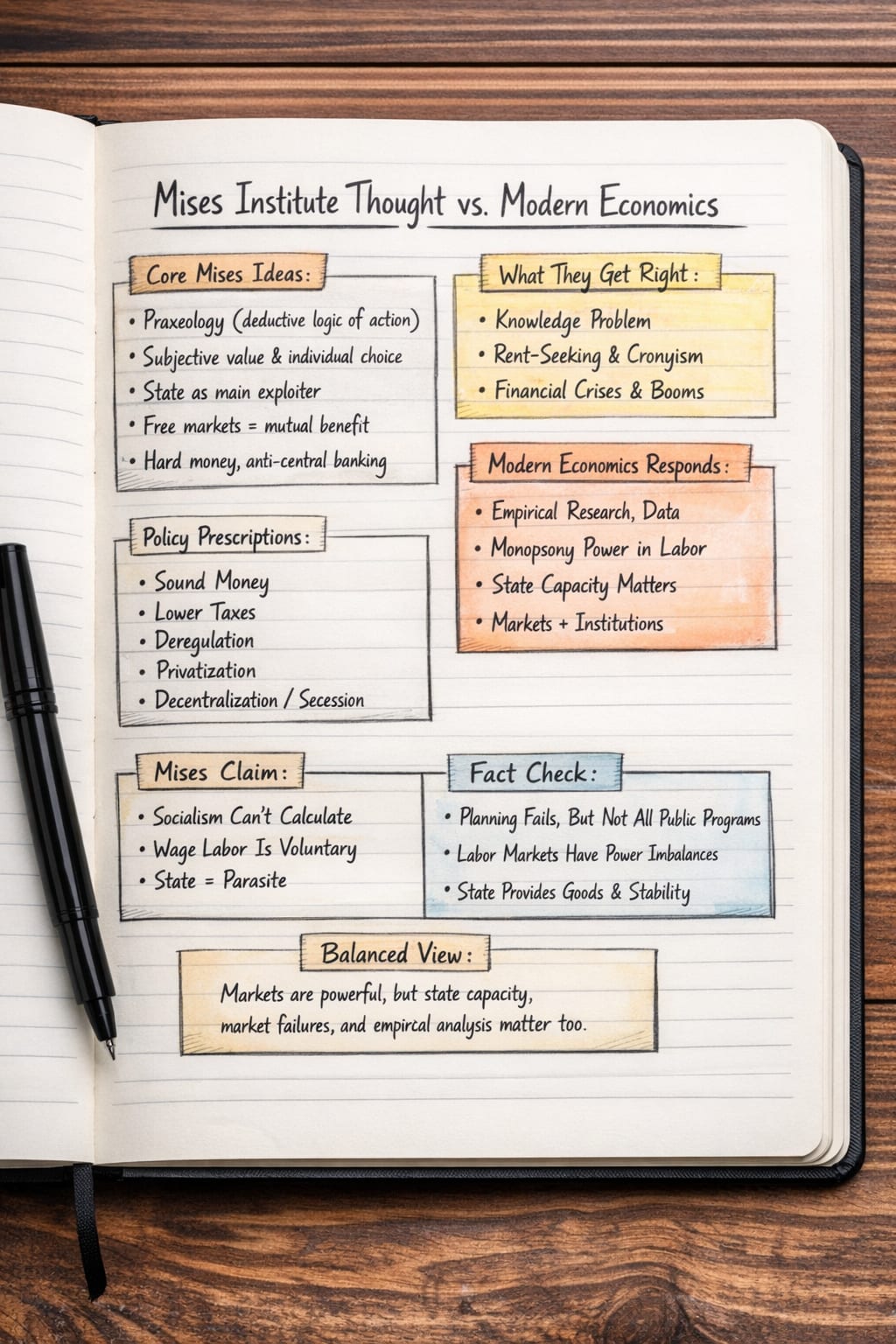
Libertarian / Mises Institute view: core ideas, prescriptions, and best modern-economic responses
1) Core worldview
The Mises Institute version of libertarian thought starts from methodological individualism, subjective value, strong private property rights, and deep distrust of the state. Its signature methodological claim is praxeology: economics is primarily a deductive science of human action, not mainly an empirical, statistical one. On this view, voluntary exchange is mutually beneficial by definition, while coercion, taxation, inflationary money creation, and regulation are the main sources of distortion and exploitation.
In Hans-Hermann Hoppe’s “Marxist and Austrian Class Analysis,” this becomes a class theory: Marx was partly right that history involves ruling and ruled classes, but wrong about who the exploiters are. For Hoppe, the real exploiters are not capitalists as such, but political expropriators—above all the state and those who live from state privilege. Exploitation means noncontractual, nonproductive appropriation of property, not wage labor under voluntary exchange.
2) Main prescriptions associated with this tradition
The practical program is usually some mix of: sound money / hard money, severe limits on or abolition of central banking, radical reduction in taxation and regulation, stronger private property rights, opposition to socialism and centralized planning, privatization, and often strong support for decentralization or even secession as a check on concentrated political power.
3) What this tradition gets right
A serious modern reading should grant that the Mises/Hayek tradition got several important things right.
First, the economic calculation / knowledge problem remains powerful. Modern economics still takes prices, incentives, dispersed information, and local knowledge very seriously. Even critics of laissez-faire generally accept that fully centralized command economies perform badly at large-scale allocation, and Hayek’s insight about dispersed information remains influential well outside libertarian circles.
Second, the tradition is strong on rent-seeking and political privilege. Modern economics absolutely recognizes that governments can be captured, regulation can protect incumbents, and badly designed interventions can create corruption and inefficiency. That is not fringe Austrianism; it is mainstream political economy.
Third, the Austrian tradition is often directionally right to warn that credit booms, distorted incentives, and artificially cheap finance can help fuel instability. Mainstream macro does not simply adopt Austrian business cycle theory, but modern economics does take financial frictions, leverage, and mispricing of risk very seriously.
4) Best modern-economic fact checks and counterarguments
A. Praxeology
Mises view: economic laws can be derived a priori from the logic of action.
Modern-econ verdict: this is not how mainstream economics now works. Contemporary economics still uses theory, but it relies heavily on empirical testing, econometrics, experiments, quasi-experiments, and causal inference. So the Misesian methodological claim is best understood as a heterodox philosophy of economics, not the current professional standard.
B. Wage labor is non-exploitative if voluntary
Hoppe/Mises-friendly view: if a worker voluntarily accepts wages now for output sold later, there is no exploitation.
Modern-econ verdict: too simple. Modern labor economics finds that many labor markets are marked by monopsony power, search frictions, employer concentration, switching costs, and limited outside options. That means workers can agree to contracts that are still systematically tilted in employers’ favor. So “voluntary” does not automatically mean “competitive” or “non-extractive.”
C. The state is mainly an exploiting class
Hoppe view: the state primarily extracts from producers and lives by coercion.
Modern-econ verdict: one-sided. Modern economics certainly studies predation, capture, and government failure, but it also finds that state capacity—the ability to raise revenue, enforce rules, provide infrastructure, and supply public goods—is often a major contributor to development and market functioning. Strong states can be dangerous, but weak states are often disastrous too.
D. Central planning cannot replace markets
Mises view: without real market prices for capital goods, rational socialist calculation breaks down.
Modern-econ verdict: mostly right against comprehensive central planning, but too broad if used against every public program or every nonmarket institution. Modern economies mix markets, firms, public goods provision, and regulation. The failure of Soviet-style planning does not prove that all industrial policy, public insurance, infrastructure provision, or antitrust enforcement is irrational.
E. Austrian business cycle theory
Mises view: central-bank credit expansion pushes interest rates below their natural level, causing malinvestment and an unsustainable boom; recession is the liquidation/correction.
Modern-econ verdict: partly insightful, not the profession’s consensus theory. The modern literature agrees that credit booms, leverage, and distorted financial signals matter, but mainstream macro does not treat ABCT as the established general explanation of recessions. Empirical work on ABCT exists, but it is contested and remains far from dominant.
F. Markets generally outperform intervention
Mises view: intervention tends to distort prices and create cumulative dysfunction.
Modern-econ verdict: true in some cases, false in others. Modern economics sees both market failure and government failure as real. Externalities, public goods, asymmetric information, and market power can justify intervention; but politics, capture, and corruption can also make interventions worse. The modern answer is usually institutional and empirical, not doctrinally pro-state or anti-state.
5) Best short synthesis
The strongest version of Mises Institute libertarianism says:
Human cooperation works best through private property, voluntary exchange, and market prices; the state is mostly a coercive disturber of this order.
The strongest modern-economic response is:
Markets are extraordinarily powerful information and coordination systems, but real economies also have market power, information problems, public goods, externalities, path dependence, and a need for state capacity. The real question is not “market or state?” in the abstract, but which institutions work best for which problem.
6) Bottom-line judgment
My cleanest summary would be:
- Most defensible Mises/Hayek insight: prices, incentives, and dispersed knowledge matter enormously; centralized planning and political privilege are genuine dangers.
- Weakest Mises Institute move: turning that insight into a near-total indictment of the state and a near-total presumption that voluntary contracts are non-exploitative. Modern economics does not support that leap.
- Best current view: markets are usually indispensable, but they are not self-justifying, self-correcting, or sufficient in every domain. Good economics today is more empirical, more institutional, and less absolutist than Mises Institute thought.
Sources to keep handy
- Hoppe, “Marxist and Austrian Class Analysis”
- Mises Institute on Praxeology
- Mises, “Economic Calculation in the Socialist Commonwealth”
- Mises Institute, “Austrian Business Cycle Theory: An Introduction”
- NBER, “Monopsony Power in Labor Markets”
- NBER, Kline et al., “Fundamentals and Frontiers of Monopsony in Labor Markets”
- NBER, “State Capacity and Economic Development”
- Acemoglu & Robinson, “Economics versus Politics: Pitfalls of Policy Advice”
I can also turn this into a tighter half-page version or a two-column note with “Mises claim” on the left and “modern-econ response” on the right.
Libertarian / Mises Institute Thought vs Modern Economics
| Mises / Libertarian claim | Modern economics: best counter / fact check |
|---|---|
| Methodological individualism: social outcomes must be explained through individual choices and actions. | Still widely accepted in economics as a useful baseline, but modern economics also emphasizes institutions, incentives, norms, bargaining power, and path dependence. Individual choice matters, but not in a vacuum. |
| Praxeology: economics is primarily a deductive science derived from the logic of human action. | This is not the mainstream method today. Modern economics uses theory plus empirical testing, econometrics, natural experiments, and causal inference. Praxeology survives mainly as a heterodox Austrian approach. |
| Subjective value: value is determined by individual preferences, not intrinsic labor content. | This is largely vindicated. Modern economics overwhelmingly accepts subjective value rather than the labor theory of value. On this point, Austrian economics won the broader argument. |
| Voluntary exchange is mutually beneficial by definition. | True in a narrow sense: both parties expect to benefit ex ante. But modern economics says this does not mean outcomes are efficient, fair, or free from rents. Markets can contain information asymmetries, switching costs, unequal bargaining power, and monopsony. |
| Wage labor is not exploitative if voluntarily agreed to. | Too simple. Modern labor economics finds that labor markets often have employer power, local concentration, limited outside options, and frictions. So workers may “agree” to wages below something closer to their full contribution. Voluntary does not automatically mean non-extractive. |
| Profit is not evidence of exploitation; it reflects time preference, risk-taking, and coordination. | Partly true. Profit often does reflect entrepreneurship, uncertainty, and capital allocation. But modern economics also finds that some profits reflect market power, barriers to entry, regulatory capture, or labor-market rents. |
| The real exploiters are the state and politically connected elites, not market capitalists as such. | Good insight in part: modern political economy absolutely recognizes rent-seeking, capture, cronyism, and privilege. But it is too one-sided to treat the state as mainly parasitic. Modern economics also sees state capacity as crucial for property rights, infrastructure, courts, public health, and market functioning. |
| Taxation is coercive expropriation. | Normatively, libertarians see this as obvious. Modern economics does not treat the issue so absolutely. Taxes can be distortionary and badly designed, but they also finance public goods, insurance, and state capacity. The real question is design, scale, and effectiveness. |
| Regulation often protects incumbents and distorts markets. | Often true. Mainstream economics agrees that regulation can be captured and used anti-competitively. But some regulation can improve outcomes where there are externalities, monopoly power, asymmetric information, or safety problems. |
| Central banking distorts interest rates and fuels boom-bust cycles. | Austrian business cycle theory captures a real concern: cheap credit, leverage, and mispriced risk can produce instability. But modern macro does not treat Austrian business cycle theory as the consensus account of recessions. It is considered insightful in part, not the settled general theory. |
| Sound money / hard money is superior to discretionary monetary policy. | Modern economics is much more mixed. It agrees inflation can be destructive, but most economists do not favor abolishing central banking or returning to a rigid gold standard. They generally prefer credible monetary institutions with flexibility during crises. |
| Economic calculation argument: socialism cannot rationally allocate resources without market prices for capital goods. | One of the strongest Austrian points. Modern economics broadly agrees that comprehensive central planning performs badly because prices and decentralized knowledge matter. But this does not prove that every public program, industrial policy, or nonmarket institution is irrational. |
| The knowledge problem: dispersed local knowledge makes centralized control inferior to markets. → Hayek - Knowledge Problem | Still one of the most influential Austrian/Hayekian insights. Modern economics strongly supports the idea that information is dispersed and costly. But modern work also studies when states, firms, and hybrid institutions can coordinate better than atomized markets in specific domains. |
| Private property is the foundation of prosperity and social order. | Largely supported in broad form: secure property rights are associated with investment and growth. But modern economics stresses that property rights are institutionally created, politically contested, and historically uneven, not simply pre-political facts. |
| Hoppe’s class theory: Marx was partly right about class conflict, but wrong about who exploits whom. The real class divide is between producers and political expropriators. | Interesting and partly insightful, especially on cronyism and state privilege. But modern economics would say Hoppe’s framework is too binary. Real economies involve interaction among markets, firms, law, class, and politics, not a clean split between productive markets and coercive states. |
| “Clean capitalism” is non-exploitative; most bad outcomes blamed on capitalism are really caused by the state. | This is one of the weakest Mises Institute moves. Modern economics sees actual capitalism as deeply institutionally embedded. Ownership structures, bargaining power, market concentration, and legal rules shape market outcomes. You cannot cleanly separate “market” from “politics” in real history. |
| Decentralization / secession reduces exploitation by increasing competition among governments. | There is some logic here: decentralization can constrain power and improve accountability. But modern economics also notes tradeoffs: too much fragmentation can reduce fiscal capacity, worsen coordination, and weaken provision of public goods. |
| State intervention tends to create cumulative distortions. | Sometimes true. Modern economics agrees interventions can have unintended effects. But the modern framework is not “intervention bad.” It is: compare market failure against government failure, case by case. |
| Markets are generally the default best allocator. | Often true in competitive settings with clear prices and property rights. But modern economics is less absolutist. It recognizes domains where markets underperform: public goods, externalities, health insurance, environmental problems, basic research, monopoly, and systemic financial risk. |
Best short synthesis
What the Mises tradition gets most right
- Prices, incentives, and decentralized knowledge are indispensable.
- Central planning performs badly.
- Rent-seeking, cronyism, and political privilege are real and important.
- Some regulation and monetary policy can create serious distortions.
Where modern economics pushes back hardest
- Real labor markets are not perfectly competitive.
- Voluntary contracts can still reflect bargaining asymmetries and market power.
- Property rights and market outcomes are shaped by institutions and history.
- The state is not only extractive; state capacity can be economically productive.
- Good economics today is more empirical and less doctrinaire than Mises Institute thought.
Bottom line
Best charitable reading: Mises Institute thought is strongest as a warning about knowledge problems, political privilege, and the limits of central planning.
Best modern-economic response: those insights do not justify treating all or most state action as exploitative, nor do they prove that voluntary markets are automatically fair, competitive, or sufficient in every domain.
Complete understanding: Mises Institute thought vs modern economics
What this note is for
This is a compact map of what the Mises Institute tradition claims, what it prescribes, what it gets right, and where modern economics pushes back hardest. The Mises Institute explicitly presents itself as promoting Austrian economics, individual freedom, and praxeology in the tradition of Ludwig von Mises and Murray Rothbard.
Core identity of Mises Institute thought
The Mises Institute tradition is best understood as Austrian economics plus strong libertarian political theory. Its central pillars are:
-
methodological individualism
-
subjective value
-
private property rights
-
voluntary exchange
-
skepticism of the state
-
praxeology as a distinctive deductive method
On its own presentation, praxeology is the “science of human action” and the distinctive method of Austrian economics.
Main descriptive claims
1. Markets coordinate better than central planners.
Mises’s economic-calculation argument says that without market prices for capital goods, socialist planners cannot rationally compare alternative uses of resources. This remains one of the most famous Austrian arguments.
2. Value is subjective, not based on labor content.
Austrian economics rejects the labor theory of value and argues that value comes from individual preferences and marginal evaluation. That basic shift is broadly consistent with modern economics.
3. Voluntary exchange is presumptively mutually beneficial.
If two parties trade without coercion, Austrians generally infer that both expect to gain ex ante. This underlies their defense of markets and contracts.
4. The state is the main source of coercion and privilege.
In the Mises Institute orbit, taxation, regulation, inflationary monetary policy, and political favoritism are treated as the main distortions of market order. Hoppe’s “Marxist and Austrian Class Analysis” sharpens this into a class theory: the real exploiters are political expropriators, not market capitalists as such.
Main prescriptions
The practical program usually includes:
-
hard money / sound money
-
deep suspicion of central banking
-
lower taxes
-
less regulation
-
stronger property rights
-
privatization
-
decentralization / localism / sometimes secessionist logic
-
hostility to socialism and centralized planning
These prescriptions follow from the Austrian view that economic order works best when based on private property, contract, and market prices rather than political command.
Hoppe’s paper in one sentence
Hoppe’s argument is: Marx was partly right that history involves exploitation and class conflict, but wrong about who the exploiters are; the true exploiting class is the state and those who live through political expropriation.
What this tradition gets right
The knowledge problem is real.
Modern economics still takes dispersed information, local knowledge, incentives, and price signals very seriously. The broad Hayek/Mises point that fully centralized systems struggle to allocate complex resources remains highly influential.
Rent-seeking and capture are real.
Modern economics strongly agrees that governments can be captured, regulation can protect incumbents, and politics can create privilege rather than competition. This is a genuine point in the Austrian tradition’s favor.
Financial distortions matter.
Even though mainstream macro does not adopt Austrian business-cycle theory as its consensus framework, modern economics does recognize that leverage, credit booms, mispriced risk, and financial fragility can produce major instability.
Where modern economics pushes back hardest
1. Praxeology is not the mainstream method.
The Mises Institute’s claim that economics is primarily a deductive science is far from the current professional norm. Contemporary economics relies heavily on empirical testing, econometrics, experiments, and causal inference. So praxeology is best seen as a heterodox methodology, not the dominant scientific standard.
2. Voluntary contracts do not automatically imply competitive outcomes.
Modern labor economics finds substantial evidence of monopsony, employer wage-setting power, search frictions, switching costs, and local labor-market concentration. That means a worker can “agree” to a wage in a market that is still systematically tilted in the employer’s favor. This is one of the clearest modern counters to simple Austrian claims about labor contracts.
3. Markets are institutionally embedded.
Modern economics does not usually treat “the market” and “the state” as cleanly separable. Property rights, firm boundaries, contract enforcement, bargaining positions, and even competitive conditions are shaped by legal and political institutions. That makes the Mises/Hoppe idea of “clean capitalism” too abstract as a positive description of real-world capitalism.
4. The state is not only predatory.
Modern development economics treats state capacity as a major contributor to prosperity: enforcing rules, providing infrastructure, building administrative capacity, and supplying public goods. So the modern view is not “state good,” but it is definitely not “state mainly parasite” either.
Best fact checks on major Mises-style claims
Claim: socialism cannot calculate.
Fact check: broadly strong against full central planning. Modern economics largely agrees that comprehensive planning without real price signals performs badly. But this does not prove that every public program, industrial policy, or nonmarket institution is irrational.
Claim: wage labor is non-exploitative if voluntary.
Fact check: too simple by current standards. Modern labor economics shows that voluntariness alone does not rule out employer power, rents, or suppressed wages.
Claim: the state is the main exploiting class.
Fact check: partly insightful, overstated. Political predation and privilege are real, but so is the growth-supporting role of state capacity.
Claim: hard money is clearly superior.
Fact check: not the mainstream view. Modern economics does see inflation and bad monetary governance as dangerous, but most economists do not support abolishing central banking or returning to a rigid commodity standard. The mainstream preference is usually for credible but flexible monetary institutions. This last point is a synthesis from the current state of the field rather than a single decisive paper.
Hoppe-specific understanding
In Hoppe’s paper, the key move is to redefine exploitation. Marx says exploitation is rooted in capitalist production and surplus extraction; Hoppe says exploitation means noncontractual appropriation of property. Once he makes that move, the class divide changes:
-
not capitalist vs worker
-
but producer vs political expropriator
Modern economics would say Hoppe is strongest when he highlights rent-seeking, privilege, and political predation, and weakest when he assumes labor markets are close enough to competitive that voluntariness settles the issue.
Cleanest synthesis
Best charitable reading of Mises Institute thought:
Markets, prices, and private property are extraordinarily powerful coordination mechanisms, and centralized political control often creates distortion, privilege, and waste.
Best modern-economic response:
Those insights are important but incomplete. Real economies also feature market power, labor frictions, externalities, public goods, institutional path dependence, and a need for state capacity. So the modern question is usually not “market or state?” but which institutional mix solves which problem best?
Bottom line
What Mises Institute thought understands best:
the knowledge problem, the limits of central planning, the importance of prices, and the danger of political privilege.
What modern economics rejects most strongly:
the idea that deduction can replace empirical testing, that voluntary contracts are automatically non-exploitative, and that the state is mainly or only a coercive extractor.
Most balanced conclusion:
Austrian / Mises Institute thought is valuable as a warning tradition, but too absolutist as a full theory of modern economies. Modern economics is more empirical, more institutional, and more willing to see both market failure and government failure as real.
Sources to keep attached to this note
-
Mises Institute on praxeology
-
Mises, Economic Calculation in the Socialist Commonwealth
-
Hoppe, Marxist and Austrian Class Analysis
-
NBER on monopsony in labor markets
-
NBER on state capacity and development