Filed with 60.3.7 Economics · Related: Political Philosophy (MOC) · Business MOC
Relative poverty is about envy. It’s a spiritual rather than economic problem and will always be with us.
The measurement note works out which of three different things the word “poverty” can mean, why national poverty rates cannot be compared across countries, and where the U.S. poverty line came from (a 1955 USDA food budget, multiplied by three). Companion evidence: Were the 1950s Better Than Today - A Standard of Living Audit.
Where the line above holds, and where it needs qualifying
It holds in this respect: relative measures are relative by construction. The EU’s “at risk of poverty” line is income below 60% of the national median — so a person can become statistically poor while his real consumption rises, if everyone else’s rises faster. Eurostat itself warns the indicator does not necessarily imply a low absolute standard of living. Any measure with that property will report poverty forever, which is the strongest version of your point.
It needs qualifying in this respect: the standard defence of relative measures is not envy but participation — whether you can do the things the surrounding society treats as ordinary (get to a job, be reachable by phone, keep a child in school without stigma). That is a claim about function, not comparison, and it is why the concept did not simply get abandoned once subsistence was solved.
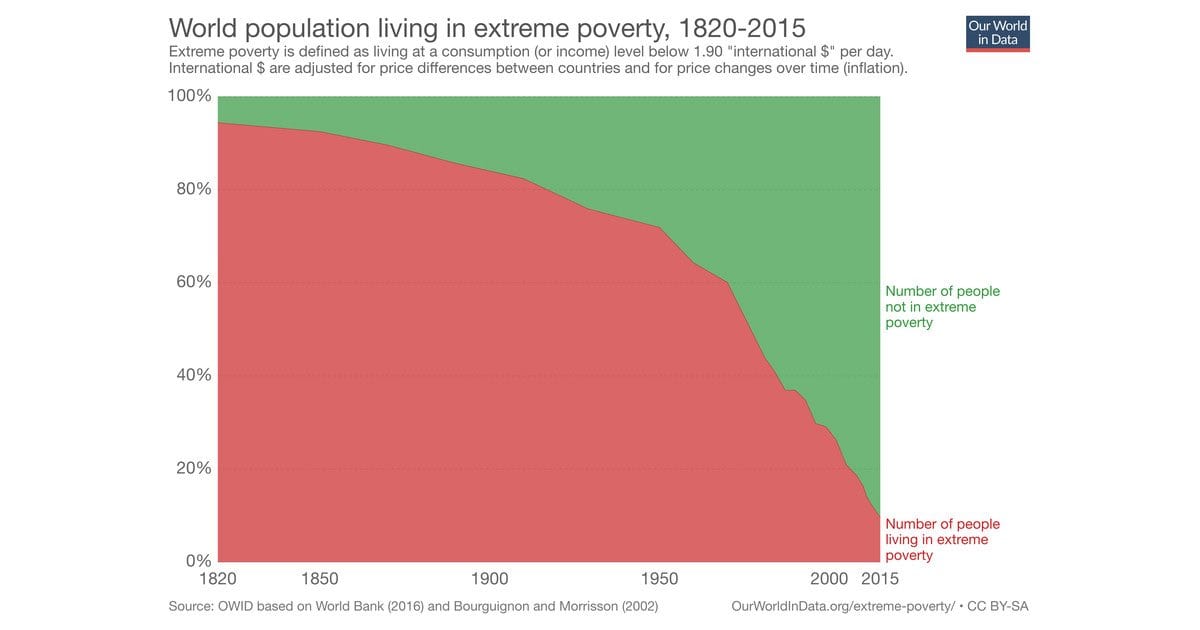
The cleanest way to hold both: absolute progress is real and enormous, and a relative measure will never register it. Those are compatible, and an argument that needs you to deny either one is weak. The U.S. Official Poverty Measure is worth knowing precisely because it is absolute — an inflation-adjusted 1963 standard — which is what makes 22.4% (1959) → 10.6% (2024) a meaningful comparison rather than a moving goalpost.
Pinker’s Chapter 6 supplement — poverty and civil war form a feedback loop
In the historical datasets Pinker summarizes, civil-war risk rises sharply at low income levels, but the relationship runs in both directions. War destroys infrastructure, skills, markets, and trust; weak state capacity makes insurgency and predation easier; and resource wealth can worsen the bargain when rulers can finance themselves without broad consent. Ethnic or religious diversity alone does not supply a sufficient cause, and the same scarcity can produce cooperation rather than violence under different institutions.
The cited regressions use historical observations and income expressed in 2003 dollars; they are not a current country forecast or proof that poverty mechanically causes war. Read them as a coupled system in which poverty, governance, trade, state capacity, geography, and conflict can reinforce one another. Chapter 6 synthesis · Poverty, state capacity, resources, and civil-war risk, PDF pp. 429–438 (file not included in this release)