Filed with Social Issues MOC · Related: 60.5 Parenting · 60.21 Psychology
Pinker’s Chapter 7 supplement — acceptance changed faster than the violence series
Pinker treats visibility and personal contact as plausible contributors to growing acceptance: in a 2009 Gallup poll, six in ten Americans said they knew an openly gay person, and those respondents were more supportive of legal same-sex relations and marriage. That is a correlation and may partly reflect selection—tolerant people may be more likely to know disclosure—not a clean estimate of contact’s causal effect. His generational forecast is likewise a 2011 prediction, not evidence about what happened afterward.
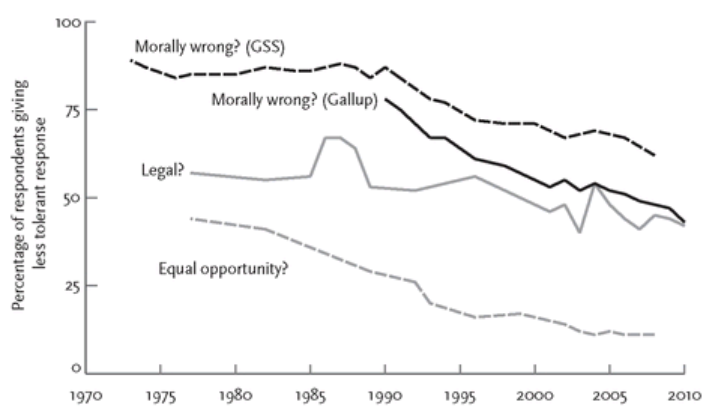
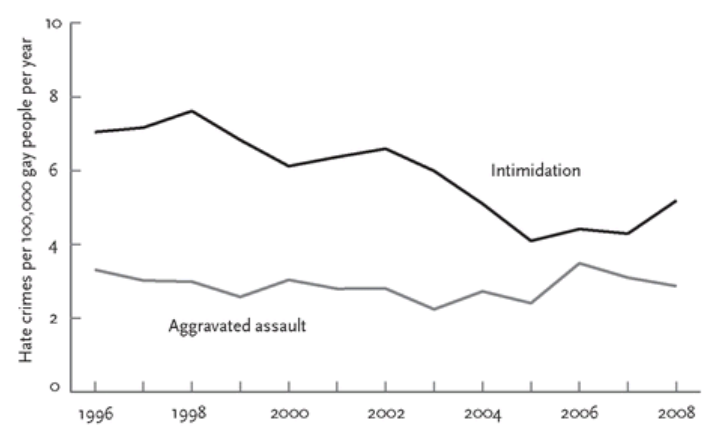
Figures 7-24 and 7-25 — U.S. attitudes toward homosexuality, 1973–2010, and reported antigay hate crime, 1996–2008. Figure 7-24 combines different questions and polling organizations; the “legal” and “equal opportunity” series are inverted so that every downward movement means greater tolerance. It supports a broad shift, not one continuous measure of support for same-sex marriage. Figure 7-25 is deliberately narrower than Pinker’s attitudinal claim: only intimidation clearly declined. Aggravated assault, simple assault, and the very small homicide count showed no significant trend in the period he reviewed. The rate uses FBI participating-agency coverage and an assumed gay population share of 3%, while reporting and local hate-crime classification may change. The defensible conclusion is rapid legal and attitudinal liberalization with insufficient evidence in this series for a parallel fall in physical assault. Chapter 7 synthesis · Visibility, contact, and attitude change, PDF pp. 625–628 (file not included in this release) · Figure 7-24, PDF p. 626 (file not included in this release) · Hate-crime measurement limits, PDF pp. 628–629 (file not included in this release) · Figure 7-25, PDF p. 629 (file not included in this release)
A Gay Marriage Success Story - Los Angeles Times
You Will Be Embarrassed About This in 20 Years | Washington Monthly
Justice - What's The Right Thing To Do - YouTube
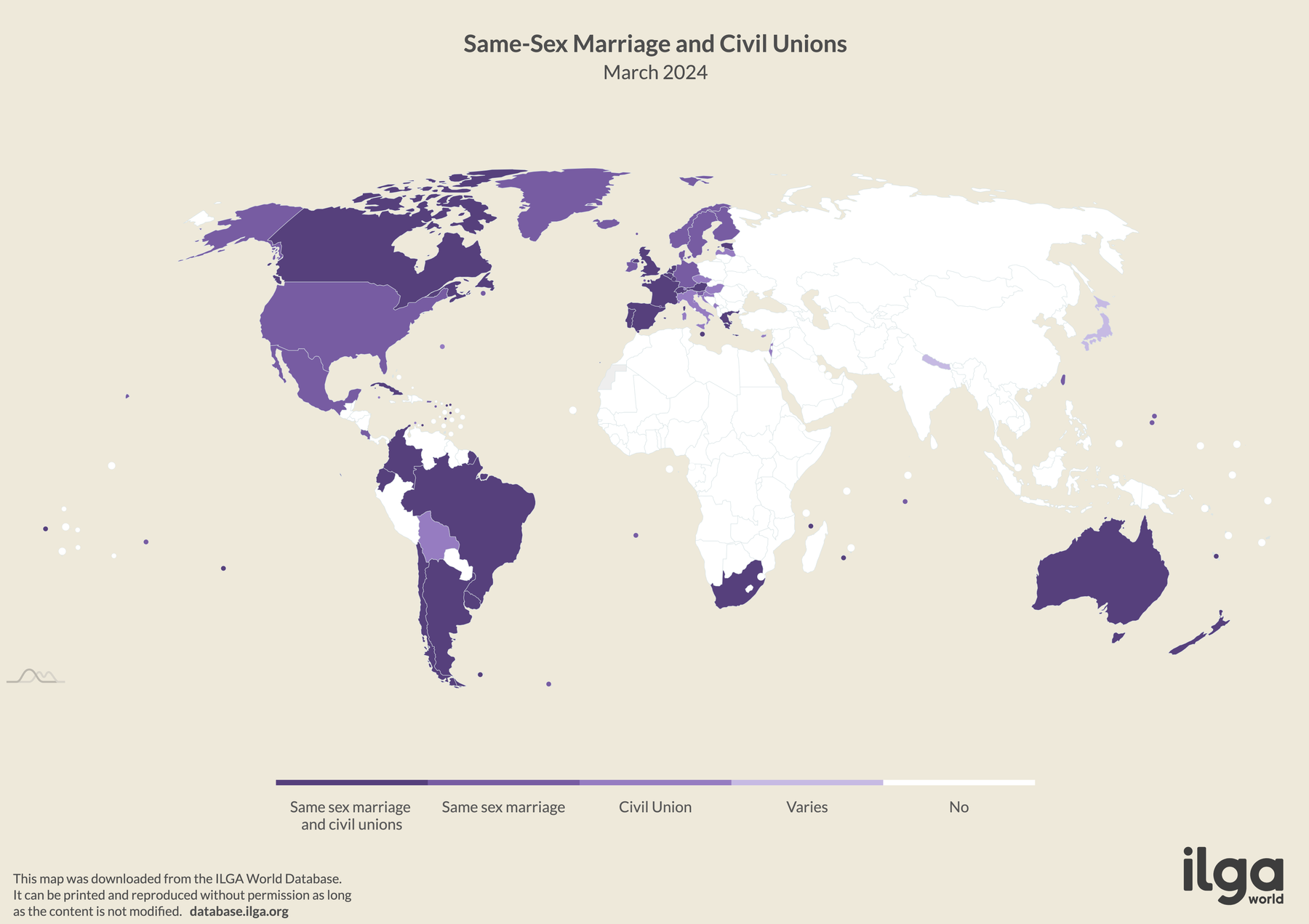
Same_Sex_Marriage_CivilUnions_ILGAWorld_May2024-e1715097001369.png
Ben Shapiro Arguments for Traditional Marriage
Caller Debates Ben Shapiro on Gay Marriage - YouTube
1. State vs. Federal Issue
- Claim: Marriage should be decided at the state level, not the federal level.
- Reasoning: Marriage laws have historically been handled by states, reflecting regional cultural differences.
- Counter-Argument Anticipation: Shapiro acknowledges that this approach can seem inconsistent for conservatives advocating for a smaller federal government but argues that not all government involvement is inherently negative.
2. Libertarian Approach to Marriage
-
Claim: The government should either subsidize all marriages (gay and straight) or none.
-
Reasoning:
- If the government is not going to set a moral standard, it should remove itself from the marriage business entirely.
- He expresses a preference for the government not subsidizing any marriages if it means being forced to subsidize relationships he argues have less societal benefit.
-
Counter-Argument: This approach is countered by the practical need for certain legal benefits tied to marriage, like tax breaks, hospital visitation, and inheritance rights, which Shapiro later addresses.
3. Purpose of Government Involvement in Marriage
-
Claim: Government’s interest in marriage is based on the production and raising of children.
-
Reasoning:
- Marriage, historically and biologically, has been about creating stable family units for child-rearing.
- Society has a vested interest in supporting relationships that produce the next generation, which requires a unique legal framework.
-
Analogy: Compares this to the definition of cars versus horses, arguing that not every relationship can fulfill the core function of marriage as a child-rearing institution.
4. Distinction Between Legality and State Recognition
-
Claim: Same-sex couples should not be criminalized, but this is distinct from state recognition.
-
Reasoning:
- The state can choose not to legally recognize a relationship without criminalizing it.
- Shapiro argues that same-sex couples can have private, non-governmental ceremonies without state involvement.
5. The Moral Arbiter Argument
-
Claim: Government should not act as the moral arbiter of personal relationships.
-
Reasoning:
- Shapiro argues that looking to the state for validation of a relationship is misguided.
- He separates the legal benefits of marriage from the moral or religious sanctification of marriage, emphasizing his personal reliance on religious, not governmental, validation.
-
Counter-Argument: Critics might argue that without legal recognition, same-sex couples face unnecessary legal and financial disadvantages.
6. Slippery Slope to Coercion
-
Claim: Legalizing same-sex marriage leads to coercion in other areas.
-
Reasoning:
- He argues that the progression from decriminalization to marriage equality has led to coercive demands for social and legal recognition, using the example of business owners being compelled to recognize same-sex marriages.
-
Historical Analogy: Uses the example of slavery as a parallel to show how societal norms influence broader social structures, though he explicitly rejects any moral equivalence.
7. Civil Unions as a Compromise
-
Claim: Civil unions could provide legal protections without redefining marriage.
-
Reasoning:
- Civil unions historically provided many of the same legal benefits as marriage without redefining the institution itself.
- Shapiro argues this approach satisfied the original claims of the gay rights movement before demands escalated to full marriage equality.
8. Practical Benefits vs. Marriage Definition
-
Claim: Legal benefits like hospital visitation and estate rights can be handled through contracts, not marriage.
-
Reasoning:
- He asserts that legal rights should not require redefining marriage and can be addressed through separate legal mechanisms.
9. Children and the State’s Role in Protecting Them
-
Claim: Marriage exists to protect children and ensure stable family structures.
-
Reasoning:
- The historical definition of marriage as a union between a man and a woman is based on the biological reality that this pairing can produce children.
- Legal recognition is about providing protections for these family structures, not validating emotional bonds.
10. Conclusion and Core Premise
-
Claim: Marriage as a legal institution should be reserved for relationships that inherently have the potential to produce and raise children.
-
Reasoning:
- Shapiro concludes that society has a foundational interest in supporting child-rearing relationships, which he argues same-sex couples do not inherently fulfill.
Abuse
The claim that lesbian couples raising children have higher rates of child abuse compared to gay male couples lacks substantial empirical support. While some studies have explored disparities in child abuse victimization among different family structures, the evidence does not conclusively indicate that lesbian parents are more likely to abuse their children than gay male parents.
Research Findings
-
A study published in the Journal of Consulting and Clinical Psychology found that lesbian and bisexual women reported higher rates of childhood abuse victimization compared to heterosexual women. However, this research focused on the individuals’ experiences as children, not on their behavior as parents. Therefore, it does not provide direct evidence about the parenting practices of lesbian couples. (PubMed)
-
The National Longitudinal Lesbian Family Study (NLLFS), a 25-year study tracking children raised by lesbian mothers, found that these children were as psychologically healthy as their peers raised by heterosexual parents. The study reported no significant differences in mental health outcomes and noted higher levels of educational achievement among the children of lesbian parents. (Them)
-
A comprehensive review of research on same-sex parenting concluded that children raised by lesbian or gay parents are as well-adjusted as those raised by heterosexual parents. The review emphasized that the quality of parenting and family relationships, rather than the parents’ sexual orientation, are the key factors influencing child outcomes. (Wikipedia)
Conclusion
Current reputable research does not support the assertion that lesbian couples are more likely to abuse their children than gay male couples. The well-being of children is more closely linked to the quality of parenting and the stability of the family environment than to the sexual orientation of the parents. It’s important to approach such claims critically and rely on peer-reviewed studies and expert consensus when evaluating the impacts of different family structures on child development.
Denial and Discovery of Harm for Children with Same-Sex Parents by Donald Sullins SSRN
Behavioral Outcomes of Children with Same-Sex Parents in The Netherlands - PMC