
DESCRIPTION
NAMED A BOOK OF THE YEAR BY THE ECONOMIST AND ONE OF THE BEST BOOKS OF 2021 BY THE TIMES AND THE SUNDAY TIMES “Irreversible Damage … has caused a storm. Abigail Shrier, a Wall Street Journal writer, does something simple yet devastating: she rigorously lays out the facts.” —Janice Turner, The Times of London Until just a few years ago, gender dysphoria—severe discomfort in one’s biological sex—was vanishingly rare. It was typically found in less than .01 percent of the population, emerged in early childhood, and afflicted males almost exclusively. But today whole groups of female friends in colleges, high schools, and even middle schools across the country are coming out as “transgender.” These are girls who had never experienced any discomfort in their biological sex until they heard a coming-out story from a speaker at a school assembly or discovered the internet community of trans “influencers.” Unsuspecting parents are awakening to find their daughters in thrall to hip trans YouTube stars and “gender-affirming” educators and therapists who push life-changing interventions on young girls—including medically unnecessary double mastectomies and puberty blockers that can cause permanent infertility. Abigail Shrier, a writer for the Wall Street Journal, has dug deep into the trans epidemic, talking to the girls, their agonized parents, and the counselors and doctors who enable gender transitions, as well as to “detransitioners”—young women who bitterly regret what they have done to themselves. Coming out as transgender immediately boosts these girls’ social status, Shrier finds, but once they take the first steps of transition, it is not easy to walk back. She offers urgently needed advice about how parents can protect their daughters. A generation of girls is at risk. Abigail Shrier’s essential book will help you understand what the trans craze is and how you can inoculate your child against it—or how to retrieve her from this dangerous path.
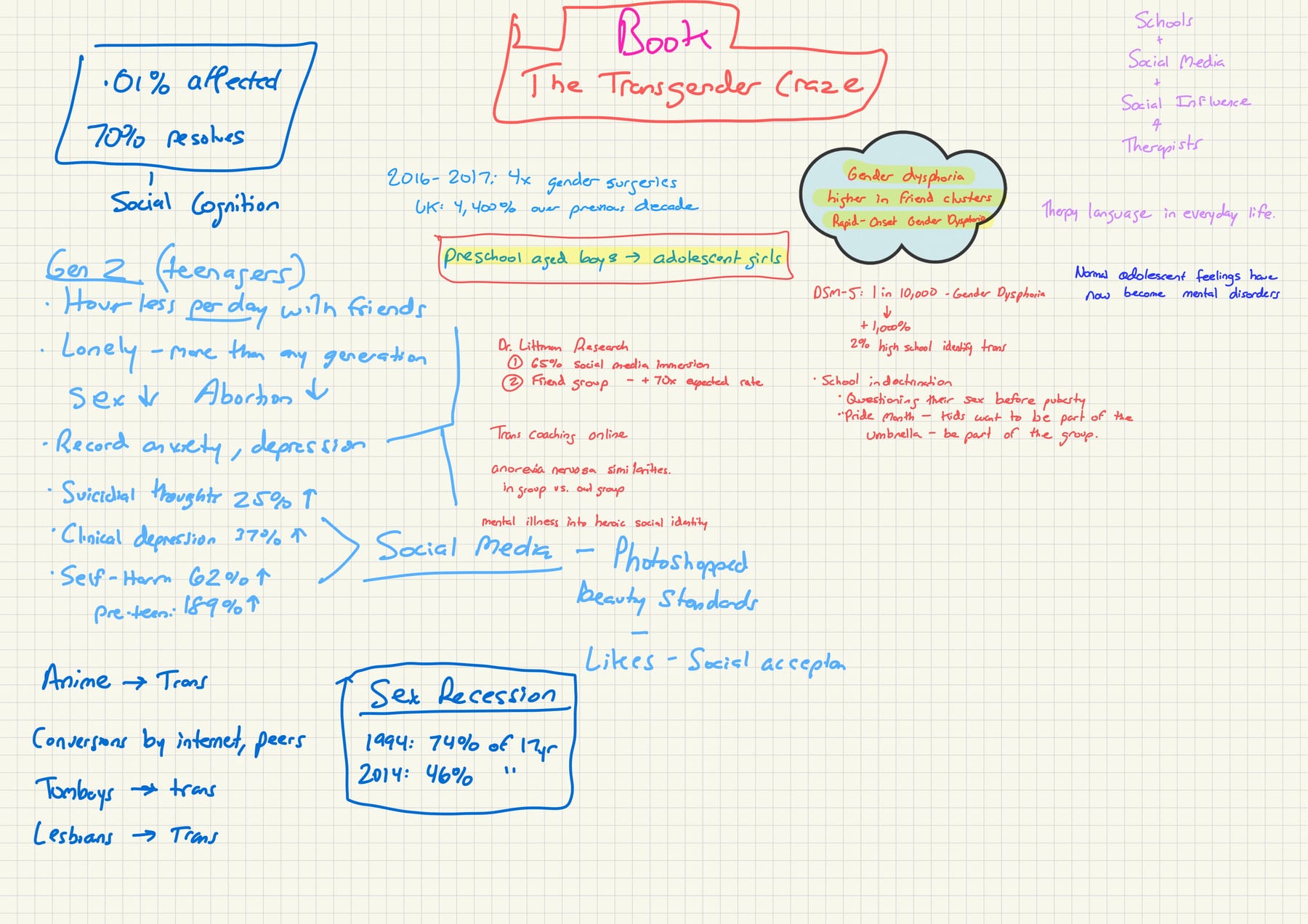
Summary (Mine)
- This idea that you can’t question a person’s gender dysphoria. Therapists dont; they affirm. And Parents can’t.
- Emotional blackmail of telling parents, “Do you rather a dead daughter, or a happy son?” — The vast majority of these children had mental disorders before they found gender dysphoria.
MAIN IDEAS, TAKEAWAYS & SIMILARITIES
-
This idea of “This is a boy” “This is a girl” — they have a concrete view on how boys and girls should act—and if a person doesn’t align to that narrative or their idea of how they should behave—their then “trans” and “gender nonconforming”
-
The way they teach kids in K-6 and Middle School is gross. It seems that putting in the heads of children you may not be the sex that you’re body and chromosomes demonstrates—when only 0.1% are affected with gender dysphora. What if schools had to put children through other “courses” or instruction for other issues in the DSM-5 that only affect 1 in 10,000?
-
Why allow body modification is gender is fluid and it may change in a year?
-
It typically begins in early childhood—ages two to four—though it may grow more severe in adolescence. But in most cases—nearly 70 percent—childhood gender dysphoria resolves. Historically, it afflicted a tiny sliver of the population (roughly .01 percent) and almost exclusively boys. Before 2012, in fact, there was no scientific literature on girls ages eleven to twenty-one ever having developed gender dysphoria at all.
-
WHAT SHOULD WE DO FOR OUR GIRLS?
- recommend seeking out a support group immediately. The good ones will help you navigate staying connected with your child without participating in her indoctrination.
- advises against adopting the child’s name and pronouns.
- inoculate their own daughters from the fast-spreading social contagion of gender ideology,
1. Don’t Get Your Kid a Smartphone
Nearly every novel problem teenagers face traces itself back to 2007 and the introduction of Steve Jobs’s iPhone. In fact, the explosion in self-harm can be so precisely pinpointed to the introduction of this one device that researches have little doubt that it is the cause.
the statistical explosion of bullying, cutting, anorexia, depression, and the rise of sudden transgender identification is owed to the self-harm instruction, manipulation, abuse, and relentless harassment supplied by a single smartphone.
2. Don’t Relinquish Your Authority as the Parent
Sasha Ayad says that parents today are often afraid of upsetting their teens because they have the idea that their job is to ensure their child is “happy and perfectly adjusted and well-balanced 100 percent of the time.” Not only is that an unreasonable goal, it misunderstands the inherently tumultuous state of adolescence. Teenagers are supposed to get angry and emotional. Parents are supposed to set limits.
If you eliminate all conflict through endless agreement and support, it may only encourage her to kick things up a notch.
3. Don’t Support Gender Ideology in Your Child’s Education
“Bulimia is so contagious that support groups and in-treatment facilities designed to help patients are also primary spreading agents.”
Offer a school assembly on one teen’s suicide and you will raise awareness, possibly at the cost of more suicide. 5 The same goes for depression and cutting. 6 And now trans identification.
4. Reintroduce Privacy into the Home
For nearly all of the parents I spoke to, their daughters’ announcement on social media of a transgender identity was a turning point. From then on, everyone knew. From then on—and sometimes despite their daughters’ lingering doubts—their daughters felt locked in. It became a choice they couldn’t easily take back.
5. Consider Big Steps to Separate Your Daughter from Harm
these families went to great lengths to physically move their daughters away from the schools, the peer groups, and the online communities that were relentlessly encouraging the girls’ self-destructive choices.
6. Stop Pathologizing Girlhood
Adolescence is especially hard on girls. Effervescent with emotion, they buck and bray like wild horses. Parents might be forgiven for assuming that this can’t be right—that there is something wrong with them. Parents might even be forgiven for wishing to put their daughters on medication to flatten their moods and short-circuit these crazy teenage years.
A young woman’s unruly emotions in her teenage years—the whirlwind fury and self-doubt of female adolescence—may be a feature, not a flaw. That doesn’t mean a parent shouldn’t set boundaries or punish bad behavior. But absent a serious mental health problem, neither should a parent strive to banish all her daughter’s ups and downs.
Your teenage girl may be driving you crazy. Though this be madness, there is method in it. She may just be beta testing. She’s flexing her muscles, discovering the power and extent of an intellectual and emotional prowess that will enable her to be the most compassionate of parents and supportive of friends.
7. Don’t Be Afraid to Admit: It’s Wonderful to Be a Girl
Becoming a woman means losing a body almost indistinguishable from a boy’s in terms of strength and solidity and growing into one that is softer, more sexually inviting, but more vulnerable, too. For the first few years, you can feel like a hermit crab who has outgrown a shell it must then abandon, blindly scurrying for another. The armor you eventually take up is of a different sort. You can no longer credibly challenge the boys to an arm-wrestling match and expect to win.
A young woman can be an astronaut or a nurse; a girl can play with trucks or with dolls. And she may find herself attracted to men or to other women. None of that makes her any less of a girl or any less suited to womanhood.
AI Summary
- Introduction: The Contagion
Key Ideas
- The article discusses a sudden surge in recent years of adolescent girls identifying as transgender, despite never having shown signs of gender dysphoria in childhood. This is a new phenomenon.
- Historically, gender dysphoria afflicted a tiny fraction of the population (0.01%) and almost exclusively boys.
- The article questions why there is now a majority of natal girls among those identifying as transgender, when previously adolescents were the minority of those afflicted.
Examples
- Gives the example of “Lucy”, a girl with no childhood history of gender dysphoria, who began identifying as transgender after entering college.
Statistics
- Before 2012, there was no scientific literature on girls ages 11-21 ever developing gender dysphoria.
- Gender dysphoria typically begins in early childhood (ages 2-4).
- In 70% of childhood gender dysphoria cases, the dysphoria resolves by adulthood.
Key Ideas
- The article argues this phenomenon originates not in traditional gender dysphoria, but from internet influences and social contagion.
- It states that transgender identification offers these girls freedom from anxiety, a sense of belonging, and the thrill of transgression.
- The article expresses concern over adolescents making permanent medical changes based on temporary social influences.
- Chapter 1: The Girls
Main Points
- There is a growing “transgender craze” or epidemic among teenage girls in recent years that differs markedly from historical gender dysphoria cases
- Today’s transgender-identifying girls:
- Do not necessarily want to “pass” as boys or be stereotypical men
- Are not focused on transitioning fully with surgery
- Seem to be using transgender identity to flee womanhood due to discomfort
- Have high rates of anxiety, depression, self-harm that predate transition
- Possible contributing factors:
- Less in-person socialization and friendship
- More time spent online and influenced by social media
- Earlier onset of puberty causing distress
- Quick fix culture that pushes medical solutions
- The cases of “Julie”, “Sally”, and “Gayatri” illustrate:
- No childhood history of gender dysphoria
- Normal gender development and identification initially
- Later influence of online content and communities
- Rapid shifts in identity and transition desires
- Significant mental health issues as well
- Statistics:
- Average age of puberty onset down to 9-10 years old from 14 in the past
- Teen depression diagnoses up 37% from 2005-2014, especially in girls
- Teen suicidal ideation up 25% from 2009-2017
- Teen self-harm up 62% since 2009 in girls
- Preteen self-harm up 189% since 2010 in girls
- 95% of teens access smartphones by 2018
- 11 years old - Average age first viewing porn
- 46% of 17 year olds in relationships in 2014, down from 74% in 1994
Examples
- Julie went from normal teen girl into transgender identity after befriending an older trans girl and spending time on DeviantArt website
- Sally was a star athlete with no gender issues until a college counselor suggested she may be transgender, influencing a rapid shift
- Gayatri only became interested in transgender identity after getting a phone/laptop and spending lots of time online during the summer
- Chapter 2: The Puzzle
Key Points
- In 2016, Dr. Lisa Littman noticed a statistical peculiarity - several adolescent girls in her town came out as transgender, all from the same friend group
- This led Dr. Littman to research spikes in adolescent transgender identification
- Between 2016-2017 in the US, gender surgeries for natal females quadrupled, with biological women suddenly accounting for 70% of gender surgeries
- In 2018, the UK reported a 4,400% rise over the previous decade in teenage girls seeking gender treatments
- Clinicians began reporting a sudden demographic shift in gender dysphoria cases - from predominantly preschool-aged boys to predominantly adolescent girls
- Dr. Littman hypothesized this could be a new phenomenon she termed “rapid onset gender dysphoria” (ROGD), potentially caused by social contagion
- Key features of ROGD cases:
- Majority (65%) of adolescents had increased social media use prior to announcement
- High prevalence (70 times expected rate) of transgender identification within friend groups
- Dr. Littman’s paper met activist backlash - she was accused of transphobia, bias, and unethical research
- PLOS One issued an apology and “correction” to her paper due to activist pressure
Examples
- Statistical peculiarity: several adolescent girls from the same friend group in Dr. Littman’s town came out as transgender
- Demographic shift: gender dysphoria cases changed from predominantly preschool-aged boys to adolescent girls
- Features of ROGD:
- 65% of adolescents had increased social media use prior to announcement
- Prevalence within some friend groups over 70 times higher than expected rate
- Chapter 3: The Influencers
Main Points
- Trans influencers on YouTube and social media have become popular sources of information and advice for gender questioning youth
- They promote the idea that if you question your gender, you are likely trans (“if you’re asking the question, ‘Am I trans?’ the answer is probably yes”)
- They encourage trying out binders to flatten breasts as a first step in transitioning
- They enthusiastically promote testosterone (“T”) and describe the changes as “amazing,” rarely mentioning negative side effects
- They say you don’t need to be 100% sure to start hormones
- They criticize unsupportive parents, saying “True love is unconditional love”
- They warn that lack of parental support leads to suicidality
- Some promote identifying as non-binary instead of fully male or female
Key Ideas
- Being trans is innate, permanent and knowable
- Doubts are normal but should not prevent transition
- Medical transition brings “legitimacy”
- Parental skepticism equals lack of love
- Doctors should be deceived if necessary to get treatment
- The trans “glitter family” can replace unsupportive blood relatives
Examples
- Chase Ross built a large YouTube audience documenting his female-to-male transition
- Kaylee Korol suggests trying hormones for 3 months even if unsure about being trans
- Skylar Kergil recalls Leelah Alcorn’s suicide after lack of family support
- Ash Hardell identifies as non-binary, neither fully male nor female
- Chapter 4: The Schools
Key Ideas
- Teachers unions like the California Teachers Association (CTA) are pursuing policies to allow minors to leave school to obtain cross-sex hormones without parental consent
- The CTA also aims to create school-based health clinics to provide “equal and confidential access” to transition services
- Schools are teaching comprehensive gender identity curricula, presenting concepts like gender as a spectrum. This is facilitated by materials and speakers from LGBTQ activist groups
- Kindergartners are introduced to ideas like being a “girl brain in a boy body”, taught about gender stereotypes to lay groundwork for gender identity
- Middle school health curricula promote imagining yourself as a different gender and questioning fixed gender identities
- High school curricula explicitly discuss anal sex and other graphic material regarding LGBTQ relationships
- This education encourages adolescents to focus intensely on gender/sexuality, seeing identities like “non-binary” as avant-garde
- Schools justify these teachings as necessary to prevent anti-LGBTQ bullying and create “safe spaces”
- However, “bullying” is defined very broadly as not affirming new names/pronouns or gender identities
- Parents who oppose or question these ideologies/policies are seen as potential bullies that schools aim to circumvent
Key Statistics
- 600,000+ students in Los Angeles Unified School District receive LGBTQ education overseen by Judy Chiasson
- LGBTQ history is now mandatory curriculum in CA, NJ, CO, IL schools
- CDC examined harassment/self-harm rates for trans students across 19 states
- GLSEN surveys suggest higher victimization rates for LGBTQ students
Examples
- CTA pursuing policy for minors to leave for hormones without parental consent
- Genderbread Person and Gender Unicorn resources used to teach gender identity in elementary schools
- “Imagining a Different Gender Activity” in middle school health curricula
- Jamie Nabozny case - middle/high schooler relentlessly bullied and assaulted for being openly gay
- Schools using confidential “Gender Support Plans” and preferred names/pronouns without informing parents
- Chapter 5: The Mom and the Dads
Katherine Cave’s Experience
- In 2013, her 12-year-old daughter Maddie announced she was transgender after a school assembly on transgender students
- Maddie did not fit the description of gender dysphoria - she had never been a tomboy or expressed interest in stereotypically masculine activities
- Maddie was socially awkward, tended towards rigid thinking, and was later diagnosed with high-functioning autism
- Katherine took Maddie to 10 therapists who all said Maddie knew who she was and Katherine should affirm her transgender identity
- The gender therapist said Maddie was at high risk of suicide if Katherine did not affirm her, so Katherine started using Maddie’s new name and pronouns
- The therapist pushed for Maddie to start puberty blockers, claiming they were safe and well studied
- Katherine researched and realized puberty blockers almost always lead to cross-sex hormones, resulting in infertility
- She felt betrayed and tried to reverse course, but Maddie had already told her school about her new transgender identity
Views from Other Mothers
- Brie Jontry also had a daughter who identified as transgender after increased internet use
- Brie quit her job to travel with her daughter, and the daughter desisted and resumed identifying as a girl
- These mothers tend to be disillusioned with progressivism and the Democratic party over this issue
- They feel politically homeless and struggle to find people who share their skepticism of pediatric transition
Dangers of Medical Interventions
- Puberty blockers nearly always lead to cross-sex hormones, resulting in infertility
- Cross-sex hormones carry serious risks like endometrial cancer, ovarian cancer, and hysterectomy
The Rapid Spread of Transgender Identification
- Many mothers noticed very high rates of transgender identification at their daughters’ schools
- The numbers coming out as transgender far exceeded prevalence estimates for gender dysphoria
- This phenomenon seems to have emerged rapidly in the last 5-10 years
Sexuality in Adolescent Girls
- Crushes on friends are very common for adolescent girls and don’t necessarily signify stable sexual orientation
- Today’s kids feel pressure to categorize themselves and decide on an identity prematurely
The Role of Therapy
- This generation of kids participates extensively in therapy for emotional issues
- Seeing emotions as illnesses and encouraging constant self-monitoring may be unhealthy
- Quickly diagnosing kids with anxiety disorders, depression, etc. may alter outcomes
- Chapter 6: The Shrinks
- The prevailing “affirmative care” standard for treating transgender patients asks therapists to “affirm” patients’ self-diagnosis of gender dysphoria and perception that they are the opposite gender.
- Affirmative care proponents argue therapists must:
- Adopt gender ideology themselves
- “Modify their understanding” of gender to include transgender identities
- Take “affirmative involvement as allies” of the transgender community
- Dr. Kaufman, a leading gender therapist:
- Says the “single most important factor” for transgender teens’ mental health is family support and acceptance
- Claims studies show suicide rates drop dramatically when teens are supported in their gender identity
- Affirmative care requires parents to:
- Follow their child’s lead on names, pronouns, etc.
- Recognize their “gender journey” even if it changes over time
- Believe what their child says about their gender identity
- If parents don’t affirm their child’s gender identity, therapists warn the child may become depressed, anxious, suicidal or even kill themselves
The Theory of Gender Affirmation
- Claim 1: “Adolescents know who they are”
- Evidence shows adolescent gender dysphoria often desists in adulthood
- No evidence adolescents can accurately predict if their gender dysphoria will persist
- Claim 2: “Social transition and affirmation is a ‘no lose’ proposition”
- Social transition is not easily undone and can reinforce gender dysphoria
- Therapists who affirm patient’s perceptions may not provide objective guidance
- Claim 3: “If you don’t affirm, your child may kill herself”
- Studies show no evidence affirmation reduces suicidal ideation
- Mental health issues may be due to comorbidities, not gender dysphoria
- Claim 4: “Gender identity is immutable”
- Many kids outgrow childhood gender dysphoria without affirmation
- Evidence shows gender dysphoria can change, especially with therapy
- Chapter 7: The Dissidents
Key figures
- Kenneth Zucker - Psychologist, international expert on child and adolescent gender dysphoria. Fired in 2015 due to activism against his methods.
- Ray Blanchard - Psychiatrist, developed typology for understanding transsexualism, identified “autogynephiles”. Faced backlash for his views.
- J. Michael Bailey - Psychologist, expert on gender identity disorders. Faced attempts to revoke tenure for his book on transgender issues.
- Lisa Marchiano - Jungian analyst, psychotherapist. Critical of affirmative therapy approaches.
- Paul McHugh - Psychiatrist, former psychiatrist in chief at Johns Hopkins Hospital. Shut down gender clinic in 1979, vocal critic of transgender medical interventions.
Views on gender dysphoria
- Not a single cause, multiple possible pathways can lead to it
- Need to evaluate patients carefully instead of taking self-diagnosis at face value
- Many children/teens outgrow it, high desistance rates in studies
- Affirmative model rushes to medical transition instead of exploring psychological factors
Typologies
- Blanchard: Separates “homosexual transsexualism” and “autogynephilic transsexualism” based on age of onset, sexual orientation
- Bailey: Sees parallels to multiple personality disorder, “mistaken identity”
Issues with current approaches
- Informed consent removes responsibility from doctors to carefully evaluate patients
- Activism has obscured fact it is a mental health issue
- Using suicide statistics to pressure transitions raises ethical concerns, risks contagion
Positions on medical interventions
- Range from appropriate only for some adults (Blanchard) to never appropriate (McHugh)
- Lack of predictability on who will benefit and who will regret
Causes of increase
- Social contagion, “symptom pools”, media and internet exposure
- Issues facing teenage girls - separation from parents, anxiety, suggestibility
- Chapter 8: The Promoted and the Demoted
Main Points
- In May 2019, the author’s friend took her 13-year-old daughter for a first bra fitting at Nordstrom. The experience went badly because the employee helping fit bras was a transgender woman. This raised concerns over young teen girls being exposed to male anatomy during intimate situations.
- The author confirms the Nordstrom employee was male but presented elegantly as a woman. This highlights concerns over safe spaces for adolescent girls undergoing bodily changes.
- The transgender experience has become more accepted and mainstream since Caitlyn Jenner’s coming out in 2015. However, this has also meant less privacy and more spectacle for many transgender people.
- The increased visibility of transgender identities has put transgender rights in conflict with some women’s rights regarding safe spaces like bathrooms, locker rooms, shelters, sports, etc.
- Lesbians feel their culture and spaces have been encroached upon by acceptance of transgender identities. Lesbianism is now seen as “uncool” among youth.
- Biological boys identifying as transgender girls are dominating high school girls’ sports. Objections over unfair advantages are dismissed as bigotry.
- Womanhood is being redefined in ways that erase female biology. Terms like “people who menstruate” replace “women.”
- Violent pornography may be contributing to girls’ discomfort with their future adult relationships and sexuality.
- Identifying as transgender shields a person from criticism in progressive ideology. Speculation that some youth claim transgender identity for social acceptance rather than gender dysphoria.
- Universities make it easy for students to change their names, pronouns, and access transition-related healthcare like hormones and surgery.
- Campus mental health services guide psychologically vulnerable students toward medical transition without adequate safeguards.
Examples
- A 13-year old girl had to get her first bra fitting from a transgender employee at Nordstrom
- Kristal, a male-to-female transgender person, felt increased spectacle and harassment after Caitlyn Jenner came out as transgender
- Lesbians have created underground meetings and vetting processes to keep their spaces restricted to biological women
- Biological male athletes are breaking records and winning championships in high school girls sports
- Terms like “pregnant people” and “people who menstruate” are replacing gendered terms for women
- A quarter of adult women report feeling scared during sex; 13% of sexually active teen girls have been choked
- 40-50% of students at Evergreen State College identify as LGBTQ, unlikely to reflect actual demographic
- Yale University offered 18 LGBTQ social events in the first 2 weeks of one school semester
- Over 100 universities cover transition-related hormones and surgery under student health plans
- Chapter 9: The Transformation
Main Points
- Forensic anthropologists can easily determine the sex of adult human skeletons based on size and bone morphology. Men’s bones are 50% larger and shaped differently.
- The TV show Bones depicts the forensic anthropologist Dr. Brennan quickly identifying victims’ sex from skeletons. This is accurate - sex is one of the easiest determinations.
Hormone Blockers/Puberty Blockers
- Lupron is commonly used to halt puberty in gender dysphoric youth, despite lack of research on safety/efficacy for this purpose
- Lupron was originally used for chemical castration of sex offenders
- Halting healthy puberty has significant psychosocial effects and may affect neurological development
- 100% of children put on blockers proceeded to cross-sex hormones in one study
- Blockers may increase gender dysphoria as youth feels more estranged from peers
Testosterone Therapy
- Testosterone therapy aims to develop male secondary sex characteristics and minimize female ones
- Can cause mood elevation, anxiety/depression reduction, aggression
- Health risks: cardiovascular disease, diabetes, blood clots, cancer, increased mortality
- Does not resolve gender dysphoria based on available research
Top Surgery
- Mastectomy and chest reconstruction for trans men is increasingly common
- Performed on minors with informed consent, no therapy required
- Surgeons promote surgeries as “affirming” and cite patients’ happiness
- Breast removal is permanent and irreversible - “breast mounds” are not the same
- Risks include pain, oozing, infection, loss of function
Bottom Surgeries
- Genital reconstruction surgeries are less common but growing
- Phalloplasty is complex with high complication rates
- Can result in loss of function, urinary problems, disfigurement
- Metoidioplasty also carries risks of complications
- Chapter 10: The Regret
Main Points
- Benji is a 23-year old woman who identified as a trans man between ages 13-19, but has now detransitioned and re-embraced her biological sex
- She believes the transgender world she was part of operates like a “cult” that draws people in and convinces them no one outside the cult can be trusted
- Many young women get drawn into identifying as transgender online through positive reinforcement and acceptance from strangers
- Taking cross-sex hormones like testosterone can be “addictive” and make people obsessed even when it makes them feel bad
- Detransitioners exist but trans activists deny it; there’s no official way to record detransitioners
- Helena is another example of a detransitioner; she started identifying as trans online to escape bullying and gain friends
- Helena, like Benji, also described the transgender community as being “like a cult”
- Both felt pressured to take medical steps like hormones that they later regretted
- Many detransitioners feel regret and believe the adults and doctors encouraged their transitions too readily without considering other options first
Key Ideas and Examples
- Young women who identify as trans men online are often intellectually gifted but anxious, depressed, or unstable(Example: Benji was musically talented but developed anorexia and issues at home)
- Identifying as transgender brings positive social reinforcement and sense of belonging(Example: Benji’s online friends praised her for coming out as trans)
- Social contagion - friends identifying as trans in groups after talking to each other(Example: Helena’s male friend realized he was trans, then she did, then two other friends)
- Taking cross-sex hormones can be “addictive” even if it makes you feel bad(Example: Erin felt nauseous on testosterone but craved taking it)
- No official way to record detransitioners; numbers hard to track(“In contrast to comparable disorders, DSM-5 diagnostic criteria for Gender Dysphoria do not include ‘In Remission’ specifiers.”)
- Many detransitioners believe they were just young lesbians uncomfortable with sexuality(Example: Benji realized she was attracted to women after detransitioning)
- Most detransitioners blame adults and doctors for facilitating medical transition so readily without considering other options or their mental health issues(Example: Helena’s school psychologist affirmed she was trans; Benji’s therapist just assumed she was and was confused when Benji asked about alternatives)
- Chapter 11: The Way Back
Main Points
- Buck Angel, a famous trans porn star, believes the current approach to treating trans youth is problematic
- Trans youth are influenced by social media and see transitioning as a “fix” for their problems
- There is a lack of proper mental health evaluation and oversight before medical transition
- Many trans-identifying teenagers may not actually be transgender
- 16-year olds lack life experience to truly know their identity
- Social contagion and peer influence is likely affecting many
- Medical transition should involve extensive therapy and evaluation
- Buck Angel had to go through many evaluations before being approved
- This process enabled him to transition successfully
- The trans community is failing to properly question the explosion in trans-identified teens
- Teenage years are meant to be emotional and tumultuous
- Parents today try to eliminate all struggle to keep kids “perfectly happy”
- Some conflict and rebellion is normal and helps teens individuate
Key Ideas
- Many teen girls view being male as easier, which influences their desire to transition
- Social messages denigrate motherhood and feminine careers, making girls feel inferior
- Teens are not having relationships or exploring sexuality
- Binding, hormones, and surgery prevent intimacy and reinforce dysphoria
- This withdrawal from typical teen behavior is concerning
Examples
- Buck Angel mentions that many teens contact him for advice, allowing him to see the conformity in their language and desire to transition
- The author could tell Buck Angel was biologically female based on his appearance and voice
- Buck Angel had to get a letter from a mental health professional and go through many evaluations before medically transitioning
- Buck Angel, a famous trans porn star, believes the current approach to treating trans youth is problematic
ADDITIONAL RESOURCES
- Useful examples to show the absurdity
- 95lb anorexic girl going to doctor and getting affirmed (Ch. 6)
- A black girl goes to therapist and wants to be white and get her nose narrowed. (Ch. 6)
- Story of a girl whose family gave her to a Christian family during the holocaust. She later felt not Jewish and not Christian and alone after pretending to be Christan for so many years.
Studies
- T. D. Steensma et al., “Desisting and Persisting Gender Dysphoria after Childhood: A Qualitative Follow-Up Study,” Clinical Child Psychology and Psychiatry 16, no. 4 (October 2011): 499–516, https://www.ncbi.nlm.nih.gov/pubmed/21216800; See also “Could Social Transition Increase Persistence Rates in ‘Trans’ Kids?” 4thWaveNow, November 28, 2016, https://4thwavenow.com/2016/11/28/could-social-transition-increase-persistence-rates-in-trans-kids/.
- J. Ristori and T. D. Steensma, “Gender Dysphoria in Childhood,” International Review of Psychiatry 28, no. 1 (2016): 13–20, 10.3109/09540261.2015.1115754.
HIGHLIGHTS
INTRODUCTION THE CONTAGION (Page 10)
real drug—the one that hooked her—was the promise of a new identity. (Page 11)
Gender dysphoria—formerly known as “gender identity disorder”—is characterized by a severe and persistent discomfort in one’s biological sex. 8 It typically begins in early childhood—ages two to four—though it may grow more severe in adolescence. But in most cases—nearly 70 percent—childhood gender dysphoria resolves. 9 Historically, it afflicted a tiny sliver of the population (roughly .01 percent) and almost exclusively boys. Before 2012, in fact, there was no scientific literature on girls ages eleven to twenty-one ever having developed gender dysphoria at all. (Page 14)
Some small proportion of the population will always be transgender. But perhaps the current craze will not always lure troubled young girls with no history of gender dysphoria, enlisting them in a lifetime of hormone dependency and disfiguring surgeries. If this is a social contagion, society—perhaps—can arrest it. No adolescent should pay this high a price for having been, briefly, a follower. (Page 18)
CHAPTER ONE THE GIRLS (Page 20)
Teens of my era who came of age in the early 1990s set the high watermark in the U.S. for teenage pregnancy. 2 It’s been plummeting ever since—as have rates of teenage sex—recently reaching multi-decade lows. (Page 22)
Today’s adolescents spend far less time in person with friends—up to an hour less per day—than did members of Gen X. 4 And dear God, they are lonely. They report greater loneliness than any generation on record. 5 (Page 22)
In America, Britain, and Canada, teenagers are in the midst of what academic psychologist Jonathan Haidt has called a “mental health crisis”—evincing record levels of anxiety and depression. 7 (Page 22)
Between 2009 and 2017, the number of high schoolers who contemplated suicide increased 25 percent. 8 The number of teens diagnosed with clinical depression grew 37 percent between 2005 and 2014. And the worst hit—experiencing depression at a rate three times that of boys—were teenage girls. (Page 22)
Haidt points out that the average rates of self-harm reflect the same spike: an increase of 62 percent since 2009—all among teenage girls. 10 Among preteen girls aged ten to fourteen, rates of self-harm are up 189 percent since 2010, nearly triple what they were only six years before. (Page 22)
happened? podcast host Joe Rogan asked Haidt. Why the sudden spike in anxiety, depression, self-harm? “Social media,” was Haidt’s immediate reply. 11 (Page 23)
Teenage girlhood in America is practically synonymous with the worry that one’s body does not measure up. (Page 23)
Social media personas—that is to say, the “friends” most relevant to today’s teens and with whom they spend the most time—admit no such imperfection. Carefully curated and “facetuned,” 16 their photographs set a beauty standard no real girl can meet. (Page 24)
We know that social media makes people anxious and sad. We know that, as a group, adolescent girls are the hardest hit by its negative effects. But there is something else too: adolescent girls, who historically faced life’s challenges in pairs and groups, are now more likely to face them alone. (Page 24)
Members of Gen Z are less likely to go to parties, hang out with friends, date, go for a car ride, head to shopping malls, or even go to a movie than were those of previous generations. 18 By 2015, high school seniors were going out with friends less often than eighth graders did just six years earlier. (Page 24)
“Teens are physically safer than ever, yet they are more mentally vulnerable,” (Page 25)
Many of the adolescent girls who fall for the transgender craze lead upper-middle-class, Gen Z lives. Carefully tended by those for whom “parent” is an active verb, even a life’s work, they are often stellar students. Until the transgender craze strikes, these adolescents are notable for their agreeableness, companionability, and utter lack of rebellion. They’ve never smoked a cigarette; they don’t ever drink. (Page 25)
They’ve also never been sexually active. Many have never had a kiss—with boy or girl. According to Sasha Ayad, a therapist whose practice is largely devoted to trans-identifying adolescents, many have never masturbated. Their bodies are a mystery to them, their deepest desires under-explored and largely unknown. (Page 25)
they sense a dangerous chasm lies between the unsteady girls they are and the glamorous women social media tells them they should be. (Page 26)
The internet never gives them a day—or even an hour—of reprieve. (Page 26)
Only 12 percent of natal females who identify as transgender have undergone or even desire phalloplasty. 23 They have no plans to obtain the male appendage that most people would consider a defining feature of manhood. As Sasha Ayad put it to me, “A common response that I get from female clients is something along these lines: ‘I don’t know exactly that I want to be a guy. I just know I don’t want to be a girl.’ ” (Page 27)
anime, computer-animated images of anthropomorphized creatures. “I had no idea it was tied into this whole trans culture,” (Page 29)
But there is no such thing as a “tomboy” anymore, as any teenage girl will tell you. In its place is an endless litany of sexual and gender identities—public, rigid, and confining. (Page 34)
“I think being a masculine girl today is hard because they don’t exist. They transition.” Transition, that is—to boys. (Page 34)
That “new idea” is that lesbians do not exist: girls with more masculine presentations are “really” boys. (Page 35)
young. The average age of menarche among American girls is now twelve, according to Scientific American, 27 down from age fourteen a century ago. The average age of breast development is now nine to ten years old. (Page 41)
Girls may not feel sexual when their breasts arrive (very often, they don’t). They are almost certainly psychologically unprepared for sexual advances—but attention from men they will receive, and they have never received it so young. (Page 41)
Puberty is also when today’s transgender craze among girls typically takes hold. Girls feel alienated from a body pummeling them from the inside. The stress brought on by puberty is age-old. What is new is today’s adolescents’ relative inability to bear it—and the constant presence of apparent alternatives. (Page 41)
Extensive daily internet use provides casual conversance with every sort of sexual fetish. They know what a “furry” is and have seen bondage porn. They’re au fait with the “lesbian” videos so popular on PornHub. The average age at which they first viewed pornography is eleven. (Page 47)
As Kate Julian observed in The Atlantic, we are in the midst of a “sex recession” especially severe among members of Gen Z. In 1994, 74 percent of seventeen-year-old women had had a “special romantic relationship” in the past eighteen months. “In 2014, when the Pew Research Center asked seventeen-year-olds whether they had ‘ever dated, hooked up with or otherwise had a romantic relationship with another person’—seemingly a broader category than the earlier one—only 46 percent said yes.” 29 (Page 47)
Many of the adolescent girls who adopt a transgender identity have never had a single sexual or romantic experience. They have never been kissed by a boy or a girl. What they lack in life experience, they make up for with a sex-studded vocabulary and avant-garde gender theory. Deep in the caverns of the internet, a squadron of healers waits to advise them. Gurus far worse than Amanda. (Page 48)
CHAPTER TWO THE PUZZLE (Page 49)
Between 2016 and 2017 the number of gender surgeries for natal females in the U.S. quadrupled, with biological women suddenly accounting for—as we have seen—70 percent of all gender surgeries. 1 In 2018, the UK reported a 4,400 percent rise over the previous decade in teenage girls seeking gender treatments. (Page 49)
dramatic shift in the demographics of those presenting with gender dysphoria—from predominately preschool-aged boys to predominately adolescent girls. (Page 50)
Why would a psychological ailment that had been almost exclusively the province of boys suddenly befall teenage girls? And why would the incidence of gender dysphoria be so much higher in friend clusters? (Page 50)
Two patterns stood out: First, the clear majority (65 percent) of the adolescent girls who had discovered transgender identity in adolescence—“ out of the blue” 5—had done so after a period of prolonged social media immersion. Second, the prevalence of transgender identification within some of the girls’ friend groups was more than seventy times the expected rate. 6 (Page 50)
Brown University stripped its own press release on her paper from its website and replaced it with an apology from the dean of public health, who lamented that “the conclusions of the study could be used to discredit efforts to support transgender youth.” 12 PLoS One’s editor in chief took the rare step of issuing an apology for not having provided better “context” for the research and promised additional review into possible “methodological errors” the paper might have contained. 13 (Page 52)
Whether this transgender craze isn’t partially the result of over-parented, coddled kids desperate to stake out territory for rebellion. Whether it is no coincidence that so many of these kids come from upper-middle-class white families, seeking cover in a minority identity? Or is it the fact that they overwhelmingly come from progressive families—raised with few walls, they hunt for barriers to knock down? And then there’s our modern-day obsession with mental health, medicating everyone toward the optimal level of happiness, as if we are all just tires in need of topping up. With the help of battalions of therapists, the upper-middle class has made a habit of extirpating anxiety, depression, and even the occasional disappointment wherever they find them. Perhaps we’ve trained adolescents to regard happiness as a natural and constantly accessible state. Perhaps they’ve come to believe momentary sadness amounts to a crisis—teenage doldrums a catastrophe to rectify rather than a phase to ignore. (Page 55)
The most recent Diagnostic and Statistical Manual (DSM-5) reports an expected incidence of gender dysphoria at .005–. 014 percent for natal males, and a much lower .002–. 003 percent for natal females, based on the numbers of those who, a decade ago, sought medical intervention. 22 This is an incidence of fewer than 1 in 10,000 people. In the last decade, as Dr. Littman began to discover, adolescent gender dysphoria has surged across the West. In the United States, the prevalence has increased by over 1,000 percent. 23 Two percent of high school students now identify as “transgender,” according to a 2017 survey of teens issued by the Centers for Disease Control and and Prevention (CDC). 24 In Britain, the increase is 4,000 percent, 25 and three-quarters of those referred for gender treatment are girls. 26 (Page 57)
Toronto, and Amsterdam reported that their ratios of gender dysphoria had flipped, from predominately natal males prior to 2006, to predominately natal females from 2006 to 2013.29 (Page 58)
Dr. Littman began reading everything she could about another peer contagion: anorexia nervosa. (Page 58)
Dr. Littman noticed that both the anorexia and transgender sites had a strong in-group-versus-out-group flavor. The trans sites ridicule “cis” people and depict gender dysphoria as a valorous condition—and those without it as ignorant or benighted. It reminded her of the culture of eating disorder patients in inpatient and outpatient settings—translating thinness into virtue, extremism into integrity. (Page 60)
“When we listen to girls versus boys talk to each other, girls are much more likely to reply with statements that are validating and supportive than questioning,” Amanda Rose, professor of psychology at the University of Missouri, told me. “They’re willing to suspend reality to get into their friends’ worlds more. For this reason, adolescent girls are more likely to take on, for instance, the depression their friends are going through and become depressed themselves.” (Page 61)
But what part of this, exactly, was contagious? Dr. Littman hypothesized three things (again, I have lightly edited her words): the belief that non-specific symptoms should be perceived as gender dysphoria and that their presence is proof of being transgender the belief that the only path to happiness is transition the belief that anyone who disagrees with the self-assessment of being transgender or opposes the plan for transition is transphobic, abusive, and should be cut off (Page 64)
CHAPTER THREE THE INFLUENCERS (Page 66)
Discovering online trans gurus is equal parts thrilling and disconcerting to curious tweens—like the pornography they’re curious about but not quite ready to see. One young woman I interviewed told me that in high school, she fell for the boy-band looks of social media influencer Wes Tucker, only to be thrown into a tailspin when she learned Wes was biologically female. (The young woman decided her crush was evidence that she herself was also “trans.”) (Page 67)
Trans influencers have a few classic mantras. Here’s some of the advice you’re likely to receive from them: (Page 69)
IF YOU THINK YOU MIGHT BE TRANS, YOU ARE (Page 70)
Having cast gender dysphoria aside, trans influencers describe symptoms that are vague and ubiquitous: feeling different, not really fitting in, and not feeling feminine or masculine enough. And this one: ever feeling uncomfortable in your body. (Spoiler alert: for every woman lolloping about the Western Hemisphere, the answer is “affirmative.”) (Page 70)
Influencers typically claim that “being trans” is like being gay—innate, biologically determined, and immutable. But is this right? Psychologists who study sexuality measure the observable physiological response of the male and female sex organs to visual stimuli. Show a man the right kind of images and—long before he opens his mouth—his body will let you know exactly what he thinks of it. Not so with “being trans,” which has no scientific markers and, like recovered memories, depends entirely on a person’s say-so. And even once arrived at, a person’s new gender identity can change, again and again. 7 This presents a metaphysical and biological challenge to the very concept of “being trans.” (Page 71)
TRYING OUT TRANS? BINDERS ARE A GREAT WAY TO START (Page 73)
What trans videos like Elliott’s rarely mention are the dangerous medical side effects. It turns out that breasts—glandular tissue, fatty tissue, blood vessels, lymph vessels and lymph nodes, lobes, ducts, connective tissue, and ligaments—are not really meant to be squashed flat all day long. 12 Fractured or bruised ribs, punctured or collapsed lungs, shortness of breath, back pain, and deformation of the breast tissue are side effects. (Page 73)
TESTOSTERONE, OR “T,” IS AMAZING. IT MAY JUST SOLVE ALL OF YOUR PROBLEMS. (Page 75)
IF YOUR PARENTS LOVED YOU, THEY WOULD SUPPORT YOUR TRANS IDENTITY (Page 78)
champion (competing against biological women, that is) Rachel McKinnon was moved to encourage trans-identifying adolescents to cut off their own mothers. “Kids whose parents maybe don’t support them as much as we would hope—unfortunately this is too common. I want to give you some hope, though. I want you to know that it’s okay to walk away from unsupportive or disrespectful or even abusive parents.” 21 (Page 78)
IF YOU’RE NOT SUPPORTED IN YOUR TRANS IDENTITY, YOU’LL PROBABLY KILL YOURSELF (Page 80)
Suicide rates among the transgender-identified are, indeed, alarmingly high. 23 Nearly every trans influencer believes, therefore, that anything parents do to make their trans-identified adolescent’s life harder—insist on employing the name they gave her, take away her iPhone—is unforgivably cruel. You wouldn’t do that to someone on the verge of a nervous breakdown, would you? Don’t you know how hard it is just getting through the day? (Page 80)
There is no doubt some truth here: these girls are unquestionably in pain. Their mental anguish would seem to merit adult compassion. Parents ought to offer it. But extending compassion is not the same as giving in to demands, particularly to demands that a parent believes are not in the child’s best interests. (Page 80)
This message is ostensibly directed at parents. But what parents troll YouTube looking for advice from teens on how to raise their children? Of course, the advice isn’t for parents, not really. It’s a method of coaching their children, helping them to fend off adults who might otherwise convince them to desist. (Page 81)
DECEIVING PARENTS AND DOCTORS IS JUSTIFIED IF IT HELPS TRANSITION (Page 82)
YOU DON’T HAVE TO IDENTIFY AS THE OPPOSITE SEX TO BE “TRANS” (Page 83)
CHAPTER FOUR THE SCHOOLS (Page 88)
The rationale for the new policy was simple: California state law already allowed “cis minors” to leave school to “receive hormones (that is, birth control) without the barrier of parental permission.” 3 Trans kids should also be entitled to leave school to obtain their hormones. The delegates voted, and the new item was approved. The CTA would begin to pursue a policy of allowing students age twelve and up to walk out the door during the school day to obtain cross-sex hormones. (Page 88)
Educators, activists, and legislators are studying California’s blueprints. New York, New Jersey, Colorado, Illinois, Northern Virginia, and Oregon public schools have already adopted a radical approach to gender in their curricula and policies. To say nothing of tony private schools. Why, avant-garde educational philosophy is their métier. (Page 89)
California, New Jersey, Colorado, and Illinois all have laws mandating LGBTQ history be taught in schools. (Page 93)
While all this sexual identity politics marches through the front door, a large-scale robbery is taking place: the theft of women’s achievement. The more incredible a woman is, the more barriers she busts through, the more “gender nonconforming” she is deemed to be. In this perverse schema, by definition, the more amazing a woman is, the less she counts as a woman. (Page 93)
Girls who like math, or sports, or are logical; boys who sing, or act, or like to draw are all “gender nonconforming.” They may have turned up to school as a “girl who excels at math” or “boy with vocal talent,” but they leave rebranded as “a person whose behaviors or gender expression falls outside what is generally considered typical for their assigned sex at birth.” 10 (Page 94)
The ACLU, Planned Parenthood, and GLSEN (formerly the “Gay and Lesbian Independent School Teachers Network”) supply curriculum materials. Their members are routinely brought into schools to lecture students on sexual orientation and gender. They provide teacher training and videos and even coach the Gay–Straight Alliance (GSA), a popular after-school club. (Page 94)
It is biologically nonsensical to suggest that a girl’s brain—every cell of it stamped with XX chromosomes—might inhabit a boy’s body. No mention is made of the fact that there are no diagnostic or empirical criteria for deciding that a biological girl is in fact “really a boy.” (Page 95)
K–6 (Page 96)
What to teach kindergarteners about gender identity? Begin by introducing preschoolers to gender stereotypes. “Discuss gender with kindergarteners,” suggests the California Board of Education, “by exploring gender stereotypes and asking open-ended questions, such as what are preferred colors, toys, and activities for boys/ girls.” (Page 96)
It’s essential that she learns gender stereotypes because, without them, “gender identity” makes no sense at all. (Page 96)
MIDDLE SCHOOL (Page 99)
Positive Prevention PLUS is among the most highly respected health curricula in use in schools that employ gender-identity instruction. This curriculum, designed for middle school students, instructs teachers to engage students in an “Imagining a Different Gender Activity.” (Page 99)
This is the drumbeat: place yourself in the shoes of a gender-questioning person. Are you entirely female? Are you sure? (Page 99)
The only rule is that sexual dimorphism must be rejected outright. Teachers present an array of gender and sexual identity options and appear pleasantly surprised when a child chooses wisely (that is, anything but cisgender). The kid is certainly not encouraged to share the big news with her folks. (Page 99)
As fifth grade public school teacher and Equality California (LGBTQ activist group) liaison to the California Teachers Association, C. Scott Miller, explained to me: “As much as parents want to have rights, what they need to do is be involved in the process. And the more they’re involved with their kids anyway, the more they’re going to know what’s going on. It’s not the school’s obligation to call up and ‘out’ a kid to a parent because you’re not sending that kid home to the gay pride parade. You’re sending them home to somewhere that’s going to be very unsafe and a lot of misinformation, a lot of anger and it’s just not going to be a safe place for that kid.” (Page 99)
HIGH SCHOOL (Page 101)
The high school versions of three of the most highly respected health curricula26 that include gender identity and sexual orientation instruction are so raunchy, explicit, and radical that I couldn’t decide whether they were trying to excite adolescents to the point of orgasm or turn them off of sex entirely. Anal sex is promoted so often that one would assume the writers believed they had invented it. Fisting and anal stimulation by mouth are discussed in supplementary materials, leaving nothing to the imagination. No orifice is left behind. (Page 101)
It encourages students to look constantly for landmark feelings or impulses, anything that might point toward “genderfluid,” “genderqueer,” “asexual,” or “non-binary.” And it encourages the subtle formation of two camps: us and them. (Page 101)
all of her daughter’s friends at school identify as transgender, or lesbian, or gay, or bi. “I feel like it’s very important to my daughter and to a lot of these kids who are caught up in this to be part of the LGBT umbrella. I don’t think it really matters to them, as much, what they are in that umbrella, but they’ve got to be in that umbrella because it has become such a tribe of which they are proud of being members.” (Page 103)
THE EFFECT OF ALL THIS GENDER IDENTITY EDUCATION ON ADOLESCENTS (Page 104)
The schools are not forcing adolescents to identify as transgender, but they are greasing the skids. The LGBTQ safe house they’ve fashioned is avant-garde and enticing, framed with moral superiority, insulated with civil rights. Those who teach gender ideology do not make adolescents transgender. They simply fill kids’ heads with gender options and ideology. Then, when the adolescents do experience a crisis, the heroic solution readily bobs to mind. (Page 104)
THE RATIONALE: ANTI-BULLYING (Page 105)
This is the sense in which so much gender identity and sexual orientation education, delivered with the tireless passion of priests, is pretext for an ulterior aim. There is simply no good reason for insisting that students be made to imagine themselves as gay or transgender or pansexual. There is no very good reason to imagine they might be a boy in a girl’s body or a girl in a boy’s. There is no reason to teach students, in the words of one of the most highly regarded school manuals, that the “expression of transgender identity, or any other form of gender-expansive behavior, is a healthy, appropriate and typical aspect of human development.” (Page 107)
The proof is simply how bullying would be handled in any other context. If a Thai kid were being picked on because she arrived to school wearing a panung sash across her torso and those traditional blousy pants, it’s inconceivable that the school board would mandate that every student learn the wai pressed-palms greeting. Or insist students learn the history of King Rama IX. (Page 107)
But instead “bullying” is used as an excuse for a thorough indoctrination in gender ideology and the insistence that transgender students must be “affirmed” or suffer a steep psychological toll. (Page 108)
There are reasons parents might think otherwise. Asserting a child’s “new” gender identify may tend to harden it in the child’s mind. Children who have been referred to by an opposite-sex name and pronouns for a year—afforded access to opposite-sex bathrooms and assigned to rooms in opposite-sex bunks on overnight school trips—might become more confused about who they are and find it harder to change their minds. 35 One might consider these to be aspects of a child’s life a parent retains the right to know. (Page 109)
WHO ARE THE BULLIES? (Page 111)
Which brings me to my final reason for believing that the anti-bullying effort is only a pretext for gender identity education: the ever expanding notions of what constitutes “bullying” and student “safety.” (Page 111)
CHAPTER FIVE THE MOMS AND DADS (Page 113)
“So first of all, the studies show that when a kid is put on puberty blockers, almost 100 percent will go on to do cross-sex hormones.” This is true, though the reasons are not entirely clear. One possibility is that a young person would only go on puberty blockers in the first place if she was reasonably certain of wanting to lead a transgender life. Another is that, after years of socially identifying as a person of the opposite sex, the social costs of taking it all back are quite steep. It’s hard to change your mind about something you’ve been insisting on for so long—even if you might wish you could. (Page 117)
THE THERAPY LANGUAGE GAME (Page 130)
One side effect may be that the next generation is coming to see all human emotion as a sign of mental illness—something to medicate, curb, give therapy for, or otherwise blot out. As Jungian analyst Lisa Marchiano has observed, “When we construe normal feelings as illness, we offer people an understanding of themselves as disordered.” (Page 130)
Nearly all of the mothers I spoke to offered me diagnoses of their daughters provided by therapists, the internet, or a book. They suspected their daughters might be a touch autistic or have auditory processing issues or agoraphobia. They may all be right, but I couldn’t help wondering whether the process of diagnosis wasn’t itself altering the outcome, helping to convince suggestible daughters that there really was something wrong with them. (Page 130)
What is more, the mothers’ penchant for diagnosis does not seem to confine itself to the psychological realm but extends to the sexual one as well. With similar deliberateness, they described daughters as young as eleven as “pansexual” or “bi” or “probably gay.” They seemed to assume that their prepubescent daughters’ sexualities were already fully formed, and that careful observation would reveal it. (Page 131)
In small children, sadness and dread may naturally worry us, depending on the severity and duration. But with teens, careening between doldrums, rage, and euphoria was long understood to be relatively normal, the psychological analog to puberty itself. (Page 132)
Today’s adolescents, practiced in therapy, have assimilated its vocabulary. They can tell you what sorts of social situations they find emotionally challenging and the precise contours of the psychological problem that’s to blame—“ social anxiety,” “testing anxiety,” “panic attack,” and so forth. Such diagnoses have a way of reifying the problems they describe. (Page 132)
CHAPTER SIX THE SHRINKS (Page 133)
The standard asks—against much evidence, and sometimes contrary to their beliefs on the matter—that mental health professionals “affirm” not only the patient’s self-diagnosis of dysphoria but also the accuracy of the patients’ perception. (Page 133)
GENDER-AFFIRMING CARE (Page 136)
The guidelines state, “Psychologists are encouraged to adapt or modify their understanding of gender, broadening the range of variation viewed as healthy and normative. By understanding the spectrum of gender identities and gender expressions that exist, and that a person’s gender identity may not be in full alignment with sex assigned at birth, psychologists can increase their capacity to assist TGNC people, their families, and their communities.” 3 Imagine we treated anorexics this way. (Page 136)
Imagine a girl—5’6” tall, 95 pounds—approaches her therapist and says: “I just know I’m fat. Please call me ‘Fatty.’ ” Imagine the APA encouraged its doctors to “modify their understanding” of what constitutes “fat” to include this emaciated girl. Imagine the APA encouraged therapists to respond to such patients, “If you feel fat, then you are. I support your lived experience. Okay, Fatty?” (Page 136)
Or what about a black girl who has internalized the racism of her peers? Suppose Nia, twelve years old, informs her therapist that she desperately wants to become white. She wasn’t sure about this for a while, but then she saw these white girls on YouTube who were just so amazing, and that’s when she knew what she was supposed to be. “Call me Heather,” the girl pleads. “I want my ugly nose narrowed,” she says. “And I hate my hair; I want it to be straight and blonde. I want my skin bleached. There are creams; I know—I’ve read about them. I was never meant to look this way. Anyway, I don’t feel black. I find white boys cute. I’m not good at basketball or singing; I’m more into hiking and playing acoustic guitar. I like the TV and food that white girls like. I’m basically white already.” (Page 136)
although the only relevant medical diagnosis is “gender dysphoria,” the APA guidelines talk about the treatment of “transgender” people. In other words, the APA has given up the vocabulary and perhaps even the methods of medicine in dealing with this population and entered the world of politics. It is worth asking whether a standard guided less by biology than by political correctness is in the best interest of patients. (Page 139)
THE THERAPISTS (Page 140)
In researching the theory and practice of gender-affirmative therapy, I spoke with a number of psychotherapists specializing in gender issues, including some who are transgender themselves. More than one told me it was not their job to question an adolescent patient’s stated gender identity, but instead to facilitate the patient’s range of options. (Page 140)
Suicide rates are often cited by gender therapists as a reason to immediately affirm a child or adolescent’s stated gender identity and sometimes even as a reason to allow them to medically transition. (Page 141)
It’s worth noting how different this is from being the parent of a gay adolescent. An adolescent who comes out as gay asks her parents to accept her for what she is. An adolescent who is transgender-identified asks to be accepted for what she is not. Even the most loving parent might be forgiven for failing this mind-bending test. (Page 142)
If an adolescent’s understanding of her gender “may or may not change over time,” how can a parent possibly support body modification? (Page 142)
But wouldn’t all the variation and inconstancy of a “gender journey” seem to provide reason to keep calling your kid what you always have? No, gender therapists will tell you, because adolescents know who they are—even if they later change their minds. “I think the most important thing to know about gender is that for some people, it’s really fluid and it can remain fluid throughout life,” Dr. Kaufman told me. “We don’t really think about it that way. We think about it being fixed and for some people it is, and for some people, it’s not,” she said. (Page 144)
It’s a gun to the head: do as your kid says, or she just might take her own life. Again and again, I heard this question from gender therapists and also from parents to whom they had spoken: “Would you rather a dead daughter or a live son?” (Page 146)
THE THEORY OF GENDER AFFIRMATION (Page 147)
“Adolescents know who they are.” (Page 147)
Resist the urge to squeal out loud at the preposterous notion that a teenager in any sense knows who she is with the level of certainty sufficient to entrust her with life-altering decisions. (Page 147)
What studies do show is that nearly all adolescents who identify as transgender and are put on puberty blockers go on to take cross-sex hormones in adulthood. 11 Of course, that does not prove that these adolescents “knew who they were”; at most, it proves that if you medically halt a kid’s puberty so that they do not obtain secondary sex characteristics, while also socially affirming their new gender identity, that adolescent will be less likely to later reverse course. (Page 147)
The reason we typically discourage teenagers from making significant alterations to their identities or bodies—religious conversion, name changes, tattoos, and so forth—is not only because they so often fail at predicting what they will want in the future, when their identities are more fully formed and their hormones have calmed down. (Page 148)
Turns out, adolescents really care what their friends think—quite a lot, in fact—and this distorts all kinds of choices they make. (Page 148)
“Social transition and affirmation is a ‘no lose’ proposition.” (Page 151)
“The truth is that our identities are socially negotiated,” said Lisa Marchiano, Jungian analyst and an outspoken critic of gender-affirmative therapy. (Page 152)
Social transition, by definition, is a communal activity, requiring the buy-in of others. It insists on the community’s participation in this new identity. It requires that others accede to certain practices, if not entirely adopt the belief themselves. And it may even increase an adolescent’s dissatisfaction with her body: Once you’ve cemented her belief that she really is—or is supposed to be—actually a boy, her given body can only be an endless source of disappointment to her. (Page 152)
We are, by nature, social animals—as Aristotle once observed. We absorb ideas about ourselves from our surroundings more often than we realize and more deeply than we know. If we attend a school or live in a family in which we are made to feel stupid or told we are, some number of us will come to believe it. If a boy is placed in a school in which the other boys tease him for being gay, he may come to internalize their homophobia. He may turn his anger inward, at himself. (Page 154)
a team of Dutch clinician-researchers who pioneered the use of puberty blockers found just that: Social transition is a significant intervention. In a 2011 journal article, they warned that early social transitions proved sticky. Given that girls who had been living as boys for years during childhood “experienced great trouble when they wanted to return to the female gender role,” they cautioned, “We believe that parents and caregivers should fully realize the unpredictability of their child’s psychosexual outcome.” 15 (Page 155)
“If you don’t affirm, your child may kill herself.” (Page 156)
Given the power this has to disarm and disable parental judgment, there is something a little disturbing about the fact that so many therapists feel comfortable trotting it out. There is, after all, no other life decision a teenager might make, no other identity proclamation, that would likely lead a therapist to blithely suggest to parents that if they didn’t go along with it, they might have a dead kid on their hands. It’s a weapon so highly coercive, one would think a mental health expert would only brandish it, if ever, in a grave emergency. (Page 157)
The rates of anxiety, depression, self-harm, and suicidal ideation for transgender youth, adolescents, and even adults are indeed startlingly high. 16 Nearly every study confirms this. In 2014, the Williams Institute put out a widely cited study that reported the suicide attempts among transgender and non-conforming adults at 41 percent. If true, this would be a ghastly statistic. For the U.S. population as a whole the rate of attempted suicide is 0.6 percent, and 10 to 20 percent for lesbian, gay, and bisexual individuals. (Page 157)
we must answer two questions: 1) Is the gender dysphoria causing the suicidal ideation? And 2) Do we have any evidence that affirmation ameliorates mental health problems? The answer to both questions, it seems, is no. (Page 158)
recent academic study, Kenneth Zucker found that the mental health outcomes for adolescents with gender dysphoria were very similar to those with the same mental health issues who did not have gender dypshoria. (Page 158)
leaked 2019 report from the Tavistock and Portman Trust gender clinic in the UK, which showed that rates of self-harm and suicidality did not decrease even after puberty suppression for adolescent natal girls. (Page 158)
We know this, because before “affirmative therapy” was the vogue, gender therapists practiced “watchful waiting,” a therapeutic process whose goal was to help a child grow more comfortable in his or her biological sex. As we’ll see in the next chapter, watchful waiting was remarkably successful. Several studies indicate that nearly 70 percent of kids who experience childhood gender dysphoria—and are not affirmed or socially transitioned—eventually outgrow it. 23 (Page 159)
We know that homosexuality can’t be eliminated through socialization—because it hasn’t been for thousands of years, in all kinds of cultures that specifically attempted to repress it. And we have voluminous records, throughout history, of gay writers, poets, leaders, and philosophers living under repressive regimes, even battling their own homosexuality, unsuccessfully. We don’t have any similar weight of history telling us that we can’t treat gender dysphoria. (Page 160)
Transgender activists and gender-affirmative therapists often point to the David Reimer case, somewhat incredibly, as proof of the immutability of gender identity. After all, they say, David Reimer’s gender identity had been “male.” All the efforts by David’s parents, teachers, friends, family, and therapists to convince David otherwise failed because you can’t change someone’s gender identity. (Page 161)
CHAPTER SEVEN THE DISSIDENTS (Page 163)
Until transgender activists rallied against him, most health professionals practicing in this area regarded Dr. Zucker as an international authority on what “gender dysphoria” was. (Page 163)
His philosophy was simple, though his understanding of gender dysphoria was anything but: a child or adolescent in distress is not reducible to one problem. To reach an accurate diagnosis, Dr. Zucker believes mental health professionals need to look at the whole kid. (Page 163)
For decades, Dr. Zucker practiced a therapy that has been called “watchful waiting,” a term that Zucker once applied to his own method but has since come to dislike. He finds that it is overly simplistic and implies a passivity that only sometimes characterized his approach. Zucker administered more or less active therapy—and sometimes recommended no therapy at all—depending upon what he thought the child needed. But in all cases a diagnosis of “gender dysphoria” was only the beginning for Dr. Zucker. It neither exhausted his range of diagnoses nor determined the treatment he recommended. (Page 164)
His method certainly isn’t “affirmative therapy,” but it isn’t quite the opposite, either. In cases in which gender dysphoria had persisted without change into adolescence, Dr. Zucker sometimes recommended medical transition. But transition was never his goal—if he could help a child or adolescent become more comfortable in their skin, he would. And he doesn’t believe in taking a patient’s self-diagnosis at face value, either. After a lifetime of study, he was the professional, after all. (Page 166)
Nearly five hundred mental health professionals from around the world signed an open letter to CAMH protesting Dr. Zucker’s firing. It seemed obvious that the hospital had sacrificed an international expert on gender dysphoria and the families he served “for some real or imagined local political gain.” (Page 166)
THE SEXOLOGISTS: RAY BLANCHARD AND J. MICHAEL BAILEY (Page 169)
Blanchard proposed dividing gender dysphoria into two categories: “homosexual transsexualism” (child-onset, effeminate boys or masculine girls who would grow into gay men and women; think drag queens) and “autogynephilic transsexualism” (adolescent-onset, heterosexual men who are aroused by the idea or image of themselves dressed as women; think men who transition to female in their fifties and are married to women). It was his discovery of “autogynephiles,” a term he coined, that brought the outrage mob to his door. (Page 169)
Blanchard has stuck by his typology. According to him, a simple overlap in some symptoms does not necessarily collapse two different conditions into a single disorder. The boy who wants to be a girl and find a boyfriend and the man who is sexually aroused by the image of himself as a woman both experience gender dysphoria, but that does not mean that their psychopathologies are the same. (Page 171)
trans in adolescence necessarily have gender dysphoria at all. He believes they are likely a mixed bag of at least three groups: (1) some kids who are going to be transgender no matter what therapy they’re given; (2) kids who would naturally have outgrown their dysphoria on their own and proceeded to live as gay adults; and (3) “some contingent of teenage girls who just have borderline personality disorders and who have a kind of faux gender dysphoria, which they have identified as the locus of their unhappiness.” (Page 174)
Blanchard emphasizes that in the entire diagnostic history of gender dysphoria—dating back to the 1910s—there is no record of genuine transsexualism or well-established syndromes of gender dysphoria ever passing from one person to another. “People developed gender dysphoria in isolation from models.” They didn’t need prompting from a friend, a school assembly, or a YouTube influencer to realize their dysphoria; it simply was. (Page 175)
Dr. Bailey believes that for these teenage girls gender dysphoria is a hysteria much like multiple personality disorder, another historical example of disturbed young women convincing themselves they possess an ailment and then manifesting the symptoms. (Page 176)
But we have scant evidence that gender identity—a person’s ineffable sense of her own gender—is immutable. In fact, we have very good evidence that in many cases it is not. Several long-term studies have shown that a majority of children with gender dysphoria have outgrown it. (Page 176)
Dr. Bailey might land himself into trouble for these views, I can assure you, he knows. “You know, there’s a kind of progressive language police now and part of the function is to keep people off balance so that they’re always apologizing and never asking questions and also to prevent people from being able to have clear conversations about things,” he says. “I have heard even ‘transgender’ is problematic to some people. I don’t know what the correct language is and I don’t really care.” (Page 177)
THE NON-AFFIRMATIVE PSYCHOTHERAPIST: LISA MARCHIANO (Page 179)
“I think the human psyche is very susceptible to these kind of psychic epidemics,” she told me. “It happened with lobotomies. It happened with multiple personality disorder. It happened in Germany in the 1930s and 1940s. Human beings are susceptible to psychic contagion. We just are. Any of us.” (Page 179)
This is the idea developed by historian of psychiatry Edward Shorter, and popularized by journalist Ethan Watters: Patients are drawn to “symptom pools”—lists of culturally acceptable ways of manifesting distress that lead to recognized diagnoses. (Page 179)
Hong Kong, for instance, had never experienced an epidemic of what Westerners call “anorexia”—girls, captivated by a belief that they are fat, engaging in self-starving. Not until 1994, that is, when local media widely publicized the story of a girl whose tragic death was interpreted by news outlets as an example of an unfamiliar Western ailment called anorexia nervosa. An outbreak of girls presenting with symptoms soon followed. It wasn’t that no one in Hong Kong had ever thought to starve themselves before 1994; it was simply that only when anorexia became a “culturally agreed-upon expression of internal distress did it become widespread.” 16 (Page 180)
“When you tell a group of highly suggestible adolescent females that if they don’t get a certain thing, they’re going to feel suicidal,” she says, “that’s suggestion, and then you’re actually spreading suicide contagion.” (Page 182)
THE PSYCHIATRIST: DR. PAUL MCHUGH (Page 184)
Gender dysphoria is an “overvalued idea” or ruling passion. This is “an idea held by many people in the world, but held intensely by the patient or the person, who is making a life of that idea,” Dr. McHugh told me. Many people believe that it is good to be thin, for instance. Many adolescent girls believe it’s better to be a boy. But for anorexics and those with gender dysphoria, those ideas become all-consuming. (Page 184)
The problem with gender surgery, according to Dr. McHugh, is not that it can never satisfy a patient or alleviate dysphoria. The problem is that doctors have no way of knowing who will be healed and who will be harmed by it. “Well, I know this,” he told me. “That some people are satisfied and live happily ever after. And some, of course, get suicidal, depressed, and regretful. And nobody can tell the difference between the ones in the beginning that will and will not regret it.” (Page 185)
Dr. McHugh believes the current transgender craze is similarly encouraged and improperly treated by a psychiatry profession overtaken by fad. Whereas in all other areas of medicine experimental procedures performed on human subjects must be overseen by an institutional review board, gender surgeries are not. And they are experimental, Dr. McHugh insists, pointing to the poor evidence quality of the studies on which they are based. (Page 186)
CHAPTER EIGHT THE PROMOTED AND THE DEMOTED (Page 188)
Teen Vogue routinely educates girls that gender is a social construct. “The truth is, not all women menstruate and not all people who menstruate are women,” one article blithely informs readers, as if that were factual. (Page 190)
one can’t argue that transgender individuals haven’t received, in airline parlance, a “status upgrade”—or that adolescent girls haven’t noticed. (Page 190)
UNWELCOME PUBLICITY (Page 192)
For many classic sufferers of gender dysphoria, celebration of their trans identity is anathema. They aren’t looking to show off a “costume,” they want to be accepted as the real thing. “I knew I looked like a man in women’s clothing,” Kristal said. “But it became a freak show. I couldn’t have dinner in a restaurant without strangers hugging you. It was really bizarre. It was a really strange experience. So I felt that something weird was happening, and everywhere I went, people were asking my opinion on Caitlyn Jenner and, you know, it was just, it was awful.” (Page 193)
She abhors what she sees as efforts by trans activists to make biological women feel unsafe, and she says the gender ideologues’ “pseudoscience is nuts.” Kristal knows that she is biologically male; she simply feels most comfortable presenting as a woman. “I don’t think you can throw out the science of DNA just because of people’s feelings.” (Page 193)
CHRISTINE, CAITLYN, AND FALLEN HEROES (Page 195)
Today we think of the 1950s as an era of unrelieved sexual prudery, but Christine Jorgensen seems to have returned home to a warm media reception. “She was a tireless lecturer on the subject of transsexuality, pleading for understanding from a public that all too often wanted to see transsexuals as freaks or perverts,” one much-quoted obituary put it in 1999. “Ms. Jorgensen’s poise, charm, and wit won the hearts of millions.” 8 (Page 195)
THE FORGOTTEN ‘L’ IN LGBTQ (Page 198)
gender ideology puts transgender individuals into direct conflict with radical feminists who believe sex is the defining feature of one’s identity. (Page 198)
In the mid-’ 90s, Pippa told me, lesbians were thriving in America and lesbian culture was enjoying a heyday. Now, she says, lesbians have “gone underground.” Lesbian organizations have either disappeared entirely or they use vetting and background checks to bar trans women from forcing their way in on the grounds that they, too, are “lesbians.” Many other lesbians have confirmed for me that these “underground” meetings are taking place around the country. This, they say, is the only way lesbians have been able to keep their meetings restricted to biological women. (Page 198)
TRANS RIGHTS BEAT GIRLS’ RIGHTS (Page 200)
If Navratilova, perhaps the world’s most prominent gay female athlete, could be branded an anti-LGBT bigot for having stood up for girls, how could unknown girl athletes object? (Page 200)
WHAT IS A WOMAN, ANYWAY? (Page 201)
Andrea Long Chu has an answer: “Female is a ‘universal existential condition’ defined by submitting to someone else’s desires.” (Page 201)
In this way, women’s biological uniqueness is denied outright—all reference to our specialness stripped with the acid of intersectional language. Pregnant women are increasingly referred to as “pregnant people,” and the word “vagina” replaced with the hideous phrase “front hole”; the more “inclusive” language strives to whitewash the feminine nature of anatomy that trans-identified biological women would prefer to forget. 20 (Page 201)
October 19, 2019, tweet, NPR announced, “People who menstruate spend an estimated $ 150 million a year just on the sales tax for tampons and pads.” (Page 201)
TRANS AS INTERSECTIONAL SHIELD (Page 204)
Remember that the overwhelming majority (over 90 percent of the parents) of the girls suddenly identifying as transgender—according to Littman’s surveys—are white. (Page 204)
(By 2020, 50 percent of students at Evergreen were identifying as LGBTQ or “questioning.” (Page 204)
pharmacy. Over a hundred universities now cover transgender hormones under their health plans, including every Ivy League school. (Page 205)
CHAPTER NINE THE TRANSFORMATION (Page 212)
LUPRON: CHEMICAL CASTRATOR TURNED PUBERTAL “PAUSE BUTTON” (Page 215)
What the FDA has not approved is using Lupron to halt normal puberty in anyone— (Page 215)
There are as yet no reliable studies that show Lupron is safe for these kids. All available studies note the “low quality” of evidence, or contain similar caveats. (Page 215)
Sex hormones like testosterone don’t only target the sex organs. They also shower the brain. There is good reason to believe they participate in an adolescent’s neurological development. 5 Why on earth would doctors liberally prescribe drugs that block it? (Page 216)
that in a clinical trial 100 percent of children put on puberty blockers proceeded to cross-sex hormones. 6 That is a stunning statistic, especially considering that when no intervention is made, roughly 70 percent of children will outgrow gender dysphoria on their own. 7 Far from being “neutral,” the psychosocial effects seem closer to radical. (Page 217)
Suppression of normal bone density development and greater risk of osteoporosis, loss of sexual function, interference with brain development, and possibly suppressing peak IQ are all risks puberty blockers carry. (Page 217)
GETTING SERIOUS ABOUT TRANSITION: CROSS-SEX HORMONES (Page 219)
In 2007, there was one gender clinic in the United States. Today, there are well over fifty; Planned Parenthood, Kaiser, and Mayo all disburse testosterone, too. Many do so on a first visit on an “informed consent” basis; no referral or therapy required. The age of medical consent varies by state. In Oregon, it is fifteen. (Page 220)
One of the major side effects of testosterone is vaginal atrophy—dryness, cracking, and recession. Intercourse becomes painful. Young women in transition often become so hyperconscious of the dramatic changes to their bodies that they are afraid to approach, much less undress in front of, a sexual partner. 13 Whatever euphoria these girls are chasing, it stops short of helping them achieve physical connection with another person. (Page 221)
TESTOSTERONE: THE RISKS (Page 223)
There are also pains and inconveniences that come with testosterone. We’ve seen that vaginal atrophy is a problem. There are also muscle aches, painful cramping due to endometriosis, increased sweating, moodiness, and aggression. The long-term effects include heightened rates of diabetes, stroke, blood clots, cancer, and, as we’ve seen, heart disease. In general, mortality risk rises. (Page 224)
“TOP SURGERY” (Page 226)
(Yes, thirteen-year-old girls can undergo “top surgery” in California. (Page 226)
According to plastic surgeon Dr. Patrick Lappert, the answer is an emphatic no. “I can reverse masculinizing your nose, I can reverse masculinizing your jaw; I can reverse masculinizing your hairline,” Dr. Lappert told me. “But I cannot reverse a mastectomy. All I can do is make you a new breast mound, but it’s not a breast. It’s a lump on your chest which looks like a breast.” (Page 227)
Interestingly, Dr. McLean and other top surgeons like him offer masculinizing double mastectomies to natal females who do not even identify as men. He provides them to those who claim to be “non-binary,” too. (Page 229)
“BOTTOM SURGERY”: PHALLOPLASTY AND METOIDIOPLASTY (Page 232)
Relatively few female-to-male transgender people pursue “bottom surgery”—which probably is a good thing. I have talked to enough transgender-identified people who have suffered a botched phalloplasty (or had friends who did) to fuel a lifetime of nightmares. Whereas 36 percent of biological females identifying as “trans men” have had top surgery and another 61 percent desire it, according to the U.S. Transgender Survey of 2015, only 3 percent have had phalloplasty and only 13 percent even want it. (Page 232)
Even just connecting all the veins and arteries to allow blood flow to the new appendage demands microsurgical skills that would abash a master watchmaker, so much delicate piecing of miniature parts. The radial artery that supplies blood to the neophallus must be connected to the artery in the groin area under a microscope, using sutures about one-fourth the thickness of a human hair. The same suturing must be done to veins alongside the radial artery, to direct blood flow into the groin. (Page 233)
HOW DID THIS HAPPEN? (Page 237)
Testosterone is a Schedule III controlled substance, full of long-term health risk. Top surgery is an elective procedure that destroys biological capacity, and phalloplasty is full of serious risk. And yet, in the last decade, doctors and clinics began providing gender treatments like these without even requiring a therapist’s note. Why? (Page 237)
Part of the answer lies with the Affordable Care Act of 2010, which indirectly forced health insurance companies to cover hormones and surgeries by barring health insurance companies from discriminating based on sexual orientation and gender identity. (Page 237)
I have heard from several doctors that transgender medicine has become unlike any other field of medicine. Take WPATH for instance, the medical organization that sets the standards of care for transgender people. Once it represented the most serious scientific inquiry into the cure and care of transgender patients. Today, its conferences are hotbeds of activism, where even physicians and surgeons offering scientific evidence are shouted down. (Page 238)
CHAPTER TEN THE REGRET (Page 241)
Numbers on those who regret their gender transitions and turn back are difficult to obtain. Trans activists commonly deny there are any. 3 And the mental health establishment seems not to want to know about them. “In contrast to comparable disorders, DSM-5 diagnostic criteria for Gender Dysphoria do not include ‘In Remission,’ ‘In Full Remission,’ or ‘In Partial Remission’ specifiers,” Dr. Blanchard pointed out in a tweet. “Thus, there is no apparent way to record a detransitioned patient for clinical or research purposes.” 4 (Page 250)
“If you did make a mistake by transitioning, it’s not like you blindly one day decided that this is what you wanted to do,” Benji wants those considering detransition to know. “Probably, your guidance counselor, social worker, doctor, therapist, psychiatrist, parent, school teacher, told you that this is a good idea or supported that this is a good idea or helped you hash out why this would be good for you. This is not something that you came to the decision on your own—especially if you were under eighteen, you were like a child. Other people should have been looking out for your well-being.” (Page 260)
Chapter Eleven: The Way Back
Buck faults the trans community for not being more skeptical of the sudden epidemic of adolescent girls claiming to be trans. “How can we not question it? How can our own community not question it? That’s the part that I’m a little bit upset about; my own community not saying, Hey, we need to take responsibility for these children.”
Far be it from me to advocate teenage sex. But in the course of writing this book, I’ve come to view this monster differently, now that it’s been so utterly defanged. For humanity’s most notoriously libidinous demographic, it’s hard not to see that age-old rounding of bases as a twitchy expression of joy, the carnal declaration of hope.
MEN HAVE IT BETTER, DON’T THEY?
WHAT SHOULD WE DO FOR OUR GIRLS?
recommend seeking out a support group immediately. The good ones will help you navigate staying connected with your child without participating in her indoctrination.
advises against adopting the child’s name and pronouns.
inoculate their own daughters from the fast-spreading social contagion of gender ideology,
1. Don’t Get Your Kid a Smartphone
Nearly every novel problem teenagers face traces itself back to 2007 and the introduction of Steve Jobs’s iPhone. In fact, the explosion in self-harm can be so precisely pinpointed to the introduction of this one device that researches have little doubt that it is the cause.
the statistical explosion of bullying, cutting, anorexia, depression, and the rise of sudden transgender identification is owed to the self-harm instruction, manipulation, abuse, and relentless harassment supplied by a single smartphone.
2. Don’t Relinquish Your Authority as the Parent
Sasha Ayad says that parents today are often afraid of upsetting their teens because they have the idea that their job is to ensure their child is “happy and perfectly adjusted and well-balanced 100 percent of the time.” Not only is that an unreasonable goal, it misunderstands the inherently tumultuous state of adolescence. Teenagers are supposed to get angry and emotional. Parents are supposed to set limits.
If you eliminate all conflict through endless agreement and support, it may only encourage her to kick things up a notch.
3. Don’t Support Gender Ideology in Your Child’s Education
“Bulimia is so contagious that support groups and in-treatment facilities designed to help patients are also primary spreading agents.”
Offer a school assembly on one teen’s suicide and you will raise awareness, possibly at the cost of more suicide. 5 The same goes for depression and cutting. 6 And now trans identification.
4. Reintroduce Privacy into the Home
For nearly all of the parents I spoke to, their daughters’ announcement on social media of a transgender identity was a turning point. From then on, everyone knew. From then on—and sometimes despite their daughters’ lingering doubts—their daughters felt locked in. It became a choice they couldn’t easily take back.
5. Consider Big Steps to Separate Your Daughter from Harm
these families went to great lengths to physically move their daughters away from the schools, the peer groups, and the online communities that were relentlessly encouraging the girls’ self-destructive choices.
6. Stop Pathologizing Girlhood
Adolescence is especially hard on girls. Effervescent with emotion, they buck and bray like wild horses. Parents might be forgiven for assuming that this can’t be right—that there is something wrong with them. Parents might even be forgiven for wishing to put their daughters on medication to flatten their moods and short-circuit these crazy teenage years.
A young woman’s unruly emotions in her teenage years—the whirlwind fury and self-doubt of female adolescence—may be a feature, not a flaw. That doesn’t mean a parent shouldn’t set boundaries or punish bad behavior. But absent a serious mental health problem, neither should a parent strive to banish all her daughter’s ups and downs.
Your teenage girl may be driving you crazy. Though this be madness, there is method in it. She may just be beta testing. She’s flexing her muscles, discovering the power and extent of an intellectual and emotional prowess that will enable her to be the most compassionate of parents and supportive of friends.
7. Don’t Be Afraid to Admit: It’s Wonderful to Be a Girl
Becoming a woman means losing a body almost indistinguishable from a boy’s in terms of strength and solidity and growing into one that is softer, more sexually inviting, but more vulnerable, too. For the first few years, you can feel like a hermit crab who has outgrown a shell it must then abandon, blindly scurrying for another. The armor you eventually take up is of a different sort. You can no longer credibly challenge the boys to an arm-wrestling match and expect to win.
A young woman can be an astronaut or a nurse; a girl can play with trucks or with dolls. And she may find herself attracted to men or to other women. None of that makes her any less of a girl or any less suited to womanhood.
WHY THIS MATTERS