Oikophobia (Ancient Greek: οἶκος, romanized: oîkos, lit. ‘house, household’ + φόβος, phóbos, ‘fear’; related to domatophobia and ecophobia) is a tendency to criticise or reject one’s own home or home society while praising others. It has been used in political contexts to refer critically to political ideologies that are held to repudiate one’s own culture. A prominent such usage was by Roger Scruton in his 2004 book England and the Need for Nations.
In 1808 the English Romantic poet and essayist Robert Southey used it to describe a desire (particularly by the English people) to leave home and travel. Southey’s usage is a synonym for wanderlust.
It is not used in psychiatry, and is not listed in the DSM-5. If it were, it would be used to narrowly indicate a type of specific phobia or fear of specific items contained in a house, (e.g. appliances, bathtubs and electric switches) but not the fear of a house itself, which is domatophobia. In the post-Second World War era in West Germany, some commentators used the term to refer to a “fear and loathing of housework” experienced by women who worked outside of the home and who were attracted to a consumerist lifestyle.
Political usage
The English conservative philosopher Roger Scruton first wrote of oikophobia while at Boston University in 1993. In his 2004 book England and the Need for Nations, Scruton expanded usage of the word to mean “the repudiation of inheritance and home”. He argues that it is “a stage through which the adolescent mind normally passes”, but is also a feature of some, typically leftist, political impulses and ideologies which espouse xenophilia, i.e. preference for foreign cultures.
Scruton uses it as the antithesis of xenophobia. In his book Roger Scruton: Philosopher on Dover Beach the Irish journalist Mark Dooley describes oikophobia as centred within the academic establishment of the Western world as part of “both the common culture of the West, and the old educational curriculum that sought to transmit its humane values.” This disposition has grown out of, for example, the writings of Jacques Derrida and of Michel Foucault‘s “assault on ‘bourgeois’ society result[ing] in an ‘anti-culture’ that took direct aim at holy and sacred things, condemning and repudiating them as oppressive and power-ridden.” He continues:
Derrida is a classic oikophobe in so far as he repudiates the longing for home that the Western theological, legal, and literary traditions satisfy … Derrida’s deconstruction seeks to block the path to this ‘core experience’ of membership, preferring instead a rootless existence founded ‘upon nothing.’
An extreme aversion to the sacred, and the thwarting of the connection of the sacred to the culture of the West is described as the underlying motif of oikophobia; and not the substitution of Christianity by another coherent system of belief. The paradox of the oikophobe seems to be that any opposition directed at the theological and cultural tradition of the West is to be encouraged even if it is “significantly more parochial, exclusivist, patriarchal, or ethnocentric.” Scruton describes “a chronic form of oikophobia [which] has spread through the American universities, in the guise of political correctness.”
Scruton’s usage has been taken up by some American political commentators to refer to what they see as a rejection of traditional American culture by the liberal elite. In August 2010 James Taranto wrote a column in the Wall Street Journal entitled “Oikophobia: Why the liberal elite finds Americans revolting”, in which he criticises supporters of the proposed Islamic center in New York as oikophobes who were defending Muslims and aimed to “exploit the 9/11 atrocity.”
In the Netherlands oikophobia has been adopted by the politician and writer Thierry Baudet, which he describes in his book Oikophobia: The Fear of Home.
Polling
Below is what the best long-running polling series show about declining national pride / rising shame, and the broader “demoralization” cluster (low trust, pessimism, institutional alienation) in the U.S. and U.K. over roughly the last 50 years.
What you can actually measure over time
Pollsters rarely ask “oikophobia” directly. What does have multi-decade trend data are proxies like:
National pride / attachment (proud to be [nationality], “rather be a citizen of X than any other country”)
Trust in government / confidence in institutions
Satisfaction with how democracy works
Evaluations of national history (pride vs shame about history/empire)
Right-track / wrong-track pessimism (especially for younger cohorts)
1) Trust in federal government: long decline since the 1960s peak
Pew’s synthesis of the National Election Study trust question shows trust peaking in the early 1960s and sitting near historic lows today; Dec 2025 is 17% saying they trust the federal government to do what is right “just about always/most of the time.” (Pew Research Center) Interpretation: this is one of the clearest “demoralization” indicators because it tracks legitimacy/faith in governance, not feelings about culture or identity.
2) National pride: high after 9/11, then a long slide (with sharp partisan and generational splits)
Gallup’s series on being “extremely/very proud to be an American” shows:
a post-9/11 era high and then a multi-year decline,
by 2025 overall pride is at a new low: 58% “extremely or very proud.” (Gallup.com) Important correction to the claim you quoted:
The “2003” peak in Gallup’s extreme pride measure is 70% extremely proud, not 60%. (Gallup.com)
The “18% today” figure corresponds to younger adults in some Gallup breakdowns (not the whole country). (Gallup.com)
3) Youth “embarrassed vs proud”: a newer but striking measure
Harvard’s Youth Poll crosstabs include an item with response options including “proud” vs “embarrassed.” In the Spring 2025 crosstabs file, “Neither proud nor embarrassed” is shown alongside the other categories (and the underlying item is what people cite when they say “a sizable minority are embarrassed”). (Institute of Politics) Interpretation: “embarrassment” measures are newer and not directly comparable to 1970s polling—but they strongly confirm the generational dimension of the broader pride decline. Bottom line for the U.S.:
Over decades, the most consistent deterioration is trust/legitimacy (government trust) plus a post-2000 decline in national pride, concentrated among younger Americans and shaped by polarization. (Pew Research Center)
United Kingdom: the big trend lines
1) “Pride in Britain’s achievements” fell sharply over the last decade (especially history + democracy)
The National Centre for Social Research (British Social Attitudes) provides a clean 1995–2023 time series:
Proud of Britain’s history:86% (2013) → 64% (2023)
Proud of the way democracy works:69% (2013) → 53% (2023)
Proud of Britain’s economic achievements:57% (2013) → 44% (2023)
Notably, pride in arts/literature remains high (79% in 2023), suggesting the shift is not “everything British is viewed negatively,” but rather a selective loss of pride in politics/history/economy.
2) “Nationalist sentiment” also dropped, especially “I’d rather be British than any other citizen”
Same BSA chapter shows:
“Rather be a citizen of Britain than any other country”: 62% (2013) → 49% (2023)
“Britain is better than most other countries”: 54% (2013) → 42% (2023)
This is close to what people often mean by “declining attachment” or “cooling patriotism.”
3) Empire pride vs shame: young Britons are now more likely to say “shame”
YouGov (Jan 2025) reports that among 18–24-year-olds, the most common answer is that the Empire should be a source of shame (35%), with pride (24%) lower. (YouGov) Interpretation: this is an unusually direct “oikophobia-like” indicator because it measures negative evaluation of a central national-history symbol (empire), and the generational gradient is steep.
4) Longer-run context (back to the early 1980s): “Britishness” was rising for decades
A UK government / BIS social-attitudes compendium shows measures like “very proud to be British” rising from the early 1980s through the 2000s. (GOV.UK)
That matters because it implies the recent drop since the 2010s is not a smooth 50-year straight line downward; it looks more like:
upward drift through the late 20th century,
then a reversal/decline in the last decade (especially 2013–2023). (GOV.UK) Bottom line for the U.K.:
The cleanest “collapse” is concentrated since ~2013 across pride-in-history, pride-in-democracy, and “prefer British citizenship,” while cultural pride remains comparatively resilient.
Cross-Atlantic pattern: what’s most consistent
Across both countries, the most defensible trend summary is:
Institutional trust/legitimacy has weakened (very strong in the U.S. long-run; also visible in the U.K. as pride in democracy falls). (Pew Research Center)
Pride/attachment has become more generationally split (younger cohorts less proud/more critical). (Gallup.com)
History-related pride is where “shame language” shows up most (U.K. empire; U.K. history pride drop; U.S. youth “embarrassed” items). (YouGov)
This is not simply “everyone increasingly hates their country.” It’s more precise to say: cultural pride stays highwhile political/system pride and historical pride have weakened sharply in the 2010s–2020s.
Best long-run polling series (closest to “back to the 1960s”) for the U.S. and Britain
Country
Series (owner)
What it’s best for (demoralization / “oikophobia” proxies)
Earliest year
Coverage / cadence
Where to pull the data
Notes / comparability cautions
United States
Trust in federal government (ANES question; compiled/visualized by Pew) (Pew Research Center)
“Trust government to do what is right” (legitimacy / institutional trust)
1958
Intermittent surveys across decades (Pew harmonizes multiple sources)
Pew chart with downloadable CSV; ANES documentation
Strongest single “demoralization” trend line because it spans ~7 decades; wording and fielding vary across sources in Pew compilation. (Pew Research Center)
Broad social/institution attitudes; includes “How proud of America”batteries in some years
1972
Mostly biennial (varies by module)
GSS site + variable documentation
GSS is excellent for long-run mood/values; but “pride” items are not asked every year (module-based), so treat it as a repeated cross-section series, not a smooth annual line. (GSS)
Political attitudes and democratic legitimacy measures across elections
1964(historical files listed 1964–2010; modern panel continues)
Election waves + large modern panels
BES “Data” page
This is your closest UK analogue to ANES for “back to the 1960s,” but exact question wording varies by wave; trend-building often requires variable harmonization. (britishelectionstudy.com)
United Kingdom
British General Election Survey series (ICPSR description of the BES/BGES lineage)(ICPSR)
Archival pointer + continuity claim (“early 1960s to present”)
Early 1960s(series purpose)
Election-linked surveys
ICPSR series page
Useful roadmap for where the historic files live and what they’re designed to support; not itself a single “trust” indicator, but a backbone dataset family. (ICPSR)
Trust politicians to tell the truth (Ipsos Veracity Index) (Ipsos)
Elite credibility / perceived honesty
1983
Annual
Ipsos Veracity Index pages
Very clean “politicians aren’t honest” time series. This is about politicians as a profession rather than “government legitimacy,” but they move together in many narratives. (Ipsos)
United Kingdom (and cross-national)
Eurobarometer trust in institutions (GESIS trend files) (gesis.org)
Trust in national government/parliament and other institutions (UK included while it participated)
1985 (for the specific “do what is right” item listed there)
Many waves from late 1990s onward + some earlier
GESIS “trust in institutions” trend index; ICPSR Eurobarometer series
Useful for cross-country comparison; UK coverage exists historically but ends after UK no longer fielded as an EU member. Question formats differ by era (GESIS lists). (gesis.org)
US: “Trust the government in Washington to do what is right just about always/most of the time” (Pew compilation series). (Pew Research Center)
UK: “Trust British governments of any party to place the needs of the nation above the interests of their party” — share saying just about always/most of the time (British Social Attitudes).
Table 3 — UK attitudes toward the British Empire (overall public)
This is a different (but commonly cited) “oikophobia / shame” indicator: whether people view the Empire as more something to be proud of vs more something to be ashamed of.
If you want, I can also add one more long-run “demoralization” proxy that exists for both countries (e.g., satisfaction with how democracy works), but it usually requires stitching together different survey programs, so I kept the tables above to the cleanest, most directly comparable time-series items.
A clean “1960s → today” national-pride time series that uses the same wording, fielding mode, and answer options for both the US and the UK is not (as far as I can verify from publicly posted toplines) continuously available back to the 1960s. What is straightforward to document with public toplines are:
US: Gallup’s “How proud are you to be an American?” series (public toplines shown back to 2001).
UK: Public toplines for closely related “national pride” indicators (e.g., pride in Britain’s history/democracy; “rather be a citizen of Britain than anywhere else”) from the British Social Attitudes reporting (shown for 2013 vs the latest wave reported), plus a direct “proud to be British” topline from YouGov (2020).
Because the UK sources aren’t the exact same question as the US Gallup item (except the YouGov one-year snapshot), the UK columns below should be read as related pride measures, not a perfect apples-to-apples match with Gallup’s US series.
Single table (US + UK pride measures over time)
US values come from Gallup’s topline table of responses. (Gallup.com)
UK “proud to be British” (2020) comes from YouGov’s daily question result page. (YouGov)
UK “pride in Britain’s history / democracy / rather be a citizen” comes from British Social Attitudes 41 reporting (2013 vs “now” as reported). (National Centre for Social Research)
Year
US: Proud to be American (Extremely+Very) %
US: Extremely proud %
UK: Proud to be British (Very+Fairly) %
UK: Very proud %
UK: Proud of Britain’s history %
UK: Proud of how democracy works %
UK: Rather be citizen of Britain than anywhere else %
1960
—
—
—
—
—
—
—
1970
—
—
—
—
—
—
—
1980
—
—
—
—
—
—
—
1990
—
—
—
—
—
—
—
2000
—
—
—
—
—
—
—
2001
87
55
—
—
—
—
—
2002
92
69
—
—
—
—
—
2003
90
70
—
—
—
—
—
2004
91
69
—
—
—
—
—
2005
83
61
—
—
—
—
—
2006
82
57
—
—
—
—
—
2007
81
57
—
—
—
—
—
2008
82
58
—
—
—
—
—
2009
82
58
—
—
—
—
—
2013
85
57
—
—
86
69
62
2015
81
54
—
—
—
—
—
2016
81
52
—
—
—
—
—
2017
75
51
—
—
—
—
—
2018
72
47
—
—
—
—
—
2019
70
45
—
—
—
—
—
2020
63
42
67
32
—
—
—
2021
69
43
—
—
—
—
—
2022
65
38
—
—
—
—
—
2023
67
39
—
—
—
—
—
2024
67
41
—
—
64
53
49
2025
58
41
—
—
—
—
—
What the trends show (based on the documented toplines above)
US (Gallup, 2001–2025): The “Extremely proud” share peaks in the early 2000s (e.g., 70% in 2003) and is much lower in 2020s (e.g., 41% in 2025). (Gallup.com)
This also means the specific claim “60% extremely proud in 2003” does not match this Gallup series; Gallup’s 2003 reading shown is 70%. (Gallup.com)
UK (British Social Attitudes 41, 2013 → latest reported): Several national-pride-adjacent indicators drop notably from 2013 to the most recent wave reported:
“Proud of Britain’s history”: 86% → 64%
“Proud of how Britain’s democracy works”: 69% → 53%
UK (YouGov direct “proud to be British,” 2020 snapshot): In June 2020, 67% say they are “very” or “fairly” proud to be British (32% “very proud”). (YouGov)
The earliest well-documented, publicly viewable poll results that directly capture Americans’ self-reported pride/patriotism are later than the 1960s. Early scientific polling exists in the 1930s–1950s, but questions explicitly using “patriotism” / “proud to be American” were asked only sporadically for decades, and the first repeatable trend-style measures show up much later. (Roper Center)
Earliest clearly documented “proud/patriotic” results (with toplines you can cite)
1987 — NES (National Election Studies) Pilot Study: “Proud to be American”
“Proud to be American” response distribution (four-point): 61.2% “Extremely,” 31.0% “Very,” 7.3% “Somewhat,” 0.6% “Not very.” (ANES)
This is one of the earliest explicit “proud to be American” poll results I can point to in a publicly accessible primary document. 2001 — Gallup: “How proud are you to be an American?”
Gallup reports that it first asked this exact question in 2001 (its long-running “proud to be an American” time series starts there). (Gallup.com)
In that first Gallup reading (2001), 55% said “extremely proud” (and Gallup also reports combined “extremely/very” levels in later trend reporting). (Gallup.com)
Why you’re not seeing a clean “1960s pride” series
The Roper Center (which archives polls back to early polling) notes that few questions used “patriot/patriotism” in the early decades, and that the “most basic measure of Americans’ self-reported patriotism” has a trendline that begins in the 1980s, not the 1960s. (Roper Center)
So if you specifically mean: “What’s the earliest polling result showing Americans’ pride/patriotism?” — you can cite the 1987 NES Pilot as a very early direct “proud to be American” topline, and Gallup 2001 as the start of the best-known ongoing “proud” series.
Copy/paste source links
NES “Measuring Patriotism and Nationalism” memo (1987 NES Pilot Study; includes “Proud to be American” toplines):https://electionstudies.org/wp-content/uploads/2018/07/nes002263.pdfRoper Center blog: “Yankee Doodle Polling: Public Opinion on Patriotism” (notes limited early usage + trendline starting in 1980s):https://ropercenter.cornell.edu/blog/yankee-doodle-polling-public-opinion-patriotismGallup (Feb 8, 2005): “Who’s Proud to Be an American?” (states Gallup first asked in 2001, gives early toplines):https://news.gallup.com/poll/14860/whos-proud-american.aspxGallup (Jun 30, 2025): “American Pride Slips to New Low” (25-year trend overview):https://news.gallup.com/poll/692150/american-pride-slips-new-low.aspx
If you tell me whether you want (a) “proud to be American” specifically, or (b) broader “patriotism” (flag/anthem/pledge, willingness to serve, “citizen of the U.S. rather than any other country”), I can pull the earliest publicly available toplines for that narrower definition too.
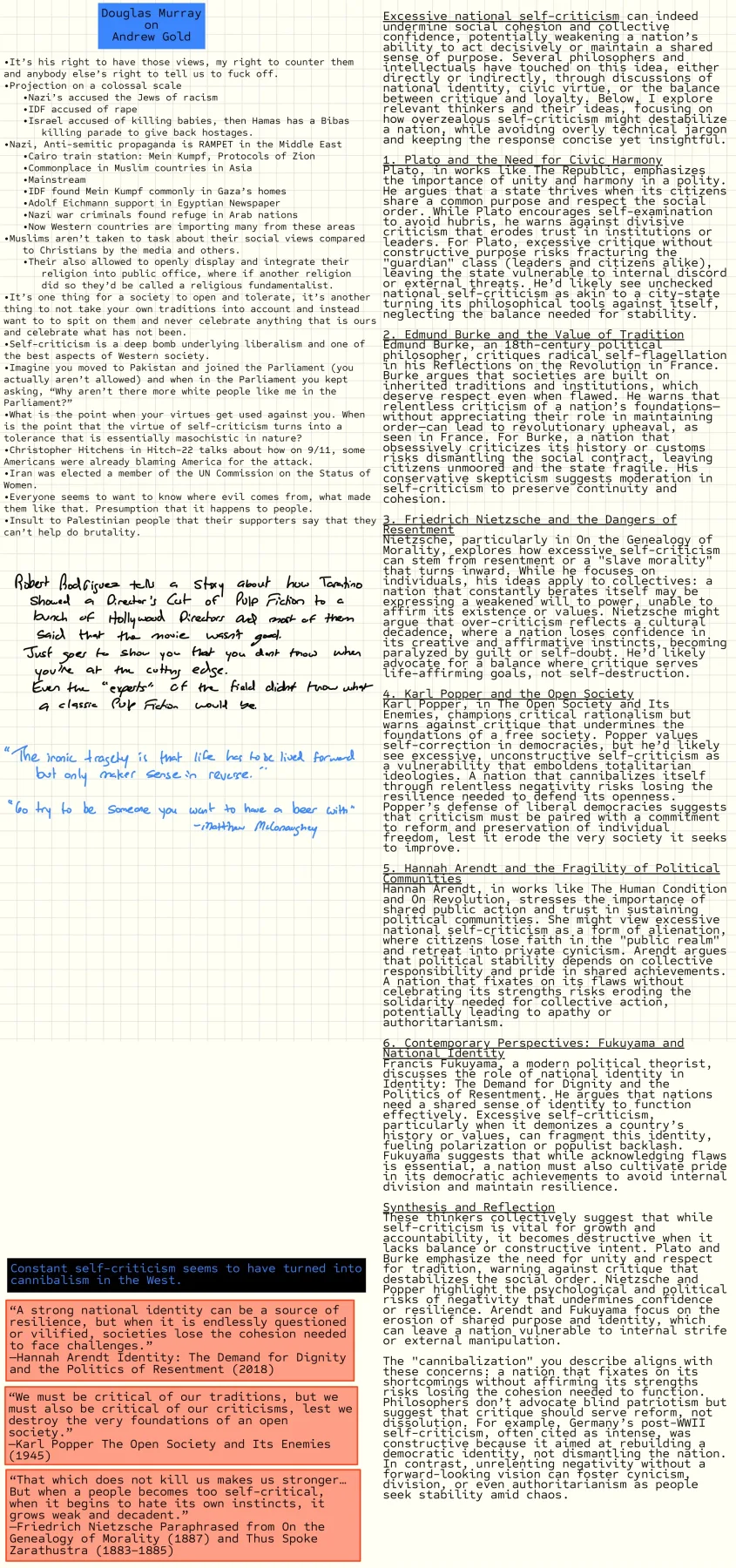
Captured national self-criticism clip
Capture provenance — Excessive National Self-Criticism
Original location: 90 Notes/Excessive National Self-Criticism.md. Filed on 2026-10-06. The material below is preserved from the capture; relocation does not independently verify its claims or attributions.
Original properties:
up: - "[[Politics MOC]]"date created: Monday, May 13th 2024, 5:20:30 pmdate modified: Monday, May 13th 2024, 5:24:53 pmrelated: - "[[60.9.3.4 Political Philosophy]]"Genre: URL: tags: - wokeCategory: