Pinker’s supplement — violence as a strategy, not hydraulic pressure
Pinker rejects the picture of violence as an inner pressure that must be released. Because targets can retaliate, he argues, violence is more often conditional: actors use it when expected benefits appear to exceed expected costs. Hobbes’s three motives become a compact causal map—gain through predation, safety through preemption, and credibility through retaliation for insults or attacks. The last motive can create self-sustaining revenge cycles because each side experiences its own violence as justified response and the other side’s as unprovoked aggression. Pinker also cites a cross-cultural survey in which 95% of the sampled societies explicitly endorsed taking a life for a life; that is best read as a reported coding result, not a timeless universal.
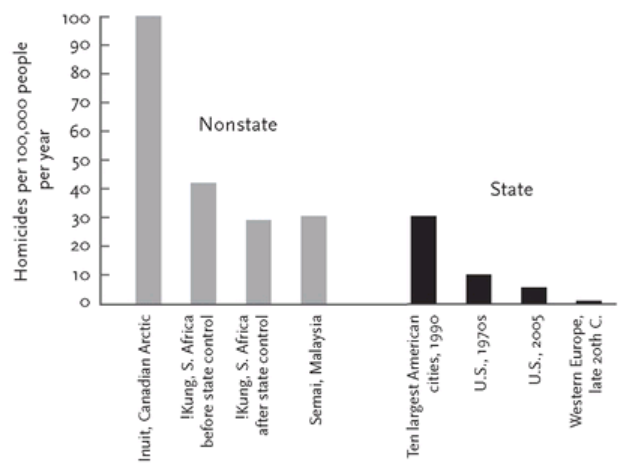
Figure 2-4 — homicide rates in selected low-violence nonstate societies and state benchmarks. Pinker uses the figure to show why labels such as “peaceful” need a denominator: a small number of killings in a small population can still yield a high per-capita rate. But the selected cases, small denominators, comparison years, and quality of historical counts limit what the graph can establish. It is evidence for a mechanism and a comparative pattern, not a diagnosis of any present ideology or population. Chapter 2 synthesis · Attachment (file not included in this release) · Attachment (file not included in this release) · Attachment (file not included in this release) · Attachment (file not included in this release)
Pinker’s Chapter 3 supplement — violence can be private “justice”
Drawing on Donald Black’s “Crime as Social Control,” Pinker reports that perhaps as few as 10% of homicides are purely instrumental—for example, killing a witness during a robbery. Many more arise from quarrels, jealousy, punishment, revenge, defense, or retaliation for humiliation. From the perpetrator’s viewpoint, the act may feel like deserved sanction: a private citizen becomes judge, jury, and executioner. Violence can therefore reflect not only a deficit of morality but a surfeit of moral certainty joined to a refusal of impartial adjudication.
The institutional implication is especially relevant to political violence. People become “effectively stateless” when they cannot safely use courts—because their market is illegal, enforcement is corrupt or hostile, or they expect authorities to ignore their grievance. Honor and retaliatory credibility then substitute for law. Ideology can perform a similar move by declaring ordinary institutions illegitimate and recasting violence as corrective justice.
Evidence boundary: motive categories are contestable, and Pinker is synthesizing criminological work available in 2011. The mechanism does not imply that every act described as resistance is equivalent, that perpetrators’ moral narratives are true, or that poverty and discrimination are irrelevant; it identifies one pathway by which grievance becomes self-authorized punishment. Chapter 3 synthesis · Attachment (file not included in this release) · Attachment (file not included in this release) · Attachment (file not included in this release)
Pinker’s Chapter 4 supplement — fragile beliefs can turn disagreement into existential threat
Pinker adds an epistemic-status pathway to political violence. A belief can anchor competence, dignity, leadership, and group membership. When its basis is difficult to demonstrate publicly, a credible dissenter threatens not only the proposition but the believer’s standing and the institutions organized around it. Coercion then becomes a way to remove the humiliating counterexample that persuasion cannot defeat.
Witchcraft accusations show how the pathway can scale: unexplained harm is assigned to a hidden agent; the claim cannot be disproved; rivals or unsupported outsiders become convenient suspects; coerced confessions name new enemies; and reluctance to join the denunciation becomes suspicious. The mechanism is useful for analyzing conspiratorial politics and purity spirals, but it is not a diagnosis of any particular religion, movement, or disputed claim. Its application requires evidence that the belief is insulated from disconfirmation and that dissent is actually being converted into permission for force. Chapter 4 synthesis · Attachment (file not included in this release) · Attachment (file not included in this release) · Attachment (file not included in this release)
Pinker’s Chapter 8 supplement — identify the operating “demon”
Pinker’s five-part taxonomy prevents “political violence” from becoming one catch-all explanation:
- Predation treats harm as a means to money, territory, compliance, concealment, or another advantage.
- Dominance turns rank, humiliation, prestige, or group standing into stakes worth fighting over.
- Revenge treats retaliation as deserved payment and deterrent reputation.
- Sadism makes suffering itself rewarding, often after power, repetition, secrecy, and peer reinforcement weaken revulsion.
- Ideology authorizes unlimited present harm for a sacred or utopian future good.
The categories can overlap, and they do not identify fixed kinds of people. A movement may use ideological language while leaders pursue status, foot soldiers conform, and institutions create opportunities for predation or cruelty. The analytic task is to identify the mechanism actually doing causal work and then match the restraint: detection and incentives for predation; face-saving and plural identities for dominance; impartial adjudication for revenge; transparency and accountability for sadism; dissent, open information, and revisable ends for ideology. This is a source-derived framework, not a diagnosis of every movement named elsewhere in this note. Chapter 8 synthesis · Attachment (file not included in this release) · Attachment (file not included in this release) · Attachment (file not included in this release) · Attachment (file not included in this release) · Attachment (file not included in this release)
Pinker’s Chapter 9 supplement — falling rhetorical complexity can be a warning, not a verdict
Pinker summarizes Philip Tetlock and Peter Suedfeld’s measure of integrative complexity. Low-complexity rhetoric states one position in absolute terms; higher-complexity rhetoric differentiates credible viewpoints, relates them through tradeoffs, and sometimes integrates them under a broader principle. In the twentieth-century crises they coded, declining complexity in leaders’ speeches was associated with war, including in Arab–Israeli and U.S.–Soviet confrontations.
The causal direction is unresolved. Actors may become unable to imagine compromise, or they may simplify public language strategically after deciding to escalate; both processes can occur. Integrative complexity is also not truth, moral equivalence, or moderation for its own sake—a nuanced falsehood remains false, and a clear boundary can be justified. Its practical use is as a change signal: when qualifications, competing perspectives, and face-saving options disappear from elite discourse, independently check whether bargaining space is collapsing and whether violence is being recast as the only coherent choice. Do not infer violent intent from writing style alone. Chapter 9 synthesis · Attachment (file not included in this release) · Attachment (file not included in this release)
Foundations of their Thinking
- All morals and civilizations I don’t like are guises for power.
- My failure is the result of one of those corrupt power systems. I have the victim, I am being targeted.
- If there is a great conspiracy that is targeting me for destruction, I must respond in kind with violence.
Main Ideologies
Trans/Marxist
- Trans
- Your argument about biology, that that argument is in fact a guise for power. Just saying that because you hate me
- You wish to erase me.
- Trans-genocide
- Speech a form of violence so should be meet with violence
- Marxist
- My failures a fault of the system
- Destroying me
White Supremacist
- White people are being destroyed in the US by an entire system
- White genocide
- Violence proper response to attempted genocide
Radical Muslims
- Failure of Palestinians is because of the West