These volumes’ chapter headings already link to this note; these are the return links.
Evans — A History of Western Philosophy
A History of Western Philosophy - C Stephen Evans — Chapter 19 – German Idealism and Georg Wilhelm Friedrich Hegel (heading contains links, so it can’t be anchored; search the title inside the note)
Biography
Georg Wilhelm Friedrich Hegel (1770–1831) was a German philosopher, one of the most influential figures in German Idealism. Born in Stuttgart, he studied theology and philosophy at the Tübinger Stift, where he befriended Schelling and the poet Hölderlin. After working as a tutor and lecturer, he became professor of philosophy at Heidelberg and then Berlin, where he became the leading philosopher of his age. Hegel is best known for his dialectical method, his philosophy of history, and his system that sought to reconcile reason, freedom, and reality. His major works include The Phenomenology of Spirit (1807), Science of Logic (1812–1813), Philosophy of Right (1820), and his lectures on history, religion, and aesthetics.
Life
Early Years (1770–1793): Born in Stuttgart; studied at Tübingen with Hölderlin and Schelling; influenced by Enlightenment and French Revolution.
Early Career (1793–1806): Worked as tutor; collaborated with Schelling; wrote early theological and political works; Phenomenology of Spirit published in 1807.
Academic Career (1807–1831): Professorships at Jena, Heidelberg, and Berlin; systematized his philosophy in Logic, Encyclopaedia, and Philosophy of Right.
Death (1831): Died of cholera in Berlin; left a legacy that dominated 19th-century European philosophy.
Impact on Philosophy
German Idealism: Completed the trajectory from Kant through Fichte and Schelling by developing an all-encompassing philosophical system.
Dialectical Method: Introduced a dynamic view of reality as evolving through contradictions and resolutions.
Philosophy of History: Argued history is the unfolding of freedom, with reason guiding the progress of Spirit (Geist).
Political Philosophy: Justified constitutional monarchy and the modern state as expressions of rational freedom.
Legacy: Influenced Marxism, existentialism, phenomenology, theology, and political theory. Both right- and left-Hegelians drew radically different lessons from his thought.
Concepts
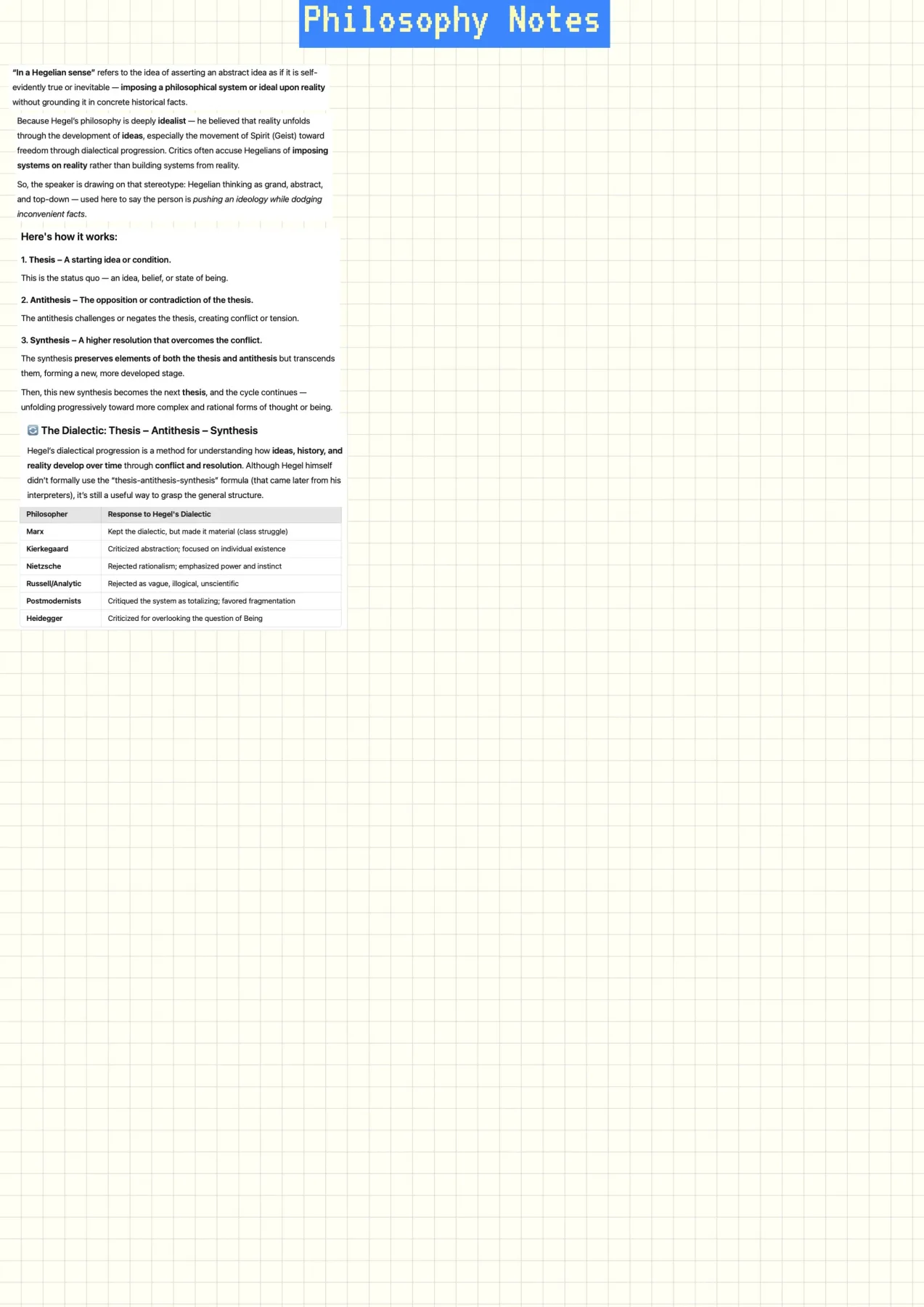
Dialectic
Definition: Development through contradiction and resolution (often described as thesis–antithesis–synthesis, though Hegel himself didn’t use this exact formula).
Example: Master–slave dialectic in Phenomenology of Spirit shows how self-consciousness arises through conflict and recognition.
Absolute Idealism
Definition: Reality is rational and structured by Spirit (Geist); the distinctions between subject and object, thought and being, are reconciled in the Absolute.
Example: Knowledge isn’t just correspondence but the self-realization of Spirit through history and culture.
Phenomenology of Spirit
Definition: Traces the development of consciousness from sense perception to absolute knowing.
Example: Stages include sense-certainty, self-consciousness, reason, and ultimately Spirit recognizing itself.
Freedom as Historical Development
Definition: Freedom is not merely individual choice but realized in ethical life (Sittlichkeit) through family, civil society, and the state.
Example: In Philosophy of Right, Hegel sees the rational modern state as the culmination of freedom.
Philosophy of History
Definition: History has a rational direction—the progress of human freedom.
Example: Ancient Oriental societies recognized freedom for one; Greece and Rome for some; modern states for all.
The State as Rational
Definition: The state is the embodiment of ethical life, not a mere contract but an expression of collective freedom.
Example: Hegel defends constitutional monarchy as balancing universal reason with particular interests.
Civil society §§243–248 and divergent political afterlives
In §§243–245 of the Philosophy of Right, Hegel identifies a contradiction inside modern civil society: expanding wealth and production can coexist with a mass unable to secure the material standing and social recognition required for membership. Poverty becomes a “rabble” problem when exclusion produces alienation from society’s norms and resentment toward the wealthy. Direct relief can undermine the principle of independence through work, while creating more work can aggravate overproduction.
Sections 246–248 push civil society outward toward foreign markets, maritime commerce, and colonization. The sea is industry’s medium of communication; colonization offers some people land while providing society with new demand and fields of production. This is not a demonstrated final solution: it can displace and reproduce the contradiction elsewhere.
These passages have distinct afterlives:
Marx: Hegel’s account of civil society, contradiction, labor, poverty, and exclusion is an important background to Marx. But Marx’s surviving 1843 Critique of Hegel’s Philosophy of Right comments on §§261–313, not §§243–248, and Marx’s mature political economy cannot be derived from this passage alone.
Schmitt: The article analyzed in It's Not All Hegel, But It's a Lot Hegel - James Lindsay reports that Schmitt’s Land and Sea afterword explicitly invokes §247 as a programmatic prompt. That precise edition/page still needs verification; Schmitt’s wider spatial theory also draws on Hobbes, international law, the Monroe Doctrine, geopolitics, Weimar, and Versailles.
Dugin: Dugin directly invokes Hegelian history and empire while combining Schmittian land/sea geopolitics, “large spaces,” Heidegger, Traditionalism, and selected Marxist criticism.
Genealogy is not identity
Hegel’s influence on mutually opposed movements does not make those movements equivalent or make every theory of contradiction “Hegelian” in the same sense. Establish the exact concept, text, intermediary, and political transformation before inferring a lineage.
Criticisms of Hegel
Obscurity & System-Building
Hegel’s dense, often opaque style has been criticized as unnecessarily convoluted.
Critique: Schopenhauer mocked him as an obscurantist; analytic philosophers often dismiss him as unclear.
Determinism in History
His philosophy of history suggests an inevitable march of freedom, which critics see as teleological and overly Eurocentric.
Critique: Modern historians reject the idea that history has a predetermined rational direction.
Political Conservatism
While radical followers (Young Hegelians, Marx) drew revolutionary lessons, Hegel himself defended the Prussian state.
Critique: Some accuse him of justifying authoritarianism by calling the state the embodiment of reason.
Abstract Spirit vs. Lived Experience
Hegel’s focus on Spirit and universals is seen as neglecting concrete human suffering and individuality.
Critique: Kierkegaard rejected Hegel’s “system” for overlooking the individual and existential anxiety.
Misuse by Later Movements
His dialectical method influenced Marx, but also later nationalists and authoritarian thinkers who invoked his justification of the state.
Critique: His legacy is divided—both leftist revolutionaries and rightist conservatives claimed him.
Methodological Vagueness
The dialectical process can appear too flexible, allowing almost any development to be rationalized as “necessary.”
Critique: Popper accused Hegel of pseudo-science and historicism, making unfalsifiable claims about history.
References
Hegel, G.W.F. Phenomenology of Spirit (1807).
Hegel, G.W.F. Science of Logic (1812–1813).
Hegel, G.W.F. Encyclopaedia of the Philosophical Sciences (1817).
Hegel, G.W.F. Philosophy of Right (1820).
Taylor, Charles. Hegel (1975).
Pinkard, Terry. Hegel: A Biography (2000).
Captured Hegelian terminology clip
Capture provenance — Term - In a Hegelian Sense
Original location: 90 Notes/Term - In a Hegelian Sense.md. Filed on 2026-10-06. The material below is preserved from the capture; relocation does not independently verify its claims or attributions.
Original properties:
up: - "[[60.9 Philosophy]]"date created: Monday, May 13th 2024, 5:20:30 pmdate modified: Monday, May 13th 2024, 5:24:53 pmrelated:Genre:URL:tags:Category: