Biography
Thomas Hobbes (1588–1679) was an English philosopher and political theorist, best known for his social contract theory and defense of absolute sovereignty. Born in Westport, Wiltshire, he studied at Oxford and became tutor to the Cavendish family, which gave him access to intellectual and political circles. Hobbes lived through the English Civil War (1642–1651), which shaped his bleak view of human nature and his defense of strong centralized authority. His major work, Leviathan (1651), laid out his political philosophy, arguing that in the state of nature human life would be “solitary, poor, nasty, brutish, and short.”
Life
- Early Years (1588–1608): Born prematurely during the fear of Spanish invasion; educated at Oxford; became tutor to aristocratic families.
- European Travels (1610s–1630s): Traveled across Europe; met Galileo, Descartes, and other leading thinkers; developed interests in mathematics and natural science.
- Civil War Period (1640s): Exiled in Paris; associated with royalists; began developing his social contract theory during English political upheaval.
- Major Works (1651–1679): Published Leviathan (1651), De Cive (1642), and Behemoth (1668); returned to England under Cromwell’s rule, later reconciled with monarchy.
- Death (1679): Died at 91; remembered as one of the founders of modern political philosophy.
Impact on Philosophy
- Social Contract Theory: Helped establish contractarian political thought later developed by Locke and Rousseau.
- Sovereignty & State Power: Early theorist of the modern state as guarantor of order and security.
- Scientific Materialism: Applied mechanistic principles to human behavior and society.
- Legacy: Influenced liberalism, realism in international relations, and debates over authority, liberty, and human nature.
Concepts
- State of Nature
- Definition: A hypothetical pre-political condition where humans live without authority or laws.
- Example: In this condition, competition, diffidence, and glory-seeking lead to conflict.
- War of All Against All (bellum omnium contra omnes)
- Definition: Without government, humans exist in constant fear and danger of violent death.
- Example: Life in the state of nature is “solitary, poor, nasty, brutish, and short.”
- Social Contract
- Definition: Individuals collectively agree to surrender their natural freedoms to a sovereign for peace and protection.
- Example: Citizens obey laws in exchange for security provided by the state.
- Leviathan (Sovereign Authority)
- Definition: A powerful sovereign (monarch or assembly) is necessary to maintain order and prevent chaos.
- Example: Sovereign power must be absolute to prevent relapse into the state of nature.
- Materialism & Mechanistic Human Nature
- Definition: Human beings are matter in motion, driven by appetites and aversions.
- Example: Desire for power and fear of death motivate human action.
- Law of Nature
- Definition: Rational precepts that guide self-preservation and peace.
- Example: Seek peace, keep covenants, and show gratitude.
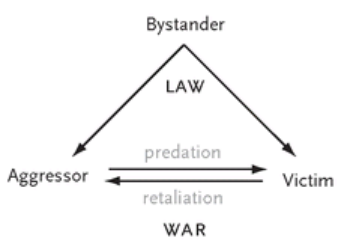
Figure 2-1 — From Hobbes’s three quarrels to third-party law
Pinker translates Hobbes’s competition, diffidence, and glory into three strategic incentives: gain, safety through preemption, and reputation or credibility. The third party in the triangle changes those incentives by punishing aggression and replacing private retaliation with adjudication—Pinker’s compact formulation is that violence between the first two parties is war, while intervention by the third is law.
Interpretive boundary: this is a mechanism for why credible, comparatively impartial enforcement may reduce violence; it does not establish that monarchy, absolute sovereignty, or unchecked state power is necessary or legitimate. Chapter 2 synthesis · Chapter 2, Figure 2-1, PDF pp. 65–69 (file not included in this release)
Pinker’s Chapter 10 supplement — Leviathan works through calibrated third-party power
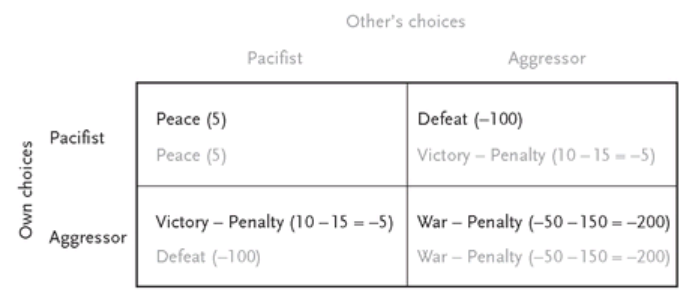
Figure 10-2 — How a Leviathan resolves the Pacifist’s Dilemma. A comparatively disinterested authority can make aggression less rewarding, reduce each side’s need to preempt or retaliate privately, and help restraint become habitual. Pinker extends the mechanism beyond physical coercion: reputation, ostracism, international organizations, sanctions, and peacekeepers can sometimes function as weaker third parties where no world sovereign exists.
The sword is therefore not sufficient. If a state applies force indiscriminately—punishing peaceful and aggressive conduct alike—it can produce as much violence as it suppresses. Pinker’s own boundary favors legitimate, discriminating enforcement over Hobbesian absolutism: enough capacity to deter predation, but constraints and calibration that keep the enforcer from becoming the principal predator. Chapter 10 synthesis · Leviathan mechanism, PDF pp. 931–932 (file not included in this release) · Soft power and indiscriminate-force limit, PDF p. 933 (file not included in this release)
Main Arguments Between Descartes and Hobbes
1. On Thought and Existence (Cogito)
- Descartes: In Meditations II, Descartes argues: “I think, therefore I am” (cogito ergo sum). Thought is the essence of the self; the mind exists independently of the body.
- Hobbes: He challenges this. For Hobbes, “thinking” is just motion in the body (a material process). He questions whether Descartes has truly proven that an incorporeal “thinking substance” exists.
- Dispute: Descartes insists on a non-material mind; Hobbes denies immaterial substances altogether.
2. On the Nature of Mind and Body
- Descartes: The mind (res cogitans) is a distinct, immaterial substance, separate from the body (res extensa).
- Hobbes: Rejects this dualism. He argues all that exists is body (matter in motion). To call something immaterial is to say it is nothing.
- Dispute: Hobbes says Descartes’ division is incoherent — you can’t make sense of an immaterial “thinking thing.”
3. On God’s Existence
- Descartes: Uses the ontological argument (from the concept of God) and the causal argument (idea of a perfect being must have come from a perfect cause).
- Hobbes: Dismisses both. He says ideas are just phantasms (mental images) caused by motion; we cannot infer from an idea that a corresponding perfect being must exist. For Hobbes, God exists but cannot be proven by Descartes’ rationalist arguments — only accepted as an article of faith.
- Dispute: Rational proof of God vs. skepticism about abstract metaphysical reasoning.
4. On Clear and Distinct Ideas
- Descartes: Certainty is guaranteed when we perceive something clearly and distinctly.
- Hobbes: Argues clarity is subjective — what seems clear may not be true. He prefers definitions derived from human convention and science (geometry as a model).
- Dispute: Descartes trusts mental intuition; Hobbes trusts definitions and empirical science.
5. On Infinity and the Nature of Ideas
- Descartes: Claims we have an idea of infinity (God) that must come from an infinite being.
- Hobbes: Denies this. We have no positive idea of infinity, only an indefinite ability to keep adding or imagining. Infinity is a negative concept (not bounded), not proof of God.
6. On Liberty and Will
- Descartes: Free will is evidence of God’s image in us. Our ability to choose demonstrates immateriality of the mind.
- Hobbes: Freedom is merely the absence of external impediments. Choice is determined by desire and aversion (mechanistic psychology).
- Dispute: Libertarian freedom vs. materialist determinism.
The Big Picture
- Descartes: Rationalist, dualist, metaphysical — sees philosophy as grounded in certain intuitions, separating soul from body.
- Hobbes: Materialist, mechanistic, skeptical — wants philosophy to be modeled on geometry and physics, reducing mind and will to motions of matter.
Their exchange foreshadows later debates: - Rationalism vs. empiricism.
- Dualism vs. materialism.
- Metaphysical certainty vs. scientific method.
Criticisms of Hobbes
- Bleak View of Human Nature
- Critique: Hobbes is accused of exaggerating human selfishness and violence; Locke and Rousseau offered more optimistic alternatives.
- Absolute Sovereignty
- Critique: His defense of absolute power risks justifying tyranny, since subjects have little recourse against unjust rulers.
- Neglect of Liberty
- Critique: Defines liberty narrowly as absence of external impediments, ignoring broader notions of political freedom.
- Religious Ambiguities
- Critique: Though critical of religious authority, Hobbes tried to reconcile Christianity with his political philosophy, leaving tensions.
- Scientific Reductionism
- Critique: His mechanistic psychology oversimplifies human motivation, ignoring altruism, culture, and complexity of desires.
- Historical Application
- Critique: The English Civil War deeply influenced his pessimism, raising questions about the universality of his theory.
- International Relations
- Critique: His framework implies international politics remains a state of nature, but critics argue for cooperation and institutions.
References
- Hobbes, Thomas. Leviathan (1651).
- Hobbes, Thomas. De Cive (1642).
- Hobbes, Thomas. Behemoth (1668).
- Tuck, Richard. Hobbes: A Very Short Introduction (2002).
- Skinner, Quentin. Reason and Rhetoric in the Philosophy of Hobbes (1996).
- Strauss, Leo. The Political Philosophy of Hobbes (1936).
Foundations of Modern Social Thought - Yale#2 Thomas Hobbes Authority Human Rights and Social Order