Filed with Concepts & Theories (MOC) · Related: 60.9 Philosophy · Political Philosophy (MOC)
Pinker’s Chapter 8 supplement — revenge, forgiveness, and iterated cooperation
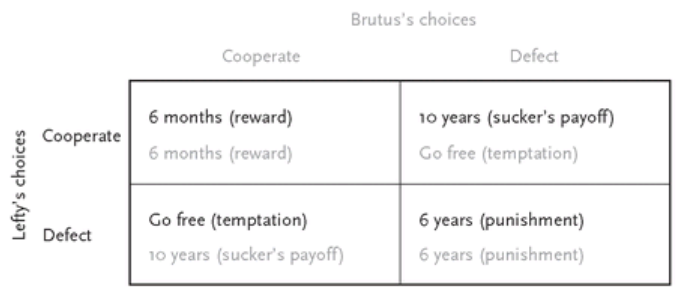
Figure 8-5 makes the one-shot Prisoner’s Dilemma concrete: mutual cooperation gives both prisoners six months, unilateral defection frees the defector and gives the cooperator ten years, and mutual defection gives both six years. Individual incentive therefore selects an outcome worse for both. Pinker uses the game to explain why revenge can function as deterrence rather than mere spite when encounters repeat.
Figure 8-5 — The Prisoner’s Dilemma payoff matrix. In repeated play, Pinker highlights four features of Tit for Tat: it begins cooperatively, is easy to read, retaliates after defection, and forgives immediately after renewed cooperation. He then preserves an important complication: accidental or misread defections can trap two Tit-for-Tat players in needless retaliation. Generous Tit for Tat occasionally forgives an apparent defection, while Contrite Tit for Tat remembers when its own error caused the cycle and accepts justified retaliation before resetting cooperation. These are model lessons, not a universal recipe for diplomacy or intimate relationships; real actors have unequal power, uncertain payoffs, multiple audiences, and disputed histories. Chapter 8 synthesis · Figure 8-5 and the one-shot dilemma, PDF pp. 735–736 (file not included in this release) · Tit for Tat, PDF pp. 736–738 (file not included in this release) · Generous and Contrite Tit for Tat, PDF pp. 738–739 (file not included in this release)
Pinker’s Chapter 10 supplement — the Pacifist’s Dilemma is a heuristic, not a forecast
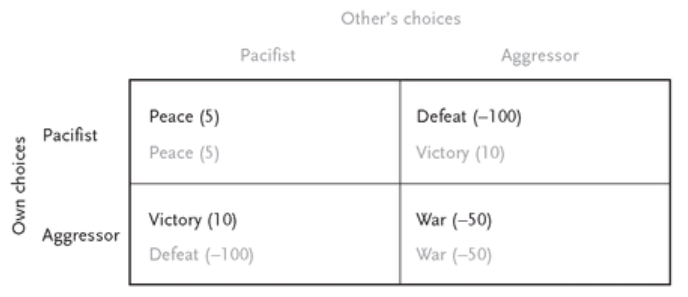
Pinker relabels the Prisoner’s Dilemma to isolate the strategic obstacle to peace. If the other side stays peaceful, aggression can promise victory; if it attacks, aggression can avoid the much worse “sucker” outcome of unilateral vulnerability. Yet mutual aggression leaves both worse off than mutual restraint, and the victim’s loss ordinarily exceeds the aggressor’s gain, making violence negative-sum at the level of the two parties together.
Figure 10-1 — The Pacifist’s Dilemma. Pinker says the numbers are arbitrary and the matrix is not a fitted mathematical model. Its value is diagnostic: pacifist exhortation fails when it leaves the other side’s incentives unchanged, while third-party enforcement, commerce, wider concern, and impartial institutional design can alter different cells of the game. Real conflicts still require actor-specific payoffs, information, power, and chronology before the heuristic can explain anything. Chapter 10 synthesis · Figure 10-1 and model boundary, PDF p. 929 (file not included in this release) · Negative-sum violence and unilateral pacifism, PDF pp. 930–931 (file not included in this release)
Understanding Game Theory
Game theory is a branch of mathematics and economics that studies strategic interactions among rational decision-makers. It provides a formal framework for analyzing situations where the outcome of one participant’s decision depends on the decisions made by others. Here, we will delve into the key concepts, historical development, and applications of game theory.
Key Concepts in Game Theory
1. Players:
Players are the decision-makers in a game. They can be individuals, groups, firms, or any entities making strategic decisions.
2. Strategies:
A strategy is a complete plan of action a player will follow in a given game. Strategies can be pure (a specific action) or mixed (a probabilistic combination of actions).
3. Payoffs:
Payoffs are the rewards or outcomes that players receive as a result of the strategies they choose. These are often represented in terms of utility or profit.
4. Games:
Games can be classified based on several criteria:
- Cooperative vs. Non-Cooperative: In cooperative games, players can form binding agreements, while in non-cooperative games, they cannot.
- Zero-Sum vs. Non-Zero-Sum: In zero-sum games, one player’s gain is exactly another player’s loss. In non-zero-sum games, the total payoff can vary, allowing for win-win scenarios.
- Simultaneous vs. Sequential: In simultaneous games, players make decisions at the same time. In sequential games, players make decisions one after another.
5. Nash Equilibrium:
A Nash equilibrium is a set of strategies where no player can benefit by unilaterally changing their strategy, given the strategies of the other players. It represents a stable state of the game where players’ strategies are mutually consistent.
Historical Development
Game theory has a rich history, with contributions from various mathematicians and economists:
- Early Foundations: The roots of game theory can be traced back to the works of Pascal, Huygens, and Waldegrave in the 17th and 18th centuries, who explored concepts related to games of chance and strategic decision-making[2].
- John von Neumann and Oskar Morgenstern: The formal foundation of game theory was laid by John von Neumann and Oskar Morgenstern in their 1944 book Theory of Games and Economic Behavior. They introduced the concept of utility and provided methods for analyzing zero-sum games[2].
- John Nash: In the 1950s, John Nash expanded the scope of game theory by developing the concept of Nash equilibrium, applicable to a broader range of games, including non-zero-sum and multiplayer games[2].
Applications of Game Theory
Game theory has wide-ranging applications across various fields:
1. Economics and Business:
- Market Competition: Firms use game theory to strategize pricing, product launches, and market entry.
- Auctions: Auction designs, such as those used for selling government bonds or spectrum licenses, are based on game-theoretic principles[7].
2. Political Science:
- Voting Systems: Game theory helps in understanding strategic voting and coalition formation.
- International Relations: It is used to analyze negotiations, treaties, and conflicts between countries[7].
3. Biology:
- Evolutionary Biology: Game theory models the evolution of behaviors and strategies in animals, such as cooperation and competition[3].
4. Computer Science:
- Algorithm Design: Game theory informs the design of algorithms for network routing, resource allocation, and optimization[7].
5. Psychology and Sociology:
- Social Interactions: It helps in understanding human behavior in social settings, such as cooperation, trust, and conflict resolution[5].
Real-Life Examples
1. The Prisoner’s Dilemma:
A classic example where two individuals must decide whether to cooperate or defect. The optimal strategy often leads to a suboptimal outcome for both, illustrating the conflict between individual rationality and collective benefit[9].
2. The Stag Hunt:
This game illustrates the conflict between safety and social cooperation. Players must choose between hunting a stag (requiring cooperation) or a hare (individual but less rewarding)[6].
Learning Resources
For those interested in diving deeper into game theory, several resources are available:
-
Books:
- Game Theory by Drew Fudenberg and Jean Tirole
- A Course in Game Theory by Martin J. Osborne and Ariel Rubinstein
- Game Theory: Analysis of Conflict by Roger B. Myerson[8][11]
-
Online Courses:
- William Spaniel’s Game Theory 101 courses
- Various MOOCs on platforms like Coursera and edX[4]
-
Websites:
- Game Theory .net offers educational resources, interactive applets, and lecture notes for both students and educators[12].
Game theory provides a powerful toolkit for analyzing strategic interactions in diverse fields, offering insights into optimal decision-making and the dynamics of competition and cooperation.
Citations:
[1] https://www.investopedia.com/terms/g/gametheory.asp
[2] https://en.wikipedia.org/wiki/Game_theory
[3] https://www.reddit.com/r/GAMETHEORY/comments/nv175b/game_theory_applied_to_real_life/
[4] https://www.reddit.com/r/GAMETHEORY/comments/aenbqh/best_resources_for_learning_about_game_theory/
[5] https://www.business-to-you.com/introduction-game-theory-the-basics/
[6] https://plato.stanford.edu/entries/game-theory/
[7] https://www.geeksforgeeks.org/real-life-applications-of-game-theory/
[8] https://math.stackexchange.com/questions/3779545/books-for-game-theory
[9] https://faculty.sites.iastate.edu/tesfatsi/files/inline-files/GameDef.pdf
[10] https://sophia.stkate.edu/cgi/viewcontent.cgi?article=1078&context=undergraduate_research_symposium
[11] https://gametheorysociety.org/resources/
[12] https://www.gametheory.net